AB 987: Vehicles: storage and towing.
- Session Year: 2025-2026
- House: Assembly
- Latest Version Date: 2025-10-06
Current Status:
Passed
(2025-10-06: Chaptered by Secretary of State - Chapter 345, Statutes of 2025.)
Introduced
In Committee
Awaiting First Chamber Vote
Passed First Chamber
In Committee
Awaiting Second Chamber Vote
Passed Second Chamber
Enacted
What does this bill do?
The bill expands the list of towing and storage fees that are presumed unreasonable, adding storage charges on state holidays that exceed the posted daily rate and towing charges when police direct a tow truck to move a vehicle to clear a roadway during a state or local emergency. It also shields tow operators who act in good faith while moving vehicles under those police directions from civil liability for property damage, unless they act with gross negligence (serious carelessness) or deliberate harmful conduct.
The summary is provided by generative AI which can make mistakes. For original language, please view the details in the table below.
Under existing law, when a vehicle has been towed and stored, the legal owner may only be charged a storage fee during the first 15 days of possession, and beyond the first 15 days, only for any time after 3 days have lapsed after written notification has been made to the legal owner, as specified. Existing law requires that fees charged under these provisions for storage and towing be reasonable.
Existing law makes an insurer that is responsible for reasonable storage and towing charges liable to the person providing those services when a vehicle is towed and stored as a result of an accident or stolen recovery, as specified. Existing law requires that these storage and towing fees be reasonable and enumerates a list of fees that are presumptively unreasonable.
This bill would expand the list of presumptively unreasonable fees for purposes of the provisions described above to include, among other things, storage fees charged for state holidays that exceed the posted standard daily storage rate and towing fees charged when the owner or the operator of a tow truck is directed by a law enforcement officer to remove a vehicle at the scene of a state or local emergency, as specified.
Under existing law, when a vehicle has been towed and stored, the legal owner may only be charged a storage fee during the first 15 days of possession, and beyond the first 15 days, only for any time after 3 days have lapsed after written notification has been made to the legal owner, as specified. Existing law requires that fees charged under these provisions for storage and towing be reasonable.
Existing law makes an insurer that is responsible for reasonable storage and towing charges liable to the person providing those services when a vehicle is towed and stored as a result of an accident or stolen recovery, as specified. Existing law requires that these storage and towing fees be reasonable and enumerates a list of fees that are presumptively unreasonable.
This bill would expand the list of presumptively unreasonable fees for purposes of the provisions described above to include, among other things, storage fees charged for state holidays that exceed the posted standard daily storage rate and towing fees charged when the owner or the operator of a tow truck is directed by a law enforcement officer to remove their a vehicle at the scene of a state or local emergency, as specified.
Under existing law, when a vehicle has been towed and stored, the legal owner may only be charged a storage fee during the first 15 days of possession, and beyond the first 15 days, only for any time after 3 days have lapsed after written notification has been made to the legal owner, as specified. Existing law requires that fees charged under these provisions for storage and towing be reasonable.
Existing law makes an insurer that is responsible for reasonable storage and towing charges liable to the person providing those services when a vehicle is towed and stored as a result of an accident or stolen recovery, as specified. Existing law requires that these storage and towing fees be reasonable and enumerates a list of fees that are presumptively unreasonable.
This bill would expand the list of presumptively unreasonable fees for purposes of the provisions described above to include, among other things, storage fees charged for state holidays that exceed the posted standard daily storage rate and towing fees charged when the owner is directed by a law enforcement officer to remove their vehicle at the scene of a state or local emergency, as specified.
Under existing law, when a vehicle has been towed and stored, the legal owner may only be charged a storage fee during the first 15 days of possession, and beyond the first 15 days, only for any time after 3 days have lapsed after written notification has been made to the legal owner, as specified. Existing law requires that fees charged under these provisions for storage and towing be reasonable.
Existing law makes an insurer that is responsible for reasonable storage and towing charges liable to the person providing those services when a vehicle is towed and stored as a result of an accident or stolen recovery, as specified. Existing law requires that these storage and towing fees be reasonable and enumerates a list of fees that are presumptively unreasonable.
This bill would expand the list of presumptively unreasonable fees for purposes of the provisions described above to include, among other things, fees for holiday hours and fees assessed on vehicles in emergency situations where the owner or insurer of the vehicle was not at fault. storage fees charged for state holidays that exceed the posted standard daily storage rate and towing fees charged when the owner is directed by a law enforcement officer to remove their vehicle at the scene of a state or local emergency, as specified.
Under existing law, when a vehicle has been towed and stored, the legal owner may only be charged a storage fee during the first 15 days of possession, and beyond the first 15 days, only for any time after 3 days have lapsed after written notification has been made to the legal owner, as specified. Existing law requires that fees charged under these provisions for storage and towing be reasonable.
Existing law makes an insurer that is responsible for reasonable storage and towing charges liable to the person providing those services when a vehicle is towed and stored as a result of an accident or stolen recovery, as specified. Existing law requires that these storage and towing fees be reasonable and enumerates a list of fees that are presumptively unreasonable.
This bill would expand the list of presumptively unreasonable fees for purposes of the provisions described above to include, among other things, fees for holiday hours and fees assessed on vehicles in emergency situations where the owner or insurer of the vehicle was not at fault.
Existing law imposes various requirements on tow truck operators relating to the removal of vehicles from private property, including requiring the operator to first obtain written authorization from the owner of the property and to provide notice to the owner of the vehicle, as specified.This bill would state the intent of the Legislature to enact legislation to ensure towing operators have reasonable standards.Existing law imposes various requirements on tow truck operators relating to the removal of vehicles from private property, including requiring the operator to first obtain written authorization from the owner of the property and to provide notice to the owner of the vehicle, as specified.
This bill would state the intent of the Legislature to enact legislation to ensure towing operators have reasonable standards.
(a)Whenever the name and address of the legal owner of a motor vehicle is known, or may be ascertained from the registration records in the vehicle or from the records of the Department of Motor Vehicles, no fee or service charge may be imposed upon the legal owner for the parking and storage of the motor vehicle except as follows: (1) The first 15 days of possession and (2) following that 15-day period, the period commencing 3 days after written notice is sent by the person in possession to the legal owner by certified mail, return receipt requested, and continuing for a period not to exceed any applicable time limit set forth in Section 3068 or 3068.1 of the Civil Code.
(b)The costs of notifying the legal owner may be charged as part of the storage fee when the motor vehicle has been stored for an indefinite period of time and notice is given no sooner than the third day of possession. This subdivision also applies if the legal owner refuses to claim possession of the motor vehicle.
(c)In any action brought by, or on behalf of, a legal owner of a motor vehicle to which subdivision (a) applies, to recover a motor vehicle alleged to be withheld by the person in possession of the motor vehicle by demanding storage fees or charges for any number of days in excess of that permitted pursuant to subdivision (a), the prevailing party shall be entitled to reasonable attorneys fees, not to exceed one thousand seven hundred fifty dollars ($1,750). The recovery of those fees is in addition to any other right, remedy, or cause of action of that party.
(d)All storage and towing fees charged to a legal owner of a motor vehicle shall be reasonable. The following rates and fees are presumptively unreasonable:
(1)Administrative or filing fees, except those incurred related to documentation from the Department of Motor Vehicles and those related to the lien sale of a vehicle.
(2)Security fees.
(3)Dolly fees.
(4)Load and unload fees.
(5)Pull-out fees.
(6)Gate fees, except when the owner or insurer of the vehicle requests that the vehicle be released outside of normal business hours.
(7)When gate fees are reasonably assessed, any additional towing fees that exceed 10 percent of the normal towing rate due to the call originating after normal business hours.
(8)Any storage fees charged for state holidays that exceed the posted standard daily storage rate.
(9)(A)Towing fees when the owner or the operator of a tow truck is directed by a law enforcement officer to remove a vehicle to the nearest shoulder or to level ground adjacent to the roadway for the sole purpose of clearing a roadway to facilitate access by an emergency vehicle at the scene of a state emergency, as defined in Section 8625 of the Government Code, or a local emergency, as defined in Section 8630 of the Government Code.
(B)An owner or operator of a tow truck that removes a vehicle under the circumstances described in subparagraph (A) and acts in good faith shall not be subject to civil liability for any damage to personal property that results from the removal of the vehicle.
(C)The limitation of liability described in subparagraph (B) shall not apply to an act or omission by an owner or operator of a tow truck that constitutes gross negligence or willful or wanton misconduct.
(10)Following a request from the vehicle owner to release their vehicle, and upon payment of all fees then due, storage fees for any day that a storage facility fails to release the vehicle.
(11)Storage fees in excess of 50 percent of the daily storage rate when a vehicle is recovered within the first four hours of storage.
(e)This section is not applicable to any motor vehicle stored by a levying officer acting under the authority of judicial process.
(f)Nothing in subdivision (d) prohibits any fees authorized in a written agreement between a law enforcement agency and a towing or storage company, including, but not limited to, official police garages operating under the jurisdiction of a municipal police commission, if the tow was initiated by the law enforcement agency.
(g)For purposes of this section, normal business hours means Monday through Friday from 8:00 a.m. to 5:00 p.m., inclusive, except for state holidays.
SEC. 2.Section 22524.5 of the Vehicle Code is amended to read:22524.5.(a)Any insurer that is responsible for coverage for ordinary and reasonable towing and storage charges under an automobile insurance policy to an insured or on behalf of an insured to a valid claimant, is liable for those charges to the person performing those services when a vehicle is towed and stored as a result of an accident or stolen recovery. The insurer may discharge the obligation by making payment to the person performing the towing and storage services or to the insured or on behalf of the insured to the claimant.
(b)Any insured or claimant who has received payment, which includes towing and storage charges, from an insurer for a loss relating to a vehicle is liable for those charges to the person performing those services.
(c)(1)All towing and storage fees charged when those services are performed as a result of an accident or recovery of a stolen vehicle shall be reasonable.
(2)(A)For purposes of this section, a towing and storage charge shall be deemed reasonable if it does not exceed those fees and rates charged for similar services provided in response to requests initiated by a public agency, including, but not limited to, the Department of the California Highway Patrol or local police department.
(B)A storage rate and fee shall also be deemed reasonable if it is comparable to storage-related rates and fees charged by other facilities in the same locale. This does not preclude a rate or fee that is higher or lower if it is otherwise reasonable.
(3)The following rates and fees are presumptively unreasonable:
(A)Administrative or filing fees, except those incurred related to documentation from the Department of Motor Vehicles and those related to the lien sale of a vehicle.
(B)Security fees.
(C)Dolly fees.
(D)Load and unload fees.
(E)Pull-out fees.
(F)Gate fees, except when the owner or insurer of the vehicle requests that the vehicle be released outside of normal business hours.
(G)When gate fees are reasonably assessed, any additional towing fees that exceed 10 percent of the normal towing rate due to the call originating after normal business hours.
(H)Any storage fees charged for state holidays that exceed the posted standard daily storage rate.
(I)(i)Towing fees when the owner or the operator of a tow truck is directed by a law enforcement officer to remove a vehicle to the nearest shoulder or to level ground adjacent to the roadway for the sole purpose of clearing a roadway to facilitate access by an emergency vehicle at the scene of a state emergency, as defined in Section 8625 of the Government Code, or a local emergency, as defined in Section 8630 of the Government Code.
(ii)An owner or operator of a tow truck that removes a vehicle under the circumstances described in clause (i) and acts in good faith shall not be subject to civil liability for any damage to personal property that results from the removal of the vehicle.
(iii)The limitation of liability described in clause (ii) shall not apply to an act or omission by an owner or operator of a tow truck that constitutes gross negligence or willful or wanton misconduct.
(J)Following a request from the vehicle owner to release their vehicle, and upon payment of all fees then due, storage fees for any day that a storage facility fails to release the vehicle.
(K)Storage fees in excess of 50 percent of the daily storage rate when a vehicle is recovered within the first four hours of storage.
(d)Notwithstanding this section, an insurer shall comply with all of its obligations under Section 2695.8 of Chapter 5 of Title 10 of the California Code of Regulations.
(e)Nothing in paragraph (3) of subdivision (c) prohibits any fees authorized in a written agreement between a law enforcement agency and a towing or storage company, including, but not limited to, official police garages operating under the jurisdiction of a municipal police commission, if the tow was initiated by the law enforcement agency.
(f)For purposes of this section, normal business hours means Monday through Friday from 8:00 a.m. to 5:00 p.m., inclusive, except for state holidays.
(a)Whenever the name and address of the legal owner of a motor vehicle is known, or may be ascertained from the registration records in the vehicle or from the records of the Department of Motor Vehicles, no fee or service charge may be imposed upon the legal owner for the parking and storage of the motor vehicle except as follows: (1) The first 15 days of possession and (2) following that 15-day period, the period commencing 3 days after written notice is sent by the person in possession to the legal owner by certified mail, return receipt requested, and continuing for a period not to exceed any applicable time limit set forth in Section 3068 or 3068.1 of the Civil Code.
(b)The costs of notifying the legal owner may be charged as part of the storage fee when the motor vehicle has been stored for an indefinite period of time and notice is given no sooner than the third day of possession. This subdivision also applies if the legal owner refuses to claim possession of the motor vehicle.
(c)In any action brought by, or on behalf of, a legal owner of a motor vehicle to which subdivision (a) applies, to recover a motor vehicle alleged to be withheld by the person in possession of the motor vehicle by demanding storage fees or charges for any number of days in excess of that permitted pursuant to subdivision (a), the prevailing party shall be entitled to reasonable attorneys fees, not to exceed one thousand seven hundred fifty dollars ($1,750). The recovery of those fees is in addition to any other right, remedy, or cause of action of that party.
(d)All storage and towing fees charged to a legal owner of a motor vehicle shall be reasonable. The following rates and fees are presumptively unreasonable:
(1)Administrative or filing fees, except those incurred related to documentation from the Department of Motor Vehicles and those related to the lien sale of a vehicle.
(2)Security fees.
(3)Dolly fees.
(4)Load and unload fees.
(5)Pull-out fees.
(6)Gate fees, except when the owner or insurer of the vehicle requests that the vehicle be released outside of normal business hours.
(7)When gate fees are reasonably assessed, any additional towing fees that exceed 10 percent of the normal towing rate due to the call originating after normal business hours.
(8)Any storage fees charged for state holidays that exceed the posted standard daily storage rate.
(9)(A)Towing fees when the owner or the operator of a tow truck is directed by a law enforcement officer to remove their a vehicle to the nearest shoulder or to level ground adjacent to the roadway for the sole purpose of clearing a roadway to facilitate access by an emergency vehicle at the scene of a state emergency, as defined in Section 8625 of the Government Code, or a local emergency, as defined in Section 8630 of the Government Code.
(B)An owner or operator of a tow truck that removes a vehicle under the circumstances described in subparagraph (A) and acts in good faith shall not be subject to civil liability for any damage to personal property that results from the removal of the vehicle.
(C)The limitation of liability described in subparagraph (B) shall not apply to an act or omission by an owner or operator of a tow truck that constitutes gross negligence or willful or wanton misconduct.
(10)Following a request from the vehicle owner to release their vehicle, and upon payment of all fees then due, storage fees for any day that a storage facility fails to release the vehicle.
(11)Storage fees in excess of 50 percent of the daily storage rate when a vehicle is recovered within the first four hours of storage.
(e)This section is not applicable to any motor vehicle stored by a levying officer acting under the authority of judicial process.
(f)Nothing in subdivision (d) prohibits any fees authorized in a written agreement between a law enforcement agency and a towing or storage company, including, but not limited to, official police garages operating under the jurisdiction of a municipal police commission, if the tow was initiated by the law enforcement agency.
(f)(g)For purposes of this section, normal business hours means Monday through Friday from 8:00 a.m. to 5:00 p.m., inclusive, except for state holidays.
SEC. 2.Section 22524.5 of the Vehicle Code is amended to read:22524.5.(a)Any insurer that is responsible for coverage for ordinary and reasonable towing and storage charges under an automobile insurance policy to an insured or on behalf of an insured to a valid claimant, is liable for those charges to the person performing those services when a vehicle is towed and stored as a result of an accident or stolen recovery. The insurer may discharge the obligation by making payment to the person performing the towing and storage services or to the insured or on behalf of the insured to the claimant.
(b)Any insured or claimant who has received payment, which includes towing and storage charges, from an insurer for a loss relating to a vehicle is liable for those charges to the person performing those services.
(c)(1)All towing and storage fees charged when those services are performed as a result of an accident or recovery of a stolen vehicle shall be reasonable.
(2)(A)For purposes of this section, a towing and storage charge shall be deemed reasonable if it does not exceed those fees and rates charged for similar services provided in response to requests initiated by a public agency, including, but not limited to, the Department of the California Highway Patrol or local police department.
(B)A storage rate and fee shall also be deemed reasonable if it is comparable to storage-related rates and fees charged by other facilities in the same locale. This does not preclude a rate or fee that is higher or lower if it is otherwise reasonable.
(3)The following rates and fees are presumptively unreasonable:
(A)Administrative or filing fees, except those incurred related to documentation from the Department of Motor Vehicles and those related to the lien sale of a vehicle.
(B)Security fees.
(C)Dolly fees.
(D)Load and unload fees.
(E)Pull-out fees.
(F)Gate fees, except when the owner or insurer of the vehicle requests that the vehicle be released outside of normal business hours.
(G)When gate fees are reasonably assessed, any additional towing fees that exceed 10 percent of the normal towing rate due to the call originating after normal business hours.
(H)Any storage fees charged for state holidays that exceed the posted standard daily storage rate.
(I)(i)Towing fees when the owner or the operator of a tow truck is directed by a law enforcement officer to remove their a vehicle to the nearest shoulder or to level ground adjacent to the roadway for the sole purpose of clearing a roadway to facilitate access by an emergency vehicle at the scene of a state emergency, as defined in Section 8625 of the Government Code, or a local emergency, as defined in Section 8630 of the Government Code.
(ii)An owner or operator of a tow truck that removes a vehicle under the circumstances described in clause (i) and acts in good faith shall not be subject to civil liability for any damage to personal property that results from the removal of the vehicle.
(iii)The limitation of liability described in clause (ii) shall not apply to an act or omission by an owner or operator of a tow truck that constitutes gross negligence or willful or wanton misconduct.
(J)Following a request from the vehicle owner to release their vehicle, and upon payment of all fees then due, storage fees for any day that a storage facility fails to release the vehicle.
(K)Storage fees in excess of 50 percent of the daily storage rate when a vehicle is recovered within the first four hours of storage.
(d)Notwithstanding this section, an insurer shall comply with all of its obligations under Section 2695.8 of Chapter 5 of Title 10 of the California Code of Regulations.
(e)Nothing in paragraph (3) of subdivision (c) prohibits any fees authorized in an agreement between a law enforcement agency and a towing company, if the tow was initiated by the law enforcement agency.(e)Nothing in paragraph (3) of subdivision (c) prohibits any fees authorized in a written agreement between a law enforcement agency and a towing or storage company, including, but not limited to, official police garages operating under the jurisdiction of a municipal police commission, if the tow was initiated by the law enforcement agency.
(f)For purposes of this section, normal business hours means Monday through Friday from 8:00 a.m. to 5:00 p.m., inclusive, except for state holidays.
(a)Whenever the name and address of the legal owner of a motor vehicle is known, or may be ascertained from the registration records in the vehicle or from the records of the Department of Motor Vehicles, no fee or service charge may be imposed upon the legal owner for the parking and storage of the motor vehicle except as follows: (1) The first 15 days of possession and (2) following that 15-day period, the period commencing 3 days after written notice is sent by the person in possession to the legal owner by certified mail, return receipt requested, and continuing for a period not to exceed any applicable time limit set forth in Section 3068 or 3068.1 of the Civil Code.
(b)The costs of notifying the legal owner may be charged as part of the storage fee when the motor vehicle has been stored for an indefinite period of time and notice is given no sooner than the third day of possession. This subdivision also applies if the legal owner refuses to claim possession of the motor vehicle.
(c)In any action brought by, or on behalf of, a legal owner of a motor vehicle to which subdivision (a) applies, to recover a motor vehicle alleged to be withheld by the person in possession of the motor vehicle by demanding storage fees or charges for any number of days in excess of that permitted pursuant to subdivision (a), the prevailing party shall be entitled to reasonable attorneys fees, not to exceed one thousand seven hundred fifty dollars ($1,750). The recovery of those fees is in addition to any other right, remedy, or cause of action of that party.
(d)All storage and towing fees charged to a legal owner of a motor vehicle shall be reasonable. The following rates and fees are presumptively unreasonable:
(1)Administrative or filing fees, except those incurred related to documentation from the Department of Motor Vehicles and those related to the lien sale of a vehicle.
(2)Security fees.
(3)Dolly fees.
(4)Load and unload fees.
(5)Pull-out fees.
(6)Gate fees, except when the owner or insurer of the vehicle requests that the vehicle be released outside of normal business hours.
(7)When gate fees are reasonably assessed, any additional towing fees that exceed 10 percent of the normal towing rate due to the call originating after normal business hours.
(8)Any storage fees charged for state holidays that exceed the posted standard daily storage rate.
(9)(A)Towing fees when the owner is directed by a law enforcement officer to remove their vehicle to the nearest shoulder or to level ground adjacent to the roadway for the sole purpose of clearing a roadway to facilitate access by an emergency vehicle at the scene of a state emergency, as defined in Section 8625 of the Government Code, or a local emergency, as defined in Section 8630 of the Government Code. An
(B)An owner or operator of a tow truck that removes a vehicle under the circumstances described in this paragraph shall be relieved of all liability subparagraph (A) and acts in good faith shall not be subject to civil liability for any damage to personal property that results from the removal of the vehicle.
(C)The limitation of liability described in subparagraph (B) shall not apply to an act or omission by an owner or operator of a tow truck that constitutes gross negligence or willful or wanton misconduct.
(10)Following a request from the vehicle owner to release their vehicle, and upon payment of all fees then due, storage fees for any day that a storage facility fails to release the vehicle.
(11)Storage fees in excess of 50 percent of the daily storage rate when a vehicle is recovered within the first four hours of storage.
(e)This section is not applicable to any motor vehicle stored by a levying officer acting under the authority of judicial process.
(f)For purposes of this section, normal business hours means Monday through Friday from 8:00 a.m. to 5:00 p.m., inclusive, except for state holidays.
SEC. 2.Section 22524.5 of the Vehicle Code is amended to read:22524.5.(a)Any insurer that is responsible for coverage for ordinary and reasonable towing and storage charges under an automobile insurance policy to an insured or on behalf of an insured to a valid claimant, is liable for those charges to the person performing those services when a vehicle is towed and stored as a result of an accident or stolen recovery. The insurer may discharge the obligation by making payment to the person performing the towing and storage services or to the insured or on behalf of the insured to the claimant.
(b)Any insured or claimant who has received payment, which includes towing and storage charges, from an insurer for a loss relating to a vehicle is liable for those charges to the person performing those services.
(c)(1)All towing and storage fees charged when those services are performed as a result of an accident or recovery of a stolen vehicle shall be reasonable.
(2)(A)For purposes of this section, a towing and storage charge shall be deemed reasonable if it does not exceed those fees and rates charged for similar services provided in response to requests initiated by a public agency, including, but not limited to, the Department of the California Highway Patrol or local police department.
(B)A storage rate and fee shall also be deemed reasonable if it is comparable to storage-related rates and fees charged by other facilities in the same locale. This does not preclude a rate or fee that is higher or lower if it is otherwise reasonable.
(3)The following rates and fees are presumptively unreasonable:
(A)Administrative or filing fees, except those incurred related to documentation from the Department of Motor Vehicles and those related to the lien sale of a vehicle.
(B)Security fees.
(C)Dolly fees.
(D)Load and unload fees.
(E)Pull-out fees.
(F)Gate fees, except when the owner or insurer of the vehicle requests that the vehicle be released outside of normal business hours.
(G)When gate fees are reasonably assessed, any additional towing fees that exceed 10 percent of the normal towing rate due to the call originating after normal business hours.
(H)Any storage fees charged for state holidays that exceed the posted standard daily storage rate.
(I)(i)Towing fees when the owner is directed by a law enforcement officer to remove their vehicle to the nearest shoulder or to level ground adjacent to the roadway for the sole purpose of clearing a roadway to facilitate access by an emergency vehicle at the scene of a state emergency, as defined in Section 8625 of the Government Code, or a local emergency, as defined in Section 8630 of the Government Code. An
(ii)An owner or operator of a tow truck that removes a vehicle under the circumstances described in this subparagraph shall be relieved of all liability clause (i) and acts in good faith shall not be subject to civil liability for any damage to personal property that results from the removal of the vehicle.
(iii)The limitation of liability described in clause (ii) shall not apply to an act or omission by an owner or operator of a tow truck that constitutes gross negligence or willful or wanton misconduct.
(J)Following a request from the vehicle owner to release their vehicle, and upon payment of all fees then due, storage fees for any day that a storage facility fails to release the vehicle.
(K)Storage fees in excess of 50 percent of the daily storage rate when a vehicle is recovered within the first four hours of storage.
(d)Notwithstanding this section, an insurer shall comply with all of its obligations under Section 2695.8 of Chapter 5 of Title 10 of the California Code of Regulations.
(e)Nothing in paragraph (3) of subdivision (c) prohibits any fees authorized in an agreement between a law enforcement agency and a towing company, if the tow was initiated by the law enforcement agency.
(f)For purposes of this section, normal business hours means Monday through Friday from 8:00 a.m. to 5:00 p.m., inclusive, except for state holidays.
(a)Whenever the name and address of the legal owner of a motor vehicle is known, or may be ascertained from the registration records in the vehicle or from the records of the Department of Motor Vehicles, no fee or service charge may be imposed upon the legal owner for the parking and storage of the motor vehicle except as follows: (1) The first 15 days of possession and (2) following that 15-day period, the period commencing 3 days after written notice is sent by the person in possession to the legal owner by certified mail, return receipt requested, and continuing for a period not to exceed any applicable time limit set forth in Section 3068 or 3068.1 of the Civil Code.
(b)The costs of notifying the legal owner may be charged as part of the storage fee when the motor vehicle has been stored for an indefinite period of time and notice is given no sooner than the third day of possession. This subdivision also applies if the legal owner refuses to claim possession of the motor vehicle.
(c)In any action brought by, or on behalf of, a legal owner of a motor vehicle to which subdivision (a) applies, to recover a motor vehicle alleged to be withheld by the person in possession of the motor vehicle by demanding storage fees or charges for any number of days in excess of that permitted pursuant to subdivision (a), the prevailing party shall be entitled to reasonable attorneys fees, not to exceed one thousand seven hundred fifty dollars ($1,750). The recovery of those fees is in addition to any other right, remedy, or cause of action of that party.
(d)All storage and towing fees charged to a legal owner of a motor vehicle shall be reasonable. The following rates and fees are presumptively unreasonable:
(1)Administrative or filing fees, except those incurred related to documentation from the Department of Motor Vehicles and those related to the lien sale of a vehicle.
(2)Security fees.
(3)Dolly fees.
(4)Load and unload fees.
(5)Pull-out fees.
(6)Gate fees, except when the owner or insurer of the vehicle requests that the vehicle be released outside of regular normal business hours.
(7)When gate fees are reasonably assessed, any additional towing fees that exceed 10 percent of the normal towing rate due to the call originating after normal business hours.
(8)Any storage fees charged for state holidays that exceed the posted standard daily storage rate.
(9)Towing fees when the owner is directed by a law enforcement officer to remove their vehicle to the nearest shoulder or to level ground adjacent to the roadway for the sole purpose of clearing a roadway to facilitate access by an emergency vehicle at the scene of a state emergency, as defined in Section 8625 of the Government Code, or a local emergency, as defined in Section 8630 of the Government Code. An owner or operator of a tow truck that removes a vehicle under the circumstances described in this paragraph shall be relieved of all liability for any damage to personal property that results from the removal of the vehicle.
(10)Following a request from the vehicle owner to release their vehicle, and upon payment of all fees then due, storage fees for any day that a storage facility fails to release the vehicle.
(11)Storage fees in excess of 50 percent of the daily storage rate when a vehicle is recovered within the first 12 four hours of storage.
(e)This section is not applicable to any motor vehicle stored by a levying officer acting under the authority of judicial process.
(f)For purposes of this section, normal business hours means Monday through Friday from 8:00 a.m. to 5:00 p.m., inclusive, including except for state holidays.
SEC. 2.Section 22524.5 of the Vehicle Code is amended to read:22524.5.(a)Any insurer that is responsible for coverage for ordinary and reasonable towing and storage charges under an automobile insurance policy to an insured or on behalf of an insured to a valid claimant, is liable for those charges to the person performing those services when a vehicle is towed and stored as a result of an accident or stolen recovery. The insurer may discharge the obligation by making payment to the person performing the towing and storage services or to the insured or on behalf of the insured to the claimant.
(b)Any insured or claimant who has received payment, which includes towing and storage charges, from an insurer for a loss relating to a vehicle is liable for those charges to the person performing those services.
(c)(1)All towing and storage fees charged when those services are performed as a result of an accident or recovery of a stolen vehicle shall be reasonable.
(2)(A)For purposes of this section, a towing and storage charge shall be deemed reasonable if it does not exceed those fees and rates charged for similar services provided in response to requests initiated by a public agency, including, but not limited to, the Department of the California Highway Patrol or local police department.
(B)A storage rate and fee shall also be deemed reasonable if it is comparable to storage-related rates and fees charged by other facilities in the same locale. This does not preclude a rate or fee that is higher or lower if it is otherwise reasonable.
(3)The following rates and fees are presumptively unreasonable:
(A)Administrative or filing fees, except those incurred related to documentation from the Department of Motor Vehicles and those related to the lien sale of a vehicle.
(B)Security fees.
(C)Dolly fees.
(D)Load and unload fees.
(E)Pull-out fees.
(F)Gate fees, except when the owner or insurer of the vehicle requests that the vehicle be released outside of regular normal business hours.
(G)When gate fees are reasonably assessed, any additional towing fees that exceed 10 percent of the normal towing rate due to the call originating after normal business hours.
(H)Any storage fees charged for state holidays that exceed the posted standard daily storage rate.
(I)Towing fees when the owner is directed by a law enforcement officer to remove their vehicle to the nearest shoulder or to level ground adjacent to the roadway for the sole purpose of clearing a roadway to facilitate access by an emergency vehicle at the scene of a state emergency, as defined in Section 8625 of the Government Code, or a local emergency, as defined in Section 8630 of the Government Code. An owner or operator of a tow truck that removes a vehicle under the circumstances described in this subparagraph shall be relieved of all liability for any damage to personal property that results from the removal of the vehicle.
(J)Following a request from the vehicle owner to release their vehicle, and upon payment of all fees then due, storage fees for any day that a storage facility fails to release the vehicle.
(K)Storage fees in excess of 50 percent of the daily storage rate when a vehicle is recovered within the first 12 four hours of storage.
(d)Notwithstanding this section, an insurer shall comply with all of its obligations under Section 2695.8 of Chapter 5 of Title 10 of the California Code of Regulations.
(e)Nothing in paragraph (3) of subdivision (c) prohibits any fees authorized in an agreement between a law enforcement agency and a towing company, if the tow was initiated by the law enforcement agency.
(f)For purposes of this section, normal business hours means Monday through Friday from 8:00 a.m. to 5:00 p.m., inclusive, including except for state holidays.
(a)Whenever the name and address of the legal owner of a motor vehicle is known, or may be ascertained from the registration records in the vehicle or from the records of the Department of Motor Vehicles, no fee or service charge may be imposed upon the legal owner for the parking and storage of the motor vehicle except as follows: (1) The first 15 days of possession and (2) following that 15-day period, the period commencing three 3 days after written notice is sent by the person in possession to the legal owner by certified mail, return receipt requested, and continuing for a period not to exceed any applicable time limit set forth in Section 3068 or 3068.1 of the Civil Code.
(b)The costs of notifying the legal owner may be charged as part of the storage fee when the motor vehicle has been stored for an indefinite period of time and notice is given no sooner than the third day of possession. This subdivision also applies if the legal owner refuses to claim possession of the motor vehicle.
(c)In any action brought by, or on behalf of, a legal owner of a motor vehicle to which subdivision (a) applies, to recover a motor vehicle alleged to be withheld by the person in possession of the motor vehicle by demanding storage fees or charges for any number of days in excess of that permitted pursuant to subdivision (a), the prevailing party shall be entitled to reasonable attorneys fees, not to exceed one thousand seven hundred fifty dollars ($1,750). The recovery of those fees is in addition to any other right, remedy, or cause of action of that party.
(d)All storage and towing fees charged to a legal owner of a motor vehicle shall be reasonable. The following rates and fees are presumptively unreasonable:
(1)Administrative or filing fees, except those incurred related to documentation from the Department of Motor Vehicles and those related to the lien sale of a vehicle.
(2)Security fees.
(3)Dolly fees.
(4)Load and unload fees.
(5)Pull-out fees.
(6)Gate fees, except when the owner or insurer of the vehicle requests that the vehicle be released outside of regular business hours.
(7)Fees for holiday hours.(8)Nonhourly storage fees if the vehicle has been in storage for fewer than 24 hours.(9)Storage and towing fees assessed on vehicles in emergency situations where the owner or insurer of the vehicle was not at fault.(10)Towing fees for vehicles towed during natural disasters.(11)Storage and towing fees assessed on a stolen vehicle if recovered by the owner or insurer of the vehicle within one week of being stored.(12)Storage fees assessed on days the storage facility is not open.(7)When gate fees are reasonably assessed, any additional towing fees that exceed 10 percent of the normal towing rate due to the call originating after normal business hours.
(8)Any storage fees charged for state holidays that exceed the posted standard daily storage rate.
(9)Towing fees when the owner is directed by a law enforcement officer to remove their vehicle to the nearest shoulder or to level ground adjacent to the roadway for the sole purpose of clearing a roadway to facilitate access by an emergency vehicle at the scene of a state emergency, as defined in Section 8625 of the Government Code, or a local emergency, as defined in Section 8630 of the Government Code. An owner or operator of a tow truck that removes a vehicle under the circumstances described in this paragraph shall be relieved of all liability for any damage to personal property that results from the removal of the vehicle.
(10)Following a request from the vehicle owner to release their vehicle, storage fees for any day that a storage facility fails to release the vehicle.
(11)Storage fees in excess of 50 percent of the daily storage rate when a vehicle is recovered within the first 12 hours of storage.
(e)This section is not applicable to any motor vehicle stored by a levying officer acting under the authority of judicial process.
(f)For purposes of this section, normal business hours means Monday through Friday from 8:00 a.m. to 5:00 p.m., inclusive, including state holidays.
SEC. 2.Section 22524.5 of the Vehicle Code is amended to read:22524.5.(a)Any insurer that is responsible for coverage for ordinary and reasonable towing and storage charges under an automobile insurance policy to an insured or on behalf of an insured to a valid claimant, is liable for those charges to the person performing those services when a vehicle is towed and stored as a result of an accident or stolen recovery. The insurer may discharge the obligation by making payment to the person performing the towing and storage services or to the insured or on behalf of the insured to the claimant.
(b)Any insured or claimant who has received payment, which includes towing and storage charges, from an insurer for a loss relating to a vehicle is liable for those charges to the person performing those services.
(c)(1)All towing and storage fees charged when those services are performed as a result of an accident or recovery of a stolen vehicle shall be reasonable.
(2)(A)For purposes of this section, a towing and storage charge shall be deemed reasonable if it does not exceed those fees and rates charged for similar services provided in response to requests initiated by a public agency, including, but not limited to, the Department of the California Highway Patrol or local police department.
(B)A storage rate and fee shall also be deemed reasonable if it is comparable to storage-related rates and fees charged by other facilities in the same locale. This does not preclude a rate or fee that is higher or lower if it is otherwise reasonable.
(3)The following rates and fees are presumptively unreasonable:
(A)Administrative or filing fees, except those incurred related to documentation from the Department of Motor Vehicles and those related to the lien sale of a vehicle.
(B)Security fees.
(C)Dolly fees.
(D)Load and unload fees.
(E)Pull-out fees.
(F)Gate fees, except when the owner or insurer of the vehicle requests that the vehicle be released outside of regular business hours.
(G)Fees for holiday hours.(H)Nonhourly storage fees if the vehicle has been in storage for fewer than 24 hours.(I)Storage and towing fees assessed on vehicles in emergency situations where the owner or insurer of the vehicle was not at fault.(J)Towing fees for vehicles towed during natural disasters.(K)Storage and towing fees assessed on a stolen vehicle if recovered by the owner or insurer of the vehicle within one week of being stored.(L)Storage fees assessed on days the storage facility is not open.(G)When gate fees are reasonably assessed, any additional towing fees that exceed 10 percent of the normal towing rate due to the call originating after normal business hours.
(H)Any storage fees charged for state holidays that exceed the posted standard daily storage rate.
(I)Towing fees when the owner is directed by a law enforcement officer to remove their vehicle to the nearest shoulder or to level ground adjacent to the roadway for the sole purpose of clearing a roadway to facilitate access by an emergency vehicle at the scene of a state emergency, as defined in Section 8625 of the Government Code, or a local emergency, as defined in Section 8630 of the Government Code. An owner or operator of a tow truck that removes a vehicle under the circumstances described in this subparagraph shall be relieved of all liability for any damage to personal property that results from the removal of the vehicle.
(J)Following a request from the vehicle owner to release their vehicle, storage fees for any day that a storage facility fails to release the vehicle.
(K)Storage fees in excess of 50 percent of the daily storage rate when a vehicle is recovered within the first 12 hours of storage.
(d)Notwithstanding this section, an insurer shall comply with all of its obligations under Section 2695.8 of Chapter 5 of Title 10 of the California Code of Regulations.
(e)Nothing in paragraph (3) of subdivision (c) prohibits any fees authorized in an agreement between a law enforcement agency and a towing company, if the tow was initiated by the law enforcement agency.
(f)For purposes of this section, normal business hours means Monday through Friday from 8:00 a.m. to 5:00 p.m., inclusive, including state holidays.
REVISIONS: HeadingLine 2.(a)Whenever the name and address of the legal owner of a motor vehicle is known, or may be ascertained from the registration records in the vehicle or from the records of the Department of Motor Vehicles, no fee or service charge may be imposed upon the legal owner for the parking and storage of the motor vehicle except as follows: (1) The first 15 days of possession and (2) following that 15-day period, the period commencing three days after written notice is sent by the person in possession to the legal owner by certified mail, return receipt requested, and continuing for a period not to exceed any applicable time limit set forth in Section 3068 or 3068.1 of the Civil Code.
(b)The costs of notifying the legal owner may be charged as part of the storage fee when the motor vehicle has been stored for an indefinite period of time and notice is given no sooner than the third day of possession. This subdivision also applies if the legal owner refuses to claim possession of the motor vehicle.
(c)In any action brought by, or on behalf of, a legal owner of a motor vehicle to which subdivision (a) applies, to recover a motor vehicle alleged to be withheld by the person in possession of the motor vehicle by demanding storage fees or charges for any number of days in excess of that permitted pursuant to subdivision (a), the prevailing party shall be entitled to reasonable attorneys fees, not to exceed one thousand seven hundred fifty dollars ($1,750). The recovery of those fees is in addition to any other right, remedy, or cause of action of that party.
(d)All storage and towing fees charged to a legal owner of a motor vehicle shall be reasonable. For purposes of this section, fees are presumed to be reasonable if they comply with subdivision (c) of Section 22524.5. The following rates and fees are presumptively unreasonable:
(1)Administrative or filing fees, except those incurred related to documentation from the Department of Motor Vehicles and those related to the lien sale of a vehicle.
(2)Security fees.
(3)Dolly fees.
(4)Load and unload fees.
(5)Pull-out fees.
(6)Gate fees, except when the owner or insurer of the vehicle requests that the vehicle be released outside of regular business hours.
(7)Fees for holiday hours.
(8)Nonhourly storage fees if the vehicle has been in storage for fewer than 24 hours.
(9)Storage and towing fees assessed on vehicles in emergency situations where the owner or insurer of the vehicle was not at fault.
(10)Towing fees for vehicles towed during natural disasters.
(11)Storage and towing fees assessed on a stolen vehicle if recovered by the owner or insurer of the vehicle within one week of being stored.
(12)Storage fees assessed on days the storage facility is not open.
(e)This section is not applicable to any motor vehicle stored by a levying officer acting under the authority of judicial process.
SEC. 2.Section 22524.5 of the Vehicle Code is amended to read:22524.5.(a)Any insurer that is responsible for coverage for ordinary and reasonable towing and storage charges under an automobile insurance policy to an insured or on behalf of an insured to a valid claimant, is liable for those charges to the person performing those services when a vehicle is towed and stored as a result of an accident or stolen recovery. The insurer may discharge the obligation by making payment to the person performing the towing and storage services or to the insured or on behalf of the insured to the claimant.
(b)Any insured or claimant who has received payment, which includes towing and storage charges, from an insurer for a loss relating to a vehicle is liable for those charges to the person performing those services.
(c)(1)All towing and storage fees charged when those services are performed as a result of an accident or recovery of a stolen vehicle shall be reasonable.
(2)(A)For purposes of this section, a towing and storage charge shall be deemed reasonable if it does not exceed those fees and rates charged for similar services provided in response to requests initiated by a public agency, including, but not limited to, the Department of the California Highway Patrol or local police department.
(B)A storage rate and fee shall also be deemed reasonable if it is comparable to storage-related rates and fees charged by other facilities in the same locale. This does not preclude a rate or fee that is higher or lower if it is otherwise reasonable.
(3)The following rates and fees are presumptively unreasonable:
(A)Administrative or filing fees, except those incurred related to documentation from the Department of Motor Vehicles and those related to the lien sale of a vehicle.
(B)Security fees.
(C)Dolly fees.
(D)Load and unload fees.
(E)Pull-out fees.
(F)Gate fees, except when the owner or insurer of the vehicle requests that the vehicle be released outside of regular business hours.
(G)Fees for holiday hours.
(H)Nonhourly storage fees if the vehicle has been in storage for fewer than 24 hours.
(I)Storage and towing fees assessed on vehicles in emergency situations where the owner or insurer of the vehicle was not at fault.
(J)Towing fees for vehicles towed during natural disasters.
(K)Storage and towing fees assessed on a stolen vehicle if recovered by the owner or insurer of the vehicle within one week of being stored.
(L)Storage fees assessed on days the storage facility is not open.
(d)Notwithstanding this section, an insurer shall comply with all of its obligations under Section 2695.8 of Chapter 5 of Title 10 of the California Code of Regulations.
(e)Nothing in paragraph (3) of subdivision (c) prohibits any fees authorized in an agreement between a law enforcement agency and a towing company, if the tow was initiated by the law enforcement agency.
SECTION 1.It is the intent of the Legislature to enact legislation to ensure towing operators have reasonable standards.It is the intent of the Legislature to enact legislation to ensure towing operators have reasonable standards.
|
Date
|
Status
|
|---|---|
| Oct 6, 2025 | Chaptered by Secretary of State - Chapter 345, Statutes of 2025. |
| Oct 6, 2025 | Approved by the Governor. |
| Sep 15, 2025 | Enrolled and presented to the Governor at 4:30 p.m. |
| Sep 8, 2025 | Senate amendments concurred in. To Engrossing and Enrolling. (Ayes 79. Noes 0. Page 3019.). |
| Sep 3, 2025 | In Assembly. Concurrence in Senate amendments pending. |
| Sep 3, 2025 | Read third time. Passed. Ordered to the Assembly. (Ayes 40. Noes 0. Page 2439.). |
| Aug 29, 2025 | Read second time. Ordered to third reading. |
| Aug 28, 2025 | Read third time and amended. Ordered to second reading. |
| Aug 25, 2025 | Ordered to third reading. |
| Aug 25, 2025 | From Consent Calendar. |
| Aug 20, 2025 | Read second time. Ordered to Consent Calendar. |
| Aug 19, 2025 | From committee: Be ordered to second reading file pursuant to Senate Rule 28.8 and ordered to Consent Calendar. |
| Jul 9, 2025 | From committee: Do pass and re-refer to Com. on APPR. with recommendation: To Consent Calendar. (Ayes 13. Noes 0.) (July 8). Re-referred to Com. on APPR. |
| Jul 2, 2025 | From committee chair, with author's amendments: Amend, and re-refer to committee. Read second time, amended, and re-referred to Com. on JUD. |
| Jun 25, 2025 | From committee: Do pass and re-refer to Com. on JUD. with recommendation: To Consent Calendar. (Ayes 14. Noes 0.) (June 24). Re-referred to Com. on JUD. |
| Jun 11, 2025 | From committee chair, with author's amendments: Amend, and re-refer to committee. Read second time, amended, and re-referred to Com. on TRANS. |
| May 28, 2025 | Referred to Coms. on TRANS. and JUD. |
| May 20, 2025 | In Senate. Read first time. To Com. on RLS. for assignment. |
| May 19, 2025 | Read third time. Passed. Ordered to the Senate. (Ayes 75. Noes 0. Page 1607.) |
| May 15, 2025 | Read second time. Ordered to third reading. |
| May 14, 2025 | From committee: Do pass. (Ayes 15. Noes 0.) (May 14). |
| Apr 29, 2025 | From committee: Do pass and re-refer to Com. on APPR. (Ayes 16. Noes 0.) (April 28). Re-referred to Com. on APPR. |
| Apr 29, 2025 | Coauthors revised. |
| Apr 23, 2025 | Re-referred to Com. on TRANS. |
| Apr 22, 2025 | From committee chair, with author's amendments: Amend, and re-refer to Com. on TRANS. Read second time and amended. |
| Apr 1, 2025 | Re-referred to Com. on TRANS. |
| Mar 28, 2025 | Referred to Com. on TRANS. |
| Mar 28, 2025 | From committee chair, with author's amendments: Amend, and re-refer to Com. on TRANS. Read second time and amended. |
| Feb 21, 2025 | From printer. May be heard in committee March 23. |
| Feb 20, 2025 | Read first time. To print. |
|
Date
|
Description
|
Location
|
Votes
|
|
|---|---|---|---|---|
| Sep 8, 2025 | AB 987 Sharp-Collins Concurrence in Senate Amendments | Assembly Floor |
Passed |
|
| Sep 3, 2025 | Assembly 3rd Reading AB987 Sharp-Collins et al. By Wahab | Senate Floor |
Passed |
|
| Jul 8, 2025 | Do pass, but first be re-referred to the Committee on [Appropriations] with the recommendation: To Consent Calendar | Senate Standing Committee on Judiciary |
Passed |
|
| Jun 24, 2025 | Do pass, but first be re-referred to the Committee on [Judiciary] with the recommendation: To Consent Calendar | Senate Standing Committee on Transportation |
Passed |
|
| May 19, 2025 | AB 987 Sharp-Collins Assembly Third Reading | Assembly Floor |
Passed |
|
| May 14, 2025 | Do pass. | Assembly Standing Committee on Appropriations |
Passed |
|
| Apr 28, 2025 | Do pass and be re-referred to the Committee on [Appropriations] | Assembly Standing Committee on Transportation |
Passed |
This list shows positions taken on this bill by organizations on the date displayed, which is linked to the original source.
Positions by individuals are not included.
|
Organization
|
Position
|
Date
|
|---|---|---|
| California Public Interest Research Group | ** Support | |
| Consumers For Auto Reliability And Safety | ** Support |
CONCURRENCE IN SENATE AMENDMENTS
CSA1 Bill Id:AB 987
Author:(Sharp-Collins)
As Amended Ver:August 28, 2025
Majority vote
SUMMARY
Expands the types of towing and storage fees that are considered unreasonable.
Senate Amendments
- Provide that an owner or an operator of a tow truck that removes a vehicle to the nearest shoulder during a state emergency and acts in good faith shall not be subject to civil liability for damages to personal property that results in the removal of the vehicle, so long as their behavior does not constitute gross negligence or willful or wanton misconduct.
- Provide that storage fees in excess of 50% of the daily storage rate when a vehicle is recovered within the first four hours is unreasonable.
- Make technical, clarifying changes related to the definition of normal business hours to conform with existing law.
COMMENTS
The California Legislature has taken steps to reduce a number of anti-consumer behaviors by some towing and storage companies. There was a growing problem with bandit towing that involved the removal of legitimately parked cars. In these cases, a tower would remove the parked car, take it to a storage lot, and then charge inflated towing and storage fees. To address the problem, AB 2210 (Goldberg), Chapter 609, Statutes of 2006, required written approval before the tow operator could remove a parked car. If the tow was on private property, the written approval had to come from the property owner and, if on public property, the written approval was required to be from law enforcement or a public agency. AB 2210, among other things, required tow operators to maintain CHP-approved rates, vehicle storage facilities to release towed vehicles after normal business hours, and set specified storage rate fees.
AB 519 (Solorio), Chapter 566, Statutes of 2010, required towing companies to provide consumers a Towing Fees and Access Notice and an itemized invoice of all towing and storage fees. Towing companies are also required to accept credit cards, debit cards, and insurance checks.
AB 2392 (Santiago), Chapter 432, Statutes of 2018 aimed to protect consumers against unreasonable towing fees by clarifying what towing fees were considered reasonable and what fees were considered unreasonable, with the general rule creating a presumption that fees that were higher than the prevailing rate in the area or higher than the negotiated cost made with local law enforcement or the CHP were unreasonable if the insurer was responsible for covering the cost of the tow.
This bill builds on AB 2392 and expands what fees (shown above) are considered unreasonable. This bill mirrors the provisions in CHP Tow Service Agreements, with the exception of the half day storage charge for vehicles recovered within the first 12 hours. CHP currently has towing service agreements with towing companies that they use and CHP negotiates the price of the tow for consumers. Rates higher than the rate for the standard towing agreement or agreements with local law enforcement are presumed unreasonable under the law even if the towing company does not have an agreement for CHP. The CHP will suspend a towing company from its preferential towing list if consumers bring repeated complaints against the company.
Under existing law, if an individual is charged unreasonable fees they are entitled to bring a lawsuit against a towing and storage facility for damages. Existing law authorizes damages to be as much as four times the cost of the towing and storage charges (the damages are limited to a maximum of $10,000 if brought in small claims court). If a towing agency refuses to accept a credit card, insurer's check, or a bank draft, fails to provide a Towing Fees and Access Notice and an itemized invoice, or is not open during normal business hours they can be found civilly liable up to two times the amount charge but a maximum liability of $500 per vehicle.
According to the Author
"Unreasonable tow and storage fees can place a severe financial burden on working-class individuals, especially when their vehicles are towed unexpectedly or through no fault of their own. Current law only limits fees in certain situations, allowing towing companies to impose excessive charges—such as holiday fees, after-hours releases, or unnecessary administrative costs—in most other cases. These practices exploit people in vulnerable moments, often forcing them to choose between paying exorbitant fees or losing access to vital transportation. This bill expands the definition of "unreasonable" fees to provide clear consumer protections and prevent predatory pricing."
Arguments in Support
According to the Consumers for Auto Reliability and Safety, "Unfortunately, some unscrupulous tow companies impose unjustified and unreasonable charges upon vehicle owners as a condition of returning their vehicles, causing significant financial strain, particularly for moderate and low-income individuals and families. Many vehicle owners are forced to pay exorbitant fees to retrieve their vehicles, often resulting in unexpected financial hardship. For many, this burden can lead to a cascade of problems, such as missed work, difficulty accessing healthcare, and challenges in providing for their families.
While current law offers some protection against unreasonable tow fees, loopholes and gaps remain, allowing towing companies to exploit vehicle owners through excessive and unjustified charges. AB 987 takes an important step toward expanding the definition of "unreasonable" tow fees, offering greater consumer protections and reducing the risk of predatory pricing. These provisions are crucial for helping ensure that vehicle owners are not unfairly burdened by arbitrary and exorbitant fees, or unjustly deprived of their only means of transportation."
Arguments in Opposition
None
FISCAL COMMENTS
Pursuant to Senate Rule 28.8, negligible state costs.
VOTES:
ASM TRANSPORTATION: 16-0-0
YES: Wilson, Davies, Aguiar-Curry, Ahrens, Carrillo, Harabedian, Hart, Hoover, Jackson, Lackey, Lowenthal, Macedo, Papan, Ransom, Rogers, Ward
ASM APPROPRIATIONS: 15-0-0
YES: Wicks, Sanchez, Arambula, Calderon, Caloza, Dixon, Elhawary, Fong, Mark González, Hart, Pacheco, Pellerin, Solache, Ta, Tangipa
ASSEMBLY FLOOR: 75-0-4
YES: Addis, Aguiar-Curry, Ahrens, Alanis, Alvarez, Arambula, Ávila Farías, Bains, Bauer-Kahan, Bennett, Berman, Boerner, Bonta, Bryan, Calderon, Caloza, Carrillo, Castillo, Chen, Connolly, Davies, DeMaio, Elhawary, Ellis, Fong, Gabriel, Gallagher, Garcia, Gipson, Mark González, Hadwick, Haney, Harabedian, Hart, Hoover, Irwin, Jackson, Kalra, Krell, Lackey, Lee, Lowenthal, Macedo, McKinnor, Muratsuchi, Nguyen, Ortega, Pacheco, Patel, Patterson, Pellerin, Petrie-Norris, Quirk-Silva, Ramos, Ransom, Celeste Rodriguez, Michelle Rodriguez, Rogers, Blanca Rubio, Sanchez, Schiavo, Schultz, Sharp-Collins, Solache, Soria, Stefani, Ta, Tangipa, Valencia, Wallis, Ward, Wicks, Wilson, Zbur, Rivas
ABS, ABST OR NV: Dixon, Flora, Jeff Gonzalez, Papan
SENATE FLOOR: 40-0-0
YES: Allen, Alvarado-Gil, Archuleta, Arreguín, Ashby, Becker, Blakespear, Cabaldon, Caballero, Cervantes, Choi, Cortese, Dahle, Durazo, Gonzalez, Grayson, Grove, Hurtado, Jones, Laird, Limón, McGuire, McNerney, Menjivar, Niello, Ochoa Bogh, Padilla, Pérez, Reyes, Richardson, Rubio, Seyarto, Smallwood-Cuevas, Stern, Strickland, Umberg, Valladares, Wahab, Weber Pierson, Wiener
UPDATED
VERSION: August 28, 2025
CONSULTANT: David Sforza / TRANS. / (916) 319-2093 FN: 0001573
SENATE RULES COMMITTEE Office of Senate Floor Analyses (916) 651-1520 Fax: (916) 327-4478 | AB 987 |
THIRD READING
Bill No: AB 987
Author: Sharp-Collins (D), et al.
Amended: 8/28/25 in Senate
Vote: 21
SENATE TRANSPORTATION COMMITTEE: 14-0, 6/24/25
AYES: Cortese, Strickland, Archuleta, Arreguín, Blakespear, Cervantes, Dahle, Gonzalez, Grayson, Limón, Menjivar, Richardson, Seyarto, Umberg
NO VOTE RECORDED: Valladares
SENATE JUDICIARY COMMITTEE: 13-0, 7/8/25
AYES: Umberg, Niello, Allen, Arreguín, Ashby, Caballero, Durazo, Laird, Stern, Valladares, Wahab, Weber Pierson, Wiener
SENATE APPROPRIATIONS COMMITTEE: Senate Rule 28.8
ASSEMBLY FLOOR: 75-0, 5/19/25 - See last page for vote
SUBJECT: Vehicles: storage and towing
SOURCE: Author
DIGEST:
This bill expands the types of towing and storage fees that are considered unreasonable.
Senate Floor Amendments of 8/28/25 (1) clarify that the provisions of this bill pertaining to towing fees accrued during the removal of a vehicle at the direction of law enforcement to facilitate emergency vehicle access apply to operators of tow trucks, in addition to owners of tow trucks; (2) exempt from the fee restrictions in the bill any fees authorized in a written agreement between a law enforcement agency and a towing or storage provider, including, but not limited to, official police garages operating under the jurisdiction of a municipal police commission, provided the vehicle was towed or stored at the direction of the law enforcement agency and in accordance with the terms of that agreement; (3) add a coauthor.
ANALYSIS:
Existing law:
- Requires all storage and towing fees charged to a legal owner of a motor vehicle to be reasonable, as specified. Requires all towing and storage fees charged when those services are performed as a result of an accident or recovery of a stolen vehicle to be reasonable. Deems a towing and storage charge to be reasonable if it does not exceed those rates and fees charged for similar services provided in response to requests initiated by a public agency, including but not limited to, the California Highway Patrol (CHP) or local police department. Deems a storage rate and fee to be reasonable if it is comparable to storage-related rates and fees charged by other facilities in the same locale, but does not preclude a rate or fee that is higher or lower if it is otherwise reasonable. (Vehicle Code (VEH) 106252.5 and 22524.5)
- Specifies that the following rates and fees are presumptively unreasonable: administrative or filing fees, except those incurred related to documentation from the Department of Motor Vehicles (DMV) and those related to the lien sale of a vehicle; security fees; dolly fees; load and unload fees; pull-out fees; and, gate fees, except when the owner or insurer of the vehicle requests that the vehicle be released outside of regular business hours. (VEH 22524.5).
- Clarifies that the above mentioned prohibitions do not limit any fees authorized in an agreement between a law enforcement agency and a towing company, if the tow was initiated by the law enforcement agency. (VEH 22524.5)
- Authorizes a vehicle owner, his or her agent, or a repossessor prior to paying any towing, recovery, or storage related fees to inspect the vehicle without paying a fee or have an insurer inspect the vehicle at the storage facility at no charge during normal business hours; however, the storage facility may limit the inspection to increments of 45 consecutive minutes in order to provide service to customers, as specified. (VEH 22651.07)
- Requires a towing or storage facility to accept an insurer’s check as a form of payment. (VEH 22651.07)
- Requires a storage facility to be open and accessible during normal business hours and outside of normal business hours, the facility must provide a telephone number that permits the caller to leave a message and calls must be returned no later than six business hours after a message has been left. (VEH 22651.07)
- Adds information to the towing and storage fees and access notice related to vehicle inspections and releases by insurance carriers. Defines, for purposes of this bill, “insurer” to mean either a first-party insurer or third-party insurer. (VEH 22651.07)
This bill:
- Expands the scope of existing towing and storage fees that are considered unreasonable for any tow, including tows covered by insurance, to include:
- Additional towing fees that exceed 10% of the normal towing rate due to the call originating after normal business hours when gate fees are reasonably assessed;
- Storage fees charged for state holidays that exceed the posted standard daily storage rate;
- Towing fees when the owner or operator of a tow truck is directed by a law enforcement officer to remove a vehicle to the nearest shoulder or to level ground adjacent to the roadway for the sole purpose of clearing a roadway to facilitate access by an emergency vehicle at the scene of a state or local emergency. An owner or operator of a tow truck that removes a vehicle under these circumstances and acts in good faith shall be relieved of all liability for any damage to personal property that results from the removal of the vehicle. However, this limitation in liability does not apply to an act or omission by an owner or operator of a tow truck that constitutes gross negligence or willful or wanton misconduct;
- Following a request from the vehicle owner to release their vehicle, and upon payment of all fees then due, storage fees for any day that a storage facility fails to release the vehicle; and,
- Storage fees in excess of 50% of the daily storage rate when a vehicle is recovered within the first 4 hours of storage.
- Specifies that the following fees are unreasonable for all tows, which are already considered unreasonable for tows that are covered by insurance:
- Administrative filing fees, except those incurred related to documentation from DMV and those related to the lien sale of a vehicle;
- Security fees;
- Dolly fees;
- Load and unload fees;
- Pull-out fees; and,
- Gate fees, except when the owner or insurer of the vehicle requests that the vehicle be released outside of normal business hours.
- Defines “normal business hours” as Monday through Friday from 8:00 a.m. to 5:00 p.m., except for state holidays.
- Exempts from the provisions of the bill any fees authorized in a written agreement between a law enforcement agency and a towing company, including, but not limited to, official police garages operating under the jurisdiction of a municipal police commission, if the tow was initiated by the law enforcement agency.
Comments
- Purpose of this bill. According to the author, “Unreasonable tow and storage fees can place a severe financial burden on working-class individuals, especially when their vehicles are towed unexpectedly or through no fault of their own. Current law only limits fees in certain situations, allowing towing companies to impose excessive charges—such as holiday fees, after-hours releases, or unnecessary administrative costs—in most other cases. These practices exploit people in vulnerable moments, often forcing them to choose between paying exorbitant fees or losing access to vital transportation. This bill expands the definition of “unreasonable” fees to provide clear consumer protections and prevent predatory pricing. By targeting specific fee categories, such as those charged during emergencies, natural disasters, or when storage facilities are closed, this bill ensures fairness and transparency in towing practices. It prioritizes public interest over profit, helping to safeguard Californians from financial exploitation during times of stress and uncertainty.”
- Burden of tow and storage fees. According to the 2019 report Towed into Debt: How Towing Practices in California Punish Poor People, “for many Californians, a vehicle tow means the permanent loss of their car and, along with it, the loss of employment, access to education and medical care, and, for some, their only shelter. Nonetheless, local governments throughout California regularly tow vehicles for relatively minor offenses: outstanding parking tickets, lapsed vehicle registration, and remaining parked in one place for more than 72 hours.” The report goes on to find, “[g]etting a car back after a tow is expensive. As a result of all the add-on and administrative fees, the average price people must pay after a debt-collection tow is over $1,100. Tow fees are often unfair. Daily storage rates at California tow lots are at least twice as expensive as the daily rate at parking garages in the same part of town, and in some cases, up to twelve times higher than market rates.” The report highlights that many Californians cannot afford the fees associated with a single tow and impound, resulting in their car being sold at a lien sale, often for a fraction of its value.
- Current protections. California has existing protections against unreasonable towing fees. Current law requires towing companies to release a vehicle at no charge if the owner arrives before the tow truck departs with the vehicle. If the vehicle has been hooked up but not yet removed, the company may charge no more than half the regular towing fee. Additionally, storage fees are limited to one day's charge if the vehicle is reclaimed within 24 hours. These provisions aim to prevent excessive charges for prompt retrieval of vehicles. Towing companies must provide consumers a “Towing Fees and Access Notice” and an itemized invoice of all towing and storage fees. These companies are also required to accept credit cards, debit cards, and insurance checks. A number of towing and storage fees are deemed presumptively unreasonable, including certain administrative fees, security fees, dolly fees, load and unload fees, pull-out fees, and gate fees during normal business hours.
AB 2392 (Santiago, Chapter 432, Statutes of 2018) strengthened protections against unreasonable towing fees by clarifying what towing fees were considered unreasonable, with the general rule creating a presumption that fees that were higher than the prevailing rate in the area or higher than the negotiated cost made with local law enforcement or the CHP were unreasonable if the insurer was responsible for covering the cost of the tow. CHP currently has towing service agreements with towing companies, drafted with the assistance and cooperation of the towing industry and the general public. CHP negotiates the price of the tow for consumers to ensure the public receives ethical and fair business practices on the part of private towing companies utilized by the CHP. Rates higher than the rate for the standard towing agreement or agreements with local law enforcement are presumed unreasonable under the law even if the towing company does not have an agreement for CHP. CHP will suspend a towing company from its preferential towing list if consumers bring repeated complaints against the company.
- Fees limited by this bill. AB 987 expands and clarifies the list of unreasonable tow and storage fees in a number of ways. This bill strengthens gate fee restrictions—these are fees typically imposed for the tow yard’s effort to open the gate after hours— by clarifying that when gate fees are reasonably assessed, any additional towing fees that exceed 10% of the normal towing rate due to the call originating after normal business hours are unreasonable. This bill also seeks to limit the charging of “holiday rates,” which are higher rates for storing a vehicle over a holiday. Instead, any storage fees charged for state holidays that exceed the posted standard daily storage rate would be presumptively unreasonable.
Additionally, this bill would prohibit fees charged to a vehicle’s owner if the owner requests the car be released and pays all necessary fees, but the storage facility fails to release the vehicle. In this scenario, the storage company would not be able to continue charging the owner for the days the company either refused or was unable to return the fully-paid vehicle. Another issue this bill aims to address are fees charged when the vehicle was only at the storage yard for a brief period of time. Currently, storage fees are limited to one day's charge if the vehicle is reclaimed within 24 hours. This bill would expand this consumer protection to limit storage fees to 50% of the daily storage rate when a vehicle is recovered within the first 4 hours of storage. For example, if a vehicle was towed at 11pm and the owner retrieved the vehicle at 2am, the tow yard would only be able to charge 50% of the daily rate.
- Local emergency necessitated tows. This bill also seeks to establish protections for vehicle owners who had their legally-parked car towed during a local emergency. Specifically, AB 987 would prohibit towing fees when a law enforcement officer requests the removal of a vehicle to a nearby area for the sole purpose of clearing a roadway to facilitate access by an emergency. In order to address industry concerns that tow trucks may be discouraged from moving these vehicles, the bill relieves tow trucks—both owners and operators—in these situations of liability for any damage to personal property that results from the removal of the vehicle. However, this limitation in liability does not apply to an act or omission by an owner or operator of a tow truck that constitutes gross negligence or willful or wanton misconduct.
FISCAL EFFECT: Appropriation: No Fiscal Com.: Yes Local: No
SUPPORT: (Verified 8/28/25)
California Public Interest Research Group
Consumers for Auto Reliability & Safety
OPPOSITION: (Verified 8/28/25)
None received
ASSEMBLY FLOOR: 75-0, 5/19/25
AYES: Addis, Aguiar-Curry, Ahrens, Alanis, Alvarez, Arambula, Ávila Farías, Bains, Bauer-Kahan, Bennett, Berman, Boerner, Bonta, Bryan, Calderon, Caloza, Carrillo, Castillo, Chen, Connolly, Davies, DeMaio, Elhawary, Ellis, Fong, Gabriel, Gallagher, Garcia, Gipson, Mark González, Hadwick, Haney, Harabedian, Hart, Hoover, Irwin, Jackson, Kalra, Krell, Lackey, Lee, Lowenthal, Macedo, McKinnor, Muratsuchi, Nguyen, Ortega, Pacheco, Patel, Patterson, Pellerin, Petrie-Norris, Quirk-Silva, Ramos, Ransom, Celeste Rodriguez, Michelle Rodriguez, Rogers, Blanca Rubio, Sanchez, Schiavo, Schultz, Sharp-Collins, Solache, Soria, Stefani, Ta, Tangipa, Valencia, Wallis, Ward, Wicks, Wilson, Zbur, Rivas
NO VOTE RECORDED: Dixon, Flora, Jeff Gonzalez, Papan
Prepared by: Isabelle LaSalle / TRANS. / (916) 651-4121
9/2/25 11:54:07
**** END ****
SENATE RULES COMMITTEE Office of Senate Floor Analyses (916) 651-1520 Fax: (916) 327-4478 | AB 987 |
THIRD READING
Bill No: AB 987
Author: Sharp-Collins (D), et al.
Amended: 7/2/25 in Senate
Vote: 21
SENATE TRANSPORTATION COMMITTEE: 14-0, 6/24/25
AYES: Cortese, Strickland, Archuleta, Arreguín, Blakespear, Cervantes, Dahle, Gonzalez, Grayson, Limón, Menjivar, Richardson, Seyarto, Umberg
NO VOTE RECORDED: Valladares
SENATE JUDICIARY COMMITTEE: 13-0, 7/8/25
AYES: Umberg, Niello, Allen, Arreguín, Ashby, Caballero, Durazo, Laird, Stern, Valladares, Wahab, Weber Pierson, Wiener
SENATE APPROPRIATIONS COMMITTEE: Senate Rule 28.8
ASSEMBLY FLOOR: 75-0, 5/19/25 - See last page for vote
SUBJECT: Vehicles: storage and towing
SOURCE: Author
DIGEST:
This bill expands the types of towing and storage fees that are considered unreasonable.
ANALYSIS:
Existing law:
- Requires all storage and towing fees charged to a legal owner of a motor vehicle to be reasonable, as specified. Requires all towing and storage fees charged when those services are performed as a result of an accident or recovery of a stolen vehicle to be reasonable. Deems a towing and storage charge to be reasonable if it does not exceed those rates and fees charged for similar services provided in response to requests initiated by a public agency, including but not limited to, the California Highway Patrol (CHP) or local police department. Deems a storage rate and fee to be reasonable if it is comparable to storage-related rates and fees charged by other facilities in the same locale, but does not preclude a rate or fee that is higher or lower if it is otherwise reasonable. (Vehicle Code (VEH) 106252.5 and 22524.5)
- Specifies that the following rates and fees are presumptively unreasonable: administrative or filing fees, except those incurred related to documentation from the Department of Motor Vehicles (DMV) and those related to the lien sale of a vehicle; security fees; dolly fees; load and unload fees; pull-out fees; and, gate fees, except when the owner or insurer of the vehicle requests that the vehicle be released outside of regular business hours. (VEH 22524.5).
- Clarifies that the above mentioned prohibitions do not limit any fees authorized in an agreement between a law enforcement agency and a towing company, if the tow was initiated by the law enforcement agency. (VEH 22524.5)
- Authorizes a vehicle owner, his or her agent, or a repossessor prior to paying any towing, recovery, or storage related fees to inspect the vehicle without paying a fee or have an insurer inspect the vehicle at the storage facility at no charge during normal business hours; however, the storage facility may limit the inspection to increments of 45 consecutive minutes in order to provide service to customers, as specified. (VEH 22651.07)
- Requires a towing or storage facility to accept an insurer’s check as a form of payment. (VEH 22651.07)
- Requires a storage facility to be open and accessible during normal business hours and outside of normal business hours, the facility must provide a telephone number that permits the caller to leave a message and calls must be returned no later than six business hours after a message has been left. (VEH 22651.07)
- Adds information to the towing and storage fees and access notice related to vehicle inspections and releases by insurance carriers. Defines, for purposes of this bill, “insurer” to mean either a first-party insurer or third-party insurer. (VEH 22651.07)
This bill:
- Expands the scope of existing towing and storage fees that are considered unreasonable for any tow, including tows covered by insurance, to include:
- Additional towing fees that exceed 10% of the normal towing rate due to the call originating after normal business hours when gate fees are reasonably assessed;
- Storage fees charged for state holidays that exceed the posted standard daily storage rate;
- Towing fees when the owner is directed by a law enforcement officer to remove their vehicle to the nearest shoulder or to level ground adjacent to the roadway for the sole purpose of clearing a roadway to facilitate access by an emergency vehicle at the scene of a state or local emergency. An owner or operator of a tow truck that removes a vehicle under the circumstances described in this paragraph shall be relieved of all liability for any damage to personal property that results from the removal of the vehicle. However, this limitation in liability does not apply to an act or omission by an owner or operator of a tow truck that constitutes gross negligence or willful or wanton misconduct;
- Following a request from the vehicle owner to release their vehicle, and upon payment of all fees then due, storage fees for any day that a storage facility fails to release the vehicle; and,
- Storage fees in excess of 50% of the daily storage rate when a vehicle is recovered within the first 4 hours of storage.
- Clarifies that the following fees are unreasonable for all tows, which are already considered unreasonable for tows that are covered by insurance:
- Administrative filing fees, except those incurred related to documentation from DMV and those related to the lien sale of a vehicle;
- Security fees;
- Dolly fees;
- Load and unload fees;
- Pull-out fees; and,
- Gate fees, except when the owner or insurer of the vehicle requests that the vehicle be released outside of normal business hours.
- Defines “normal business hours” as Monday through Friday from 8:00 a.m. to 5:00 p.m., except for state holidays.
Comments
- Purpose of this bill. According to the author, “Unreasonable tow and storage fees can place a severe financial burden on working-class individuals, especially when their vehicles are towed unexpectedly or through no fault of their own. Current law only limits fees in certain situations, allowing towing companies to impose excessive charges—such as holiday fees, after-hours releases, or unnecessary administrative costs—in most other cases. These practices exploit people in vulnerable moments, often forcing them to choose between paying exorbitant fees or losing access to vital transportation. This bill expands the definition of “unreasonable” fees to provide clear consumer protections and prevent predatory pricing. By targeting specific fee categories, such as those charged during emergencies, natural disasters, or when storage facilities are closed, this bill ensures fairness and transparency in towing practices. It prioritizes public interest over profit, helping to safeguard Californians from financial exploitation during times of stress and uncertainty.”
- Burden of tow and storage fees. According to the 2019 report Towed into Debt: How Towing Practices in California Punish Poor People, “For many Californians, a vehicle tow means the permanent loss of their car and, along with it, the loss of employment, access to education and medical care, and, for some, their only shelter. Nonetheless, local governments throughout California regularly tow vehicles for relatively minor offenses: outstanding parking tickets, lapsed vehicle registration, and remaining parked in one place for more than 72 hours.” The report goes on to find, “[g]etting a car back after a tow is expensive. As a result of all the add-on and administrative fees, the average price people must pay after a debt-collection tow is over $1,100. Tow fees are often unfair. Daily storage rates at California tow lots are at least twice as expensive as the daily rate at parking garages in the same part of town, and in some cases, up to twelve times higher than market rates.” The report highlights that many Californians cannot afford the fees associated with a single tow and impound, resulting in their car being sold at a lien sale, often for a fraction of its value.
- Current protections. California has existing protections against unreasonable towing fees. Current law requires towing companies to release a vehicle at no charge if the owner arrives before the tow truck departs with the vehicle. If the vehicle has been hooked up but not yet removed, the company may charge no more than half the regular towing fee. Additionally, storage fees are limited to one day's charge if the vehicle is reclaimed within 24 hours. These provisions aim to prevent excessive charges for prompt retrieval of vehicles. Towing companies must provide consumers a “Towing Fees and Access Notice” and an itemized invoice of all towing and storage fees. These companies are also required to accept credit cards, debit cards, and insurance checks. A number of towing and storage fees are deemed presumptively unreasonable, including certain administrative fees, security fees, dolly fees, load and unload fees, pull-out fees, and gate fees during normal business hours.
AB 2392 (Santiago, Chapter 432, Statutes of 2018) strengthened protections against unreasonable towing fees by clarifying what towing fees were considered unreasonable, with the general rule creating a presumption that fees that were higher than the prevailing rate in the area or higher than the negotiated cost made with local law enforcement or the CHP were unreasonable if the insurer was responsible for covering the cost of the tow. CHP currently has towing service agreements with towing companies, drafted with the assistance and cooperation of the towing industry and the general public. CHP negotiates the price of the tow for consumers to ensure the public receives ethical and fair business practices on the part of private towing companies utilized by the CHP. Rates higher than the rate for the standard towing agreement or agreements with local law enforcement are presumed unreasonable under the law even if the towing company does not have an agreement for CHP. CHP will suspend a towing company from its preferential towing list if consumers bring repeated complaints against the company.
- Fees limited by this bill. AB 987 expands and clarifies the list of unreasonable tow and storage fees in a number of ways. This bill strengthens gate fee restrictions—these are fees typically imposed for the tow yard’s effort to open the gate after hours— by clarifying that when gate fees are reasonably assessed, any additional towing fees that exceed 10% of the normal towing rate due to the call originating after normal business hours are unreasonable. This bill also seeks to limit the charging of “holiday rates,” which are higher rates for storing a vehicle over a holiday. Instead, any storage fees charged for state holidays that exceed the posted standard daily storage rate would be presumptively unreasonable.
Additionally, this bill would prohibit fees charged to a vehicle’s owner if the owner requests the car be released and pays all necessary fees, but the storage facility fails to release the vehicle. In this scenario, the storage company would not be able to continue charging the owner for the days the company either refused or was unable to return the fully-paid vehicle. Another issue this bill aims to address are fees charged when the vehicle was only at the storage yard for a brief period of time. Currently, storage fees are limited to one day's charge if the vehicle is reclaimed within 24 hours. This bill would expand this consumer protection to limit storage fees to 50% of the daily storage rate when a vehicle is recovered within the first 4 hours of storage. For example, if a vehicle was towed at 11pm and the owner retrieved the vehicle at 2am, the tow yard would only be able to charge 50% of the daily rate.
- Local emergency necessitated tows. This bill also seeks to establish protections for vehicle owners who had their legally-parked car towed during a local emergency. Specifically, AB 987 would prohibit towing fees when a law enforcement officer requests the removal of a vehicle to a nearby area for the sole purpose of clearing a roadway to facilitate access by an emergency. In order to address industry concerns that tow trucks may be discouraged from moving these vehicles, this bill relieves tow trucks in these situations of liability for any damage to personal property that results from the removal of the vehicle. However, this limitation in liability does not apply to an act or omission by an owner or operator of a tow truck that constitutes gross negligence or willful or wanton misconduct.
FISCAL EFFECT: Appropriation: No Fiscal Com.: Yes Local: No
SUPPORT: (Verified 8/18/25)
Calpirg (California Public Interest Research Group)
Consumers for Auto Reliability & Safety
OPPOSITION: (Verified 8/18/25)
None received
ARGUMENTS IN SUPPORT: Consumers for Auto Reliability and Safety write the following in support of the bill, “Unfortunately, some unscrupulous tow companies impose unjustified and unreasonable charges upon vehicle owners as a condition of returning their vehicles, causing significant financial strain, particularly for moderate and low-income individuals and families. Many vehicle owners are forced to pay exorbitant fees to retrieve their vehicles, often resulting in unexpected financial hardship. For many, this burden can lead to a cascade of problems, such as missed work, difficulty accessing healthcare, and challenges in providing for their families.
“While current law offers some protection against unreasonable tow fees, loopholes and gaps remain, allowing towing companies to exploit vehicle owners through excessive and unjustified charges. AB 987 takes an important step toward expanding the definition of "unreasonable" tow fees, offering greater consumer protections and reducing the risk of predatory pricing. These provisions are crucial for helping ensure that vehicle owners are not unfairly burdened by arbitrary and exorbitant fees, or unjustly deprived of their only means of transportation.”
ASSEMBLY FLOOR: 75-0, 5/19/25
AYES: Addis, Aguiar-Curry, Ahrens, Alanis, Alvarez, Arambula, Ávila Farías, Bains, Bauer-Kahan, Bennett, Berman, Boerner, Bonta, Bryan, Calderon, Caloza, Carrillo, Castillo, Chen, Connolly, Davies, DeMaio, Elhawary, Ellis, Fong, Gabriel, Gallagher, Garcia, Gipson, Mark González, Hadwick, Haney, Harabedian, Hart, Hoover, Irwin, Jackson, Kalra, Krell, Lackey, Lee, Lowenthal, Macedo, McKinnor, Muratsuchi, Nguyen, Ortega, Pacheco, Patel, Patterson, Pellerin, Petrie-Norris, Quirk-Silva, Ramos, Ransom, Celeste Rodriguez, Michelle Rodriguez, Rogers, Blanca Rubio, Sanchez, Schiavo, Schultz, Sharp-Collins, Solache, Soria, Stefani, Ta, Tangipa, Valencia, Wallis, Ward, Wicks, Wilson, Zbur, Rivas
NO VOTE RECORDED: Dixon, Flora, Jeff Gonzalez, Papan
Prepared by: Isabelle LaSalle / TRANS. / (916) 651-4121
8/25/25 16:22:20
**** END ****
SENATE RULES COMMITTEE Office of Senate Floor Analyses (916) 651-1520 Fax: (916) 327-4478 | AB 987 |
CONSENT
Bill No: AB 987
Author: Sharp-Collins (D), et al.
Amended: 7/2/25 in Senate
Vote: 21
SENATE TRANSPORTATION COMMITTEE: 14-0, 6/24/25
AYES: Cortese, Strickland, Archuleta, Arreguín, Blakespear, Cervantes, Dahle, Gonzalez, Grayson, Limón, Menjivar, Richardson, Seyarto, Umberg
NO VOTE RECORDED: Valladares
SENATE JUDICIARY COMMITTEE: 13-0, 7/8/25
AYES: Umberg, Niello, Allen, Arreguín, Ashby, Caballero, Durazo, Laird, Stern, Valladares, Wahab, Weber Pierson, Wiener
SENATE APPROPRIATIONS COMMITTEE: Senate Rule 28.8
ASSEMBLY FLOOR: 75-0, 5/19/25 - See last page for vote
SUBJECT: Vehicles: storage and towing
SOURCE: Author
DIGEST:
This bill expands the types of towing and storage fees that are considered unreasonable.
ANALYSIS:
Existing law:
- Requires all storage and towing fees charged to a legal owner of a motor vehicle to be reasonable, as specified. Requires all towing and storage fees charged when those services are performed as a result of an accident or recovery of a stolen vehicle to be reasonable. Deems a towing and storage charge to be reasonable if it does not exceed those rates and fees charged for similar services provided in response to requests initiated by a public agency, including but not limited to, the California Highway Patrol (CHP) or local police department. Deems a storage rate and fee to be reasonable if it is comparable to storage-related rates and fees charged by other facilities in the same locale, but does not preclude a rate or fee that is higher or lower if it is otherwise reasonable. (Vehicle Code (VEH) 106252.5 and 22524.5)
- Specifies that the following rates and fees are presumptively unreasonable: administrative or filing fees, except those incurred related to documentation from the Department of Motor Vehicles (DMV) and those related to the lien sale of a vehicle; security fees; dolly fees; load and unload fees; pull-out fees; and, gate fees, except when the owner or insurer of the vehicle requests that the vehicle be released outside of regular business hours. (VEH 22524.5).
- Clarifies that the above mentioned prohibitions do not limit any fees authorized in an agreement between a law enforcement agency and a towing company, if the tow was initiated by the law enforcement agency. (VEH 22524.5)
- Authorizes a vehicle owner, his or her agent, or a repossessor prior to paying any towing, recovery, or storage related fees to inspect the vehicle without paying a fee or have an insurer inspect the vehicle at the storage facility at no charge during normal business hours; however, the storage facility may limit the inspection to increments of 45 consecutive minutes in order to provide service to customers, as specified. (VEH 22651.07)
- Requires a towing or storage facility to accept an insurer’s check as a form of payment. (VEH 22651.07)
- Requires a storage facility to be open and accessible during normal business hours and outside of normal business hours, the facility must provide a telephone number that permits the caller to leave a message and calls must be returned no later than six business hours after a message has been left. (VEH 22651.07)
- Adds information to the towing and storage fees and access notice related to vehicle inspections and releases by insurance carriers. Defines, for purposes of this bill, “insurer” to mean either a first-party insurer or third-party insurer. (VEH 22651.07)
This bill:
- Expands the scope of existing towing and storage fees that are considered unreasonable for any tow, including tows covered by insurance, to include:
- Additional towing fees that exceed 10% of the normal towing rate due to the call originating after normal business hours when gate fees are reasonably assessed;
- Storage fees charged for state holidays that exceed the posted standard daily storage rate;
- Towing fees when the owner is directed by a law enforcement officer to remove their vehicle to the nearest shoulder or to level ground adjacent to the roadway for the sole purpose of clearing a roadway to facilitate access by an emergency vehicle at the scene of a state or local emergency. An owner or operator of a tow truck that removes a vehicle under the circumstances described in this paragraph shall be relieved of all liability for any damage to personal property that results from the removal of the vehicle. However, this limitation in liability does not apply to an act or omission by an owner or operator of a tow truck that constitutes gross negligence or willful or wanton misconduct;
- Following a request from the vehicle owner to release their vehicle, and upon payment of all fees then due, storage fees for any day that a storage facility fails to release the vehicle; and,
- Storage fees in excess of 50% of the daily storage rate when a vehicle is recovered within the first 4 hours of storage.
- Clarifies that the following fees are unreasonable for all tows, which are already considered unreasonable for tows that are covered by insurance:
- Administrative filing fees, except those incurred related to documentation from DMV and those related to the lien sale of a vehicle;
- Security fees;
- Dolly fees;
- Load and unload fees;
- Pull-out fees; and,
- Gate fees, except when the owner or insurer of the vehicle requests that the vehicle be released outside of normal business hours.
- Defines “normal business hours” as Monday through Friday from 8:00 a.m. to 5:00 p.m., except for state holidays.
Comments
- Purpose of this bill. According to the author, “Unreasonable tow and storage fees can place a severe financial burden on working-class individuals, especially when their vehicles are towed unexpectedly or through no fault of their own. Current law only limits fees in certain situations, allowing towing companies to impose excessive charges—such as holiday fees, after-hours releases, or unnecessary administrative costs—in most other cases. These practices exploit people in vulnerable moments, often forcing them to choose between paying exorbitant fees or losing access to vital transportation. This bill expands the definition of “unreasonable” fees to provide clear consumer protections and prevent predatory pricing. By targeting specific fee categories, such as those charged during emergencies, natural disasters, or when storage facilities are closed, this bill ensures fairness and transparency in towing practices. It prioritizes public interest over profit, helping to safeguard Californians from financial exploitation during times of stress and uncertainty.”
- Burden of tow and storage fees. According to the 2019 report Towed into Debt: How Towing Practices in California Punish Poor People, “For many Californians, a vehicle tow means the permanent loss of their car and, along with it, the loss of employment, access to education and medical care, and, for some, their only shelter. Nonetheless, local governments throughout California regularly tow vehicles for relatively minor offenses: outstanding parking tickets, lapsed vehicle registration, and remaining parked in one place for more than 72 hours.” The report goes on to find, “[g]etting a car back after a tow is expensive. As a result of all the add-on and administrative fees, the average price people must pay after a debt-collection tow is over $1,100. Tow fees are often unfair. Daily storage rates at California tow lots are at least twice as expensive as the daily rate at parking garages in the same part of town, and in some cases, up to twelve times higher than market rates.” The report highlights that many Californians cannot afford the fees associated with a single tow and impound, resulting in their car being sold at a lien sale, often for a fraction of its value.
- Current protections. California has existing protections against unreasonable towing fees. Current law requires towing companies to release a vehicle at no charge if the owner arrives before the tow truck departs with the vehicle. If the vehicle has been hooked up but not yet removed, the company may charge no more than half the regular towing fee. Additionally, storage fees are limited to one day's charge if the vehicle is reclaimed within 24 hours. These provisions aim to prevent excessive charges for prompt retrieval of vehicles. Towing companies must provide consumers a “Towing Fees and Access Notice” and an itemized invoice of all towing and storage fees. These companies are also required to accept credit cards, debit cards, and insurance checks. A number of towing and storage fees are deemed presumptively unreasonable, including certain administrative fees, security fees, dolly fees, load and unload fees, pull-out fees, and gate fees during normal business hours.
AB 2392 (Santiago, Chapter 432, Statutes of 2018) strengthened protections against unreasonable towing fees by clarifying what towing fees were considered unreasonable, with the general rule creating a presumption that fees that were higher than the prevailing rate in the area or higher than the negotiated cost made with local law enforcement or the CHP were unreasonable if the insurer was responsible for covering the cost of the tow. CHP currently has towing service agreements with towing companies, drafted with the assistance and cooperation of the towing industry and the general public. CHP negotiates the price of the tow for consumers to ensure the public receives ethical and fair business practices on the part of private towing companies utilized by the CHP. Rates higher than the rate for the standard towing agreement or agreements with local law enforcement are presumed unreasonable under the law even if the towing company does not have an agreement for CHP. CHP will suspend a towing company from its preferential towing list if consumers bring repeated complaints against the company.
- Fees limited by this bill. AB 987 expands and clarifies the list of unreasonable tow and storage fees in a number of ways. This bill strengthens gate fee restrictions—these are fees typically imposed for the tow yard’s effort to open the gate after hours— by clarifying that when gate fees are reasonably assessed, any additional towing fees that exceed 10% of the normal towing rate due to the call originating after normal business hours are unreasonable. This bill also seeks to limit the charging of “holiday rates,” which are higher rates for storing a vehicle over a holiday. Instead, any storage fees charged for state holidays that exceed the posted standard daily storage rate would be presumptively unreasonable.
Additionally, this bill would prohibit fees charged to a vehicle’s owner if the owner requests the car be released and pays all necessary fees, but the storage facility fails to release the vehicle. In this scenario, the storage company would not be able to continue charging the owner for the days the company either refused or was unable to return the fully-paid vehicle. Another issue this bill aims to address are fees charged when the vehicle was only at the storage yard for a brief period of time. Currently, storage fees are limited to one day's charge if the vehicle is reclaimed within 24 hours. This bill would expand this consumer protection to limit storage fees to 50% of the daily storage rate when a vehicle is recovered within the first 4 hours of storage. For example, if a vehicle was towed at 11pm and the owner retrieved the vehicle at 2am, the tow yard would only be able to charge 50% of the daily rate.
- Local emergency necessitated tows. This bill also seeks to establish protections for vehicle owners who had their legally-parked car towed during a local emergency. Specifically, AB 987 would prohibit towing fees when a law enforcement officer requests the removal of a vehicle to a nearby area for the sole purpose of clearing a roadway to facilitate access by an emergency. In order to address industry concerns that tow trucks may be discouraged from moving these vehicles, this bill relieves tow trucks in these situations of liability for any damage to personal property that results from the removal of the vehicle. However, this limitation in liability does not apply to an act or omission by an owner or operator of a tow truck that constitutes gross negligence or willful or wanton misconduct.
FISCAL EFFECT: Appropriation: No Fiscal Com.: Yes Local: No
SUPPORT: (Verified 8/18/25)
Calpirg (California Public Interest Research Group)
Consumers for Auto Reliability & Safety
OPPOSITION: (Verified 8/18/25)
None received
ARGUMENTS IN SUPPORT: Consumers for Auto Reliability and Safety write the following in support of the bill, “Unfortunately, some unscrupulous tow companies impose unjustified and unreasonable charges upon vehicle owners as a condition of returning their vehicles, causing significant financial strain, particularly for moderate and low-income individuals and families. Many vehicle owners are forced to pay exorbitant fees to retrieve their vehicles, often resulting in unexpected financial hardship. For many, this burden can lead to a cascade of problems, such as missed work, difficulty accessing healthcare, and challenges in providing for their families.
“While current law offers some protection against unreasonable tow fees, loopholes and gaps remain, allowing towing companies to exploit vehicle owners through excessive and unjustified charges. AB 987 takes an important step toward expanding the definition of "unreasonable" tow fees, offering greater consumer protections and reducing the risk of predatory pricing. These provisions are crucial for helping ensure that vehicle owners are not unfairly burdened by arbitrary and exorbitant fees, or unjustly deprived of their only means of transportation.”
ASSEMBLY FLOOR: 75-0, 5/19/25
AYES: Addis, Aguiar-Curry, Ahrens, Alanis, Alvarez, Arambula, Ávila Farías, Bains, Bauer-Kahan, Bennett, Berman, Boerner, Bonta, Bryan, Calderon, Caloza, Carrillo, Castillo, Chen, Connolly, Davies, DeMaio, Elhawary, Ellis, Fong, Gabriel, Gallagher, Garcia, Gipson, Mark González, Hadwick, Haney, Harabedian, Hart, Hoover, Irwin, Jackson, Kalra, Krell, Lackey, Lee, Lowenthal, Macedo, McKinnor, Muratsuchi, Nguyen, Ortega, Pacheco, Patel, Patterson, Pellerin, Petrie-Norris, Quirk-Silva, Ramos, Ransom, Celeste Rodriguez, Michelle Rodriguez, Rogers, Blanca Rubio, Sanchez, Schiavo, Schultz, Sharp-Collins, Solache, Soria, Stefani, Ta, Tangipa, Valencia, Wallis, Ward, Wicks, Wilson, Zbur, Rivas
NO VOTE RECORDED: Dixon, Flora, Jeff Gonzalez, Papan
Prepared by: Isabelle LaSalle / TRANS. / (916) 651-4121
8/21/25 16:45:38
**** END ****
SENATE COMMITTEE ON TRANSPORTATION
Senator Dave Cortese, Chair
2025 - 2026 Regular
Bill No: Hearing Date: 6/24/2025
Author: | Sharp-Collins | ||
Version: | 6/11/2025 Amended | ||
Urgency: | No | Fiscal: | Yes |
Consultant: | Isabelle LaSalle | ||
SUBJECT:
DIGEST: This bill expands the types of towing and storage fees that are considered unreasonable.
ANALYSIS:
Existing law:
- Requires all storage and towing fees charged to a legal owner of a motor vehicle to be reasonable, as specified. Requires all towing and storage fees charged when those services are performed as a result of an accident or recovery of a stolen vehicle to be reasonable. Deems a towing and storage charge to be reasonable if it does not exceed those rates and fees charged for similar services provided in response to requests initiated by a public agency, including but not limited to, the California Highway Patrol (CHP) or local police department. Deems a storage rate and fee to be reasonable if it is comparable to storage-related rates and fees charged by other facilities in the same locale, but does not preclude a rate or fee that is higher or lower if it is otherwise reasonable. (VEH 106252.5 and 22524.5)
- Specifies that the following rates and fees are presumptively unreasonable: administrative or filing fees, except those incurred related to documentation from the Department of Motor Vehicles (DMV) and those related to the lien sale of a vehicle; security fees; dolly fees; load and unload fees; pull-out fees; and, gate fees, except when the owner or insurer of the vehicle requests that the vehicle be released outside of regular business hours. (VEH 22524.5).
- Clarifies that the above mentioned prohibitions do not limit any fees authorized in an agreement between a law enforcement agency and a towing company, if the tow was initiated by the law enforcement agency. (VEH 22524.5)
- Authorizes a vehicle owner, his or her agent, or a repossessor prior to paying any towing, recovery, or storage related fees to inspect the vehicle without paying a fee or have an insurer inspect the vehicle at the storage facility at no charge during normal business hours; however, the storage facility may limit the inspection to increments of 45 consecutive minutes in order to provide service to customers, as specified. (VEH 22651.07)
- Requires a towing or storage facility to accept an insurer’s check as a form of payment. (VEH 22651.07)
- Requires a storage facility to be open and accessible during normal business hours and outside of normal business hours, the facility must provide a telephone number that permits the caller to leave a message and calls must be returned no later than six business hours after a message has been left. (VEH 22651.07)
- Adds information to the towing and storage fees and access notice related to vehicle inspections and releases by insurance carriers. Defines, for purposes of this bill, “insurer” to mean either a first-party insurer or third-party insurer. (VEH 22651.07)
This bill:
- Expands the scope of existing towing and storage fees that are considered unreasonable for any tow, including tows covered by insurance, to include:
- Additional towing fees that exceed 10% of the normal towing rate due to the call originating after normal business hours when gate fees are reasonably assessed;
- Storage fees charged for state holidays that exceed the posted standard daily storage rate;
- Towing fees when the owner is directed by a law enforcement officer to remove their vehicle to the nearest shoulder or to level ground adjacent to the roadway for the sole purpose of clearing a roadway to facilitate access by an emergency vehicle at the scene of a state or local emergency. An owner or operator of a tow truck that removes a vehicle under the circumstances described in this paragraph shall be relieved of all liability for any damage to personal property that results from the removal of the vehicle;
- Following a request from the vehicle owner to release their vehicle, and upon payment of all fees then due, storage fees for any day that a storage facility fails to release the vehicle; and,
- Storage fees in excess of 50% of the daily storage rate when a vehicle is recovered within the first 4 hours of storage.
- Clarifies that the following fees are unreasonable for all tows, which are already considered unreasonable for tows that are covered by insurance:
- Administrative filing fees, except those incurred related to documentation from DMV and those related to the lien sale of a vehicle;
- Security fees;
- Dolly fees;
- Load and unload fees;
- Pull-out fees; and,
- Gate fees, except when the owner or insurer of the vehicle requests that the vehicle be released outside of normal business hours.
- Defines “normal business hours” as Monday through Friday from 8:00 a.m. to 5:00 p.m., except for state holidays.
COMMENTS:
- Purpose of the bill. According to the author, “Unreasonable tow and storage fees can place a severe financial burden on working-class individuals, especially when their vehicles are towed unexpectedly or through no fault of their own. Current law only limits fees in certain situations, allowing towing companies to impose excessive charges—such as holiday fees, after-hours releases, or unnecessary administrative costs—in most other cases. These practices exploit people in vulnerable moments, often forcing them to choose between paying exorbitant fees or losing access to vital transportation. This bill expands the definition of “unreasonable” fees to provide clear consumer protections and prevent predatory pricing. By targeting specific fee categories, such as those charged during emergencies, natural disasters, or when storage facilities are closed, this bill ensures fairness and transparency in towing practices. It prioritizes public interest over profit, helping to safeguard Californians from financial exploitation during times of stress and uncertainty.”
- Burden of tow and storage fees. According to the 2019 report Towed into Debt: How Towing Practices in California Punish Poor People, “for many Californians, a vehicle tow means the permanent loss of their car and, along with it, the loss of employment, access to education and medical care, and, for some, their only shelter. Nonetheless, local governments throughout California regularly tow vehicles for relatively minor offenses: outstanding parking tickets, lapsed vehicle registration, and remaining parked in one place for more than 72 hours.” The report goes on to find, “[g]etting a car back after a tow is expensive. As a result of all the add-on and administrative fees, the average price people must pay after a debt-collection tow is over $1,100. Tow fees are often unfair. Daily storage rates at California tow lots are at least twice as expensive as the daily rate at parking garages in the same part of town, and in some cases, up to twelve times higher than market rates.” Furthermore, “[t]he scope of the problem is significant: in just one month in Los Angeles alone, government agencies towed 9,400 vehicles and sold 2,500 towed vehicles. In 2016, the City of San Francisco ordered more than 42,000 tows and sold more than 5,300 vehicles at lien sales. Analysts estimate that public agencies in California towed nearly one million vehicles in 2016. The most minor reasons for tow are some of the most common, and have the most devastating results. Statewide, over one fourth of tows are conducted just because the owner had unpaid parking tickets, lapsed registration, or parked in one place for 72 hours. Vehicles towed for these reasons are 2-6 times more likely to be sold at lien sale than the average towed car.” The report highlights that many Californians cannot afford the fees associated with a single tow and impound, resulting in their car being sold at a lien sale, often for a fraction of its value.
- Current protections. California has existing protections against unreasonable towing fees. Current law requires towing companies to release a vehicle at no charge if the owner arrives before the tow truck departs with the vehicle. If the vehicle has been hooked up but not yet removed, the company may charge no more than half the regular towing fee. Additionally, storage fees are limited to one day's charge if the vehicle is reclaimed within 24 hours. These provisions aim to prevent excessive charges for prompt retrieval of vehicles. Towing companies must provide consumers a “Towing Fees and Access Notice” and an itemized invoice of all towing and storage fees. These companies are also required to accept credit cards, debit cards, and insurance checks. A number of towing and storage fees are deemed presumptively unreasonable, including certain administrative fees, security fees, dolly fees, load and unload fees, pull-out fees, and gate fees during normal business hours.
AB 2392 (Santiago, Chapter 432, Statutes of 2018) strengthened protections against unreasonable towing fees by clarifying what towing fees were considered unreasonable, with the general rule creating a presumption that fees that were higher than the prevailing rate in the area or higher than the negotiated cost made with local law enforcement or the CHP were unreasonable if the insurer was responsible for covering the cost of the tow. CHP currently has towing service agreements with towing companies, drafted with the assistance and cooperation of the towing industry and the general public. CHP negotiates the price of the tow for consumers to ensure the public receives ethical and fair business practices on the part of private towing companies utilized by the CHP. Rates higher than the rate for the standard towing agreement or agreements with local law enforcement are presumed unreasonable under the law even if the towing company does not have an agreement for CHP. CHP will suspend a towing company from its preferential towing list if consumers bring repeated complaints against the company.
- Fees limited by this bill. AB 987 expands and clarifies the list of unreasonable tow and storage fees in a number of ways. The bill strengthens gate fee restrictions—these are fees typically imposed for the tow yard’s effort to open the gate after hours— by clarifying that when gate fees are reasonably assessed, any additional towing fees that exceed 10% of the normal towing rate due to the call originating after normal business hours are unreasonable. The bill also seeks to limit the charging of “holiday rates,” which are higher rates for storing a vehicle over a holiday. Instead, any storage fees charged for state holidays that exceed the posted standard daily storage rate would be presumptively unreasonable.
Additionally, this bill would prohibit fees charged to a vehicle’s owner if the owner requests the car be released and pays all necessary fees, but the storage facility fails to release the vehicle. In this scenario, the storage company would not be able to continue charging the owner for the days the company either refused or was unable to return the fully-paid vehicle. Another issue this bill aims to address are fees charged when the vehicle was only at the storage yard for a brief period of time. Currently, storage fees are limited to one day's charge if the vehicle is reclaimed within 24 hours. This bill would expand this consumer protection to limit storage fees to 50% of the daily storage rate when a vehicle is recovered within the first 4 hours of storage. For example, if a vehicle was towed at 11pm and the owner retrieved the vehicle at 2am, the tow yard would only be able to charge 50% of the daily rate.
- Local emergency necessitated tows. This bill also seeks to establish protections for vehicle owners who had their legally-parked car towed during a local emergency. Specifically, AB 987 would prohibit towing fees when a law enforcement officer requests the removal of a vehicle to a nearby area for the sole purpose of clearing a roadway to facilitate access by an emergency. In order to address industry concerns that tow trucks may be discouraged from moving these vehicles, the bill relieves tow trucks in these situations of all liability for any damage to personal property that results from the removal of the vehicle.
The current language of the bill reflects an agreement negotiated between the author’s office and the California Tow Truck Association (CTTA), among others.
- Support. Writing in support CALPRIG states, “California already has some protections against unreasonable fees in certain situations, but a current gap in the law allows towing companies to impose excessive charges such as holiday fees, after-hours releases, or unnecessary administrative costs. A 2018 survey from the Property Casualty Insurers Association of America identified excessive rates and fees as ‘the worst problem insurers and consumers face with towing companies.’ Inflated charges leave people either without access to transportation they rely on or forced to pay exorbitant prices. AB 987 expands protections against excessive fees in all towing instances, protecting consumers from predatory pricing. Consumers deserve a fair and reasonable towing industry.”
- Double referral. This bill is double referred to the Senate Judiciary Committee.
Related/previous Legislation:
AB 471 (Low, Chapter 372, Statutes of 2021) – Authorized the Bureau of Automotive Repair (BAR) to establish an informal citation conference for automotive repair dealers, creating a three-member panel to issue citations and fines on low-level citations that can result in a Bureau-approved remedial training course.
AB 2932 (Santiago, Chapter 432, Statutes of 2018) – Required all towing and storage fees to be reasonable and enhances consumer protections for towing and storage customers, as specified.
AB 519 (Solorio, Chapter 566, Statutes of 2010) – Required towing companies to provide consumers a Towing Fees and Access Notice and an itemized invoice of all towing and storage fees.
AB 515 (Hagman, Chapter 322, Statutes of 2009) – Made numerous changes to the Collateral Recovery Act, including requiring impound agencies to accept a valid bank credit card or cash.
AB 294 (Santiago, 2021) – Would have created the Vehicle Towing and Storage Board (VTSB) within the Department of Consumer Affairs (DCA) and required businesses that tow and store vehicles to receive a permit from VTSB, and would have authorized VTSB to resolve disputes associated with the tow and storage of vehicles. That bill died in Assembly Appropriations Committee.
AB 2656 (Chen, 2018) – Would have required towing and storage facilities to accept a debit card from licensed repossessors. That bill was vetoed by the Governor.
FISCAL EFFECT: Appropriation: No Fiscal Com.: Yes Local: No
POSITIONS: (Communicated to the committee before noon on Wednesday, June 18, 2025.)
SUPPORT:
Calpirg, California Public Interest Research Group
Consumers for Auto Reliability & Safety
OPPOSITION:
None received.
-- END --
ASSEMBLY THIRD READING
ATR Bill Id:AB 987
Author:(Sharp-Collins)
As Amended Ver:April 22, 2025
Majority vote
SUMMARY
Expands the types of towing and storage fees that are considered unreasonable.
Major Provisions
- Expands existing towing and storage fees that are considered unreasonable if an insurer is responsible for covering the cost of tow or for any other tow to include:
- Additional towing fees that exceed 10% of the normal towing rate due to the call originating after normal business hours when gate fees are reasonable assessed;
- Storage fees charged for state holidays that exceed the posted standard daily storage rate;
- Towing fees when the owner is directed by a law enforcement officer to remove their vehicle to the nearest shoulder or to level ground adjacent to the roadway for the sole purpose of clearing a roadway to facilitate access by an emergency vehicle at the scene of a state emergency or a local emergency. An owner or operator of a tow truck that removes a vehicle under the circumstances described in this paragraph shall be relieved of all liability for any damage to personal property that results from the removal of the vehicle;
- Following a request from the vehicle owner to release their vehicle, storage fees for any day that a storage facility fails to release the vehicle; and,
- Storage fees in excess of 50% of the daily storage rate when a vehicle is recovered within the first 12 hours of storage.
- Makes the following fees unreasonable for other tows that are already considered unreasonable for tows that have to be covered by insurance:
- Administrative filing fees, except those incurred related to documentation from the Department of Motor Vehicles (DMV) and those related to the lien sale of a vehicle;
- Security fees;
- Dolly fees;
- Load and unload fees;
- Pull-out fees; and,
- Gate fees, except when the owner or insurer of the vehicle requests that the vehicle be released outside of regular business hours.
COMMENTS
The California Legislature has taken steps to reduce a number of anti-consumer behaviors by some towing and storage companies. There was a growing problem with bandit towing that involved the removal of legitimately parked cars. In these cases, a tower would remove the parked car, take it to a storage lot, and then charge inflated towing and storage fees. To address the problem, AB 2210 (Goldberg), Chapter 609, Statutes of 2006, required written approval before the tow operator could remove a parked car. If the tow was on private property, the written approval had to come from the property owner and, if on public property, the written approval was required to be from law enforcement or a public agency. AB 2210, among other things, required tow operators to maintain CHP-approved rates, vehicle storage facilities to release towed vehicles after normal business hours, and set specified storage rate fees.
AB 519 (Solorio), Chapter 566, Statutes of 2010, required towing companies to provide consumers a Towing Fees and Access Notice and an itemized invoice of all towing and storage fees. Towing companies are also required to accept credit cards, debit cards, and insurance checks.
AB 2392 (Santiago), Chapter 432, Statutes of 2018 aimed to protect consumers against unreasonable towing fees by clarifying what towing fees were considered reasonable and what fees were considered unreasonable, with the general rule creating a presumption that fees that were higher than the prevailing rate in the area or higher than the negotiated cost made with local law enforcement or the CHP were unreasonable if the insurer was responsible for covering the cost of the tow.
This bill builds on AB 2392 and expands what fees (shown above) are considered unreasonable. This bill mirrors the provisions in CHP Tow Service Agreements, with the exception of the half day storage charge for vehicles recovered within the first 12 hours. CHP currently has towing service agreements with towing companies that they use and CHP negotiates the price of the tow for consumers. Rates higher than the rate for the standard towing agreement or agreements with local law enforcement are presumed unreasonable under the law even if the towing company does not have an agreement for CHP. The CHP will suspend a towing company from its preferential towing list if consumers bring repeated complaints against the company.
Under existing law, if an individual is charged unreasonable fees they are entitled to bring a lawsuit against a towing and storage facility for damages. Existing law authorizes damages to be as much as four times the cost of the towing and storage charges (the damages are limited to a maximum of $10,000 if brought in small claims court). If a towing agency refuses to accept a credit card, insurer's check, or a bank draft, fails to provide a Towing Fees and Access Notice and an itemized invoice, or is not open during normal business hours they can be found civilly liable up to two times the amount charge but a maximum liability of $500 per vehicle.
Committee comments: This bill is still being negotiated between the California Tow Truck Association (CTTA) and the author's office. Most of the current language reflects an agreement between the two. The original version of the bill was much broader, especially in defining which towing fees were considered unreasonable.
One ongoing issue is whether tow yards can charge a full day's storage fee for vehicles that have been stored for 12 hours or less. The committee proposed this language as an alternative to language that would have prohibited nonhourly storage fees if the vehicle has been in storage for fewer than 12 hours. CTTA opposes limiting these fees, saying that most people retrieve their vehicles within the first 12 hours. They argue that such a limit would significantly reduce their revenue.
This bill does not allow towing companies to charge a fee for moving a vehicle that is blocking emergency vehicles during a declared emergency. In return, the tow companies are protected from being held liable for any damage they cause while moving the vehicle.
This liability protection could lead to tow companies being less careful with other people's cars, since they would not have to worry about paying for any damage they cause. On the other hand, without this protection, companies may have no incentive to move vehicles at all—and could even lose money if damage occurs.
The bill was changed too late to be reviewed by the Assembly Judiciary Committee Future committees may want to consider if the liability protection is appropriate, or if exceptions should be made—especially in cases of gross negligence by the towing operator.
According to the Author
"Unreasonable tow and storage fees can place a severe financial burden on working-class individuals, especially when their vehicles are towed unexpectedly or through no fault of their own. Current law only limits fees in certain situations, allowing towing companies to impose excessive charges—such as holiday fees, after-hours releases, or unnecessary administrative costs—in most other cases. These practices exploit people in vulnerable moments, often forcing them to choose between paying exorbitant fees or losing access to vital transportation. This bill expands the definition of "unreasonable" fees to provide clear consumer protections and prevent predatory pricing."
Arguments in Support
According to the Consumers for Auto Reliability and Safety, "Unfortunately, some unscrupulous tow companies impose unjustified and unreasonable charges upon vehicle owners as a condition of returning their vehicles, causing significant financial strain, particularly for moderate and low-income individuals and families. Many vehicle owners are forced to pay exorbitant fees to retrieve their vehicles, often resulting in unexpected financial hardship. For many, this burden can lead to a cascade of problems, such as missed work, difficulty accessing healthcare, and challenges in providing for their families.
While current law offers some protection against unreasonable tow fees, loopholes and gaps remain, allowing towing companies to exploit vehicle owners through excessive and unjustified charges. AB 987 takes an important step toward expanding the definition of "unreasonable" tow fees, offering greater consumer protections and reducing the risk of predatory pricing. These provisions are crucial for helping ensure that vehicle owners are not unfairly burdened by arbitrary and exorbitant fees, or unjustly deprived of their only means of transportation."
Arguments in Opposition
None on file
FISCAL COMMENTS
According to Assembly Appropriations Committee, negligible state costs.
VOTES
ASM TRANSPORTATION: 16-0-0
YES: Wilson, Davies, Aguiar-Curry, Ahrens, Carrillo, Harabedian, Hart, Hoover, Jackson, Lackey, Lowenthal, Macedo, Papan, Ransom, Rogers, Ward
ASM APPROPRIATIONS: 15-0-0
YES: Wicks, Sanchez, Arambula, Calderon, Caloza, Dixon, Elhawary, Fong, Mark González, Hart, Pacheco, Pellerin, Solache, Ta, Tangipa
UPDATED
VERSION: April 22, 2025
CONSULTANT: David Sforza / TRANS. / (916) 319-2093 FN: 0000405
Date of Hearing: May 14, 2025
ASSEMBLY COMMITTEE ON APPROPRIATIONS
Buffy Wicks, Chair
ABPCA Bill Id:AB 987
Author:(Sharp-Collins) – As Amended Ver:April 22, 2025
Policy Committee: | Transportation | Vote: | 16 - 0 |
|
| ||
|
|
Urgency: No State Mandated Local Program: No Reimbursable: No
SUMMARY:
This bill declares presumptively unreasonable a variety of fees and charges for vehicle storage and towing and for towing and storage fees charged when those services are performed as a result of an accident or recovery of a stolen vehicle.
FISCAL EFFECT:
Negligible state costs.
COMMENTS:
Existing law authorizes a peace officer or other specified individuals to remove, or cause to be removed, a vehicle for a variety of reasons. The law also requires that any fee for towing and storage of such a vehicle be reasonable, consistent with existing law, and provides certain fees that are presumptively unreasonable, specifically: (1) administrative or filing fees, with exceptions, (2) security fees; (3) dolly fees; (4) load and unload fees; (5) pull-out fees and (6) gate fees, with exception.
This bill declares additional types of fees and presumptively unreasonable. According to the author:
Unreasonable tow and storage fees can place a severe financial burden on working-class individuals, especially when their vehicles are towed unexpectedly or through no fault of their own. Current law only limits fees in certain situations, allowing towing companies to impose excessive charges—such as holiday fees, after-hours releases, or unnecessary administrative costs—in most other cases. These practices exploit people in vulnerable moments, often forcing them to choose between paying exorbitant fees or losing access to vital transportation. This bill expands the definition of “unreasonable” fees to provide clear consumer protections and prevent predatory pricing.
Analysis Prepared by: Jay Dickenson / APPR. / (916) 319-2081
Date of Hearing: April 28, 2025
ASSEMBLY COMMITTEE ON TRANSPORTATION
Lori D. Wilson, Chair
ABPCA Bill Id:AB 987 (
Author:Sharp-Collins) – As Amended Ver:April 22, 2025
SUBJECT: Vehicles: storage and towing
SUMMARY: Expands the types of towing and storage fees that are considered unreasonable. Specifically, this bill:
- Expands existing towing and storage fees that are considered unreasonable if an insurer is responsible for covering the cost of tow or for any other tow to include:
- Additional towing fees that exceed 10% of the normal towing rate due to the call originating after normal business hours when gate fees are reasonable assessed;
- Storage fees charged for state holidays that exceed the posted standard daily storage rate;
- Towing fees when the owner is directed by a law enforcement officer to remove their vehicle to the nearest shoulder or to level ground adjacent to the roadway for the sole purpose of clearing a roadway to facilitate access by an emergency vehicle at the scene of a state emergency or a local emergency. An owner or operator of a tow truck that removes a vehicle under the circumstances described in this paragraph shall be relieved of all liability for any damage to personal property that results from the removal of the vehicle;
- Following a request from the vehicle owner to release their vehicle, storage fees for any day that a storage facility fails to release the vehicle; and,
- Storage fees in excess of 50% of the daily storage rate when a vehicle is recovered within the first 12 hours of storage.
- Makes the following fees unreasonable for other tows that are already considered unreasonable for tows that have to be covered by insurance:
- Administrative filing fees, except those incurred related to documentation from the Department of Motor Vehicles (DMV) and those related to the lien sale of a vehicle;
- Security fees;
- Dolly fees;
- Load and unload fees;
- Pull-out fees; and,
- Gate fees, except when the owner or insurer of the vehicle requests that the vehicle be released outside of regular business hours.
- Defines “regular business hours” to include Monday through Friday from 8:00 a.m. to 5:00 p.m., including state holidays.
EXISTING LAW:
- Defines a tow truck as “a motor vehicle which has been altered or designed and equipped for, and primarily used in the business of, transporting vehicles by means of a crane, hoist, tow bar, tow line, or dolly or is otherwise primarily used to render assistance to other vehicles. A ‘roll-back carrier’ designed to carry up to two vehicles is also a tow truck. A trailer for hire that is being used to transport a vehicle is a tow truck. ‘Tow truck’ does not include an automobile dismantlers’ tow vehicle or a repossessor’s tow vehicle.” (Vehicle Code Section (VEH) 615)
- Requires all storage and towing fees charged to a legal owner of a motor vehicle to be reasonable, as specified. Requires all towing and storage fees charged when those services are performed as a result of an accident or recovery of a stolen vehicle to be reasonable. Deems a towing and storage charge to be reasonable if it does not exceed those rates and fees charged for similar services provided in response to requests initiated by a public agency, including but not limited to, the CHP or local police department. Deems a storage rate and fee to be reasonable if it is comparable to storage-related rates and fees charged by other facilities in the same locale, but does not preclude a rate or fee that is higher or lower if it is otherwise reasonable.(VEH 106252.5 and 22524.5)
- Specifies that the following rates and fees are presumptively unreasonable: administrative or filing fees, except those incurred related to documentation from DMV and those related to the lien sale of a vehicle; security fees; dolly fees; load and unload fees; pull-out fees; and, gate fees, except when the owner or insurer of the vehicle requests that the vehicle be released outside of regular business hours. (VEH 22524.5).
- Clarifies that 3) above does not prohibit any fees authorized in an agreement between a law enforcement agency and a towing company, if the tow was initiated by the law enforcement agency. (VEH 22524.5)
- Authorizes a vehicle owner, his or her agent, or a repossessor prior to paying any towing, recovery, or storage related fees to inspect the vehicle without paying a fee or have an insurer inspect the vehicle at the storage facility at no charge during normal business hours; however, the storage facility may limit the inspection to increments of 45 consecutive minutes in order to provide service to customers, as specified. (VEH 22651.07)
- Requires a towing or storage facility to accept an insurer’s check as a form of payment. (VEH 22651.07)
- Requires a storage facility to be open and accessible during normal business hours and outside of normal business hours, the facility must provide a telephone number that permits the caller to leave a message and calls must be returned no later than six business hours after a message has been left (VEH 22651.07).
- Adds information to the towing and storage fees and access notice related to vehicle inspections and releases by insurance carriers. Defines, for purposes of this bill, “insurer” to mean either a first-party insurer or third-party insurer. (VEH 22651.07)
FISCAL EFFECT: Unknown
COMMENTS: The California Legislature has taken steps to reduce a number of anti-consumer behaviors by some towing and storage companies. There was a growing problem with bandit towing that involved the removal of legitimately parked cars. In these cases, a tower would remove the parked car, take it to a storage lot, and then charge inflated towing and storage fees. To address the problem, AB 2210 (Goldberg), Chapter 609, Statutes of 2006, required written approval before the tow operator could remove a parked car. If the tow was on private property, the written approval had to come from the property owner and, if on public property, the written approval was required to be from law enforcement or a public agency. AB 2210, among other things, required tow operators to maintain CHP-approved rates, vehicle storage facilities to release towed vehicles after normal business hours, and set specified storage rate fees.
AB 519 (Solorio), Chapter 566, Statutes of 2010, required towing companies to provide consumers a Towing Fees and Access Notice and an itemized invoice of all towing and storage fees. Towing companies are also required to accept credit cards, debit cards, and insurance checks.
AB 2392 (Santiago), Chapter 432, Statutes of 2018 aimed to protect consumers against unreasonable towing fees by clarifying what towing fees were considered reasonable and what fees were considered unreasonable, with the general rule creating a presumption that fees that were higher than the prevailing rate in the area or higher than the negotiated cost made with local law enforcement or the CHP were unreasonable if the insurer was responsible for covering the cost of the tow.
According to the author, “Unreasonable tow and storage fees can place a severe financial burden on working-class individuals, especially when their vehicles are towed unexpectedly or through no fault of their own. Current law only limits fees in certain situations, allowing towing companies to impose excessive charges—such as holiday fees, after-hours releases, or unnecessary administrative costs—in most other cases. These practices exploit people in vulnerable moments, often forcing them to choose between paying exorbitant fees or losing access to vital transportation. This bill expands the definition of “unreasonable” fees to provide clear consumer protections and prevent predatory pricing.”
This bill builds on AB 2392 and expands what fees (shown above) are considered unreasonable. This bill mirrors the provisions in CHP Tow Service Agreements, with the exception of the half day storage charge for vehicles recovered within the first 12 hours. CHP currently has towing service agreements with towing companies that they use and CHP negotiates the price of the tow for consumers. Rates higher than the rate for the standard towing agreement or agreements with local law enforcement are presumed unreasonable under the law even if the towing company does not have an agreement for CHP. The CHP will suspend a towing company from its preferential towing list if consumers bring repeated complaints against the company.
Under existing law, if an individual is charged unreasonable fees they are entitled to bring a lawsuit against a towing and storage facility for damages. Existing law authorizes damages to be as much as four times the cost of the towing and storage charges (the damages are limited to a maximum of $10,000 if brought in small claims court). If a towing agency refuses to accept a credit card, insurer’s check, or a bank draft, fails to provide a Towing Fees and Access Notice and an itemized invoice, or is not open during normal business hours they can be found civilly liable up to two times the amount charge but a maximum liability of $500 per vehicle.
Committee comments: This bill is still being negotiated between the California Tow Truck Association (CTTA) and the author’s office. Most of the current language reflects an agreement between the two. The original version of the bill was much broader, especially in defining which towing fees were considered unreasonable.
One ongoing issue is whether tow yards can charge a full day’s storage fee for vehicles that have been stored for 12 hours or less. The committee proposed this language as an alternative to language that would have prohibited nonhourly storage fees if the vehicle has been in storage for fewer than 12 hours. CTTA opposes limiting these fees, saying that most people retrieve their vehicles within the first 12 hours. They argue that such a limit would significantly reduce their revenue.
This bill does not allow towing companies to charge a fee for moving a vehicle that is blocking emergency vehicles during a declared emergency. In return, the tow companies are protected from being held liable for any damage they cause while moving the vehicle.
This liability protection could lead to tow companies being less careful with other people’s cars, since they would not have to worry about paying for any damage they cause. On the other hand, without this protection, companies may have no incentive to move vehicles at all—and could even lose money if damage occurs.
The bill was changed too late to be reviewed by the Assembly Judiciary Committee Future committees may want to consider if the liability protection is appropriate, or if exceptions should be made—especially in cases of gross negligence by the towing operator.
Previous legislation: AB 471 (Low), Chapter 372, Statutes of 2021, authorized BAR to establish an informal citation conference for automotive repair dealers, creating a three-member panel to issue citations and fines on low-level citations that can result in a Bureau-approved remedial training course.
AB 2932 (Santiago) Chapter 432, Statutes of 2018, required all towing and storage fees to be reasonable and enhances consumer protections for towing and storage customers, as specified.
AB 519 (Solorio), Chapter 566, Statutes of 2010, required towing companies to provide consumers a Towing Fees and Access Notice and an itemized invoice of all towing and storage fees.
AB 515 (Hagman), Chapter 322, Statutes of 2009¸ made numerous changes to the Collateral Recovery Act, including requiring impound agencies to accept a valid bank credit card or cash.
AB 294 (Santiago) of 2021 would have created the Vehicle Towing and Storage Board (VTSB) within the Department of Consumer Affairs (DCA) and required businesses that tow and store vehicles to receive a permit from VTSB, and would have authorized VTSB to resolve disputes associated with the tow and storage of vehicles. That bill died in Assembly Appropriations Committee.
AB 2656 (Chen) of 2018 would have required towing and storage facilities to accept a debit card from licensed repossessors. That bill was vetoed by the Governor.
REGISTERED SUPPORT / OPPOSITION:
Support
None on file
Opposition
None on file
Analysis Prepared by: David Sforza / TRANS. / (916) 319-2093
Discussed in Hearing
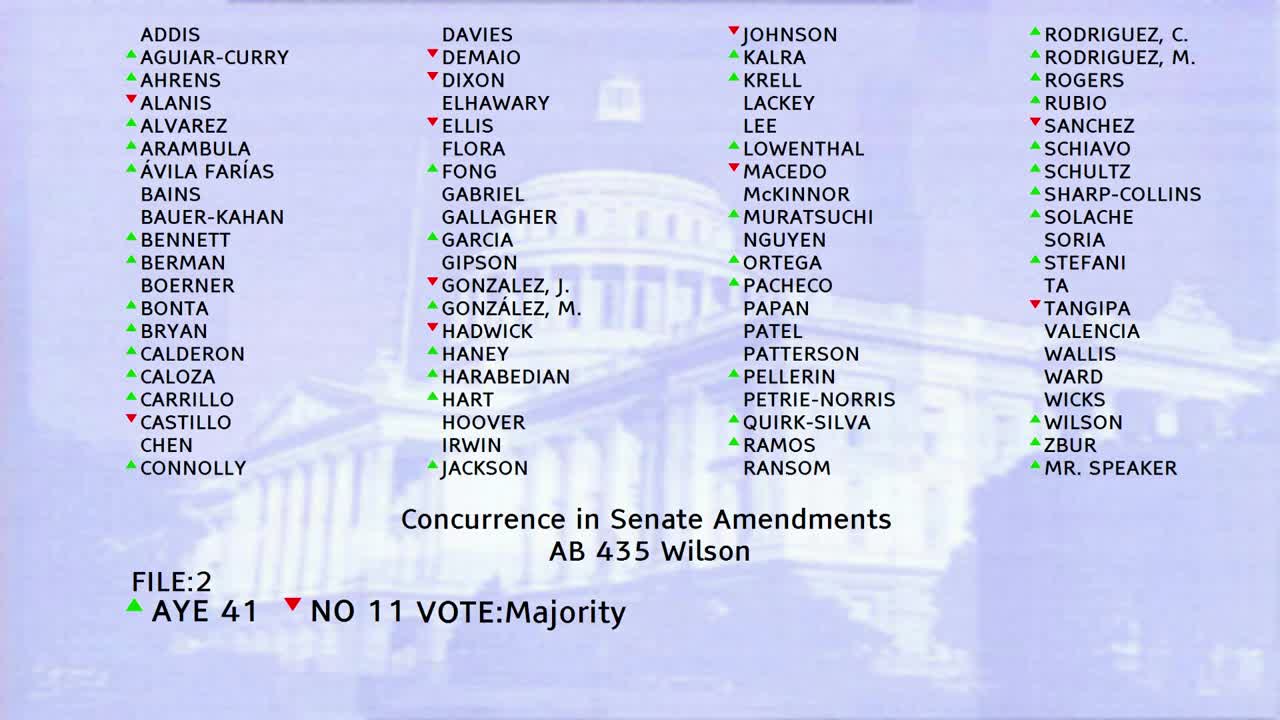 56SEC
Assembly Floor
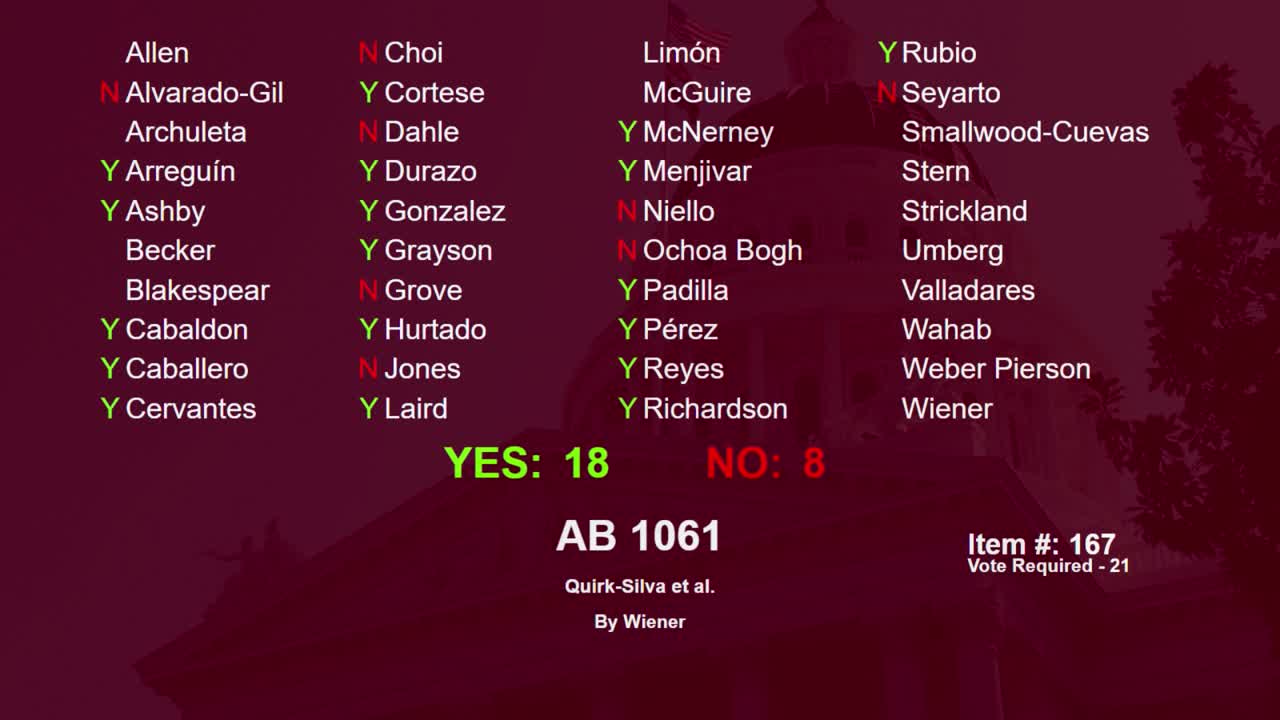 1MIN
Senate Floor
 3MIN
Assembly Floor
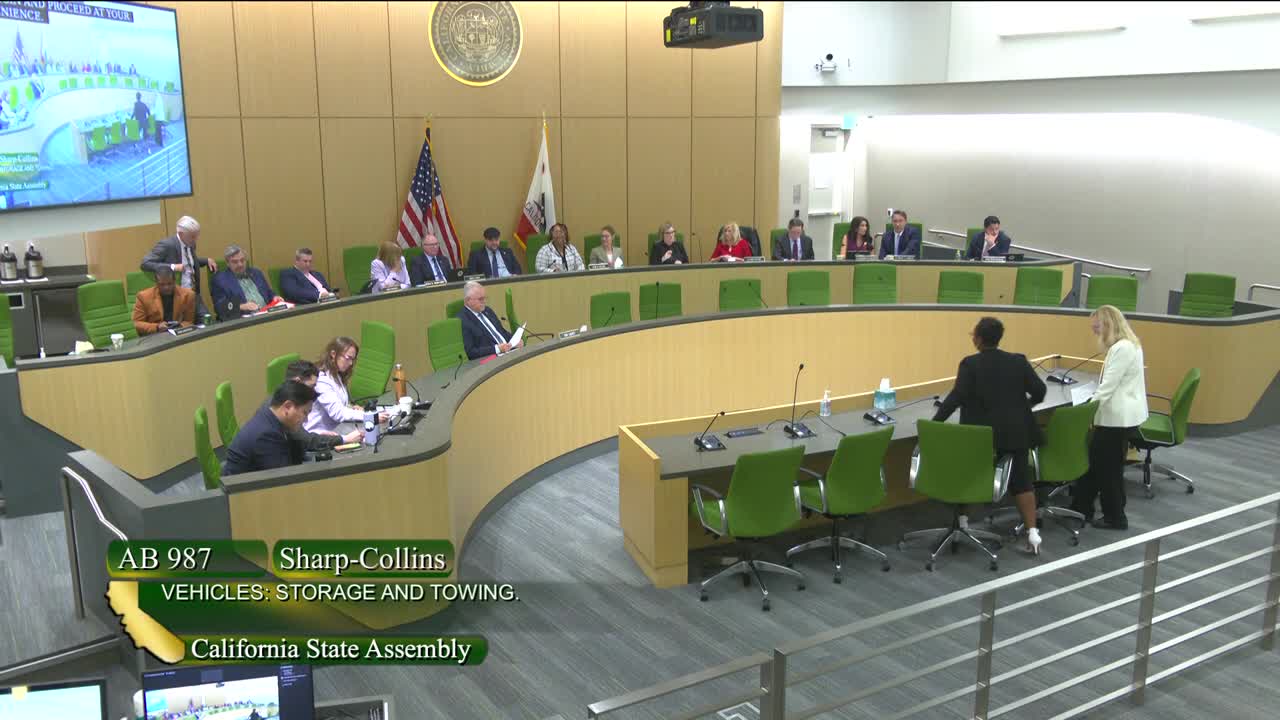 7MIN
Assembly Standing Committee on Transportation
Bill Author