AB 1102: Hazardous waste facilities: inspections.
- Session Year: 2015-2016
- House: Assembly
- Latest Version Date: 2016-06-21
Existing law requires the Department of Toxic Substances Control, and a local health officer or local public officer designated by the Director of Toxic Substances Control, to enforce the standards in the hazardous waste control law and the regulations adopted by the department to implement that law, except as specified. Existing law authorizes a representative of the department or the local officer or agency authorized to enforce the hazardous waste control law to, among other things, enter and inspect a factory, plant, construction site, disposal site, transfer facility, or an establishment or any other place or environment where hazardous wastes are stored, handled, processed, disposed of, or being treated to recover resources.
This bill would require the department to inspect a permitted hazardous waste land disposal facility no less than once per month, inspect a permitted and operating hazardous waste facility no less than 4 times per calendar year, and inspect a permitted hazardous waste facility no less than 2 times per calendar year.
Existing federal law, the Patient Protection and Affordable Care Act (PPACA), enacts various health care coverage market reforms as of January 1, 2014. Among other things, PPACA requires each state to establish an American Health Benefits Exchange and allows qualified individuals to obtain premium assistance for coverage purchased through the Exchange. PPACA specifies that this premium assistance is not available if the individual is eligible for affordable employer-sponsored coverage that provides minimum value, as specified.
Existing law establishes the Medi-Cal Access Program, administered by the State Department of Health Care Services. Existing law creates the California Major Risk Medical Insurance Program (MRMIP), which is administered by the Managed Risk Medical Insurance Board, to arrange for major risk medical coverage for eligible residents of the state who are unable to secure adequate private health care coverage.
This bill would require the State Department of Health Care Services to inform applicants who are rejected for Medi-Cal Access Program coverage of other coverage options through MRMIP and Covered California, and direct applicants how to receive more information on Covered California and MRMIP, as specified.
Existing federal law, the Patient Protection and Affordable Care Act (PPACA), enacts various health care coverage market reforms as of January 1, 2014. Among other things, PPACA requires each state, by January 1, 2014, to establish an American Health Benefit Exchange that facilitates the purchase of qualified health plans by qualified individuals and qualified small employers, and requires each exchange to provide for an initial open enrollment period, annual open enrollment periods, and special enrollment periods.
Existing law, the Knox-Keene Health Care Service Plan Act of 1975, provides for the licensure and regulation of health care service plans by the Department of Managed Health Care and makes a willful violation of the act a crime. Existing law also provides for the regulation of health insurers by the Department of Insurance. Existing law requires a health care service plan or health insurer, on and after October 1, 2013, to offer, market, and sell all of the plans or insurers health benefit plans that are sold in the individual market for policy years on or after January 1, 2014, to all individuals and dependents in each service area in which the plan or insurer provides or arranges for the provision of health care services, as specified, but requires plans and insurers to limit enrollment in individual health benefit plans to specified open enrollment and special enrollment periods. Existing law requires a health care service plan and health insurer to allow an individual to enroll in or change individual health benefit plans as a result of specified triggering events, including that he or she gains a dependent.
This bill would require, on and after January 1, 2017, and until October 1, 2020, a health care service plan or health insurer to allow an individual who does not have minimum essential coverage to enroll in an individual health benefit plan if the individual becomes pregnant. Because a willful violation of this requirement by a health care service plan would be a crime, this bill would impose a state-mandated local program.
The California Constitution requires the state to reimburse local agencies and school districts for certain costs mandated by the state. Statutory provisions establish procedures for making that reimbursement.
This bill would provide that no reimbursement is required by this act for a specified reason.
Existing federal law, the Patient Protection and Affordable Care Act (PPACA), enacts various health care coverage market reforms as of January 1, 2014. Among other things, PPACA requires each state, by January 1, 2014, to establish an American Health Benefit Exchange that facilitates the purchase of qualified health plans by qualified individuals and qualified small employers, and requires each exchange to provide for an initial open enrollment period, annual open enrollment periods, and special enrollment periods.
Existing law, the Knox-Keene Health Care Service Plan Act of 1975, provides for the licensure and regulation of health care service plans by the Department of Managed Health Care and makes a willful violation of the act a crime. Existing law also provides for the regulation of health insurers by the Department of Insurance. Existing law requires a health care service plan or health insurer, on and after October 1, 2013, to offer, market, and sell all of the plans or insurers health benefit plans that are sold in the individual market for policy years on or after January 1, 2014, to all individuals and dependents in each service area in which the plan or insurer provides or arranges for the provision of health care services, as specified, but requires plans and insurers to limit enrollment in individual health benefit plans to specified open enrollment and special enrollment periods. Existing law requires a health care service plan and health insurer to allow an individual to enroll in or change individual health benefit plans as a result of specified triggering events, including that he or she gains a dependent.
This bill would require, until October 1, 2021, on and after January 1, 2017, and until October 1, 2020, a health care service plan or health insurer to allow an individual who does not have minimum essential coverage to enroll or change in an individual health benefits benefit plan if the individual becomes pregnant. Because a willful violation of this requirement by a health care service plan would be a crime, this bill would impose a state-mandated local program.
The California Constitution requires the state to reimburse local agencies and school districts for certain costs mandated by the state. Statutory provisions establish procedures for making that reimbursement.
This bill would provide that no reimbursement is required by this act for a specified reason.
Existing federal law, the Patient Protection and Affordable Care Act (PPACA), enacts various health care coverage market reforms as of January 1, 2014. Among other things, PPACA requires each state, by January 1, 2014, to establish an American Health Benefit Exchange that facilitates the purchase of qualified health plans by qualified individuals and qualified small employers, and requires each exchange to provide for an initial open enrollment period, annual open enrollment periods, and special enrollment periods.
Existing law, the Knox-Keene Health Care Service Plan Act of 1975, provides for the licensure and regulation of health care service plans by the Department of Managed Health Care and makes a willful violation of the act a crime. Existing law also provides for the regulation of health insurers by the Department of Insurance. Existing law requires a health care service plan or health insurer, on and after October 1, 2013, to offer, market, and sell all of the plans or insurers health benefit plans that are sold in the individual market for policy years on or after January 1, 2014, to all individuals and dependents in each service area in which the plan or insurer provides or arranges for the provision of health care services, as specified, but requires plans and insurers to limit enrollment in individual health benefit plans to specified open enrollment and special enrollment periods. Existing law requires a health care service plan and health insurer to allow an individual to enroll in or change individual health benefit plans as a result of specified triggering events, including that he or she gains a dependent.
This bill would require require, until October 1, 2021, a health care service plan or health insurer to allow an individual to enroll or change individual health benefits if the individual becomes pregnant. Because a willful violation of this requirement by a health care service plan would be a crime, this bill would impose a state-mandated local program.
The California Constitution requires the state to reimburse local agencies and school districts for certain costs mandated by the state. Statutory provisions establish procedures for making that reimbursement.
This bill would provide that no reimbursement is required by this act for a specified reason.
Existing federal law, the Patient Protection and Affordable Care Act (PPACA), enacts various health care coverage market reforms as of January 1, 2014. Among other things, PPACA requires each state, by January 1, 2014, to establish an American Health Benefit Exchange that facilitates the purchase of qualified health plans by qualified individuals and qualified small employers, and requires each exchange to provide for an initial open enrollment period, annual open enrollment periods, and special enrollment periods.
Existing law, the Knox-Keene Health Care Service Plan Act of 1975, provides for the licensure and regulation of health care service plans by the Department of Managed Health Care and makes a willful violation of the act a crime. Existing law also provides for the regulation of health insurers by the Department of Insurance. Existing law requires a health care service plan or health insurer, on and after October 1, 2013, to offer, market, and sell all of the plans or insurers health benefit plans that are sold in the individual market for policy years on or after January 1, 2014, to all individuals and dependents in each service area in which the plan or insurer provides or arranges for the provision of health care services, as specified, but requires plans and insurers to limit enrollment in individual health benefit plans to specified open enrollment and special enrollment periods. Existing law requires a health care service plan and health insurer to allow an individual to enroll in or change individual health benefit plans as a result of specified triggering events, including that he or she gains a dependent.
This bill would require a health care service plan or health insurer to allow an individual to enroll or change individual health benefits if the individual becomes pregnant. Because a willful violation of this requirement by a health care service plan would be a crime, this bill would impose a state-mandated local program.
The California Constitution requires the state to reimburse local agencies and school districts for certain costs mandated by the state. Statutory provisions establish procedures for making that reimbursement.
This bill would provide that no reimbursement is required by this act for a specified reason.
Existing law provides for the licensure of residential care facilities for the elderly by the State Department of Social Services, including prescribing standards of safety and sanitation for the physical plant and standards for basic care and supervision, personal care, and services to be provided. Violation of these provisions is a crime.
This bill would make technical, nonsubstantive changes to these provisions.
(a)The Legislature finds and declares that hazardous waste facilities that are not in compliance with state and federal laws and regulations pose a danger to human health and safety and the environment. This danger is increased for disadvantaged communities impacted by multiple sources of pollution. It is vital that permitted hazardous waste facilities be inspected on a regular basis to ensure compliance with state and federal laws.
(b)The department shall do all of the following:
(1)Inspect a permitted hazardous waste land disposal facility no less than once per month.
(2)Inspect a permitted and operating hazardous waste facility not covered under paragraph (1) no less than four times per calendar year.
(3)Inspect a permitted hazardous waste facility not covered under paragraph (1) or (2) no less than two times per calendar year.
(c)Nothing in this section shall prevent the department from inspecting a hazardous waste facility more frequently than is required pursuant to subdivision (b).
(d)If the department requires additional staff to carry out the inspections required pursuant to subdivision (b), it is the intent of the Legislature to enact future legislation to increase the facility fee to cover this regulatory cost in order to ensure that hazardous waste facilities are in compliance with state and federal hazardous waste laws.
SECTION 1.Section 15849 is added to the Welfare and Institutions Code, to read:15849.If an applicant is rejected for coverage, the department shall inform the applicant about the California Major Risk Medical Insurance Program (MRMIP) (Part 6.5 (commencing with Section 12700) of Division 2 of the Insurance Code) and about the coverage options and the potential for subsidized coverage through Covered California. The department shall direct persons seeking more information to MRMIP, Covered California, plan or policy representatives, insurance agents, or an entity paid by Covered California to assist with health coverage enrollment, such as a navigator or an assister.
If an applicant is rejected for coverage, the department shall inform the applicant about the California Major Risk Medical Insurance Program (MRMIP) (Part 6.5 (commencing with Section 12700) of Division 2 of the Insurance Code) and about the coverage options and the potential for subsidized coverage through Covered California. The department shall direct persons seeking more information to MRMIP, Covered California, plan or policy representatives, insurance agents, or an entity paid by Covered California to assist with health coverage enrollment, such as a navigator or an assister.
All matter omitted in this version of the bill appears in the bill as amended in the Assembly, June 3, 2015. (JR11)(a)(1)On and after October 1, 2013, a plan shall fairly and affirmatively offer, market, and sell all of the plans health benefit plans that are sold in the individual market for policy years on or after January 1, 2014, to all individuals and dependents in each service area in which the plan provides or arranges for the provision of health care services. A plan shall limit enrollment in individual health benefit plans to open enrollment periods, annual enrollment periods, and special enrollment periods as provided in subdivisions (c) and (d).
(2)A plan shall allow the subscriber of an individual health benefit plan to add a dependent to the subscribers plan at the option of the subscriber, consistent with the open enrollment, annual enrollment, and special enrollment period requirements in this section.
(b)An individual health benefit plan issued, amended, or renewed on or after January 1, 2014, shall not impose any preexisting condition provision upon any individual.
(c)(1)A plan shall provide an initial open enrollment period from October 1, 2013, to March 31, 2014, inclusive, an annual enrollment period for the policy year beginning on January 1, 2015, from November 15, 2014, to February 15, 2015, inclusive, and annual enrollment periods for policy years beginning on or after January 1, 2016, from October 15 to December 7, inclusive, of the preceding calendar year.
(2)Pursuant to Section 147.104(b)(2) of Title 45 of the Code of Federal Regulations, for individuals enrolled in noncalendar year individual health plan contracts, a plan shall also provide a limited open enrollment period beginning on the date that is 30 calendar days prior to the date the policy year ends in 2014.
(d)(1)Subject to paragraph (2), (3), commencing January 1, 2014, a plan shall allow an individual to enroll in or change individual health benefit plans as a result of the following triggering events:
(A)He or she or his or her dependent loses minimum essential coverage. For purposes of this paragraph, section, the following definitions shall apply:
(i)Minimum essential coverage has the same meaning as that term is defined in subsection (f) of Section 5000A of the Internal Revenue Code (26 U.S.C. Sec. 5000A).
(ii)Loss of minimum essential coverage includes, but is not limited to, loss of that coverage due to the circumstances described in Section 54.9801-6(a)(3)(i) to (iii), inclusive, of Title 26 of the Code of Federal Regulations and the circumstances described in Section 1163 of Title 29 of the United States Code. Loss of minimum essential coverage also includes loss of that coverage for a reason that is not due to the fault of the individual.
(iii)Loss of minimum essential coverage does not include loss of that coverage due to the individuals failure to pay premiums on a timely basis or situations allowing for a rescission, subject to clause (ii) and Sections 1389.7 and 1389.21.
(B)He or she gains a dependent or becomes a dependent.
(C)He or she is mandated to be covered as a dependent pursuant to a valid state or federal court order.
(D)He or she has been released from incarceration.
(E)His or her health coverage issuer substantially violated a material provision of the health coverage contract.
(F)He or she gains access to new health benefit plans as a result of a permanent move.
(G)He or she was receiving services from a contracting provider under another health benefit plan, as defined in Section 1399.845 of this code or Section 10965 of the Insurance Code, for one of the conditions described in subdivision (c) of Section 1373.96 and that provider is no longer participating in the health benefit plan.
(H)He or she demonstrates to the Exchange, with respect to health benefit plans offered through the Exchange, or to the department, with respect to health benefit plans offered outside the Exchange, that he or she did not enroll in a health benefit plan during the immediately preceding enrollment period available to the individual because he or she was misinformed that he or she was covered under minimum essential coverage.
(I)He or she is a member of the reserve forces of the United States military returning from active duty or a member of the California National Guard returning from active duty service under Title 32 of the United States Code.
(J)On and after January 1, 2016, and until October 1, 2021, an individual becomes pregnant.
(K)
(J)With respect to individual health benefit plans offered through the Exchange, in addition to the triggering events listed in this paragraph, any other events listed in Section 155.420(d) of Title 45 of the Code of Federal Regulations.
(2)Subject to paragraph (3), commencing January 1, 2017, and until October 1, 2020, a plan shall allow an individual who does not have minimum essential coverage to enroll in an individual health benefit plan if she becomes pregnant.
(2)
(3)With respect to individual health benefit plans offered outside the Exchange, an individual shall have 60 days from the date of a triggering event identified in paragraph (1) to apply for coverage from a health care service plan subject to this section. With respect to individual health benefit plans offered through the Exchange, an individual shall have 60 days from the date of a triggering event identified in paragraph (1) to select a plan offered through the Exchange, unless a longer period is provided in Part 155 (commencing with Section 155.10) of Subchapter B of Subtitle A of Title 45 of the Code of Federal Regulations.
(e)With respect to individual health benefit plans offered through the Exchange, the effective date of coverage required pursuant to this section shall be consistent with the dates specified in Section 155.410 or 155.420 of Title 45 of the Code of Federal Regulations, as applicable. A dependent who is a registered domestic partner pursuant to Section 297 of the Family Code shall have the same effective date of coverage as a spouse.
(f)With respect to individual health benefit plans offered outside the Exchange, the following provisions shall apply:
(1)After an individual submits a completed application form for a plan contract, the health care service plan shall, within 30 days, notify the individual of the individuals actual premium charges for that plan established in accordance with Section 1399.855. The individual shall have 30 days in which to exercise the right to buy coverage at the quoted premium charges.
(2)With respect to an individual health benefit plan for which an individual applies during the initial open enrollment period described in subdivision (c), when the subscriber submits a premium payment, based on the quoted premium charges, and that payment is delivered or postmarked, whichever occurs earlier, by December 15, 2013, coverage under the individual health benefit plan shall become effective no later than January 1, 2014. When that payment is delivered or postmarked within the first 15 days of any subsequent month, coverage shall become effective no later than the first day of the following month. When that payment is delivered or postmarked between December 16, 2013, and December 31, 2013, inclusive, or after the 15th day of any subsequent month, coverage shall become effective no later than the first day of the second month following delivery or postmark of the payment.
(3)With respect to an individual health benefit plan for which an individual applies during the annual open enrollment period described in subdivision (c), when the individual submits a premium payment, based on the quoted premium charges, and that payment is delivered or postmarked, whichever occurs later, by December 15, coverage shall become effective as of the following January 1. When that payment is delivered or postmarked within the first 15 days of any subsequent month, coverage shall become effective no later than the first day of the following month. When that payment is delivered or postmarked between December 16 and December 31, inclusive, or after the 15th day of any subsequent month, coverage shall become effective no later than the first day of the second month following delivery or postmark of the payment.
(4)With respect to an individual health benefit plan for which an individual applies during a special enrollment period described in subdivision (d), the following provisions shall apply:
(A)When the individual submits a premium payment, based on the quoted premium charges, and that payment is delivered or postmarked, whichever occurs earlier, within the first 15 days of the month, coverage under the plan shall become effective no later than the first day of the following month. When the premium payment is neither delivered nor postmarked until after the 15th day of the month, coverage shall become effective no later than the first day of the second month following delivery or postmark of the payment.
(B)Notwithstanding subparagraph (A), in the case of a birth, adoption, or placement for adoption, the coverage shall be effective on the date of birth, adoption, or placement for adoption.
(C)Notwithstanding subparagraph (A), in the case of marriage or becoming a registered domestic partner or in the case where a qualified individual loses minimum essential coverage, the coverage effective date shall be the first day of the month following the date the plan receives the request for special enrollment.
(g)(1)A health care service plan shall not establish rules for eligibility, including continued eligibility, of any individual to enroll under the terms of an individual health benefit plan based on any of the following factors:
(A)Health status.
(B)Medical condition, including physical and mental illnesses.
(C)Claims experience.
(D)Receipt of health care.
(E)Medical history.
(F)Genetic information.
(G)Evidence of insurability, including conditions arising out of acts of domestic violence.
(H)Disability.
(I)Any other health status-related factor as determined by any federal regulations, rules, or guidance issued pursuant to Section 2705 of the federal Public Health Service Act.
(2)Notwithstanding Section 1389.1, a health care service plan shall not require an individual applicant or his or her dependent to fill out a health assessment or medical questionnaire prior to enrollment under an individual health benefit plan. A health care service plan shall not acquire or request information that relates to a health status-related factor from the applicant or his or her dependent or any other source prior to enrollment of the individual.
(h)(1)A health care service plan shall consider as a single risk pool for rating purposes in the individual market the claims experience of all insureds and all enrollees in all nongrandfathered individual health benefit plans offered by that health care service plan in this state, whether offered as health care service plan contracts or individual health insurance policies, including those insureds and enrollees who enroll in individual coverage through the Exchange and insureds and enrollees who enroll in individual coverage outside of the Exchange. Student health insurance coverage, as that coverage is defined in Section 147.145(a) of Title 45 of the Code of Federal Regulations, shall not be included in a health care service plans single risk pool for individual coverage.
(2)Each calendar year, a health care service plan shall establish an index rate for the individual market in the state based on the total combined claims costs for providing essential health benefits, as defined pursuant to Section 1302 of PPACA, within the single risk pool required under paragraph (1). The index rate shall be adjusted on a marketwide basis based on the total expected marketwide payments and charges under the risk adjustment and reinsurance programs established for the state pursuant to Sections 1343 and 1341 of PPACA and Exchange user fees, as described in subdivision (d) of Section 156.80 of Title 45 of the Code of Federal Regulations. The premium rate for all of the health benefit plans in the individual market within the single risk pool required under paragraph (1) shall use the applicable marketwide adjusted index rate, subject only to the adjustments permitted under paragraph (3).
(3)A health care service plan may vary premium rates for a particular health benefit plan from its index rate based only on the following actuarially justified plan-specific factors:
(A)The actuarial value and cost-sharing design of the health benefit plan.
(B)The health benefit plans provider network, delivery system characteristics, and utilization management practices.
(C)The benefits provided under the health benefit plan that are in addition to the essential health benefits, as defined pursuant to Section 1302 of PPACA and Section 1367.005. These additional benefits shall be pooled with similar benefits within the single risk pool required under paragraph (1) and the claims experience from those benefits shall be utilized to determine rate variations for plans that offer those benefits in addition to essential health benefits.
(D)With respect to catastrophic plans, as described in subsection (e) of Section 1302 of PPACA, the expected impact of the specific eligibility categories for those plans.
(E)Administrative costs, excluding user fees required by the Exchange.
(i)This section shall only apply with respect to individual health benefit plans for policy years on or after January 1, 2014.
(j)This section shall not apply to a grandfathered health plan.
(k)If Section 5000A of the Internal Revenue Code, as added by Section 1501 of PPACA, is repealed or amended to no longer apply to the individual market, as defined in Section 2791 of the federal Public Health Service Act (42 U.S.C. Sec. 300gg-91), subdivisions (a), (b), and (g) shall become inoperative 12 months after that repeal or amendment.
SEC. 2.Section 10965.3 of the Insurance Code is amended to read:10965.3.(a)(1)On and after October 1, 2013, a health insurer shall fairly and affirmatively offer, market, and sell all of the insurers health benefit plans that are sold in the individual market for policy years on or after January 1, 2014, to all individuals and dependents in each service area in which the insurer provides or arranges for the provision of health care services. A health insurer shall limit enrollment in individual health benefit plans to open enrollment periods, annual enrollment periods, and special enrollment periods as provided in subdivisions (c) and (d).
(2)A health insurer shall allow the policyholder of an individual health benefit plan to add a dependent to the policyholders health benefit plan at the option of the policyholder, consistent with the open enrollment, annual enrollment, and special enrollment period requirements in this section.
(b)An individual health benefit plan issued, amended, or renewed on or after January 1, 2014, shall not impose any preexisting condition provision upon any individual.
(c)(1)A health insurer shall provide an initial open enrollment period from October 1, 2013, to March 31, 2014, inclusive, an annual enrollment period for the policy year beginning on January 1, 2015, from November 15, 2014, to February 15, 2015, inclusive, and annual enrollment periods for policy years beginning on or after January 1, 2016, from October 15 to December 7, inclusive, of the preceding calendar year.
(2)Pursuant to Section 147.104(b)(2) of Title 45 of the Code of Federal Regulations, for individuals enrolled in noncalendar-year individual health plan contracts, a health insurer shall also provide a limited open enrollment period beginning on the date that is 30 calendar days prior to the date the policy year ends in 2014.
(d)(1)Subject to paragraph (2), (3), commencing January 1, 2014, a health insurer shall allow an individual to enroll in or change individual health benefit plans as a result of the following triggering events:
(A)He or she or his or her dependent loses minimum essential coverage. For purposes of this paragraph, section, both of the following definitions shall apply:
(i)Minimum essential coverage has the same meaning as that term is defined in subsection (f) of Section 5000A of the Internal Revenue Code (26 U.S.C. Sec. 5000A).
(ii)Loss of minimum essential coverage includes, but is not limited to, loss of that coverage due to the circumstances described in Section 54.9801-6(a)(3)(i) to (iii), inclusive, of Title 26 of the Code of Federal Regulations and the circumstances described in Section 1163 of Title 29 of the United States Code. Loss of minimum essential coverage also includes loss of that coverage for a reason that is not due to the fault of the individual.
(iii)Loss of minimum essential coverage does not include loss of that coverage due to the individuals failure to pay premiums on a timely basis or situations allowing for a rescission, subject to clause (ii) and Sections 10119.2 and 10384.17.
(B)He or she gains a dependent or becomes a dependent.
(C)He or she is mandated to be covered as a dependent pursuant to a valid state or federal court order.
(D)He or she has been released from incarceration.
(E)His or her health coverage issuer substantially violated a material provision of the health coverage contract.
(F)He or she gains access to new health benefit plans as a result of a permanent move.
(G)He or she was receiving services from a contracting provider under another health benefit plan, as defined in Section 10965 of this code or Section 1399.845 of the Health and Safety Code, for one of the conditions described in subdivision (a) of Section 10133.56 and that provider is no longer participating in the health benefit plan.
(H)He or she demonstrates to the Exchange, with respect to health benefit plans offered through the Exchange, or to the department, with respect to health benefit plans offered outside the Exchange, that he or she did not enroll in a health benefit plan during the immediately preceding enrollment period available to the individual because he or she was misinformed that he or she was covered under minimum essential coverage.
(I)He or she is a member of the reserve forces of the United States military returning from active duty or a member of the California National Guard returning from active duty service under Title 32 of the United States Code.
(J)On and after January 1, 2016, and until October 1, 2021, an individual becomes pregnant.
(K)
(J)With respect to individual health benefit plans offered through the Exchange, in addition to the triggering events listed in this paragraph, any other events listed in Section 155.420(d) of Title 45 of the Code of Federal Regulations.
(2)Subject to paragraph (3), commencing January 1, 2017, and until October 1, 2020, a plan shall allow an individual who does not have minimum essential coverage to enroll in an individual health benefit plan if she becomes pregnant.
(2)
(3)With respect to individual health benefit plans offered outside the Exchange, an individual shall have 60 days from the date of a triggering event identified in paragraph (1) to apply for coverage from a health care service plan subject to this section. With respect to individual health benefit plans offered through the Exchange, an individual shall have 60 days from the date of a triggering event identified in paragraph (1) to select a plan offered through the Exchange, unless a longer period is provided in Part 155 (commencing with Section 155.10) of Subchapter B of Subtitle A of Title 45 of the Code of Federal Regulations.
(e)With respect to individual health benefit plans offered through the Exchange, the effective date of coverage required pursuant to this section shall be consistent with the dates specified in Section 155.410 or 155.420 of Title 45 of the Code of Federal Regulations, as applicable. A dependent who is a registered domestic partner pursuant to Section 297 of the Family Code shall have the same effective date of coverage as a spouse.
(f)With respect to an individual health benefit plan offered outside the Exchange, the following provisions shall apply:
(1)After an individual submits a completed application form for a plan, the insurer shall, within 30 days, notify the individual of the individuals actual premium charges for that plan established in accordance with Section 10965.9. The individual shall have 30 days in which to exercise the right to buy coverage at the quoted premium charges.
(2)With respect to an individual health benefit plan for which an individual applies during the initial open enrollment period described in subdivision (c), when the policyholder submits a premium payment, based on the quoted premium charges, and that payment is delivered or postmarked, whichever occurs earlier, by December 15, 2013, coverage under the individual health benefit plan shall become effective no later than January 1, 2014. When that payment is delivered or postmarked within the first 15 days of any subsequent month, coverage shall become effective no later than the first day of the following month. When that payment is delivered or postmarked between December 16, 2013, and December 31, 2013, inclusive, or after the 15th day of any subsequent month, coverage shall become effective no later than the first day of the second month following delivery or postmark of the payment.
(3)With respect to an individual health benefit plan for which an individual applies during the annual open enrollment period described in subdivision (c), when the individual submits a premium payment, based on the quoted premium charges, and that payment is delivered or postmarked, whichever occurs later, by December 15, coverage shall become effective as of the following January 1. When that payment is delivered or postmarked within the first 15 days of any subsequent month, coverage shall become effective no later than the first day of the following month. When that payment is delivered or postmarked between December 16 and December 31, inclusive, or after the 15th day of any subsequent month, coverage shall become effective no later than the first day of the second month following delivery or postmark of the payment.
(4)With respect to an individual health benefit plan for which an individual applies during a special enrollment period described in subdivision (d), the following provisions shall apply:
(A)When the individual submits a premium payment, based on the quoted premium charges, and that payment is delivered or postmarked, whichever occurs earlier, within the first 15 days of the month, coverage under the plan shall become effective no later than the first day of the following month. When the premium payment is neither delivered nor postmarked until after the 15th day of the month, coverage shall become effective no later than the first day of the second month following delivery or postmark of the payment.
(B)Notwithstanding subparagraph (A), in the case of a birth, adoption, or placement for adoption, the coverage shall be effective on the date of birth, adoption, or placement for adoption.
(C)Notwithstanding subparagraph (A), in the case of marriage or becoming a registered domestic partner or in the case where a qualified individual loses minimum essential coverage, the coverage effective date shall be the first day of the month following the date the insurer receives the request for special enrollment.
(g)(1)A health insurer shall not establish rules for eligibility, including continued eligibility, of any individual to enroll under the terms of an individual health benefit plan based on any of the following factors:
(A)Health status.
(B)Medical condition, including physical and mental illnesses.
(C)Claims experience.
(D)Receipt of health care.
(E)Medical history.
(F)Genetic information.
(G)Evidence of insurability, including conditions arising out of acts of domestic violence.
(H)Disability.
(I)Any other health status-related factor as determined by any federal regulations, rules, or guidance issued pursuant to Section 2705 of the federal Public Health Service Act.
(2)Notwithstanding subdivision (c) of Section 10291.5, a health insurer shall not require an individual applicant or his or her dependent to fill out a health assessment or medical questionnaire prior to enrollment under an individual health benefit plan. A health insurer shall not acquire or request information that relates to a health status-related factor from the applicant or his or her dependent or any other source prior to enrollment of the individual.
(h)(1)A health insurer shall consider as a single risk pool for rating purposes in the individual market the claims experience of all insureds and enrollees in all nongrandfathered individual health benefit plans offered by that insurer in this state, whether offered as health care service plan contracts or individual health insurance policies, including those insureds and enrollees who enroll in individual coverage through the Exchange and insureds and enrollees who enroll in individual coverage outside the Exchange. Student health insurance coverage, as such coverage is defined in Section 147.145(a) of Title 45 of the Code of Federal Regulations, shall not be included in a health insurers single risk pool for individual coverage.
(2)Each calendar year, a health insurer shall establish an index rate for the individual market in the state based on the total combined claims costs for providing essential health benefits, as defined pursuant to Section 1302 of PPACA, within the single risk pool required under paragraph (1). The index rate shall be adjusted on a marketwide basis based on the total expected marketwide payments and charges under the risk adjustment and reinsurance programs established for the state pursuant to Sections 1343 and 1341 of PPACA and Exchange user fees, as described in subdivision (d) of Section 156.80 of Title 45 of the Code of Federal Regulations. The premium rate for all of the health benefit plans in the individual market within the single risk pool required under paragraph (1) shall use the applicable marketwide adjusted index rate, subject only to the adjustments permitted under paragraph (3).
(3)A health insurer may vary premium rates for a particular health benefit plan from its index rate based only on the following actuarially justified plan-specific factors:
(A)The actuarial value and cost-sharing design of the health benefit plan.
(B)The health benefit plans provider network, delivery system characteristics, and utilization management practices.
(C)The benefits provided under the health benefit plan that are in addition to the essential health benefits, as defined pursuant to Section 1302 of PPACA and Section 10112.27. These additional benefits shall be pooled with similar benefits within the single risk pool required under paragraph (1) and the claims experience from those benefits shall be utilized to determine rate variations for plans that offer those benefits in addition to essential health benefits.
(D)With respect to catastrophic plans, as described in subsection (e) of Section 1302 of PPACA, the expected impact of the specific eligibility categories for those plans.
(E)Administrative costs, excluding any user fees required by the Exchange.
(i)This section shall only apply with respect to individual health benefit plans for policy years on or after January 1, 2014.
(j)This section shall not apply to a grandfathered health plan.
(k)If Section 5000A of the Internal Revenue Code, as added by Section 1501 of PPACA, is repealed or amended to no longer apply to the individual market, as defined in Section 2791 of the federal Public Health Service Act (42 U.S.C. Sec. 300gg-91), subdivisions (a), (b), and (g) shall become inoperative 12 months after the date of that repeal or amendment and individual health care benefit plans shall thereafter be subject to Sections 10901.2, 10951, and 10953.
SEC. 3.No reimbursement is required by this act pursuant to Section 6 of Article XIIIB of the California Constitution because the only costs that may be incurred by a local agency or school district will be incurred because this act creates a new crime or infraction, eliminates a crime or infraction, or changes the penalty for a crime or infraction, within the meaning of Section 17556 of the Government Code, or changes the definition of a crime within the meaning of Section 6 of Article XIIIB of the California Constitution.
(a)(1)On and after October 1, 2013, a plan shall fairly and affirmatively offer, market, and sell all of the plans health benefit plans that are sold in the individual market for policy years on or after January 1, 2014, to all individuals and dependents in each service area in which the plan provides or arranges for the provision of health care services. A plan shall limit enrollment in individual health benefit plans to open enrollment periods, annual enrollment periods, and special enrollment periods as provided in subdivisions (c) and (d).
(2)A plan shall allow the subscriber of an individual health benefit plan to add a dependent to the subscribers plan at the option of the subscriber, consistent with the open enrollment, annual enrollment, and special enrollment period requirements in this section.
(b)An individual health benefit plan issued, amended, or renewed on or after January 1, 2014, shall not impose any preexisting condition provision upon any individual.
(c)(1)A plan shall provide an initial open enrollment period from October 1, 2013, to March 31, 2014, inclusive, an annual enrollment period for the policy year beginning on January 1, 2015, from November 15, 2014, to February 15, 2015, inclusive, and annual enrollment periods for policy years beginning on or after January 1, 2016, from October 15 to December 7, inclusive, of the preceding calendar year.
(2)Pursuant to Section 147.104(b)(2) of Title 45 of the Code of Federal Regulations, for individuals enrolled in noncalendar year individual health plan contracts, a plan shall also provide a limited open enrollment period beginning on the date that is 30 calendar days prior to the date the policy year ends in 2014.
(d)(1)Subject to paragraph (2), commencing January 1, 2014, a plan shall allow an individual to enroll in or change individual health benefit plans as a result of the following triggering events:
(A)He or she or his or her dependent loses minimum essential coverage. For purposes of this paragraph, the following definitions shall apply:
(i)Minimum essential coverage has the same meaning as that term is defined in subsection (f) of Section 5000A of the Internal Revenue Code (26 U.S.C. Sec. 5000A).
(ii)Loss of minimum essential coverage includes, but is not limited to, loss of that coverage due to the circumstances described in Section 54.9801-6(a)(3)(i) to (iii), inclusive, of Title 26 of the Code of Federal Regulations and the circumstances described in Section 1163 of Title 29 of the United States Code. Loss of minimum essential coverage also includes loss of that coverage for a reason that is not due to the fault of the individual.
(iii)Loss of minimum essential coverage does not include loss of that coverage due to the individuals failure to pay premiums on a timely basis or situations allowing for a rescission, subject to clause (ii) and Sections 1389.7 and 1389.21.
(B)He or she gains a dependent or becomes a dependent.
(C)He or she is mandated to be covered as a dependent pursuant to a valid state or federal court order.
(D)He or she has been released from incarceration.
(E)His or her health coverage issuer substantially violated a material provision of the health coverage contract.
(F)He or she gains access to new health benefit plans as a result of a permanent move.
(G)He or she was receiving services from a contracting provider under another health benefit plan, as defined in Section 1399.845 of this code or Section 10965 of the Insurance Code, for one of the conditions described in subdivision (c) of Section 1373.96 and that provider is no longer participating in the health benefit plan.
(H)He or she demonstrates to the Exchange, with respect to health benefit plans offered through the Exchange, or to the department, with respect to health benefit plans offered outside the Exchange, that he or she did not enroll in a health benefit plan during the immediately preceding enrollment period available to the individual because he or she was misinformed that he or she was covered under minimum essential coverage.
(I)He or she is a member of the reserve forces of the United States military returning from active duty or a member of the California National Guard returning from active duty service under Title 32 of the United States Code.
(J)An On and after January 1, 2016, and until October 1, 2021, an individual becomes pregnant.
(K)With respect to individual health benefit plans offered through the Exchange, in addition to the triggering events listed in this paragraph, any other events listed in Section 155.420(d) of Title 45 of the Code of Federal Regulations.
(2)With respect to individual health benefit plans offered outside the Exchange, an individual shall have 60 days from the date of a triggering event identified in paragraph (1) to apply for coverage from a health care service plan subject to this section. With respect to individual health benefit plans offered through the Exchange, an individual shall have 60 days from the date of a triggering event identified in paragraph (1) to select a plan offered through the Exchange, unless a longer period is provided in Part 155 (commencing with Section 155.10) of Subchapter B of Subtitle A of Title 45 of the Code of Federal Regulations.
(e)With respect to individual health benefit plans offered through the Exchange, the effective date of coverage required pursuant to this section shall be consistent with the dates specified in Section 155.410 or 155.420 of Title 45 of the Code of Federal Regulations, as applicable. A dependent who is a registered domestic partner pursuant to Section 297 of the Family Code shall have the same effective date of coverage as a spouse.
(f)With respect to individual health benefit plans offered outside the Exchange, the following provisions shall apply:
(1)After an individual submits a completed application form for a plan contract, the health care service plan shall, within 30 days, notify the individual of the individuals actual premium charges for that plan established in accordance with Section 1399.855. The individual shall have 30 days in which to exercise the right to buy coverage at the quoted premium charges.
(2)With respect to an individual health benefit plan for which an individual applies during the initial open enrollment period described in subdivision (c), when the subscriber submits a premium payment, based on the quoted premium charges, and that payment is delivered or postmarked, whichever occurs earlier, by December 15, 2013, coverage under the individual health benefit plan shall become effective no later than January 1, 2014. When that payment is delivered or postmarked within the first 15 days of any subsequent month, coverage shall become effective no later than the first day of the following month. When that payment is delivered or postmarked between December 16, 2013, and December 31, 2013, inclusive, or after the 15th day of any subsequent month, coverage shall become effective no later than the first day of the second month following delivery or postmark of the payment.
(3)With respect to an individual health benefit plan for which an individual applies during the annual open enrollment period described in subdivision (c), when the individual submits a premium payment, based on the quoted premium charges, and that payment is delivered or postmarked, whichever occurs later, by December 15, coverage shall become effective as of the following January 1. When that payment is delivered or postmarked within the first 15 days of any subsequent month, coverage shall become effective no later than the first day of the following month. When that payment is delivered or postmarked between December 16 and December 31, inclusive, or after the 15th day of any subsequent month, coverage shall become effective no later than the first day of the second month following delivery or postmark of the payment.
(4)With respect to an individual health benefit plan for which an individual applies during a special enrollment period described in subdivision (d), the following provisions shall apply:
(A)When the individual submits a premium payment, based on the quoted premium charges, and that payment is delivered or postmarked, whichever occurs earlier, within the first 15 days of the month, coverage under the plan shall become effective no later than the first day of the following month. When the premium payment is neither delivered nor postmarked until after the 15th day of the month, coverage shall become effective no later than the first day of the second month following delivery or postmark of the payment.
(B)Notwithstanding subparagraph (A), in the case of a birth, adoption, or placement for adoption, the coverage shall be effective on the date of birth, adoption, or placement for adoption.
(C)Notwithstanding subparagraph (A), in the case of marriage or becoming a registered domestic partner or in the case where a qualified individual loses minimum essential coverage, the coverage effective date shall be the first day of the month following the date the plan receives the request for special enrollment.
(g)(1)A health care service plan shall not establish rules for eligibility, including continued eligibility, of any individual to enroll under the terms of an individual health benefit plan based on any of the following factors:
(A)Health status.
(B)Medical condition, including physical and mental illnesses.
(C)Claims experience.
(D)Receipt of health care.
(E)Medical history.
(F)Genetic information.
(G)Evidence of insurability, including conditions arising out of acts of domestic violence.
(H)Disability.
(I)Any other health status-related factor as determined by any federal regulations, rules, or guidance issued pursuant to Section 2705 of the federal Public Health Service Act.
(2)Notwithstanding Section 1389.1, a health care service plan shall not require an individual applicant or his or her dependent to fill out a health assessment or medical questionnaire prior to enrollment under an individual health benefit plan. A health care service plan shall not acquire or request information that relates to a health status-related factor from the applicant or his or her dependent or any other source prior to enrollment of the individual.
(h)(1)A health care service plan shall consider as a single risk pool for rating purposes in the individual market the claims experience of all insureds and all enrollees in all nongrandfathered individual health benefit plans offered by that health care service plan in this state, whether offered as health care service plan contracts or individual health insurance policies, including those insureds and enrollees who enroll in individual coverage through the Exchange and insureds and enrollees who enroll in individual coverage outside of the Exchange. Student health insurance coverage, as that coverage is defined in Section 147.145(a) of Title 45 of the Code of Federal Regulations, shall not be included in a health care service plans single risk pool for individual coverage.
(2)Each calendar year, a health care service plan shall establish an index rate for the individual market in the state based on the total combined claims costs for providing essential health benefits, as defined pursuant to Section 1302 of PPACA, within the single risk pool required under paragraph (1). The index rate shall be adjusted on a marketwide basis based on the total expected marketwide payments and charges under the risk adjustment and reinsurance programs established for the state pursuant to Sections 1343 and 1341 of PPACA and Exchange user fees, as described in subdivision (d) of Section 156.80 of Title 45 of the Code of Federal Regulations. The premium rate for all of the health benefit plans in the individual market within the single risk pool required under paragraph (1) shall use the applicable marketwide adjusted index rate, subject only to the adjustments permitted under paragraph (3).
(3)A health care service plan may vary premium rates for a particular health benefit plan from its index rate based only on the following actuarially justified plan-specific factors:
(A)The actuarial value and cost-sharing design of the health benefit plan.
(B)The health benefit plans provider network, delivery system characteristics, and utilization management practices.
(C)The benefits provided under the health benefit plan that are in addition to the essential health benefits, as defined pursuant to Section 1302 of PPACA and Section 1367.005. These additional benefits shall be pooled with similar benefits within the single risk pool required under paragraph (1) and the claims experience from those benefits shall be utilized to determine rate variations for plans that offer those benefits in addition to essential health benefits.
(D)With respect to catastrophic plans, as described in subsection (e) of Section 1302 of PPACA, the expected impact of the specific eligibility categories for those plans.
(E)Administrative costs, excluding user fees required by the Exchange.
(i)This section shall only apply with respect to individual health benefit plans for policy years on or after January 1, 2014.
(j)This section shall not apply to a grandfathered health plan.
(k)If Section 5000A of the Internal Revenue Code, as added by Section 1501 of PPACA, is repealed or amended to no longer apply to the individual market, as defined in Section 2791 of the federal Public Health Service Act (42 U.S.C. Sec. 300gg-91), subdivisions (a), (b), and (g) shall become inoperative 12 months after that repeal or amendment.
SEC. 2.Section 10965.3 of the Insurance Code is amended to read:10965.3.(a)(1)On and after October 1, 2013, a health insurer shall fairly and affirmatively offer, market, and sell all of the insurers health benefit plans that are sold in the individual market for policy years on or after January 1, 2014, to all individuals and dependents in each service area in which the insurer provides or arranges for the provision of health care services. A health insurer shall limit enrollment in individual health benefit plans to open enrollment periods, annual enrollment periods, and special enrollment periods as provided in subdivisions (c) and (d).
(2)A health insurer shall allow the policyholder of an individual health benefit plan to add a dependent to the policyholders health benefit plan at the option of the policyholder, consistent with the open enrollment, annual enrollment, and special enrollment period requirements in this section.
(b)An individual health benefit plan issued, amended, or renewed on or after January 1, 2014, shall not impose any preexisting condition provision upon any individual.
(c)(1)A health insurer shall provide an initial open enrollment period from October 1, 2013, to March 31, 2014, inclusive, an annual enrollment period for the policy year beginning on January 1, 2015, from November 15, 2014, to February 15, 2015, inclusive, and annual enrollment periods for policy years beginning on or after January 1, 2016, from October 15 to December 7, inclusive, of the preceding calendar year.
(2)Pursuant to Section 147.104(b)(2) of Title 45 of the Code of Federal Regulations, for individuals enrolled in noncalendar-year individual health plan contracts, a health insurer shall also provide a limited open enrollment period beginning on the date that is 30 calendar days prior to the date the policy year ends in 2014.
(d)(1)Subject to paragraph (2), commencing January 1, 2014, a health insurer shall allow an individual to enroll in or change individual health benefit plans as a result of the following triggering events:
(A)He or she or his or her dependent loses minimum essential coverage. For purposes of this paragraph, both of the following definitions shall apply:
(i)Minimum essential coverage has the same meaning as that term is defined in subsection (f) of Section 5000A of the Internal Revenue Code (26 U.S.C. Sec. 5000A).
(ii)Loss of minimum essential coverage includes, but is not limited to, loss of that coverage due to the circumstances described in Section 54.9801-6(a)(3)(i) to (iii), inclusive, of Title 26 of the Code of Federal Regulations and the circumstances described in Section 1163 of Title 29 of the United States Code. Loss of minimum essential coverage also includes loss of that coverage for a reason that is not due to the fault of the individual.
(iii)Loss of minimum essential coverage does not include loss of that coverage due to the individuals failure to pay premiums on a timely basis or situations allowing for a rescission, subject to clause (ii) and Sections 10119.2 and 10384.17.
(B)He or she gains a dependent or becomes a dependent.
(C)He or she is mandated to be covered as a dependent pursuant to a valid state or federal court order.
(D)He or she has been released from incarceration.
(E)His or her health coverage issuer substantially violated a material provision of the health coverage contract.
(F)He or she gains access to new health benefit plans as a result of a permanent move.
(G)He or she was receiving services from a contracting provider under another health benefit plan, as defined in Section 10965 of this code or Section 1399.845 of the Health and Safety Code, for one of the conditions described in subdivision (a) of Section 10133.56 and that provider is no longer participating in the health benefit plan.
(H)He or she demonstrates to the Exchange, with respect to health benefit plans offered through the Exchange, or to the department, with respect to health benefit plans offered outside the Exchange, that he or she did not enroll in a health benefit plan during the immediately preceding enrollment period available to the individual because he or she was misinformed that he or she was covered under minimum essential coverage.
(I)He or she is a member of the reserve forces of the United States military returning from active duty or a member of the California National Guard returning from active duty service under Title 32 of the United States Code.
(J)An On and after January 1, 2016, and until October 1, 2021, an individual becomes pregnant.
(K)With respect to individual health benefit plans offered through the Exchange, in addition to the triggering events listed in this paragraph, any other events listed in Section 155.420(d) of Title 45 of the Code of Federal Regulations.
(2)With respect to individual health benefit plans offered outside the Exchange, an individual shall have 60 days from the date of a triggering event identified in paragraph (1) to apply for coverage from a health care service plan subject to this section. With respect to individual health benefit plans offered through the Exchange, an individual shall have 60 days from the date of a triggering event identified in paragraph (1) to select a plan offered through the Exchange, unless a longer period is provided in Part 155 (commencing with Section 155.10) of Subchapter B of Subtitle A of Title 45 of the Code of Federal Regulations.
(e)With respect to individual health benefit plans offered through the Exchange, the effective date of coverage required pursuant to this section shall be consistent with the dates specified in Section 155.410 or 155.420 of Title 45 of the Code of Federal Regulations, as applicable. A dependent who is a registered domestic partner pursuant to Section 297 of the Family Code shall have the same effective date of coverage as a spouse.
(f)With respect to an individual health benefit plan offered outside the Exchange, the following provisions shall apply:
(1)After an individual submits a completed application form for a plan, the insurer shall, within 30 days, notify the individual of the individuals actual premium charges for that plan established in accordance with Section 10965.9. The individual shall have 30 days in which to exercise the right to buy coverage at the quoted premium charges.
(2)With respect to an individual health benefit plan for which an individual applies during the initial open enrollment period described in subdivision (c), when the policyholder submits a premium payment, based on the quoted premium charges, and that payment is delivered or postmarked, whichever occurs earlier, by December 15, 2013, coverage under the individual health benefit plan shall become effective no later than January 1, 2014. When that payment is delivered or postmarked within the first 15 days of any subsequent month, coverage shall become effective no later than the first day of the following month. When that payment is delivered or postmarked between December 16, 2013, and December 31, 2013, inclusive, or after the 15th day of any subsequent month, coverage shall become effective no later than the first day of the second month following delivery or postmark of the payment.
(3)With respect to an individual health benefit plan for which an individual applies during the annual open enrollment period described in subdivision (c), when the individual submits a premium payment, based on the quoted premium charges, and that payment is delivered or postmarked, whichever occurs later, by December 15, coverage shall become effective as of the following January 1. When that payment is delivered or postmarked within the first 15 days of any subsequent month, coverage shall become effective no later than the first day of the following month. When that payment is delivered or postmarked between December 16 and December 31, inclusive, or after the 15th day of any subsequent month, coverage shall become effective no later than the first day of the second month following delivery or postmark of the payment.
(4)With respect to an individual health benefit plan for which an individual applies during a special enrollment period described in subdivision (d), the following provisions shall apply:
(A)When the individual submits a premium payment, based on the quoted premium charges, and that payment is delivered or postmarked, whichever occurs earlier, within the first 15 days of the month, coverage under the plan shall become effective no later than the first day of the following month. When the premium payment is neither delivered nor postmarked until after the 15th day of the month, coverage shall become effective no later than the first day of the second month following delivery or postmark of the payment.
(B)Notwithstanding subparagraph (A), in the case of a birth, adoption, or placement for adoption, the coverage shall be effective on the date of birth, adoption, or placement for adoption.
(C)Notwithstanding subparagraph (A), in the case of marriage or becoming a registered domestic partner or in the case where a qualified individual loses minimum essential coverage, the coverage effective date shall be the first day of the month following the date the insurer receives the request for special enrollment.
(g)(1)A health insurer shall not establish rules for eligibility, including continued eligibility, of any individual to enroll under the terms of an individual health benefit plan based on any of the following factors:
(A)Health status.
(B)Medical condition, including physical and mental illnesses.
(C)Claims experience.
(D)Receipt of health care.
(E)Medical history.
(F)Genetic information.
(G)Evidence of insurability, including conditions arising out of acts of domestic violence.
(H)Disability.
(I)Any other health status-related factor as determined by any federal regulations, rules, or guidance issued pursuant to Section 2705 of the federal Public Health Service Act.
(2)Notwithstanding subdivision (c) of Section 10291.5, a health insurer shall not require an individual applicant or his or her dependent to fill out a health assessment or medical questionnaire prior to enrollment under an individual health benefit plan. A health insurer shall not acquire or request information that relates to a health status-related factor from the applicant or his or her dependent or any other source prior to enrollment of the individual.
(h)(1)A health insurer shall consider as a single risk pool for rating purposes in the individual market the claims experience of all insureds and enrollees in all nongrandfathered individual health benefit plans offered by that insurer in this state, whether offered as health care service plan contracts or individual health insurance policies, including those insureds and enrollees who enroll in individual coverage through the Exchange and insureds and enrollees who enroll in individual coverage outside the Exchange. Student health insurance coverage, as such coverage is defined in Section 147.145(a) of Title 45 of the Code of Federal Regulations, shall not be included in a health insurers single risk pool for individual coverage.
(2)Each calendar year, a health insurer shall establish an index rate for the individual market in the state based on the total combined claims costs for providing essential health benefits, as defined pursuant to Section 1302 of PPACA, within the single risk pool required under paragraph (1). The index rate shall be adjusted on a marketwide basis based on the total expected marketwide payments and charges under the risk adjustment and reinsurance programs established for the state pursuant to Sections 1343 and 1341 of PPACA and Exchange user fees, as described in subdivision (d) of Section 156.80 of Title 45 of the Code of Federal Regulations. The premium rate for all of the health benefit plans in the individual market within the single risk pool required under paragraph (1) shall use the applicable marketwide adjusted index rate, subject only to the adjustments permitted under paragraph (3).
(3)A health insurer may vary premium rates for a particular health benefit plan from its index rate based only on the following actuarially justified plan-specific factors:
(A)The actuarial value and cost-sharing design of the health benefit plan.
(B)The health benefit plans provider network, delivery system characteristics, and utilization management practices.
(C)The benefits provided under the health benefit plan that are in addition to the essential health benefits, as defined pursuant to Section 1302 of PPACA and Section 10112.27. These additional benefits shall be pooled with similar benefits within the single risk pool required under paragraph (1) and the claims experience from those benefits shall be utilized to determine rate variations for plans that offer those benefits in addition to essential health benefits.
(D)With respect to catastrophic plans, as described in subsection (e) of Section 1302 of PPACA, the expected impact of the specific eligibility categories for those plans.
(E)Administrative costs, excluding any user fees required by the Exchange.
(i)This section shall only apply with respect to individual health benefit plans for policy years on or after January 1, 2014.
(j)This section shall not apply to a grandfathered health plan.
(k)If Section 5000A of the Internal Revenue Code, as added by Section 1501 of PPACA, is repealed or amended to no longer apply to the individual market, as defined in Section 2791 of the federal Public Health Service Act (42 U.S.C. Sec. 300gg-91), subdivisions (a), (b), and (g) shall become inoperative 12 months after the date of that repeal or amendment and individual health care benefit plans shall thereafter be subject to Sections 10901.2, 10951, and 10953.
SEC. 3.No reimbursement is required by this act pursuant to Section 6 of Article XIIIB of the California Constitution because the only costs that may be incurred by a local agency or school district will be incurred because this act creates a new crime or infraction, eliminates a crime or infraction, or changes the penalty for a crime or infraction, within the meaning of Section 17556 of the Government Code, or changes the definition of a crime within the meaning of Section 6 of Article XIIIB of the California Constitution.
(a)(1)On and after October 1, 2013, a plan shall fairly and affirmatively offer, market, and sell all of the plans health benefit plans that are sold in the individual market for policy years on or after January 1, 2014, to all individuals and dependents in each service area in which the plan provides or arranges for the provision of health care services. A plan shall limit enrollment in individual health benefit plans to open enrollment periods, annual enrollment periods, and special enrollment periods as provided in subdivisions (c) and (d).
(2)A plan shall allow the subscriber of an individual health benefit plan to add a dependent to the subscribers plan at the option of the subscriber, consistent with the open enrollment, annual enrollment, and special enrollment period requirements in this section.
(b)An individual health benefit plan issued, amended, or renewed on or after January 1, 2014, shall not impose any preexisting condition provision upon any individual.
(c)(1)A plan shall provide an initial open enrollment period from October 1, 2013, to March 31, 2014, inclusive, an annual enrollment period for the policy year beginning on January 1, 2015, from November 15, 2014, to February 15, 2015, inclusive, and annual enrollment periods for policy years beginning on or after January 1, 2016, from October 15 to December 7, inclusive, of the preceding calendar year.
(2)Pursuant to Section 147.104(b)(2) of Title 45 of the Code of Federal Regulations, for individuals enrolled in noncalendar year individual health plan contracts, a plan shall also provide a limited open enrollment period beginning on the date that is 30 calendar days prior to the date the policy year ends in 2014.
(d)(1)Subject to paragraph (2), commencing January 1, 2014, a plan shall allow an individual to enroll in or change individual health benefit plans as a result of the following triggering events:
(A)He or she or his or her dependent loses minimum essential coverage. For purposes of this paragraph, the following definitions shall apply:
(i)Minimum essential coverage has the same meaning as that term is defined in subsection (f) of Section 5000A of the Internal Revenue Code (26 U.S.C. Sec. 5000A).
(ii)Loss of minimum essential coverage includes, but is not limited to, loss of that coverage due to the circumstances described in Section 54.9801-6(a)(3)(i) to (iii), inclusive, of Title 26 of the Code of Federal Regulations and the circumstances described in Section 1163 of Title 29 of the United States Code. Loss of minimum essential coverage also includes loss of that coverage for a reason that is not due to the fault of the individual.
(iii)Loss of minimum essential coverage does not include loss of that coverage due to the individuals failure to pay premiums on a timely basis or situations allowing for a rescission, subject to clause (ii) and Sections 1389.7 and 1389.21.
(B)He or she gains a dependent or becomes a dependent.
(C)He or she is mandated to be covered as a dependent pursuant to a valid state or federal court order.
(D)He or she has been released from incarceration.
(E)His or her health coverage issuer substantially violated a material provision of the health coverage contract.
(F)He or she gains access to new health benefit plans as a result of a permanent move.
(G)He or she was receiving services from a contracting provider under another health benefit plan, as defined in Section 1399.845 of this code or Section 10965 of the Insurance Code, for one of the conditions described in subdivision (c) of Section 1373.96 and that provider is no longer participating in the health benefit plan.
(H)He or she demonstrates to the Exchange, with respect to health benefit plans offered through the Exchange, or to the department, with respect to health benefit plans offered outside the Exchange, that he or she did not enroll in a health benefit plan during the immediately preceding enrollment period available to the individual because he or she was misinformed that he or she was covered under minimum essential coverage.
(I)He or she is a member of the reserve forces of the United States military returning from active duty or a member of the California National Guard returning from active duty service under Title 32 of the United States Code.
(J)An individual becomes pregnant.
(J)
(K)With respect to individual health benefit plans offered through the Exchange, in addition to the triggering events listed in this paragraph, any other events listed in Section 155.420(d) of Title 45 of the Code of Federal Regulations.
(2)With respect to individual health benefit plans offered outside the Exchange, an individual shall have 60 days from the date of a triggering event identified in paragraph (1) to apply for coverage from a health care service plan subject to this section. With respect to individual health benefit plans offered through the Exchange, an individual shall have 60 days from the date of a triggering event identified in paragraph (1) to select a plan offered through the Exchange, unless a longer period is provided in Part 155 (commencing with Section 155.10) of Subchapter B of Subtitle A of Title 45 of the Code of Federal Regulations.
(e)With respect to individual health benefit plans offered through the Exchange, the effective date of coverage required pursuant to this section shall be consistent with the dates specified in Section 155.410 or 155.420 of Title 45 of the Code of Federal Regulations, as applicable. A dependent who is a registered domestic partner pursuant to Section 297 of the Family Code shall have the same effective date of coverage as a spouse.
(f)With respect to individual health benefit plans offered outside the Exchange, the following provisions shall apply:
(1)After an individual submits a completed application form for a plan contract, the health care service plan shall, within 30 days, notify the individual of the individuals actual premium charges for that plan established in accordance with Section 1399.855. The individual shall have 30 days in which to exercise the right to buy coverage at the quoted premium charges.
(2)With respect to an individual health benefit plan for which an individual applies during the initial open enrollment period described in subdivision (c), when the subscriber submits a premium payment, based on the quoted premium charges, and that payment is delivered or postmarked, whichever occurs earlier, by December 15, 2013, coverage under the individual health benefit plan shall become effective no later than January 1, 2014. When that payment is delivered or postmarked within the first 15 days of any subsequent month, coverage shall become effective no later than the first day of the following month. When that payment is delivered or postmarked between December 16, 2013, and December 31, 2013, inclusive, or after the 15th day of any subsequent month, coverage shall become effective no later than the first day of the second month following delivery or postmark of the payment.
(3)With respect to an individual health benefit plan for which an individual applies during the annual open enrollment period described in subdivision (c), when the individual submits a premium payment, based on the quoted premium charges, and that payment is delivered or postmarked, whichever occurs later, by December 15, coverage shall become effective as of the following January 1. When that payment is delivered or postmarked within the first 15 days of any subsequent month, coverage shall become effective no later than the first day of the following month. When that payment is delivered or postmarked between December 16 and December 31, inclusive, or after the 15th day of any subsequent month, coverage shall become effective no later than the first day of the second month following delivery or postmark of the payment.
(4)With respect to an individual health benefit plan for which an individual applies during a special enrollment period described in subdivision (d), the following provisions shall apply:
(A)When the individual submits a premium payment, based on the quoted premium charges, and that payment is delivered or postmarked, whichever occurs earlier, within the first 15 days of the month, coverage under the plan shall become effective no later than the first day of the following month. When the premium payment is neither delivered nor postmarked until after the 15th day of the month, coverage shall become effective no later than the first day of the second month following delivery or postmark of the payment.
(B)Notwithstanding subparagraph (A), in the case of a birth, adoption, or placement for adoption, the coverage shall be effective on the date of birth, adoption, or placement for adoption.
(C)Notwithstanding subparagraph (A), in the case of marriage or becoming a registered domestic partner or in the case where a qualified individual loses minimum essential coverage, the coverage effective date shall be the first day of the month following the date the plan receives the request for special enrollment.
(g)(1)A health care service plan shall not establish rules for eligibility, including continued eligibility, of any individual to enroll under the terms of an individual health benefit plan based on any of the following factors:
(A)Health status.
(B)Medical condition, including physical and mental illnesses.
(C)Claims experience.
(D)Receipt of health care.
(E)Medical history.
(F)Genetic information.
(G)Evidence of insurability, including conditions arising out of acts of domestic violence.
(H)Disability.
(I)Any other health status-related factor as determined by any federal regulations, rules, or guidance issued pursuant to Section 2705 of the federal Public Health Service Act.
(2)Notwithstanding Section 1389.1, a health care service plan shall not require an individual applicant or his or her dependent to fill out a health assessment or medical questionnaire prior to enrollment under an individual health benefit plan. A health care service plan shall not acquire or request information that relates to a health status-related factor from the applicant or his or her dependent or any other source prior to enrollment of the individual.
(h)(1)A health care service plan shall consider as a single risk pool for rating purposes in the individual market the claims experience of all insureds and all enrollees in all nongrandfathered individual health benefit plans offered by that health care service plan in this state, whether offered as health care service plan contracts or individual health insurance policies, including those insureds and enrollees who enroll in individual coverage through the Exchange and insureds and enrollees who enroll in individual coverage outside of the Exchange. Student health insurance coverage, as that coverage is defined in Section 147.145(a) of Title 45 of the Code of Federal Regulations, shall not be included in a health care service plans single risk pool for individual coverage.
(2)Each calendar year, a health care service plan shall establish an index rate for the individual market in the state based on the total combined claims costs for providing essential health benefits, as defined pursuant to Section 1302 of PPACA, within the single risk pool required under paragraph (1). The index rate shall be adjusted on a marketwide basis based on the total expected marketwide payments and charges under the risk adjustment and reinsurance programs established for the state pursuant to Sections 1343 and 1341 of PPACA and Exchange user fees, as described in subdivision (d) of Section 156.80 of Title 45 of the Code of Federal Regulations. The premium rate for all of the health benefit plans in the individual market within the single risk pool required under paragraph (1) shall use the applicable marketwide adjusted index rate, subject only to the adjustments permitted under paragraph (3).
(3)A health care service plan may vary premium rates for a particular health benefit plan from its index rate based only on the following actuarially justified plan-specific factors:
(A)The actuarial value and cost-sharing design of the health benefit plan.
(B)The health benefit plans provider network, delivery system characteristics, and utilization management practices.
(C)The benefits provided under the health benefit plan that are in addition to the essential health benefits, as defined pursuant to Section 1302 of PPACA and Section 1367.005. These additional benefits shall be pooled with similar benefits within the single risk pool required under paragraph (1) and the claims experience from those benefits shall be utilized to determine rate variations for plans that offer those benefits in addition to essential health benefits.
(D)With respect to catastrophic plans, as described in subsection (e) of Section 1302 of PPACA, the expected impact of the specific eligibility categories for those plans.
(E)Administrative costs, excluding user fees required by the Exchange.
(i)This section shall only apply with respect to individual health benefit plans for policy years on or after January 1, 2014.
(j)This section shall not apply to a grandfathered health plan.
(k)If Section 5000A of the Internal Revenue Code, as added by Section 1501 of PPACA, is repealed or amended to no longer apply to the individual market, as defined in Section 2791 of the federal Public Health Service Act (42 U.S.C. Sec. 300gg-91), subdivisions (a), (b), and (g) shall become inoperative 12 months after that repeal or amendment.
SEC. 2.Section 10965.3 of the Insurance Code is amended to read:10965.3.(a)(1)On and after October 1, 2013, a health insurer shall fairly and affirmatively offer, market, and sell all of the insurers health benefit plans that are sold in the individual market for policy years on or after January 1, 2014, to all individuals and dependents in each service area in which the insurer provides or arranges for the provision of health care services. A health insurer shall limit enrollment in individual health benefit plans to open enrollment periods, annual enrollment periods, and special enrollment periods as provided in subdivisions (c) and (d).
(2)A health insurer shall allow the policyholder of an individual health benefit plan to add a dependent to the policyholders health benefit plan at the option of the policyholder, consistent with the open enrollment, annual enrollment, and special enrollment period requirements in this section.
(b)An individual health benefit plan issued, amended, or renewed on or after January 1, 2014, shall not impose any preexisting condition provision upon any individual.
(c)(1)A health insurer shall provide an initial open enrollment period from October 1, 2013, to March 31, 2014, inclusive, an annual enrollment period for the policy year beginning on January 1, 2015, from November 15, 2014, to February 15, 2015, inclusive, and annual enrollment periods for policy years beginning on or after January 1, 2016, from October 15 to December 7, inclusive, of the preceding calendar year.
(2)Pursuant to Section 147.104(b)(2) of Title 45 of the Code of Federal Regulations, for individuals enrolled in noncalendar-year individual health plan contracts, a health insurer shall also provide a limited open enrollment period beginning on the date that is 30 calendar days prior to the date the policy year ends in 2014.
(d)(1)Subject to paragraph (2), commencing January 1, 2014, a health insurer shall allow an individual to enroll in or change individual health benefit plans as a result of the following triggering events:
(A)He or she or his or her dependent loses minimum essential coverage. For purposes of this paragraph, both of the following definitions shall apply:
(i)Minimum essential coverage has the same meaning as that term is defined in subsection (f) of Section 5000A of the Internal Revenue Code (26 U.S.C. Sec. 5000A).
(ii)Loss of minimum essential coverage includes, but is not limited to, loss of that coverage due to the circumstances described in Section 54.9801-6(a)(3)(i) to (iii), inclusive, of Title 26 of the Code of Federal Regulations and the circumstances described in Section 1163 of Title 29 of the United States Code. Loss of minimum essential coverage also includes loss of that coverage for a reason that is not due to the fault of the individual.
(iii)Loss of minimum essential coverage does not include loss of that coverage due to the individuals failure to pay premiums on a timely basis or situations allowing for a rescission, subject to clause (ii) and Sections 10119.2 and 10384.17.
(B)He or she gains a dependent or becomes a dependent.
(C)He or she is mandated to be covered as a dependent pursuant to a valid state or federal court order.
(D)He or she has been released from incarceration.
(E)His or her health coverage issuer substantially violated a material provision of the health coverage contract.
(F)He or she gains access to new health benefit plans as a result of a permanent move.
(G)He or she was receiving services from a contracting provider under another health benefit plan, as defined in Section 10965 of this code or Section 1399.845 of the Health and Safety Code, for one of the conditions described in subdivision (a) of Section 10133.56 and that provider is no longer participating in the health benefit plan.
(H)He or she demonstrates to the Exchange, with respect to health benefit plans offered through the Exchange, or to the department, with respect to health benefit plans offered outside the Exchange, that he or she did not enroll in a health benefit plan during the immediately preceding enrollment period available to the individual because he or she was misinformed that he or she was covered under minimum essential coverage.
(I)He or she is a member of the reserve forces of the United States military returning from active duty or a member of the California National Guard returning from active duty service under Title 32 of the United States Code.
(J)An individual becomes pregnant.
(J)
(K)With respect to individual health benefit plans offered through the Exchange, in addition to the triggering events listed in this paragraph, any other events listed in Section 155.420(d) of Title 45 of the Code of Federal Regulations.
(2)With respect to individual health benefit plans offered outside the Exchange, an individual shall have 60 days from the date of a triggering event identified in paragraph (1) to apply for coverage from a health care service plan subject to this section. With respect to individual health benefit plans offered through the Exchange, an individual shall have 60 days from the date of a triggering event identified in paragraph (1) to select a plan offered through the Exchange, unless a longer period is provided in Part 155 (commencing with Section 155.10) of Subchapter B of Subtitle A of Title 45 of the Code of Federal Regulations.
(e)With respect to individual health benefit plans offered through the Exchange, the effective date of coverage required pursuant to this section shall be consistent with the dates specified in Section 155.410 or 155.420 of Title 45 of the Code of Federal Regulations, as applicable. A dependent who is a registered domestic partner pursuant to Section 297 of the Family Code shall have the same effective date of coverage as a spouse.
(f)With respect to an individual health benefit plan offered outside the Exchange, the following provisions shall apply:
(1)After an individual submits a completed application form for a plan, the insurer shall, within 30 days, notify the individual of the individuals actual premium charges for that plan established in accordance with Section 10965.9. The individual shall have 30 days in which to exercise the right to buy coverage at the quoted premium charges.
(2)With respect to an individual health benefit plan for which an individual applies during the initial open enrollment period described in subdivision (c), when the policyholder submits a premium payment, based on the quoted premium charges, and that payment is delivered or postmarked, whichever occurs earlier, by December 15, 2013, coverage under the individual health benefit plan shall become effective no later than January 1, 2014. When that payment is delivered or postmarked within the first 15 days of any subsequent month, coverage shall become effective no later than the first day of the following month. When that payment is delivered or postmarked between December 16, 2013, and December 31, 2013, inclusive, or after the 15th day of any subsequent month, coverage shall become effective no later than the first day of the second month following delivery or postmark of the payment.
(3)With respect to an individual health benefit plan for which an individual applies during the annual open enrollment period described in subdivision (c), when the individual submits a premium payment, based on the quoted premium charges, and that payment is delivered or postmarked, whichever occurs later, by December 15, coverage shall become effective as of the following January 1. When that payment is delivered or postmarked within the first 15 days of any subsequent month, coverage shall become effective no later than the first day of the following month. When that payment is delivered or postmarked between December 16 and December 31, inclusive, or after the 15th day of any subsequent month, coverage shall become effective no later than the first day of the second month following delivery or postmark of the payment.
(4)With respect to an individual health benefit plan for which an individual applies during a special enrollment period described in subdivision (d), the following provisions shall apply:
(A)When the individual submits a premium payment, based on the quoted premium charges, and that payment is delivered or postmarked, whichever occurs earlier, within the first 15 days of the month, coverage under the plan shall become effective no later than the first day of the following month. When the premium payment is neither delivered nor postmarked until after the 15th day of the month, coverage shall become effective no later than the first day of the second month following delivery or postmark of the payment.
(B)Notwithstanding subparagraph (A), in the case of a birth, adoption, or placement for adoption, the coverage shall be effective on the date of birth, adoption, or placement for adoption.
(C)Notwithstanding subparagraph (A), in the case of marriage or becoming a registered domestic partner or in the case where a qualified individual loses minimum essential coverage, the coverage effective date shall be the first day of the month following the date the insurer receives the request for special enrollment.
(g)(1)A health insurer shall not establish rules for eligibility, including continued eligibility, of any individual to enroll under the terms of an individual health benefit plan based on any of the following factors:
(A)Health status.
(B)Medical condition, including physical and mental illnesses.
(C)Claims experience.
(D)Receipt of health care.
(E)Medical history.
(F)Genetic information.
(G)Evidence of insurability, including conditions arising out of acts of domestic violence.
(H)Disability.
(I)Any other health status-related factor as determined by any federal regulations, rules, or guidance issued pursuant to Section 2705 of the federal Public Health Service Act.
(2)Notwithstanding subdivision (c) of Section 10291.5, a health insurer shall not require an individual applicant or his or her dependent to fill out a health assessment or medical questionnaire prior to enrollment under an individual health benefit plan. A health insurer shall not acquire or request information that relates to a health status-related factor from the applicant or his or her dependent or any other source prior to enrollment of the individual.
(h)(1)A health insurer shall consider as a single risk pool for rating purposes in the individual market the claims experience of all insureds and enrollees in all nongrandfathered individual health benefit plans offered by that insurer in this state, whether offered as health care service plan contracts or individual health insurance policies, including those insureds and enrollees who enroll in individual coverage through the Exchange and insureds and enrollees who enroll in individual coverage outside the Exchange. Student health insurance coverage, as such coverage is defined in Section 147.145(a) of Title 45 of the Code of Federal Regulations, shall not be included in a health insurers single risk pool for individual coverage.
(2)Each calendar year, a health insurer shall establish an index rate for the individual market in the state based on the total combined claims costs for providing essential health benefits, as defined pursuant to Section 1302 of PPACA, within the single risk pool required under paragraph (1). The index rate shall be adjusted on a marketwide basis based on the total expected marketwide payments and charges under the risk adjustment and reinsurance programs established for the state pursuant to Sections 1343 and 1341 of PPACA and Exchange user fees, as described in subdivision (d) of Section 156.80 of Title 45 of the Code of Federal Regulations. The premium rate for all of the health benefit plans in the individual market within the single risk pool required under paragraph (1) shall use the applicable marketwide adjusted index rate, subject only to the adjustments permitted under paragraph (3).
(3)A health insurer may vary premium rates for a particular health benefit plan from its index rate based only on the following actuarially justified plan-specific factors:
(A)The actuarial value and cost-sharing design of the health benefit plan.
(B)The health benefit plans provider network, delivery system characteristics, and utilization management practices.
(C)The benefits provided under the health benefit plan that are in addition to the essential health benefits, as defined pursuant to Section 1302 of PPACA and Section 10112.27. These additional benefits shall be pooled with similar benefits within the single risk pool required under paragraph (1) and the claims experience from those benefits shall be utilized to determine rate variations for plans that offer those benefits in addition to essential health benefits.
(D)With respect to catastrophic plans, as described in subsection (e) of Section 1302 of PPACA, the expected impact of the specific eligibility categories for those plans.
(E)Administrative costs, excluding any user fees required by the Exchange.
(i)This section shall only apply with respect to individual health benefit plans for policy years on or after January 1, 2014.
(j)This section shall not apply to a grandfathered health plan.
(k)If Section 5000A of the Internal Revenue Code, as added by Section 1501 of PPACA, is repealed or amended to no longer apply to the individual market, as defined in Section 2791 of the federal Public Health Service Act (42 U.S.C. Sec. 300gg-91), subdivisions (a), (b), and (g) shall become inoperative 12 months after the date of that repeal or amendment and individual health care benefit plans shall thereafter be subject to Sections 10901.2, 10951, and 10953.
SEC. 3.No reimbursement is required by this act pursuant to Section 6 of Article XIIIB of the California Constitution because the only costs that may be incurred by a local agency or school district will be incurred because this act creates a new crime or infraction, eliminates a crime or infraction, or changes the penalty for a crime or infraction, within the meaning of Section 17556 of the Government Code, or changes the definition of a crime within the meaning of Section 6 of Article XIIIB of the California Constitution.
SECTION 1.Section 1569.31 of the Health and Safety Code is amended to read:1569.31.(a)The regulations for a license shall prescribe standards of safety and sanitation for the physical plant and standards for basic care and supervision, personal care, and services to be provided.
(b)The departments regulations shall allow for the development of new and innovative community programs.
(c)In adopting regulations that implement this chapter, the department shall provide flexibility to allow facilities conducted by and exclusively for adherents of a well-recognized church or religious denomination who rely solely on prayer or spiritual means for healing to operate a licensed residential care facility for the elderly.
(a)The regulations for a license shall prescribe standards of safety and sanitation for the physical plant and standards for basic care and supervision, personal care, and services to be provided.
The
(b)The departments regulations shall allow for the development of new and innovative community programs.
In
(c)In adopting regulations which that implement this chapter, the department shall provide flexibility to allow facilities conducted by and exclusively for adherents of a well-recognized church or religious denomination who rely solely on prayer or spiritual means for healing to operate a licensed residential care facility for the elderly.
|
Date
|
Status
|
|---|---|
| Jun 4, 2015 | Read third time. Passed. Ordered to the Senate. |
| Jun 29, 2016 | In committee: Set, first hearing. Hearing canceled at the request of author. |
| Jun 23, 2016 | Re-referred to Com. on RLS. pursuant to Senate Rule 29.10(c). |
| Jun 23, 2016 | Re-referred to Com. on E.Q. |
| Jun 22, 2016 | Read second time. Ordered to third reading. |
| Jun 21, 2016 | Read second time and amended. Ordered returned to second reading. |
| Jun 21, 2016 | Ordered to second reading. |
| Jun 21, 2016 | From inactive file. |
| Sep 2, 2015 | Ordered to inactive file at the request of Senator Hernandez. |
| Aug 31, 2015 | Read second time. Ordered to third reading. |
| Aug 27, 2015 | From committee: Do pass. (Ayes 5. Noes 2.) (August 27). |
| Aug 17, 2015 | In committee: Referred to APPR. suspense file. |
| Jul 16, 2015 | From committee: Do pass and re-refer to Com. on APPR. (Ayes 8. Noes 0.) (July 15). Re-referred to Com. on APPR. |
| Jul 9, 2015 | From committee chair, with author's amendments: Amend, and re-refer to committee. Read second time, amended, and re-referred to Com. on HEALTH. |
| Jun 18, 2015 | Referred to Com. on HEALTH. |
| Jun 4, 2015 | Read third time. Passed. Ordered to the Senate. (Ayes 66. Noes 10. Page 1903.) |
| Feb 27, 2015 | Introduced. To print. |
| Jun 4, 2015 | Read second time. Ordered to third reading. |
| Jun 4, 2015 | In Senate. Read first time. To Com. on RLS. for assignment. |
| Jun 4, 2015 | Assembly Rule 63 suspended. (Page 1903.) |
| Jun 3, 2015 | Read second time and amended. Ordered returned to second reading. |
| Jun 2, 2015 | From committee: Amend, and do pass as amended. (Ayes 13. Noes 1.) (May 28). |
| May 13, 2015 | In committee: Set, first hearing. Referred to APPR. suspense file. |
| May 6, 2015 | Re-referred to Com. on APPR. |
| May 5, 2015 | Read second time and amended. |
| May 4, 2015 | From committee: Amend, and do pass as amended and re-refer to Com. on APPR. (Ayes 16. Noes 1.) (April 28). |
| Apr 6, 2015 | Re-referred to Com. on HEALTH. |
| Mar 26, 2015 | Referred to Com. on HEALTH. |
| Mar 26, 2015 | From committee chair, with author's amendments: Amend, and re-refer to Com. on HEALTH. Read second time and amended. |
| Mar 2, 2015 | Read first time. |
| Mar 1, 2015 | From printer. May be heard in committee March 31. |
|
Date
|
Description
|
Location
|
Votes
|
|
|---|---|---|---|---|
| Aug 27, 2015 | Do pass | Senate Standing Committee on Appropriations |
Passed |
|
| Aug 17, 2015 | Placed on suspense file | Senate Standing Committee on Appropriations |
Passed |
|
| Jul 15, 2015 | Do pass, but first be re-referred to the Committee on [Appropriations] | Senate Standing Committee on Health |
Passed |
|
| Jun 4, 2015 | AB 1102 SANTIAGO Assembly Third Reading | Assembly Floor |
Passed |
|
| May 28, 2015 | Do pass as amended. | Assembly Standing Committee on Appropriations |
Passed |
|
| Apr 28, 2015 | Do pass as amended and be re-referred to the Committee on [Appropriations] | Assembly Standing Committee on Health |
Passed |
This list shows positions taken on this bill by organizations on the date displayed, which is linked to the original source.
Positions by individuals are not included.
|
Organization
|
Position
|
Date
|
|---|---|---|
| Association Of California Life & Health Insurance Companies | * Support | Jul 15, 2015 |
| Biocom | * Support | Jul 15, 2015 |
| California Association Of Health Plans | * Support | Jul 15, 2015 |
| Health Access California | * Support | Jul 15, 2015 |
| Maternal and Child Health Access | ** Support | Jun 4, 2015 |
| National March Of Dimes Birth Defects Foundation | * Support | Jul 15, 2015 |
| Planned Parenthood Affiliates Of California | * Indeterminate | Apr 28, 2015 |
| SEIU California State Council | * Support | Jul 15, 2015 |
| Western Center On Law And Poverty Inc. | * Support | Jul 15, 2015 |
SENATE COMMITTEE ON ENVIRONMENTAL QUALITY
Senator Wieckowski, Chair
2015 - 2016 Regular
Bill No: AB 1102
Author: | Santiago | ||
Version: | 6/21/2016 | Hearing Date: | 6/29/2016 |
Urgency: | No | Fiscal: | Yes |
Consultant: | Rachel Machi Wagoner | ||
SUBJECT: Hazardous waste facilities: inspections.
ANALYSIS:
Existing law:
- Under the federal Resource Conservation and Recovery Act (RCRA) of 1976, governs the disposal of hazardous waste:
- Through regulation, sets standards for the treatment, storage, transport, tracking and disposal of hazardous waste in the United States.
- Authorizes states to carry out many of the functions of the federal law through their own hazardous waste laws if such programs have been approved by the United States Environmental Protection Agency (US EPA).
- Under the California Hazardous Waste Control Act (HWCA) of 1972:
- Establishes the Hazardous Waste Control program.
- Regulates the appropriate handling, processing and disposal of hazardous and extremely hazardous waste to protect the public, livestock and wildlife from hazards to health and safety.
- Implements federal tracking requirements for the handling and transportation of hazardous waste from the point of waste generation to the point of ultimate disposition.
- Establishes a system of fees to cover the costs of operating the hazardous waste management program.
- Authorizes the Department of Toxic Substances Control (DTSC) to enforce federal law and regulations under RCRA.
- Requires DTSC to grant and review permits and enforce HWCA requirements for hazardous waste treatment, storage and disposal facilities.
- Authorizes DTSC to issue an order under the hazardous waste control laws requiring that a violation be corrected and imposing a civil penalty to specified persons, including a person who has violated various provisions regulating hazardous waste or provisions concerning removal and remedial actions for hazardous substance releases. A person who is issued that order is required to pay for oversight of the removal or remedial action.
- Authorizes DTSC to conduct inspections of hazardous waste facilities, (but not at any specified required frequency).
This bill:
- Sets minimum inspection frequencies for DTSC for hazardous waste facilities. This bill requires DTSC to inspect:
- A permitted hazardous waste landfill disposal facility no less than once per month.
- A permitted and operating hazardous waste facility that is not covered under paragraph 1 (i.e. operating facilities not including landfills) no less than four times per year.
- A permitted hazardous waste facility not covered under paragraphs 1 or 2 (i.e. postclosure facilities) no less than twice a year.
- Provides that if the department requires additional staff to conduct inspections, the Legislature intends to increase the facility fee to cover these regulatory costs.
Background
- Exide Technologies, Vernon, California. The Exide facility in Vernon, California was one of two secondary lead smelting facilities in California which recovered lead from recycled automotive batteries. It has over 100 employees. It recycles 23,000 to 41,000 batteries daily and has an average production of 100,000 to 120,000 tons of lead per year.
The facility has been used for a variety of metal fabrication and metal recovery operations since 1922. Previous owners have included Morris P. Kirk & Sons, Inc., NL Industries, Gould Inc., and GNB Inc.
The facility in Vernon has been operating with an interim hazardous waste facility permit since 1981.
In recent years, the Exide facility has brought to light the failings of DTSC’s Permitting Program. Over the 30 years that the facility operated with an interim permit, there were many violations of the permit as well as other regulatory standards, such as those by the South Coast Air Quality Management District, which caused environmental damage and risk to public health.
In March, 2015 it was announced that an agreement was reached between the United States Department of Justice and Exide Technologies to permanently close the battery recycling facility in Vernon, CA, and in order to avoid criminal prosecution, Exide Technologies further agreed to a stipulation and order with DTSC to complete remediation activities as specified in the stipulation and order issued by DTSC.
This example of a failed process calls into question whether the statutory authorizations, requirements and direction to DTSC is adequate to ensure that the program runs correctly and is appropriately protective of public health and the environment, especially in the vulnerable communities where there are permitted facilities.
Additionally, it called into question whether there are other facilities that may currently be similarly causing harm to the communities in which they are located.
The community crisis around Exide created significant concern about DTSC’s permitting statutory authorization and implementation.
The DTSC Office of Permitting is authorized to issue hazardous waste facilities permits, and to impose conditions specifying the types of hazardous waste that may be accepted for transfer, storage, treatment, or disposal in California. Currently there are 117 permitted Operating Facilities, including 28 Post Closure Facilities (closed and going through final remediation) in the state, that provide for the treatment, storage, or disposal of substances regulated as hazardous waste under federal and state law. A total of 1.82 billion pounds of California toxic waste were disposed of in these facilities in 2012, with 62% treated to the point where it no longer met toxic standards, and 38% placed in landfills. From a staffing standpoint, currently there are 29 authorized positions allocated to the Office of Permitting, located in Sacramento, Berkeley, and Chatsworth.
There has been significant dissatisfaction with the performance of the Permitting Office, directed at the cost and length of time in completing the permit process and a perception that the Office does not deny or revoke permits as often as it should to address community concerns. The stakeholder interviews conducted as part of this study identified the following major concerns:
- The need to create clear and objective criteria for making denial/revocation decisions that are based on valid standards of performance and risk.
- A clear standard for violations that would lead to a denial or revocation.
- The need for the Department to document and measure a “scorecard” of attributes that would be perceived as a “good result” for the permitting program.
DTSC entered into a contract with CPS HR Consulting on February 1, 2013, to conduct a Permitting Process Review and Analysis.
CPS HR was asked to review the existing permitting program and develop a recommended standardized process with clear decision criteria and corresponding standards of performance. CPS HR was also asked to document the changes in the permitting process over the past five years based primarily on the record obtained from past internal review, and to obtain perspectives of designated subject matter experts, including representatives from the environmentalist, environmental justice, and industry communities. This report provides findings in each defined area.
The study found that the overall average permitting process time, which was 5.0 years prior to FY2003, improved to a 3.2 year average for the period from FY2003 to FY2007, before again increasing to 4.3 years in the most recent time period (from FY2008 through part of FY2013). So while there was an improvement from the oldest period studied to the most recent, the current trend is again towards longer processing time.
The study notes several key findings regarding the recent increase in permit processing time which is attributed to at least two major factors:
- There was a reduction in staffing in the office. Permitting staffing has been reduced significantly from 95.8 personnel years utilized in FY2007 to just 24.6 personnel years utilized in FY2009. The initial change was a response to the economic recession in 2009, and its required state budget reductions. However, less than 26.1 personnel years have been utilized in each year since that time.
- The study found that the second primary reason for permitting delays is poor management practices. Between December 2009 and June 2013, the Permitting Program Office did not maintain consistent uniform management, supervisory structure or clear consistent organizational structure. This is demonstrated by the fact that program managers were either re‐assigned to other duties or vacant for a majority of the time period from July 2009 through July 2013, while program supervisor positions for all personnel in the unit were either not authorized or vacant for more than half of this period. In other words, there was a four‐year period in which direct supervision of personnel lapsed.
This study concludes that while many aspects of the work process required for a permit renewal are well-defined and well-known, most of the difficult or complex steps are not clear or well-defined. This is one of the most likely reasons for prolonged delays, and for future process improvement.
The study further stated that much of the “process” knowledge within the Office of Permitting is in the individual professional knowledge of the DTSC staff which is interpretive and not documented. More importantly, a re-review of the Permit Renewal Team effort of 2007‐2009 has not found any structural changes or permanent process changes that have been implemented that could cause significantly improved permit renewals in the future. According to CPS HR the “lessons learned” from the Renewal team effort appear to have been misconstrued, and the actions taken after the team experience were damaging to management and supervision in the unit.
According to the department, for several years, DTSC’s efforts to carry out this mission were compromised by deficiencies in technical and administrative processes and procedures, from a misaligned personnel system to insufficient coordination between programs. These systemic issues resulted in a structural budget deficit; $184.5 million in uncollected cleanup costs dating back 26 years; a growing backlog of applications to renew hazardous waste permits; and decreased stakeholder confidence and public trust in the department.
In early 2012, the department embarked on its “Fixing the Foundation” initiative, which includes more than 30 different activities intended to improve its operations and restore public trust in the department. Activities include increasing cost recovery from those responsible for hazardous waste contamination, reducing permitting backlogs, strengthening enforcement, and improving the financial sustainability of its operating funds. This effort includes multiple goals at every level of the organization, from staff engagement to permitting backlogs and cost recovery.
In 2014, DTSC released its Permitting Enhancement Work Plan as a comprehensive roadmap to guide efforts to improve DTSC’s ability to issue protective, timely and enforceable permits using more transparent standards and consistent procedures.
In the 2014-15 Budget Act, DTSC requested and was granted 8 limited-term positions and $1.2 million for reduction of backlogged permitting application review.
As part of the 2015-16 Budget Act, DTSC requested an additional $1.632 million and 16 limited-term positions for two years to address the permitting backlog.
- Independent Review Panel (IRP). The IRP was created within DTSC by SB 83 (Senate Committee on Budget and Fiscal Review, Chapter 24, Statutes of 2015). The IRP is comprised of three members tasked with reviewing and making recommendations regarding improvements to DTSC’s permitting, enforcement, public outreach, and fiscal management. The IRP will issue reports to the Governor and Legislature every 90 days detailing updates on DTSC’s performance and backlogs. The IRP reports will additionally include recommendations for improving DTSC programs.
The IRP has submitted 2 reports thus far with a series of observations, concerns and recommendations for improving DTSC’s permitting, cost recovery and site remediation programs. Much of the reports’ focus is on budgetary improvements that have been made or are being made. In addition the IRP makes several process improvement recommendations around DTSC’s permitting program with an emphasis on increasing public participation and accountability.
Comments
- Purpose of Bill. According to the author, in 2015, SB 83 established the IRP within DTSC. The IRP is tasked with reviewing and making recommendations regarding improvements to DTSC’s permitting, enforcement, public outreach, and fiscal management. At the recent IRP meeting on June 8, 2016, DTSC presented on their enforcement and inspection operations. Currently, there are no statutory requirements for inspection frequencies.
The author asserts that communities across the state have expressed concerns regarding state regulation of hazardous waste facilities. In particular, the situation at the Exide lead-acid battery recycling facility is inexcusable, where lax permitting and enforcement allowed the facility to operate for over three decades on a temporary permit near disadvantaged communities. More frequent inspections may have addressed violations or even shut the plant down sooner. While the plant has closed down, other communities should not suffer the same fate.
The author states that hazardous waste facilities that are not in compliance with state and federal laws and regulations pose a risk to public health and the environment. It is vital that permitted hazardous waste facilities be inspected on a regular basis to ensure compliance with state and federal laws. AB 1102 sets minimum inspection frequencies for DTSC for hazardous waste facilities to ensure compliance with laws and regulations.
- Or what? AB 1102 specifies a frequency at which hazardous waste facilities must be inspected.
DTSC has jurisdiction over about 120 facilities which store, transport, or dispose of hazardous waste. DTSC has 111 inspector positions.
At the last IRP hearing it was stated that 25% of the criminal inspectors are missing. The Office of Criminal Enforcement has about 1/3 of the total inspectors and the Office of Criminal Enforcement just wiped out over 200 cases that they failed to prosecute or had let the statutes of limitations expire, or lost the chain of custody. These were 200 cases where criminal wrong-doing was initially suspected and charges were filed.
Some of the part B facilities in Los Angeles County have not been inspected in half a decade.
While statutorily requiring frequent inspections may help increase enforcement, the problems are myriad and more complicated.
DTSC could be conducting frequent inspections now, but it is not – there are too few inspectors and additional factors that influence DTSC’s current situation.
What are the consequences if DTSC does not meet this statutory mandate – for whatever reason?
- A band aid on a hemorrhage? The Legislature, the Administration and stakeholders have all pointed to systemic issues and programmatic deficiencies that have impacted DTSC’s ability to fulfill its public health and environmental protection mandates. The Legislature has had nearly 20 hearings on the department’s deficiencies in the last 3 years between policy and budget committees in both houses. DTSC and the Governor have initiated audits, panels, reports, and their own initiatives to fix identified problems. The Legislature has passed several reform bills and significantly augmented DTSC’s budget and staff.
It is not clear that a suite of bills that make small “steps in the right direction” at the 11th hour of the Legislature’s policy deadlines at the end of a two-year session is the right direction at this point. This lacks the opportunity to do the thoughtful consideration necessary to review how these reforms impact all stakeholders and may actually hinder significant reform necessary to improve DTSC.
It is clear however, that all review to date has pointed to systemic issues at DTSC. At the heart of the criticisms around DTSC’s failings is a lack of accountability. These bills, while they may tighten the statute, do not help solve the root problem of greater transparency and accountability.
Related/Prior Legislation
AB 1205 (Gomez, 2015) Requires DTSC, within 90 days of receiving a renewal application for a hazardous waste facilities permit, to hold a public meeting for specified purposes in or near the community in which the hazardous waste facility is located and requires DTSC review the financial assurances required to operate a hazardous waste facility at least once every 5 years. If the department’s review finds the financial assurances for a facility to be inadequate, the bill would require the department to notify the owner or operator of the facility and would require the owner or operator to update and adopt adequate financial assurances within 90 days.
AB 1400 (Santiago, 2016) requires DTSC, as a condition for a new hazardous waste facilities permit or a renewal of a hazardous waste facilities permit, to require a facility operator to install monitoring devices or other equipment at the fence line of the facility to monitor for potential releases from the facility into the surrounding community, except as specified; requires DTSC to grant such a request from a member of the public for a technical assistance grant for the purpose of getting assistance relating to, and information about, a pending hazardous waste facilities permit if DTSC receives the request within one year of the submission of the applicable hazardous waste facilities permit application, and would authorize DTSC to, in its discretion, grant such a request received more than one year from the submission of the applicable permit application, requires the permit applicant to fund the grants; requires DTSC, upon receipt of an application for a new hazardous waste facilities permit or for a renewal of a hazardous waste facilities permit, to post on its Internet Web site that the application has been received, and to include with this information a description of the process for applying for a technical assistance grant.
SB 83 (Committee on Budget and Fiscal Review, Chapter 24, Statutes of 2015) among other things, created the IRP to review and make recommendations for improving DTSC programs, as specified.
SB 673 (Lara, Chapter 611, Statutes of 2015) revises DTSC’s permitting process and public participation requirements for hazardous waste facilities
SB 712 (Lara, Chapter 833, Statutes of 2014) requires DTSC, on or before December 31, 2015, to issue a final permit decision on an application for a hazardous waste facilities permit that is submitted by a facility operating under a grant of interim status on or before January 1, 1986, by either issuing a final permit or a final denial of the application.
SB 812 (de León, 2014) would have required DTSC to adopt regulations by January 1, 2017, to specify conditions for new permits and the renewal of existing permits, as specified, and establishes deadlines for the submission and processing of facility applications, as specified. SB 812 was vetoed by Governor Brown.
SOURCE: Author
SUPPORT:
Asian Pacific Environmental Network
Breast Cancer Fund
California Environmental Justice Alliance
California League of Conservation Voters
Center for Community Action and Environmental Justice
Clean Water Action/ Clean Water Fund
Communities for a Better Environment
Environmental Health Coalition
Environmental Working Group
Natural Resources Defense Council
OPPOSITION:
CalChamber
Waste Management
These lists is likely incomplete as the bill was gut and amended on 6/20/16, not giving stakeholders a sufficient opportunity to review.
ARGUMENTS IN SUPPORT:
Supporters state that the DTSC reform package (AB 1102, AB 1205 and AB 1400) will improve DTSC’s hazardous waste permit program by setting minimum inspection frequencies at hazardous waste facilities, increasing public’s ability to participate in the permitting process, ensuring adequate monitoring to avoid off-site migration of contaminants and requiring financial assurances to cover hazardous waste facilities clean-up costs.
ARGUMENTS IN OPPOSITION:
According to Waste Management “the objection pertains to the cumulative effect of these combined proposals, the costs of which must all be borne by applicants or operators. In brief, the cumulative effect will be large, poorly-understood, and clearly discourage the operation of DTSC-licensed facilities in California. Please note that legislation to eliminate the flat-fee option for permit applicants is part of the budget and trailer bills. Additionally, legislation to create an Appeals Hearing Board is being actively considered. Can we reasonably expect DTSC to implement the totality of these changes smoothly? It is ill-advised to inundate DTSC with a myriad of lately developed proposals.
These proposals should not be considered in isolation. Important issues of public policy should be considered. For example, approximately 85% of material deposited at Kettleman Hills is non-RCRA waste. If transported to the border, non-RCRA waste is subjected to dramatically less demanding regulatory standards. During Waste Management’s recent permit modification “ordeal”, waste previously deposited at Kettleman Hills went elsewhere (not in California). No one has studied where this waste went and the manner in which it was handled, treated, etc. Enactment of the three bills (and other matters) identified above could result in the export of more waste and related activity.
No one questions the need to reform DTSC. But the rapid adoption of multiple bills fails to prioritize reforms, frustrates integration, and may impede reform. Further delay and frustration may result.”
-- END --
AB 1102
Page 5
|
Office of Senate Floor Analyses (916) 651-1520 Fax: (916) 327-4478 |
THIRD READING
Bill No: AB 1102
Amended: 7/9/15 in Senate
SENATE HEALTH COMMITTEE: 8-0, 7/15/15
AYES: Hernandez, Nguyen, Hall, Mitchell, Monning, Pan, Roth, Wolk
NO VOTE RECORDED: Nielsen
SENATE APPROPRIATIONS COMMITTEE: 5-2, 8/27/15
AYES: Lara, Beall, Hill, Leyva, Mendoza
NOES: Bates, Nielsen
ASSEMBLY FLOOR: 66-10, 6/4/15 - See last page for vote
SUBJECT: Health care coverage: Medi-Cal Access Program: disclosures
DIGEST: This bill requires the Department of Health Care Services to inform an applicant of the Medi-Cal Access Program who is declined coverage, about the Major Risk Medical Insurance Program and options for potential subsidized coverage through Covered California.
Existing law:
Establishes the Medi-Cal Access Program, at the Department of Health Care Services (DHCS) to provide preventive, screening, diagnostic, and treatment services, physician services, emergency first aid, perinatal, obstetric, radiology, laboratory, and nutrition services, services of advanced practice nurses or mid-level practitioners who are authorized to perform any of the services within the scope of their licensure, and all services and benefits set forth in the Medi-Cal program.
Creates the Managed Risk Medical Insurance Board (MRMIB) which administers the Major Risk Medical Insurance Program (MRMIP) to provide major risk medical coverage to residents who are unable to secure adequate private health coverage due to chronic illness or high-risk medical conditions.
Requires health plans and insurers to limit enrollment in individual health benefit plans to open enrollment periods, annual enrollment periods, and special enrollment periods.
Establishes California’s health benefit exchange (Covered California), authorized under the federal Affordable Care Act (ACA), as a marketplace for individuals and small business to purchase health insurance, and for eligible individuals to obtain premium and cost sharing subsidies.
Establishes as an open enrollment period for the policy year beginning on January 1, 2016, from November 1, of the preceding calendar year, to January 31, of the benefit year, inclusive. This is the period when individuals can purchase health insurance through Covered California and in the commercial market. In addition, gives individuals 63 days to enroll under specified special enrollment trigger events such as a move, marriage or birth of a child.
This bill:
Requires DHCS to inform an applicant for the Medi-Cal Access Program who is declined coverage, about MRMIP and the potential for subsidized coverage through Covered California.
Requires DHCS to direct persons seeking more information to MRMIP, Covered California, plan or policy representatives, insurance agents, or an entity paid by Covered California to assist with health coverage enrollment, such as a navigator or an assister.
Comments
Author’s statement. According to the author, in 2016, individuals will be allowed to sign up for health insurance within the three months designated as open enrollment. Individuals can purchase health insurance outside this period only when experiencing a qualifying life event such as getting married, or having a baby. Becoming pregnant does not qualify as a life event that triggers special enrollment. Some women can receive health insurance outside of open enrollment through the Medi-Cal Access Program. For women who do not qualify for the Medi-Cal Access Program, a safety-net health insurance program exists. MRMIP is not subject to open enrollment periods and was created to ensure that those that become medically fragile receive the healthcare they need. Unfortunately, many women forego receiving prenatal care simply because they are unaware of MRMIP. Requiring information about MRMIP to be given to women who are rejected for the Medi-Cal Access Program will ensure pregnant women receive prenatal care and are afforded the opportunity of important preventive measures.
Medi-Cal Access Program. The Medi-Cal Access Program, formerly the Access for Infants and Mothers (AIM) Program, covers pregnant women in families with incomes between 213-322% of the federal poverty level (approximately $25,080-$37,908 annually for an individual). These pregnant women are subject to premiums fixed at 1.5% of their adjusted annual income. There is no open enrollment period.
Major Risk Medical Insurance Program. MRMIP is California’s high risk health insurance program and provides coverage to Californians who are unable to obtain coverage, or charged unaffordable premiums in the individual health insurance market. Premiums equal 100% of the average market cost of premiums based on the Silver level coverage through Covered California. Premiums are subsidized but coverage comes with an annual benefit cap of $75,000 and a lifetime benefit cap of $750,000. Because this program was established prior to November 26, 2014, it is recognized as minimum essential coverage under the ACA. Eligibility is not based on income and there is no open enrollment period, however there is a three month preexisting condition exclusionary period. With the passage of ACA, more affordable comprehensive coverage is available through Covered California during open or special enrollment periods.
FISCAL EFFECT: Appropriation: No Fiscal Com.: Yes Local: No
According to the Senate Appropriations Committee:
Likely one-time costs in the hundreds of thousands to make information technology changes to allow DHCS and counties to provide information about coverage options to applicants who are denied coverage through the Medi-Cal Access Program (General Fund and federal funds). Because much of the application and enrollment process for Medi-Cal and related programs is automated, DHCS will need to modify its information technology systems to include additional information about coverage options when sending information notifying an applicant that an application was denied.
Unknown impact on state spending on MRMIP (Proposition 99 funds). By informing denied applicants that they may be able to get health care coverage through MRMIP, the bill is likely to result in some share of those individuals seeking and accessing coverage through MRMIP. Currently, MRMIP is funded through subscriber premiums and a state subsidy using Proposition 99 funds. The state has a maintenance of effort requirement imposed by the federal government on this program and the program has experienced significantly lower enrollment in recent years. Therefore, it is uncertain whether any additional enrollment in the program will actually increase state spending (or reduce future savings), due to the maintenance of effort requirement.
Health Access California
March of Dimes
OPPOSITION: (Verified 8/28/15)
None received
ARGUMENTS IN SUPPORT: The March of Dimes writes that this bill will help provide increased information about health coverage options for pregnant women. Lack of health coverage is a significant barrier to accessing prenatal care and puts both mom and baby at risk. Maternal mortality is three to four times higher among women who do not receive prenatal care according to the American College of Obstetricians and Gynecologists.
ASSEMBLY FLOOR: 66-10, 6/4/15
AYES: Achadjian, Alejo, Baker, Bloom, Bonilla, Bonta, Brough, Brown, Burke, Calderon, Campos, Chang, Chau, Chávez, Chiu, Chu, Cooley, Cooper, Dababneh, Dahle, Daly, Dodd, Eggman, Frazier, Cristina Garcia, Eduardo Garcia, Gatto, Gipson, Gomez, Gonzalez, Gordon, Gray, Roger Hernández, Holden, Irwin, Jones-Sawyer, Kim, Levine, Linder, Lopez, Low, Maienschein, Mathis, McCarty, Medina, Mullin, Nazarian, O'Donnell, Perea, Quirk, Rendon, Ridley-Thomas, Rodriguez, Salas, Santiago, Steinorth, Mark Stone, Thurmond, Ting, Wagner, Waldron, Weber, Wilk, Williams, Wood, Atkins
NOES: Travis Allen, Bigelow, Beth Gaines, Gallagher, Harper, Lackey, Mayes, Melendez, Olsen, Patterson
NO VOTE RECORDED: Grove, Hadley, Jones, Obernolte
Prepared by: Teri Boughton / HEALTH /
8/31/15 16:37:05
**** END ****
AB 1102 (Santiago) Page 2 of 2
SENATE COMMITTEE ON APPROPRIATIONS
Senator Ricardo Lara, Chair
2015 - 2016 Regular Session
AB 1102 (Santiago) - Health care coverage: Medi-Cal Access Program: disclosures
|
|
Version: July 9, 2015 |
Policy Vote: HEALTH 8 - 0 |
Urgency: No |
Mandate: No |
Hearing Date: August 17, 2015 |
Consultant: Brendan McCarthy |
This bill meets the criteria for referral to the Suspense File.
Bill Summary:
AB 1102 would require the Department of Health Care Services to notify an applicant who was denied coverage in the Medi-Cal Access Program about options for coverage through the Major Risk Medical Insurance Program or Covered California.
Fiscal Impact:
Likely one-time costs in the hundreds of thousands to make information technology changes to allow the Department of Health Care Services and counties to provide information about coverage options to applicants who are denied coverage through the Medi-Cal Access Program (General Fund and federal funds). Because much of the application and enrollment process for Medi-Cal and related programs is automated, the Department will need to modify its information technology systems to include additional information about coverage options when sending information notifying an applicant that an application was denied.
Unknown impact on state spending on the Major Risk Medical Insurance Program (Proposition 99 funds). By informing denied applicants that they may be able to get health care coverage through the Major Risk Medical Insurance Program, the bill is likely to result in some share of those individuals seeking and accessing coverage through the Major Risk Medical Insurance Program. Currently, the Major Risk Medical Insurance Program is funded through subscriber premiums and a state subsidy using Proposition 99 funds. The state has a maintenance of effort requirement imposed by the federal government on this program and the program has experienced significantly lower enrollment in recent years. Therefore, it is uncertain whether any additional enrollment in the program will actually increase state spending (or reduce future savings), due to the maintenance of effort requirement.
Background:
Under current law, the Department of Health Care Services operates the Medi-Cal Access Program (formerly referred to as the Access for Infants and Mothers or AIM Program). Under this program, pregnant and post-partum women with incomes up to 322% of the federal poverty level are eligible for coverage. The program has no open enrollment periods.
Under current law, the state operates a high-risk insurance pool for people who cannot afford or have been rejected from private health coverage. Typically, these are people who have pre-existing medical conditions. The Major Risk Medical Insurance Program provides subsidized health coverage to people who have been denied private coverage. Under the program, participants are required to pay premiums equal to 100% of the market equivalent premiums. The state also subsidizes premiums (because program participants are sicker than the general population, the actual cost to cover this group is higher than the general population). In addition, the program has annual benefit limits of $75,000 and lifetime benefit limits of $750,000. The Major Risk Medical Insurance Program does not have an open enrollment period.
Under current law, Covered California offers health care coverage to individuals, with federal subsidies based on income level. Covered California has an annual open enrollment period in the fall. Individuals can acquire coverage outside of the open enrollment period due to certain life events, such as the birth of a child or loss of other health care coverage. Becoming pregnant is not an event that allows for enrollment out of the open enrollment period.
Proposed Law:
AB 1102 would require the Department of Health Care Services to notify an applicant who was denied coverage in the Medi-Cal Access Program about options for coverage through the Major Risk Medical Insurance Program or Covered California.
Staff Comments:
In general, individuals can only sign up for health care coverage through Covered California (or for private coverage generally) during open enrollment periods or if certain qualifying events take place. A woman who does not have health care coverage and becomes pregnant has few options to get health care coverage for the duration of the pregnancy if her income is too high to qualify for Medi-Cal or the Medi-Cal Access Program. One option in that case would be to sign up for coverage through the Major Risk Medical Insurance Program.
-- END --
AB 1102 (Santiago) Page 4 of 4
SENATE COMMITTEE ON HEALTH
Senator Ed Hernandez, O.D., Chair
BILL NO: AB 1102
AUTHOR: |
Santiago |
||
VERSION: |
July 9, 2015 |
||
HEARING DATE: |
July 15, 2015 |
|
|
CONSULTANT: |
Teri Boughton |
||
SUBJECT: Health care coverage: Medi-Cal Access Program: disclosures
SUMMARY:
Requires the Department of Health Care Services to inform an applicant of the Medi-Cal Access Program who is declined coverage about the Major Risk Medical Insurance Program and options for potential subsidized coverage through Covered California.
Existing law:
Establishes the Medi-Cal Access Program, at the Department of Health Care Services (DHCS) to provide preventive, screening, diagnostic, and treatment services, physician services, emergency first aid, perinatal, obstetric, radiology, laboratory, and nutrition services, services of advanced practice nurses or mid-level practitioners who are authorized to perform any of the services listed in this section within the scope of their licensure, and all services and benefits set forth in the Medi-Cal program.
Establishes program eligibility for the Medi-Cal Access Program for: a woman who is pregnant or in her postpartum period, as specified, and who is a resident of the state; a person who is a member of a federally recognized California Indian tribe is a resident of the state for these purposes; and infants up to age two who are born to woman in the program.
Creates the Managed Risk Medical Insurance Board (MRMIB) which administers the Major Risk Medical Insurance Program (MRMIP) to provide major risk medical coverage to residents who are unable to secure adequate private health coverage due to chronic illness or high-risk medical conditions.
Requires health plans and insurers to limit enrollment in individual health benefit plans to open enrollment periods, annual enrollment periods, and special enrollment periods.
Establishes as an open enrollment period for the policy year beginning on January 1, 2016, from November 1, of the preceding calendar year, to January 31, of the benefit year, inclusive. This is the period when individuals can purchase health insurance through Covered California and in the commercial market. In addition, gives individuals 63 days to enroll under one of the following special enrollment trigger events:
Loss of minimum essential coverage, as specified under federal requirements;
Gaining a dependent or becoming a dependent;
Mandated coverage due to court order;
Released from incarceration;
Health benefit plan substantially violated a material provision of the contract;
Gained access to a new health benefit plan as a result of a permanent move;
Provider no longer participating in a plan and individual has a specified condition;
Misinformed about minimum essential coverage; and,
Any events listed under federal regulations.
This bill:
Requires DHCS to inform an applicant for the Medi-Cal Access Program who is declined coverage about MRMIP and the coverage options and the potential for subsidized coverage through Covered California.
Requires DHCS to direct persons seeking more information to MRMIP, Covered California, plan or policy representatives, insurance agents, or an entity paid by Covered California to assist with health coverage enrollment, such as a navigator or an assister.
FISCAL EFFECT:
This version of the bill has not been analyzed by a fiscal committee.
PRIOR VOTES:
The prior votes are not relevant to this version of the bill.
COMMENTS:
Author’s statement. According to the author, in 2016, individuals will be allowed to sign up for health insurance within the three months designated as open enrollment. Individuals can purchase health insurance outside this period only when experiencing a qualifying life event such as getting married, or having a baby. Becoming pregnant does not qualify as a life event that triggers special enrollment. Some women can receive health insurance outside of open enrollment through the Medi-Cal Access Program. For women who do not qualify for the Medi-Cal Access Program, a safety-net health insurance program exists. The Major Risk Medical Insurance Program (MRMIP) is not subject to open enrollment periods and was created to ensure that those that become medically fragile receive the healthcare they need. Unfortunately, many women forego receiving prenatal care simply because they are unaware of MRMIP. By requiring information about MRMIP to be given to women who are rejected for the Medi-Cal Access Program, will ensure pregnant women receive prenatal care and afforded the opportunity of important preventive measures.
Medi-Cal Access Program. The Medi-Cal Access Program, formerly the Access for Infants and Mothers (AIM) Program, covers pregnant women in families with incomes between 213-322% of the federal poverty level (approximately $25,080-$37,908 annually for an individual). These pregnant women are subject to premiums fixed at 1.5% of their adjusted annual income. There is no open enrollment period.
Major Risk Medical Insurance Program. MRMIP is California’s high risk health insurance program and provides coverage to Californians who are unable to obtain coverage, or charged unaffordable premiums in the individual health insurance market due to pre-existing conditions. Premiums equal 100% of the average market cost of premiums based on the Silver level coverage through Covered California. Premiums are subsidized but coverage comes with an annual benefit cap of $75,000 and a lifetime benefit cap of $750,000. Because this program was established prior to November 26, 2014, it is recognized as minimum essential coverage under the Affordable Care Act (ACA). Eligibility is not based on income and there is no open enrollment period. With the passage of ACA, more affordable comprehensive coverage is available through Covered California during open or special enrollment periods.
ACA. The ACA makes statutory changes affecting the regulation of and payment for certain types of private health insurance. As of 2014, individuals are required to maintain health insurance or pay a penalty, with exceptions for financial hardship (if health insurance premiums exceed 8% of household adjusted gross income), religion, incarceration, and immigration status. Several insurance market reforms are also required, such as prohibitions against health insurers imposing pre-existing health condition exclusions. These reforms impose new requirements on states related to the allocation of insurance risk, prohibit insurers from basing eligibility for coverage on health status-related factors, allow the offering of premium discounts or rewards based on enrollee participation in wellness programs, impose nondiscrimination requirements, require insurers to offer coverage on a guaranteed issue and renewal basis, and determine premiums based on adjusted community rating (age, family, geography, and tobacco use). Additionally, states have been permitted to establish health benefit exchanges where individuals with income below 400% of the federal poverty level can qualify for credits toward their premium costs and subsidies toward their cost-sharing for insurance purchased through an exchange. California has established Covered California, as a state-based exchange that is operating as an independent government entity with a five-member Board of Directors.
Prior legislation. AB 1180 (Pan, Chapter 441, Statutes of 2013), makes inoperative because of the ACA several provisions in existing law that implement state health insurance laws of the federal Health Insurance Portability and Accountability Act of 1996 and additional provisions that provide former employees rights to convert their group health insurance coverage to individual market coverage without medical underwriting. Establishes notification requirements informing individuals affected by AB 1180 of health insurance available in 2014.
AB 1X 2 (Pan, Chapter 1,
Statutes of 2013-14 First Extraordinary Session), and SB 1X 2
(Hernandez, Chapter 2, Statutes of 2013-14 First Extraordinary
Session), established health insurance market reforms contained in
the ACA specific to individual purchasers, such as prohibiting
insurers from denying coverage based on pre-existing conditions; and
makes conforming changes to small employer health insurance laws
resulting from final federal regulations.
SB 961
(Hernandez, 2012), and AB 1461 (Monning, 2012), were identical bills
that would have reformed California’s individual market similar to
the provisions in SBX1 2. SB
961 and AB 1461 were vetoed by Governor Brown.
AB 1083 (Monning, Chapter 854, Statutes of 2012), established reforms in the small group health insurance market to implement the ACA.
AB 2244 (Feuer, Chapter 656, Statutes of 2010), required guaranteed issue of health plan and health insurance products for children beginning in January 1, 2011.
SB 900 (Alquist, Chapter 659, Statutes of 2010), and AB 1602 (Perez, Chapter 655, Statutes of 2010), established the California Health Benefit Exchange.
AB 99 (Chapter 278, Statutes of
1991) established the AIM and SB 800 (Chapter 448, Statutes of 2013)
transferred the AIM from the Managed Risk Medical Insurance Board
(MRMIB) to the Department of Health Care Services and renamed the
program the Medi-Cal Access Program.
AB 60 (Isenberg, Chapter 1168,
Statutes of 1989), established the Major Risk Medical Insurance
Program administered by MRMIB.
Amendments. The author and committee may wish to amend this bill to include a requirement that Covered California and private health insurance companies also inform an individual who is not eligible to enroll in coverage because it is outside an open enrollment period and he or she does not qualify for special enrollment because of a qualifying life event about MRMIP.
-- END --
AB 1102
Page 4
Date of Hearing: May 13, 2015
ASSEMBLY COMMITTEE ON APPROPRIATIONS
Jimmy Gomez, Chair
AB 1102
(Santiago) – As Amended May 5, 2015
Policy Committee: |
Health |
Vote: |
16 - 1 |
|
|
|
|
|
|
|
|
Urgency: No State Mandated Local Program: Yes Reimbursable: No
SUMMARY:
This bill allows women to enroll in health insurance, or change their private health insurance plans, when they become pregnant.
FISCAL EFFECT:
Costs to update the California Healthcare Eligibility, Enrollment and Retention System (CalHEERS) with appropriate business rules and logic to effectuate the addition of pregnancy as a triggering event would be in the low hundreds of thousands (federal/ California Health Trust Fund).
This bill has a limited fiscal impact on the state's purchase of health care, because eligible women can enroll in state-sponsored coverage throughout the year. The state could even realize some (likely small) level of cost savings if some women eligible for state-sponsored coverage decided to purchase coverage through the exchange, based on provider networks or health plan choices. However, it would have significant fiscal impacts and could lead to disruption in the private health insurance market.
COMMENTS:
Purpose. According to the author, maternity care is an essential health benefit under the federal Patient Protection and Affordable Care Act (ACA), and special enrollment exists for women who give birth. Because of this, it makes sense to ensure that access to prenatal care is granted. The author contends that, if pregnancy qualifies as a triggering event, women will be afforded the opportunity of important preventive measures that, in the long run, would save lives and money.
Background. The ACA requires all individuals to be insured or pay a penalty. One way the ACA encourages individuals to purchase insurance before needing health care is by specifying open enrollment periods. According to recently released federal regulations, for 2016, the open enrollment period will run from November 1, 2016 to January 31, 2016. Individuals can purchase health insurance outside this period only when experiencing a qualifying life event such as getting married, losing a job, or moving to the state. None of the qualifying events are based on a change in health status.
Special enrollment periods based on a change in health status undermine the fundamental nature of insurance risk pools and pricing, in the same sense that one cannot purchase car "insurance" after an accident. In contrast, Medi-Cal and other state-sponsored programs have no defined enrollment periods; individuals can apply on a rolling basis.
Related Federal and State Action. At the federal level, the U.S. Department of Health and Human Services (HHS) is being urged by advocates and lawmakers to add pregnancy as a qualifying life event for a special enrollment period outside of open enrollment. In March 2015, 37 U.S. Senators sent a letter to HHS Secretary Sylvia Mathews Burwell, encouraging her to institute a special open enrollment period for pregnancy. On April 10, 2015, Secretary Burwell responded in a letter that, after reviewing federal statute and regulations, HHS does not have the legal authority to establish such an exception.
In March 2015, U.S. Senators Barbara Boxer and Dianne Feinstein sent a letter urging Covered California to add pregnancy as a qualifier for special enrollment through Covered California. On April 15, 2015, Covered California issued a response to this letter stating, "absent HHS guidelines, Covered California is unable to even consider making pregnancy a qualifying life event that would trigger a special enrollment period." The letter also stated that, moving forward, Covered California will continue to "stress the importance of making sure that all consumers, regardless of health status, understand the benefits of enrolling during the Open Enrollment period as well as potential tax penalties for not having coverage through the year."
CHBRP Review. In their accelerated review of this bill, the California Health Benefits Review Program (CHBRP) notes several important potential points and consequences:
Women affected would most likely be of midrange to higher incomes, considering the existing public program coverage options for women of lower incomes (coverage through Medi-Cal and the Medi-Cal Access Program is available for women up to 322% of the federal poverty level).
CHBRP's review of premium impact focused only on Covered California. They found if 10% of women dropped coverage, and later added coverage after becoming pregnant, Covered California would experience an increase in premiums of 0.4% amounting to $22.8 million. If 25% of women took the same actions, premiums would increase by 1.2% or $75.8 million. CHBRP estimates these marginal price impacts would lead to thousands of people being priced out of coverage. Although CHBRP's accelerated review did not allow time to assess the impact on the individual market outside Covered California, it would likely experience similar impacts.
CHBRP also estimated that 3.6% of women aged 19 to 44 become pregnant each year, and about a quarter of those with higher incomes would be expected to temporarily add coverage for maternity and childbirth expenses. CHBRP estimated that 489 women would newly enroll in Covered California, generating a net cost impact of approximately $5,822,339.
CHBRP notes a significant difference in initiation of prenatal care between insured versus uninsured individuals. To the extent this bill could increase utilization of effective prenatal care that can reduce outcomes such as preterm births and related infant mortality, it has potential to reduce morbidity and mortality and associated societal costs. CHBRP states that reducing out-of-pocket costs could, in turn increase pregnant women's use of prenatal care, and that there is clear and convincing evidence that certain prenatal care services produce better outcomes for mothers and infants.
Support. Maternal and Child Health Access, Western Center on Law and Poverty, and SEIU California support this bill. Supporters state half of all pregnancies are unintended, note the importance of prenatal care, and state this bill would help bridge a narrow, but significant gap in access to health coverage.
Opposition. Health plans and insurers oppose this bill. Opponents state that annual open enrollment periods are designed to provide a period of open access into any health plan of an enrollee's choice, while protecting against individuals waiting to enroll until they need health care. Opponents argue that special enrollment periods allow individuals to enroll outside of this annual open enrollment period, but only for narrow, qualifying events in a person's life, such as the loss of coverage through divorce. Opponents state that adding additional special enrollment periods not intended by the ACA potentially drives up the cost of health care and provides disincentives for individuals to enroll under the normal timeframe.
Staff Comments. No one disputes it is important for pregnant women to access prenatal care; however, this bill is not about whether care should be denied to pregnant women, it is about whose responsibility it is to pay for the care. Medi-Cal and the Medi-Cal Access Program (formerly Access for Infants and Mothers) already cover pregnant women in California on a rolling basis up to 322% of the federal poverty level, or nearly $38,000 for a single individual. The fundamental question posed by this bill, then, is whether or not a pregnant woman, with annual income levels $2,000 higher than the median income in the state, should have the right, upon becoming pregnant, to benefit from the array of services provided through health insurance plans she did not choose to purchase before she needed to use health care services. This essentially allows a woman to skip paying premiums while she does not need health care, and only pay premiums during the time health care is needed, in which case the premiums cover a small portion of the $18,000 cost of a normal childbirth.
Adding a health status-based open enrollment event, opponents may argue, is a slippery slope to adding other conditions. Adding health conditions as triggering events for open enrollment is anathema to the nature of insurance markets. As long as our health care delivery and finance system is based on an insurance model, adding such conditions as triggering events will fundamentally undermine the entire system and should not be taken lightly.
On the other hand, despite the negative impacts of adverse selection on the insurance market, pregnancy is a special case that poses a unique ethical dilemma, because the quality and amount of prenatal care impacts not only the mother, but her child. The potential societal benefits of healthier children and issues of equity to children add a complex wrinkle to an otherwise more straightforward issue of adverse selection. In the case of an individual who experiences a change in health status such as developing a chronic disease, only the individual's health is directly at risk based on the quality and amount of health care available to him or her. This is obviously not the case for pregnancy.
There are issues of gender equity raised as well—a woman is the one who incurs costs related to pregnancy. Is it fair that under current law, a young woman, who is otherwise similarly situated to a young man who chooses to go without coverage, pays a higher price for the lack of coverage because she is the one bearing the child? In our current health care system, being a young woman is inherently financially riskier than being a young man. This bill would allow younger women to shift financial risk to other payers.
Finally, this bill poses two separate questions that should perhaps be thought of separately: (1) whether an individual should be able to enroll in an insurance product at all upon becoming pregnant (in which preventive care is covered with no cost-sharing), and (2) whether an individual currently enrolled in a plan (in which preventive care is covered with no cost-sharing), should be able to change her existing plan upon becoming pregnant. This bill allows for both. In both scenarios, prenatal care is covered with no cost-sharing. However, in scenario (1), a woman is gaining access to free prenatal care, with corresponding positive impact on her future child's health. In scenario (2), a woman would not be gaining access to prenatal care; she would simply be able to enroll in a higher-actuarial value plan, reducing her cost-sharing for the delivery event and other medical services without the corresponding positive impact on her future child's health.
Analysis Prepared by: Lisa Murawski / APPR. / (916) 319-2081
AB 1102
Page 8
Date of Hearing: April 28, 2015
ASSEMBLY COMMITTEE ON HEALTH
Rob Bonta, Chair
AB 1102
(Santiago) – As Amended March 26, 2015
SUBJECT: Health care coverage: special enrollment periods: triggering event.
SUMMARY: Requires a health care service plan (plan) or health insurer (insurer) to allow an individual to enroll in or change an individual plan or policy as a result of pregnancy.
EXISTING LAW:
Establishes under federal law, the Patient Protection and Affordable Care Act (ACA) which requires that all individuals, with certain exceptions, who have access to affordable coverage purchase minimum essential coverage, as defined, or pay a penalty.
Establishes the Knox-Keene Health Care Service Plan Act of 1975 which provides for the licensure and regulation of health care services plans by the Department of Managed Health Care (DMHC) and provides for the regulation of health insurers by the California Insurance Commissioner.
Establishes the California Health Benefit Exchange (Exchange), now called Covered California, to arrange for and offer coverage to individuals and small groups, consistent with state and federal requirements, including determining eligibility for federal premium tax credits to assist eligible low- and moderate-income persons with the purchase of health coverage from contracted Covered California health plans and insurers.
Requires, under both federal and state law, health plans and insurers issuing health benefit plans in the individual and small group market to comply with specified requirements regarding the offering, sale, and scope of coverage provided, including requirements to cover the following 10 essential health benefits (EHBs): maternity and newborn care; ambulatory patient services; emergency services; hospitalization; mental health and substance use disorder services, including behavioral health treatment; prescription drugs; rehabilitative and habilitative services and devices; laboratory services; preventive and wellness services and chronic disease management; and, pediatric services, including oral and vision care.
Requires all plans and insurers to fairly and affirmatively offer, market, and sell all of the health benefit plans that are sold in the individual market to all individuals and dependents in each of the plan’s or insurer’s service areas.
Requires plans and insurers to limit enrollment in individual health benefit plans to annual open enrollment periods, and special enrollment periods, as specified.
Requires plans and insurers to allow individual health plan subscribers to add dependents to the plan at the option of the subscriber, consistent with open enrollment and special enrollment periods.
Requires plans and insurers to allow an individual to enroll in or change individual health benefit plans as a result of specified triggering events including when the individual:
Loses minimum essential coverage, as defined;
Gains a dependent or becomes a dependent;
Is mandated to be covered as a dependent pursuant to a valid state or federal court order;
Is released from incarceration;
Gains access to a new health benefit plan as a result of a permanent move;
Received services from a contracting provider for specified conditions, and the provider is no longer participating with the plan or insurer;
Demonstrates to the Exchange that he or she did not enroll in a plan or insurance policy during the immediately preceding open enrollment period because of misinformation that he or she was covered under minimum essential coverage;
Is a member of the reserve forces of the United States military, or of the California National Guard returning from active duty; or,
With respect to individual health plans offered through the Exchange, qualifies under specified federal provisions regarding special enrollment periods, changes in eligibility for federal advance premium tax credits.
Provides that an individual shall have 60 days from the date of a triggering event to apply for coverage, as specified.
Sets forth specified timeframes by which an individual may exercise the right to buy coverage, and for when coverage becomes effective after application for enrollment during annual open and special enrollment periods, including effective dates of coverage in cases of birth, adoption, placement for adoption, marriage, domestic partnership, or loss of minimum essential coverage.
Prohibits plans and insurers from basing eligibility for coverage on specified factors, including health status or medical condition, and prohibits plans or insurers from requiring applicants for coverage, or any dependents, from completing a health assessment or medical questionnaire, or from acquiring or requesting information that relates to a health status-related factor prior to enrollment.
FISCAL EFFECT: This bill has not yet been analyzed by a fiscal committee.
COMMENTS:
PURPOSE OF THIS BILL. According to the author, maternity care is an EHB under the ACA, and special enrollment exists for women who give birth. The author states, because of this, it makes sense to ensure that access to prenatal care is granted. The author contends that, if pregnancy qualifies as a triggering event, women will be afforded the opportunity of important preventive measures that, in the long run, would save lives and the health care system money.
BACKGROUND.
Open enrollment and special enrollment periods. Under the ACA, individuals are required to maintain health insurance or pay a penalty, with exceptions for financial hardship, religion, incarceration, and immigration status. Individuals who do not meet these requirements may be subject to a penalty when filing their federal income tax return. Effective January 1, 2015, the penalty is the greater of $325 or 2% of income.
The ACA also includes several insurance market reforms, such as prohibitions against health insurers imposing preexisting health condition exclusions and a requirement that health plans and insurers offer EHBs in the individual and small group markets.
The ACA requires the U.S. Secretary of Health and Human Services (HHS) to establish open enrollment periods for health plans sold through state health benefits exchanges, and requires individual market plans sold outside an exchange to be offered during this open enrollment period as well. Open enrollment serves as a safeguard against people waiting to become sick to enroll. People will generally be unable to enroll in individual coverage outside of the open enrollment period unless they experience a qualifying life event, which triggers a special enrollment opportunity. Such events include loss of eligibility for other coverage, gaining a dependent, divorce, or a large change in income. Under current state or federal law, none of the qualifying life events triggering a special enrollment period are based on changes in health status.
The open enrollment period for this year was November 15, 2014 to February 15, 2015. According to recently released federal regulations, for 2016, the open enrollment period will run from November 1, 2016 to January 31, 2016. Additionally, a special open enrollment period was authorized by the federal government, and implemented by Covered California, for individuals who were unaware of the tax penalty for failing to maintain health insurance. The special enrollment period runs from February 15, 2015 to April 30, 2015.
California Health Benefits Review Program (CHBRP) analysis. On April 23, 2015, CHBRP published an analysis of this bill. According to CHBRP, there appear to be two populations of pregnant women affected by this bill: those who are already insured with maternity benefits, and those who are uninsured at the time of conception. It should also be noted that these women would also most likely be of midrange to higher incomes considering the existing public program coverage options for women of lower incomes.
CHBRP’s analysis focused on the bill’s impact to Covered California, noting that 21.7% of Covered California enrollees are women of childbearing age. In terms of utilization and cost, CHBRP estimated the impact to Covered California expenditures if 10% and 25% of women dropped coverage as a result of this bill. Specifically, CHBRP found that if 10% of women dropped coverage, and later added coverage after becoming pregnant, Covered California would experience an increase in premiums of 0.4% amounting to $22.8 million. If 25% of women took the same actions, premiums would increase by 1.2% or $75.8 million.
CHBRP also estimated that 3.6% of women aged 19 to 44 become pregnant each year, and about a quarter of those with higher incomes would be expected to temporarily add coverage for maternity and childbirth expenses. CHBRP estimated that 489 women would newly enroll in Covered California, generating a net cost impact of approximately $5,822,339. According to CHBRP, this group of women would also propel somewhat of an increase in utilization of prenatal care services once their new insurance is activated.
CHBRP also considered the potential for insured women to, upon pregnancy, change from a more affordable plan with a limited network, to a more expensive plan with a broader network selection. CHBRP was unable to perform a complete projection of the impact of this scenario, but stated that it would likely be of smaller magnitude than that of women dropping and later re-enrolling upon pregnancy, or of uninsured women seeking coverage upon pregnancy.
The CHBRP analysis notes disparities among insured and uninsured women with regard to prenatal care. Specifically, about 94% of privately insured women initiated prenatal care in their first trimester as compared to 61% of uninsured women. Additionally, CHBRP noted that the annual societal economic burden associated with preterm births is an average of $51,600 per infant born preterm. A pregnancy and non-complicated birth costs approximately $18,690 in California. In California, 10.1% of babies are born prematurely, and CHBRP notes that, to the extent that this bill could increase utilization of effective prenatal care that can reduce outcomes such as preterm births and related infant mortality, there is a potential to reduce morbidity and mortality and associated societal costs.
Finally, CHBRP's review of medical effectiveness of this bill focuses on prenatal care, due to the fact that this bill could increase the number of pregnant women with health insurance, and, thus reduce-out-of-pocket expenses for prenatal care. CHBRP states that reducing out-of-pocket costs could, in turn increase pregnant women's use of prenatal care. CHBRP states that there is clear and convincing evidence that certain prenatal care services produce better outcomes for mothers and infants.
Recent federal correspondence. At the federal level, the U.S. Department of HHS is being urged by advocates and lawmakers to add pregnancy as a qualifying life event for a special enrollment period outside of open enrollment. In March 2015, 37 U.S. Senators sent a letter to HHS Secretary Sylvia Mathews Burwell, encouraging her to institute a special open enrollment period for women to enroll in health coverage when they find out they are pregnant. In the letter, the Senators asserted, among other things, that if a woman becomes pregnant at a time outside of the open enrollment period and is uninsured, or enrolled in a grandfathered plan that does not cover maternity services, then she will not be able to access coverage for maternity care, forcing them to either forgo critical care or face significant out-of-pocket costs.
On April 10, 2015, Secretary Burwell responded in a letter stating that, after reviewing federal statute and regulations, HHS does not have the legal authority to establish pregnancy as an exceptional circumstance. Secretary Burwell also added that, under the ACA, all non-grandfathered individual and small group plans, including those sold through an Exchange, must cover maternity services, and women cannot be discriminated against on the basis of gender or pre-existing conditions when purchasing health insurance through an Exchange. Additionally, Secretary Burwell noted that the federal Medicaid and Children's Health Insurance Program provide access to coverage for pregnant women who can enroll in these programs anytime if they qualify.
In March 2015, U.S. Senators Barbara Boxer and Dianne Feinstein sent a letter urging Covered California to add pregnancy as a qualifier for special enrollment through Covered California. The Senators stated that prenatal care "is critical for ensuring a healthy pregnancy and positive outcomes for both the baby and the mother. Especially since having a child is a qualifying life event, it makes sense to ensure that access to care is granted prior to birth." The Senators also stated that, "allowing women to purchase health insurance during pregnancy will increase access to care and has the potential to improve health, save lives, and reduce future health costs."
On April 15, 2015, Covered California issued a response to this letter stating that, "absent HHS guidelines, Covered California is unable to even consider making pregnancy a qualifying life event that would trigger a special enrollment period in the California Health Benefit Exchange." The letter also stated that, moving forward, Covered California will continue to "stress the importance of making sure that all consumers, regardless of health status, understand the benefits of enrolling during the Open Enrollment period as well as potential tax penalties for not having coverage through the year."
Public coverage programs. Currently, women with qualifying low-income who become pregnant can apply for Medi-Cal at any time during the year as Medi-Cal does not subject applicants to an open enrollment period. Pregnant women may also apply through their provider for Medi-Cal Presumptive Eligibility (PE) for pregnant women, a program that provides immediate no-cost pregnancy-related care to low-income women pregnant women while their application is evaluated for ongoing Medi-Cal. PE for pregnant women offers coverage for specific ambulatory, pregnancy-related care, some lab tests, and prescription drugs for pregnancy-related conditions. PE for pregnant women is a temporary program, and a pregnant woman may apply for Medi-Cal on an ongoing basis during the PE period.
Additionally, the Medi-Cal Access Program (MCAP), formerly known as the Access for Infants and Mothers Program, provides low-cost affordable health coverage for middle-income pregnant women, specifically those with income too high for no-cost Medi-Cal, but at or below 322% of the federal poverty level. MCAP coverage costs 1.5% of an enrollee's adjusted net-annual income and is billed over a 12-month period. MCAP provides coverage for pregnant women who are not eligible for no-cost Medi-Cal, as specified, and who do not have health insurance, or have private insurance with a maternity-only deductible or co-payment greater than $500.
SUPPORT. Supporters state that half of all pregnancies are unintended, which means that if a pregnant woman is uninsured at the time of pregnancy and does not have employer-based coverage or does not qualify for Medi-Cal or MCAP, she will not have any coverage options until after the child is born. Supporters assert that without prenatal care, expectant parents are far more likely to lack diagnosis and treatment of serious, even life-threatening complications during and after pregnancy, and are more likely to have a pre-term delivery. Supporters state that preterm birth is the leading cause of infant death, developmental disabilities, and imposes significant costs to the health care system. Supporters further argue that the ACA implemented several changes which would mitigate the potential consequences of adverse selection that opponents of this bill argue, including individual mandate requirements, massive coverage expansions, and the requirement for maternity care to be covered as an EHB. Supporters conclude by stating that this bill would help bridge a narrow, but significant gap in access by extending coverage to uninsured women at a time when it most makes sense.
OPPOSITION. Opponents state that annual open enrollment periods are designed to provide a period of open access into any health plan of an enrollee's choice, while protecting against individuals waiting to enroll until they need health care. Opponents argue that special enrollment periods allow individuals to enroll outside of this annual open enrollment period, but only for narrow, qualifying events in a person's life, such as the loss of coverage through divorce. Opponents state that adding additional special enrollment periods not intended by the ACA potentially drives up the cost of health care and provides disincentives for individuals to enroll under the normal timeframe.
RELATED LEGISLATION. SB 125 (Ed Hernandez) establishes an annual open enrollment period for purchasers in the individual health insurance market for the policy year beginning on January 1, 2016, from November 1, of the preceding calendar year, to January 31, of the benefit year, inclusive; extends the sunset date of CHBRP to June 30, 2017.
PREVIOUS LEGISLATION.
SB 20 (Ed Hernandez), Chapter 24, Statutes of 2014, requires a plan or insurer to provide annual enrollment periods for policy years beginning on or after January 1, 2016, from October 15 to December 7, inclusive, of the preceding calendar year.
SB 2 X1 (Ed Hernandez), Chapter 2, Statutes of 2013-14 First Extraordinary Session, applied the individual insurance market reforms of the ACA to health plans regulated by DMHC and updates the small group market laws for health plans to be consistent with final federal regulations.
AB 2 X1 (Pan), Chapter 1, Statutes of 2013-14 First Extraordinary Session, established health insurance market reforms contained in the ACA specific to individual purchasers, such as prohibiting insurers from denying coverage based on pre-existing conditions and makes conforming changes to small employer health insurance laws resulting from final federal regulations.
SB 900 (Alquist), Chapter 659, Statutes of 2010, and AB 1602 (Perez), Chapter 655, Statutes of 2010, established the Exchange.
AB 1180 (Pan), Chapter 441, Statutes of 2013, made inoperative several provisions in existing law that implement the health insurance laws of the federal Health Insurance Portability and Accountability Act of 1996 and additional provisions that provide former employees rights to convert their group health insurance coverage to individual market coverage without medical underwriting. Established notification requirements informing individuals affected by AB 1180 of health insurance available in 2014.
SB 2 X1 (Ed Hernandez), Chapter 2, Statutes of 2013-14 First Extraordinary Session, and AB 2 X1 (Pan), Chapter 1, Statutes of 2013-14 First Extraordinary Session, conform California law to the ACA as it relates to the ability to sell and purchase individual health insurance by prohibiting pre-existing condition exclusions, establishing modified community rating, requiring the guaranteed issue and renewal of health insurance, and ending the practice of carriers conditioning health insurance on health status, medical condition, claims experience, genetic information, or other factors. The bills also update the small group market laws for health plans to be consistent with final federal regulations.
AB 1602 (John A. Pérez), Chapter 655, Statutes of 2010, and SB 900 (Alquist), Chapter 659, Statutes of 2010, establish the Exchange and its powers and duties.
AB 1996 (Thomson), Chapter 795, Statutes of 2002, requests the University of California (which created CHBRP in response), until January 1, 2007, to, within 60 days of receiving a request by the Legislature, review legislation proposing to mandate or repeal a health plan or health insurance benefit or service for public health, medical, and financial impacts.
POLICY COMMENT. The goal of this bill is well intended. As CHBRP stated in its analysis, there is clear and convincing evidence that certain prenatal care services produce better birth outcomes. Thus, this bill could very well have a positive public health impact and reduced costs over time as a result in improved health outcomes for pregnant women and their infants. However, the bill also raises important policy questions about the introduction of triggering events based on health-conditions. While California law has exceeded federal law by adding our own qualifying events for special enrollment such as being released from incarceration, or returning from active military duty, none of the current qualifying events in state or federal law are based on a change in health status.
Other policy questions to consider are what kind of impact the bill may have on the insurance market in terms of possible disincentives to maintain coverage pursuant to the individual mandate, and potential adverse selection. Should this bill move forward, the author should consider the potential impact of this bill on the individual market as a whole, and continue to seek additional data and information to determine to what degree the benefits of increased access to coverage for prenatal care or other health care services for pregnant women would offset the potential for adverse selection and accompanying increases in costs to the individual marketplace.
Finally, as stated in the analysis, women with incomes below 322% of the federal poverty limit may obtain free or low-cost coverage through Medi-Cal or the Medi-Cal Access Program when they become pregnant. As such, this bill would essentially apply to women of relatively higher financial means, those with incomes above 322% of the federal poverty limit.
REGISTERED SUPPORT / OPPOSITION:
Support
Maternal and Child Health Access
Western Center on Law and Poverty
SEIU California
Opposition
Association of California Life and Health Insurance Companies
California Association of Health Plans
Analysis Prepared by: Kelly Green / HEALTH / (916) 319-2097
Discussed in Hearing
 20SEC
Senate Standing Committee on Appropriations
 4MIN
Senate Standing Committee on Health
 2MIN
Assembly Floor
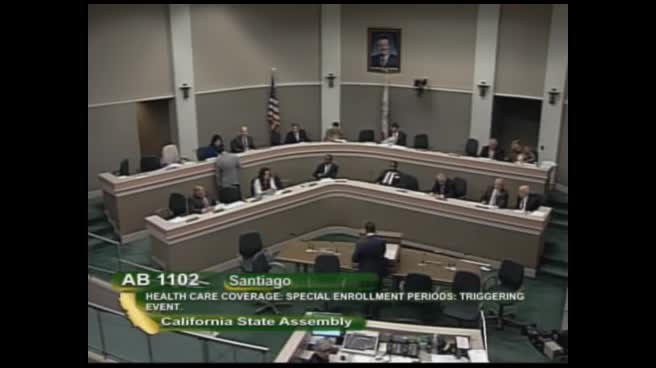 12MIN
Assembly Standing Committee on Health
Bill Author

Bill Co-Author(s):