AB 1182: Secondhand goods: tangible personal property.
- Session Year: 2015-2016
- House: Assembly
- Latest Version Date: 2015-10-10
Existing law requires secondhand dealers and coin dealers to, among other things, report certain secondhand tangible personal property taken in trade or pawn, accepted for sale on consignment, or accepted for auctioning, to the chief of police or to the sheriff, as specified. Existing law defines tangible personal property for those purposes as including secondhand tangible personal property that bears or bears evidence of having had a serial number or personalized initials and new or used tangible personal property that is received as security for a loan by a pawnbroker or is commonly sold by secondhand dealers and part of a significant class of stolen goods. Existing law requires the Attorney General to supply to local law enforcement agencies and periodically review a list of that personal property commonly sold by secondhand dealers which statistically is found through crime reports to the Attorney General to constitute a significant class of stolen goods.
This bill would require the Attorney General to update that list annually and post the list on his or her Internet Web site. The bill would instead specify that tangible personal property means secondhand tangible personal property that bears or bears evidence of having had a serial number or personalized initials, new or used tangible personal property that is received as security for a loan by a pawnbroker, or all tangible personal property that the Attorney General statistically determines through the most recent Department of Justice Crime in California report to constitute a significant class of stolen goods, as defined.
This bill would require the secondhand dealer to verify the identification of the seller or pledger for each transaction.
Existing law requires secondhand dealers and coin dealers to, among other things, report certain secondhand tangible personal property taken in trade or pawn, accepted for sale on consignment, or accepted for auctioning, to the chief of police or to the sheriff, as specified. Existing law defines tangible personal property for those purposes as including secondhand tangible personal property that bears or bears evidence of having had a serial number or personalized initials and new or used tangible personal property that is received as security for a loan by a pawnbroker or is commonly sold by secondhand dealers and part of a significant class of stolen goods. Existing law requires the Attorney General to supply to local law enforcement agencies and periodically update review a list of that personal property commonly sold by secondhand dealers and part of which statistically is found through crime reports to the Attorney General to constitute a significant class of stolen goods.
This bill would require the Attorney General to update that list annually and post the list on his or her Internet Web site. The bill would allow a county law enforcement agency to use its own list, as described, until the Attorney General provides the first annual updated list. The bill would instead specify that tangible personal property means secondhand tangible personal property that bears or bears evidence of having had a serial number or personalized initials and initials, new or used tangible personal property that is received as security for a loan by a pawnbroker or is commonly sold by secondhand dealers and part of pawnbroker, or all tangible personal property that the Attorney General statistically determines through the most recent Department of Justice Crime in California report to constitute a significant class of stolen goods. goods, as defined.
This bill would require the secondhand dealer to verify the identification of the seller or pledger for each transaction.
Existing law requires secondhand dealers and coin dealers to, among other things, report certain secondhand tangible personal property taken in trade or pawn, accepted for sale on consignment, or accepted for auctioning, to the chief of police or to the sheriff, as specified. Existing law defines tangible personal property for those purposes as including secondhand tangible personal property that bears or bears evidence of having had a serial number or personalized initials and new or used tangible personal property that is received as security for a loan by a pawnbroker or is commonly sold by secondhand dealers and part of a significant class of stolen goods. Existing law requires the Attorney General to supply to local law enforcement agencies and periodically update a list of that personal property commonly sold by secondhand dealers and part of a significant class of stolen goods.
This bill would require the Attorney General to update that list annually and post the list on his or her Internet Web site. The bill would allow a county law enforcement agency to use its own list, as described, until the Attorney General provides the first annual updated list. The bill would instead specify that tangible personal property means secondhand tangible personal property that bears or bears evidence of having had a serial number or personalized initials and new or used tangible personal property that is received as security for a loan by a pawnbroker or is commonly sold by secondhand dealers and part of a significant class of stolen goods.
Existing law requires secondhand dealers and coin dealers to, among other things, report certain secondhand tangible personal property taken in trade or pawn, accepted for sale on consignment, or accepted for auctioning, to the chief of police or to the sheriff, as specified. Existing law defines tangible personal property for those purposes as including secondhand tangible personal property that bears or bears evidence of having had a serial number or personalized initials and new or used tangible personal property that is received as security for a loan by a pawnbroker or is commonly sold by secondhand dealers and part of a significant class of stolen goods. Existing law requires the Attorney General to supply to local law enforcement agencies and periodically update a list of that personal property commonly sold by secondhand dealers and part of a significant class of stolen goods.
This bill would require the Attorney General to update that list annually and post the list on his or her Internet Web site. The bill would instead specify that tangible personal property means secondhand tangible personal property that bears or bears evidence of having had a serial number or personalized initials and new or used tangible personal property that is received as security for a loan by a pawnbroker or is commonly sold by secondhand dealers and part of a significant class of stolen goods.
Existing law requires secondhand dealers and coin dealers to, among other things, report certain secondhand tangible personal property taken in trade or pawn, accepted for sale on consignment, or accepted for auctioning, to the chief of police or to the sheriff, as specified. Existing law defines tangible personal property for those purposes as including secondhand tangible personal property that bears or bears evidence of having had a serial number or personalized initials and new or used tangible personal property that is received as security for a loan by a pawnbroker or is commonly sold by secondhand dealers and part of a significant class of stolen goods.
This bill would instead specify that tangible personal property means secondhand tangible personal property that bears or bears evidence of having had a serial number or personalized initials and new or used tangible personal property that is received as security for a loan by a pawnbroker or is commonly sold by secondhand dealers and part of a significant class of stolen goods.
The Medical Practice Act provides for the licensure and regulation of physicians and surgeons by the Medical Board of California. The act requires an applicant for a physicians and surgeons certificate to comply with general requirements for licensure unless other specific requirements apply to the particular class of applicant.
This bill would make nonsubstantive changes to that physicians and surgeons certificate provision.
(a)As used in this article, tangible personal property means all secondhand tangible personal property which bears a serial number or personalized initials or inscription or which, at the time it is acquired by the secondhand dealer, bears evidence of having had a serial number or personalized initials or inscription.
(b)Tangible personal property also means the following:
(1)All tangible personal property, new or used, including motor vehicles, received in pledge as security for a loan by a pawnbroker.
(2)All tangible personal property that bears a serial number or personalized initials or inscription which is purchased by a secondhand dealer or a pawnbroker or which, at the time of such purchase, bears evidence of having had a serial number or personalized initials or inscription.
(3)All tangible personal property that the Attorney General statistically determines through the most recent Department of Justice Crime in California report to constitute a significant class of stolen goods. A list of such personal property shall be supplied by the Attorney General to all local law enforcement agencies and posted on the Attorney Generals Internet Web site. Such list shall be updated annually by the Attorney General, beginning January 1, 2016, to ensure that it addresses current problems with stolen goods.
(c)As used in this article, tangible personal property does not include any new goods or merchandise purchased from a bona fide manufacturer or distributor or wholesaler of such new goods or merchandise by a secondhand dealer. For the purposes of this article, however, a secondhand dealer shall retain for one year from the date of purchase, and shall make available for inspection by any law enforcement officer, any receipt, invoice, bill of sale or other evidence of purchase of such new goods or merchandise.
(d)As used in this article, tangible personal property does not include coins, monetized bullion, or commercial grade ingots of gold, silver, or other precious metals. Commercial grade ingots means 0.99 fine or finer ingots of gold, silver, palladium, or platinum, or 0.925 fine sterling silver art bars and medallions, provided that the ingots, art bars, and medallions are marked by the refiner or fabricator as to their assay fineness.
(e)For purposes of this article, a significant class of stolen goods means those items determined through the Department of Justices annual Crime in California report to constitute more than 10 percent of property reported stolen in the calendar year preceding the annual posting of the list of significant classes of stolen goods.
SEC. 2.Section 21628.3 is added to the Business and Professions Code, to read:21628.3.In complying with the requirements of Section 21628, a secondhand dealer shall verify the identification of the seller or pledger for each transaction, not for each item that shall be reported.
SEC. 2.Section 21628 of the Business and Professions Code is amended to read:21628.Every secondhand dealer or coin dealer described in Section 21626 shall report daily, or on the first working day after receipt or purchase of secondhand tangible personal property, on forms or through an electronic reporting system approved by the Department of Justice, all secondhand tangible personal property, except for firearms, which he or she has purchased, taken in trade, taken in pawn, accepted for sale on consignment, or accepted for auctioning, to the chief of police or to the sheriff, in accordance with the provisions of Sections 21630 and 21633 and subdivision (j). The report shall be legible, prepared in English, completed where applicable, and include, but not be limited to, the following information:
(a)The name and current address of the intended seller or pledger of the property.
(b)The identification of the intended seller or pledger. The identification of the seller or pledger of the property shall be verified by the person taking the information. The verification shall be valid if the person taking the information reasonably relies on any one of the following documents, provided that the document is currently valid or has been issued within five years and contains a photograph or description, or both, of the person named on it, and, where applicable, is signed by the person, and bears a serial or other identifying number:
(1)A passport of the United States.
(2)A drivers license issued by any state or Canada.
(3)An identification card issued by any state.
(4)An identification card issued by the United States.
(5)A passport from any other country in addition to another item of identification bearing an address.
(6)A Matricula Consular in addition to another item of identification bearing an address.
(c)A complete and reasonably accurate description of serialized property, including, but not limited to, the following: serial number and other identifying marks or symbols, owner-applied numbers, manufacturers named brand, and model name or number. Watches need not be disassembled when special skill or special tools are required to obtain the required information, unless specifically requested to do so by a peace officer. A special tool does not include a penknife, caseknife, or similar instrument and disassembling a watch with a penknife, caseknife, or similar instrument does not constitute a special skill. In all instances where the required information may be obtained by removal of a watchband, then the watchband shall be removed. The cost associated with opening the watch shall be borne by the pawnbroker, secondhand dealer, or customer.
(d)A complete and reasonably accurate description of nonserialized property, including, but not limited to, the following: size, color, material, manufacturers pattern name (when known), owner-applied numbers and personalized inscriptions, and other identifying marks or symbols. Watches need not be disassembled when special skill or special tools are required to obtain the required information, unless specifically requested to do so by a peace officer. A special tool does not include a penknife, caseknife, or similar instrument and disassembling a watch with a penknife, caseknife, or similar instrument does not constitute a special skill. In all instances where the required information may be obtained by removal of a watchband, then the watchband shall be removed. The cost associated with opening the watch shall be borne by the pawnbroker, secondhand dealer, or customer.
(e)A certification by the intended seller or pledger that he or she is the owner of the property or has the authority of the owner to sell or pledge the property.
(f)A certification by the intended seller or pledger that to his or her knowledge and belief the information is true and complete.
(g)A legible fingerprint taken from the intended seller or pledger, as prescribed by the Department of Justice. This requirement does not apply to a coin dealer, unless required pursuant to local regulation.
(h)(1)When a secondhand dealer complies with all of the provisions of this section, he or she shall be deemed to have received from the seller or pledger adequate evidence of authority to sell or pledge the property for all purposes included in this article, and Division 8 (commencing with Section 21000) of the Financial Code.
(2)In enacting this subdivision, it is the intent of the Legislature that its provisions shall not adversely affect the implementation of, or prosecution under, any provision of the Penal Code.
(i)Any person who conducts business as a secondhand dealer at any gun show or event, as defined in Section 478.100 of Title 27 of the Code of Federal Regulations, or its successor, outside the jurisdiction that issued the secondhand dealer license in accordance with subdivision (d) of Section 21641, may be required to submit a duplicate of the transaction report prepared pursuant to this section to the local law enforcement agency where the gun show or event is conducted.
(j)(1)The Department of Justice shall, in consultation with appropriate local law enforcement agencies, develop clear and comprehensive descriptive categories denoting tangible personal property, as detailed in this section, subject to the reporting requirements of this section. These categories shall be incorporated by secondhand dealers and coin dealers described in Section 21626 for purposes of the reporting requirements set forth herein. Except as otherwise provided in this section, any report required of a secondhand dealer shall be transmitted by electronic means. With the consultation by the Department of Justice with local law enforcement agencies and representatives from the secondhand dealer businesses, pursuant to Resolution Chapter 16 of the Statutes of 2010, and upon the availability of sufficient funds in the Secondhand Dealer and Pawnbroker Fund created pursuant to Section 21642.5, the department shall promptly develop a single, statewide, uniform electronic reporting system to be used to transmit these secondhand dealer reports.
(2)(A)Until the date that the Department of Justice implements the single, statewide, uniform electronic reporting system described in paragraph (1), each secondhand dealer may continue to report the information required by this section under the reporting categories described in paragraph (1) in paper format on forms approved of or provided by the Department of Justice.
(B)On and after the date that the Department of Justice implements the single, statewide, uniform electronic reporting system described in paragraph (1), each secondhand dealer shall electronically report using that system the information required by this section under the reporting categories described in paragraph (1), except that for the first 30 days following the implementation date, each secondhand dealer shall also report the information in paper format as described in subparagraph (A).
(3)A coin dealer shall report the information required by this section under the reporting categories described in paragraph (1) on a form developed by the Attorney General that the coin dealer shall transmit each day by facsimile transmission or by mail to the chief of police or sheriff. A transaction shall consist of not more than one item.
(4)For purposes of this subdivision, item shall mean any single physical article. However, with respect to a commonly accepted grouping of articles that are purchased as a set, including, but not limited to, a pair of earrings or place settings of china, silverware, or other tableware, item shall mean that commonly accepted grouping.
(5)Nothing in this subdivision shall be construed as excepting a secondhand dealer from the fingerprinting requirement of subdivision (g).
(k)Nothing in this section shall be construed to exempt a person licensed as a firearms dealer pursuant to Sections 26700 to 26915, inclusive, of the Penal Code from the reporting requirements for the delivery of firearms pursuant to Sections 26700 to 26915, inclusive, of the Penal Code.
(l)The secondhand dealer shall verify the identification of the seller or pledger for each transaction, not for each item that must be reported.
(a)As used in this article, tangible personal property means all secondhand tangible personal property which bears a serial number or personalized initials or inscription or which, at the time it is acquired by the secondhand dealer, bears evidence of having had a serial number or personalized initials or inscription.
(b)Tangible personal property also means the following:
(1)All tangible personal property, new or used, including motor vehicles, received in pledge as security for a loan by a pawnbroker.
(2)All tangible personal property that bears a serial number or personalized initials or inscription which is purchased by a secondhand dealer or a pawnbroker or which, at the time of such purchase, bears evidence of having had a serial number or personalized initials or inscription.
(3)(A)All All tangible personal property commonly sold by secondhand dealers which statistically is found through crime reports to the Attorney General that the Attorney General statistically determines through the most recent Department of Justice Crime in California report to constitute a significant class of stolen goods. A list of such personal property shall be supplied by the Attorney General to all local law enforcement agencies and posted on the Attorney Generals Internet Web site. Such list shall be updated annually by the Attorney General to insure General, beginning January 1, 2016, to ensure that it addresses current problems with stolen goods.
(B)A county law enforcement agency may use its own list of personal property commonly sold by secondhand dealers which statistically is found through crime reports to the county law enforcement agency to constitute a significant class of stolen goods until the Attorney General provides the first annual update of the list of personal property.
(c)As used in this article, tangible personal property does not include any new goods or merchandise purchased from a bona fide manufacturer or distributor or wholesaler of such new goods or merchandise by a secondhand dealer. For the purposes of this article, however, a secondhand dealer shall retain for one year from the date of purchase, and shall make available for inspection by any law enforcement officer, any receipt, invoice, bill of sale or other evidence of purchase of such new goods or merchandise.
(d)As used in this article, tangible personal property does not include coins, monetized bullion, or commercial grade ingots of gold, silver, or other precious metals. Commercial grade ingots means 0.99 fine or finer ingots of gold, silver, palladium, or platinum, or 0.925 fine sterling silver art bars and medallions, provided that the ingots, art bars, and medallions are marked by the refiner or fabricator as to their assay fineness.
(e)For purposes of this article, a significant class of stolen goods means those items determined through the Department of Justices annual Crime in California report to constitute more than 10 percent of property reported stolen in the calendar year preceding the annual posting of the list of significant classes of stolen goods.
SEC. 2.Section 21628 of the Business and Professions Code is amended to read:21628.Every secondhand dealer or coin dealer described in Section 21626 shall report daily, or on the first working day after receipt or purchase of secondhand tangible personal property, on forms or through an electronic reporting system approved by the Department of Justice, all secondhand tangible personal property, except for firearms, which he or she has purchased, taken in trade, taken in pawn, accepted for sale on consignment, or accepted for auctioning, to the chief of police or to the sheriff, in accordance with the provisions of Sections 21630 and 21633 and subdivision (j). The report shall be legible, prepared in English, completed where applicable, and include, but not be limited to, the following information:
(a)The name and current address of the intended seller or pledger of the property.
(b)The identification of the intended seller or pledger. The identification of the seller or pledger of the property shall be verified by the person taking the information. The verification shall be valid if the person taking the information reasonably relies on any one of the following documents, provided that the document is currently valid or has been issued within five years and contains a photograph or description, or both, of the person named on it, and, where applicable, is signed by the person, and bears a serial or other identifying number:
(1)A passport of the United States.
(2)A drivers license issued by any state or Canada.
(3)An identification card issued by any state.
(4)An identification card issued by the United States.
(5)A passport from any other country in addition to another item of identification bearing an address.
(6)A Matricula Consular in addition to another item of identification bearing an address.
(c)A complete and reasonably accurate description of serialized property, including, but not limited to, the following: serial number and other identifying marks or symbols, owner-applied numbers, manufacturers named brand, and model name or number. Watches need not be disassembled when special skill or special tools are required to obtain the required information, unless specifically requested to do so by a peace officer. A special tool does not include a penknife, caseknife, or similar instrument and disassembling a watch with a penknife, caseknife, or similar instrument does not constitute a special skill. In all instances where the required information may be obtained by removal of a watchband, then the watchband shall be removed. The cost associated with opening the watch shall be borne by the pawnbroker, secondhand dealer, or customer.
(d)A complete and reasonably accurate description of nonserialized property, including, but not limited to, the following: size, color, material, manufacturers pattern name (when known), owner-applied numbers and personalized inscriptions, and other identifying marks or symbols. Watches need not be disassembled when special skill or special tools are required to obtain the required information, unless specifically requested to do so by a peace officer. A special tool does not include a penknife, caseknife, or similar instrument and disassembling a watch with a penknife, caseknife, or similar instrument does not constitute a special skill. In all instances where the required information may be obtained by removal of a watchband, then the watchband shall be removed. The cost associated with opening the watch shall be borne by the pawnbroker, secondhand dealer, or customer.
(e)A certification by the intended seller or pledger that he or she is the owner of the property or has the authority of the owner to sell or pledge the property.
(f)A certification by the intended seller or pledger that to his or her knowledge and belief the information is true and complete.
(g)A legible fingerprint taken from the intended seller or pledger, as prescribed by the Department of Justice. This requirement does not apply to a coin dealer, unless required pursuant to local regulation.
(h)(1)When a secondhand dealer complies with all of the provisions of this section, he or she shall be deemed to have received from the seller or pledger adequate evidence of authority to sell or pledge the property for all purposes included in this article, and Division 8 (commencing with Section 21000) of the Financial Code.
(2)In enacting this subdivision, it is the intent of the Legislature that its provisions shall not adversely affect the implementation of, or prosecution under, any provision of the Penal Code.
(i)Any person who conducts business as a secondhand dealer at any gun show or event, as defined in Section 478.100 of Title 27 of the Code of Federal Regulations, or its successor, outside the jurisdiction that issued the secondhand dealer license in accordance with subdivision (d) of Section 21641, may be required to submit a duplicate of the transaction report prepared pursuant to this section to the local law enforcement agency where the gun show or event is conducted.
(j)(1)The Department of Justice shall, in consultation with appropriate local law enforcement agencies, develop clear and comprehensive descriptive categories denoting tangible personal property, as detailed in this section, subject to the reporting requirements of this section. These categories shall be incorporated by secondhand dealers and coin dealers described in Section 21626 for purposes of the reporting requirements set forth herein. Except as otherwise provided in this section, any report required of a secondhand dealer shall be transmitted by electronic means. With the consultation by the Department of Justice with local law enforcement agencies and representatives from the secondhand dealer businesses, pursuant to Resolution Chapter 16 of the Statutes of 2010, and upon the availability of sufficient funds in the Secondhand Dealer and Pawnbroker Fund created pursuant to Section 21642.5, the department shall promptly develop a single, statewide, uniform electronic reporting system to be used to transmit these secondhand dealer reports.
(2)(A)Until the date that the Department of Justice implements the single, statewide, uniform electronic reporting system described in paragraph (1), each secondhand dealer may continue to report the information required by this section under the reporting categories described in paragraph (1) in paper format on forms approved of or provided by the Department of Justice.
(B)On and after the date that the Department of Justice implements the single, statewide, uniform electronic reporting system described in paragraph (1), each secondhand dealer shall electronically report using that system the information required by this section under the reporting categories described in paragraph (1), except that for the first 30 days following the implementation date, each secondhand dealer shall also report the information in paper format as described in subparagraph (A).
(3)A coin dealer shall report the information required by this section under the reporting categories described in paragraph (1) on a form developed by the Attorney General that the coin dealer shall transmit each day by facsimile transmission or by mail to the chief of police or sheriff. A transaction shall consist of not more than one item.
(4)For purposes of this subdivision, item shall mean any single physical article. However, with respect to a commonly accepted grouping of articles that are purchased as a set, including, but not limited to, a pair of earrings or place settings of china, silverware, or other tableware, item shall mean that commonly accepted grouping.
(5)Nothing in this subdivision shall be construed as excepting a secondhand dealer from the fingerprinting requirement of subdivision (g).
(k)Nothing in this section shall be construed to exempt a person licensed as a firearms dealer pursuant to Sections 26700 to 26915, inclusive, of the Penal Code from the reporting requirements for the delivery of firearms pursuant to Sections 26700 to 26915, inclusive, of the Penal Code.
(l)The secondhand dealer shall verify the identification of the seller or pledger for each transaction, not for each item that must be reported.
(a)As used in this article, tangible personal property means all secondhand tangible personal property which bears a serial number or personalized initials or inscription or which, at the time it is acquired by the secondhand dealer, bears evidence of having had a serial number or personalized initials or inscription.
(b)Tangible personal property also means the following:
(1)All tangible personal property, new or used, including motor vehicles, received in pledge as security for a loan by a pawnbroker.
(2)All tangible personal property that bears a serial number or personalized initials or inscription which is purchased by a secondhand dealer or a pawnbroker or which, at the time of such purchase, bears evidence of having had a serial number or personalized initials or inscription.
(3)(A)All personal property commonly sold by secondhand dealers which statistically is found through crime reports to the Attorney General to constitute a significant class of stolen goods. A list of such personal property shall be supplied by the Attorney General to all local law enforcement agencies and posted on the Attorney Generals Internet Web site. Such list shall be updated annually by the Attorney General to insure that it addresses current problems with stolen goods.
(B)A county law enforcement agency may use its own list of personal property commonly sold by secondhand dealers which statistically is found through crime reports to the county law enforcement agency to constitute a significant class of stolen goods until the Attorney General provides the first annual update of the list of personal property.
(c)As used in this article, tangible personal property does not include any new goods or merchandise purchased from a bona fide manufacturer or distributor or wholesaler of such new goods or merchandise by a secondhand dealer. For the purposes of this article, however, a secondhand dealer shall retain for one year from the date of purchase, and shall make available for inspection by any law enforcement officer, any receipt, invoice, bill of sale or other evidence of purchase of such new goods or merchandise.
(d)As used in this article, tangible personal property does not include coins, monetized bullion, or commercial grade ingots of gold, silver, or other precious metals. Commercial grade ingots means 0.99 fine or finer ingots of gold, silver, palladium, or platinum, or 0.925 fine sterling silver art bars and medallions, provided that the ingots, art bars, and medallions are marked by the refiner or fabricator as to their assay fineness.
(a)As used in this article, tangible personal property means all secondhand tangible personal property which bears a serial number or personalized initials or inscription or which, at the time it is acquired by the secondhand dealer, bears evidence of having had a serial number or personalized initials or inscription.
(b)Tangible personal property also means the following:
(1)All tangible personal property, new or used, including motor vehicles, received in pledge as security for a loan by a pawnbroker.
(2)All tangible personal property that bears a serial number or personalized initials or inscription which is purchased by a secondhand dealer or a pawnbroker or which, at the time of such purchase, bears evidence of having had a serial number or personalized initials or inscription.
(3)All personal property commonly sold by secondhand dealers which statistically is found through crime reports to the Attorney General to constitute a significant class of stolen goods. A list of such personal property shall be supplied by the Attorney General to all local law enforcement agencies. agencies and posted on the Attorney Generals Internet Web site. Such list shall be reviewed periodically updated annually by the Attorney General to insure that it addresses current problems with stolen goods.
(c)As used in this article, tangible personal property does not include any new goods or merchandise purchased from a bona fide manufacturer or distributor or wholesaler of such new goods or merchandise by a secondhand dealer. For the purposes of this article, however, a secondhand dealer shall retain for one year from the date of purchase, and shall make available for inspection by any law enforcement officer, any receipt, invoice, bill of sale or other evidence of purchase of such new goods or merchandise.
(d)As used in this article, tangible personal property does not include coins, monetized bullion, or commercial grade ingots of gold, silver, or other precious metals. Commercial grade ingots means 0.99 fine or finer ingots of gold, silver, palladium, or platinum, or 0.925 fine sterling silver art bars and medallions, provided that the ingots, art bars, and medallions are marked by the refiner or fabricator as to their assay fineness.
(a)As used in this article, tangible personal property includes, but is not limited to, means all secondhand tangible personal property which bears a serial number or personalized initials or inscription or which, at the time it is acquired by the secondhand dealer, bears evidence of having had a serial number or personalized initials or inscription.
(b)Tangible personal property also includes, but is not limited to, means the following:
(1)All tangible personal property, new or used, including motor vehicles, received in pledge as security for a loan by a pawnbroker.
(2)All tangible personal property that bears a serial number or personalized initials or inscription which is purchased by a secondhand dealer or a pawnbroker or which, at the time of such purchase, bears evidence of having had a serial number or personalized initials or inscription.
(3)All personal property commonly sold by secondhand dealers which statistically is found through crime reports to the Attorney General to constitute a significant class of stolen goods. A list of such personal property shall be supplied by the Attorney General to all local law enforcement agencies. Such list shall be reviewed periodically by the Attorney General to insure that it addresses current problems with stolen goods.
(c)As used in this article, tangible personal property does not include any new goods or merchandise purchased from a bona fide manufacturer or distributor or wholesaler of such new goods or merchandise by a secondhand dealer. For the purposes of this article, however, a secondhand dealer shall retain for one year from the date of purchase, and shall make available for inspection by any law enforcement officer, any receipt, invoice, bill of sale or other evidence of purchase of such new goods or merchandise.
(d)As used in this article, tangible personal property does not include coins, monetized bullion, or commercial grade ingots of gold, silver, or other precious metals. Commercial grade ingots means 0.99 fine or finer ingots of gold, silver, palladium, or platinum, or 0.925 fine sterling silver art bars and medallions, provided that the ingots, art bars, and medallions are marked by the refiner or fabricator as to their assay fineness.
SECTION 1.Section 2080 of the Business and Professions Code is amended to read:2080.(a)Except as otherwise provided, the provisions of this article applicable to applications generally shall apply to all certificates issued.
(b)An applicant for a physicians and surgeons certificate shall comply with this article unless other specific requirements of this chapter are applicable to the particular class of applicant.
(a)Except as otherwise provided, the provisions of this article applicable to applications generally shall apply to all certificates issued.
(b)Every An applicant for a physicians and surgeons certificate shall comply with the requirements of this article unless other specific requirements of this chapter are applicable to a the particular class of applicant.
|
Date
|
Status
|
|---|---|
| Sep 8, 2015 | Read third time. Passed. Ordered to the Assembly. (Ayes 40. Noes 0. Page 2593.). |
| Aug 17, 2015 | From committee: Amend, and do pass as amended and re-refer to Com. on APPR. (Ayes 6. Noes 1.) (July 14). |
| Aug 18, 2015 | Read second time and amended. Re-referred to Com. on APPR. |
| Aug 24, 2015 | From committee: Be placed on second reading file pursuant to Senate Rule 28.8. |
| Aug 25, 2015 | Read second time. Ordered to third reading. |
| Sep 3, 2015 | Read third time and amended. Ordered to second reading. |
| Sep 4, 2015 | Read second time. Ordered to third reading. |
| Sep 8, 2015 | In Assembly. Concurrence in Senate amendments pending. May be considered on or after September 10 pursuant to Assembly Rule 77. |
| Sep 8, 2015 | Read third time. Passed. Ordered to the Assembly. |
| Jul 7, 2015 | In committee: Hearing postponed by committee. |
| Sep 9, 2015 | Assembly Rule 77 suspended. |
| Sep 9, 2015 | Assembly Rule 77 suspended. (Page 2990.) |
| Sep 9, 2015 | Senate amendments concurred in. To Engrossing and Enrolling. |
| Sep 9, 2015 | Senate amendments concurred in. To Engrossing and Enrolling. (Ayes 78. Noes 0. Page 3003.). |
| Sep 9, 2015 | Senate amendments concurred in. To Engrossing and Enrolling. (Ayes 78. Noes 0.). |
| Sep 17, 2015 | Enrolled and presented to the Governor at 4 p.m. |
| Oct 10, 2015 | Approved by the Governor. |
| Oct 10, 2015 | Chaptered by Secretary of State - Chapter 749, Statutes of 2015. |
| May 5, 2015 | Read second time and amended. |
| Mar 1, 2015 | From printer. May be heard in committee March 31. |
| Mar 2, 2015 | Read first time. |
| Mar 26, 2015 | From committee chair, with author's amendments: Amend, and re-refer to Com. on B. & P. Read second time and amended. |
| Mar 26, 2015 | Referred to Com. on B. & P. |
| Apr 6, 2015 | Re-referred to Com. on B. & P. |
| Apr 21, 2015 | From committee chair, with author's amendments: Amend, and re-refer to Com. on B. & P. Read second time and amended. |
| Apr 22, 2015 | Re-referred to Com. on B. & P. |
| May 4, 2015 | From committee: Amend, and do pass as amended and re-refer to Com. on APPR. (Ayes 14. Noes 0.) (April 28). |
| Feb 27, 2015 | Introduced. To print. |
| May 6, 2015 | Re-referred to Com. on APPR. |
| May 27, 2015 | From committee: Do pass. (Ayes 17. Noes 0.) (May 27). |
| May 28, 2015 | Read second time. Ordered to third reading. |
| Jun 1, 2015 | In Senate. Read first time. To Com. on RLS. for assignment. |
| Jun 1, 2015 | Read third time. Passed. Ordered to the Senate. |
| Jun 1, 2015 | Read third time. Passed. Ordered to the Senate. (Ayes 79. Noes 0. Page 1691.) |
| Jun 11, 2015 | Referred to Com. on PUB. S. |
|
Date
|
Description
|
Location
|
Votes
|
|
|---|---|---|---|---|
| Sep 9, 2015 | AB 1182 SANTIAGO Concurrence in Senate Amendments | Assembly Floor |
Passed |
|
| Sep 8, 2015 | Assembly 3rd Reading AB1182 Santiago By Wieckowski | Senate Floor |
Passed |
|
| Jul 14, 2015 | Do pass as amended, but first amend, and re-refer to the Committee on [Appropriations] | Senate Standing Committee on Public Safety |
Passed |
|
| Jun 1, 2015 | AB 1182 SANTIAGO Assembly Third Reading | Assembly Floor |
Passed |
|
| May 27, 2015 | Do pass. | Assembly Standing Committee on Appropriations |
Passed |
|
| Apr 28, 2015 | Do pass as amended and be re-referred to the Committee on [Appropriations] | Assembly Standing Committee on Business and Professions |
Passed |
This list shows positions taken on this bill by organizations on the date displayed, which is linked to the original source.
Positions by individuals are not included.
|
Organization
|
Position
|
Date
|
|---|---|---|
| Antiques By The Bay, Inc. | ** Support | Sep 8, 2015 |
| California Association of Resellers, ReUsers and Buyers | ** Support | Sep 8, 2015 |
| California Police Chiefs Association | ** Against | Sep 8, 2015 |
| California State Sheriffs' Association | ** Against | Sep 8, 2015 |
| Californians Against Waste | ** Support | Sep 8, 2015 |
| Home and Consignment Center | * Support | May 27, 2015 |
| Home Consignment Center | ** Support | Sep 8, 2015 |
| Michaan's Auctions | * Support | May 27, 2015 |
| Sacramento Antique Faire | ** Support | Sep 8, 2015 |
| Secondhand Collectors Association | ** Against | Sep 8, 2015 |
AB 1182
Page 3
CONCURRENCE IN SENATE AMENDMENTS
AB 1182
(Santiago)
As Amended September 3, 2015
Majority vote
ASSEMBLY: |
79-0 |
(June 1, 2015 |
SENATE: |
40-0 |
(September 8, 2015) |
Original Committee Reference: B. & P.
SUMMARY: Narrows the current definition of tangible personal property, as specified, and requires the Department of Justice (DOJ) to annually update the list of items which represent a significant class of stolen goods, beginning January 1, 2016, and post it on its Web site, and makes other technical and clarifying amendments. Specifically, this bill:
Revises and narrows the definition of "tangible personal property" to include tangible personal property that the attorney general (AG) statistically determines through the most recent DOJ "Crime in California" report to constitute a significant class of stolen goods, instead of the AG utilizing crime reports to determine the list of stolen goods.
Requires, beginning January 1, 2016, the AG to publish and post on its Web site the list of a significant class of stolen goods and update the list annually.
Defines "significant class of stolen goods" to mean those items determined through the DOJs annual "Crime in California" report to constitute more than 10 % of property reported stolen in the calendar year preceding the annual posting of the list of significant classes of stolen goods.
Requires a secondhand dealer to verify the identification of the seller or pledger for each transaction, not for each item that must be reported.
The Senate amendments delete the provision which authorized a law enforcement agency to utilize its own list of significant stolen property until the DOJ provides the first annual update to its list; revises the definition of "tangible personal property" to mean "tangible personal property' that the AG determines through the most recent DOJ "Crime in California" report to constitute a significant class of stolen goods; requires the DOJ to update this list annually beginning January 1, 2016; defines "significant class of stolen goods;" and, clarifies that a secondhand dealer must verify the identification of the seller or pledger for each transaction, not for each item that must be reported.
EXISTING LAW:
States that "tangible personal property" includes, but is not limited to, all secondhand tangible personal property which bears a serial number or personalized initials or inscription, or which at the time it is acquired by the secondhand dealer, bears evidence of having had a serial number or personalized initials or inscription. (Business and Professions Code (BPC) Section 21627(a))
States that tangible personal property also includes, but is not limited to, the following: (BPC Section 21627(b))
All tangible personal property, new or used, including motor vehicles, received in pledge as security for a loan by a pawnbroker;
All tangible personal property that bears a serial number or personalized initials or inscription which is purchased by a secondhand dealer or a pawnbroker or which, at the time of such purchase, bears evidence of having had a serial number or personalized initials or inscription; and,
All personal property commonly sold by secondhand dealers which statistically is found through crime reports to the DOJ to constitute a significant class of stolen goods. A list of such personal property shall be supplied by the DOJ to all local law enforcement agencies. The list shall be reviewed periodically by the DOJ to insure that it addresses current problems with stolen goods.
FISCAL EFFECT: According to the Senate Appropriations Committee, pursuant to Senate Rule 28.8, negligible state costs.
COMMENTS:
Purpose. This bill is sponsored by the California Association of Resellers, ReUsers and Buyers. According to the author, "… with the passage of AB 391[(Pan) Chapter, 172, Statutes of 2012], secondhand dealers (who do not sell serialized goods or goods which are statistically found through crime reports to the [DOJ] to constitute a significant class of stolen goods to be licensed as a secondhand dealer) will now need to take the name and current address of the intended seller of the property, take the identification of the intended seller or pledger and a legible fingerprint from the intended seller, to report daily, and to retain for 30 days all tangible personal property reported.
"As outlined, California law imposes all of the above-mentioned regulatory requirements on every secondhand dealer, regardless of how large the number of identical items or how low the value of each item bought and sold. As written, separate individual reports will need to be made for every used book, every old doorknob, every piece of colored glass, every old name badge or game piece (amongst thousands of other items) sold within the State of California. There is also no consideration made for items that have been gathered over the past several decades for which re-sellers would be unable to locate the initial owners (for purposes of gaining their information, fingerprints, and identification)… With this in mind, [this bill] seeks to clarify existing law, provide law enforcement useful data they need in order to curtail the dissemination of stolen property and to facilitate the recovery of such property, and remove an unnecessary burden on secondhand dealers."
Background. This bill seeks to revise the definition of "tangible personal property" by narrowing the list of items which are considered to be "tangible personal property." By narrowing the definition, this bill will limit the category of secondhand items that need to be reported to local law enforcement on a daily basis. Currently, "tangible personal property" is defined as those items referenced in BPC Section 21627(b), but current law does not restrict the definition to only those items listed. This bill will revise the definition by specifying that "tangible personal property" only includes the items that are listed under BPC Section 21627(b), such as items that bear a serial number and all personal property commonly sold by secondhand dealers which are found through the DOJ's "Crime in California" report that constitute a significant class of stolen goods. This bill does not alter the reporting requirements for secondhand dealers if they acquire an item that would meet the revised definition of tangible person property, but specifies that the secondhand dealer must verify the identification of the seller for each transaction, not each item.
Secondhand Dealer Transactions and Reporting Requirements. Under current law, secondhand dealers are required to report daily or on the first working day after the receipt or purchase of secondhand personal property on forms or through the electronic database (once completely functional), all of the secondhand tangible personal property which has been purchased, taken in trade, taken in pawn, or accepted for sale or consignment. As noted by the author, because the definition of personal tangible property is so broad, the secondhand dealers feel compelled to report all secondhand transition items, even those which may be of minor material value such as door knobs, used books or old game pieces.
DOJ List. The intent of narrowing the definition of "tangible personal property" is to limit the number of secondhand transactions that must be reported by secondhand dealers to those which are of significance for crime tracking purposes. As noted, the definition of "tangible personal property" includes all personal property that bears a serial number or personalized initials or inscription and those items found on a list compiled by the DOJ. Currently, BPC Section 21627(3) requires the DOJ to provide its list of personal property which statistically is found through crime reports to constitute a significant class of stolen goods to local law enforcement. Depending on the size, type, and number of items reported on the list as determined by the DOJ, it could significantly expand or reduce those items which are considered "tangible personal property." Currently, there are only two items on the DOJ's Secondhand Dealer Report including: jewelry and sterling silverware. This limited list means that the definition of "tangible personal property" will only include those two items along with anything that has a serial number. This bill will require the DOJ to produce a list of a significant class of stolen goods, based on the DOJ's "Crime in California" report, which must be updated annually.
Analysis Prepared by: Elissa Silva / B. & P. / (916) 319-3301 FN: 0002219
AB 1182
Page 7
|
Office of Senate Floor Analyses (916) 651-1520 Fax: (916) 327-4478 |
THIRD READING
Bill No: AB 1182
Amended: 9/3/15 in Senate
SENATE PUBLIC SAFETY COMMITTEE: 6-1, 7/14/15
AYES: Hancock, Anderson, Leno, Liu, Monning, Stone
NOES: Glazer
SENATE APPROPRIATIONS COMMITTEE: Senate Rule 28.8
ASSEMBLY FLOOR: 79-0, 6/1/15 - See last page for vote
SUBJECT: Secondhand goods: tangible personal property
DIGEST: This bill defines items that constitute a significant class of stolen goods that secondhand dealers must report to law enforcement upon acquisition and requires the Attorney General to annually update and post on her website the list of property that secondhand dealers must report.
Senate Floor Amendments of 9/3/15 are chaptering amendments to protect AB 632 (Eggman). One of the sections in this bill amends the same statute as the statute amended by AB 632. This bill places that provision in a stand-alone statute.
Existing law:
Defines a "secondhand dealer" as any person, co-partnership, firm, or corporation whose business includes buying, selling, trading, taking in pawn, accepting for sale on consignment, accepting for auctioning, or auctioning secondhand tangible personal property and specifies that a "secondhand dealer" does not include a coin dealer or participant at gun shows or events, as specified. (Bus. and Prof. Code § 21626, subd. (a).)
Specifies that "secondhand dealers" do not include persons who perform the services of an auctioneer for a fee or salary or persons whose business is limited to the reconditioning and selling of major household appliances, as long as specified conditions are met. (Bus. and Prof. Code § 21626.5.)
States that "tangible personal property" includes, but is not limited to, all secondhand tangible personal property which bears a serial number or personalized initials or inscription, or which at the time it is acquired by the secondhand dealer, bears evidence of having had a serial number or personalized initials or inscription. (Bus. and Prof. Code § 21627, subd. (a).)
States that tangible personal property also includes, but is not limited to, the following:
All tangible personal property, new or used, including motor vehicles, received in pledge as security for a loan by a pawnbroker;
All tangible personal property that bears a serial number or personalized initials or inscription which is purchased by a secondhand dealer or a pawnbroker or which, at the time of such purchase, bears evidence of having had a serial number or personalized initials or inscription; and,
All personal property commonly sold by secondhand dealers which statistically is found through crime reports to the DOJ to constitute a significant class of stolen goods. A list of such personal property shall be supplied by the DOJ to all local law enforcement agencies. The list shall be reviewed periodically by the DOJ to insure that it addresses current problems with stolen goods. (Bus. and Prof. Code § 21627, subd. (b).)
Specifies that “tangible personal property” does not include any new goods or merchandise purchased from a bona fide manufacturer, distributor, or wholesaler of such new goods or merchandise by a secondhand dealer, and requires a secondhand dealer to retain for one year from the date of purchase, and make available for inspection by any law enforcement officer, any receipt, invoice, bill of sale or other evidence of purchase of such new goods or merchandise. (Bus. and Prof. Code § 21627, subd. (c))
Specifies that “tangible personal property” does not include coins, monetized bullion, or commercial grade ingots of gold, silver, or other precious metals, as specified. (Bus. and Prof. Code § 21627, subd. (d).)
Requires every secondhand dealer or coin dealer, as defined, to report daily, or on the first working day after receipt or purchase, on forms or through an electronic reporting system approved by the Department of Justice (DOJ), all secondhand tangible personal property, except for firearms, which he or she has purchased, taken in trade, taken in pawn, accepted for sale on consignment, or accepted for auctioning, to the chief of police or to the sheriff, as specified. (Bus. and Prof. Code § 21628)
Requires the report to be legible, prepared in English, completed where applicable, and include, but not be limited to, the following information: (Bus. and Prof. Code § 21628)
The name and current address of the intended seller or pledger of the property;
The identification of the intended seller or pledger, as specified;
A complete and reasonably accurate description of serialized property, including, but not limited to: serial number and other identifying marks or symbols, owner-applied numbers, manufacturer’s named brand, and model name or number;
A complete and reasonably accurate description of non-serialized property, including, but not limited to: size, color, material, manufacturer’s pattern name (when known), owner-applied numbers and personalized inscriptions, and other identifying marks or symbols;
A certification by the intended seller or pledger that he or she is the owner of the property or has the authority of the owner to sell or pledge the property.
A certification by the intended seller or pledger that to his or her knowledge and belief the information is true and complete;
A legible fingerprint taken from the intended seller or pledger, as specified; and,
When a secondhand dealer complies with all of the provisions of this section, he or she shall be deemed to have received from the seller or pledger adequate evidence of authority to sell or pledge the property, as specified.
Requires the DOJ, in consultation with appropriate local law enforcement agencies, to develop clear and comprehensive descriptive categories denoting tangible personal property, as specified. (Bus. and Prof. Code § 21628, subd. (j).)
Requires the DOJ to develop a single, statewide, uniform, electronic reporting system to be used to transmit required secondhand dealer reports, as specified. (Bus. and Prof. Code § 21628, subd. (j)(1).)
Requires secondhand and coin dealers to hold tangible personal property acquired for 30 days before disposing of the property. Pawnbrokers must wait for a period of four months before disposing of tangible personal property that is acquired. For purposes of this Section, tangible personal property means property that must be reported to law enforcement upon acquisition by the reporting entity or party. (Bus. and Prof. Code § 21636.)
This bill:
Eliminates the statutory provision stating that the definition of tangible personal property is not limited to the specifically listed or enumerated property.
Defines "tangible personal property" as only property specifically listed or enumerated in current law: serialized property, property with personalized initials or inscriptions, property that bears evidence of previously having a serial number, initials or inscription, and all personal property that the Attorney General statistically determines through the “Crime in California Report” to constitute a statistically significant class of stolen goods.
Defines “a statistically significant class of stolen goods” as those items found to constitute more than 10% of property reported as stolen in the annual “Crime in California” report.
Requires the Attorney General to annually update its list of personal property commonly sold by secondhand dealers that constitutes a statistically significant class of stolen goods and post the list on the Attorney General’s website.
Specifies that a secondhand goods dealer need only verify the identity of the person selling property once per transaction, not as to each item sold in a transaction, although each item obtained by the dealer must be reported.
Background
In 2012, AB 391 (Pan) established a new requirement that secondhand dealers and pawnbrokers electronically report to the DOJ all secondhand tangible property which has been purchased, taken in trade, taken in pawn, accepted for sale on consignment or accepted for auctioning. Licensed secondhand dealers and pawnbrokers use must the new system - the California Automated Pawn and Secondhand Dealer System (CAPPS) - to do so.
A March 19, 2015 letter from DOJ to pawnbrokers and secondhand dealers stated:
[DOJ] was mandated pursuant to Assembly Bill 391 (Stats 2012, Ch. 172, Pan) to develop and implement a statewide, uniform electronic reporting system that would allow for the electronic reporting of property transaction reports …The initial California Pawn and Secondhand Dealer System (CAPSS)… was implemented by the DOJ in December 2014. …DOJ and its contractor have been working diligently on phase-in improvements [and] …announces [that] these improvements are nearing readiness. …A few of CAPPS capabilities include an auto registration component, multiple property transaction bulk upload, and an advanced licensing application for law enforcement [to] …streamline the licensing process.
The utilization of the electronic database is not intended to change the kinds of property that must be reported by secondhand dealers. Nevertheless, the CAPSS Website includes an Excel table with a code number for reporting each of over 800 items, from accordions to zithers. The list includes bee hives, beer kegs, defibrillators, ladders, pavers, parking meters, pottery wheels, roller blades, shocks, tillers, timing light, toilets and wheel chairs. Clearly this does not constitute the list of items that must be reported by secondhand dealers. However, it does appear that under the CAPSS system any kind of property that becomes commonly stolen could be readily reported.
Arguably, the optimal list of reportable goods would include readily reportable and identifiable property that can be matched against police reports of stolen goods. An overly broad reporting requirement could be onerous for secondhand dealers, yet produce data that is mostly of no value to law enforcement. An overly broad requirement could reduce compliance, paradoxically reducing reports of recoverable stolen property.
The only kinds of property the secondhand goods reporting statute specifically describes are serialized and initialed property. The statute also requires secondhand dealers to report property “commonly sold by secondhand dealers which statistically is found through crime reports to the Attorney General to constitute a significant class of stolen goods.” The statute directs the Attorney General to update the list periodically. The current list has not been updated for some time and includes only jewelry and sterling silver.
DOJ is required by statute to collect data from law enforcement agencies about “the amount and types of offenses known to the public authorities.” DOJ has great latitude as to how data must be reported. DOJ can direct law enforcement agencies to include in reports the kinds of property stolen in theft, burglary and robbery offenses. (Pen. Code §§ 13000, 13002 and 13020
The governing statute defines does not define “significant” and also does not state how DOJ is to determine which property is “commonly sold by secondhand dealers.” The bill was amended in Senate Public Safety to provide that “significant” be defined as property constituting 10% of the kinds of property reported stolen as determined by and through the “Crime in California” report published annually by DOJ and to delete the reference to goods commonly sold by secondhand dealers. The CAPPS electronic reporting system will provide consistency in the form and analysis of reporting. Arguably, the requirements for the contents of the reports should be similarly consistent if the full benefits of the electronic system are to be realized.
The sponsor has noted that secondhand dealers often obtain goods in sets or matched collections, especially property from an estate sale. The dealer may buy a set of furniture, china or other combined goods. In such cases, the dealer should be allowed to obtain a single identification and fingerprint of the seller, not a separate identification and print for each item. This bill specifically authorizes secondhand dealers to verify the identity of the seller once per transaction.
The Court of Appeal, Third Appellate District, recently considered whether a secondhand dealer or pawnbroker must comply with a local ordinance requiring reporting of property that need not be reported under state law. The court held that a Sacramento County ordinance imposing additional reporting requirements was preempted by state law. (Collateral Loan and Secondhand Dealers Association v. County Of Sacramento (2014) 223 Cal.App.4th 1032, 1042-1043.)
FISCAL EFFECT: Appropriation: No Fiscal Com.: Yes Local: No
California Association of Resellers, Reusers and Buyers (source)
Antiques by the Bay
Californians Against Waste
City of Alameda
Home Consignment Center
Sacramento Antique Faire
California Police Chiefs Association
California State Sheriffs’ Association
Secondhand Collectors Association
ASSEMBLY FLOOR: 79-0, 6/1/15
AYES: Achadjian, Alejo, Travis Allen, Baker, Bigelow, Bloom, Bonilla, Bonta, Brough, Brown, Burke, Calderon, Campos, Chang, Chau, Chávez, Chiu, Chu, Cooley, Cooper, Dababneh, Dahle, Daly, Dodd, Eggman, Frazier, Gallagher, Cristina Garcia, Eduardo Garcia, Gatto, Gipson, Gomez, Gonzalez, Gordon, Gray, Grove, Hadley, Harper, Roger Hernández, Holden, Irwin, Jones, Jones-Sawyer, Kim, Lackey, Levine, Linder, Lopez, Low, Maienschein, Mathis, Mayes, McCarty, Medina, Melendez, Mullin, Nazarian, Obernolte, O'Donnell, Olsen, Patterson, Perea, Quirk, Rendon, Ridley-Thomas, Rodriguez, Salas, Santiago, Steinorth, Mark Stone, Thurmond, Ting, Wagner, Waldron, Weber, Wilk, Williams, Wood, Atkins
NO VOTE RECORDED: Beth Gaines
Prepared by: Jerome McGuire / PUB. S. /
9/4/15 13:58:56
**** END ****
AB 1182
Page 7
|
Office of Senate Floor Analyses (916) 651-1520 Fax: (916) 327-4478 |
THIRD READING
Bill No: AB 1182
Amended: 8/18/15 in Senate
SENATE PUBLIC SAFETY COMMITTEE: 6-1, 7/14/15
AYES: Hancock, Anderson, Leno, Liu, Monning, Stone
NOES: Glazer
SENATE APPROPRIATIONS COMMITTEE: Senate Rule 28.8
ASSEMBLY FLOOR: 79-0, 6/1/15 - See last page for vote
SUBJECT: Secondhand goods: tangible personal property
SOURCE: California Association of Resellers, Reusers and Buyers
DIGEST: This bill defines items that constitute a significant class of stolen goods that secondhand dealers must report to law enforcement upon acquisition and requires the Attorney General to annually update and post on her website the list of property that secondhand dealers must report.
Existing law:
Defines a "secondhand dealer" as any person, co-partnership, firm, or corporation whose business includes buying, selling, trading, taking in pawn, accepting for sale on consignment, accepting for auctioning, or auctioning secondhand tangible personal property and specifies that a "secondhand dealer" does not include a coin dealer or participant at gun shows or events, as specified. (Bus. and Prof. Code § 21626, subd. (a).)
Specifies that "secondhand dealers" do not include persons who perform the services of an auctioneer for a fee or salary or persons whose business is limited to the reconditioning and selling of major household appliances, as long as specified conditions are met. (Bus. and Prof. Code § 21626.5.)
States that "tangible personal property" includes, but is not limited to, all secondhand tangible personal property which bears a serial number or personalized initials or inscription, or which at the time it is acquired by the secondhand dealer, bears evidence of having had a serial number or personalized initials or inscription. (Bus. and Prof. Code § 21627, subd. (a).)
States that tangible personal property also includes, but is not limited to, the following:
All tangible personal property, new or used, including motor vehicles, received in pledge as security for a loan by a pawnbroker;
All tangible personal property that bears a serial number or personalized initials or inscription which is purchased by a secondhand dealer or a pawnbroker or which, at the time of such purchase, bears evidence of having had a serial number or personalized initials or inscription; and,
All personal property commonly sold by secondhand dealers which statistically is found through crime reports to the DOJ to constitute a significant class of stolen goods. A list of such personal property shall be supplied by the DOJ to all local law enforcement agencies. The list shall be reviewed periodically by the DOJ to insure that it addresses current problems with stolen goods. (Bus. and Prof. Code § 21627, subd. (b).)
Specifies that “tangible personal property” does not include any new goods or merchandise purchased from a bona fide manufacturer, distributor, or wholesaler of such new goods or merchandise by a secondhand dealer, and requires a secondhand dealer to retain for one year from the date of purchase, and make available for inspection by any law enforcement officer, any receipt, invoice, bill of sale or other evidence of purchase of such new goods or merchandise. (Bus. and Prof. Code § 21627, subd. (c))
Specifies that “tangible personal property” does not include coins, monetized bullion, or commercial grade ingots of gold, silver, or other precious metals, as specified. (Bus. and Prof. Code § 21627, subd. (d).)
Requires every secondhand dealer or coin dealer, as defined, to report daily, or on the first working day after receipt or purchase of secondhand tangible personal property, on forms or through an electronic reporting system approved by the Department of Justice (DOJ), all secondhand tangible personal property, except for firearms, which he or she has purchased, taken in trade, taken in pawn, accepted for sale on consignment, or accepted for auctioning, to the chief of police or to the sheriff, as specified. (Bus. and Prof. Code § 21628)
Requires the report to be legible, prepared in English, completed where applicable, and include, but not be limited to, the following information: (Bus. and Prof. Code § 21628)
The name and current address of the intended seller or pledger of the property;
The identification of the intended seller or pledger, as specified;
A complete and reasonably accurate description of serialized property, including, but not limited to: serial number and other identifying marks or symbols, owner-applied numbers, manufacturer’s named brand, and model name or number;
A complete and reasonably accurate description of non-serialized property, including, but not limited to: size, color, material, manufacturer’s pattern name (when known), owner-applied numbers and personalized inscriptions, and other identifying marks or symbols;
A certification by the intended seller or pledger that he or she is the owner of the property or has the authority of the owner to sell or pledge the property.
A certification by the intended seller or pledger that to his or her knowledge and belief the information is true and complete;
A legible fingerprint taken from the intended seller or pledger, as specified; and,
When a secondhand dealer complies with all of the provisions of this section, he or she shall be deemed to have received from the seller or pledger adequate evidence of authority to sell or pledge the property, as specified.
Requires the DOJ, in consultation with appropriate local law enforcement agencies, to develop clear and comprehensive descriptive categories denoting tangible personal property, as specified. (Bus. and Prof. Code § 21628, subd. (j).)
Requires the DOJ to develop a single, statewide, uniform, electronic reporting system to be used to transmit required secondhand dealer reports, as specified. (Bus. and Prof. Code § 21628, subd. (j)(1).)
Requires secondhand and coin dealers to hold for a period of 30 days any tangible personal property acquired before disposing of the property. Pawnbrokers must wait for a period of four months before disposing of tangible personal property that is acquired. For purposes of this Section, tangible personal property means property that must be reported to law enforcement upon acquisition by the reporting entity or party. (Bus. and Prof. Code § 21636.)
This bill:
Eliminates the statutory provision stating that the definition of tangible personal property is not limited to the specifically listed or enumerated property.
Defines "tangible personal property" to mean only the forms of property specifically listed or enumerated in current law: serialized property, property with personalized initials or inscriptions, property that bears evidence of previously having a serial number, initials or inscription, and all personal property that the Attorney General statistically determines through the “Crime in California Report” to constitute a statistically significant class of stolen goods.
Defines “a statistically significant class of stolen goods” as those items found to constitute more than 10% of property reported as stolen in the annual “Crime in California” report.
Requires the Attorney General to annually update its list of personal property commonly sold by secondhand dealers that constitutes a statistically significant class of stolen goods and post the list on the Attorney General’s website.
Specifies that a secondhand goods dealer need only verify and record the identity of the person selling property once per transaction, not as to each item sold in a transaction, although each item obtained by the dealer must be reported.
Background
In 2012, AB 391 (Pan) established a new requirement that secondhand dealers and pawnbrokers electronically report to the DOJ all secondhand tangible property which has been purchased, taken in trade, taken in pawn, accepted for sale on consignment or accepted for auctioning. Licensed secondhand dealers and pawnbrokers use must the new system - the California Automated Pawn and Secondhand Dealer System (CAPPS) - to do so.
A March 19, 2015 letter from DOJ to pawnbrokers and secondhand dealers stated:
[DOJ] was mandated pursuant to Assembly Bill 391 (Stats 2012, Ch. 172, Pan) to develop and implement a statewide, uniform electronic reporting system that would allow for the electronic reporting of property transaction reports …The initial California Pawn and Secondhand Dealer System (CAPSS)… was implemented by the DOJ in December 2014. …DOJ and its contractor have been working diligently on phase-in improvements [and] …announces [that] these improvements are nearing readiness. …A few of CAPPS capabilities include an auto registration component, multiple property transaction bulk upload, and an advanced licensing application for law enforcement [to] …streamline the licensing process.
The utilization of the electronic database is not intended to change the kinds of property that must be reported by secondhand dealers. Nevertheless, the CAPSS Website includes an Excel table with a code number for reporting each of over 800 items, from accordions to zithers. The list includes bee hives, beer kegs, defibrillators, ladders, pavers, parking meters, pottery wheels, roller blades, shocks, tillers, timing light, toilets and wheel chairs. Clearly this does not constitute the list of items that must be reported by secondhand dealers. However, it does appear that under the CAPSS system any kind of property that becomes commonly stolen could be readily reported.
Arguably, the optimal list of reportable goods would include readily reportable and identifiable property that can be matched against police reports of stolen goods. An overly broad reporting requirement could be onerous for secondhand dealers, yet produce data that is mostly of no value to law enforcement. An overly broad requirement could reduce compliance, paradoxically reducing reports of recoverable stolen property.
The only kinds of property the secondhand goods reporting statute specifically describes are serialized and initialed property. The statute also requires secondhand dealers to report property “commonly sold by secondhand dealers which statistically is found through crime reports to the Attorney General to constitute a significant class of stolen goods.” The statute directs the Attorney General to update the list periodically. The current list has not been updated for some time and includes only jewelry and sterling silver.
DOJ is required by statute to collect data from law enforcement agencies about “the amount and types of offenses known to the public authorities.” DOJ has great latitude as to how data must be reported. DOJ can direct law enforcement agencies to include in reports the kinds of property stolen in theft, burglary and robbery offenses. (Pen. Code §§ 13000, 13002 and 13020
As noted above, the governing statute requires DOJ to statistically determine property constituting a “significant class of stolen goods” commonly sold by secondhand dealers. The statute does not define “significant.” The statute also does not provide how DOJ is to determine which property is “commonly sold by secondhand dealers.” The bill was amended in Senate Public Safety to provide that “significant” be defined as property constituting 10% of the kinds of property reported stolen as determined by and through the “Crime in California” report published annually by DOJ and to delete the reference to goods commonly sold by secondhand dealers. The CAPPS electronic reporting system will provide consistency in the form and analysis of reporting. Arguably, the requirements for the contents of the reports should be similarly consistent if the full benefits of the electronic system in finding stolen property and prosecuting thieves are to be realized.
The sponsor has noted that secondhand dealers often obtain goods in sets or matched collections. This is especially true for purchases of property from an estate sale. The dealer may buy a set of furniture, china or other combined goods. In such cases, the dealer should be allowed to obtain a single identification and fingerprint of the seller, not a separate identification and print for each item. This bill specifically authorizes secondhand dealers to verify the identity of the seller once per transaction.
The Court of Appeal, Third Appellate District, recently considered whether a secondhand dealer or pawnbroker must comply with a local ordinance requiring reporting of property that need not be reported under state law. The court held that a Sacramento County ordinance imposing additional reporting requirements was preempted by state law. (Collateral Loan and Secondhand Dealers Association v. County Of Sacramento (2014) 223 Cal.App.4th 1032, 1042-1043.)
FISCAL EFFECT: Appropriation: No Fiscal Com.: Yes Local: No
California Association of Resellers, Reusers and Buyers (source)
Antiques by the Bay
Californians Against Waste
City of Alameda
Home Consignment Center
Sacramento Antique Faire
OPPOSITION: (Verified 8/26/15)
California Police Chiefs Association
California State Sheriffs’ Association
Secondhand Collectors Association (unless amended)
ASSEMBLY FLOOR: 79-0, 6/1/15
AYES: Achadjian, Alejo, Travis Allen, Baker, Bigelow, Bloom, Bonilla, Bonta, Brough, Brown, Burke, Calderon, Campos, Chang, Chau, Chávez, Chiu, Chu, Cooley, Cooper, Dababneh, Dahle, Daly, Dodd, Eggman, Frazier, Gallagher, Cristina Garcia, Eduardo Garcia, Gatto, Gipson, Gomez, Gonzalez, Gordon, Gray, Grove, Hadley, Harper, Roger Hernández, Holden, Irwin, Jones, Jones-Sawyer, Kim, Lackey, Levine, Linder, Lopez, Low, Maienschein, Mathis, Mayes, McCarty, Medina, Melendez, Mullin, Nazarian, Obernolte, O'Donnell, Olsen, Patterson, Perea, Quirk, Rendon, Ridley-Thomas, Rodriguez, Salas, Santiago, Steinorth, Mark Stone, Thurmond, Ting, Wagner, Waldron, Weber, Wilk, Williams, Wood, Atkins
NO VOTE RECORDED: Beth Gaines
Prepared by: Jerome McGuire / PUB. S. /
8/26/15 14:40:38
**** END ****
AB 1182 (Santiago ) Page 8 of 8
SENATE COMMITTEE ON PUBLIC SAFETY
Senator Loni Hancock, Chair
2015 - 2016 Regular
Bill No: AB 1182 Hearing Date: July 14, 2015
Author: |
Santiago |
||
Version: |
May 5, 2015 |
||
Urgency: |
No |
Fiscal: |
Yes |
Consultant: |
JM |
||
Subject: Secondhand Goods: Tangible Personal Property
HISTORY
Source: California Association of Resellers, Reusers and Buyers
Prior Legislation: SB 762 (Hill) - Ch. 318, Stats. 2013
AB 391 (Pan), Ch. 172, Stats.
2012
SCR 63 (Yee) - Reso. Ch. 16., Stats. 2010
SB 1893 (Burton) - failed in Assembly Business and Professions, 2004
SB 1520 (Schiff) - Ch. 994, Stats. 2000
Support: Sacramento Antique Faire; Californians Against Waste
Opposition: California Pawnbrokers Association (unless amended); California State Sheriffs’ Association; Secondhand Collectors Association (unless amended)
Assembly Floor Vote: 79 - 0
PURPOSE
The purpose of this bill is to: 1) clearly define items that constitute a significant class of stolen goods that secondhand dealers must report to law enforcement; and 2) require the Attorney General to annually update the list of such stolen property and post the list on the Attorney General’s website.
Existing law:
Defines
a "secondhand dealer" as any person, co-partnership, firm,
or corporation whose business includes buying, selling, trading,
taking in pawn, accepting for sale on consignment, accepting for
auctioning, or auctioning secondhand tangible personal property and
specifies that a "secondhand dealer" does not include a
coin dealer or participant at gun shows or events, as specified.
(Bus. and Prof. Code § 21626, subd. (a).)
Specifies that "secondhand dealers" are not persons who perform the services of an auctioneer for a fee or salary, or persons whose business is limited to the reconditioning and selling of major household appliances, as long as specified conditions are met. (Bus. and Prof. Code § 21626.5.)
States that "tangible personal property" includes, but is not limited to, all secondhand tangible personal property which bears a serial number or personalized initials or inscription, or which at the time it is acquired by the secondhand dealer, bears evidence of having had a serial number or personalized initials or inscription. (Bus. and Prof. Code § 21627, subd. (a).)
States that tangible personal property also includes, but is not limited to, the following:
All tangible personal property, new or used, including motor vehicles, received in pledge as security for a loan by a pawnbroker;
All tangible personal property that bears a serial number or personalized initials or inscription which is purchased by a secondhand dealer or a pawnbroker or which, at the time of such purchase, bears evidence of having had a serial number or personalized initials or inscription; and,
All personal property commonly sold by secondhand dealers which statistically is found through crime reports to the DOJ to constitute a significant class of stolen goods. A list of such personal property shall be supplied by the DOJ to all local law enforcement agencies. The list shall be reviewed periodically by the DOJ to insure that it addresses current problems with stolen goods. (Bus. and Prof. Code § 21627, subd. (b).)
Specifies that “tangible personal property” does not include any new goods or merchandise purchased from a bona fide manufacturer, distributor, or wholesaler of such new goods or merchandise by a secondhand dealer, and requires a secondhand dealer to retain for one year from the date of purchase, and make available for inspection by any law enforcement officer, any receipt, invoice, bill of sale or other evidence of purchase of such new goods or merchandise. (Bus. and Prof. Code § 21627, subd. (c))
Specifies that “tangible personal property” does not include coins, monetized bullion, or commercial grade ingots of gold, silver, or other precious metals, as specified. (Bus. and Prof. Code § 21627, subd. (d).)
Requires every secondhand dealer or coin dealer, as specified to report daily, or on the first working day after receipt or purchase of secondhand tangible personal property, on forms or through an electronic reporting system approved by the Department of Justice (DOJ), all secondhand tangible personal property, except for firearms, which he or she has purchased, taken in trade, taken in pawn, accepted for sale on consignment, or accepted for auctioning, to the chief of police or to the sheriff, as specified. (Bus. and Prof. Code § 21628)
Requires the report to be legible, prepared in English, completed where applicable, and include, but not be limited to, the following information: (Bus. and Prof. Code § 21628)
The name and current address of the intended seller or pledger of the property;
The identification of the intended seller or pledger, as specified;
A complete and reasonably accurate description of serialized property, including, but not limited to: serial number and other identifying marks or symbols, owner-applied numbers, manufacturer’s named brand, and model name or number;
A complete and reasonably accurate description of non-serialized property, including, but not limited to: size, color, material, manufacturer’s pattern name (when known), owner-applied numbers and personalized inscriptions, and other identifying marks or symbols;
A certification by the intended seller or pledger that he or she is the owner of the property or has the authority of the owner to sell or pledge the property.
A certification by the intended seller or pledger that to his or her knowledge and belief the information is true and complete;
A legible fingerprint taken from the intended seller or pledger, as specified; and,
When a secondhand dealer complies with all of the provisions of this section, he or she shall be deemed to have received from the seller or pledger adequate evidence of authority to sell or pledge the property, as specified.
Requires the DOJ, in consultation
with appropriate local law enforcement agencies, to develop clear and
comprehensive descriptive categories denoting tangible personal
property, as specified. (Bus. and Prof. Code § 21628, subd. (j).)
Requires the DOJ to develop a single, statewide, uniform, electronic reporting system to be used to transmit required secondhand dealer reports, as specified. (Bus. and Prof. Code § 21628, subd. (j)(1).)
Requires secondhand and coin dealers to hold for a period of 30 days any tangible personal property acquired before disposing of the property. Pawnbrokers must wait for a period of four months before disposing of tangible personal property that is acquired. For purposes of this Section, tangible personal property means property that must be reported to law enforcement upon acquisition by the reporting entity or party. (Bus. and Prof. Code § 21636.)
This bill:
Narrows the definition of "tangible personal property" to mean only the forms of property specifically listed or enumerated in current law: serialized property, property with personalized initials or inscriptions, property that bears evidence of previously having a serial number, initials or inscription, and all personal property commonly sold by secondhand dealers that is determined by the Attorney General to constitute a statistically significant class of stolen goods.
Eliminates the statutory provision stating that the definition of tangible personal property is not limited to the specifically listed or enumerated property.
Requires the DOJ to annually update its list of personal property commonly sold by secondhand dealers that constitutes a statistically significant class of stolen goods and post the list on the DOJ's website.
Provides that a county law enforcement agency may use its own list of TPP for purposes of the requirement that secondhand dealers report acquisitions of TPP to law enforcement.
RECEIVERSHIP/OVERCROWDING CRISIS AGGRAVATION
For the past eight years, this Committee has scrutinized legislation referred to its jurisdiction for any potential impact on prison overcrowding. Mindful of the United States Supreme Court ruling and federal court orders relating to the state’s ability to provide a constitutional level of health care to its inmate population and the related issue of prison overcrowding, this Committee has applied its “ROCA” policy as a content-neutral, provisional measure necessary to ensure that the Legislature does not erode progress in reducing prison overcrowding.
On February 10, 2014, the federal court ordered California to reduce its in-state adult institution population to 137.5% of design capacity by February 28, 2016, as follows:
143% of design bed capacity by June 30, 2014;
141.5% of design bed capacity by February 28, 2015; and,
137.5% of design bed capacity by February 28, 2016.
In February of this year the administration reported that as “of February 11, 2015, 112,993 inmates were housed in the State’s 34 adult institutions, which amounts to 136.6% of design bed capacity, and 8,828 inmates were housed in out-of-state facilities. This current population is now below the court-ordered reduction to 137.5% of design bed capacity.”( Defendants’ February 2015 Status Report In Response To February 10, 2014 Order, 2:90-cv-00520 KJM DAD PC, 3-Judge Court, Coleman v. Brown, Plata v. Brown (fn. omitted).
While significant gains have been made in reducing the prison population, the state now must stabilize these advances and demonstrate to the federal court that California has in place the “durable solution” to prison overcrowding “consistently demanded” by the court. (Opinion Re: Order Granting in Part and Denying in Part Defendants’ Request For Extension of December 31, 2013 Deadline, NO. 2:90-cv-0520 LKK DAD (PC), 3-Judge Court, Coleman v. Brown, Plata v. Brown (2-10-14). The Committee’s consideration of bills that may impact the prison population therefore will be informed by the following questions:
Whether a proposal erodes a measure which has contributed to reducing the prison population;
Whether a proposal addresses a major area of public safety or criminal activity for which there is no other reasonable, appropriate remedy;
Whether a proposal addresses a crime which is directly dangerous to the physical safety of others for which there is no other reasonably appropriate sanction;
Whether a proposal corrects a constitutional problem or legislative drafting error; and
Whether a proposal proposes penalties which are proportionate, and cannot be achieved through any other reasonably appropriate remedy.
COMMENTS
Need for This Bill
According to the author:
With the passage of AB 391 [(Pan) Chapter, 172, Statutes of 2012], secondhand dealers (who do not sell serialized goods or goods which are statistically found through crime reports [to the DOJ] to constitute a significant class of stolen goods to be licensed as a secondhand dealer) will now need to take the name and current address of the intended seller of the property, take the identification of the intended seller or pledger and a legible fingerprint from the intended seller, to report daily, and to retain for 30 days all tangible personal property reported.
As outlined, California law imposes all of the above-mentioned regulatory requirements on every secondhand dealer, regardless of how large the number of identical items or how low the value of each item bought and sold. As written, separate individual reports will need to be made for every used book, every old doorknob, every piece of colored glass, every old name badge or game piece (amongst thousands of other items) sold within the State of California. There is also no consideration made for items that have been gathered over the past several decades for which re-sellers would be unable to locate the initial owners (for purposes of gaining their information, fingerprints, and identification)… With this in mind, [this bill] seeks to clarify existing law, provide law enforcement useful data they need in order to curtail the dissemination of stolen property and to facilitate the recovery of such property, and remove an unnecessary burden on secondhand dealers.
Electronic Reporting Database
In 2012, AB 391 (Pan) established a new requirement that secondhand dealers and pawnbrokers electronically report to the DOJ all secondhand tangible property which has been purchased, taken in trade, taken in pawn, accepted for sale on consignment or accepted for auctioning. Licensed secondhand dealers and pawnbrokers use must the new system - the California Automated Pawn and Secondhand Dealer System (CAPPS) - to submit the requisite tangible personal property transaction information to the DOJ.
A March 19, 2015 letter from DOJ to pawnbrokers and secondhand dealers stated:
The California Department of Justice (DOJ) was mandated pursuant to Assembly Bill 391 (Stats 2012, Ch. 172, Pan) to develop and implement a statewide, uniform electronic reporting system that would allow for the electronic reporting of property transaction reports (Pawnbroker/Secondhand Dealer Reports - JUS 123). The initial California Pawn and Secondhand Dealer System (CAPSS), which presented core functionality to meet the Legislative mandate was implemented by the DOJ in December 2014. Since that time, the DOJ and its contractor have been working diligently on phase-in improvements. The DOJ is happy to announce these improvements are nearing readiness. This exciting iteration will provide pawn and secondhand dealers with vastly improved user capabilities. A few of these capabilities include an auto registration component, multiple property transaction bulk upload, and an advanced licensing application for law enforcement which will streamline the licensing process. The DOJ anticipates several waves of improvement releases between April and June.
The utilization of the electronic database is not intended to change the kinds of property that must be reported by secondhand dealers. Nevertheless, the CAPSS Website includes an Excel table with a code number for reporting each of over 800, from accordions to zithers. The list includes bee hives, beer kegs, defibrillators, ladders, pavers, parking meters, pottery wheels, roller blades, shocks, tillers, timing light, toilets and wheel chairs. Clearly this does not constitute the list of items that must be reported by secondhand dealers. However, it does appear that under the CAPSS system any kind of property that becomes commonly stolen could be readily reported.
Determining What Property is Frequently Stolen and Subject to Reporting by Secondhand Dealers
Arguably, the optimal list of reportable goods would include readily reportable and identifiable property that can be matched against police reports of stolen goods. An overly broad reporting requirement could be onerous for secondhand dealers, yet produce data that is mostly of no value to law enforcement - a larger haystack with a few useful needles. An overly broad and onerous requirement could reduce compliance, paradoxically reducing reports of recoverable stolen property.
The only kinds of property the secondhand goods reporting statute specifically describes are serialized and initialed property. The statute also requires secondhand dealers to report property “commonly sold by secondhand dealers which statistically is found through crime reports to the Attorney General to constitute a significant class of stolen goods.” The statute directs the Attorney General to update the list periodically. The current list has not been updated for some time and includes only jewelry and sterling silver.
DOJ is required by statute to collect data from law enforcement agencies about “the amount and types of offenses known to the public authorities.” DOJ has great latitude as to how data must be reported. DOJ could direct law enforcement agencies to include in reports the kinds of property stolen in theft, burglary and robbery offenses. (Pen. Code §§ 13000, 13002 and 13020.) It can be argued that the current statute requires DOJ to statistically determine significant classes of stolen goods commonly sold by secondhand dealers from reports submitted annually by all state law enforcement agencies. However, it could also be argued that changing the California crime reporting system to serve the purpose of secondhand goods reports could be expensive and overly time-consuming for law enforcement agencies and DOJ.
The author’s office and the sponsor have reported that DOJ representatives have stated that DOJ could use crime data published by the Federal Bureau of Investigation (FBI), as those reports include the kinds of property taken in larcenies. The FBI maintains the Uniform Crime Reporting (UCR.) system.1 The FBI publishes four UCR reports annually. Two of the reports are “Crime in the United States” and the “National Incident-Based Reporting System” (NIBRS). The reports include a compilation and analysis of data submitted in mandatory reports by law enforcement agencies across the country. However, FBI reports may not include the property stolen in burglaries. Exclusion of property taken in burglaries could produce inaccurate data on the kinds of property that are most often stolen.
To address concerns that the UCR would not reflect the types of property most often stolen in California, the statute could authorize DOJ, in addition to crime reports submitted by California law enforcement agencies, to use other relevant and reliable sources of data, including UCR reports.
As noted above, the governing statute requires DOJ to statistically determine property constituting a “significant class of stolen goods” commonly sold by secondhand dealers. The statute does not define “significant.” Nor does the statute provide how DOJ would determine property that is “commonly sold by secondhand dealers.” The sponsor and author have proposed that “significant” be defined as property constituting 10% of the kinds of property reported in the UCR. A 10% standard would be arbitrary to some extent. Further, until relevant data is analyzed, it cannot be determined if a 10% would produce useful data that could be readily reported.
The electronic reporting system that is currently being implemented will provide consistency in the form and analysis of reporting. Arguably, the requirements for the contents of the reports should be similarly consistent if the full benefits of the electronic system in finding stolen property and prosecuting thieves are to be realized.
DOES THE EXISTING SECONDHAND GOODS REPORTING STATUTE REQUIRE DOJ TO ANALYZE CRIME DATA LAW ENFORCEMENT AGENCIES ARE REQUIRED TO REPORT TO DOJ IN ORDER TO DETERMINE SIGNIFICANT CLASSES OF STOLEN GOODS COMMONLY SOLD BY SECONDHAND DEALERS?
IN COMPILING A LIST OF COMMONLY STOLEN GOODS, SHOULD DOJ BE GIVEN DISCRETION TO USE RELIABLE AND RELEVANT DATA SOURCES?
4. Sponsor’s Proposal that the Governing Statute Explicitly Authorize Secondhand Dealers to Report Goods by Transaction, not by each Item of Property
The sponsor has noted that secondhand dealers often obtain goods in sets of property. This is especially true for purchases of property from an estate sale. The dealer may buy a set of furniture, china or other combined goods. In such cases, the dealer should be allowed to obtain a single identification and fingerprint of the seller, not a separate identification and print for each item. It does appear that law enforcement, in practice, allows reporting of goods as a set. For example, the Attorney General’s CAPSS Website specifically states that the system will have “ multiple property transaction bulk upload” capacity and that “[t]here is no limit to the number of items that can be included as part of a single property transaction report. …The Customer signature and thumbprint will be required.” 2However, the law does not explicitly allow multiple transaction reporting.
SHOULD THE GOVERNING STATUTE SPECIFICALLY AUTHORIZE SECONDHAND DEALERS TO REPORT PURCHASES OF GOODS IN MATCHED SETS OR OTHER STANDARD COMBINATIONS?
State Law Currently Preempts Local Reporting Ordinances
The Court of Appeal, Third Appellate District, recently considered whether a secondhand dealer or pawnbroker must comply with a local ordinance requiring reporting of property that need not be reported under state law. The court held that a Sacramento County ordinance imposing additional reporting requirements was preempted by state law:
In Sacramento County Code section 4.30.030, subdivisions A through G, the ordinance prescribes the collection of the information specified under various state laws, including section 21628. However, as noted above, Sacramento County Code section 4.30.030, subdivision H adds additional reporting requirements.
As we have explained, to the extent the ordinance is duplicative of state law, it is not preempted. But under the authority of Malish, supra, 84 Cal.App.4th at pages 735, 736, it cannot add to the reporting requirements of state law. Having demonstrated that it is likely to prevail on this issue (without rejoinder from defendants) and is at risk of irreparable injury from enforcement of the ordinance, CLSDA is entitled to have the preliminary injunction include a restraint on enforcing Sacramento County Code section 4.30.030, subdivision H as well. (Collateral Loan and Secondhand Dealers Association v. County Of Sacramento (2014) 223 Cal.App. 4th 1032, 1042-1043.)
6. Amendment to Strike Reference in the Bill to the Authorization for each County Sheriff’s Department to use its own List of Property Subject to Reporting
This bill would essentially eliminate state preemption of local ordinances requiring reporting of acquisitions of secondhand property until the Attorney General provides a list of frequently stolen items that must be reported. It would appear that state preemption would apply at that point.
Authorizing each sheriff to determine what TPP must be reported by secondhand goods dealers could be confusing and burdensome to a secondhand dealer who does business in more than one county. The Bay Area, for example is generally described as being composed of nine counties. Further, having a different list of TPP in each county could produce a database with a myriad of categories, and perhaps an overly voluminous database that could be difficult to effectively search. Further, a county-by-county system conflicts with the Legislature’s stated purpose of having a “uniform, statewide, state-administered program.” (Bus. & Prof. Code § 21625.)
Stakeholders and interested parties have told Committee staff that the author agreed in the Assembly Business and Professions Committee to strike the county-by-county reporting provision.
SHOULD THIS AMENDMENT BE MADE?
-- END –
1 Casualty insurance organizations track stolen property claims with some specificity and detail. And have found that the most commonly stolen items included in loss claims are jewelry, electronics and apparel, with women’s purses leading the last category.
2 https://oag.ca.gov/secondhand/capss
AB 1182 (Santiago ) Page 8 of 8
SENATE COMMITTEE ON PUBLIC SAFETY
Senator Loni Hancock, Chair
2015 - 2016 Regular
Bill No: AB 1182 Hearing Date: July 7, 2015
Author: |
Santiago |
||
Version: |
May 5, 2015 |
||
Urgency: |
No |
Fiscal: |
Yes |
Consultant: |
JM |
||
Subject: Secondhand Goods: Tangible Personal Property
HISTORY
Source: California Association of Resellers, Reusers and Buyers
Prior Legislation: SB 762 (Hill) - Ch. 318, Stats. 2013
AB 391 (Pan), Ch. 172, Stats.
2012
SCR 63 (Yee) - Reso. Ch. 16., Stats. 2010
SB 1893 (Burton) - failed in Assembly Business and Professions, 2004
SB 1520 (Schiff) - Ch. 994, Stats. 2000
Support: Sacramento Antique Faire
Opposition: California Pawnbrokers Association (unless amended); California State Sheriffs’ Association; Secondhand Collectors Association (unless amended)
Assembly Floor Vote: 79 - 0
PURPOSE
The purposes of this bill are 1) to clearly define items that constitute a significant class of stolen goods that secondhand dealers must report to law enforcement; and 2) to require the Attorney General to annually update the list of such stolen property and post the list on the Attorney General’s website.
Existing law:
Defines
a "secondhand dealer" as any person, co-partnership, firm,
or corporation whose business includes buying, selling, trading,
taking in pawn, accepting for sale on consignment, accepting for
auctioning, or auctioning secondhand tangible personal property and
specifies that a "secondhand dealer" does not include a
coin dealer or participant at gun shows or events, as specified.
(Bus. and Prof. Code § 21626, subd. (a).)
Specifies that "secondhand dealers" are not persons who perform the services of an auctioneer for a fee or salary, or persons whose business is limited to the reconditioning and selling of major household appliances, as long as specified conditions are met. (Bus. and Prof. Code § 21626.5.)
States that "tangible personal property" includes, but is not limited to, all secondhand tangible personal property which bears a serial number or personalized initials or inscription, or which at the time it is acquired by the secondhand dealer, bears evidence of having had a serial number or personalized initials or inscription. (Bus. and Prof. Code § 21627, subd. (a).)
States that tangible personal property also includes, but is not limited to, the following:
All tangible personal property, new or used, including motor vehicles, received in pledge as security for a loan by a pawnbroker;
All tangible personal property that bears a serial number or personalized initials or inscription which is purchased by a secondhand dealer or a pawnbroker or which, at the time of such purchase, bears evidence of having had a serial number or personalized initials or inscription; and,
All personal property commonly sold by secondhand dealers which statistically is found through crime reports to the DOJ to constitute a significant class of stolen goods. A list of such personal property shall be supplied by the DOJ to all local law enforcement agencies. The list shall be reviewed periodically by the DOJ to insure that it addresses current problems with stolen goods. (Bus. and Prof. Code § 21627, subd. (b).)
Specifies that “tangible personal property” does not include any new goods or merchandise purchased from a bona fide manufacturer, distributor, or wholesaler of such new goods or merchandise by a secondhand dealer, and requires a secondhand dealer to retain for one year from the date of purchase, and make available for inspection by any law enforcement officer, any receipt, invoice, bill of sale or other evidence of purchase of such new goods or merchandise. (Bus. and Prof. Code § 21627, subd. (c))
Specifies that “tangible personal property” does not include coins, monetized bullion, or commercial grade ingots of gold, silver, or other precious metals, as specified. (Bus. and Prof. Code § 21627, subd. (d).)
Requires every secondhand dealer or coin dealer, as specified to report daily, or on the first working day after receipt or purchase of secondhand tangible personal property, on forms or through an electronic reporting system approved by the Department of Justice (DOJ), all secondhand tangible personal property, except for firearms, which he or she has purchased, taken in trade, taken in pawn, accepted for sale on consignment, or accepted for auctioning, to the chief of police or to the sheriff, as specified. (Bus. and Prof. Code § 21628)
Requires the report to be legible, prepared in English, completed where applicable, and include, but not be limited to, the following information: (Bus. and Prof. Code § 21628)
The name and current address of the intended seller or pledger of the property;
The identification of the intended seller or pledger, as specified;
A complete and reasonably accurate description of serialized property, including, but not limited to: serial number and other identifying marks or symbols, owner-applied numbers, manufacturer’s named brand, and model name or number;
A complete and reasonably accurate description of non-serialized property, including, but not limited to: size, color, material, manufacturer’s pattern name (when known), owner-applied numbers and personalized inscriptions, and other identifying marks or symbols;
A certification by the intended seller or pledger that he or she is the owner of the property or has the authority of the owner to sell or pledge the property.
A certification by the intended seller or pledger that to his or her knowledge and belief the information is true and complete;
A legible fingerprint taken from the intended seller or pledger, as specified; and,
When a secondhand dealer complies with all of the provisions of this section, he or she shall be deemed to have received from the seller or pledger adequate evidence of authority to sell or pledge the property, as specified.
Requires the DOJ, in consultation
with appropriate local law enforcement agencies, to develop clear and
comprehensive descriptive categories denoting tangible personal
property, as specified. (Bus. and Prof. Code § 21628, subd. (j).)
Requires the DOJ to develop a single, statewide, uniform, electronic reporting system to be used to transmit required secondhand dealer reports, as specified. (Bus. and Prof. Code § 21628, subd. (j)(1).)
Requires secondhand and coin dealers to hold for a period of 30 days any tangible personal property acquired before disposing of the property. Pawnbrokers must wait for a period of four months before disposing of tangible personal property that is acquired. For purposes of this Section, tangible personal property means property that must be reported to law enforcement upon acquisition by the reporting entity or party. (Bus. and Prof. Code § 21636.)
This bill:
Narrows the definition of "tangible personal property" to mean only the forms of property specifically listed or enumerated in current law: serialized property, property with personalized initials or inscriptions, property that bears evidence of previously having a serial number, initials or inscription, and all personal property commonly sold by secondhand dealers that is determined by the Attorney General to constitute a statistically significant class of stolen goods.
Eliminates the statutory provision stating that the definition of tangible personal property is not limited to the specifically listed or enumerated property.
Requires the DOJ to annually update its list of personal property commonly sold by secondhand dealers that constitutes a statistically significant class of stolen goods and post the list on the DOJ's website.
Provides that a county law enforcement agency may use its own list of TPP for purposes of the requirement that secondhand dealers report acquisitions of TPP to law enforcement.
RECEIVERSHIP/OVERCROWDING CRISIS AGGRAVATION
For the past eight years, this Committee has scrutinized legislation referred to its jurisdiction for any potential impact on prison overcrowding. Mindful of the United States Supreme Court ruling and federal court orders relating to the state’s ability to provide a constitutional level of health care to its inmate population and the related issue of prison overcrowding, this Committee has applied its “ROCA” policy as a content-neutral, provisional measure necessary to ensure that the Legislature does not erode progress in reducing prison overcrowding.
On February 10, 2014, the federal court ordered California to reduce its in-state adult institution population to 137.5% of design capacity by February 28, 2016, as follows:
143% of design bed capacity by June 30, 2014;
141.5% of design bed capacity by February 28, 2015; and,
137.5% of design bed capacity by February 28, 2016.
In February of this year the administration reported that as “of February 11, 2015, 112,993 inmates were housed in the State’s 34 adult institutions, which amounts to 136.6% of design bed capacity, and 8,828 inmates were housed in out-of-state facilities. This current population is now below the court-ordered reduction to 137.5% of design bed capacity.”( Defendants’ February 2015 Status Report In Response To February 10, 2014 Order, 2:90-cv-00520 KJM DAD PC, 3-Judge Court, Coleman v. Brown, Plata v. Brown (fn. omitted).
While significant gains have been made in reducing the prison population, the state now must stabilize these advances and demonstrate to the federal court that California has in place the “durable solution” to prison overcrowding “consistently demanded” by the court. (Opinion Re: Order Granting in Part and Denying in Part Defendants’ Request For Extension of December 31, 2013 Deadline, NO. 2:90-cv-0520 LKK DAD (PC), 3-Judge Court, Coleman v. Brown, Plata v. Brown (2-10-14). The Committee’s consideration of bills that may impact the prison population therefore will be informed by the following questions:
Whether a proposal erodes a measure which has contributed to reducing the prison population;
Whether a proposal addresses a major area of public safety or criminal activity for which there is no other reasonable, appropriate remedy;
Whether a proposal addresses a crime which is directly dangerous to the physical safety of others for which there is no other reasonably appropriate sanction;
Whether a proposal corrects a constitutional problem or legislative drafting error; and
Whether a proposal proposes penalties which are proportionate, and cannot be achieved through any other reasonably appropriate remedy.
COMMENTS
Need for This Bill
According to the author:
With the passage of AB 391 [(Pan) Chapter, 172, Statutes of 2012], secondhand dealers (who do not sell serialized goods or goods which are statistically found through crime reports [to the DOJ] to constitute a significant class of stolen goods to be licensed as a secondhand dealer) will now need to take the name and current address of the intended seller of the property, take the identification of the intended seller or pledger and a legible fingerprint from the intended seller, to report daily, and to retain for 30 days all tangible personal property reported.
As outlined, California law imposes all of the above-mentioned regulatory requirements on every secondhand dealer, regardless of how large the number of identical items or how low the value of each item bought and sold. As written, separate individual reports will need to be made for every used book, every old doorknob, every piece of colored glass, every old name badge or game piece (amongst thousands of other items) sold within the State of California. There is also no consideration made for items that have been gathered over the past several decades for which re-sellers would be unable to locate the initial owners (for purposes of gaining their information, fingerprints, and identification)… With this in mind, [this bill] seeks to clarify existing law, provide law enforcement useful data they need in order to curtail the dissemination of stolen property and to facilitate the recovery of such property, and remove an unnecessary burden on secondhand dealers.
Electronic Reporting Database
In 2012, AB 391 (Pan) established a new requirement that secondhand dealers and pawnbrokers electronically report to the DOJ all secondhand tangible property which has been purchased, taken in trade, taken in pawn, accepted for sale on consignment or accepted for auctioning. Licensed secondhand dealers and pawnbrokers use must the new system - the California Automated Pawn and Secondhand Dealer System (CAPPS) - to submit the requisite tangible personal property transaction information to the DOJ. The utilization of the electronic database will not change the kinds of property that must be reported by secondhand dealers.
Attorney General Opinion on the Definition of Tangible Personal Property (TPP) within the Secondhand Goods Reporting Law
"Tangible personal property" (TPP) is property that must be reported to law enforcement when acquired by a secondhand dealer or pawnbroker. By statute, TPP “includes, but is not limited to,” serialized property and property with an inscription or initials. This definition has been criticized as being too broad, as it appears to include anything a person could touch except real estate.
The definition of TPP is arguably, however, narrowed by the following provision in the governing statute:
[TPP includes] all personal property commonly sold by secondhand dealers which statistically is found through crime reports to the Attorney General to constitute a significant class of stolen goods. A list of such personal property shall be supplied by the Attorney General to all local law enforcement agencies. Such list shall be reviewed periodically by the Attorney General to insure that it addresses current problems with stolen goods. (Bus. & Prof. Code § 21627, subd. (b)(3).)
In 1996, Assemblywoman Cathie Wright requested an Attorney General opinion as to whether baseball trading cards constitute "tangible personal property." According to the opinion, "Baseball trading cards purchased by a card shop do not constitute tangible personal property1 for purposes of regulation under the Secondhand Goods Law." (79 Ops.Cal.Atty.Gen. 103).
The opinion, noting that the Attorney General had only identified jewelry and silverware as frequently stolen goods subject to reporting requirements, concluded:
Moreover, as previously indicated, it was the Legislature's purpose in enacting sections "to curtail the dissemination of stolen property and to facilitate the recovery of stolen property . . . ." In construing the words of a statute, [we are] required to read the statute in the light of the legislative objective sought to be achieved and the evil to be averted. In this regard, we note that baseball trading cards have not been determined by the Department of Justice "to constitute a significant class of stolen goods." (Ibid., italics added, citations omitted.)
This appears to support an argument that unless property bears a serial number or initials, or appears previously having a serial number or initials, it is not subject to reporting unless the property appears on the list of commonly stolen items compiled by the Department of Justice. The current list of such property, as at the time of the Attorney General’s opinion, only includes jewelry and silverware. Arguably, a secondhand dealer need not report acquisitions of other property until the Department of Justice amends the list of frequently stolen property.
Further, a secondhand dealer prosecuted for failing to report property, other than property that has been serialized or initialed or included on the Department of Justice list, has a substantial argument that the law is unconstitutionally vague. A criminal law is unconstitutionally vague if a person of ordinary intelligence cannot readily understand what it prohibits or requires. (Kolender v. Lawson (1983) 461 U.S. 352, 357.) Committee staff has found no cases considering whether the reporting requirements for secondhand dealers are vague. Nevertheless, it is recommended that the reporting requirements be written so as to be clear, certain and consistent. In addition to avoiding vagueness challenges, clear and consistent reporting requirements would appear to promote the purpose of the law - allowing law enforcement to discover stolen property.
Determining What Property is Frequently Stolen and Subject to Reporting by Secondhand Dealers
The only kinds of property the secondhand goods reporting statute specifically describes are serialized and initialed property. The statute also requires secondhand dealers to report property “commonly sold by secondhand dealers which statistically is found through crime reports to the Attorney General to constitute a significant class of stolen goods.” The statute directs the Attorney General to update the list periodically. The current list has not been updated for decades and includes only jewelry and silverware.
There are numerous sources of data from which a list of commonly stolen goods could be compiled. These include data reported to the California Department of Justice (DOJ), FBI data and even insurance industry data.
DOJ is required by statute to collect data from law enforcement agencies about “the amount and types of offenses known to the public authorities.” DOJ has great latitude as to how data must be reported. DOJ could direct law enforcement agencies to include in reports the kinds of property stolen in theft, burglary and robbery offenses. (Pen. Code § 13000, 13002 and 13020.)
However, according to the author’s office and the sponsor, DOJ representatives have stated that DOJ would use crime data published by the Federal Bureau of Investigation (FBI) to comply with a requirement to list commonly stolen property. The use of FBI reports has drawn some criticism because it would not accurately reflect property stolen in California. It can be argued that the effect of unusual theft trends in various parts of the country would be greatly limited when mixed with data from across the country. Further, California includes urban, suburban, agricultural and other rural areas, and a wide mix of economic activity, that would roughly be similar to the rest of the country as a whole.
The FBI maintains the Uniform Crime Reporting (UCR.) system.2 The FBI publishes four UCR reports annually. Two of the reports are “Crime in the United States” and the “National Incident-Based Reporting System” (NIBRS). The reports include a compilation and analysis of data submitted in mandatory reports by law enforcement agencies across the country.
To address concerns that the UCR would not reflect the types of property most often stolen in California, the statute could authorize DOJ, in addition to crime reports submitted by California law enforcement agencies, to use other relevant and reliable sources of data, including UCR reports.
As noted above, the governing statute requires DOJ to statistically determine property constituting a “significant class of stolen goods” commonly sold by secondhand dealers. The statute does not define “significant.”
The sponsor and author have proposed that “significant” be defined as property constituting 10% of the kinds of property reported in the UCR. A 10% standard would be arbitrary to some extent. However, that standard would be clear and reasonably simple for secondhand dealers to follow; and other standards could be overly complicated, under-inclusive or over-inclusive. Further, a clear and certain standard would be also useful for law enforcement in tracking stolen goods.
The electronic reporting system that is currently being implemented will provide consistency in the form and analysis of reporting. Arguably, the requirements for the contents of the reports should be similarly consistent if the full benefits of the electronic system in finding stolen property and prosecuting thieves are to be realized.
WOULD CATEGORIES OF PROPERTY THAT CONSTITUTE 10% OF PROPERTY REPORTED AS STOLEN BE A REASONABLE STANDARD FOR “A SIGNIFICANT CLASS OF STOLEN GOODS” FOR PURPOSES OF REPORTING PROPERTY ACQUISTIONS BY SECONDHAND DEALERS?
IN COMPILING A LIST OF COMMONLY STOLEN GOODS, SHOULD DOJ BE AUTHORIZED TO USE RELIABLE AND RELEVANT DATA SOURCES, INCLUDING COMPREHENSIVE FEDERAL REPORTS, IN ADDITION TO REPORTS BY CALIFORNIA LAW ENFORCMENTAGENCIES?
State Law Currently Preempts Local Reporting Ordinances
The Court of Appeal, Third Appellate District, recently considered whether a secondhand dealer or pawnbroker must comply with a local ordinance requiring reporting of property that need not be reported under state law. The court held that a Sacramento County ordinance imposing additional reporting requirements was preempted by state law:
In Sacramento County Code section 4.30.030, subdivisions A through G, the ordinance prescribes the collection of the information specified under various state laws, including section 21628. However, as noted above, Sacramento County Code section 4.30.030, subdivision H adds additional reporting requirements.
As we have explained, to the extent the ordinance is duplicative of state law, it is not preempted. But under the authority of Malish, supra, 84 Cal.App.4th at pages 735, 736, it cannot add to the reporting requirements of state law. Having demonstrated that it is likely to prevail on this issue (without rejoinder from defendants) and is at risk of irreparable injury from enforcement of the ordinance, CLSDA is entitled to have the preliminary injunction include a restraint on enforcing Sacramento County Code section 4.30.030, subdivision H as well. (Collateral Loan and Secondhand Dealers Association v. County Of Sacramento (2014) 223 Cal.App. 4th 1032, 1042-1043.)
Amendment to Strike Reference in the Bill to the Authorization for each County Sheriff’s Department to use its own List of Property Subject to Reporting
This bill would essentially eliminate state preemption of local ordinances requiring reporting of acquisitions of secondhand property until the Attorney General provides a list of frequently stolen items that must be reported. It would appear that state preemption would apply at that point.
Authorizing each sheriff to determine what TPP must be reported by secondhand goods dealers could be confusing and burdensome to a secondhand dealer who does business in more than one county. The Bay Area, for example in generally described as being composed of nine counties. Further, having a different list of TPP in each county could produce a database with a myriad of categories, and perhaps an overly voluminous database that could be difficult to effectively search. Further, a county-by-county system conflicts with the Legislature’s stated purpose of having a “uniform, statewide, state-administered program.” (Bus. & Prof. Code § 21625.)
Stakeholders and interested parties have told committee staff that the author agreed in the Assembly Business and Professions Committee to strike the county-by-county reporting provision. Should this amendment be made?
-- END –
1 The opinion did note with some significance that transactions in sports trading cards are regulated by another article of the Business and Professions Code that imposes penalties for fraudulent practices. (Bus. & Prof. Code §§ 21670-21672.)
2 Casualty insurance organizations track stolen property claims with some specificity and detail. And have found that the most commonly stolen items included in loss claims are jewelry, electronics and apparel, with women’s purses leading the last category.
AB 1182
Page 4
ASSEMBLY THIRD READING
AB 1182
(Santiago)
As Amended May 5, 2015
Majority vote
Committee |
Votes |
Ayes |
Noes |
Business & Professions |
14-0 |
Bonilla, Jones, Baker, Bloom, Burke, Chang, Dodd, Eggman, Gatto, Holden, Mullin, Ting, Wilk, Wood |
|
Appropriations |
17-0 |
Gomez, Bigelow, Bonta, Calderon, Chang, Daly, Eggman, Gallagher, Eduardo Garcia, Gordon, Holden, Jones, Quirk, Rendon, Wagner, Weber, Wood |
|
SUMMARY: Narrows the current definition of tangible personal property, as specified, and requires the Department of Justice (DOJ) to annually update the list of items which represent a significant class of stolen goods and post it on its Web site. Specifically, this bill:
Narrows the definition of "tangible personal property" to mean only those elements listed in current law.
Requires the DOJ, to update its list annually of personal property commonly sold by secondhand dealers which is statistically found through crime reports to constitute a significant class of stolen goods and post the list on the DOJ's website.
EXISTING LAW:
Defines a "secondhand dealer" as any person, co-partnership, firm, or corporation whose business includes buying, selling, trading, taking in pawn, accepting for sale on consignment, accepting for auctioning, or auctioning secondhand tangible personal property and specifies that a "secondhand dealer" does not include a coin dealer or participant at gun shows or events, as specified. (Business and Professions Code (BPC) Section 21626 (a))
States that "tangible personal property" includes, but is not limited to, all secondhand tangible personal property which bears a serial number or personalized initials or inscription, or which at the time it is acquired by the secondhand dealer, bears evidence of having had a serial number or personalized initials or inscription. (BPC Section 21627(a))
States that tangible personal property also includes, but is not limited to, the following: (BPC Section 21627(b))
All tangible personal property, new or used, including motor vehicles, received in pledge as security for a loan by a pawnbroker;
All tangible personal property that bears a serial number or personalized initials or inscription which is purchased by a secondhand dealer or a pawnbroker or which, at the time of such purchase, bears evidence of having had a serial number or personalized initials or inscription; and,
All personal property commonly sold by secondhand dealers which statistically is found through crime reports to the DOJ to constitute a significant class of stolen goods. A list of such personal property shall be supplied by the DOJ to all local law enforcement agencies. The list shall be reviewed periodically by the DOJ to insure that it addresses current problems with stolen goods.
Specifies that "tangible personal property" does not include coins, monetized bullion, or commercial grade ingots of gold, silver, or other precious metals, as specified. (BPC Section 21627(d))
Requires every secondhand dealer or coin dealer, as specified to report daily, or on the first working day after receipt or purchase of secondhand tangible personal property, on forms or through an electronic reporting system approved by the DOJ, all secondhand tangible personal property, except for firearms, which he or she has purchased, taken in trade, taken in pawn, accepted for sale on consignment, or accepted for auctioning, to the chief of police or to the sheriff, as specified. (BPC Section 21628)
FISCAL EFFECT: According to the Assembly Appropriations Committee, minor and absorbable cost to DOJ to update its list and post it on the DOJ Web site.
COMMENTS:
Purpose. This bill is sponsored by the California Association of Resellers, ReUsers and Buyers. According to the author, "… with the passage of AB 391[(Pan) Chapter, 172, Statutes of 2012], secondhand dealers (who do not sell serialized goods or goods which are statistically found through crime reports to the [DOJ] to constitute a significant class of stolen goods to be licensed as a secondhand dealer) will now need to take the name and current address of the intended seller of the property, take the identification of the intended seller or pledger and a legible fingerprint from the intended seller, to report daily, and to retain for 30 days all tangible personal property reported.
"As outlined, California law imposes all of the above-mentioned regulatory requirements on every secondhand dealer, regardless of how large the number of identical items or how low the value of each item bought and sold. As written, separate individual reports will need to be made for every used book, every old doorknob, every piece of colored glass, every old name badge or game piece (amongst thousands of other items) sold within the State of California. There is also no consideration made for items that have been gathered over the past several decades for which re-sellers would be unable to locate the initial owners (for purposes of gaining their information, fingerprints, and identification)… With this in mind, [this bill] seeks to clarify existing law, provide law enforcement useful data they need in order to curtail the dissemination of stolen property and to facilitate the recovery of such property, and remove an unnecessary burden on secondhand dealers."
Background. This bill seeks to revise the definition of "tangible personal property" by narrowing the list of items which are considered to be "tangible personal property." By narrowing the list of items considered "tangible personal property," this bill will limit the category of secondhand items that need to be reported to local law enforcement on a daily basis. Currently, "tangible personal property" is defined as the items referenced in BPC Section 21627(b), but current law does not restrict the definition to only those items listed. This bill will revise the definition by specifying that "tangible personal property" only includes the items that are listed under BPC 21627(b), such as items that bear a serial number and all personal property commonly sold by secondhand dealers which are found through crime reports to the DOJ that constitute a significant class of stolen goods. This bill does not alter the reporting requirements for secondhand dealers if they acquire an item that would meet the revised definition of tangible person property. According to the DOJ, the regulation of secondhand dealers occurred as a result of legislation in 1980 in an effort to provide law enforcement agencies with a means to curtail the selling of stolen property and to facilitate its recovery by means of a uniform statewide, state-administered secondhand dealer licensing and reporting program.
Secondhand Dealers. A secondhand dealer includes a person, business or corporation whose main purpose is to buy, sell, trade, take in pawn, accept for sale on consignment, or accept for auction, secondhand tangible personal property. Current law specifically exempts certain individuals from the definition of a secondhand dealer, including coin dealers, certain auctioneers and certain appliance repair persons.
Secondhand Dealer Transactions and Reporting Requirements. Traditional secondhand dealer transactions typically take place through face-to-face encounters where applicable state and local laws can apply, such as California's 30-day hold requirement. Under current law, secondhand dealers are required to report daily or on the first working day after the receipt or purchase of secondhand personal property on forms or through the electronic database (once completely functional), all of the secondhand tangible personal property which has been purchased, taken in trade, taken in pawn, or accepted for sale or consignment. Because the electronic database is not currently available, the reports of tangible personal property items are currently required to be submitted directly to local law enforcement. As noted by the author, because the definition of personal tangible property is so broad, the secondhand dealers feel compelled to report all secondhand transition items, even those which may be of minor material value such as door knobs, used books or old game pieces.
DOJ List. The intent of narrowing the definition of "tangible personal property" is to limit the number of secondhand transactions that must be reported by secondhand dealers to those which are of significance for crime tracking purposes. As noted, the definition of "tangible personal property" includes all personal property that bears a serial number or personalized initials or inscription and those items found on a list compiled by the DOJ. Currently, BPC Section 21627(3) requires the DOJ to provide its list of personal property which statistically is found through crime reports to constitute a significant class of stolen goods to local law enforcement. Depending on the size, type, and number of items reported on the list as determined by the DOJ, it could significantly expand or reduce those items which are considered "tangible personal property." Currently, there are only two items on the DOJ's Secondhand Dealer Report including: jewelry and sterling silverware. This limited list means that the definition of "tangible personal property" will only include those two items along with anything that has a serial number.
According to the author, the Federal Bureau of Investigation provides a list of stolen goods which contains an expansive list of items including tangible goods such as handbags, pelts or skins for apparel purposes, and bikes. It is unclear how often or the last time DOJ updated its list of items found through crime reports to be statistically significant. However, this bill will require the DOJ to update its list annually which depending on the process for obtaining the necessary data for its list could expand or reduce those items that need to be reported annually.
Attorney General Opinion. The current definition of "tangible personal property" is seen as being too broad. Because the definition states items, "including, but not limited to," it provides for a wide interpretation of what must be included in any secondhand transaction – it could potentially include anything. Because of the reporting requirements, it is necessary for secondhand dealers to understand what is included under the definition of "tangible personal property."
For instance, in 1996, an Attorney General opinion was requested to determine whether or not baseball trading cards constitute "tangible personal property". According to the opinion, "Baseball trading cards purchased by a card shop do not constitute tangible personal property for purposes of regulation under the Secondhand Goods Law" (79 Ops.Cal.Atty.Gen. 103). Given the broad definition of "tangible personal property" there may be other items which fall into the potential category of "tangible personal property," but without a formal DOJ opinion, secondhand dealers must operate as if all property is required to be reported.
Analysis Prepared by: Elissa Silva / B. & P. / (916) 319-3301 FN: 0000532
AB 1182
Page 2
Date of Hearing: May 27, 2015
ASSEMBLY COMMITTEE ON APPROPRIATIONS
Jimmy Gomez, Chair
AB 1182
(Santiago) – As Amended May 5, 2015
Policy Committee: |
Business and Professions |
Vote: |
14 - 0 |
|
|
|
|
|
|
|
|
Urgency: No State Mandated Local Program: No Reimbursable: No
SUMMARY:
This bill narrows the current definition of tangible personal property, as specified, and requires the Department of Justice (DOJ) to annually update the list of items which represent a significant class of stolen goods and post it on its website. The bill allows a county law enforcement agency to use its own list of a significant class of stolen goods until DOJ provides its first annual update. Specifically, this bill:
Narrows the definition of "tangible personal property" to mean only those elements listed in current law.
Requires the DOJ to update its list annually of personal property commonly sold by secondhand dealers which is statistically found through crime reports to constitute a significant class of stolen goods and post the list on the DOJ's website.
Allows a county law enforcement agency to use its own list of personal property commonly sold by secondhand dealers, which is statistically found through crime reports to constitute a significant class of stolen goods, until DOJ provides its first annual update.
FISCAL EFFECT:
Minor and absorbable cost to DOJ to update its list and post it on the DOJ website.
COMMENTS:
Purpose. By narrowing the list of items considered "tangible personal property, this bill seeks to limit the category of secondhand items that need to be reported to local law enforcement on a daily basis. The intent is to remove burdensome information gathering and reporting requirements on secondhand dealers, while still providing law enforcement the data they need to curtail the sale of, and facilitate the recovery of, stolen property.
According to the author, "…with the passage of AB 391(Pan), Chapter, 172, Statutes of 2012, secondhand dealers now need to take the name and current address of the intended seller of the property, take the identification of the intended seller or pledger and a legible fingerprint from the intended seller, to report daily, and to retain for 30 days all tangible personal property reported.”
Background. The regulation of secondhand dealers began 35 years ago in an effort to provide law enforcement agencies with a means to curtail the selling of stolen property and to facilitate its recovery by means of a uniform statewide, state-administered secondhand dealer licensing and reporting program.
Local law enforcement entities have the responsibility to incorporate the Secondhand Dealer and Pawnbroker licensing process into their local programs. It is the responsibility of the local licensing agency to administer, maintain, and enforce state law regarding the secondhand dealer or pawnbroker licenses. Persons, entities, or corporations wishing to conduct business as a secondhand dealer or pawnbroker, must first apply for a specific license to conduct the business with the local licensing agency, who then receives background check results and a license number issued by the DOJ's Secondhand Dealer and Pawnbroker Unit.
Under current law, secondhand dealers are required to report daily, through a statewide electronic database directly to the DOJ, all of the secondhand tangible personal property which has been purchased, taken in trade, taken in pawn, or accepted for sale or consignment. Because the electronic database is not yet fully functional, the reports are required to be submitted directly to local law enforcement.
Because the definition of personal tangible property is so broad, the secondhand dealers indicate they feel compelled to report all secondhand transition items, even those which may be of minor material value. The intent of narrowing the definition of "tangible personal property" is to limit the number of secondhand transactions that must be reported by secondhand dealers to those which are of significance for crime tracking purposes.
Arguments in Support. Second hand dealers argue that current law was written to address potential criminal activity, but did not contemplate the circumstances surrounding traditional second hand vendors, antique fair vendors, auction houses and collectors where there is no evidence of selling stolen goods.
Arguments in Opposition. Pawnbrokers indicate that the latest amendment requiring secondhand licensees to report items from a local sheriff's list until the DOJ list is available, would be a reporting "nightmare" for those with locations in multiple jurisdictions. Further, they state that the bill unravels the previous 12 year effort to standardize and coordinate a "single and uniform electronic data base for the reporting of tangible personal property" through DOJ.
Current Legislation. AB 632 (Eggman), pending referral in the Senate, would authorize specified unique identifying numbers to be used as the serial number reported for handheld electronic devices, as specified.
Prior Legislation. AB 391 (Pan), Chapter 172, Statutes of 2012, established the process and fee schedule to implement a single, statewide, uniform electronic reporting system for pawnbrokers and secondhand dealers as specified administered by the DOJ.
Analysis Prepared by: Jennifer Swenson / APPR. / (916) 319-2081
AB 1182
Page 6
Date of Hearing: April 28, 2015
ASSEMBLY COMMITTEE ON BUSINESS AND PROFESSIONS
Susan Bonilla, Chair
AB 1182
Santiago – As Amended April 21, 2015
SUBJECT: Secondhand goods: tangible personal property.
SUMMARY: Narrows the current definition of tangible personal property, as specified, and requires the Department of Justice (DOJ) to annually update the list of items which represent a significant class of stolen goods and post it on its website.
EXISTING LAW:
Defines a "secondhand dealer" as any person, co-partnership, firm, or corporation whose business includes buying, selling, trading, taking in pawn, accepting for sale on consignment, accepting for auctioning, or auctioning secondhand tangible personal property and specifies that a "secondhand dealer" does not include a coin dealer or participant at gun shows or events, as specified. (Business and Professions Code (BPC) Section 21626 (a))
Specifies that "secondhand dealers" are not persons who perform the services of an auctioneer for a fee or salary, or persons whose business is limited to the reconditioning and selling of major household appliances, as long as specified conditions are met. (BPC Section 21626.5)
States that "tangible personal property" includes, but is not limited to, all secondhand tangible personal property which bears a serial number or personalized initials or inscription, or which at the time it is acquired by the secondhand dealer, bears evidence of having had a serial number or personalized initials or inscription. (BPC Section 21627(a))
States that tangible personal property also includes, but is not limited to, the following: (BPC Section 21627(b))
All tangible personal property, new or used, including motor vehicles, received in pledge as security for a loan by a pawnbroker;
All tangible personal property that bears a serial number or personalized initials or inscription which is purchased by a secondhand dealer or a pawnbroker or which, at the time of such purchase, bears evidence of having had a serial number or personalized initials or inscription; and,
All personal property commonly sold by secondhand dealers which statistically is found through crime reports to the DOJ to constitute a significant class of stolen goods. A list of such personal property shall be supplied by the DOJ to all local law enforcement agencies. The list shall be reviewed periodically by the DOJ to insure that it addresses current problems with stolen goods.
Specifies that “tangible personal property” does not include any new goods or merchandise purchased from a bona fide manufacturer, distributor, or wholesaler of such new goods or merchandise by a secondhand dealer, and requires a secondhand dealer to retain for one year from the date of purchase, and make available for inspection by any law enforcement officer, any receipt, invoice, bill of sale or other evidence of purchase of such new goods or merchandise. (BPC Section 21627(c))
Specifies that “tangible personal property” does not include coins, monetized bullion, or commercial grade ingots of gold, silver, or other precious metals, as specified. (BPC Section 21627(d))
Requires every secondhand dealer or coin dealer, as specified to report daily, or on the first working day after receipt or purchase of secondhand tangible personal property, on forms or through an electronic reporting system approved by the Department of Justice (DOJ), all secondhand tangible personal property, except for firearms, which he or she has purchased, taken in trade, taken in pawn, accepted for sale on consignment, or accepted for auctioning, to the chief of police or to the sheriff, as specified. (BPC Section 21628)
Requires the report to be legible, prepared in English, completed where applicable, and include, but not be limited to, the following information: (BPC Section 21628)
The name and current address of the intended seller or pledger of the property;
The identification of the intended seller or pledger, as specified;
A complete and reasonably accurate description of serialized property, including, but not limited to: serial number and other identifying marks or symbols, owner-applied numbers, manufacturer’s named brand, and model name or number;
A complete and reasonably accurate description of non-serialized property, including, but not limited to: size, color, material, manufacturer’s pattern name (when known), owner-applied numbers and personalized inscriptions, and other identifying marks or symbols;
A certification by the intended seller or pledger that he or she is the owner of the property or has the authority of the owner to sell or pledge the property;
A certification by the intended seller or pledger that to his or her knowledge and belief the information is true and complete;
A legible fingerprint taken from the intended seller or pledger, as specified; and,
When a secondhand dealer complies with all of the provisions of this section, he or she shall be deemed to have received from the seller or pledger adequate evidence of authority to sell or pledge the property, as specified.
Requires the DOJ, in consultation with appropriate local law enforcement agencies, to develop clear and comprehensive descriptive categories denoting tangible personal property, as specified. (BPC Section 2168(j))
Requires the DOJ to develop a single, statewide, uniform, electronic reporting system to be used to transmit required secondhand dealer reports, as specified. (BPC Section 21628(j)(1)).
THIS BILL:
Narrows the definition of "tangible personal property" to mean only those elements listed in current law.
Requires the DOJ, to update its list annually of personal property commonly sold by secondhand dealers which is statistically found through crime reports to constitute a significant class of stolen goods and post the list on the DOJ's website.
FISCAL EFFECT: Unknown. This bill is keyed fiscal by the Legislative Counsel.
COMMENTS:
Purpose. This bill is sponsored by the California Association of Resellers, ReUsers and Buyers. According to the author, "…with the passage of AB 391[(Pan) Chapter, 172, Statutes of 2012], secondhand dealers (who do not sell serialized goods or goods which are statistically found through crime reports to the [DOJ] to constitute a significant class of stolen goods to be licensed as a secondhand dealer) will now need to take the name and current address of the intended seller of the property, take the identification of the intended seller or pledger and a legible fingerprint from the intended seller, to report daily, and to retain for 30 days all tangible personal property reported.
As outlined, California law imposes all of the above-mentioned regulatory requirements on every secondhand dealer, regardless of how large the number of identical items or how low the value of each item bought and sold. As written, separate individual reports will need to be made for every used book, every old doorknob, every piece of colored glass, every old name badge or game piece (amongst thousands of other items) sold within the state of California. There is also no consideration made for items that have been gathered over the past several decades for which re-sellers would be unable to locate the initial owners (for purposes of gaining their information, fingerprints, and identification)….With this in mind, [this bill] seeks to clarify existing law, provide law enforcement useful data they need in order to curtail the dissemination of stolen property and to facilitate the recovery of such property, and remove an unnecessary burden on secondhand dealers."
Background. This bill seeks to revise the definition of "tangible personal property" by narrowing the list of items which are considered to be "tangible personal property." By narrowing the list of items considered "tangible personal property," this bill will limit the category of secondhand items that need to be reported to local law enforcement on a daily basis. Currently, "tangible personal property" is defined as the items referenced in BPC Section 21627(b), but current law does not restrict the definition to only those items listed. This bill will revise the definition by specifying that "tangible personal property" only includes the items that are listed under BPC 21627(b), such as items that bear a serial number and all personal property commonly sold by secondhand dealers which are found through crime reports to the DOJ that constitute a significant class of stolen goods. This bill does not alter the reporting requirements for secondhand dealers if they acquire an item that would meet the revised definition of tangible person property.
According to the DOJ, the regulation of secondhand dealers occurred as a result of legislation in 1980 in an effort to provide law enforcement agencies with a means to curtail the selling of stolen property and to facilitate its recovery by means of a uniform statewide, state-administered secondhand dealer licensing and reporting program.
Pursuant to BPC Section 21641, local entities such as police chiefs, the sheriff, or where appropriate the police commission have the responsibility to incorporate the Secondhand Dealer and Pawnbroker licensing process into their local programs. It is the responsibility of the local licensing agency to administer, maintain, and enforce state law regarding the secondhand dealer or pawnbroker licenses. Persons, entities, or corporations wishing to conduct business as a secondhand dealer or pawnbroker, must first apply for a specific license to conduct the business with the local licensing agency (chief of police or sheriff) who then receives background check results and a license number issued by the DOJ's Secondhand Dealer and Pawnbroker Unit.
Secondhand Dealers. A secondhand dealer includes a person, business or corporation whose main purpose is to buy, sell, trade, take in pawn, accept for sale on consignment, or accept for auction, secondhand tangible personal property. Current law specifically exempts certain individuals from the definition of a secondhand dealer, including coin dealers, certain auctioneers and certain appliance repair persons.
Secondhand Dealer Transactions and Reporting Requirements. Traditional secondhand dealer transactions typically take place through face-to-face encounters where applicable state and local laws can apply, such as California's 30-day hold requirement. Under current law, secondhand dealers are required to report daily or on the first working day after the receipt or purchase of secondhand personal property on forms or through the electronic database (once completely functional), all of the secondhand tangible personal property which has been purchased, taken in trade, taken in pawn, or accepted for sale or consignment. Because the electronic database is not currently available, the reports of tangible personal property items are currently required to be submitted directly to local law enforcement. As noted by the author, because the definition of personal tangible property is so broad, the secondhand dealers feel compelled to report all secondhand transition items, even those which may be of minor material value such as door knobs, used books or old game pieces.
DOJ List. The intent of narrowing the definition of "tangible personal property" is to limit the number of secondhand transactions that must be reported by secondhand dealers to those which are of significance for crime tracking purposes. As noted, the definition of "tangible personal property" includes all personal property that bears a serial number or personalized initials or inscription and those items found on a list compiled by the DOJ. Currently, BPC Section 21627(3) requires the DOJ to provide its list of personal property which statistically is found through crime reports to constitute a significant class of stolen goods to local law enforcement. Depending on the size, type, and number of items reported on the list as determined by the DOJ, it could significantly expand or reduce those items which are considered "tangible personal property." Currently, there are only two items on the DOJ's Secondhand Dealer Report including: jewelry and sterling silverware. This limited list means that the definition of "tangible personal property" will only include those two items along with anything that has a serial number.
According to the author, the Federal Bureau of Investigation provides a list of stolen goods which contains an expansive list of items including tangible goods such as handbags, pelts or skins for apparel purposes, and bikes. It is unclear how often or the last time DOJ updated its list of items found through crime reports to be statistically significant. However, this bill will require the DOJ to update its list annually which depending on the process for obtaining the necessary data for its list, could expand or reduce those items that need to be reported annually.
Electronic Reporting Database. In 2012, AB 391 (Pan) was enacted and established a new requirement that secondhand dealers and pawnbrokers electronically report to the DOJ all secondhand tangible property which has been purchased, taken in trade, taken in pawn, accepted for sale on consignment or accepted for auctioning. The enacted statute mandates licensed secondhand dealers and pawnbrokers use the new system, the California Automated Pawn and Secondhand Dealer System (CAPPS), to submit the requisite tangible personal property transaction information to the DOJ. The utilization of the electronic database will not change the reporting requirements for secondhand dealers. This bill would potentially decrease the number of items that a secondhand dealer would be required to report daily to local law enforcement who utilize the information to look for stolen property.
The author contends that traditional secondhand dealers typically obtain their "tangible personal property" from estate sales and re-sell that property at brick-and-mortar locations, antique fairs or on the Internet. These venues are typically not magnets for criminal activity or the re-sale of stolen property.
Attorney General Opinion. The current definition of "tangible personal property" is seen as being too broad. Because the definition states items, “including, but not limited to,” it provides for a wide interpretation of what must be included in any secondhand transaction—it could potentially include anything. Because of the reporting requirements, it is necessary for secondhand dealers to understand what is included under the definition of "tangible personal property."
For instance, in 1996, an Attorney General opinion was requested to
determine whether or not baseball trading cards constitute "tangible
personal property". According to the opinion,
"Baseball trading cards purchased by a card shop
do not constitute tangible personal property for purposes of
regulation under the Secondhand Goods Law" (79
Ops.Cal.Atty.Gen. 103). Given the broad
definition of "tangible personal property" there may be
other items which fall into the potential category of "tangible
personal property," but without a formal DOJ opinion, secondhand
dealers must operate as if all property is required to be reported.
Current Related Legislation. AB 632 (Eggman) of the current legislative session, would authorize specified unique identifying numbers to be used as the serial number reported for handheld electronic devices, as specified. STATUS: This bill is pending in the Assembly Committee on Business and Professions.
Prior Related Legislation. AB 391 (Pan), Chapter 172, Statutes of 2012, established the process and fee schedule to implement a single, statewide, uniform electronic reporting system for pawnbrokers and secondhand dealers as specified administered by the DOJ.
ARGUMENTS IN SUPPORT:
The California Association of Resellers, Reusers, and Buyers writes in support, "We want to make sure law enforcement has the data they need to go after stolen goods. But current law requires the reporting of many goods that are not necessary for that purpose and impose unreasonable burden on legitimate secondhand dealers like me. The solution to this problem is for the Legislature to clarify exisitng law to provide that "tangible personal property" means all secondhand tangible personal property which bears a serial number or personalized initials or inscriptions which is statistically found through crime reports to the Attorney General to constitute a significant class of stolen goods."
ARGUMENTS IN OPPOSITION:
None of file.
POLICY ISSUE FOR CONSIDERATION:
While the intent of narrowing the definition of "tangible personal property is to mitigate a reporting burden on secondhand dealers who tend to deal with a wide variety of used goods such as doorknobs and colored glass, which may not be related to commonly stolen good, due to the limited number of items currently disclosed on the DOJ's list of commonly stolen items, it may be prudent to authorize a county law enforcement agency to provide a supplemental list to secondhand dealers within their jurisdiction if they choose. In addition, the author may wish to consider establishing a deadline for the DOJ to update its list in order to provide consistency across jurisdictions.
AMENDMENT(S):
On page 2, line 16, after "3", insert: (A)
On page 2, line 23, after "good." Insert: (B) Only until the Attorney General provides the first annual update of that list of personal property, a county law enforcement agency may use its own list.
REGISTERED SUPPORT:
California Association of Resellers, Reusers, & Buyers (sponsor)
Californians Against Waste
Numerous individuals
REGISTERED OPPOSITION:
None on file.
Analysis Prepared by: Elissa Silva / B. & P. / (916) 319-3301

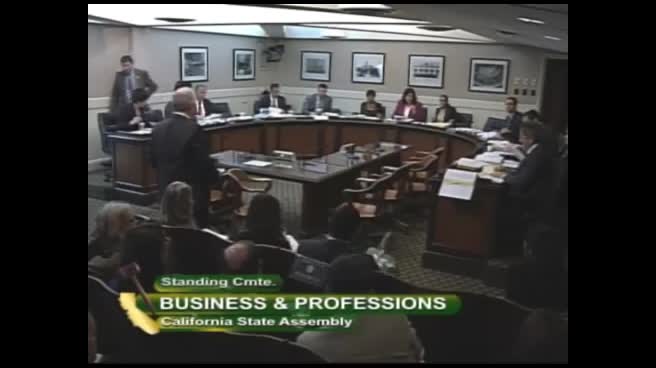
Bill Author