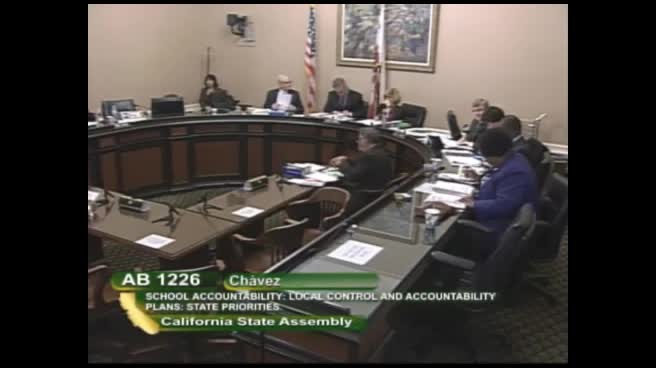
AB 1226: School accountability: local control and accountability plans: state priorities: teacher professional development.
- Session Year: 2015-2016
- House: Assembly
- Latest Version Date: 2015-04-20
Existing law requires the governing board of each school district to adopt a local control and accountability plan and requires the governing board of a school district to update its local control and accountability plan before July 1 of each year. Existing law requires a local control and accountability plan to include, among other things, a description of the annual goals to be achieved for each state priority, as specified, for all pupils and certain subgroups of pupils.
This bill would add to the enumerated state priorities the degree to which the certificated instructional personnel of the school district are offered opportunity opportunities for professional development and growth in effectiveness, as specified. growth. By requiring the governing board of each school district to include additional information in the local control and accountability plan, the bill would impose a state-mandated local program.
The California Constitution requires the state to reimburse local agencies and school districts for certain costs mandated by the state. Statutory provisions establish procedures for making that reimbursement.
This bill would provide that, if the Commission on State Mandates determines that the bill contains costs mandated by the state, reimbursement for those costs shall be made pursuant to these statutory provisions.
Existing law requires the governing board of each school district to adopt a local control and accountability plan and requires the governing board of a school district to update its local control and accountability plan before July 1 of each year. Existing law requires a local control and accountability plan to include, among other things, a description of the annual goals to be achieved for each state priority, as specified, for all pupils and certain subgroups of pupils.
This bill would add to the enumerated state priorities the degree to which the certificated instructional personnel of the school district are offered opportunity for professional development and growth in effectiveness, as specified. By requiring the governing board of each school district to include additional information in the local control and accountability plan, the bill would impose a state-mandated local program.
The California Constitution requires the state to reimburse local agencies and school districts for certain costs mandated by the state. Statutory provisions establish procedures for making that reimbursement.
This bill would provide that, if the Commission on State Mandates determines that the bill contains costs mandated by the state, reimbursement for those costs shall be made pursuant to these statutory provisions.
(a)On or before July 1, 2014, the governing board of each school district shall adopt a local control and accountability plan using a template adopted by the state board.
(b)A local control and accountability plan adopted by the governing board of a school district shall be effective for a period of three years, and shall be updated on or before July 1 of each year.
(c)A local control and accountability plan adopted by the governing board of a school district shall include, for the school district and each school within the school district, both of the following:
(1)A description of the annual goals, for all pupils and each subgroup of pupils identified pursuant to Section 52052, to be achieved for each of the state priorities identified in subdivision (d) and for any additional local priorities identified by the governing board of the school district. For purposes of this article, a subgroup of pupils identified pursuant to Section 52052 shall be a numerically significant pupil subgroup as specified in paragraphs (2) and (3) of subdivision (a) of Section 52052.
(2)A description of the specific actions the school district will take during each year of the local control and accountability plan to achieve the goals identified in paragraph (1), including the enumeration of any specific actions necessary for that year to correct any deficiencies in regard to the state priorities listed in paragraph (1) of subdivision (d). The specific actions shall not supersede the provisions of existing local collective bargaining agreements within the jurisdiction of the school district.
(d)All of the following are state priorities:
(1)The degree to which the teachers of the school district are appropriately assigned in accordance with Section 44258.9, and fully credentialed in the subject areas, and, for the pupils they are teaching, every pupil in the school district has sufficient access to the standards-aligned instructional materials as determined pursuant to Section 60119, and school facilities are maintained in good repair, as defined in subdivision (d) of Section 17002.
(2)Implementation of the academic content and performance standards adopted by the state board, including how the programs and services will enable English learners to access the common core academic content standards adopted pursuant to Section 60605.8 and the English language development standards adopted pursuant to former Section 60811.3, as that section read on June 30, 2013, or Section 60811.4, for purposes of gaining academic content knowledge and English language proficiency.
(3)The degree to which the certificated instructional personnel of the school district are offered opportunity opportunities for professional development and growth in effectiveness, including, but not necessarily limited to, the requirement to confer with a certificated employee making specific recommendations as to areas of improvement in the employees performance and endeavor to assist the employee in his or her performance, pursuant to Section 44664. growth.
(4)Parental involvement, including efforts the school district makes to seek parent input in making decisions for the school district and each individual schoolsite, and including how the school district will promote parental participation in programs for unduplicated pupils and individuals with exceptional needs.
(5)Pupil achievement, as measured by all of the following, as applicable:
(A)Statewide assessments administered pursuant to Article 4 (commencing with Section 60640) of Chapter 5 of Part 33 or any subsequent assessment, as certified by the state board.
(B)The Academic Performance Index, as described in Section 52052.
(C)The percentage of pupils who have successfully completed courses that satisfy the requirements for entrance to the University of California and the California State University, or career technical education sequences or programs of study that align with state board-approved career technical education standards and frameworks, including, but not limited to, those described in subdivision (a) of Section 52302, subdivision (a) of Section 52372.5, or paragraph (2) of subdivision (e) of Section 54692.
(D)The percentage of English learner pupils who make progress toward English proficiency as measured by the California English Language Development Test or any subsequent assessment of English proficiency, as certified by the state board.
(E)The English learner reclassification rate.
(F)The percentage of pupils who have passed an advanced placement examination with a score of 3 or higher.
(G)The percentage of pupils who participate in, and demonstrate college preparedness pursuant to, the Early Assessment Program, as described in Chapter 6 (commencing with Section 99300) of Part 65 of Division 14 of Title 3, or any subsequent assessment of college preparedness.
(6)Pupil engagement, as measured by all of the following, as applicable:
(A)School attendance rates.
(B)Chronic absenteeism rates.
(C)Middle school dropout rates, as described in paragraph (3) of subdivision (a) of Section 52052.1.
(D)High school dropout rates.
(E)High school graduation rates.
(7)School climate, as measured by all of the following, as applicable:
(A)Pupil suspension rates.
(B)Pupil expulsion rates.
(C)Other local measures, including surveys of pupils, parents, and teachers on the sense of safety and school connectedness.
(8)The extent to which pupils have access to, and are enrolled in, a broad course of study that includes all of the subject areas described in Section 51210 and subdivisions (a) to (i), inclusive, of Section 51220, as applicable, including the programs and services developed and provided to unduplicated pupils and individuals with exceptional needs, and the programs and services that are provided to benefit these pupils as a result of the funding received pursuant to Section 42238.02, as implemented by Section 42238.03.
(9)Pupil outcomes, if available, in the subject areas described in Section 51210 and subdivisions (a) to (i), inclusive, of Section 51220, as applicable.
(e)For purposes of the descriptions required by subdivision (c), the governing board of a school district may consider qualitative information, including, but not limited to, findings that result from school quality reviews conducted pursuant to subparagraph (J) of paragraph (4) of subdivision (a) of Section 52052 or any other reviews.
(f)To the extent practicable, data reported in a local control and accountability plan shall be reported in a manner consistent with how information is reported on a school accountability report card.
(g)The governing board of a school district shall consult with teachers, principals, administrators, other school personnel, local bargaining units of the school district, parents, and pupils in developing a local control and accountability plan.
(h)A school district may identify local priorities, goals in regard to the local priorities, and the method for measuring the school districts progress toward achieving those goals.
SEC. 2.If the Commission on State Mandates determines that this act contains costs mandated by the state, reimbursement to local agencies and school districts for those costs shall be made pursuant to Part 7 (commencing with Section 17500) of Division 4 of Title 2 of the Government Code.
(a)On or before July 1, 2014, the governing board of each school district shall adopt a local control and accountability plan using a template adopted by the state board.
(b)A local control and accountability plan adopted by the governing board of a school district shall be effective for a period of three years, and shall be updated on or before July 1 of each year.
(c)A local control and accountability plan adopted by the governing board of a school district shall include, for the school district and each school within the school district, both of the following:
(1)A description of the annual goals, for all pupils and each subgroup of pupils identified pursuant to Section 52052, to be achieved for each of the state priorities identified in subdivision (d) and for any additional local priorities identified by the governing board of the school district. For purposes of this article, a subgroup of pupils identified pursuant to Section 52052 shall be a numerically significant pupil subgroup as specified in paragraphs (2) and (3) of subdivision (a) of Section 52052.
(2)A description of the specific actions the school district will take during each year of the local control and accountability plan to achieve the goals identified in paragraph (1), including the enumeration of any specific actions necessary for that year to correct any deficiencies in regard to the state priorities listed in paragraph (1) of subdivision (d). The specific actions shall not supersede the provisions of existing local collective bargaining agreements within the jurisdiction of the school district.
(d)All of the following are state priorities:
(1)The degree to which the teachers of the school district are appropriately assigned in accordance with Section 44258.9, and fully credentialed in the subject areas, and, for the pupils they are teaching, every pupil in the school district has sufficient access to the standards-aligned instructional materials as determined pursuant to Section 60119, and school facilities are maintained in good repair, as defined in subdivision (d) of Section 17002.
(2)Implementation of the academic content and performance standards adopted by the state board, including how the programs and services will enable English learners to access the common core academic content standards adopted pursuant to Section 60605.8 and the English language development standards adopted pursuant to former Section 60811.3, as that section read on June 30, 2013, or Section 60811.4, for purposes of gaining academic content knowledge and English language proficiency.
(3)The degree to which the certificated instructional personnel of the school district are offered opportunity for professional development and growth in effectiveness, including, but not necessarily limited to, the requirement to confer with a certificated employee making specific recommendations as to areas of improvement in the employees performance and endeavor to assist the employee in his or her performance, pursuant to Section 44664.
(3)
(4)Parental involvement, including efforts the school district makes to seek parent input in making decisions for the school district and each individual schoolsite, and including how the school district will promote parental participation in programs for unduplicated pupils and individuals with exceptional needs.
(4)
(5)Pupil achievement, as measured by all of the following, as applicable:
(A)Statewide assessments administered pursuant to Article 4 (commencing with Section 60640) of Chapter 5 of Part 33 or any subsequent assessment, as certified by the state board.
(B)The Academic Performance Index, as described in Section 52052.
(C)The percentage of pupils who have successfully completed courses that satisfy the requirements for entrance to the University of California and the California State University, or career technical education sequences or programs of study that align with state board-approved career technical education standards and frameworks, including, but not limited to, those described in subdivision (a) of Section 52302, subdivision (a) of Section 52372.5, or paragraph (2) of subdivision (e) of Section 54692.
(D)The percentage of English learner pupils who make progress toward English proficiency as measured by the California English Language Development Test or any subsequent assessment of English proficiency, as certified by the state board.
(E)The English learner reclassification rate.
(F)The percentage of pupils who have passed an advanced placement examination with a score of 3 or higher.
(G)The percentage of pupils who participate in, and demonstrate college preparedness pursuant to, the Early Assessment Program, as described in Chapter 6 (commencing with Section 99300) of Part 65 of Division 14 of Title 3, or any subsequent assessment of college preparedness.
(5)
(6)Pupil engagement, as measured by all of the following, as applicable:
(A)School attendance rates.
(B)Chronic absenteeism rates.
(C)Middle school dropout rates, as described in paragraph (3) of subdivision (a) of Section 52052.1.
(D)High school dropout rates.
(E)High school graduation rates.
(6)
(7)School climate, as measured by all of the following, as applicable:
(A)Pupil suspension rates.
(B)Pupil expulsion rates.
(C)Other local measures, including surveys of pupils, parents, and teachers on the sense of safety and school connectedness.
(7)
(8)The extent to which pupils have access to, and are enrolled in, a broad course of study that includes all of the subject areas described in Section 51210 and subdivisions (a) to (i), inclusive, of Section 51220, as applicable, including the programs and services developed and provided to unduplicated pupils and individuals with exceptional needs, and the programs and services that are provided to benefit these pupils as a result of the funding received pursuant to Section 42238.02, as implemented by Section 42238.03.
(8)
(9)Pupil outcomes, if available, in the subject areas described in Section 51210 and subdivisions (a) to (i), inclusive, of Section 51220, as applicable.
(e)For purposes of the descriptions required by subdivision (c), the governing board of a school district may consider qualitative information, including, but not limited to, findings that result from school quality reviews conducted pursuant to subparagraph (J) of paragraph (4) of subdivision (a) of Section 52052 or any other reviews.
(f)To the extent practicable, data reported in a local control and accountability plan shall be reported in a manner consistent with how information is reported on a school accountability report card.
(g)The governing board of a school district shall consult with teachers, principals, administrators, other school personnel, local bargaining units of the school district, parents, and pupils in developing a local control and accountability plan.
(h)A school district may identify local priorities, goals in regard to the local priorities, and the method for measuring the school districts progress toward achieving those goals.
SEC. 2.If the Commission on State Mandates determines that this act contains costs mandated by the state, reimbursement to local agencies and school districts for those costs shall be made pursuant to Part 7 (commencing with Section 17500) of Division 4 of Title 2 of the Government Code.
|
Date
|
Status
|
|---|---|
| Feb 27, 2015 | Introduced. To print. |
| Mar 1, 2015 | From printer. May be heard in committee March 31. |
| Mar 2, 2015 | Read first time. |
| Mar 23, 2015 | Referred to Com. on ED. |
| Apr 16, 2015 | From committee: Amend, and do pass as amended and re-refer to Com. on APPR. (Ayes 7. Noes 0.) (April 8). |
| Apr 20, 2015 | Read second time and amended. |
| Apr 21, 2015 | Re-referred to Com. on APPR. |
| Apr 29, 2015 | In committee: Set, first hearing. Referred to APPR. suspense file. |
| May 28, 2015 | In committee: Held under submission. |
| Jan 31, 2016 | Died pursuant to Article IV, Sec. 10(c) of the Constitution. |
| Feb 1, 2016 | From committee: Filed with the Chief Clerk pursuant to Joint Rule 56. |
|
Date
|
Description
|
Location
|
Votes
|
|
|---|---|---|---|---|
| Apr 8, 2015 | Do pass as amended and be re-referred to the Committee on [Appropriations] | Assembly Standing Committee on Education |
Passed |
This list shows positions taken on this bill by organizations on the date displayed, which is linked to the original source.
Positions by individuals are not included.
|
Organization
|
Position
|
Date
|
|---|---|---|
| Edvoice | ** Support | Apr 8, 2015 |
| Students First | ** Support | Apr 8, 2015 |
AB 1226
Page 2
Date of Hearing: April 29, 2015
ASSEMBLY COMMITTEE ON APPROPRIATIONS
Jimmy Gomez, Chair
AB 1226
(Chávez) – As Amended April 20, 2015
Policy Committee: |
Education |
Vote: |
7 - 0 |
|
|
|
|
|
|
|
|
Urgency: No State Mandated Local Program: Yes Reimbursable: Yes
SUMMARY: This bill expands the state priorities under the local control and accountability plans (LCAPs) to include the degree to which the certificated instructional personnel of the school district are offered opportunities for professional development and growth.
FISCAL EFFECT:
Proposition 98/GF cost pressure, potentially in the hundreds of millions of dollars, to dedicate funding for professional development activities.
COMMENTS:
Purpose. In 2013, the state implemented a new funding formula for schools known as the Local Control Funding Formula (LCFF). The new law replaces most previously existing K–12 funding streams (revenue limit and categorical programs) with per pupil grade span funding. Additionally, the new formula provides targeted funding for low income, English learner and foster youth students.
With the elimination of most state categorical programs, the LCFF also shifts many spending decisions from the state to the local level. To this end, local education agencies (LEAs) are required to produce an LCAP in consultation with parents, teachers and the broader community. The LCAP ties decisions about the use of resources to annual educational goals. Each LCAP must address the following eight state priorities:
The degree to which teachers are appropriately assigned;
Implementation of the academic content and performance standards adopted by the State Board of Education (SBE);
Parental involvement;
Pupil achievement;
Pupil engagement;
School climate;
The extent to which pupils have access to and are enrolled in a broad course of study; and
Pupil outcomes.
This bill adds as a ninth priority the degree to which the district offers opportunities for professional development and growth.
Funding for Professional Development. Prior to the enactment of the LCFF, the annual budget appropriated approximately $400 million for specific professional development programs and activities. In 2009, in response to the state budget crisis, the Legislature reduced funding for approximately 40 categorical programs, including professional development programs. Along with the funding reduction, the state made program requirements flexible, allowing LEAs to spend funding for any educational purpose. This flexibility was continued under the Local Control Funding Formula (LCFF) enacted in 2013.
The 2013-14 Budget Act provided $1.25 billion (one-time/P98) to LEAs to support the transition to the Common Core State Standards (CCSS). Allowable activities included professional development, instructional materials, and technology.
The 2014-15 Budget Act appropriated $400 million to reduce K-12 education mandate claims backlog and expressed Legislative intent that the funding be used for activities associated with implementation of the CCSS, including professional development.
Analysis Prepared by: Misty Feusahrens / APPR. / (916) 319-2081
AB 1226
Page 3
Date of Hearing: April 8, 2015
ASSEMBLY COMMITTEE ON EDUCATION
Patrick O'Donnell, Chair
AB 1226
(Chávez) – As Introduced February 27, 2015
SUBJECT: School accountability: local control and accountability plans: state priorities
SUMMARY: Requires school district local control and accountability plans (LCAPs) to address the degree to which the certificated instructional personnel of the school district are offered opportunities for professional development and growth in effectiveness, including, but not necessarily limited to, the requirement to confer with a certificated employee making specific recommendations as to areas of improvement in the employee's performance and endeavor to assist the employee in his or her performance pursuant to existing requirements regarding professional development for certificated employees.
EXISTING LAW:
Requires the performance of certificated employees to be made on a continuing basis as follows:
At least once each school year for probationary personnel;
At least every other year for personnel with permanent status; and
At least every five years for personnel with permanent status who have been employed at least 10 years with the district, are highly qualified (if in a position that federal law requires to be occupied by a highly qualified teacher), and whose previous evaluation rated the employee as meeting or exceeding standards, provided the employee and the evaluator agree.
Requires the evaluation to include recommendations for improvement, if necessary, or, if the employee is performing at an unsatisfactory level, a written notice to the employee of that fact.
Provides that an unsatisfactory evaluation may include a requirement that the employee be required to participate in a professional development program.
Requires school districts to adopt and annually update LCAPs and requires each LCAP to address the following eight state priorities:
The degree to which teachers are appropriately assigned;
Implementation of the academic content and performance standards adopted by the State Board of Education (SBE);
Parental involvement;
Pupil achievement;
Pupil engagement;
School climate;
The extent to which pupils have access to and are enrolled in a broad course of study; and
Pupil outcomes.
FISCAL EFFECT: State mandated local program
COMMENTS: The requirement for each school district and county office of education to adopt and annually update an LCAP was established with the enactment of the local control funding formula (LCFF). The LCAP requirement does not apply to charter schools, which are instead monitored on the basis of the goals and actions specified in their charters, which must be updated annually beginning July 1, 2015.) Each LCAP must address the eight state priorities listed above. This bill adds as a ninth priority the degree to which the district offers opportunities for professional development and growth.
Prior to the enactment of the LCFF, the annual budget appropriated funds for several professional development programs, including:
Bilingual Teacher Training Assistance Program
Certificated Staff Mentoring
National Board Certification Incentives
Beginning Teacher Support and Assessment (BTSA)
Peer Assistance and Review (PAR)
When the LCFF was adopted, these categorical programs were eliminated and the funding for them was rolled into the new funding formula. Although districts have the authority to continue any or all of these programs using LCFF funds, many do not, even though professional development is known to be an important factor in improving classroom instruction.
Possible conflict with pending legislation. This bill actually contains two requirements. First, it requires each LCAP to address the degree to which certificated instructional personnel are offered opportunities for professional developments. Second, it requires opportunities for professional development to include individual conferences and the identification of specific areas of needed improvement. These second issues go beyond professional development and get into the area of teacher evaluation, which is being addressed in separate legislation. Specifically, the following bills dealing with some aspect of teacher evaluation have been introduced in the current session:
AB 575 (O'Donnell), pending in the Assembly Education Committee
AB 1078 (Olsen), pending in the Assembly Education Committee
AB 1099 (Olsen), pending in the Assembly Education Committee
AB 1484 (Weber), pending in the Assembly Education Committee
SB 499 (Liu), pending in the Senate Education Committee
Each of these bills has the potential to more fully address the broad and complex range of issues related to teacher evaluation. Hearing them will also would give the committee a better opportunity to consider all of the issues involved, structure a more comprehensive teacher evaluation program, and avoid possible conflicts or inconsistencies that could result from a piece-meal approach. In addition, Education Code Section 44644, which is referenced by this bill, may be replaced with a new section dealing with teacher evaluation. For these reasons, staff recommends that the bill be amended to strike the requirement that opportunities for professional development include individual conferences and the identification of specific areas of needed improvement.
Charter schools. Charter schools are not required to adopt LCAPs. Instead, the petition for each charter must address some, but not all, of the same state priorities as the LCAP, such as a description of the school's educational program, annual goals, and measurable outcomes. State priorities that must be addressed in an LCAP that are not required to be addressed in a charter school petition, include teacher assignment, parental involvement, pupil engagement, and school climate. This bill makes opportunities for professional development a ninth state priority for LCAPs. Staff recommends that the bill be amended to add opportunities for professional development to the elements that are required to be addressed by charter school petitions.
REGISTERED SUPPORT / OPPOSITION:
Support
EdVoice
Students First
Opposition
None received
Analysis Prepared by: Rick Pratt / ED. / (916) 319-2087