AB 1431: Local Agency Public Construction Act: job order contracting.
- Session Year: 2015-2016
- House: Assembly
- Latest Version Date: 2015-10-10
Existing law, the Local Agency Public Construction Act, authorizes job order contracting, as provided, by the Los Angeles Unified School District (LAUSD), until December 31, 2020.
This bill would repeal the provisions relating to the LAUSD and would instead authorize job order contracting in a similar manner for school districts until January 1, 2022. The bill would restrict job order contracting pursuant to the bill to school districts that have entered into a project labor agreement or agreements, as defined, that will apply to all public works in excess of $25,000 undertaken by the school district through at least December 31, 2021, regardless of what contracting procedure is used to award that work. The bill would require job order contractors to submit a questionnaire to the school district containing specified information verified under oath. By expanding the crime of perjury, this bill would impose a state-mandated local program.
The California Constitution requires the state to reimburse local agencies and school districts for certain costs mandated by the state. Statutory provisions establish procedures for making that reimbursement.
This bill would provide that no reimbursement is required by this act for a specified reason.
Existing law, the Local Agency Public Construction Act, authorizes job order contracting, as provided, by the Los Angeles Unified School District (LAUSD), until December 31, 2020.
This bill would repeal the provisions relating to the LAUSD and would instead authorize job order contracting in a similar manner for school districts other than LAUSD until January 1, 2022. The bill would restrict job order contracting pursuant to the bill to school districts that have entered into a project labor agreement or agreements, as defined, that will apply to all public works in excess of $25,000 undertaken by the school district through at least December 31, 2021, regardless of what contracting procedure is used to award that work. The bill would require job order contractors to submit a questionnaire to the school district containing specified information verified under oath. By expanding the crime of perjury, this bill would impose a state-mandated local program.
The California Constitution requires the state to reimburse local agencies and school districts for certain costs mandated by the state. Statutory provisions establish procedures for making that reimbursement.
This bill would provide that no reimbursement is required by this act for a specified reason.
Existing law, the Local Agency Public Construction Act, authorizes job order contracting, as provided, by the Los Angeles Unified School District (LAUSD), until December 1, 31, 2020.
This bill would authorize job order contracting in a similar manner for school districts other than LAUSD until January 1, 2022. The bill would restrict job order contracting pursuant to the bill to school districts that have entered into a project labor agreement or agreements, as defined, that will apply to all public works in excess of $25,000 undertaken by the school district through at least December 31, 2021, regardless of what contracting procedure is used to award that work. The bill would require job order contractors to submit a questionnaire to the school district containing specified information verified under oath. By expanding the crime of perjury, this bill would impose a state-mandated local program.
The California Constitution requires the state to reimburse local agencies and school districts for certain costs mandated by the state. Statutory provisions establish procedures for making that reimbursement.
This bill would provide that no reimbursement is required by this act for a specified reason.
Existing law, the Local Agency Public Construction Act, authorizes job order contracting, as provided, by the Los Angeles Unified School District (LAUSD), until December 1, 2020.
This bill would authorize job order contracting in a similar manner for school districts other than LAUSD until January 1, 2022. The bill would restrict job order contracting pursuant to the bill to school districts that have entered into a project labor agreement or agreements, as defined, that will apply to all public works in excess of $25,000 undertaken by the school district through at least December 31, 2021, regardless of what contracting procedure is used to award that work. The bill would require job order contractors to submit a questionnaire to the school district containing specified information verified under oath. By expanding the crime of perjury, this bill would impose a state-mandated local program.
The California Constitution requires the state to reimburse local agencies and school districts for certain costs mandated by the state. Statutory provisions establish procedures for making that reimbursement.
This bill would provide that no reimbursement is required by this act for a specified reason.
The Planning and Zoning Law requires a city or county to adopt a comprehensive, long-term general plan for the physical development of the city or county and of any land outside its boundaries that bears relation to its planning. That law also requires the general plan to contain specified mandatory elements, including a housing element for the preservation, improvement, and development of housing. Existing law requires the housing element to include specified information.
This bill would make nonsubstantive changes to the provision regarding the information required to be included in the housing element.
This article shall remain in effect only until January 1, 2016, and as of that date is repealed, unless a later enacted statute, that is enacted before January 1, 2016, deletes or extends that date.
SEC. 2.Article 60.4 (commencing with Section 20919.20) is added to Chapter 1 of Part 3 of Division 2 of the Public Contract Code, to read:60.4.Job Order Contracting for School Districts20919.20.The Legislature finds and declares all of the following:
(a)It is the intent of the Legislature, in enacting this article, to demonstrate an alternative and optional procedure for bidding of public works projects that is applicable only to school districts. The Legislature has previously authorized the use of this alternative and optional procedure only for the Los Angeles Unified School District, which is using the procedure in conjunction with its project stabilization agreement.
(b)Districts should be able to utilize cost-effective options for the delivery of public works projects, in accordance with the national trend, which include authorizations in California, to allow public entities to utilize job order contracts as a project delivery method.
(c)The benefits of a job order contract project delivery system include accelerated completion of the projects, cost savings, and reduction of construction contracting complexity for the unified school district.
(d)The job order contracting approach should be used for the purposes of reducing project cost and expediting project completion.
(e)The availability of job order contracting as a project delivery method will not preclude the use of traditional methods of project delivery if a traditional method results in higher cost savings.
(f)It is the intent of the Legislature that job order contracts be competitively bid and awarded to the bidders providing the most qualified responsive bids. It is further the intent of the Legislature that school districts use the job order contract process pursuant to this article only if the school district has entered into a project labor agreement that meets the requirements of Section 2500 for all its public works projects.
20919.21.As used in this chapter:
(a)Adjustment factor means the job order contractors competitively bid adjustment to the school districts prices as published in the unit price catalog.
(b)Indefinite quantity means one or more of the construction tasks listed in the unit price catalog.
(c)Job order means a firm, fixed priced, lump-sum order issued by the school district to a job order contractor for a definite project scope of work as compiled from the unit price catalog to be performed pursuant to a job order contract.
(d)Job order contract means a contract, awarded to a most qualified bidder as described in paragraph (1) of subdivision (b) of Section 20919.24, between the school district and a licensed, bonded, and general liability insured contractor in which the contractor agrees to a fixed period, fixed-unit price, and indefinite quantity contract that provides for the use of job orders for public works or maintenance projects.
(e)Job order contract technical specifications means a book, published by the school district, detailing the technical specifications with regard to quality of materials and workmanship to be used by the job order contractor in accomplishing the tasks listed in the unit price catalog.
(f)Job order contractor means a licensed, bonded, and general liability insured contractor awarded a job order contract.
(g)Offer to perform work means the job order contractors proposal for a specific job order.
(h)Plans and specifications means the unit price catalog and the job order contract technical specifications. The scope of work to be performed with a job order contract is potentially, but not necessarily, all the tasks published in the unit price catalog.
(i)Project means the specific requirements and work to be accomplished by the job order contractor in connection with an individual job order.
(j)Project labor agreement means an agreement that meets the requirements of Section 2500.
(k)Project scope of work means the document and related drawings, specifications, and writings referenced therein which together set forth the specific requirements and work to be accomplished by the job order contractor in connection with an individual job order.
(l)Proposal means the job order contractor prepared document quoting those construction tasks listed in the unit price catalog that the job order contractor requires to complete the project scope of work, together with the appropriate quantities of each task. The pricing of each task shall be accomplished by multiplying the construction task unit price by the proposed quantity and the contractors competitively bid adjustment factor. The proposal shall also contain a schedule for the completion of a specific project scope of work as requested by the school district. The proposal may also contain approved drawings, work schedule, permits, or other documentation as the school district may require for a specific job order.
(m)Public works has the same meaning as in Chapter 1 (commencing with Section 1720) of Part 7 of Division 2 of the Labor Code.
(n)Public works project has the same meaning as public project, as defined in Section 22002.
(o)Subcontractor means any person, firm, or corporation, other than the employees of the job order contractor, who is bonded and general liability insured and who contracts to furnish labor, or labor and materials, at the worksite or in connection with a job order, whether directly or indirectly on behalf of the job order contractor.
(p)School district means any school district.
(q)Unit price catalog means a book containing specific construction tasks and the unit prices to install or demolish that construction. The listed tasks shall be based on generally accepted industry standards and information, where available, for various items of work to be performed by the job order contractor. The prices shall include the cost of materials, labor, and equipment for performing the items of work. The prices shall not include overhead and profit. All unit prices shall be developed using local prevailing wages.
20919.22.Provisions in this article only apply to school districts that choose to utilize job order contracting. A school district may utilize job order contracting, when permitted by this article, as an alternative to any contracting procedures that the school district is otherwise authorized or required by law to use.
20919.23.(a)The school district may utilize job order contracting pursuant to this article only if the school district has entered into a project labor agreement or agreements that will apply to all public works in excess of twenty-five thousand dollars ($25,000) undertaken by the school district through at least December 31, 2021, regardless of what contracting procedure is used to award that work.
(b)The school district shall prepare an execution plan for all modernization projects that may be eligible for job order contracting pursuant to this article. The school district shall select from that plan a sufficient number of projects to be initiated as job order contracts during each calendar year and shall determine for each selected project that job order contracting will reduce the total cost of that project. Job order contracting shall not be used if the school district finds that it will increase the total cost of the project.
20919.24.Bidding for job order contracts shall progress as follows:
(a)(1)The school district shall prepare a set of documents for job order contracts. The documents shall include a unit price catalog and preestablished unit prices, job order contract technical specifications, and any other information deemed necessary to describe adequately the school districts needs.
(2)Any architect, engineer, or consultant retained by the school district to assist in the development of the job order contract documents shall not be eligible to participate in the preparation of a bid with any job order contractor.
(b)Based on the documents prepared under subdivision (a), the school district shall prepare a request for bid that invites prequalified job order contractors to submit competitive sealed bids in the manner prescribed by the school district.
(1)(A)The prequalified job order contractors, as determined by the school district, shall bid one or more adjustment factors to the unit prices listed in the unit price catalog based on the job order contract technical specifications. Awards shall be made to the prequalified bidders that the school district determines to be the most qualified based upon preestablished criteria made by the school district. The prequalified bidders must be in compliance with the school districts project labor agreement.
(B)Compliance shall constitute no more than three major violations on any school district projects within the last three years. If a contractor has more than three violations within a three-year period of time, the school district shall seek administrative review of the violations. Violations will include, but are not limited to, the following:
(i)Failure to register core workers with the appropriate building trade union.
(ii)Failure to assign apprentices in accordance with Section 1777.5 of the Labor Code.
(iii)Failure to comply with subdivision (c) of Section 20919.25.
(iv)Incorrect assignment of work in accordance with the school districts project labor agreement.
(2)The school district may award multiple job order contracts through a request for bid. Job order contracts shall be awarded to the most qualified prequalified bidders described in this subdivision.
(3)The request for bids may encourage the participation of local construction firms and the use of local subcontractors.
(c)(1)The school district shall establish a procedure to prequalify job order contractors using a standard questionnaire that includes, at a minimum, the issues covered by the standardized questionnaire and model guidelines for rating bidders developed by the Department of Industrial Relations pursuant to subdivision (a) of Section 20101. This questionnaire shall require information including, but not limited to, all of the following:
(A)If the job order contractor is a partnership, limited partnership, or other association, a listing of all of the partners or association members known at the time of bid submission who will participate in the job order contract.
(B)Evidence that the members of the job order contractor have the capacity to complete projects of similar size, scope, or complexity, and that proposed key personnel have sufficient experience and training to competently manage the construction of the project, as well as a financial statement that assures the school district that the job order contractor has the capacity to complete the project.
(C)The licenses, registration, and credentials required to perform construction, including, but not limited to, information on the revocation or suspension of any license, credential, or registration.
(D)Evidence that establishes that the job order contractor has the capacity to obtain all required payment and performance bonding and liability insurance.
(E)Information concerning workers compensation experience history, worker safety programs, and apprenticeship programs.
(F)A full disclosure regarding all of the following that are applicable:
(i)Any serious or willful violation of Part 1 (commencing with Section 6300) of Division 5 of the Labor Code or the federal Occupational Safety and Health Act of 1970 (Public Law 91-596), settled against any member of the job order contractor.
(ii)Any debarment, disqualification, or removal from a federal, state, or local government public works project.
(iii)Any instance where the job order contractor, or its owners, officers, or managing employees submitted a bid on a public works project and were found to be nonresponsive, or were found by an awarding body not to be a responsible bidder.
(iv)Any instance where the job order contractor, or its owners, officers, or managing employees defaulted on a construction contract.
(v)Any violations of the Contractors State License Law (Chapter 9 (commencing with Section 7000) of Division 3 of the Business and Professions Code), excluding alleged violations of federal or state law regarding the payment of wages, benefits, apprenticeship requirements, or personal income tax withholding, or of Federal Insurance Contribution Act (FICA) withholding requirements settled against any member of the job order contractor.
(vi)Any bankruptcy or receivership of any member of the job order contractor, including, but not limited to, information concerning any work completed by a surety.
(vii)Any settled adverse claims, disputes, or lawsuits between the owner of a public works project and any member of the job order contractor during the five years preceding submission of a bid under this article, in which the claim, settlement, or judgment exceeds fifty thousand dollars ($50,000). Information shall also be provided concerning any work completed by a surety during this period.
(G)In the case of a partnership or any association that is not a legal entity, a copy of the agreement creating the partnership or association and specifying that all partners or association members agree to be fully liable for the performance under the job order contract.
(2)The information required under this subdivision shall be verified under oath by the entity and its members in the manner in which civil pleadings in civil actions are verified. Information that is not a public record under the California Public Records Act (Chapter 3.5 (commencing with Section 6250) of Division 7 of Title 1 of the Government Code) shall not be open to public inspection.
20919.25.(a)The maximum total dollar amount that may be awarded under a single job order contract shall not exceed five million dollars ($5,000,000) in the first term of the job order contract and, if extended or renewed pursuant to subdivision (b), a maximum of ten million dollars ($10,000,000) over the subsequent two terms of the job order contract.
(b)Job order contracts may be executed for an initial contract term of no more than 12 months, with the option of extending or renewing the job order contract for two 12-month periods. The term of the job order contract shall be for the contract term or whenever the maximum value of the contract is achieved, whichever is less. All extensions or renewals shall be priced as provided in the request for bids. The extension or renewal shall be mutually agreed to by the school district and the job order contractor.
(c)The school district may issue job orders to the job order contractor that has been awarded the job order contract. The job order issued to the job order contractor shall not commence for seven days from the time the job order was issued and the job order contractor shall provide a minimum of seven days notice for the addition of any subcontractor or substitution of any subcontractor as described in subdivision (e) of Section 20919.26. The job order shall be based on a project scope of work prepared by the school district as well as a proposal from the job order contractor who is awarded the job order contract. No single job order may exceed one million dollars ($1,000,000).
(d)The amounts specified in subdivisions (a) and (c) shall be adjusted on January 1, 2016, as if this section was operative beginning January 1, 2004, to reflect the percentage change in the California Consumer Price Index, and shall be adjusted each January 1 thereafter to reflect the percentage change in the California Consumer Price Index.
(e)It is unlawful to split or separate into smaller job orders any project for the purpose of evading the cost limitation provisions of this chapter.
(f)All work performed under the job order contract shall be covered by a project labor agreement.
(g)Any change or alteration to a job order shall be in compliance with Section 20118.4.
20919.26.(a)All work bid under the job order contract shall comply with Chapter 4 (commencing with Section 4100) of Part 1 and is subject to all of the penalties and provisions set forth in that chapter.
(b)For purposes of this article, if the primary job order contractor chooses to use subcontractors, the primary job order contractor is required to verify that the subcontractors possess the appropriate licenses and credentials required to perform construction.
(c)Notwithstanding subdivision (a), the primary job order contractor may use subcontractors that are not listed at the time the job order is issued if the work to be performed under that job order is less than ten thousand dollars ($10,000).
(d)If the primary job order contractor chooses to use a subcontractor that is not listed at the time of bid to perform work on a job order, all of the following apply:
(1)The primary job order contractor shall provide public notice of the availability of work to be subcontracted by trade. The public notice shall include the scope of work; the project location; the name, address, and the telephone number of the primary job order contractor; and the closing date, time, and location for sealed bids to be submitted.
(2)The primary job order contractor shall take sealed bids from the subcontractors solicited for the proposal. These bids shall be publicly opened at a prescribed time and place by the primary job order contractor. After the bids are opened, the job order contractor shall notify the school district which subcontractor was selected.
(3)The notification shall include every subcontractor for all tiers and must establish the authorized subcontractor list for the job order. Work shall not commence prior to seven days notice of the established subcontractor list and the subsequent addition of any subcontractor to the job order.
(4)The notification shall identify the scope of the work to be performed by each subcontractor to the job order, broken down by craft. If a subcontractor performs multiple crafts, the job order contractor shall identify the work of each craft to be performed.
(e)If the primary job order contractor chooses to make a substitution to the subcontractor list, the primary job order contractor shall provide a minimum of seven days notice to the school district along with justification as to the need for the substitution. The school district may request a hearing to evaluate the substitution request, which shall be in accordance with Chapter 4 (commencing with Section 4100) of Part 1.
(f)If the school district determines that there has been a violation of Chapter 4 (commencing with Section 4100) of Part 1, including bid shopping by the primary job order contractor, the school district may terminate the job order or the contractor may lose authorization to proceed with awarded work subject to the school districts administrative due process review, if such review is established pursuant to the school districts project labor agreement. If the school district determines that a job order contractor has violated any provision set forth in Chapter 4 (commencing with Section 4100) of Part 1, the school district may declare the contractor ineligible for future job orders and may result in a loss of prequalification status for a period of time to be determined by the school district.
20919.27.(a)A job order contract shall set forth in the general conditions of the job order contract the party or parties responsible for seeing that the provisions of Article 2 (commencing with Section 1770) of Chapter 1 of Part 7 of Division 2 of the Labor Code are complied with.
(b)For purposes of job order contracting, prevailing wages when required to be paid shall apply to all work ordered under the job order contract regardless of thresholds set forth in Section 1771.5 of the Labor Code.
(c)The job order contractor shall pay the prevailing wage in effect at the time the job order is issued by the school district and all increases as published by the Department of Industrial Relations for the term of the job order contract, including all overtime, holiday, and shift provisions published by the Department of Industrial Relations.
(d)The school district shall designate one individual to act as a monitor to inspect job sites for labor compliance violations at the request of the designated labor representative in its project labor agreement.
20919.28.A willful violation of Section 20919.26 occurs when the job order contractor or subcontractor knew or reasonably should have known of his or her obligations under the public works law and deliberately fails or refuses to comply with its provisions. The school district using job order contracting shall publish and distribute to the Labor Commissioner a list of all job order contractors or subcontractors who violate this provision and the school district shall not award a job order contract or any future job orders under an existing job order contract to any contractor or subcontractor who violates this provision during the effective period of debarment of the contractor or subcontractor.
20919.29.For purposes of employment of apprentices on job order contracts, when the individual job order involves more than thirty thousand dollars ($30,000) or 20 working days, all general contractors or subcontractors shall at all times be in compliance with Section 1777.5 of the Labor Code and shall comply with the following:
(a)Prior to commencing work on an individual job order, every contractor shall submit job order award information to an applicable apprenticeship program that can supply apprentices to the site of the job order. The information submitted shall include an estimate of the journeyman hours to be performed under the contract, the number of apprenticeships proposed to be employed, and the approximate dates the apprentices would be employed. A copy of this information shall also be submitted to the awarding agency if requested by the awarding agency.
(b)The ratio of work performed by apprentices to journeymen employed in a particular craft or trade on the job order may be no higher than the ratio stipulated in the apprenticeship standard under which the apprenticeship program operates where the job order contractor agrees to be bound by those standards but, except as otherwise provided in Section 1777.5 of the Labor Code, in no case shall the ratio be less than one hour of apprenticeship work for every five hours of journeyman work.
(c)Every apprentice employed under the job order contract shall be paid the prevailing rate of per diem wages for apprentices in the trade to which he or she is registered and shall be employed only at the work of the craft or trade to which he or she is registered.
(d)Every apprentice employed under the job order contract shall be hired from the local joint labor management apprenticeship committee that has jurisdiction in the geographic area of the project.
20919.30.A job order contractor or subcontractor that knowingly violates the provisions involving employment of apprentices shall forfeit as a civil penalty an amount not exceeding one hundred dollars ($100) for each full calendar day of noncompliance. The amount of this penalty shall be based on consideration of whether the violation was a good faith mistake due to inadvertence. A contractor or subcontractor that knowingly commits a second or subsequent violation of the provisions involving employment of apprentices within a three-year period where the noncompliance results in apprenticeship training not being provided as required, shall forfeit as a civil penalty a sum of not more than three hundred dollars ($300) for each full calendar day of noncompliance and shall not be awarded any further job orders under the job order contract and shall be precluded for a period of one year from bidding on any future job order contracts.
20919.31.In order to prevent fraud, waste, and abuse, the school district adopting job order contracting shall do all of the following:
(a)Prepare for each individual job order developed under a job order contract an independent school district estimate. The estimate will be prepared prior to the receipt of the contractors offer to perform work and will be compared to the contractors proposed price to determine the reasonableness of that price before issuance of any job order. The basis for any adjustments to the school district estimate is to be documented. In the event that the contractors proposal for a given job order is found to be unreasonable, not cost effective, or undesirable, the school district is under no obligation to issue the job order to the job order contractor, and may instead utilize any other available procurement procedures.
(b)The school district shall not issue a job order until the job order has been reviewed and approved by the appropriate level of management.
(c)Once a job order has been issued, all documents pertaining to preparation and approval of the job order, including the independent school district estimate, shall be available for public review.
20919.32.A school district that adopts the job order contracting process shall also adopt a payment resolution process which may include, but not be limited to, the convening of a payment resolution committee.
20919.33.This article shall remain in effect only until January 1, 2022, and as of that date is repealed, unless a later enacted statute, that is enacted before January 1, 2022, deletes or extends that date.
SEC. 3.No reimbursement is required by this act pursuant to Section 6 of Article XIIIB of the California Constitution because the only costs that may be incurred by a local agency or school district will be incurred because this act creates a new crime or infraction, eliminates a crime or infraction, or changes the penalty for a crime or infraction, within the meaning of Section 17556 of the Government Code, or changes the definition of a crime within the meaning of Section 6 of Article XIIIB of the California Constitution.
This article shall remain in effect only until January 1, 2016, and as of that date is repealed, unless a later enacted statute, that is enacted before January 1, 2016, deletes or extends that date.
SEC. 2.Article 60.4 (commencing with Section 20919.20) is added to Chapter 1 of Part 3 of Division 2 of the Public Contract Code, to read:60.4.Job Order Contracting for School Districts20919.20.The Legislature finds and declares all of the following:
(a)It is the intent of the Legislature, in enacting this article, to demonstrate an alternative and optional procedure for bidding of public works projects that is applicable only to school districts other than the Los Angeles Unified School District. districts. The Legislature has previously authorized the use of this alternative and optional procedure in Article 60.3 (commencing with Section 20219) only for the Los Angeles Unified School District, which is using the procedure in conjunction with its project stabilization agreement.
(b)Districts should be able to utilize cost-effective options for the delivery of public works projects, in accordance with the national trend, which include authorizations in California, to allow public entities to utilize job order contracts as a project delivery method.
(c)The benefits of a job order contract project delivery system include accelerated completion of the projects, cost savings, and reduction of construction contracting complexity for the unified school district.
(d)The job order contracting approach should be used for the purposes of reducing project cost and expediting project completion.
(e)The Legislature is uncertain of the benefits and advantages of job order contracting for California school districts and therefore looks forward to the reports required by Section 20919.32 in order to fully and competently assess any further exemptions to the school contracting process.
(f)
(e)The availability of job order contracting as a project delivery method will not preclude the use of traditional methods of project delivery if a traditional method results in higher cost savings.
(g)
(f)It is the intent of the Legislature that job order contracts be competitively bid and awarded to the bidders providing the most qualified responsive bids. It is further the intent of the Legislature that school districts use the job order contract process pursuant to this article only if the school district has entered into a project labor agreement that meets the requirements of Section 2500 for all its public works projects.
20919.21.As used in this chapter:
(a)Adjustment factor means the job order contractors competitively bid adjustment to the school districts prices as published in the unit price catalog.
(b)Indefinite quantity means one or more of the construction tasks listed in the unit price catalog.
(c)Job order means a firm, fixed priced, lump-sum order issued by the school district to a job order contractor for a definite project scope of work as compiled from the unit price catalog to be performed pursuant to a job order contract.
(d)Job order contract means a contract, awarded to a most qualified bidder as described in paragraph (1) of subdivision (b) of Section 20919.24, between the school district and a licensed, bonded, and general liability insured contractor in which the contractor agrees to a fixed period, fixed-unit price, and indefinite quantity contract that provides for the use of job orders for public works or maintenance projects.
(e)Job order contract technical specifications means a book, published by the school district, detailing the technical specifications with regard to quality of materials and workmanship to be used by the job order contractor in accomplishing the tasks listed in the unit price catalog.
(f)Job order contractor means a licensed, bonded, and general liability insured contractor awarded a job order contract.
(g)Offer to perform work means the job order contractors proposal for a specific job order.
(h)Plans and specifications means the unit price catalog and the job order contract technical specifications. The scope of work to be performed with a job order contract is potentially, but not necessarily, all the tasks published in the unit price catalog.
(i)Project means the specific requirements and work to be accomplished by the job order contractor in connection with an individual job order.
(j)Project labor agreement means an agreement that meets the requirements of Section 2500.
(k)Project scope of work means the document and related drawings, specifications, and writings referenced therein which together set forth the specific requirements and work to be accomplished by the job order contractor in connection with an individual job order.
(l)Proposal means the job order contractor prepared document quoting those construction tasks listed in the unit price catalog that the job order contractor requires to complete the project scope of work, together with the appropriate quantities of each task. The pricing of each task shall be accomplished by multiplying the construction task unit price by the proposed quantity and the contractors competitively bid adjustment factor. The proposal shall also contain a schedule for the completion of a specific project scope of work as requested by the school district. The proposal may also contain approved drawings, work schedule, permits, or other documentation as the school district may require for a specific job order.
(m)Public works has the same meaning as in Chapter 1 (commencing with Section 1720) of Part 7 of Division 2 of the Labor Code.
(n)Public works project has the same meaning as public project, as defined in Section 22002.
(o)Subcontractor means any person, firm, or corporation, other than the employees of the job order contractor, who is bonded and general liability insured and who contracts to furnish labor, or labor and materials, at the worksite or in connection with a job order, whether directly or indirectly on behalf of the job order contractor.
(p)School district means any school district.
(q)Unit price catalog means a book containing specific construction tasks and the unit prices to install or demolish that construction. The listed tasks shall be based on generally accepted industry standards and information, where available, for various items of work to be performed by the job order contractor. The prices shall include the cost of materials, labor, and equipment for performing the items of work. The prices shall not include overhead and profit. All unit prices shall be developed using local prevailing wages.
20919.22.Provisions in this article only apply to school districts that choose to utilize job order contracting. A school district may utilize job order contracting, when permitted by this article, as an alternative to any contracting procedures that the school district is otherwise authorized or required by law to use.
20919.23.(a)The school district may utilize job order contracting pursuant to this article only if the school district has entered into a project labor agreement or agreements that will apply to all public works in excess of twenty-five thousand dollars ($25,000) undertaken by the school district through at least December 31, 2021, regardless of what contracting procedure is used to award that work.
(b)The school district shall prepare an execution plan for all modernization projects that may be eligible for job order contracting pursuant to this article. The school district shall select from that plan a sufficient number of projects to be initiated as job order contracts during each calendar year and shall determine for each selected project that job order contracting will reduce the total cost of that project. Job order contracting shall not be used if the school district finds that it will increase the total cost of the project.
20919.24.Bidding for job order contracts shall progress as follows:
(a)(1)The school district shall prepare a set of documents for job order contracts. The documents shall include a unit price catalog and preestablished unit prices, job order contract technical specifications, and any other information deemed necessary to describe adequately the school districts needs.
(2)Any architect, engineer, or consultant retained by the school district to assist in the development of the job order contract documents shall not be eligible to participate in the preparation of a bid with any job order contractor.
(b)Based on the documents prepared under subdivision (a), the school district shall prepare a request for bid that invites prequalified job order contractors to submit competitive sealed bids in the manner prescribed by the school district.
(1)(A)The prequalified job order contractors, as determined by the school district, shall bid one or more adjustment factors to the unit prices listed in the unit price catalog based on the job order contract technical specifications. Awards shall be made to the prequalified bidders that the school district determines to be the most qualified based upon preestablished criteria made by the school district. The prequalified bidders must be in compliance with the school districts project labor agreement.
(B)Compliance shall constitute no more than three major violations on any school district projects within the last three years. If a contractor has more than three violations within a three-year period of time, the school district shall seek administrative review of the violations. Violations will include, but are not limited to, the following:
(i)Failure to register core workers with the appropriate building trade union.
(ii)Failure to assign apprentices in accordance with Section 1777.5 of the Labor Code.
(iii)Failure to comply with subdivision (c) of Section 20919.25.
(iv)Incorrect assignment of work in accordance with the school districts project labor agreement.
(2)The school district may award multiple job order contracts through a request for bid. Job order contracts shall be awarded to the most qualified prequalified bidders described in this subdivision.
(3)The request for bids may encourage the participation of local construction firms and the use of local subcontractors.
(c)(1)The school district shall establish a procedure to prequalify job order contractors using a standard questionnaire that includes, at a minimum, the issues covered by the standardized questionnaire and model guidelines for rating bidders developed by the Department of Industrial Relations pursuant to subdivision (a) of Section 20101. This questionnaire shall require information including, but not limited to, all of the following:
(A)If the job order contractor is a partnership, limited partnership, or other association, a listing of all of the partners or association members known at the time of bid submission who will participate in the job order contract.
(B)Evidence that the members of the job order contractor have the capacity to complete projects of similar size, scope, or complexity, and that proposed key personnel have sufficient experience and training to competently manage the construction of the project, as well as a financial statement that assures the school district that the job order contractor has the capacity to complete the project.
(C)The licenses, registration, and credentials required to perform construction, including, but not limited to, information on the revocation or suspension of any license, credential, or registration.
(D)Evidence that establishes that the job order contractor has the capacity to obtain all required payment and performance bonding and liability insurance.
(E)Information concerning workers compensation experience history, worker safety programs, and apprenticeship programs.
(F)A full disclosure regarding all of the following that are applicable:
(i)Any serious or willful violation of Part 1 (commencing with Section 6300) of Division 5 of the Labor Code or the federal Occupational Safety and Health Act of 1970 (Public Law 91-596), settled against any member of the job order contractor.
(ii)Any debarment, disqualification, or removal from a federal, state, or local government public works project.
(iii)Any instance where the job order contractor, or its owners, officers, or managing employees submitted a bid on a public works project and were found to be nonresponsive, or were found by an awarding body not to be a responsible bidder.
(iv)Any instance where the job order contractor, or its owners, officers, or managing employees defaulted on a construction contract.
(v)Any violations of the Contractors State License Law (Chapter 9 (commencing with Section 7000) of Division 3 of the Business and Professions Code), excluding alleged violations of federal or state law regarding the payment of wages, benefits, apprenticeship requirements, or personal income tax withholding, or of Federal Insurance Contribution Act (FICA) withholding requirements settled against any member of the job order contractor.
(vi)Any bankruptcy or receivership of any member of the job order contractor, including, but not limited to, information concerning any work completed by a surety.
(vii)Any settled adverse claims, disputes, or lawsuits between the owner of a public works project and any member of the job order contractor during the five years preceding submission of a bid under this article, in which the claim, settlement, or judgment exceeds fifty thousand dollars ($50,000). Information shall also be provided concerning any work completed by a surety during this period.
(G)In the case of a partnership or any association that is not a legal entity, a copy of the agreement creating the partnership or association and specifying that all partners or association members agree to be fully liable for the performance under the job order contract.
(2)The information required under this subdivision shall be verified under oath by the entity and its members in the manner in which civil pleadings in civil actions are verified. Information that is not a public record under the California Public Records Act (Chapter 3.5 (commencing with Section 6250) of Division 7 of Title 1 of the Government Code) shall not be open to public inspection.
20919.25.(a)The maximum total dollar amount that may be awarded under a single job order contract shall not exceed five million dollars ($5,000,000) in the first term of the job order contract and, if extended or renewed pursuant to subdivision (b), a maximum of ten million dollars ($10,000,000) over the subsequent two terms of the job order contract.
(b)Job order contracts may be executed for an initial contract term of no more than 12 months, with the option of extending or renewing the job order contract for two 12-month periods. The term of the job order contract shall be for the contract term or whenever the maximum value of the contract is achieved, whichever is less. All extensions or renewals shall be priced as provided in the request for bids. The extension or renewal shall be mutually agreed to by the school district and the job order contractor.
(c)The school district may issue job orders to the job order contractor that has been awarded the job order contract. The job order issued to the job order contractor shall not commence for seven days from the time the job order was issued and the job order contractor shall provide a minimum of seven days notice for the addition of any subcontractor or substitution of any subcontractor as described in subdivision (e) of Section 20919.26. The job order shall be based on a project scope of work prepared by the school district as well as a proposal from the job order contractor who is awarded the job order contract. No single job order may exceed one million dollars ($1,000,000).
(d)The amounts specified in subdivisions (a) and (c) shall be adjusted on January 1, 2016, as if this section was operative beginning January 1, 2004, to reflect the percentage change in the California Consumer Price Index, and shall be adjusted each January 1 thereafter to reflect the percentage change in the California Consumer Price Index.
(e)It is unlawful to split or separate into smaller job orders any project for the purpose of evading the cost limitation provisions of this chapter.
(f)All work performed under the job order contract shall be covered by a project labor agreement.
(g)Any change or alteration to a job order shall be in compliance with Section 20118.4.
20919.26.(a)All work bid under the job order contract shall comply with Chapter 4 (commencing with Section 4100) of Part 1 and is subject to all of the penalties and provisions set forth in that chapter.
(b)For purposes of this article, if the primary job order contractor chooses to use subcontractors, the primary job order contractor is required to verify that the subcontractors possess the appropriate licenses and credentials required to perform construction.
(c)Notwithstanding subdivision (a), the primary job order contractor may use subcontractors that are not listed at the time the job order is issued if the work to be performed under that job order is less than ten thousand dollars ($10,000).
(d)If the primary job order contractor chooses to use a subcontractor that is not listed at the time of bid to perform work on a job order, all of the following apply:
(1)The primary job order contractor shall provide public notice of the availability of work to be subcontracted by trade. The public notice shall include the scope of work; the project location; the name, address, and the telephone number of the primary job order contractor; and the closing date, time, and location for sealed bids to be submitted.
(2)The primary job order contractor shall take sealed bids from the subcontractors solicited for the proposal. These bids shall be publicly opened at a prescribed time and place by the primary job order contractor. After the bids are opened, the job order contractor shall notify the school district which subcontractor was selected.
(3)The notification shall include every subcontractor for all tiers and must establish the authorized subcontractor list for the job order. Work shall not commence prior to seven days notice of the established subcontractor list and the subsequent addition of any subcontractor to the job order.
(4)The notification shall identify the scope of the work to be performed by each subcontractor to the job order, broken down by craft. If a subcontractor performs multiple crafts, the job order contractor shall identify the work of each craft to be performed.
(e)If the primary job order contractor chooses to make a substitution to the subcontractor list, the primary job order contractor shall provide a minimum of seven days notice to the school district along with justification as to the need for the substitution. The school district may request a hearing to evaluate the substitution request, which shall be in accordance with Chapter 4 (commencing with Section 4100) of Part 1.
(f)If the school district determines that there has been a violation of Chapter 4 (commencing with Section 4100) of Part 1, including bid shopping by the primary job order contractor, the school district may terminate the job order or the contractor may lose authorization to proceed with awarded work subject to the school districts administrative due process review, if such review is established pursuant to the school districts project labor agreement. If the school district determines that a job order contractor has violated any provision set forth in Chapter 4 (commencing with Section 4100) of Part 1, the school district may declare the contractor ineligible for future job orders and may result in a loss of prequalification status for a period of time to be determined by the school district.
20919.27.(a)A job order contract shall set forth in the general conditions of the job order contract the party or parties responsible for seeing that the provisions of Article 2 (commencing with Section 1770) of Chapter 1 of Part 7 of Division 2 of the Labor Code are complied with.
(b)For purposes of job order contracting, prevailing wages when required to be paid shall apply to all work ordered under the job order contract regardless of thresholds set forth in Section 1771.5 of the Labor Code.
(c)The job order contractor shall pay the prevailing wage in effect at the time the job order is issued by the school district and all increases as published by the Department of Industrial Relations for the term of the job order contract, including all overtime, holiday, and shift provisions published by the Department of Industrial Relations.
(d)The school district shall designate one individual to act as a monitor to inspect job sites for labor compliance violations at the request of the designated labor representative in its project labor agreement.
20919.28.A willful violation of Section 20919.26 occurs when the job order contractor or subcontractor knew or reasonably should have known of his or her obligations under the public works law and deliberately fails or refuses to comply with its provisions. The school district using job order contracting shall publish and distribute to the Labor Commissioner a list of all job order contractors or subcontractors who violate this provision and the school district shall not award a job order contract or any future job orders under an existing job order contract to any contractor or subcontractor who violates this provision during the effective period of debarment of the contractor or subcontractor.
20919.29.For purposes of employment of apprentices on job order contracts, when the individual job order involves more than thirty thousand dollars ($30,000) or 20 working days, all general contractors or subcontractors shall at all times be in compliance with Section 1777.5 of the Labor Code and shall comply with the following:
(a)Prior to commencing work on an individual job order, every contractor shall submit job order award information to an applicable apprenticeship program that can supply apprentices to the site of the job order. The information submitted shall include an estimate of the journeyman hours to be performed under the contract, the number of apprenticeships proposed to be employed, and the approximate dates the apprentices would be employed. A copy of this information shall also be submitted to the awarding agency if requested by the awarding agency.
(b)The ratio of work performed by apprentices to journeymen employed in a particular craft or trade on the job order may be no higher than the ratio stipulated in the apprenticeship standard under which the apprenticeship program operates where the job order contractor agrees to be bound by those standards but, except as otherwise provided in Section 1777.5 of the Labor Code, in no case shall the ratio be less than one hour of apprenticeship work for every five hours of journeyman work.
(c)Every apprentice employed under the job order contract shall be paid the prevailing rate of per diem wages for apprentices in the trade to which he or she is registered and shall be employed only at the work of the craft or trade to which he or she is registered.
(d)Every apprentice employed under the job order contract shall be hired from the local joint labor management apprenticeship committee that has jurisdiction in the geographic area of the project.
20919.30.A job order contractor or subcontractor that knowingly violates the provisions involving employment of apprentices shall forfeit as a civil penalty an amount not exceeding one hundred dollars ($100) for each full calendar day of noncompliance. The amount of this penalty shall be based on consideration of whether the violation was a good faith mistake due to inadvertence. A contractor or subcontractor that knowingly commits a second or subsequent violation of the provisions involving employment of apprentices within a three-year period where the noncompliance results in apprenticeship training not being provided as required, shall forfeit as a civil penalty a sum of not more than three hundred dollars ($300) for each full calendar day of noncompliance and shall not be awarded any further job orders under the job order contract and shall be precluded for a period of one year from bidding on any future job order contracts.
20919.31.In order to prevent fraud, waste, and abuse, the school district adopting job order contracting shall do all of the following:
(a)Prepare for each individual job order developed under a job order contract an independent school district estimate. The estimate will be prepared prior to the receipt of the contractors offer to perform work and will be compared to the contractors proposed price to determine the reasonableness of that price before issuance of any job order. The basis for any adjustments to the school district estimate is to be documented. In the event that the contractors proposal for a given job order is found to be unreasonable, not cost effective, or undesirable, the school district is under no obligation to issue the job order to the job order contractor, and may instead utilize any other available procurement procedures.
(b)The school district shall not issue a job order until the job order has been reviewed and approved by the appropriate level of management.
(c)Once a job order has been issued, all documents pertaining to preparation and approval of the job order, including the independent school district estimate, shall be available for public review.
20919.32.A school district that adopts the job order contracting process shall also adopt a payment resolution process which may include, but not be limited to, the convening of a payment resolution committee.
20919.33.This article shall remain in effect only until January 1, 2022, and as of that date is repealed, unless a later enacted statute, that is enacted before January 1, 2022, deletes or extends that date.
SEC. 3.No reimbursement is required by this act pursuant to Section 6 of Article XIIIB of the California Constitution because the only costs that may be incurred by a local agency or school district will be incurred because this act creates a new crime or infraction, eliminates a crime or infraction, or changes the penalty for a crime or infraction, within the meaning of Section 17556 of the Government Code, or changes the definition of a crime within the meaning of Section 6 of Article XIIIB of the California Constitution.
This article shall remain in effect only until January 1, 2016, and as of that date is repealed, unless a later enacted statute, that is enacted before January 1, 2016, deletes or extends that date.
SEC. 2.Article 60.4 (commencing with Section 20919.20) is added to Chapter 1 of Part 3 of Division 2 of the Public Contract Code, to read:60.4.Job Order Contracting for School Districts20919.20.The Legislature finds and declares all of the following:
(a)It is the intent of the Legislature, in enacting this article, to demonstrate an alternative and optional procedure for bidding of public works projects that is applicable only to school districts other than the Los Angeles Unified School District. The Legislature has previously authorized the use of this alternative and optional procedure in Article 60.3 (commencing with Section 20219) only for the Los Angeles Unified School District, which is using the procedure in conjunction with its project stabilization agreement.
(b)Districts should be able to utilize cost-effective options for the delivery of public works projects, in accordance with the national trend, which include authorizations in California, to allow public entities to utilize job order contracts as a project delivery method.
(c)The benefits of a job order contract project delivery system include accelerated completion of the projects, cost savings, and reduction of construction contracting complexity for the unified school district.
(d)The job order contracting approach should be used for the purposes of reducing project cost and expediting project completion.
(e)The Legislature is uncertain of the benefits and advantages of job order contracting for California school districts and therefore looks forward to the reports required by Section 20919.32 in order to fully and competently assess any further exemptions to the school contracting process.
(f)The availability of job order contracting as a project delivery method will not preclude the use of traditional methods of project delivery if a traditional method results in higher cost savings.
(g)It is the intent of the Legislature that job order contracts be competitively bid and awarded to the bidders providing the most qualified responsive bids. It is further the intent of the Legislature that school districts use the job order contract process pursuant to this article only if the school district has entered into a project labor agreement that meets the requirements of Section 2500 for all its public works projects.
20919.21.As used in this chapter:
(a)Adjustment factor means the job order contractors competitively bid adjustment to the school districts prices as published in the unit price catalog.
(b)Indefinite quantity means one or more of the construction tasks listed in the unit price catalog.
(c)Job order means a firm, fixed priced, lump-sum order issued by the school district to a job order contractor for a definite project scope of work as compiled from the unit price catalog to be performed pursuant to a job order contract.
(d)Job order contract means a contract, awarded to a most qualified bidder as described in paragraph (1) of subdivision (b) of Section 20919.24, between the school district and a licensed, bonded, and general liability insured contractor in which the contractor agrees to a fixed period, fixed-unit price, and indefinite quantity contract that provides for the use of job orders for public works or maintenance projects.
(e)Job order contract technical specifications means a book, published by the school district, detailing the technical specifications with regard to quality of materials and workmanship to be used by the job order contractor in accomplishing the tasks listed in the unit price catalog.
(f)Job order contractor means a licensed, bonded, and general liability insured contractor awarded a job order contract.
(g)Offer to perform work means the job order contractors proposal for a specific job order.
(h)Plans and specifications means the unit price catalog and the job order contract technical specifications. The scope of work to be performed with a job order contract is potentially, but not necessarily, all the tasks published in the unit price catalog.
(i)Project means the specific requirements and work to be accomplished by the job order contractor in connection with an individual job order.
(j)Project labor agreement means an agreement that meets the requirements of Section 2500.
(k)Project scope of work means the document and related drawings, specifications, and writings referenced therein which together set forth the specific requirements and work to be accomplished by the job order contractor in connection with an individual job order.
(l)Proposal means the job order contractor prepared document quoting those construction tasks listed in the unit price catalog that the job order contractor requires to complete the project scope of work, together with the appropriate quantities of each task. The pricing of each task shall be accomplished by multiplying the construction task unit price by the proposed quantity and the contractors competitively bid adjustment factor. The proposal shall also contain a schedule for the completion of a specific project scope of work as requested by the school district. The proposal may also contain approved drawings, work schedule, permits, or other documentation as the school district may require for a specific job order.
(m)Public works has the same meaning as in Chapter 1 (commencing with Section 1720) of Part 7 of Division 2 of the Labor Code.
(n)Public works project has the same meaning as public project, as defined in Section 22002.
(o)Subcontractor means any person, firm, or corporation, other than the employees of the job order contractor, who is bonded and general liability insured and who contracts to furnish labor, or labor and materials, at the worksite or in connection with a job order, whether directly or indirectly on behalf of the job order contractor.
(p)School district means any school district.
(q)Unit price catalog means a book containing specific construction tasks and the unit prices to install or demolish that construction. The listed tasks shall be based on generally accepted industry standards and information, where available, for various items of work to be performed by the job order contractor. The prices shall include the cost of materials, labor, and equipment for performing the items of work. The prices shall not include overhead and profit. All unit prices shall be developed using local prevailing wages.
20919.22.Nothing in this article or in this code shall prohibit the school district from utilizing job order contracting, Provisions in this article only apply to school districts that choose to utilize job order contracting. A school district may utilize job order contracting, when permitted by this article, as an alternative to any contracting procedures that the school district is otherwise authorized or required by law to use.
20919.23.(a)The school district may utilize job order contracting pursuant to this article only if the school district has entered into a project labor agreement or agreements that will apply to all public works in excess of twenty-five thousand dollars ($25,000) undertaken by the school district through at least December 31, 2021, regardless of what contracting procedure is used to award that work.
(b)The school district shall prepare an execution plan for all modernization projects that may be eligible for job order contracting pursuant to this article. The school district shall select from that plan a sufficient number of projects to be initiated as job order contracts during each calendar year and shall determine for each selected project that job order contracting will reduce the total cost of that project. Job order contracting shall not be used if the school district finds that it will increase the total cost of the project.
20919.24.Bidding for job order contracts shall progress as follows:
(a)(1)The school district shall prepare a set of documents for job order contracts. The documents shall include a unit price catalog and preestablished unit prices, job order contract technical specifications, and any other information deemed necessary to describe adequately the school districts needs.
(2)Any architect, engineer, or consultant retained by the school district to assist in the development of the job order contract documents shall not be eligible to participate in the preparation of a bid with any job order contractor.
(b)Based on the documents prepared under subdivision (a), the school district shall prepare a request for bid that invites prequalified job order contractors to submit competitive sealed bids in the manner prescribed by the school district.
(1)(A)The prequalified job order contractors, as determined by the school district, shall bid one or more adjustment factors to the unit prices listed in the unit price catalog based on the job order contract technical specifications. Awards shall be made to the prequalified bidders that the school district determines to be the most qualified based upon preestablished criteria made by the school district. The prequalified bidders must be in compliance with the school districts project labor agreement.
(B)Compliance shall constitute no more than three major violations on any school district projects within the last three years. If a contractor has more than three violations within a three-year period of time, the school district shall seek administrative review of the violations. Violations will include, but are not limited to, the following:
(i)Failure to register core workers with the appropriate building trade union.
(ii)Failure to assign apprentices in accordance with Section 1777.5 of the Labor Code.
(iii)Failure to comply with subdivision (c) of Section 20919.25.
(iv)Incorrect assignment of work in accordance with the school districts project labor agreement.
(2)The school district may award multiple job order contracts through a request for bid. Job order contracts shall be awarded to the most qualified prequalified bidders described in this subdivision.
(3)The request for bids may encourage the participation of local construction firms and the use of local subcontractors.
(c)(1)The school district shall establish a procedure to prequalify job order contractors using a standard questionnaire that includes, at a minimum, the issues covered by the standardized questionnaire and model guidelines for rating bidders developed by the Department of Industrial Relations pursuant to subdivision (a) of Section 20101. This questionnaire shall require information including, but not limited to, all of the following:
(A)If the job order contractor is a partnership, limited partnership, or other association, a listing of all of the partners or association members known at the time of bid submission who will participate in the job order contract.
(B)Evidence that the members of the job order contractor have the capacity to complete projects of similar size, scope, or complexity, and that proposed key personnel have sufficient experience and training to competently manage the construction of the project, as well as a financial statement that assures the school district that the job order contractor has the capacity to complete the project.
(C)The licenses, registration, and credentials required to perform construction, including, but not limited to, information on the revocation or suspension of any license, credential, or registration.
(D)Evidence that establishes that the job order contractor has the capacity to obtain all required payment and performance bonding and liability insurance.
(E)Information concerning workers compensation experience history, worker safety programs, and apprenticeship programs.
(i)An acceptable safety record as determined by the school district. In its determination, the school district shall consider, but is not required to find, a contractors safety record as acceptable if its experience modification rate for the most recent three-year period is an average of 1.00 or less, and its average total recordable injury/illness rate and average lost work rate for the most recent three-year period do not exceed the applicable statistical standards for its business category or if the contractor is a party to an alternative dispute resolution system as provided for in Section 3201.5 of the Labor Code.
(ii)Skilled labor force availability as determined by the existence of an agreement with a registered apprenticeship program, approved by the California Apprenticeship Council, that has graduated apprentices in each of the preceding five years. This graduation training for any craft that was first deemed by the Department of Labor and the Department of Industrial Relations to be an apprenticeable craft within the five years prior to the effective date of this article.
(F)A full disclosure regarding all of the following that are applicable:
(i)Any serious or willful violation of Part 1 (commencing with Section 6300) of Division 5 of the Labor Code or the federal Occupational Safety and Health Act of 1970 (Public Law 91-596), settled against any member of the job order contractor.
(ii)Any debarment, disqualification, or removal from a federal, state, or local government public works project.
(iii)Any instance where the job order contractor, or its owners, officers, or managing employees submitted a bid on a public works project and were found to be nonresponsive, or were found by an awarding body not to be a responsible bidder.
(iv)Any instance where the job order contractor, or its owners, officers, or managing employees defaulted on a construction contract.
(v)Any violations of the Contractors State License Law (Chapter 9 (commencing with Section 7000) of Division 3 of the Business and Professions Code), excluding alleged violations of federal or state law regarding the payment of wages, benefits, apprenticeship requirements, or personal income tax withholding, or of Federal Insurance Contribution Act (FICA) withholding requirements settled against any member of the job order contractor.
(vi)Any bankruptcy or receivership of any member of the job order contractor, including, but not limited to, information concerning any work completed by a surety.
(vii)Any settled adverse claims, disputes, or lawsuits between the owner of a public works project and any member of the job order contractor during the five years preceding submission of a bid under this article, in which the claim, settlement, or judgment exceeds fifty thousand dollars ($50,000). Information shall also be provided concerning any work completed by a surety during this period.
(G)In the case of a partnership or any association that is not a legal entity, a copy of the agreement creating the partnership or association and specifying that all partners or association members agree to be fully liable for the performance under the job order contract.
(2)The information required under this subdivision shall be verified under oath by the entity and its members in the manner in which civil pleadings in civil actions are verified. Information that is not a public record under the California Public Records Act (Chapter 3.5 (commencing with Section 6250) of Division 7 of Title 1 of the Government Code) shall not be open to public inspection.
20919.25.(a)The maximum total dollar amount that may be awarded under a single job order contract shall not exceed five million dollars ($5,000,000) in the first term of the job order contract and, if extended or renewed pursuant to subdivision (b), a maximum of ten million dollars ($10,000,000) over the subsequent two terms of the job order contract.
(b)Job order contracts may be executed for an initial contract term of no more than 12 months, with the option of extending or renewing the job order contract for two 12-month periods. The term of the job order contract shall be for the contract term or whenever the maximum value of the contract is achieved, whichever is less. All extensions or renewals shall be priced as provided in the request for bids. The extension or renewal shall be mutually agreed to by the school district and the job order contractor.
(c)The school district may issue job orders to the job order contractor that has been awarded the job order contract. The job order issued to the job order contractor shall not commence for seven days from the time the job order was issued and the job order contractor shall provide a minimum of seven days notice for the addition of any subcontractor or substitution of any subcontractor as described in subdivision (e) of Section 20919.26. The job order shall be based on a project scope of work prepared by the school district as well as a proposal from the job order contractor who is awarded the job order contract. No single job order may exceed one million dollars ($1,000,000).
(d)The amounts specified in subdivisions (a) and (c) shall be adjusted on January 1, 2016, as if this section was operative beginning January 1, 2004, to reflect the percentage change in the California Consumer Price Index, and shall be adjusted each January 1 thereafter to reflect the percentage change in the California Consumer Price Index.
(e)It is unlawful to split or separate into smaller job orders any project for the purpose of evading the cost limitation provisions of this chapter.
(f)All work performed under the job order contract shall be covered by a project labor agreement.
(g)Any change or alteration to a job order shall be in compliance with Section 20118.4.
20919.26.(a)All work bid under the job order contract shall comply with Chapter 4 (commencing with Section 4100) of Part 1 and is subject to all of the penalties and provisions set forth in that chapter.
(b)For purposes of this article, if the primary job order contractor chooses to use subcontractors, the primary job order contractor is required to verify that the subcontractors possess the appropriate licenses and credentials required to perform construction.
(c)Notwithstanding subdivision (a), the primary job order contractor may use subcontractors that are not listed at the time the job order is issued if the work to be performed under that job order is less than ten thousand dollars ($10,000).
(d)If the primary job order contractor chooses to use a subcontractor that is not listed at the time of bid to perform work on a job order, all of the following apply:
(1)The primary job order contractor shall provide public notice of the availability of work to be subcontracted by trade. The public notice shall include the scope of work; the project location; the name, address, and the telephone number of the primary job order contractor; and the closing date, time, and location for sealed bids to be submitted.
(2)The primary job order contractor shall take sealed bids from the subcontractors solicited for the proposal. These bids shall be publicly opened at a prescribed time and place by the primary job order contractor. After the bids are opened, the job order contractor shall notify the school district which subcontractor was selected.
(3)The notification shall include every subcontractor for all tiers and must establish the authorized subcontractor list for the job order. Work shall not commence prior to seven days notice of the established subcontractor list and the subsequent addition of any subcontractor to the job order.
(4)The notification shall identify the scope of the work to be performed by each subcontractor to the job order, broken down by craft. If a subcontractor performs multiple crafts, the job order contractor shall identify the work of each craft to be performed.
(e)If the primary job order contractor chooses to make a substitution to the subcontractor list, the primary job order contractor shall provide a minimum of seven days notice to the school district along with justification as to the need for the substitution. The school district may request a hearing to evaluate the substitution request, which shall be in accordance with Chapter 4 (commencing with Section 4100) of Part 1.
(f)If the school district determines that there has been a violation of Chapter 4 (commencing with Section 4100) of Part 1, including bid shopping by the primary job order contractor, the school district may terminate the job order or the contractor may lose authorization to proceed with awarded work subject to the school districts administrative due process review, if such review is established pursuant to the school districts project labor agreement. If the school district determines that a job order contractor has violated any provision set forth in Chapter 4 (commencing with Section 4100) of Part 1, the school district may declare the contractor ineligible for future job orders and may result in a loss of prequalification status for a period of time to be determined by the school district.
20919.27.(a)A job order contract shall set forth in the general conditions of the job order contract the party or parties responsible for seeing that the provisions of Article 2 (commencing with Section 1770) of Chapter 1 of Part 7 of Division 2 of the Labor Code are complied with.
(b)For purposes of job order contracting, prevailing wages when required to be paid shall apply to all work ordered under the job order contract regardless of thresholds set forth in Section 1771.5 of the Labor Code.
(c)The job order contractor shall pay the prevailing wage in effect at the time the job order is issued by the school district and all increases as published by the Department of Industrial Relations for the term of the job order contract, including all overtime, holiday, and shift provisions published by the Department of Industrial Relations.
(d)The school district shall designate one individual to act as a monitor to inspect job sites for labor compliance violations at the request of the designated labor representative in its project labor agreement.
20919.28.A willful violation of Section 20919.26 occurs when the job order contractor or subcontractor knew or reasonably should have known of his or her obligations under the public works law and deliberately fails or refuses to comply with its provisions. The school district using job order contracting shall publish and distribute to the Labor Commissioner a list of all job order contractors or subcontractors who violate this provision and the school district shall not award a job order contract or any future job orders under an existing job order contract to any contractor or subcontractor who violates this provision during the effective period of debarment of the contractor or subcontractor.
20919.29.For purposes of employment of apprentices on job order contracts, when the individual job order involves more than thirty thousand dollars ($30,000) or 20 working days, all general contractors or subcontractors shall at all times be in compliance with Section 1777.5 of the Labor Code and shall comply with the following:
(a)Prior to commencing work on an individual job order, every contractor shall submit job order award information to an applicable apprenticeship program that can supply apprentices to the site of the job order. The information submitted shall include an estimate of the journeyman hours to be performed under the contract, the number of apprenticeships proposed to be employed, and the approximate dates the apprentices would be employed. A copy of this information shall also be submitted to the awarding agency if requested by the awarding agency.
(b)The ratio of work performed by apprentices to journeymen employed in a particular craft or trade on the job order may be no higher than the ratio stipulated in the apprenticeship standard under which the apprenticeship program operates where the job order contractor agrees to be bound by those standards but, except as otherwise provided in Section 1777.5 of the Labor Code, in no case shall the ratio be less than one hour of apprenticeship work for every five hours of journeyman work.
(c)Every apprentice employed under the job order contract shall be paid the prevailing rate of per diem wages for apprentices in the trade to which he or she is registered and shall be employed only at the work of the craft or trade to which he or she is registered.
(d)Every apprentice employed under the job order contract shall be hired from the local joint labor management apprenticeship committee that has jurisdiction in the geographic area of the project.
20919.30.A job order contractor or subcontractor that knowingly violates the provisions involving employment of apprentices shall forfeit as a civil penalty an amount not exceeding one hundred dollars ($100) for each full calendar day of noncompliance. The amount of this penalty shall be based on consideration of whether the violation was a good faith mistake due to inadvertence. A contractor or subcontractor that knowingly commits a second or subsequent violation of the provisions involving employment of apprentices within a three-year period where the noncompliance results in apprenticeship training not being provided as required, shall forfeit as a civil penalty a sum of not more than three hundred dollars ($300) for each full calendar day of noncompliance and shall not be awarded any further job orders under the job order contract and shall be precluded for a period of one year from bidding on any future job order contracts.
20919.31.In order to prevent fraud, waste, and abuse, the school district adopting job order contracting shall do all of the following:
(a)Prepare for each individual job order developed under a job order contract an independent school district estimate. The estimate will be prepared prior to the receipt of the contractors offer to perform work and will be compared to the contractors proposed price to determine the reasonableness of that price before issuance of any job order. The basis for any adjustments to the school district estimate is to be documented. In the event that the contractors proposal for a given job order is found to be unreasonable, not cost effective, or undesirable, the school district is under no obligation to issue the job order to the job order contractor, and may instead utilize any other available procurement procedures.
(b)The school district shall not issue a job order until the job order has been reviewed and approved by the appropriate level of management.
(c)Once a job order has been issued, all documents pertaining to preparation and approval of the job order, including the independent school district estimate, shall be available for public review.
20919.32.If the school district adopts the job order contracting process, the school district shall submit to the Office of Public School Construction in the Department of General Services, the Senate Committee on Business, Professions and Economic Development and Assembly Committee on Business, Professions and Consumer Protection, the Senate and Assembly Committees on Education, and the Joint Legislative Budget Committee before December 31, 2019, a report containing a description of each job order contract procured, and the work under each contract completed on or before June 30, 2019. The report shall be prepared by an independent third party and the school district shall pay for the cost of the report. The report shall include, but not be limited to, all of the following information:
(a)A listing of all projects completed under each job order contract.
(b)The job order contractor that was awarded each contract.
(c)The estimated and actual project costs.
(d)The estimated procurement time savings.
(e)A description of any written protests concerning any aspect of the solicitation, bid, proposal, or award of the job order contract, including, but not limited to, the resolution of the protests.
(f)An assessment of the prequalification process and criteria.
(g)A description of the labor force compliance program required under Section 20919.24, and an assessment of the impact on a project where compliance with that program is required.
(h)Recommendations regarding the most appropriate uses for the job order contract process.
20919.33.20919.32.A school district that adopts the job order contracting process shall also adopt a payment resolution process which may include, but not be limited to, the convening of a payment resolution committee.
20919.34.20919.33.This article shall remain in effect only until January 1, 2022, and as of that date is repealed, unless a later enacted statute, that is enacted before January 1, 2022, deletes or extends that date.
SEC. 3.No reimbursement is required by this act pursuant to Section 6 of Article XIIIB of the California Constitution because the only costs that may be incurred by a local agency or school district will be incurred because this act creates a new crime or infraction, eliminates a crime or infraction, or changes the penalty for a crime or infraction, within the meaning of Section 17556 of the Government Code, or changes the definition of a crime within the meaning of Section 6 of Article XIIIB of the California Constitution.
This article shall remain in effect only until December 31, 2020, January 1, 2016, and as of that date is repealed, unless a later enacted statute, that is enacted before December 31, 2020, January 1, 2016, deletes or extends that date.
SECTION 1.SEC. 2.Article 60.4 (commencing with Section 20919.20) is added to Chapter 1 of Part 3 of Division 2 of the Public Contract Code, to read:60.4.Job Order Contracting for School Districts20919.20.The Legislature finds and declares all of the following:
(a)It is the intent of the Legislature, in enacting this article, to demonstrate an alternative and optional procedure for bidding of public works projects that is applicable only to school districts other than the Los Angeles Unified School District. The Legislature has previously authorized the use of this alternative and optional procedure in Article 60.3 (commencing with Section 20219) only for the Los Angeles Unified School District, which is using the procedure in conjunction with its project stabilization agreement.
(b)Districts should be able to utilize cost-effective options for the delivery of public works projects, in accordance with the national trend, which include authorizations in California, to allow public entities to utilize job order contracts as a project delivery method.
(c)The benefits of a job order contract project delivery system include accelerated completion of the projects, cost savings, and reduction of construction contracting complexity for the unified school district.
(d)The job order contracting approach should be used for the purposes of reducing project cost and expediting project completion.
(e)The Legislature is uncertain of the benefits and advantages of job order contracting for California school districts and therefore looks forward to the reports required by Section 20919.32 in order to fully and competently assess any further exemptions to the school contracting process.
(f)The availability of job order contracting as a project delivery method will not preclude the use of traditional methods of project delivery if a traditional method results in higher cost savings.
(g)It is the intent of the Legislature that job order contracts be competitively bid and awarded to the bidder bidders providing the most qualified responsive bid. bids. It is further the intent of the Legislature that school districts use the job order contract process pursuant to this article only if the school district has entered into a project labor agreement that meets the requirements of Section 2500 for all its public works projects.
20919.21.As used in this chapter:
(a)Adjustment factor means the job order contractors competitively bid adjustment to the school districts prices as published in the catalog of construction tasks. unit price catalog.
(b)Catalog of construction tasks means a book containing specific construction tasks and the unit prices to install or demolish that construction. The listed tasks shall be based on generally accepted industry standards and information, where available, for various items of work to be performed by the job order contractor. The prices shall include the cost of materials, labor, and equipment for performing the items of work. The prices shall not include overhead and profit. All unit prices shall be developed using local prevailing wages.
(c)
(b)Indefinite quantity means one or more of the construction tasks listed in the catalog of construction tasks. unit price catalog.
(d)
(c)Job order means a firm, fixed priced, lump-sum order issued by the school district to a job order contractor for a definite project scope of work as compiled from the catalog of construction tasks unit price catalog to be performed pursuant to a job order contract. No single job order may exceed one million dollars ($1,000,000) in value.
(e)
(d)Job order contract means a contract, awarded to the a most qualified bidder as described in paragraph (1) of subdivision (b) of Section 20919.24, between the school district and a licensed, bonded, and general liability insured contractor in which the contractor agrees to a fixed period, fixed unit fixed-unit price, and indefinite quantity contract that provides for the use of job orders for public works or maintenance projects.
(f)
(e)Job order contract technical specifications means a book, published by the school district, detailing the technical specifications with regard to quality of materials and workmanship to be used by the job order contractor in accomplishing the tasks listed in the catalog of construction tasks. unit price catalog.
(g)
(f)Job order contractor means a licensed, bonded, and general liability insured contractor awarded a job order contract.
(h)
(g)Offer to perform work means the job order contractors proposal for a specific job order.
(i)
(h)Plans and specifications means the catalog of construction tasks unit price catalog and the job order contract technical specifications. The scope of work to be performed with a job order contract is potentially, but not necessarily, all the tasks published in the catalog of construction tasks. unit price catalog.
(j)
(i)Project means the specific requirements and work to be accomplished by the job order contractor in connection with an individual job order.
(k)
(j)Project labor agreement means an agreement that meets the requirements of Section 2500.
(l)
(k)Project scope of work means the document and related drawings, specifications, and writings referenced therein which together set forth the specific requirements and work to be accomplished by the job order contractor in connection with an individual job order.
(m)
(l)Proposal means the job order contractor prepared document quoting those construction tasks listed in the catalog of construction tasks unit price catalog that the job order contractor requires to complete the project scope of work, together with the appropriate quantities of each task. The pricing of each task shall be accomplished by multiplying the construction task unit price by the proposed quantity and the contractors competitively bid adjustment factor. The proposal shall also contain a schedule for the completion of a specific project scope of work as requested by the school district. The proposal may also contain approved drawings, work schedule, permits, or other documentation as the school district may require for a specific job order.
(n)
(m)Public works has the same meaning as in Chapter 1 (commencing with Section 1720) of Part 7 of Division 2 of the Labor Code.
(o)
(n)Public works project has the same meaning as public project, as defined in Section 22002.
(p)
(o)Subcontractor means any person, firm, or corporation, other than the employees of the job order contractor, who is bonded and general liability insured and who contracts to furnish labor, or labor and materials, at the worksite or in connection with a job order, whether directly or indirectly on behalf of the job order contractor.
(q)
(p)School district means any school district other than the Los Angeles Unified School District. district.
(q)Unit price catalog means a book containing specific construction tasks and the unit prices to install or demolish that construction. The listed tasks shall be based on generally accepted industry standards and information, where available, for various items of work to be performed by the job order contractor. The prices shall include the cost of materials, labor, and equipment for performing the items of work. The prices shall not include overhead and profit. All unit prices shall be developed using local prevailing wages.
20919.22.Nothing in this article or in this code shall prohibit the school district from utilizing job order contracting, as an alternative to any contracting procedures that the school district is otherwise authorized or required by law to use.
20919.23.(a)The school district may utilize job order contracting pursuant to this article only if the school district has entered into a project labor agreement or agreements that will apply to all public works in excess of twenty-five thousand dollars ($25,000) undertaken by the school district through at least December 31, 2021, regardless of what contracting procedure is used to award that work.
(b)The school district shall prepare an execution plan for all modernization projects that may be eligible for job order contracting pursuant to this article. The school district shall select from that plan a sufficient number of projects to be initiated as job order contracts during each calendar year and shall determine for each selected project that job order contracting will reduce the total cost of that project. Job order contracting shall not be used if the school district finds that it will increase the total cost of the project.
20919.24.Bidding for job order contracts shall progress as follows:
(a)(1)The school district shall prepare a set of documents for each job order contract. job order contracts. The documents shall include a catalog of construction tasks a unit price catalog and preestablished unit prices, job order contract technical specifications, and any other information deemed necessary to describe adequately the school districts needs.
(2)Any architect, engineer, or consultant retained by the school district to assist in the development of the job order contract documents shall not be eligible to participate in the preparation of a bid with any job order contractor.
(b)Based on the documents prepared under subdivision (a), the school district shall prepare a request for bid that invites prequalified job order contractors to submit competitive sealed bids in the manner prescribed by the school district.
(1)(A)The prequalified job order contractors, as determined by the school district, shall bid one or more adjustment factors to the unit prices listed in the catalog of construction tasks unit price catalog based on the job order contract technical specifications. Awards shall be made to the prequalified bidder bidders that the school district determines to be the most qualified based upon preestablished criteria made by the school district. The prequalified bidder bidders must be in compliance with the school districts project labor agreement.
(B)Compliance shall constitute no more than three major violations on any school district projects within the last three years. If a contractor has more than three violations within a three-year period of time, the school district shall seek administrative review of the violations. Violations will include, but are not limited to, the following:
(i)Failure to register core workers with the appropriate building trade union.
(ii)Failure to assign apprentices in accordance with Section 1777.5 of the Labor Code.
(iii)Failure to comply with subdivision (c) of Section 20919.25.
(iv)Incorrect assignment of work in accordance with the school districts project labor agreement.
(2)The school district may award multiple job order contracts. Each job order contract contracts through a request for bid. Job order contracts shall be awarded to the most qualified prequalified bidder bidders described in paragraph (1). this subdivision.
(3)The request for bids may encourage the participation of local construction firms and the use of local subcontractors.
(c)(1)The school district shall establish a procedure to prequalify job order contractors using a standard questionnaire that includes, at a minimum, the issues covered by the standardized questionnaire and model guidelines for rating bidders developed by the Department of Industrial Relations pursuant to subdivision (a) of Section 20101. This questionnaire shall require information including, but not limited to, all of the following:
(A)If the job order contractor is a partnership, limited partnership, or other association, a listing of all of the partners or association members known at the time of bid submission who will participate in the job order contract.
(B)Evidence that the members of the job order contractor have the capacity to complete projects of similar size, scope, or complexity, and that proposed key personnel have sufficient experience and training to competently manage the construction of the project, as well as a financial statement that assures the school district that the job order contractor has the capacity to complete the project.
(C)The licenses, registration, and credentials required to perform construction, including, but not limited to, information on the revocation or suspension of any license, credential, or registration.
(D)Evidence that establishes that the job order contractor has the capacity to obtain all required payment and performance bonding and liability insurance.
(E)Information concerning workers compensation experience history, worker safety programs, and apprenticeship programs.
(i)An acceptable safety record as determined by the school district. In its determination, the school district shall consider, but is not required to find, a contractors safety record as acceptable if its experience modification rate for the most recent three-year period is an average of 1.00 or less, and its average total recordable injury/illness rate and average lost work rate for the most recent three-year period do not exceed the applicable statistical standards for its business category or if the contractor is a party to an alternative dispute resolution system as provided for in Section 3201.5 of the Labor Code.
(ii)Skilled labor force availability as determined by the existence of an agreement with a registered apprenticeship program, approved by the California Apprenticeship Council, that has graduated apprentices in each of the preceding five years. This graduation training for any craft that was first deemed by the Department of Labor and the Department of Industrial Relations to be an apprenticeable craft within the five years prior to the effective date of this article.
(F)A full disclosure regarding all of the following that are applicable:
(i)Any serious or willful violation of Part 1 (commencing with Section 6300) of Division 5 of the Labor Code or the federal Occupational Safety and Health Act of 1970 (Public Law 91-596), settled against any member of the job order contractor.
(ii)Any debarment, disqualification, or removal from a federal, state, or local government public works project.
(iii)Any instance where the job order contractor, or its owners, officers, or managing employees submitted a bid on a public works project and were found to be nonresponsive, or were found by an awarding body not to be a responsible bidder.
(iv)Any instance where the job order contractor, or its owners, officers, or managing employees defaulted on a construction contract.
(v)Any violations of the Contractors State License Law (Chapter 9 (commencing with Section 7000) of Division 3 of the Business and Professions Code), excluding alleged violations of federal or state law regarding the payment of wages, benefits, apprenticeship requirements, or personal income tax withholding, or of Federal Insurance Contribution Act (FICA) withholding requirements settled against any member of the job order contractor.
(vi)Any bankruptcy or receivership of any member of the job order contractor, including, but not limited to, information concerning any work completed by a surety.
(vii)Any settled adverse claims, disputes, or lawsuits between the owner of a public works project and any member of the job order contractor during the five years preceding submission of a bid under this article, in which the claim, settlement, or judgment exceeds fifty thousand dollars ($50,000). Information shall also be provided concerning any work completed by a surety during this period.
(G)In the case of a partnership or any association that is not a legal entity, a copy of the agreement creating the partnership or association and specifying that all partners or association members agree to be fully liable for the performance under the job order contract.
(2)The information required under this subdivision shall be verified under oath by the entity and its members in the manner in which civil pleadings in civil actions are verified. Information that is not a public record under the California Public Records Act (Chapter 3.5 (commencing with Section 6250) of Division 7 of Title 1 of the Government Code) shall not be open to public inspection.
20919.25.(a)The maximum total dollar amount that may be awarded under a single job order contract shall not exceed five million dollars ($5,000,000) in the first term of the job order contract and, if extended or renewed, renewed pursuant to subdivision (b), a maximum of ten million dollars ($10,000,000) over the maximum subsequent two terms of the job order contract adjusted annually to reflect the percentage change in the California Consumer Price Index. contract.
(b)Job order contracts may be executed for an initial contract term of no more than 12 months, with the option of extending or renewing the job order contract for two 12-month periods. The term of the job order contract shall be for the contract term or whenever the maximum value of the contract is achieved, whichever is less. All extensions or renewals shall be priced as provided in the request for bids. The extension or renewal shall be mutually agreed to by the school district and the job order contractor.
(c)The school district may issue job orders to the job order contractor that has been awarded the job order contract. The job order issued to the job order contractor shall not commence for seven days from the time the job order was issued and the job order contractor shall provide a minimum of seven days days notice for the addition of any subcontractor or substitution of any subcontractor as described in subdivision (e) of Section 20919.26. The job order shall be based on a project scope of work prepared by the school district as well as a proposal from the job order contractor who is awarded the job order contract. No single job order may exceed one million dollars ($1,000,000).
(d)The amounts specified in subdivisions (a) and (c) shall be adjusted on January 1, 2016, as if this section was operative beginning January 1, 2004, to reflect the percentage change in the California Consumer Price Index, and shall be adjusted each January 1 thereafter to reflect the percentage change in the California Consumer Price Index.
(d)
(e)It is unlawful to split or separate into smaller job orders any project for the purpose of evading the cost limitation provisions of this chapter.
(e)
(f)All work performed under the job order contract shall be covered by a project labor agreement.
(f)
(g)Any change or alteration to a job order shall be in compliance with Section 20118.4.
20919.26.(a)All work bid under the job order contract shall comply with Chapter 4 (commencing with Section 4100) of Part 1 and is subject to all of the penalties and provisions set forth in that chapter.
(b)For purposes of this article, if the primary job order contractor chooses to use subcontractors, the primary job order contractor is required to verify that the subcontractors possess the appropriate licenses and credentials required to perform construction.
(c)Notwithstanding subdivision (a), the primary job order contractor may use subcontractors that are not listed at the time the job order is issued if the work to be performed under that job order is less than ten thousand dollars ($10,000).
(d)If the primary job order contractor chooses to use a subcontractor that is not listed at the time of bid to perform work on a job order, both all of the following apply:
(1)The primary job order contractor shall provide public notice of the availability of work to be subcontracted by trade. The public notice shall include the scope of work; the project location; the name, address, and the telephone number of the primary job order contractor; and the closing date, time, and location for sealed bids to be submitted.
(2)The primary job order contractor shall take sealed bids from the subcontractors solicited for the proposal. These bids shall be publicly opened at a prescribed time and place by the primary job order contractor. After the bids are opened, the job order contractor shall notify the school district which subcontractor was selected.
(3)The notification shall include every subcontractor for all tiers and must establish the authorized subcontractor list for the job order. Work shall not commence prior to seven days days notice of the established subcontractor list and the subsequent addition of any subcontractor to the job order.
(4)The notification shall identify the scope of the work to be performed by each subcontractor to the job order, broken down by craft. If a subcontractor performs multiple crafts, the job order contractor shall identify the work of each craft to be performed.
(e)If the primary job order contractor chooses to make a substitution to the subcontractor list, the primary job order contractor shall provide a minimum of seven days notice to the school district along with justification as to the need for the substitution. The school district may request a hearing to evaluate the substitution request, which shall be in accordance with Chapter 4 (commencing with Section 4100) of Part 1.
(f)If the school district determines that there has been a violation of Chapter 4 (commencing with Section 4100) of Part 1, including bid shopping by the primary job order contractor, the school district may terminate the job order or the contractor may lose authorization to proceed with awarded work subject to the school districts administrative due process review, if such review is established pursuant to the school districts project labor agreement. If the school district determines that a job order contractor has violated any provision set forth in Chapter 4 (commencing with Section 4100) of Part 1, the school district may declare the contractor ineligible for future job orders and may result in a loss of prequalification status for a period of time to be determined by the school district.
20919.27.(a)A job order contract shall set forth in the general conditions of the job order contract the party or parties responsible for seeing that the provisions of Article 2 (commencing with Section 1770) of Chapter 1 of Part 7 of Division 2 of the Labor Code are complied with.
(b)For purposes of job order contracting, prevailing wages when required to be paid shall apply to all work ordered under the job order contract regardless of thresholds set forth in Section 1771.5 of the Labor Code.
(c)The job order contractor shall pay the prevailing wage in effect at the time the job order is issued by the school district and all increases as published by the Department of Industrial Relations for the term of the job order contract, including all overtime, holiday, and shift provisions published by the Department of Industrial Relations.
(d)The school district shall designate one individual to act as a monitor to inspect job sites for labor compliance violations at the request of the designated labor representative in its project labor agreement.
20919.28.A willful violation of Section 20919.26 occurs when the job order contractor or subcontractor knew or reasonably should have known of his or her obligations under the public works law and deliberately fails or refuses to comply with its provisions. The school district using job order contracting shall publish and distribute to the Labor Commissioner a list of all job order contractors or subcontractors who violate this provision and the school district shall not award a job order contract or any future job orders under an existing job order contract to any contractor or subcontractor who violates this provision during the effective period of debarment of the contractor or subcontractor.
20919.29.For purposes of employment of apprentices on job order contracts, when the individual job order involves more than thirty thousand dollars ($30,000) or 20 working days, all general contractors or subcontractors shall at all times be in compliance with Section 1777.5 of the Labor Code and shall comply with the following:
(a)Prior to commencing work on an individual job order, every contractor shall submit job order award information to an applicable apprenticeship program that can supply apprentices to the site of the job order. The information submitted shall include an estimate of the journeyman hours to be performed under the contract, the number of apprenticeships proposed to be employed, and the approximate dates the apprentices would be employed. A copy of this information shall also be submitted to the awarding agency if requested by the awarding agency.
(b)The ratio of work performed by apprentices to journeymen employed in a particular craft or trade on the job order may be no higher than the ratio stipulated in the apprenticeship standard under which the apprenticeship program operates where the job order contractor agrees to be bound by those standards but, except as otherwise provided in Section 1777.5 of the Labor Code, in no case shall the ratio be less than one hour of apprenticeship work for every five hours of journeyman work.
(c)Every apprentice employed under the job order contract shall be paid the prevailing rate of per diem wages for apprentices in the trade to which he or she is registered and shall be employed only at the work of the craft or trade to which he or she is registered.
(d)Every apprentice employed under the job order contract shall be hired from the local joint labor management apprenticeship committee that has jurisdiction in the geographic area of the project.
20919.30.A job order contractor or subcontractor that knowingly violates the provisions involving employment of apprentices shall forfeit as a civil penalty an amount not exceeding one hundred dollars ($100) for each full calendar day of noncompliance. The amount of this penalty shall be based on consideration of whether the violation was a good faith mistake due to inadvertence. A contractor or subcontractor that knowingly commits a second or subsequent violation of the provisions involving employment of apprentices within a three-year period where the noncompliance results in apprenticeship training not being provided as required, shall forfeit as a civil penalty a sum of not more than three hundred dollars ($300) for each full calendar day of noncompliance and shall not be awarded any further job orders under the job order contract and shall be precluded for a period of one year from bidding on any future job order contracts.
20919.31.In order to prevent fraud, waste, and abuse, the school district adopting job order contracting shall do all of the following:
(a)Prepare for each individual job order developed under a job order contract an independent school district estimate. The estimate will be prepared prior to the receipt of the contractors offer to perform work and will be compared to the contractors proposed price to determine the reasonableness of that price before issuance of any job order. The basis for any adjustments to the school district estimate is to be documented. In the event that the contractors proposal for a given job order is found to be unreasonable, not cost effective, or undesirable, the school district is under no obligation to issue the job order to the job order contractor, and may instead utilize any other available procurement procedures.
(b)The school district shall not issue a job order until the job order has been reviewed and approved by at least two levels the appropriate level of management.
(c)Once a job order has been issued, all documents pertaining to preparation and approval of the job order, including the independent school district estimate, shall be available for public review.
20919.32.If the school district adopts the job order contracting process, the school district shall submit to the Office of Public School Construction in the Department of General Services, the Senate Committee on Business, Professions and Economic Development and Assembly Committee on Business, Professions and Consumer Protection, the Senate and Assembly Committees on Education, and the Joint Legislative Budget Committee before December 31, 2019, a report containing a description of each job order contract procured, and the work under each contract completed on or before June 30, 2019. The report shall be prepared by an independent third party and the school district shall pay for the cost of the report. The report shall include, but not be limited to, all of the following information:
(a)A listing of all projects completed under each job order contract.
(b)The job order contractor that was awarded each contract.
(c)The estimated and actual project costs.
(d)The estimated procurement time savings.
(e)A description of any written protests concerning any aspect of the solicitation, bid, proposal, or award of the job order contract, including, but not limited to, the resolution of the protests.
(f)An assessment of the prequalification process and criteria.
(g)A description of the labor force compliance program required under Section 20919.24, and an assessment of the impact on a project where compliance with that program is required.
(h)Recommendations regarding the most appropriate uses for the job order contract process.
20919.33.If, after 30 days from receipt of the invoice, a contract has not been paid, the contractor shall contact the designated school district employee to resolve payment. If the contact with the school districts designee does not provide full payment within three business days, the contractor may request a special convening of the payment resolution committee.
(a)The payment resolution committee shall be composed of a representative of the contractor, a representative from labor, a representative designated by the director of facilities within the school district, and a representative designated by the director of facilities support services within the school district.
(b)After convening, the committee shall make its recommendation of payment within three business days.
20919.33.A school district that adopts the job order contracting process shall also adopt a payment resolution process which may include, but not be limited to, the convening of a payment resolution committee.
20919.34.This article shall remain in effect only until January 1, 2022, and as of that date is repealed, unless a later enacted statute, that is enacted before January 1, 2022, deletes or extends that date.
SEC. 2.SEC. 3.No reimbursement is required by this act pursuant to Section 6 of Article XIIIB of the California Constitution because the only costs that may be incurred by a local agency or school district will be incurred because this act creates a new crime or infraction, eliminates a crime or infraction, or changes the penalty for a crime or infraction, within the meaning of Section 17556 of the Government Code, or changes the definition of a crime within the meaning of Section 6 of Article XIIIB of the California Constitution.
The Legislature finds and declares all of the following:
(a)It is the intent of the Legislature, in enacting this article, to demonstrate an alternative and optional procedure for bidding of public works projects that is applicable only to school districts other than the Los Angeles Unified School District. The Legislature has previously authorized the use of this alternative and optional procedure in Article 60.3 (commencing with Section 20219) only for the Los Angeles Unified School District, which is using the procedure in conjunction with its project stabilization agreement.
(b)Districts should be able to utilize cost-effective options for the delivery of public works projects, in accordance with the national trend, which include authorizations in California, to allow public entities to utilize job order contracts as a project delivery method.
(c)The benefits of a job order contract project delivery system include accelerated completion of the projects, cost savings, and reduction of construction contracting complexity for the unified school district.
(d)The job order contracting approach should be used for the purposes of reducing project cost and expediting project completion.
(e)The Legislature is uncertain of the benefits and advantages of job order contracting for California school districts and therefore looks forward to the reports required by Section 20919.32 in order to fully and competently assess any further exemptions to the school contracting process.
(f)The availability of job order contracting as a project delivery method will not preclude the use of traditional methods of project delivery if a traditional method results in higher cost savings.
(g)It is the intent of the Legislature that job order contracts be competitively bid and awarded to the bidder providing the most qualified responsive bid. It is further the intent of the Legislature that school districts use the job order contract process pursuant to this article only if the school district has entered into a project labor agreement that meets the requirements of Section 2500 for all its public works projects.
20919.21.As used in this chapter:
(a)Adjustment factor means the job order contractors competitively bid adjustment to the school districts prices as published in the catalog of construction tasks.
(b)Catalog of construction tasks means a book containing specific construction tasks and the unit prices to install or demolish that construction. The listed tasks shall be based on generally accepted industry standards and information, where available, for various items of work to be performed by the job order contractor. The prices shall include the cost of materials, labor, and equipment for performing the items of work. The prices shall not include overhead and profit. All unit prices shall be developed using local prevailing wages.
(c)Indefinite quantity means one or more of the construction tasks listed in the catalog of construction tasks.
(d)Job order means a firm, fixed priced, lump-sum order issued by the school district to a job order contractor for a definite project scope of work as compiled from the catalog of construction tasks to be performed pursuant to a job order contract. No single job order may exceed one million dollars ($1,000,000) in value.
(e)Job order contract means a contract, awarded to the most qualified bidder as described in paragraph (1) of subdivision (b) of Section 20919.24, between the school district and a licensed, bonded, and general liability insured contractor in which the contractor agrees to a fixed period, fixed unit price, and indefinite quantity contract that provides for the use of job orders for public works or maintenance projects.
(f)Job order contract technical specifications means a book, published by the school district, detailing the technical specifications with regard to quality of materials and workmanship to be used by the job order contractor in accomplishing the tasks listed in the catalog of construction tasks.
(g)Job order contractor means a licensed, bonded, and general liability insured contractor awarded a job order contract.
(h)Offer to perform work means the job order contractors proposal for a specific job order.
(i)Plans and specifications means the catalog of construction tasks and the job order contract technical specifications. The scope of work to be performed with a job order contract is potentially, but not necessarily, all the tasks published in the catalog of construction tasks.
(j)Project means the specific requirements and work to be accomplished by the job order contractor in connection with an individual job order.
(k)Project labor agreement means an agreement that meets the requirements of Section 2500.
(l)Project scope of work means the document and related drawings, specifications, and writings referenced therein which together set forth the specific requirements and work to be accomplished by the job order contractor in connection with an individual job order.
(m)Proposal means the job order contractor prepared document quoting those construction tasks listed in the catalog of construction tasks that the job order contractor requires to complete the project scope of work, together with the appropriate quantities of each task. The pricing of each task shall be accomplished by multiplying the construction task unit price by the proposed quantity and the contractors competitively bid adjustment factor. The proposal shall also contain a schedule for the completion of a specific project scope of work as requested by the school district. The proposal may also contain approved drawings, work schedule, permits, or other documentation as the school district may require for a specific job order.
(n)Public works has the same meaning as in Chapter 1 (commencing with Section 1720) of Part 7 of Division 2 of the Labor Code.
(o)Public works project has the same meaning as public project, as defined in Section 22002.
(p)Subcontractor means any person, firm, or corporation, other than the employees of the job order contractor, who is bonded and general liability insured and who contracts to furnish labor, or labor and materials, at the worksite or in connection with a job order, whether directly or indirectly on behalf of the job order contractor.
(q)School district means any school district other than the Los Angeles Unified School District.
20919.22.Nothing in this article or in this code shall prohibit the school district from utilizing job order contracting, as an alternative to any contracting procedures that the school district is otherwise authorized or required by law to use.
20919.23.(a)The school district may utilize job order contracting pursuant to this article only if the school district has entered into a project labor agreement or agreements that will apply to all public works in excess of twenty-five thousand dollars ($25,000) undertaken by the school district through at least December 31, 2021, regardless of what contracting procedure is used to award that work.
(b)The school district shall prepare an execution plan for all modernization projects that may be eligible for job order contracting pursuant to this article. The school district shall select from that plan a sufficient number of projects to be initiated as job order contracts during each calendar year and shall determine for each selected project that job order contracting will reduce the total cost of that project. Job order contracting shall not be used if the school district finds that it will increase the total cost of the project.
20919.24.Bidding for job order contracts shall progress as follows:
(a)(1)The school district shall prepare a set of documents for each job order contract. The documents shall include a catalog of construction tasks and preestablished unit prices, job order contract technical specifications, and any other information deemed necessary to describe adequately the school districts needs.
(2)Any architect, engineer, or consultant retained by the school district to assist in the development of the job order contract documents shall not be eligible to participate in the preparation of a bid with any job order contractor.
(b)Based on the documents prepared under subdivision (a), the school district shall prepare a request for bid that invites prequalified job order contractors to submit competitive sealed bids in the manner prescribed by the school district.
(1)(A)The prequalified job order contractors, as determined by the school district, shall bid one or more adjustment factors to the unit prices listed in the catalog of construction tasks based on the job order contract technical specifications. Awards shall be made to the prequalified bidder that the school district determines to be the most qualified based upon preestablished criteria made by the school district. The prequalified bidder must be in compliance with the school districts project labor agreement.
(B)Compliance shall constitute no more than three major violations on any school district projects within the last three years. If a contractor has more than three violations within a three-year period of time, the school district shall seek administrative review of the violations. Violations will include, but are not limited to, the following:
(i)Failure to register core workers with the appropriate building trade union.
(ii)Failure to assign apprentices in accordance with Section 1777.5 of the Labor Code.
(iii)Failure to comply with subdivision (c) of Section 20919.25.
(iv)Incorrect assignment of work in accordance with the school districts project labor agreement.
(2)The school district may award multiple job order contracts. Each job order contract shall be awarded to the most qualified prequalified bidder described in paragraph (1).
(3)The request for bids may encourage the participation of local construction firms and the use of local subcontractors.
(c)(1)The school district shall establish a procedure to prequalify job order contractors using a standard questionnaire that includes, at a minimum, the issues covered by the standardized questionnaire and model guidelines for rating bidders developed by the Department of Industrial Relations pursuant to subdivision (a) of Section 20101. This questionnaire shall require information including, but not limited to, all of the following:
(A)If the job order contractor is a partnership, limited partnership, or other association, a listing of all of the partners or association members known at the time of bid submission who will participate in the job order contract.
(B)Evidence that the members of the job order contractor have the capacity to complete projects of similar size, scope, or complexity, and that proposed key personnel have sufficient experience and training to competently manage the construction of the project, as well as a financial statement that assures the school district that the job order contractor has the capacity to complete the project.
(C)The licenses, registration, and credentials required to perform construction, including, but not limited to, information on the revocation or suspension of any license, credential, or registration.
(D)Evidence that establishes that the job order contractor has the capacity to obtain all required payment and performance bonding and liability insurance.
(E)Information concerning workers compensation experience history, worker safety programs, and apprenticeship programs.
(i)An acceptable safety record as determined by the school district. In its determination, the school district shall consider, but is not required to find, a contractors safety record as acceptable if its experience modification rate for the most recent three-year period is an average of 1.00 or less, and its average total recordable injury/illness rate and average lost work rate for the most recent three-year period do not exceed the applicable statistical standards for its business category or if the contractor is a party to an alternative dispute resolution system as provided for in Section 3201.5 of the Labor Code.
(ii)Skilled labor force availability as determined by the existence of an agreement with a registered apprenticeship program, approved by the California Apprenticeship Council, that has graduated apprentices in each of the preceding five years. This graduation training for any craft that was first deemed by the Department of Labor and the Department of Industrial Relations to be an apprenticeable craft within the five years prior to the effective date of this article.
(F)A full disclosure regarding all of the following that are applicable:
(i)Any serious or willful violation of Part 1 (commencing with Section 6300) of Division 5 of the Labor Code or the federal Occupational Safety and Health Act of 1970 (Public Law 91-596), settled against any member of the job order contractor.
(ii)Any debarment, disqualification, or removal from a federal, state, or local government public works project.
(iii)Any instance where the job order contractor, or its owners, officers, or managing employees submitted a bid on a public works project and were found to be nonresponsive, or were found by an awarding body not to be a responsible bidder.
(iv)Any instance where the job order contractor, or its owners, officers, or managing employees defaulted on a construction contract.
(v)Any violations of the Contractors State License Law (Chapter 9 (commencing with Section 7000) of Division 3 of the Business and Professions Code), excluding alleged violations of federal or state law regarding the payment of wages, benefits, apprenticeship requirements, or personal income tax withholding, or of Federal Insurance Contribution Act (FICA) withholding requirements settled against any member of the job order contractor.
(vi)Any bankruptcy or receivership of any member of the job order contractor, including, but not limited to, information concerning any work completed by a surety.
(vii)Any settled adverse claims, disputes, or lawsuits between the owner of a public works project and any member of the job order contractor during the five years preceding submission of a bid under this article, in which the claim, settlement, or judgment exceeds fifty thousand dollars ($50,000). Information shall also be provided concerning any work completed by a surety during this period.
(G)In the case of a partnership or any association that is not a legal entity, a copy of the agreement creating the partnership or association and specifying that all partners or association members agree to be fully liable for the performance under the job order contract.
(2)The information required under this subdivision shall be verified under oath by the entity and its members in the manner in which civil pleadings in civil actions are verified. Information that is not a public record under the California Public Records Act (Chapter 3.5 (commencing with Section 6250) of Division 7 of Title 1 of the Government Code) shall not be open to public inspection.
20919.25.(a)The maximum total dollar amount that may be awarded under a single job order contract shall not exceed five million dollars ($5,000,000) in the first term of the job order contract and, if extended or renewed, ten million dollars ($10,000,000) over the maximum two terms of the job order contract adjusted annually to reflect the percentage change in the California Consumer Price Index.
(b)Job order contracts may be executed for an initial contract term of no more than 12 months, with the option of extending or renewing the job order contract for two 12-month periods. The term of the job order contract shall be for the contract term or whenever the maximum value of the contract is achieved, whichever is less. All extensions or renewals shall be priced as provided in the request for bids. The extension or renewal shall be mutually agreed to by the school district and the job order contractor.
(c)The school district may issue job orders to the job order contractor that has been awarded the job order contract. The job order issued to the job order contractor shall not commence for seven days from the time the job order was issued and the job order contractor shall provide a minimum of seven days notice for the addition of any subcontractor or substitution of any subcontractor as described in subdivision (e) of Section 20919.26. The job order shall be based on a project scope of work prepared by the school district as well as a proposal from the job order contractor who is awarded the job order contract. No single job order may exceed one million dollars ($1,000,000).
(d)It is unlawful to split or separate into smaller job orders any project for the purpose of evading the cost limitation provisions of this chapter.
(e)All work performed under the job order contract shall be covered by a project stabilization labor agreement.
(f)Any change or alteration to a job order shall be in compliance with Section 20118.4.
20919.26.(a)All work bid under the job order shall comply with Chapter 4 (commencing with Section 4100) of Part 1 and is subject to all of the penalties and provisions set forth in that chapter.
(b)For purposes of this article, if the primary job order contractor chooses to use subcontractors, the primary job order contractor is required to verify that the subcontractors possess the appropriate licenses and credentials required to perform construction.
(c)Notwithstanding subdivision (a), the primary job order contractor may use subcontractors that are not listed at the time the job order is issued if the work to be performed under that job order is less than ten thousand dollars ($10,000).
(d)If the primary job order contractor chooses to use a subcontractor that is not listed at the time of bid to perform work on a job order, both of the following apply:
(1)The primary job order contractor shall provide public notice of the availability of work to be subcontracted by trade. The public notice shall include the scope of work; the project location; the name, address, and the telephone number of the primary job order contractor; and the closing date, time, and location for sealed bids to be submitted.
(2)The primary job order contractor shall take sealed bids from the subcontractors solicited for the proposal. These bids shall be publicly opened at a prescribed time and place by the primary job order contractor. After the bids are opened, the job order contractor shall notify the school district which subcontractor was selected.
(3)The notification shall include every subcontractor for all tiers and must establish the authorized subcontractor list for the job order. Work shall not commence prior to seven days notice of the established subcontractor list and the subsequent addition of any subcontractor to the job order.
(4)The notification shall identify the scope of the work to be performed by each subcontractor to the job order, broken down by craft. If a subcontractor performs multiple crafts, the job order contractor shall identify the work of each craft to be performed.
(e)If the primary job order contractor chooses to make a substitution to the subcontractor list, the primary job order contractor shall provide a minimum of seven days notice to the school district along with justification as to the need for the substitution. The school district may request a hearing to evaluate the substitution request, which shall be in accordance with Chapter 4 (commencing with Section 4100) of Part 1.
(f)If the school district determines that there has been a violation of Chapter 4 (commencing with Section 4100) of Part 1, including bid shopping by the primary job order contractor, the school district may terminate the job order or the contractor may lose authorization to proceed with awarded work subject to the school districts administrative due process review, if such review is established pursuant to the school districts project labor agreement. If the school district determines that a job order contractor has violated any provision set forth in Chapter 4 (commencing with Section 4100) of Part 1, the school district may declare the contractor ineligible for future job orders and may result in a loss of prequalification status for a period of time to be determined by the school district.
20919.27.(a)A job order contract shall set forth in the general conditions of the job order contract the party or parties responsible for seeing that the provisions of Article 2 (commencing with Section 1770) of Chapter 1 of Part 7 of Division 2 of the Labor Code are complied with.
(b)For purposes of job order contracting, prevailing wages when required to be paid shall apply to all work ordered under the job order contract regardless of thresholds set forth in Section 1771.5 of the Labor Code.
(c)The job order contractor shall pay the prevailing wage in effect at the time the job order is issued by the school district and all increases as published by the Department of Industrial Relations for the term of the job order contract, including all overtime, holiday, and shift provisions published by the Department of Industrial Relations.
(d)The school district shall designate one individual within its labor compliance office to act as a monitor to inspect job sites for labor compliance violations at the request of the designated labor representative in its project labor agreement.
20919.28.A willful violation of Section 20919.26 occurs when the job order contractor or subcontractor knew or reasonably should have known of his or her obligations under the public works law and deliberately fails or refuses to comply with its provisions. The school district using job order contracting shall publish and distribute to the Labor Commissioner a list of all job order contractors or subcontractors who violate this provision and the school district shall not award a job order contract or any future job orders under an existing job order contract to any contractor or subcontractor who violates this provision during the effective period of debarment of the contractor or subcontractor.
20919.29.For purposes of employment of apprentices on job order contracts, when the individual job order involves more than thirty thousand dollars ($30,000) or 20 working days, all general contractors or subcontractors shall at all times be in compliance with Section 1777.5 of the Labor Code and shall comply with the following:
(a)Prior to commencing work on an individual job order, every contractor shall submit job order award information to an applicable apprenticeship program that can supply apprentices to the site of the job order. The information submitted shall include an estimate of the journeyman hours to be performed under the contract, the number of apprenticeships proposed to be employed, and the approximate dates the apprentices would be employed. A copy of this information shall also be submitted to the awarding agency if requested by the awarding agency.
(b)The ratio of work performed by apprentices to journeymen employed in a particular craft or trade on the job order may be no higher than the ratio stipulated in the apprenticeship standard under which the apprenticeship program operates where the job order contractor agrees to be bound by those standards but, except as otherwise provided in Section 1777.5 of the Labor Code, in no case shall the ratio be less than one hour of apprenticeship work for every five hours of journeyman work.
(c)Every apprentice employed under the job order contract shall be paid the prevailing rate of per diem wages for apprentices in the trade to which he or she is registered and shall be employed only at the work of the craft or trade to which he or she is registered.
(d)Every apprentice employed under the job order contract shall be hired from the local joint labor management apprenticeship committee that has jurisdiction in the geographic area of the project.
20919.30.A job order contractor or subcontractor that knowingly violates the provisions involving employment of apprentices shall forfeit as a civil penalty an amount not exceeding one hundred dollars ($100) for each full calendar day of noncompliance. The amount of this penalty shall be based on consideration of whether the violation was a good faith mistake due to inadvertence. A contractor or subcontractor that knowingly commits a second or subsequent violation of the provisions involving employment of apprentices within a three-year period where the noncompliance results in apprenticeship training not being provided as required, shall forfeit as a civil penalty a sum of not more than three hundred dollars ($300) for each full calendar day of noncompliance and shall not be awarded any further job orders under the job order contract and shall be precluded for a period of one year from bidding on any future job order contracts.
20919.31.In order to prevent fraud, waste, and abuse, the school district adopting job order contracting shall do all of the following:
(a)Prepare for each individual job order developed under a job order contract an independent school district estimate. The estimate will be prepared prior to the receipt of the contractors offer to perform work and will be compared to the contractors proposed price to determine the reasonableness of that price before issuance of any job order. The basis for any adjustments to the school district estimate is to be documented. In the event that the contractors proposal for a given job order is found to be unreasonable, not cost effective, or undesirable, the school district is under no obligation to issue the job order to the job order contractor, and may instead utilize any other available procurement procedures.
(b)The school district shall not issue a job order until the job order has been reviewed and approved by at least two levels of management.
(c)Once a job order has been issued, all documents pertaining to preparation and approval of the job order, including the independent school district estimate, shall be available for public review.
20919.32.If the school district adopts the job order contracting process, the school district shall submit to the Office of Public School Construction in the Department of General Services, the Senate Committee on Business, Professions and Economic Development and Assembly Committee on Business, Professions and Consumer Protection, the Senate and Assembly Committees on Education, and the Joint Legislative Budget Committee before December 31, 2019, a report containing a description of each job order contract procured, and the work under each contract completed on or before June 30, 2019. The report shall be prepared by an independent third party and the school district shall pay for the cost of the report. The report shall include, but not be limited to, all of the following information:
(a)A listing of all projects completed under each job order contract.
(b)The job order contractor that was awarded each contract.
(c)The estimated and actual project costs.
(d)The estimated procurement time savings.
(e)A description of any written protests concerning any aspect of the solicitation, bid, proposal, or award of the job order contract, including, but not limited to, the resolution of the protests.
(f)An assessment of the prequalification process and criteria.
(g)A description of the labor force compliance program required under Section 20919.24, and an assessment of the impact on a project where compliance with that program is required.
(h)Recommendations regarding the most appropriate uses for the job order contract process.
20919.33.If, after 30 days from receipt of the invoice, a contract has not been paid, the contractor shall contact the designated school district employee to resolve payment. If the contact with the school districts designee does not provide full payment within three business days, the contractor may request a special convening of the payment resolution committee.
(a)The payment resolution committee shall be composed of a representative of the contractor, a representative from labor, a representative designated by the director of facilities within the school district, and a representative designated by the director of facilities support services within the school district.
(b)After convening, the committee shall make its recommendation of payment within three business days.
20919.34.It is the intent of the Legislature that a moratorium be placed on the enactment of any additional legislation authorizing school districts to use job order contracting until the Legislature has received the reports required by Sections 20919.12 and 20919.32.
20919.35.20919.34.This article shall remain in effect only until January 1, 2022, and as of that date is repealed, unless a later enacted statute, that is enacted before January 1, 2022, deletes or extends that date.
SEC. 2.No reimbursement is required by this act pursuant to Section 6 of Article XIIIB of the California Constitution because the only costs that may be incurred by a local agency or school district will be incurred because this act creates a new crime or infraction, eliminates a crime or infraction, or changes the penalty for a crime or infraction, within the meaning of Section 17556 of the Government Code, or changes the definition of a crime within the meaning of Section 6 of Article XIIIB of the California Constitution.
The Legislature finds and declares all of the following:
(a)It is the intent of the Legislature, in enacting this article, to demonstrate an alternative and optional procedure for bidding of public works projects that is applicable only to school districts other than the Los Angeles Unified School District. The Legislature has previously authorized the use of this alternative and optional procedure in Article 60.3 (commencing with Section 20219) only for the Los Angeles Unified School District, which is using the procedure in conjunction with its project stabilization agreement.
(b)Districts should be able to utilize cost-effective options for the delivery of public works projects, in accordance with the national trend, which include authorizations in California, to allow public entities to utilize job order contracts as a project delivery method.
(c)The benefits of a job order contract project delivery system include accelerated completion of the projects, cost savings, and reduction of construction contracting complexity for the unified school district.
(d)The job order contracting approach should be used for the purposes of reducing project cost and expediting project completion.
(e)The Legislature is uncertain of the benefits and advantages of job order contracting for California school districts and therefore looks forward to the reports required by Section 20919.32 in order to fully and competently assess any further exemptions to the school contracting process.
(f)The availability of job order contracting as a project delivery method will not preclude the use of traditional methods of project delivery if a traditional method results in higher cost savings.
(g)It is the intent of the Legislature that job order contracts be competitively bid and awarded to the bidder providing the most qualified responsive bid. It is further the intent of the Legislature that school districts use the job order contract process pursuant to this article only if the school district has entered into a project labor agreement that meets the requirements of Section 2500 for all its public works projects.
20919.21.As used in this chapter:
(a)Adjustment factor means the job order contractors competitively bid adjustment to the school districts prices as published in the catalog of construction tasks.
(b)Catalog of construction tasks means a book containing specific construction tasks and the unit prices to install or demolish that construction. The listed tasks shall be based on generally accepted industry standards and information, where available, for various items of work to be performed by the job order contractor. The prices shall include the cost of materials, labor, and equipment for performing the items of work. The prices shall not include overhead and profit. All unit prices shall be developed using local prevailing wages.
(c)Indefinite quantity means one or more of the construction tasks listed in the catalog of construction tasks.
(d)Job order means a firm, fixed priced, lump-sum order issued by the school district to a job order contractor for a definite project scope of work as compiled from the catalog of construction tasks to be performed pursuant to a job order contract. No single job order may exceed one million dollars ($1,000,000) in value.
(e)Job order contract means a contract, awarded to the most qualified bidder as described in paragraph (1) of subdivision (b) of Section 20919.24, between the school district and a licensed, bonded, and general liability insured contractor in which the contractor agrees to a fixed period, fixed unit price, and indefinite quantity contract that provides for the use of job orders for public works or maintenance projects.
(f)Job order contract technical specifications means a book, published by the school district, detailing the technical specifications with regard to quality of materials and workmanship to be used by the job order contractor in accomplishing the tasks listed in the catalog of construction tasks.
(g)Job order contractor means a licensed, bonded, and general liability insured contractor awarded a job order contract.
(h)Offer to perform work means the job order contractors proposal for a specific job order.
(i)Plans and specifications means the catalog of construction tasks and the job order contract technical specifications. The scope of work to be performed with a job order contract is potentially, but not necessarily, all the tasks published in the catalog of construction tasks.
(j)Project means the specific requirements and work to be accomplished by the job order contractor in connection with an individual job order.
(k)Project labor agreement means an agreement that meets the requirements of Section 2500.
(l)Project scope of work means the document and related drawings, specifications, and writings referenced therein which together set forth the specific requirements and work to be accomplished by the job order contractor in connection with an individual job order.
(m)Proposal means the job order contractor prepared document quoting those construction tasks listed in the catalog of construction tasks that the job order contractor requires to complete the project scope of work, together with the appropriate quantities of each task. The pricing of each task shall be accomplished by multiplying the construction task unit price by the proposed quantity and the contractors competitively bid adjustment factor. The proposal shall also contain a schedule for the completion of a specific project scope of work as requested by the school district. The proposal may also contain approved drawings, work schedule, permits, or other documentation as the school district may require for a specific job order.
(n)Public works has the same meaning as in Chapter 1 (commencing with Section 1720) of Part 7 of Division 2 of the Labor Code.
(o)Public works project has the same meaning as public project, as defined in Section 22002.
(p)Subcontractor means any person, firm, or corporation, other than the employees of the job order contractor, who is bonded and general liability insured and who contracts to furnish labor, or labor and materials, at the worksite or in connection with a job order, whether directly or indirectly on behalf of the job order contractor.
(q)School district means any school district other than the Los Angeles Unified School District.
20919.22.Nothing in this article or in this code shall prohibit the school district from utilizing job order contracting, as an alternative to any contracting procedures that the school district is otherwise authorized or required by law to use.
20919.23.(a)The school district may utilize job order contracting pursuant to this article only if the school district has entered into a project labor agreement or agreements that will apply to all public works in excess of twenty-five thousand dollars ($25,000) undertaken by the school district through at least December 31, 2021, regardless of what contracting procedure is used to award that work.
(b)The school district shall prepare an execution plan for all modernization projects that may be eligible for job order contracting pursuant to this article. The school district shall select from that plan a sufficient number of projects to be initiated as job order contracts during each calendar year and shall determine for each selected project that job order contracting will reduce the total cost of that project. Job order contracting shall not be used if the school district finds that it will increase the total cost of the project.
20919.24.Bidding for job order contracts shall progress as follows:
(a)(1)The school district shall prepare a set of documents for each job order contract. The documents shall include a catalog of construction tasks and preestablished unit prices, job order contract technical specifications, and any other information deemed necessary to describe adequately the school districts needs.
(2)Any architect, engineer, or consultant retained by the school district to assist in the development of the job order contract documents shall not be eligible to participate in the preparation of a bid with any job order contractor.
(b)Based on the documents prepared under subdivision (a), the school district shall prepare a request for bid that invites prequalified job order contractors to submit competitive sealed bids in the manner prescribed by the school district.
(1)(A)The prequalified job order contractors, as determined by the school district, shall bid one or more adjustment factors to the unit prices listed in the catalog of construction tasks based on the job order contract technical specifications. Awards shall be made to the prequalified bidder that the school district determines to be the most qualified based upon preestablished criteria made by the school district. The prequalified bidder must be in compliance with the school districts project labor agreement.
(B)Compliance shall constitute no more than three major violations on any school district projects within the last three years. If a contractor has more than three violations within a three-year period of time, the school district shall seek administrative review of the violations. Violations will include, but are not limited to, the following:
(i)Failure to register core workers with the appropriate building trade union.
(ii)Failure to assign apprentices in accordance with Section 1777.5 of the Labor Code.
(iii)Failure to comply with subdivision (c) of Section 20919.25.
(iv)Incorrect assignment of work in accordance with the school districts project labor agreement.
(2)The school district may award multiple job order contracts. Each job order contract shall be awarded to the most qualified prequalified bidder described in paragraph (1).
(3)The request for bids may encourage the participation of local construction firms and the use of local subcontractors.
(c)(1)The school district shall establish a procedure to prequalify job order contractors using a standard questionnaire that includes, at a minimum, the issues covered by the standardized questionnaire and model guidelines for rating bidders developed by the Department of Industrial Relations pursuant to subdivision (a) of Section 20101. This questionnaire shall require information including, but not limited to, all of the following:
(A)If the job order contractor is a partnership, limited partnership, or other association, a listing of all of the partners or association members known at the time of bid submission who will participate in the job order contract.
(B)Evidence that the members of the job order contractor have the capacity to complete projects of similar size, scope, or complexity, and that proposed key personnel have sufficient experience and training to competently manage the construction of the project, as well as a financial statement that assures the school district that the job order contractor has the capacity to complete the project.
(C)The licenses, registration, and credentials required to perform construction, including, but not limited to, information on the revocation or suspension of any license, credential, or registration.
(D)Evidence that establishes that the job order contractor has the capacity to obtain all required payment and performance bonding and liability insurance.
(E)Information concerning workers compensation experience history, worker safety programs, and apprenticeship programs.
(i)An acceptable safety record as determined by the school district. In its determination, the school district shall consider, but is not required to find, a contractors safety record as acceptable if its experience modification rate for the most recent three-year period is an average of 1.00 or less, and its average total recordable injury/illness rate and average lost work rate for the most recent three-year period do not exceed the applicable statistical standards for its business category or if the contractor is a party to an alternative dispute resolution system as provided for in Section 3201.5 of the Labor Code.
(ii)Skilled labor force availability as determined by the existence of an agreement with a registered apprenticeship program, approved by the California Apprenticeship Council, that has graduated apprentices in each of the preceding five years. This graduation training for any craft that was first deemed by the Department of Labor and the Department of Industrial Relations to be an apprenticeable craft within the five years prior to the effective date of this article.
(F)A full disclosure regarding all of the following that are applicable:
(i)Any serious or willful violation of Part 1 (commencing with Section 6300) of Division 5 of the Labor Code or the federal Occupational Safety and Health Act of 1970 (Public Law 91-596), settled against any member of the job order contractor.
(ii)Any debarment, disqualification, or removal from a federal, state, or local government public works project.
(iii)Any instance where the job order contractor, or its owners, officers, or managing employees submitted a bid on a public works project and were found to be nonresponsive, or were found by an awarding body not to be a responsible bidder.
(iv)Any instance where the job order contractor, or its owners, officers, or managing employees defaulted on a construction contract.
(v)Any violations of the Contractors State License Law (Chapter 9 (commencing with Section 7000) of Division 3 of the Business and Professions Code), excluding alleged violations of federal or state law regarding the payment of wages, benefits, apprenticeship requirements, or personal income tax withholding, or of Federal Insurance Contribution Act (FICA) withholding requirements settled against any member of the job order contractor.
(vi)Any bankruptcy or receivership of any member of the job order contractor, including, but not limited to, information concerning any work completed by a surety.
(vii)Any settled adverse claims, disputes, or lawsuits between the owner of a public works project and any member of the job order contractor during the five years preceding submission of a bid under this article, in which the claim, settlement, or judgment exceeds fifty thousand dollars ($50,000). Information shall also be provided concerning any work completed by a surety during this period.
(G)In the case of a partnership or any association that is not a legal entity, a copy of the agreement creating the partnership or association and specifying that all partners or association members agree to be fully liable for the performance under the job order contract.
(2)The information required under this subdivision shall be verified under oath by the entity and its members in the manner in which civil pleadings in civil actions are verified. Information that is not a public record under the California Public Records Act (Chapter 3.5 (commencing with Section 6250) of Division 7 of Title 1 of the Government Code) shall not be open to public inspection.
20919.25.(a)The maximum total dollar amount that may be awarded under a single job order contract shall not exceed five million dollars ($5,000,000) in the first term of the job order contract and, if extended or renewed, ten million dollars ($10,000,000) over the maximum two terms of the job order contract adjusted annually to reflect the percentage change in the California Consumer Price Index.
(b)Job order contracts may be executed for an initial contract term of no more than 12 months, with the option of extending or renewing the job order contract for two 12-month periods. The term of the job order contract shall be for the contract term or whenever the maximum value of the contract is achieved, whichever is less. All extensions or renewals shall be priced as provided in the request for bids. The extension or renewal shall be mutually agreed to by the school district and the job order contractor.
(c)The school district may issue job orders to the job order contractor that has been awarded the job order contract. The job order issued to the job order contractor shall not commence for seven days from the time the job order was issued and the job order contractor shall provide a minimum of seven days notice for the addition of any subcontractor or substitution of any subcontractor as described in subdivision (e) of Section 20919.26. The job order shall be based on a project scope of work prepared by the school district as well as a proposal from the job order contractor who is awarded the job order contract. No single job order may exceed one million dollars ($1,000,000).
(d)It is unlawful to split or separate into smaller job orders any project for the purpose of evading the cost limitation provisions of this chapter.
(e)All work performed under the job order contract shall be covered by a project stabilization agreement.
(f)Any change or alteration to a job order shall be in compliance with Section 20118.4.
20919.26.(a)All work bid under the job order shall comply with Chapter 4 (commencing with Section 4100) of Part 1 and is subject to all of the penalties and provisions set forth in that chapter.
(b)For purposes of this article, if the primary job order contractor chooses to use subcontractors, the primary job order contractor is required to verify that the subcontractors possess the appropriate licenses and credentials required to perform construction.
(c)Notwithstanding subdivision (a), the primary job order contractor may use subcontractors that are not listed at the time the job order is issued if the work to be performed under that job order is less than ten thousand dollars ($10,000).
(d)If the primary job order contractor chooses to use a subcontractor that is not listed at the time of bid to perform work on a job order, both of the following apply:
(1)The primary job order contractor shall provide public notice of the availability of work to be subcontracted by trade. The public notice shall include the scope of work; the project location; the name, address, and the telephone number of the primary job order contractor; and the closing date, time, and location for sealed bids to be submitted.
(2)The primary job order contractor shall take sealed bids from the subcontractors solicited for the proposal. These bids shall be publicly opened at a prescribed time and place by the primary job order contractor. After the bids are opened, the job order contractor shall notify the school district which subcontractor was selected.
(3)The notification shall include every subcontractor for all tiers and must establish the authorized subcontractor list for the job order. Work shall not commence prior to seven days notice of the established subcontractor list and the subsequent addition of any subcontractor to the job order.
(4)The notification shall identify the scope of the work to be performed by each subcontractor to the job order, broken down by craft. If a subcontractor performs multiple crafts, the job order contractor shall identify the work of each craft to be performed.
(e)If the primary job order contractor chooses to make a substitution to the subcontractor list, the primary job order contractor shall provide a minimum of seven days notice to the school district along with justification as to the need for the substitution. The school district may request a hearing to evaluate the substitution request, which shall be in accordance with Chapter 4 (commencing with Section 4100) of Part 1.
(f)If the school district determines that there has been a violation of Chapter 4 (commencing with Section 4100) of Part 1, including bid shopping by the primary job order contractor, the school district may terminate the job order or the contractor may lose authorization to proceed with awarded work subject to the school districts administrative due process review, if such review is established pursuant to the school districts project labor agreement. If the school district determines that a job order contractor has violated any provision set forth in Chapter 4 (commencing with Section 4100) of Part 1, the school district may declare the contractor ineligible for future job orders and may result in a loss of prequalification status for a period of time to be determined by the school district.
20919.27.(a)A job order contract shall set forth in the general conditions of the job order contract the party or parties responsible for seeing that the provisions of Article 2 (commencing with Section 1770) of Chapter 1 of Part 7 of Division 2 of the Labor Code are complied with.
(b)For purposes of job order contracting, prevailing wages when required to be paid shall apply to all work ordered under the job order contract regardless of thresholds set forth in Section 1771.5 of the Labor Code.
(c)The job order contractor shall pay the prevailing wage in effect at the time the job order is issued by the school district and all increases as published by the Department of Industrial Relations for the term of the job order contract, including all overtime, holiday, and shift provisions published by the Department of Industrial Relations.
(d)The school district shall designate one individual within its labor compliance office to act as a monitor to inspect job sites for labor compliance violations at the request of the designated labor representative in its project labor agreement.
20919.28.A willful violation of Section 20919.26 occurs when the job order contractor or subcontractor knew or reasonably should have known of his or her obligations under the public works law and deliberately fails or refuses to comply with its provisions. The school district using job order contracting shall publish and distribute to the Labor Commissioner a list of all job order contractors or subcontractors who violate this provision and the school district shall not award a job order contract or any future job orders under an existing job order contract to any contractor or subcontractor who violates this provision during the effective period of debarment of the contractor or subcontractor.
20919.29.For purposes of employment of apprentices on job order contracts, when the individual job order involves more than thirty thousand dollars ($30,000) or 20 working days, all general contractors or subcontractors shall at all times be in compliance with Section 1777.5 of the Labor Code and shall comply with the following:
(a)Prior to commencing work on an individual job order, every contractor shall submit job order award information to an applicable apprenticeship program that can supply apprentices to the site of the job order. The information submitted shall include an estimate of the journeyman hours to be performed under the contract, the number of apprenticeships proposed to be employed, and the approximate dates the apprentices would be employed. A copy of this information shall also be submitted to the awarding agency if requested by the awarding agency.
(b)The ratio of work performed by apprentices to journeymen employed in a particular craft or trade on the job order may be no higher than the ratio stipulated in the apprenticeship standard under which the apprenticeship program operates where the job order contractor agrees to be bound by those standards but, except as otherwise provided in Section 1777.5 of the Labor Code, in no case shall the ratio be less than one hour of apprenticeship work for every five hours of journeyman work.
(c)Every apprentice employed under the job order contract shall be paid the prevailing rate of per diem wages for apprentices in the trade to which he or she is registered and shall be employed only at the work of the craft or trade to which he or she is registered.
(d)Every apprentice employed under the job order contract shall be hired from the local joint labor management apprenticeship committee that has jurisdiction in the geographic area of the project.
20919.30.A job order contractor or subcontractor that knowingly violates the provisions involving employment of apprentices shall forfeit as a civil penalty an amount not exceeding one hundred dollars ($100) for each full calendar day of noncompliance. The amount of this penalty shall be based on consideration of whether the violation was a good faith mistake due to inadvertence. A contractor or subcontractor that knowingly commits a second or subsequent violation of the provisions involving employment of apprentices within a three-year period where the noncompliance results in apprenticeship training not being provided as required, shall forfeit as a civil penalty a sum of not more than three hundred dollars ($300) for each full calendar day of noncompliance and shall not be awarded any further job orders under the job order contract and shall be precluded for a period of one year from bidding on any future job order contracts.
20919.31.In order to prevent fraud, waste, and abuse, the school district adopting job order contracting shall do all of the following:
(a)Prepare for each individual job order developed under a job order contract an independent school district estimate. The estimate will be prepared prior to the receipt of the contractors offer to perform work and will be compared to the contractors proposed price to determine the reasonableness of that price before issuance of any job order. The basis for any adjustments to the school district estimate is to be documented. In the event that the contractors proposal for a given job order is found to be unreasonable, not cost effective, or undesirable, the school district is under no obligation to issue the job order to the job order contractor, and may instead utilize any other available procurement procedures.
(b)The school district shall not issue a job order until the job order has been reviewed and approved by at least two levels of management.
(c)Once a job order has been issued, all documents pertaining to preparation and approval of the job order, including the independent school district estimate, shall be available for public review.
20919.32.If the school district adopts the job order contracting process, the school district shall submit to the Office of Public School Construction in the Department of General Services, the Senate Committee on Business, Professions and Economic Development and Assembly Committee on Business, Professions and Consumer Protection, the Senate and Assembly Committees on Education, and the Joint Legislative Budget Committee before December 31, 2019, a report containing a description of each job order contract procured, and the work under each contract completed on or before June 30, 2019. The report shall be prepared by an independent third party and the school district shall pay for the cost of the report. The report shall include, but not be limited to, all of the following information:
(a)A listing of all projects completed under each job order contract.
(b)The job order contractor that was awarded each contract.
(c)The estimated and actual project costs.
(d)The estimated procurement time savings.
(e)A description of any written protests concerning any aspect of the solicitation, bid, proposal, or award of the job order contract, including, but not limited to, the resolution of the protests.
(f)An assessment of the prequalification process and criteria.
(g)A description of the labor force compliance program required under Section 20919.24, and an assessment of the impact on a project where compliance with that program is required.
(h)Recommendations regarding the most appropriate uses for the job order contract process.
20919.33.If, after 30 days from receipt of the invoice, a contract has not been paid, the contractor shall contact the designated school district employee to resolve payment. If the contact with the school districts designee does not provide full payment within three business days, the contractor may request a special convening of the payment resolution committee.
(a)The payment resolution committee shall be composed of a representative of the contractor, a representative from labor, a representative designated by the director of facilities within the school district, and a representative designated by the director of facilities support services within the school district.
(b)After convening, the committee shall make its recommendation of payment within three business days.
20919.34.It is the intent of the Legislature that a moratorium be placed on the enactment of any additional legislation authorizing school districts to use job order contracting until the Legislature has received the reports required by Sections 20919.12 and 20919.32.
20919.35.This article shall remain in effect only until January 1, 2022, and as of that date is repealed, unless a later enacted statute, that is enacted before January 1, 2022, deletes or extends that date.
SEC. 2.No reimbursement is required by this act pursuant to Section 6 of Article XIIIB of the California Constitution because the only costs that may be incurred by a local agency or school district will be incurred because this act creates a new crime or infraction, eliminates a crime or infraction, or changes the penalty for a crime or infraction, within the meaning of Section 17556 of the Government Code, or changes the definition of a crime within the meaning of Section 6 of Article XIIIB of the California Constitution.
SECTION 1.Section 65583 of the Government Code is amended to read:65583.The housing element shall consist of an identification and analysis of existing and projected housing needs and a statement of goals, policies, quantified objectives, financial resources, and scheduled programs for the preservation, improvement, and development of housing. The housing element shall identify adequate sites for housing, including rental housing, factory-built housing, mobilehomes, and emergency shelters, and shall make adequate provision for the existing and projected needs of all economic segments of the community. The element shall contain all of the following:
(a)An assessment of housing needs and an inventory of resources and constraints relevant to the meeting of these needs. The assessment and inventory shall include all of the following:
(1)An analysis of population and employment trends, documentation of projections, and a quantification of the localitys existing and projected housing needs for all income levels, including extremely low income households, as defined in subdivision (b) of Section 50105 and Section 50106 of the Health and Safety Code. These existing and projected needs shall include the localitys share of the regional housing need in accordance with Section 65584. Local agencies shall calculate the subset of very low income households allotted under Section 65584 that qualify as extremely low income households. The local agency may either use available census data to calculate the percentage of very low income households that qualify as extremely low income households or presume that 50 percent of the very low income households qualify as extremely low income households. The number of extremely low income households and very low income households shall equal the jurisdictions allocation of very low income households pursuant to Section 65584.
(2)An analysis and documentation of household characteristics, including level of payment compared to ability to pay, housing characteristics, including overcrowding, and housing stock condition.
(3)An inventory of land suitable for residential development, including vacant sites and sites having potential for redevelopment, and an analysis of the relationship of zoning and public facilities and services to these sites.
(4)(A)The identification of a zone or zones where emergency shelters are allowed as a permitted use without a conditional use or other discretionary permit. The identified zone or zones shall include sufficient capacity to accommodate the need for emergency shelter identified in paragraph (7), except that each local government shall identify a zone or zones that can accommodate at least one year-round emergency shelter. If the local government cannot identify a zone or zones with sufficient capacity, the local government shall include a program to amend its zoning ordinance to meet the requirements of this paragraph within one year of the adoption of the housing element. The local government may identify additional zones where emergency shelters are permitted with a conditional use permit. The local government shall also demonstrate that existing or proposed permit processing, development, and management standards are objective and encourage and facilitate the development of, or conversion to, emergency shelters. Emergency shelters may only be subject to those development and management standards that apply to residential or commercial development within the same zone, except that a local government may apply written, objective standards that include all of the following:
(i)The maximum number of persons or beds permitted to be served nightly by the facility.
(ii)Off-street parking based upon demonstrated need, provided that the standards do not require more parking for emergency shelters than for other residential or commercial uses within the same zone.
(iii)The size and location of exterior and interior onsite waiting and client intake areas.
(iv)The provision of onsite management.
(v)The proximity to other emergency shelters, provided that emergency shelters are not required to be more than 300 feet apart.
(vi)The length of stay.
(vii)Lighting.
(viii)Security during hours that the emergency shelter is in operation.
(B)The permit processing, development, and management standards applied under this paragraph shall not be deemed to be discretionary acts within the meaning of the California Environmental Quality Act (Division 13 (commencing with Section 21000) of the Public Resources Code).
(C)A local government that can demonstrate, to the satisfaction of the department, the existence of one or more emergency shelters either within its jurisdiction or pursuant to a multijurisdictional agreement that can accommodate that jurisdictions need for emergency shelter identified in paragraph (7) may comply with the zoning requirements of subparagraph (A) by identifying a zone or zones where new emergency shelters are allowed with a conditional use permit.
(D)A local government with an existing ordinance that complies with this paragraph shall not be required to take additional action to identify zones for emergency shelters. The housing element must only describe how existing ordinances, policies, and standards are consistent with the requirements of this paragraph.
(5)An analysis of potential and actual governmental constraints upon the maintenance, improvement, or development of housing for all income levels, including the types of housing identified in paragraph (1) of subdivision (c), and for persons with disabilities as identified in the analysis pursuant to paragraph (7), including land use controls, building codes and their enforcement, site improvements, fees and other exactions required of developers, and local processing and permit procedures. The analysis shall also demonstrate local efforts to remove governmental constraints that hinder the locality from meeting its share of the regional housing need in accordance with Section 65584 and from meeting the need for housing for persons with disabilities, supportive housing, transitional housing, and emergency shelters identified pursuant to paragraph (7). Transitional housing and supportive housing shall be considered a residential use of property, and shall be subject only to those restrictions that apply to other residential dwellings of the same type in the same zone.
(6)An analysis of potential and actual nongovernmental constraints upon the maintenance, improvement, or development of housing for all income levels, including the availability of financing, the price of land, and the cost of construction.
(7)An analysis of any special housing needs, such as those of the elderly; persons with disabilities, including a developmental disability, as defined in Section 4512 of the Welfare and Institutions Code; large families; farmworkers; families with female heads of households; and families and persons in need of emergency shelter. The need for emergency shelter shall be assessed based on annual and seasonal need. The need for emergency shelter may be reduced by the number of supportive housing units that are identified in an adopted 10-year plan to end chronic homelessness and that are either vacant or for which funding has been identified to allow construction during the planning period.
(8)An analysis of opportunities for energy conservation with respect to residential development. Cities and counties are encouraged to include weatherization and energy efficiency improvements as part of publicly subsidized housing rehabilitation projects. This may include energy efficiency measures that encompass the building envelope, its heating and cooling systems, and its electrical system.
(9)An analysis of existing assisted housing developments that are eligible to change from low-income housing uses during the next 10 years due to termination of subsidy contracts, mortgage prepayment, or expiration of restrictions on use. Assisted housing developments, for the purpose of this section, shall mean multifamily rental housing that receives governmental assistance under federal programs listed in subdivision (a) of Section 65863.10, state and local multifamily revenue bond programs, local redevelopment programs, the federal Community Development Block Grant Program, or local in-lieu fees. Assisted housing developments shall also include multifamily rental units that were developed pursuant to a local inclusionary housing program or used to qualify for a density bonus pursuant to Section 65916.
(A)The analysis shall include a listing of each development by project name and address, the type of governmental assistance received, the earliest possible date of change from low-income use, and the total number of elderly and nonelderly units that could be lost from the localitys low-income housing stock in each year during the 10-year period. For purposes of state and federally funded projects, the analysis required by this subparagraph need only contain information available on a statewide basis.
(B)The analysis shall estimate the total cost of producing new rental housing that is comparable in size and rent levels, to replace the units that could change from low-income use, and an estimated cost of preserving the assisted housing developments. This cost analysis for replacement housing may be done aggregately for each five-year period and does not have to contain a project-by-project cost estimate.
(C)The analysis shall identify public and private nonprofit corporations known to the local government which have legal and managerial capacity to acquire and manage these housing developments.
(D)The analysis shall identify and consider the use of all federal, state, and local financing and subsidy programs which can be used to preserve, for lower income households, the assisted housing developments, identified in this paragraph, including, but not limited to, federal Community Development Block Grant Program funds, tax increment funds received by a redevelopment agency of the community, and administrative fees received by a housing authority operating within the community. In considering the use of these financing and subsidy programs, the analysis shall identify the amounts of funds under each available program which have not been legally obligated for other purposes and which could be available for use in preserving assisted housing developments.
(b)(1)A statement of the communitys goals, quantified objectives, and policies relative to the maintenance, preservation, improvement, and development of housing.
(2)It is recognized that the total housing needs identified pursuant to subdivision (a) may exceed available resources and the communitys ability to satisfy this need within the content of the general plan requirements outlined in Article 5 (commencing with Section 65300). Under these circumstances, the quantified objectives need not be identical to the total housing needs. The quantified objectives shall establish the maximum number of housing units by income category, including extremely low income, that can be constructed, rehabilitated, and conserved over a five-year time period.
(c)A program which sets forth a schedule of actions during the planning period, each with a timeline for implementation, which may recognize that certain programs are ongoing, so that there will be beneficial impacts of the programs within the planning period, that the local government is undertaking or intends to undertake to implement the policies and achieve the goals and objectives of the housing element through the administration of land use and development controls, the provision of regulatory concessions and incentives, the utilization of appropriate federal and state financing and subsidy programs when available, and the utilization of moneys in a low- and moderate-income housing fund of an agency if the locality has established a redevelopment project area pursuant to the Community Redevelopment Law (Division 24 (commencing with Section 33000) of the Health and Safety Code). In order to make adequate provision for the housing needs of all economic segments of the community, the program shall do all of the following:
(1)Identify actions that will be taken to make sites available during the planning period with appropriate zoning and development standards and with services and facilities to accommodate that portion of the citys or countys share of the regional housing need for each income level that could not be accommodated on sites identified in the inventory completed pursuant to paragraph (3) of subdivision (a) without rezoning, and to comply with the requirements of Section 65584.09. Sites shall be identified as needed to facilitate and encourage the development of a variety of types of housing for all income levels, including multifamily rental housing, factory-built housing, mobilehomes, housing for agricultural employees, supportive housing, single-room occupancy units, emergency shelters, and transitional housing.
(A)Where the inventory of sites, pursuant to paragraph (3) of subdivision (a), does not identify adequate sites to accommodate the need for groups of all household income levels pursuant to Section 65584, rezoning of those sites, including adoption of minimum density and development standards, for jurisdictions with an eight-year housing element planning period pursuant to Section 65588, shall be completed no later than three years after either the date the housing element is adopted pursuant to subdivision (f) of Section 65585 or the date that is 90 days after receipt of comments from the department pursuant to subdivision (b) of Section 65585, whichever is earlier, unless the deadline is extended pursuant to subdivision (f). Notwithstanding the foregoing, for a local government that fails to adopt a housing element within 120 days of the statutory deadline in Section 65588 for adoption of the housing element, rezoning of those sites, including adoption of minimum density and development standards, shall be completed no later than three years and 120 days from the statutory deadline in Section 65588 for adoption of the housing element.
(B)Where the inventory of sites, pursuant to paragraph (3) of subdivision (a), does not identify adequate sites to accommodate the need for groups of all household income levels pursuant to Section 65584, the program shall identify sites that can be developed for housing within the planning period pursuant to subdivision (h) of Section 65583.2. The identification of sites shall include all components specified in subdivision (b) of Section 65583.2.
(C)Where the inventory of sites pursuant to paragraph (3) of subdivision (a) does not identify adequate sites to accommodate the need for farmworker housing, the program shall provide for sufficient sites to meet the need with zoning that permits farmworker housing use by right, including density and development standards that could accommodate and facilitate the feasibility of the development of farmworker housing for low- and very low income households.
(2)Assist in the development of adequate housing to meet the needs of extremely low, very low, low-, and moderate-income households.
(3)Address and, where appropriate and legally possible, remove governmental constraints to the maintenance, improvement, and development of housing, including housing for all income levels and housing for persons with disabilities. The program shall remove constraints to, and provide reasonable accommodations for housing designed for, intended for occupancy by, or with supportive services for, persons with disabilities.
(4)Conserve and improve the condition of the existing affordable housing stock, which may include addressing ways to mitigate the loss of dwelling units demolished by public or private action.
(5)Promote housing opportunities for all persons regardless of race, religion, sex, marital status, ancestry, national origin, color, familial status, or disability.
(6)Preserve for lower income households the assisted housing developments identified pursuant to paragraph (9) of subdivision (a). The program for preservation of the assisted housing developments shall utilize, to the extent necessary, all available federal, state, and local financing and subsidy programs identified in paragraph (9) of subdivision (a), except where a community has other urgent needs for which alternative funding sources are not available. The program may include strategies that involve local regulation and technical assistance.
(7) Include an identification of the agencies and officials responsible for the implementation of the various actions and the means by which consistency will be achieved with other general plan elements and community goals.
(8)Include a diligent effort by the local government to achieve public participation of all economic segments of the community in the development of the housing element, and the program shall describe this effort.
(d)(1)A local government may satisfy all or part of its requirement to identify a zone or zones suitable for the development of emergency shelters pursuant to paragraph (4) of subdivision (a) by adopting and implementing a multijurisdictional agreement, with a maximum of two other adjacent communities, that requires the participating jurisdictions to develop at least one year-round emergency shelter within two years of the beginning of the planning period.
(2)The agreement shall allocate a portion of the new shelter capacity to each jurisdiction as credit towards its emergency shelter need, and each jurisdiction shall describe how the capacity was allocated as part of its housing element.
(3)Each member jurisdiction of a multijurisdictional agreement shall describe in its housing element all of the following:
(A)How the joint facility will meet the jurisdictions emergency shelter need.
(B)The jurisdictions contribution to the facility for both the development and ongoing operation and management of the facility.
(C)The amount and source of the funding that the jurisdiction contributes to the facility.
(4)The aggregate capacity claimed by the participating jurisdictions in their housing elements shall not exceed the actual capacity of the shelter.
(e)Except as otherwise provided in this article, amendments to this article that alter the required content of a housing element shall apply to both of the following:
(1)A housing element or housing element amendment prepared pursuant to subdivision (e) of Section 65588 or Section 65584.02, when a city, county, or city and county submits a draft to the department for review pursuant to Section 65585 more than 90 days after the effective date of the amendment to this section.
(2)Any housing element or housing element amendment prepared pursuant to subdivision (e) of Section 65588 or Section 65584.02, when the city, county, or city and county fails to submit the first draft to the department before the due date specified in Section 65588 or 65584.02.
(f)The deadline for completing required rezoning pursuant to subparagraph (A) of paragraph (1) of subdivision (c) shall be extended by one year if the local government has completed the rezoning at densities sufficient to accommodate at least 75 percent of the units for low- and very low income households and if the legislative body at the conclusion of a public hearing determines, based upon substantial evidence, that any of the following circumstances exist:
(1)The local government has been unable to complete the rezoning due to the action or inaction beyond the control of the local government of any other state, federal, or local agency.
(2)The local government is unable to complete the rezoning because of infrastructure deficiencies due to fiscal or regulatory constraints.
(3)The local government must undertake a major revision to its general plan in order to accommodate the housing-related policies of a sustainable communities strategy or an alternative planning strategy adopted pursuant to Section 65080.
The resolution and the findings shall be transmitted to the department together with a detailed budget and schedule for preparation and adoption of the required rezonings, including plans for citizen participation and expected interim action. The schedule shall provide for adoption of the required rezoning within one year of the adoption of the resolution.
(g)(1)If a local government fails to complete the rezoning by the deadline provided in subparagraph (A) of paragraph (1) of subdivision (c), as it may be extended pursuant to subdivision (f), except as provided in paragraph (2), a local government may not disapprove a housing development project, nor require a conditional use permit, planned unit development permit, or other locally imposed discretionary permit, or impose a condition that would render the project infeasible, if the housing development project (A) is proposed to be located on a site required to be rezoned pursuant to the program action required by that subparagraph and (B) complies with applicable, objective general plan and zoning standards and criteria, including design review standards, described in the program action required by that subparagraph. A subdivision of sites shall be subject to the Subdivision Map Act (Division 2 (commencing with Section 66410)). Design review shall not constitute a project for purposes of Division 13 (commencing with Section 21000) of the Public Resources Code.
(2)A local government may disapprove a housing development described in paragraph (1) if it makes written findings supported by substantial evidence on the record that both of the following conditions exist:
(A)The housing development project would have a specific, adverse impact upon the public health or safety unless the project is disapproved or approved upon the condition that the project be developed at a lower density. As used in this paragraph, a specific, adverse impact means a significant, quantifiable, direct, and unavoidable impact, based on objective, identified written public health or safety standards, policies, or conditions as they existed on the date the application was deemed complete.
(B)There is no feasible method to satisfactorily mitigate or avoid the adverse impact identified pursuant to paragraph (1), other than the disapproval of the housing development project or the approval of the project upon the condition that it be developed at a lower density.
(3)The applicant or any interested person may bring an action to enforce this subdivision. If a court finds that the local agency disapproved a project or conditioned its approval in violation of this subdivision, the court shall issue an order or judgment compelling compliance within 60 days. The court shall retain jurisdiction to ensure that its order or judgment is carried out. If the court determines that its order or judgment has not been carried out within 60 days, the court may issue further orders to ensure that the purposes and policies of this subdivision are fulfilled. In any such action, the city, county, or city and county shall bear the burden of proof.
(4)For purposes of this subdivision, housing development project means a project to construct residential units for which the project developer provides sufficient legal commitments to the appropriate local agency to ensure the continued availability and use of at least 49 percent of the housing units for very low, low-, and moderate-income households with an affordable housing cost or affordable rent, as defined in Section 50052.5 or 50053 of the Health and Safety Code, respectively, for the period required by the applicable financing.
(h)An action to enforce the program actions of the housing element shall be brought pursuant to Section 1085 of the Code of Civil Procedure.
The housing element shall consist of an identification and analysis of existing and projected housing needs and a statement of goals, policies, quantified objectives, financial resources, and scheduled programs for the preservation, improvement, and development of housing. The housing element shall identify adequate sites for housing, including rental housing, factory-built housing, mobilehomes, and emergency shelters, and shall make adequate provision for the existing and projected needs of all economic segments of the community. The element shall contain all of the following:
(a)An assessment of housing needs and an inventory of resources and constraints relevant to the meeting of these needs. The assessment and inventory shall include all of the following:
(1)An analysis of population and employment trends and trends, documentation of projections projections, and a quantification of the localitys existing and projected housing needs for all income levels, including extremely low income households, as defined in subdivision (b) of Section 50105 and Section 50106 of the Health and Safety Code. These existing and projected needs shall include the localitys share of the regional housing need in accordance with Section 65584. Local agencies shall calculate the subset of very low income households allotted under Section 65584 that qualify as extremely low income households. The local agency may either use available census data to calculate the percentage of very low income households that qualify as extremely low income households or presume that 50 percent of the very low income households qualify as extremely low income households. The number of extremely low income households and very low income households shall equal the jurisdictions allocation of very low income households pursuant to Section 65584.
(2)An analysis and documentation of household characteristics, including level of payment compared to ability to pay, housing characteristics, including overcrowding, and housing stock condition.
(3)An inventory of land suitable for residential development, including vacant sites and sites having potential for redevelopment, and an analysis of the relationship of zoning and public facilities and services to these sites.
(4)(A)The identification of a zone or zones where emergency shelters are allowed as a permitted use without a conditional use or other discretionary permit. The identified zone or zones shall include sufficient capacity to accommodate the need for emergency shelter identified in paragraph (7), except that each local government shall identify a zone or zones that can accommodate at least one year-round emergency shelter. If the local government cannot identify a zone or zones with sufficient capacity, the local government shall include a program to amend its zoning ordinance to meet the requirements of this paragraph within one year of the adoption of the housing element. The local government may identify additional zones where emergency shelters are permitted with a conditional use permit. The local government shall also demonstrate that existing or proposed permit processing, development, and management standards are objective and encourage and facilitate the development of, or conversion to, emergency shelters. Emergency shelters may only be subject to those development and management standards that apply to residential or commercial development within the same zone zone, except that a local government may apply written, objective standards that include all of the following:
(i)The maximum number of beds or persons persons or beds permitted to be served nightly by the facility.
(ii)Off-street parking based upon demonstrated need, provided that the standards do not require more parking for emergency shelters than for other residential or commercial uses within the same zone.
(iii)The size and location of exterior and interior onsite waiting and client intake areas.
(iv)The provision of onsite management.
(v)The proximity to other emergency shelters, provided that emergency shelters are not required to be more than 300 feet apart.
(vi)The length of stay.
(vii)Lighting.
(viii)Security during hours that the emergency shelter is in operation.
(B)The permit processing, development, and management standards applied under this paragraph shall not be deemed to be discretionary acts within the meaning of the California Environmental Quality Act (Division 13 (commencing with Section 21000) of the Public Resources Code).
(C)A local government that can demonstrate demonstrate, to the satisfaction of the department department, the existence of one or more emergency shelters either within its jurisdiction or pursuant to a multijurisdictional agreement that can accommodate that jurisdictions need for emergency shelter identified in paragraph (7) may comply with the zoning requirements of subparagraph (A) by identifying a zone or zones where new emergency shelters are allowed with a conditional use permit.
(D)A local government with an existing ordinance or ordinances that comply complies with this paragraph shall not be required to take additional action to identify zones for emergency shelters. The housing element must only describe how existing ordinances, policies, and standards are consistent with the requirements of this paragraph.
(5)An analysis of potential and actual governmental constraints upon the maintenance, improvement, or development of housing for all income levels, including the types of housing identified in paragraph (1) of subdivision (c), and for persons with disabilities as identified in the analysis pursuant to paragraph (7), including land use controls, building codes and their enforcement, site improvements, fees and other exactions required of developers, and local processing and permit procedures. The analysis shall also demonstrate local efforts to remove governmental constraints that hinder the locality from meeting its share of the regional housing need in accordance with Section 65584 and from meeting the need for housing for persons with disabilities, supportive housing, transitional housing, and emergency shelters identified pursuant to paragraph (7). Transitional housing and supportive housing shall be considered a residential use of property, and shall be subject only to those restrictions that apply to other residential dwellings of the same type in the same zone.
(6)An analysis of potential and actual nongovernmental constraints upon the maintenance, improvement, or development of housing for all income levels, including the availability of financing, the price of land, and the cost of construction.
(7)An analysis of any special housing needs, such as those of the elderly; persons with disabilities, including a developmental disability, as defined in Section 4512 of the Welfare and Institutions Code; large families; farmworkers; families with female heads of households; and families and persons in need of emergency shelter. The need for emergency shelter shall be assessed based on annual and seasonal need. The need for emergency shelter may be reduced by the number of supportive housing units that are identified in an adopted 10-year plan to end chronic homelessness and that are either vacant or for which funding has been identified to allow construction during the planning period.
(8)An analysis of opportunities for energy conservation with respect to residential development. Cities and counties are encouraged to include weatherization and energy efficiency improvements as part of publicly subsidized housing rehabilitation projects. This may include energy efficiency measures that encompass the building envelope, its heating and cooling systems, and its electrical system.
(9)An analysis of existing assisted housing developments that are eligible to change from low-income housing uses during the next 10 years due to termination of subsidy contracts, mortgage prepayment, or expiration of restrictions on use. Assisted housing developments, for the purpose of this section, shall mean multifamily rental housing that receives governmental assistance under federal programs listed in subdivision (a) of Section 65863.10, state and local multifamily revenue bond programs, local redevelopment programs, the federal Community Development Block Grant Program, or local in-lieu fees. Assisted housing developments shall also include multifamily rental units that were developed pursuant to a local inclusionary housing program or used to qualify for a density bonus pursuant to Section 65916.
(A)The analysis shall include a listing of each development by project name and address, the type of governmental assistance received, the earliest possible date of change from low-income use, and the total number of elderly and nonelderly units that could be lost from the localitys low-income housing stock in each year during the 10-year period. For purposes of state and federally funded projects, the analysis required by this subparagraph need only contain information available on a statewide basis.
(B)The analysis shall estimate the total cost of producing new rental housing that is comparable in size and rent levels, to replace the units that could change from low-income use, and an estimated cost of preserving the assisted housing developments. This cost analysis for replacement housing may be done aggregately for each five-year period and does not have to contain a project-by-project cost estimate.
(C)The analysis shall identify public and private nonprofit corporations known to the local government which have legal and managerial capacity to acquire and manage these housing developments.
(D)The analysis shall identify and consider the use of all federal, state, and local financing and subsidy programs which can be used to preserve, for lower income households, the assisted housing developments, identified in this paragraph, including, but not limited to, federal Community Development Block Grant Program funds, tax increment funds received by a redevelopment agency of the community, and administrative fees received by a housing authority operating within the community. In considering the use of these financing and subsidy programs, the analysis shall identify the amounts of funds under each available program which have not been legally obligated for other purposes and which could be available for use in preserving assisted housing developments.
(b)(1)A statement of the communitys goals, quantified objectives, and policies relative to the maintenance, preservation, improvement, and development of housing.
(2)It is recognized that the total housing needs identified pursuant to subdivision (a) may exceed available resources and the communitys ability to satisfy this need within the content of the general plan requirements outlined in Article 5 (commencing with Section 65300). Under these circumstances, the quantified objectives need not be identical to the total housing needs. The quantified objectives shall establish the maximum number of housing units by income category, including extremely low income, that can be constructed, rehabilitated, and conserved over a five-year time period.
(c)A program which sets forth a schedule of actions during the planning period, each with a timeline for implementation, which may recognize that certain programs are ongoing, such so that there will be beneficial impacts of the programs within the planning period, that the local government is undertaking or intends to undertake to implement the policies and achieve the goals and objectives of the housing element through the administration of land use and development controls, the provision of regulatory concessions and incentives, the utilization of appropriate federal and state financing and subsidy programs when available, and the utilization of moneys in a low- and moderate-income housing fund of an agency if the locality has established a redevelopment project area pursuant to the Community Redevelopment Law (Division 24 (commencing with Section 33000) of the Health and Safety Code). In order to make adequate provision for the housing needs of all economic segments of the community, the program shall do all of the following:
(1)Identify actions that will be taken to make sites available during the planning period with appropriate zoning and development standards and with services and facilities to accommodate that portion of the citys or countys share of the regional housing need for each income level that could not be accommodated on sites identified in the inventory completed pursuant to paragraph (3) of subdivision (a) without rezoning, and to comply with the requirements of Section 65584.09. Sites shall be identified as needed to facilitate and encourage the development of a variety of types of housing for all income levels, including multifamily rental housing, factory-built housing, mobilehomes, housing for agricultural employees, supportive housing, single-room occupancy units, emergency shelters, and transitional housing.
(A)Where the inventory of sites, pursuant to paragraph (3) of subdivision (a), does not identify adequate sites to accommodate the need for groups of all household income levels pursuant to Section 65584, rezoning of those sites, including adoption of minimum density and development standards, for jurisdictions with an eight-year housing element planning period pursuant to Section 65588, shall be completed no later than three years after either the date the housing element is adopted pursuant to subdivision (f) of Section 65585 or the date that is 90 days after receipt of comments from the department pursuant to subdivision (b) of Section 65585, whichever is earlier, unless the deadline is extended pursuant to subdivision (f). Notwithstanding the foregoing, for a local government that fails to adopt a housing element within 120 days of the statutory deadline in Section 65588 for adoption of the housing element, rezoning of those sites, including adoption of minimum density and development standards, shall be completed no later than three years and 120 days from the statutory deadline in Section 65588 for adoption of the housing element.
(B)Where the inventory of sites, pursuant to paragraph (3) of subdivision (a), does not identify adequate sites to accommodate the need for groups of all household income levels pursuant to Section 65584, the program shall identify sites that can be developed for housing within the planning period pursuant to subdivision (h) of Section 65583.2. The identification of sites shall include all components specified in subdivision (b) of Section 65583.2.
(C)Where the inventory of sites pursuant to paragraph (3) of subdivision (a) does not identify adequate sites to accommodate the need for farmworker housing, the program shall provide for sufficient sites to meet the need with zoning that permits farmworker housing use by right, including density and development standards that could accommodate and facilitate the feasibility of the development of farmworker housing for low- and very low income households.
(2)Assist in the development of adequate housing to meet the needs of extremely low, very low, low-, and moderate-income households.
(3)Address and, where appropriate and legally possible, remove governmental constraints to the maintenance, improvement, and development of housing, including housing for all income levels and housing for persons with disabilities. The program shall remove constraints to, and provide reasonable accommodations for housing designed for, intended for occupancy by, or with supportive services for, persons with disabilities.
(4)Conserve and improve the condition of the existing affordable housing stock, which may include addressing ways to mitigate the loss of dwelling units demolished by public or private action.
(5)Promote housing opportunities for all persons regardless of race, religion, sex, marital status, ancestry, national origin, color, familial status, or disability.
(6)Preserve for lower income households the assisted housing developments identified pursuant to paragraph (9) of subdivision (a). The program for preservation of the assisted housing developments shall utilize, to the extent necessary, all available federal, state, and local financing and subsidy programs identified in paragraph (9) of subdivision (a), except where a community has other urgent needs for which alternative funding sources are not available. The program may include strategies that involve local regulation and technical assistance.
(7) Include an identification of the agencies and officials responsible for the implementation of the various actions and the means by which consistency will be achieved with other general plan elements and community goals.
(8)Include a diligent effort by the local government to achieve public participation of all economic segments of the community in the development of the housing element, and the program shall describe this effort.
(d)(1)A local government may satisfy all or part of its requirement to identify a zone or zones suitable for the development of emergency shelters pursuant to paragraph (4) of subdivision (a) by adopting and implementing a multijurisdictional agreement, with a maximum of two other adjacent communities, that requires the participating jurisdictions to develop at least one year-round emergency shelter within two years of the beginning of the planning period.
(2)The agreement shall allocate a portion of the new shelter capacity to each jurisdiction as credit towards its emergency shelter need, and each jurisdiction shall describe how the capacity was allocated as part of its housing element.
(3)Each member jurisdiction of a multijurisdictional agreement shall describe in its housing element all of the following:
(A)How the joint facility will meet the jurisdictions emergency shelter need.
(B)The jurisdictions contribution to the facility for both the development and ongoing operation and management of the facility.
(C)The amount and source of the funding that the jurisdiction contributes to the facility.
(4)The aggregate capacity claimed by the participating jurisdictions in their housing elements shall not exceed the actual capacity of the shelter.
(e)Except as otherwise provided in this article, amendments to this article that alter the required content of a housing element shall apply to both of the following:
(1)A housing element or housing element amendment prepared pursuant to subdivision (e) of Section 65588 or Section 65584.02, when a city, county, or city and county submits a draft to the department for review pursuant to Section 65585 more than 90 days after the effective date of the amendment to this section.
(2)Any housing element or housing element amendment prepared pursuant to subdivision (e) of Section 65588 or Section 65584.02, when the city, county, or city and county fails to submit the first draft to the department before the due date specified in Section 65588 or 65584.02.
(f)The deadline for completing required rezoning pursuant to subparagraph (A) of paragraph (1) of subdivision (c) shall be extended by one year if the local government has completed the rezoning at densities sufficient to accommodate at least 75 percent of the units for low- and very low income households and if the legislative body at the conclusion of a public hearing determines, based upon substantial evidence, that any of the following circumstances exist:
(1)The local government has been unable to complete the rezoning because of due to the action or inaction beyond the control of the local government of any other state, federal, or local agency.
(2)The local government is unable to complete the rezoning because of infrastructure deficiencies due to fiscal or regulatory constraints.
(3)The local government must undertake a major revision to its general plan in order to accommodate the housing-related policies of a sustainable communities strategy or an alternative planning strategy adopted pursuant to Section 65080.
The resolution and the findings shall be transmitted to the department together with a detailed budget and schedule for preparation and adoption of the required rezonings, including plans for citizen participation and expected interim action. The schedule shall provide for adoption of the required rezoning within one year of the adoption of the resolution.
(g)(1)If a local government fails to complete the rezoning by the deadline provided in subparagraph (A) of paragraph (1) of subdivision (c), as it may be extended pursuant to subdivision (f), except as provided in paragraph (2), a local government may not disapprove a housing development project, nor require a conditional use permit, planned unit development permit, or other locally imposed discretionary permit, or impose a condition that would render the project infeasible, if the housing development project (A) is proposed to be located on a site required to be rezoned pursuant to the program action required by that subparagraph and (B) complies with applicable, objective general plan and zoning standards and criteria, including design review standards, described in the program action required by that subparagraph. Any A subdivision of sites shall be subject to the Subdivision Map Act (Division 2 (commencing with Section 66410)). Design review shall not constitute a project for purposes of Division 13 (commencing with Section 21000) of the Public Resources Code.
(2)A local government may disapprove a housing development described in paragraph (1) if it makes written findings supported by substantial evidence on the record that both of the following conditions exist:
(A)The housing development project would have a specific, adverse impact upon the public health or safety unless the project is disapproved or approved upon the condition that the project be developed at a lower density. As used in this paragraph, a specific, adverse impact means a significant, quantifiable, direct, and unavoidable impact, based on objective, identified written public health or safety standards, policies, or conditions as they existed on the date the application was deemed complete.
(B)There is no feasible method to satisfactorily mitigate or avoid the adverse impact identified pursuant to paragraph (1), other than the disapproval of the housing development project or the approval of the project upon the condition that it be developed at a lower density.
(3)The applicant or any interested person may bring an action to enforce this subdivision. If a court finds that the local agency disapproved a project or conditioned its approval in violation of this subdivision, the court shall issue an order or judgment compelling compliance within 60 days. The court shall retain jurisdiction to ensure that its order or judgment is carried out. If the court determines that its order or judgment has not been carried out within 60 days, the court may issue further orders to ensure that the purposes and policies of this subdivision are fulfilled. In any such action, the city, county, or city and county shall bear the burden of proof.
(4)For purposes of this subdivision, housing development project means a project to construct residential units for which the project developer provides sufficient legal commitments to the appropriate local agency to ensure the continued availability and use of at least 49 percent of the housing units for very low, low-, and moderate-income households with an affordable housing cost or affordable rent, as defined in Section 50052.5 or 50053 of the Health and Safety Code, respectively, for the period required by the applicable financing.
(h)An action to enforce the program actions of the housing element shall be brought pursuant to Section 1085 of the Code of Civil Procedure.
|
Date
|
Status
|
|---|---|
| Sep 2, 2015 | Reconsideration granted. |
| Jul 16, 2015 | Read second time and amended. Ordered to third reading. |
| Aug 27, 2015 | Read third time and amended. Ordered to second reading. |
| Aug 31, 2015 | Read second time. Ordered to third reading. |
| Sep 2, 2015 | In Assembly. Concurrence in Senate amendments pending. May be considered on or after September 4 pursuant to Assembly Rule 77. |
| Sep 2, 2015 | Motion to reconsider made by Senator Lara. |
| Sep 2, 2015 | Read third time. Passed. Ordered to the Assembly. |
| Sep 2, 2015 | Read third time. Passed. Ordered to the Assembly. (Ayes 23. Noes 14. Page 2392.). |
| Sep 2, 2015 | Read third time. Passed. Ordered to the Assembly. (Ayes 26. Noes 13. Page 2431.). |
| Jul 15, 2015 | From committee: Amend, and do pass as amended. (Ayes 5. Noes 2.) (July 13). |
| Sep 2, 2015 | Reconsideration granted. (Ayes 36. Noes 0. Page 2415.) |
| Sep 4, 2015 | Senate amendments concurred in. To Engrossing and Enrolling. |
| Sep 4, 2015 | Senate amendments concurred in. To Engrossing and Enrolling. (Ayes 53. Noes 27. Page 2905.). |
| Sep 4, 2015 | Senate amendments concurred in. To Engrossing and Enrolling. (Ayes 53. Noes 27.). |
| Sep 16, 2015 | Enrolled and presented to the Governor at 4 p.m. |
| Oct 10, 2015 | Approved by the Governor. |
| Oct 10, 2015 | Chaptered by Secretary of State - Chapter 753, Statutes of 2015. |
| May 20, 2015 | From committee: Do pass. (Ayes 11. Noes 4.) (May 20). |
| Mar 1, 2015 | From printer. May be heard in committee March 31. |
| Mar 2, 2015 | Read first time. |
| Mar 26, 2015 | From committee chair, with author's amendments: Amend, and re-refer to Com. on ED. Read second time and amended. |
| Mar 26, 2015 | Referred to Com. on ED. |
| Apr 6, 2015 | Re-referred to Com. on ED. |
| Apr 29, 2015 | From committee: Amend, and do pass as amended and re-refer to Com. on APPR. (Ayes 5. Noes 2.) (April 22). |
| Apr 30, 2015 | Read second time and amended. |
| May 4, 2015 | Re-referred to Com. on APPR. |
| Feb 27, 2015 | Introduced. To print. |
| May 21, 2015 | Read second time. Ordered to third reading. |
| May 22, 2015 | In Senate. Read first time. To Com. on RLS. for assignment. |
| May 22, 2015 | Read third time. Passed. Ordered to the Senate. |
| May 22, 2015 | Read third time. Passed. Ordered to the Senate. (Ayes 50. Noes 25. Page 1559.) |
| Jun 4, 2015 | Referred to Com. on ED. |
| Jun 24, 2015 | From committee: Amend, and do pass as amended and re-refer to Com. on APPR. (Ayes 6. Noes 2.) (June 17). |
| Jun 25, 2015 | Read second time and amended. Re-referred to Com. on APPR. |
|
Date
|
Description
|
Location
|
Votes
|
|
|---|---|---|---|---|
| Sep 4, 2015 | AB 1431 GOMEZ Concurrence in Senate Amendments | Assembly Floor |
Passed |
|
| Sep 2, 2015 | Assembly 3rd Reading AB1431 Gomez By Lara | Senate Floor |
Passed |
|
| Sep 2, 2015 | Assembly 3rd Reading AB1431 Gomez By Lara Reconsider | Senate Floor |
Passed |
|
| Sep 2, 2015 | Assembly 3rd Reading AB1431 Gomez By Lara | Senate Floor |
Passed |
|
| Jul 13, 2015 | Do pass as amended | Senate Standing Committee on Appropriations |
Passed |
|
| Jun 17, 2015 | Do pass as amended, but first amend, and re-refer to the Committee on [Appropriations] | Senate Standing Committee on Education |
Passed |
|
| May 22, 2015 | AB 1431 GOMEZ Assembly Third Reading | Assembly Floor |
Passed |
|
| May 20, 2015 | Do pass. | Assembly Standing Committee on Appropriations |
Passed |
|
| Apr 22, 2015 | Do pass as amended and be re-referred to the Committee on [Appropriations] | Assembly Standing Committee on Education |
Passed |
This list shows positions taken on this bill by organizations on the date displayed, which is linked to the original source.
Positions by individuals are not included.
|
Organization
|
Position
|
Date
|
|---|---|---|
| Air Conditioning Trade Association | ** Against | Sep 2, 2015 |
| American Fire Sprinkler Association | ** Against | Sep 2, 2015 |
| Associated Builders and Contractors - San Diego Chapter | ** Against | Sep 2, 2015 |
| Associated Builders And Contractors Of California | ** Against | Sep 2, 2015 |
| Bay Area Business Roundtable | ** Against | Apr 22, 2015 |
| California Labor Federation, Afl-Cio | * Support | Jun 17, 2015 |
| California State Association Of Counties | * Indeterminate | Jul 13, 2015 |
| Don Celillo Electric Co. Inc. | ** Against | Jun 17, 2015 |
| Gordian Group Inc. The | * Support | Jul 13, 2015 |
| Gordion Group | ** Support | Jun 17, 2015 |
| Los Angeles Unified School District | * Support | Jun 17, 2015 |
| National Electrical Contractors Association | * Indeterminate | Apr 22, 2015 |
| Plumbing Heating Cooling Contractors Of California | * Indeterminate | Apr 22, 2015 |
| Plumbing-Heating-Cooling Contractors Association of California | ** Against | Sep 2, 2015 |
| San Francisco Unified School District | * Indeterminate | May 20, 2015 |
| Small School Districts Association | * Support | Jun 17, 2015 |
| State Building & Construction Trades Council Of California | * Support | Jun 17, 2015 |
| The Plumbing, Heating, Cooling Contractors of California | * Against | Jul 13, 2015 |
| TSV Painting | ** Against | Jun 17, 2015 |
| Western Electrical Contractors Association | ** Against | Sep 2, 2015 |
AB 1431
Page 8
CONCURRENCE IN SENATE AMENDMENTS
AB 1431
(Gomez)
As Amended August 27, 2015
Majority vote
ASSEMBLY: |
50-25 |
(May 22, 2015) |
SENATE: |
26-13 |
(September 2, 2015) |
Original Committee Reference: ED.
SUMMARY: Extends the authority to utilize job order contracting (JOC) to all school districts. Specifically, this bill:
Changes the sunset date of the authority for the Los Angeles Unified School District (LAUSD) to utilize JOC from December 31, 2020, to January 1, 2016.
Specifies that the provisions in this bill only apply to school districts that choose to utilize JOC. Authorizes a school district to utilize JOC, when permitted by this bill, as an alternative to any contracting procedures that the school district is otherwise authorized or required by law to use.
Authorizes a school district to utilize JOC only if the school district has entered into a project labor agreement or agreements that will apply to all public works in excess of $25,000 undertaken by the school district through at least December 31, 2021, regardless of what contracting procedure is used to award that work.
Requires the school district to prepare an execution plan for all modernization projects that may be eligible for JOC. Requires the school district to select from that plan a sufficient number of projects to be initiated as JOC during each calendar year and to determine for each selected project that JOC will reduce the total cost of that project. Prohibits JOC from being used if the school district finds that it will increase the total cost of the project.
Definitions:
Establishes the following definitions:
"Adjustment factor" means the job order contractor's competitively bid adjustment to the school district's prices as published in the unit price catalog.
"Indefinite quantity" means one or more of the construction tasks listed in the unit price catalog.
"Job order" means a firm, fixed priced, lump-sum order issued by the school district to a job order contractor for a definite project scope of work as compiled from the unit price catalog to be performed pursuant to a job order contract.
"Job order contract" means a contract, awarded to the most qualified bidder, between the school district and a licensed, bonded, and general liability insured contractor in which the contractor agrees to a fixed period, fixed-unit price, and indefinite quantity contract that provides for the use of job orders for public works or maintenance projects.
"Job order contract technical specifications" means a book, published by the school district, detailing the technical specifications with regard to quality of materials and workmanship to be used by the job order contractor in accomplishing the tasks listed in the unit price catalog.
"Job order contractor" means a licensed, bonded, and general liability insured contractor awarded a job order contract.
"Offer to perform work" means the job order contractor's proposal for a specific job order.
"Plans and specifications" means the unit price catalog and the job order contract technical specifications. The scope of work to be performed with a job order contract is potentially, but not necessarily, all the tasks published in the unit price catalog.
"Project" means the specific requirements and work to be accomplished by the job order contractor in connection with an individual job order.
"Project labor agreement" means an agreement that meets the requirements of Public Contract Code (PCC) Section 2500.
"Project scope of work" means the document and related drawings, specifications, and writings referenced therein which together set forth the specific requirements and work to be accomplished by the job order contractor in connection with an individual job order.
"Proposal" means the job order contractor prepared document quoting those construction tasks listed in the unit price catalog that the job order contractor requires to complete the project scope of work, together with the appropriate quantities of each task. The pricing of each task shall be accomplished by multiplying the construction task unit price by the proposed quantity and the contractor’s competitively bid adjustment factor. The proposal shall also contain a schedule for the completion of a specific project scope of work as requested by the school district. The proposal may also contain approved drawings, work schedule, permits, or other documentation as the school district may require for a specific job order.
"Public works" has the same meaning as in Labor Code Division 2, Part 7, Chapter 1 (commencing with Section 1720).
"Public works project" has the same meaning as "public project," as defined in PCC Section 22002.
"Subcontractor" means any person, firm, or corporation, other than the employees of the job order contractor, who is bonded and general liability insured and who contracts to furnish labor, or labor and materials, at the worksite or in connection with a job order, whether directly or indirectly on behalf of the job order contractor.
"School district" means any school district.
"Unit price catalog" means a book containing specific construction tasks and the unit prices to install or demolish that construction. The listed tasks shall be based on generally accepted industry standards and information, where available, for various items of work to be performed by the job order contractor. The prices shall include the cost of materials, labor, and equipment for performing the items of work. The prices shall not include overhead and profit. All unit prices shall be developed using local prevailing wages.
Process for bidding JOCs:
Establishes a process for bidding JOCs as follows:
The school district shall prepare a set of documents for job order contracts. The documents shall include a unit price catalog and pre-established unit prices, job order contract technical specifications, and any other information deemed necessary to describe adequately the school district’s needs. Any architect, engineer, or consultant retained by the school district to assist in the development of the job order contract documents shall not be eligible to participate in the preparation of a bid with any job order contractor.
Based on the documents prepared, the school district shall prepare a request for bid that invites prequalified job order contractors to submit competitive sealed bids in the manner prescribed by the school district.
The prequalified job order contractors, as determined by the school district, shall bid one or more adjustment factors to the unit prices listed in the unit price catalog based on the job order contract technical specifications. Awards shall be made to the prequalified bidders that the school district determines to be the most qualified based upon pre-established criteria made by the school district. The prequalified bidder must be in compliance with the school district’s project labor agreement.
Compliance shall constitute no more than three major violations on any school district projects within the last three years. If a contractor has more than three violations within a three-year period of time, the school district shall seek administrative review of the violations. Violations will include, but are not limited to, failure to register core workers with the appropriate building trade union, failure to assign apprentices in accordance with the Labor Code, failure to comply with the requirement to provide a minimum of seven days of notice for the addition of any subcontractor or substation of subcontractor, and incorrect assignment of work in accordance with the school district’s project labor agreement.
The school district may award multiple job order contracts through a request for bid. JOCs shall be awarded to the most qualified prequalified bidders.
The request for bids may encourage the participation of local construction firms and the use of local subcontractors.
Prequalification:
Requires the school district to establish a procedure to prequalify job order contractors using a standard questionnaire that includes, at a minimum, the issues covered by the standardized questionnaire and model guidelines for rating bidders developed by the Department of Industrial Relations (DIR). This questionnaire shall require information including, but not limited to, the following: a) a listing of all partners; b) evidence of ability to complete the project of similar size, scope or complexity; c) licenses, bonds and insurance; d) information regarding workers; compensation history, safety and apprenticeship programs; and e) full disclosure of past violations, disciplinary actions, and lawsuits. Requires all information to be verified under oath.
Length and amount of contracts:
Specifies that the maximum total dollar amount that may be awarded under a single job order contract shall not exceed $5 million in the first term of the contract or a maximum of $10 million if the contract is extended or renewed for the second and final term.
Specifies that the initial JOC contract may be no more than 12 months, with the option of extending or renewing the JOC for two 12-month periods. The extension or renewal shall be mutually agreed to by the school district and the job order contractor.
Provides that the school district may issue job orders to the job order contractor that has been awarded the JOC. Prohibits the job order from commencing for seven days from the time the job order was issued. Requires the job order contractor to provide a minimum of seven days' notice for the addition of any subcontractor or substitution of any subcontractor. Limits single job orders to no more than $1 million. Prohibits splitting or separating a project into smaller job orders to evade the cost limitations, and requires all work performed under the JOC to be covered by a project labor agreement.
Requires the dollar limits to be adjusted on January 1, 2016, as if the limits were operative beginning January 1, 2014, to reflect the percentage change in the California Consumer Price Index (CPI), and requires the adjustment to be made each January 1 thereafter to reflect the percentage change in the CPI.
Subletting and subcontracting:
Requires all work bid under the job order to comply with existing law under the Subletting and Subcontracting Fair Practices Act.
Requires the primary job order contractor to verify that the subcontractors possess the appropriate licenses and credentials.
Authorizes the primary job order contractor to use subcontractors that are not listed at the time the job order is issued if the work to be performed is less than $10,000 and requires the job order contractor to comply with the following:
Provide public notice of the availability of work to be subcontracted by trade. The public notice shall provide information regarding the job, including the scope of work, the project location, information regarding the primary job order contractor, and the closing date, time and location for sealed bids to be submitted.
Take sealed bids from the subcontractors and publicly open the bids at a prescribed time and place. Notify the school district which subcontractor was selected.
Requires the notification to include every subcontractor for all tiers and identify the scope of work to be performed by each subcontractor to the job order, broken down by craft.
Requires the primary job order contractor to provide a minimum of seven days' notice to the school district of any substitution along with the justification as to the need for the substitution. Authorizes the school district to request a hearing to evaluate the substitution request.
Authorizes a school district to terminate the job order, declare the contractor ineligible for future job orders and rescind prequalification status if the school determines that a violation of the Subletting and Subcontracting Fair Practices Act has occurred, including bid shopping by the primary job contractor.
Labor provisions:
Requires a JOC to set forth the party or parties responsible for labor compliance.
Requires the job order contractor to pay the prevailing wage in effect at the time the job order is issued by the school district and all increases as published by the DIR for the term of the JOC, including all overtime, holiday, and shift provisions.
Requires the school district to designate one individual to act as a monitor to inspect job sites for labor compliance violations.
Specifies that a willful violation of the Subletting and Subcontracting Fair Practices Act occurs when the job order contractor or subcontractor knew or reasonably should have known of his or her obligations under the public works law and deliberately fails to refuses to comply. Requires school districts to publish and distribute to the Labor Commissioner a list of all job order contractors or subcontractors who committed violations and prohibits the school district from awarding a JOC or future job orders.
Provides that when the job order is more than $30,000 or 20 working days, all general contractor or subcontractors must comply with the Labor Code relating to apprentices. Requires the job order contractor to notify apprenticeship programs that can supply apprentices to the site of the job order, specifies apprentice to journeyman ratios, payment of prevailing wage, and requires every apprentice to be hired from the local joint labor management apprenticeship committee that has jurisdiction in the geographic area of the project.
Imposes a civil penalty of $100 for each full calendar day of noncompliance with specified apprentice employment provisions. A job order contractor or subcontractor shall be imposed a $300 per day penalty for a second or subsequent violation, and shall not be awarded any further job orders under the JOC or be allowed to bid on any future JOCs for one year.
Fraud, waste, and abuse prevention:
Requires school districts to do all of the following to prevent fraud, waste and abuse:
Prepare an independent cost estimate for all job orders under a JOC. If a contractor's proposal is found to be unreasonable, not cost effective, or undesirable, the school district is not obligated to issue the job order to the job order contractor and may utilize other procurement procedures.
Have the job order reviewed and approved by the appropriate level of management.
Make all documents pertaining to the approval of the job order available for public review.
Miscellaneous:
Authorizes a school district that adopts the JOC process to adopt a payment resolution process which may include, but not be limited to, the convening of a payment resolution committee.
Expresses the intent of the Legislature to authorize school districts other than the LAUSD to use an alternative and optional procedure for bidding of public works projects and expresses the benefits of a JOC project delivery system as including accelerated completion of projects, cost savings, and reduction in construction contracting complexity for school districts.
Sunsets on January 1, 2022, unless a later enacted statute, that is enacted before January 1, 2022, deletes or extends that date.
The Senate amendments:
Sunset the provisions authorizing the LAUSD to utilize JOC as a pilot project on January 1, 2016.
Change the term "catalog of construction tasks" to "unit price catalog."
Strike, in the provisions requiring the establishment of a prequalification process, the provisions specifying the determination of an acceptable safety record and skilled labor force availability.
Require the dollar limits for contracts to be adjusted according to the CPI each January 1, as if the limits were operative beginning January 1, 2004.
Strike the requirement for a school district that adopts the JOC process to submit specified reports.
Strike provisions establishing a payment resolution committee and instead authorize a school district to adopt a payment resolution process that may include the convening of a payment resolution committee.
Strike the provision which finds and declares that the Legislature is uncertain of the benefits of JOC for school districts and looks forward to receiving specified reports.
Add co-authors.
Make minor, nonsubstantive changes.
FISCAL EFFECT: According to the Senate Appropriations Committee, no direct state costs or mandate.
COMMENTS: Under current law, K-12 school districts are required to competitively bid any public works contract over $15,000 and award the contract to the lowest responsible bidder. The traditional method for awarding public works contracts is through the "design-bid-build" method. A school district would first hire an architect to design a school facility and then issue a bid for the construction phase, awarding the contract to the lowest bidder. Alternative methods for awarding contracts have emerged over time, including design-build, which enables a school district to issue a bid for both the design and construction of projects over $10 million; best value, which authorizes school districts to consider factors other than cost; and JOC.
What does this bill do? AB 14 (Jerome Horton), Chapter 885, Statutes of 2003, authorized LAUSD to use JOC. The original sunset of December 1, 2007, was extended to December 1, 2012, which was extended in 2012 by AB 2580 (Furutani), Chapter 825, Statutes of 2012, to December 31, 2020. This bill authorizes all school districts that have entered into a specified project labor agreement to utilize JOC. Amendments adopted in the Senate sunset the LAUSD authorization on January 1, 2016. If signed into law, LAUSD can continue to use JOC under the authority granted by this bill, which is substantially similar to the LAUSD authorization.
What is JOC? JOC is an alternative method for awarding contracts that is not based on bids for a specific project, but rather based on prices for specific construction tasks. A catalog or book identifies all work that could be performed – typically maintenance or modernization projects – and the unit prices for each of those tasks. The tasks are based on accepted industry standards and prices include the cost of materials, labor, and equipment for performing the work, but exclude overhead and profit. A contractor, who has been prequalified, submits bids using an adjustment factor. The unit price, multiplied by the adjustment factor equals the price the contractor is willing to accept for work for those tasks. Selection of the contractors is based on the lowest responsible bidder; however, a school district may select more than one contractor. When the school district has a project that requires the tasks for which a contractor has been awarded, the school district will provide a job order with the details of the job. The authorization for LAUSD and this bill limit the amount for each job order to $1 million and the total amount of the initial contract for a contractor to $5 million and renewed for two more 12-month terms for $10 million. JOC allows a school district to identify contractors for specific tasks and locks in the price for up to $5 million worth of work. JOC is intended to reduce costs and accelerate completion of smaller projects; it is not generally viewed as an appropriate method of contracting for large, complex construction projects that require extensive or innovative design or are likely to encounter changes and revisions during constructions.
This bill, similar to the LAUSD authorization, requires a prospective contractor to first complete a questionnaire and become prequalified prior to submitting a bid. The questionnaire allows school districts to screen potential contractors to ensure that the contractor has all required licenses, insurances and bonds, and have not committed violations. The questionnaire will also enable a school district to assess whether the contractor has engaged in similar size and scope of work previously. The LAUSD authorization and this bill also establish a process for contractors to hire subcontractors after the contractor has been awarded a contract as well as a process for labor compliance, hiring apprentices, and measures to prevent fraud, waste and abuse.
LAUSD report. In its report to the Legislature in 2011, the LAUSD stated that for "job orders completed through November 1, 2011, actual project costs were reduced by an average of 9.26% as compared to the estimates and the procurement time. The procurement time savings varied among projects, but overall, produced significant time savings and provided the LAUSD with a valuable procurement tool."
Arguments in support. The author states, "Public Contracting Code section 20919 et seq. authorizes LAUSD to utilize JOC. The program has proven to be cost-effective and efficient, reducing costs by 9.2% and cutting total procurement time by more than 50%. LAUSD's model is successful in large part to the project stabilization agreement (also known as a project labor agreement, or PLA). The PLA was instrumental in ensuring the district had access to a skilled workforce. The PLA focuses on hiring residents from LAUSD’s geographic boundaries. It has opened the door to a career in construction for thousands of young men and women. The relationship between local worker organizations, their apprenticeship programs, and school districts is being replicated through the increasing use of project labor agreements statewide."
Arguments in opposition. The Bay Area Business Roundtable opposes this bill and states, "We oppose AB 1431 because its [sic] not inclusive and makes no economic development sense. It excludes state approved Associated Builders and Contractors of California and other merit shop apprentices. This bill is going to have a huge impact on many of the contractors who perform school construction if a statewide PLA mandates is in place for school districts that wish to utilize Job Order Contracting."
Analysis Prepared by: Sophia Kwong Kim / ED. / (916) 319-2087 FN: 0001698
AB 1431
Page 5
|
Office of Senate Floor Analyses (916) 651-1520 Fax: (916) 327-4478 |
THIRD READING
Bill No: AB 1431
Amended: 8/27/15 in Senate
SENATE EDUCATION COMMITTEE: 6-2, 6/17/15
AYES: Liu, Block, Hancock, Leyva, Monning, Pan
NOES: Runner, Vidak
NO VOTE RECORDED: Mendoza
SENATE APPROPRIATIONS COMMITTEE: 5-2, 7/13/15
AYES: Lara, Beall, Hill, Leyva, Mendoza
NOES: Bates, Nielsen
ASSEMBLY FLOOR: 50-25, 5/22/15 - See last page for vote
SUBJECT: Local Agency Public Construction Act: job order contracting
DIGEST: This bill expands an existing authority to use job order contracting by the Los Angeles Unified School District (LAUSD) to apply to all school districts until January 1, 2022.
Senate Floor Amendments of 8/27/15 conform the legislative findings and declarations to amendments adopted in the policy committee that eliminated reporting requirements and consolidated the job order contracting statutes under a single code section.
ANALYSIS: Existing law authorizes the LAUSD to utilize a job order contracting process, as specified, until December 1, 2020, and requires the LAUSD to report as specified, if it opts to use this authority. An interim report to specified committees of the Legislature and to the Office of Public School Construction, prepared by an independent third party, is required by January 30, 2017. A final report is due on December 31, 2019. Existing law also declares the Legislature’ intent that a moratorium be placed on the enactment of legislation authorizing school districts to use job order contracting until receipt of the required reports. (Public Contract Code § 20919-20919.15)
This bill establishes the authority of all school districts to utilize the job order contracting process subject to specified requirements which are substantively similar to those established under current law for the LAUSD. Specifically, this bill:
Authorizes school districts to utilize Job Order Contractor (JOC) pursuant to the bill’s provisions only if it has entered into a Project Labor Agreement, or agreements, that apply to all public works projects in excess of $25,000 through at least December 31, 2021, regardless of the contracting procedure.
Outlines requirements to be met by a district to use the JOC process, including, preparation of an execution plan for all potentially eligible modernization projects, the creation of a catalog of construction tasks, unit prices, and technical specifications, bid procedures, bidder requirements, and the information to be provided by bidders.
Requires a school district to establish a prequalification procedure for job order contractors, as specified.
Establishes restrictions on the amount and terms of job order contracts.
Requires that all JOC work comply with specified Public Contract law relative to the use of subcontractors, authorizes the termination of a contract, or the declaration that a contractor is ineligible to bid, for violations of these provisions, and makes additional provision for the use of subcontractors, including public notice requirements and bidding procedures, based upon the dollar amount of the work to be performed.
Requires the JOC to set forth the parties responsible for ensuring compliance with specified labor law, establishes requirements regarding the payment of prevailing wages, and requires the district to designate one individual to monitor and inspect labor compliance violations at the request of the designated labor representative.
Requires specified notice by a school district to the Labor Commission of any JOC contractors or subcontractors who violate this bill’s provisions regarding the use of subcontractors and prohibits the awarding of a JOC or job order to the offending contractors or subcontractors during the effective period of debarment.
Establishes requirements for the employment of apprentices on JOCs including the submission of specified information to an applicable apprenticeship program, work ratios, payment of prevailing rate of per diem wages, and the hiring of apprentices from specified sources, and provides for civil penalties and precludes the awarding of jobs under the JOC for contractors who knowingly violate these provisions.
Requires that a school district adopting JOC prepare an independent estimate, as specified, for each individual job order, and provides for managerial and public review of all related documents in order to prevent fraud, waste and abuse.
Requires that a district that adopts JOC to adopt a payment resolution process, which may include the convening of a payment resolution committee.
Sunsets this bill’s provisions on January 1, 2022.
Comments
Need for the bill. According to the author, the LAUSD JOC pilot program has proven cost effective and efficient, in large part because of the required Project Labor Agreement which ensures access to a skilled workforce. This bill proposes extension of JOC to all districts based upon the LAUSD model (developed collaboratively with the Los Angeles Building Trades Council), which the author opines has resulted in improvements which have benefitted LAUSD, local taxpayers, contractors, and workers.
Job order contracting. JOC is a contracting procedure that allows for the awarding of contracts based on prices for specific construction tasks rather than bids for a specific project. A catalog or book identifies all work that could be performed (typically maintenance or modernization projects) and the unit prices for each of those tasks. The tasks are based on accepted industry standards and prices include the cost of materials, labor, and equipment for performing the work, but exclude overhead and profit. A contractor, who has been prequalified, rather than bid a total price for the project, will bid an adjustment factor, which reflects specified costs, to the pre-set unit prices. The unit price, multiplied by the adjustment factor equals the price the contractor is willing to accept for completion of those tasks. Selection of the contractors is based on the lowest responsible bidder. When the school district has a project that requires the tasks for which a contractor is prequalified, the school district will issue a job order to the contractor.
JOC is intended to reduce costs and accelerate completion of smaller projects; it is not generally viewed as an appropriate method of contracting for large, complex construction projects that require extensive or innovative design or are likely to encounter changes and revisions during constructions.
History of statute. The authority for JOC was first extended to the LAUSD on a pilot basis by AB 14 (Horton, Chapter 885, Statutes of 2003). AB 14 established a 2007 sunset date for the pilot program and required an interim report on the use of JOC by June 30, 2005, with a final report due by December 1, 2007. Due to the short time frame, there was an absence of meaningful information in the first report. AB 2362 (Horton, Chapter 570, Statutes of 2006) was enacted to extend the period for the JOC projects to December 1, 2012, and require a report on its use by December 1, 2011 (see comment #4). AB 2580 (Furutani, Chapter 825, Statutes of 2012) extended the existing authorization to 2020 and established additional reporting dates in 2017 for interim reporting, and 2019 for final reporting.
LAUSD Experience. In its November 2011 report, the LAUSD reports that, since the inception of JOC in 2005, the District has executed 138 master contracts with 44 different contracting firms. As of November 1, 2011, the District had issued JOC “master” contracts valued at up to $791 million, with total contract receipts ranging from $200,000 to $10 million per contractor. For job orders completed through November 1, 2011, the LAUSD reports that actual project costs were reduced by an average of 9.26% as compared to the estimates and the procurement time. The LAUSD reports that the procurement time savings varied among projects, but overall, JOC produced significant time savings and provided the district with a valuable procurement tool.
FISCAL EFFECT: Appropriation: No Fiscal Com.: Yes Local: Yes
According to the Senate Appropriations Committee, this bill does not result in direct costs to the state. It does not impose a state mandate, and school districts may only choose this option if it does not result in increased project costs. The number of school districts that would be able to benefit from this option is unknown.
State Building and Construction Trades Council
OPPOSITION: (Verified 8/28/15)
Air Conditioning Trade Association
American Fire Sprinkler Association
Associated Builders and Contractors – San Diego Chapter
Associated Builders and Contractors of California
Plumbing-Heating-Cooling Contractors Association of California
Western Electrical Contractors Association
ASSEMBLY FLOOR: 50-25, 5/22/15
AYES: Bloom, Bonilla, Bonta, Brown, Burke, Calderon, Campos, Chau, Chiu, Chu, Cooley, Cooper, Dababneh, Daly, Dodd, Eggman, Frazier, Cristina Garcia, Eduardo Garcia, Gatto, Gipson, Gomez, Gonzalez, Gordon, Gray, Roger Hernández, Holden, Irwin, Jones-Sawyer, Levine, Linder, Lopez, Low, McCarty, Medina, Mullin, Nazarian, Perea, Quirk, Rendon, Ridley-Thomas, Rodriguez, Salas, Santiago, Mark Stone, Thurmond, Ting, Williams, Wood, Atkins
NOES: Achadjian, Travis Allen, Baker, Bigelow, Brough, Chang, Chávez, Dahle, Beth Gaines, Gallagher, Grove, Hadley, Harper, Jones, Kim, Lackey, Maienschein, Mathis, Mayes, Melendez, Obernolte, Patterson, Steinorth, Wagner, Wilk
NO VOTE RECORDED: Alejo, O'Donnell, Olsen, Waldron, Weber
Prepared by: Kathleen Chavira / ED. / (916) 651-4105
8/31/15 12:48:02
AB 1431
Page 5
|
Office of Senate Floor Analyses (916) 651-1520 Fax: (916) 327-4478 |
THIRD READING
Bill No: AB 1431
Amended: 7/16/15 in Senate
SENATE EDUCATION COMMITTEE: 6-2, 6/17/15
AYES: Liu, Block, Hancock, Leyva, Monning, Pan
NOES: Runner, Vidak
NO VOTE RECORDED: Mendoza
SENATE APPROPRIATIONS COMMITTEE: 5-2, 7/13/15
AYES: Lara, Beall, Hill, Leyva, Mendoza
NOES: Bates, Nielsen
ASSEMBLY FLOOR: 50-25, 5/22/15 - See last page for vote
SUBJECT: Local Agency Public Construction Act: job order contracting
DIGEST: This bill expands an existing authority to use job order contracting by the Los Angeles Unified School District (LAUSD) to apply to all school districts until January 1, 2022.
ANALYSIS: Existing law authorizes the LAUSD to utilize a job order contracting process, as specified, until December 1, 2020, and requires the LAUSD to report, as specified, if it opts to use this authority. An interim report to specified committees of the Legislature and to the Office of Public School Construction, prepared by an independent third party, is required by January 30, 2017. A final report is due on December 31, 2019. Existing law also declares the Legislature’s intent that a moratorium be placed on the enactment of legislation authorizing school districts to use job order contracting until receipt of the required reports. (Public Contract Code § 20919-20919.15)
This bill establishes the authority of all school districts to utilize the job order contracting process subject to specified requirements which are substantively similar to those established under current law for the LAUSD. Specifically, this bill:
Authorizes school districts to utilize Job Order Contracting (JOC) pursuant to this bill’s provisions only if it has entered into a Project Labor Agreement, or agreements, that apply to all public works projects in excess of $25,000 through at least December 31, 2021, regardless of the contracting procedure.
Outlines requirements to be met by a district to use the JOC process, including, preparation of an execution plan for all potentially eligible modernization projects, the creation of a catalog of construction tasks, unit prices, and technical specifications, bid procedures, bidder requirements, and the information to be provided by bidders.
Requires a school district to establish a prequalification procedure for job order contractors, as specified.
Establishes restrictions on the amount and terms of job order contracts.
Requires that all JOC work comply with specified Public Contract law relative to the use of subcontractors, authorizes the termination of a contract, or the declaration that a contractor is ineligible to bid, for violations of these provisions, and makes additional provision for the use of subcontractors, including public notice requirements and bidding procedures, based upon the dollar amount of the work to be performed.
Requires the JOC to set forth the parties responsible for ensuring compliance with specified labor law, establishes requirements regarding the payment of prevailing wages, and requires the district to designate one individual to monitor and inspect labor compliance violations at the request of the designated labor representative.
Requires specified notice by a school district to the Labor Commission of any JOC contractors or subcontractors who violate this bill’s provisions regarding the use of subcontractors and prohibits the awarding of a JOC or job order to the offending contractors or subcontractors during the effective period of debarment.
Establishes requirements for the employment of apprentices on JOCs including the submission of specified information to an applicable apprenticeship program, work ratios, payment of prevailing rate of per diem wages, and the hiring of apprentices from specified sources, and provides for civil penalties and precludes the awarding of jobs under the JOC for contractors who knowingly violate these provisions.
Requires that a school district adopting JOC prepare an independent estimate, as specified, for each individual job order, and provides for managerial and public review of all related documents in order to prevent fraud, waste and abuse.
Requires that a district that adopt JOC to adopt a payment resolution process, which may include the convening of a payment resolution committee.
Sunsets this bill’s provisions on January 1, 2022.
Comments
Need for the bill. According to the author, the LAUSD JOC pilot program has proven cost effective and efficient, in large part because of the required Project Labor Agreement which ensures access to a skilled workforce. This bill proposes extension of JOC to all districts based upon the LAUSD model (developed collaboratively with the Los Angeles Building Trades Council), which the author opines has resulted in improvements which have benefitted LAUSD, local taxpayers, contractors, and workers.
JOC. JOC is a contracting procedure that allows for the awarding of contracts based on prices for specific construction tasks rather than bids for a specific project. A catalog or book identifies all work that could be performed (typically maintenance or modernization projects) and the unit prices for each of those tasks. The tasks are based on accepted industry standards and prices include the cost of materials, labor, and equipment for performing the work, but exclude overhead and profit. A contractor, who has been prequalified, rather than bid a total price for the project, will bid an adjustment factor, which reflects specified costs, to the pre-set unit prices. The unit price, multiplied by the adjustment factor equals the price the contractor is willing to accept for completion of those tasks. Selection of the contractors is based on the lowest responsible bidder. When the school district has a project that requires the tasks for which a contractor is prequalified, the school district will issue a job order to the contractor.
JOC is intended to reduce costs and accelerate completion of smaller projects; it is not generally viewed as an appropriate method of contracting for large, complex construction projects that require extensive or innovative design or are likely to encounter changes and revisions during constructions.
History of statute. The authority for JOC was first extended to the LAUSD on a pilot basis by AB 14 (Horton, Chapter 885, Statutes of 2003). AB 14 established a 2007 sunset date for the pilot program and required an interim report on the use of JOC by June 30, 2005, with a final report due by December 1, 2007. Due to the short time frame, there was an absence of meaningful information in the first report. AB 2362 (Horton, Chapter 570, Statutes of 2006) was enacted to extend the period for the JOC projects to December 1, 2012, and require a report on its use by December 1, 2011 (see comment #4). AB 2580 (Furutani, Chapter 825, Statutes of 2012) extended the existing authorization to 2020 and established additional reporting dates in 2017 for interim reporting, and 2019 for final reporting.
LAUSD experience. In its November 2011 report, the LAUSD reports that, since the inception of JOC in 2005, the District has executed 138 master contracts with 44 different contracting firms. As of November 1, 2011, the District had issued JOC “master” contracts valued at up to $791 million, with total contract receipts ranging from $200,000 to $10 million per contractor. For job orders completed through November 1, 2011, the LAUSD reports that actual project costs were reduced by an average of 9.26% as compared to the estimates and the procurement time. The LAUSD reports that the procurement time savings varied among projects, but overall, JOC produced significant time savings and provided the district with a valuable procurement tool.
FISCAL EFFECT: Appropriation: No Fiscal Com.: Yes Local: Yes
According to the Senate Appropriations Committee, this bill does not result in direct costs to the state. It does not impose a state mandate, and school districts may only choose this option if it does not result in increased project costs. The number of school districts that would be able to benefit from this option is unknown.
State Building and Construction Trades Council
OPPOSITION: (Verified 7/30/15)
Air Conditioning Trade Association
American Fire Sprinkler Association
Associated Builders and Contractors – San Diego Chapter
Associated Builders and Contractors of California
Plumbing-Heating-Cooling Contractors Association of California
Western Electrical Contractors Association
ASSEMBLY FLOOR: 50-25, 5/22/15
AYES: Bloom, Bonilla, Bonta, Brown, Burke, Calderon, Campos, Chau, Chiu, Chu, Cooley, Cooper, Dababneh, Daly, Dodd, Eggman, Frazier, Cristina Garcia, Eduardo Garcia, Gatto, Gipson, Gomez, Gonzalez, Gordon, Gray, Roger Hernández, Holden, Irwin, Jones-Sawyer, Levine, Linder, Lopez, Low, McCarty, Medina, Mullin, Nazarian, Perea, Quirk, Rendon, Ridley-Thomas, Rodriguez, Salas, Santiago, Mark Stone, Thurmond, Ting, Williams, Wood, Atkins
NOES: Achadjian, Travis Allen, Baker, Bigelow, Brough, Chang, Chávez, Dahle, Beth Gaines, Gallagher, Grove, Hadley, Harper, Jones, Kim, Lackey, Maienschein, Mathis, Mayes, Melendez, Obernolte, Patterson, Steinorth, Wagner, Wilk
NO VOTE RECORDED: Alejo, O'Donnell, Olsen, Waldron, Weber
Prepared by: Kathleen Chavira / ED. / (916) 651-4105
8/13/15 13:38:39
**** END ****
AB 1431 (Gomez) Page 6 of 6
SENATE COMMITTEE ON APPROPRIATIONS
Senator Ricardo Lara, Chair
2015 - 2016 Regular Session
AB 1431 (Gomez) - Local Agency Public Construction Act: job order contracting.
|
|
Version: June 25, 2015 |
Policy Vote: ED. 6 - 2 |
Urgency: No |
Mandate: Yes |
Hearing Date: July 13, 2015 |
Consultant: Jillian Kissee |
This bill does not meet the criteria for referral to the Suspense File.
Bill Summary:
This bill expands an existing authority to use job order contracting by the Los Angeles Unified School District (LAUSD) to apply to all school districts until January 1, 2022.
Fiscal Impact:
This bill does not result in direct costs to the state. It does not impose a state mandate, and school districts may only choose this option if it does not result in increased project costs. The number of school districts that would be able to benefit from this option is unknown.
Background:
Existing law authorizes the LAUSD to utilize a job order contracting process, as specified, until December 1, 2020. Existing law also requires the LAUSD to report as specified, if it opts to use this authority. An interim report to specified committees of the Legislature and to the Office of Public School Construction, prepared by an independent third party, is required by January 30, 2017. A final report is due on December 31, 2019. Existing law also declares the Legislature’s intent that a moratorium be placed on the enactment of legislation authorizing school districts to use job order contracting until receipt of the required reports. (Public Contract Code § 20919-20919.15)
Job order contracting is a contracting procedure that allows for the awarding of contracts based on prices for specific construction tasks rather than bids for a specific project. A catalog or book identifies all work that could be performed (typically maintenance or modernization projects) and the unit prices for each of those tasks. The tasks are based on accepted industry standards and prices include the cost of materials, labor, and equipment for performing the work, but exclude overhead and profit. A contractor, who has been prequalified, rather than bid a total price for the project, will bid an adjustment factor, which reflects specified costs, to the pre-set unit prices. The unit price, multiplied by the adjustment factor equals the price the contractor is willing to accept for completion of those tasks. When the school district has a project that requires the tasks for which a contractor is prequalified, the school district will issue a job order to the contractor.
Job order contracting is intended to reduce costs and accelerate completion of smaller projects; it is not generally viewed as an appropriate method of contracting for large, complex construction projects that require extensive or innovative design or are likely to encounter changes and revisions during constructions.
Proposed Law:
This bill establishes a structure for job order contracting as an alternative procurement method for school districts until January 1, 2022.
It requires that a school district may only use job order contracting if it has entered into a public labor agreement that will apply to all public works in excess of $25,000. If a school district chooses this option it must: (1) prepare an execution plan for all potentially eligible modernization programs; (2) select from the plan a sufficient number of projects to be initiated as job order contracts; and (3) determine for each selected project that job order contracting will reduce the total cost of that project.
This bill requires a school district to prepare a request for bid based on a unit price catalog and pre-established unit prices, job order contract technical specifications, and other information deemed necessary. Awards are to be made to the most qualified bidder based on a prequalification process that is required to be developed by the school district and adheres to certain requirements. Prequalified bidders must be in compliance with the school district’s project labor agreement, as specified.
This bill requires that the maximum amount that may be awarded under a single job order contract must not exceed $5 million, and if it is extended or renewed, a maximum of $10 million over the subsequent two terms of the job order contract.
The school district is required to designate one individual to monitor and inspect job sites for labor compliance violations at the request of the designated labor representative in its project labor agreement. This bill requires the school district to publish and distribute to the Labor Commission a list of all job order contractors or subcontractors who violate labor provisions and precludes the awarding of jobs under the job order contracting to those entities.
This bill establishes requirements for the employment of apprentices on job order contracts, such as submitting specified information to an applicable apprenticeship program that can supply apprentices; certain ratios of work performed by apprentices; that they be paid the prevailing rate of per diem wages; and that they be hired from specified sources.
Finally, this bill requires that school districts using the job order contracting process to submit a report to the Office of Public School Construction and the Legislature by December 31, 2019 containing a description of each job order contract procured, as specified, including recommendations regarding the most appropriate uses for the job order contract process.
Related Legislation:
AB 566 (O'Donnell) expands prequalification requirements for lease/leaseback and lease-to-own contracts, as specified, and for school districts entering into these types of contracts to use a skilled workforce, as specified. This bill is pending on the Senate Floor.
AB 1185 (Ridley-Thomas) authorizes a pilot program for the LAUSD to use best value procurement for certain projects and includes skilled workforce requirements. This bill is pending in this committee’s Suspense File.
AB 1358 (Dababneh), among other things, reestablishes the design-build authority to generally align with that which exists for other state and local agencies and establishes extensive new skilled workforce requirements. This bill is pending in this committee.
Staff Comments:
Because the job order contracting process would be a new tool available to school districts to use at their discretion, does not disrupt current contracting procedures, and cannot be used if a school district finds that it will increase the total cost of the project, this bill does not appear to impose direct costs to the state.
This bill outlines a detailed and prescriptive process which must be followed if a school district chooses to use job order contracting. It is unknown how many school districts will ultimately use this process. To the extent school districts may benefit from this contracting process and realize savings and efficiencies, resources could be made available to address other needs within the school district.
Recommended Amendments:
Staff recommends the following amendments that: (1) clarify that the requirements in this bill only apply to districts that choose this contracting process; and (2) streamline prequalification requirements; and (3) remove school district reporting requirements.
20919.22. Nothing
in this article or in this code shall prohibit the school district
from utilizing job order contracting, Provisions
in this article only apply to school districts that choose to utilize
job order contracting. A school district may utilize job order
contracting, when permitted by this article, as an
alternative to any contracting procedures that the school district is
otherwise authorized or required by law to use.
20919.24. Bidding for job order contracts shall progress as follows:
(a) (1) The school district shall prepare a set of documents for job order contracts. The documents shall include a unit price catalog and preestablished unit prices, job order contract technical specifications, and any other information deemed necessary to describe adequately the school district’s needs.
(2) Any architect, engineer, or consultant retained by the school district to assist in the development of the job order contract documents shall not be eligible to participate in the preparation of a bid with any job order contractor.
(b) Based on the documents prepared under subdivision (a), the school district shall prepare a request for bid that invites prequalified job order contractors to submit competitive sealed bids in the manner prescribed by the school district.
(1) (A) The prequalified job order contractors, as determined by the school district, shall bid one or more adjustment factors to the unit prices listed in the unit price catalog based on the job order contract technical specifications. Awards shall be made to the prequalified bidders that the school district determines to be the most qualified based upon preestablished criteria made by the school district. The prequalified bidders must be in compliance with the school district’s project labor agreement.
(B) Compliance shall constitute no more than three major violations on any school district projects within the last three years. If a contractor has more than three violations within a three-year period of time, the school district shall seek administrative review of the violations. Violations will include, but are not limited to, the following:
(i) Failure to register core workers with the appropriate building trade union.
(ii) Failure to assign apprentices in accordance with Section 1777.5 of the Labor Code.
(iii) Failure to comply with subdivision (c) of Section 20919.25.
(iv) Incorrect assignment of work in accordance with the school district’s project labor agreement.
(2) The school district may award multiple job order contracts through a request for bid. Job order contracts shall be awarded to the most qualified prequalified bidders described in this subdivision.
(3) The request for bids may encourage the participation of local construction firms and the use of local subcontractors.
(c) (1) The school district shall establish a procedure to prequalify job order contractors using a standard questionnaire that includes, at a minimum, the issues covered by the standardized questionnaire and model guidelines for rating bidders developed by the Department of Industrial Relations pursuant to subdivision (a) of Section 20101. This questionnaire shall require information including, but not limited to, all of the following:
(A) If the job order contractor is a partnership, limited partnership, or other association, a listing of all of the partners or association members known at the time of bid submission who will participate in the job order contract.
(B) Evidence that the members of the job order contractor have the capacity to complete projects of similar size, scope, or complexity, and that proposed key personnel have sufficient experience and training to competently manage the construction of the project, as well as a financial statement that assures the school district that the job order contractor has the capacity to complete the project.
(C) The licenses, registration, and credentials required to perform construction, including, but not limited to, information on the revocation or suspension of any license, credential, or registration.
(D) Evidence that establishes that the job order contractor has the capacity to obtain all required payment and performance bonding and liability insurance.
(E) Information concerning workers’ compensation experience history, worker safety programs, and apprenticeship programs.
(i) An
acceptable safety record as determined by the school district. In its
determination, the school district shall consider, but is not
required to find, a contractor’s safety record as acceptable if its
experience modification rate for the most recent three-year period is
an average of 1.00 or less, and its average total recordable
injury/illness rate and average lost work rate for the most recent
three-year period do not exceed the applicable statistical standards
for its business category or if the contractor is a party to an
alternative dispute resolution system as provided for in Section
3201.5 of the Labor Code.
(ii) Skilled
labor force availability as determined by the existence of an
agreement with a registered apprenticeship program, approved by the
California Apprenticeship Council, that has graduated apprentices in
each of the preceding five years. This graduation training for any
craft that was first deemed by the Department of Labor and the
Department of Industrial Relations to be an apprenticeable craft
within the five years prior to the effective date of this article.
(F) A full disclosure regarding all of the following that are applicable:
(i) Any serious or willful violation of Part 1 (commencing with Section 6300) of Division 5 of the Labor Code or the federal Occupational Safety and Health Act of 1970 (Public Law 91-596), settled against any member of the job order contractor.
(ii) Any debarment, disqualification, or removal from a federal, state, or local government public works project.
(iii) Any instance where the job order contractor, or its owners, officers, or managing employees submitted a bid on a public works project and were found to be nonresponsive, or were found by an awarding body not to be a responsible bidder.
(iv) Any instance where the job order contractor, or its owners, officers, or managing employees defaulted on a construction contract.
(v) Any violations of the Contractors’ State License Law (Chapter 9 (commencing with Section 7000) of Division 3 of the Business and Professions Code), excluding alleged violations of federal or state law regarding the payment of wages, benefits, apprenticeship requirements, or personal income tax withholding, or of Federal Insurance Contribution Act (FICA) withholding requirements settled against any member of the job order contractor.
(vi) Any bankruptcy or receivership of any member of the job order contractor, including, but not limited to, information concerning any work completed by a surety.
(vii) Any settled adverse claims, disputes, or lawsuits between the owner of a public works project and any member of the job order contractor during the five years preceding submission of a bid under this article, in which the claim, settlement, or judgment exceeds fifty thousand dollars ($50,000). Information shall also be provided concerning any work completed by a surety during this period.
(G) In the case of a partnership or any association that is not a legal entity, a copy of the agreement creating the partnership or association and specifying that all partners or association members agree to be fully liable for the performance under the job order contract.
(2) The
information required under this subdivision shall be verified under
oath by the entity and its members in the manner in which civil
pleadings in civil actions are verified. Information that is not a
public record under the California Public Records Act (Chapter 3.5
(commencing with Section 6250) of Division 7 of Title 1 of the
Government Code) shall not be open to public inspection.
20919.32.
If the school district adopts the job
order contracting process, the school district shall submit to the
Office of Public School Construction in the Department of General
Services, the Senate Committee on Business, Professions and Economic
Development and Assembly Committee on Business, Professions and
Consumer Protection, the Senate and Assembly Committees on Education,
and the Joint Legislative Budget Committee before December 31, 2019,
a report containing a description of each job order contract
procured, and the work under each contract completed on or before
June 30, 2019. The report shall be prepared by an independent third
party and the school district shall pay for the cost of the report.
The report shall include, but not be limited to, all of the following
information:
(a) A
listing of all projects completed under each job order
contract.
(b) The
job order contractor that was awarded each contract.
(c) The
estimated and actual project costs.
(d) The
estimated procurement time savings.
(e) A
description of any written protests concerning any aspect of the
solicitation, bid, proposal, or award of the job order contract,
including, but not limited to, the resolution of the protests.
(f) An
assessment of the prequalification process and criteria.
(g) A
description of the labor force compliance program required under
Section 20919.24, and an assessment of the impact on a project where
compliance with that program is required.
(h) Recommendations
regarding the most appropriate uses for the job order contract
process.
-- END --
AB 1431 (Gomez) Page 15 of 15
SENATE COMMITTEE ON EDUCATION
Senator Carol Liu, Chair
2015 - 2016 Regular
Bill No: AB 1431
Author: |
Gomez |
||
Version: |
April 30, 2015 Hearing Date: June 17, 2015 |
||
Urgency: |
No |
Fiscal: |
Yes |
Consultant: |
Kathleen Chavira |
||
Subject: Local Agency Public Construction Act: job order contracting
SUMMARY
This bill expands an existing authority to use job order contracting by the Los Angeles Unified School District (LAUSD) to apply to all school districts until January 1, 2022.
BACKGROUND
Existing law authorizes the LAUSD to utilize a job order contracting process, as specified, until December 1, 2020. Existing law also requires the LAUSD to report as specified, if it opts to use this authority. An interim report to specified committees of the Legislature and to the Office of Public School Construction, prepared by an independent third party, is required by January 30, 2017. A final report is due on December 31, 2019. Existing law also declares the Legislature’ intent that a moratorium be placed on the enactment of legislation authorizing school districts to use job order contracting until receipt of the required reports. (Public Contract Code § 20919-20919.15)
ANALYSIS
This bill establishes the authority of all school districts to utilize the job order contracting process subject to specified requirements which are substantively similar to those established under current law for the LAUSD. It:
Authorizes school districts, other than the LAUSD, to utilize Job Order Contractor (JOC) pursuant to the bill’s provisions only if it has entered into a Project Labor Agreement, or agreements, that apply to all public works projects in excess of $25,000 through at least December 31, 2021, regardless of the contracting procedure.
Outlines requirements to be met by a district to use the JOC process, including, preparation of an execution plan for all potentially eligible modernization projects, the creation of a catalog of construction tasks, unit prices, and technical specifications, bid procedures, bidder requirements, and the information to be provided by bidders.
Requires a school district to establish a prequalification procedure for job order contractors, as specified.
Establishes restrictions on the amount and terms of job order contracts.
Requires that all Job Order Contractor (JOC) work comply with specified Public Contract law relative to the use of subcontractors, authorizes the termination of a contract, or the declaration that a contractor is ineligible to bid, for violations of these provisions, and makes additional provision for the use of subcontractors, including public notice requirements and bidding procedures, based upon the dollar amount of the work to be performed.
Requires the JOC to set forth the parties responsible for ensuring compliance with specified labor law, establishes requirements regarding the payment of prevailing wages, and requires the district to designate one individual to monitor and inspect labor compliance violations at the request of the designated labor representative.
Requires specified notice by a school district to the Labor Commission of any JOC contractors or subcontractors who violate the bill’s provisions regarding the use of subcontractors and prohibits the awarding of a JOC or job order to the offending contractors or subcontractors during the effective period of debarment.
Establishes requirements for the employment of apprentices on JOCs including the submission of specified information to an applicable apprenticeship program, work ratios, payment of prevailing rate of per diem wages, and the hiring of apprentices from specified sources, and provides for civil penalties and precludes the awarding of jobs under the JOC for contractors who knowingly violate these provisions.
Requires that a school district adopting JOC prepare an independent estimate, as specified, for each individual job order, and provides for managerial and public review of all related documents in order to prevent fraud, waste and abuse.
Establishes payment resolution processes to be followed by contractors, including the convening of a payment resolution committee, as specified.
Requires, if a school district adopts the JOC process, that it submit a report to specified committees of the Legislature and to the Office of Public School Construction, prepared by an independent third party and paid for by the district, by December 31, 2019, on all work completed under each JOC by June 30, 2019.
Sunsets the bill’s provisions on January 1, 2022.
STAFF COMMENTS
Need for the bill. According to the author, the Los Angeles Unified School District (LAUSD) JOC pilot program has proven cost effective and efficient, in large part because of the required Project Labor Agreement which ensures access to a skilled workforce. This bill proposes extension of JOC to all districts based upon the LAUSD model (developed collaboratively with the Los Angeles Building Trades Council), which the author opines has resulted in improvements which have benefitted LAUSD, local taxpayers, contractors, and workers.
Job order contracting. JOC is a contracting procedure that allows for the awarding of contracts based on prices for specific construction tasks rather than bids for a specific project. A catalog or book identifies all work that could be performed (typically maintenance or modernization projects) and the unit prices for each of those tasks. The tasks are based on accepted industry standards and prices include the cost of materials, labor, and equipment for performing the work, but exclude overhead and profit. A contractor, who has been prequalified, rather than bid a total price for the project, will bid an adjustment factor, which reflects specified costs, to the pre-set unit prices. The unit price, multiplied by the adjustment factor equals the price the contractor is willing to accept for completion of those tasks. Selection of the contractors is based on the lowest responsible bidder. When the school district has a project that requires the tasks for which a contractor is prequalified, the school district will issue a job order to the contractor.
Job Order Contractor (JOC) is intended to reduce costs and accelerate completion of smaller projects; it is not generally viewed as an appropriate method of contracting for large, complex construction projects that require extensive or innovative design or are likely to encounter changes and revisions during constructions.
History of statute. The authority for JOC was first extended to the Los Angeles Unified School District (LAUSD) on a pilot basis by AB 14 (Horton, Chapter 885, Statutes of 2003). AB 14 established a 2007 sunset date for the pilot program and required an interim report on the use of JOC by June 30, 2005 with a final report due by December 1, 2007. Due to the short time frame, there was an absence of meaningful information in the first report. AB 2362 (Horton, Chapter 570, Statutes of 2006) was enacted to extend the period for the JOC projects to December 1, 2012 and require a report on its use by December 1, 2011 (see staff comment #4). AB 2580 (Furutani, Chapter 825, Statutes of 2012) extended the existing authorization to 2020 and established additional reporting dates in 2017 for interim reporting, and 2019 for final reporting.
LAUSD Experience. In its November 2011 report, the LAUSD reports that, since
the inception of JOC in 2005, the District has executed 138 master contracts with 44 different contracting firms. As of November 1, 2011, the District had issued JOC “master” contracts valued at up to $791 million, with total contract receipts ranging from $200,000 to $10 million per contractor. For job orders completed through November 1, 2011, the LAUSD reports that actual project costs were reduced by an average of 9.26% as compared to the estimates and the procurement time. The LAUSD reports that the procurement time savings varied among projects, but overall, JOC produced significant time savings and provided the district with a valuable procurement tool.
One size fits all? This bill outlines a detailed and prescriptive process which must be followed if a district chooses to use JOC. The model outlined in this bill is based upon the detailed elements of a pilot program utilized by the LAUSD, the largest school district in the state with the resources to uniquely implement an extensive and complex school construction program. Although the use of JOC is optional, and the bill’s provisions would only be applicable to those districts that determine that it offers a cost saving alternative, it is unclear whether districts other than the LAUSD will be able to meet the requirements outlined in this bill. Accordingly the author has proposed amendments to ensure greater flexibility for less resourced districts to
comply with the requirements necessary to implement Job Order Contractor (JOC) if they so choose. Accordingly, staff recommends the bill be amended per the attached mock-up.
Are the pilot program and reporting requirements still necessary? If enacted, this bill would result in two distinct authorities for JOC; one for all districts and one for the Los Angeles Unified School District (LAUSD). Should the provisions of existing law authorizing the pilot program for the LAUSD be deleted and this bill amended to include LAUSD? Additionally, this bill requires districts that use the JOC authority to report in a manner similar to the requirements established for the LAUSD pilot program. Arguably the LAUSD pilot and the district’s 2011 report have provided the information necessary to evaluate whether to expand JOC statewide. Are ongoing reporting requirements in section 20919.32 still necessary?
SUPPORT
Gordion Group
Small School Districts Association
State Building and Construction Trades Council
OPPOSITION
Air Conditioning Trade Association
Associated Builders and Contractors – San Diego Chapter
Associated Builders and Contractors of California
Associated Builders and Contractors of California
Don Celillo Electric Co. Inc.
Plumbing-Heating-Cooling Contractors Association of California
TSV Painting
Western Electrical Contractors Association
-- END --
AMENDED IN ASSEMBLY APRIL 30, 2015
AMENDED IN ASSEMBLY MARCH 26, 2015
AB 1431
SECTION 1.
Article 60.4 (commencing with Section 20919.20) is added to Chapter 1 of Part 3 of Division 2 of the Public Contract Code, to read:
Article 60.4. Job Order Contracting for School Districts
20919.20.
The Legislature finds and declares all of the following:
(a) It is the intent of the Legislature, in enacting this article, to demonstrate an alternative and optional procedure for bidding of public works projects that is applicable only to school districts other than the Los Angeles Unified School District. The Legislature has previously authorized the use of this alternative and optional procedure in Article 60.3 (commencing with Section 20219) only for the Los Angeles Unified School District, which is using the procedure in conjunction with its project stabilization agreement.
(b) Districts should be able to utilize cost-effective options for the delivery of public works projects, in accordance with the national trend, which include authorizations in California, to allow public entities to utilize job order contracts as a project delivery method.
(c) The benefits of a job order contract project delivery system include accelerated completion of the projects, cost savings, and reduction of construction contracting complexity for the unified school district.
(d) The job order contracting approach should be used for the purposes of reducing project cost and expediting project completion.
(e) The Legislature is uncertain of the benefits and advantages of job order contracting for California school districts and therefore looks forward to the reports required by Section 20919.32 in order to fully and competently assess any further exemptions to the school contracting process.
(f) The availability of job order contracting as a project delivery method will not preclude the use of traditional methods of project delivery if a traditional method results in higher cost savings.
(g) It is the intent of the Legislature that job order contracts be competitively bid and awarded to the bidders providing the most qualified responsive bids. It is further the intent of the Legislature that school districts use the job order contract process pursuant to this article only if the school district has entered into a project labor agreement that meets the requirements of Section 2500 for all its public works projects.
20919.21.
As used in this chapter:
(a) “Adjustment factor”
means the job order contractor’s competitively bid adjustment to
the school district’s prices as published in the catalog
of construction tasks
unit
price catalog.
(b) “Catalog
of construction tasks”
“Unit
price catalog”
means a book containing specific construction tasks and the unit
prices to install or demolish that construction. The listed tasks
shall be based on generally accepted industry standards and
information, where available, for various items of work to be
performed by the job order contractor. The prices shall include the
cost of materials, labor, and equipment for performing the items of
work. The prices shall not include overhead and profit. All unit
prices shall be developed using local prevailing wages.
(c) “Indefinite quantity”
means one or more of the construction tasks listed in the catalog
of construction tasks
unit
price catalog.
(d) “Job order” means a
firm, fixed priced, lump-sum order issued by the school district to a
job order contractor for a definite project scope of work as compiled
from the catalog
of construction tasks
unit
price catalog
to be performed pursuant to a job order contract. No
single job order may exceed one million dollars ($1,000,000) in
value.
(e) “Job order contract”
means a contract, awarded to the
a most qualified
bidder as described in paragraph (1) of subdivision (b) of Section
20919.24, between the school district and a licensed, bonded, and
general liability insured contractor in which the contractor agrees
to a fixed period, fixed unit price, and indefinite quantity contract
that provides for the use of job orders for public works or
maintenance projects.
(f) “Job order contract
technical specifications” means a book, published by the school
district, detailing the technical specifications with regard to
quality of materials and workmanship to be used by the job order
contractor in accomplishing the tasks listed in the
catalog
of construction tasks
unit
price catalog.
(g) “Job order contractor” means a licensed, bonded, and general liability insured contractor awarded a job order contract.
(h) “Offer to perform work” means the job order contractor’s proposal for a specific job order.
(i) “Plans and
specifications” means the catalog
of construction tasks
unit
price catalog
and the job order contract technical specifications. The scope of
work to be performed with a job order contract is potentially, but
not necessarily, all the tasks published in the catalog
of construction tasks
unit
price catalog.
(j) “Project” means the specific requirements and work to be accomplished by the job order contractor in connection with an individual job order.
(k) “Project labor agreement” means an agreement that meets the requirements of Section 2500.
(l) “Project scope of work” means the document and related drawings, specifications, and writings referenced therein which together set forth the specific requirements and work to be accomplished by the job order contractor in connection with an individual job order.
(m) “Proposal” means the
job order contractor prepared document quoting those construction
tasks listed in the catalog
of construction tasks
unit
price catalog
that the job order contractor requires to complete the project scope
of work, together with the appropriate quantities of each task. The
pricing of each task shall be accomplished by multiplying the
construction task unit price by the proposed quantity and the
contractor’s competitively bid adjustment factor. The proposal
shall also contain a schedule for the completion of a specific
project scope of work as requested by the school district. The
proposal may also contain approved drawings, work schedule, permits,
or other documentation as the school district may require for a
specific job order.
(n) “Public works” has the same meaning as in Chapter 1 (commencing with Section 1720) of Part 7 of Division 2 of the Labor Code.
(o) “Public works project” has the same meaning as “public project,” as defined in Section 22002.
(p) “Subcontractor” means any person, firm, or corporation, other than the employees of the job order contractor, who is bonded and general liability insured and who contracts to furnish labor, or labor and materials, at the worksite or in connection with a job order, whether directly or indirectly on behalf of the job order contractor.
(q) “School district” means any school district other than the Los Angeles Unified School District.
20919.22.
Nothing in this article or in this code shall prohibit the school district from utilizing job order contracting, as an alternative to any contracting procedures that the school district is otherwise authorized or required by law to use.
20919.23.
(a) The school district may utilize job order contracting pursuant to this article only if the school district has entered into a project labor agreement or agreements that will apply to all public works in excess of twenty-five thousand dollars ($25,000) undertaken by the school district through at least December 31, 2021, regardless of what contracting procedure is used to award that work.
(b) The school district shall prepare an execution plan for all modernization projects that may be eligible for job order contracting pursuant to this article. The school district shall select from that plan a sufficient number of projects to be initiated as job order contracts during each calendar year and shall determine for each selected project that job order contracting will reduce the total cost of that project. Job order contracting shall not be used if the school district finds that it will increase the total cost of the project.
20919.24.
Bidding for job order contracts shall progress as follows:
(a) (1) The school
district shall prepare a set of documents for each
job order contracts.
The documents shall include a catalog
of construction tasks
unit
price catalog
and preestablished
unit prices, job order contract technical specifications, and any
other information deemed necessary to describe adequately the school
district’s needs.
(2) Any architect, engineer, or consultant retained by the school district to assist in the development of the job order contract documents shall not be eligible to participate in the preparation of a bid with any job order contractor.
(b) Based on the documents prepared under subdivision (a), the school district shall prepare a request for bid that invites prequalified job order contractors to submit competitive sealed bids in the manner prescribed by the school district.
(1) (A) The
prequalified job order contractors, as determined by the school
district, shall bid one or more adjustment factors to the unit prices
listed in the catalog
of construction tasks
unit
price catalog
based on the job
order contract technical specifications. Awards shall be made to the
prequalified bidders
that the school district determines to be the most qualified based
upon preestablished criteria made by the school district. The
prequalified bidders
must be in compliance with the school district’s project labor
agreement.
(B) Compliance shall constitute no more than three major violations on any school district projects within the last three years. If a contractor has more than three violations within a three-year period of time, the school district shall seek administrative review of the violations. Violations will include, but are not limited to, the following:
(i) Failure to register core workers with the appropriate building trade union.
(ii) Failure to assign apprentices in accordance with Section 1777.5 of the Labor Code.
(iii) Failure to comply with subdivision (c) of Section 20919.25.
(iv) Incorrect assignment of work in accordance with the school district’s project labor agreement.
(2) The school district may
award multiple job order contracts through
a request for bid. Each
jJob
order contracts
shall be awarded to the most qualified prequalified bidders
described in paragraph
(1)
subdivision (b).
(3) The request for bids may encourage the participation of local construction firms and the use of local subcontractors.
(c) (1) The school district shall establish a procedure to prequalify job order contractors using a standard questionnaire that includes, at a minimum, the issues covered by the standardized questionnaire and model guidelines for rating bidders developed by the Department of Industrial Relations pursuant to subdivision (a) of Section 20101. This questionnaire shall require information including, but not limited to, all of the following:
(A) If the job order contractor is a partnership, limited partnership, or other association, a listing of all of the partners or association members known at the time of bid submission who will participate in the job order contract.
(B) Evidence that the members of the job order contractor have the capacity to complete projects of similar size, scope, or complexity, and that proposed key personnel have sufficient experience and training to competently manage the construction of the project, as well as a financial statement that assures the school district that the job order contractor has the capacity to complete the project.
(C) The licenses, registration, and credentials required to perform construction, including, but not limited to, information on the revocation or suspension of any license, credential, or registration.
(D) Evidence that establishes that the job order contractor has the capacity to obtain all required payment and performance bonding and liability insurance.
(E) Information concerning workers’ compensation experience history, worker safety programs, and apprenticeship programs.
(i) An acceptable safety record as determined by the school district. In its determination, the school district shall consider, but is not required to find, a contractor’s safety record as acceptable if its experience modification rate for the most recent three-year period is an average of 1.00 or less, and its average total recordable injury/illness rate and average lost work rate for the most recent three-year period do not exceed the applicable statistical standards for its business category or if the contractor is a party to an alternative dispute resolution system as provided for in Section 3201.5 of the Labor Code.
(ii) Skilled labor force availability as determined by the existence of an agreement with a registered apprenticeship program, approved by the California Apprenticeship Council that has graduated apprentices in each of the preceding five years. This graduation training for any craft that was first deemed by the Department of Labor and the Department of Industrial Relations to be an apprenticeable craft within the five years prior to the effective date of this article.
(F) A full disclosure regarding all of the following that are applicable:
(i) Any serious or willful violation of Part 1 (commencing with Section 6300) of Division 5 of the Labor Code or the federal Occupational Safety and Health Act of 1970 (Public Law 91-596), settled against any member of the job order contractor.
(ii) Any debarment, disqualification, or removal from a federal, state, or local government public works project.
(iii) Any instance where the job order contractor, or its owners, officers, or managing employees submitted a bid on a public works project and were found to be nonresponsive, or were found by an awarding body not to be a responsible bidder.
(iv) Any instance where the job order contractor, or its owners, officers, or managing employees defaulted on a construction contract.
(v) Any violations of the Contractors’ State License Law (Chapter 9 (commencing with Section 7000) of Division 3 of the Business and Professions Code), excluding alleged violations of federal or state law regarding the payment of wages, benefits, apprenticeship requirements, or personal income tax withholding, or of Federal Insurance Contribution Act (FICA) withholding requirements settled against any member of the job order contractor.
(vi) Any bankruptcy or receivership of any member of the job order contractor, including, but not limited to, information concerning any work completed by a surety.
(vii) Any settled adverse claims, disputes, or lawsuits between the owner of a public works project and any member of the job order contractor during the five years preceding submission of a bid under this article, in which the claim, settlement, or judgment exceeds fifty thousand dollars ($50,000). Information shall also be provided concerning any work completed by a surety during this period.
(G) In the case of a partnership or any association that is not a legal entity, a copy of the agreement creating the partnership or association and specifying that all partners or association members agree to be fully liable for the performance under the job order contract.
(2) The information required under this subdivision shall be verified under oath by the entity and its members in the manner in which civil pleadings in civil actions are verified. Information that is not a public record under the California Public Records Act (Chapter 3.5 (commencing with Section 6250) of Division 7 of Title 1 of the Government Code) shall not be open to public inspection.
20919.25.
(a) The maximum total
dollar amount that may be awarded under a single job order contract
shall not exceed five million dollars ($5,000,000) in the first term
of the job order contract and, if extended or renewed pursuant
to subdivision (b), a maximum of
ten million dollars ($10,000,000) over the maximum
subsequent
two
terms of the job
order contract. The
monetary figures in this subsection shall be
adjusted annually to reflect the percentage change in the California
Consumer Price Index since
January 1, 2004.
(b) Job order contracts may be executed for an initial contract term of no more than 12 months, with the option of extending or renewing the job order contract for two 12-month periods. The term of the job order contract shall be for the contract term or whenever the maximum value of the contract is achieved, whichever is less. All extensions or renewals shall be priced as provided in the request for bids. The extension or renewal shall be mutually agreed to by the school district and the job order contractor.
(c) The school district may issue job orders to the job order contractor that has been awarded the job order contract. The job order issued to the job order contractor shall not commence for seven days from the time the job order was issued and the job order contractor shall provide a minimum of seven days notice for the addition of any subcontractor or substitution of any subcontractor as described in subdivision (e) of Section 20919.26. The job order shall be based on a project scope of work prepared by the school district as well as a proposal from the job order contractor who is awarded the job order contract. No single job order may exceed one million dollars ($1,000,000) adjusted annually to reflect the percentage change in the California Consumer Price Index since January 1, 2004.
(d) It is unlawful to split or separate into smaller job orders any project for the purpose of evading the cost limitation provisions of this chapter.
(e) All work performed under the job order contract shall be covered by a project labor agreement.
(f) Any change or alteration to a job order shall be in compliance with Section 20118.4.
20919.26.
(a) All work bid under the job order contract shall comply with Chapter 4 (commencing with Section 4100) of Part 1 and is subject to all of the penalties and provisions set forth in that chapter.
(b) For purposes of this article, if the primary job order contractor chooses to use subcontractors, the primary job order contractor is required to verify that the subcontractors possess the appropriate licenses and credentials required to perform construction.
(c) Notwithstanding subdivision (a), the primary job order contractor may use subcontractors that are not listed at the time the job order is issued if the work to be performed under that job order is less than ten thousand dollars ($10,000).
(d) If the primary job order
contractor chooses to use a subcontractor that is not listed at the
time of bid to perform work on a job order, both
all of the
following apply:
(1) The primary job order contractor shall provide public notice of the availability of work to be subcontracted by trade. The public notice shall include the scope of work; the project location; the name, address, and the telephone number of the primary job order contractor; and the closing date, time, and location for sealed bids to be submitted.
(2) The primary job order contractor shall take sealed bids from the subcontractors solicited for the proposal. These bids shall be publicly opened at a prescribed time and place by the primary job order contractor. After the bids are opened, the job order contractor shall notify the school district which subcontractor was selected.
(3) The notification shall include every subcontractor for all tiers and must establish the authorized subcontractor list for the job order. Work shall not commence prior to seven days notice of the established subcontractor list and the subsequent addition of any subcontractor to the job order.
(4) The notification shall identify the scope of the work to be performed by each subcontractor to the job order, broken down by craft. If a subcontractor performs multiple crafts, the job order contractor shall identify the work of each craft to be performed.
(e) If the primary job order contractor chooses to make a substitution to the subcontractor list, the primary job order contractor shall provide a minimum of seven days’ notice to the school district along with justification as to the need for the substitution. The school district may request a hearing to evaluate the substitution request, which shall be in accordance with Chapter 4 (commencing with Section 4100) of Part 1.
(f) If the school district determines that there has been a violation of Chapter 4 (commencing with Section 4100) of Part 1, including bid shopping by the primary job order contractor, the school district may terminate the job order or the contractor may lose authorization to proceed with awarded work subject to the school district’s administrative due process review, if such review is established pursuant to the school district’s project labor agreement. If the school district determines that a job order contractor has violated any provision set forth in Chapter 4 (commencing with Section 4100) of Part 1, the school district may declare the contractor ineligible for future job orders and may result in a loss of prequalification status for a period of time to be determined by the school district.
20919.27.
(a) A job order contract shall set forth in the general conditions of the job order contract the party or parties responsible for seeing that the provisions of Article 2 (commencing with Section 1770) of Chapter 1 of Part 7 of Division 2 of the Labor Code are complied with.
(b) For purposes of job order contracting, prevailing wages when required to be paid shall apply to all work ordered under the job order contract regardless of thresholds set forth in Section 1771.5 of the Labor Code.
(c) The job order contractor shall pay the prevailing wage in effect at the time the job order is issued by the school district and all increases as published by the Department of Industrial Relations for the term of the job order contract, including all overtime, holiday, and shift provisions published by the Department of Industrial Relations.
(d) The school district shall designate one individual to act as a monitor to inspect job sites for labor compliance violations at the request of the designated labor representative in its project labor agreement.
20919.28.
A willful violation of Section 20919.26 occurs when the job order contractor or subcontractor knew or reasonably should have known of his or her obligations under the public works law and deliberately fails or refuses to comply with its provisions. The school district using job order contracting shall publish and distribute to the Labor Commissioner a list of all job order contractors or subcontractors who violate this provision and the school district shall not award a job order contract or any future job orders under an existing job order contract to any contractor or subcontractor who violates this provision during the effective period of debarment of the contractor or subcontractor.
20919.29.
For purposes of employment of apprentices on job order contracts, when the individual job order involves more than thirty thousand dollars ($30,000) or 20 working days, all general contractors or subcontractors shall at all times be in compliance with Section 1777.5 of the Labor Code and shall comply with the following:
(a) Prior to commencing work on an individual job order, every contractor shall submit job order award information to an applicable apprenticeship program that can supply apprentices to the site of the job order. The information submitted shall include an estimate of the journeyman hours to be performed under the contract, the number of apprenticeships proposed to be employed, and the approximate dates the apprentices would be employed. A copy of this information shall also be submitted to the awarding agency if requested by the awarding agency.
(b) The ratio of work performed by apprentices to journeymen employed in a particular craft or trade on the job order may be no higher than the ratio stipulated in the apprenticeship standard under which the apprenticeship program operates where the job order contractor agrees to be bound by those standards but, except as otherwise provided in Section 1777.5 of the Labor Code, in no case shall the ratio be less than one hour of apprenticeship work for every five hours of journeyman work.
(c) Every apprentice employed under the job order contract shall be paid the prevailing rate of per diem wages for apprentices in the trade to which he or she is registered and shall be employed only at the work of the craft or trade to which he or she is registered.
(d) Every apprentice employed under the job order contract shall be hired from the local joint labor management apprenticeship committee that has jurisdiction in the geographic area of the project.
20919.30.
A job order contractor or subcontractor that knowingly violates the provisions involving employment of apprentices shall forfeit as a civil penalty an amount not exceeding one hundred dollars ($100) for each full calendar day of noncompliance. The amount of this penalty shall be based on consideration of whether the violation was a good faith mistake due to inadvertence. A contractor or subcontractor that knowingly commits a second or subsequent violation of the provisions involving employment of apprentices within a three-year period where the noncompliance results in apprenticeship training not being provided as required, shall forfeit as a civil penalty a sum of not more than three hundred dollars ($300) for each full calendar day of noncompliance and shall not be awarded any further job orders under the job order contract and shall be precluded for a period of one year from bidding on any future job order contracts.
20919.31.
In order to prevent fraud, waste, and abuse, the school district adopting job order contracting shall do all of the following:
(a) Prepare for each individual job order developed under a job order contract an independent school district estimate. The estimate will be prepared prior to the receipt of the contractor’s offer to perform work and will be compared to the contractor’s proposed price to determine the reasonableness of that price before issuance of any job order. The basis for any adjustments to the school district estimate is to be documented. In the event that the contractor’s proposal for a given job order is found to be unreasonable, not cost effective, or undesirable, the school district is under no obligation to issue the job order to the job order contractor, and may instead utilize any other available procurement procedures.
(b) The school district
shall not issue a job order until the job order has been reviewed and
approved by at
least two levels
the appropriate level
of management.
(c) Once a job order has been issued, all documents pertaining to preparation and approval of the job order, including the independent school district estimate, shall be available for public review.
20919.32.
If the school district adopts the job order contracting process, the school district shall submit to the Office of Public School Construction in the Department of General Services, the Senate Committee on Business, Professions and Economic Development and Assembly Committee on Business, Professions and Consumer Protection, the Senate and Assembly Committees on Education, and the Joint Legislative Budget Committee before December 31, 2019, a report containing a description of each job order contract procured, and the work under each contract completed on or before June 30, 2019. The report shall be prepared by an independent third party and the school district shall pay for the cost of the report. The report shall include, but not be limited to, all of the following information:
(a) A listing of all projects completed under each job order contract.
(b) The job order contractor that was awarded each contract.
(c) The estimated and actual project costs.
(d) The estimated procurement time savings.
(e) A description of any written protests concerning any aspect of the solicitation, bid, proposal, or award of the job order contract, including, but not limited to, the resolution of the protests.
(f) An assessment of the prequalification process and criteria.
(g) A description of the labor force compliance program required under Section 20919.24, and an assessment of the impact on a project where compliance with that program is required.
(h) Recommendations regarding the most appropriate uses for the job order contract process.
20919.33.
A school district that adopts the job order contracting process shall adopt a payment resolution process which may include, but not be limited to, the convening of a payment resolution committee.
If, after 30
days from receipt of the invoice, a contract has not been paid, the
contractor shall contact the designated school district employee to
resolve payment. If the contact with the school district’s designee
does not provide full payment within three business days, the
contractor may request a special convening of the payment resolution
committee.
(a) The payment
resolution committee shall be composed of a representative of the
contractor, a representative from labor, a representative designated
by the director of facilities within the school district, and a
representative designated by the director of facilities support
services within the school district.
(b) After
convening, the committee shall make its recommendation of payment
within three business days.
20919.34.
This article shall remain in effect only until January 1, 2022, and as of that date is repealed, unless a later enacted statute, that is enacted before January 1, 2022, deletes or extends that date.
SEC. 2.
No reimbursement is required by this act pursuant to Section 6 of Article XIII B of the California Constitution because the only costs that may be incurred by a local agency or school district will be incurred because this act creates a new crime or infraction, eliminates a crime or infraction, or changes the penalty for a crime or infraction, within the meaning of Section 17556 of the Government Code, or changes the definition of a crime within the meaning of Section 6 of Article XIII B of the California Constitution.
AB 1431
Page 8
ASSEMBLY THIRD READING
AB 1431
(Gomez)
As Amended April 30, 2015
Majority vote
Committee |
Votes |
Ayes |
Noes |
Education |
5-2 |
O'Donnell, McCarty, Santiago, Thurmond, Weber |
Chávez, Kim |
Appropriations |
11-4 |
Gomez, Bloom, Bonta, Calderon, Eggman, Eduardo Garcia, Holden, Quirk, Rendon, Weber, Wood |
Bigelow, Chang, Gallagher, Wagner |
SUMMARY: Extends the authority to utilize job order contracting (JOC) to all school districts. Specifically, this bill:
Specifies that nothing in this bill shall prohibit the school district from utilizing JOC, as an alternative to any contracting procedures that the school district is otherwise authorized or required by law to use.
Authorizes a school district to utilize JOC only if the school district has entered into a project labor agreement or agreements that will apply to all public works in excess of $25,000 undertaken by the school district through at least December 31, 2021, regardless of what contracting procedure is used to award that work.
Requires the school district to prepare an execution plan for all modernization projects that may be eligible for JOC. Requires the school district to select from that plan a sufficient number of projects to be initiated as JOC during each calendar year and to determine for each selected project that JOC will reduce the total cost of that project. Prohibits JOC from being used if the school district finds that it will increase the total cost of the project.
Definitions:
Establishes the following definitions:
"Adjustment factor" means the job order contractor's competitively bid adjustment to the school district's prices as published in the catalog of construction tasks.
"Catalog of construction tasks" means a book containing specific construction tasks and the unit prices to install or demolish that construction. The listed tasks shall be based on generally accepted industry standards and information, where available, for various items of work to be performed by the job order contractor. The prices shall include the cost of materials, labor, and equipment for performing the items of work. The prices shall not include overhead and profit. All unit prices shall be developed using local prevailing wages.
"Indefinite quantity" means one or more of the construction tasks listed in the catalog of construction tasks.
"Job order" means a firm, fixed priced, lump-sum order issued by the school district to a job order contractor for a definite project scope of work as compiled from the catalog of construction tasks to be performed pursuant to a job order contract. No single job order may exceed $1 million in value.
"Job order contract" means a contract, awarded to the most qualified bidder, between the school district and a licensed, bonded, and general liability insured contractor in which the contractor agrees to a fixed period, fixed unit price, and indefinite quantity contract that provides for the use of job orders for public works or maintenance projects.
"Job order contract technical specifications" means a book, published by the school district, detailing the technical specifications with regard to quality of materials and workmanship to be used by the job order contractor in accomplishing the tasks listed in the catalog of construction tasks.
"Job order contractor" means a licensed, bonded, and general liability insured contractor awarded a job order contract.
"Offer to perform work" means the job order contractor's proposal for a specific job order.
"Plans and specifications" means the catalog of construction tasks and the job order contract technical specifications. The scope of work to be performed with a job order contract is potentially, but not necessarily, all the tasks published in the catalog of construction tasks.
"Project" means the specific requirements and work to be accomplished by the job order contractor in connection with an individual job order.
"Project labor agreement" means an agreement that meets the requirements of Public Contract Code (PCC) Section 2500.
"Project scope of work" means the document and related drawings, specifications, and writings referenced therein which together set forth the specific requirements and work to be accomplished by the job order contractor in connection with an individual job order.
"Proposal" means the job order contractor prepared document quoting those construction tasks listed in the catalog of construction tasks that the job order contractor requires to complete the project scope of work, together with the appropriate quantities of each task. The pricing of each task shall be accomplished by multiplying the construction task unit price by the proposed quantity and the contractor’s competitively bid adjustment factor. The proposal shall also contain a schedule for the completion of a specific project scope of work as requested by the school district. The proposal may also contain approved drawings, work schedule, permits, or other documentation as the school district may require for a specific job order.
"Public works" has the same meaning as in Labor Code Division 2, Part 7, Chapter 1 (commencing with Section 1720).
"Public works project" has the same meaning as "public project," as defined in PCC Section 22002.
"Subcontractor" means any person, firm, or corporation, other than the employees of the job order contractor, who is bonded and general liability insured and who contracts to furnish labor, or labor and materials, at the worksite or in connection with a job order, whether directly or indirectly on behalf of the job order contractor.
"School district" means any school district other than the Los Angeles Unified School District (LAUSD).
Process for bidding JOCs:
Establishes a process for bidding JOCs as follows:
The school district shall prepare a set of documents for each job order contract. The documents shall include a catalog of construction tasks and pre-established unit prices, job order contract technical specifications, and any other information deemed necessary to describe adequately the school district’s needs. Any architect, engineer, or consultant retained by the school district to assist in the development of the job order contract documents shall not be eligible to participate in the preparation of a bid with any job order contractor.
Based on the documents prepared, the school district shall prepare a request for bid that invites prequalified job order contractors to submit competitive sealed bids in the manner prescribed by the school district.
The prequalified job order contractors, as determined by the school district, shall bid one or more adjustment factors to the unit prices listed in the catalog of construction tasks based on the job order contract technical specifications. Awards shall be made to the prequalified bidder that the school district determines to be the most qualified based upon pre-established criteria made by the school district. The prequalified bidder must be in compliance with the school district’s project labor agreement.
Compliance shall constitute no more than three major violations on any school district projects within the last three years. If a contractor has more than three violations within a three-year period of time, the school district shall seek administrative review of the violations. Violations will include, but are not limited to, failure to register core workers with the appropriate building trade union, failure to assign apprentices in accordance with the Labor Code, failure to comply with the requirement to provide a minimum of seven days of notice for the addition of any subcontractor or substation of subcontractor, and incorrect assignment of work in accordance with the school district’s project labor agreement.
The school district may award multiple job order contracts. Each job order contract shall be awarded to the most qualified prequalified bidder.
The request for bids may encourage the participation of local construction firms and the use of local subcontractors.
Prequalification:
Requires the school district to establish a procedure to prequalify job order contractors using a standard questionnaire that includes, at a minimum, the issues covered by the standardized questionnaire and model guidelines for rating bidders developed by the Department of Industrial Relations (DIR). This questionnaire shall require information including, but not limited to, the following: a) a listing of all partners; b) evidence of ability to complete the project of similar size, scope or complexity; c) licenses, bonds and insurance; d) information regarding workers; compensation history, safety and apprenticeship programs; e) safety record; f) skilled labor force availability; and g) full disclosure of past violations, disciplinary actions, and lawsuits. Requires all information to be verified under oath.
Length and amount of contracts:
Specifies that the maximum total dollar amount that may be awarded under a single job order contract shall not exceed $5 million in the first term of the contract or $10 million (adjusted annually to reflect changes in the consumer price index) if the contract is extended or renewed for the second and final term.
Specifies that the initial JOC contract may be no more than 12 months, with the option of extending or renewing the JOC for two 12-month periods. The extension or renewal shall be mutually agreed to by the school district and the job order contractor.
Provides that the school district may issue job orders to the job order contractor that has been awarded the JOC. Prohibits the job order from commencing for seven days from the time the job order was issued. Requires the job order contractor to provide a minimum of seven days' notice for the addition of any subcontractor or substitution of any subcontractor. Limits single job orders to no more than $1 million. Prohibits splitting or separating a project into smaller job orders to evade the cost limitations, and requires all work performed under the JOC to be covered by a project labor agreement.
Subletting and subcontracting:
Requires all work bid under the job order to comply with existing law under the Subletting and Subcontracting Fair Practices Act.
Requires the primary job order contractor to verify that the subcontractors possess the appropriate licenses and credentials.
Authorizes the primary job order contractor to use subcontractors that are not listed at the time the job order is issued if the work to be performed is less than $10,000 and requires the job order contractor to comply with both of the following:
Provide public notice of the availability of work to be subcontracted by trade. The public notice shall provide information regarding the job, including the scope of work, the project location, information regarding the primary job order contractor, and the closing date, time and location for sealed bids to be submitted.
Take sealed bids from the subcontractors and publicly open the bids at a prescribed time and place. Notify the school district which subcontractor was selected.
Requires the notification to include every subcontractor for all tiers and identify the scope of work to be performed by each subcontractor to the job order, broken down by craft.
Requires the primary job order contractor to provide a minimum of seven days' notice to the school district of any substitution along with the justification as to the need for the substitution. Authorizes the school district to request a hearing to evaluate the substitution request.
Authorizes a school district to terminate the job order, declare the contractor ineligible for future job orders and rescind prequalification status if the school determines that a violation of the Subletting and Subcontracting Fair Practices Act has occurred, including bid shopping by the primary job contractor.
Labor provisions:
Requires a JOC to set forth the party or parties responsible for labor compliance.
Requires the job order contractor to pay the prevailing wage in effect at the time the job order is issued by the school district and all increases as published by the DIR for the term of the JOC, including all overtime, holiday, and shift provisions.
Requires the school district to designate one individual to act as a monitor to inspect job sites for labor compliance violations.
Specifies that a willful violation of the Subletting and Subcontracting Fair Practices Act occurs when the job order contractor or subcontractor knew or reasonably should have known of his or her obligations under the public works law and deliberately fails to refuses to comply. Requires school districts to publish and distribute to the Labor Commissioner a list of all job order contractors or subcontractors who committed violations and prohibits the school district from awarding a JOC or future job orders.
Provides that when the job order is more than $30,000 or 20 working days, all general contractor or subcontractors must comply with the Labor Code relating to apprentices. Requires the job order contractor to notify apprenticeship programs that can supply apprentices to the site of the job order, specifies apprentice to journeyman ratios, payment of prevailing wage, and requires every apprentice to be hired from the local joint labor management apprenticeship committee that has jurisdiction in the geographic area of the project.
Imposes a civil penalty of $100 for each full calendar day of noncompliance with specified apprentice employment provisions. A job order contractor or subcontractor shall be imposed a $300 per day penalty for a second or subsequent violation, and shall not be awarded any further job orders under the JOC or be allowed to bid on any future JOCs for one year.
Fraud, waste, and abuse prevention:
Requires school districts to do all of the following to prevent fraud, waste and abuse:
Prepare an independent cost estimate for all job orders under a JOC. If a contractor's proposal is found to be unreasonable, not cost effective, or undesirable, the school district is not obligated to issue the job order to the job order contractor and may utilize other procurement procedures.
Have the job order reviewed and approved by at least two levels of management.
Make all documents pertaining to the approval of the job order available for public review.
Report:
Requires a school district that adopts the JOC process to submit a report, prepared by an independent third party, before December 31, 2019, to the following: the Office of Public School Construction, Department of General Services, the Senate Business, Professions and Economic Development Committee, the Assembly Business and Professions Committee, the Senate and Assembly Education Committees, and the Joint Legislative Budget Committee. Requires the report to be completed by an independent third party and include a listing of all projects completed under each JOC, the job order contractor that was awarded each contract, the estimated and actual project costs, the estimated procurement time savings, a description of any written protests and the resolution of the protests, an assessment of the prequalification process, a description of the labor force compliance programs, and recommendations regarding the most appropriate uses for the job order contract process.
Miscellaneous:
Establishes a payment resolution committee to be composed of representatives of the contractor, labor, director of facilities, and the director of the facilities support services within the school district, to be contacted by the contractor if payment is not received within 30 days. Requires the committee to make its recommendation of payment within three business days.
Expresses the intent of the Legislature to authorize school districts other than the LAUSD to use an alternative and optional procedure for bidding of public works projects and expresses the benefits of a JOC project delivery system as including accelerated completion of projects, cost savings, and reduction in construction contracting complexity for school districts.
Sunsets on January 1, 2022, unless a later enacted statute, that is enacted before January 1, 2022, deletes or extends that date.
FISCAL EFFECT: According to the Assembly Appropriations Committee, negligible fiscal impact. Use of JOC is voluntary and presumably K-12 districts will choose this process for specific projects upon determining a potential for savings in terms of project schedule and/or costs.
COMMENTS: Under current law, K-12 school districts are required to competitively bid any public works contract over $15,000 and award the contract to the lowest responsible bidder. The traditional method for awarding public works contracts is through the "design-bid-build" method. A school district would first hire an architect to design a school facility and then issue a bid for the construction phase, awarding the contract to the lowest bidder. Alternative methods for awarding contracts have emerged over time, including design-build, which enables a school district to issue a bid for both the design and construction of projects over $10 million; best value which authorizes school districts to consider factors other than cost; and JOC.
What does this bill do? AB 14 (Jerome Horton), Chapter 885, Statutes of 2003, authorized LAUSD to use JOC. The original sunset of December 1, 2007, was extended to December 1, 2012, which was extended in 2012 by AB 2580 (Furutani), Chapter 825, Statutes of 2012, to December 31, 2020. This bill expands the authority to all school districts that have entered into a specified project labor agreement, except LAUSD, and is substantially similar to the LAUSD authorization. Rather than creating a new article for all other school districts, the author may wish to consider integrating the two into one process and authorization.
What is JOC? JOC is an alternative method for awarding contracts that is not based on bids for a specific project, but rather based on prices for specific construction tasks. A catalog or book identifies all work that could be performed for, typically maintenance or modernization projects, and the unit prices for each of those tasks. The tasks are based on accepted industry standards and prices include the cost of materials, labor, and equipment for performing the work, but exclude overhead and profit. A contractor, who has been prequalified, submits bids using an adjustment factor. The unit price, multiplied by the adjustment factor equals the price the contractor is willing to accept for work for those tasks. Selection of the contractors is based on the lowest responsible bidder; however, a school district may select more than one contractor. When the school district has a project that requires the tasks for which a contractor has been awarded, the school district will provide a job order with the details of the job. The authorization for LAUSD and this bill limit the amount for each job order to $1 million and the total amount of the initial contract for a contractor to $5 million and renewed for two more 12-month terms for $10 million. JOC allows a school district to identify contractors for specific tasks and locks in the price for up to $5 million worth of work. JOC is intended to reduce costs and accelerate completion of smaller projects; it is not generally viewed as an appropriate method of contracting for large, complex construction projects that require extensive or innovative design or are likely to encounter changes and revisions during constructions.
This bill, similar to the LAUSD authorization, requires a prospective contractor to first complete a questionnaire and become prequalified prior to submitting a bid. The questionnaire allows school districts to screen potential contractors to ensure that the contractor has all required licenses, insurances and bonds, and have not committed violations. The questionnaire will also enable a school district to assess whether the contractor has engaged in similar size and scope of work previously. The LAUSD authorization and this bill also establish a process for contractors to hire subcontractors after the contractor has been awarded a contract as well as a process for labor compliance, hiring apprentices, and measures to prevent fraud, waste and abuse.
LAUSD report. In its report to the Legislature in 2011, the LAUSD stated that for "job orders completed through November 1, 2011, actual project costs were reduced by an average of 9.26% as compared to the estimates and the procurement time. The procurement time savings varied among projects, but overall, produced significant time savings and provided the LAUSD with a valuable procurement tool."
Arguments in support. The author states, "Public Contracting Code section 20919 et seq. authorizes LAUSD to utilize JOC. The program has proven to be cost-effective and efficient, reducing costs by 9.2% and cutting total procurement time by more than 50%. LAUSD’s model is successful in large part to the project stabilization agreement (also known as a project labor agreement, or PLA). The PLA was instrumental in ensuring the district had access to a skilled workforce. The PLA focuses on hiring residents from LAUSD’s geographic boundaries. It has opened the door to a career in construction for thousands of young men and women. The relationship between local worker organizations, their apprenticeship programs, and school districts is being replicated through the increasing use of project labor agreements statewide."
Arguments in opposition. The Bay Area Business Roundtable opposes this bill and states, "We oppose AB 1431 because its [sic] not inclusive and makes no economic development sense. It excludes state approved Associated Builders and Contractors of California and other merit shop apprentices. This bill is going to have a huge impact on many of the contractors who perform school construction if a statewide PLA mandates is in place for school districts that wish to utilize Job Order Contracting."
Analysis Prepared by: Sophia Kwong Kim / ED. / (916) 319-2087 FN: 0000480
AB 1431
Page 3
Date of Hearing: May 20, 2015
ASSEMBLY COMMITTEE ON APPROPRIATIONS
Jimmy Gomez, Chair
AB 1431
(Gomez) – As Amended April 30, 2015
Policy Committee: |
Education |
Vote: |
5 - 2 |
|
|
|
|
|
|
|
|
Urgency: No State Mandated Local Program: Yes Reimbursable: No
SUMMARY:
This bill extends the authority to utilize job order contracting (JOC) to all school districts through January 1, 2022. Specifically, this bill:
Specifies that nothing in this bill prohibits a school district from utilizing JOC, as an alternative to any contracting procedures that the school district is otherwise authorized or required by law to use.
Authorizes a school district to utilize JOC only if the school district has entered into a project labor agreement or agreements that will apply to all public works in excess of $25,000, undertaken by the school district through at least December 31, 2021, regardless of what contracting procedure is used to award that work.
Requires the school district to prepare an execution plan for all modernization projects that may be eligible for JOC. Requires the school district to select from that plan a sufficient number of projects to be initiated as JOC during each calendar year and to determine for each selected project that JOC will reduce the total cost of that project. Prohibits JOC from being used if the school district finds that it will increase the total cost of the project.
Sets forth a bid process for prequalified contractors, including the requirement that the bidder must be in compliance with the school district’s project labor agreement. Authorizes the school district to award multiple job order contracts.
Requires the school district to establish a procedure to prequalify job order contractors using a standard questionnaire that includes, at a minimum, the issues covered by the standardized questionnaire and model guidelines for rating bidders developed by the Department of Industrial Relations (DIR). This questionnaire requires various pieces of information including, but not limited to, the following: a) a listing of all partners; b) evidence of ability to complete the project of similar size, scope or complexity; c) licenses, bonds and insurance; d) information regarding workers; compensation history, safety and apprenticeship programs; e) safety record; f) skilled labor force availability; and g) full disclosure of past violations, disciplinary actions, and lawsuits. Requires all information to be verified under oath.
Specifies that the maximum total dollar amount that may be awarded under a single job order contract shall not exceed $5 million in the first term of the contract or $10 million (adjusted annually to reflect changes in the consumer price index) if the contract is extended or renewed for the second and final term. Specifies the contract is required to be executed in less than 12 months, with the option to extend for two 12 month periods, as authorized. Specifies no single job order may exceed $1 million.
Requires the contract to specify parties responsible for labor code compliance and specifies various labor code compliance requirements; including the provision of prevailing wage and the use of subcontractors.
Sets forth a process for independent job order contract estimates, in order to prevent fraud, waste, and abuse. Makes the issued job order available to the public for review.
Requires the school district, if they choose to adopt the job order contracting process, to submit to the Office of Public School Construction (OPSC), the Senate Committee on Business, Professions and Economic Development and Assembly Committee on Business, Professions and Consumer Protection, the Senate and Assembly Committees on Education, and the Joint Legislative Budget Committee before December 31, 2019, a report containing a description of each job order contract procured, and the work under each contract completed on or before June 30, 2019. The report shall be prepared by an independent third party and the school district shall pay for the cost of the report.
FISCAL EFFECT:
Negligible fiscal impact. Use of JOC is voluntary and presumably K-12 districts will choose this process for specific projects upon determining a potential for savings in terms of project schedule and/or costs.
COMMENTS:
Purpose. This bill provides an alternative and optional procedure for bidding of public works project, known as job order contracts (JOCs), modeled after a process currently used in Los Angeles Unified School District (LAUSD).
Background. Under current law, K-12 school districts are required to competitively bid any public works contract over $15,000 and award the contract to the lowest responsible bidder. The traditional method for awarding public works contracts is through the "design-bid-build" method. A school district would first hire an architect to design a school facility and then issue a bid for the construction phase, awarding the contract to the lowest bidder. Alternative methods for awarding contracts have emerged over time, including; a) design-build, which enables a school district to issue a bid for both the design and construction of projects over $10 million; b) best value, which authorizes school districts to consider factors other than cost; and c) JOC.
The authorization for LAUSD, and this bill, limit the amount for each job order to $1 million and the total amount of the initial contract for a contractor to $5 million and renewed for two more 12-month terms for $10 million. JOC allows a school district to identify contractors for specific tasks and locks in the price for up to $5 million worth of work. JOC is intended to reduce costs and accelerate completion of smaller projects; it is not generally viewed as an appropriate method of contracting for large, complex construction projects that require extensive or innovative design or are likely to encounter changes and revisions during constructions.
In its report to the Legislature in 2011, the LAUSD stated that for "job orders completed through November 1, 2011, actual project costs were reduced by an average of 9.26% as compared to the estimates and the procurement time. The procurement time savings varied among projects, but overall, produced significant time savings and provided the LAUSD with a valuable procurement tool."
Analysis Prepared by: Misty Feusahrens / APPR. / (916) 319-2081
AB 1431
Page 9
Date of Hearing: April 22, 2015
ASSEMBLY COMMITTEE ON EDUCATION
Patrick O'Donnell, Chair
AB 1431
(Gomez) – As Amended March 26, 2015
SUBJECT: Local Agency Public Construction Act: job order contracting
SUMMARY: Extends the authority to utilize job order contracting (JOC) to all school districts. Specifically, this bill:
Specifies that nothing in this bill shall prohibit the school district from utilizing JOC, as an alternative to any contracting procedures that the school district is otherwise authorized or required by law to use.
Authorizes a school district to utilize JOC only if the school district has entered into a project labor agreement or agreements that will apply to all public works in excess of $25,000 undertaken by the school district through at least December 31, 2021, regardless of what contracting procedure is used to award that work.
Requires the school district to prepare an execution plan for all modernization projects that may be eligible for JOC. Requires the school district to select from that plan a sufficient number of projects to be initiated as JOC during each calendar year and to determine for each selected project that JOC will reduce the total cost of that project. Prohibits JOC from being used if the school district finds that it will increase the total cost of the project.
Definitions:
Establishes the following definitions:
“Adjustment factor” means the job order contractor’s competitively bid adjustment to the school district’s prices as published in the catalog of construction tasks.
“Catalog of construction tasks” means a book containing specific construction tasks and the unit prices to install or demolish that construction. The listed tasks shall be based on generally accepted industry standards and information, where available, for various items of work to be performed by the job order contractor. The prices shall include the cost of materials, labor, and equipment for performing the items of work. The prices shall not include overhead and profit. All unit prices shall be developed using local prevailing wages.
“Indefinite quantity” means one or more of the construction tasks listed in the catalog of construction tasks.
“Job order” means a firm, fixed priced, lump-sum order issued by the school district to a job order contractor for a definite project scope of work as compiled from the catalog of construction tasks to be performed pursuant to a job order contract. No single job order may exceed $1 million in value.
“Job order contract” means a contract, awarded to the most qualified bidder, between the school district and a licensed, bonded, and general liability insured contractor in which the contractor agrees to a fixed period, fixed unit price, and indefinite quantity contract that provides for the use of job orders for public works or maintenance projects.
“Job order contract technical specifications” means a book, published by the school district, detailing the technical specifications with regard to quality of materials and workmanship to be used by the job order contractor in accomplishing the tasks listed in the catalog of construction tasks.
“Job order contractor” means a licensed, bonded, and general liability insured contractor awarded a job order contract.
“Offer to perform work” means the job order contractor’s proposal for a specific job order.
“Plans and specifications” means the catalog of construction tasks and the job order contract technical specifications. The scope of work to be performed with a job order contract is potentially, but not necessarily, all the tasks published in the catalog of construction tasks.
“Project” means the specific requirements and work to be accomplished by the job order contractor in connection with an individual job order.
“Project labor agreement” means an agreement that meets the requirements of Public Contract Code (PCC) Section 2500.
“Project scope of work” means the document and related drawings, specifications, and writings referenced therein which together set forth the specific requirements and work to be accomplished by the job order contractor in connection with an individual job order.
“Proposal” means the job order contractor prepared document quoting those construction tasks listed in the catalog of construction tasks that the job order contractor requires to complete the project scope of work, together with the appropriate quantities of each task. The pricing of each task shall be accomplished by multiplying the construction task unit price by the proposed quantity and the contractor’s competitively bid adjustment factor. The proposal shall also contain a schedule for the completion of a specific project scope of work as requested by the school district. The proposal may also contain approved drawings, work schedule, permits, or other documentation as the school district may require for a specific job order.
“Public works” has the same meaning as in Chapter 1 (commencing with Section 1720) of Part 7 of Division 2 of the Labor Code.
“Public works project” has the same meaning as “public project,” as defined in PCC Section 22002.
“Subcontractor” means any person, firm, or corporation, other than the employees of the job order contractor, who is bonded and general liability insured and who contracts to furnish labor, or labor and materials, at the worksite or in connection with a job order, whether directly or indirectly on behalf of the job order contractor.
“School district” means any school district other than the Los Angeles Unified School District.
Process for bidding JOCs:
Establishes a process for bidding JOCs as follows:
The school district shall prepare a set of documents for each job order contract. The documents shall include a catalog of construction tasks and preestablished unit prices, job order contract technical specifications, and any other information deemed necessary to describe adequately the school district’s needs. Any architect, engineer, or consultant retained by the school district to assist in the development of the job order contract documents shall not be eligible to participate in the preparation of a bid with any job order contractor.
Based on the documents prepared, the school district shall prepare a request for bid that invites prequalified job order contractors to submit competitive sealed bids in the manner prescribed by the school district.
The prequalified job order contractors, as determined by the school district, shall bid one or more adjustment factors to the unit prices listed in the catalog of construction tasks based on the job order contract technical specifications. Awards shall be made to the prequalified bidder that the school district determines to be the most qualified based upon preestablished criteria made by the school district. The prequalified bidder must be in compliance with the school district’s project labor agreement.
Compliance shall constitute no more than three major violations on any school district projects within the last three years. If a contractor has more than three violations within a three-year period of time, the school district shall seek administrative review of the violations. Violations will include, but are not limited to, failure to register core workers with the appropriate building trade union, failure to assign apprentices in accordance with the Labor Code, failure to comply with the requirement to provide a minimum of seven days of notice for the addition of any subcontractor or substation of subcontractor, and incorrect assignment of work in accordance with the school district’s project labor agreement.
The school district may award multiple job order contracts. Each job order contract shall be awarded to the most qualified prequalified bidder.
The request for bids may encourage the participation of local construction firms and the use of local subcontractors.
Prequalification:
Requires the school district to establish a procedure to prequalify job order contractors using a standard questionnaire that includes, at a minimum, the issues covered by the standardized questionnaire and model guidelines for rating bidders developed by the Department of Industrial Relations (DIR). This questionnaire shall require information including, but not limited to, the following: a) a listing of all partners; b) evidence of ability to complete the project of similar size, scope or complexity; c) licenses, bonds and insurance; d) information regarding workers; compensation history, safety and apprenticeship programs; e) safety record; f) skilled labor force availability; and g) full disclosure of past violations, disciplinary actions, and lawsuits. Requires all information to be verified under oath.
Length and amount of contracts:
Specifies that the maximum total dollar amount that may be awarded under a single job order contract shall not exceed $5 million in the first term of the contract or $10 million (adjusted annually to reflect changes in the consumer price index) if the contract is extended or renewed for the second and final term.
Specifies that the initial JOC contract may be no more than 12 months, with the option of extending or renewing the JOC for two 12-month periods. The extension or renewal shall be mutually agreed to by the school district and the job order contractor.
Provides that the school district may issue job orders to the job order contractor that has been awarded the JOC. Prohibits the job order from commencing for seven days from the time the job order was issued. Requires the job order contractor to provide a minimum of seven days' notice for the addition of any subcontractor or substitution of any subcontractor. Limits single job orders to no more than $1 million. Prohibits splitting or separating a project into smaller job orders to evade the cost limitations, and requires all work perfected under the JOC to be covered by a project stabilization agreement.
Subletting and subcontracting:
Requires all work bid under the job order to comply with existing law under the Subletting and Subcontracting Fair Practices Act.
Requires the primary job order contractor to verify that the subcontractors possess the appropriate licenses and credentials.
Authorizes the primary job order contractor to use subcontractors that are not listed at the time the job order is issued if the work to be performed is less than $10,000 and requires the job order contractor to comply with both of the following:
Provide public notice of the availability of work to be subcontracted by trade. The public notice shall provide information regarding the job, including the scope of work, the project location, information regarding the primary job order contractor, and the closing date, time and location for sealed bids to be submitted.
Take sealed bids from the subcontractors and publicly open the bids at a prescribed time and place. Notify the school district which subcontractor was selected.
Requires the notification to include every subcontractor for all tiers and identify the scope of work to be performed by each subcontractor to the job order, broken down by craft.
Requires the primary job order contractor to provide a minimum of seven days' notice to the school district of any substitution along with the justification as to the need for the substitution. Authorizes the school district to request a hearing to evaluate the substitution request.
Authorizes a school district to terminate the job order, declare the contractor ineligible for future job orders and rescind prequalification status if the school determines that a violation of the Subletting and Subcontracting Fair Practices Act has occurred, including bid shopping by the primary job contractor.
Labor Provisions:
Requires a JOC to set forth the party or parties responsible for labor compliance.
Requires the job order contractor to pay the prevailing wage in effect at the time the job order is issued by the school district and all increases as published by the DIR for the term of the JOC, including all overtime, holiday and shift provisions.
Requires the school district to designate one individual to act as a monitor to inspect job sites for labor compliance violations.
Specifies that a willful violation of the Subletting and Subcontracting Fair Practices Act occurs when the job order contractor or subcontractor knew or reasonably should have known of his or her obligations under the public works law and deliberately fails to refuses to comply. Requires school districts to publish and distribute to the Labor Commissioner a list of all job order contractors or subcontractors who committed violations and prohibits the school district from awarding a JOC or future job orders.
Provides that when the job order is more than $30,000 or 20 working days, all general contractor or subcontractors must comply with the Labor Code relating to apprentices. Requires the job order contractor to notify apprenticeship programs that can supply apprentices to the site of the job order, specifies apprentice to journeyman ratios, payment of prevailing wage, and requires every apprentice to be hired from the local joint labor management apprenticeship committee that has jurisdiction in the geographic area of the project.
Imposes a civil penalty of $100 for each full calendar day of noncompliance with specified apprentice employment provisions. A job order contractor or subcontractor shall be imposed a $300 per day penalty for a second or subsequent violation, and shall not be awarded any further job orders under the JOC or be allowed to bid on any future JOCs for one year.
Fraud, waste and abuse prevention:
Requires school districts to do all of the following to prevent fraud, waste and abuse:
Prepare an independent cost estimate for all job orders under a JOC. If a contractor's proposal is found to be unreasonable, not cost effective, or undesirable, the school district is not obligated to issue the job order to the job order contractor and may utilize other procurement procedures.
Have the job order reviewed and approved by at least two levels of management.
Make all documents pertaining to the approval of the job order available for public review.
Report:
Requires a school district that adopts the JOC process to submit a report, prepared by an independent third party, before December 31, 2019, to the following: the Office of Public School Construction, Department of General Services, the Senate Committee on Business, Professions and Economic Development, the Assembly Committee on Business, Professions and Consumer Protection, the Senate and Assembly Committees on Education, and the Joint Legislative Budget Committee. Requires the report to be completed by an independent third party and include a listing of all projects completed under each JOC, the job order contractor that was awarded each contract, the estimated and actual project costs, the estimated procurement time savings, a description of any written protests and the resolution of the protests, an assessment of the prequalification process, a description of the labor force compliance programs, and recommendations regarding the most appropriate uses for the job order contract process.
Miscellaneous:
Establishes a payment resolution committee to be composed of representatives of the contractor, labor, director of facilities, and the director of the facilities support services within the school district, to be contacted by the contractor if payment is not received within 30 days. Requires the committee to make its recommendation of payment within three business days.
Expresses the intent of the Legislature to authorize school districts other than the LAUSD to use an alternative and optional procedure for bidding of public works projects and expresses the benefits of a JOC project delivery system as including accelerated completion of projects, cost savings, and reduction in construction contracting complexity for school districts.
Expresses the intent of the Legislature that a moratorium be placed on the enactment of any additional legislation authorizing school districts to use JOC until the Legislature has received the reports required by this bill and the report required of LAUSD.
Sunsets on January 1, 2022, unless a later enacted statute, that is enacted before January 1, 2022, deletes or extends that date.
EXISTING LAW:
Requires the governing board of a school district to competitively bid and award to the lowest bidder contracts involving the following:
An expenditure of $50,000 or more for the purchase of equipment, materials, or supplies, services (except for construction services), and repairs.
An expenditure of $15,000 or more for a public contract project defined as construction, reconstruction, erection, alteration, renovation, improvement, demolition, repair, painting or repainting of any publicly owned, leased, or operated facility. (Public Contract Code (PCC) Sections 20111 and 22002)
Authorizes the LAUSD to use JOC until December 31, 2020.
FISCAL EFFECT: The Legislative Counsel has keyed this bill as a state-mandated local program.
COMMENTS: Under current law, K-12 school districts are required to competitively bid any public works contract over $15,000 and award the contract to the lowest responsible bidder. The traditional method for awarding public works contracts is through the "design-bid-build" method. A school district would first hire an architect to design a school facility and then issue a bid for the construction phase, awarding the contract to the lowest bidder. Alternative methods for awarding contracts have emerged over time, including design-build, which enables a school district to issue a bid for both the design and construction of projects over $10 million; best value which authorizes school districts to consider factors other than cost, and JOC.
What does this bill do? AB 14 (J. Horton), Chapter 885, Statutes of 2003 authorized LAUSD to use JOC. The original sunset of December 1, 2007 was extended to December 1, 2012, which was extended in 2012 by AB 2580 (Furutani) to December 31, 2020. This bill expands the authority to all school districts that have entered into a specified project labor agreement, except LAUSD, and is substantially similar to the LAUSD authorization. Rather than creating a new article for all other school districts, the author may wish to consider integrating the two into one process and authorization.
What is JOC? JOC is an alternative method for awarding contracts that is not based on bids for a specific project, but rather based on prices for specific construction tasks. A catalog or book identifies all work that could be performed for, typically maintenance or modernization projects, and the unit prices for each of those tasks. The tasks are based on accepted industry standards and prices include the cost of materials, labor, and equipment for performing the work, but exclude overhead and profit. A contractor, who has been prequalified, submits bids using an adjustment factor. The unit price, multiplied by the adjustment factor equals the price the contractor is willing to accept for work for those tasks. Selection of the contractors is based on the lowest responsible bidder; however, a school district may select more than one contractor. When the school district has a project that requires the tasks for which a contractor has been awarded, the school district will provide a job order with the details of the job. The authorization for LAUSD and this bill limit the amount for each job order to $1 million and the total amount of the initial contract for a contractor to $5 million and renewed for two more 12-month terms for $10 million. JOC allows a school district to identify contractors for specific tasks and locks in the price for up to $5 million worth of work. JOC is intended to reduce costs and accelerate completion of smaller projects; it is not generally viewed as an appropriate method of contracting for large, complex construction projects that require extensive or innovative design or are likely to encounter changes and revisions during constructions.
This bill, similar to the LAUSD authorization, requires a prospective contractor to first complete a questionnaire and become prequalified prior to submitting a bid. The questionnaire allows school districts to screen potential contractors to ensure that the contractor has all required licenses, insurances and bonds, and have not committed violations. The questionnaire will also enable a school district to assess whether the contractor has engaged in similar size and scope of work previously. The LAUSD authorization and this bill also establish a process for contractors to hire subcontractors after the contractor has been awarded a contract as well as a process for labor compliance, hiring apprentices, and measures to prevent fraud, waste and abuse.
LAUSD report. In its report to the Legislature in 2011, the LAUSD stated that for "job orders completed through November 1, 2011, actual project costs were reduced by an average of 9.26% as compared to the estimates and the procurement time. The procurement time savings varied among projects, but overall, produced significant time savings and provided the LAUSD with a valuable procurement tool."
The LAUSD final report also stated that, "Generally, JOC master contracts are one year in duration with provisions to extend up to a total of three years. However, payments under a contract cannot exceed $10 million in total, but there is no limit on the number of JOC projects that can be conducted under this cost ceiling. Since the inception of JOC in 2005, the [LAUSD] has executed 138 master contracts with 44 different contracting firms. As of November 1, 2011, the [LAUS D] has issued JOC 'master' contracts valued at up to $791 million – with total contract receipts ranging from $200,000 to $10 million per contractor… Through November 1, 2011, 3,343 JOC projects have been completed with a total value of $307 million… These competitively bid contracts involve general contractors, as well as specialty trades such as plumbing, electrical, roofing, and asbestos abatement. Each contract is separately bid and an individual contractor is permitted to hold multiple JOC contracts at one time. These contracts have a minimum guaranteed amount of $25,000."
Committee amendments:
Staff recommends correcting a drafting error. On page 10, line 2, strike "stabilization" and insert "labor".
The bill requires a school district to designate one individual within its labor compliance office to monitor and inspect job sites to investigate labor violations. This language was modeled after LAUSD's authorization. LAUSD may have a labor compliance office, but not every school district may have one. Staff recommends striking reference to labor compliance office. On page 11, line 38, strike "within its" and on line 39, strike "labor compliance office".
Section 20919.14 expresses the intent of the Legislature that a moratorium be placed on the enactment of any additional legislation authorizing school districts to use JOC until the Legislature has received LAUSD's report and the reports as a result of this bill in 2019. Since this bill expands the authority to all school districts, this provision is unnecessary. Staff recommends striking this provision.
Arguments in support. The author states, "Public Contracting Code section 20919 et seq. authorizes LAUSD to utilize JOC. The program has proven to be cost-effective and efficient, reducing costs by 9.2% and cutting total procurement time by more than 50%. LAUSD’s model is successful in large part to the project stabilization agreement (also known as a project labor agreement, or PLA). The PLA was instrumental in ensuring the district had access to a skilled workforce. The PLA focuses on hiring residents from LAUSD’s geographic boundaries. It has opened the door to a career in construction for thousands of young men and women. The relationship between local worker organizations, their apprenticeship programs, and school districts is being replicated through the increasing use of project labor agreements statewide.
The
State has supported expanding the use of PLAs. PLA protections exist
in Public Contract Code 2500, in design-build statutes, labor code
enforcement statutes, and AB 155 (Alejo-
Statutes of 2014).
Cities, counties, transit agencies, special districts, school and
community college districts, private projects, the State Judicial
Council, High Speed Rail Authority are some of the many entities that
have established PLA policies or delivered projects under PLA."
Arguments in opposition. The Bay Area Business Roundtable opposes the bill and states, "We oppose AB 1431 because its [sic] not inclusive and makes no economic development sense. It excludes state approved ABC and other merit shop apprentices. This bill is going to have a huge impact on many of the contractors who perform school construction if a statewide PLA [project labor agreement] mandates is in place for school districts that wish to utilize Job Order Contracting."
Prior related legislation. AB 2580 (Furutani), Chapter 825, Statutes of 2012, extended the sunset date on the LAUSD JOC pilot project from December 1, 2012, to December 31, 2020 and made a number of programmatic changes to the JOC process.
AB 2362 (Horton), Chapter 570, Statutes of 2006, extended the sunset date on the LAUSD's JOC pilot project from December 1, 2007, to December 1, 2012.
AB 14 (Horton), Chapter 889, Statutes of 2003, authorized the LAUSD's JOC pilot program, and required an interim report on the JOC program to the Legislature and the Office of Public School Construction by June 30, 2005. This bill required JOC to sunset on December 1, 2007.
REGISTERED SUPPORT / OPPOSITION:
Support
None on file
Opposition
Air Conditioning Trade Association
Associated Builders and Contractors of California (ABC California)
Associated Builders and Contractors – San Diego
Bay Area Business Roundtable
Plumbing-Heating-Cooling Contractors Association of California
Western Electrical Contractors Association
Analysis Prepared by: Sophia Kwong Kim / ED. / (916) 319-2087
Discussed in Hearing
 53SEC
Assembly Floor
 4MIN
Senate Floor
 4MIN
Senate Floor
 4MIN
Senate Standing Committee on Appropriations
 11MIN
Senate Standing Committee on Education
 1MIN
Assembly Floor
 2MIN
Assembly Standing Committee on Appropriations
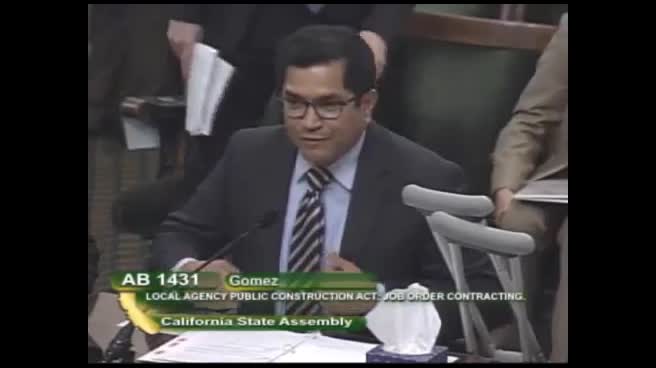 10MIN
Assembly Standing Committee on Education
Bill Author