AB 156: Ammunition.
- Session Year: 2015-2016
- House: Assembly
- Latest Version Date: 2016-05-17
(1)Existing law requires the Attorney General to maintain records, including, among other things, fingerprints, licenses to carry concealed firearms, and information from firearms dealers pertaining to firearms, for purposes of assisting in the investigation of crimes and specified civil actions. In regard to certain of those records, existing law authorizes specified peace officers to disseminate the name of the subject of the record, the number of firearms listed in the record, the description of any firearm, and other information reported to the Department of Justice, as specified, if the subject of the record has been arraigned, is being prosecuted, or is serving a sentence for domestic violence or is the subject of specified protective orders. Existing law requires the law enforcement officer to provide a victim of domestic violence to whom information is disseminated with a Victims of Domestic Violence card, and authorizes the victim or other person to whom the information is disseminated to disclose that information as he or she deems necessary to protect himself, herself, or another person from bodily harm by the person who is the subject of the record.
This bill would require the Attorney General to also maintain information about ammunition transactions and ammunition vendor licenses for those purposes. This The bill would similarly authorize specified agencies, officials, and officers to disseminate the name of a person and the fact of any ammunition purchases by that person, as specified, if the subject of the record has been arraigned, is being prosecuted, or is serving a sentence for domestic violence or is the subject of specified protective orders. The bill would require the law enforcement officer to provide a victim of domestic violence to whom information regarding an ammunition purchase is disseminated with a Victims of Domestic Violence card, and would authorize the victim or other person to whom the information is disseminated to disclose that information as he or she deems necessary to protect himself, herself, or another person from bodily harm by the person who is the subject of the record. card.
By imposing new duties on local law enforcement officers, this bill would impose a state-mandated local program.
(2)Existing law, subject to exceptions, requires that the delivery or transfer of ownership of handgun ammunition occur only in a face-to-face transaction and makes a violation of this requirement a crime.
This bill would extend those provisions, subject to exceptions, to any ammunition and would reorganize those provisions.
(3)Existing law provides that the term vendor for purposes of ammunition sales is a handgun ammunition vendor as defined for those and other purposes.
This bill would provide that the term vendor for purposes of ammunition sales means ammunition vendor and, commencing January 1, 2018, means a licensed ammunition vendor. The bill would provide that commencing on January 1, 2018, only a licensed ammunition vendor may sell ammunition. The bill would revise the definition of ammunition for those purposes.
(4)Existing law establishes the Prohibited Armed Persons File, the purpose of which is to cross-reference persons prohibited from possessing firearms with records of firearm transactions to determine if these persons have acquired or attempted to acquire firearms. Under existing law, a person who is prohibited from owning or possessing a firearm is prohibited from owning, possessing, or having under his or her custody or control any ammunition or reloaded ammunition.
This bill would, commencing July 1, 2019, use the Prohibited Armed Persons File to cross-reference persons who attempt to acquire ammunition, as specified, to determine if those persons are prohibited from possessing ammunition.
(5)Existing law makes it a crime for a person, corporation, or firm to provide ammunition, as specified, to an individual that the person, corporation, or firm knows or should know is prohibited from possessing or owning ammunition.
This bill would apply that prohibition to other business enterprises. The bill would make it a crime for a person, corporation, firm, or other business enterprise to provide, as specified, ammunition to an individual that the person, corporation, firm, or other business entity knows or has cause to believe is not the actual purchaser or transferee of the ammunition, ammunition or knows or has cause to believe that the ammunition is to be sold or transferred to a person prohibited from possessing or owning ammunition.
(6)Existing law prohibits an ammunition vendor from allowing a person the vendor knows or should know is a person who is prohibited from possessing firearms, for specified reasons, from handling, selling, or delivering handgun ammunition in the course and scope of his or her employment. Existing law prohibits an ammunition vendor from selling or otherwise transferring ownership of, offering for sale or otherwise offering to transfer ownership of, or displaying for sale or displaying for transfer of ownership of, any handgun ammunition in a manner that allows that ammunition to be accessible to a purchaser or transferee without the assistance of the vendor or an employee of the vendor.
This bill would extend those prohibitions to any ammunition. The bill would require that when neither party to the ammunition transaction is an ammunition dealer, the transaction be conducted by an ammunition dealer. The bill would, subject to exceptions, require a resident bringing ammunition into the state to have the ammunition delivered to an ammunition dealer for delivery to the person, as specified. The bill would provide that a violation of these provisions is a crime.
(7)Existing law, subject to exceptions, requires a handgun ammunition vendor to record specified information at the time of delivery of handgun ammunition to a purchaser, as specified.
This bill would extend those provisions to transactions of any ammunition and would, commencing on July 1, 2019, require the ammunition vendor to submit that information to the Department of Justice, as specified. The bill would require the department to retain the information for 2 years in a database to be known as the Ammunition Purchase Records File and would prescribe the authority of the department and other entities to use the file, as specified. The bill would, commencing on July 1, 2019, and subject to exceptions, require the purchaser of ammunition to be authorized to purchase ammunition by the department, as specified. The bill would require the department to cross-reference the Prohibited Armed Persons File and the Automated Firearms System for those transaction purposes. The bill would require, commencing on July 1, 2019, and subject to exceptions, that only persons listed in the Automated Firearms System, or who purchase a one-time ammunition transaction license from the department, would be able to purchase ammunition. A violation of these provisions would be a crime.
The bill would authorize the department to accept applications for ammunition vendor licenses, commencing on July 1, 2017. The bill would require an ammunition vendor to be licensed, commencing on January 1, 2018, in order to sell ammunition. The bill would create an application process for ammunition vendors, as specified. The bill would establish the Ammunition Special Account, into which vendor license fees and ammunition transaction fees would be deposited and made available, upon appropriation by the Legislature, to the department for purposes of enforcing the ammunition vendor licensing and ammunition purchasing provisions. The bill would require the ammunition vendor to conduct business at the location specified in the license, except in the case of gun shows or events, as specified. The bill would require ammunition sales at a gun show or event to comply with certain requirements pertaining to ammunition transfers and recordkeeping, the violation of which is a crime.
(8)By expanding existing crimes and creating new crimes, this bill would impose a state-mandated local program.
(9)The California Constitution requires the state to reimburse local agencies and school districts for certain costs mandated by the state. Statutory provisions establish procedures for making that reimbursement.
This bill would provide that with regard to certain mandates no reimbursement is required by this act for a specified reason.
With regard to any other mandates, this bill would provide that, if the Commission on State Mandates determines that the bill contains costs so mandated by the state, reimbursement for those costs shall be made pursuant to the statutory provisions noted above.
(1)Existing law requires the Attorney General to maintain records, including, among other things, fingerprints, licenses to carry concealed firearms, and information from firearms dealers pertaining to firearms, for purposes of assisting in the investigation of crimes and specified civil actions. In regard to certain of those records, existing law authorizes specified peace officers to disseminate the name of the subject of the record, the number of firearms listed in the record, the description of any firearm, and other information reported to the Department of Justice, as specified, if the subject of the record has been arraigned, is being prosecuted, or is serving a sentence for domestic violence or is the subject of specified protective orders. Existing law requires the law enforcement officer to provide a victim of domestic violence to whom information is disseminated with a Victims of Domestic Violence card, and authorizes the victim or other person to whom the information is disseminated to disclose that information as he or she deems necessary to protect himself, herself, or another person from bodily harm by the person who is the subject of the record.
This bill would require the Attorney General to also maintain information about ammunition transactions and ammunition vendor licenses for those purposes. This bill would similarly authorize specified agencies, officials, and officers to disseminate the name of a person and the fact of any ammunition purchases by that person, as specified, if the subject of the record has been arraigned, is being prosecuted, or is serving a sentence for domestic violence or is the subject of specified protective orders. The bill would require the law enforcement officer to provide a victim of domestic violence to whom information is disseminated with a Victims of Domestic Violence card, and would authorize the victim or other person to whom the information is disseminated to disclose that information as he or she deems necessary to protect himself, herself, or another person from bodily harm by the person who is the subject of the record.
By imposing new duties on local law enforcement officers, this bill would impose a state-mandated local program.
(2)Existing law, subject to exceptions, requires that the delivery or transfer of ownership of handgun ammunition occur only in a face-to-face transaction and makes a violation of this requirement a crime.
This bill would extend those provisions, subject to exceptions, to any ammunition and would reorganize those provisions.
(3)Existing law provides that the term vendor for purposes of ammunition sales is a handgun ammunition vendor as defined for those and other purposes.
This bill would provide that the term vendor for purposes of ammunition sales means ammunition vendor and, commencing January 1, 2018, means a licensed ammunition vendor. The bill would provide that commencing on January 1, 2018, only a licensed ammunition vendor may sell ammunition. The bill would revise the definition of ammunition for those purposes.
(4)Existing law establishes the Prohibited Armed Persons File, the purpose of which is to cross-reference persons prohibited from possessing firearms with records of firearm transactions to determine if these persons have acquired or attempted to acquire firearms. Under existing law, a person who is prohibited from owning or possessing a firearm is prohibited from owning, possessing, or having under his or her custody or control any ammunition or reloaded ammunition.
This bill would, commencing July 1, 2019, use the Prohibited Armed Persons File to cross-reference persons who attempt to acquire ammunition, as specified, to determine if those persons are prohibited from possessing ammunition.
(5)Existing law makes it a crime for a person, corporation, or firm to provide ammunition, as specified, to an individual that the person, corporation, or firm knows or should know is prohibited from possessing or owning ammunition.
This bill would apply that prohibition to other business enterprises. The bill would make it a crime for a person, corporation, firm, or other business enterprise to provide, as specified, ammunition to an individual that the person, corporation, firm, or other business entity knows or has cause to believe is not the actual purchaser or transferee of the ammunition, or knows or has cause to believe that the ammunition is to be sold or transferred to a person prohibited from possessing or owning ammunition.
(6)Existing law prohibits an ammunition vendor from allowing a person the vendor knows or should know is a person who is prohibited from possessing firearms, for specified reasons, from handling, selling, or delivering handgun ammunition in the course and scope of his or her employment. Existing law prohibits an ammunition vendor from selling or otherwise transferring ownership of, offering for sale or otherwise offering to transfer ownership of, or displaying for sale or displaying for transfer of ownership of, any handgun ammunition in a manner that allows that ammunition to be accessible to a purchaser or transferee without the assistance of the vendor or an employee of the vendor.
This bill would extend those prohibitions to any ammunition. The bill would require that when neither party to the ammunition transaction is an ammunition dealer, the transaction be conducted by an ammunition dealer. The bill would, subject to exceptions, require a resident bringing ammunition into the state to have the ammunition delivered to an ammunition dealer for delivery to the person, as specified. The bill would provide that a violation of these provisions is a crime.
(7)Existing law, subject to exceptions, requires a handgun ammunition vendor to record specified information at the time of delivery of handgun ammunition to a purchaser, as specified.
This bill would extend those provisions to transactions of any ammunition and would, commencing on July 1, 2019, require the ammunition vendor to submit that information to the Department of Justice, as specified. The bill would require the department to retain the information for 2 years in a database to be known as the Ammunition Purchase Records File and would prescribe the authority of the department and other entities to use the file, as specified. The bill would, commencing on July 1, 2019, and subject to exceptions, require the purchaser of ammunition to be authorized to purchase ammunition by the department, as specified. The bill would require the department to cross-reference the Prohibited Armed Persons File and the Automated Firearms System for those transaction purposes. The bill would require, commencing on July 1, 2019, and subject to exceptions, that only persons listed in the Automated Firearms System, or who purchase a one-time ammunition transaction license from the department, would be able to purchase ammunition. A violation of these provisions would be a crime.
The bill would authorize the department to accept applications for ammunition vendor licenses, commencing on July 1, 2017. The bill would require an ammunition vendor to be licensed, commencing on January 1, 2018, in order to sell ammunition. The bill would create an application process for ammunition vendors, as specified. The bill would establish the Ammunition Special Account, into which vendor license fees and ammunition transaction fees would be deposited and made available, upon appropriation by the Legislature, to the department for purposes of enforcing the ammunition vendor licensing and ammunition purchasing provisions. The bill would require the ammunition vendor to conduct business at the location specified in the license, except in the case of gun shows or events, as specified. The bill would require ammunition sales at a gun show or event to comply with certain requirements pertaining to ammunition transfers and recordkeeping, the violation of which is a crime.
(8)By expanding existing crimes and creating new crimes, this bill would impose a state-mandated local program.
(9)The California Constitution requires the state to reimburse local agencies and school districts for certain costs mandated by the state. Statutory provisions establish procedures for making that reimbursement.
This bill would provide that with regard to certain mandates no reimbursement is required by this act for a specified reason.
With regard to any other mandates, this bill would provide that, if the Commission on State Mandates determines that the bill contains costs so mandated by the state, reimbursement for those costs shall be made pursuant to the statutory provisions noted above.
The California Global Warming Solutions Act of 2006 designates the State Air Resources Board as the state agency charged with monitoring and regulating sources of emissions of greenhouse gases. The act authorizes the state board to include the use of market-based compliance mechanisms. Existing law requires all moneys, except for fines and penalties, collected by the state board as part of a market-based compliance mechanism to be deposited in the Greenhouse Gas Reduction Fund and to be available upon appropriation. Existing law requires the California Environmental Protection Agency to identify disadvantaged communities and requires the Department of Finance, in consultation with the state board and any other relevant state agency, to develop, as specified, a 3-year investment plan for the moneys deposited in the Greenhouse Gas Reduction Fund. Existing law requires the 3-year investment plan to allocate a minimum of 25% of the available moneys in the fund to projects that provide benefits to disadvantaged communities.
This bill would require the state board to prepare and post on its Internet Web site a specified report on the projects funded to benefit disadvantaged communities.
This bill would require the state board to establish a comprehensive technical assistance program, upon the appropriation of moneys from the Greenhouse Gas Reduction Fund, for eligible applicants, as specified, assisting eligible communities, as defined.
This bill would also require the department to include in the 3-year investment plan an allocation to the state board for that technical assistance program.
The California Global Warming Solutions Act of 2006 designates the State Air Resources Board as the state agency charged with monitoring and regulating sources of emissions of greenhouse gases. The act authorizes the state board to include the use of market-based compliance mechanisms. Existing law requires all moneys, except for fines and penalties, collected by the state board from the auction or sale of allowances as part of a market-based compliance mechanism to be deposited in the Greenhouse Gas Reduction Fund and to be available upon appropriation. Existing law requires the California Environmental Protection Agency to identify disadvantaged communities and requires the Department of Finance, in consultation with the state board and any other relevant state agency, to develop, as specified, a 3-year investment plan for the moneys deposited in the Greenhouse Gas Reduction Fund. Existing law requires the 3-year investment plan to allocate a minimum of 25% of the available moneys in the fund to projects that provide benefits to disadvantaged communities.
This bill would require the state board to prepare and post on its Internet Web site a specified report on the projects funded to benefit disadvantaged communities.
This bill would require the state board to establish a comprehensive technical assistance program, upon the appropriation of moneys from the Greenhouse Gas Reduction Fund, for eligible applicants, as specified, assisting disadvantaged eligible communities, as defined.
This bill would also require the department to include in the 3-year investment plan an allocation to the state board for that technical assistance program.
The California Global Warming Solutions Act of 2006 designates the State Air Resources Board as the state agency charged with monitoring and regulating sources of emissions of greenhouse gases. The act authorizes the state board to include the use of market-based compliance mechanisms. Existing law requires all moneys, except for fines and penalties, collected by the state board from the auction or sale of allowances as part of a market-based compliance mechanism to be deposited in the Greenhouse Gas Reduction Fund and to be available upon appropriation. Existing law requires the California Environmental Protection Agency to identify disadvantaged communities and requires the Department of Finance, in consultation with the state board and any other relevant state agency, to develop, as specified, a 3-year investment plan for the moneys deposited in the Greenhouse Gas Reduction Fund. Existing law requires the 3-year investment plan to allocate a minimum of 25% of the available moneys in the fund to projects that provide benefits to disadvantaged communities.
This bill would require the state board to prepare and post on its Internet Web site a specified report on the projects funded to benefit disadvantaged communities.
This bill would require the state board to establish a comprehensive technical assistance program, upon the appropriation of moneys from the Greenhouse Gas Reduction Fund, for eligible applicants, as specified, assisting disadvantaged communities and other specified communities, as defined.
This bill would also require the department to include in the 3-year investment plan an allocation to the state board for that technical assistance program.
The California Global Warming Solutions Act of 2006 designates the State Air Resources Board as the state agency charged with monitoring and regulating sources of emissions of greenhouse gases. The act authorizes the state board to include the use of market-based compliance mechanisms. Existing law requires all moneys, except for fines and penalties, collected by the state board from the auction or sale of allowances as part of a market-based compliance mechanism to be deposited in the Greenhouse Gas Reduction Fund and to be available upon appropriation. Existing law requires the California Environmental Protection Agency to identify disadvantaged communities and requires the Department of Finance, in consultation with the state board and any other relevant state agency, to develop, as specified, a 3-year investment plan for the moneys deposited in the Greenhouse Gas Reduction Fund. Existing law requires the 3-year investment plan to allocate a minimum of 25% of the available moneys in the fund to projects that provide benefits to disadvantaged communities.
This bill would require the state board to prepare and post on its Internet Web site a specified report on the projects funded to benefit disadvantaged communities.
This bill would require the state board to establish a comprehensive technical assistance program, upon the appropriation of moneys from the Greenhouse Gas Reduction Fund, for eligible applicants, as specified, assisting disadvantaged communities and other specified communities.
This bill would also require the department to include in the 3-year investment plan an allocation to the state board for that technical assistance program.
The California Global Warming Solutions Act of 2006 designates the State Air Resources Board as the state agency charged with monitoring and regulating sources of emissions of greenhouse gases. The act authorizes the state board to include the use of market-based compliance mechanisms. Existing law requires all moneys, except for fines and penalties, collected by the state board from the auction or sale of allowances as part of a market-based compliance mechanism to be deposited in the Greenhouse Gas Reduction Fund and to be available upon appropriation. Existing law requires the California Environmental Protection Agency to identify disadvantaged communities and requires the Department of Finance, in consultation with the state board and any other relevant state agency, to develop, as specified, a 3-year investment plan for the moneys deposited in the Greenhouse Gas Reduction Fund. Existing law requires the 3-year investment plan to allocate a minimum of 25% of the available moneys in the fund to projects that provide benefits to disadvantaged communities.
This bill would require the state board to establish a comprehensive technical assistance program, upon the appropriation of moneys from the Greenhouse Gas Reduction Fund, for eligible applicants, as specified, assisting disadvantaged communities and other specified communities.
This bill would also require the department to include in the 3-year investment plan an allocation to the state board to provide technical assistance to disadvantaged communities to assist them in developing project proposals for specified projects. for that technical assistance program.
The California Global Warming Solutions Act of 2006 designates the State Air Resources Board as the state agency charged with monitoring and regulating sources of emissions of greenhouse gases. The state board is required to adopt a statewide greenhouse gas emissions limit equivalent to the statewide greenhouse gas emissions level in 1990 to be achieved by 2020. The act authorizes the state board to include the use of market-based compliance mechanisms. Existing law requires all moneys, except for fines and penalties, collected by the state board from the auction or sale of allowances as part of a market-based compliance mechanism to be deposited in the Greenhouse Gas Reduction Fund and to be available upon appropriation. Existing law requires the California Environmental Protection Agency to identify disadvantaged communities and requires the Department of Finance, in consultation with the state board and any other relevant state agency, to develop, as specified, a 3-year investment plan for the moneys deposited in the Greenhouse Gas Reduction Fund. Existing law requires the 3-year investment plan to allocate a minimum of 25% of the available moneys in the fund to projects that provide benefits to disadvantaged communities.
This bill would require the state board to establish a comprehensive technical assistance program, upon the appropriation of moneys from the Greenhouse Gas Reduction Fund, for eligible applicants, as specified, assisting disadvantaged communities.
This bill would also require the department to include in the 3-year investment plan an allocation to the state board to provide technical assistance to disadvantaged communities to assist them in proposing developing project proposals for specified projects for inclusion in the 3-year investment plan. projects.
The California Global Warming Solutions Act of 2006 designates the State Air Resources Board as the state agency charged with monitoring and regulating sources of emissions of greenhouse gases. The state board is required to adopt a statewide greenhouse gas emissions limit equivalent to the statewide greenhouse gas emissions level in 1990 to be achieved by 2020. The act authorizes the state board to include the use of market-based compliance mechanisms. Existing law requires all moneys, except for fines and penalties, collected by the state board from the auction or sale of allowances as part of a market-based compliance mechanism to be deposited in the Greenhouse Gas Reduction Fund and to be available upon appropriation. Existing law requires the California Environmental Protection Agency to identify disadvantaged communities and requires the Department of Finance, in consultation with the state board and any other relevant state agency, to develop, as specified, a 3-year investment plan for the moneys deposited in the Greenhouse Gas Reduction Fund.
This bill would require the department to include in the 3-year investment plan an allocation to provide technical assistance to disadvantaged communities to assist them in proposing specified projects for inclusion in the 3-year investment plan.
(a)(1)In order to assist in the investigation of crime, the prosecution of civil actions by city attorneys pursuant to paragraph (3) of subdivision (b), the arrest and prosecution of criminals, and the recovery of lost, stolen, or found property, the Attorney General shall keep and properly file a complete record of all of the following:
(A)All copies of fingerprints.
(B)Copies of licenses to carry firearms issued pursuant to Section 26150, 26155, 26170, or 26215.
(C)Information reported to the Department of Justice pursuant to Section 26225, 27875, 27920, or 29830.
(D)Dealers records of sales of firearms.
(E)Reports provided pursuant to Article 1 (commencing with Section 27500) of Chapter 4 of Division 6 of Title 4 of Part 6, or pursuant to any provision listed in subdivision (a) of Section 16585.
(F)Forms provided pursuant to Section 12084, as that section read prior to being repealed on January 1, 2006.
(G)Reports provided pursuant to Article 1 (commencing with Section 26700) and Article 2 (commencing with Section 26800) of Chapter 2 of Division 6 of Title 4 of Part 6, that are not dealers records of sales of firearms.
(H)Information provided pursuant to Section 28255.
(I)Reports of stolen, lost, found, pledged, or pawned property in any city or county of this state.
(J)Ammunition vendor license information pursuant to Article 3 (commencing with Section 30345) of Chapter 1 of Division 10 of Title 4 of Part 6.
(K)Information required by Section 30369.
(2)The Attorney General shall, upon proper application therefor, furnish the information to the officers referred to in Section 11105.
(b)(1)The Attorney General shall permanently keep and properly file and maintain all information reported to the Department of Justice pursuant to the following provisions as to firearms and maintain a registry thereof:
(A)Article 1 (commencing with Section 26700) and Article 2 (commencing with Section 26800) of Chapter 2 of Division 6 of Title 4 of Part 6.
(B)Article 1 (commencing with Section 27500) of Chapter 4 of Division 6 of Title 4 of Part 6.
(C)Chapter 5 (commencing with Section 28050) of Division 6 of Title 4 of Part 6.
(D)Any provision listed in subdivision (a) of Section 16585.
(E)Former Section 12084.
(F)Section 28255.
(G)Any other law.
(2)The registry shall consist of all of the following:
(A)The name, address, identification of, place of birth (state or country), complete telephone number, occupation, sex, description, and all legal names and aliases ever used by the owner or person being loaned the particular firearm as listed on the information provided to the department on the Dealers Record of Sale, the Law Enforcement Firearms Transfer (LEFT), as defined in former Section 12084, or reports made to the department pursuant to any provision listed in subdivision (a) of Section 16585, Section 28255, or any other law.
(B)The name and address of, and other information about, any person, whether a dealer or a private party, from whom the owner acquired or the person being loaned the particular firearm and when the firearm was acquired or loaned as listed on the information provided to the department on the Dealers Record of Sale, the LEFT, or reports made to the department pursuant to any provision listed in subdivision (a) of Section 16585 or any other law.
(C)Any waiting period exemption applicable to the transaction which resulted in the owner of or the person being loaned the particular firearm acquiring or being loaned that firearm.
(D)The manufacturers name if stamped on the firearm, model name or number if stamped on the firearm, and, if applicable, the serial number, other number if more than one serial number is stamped on the firearm, caliber, type of firearm, if the firearm is new or used, barrel length, and color of the firearm, or, if the firearm is not a handgun and does not have a serial number or any identification number or mark assigned to it, that shall be noted.
(3)Information in the registry referred to in this subdivision shall, upon proper application therefor, be furnished to the officers referred to in Section 11105, to a city attorney prosecuting a civil action, solely for use in prosecuting that civil action and not for any other purpose, or to the person listed in the registry as the owner or person who is listed as being loaned the particular firearm.
(4)If any person is listed in the registry as the owner of a firearm through a Dealers Record of Sale prior to 1979, and the person listed in the registry requests by letter that the Attorney General store and keep the record electronically, as well as in the records existing photographic, photostatic, or nonerasable optically stored form, the Attorney General shall do so within three working days of receipt of the request. The Attorney General shall, in writing, and as soon as practicable, notify the person requesting electronic storage of the record that the request has been honored as required by this paragraph.
(c)(1)If the conditions specified in paragraph (2) are met, any officer referred to in paragraphs (1) to (6), inclusive, of subdivision (b) of Section 11105 may disseminate the name of the subject of the record, the fact of any ammunition purchases by that person based on information supplied to the department pursuant to Section 30352, the number of the firearms listed in the record, and the description of any firearm, including the make, model, and caliber, from the record relating to any firearms sale, transfer, registration, or license record, or any information reported to the Department of Justice pursuant to any of the following:
(A)Section 26225, 27875, or 27920.
(B)Article 1 (commencing with Section 26700) and Article 2 (commencing with Section 26800) of Chapter 2 of Division 6 of Title 4 of Part 6.
(C)Article 1 (commencing with Section 27500) of Chapter 4 of Division 6 of Title 4 of Part 6.
(D)Chapter 5 (commencing with Section 28050) of Division 6 of Title 4 of Part 6.
(E)Article 2 (commencing with Section 28150) of Chapter 6 of Division 6 of Title 4 of Part 6.
(F)Article 5 (commencing with Section 30900) of Chapter 2 of Division 10 of Title 4 of Part 6.
(G)Chapter 2 (commencing with Section 33850) of Division 11 of Title 4 of Part 6.
(H)Any provision listed in subdivision (a) of Section 16585.
(2)Information may be disseminated pursuant to paragraph (1) only if all of the following conditions are satisfied:
(A)The subject of the record has been arraigned for a crime in which the victim is a person described in subdivisions (a) to (f), inclusive, of Section 6211 of the Family Code and is being prosecuted or is serving a sentence for the crime, or the subject of the record is the subject of an emergency protective order, a temporary restraining order, or an order after hearing, which is in effect and has been issued by a family court under the Domestic Violence Prevention Act set forth in Division 10 (commencing with Section 6200) of the Family Code.
(B)The information is disseminated only to the victim of the crime or to the person who has obtained the emergency protective order, the temporary restraining order, or the order after hearing issued by the family court.
(C)Whenever a law enforcement officer disseminates the information authorized by this subdivision, that officer or another officer assigned to the case shall immediately provide the victim of the crime with a Victims of Domestic Violence card, as specified in subparagraph (H) of paragraph (9) of subdivision (c) of Section 13701.
(3)The victim or person to whom information is disseminated pursuant to this subdivision may disclose it as he or she deems necessary to protect himself or herself or another person from bodily harm by the person who is the subject of the record.
SECTION 1.Section 11106.5 is added to the Penal Code, to read:11106.5.(a)In addition to the requirements of Section 11106, the Attorney General shall keep and properly file a complete record of both of the following:
(1)Ammunition vendor license information pursuant to Article 3 (commencing with Section 30345) of Chapter 1 of Division 10 of Title 4 of Part 6.
(2)Information required by Section 30369.
(b)If the conditions of paragraph (2) of subdivision (c) of Section 11106 are met, an officer referred to in paragraphs (1) to (6), inclusive, of subdivision (b) of Section 11105 may disseminate the fact of any ammunition purchases by the subject of a state summary criminal history record based on information supplied by the department pursuant to Section 30352.
SEC. 2.Section 16150 of the Penal Code is amended to read:16150.(a)As used in this part, except as specified in subdivision (b), ammunition means one or more loaded cartridges consisting of a primer case, propellant, and with one or more projectiles. Ammunition does not include blanks.
(b)As used in subdivision (a) of Section 30305 and in Section 30306, ammunition includes, but is not limited to, any bullet, cartridge, magazine, clip, speed loader, autoloader, or projectile capable of being fired from a firearm with a deadly consequence. Ammunition does not include blanks.
SEC. 3.Section 16151 is added to the Penal Code, to read:16151.Commencing January 1, 2018, as used in this part, ammunition vendor means any person, firm, corporation, dealer, or any other business who has a current ammunition vendor license issued pursuant to Section 30345.
SEC. 4.Section 16650 of the Penal Code is repealed.SEC. 5.Section 16662 of the Penal Code is repealed.SEC. 6.Section 17315 of the Penal Code is amended to read:17315.As used in Article 2 (commencing with Section 30300), Article 3 (commencing with Section 30345), Article 4 (commencing with Section 30355), and Article 5 (commencing with Section 30360) of Chapter 1 of Division 10 of Title 4, vendor means an ammunition vendor.
SEC. 7.Section 30000 of the Penal Code is amended to read:30000.(a)The Attorney General shall establish and maintain an online database to be known as the Prohibited Armed Persons File. The purpose of the file is to cross-reference persons who have ownership or possession of a firearm on or after January 1, 1996, as indicated by a record in the Consolidated Firearms Information System, and who, subsequent to the date of that ownership or possession of a firearm, fall within a class of persons who are prohibited from owning or possessing a firearm.
(b)Commencing July 1, 2019, the file shall also be used to cross-reference persons who attempt to acquire ammunition to determine if those persons fall within a class of persons who are prohibited from owning or possessing ammunition.
(c)The information contained in the Prohibited Armed Persons File shall only be available to those entities specified in, and pursuant to, subdivision (b) or (c) of Section 11105, through the California Law Enforcement Telecommunications System, for the purpose of determining if persons are armed and prohibited from possessing firearms.
SEC. 8.Section 30306 of the Penal Code is amended to read:30306.(a)Any person, corporation, firm, or other business enterprise who supplies, delivers, sells, or gives possession or control of, any ammunition to any person who he or she knows or using reasonable care should know is prohibited from owning, possessing, or having under custody or control, any ammunition or reloaded ammunition pursuant to subdivision (a) or (b) of Section 30305, is guilty of a misdemeanor, punishable by imprisonment in a county jail not exceeding one year, or a fine not exceeding one thousand dollars ($1,000), or by both that fine and imprisonment.
(b)Any person, corporation, firm, or other business enterprise who supplies, delivers, sells, or gives possession or control of, any of ammunition to any a person who the person, corporation, firm, or other business enterprise knows or has cause to believe is not the actual purchaser or transferee or has cause to believe is not the actual purchaser or transferee of the ammunition, with knowledge or cause to believe that the ammunition is to be subsequently sold or transferred to a person who is prohibited from owning, possessing, or having under custody or control any ammunition or reloaded ammunition pursuant to subdivision (a) or (b) of Section 30305, is guilty of a misdemeanor, punishable by imprisonment in a county jail not exceeding one year, year or a fine not exceeding one thousand dollars ($1,000), or by both that fine and imprisonment.
(c)The provisions of this section are cumulative and shall not be construed as restricting the application of any other law. However, an act or omission punishable in different ways by this section and another provision of law shall not be punished under more than one provision.
SEC. 9.Section 30312 of the Penal Code is repealed.SEC. 10.Article 3 (commencing with Section 30345) of Chapter 1 of Division 10 of Title 4 of Part 6 of the Penal Code is repealed.SEC. 11.Article 3 (commencing with Section 30345) is added to Chapter 1 of Division 10 of Title 4 of Part 6 of the Penal Code, to read:3.Ammunition Vendor License30345.(a)Commencing January 1, 2018, only an ammunition vendor who is licensed by the Department of Justice shall be authorized to sell ammunition in this state, except as provided by Article 5 (commencing with Section 30360).
(b)Subdivision (a) does not apply to the sale of ammunition by any of the following:
(1)A commercial hunting club, as defined in Section 3240.5 of the Fish and Game Code, provided the ammunition is used and consumed on the licensed premises while engaged in lawful hunting activity.
(2)A domesticated game bird hunting club, pursuant to Section 3270 of the Fish and Game Code, provided the ammunition is used and consumed on the licensed premises while engaged in lawful hunting activity.
(3)A domesticated migratory game bird shooting club, pursuant to Article 4 (commencing with Section 3300) of Chapter 2 of Part 1 of Division 4 of the Fish and Game Code, provided the ammunition is used and consumed on the licensed premises while engaged in lawful hunting activity.
(4)A nonprofit mutual or public benefit corporation organized pursuant to the Corporations Code that engages in recreational shooting and lawful hunting activity provided that the ammunition is used and consumed during the shooting or hunting event conducted by that nonprofit or public benefit corporation.
(5)A target facility that holds a business or regulatory license provided that the ammunition is at all times kept within the facilitys premises and used on the premises.
(6)A person who sells no more than 50 100 rounds of ammunition to one vendor in one month or cumulatively sells no more than 250 rounds per year to vendors in this state.
(c)The Department of Justice is authorized to issue ammunition vendor licenses pursuant to this article. The department shall, commencing July 1, 2017, accept applications for ammunition vendor licenses. The department shall issue a license or deny the application for a license within 60 days of receipt of the application in the first two years of implementation, and within 30 days thereafter. If the application is denied, the department shall inform the applicant of the reason for denial in writing.
(d)The ammunition vendor license shall be issued in a form prescribed by the Attorney General and shall be valid for a period of one year. The license shall allow the licensee to sell ammunition from a fixed location and at any place set forth in subdivision (b) of Section 30365.
30346.(a)The department may charge ammunition vendor license applicants a fee sufficient to cover the reasonable costs of issuing a certificate of eligibility, as described, except for those persons or entities described in subdivision (d) of Section 30347.
(b)The fees received by the department pursuant to this article shall be deposited in the Ammunition Special Account, which is hereby created. The revenue in the fund shall be available, upon appropriation by the Legislature, for use by the Department of Justice for the purpose of implementing and enforcing the provisions of this article, Article 4 (commencing with Section 30355) and Article 5 (commencing with Section 30360).
30347.(a)The department is authorized to issue ammunition vendor licenses to ammunition vendors who the department has determined are not prohibited by state or federal law from possessing, receiving, owning, or purchasing a firearm, firearm and who have a certificate of eligibility issued by the department.
(b)The department shall require any agent or employee of a vendor who handles, sells, or delivers ammunition to obtain and provide to the ammunition vendor a certificate of eligibility from the Department of Justice pursuant to Section 26710. On the application for the certificate, the agent or employee shall provide the name and California ammunition vendor number of the vendor with whom the person is employed.
(c)In the case of an entity other than a natural person, the department shall issue the license to the business entity, pursuant to the requirements in subdivisions (a) and (b).
(d)The department shall, upon request and in a manner prescribed by the department, issue ammunition vendor licenses to the following:
(1)A firearms dealer licensed pursuant to Sections 26700 to 26915, inclusive.
(2)A person who is on the centralized list of federal firearms licensees maintained by the department pursuant to Article 6 (commencing with Section 28450) of Chapter 6 of Division 6.
(3)A gunsmith as defined in Section 16630.
(4)A wholesaler as defined in Section 17340.
(5)A manufacturer or importer of firearms or ammunition licensed pursuant to Chapter 44 (commencing with Section 921) of Title 18 of the United States Code, Code and the regulations issued pursuant thereto.
(e)The department shall keep a registry of all licensed ammunition vendors.
(f)The department shall revoke the license of any ammunition vendor who violates this article, Article 4 (commencing with Section 30355), or Article 5 (commencing with Section 30360) in any combination three times. The ammunition vendor shall thereafter be permanently ineligible for an ammunition vendor license.
SEC. 12.Article 4 (commencing with Section 30355) is added to Chapter 1 of Division 10 of Title 4 of Part 6 of the Penal Code, to read:4.Ammunition Purchase Authorization30355.(a)Any person who violates any provision of this article is guilty of a misdemeanor, punishable by imprisonment in a county jail not exceeding one year, year or a fine not exceeding one thousand dollars ($1,000), or by both that fine and imprisonment.
(b)The provisions of this article are cumulative, cumulative and shall not be construed as restricting the application of any other law. However, an act or omission punishable in different ways by different provisions of law shall not be punished under more than one provision.
30356.(a)Commencing July 1, 2019, the department shall electronically approve the purchase or transfer of ammunition through a vendor, as defined in Section 16151, except as otherwise specified. This approval shall occur at the time of purchase or transfer, prior to the purchaser or transferee taking possession of the ammunition.
(b)To determine if the purchaser or transferee is eligible to purchase or possess ammunition, the department shall cross-reference the ammunition purchasers or transferees name, date of birth, current address, and drivers license or other government identification number, as described in Section 28180, with the information maintained in the Automated Firearms System (AFS). If the purchasers or transferees information does not match an AFS entry, the transaction shall be denied. If the purchasers or transferees information matches an AFS entry, the department shall determine if the purchaser or transferee falls within a class of persons who are prohibited from owning or possessing ammunition by cross-referencing the Prohibited Armed Persons File. If the purchaser or transferee is prohibited from owning or possessing a firearm, the transaction shall be denied.
(c)A vendor is prohibited from providing a purchaser or transferee ammunition without department approval. If a vendor cannot electronically verify a persons eligibility to purchase or possess ammunition via an Internet connection, the department shall provide a phone line to verify eligibility. This option is available to ammunition vendors who can demonstrate legitimate geographical and telecommunications limitations in submitting the information electronically, electronically and who are approved by the department to use the phone line verification.
(d)The department shall recover the reasonable cost of regulatory and enforcement activities related to this article by charging ammunition purchasers and transferees a per-transaction fee not to exceed one dollar ($1), provided, however, that the fees fee may be increased at a rate not to exceed any increases in the California Consumer Price Index as compiled and reported by the Department of Industrial Relations, not to exceed the reasonable regulatory and enforcement costs. The fees shall be deposited in the Ammunition Special Account, to be available upon appropriation by the Legislature, for use by the Department of Justice for the purpose of implementing and enforcing this article, Article 3 (commencing with Section 30345), and Article 5 (commencing with Section 30360).
(e)This section shall not apply to the sale, delivery, or transfer of ammunition to any of the following, if properly identified prior to the delivery of the ammunition by the vendor:
(1)A firearms dealer licensed pursuant to Sections 26700 to 26915, inclusive.
(2)A person who is on the centralized list of federal firearms licensees maintained by the department pursuant to Article 6 (commencing with Section 28450) of Chapter 6 of Division 6.
(3)A gunsmith as defined in Section 16630.
(4)A wholesaler as defined in Section 17340.
(5)A manufacturer or importer of firearms or ammunition licensed pursuant to Chapter 44 (commencing with Section 921) of Title 18 of the United States Code, Code and the regulations issued pursuant thereto.
(6)An ammunition vendor.
(7)A person whose licensed premises are outside of this state and who is licensed as a dealer or collector of firearms pursuant to Chapter 44 (commencing with Section 921) of Title 18 of the United States Code and the regulations issued pursuant thereto.
(8)A person who is licensed as a collector of firearms pursuant to Chapter 44 (commencing with Section 921) of Title 18 of the United States Code and the regulations issued pursuant thereto, whose licensed premises are within this state, and who has a current certificate of eligibility issued by the department pursuant to Section 26710.
(9)An authorized law enforcement representative of a city, county, city and county, or state or federal government, if the sale or other transfer is for exclusive use by that government agency, and, prior to the sale, delivery, or transfer of the ammunition, written authorization from the head of the agency authorizing the transaction is presented to the person from whom the purchase, delivery, or transfer is being made. Proper written authorization is defined as verifiable written certification from the head of the agency, or designee, by which the purchaser, transferee, or person otherwise acquiring ownership is employed, identifying the employee as an individual authorized to conduct the transaction, and authorizing the transaction for the exclusive use of the agency by which that individual is employed.
(10)A properly identified sworn peace officer, as defined in Chapter 4.5 (commencing with Section 830) of Title 3 of Part 2 or properly identified sworn member of a federal law enforcement agency who is authorized to carry a firearm in the course and scope of the officers duties.
(11)A target facility that holds a business or regulatory license.
(12)A person who purchases or receives ammunition at a target facility holding a business or other regulatory license, provided that the ammunition is at all times kept within the facilitys premises and used on the premises.
(13)A commercial hunting club, as defined in Section 3240.5 of the Fish and Game Code.
(14)A domesticated game bird hunting club, pursuant to Section 3270 of the Fish and Game Code.
(15)A domesticated migratory game bird shooting club, pursuant to Article 4 (commencing with Section 3300) of Chapter 2 of Part 1 of Division 4 of the Fish and Game Code.
(16)A participant at a shooting or hunting event conducted by any of the following:
(A)A commercial hunting club, as defined in Section 3240.5 of the Fish and Game Code, provided the ammunition is used and consumed on the licensed premises while engaged in lawful hunting activity.
(B)A domesticated game bird hunting club, pursuant to Section 3270 of the Fish and Game Code, provided the ammunition is used and consumed on the licensed premises while engaged in lawful hunting activity.
(C)A domesticated migratory game bird shooting club, pursuant to Article 4 (commencing with Section 3300) of Chapter 2 of Part 1 of Division 4 of the Fish and Game Code, provided the ammunition is used and consumed on the licensed premises while engaged in lawful hunting activity.
(17)A nonprofit mutual or public benefit corporation organized pursuant to the Corporations Code that engages in recreational shooting and lawful hunting activity.
(18)A participant at a shooting or hunting event conducted by a nonprofit mutual or public benefit corporation organized pursuant to the Corporations Code that engages in recreational shooting or lawful hunting activity provided that the ammunition is used and consumed during the event.
(19)A person who is authorized to carry loaded firearms pursuant to Section 25900, 25905, 25910, 25925, 26010, 26015, 26025, or 26030.
(20)A holder of a special weapons permit issued by the department pursuant to Section 32650 or 33300, pursuant to Article 3 (commencing with Section 18900) of Chapter 1 of Division 5 of Title 2, or pursuant to Article 4 (commencing with Section 32700) of Chapter 6.
(21)A holder of a valid entertainment firearms permit issued pursuant to Chapter 2 (commencing with Section 29500) of Division 8.
(22)A person authorized by the department pursuant to Section 30357.
30357.The department shall develop a procedure in which a person who is not prohibited from purchasing or possessing ammunition may be approved for a single ammunition transaction or purchase. The department shall recover the cost of processing, regulatory, and enforcement activities related to this section, section by charging the ammunition transaction or purchase applicant a fee not to exceed the fee charged for the departments Dealer Record of Sale (DROS) process, as described in Section 28225, and not to exceed the departments reasonable costs.
SEC. 13.Article 5 (commencing with Section 30360) is added to Chapter 1 of Division 10 of Title 4 of Part 6 of the Penal Code, to read:5.Ammunition Sales30360.(a)Any person who violates any provision of this article is guilty of a misdemeanor, punishable by imprisonment in a county jail not exceeding one year, year or a fine not exceeding one thousand dollars ($1,000), or by both that fine and imprisonment.
(b)The provisions of this article are cumulative, cumulative and shall not be construed as restricting the application of any other law. However, an act or omission punishable in different ways by different provisions of law shall not be punished under more than one provision.
30362.A vendor shall not permit any employee who the vendor knows or reasonably should know is a person described in Chapter 2 (commencing with Section 29800) or Chapter 3 (commencing with Section 29900) of Division 9 of this title, or Section 8100 or 8103 of the Welfare and Institutions Code, to handle, sell, or deliver ammunition or to deliver or have under his or her custody or control, control ammunition in the course and scope of employment.
30363.A vendor shall not sell or otherwise transfer ownership of, offer for sale, or otherwise offer to transfer ownership of, display for sale, or display for transfer any ammunition in a manner that allows that ammunition to be accessible to a purchaser or transferee without the assistance of the vendor or an employee of the vendor.
30364.(a)The sale, delivery, or transfer of ammunition may only occur in a face-to-face transaction with the seller, deliverer, or transferor being provided bona fide evidence of identity from the purchaser or other transferee, provided, however, that ammunition may be purchased over the Internet or through other means of remote ordering if an ammunition vendor in this state initially receives the ammunition and processes the transfer in compliance with this article, Article 3 (commencing with Section 30345), and Article 4 (commencing with Section 30355). An ammunition vendor is required to promptly and properly process those transactions. An ammunition vendor may charge a fee to process the transfer not to exceed ten dollars ($10) per transaction. An ammunition vendor is not required to house ammunition orders longer than 30 days.
(b)Subdivision (a) shall not apply to or affect the sale, delivery, or transfer of ammunition to any of the following:
(1)A firearms dealer licensed pursuant to Sections 26700 to 26915, inclusive.
(2)A person who is on the centralized list of federal firearms licensees maintained by the Department of Justice pursuant to Article 6 (commencing with Section 28450) of Chapter 6 of Division 6.
(3)A gunsmith as defined in Section 16630.
(4)A wholesaler as defined in Section 17340.
(5)A manufacturer or importer of firearms or ammunition licensed pursuant to Chapter 44 (commencing with Section 921) of Title 18 of the United States Code, Code and the regulations issued pursuant thereto.
(6)An ammunition vendor.
(7)A person whose licensed premises are outside this state and who is licensed as a dealer or collector of firearms pursuant to Chapter 44 (commencing with Section 921) of Title 18 of the United States Code and the regulations issued pursuant thereto.
(8)A person who is licensed as a collector of firearms pursuant to Chapter 44 (commencing with Section 921) of Title 18 of the United States Code and the regulations issued pursuant thereto, whose licensed premises are within this state, and who has a current certificate of eligibility issued by the Department of Justice pursuant to Section 26710.
(9)An authorized law enforcement representative of a city, county, city and county, or state or federal government, if the sale, delivery, or other transfer is for exclusive use by that government agency and, prior to the sale, delivery, or transfer of the ammunition, written authorization is received from the head of the agency, or designee, by which the purchaser, transferee, or person otherwise acquiring ownership is employed, identifying the employee as an individual authorized to conduct the transaction, and authorizing the transaction for the exclusive use of the agency employing the individual.
(10)A properly identified sworn peace officer, as defined in Chapter 4.5 (commencing with Section 830) of Title 3 of Part 2, or properly identified sworn member of a federal law enforcement agency who is authorized to carry a firearm in the course and scope of the officers duties.
(11)A target facility holding a business or other regulatory license.
(12)A commercial hunting club, as defined in Section 3240.5 of the Fish and Game Code.
(13)A domesticated game bird hunting club, pursuant to Section 3270 of the Fish and Game Code.
(14)A domesticated migratory game bird shooting club, pursuant to Article 4 (commencing with Section 3300) of Chapter 2 of Part 1 of Division 4 of the Fish and Game Code.
(15)A nonprofit mutual or public benefit corporation organized pursuant to the Corporations Code that engages in recreational shooting and lawful hunting activity.
(16)A consultant-evaluator.
(17)A contract or common carrier or an authorized agent or employee thereof, when acting in conformance with applicable federal law.
30365.(a)Except as provided in subdivision (b), the sale of ammunition shall be conducted at the location specified in the license.
(b)A vendor may sell ammunition at a gun show or event, as described in Chapter 3 (commencing with Section 27200) of Division 6, if the gun show or event is not conducted from any motorized or towed vehicle.
(c)Sales of ammunition at a gun show or event shall comply with Sections 30345, 30356, 30369, and 30370.
30366.(a)When neither party in an ammunition sale is a vendor, the following shall apply:
(1)The seller shall deliver the ammunition to a vendor to process the transaction.
(2)The vendor shall then promptly and properly deliver the ammunition to the purchaser, if the sale is not prohibited, as if the ammunition were the vendors own merchandise.
(3)If the vendor cannot legally deliver the ammunition to the purchaser, the vendor shall forthwith return the ammunition to the seller. This return is not subject to Section 30356.
(b)The vendor may charge the purchaser an administrative fee to process the transaction, not to exceed ten dollars ($10) per transaction processed.
(c)A person selling ammunition pursuant to this section is exempt from the requirement to be licensed pursuant to Section 30345.
(d)This section does not apply to a person whose premises are outside of this state when directly selling and shipping ammunition to a law enforcement agency within this state.
30367.(a)Notwithstanding Sections 30345 and 30366, the sale of ammunition between the following is authorized so long as it does not exceed fifty (50) 50 rounds per month:
(1)The sale of ammunition between licensed hunters while engaged in lawful hunting activity.
(2)The sale of ammunition between immediate family members, spouses, or registered domestic partners.
(b)Notwithstanding Sections 30345 and 30366, the sale of ammunition by a private individual to an authorized representative of a city, city and county, county, state, or the federal government, as part of a voluntary program is authorized.
(c)Ammunition acquired pursuant to subdivision (b) shall be disposed of in the same manner as set forth for firearms in Sections Section 18000, 18005, or 34000.
30368.(a)Commencing July 1, 2019, a resident of this state shall not bring or transport into this state any ammunition that he or she purchased from outside of this state unless he or she first has that ammunition delivered to an ammunition vendor in this state for delivery to that resident pursuant to the procedures set forth in Section 30366.
(b)Subdivision (a) does not apply to any of the following bringing or transporting into this state any ammunition:
(1)A firearms dealer licensed pursuant to Sections 26700 to 26915, inclusive.
(2)A person who is on the centralized list of federal firearms licensees maintained by the department pursuant to Article 6 (commencing with Section 28450) of Chapter 6 of Division 6.
(3)A gunsmith as defined in Section 16630.
(4)A wholesaler as defined in Section 17340.
(5)A manufacturer or importer of firearms or ammunition licensed pursuant to Chapter 44 (commencing with Section 921) of Title 18 of the United States Code, and the regulations issued pursuant thereto.
(6)An ammunition vendor.
(7)A person who is licensed as a collector of firearms pursuant to Chapter 44 (commencing with Section 921) of Title 18 of the United States Code and the regulations issued pursuant thereto, whose licensed premises are within this state, and who has a current certificate of eligibility issued by the Department of Justice pursuant to Section 26710.
(8)Authorized law enforcement representatives of cities, counties, cities and counties, or state or federal governments for exclusive use by those government agencies if, prior to the importation, the person has written authorization from the head of the agency authorizing the acquisition of that ammunition. Proper written authorization is defined as verifiable written certification from the head of the agency, or designee, by which the person is employed, identifying the employee as an individual authorized to acquire and import ammunition, and authorizing the transaction for the exclusive use of the agency by which he or she is employed.
(9)A properly identified sworn peace officer, as defined in Chapter 4.5 (commencing with Section 830) of Title 3 of Part 2, or properly identified sworn member of a federal law enforcement agency who is authorized to carry a firearm in the course and scope of the officers duties.
(10)A contract or common carrier or an authorized agent or employee thereof, when acting in conformity with applicable federal law.
(11)A person who purchases the ammunition from an immediate family member, spouse, or registered domestic partner if the person brings or transports into this state no more than 50 rounds.
(12)The executor or administrator of an estate that includes ammunition.
(13)A person that at the time he or she acquired the ammunition was not a resident of this state.
(14)Ammunition that is imported into this country pursuant to provisions of Section 925(a)(4) of Title 18 of the United States Code.
(15)A licensed hunter who purchased the ammunition outside of this state for use in a lawful hunting activity that occurred outside of this state if the person brings or imports no more than 50 rounds into this state and the ammunition is designed and intended for use in the firearm the hunter used in that hunting activity.
(16)A person who attended and participated in an organized competitive match or league competition that involves the use of firearms in a match or competition; competition sponsored by, conducted under the auspices of, or approved by, a law enforcement agency or a nationally or state recognized entity that fosters proficiency in, or promotes education about, firearms, and the person brings or imports into this state no more than 50 rounds of ammunition designed and intended to be used in the firearm the person used in the match or competition.
30369.(a)Commencing July 1, 2019, a vendor shall not sell or otherwise transfer ownership of any ammunition without, at the time of delivery, legibly recording the following information:
(1)The purchasers full name.
(2)The purchasers or transferees drivers license or other identification number and the state in which it was issued
(3)The date of the sale or other transaction.
(4)The brand, type, and amount of ammunition sold or otherwise transferred.
(5)The name of the salesperson who processed the sale or other transaction.
(6)The purchasers or transferees full residential address and telephone number.
(7)The purchasers or transferees date of birth.
(b)Commencing July 1, 2019, the vendor shall electronically submit to the department the information required by subdivision (a) in a format and a manner prescribed by the department for all sales or other transfers of ammunition. The department shall retain this information for two years in a database to be known as the Ammunition Purchase Records File for the sole purpose of aiding and assisting local and state law enforcement agencies in an active investigation. The vendor shall not share any of the information required by subdivision (a) for any reason other than for authorized law enforcement purposes. The information in the Ammunition Purchase Records File may be accessed by a state or local law enforcement agency only if the department is provided a case number or other sufficient information as determined by the department that indicates an active investigation, investigation and the information sought is for the investigation or prosecution of that case.
(c)In the case that a vendor cannot submit the information required by subdivision (a) electronically via an Internet connection, the department shall provide a telephone line to submit the information if the vendor can demonstrate legitimate geographic and telecommunications limitations to submitting the information electronically, and the department approves the vendors use of the telephone line.
(d)This section shall not apply to or affect sales or other transfers of ammunition by ammunition vendors to any of the following, if properly identified:
(1)A firearms dealer licensed pursuant to Sections 26700 to 26915, inclusive.
(2)A person who is on the centralized list of federal firearms licensees maintained by the department pursuant to Article 6 (commencing with Section 28450) of Chapter 6 of Division 6.
(3)A gunsmith as defined in Section 16630.
(4)A wholesaler as defined in Section 17340.
(5)A manufacturer or importer of firearms licensed pursuant to Chapter 44 (commencing with Section 921) of Title 18 of the United States Code, Code and the regulations issued pursuant thereto.
(6)An ammunition vendor.
(7)An authorized law enforcement representative of a city, county, city and county, or state or federal government, if the sale or other transfer is for exclusive use by that government agency, and, prior to the sale, delivery, or transfer of the ammunition, written authorization from the head of the agency, or designee, authorizing the transaction is presented to the person from whom the purchase, delivery, or transfer is being made. Proper written authorization is defined as verifiable written certification from the head of the agency, or designee, by which the purchaser, transferee, or person otherwise acquiring ownership is employed, identifying the employee as an individual authorized to conduct the transaction, and authorizing the transaction for the exclusive use of the agency by which that individual is employed.
(8)A properly identified sworn peace officer, as defined in Chapter 4.5 (commencing with Section 830) of Title 3 of Part 2, or properly identified sworn member of a federal law enforcement agency who is authorized to carry a firearm in the course and scope of the officers duties.
(9)A target facility that holds a business or regulatory license.
(10)A person who purchases or receives ammunition at a target facility holding a business or other regulatory license, provided that the ammunition is at all times kept within the facilitys premises and used on the premises.
(11)A commercial hunting club, as defined in Section 3240.5 of the Fish and Game Code.
(12)A domesticated game bird hunting club, pursuant to Section 3270 of the Fish and Game Code.
(13)A domesticated migratory game bird shooting club, pursuant to Article 4 (commencing with Section 3300) of Chapter 2 of Part 1 of Division 4 of the Fish and Game Code.
(14)A participant at a shooting or hunting event conducted by any of the following:
(A)A commercial hunting club, as defined in Section 3240.5 of the Fish and Game Code, provided the ammunition is used and consumed on the licensed premises while engaged in lawful hunting activity.
(B)A domesticated game bird hunting club, pursuant to Section 3270 of the Fish and Game Code, provided the ammunition is used and consumed on the licensed premises while engaged in lawful hunting activity.
(C)A domesticated migratory game bird shooting club, pursuant to Article 4 (commencing with Section 3300) of Chapter 2 of Part 1 of Division 4 of the Fish and Game Code, provided the ammunition is used and consumed on the licensed premises while engaged in lawful hunting activity.
(15)A nonprofit mutual or public benefit corporation organized pursuant to the Corporations Code that engages in recreational shooting and lawful hunting activity.
(16)A participant at a shooting or hunting event conducted by a nonprofit mutual or public benefit corporation organized pursuant to the Corporations Code that engages in recreational shooting or lawful hunting activity provided that the ammunition is used and consumed during the event.
30370.A vendor shall not knowingly make a false entry in, or fail to make a required entry of information in accordance with Section 30369.
SEC. 14.No reimbursement is required by this act pursuant to Section 6 of Article XIIIB of the California Constitution for certain costs that may be incurred by a local agency or school district because, in that regard, this act creates a new crime or infraction, eliminates a crime or infraction, or changes the penalty for a crime or infraction, within the meaning of Section 17556 of the Government Code, or changes the definition of a crime within the meaning of Section 6 of Article XIIIB of the California Constitution.
However, if the Commission on State Mandates determines that this act contains other costs mandated by the state, reimbursement to local agencies and school districts for those costs shall be made pursuant to Part 7 (commencing with Section 17500) of Division 4 of Title 2 of the Government Code.
SEC. 15.The Legislature finds and declares that Section 13 of this act, which adds Section 30369 to the Penal Code, imposes a limitation on the publics right of access to the meetings of public bodies or the writings of public officials and agencies within the meaning of Section 3 of Article I of the California Constitution. Pursuant to that constitutional provision, the Legislature makes the following findings to demonstrate the interest protected by this limitation and the need for protecting that interest:
In order to protect the personal information of ammunition purchasers, it is necessary that this act limit the publics right of access to that information.
(a)(1)In order to assist in the investigation of crime, the prosecution of civil actions by city attorneys pursuant to paragraph (3) of subdivision (b), the arrest and prosecution of criminals, and the recovery of lost, stolen, or found property, the Attorney General shall keep and properly file a complete record of all of the following:
(A)All copies of fingerprints.
(B)Copies of licenses to carry firearms issued pursuant to Section 26150, 26155, 26170, or 26215.
(C)Information reported to the Department of Justice pursuant to Section 26225, 27875, 27920, or 29830.
(D)Dealers records of sales of firearms.
(E)Reports provided pursuant to Article 1 (commencing with Section 27500) of Chapter 4 of Division 6 of Title 4 of Part 6, or pursuant to any provision listed in subdivision (a) of Section 16585.
(F)Forms provided pursuant to Section 12084, as that section read prior to being repealed on January 1, 2006.
(G)Reports provided pursuant to Article 1 (commencing with Section 26700) and Article 2 (commencing with Section 26800) of Chapter 2 of Division 6 of Title 4 of Part 6, that are not dealers records of sales of firearms.
(H)Information provided pursuant to Section 28255.
(I)Reports of stolen, lost, found, pledged, or pawned property in any city or county of this state.
(J)Ammunition vendor license information pursuant to Article 3 (commencing with Section 30345) of Chapter 1 of Division 10 of Title 4 of Part 6.
(K)Information required by Section 30369.
(2)The Attorney General shall, upon proper application therefor, furnish the information to the officers referred to in Section 11105.
(b)(1)The Attorney General shall permanently keep and properly file and maintain all information reported to the Department of Justice pursuant to the following provisions as to firearms and maintain a registry thereof:
(A)Article 1 (commencing with Section 26700) and Article 2 (commencing with Section 26800) of Chapter 2 of Division 6 of Title 4 of Part 6.
(B)Article 1 (commencing with Section 27500) of Chapter 4 of Division 6 of Title 4 of Part 6.
(C)Chapter 5 (commencing with Section 28050) of Division 6 of Title 4 of Part 6.
(D)Any provision listed in subdivision (a) of Section 16585.
(E)Former Section 12084.
(F)Section 28255.
(G)Any other law.
(2)The registry shall consist of all of the following:
(A)The name, address, identification of, place of birth (state or country), complete telephone number, occupation, sex, description, and all legal names and aliases ever used by the owner or person being loaned the particular firearm as listed on the information provided to the department on the Dealers Record of Sale, the Law Enforcement Firearms Transfer (LEFT), as defined in former Section 12084, or reports made to the department pursuant to any provision listed in subdivision (a) of Section 16585, Section 28255, or any other law.
(B)The name and address of, and other information about, any person (whether person, whether a dealer or a private party) party, from whom the owner acquired or the person being loaned the particular firearm and when the firearm was acquired or loaned as listed on the information provided to the department on the Dealers Record of Sale, the LEFT, or reports made to the department pursuant to any provision listed in subdivision (a) of Section 16585 or any other law.
(C)Any waiting period exemption applicable to the transaction which resulted in the owner of or the person being loaned the particular firearm acquiring or being loaned that firearm.
(D)The manufacturers name if stamped on the firearm, model name or number if stamped on the firearm, and, if applicable, the serial number, other number (if if more than one serial number is stamped on the firearm), firearm, caliber, type of firearm, if the firearm is new or used, barrel length, and color of the firearm, or, if the firearm is not a handgun and does not have a serial number or any identification number or mark assigned to it, that shall be noted.
(3)Information in the registry referred to in this subdivision shall, upon proper application therefor, be furnished to the officers referred to in Section 11105, to a city attorney prosecuting a civil action, solely for use in prosecuting that civil action and not for any other purpose, or to the person listed in the registry as the owner or person who is listed as being loaned the particular firearm.
(4)If any person is listed in the registry as the owner of a firearm through a Dealers Record of Sale prior to 1979, and the person listed in the registry requests by letter that the Attorney General store and keep the record electronically, as well as in the records existing photographic, photostatic, or nonerasable optically stored form, the Attorney General shall do so within three working days of receipt of the request. The Attorney General shall, in writing, and as soon as practicable, notify the person requesting electronic storage of the record that the request has been honored as required by this paragraph.
(c)(1)If the conditions specified in paragraph (2) are met, any officer referred to in paragraphs (1) to (6), inclusive, of subdivision (b) of Section 11105 may disseminate the name of the subject of the record, the fact of any ammunition purchases by that person based on information supplied to the department pursuant to Section 30352, the number of the firearms listed in the record, and the description of any firearm, including the make, model, and caliber, from the record relating to any firearms sale, transfer, registration, or license record, or any information reported to the Department of Justice pursuant to any of the following:
(A)Section 26225, 27875, or 27920.
(B)Article 1 (commencing with Section 26700) and Article 2 (commencing with Section 26800) of Chapter 2 of Division 6 of Title 4 of Part 6.
(C)Article 1 (commencing with Section 27500) of Chapter 4 of Division 6 of Title 4 of Part 6.
(D)Chapter 5 (commencing with Section 28050) of Division 6 of Title 4 of Part 6.
(E)Article 2 (commencing with Section 28150) of Chapter 6 of Division 6 of Title 4 of Part 6.
(F)Article 5 (commencing with Section 30900) of Chapter 2 of Division 10 of Title 4 of Part 6.
(G)Chapter 2 (commencing with Section 33850) of Division 11 of Title 4 of Part 6.
(H)Any provision listed in subdivision (a) of Section 16585.
(2)Information may be disseminated pursuant to paragraph (1) only if all of the following conditions are satisfied:
(A)The subject of the record has been arraigned for a crime in which the victim is a person described in subdivisions (a) to (f), inclusive, of Section 6211 of the Family Code and is being prosecuted or is serving a sentence for the crime, or the subject of the record is the subject of an emergency protective order, a temporary restraining order, or an order after hearing, which is in effect and has been issued by a family court under the Domestic Violence Protection Prevention Act set forth in Division 10 (commencing with Section 6200) of the Family Code.
(B)The information is disseminated only to the victim of the crime or to the person who has obtained the emergency protective order, the temporary restraining order, or the order after hearing issued by the family court.
(C)Whenever a law enforcement officer disseminates the information authorized by this subdivision, that officer or another officer assigned to the case shall immediately provide the victim of the crime with a Victims of Domestic Violence card, as specified in subparagraph (H) of paragraph (9) of subdivision (c) of Section 13701.
(3)The victim or person to whom information is disseminated pursuant to this subdivision may disclose it as he or she deems necessary to protect himself or herself or another person from bodily harm by the person who is the subject of the record.
SEC. 2.Section 16150 of the Penal Code is amended to read:16150.(a)As used in Section 30300, this part, except as specified in subdivision (b), ammunition means handgun ammunition as defined in Section 16650. one or more loaded cartridges consisting of a primer case, propellant, and with one or more projectiles. Ammunition does not include blanks.
(b)As used in subdivision (a) of Section 30305 and in Section 30306, ammunition includes, but is not limited to, any bullet, cartridge, magazine, clip, speed loader, autoloader, or projectile capable of being fired from a firearm with a deadly consequence. Ammunition does not include blanks.
SEC. 3.Section 16151 is added to the Penal Code, to read:16151.Commencing January 1, 2018, as used in this part, ammunition vendor means any person, firm, corporation, dealer, or any other business who has a current ammunition vendor license issued pursuant to Section 30345.
SEC. 4.Section 16650 of the Penal Code is repealed.16650.(a)As used in this part, handgun ammunition means ammunition principally for use in pistols, revolvers, and other firearms capable of being concealed upon the person, notwithstanding that the ammunition may also be used in some rifles.
(b)As used in Section 30312 and in Article 3 (commencing with Section 30345) of Chapter 1 of Division 10 of Title 4, handgun ammunition does not include either of the following:
(1)Ammunition designed and intended to be used in an antique firearm.
(2)Blanks.
SEC. 5.Section 16662 of the Penal Code is repealed.16662.As used in this part, handgun ammunition vendor means any person, firm, corporation, dealer, or any other business enterprise that is engaged in the retail sale of any handgun ammunition, or that holds itself out as engaged in the business of selling any handgun ammunition.
SEC. 6.Section 17315 of the Penal Code is amended to read:17315.As used in Article 2 (commencing with Section 30300), Article 3 (commencing with Section 30345) 30345), Article 4 (commencing with Section 30355), and Article 5 (commencing with Section 30360) of Chapter 1 of Division 10 of Title 4, vendor means a handgun an ammunition vendor.
SEC. 7.Section 30000 of the Penal Code is amended to read:30000.(a)The Attorney General shall establish and maintain an online database to be known as the Prohibited Armed Persons File. The purpose of the file is to cross-reference persons who have ownership or possession of a firearm on or after January 1, 1996, as indicated by a record in the Consolidated Firearms Information System, and who, subsequent to the date of that ownership or possession of a firearm, fall within a class of persons who are prohibited from owning or possessing a firearm.
(b)Commencing July 1, 2019, the file shall also be used to cross-reference persons who attempt to acquire ammunition to determine if those persons fall within a class of persons who are prohibited from owning or possessing ammunition.
(b)
(c)The information contained in the Prohibited Armed Persons File shall only be available to those entities specified in, and pursuant to, subdivision (b) or (c) of Section 11105, through the California Law Enforcement Telecommunications System, for the purpose of determining if persons are armed and prohibited from possessing firearms.
SEC. 8.Section 30306 of the Penal Code is amended to read:30306.(a)Any person, corporation, firm, or firm other business enterprise who supplies, delivers, sells, or gives possession or control of, any ammunition to any person who he or she knows or using reasonable care should know is prohibited from owning, possessing, or having under custody or control, any ammunition or reloaded ammunition pursuant to subdivision (a) or (b) of Section 30305, is guilty of a misdemeanor, punishable by imprisonment in a county jail not exceeding one year, or a fine not exceeding one thousand dollars ($1,000), or by both that fine and imprisonment.
(b)Any person, corporation, firm, or other business enterprise who supplies, delivers, sells, or gives possession or control of, any ammunition to any person who the person, corporation, firm, or other business enterprise knows or has cause to believe is not the actual purchaser or transferee or has cause to believe is not the actual purchaser or transferee of the ammunition, with knowledge or cause to believe that the ammunition is to be subsequently sold or transferred to a person who is prohibited from owning, possessing, or having under custody or control any ammunition or reloaded ammunition pursuant to subdivision (a) or (b) of Section 30305, is guilty of a misdemeanor, punishable by imprisonment in a county jail not exceeding one year, or a fine not exceeding one thousand dollars ($1,000), or by both that fine and imprisonment.
(b)
(c)The provisions of this section are cumulative and shall not be construed as restricting the application of any other law. However, an act or omission punishable in different ways by this section and another provision of law shall not be punished under more than one provision.
SEC. 9.Section 30312 of the Penal Code is repealed.30312.(a)Commencing February 1, 2011, the delivery or transfer of ownership of handgun ammunition may only occur in a face-to-face transaction with the deliverer or transferor being provided bona fide evidence of identity from the purchaser or other transferee.
(b)Subdivision (a) shall not apply to or affect the sale, delivery, or transfer of handgun ammunition to any of the following:
(1)An authorized law enforcement representative of a city, county, city and county, or state or federal government, if the sale, delivery, or transfer is for exclusive use by that government agency and, prior to the sale, delivery, or transfer of the handgun ammunition, written authorization from the head of the agency employing the purchaser or transferee is obtained, identifying the employee as an individual authorized to conduct the transaction, and authorizing the transaction for the exclusive use of the agency employing the individual.
(2)A sworn peace officer, as defined in Chapter 4.5 (commencing with Section 830) of Title 3 of Part 2 who is authorized to carry a firearm in the course and scope of the officers duties.
(3)An importer or manufacturer of handgun ammunition or firearms who is licensed to engage in business pursuant to Chapter 44 (commencing with Section 921) of Title 18 of the United States Code and the regulations issued pursuant thereto.
(4)A person who is on the centralized list maintained by the Department of Justice pursuant to Article 6 (commencing with Section 28450) of Chapter 6 of Division 6 of this title.
(5)A person whose licensed premises are outside this state and who is licensed as a dealer or collector of firearms pursuant to Chapter 44 (commencing with Section 921) of Title 18 of the United States Code and the regulations issued pursuant thereto.
(6)A person who is licensed as a collector of firearms pursuant to Chapter 44 (commencing with Section 921) of Title 18 of the United States Code and the regulations issued pursuant thereto, whose licensed premises are within this state, and who has a current certificate of eligibility issued by the Department of Justice pursuant to Section 26710.
(7)A handgun ammunition vendor.
(8)A consultant-evaluator.
(c)A violation of this section is a misdemeanor.
SEC. 10.Article 3 (commencing with Section 30345) of Chapter 1 of Division 10 of Title 4 of Part 6 of the Penal Code is repealed.SEC. 11.Article 3 (commencing with Section 30345) is added to Chapter 1 of Division 10 of Title 4 of Part 6 of the Penal Code, to read:3.Ammunition Vendor License30345.(a)Commencing January 1, 2018, only an ammunition vendor who is licensed by the Department of Justice shall be authorized to sell ammunition in this state, except as provided by Article 5 (commencing with Section 30360).
(b)Subdivision (a) does not apply to the sale of ammunition by any of the following:
(1)A commercial hunting club, as defined in Section 3240.5 of the Fish and Game Code, provided the ammunition is used and consumed on the licensed premises while engaged in lawful hunting activity.
(2)A domesticated game bird hunting club, pursuant to Section 3270 of the Fish and Game Code, provided the ammunition is used and consumed on the licensed premises while engaged in lawful hunting activity.
(3)A domesticated migratory game bird shooting club, pursuant to Article 4 (commencing with Section 3300) of Chapter 2 of Part 1 of Division 4 of the Fish and Game Code, provided the ammunition is used and consumed on the licensed premises while engaged in lawful hunting activity.
(4)A nonprofit mutual or public benefit corporation organized pursuant to the Corporations Code that engages in recreational shooting and lawful hunting activity provided that the ammunition is used and consumed during the shooting or hunting event conducted by that nonprofit or public benefit corporation.
(5)A target facility that holds a business or regulatory license provided that the ammunition is at all times kept within the facilitys premises and used on the premises.
(6)A person who sells no more than 50 rounds of ammunition to one vendor in one month or cumulatively sells no more than 250 rounds per year to vendors in this state.
(c)The Department of Justice is authorized to issue ammunition vendor licenses pursuant to this article. The department shall, commencing July 1, 2017, accept applications for ammunition vendor licenses. The department shall issue a license or deny the application for a license within 60 days of receipt of the application in the first two years of implementation, and within 30 days thereafter. If the application is denied, the department shall inform the applicant of the reason for denial in writing.
(d)The ammunition vendor license shall be issued in a form prescribed by the Attorney General and shall be valid for a period of one year. The license shall allow the licensee to sell ammunition from a fixed location and at any place set forth in subdivision (b) of Section 30365.
30346.(a)The department may charge ammunition vendor license applicants a fee sufficient to cover the reasonable costs of issuing a certificate of eligibility, as described, except for those persons or entities described in subdivision (d) of Section 30347.
(b)The fees received by the department pursuant to this article shall be deposited in the Ammunition Special Account, which is hereby created. The revenue in the fund shall be available, upon appropriation by the Legislature, for use by the Department of Justice for the purpose of implementing and enforcing the provisions of this article, Article 4 (commencing with Section 30355) and Article 5 (commencing with Section 30360).
30347.(a)The department is authorized to issue ammunition vendor licenses to ammunition vendors who the department has determined are not prohibited by state or federal law from possessing, receiving, owning, or purchasing a firearm, and have a certificate of eligibility issued by the department.
(b)The department shall require any agent or employee of a vendor who handles, sells, or delivers ammunition to obtain and provide to the ammunition vendor a certificate of eligibility from the Department of Justice pursuant to Section 26710. On the application for the certificate, the agent or employee shall provide the name and California ammunition vendor number of the vendor with whom the person is employed.
(c)In the case of an entity other than a natural person, the department shall issue the license to the business entity, pursuant to the requirements in subdivisions (a) and (b).
(d)The department shall, upon request and in a manner prescribed by the department, issue ammunition vendor licenses to the following:
(1)A firearms dealer licensed pursuant to Sections 26700 to 26915, inclusive.
(2)A person who is on the centralized list of federal firearms licensees maintained by the department pursuant to Article 6 (commencing with Section 28450) of Chapter 6 of Division 6.
(3)A gunsmith as defined in Section 16630.
(4)A wholesaler as defined in Section 17340.
(5)A manufacturer or importer of firearms or ammunition licensed pursuant to Chapter 44 (commencing with Section 921) of Title 18 of the United States Code, and the regulations issued pursuant thereto.
(e)The department shall keep a registry of all licensed ammunition vendors.
(f)The department shall revoke the license of any ammunition vendor who violates this article, Article 4 (commencing with Section 30355), or Article 5 (commencing with Section 30360) in any combination three times. The ammunition vendor shall thereafter be permanently ineligible for an ammunition vendor license.
SEC. 12.Article 4 (commencing with Section 30355) is added to Chapter 1 of Division 10 of Title 4 of Part 6 of the Penal Code, to read:4.Ammunition Purchase Authorization30355.(a)Any person who violates any provision of this article is guilty of a misdemeanor, punishable by imprisonment in a county jail not exceeding one year, or a fine not exceeding one thousand dollars ($1,000), or by both that fine and imprisonment.
(b)The provisions of this article are cumulative, and shall not be construed as restricting the application of any other law. However, an act or omission punishable in different ways by different provisions of law shall not be punished under more than one provision.
30356.(a)Commencing July 1, 2019, the department shall electronically approve the purchase or transfer of ammunition through a vendor, as defined in Section 16151, except as otherwise specified. This approval shall occur at the time of purchase or transfer, prior to the purchaser or transferee taking possession of the ammunition.
(b)To determine if the purchaser or transferee is eligible to purchase or possess ammunition, the department shall cross-reference the ammunition purchasers or transferees name, date of birth, current address, and drivers license or other government identification number, as described in Section 28180, with the information maintained in the Automated Firearms System (AFS). If the purchasers or transferees information does not match an AFS entry, the transaction shall be denied. If the purchasers or transferees information matches an AFS entry, the department shall determine if the purchaser or transferee falls within a class of persons who are prohibited from owning or possessing ammunition by cross-referencing the Prohibited Armed Persons File. If the purchaser or transferee is prohibited from owning or possessing a firearm, the transaction shall be denied.
(c)A vendor is prohibited from providing a purchaser or transferee ammunition without department approval. If a vendor cannot electronically verify a persons eligibility to purchase or possess ammunition via an Internet connection, the department shall provide a phone line to verify eligibility. This option is available to ammunition vendors who can demonstrate legitimate geographical and telecommunications limitations in submitting the information electronically, and who are approved by the department to use the phone line verification.
(d)The department shall recover the reasonable cost of regulatory and enforcement activities related to this article by charging ammunition purchasers and transferees a per-transaction fee not to exceed one dollar ($1), provided, however, that the fees may be increased at a rate not to exceed any increases in the California Consumer Price Index as compiled and reported by the Department of Industrial Relations, not to exceed the reasonable regulatory and enforcement costs. The fees shall be deposited in the Ammunition Special Account, to be available upon appropriation by the Legislature, for use by the Department of Justice for the purpose of implementing and enforcing this article, Article 3 (commencing with Section 30345), and Article 5 (commencing with Section 30360).
(e)This section shall not apply to the sale, delivery, or transfer of ammunition to any of the following, if properly identified prior to the delivery of the ammunition by the vendor:
(1)A firearms dealer licensed pursuant to Sections 26700 to 26915, inclusive.
(2)A person who is on the centralized list of federal firearms licensees maintained by the department pursuant to Article 6 (commencing with Section 28450) of Chapter 6 of Division 6.
(3)A gunsmith as defined in Section 16630.
(4)A wholesaler as defined in Section 17340.
(5)A manufacturer or importer of firearms or ammunition licensed pursuant to Chapter 44 (commencing with Section 921) of Title 18 of the United States Code, and the regulations issued pursuant thereto.
(6)An ammunition vendor.
(7)A person whose licensed premises are outside of this state and who is licensed as a dealer or collector of firearms pursuant to Chapter 44 (commencing with Section 921) of Title 18 of the United States Code and the regulations issued pursuant thereto.
(8)A person who is licensed as a collector of firearms pursuant to Chapter 44 (commencing with Section 921) of Title 18 of the United States Code and the regulations issued pursuant thereto, whose licensed premises are within this state, and who has a current certificate of eligibility issued by the department pursuant to Section 26710.
(9)An authorized law enforcement representative of a city, county, city and county, or state or federal government, if the sale or other transfer is for exclusive use by that government agency, and, prior to the sale, delivery, or transfer of the ammunition, written authorization from the head of the agency authorizing the transaction is presented to the person from whom the purchase, delivery, or transfer is being made. Proper written authorization is defined as verifiable written certification from the head of the agency, or designee, by which the purchaser, transferee, or person otherwise acquiring ownership is employed, identifying the employee as an individual authorized to conduct the transaction, and authorizing the transaction for the exclusive use of the agency by which that individual is employed.
(10)A properly identified sworn peace officer, as defined in Chapter 4.5 (commencing with Section 830) of Title 3 of Part 2 or properly identified sworn member of a federal law enforcement agency who is authorized to carry a firearm in the course and scope of the officers duties.
(11)A target facility that holds a business or regulatory license.
(12)A person who purchases or receives ammunition at a target facility holding a business or other regulatory license, provided that the ammunition is at all times kept within the facilitys premises and used on the premises.
(13)A commercial hunting club, as defined in Section 3240.5 of the Fish and Game Code.
(14)A domesticated game bird hunting club, pursuant to Section 3270 of the Fish and Game Code.
(15)A domesticated migratory game bird shooting club, pursuant to Article 4 (commencing with Section 3300) of Chapter 2 of Part 1 of Division 4 of the Fish and Game Code.
(16)A participant at a shooting or hunting event conducted by any of the following:
(A)A commercial hunting club, as defined in Section 3240.5 of the Fish and Game Code, provided the ammunition is used and consumed on the licensed premises while engaged in lawful hunting activity.
(B)A domesticated game bird hunting club, pursuant to Section 3270 of the Fish and Game Code, provided the ammunition is used and consumed on the licensed premises while engaged in lawful hunting activity.
(C)A domesticated migratory game bird shooting club, pursuant to Article 4 (commencing with Section 3300) of Chapter 2 of Part 1 of Division 4 of the Fish and Game Code, provided the ammunition is used and consumed on the licensed premises while engaged in lawful hunting activity.
(17)A nonprofit mutual or public benefit corporation organized pursuant to the Corporations Code that engages in recreational shooting and lawful hunting activity.
(18)A participant at a shooting or hunting event conducted by a nonprofit mutual or public benefit corporation organized pursuant to the Corporations Code that engages in recreational shooting or lawful hunting activity provided that the ammunition is used and consumed during the event.
(19)A person who is authorized to carry loaded firearms pursuant to Section 25900, 25905, 25910, 25925, 26010, 26015, 26025, or 26030.
(20)A holder of a special weapons permit issued by the department pursuant to Section 32650 or 33300, pursuant to Article 3 (commencing with Section 18900) of Chapter 1 of Division 5 of Title 2, or pursuant to Article 4 (commencing with Section 32700) of Chapter 6.
(21)A holder of a valid entertainment firearms permit issued pursuant to Chapter 2 (commencing with Section 29500) of Division 8.
(22)A person authorized by the department pursuant to Section 30357.
30357.The department shall develop a procedure in which a person who is not prohibited from purchasing or possessing ammunition may be approved for a single ammunition transaction or purchase. The department shall recover the cost of processing, regulatory, and enforcement activities related to this section, by charging the ammunition transaction or purchase applicant a fee not to exceed the fee charged for the departments Dealer Record of Sale (DROS) process, as described in Section 28225, and not to exceed the departments reasonable costs.
SEC. 13.Article 5 (commencing with Section 30360) is added to Chapter 1 of Division 10 of Title 4 of Part 6 of the Penal Code, to read:5.Ammunition Sales30360.(a)Any person who violates any provision of this article is guilty of a misdemeanor, punishable by imprisonment in a county jail not exceeding one year, or a fine not exceeding one thousand dollars ($1,000), or by both that fine and imprisonment.
(b)The provisions of this article are cumulative, and shall not be construed as restricting the application of any other law. However, an act or omission punishable in different ways by different provisions of law shall not be punished under more than one provision.
30362.A vendor shall not permit any employee who the vendor knows or reasonably should know is a person described in Chapter 2 (commencing with Section 29800) or Chapter 3 (commencing with Section 29900) of Division 9 of this title, or Section 8100 or 8103 of the Welfare and Institutions Code, to handle, sell, or deliver ammunition or deliver or have under his or her custody or control, ammunition in the course and scope of employment.
30363.A vendor shall not sell or otherwise transfer ownership of, offer for sale, or otherwise offer to transfer ownership of, display for sale, or display for transfer any ammunition in a manner that allows that ammunition to be accessible to a purchaser or transferee without the assistance of the vendor or an employee of the vendor.
30364.(a)The sale, delivery, or transfer of ammunition may only occur in a face-to-face transaction with the seller, deliverer, or transferor being provided bona fide evidence of identity from the purchaser or other transferee, provided, however, that ammunition may be purchased over the Internet or through other means of remote ordering if an ammunition vendor in this state initially receives the ammunition and processes the transfer in compliance with this article, Article 3 (commencing with Section 30345), and Article 4 (commencing with Section 30355). An ammunition vendor is required to promptly and properly process those transactions. An ammunition vendor may charge a fee to process the transfer not to exceed ten dollars ($10) per transaction. An ammunition vendor is not required to house ammunition orders longer than 30 days.
(b)Subdivision (a) shall not apply to or affect the sale, delivery, or transfer of ammunition to any of the following:
(1)A firearms dealer licensed pursuant to Sections 26700 to 26915, inclusive.
(2)A person who is on the centralized list of federal firearms licensees maintained by the Department of Justice pursuant to Article 6 (commencing with Section 28450) of Chapter 6 of Division 6.
(3)A gunsmith as defined in Section 16630.
(4)A wholesaler as defined in Section 17340.
(5)A manufacturer or importer of firearms or ammunition licensed pursuant to Chapter 44 (commencing with Section 921) of Title 18 of the United States Code, and the regulations issued pursuant thereto.
(6)An ammunition vendor.
(7)A person whose licensed premises are outside this state and who is licensed as a dealer or collector of firearms pursuant to Chapter 44 (commencing with Section 921) of Title 18 of the United States Code and the regulations issued pursuant thereto.
(8)A person who is licensed as a collector of firearms pursuant to Chapter 44 (commencing with Section 921) of Title 18 of the United States Code and the regulations issued pursuant thereto, whose licensed premises are within this state, and who has a current certificate of eligibility issued by the Department of Justice pursuant to Section 26710.
(9)An authorized law enforcement representative of a city, county, city and county, or state or federal government, if the sale, delivery, or other transfer is for exclusive use by that government agency and, prior to the sale, delivery, or transfer of the ammunition, written authorization is received from the head of the agency, or designee, by which the purchaser, transferee, or person otherwise acquiring ownership is employed, identifying the employee as an individual authorized to conduct the transaction, and authorizing the transaction for the exclusive use of the agency employing the individual.
(10)A properly identified sworn peace officer, as defined in Chapter 4.5 (commencing with Section 830) of Title 3 of Part 2, or properly identified sworn member of a federal law enforcement agency who is authorized to carry a firearm in the course and scope of the officers duties.
(11)A target facility holding a business or other regulatory license.
(12)A commercial hunting club, as defined in Section 3240.5 of the Fish and Game Code.
(13)A domesticated game bird hunting club, pursuant to Section 3270 of the Fish and Game Code.
(14)A domesticated migratory game bird shooting club, pursuant to Article 4 (commencing with Section 3300) of Chapter 2 of Part 1 of Division 4 of the Fish and Game Code.
(15)A nonprofit mutual or public benefit corporation organized pursuant to the Corporations Code that engages in recreational shooting and lawful hunting activity.
(16)A consultant-evaluator.
(17)A contract or common carrier or an authorized agent or employee thereof, when acting in conformance with applicable federal law.
30365.(a)Except as provided in subdivision (b), the sale of ammunition shall be conducted at the location specified in the license.
(b)A vendor may sell ammunition at a gun show or event, as described in Chapter 3 (commencing with Section 27200) of Division 6, if the gun show or event is not conducted from any motorized or towed vehicle.
(c)Sales of ammunition at a gun show or event shall comply with Sections 30345, 30356, 30369, and 30370.
30366.(a)When neither party in an ammunition sale is a vendor, the following shall apply:
(1)The seller shall deliver the ammunition to a vendor to process the transaction.
(2)The vendor shall then promptly and properly deliver the ammunition to the purchaser, if the sale is not prohibited, as if the ammunition were the vendors own merchandise.
(3)If the vendor cannot legally deliver the ammunition to the purchaser, the vendor shall forthwith return the ammunition to the seller. This return is not subject to Section 30356.
(b)The vendor may charge the purchaser an administrative fee to process the transaction, not to exceed ten dollars ($10) per transaction processed.
(c)A person selling ammunition pursuant to this section is exempt from the requirement to be licensed pursuant to Section 30345.
30367.(a)Notwithstanding Sections 30345 and 30366, the sale of ammunition between the following is authorized so long as it does not exceed fifty (50) rounds per month:
(1)The sale of ammunition between licensed hunters while engaged in lawful hunting activity.
(2)The sale of ammunition between immediate family members, spouses, or registered domestic partners.
(b)Notwithstanding Sections 30345 and 30366, the sale of ammunition by a private individual to an authorized representative of a city, city and county, county, state, or the federal government, as part of a voluntary program is authorized.
(c)Ammunition acquired pursuant to subdivision (b) shall be disposed of in the same manner as set forth for firearms in Sections 18000, 18005, or 34000.
30368.(a)Commencing July 1, 2019, a resident of this state shall not bring or transport into this state any ammunition that he or she purchased from outside of this state unless he or she first has that ammunition delivered to an ammunition vendor in this state for delivery to that resident pursuant to the procedures set forth in Section 30366.
(b)Subdivision (a) does not apply to any of the following bringing or transporting into this state any ammunition:
(1)A firearms dealer licensed pursuant to Sections 26700 to 26915, inclusive.
(2)A person who is on the centralized list of federal firearms licensees maintained by the department pursuant to Article 6 (commencing with Section 28450) of Chapter 6 of Division 6.
(3)A gunsmith as defined in Section 16630.
(4)A wholesaler as defined in Section 17340.
(5)A manufacturer or importer of firearms or ammunition licensed pursuant to Chapter 44 (commencing with Section 921) of Title 18 of the United States Code, and the regulations issued pursuant thereto.
(6)An ammunition vendor.
(7)A person who is licensed as a collector of firearms pursuant to Chapter 44 (commencing with Section 921) of Title 18 of the United States Code and the regulations issued pursuant thereto, whose licensed premises are within this state, and who has a current certificate of eligibility issued by the Department of Justice pursuant to Section 26710.
(8)Authorized law enforcement representatives of cities, counties, cities and counties, or state or federal governments for exclusive use by those government agencies if, prior to the importation, the person has written authorization from the head of the agency authorizing the acquisition of that ammunition. Proper written authorization is defined as verifiable written certification from the head of the agency, or designee, by which the person is employed, identifying the employee as an individual authorized to acquire and import ammunition, and authorizing the transaction for the exclusive use of the agency by which he or she is employed.
(9)A properly identified sworn peace officer, as defined in Chapter 4.5 (commencing with Section 830) of Title 3 of Part 2, or properly identified sworn member of a federal law enforcement agency who is authorized to carry a firearm in the course and scope of the officers duties.
(10)A contract or common carrier or an authorized agent or employee thereof, when acting in conformity with applicable federal law.
(11)A person who purchases the ammunition from an immediate family member, spouse, or registered domestic partner if the person brings or transports into this state no more than 50 rounds.
(12)The executor or administrator of an estate that includes ammunition.
(13)A person that at the time he or she acquired the ammunition was not a resident of this state.
(14)Ammunition that is imported into this country pursuant to provisions of Section 925(a)(4) of Title 18 of the United States Code.
(15)A licensed hunter who purchased the ammunition outside of this state for use in a lawful hunting activity that occurred outside of this state if the person brings or imports no more than 50 rounds into this state and the ammunition is designed and intended for use in the firearm the hunter used in that hunting activity.
(16)A person who attended and participated in an organized competitive match or league competition that involves the use of firearms in a match or competition; sponsored by, conducted under the auspices of, or approved by, a law enforcement agency or a nationally or state recognized entity that fosters proficiency in, or promotes education about, firearms, and the person brings or imports into this state no more than 50 rounds of ammunition designed and intended to be used in the firearm the person used in the match or competition.
30369.(a)Commencing July 1, 2019, a vendor shall not sell or otherwise transfer ownership of any ammunition without, at the time of delivery, legibly recording the following information:
(1)The purchasers full name.
(2)The purchasers or transferees drivers license or other identification number and the state in which it was issued
(3)The date of the sale or other transaction.
(4)The brand, type, and amount of ammunition sold or otherwise transferred.
(5)The name of the salesperson who processed the sale or other transaction.
(6)The purchasers or transferees full residential address and telephone number.
(7)The purchasers or transferees date of birth.
(b)Commencing July 1, 2019, the vendor shall electronically submit to the department the information required by subdivision (a) in a format and a manner prescribed by the department for all sales or other transfers of ammunition. The department shall retain this information for two years in a database to be known as the Ammunition Purchase Records File for the sole purpose of aiding and assisting local and state law enforcement agencies in an active investigation. The vendor shall not share any of the information required by subdivision (a) for any reason other than for authorized law enforcement purposes. The information in the Ammunition Purchase Records File may be accessed by a state or local law enforcement agency only if the department is provided a case number or other sufficient information as determined by the department that indicates an active investigation, and the information sought is for the investigation or prosecution of that case.
(c)In the case that a vendor cannot submit the information required by subdivision (a) electronically via an Internet connection, the department shall provide a telephone line to submit the information if the vendor can demonstrate legitimate geographic and telecommunications limitations to submitting the information electronically, and the department approves the vendors use of the telephone line.
(d)This section shall not apply to or affect sales or other transfers of ammunition by ammunition vendors to any of the following, if properly identified:
(1)A firearms dealer licensed pursuant to Sections 26700 to 26915, inclusive.
(2)A person who is on the centralized list of federal firearms licensees maintained by the department pursuant to Article 6 (commencing with Section 28450) of Chapter 6 of Division 6.
(3)A gunsmith as defined in Section 16630.
(4)A wholesaler as defined in Section 17340.
(5)A manufacturer or importer of firearms licensed pursuant to Chapter 44 (commencing with Section 921) of Title 18 of the United States Code, and the regulations issued pursuant thereto.
(6)An ammunition vendor.
(7)An authorized law enforcement representative of a city, county, city and county, or state or federal government, if the sale or other transfer is for exclusive use by that government agency, and, prior to the sale, delivery, or transfer of the ammunition, written authorization from the head of the agency, or designee, authorizing the transaction is presented to the person from whom the purchase, delivery, or transfer is being made. Proper written authorization is defined as verifiable written certification from the head of the agency, or designee, by which the purchaser, transferee, or person otherwise acquiring ownership is employed, identifying the employee as an individual authorized to conduct the transaction, and authorizing the transaction for the exclusive use of the agency by which that individual is employed.
(8)A properly identified sworn peace officer, as defined in Chapter 4.5 (commencing with Section 830) of Title 3 of Part 2, or properly identified sworn member of a federal law enforcement agency who is authorized to carry a firearm in the course and scope of the officers duties.
(9)A target facility that holds a business or regulatory license.
(10)A person who purchases or receives ammunition at a target facility holding a business or other regulatory license, provided that the ammunition is at all times kept within the facilitys premises and used on the premises.
(11)A commercial hunting club, as defined in Section 3240.5 of the Fish and Game Code.
(12)A domesticated game bird hunting club, pursuant to Section 3270 of the Fish and Game Code.
(13)A domesticated migratory game bird shooting club, pursuant to Article 4 (commencing with Section 3300) of Chapter 2 of Part 1 of Division 4 of the Fish and Game Code.
(14)A participant at a shooting or hunting event conducted by any of the following:
(A)A commercial hunting club, as defined in Section 3240.5 of the Fish and Game Code, provided the ammunition is used and consumed on the licensed premises while engaged in lawful hunting activity.
(B)A domesticated game bird hunting club, pursuant to Section 3270 of the Fish and Game Code, provided the ammunition is used and consumed on the licensed premises while engaged in lawful hunting activity.
(C)A domesticated migratory game bird shooting club, pursuant to Article 4 (commencing with Section 3300) of Chapter 2 of Part 1 of Division 4 of the Fish and Game Code, provided the ammunition is used and consumed on the licensed premises while engaged in lawful hunting activity.
(15)A nonprofit mutual or public benefit corporation organized pursuant to the Corporations Code that engages in recreational shooting and lawful hunting activity.
(16)A participant at a shooting or hunting event conducted by a nonprofit mutual or public benefit corporation organized pursuant to the Corporations Code that engages in recreational shooting or lawful hunting activity provided that the ammunition is used and consumed during the event.
30370.A vendor shall not knowingly make a false entry in, or fail to make a required entry of information in accordance with Section 30369.
SEC. 14.No reimbursement is required by this act pursuant to Section 6 of Article XIIIB of the California Constitution for certain costs that may be incurred by a local agency or school district because, in that regard, this act creates a new crime or infraction, eliminates a crime or infraction, or changes the penalty for a crime or infraction, within the meaning of Section 17556 of the Government Code, or changes the definition of a crime within the meaning of Section 6 of Article XIIIB of the California Constitution.
However, if the Commission on State Mandates determines that this act contains other costs mandated by the state, reimbursement to local agencies and school districts for those costs shall be made pursuant to Part 7 (commencing with Section 17500) of Division 4 of Title 2 of the Government Code.
SEC. 15.The Legislature finds and declares that Section 13 of this act, which adds Section 30369 to the Penal Code, imposes a limitation on the publics right of access to the meetings of public bodies or the writings of public officials and agencies within the meaning of Section 3 of Article I of the California Constitution. Pursuant to that constitutional provision, the Legislature makes the following findings to demonstrate the interest protected by this limitation and the need for protecting that interest:
In order to protect the personal information of ammunition purchasers, it is necessary that this act limit the publics right of access to that information.
SECTION 1.Section 39713 of the Health and Safety Code is amended to read:39713.(a)The investment plan developed and submitted to the Legislature, pursuant to Section 39716, shall allocate a minimum of 25 percent of the available moneys in the fund to projects that provide benefits to communities described in Section 39711.
(b)The investment plan shall allocate a minimum of 10 percent of the available moneys in the fund to projects located within communities described in Section 39711.
(c)The allocation pursuant to subdivision (b) may be, but need not be, for projects included, in whole or in part, in the set of projects supported by the allocation described in subdivision (a).
(d)The state board shall prepare and post on its Internet Web site a report on the projects funded pursuant to this section. The report shall include all of the following:
(1)A general description of the project.
(2)The location where the project will be implemented.
(3)The estimated date of completion of each project.
(4)The amount awarded to each project.
(5)The status of any moneys in the fund that are not awarded pursuant to this section and the reasons, if any, why those moneys have not been awarded.
SEC. 2.Section 39713.5 is added to the Health and Safety Code, to read:39713.5.(a)For purposes of this section, eligible communities means census tracts identified as disadvantaged pursuant to Section 39711 or with median incomes at or below 80 percent of the statewide median income.
(b)The investment plan developed and submitted to the Legislature pursuant to Section 39716 shall allocate from the available moneys in the fund technical assistance moneys to the state board to implement this section. That allocation of technical assistance moneys shall not be used to satisfy the requirements of subdivisions (a) and (b) of Section 39713.
(c)(1)Upon an appropriation of moneys from the fund, the state board shall establish a comprehensive technical assistance program for eligible applicants assisting eligible communities that the state board determines require technical assistance in accessing programs allocated moneys appropriated from the fund.
(2)Eligible applicants include, but are not limited to, regional agencies and nonprofit organizations coordinating with local governments.
(3)(A)The state board, in consultation with the California Environmental Protection Agency and agencies that administer programs using moneys appropriated from the fund, shall develop guidelines to implement this program consistent with this section.
(B)The state board shall provide an opportunity for public comment prior to finalizing the guidelines.
(d)The state board shall prioritize technical assistance for those communities demonstrating the greatest need for increased capacity to access programs using moneys appropriated from the fund.
(e)The program established pursuant to this section shall provide assistance to eligible applicants with any of the following:
(1)Identifying state agencies with appropriate grant programs.
(2)Developing competitive project proposals to apply for moneys available through state agencies or pursuant to this chapter.
(3)Coordinating existing local programs to reduce greenhouse gas emissions with new programs receiving moneys pursuant to this chapter.
(4)Conducting community outreach to residents of eligible communities that the state board determines require technical assistance on consumer programs receiving state or local moneys pursuant to this chapter or for other programs that reduce greenhouse gas emissions.
(f)Technical assistance provided pursuant to this section shall promote programs that reduce emissions of greenhouse gases and demonstrate a direct, meaningful benefit to eligible communities. Cobenefits of these programs may include, but are not limited to, improved air quality, improved water quality, improved public health, increased access to employment in clean energy, increased access to affordable housing and transit, reduced residential and commercial water use, and increased residential and commercial energy efficiency.
(a)The investment plan developed and submitted to the Legislature, pursuant to Section 39716, shall allocate a minimum of 25 percent of the available moneys in the fund to projects that provide benefits to communities described in Section 39711.
(b)The investment plan shall allocate a minimum of 10 percent of the available moneys in the fund to projects located within communities described in Section 39711.
(c)The allocation pursuant to subdivision (b) may be, but need not be, for projects included, in whole or in part, in the set of projects supported by the allocation described in subdivision (a).
(d)The state board shall prepare and post on its Internet Web site a report on the projects funded pursuant to this section. The report shall include all of the following:
(1)A general description of the project.
(2)The location where the project will be implemented.
(3)The estimated date of completion of each project.
(4)The amount awarded to each project.
(5)The status of any moneys in the fund that are not awarded pursuant to this section and the reasons, if any, why those moneys have not been awarded.
SEC. 2.Section 39713.5 is added to the Health and Safety Code, to read:39713.5.(a)For purposes of this section, eligible communities means census tracts identified as disadvantaged pursuant to Section 39711 or with median incomes at or below 80 percent of the statewide median income.
(b)The investment plan developed and submitted to the Legislature pursuant to Section 39716 shall allocate from the available moneys in the fund technical assistance moneys to the state board to implement this section. That allocation of technical assistance moneys shall not be used to satisfy the requirements of subdivisions (a) and (b) of Section 39713.
(b)
(c)(1)Upon an appropriation of moneys from the fund, the state board shall establish a comprehensive technical assistance program for eligible applicants assisting disadvantaged eligible communities that the state board determines require technical assistance in accessing programs using allocated moneys appropriated from the fund.
(2)Eligible applicants include, but are not limited to, regional agencies and nonprofit organizations coordinating with local governments.
(3)As used in this section, disadvantaged communities means census tracts identified as disadvantaged pursuant to Section 39711 or with median incomes at or below 80 percent of the statewide median household income.
(4)
(3)(A)The state board, in consultation with the California Environmental Protection Agency and agencies that administer programs using moneys appropriated from the fund, shall develop guidelines to implement this program consistent with this section.
(B)The state board shall provide an opportunity for public comment prior to finalizing the guidelines.
(c)
(d)The state board shall prioritize technical assistance to for those communities demonstrating the greatest need for increased capacity to access programs using moneys appropriated from the fund.
(d)
(e)The program established pursuant to this section shall provide assistance to eligible applicants with any of the following:
(1)Identifying state agencies with appropriate grant programs.
(2)Developing competitive project proposals to apply for moneys available through state agencies or pursuant to this chapter.
(3)Coordinating existing local programs to reduce greenhouse gas emissions with new programs receiving moneys pursuant to this chapter.
(4)Conducting community outreach to residents of disadvantaged eligible communities that the state board determines require technical assistance on consumer programs receiving state or local moneys pursuant to this chapter or for other programs that reduce greenhouse gas emissions.
(e)
(f)Technical assistance provided pursuant to this section shall promote programs that reduce emissions of greenhouse gases and demonstrate a direct, meaningful benefit to disadvantaged eligible communities. Cobenefits of these programs may include, but are not limited to, improved air quality, improved water quality, improved public health, increased access to employment in clean energy, increased access to affordable housing and transit, reduced residential and commercial water use, and increased residential and commercial energy efficiency.
(a)The investment plan developed and submitted to the Legislature, pursuant to Section 39716, shall allocate a minimum of 25 percent of the available moneys in the fund to projects that provide benefits to communities described in Section 39711.
(b)The investment plan shall allocate a minimum of 10 percent of the available moneys in the fund to projects located within communities described in Section 39711.
(c)The allocation pursuant to subdivision (b) may be, but need not be, for projects included, in whole or in part, in the set of projects supported by the allocation described in subdivision (a).
(d)The state board shall prepare and post on its Internet Web site a report on the projects funded pursuant to this section. The report shall include all of the following:
(1)A general description of the project.
(2)The location where the project will be implemented.
(3)The estimated date of completion of each project.
(4)The amount awarded to each project.
(5)The status of any moneys in the fund that are not awarded pursuant to this section and the reasons, if any, why those moneys have not been awarded.
SEC. 2.Section 39713.5 is added to the Health and Safety Code, to read:39713.5.(a)The investment plan developed and submitted to the Legislature pursuant to Section 39716 shall allocate from the available moneys in the fund technical assistance moneys to the state board to implement this section. That allocation of technical assistance moneys shall not be used to satisfy the requirements of subdivisions (a) and (b) of Section 39713.
(b)(1)Upon an appropriation of moneys from the fund, the state board shall establish a comprehensive technical assistance program for eligible applicants assisting disadvantaged communities identified pursuant to Section 39711 and other communities with median incomes at or below 80 percent of the statewide median income and that the state board determines require technical assistance. Eligible assistance in accessing programs using moneys appropriated from the fund.
(2)Eligible applicants include, but are not limited to, regional agencies and nonprofit organizations coordinating with local governments.
(3)As used in this section, disadvantaged communities means census tracts identified as disadvantaged pursuant to Section 39711 or with median incomes at or below 80 percent of the statewide median household income.
(2)
(4)(A)The state board, in consultation with the California Environmental Protection Agency and agencies that administer programs using moneys appropriated from the fund, shall develop guidelines to implement this program consistent with this section.
(B)The state board shall provide an opportunity for public comment prior to finalizing the guidelines.
(c)The state board shall prioritize technical assistance to those communities demonstrating the greatest need for increased capacity to access programs using moneys appropriated from the fund.
(c)
(d)The program established pursuant to this section shall provide assistance to eligible applicants with any of the following:
(1)Identifying state agencies with appropriate grant programs.
(2)Developing competitive project proposals to apply for moneys available through state agencies or pursuant to this chapter.
(3)Coordinating existing local programs to reduce greenhouse gas emissions with new programs receiving moneys pursuant to this chapter.
(4)Conducting community outreach to residents of disadvantaged communities identified pursuant to Section 39711 and other communities with median incomes at or below 80 percent of the statewide median income and that the state board determines require technical assistance on consumer programs receiving state or local moneys pursuant to this chapter or for other programs that reduce greenhouse gas emissions.
(d)
(e)Technical assistance provided pursuant to this section shall promote programs that reduce emissions of greenhouse gases and demonstrate a direct, meaningful benefit to disadvantaged communities. Cobenefits of these programs may include, but are not limited to, improved air quality, improved water quality, improved public health, increased access to employment in clean energy, increased access to affordable housing and transit, reduced residential and commercial water use, and increased residential and commercial energy efficiency.
(a)The investment plan developed and submitted to the Legislature, pursuant to Section 39716, shall allocate a minimum of 25 percent of the available moneys in the fund to projects that provide benefits to communities described in Section 39711.
(b)The investment plan shall allocate a minimum of 10 percent of the available moneys in the fund to projects located within communities described in Section 39711.
(c)The allocation pursuant to subdivision (b) may be, but need not be, for projects included, in whole or in part, in the set of projects supported by the allocation described in subdivision (a).
(d)The state board shall prepare and post on its Internet Web site a report on the projects funded pursuant to this section. The report shall include all of the following:
(1)A general description of the project.
(2)The location where the project will be implemented.
(3)The estimated date of completion of each project.
(4)The amount awarded to each project.
(5)The status of any moneys in the fund that are not awarded pursuant to this section and the reasons, if any, why those moneys have not been awarded.
SEC. 2.Section 39713.5 is added to the Health and Safety Code, to read:39713.5.(a)The investment plan developed and submitted to the Legislature pursuant to Section 39716 shall allocate from the available moneys in the fund technical assistance moneys to the state board to implement this section. That allocation of technical assistance moneys shall not be used to satisfy the requirements of subdivisions (a) and (b) of Section 39713.
(b)(1)Upon an appropriation of moneys from the fund, the state board shall establish a comprehensive technical assistance program for eligible applicants assisting disadvantaged communities identified pursuant to Section 39711 and other communities with median incomes at or below 80 percent of the statewide median income and that the state board determines require technical assistance. Eligible applicants include, but are not limited to, regional agencies and nonprofit organizations coordinating with local governments.
(2)(A)The state board, in consultation with the California Environmental Protection Agency and agencies that administer programs using moneys appropriated from the fund, shall develop guidelines to implement this program consistent with this section.
(B)The state board shall provide an opportunity for public comment prior to finalizing the guidelines.
(c)The program established pursuant to this section shall provide assistance to eligible applicants with any of the following:
(1)Identifying state agencies with appropriate grant programs.
(2)Developing competitive project proposals to apply for moneys available through state agencies or pursuant to this chapter.
(3)Coordinating existing local programs to reduce greenhouse gas emissions with new programs receiving moneys pursuant to this chapter.
(4)Conducting community outreach to residents of disadvantaged communities identified pursuant to Section 39711 and other communities with median incomes at or below 80 percent of the statewide median income and that the state board determines require technical assistance on consumer programs receiving state or local moneys pursuant to this chapter or for other programs that reduce greenhouse gas emissions. The programs may include, but are not limited to, programs that also improve air quality, reduce residential and commercial water use, and increase residential and commercial energy efficiency.
(d)Technical assistance provided pursuant to this section shall promote programs that reduce emissions of greenhouse gases and demonstrate a direct, meaningful benefit to disadvantaged communities. Cobenefits of these programs may include, but are not limited to, improved air quality, improved water quality, improved public health, increased access to employment in clean energy, increased access to affordable housing and transit, reduced residential and commercial water use, and increased residential and commercial energy efficiency.
(a)The investment plan developed and submitted to the Legislature, pursuant to Section 39716, shall allocate a minimum of 25 percent of the available moneys in the fund to projects that provide benefits to communities described in Section 39711.
(b)The investment plan shall allocate a minimum of 10 percent of the available moneys in the fund to projects located within communities described in Section 39711.
(c)The allocation pursuant to subdivision (b) may be, but need not be, for projects included, in whole or in part, in the set of projects supported by the allocation described in subdivision (a).
(d)The state board shall prepare and post on its Internet Web site a report on the projects funded pursuant to this section. The report shall include all of the following:
(1)A general description of the project.
(2)The location where the project will be implemented.
(3)The estimated date of completion of each project.
(4)The amount awarded to each project.
(5)The status of any moneys in the fund that are not awarded pursuant to this section and the reasons, if any, why those moneys have not been awarded.
SECTION 1.SEC. 2.Section 39713.5 is added to the Health and Safety Code, to read:39713.5.(a)The investment plan developed and submitted to the Legislature pursuant to Section 39716 shall allocate from the available moneys in the fund technical assistance moneys to the state board to implement this section. That allocation of technical assistance moneys shall not be used to satisfy the requirements of subdivisions (a) and (b) of Section 39713.
(b)Upon an appropriation of moneys from the fund, the state board shall establish a comprehensive technical assistance program for eligible applicants assisting disadvantaged communities identified pursuant to Section 39711 and other communities with median incomes at or below 80 percent of the statewide median income and that the state board determines require technical assistance. Eligible applicants include, but are not limited to, regional agencies and nonprofit organizations coordinating with local governments.
(c)The program established pursuant to this section shall provide assistance to eligible applicants with any of the following:
(1)Identifying state agencies with appropriate grant programs.
(2)Developing competitive project proposals to apply for moneys available through state agencies or pursuant to this chapter.
(3)Coordinating existing local programs to reduce greenhouse gas emissions with new programs receiving moneys pursuant to this chapter.
(4)Conducting community outreach to residents of disadvantaged communities identified pursuant to Section 39711 and other communities with median incomes at or below 80 percent of the statewide median income and that the state board determines require technical assistance on consumer programs receiving state or local moneys pursuant to this chapter or for other programs that reduce greenhouse gas emissions. The programs may include, but are not limited to, programs that also improve air quality, reduce residential and commercial water use, and increase residential and commercial energy efficiency.
(a)The investment plan developed and submitted to the Legislature pursuant to Section 39716 shall allocate from the available moneys in the fund technical assistance moneys to the state board to implement this section. That allocation of technical assistance moneys shall not be used to satisfy the requirements of subdivisions (a) and (b) of Section 39713.
(b)Upon an appropriation of moneys from the fund, the state board shall establish a comprehensive technical assistance program for eligible applicants assisting disadvantaged communities identified pursuant to Section 39711 and other communities with median incomes at or below 80 percent of the statewide median income and that the state board determines require technical assistance. Eligible applicants include, but are not limited to, regional agencies and nonprofit organizations coordinating with local governments.
(c)The program established pursuant to this section shall provide assistance to eligible applicants with any of the following:
(1)Identifying state agencies with appropriate grant programs.
(2)Developing competitive project proposals to apply for moneys available through state agencies or pursuant to this chapter.
(3)Coordinating existing local programs to reduce greenhouse gas emissions with new programs receiving moneys pursuant to this chapter.
(4)Conducting community outreach to residents of disadvantaged communities identified pursuant to Section 39711 and other communities with median incomes at or below 80 percent of the statewide median income and that the state board determines require technical assistance on consumer programs receiving state or local moneys pursuant to this chapter or for other programs that reduce greenhouse gas emissions. The programs may include, but are not limited to, programs that also improve air quality, reduce residential and commercial water use, and increase residential and commercial energy efficiency.
(a)The investment plan developed and submitted to the Legislature, pursuant to Section 39716, shall allocate a minimum of 25 percent of the available moneys in the fund to projects that provide benefits to communities described in Section 39711.
(b)The investment plan shall allocate a minimum of 10 percent of the available moneys in the fund to projects located within communities described in Section 39711.
(c)The allocation pursuant to subdivision (b) may be, but need not be, for projects included, in whole or in part, in the set of projects supported by the allocation described in subdivision (a).
(d)The investment plan shall allocate from the available moneys in the fund technical assistance moneys to the state board to assist the communities described in Section 39711 in developing project proposals for projects described in this section. That allocation of technical assistance moneys shall not be used to satisfy the requirements of subdivisions (a) and (b).
SEC. 2. SECTION 1.Section 39713.5 is added to the Health and Safety Code, to read:39713.5.(a)Upon The investment plan developed and submitted to the Legislature pursuant to Section 39716 shall allocate from the available moneys in the fund technical assistance moneys to the state board to implement this section. That allocation of technical assistance moneys shall not be used to satisfy the requirements of subdivisions (a) and (b) of Section 39713.
(b)Upon an appropriation of moneys from the fund, the state board shall establish a comprehensive technical assistance program, consistent with subdivision (d) of Section 39713, program for eligible applicants assisting disadvantaged communities identified pursuant to Section 39711 and other communities with median incomes at or below 80 percent of the statewide median income and that the state board determines require technical assistance. Eligible applicants include, but are not limited to, regional agencies and nonprofit organizations coordinating with local governments.
(b)
(c)The program established pursuant to this section shall provide assistance to eligible applicants with any of the following:
(1)Identifying state agencies with appropriate grant programs.
(2)Developing competitive project proposals to apply for moneys available through state agencies or pursuant to this chapter.
(3)Coordinating existing local programs to reduce greenhouse gas emissions with new programs receiving moneys pursuant to this chapter.
(4)Conducting community outreach to residents of disadvantaged communities identified pursuant to Section 39711 on consumer programs receiving state or local moneys pursuant to this chapter or for other programs that reduce greenhouse gas emissions. The programs may include, but are not limited to, programs that also improve air quality, reduce residential and commercial water use, and increase residential and commercial energy efficiency.
(a)The investment plan developed and submitted to the Legislature, pursuant to Section 39716, shall allocate a minimum of 25 percent of the available moneys in the fund to projects that provide benefits to communities described in Section 39711.
(b)The investment plan shall allocate a minimum of 10 percent of the available moneys in the fund to projects located within communities described in Section 39711.
(c)The allocation pursuant to subdivision (b) may be, but need not be, for projects included, in whole or in part, in the set of projects supported by the allocation described in subdivision (a).
(d)The investment plan shall allocate from the available moneys in the fund technical assistance moneys to the state board to assist the communities described in Section 39711 in proposing developing project proposals for projects described in this section. That allocation of technical assistance moneys shall not be used to satisfy the requirements of subdivisions (a) and (b).
SEC. 2.Section 39713.5 is added to the Health and Safety Code, to read:39713.5.(a)Upon appropriation of moneys from the fund, the state board shall establish a comprehensive technical assistance program, consistent with subdivision (d) of Section 39713, for eligible applicants assisting disadvantaged communities identified pursuant to Section 39711. Eligible applicants include, but are not limited to, regional agencies and nonprofit organizations coordinating with local governments.
(b)The program established pursuant to this section shall provide assistance to eligible applicants with any of the following:
(1)Identifying state agencies with appropriate grant programs.
(2)Developing competitive project proposals to apply for moneys available through state agencies or pursuant to this chapter.
(3)Coordinating existing local programs to reduce greenhouse gas emissions with new programs receiving moneys pursuant to this chapter.
(4)Conducting community outreach to residents of disadvantaged communities identified pursuant to Section 39711 on consumer programs receiving state or local moneys pursuant to this chapter or for other programs that reduce greenhouse gas emissions. The programs may include, but are not limited to, programs that also improve air quality, reduce residential and commercial water use, and increase residential and commercial energy efficiency.
(a)The investment plan developed and submitted to the Legislature, pursuant to Section 39716, shall allocate a minimum of 25 percent of the available moneys in the fund to projects that provide benefits to communities described in Section 39711.
(b)The investment plan shall allocate a minimum of 10 percent of the available moneys in the fund to projects located within communities described in Section 39711.
(c)The allocation pursuant to subdivision (b) may be, but need not be, for projects included, in whole or in part, in the set of projects supported by the allocation described in subdivision (a).
(d)The investment plan shall allocate from the available moneys in the fund technical assistance moneys to assist the communities described in Section 39711 in proposing projects described in this section. That allocation of technical assistance moneys shall not be used to satisfy the requirements of subdivisions (a) and (b).
|
Date
|
Status
|
|---|---|
| May 4, 2016 | From committee chair, with author's amendments: Amend, and re-refer to committee. Read second time, amended, and re-referred to Com. on PUB. S. |
| Jun 25, 2015 | In committee: Set, first hearing. Hearing canceled at the request of author. |
| Jul 1, 2015 | From committee chair, with author's amendments: Amend, and re-refer to committee. Read second time, amended, and re-referred to Com. on E.Q. |
| Aug 17, 2015 | From committee: Amend, and do pass as amended and re-refer to Com. on APPR. (Ayes 6. Noes 1.) (July 15). |
| Aug 18, 2015 | Read second time and amended. Re-referred to Com. on APPR. |
| Aug 24, 2015 | In committee: Referred to APPR. suspense file. |
| Aug 27, 2015 | In committee: Held under submission. |
| Apr 25, 2016 | Re-referred to Com. on RLS. |
| Apr 25, 2016 | Withdrawn from committee. |
| Jun 23, 2015 | From committee chair, with author's amendments: Amend, and re-refer to committee. Read second time, amended, and re-referred to Com. on E.Q. |
| May 4, 2016 | Re-referred to Com. on PUB. S. |
| May 10, 2016 | From committee: Do pass and re-refer to Com. on APPR. (Ayes 5. Noes 2.) (May 10). Re-referred to Com. on APPR. |
| May 16, 2016 | From committee: Amend, and do pass as amended. (Ayes 5. Noes 2.) (May 16). |
| May 17, 2016 | Read second time and amended. Ordered to third reading. |
| May 19, 2016 | Read third time. Passed. Ordered to the Assembly. |
| May 19, 2016 | Read third time. Passed. Ordered to the Assembly. (Ayes 24. Noes 15. Page 3899.). |
| Jun 22, 2016 | In Assembly. Concurrence in Senate amendments pending. May be considered on or after June 24 pursuant to Assembly Rule 77. |
| Jun 30, 2016 | Ordered to inactive file at the request of Assembly Member McCarty. |
| Apr 28, 2015 | Re-referred to Com. on APPR. |
| Jan 21, 2015 | From printer. May be heard in committee February 20. |
| Feb 2, 2015 | Referred to Com. on NAT. RES. |
| Mar 26, 2015 | From committee chair, with author's amendments: Amend, and re-refer to Com. on NAT. RES. Read second time and amended. |
| Apr 6, 2015 | Re-referred to Com. on NAT. RES. |
| Apr 15, 2015 | From committee: Amend, and do pass as amended and re-refer to Com. on APPR. (Ayes 8. Noes 0.) (April 13). |
| Apr 16, 2015 | Read second time and amended. |
| Apr 20, 2015 | Re-referred to Com. on APPR. |
| Apr 27, 2015 | From committee chair, with author's amendments: Amend, and re-refer to Com. on APPR. Read second time and amended. |
| Jan 20, 2015 | Read first time. To print. |
| Apr 29, 2015 | In committee: Set, first hearing. Referred to APPR. suspense file. |
| Jun 1, 2015 | From committee: Amend, and do pass as amended. (Ayes 17. Noes 0.) (May 28). |
| Jun 1, 2015 | Read second time and amended. Ordered returned to second reading. |
| Jun 2, 2015 | Read second time. Ordered to third reading. |
| Jun 3, 2015 | In Senate. Read first time. To Com. on RLS. for assignment. |
| Jun 3, 2015 | Read third time. Passed. Ordered to the Senate. |
| Jun 3, 2015 | Read third time. Passed. Ordered to the Senate. (Ayes 76. Noes 0. Page 1886.) |
| Jun 18, 2015 | Referred to Com. on E.Q. |
|
Date
|
Description
|
Location
|
Votes
|
|
|---|---|---|---|---|
| May 19, 2016 | Assembly 3rd Reading AB156 McCarty By De León | Senate Floor |
Passed |
|
| May 16, 2016 | Do pass as amended | Senate Standing Committee on Appropriations |
Passed |
|
| May 16, 2016 | Placed on suspense file | Senate Standing Committee on Appropriations |
Failed |
|
| May 10, 2016 | Do pass, but first be re-referred to the Committee on [Appropriations] | Senate Standing Committee on Public Safety |
Passed |
|
| Aug 24, 2015 | Placed on suspense file | Senate Standing Committee on Appropriations |
Passed |
|
| Jul 15, 2015 | Do pass as amended, but first amend, and re-refer to the Committee on [Appropriations] | Senate Standing Committee on Environmental Quality |
Passed |
|
| Jun 3, 2015 | AB 156 PEREA Assembly Third Reading | Assembly Floor |
Passed |
|
| May 28, 2015 | Do pass as amended. | Assembly Standing Committee on Appropriations |
Passed |
|
| Apr 13, 2015 | Do pass as amended and be re-referred to the Committee on [Appropriations] | Assembly Standing Committee on Natural Resources |
Passed |
This list shows positions taken on this bill by organizations on the date displayed, which is linked to the original source.
Positions by individuals are not included.
|
Organization
|
Position
|
Date
|
|---|---|---|
| American Lung Association in California | * Support | Jul 15, 2015 |
| Breathe California | ** Support | Jul 15, 2015 |
| California Academy Of Family Physicians | * Support | May 16, 2016 |
| California Bicycle Coalition | ** Support | Jul 15, 2015 |
| California Chamber Of Commerce | ** Against | Apr 13, 2015 |
| California Chapters of The Brady Campaign to Prevent Gun Violence | ** Support | May 19, 2016 |
| California Climate and Agriculture Network | ** Support | Jul 15, 2015 |
| California Coalition For Rural Housing | * Support | Jul 15, 2015 |
| California Environmental Justice Alliance | ** Support | Jul 15, 2015 |
| California Equity Leaders Network | ** Support | Jul 15, 2015 |
| California Institute for Rural Studies | ** Support | Jul 15, 2015 |
| California League Of Conservation Voters | * Support | Jul 15, 2015 |
| California Medical Association, Inc. | * Support | May 16, 2016 |
| California Releaf | ** Support | Jul 15, 2015 |
| California Rifle And Pistol Association, Inc. | * Support | May 16, 2016 |
| California Rural Legal Assistance Foundation, Inc. | * Support | Jul 15, 2015 |
| California Sportsman's Lobby, Inc. | * Support | May 16, 2016 |
| California Vanpool Authority | ** Support | Jul 15, 2015 |
| Catholic Charities, Diocese of Stockton | ** Support | Jul 15, 2015 |
| Center for Sustainable Neighborhoods | ** Support | Jul 15, 2015 |
| Central California Environmental Justice Network | * Support | Jul 15, 2015 |
| City of Firebaugh, City Manager Kenneth McDonald | ** Support | Jul 15, 2015 |
| City of Fowler, City Manager David Elias | ** Support | Jul 15, 2015 |
| City of Huron, Mayor Sylvia V. Chavez | ** Support | Jul 15, 2015 |
| City of Kerman, City Manager Luis Patlan | ** Support | Jul 15, 2015 |
| City of Kingsburg, Mayor Chet Reilly | ** Support | Jul 15, 2015 |
| City of Mendota, City Manager Vince DiMaggio | ** Support | Jul 15, 2015 |
| City of Parlier, City Manager Israel Lara, Jr. | ** Support | Jul 15, 2015 |
| City of Reedley, Mayor Ray Soleno | ** Support | Jul 15, 2015 |
| City of Sanger, Mayor Joshua Mitchell | ** Support | Jul 15, 2015 |
| Clean Water Action | ** Support | Jul 15, 2015 |
| Coalition For Clean Air | * Support | Jul 15, 2015 |
| Community Water Center | ** Support | Jul 15, 2015 |
| Creswell Consulting | ** Support | Jul 15, 2015 |
| Environmental Defense Fund | ** Support | Jul 15, 2015 |
| Firearms Policy Coalition | * Support | May 16, 2016 |
| Fresno Chamber of Commerce | ** Support | Jul 15, 2015 |
| Fresno Council of Governments | ** Support | Jul 15, 2015 |
| Gun Owners of California | * Against Unless Amend | May 16, 2016 |
| Housing California | ** Support | Jul 15, 2015 |
| La Cooperativa Campesina | ** Support | Jul 15, 2015 |
| Latino Coalition for a Healthy California | ** Support | Jul 15, 2015 |
| Law Center to Prevent Gun Violence | ** Support | May 19, 2016 |
| Leadership Counsel for Justice and Accountability | ** Support | Apr 13, 2015 |
| Leading Age California | ** Support | Jul 15, 2015 |
| National Rifle Association Institute For Legislative Action | * Support | May 16, 2016 |
| National Shooting Sports Foundatio | * Support | May 16, 2016 |
| NRDC | * Support | Jul 15, 2015 |
| Public Interest Law Project | ** Support | Jul 15, 2015 |
| Regional Asthma Management & Prevention | ** Support | Jul 15, 2015 |
| Rural County Representatives of California | * Against | Apr 13, 2015 |
| Rural Smart Growth Task Force | ** Support | Jul 15, 2015 |
| Sacramento, County Of | * Support | May 16, 2016 |
| Safe Routes to School National Partnership | ** Support | Jul 15, 2015 |
| San Francisco County | * Support | Apr 13, 2015 |
| San Joaquin Valley Air Pollution Control District | * Support | Jul 15, 2015 |
| Self Help Enterprises | ** Support | Jul 15, 2015 |
| Sierra Business Council | * Support | Jul 15, 2015 |
| Sierra Club | * Support | Jul 15, 2015 |
| Sierra Club California | * Support | Jul 15, 2015 |
| South Coast Air Quality Management District | ** Support | Jul 15, 2015 |
| The Greenling Institute | ** Support | Jul 15, 2015 |
| The Nature Conservancy | ** Support | Jul 15, 2015 |
| The Ocean Conservancy | * Support | Apr 13, 2015 |
| Trust For Public Land, The | * Support | Jul 15, 2015 |
| Union Of Concerned Scientists | ** Support | Jul 15, 2015 |
| Valley Ag Water Coalition | ** Support | Jul 15, 2015 |
| Valley Clean Air Now | ** Support | Apr 13, 2015 |
CONCURRENCE IN SENATE AMENDMENTS
CSA1 Bill Id:AB 156
Author:(McCarty)
As Amended Ver:May 17, 2016
Majority vote
ASSEMBLY: |
| (June 3, 2015) | SENATE: | 24-15 | (May 19, 2016) |
(vote not relevant)
Original Committee Reference: PUB. S.
SUMMARY: Creates a new regulatory framework for the purchase and sale of ammunition in California.
The Senate amendments delete the Assembly version of the bill and instead:
- Require the Department of Justice (DOJ) to maintain ammunition vendor license information, ammunition transaction information, and authorizes specified agencies, officials, and officers to disseminate the name of a person and specified ammunition purchase information by that person if the subject of the record has been arraigned, is being prosecuted, or is serving a sentence for conviction of domestic violence or is the subject of a protective order, as specified.
- Define "ammunition" to mean one or more loaded cartridges consisting of primer case, propellant, and with one or more projectiles. Ammunition does not include blanks.
- State that effective January 1, 2018, "ammunition vendor" means any person, firm, corporation, dealer, or any other business that has a current ammunition vendor license, as specified.
- Require commencing January 1, 2019, that information contained in the Armed Prohibited Persons File (APPS) be used to cross-reference persons who attempt to acquire ammunition to determine if those persons fall within a class of persons who are prohibited from owning or possessing ammunition.
- Provide that any person, corporation, firm, or other business enterprise who supplies, delivers, sells, or gives possession or control of, any ammunition to any person who the person, corporation, firm, or other business enterprise knows or has cause to believe is not the actual purchaser or transferee or has cause to believe is not the actual purchaser or transferee of the ammunition, with knowledge or cause to believe that the ammunition is to be subsequently sold or transferred to a person who is prohibited from owning, possessing, or having under custody or control any ammunition or reloaded ammunition is guilty of a misdemeanor, punishable by imprisonment in a county jail not exceeding one year, or a fine not exceeding 1,000, or by both that fine and imprisonment.
- State that commencing January 1, 2018, only an ammunition vendor that is licensed by the DOJ shall be authorized to sell ammunition in this state, except for the following entities:
- A commercial hunting club, as defined, provided the ammunition is used and consumed on the licensed premises while engaged in lawful hunting activity;
- A domesticated game bird hunting club, as defined, provided the ammunition is used and consumed on the licensed premises while engaged in lawful hunting activity;
- A domesticated migratory game bird shooting club, as defined, provided the ammunition is used and consumed on the licensed premises while engaged in lawful hunting activity;
- A nonprofit mutual or public benefit corporation organized, as specified, that engages in recreational shooting and lawful hunting activity provided that the ammunition is used and consumed during the shooting or hunting event conducted by that nonprofit or public benefit corporation;
- A target facility that holds a business or regulatory license provided that the ammunition is at all times kept within the facility's premises and used on the premises; and,
- A person who sells no more than 50 rounds of ammunition to one vendor in one month or cumulatively sells no more than 250 rounds per year to vendors in this state.
- Authorize the DOJ to issue ammunition vendor licenses pursuant to this article. The department shall, commencing July 1, 2017, accept applications for ammunition vendor licenses. The department shall issue a license or deny the application for a license within 60 days of receipt of the application in the first two years of implementation, and within 30 days thereafter. If the application is denied, the department shall inform the applicant of the reason for denial in writing. The ammunition vendor license shall be issued in a form prescribed by the Attorney General and shall be valid for a period of one year. The license shall allow the licensee to sell ammunition from a fixed location, except as specified.
- Require the DOJ to issue ammunition vendor licenses to ammunition vendors who are not prohibited by law from possessing, receiving, owning, or purchasing a firearm and possess a certificate of eligibility (COE), and requires any agent or employee of a vendor who handles, sells, or delivers ammunition to possess a COE.
- Require the DOJ, upon request, to issue ammunition vendor licenses to the following:
- Firearms dealers;
- Federal firearms licensees;
- A gunsmith;
- A wholesaler, and,
- A licensed manufacturer or importer of firearms or ammunition.
- State that commencing July 1, 2019, the department shall electronically approve the purchase or transfer of ammunition through a vendor, except as otherwise specified. This approval shall occur at the time of purchase or transfer, prior to the purchaser or transferee taking possession of the ammunition.
- Provide that to determine if the purchaser or transferee is eligible to purchase or possess ammunition, the department shall cross-reference the ammunition purchaser's or transferee's name, date of birth, current address, and driver's license or other government identification number with the information maintained in the Automated Firearms System (AFS). If the purchaser's or transferee's information does not match an AFS entry, the transaction shall be denied. If the purchaser's or transferee's information matches an AFS entry, the department shall determine if the purchaser or transferee falls within a class of persons who are prohibited from owning or possessing ammunition by cross-referencing the APP File. If the purchaser or transferee is prohibited from owning or possessing a firearm, the transaction shall be denied.
- Prohibit a vendor from providing a purchaser or transferee ammunition without department approval. If a vendor cannot electronically verify a person's eligibility to purchase or possess ammunition via an Internet connection, the DOJ shall provide a phone line to verify eligibility. This option is available to ammunition vendors who can demonstrate legitimate geographical and telecommunications limitations in submitting the information electronically, and who are approved by the DOJ to use the phone line verification.
- Allow the DOJ shall recover the reasonable cost of regulatory and enforcement activities related to this article by charging ammunition purchasers and transferees a per-transaction fee not to exceed $1, provided, however, that the fees may be increased at a rate not to exceed any increases in the California Consumer Price Index as compiled and reported by the Department of Industrial Relations, not to exceed the reasonable regulatory and enforcement costs. The fees shall be deposited in the Ammunition Special Account, to be available upon appropriation by the Legislature, for use by the Department of Justice for the purpose of implementing and enforcing this Act.
- Provide that the following are exempt from the ammunition purchase requirements:
- Firearms dealers;
- A person on the centralized list of federal firearms licensees;
- A gunsmith;
- A wholesaler;
- A licensed manufacturer or importer of firearms or ammunition;
- A person whose licensed premises are outside the state, and the person is federally licensed as a dealer or collector of firearms;
- A person who is a federally licensed as a collector of firearms whose licensed premises are within the state and who has a current COE issued by DOJ;
- An authorized law enforcement representative of a city, county, city and county, or state or federal government, if the sale or other transfer is for exclusive use by that government agency, and, prior to the sale, delivery, or transfer of the ammunition, written authorization from the head of the agency authorizing the transaction is presented to the person from whom the purchase, delivery, or transfer is being made. Proper written authorization is defined as verifiable written certification from the head of the agency, or designee, by which the purchaser, transferee, or person otherwise acquiring ownership is employed, identifying the employee as an individual authorized to conduct the transaction, and authorizing the transaction for the exclusive use of the agency by which that individual is employed;
- A properly identified sworn federal, state, or local peace officer;
- A target facility that holds a business or regulatory license;
- A person who purchases or receives ammunition at a target facility holding a business license or other regulatory license, provided that the ammunition is at all times kept within the facility's premises and used on the premises.
- A commercial hunting club, as defined;
- A domesticated game bird hunting club, as defined;
- A domesticated migratory game bird hunting club, as defined;
- A domesticated migratory game bird shooting club, as defined;
- A participant at a shooting or hunting event conducted by any of the following:
- A commercial hunting club, as defined, provided the ammunition is used and consumed on the licensed premises while engaged in lawful hunting activity;
- A domesticated game bird hunting club, as defined, provided the ammunition is used and consumed on the licensed premises while engaged in lawful hunting activity;
- A domesticated migratory game bird shooting club, as defined, provided the ammunition is used and consumed on the licensed premises while engaged in lawful hunting activity;
- A nonprofit mutual or public benefit corporation organized, as specified, that engages in recreational shooting and lawful hunting activity;
- A nonprofit mutual or public benefit corporation organized, as specified, that engages in recreational shooting and lawful hunting activity provided that the ammunition is used and consumed during the shooting or hunting event conducted by that nonprofit or public benefit corporation;
- A peace officer, retired peace officer, or holder of a concealed weapons permit who is authorized to carry a loaded weapon;
- A holder of a special weapons permit issued by the DOJ;
- A holder of a valid entertainment firearms permit issued by the DOJ; and,
- A person who is not prohibited from purchasing or possessing a firearm who has been approved for a single ammunition transaction or purchase.
- State that a vendor shall not permit an employee who the vendors knows or reasonably should know is a person that is prohibited from purchasing or owning a firearm to handle, sell or deliver ammunition in the course and scope of employment.
- Provide that a vendor shall not sell or otherwise transfer ownership of, offer for sale, or otherwise offer to transfer ownership of, display for sale, or display for transfer any ammunition in a manner that allows that ammunition to be accessible to a purchaser or transferee without the assistance of the vendor or an employee of the vendor.
- Require the sale, delivery, or transfer of ammunition to occur only in a face-to-face transaction with the seller, deliverer, or transferor being provided bona fide evidence of identity from the purchaser or other transferee, provided, however, that ammunition may be purchased over the Internet or through other means of remote ordering if an ammunition vendor in this state initially receives the ammunition and processes the transfer as required by law. An ammunition vendor is required to promptly and properly process those transactions. An ammunition vendor may charge a fee to process the transfer not to exceed $10 per transaction. An ammunition vendor is not required to house ammunition orders longer than 30 days.
- Provide that the following persons are exempt from the ammunition sales requirements:
- Firearms dealers;
- A person on the centralized list of federal firearms licensees;
- A gunsmith;
- A wholesaler;
- A licensed manufacturer or importer of firearms or ammunition;
- A person whose licensed premises are outside the state, and the person is federally licensed as a dealer or collector of firearms;
- A person who is a federally licensed as a collector of firearms whose licensed premises are within the state and who has a current COE issued by DOJ;
- An authorized law enforcement representative of a city, county, city and county, or state or federal government, if the sale or other transfer is for exclusive use by that government agency, and, prior to the sale, delivery, or transfer of the ammunition, written authorization from the head of the agency authorizing the transaction is presented to the person from whom the purchase, delivery, or transfer is being made. Proper written authorization is defined as verifiable written certification from the head of the agency, or designee, by which the purchaser, transferee, or person otherwise acquiring ownership is employed, identifying the employee as an individual authorized to conduct the transaction, and authorizing the transaction for the exclusive use of the agency by which that individual is employed;
- A properly identified sworn federal, state, or local peace officer;
- A target facility that holds a business or regulatory license;
- A commercial hunting club, as defined;
- A domesticated game bird hunting club, as defined;
- A domesticated migratory game bird hunting club, as defined;
- A domesticated migratory game bird shooting club, as defined;
- A nonprofit mutual or public benefit corporation organized, as specified, that engages in recreational shooting and lawful hunting activity;
- A consultant-evaluator; and,
- A contract or common carrier or an authorized agent or employee thereof.
- Require that ammunition sales be conducted at the location specified in the license, but a vendor may sell ammunition at a gun show or event, as specified.
- Provide that when neither party to an ammunition sales is a licensed vendor, the following shall apply:
- The seller shall deliver the ammunition to a vendor to process the transaction.
- The vendor shall then promptly and properly deliver the ammunition to the purchaser, if the sale is not prohibited, as if the ammunition were the vendor's own merchandise.
- If the vendor cannot legally deliver the ammunition to the purchaser, the vendor shall forthwith return the ammunition to the seller. This return is not subject to Penal Code Section 30356.
- The vendor may charge the purchaser an administrative fee to process the transaction, not to exceed $10 per transaction processed.
- A person selling ammunition pursuant to this section is exempt from the requirement to be licensed as an ammunition vendor.
- State that notwithstanding the purchase and sale requirements of this act, the sale of ammunition between the following is authorized so long as it does not exceed 50 rounds per month:
- The sale of ammunition between licensed hunters while engaged in lawful hunting activity.
- The sale of ammunition between immediate family members, spouses, or registered domestic partners.
- Provide that commencing July1, 2019, a resident of this state shall not bring into this state any ammunition that he or she purchased from outside this state unless he or she first has that ammunition delivered to an ammunition vendor in this state for delivery to the resident, as specified.
- Provide that the following persons are exempt from the requirements related to bringing into this state any ammunition:
- Firearms dealers;
- A person on the centralized list of federal firearms licensees;
- A gunsmith;
- A wholesaler;
- A licensed manufacturer or importer of firearms or ammunition;
- An ammunition vendor;
- A person who is a federally licensed as a collector of firearms whose licensed premises are within the state and who has a current COE issued by DOJ;
- An authorized law enforcement representative of a city, county, city and county, or state or federal government, if the sale or other transfer is for exclusive use by that government agency, and, prior to the sale, delivery, or transfer of the ammunition, written authorization from the head of the agency authorizing the transaction is presented to the person from whom the purchase, delivery, or transfer is being made. Proper written authorization is defined as verifiable written certification from the head of the agency, or designee, by which the purchaser, transferee, or person otherwise acquiring ownership is employed, identifying the employee as an individual authorized to conduct the transaction, and authorizing the transaction for the exclusive use of the agency by which that individual is employed;
- A properly identified sworn federal, state, or local peace officer;
- A contract or common carrier or an authorized agent or employee thereof, when acting in conformance of federal law;
- A person who purchases the ammunition from an immediate family member, spouse, or registered domestic partner if the person brings or transports into this state no more than 50 rounds.
- The executor or administrator of an estate that includes ammunition.
- A person that at the time he or she acquired the ammunition was not a resident of this state;
- Ammunition that is imported into this country, as specified;
- A licensed hunter who purchased the ammunition outside of this state for use in a lawful hunting activity that occurred outside of this state if the person brings or imports no more than 50 rounds into this state and the ammunition is designed and intended for use in the firearm the hunter used in that hunting activity.
- A person who attended and participated in an organized competitive match or league competition that involves the use of firearms in a match or competition; sponsored by, conducted under the auspices of, or approved by, a law enforcement agency or a nationally or state recognized entity that fosters proficiency in, or promotes education about, firearms, and the person brings or imports into this state no more than 50 rounds of ammunition designed and intended to be used in the firearm the person used in the match or competition.
- Provide that commencing January 1, 2019, a vendor shall not sell or otherwise transfer ownership of any ammunition without, at the time of delivery, legibly recording the following information:
- The purchaser's full name;
- The purchaser's or transferee's driver's license or other identification number and the state in which it was issued;
- The date of the sale or other transaction;
- The brand, type, and amount of ammunition sold or otherwise transferred;
- The name of the salesperson who processed the sale or other transaction;
- The purchaser's or transferee's full residential address and telephone number; and,
- The purchaser's or transferee's date of birth.
- State that commencing July 1, 2019, the vendor shall electronically submit to the DOJ ammunition purchase information in a format and a manner prescribed by the department for all sales or other transfers of ammunition. The department shall retain this information for two years in a database to be known as the Ammunition Purchase Records File for the sole purpose of aiding and assisting local and state law enforcement agencies in an active investigation. The vendor shall not share any of the ammunition purchase information for any reason other than for authorized law enforcement purposes. The information in the Ammunition Purchase Records File may be accessed by a state or local law enforcement agency only if the department is provided a case number or other sufficient information as determined by the department that indicates an active investigation, and the information sought is for the investigation or prosecution of that case.
- Provide that in the case a vendor cannot electronically transmit the required ammunition purchase information via an Internet connection, the DOJ shall provide a telephone line to submit the information the vendor can demonstrate legitimate geographic and telecommunications limitations to submitting the information electronically, and the DOJ approves the vendor's use of the telephone line.
- Provide that the following persons are exempt from the electronic submission of ammunition purchase information:
- Firearms dealers;
- A person on the centralized list of federal firearms licensees;
- A gunsmith;
- A wholesaler;
- A licensed manufacturer or importer of firearms or ammunition;
- An ammunition vendor;
- An authorized law enforcement representative of a city, county, city and county, or state or federal government, if the sale or other transfer is for exclusive use by that government agency, and, prior to the sale, delivery, or transfer of the ammunition, written authorization from the head of the agency authorizing the transaction is presented to the person from whom the purchase, delivery, or transfer is being made. Proper written authorization is defined as verifiable written certification from the head of the agency, or designee, by which the purchaser, transferee, or person otherwise acquiring ownership is employed, identifying the employee as an individual authorized to conduct the transaction, and authorizing the transaction for the exclusive use of the agency by which that individual is employed;
- A properly identified sworn federal, state, or local peace officer;
- A target facility that holds a business or regulatory license;
- A commercial hunting club, as defined;
- A domesticated game bird hunting club, as defined;
- A domesticated migratory game bird hunting club, as defined;
- A domesticated migratory game bird shooting club, as defined;
- A participant at a shooting or hunting event conducted by any of the following:
- A commercial hunting club, as defined, provided the ammunition is used and consumed on the licensed premises while engaged in lawful hunting activity;
- A domesticated game bird hunting club, as defined, provided the ammunition is used and consumed on the licensed premises while engaged in lawful hunting activity;
- A domesticated migratory game bird shooting club, as defined, provided the ammunition is used and consumed on the licensed premises while engaged in lawful hunting activity;
- A nonprofit mutual or public benefit corporation organized, as specified, that engages in recreational shooting and lawful hunting activity;
- A participant at a shooting or hunting event conducted by a nonprofit mutual or public benefit corporation organized, as specified, that engages in recreational shooting and lawful hunting activity provided that the ammunition is used and consumed during the event.
- Prohibit a vendor from knowingly making a false entry, or failing to make a required entry of ammunition purchase information.
- Provide that any person that violates any requirement related to the sale or purchase of ammunition is guilty of a misdemeanor punishable by imprisonment in a county jail not exceeding one year, or by a fine not exceeding $1,000, or by both imprisonment and a fine.
AS PASSED BY THE ASSEMBLY, this bill required the Greenhouse Gas Reduction Fund (GGRF) Investment Plan to allocate technical assistance funds to the Air Resources Board (ARB) to assist disadvantaged and low-income communities in developing greenhouse gas (GHG) reduction project funding proposals. Further required ARB to report on projects funded in or benefiting disadvantaged communities.
FISCAL EFFECT: According to the Senate Appropriations Committee:
- Project development: Major one-time costs to the Department of Justice (DOJ) potentially in excess of $25 million (Special Fund*/General Fund) to a) develop the system enabling real-time review and approval of transactions at the point of sale/transfer, b) develop the Ammunition Purchase Records database enabling electronic submission of purchaser information and law enforcement access, as specified, and c) create a vendor licensing application process and registry. Staff notes a General Fund appropriation or loan would likely be necessary to support the start-up costs of these projects, as sufficient fees would not be collected until after the necessary infrastructure is in place.
- Ongoing DOJ workload: Ongoing costs potentially in the millions of dollars (Special Fund*) annually to be offset by fees collected for vendor licenses and point of sale transactions, to support staffing for a) ongoing enforcement of the ammunition vendor licensing, purchase, and sale provisions, b) completion of cross-checks of firearms databases prior to ammunition purchase and transfer approvals, c) the collection, retention of ammunition purchase records, licenses, maintenance, and storage.
- Local law enforcement agencies: Potentially significant non-reimbursable local costs (Local Funds) for enforcement and incarceration resulting from the new misdemeanor offenses created under the provisions of this bill.
- State prisons: Potentially significant increase in state costs (General Fund) to the extent the point of sale ammunition transactions cross check against APPS prompts additional DOJ enforcement actions. No new commitments to state prison are estimated based on the revised definition of "ammunition." Although the bill redefines "ammunition" for the entirety of Part 6 of the Penal Code, there is an exception to the revised definition under existing law which provides for a possible prison term for persons prohibited from owning a firearm found in possession/ownership of ammunition. The definition of "ammunition" for purposes of PC Section 30305(a) is unchanged from existing law as specified in PC Section 16150(b).
- Ammunition sales: Potential ongoing loss of state sales tax revenue (General Fund) due to the enhanced regulations on ammunition sales that may deter sales transactions from being attempted that would be denied at the point of sale. Every 5% decline would result in $1.8 million (General Fund) in reduced state sales tax revenues. It is unknown at this time to what degree the $1 per transaction fee will impact consumer behavior relative to the $10 vendor fee assessed to process out of state sales transactions, upon which no sales tax would be assessed.
*Ammunition Special Account
COMMENTS: According to the author, "we all know that there are a lot of laws on the books that regulate gun sales, but virtually no laws to regulate ammunition. Whether you are an advocate for gun control or a staunch supporter of the 2nd amendment, we all can agree that we must keep ammunition out of the hands of those who seek to do harm. I know first-hand that regulating ammunition is an effective tool to reduce gun violence. As a City Councilmember in Sacramento, in 2007, I authored an Ordinance that required ammunition sales to be logged and those logs to be sent electronically to law enforcement. After almost ten years of local laws, statewide efforts and court battles, this bill offers a common sense solution that uses existing databases and new technology for a simple point of sale system."
This bill was substantially amended in the Senate and the Assembly-approved version of this bill was deleted. This bill, as amended in the Senate, is inconsistent with the Assembly actions and the provisions of this bill, as amended in the Senate, have not been heard in an Assembly policy committee.
Analysis Prepared by: Gregory Pagan / PUB. S. / (916) 319-3744 FN: 0003507
Office of Senate Floor Analyses (916) 651-1520 Fax: (916) 327-4478 | AB |
THIRD READING
Bill No: AB 156
:
PRIOR VOTES NOT RELEVANT
SENATE PUBLIC SAFETY COMMITTEE: 5-2, 5/10/16
AYES: Hancock, Glazer, Leno, Liu, Monning
NOES: Anderson, Stone
SENATE APPROPRIATIONS COMMITTEE: 5-2, 5/16/16
AYES: Lara, Beall, Hill, McGuire, Mendoza
NOES: Bates, Nielsen
ASSEMBLY FLOOR: Not relevant
DIGEST: This bill creates a new regulatory framework for the sale and purchase of ammunition in California.
Existing law:
- Prohibits possession of ammunition by a person under 18 years of age, except as specified. A violation is generally punishable as a misdemeanor, but, if the minor has been found guilty of violating certain enumerated offenses previously, a violation may be punished as either a felony by 16 months, two or three years in county jail, or as a misdemeanor by up to one year in the county jail. (Penal Code §§ 29650 and 29700.)
- Provides that selling any ammunition to a person under the age of 18, or selling ammunition designed and intended for a handgun to a person under the age of 21 is a misdemeanor. (Penal Code § 30300.)
- Provides that, except as specified, any person who is prohibited from owning or possessing a firearm is also prohibited from owning, or possessing ammunition. A violation may be punished as either a felony by 16 months, two or three years in state prison or as a misdemeanor by up to one year in the county jail. (Penal Code § 30305(a).)
- Provides that, except as specified, a person enjoined from engaging in activity pursuant to an injunction against that person as a member of a criminal street gang is prohibited from owning or possessing ammunition. Violation of this section is punishable as a misdemeanor. (Penal Code § 30305(b).)
- Provides that supplying, selling, or delivering ammunition to someone that a person knows or reasonably should know is prohibited from owning or possessing ammunition is a misdemeanor punishable by up to one year in the county jail. (Penal Code § 30306.)
- Provides that possession of ammunition on school grounds without the written permission of the school district superintendent is prohibited except for persons who have been issued a license to carry a concealed weapon or in limited situations involving law enforcement or military personnel. Violation of this section is punishable as a misdemeanor. (Penal Code § 30310.)
- Prohibits possession of any handgun ammunition designed primarily to penetrate metal or armor. A violation is punishable as either a felony by 16 months, two or three years in county jail or as a misdemeanor by up to one year in the county jail, unless the person found the ammunition and they are not otherwise prohibited from possessing firearms or ammunition, and they are transporting it to a law enforcement agency for disposal. (Penal Code § 30315.)
- Provides that manufacturing, importing, or selling handgun ammunition designed primarily to penetrate metal or armor is a felony, punishable by 16 months, two or three years in state prison and a fine of up to $5,000, or both. (Penal Code § 30320.)
- Provides that, with limited exceptions, delivery or transfer of ownership of handgun ammunition may only occur in a face-to-face transaction with bona fide evidence of identity from the purchaser. Violation of this section is punishable as a misdemeanor. (Penal Code § 30312.)*
- Provides that vendors of handgun ammunition must comply with certain conditions, requirements and prohibitions, with limited exceptions, including not selling or transferring ownership of any handgun ammunition without, at the time of delivery, legibly recording the following information. (Penal Code § 30352.):*
- The date of the sale or other transaction;
- The purchaser’s/transferee’s driver’s license or ID number and the state of issuance;
- The brand, type, and amount of ammunition sold or otherwise transferred;
- The purchaser’s/transferee’s signature;
- The name of the salesperson who processed the sale or other transaction;
- The right thumbprint of the purchaser or transferee on the above form;
- The purchaser’s /transferee’s full residential address and telephone number; and
- The purchaser’s/transferee’s date of birth.
- Requires that handgun ammunition vendors must keep these records for a period of not less than five years and must make these records available to inspection by specified law enforcement during normal business hours. (Penal Code §§ 30355, 30357.)*
- Requires that handgun ammunition vendors shall not knowingly make a false entry or fail to make an entry or obtain the required thumbprint. (Penal Code § 30360.)*
- Provides that violations of the above laws regarding handgun ammunition vendors are punishable as a misdemeanor. (Penal Code § 30365.)*
- Defines “handgun ammunition” as “ammunition principally for use in pistols, revolvers, and other firearms capable of being concealed upon the person, notwithstanding that the ammunition may also be used in some rifles” and exempting, as specified:
- Ammunition designed and intended to be used in an antique firearm; and
- Blanks. (Penal Code § 16650.)* (* Enforcement of these sections is currently stayed per order of the Fresno County Superior Court in Parker v. State of California, No. 10 CECG 02116. That order is currently on appeal.)
This bill:
Ammunition Vendor License
- Provides that the term “vendor” for purposes of ammunition sales means “ammunition vendor,” and, commencing on January 1, 2018, only a licensed ammunition vendor may sell ammunition, as specified.
- Defines “ammunition” as one or more loaded cartridges consisting of a primer case, propellant, and with one or more projectiles. “Ammunition” does not include blanks.
- Authorizes the Department of Justice (department) to accept applications for ammunition vendor licenses, commencing on July 1, 2017, and creates an application process for ammunition vendors, as specified. This bill provides that the ammunition vendor license is only valid for one year and requires the ammunition vendor to conduct business at a location specified in the license, except in the case of gun shows or events, as specified. The bill requires ammunition sales at a gun show or event to comply with certain requirements pertaining to ammunition transfers and recordkeeping, the violation of which is a crime.
- Exempts the following from having to have an ammunition vendor license:
- A commercial hunting club, as defined, provided the ammunition is used and consumed on the licensed premises while engaged in lawful hunting activity.
- A domesticated game bird hunting club, as defined, provided the ammunition is used and consumed on the licensed premises with engage in lawful hunting activity.
- A domesticated migratory game bird shooting club, as defined, provided the ammunition is used and consumed on the licensed premises while engaged in lawful hunting activity.
- A nonprofit or public benefit corporation, as defined, that engages in recreational shooting and lawful hunting activity provided that the ammunition is used and consumed during the shooting or hunting event conducted by that nonprofit or public benefit corporation.
- A target facility that holds a business or regulatory license provided that the ammunition is at all times kept within the facility’s premises and used on the premises.
- A person who sells no more than 100 rounds of ammunition to one vendor in one month or cumulatively sells no more than 250 rounds per year.
- Allows the department to charge applicants for a ammunition vendor license a fee sufficient to cover the reasonable costs of issuing a certificate of eligibility, as specified. Except for the following, who the department is required to, upon request and in a manner prescribed, issue ammunition vendor licenses:
- A firearms dealer, as specified.
- A person who is on the centralized list of federal firearms licensees, as specified.
- A gunsmith, as specified.
- A wholesaler, as specified.
- A manufacturer or importer of firearms or ammunition with a specified license.
- Provides that the department is to require that any agent or employee of a vendor who handles, sells, or delivers ammunition to obtain and provide to the ammunition vendor a certificate of eligibility, as specified.
- Establishes the Ammunition Special Account, into which vendor license fees would be deposited and made available, upon appropriation by the Legislature, to the department for purposes of enforcing the ammunition vendor licensing provisions.
Ammunition Purchaser Authorization
- Requires the department to electronically approve the purchase or transfer of ammunition through a vendor, as specified. This approval must occur at the time of purchase or transfer, prior to the purchaser or transferee taking possession of the ammunition.
- Specifies that, to determine if the purchaser or transferee is eligible to purchase or possess ammunition, the department is required to cross-reference the ammunition purchaser’s or transferee’s name, date of birth, current address, and driver’s license or other government identification number, as specified, with the information maintained in the Automated Firearms System (AFS). If the purchaser’s or transferee’s information does not match an AFS entry, the transaction must be denied. If the purchaser’s or transferee’s information matches an AFS entry, the department is required to determine if the purchaser or transferee falls within a class of persons who are prohibited from owning or possessing ammunition by cross-referencing the Prohibited Armed Persons file, as specified. If the purchaser or transferee is prohibited from owning or possessing a firearm, the transaction is denied. This bill provides that the department can charge a per-transaction fee not to exceed $1, not to exceed reasonable regulatory costs, as specified.
- Prohibits the vendor from providing a purchaser or transferee ammunition without departmental approval, as specified.
- Provides that if a vendor cannot electronically verify a person’s eligibility to purchase or possess ammunition via an internet connection, the department must provide a phone line to verify eligibility, as specified.
- States that these provisions do not apply to the sale, delivery, or transfer of ammunition to any of the following, if properly identified prior to the delivery of the ammunition by the vendor:
- A firearms dealer, as specified.
- A person who is on the centralized list of federal firearms licensees, as specified.
- A gunsmith, as specified.
- A wholesaler, as specified.
- A manufacturer or importer of firearms or ammunition with a specified license.
- An ammunition vendor.
- A person whose licensed premises are outside of this state and who is licensed as a dealer or collector of firearms, as specified.
- A person who is a licensed collector, whose licensed premises are within the state, and who has a current certificate of eligibility, as specified.
- An authorized law enforcement representative, as specified.
- A sworn peace officer, as specified.
- A target facility, as specified.
- A person who purchases or receives ammunition at a target facility holding a business or other regulatory license, provided that the ammunition is at all times kept within the facility’s premises and used on the premises.
- A commercial hunting club, as specified.
- A domesticated game bird hunting club, as specified.
- A domesticated migratory game bird shooting club, as specified.
- A participant at a shooting or hunting event conducted by any of the following:
- A commercial hunting club, as specified, provided the ammunition is used and consumed on the licensed premises while engaged in lawful hunting activity.
- A domesticated game bird hunting club, as specified, provided the ammunition is used and consumed on the licensed premises while engaged in lawful hunting activity.
- A domesticated migratory game bird hunting club, as specified, provided the ammunition is used and consumed on the licensed premises while engaged in lawful hunting activity.
- A nonprofit mutual or public benefit corporation, as specified.
- A participant at a shooting or hunting event conducted by a nonprofit mutual or public benefit corporation, as specified, provided that the ammunition is used and consumed during the event.
- A person who is authorized to carry loaded firearms, as specified.
- A holder of a special weapons permit, as specified.
- A holder of a valid entertainment firearms permit, as specified.
- A person approved by the department for a single ammunition transaction or purchase, as specified.
- Requires the department to develop a procedure in which a person who is not prohibited from purchasing or possessing ammunition may be approved for a single ammunition transaction or purchase, and allows the department to charge a fee, as specified.
- Provides that a violation of these provisions is a misdemeanor, as specified.
Ammunition Sale Provisions
- Provides that the sale, delivery or transfer of ammunition may only occur in a face-to-face transaction with the seller, deliverer, or transferor being provided bona fide evidence of identity from the purchaser or transferee, provided, however, that ammunition may be purchased over the Internet or through other means of remote ordering if an ammunition vendor in this state initially receives the ammunition and processes the transfer, as specified. This section, does not apply to or affect the sale, delivery or transfer of ammunition to any of the following:
- A firearms dealer, as specified.
- A person who is on the centralized list of federal firearms licensees, as specified.
- A gunsmith, as specified.
- A wholesaler, as specified.
- A manufacturer or importer of firearms or ammunition with a specified license.
- An ammunition vendor.
- A person whose licensed premises are outside of this state and who is licensed as a dealer or collector of firearms, as specified.
- A person who is a licensed collector, whose licensed premises are within the state, and who has a current certificate of eligibility, as specified.
- An authorized law enforcement representative, as specified.
- A sworn peace officer, as specified.
- A target facility, as specified.
- A commercial hunting club, as specified.
- A domesticated game bird hunting club, as specified.
- A domesticated migratory game bird shooting club, as specified.
- A nonprofit mutual or public benefit corporation, as specified.
- A consultant-evaluator.
- A contract or common carrier or an authorized agent or employee thereof, as specified.
- Provides that, when neither party in an ammunition sale is a vendor, the following applies:
- The seller must deliver the ammunition to the vendor to process the transaction. The ammunition vendor may charge a fee not exceeding $10 to process the transaction.
- The vendor must then promptly and properly deliver the ammunition to the purchaser, if the sale is not prohibited, as if the ammunition were the vendor’s own merchandise.
- If the vendor cannot legally deliver the ammunition to the purchaser, the vendor must return the ammunition to the seller, as specified.
- Exempts a person whose premises are outside of this state when directly selling and shipping ammunition to a law enforcement agency within the state from the requirement that the sale be processed through a vendor.
- Provides that the sale of ammunition between the following is authorized so long as it does not exceed 50 rounds per month:
- The sale of ammunition between licensed hunters while engaged in lawful hunting activity.
- The same of ammunition between immediate family members, spouses, or registered domestic partners.
- Prohibits, as of July 1, 2019, a resident of this state from bringing or transporting into this state any ammunition from outside of this state, unless he or she first has the ammunition delivered to an ammunition vendor in this state, as specified. The following are exempt from this requirement:
- A firearms dealer, as specified.
- A person who is on the centralized list of federal firearms licensees, as specified.
- A gunsmith, as specified.
- A wholesaler, as specified.
- A manufacturer or importer of firearms or ammunition with a specified license.
- An ammunition vendor.
- A person who is a licensed collector, whose licensed premises are within the state, and who has a current certificate of eligibility, as specified.
- An authorized law enforcement representative, as specified.
- A sworn peace officer, as specified.
- A contract or common carrier or an authorized agent or employee thereof, as specified.
- A person who purchases the ammunition from an immediate family member, spouse, or registered domestic partner if the person brings or transports into this state no more than 50 rounds.
- The executor or administrator of an estate that includes ammunition.
- A person that at the time he or she acquired the ammunition was not a resident of this state.
- Ammunition that is imported into this county, as specified.
- A licensed hunter who purchased the ammunition outside of this state for use in a lawful hunting activity that occurred outside of this state if the person brings or imports not more than 50 rounds into this state and the ammunition is designed and intended for use in the firearm the hunter used in that hunting activity.
- A person who attended and participated in an organized competitive match or league competition that involves the use of firearms in a match or competition, as specified, and the person brings or imports into this state no more than 50 rounds of ammunition designed and intended to be used in the firearm the person used in the match or competition.
- Requires an ammunition vendor to, commencing on July 1, 2019, electronically submit specified purchaser information to the department, in a manner prescribed by the department, including:
- The purchaser’s full name.
- The purchaser’s or transferee’s driver’s license or other identification number and the state in which it was issued.
- The date of the sale or other transaction.
- The brand, type, and amount of ammunition sold or otherwise transferred.
- The name of the salesperson who processed the sale or other transaction.
- The purchaser’s or transferee’s full residential address and telephone number.
- The purchaser’s or transferee’s date of birth.
- Requires the department to retain this purchaser information for two years in a database to be known as the Ammunition Purchase Records file and prescribes the authority if the department and other entities to use this file, as specified. The following are exempted from this requirement:
- A firearms dealer, as specified.
- A person who is on the centralized list of federal firearms licensees, as specified.
- A gunsmith, as specified.
- A wholesaler, as specified.
- A manufacturer or importer of firearms or ammunition with a specified license.
- An authorized law enforcement representative, as specified.
- A sworn peace officer, as specified.
- A target facility, as specified.
- A person who purchases or receives ammunition at a target facility holding a business or other regulatory license, provided that the ammunition is at all times kept within the facility’s premises and used on the premises.
- A commercial hunting club, as specified.
- A domesticated game bird hunting club, as specified.
- A domesticated migratory game bird shooting club, as specified.
- A participant at a shooting or hunting event conducted by any of the following:
- A commercial hunting club, as specified, provided the ammunition is used and consumed on the licensed premises while engaged in lawful hunting activity.
- A domesticated game bird hunting club, as specified, provided the ammunition is used and consumed on the licensed premises while engaged in lawful hunting activity.
- A domesticated migratory game bird hunting club, as specified, provided the ammunition is used and consumed on the licensed premises while engaged in lawful hunting activity.
- A nonprofit mutual or public benefit corporation, as specified.
- A participant at a shooting or hunting event conducted by a nonprofit mutual or public benefit corporation, as specified, provided that the ammunition is used and consumed during the event.
- States that an ammunition vendor shall not knowingly make a false entry in, or fail to make a required entry of information, as specified.
- Makes a violation of these provisions a misdemeanor, as specified.
- Makes it a misdemeanor for a person, corporation, firm, or other business enterprise to provide, as specified, ammunition to an individual that the person, corporation, firm, or other business entity knows or has cause to believe is not the actual purchaser or transferee of the ammunition, or knows of has cause to believe that the ammunition is to be sold or transferred to a person prohibited from possessing or owning ammunition.
Comments
This bill repeals and reconstructs the provisions of the Penal Code relating to ammunition vendors. In doing so, this bill sets up a new regulatory framework for the sale and purchase of ammunition in California. First, this bill applies its provisions to all ammunition, thereby avoiding the vagueness concerns raised in the Parker case. As discussed in detail above, this bill:
- Requires anyone wishing to sell ammunition in California to obtain an Ammunition Vendor’s License.
- Requires licensed ammunition vendors to have ammunition transactions approved by the department prior to delivering the ammunition to the purchaser. The department would then perform a real-time approval by utilizing its current databases to determine if: (1) the purchaser has a firearm; and, (2) if the purchaser has a firearm in the system, whether the purchaser is a prohibited person. If the purchaser has a firearm and is not prohibited, the transaction will be approved.
- Requires ammunition vendors to collect certain purchaser information.
- Requires that ammunition be sold and purchased in a face-to-face transaction. (This bill states that ammunition may be purchased over the Internet or through other means of remote ordering if an ammunition vendor in this state initially receives the ammunition and processes the transfer, as specified.)
- Prohibits a resident of this state from bringing or transporting into this state any ammunition from outside of this state, unless he or she first has the ammunition delivered to an ammunition vendor in this state.
- Exempts a number of categories of individuals from its provisions.
Thus, in order to purchase ammunition in California, an individual would have to pay a transaction fee, which is set at a maximum of $1, and have at least one firearm in the department’s AFS. Since the department did not begin collecting long gun records until 2014, there are likely a number of firearms owners in California that do not have firearms in the AFS. For those individuals, and others, the department has an existing procedure that would allow firearms owners to report firearms ownership. (https://oag.ca.gov/sites/all/files/agweb/pdfs/ firearms /forms/volreg. Pdf.)
FISCAL EFFECT: Appropriation: Fiscal Com.: Local:
According to the Senate Appropriations Committee:
- Project development: Major one-time costs to the department potentially in excess of $25 million (Special Fund*/General Fund) to (1) develop the system enabling real-time review and approval of transactions at the point of sale/transfer, (2) develop the Ammunition Purchase Records database enabling electronic submission of purchaser information and law enforcement access, as specified, and (3) create a vendor licensing application process and registry. Appropriations staff notes a General Fund appropriation or loan would likely be necessary to support the start-up costs of these projects, as sufficient fees would not be collected until after the necessary infrastructure is in place.
- Ongoing department workload: Ongoing costs potentially in the millions of dollars (Special Fund*) annually to be offset by fees collected for vendor licenses and point of sale transactions, to support staffing for (1) ongoing enforcement of the ammunition vendor licensing, purchase, and sale provisions, (2) completion of cross-checks of firearms databases prior to ammunition purchase and transfer approvals, (3) the collection, retention of ammunition purchase records, licenses, maintenance, and storage.
- Local law enforcement agencies: Potentially significant non-reimbursable local costs (Local Funds) for enforcement and incarceration resulting from the new misdemeanor offenses created under the provisions of this bill.
- State prisons: Potentially significant increase in state costs (General Fund) to the extent the point of sale ammunition transactions cross check against the Armed Prohibited Persons System prompts additional department enforcement actions. No new commitments to state prison are estimated based on the revised definition of ammunition.” Although this bill redefines “ammunition” for the entirety of Part 6 of the Penal Code, there is an exception to the revised definition under existing law which provides for a possible prison term for persons prohibited from owning a firearm found in possession/ownership of ammunition. The definition of “ammunition” for purposes of Penal Code § 30305(a) is unchanged from existing law as specified in Penal Code § 16150(b).
- Ammunition sales: Potential ongoing loss of state sales tax revenue (General Fund) due to the enhanced regulations on ammunition sales that may deter sales transactions from being attempted that would be denied at the point of sale. Every five percent decline would result in $1.8 million (General Fund) in reduced state sales tax revenues. It is unknown at this time to what degree the $1 per transaction fee will impact consumer behavior relative to the $10 vendor fee assessed to process out of state sales transactions, upon which no sales tax would be assessed.
*Ammunition Special Account
California Chapters of the Brady Campaign to Prevent Gun Violence
Coalition Against Gun Violence, a Santa Barbara County Coalition
Law Center to Prevent Gun Violence
OPPOSITION: (Verified 5/17/16)
California Sportsman’s Lobby
California State Sheriffs’ Association
Crossroads of the West
Firearms Policy Coalition
National Rifle Association
National Shooting Sports Foundation
Outdoor Sportsmen’s Coalition of California
Safari Club International
Several individuals
ARGUMENTS IN SUPPORT: The California Chapters of the Brady Campaign to Prevent Gun Violence state:
Ammunition sales are virtually unregulated in California. The buyers and sellers of ammunition are unknown. There is currently no ability to prevent individuals who, under existing law, are prohibited from purchasing firearms and ammunition from buying ammunition. Dangerous individuals armed with illegal guns can easily purchase ammunition in California.
AB 156 authorizes the Department of Justice (DOJ) to issue ammunition vendor licenses to legitimate businesses as specified in the bill. Beginning on January 1, 2018, an ammunition vendor must be licensed in order to sell ammunition. A license would be valid for one year and DOJ would be authorized to charge a fee to cover the cost of issuance. DOJ will maintain a registry of all licensed ammunition vendors. An ammunition vendor registry is important because the State cannot even begin to regulate the sale of ammunition until it is known who is selling ammunition.
Commencing July 1, 2019, AB 156 requires ammunition vendors to electronically submit information about a purchaser of ammunition to DOJ, which would cross-reference the Automated Firearms System (AFS) and the Prohibited Armed Persons File (APPS). If the ammunition purchaser has a firearm listed in AFS and has not fallen into APPS because he or she subsequently became prohibited, then the sale would immediately proceed. If an ammunition purchaser does not have a firearm listed in AFS, the person may obtain an ammunition transaction license from DOJ, which would include a background check, and be approved for a single ammunition transaction.
Existing state law requires that sellers of handgun ammunition must store the ammunition so that it is inaccessible to a purchaser without the assistance of the vendor and requires delivery or transfer of handgun ammunition to be completed in face-to-face transactions. Existing law also prohibits a handgun ammunition vendor from allowing an employee who is prohibited from possessing firearms and ammunition to handle or sell ammunition. However, these laws are under a court-issued injunction due to the ruling that the definition of handgun ammunition is unconstitutionally vague. AB 156 resolves the issue by making the requirements apply to all ammunition, which in itself is good policy since long guns are increasingly used in crime in California. The existing requirement that ammunition vendors maintain records of handgun ammunition sales for five years will be replaced with the requirement that DOJ retain ammunition transfer information for two years in the Ammunition Purchase Records File.
Some cities in California require ammunition sellers to keep records of their ammunition sales. A 2006 RAND Corporation study found that substantial amounts of ammunition are bought by felons and other prohibited persons. Researchers analyzed ammunition sales records in Los Angeles in a two month period and found that 2.6% of ammunition purchasers had a prior felony conviction or another condition that prohibited them from possessing ammunition. During the study period prohibited possessors purchased over 10,000 rounds of ammunition in Los Angeles. The City of Sacramento Police Department reported that ammunition sales records in Sacramento revealed that 229 prohibited people purchased ammunition during a nineteen month period in 2008 and 2009. Of these prohibited people, 173 had previous felony convictions and 19 were gang members. Using this information, over 100 search warrants were executed and 160 illegal firearms, including 7 assault weapons, were seized.
As the cities of Los Angeles and Sacramento have demonstrated, prohibited persons can easily purchase ammunition in California. AB 156 will reduce easy access to both handgun and long gun ammunition by minors, criminals, and other prohibited persons and will give law enforcement an investigative tool to find and remove illegal guns and disarm dangerous prohibited persons. The regulation of ammunition sales in California is long overdue and the California Brady Campaign Chapters stand in strong support of AB 156.
ARGUMENTS IN OPPOSITION: The National Rifle Association states:
AB 156 would require the Attorney General to maintain information about ammunition transactions and ammunition vendor licenses. This bill would also authorize specified agencies, officials, and officers to disseminate the name of a person and the fact of any ammunition purchases by that person, as specified, if the subject of the record has been arraigned, is being prosecuted, or is serving a sentence for domestic violence or is the subject of specified protective orders.
If passed and enacted into law, AB 156 would require the collection and reporting of personal consumer information for all ammunition purchases throughout the state. In doing so, AB 156 would impose drastic and unjustified restrictions on law-abiding gun owners while doing nothing to reduce violent crime.
First and foremost, the reporting of ammunition sales has already been tried -- and failed -- at the federal level. Throughout the 1980s, Congress considered repeal of a federal ammunition regulation package that required, among other things, reporting of ammunition sales. In 1986, the director of the federal Bureau of Alcohol, Tobacco and Firearms supported eliminating the reporting requirement, stating: “The Bureau and the [Treasury] Department have recognized that current record keeping requirements for ammunition have no substantial law enforcement value.” As a result, the Firearms Owners Protection Act of 1986 repealed the ammunition restrictions, with little opposition to the removal of that requirement.
AB 156 will similarly fail to reduce violent crime, as a law requiring honest citizens to register each and every ammunition purchase plainly will not deter criminals. Criminals will simply buy the ammunition elsewhere, steal it, purchase it on the black market, reload their own ammunition or use a straw purchaser. It is also important to remember that ammunition, like Kleenex or computer printer ink, is a “consumable”. It is intended to be used and discarded. In the case of ammunition, the bullet is usually fired into a dirt berm and the cartridge case finds its way into a recycling bin. Ammunition can be consumed within days, hours, or even minutes after purchase. The Attorney General's ammunition data base will capture (in perpetuity) billions of rounds of ammunition that no longer exist. In some cases the ammunition may “cease to exist” before it is entered in the database. It's hard to imagine what public safety purpose such a program serves.
Senator De Leon has already tried this several times and has failed. In 2009, Assembly Bill 962 authored by Senator De Leon was enacted. That legislation sought to impose identical restrictions on “handgun ammunition” sales. Those restrictions have yet to be enforced, however, because the definition of handgun ammunition employed by AB 962 was ruled unconstitutionally vague.
In 2011, Governor Brown vetoed Senator De Leon's ammunition sales registration bill. Governor Brown specifically instructed that another ammunition registration amendment bill should not be considered prior to resolution of Parker v. California, which enjoined the enforcement of AB 962. That case is still pending before the California Supreme Court.
Rather than wait for the resolution of Parker as requested by the Governor, in 2014, Senator De Leon again attempted to use tragedies to do what he was unable to in prior years -- impose his restrictions on all ammunition. SB 53 failed to pass the legislature.
Now it’s 2016, and Senator De Leon is again trying to push another ammunition registration bill.
Passage of this flawed and unwarranted legislation will undoubtedly result in further litigation against the State, while litigation over the author's previous legislation is still ongoing. Enactment of AB 156 would thus force the taxpayers to fund costly litigation, and it will continue to drive legitimate businesses, and the tax revenues they generate, out of California.
Prepared by: Jessica Devencenzi / PUB. S. /
5/18/16 16:21:30
**** END ****
SENATE COMMITTEE ON APPROPRIATIONS
Senator Ricardo Lara, Chair
2015 - 2016 Regular Session
AB 156 (McCarty) - Ammunition
Version: May 4, 2016 | Policy Vote: PUB. S. 5 - 2 |
Urgency: No | Mandate: Yes |
Hearing Date: May 16, 2016 | Consultant: Jolie Onodera |
This bill meets the criteria for referral to the Suspense File.
Bill Summary:
AB 156 would create a new regulatory framework for the sale, purchase, and transfer of ammunition in California, as specified.
Fiscal Impact:
- Project development: Major one-time costs to the Department of Justice (DOJ) potentially in excess of $25 million (Special Fund*/General Fund) to (1) develop the system enabling real-time review and approval of transactions at the point of sale/transfer, (2) develop the Ammunition Purchase Records database enabling electronic submission of purchaser information and law enforcement access, as specified, and (3) create a vendor licensing application process and registry. Staff notes a General Fund appropriation or loan would likely be necessary to support the start-up costs of these projects, as sufficient fees would not be collected until after the necessary infrastructure is in place.
- Ongoing DOJ workload: Ongoing costs potentially in the millions of dollars (Special Fund*) annually to be offset by fees collected for vendor licenses and point of sale transactions, to support staffing for (1) ongoing enforcement of the ammunition vendor licensing, purchase, and sale provisions, (2) completion of cross-checks of firearms databases prior to ammunition purchase and transfer approvals, (3) the collection, retention of ammunition purchase records, licenses, maintenance, and storage.
- Local law enforcement agencies: Potentially significant non-reimbursable local costs (Local Funds) for enforcement and incarceration resulting from the new misdemeanor offenses created under the provisions of this bill.
- State prisons: Potentially significant increase in state costs (General Fund) to the extent the point of sale ammunition transactions cross check against APPS prompts additional DOJ enforcement actions. No new commitments to state prison are estimated based on the revised definition of ammunition.” Although the bill redefines “ammunition” for the entirety of Part 6 of the Penal Code, there is an exception to the revised definition under existing law which provides for a possible prison term for persons prohibited from owning a firearm found in possession/ownership of ammunition. The definition of “ammunition” for purposes of PC § 30305(a) is unchanged from existing law as specified in PC § 16150(b).
- Ammunition sales: Potential ongoing loss of state sales tax revenue (General Fund) due to the enhanced regulations on ammunition sales that may deter sales transactions from being attempted that would be denied at the point of sale. Every five percent decline would result in $1.8 million (General Fund) in reduced state sales tax revenues. It is unknown at this time to what degree the $1 per transaction fee will impact consumer behavior relative to the $10 vendor fee assessed to process out of state sales transactions, upon which no sales tax would be assessed.
*Ammunition Special Account
Background:
Assembly Bill 962 (de León), Chapter 628/2009, established several requirements regarding the sale of handgun ammunition, defined, as “ammunition principally for use in pistols, revolvers, and other firearms capable of being concealed upon the person, notwithstanding that the ammunition may also be used in some rifles.” (Penal Code (PC) § 16650.)
The requirements included that handgun ammunition sellers obtain personal identification information from buyers, retain that information for inspection by law enforcement upon request, and complete all transactions of handgun ammunition through face-to-face transactions (prohibiting direct sales over the internet). On January 31, 2011, a Superior Court in Fresno ruled that the definition of “handgun ammunition” contained in the statute was unconstitutionally vague, rendering invalid the provisions applicable to “handgun ammunition”. As a result of this finding, the Court enjoined the State Attorney General from enforcing those statutes. (Parker v. State of California, et al., Fresno County Superior Court, Case No. 10 CECG 02116, Order Denying Plaintiff’s Motion for Summary Judgment and Granting In Part and Denying In Part Defendant’s Motion for Summary Adjudication, , pages 4, 11-17.)
The Court stated: “Because the language of the definition of ‘handgun ammunition fundamentally requires each law enforcement officer to make a subjective determination as to whether or not the ammunition at issue is ammunition ‘principally for use’ in a handgun and then subjectively apply their own definition to the situation before them, the definition of ‘handgun ammunition’ established in section 12060(b) and 12318(b)(2) gives unlimited discretion to each individual law enforcement officer to determine arbitrarily if the ammunition at issue is ‘handgun ammunition’ and to apply their particular classification of ‘handgun ammunition’ or not to the specific issue before them.” (Id at pages 14-15.)
This bill would repeal the references in statute to “handgun ammunition” and would instead establish and apply a new regulatory framework upon the purchase, sale, and transfer of all forms of ammunition, thereby addressing the vagueness issue cited by the court in Parker.
Proposed Law:
This bill would repeal and reconstruct the provisions of the Penal Code relating to ammunition and establishes a new regulatory framework for the sale and purchase of ammunition in California. In summary, this bill applies its provisions to all ammunition, and redefines ammunition, “as one or more loaded cartridges consisting of a primer case, propellant, and with one or more projectiles. Ammunition does not include blanks.”
Ammunition Vendor Licenses
This bill provides that commencing on January 1, 2018, only a licensed ammunition vendor, as defined, may sell ammunition, as specified. This bill:
- Authorizes the DOJ to accept applications for ammunition vendor licenses, commencing on July 1, 2017, and would create an application process for ammunition vendors, as specified.
- Provides that the license is only valid for one year and would require the ammunition vendor to conduct business at a location specified in the license, except in the case of gun shows or events, as specified.
- Exempts numerous entities from the ammunition vendor license requirement.
- Requires licensed ammunition vendors to have ammunition transactions approved by the DOJ prior to delivering the ammunition to the purchaser.
- Requires the DOJ to perform real-time approval by utilizing its current databases to determine if: (1) the purchaser has a firearm; and, (2) if the purchaser has a firearm in the system, whether the purchaser is a prohibited person. If the purchaser has a firearm and is not prohibited, the transaction will be approved.
- Authorizes the DOJ to charge ammunition vendor license applicants a fee sufficient to cover the reasonable costs of issuing a certificate of eligibility (COE), as specified. Exempts specified entities from the fee (those already in possession of a COE) and requires DOJ to, upon request and in a manner prescribed, issue ammunition vendor licenses to these entities.
- Establishes the Ammunition Special Account, into which vendor license fees would be deposited and made available, upon appropriation by the Legislature, to the DOJ for purposes of implementing and enforcing the bill’s provisions.
Ammunition Purchase or Transfer Authorization
This bill requires the DOJ to, commencing July 1, 2019, electronically approve the purchase or transfer of ammunition through a vendor, as specified. This approval must occur at the time of purchase or transfer, prior to the purchaser or transferee taking possession of the ammunition.
- Specifies that, to determine if the purchaser or transferee is eligible to purchase or possess ammunition, the DOJ is required to cross-reference the ammunition purchaser’s or transferee’s personal data against information maintained in the Automated Firearms System (AFS). If the purchaser’s or transferee’s information does not match an AFS entry, the transaction must be denied. If the purchaser’s or transferee’s information matches an AFS entry, the DOJ is required to determine if the person falls within a class of persons prohibited from owning or possessing ammunition by cross-referencing the Prohibited Armed Persons file, as specified. If the purchaser or transferee is prohibited from owning or possessing a firearm, the transaction is denied.
- Requires the DOJ to recover the reasonable cost of regulatory and enforcement activities by charging purchasers and transferees a per-transaction fee not to exceed $1, that may be increased at a rate not to exceed the CPI, and not to exceed the reasonable costs of regulation and enforcement, to be deposited in the Ammunition Special Account, to be available upon appropriation of the Legislature, as specified.
- Prohibits a resident of this state from bringing or transporting into this state any ammunition from outside of this state, unless he or she first has the ammunition delivered to an ammunition vendor in this state.
- Prohibits a vendor from providing a purchaser or transferee ammunition without DOJ approval, as specified.
- Provides that if a vendor cannot electronically verify a person’s eligibility to purchase or possess ammunition via an internet connection, the DOJ must provide a phone line to verify eligibility, as specified.
- States that the verification provisions do not apply to the sale, delivery, or transfer of ammunition to specified persons, if properly identified prior to the delivery of the ammunition by the vendor.
- Requires the DOJ to develop a procedure in which a person who is not prohibited from purchasing or possessing ammunition may be approved for a single ammunition transaction or purchase, and allows the DOJ to charge a fee, as specified.
- Provides that a violation of these provisions is a misdemeanor, as specified.
Ammunition Sales
This bill provides that the sale, delivery or transfer of ammunition may only occur in a face-to-face transaction with the seller, deliverer, or transferor being provided bona fide evidence of identity from the purchaser or transferee, provided, however, that ammunition may be purchased over the Internet or through other means of remote ordering if an ammunition vendor in this state initially receives the ammunition and processes the transfer, as specified.
- Provides for a list of numerous exceptions for which the face-to-face requirement does not apply to or affect the sale, delivery or transfer of ammunition.
- Provides that, when neither party to a sale of ammunition is a vendor, specified requirements apply.
- Provides that the sale of ammunition between specified parties (licensed hunters, immediate family members) is authorized so long as it does not exceed fifty rounds per month.
- Prohibits, as of July 1, 2019, a resident of this state from bringing or transporting into this state any ammunition from outside of this state, unless he or she first has the ammunition delivered to an ammunition vendor in this state, as specified, with numerous exemptions from this requirement.
- Requires an ammunition vendor to, commencing on July 1, 2019, electronically submit specified purchaser information to the department, in a manner prescribed by the department, as specified.
- In the case that a vendor cannot submit the information electronically via an Internet connection, requires DOJ to provide a telephone line to submit the information if the vendor can demonstrate legitimate geographic and telecommunications limitations to submitting the information electronically, and the DOJ approves the vendor’s use of the telephone line.
- Requires the DOJ to retain the purchaser information for two years in a database to be known as the Ammunition Purchase Records file and would prescribe the authority if the DOJ and other entities to use this file, as specified, and with numerous exemptions from this requirement.
- States that an ammunition vendor shall not knowingly make a false entry in, or fail to make a required entry of information, as specified.
- Makes a violation of these provisions a misdemeanor, as specified.
- Makes it a misdemeanor for a person, corporation, firm, or other business enterprise to provide, as specified, ammunition to an individual that the person, corporation, firm, or other business entity knows or has cause to believe is not the actual purchaser or transferee of the ammunition, or knows of has cause to believe that the ammunition is to be sold or transferred to a person prohibited from possessing or owning ammunition.
Related Legislation:
SB 1235 (de León) is identical to this measure. SB 1235 is scheduled to be heard today by this Committee
Prior Legislation: SB 53 (de León) 2013 would have recast existing provisions of law regarding the sale of handgun ammunition, as defined, to apply to all ammunition, and place additional regulations on the sale, transfer, and purchase of ammunition, as specified. SB 53 failed passage on the Assembly Floor.
SB 427 (de León) 2011 would have recast the definition of “handgun ammunition” and clarified that ammunition records may not be provided to a non-authorized person or third-party without written consent from the purchaser. SB 427 would have provided that ammunition vendors must provide local law enforcement written notice of intent to conduct business, as well as required a court issuing an injunction against gang activity to state whether any or all of the defendants are enjoined from possession a firearm. SB 427 was vetoed by the Governor with the following message:
I am returning Senate Bill 427 without my signature. This measure would amend a recently enacted law concerning the sale and purchase of handgun ammunition. That law is currently being litigated. Let's keep our powder dry on amendments until the court case runs its course.
AB 2358 (de León) 2010 would have required copies of handgun ammunition sales records to be transmitted to the county sheriff or chief of police if required by local law, and prohibited, except as specified, vendors providing ammunition sales information to any third party without the written consent of the purchaser or transferee. AB 2358 would have provided that handgun ammunition may be purchased over the Internet or through other means of remote ordering if a handgun ammunition vendor, as defined, in California initially receives the ammunition and processes the transfer in compliance with specified requirements. AB 2358 failed passage on the Senate Floor.
AB 962 (de León) Chapter 628/2009 imposes specified requirements on handgun ammunition sellers, primarily that sellers collect buyer’s personal data and keep a log of such sales. Enforcement of several sections of AB 962 are currently stayed per order of the Fresno County Superior Court in Parker v. State of California, No. 10 CECG 02116. That order is currently on appeal.
Staff Comments:
The DOJ will incur major one-time and ongoing costs to develop and implement the new regulatory framework for the purchase and sale of ammunition as specified under the provisions of this bill. While the total start-up costs for development are unknown at this time, it is estimated that costs could exceed $25 million given the complexity of the projects, the software development, automation enhancements, and consultant costs that may be required. Staff notes a General Fund appropriation or loan would likely be necessary to support the start-up costs of these projects, as sufficient fees would not be collected until after the necessary infrastructure is in place.
The initial costs to create the vendor licensing application process should be incurred over six months to ensure vendor license applications can be accepted by July 1, 2017, as required by the bill. The initial costs to (1) develop the system enabling real-time review and approval of transactions at the point of sale/transfer, and (2) develop the Ammunition Purchase Records database enabling electronic submission of purchaser information and law enforcement access, as specified, are projected to be incurred through July 1, 2019.
The DOJ will also incur major ongoing operational and administrative costs to (1) provide real-time processing of ammunition purchase and transfer approvals through cross-checks of the APPS and AFS systems, (2) enforcement of the ammunition vendor licensing, purchase, and sale provisions, and (3) the collection and retention of ammunition purchase records, vendor licenses, maintenance, and storage. The total costs are unknown at this time but are estimated to be in the millions of dollars annually, to be offset in whole or in part by the fee authority provided in this bill for vendor licenses and purchase/transfer transactions. The extent to which fee revenues will offset ongoing costs cannot be estimated with certainty and would be dependent on the number of vendor licenses issued and the number of consumer transactions, which is unknown.
Although the bill redefines “ammunition” for the entirety of Part 6 of the Penal Code, no new commitments to state prison are anticipated based on the revised definition alone. Existing law provides for an exception to the revised definition for purposes of PC § 30305(a) which provides for a possible prison term for persons prohibited from owning a firearm found in possession/ownership of ammunition. The definition of “ammunition” for purposes of PC § 30305(a) is unchanged from existing law as specified in PC § 16150(b). However, to the extent the point of sale transactions that require a cross check against APPS prompts additional DOJ enforcement actions, additional state costs for violations of unlawful possession of firearms/ammunition could result.
This bill may also result in a reduction in state sales tax revenue from ammunition sales as a result of the additional procedures required for consumers to purchase ammunition which may reduce the number of attempted sales transactions due to the new point-of-sale cross check with the armed prohibited persons database. According to the National Shooting Sports Foundation, 1.2 billion rounds of ammunition are sold in California annually. This includes pistol, long gun, and shot gun ammunition. At an average price of $0.84 per round, the sales would amount to just over $1 billion annually. Adjusting for sales to law enforcement, the statewide civilian ammunition sales are estimated at approximately $924 million annually. It is unknown at this time the degree to which ammunition sales may decline due to out-of-state purchases and the enhanced ammunition purchase regulations proposed in this measure, but for every 5 percent reduction in annual ammunition sales, annual sales tax revenue could decline by approximately $1.8 million General Fund (based on a General Fund rate of 3.9375 percent).
To the extent the provisions of this bill serve to reduce the incidence of firearms-related injuries and death, potential future cost savings could be substantial. A study by the non-profit Pacific Institute for Research and Evaluation (PIRE) reported over 105,000 incidences of firearm injury and death in 2010 nationally, with an estimated societal cost of over $174 billion in work lost, medical care, insurance, criminal-justice expenses and pain and suffering. At a unit level, the study reported a governmental cost of $187,000 to $582,000 per firearm fatality in medical and mental health care, emergency services, and administrative and criminal justice costs. The estimated societal cost per firearm injury or fatality, including lost work productivity and quality of life was reported as nearly $430,000 to $5 million, respectively.
Amendments to be taken in Committee: In addition to several technical and non-substantive changes, the following amendments will be taken in committee:
- To avoid chaptering out issues, the proposed changes to PC § 11106 in Section 1 of this bill will instead be an add section.
- On page 14, in line 7, subdivision (b) of PC § 30345 will be amended as follows:
(6) A person who sells no more than 50 100 rounds of ammunition to one vendor in one month or cumulatively sells no more than 250 rounds per year to vendors in this state.
- On page 22, between lines 32 and 33, PC § 30366 will be amended as follows:
(d) This section shall not apply to a person whose premises are outside of this state when directly delivering ammunition to a law enforcement agency within this state.
-- END --
SENATE COMMITTEE ON PUBLIC SAFETY
Senator Loni Hancock, Chair
2015 - 2016 Regular
Bill No: AB 156 Hearing Date: May 10, 2016
Author: | McCarty | ||
Version: | May 4, 2016 | ||
Urgency: | No | Fiscal: | Yes |
Consultant: | JRD | ||
Subject: Ammunition
HISTORY
Source: Author
Prior Legislation: SB 53 (De León) – failed passage on Assembly Floor, 2013-2014
SB 427 (De León) – vetoed, 2011-2012
AB 2358 (De León) – failed passage on Senate Floor, 2010
AB 1663 (Hagman) – failed passage in Assembly Public Safety, 2010
AB 962 (De León) – Ch. 628, Statutes of 2009
AB 2062 (De León) – held in Senate Appropriations Committee, 2008
AB 362 (De León) – held in Senate Appropriations Committee, 2007
AB 996 (Ridley-Thomas) – vetoed, 2006
AB 352 (Koretz) – died in conference, 2006
AB 2714 (Torrico) – vetoed, 2005-06
SB 1152 (Scott) – vetoed, 2003-04
Support: California Chapters of the Brady Campaign to Prevent Gun Violence; Coalition Against Gun Violence, a Santa Barbara County Coalition; Law Center to Prevent Gun Violence
Opposition: Crossroads of the West; California Sportsman’s Lobby; California State Sheriffs’ Association; Firearms Policy Coalition; Outdoor Sportsmen’s Coalition of California; National Rifle Association; National Shooting Sports Foundation; Safari Club International
Assembly Floor Vote: Not Relevant
PURPOSE
The purpose of this legislation to create a new regulatory framework for the sale and purchase of ammunition in California, as specified.
Current law prohibits possession of ammunition by a person under 18 years of age, except as specified. A violation is generally punishable as a misdemeanor, but, if the minor has been found guilty of violating certain enumerated offenses previously, a violation may be punished as either a felony by 16 months, two or three years in county jail, or as a misdemeanor by up to one year in the county jail. (Penal Code §§ 29650 and 29700.)
Current law provides that selling any ammunition to a person under the age of 18, or selling ammunition designed and intended for a handgun to a person under the age of 21 is a misdemeanor. (Penal Code § 30300.)
Current law provides that, except as specified, any person who is prohibited from owning or possessing a firearm is also prohibited from owning, or possessing ammunition. A violation may be punished as either a felony by 16 months, two or three years in state prison or as a misdemeanor by up to one year in the county jail. (Penal Code § 30305(a).)
Current law provides that, except as specified, a person enjoined from engaging in activity pursuant to an injunction against that person as a member of a criminal street gang is prohibited from owning or possessing ammunition. Violation of this section is punishable as a misdemeanor. (Penal Code § 30305(b).)
Current law provides that supplying, selling, or delivering ammunition to someone that a person knows or reasonably should know is prohibited from owning or possessing ammunition is a misdemeanor punishable by up to one year in the county jail. (Penal Code § 30306.)
Current law provides that possession of ammunition on school grounds without the written permission of the school district superintendent is prohibited except for persons who have been issued a license to carry a concealed weapon or in limited situations involving law enforcement or military personnel. Violation of this section is punishable as a misdemeanor. (Penal Code
§ 30310.)
Current law prohibits possession of any handgun ammunition designed primarily to penetrate metal or armor. A violation is punishable as either a felony by 16 months, two or three years in county jail or as a misdemeanor by up to one year in the county jail, unless the person found the ammunition and they are not otherwise prohibited from possessing firearms or ammunition, and they are transporting it to a law enforcement agency for disposal. (Penal Code § 30315.)
Current law provides that manufacturing, importing, or selling handgun ammunition designed primarily to penetrate metal or armor is a felony, punishable by 16 months, two or three years in state prison and a fine of up to $5,000, or both. (Penal Code § 30320.)
Current law provides that, with limited exceptions, delivery or transfer of ownership of handgun ammunition may only occur in a face-to-face transaction with bona fide evidence of identity from the purchaser. Violation of this section is punishable as a misdemeanor. (Penal Code
§ 30312.)*
Current law provides that vendors of handgun ammunition must comply with certain conditions, requirements and prohibitions, with limited exceptions, including not selling or transferring ownership of any handgun ammunition without, at the time of delivery, legibly recording the following information. (Penal Code § 30352.):*
- the date of the sale or other transaction;
- the purchaser’s/transferee’s driver’s license or ID number and the state of issuance;
- the brand, type, and amount of ammunition sold or otherwise transferred.
- the purchaser’s/transferee’s signature;
- the name of the salesperson who processed the sale or other transaction;
- the right thumbprint of the purchaser or transferee on the above form;
- the purchaser’s /transferee’s full residential address and telephone number; and
- the purchaser’s/transferee’s date of birth.
Current law requires that handgun ammunition vendors must keep these records for a period of not less than 5 years and must make these records available to inspection by specified law enforcement during normal business hours. (Penal Code §§ 30355, 30357.)*
Current law requires that handgun ammunition vendors shall not knowingly make a false entry or fail to make an entry or obtain the required thumbprint. (Penal Code § 30360.)*
Current law provides that violations of the above laws regarding handgun ammunition vendors are punishable as a misdemeanor. (Penal Code § 30365.)*
Current law defines “handgun ammunition” as “ammunition principally for use in pistols, revolvers, and other firearms capable of being concealed upon the person, notwithstanding that the ammunition may also be used in some rifles” and exempting, as specified:
- ammunition designed and intended to be used in an antique firearm; and
- blanks. (Penal Code § 16650.)*
* Enforcement of these sections is currently stayed per order of the Fresno County Superior Court in Parker v. State of California, No. 10 CECG 02116. That order is currently on appeal.
Ammunition Vendor License
This bill provides that the term “vendor” for purposes of ammunition sales means “ammunition vendor,” and, commencing on January 1, 2018, only a licensed ammunition vendor may sell ammunition, as specified.
This bill defines “ammunition” as one or more loaded cartridges consisting of a primer case, propellant, and with one or more projectiles. “Ammunition” does not include blanks.
This bill would authorize the Department of Justice (“the department”) to accept applications for ammunition vendor licenses, commencing on July 1, 2017, and would create an application process for ammunition vendors, as specified. This bill provides that the ammunition vendor license is only valid for one year and would require the ammunition vendor to conduct business at a location specified in the license, except in the case of gun shows or events, as specified. The bill would require ammunition sales at a gun show or event to comply with certain requirements pertaining to ammunition transfers and recordkeeping, the violation of which is a crime.
This bill exempts the following from having to have an ammunition vendor license:
- A commercial hunting club, as defined, provided the ammunition is used and consumed on the licensed premises while engaged in lawful hunting activity.
- A domesticated game bird hunting club, as defined, provided the ammunition is used and consumed on the licensed premises with engage in lawful hunting activity.
- A domesticated migratory game bird shooting club, as defined, provided the ammunition is used and consumed on the licensed premises while engaged in lawful hunting activity.
- A nonprofit or public benefit corporation, as defined, that engages in recreational shooting and lawful hunting activity provided that the ammunition is used and consumed during the shooting or hunting event conducted by that nonprofit or public benefit corporation.
- A target facility that holds a business or regulatory license provided that the ammunition is at all times kept within the facility’s premises and used on the premises.
- A person who sells no more than 50 rounds of ammunition to one vendor in one month or cumulatively sells no more than 250 rounds per year.
This bill allows the department to charge applicants for a ammunition vendor license a fee sufficient to cover the reasonable costs of issuing a certificate of eligibility, as specified. Except for the following, who the department is required to, upon request and in a manner prescribed, issue ammunition vendor licenses:
- A firearms dealer, as specified.
- A person who is on the centralized list of federal firearms licensees, as specified.
- A gunsmith, as specified.
- A wholesaler, as specified.
- A manufacturer or importer of firearms or ammunition with a specified license.
This bill provides that the department is to require that any agent or employee of a vendor who handles, sells, or delivers ammunition to obtain and provide to the ammunition vendor a certificate of eligibility, as specified.
This bill would establish the Ammunition Special Account, into which vendor license fees would be deposited and made available, upon appropriation by the Legislature, to the department for purposes of enforcing the ammunition vendor licensing provisions.
Ammunition Purchaser Authorization
This bill requires the department to electronically approve the purchase or transfer of ammunition through a vendor, as specified. This approval must occur at the time of purchase or transfer, prior to the purchaser or transferee taking possession of the ammunition.
This bill specifies that, to determine if the purchaser or transferee is eligible to purchase or possess ammunition, the department is required to cross-reference the ammunition purchaser’s or transferee’s name, date of birth, current address, and driver’s license or other government identification number, as specified, with the information maintained in the Automated Firearms System (AFS). If the purchaser’s or transferee’s information does not match an AFS entry, the transaction must be denied. If the purchaser’s or transferee’s information matches an AFS entry, the department is required to determine if the purchaser or transferee falls within a class of persons who are prohibited from owning or possessing ammunition by cross-referencing the Prohibited Armed Persons file, as specified. If the purchaser or transferee is prohibited from owning or possessing a firearm, the transaction is denied. This bill provides that the department can charge a per-transaction fee not to exceed one dollar ($1), not to exceed reasonable regulatory costs, as specified.
This bill prohibits the vendor from providing a purchaser or transferee ammunition without departmental approval, as specified.
This bill provides that if a vendor cannot electronically verify a person’s eligibility to purchase or possess ammunition via an internet connection, the department must provide a phone line to verify eligibility, as specified.
This bill states that these provisions do not apply to the sale, delivery, or transfer of ammunition to any of the following, if properly identified prior to the delivery of the ammunition by the vendor:
- A firearms dealer, as specified.
- A person who is on the centralized list of federal firearms licensees, as specified.
- A gunsmith, as specified.
- A wholesaler, as specified.
- A manufacturer or importer of firearms or ammunition with a specified license.
- An ammunition vendor.
- A person whose licensed premises are outside of this state and who is licensed as a dealer or collector of firearms, as specified.
- A person who is a licensed collector, whose licensed premises are within the state, and who has a current certificate of eligibility, as specified.
- An authorized law enforcement representative, as specified.
- A sworn peace officer, as specified.
- A target facility, as specified.
- A person who purchases or receives ammunition at a target facility holding a business or other regulatory license, provided that the ammunition is at all times kept within the facility’s premises and used on the premises.
- A commercial hunting club, as specified.
- A domesticated game bird hunting club, as specified.
- A domesticated migratory game bird shooting club, as specified.
- A participant at a shooting or hunting event conducted by any of the following:
- A commercial hunting club, as specified, provided the ammunition is used and consumed on the licensed premises while engaged in lawful hunting activity.
- A domesticated game bird hunting club, as specified, provided the ammunition is used and consumed on the licensed premises while engaged in lawful hunting activity.
- A domesticated migratory game bird hunting club, as specified, provided the ammunition is used and consumed on the licensed premises while engaged in lawful hunting activity.
- A nonprofit mutual or public benefit corporation, as specified.
- A participant at a shooting or hunting event conducted by a nonprofit mutual or public benefit corporation, as specified, provided that the ammunition is used and consumed during the event.
- A person who is authorized to carry loaded firearms, as specified.
- A holder of a special weapons permit, as specified.
- A holder of a valid entertainment firearms permit, as specified.
- A person approved by the department for a single ammunition transaction or purchase, as specified.
This bill requires the Department of Justice to develop a procedure in which a person who is not prohibited from purchasing or possessing ammunition may be approved for a single ammunition transaction or purchase, and allows the department to charge a fee, as specified.
This bill provides that a violation of these provisions is a misdemeanor, as specified.
Ammunition Sale Provisions
This bill provides that the sale, delivery or transfer of ammunition may only occur in a face-to-face transaction with the seller, deliverer, or transferor being provided bona fide evidence of identity from the purchaser or transferee, provided, however, that ammunition may be purchased over the Internet or through other means of remote ordering if an ammunition vendor in this state initially receives the ammunition and processes the transfer, as specified. This section, does not apply to or affect the sale, delivery or transfer of ammunition to any of the following:
- A firearms dealer, as specified.
- A person who is on the centralized list of federal firearms licensees, as specified.
- A gunsmith, as specified.
- A wholesaler, as specified.
- A manufacturer or importer of firearms or ammunition with a specified license.
- An ammunition vendor.
- A person whose licensed premises are outside of this state and who is licensed as a dealer or collector of firearms, as specified.
- A person who is a licensed collector, whose licensed premises are within the state, and who has a current certificate of eligibility, as specified.
- An authorized law enforcement representative, as specified.
- A sworn peace officer, as specified.
- A target facility, as specified.
- A commercial hunting club, as specified.
- A domesticated game bird hunting club, as specified.
- A domesticated migratory game bird shooting club, as specified.
- A nonprofit mutual or public benefit corporation, as specified.
- A consultant-evaluator.
- A contract or common carrier or an authorized agent or employee thereof, as specified.
This bill provides that, when neither party in an ammunition sale is a vendor, the following applies:
- The seller must deliver the ammunition to the vendor to process the transaction. The ammunition vendor may charge a fee not exceeding ten dollars to process the transaction.
- The vendor must then promptly and properly deliver the ammunition to the purchaser, if the sale is not prohibited, as if the ammunition were the vendor’s own merchandise.
- If the vendor cannot legally deliver the ammunition to the purchaser, the vendor must return the ammunition to the seller, as specified.
This bill provides that the sale of ammunition between the following is authorized so long as it does not exceed fifty rounds per month:
- The sale of ammunition between licensed hunters while engaged in lawful hunting activity.
- The same of ammunition between immediate family members, spouses, or registered domestic partners.
This bill prohibits, as of July 1, 2019, a resident of this state from bringing or transporting into this state any ammunition from outside of this state, unless he or she first has the ammunition delivered to an ammunition vendor in this state, as specified. The following are exempt from this requirement:
- A firearms dealer, as specified.
- A person who is on the centralized list of federal firearms licensees, as specified.
- A gunsmith, as specified.
- A wholesaler, as specified.
- A manufacturer or importer of firearms or ammunition with a specified license.
- An ammunition vendor.
- A person who is a licensed collector, whose licensed premises are within the state, and who has a current certificate of eligibility, as specified.
- An authorized law enforcement representative, as specified.
- A sworn peace officer, as specified.
- A contract or common carrier or an authorized agent or employee thereof, as specified.
- A person who purchases the ammunition from an immediate family member, spouse, or registered domestic partner if the person brings or transports into this state no more than 50 rounds.
- The executor or administrator of an estate that includes ammunition.
- A person that at the time he or she acquired the ammunition was not a resident of this state.
- Ammunition that is imported into this county, as specified.
- A licensed hunter who purchased the ammunition outside of this state for use in a lawful hunting activity that occurred outside of this state if the person brings or imports not more than 50 rounds into this state and the ammunition is designed and intended for use in the firearm the hunter used in that hunting activity.
- A person who attended and participated in an organized competitive match or league competition that involves the use of firearms in a match or competition, as specified, and the person brings or imports into this state no more than 50 rounds of ammunition designed and intended to be used in the firearm the person used in the match or competition.
This bill requires an ammunition vendor to, commencing on July 1, 2019, electronically submit[1] specified purchaser information to the department, in a manner prescribed by the department, including:
- The purchaser’s full name.
- The purchaser’s or transferee’s driver’s license or other identification number and the state in which it was issued.
- The date of the sale or other transaction.
- The brand, type, and amount of ammunition sold or otherwise transferred.
- The name of the salesperson who processed the sale or other transaction.
- The purchaser’s or transferee’s full residential address and telephone number.
- The purchaser’s or transferee’s date of birth.
The bill would require the department to retain this purchaser information for two years in a database to be known as the Ammunition Purchase Records file and would prescribe the authority if the department and other entities to use this file, as specified. The following are exempted from this requirement:
- A firearms dealer, as specified.
- A person who is on the centralized list of federal firearms licensees, as specified.
- A gunsmith, as specified.
- A wholesaler, as specified.
- A manufacturer or importer of firearms or ammunition with a specified license.
- An authorized law enforcement representative, as specified.
- A sworn peace officer, as specified.
- A target facility, as specified.
- A person who purchases or receives ammunition at a target facility holding a business or other regulatory license, provided that the ammunition is at all times kept within the facility’s premises and used on the premises.
- A commercial hunting club, as specified.
- A domesticated game bird hunting club, as specified.
- A domesticated migratory game bird shooting club, as specified.
- A participant at a shooting or hunting event conducted by any of the following:
- A commercial hunting club, as specified, provided the ammunition is used and consumed on the licensed premises while engaged in lawful hunting activity.
- A domesticated game bird hunting club, as specified, provided the ammunition is used and consumed on the licensed premises while engaged in lawful hunting activity.
- A domesticated migratory game bird hunting club, as specified, provided the ammunition is used and consumed on the licensed premises while engaged in lawful hunting activity.
- A nonprofit mutual or public benefit corporation, as specified.
- A participant at a shooting or hunting event conducted by a nonprofit mutual or public benefit corporation, as specified, provided that the ammunition is used and consumed during the event.
This bill states that an ammunition vendor shall not knowingly make a false entry in, or fail to make a required entry of information, as specified.
This bill makes a violation of these provisions a misdemeanor, as specified.
This bill, additionally, makes it a misdemeanor for a person, corporation, firm, or other business enterprise to provide, as specified, ammunition to an individual that the person, corporation, firm, or other business entity knows or has cause to believe is not the actual purchaser or transferee of the ammunition, or knows of has cause to believe that the ammunition is to be sold or transferred to a person prohibited from possessing or owning ammunition.
RECEIVERSHIP/OVERCROWDING CRISIS AGGRAVATION
For the past several years this Committee has scrutinized legislation referred to its jurisdiction for any potential impact on prison overcrowding. Mindful of the United States Supreme Court ruling and federal court orders relating to the state’s ability to provide a constitutional level of health care to its inmate population and the related issue of prison overcrowding, this Committee has applied its “ROCA” policy as a content-neutral, provisional measure necessary to ensure that the Legislature does not erode progress in reducing prison overcrowding.
On February 10, 2014, the federal court ordered California to reduce its in-state adult institution population to 137.5% of design capacity by February 28, 2016, as follows:
- 143% of design bed capacity by June 30, 2014;
- 141.5% of design bed capacity by February 28, 2015; and,
- 137.5% of design bed capacity by February 28, 2016.
In December of 2015 the administration reported that as “of December 9, 2015, 112,510 inmates were housed in the State’s 34 adult institutions, which amounts to 136.0% of design bed capacity, and 5,264 inmates were housed in out-of-state facilities. The current population is 1,212 inmates below the final court-ordered population benchmark of 137.5% of design bed capacity, and has been under that benchmark since February 2015.” (Defendants’ December 2015 Status Report in Response to February 10, 2014 Order, 2:90-cv-00520 KJM DAD PC, 3-Judge Court, Coleman v. Brown, Plata v. Brown (fn. omitted).) One year ago, 115,826 inmates were housed in the State’s 34 adult institutions, which amounted to 140.0% of design bed capacity, and 8,864 inmates were housed in out-of-state facilities. (Defendants’ December 2014 Status Report in Response to February 10, 2014 Order, 2:90-cv-00520 KJM DAD PC, 3-Judge Court, Coleman v. Brown, Plata v. Brown (fn. omitted).)
While significant gains have been made in reducing the prison population, the state must stabilize these advances and demonstrate to the federal court that California has in place the “durable solution” to prison overcrowding “consistently demanded” by the court. (Opinion Re: Order Granting in Part and Denying in Part Defendants’ Request For Extension of December 31, 2013 Deadline, NO. 2:90-cv-0520 LKK DAD (PC), 3-Judge Court, Coleman v. Brown, Plata v. Brown (2-10-14). The Committee’s consideration of bills that may impact the prison population therefore will be informed by the following questions:
- Whether a proposal erodes a measure which has contributed to reducing the prison population;
- Whether a proposal addresses a major area of public safety or criminal activity for which there is no other reasonable, appropriate remedy;
- Whether a proposal addresses a crime which is directly dangerous to the physical safety of others for which there is no other reasonably appropriate sanction;
- Whether a proposal corrects a constitutional problem or legislative drafting error; and
- Whether a proposal proposes penalties which are proportionate, and cannot be achieved through any other reasonably appropriate remedy.
COMMENTS
1. Ammunition Purchases by Prohibited Persons: The Scope of The Problem
In Los Angeles, a city ordinance requires that vendors selling any firearm ammunition within the city limits must record the following information:
- The date of the transaction;
- The name, address and date of birth of the transferee;
- The transferee’s driver’s license or other identification number and the state in which it was issued;
- The brand, type and amount of ammunition transferred;
- The transferee’s signature;
- The name of the sales person who processed the transaction; and
- The vendor shall also at the time of purchase or transfer obtain the right thumb print of the purchaser or transferee on the above-referenced form.
(Los Angeles Municipal Code, Ch. V, § 55.11.)
Using this information, required to be maintained by ammunition dealers, a RAND corporation study examined ammunition sales during a two-month period in Los Angeles in 2004. RAND reported:
Substantial amounts of bullets and shotgun shells sold in Los Angeles are purchased by felons and others who are prohibited by law from buying ammunition, according to a new RAND Corporation study that is the first to examine the amount of ammunition sold to criminals.
With support from the National Institute of Justice, researchers analyzed records detailing ammunition sales made during April and May of 2004 at 10 of the 13 retail stores in the city of Los Angeles that sell bullets and shotgun shells to the public.
A total of 2,031 people purchased 436,956 rounds of ammunition during the study period. This included 10,050 rounds of ammunition purchased by 52 people with felony convictions or other violations on their records that legally prohibit them from buying ammunition.
While federal and state laws prohibit certain people from buying ammunition, there are no mechanisms to enforce the rules. Los Angeles and a few other cities require ammunition sellers to collect information about the purchasers, but in the past those records were not routinely reviewed.
“Strategies to reduce gun violence in communities thus far have focused intensely on the guns,” said George Tita, a criminologist at the University of California, Irvine, and lead author of the study that appears in the October edition of the journal Injury Prevention. “More effective policies will need to address access to ammunition as well as access to guns.”
While the study examined only a short period of time, researchers say it provides the first reliable information about whether ammunition is routinely purchased by people who are barred from possessing ammunition.
“We found that it’s not uncommon for people with criminal records simply to buy ammunition at a retail store,” said Greg Ridgeway, co-author of the study and a researcher at RAND, a nonprofit research organization. “It is particularly risky for communities to have guns and ammunition in the hands of such people.”
Past studies have shown that guns and ammunition possessed by felons and others prohibited from owning weapons are more likely to be used in violent crimes than weapons bought by people with no criminal histories.
People who buy ammunition in the city of Los Angeles must show a driver's license or other photo identification and leave a fingerprint with the seller, who maintains records about the transaction. An unsuccessful bill introduced in the California legislature in 2005 would have required ammunition dealers in California to log all ammunition sales and their purchasers in a state database.
The RAND study says if lawmakers want to prohibit the illegal sale of ammunition they could extend the instant background checks required before guns are sold to also cover the sale of ammunition.
However, unless such a step was taken at the state level, buyers could simply purchase ammunition in a nearby city to get around a local law. In addition, people prohibited from purchasing ammunition could begin buying ammunition from unregulated private sellers in the secondary firearms markets, researchers said.
However, studies conducted by other researchers in different communities with high levels of gun violence found that more careful enforcement of ammunition purchases may not necessarily lead to the creation of a black market in ammunition, according to researchers.
Another alternative is for law enforcement officials to take advantage of ammunition sales records to provide tips about felons who may illegally possess firearms, according to researchers. Ammunition logs have been used by Los Angeles area law enforcement officials to obtain search warrants that have led to the recovery of illegal firearms, according to the study.
Researchers say their study was limited by the small number of ammunition sales outlets involved and the relatively brief study period. Most of the outlets studied are located in the San Fernando Valley in the northern section of Los Angeles.
(http://www.rand.org/congress/newsletters/safety_justice/1106/ammunition.html.)
2. Background – AB 962 and the Ruling in Parker v. State of California, et al.
AB 962 (De León), Chap. 628, Statutes of 2009, created several new requirements regarding handgun ammunition sales. These include requiring that handgun ammunition sellers obtain personal identification information from buyers and retain that information for inspection by law enforcement upon request, (Penal Code §§ 30345, et seq.) and that all delivery of handgun ammunition take place in a face-to-face transaction (prohibiting direct sales over the internet). (Penal Code § 30312.) On January 31, 2011, a Superior Court in Fresno ruled that the definition of “handgun ammunition” contained in sections 12060(b) and 12318(b)(2) (now renumbered as section 16650) was unconstitutionally vague, rendering invalid the provisions of sections 12060, 12061 (now renumbered as sections 30345, et seq.) and 12318. Each of these sections were enacted pursuant to AB 962.[2] As a result of this finding the Court enjoined the State Attorney General from enforcing those statutes. (Parker v. State of California, et al., Fresno County Superior Court, Case No. 10 CECG 02116, Order Denying Plaintiff’s Motion for Summary Judgment and Granting In Part and Denying In Part Defendant’s Motion for Summary Adjudication, , pages 4, 11-17.)
The Court stated:
Because the language of the definition of “handgun ammunition” fundamentally requires each law enforcement officer to make a subjective determination as to whether or not the ammunition at issue is ammunition “principally for use” in a handgun and then subjectively apply their own definition to the situation before them, the definition of “handgun ammunition” established in section 12060(b) and 12318(b)(2) gives unlimited discretion to each individual law enforcement officer to determine arbitrarily if the ammunition at issue is “handgun ammunition” and to apply their particular classification of “handgun ammunition” or not to the specific issue before them. (Id at pages 14-15.)
The state appealed this decision and the 5th District Court of Appeal stated in its holding,
This appeal presents a facial challenge under the void-for-vagueness doctrine to a
statutory scheme within the Penal Code regulating the sale, display, and transfer of “handgun ammunition.” The statutes at issue, former sections 12060, 12061 and 12318, defined “handgun ammunition” as ammunition “principally for use” in handguns as opposed to rifles and other firearms. In the proceedings below, respondents challenged the constitutionality of these statutes on grounds that they failed to provide adequate notice of the conduct proscribed and lacked sufficiently definite guidelines to prevent arbitrary or discriminatory enforcement by police.
The trial court agreed with respondents, declaring the challenged statutes constitutionally invalid and issuing a permanent injunction against their enforcement. Appellants contend the statutes are not unconstitutional because it is possible to conceive of circumstances in which the statutory language would not be vague. These issues are addressed in the first part of our opinion. The second part of the opinion pertains to the trial court’s partial denial of a motion to tax costs filed by appellants after the permanent injunction was issued. We affirm the judgment in full. (Parker v. State of California, 221 Cal. App. 4th 340, 346-47 (Cal. App. 5th Dist. 2013).)
Parker v. State of California is currently pending before the California Supreme Court.
3. Effect of this Legislation
This legislation repeals and reconstructs the provisions of the Penal Code relating to ammunition vendors. In doing so, this legislation sets up a new regulatory framework for the sale and purchase of ammunition in California. First, this legislation applies its provisions to all ammunition, thereby avoiding the vagueness concerns raised in the Parker case. As discussed in detail above, this legislation:
- Requires anyone wishing to sell ammunition in California to obtain an Ammunition Vendor’s License.
- Requires licensed ammunition vendors to have ammunition transactions approved by the department prior to delivering the ammunition to the purchaser. The department would then perform a real-time approval by utilizing its current databases to determine if: (1) the purchaser has a firearm; and, (2) if the purchaser has a firearm in the system, whether the purchaser is a prohibited person. If the purchaser has a firearm and is not prohibited, the transaction will be approved.
- Requires ammunition vendors to collect certain purchaser information.
- Requires that ammunition be sold and purchased in a face-to-face transaction.[3]
- Prohibits a resident of this state from bringing or transporting into this state any ammunition from outside of this state, unless he or she first has the ammunition delivered to an ammunition vendor in this state.
- Exempts a number of categories of individuals from its provisions.
Thus, in order to purchase ammunition in California, an individual would have to pay a transaction fee, which is set at a maximum of one-dollar, and have at least one firearm in the department’s Automated Firearms System. Since the Department of Justice did not begin collecting long gun records until 2014, there are likely a number of firearms owners in California that do not have firearms in the Automated Firearms System. For those individuals, and others, the Department of Justice has an existing procedure that would allow firearms owners to report firearms ownership. (https://oag.ca.gov/sites/all/files/agweb/pdfs/firearms /forms/volreg. Pdf?.)
4. Safety for All Act of 2016
On May 3, 2016, the Assembly and Senate Committees on Public Safety held a joint hearing on the Safety for All Act of 2016, pursuant to Elections Code section 9034.
At this joint hearing, members of the committees heard from the Legislative Analyst’s Office, as well as the proponents and opponents of the initiative. While the initiative makes a variety of changes to California’s firearms laws, its proposed modifications to ammunition regulation is particularly relevant to this measure.
According to the Legislative Analyst’s Office:
This measure regulates all ammunition sales in a manner similar to firearm sales. The measure defines ammunition as “one or more loaded cartridges consisting of a primed case, propellant, and with one or more projectiles.”
Ammunition Vendor Licenses. Under the measure, vendors must obtain a one-year ammunition vendor license from DOJ to sell more than 500 rounds of ammunition in a 30-day period. In order to obtain a license, vendors would need to meet a number of requirements, such as not being a prohibited person and meeting certain other federal, state, or local government requirements. Firearms dealers complying with existing federal and state licensing requirements related to firearms would be automatically deemed licensed ammunition vendors. Failure to comply with the licensing requirements would be a misdemeanor, punishable by a fine and/or county jail. The measure authorizes DOJ to charge a licensing fee to support its costs to administer and enforce the above licensing requirements.
Ammunition Purchase Authorizations. The measure also requires an individual seeking to purchase ammunition to obtain a four-year ammunition purchase authorization from DOJ beginning in July 2019. In order to receive such authorization, the individual must be 18 or over and not a prohibited person. In addition, ammunition vendors would be required to verify with DOJ that an individual has an ammunition purchase authorization before completing a transaction. The measure also requires ammunition vendors to collect and submit specified information—such as the date of the transaction, the purchasers’ identification information, and the type of ammunition purchased—to DOJ for retention in a centralized database for law enforcement purposes. The measure authorizes DOJ to charge a fee from individuals seeking an ammunition purchase authorization to support its costs for administering and enforcing the above requirements. The measure limits the fee to $50 per person, but allows the fee to be adjusted annually for inflation.
Other Requirements. The measure also includes a number of other regulatory requirements related to ammunition. For example, the measure requires that nearly all ammunition sales (including Internet and out-of-state purchases) be conducted through a licensed ammunition vendor beginning in 2018. In addition, firearms dealers and ammunition vendors must require employees who handle, sell, or deliver firearms or ammunition to obtain and provide certification from DOJ demonstrating that they are not a prohibited person. Finally, ammunition vendors who sell to an individual who they know or have cause to believe is obtaining the ammunition on behalf of a prohibited person would be guilty of an infraction (punishable by a fine) or misdemeanor (punishable by a fine and/or imprisonment in county jail).
(http://www.lao.ca.gov/BallotAnalysis/Initiative/2015-098.)
-- END –
In the case that a vendor cannot submit the information electronically via an Internet connection, this requires that the the department provide a telephone line to submit the information if the vendor can demonstrate legitimate geographic and telecommunications limitations to submitting the information electronically, and the department approves the vendor’s use of the telephone line. ↑
Old Penal Code section 12318 defines “handgun ammunition by cross-reference to old section 12323(a), now renumbered section 16650. ↑
This legislation states that ammunition may be purchased over the Internet or through other means of remote ordering if an ammunition vendor in this state initially receives the ammunition and processes the transfer, as specified. ↑
AB 156 (Perea) Page 3 of 3
SENATE COMMITTEE ON APPROPRIATIONS
Senator Ricardo Lara, Chair
2015 - 2016 Regular Session
AB 156 (Perea) - California Global Warming Solutions Act of 2006: disadvantaged communities.
|
|
Version: August 18, 2015 |
Policy Vote: E.Q. 6 - 1 |
Urgency: No |
Mandate: No |
Hearing Date: August 24, 2015 |
Consultant: Marie Liu |
This bill meets the criteria for referral to the Suspense File.
Bill Summary:
AB 156 would establish a technical assistance grant program to help eligible applicants identify and develop projects that are eligible to receive funding from the Greenhouse Gas Reduction Fund (GGRF).
Fiscal Impact:
Unknown ongoing costs, likely in the mid-hundreds of thousands to low millions, depending on the size of the grant program, to the GGRF (special fund) for the ARB to administer the grant program
Cost pressures of at least $7 million to the GGRF (special fund) for ARB or a third-party to provide technical assistance.
Background:
The California Global Warming Solutions Act of 2006 (referred to as AB 32, HSC §38500 et seq.) requires the California Air Resources Board (ARB) to determine the 1990 statewide greenhouse gas (GHG) emissions level, to approve a statewide GHG emissions limit equivalent to that level that will be achieved by 2020, and to adopt GHG emissions reductions measures by regulation. ARB is authorized to include the use of market-based mechanisms to comply with the regulations. All monies, except for fines and penalties, collected pursuant to a market-based mechanism are deposited in the Greenhouse Gas Reduction Fund (GGRF) (Government Code §16428.8).
Existing law requires that the GGRF only be used to facilitate the achievement of reductions of GHG emissions consistent with AB 32 (HSC §39710 et seq.). To this end, the Department of Finance, in consultation with the ARB and any other relevant state agencies, is required to develop, as specified, a three-year investment plan for the moneys deposited in the GGRF. The investment plan must allocate a minimum of 25% of the funds to projects that benefit disadvantaged communities and to allocate 10% of the funds to projects located within disadvantaged communities. Additionally, the ARB, in consultation with CalEPA, is required to develop funding guidelines for administering agencies receiving allocations of GGRF funds that include a component for how agencies should maximize benefits to disadvantaged communities.
Proposed Law:
This bill would require the ARB, upon appropriation, to establish a comprehensive technical assistance grant program for eligible applicants assisting communities that the state board determines require technical assistance in accessing programs that allocate money from the GGRF. Priority would be given to those communities demonstrating the greatest need for increased capacity. Eligible applicants include regional agencies and nonprofit organizations coordinating with local governments.
Grants could be used for the following activities:
Identifying appropriate grant programs,
Developing competitive project proposals,
Coordinating existing local programs that reduce GHG emissions with new programs that receive GGRF funding,
Conducting community outreach to residents of eligible communities regarding consumer programs receiving funding from GGRF or reducing GHG emissions
ARB would be required to coordinate with the California Environmental Protection Agency (CalEPA) as well as agencies that administer GGRF funds in the development of grant program guidelines.
This bill would require the investment plan to allocate money to fund this technical assistance program.
This bill would also require the ARB to prepare and post on its website a report on projects funded to benefit disadvantaged communities. The report is to include the following information on the project: a general description, location of implementation, estimated date of completion, award amount, and the status of any monies not awarded in accordance with the investment plan and the reasons for those funds not being awarded.
Related Legislation:
SB 398 would create a technical assistance and outreach program, administered by the secretary of the California Environmental Protection Agency (CalEPA), for small businesses and small nonprofits who are interested in applying for grants from programs funded by the Greenhouse Gas Reduction Fund (GGRF). SB 398 is awaiting hearing in the Assembly Appropriations Committee.
AB 1179 (Rendon) would require the ARB to prepare and post on its website a report on the GGRF funded projects, identical to the requirement in this bill. Assembly Appropriations held AB 1179 was held under suspense and incorporated the language in AB 1179 into AB 156, also adding Assembly Member Rendon as a principle co-author.
Staff Comments:
To develop and provide a comprehensive technical assistance program for disadvantaged communities for all GGRF programs, ARB estimates that it would need 40 positions at $7.4 million plus 2 additional positions at $280,000 annually for the first two years. This estimate assumes that ARB would be the entity providing the technical assistance. This estimate includes 20 positions to provide guidance and feedback to communities in developing competitive projects to apply for GGRF-funded grants and 10 positions to conduct outreach to local governments, non-profits, and others on consumer programs aimed at reducing GHG emissions. ARB notes that there are over 2,000 census tracks in the state that meet the definition of “eligible community” in the bill. Each of these communities could receive technical assistance for GGRF-funded programs run by 14 administering agencies with 40 sub-programs. Staff notes that this bill aims to provide assistance in developing grant proposals. This could require a significant amount of workload per project. Depending on the depth of assistance given, the 20 positions estimated for this responsibility could be conservative.
According to the author’s staff, the intent of this bill is to create a grant program that would allocate grants to third-parties to provide the technical assistance instead of the ARB providing the technical assistance itself. Staff notes that both program designs could be allowed under the current language of the bill. Staff recommends that the bill be amended to clearly reflect the author’s intent. If a third-party is providing the assistance, the bill should also clarify whether the third-party can receive a grant to provide technical assistance to a single project or a single applicant.
Staff believes the costs associated with the grant program are approximately the same, regardless of who is providing the technical assistance, just distributed differently. If the assistance is to be conducted by a third-party, ARB will likely need approximately 5% of the grant program’s appropriation for administration with the remaining amount being issued through grants.
Staff notes that there is a very high probability that the grant program would be oversubscribed. If the program is oversubscribed, the ARB will be in a position of choosing which applicants receive funding, therefore giving those communities an advantage over other eligible communities who don’t receive assistance. This early advantage could be especially significant given that the assistance could include project development. Providing an early advantage would be especially inappropriate in programs administered by the ARB. Having a third-party administer the technical assistance creates some distance between the awarding agency and potential applicants, especially if the third-party receives a grant to help with multiple projects and applicants. However there still could be the perception, if not the reality, that the technical assistance program would be choosing early winners and losers for the various GGRF-funded grant programs. Staff believes it is not likely that enough funding could be provided to this grant program to avoid oversubscription.
-- END --
AB 156 (Perea) Page 9 of 9
SENATE COMMITTEE ON ENVIRONMENTAL QUALITY
Senator Wieckowski, Chair
2015 - 2016 Regular
Bill No: AB 156
Author: |
Perea |
||
Version: |
7/1/2015 |
Hearing Date: |
7/15/2015 |
Urgency: |
No |
Fiscal: |
Yes |
Consultant: |
Laurie Harris |
||
SUBJECT: California Global Warming Solutions Act of 2006: disadvantaged communities.
ANALYSIS:
Existing law:
Under the California Global Warming Solutions Act of 2006, requires the California Air Resources Board (ARB) to determine the 1990 statewide greenhouse gas (GHG) emissions level, to approve a statewide GHG emissions limit equivalent to that level that will be achieved by 2020, and to adopt GHG emissions reductions measures by regulation. ARB is authorized to include the use of market-based mechanisms to comply with the regulations. (Health and Safety Code (HSC) §38500 et seq.)
Establishes the Greenhouse Gas Reduction Fund (GGRF) as a special fund in the State Treasury; requires that all moneys, except for fines and penalties, collected pursuant to a market-based mechanism be deposited in the fund; and requires the Department of Finance, in consultation with the state board and any other relevant state agency, to develop, as specified, a three-year investment plan for the moneys deposited in the GGRF. (Government Code §16428.8)
Requires that GGRF moneys be used to facilitate the achievement of reductions of GHG emissions in the state consistent with the Global Warming Solutions Act of 2006. Appropriations of the GGRF funds in the annual budget are required to be consistent with the three-year investment plan. (HSC §39712)
Under the GGRF Investment Plan and Communities Revitalization Act (“Act”), requires the California Environmental Protection Agency (CalEPA) to identify disadvantaged communities for investment opportunities related to the Act. (HSC §39711)
Requires the GGRF investment plan to allocate a minimum of 25% of the funds to projects that benefit disadvantaged communities and to allocate 10% of the funds to projects located within disadvantaged communities. (HSC §39713)
Requires the ARB, in consultation with the California Environmental Protection Agency (CalEPA), to develop funding guidelines for administering agencies receiving allocations of GGRF funds that include a component for how agencies should maximize benefits to disadvantaged communities. (HSC §39715)
Requires that moneys in the GGRF be available, upon appropriation, to the ARB and administering agencies for administrative purposes in carrying out the Act. (HSC §39718)
This bill:
Requires the ARB to prepare and post on its Internet Web site a report on projects funded to benefit disadvantaged communities, including for each project: a general description, location of implementation, estimated date of completion, and award amount, as well as the status of any moneys in the fund not awarded pursuant to the Section and why those moneys were not awarded.
Requires the investment plan, developed pursuant to Section 39716, to allocate GGRF moneys to the ARB to establish and implement a technical assistance program for eligible applicants assisting disadvantaged communities that ARB determines require assistance in accessing GGRF moneys. Eligible applicants include, but are not limited to, regional agencies and nonprofit organizations coordinating with local governments.
Redefines “disadvantaged communities” to mean census tracts identified as disadvantaged pursuant to Section 39711 or with median incomes at or below 80 percent of the statewide median household income.
Requires the ARB, in consultation with CalEPA and GGRF administering agencies, to develop guidelines to implement the program and to provide an opportunity for public comment prior to finalizing the guidelines.
Requires ARB to prioritize technical assistance to communities demonstrating the greatest need for increased capacity to access programs using GGRF moneys.
Requires that the established program provide assistance to eligible applicants with any of the following activities:
Identifying state agencies with appropriate grant programs.
Developing competitive project proposals.
Coordinating existing local programs to reduce GHG emissions with new programs receiving moneys pursuant to the chapter.
Conduct community outreach to residents of disadvantaged communities that the ARB determines require assistance on programs, as specified, on consumer programs receiving state or local moneys pursuant to the chapter or other programs that reduce GHGs.
Requires that technical assistance promote programs that reduce emission of GHGs and demonstrate a direct, meaningful benefit to disadvantaged communities and may have cobenefits as specified.
Background
Cap-and-Trade Expenditure Plan in the Annual Budget & Administering Agencies.
For the 2014-15 budget year, the Budget provides $832 million of cap-and-trade proceeds to reduce GHG emissions and meet SB 535 (de León, Chapter 830, Statutes of 2012) goals. Of the Budget, 60% is permanently allocated to high-speed rail, public transit, affordable housing, and sustainable communities, administered by four departments. Seven additional departments receive appropriations to administer programs for low carbon transportation, energy efficiency upgrades and energy efficiency for public buildings, agricultural and operational efficiency, wetlands and watershed restoration, fire prevention and urban forestry projects, and waste diversion.
Disadvantaged Communities.
CalEnviroScreen was developed by OEHHA, at the request of CalEPA and pursuant to the GGRF Investment Plan and Communities Revitalization Act (SB 535, de León, Chapter 830, Statutes of 2012), to determine a list of disadvantaged communities in California that are the most vulnerable and pollution-burdened. The tool will be used to help direct those GGRF investments targeted for disadvantaged communities, as well as to guide CalEPA in administering its Environmental Justice Small Grants Program and prioritizing resources for cleanup and abatement projects and outreach efforts by the Agency.
Using CalEnviroScreen, CalEPA determined a list of disadvantaged communities throughout California in October 2014. According to CalEPA, the current version incorporates 19 indicators, including those for exposures, environmental effects, sensitive populations, and socioeconomic factors. The areas within which the majority of disadvantaged communities were identified included the San Joaquin Valley, parts of Los Angeles and the Inland Empire, and large portions of the Coachella Valley and Mojave Desert, in addition to communities located near industrial areas and major roadways.
ARB Reporting.
The ARB currently develops an annual report which includes the program-level status of funds appropriated from the GGRF targeted to disadvantaged communities and benefits that have been achieved by each state agency. However, the report does not include project-level information.
The ARB has reportedly requested approval from the California Technology Agency (CTA) to develop and implement an information technology system that would track individual GGRF-funded projects implemented by state agencies and include a public interface for information such as that specified by this bill.
Comments
Purpose of Bill.
According
to the author, “AB 156 would ensure that disadvantaged communities
have the ability to apply competitively for Greenhouse Gas Reduction
Fund money by establishing a technical assistance program at the ARB.
This bill will increase access for disadvantaged communities to
cap-and-trade revenue and assist them with technical assistance
funding to navigate the pre-planning and application process. The
application process can be overwhelming for communities most severely
impacted by carbon emissions and without technical assistance these
communities will not have the means to compete with others for
grants.”
Use of GGRF Moneys for Technical Assistance?
By using GGRF moneys for technical assistance, some of the funds would likely assist project proposals that are not funded. Therefore, the moneys would not facilitate the reduction of GHG emissions, as required. However, ARB and administering agencies are allowed to use GGRF moneys for “administrative purposes,” pursuant to Section 39718 of the Health and Safety Code for implementation of the GGRF Investment Plan and Communities Revitalization Act. Technical assistance and outreach could fall within this category of approved use for the moneys.
Legislative Counsel provided a written opinion that “it is [their] opinion that the Legislature may lawfully appropriate moneys from the Greenhouse Gas Reduction Fund to pay for the technical assistance program proposed in Assembly Bill No. 156, as amended April 27, 2015.” That version of the bill included technical assistance to eligible applicants assisting both disadvantaged communities and those with median incomes at or below 80% of the statewide median income and that the state board determines require technical assistance, as in the current version amended July 1, 2015.
Precedent for Technical Assistance for Disadvantaged Communities.
AB 92 (Assembly Committee on Budget, Chapter 2, Statutes of 2015) established the Office of Sustainable Water Solutions within the State Water Resources Control Board. The Office is authorized to provide technical assistance to disadvantaged communities and small drinking water systems and wastewater systems, including grant application assistance, outreach and education in vulnerable communities, financial management support, and facilitation of discussions within and between communities.
SB 732 (Steinberg, Chapter 729, Statutes of 2008), within the Safe Drinking Water, Water Quality and Supply, Flood Control, River and Coastal Protection Bond Act of 2006, established implementation provisions, including a specification that, “State agencies that are authorized to award a loan or grant financed by this division shall provide technical assistance with regard to the preparation of an application for a loan or grant in a manner that, among other things, addresses the needs of economically disadvantaged communities.”
Who Needs Assistance?
In the Assembly Natural Resources Committee, an amendment was taken to expand the technical assistance program from eligible applicants assisting just disadvantaged communities as defined by the CalEnviroScreen tool to also encompass communities with median incomes at or below 80% of the median household income that ARB determines need assistance. It would stand to reason that ARB would determine the need for assistance not solely on income, but also on the GHG impact burdens as specified in the tool.
Through CalEnviroScreen, CalEPA has identified the top 25% of the highest scoring census tracts to identify disadvantaged communities. If disadvantaged communities were broadened to include communities with median incomes at or below 80% of the statewide median income, the disadvantaged community classification would expand to encompass a larger percentage of the population. It follows that there would be less money available per eligible applicant for any funds budgeted for technical assistance.
The basic questions surrounding these changes are:
Which communities most need technical assistance in applying for moneys from the greenhouse gas reduction fund given the requirements of the fund’s use, and how would those communities be prioritized?
What capacity is available for meaningful technical assistance?
What Type of Assistance is Appropriate?
The bill currently tasks ARB with providing multiple types of technical assistance, some of which the board is already working to implement, such as assistance with program-specific requirements and eligibility criteria. An additional provision in the bill would task ARB with providing assistance to eligible applicants in developing competitive project proposals.
ARB is the agency responsible, in consultation with the California Environmental Protection Agency (CalEPA), for developing funding guidelines for administering agencies receiving allocations of GGRF. As well, ARB is involved in the development of the investment plan. Thus, the committee may wish to consider whether it is appropriate to have ARB both overseeing GGRF moneys and guideline development and also helping selected groups to develop proposal for the moneys.
Clarifying Amendments.
The current bill language redefines a disadvantaged community within a single chapter of code. This causes inconsistency and confusion. Therefore, an amendment is needed to define the communities receiving assistance in the bill language as “eligible communities” instead of “disadvantaged communities.”
The definition for disadvantaged communities also refers to communities with “median incomes” in comparison to statewide “median household incomes.” This is inconsistent, and to clarify, an amendment is needed to remove the word “household” to state “communities with a median income at or below 80 percent of the statewide median income” as reflected in the amendments taken in the Assembly Natural Resources Committee.
Related/Prior Legislation
SB 398 (Leyva) would establish the Green Assistance Program (GAP) to be administered by the Secretary of CalEPA in concert with environmental justice programs to provide technical assistance and outreach to small businesses, small nonprofits, and disadvantaged communities in applying for GGRF moneys. SB 398 is currently referred to the Assembly Natural Resources Committee.
AB 1179 (Rendon) would require ARB to prepare and post on its Internet Web site a report on the GGRF funded projects providing benefits to, or located within, disadvantaged communities. AB 1179 was held under suspense in the Assembly Committee on Appropriations, and the language of the bill has been incorporated into AB 156, also adding Assembly Member Rendon as a principle co-author, with agreement from both authors and Assembly Appropriations staff.
SB 535 (De León, Chapter 830, Statutes of 2012) required CalEPA to identify disadvantaged communities for investment opportunities using the GGRF. OEHHA developed CalEnviroScreen pursuant to this requirement to determine the state’s most pollution-burdened and vulnerable communities.
SOURCE:
Valley Clean Air Now (Valley CAN) &
Leadership Counsel for Justice and Accountability
SUPPORT:
American Lung Association in California
Breathe California
California Bicycle Coalition
California Coalition for Rural Housing
California Climate and Agriculture Network
California Environmental Justice Alliance
California Equity Leaders Network
California Institute for Rural Studies
California League of Conservation Voters
California ReLeaf
California Vanpool Authority
Catholic Charities, Diocese of Stockton
Center for Sustainable Neighborhoods
City of Firebaugh, City Manager Kenneth McDonald
City of Fowler, City Manager David Elias
City of Huron, Mayor Sylvia V. Chavez
City of Kerman, City Manager Luis Patlan
City of Kingsburg, Mayor Chet Reilly
City of Mendota, City Manager Vince DiMaggio
City of Parlier, City Manager Israel Lara, Jr.
City of Reedley, Mayor Ray Soleno
City of Sanger, Mayor Joshua Mitchell
Clean Water Action
Community Water Center
Creswell Consulting
Environmental Defense Fund
Fresno Chamber of Commerce
Fresno Council of Governments
Housing California
La Cooperativa Campesina
Latino Coalition for a Healthy California
Leading Age California
Public Interest Law Project
Regional Asthma Management & Prevention (RAMP)
Rural Smart Growth Task Force
Safe Routes to School National Partnership
San Joaquin Valley Air Pollution Control District
Self Help Enterprises
Sierra Business Council
Sierra Club California
South Coast Air Quality Management District (SCAQMD)
The Greenling Institute
The Nature Conservancy
Union of Concerned Scientists
Valley Ag Water Coalition
OPPOSITION:
None received
ARGUMENTS IN SUPPORT:
A coalition of environmental and public health advocates state, “This bill will help bridge the gap for those who could most benefit from co-benefits associated with reduced greenhouse gas emissions but have difficulty applying for available funds. Too often, DACs [disadvantaged communities] do not have the staff capacity of resources to identify potential funding opportunities or assemble detailed and competitive grant applications. AB 156 has the potential to make DACs more competitive by helping them identify opportunities and navigate the application and research process to apply and receive these funds.”
-- END --
AB 156
Page 3
ASSEMBLY THIRD READING
AB 156
(Perea)
As Amended June 1, 2015
Majority vote
Committee |
Votes |
Ayes |
Noes |
Natural Resources |
8-0 |
Williams, Dahle, Cristina Garcia, Hadley, McCarty, Rendon, Mark Stone, Wood |
|
Appropriations |
17-0 |
Gomez, Bigelow, Bonta, Calderon, Chang, Daly, Eggman, Gallagher, Eduardo Garcia, Gordon, Holden, Jones, Quirk, Rendon, Wagner, Weber, Wood |
|
SUMMARY: Requires the Greenhouse Gas Reduction Fund (GGRF) Investment Plan to allocate technical assistance funds to the Air Resources Board (ARB) to assist disadvantaged and low-income communities in developing greenhouse gas (GHG) reduction project funding proposals. Further requires ARB to report on projects funded in or benefiting disadvantaged communities. Specifically, this bill:
Requires the Investment Plan to allocate technical assistance funds to ARB to assist disadvantaged communities and other communities with median incomes at or below 80% of the statewide median income in developing GHG reduction project funding proposals.
Provides that the allocation of these technical assistance funds shall not be used to meet the 10% and 25% minimums set by SB 535.
Requires ARB, upon appropriation of funds, to establish a comprehensive technical assistance program to provide assistance to applicants with any of the following:
Identifying state agencies with appropriate grant programs.
Developing competitive project proposals to apply for funds.
Coordinating existing local programs to reduce GHG emissions with new programs receiving GGRF funds.
Conducting community outreach on consumer programs or other programs that reduce GHG emissions.
Requires ARB to prepare, and post on its website, a report on the projects funded pursuant to SB 535, including a general description of the project, the location where the project will be implemented, the estimated date of completion of each project, the amount awarded to each project, and the status of any moneys in the fund that are not awarded pursuant to this section and the reasons, if any, why those moneys have not been awarded.
EXISTING LAW:
Requires ARB, pursuant to California Global Warming Solutions Act of 2006 [AB 32 (Núñez), Chapter 488, Statutes of 2006], to adopt a statewide GHG emissions limit equivalent to 1990 levels by 2020 and adopt regulations to achieve maximum technologically feasible and cost-effective GHG emission reductions.
Authorizes ARB to permit the use of market-based compliance mechanisms to comply with GHG reduction regulations, once specified conditions are met.
Establishes the GGRF and requires all moneys, except for fines and penalties, collected by ARB from the auction or sale of allowances pursuant to a market-based compliance mechanism (i.e., the cap-and-trade program adopted by ARB under AB 32) to be deposited in the Fund and available for appropriation by the Legislature.
Establishes the GGRF Investment Plan and Communities Revitalization Act [AB 1532 (John A. Pérez), Chapter 807, Statutes of 2012] to set procedures for the investment of GHG allowance auction revenues. AB 1532 authorizes a range of GHG reduction investments and establishes several additional policy objectives.
Requires the Investment Plan to allocate: a) a minimum of 25% of the available moneys in the fund to projects that provide benefits to identified disadvantaged communities; and, b) a minimum of 10% of the available moneys in the fund to projects located within identified disadvantaged communities [SB 535 (De Leon), Chapter 830, Statutes of 2012].
FISCAL EFFECT: According to the Assembly Appropriations Committee, increased administrative costs to the ARB (GGRF) potentially in the millions of dollars. Some costs may be reduced by contracting with nonprofit agencies and regional air boards. Increased costs of $200,000 for ARB (GGRF) to collect data and make it available in a format consistent with the reporting requirements.
COMMENTS: The 2014-15 Budget Act allocates cap-and-trade revenues for the 2014-15 Fiscal Year and establishes a long-term plan for the allocation of cap-and-trade revenues beginning in Fiscal Year 2015-16. The Budget continuously appropriates 35% of cap-and-trade funds for investments in transit, affordable housing, and sustainable communities. Twenty-five percent of the revenues are continuously appropriated to continue the construction of high-speed rail. The remaining 40% will be appropriated annually by the Legislature for investments in programs that include low-carbon transportation, energy efficiency and renewable energy, and natural resources and waste diversion.
SB 535 directed that, in addition to reducing GHG emissions, a quarter of the proceeds from the GGRF must also go to projects that provide a benefit to disadvantaged communities, as identified by the California Environmental Protection Agency (CalEPA). A minimum of 10% of the funds must be for projects located within those communities.
In October 2014, CalEPA released its list of disadvantaged communities for the purpose of SB 535. To inform its decision, CalEPA relied on the California Communities Environmental Health Screening Tool (CalEnviroScreen), a tool that assesses all census tracts in California to identify the areas disproportionately burdened by and vulnerable to multiple sources of pollution.
Areas (census tracts) identified as disadvantaged for SB 535's purposes by CalEnviroScreen 2.0 include the majority of the San Joaquin Valley; much of Los Angeles and the Inland Empire; pockets of other communities near ports, freeways, and major industrial facilities such as refineries and power plants; and large swaths of the Coachella Valley, Imperial Valley and Mojave Desert.
In addition to targeting disadvantaged communities, this bill includes other communities at or below 80% of the statewide median income that ARB determines require technical assistance. This includes many rural communities that may face similar challenges in competing for funds, and could benefit from technical assistance, but do not have the pollution burden to meet the CalEnviroScreen criteria for disadvantaged community.
Analysis Prepared by: Lawrence Lingbloom / NAT. RES. / (916) 319-2092 FN: 0000844
AB 156
Page 3
Date of Hearing: April 29, 2015
ASSEMBLY COMMITTEE ON APPROPRIATIONS
Jimmy Gomez, Chair
AB 156
(Perea) – As Amended April 27, 2015
Policy Committee: |
Natural Resources |
Vote: |
8 - 0 |
|
|
|
|
|
|
|
|
Urgency: No State Mandated Local Program: No Reimbursable:
SUMMARY:
This bill requires the Air Resources Board (ARB) to include technical assistance funds to assist disadvantaged and low-income communities in its AB 32 Greenhouse Gas Reduction Fund (GGRF) Investment Plan.
Specifically, this bill:
Requires the Investment Plan to allocate technical assistance funds to ARB to assist disadvantaged communities in developing project funding proposals to reduce GHG.
Prohibits technical assistance funds from counting towards the 25% set aside for projects that benefit disadvantaged communities and the 10% set aside for projects located within identified disadvantaged communities.
Requires ARB, upon appropriation of funds, to establish a comprehensive technical assistance program for communities that meet the California Communities Environmental Health Screening Tool (CalEnviroScreen) criteria for disadvantaged communities and other communities ARB determines require technical assistance with median incomes at or below 80% of the statewide median income.
Requires the technical assistance program to provide assistance to applicants with any of the following:
Identifying state agencies with appropriate grant programs.
Developing competitive project proposals to apply for funds.
Coordinating existing programs to reduce GHG emissions with new programs funded by the GGRF.
Conducting community outreach on programs, including, but not limited to, programs that improve air quality, reduce residential and commercial water use, and increase residential and commercial energy efficiency.
FISCAL EFFECT:
Increased administrative costs to the ARB (GGRF) potentially in the millions of dollars. Some costs may be reduced by contracting with nonprofit agencies and regional air boards.
COMMENTS:
Purpose. This bill seeks to improve the quality of life in disadvantaged communities (DACs) by funding GHG reduction projects. DACs often have a difficult time bringing the right technology, project, or program to mitigate and reduce GHG emissions. Because many disadvantaged communities lack the technical and managerial resources to apply for help, it is difficult to be awarded funds for projects that can reduce the amount of GHG emissions in their communities. Therefore, these communities are often left with limited options to improve their environment. Various state departments that are appropriated moneys from the GGRF fund administer the funding for these programs and projects. These agencies then distribute the funds in rebates, loans, and grants to the most qualified candidates. Some DACs with most need do not participate because they do not have the consultants, research, and money to apply competitively. The CalEnviroScreen 2.0 report identifies a long list of disadvantaged communities that need to apply for money and programs to reduce the impact of GHG emissions in their communities. The inability for disadvantaged communities to apply competitively for grants is not a new phenomenon. In the past, laws and policies have been drafted to empower these communities by providing technical assistance. For example, the State Water Resource Control Board provides free TA across the state for the neediest DACs.
Background. The California Global Warming Solutions Act of 2006 (AB 32) requires ARB to adopt a statewide GHG emissions limit equivalent to 1990 levels by 2020 and adopt regulations, including market-based compliance mechanisms, to achieve maximum technologically feasible and cost-effective GHG emission reductions.
As part of the implementation of AB 32 market-based compliance measures, ARB adopted a cap-and-trade program that caps the allowable statewide emissions and provides for the auctioning of emission credits, the proceeds of which are quarterly deposited into the GGRF available for appropriation by the Legislature.
The 2014-15 Budget Act allocates cap-and-trade revenues for the 2014-15 fiscal year and establishes a long-term plan for the allocation of cap-and-trade revenues beginning in fiscal year 2015-16.
The Budget continuously appropriates 35% of cap-and-trade funds for investments in transit, affordable housing, and sustainable communities. Twenty-five percent of the revenues are continuously appropriated to continue the construction of high-speed rail. The remaining 40% will be appropriated annually by the Legislature for investments in programs that include low-carbon transportation, energy efficiency and renewable energy, and natural resources and waste diversion.
Disadvantaged Communities. SB 535 (De León), Chapter 830, Statutes of 2012, requires no less than 10% of cap-and-trade revenues fund projects located within disadvantaged communities, and that 25% of available revenues fund projects that benefit those communities.
In October 2014, CalEPA released its list of disadvantaged communities for the purpose of SB 535. CalEPA relied on CalEnviroScreen, to identify the areas disproportionately burdened by and vulnerable to multiple sources of pollution. CalEnviroScreen is a tool that assess all census tracts in California to identify the areas disproportionally affected and vulnerable to multiple sources of pollution.
Areas (census tracts) identified as disadvantaged for SB 535's purposes by CalEnviroScreen include the majority of the San Joaquin Valley; much of Los Angeles and the Inland Empire; pockets of other communities near ports, freeways, and major industrial facilities such as refineries and power plants; and large swaths of the Coachella Valley, Imperial Valley and Mojave Desert.
Analysis Prepared by: Jennifer Galehouse / APPR. / (916) 319-2081
AB 156
Page 3
Date of Hearing: April 13, 2015
ASSEMBLY COMMITTEE ON NATURAL RESOURCES
Das Williams, Chair
AB 156
(Perea) – As Amended March 26, 2015
SUBJECT: California Global Warming Solutions Act of 2006: investment plan
SUMMARY: Requires the Greenhouse Gas Reduction Fund (GGRF) Investment Plan to allocate technical assistance funds to the Air Resources Board (ARB) to assist disadvantaged communities in developing GHG reduction project funding proposals.
EXISTING LAW:
Requires ARB, pursuant to California Global Warming Solutions Act of 2006 [AB 32 (Núñez), Chapter 488, Statutes of 2006], to adopt a statewide GHG emissions limit equivalent to 1990 levels by 2020 and adopt regulations to achieve maximum technologically feasible and cost-effective GHG emission reductions.
Authorizes ARB to permit the use of market-based compliance mechanisms to comply with GHG reduction regulations, once specified conditions are met.
Establishes the GGRF and requires all moneys, except for fines and penalties, collected by ARB from the auction or sale of allowances pursuant to a market-based compliance mechanism (i.e., the cap-and-trade program adopted by ARB under AB 32) to be deposited in the Fund and available for appropriation by the Legislature.
Establishes the GGRF Investment Plan and Communities Revitalization Act [AB 1532 (John A. Pérez), Chapter 807, Statutes of 2012] to set procedures for the investment of GHG allowance auction revenues. AB 1532 authorizes a range of GHG reduction investments and establishes several additional policy objectives.
Requires the Investment Plan to allocate: 1) a minimum of 25% of the available moneys in the fund to projects that provide benefits to identified disadvantaged communities; and, 2) a minimum of 10% of the available moneys in the fund to projects located within identified disadvantaged communities [SB 535 (De Leon), Chapter 830, Statutes of 2012].
THIS BILL:
Requires the Investment Plan to allocate technical assistance funds to ARB to assist disadvantaged communities in developing GHG reduction project funding proposals.
Provides that the allocation of these technical assistance funds shall not be used to meet the 10% and 25% minimums set by SB 535.
Requires ARB, upon appropriation of funds, to establish a comprehensive technical assistance program to provide assistance to applicants with any of the following:
Identifying state agencies with appropriate grant programs.
Developing competitive project proposals to apply for funds.
Coordinating existing local programs to reduce GHG emissions with new programs receiving GGRF funds.
Conducting community outreach to residents of disadvantaged communities on consumer programs or for other programs that reduce GHG emissions.
FISCAL EFFECT: Unknown
COMMENTS:
Background. The 2014-15 Budget Act allocates cap-and-trade revenues for the 2014-15 fiscal year and establishes a long-term plan for the allocation of cap-and-trade revenues beginning in fiscal year 2015-16. The Budget continuously appropriates 35 percent of cap-and-trade funds for investments in transit, affordable housing, and sustainable communities. Twenty-five percent of the revenues are continuously appropriated to continue the construction of high-speed rail. The remaining 40 percent will be appropriated annually by the Legislature for investments in programs that include low-carbon transportation, energy efficiency and renewable energy, and natural resources and waste diversion.
SB 535 directed that, in addition to reducing greenhouse gas emissions, a quarter of the proceeds from the GGRF must also go to projects that provide a benefit to disadvantaged communities, as identified by the California Environmental Protection Agency (CalEPA). A minimum of 10 percent of the funds must be for projects located within those communities.
In October 2014, CalEPA released its list of disadvantaged communities for the purpose of SB 535. To inform its decision, CalEPA relied on the California Communities Environmental Health Screening Tool (CalEnviroScreen), a tool that assesses all census tracts in California to identify the areas disproportionately burdened by and vulnerable to multiple sources of pollution.
Areas (census tracts) identified as disadvantaged for SB 535's purposes by CalEnviroScreen 2.0 include the majority of the San Joaquin Valley; much of Los Angeles and the Inland Empire; pockets of other communities near ports, freeways, and major industrial facilities such as refineries and power plants; and large swaths of the Coachella Valley, Imperial Valley and Mojave Desert.
Is technical assistance an allowable use of GGRF funds? It seems that the expenditure of GGRF for technical assistance will not directly reduce GHG emissions. In some cases, it may facilitate projects which reduce GHG emissions. In other cases, there may be no measureable result. AB 1532 prohibits the state from approving allocations for a measure or program using moneys appropriated from the GGRF except after determining, based on the available evidence, that the use of those moneys furthers the regulatory purposes of AB 32 and is consistent with law. However, AB 1532 does allow ARB and other agencies to use GGRF funds for "administrative purposes."
Are disadvantaged communities the only entities in need of technical assistance? This bill anticipates using the general pool of GGRF revenue for technical assistance, but requires the technical assistance to target only disadvantaged communities, and further prohibits these funds from counting toward the minimum expenditures required by SB 535. This approach excludes many rural communities that may face similar challenges in competing for funds, and could benefit from technical assistance, but do not have the pollution burden to meet the CalEnviroScreen criteria for disadvantaged community.
REGISTERED SUPPORT / OPPOSITION:
Support
American Lung Association in California
California Coalition for Rural Housing
California League of Conservation Voters
California Vanpool Authority
City of Reedley, Mayor Ray Soleno
Clean Water Action
Community Water Center
Environmental Defense Fund
Environmental Justice Program of Catholic Charities, Diocese of Stockton
Greater Fresno Area Chamber of Commerce
La Cooperativa Campesina
Leadership Counsel for Justice and Accountability
LeadingAge California
Safe Routes to School National Partnership
Sierra Club California
South Coast Air Quality Management District
Valley Ag Water Coalition
Valley Clean Air Now
Opposition
California Chamber of Commerce
Rural County Representatives of California (RCRC)
Analysis Prepared by: Lawrence Lingbloom / NAT. RES. / (916) 319-2092
Discussed in Hearing
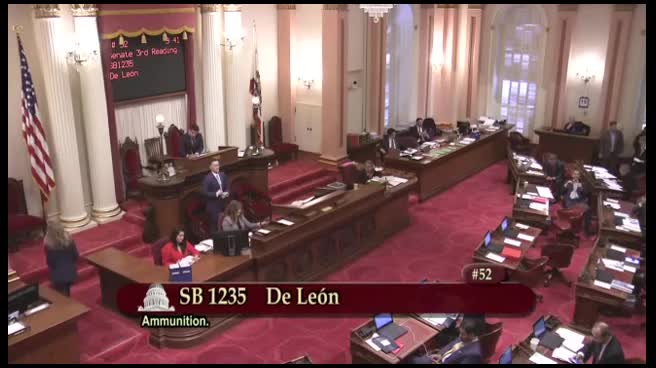 3MIN
Senate Floor
 13MIN
Senate Standing Committee on Appropriations
 24MIN
Senate Standing Committee on Public Safety
 28SEC
Senate Standing Committee on Appropriations
 8MIN
Senate Standing Committee on Environmental Quality
 1MIN
Assembly Floor
 8MIN