AB 1592: Autonomous vehicles: pilot project.
- Session Year: 2015-2016
- House: Assembly
- Latest Version Date: 2016-09-29
Existing law permits the operation of an autonomous vehicle on public roads for testing purposes if, among other requirements, a driver is seated in the drivers seat and is capable of taking immediate manual control of the vehicle in the event of an autonomous technology failure or other emergency.
This bill would, notwithstanding the above provision, until 180 days after the operative date of regulations promulgated by the Department of Motor Vehicles to allow testing of autonomous vehicles without a driver in the vehicle, authorize the Contra Costa Transportation Authority to conduct a pilot project for the testing of autonomous vehicles that do not have a driver seated in the drivers seat and are not equipped with a steering wheel, a brake pedal, or an accelerator if the testing is conducted only at specified locations and the autonomous vehicle operates at speeds of less than 35 miles per hour. The bill would require the authority or a private entity, or a combination of the 2, to obtain an instrument of insurance, surety bond, or proof of self-insurance in an amount of $5,000,000 prior to the start of testing of any autonomous vehicle on or across a public road and would require evidence of the insurance, surety bond, or proof of self-insurance to be provided to the Department of Motor Vehicles in the form and manner required by the department. The bill would require the authority or a private entity, or a combination of the 2, to provide the department with a detailed description of the testing program, as specified. The bill would require the operator of the autonomous vehicle technology to disclose what personal information concerning a pilot project participant is collected by an autonomous vehicle. The bill would allow the department to require data collection for evaluating the safety of the vehicles, as provided.
Existing law permits the operation of an autonomous vehicle on public roads for testing purposes if, among other requirements, a driver is seated in the drivers seat and is capable of taking immediate manual control of the vehicle in the event of an autonomous technology failure or other emergency.
This bill would, notwithstanding the above provision, until 180 days after the operative date of regulations promulgated by the Department of Motor Vehicles to allow testing of autonomous vehicles without a driver in the vehicle, authorize the Contra Costa Transportation Authority to conduct a pilot project for the testing of autonomous vehicles that do not have an operator a driver seated in the drivers seat and are not equipped with a steering wheel, a brake pedal, or an accelerator if the testing is conducted only at specified locations and the autonomous vehicle operates at speeds of less than 35 miles per hour. The bill would require the authority or a private entity, or a combination of the two, 2, to obtain an instrument of insurance, surety bond, or proof of self-insurance in an amount of $5,000,000 prior to the start of testing of any autonomous vehicle on or across a public road and would require evidence of the insurance, surety bond, or proof of self-insurance to be provided to the Department of Motor Vehicles in the form and manner required by the department. The bill would require the authority or a private entity, or a combination of the 2, to provide the department with a detailed description of the testing program, as specified. The bill would require the operator of the autonomous vehicle technology to disclose what personal information concerning a pilot project participant is collected by an autonomous vehicle. The bill would allow the department to require data collection for evaluating the safety of the vehicles, as provided.
Existing law permits the operation of an autonomous vehicle on public roads for testing purposes if, among other requirements, a driver is seated in the drivers seat and is capable of taking immediate manual control of the vehicle in the event of an autonomous technology failure or other emergency.
This bill would, notwithstanding the above provision, authorize the Contra Costa Transportation Authority to conduct a pilot project for the testing of autonomous vehicles that do not have an operator and are not equipped with a steering wheel, a brake pedal, or an accelerator if the testing is conducted only at specified locations and the autonomous vehicle operates at speeds of less than 35 miles per hour. The bill would require the authority or a private entity, or a combination of the two, to obtain an instrument of insurance, surety bond, or proof of self-insurance in an amount of $5,000,000 prior to the start of testing of any autonomous vehicle on or across a public road and would require evidence of the insurance, surety bond, or proof of self-insurance to be provided to the Department of Motor Vehicles in the form and manner required by the department. The bill would allow the department to require the submission of information and data regarding the testing of autonomous vehicles tested pursuant to these provisions. The bill would require the operator of the autonomous vehicle technology to disclose what personal information concerning a pilot project participant is collected by an autonomous vehicle.
Existing law permits the operation of an autonomous vehicle on public roads for testing purposes if, among other requirements, a driver is seated in the drivers seat and is capable of taking immediate manual control of the vehicle in the event of an autonomous technology failure or other emergency.
This bill would, notwithstanding the above provision, authorize the Contra Costa Transportation Authority to conduct a pilot project for the testing of autonomous vehicles that do not have an operator and are not equipped with a steering wheel, a brake pedal, or an accelerator if the testing is conducted only at specified locations and the autonomous vehicle operates at speeds of less than 35 miles per hour. The bill would require the authority or a private entity, or a combination of the two, to obtain an instrument of insurance, surety bond, or proof of self-insurance in an amount of $5,000,000 prior to the start of testing of any autonomous vehicle on or across a public road and would require evidence of the insurance, surety bond, or proof of self-insurance to be provided to the Department of Motor Vehicles in the form and manner required by the department. The bill would limit the operator of the autonomous technology to only collect data about the operation of the autonomous vehicle and the environment of the vehicle that is necessary for the operation of the vehicle and not for marketing or other commercial purposes. The bill would authorize the department to require data collection for evaluating the safety of the vehicles. The bill would allow the department to require the submission of information and data regarding the testing of autonomous vehicles tested pursuant to these provisions. The bill would require the operator of the autonomous vehicle technology to disclose what personal information concerning a pilot project participant is collected by an autonomous vehicle.
Existing law permits the operation of an autonomous vehicle on public roads for testing purposes if, among other requirements, a driver is seated in the drivers seat and is capable of taking immediate manual control of the vehicle in the event of an autonomous technology failure or other emergency.
This bill would, notwithstanding the above provision, authorize the Contra Costa Transportation Authority to conduct a pilot project for the testing of autonomous vehicles that do not have an operator and are not equipped with a steering wheel, a brake pedal, or an accelerator if the testing is conducted only at specified locations and the autonomous vehicle operates at speeds of less than 35 miles per hour. The bill would require the authority or a private entity, or a combination of the two, to obtain an instrument of insurance, surety bond, or proof of self-insurance in an amount of $5,000,000 prior to the start of testing of any autonomous vehicle on or across a public road and would require evidence of the insurance, surety bond, or proof of self-insurance to be provided to the Department of Motor Vehicles in the form and manner required by the department. The bill would limit the operator of the autonomous technology to only collect data about the operation of the autonomous vehicle and the environment of the vehicle that is necessary for the operation of the vehicle and not for marketing or other commercial purposes. The bill would authorize the department to require data collection for evaluating the safety of the vehicles.
Existing law permits the operation of an autonomous vehicle on public roads for testing purposes if, among other requirements, a driver is seated in the drivers seat and is capable of taking immediate manual control of the vehicle in the event of an autonomous technology failure or other emergency.
This bill would, notwithstanding the above provision, authorize the Contra Costa Transportation Authority to conduct a pilot project for the testing of autonomous vehicles that do not have an operator and are not equipped with a steering wheel, a brake pedal, or an accelerator if the testing is conducted only at specified locations and the autonomous vehicle operates at speeds of less than 35 miles per hour.
This bill would make legislative findings and declarations as to the necessity of a special statute for the Contra Costa Transportation Authority.
Existing law permits the operation of an autonomous vehicle on public roads for testing purposes if, among other requirements, the a driver is seated in the drivers seat and is capable of taking immediate manual control of the vehicle in the event of an autonomous technology failure or other emergency.
This bill would, notwithstanding the above provision, authorize the Contra Costa Transportation Authority to conduct a pilot project for the testing of autonomous vehicles that do not have an operator and are not equipped with a steering wheel, a brake pedal, or an accelerator, or an operator inside the vehicle, accelerator if the testing is conducted only at specified locations and the autonomous vehicle operates at speeds of less than 35 miles per hour.
This bill would make legislative findings and declarations as to the necessity of a special statute for the Contra Costa Transportation Authority.
Existing law permits the operation of an autonomous vehicle on public roads for testing purposes if, among other requirements, the driver is seated in the drivers seat and is capable of taking immediate manual control of the vehicle in the event of an autonomous technology failure or other emergency.
This bill would, notwithstanding the above provision, authorize the Contra Costa Transportation Authority to conduct a pilot project for the testing of autonomous vehicles that are not equipped with a steering wheel, a brake pedal, an accelerator, or an operator inside the vehicle, if the testing is conducted only at specified locations and the autonomous vehicle operates at speeds of less than 35 miles per hour.
This bill would make legislative findings and declarations as to the necessity of a special statute for the Contra Costa Transportation Authority.
(a)Notwithstanding Section 38750, the Contra Costa Transportation Authority is authorized to conduct a pilot project for the testing of autonomous vehicles that do not have a driver seated in the drivers seat and are not equipped with a steering wheel, a brake pedal, or an accelerator provided the following requirements are met:
(1)The testing shall be conducted only at a privately owned business park designated by the authority, inclusive of public roads within the designated business park, and at GoMentum Station located within the boundaries of the former Concord Naval Weapons Station.
(2)The autonomous vehicle shall operate at speeds of less than 35 miles per hour.
(b)A change in ownership of the property comprising the GoMentum Station shall not affect the authorization to conduct testing pursuant to this section.
(c)Prior to the start of the testing of an autonomous vehicle that does not have a driver seated in the drivers seat on or across a public road, the Contra Costa Transportation Authority or a private entity, or a combination of the two, shall do both of the following:
(1)Obtain an instrument of insurance, surety bond, or proof of self-insurance in an amount of five million dollars ($5,000,000), and shall provide evidence of the insurance, surety bond, or proof of self-insurance to the Department of Motor Vehicles in the form and manner required by the department.
(2)Submit a detailed description of the testing program to the department. The detailed description shall include all of the following:
(A)Certification that, prior to testing on public roads, the autonomous vehicle has been tested under controlled conditions that simulate, as closely as practicable, the real world conditions that the autonomous vehicle will be subject to during this pilot project, and that the Contra Costa Transportation Authority or a private entity, or a combination of the two, has made a reasonable determination that it is safe to operate the autonomous vehicle on public roads under these conditions.
(B)Evidence satisfactory to the department that the City of San Ramon and any other local authorities with jurisdiction over the public roads in the designated privately owned business park approve of the geographic area and environmental, traffic, and speed conditions authorized for purposes of this pilot project.
(C)Certification that the autonomous vehicle can only operate in autonomous mode in the geographic area and environmental, traffic, and speed conditions authorized in this specific pilot project.
(D)Certification that this pilot project complies, or will comply, with National Highway Traffic Safety Administration guidance, if any, on the safe testing, deployment, and operation of autonomous vehicles.
(E)Certification that the autonomous vehicle used in the pilot project complies with all applicable federal Motor Vehicle Safety Standards, or written evidence that the National Highway Traffic Safety Administration either considers the absence of a steering wheel, a brake pedal, or an accelerator permissible under federal Motor Vehicle Safety Standards or has granted the autonomous vehicle an exemption from compliance with the relevant federal Motor Vehicle Safety Standards.
(F)Identify to the department the autonomous vehicles that are to be tested on public roads during this pilot project. For each vehicle, the manufacturer shall provide to the department the make, model, and model year of the vehicle, the full vehicle identification number, and the license plate number and the state of issuance.
(G)Certification that the vehicle is equipped with a communication link between the vehicle and a remote operator to provide information on the vehicles location and status and to allow two-way communication between the remote operator and any passengers if the vehicle experiences any failures that would endanger the safety of the vehicles passengers or other road users while operating without a driver.
(H)Certification that the autonomous vehicle is designed to detect and respond to roadway conditions in compliance with all provisions of this code and local regulations applicable to the operation of motor vehicles.
(I)A copy of a law enforcement interaction plan, which includes information that the Contra Costa Transportation Authority or a private entity, or a combination of the two, will provide to the law enforcement agencies whose jurisdiction covers the designated privately owned business park to instruct those agencies on how to interact with the vehicle in emergency and traffic enforcement situations.
(d)The operator of the autonomous vehicle technology tested pursuant to this section shall disclose to an individual who participates in the pilot project what personal information, if any, concerning the pilot project participant is collected by an autonomous vehicle.
(e)For the testing of autonomous vehicles within the designated business park, the department may require data collection for evaluating the safety of the vehicles, including, but not limited to, both of the following:
(1)A report to the department of any accident originating from the operation of the autonomous vehicle on a public road that resulted in the damage of property or in bodily injury or death. Accidents shall be reported within 10 days in the form and manner specified by the department pursuant to the regulations adopted by the department under Section 38750.
(2)The submission to the department of an annual report in the form and manner specified by the department pursuant to the regulations adopted under Section 38750 summarizing information on unplanned technology disengagements that occurred while the autonomous vehicle was being tested on public roads. Disengagement means a deactivation of the autonomous mode when a failure of the autonomous technology is detected or when the safe operation of the vehicle required disengagement from the autonomous mode.
(f)This section does not limit the authority of the department to promulgate regulations governing the testing and operation of autonomous vehicles on public roads, with or without the presence of a driver inside the vehicle, pursuant to Section 38750.
(g)It is the intent of the Legislature, in enacting the act that added this section, to address the specific circumstances of the pilot project proposed in the County of Contra Costa. Pursuant to Section 38750, the Department of Motor Vehicles is developing regulations for the testing and operation of autonomous vehicles, and it is not the intent of the Legislature to influence the content of those statewide regulations through the adoption of the act that added this section, which is only intended to govern the establishment of one local pilot project.
(h)This section shall remain in effect only until 180 days after the operative date of regulations promulgated by the department to allow testing of autonomous vehicles without a driver in the vehicle, on which date any testing of autonomous vehicles by the Contra Costa Transportation Authority shall conform to those regulations, and as of the January 1 following that date this section is repealed, unless a later enacted statute, that is enacted before that January 1, deletes or extends that date.
(a)Notwithstanding Section 38750, the Contra Costa Transportation Authority is authorized to conduct a pilot project for the testing of autonomous vehicles that do not have an operator a driver seated in the drivers seat and are not equipped with a steering wheel, a brake pedal, or an accelerator provided the following requirements are met:
(1)The testing shall be conducted only at a privately owned business park designated by the authority, inclusive of public roads within the designated business park, and at GoMentum Station located within the boundaries of the former Concord Naval Weapons Station.
(2)The autonomous vehicle shall operate at speeds of less than 35 miles per hour.
(b)A change in ownership of the property comprising the GoMentum Station shall not affect the authorization to conduct testing pursuant to this section.
(c)Prior to the start of the testing of an autonomous vehicle that does not have an operator a driver seated in the drivers seat on or across a public road, the Contra Costa Transportation Authority or a private entity, or a combination of the two, shall obtain do both of the following:
(1)Obtain an instrument of insurance, surety bond, or proof of self-insurance in an amount of five million dollars ($5,000,000), and shall provide evidence of the insurance, surety bond, or proof of self-insurance to the Department of Motor Vehicles in the form and manner required by the department.
(2)Submit a detailed description of the testing program to the department. The detailed description shall include all of the following:
(A)Certification that, prior to testing on public roads, the autonomous vehicle has been tested under controlled conditions that simulate, as closely as practicable, the real world conditions that the autonomous vehicle will be subject to during this pilot project, and that the Contra Costa Transportation Authority or a private entity, or a combination of the two, has made a reasonable determination that it is safe to operate the autonomous vehicle on public roads under these conditions.
(B)Evidence satisfactory to the department that the City of San Ramon and any other local authorities with jurisdiction over the public roads in the designated privately owned business park approve of the geographic area and environmental, traffic, and speed conditions authorized for purposes of this pilot project.
(C)Certification that the autonomous vehicle can only operate in autonomous mode in the geographic area and environmental, traffic, and speed conditions authorized in this specific pilot project.
(D)Certification that this pilot project complies, or will comply, with National Highway Traffic Safety Administration guidance, if any, on the safe testing, deployment, and operation of autonomous vehicles.
(E)Certification that the autonomous vehicle used in the pilot project complies with all applicable federal Motor Vehicle Safety Standards, or written evidence that the National Highway Traffic Safety Administration either considers the absence of a steering wheel, a brake pedal, or an accelerator permissible under federal Motor Vehicle Safety Standards or has granted the autonomous vehicle an exemption from compliance with the relevant federal Motor Vehicle Safety Standards.
(F)Identify to the department the autonomous vehicles that are to be tested on public roads during this pilot project. For each vehicle, the manufacturer shall provide to the department the make, model, and model year of the vehicle, the full vehicle identification number, and the license plate number and the state of issuance.
(G)Certification that the vehicle is equipped with a communication link between the vehicle and a remote operator to provide information on the vehicles location and status and to allow two-way communication between the remote operator and any passengers if the vehicle experiences any failures that would endanger the safety of the vehicles passengers or other road users while operating without a driver.
(H)Certification that the autonomous vehicle is designed to detect and respond to roadway conditions in compliance with all provisions of this code and local regulations applicable to the operation of motor vehicles.
(I)A copy of a law enforcement interaction plan, which includes information that the Contra Costa Transportation Authority or a private entity, or a combination of the two, will provide to the law enforcement agencies whose jurisdiction covers the designated privately owned business park to instruct those agencies on how to interact with the vehicle in emergency and traffic enforcement situations.
(d)The operator of the autonomous vehicle technology tested pursuant to this section shall disclose to an individual who participates in the pilot project what personal information, if any, concerning the pilot project participant is collected by an autonomous vehicle.
(e)For the testing of autonomous vehicles within the designated business park, the department may require data collection for evaluating the safety of the vehicles, including, but not limited to, both of the following:
(1)A report to the department of any accident originating from the operation of the autonomous vehicle on a public road that resulted in the damage of property or in bodily injury or death. Accidents shall be reported within 10 days in the form and manner specified by the department pursuant to the regulations adopted by the department under Section 38750.
(2)The submission to the department of an annual report in the form and manner specified by the department pursuant to the regulations adopted under Section 38750 summarizing information on unplanned technology disengagements that occurred while the autonomous vehicle was being tested on public roads. Disengagement means a deactivation of the autonomous mode when a failure of the autonomous technology is detected or when the safe operation of the vehicle required disengagement from the autonomous mode.
(e)
(f)This section does not limit the authority of the department to promulgate regulations governing the testing and operation of autonomous vehicles on public roads, with or without the presence of a driver inside the vehicle, pursuant to Section 38750.
(g)It is the intent of the Legislature, in enacting the act that added this section, to address the specific circumstances of the pilot project proposed in the County of Contra Costa. Pursuant to Section 38750, the Department of Motor Vehicles is developing regulations for the testing and operation of autonomous vehicles, and it is not the intent of the Legislature to influence the content of those statewide regulations through the adoption of the act that added this section, which is only intended to govern the establishment of one local pilot project.
(h)This section shall remain in effect only until 180 days after the operative date of regulations promulgated by the department to allow testing of autonomous vehicles without a driver in the vehicle, on which date any testing of autonomous vehicles by the Contra Costa Transportation Authority shall conform to those regulations, and as of the January 1 following that date this section is repealed, unless a later enacted statute, that is enacted before that January 1, deletes or extends that date.
(a)Notwithstanding Section 38750, the Contra Costa Transportation Authority is authorized to conduct a pilot project for the testing of autonomous vehicles that do not have an operator and are not equipped with a steering wheel, a brake pedal, or an accelerator provided the following requirements are met:
(1)The testing shall be conducted only at a privately owned business park designated by the authority, inclusive of public roads within the designated business park, and at GoMentum Station located within the boundaries of the former Concord Naval Weapons Station.
(2)The autonomous vehicle shall operate at speeds of less than 35 miles per hour.
(3)
(b)A change in ownership of the property comprising the GoMentum Station shall not affect the authorization to conduct testing pursuant to this section.
(b)
(c)Prior to the start of the testing of an autonomous vehicle that does not have an operator on or across a public road, the Contra Costa Transportation Authority or a private entity, or a combination of the two, shall obtain an instrument of insurance, surety bond, or proof of self-insurance in an amount of five million dollars ($5,000,000), and shall provide evidence of the insurance, surety bond, or proof of self-insurance to the Department of Motor Vehicles in the form and manner required by the department.
(c)
(d)The operator of the autonomous vehicle technology tested pursuant to this section shall disclose to an individual who participates in the pilot project what personal information, if any, concerning the pilot project participant is collected by an autonomous vehicle.
(d)The department may require the submission of information and data regarding the testing of autonomous vehicles tested pursuant to this section.
(e)This section does not limit the authority of the department to promulgate regulations governing the testing and operation of autonomous vehicles on public roads, with or without the presence of a driver inside the vehicle, pursuant to Section 38750.
(a)Notwithstanding Section 38750, the Contra Costa Transportation Authority is authorized to conduct a pilot project for the testing of autonomous vehicles that do not have an operator and are not equipped with a steering wheel, a brake pedal, or an accelerator provided the following requirements are met:
(1)The testing shall be conducted only at a privately owned business park designated by the authority, inclusive of public roads within the designated business park, and at GoMentum Station located within the boundaries of the former Concord Naval Weapons Station.
(2)The autonomous vehicle shall operate at speeds of less than 35 miles per hour.
(3)A change in ownership of the property comprising the GoMentum Station shall not affect the authorization to conduct testing pursuant to this section.
(b)Prior to the start of the testing of an autonomous vehicle that does not have an operator on or across a public road, the Contra Costa Transportation Authority or a private entity, or a combination of the two, shall obtain an instrument of insurance, surety bond, or proof of self-insurance in an amount of five million dollars ($5,000,000), and shall provide evidence of the insurance, surety bond, or proof of self-insurance to the Department of Motor Vehicles in the form and manner required by the department.
(c)The operator of the autonomous technology may only collect data about the operation of the autonomous vehicle and the environment of the vehicle that is necessary for the operation of the vehicle and not for marketing or other commercial purposes. The data shall not be retained any longer than is necessary for the operation of the vehicle or for research purposes related to operation of the vehicle. For the testing of autonomous vehicles within the designated business park, the department may require data collection for evaluating the safety of the vehicles.
(c)The operator of the autonomous vehicle technology tested pursuant to this section shall disclose to an individual who participates in the pilot project what personal information, if any, concerning the pilot project participant is collected by an autonomous vehicle.
(d)The department may require the submission of information and data regarding the testing of autonomous vehicles tested pursuant to this section.
(d)
(e)This section does not limit the authority of the department to promulgate regulations governing the testing and operation of autonomous vehicles on public roads, with or without the presence of a driver inside the vehicle, pursuant to Section 38750.
(a)Notwithstanding Section 38750, the Contra Costa Transportation Authority is authorized to conduct a pilot project for the testing of autonomous vehicles that do not have an operator and are not equipped with a steering wheel, a brake pedal, or an accelerator provided the following requirements are met:
(1)The testing shall be conducted only at a privately owned business park designated by the authority, inclusive of public roads within the designated business park, and at GoMentum Station located within the boundaries of the former Concord Naval Weapons Station.
(2)The autonomous vehicle shall operate at speeds of less than 35 miles per hour.
(3)A change in ownership of the property comprising the GoMentum Station shall not affect the authorization to conduct testing pursuant to this section.
(b)Prior to the start of the testing of an autonomous vehicle that does not have an operator on or across a public road, the Contra Costa Transportation Authority or a private entity, or a combination of the two, shall obtain an instrument of insurance, surety bond, or proof of self-insurance in an amount of five million dollars ($5,000,000), and shall provide evidence of the insurance, surety bond, or proof of self-insurance to the Department of Motor Vehicles in the form and manner required by the department.
(c)The operator of the autonomous technology may only collect data about the operation of the autonomous vehicle and the environment of the vehicle that is necessary for the operation of the vehicle and not for marketing or other commercial purposes. The data shall not be retained any longer than is necessary for the operation of the vehicle or for research purposes related to operation of the vehicle. For the testing of autonomous vehicles within the designated business park, the department may require data collection for evaluating the safety of the vehicles.
(b)
(d)This section does not limit the authority of the department to promulgate regulations governing the testing and operation of autonomous vehicles on public roads, with or without the presence of a driver inside the vehicle, pursuant to Section 38750.
(a)Notwithstanding Section 38750, the Contra Costa Transportation Authority is authorized to conduct a pilot project for the testing of autonomous vehicles that do not have an operator and are not equipped with a steering wheel, a brake pedal, or an accelerator provided the following requirements are met:
(a)
(1)The testing shall be conducted only at a privately owned business park designated by the authority, inclusive of public roads within the designated business park, and at GoMentum Station located within the boundaries of the former Concord Naval Weapons Station.
(b)
(2)The autonomous vehicle shall operate at speeds of less than 35 miles per hour.
(c)
(3)A change in ownership of the property comprising the GoMentum Station shall not affect the authorization to conduct testing pursuant to this section.
(b)This section does not limit the authority of the department to promulgate regulations governing the testing and operation of autonomous vehicles on public roads, with or without the presence of a driver inside the vehicle, pursuant to Section 38750.
SEC. 2.The Legislature finds and declares that a special law is necessary and that a general law cannot be made applicable within the meaning of Section 16 of Article IV of the California Constitution. Because of the need to limit the scope of testing of new autonomous vehicle technology, it is necessary to limit authorization for the establishment of a pilot project to the Contra Costa Transportation Authority.
Notwithstanding Section 38750, the Contra Costa Transportation Authority is authorized to conduct a pilot project for the testing of autonomous vehicles that do not have an operator and are not equipped with a steering wheel, a brake pedal, or an accelerator, or an operator inside the vehicle, accelerator provided the following requirements are met:
(a)The testing shall be conducted only at a privately owned business office park designated by the authority, inclusive of public roads within the designated office business park, and at the GoMentum Station at the located within the boundaries of the former Concord Naval Weapons Station.
(b)The autonomous vehicle shall operate at speeds of less than 35 miles per hour.
(c)A change in ownership of the property comprising the GoMentum Station shall not affect the authorization to conduct testing pursuant to this section.
SEC. 2.The Legislature finds and declares that a special law is necessary and that a general law cannot be made applicable within the meaning of Section 16 of Article IV of the California Constitution. Because of the need to limit the scope of testing of new autonomous vehicle technology technology, it is necessary to limit authorization for the establishment of a pilot project to the Contra Costa Transportation Authority.
Notwithstanding Section 38750, the Contra Costa Transportation Authority is authorized to conduct a pilot project for the testing of autonomous vehicles that are not equipped with a steering wheel, a brake pedal, an accelerator, or an operator inside the vehicle, provided the following requirements are met:
(a)The testing shall be conducted only at a privately owned business office park designated by the authority, inclusive of public roads within the designated office park, and at the GoMentum Station at the Concord Naval Weapons Station.
(b)The autonomous vehicle shall operate at speeds of less than 35 miles per hour.
SEC. 2.The Legislature finds and declares that a special law is necessary and that a general law cannot be made applicable within the meaning of Section 16 of Article IV of the California Constitution. Because of the need to limit the scope of testing of new autonomous vehicle technology it is necessary to limit authorization for the establishment of a pilot project to the Contra Costa Transportation Authority.
|
Date
|
Status
|
|---|---|
| Jun 22, 2016 | Read second time and amended. Ordered to third reading. |
| Sep 2, 2016 | Enrolled and presented to the Governor at 12 p.m. |
| Aug 29, 2016 | Senate amendments concurred in. To Engrossing and Enrolling. (Ayes 75. Noes 3. Page 6338.). |
| Aug 29, 2016 | Senate amendments concurred in. To Engrossing and Enrolling. |
| Aug 24, 2016 | In Assembly. Concurrence in Senate amendments pending. May be considered on or after August 26 pursuant to Assembly Rule 77. |
| Aug 23, 2016 | Read third time. Passed. Ordered to the Assembly. (Ayes 39. Noes 0. Page 5289.). |
| Aug 23, 2016 | Read third time. Passed. Ordered to the Assembly. |
| Aug 22, 2016 | Read second time. Ordered to third reading. |
| Aug 19, 2016 | Read third time and amended. Ordered to second reading. |
| Aug 16, 2016 | Read second time. Ordered to third reading. |
| Aug 15, 2016 | Read third time and amended. Ordered to second reading. |
| Aug 2, 2016 | Read second time and amended. Ordered to third reading. |
| Aug 1, 2016 | From committee: Be placed on second reading file pursuant to Senate Rule 28.8 and be amended. |
| Jun 23, 2016 | Re-referred to Com. on APPR. pursuant to Joint Rule 10.5. |
| Jan 6, 2016 | Read first time. To print. |
| Jun 21, 2016 | From committee: Amend, and do pass as amended. (Ayes 10. Noes 0.) (June 14). |
| Jun 6, 2016 | From committee chair, with author's amendments: Amend, and re-refer to committee. Read second time, amended, and re-referred to Com. on T. & H. |
| Apr 28, 2016 | Referred to Com. on T. & H. |
| Apr 7, 2016 | Read third time. Passed. Ordered to the Senate. (Ayes 75. Noes 0. Page 4229.) |
| Apr 7, 2016 | Read third time. Passed. Ordered to the Senate. |
| Apr 7, 2016 | In Senate. Read first time. To Com. on RLS. for assignment. |
| Apr 6, 2016 | Read second time. Ordered to third reading. |
| Apr 5, 2016 | From committee: Do pass. (Ayes 16. Noes 0.) (April 4). |
| Mar 29, 2016 | Re-referred to Com. on TRANS. |
| Mar 28, 2016 | From committee chair, with author's amendments: Amend, and re-refer to Com. on TRANS. Read second time and amended. |
| Mar 10, 2016 | In committee: Set, first hearing. Hearing canceled at the request of author. |
| Feb 1, 2016 | Referred to Com. on TRANS. |
| Jan 7, 2016 | From printer. May be heard in committee February 6. |
|
Date
|
Description
|
Location
|
Votes
|
|
|---|---|---|---|---|
| Aug 29, 2016 | AB 1592 BONILLA Concurrence in Senate Amendments | Assembly Floor |
Passed |
|
| Aug 23, 2016 | Assembly 3rd Reading AB1592 Bonilla By Cannella | Senate Floor |
Passed |
|
| Jun 14, 2016 | Do pass as amended | Senate Standing Committee on Transportation and Housing |
Passed |
|
| Apr 7, 2016 | AB 1592 BONILLA Assembly Third Reading | Assembly Floor |
Passed |
|
| Apr 4, 2016 | Do pass. | Assembly Standing Committee on Transportation |
Passed |
This list shows positions taken on this bill by organizations on the date displayed, which is linked to the original source.
Positions by individuals are not included.
|
Organization
|
Position
|
Date
|
|---|---|---|
| Alliance for Transportation Innovation | ** Support | Aug 29, 2016 |
| Allstate Insurance Company | ** Support | Aug 29, 2016 |
| Amalgated Transit Union | ** Against | Aug 29, 2016 |
| Bay Area Council | ** Support | Aug 29, 2016 |
| Bay Area Rapid Transit District | ** Support | Aug 29, 2016 |
| BestMile | ** Support | Aug 29, 2016 |
| California Association Of Councils Of Governments | * Support | Apr 4, 2016 |
| California Chamber Of Commerce | ** Against | Aug 23, 2016 |
| California Department of Insurance | ** Support | Aug 29, 2016 |
| California Manufacturers And Technology Association | ** Against | Aug 29, 2016 |
| California Teamsters Public Affairs Council | ** Against | Aug 23, 2016 |
| Central Contra Costa Transit Authority | ** Support | Aug 29, 2016 |
| City of San Ramon | ** Support | Aug 29, 2016 |
| CompTIA | ** Against | Aug 23, 2016 |
| Concord, City Of | ** Support | Aug 29, 2016 |
| Congressmember Nancy Pelosi | ** Support | Aug 29, 2016 |
| Consumer Watchdog | * Against | Apr 4, 2016 |
| Contra Costa County Board of Supervisors | ** Support | Aug 29, 2016 |
| Contra Costa Transportation Authority | ** Support | Aug 29, 2016 |
| County Connection | ** Support | Apr 4, 2016 |
| CTIA | ** Against | Aug 23, 2016 |
| East Bay Leadership Council | ** Support | Aug 29, 2016 |
| EasyMile | ** Support | Aug 29, 2016 |
| Honda | ** Support | Aug 29, 2016 |
| Honda North America Inc. | ** Support | Apr 4, 2016 |
| Information Technology Industry | ** Against | Aug 23, 2016 |
| Intelligent Transportation Society of California | ** Support | Apr 4, 2016 |
| Intelligent Transportation Systems California | ** Support | Aug 29, 2016 |
| League Of California Cities | ** Support | Aug 29, 2016 |
| Metropolitan Transportation Commission | ** Support | Aug 29, 2016 |
| Personal Insurance Federation Of California | ** Support | Aug 29, 2016 |
| San Ramon Police Department | ** Support | Aug 29, 2016 |
| Securing America's Future Energy | ** Support | Aug 29, 2016 |
| Silicon Valley Leadership Group | ** Support | Aug 29, 2016 |
| Stantec | ** Support | Aug 29, 2016 |
| Suffolk County Coalition | * Support | Apr 4, 2016 |
| Sunset Development Company | ** Support | Aug 29, 2016 |
| Technet | ** Support | Aug 29, 2016 |
| Telecommunications Industry Association | ** Support | Aug 29, 2016 |
| Telegra, Inc. | ** Support | Aug 29, 2016 |
| The Internet Association | ** Against | Aug 23, 2016 |
| Walnut Creek, City Of | ** Support | Aug 29, 2016 |
Office of Senate Floor Analyses (916) 651-1520 Fax: (916) 327-4478 | AB |
THIRD READING
Bill No: AB 1592
:
SENATE TRANS. & HOUSING COMMITTEE: 10-0, 6/14/16
AYES: Beall, Cannella, Allen, Bates, Gaines, Galgiani, Leyva, McGuire, Mendoza, Roth
NO VOTE RECORDED: Wieckowski
SENATE APPROPRIATIONS COMMITTEE: Senate Rule 28.8
ASSEMBLY FLOOR: 75-0, 4/7/16 - See last page for vote
SOURCE: Contra Costa Transportation Authority
DIGEST: This bill authorizes the Contra Costa Transportation Authority (CCTA) to conduct a pilot project for the testing of autonomous vehicles under specified conditions.
Senate Floor Amendments of 8/19/16 require the CCTA, one of the testing manufacturers, or both to provide the Department of Motor Vehicles (DMV) with a detailed description of the testing program, including certification that the program complies with the guidance of the National Highway Traffic Safety Administration (NHTSA) on the safe testing, deployment, and operation of autonomous vehicles. The amendments also authorize the DMV to require data collection for evaluating the safety of the autonomous vehicles. The provisions of this bill sunset 180 days after the operative date of the DMV regulations allowing testing of autonomous vehicles without a driver.
Senate Floor Amendments of 8/15/16 delete the provision authorizing the DMV to require the submission of information regarding the testing of autonomous vehicles pursuant to the provisions of this bill.
Existing law:
- Authorizes the operation of autonomous vehicles on public roads for testing purposes under certain circumstances specified in regulations adopted by the DMV. Insurance of $5 million is required of the manufacturer.
- Requires DMV, by January 1, 2015, to adopt regulations setting forth requirements for the application to operate autonomous vehicles on public roads for non-testing purposes.
- Requires the application submitted to DMV for the operation of autonomous vehicles on public roads for non-testing purposes to include a certification from the manufacturer that the vehicle allows the operator to take control through the use of the brake, the accelerator pedal, or the steering wheel.
- Requires DMV to approve an application submitted by a manufacturer for the operation of autonomous vehicles for non-testing purposes if DMV finds that the applicant has submitted all information and completed testing necessary to satisfy DMV that the autonomous vehicles are safe to operate on public roads and the applicant has complied with all requirements specified in DMV regulations.
- Authorizes DMV to impose additional requirements it deems necessary to ensure the safe operation of autonomous vehicles if those vehicles are capable of operating without the presence of a driver inside the vehicle, including the presence of a driver in the driver’s seat of the vehicle, if DMV determines that such a requirement is necessary to ensure the safe operation of those vehicles on public roads.
- Requires DMV to notify the Legislature of the receipt and approval of an application from a manufacturer seeking to operate autonomous vehicles capable of operating without the presence of a driver inside the vehicle on public roads for non-testing purposes.
This bill:
- Authorizes the CCTA to conduct a pilot project for the testing of autonomous vehicles that do not have an operator and are not equipped with a steering wheel, brake pedal, or an accelerator, provided that:
- The vehicle operates at less than 35 miles per hour.
- The testing is conducted only at a privately owned business park designated by CCTA or at the GoMentum Station located within the boundaries of the former Concord Naval Weapons Station.
- The CCTA, one of the testing manufacturers, or both, obtains $5 million in insurance.
- The operator of the autonomous vehicle technology discloses to an individual participating in the pilot project what personal information, if any, concerning the participant is collected by the vehicle.
- The CCTA, one of the testing manufacturers, or both shall provide the DMV with a detailed description of the testing program, including certification that the program complies with the guidance of the NHTSA on the safe testing, deployment, and operation of autonomous vehicles.
- Authorizes the DMV to require data collection from the pilot project for evaluating the safety of the autonomous vehicles.
- Sunsets the provisions of this bill 180 days after the operative date of the DMV regulations allowing testing of autonomous vehicles without a driver.
Comments
- Purpose. The author has observed that autonomous vehicle technologies are evolving at a rapid pace and states that it is critical that California supports further development of such technologies to improve mobility, increase road safety, reduce parking and traffic congestion, meet our state’s climate change goals, and keep jobs and technology innovation in California. As a state, we cannot allow auto manufacturers, software companies, engineers, and scientists — and the jobs, technology, and innovation they bring — to leave our state. Currently, other states such as Michigan, Texas, Arizona, and Nevada are attracting the business and innovation as a result of state investment and more favorable regulations pertaining to autonomous vehicles. It is imperative that we remove barriers to the testing and development of autonomous vehicles, according to the author.
- Who and where? The CCTA is a public agency responsible for maintaining and improving Contra Costa County’s transportation system by planning, funding, and delivering transportation infrastructure projects and programs. CCTA is also the county’s designated Congestion Management Agency, responsible for putting programs in place to keep traffic levels manageable. This bill authorizes CCTA to conduct an autonomous vehicle pilot program in two places. The first is at Bishop Ranch in San Ramon, a large business park which is crossed and bordered by several major streets. Bishop Ranch houses major corporate tenants such as AT&T, GE, and Toyota. It is bordered by shopping centers and a middle school. The second location is known as the GoMentum Station, a 2,100-acre test bed located within the footprint of the former Concord Naval Weapons Station, with over 20 miles of paved road. The GoMentum Station is a secured test site inaccessible to the public. That will change as the property is turned over to the City of Concord, which could subsequently open the property to the public and authorize development.
- Waiting. The DMV’s autonomous vehicle testing program regulations were adopted May 19, 2014, and are effective now. Those regulations, consistent with existing law, do not permit the testing of autonomous vehicles without a driver or driving controls. The DMV’s regulations for autonomous vehicles for non-testing purposes are long overdue and not expected soon. Draft regulations, which were published in December 2015, required autonomous vehicles, for non-testing purposes, to also have a driver and driving controls. This provision was criticized by many autonomous vehicle manufacturers.
Meanwhile, the federal government is also developing autonomous vehicle rules and policies. In January, the NHTSA said it would propose best-practice guidance to the auto industry on establishing principles of safe operation for fully autonomous vehicles. NHTSA is also working with the American Association of Motor Vehicle Administrators to develop model state autonomous vehicle policies by July. California’s DMV is chairing this working group.
- What’s the record? Autonomous vehicles have been permitted for testing on California roads since 2014, accumulating over 400,000 miles of travel. Since then, 15 accidents have been reported, five of which occurred when the vehicles were operated manually. Most of these accidents involved no or very minor damage and injury. The DMV also requires reporting on the instances when the autonomous driving function is disabled, either because of a technology failure or when the driver disables the function for safety reasons. Google, which has tested autonomous vehicles on California roads far more than anyone else, reported 341 instances of disengagement since 2014. This is a small number given the number of miles traveled, but not insignificant, as the pilot program authorized by this bill will not have a driver to take over the vehicle.
Unlike the GoMentum Station, which is, for now, a closed-to-the-public testing facility, Bishop Ranch is a bustling, heavily-trafficked business park located in the city of San Ramon. Currently, CCTA is planning on deploying EasyMile driverless shuttles, low-speed electric vehicles with a 12-passenger capacity. These vehicles have been used in a number of campus-like environments in Europe since late 2014. Concerns about the use of unmanned autonomous vehicles in this location are mitigated by the support of the San Ramon Police Department for the bill.
- Another California industry. Development of autonomous vehicles has been good for California and its companies. Google, Tesla, and perhaps Apple are leaders in self-driving technology. And much of the sensor, control, and mapping technology have links to the Silicon Valley. With the potential addition of electric car company Faraday Future in Vallejo, the car industry is rebuilding its presence in California.
- Can I get it tomorrow? Many boldly predict that fully autonomous vehicles will be on the road soon: GM predicts by 2020, as do Ford and Toyota; in 2012, Google predicted it would have a driverless car on the market by 2018. Uber says that its fleet will be driverless by 2030. These timeframes will be greatly impacted by the pace of regulatory accommodation. As an example, federal motor vehicle safety standards require all vehicles to have steering wheels, brakes, and other controls. These standards will need to be revised if control-less vehicles are to be generally available to the public. More certain is the gradual deployment of driver-assistance technology which will support, but not supplant, the driver, such as adaptive cruise control, lane-keeper assistance, and vehicle-to-vehicle communication.
- More to learn. In addition to the technical and regulatory hurdles, autonomous vehicles will have enormous societal impacts, particularly with regard to labor markets, which will affect the speed of its acceptance. Surveys show the general public does not yet trust autonomous vehicles. And the effect of autonomous vehicles on congestion and greenhouse gas emissions are potentially positive, but not well understood.
FISCAL EFFECT: Appropriation: No Fiscal Com.: Yes Local: No
Contra Costa Transportation Authority (source)
Alliance for Transportation Innovation
Allstate Insurance Company
American Council of Engineering Companies California
Bay Area Council
Bay Area Rapid Transit District
BestMile
California Department of Insurance
Central Contra Costa Transit Authority
City of Clayton
City of Concord
City of San Ramon
City of Walnut Creek
Congressmember Nancy Pelosi
Contra Costa County Board of Supervisors
East Bay Leadership Council
EasyMile
Honda
Intelligent Transportation Systems California
League of California Cities
Metropolitan Transportation Commission
Personal Insurance Federation of California
San Ramon Police Department
Securing America’s Future Energy
Silicon Valley Leadership Group
Stantec
Sunset Development Company
TechNet
Telecommunications Industry Association
Telegra, Inc.
OPPOSITION: (Verified 8/23/16)
Amalgated Transit Union
California Manufacturers and Technology Association
California Teamsters Public Affairs Council
CTIA
DMA
Information Technology Industry
ASSEMBLY FLOOR: 75-0, 4/7/16
AYES: Achadjian, Alejo, Travis Allen, Atkins, Baker, Bigelow, Bloom, Bonilla, Bonta, Brown, Burke, Calderon, Chang, Chau, Chávez, Chiu, Chu, Cooley, Cooper, Dababneh, Dahle, Daly, Dodd, Eggman, Frazier, Beth Gaines, Gallagher, Cristina Garcia, Eduardo Garcia, Gatto, Gipson, Gomez, Gonzalez, Gordon, Gray, Grove, Hadley, Harper, Roger Hernández, Holden, Irwin, Jones, Jones-Sawyer, Kim, Lackey, Linder, Lopez, Low, Maienschein, Mathis, Mayes, McCarty, Medina, Melendez, Mullin, Nazarian, Obernolte, O'Donnell, Olsen, Patterson, Quirk, Ridley-Thomas, Rodriguez, Salas, Santiago, Steinorth, Mark Stone, Thurmond, Ting, Wagner, Weber, Wilk, Williams, Wood, Rendon
NO VOTE RECORDED: Brough, Campos, Levine, Waldron
8/24/16 9:09:10
**** END ****
CONCURRENCE IN SENATE AMENDMENTS
CSA1 Bill Id:AB 1592
Author:(Bonilla)
As Amended Ver:August 19, 2016
Majority vote
ASSEMBLY: | 75-0 | (April 7, 2016) | SENATE: | (39-0) | (August 23, 2016) |
Original Committee Reference: TRANS.
SUMMARY: Authorizes the Contra Costa Transportation Authority (CCTA) to conduct a pilot project for the testing of autonomous vehicles under specific conditions.
The Senate amendments:
- Require CCTA to obtain and provide to the Department of Motor Vehicles (DMV) proof of insurance and a detailed description of the testing program prior to testing an autonomous vehicle without an operator on a public road.
- Require the detailed description of the testing program to include specific certifications relating to the pilot's technical specifications and compliance with applicable laws.
- Require the operator of the autonomous vehicle technology to disclose to an individual who participates in the pilot project what personal information, if any, concerning the pilot project participant is collected by an autonomous vehicle.
- Authorize DMV to require the submission of information and data regarding the testing of autonomous vehicles in the pilot, including a report of any accident involving the autonomous vehicles and an annual report summarizing information on unplanned autonomous technology disengagements, pursuant to existing law.
- Provide that this bill does not limit the authority of DMV to promulgate regulations governing the testing and operation of autonomous vehicles on public roads, with or without the presence of a driver inside the vehicle, pursuant to existing law.
- Declare the intent of the Legislature is not to influence the development of regulations by DMV for the testing and operation of autonomous vehicles pursuant to existing law.
- Provide that the testing of autonomous vehicles by CCTA shall conform to future DMV regulations upon adoption of those regulations.
- Delete the provision declaring the necessity of a special statute for CCTA.
AS PASSED BY THE ASSEMBLY, this bill:
- Authorized CCTA to conduct a pilot for the testing of autonomous vehicles not equipped with a steering wheel, a brake pedal, an accelerator, or an operator.
- Limited the venue for the pilot project to a private business park designated by CCTA, including the public roads within that business park, and the GoMentum Station at the Concord Naval Weapons Station.
- Limited the operating speed of the autonomous vehicle in the pilot to 35 miles per hour.
- Declared the necessity of a special statute for CCTA.
FISCAL EFFECT: According to the Senate Appropriations Committee, pursuant to Senate Rule 28.8, negligible state costs.
COMMENTS: In response to arguments for the traffic safety benefits of increasingly automated vehicle technology, the Legislature passed and the Governor approved legislation requiring DMV to adopt regulations for the operation of autonomous vehicles on California's public roads in 2012 [SB 1298 (Padilla), Chapter 570, Statutes of 2012]. The rollout of DMV's regulations was separated into two stages: regulations for insurance requirements for the purposes of testing autonomous vehicles and regulations for the full deployment of autonomous vehicles on California roads for non-testing purposes. Both sets of regulations were required to be adopted by January 1, 2015. DMV adopted testing regulations on May 19, 2014, and have yet to adopt regulations for the deployment of autonomous vehicles for non-testing purposes out of a desire to receive more input from the public and stakeholders before a final regulatory action.
The original legislation directing DMV to adopt these regulations includes several requirements for the operation of autonomous vehicles, including the presence of an operator inside the vehicle and the ability of the operator to take over control of the vehicle from the autonomous technology through the use of the brake, the accelerator pedal, or the steering wheel.
This bill would authorize CCTA to conduct a pilot project for the testing of autonomous vehicles – separate from the framework for testing autonomous vehicles that already exists – that are not equipped with these control features and do not have an operator inside the vehicle at specific sites in Contra Costa County.
CCTA, the bill's sponsor, intends to test the vehicles at the GoMentum Station, located at the former Concord Naval Weapons Station, before testing the transportation of employees at the Bishop Ranch business park in San Ramon. CCTA has begun procurement of the autonomous vehicles to be used in the pilot from a company that has successfully deployed these types of multi-passenger vehicles in Europe. The vehicles to be used in the pilot are not manufactured with the control features specified in existing law and regulation.
According to the author, by encouraging technological innovation in the field of mass transit, California can improve mobility, increase road safety, reduce parking and traffic congestion, meet the state's climate change goals, and keep jobs and technological innovation in California.
Federal developments: In January 2016, United States Department of Transportation Secretary Anthony Foxx announced that NHTSA will, within six months, both consult with industry and other stakeholders to develop guidance on the safe deployment and operation of autonomous vehicles, and consult with stakeholders to develop a model state policy on automated vehicles that offers a path to consistent national policy. This model state policy has not yet been released.
Please see the policy committee analysis for full discussion of this bill.
Analysis Prepared by: Justin Behrens / TRANS. / (916) 319-2093 FN: 0004821
Office of Senate Floor Analyses (916) 651-1520 Fax: (916) 327-4478 | AB 1592 |
THIRD READING
Bill No: AB 1592
Amended: 8/19/16 in Senate
SENATE TRANS. & HOUSING COMMITTEE: 10-0, 6/14/16
AYES: Beall, Cannella, Allen, Bates, Gaines, Galgiani, Leyva, McGuire, Mendoza, Roth
NO VOTE RECORDED: Wieckowski
SENATE APPROPRIATIONS COMMITTEE: Senate Rule 28.8
ASSEMBLY FLOOR: 75-0, 4/7/16 - See last page for vote
SUBJECT: Autonomous vehicles: pilot project
SOURCE: Contra Costa Transportation Authority
DIGEST: This bill authorizes the Contra Costa Transportation Authority (CCTA) to conduct a pilot project for the testing of autonomous vehicles under specified conditions.
Senate Floor Amendments of 8/19/16 require the CCTA, one of the testing manufacturers, or both to provide the Department of Motor Vehicles (DMV) with a detailed description of the testing program, including certification that the program complies with the guidance of the National Highway Traffic Safety Administration (NHTSA) on the safe testing, deployment, and operation of autonomous vehicles. The amendments also authorize the DMV to require data collection for evaluating the safety of the autonomous vehicles. The provisions of this bill sunset 180 days after the operative date of the DMV regulations allowing testing of autonomous vehicles without a driver.
Senate Floor Amendments of 8/15/16 delete the provision authorizing the DMV to require the submission of information regarding the testing of autonomous vehicles pursuant to the provisions of this bill.
Existing law:
- Authorizes the operation of autonomous vehicles on public roads for testing purposes under certain circumstances specified in regulations adopted by the DMV. Insurance of $5 million is required of the manufacturer.
- Requires DMV, by January 1, 2015, to adopt regulations setting forth requirements for the application to operate autonomous vehicles on public roads for non-testing purposes.
- Requires the application submitted to DMV for the operation of autonomous vehicles on public roads for non-testing purposes to include a certification from the manufacturer that the vehicle allows the operator to take control through the use of the brake, the accelerator pedal, or the steering wheel.
- Requires DMV to approve an application submitted by a manufacturer for the operation of autonomous vehicles for non-testing purposes if DMV finds that the applicant has submitted all information and completed testing necessary to satisfy DMV that the autonomous vehicles are safe to operate on public roads and the applicant has complied with all requirements specified in DMV regulations.
- Authorizes DMV to impose additional requirements it deems necessary to ensure the safe operation of autonomous vehicles if those vehicles are capable of operating without the presence of a driver inside the vehicle, including the presence of a driver in the driver’s seat of the vehicle, if DMV determines that such a requirement is necessary to ensure the safe operation of those vehicles on public roads.
- Requires DMV to notify the Legislature of the receipt and approval of an application from a manufacturer seeking to operate autonomous vehicles capable of operating without the presence of a driver inside the vehicle on public roads for non-testing purposes.
This bill:
- Authorizes the CCTA to conduct a pilot project for the testing of autonomous vehicles that do not have an operator and are not equipped with a steering wheel, brake pedal, or an accelerator, provided that:
- The vehicle operates at less than 35 miles per hour.
- The testing is conducted only at a privately owned business park designated by CCTA or at the GoMentum Station located within the boundaries of the former Concord Naval Weapons Station.
- The CCTA, one of the testing manufacturers, or both, obtains $5 million in insurance.
- The operator of the autonomous vehicle technology discloses to an individual participating in the pilot project what personal information, if any, concerning the participant is collected by the vehicle.
- The CCTA, one of the testing manufacturers, or both shall provide the DMV with a detailed description of the testing program, including certification that the program complies with the guidance of the NHTSA on the safe testing, deployment, and operation of autonomous vehicles.
- Authorizes the DMV to require data collection from the pilot project for evaluating the safety of the autonomous vehicles.
- Sunsets the provisions of this bill 180 days after the operative date of the DMV regulations allowing testing of autonomous vehicles without a driver.
Comments
- Purpose. The author has observed that autonomous vehicle technologies are evolving at a rapid pace and states that it is critical that California supports further development of such technologies to improve mobility, increase road safety, reduce parking and traffic congestion, meet our state’s climate change goals, and keep jobs and technology innovation in California. As a state, we cannot allow auto manufacturers, software companies, engineers, and scientists — and the jobs, technology, and innovation they bring — to leave our state. Currently, other states such as Michigan, Texas, Arizona, and Nevada are attracting the business and innovation as a result of state investment and more favorable regulations pertaining to autonomous vehicles. It is imperative that we remove barriers to the testing and development of autonomous vehicles, according to the author.
- Who and where? The CCTA is a public agency responsible for maintaining and improving Contra Costa County’s transportation system by planning, funding, and delivering transportation infrastructure projects and programs. CCTA is also the county’s designated Congestion Management Agency, responsible for putting programs in place to keep traffic levels manageable. This bill authorizes CCTA to conduct an autonomous vehicle pilot program in two places. The first is at Bishop Ranch in San Ramon, a large business park which is crossed and bordered by several major streets. Bishop Ranch houses major corporate tenants such as AT&T, GE, and Toyota. It is bordered by shopping centers and a middle school. The second location is known as the GoMentum Station, a 2,100-acre test bed located within the footprint of the former Concord Naval Weapons Station, with over 20 miles of paved road. The GoMentum Station is a secured test site inaccessible to the public. That will change as the property is turned over to the City of Concord, which could subsequently open the property to the public and authorize development.
- Waiting. The DMV’s autonomous vehicle testing program regulations were adopted May 19, 2014, and are effective now. Those regulations, consistent with existing law, do not permit the testing of autonomous vehicles without a driver or driving controls. The DMV’s regulations for autonomous vehicles for non-testing purposes are long overdue and not expected soon. Draft regulations, which were published in December 2015, required autonomous vehicles, for non-testing purposes, to also have a driver and driving controls. This provision was criticized by many autonomous vehicle manufacturers.
Meanwhile, the federal government is also developing autonomous vehicle rules and policies. In January, the NHTSA said it would propose best-practice guidance to the auto industry on establishing principles of safe operation for fully autonomous vehicles. NHTSA is also working with the American Association of Motor Vehicle Administrators to develop model state autonomous vehicle policies by July. California’s DMV is chairing this working group.
- What’s the record? Autonomous vehicles have been permitted for testing on California roads since 2014, accumulating over 400,000 miles of travel. Since then, 15 accidents have been reported, five of which occurred when the vehicles were operated manually. Most of these accidents involved no or very minor damage and injury. The DMV also requires reporting on the instances when the autonomous driving function is disabled, either because of a technology failure or when the driver disables the function for safety reasons. Google, which has tested autonomous vehicles on California roads far more than anyone else, reported 341 instances of disengagement since 2014. This is a small number given the number of miles traveled, but not insignificant, as the pilot program authorized by this bill will not have a driver to take over the vehicle.
Unlike the GoMentum Station, which is, for now, a closed-to-the-public testing facility, Bishop Ranch is a bustling, heavily-trafficked business park located in the city of San Ramon. Currently, CCTA is planning on deploying EasyMile driverless shuttles, low-speed electric vehicles with a 12-passenger capacity. These vehicles have been used in a number of campus-like environments in Europe since late 2014. Concerns about the use of unmanned autonomous vehicles in this location are mitigated by the support of the San Ramon Police Department for the bill.
- Another California industry. Development of autonomous vehicles has been good for California and its companies. Google, Tesla, and perhaps Apple are leaders in self-driving technology. And much of the sensor, control, and mapping technology have links to the Silicon Valley. With the potential addition of electric car company Faraday Future in Vallejo, the car industry is rebuilding its presence in California.
- Can I get it tomorrow? Many boldly predict that fully autonomous vehicles will be on the road soon: GM predicts by 2020, as do Ford and Toyota; in 2012, Google predicted it would have a driverless car on the market by 2018. Uber says that its fleet will be driverless by 2030. These timeframes will be greatly impacted by the pace of regulatory accommodation. As an example, federal motor vehicle safety standards require all vehicles to have steering wheels, brakes, and other controls. These standards will need to be revised if control-less vehicles are to be generally available to the public. More certain is the gradual deployment of driver-assistance technology which will support, but not supplant, the driver, such as adaptive cruise control, lane-keeper assistance, and vehicle-to-vehicle communication.
- More to learn. In addition to the technical and regulatory hurdles, autonomous vehicles will have enormous societal impacts, particularly with regard to labor markets, which will affect the speed of its acceptance. Surveys show the general public does not yet trust autonomous vehicles. And the effect of autonomous vehicles on congestion and greenhouse gas emissions are potentially positive, but not well understood.
FISCAL EFFECT: Appropriation: No Fiscal Com.: Yes Local: No
Contra Costa Transportation Authority (source)
Alliance for Transportation Innovation
Allstate Insurance Company
American Council of Engineering Companies California
Bay Area Council
Bay Area Rapid Transit District
BestMile
California Department of Insurance
Central Contra Costa Transit Authority
City of Clayton
City of Concord
City of San Ramon
City of Walnut Creek
Congressmember Nancy Pelosi
Contra Costa County Board of Supervisors
East Bay Leadership Council
EasyMile
Honda
Intelligent Transportation Systems California
League of California Cities
Metropolitan Transportation Commission
Personal Insurance Federation of California
San Ramon Police Department
Securing America’s Future Energy
Silicon Valley Leadership Group
Stantec
Sunset Development Company
TechNet
Telecommunications Industry Association
Telegra, Inc.
OPPOSITION: (Verified 8/22/16)
Amalgated Transit Union
California Chamber of Commerce
California Manufacturers and Technology Association
California Teamsters Public Affairs Council
CompTIA
CTIA
DMA
Information Technology Industry
Internet Association
ASSEMBLY FLOOR: 75-0, 4/7/16
AYES: Achadjian, Alejo, Travis Allen, Atkins, Baker, Bigelow, Bloom, Bonilla, Bonta, Brown, Burke, Calderon, Chang, Chau, Chávez, Chiu, Chu, Cooley, Cooper, Dababneh, Dahle, Daly, Dodd, Eggman, Frazier, Beth Gaines, Gallagher, Cristina Garcia, Eduardo Garcia, Gatto, Gipson, Gomez, Gonzalez, Gordon, Gray, Grove, Hadley, Harper, Roger Hernández, Holden, Irwin, Jones, Jones-Sawyer, Kim, Lackey, Linder, Lopez, Low, Maienschein, Mathis, Mayes, McCarty, Medina, Melendez, Mullin, Nazarian, Obernolte, O'Donnell, Olsen, Patterson, Quirk, Ridley-Thomas, Rodriguez, Salas, Santiago, Steinorth, Mark Stone, Thurmond, Ting, Wagner, Weber, Wilk, Williams, Wood, Rendon
NO VOTE RECORDED: Brough, Campos, Levine, Waldron
Prepared by: Randy Chinn / T. & H. / (916) 651-4121
8/22/16 22:40:07
**** END ****
Office of Senate Floor Analyses (916) 651-1520 Fax: (916) 327-4478 | AB |
THIRD READING
Bill No: AB 1592
:
SENATE TRANS. & HOUSING COMMITTEE: 10-0, 6/14/16
AYES: Beall, Cannella, Allen, Bates, Gaines, Galgiani, Leyva, McGuire, Mendoza, Roth
NO VOTE RECORDED: Wieckowski
SENATE APPROPRIATIONS COMMITTEE: Senate Rule 28.8
ASSEMBLY FLOOR: 75-0, 4/7/16 - See last page for vote
SOURCE: Contra Costa Transportation Authority
DIGEST: This bill authorizes the Contra Costa Transportation Authority (CCTA) to conduct a pilot project for the testing of autonomous vehicles under specified conditions.
Senate Floor Amendments of 8/15/16 delete the provision authorizing the Department of Motor Vehicles (DMV) to require the submission of information regarding the testing of autonomous vehicles pursuant to the provisions of this bill.
Existing law:
- Authorizes the operation of autonomous vehicles on public roads for testing purposes under certain circumstances specified in regulations adopted by the DMV. Insurance of $5 million is required of the manufacturer.
- Requires DMV, by January 1, 2015, to adopt regulations setting forth requirements for the application to operate autonomous vehicles on public roads for non-testing purposes.
- Requires the application submitted to DMV for the operation of autonomous vehicles on public roads for non-testing purposes to include a certification from the manufacturer that the vehicle allows the operator to take control through the use of the brake, the accelerator pedal, or the steering wheel.
- Requires DMV to approve an application submitted by a manufacturer for the operation of autonomous vehicles for non-testing purposes if DMV finds that the applicant has submitted all information and completed testing necessary to satisfy DMV that the autonomous vehicles are safe to operate on public roads and the applicant has complied with all requirements specified in DMV regulations.
- Authorizes DMV to impose additional requirements it deems necessary to ensure the safe operation of autonomous vehicles if those vehicles are capable of operating without the presence of a driver inside the vehicle, including the presence of a driver in the driver’s seat of the vehicle, if DMV determines that such a requirement is necessary to ensure the safe operation of those vehicles on public roads.
- Requires DMV to notify the Legislature of the receipt and approval of an application from a manufacturer seeking to operate autonomous vehicles capable of operating without the presence of a driver inside the vehicle on public roads for non-testing purposes.
This bill authorizes the Contra Costa Transportation Authority (CCTA) to conduct a pilot project for the testing of autonomous vehicles that do not have an operator and are not equipped with a steering wheel, brake pedal, or an accelerator, provided that:
- The vehicle operates at less than 35 miles per hour.
- The testing is conducted only at a privately owned business park designated by CCTA or at the GoMentum Station located within the boundaries of the former Concord Naval Weapons Station.
- The CCTA, one of the testing manufacturers, or both, obtains $5 million in insurance.
- The operator of the autonomous vehicle technology shall disclose to an individual participating in the pilot project what personal information, if any, concerning the participant is collected by the vehicle.
Comments
- Purpose. The author has observed that autonomous vehicle technologies are evolving at a rapid pace and states that it is critical that California supports further development of such technologies to improve mobility, increase road safety, reduce parking and traffic congestion, meet our state’s climate change goals, and keep jobs and technology innovation in California. As a state, we cannot allow auto manufacturers, software companies, engineers, and scientists — and the jobs, technology, and innovation they bring — to leave our state. Currently, other states such as Michigan, Texas, Arizona, and Nevada are attracting the business and innovation as a result of state investment and more favorable regulations pertaining to autonomous vehicles. It is imperative that we remove barriers to the testing and development of autonomous vehicles, according to the author.
- Who and where? The CCTA is a public agency responsible for maintaining and improving Contra Costa County’s transportation system by planning, funding, and delivering transportation infrastructure projects and programs. CCTA is also the county’s designated Congestion Management Agency, responsible for putting programs in place to keep traffic levels manageable. This bill authorizes CCTA to conduct an autonomous vehicle pilot program in two places. The first is at Bishop Ranch in San Ramon, a large business park which is crossed and bordered by several major streets. Bishop Ranch houses major corporate tenants such as AT&T, GE, and Toyota. It is bordered by shopping centers and a middle school. The second location is known as the GoMentum Station, a 2,100-acre test bed located within the footprint of the former Concord Naval Weapons Station, with over 20 miles of paved road. The GoMentum Station is a secured test site inaccessible to the public. That will change as the property is turned over to the City of Concord, which could subsequently open the property to the public and authorize development.
- Waiting. The DMV’s autonomous vehicle testing program regulations were adopted May 19, 2014, and are effective now. Those regulations, consistent with existing law, do not permit the testing of autonomous vehicles without a driver or driving controls. The DMV’s regulations for autonomous vehicles for non-testing purposes are long overdue and not expected soon. Draft regulations, which were published in December 2015, required autonomous vehicles, for non-testing purposes, to also have a driver and driving controls. This provision was criticized by many autonomous vehicle manufacturers.
Meanwhile, the federal government is also developing autonomous vehicle rules and policies. In January, the National Highway and Traffic Safety Administration (NHTSA) said it would propose best-practice guidance to the auto industry on establishing principles of safe operation for fully autonomous vehicles. NHTSA is also working with the American Association of Motor Vehicle Administrators to develop model state autonomous vehicle policies by July. California’s DMV is chairing this working group.
- What’s the record? Autonomous vehicles have been permitted for testing on California roads since 2014, accumulating over 400,000 miles of travel. Since then, 15 accidents have been reported, five of which occurred when the vehicles were operated manually. Most of these accidents involved no or very minor damage and injury. The DMV also requires reporting on the instances when the autonomous driving function is disabled, either because of a technology failure or when the driver disables the function for safety reasons. Google, which has tested autonomous vehicles on California roads far more than anyone else, reported 341 instances of disengagement since 2014. This is a small number given the number of miles traveled, but not insignificant, as the pilot program authorized by this bill will not have a driver to take over the vehicle.
Unlike the GoMentum Station, which is, for now, a closed-to-the-public testing facility, Bishop Ranch is a bustling, heavily-trafficked business park located in the city of San Ramon. Currently, CCTA is planning on deploying EasyMile driverless shuttles, low-speed electric vehicles with a 12-passenger capacity. These vehicles have been used in a number of campus-like environments in Europe since late 2014. Concerns about the use of unmanned autonomous vehicles in this location are mitigated by the support of the San Ramon Police Department for the bill.
- Another California industry. Development of autonomous vehicles has been good for California and its companies. Google, Tesla, and, perhaps, Apple are leaders in self-driving technology. And much of the sensor, control, and mapping technology has links to the Silicon Valley. With the potential addition of electric car company Faraday Future in Vallejo, the car industry is rebuilding its presence in California.
- Can I get it tomorrow? Many boldly predict that fully autonomous vehicles will be on the road soon: GM predicts by 2020, as do Ford and Toyota; in 2012, Google predicted it would have a driverless car on the market by 2018. Uber says that its fleet will be driverless by 2030. These timeframes will be greatly impacted by the pace of regulatory accommodation. As an example, federal motor vehicle safety standards require all vehicles to have steering wheels, brakes, and other controls. These standards will need to be revised if controlless vehicles are to be generally available to the public. More certain is the gradual deployment of driver-assistance technology which will support, but not supplant, the driver, such as adaptive cruise control, lane-keeper assistance, and vehicle-to-vehicle communication.
- More to learn. In addition to the technical and regulatory hurdles, autonomous vehicles will have enormous societal impacts, particularly with regard to labor markets, which will affect the speed of its acceptance. Surveys show the general public does not yet trust autonomous vehicles. And the effect of autonomous vehicles on congestion and greenhouse gas emissions are potentially positive, but not well understood.
- DMV can require information. While the recent amendments delete the specific authorization for the DMV to require information, the general authority of the DMV to develop regulations requiring such information is preserved in subdivision (e) of the bill.
FISCAL EFFECT: Appropriation: No Fiscal Com.: Yes Local: No
Contra Costa Transportation Authority (source)
Alliance for Transportation Innovation
Allstate Insurance Company
American Council of Engineering Companies California
Bay Area Council
Bay Area Rapid Transit District
California Department of Insurance
Central Contra Costa Transit Authority
City of Clayton
City of Concord
City of San Ramon
City of Walnut Creek
Contra Costa County Board of Supervisors
EasyMile
Honda
Intelligent Transportation Systems California
League of California Cities
Metropolitan Transportation Commission
Personal Insurance Federation of California
San Ramon Police Department
Silicon Valley Leadership Group
Sunset Development Company
Stantec
Telecommunications Industry Association
Telegra, Inc.
OPPOSITION: (Verified 8/15/16)
Amalgated Transit Union
California Chamber of Commerce
California Manufacturers and Technology Association
California Teamsters Public Affairs Council
CompTIA
CTIA
DMA
Information Technology Industry
Internet Association
TechNet
ASSEMBLY FLOOR: 75-0, 4/7/16
AYES: Achadjian, Alejo, Travis Allen, Atkins, Baker, Bigelow, Bloom, Bonilla, Bonta, Brown, Burke, Calderon, Chang, Chau, Chávez, Chiu, Chu, Cooley, Cooper, Dababneh, Dahle, Daly, Dodd, Eggman, Frazier, Beth Gaines, Gallagher, Cristina Garcia, Eduardo Garcia, Gatto, Gipson, Gomez, Gonzalez, Gordon, Gray, Grove, Hadley, Harper, Roger Hernández, Holden, Irwin, Jones, Jones-Sawyer, Kim, Lackey, Linder, Lopez, Low, Maienschein, Mathis, Mayes, McCarty, Medina, Melendez, Mullin, Nazarian, Obernolte, O'Donnell, Olsen, Patterson, Quirk, Ridley-Thomas, Rodriguez, Salas, Santiago, Steinorth, Mark Stone, Thurmond, Ting, Wagner, Weber, Wilk, Williams, Wood, Rendon
NO VOTE RECORDED: Brough, Campos, Levine, Waldron
8/16/16 17:55:11
**** END ****
Office of Senate Floor Analyses (916) 651-1520 Fax: (916) 327-4478 | AB |
THIRD READING
Bill No: AB 1592
:
SENATE TRANS. & HOUSING COMMITTEE: 10-0, 6/14/16
AYES: Beall, Cannella, Allen, Bates, Gaines, Galgiani, Leyva, McGuire, Mendoza, Roth
NO VOTE RECORDED: Wieckowski
SENATE APPROPRIATIONS COMMITTEE: Senate Rule 28.8
ASSEMBLY FLOOR: 75-0, 4/7/16 - See last page for vote
SOURCE: Contra Costa Transportation Authority
DIGEST: This bill authorizes the Contra Costa Transportation Authority (CCTA) to conduct a pilot project for the testing of autonomous vehicles under specified conditions.
Existing law:
- Authorizes the operation of autonomous vehicles on public roads for testing purposes under certain circumstances specified in regulations adopted by the Department of Motor Vehicles (DMV). Insurance of $5 million is required of the manufacturer.
- Requires DMV, by January 1, 2015, to adopt regulations setting forth requirements for the application to operate autonomous vehicles on public roads for non-testing purposes.
- Requires the application submitted to DMV for the operation of autonomous vehicles on public roads for non-testing purposes to include a certification from the manufacturer that the vehicle allows the operator to take control through the use of the brake, the accelerator pedal, or the steering wheel.
- Requires DMV to approve an application submitted by a manufacturer for the operation of autonomous vehicles for non-testing purposes if DMV finds that the applicant has submitted all information and completed testing necessary to satisfy DMV that the autonomous vehicles are safe to operate on public roads and the applicant has complied with all requirements specified in DMV regulations.
- Authorizes DMV to impose additional requirements it deems necessary to ensure the safe operation of autonomous vehicles if those vehicles are capable of operating without the presence of a driver inside the vehicle, including the presence of a driver in the driver’s seat of the vehicle, if DMV determines that such a requirement is necessary to ensure the safe operation of those vehicles on public roads.
- Requires DMV to notify the Legislature of the receipt and approval of an application from a manufacturer seeking to operate autonomous vehicles capable of operating without the presence of a driver inside the vehicle on public roads for non-testing purposes.
This bill authorizes the Contra Costa Transportation Authority (CCTA) to conduct a pilot project for the testing of autonomous vehicles that do not have an operator and are not equipped with a steering wheel, brake pedal, or an accelerator, provided that:
- The vehicle operates at less than 35 miles per hour.
- The testing is conducted only at a privately owned business park designated by CCTA or at the GoMentum Station located within the boundaries of the former Concord Naval Weapons Station.
- The CCTA, one of the testing manufacturers, or both, obtains $5 million in insurance.
- The operator of the autonomous vehicle technology shall disclose to an individual participating in the pilot project what personal information, if any, concerning the participant is collected by the vehicle. The DMV may require data collection for evaluating vehicle safety.
Comments
- Purpose. The author has observed that autonomous vehicle technologies are evolving at a rapid pace and states that it is critical that California supports further development of such technologies to improve mobility, increase road safety, reduce parking and traffic congestion, meet our state’s climate change goals, and keep jobs and technology innovation in California. As a state, we cannot allow auto manufacturers, software companies, engineers, and scientists — and the jobs, technology, and innovation they bring — to leave our state. Currently, other states such as Michigan, Texas, Arizona, and Nevada are attracting the business and innovation as a result of state investment and more favorable regulations pertaining to autonomous vehicles. It is imperative that we remove barriers to the testing and development of autonomous vehicles, according to the author.
- Who and where? The CCTA is a public agency responsible for maintaining and improving Contra Costa County’s transportation system by planning, funding, and delivering transportation infrastructure projects and programs. CCTA is also the county’s designated Congestion Management Agency, responsible for putting programs in place to keep traffic levels manageable. This bill authorizes CCTA to conduct an autonomous vehicle pilot program in two places. The first is at Bishop Ranch in San Ramon, a large business park which is crossed and bordered by several major streets. Bishop Ranch houses major corporate tenants such as AT&T, GE, and Toyota. It is bordered by shopping centers and a middle school. The second location is known as the GoMentum Station, a 2,100-acre test bed located within the footprint of the former Concord Naval Weapons Station, with over 20 miles of paved road. The GoMentum Station is a secured test site inaccessible to the public. That will change as the property is turned over to the City of Concord, which could subsequently open the property to the public and authorize development.
- Waiting. The DMV’s autonomous vehicle testing program regulations were adopted May 19, 2014, and are effective now. Those regulations, consistent with existing law, do not permit the testing of autonomous vehicles without a driver or driving controls. The DMV’s regulations for autonomous vehicles for non-testing purposes are long overdue and not expected soon. Draft regulations, which were published in December 2015, required autonomous vehicles, for non-testing purposes, to also have a driver and driving controls. This provision was criticized by many autonomous vehicle manufacturers.
Meanwhile, the federal government is also developing autonomous vehicle rules and policies. In January, the National Highway and Traffic Safety Administration (NHTSA) said it would propose best-practice guidance to the auto industry on establishing principles of safe operation for fully autonomous vehicles. NHTSA is also working with the American Association of Motor Vehicle Administrators to develop model state autonomous vehicle policies by July. California’s DMV is chairing this working group.
- What’s the record? Autonomous vehicles have been permitted for testing on California roads since 2014, accumulating over 400,000 miles of travel. Since then, 15 accidents have been reported, five of which occurred when the vehicles were operated manually. Most of these accidents involved no or very minor damage and injury. The DMV also requires reporting on the instances when the autonomous driving function is disabled, either because of a technology failure or when the driver disables the function for safety reasons. Google, which has tested autonomous vehicles on California roads far more than anyone else, reported 341 instances of disengagement since 2014. This is a small number given the number of miles traveled, but not insignificant, as the pilot program authorized by this bill will not have a driver to take over the vehicle.
Unlike the GoMentum Station, which is, for now, a closed-to-the-public testing facility, Bishop Ranch is a bustling, heavily-trafficked business park located in the city of San Ramon. Currently, CCTA is planning on deploying EasyMile driverless shuttles, low-speed electric vehicles with a 12-passenger capacity. These vehicles have been used in a number of campus-like environments in Europe since late 2014. Concerns about the use of unmanned autonomous vehicles in this location are mitigated by the support of the San Ramon Police Department for the bill.
- Another California industry. Development of autonomous vehicles has been good for California and its companies. Google, Tesla and, perhaps, Apple are leaders in self-driving technology. And much of the sensor, control, and mapping technology has links to the Silicon Valley. With the potential addition of electric car company Faraday Future in Vallejo, the car industry is rebuilding its presence in California.
- Can I get it tomorrow? Many boldly predict that fully autonomous vehicles will be on the road soon: GM predicts by 2020, as do Ford and Toyota; in 2012, Google predicted it would have a driverless car on the market by 2018. Uber says that its fleet will be driverless by 2030. These timeframes will be greatly impacted by the pace of regulatory accommodation. As an example, federal motor vehicle safety standards require all vehicles to have steering wheels, brakes, and other controls. These standards will need to be revised if controlless vehicles are to be generally available to the public. More certain is the gradual deployment of driver assistance technology which will support, but not supplant, the driver, such as adaptive cruise control, lane keeper assistance, and vehicle-to-vehicle communication.
- More to learn. In addition to the technical and regulatory hurdles, autonomous vehicles will have enormous societal impacts, particularly with regard to labor markets, which will affect the speed of its acceptance. Surveys show the general public does not yet trust autonomous vehicles. And the effect of autonomous vehicles on congestion and greenhouse gas emissions are potentially positive, but not well understood.
FISCAL EFFECT: Appropriation: Fiscal Com.: Yes Local:
Contra Costa Transportation Authority (source)
Alliance for Transportation Innovation
Allstate Insurance Company
American Council of Engineering Companies California
Bay Area Council
Bay Area Rapid Transit District
California Department of Insurance
Central Contra Costa Transit Authority
City of Clayton
City of Concord
City of San Ramon
City of Walnut Creek
Contra Costa County Board of Supervisors
EasyMile
Honda
Intelligent Transportation Systems California
League of California Cities
Metropolitan Transportation Commission
Personal Insurance Federation of California
San Ramon Police Department
Silicon Valley Leadership Group
Sunset Development Company
Stantec
Telecommunications Industry Association
Telegra, Inc.
Amalgated Transit Union
California Chamber of Commerce
California Manufacturers and Technology Association
California Teamsters Public Affairs Council
CompTIA
CTIA
DMA
Information Technology Industry
Internet Association
TechNet
ASSEMBLY FLOOR: 75-0, 4/7/16
AYES: Achadjian, Alejo, Travis Allen, Atkins, Baker, Bigelow, Bloom, Bonilla, Bonta, Brown, Burke, Calderon, Chang, Chau, Chávez, Chiu, Chu, Cooley, Cooper, Dababneh, Dahle, Daly, Dodd, Eggman, Frazier, Beth Gaines, Gallagher, Cristina Garcia, Eduardo Garcia, Gatto, Gipson, Gomez, Gonzalez, Gordon, Gray, Grove, Hadley, Harper, Roger Hernández, Holden, Irwin, Jones, Jones-Sawyer, Kim, Lackey, Linder, Lopez, Low, Maienschein, Mathis, Mayes, McCarty, Medina, Melendez, Mullin, Nazarian, Obernolte, O'Donnell, Olsen, Patterson, Quirk, Ridley-Thomas, Rodriguez, Salas, Santiago, Steinorth, Mark Stone, Thurmond, Ting, Wagner, Weber, Wilk, Williams, Wood, Rendon
NO VOTE RECORDED: Brough, Campos, Levine, Waldron
8/3/16 18:45:40
**** END ****
Office of Senate Floor Analyses (916) 651-1520 Fax: (916) 327-4478 | AB |
THIRD READING
Bill No: AB 1592
:
SENATE TRANS. & HOUSING COMMITTEE: 10-0, 6/14/16
AYES: Beall, Cannella, Allen, Bates, Gaines, Galgiani, Leyva, McGuire, Mendoza, Roth
NO VOTE RECORDED: Wieckowski
ASSEMBLY FLOOR: 75-0, 4/7/16 - See last page for vote
SOURCE: Contra Costa Transportation Authority
DIGEST: This bill authorizes the Contra Costa Transportation Authority (CCTA) to conduct a pilot project for the testing of autonomous vehicles under specified conditions.
Existing law:
- Authorizes the operation of autonomous vehicles on public roads for testing purposes under certain circumstances specified in regulations adopted by the Department of Motor Vehicles (DMV). Insurance of $5 million is required of the manufacturer.
- Requires DMV, by January 1, 2015, to adopt regulations setting forth requirements for the application to operate autonomous vehicles on public roads for non-testing purposes.
- Requires the application submitted to DMV for the operation of autonomous vehicles on public roads for non-testing purposes to include a certification from the manufacturer that the vehicle allows the operator to take control through the use of the brake, the accelerator pedal, or the steering wheel.
- Requires DMV to approve an application submitted by a manufacturer for the operation of autonomous vehicles for non-testing purposes if DMV finds that the applicant has submitted all information and completed testing necessary to satisfy DMV that the autonomous vehicles are safe to operate on public roads and the applicant has complied with all requirements specified in DMV regulations.
- Authorizes DMV to impose additional requirements it deems necessary to ensure the safe operation of autonomous vehicles if those vehicles are capable of operating without the presence of a driver inside the vehicle, including the presence of a driver in the driver’s seat of the vehicle, if DMV determines that such a requirement is necessary to ensure the safe operation of those vehicles on public roads.
- Requires DMV to notify the Legislature of the receipt and approval of an application from a manufacturer seeking to operate autonomous vehicles capable of operating without the presence of a driver inside the vehicle on public roads for non-testing purposes.
This bill authorizes the CCTA to conduct a pilot project for the testing of autonomous vehicles that do not have an operator and are not equipped with a steering wheel, brake pedal, or an accelerator, provided that:
- The vehicle operates at less than 35 miles per hour.
- The testing is conducted only at a privately owned business park designated by CCTA or at the GoMentum Station located within the boundaries of the former Concord Naval Weapons Station.
- The CCTA, one of the testing manufacturers, or both, obtains $5 million in insurance.
- Vehicle data shall only be collected about the operation of the vehicle and may not be used for marketing or other commercial purposes. The DMV may require data collection for evaluating vehicle safety during the operation in the private business park.
Comments
- Purpose. The author has observed that autonomous vehicle technologies are evolving at a rapid pace and states that it is critical that California supports further development of such technologies to improve mobility, increase road safety, reduce parking and traffic congestion, meet our state’s climate change goals, and keep jobs and technology innovation in California. As a state, we cannot allow auto manufacturers, software companies, engineers, and scientists — and the jobs, technology, and innovation they bring — to leave our state. Currently, other states such as Michigan, Texas, Arizona, and Nevada are attracting the business and innovation as a result of state investment and more favorable regulations pertaining to autonomous vehicles. It is imperative that we remove barriers to the testing and development of autonomous vehicles, according to the author.
- Who and where? The CCTA is a public agency responsible for maintaining and improving Contra Costa County’s transportation system by planning, funding, and delivering transportation infrastructure projects and programs. CCTA is also the county's designated Congestion Management Agency, responsible for putting programs in place to keep traffic levels manageable. This bill authorizes CCTA to conduct an autonomous vehicle pilot program in two places. The first is at Bishop Ranch in San Ramon, a large business park which is crossed and bordered by several major streets. Bishop Ranch houses major corporate tenants such as AT&T, GE, and Toyota. It is bordered by shopping centers and a middle school. The second location is known as the GoMentum Station, a 2,100-acre test bed located within the footprint of the former Concord Naval Weapons Station, with over 20 miles of paved road. The GoMentum Station is a secured test site inaccessible to the public. That will change as the property is turned over to the City of Concord, which could subsequently open the property to the public and authorize development.
- Waiting. The DMV’s autonomous vehicle testing program regulations were adopted May 19, 2014, and are effective now. Those regulations, consistent with existing law, do not permit the testing of autonomous vehicles without a driver or driving controls. The DMV’s regulations for autonomous vehicles for non-testing purposes are long overdue and not expected soon. Draft regulations, which were published in December 2015, required autonomous vehicles, for non-testing purposes, to also have a driver and driving controls. This provision was criticized by many autonomous vehicle manufacturers.
Meanwhile, the federal government is also developing autonomous vehicle rules and policies. In January, the National Highway and Traffic Safety Administration (NHTSA) said it would propose best-practice guidance to the auto industry on establishing principles of safe operation for fully autonomous vehicles. NHTSA is also working with the American Association of Motor Vehicle Administrators to develop model state autonomous vehicle policies by July. California’s DMV is chairing this working group.
- What’s the record? Autonomous vehicles have been permitted for testing on California roads since 2014, accumulating over 400,000 miles of travel. Since then, 15 accidents have been reported, five of which occurred when the vehicles were operated manually. Most of these accidents involved no or very minor damage and injury. The DMV also requires reporting on the instances when the autonomous driving function is disabled, either because of a technology failure or when the driver disables the function for safety reasons. Google, which has tested autonomous vehicles on California roads far more than anyone else, reported 341 instances of disengagement since 2014. This is a small number given the number of miles traveled, but not insignificant, as the pilot program authorized by this bill will not have a driver to take over the vehicle.
Unlike the GoMentum Station, which is, for now, a closed-to-the-public testing facility, Bishop Ranch is a bustling, heavily-trafficked business park located in the city of San Ramon. Currently, CCTA is planning on deploying EasyMile driverless shuttles, low-speed electric vehicles with a 12-passenger capacity. These vehicles have been used in a number of campus-like environments in Europe since late 2014. Concerns about the use of unmanned autonomous vehicles in this location are mitigated by the support of the San Ramon Police Department for the bill.
- Another California industry. Development of autonomous vehicles has been good for California and its companies. Google, Tesla and, perhaps, Apple are leaders in self-driving technology. And much of the sensor, control, and mapping technology has links to the Silicon Valley. With the potential addition of electric car company Faraday Future in Vallejo, the car industry is rebuilding its presence in California.
- Can I get it tomorrow? Many boldly predict that fully autonomous vehicles will be on the road soon: GM predicts by 2020, as do Ford and Toyota; in 2012, Google predicted it would have a driverless car on the market by 2018. Uber says that its fleet will be driverless by 2030. These timeframes will be greatly impacted by the pace of regulatory accommodation. As an example, federal motor vehicle safety standards require all vehicles to have steering wheels, brakes, and other controls. These standards will need to be revised if controlless vehicles are to be generally available to the public. More certain is the gradual deployment of driver assistance technology which will support, but not supplant, the driver, such as adaptive cruise control, lane keeper assistance, and vehicle-to-vehicle communication.
- More to learn. In addition to the technical and regulatory hurdles, autonomous vehicles will have enormous societal impacts, particularly with regard to labor markets, which will affect the speed of its acceptance. Surveys show the general public does not yet trust autonomous vehicles. And the effect of autonomous vehicles on congestion and greenhouse gas emissions are potentially positive, but not well understood.
FISCAL EFFECT: Appropriation: Fiscal Com.: Local:
Contra Costa Transportation Authority (source)
Alliance for Transportation Innovation
Allstate Insurance Company
American Council of Engineering Companies California
Bay Area Council
Bay Area Rapid Transit District
California Department of Insurance
Central Contra Costa Transit Authority
City of Clayton
City of Concord
City of San Ramon
City of Walnut Creek
Contra Costa County Board of Supervisors
EasyMile
Honda
Intelligent Transportation Systems California
League of California Cities
Metropolitan Transportation Commission
Personal Insurance Federation of California
San Ramon Police Department
Silicon Valley Leadership Group
Sunset Development Company
Stantec
Telecommunications Industry Association
Telegra, Inc.
OPPOSITION: (Verified 6/22/16)
Amalgated Transit Union
California Teamsters Public Affairs Council
ASSEMBLY FLOOR: 75-0, 4/7/16
AYES: Achadjian, Alejo, Travis Allen, Atkins, Baker, Bigelow, Bloom, Bonilla, Bonta, Brown, Burke, Calderon, Chang, Chau, Chávez, Chiu, Chu, Cooley, Cooper, Dababneh, Dahle, Daly, Dodd, Eggman, Frazier, Beth Gaines, Gallagher, Cristina Garcia, Eduardo Garcia, Gatto, Gipson, Gomez, Gonzalez, Gordon, Gray, Grove, Hadley, Harper, Roger Hernández, Holden, Irwin, Jones, Jones-Sawyer, Kim, Lackey, Linder, Lopez, Low, Maienschein, Mathis, Mayes, McCarty, Medina, Melendez, Mullin, Nazarian, Obernolte, O'Donnell, Olsen, Patterson, Quirk, Ridley-Thomas, Rodriguez, Salas, Santiago, Steinorth, Mark Stone, Thurmond, Ting, Wagner, Weber, Wilk, Williams, Wood, Rendon
NO VOTE RECORDED: Brough, Campos, Levine, Waldron
6/22/16 15:15:23
**** END ****
SENATE COMMITTEE ON TRANSPORTATION AND HOUSING
Senator Jim Beall, Chair
2015 - 2016 Regular
Bill No: AB 1592 Hearing Date: 6/14/2016
Author: | Bonilla | ||
Version: | 6/6/2016 | ||
Urgency: | No | Fiscal: | No |
Consultant: | Randy Chinn | ||
SUBJECT: Autonomous vehicles: pilot project
DIGEST: This bill authorizes the Contra Costa Transportation Authority (CCTA) to conduct a pilot project for the testing of autonomous vehicles under specified conditions.
ANALYSIS:
Existing law:
- Authorizes the operation of autonomous vehicles on public roads for testing purposes under certain circumstances specified in regulations adopted by the Department of Motor Vehicles (DMV). Insurance of $5 million is required of the manufacturer
- Requires DMV, by January 1, 2015, to adopt regulations setting forth requirements for the application to operate autonomous vehicles on public roads for non-testing purposes
- Requires the application submitted to DMV for the operation of autonomous vehicles on public roads for non-testing purposes to include a certification from the manufacturer that the vehicle allows the operator to take control through the use of the brake, the accelerator pedal, or the steering wheel
- Requires DMV to approve an application submitted by a manufacturer for the operation of autonomous vehicles for non-testing purposes if DMV finds that the applicant has submitted all information and completed testing necessary to satisfy DMV that the autonomous vehicles are safe to operate on public roads and the applicant has complied with all requirements specified in DMV regulations
- Authorizes DMV to impose additional requirements it deems necessary to ensure the safe operation of autonomous vehicles if those vehicles are capable of operating without the presence of a driver inside the vehicle, including the presence of a driver in the driver’s seat of the vehicle, if DMV determines that such a requirement is necessary to ensure the safe operation of those vehicles on public roads
- Requires DMV to notify the Legislature of the receipt and approval of an application from a manufacturer seeking to operate autonomous vehicles capable of operating without the presence of a driver inside the vehicle on public roads for non-testing purposes
This bill:
Authorizes the Contra Costa Transportation Authority (CCTA) to conduct a pilot project for the testing of autonomous vehicles that do not have an operator and are not equipped with a steering wheel, brake pedal, or an accelerator, provided that:
- The vehicle operates at less than 35 miles per hour
- The testing is conducted only at a privately owned business park designated by CCTA or at the GoMentum Station located within the boundaries of the former Concord Naval Weapons Station
COMMENTS:
- Purpose. The author has observed that autonomous vehicle technologies are evolving at a rapid pace and states that it is critical that California supports further development of such technologies to improve mobility, increase road safety, reduce parking and traffic congestion, meet our state’s climate change goals, and keep jobs and technology innovation in California. As a state, we cannot allow auto manufacturers, software companies, engineers, and scientists — and the jobs, technology, and innovation they bring —to leave our state. Currently, other states such as Michigan, Texas, Arizona, and Nevada are attracting the business and innovation as a result of state investment and more favorable regulations pertaining to autonomous vehicles. It is imperative that we remove barriers to the testing and development of autonomous vehicles, according to the author.
- Who and where? The CCTA is a public agency responsible for maintaining and improving Contra Costa Countys transportation system by planning, funding, and delivering transportation infrastructure projects and programs. CCTA is also the county's designated Congestion Management Agency (CMA), responsible for putting programs in place to keep traffic levels manageable. This bill authorizes CCTA to conduct an autonomous vehicle pilot program in two places. The first is at Bishop Ranch in San Ramon, a large business park which is crossed and bordered by several major streets. Bishop Ranch houses major corporate tenants such as AT&T, GE, and Toyota. It is bordered by shopping centers and a middle school. The second location is known as the GoMentum Station, a 2,100 acre test bed located within the footprint of the former Concord Naval Weapons Station, with over 20 miles of paved road. The GoMentum Station is a secured test site inaccessible to the public. That will change as the property is turned over to the City of Concord, which could subsequently open the property to the public and authorize development.
- Waiting. The DMV’s autonomous vehicle testing program regulations were adopted May 19, 2014, and are effective now. Those regulations, consistent with existing law, do not permit the testing of autonomous vehicles without a driver or driving controls. The DMV’s regulations for autonomous vehicles for non-testing purposes are long overdue and not expected soon. Draft regulations, which were published in December 2015, required autonomous vehicles, for non-testing purposes, to also have a driver and driving controls. This provision was criticized by many autonomous vehicle manufacturers.
Meanwhile, the federal government is also developing autonomous vehicle rules and policies. In January, the National Highway and Traffic Safety Administration (NHTSA) said it would propose best-practice guidance to the auto industry on establishing principles of safe operation for fully autonomous vehicles. NHTSA is also working with the American Association of Motor Vehicle Administrators to develop model state autonomous vehicle policies by July. California’s DMV is chairing this working group.
- Revising testing protocols. This bill changes the autonomous vehicle testing protocols established by SB 1298 (Padilla, Chapter 570, Statutes of 2012) by deleting the requirement for a driver and manually operable controls. Also eliminated are the requirements for $5 million in liability insurance and reporting requirements on accidents and autonomous technology disengagements. But some assurance is prudent to ensure that the state of California is not on the hook in the unfortunate event of a serious accident. And reporting on the track record of the autonomous technology when it is exposed to the public in the business park will help the DMV in developing its autonomous vehicle regulations. The author and committee may wish to consider reinstating the $5 million liability insurance requirement and the reporting of accidents and malfunctions during the operation in the business park.
- What’s the record? Autonomous vehicles have been permitted for testing on California roads since 2014, accumulating over 400,000 miles of travel. Since then, 15 accidents have been reported, five of which occurred when the vehicles were operated manually. Most of these accidents involved no or very minor damage and injury. The DMV also requires reporting on the instances when the autonomous driving function is disabled, either because of a technology failure or when the driver disables the function for safety reasons. Google, which has tested autonomous vehicles on California roads far more than anyone else, reported 341 instances of disengagement since 2014. This is a small number given the number of miles traveled, but not insignificant, as the pilot program authorized by this bill will not have a driver to take over the vehicle.
Unlike the GoMentum Station which is, for now, a closed-to-the-public testing facility, Bishop Ranch is a bustling, heavily trafficked business park located in the city of San Ramon. Currently, CCTA is planning on deploying EasyMile driverless shuttles, low-speed electric vehicles with a 12-passenger capacity. These vehicles have been used in a number of campus-like environments in Europe since late 2014. Concerns about the use of unmanned autonomous vehicles in this location are mitigated by the support of the San Ramon Police Department for the bill.
- Privacy. Some have raised concerns about the privacy of the users of autonomous vehicles in that their comings and goings can be tracked. The author and committee may wish to consider collecting only information related to the operation of the vehicle and its environment and that the information may not be used for marketing or other commercial purposes.
- Data. The DMV requires autonomous vehicle manufacturers to regularly report on incidents involving those vehicles, providing important information information for the DMV as it develops its regulations while the technology evolves. This bill is silent on the provision of information to the DMV. The author and committee may wish to consider allowing the DMV to require information related to vehicle safety for the operation of autonomous vehicles in the private business park.
- Another California industry. Development of autonomous vehicles has been good for California and its companies. Google, Tesla and, perhaps, Apple are leaders in self - driving technology. And much of the sensor, control, and mapping technology have links to the Silicon Valley. With the potential addition of electric car company Faraday Future in Vallejo, the car industry is rebuilding its presence in California.
- Can I get it tomorrow? Many boldly predict that fully autonomous vehicles will be on the road soon: GM predicts by 2020, as do Ford and Toyota; in 2012, Google predicted it would have a driverless car on the market by 2018. Uber says that its fleet will be driverless by 2030. These timeframes will be greatly impacted by the pace of regulatory accommodation. As an example, federal motor vehicle safety standards require all vehicles to have steering wheels, brakes, and other controls. These standards will need to be revised if controlless vehicles are to be generally available to the public. More certain is the gradual deployment of driver assistance technology which will support, but not supplant the driver, such as adaptive cruise control, lane keeper assistance, and vehicle to vehicle communication.
- More to learn. In addition to the technical and regulatory hurdles, autonomous vehicles will have enormous societal impacts, particularly with regard to labor markets, which will affect the speed of its acceptance. Surveys show the general public does not yet trust autonomous vehicles. And the effect of autonomous vehicles on congestion and greenhouse gas emissions are potentially positive, but not well understood.
Related Legislation:
AB 2682 (Chang) —requires DMV, upon the development of a model state policy on autonomous vehicles by NHTSA, to hold public hearings on the model policy and consider, to the extent authorized by other law, conforming department regulations with that policy. AB 2682 will be heard in the Senate Transportation and Housing Committee on June 14, 2016.
SB 1298 (Padilla, Chapter 570, Statutes of 2012) —established conditions for the operation of autonomous vehicles upon public roadways.
AB 2258 (Fox, 2014) — would have authorized the City of Lancaster to research and develop autonomous public buses. This bill failed in the Assembly Transportation Committee.
Assembly Votes
Floor: 75-0
Trans: 16-0
FISCAL EFFECT: Appropriation: Fiscal Com.: Local:
POSITIONS: (Communicated to the committee before noon on Wednesday,
June 8, 2016.)
SUPPORT:
Contra Costa Transportation Authority (sponsor)
Alliance for Transportation Innovation
Allstate Insurance Company
American Council of Engineering Companies California
Bay Area Council
Bay Area Rapid Transit District
California Department of Insurance
Central Contra Costa Transit Authority
City of Clayton
City of Concord
City of San Ramon
City of Walnut Creek
Contra Costa County Board of Supervisors
EasyMile
Honda
Intelligent Transportation Systems California
League of California Cities
Metropolitan Transportation Commission
San Ramon Police Department
Sunset Development Company
Stantec
Telecommunications Industry Association
Telegra, Inc.
OPPOSITION:
Amalgamated Transit Union
California Teamsters Public Affairs Council
-- END --
SENATE COMMITTEE ON TRANSPORTATION AND HOUSING
Senator Jim Beall, Chair
2015 - 2016 Regular
Bill No: AB 1592 Hearing Date: 6/14/2016
Author: | Bonilla | ||
Version: | 6/6/2016 | ||
Urgency: | No | Fiscal: | No |
Consultant: | Randy Chinn | ||
SUBJECT: Autonomous vehicles: pilot project
DIGEST: This bill authorizes the Contra Costa Transportation Authority (CCTA) to conduct a pilot project for the testing of autonomous vehicles under specified conditions.
ANALYSIS:
Existing law:
- Authorizes the operation of autonomous vehicles on public roads for testing purposes under certain circumstances specified in regulations adopted by the Department of Motor Vehicles (DMV). Insurance of $5 million is required of the manufacturer
- Requires DMV, by January 1, 2015, to adopt regulations setting forth requirements for the application to operate autonomous vehicles on public roads for non-testing purposes
- Requires the application submitted to DMV for the operation of autonomous vehicles on public roads for non-testing purposes to include a certification from the manufacturer that the vehicle allows the operator to take control through the use of the brake, the accelerator pedal, or the steering wheel
- Requires DMV to approve an application submitted by a manufacturer for the operation of autonomous vehicles for non-testing purposes if DMV finds that the applicant has submitted all information and completed testing necessary to satisfy DMV that the autonomous vehicles are safe to operate on public roads and the applicant has complied with all requirements specified in DMV regulations
- Authorizes DMV to impose additional requirements it deems necessary to ensure the safe operation of autonomous vehicles if those vehicles are capable of operating without the presence of a driver inside the vehicle, including the presence of a driver in the driver’s seat of the vehicle, if DMV determines that such a requirement is necessary to ensure the safe operation of those vehicles on public roads
- Requires DMV to notify the Legislature of the receipt and approval of an application from a manufacturer seeking to operate autonomous vehicles capable of operating without the presence of a driver inside the vehicle on public roads for non-testing purposes
This bill:
Authorizes the Contra Costa Transportation Authority (CCTA) to conduct a pilot project for the testing of autonomous vehicles that do not have an operator and are not equipped with a steering wheel, brake pedal, or an accelerator, provided that:
- The vehicle operates at less than 35 miles per hour
- The testing is conducted only at a privately owned business park designated by CCTA or at the GoMentum Station located within the boundaries of the former Concord Naval Weapons Station
COMMENTS:
- Purpose. The author has observed that autonomous vehicle technologies are evolving at a rapid pace and states that it is critical that California supports further development of such technologies to improve mobility, increase road safety, reduce parking and traffic congestion, meet our state’s climate change goals, and keep jobs and technology innovation in California. As a state, we cannot allow auto manufacturers, software companies, engineers, and scientists — and the jobs, technology, and innovation they bring —to leave our state. Currently, other states such as Michigan, Texas, Arizona, and Nevada are attracting the business and innovation as a result of state investment and more favorable regulations pertaining to autonomous vehicles. It is imperative that we remove barriers to the testing and development of autonomous vehicles, according to the author.
- Who and where? The CCTA is a public agency responsible for maintaining and improving Contra Costa Countys transportation system by planning, funding, and delivering transportation infrastructure projects and programs. CCTA is also the county's designated Congestion Management Agency (CMA), responsible for putting programs in place to keep traffic levels manageable. This bill authorizes CCTA to conduct an autonomous vehicle pilot program in two places. The first is at Bishop Ranch in San Ramon, a large business park which is crossed and bordered by several major streets. Bishop Ranch houses major corporate tenants such as AT&T, GE, and Toyota. It is bordered by shopping centers and a middle school. The second location is known as the GoMentum Station, a 2,100 acre test bed located within the footprint of the former Concord Naval Weapons Station, with over 20 miles of paved road. The GoMentum Station is a secured test site inaccessible to the public. That will change as the property is turned over to the City of Concord, which could subsequently open the property to the public and authorize development.
- Waiting. The DMV’s autonomous vehicle testing program regulations were adopted May 19, 2014, and are effective now. Those regulations, consistent with existing law, do not permit the testing of autonomous vehicles without a driver or driving controls. The DMV’s regulations for autonomous vehicles for non-testing purposes are long overdue and not expected soon. Draft regulations, which were published in December 2015, required autonomous vehicles, for non-testing purposes, to also have a driver and driving controls. This provision was criticized by many autonomous vehicle manufacturers.
Meanwhile, the federal government is also developing autonomous vehicle rules and policies. In January, the National Highway and Traffic Safety Administration (NHTSA) said it would propose best-practice guidance to the auto industry on establishing principles of safe operation for fully autonomous vehicles. NHTSA is also working with the American Association of Motor Vehicle Administrators to develop model state autonomous vehicle policies by July. California’s DMV is chairing this working group.
- Revising testing protocols. This bill changes the autonomous vehicle testing protocols established by SB 1298 (Padilla, Chapter 570, Statutes of 2012) by deleting the requirement for a driver and manually operable controls. Also eliminated are the requirements for $5 million in liability insurance and reporting requirements on accidents and autonomous technology disengagements. But some assurance is prudent to ensure that the state of California is not on the hook in the unfortunate event of a serious accident. And reporting on the track record of the autonomous technology when it is exposed to the public in the business park will help the DMV in developing its autonomous vehicle regulations. The author and committee may wish to consider reinstating the $5 million liability insurance requirement and the reporting of accidents and malfunctions during the operation in the business park.
- What’s the record? Autonomous vehicles have been permitted for testing on California roads since 2014, accumulating over 400,000 miles of travel. Since then, 15 accidents have been reported, five of which occurred when the vehicles were operated manually. Most of these accidents involved no or very minor damage and injury. The DMV also requires reporting on the instances when the autonomous driving function is disabled, either because of a technology failure or when the driver disables the function for safety reasons. Google, which has tested autonomous vehicles on California roads far more than anyone else, reported 341 instances of disengagement since 2014. This is a small number given the number of miles traveled, but not insignificant, as the pilot program authorized by this bill will not have a driver to take over the vehicle.
Unlike the GoMentum Station which is, for now, a closed-to-the-public testing facility, Bishop Ranch is a bustling, heavily trafficked business park located in the city of San Ramon. Currently, CCTA is planning on deploying EasyMile driverless shuttles, low-speed electric vehicles with a 12-passenger capacity. These vehicles have been used in a number of campus-like environments in Europe since late 2014. Concerns about the use of unmanned autonomous vehicles in this location are mitigated by the support of the San Ramon Police Department for the bill.
- Privacy. Some have raised concerns about the privacy of the users of autonomous vehicles in that their comings and goings can be tracked. The author and committee may wish to consider collecting only information related to the operation of the vehicle and its environment and that the information may not be used for marketing or other commercial purposes.
- Another California industry. Development of autonomous vehicles has been good for California and its companies. Google, Tesla and, perhaps, Apple are leaders in self - driving technology. And much of the sensor, control, and mapping technology have links to the Silicon Valley. With the potential addition of electric car company Faraday Future in Vallejo, the car industry is rebuilding its presence in California.
- Can I get it tomorrow? Many boldly predict that fully autonomous vehicles will be on the road soon: GM predicts by 2020, as do Ford and Toyota; in 2012, Google predicted it would have a driverless car on the market by 2018. Uber says that its fleet will be driverless by 2030. These timeframes will be greatly impacted by the pace of regulatory accommodation. As an example, federal motor vehicle safety standards require all vehicles to have steering wheels, brakes, and other controls. These standards will need to be revised if control less vehicles are to be generally available to the public. More certain is the gradual deployment of driver assistance technology which will support, but not supplant the driver, such as adaptive cruise control, lane keeper assistance, and vehicle to vehicle communication.
- More to learn. In addition to the technical and regulatory hurdles, autonomous vehicles will have enormous societal impacts, particularly with regard to labor markets, which will affect the speed of its acceptance. Surveys show the general public does not yet trust autonomous vehicles. And the effect of autonomous vehicles on congestion and greenhouse gas emissions are potentially positive, but not well understood.
Related Legislation:
AB 2682 (Chang) —requires DMV, upon the development of a model state policy on autonomous vehicles by NHTSA, to hold public hearings on the model policy and consider, to the extent authorized by other law, conforming department regulations with that policy. AB 2682 will be heard in the Senate Transportation and Housing Committee on June 14, 2016.
SB 1298 (Padilla, Chapter 570, Statutes of 2012) —established conditions for the operation of autonomous vehicles upon public roadways.
AB 2258 (Fox, 2014) — would have authorized the City of Lancaster to research and develop autonomous public buses. This bill failed in the Assembly Transportation Committee.
Assembly Votes
Floor: 75-0
Trans: 16-0
FISCAL EFFECT: Appropriation: Fiscal Com.: Local:
POSITIONS: (Communicated to the committee before noon on Wednesday,
June 8, 2016.)
SUPPORT:
Contra Costa Transportation Authority (sponsor)
Alliance for Transportation Innovation
Allstate Insurance Company
American Council of Engineering Companies California
Bay Area Council
Bay Area Rapid Transit District
California Department of Insurance
Central Contra Costa Transit Authority
City of Clayton
City of Concord
City of San Ramon
City of Walnut Creek
Contra Costa County Board of Supervisors
EasyMile
Honda
Intelligent Transportation Systems California
League of California Cities
Metropolitan Transportation Commission
San Ramon Police Department
Sunset Development Company
Stantec
Telecommunications Industry Association
Telegra, Inc.
OPPOSITION:
Amalgamated Transit Union
California Teamsters Public Affairs Council
-- END --
ASSEMBLY THIRD READING
ATR Bill Id:AB 1592
Author:(Bonilla)
As Amended Ver:March 28, 2016
Majority vote
Committee | Votes | Ayes | Noes |
Transportation | 16-0 | Frazier, Linder, Baker, Bloom, Brown, Chu, Daly, Dodd, Eduardo Garcia, Gomez, Kim, Mathis, Medina, Melendez, Nazarian, O'Donnell |
SUMMARY: Authorizes the Contra Costa Transportation Authority (CCTA) to conduct a pilot project for the testing of autonomous vehicles under specific conditions. Specifically, this bill:
- Authorizes CCTA to conduct a pilot for the testing of autonomous vehicles not equipped with a steering wheel, a brake pedal, an accelerator, or an operator.
- Limits the venue for the pilot project to a private business park designated by CCTA, including the public roads within that business park, and the GoMentum Station at the Concord Naval Weapons Station.
- Limits the operating speed of the autonomous vehicle involved in the pilot project to 35 miles per hour.
- Declares the necessity of a special statute for CCTA.
EXISTING LAW:
- Authorizes the operation of autonomous vehicles on public roads for testing purposes under certain circumstances specified in regulations adopted by the Department of Motor Vehicles (DMV).
- Prohibits the operation of autonomous vehicles on public roads for non-testing purposes unless the manufacturer of the vehicles submits an application to DMV that is approved pursuant to DMV regulations.
- Requires DMV, by January 1, 2015, to adopt regulations setting forth requirements for the application to operate autonomous vehicles on public roads for non-testing purposes.
- Requires the application submitted to DMV for the operation of autonomous vehicles on public roads for non-testing purposes to include a certification from the manufacturer that the vehicle allows the operator to take control through the use of the brake, the accelerator pedal, or the steering wheel.
- Requires DMV to approve an application submitted by a manufacturer for the operation of autonomous vehicles for non-testing purposes if DMV finds that the applicant has submitted all information and completed testing necessary to satisfy DMV that the autonomous vehicles are safe to operate on public roads and the applicant has complied with all requirements specified in DMV regulations.
- Authorizes DMV to impose additional requirements it deems necessary to ensure the safe operation of autonomous vehicles if those vehicles are capable of operating without the presence of a driver inside the vehicle, including the presence of a driver in the driver's seat of the vehicle, if DMV determines that such a requirement is necessary to ensure the safe operation of those vehicles on public roads.
- Requires DMV to notify the Legislature of the receipt and approval of an application from a manufacturer seeking to operate autonomous vehicles capable of operating without the presence of a driver inside the vehicle on public roads for non-testing purposes.
FISCAL EFFECT: Unknown. This bill is keyed non-fiscal by the Legislative Counsel.
COMMENTS: In response to arguments for the traffic safety benefits of increasingly automated vehicle technology, the Legislature passed and the Governor approved legislation requiring DMV to adopt regulations for the operation of autonomous vehicles on California's public roads in 2012 [SB 1298 (Padilla), Chapter 570, Statutes of 2012]. The rollout of DMV's regulations was separated into two stages: regulations for insurance requirements for the purposes of testing autonomous vehicles and regulations for the full deployment of autonomous vehicles on California roads for non-testing purposes. Both sets of regulations were required to be adopted by January 1, 2015. DMV adopted testing regulations on May 19, 2014, and have yet to adopt regulations for the deployment of autonomous vehicles for non-testing purposes out of a desire on the part of DMV to receive more input from the public and stakeholders before making a final regulatory action.
The original legislation directing DMV to adopt these regulations includes several requirements for the operation of autonomous vehicles, including the presence of an operator inside the vehicle and the ability of the operator to take over control of the vehicle from the autonomous technology through the use of the brake, the accelerator pedal, or the steering wheel.
This bill would authorize CCTA to conduct a pilot project for the testing of autonomous vehicles – separate from the framework for testing autonomous vehicles that already exists – that are not equipped with these control features and do not have an operator inside the vehicle at specific sites in Contra Costa County.
CCTA, the bill's sponsor, intends to conduct this pilot using a specific type of vehicle as an electric, fixed-route people mover to act as a first mile/last mile connector between exiting transportation infrastructure and employment centers. The pilot will be used to first test the vehicles at the GoMentum Station, located at the former Concord Naval Weapons Station and which already acts as a testbed for extensive autonomous vehicle testing, and then to test the transportation of employees at the Bishop Ranch business park in San Ramon. While CCTA is currently able to conduct testing of autonomous vehicles on the private roads at GoMentum Station and Bishop Ranch, it requires authorization to conduct the pilot where public roads intersect with the existing facilities, and will potentially need this authorization should jurisdiction over the former naval base revert to the local authorities.
CCTA has begun procurement of the autonomous vehicles to be used in the pilot from EasyMile, a European company that has successfully deployed these types of multi-passenger vehicles in the Netherlands, France, and Switzerland at varying stages of testing and operation. The vehicles to be used in the pilot are not manufactured with the control features required for the operation of autonomous vehicles specified in existing law and regulation. CCTA anticipates initiating the pilot by spring of 2017, following a period of testing and mechanical evaluation. By limiting the scope of the pilot to the two specified locations and prohibiting the operation of vehicles over 35 miles per hour, CCTA hopes to minimize the divergence between this program and existing statutory and regulatory requirements, as well as the potential safety impacts on the public roads the pilot would include.
The author states, "For California to remain on the cutting edge of transportation technology and a potential hotbed for investment, development, and new jobs, it is imperative that the State continues to support the growth of testing programs such as CCTA's and GoMentum Station." The author, the sponsor, and numerous organizations supporting this bill argue that California is at risk of missing out on technological innovation and the concurrent economic and scientific benefits to other states, such as Michigan, if the state does not sufficiently encourage the development of technologies like autonomous vehicles. According to the author, by encouraging technological innovation in the field of mass transit, California can improve mobility, increase road safety, reduce parking and traffic congestion, meet the state's climate change goals, and keep jobs and technological innovation in California.
Federal developments: In January 2016, United States Department of Transportation Secretary Anthony Foxx announced President Obama's Fiscal Year 2017 budget proposal to allocate nearly $4 billion over 10 years towards accelerating the development of autonomous vehicle technology through real-world pilot projects. Additionally, Secretary Foxx announced that the National Highway Traffic Safety Administration (NHTSA) will, within six months, both consult with industry and other stakeholders to develop guidance on the safe deployment and operation of autonomous vehicles, and consult with state partners, the American Association of Motor Vehicle Administrators, and other stakeholders to develop a model state policy on automated vehicles that offers a path to consistent national policy.
The authorization of additional avenues to explore autonomous vehicle technology in California contained in this bill is consistent with this shift in federal policy towards encouraging the development of autonomous vehicles.
Committee concerns: Although CCTA is currently positioned to initiate their pilot program, other agencies or companies may wish to implement a similar program, but would not be included in this authorization. By creating a carve-out specifically for CCTA, this bill could create a problematic precedent for other entities seeking to receive authorization for their own special projects outside of the existing and future DMV framework for autonomous vehicles.
While DMV has not yet adopted regulations for the deployment of non-testing autonomous vehicles, it has issued a summary of what the department expects its regulations to contain in order to receive additional feedback from the public and stakeholders before initiating the formal rulemaking process. As such, it is possible that the final regulations that DMV adopts for the operation of autonomous vehicles on public roads could accommodate CCTA's pilot program without needing this legislative authorization.
Analysis Prepared by: Justin Behrens / TRANS. / (916) 319-2093 FN: 0002684
Date of Hearing: April 4, 2016
ASSEMBLY COMMITTEE ON TRANSPORTATION
Jim Frazier, Chair
ABPCA Bill Id:AB 1592 (
Author:Bonilla) – As Amended Ver:March 28, 2016
SUBJECT: Autonomous vehicles: pilot project
SUMMARY: Authorizes the Contra Costa Transportation Authority (CCTA) to conduct a pilot project for the testing of autonomous vehicles under specific conditions. Specifically, this bill:
- Authorizes CCTA to conduct a pilot for the testing of autonomous vehicles not equipped with a steering wheel, a brake pedal, an accelerator, or an operator.
- Limits the venue for the pilot project to a private business park designated by CCTA, including the public roads within that business park, and the GoMentum Station at the Concord Naval Weapons Station.
- Limits the operating speed of the autonomous vehicle involved in the pilot project to 35 miles per hour.
- Declares the necessity of a special statute for CCTA.
EXISTING LAW:
- Authorizes the operation of autonomous vehicles on public roads for testing purposes under certain circumstances specified in regulations adopted by the Department of Motor Vehicles (DMV).
- Prohibits the operation of autonomous vehicles on public roads for non-testing purposes unless the manufacturer of the vehicles submits an application to DMV that is approved pursuant to DMV regulations.
- Requires DMV, by January 1, 2015, to adopt regulations setting forth requirements for the application to operate autonomous vehicles on public roads for non-testing purposes.
- Requires the application submitted to DMV for the operation of autonomous vehicles on public roads for non-testing purposes to include a certification from the manufacturer that the vehicle allows the operator to take control through the use of the brake, the accelerator pedal, or the steering wheel.
- Requires DMV to approve an application submitted by a manufacturer for the operation of autonomous vehicles for non-testing purposes if DMV finds that the applicant has submitted all information and completed testing necessary to satisfy DMV that the autonomous vehicles are safe to operate on public roads and the applicant has complied with all requirements specified in DMV regulations.
- Authorizes DMV to impose additional requirements it deems necessary to ensure the safe operation of autonomous vehicles if those vehicles are capable of operating without the presence of a driver inside the vehicle, including the presence of a driver in the driver’s seat of the vehicle, if DMV determines that such a requirement is necessary to ensure the safe operation of those vehicles on public roads.
- Requires DMV to notify the Legislature of the receipt and approval of an application from a manufacturer seeking to operate autonomous vehicles capable of operating without the presence of a driver inside the vehicle on public roads for non-testing purposes.
FISCAL EFFECT: Unknown, this bill is keyed non-fiscal by the Legislative Counsel.
COMMENTS: In response to arguments for the traffic safety benefits of increasingly automated vehicle technology, the Legislature passed and the Governor approved legislation requiring DMV to adopt regulations for the operation of autonomous vehicles on California’s public roads in 2012 [SB 1298 (Padilla), Chapter 570, Statutes of 2012]. The rollout of DMV’s regulations was separated into two stages: regulations for insurance requirements for the purposes of testing autonomous vehicles and regulations for the full deployment of autonomous vehicles on California roads for non-testing purposes. Both sets of regulations were required to be adopted by January 1, 2015. DMV adopted testing regulations on May 19, 2014, and have yet to adopt regulations for the deployment of autonomous vehicles for non-testing purposes out of a desire on the part of DMV to receive more input from the public and stakeholders before making a final regulatory action.
The original legislation directing DMV to adopt these regulations includes several requirements for the operation of autonomous vehicles, including the presence of an operator inside the vehicle and the ability of the operator to take over control of the vehicle from the autonomous technology through the use of the brake, the accelerator pedal, or the steering wheel.
This bill would authorize CCTA to conduct a pilot project for the testing of autonomous vehicles – separate from the framework for testing autonomous vehicles that already exists – that are not equipped with these control features and do not have an operator inside the vehicle at specific sites in Contra Costa County.
CCTA, the bill’s sponsor, intends to conduct this pilot using a specific type of vehicle as an electric, fixed-route people mover to act as a first mile/last mile connector between exiting transportation infrastructure and employment centers. The pilot will be used to first test the vehicles at the GoMentum Station, located at the former Concord Naval Weapons Station and which already acts as a testbed for extensive autonomous vehicle testing, and then to test the transportation of employees at the Bishop Ranch business park in San Ramon. While CCTA is currently able to conduct testing of autonomous vehicles on the private roads at GoMentum and Bishop Ranch, it requires authorization to conduct the pilot where public roads intersect with the existing facilities, and will potentially need this authorization should jurisdiction over the former naval base revert to the local authorities.
CCTA has begun procurement of the autonomous vehicles to be used in the pilot from EasyMile, a European company that has successfully deployed these types of multi-passenger vehicles in the Netherlands, France, and Switzerland at varying stages of testing and operation. The vehicles to be used in the pilot are not manufactured with the control features required for the operation of autonomous vehicles specified in existing law and regulation. CCTA anticipates initiating the pilot by spring of 2017, following a period of testing and mechanical evaluation. By limiting the scope of the pilot to the two specified locations and prohibiting the operation of vehicles over 35 miles per hour, CCTA hopes to minimize the divergence between this program and existing statutory and regulatory requirements, as well as the potential safety impacts on the public roads the pilot would include.
The author states, “For California to remain on the cutting edge of transportation technology and a potential hotbed for investment, development, and new jobs, it is imperative that the State continues to support the growth of testing programs such as CCTA’s and GoMentum Station.” The author, the sponsor, and numerous organizations supporting this bill argue that California is at risk of missing out on technological innovation and the concurrent economic and scientific benefits to other states, such as Michigan, if the state does not sufficiently encourage the development of technologies like autonomous vehicles. According to the author, by encouraging technological innovation in the field of mass transit, California can improve mobility, increase road safety, reduce parking and traffic congestion, meet the state’s climate change goals, and keep jobs and technological innovation in California.
Federal Developments: In January 2016, United States Department of Transportation Secretary Anthony Foxx announced President Obama’s Fiscal Year 2017 budget proposal to allocate nearly $4 billion over ten years towards accelerating the development of autonomous vehicle technology through real-world pilot projects. Additionally, Secretary Foxx announced that the National Highway Traffic Safety Administration (NHTSA) will, within six months, both consult with industry and other stakeholders to develop guidance on the safe deployment and operation of autonomous vehicles, and consult with state partners, the American Association of Motor Vehicle Administrators, and other stakeholders to develop a model state policy on automated vehicles that offers a path to consistent national policy.
The authorization of additional avenues to explore autonomous vehicle technology in California contained in this bill is consistent with this shift in federal policy towards encouraging the development of autonomous vehicles.
Committee Concerns: Although CCTA is currently positioned to initiate their pilot program, other agencies or companies may wish to implement a similar program, but would not be included in this authorization. By creating a carve-out specifically for CCTA, this bill could create a problematic precedent for other entities seeking to receive authorization for their own special projects outside of the existing and future DMV framework for autonomous vehicles.
While DMV has not yet adopted regulations for the deployment of non-testing autonomous vehicles, it has issued a summary of what the department expects its regulations to contain in order to receive additional feedback from the public and stakeholders before initiating the formal rulemaking process. As such, it is possible that the final regulations that DMV adopts for the operation of autonomous vehicles on public roads could accommodate CCTA’s pilot program without needing this legislative authorization.
Related Legislation: AB 2682 (Chang), requires DMV, upon the development of a model state policy on autonomous vehicles by NHTSA, to hold public hearings on the model policy and consider, to the extent authorized by other law, conforming department regulations with that policy. AB 2682 is currently awaiting a hearing in this Committee.
AB 2866 (Gatto), requires DMV and the Department of the California Highway Patrol to conduct a pilot project in three counties in conjunction with one or more manufacturers of autonomous vehicles to test the safety and feasibility of operating autonomous vehicles on public roads. AB 2866 is currently awaiting a hearing in this Committee.
Previous Legislation: SB 1298 (Padilla), Chapter 570, Statutes of 2012, established conditions for the operation of autonomous vehicles upon public roadways.
AB 2258 (Fox) of 2014, would have authorized the City of Lancaster to research and develop autonomous public buses. AB 2258 was pulled from its hearing at the request of the author.
REGISTERED SUPPORT / OPPOSITION:
Support
Contra Costa Transportation Authority (Sponsor)
Allstate Insurance Company
American Council of Engineering Companies
Bay Area Council
California Department of Insurance
City of Clayton
City of Concord
City of San Ramon
City of Walnut Creek
County Connection
EasyMile
Honda North America, Inc.
Intelligent Transportation Society of California
Metropolitan Transportation Commission
Stantec
Sunset Development Company
Telecommunications Industry Association
Telegra, Inc.
Opposition
Amalgamated Transit Union
Consumer Watchdog
Analysis Prepared by: Justin Behrens / TRANS. / (916) 319-2093
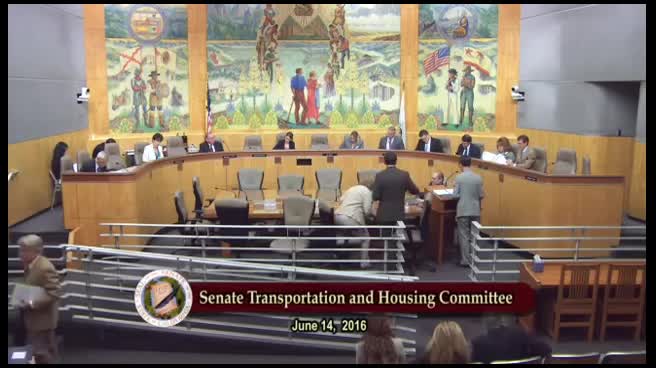
Bill Author




