AB 1718: Elder abuse.
- Session Year: 2015-2016
- House: Assembly
- Latest Version Date: 2016-02-29
Existing law makes it a crime for a person who is not a caretaker any person to violate specified laws proscribing theft, embezzlement, forgery, fraud, or identity theft with respect to the property or identifying information of an elder or dependent adult, knowing that he or she is an elder or dependent adult. Existing law makes a violation of that provision those provisions punishable as a misdemeanor or a felony in county jail, as prescribed, when the moneys, labor, goods, services, or real or personal property taken or obtained is of a value exceeding $950.
This bill would instead make a violation of that provision those provisions punishable as a misdemeanor in county jail or as a felony in state prison, as prescribed.
Existing law makes it a crime for a person who is not a caretaker to violate specified laws proscribing theft, embezzlement, fraud, or identity theft with respect to the property or identifying information of an elder or dependent adult, knowing that he or she is an elder or dependent adult. Existing law makes a violation of that provision punishable as a misdemeanor or a felony in county jail, as prescribed, when the moneys, labor, goods, services, or real or personal property taken or obtained is of a value exceeding $950.
This bill would instead make a violation of that provision punishable as a misdemeanor in county jail or as a felony in state prison, as prescribed.
(a)The Legislature finds and declares that crimes against elders and dependent adults are deserving of special consideration and protection, not unlike the special protections provided for minor children, because elders and dependent adults may be confused, on various medications, mentally or physically impaired, or incompetent, and therefore less able to protect themselves, to understand or report criminal conduct, or to testify in court proceedings on their own behalf.
(b)(1)Any person who knows or reasonably should know that a person is an elder or dependent adult and who, under circumstances or conditions likely to produce great bodily harm or death, willfully causes or permits any elder or dependent adult to suffer, or inflicts thereon unjustifiable physical pain or mental suffering, or having the care or custody of any elder or dependent adult, willfully causes or permits the person or health of the elder or dependent adult to be injured, or willfully causes or permits the elder or dependent adult to be placed in a situation in which his or her person or health is endangered, is punishable by imprisonment in a county jail not exceeding one year, or by a fine not to exceed six thousand dollars ($6,000), or by both that fine and imprisonment, or by imprisonment in the state prison for two, three, or four years.
(2)If, in the commission of an offense described in paragraph (1), the victim suffers great bodily injury, as defined in Section 12022.7, the defendant shall receive an additional term in the state prison as follows:
(A)Three years if the victim is under 70 years of age.
(B)Five years if the victim is 70 years of age or older.
(3)If, in the commission of an offense described in paragraph (1), the defendant proximately causes the death of the victim, the defendant shall receive an additional term in the state prison as follows:
(A)Five years if the victim is under 70 years of age.
(B)Seven years if the victim is 70 years of age or older.
(c)Any person who knows or reasonably should know that a person is an elder or dependent adult and who, under circumstances or conditions other than those likely to produce great bodily harm or death, willfully causes or permits any elder or dependent adult to suffer, or inflicts thereon unjustifiable physical pain or mental suffering, or having the care or custody of any elder or dependent adult, willfully causes or permits the person or health of the elder or dependent adult to be injured or willfully causes or permits the elder or dependent adult to be placed in a situation in which his or her person or health may be endangered, is guilty of a misdemeanor. A second or subsequent violation of this subdivision is punishable by a fine not to exceed two thousand dollars ($2,000), or by imprisonment in a county jail not to exceed one year, or by both that fine and imprisonment.
(d)Any person who is not a caretaker who violates any provision of law proscribing theft, embezzlement, forgery, or fraud, or who violates Section 530.5 proscribing identity theft, with respect to the property or personal identifying information of an elder or a dependent adult, and who knows or reasonably should know that the victim is an elder or a dependent adult, is punishable as follows:
(1)By a fine not exceeding two thousand five hundred dollars ($2,500), or by imprisonment in a county jail not exceeding one year, or by both that fine and imprisonment, or by a fine not exceeding ten thousand dollars ($10,000), or by imprisonment in the state prison for two, three, or four years, or by both that fine and imprisonment, when the moneys, labor, goods, services, or real or personal property taken or obtained is of a value exceeding nine hundred fifty dollars ($950).
(2)By a fine not exceeding one thousand dollars ($1,000), by imprisonment in a county jail not exceeding one year, or by both that fine and imprisonment, when the moneys, labor, goods, services, or real or personal property taken or obtained is of a value not exceeding nine hundred fifty dollars ($950).
(e)Any caretaker of an elder or a dependent adult who violates any provision of law proscribing theft, embezzlement, forgery, or fraud, or who violates Section 530.5 proscribing identity theft, with respect to the property or personal identifying information of that elder or dependent adult, is punishable as follows:
(1)By a fine not exceeding two thousand five hundred dollars ($2,500), or by imprisonment in a county jail not exceeding one year, or by both that fine and imprisonment, or by a fine not exceeding ten thousand dollars ($10,000), or by imprisonment pursuant to subdivision (h) of Section 1170 in the state prison for two, three, or four years, or by both that fine and imprisonment, when the moneys, labor, goods, services, or real or personal property taken or obtained is of a value exceeding nine hundred fifty dollars ($950).
(2)By a fine not exceeding one thousand dollars ($1,000), by imprisonment in a county jail not exceeding one year, or by both that fine and imprisonment, when the moneys, labor, goods, services, or real or personal property taken or obtained is of a value not exceeding nine hundred fifty dollars ($950).
(f)Any person who commits the false imprisonment of an elder or a dependent adult by the use of violence, menace, fraud, or deceit is punishable by imprisonment pursuant to subdivision (h) of Section 1170 for two, three, or four years.
(g)As used in this section, elder means any person who is 65 years of age or older.
(h)As used in this section, dependent adult means any person who is between the ages of 18 and 64, who has physical or mental limitations which restrict his or her ability to carry out normal activities or to protect his or her rights, including, but not limited to, persons who have physical or developmental disabilities or whose physical or mental abilities have diminished because of age. Dependent adult includes any person between the ages of 18 and 64 who is admitted as an inpatient to a 24-hour health facility, as defined in Sections 1250, 1250.2, and 1250.3 of the Health and Safety Code.
(i)As used in this section, caretaker means any person who has the care, custody, or control of, or who stands in a position of trust with, an elder or a dependent adult.
(j)Nothing in this section shall preclude prosecution under both this section and Section 187 or 12022.7 or any other provision of law. However, a person shall not receive an additional term of imprisonment under both paragraphs (2) and (3) of subdivision (b) for any single offense, nor shall a person receive an additional term of imprisonment under both Section 12022.7 and paragraph (2) or (3) of subdivision (b) for any single offense.
(k)In any case in which a person is convicted of violating these provisions, the court may require him or her to receive appropriate counseling as a condition of probation. Any defendant ordered to be placed in a counseling program shall be responsible for paying the expense of his or her participation in the counseling program as determined by the court. The court shall take into consideration the ability of the defendant to pay, and no defendant shall be denied probation because of his or her inability to pay.
(l)Upon conviction for a violation of subdivision (b), (c), (d), (e), or (f), the sentencing court shall also consider issuing an order restraining the defendant from any contact with the victim, which may be valid for up to 10 years, as determined by the court. It is the intent of the Legislature that the length of any restraining order be based upon the seriousness of the facts before the court, the probability of future violations, and the safety of the victim and his or her immediate family. This protective order may be issued by the court whether the defendant is sentenced to state prison or county jail, or if imposition of sentence is suspended and the defendant is placed on probation.
(a)The Legislature finds and declares that crimes against elders and dependent adults are deserving of special consideration and protection, not unlike the special protections provided for minor children, because elders and dependent adults may be confused, on various medications, mentally or physically impaired, or incompetent, and therefore less able to protect themselves, to understand or report criminal conduct, or to testify in court proceedings on their own behalf.
(b)(1)Any person who knows or reasonably should know that a person is an elder or dependent adult and who, under circumstances or conditions likely to produce great bodily harm or death, willfully causes or permits any elder or dependent adult to suffer, or inflicts thereon unjustifiable physical pain or mental suffering, or having the care or custody of any elder or dependent adult, willfully causes or permits the person or health of the elder or dependent adult to be injured, or willfully causes or permits the elder or dependent adult to be placed in a situation in which his or her person or health is endangered, is punishable by imprisonment in a county jail not exceeding one year, or by a fine not to exceed six thousand dollars ($6,000), or by both that fine and imprisonment, or by imprisonment in the state prison for two, three, or four years.
(2)If, in the commission of an offense described in paragraph (1), the victim suffers great bodily injury, as defined in Section 12022.7, the defendant shall receive an additional term in the state prison as follows:
(A)Three years if the victim is under 70 years of age.
(B)Five years if the victim is 70 years of age or older.
(3)If, in the commission of an offense described in paragraph (1), the defendant proximately causes the death of the victim, the defendant shall receive an additional term in the state prison as follows:
(A)Five years if the victim is under 70 years of age.
(B)Seven years if the victim is 70 years of age or older.
(c)Any person who knows or reasonably should know that a person is an elder or dependent adult and who, under circumstances or conditions other than those likely to produce great bodily harm or death, willfully causes or permits any elder or dependent adult to suffer, or inflicts thereon unjustifiable physical pain or mental suffering, or having the care or custody of any elder or dependent adult, willfully causes or permits the person or health of the elder or dependent adult to be injured or willfully causes or permits the elder or dependent adult to be placed in a situation in which his or her person or health may be endangered, is guilty of a misdemeanor. A second or subsequent violation of this subdivision is punishable by a fine not to exceed two thousand dollars ($2,000), or by imprisonment in a county jail not to exceed one year, or by both that fine and imprisonment.
(d)Any person who is not a caretaker who violates any provision of law proscribing theft, embezzlement, forgery, or fraud, or who violates Section 530.5 proscribing identity theft, with respect to the property or personal identifying information of an elder or a dependent adult, and who knows or reasonably should know that the victim is an elder or a dependent adult, is punishable as follows:
(1)By a fine not exceeding two thousand five hundred dollars ($2,500), or by imprisonment in a county jail not exceeding one year, or by both that fine and imprisonment, or by a fine not exceeding ten thousand dollars ($10,000), or by imprisonment pursuant to subdivision (h) of Section 1170 in the state prison for two, three, or four years, or by both that fine and imprisonment, when the moneys, labor, goods, services, or real or personal property taken or obtained is of a value exceeding nine hundred fifty dollars ($950).
(2)By a fine not exceeding one thousand dollars ($1,000), by imprisonment in a county jail not exceeding one year, or by both that fine and imprisonment, when the moneys, labor, goods, services, or real or personal property taken or obtained is of a value not exceeding nine hundred fifty dollars ($950).
(e)Any caretaker of an elder or a dependent adult who violates any provision of law proscribing theft, embezzlement, forgery, or fraud, or who violates Section 530.5 proscribing identity theft, with respect to the property or personal identifying information of that elder or dependent adult, is punishable as follows:
(1)By a fine not exceeding two thousand five hundred dollars ($2,500), or by imprisonment in a county jail not exceeding one year, or by both that fine and imprisonment, or by a fine not exceeding ten thousand dollars ($10,000), or by imprisonment pursuant to subdivision (h) of Section 1170 for two, three, or four years, or by both that fine and imprisonment, when the moneys, labor, goods, services, or real or personal property taken or obtained is of a value exceeding nine hundred fifty dollars ($950).
(2)By a fine not exceeding one thousand dollars ($1,000), by imprisonment in a county jail not exceeding one year, or by both that fine and imprisonment, when the moneys, labor, goods, services, or real or personal property taken or obtained is of a value not exceeding nine hundred fifty dollars ($950).
(f)Any person who commits the false imprisonment of an elder or a dependent adult by the use of violence, menace, fraud, or deceit is punishable by imprisonment pursuant to subdivision (h) of Section 1170 for two, three, or four years.
(g)As used in this section, elder means any person who is 65 years of age or older.
(h)As used in this section, dependent adult means any person who is between the ages of 18 and 64, who has physical or mental limitations which restrict his or her ability to carry out normal activities or to protect his or her rights, including, but not limited to, persons who have physical or developmental disabilities or whose physical or mental abilities have diminished because of age. Dependent adult includes any person between the ages of 18 and 64 who is admitted as an inpatient to a 24-hour health facility, as defined in Sections 1250, 1250.2, and 1250.3 of the Health and Safety Code.
(i)As used in this section, caretaker means any person who has the care, custody, or control of, or who stands in a position of trust with, an elder or a dependent adult.
(j)Nothing in this section shall preclude prosecution under both this section and Section 187 or 12022.7 or any other provision of law. However, a person shall not receive an additional term of imprisonment under both paragraphs (2) and (3) of subdivision (b) for any single offense, nor shall a person receive an additional term of imprisonment under both Section 12022.7 and paragraph (2) or (3) of subdivision (b) for any single offense.
(k)In any case in which a person is convicted of violating these provisions, the court may require him or her to receive appropriate counseling as a condition of probation. Any defendant ordered to be placed in a counseling program shall be responsible for paying the expense of his or her participation in the counseling program as determined by the court. The court shall take into consideration the ability of the defendant to pay, and no defendant shall be denied probation because of his or her inability to pay.
(l)Upon conviction for a violation of subdivision (b), (c), (d), (e), or (f), the sentencing court shall also consider issuing an order restraining the defendant from any contact with the victim, which may be valid for up to 10 years, as determined by the court. It is the intent of the Legislature that the length of any restraining order be based upon the seriousness of the facts before the court, the probability of future violations, and the safety of the victim and his or her immediate family. This protective order may be issued by the court whether the defendant is sentenced to state prison or county jail, or if imposition of sentence is suspended and the defendant is placed on probation.
|
Date
|
Status
|
|---|---|
| Jan 27, 2016 | Read first time. To print. |
| Jan 28, 2016 | From printer. May be heard in committee February 27. |
| Feb 18, 2016 | Referred to Coms. on PUB. S. and AGING & L.T.C. |
| Feb 29, 2016 | From committee chair, with author's amendments: Amend, and re-refer to Com. on PUB. S. Read second time and amended. |
| Mar 1, 2016 | Re-referred to Com. on PUB. S. |
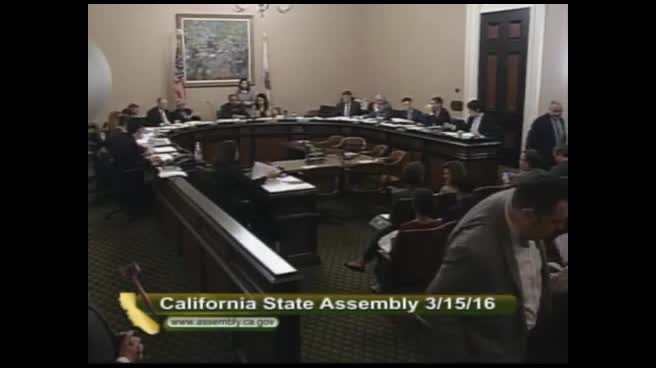
| Mar 15, 2016 | In committee: Set, first hearing. Failed passage. Reconsideration granted. |
| Apr 20, 2016 | In committee: Set, second hearing. Failed passage. |
| Apr 21, 2016 | From committee: Without further action pursuant to Joint Rule 62(a). |
|
Date
|
Description
|
Location
|
Votes
|
|
|---|---|---|---|---|
| Apr 20, 2016 | Do pass and be re-referred to the Committee on [Aging and Long-Term Care] | Assembly Standing Committee on Public Safety |
Failed |
|
| Mar 15, 2016 | Reconsideration. | Assembly Standing Committee on Public Safety |
Passed |
|
| Mar 15, 2016 | Do pass and be re-referred to the Committee on [Aging and Long-Term Care] | Assembly Standing Committee on Public Safety |
Failed |
This list shows positions taken on this bill by organizations on the date displayed, which is linked to the original source.
Positions by individuals are not included.
|
Organization
|
Position
|
Date
|
|---|---|---|
| California Attorneys For Criminal Justice | ** Against | Mar 15, 2016 |
| California Public Defenders Association | * Against | Mar 15, 2016 |
| California Public Defenders Association | * Support | Mar 15, 2016 |
| CEDA | * Against | Mar 15, 2016 |
| CLTCOA | * Support | Mar 15, 2016 |
| Coalition for Elder and Dependent Adult Rights | ** Against | Mar 15, 2016 |
| PUB. S. | ** Against | Mar 15, 2016 |
| Senior Advocacy Services | * Indeterminate | Mar 15, 2016 |
Date of Hearing:
Counsel: Gabriel Caswell
ASSEMBLY COMMITTEE ON PUBLIC SAFETY
Reginald Byron Jones-Sawyer, Sr., Chair
ABPCA Bill Id:AB 1718
Author:(Kim) – As Amended Ver:February 29, 2016
VOTE ONLY
SUMMARY: Requires the court to sentence a defendant convicted of felony financial abuse of an elder or dependent adult to state prison. Specifically, this bill: Allows the sentence for the crime of theft from an elder or dependent adult, when the value of the property exceeds $950, to be served in state prison rather than in county jail.
EXISTING LAW:
- Defines a "felony" as "a crime that is punishable with death, by imprisonment in the state prison, or notwithstanding any other provision of law, by imprisonment in a county jail." (Pen. Code, § 17, subd. (a).)
- Prohibits a term of more than one year in the county jail except for executed felony sentences. (Pen. Code, § 19.2.)
- Specifies that any person who is not a caretaker who violates any provision of law proscribing theft, embezzlement, forgery, fraud, or identity theft, with respect to the property or personal identifying information of an elder or a dependent adult, and who knows or reasonably should know that the victim is an elder or a dependent adult, is punishable as follows:
- By a fine not exceeding $2,500, or by imprisonment in a county jail not exceeding one year, or by both that fine and imprisonment, or by a fine not exceeding $10,000, or by imprisonment in the county jail for two, three, or four years, or by both that fine and imprisonment, when the moneys, labor, goods, services, or real or personal property taken or obtained is of a value exceeding $950; or
- By a fine not exceeding $1,000, by imprisonment in a county jail not exceeding one year, or by both that fine and imprisonment, when the moneys, labor, goods, services, or real or personal property taken or obtained is of a value not exceeding $950. (Pen. Code, § 368, subd. (d).)
- Provides that any caretaker of an elder or a dependent adult who violates any provision of law proscribing theft, embezzlement, forgery, fraud, or identity theft, with respect to the property or personal identifying information of that elder or dependent adult, is punishable as follows:
- By a fine not exceeding $2,500, or by imprisonment in a county jail not exceeding one year, or by both that fine and imprisonment, or by a fine not exceeding $10,000, or by imprisonment in the county jail for two, three, or four years, or by both that fine and imprisonment, when the moneys, labor, goods, services, or real or personal property taken or obtained is of a value exceeding $950; or
- By a fine not exceeding $1,000, by imprisonment in a county jail not exceeding one year, or by both that fine and imprisonment, when the moneys, labor, goods, services, or real or personal property taken or obtained is of a value not exceeding $950. (Pen. Code, § 368, subd. (e).)
- Defines "elder" as "any person who is 65 years of age or older." (Pen. Code, § 368, subd. (g).)
- States that upon conviction of any felony it shall be considered a circumstance in aggravation in imposing the upper term if the victim of an offense is particularly vulnerable, or unable to defend himself or herself, due to age or significant disability. (Pen. Code, § 1170.85, subd. (b).)
FISCAL EFFECT: Unknown
COMMENTS:
- Author's Statement: According to the Author, "AB 1718 strengthens seniors’ protections against financial abuse by giving judges the option to sentence criminals convicted of felony financial elder abuse to state prison instead of the current option of only county jail. We have an obligation to protect the most vulnerable in our society, and our senior citizens are regularly targeted for financial abuse. By sending these criminals to state prison, we can end slap-on-the wrist punishments for doing the unconscionable – preying on the savings of seniors. "
- Legislative History and Intent of Elder Abuse: Specifically, elder abuse was punished as a crime in 1986; abuse of a dependent person was punished in 1984. (See Statutes of 1984, Chapter 144, Section 160.) Although the statute has been renumbered, the language originally stated:
"Any person, who, under circumstances or conditions likely to produce great bodily harm or death, willfully causes or permits any elder or dependent adult, with knowledge that he or she is an elder or dependent adult, willfully causes or permits the person or health of the elder or dependent adult to be placed in a situation in which his or her person or health is endangered is punishable by imprisonment in the county jail not exceeding one year or in state prison for two, three or four years." [Original Pen. Code § 368, subd. (a) as cited in People vs. Heitzman (1994) 9 Cal.4th 189, 194]
In 1994, the California Supreme Court construed Penal Code Section 368 as requiring a tort grounded duty of care to save the statute from being unconstitutionally vague. The Court in Heitzman stated:
"In 1983, the Legislature passed the state's first law focusing exclusively on those 65 years of age or older, requiring elder care custodians and other specified professionals to report instances of elder abuse. (Welf. & Inst. Code, § 9380- 9386, added by Stats. 1983, ch. 1273, § 2 and repealed by Stats. 1986, ch. 769, § 1.3, eff. Sept. 15, 1986.) That same year, Senate Bill No. 248, 1983-1984 Regular Session, was introduced at the request of the Santa Ana Police Department. An analysis of the bill prepared for the Senate Committee on the Judiciary indicates that the goal of the legislation was to aid in the prosecution of people who harm or neglect dependent adults. (Sen. Com. on Judiciary, Analysis of Sen. Bill No. 248 (1983-1984 Reg. Sess.) p. 2.) According to this document, law enforcement agencies receiving reports concerning suspected abuse or neglect of dependent adults were having difficulty finding Penal Code sections under which they could prosecute such cases. (Ibid.) The solution proposed by the bill was to establish the same criminal penalties for the abuse of a dependent adult as those found in sections 273a and 273d for child abuse. (Sen. Com. on Judiciary, Analysis of Sen. Bill No. 248.) When drafting the new legislation, the bill's author lifted the language of the child abuse statutes in its entirety, replacing the word 'child' with 'dependent adult' throughout (internal citation omitted).
"After the statute was enacted late in 1983, several non-substantive changes were made. (Stats. 1984, ch. 144, § 160, p. 482.) Later, in conjunction with legislation designed to consolidate the two sets of conflicting reporting laws for elder abuse and dependent adult abuse, a 1986 amendment to section 368(a) made the section expressly applicable to elders as well as dependent adults. (Stats. 1986, ch. 769, § 1.2, p. 2531, urgency measure eff. Sept. 15, 1986.) [Heitzman at 245.]"
In 2004, AB 3095 (Committee on Aging and Long Term Care), Chapter 893, Statutes of 2004, related to conditions of probation when an offender is guilty of the crime of elder abuse, as specified. However, the Senate amended AB 3095 to strike "with knowledge that he or she is an elder or dependent adult" and instead included any person who "knows or reasonably should know that a person is an elder or dependent adult". This language is presumably broader than simple knowledge because it includes persons who reasonably should have known of the victim's status as an elderly or dependent person.
The stated intent behind the increased penalty for crimes against the elderly is to punish those who would prey on person who might not be able to defend himself or herself. (Pen. Code § 368, subd. (a).) The offenses specified in the elder abuse section, such as battery and fraud, are all punishable as substantive offenses. Pen. Code § 368 is meant to impose a more severe punishment on a person who victimizes an elderly person. The intent behind the legislation was to make crimes against the elderly more severe, not necessarily to be punished by imprisonment in the state prison. - Effect on Criminal Justice Realignment: Criminal justice realignment created two classifications of felonies: those punishable in county jail and those punishable in state prison. Realignment limited which felons can be sent to state prison, thus requiring that more felons serve their sentences in county jails. The law applies to qualified defendants who commit qualifying offenses and who were sentenced on or after October 1, 2011. Specifically, sentences to state prison are now mainly limited to registered sex offenders and individuals with a current or prior serious or violent offense. In addition to the serious, violent, registerable offenses eligible for state prison incarceration, there are approximately 70 felonies which have be specifically excluded from eligibility for local custody (i.e., the sentence for which must be served in state prison).
This bill specifies that any defendant who is convicted of theft from an elder or dependent adult, when the value of the property taken is more than $950, shall serve that sentence in state prison rather than in the county jail. Thus, this bill creates a new exclusion for county-jail eligibility. - On-Going Concerns for Prison Overcrowding: On February 10, 2014, the federal court ordered California to reduce its in-state adult institution population to 137.5% of design capacity by February 28, 2016, as follows:
• 143% of design bed capacity by June 30, 2014;
• 141.5% of design bed capacity by February 28, 2015; and,
• 137.5% of design bed capacity by February 28, 2016.
In February of last year the administration reported that as "of February 11, 2015, 112,993 inmates were housed in the State’s 34 adult institutions, which amounts to 136.6% of design bed capacity, and 8,828 inmates were housed in out-of-state facilities. This current population is now below the court-ordered reduction to 137.5% of design bed capacity." (Defendants' February 2015 Status Report In Response To February 10, 2014 Order, 2:90-cv-00520 KJM DAD PC, 3-Judge Court, Coleman v. Brown, Plata v. Brown (fn. omitted).
While significant gains have been made in reducing the prison population, the state now must stabilize these advances and demonstrate to the federal court that California has in place the “durable solution” to prison overcrowding “consistently demanded” by the court. (Opinion Re: Order Granting in Part and Denying in Part Defendants’ Request For Extension of December 31, 2013 Deadline, NO. 2:90-cv-0520 LKK DAD (PC), 3-Judge Court, Coleman v. Brown, Plata v. Brown (2-10-14).
However, even though the state has complied with the federal court order, the prison population needs to be maintained, not increased. And according to the Legislative Analyst's Office (LAO), "CDCR is currently projecting that the prison population will increase by several thousand inmates in the next few years and will reach the cap by June 2018 and exceed it by 1,000 inmates by June 2019." (http://www.lao.ca.gov/reports/2014/budget/criminal-justice/criminal-justice-021914.aspx.) The LAO also notes that predicting the prison population is "inherently difficulty" and subject to "considerable uncertainty." (Ibid.) Nevertheless, creating a new exclusion for county jail sentences when the prison population is already expected to increase seems imprudent.
- Argument in Support: According to the California Long-Term Care Ombudsman Association, "Currently the law allows a person convicted of committing a crime against a senior or dependent adult, when the value of money, goods, services, or personal property stolen exceeds $950, to be sentenced to county jail for either a misdemeanor or a felony.
"AB 1718 revises California statue to allow for the court's discretion when sentencing a person found guilty of a misdemeanor in a county jail or as a felony in state prison.
"Without changes to the penalties levied by the court, persons inclined to commit crimes against seniors are not sufficiently discouraged from committing illegal conduct; hence frail, elderly and vulnerable adults suffer needlessly."
- Argument in Opposition: According to the California Attorneys for Criminal Justice, "This bill would revise the penalty for violation of Penal Code 3689(e) from incarceration in county jail to imprisonment in state prison.
"Existing law makes it a crime for a caretaker of an elder or dependent adult to knowingly steal or defraud an elder or dependent adult. The existing penalty for a violation of Penal Code section 368, when the moneys, labor, goods, services, or real or personal property taken or obtained is of a value exceeding $950.
"CACJ understands that admirable intent of the legislation to continue protecting the vulnerable elder population. However, CACJ must object to the increased penalties without any showing that the existing laws are deficient. Current law allows for the sentencing of a person for up to three years in county jail. This bill would not only remove that sentence from jail to state prison, but also increase the maximum time served to four years.
"Furthermore, without express justification for this sentencing increase and expansion of state prison crimes, California is still under a court order to reduce the state prison population. This would further exacerbate this issue and prevent offenders from receiving much needed specialized reentry services that are provided in county jail."
- Prior Legislation:
- AB 441 (Wilk), of the 2015-2016 Legislative Session, would have created a sentence enhancement of two additional years of imprisonment for any person convicted of identity theft if the victim was 65 years of age or older at the time of the offense. AB 441 failed passage in this committee.
- AB 332 (Butler), Chapter 366, Statutes of 2011, increased the fines for fraud, embezzlement, theft, and identity theft against an elder or dependent adult when the amount taken is more than $950.
- AB 1293 (Blumenfield), Chapter 371, Statutes of 2011, authorizes prosecutors to petition for forfeiture of assets in specified cases involving financial abuse of elder or dependent adults.
REGISTERED SUPPORT / OPPOSITION:
Support
California Long-Term Care Ombudsman Association
Opposition
American Civil Liberties Union
California Attorneys for Criminal Justice
California Public Defenders Association
Coalition for elder and Dependent Adult Rights
Analysis Prepared by:
Gabriel Caswell / PUB. S. / (916) 319-3744
Date of Hearing: March 15, 2016
Counsel: Gabriel Caswell
ASSEMBLY COMMITTEE ON
, Sr., Chair
ABPCA Bill Id:
Author:() – As Ver:
SUMMARY: Requires the court to sentence a defendant convicted of felony financial abuse of an elder or dependent adult to state prison. Specifically, this bill: Allows the sentence for the crime of theft from an elder or dependent adult, when the value of the property exceeds $950, to be served in state prison rather than in county jail.
EXISTING LAW:
- Defines a "felony" as "a crime that is punishable with death, by imprisonment in the state prison, or notwithstanding any other provision of law, by imprisonment in a county jail." (Pen. Code, § 17, subd. (a).)
- Prohibits a term of more than one year in the county jail except for executed felony sentences. (Pen. Code, § 19.2.)
- Specifies that any person who is not a caretaker who violates any provision of law proscribing theft, embezzlement, forgery, fraud, or identity theft, with respect to the property or personal identifying information of an elder or a dependent adult, and who knows or reasonably should know that the victim is an elder or a dependent adult, is punishable as follows:
- By a fine not exceeding $2,500, or by imprisonment in a county jail not exceeding one year, or by both that fine and imprisonment, or by a fine not exceeding $10,000, or by imprisonment in the county jail for two, three, or four years, or by both that fine and imprisonment, when the moneys, labor, goods, services, or real or personal property taken or obtained is of a value exceeding $950; or
- By a fine not exceeding $1,000, by imprisonment in a county jail not exceeding one year, or by both that fine and imprisonment, when the moneys, labor, goods, services, or real or personal property taken or obtained is of a value not exceeding $950. (Pen. Code, § 368, subd. (d).)
- Provides that any caretaker of an elder or a dependent adult who violates any provision of law proscribing theft, embezzlement, forgery, fraud, or identity theft, with respect to the property or personal identifying information of that elder or dependent adult, is punishable as follows:
- By a fine not exceeding $2,500, or by imprisonment in a county jail not exceeding one year, or by both that fine and imprisonment, or by a fine not exceeding $10,000, or by imprisonment in the county jail for two, three, or four years, or by both that fine and imprisonment, when the moneys, labor, goods, services, or real or personal property taken or obtained is of a value exceeding $950; or
- By a fine not exceeding $1,000, by imprisonment in a county jail not exceeding one year, or by both that fine and imprisonment, when the moneys, labor, goods, services, or real or personal property taken or obtained is of a value not exceeding $950. (Pen. Code, § 368, subd. (e).)
- Defines "elder" as "any person who is 65 years of age or older." (Pen. Code, § 368, subd. (g).)
- States that upon conviction of any felony it shall be considered a circumstance in aggravation in imposing the upper term if the victim of an offense is particularly vulnerable, or unable to defend himself or herself, due to age or significant disability. (Pen. Code, § 1170.85, subd. (b).)
FISCAL EFFECT:
COMMENTS:
- Author's Statement: According to the Author, "AB 1718 strengthens seniors’ protections against financial abuse by giving judges the option to sentence criminals convicted of felony financial elder abuse to state prison instead of the current option of only county jail. We have an obligation to protect the most vulnerable in our society, and our senior citizens are regularly targeted for financial abuse. By sending these criminals to state prison, we can end slap-on-the wrist punishments for doing the unconscionable – preying on the savings of seniors. "
- Legislative History and Intent of Elder Abuse: Specifically, elder abuse was punished as a crime in 1986; abuse of a dependent person was punished in 1984. (See Statutes of 1984, Chapter 144, Section 160.) Although the statute has been renumbered, the language originally stated:
"Any person, who, under circumstances or conditions likely to produce great bodily harm or death, willfully causes or permits any elder or dependent adult, with knowledge that he or she is an elder or dependent adult, willfully causes or permits the person or health of the elder or dependent adult to be placed in a situation in which his or her person or health is endangered is punishable by imprisonment in the county jail not exceeding one year or in state prison for two, three or four years." [Original Pen. Code § 368, subd. (a) as cited in People vs. Heitzman (1994) 9 Cal.4th 189, 194]
In 1994, the California Supreme Court construed Penal Code Section 368 as requiring a tort grounded duty of care to save the statute from being unconstitutionally vague. The Court in Heitzman stated:
"In 1983, the Legislature passed the state's first law focusing exclusively on those 65 years of age or older, requiring elder care custodians and other specified professionals to report instances of elder abuse. (Welf. & Inst. Code, § 9380- 9386, added by Stats. 1983, ch. 1273, § 2 and repealed by Stats. 1986, ch. 769, § 1.3, eff. Sept. 15, 1986.) That same year, Senate Bill No. 248, 1983-1984 Regular Session, was introduced at the request of the Santa Ana Police Department. An analysis of the bill prepared for the Senate Committee on the Judiciary indicates that the goal of the legislation was to aid in the prosecution of people who harm or neglect dependent adults. (Sen. Com. on Judiciary, Analysis of Sen. Bill No. 248 (1983-1984 Reg. Sess.) p. 2.) According to this document, law enforcement agencies receiving reports concerning suspected abuse or neglect of dependent adults were having difficulty finding Penal Code sections under which they could prosecute such cases. (Ibid.) The solution proposed by the bill was to establish the same criminal penalties for the abuse of a dependent adult as those found in sections 273a and 273d for child abuse. (Sen. Com. on Judiciary, Analysis of Sen. Bill No. 248.) When drafting the new legislation, the bill's author lifted the language of the child abuse statutes in its entirety, replacing the word 'child' with 'dependent adult' throughout (internal citation omitted).
"After the statute was enacted late in 1983, several non-substantive changes were made. (Stats. 1984, ch. 144, § 160, p. 482.) Later, in conjunction with legislation designed to consolidate the two sets of conflicting reporting laws for elder abuse and dependent adult abuse, a 1986 amendment to section 368(a) made the section expressly applicable to elders as well as dependent adults. (Stats. 1986, ch. 769, § 1.2, p. 2531, urgency measure eff. Sept. 15, 1986.) [Heitzman at 245.]"
In 2004, AB 3095 (Committee on Aging and Long Term Care), Chapter 893, Statutes of 2004, related to conditions of probation when an offender is guilty of the crime of elder abuse, as specified. However, the Senate amended AB 3095 to strike "with knowledge that he or she is an elder or dependent adult" and instead included any person who "knows or reasonably should know that a person is an elder or dependent adult". This language is presumably broader than simple knowledge because it includes persons who reasonably should have known of the victim's status as an elderly or dependent person.
The stated intent behind the increased penalty for crimes against the elderly is to punish those who would prey on person who might not be able to defend himself or herself. (Pen. Code § 368, subd. (a).) The offenses specified in the elder abuse section, such as battery and fraud, are all punishable as substantive offenses. Pen. Code § 368 is meant to impose a more severe punishment on a person who victimizes an elderly person. The intent behind the legislation was to make crimes against the elderly more severe, not necessarily to be punished by imprisonment in the state prison. - Effect on Criminal Justice Realignment: Criminal justice realignment created two classifications of felonies: those punishable in county jail and those punishable in state prison. Realignment limited which felons can be sent to state prison, thus requiring that more felons serve their sentences in county jails. The law applies to qualified defendants who commit qualifying offenses and who were sentenced on or after October 1, 2011. Specifically, sentences to state prison are now mainly limited to registered sex offenders and individuals with a current or prior serious or violent offense. In addition to the serious, violent, registerable offenses eligible for state prison incarceration, there are approximately 70 felonies which have be specifically excluded from eligibility for local custody (i.e., the sentence for which must be served in state prison).
This bill specifies that any defendant who is convicted of theft from an elder or dependent adult, when the value of the property taken is more than $950, shall serve that sentence in state prison rather than in the county jail. Thus, this bill creates a new exclusion for county-jail eligibility. - On-Going Concerns for Prison Overcrowding: On February 10, 2014, the federal court ordered California to reduce its in-state adult institution population to 137.5% of design capacity by February 28, 2016, as follows:
• 143% of design bed capacity by June 30, 2014;
• 141.5% of design bed capacity by February 28, 2015; and,
• 137.5% of design bed capacity by February 28, 2016.
In February of last year the administration reported that as "of February 11, 2015, 112,993 inmates were housed in the State’s 34 adult institutions, which amounts to 136.6% of design bed capacity, and 8,828 inmates were housed in out-of-state facilities. This current population is now below the court-ordered reduction to 137.5% of design bed capacity." (Defendants' February 2015 Status Report In Response To February 10, 2014 Order, 2:90-cv-00520 KJM DAD PC, 3-Judge Court, Coleman v. Brown, Plata v. Brown (fn. omitted).
While significant gains have been made in reducing the prison population, the state now must stabilize these advances and demonstrate to the federal court that California has in place the “durable solution” to prison overcrowding “consistently demanded” by the court. (Opinion Re: Order Granting in Part and Denying in Part Defendants’ Request For Extension of December 31, 2013 Deadline, NO. 2:90-cv-0520 LKK DAD (PC), 3-Judge Court, Coleman v. Brown, Plata v. Brown (2-10-14).
However, even though the state has complied with the federal court order, the prison population needs to be maintained, not increased. And according to the Legislative Analyst's Office (LAO), "CDCR is currently projecting that the prison population will increase by several thousand inmates in the next few years and will reach the cap by June 2018 and exceed it by 1,000 inmates by June 2019." (http://www.lao.ca.gov/reports/2014/budget/criminal-justice/criminal-justice-021914.aspx.) The LAO also notes that predicting the prison population is "inherently difficulty" and subject to "considerable uncertainty." (Ibid.) Nevertheless, creating a new exclusion for county jail sentences when the prison population is already expected to increase seems imprudent.
- Argument in Support: According to the California Long-Term Care Ombudsman Association, "Currently the law allows a person convicted of committing a crime against a senior or dependent adult, when the value of money, goods, services, or personal property stolen exceeds $950, to be sentenced to county jail for either a misdemeanor or a felony.
"AB 1718 revises California statue to allow for the court's discretion when sentencing a person found guilty of a misdemeanor in a county jail or as a felony in state prison.
"Without changes to the penalties levied by the court, persons inclined to commit crimes against seniors are not sufficiently discouraged from committing illegal conduct; hence frail, elderly and vulnerable adults suffer needlessly."
- Argument in Opposition: According to the California Attorneys for Criminal Justice, "This bill would revise the penalty for violation of Penal Code 3689(e) from incarceration in county jail to imprisonment in state prison.
"Existing law makes it a crime for a caretaker of an elder or dependent adult to knowingly steal or defraud an elder or dependent adult. The existing penalty for a violation of Penal Code section 368, when the moneys, labor, goods, services, or real or personal property taken or obtained is of a value exceeding $950.
"CACJ understands that admirable intent of the legislation to continue protecting the vulnerable elder population. However, CACJ must object to the increased penalties without any showing that the existing laws are deficient. Current law allows for the sentencing of a person for up to three years in county jail. This bill would not only remove that sentence from jail to state prison, but also increase the maximum time served to four years.
"Furthermore, without express justification for this sentencing increase and expansion of state prison crimes, California is still under a court order to reduce the state prison population. This would further exacerbate this issue and prevent offenders from receiving much needed specialized reentry services that are provided in county jail."
- Prior Legislation:
- AB 441 (Wilk), of the 2015-2016 Legislative Session, would have created a sentence enhancement of two additional years of imprisonment for any person convicted of identity theft if the victim was 65 years of age or older at the time of the offense. AB 441 failed passage in this committee.
- AB 332 (Butler), Chapter 366, Statutes of 2011, increased the fines for fraud, embezzlement, theft, and identity theft against an elder or dependent adult when the amount taken is more than $950.
- AB 1293 (Blumenfield), Chapter 371, Statutes of 2011, authorizes prosecutors to petition for forfeiture of assets in specified cases involving financial abuse of elder or dependent adults.
REGISTERED SUPPORT / OPPOSITION:
Support
California Long-Term Care Ombudsman Association
Opposition
American Civil Liberties Union
California Attorneys for Criminal Justice
California Public Defenders Association
Coalition for elder and Dependent Adult Rights
Analysis Prepared by:
Discussed in Hearing
 28MIN
Assembly Standing Committee on Public Safety
Bill Author

Bill Co-Author(s):