AB 1762: Human trafficking: victims: vacating convictions.
- Session Year: 2015-2016
- House: Assembly
- Latest Version Date: 2016-08-30
(1)Under existing law, as amended by Proposition 35, an initiative measure approved by the voters at the November 6, 2012, statewide general election, a person who deprives or violate another persons personal liberty with the intent to obtain forced labor or services or who deprives or violates another persons personal liberty for the purpose of prostitution or sexual exploitation is guilty of human trafficking, a felony. Proposition 35 provides that it may be amended by a statute in furtherance of its objectives by a majority of the membership of each house of the Legislature concurring.
Existing law allows a court to issue an order to set aside a verdict of guilty and dismiss an accusation or information against a defendant who has been convicted of solicitation or prostitution if the defendant has completed any term of probation for that conviction and if he or she can establish by clear and convincing evidence that the conviction was a result of his or her status as a victim of human trafficking.
This bill would instead allow an individual convicted of a nonviolent crime that was a direct result of the individual being a human trafficking victim to apply to the court to vacate the conviction if the individual is not then in custody and has either not been convicted of any crime for two years or has successfully completed probation for the crime. The bill would allow an individual adjudicated a ward of the juvenile court as the result of a nonviolent crime committed while he or she was a human trafficking victim to apply to have the petition dismissed if the individual has not had a sustained petition for any crime or been convicted of any crime for one year prior to the date of application. The bill would specify various court procedures for adjudication of an application. If the application is granted, the bill would require the court to have all records in the case sealed, except as specified, and to release the defendant from all penalties and disabilities, as provided. The bill would define human trafficking victim and nonviolent crime for these purposes.
The bill would require the individual applying for vacatur to submit the application and all evidence in support of the application under penalty of perjury. By expanding the crime of perjury, this bill would impose a state-mandated local program.
(2)Existing law requires the Attorney General to compile and disseminate state summary criminal history information pertaining to the identification and criminal history of any person.
This bill would require the state summary criminal history information to exclude any charge or conviction for which relief has been granted pursuant to the provisions of this bill.
(3)This bill would incorporate additional changes to Section 8712 of the Family Code, proposed by AB 1997, that would become operative only if this bill and AB 1997 are enacted and become effective on or before January 1, 2017, and this bill is chaptered last.
(4)The California Constitution requires the state to reimburse local agencies and school districts for certain costs mandated by the state. Statutory provisions establish procedures for making that reimbursement.
This bill would provide that no reimbursement is required by this act for a specified reason.
(1)Under existing law, as amended by Proposition 35, an initiative measure approved by the voters at the November 6, 2012, statewide general election, a person who deprives or violate another persons personal liberty with the intent to obtain forced labor or services or who deprives or violates another persons personal liberty for the purpose of prostitution or sexual exploitation is guilty of human trafficking, a felony. Proposition 35 provides that it may be amended by a statute in furtherance of its objectives by a majority of the membership of each house of the Legislature concurring.
Existing law allows a court to issue an order to set aside a verdict of guilty and dismiss an accusation or information against a defendant who has been convicted of solicitation or prostitution if the defendant has completed any term of probation for that conviction and if he or she can establish by clear and convincing evidence that the conviction was a result of his or her status as a victim of human trafficking.
This bill would instead allow an individual convicted of a nonviolent crime that was a direct result of the individual being a human trafficking victim to apply to the court to vacate the conviction if the individual is not then in custody and has either not been convicted of any crime for two years or has successfully completed probation for the crime. The bill would allow an individual adjudicated a ward of the juvenile court as the result of a nonviolent crime committed while he or she was a human trafficking victim to apply to have the petition dismissed if the individual has not had a sustained petition for any crime or been convicted of any crime for one year prior to the date of application. The bill would specify various court procedures for adjudication of an application. If the application is granted, the bill would require the court to have all records in the case sealed sealed, except as specified, and to release the defendant from all penalties and disabilities, as provided. The bill would define human trafficking victim and nonviolent crime for these purposes.
The bill would require the individual applying for vacatur to submit the application and all evidence in support of the application under penalty of perjury. By expanding the crime of perjury, this bill would impose a state-mandated local program.
(2)Existing law requires the Attorney General to compile and disseminate state summary criminal history information pertaining to the identification and criminal history of any person.
This bill would require the state summary criminal history information to exclude any charge or conviction for which relief has been granted pursuant to the provisions of this bill.
(3)This bill would incorporate additional changes to Section 8712 of the Family Code, proposed by AB 1997, that would become operative only if this bill and AB 1997 are enacted and become effective on or before January 1, 2017, and this bill is chaptered last.
(4)The California Constitution requires the state to reimburse local agencies and school districts for certain costs mandated by the state. Statutory provisions establish procedures for making that reimbursement.
This bill would provide that no reimbursement is required by this act for a specified reason.
(1)Under existing law, as amended by Proposition 35, an initiative measure approved by the voters at the November 6, 2012, statewide general election, a person who deprives or violate another persons personal liberty with the intent to obtain forced labor or services or who deprives or violates another persons personal liberty for the purpose of prostitution or sexual exploitation is guilty of human trafficking, a felony. Proposition 35 provides that it may be amended by a statute in furtherance of its objectives by a majority of the membership of each house of the Legislature concurring.
Existing law allows a court to issue an order to set aside a verdict of guilty and dismiss an accusation or information against a defendant who has been convicted of solicitation or prostitution if the defendant has completed any term of probation for that conviction and if he or she can establish by clear and convincing evidence that the conviction was a result of his or her status as a victim of human trafficking.
This bill would instead allow an individual convicted of a nonviolent crime that was a direct result of the individual being a human trafficking victim to apply to the court to vacate the conviction if the individual is not then in custody and has either not been convicted of any crime for two years or has successfully completed probation for the crime. The bill would allow an individual adjudicated a ward of the juvenile court as the result of a nonviolent crime committed while he or she was a human trafficking victim to apply to have the petition dismissed if the individual has not had a sustained petition for any crime or been convicted of any crime for one year prior to the date of application. The bill would specify various court procedures for adjudication of an application. If the application is granted, the bill would require the court to have all records in the case sealed and to release the defendant from all penalties and disabilities, as provided. The bill would define human trafficking victim and nonviolent crime for these purposes.
The bill would require the individual applying for vacatur to submit the application and all evidence in support of the application under penalty of perjury. By expanding the crime of perjury, this bill would impose a state-mandated local program.
(2)Existing law requires the Attorney General to compile and disseminate state summary criminal history information pertaining to the identification and criminal history of any person.
This bill would require the state summary criminal history information to exclude any charge or conviction for which relief has been granted pursuant to the provisions of this bill.
(3)This bill would incorporate additional changes to Section 8712 of the Family Code, proposed by AB 1997, that would become operative only if this bill and AB 1997 are enacted and become effective on or before January 1, 2017, and this bill is chaptered last.
(3)
(4)The California Constitution requires the state to reimburse local agencies and school districts for certain costs mandated by the state. Statutory provisions establish procedures for making that reimbursement.
This bill would provide that no reimbursement is required by this act for a specified reason.
(1)Under existing law, as amended by Proposition 35, an initiative measure approved by the voters at the November 6, 2012, statewide general election, a person who deprives or violate another persons personal liberty with the intent to obtain forced labor or services or who deprives or violates another persons personal liberty for the purpose of prostitution or sexual exploitation is guilty of human trafficking, a felony. Proposition 35 provides that it may be amended by a statute in furtherance of its objectives by a majority of the membership of each house of the Legislature concurring.
Existing law allows a court to issue an order to set aside a verdict of guilty and dismiss an accusation or information against a defendant who has been convicted of solicitation or prostitution if the defendant has completed any term of probation for that conviction and if he or she can establish by clear and convincing evidence that the conviction was a result of his or her status as a victim of human trafficking.
This bill would instead allow an individual convicted of a nonviolent crime while he or she was a that was a direct result of the individual being a human trafficking victim to apply to the court to vacate the conviction if the individual has not been convicted of any crime after successfully completing probation, or if probation is not granted, for 2 years after release from custody. is not then in custody and has either not been convicted of any crime for two years or has successfully completed probation for the crime. The bill would allow an individual adjudicated a ward of the juvenile court as the result of a nonviolent crime committed while he or she was a human trafficking victim to apply to have the petition dismissed if the individual has not had a sustained petition for any crime or been convicted of any crime for one year prior to the date of application. The bill would specify various court procedures for adjudication of an application. If the application is granted, the bill would require the court to have all records in the case sealed and to release the defendant from all penalties and disabilities, as provided. The bill would define human trafficking victim and nonviolent crime for these purposes.
The bill would allow the defendant require the individual applying for vacatur to submit evidence containing personal identifying information under seal along with a statement under penalty of perjury confirming his or her identity. the application and all evidence in support of the application under penalty of perjury. By expanding the crime of perjury, this bill would impose a state-mandated local program.
(2)Existing law requires the Attorney General to compile and disseminate state summary criminal history information pertaining to the identification and criminal history of any person.
This bill would require the state summary criminal history information to exclude any charge or conviction for which relief has been granted pursuant to the provisions of this bill.
(3)The California Constitution requires the state to reimburse local agencies and school districts for certain costs mandated by the state. Statutory provisions establish procedures for making that reimbursement.
This bill would provide that no reimbursement is required by this act for a specified reason.
(1)Under existing law, as amended by Proposition 35, an initiative measure approved by the voters at the November 6, 2012, statewide general election, a person who deprives or violate another persons personal liberty with the intent to obtain forced labor or services or who deprives or violates another persons personal liberty for the purpose of prostitution or sexual exploitation is guilty of human trafficking, a felony. Proposition 35 provides that it may be amended by a statute in furtherance of its objectives by a majority of the membership of each house of the Legislature concurring.
Existing law allows a court to issue an order to set aside a verdict of guilty and dismiss an accusation or information against a defendant who has been convicted of solicitation or prostitution if the defendant has completed any term of probation for that conviction and if he or she can establish by clear and convincing evidence that the conviction was a result of his or her status as a victim of human trafficking.
This bill would instead allow an individual convicted of a nonviolent crime while he or she was a human trafficking victim to apply to the court to vacate the conviction at any time after it was entered. if the individual has not been convicted of any crime after successfully completing probation, or if probation is not granted, for 2 years after release from custody. The bill would allow an individual adjudicated a ward of the juvenile court as the result of a nonviolent crime committed while he or she was a human trafficking victim to apply to have the petition dismissed. dismissed if the individual has not had a sustained petition for any crime or been convicted of any crime for one year prior to the date of application. If the application is granted, the bill would require the court to have all records in the case sealed and to release the defendant from all penalties and disabilities, as provided. The bill would define human trafficking victim and nonviolent crime for these purposes.
The bill would allow the defendant applying for vacatur to submit evidence containing personal identify identifying information under seal along with a statement under penalty of perjury confirming his or her identity. By expanding the crime of perjury, this bill would impose a state-mandated local program.
(2)Existing law requires the Attorney General to compile and disseminate state summary criminal history information pertaining to the identification and criminal history of any person.
This bill would require the state summary criminal history information to exclude any charge or conviction for which relief has been granted pursuant to the provisions of this bill.
(3)The California Constitution requires the state to reimburse local agencies and school districts for certain costs mandated by the state. Statutory provisions establish procedures for making that reimbursement.
This bill would provide that no reimbursement is required by this act for a specified reason.
(1)Under existing law, as amended by Proposition 35, an initiative measure approved by the voters at the November 6, 2012, statewide general election, a person who deprives or violate another persons personal liberty with the intent to obtain forced labor or services or who deprives or violates another persons personal liberty for the purpose of prostitution or sexual exploitation is guilty of human trafficking, a felony. Proposition 35 provides that it may be amended by a statute in furtherance of its objectives by a majority of the membership of each house of the Legislature concurring.
Existing law allows a court to issue an order to set aside a verdict of guilty and dismiss an accusation or information against a defendant who has been convicted of solicitation or prostitution if the defendant has completed any term of probation for that conviction and if he or she can establish by clear and convincing evidence that the conviction was a result of his or her status as a victim of human trafficking.
This bill would instead allow an individual convicted of a nonviolent crime while he or she was human trafficking victim to apply to the court to vacate the conviction at any time after it was entered. The bill would allow an individual adjudicated a ward of the juvenile court as the result of a nonviolent crime committed while he or she was a human trafficking victim to apply to have the petition dismissed. If the application is granted, the bill would require the court to have all records in the case sealed and to release the defendant from all penalties and disabilities, as provided. The bill would define human trafficking victim and nonviolent crime for these purposes.
The bill would allow the defendant applying for vacatur to submit evidence containing personal identify information under seal along with a statement under penalty of perjury confirming his or her identity. By expanding the crime of perjury, this bill would impose a state-mandated local program.
(2)Existing law requires the Attorney General to compile and disseminate state summary criminal history information pertaining to the identification and criminal history of any person.
This bill would require the state summary criminal history information to exclude any charge or conviction for which relief has been granted pursuant to the provisions of this bill.
(3)The California Constitution requires the state to reimburse local agencies and school districts for certain costs mandated by the state. Statutory provisions establish procedures for making that reimbursement.
This bill would provide that no reimbursement is required by this act for a specified reason.
(1)Under existing law, as amended by Proposition 35, an initiative measure approved by the voters at the November 6, 2012, statewide general election, a person who deprives or violate another persons personal liberty with the intent to obtain forced labor or services or who deprives or violates another persons personal liberty for the purpose of prostitution or sexual exploitation is guilty of human trafficking, a felony. Proposition 35 provides that it may be amended by a statute in furtherance of its objectives by a majority of the membership of each house of the Legislature concurring.
Existing law allows a court to issue an order to set aside a verdict of guilty and dismiss an accusation or information against a defendant who has been convicted of solicitation or prostitution if the defendant has completed any term of probation for that conviction and if he or she can establish by clear and convincing evidence that the conviction was a result of his or her status as a victim of human trafficking.
This bill would instead allow an individual convicted of a nonviolent crime while he or she was human trafficking victim to apply to the court to vacate the conviction at any time after it was entered. The bill would allow an individual adjudicated a ward of the juvenile court as the result of a nonviolent crime committed while he or she was a human trafficking victim to apply to have the petition dismissed. If the application is granted, the bill would require court to have all records in the case sealed and to release the defendant from all penalties and disabilities, as provided. The bill would define human trafficking victim and nonviolent crime for these purposes.
The bill would allow the defendant applying for vacatur to submit evidence containing personal identify information under seal along with a statement under penalty of perjury confirming his or her identity. By expanding the crime of perjury, this bill would impose a state-mandated local program.
(2)Existing law requires the Attorney General to compile and disseminate state summary criminal history information pertaining to the identification and criminal history of any person.
This bill would require the state summary criminal history information to exclude any charge or conviction for which relief has been granted pursuant to the provisions of this bill.
(3)The California Constitution requires the state to reimburse local agencies and school districts for certain costs mandated by the state. Statutory provisions establish procedures for making that reimbursement.
This bill would provide that no reimbursement is required by this act for a specified reason.
(a)The department, county adoption agency, or licensed adoption agency shall require each person who files an application for adoption to be fingerprinted and shall secure from an appropriate law enforcement agency any criminal record of that person to determine whether the person has ever been convicted of a crime other than a minor traffic violation. The department, county adoption agency, or licensed adoption agency may also secure the persons full criminal record, if any. Any federal-level criminal offender record requests to the Department of Justice shall be submitted with fingerprint images and related information required by the Department of Justice for the purposes of obtaining information as to the existence and content of a record of an out-of-state or federal conviction or arrest of a person or information regarding any out-of-state or federal crimes or arrests for which the Department of Justice establishes that the person is free on bail, or on his or her own recognizance pending trial or appeal. The Department of Justice shall forward to the Federal Bureau of Investigation any requests for federal summary criminal history information received pursuant to this section. The Department of Justice shall review the information returned from the Federal Bureau of Investigation and shall compile and disseminate a response to the department, county adoption agency, or licensed adoption agency.
(b)Notwithstanding subdivision (c), the criminal record, if any, shall be taken into consideration when evaluating the prospective adoptive parent, and an assessment of the effects of any criminal history on the ability of the prospective adoptive parent to provide adequate and proper care and guidance to the child shall be included in the report to the court.
(c)(1)The department, county adoption agency, or licensed adoption agency shall not give final approval for an adoptive placement in any home in which the prospective adoptive parent or any adult living in the prospective adoptive home has either of the following:
(A)A felony conviction for child abuse or neglect, spousal abuse, crimes against a child, including child pornography, or for a crime involving violence, including rape, sexual assault, or homicide, but not including other physical assault and battery. For purposes of this subdivision, crimes involving violence means those violent crimes contained in clause (i) of subparagraph (A), and subparagraph (B), of paragraph (1) of subdivision (g) of Section 1522 of the Health and Safety Code.
(B)A felony conviction that occurred within the last five years for physical assault, battery, or a drug- or alcohol-related offense.
(2)This subdivision shall become operative on October 1, 2008, and shall remain operative only to the extent that compliance with its provisions is required by federal law as a condition of receiving funding under Title IV-E of the federal Social Security Act (42 U.S.C. Sec. 670 et seq.).
(d)Any fee charged by a law enforcement agency for fingerprinting or for checking or obtaining the criminal record of the applicant shall be paid by the applicant. The department, county adoption agency, or licensed adoption agency may defer, waive, or reduce the fee when its payment would cause economic hardship to prospective adoptive parents detrimental to the welfare of the adopted child, when the child has been in the foster care of the prospective adoptive parents for at least one year, or if necessary for the placement of a special-needs child.
SEC. 1.5.Section 8712 of the Family Code is amended to read:8712.(a)(1)The department, county adoption agency, or licensed adoption agency shall require each person who files an application for adoption to be fingerprinted and shall secure from an appropriate law enforcement agency any criminal record of that person to determine whether the person has ever been convicted of a crime other than a minor traffic violation. The department, county adoption agency, or licensed adoption agency may also secure the persons full criminal record, if any. Any federal-level criminal offender record requests to the Department of Justice shall be submitted with fingerprint images and related information required by the Department of Justice for the purposes of obtaining information as to the existence and content of a record of an out-of-state or federal conviction or arrest of a person or information regarding any out-of-state or federal crimes or arrests for which the Department of Justice establishes that the person is free on bail, or on his or her own recognizance pending trial or appeal. The Department of Justice shall forward to the Federal Bureau of Investigation any requests for federal summary criminal history information received pursuant to this section. The Department of Justice shall review the information returned from the Federal Bureau of Investigation and shall compile and disseminate a response to the department, county adoption agency, or licensed adoption agency.
(2)The department, county adoption agency, or licensed adoption agency may obtain arrest or conviction records or reports from any law enforcement agency as necessary to the performance of its duties, as provided in this section.
(b)Notwithstanding subdivision (c), the criminal record, if any, shall be taken into consideration when evaluating the prospective adoptive parent, and an assessment of the effects of any criminal history on the ability of the prospective adoptive parent to provide adequate and proper care and guidance to the child shall be included in the report to the court.
(c)(1)The department, county adoption agency, or licensed adoption agency shall not give final approval for an adoptive placement in any home in which the prospective adoptive parent or any adult living in the prospective adoptive home has either of the following:
(A)A felony conviction for child abuse or neglect, spousal abuse, crimes against a child, including child pornography, or for a crime involving violence, including rape, sexual assault, or homicide, but not including other physical assault and battery. For purposes of this subdivision, crimes involving violence means those violent crimes contained in clause (i) of subparagraph (A), and subparagraph (B), of paragraph (1) of subdivision (g) of Section 1522 of the Health and Safety Code.
(B)A felony conviction that occurred within the last five years for physical assault, battery, or a drug- or alcohol-related offense.
(2)This subdivision shall become operative on October 1, 2008, and shall remain operative only to the extent that compliance with its provisions is required by federal law as a condition of receiving funding under Title IV-E of the federal Social Security Act (42 U.S.C. Sec. 670 et seq.).
(d)Any fee charged by a law enforcement agency for fingerprinting or for checking or obtaining the criminal record of the applicant shall be paid by the applicant. The department, county adoption agency, or licensed adoption agency may defer, waive, or reduce the fee when its payment would cause economic hardship to prospective adoptive parents detrimental to the welfare of the adopted child, when the child has been in the foster care of the prospective adoptive parents for at least one year, or if necessary for the placement of a special-needs child.
SEC. 2.Section 8811 of the Family Code is amended to read:8811.(a)The department or delegated county adoption agency shall require each person who files an adoption petition to be fingerprinted and shall secure from an appropriate law enforcement agency any criminal record of that person to determine whether the person has ever been convicted of a crime other than a minor traffic violation. The department or delegated county adoption agency may also secure the persons full criminal record, if any. Any federal-level criminal offender record requests to the Department of Justice shall be submitted with fingerprint images and related information required by the Department of Justice for the purposes of obtaining information as to the existence and content of a record of an out-of-state or federal conviction or arrest of a person or information regarding any out-of-state or federal crimes or arrests for which the Department of Justice establishes that the person is free on bail, or on his or her own recognizance pending trial or appeal. The Department of Justice shall forward to the Federal Bureau of Investigation any requests for federal summary criminal history information received pursuant to this section. The Department of Justice shall review the information returned from the Federal Bureau of Investigation and shall compile and disseminate a response to the department or delegated county adoption agency.
(b)Notwithstanding subdivision (c), the criminal record, if any, shall be taken into consideration when evaluating the prospective adoptive parent, and an assessment of the effects of any criminal history on the ability of the prospective adoptive parent to provide adequate and proper care and guidance to the child shall be included in the report to the court.
(c)(1)The department or a delegated county adoption agency shall not give final approval for an adoptive placement in any home in which the prospective adoptive parent or any adult living in the prospective adoptive home has either of the following:
(A)A felony conviction for child abuse or neglect, spousal abuse, crimes against a child, including child pornography, or for a crime involving violence, including rape, sexual assault, or homicide, but not including other physical assault and battery. For purposes of this subdivision, crimes involving violence means those violent crimes contained in clause (i) of subparagraph (A), and subparagraph (B), of paragraph (1) of subdivision (g) of Section 1522 of the Health and Safety Code.
(B)A felony conviction that occurred within the last five years for physical assault, battery, or a drug- or alcohol-related offense.
(2)This subdivision shall become operative on October 1, 2008, and shall remain operative only to the extent that compliance with its provisions is required by federal law as a condition of receiving funding under Title IV-E of the federal Social Security Act (42 U.S.C. 670 et seq.).
(d)Any fee charged by a law enforcement agency for fingerprinting or for checking or obtaining the criminal record of the petitioner shall be paid by the petitioner. The department or delegated county adoption agency may defer, waive, or reduce the fee when its payment would cause economic hardship to the prospective adoptive parents detrimental to the welfare of the adopted child, when the child has been in the foster care of the prospective adoptive parents for at least one year, or if necessary for the placement of a special-needs child.
SEC. 3.Section 8908 of the Family Code is amended to read:8908.(a)A licensed adoption agency shall require each person filing an application for adoption to be fingerprinted and shall secure from an appropriate law enforcement agency any criminal record of that person to determine whether the person has ever been convicted of a crime other than a minor traffic violation. The licensed adoption agency may also secure the persons full criminal record, if any. Any federal-level criminal offender record requests to the Department of Justice shall be submitted with fingerprint images and related information required by the Department of Justice for the purposes of obtaining information as to the existence and content of a record of an out-of-state or federal conviction or arrest of a person or information regarding any out-of-state or federal crimes or arrests for which the Department of Justice establishes that the person is free on bail, or on his or her own recognizance pending trial or appeal. The Department of Justice shall forward to the Federal Bureau of Investigation any requests for federal summary criminal history information received pursuant to this section. The Department of Justice shall review the information returned from the Federal Bureau of Investigation and shall compile and disseminate a fitness determination to the licensed adoption agency.
(b)Notwithstanding subdivision (c), the criminal record, if any, shall be taken into consideration when evaluating the prospective adoptive parent, and an assessment of the effects of any criminal history on the ability of the prospective adoptive parent to provide adequate and proper care and guidance to the child shall be included in the report to the court.
(c)(1)A licensed adoption agency shall not give final approval for an adoptive placement in any home in which the prospective adoptive parent, or any adult living in the prospective adoptive home, has a felony conviction for either of the following:
(A)Any felony conviction for child abuse or neglect, spousal abuse, crimes against a child, including child pornography, or for a crime involving violence, including rape, sexual assault, or homicide, but not including other physical assault and battery. For purposes of this subdivision, crimes involving violence means those violent crimes contained in clause (i) of subparagraph (A), and subparagraph (B), of paragraph (1) of subdivision (g) of Section 1522 of the Health and Safety Code.
(B)A felony conviction that occurred within the last five years for physical assault, battery, or a drug- or alcohol-related offense.
(2)This subdivision shall become operative on October 1, 2008, and shall remain operative only to the extent that compliance with its provisions is required by federal law as a condition of receiving funding under Title IV-E of the federal Social Security Act (42 U.S.C. 670 et seq.).
(d)Any fee charged by a law enforcement agency for fingerprinting or for checking or obtaining the criminal record of the applicant shall be paid by the applicant. The licensed adoption agency may defer, waive, or reduce the fee when its payment would cause economic hardship to the prospective adoptive parents detrimental to the welfare of the adopted child.
SEC. 4.Section 236.1 of the Penal Code is amended to read:236.1.(a)A person who deprives or violates the personal liberty of another with the intent to obtain forced labor or services, is guilty of human trafficking and shall be punished by imprisonment in the state prison for 5, 8, or 12 years and a fine of not more than five hundred thousand dollars ($500,000).
(b)A person who deprives or violates the personal liberty of another with the intent to effect or maintain a violation of Section 266, 266h, 266i, 266j, 267, 311.1, 311.2, 311.3, 311.4, 311.5, 311.6, or 518 is guilty of human trafficking and shall be punished by imprisonment in the state prison for 8, 14, or 20 years and a fine of not more than five hundred thousand dollars ($500,000).
(c)A person who causes, induces, or persuades, or attempts to cause, induce, or persuade, a person who is a minor at the time of commission of the offense to engage in a commercial sex act, with the intent to effect or maintain a violation of Section 266, 266h, 266i, 266j, 267, 311.1, 311.2, 311.3, 311.4, 311.5, 311.6, or 518 is guilty of human trafficking. A violation of this subdivision is punishable by imprisonment in the state prison as follows:
(1)Five, 8, or 12 years and a fine of not more than five hundred thousand dollars ($500,000).
(2)Fifteen years to life and a fine of not more than five hundred thousand dollars ($500,000) when the offense involves force, fear, fraud, deceit, coercion, violence, duress, menace, or threat of unlawful injury to the victim or to another person.
(d)In determining whether a minor was caused, induced, or persuaded to engage in a commercial sex act, the totality of the circumstances, including the age of the victim, his or her relationship to the trafficker or agents of the trafficker, and any handicap or disability of the victim, shall be considered.
(e)Consent by a victim of human trafficking who is a minor at the time of the commission of the offense is not a defense to a criminal prosecution under this section.
(f)Mistake of fact as to the age of a victim of human trafficking who is a minor at the time of the commission of the offense is not a defense to a criminal prosecution under this section.
(g)The Legislature finds that the definition of human trafficking in this section is equivalent to the federal definition of a severe form of trafficking found in Section 7102(9) of Title 22 of the United States Code.
(h)For purposes of this chapter, the following definitions apply:
(1)Coercion includes a scheme, plan, or pattern intended to cause a person to believe that failure to perform an act would result in serious harm to or physical restraint against any person; the abuse or threatened abuse of the legal process; debt bondage; or providing and facilitating the possession of a controlled substance to a person with the intent to impair the persons judgment.
(2)Commercial sex act means sexual conduct on account of which anything of value is given or received by a person.
(3)Deprivation or violation of the personal liberty of another includes substantial and sustained restriction of anothers liberty accomplished through force, fear, fraud, deceit, coercion, violence, duress, menace, or threat of unlawful injury to the victim or to another person, under circumstances where the person receiving or apprehending the threat reasonably believes that it is likely that the person making the threat would carry it out.
(4)Duress includes a direct or implied threat of force, violence, danger, hardship, or retribution sufficient to cause a reasonable person to acquiesce in or perform an act which he or she would otherwise not have submitted to or performed; a direct or implied threat to destroy, conceal, remove, confiscate, or possess an actual or purported passport or immigration document of the victim; or knowingly destroying, concealing, removing, confiscating, or possessing an actual or purported passport or immigration document of the victim.
(5)Forced labor or services means labor or services that are performed or provided by a person and are obtained or maintained through force, fraud, duress, or coercion, or equivalent conduct that would reasonably overbear the will of the person.
(6)Great bodily injury means a significant or substantial physical injury.
(7)Human trafficking victim means a person who is a victim of any of the acts described in subdivision (a), (b), or (c).
(8)Minor means a person less than 18 years of age.
(9)Serious harm includes any harm, whether physical or nonphysical, including psychological, financial, or reputational harm, that is sufficiently serious, under all the surrounding circumstances, to compel a reasonable person of the same background and in the same circumstances to perform or to continue performing labor, services, or commercial sexual acts in order to avoid incurring that harm.
(10)Nonviolent crime means any crime or offense other than murder, attempted murder, voluntary manslaughter, mayhem, kidnapping, rape, robbery, arson, carjacking, or any other violent felony as defined in subdivision (c) of Section 667.5.
(i)The total circumstances, including the age of the victim, the relationship between the victim and the trafficker or agents of the trafficker, and any handicap or disability of the victim, shall be factors to consider in determining the presence of deprivation or violation of the personal liberty of another, duress, and coercion as described in this section.
SEC. 5.Section 236.24 is added to the Penal Code, to read:236.24.(a)An individual convicted of a nonviolent crime committed while that individual was a human trafficking victim may apply to the court in which the conviction was entered to vacate the conviction if the individual is not in custody and has either not been convicted of any crime for the two years immediately preceding the application or has successfully completed probation for the nonviolent crime. The court may grant the application on a finding that the applicants participation in the nonviolent crime was a direct result of the applicant being a human trafficking victim.
(b)The court may, with the agreement of the applicant and all involved state or local prosecutorial agencies, consolidate into one hearing a petition with respect to multiple convictions from different jurisdictions.
(c)Subject to subdivision (d), the application shall identify the applicant, the offense for which vacatur is sought, and the court in which the conviction was entered. The applicant shall describe in the application, which shall be submitted under penalty of perjury, all the available grounds and evidence for vacatur of the conviction known to the applicant.
(d)To maintain the confidentiality of the applicants status as a human trafficking victim, the application may be filed identifying the applicant by initials in any publicly available filing relating to the application. The applicant shall submit all evidence under penalty of perjury supporting the application that contains personal identifying information to the court under seal along with a statement under penalty of perjury confirming his or her identity.
(e)The application and all supporting evidence, including, without limitation, the identity statement and evidence submitted under penalty of perjury and under seal, shall be served on the state or local prosecutorial agency that obtained the conviction for which the applicant seeks vacatur. The state or local prosecutorial agency shall have 45 days for the date of receipt of service to oppose the application.
(f)If opposition to the application is not filed by the applicable state or local prosecutorial agency, the court shall deem the application unopposed and shall grant the application. If the application is opposed, the court shall hold a hearing on the application, at which time the applicant may be required to testify.
(g)If the court finds, based on clear and convincing evidence, that the applicants participation in the nonviolent crime was a direct result of the applicant being a victim of human trafficking, the court may grant the application and vacate the conviction, strike the adjudication of guilt, and order the relief specified in Section 236.25.
(h)If the court denies the application because the evidence is insufficient to establish grounds for vacatur, the denial may be without prejudice. If the court denies the application without prejudice, it may state the reasons for its denial in writing or on the record that is memorialized by transcription, audio recording, or video recording and, if those reasons are based on curable deficiencies in the application, allow the applicant a reasonable time period to cure the deficiencies upon which the court based the denial.
(i)An individual determined to be a ward of the juvenile court in a proceeding pursuant to Section 602 of the Welfare and Institutions Code as a result of a nonviolent crime committed while that individual was a human trafficking victim may apply to the juvenile court that made that determination to have the determination set aside if the individual has not had a sustained petition for any crime or been convicted of any crime for one year prior to the date of application. The court may grant the application upon making a finding, based on clear and convincing evidence, that the applicants participation in the offense on the proceeding was a direct result of the applicant being a human trafficking victim. Upon making the finding, the court may order the relief prescribed in Section 786 of the Welfare and Institutions Code.
(j)In making a determination on an application under either subdivision (a) or (i), the court may consider any evidence it deems of sufficient credibility and probative value, including the sworn statement of the applicant presented under penalty of perjury. If opposition to the application is not filed by the applicable state or local prosecutorial agency, the court may deem the application unopposed. The applicants statement alone may be sufficient evidence to support the vacating of a conviction, provided the court finds that the statement is credible.
(k)If the application is opposed, the court shall hold a hearing on the application, at which time the applicant may be required to testify and be subject to cross examination. A petitioner, or his or her attorney, may be excused from appearing in person at a hearing for relief pursuant to this section only if the court finds a compelling reason why the petitioner cannot attend the hearing, in which case the petitioner may appear telephonically, by videoconference, or by other electronic means established by the court.
(l)Evidence in support of granting an application may also include, but is not limited to, all of the following:
(1)Certified records of a federal, state, tribal, or local court or governmental agency documenting the persons status as a victim of human trafficking at the time of the offense, including identification of a victim of human trafficking by a peace officer pursuant to Section 236.2 and certified records of approval notices or enforcement certifications generated from federal immigration proceedings, create a rebuttable presumption that an offense was committed by the defendant as a direct result of being a human trafficking victim.
(2)A sworn statement from a trained professional staff member of a victim services organization, an attorney, a member of the clergy, or a medical or other professional from whom the defendant has sought assistance in addressing the trauma associated with being trafficked.
(m)The court may grant an application made under subdivision (a) or (i) if the conviction or adjudication was based on a crime constituting or arising from a commercial sex act, including violation of subdivision (b) of Section 647 or Section 653.22, upon a finding that the applicant was under the age of 18 years at the time of the offense on which the conviction is based.
(n)This section and the rights and remedies granted to victims of human trafficking hereunder apply to any conviction entered or adjudication made prior to or after January 1, 2017.
SEC. 6.Section 236.25 is added to the Penal Code, to read:236.25.(a)(1)For any charge, adjudication, or conviction for which a human trafficking victim was granted relief under Section 236.24 of the Penal Code, the court shall order that all records in the case be sealed pursuant to Section 851.86.
(2)Records that have been sealed pursuant to this subdivision may be accessed, inspected, or utilized by law enforcement for subsequent investigatory purposes involving persons other than the defendant.
(b)The human trafficking victim shall be released from all penalties and disabilities resulting from the charge, adjudication, or conviction, and all actions and proceedings by law enforcement personnel, courts, or other government employees that led to the charge, adjudication, or conviction shall be deemed not to have occurred.
(c)All of the following shall apply to a human trafficking victim granted relief pursuant to Section 236.24, or under any substantially equivalent statute of another jurisdiction:
(1)The human trafficking victim may in all circumstances state that he or she has never been arrested for, charged with, or convicted of the crime that is the subject of the charge, adjudication, or conviction, including without limitation in response to questions on employment, housing, financial aid, or loan applications.
(2)The human trafficking victim may not be denied rights or benefits, including, without limitation, employment, housing, financial aid, welfare, or a loan or other financial accommodation, based on the arrest, charge, adjudication, or conviction or the victims failure or refusal to disclose the existence of or information concerning those events.
(3)The human trafficking victim may not be thereafter charged or convicted of perjury or otherwise of giving a false statement by reason of having failed to disclose or acknowledge the existence of the charge, adjudication, or conviction, or any arrest, charge, indictment, trial, or other proceedings related thereto.
SEC. 7.Section 1203.49 of the Penal Code is repealed.SEC. 8.Section 11105 of the Penal Code is amended to read:11105.(a)(1)The Department of Justice shall maintain state summary criminal history information.
(2)As used in this section:
(A)State summary criminal history information means the master record of information compiled by the Attorney General pertaining to the identification and criminal history of any person, such as name, date of birth, physical description, fingerprints, photographs, dates of arrests, arresting agencies and booking numbers, charges, dispositions, and similar data about the person.
(B)State summary criminal history information does not refer to records and data compiled by criminal justice agencies other than the Attorney General, nor does it refer to records of complaints to or investigations conducted by, or records of intelligence information or security procedures of, the office of the Attorney General and the Department of Justice.
(b)The Attorney General shall furnish state summary criminal history information to any of the following, if needed in the course of their duties, provided that when information is furnished to assist an agency, officer, or official of state or local government, a public utility, or any other entity, in fulfilling employment, certification, or licensing duties, Chapter 1321 of the Statutes of 1974 and Section 432.7 of the Labor Code shall apply:
(1)The courts of the state.
(2)Peace officers of the state, as defined in Section 830.1, subdivisions (a) and (e) of Section 830.2, subdivision (a) of Section 830.3, subdivision (a) of Section 830.31, and subdivisions (a) and (b) of Section 830.5.
(3)District attorneys of the state.
(4)Prosecuting city attorneys of any city within the state.
(5)City attorneys pursuing civil gang injunctions pursuant to Section 186.22a, or drug abatement actions pursuant to Section 3479 or 3480 of the Civil Code, or Section 11571 of the Health and Safety Code.
(6)Probation officers of the state.
(7)Parole officers of the state.
(8)A public defender or attorney of record when representing a person in proceedings upon a petition for a certificate of rehabilitation and pardon pursuant to Section 4852.08.
(9)A public defender or attorney of record when representing a person in a criminal case, or a parole, mandatory supervision pursuant to paragraph (5) of subdivision (h) of Section 1170, or postrelease community supervision revocation or revocation extension proceeding, and if authorized access by statutory or decisional law.
(10)Any agency, officer, or official of the state if the criminal history information is required to implement a statute or regulation that expressly refers to specific criminal conduct applicable to the subject person of the state summary criminal history information, and contains requirements or exclusions, or both, expressly based upon that specified criminal conduct. The agency, officer, or official of the state authorized by this paragraph to receive state summary criminal history information may also transmit fingerprint images and related information to the Department of Justice to be transmitted to the Federal Bureau of Investigation.
(11)Any city or county, city and county, district, or any officer or official thereof if access is needed in order to assist that agency, officer, or official in fulfilling employment, certification, or licensing duties, and if the access is specifically authorized by the city council, board of supervisors, or governing board of the city, county, or district if the criminal history information is required to implement a statute, ordinance, or regulation that expressly refers to specific criminal conduct applicable to the subject person of the state summary criminal history information, and contains requirements or exclusions, or both, expressly based upon that specified criminal conduct. The city or county, city and county, district, or the officer or official thereof authorized by this paragraph may also transmit fingerprint images and related information to the Department of Justice to be transmitted to the Federal Bureau of Investigation.
(12)The subject of the state summary criminal history information under procedures established under Article 5 (commencing with Section 11120).
(13)Any person or entity when access is expressly authorized by statute if the criminal history information is required to implement a statute or regulation that expressly refers to specific criminal conduct applicable to the subject person of the state summary criminal history information, and contains requirements or exclusions, or both, expressly based upon that specified criminal conduct.
(14)Health officers of a city, county, city and county, or district when in the performance of their official duties enforcing Section 120175 of the Health and Safety Code.
(15)Any managing or supervising correctional officer of a county jail or other county correctional facility.
(16)Any humane society, or society for the prevention of cruelty to animals, for the specific purpose of complying with Section 14502 of the Corporations Code for the appointment of humane officers.
(17)Local child support agencies established by Section 17304 of the Family Code. When a local child support agency closes a support enforcement case containing summary criminal history information, the agency shall delete or purge from the file and destroy any documents or information concerning or arising from offenses for or of which the parent has been arrested, charged, or convicted, other than for offenses related to the parents having failed to provide support for minor children, consistent with the requirements of Section 17531 of the Family Code.
(18)County child welfare agency personnel who have been delegated the authority of county probation officers to access state summary criminal history information pursuant to Section 272 of the Welfare and Institutions Code for the purposes specified in Section 16504.5 of the Welfare and Institutions Code. Information from criminal history records provided pursuant to this subdivision shall not be used for any purposes other than those specified in this section and Section 16504.5 of the Welfare and Institutions Code. When an agency obtains records obtained both on the basis of name checks and fingerprint checks, final placement decisions shall be based only on the records obtained pursuant to the fingerprint check.
(19)The court of a tribe, or court of a consortium of tribes, that has entered into an agreement with the state pursuant to Section 10553.1 of the Welfare and Institutions Code. This information may be used only for the purposes specified in Section 16504.5 of the Welfare and Institutions Code and for tribal approval or tribal licensing of foster care or adoptive homes. Article 6 (commencing with Section 11140) shall apply to officers, members, and employees of a tribal court receiving criminal record offender information pursuant to this section.
(20)Child welfare agency personnel of a tribe or consortium of tribes that has entered into an agreement with the state pursuant to Section 10553.1 of the Welfare and Institutions Code and to whom the state has delegated duties under paragraph (2) of subdivision (a) of Section 272 of the Welfare and Institutions Code. The purposes for use of the information shall be for the purposes specified in Section 16504.5 of the Welfare and Institutions Code and for tribal approval or tribal licensing of foster care or adoptive homes. When an agency obtains records on the basis of name checks and fingerprint checks, final placement decisions shall be based only on the records obtained pursuant to the fingerprint check. Article 6 (commencing with Section 11140) shall apply to child welfare agency personnel receiving criminal record offender information pursuant to this section.
(21)An officer providing conservatorship investigations pursuant to Sections 5351, 5354, and 5356 of the Welfare and Institutions Code.
(22)A court investigator providing investigations or reviews in conservatorships pursuant to Section 1826, 1850, 1851, or 2250.6 of the Probate Code.
(23)A person authorized to conduct a guardianship investigation pursuant to Section 1513 of the Probate Code.
(24)A humane officer pursuant to Section 14502 of the Corporations Code for the purposes of performing his or her duties.
(25)A public agency described in subdivision (b) of Section 15975 of the Government Code, for the purpose of oversight and enforcement policies with respect to its contracted providers.
(c)The Attorney General may furnish state summary criminal history information and, when specifically authorized by this subdivision, federal level criminal history information upon a showing of a compelling need to any of the following, provided that when information is furnished to assist an agency, officer, or official of state or local government, a public utility, or any other entity in fulfilling employment, certification, or licensing duties, Chapter 1321 of the Statutes of 1974 and Section 432.7 of the Labor Code shall apply:
(1)Any public utility, as defined in Section 216 of the Public Utilities Code, that operates a nuclear energy facility when access is needed in order to assist in employing persons to work at the facility, provided that, if the Attorney General supplies the data, he or she shall furnish a copy of the data to the person to whom the data relates.
(2)To a peace officer of the state other than those included in subdivision (b).
(3)To an illegal dumping enforcement officer as defined in subdivision (j) of Section 830.7.
(4)To a peace officer of another country.
(5)To public officers, other than peace officers, of the United States, other states, or possessions or territories of the United States, provided that access to records similar to state summary criminal history information is expressly authorized by a statute of the United States, other states, or possessions or territories of the United States if the information is needed for the performance of their official duties.
(6)To any person when disclosure is requested by a probation, parole, or peace officer with the consent of the subject of the state summary criminal history information and for purposes of furthering the rehabilitation of the subject.
(7)The courts of the United States, other states, or territories or possessions of the United States.
(8)Peace officers of the United States, other states, or territories or possessions of the United States.
(9)To any individual who is the subject of the record requested if needed in conjunction with an application to enter the United States or any foreign nation.
(10)(A)(i)Any public utility, as defined in Section 216 of the Public Utilities Code, or any cable corporation as defined in subparagraph (B), if receipt of criminal history information is needed in order to assist in employing current or prospective employees, contract employees, or subcontract employees who, in the course of their employment, may be seeking entrance to private residences or adjacent grounds. The information provided shall be limited to the record of convictions and any arrest for which the person is released on bail or on his or her own recognizance pending trial.
(ii)If the Attorney General supplies the data pursuant to this paragraph, the Attorney General shall furnish a copy of the data to the current or prospective employee to whom the data relates.
(iii)Any information obtained from the state summary criminal history is confidential and the receiving public utility or cable corporation shall not disclose its contents, other than for the purpose for which it was acquired. The state summary criminal history information in the possession of the public utility or cable corporation and all copies made from it shall be destroyed not more than 30 days after employment or promotion or transfer is denied or granted, except for those cases where a current or prospective employee is out on bail or on his or her own recognizance pending trial, in which case the state summary criminal history information and all copies shall be destroyed not more than 30 days after the case is resolved.
(iv)A violation of this paragraph is a misdemeanor, and shall give the current or prospective employee who is injured by the violation a cause of action against the public utility or cable corporation to recover damages proximately caused by the violations. Any public utilitys or cable corporations request for state summary criminal history information for purposes of employing current or prospective employees who may be seeking entrance to private residences or adjacent grounds in the course of their employment shall be deemed a compelling need as required to be shown in this subdivision.
(v)This section shall not be construed as imposing any duty upon public utilities or cable corporations to request state summary criminal history information on any current or prospective employees.
(B)For purposes of this paragraph, cable corporation means any corporation or firm that transmits or provides television, computer, or telephone services by cable, digital, fiber optic, satellite, or comparable technology to subscribers for a fee.
(C)Requests for federal level criminal history information received by the Department of Justice from entities authorized pursuant to subparagraph (A) shall be forwarded to the Federal Bureau of Investigation by the Department of Justice. Federal level criminal history information received or compiled by the Department of Justice may then be disseminated to the entities referenced in subparagraph (A), as authorized by law.
(D)(i)Authority for a cable corporation to request state or federal level criminal history information under this paragraph shall commence July 1, 2005.
(ii)Authority for a public utility to request federal level criminal history information under this paragraph shall commence July 1, 2005.
(11)To any campus of the California State University or the University of California, or any four year college or university accredited by a regional accreditation organization approved by the United States Department of Education, if needed in conjunction with an application for admission by a convicted felon to any special education program for convicted felons, including, but not limited to, university alternatives and halfway houses. Only conviction information shall be furnished. The college or university may require the convicted felon to be fingerprinted, and any inquiry to the department under this section shall include the convicted felons fingerprints and any other information specified by the department.
(12)To any foreign government, if requested by the individual who is the subject of the record requested, if needed in conjunction with the individuals application to adopt a minor child who is a citizen of that foreign nation. Requests for information pursuant to this paragraph shall be in accordance with the process described in Sections 11122 to 11124, inclusive. The response shall be provided to the foreign government or its designee and to the individual who requested the information.
(d)Whenever an authorized request for state summary criminal history information pertains to a person whose fingerprints are on file with the Department of Justice and the department has no criminal history of that person, and the information is to be used for employment, licensing, or certification purposes, the fingerprint card accompanying the request for information, if any, may be stamped no criminal record and returned to the person or entity making the request.
(e)Whenever state summary criminal history information is furnished as the result of an application and is to be used for employment, licensing, or certification purposes, the Department of Justice may charge the person or entity making the request a fee that it determines to be sufficient to reimburse the department for the cost of furnishing the information. In addition, the Department of Justice may add a surcharge to the fee to fund maintenance and improvements to the systems from which the information is obtained. Notwithstanding any other law, any person or entity required to pay a fee to the department for information received under this section may charge the applicant a fee sufficient to reimburse the person or entity for this expense. All moneys received by the department pursuant to this section, Sections 11105.3 and 26190, and former Section 13588 of the Education Code shall be deposited in a special account in the General Fund to be available for expenditure by the department to offset costs incurred pursuant to those sections and for maintenance and improvements to the systems from which the information is obtained upon appropriation by the Legislature.
(f)Whenever there is a conflict, the processing of criminal fingerprints and fingerprints of applicants for security guard or alarm agent registrations or firearms qualification permits submitted pursuant to Section 7583.9, 7583.23, 7596.3, or 7598.4 of the Business and Professions Code shall take priority over the processing of other applicant fingerprints.
(g)It is not a violation of this section to disseminate statistical or research information obtained from a record, provided that the identity of the subject of the record is not disclosed.
(h)It is not a violation of this section to include information obtained from a record in (1) a transcript or record of a judicial or administrative proceeding or (2) any other public record if the inclusion of the information in the public record is authorized by a court, statute, or decisional law.
(i)Notwithstanding any other law, the Department of Justice or any state or local law enforcement agency may require the submission of fingerprints for the purpose of conducting summary criminal history information checks that are authorized by law.
(j)The state summary criminal history information shall include any finding of mental incompetence pursuant to Chapter 6 (commencing with Section 1367) of Title 10 of Part 2 arising out of a complaint charging a felony offense specified in Section 290.
(k)(1)This subdivision applies if state or federal summary criminal history information is furnished by the Department of Justice as the result of an application by an authorized agency or organization and the information is to be used for peace officer employment or certification purposes. As used in this subdivision, a peace officer is defined in Chapter 4.5 (commencing with Section 830) of Title 3 of Part 2.
(2)Notwithstanding any other law, whenever state summary criminal history information is initially furnished pursuant to paragraph (1), the Department of Justice shall disseminate the following information:
(A)Every conviction rendered against the applicant.
(B)Every arrest for an offense for which the applicant is presently awaiting trial, whether the applicant is incarcerated or has been released on bail or on his or her own recognizance pending trial.
(C)Every arrest or detention, except for an arrest or detention resulting in an exoneration, provided, however, that where the records of the Department of Justice do not contain a disposition for the arrest, the Department of Justice first makes a genuine effort to determine the disposition of the arrest.
(D)Every successful diversion.
(E)Every date and agency name associated with all retained peace officer or nonsworn law enforcement agency employee preemployment criminal offender record information search requests.
(F)Sex offender registration status of the applicant.
(l)(1)This subdivision shall apply whenever state or federal summary criminal history information is furnished by the Department of Justice as the result of an application by a criminal justice agency or organization as defined in Section 13101, and the information is to be used for criminal justice employment, licensing, or certification purposes.
(2)Notwithstanding any other law, whenever state summary criminal history information is initially furnished pursuant to paragraph (1), the Department of Justice shall disseminate the following information:
(A)Every conviction rendered against the applicant.
(B)Every arrest for an offense for which the applicant is presently awaiting trial, whether the applicant is incarcerated or has been released on bail or on his or her own recognizance pending trial.
(C)Every arrest for an offense for which the records of the Department of Justice do not contain a disposition or did not result in a conviction, provided that the Department of Justice first makes a genuine effort to determine the disposition of the arrest. However, information concerning an arrest shall not be disclosed if the records of the Department of Justice indicate or if the genuine effort reveals that the subject was exonerated, successfully completed a diversion or deferred entry of judgment program, or the arrest was deemed a detention.
(D)Every date and agency name associated with all retained peace officer or nonsworn law enforcement agency employee preemployment criminal offender record information search requests.
(E)Sex offender registration status of the applicant.
(m)(1)This subdivision shall apply whenever state or federal summary criminal history information is furnished by the Department of Justice as the result of an application by an authorized agency or organization pursuant to Section 1522, 1568.09, 1569.17, or 1596.871 of the Health and Safety Code, or any statute that incorporates the criteria of any of those sections or this subdivision by reference, and the information is to be used for employment, licensing, or certification purposes.
(2)Notwithstanding any other provision of law, whenever state summary criminal history information is initially furnished pursuant to paragraph (1), the Department of Justice shall disseminate the following information:
(A)Every conviction of an offense rendered against the applicant.
(B)Every arrest for an offense for which the applicant is presently awaiting trial, whether the applicant is incarcerated or has been released on bail or on his or her own recognizance pending trial.
(C)Every arrest for an offense for which the Department of Social Services is required by paragraph (1) of subdivision (a) of Section 1522 of the Health and Safety Code to determine if an applicant has been arrested. However, if the records of the Department of Justice do not contain a disposition for an arrest, the Department of Justice shall first make a genuine effort to determine the disposition of the arrest.
(D)Sex offender registration status of the applicant.
(3)Notwithstanding the requirements of the sections referenced in paragraph (1) of this subdivision, the Department of Justice shall not disseminate information about an arrest subsequently deemed a detention or an arrest that resulted in either the successful completion of a diversion program or exoneration.
(n)(1)This subdivision shall apply whenever state or federal summary criminal history information, to be used for employment, licensing, or certification purposes, is furnished by the Department of Justice as the result of an application by an authorized agency, organization, or individual pursuant to any of the following:
(A)Paragraph (10) of subdivision (c), when the information is to be used by a cable corporation.
(B)Section 11105.3 or 11105.4.
(C)Section 15660 of the Welfare and Institutions Code.
(D)Any statute that incorporates the criteria of any of the statutory provisions listed in subparagraph (A), (B), or (C), or of this subdivision, by reference.
(2)With the exception of applications submitted by transportation companies authorized pursuant to Section 11105.3, and notwithstanding any other law, whenever state summary criminal history information is initially furnished pursuant to paragraph (1), the Department of Justice shall disseminate the following information:
(A)Every conviction rendered against the applicant for a violation or attempted violation of any offense specified in subdivision (a) of Section 15660 of the Welfare and Institutions Code. However, with the exception of those offenses for which registration is required pursuant to Section 290, the Department of Justice shall not disseminate information pursuant to this subdivision unless the conviction occurred within 10 years of the date of the agencys request for information or the conviction is over 10 years old but the subject of the request was incarcerated within 10 years of the agencys request for information.
(B)Every arrest for a violation or attempted violation of an offense specified in subdivision (a) of Section 15660 of the Welfare and Institutions Code for which the applicant is presently awaiting trial, whether the applicant is incarcerated or has been released on bail or on his or her own recognizance pending trial.
(C)Sex offender registration status of the applicant.
(o)(1)This subdivision shall apply whenever state or federal summary criminal history information is furnished by the Department of Justice as the result of an application by an authorized agency or organization pursuant to Section 379 or 550 of the Financial Code, or any statute that incorporates the criteria of either of those sections or this subdivision by reference, and the information is to be used for employment, licensing, or certification purposes.
(2)Notwithstanding any other law, whenever state summary criminal history information is initially furnished pursuant to paragraph (1), the Department of Justice shall disseminate the following information:
(A)Every conviction rendered against the applicant for a violation or attempted violation of any offense specified in Section 550 of the Financial Code.
(B)Every arrest for a violation or attempted violation of an offense specified in Section 550 of the Financial Code for which the applicant is presently awaiting trial, whether the applicant is incarcerated or has been released on bail or on his or her own recognizance pending trial.
(p)(1)This subdivision shall apply whenever state or federal criminal history information is furnished by the Department of Justice as the result of an application by an agency, organization, or individual not defined in subdivision (k), (l), (m), (n), or (o), or by a transportation company authorized pursuant to Section 11105.3, or any statute that incorporates the criteria of that section or this subdivision by reference, and the information is to be used for employment, licensing, or certification purposes.
(2)Notwithstanding any other law, whenever state summary criminal history information is initially furnished pursuant to paragraph (1), the Department of Justice shall disseminate the following information:
(A)Every conviction rendered against the applicant.
(B)Every arrest for an offense for which the applicant is presently awaiting trial, whether the applicant is incarcerated or has been released on bail or on his or her own recognizance pending trial.
(C)Sex offender registration status of the applicant.
(q)All agencies, organizations, or individuals defined in subdivisions (k), (l), (m), (n), (o), and (p) may contract with the Department of Justice for subsequent notification pursuant to Section 11105.2. This subdivision shall not supersede sections that mandate an agency, organization, or individual to contract with the Department of Justice for subsequent notification pursuant to Section 11105.2.
(r)This section does not require the Department of Justice to cease compliance with any other statutory notification requirements.
(s)The provisions of Section 50.12 of Title 28 of the Code of Federal Regulations are to be followed in processing federal criminal history information.
(t)Whenever state or federal summary criminal history information is furnished by the Department of Justice as the result of an application by an authorized agency, organization, or individual defined in subdivisions (k) to (p), inclusive, and the information is to be used for employment, licensing, or certification purposes, the authorized agency, organization, or individual shall expeditiously furnish a copy of the information to the person to whom the information relates if the information is a basis for an adverse employment, licensing, or certification decision. When furnished other than in person, the copy shall be delivered to the last contact information provided by the applicant.
(u)State summary criminal history information compiled by the Attorney General and disseminated pursuant to this section shall exclude any charge or conviction for which relief has been granted pursuant to Section 236.24 or 236.25.
SEC. 9.Section 1.5 of this bill incorporates amendments to Section 8712 of the Family Code proposed by both this bill and Assembly Bill 1997. It shall only become operative if (1) both bills are enacted and become effective on or before January 1, 2017, (2) each bill amends Section 8712 of the Family Code, and (3) this bill is enacted after Assembly Bill 1997, in which case Section 1 of this bill shall not become operative.
SEC. 10.No reimbursement is required by this act pursuant to Section 6 of Article XIIIB of the California Constitution because the only costs that may be incurred by a local agency or school district will be incurred because this act creates a new crime or infraction, eliminates a crime or infraction, or changes the penalty for a crime or infraction, within the meaning of Section 17556 of the Government Code, or changes the definition of a crime within the meaning of Section 6 of Article XIIIB of the California Constitution.
(a)The department, county adoption agency, or licensed adoption agency shall require each person who files an application for adoption to be fingerprinted and shall secure from an appropriate law enforcement agency any criminal record of that person to determine whether the person has ever been convicted of a crime other than a minor traffic violation. The department, county adoption agency, or licensed adoption agency may also secure the persons full criminal record, if any. Any federal-level criminal offender record requests to the Department of Justice shall be submitted with fingerprint images and related information required by the Department of Justice for the purposes of obtaining information as to the existence and content of a record of an out-of-state or federal conviction or arrest of a person or information regarding any out-of-state or federal crimes or arrests for which the Department of Justice establishes that the person is free on bail, or on his or her own recognizance pending trial or appeal. The Department of Justice shall forward to the Federal Bureau of Investigation any requests for federal summary criminal history information received pursuant to this section. The Department of Justice shall review the information returned from the Federal Bureau of Investigation and shall compile and disseminate a response to the department, county adoption agency, or licensed adoption agency.
(b)Notwithstanding subdivision (c), the criminal record, if any, shall be taken into consideration when evaluating the prospective adoptive parent, and an assessment of the effects of any criminal history on the ability of the prospective adoptive parent to provide adequate and proper care and guidance to the child shall be included in the report to the court.
(c)(1)The department, county adoption agency, or licensed adoption agency shall not give final approval for an adoptive placement in any home in which the prospective adoptive parent or any adult living in the prospective adoptive home has either of the following:
(A)A felony conviction for child abuse or neglect, spousal abuse, crimes against a child, including child pornography, or for a crime involving violence, including rape, sexual assault, or homicide, but not including other physical assault and battery. For purposes of this subdivision, crimes involving violence means those violent crimes contained in clause (i) of subparagraph (A), and subparagraph (B), of paragraph (1) of subdivision (g) of Section 1522 of the Health and Safety Code.
(B)A felony conviction that occurred within the last five years for physical assault, battery, or a drug- or alcohol-related offense.
(2)This subdivision shall become operative on October 1, 2008, and shall remain operative only to the extent that compliance with its provisions is required by federal law as a condition of receiving funding under Title IV-E of the federal Social Security Act (42 U.S.C. Sec. 670 et seq.).
(d)Any fee charged by a law enforcement agency for fingerprinting or for checking or obtaining the criminal record of the applicant shall be paid by the applicant. The department, county adoption agency, or licensed adoption agency may defer, waive, or reduce the fee when its payment would cause economic hardship to prospective adoptive parents detrimental to the welfare of the adopted child, when the child has been in the foster care of the prospective adoptive parents for at least one year, or if necessary for the placement of a special-needs child.
SEC. 1.5.Section 8712 of the Family Code is amended to read:8712.(a)(1)The department, county adoption agency, or licensed adoption agency shall require each person who files an application for adoption to be fingerprinted and shall secure from an appropriate law enforcement agency any criminal record of that person to determine whether the person has ever been convicted of a crime other than a minor traffic violation. The department, county adoption agency, or licensed adoption agency may also secure the persons full criminal record, if any. Any federal-level criminal offender record requests to the Department of Justice shall be submitted with fingerprint images and related information required by the Department of Justice for the purposes of obtaining information as to the existence and content of a record of an out-of-state or federal conviction or arrest of a person or information regarding any out-of-state or federal crimes or arrests for which the Department of Justice establishes that the person is free on bail, or on his or her own recognizance pending trial or appeal. The Department of Justice shall forward to the Federal Bureau of Investigation any requests for federal summary criminal history information received pursuant to this section. The Department of Justice shall review the information returned from the Federal Bureau of Investigation and shall compile and disseminate a response to the department, county adoption agency, or licensed adoption agency.
(2)The department, county adoption agency, or licensed adoption agency may obtain arrest or conviction records or reports from any law enforcement agency as necessary to the performance of its duties, as provided in this section.
(b)Notwithstanding subdivision (c), the criminal record, if any, shall be taken into consideration when evaluating the prospective adoptive parent, and an assessment of the effects of any criminal history on the ability of the prospective adoptive parent to provide adequate and proper care and guidance to the child shall be included in the report to the court.
(c)(1)The department, county adoption agency, or licensed adoption agency shall not give final approval for an adoptive placement in any home in which the prospective adoptive parent or any adult living in the prospective adoptive home has either of the following:
(A)A felony conviction for child abuse or neglect, spousal abuse, crimes against a child, including child pornography, or for a crime involving violence, including rape, sexual assault, or homicide, but not including other physical assault and battery. For purposes of this subdivision, crimes involving violence means those violent crimes contained in clause (i) of subparagraph (A), and subparagraph (B), of paragraph (1) of subdivision (g) of Section 1522 of the Health and Safety Code.
(B)A felony conviction that occurred within the last five years for physical assault, battery, or a drug- or alcohol-related offense.
(2)This subdivision shall become operative on October 1, 2008, and shall remain operative only to the extent that compliance with its provisions is required by federal law as a condition of receiving funding under Title IV-E of the federal Social Security Act (42 U.S.C. Sec. 670 et seq.).
(d)Any fee charged by a law enforcement agency for fingerprinting or for checking or obtaining the criminal record of the applicant shall be paid by the applicant. The department, county adoption agency, or licensed adoption agency may defer, waive, or reduce the fee when its payment would cause economic hardship to prospective adoptive parents detrimental to the welfare of the adopted child, when the child has been in the foster care of the prospective adoptive parents for at least one year, or if necessary for the placement of a special-needs child.
SEC. 2.Section 8811 of the Family Code is amended to read:8811.(a)The department or delegated county adoption agency shall require each person who files an adoption petition to be fingerprinted and shall secure from an appropriate law enforcement agency any criminal record of that person to determine whether the person has ever been convicted of a crime other than a minor traffic violation. The department or delegated county adoption agency may also secure the persons full criminal record, if any. Any federal-level criminal offender record requests to the Department of Justice shall be submitted with fingerprint images and related information required by the Department of Justice for the purposes of obtaining information as to the existence and content of a record of an out-of-state or federal conviction or arrest of a person or information regarding any out-of-state or federal crimes or arrests for which the Department of Justice establishes that the person is free on bail, or on his or her own recognizance pending trial or appeal. The Department of Justice shall forward to the Federal Bureau of Investigation any requests for federal summary criminal history information received pursuant to this section. The Department of Justice shall review the information returned from the Federal Bureau of Investigation and shall compile and disseminate a response to the department or delegated county adoption agency.
(b)Notwithstanding subdivision (c), the criminal record, if any, shall be taken into consideration when evaluating the prospective adoptive parent, and an assessment of the effects of any criminal history on the ability of the prospective adoptive parent to provide adequate and proper care and guidance to the child shall be included in the report to the court.
(c)(1)The department or a delegated county adoption agency shall not give final approval for an adoptive placement in any home in which the prospective adoptive parent or any adult living in the prospective adoptive home has either of the following:
(A)A felony conviction for child abuse or neglect, spousal abuse, crimes against a child, including child pornography, or for a crime involving violence, including rape, sexual assault, or homicide, but not including other physical assault and battery. For purposes of this subdivision, crimes involving violence means those violent crimes contained in clause (i) of subparagraph (A), and subparagraph (B), of paragraph (1) of subdivision (g) of Section 1522 of the Health and Safety Code.
(B)A felony conviction that occurred within the last five years for physical assault, battery, or a drug- or alcohol-related offense.
(2)This subdivision shall become operative on October 1, 2008, and shall remain operative only to the extent that compliance with its provisions is required by federal law as a condition of receiving funding under Title IV-E of the federal Social Security Act (42 U.S.C. 670 et seq.).
(d)Any fee charged by a law enforcement agency for fingerprinting or for checking or obtaining the criminal record of the petitioner shall be paid by the petitioner. The department or delegated county adoption agency may defer, waive, or reduce the fee when its payment would cause economic hardship to the prospective adoptive parents detrimental to the welfare of the adopted child, when the child has been in the foster care of the prospective adoptive parents for at least one year, or if necessary for the placement of a special-needs child.
SEC. 3.Section 8908 of the Family Code is amended to read:8908.(a)A licensed adoption agency shall require each person filing an application for adoption to be fingerprinted and shall secure from an appropriate law enforcement agency any criminal record of that person to determine whether the person has ever been convicted of a crime other than a minor traffic violation. The licensed adoption agency may also secure the persons full criminal record, if any. Any federal-level criminal offender record requests to the Department of Justice shall be submitted with fingerprint images and related information required by the Department of Justice for the purposes of obtaining information as to the existence and content of a record of an out-of-state or federal conviction or arrest of a person or information regarding any out-of-state or federal crimes or arrests for which the Department of Justice establishes that the person is free on bail, or on his or her own recognizance pending trial or appeal. The Department of Justice shall forward to the Federal Bureau of Investigation any requests for federal summary criminal history information received pursuant to this section. The Department of Justice shall review the information returned from the Federal Bureau of Investigation and shall compile and disseminate a fitness determination to the licensed adoption agency.
(b)Notwithstanding subdivision (c), the criminal record, if any, shall be taken into consideration when evaluating the prospective adoptive parent, and an assessment of the effects of any criminal history on the ability of the prospective adoptive parent to provide adequate and proper care and guidance to the child shall be included in the report to the court.
(c)(1)A licensed adoption agency shall not give final approval for an adoptive placement in any home in which the prospective adoptive parent, or any adult living in the prospective adoptive home, has a felony conviction for either of the following:
(A)Any felony conviction for child abuse or neglect, spousal abuse, crimes against a child, including child pornography, or for a crime involving violence, including rape, sexual assault, or homicide, but not including other physical assault and battery. For purposes of this subdivision, crimes involving violence means those violent crimes contained in clause (i) of subparagraph (A), and subparagraph (B), of paragraph (1) of subdivision (g) of Section 1522 of the Health and Safety Code.
(B)A felony conviction that occurred within the last five years for physical assault, battery, or a drug- or alcohol-related offense.
(2)This subdivision shall become operative on October 1, 2008, and shall remain operative only to the extent that compliance with its provisions is required by federal law as a condition of receiving funding under Title IV-E of the federal Social Security Act (42 U.S.C. 670 et seq.).
(d)Any fee charged by a law enforcement agency for fingerprinting or for checking or obtaining the criminal record of the applicant shall be paid by the applicant. The licensed adoption agency may defer, waive, or reduce the fee when its payment would cause economic hardship to the prospective adoptive parents detrimental to the welfare of the adopted child.
SEC. 4.Section 236.1 of the Penal Code is amended to read:236.1.(a)A person who deprives or violates the personal liberty of another with the intent to obtain forced labor or services, is guilty of human trafficking and shall be punished by imprisonment in the state prison for 5, 8, or 12 years and a fine of not more than five hundred thousand dollars ($500,000).
(b)A person who deprives or violates the personal liberty of another with the intent to effect or maintain a violation of Section 266, 266h, 266i, 266j, 267, 311.1, 311.2, 311.3, 311.4, 311.5, 311.6, or 518 is guilty of human trafficking and shall be punished by imprisonment in the state prison for 8, 14, or 20 years and a fine of not more than five hundred thousand dollars ($500,000).
(c)A person who causes, induces, or persuades, or attempts to cause, induce, or persuade, a person who is a minor at the time of commission of the offense to engage in a commercial sex act, with the intent to effect or maintain a violation of Section 266, 266h, 266i, 266j, 267, 311.1, 311.2, 311.3, 311.4, 311.5, 311.6, or 518 is guilty of human trafficking. A violation of this subdivision is punishable by imprisonment in the state prison as follows:
(1)Five, 8, or 12 years and a fine of not more than five hundred thousand dollars ($500,000).
(2)Fifteen years to life and a fine of not more than five hundred thousand dollars ($500,000) when the offense involves force, fear, fraud, deceit, coercion, violence, duress, menace, or threat of unlawful injury to the victim or to another person.
(d)In determining whether a minor was caused, induced, or persuaded to engage in a commercial sex act, the totality of the circumstances, including the age of the victim, his or her relationship to the trafficker or agents of the trafficker, and any handicap or disability of the victim, shall be considered.
(e)Consent by a victim of human trafficking who is a minor at the time of the commission of the offense is not a defense to a criminal prosecution under this section.
(f)Mistake of fact as to the age of a victim of human trafficking who is a minor at the time of the commission of the offense is not a defense to a criminal prosecution under this section.
(g)The Legislature finds that the definition of human trafficking in this section is equivalent to the federal definition of a severe form of trafficking found in Section 7102(9) of Title 22 of the United States Code.
(h)For purposes of this chapter, the following definitions apply:
(1)Coercion includes a scheme, plan, or pattern intended to cause a person to believe that failure to perform an act would result in serious harm to or physical restraint against any person; the abuse or threatened abuse of the legal process; debt bondage; or providing and facilitating the possession of a controlled substance to a person with the intent to impair the persons judgment.
(2)Commercial sex act means sexual conduct on account of which anything of value is given or received by a person.
(3)Deprivation or violation of the personal liberty of another includes substantial and sustained restriction of anothers liberty accomplished through force, fear, fraud, deceit, coercion, violence, duress, menace, or threat of unlawful injury to the victim or to another person, under circumstances where the person receiving or apprehending the threat reasonably believes that it is likely that the person making the threat would carry it out.
(4)Duress includes a direct or implied threat of force, violence, danger, hardship, or retribution sufficient to cause a reasonable person to acquiesce in or perform an act which he or she would otherwise not have submitted to or performed; a direct or implied threat to destroy, conceal, remove, confiscate, or possess an actual or purported passport or immigration document of the victim; or knowingly destroying, concealing, removing, confiscating, or possessing an actual or purported passport or immigration document of the victim.
(5)Forced labor or services means labor or services that are performed or provided by a person and are obtained or maintained through force, fraud, duress, or coercion, or equivalent conduct that would reasonably overbear the will of the person.
(6)Great bodily injury means a significant or substantial physical injury.
(7)Human trafficking victim means a person who is a victim of any of the acts described in subdivision (a), (b), or (c).
(8)Minor means a person less than 18 years of age.
(9)Serious harm includes any harm, whether physical or nonphysical, including psychological, financial, or reputational harm, that is sufficiently serious, under all the surrounding circumstances, to compel a reasonable person of the same background and in the same circumstances to perform or to continue performing labor, services, or commercial sexual acts in order to avoid incurring that harm.
(10)Nonviolent crime means any crime or offense other than murder, attempted murder, voluntary manslaughter, mayhem, kidnapping, rape, robbery, arson, carjacking, or any other violent felony as defined in subdivision (c) of Section 667.5.
(i)The total circumstances, including the age of the victim, the relationship between the victim and the trafficker or agents of the trafficker, and any handicap or disability of the victim, shall be factors to consider in determining the presence of deprivation or violation of the personal liberty of another, duress, and coercion as described in this section.
SEC. 5.Section 236.24 is added to the Penal Code, to read:236.24.(a)An individual convicted of a nonviolent crime committed while that individual was a human trafficking victim may apply to the court in which the conviction was entered to vacate the conviction if the individual is not in custody and has either not been convicted of any crime for the two years immediately preceding the application or has successfully completed probation for the nonviolent crime. The court may grant the application on a finding that the applicants participation in the nonviolent crime was a direct result of the applicant being a human trafficking victim.
(b)The court may, with the agreement of the applicant and all involved state or local prosecutorial agencies, consolidate into one hearing a petition with respect to multiple convictions from different jurisdictions.
(c)Subject to subdivision (d), the application shall identify the applicant, the offense for which vacatur is sought, and the court in which the conviction was entered. The applicant shall describe in the application, which shall be submitted under penalty of perjury, all the available grounds and evidence for vacatur of the conviction known to the applicant.
(d)To maintain the confidentiality of the applicants status as a human trafficking victim, the application may be filed identifying the applicant by initials in any publicly available filing relating to the application. The applicant shall submit all evidence under penalty of perjury supporting the application that contains personal identifying information to the court under seal along with a statement under penalty of perjury confirming his or her identity.
(e)The application and all supporting evidence, including, without limitation, the identity statement and evidence submitted under penalty of perjury and under seal, shall be served on the state or local prosecutorial agency that obtained the conviction for which the applicant seeks vacatur. The state or local prosecutorial agency shall have 45 days for the date of receipt of service to oppose the application.
(f)If opposition to the application is not filed by the applicable state or local prosecutorial agency, the court shall deem the application unopposed and shall grant the application. If the application is opposed, the court shall hold a hearing on the application, at which time the applicant may be required to testify.
(g)If the court finds, based on clear and convincing evidence, that the applicants participation in the nonviolent crime was a direct result of the applicant being a victim of human trafficking, the court may grant the application and vacate the conviction, strike the adjudication of guilt, and order the relief specified in Section 236.25.
(h)If the court denies the application because the evidence is insufficient to establish grounds for vacatur, the denial may be without prejudice. If the court denies the application without prejudice, it may state the reasons for its denial in writing or on the record that is memorialized by transcription, audio recording, or video recording and, if those reasons are based on curable deficiencies in the application, allow the applicant a reasonable time period to cure the deficiencies upon which the court based the denial.
(i)An individual determined to be a ward of the juvenile court in a proceeding pursuant to Section 602 of the Welfare and Institutions Code as a result of a nonviolent crime committed while that individual was a human trafficking victim may apply to the juvenile court that made that determination to have the determination set aside if the individual has not had a sustained petition for any crime or been convicted of any crime for one year prior to the date of application. The court may grant the application upon making a finding, based on clear and convincing evidence, that the applicants participation in the offense on the proceeding was a direct result of the applicant being a human trafficking victim. Upon making the finding, the court may order the relief prescribed in Section 786 of the Welfare and Institutions Code.
(j)In making a determination on an application under either subdivision (a) or (i), the court may consider any evidence it deems of sufficient credibility and probative value, including the sworn statement of the applicant presented under penalty of perjury. If opposition to the application is not filed by the applicable state or local prosecutorial agency, the court may deem the application unopposed. The applicants statement alone may be sufficient evidence to support the vacating of a conviction, provided the court finds that the statement is credible.
(k)If the application is opposed, the court shall hold a hearing on the application, at which time the applicant may be required to testify and be subject to cross examination. A petitioner, or his or her attorney, may be excused from appearing in person at a hearing for relief pursuant to this section only if the court finds a compelling reason why the petitioner cannot attend the hearing, in which case the petitioner may appear telephonically, by videoconference, or by other electronic means established by the court.
(l)Evidence in support of granting an application may also include, but is not limited to, all of the following:
(1)Certified records of a federal, state, tribal, or local court or governmental agency documenting the persons status as a victim of human trafficking at the time of the offense, including identification of a victim of human trafficking by a peace officer pursuant to Section 236.2 and certified records of approval notices or enforcement certifications generated from federal immigration proceedings, create a rebuttable presumption that an offense was committed by the defendant as a direct result of being a human trafficking victim.
(2)A sworn statement from a trained professional staff member of a victim services organization, an attorney, a member of the clergy, or a medical or other professional from whom the defendant has sought assistance in addressing the trauma associated with being trafficked.
(m)The court may grant an application made under subdivision (a) or (i) if the conviction or adjudication was based on a crime constituting or arising from a commercial sex act, including violation of subdivision (b) of Section 647 or Section 653.22, upon a finding that the applicant was under the age of 18 years at the time of the offense on which the conviction is based.
(n)This section and the rights and remedies granted to victims of human trafficking hereunder apply to any conviction entered or adjudication made prior to or after January 1, 2017.
SEC. 6.Section 236.25 is added to the Penal Code, to read:236.25.(a)(1)For any charge, adjudication, or conviction for which a human trafficking victim was granted relief under Section 236.24 of the Penal Code, the court shall order that all records in the case be sealed pursuant to Section 851.86 and shall grant the relief provided in subdivision (b) of Section 851.8. 851.86.
(2)Records that have been sealed pursuant to this subdivision may be accessed, inspected, or utilized by law enforcement for subsequent investigatory purposes involving persons other than the defendant.
(b)The human trafficking victim shall be released from all penalties and disabilities resulting from the charge, adjudication, or conviction, and all actions and proceedings by law enforcement personnel, courts, or other government employees that led to the charge, adjudication, or conviction shall be deemed not to have occurred.
(c)All of the following shall apply to a human trafficking victim granted relief pursuant to Section 236.24, or under any substantially equivalent statute of another jurisdiction:
(1)The human trafficking victim may in all circumstances state that he or she has never been arrested for, charged with, or convicted of the crime that is the subject of the charge, adjudication, or conviction, including without limitation in response to questions on employment, housing, financial aid, or loan applications.
(2)The human trafficking victim may not be denied rights or benefits, including, without limitation, employment, housing, financial aid, welfare, or a loan or other financial accommodation, based on the arrest, charge, adjudication, or conviction or the victims failure or refusal to disclose the existence of or information concerning those events.
(3)The human trafficking victim may not be thereafter charged or convicted of perjury or otherwise of giving a false statement by reason of having failed to disclose or acknowledge the existence of the charge, adjudication, or conviction, or any arrest, charge, indictment, trial, or other proceedings related thereto.
SEC. 7.Section 1203.49 of the Penal Code is repealed.SEC. 8.Section 11105 of the Penal Code is amended to read:11105.(a)(1)The Department of Justice shall maintain state summary criminal history information.
(2)As used in this section:
(A)State summary criminal history information means the master record of information compiled by the Attorney General pertaining to the identification and criminal history of any person, such as name, date of birth, physical description, fingerprints, photographs, dates of arrests, arresting agencies and booking numbers, charges, dispositions, and similar data about the person.
(B)State summary criminal history information does not refer to records and data compiled by criminal justice agencies other than the Attorney General, nor does it refer to records of complaints to or investigations conducted by, or records of intelligence information or security procedures of, the office of the Attorney General and the Department of Justice.
(b)The Attorney General shall furnish state summary criminal history information to any of the following, if needed in the course of their duties, provided that when information is furnished to assist an agency, officer, or official of state or local government, a public utility, or any other entity, in fulfilling employment, certification, or licensing duties, Chapter 1321 of the Statutes of 1974 and Section 432.7 of the Labor Code shall apply:
(1)The courts of the state.
(2)Peace officers of the state, as defined in Section 830.1, subdivisions (a) and (e) of Section 830.2, subdivision (a) of Section 830.3, subdivision (a) of Section 830.31, and subdivisions (a) and (b) of Section 830.5.
(3)District attorneys of the state.
(4)Prosecuting city attorneys of any city within the state.
(5)City attorneys pursuing civil gang injunctions pursuant to Section 186.22a, or drug abatement actions pursuant to Section 3479 or 3480 of the Civil Code, or Section 11571 of the Health and Safety Code.
(6)Probation officers of the state.
(7)Parole officers of the state.
(8)A public defender or attorney of record when representing a person in proceedings upon a petition for a certificate of rehabilitation and pardon pursuant to Section 4852.08.
(9)A public defender or attorney of record when representing a person in a criminal case, or a parole, mandatory supervision pursuant to paragraph (5) of subdivision (h) of Section 1170, or postrelease community supervision revocation or revocation extension proceeding, and if authorized access by statutory or decisional law.
(10)Any agency, officer, or official of the state if the criminal history information is required to implement a statute or regulation that expressly refers to specific criminal conduct applicable to the subject person of the state summary criminal history information, and contains requirements or exclusions, or both, expressly based upon that specified criminal conduct. The agency, officer, or official of the state authorized by this paragraph to receive state summary criminal history information may also transmit fingerprint images and related information to the Department of Justice to be transmitted to the Federal Bureau of Investigation.
(11)Any city or county, city and county, district, or any officer or official thereof if access is needed in order to assist that agency, officer, or official in fulfilling employment, certification, or licensing duties, and if the access is specifically authorized by the city council, board of supervisors, or governing board of the city, county, or district if the criminal history information is required to implement a statute, ordinance, or regulation that expressly refers to specific criminal conduct applicable to the subject person of the state summary criminal history information, and contains requirements or exclusions, or both, expressly based upon that specified criminal conduct. The city or county, city and county, district, or the officer or official thereof authorized by this paragraph may also transmit fingerprint images and related information to the Department of Justice to be transmitted to the Federal Bureau of Investigation.
(12)The subject of the state summary criminal history information under procedures established under Article 5 (commencing with Section 11120).
(13)Any person or entity when access is expressly authorized by statute if the criminal history information is required to implement a statute or regulation that expressly refers to specific criminal conduct applicable to the subject person of the state summary criminal history information, and contains requirements or exclusions, or both, expressly based upon that specified criminal conduct.
(14)Health officers of a city, county, city and county, or district when in the performance of their official duties enforcing Section 120175 of the Health and Safety Code.
(15)Any managing or supervising correctional officer of a county jail or other county correctional facility.
(16)Any humane society, or society for the prevention of cruelty to animals, for the specific purpose of complying with Section 14502 of the Corporations Code for the appointment of humane officers.
(17)Local child support agencies established by Section 17304 of the Family Code. When a local child support agency closes a support enforcement case containing summary criminal history information, the agency shall delete or purge from the file and destroy any documents or information concerning or arising from offenses for or of which the parent has been arrested, charged, or convicted, other than for offenses related to the parents having failed to provide support for minor children, consistent with the requirements of Section 17531 of the Family Code.
(18)County child welfare agency personnel who have been delegated the authority of county probation officers to access state summary criminal history information pursuant to Section 272 of the Welfare and Institutions Code for the purposes specified in Section 16504.5 of the Welfare and Institutions Code. Information from criminal history records provided pursuant to this subdivision shall not be used for any purposes other than those specified in this section and Section 16504.5 of the Welfare and Institutions Code. When an agency obtains records obtained both on the basis of name checks and fingerprint checks, final placement decisions shall be based only on the records obtained pursuant to the fingerprint check.
(19)The court of a tribe, or court of a consortium of tribes, that has entered into an agreement with the state pursuant to Section 10553.1 of the Welfare and Institutions Code. This information may be used only for the purposes specified in Section 16504.5 of the Welfare and Institutions Code and for tribal approval or tribal licensing of foster care or adoptive homes. Article 6 (commencing with Section 11140) shall apply to officers, members, and employees of a tribal court receiving criminal record offender information pursuant to this section.
(20)Child welfare agency personnel of a tribe or consortium of tribes that has entered into an agreement with the state pursuant to Section 10553.1 of the Welfare and Institutions Code and to whom the state has delegated duties under paragraph (2) of subdivision (a) of Section 272 of the Welfare and Institutions Code. The purposes for use of the information shall be for the purposes specified in Section 16504.5 of the Welfare and Institutions Code and for tribal approval or tribal licensing of foster care or adoptive homes. When an agency obtains records on the basis of name checks and fingerprint checks, final placement decisions shall be based only on the records obtained pursuant to the fingerprint check. Article 6 (commencing with Section 11140) shall apply to child welfare agency personnel receiving criminal record offender information pursuant to this section.
(21)An officer providing conservatorship investigations pursuant to Sections 5351, 5354, and 5356 of the Welfare and Institutions Code.
(22)A court investigator providing investigations or reviews in conservatorships pursuant to Section 1826, 1850, 1851, or 2250.6 of the Probate Code.
(23)A person authorized to conduct a guardianship investigation pursuant to Section 1513 of the Probate Code.
(24)A humane officer pursuant to Section 14502 of the Corporations Code for the purposes of performing his or her duties.
(25)A public agency described in subdivision (b) of Section 15975 of the Government Code, for the purpose of oversight and enforcement policies with respect to its contracted providers.
(c)The Attorney General may furnish state summary criminal history information and, when specifically authorized by this subdivision, federal level criminal history information upon a showing of a compelling need to any of the following, provided that when information is furnished to assist an agency, officer, or official of state or local government, a public utility, or any other entity in fulfilling employment, certification, or licensing duties, Chapter 1321 of the Statutes of 1974 and Section 432.7 of the Labor Code shall apply:
(1)Any public utility, as defined in Section 216 of the Public Utilities Code, that operates a nuclear energy facility when access is needed in order to assist in employing persons to work at the facility, provided that, if the Attorney General supplies the data, he or she shall furnish a copy of the data to the person to whom the data relates.
(2)To a peace officer of the state other than those included in subdivision (b).
(3)To an illegal dumping enforcement officer as defined in subdivision (j) of Section 830.7.
(4)To a peace officer of another country.
(5)To public officers, other than peace officers, of the United States, other states, or possessions or territories of the United States, provided that access to records similar to state summary criminal history information is expressly authorized by a statute of the United States, other states, or possessions or territories of the United States if the information is needed for the performance of their official duties.
(6)To any person when disclosure is requested by a probation, parole, or peace officer with the consent of the subject of the state summary criminal history information and for purposes of furthering the rehabilitation of the subject.
(7)The courts of the United States, other states, or territories or possessions of the United States.
(8)Peace officers of the United States, other states, or territories or possessions of the United States.
(9)To any individual who is the subject of the record requested if needed in conjunction with an application to enter the United States or any foreign nation.
(10)(A)(i)Any public utility, as defined in Section 216 of the Public Utilities Code, or any cable corporation as defined in subparagraph (B), if receipt of criminal history information is needed in order to assist in employing current or prospective employees, contract employees, or subcontract employees who, in the course of their employment, may be seeking entrance to private residences or adjacent grounds. The information provided shall be limited to the record of convictions and any arrest for which the person is released on bail or on his or her own recognizance pending trial.
(ii)If the Attorney General supplies the data pursuant to this paragraph, the Attorney General shall furnish a copy of the data to the current or prospective employee to whom the data relates.
(iii)Any information obtained from the state summary criminal history is confidential and the receiving public utility or cable corporation shall not disclose its contents, other than for the purpose for which it was acquired. The state summary criminal history information in the possession of the public utility or cable corporation and all copies made from it shall be destroyed not more than 30 days after employment or promotion or transfer is denied or granted, except for those cases where a current or prospective employee is out on bail or on his or her own recognizance pending trial, in which case the state summary criminal history information and all copies shall be destroyed not more than 30 days after the case is resolved.
(iv)A violation of this paragraph is a misdemeanor, and shall give the current or prospective employee who is injured by the violation a cause of action against the public utility or cable corporation to recover damages proximately caused by the violations. Any public utilitys or cable corporations request for state summary criminal history information for purposes of employing current or prospective employees who may be seeking entrance to private residences or adjacent grounds in the course of their employment shall be deemed a compelling need as required to be shown in this subdivision.
(v)This section shall not be construed as imposing any duty upon public utilities or cable corporations to request state summary criminal history information on any current or prospective employees.
(B)For purposes of this paragraph, cable corporation means any corporation or firm that transmits or provides television, computer, or telephone services by cable, digital, fiber optic, satellite, or comparable technology to subscribers for a fee.
(C)Requests for federal level criminal history information received by the Department of Justice from entities authorized pursuant to subparagraph (A) shall be forwarded to the Federal Bureau of Investigation by the Department of Justice. Federal level criminal history information received or compiled by the Department of Justice may then be disseminated to the entities referenced in subparagraph (A), as authorized by law.
(D)(i)Authority for a cable corporation to request state or federal level criminal history information under this paragraph shall commence July 1, 2005.
(ii)Authority for a public utility to request federal level criminal history information under this paragraph shall commence July 1, 2005.
(11)To any campus of the California State University or the University of California, or any four year college or university accredited by a regional accreditation organization approved by the United States Department of Education, if needed in conjunction with an application for admission by a convicted felon to any special education program for convicted felons, including, but not limited to, university alternatives and halfway houses. Only conviction information shall be furnished. The college or university may require the convicted felon to be fingerprinted, and any inquiry to the department under this section shall include the convicted felons fingerprints and any other information specified by the department.
(12)To any foreign government, if requested by the individual who is the subject of the record requested, if needed in conjunction with the individuals application to adopt a minor child who is a citizen of that foreign nation. Requests for information pursuant to this paragraph shall be in accordance with the process described in Sections 11122 to 11124, inclusive. The response shall be provided to the foreign government or its designee and to the individual who requested the information.
(d)Whenever an authorized request for state summary criminal history information pertains to a person whose fingerprints are on file with the Department of Justice and the department has no criminal history of that person, and the information is to be used for employment, licensing, or certification purposes, the fingerprint card accompanying the request for information, if any, may be stamped no criminal record and returned to the person or entity making the request.
(e)Whenever state summary criminal history information is furnished as the result of an application and is to be used for employment, licensing, or certification purposes, the Department of Justice may charge the person or entity making the request a fee that it determines to be sufficient to reimburse the department for the cost of furnishing the information. In addition, the Department of Justice may add a surcharge to the fee to fund maintenance and improvements to the systems from which the information is obtained. Notwithstanding any other law, any person or entity required to pay a fee to the department for information received under this section may charge the applicant a fee sufficient to reimburse the person or entity for this expense. All moneys received by the department pursuant to this section, Sections 11105.3 and 26190, and former Section 13588 of the Education Code shall be deposited in a special account in the General Fund to be available for expenditure by the department to offset costs incurred pursuant to those sections and for maintenance and improvements to the systems from which the information is obtained upon appropriation by the Legislature.
(f)Whenever there is a conflict, the processing of criminal fingerprints and fingerprints of applicants for security guard or alarm agent registrations or firearms qualification permits submitted pursuant to Section 7583.9, 7583.23, 7596.3, or 7598.4 of the Business and Professions Code shall take priority over the processing of other applicant fingerprints.
(g)It is not a violation of this section to disseminate statistical or research information obtained from a record, provided that the identity of the subject of the record is not disclosed.
(h)It is not a violation of this section to include information obtained from a record in (1) a transcript or record of a judicial or administrative proceeding or (2) any other public record if the inclusion of the information in the public record is authorized by a court, statute, or decisional law.
(i)Notwithstanding any other law, the Department of Justice or any state or local law enforcement agency may require the submission of fingerprints for the purpose of conducting summary criminal history information checks that are authorized by law.
(j)The state summary criminal history information shall include any finding of mental incompetence pursuant to Chapter 6 (commencing with Section 1367) of Title 10 of Part 2 arising out of a complaint charging a felony offense specified in Section 290.
(k)(1)This subdivision applies if state or federal summary criminal history information is furnished by the Department of Justice as the result of an application by an authorized agency or organization and the information is to be used for peace officer employment or certification purposes. As used in this subdivision, a peace officer is defined in Chapter 4.5 (commencing with Section 830) of Title 3 of Part 2.
(2)Notwithstanding any other law, whenever state summary criminal history information is initially furnished pursuant to paragraph (1), the Department of Justice shall disseminate the following information:
(A)Every conviction rendered against the applicant.
(B)Every arrest for an offense for which the applicant is presently awaiting trial, whether the applicant is incarcerated or has been released on bail or on his or her own recognizance pending trial.
(C)Every arrest or detention, except for an arrest or detention resulting in an exoneration, provided, however, that where the records of the Department of Justice do not contain a disposition for the arrest, the Department of Justice first makes a genuine effort to determine the disposition of the arrest.
(D)Every successful diversion.
(E)Every date and agency name associated with all retained peace officer or nonsworn law enforcement agency employee preemployment criminal offender record information search requests.
(F)Sex offender registration status of the applicant.
(l)(1)This subdivision shall apply whenever state or federal summary criminal history information is furnished by the Department of Justice as the result of an application by a criminal justice agency or organization as defined in Section 13101, and the information is to be used for criminal justice employment, licensing, or certification purposes.
(2)Notwithstanding any other law, whenever state summary criminal history information is initially furnished pursuant to paragraph (1), the Department of Justice shall disseminate the following information:
(A)Every conviction rendered against the applicant.
(B)Every arrest for an offense for which the applicant is presently awaiting trial, whether the applicant is incarcerated or has been released on bail or on his or her own recognizance pending trial.
(C)Every arrest for an offense for which the records of the Department of Justice do not contain a disposition or did not result in a conviction, provided that the Department of Justice first makes a genuine effort to determine the disposition of the arrest. However, information concerning an arrest shall not be disclosed if the records of the Department of Justice indicate or if the genuine effort reveals that the subject was exonerated, successfully completed a diversion or deferred entry of judgment program, or the arrest was deemed a detention.
(D)Every date and agency name associated with all retained peace officer or nonsworn law enforcement agency employee preemployment criminal offender record information search requests.
(E)Sex offender registration status of the applicant.
(m)(1)This subdivision shall apply whenever state or federal summary criminal history information is furnished by the Department of Justice as the result of an application by an authorized agency or organization pursuant to Section 1522, 1568.09, 1569.17, or 1596.871 of the Health and Safety Code, or any statute that incorporates the criteria of any of those sections or this subdivision by reference, and the information is to be used for employment, licensing, or certification purposes.
(2)Notwithstanding any other provision of law, whenever state summary criminal history information is initially furnished pursuant to paragraph (1), the Department of Justice shall disseminate the following information:
(A)Every conviction of an offense rendered against the applicant.
(B)Every arrest for an offense for which the applicant is presently awaiting trial, whether the applicant is incarcerated or has been released on bail or on his or her own recognizance pending trial.
(C)Every arrest for an offense for which the Department of Social Services is required by paragraph (1) of subdivision (a) of Section 1522 of the Health and Safety Code to determine if an applicant has been arrested. However, if the records of the Department of Justice do not contain a disposition for an arrest, the Department of Justice shall first make a genuine effort to determine the disposition of the arrest.
(D)Sex offender registration status of the applicant.
(3)Notwithstanding the requirements of the sections referenced in paragraph (1) of this subdivision, the Department of Justice shall not disseminate information about an arrest subsequently deemed a detention or an arrest that resulted in either the successful completion of a diversion program or exoneration.
(n)(1)This subdivision shall apply whenever state or federal summary criminal history information, to be used for employment, licensing, or certification purposes, is furnished by the Department of Justice as the result of an application by an authorized agency, organization, or individual pursuant to any of the following:
(A)Paragraph (10) of subdivision (c), when the information is to be used by a cable corporation.
(B)Section 11105.3 or 11105.4.
(C)Section 15660 of the Welfare and Institutions Code.
(D)Any statute that incorporates the criteria of any of the statutory provisions listed in subparagraph (A), (B), or (C), or of this subdivision, by reference.
(2)With the exception of applications submitted by transportation companies authorized pursuant to Section 11105.3, and notwithstanding any other law, whenever state summary criminal history information is initially furnished pursuant to paragraph (1), the Department of Justice shall disseminate the following information:
(A)Every conviction rendered against the applicant for a violation or attempted violation of any offense specified in subdivision (a) of Section 15660 of the Welfare and Institutions Code. However, with the exception of those offenses for which registration is required pursuant to Section 290, the Department of Justice shall not disseminate information pursuant to this subdivision unless the conviction occurred within 10 years of the date of the agencys request for information or the conviction is over 10 years old but the subject of the request was incarcerated within 10 years of the agencys request for information.
(B)Every arrest for a violation or attempted violation of an offense specified in subdivision (a) of Section 15660 of the Welfare and Institutions Code for which the applicant is presently awaiting trial, whether the applicant is incarcerated or has been released on bail or on his or her own recognizance pending trial.
(C)Sex offender registration status of the applicant.
(o)(1)This subdivision shall apply whenever state or federal summary criminal history information is furnished by the Department of Justice as the result of an application by an authorized agency or organization pursuant to Section 379 or 550 of the Financial Code, or any statute that incorporates the criteria of either of those sections or this subdivision by reference, and the information is to be used for employment, licensing, or certification purposes.
(2)Notwithstanding any other law, whenever state summary criminal history information is initially furnished pursuant to paragraph (1), the Department of Justice shall disseminate the following information:
(A)Every conviction rendered against the applicant for a violation or attempted violation of any offense specified in Section 550 of the Financial Code.
(B)Every arrest for a violation or attempted violation of an offense specified in Section 550 of the Financial Code for which the applicant is presently awaiting trial, whether the applicant is incarcerated or has been released on bail or on his or her own recognizance pending trial.
(p)(1)This subdivision shall apply whenever state or federal criminal history information is furnished by the Department of Justice as the result of an application by an agency, organization, or individual not defined in subdivision (k), (l), (m), (n), or (o), or by a transportation company authorized pursuant to Section 11105.3, or any statute that incorporates the criteria of that section or this subdivision by reference, and the information is to be used for employment, licensing, or certification purposes.
(2)Notwithstanding any other law, whenever state summary criminal history information is initially furnished pursuant to paragraph (1), the Department of Justice shall disseminate the following information:
(A)Every conviction rendered against the applicant.
(B)Every arrest for an offense for which the applicant is presently awaiting trial, whether the applicant is incarcerated or has been released on bail or on his or her own recognizance pending trial.
(C)Sex offender registration status of the applicant.
(q)All agencies, organizations, or individuals defined in subdivisions (k), (l), (m), (n), (o), and (p) may contract with the Department of Justice for subsequent notification pursuant to Section 11105.2. This subdivision shall not supersede sections that mandate an agency, organization, or individual to contract with the Department of Justice for subsequent notification pursuant to Section 11105.2.
(r)This section does not require the Department of Justice to cease compliance with any other statutory notification requirements.
(s)The provisions of Section 50.12 of Title 28 of the Code of Federal Regulations are to be followed in processing federal criminal history information.
(t)Whenever state or federal summary criminal history information is furnished by the Department of Justice as the result of an application by an authorized agency, organization, or individual defined in subdivisions (k) to (p), inclusive, and the information is to be used for employment, licensing, or certification purposes, the authorized agency, organization, or individual shall expeditiously furnish a copy of the information to the person to whom the information relates if the information is a basis for an adverse employment, licensing, or certification decision. When furnished other than in person, the copy shall be delivered to the last contact information provided by the applicant.
(u)State summary criminal history information compiled by the Attorney General and disseminated pursuant to this section shall exclude any charge or conviction for which relief has been granted pursuant to Section 236.24 or 236.25.
SEC. 9.Section 1.5 of this bill incorporates amendments to Section 8712 of the Family Code proposed by both this bill and Assembly Bill 1997. It shall only become operative if (1) both bills are enacted and become effective on or before January 1, 2017, (2) each bill amends Section 8712 of the Family Code, and (3) this bill is enacted after Assembly Bill 1997, in which case Section 1 of this bill shall not become operative.
SEC. 10.No reimbursement is required by this act pursuant to Section 6 of Article XIIIB of the California Constitution because the only costs that may be incurred by a local agency or school district will be incurred because this act creates a new crime or infraction, eliminates a crime or infraction, or changes the penalty for a crime or infraction, within the meaning of Section 17556 of the Government Code, or changes the definition of a crime within the meaning of Section 6 of Article XIIIB of the California Constitution.
(a)The department, county adoption agency, or licensed adoption agency shall require each person who files an application for adoption to be fingerprinted and shall secure from an appropriate law enforcement agency any criminal record of that person to determine whether the person has ever been convicted of a crime other than a minor traffic violation. The department, county adoption agency, or licensed adoption agency may also secure the persons full criminal record, if any. Any federal-level criminal offender record requests to the Department of Justice shall be submitted with fingerprint images and related information required by the Department of Justice for the purposes of obtaining information as to the existence and content of a record of an out-of-state or federal conviction or arrest of a person or information regarding any out-of-state or federal crimes or arrests for which the Department of Justice establishes that the person is free on bail, or on his or her own recognizance pending trial or appeal. The Department of Justice shall forward to the Federal Bureau of Investigation any requests for federal summary criminal history information received pursuant to this section. The Department of Justice shall review the information returned from the Federal Bureau of Investigation and shall compile and disseminate a response to the department, county adoption agency, or licensed adoption agency.
(b)Notwithstanding subdivision (c), the criminal record, if any, shall be taken into consideration when evaluating the prospective adoptive parent, and an assessment of the effects of any criminal history on the ability of the prospective adoptive parent to provide adequate and proper care and guidance to the child shall be included in the report to the court.
(c)(1)The department, county adoption agency, or licensed adoption agency shall not give final approval for an adoptive placement in any home in which the prospective adoptive parent or any adult living in the prospective adoptive home has either of the following:
(A)A felony conviction for child abuse or neglect, spousal abuse, crimes against a child, including child pornography, or for a crime involving violence, including rape, sexual assault, or homicide, but not including other physical assault and battery. For purposes of this subdivision, crimes involving violence means those violent crimes contained in clause (i) of subparagraph (A), and subparagraph (B), of paragraph (1) of subdivision (g) of Section 1522 of the Health and Safety Code.
(B)A felony conviction that occurred within the last five years for physical assault, battery, or a drug- or alcohol-related offense.
(2)This subdivision shall become operative on October 1, 2008, and shall remain operative only to the extent that compliance with its provisions is required by federal law as a condition of receiving funding under Title IV-E of the federal Social Security Act (42 U.S.C. Sec. 670 et seq.).
(d)Any fee charged by a law enforcement agency for fingerprinting or for checking or obtaining the criminal record of the applicant shall be paid by the applicant. The department, county adoption agency, or licensed adoption agency may defer, waive, or reduce the fee when its payment would cause economic hardship to prospective adoptive parents detrimental to the welfare of the adopted child, when the child has been in the foster care of the prospective adoptive parents for at least one year, or if necessary for the placement of a special-needs child.
SEC. 1.5.Section 8712 of the Family Code is amended to read:8712.(a)(1)The department, county adoption agency, or licensed adoption agency shall require each person who files an application for adoption to be fingerprinted and shall secure from an appropriate law enforcement agency any criminal record of that person to determine whether the person has ever been convicted of a crime other than a minor traffic violation. The department, county adoption agency, or licensed adoption agency may also secure the persons full criminal record, if any, with the exception of any convictions for which relief has been granted pursuant to Section 1203.49 of the Penal Code. any. Any federal-level criminal offender record requests to the Department of Justice shall be submitted with fingerprint images and related information required by the Department of Justice for the purposes of obtaining information as to the existence and content of a record of an out-of-state or federal conviction or arrest of a person or information regarding any out-of-state or federal crimes or arrests for which the Department of Justice establishes that the person is free on bail, or on his or her own recognizance pending trial or appeal. The Department of Justice shall forward to the Federal Bureau of Investigation any requests for federal summary criminal history information received pursuant to this section. The Department of Justice shall review the information returned from the Federal Bureau of Investigation and shall compile and disseminate a response to the department, county adoption agency, or licensed adoption agency.
(2)The department, county adoption agency, or licensed adoption agency may obtain arrest or conviction records or reports from any law enforcement agency as necessary to the performance of its duties, as provided in this section.
(b)Notwithstanding subdivision (c), the criminal record, if any, shall be taken into consideration when evaluating the prospective adoptive parent, and an assessment of the effects of any criminal history on the ability of the prospective adoptive parent to provide adequate and proper care and guidance to the child shall be included in the report to the court.
(c)(1)The department, county adoption agency, or licensed adoption agency shall not give final approval for an adoptive placement in any home in which the prospective adoptive parent or any adult living in the prospective adoptive home has either of the following:
(A)A felony conviction for child abuse or neglect, spousal abuse, crimes against a child, including child pornography, or for a crime involving violence, including rape, sexual assault, or homicide, but not including other physical assault and battery. For purposes of this subdivision, crimes involving violence means those violent crimes contained in clause (i) of subparagraph (A), and subparagraph (B), of paragraph (1) of subdivision (g) of Section 1522 of the Health and Safety Code.
(B)A felony conviction that occurred within the last five years for physical assault, battery, or a drug- or alcohol-related offense.
(2)This subdivision shall become operative on October 1, 2008, and shall remain operative only to the extent that compliance with its provisions is required by federal law as a condition of receiving funding under Title IV-E of the federal Social Security Act (42 U.S.C. Sec. 670 et seq.).
(d)Any fee charged by a law enforcement agency for fingerprinting or for checking or obtaining the criminal record of the applicant shall be paid by the applicant. The department, county adoption agency, or licensed adoption agency may defer, waive, or reduce the fee when its payment would cause economic hardship to prospective adoptive parents detrimental to the welfare of the adopted child, when the child has been in the foster care of the prospective adoptive parents for at least one year, or if necessary for the placement of a special-needs child.
SEC. 2.Section 8811 of the Family Code is amended to read:8811.(a)The department or delegated county adoption agency shall require each person who files an adoption petition to be fingerprinted and shall secure from an appropriate law enforcement agency any criminal record of that person to determine whether the person has ever been convicted of a crime other than a minor traffic violation. The department or delegated county adoption agency may also secure the persons full criminal record, if any. Any federal-level criminal offender record requests to the Department of Justice shall be submitted with fingerprint images and related information required by the Department of Justice for the purposes of obtaining information as to the existence and content of a record of an out-of-state or federal conviction or arrest of a person or information regarding any out-of-state or federal crimes or arrests for which the Department of Justice establishes that the person is free on bail, or on his or her own recognizance pending trial or appeal. The Department of Justice shall forward to the Federal Bureau of Investigation any requests for federal summary criminal history information received pursuant to this section. The Department of Justice shall review the information returned from the Federal Bureau of Investigation and shall compile and disseminate a response to the department or delegated county adoption agency.
(b)Notwithstanding subdivision (c), the criminal record, if any, shall be taken into consideration when evaluating the prospective adoptive parent, and an assessment of the effects of any criminal history on the ability of the prospective adoptive parent to provide adequate and proper care and guidance to the child shall be included in the report to the court.
(c)(1)The department or a delegated county adoption agency shall not give final approval for an adoptive placement in any home in which the prospective adoptive parent or any adult living in the prospective adoptive home has either of the following:
(A)A felony conviction for child abuse or neglect, spousal abuse, crimes against a child, including child pornography, or for a crime involving violence, including rape, sexual assault, or homicide, but not including other physical assault and battery. For purposes of this subdivision, crimes involving violence means those violent crimes contained in clause (i) of subparagraph (A), and subparagraph (B), of paragraph (1) of subdivision (g) of Section 1522 of the Health and Safety Code.
(B)A felony conviction that occurred within the last five years for physical assault, battery, or a drug- or alcohol-related offense.
(2)This subdivision shall become operative on October 1, 2008, and shall remain operative only to the extent that compliance with its provisions is required by federal law as a condition of receiving funding under Title IV-E of the federal Social Security Act (42 U.S.C. 670 et seq.).
(d)Any fee charged by a law enforcement agency for fingerprinting or for checking or obtaining the criminal record of the petitioner shall be paid by the petitioner. The department or delegated county adoption agency may defer, waive, or reduce the fee when its payment would cause economic hardship to the prospective adoptive parents detrimental to the welfare of the adopted child, when the child has been in the foster care of the prospective adoptive parents for at least one year, or if necessary for the placement of a special-needs child.
SEC. 3.Section 8908 of the Family Code is amended to read:8908.(a)A licensed adoption agency shall require each person filing an application for adoption to be fingerprinted and shall secure from an appropriate law enforcement agency any criminal record of that person to determine whether the person has ever been convicted of a crime other than a minor traffic violation. The licensed adoption agency may also secure the persons full criminal record, if any. Any federal-level criminal offender record requests to the Department of Justice shall be submitted with fingerprint images and related information required by the Department of Justice for the purposes of obtaining information as to the existence and content of a record of an out-of-state or federal conviction or arrest of a person or information regarding any out-of-state or federal crimes or arrests for which the Department of Justice establishes that the person is free on bail, or on his or her own recognizance pending trial or appeal. The Department of Justice shall forward to the Federal Bureau of Investigation any requests for federal summary criminal history information received pursuant to this section. The Department of Justice shall review the information returned from the Federal Bureau of Investigation and shall compile and disseminate a fitness determination to the licensed adoption agency.
(b)Notwithstanding subdivision (c), the criminal record, if any, shall be taken into consideration when evaluating the prospective adoptive parent, and an assessment of the effects of any criminal history on the ability of the prospective adoptive parent to provide adequate and proper care and guidance to the child shall be included in the report to the court.
(c)(1)A licensed adoption agency shall not give final approval for an adoptive placement in any home in which the prospective adoptive parent, or any adult living in the prospective adoptive home, has a felony conviction for either of the following:
(A)Any felony conviction for child abuse or neglect, spousal abuse, crimes against a child, including child pornography, or for a crime involving violence, including rape, sexual assault, or homicide, but not including other physical assault and battery. For purposes of this subdivision, crimes involving violence means those violent crimes contained in clause (i) of subparagraph (A), and subparagraph (B), of paragraph (1) of subdivision (g) of Section 1522 of the Health and Safety Code.
(B)A felony conviction that occurred within the last five years for physical assault, battery, or a drug- or alcohol-related offense.
(2)This subdivision shall become operative on October 1, 2008, and shall remain operative only to the extent that compliance with its provisions is required by federal law as a condition of receiving funding under Title IV-E of the federal Social Security Act (42 U.S.C. 670 et seq.).
(d)Any fee charged by a law enforcement agency for fingerprinting or for checking or obtaining the criminal record of the applicant shall be paid by the applicant. The licensed adoption agency may defer, waive, or reduce the fee when its payment would cause economic hardship to the prospective adoptive parents detrimental to the welfare of the adopted child.
SEC. 4.Section 236.1 of the Penal Code is amended to read:236.1.(a)A person who deprives or violates the personal liberty of another with the intent to obtain forced labor or services, is guilty of human trafficking and shall be punished by imprisonment in the state prison for 5, 8, or 12 years and a fine of not more than five hundred thousand dollars ($500,000).
(b)A person who deprives or violates the personal liberty of another with the intent to effect or maintain a violation of Section 266, 266h, 266i, 266j, 267, 311.1, 311.2, 311.3, 311.4, 311.5, 311.6, or 518 is guilty of human trafficking and shall be punished by imprisonment in the state prison for 8, 14, or 20 years and a fine of not more than five hundred thousand dollars ($500,000).
(c)A person who causes, induces, or persuades, or attempts to cause, induce, or persuade, a person who is a minor at the time of commission of the offense to engage in a commercial sex act, with the intent to effect or maintain a violation of Section 266, 266h, 266i, 266j, 267, 311.1, 311.2, 311.3, 311.4, 311.5, 311.6, or 518 is guilty of human trafficking. A violation of this subdivision is punishable by imprisonment in the state prison as follows:
(1)Five, 8, or 12 years and a fine of not more than five hundred thousand dollars ($500,000).
(2)Fifteen years to life and a fine of not more than five hundred thousand dollars ($500,000) when the offense involves force, fear, fraud, deceit, coercion, violence, duress, menace, or threat of unlawful injury to the victim or to another person.
(d)In determining whether a minor was caused, induced, or persuaded to engage in a commercial sex act, the totality of the circumstances, including the age of the victim, his or her relationship to the trafficker or agents of the trafficker, and any handicap or disability of the victim, shall be considered.
(e)Consent by a victim of human trafficking who is a minor at the time of the commission of the offense is not a defense to a criminal prosecution under this section.
(f)Mistake of fact as to the age of a victim of human trafficking who is a minor at the time of the commission of the offense is not a defense to a criminal prosecution under this section.
(g)The Legislature finds that the definition of human trafficking in this section is equivalent to the federal definition of a severe form of trafficking found in Section 7102(9) of Title 22 of the United States Code.
(h)For purposes of this chapter, the following definitions apply:
(1)Coercion includes a scheme, plan, or pattern intended to cause a person to believe that failure to perform an act would result in serious harm to or physical restraint against any person; the abuse or threatened abuse of the legal process; debt bondage; or providing and facilitating the possession of a controlled substance to a person with the intent to impair the persons judgment.
(2)Commercial sex act means sexual conduct on account of which anything of value is given or received by a person.
(3)Deprivation or violation of the personal liberty of another includes substantial and sustained restriction of anothers liberty accomplished through force, fear, fraud, deceit, coercion, violence, duress, menace, or threat of unlawful injury to the victim or to another person, under circumstances where the person receiving or apprehending the threat reasonably believes that it is likely that the person making the threat would carry it out.
(4)Duress includes a direct or implied threat of force, violence, danger, hardship, or retribution sufficient to cause a reasonable person to acquiesce in or perform an act which he or she would otherwise not have submitted to or performed; a direct or implied threat to destroy, conceal, remove, confiscate, or possess an actual or purported passport or immigration document of the victim; or knowingly destroying, concealing, removing, confiscating, or possessing an actual or purported passport or immigration document of the victim.
(5)Forced labor or services means labor or services that are performed or provided by a person and are obtained or maintained through force, fraud, duress, or coercion, or equivalent conduct that would reasonably overbear the will of the person.
(6)Great bodily injury means a significant or substantial physical injury.
(7)Human trafficking victim means a person who is a victim of any of the acts described in subdivision (a), (b), or (c).
(8)Minor means a person less than 18 years of age.
(9)Serious harm includes any harm, whether physical or nonphysical, including psychological, financial, or reputational harm, that is sufficiently serious, under all the surrounding circumstances, to compel a reasonable person of the same background and in the same circumstances to perform or to continue performing labor, services, or commercial sexual acts in order to avoid incurring that harm.
(10)Nonviolent crime means any crime or offense other than murder, attempted murder, voluntary manslaughter, mayhem, kidnapping, rape, robbery, arson, carjacking, or any other violent felony as defined in subdivision (c) of Section 667.5.
(i)The total circumstances, including the age of the victim, the relationship between the victim and the trafficker or agents of the trafficker, and any handicap or disability of the victim, shall be factors to consider in determining the presence of deprivation or violation of the personal liberty of another, duress, and coercion as described in this section.
SEC. 5.Section 236.24 is added to the Penal Code, to read:236.24.(a)An individual convicted of a nonviolent crime committed while that individual was a human trafficking victim may apply to the court in which the conviction was entered to vacate the conviction if the individual is not in custody and has either not been convicted of any crime for the two years immediately preceding the application or has successfully completed probation for the nonviolent crime. The court may grant the application on a finding that the applicants participation in the nonviolent crime was a direct result of the applicant being a human trafficking victim.
(b)The court may, with the agreement of the applicant and all involved state or local prosecutorial agencies, consolidate into one hearing a petition with respect to multiple convictions from different jurisdictions.
(c)Subject to subdivision (d), the application shall identify the applicant, the offense for which vacatur is sought, and the court in which the conviction was entered. The applicant shall describe in the application, which shall be submitted under penalty of perjury, all the available grounds and evidence for vacatur of the conviction known to the applicant.
(d)To maintain the confidentiality of the applicants status as a human trafficking victim, the application may be filed identifying the applicant by initials in any publicly available filing relating to the application. The applicant shall submit all evidence under penalty of perjury supporting the application that contains personal identifying information to the court under seal along with a statement under penalty of perjury confirming his or her identity.
(e)The application and all supporting evidence, including, without limitation, the identity statement and evidence submitted under penalty of perjury and under seal, shall be served on the state or local prosecutorial agency that obtained the conviction for which the applicant seeks vacatur. The state or local prosecutorial agency shall have 45 days for the date of receipt of service to oppose the application.
(f)If opposition to the application is not filed by the applicable state or local prosecutorial agency, the court shall deem the application unopposed and shall grant the application. If the application is opposed, the court shall hold a hearing on the application, at which time the applicant may be required to testify.
(g)If the court finds, based on clear and convincing evidence, that the applicants participation in the nonviolent crime was a direct result of the applicant being a victim of human trafficking, the court may grant the application and vacate the conviction, strike the adjudication of guilt, and order the relief specified in Section 236.25.
(h)If the court denies the application because the evidence is insufficient to establish grounds for vacatur, the denial may be without prejudice. If the court denies the application without prejudice, it may state the reasons for its denial in writing or on the record that is memorialized by transcription, audio recording, or video recording and, if those reasons are based on curable deficiencies in the application, allow the applicant a reasonable time period to cure the deficiencies upon which the court based the denial.
(i)An individual determined to be a ward of the juvenile court in a proceeding pursuant to Section 602 of the Welfare and Institutions Code as a result of a nonviolent crime committed while that individual was a human trafficking victim may apply to the juvenile court that made that determination to have the determination set aside if the individual has not had a sustained petition for any crime or been convicted of any crime for one year prior to the date of application. The court may grant the application upon making a finding, based on clear and convincing evidence, that the applicants participation in the offense on the proceeding was a direct result of the applicant being a human trafficking victim. Upon making the finding, the court may order the relief prescribed in Section 786 of the Welfare and Institutions Code.
(j)In making a determination on an application under either subdivision (a) or (i), the court may consider any evidence it deems of sufficient credibility and probative value, including the sworn statement of the applicant presented under penalty of perjury. If opposition to the application is not filed by the applicable state or local prosecutorial agency, the court may deem the application unopposed. The applicants statement alone may be sufficient evidence to support the vacating of a conviction, provided the court finds that the statement is credible.
(k)If the application is opposed, the court shall hold a hearing on the application, at which time the applicant may be required to testify and be subject to cross examination. A petitioner, or his or her attorney, may be excused from appearing in person at a hearing for relief pursuant to this section only if the court finds a compelling reason why the petitioner cannot attend the hearing, in which case the petitioner may appear telephonically, by videoconference, or by other electronic means established by the court.
(l)Evidence in support of granting an application may also include, but is not limited to, all of the following:
(1)Certified records of a federal, state, tribal, or local court or governmental agency documenting the persons status as a victim of human trafficking at the time of the offense, including identification of a victim of human trafficking by a peace officer pursuant to Section 236.2 and certified records of approval notices or enforcement certifications generated from federal immigration proceedings, create a rebuttable presumption that an offense was committed by the defendant as a direct result of being a human trafficking victim.
(2)A sworn statement from a trained professional staff member of a victim services organization, an attorney, a member of the clergy, or a medical or other professional from whom the defendant has sought assistance in addressing the trauma associated with being trafficked.
(m)The court may grant an application made under subdivision (a) or (i) if the conviction or adjudication was based on a crime constituting or arising from a commercial sex act, including violation of subdivision (b) of Section 647 or Section 653.22, upon a finding that the applicant was under the age of 18 years at the time of the offense on which the conviction is based.
(n)This section and the rights and remedies granted to victims of human trafficking hereunder apply to any conviction entered or adjudication made prior to or after January 1, 2017.
SEC. 6.Section 236.25 is added to the Penal Code, to read:236.25.(a)For any charge, adjudication, or conviction for which a human trafficking victim was granted relief under Section 236.24 of the Penal Code, the court shall order that all records in the case be sealed pursuant to Section 851.86 and shall grant the relief provided in subdivision (b) of Section 851.8.
(b)The human trafficking victim shall be released from all penalties and disabilities resulting from the charge, adjudication, or conviction, and all actions and proceedings by law enforcement personnel, courts, or other government employees that led to the charge, adjudication, or conviction shall be deemed not to have occurred.
(c)All of the following shall apply to a human trafficking victim granted relief pursuant to Section 236.24, or under any substantially equivalent statute of another jurisdiction:
(1)The human trafficking victim may in all circumstances state that he or she has never been arrested for, charged with, or convicted of the crime that is the subject of the charge, adjudication, or conviction, including without limitation in response to questions on employment, housing, financial aid, or loan applications.
(2)The human trafficking victim may not be denied rights or benefits, including, without limitation, employment, housing, financial aid, welfare, or a loan or other financial accommodation, based on the arrest, charge, adjudication, or conviction or the victims failure or refusal to disclose the existence of or information concerning those events.
(3)The human trafficking victim may not be thereafter charged or convicted of perjury or otherwise of giving a false statement by reason of having failed to disclose or acknowledge the existence of the charge, adjudication, or conviction, or any arrest, charge, indictment, trial, or other proceedings related thereto.
SEC. 7.Section 1203.49 of the Penal Code is repealed.SEC. 8.Section 11105 of the Penal Code is amended to read:11105.(a)(1)The Department of Justice shall maintain state summary criminal history information.
(2)As used in this section:
(A)State summary criminal history information means the master record of information compiled by the Attorney General pertaining to the identification and criminal history of any person, such as name, date of birth, physical description, fingerprints, photographs, dates of arrests, arresting agencies and booking numbers, charges, dispositions, and similar data about the person.
(B)State summary criminal history information does not refer to records and data compiled by criminal justice agencies other than the Attorney General, nor does it refer to records of complaints to or investigations conducted by, or records of intelligence information or security procedures of, the office of the Attorney General and the Department of Justice.
(b)The Attorney General shall furnish state summary criminal history information to any of the following, if needed in the course of their duties, provided that when information is furnished to assist an agency, officer, or official of state or local government, a public utility, or any other entity, in fulfilling employment, certification, or licensing duties, Chapter 1321 of the Statutes of 1974 and Section 432.7 of the Labor Code shall apply:
(1)The courts of the state.
(2)Peace officers of the state, as defined in Section 830.1, subdivisions (a) and (e) of Section 830.2, subdivision (a) of Section 830.3, subdivision (a) of Section 830.31, and subdivisions (a) and (b) of Section 830.5.
(3)District attorneys of the state.
(4)Prosecuting city attorneys of any city within the state.
(5)City attorneys pursuing civil gang injunctions pursuant to Section 186.22a, or drug abatement actions pursuant to Section 3479 or 3480 of the Civil Code, or Section 11571 of the Health and Safety Code.
(6)Probation officers of the state.
(7)Parole officers of the state.
(8)A public defender or attorney of record when representing a person in proceedings upon a petition for a certificate of rehabilitation and pardon pursuant to Section 4852.08.
(9)A public defender or attorney of record when representing a person in a criminal case, or a parole, mandatory supervision pursuant to paragraph (5) of subdivision (h) of Section 1170, or postrelease community supervision revocation or revocation extension proceeding, and if authorized access by statutory or decisional law.
(10)Any agency, officer, or official of the state if the criminal history information is required to implement a statute or regulation that expressly refers to specific criminal conduct applicable to the subject person of the state summary criminal history information, and contains requirements or exclusions, or both, expressly based upon that specified criminal conduct. The agency, officer, or official of the state authorized by this paragraph to receive state summary criminal history information may also transmit fingerprint images and related information to the Department of Justice to be transmitted to the Federal Bureau of Investigation.
(11)Any city or county, city and county, district, or any officer or official thereof if access is needed in order to assist that agency, officer, or official in fulfilling employment, certification, or licensing duties, and if the access is specifically authorized by the city council, board of supervisors, or governing board of the city, county, or district if the criminal history information is required to implement a statute, ordinance, or regulation that expressly refers to specific criminal conduct applicable to the subject person of the state summary criminal history information, and contains requirements or exclusions, or both, expressly based upon that specified criminal conduct. The city or county, city and county, district, or the officer or official thereof authorized by this paragraph may also transmit fingerprint images and related information to the Department of Justice to be transmitted to the Federal Bureau of Investigation.
(12)The subject of the state summary criminal history information under procedures established under Article 5 (commencing with Section 11120).
(13)Any person or entity when access is expressly authorized by statute if the criminal history information is required to implement a statute or regulation that expressly refers to specific criminal conduct applicable to the subject person of the state summary criminal history information, and contains requirements or exclusions, or both, expressly based upon that specified criminal conduct.
(14)Health officers of a city, county, city and county, or district when in the performance of their official duties enforcing Section 120175 of the Health and Safety Code.
(15)Any managing or supervising correctional officer of a county jail or other county correctional facility.
(16)Any humane society, or society for the prevention of cruelty to animals, for the specific purpose of complying with Section 14502 of the Corporations Code for the appointment of humane officers.
(17)Local child support agencies established by Section 17304 of the Family Code. When a local child support agency closes a support enforcement case containing summary criminal history information, the agency shall delete or purge from the file and destroy any documents or information concerning or arising from offenses for or of which the parent has been arrested, charged, or convicted, other than for offenses related to the parents having failed to provide support for minor children, consistent with the requirements of Section 17531 of the Family Code.
(18)County child welfare agency personnel who have been delegated the authority of county probation officers to access state summary criminal history information pursuant to Section 272 of the Welfare and Institutions Code for the purposes specified in Section 16504.5 of the Welfare and Institutions Code. Information from criminal history records provided pursuant to this subdivision shall not be used for any purposes other than those specified in this section and Section 16504.5 of the Welfare and Institutions Code. When an agency obtains records obtained both on the basis of name checks and fingerprint checks, final placement decisions shall be based only on the records obtained pursuant to the fingerprint check.
(19)The court of a tribe, or court of a consortium of tribes, that has entered into an agreement with the state pursuant to Section 10553.1 of the Welfare and Institutions Code. This information may be used only for the purposes specified in Section 16504.5 of the Welfare and Institutions Code and for tribal approval or tribal licensing of foster care or adoptive homes. Article 6 (commencing with Section 11140) shall apply to officers, members, and employees of a tribal court receiving criminal record offender information pursuant to this section.
(20)Child welfare agency personnel of a tribe or consortium of tribes that has entered into an agreement with the state pursuant to Section 10553.1 of the Welfare and Institutions Code and to whom the state has delegated duties under paragraph (2) of subdivision (a) of Section 272 of the Welfare and Institutions Code. The purposes for use of the information shall be for the purposes specified in Section 16504.5 of the Welfare and Institutions Code and for tribal approval or tribal licensing of foster care or adoptive homes. When an agency obtains records on the basis of name checks and fingerprint checks, final placement decisions shall be based only on the records obtained pursuant to the fingerprint check. Article 6 (commencing with Section 11140) shall apply to child welfare agency personnel receiving criminal record offender information pursuant to this section.
(21)An officer providing conservatorship investigations pursuant to Sections 5351, 5354, and 5356 of the Welfare and Institutions Code.
(22)A court investigator providing investigations or reviews in conservatorships pursuant to Section 1826, 1850, 1851, or 2250.6 of the Probate Code.
(23)A person authorized to conduct a guardianship investigation pursuant to Section 1513 of the Probate Code.
(24)A humane officer pursuant to Section 14502 of the Corporations Code for the purposes of performing his or her duties.
(25)A public agency described in subdivision (b) of Section 15975 of the Government Code, for the purpose of oversight and enforcement policies with respect to its contracted providers.
(c)The Attorney General may furnish state summary criminal history information and, when specifically authorized by this subdivision, federal level criminal history information upon a showing of a compelling need to any of the following, provided that when information is furnished to assist an agency, officer, or official of state or local government, a public utility, or any other entity in fulfilling employment, certification, or licensing duties, Chapter 1321 of the Statutes of 1974 and Section 432.7 of the Labor Code shall apply:
(1)Any public utility, as defined in Section 216 of the Public Utilities Code, that operates a nuclear energy facility when access is needed in order to assist in employing persons to work at the facility, provided that, if the Attorney General supplies the data, he or she shall furnish a copy of the data to the person to whom the data relates.
(2)To a peace officer of the state other than those included in subdivision (b).
(3)To an illegal dumping enforcement officer as defined in subdivision (j) of Section 830.7.
(4)To a peace officer of another country.
(5)To public officers, other than peace officers, of the United States, other states, or possessions or territories of the United States, provided that access to records similar to state summary criminal history information is expressly authorized by a statute of the United States, other states, or possessions or territories of the United States if the information is needed for the performance of their official duties.
(6)To any person when disclosure is requested by a probation, parole, or peace officer with the consent of the subject of the state summary criminal history information and for purposes of furthering the rehabilitation of the subject.
(7)The courts of the United States, other states, or territories or possessions of the United States.
(8)Peace officers of the United States, other states, or territories or possessions of the United States.
(9)To any individual who is the subject of the record requested if needed in conjunction with an application to enter the United States or any foreign nation.
(10)(A)(i)Any public utility, as defined in Section 216 of the Public Utilities Code, or any cable corporation as defined in subparagraph (B), if receipt of criminal history information is needed in order to assist in employing current or prospective employees, contract employees, or subcontract employees who, in the course of their employment, may be seeking entrance to private residences or adjacent grounds. The information provided shall be limited to the record of convictions and any arrest for which the person is released on bail or on his or her own recognizance pending trial.
(ii)If the Attorney General supplies the data pursuant to this paragraph, the Attorney General shall furnish a copy of the data to the current or prospective employee to whom the data relates.
(iii)Any information obtained from the state summary criminal history is confidential and the receiving public utility or cable corporation shall not disclose its contents, other than for the purpose for which it was acquired. The state summary criminal history information in the possession of the public utility or cable corporation and all copies made from it shall be destroyed not more than 30 days after employment or promotion or transfer is denied or granted, except for those cases where a current or prospective employee is out on bail or on his or her own recognizance pending trial, in which case the state summary criminal history information and all copies shall be destroyed not more than 30 days after the case is resolved.
(iv)A violation of this paragraph is a misdemeanor, and shall give the current or prospective employee who is injured by the violation a cause of action against the public utility or cable corporation to recover damages proximately caused by the violations. Any public utilitys or cable corporations request for state summary criminal history information for purposes of employing current or prospective employees who may be seeking entrance to private residences or adjacent grounds in the course of their employment shall be deemed a compelling need as required to be shown in this subdivision.
(v)This section shall not be construed as imposing any duty upon public utilities or cable corporations to request state summary criminal history information on any current or prospective employees.
(B)For purposes of this paragraph, cable corporation means any corporation or firm that transmits or provides television, computer, or telephone services by cable, digital, fiber optic, satellite, or comparable technology to subscribers for a fee.
(C)Requests for federal level criminal history information received by the Department of Justice from entities authorized pursuant to subparagraph (A) shall be forwarded to the Federal Bureau of Investigation by the Department of Justice. Federal level criminal history information received or compiled by the Department of Justice may then be disseminated to the entities referenced in subparagraph (A), as authorized by law.
(D)(i)Authority for a cable corporation to request state or federal level criminal history information under this paragraph shall commence July 1, 2005.
(ii)Authority for a public utility to request federal level criminal history information under this paragraph shall commence July 1, 2005.
(11)To any campus of the California State University or the University of California, or any four year college or university accredited by a regional accreditation organization approved by the United States Department of Education, if needed in conjunction with an application for admission by a convicted felon to any special education program for convicted felons, including, but not limited to, university alternatives and halfway houses. Only conviction information shall be furnished. The college or university may require the convicted felon to be fingerprinted, and any inquiry to the department under this section shall include the convicted felons fingerprints and any other information specified by the department.
(12)To any foreign government, if requested by the individual who is the subject of the record requested, if needed in conjunction with the individuals application to adopt a minor child who is a citizen of that foreign nation. Requests for information pursuant to this paragraph shall be in accordance with the process described in Sections 11122 to 11124, inclusive. The response shall be provided to the foreign government or its designee and to the individual who requested the information.
(d)Whenever an authorized request for state summary criminal history information pertains to a person whose fingerprints are on file with the Department of Justice and the department has no criminal history of that person, and the information is to be used for employment, licensing, or certification purposes, the fingerprint card accompanying the request for information, if any, may be stamped no criminal record and returned to the person or entity making the request.
(e)Whenever state summary criminal history information is furnished as the result of an application and is to be used for employment, licensing, or certification purposes, the Department of Justice may charge the person or entity making the request a fee that it determines to be sufficient to reimburse the department for the cost of furnishing the information. In addition, the Department of Justice may add a surcharge to the fee to fund maintenance and improvements to the systems from which the information is obtained. Notwithstanding any other law, any person or entity required to pay a fee to the department for information received under this section may charge the applicant a fee sufficient to reimburse the person or entity for this expense. All moneys received by the department pursuant to this section, Sections 11105.3 and 26190, and former Section 13588 of the Education Code shall be deposited in a special account in the General Fund to be available for expenditure by the department to offset costs incurred pursuant to those sections and for maintenance and improvements to the systems from which the information is obtained upon appropriation by the Legislature.
(f)Whenever there is a conflict, the processing of criminal fingerprints and fingerprints of applicants for security guard or alarm agent registrations or firearms qualification permits submitted pursuant to Section 7583.9, 7583.23, 7596.3, or 7598.4 of the Business and Professions Code shall take priority over the processing of other applicant fingerprints.
(g)It is not a violation of this section to disseminate statistical or research information obtained from a record, provided that the identity of the subject of the record is not disclosed.
(h)It is not a violation of this section to include information obtained from a record in (1) a transcript or record of a judicial or administrative proceeding or (2) any other public record if the inclusion of the information in the public record is authorized by a court, statute, or decisional law.
(i)Notwithstanding any other law, the Department of Justice or any state or local law enforcement agency may require the submission of fingerprints for the purpose of conducting summary criminal history information checks that are authorized by law.
(j)The state summary criminal history information shall include any finding of mental incompetence pursuant to Chapter 6 (commencing with Section 1367) of Title 10 of Part 2 arising out of a complaint charging a felony offense specified in Section 290.
(k)(1)This subdivision applies if state or federal summary criminal history information is furnished by the Department of Justice as the result of an application by an authorized agency or organization and the information is to be used for peace officer employment or certification purposes. As used in this subdivision, a peace officer is defined in Chapter 4.5 (commencing with Section 830) of Title 3 of Part 2.
(2)Notwithstanding any other law, whenever state summary criminal history information is initially furnished pursuant to paragraph (1), the Department of Justice shall disseminate the following information:
(A)Every conviction rendered against the applicant.
(B)Every arrest for an offense for which the applicant is presently awaiting trial, whether the applicant is incarcerated or has been released on bail or on his or her own recognizance pending trial.
(C)Every arrest or detention, except for an arrest or detention resulting in an exoneration, provided, however, that where the records of the Department of Justice do not contain a disposition for the arrest, the Department of Justice first makes a genuine effort to determine the disposition of the arrest.
(D)Every successful diversion.
(E)Every date and agency name associated with all retained peace officer or nonsworn law enforcement agency employee preemployment criminal offender record information search requests.
(F)Sex offender registration status of the applicant.
(l)(1)This subdivision shall apply whenever state or federal summary criminal history information is furnished by the Department of Justice as the result of an application by a criminal justice agency or organization as defined in Section 13101, and the information is to be used for criminal justice employment, licensing, or certification purposes.
(2)Notwithstanding any other law, whenever state summary criminal history information is initially furnished pursuant to paragraph (1), the Department of Justice shall disseminate the following information:
(A)Every conviction rendered against the applicant.
(B)Every arrest for an offense for which the applicant is presently awaiting trial, whether the applicant is incarcerated or has been released on bail or on his or her own recognizance pending trial.
(C)Every arrest for an offense for which the records of the Department of Justice do not contain a disposition or did not result in a conviction, provided that the Department of Justice first makes a genuine effort to determine the disposition of the arrest. However, information concerning an arrest shall not be disclosed if the records of the Department of Justice indicate or if the genuine effort reveals that the subject was exonerated, successfully completed a diversion or deferred entry of judgment program, or the arrest was deemed a detention.
(D)Every date and agency name associated with all retained peace officer or nonsworn law enforcement agency employee preemployment criminal offender record information search requests.
(E)Sex offender registration status of the applicant.
(m)(1)This subdivision shall apply whenever state or federal summary criminal history information is furnished by the Department of Justice as the result of an application by an authorized agency or organization pursuant to Section 1522, 1568.09, 1569.17, or 1596.871 of the Health and Safety Code, or any statute that incorporates the criteria of any of those sections or this subdivision by reference, and the information is to be used for employment, licensing, or certification purposes.
(2)Notwithstanding any other provision of law, whenever state summary criminal history information is initially furnished pursuant to paragraph (1), the Department of Justice shall disseminate the following information:
(A)Every conviction of an offense rendered against the applicant.
(B)Every arrest for an offense for which the applicant is presently awaiting trial, whether the applicant is incarcerated or has been released on bail or on his or her own recognizance pending trial.
(C)Every arrest for an offense for which the Department of Social Services is required by paragraph (1) of subdivision (a) of Section 1522 of the Health and Safety Code to determine if an applicant has been arrested. However, if the records of the Department of Justice do not contain a disposition for an arrest, the Department of Justice shall first make a genuine effort to determine the disposition of the arrest.
(D)Sex offender registration status of the applicant.
(3)Notwithstanding the requirements of the sections referenced in paragraph (1) of this subdivision, the Department of Justice shall not disseminate information about an arrest subsequently deemed a detention or an arrest that resulted in either the successful completion of a diversion program or exoneration.
(n)(1)This subdivision shall apply whenever state or federal summary criminal history information, to be used for employment, licensing, or certification purposes, is furnished by the Department of Justice as the result of an application by an authorized agency, organization, or individual pursuant to any of the following:
(A)Paragraph (10) of subdivision (c), when the information is to be used by a cable corporation.
(B)Section 11105.3 or 11105.4.
(C)Section 15660 of the Welfare and Institutions Code.
(D)Any statute that incorporates the criteria of any of the statutory provisions listed in subparagraph (A), (B), or (C), or of this subdivision, by reference.
(2)With the exception of applications submitted by transportation companies authorized pursuant to Section 11105.3, and notwithstanding any other law, whenever state summary criminal history information is initially furnished pursuant to paragraph (1), the Department of Justice shall disseminate the following information:
(A)Every conviction rendered against the applicant for a violation or attempted violation of any offense specified in subdivision (a) of Section 15660 of the Welfare and Institutions Code. However, with the exception of those offenses for which registration is required pursuant to Section 290, the Department of Justice shall not disseminate information pursuant to this subdivision unless the conviction occurred within 10 years of the date of the agencys request for information or the conviction is over 10 years old but the subject of the request was incarcerated within 10 years of the agencys request for information.
(B)Every arrest for a violation or attempted violation of an offense specified in subdivision (a) of Section 15660 of the Welfare and Institutions Code for which the applicant is presently awaiting trial, whether the applicant is incarcerated or has been released on bail or on his or her own recognizance pending trial.
(C)Sex offender registration status of the applicant.
(o)(1)This subdivision shall apply whenever state or federal summary criminal history information is furnished by the Department of Justice as the result of an application by an authorized agency or organization pursuant to Section 379 or 550 of the Financial Code, or any statute that incorporates the criteria of either of those sections or this subdivision by reference, and the information is to be used for employment, licensing, or certification purposes.
(2)Notwithstanding any other law, whenever state summary criminal history information is initially furnished pursuant to paragraph (1), the Department of Justice shall disseminate the following information:
(A)Every conviction rendered against the applicant for a violation or attempted violation of any offense specified in Section 550 of the Financial Code.
(B)Every arrest for a violation or attempted violation of an offense specified in Section 550 of the Financial Code for which the applicant is presently awaiting trial, whether the applicant is incarcerated or has been released on bail or on his or her own recognizance pending trial.
(p)(1)This subdivision shall apply whenever state or federal criminal history information is furnished by the Department of Justice as the result of an application by an agency, organization, or individual not defined in subdivision (k), (l), (m), (n), or (o), or by a transportation company authorized pursuant to Section 11105.3, or any statute that incorporates the criteria of that section or this subdivision by reference, and the information is to be used for employment, licensing, or certification purposes.
(2)Notwithstanding any other law, whenever state summary criminal history information is initially furnished pursuant to paragraph (1), the Department of Justice shall disseminate the following information:
(A)Every conviction rendered against the applicant.
(B)Every arrest for an offense for which the applicant is presently awaiting trial, whether the applicant is incarcerated or has been released on bail or on his or her own recognizance pending trial.
(C)Sex offender registration status of the applicant.
(q)All agencies, organizations, or individuals defined in subdivisions (k), (l), (m), (n), (o), and (p) may contract with the Department of Justice for subsequent notification pursuant to Section 11105.2. This subdivision shall not supersede sections that mandate an agency, organization, or individual to contract with the Department of Justice for subsequent notification pursuant to Section 11105.2.
(r)This section does not require the Department of Justice to cease compliance with any other statutory notification requirements.
(s)The provisions of Section 50.12 of Title 28 of the Code of Federal Regulations are to be followed in processing federal criminal history information.
(t)Whenever state or federal summary criminal history information is furnished by the Department of Justice as the result of an application by an authorized agency, organization, or individual defined in subdivisions (k) to (p), inclusive, and the information is to be used for employment, licensing, or certification purposes, the authorized agency, organization, or individual shall expeditiously furnish a copy of the information to the person to whom the information relates if the information is a basis for an adverse employment, licensing, or certification decision. When furnished other than in person, the copy shall be delivered to the last contact information provided by the applicant.
(u)State summary criminal history information compiled by the Attorney General and disseminated pursuant to this section shall exclude any charge or conviction for which relief has been granted pursuant to Section 236.24 or 236.25.
SEC. 9.Section 1.5 of this bill incorporates amendments to Section 8712 of the Family Code proposed by both this bill and Assembly Bill 1997. It shall only become operative if (1) both bills are enacted and become effective on or before January 1, 2017, (2) each bill amends Section 8712 of the Family Code, and (3) this bill is enacted after Assembly Bill 1997, in which case Section 1 of this bill shall not become operative.
SEC. 9.SEC. 10.No reimbursement is required by this act pursuant to Section 6 of Article XIIIB of the California Constitution because the only costs that may be incurred by a local agency or school district will be incurred because this act creates a new crime or infraction, eliminates a crime or infraction, or changes the penalty for a crime or infraction, within the meaning of Section 17556 of the Government Code, or changes the definition of a crime within the meaning of Section 6 of Article XIIIB of the California Constitution.
(a)The department, county adoption agency, or licensed adoption agency shall require each person who files an application for adoption to be fingerprinted and shall secure from an appropriate law enforcement agency any criminal record of that person to determine whether the person has ever been convicted of a crime other than a minor traffic violation. The department, county adoption agency, or licensed adoption agency may also secure the persons full criminal record, if any. Any federal-level criminal offender record requests to the Department of Justice shall be submitted with fingerprint images and related information required by the Department of Justice for the purposes of obtaining information as to the existence and content of a record of an out-of-state or federal conviction or arrest of a person or information regarding any out-of-state or federal crimes or arrests for which the Department of Justice establishes that the person is free on bail, or on his or her own recognizance pending trial or appeal. The Department of Justice shall forward to the Federal Bureau of Investigation any requests for federal summary criminal history information received pursuant to this section. The Department of Justice shall review the information returned from the Federal Bureau of Investigation and shall compile and disseminate a response to the department, county adoption agency, or licensed adoption agency.
(b)Notwithstanding subdivision (c), the criminal record, if any, shall be taken into consideration when evaluating the prospective adoptive parent, and an assessment of the effects of any criminal history on the ability of the prospective adoptive parent to provide adequate and proper care and guidance to the child shall be included in the report to the court.
(c)(1)The department, county adoption agency, or licensed adoption agency shall not give final approval for an adoptive placement in any home in which the prospective adoptive parent or any adult living in the prospective adoptive home has either of the following:
(A)A felony conviction for child abuse or neglect, spousal abuse, crimes against a child, including child pornography, or for a crime involving violence, including rape, sexual assault, or homicide, but not including other physical assault and battery. For purposes of this subdivision, crimes involving violence means those violent crimes contained in clause (i) of subparagraph (A), and subparagraph (B), of paragraph (1) of subdivision (g) of Section 1522 of the Health and Safety Code.
(B)A felony conviction that occurred within the last five years for physical assault, battery, or a drug- or alcohol-related offense.
(2)This subdivision shall become operative on October 1, 2008, and shall remain operative only to the extent that compliance with its provisions is required by federal law as a condition of receiving funding under Title IV-E of the federal Social Security Act (42 U.S.C. Sec. 670 et seq.).
(d)Any fee charged by a law enforcement agency for fingerprinting or for checking or obtaining the criminal record of the applicant shall be paid by the applicant. The department, county adoption agency, or licensed adoption agency may defer, waive, or reduce the fee when its payment would cause economic hardship to prospective adoptive parents detrimental to the welfare of the adopted child, when the child has been in the foster care of the prospective adoptive parents for at least one year, or if necessary for the placement of a special-needs child.
SEC. 2.Section 8811 of the Family Code is amended to read:8811.(a)The department or delegated county adoption agency shall require each person who files an adoption petition to be fingerprinted and shall secure from an appropriate law enforcement agency any criminal record of that person to determine whether the person has ever been convicted of a crime other than a minor traffic violation. The department or delegated county adoption agency may also secure the persons full criminal record, if any. Any federal-level criminal offender record requests to the Department of Justice shall be submitted with fingerprint images and related information required by the Department of Justice for the purposes of obtaining information as to the existence and content of a record of an out-of-state or federal conviction or arrest of a person or information regarding any out-of-state or federal crimes or arrests for which the Department of Justice establishes that the person is free on bail, or on his or her own recognizance pending trial or appeal. The Department of Justice shall forward to the Federal Bureau of Investigation any requests for federal summary criminal history information received pursuant to this section. The Department of Justice shall review the information returned from the Federal Bureau of Investigation and shall compile and disseminate a response to the department or delegated county adoption agency.
(b)Notwithstanding subdivision (c), the criminal record, if any, shall be taken into consideration when evaluating the prospective adoptive parent, and an assessment of the effects of any criminal history on the ability of the prospective adoptive parent to provide adequate and proper care and guidance to the child shall be included in the report to the court.
(c)(1)The department or a delegated county adoption agency shall not give final approval for an adoptive placement in any home in which the prospective adoptive parent or any adult living in the prospective adoptive home has either of the following:
(A)A felony conviction for child abuse or neglect, spousal abuse, crimes against a child, including child pornography, or for a crime involving violence, including rape, sexual assault, or homicide, but not including other physical assault and battery. For purposes of this subdivision, crimes involving violence means those violent crimes contained in clause (i) of subparagraph (A), and subparagraph (B), of paragraph (1) of subdivision (g) of Section 1522 of the Health and Safety Code.
(B)A felony conviction that occurred within the last five years for physical assault, battery, or a drug- or alcohol-related offense.
(2)This subdivision shall become operative on October 1, 2008, and shall remain operative only to the extent that compliance with its provisions is required by federal law as a condition of receiving funding under Title IV-E of the federal Social Security Act (42 U.S.C. 670 et seq.).
(d)Any fee charged by a law enforcement agency for fingerprinting or for checking or obtaining the criminal record of the petitioner shall be paid by the petitioner. The department or delegated county adoption agency may defer, waive, or reduce the fee when its payment would cause economic hardship to the prospective adoptive parents detrimental to the welfare of the adopted child, when the child has been in the foster care of the prospective adoptive parents for at least one year, or if necessary for the placement of a special-needs child.
SEC. 3.Section 8908 of the Family Code is amended to read:8908.(a)A licensed adoption agency shall require each person filing an application for adoption to be fingerprinted and shall secure from an appropriate law enforcement agency any criminal record of that person to determine whether the person has ever been convicted of a crime other than a minor traffic violation. The licensed adoption agency may also secure the persons full criminal record, if any. Any federal-level criminal offender record requests to the Department of Justice shall be submitted with fingerprint images and related information required by the Department of Justice for the purposes of obtaining information as to the existence and content of a record of an out-of-state or federal conviction or arrest of a person or information regarding any out-of-state or federal crimes or arrests for which the Department of Justice establishes that the person is free on bail, or on his or her own recognizance pending trial or appeal. The Department of Justice shall forward to the Federal Bureau of Investigation any requests for federal summary criminal history information received pursuant to this section. The Department of Justice shall review the information returned from the Federal Bureau of Investigation and shall compile and disseminate a fitness determination to the licensed adoption agency.
(b)Notwithstanding subdivision (c), the criminal record, if any, shall be taken into consideration when evaluating the prospective adoptive parent, and an assessment of the effects of any criminal history on the ability of the prospective adoptive parent to provide adequate and proper care and guidance to the child shall be included in the report to the court.
(c)(1)A licensed adoption agency shall not give final approval for an adoptive placement in any home in which the prospective adoptive parent, or any adult living in the prospective adoptive home, has a felony conviction for either of the following:
(A)Any felony conviction for child abuse or neglect, spousal abuse, crimes against a child, including child pornography, or for a crime involving violence, including rape, sexual assault, or homicide, but not including other physical assault and battery. For purposes of this subdivision, crimes involving violence means those violent crimes contained in clause (i) of subparagraph (A), and subparagraph (B), of paragraph (1) of subdivision (g) of Section 1522 of the Health and Safety Code.
(B)A felony conviction that occurred within the last five years for physical assault, battery, or a drug- or alcohol-related offense.
(2)This subdivision shall become operative on October 1, 2008, and shall remain operative only to the extent that compliance with its provisions is required by federal law as a condition of receiving funding under Title IV-E of the federal Social Security Act (42 U.S.C. 670 et seq.).
(d)Any fee charged by a law enforcement agency for fingerprinting or for checking or obtaining the criminal record of the applicant shall be paid by the applicant. The licensed adoption agency may defer, waive, or reduce the fee when its payment would cause economic hardship to the prospective adoptive parents detrimental to the welfare of the adopted child.
SEC. 4.Section 236.1 of the Penal Code is amended to read:236.1.(a)A person who deprives or violates the personal liberty of another with the intent to obtain forced labor or services, is guilty of human trafficking and shall be punished by imprisonment in the state prison for 5, 8, or 12 years and a fine of not more than five hundred thousand dollars ($500,000).
(b)A person who deprives or violates the personal liberty of another with the intent to effect or maintain a violation of Section 266, 266h, 266i, 266j, 267, 311.1, 311.2, 311.3, 311.4, 311.5, 311.6, or 518 is guilty of human trafficking and shall be punished by imprisonment in the state prison for 8, 14, or 20 years and a fine of not more than five hundred thousand dollars ($500,000).
(c)A person who causes, induces, or persuades, or attempts to cause, induce, or persuade, a person who is a minor at the time of commission of the offense to engage in a commercial sex act, with the intent to effect or maintain a violation of Section 266, 266h, 266i, 266j, 267, 311.1, 311.2, 311.3, 311.4, 311.5, 311.6, or 518 is guilty of human trafficking. A violation of this subdivision is punishable by imprisonment in the state prison as follows:
(1)Five, 8, or 12 years and a fine of not more than five hundred thousand dollars ($500,000).
(2)Fifteen years to life and a fine of not more than five hundred thousand dollars ($500,000) when the offense involves force, fear, fraud, deceit, coercion, violence, duress, menace, or threat of unlawful injury to the victim or to another person.
(d)In determining whether a minor was caused, induced, or persuaded to engage in a commercial sex act, the totality of the circumstances, including the age of the victim, his or her relationship to the trafficker or agents of the trafficker, and any handicap or disability of the victim, shall be considered.
(e)Consent by a victim of human trafficking who is a minor at the time of the commission of the offense is not a defense to a criminal prosecution under this section.
(f)Mistake of fact as to the age of a victim of human trafficking who is a minor at the time of the commission of the offense is not a defense to a criminal prosecution under this section.
(g)The Legislature finds that the definition of human trafficking in this section is equivalent to the federal definition of a severe form of trafficking found in Section 7102(9) of Title 22 of the United States Code.
(h)For purposes of this chapter, the following definitions apply:
(1)Coercion includes a scheme, plan, or pattern intended to cause a person to believe that failure to perform an act would result in serious harm to or physical restraint against any person; the abuse or threatened abuse of the legal process; debt bondage; or providing and facilitating the possession of a controlled substance to a person with the intent to impair the persons judgment.
(2)Commercial sex act means sexual conduct on account of which anything of value is given or received by a person.
(3)Deprivation or violation of the personal liberty of another includes substantial and sustained restriction of anothers liberty accomplished through force, fear, fraud, deceit, coercion, violence, duress, menace, or threat of unlawful injury to the victim or to another person, under circumstances where the person receiving or apprehending the threat reasonably believes that it is likely that the person making the threat would carry it out.
(4)Duress includes a direct or implied threat of force, violence, danger, hardship, or retribution sufficient to cause a reasonable person to acquiesce in or perform an act which he or she would otherwise not have submitted to or performed; a direct or implied threat to destroy, conceal, remove, confiscate, or possess an actual or purported passport or immigration document of the victim; or knowingly destroying, concealing, removing, confiscating, or possessing an actual or purported passport or immigration document of the victim.
(5)Forced labor or services means labor or services that are performed or provided by a person and are obtained or maintained through force, fraud, duress, or coercion, or equivalent conduct that would reasonably overbear the will of the person.
(6)Great bodily injury means a significant or substantial physical injury.
(7)Human trafficking victim means a person who is a victim of any of the acts described in subdivision (a), (b), or (c).
(8)Minor means a person less than 18 years of age.
(9)Serious harm includes any harm, whether physical or nonphysical, including psychological, financial, or reputational harm, that is sufficiently serious, under all the surrounding circumstances, to compel a reasonable person of the same background and in the same circumstances to perform or to continue performing labor, services, or commercial sexual acts in order to avoid incurring that harm.
(10)Nonviolent crime means any crime or offense other than murder, attempted murder, voluntary manslaughter, mayhem, kidnapping, rape, robbery, arson, carjacking, or any other violent felony as defined in subdivision (c) of Section 667.5.
(i)The total circumstances, including the age of the victim, the relationship between the victim and the trafficker or agents of the trafficker, and any handicap or disability of the victim, shall be factors to consider in determining the presence of deprivation or violation of the personal liberty of another, duress, and coercion as described in this section.
SEC. 5.Section 236.24 is added to the Penal Code, to read:236.24.(a)An individual convicted of a nonviolent crime committed while that individual was a human trafficking victim may apply to the court in which the conviction was entered to vacate the conviction if the individual has not been convicted of any crime after successfully completing probation, or if probation is not granted, for two years after release from custody. is not in custody and has either not been convicted of any crime for the two years immediately preceding the application or has successfully completed probation for the nonviolent crime. The court shall may grant the application on a finding that the applicants participation in the offense on which the applicant was convicted nonviolent crime was a direct result of the applicant being a human trafficking victim.
(b)The court may, with the agreement of the applicant and all involved state or local prosecutorial agencies, consolidate into one hearing a petition with respect to multiple convictions from different jurisdictions.
(b)
(c)Subject to subdivision (c), (d), the application shall identify the applicant, the offense for which vacatur is sought, and the court in which the conviction was entered. The applicant shall describe in the application application, which shall be submitted under penalty of perjury, all the available grounds and evidence for vacatur of the conviction known to the applicant.
(c)
(d)To maintain the confidentiality of the applicants status as a human trafficking victim, the application may be filed identifying the applicant by initials in any publicly available filing relating to the application. The applicant shall submit all evidence under penalty of perjury supporting the application that contains personal identifying information to the court under seal along with a statement under penalty of perjury confirming his or her identity.
(d)
(e)The application and all supporting evidence, including, without limitation, the identity statement and evidence submitted under penalty of perjury and under seal, shall be served on the state or local prosecutorial agency that obtained the conviction for which the applicant seeks vacatur. The state or local prosecutorial agency shall have 30 45 days for the date of receipt of service to oppose the application.
(e)
(f)If opposition to the application is not filed by the applicable state or local prosecutorial agency, the court shall deem the application unopposed and shall grant the application. If the application is opposed, the court shall hold a hearing on the application. application, at which time the applicant may be required to testify.
(f)
(g)If the court finds, based on clear and convincing evidence, that the applicants participation in the offense on which the conviction was based nonviolent crime was a direct result of the applicant being a victim of human trafficking, the court shall may grant the application and vacate the conviction, strike the adjudication of guilt, and order the relief specified in Section 236.25 and may also take additional action and grant additional relief as it deems appropriate under the circumstances. 236.25.
(g)
(h)If the court denies the application because the evidence is insufficient to establish grounds for vacatur, the denial shall may be without prejudice. The court shall If the court denies the application without prejudice, it may state the reasons for its denial in writing or on the record that is memorialized by transcription, audio recording, or video recording and, if those reasons are based on curable deficiencies in the application, allow the applicant a reasonable time period to cure the deficiencies upon which the court based the denial.
(h)
(i)An individual determined to be a ward of the juvenile court in a proceeding pursuant to Section 602 of the Welfare and Institutions Code as a result of a nonviolent crime committed while that individual was a human trafficking victim may apply to the juvenile court that made that determination to have the determination set aside if the individual has not had a sustained petition for any crime or been convicted of any crime for one year prior to the date of application. The court shall may grant the application upon making a finding, based on clear and convincing evidence, that the applicants participation in the offense on the proceeding was a direct result of the applicant being a human trafficking victim. Upon making the finding, the court shall may order the relief prescribed in Section 786 of the Welfare and Institutions Code.
(i)
(j)In making a determination on an application under either subdivision (a) or (h), (i), the court may consider any evidence it deems of sufficient credibility and probative value, including the sworn statement of the applicant. The statement, alone, is applicant presented under penalty of perjury. If opposition to the application is not filed by the applicable state or local prosecutorial agency, the court may deem the application unopposed. The applicants statement alone may be sufficient evidence to support the vacating of a conviction, provided the court finds that the statement is credible. Evidence
(k)If the application is opposed, the court shall hold a hearing on the application, at which time the applicant may be required to testify and be subject to cross examination. A petitioner, or his or her attorney, may be excused from appearing in person at a hearing for relief pursuant to this section only if the court finds a compelling reason why the petitioner cannot attend the hearing, in which case the petitioner may appear telephonically, by videoconference, or by other electronic means established by the court.
(l)Evidence in support of granting an application may also include, but is not limited to, all of the following:
(1)Certified records of a federal, state, tribal, or local court or governmental agency documenting the persons status as a victim of human trafficking at the time of the offense, including identification of a victim of human trafficking by a peace officer pursuant to Section 236.2 and certified records of approval notices or enforcement certifications generated from federal immigration proceedings, create a rebuttable presumption that an offense was committed by the defendant as a direct result of being a human trafficking victim.
(2)A sworn statement from a trained professional staff member of a victim services organization, an attorney, a member of the clergy, or a medical or other professional from whom the defendant has sought assistance in addressing the trauma associated with being trafficked.
(j)
(m)The court shall may grant an application made under subdivision (a) or (h) (i) if the conviction or adjudication was based on a crime constituting or arising from a commercial sex act, including violation of subdivision (b) of Section 647 or Section 653.22, upon a finding that the applicant was under the age of 18 years at the time of the offense on which the conviction is based.
(k)
(n)This section and the rights and remedies granted to victims of human trafficking hereunder apply to any conviction entered or adjudication made prior to or after January 1, 2017 2017.
SEC. 6.Section 236.25 is added to the Penal Code, to read:236.25.(a)For any charge, adjudication, or conviction for which a human trafficking victim was granted relief under Section 236.24 of the Penal Code, the court shall order that all records in the case be sealed pursuant to Section 851.86 and shall grant the relief provided in subdivision (b) of Section 851.8.
(b)The human trafficking victim shall be released from all penalties and disabilities resulting from the charge, adjudication, or conviction, and all actions and proceedings by law enforcement personnel, courts, or other government employees that led to the charge, adjudication, or conviction shall be deemed not to have occurred.
(c)All of the following shall apply to a human trafficking victim granted relief pursuant to Section 236.24, or under any substantially equivalent statute of another jurisdiction:
(1)The human trafficking victim may in all circumstances state that he or she has never been arrested for, charged with, or convicted of the crime that is the subject of the charge, adjudication, or conviction, including without limitation in response to questions on employment, housing, financial aid, or loan applications.
(2)The human trafficking victim may not be denied rights or benefits, including, without limitation, employment, housing, financial aid, welfare, or a loan or other financial accommodation, based on the arrest, charge, adjudication, or conviction or the victims failure or refusal to disclose the existence of or information concerning those events.
(3)The human trafficking victim may not be thereafter charged or convicted of perjury or otherwise of giving a false statement by reason of having failed to disclose or acknowledge the existence of the charge, adjudication, or conviction, or any arrest, charge, indictment, trial, or other proceedings related thereto.
SEC. 7.Section 1203.49 of the Penal Code is repealed.SEC. 8.Section 11105 of the Penal Code is amended to read:11105.(a)(1)The Department of Justice shall maintain state summary criminal history information.
(2)As used in this section:
(A)State summary criminal history information means the master record of information compiled by the Attorney General pertaining to the identification and criminal history of any person, such as name, date of birth, physical description, fingerprints, photographs, dates of arrests, arresting agencies and booking numbers, charges, dispositions, and similar data about the person.
(B)State summary criminal history information does not refer to records and data compiled by criminal justice agencies other than the Attorney General, nor does it refer to records of complaints to or investigations conducted by, or records of intelligence information or security procedures of, the office of the Attorney General and the Department of Justice.
(b)The Attorney General shall furnish state summary criminal history information to any of the following, if needed in the course of their duties, provided that when information is furnished to assist an agency, officer, or official of state or local government, a public utility, or any other entity, in fulfilling employment, certification, or licensing duties, Chapter 1321 of the Statutes of 1974 and Section 432.7 of the Labor Code shall apply:
(1)The courts of the state.
(2)Peace officers of the state, as defined in Section 830.1, subdivisions (a) and (e) of Section 830.2, subdivision (a) of Section 830.3, subdivision (a) of Section 830.31, and subdivisions (a) and (b) of Section 830.5.
(3)District attorneys of the state.
(4)Prosecuting city attorneys of any city within the state.
(5)City attorneys pursuing civil gang injunctions pursuant to Section 186.22a, or drug abatement actions pursuant to Section 3479 or 3480 of the Civil Code, or Section 11571 of the Health and Safety Code.
(6)Probation officers of the state.
(7)Parole officers of the state.
(8)A public defender or attorney of record when representing a person in proceedings upon a petition for a certificate of rehabilitation and pardon pursuant to Section 4852.08.
(9)A public defender or attorney of record when representing a person in a criminal case, or a parole, mandatory supervision pursuant to paragraph (5) of subdivision (h) of Section 1170, or postrelease community supervision revocation or revocation extension proceeding, and if authorized access by statutory or decisional law.
(10)Any agency, officer, or official of the state if the criminal history information is required to implement a statute or regulation that expressly refers to specific criminal conduct applicable to the subject person of the state summary criminal history information, and contains requirements or exclusions, or both, expressly based upon that specified criminal conduct. The agency, officer, or official of the state authorized by this paragraph to receive state summary criminal history information may also transmit fingerprint images and related information to the Department of Justice to be transmitted to the Federal Bureau of Investigation.
(11)Any city or county, city and county, district, or any officer or official thereof if access is needed in order to assist that agency, officer, or official in fulfilling employment, certification, or licensing duties, and if the access is specifically authorized by the city council, board of supervisors, or governing board of the city, county, or district if the criminal history information is required to implement a statute, ordinance, or regulation that expressly refers to specific criminal conduct applicable to the subject person of the state summary criminal history information, and contains requirements or exclusions, or both, expressly based upon that specified criminal conduct. The city or county, city and county, district, or the officer or official thereof authorized by this paragraph may also transmit fingerprint images and related information to the Department of Justice to be transmitted to the Federal Bureau of Investigation.
(12)The subject of the state summary criminal history information under procedures established under Article 5 (commencing with Section 11120).
(13)Any person or entity when access is expressly authorized by statute if the criminal history information is required to implement a statute or regulation that expressly refers to specific criminal conduct applicable to the subject person of the state summary criminal history information, and contains requirements or exclusions, or both, expressly based upon that specified criminal conduct.
(14)Health officers of a city, county, city and county, or district when in the performance of their official duties enforcing Section 120175 of the Health and Safety Code.
(15)Any managing or supervising correctional officer of a county jail or other county correctional facility.
(16)Any humane society, or society for the prevention of cruelty to animals, for the specific purpose of complying with Section 14502 of the Corporations Code for the appointment of humane officers.
(17)Local child support agencies established by Section 17304 of the Family Code. When a local child support agency closes a support enforcement case containing summary criminal history information, the agency shall delete or purge from the file and destroy any documents or information concerning or arising from offenses for or of which the parent has been arrested, charged, or convicted, other than for offenses related to the parents having failed to provide support for minor children, consistent with the requirements of Section 17531 of the Family Code.
(18)County child welfare agency personnel who have been delegated the authority of county probation officers to access state summary criminal history information pursuant to Section 272 of the Welfare and Institutions Code for the purposes specified in Section 16504.5 of the Welfare and Institutions Code. Information from criminal history records provided pursuant to this subdivision shall not be used for any purposes other than those specified in this section and Section 16504.5 of the Welfare and Institutions Code. When an agency obtains records obtained both on the basis of name checks and fingerprint checks, final placement decisions shall be based only on the records obtained pursuant to the fingerprint check.
(19)The court of a tribe, or court of a consortium of tribes, that has entered into an agreement with the state pursuant to Section 10553.1 of the Welfare and Institutions Code. This information may be used only for the purposes specified in Section 16504.5 of the Welfare and Institutions Code and for tribal approval or tribal licensing of foster care or adoptive homes. Article 6 (commencing with Section 11140) shall apply to officers, members, and employees of a tribal court receiving criminal record offender information pursuant to this section.
(20)Child welfare agency personnel of a tribe or consortium of tribes that has entered into an agreement with the state pursuant to Section 10553.1 of the Welfare and Institutions Code and to whom the state has delegated duties under paragraph (2) of subdivision (a) of Section 272 of the Welfare and Institutions Code. The purposes for use of the information shall be for the purposes specified in Section 16504.5 of the Welfare and Institutions Code and for tribal approval or tribal licensing of foster care or adoptive homes. When an agency obtains records on the basis of name checks and fingerprint checks, final placement decisions shall be based only on the records obtained pursuant to the fingerprint check. Article 6 (commencing with Section 11140) shall apply to child welfare agency personnel receiving criminal record offender information pursuant to this section.
(21)An officer providing conservatorship investigations pursuant to Sections 5351, 5354, and 5356 of the Welfare and Institutions Code.
(22)A court investigator providing investigations or reviews in conservatorships pursuant to Section 1826, 1850, 1851, or 2250.6 of the Probate Code.
(23)A person authorized to conduct a guardianship investigation pursuant to Section 1513 of the Probate Code.
(24)A humane officer pursuant to Section 14502 of the Corporations Code for the purposes of performing his or her duties.
(25)A public agency described in subdivision (b) of Section 15975 of the Government Code, for the purpose of oversight and enforcement policies with respect to its contracted providers.
(c)The Attorney General may furnish state summary criminal history information and, when specifically authorized by this subdivision, federal level criminal history information upon a showing of a compelling need to any of the following, provided that when information is furnished to assist an agency, officer, or official of state or local government, a public utility, or any other entity in fulfilling employment, certification, or licensing duties, Chapter 1321 of the Statutes of 1974 and Section 432.7 of the Labor Code shall apply:
(1)Any public utility, as defined in Section 216 of the Public Utilities Code, that operates a nuclear energy facility when access is needed in order to assist in employing persons to work at the facility, provided that, if the Attorney General supplies the data, he or she shall furnish a copy of the data to the person to whom the data relates.
(2)To a peace officer of the state other than those included in subdivision (b).
(3)To an illegal dumping enforcement officer as defined in subdivision (j) of Section 830.7.
(4)To a peace officer of another country.
(5)To public officers, other than peace officers, of the United States, other states, or possessions or territories of the United States, provided that access to records similar to state summary criminal history information is expressly authorized by a statute of the United States, other states, or possessions or territories of the United States if the information is needed for the performance of their official duties.
(6)To any person when disclosure is requested by a probation, parole, or peace officer with the consent of the subject of the state summary criminal history information and for purposes of furthering the rehabilitation of the subject.
(7)The courts of the United States, other states, or territories or possessions of the United States.
(8)Peace officers of the United States, other states, or territories or possessions of the United States.
(9)To any individual who is the subject of the record requested if needed in conjunction with an application to enter the United States or any foreign nation.
(10)(A)(i)Any public utility, as defined in Section 216 of the Public Utilities Code, or any cable corporation as defined in subparagraph (B), if receipt of criminal history information is needed in order to assist in employing current or prospective employees, contract employees, or subcontract employees who, in the course of their employment, may be seeking entrance to private residences or adjacent grounds. The information provided shall be limited to the record of convictions and any arrest for which the person is released on bail or on his or her own recognizance pending trial.
(ii)If the Attorney General supplies the data pursuant to this paragraph, the Attorney General shall furnish a copy of the data to the current or prospective employee to whom the data relates.
(iii)Any information obtained from the state summary criminal history is confidential and the receiving public utility or cable corporation shall not disclose its contents, other than for the purpose for which it was acquired. The state summary criminal history information in the possession of the public utility or cable corporation and all copies made from it shall be destroyed not more than 30 days after employment or promotion or transfer is denied or granted, except for those cases where a current or prospective employee is out on bail or on his or her own recognizance pending trial, in which case the state summary criminal history information and all copies shall be destroyed not more than 30 days after the case is resolved.
(iv)A violation of this paragraph is a misdemeanor, and shall give the current or prospective employee who is injured by the violation a cause of action against the public utility or cable corporation to recover damages proximately caused by the violations. Any public utilitys or cable corporations request for state summary criminal history information for purposes of employing current or prospective employees who may be seeking entrance to private residences or adjacent grounds in the course of their employment shall be deemed a compelling need as required to be shown in this subdivision.
(v)This section shall not be construed as imposing any duty upon public utilities or cable corporations to request state summary criminal history information on any current or prospective employees.
(B)For purposes of this paragraph, cable corporation means any corporation or firm that transmits or provides television, computer, or telephone services by cable, digital, fiber optic, satellite, or comparable technology to subscribers for a fee.
(C)Requests for federal level criminal history information received by the Department of Justice from entities authorized pursuant to subparagraph (A) shall be forwarded to the Federal Bureau of Investigation by the Department of Justice. Federal level criminal history information received or compiled by the Department of Justice may then be disseminated to the entities referenced in subparagraph (A), as authorized by law.
(D)(i)Authority for a cable corporation to request state or federal level criminal history information under this paragraph shall commence July 1, 2005.
(ii)Authority for a public utility to request federal level criminal history information under this paragraph shall commence July 1, 2005.
(11)To any campus of the California State University or the University of California, or any four year college or university accredited by a regional accreditation organization approved by the United States Department of Education, if needed in conjunction with an application for admission by a convicted felon to any special education program for convicted felons, including, but not limited to, university alternatives and halfway houses. Only conviction information shall be furnished. The college or university may require the convicted felon to be fingerprinted, and any inquiry to the department under this section shall include the convicted felons fingerprints and any other information specified by the department.
(12)To any foreign government, if requested by the individual who is the subject of the record requested, if needed in conjunction with the individuals application to adopt a minor child who is a citizen of that foreign nation. Requests for information pursuant to this paragraph shall be in accordance with the process described in Sections 11122 to 11124, inclusive. The response shall be provided to the foreign government or its designee and to the individual who requested the information.
(d)Whenever an authorized request for state summary criminal history information pertains to a person whose fingerprints are on file with the Department of Justice and the department has no criminal history of that person, and the information is to be used for employment, licensing, or certification purposes, the fingerprint card accompanying the request for information, if any, may be stamped no criminal record and returned to the person or entity making the request.
(e)Whenever state summary criminal history information is furnished as the result of an application and is to be used for employment, licensing, or certification purposes, the Department of Justice may charge the person or entity making the request a fee that it determines to be sufficient to reimburse the department for the cost of furnishing the information. In addition, the Department of Justice may add a surcharge to the fee to fund maintenance and improvements to the systems from which the information is obtained. Notwithstanding any other law, any person or entity required to pay a fee to the department for information received under this section may charge the applicant a fee sufficient to reimburse the person or entity for this expense. All moneys received by the department pursuant to this section, Sections 11105.3 and 26190, and former Section 13588 of the Education Code shall be deposited in a special account in the General Fund to be available for expenditure by the department to offset costs incurred pursuant to those sections and for maintenance and improvements to the systems from which the information is obtained upon appropriation by the Legislature.
(f)Whenever there is a conflict, the processing of criminal fingerprints and fingerprints of applicants for security guard or alarm agent registrations or firearms qualification permits submitted pursuant to Section 7583.9, 7583.23, 7596.3, or 7598.4 of the Business and Professions Code shall take priority over the processing of other applicant fingerprints.
(g)It is not a violation of this section to disseminate statistical or research information obtained from a record, provided that the identity of the subject of the record is not disclosed.
(h)It is not a violation of this section to include information obtained from a record in (1) a transcript or record of a judicial or administrative proceeding or (2) any other public record if the inclusion of the information in the public record is authorized by a court, statute, or decisional law.
(i)Notwithstanding any other law, the Department of Justice or any state or local law enforcement agency may require the submission of fingerprints for the purpose of conducting summary criminal history information checks that are authorized by law.
(j)The state summary criminal history information shall include any finding of mental incompetence pursuant to Chapter 6 (commencing with Section 1367) of Title 10 of Part 2 arising out of a complaint charging a felony offense specified in Section 290.
(k)(1)This subdivision applies if state or federal summary criminal history information is furnished by the Department of Justice as the result of an application by an authorized agency or organization and the information is to be used for peace officer employment or certification purposes. As used in this subdivision, a peace officer is defined in Chapter 4.5 (commencing with Section 830) of Title 3 of Part 2.
(2)Notwithstanding any other law, whenever state summary criminal history information is initially furnished pursuant to paragraph (1), the Department of Justice shall disseminate the following information:
(A)Every conviction rendered against the applicant.
(B)Every arrest for an offense for which the applicant is presently awaiting trial, whether the applicant is incarcerated or has been released on bail or on his or her own recognizance pending trial.
(C)Every arrest or detention, except for an arrest or detention resulting in an exoneration, provided, however, that where the records of the Department of Justice do not contain a disposition for the arrest, the Department of Justice first makes a genuine effort to determine the disposition of the arrest.
(D)Every successful diversion.
(E)Every date and agency name associated with all retained peace officer or nonsworn law enforcement agency employee preemployment criminal offender record information search requests.
(F)Sex offender registration status of the applicant.
(l)(1)This subdivision shall apply whenever state or federal summary criminal history information is furnished by the Department of Justice as the result of an application by a criminal justice agency or organization as defined in Section 13101, and the information is to be used for criminal justice employment, licensing, or certification purposes.
(2)Notwithstanding any other law, whenever state summary criminal history information is initially furnished pursuant to paragraph (1), the Department of Justice shall disseminate the following information:
(A)Every conviction rendered against the applicant.
(B)Every arrest for an offense for which the applicant is presently awaiting trial, whether the applicant is incarcerated or has been released on bail or on his or her own recognizance pending trial.
(C)Every arrest for an offense for which the records of the Department of Justice do not contain a disposition or did not result in a conviction, provided that the Department of Justice first makes a genuine effort to determine the disposition of the arrest. However, information concerning an arrest shall not be disclosed if the records of the Department of Justice indicate or if the genuine effort reveals that the subject was exonerated, successfully completed a diversion or deferred entry of judgment program, or the arrest was deemed a detention.
(D)Every date and agency name associated with all retained peace officer or nonsworn law enforcement agency employee preemployment criminal offender record information search requests.
(E)Sex offender registration status of the applicant.
(m)(1)This subdivision shall apply whenever state or federal summary criminal history information is furnished by the Department of Justice as the result of an application by an authorized agency or organization pursuant to Section 1522, 1568.09, 1569.17, or 1596.871 of the Health and Safety Code, or any statute that incorporates the criteria of any of those sections or this subdivision by reference, and the information is to be used for employment, licensing, or certification purposes.
(2)Notwithstanding any other provision of law, whenever state summary criminal history information is initially furnished pursuant to paragraph (1), the Department of Justice shall disseminate the following information:
(A)Every conviction of an offense rendered against the applicant.
(B)Every arrest for an offense for which the applicant is presently awaiting trial, whether the applicant is incarcerated or has been released on bail or on his or her own recognizance pending trial.
(C)Every arrest for an offense for which the Department of Social Services is required by paragraph (1) of subdivision (a) of Section 1522 of the Health and Safety Code to determine if an applicant has been arrested. However, if the records of the Department of Justice do not contain a disposition for an arrest, the Department of Justice shall first make a genuine effort to determine the disposition of the arrest.
(D)Sex offender registration status of the applicant.
(3)Notwithstanding the requirements of the sections referenced in paragraph (1) of this subdivision, the Department of Justice shall not disseminate information about an arrest subsequently deemed a detention or an arrest that resulted in either the successful completion of a diversion program or exoneration.
(n)(1)This subdivision shall apply whenever state or federal summary criminal history information, to be used for employment, licensing, or certification purposes, is furnished by the Department of Justice as the result of an application by an authorized agency, organization, or individual pursuant to any of the following:
(A)Paragraph (10) of subdivision (c), when the information is to be used by a cable corporation.
(B)Section 11105.3 or 11105.4.
(C)Section 15660 of the Welfare and Institutions Code.
(D)Any statute that incorporates the criteria of any of the statutory provisions listed in subparagraph (A), (B), or (C), or of this subdivision, by reference.
(2)With the exception of applications submitted by transportation companies authorized pursuant to Section 11105.3, and notwithstanding any other law, whenever state summary criminal history information is initially furnished pursuant to paragraph (1), the Department of Justice shall disseminate the following information:
(A)Every conviction rendered against the applicant for a violation or attempted violation of any offense specified in subdivision (a) of Section 15660 of the Welfare and Institutions Code. However, with the exception of those offenses for which registration is required pursuant to Section 290, the Department of Justice shall not disseminate information pursuant to this subdivision unless the conviction occurred within 10 years of the date of the agencys request for information or the conviction is over 10 years old but the subject of the request was incarcerated within 10 years of the agencys request for information.
(B)Every arrest for a violation or attempted violation of an offense specified in subdivision (a) of Section 15660 of the Welfare and Institutions Code for which the applicant is presently awaiting trial, whether the applicant is incarcerated or has been released on bail or on his or her own recognizance pending trial.
(C)Sex offender registration status of the applicant.
(o)(1)This subdivision shall apply whenever state or federal summary criminal history information is furnished by the Department of Justice as the result of an application by an authorized agency or organization pursuant to Section 379 or 550 of the Financial Code, or any statute that incorporates the criteria of either of those sections or this subdivision by reference, and the information is to be used for employment, licensing, or certification purposes.
(2)Notwithstanding any other law, whenever state summary criminal history information is initially furnished pursuant to paragraph (1), the Department of Justice shall disseminate the following information:
(A)Every conviction rendered against the applicant for a violation or attempted violation of any offense specified in Section 550 of the Financial Code.
(B)Every arrest for a violation or attempted violation of an offense specified in Section 550 of the Financial Code for which the applicant is presently awaiting trial, whether the applicant is incarcerated or has been released on bail or on his or her own recognizance pending trial.
(p)(1)This subdivision shall apply whenever state or federal criminal history information is furnished by the Department of Justice as the result of an application by an agency, organization, or individual not defined in subdivision (k), (l), (m), (n), or (o), or by a transportation company authorized pursuant to Section 11105.3, or any statute that incorporates the criteria of that section or this subdivision by reference, and the information is to be used for employment, licensing, or certification purposes.
(2)Notwithstanding any other law, whenever state summary criminal history information is initially furnished pursuant to paragraph (1), the Department of Justice shall disseminate the following information:
(A)Every conviction rendered against the applicant.
(B)Every arrest for an offense for which the applicant is presently awaiting trial, whether the applicant is incarcerated or has been released on bail or on his or her own recognizance pending trial.
(C)Sex offender registration status of the applicant.
(q)All agencies, organizations, or individuals defined in subdivisions (k), (l), (m), (n), (o), and (p) may contract with the Department of Justice for subsequent notification pursuant to Section 11105.2. This subdivision shall not supersede sections that mandate an agency, organization, or individual to contract with the Department of Justice for subsequent notification pursuant to Section 11105.2.
(r)This section does not require the Department of Justice to cease compliance with any other statutory notification requirements.
(s)The provisions of Section 50.12 of Title 28 of the Code of Federal Regulations are to be followed in processing federal criminal history information.
(t)Whenever state or federal summary criminal history information is furnished by the Department of Justice as the result of an application by an authorized agency, organization, or individual defined in subdivisions (k) to (p), inclusive, and the information is to be used for employment, licensing, or certification purposes, the authorized agency, organization, or individual shall expeditiously furnish a copy of the information to the person to whom the information relates if the information is a basis for an adverse employment, licensing, or certification decision. When furnished other than in person, the copy shall be delivered to the last contact information provided by the applicant.
(u)State summary criminal history information compiled by the Attorney General and disseminated pursuant to this section shall exclude any charge or conviction for which relief has been granted pursuant to Section 236.24 or 236.25.
SEC. 9.No reimbursement is required by this act pursuant to Section 6 of Article XIIIB of the California Constitution because the only costs that may be incurred by a local agency or school district will be incurred because this act creates a new crime or infraction, eliminates a crime or infraction, or changes the penalty for a crime or infraction, within the meaning of Section 17556 of the Government Code, or changes the definition of a crime within the meaning of Section 6 of Article XIIIB of the California Constitution.
(a)The department, county adoption agency, or licensed adoption agency shall require each person who files an application for adoption to be fingerprinted and shall secure from an appropriate law enforcement agency any criminal record of that person to determine whether the person has ever been convicted of a crime other than a minor traffic violation. The department, county adoption agency, or licensed adoption agency may also secure the persons full criminal record, if any. Any federal-level criminal offender record requests to the Department of Justice shall be submitted with fingerprint images and related information required by the Department of Justice for the purposes of obtaining information as to the existence and content of a record of an out-of-state or federal conviction or arrest of a person or information regarding any out-of-state or federal crimes or arrests for which the Department of Justice establishes that the person is free on bail, or on his or her own recognizance pending trial or appeal. The Department of Justice shall forward to the Federal Bureau of Investigation any requests for federal summary criminal history information received pursuant to this section. The Department of Justice shall review the information returned from the Federal Bureau of Investigation and shall compile and disseminate a response to the department, county adoption agency, or licensed adoption agency.
(b)Notwithstanding subdivision (c), the criminal record, if any, shall be taken into consideration when evaluating the prospective adoptive parent, and an assessment of the effects of any criminal history on the ability of the prospective adoptive parent to provide adequate and proper care and guidance to the child shall be included in the report to the court.
(c)(1)The department, county adoption agency, or licensed adoption agency shall not give final approval for an adoptive placement in any home in which the prospective adoptive parent or any adult living in the prospective adoptive home has either of the following:
(A)A felony conviction for child abuse or neglect, spousal abuse, crimes against a child, including child pornography, or for a crime involving violence, including rape, sexual assault, or homicide, but not including other physical assault and battery. For purposes of this subdivision, crimes involving violence means those violent crimes contained in clause (i) of subparagraph (A), and subparagraph (B), of paragraph (1) of subdivision (g) of Section 1522 of the Health and Safety Code.
(B)A felony conviction that occurred within the last five years for physical assault, battery, or a drug- or alcohol-related offense.
(2)This subdivision shall become operative on October 1, 2008, and shall remain operative only to the extent that compliance with its provisions is required by federal law as a condition of receiving funding under Title IV-E of the federal Social Security Act (42 U.S.C. Sec. 670 et seq.).
(d)Any fee charged by a law enforcement agency for fingerprinting or for checking or obtaining the criminal record of the applicant shall be paid by the applicant. The department, county adoption agency, or licensed adoption agency may defer, waive, or reduce the fee when its payment would cause economic hardship to prospective adoptive parents detrimental to the welfare of the adopted child, when the child has been in the foster care of the prospective adoptive parents for at least one year, or if necessary for the placement of a special-needs child.
SEC. 2.Section 8811 of the Family Code is amended to read:8811.(a)The department or delegated county adoption agency shall require each person who files an adoption petition to be fingerprinted and shall secure from an appropriate law enforcement agency any criminal record of that person to determine whether the person has ever been convicted of a crime other than a minor traffic violation. The department or delegated county adoption agency may also secure the persons full criminal record, if any. Any federal-level criminal offender record requests to the Department of Justice shall be submitted with fingerprint images and related information required by the Department of Justice for the purposes of obtaining information as to the existence and content of a record of an out-of-state or federal conviction or arrest of a person or information regarding any out-of-state or federal crimes or arrests for which the Department of Justice establishes that the person is free on bail, or on his or her own recognizance pending trial or appeal. The Department of Justice shall forward to the Federal Bureau of Investigation any requests for federal summary criminal history information received pursuant to this section. The Department of Justice shall review the information returned from the Federal Bureau of Investigation and shall compile and disseminate a response to the department or delegated county adoption agency.
(b)Notwithstanding subdivision (c), the criminal record, if any, shall be taken into consideration when evaluating the prospective adoptive parent, and an assessment of the effects of any criminal history on the ability of the prospective adoptive parent to provide adequate and proper care and guidance to the child shall be included in the report to the court.
(c)(1)The department or a delegated county adoption agency shall not give final approval for an adoptive placement in any home in which the prospective adoptive parent or any adult living in the prospective adoptive home has either of the following:
(A)A felony conviction for child abuse or neglect, spousal abuse, crimes against a child, including child pornography, or for a crime involving violence, including rape, sexual assault, or homicide, but not including other physical assault and battery. For purposes of this subdivision, crimes involving violence means those violent crimes contained in clause (i) of subparagraph (A), and subparagraph (B), of paragraph (1) of subdivision (g) of Section 1522 of the Health and Safety Code.
(B)A felony conviction that occurred within the last five years for physical assault, battery, or a drug- or alcohol-related offense.
(2)This subdivision shall become operative on October 1, 2008, and shall remain operative only to the extent that compliance with its provisions is required by federal law as a condition of receiving funding under Title IV-E of the federal Social Security Act (42 U.S.C. 670 et seq.).
(d)Any fee charged by a law enforcement agency for fingerprinting or for checking or obtaining the criminal record of the petitioner shall be paid by the petitioner. The department or delegated county adoption agency may defer, waive, or reduce the fee when its payment would cause economic hardship to the prospective adoptive parents detrimental to the welfare of the adopted child, when the child has been in the foster care of the prospective adoptive parents for at least one year, or if necessary for the placement of a special-needs child.
SEC. 3.Section 8908 of the Family Code is amended to read:8908.(a)A licensed adoption agency shall require each person filing an application for adoption to be fingerprinted and shall secure from an appropriate law enforcement agency any criminal record of that person to determine whether the person has ever been convicted of a crime other than a minor traffic violation. The licensed adoption agency may also secure the persons full criminal record, if any. Any federal-level criminal offender record requests to the Department of Justice shall be submitted with fingerprint images and related information required by the Department of Justice for the purposes of obtaining information as to the existence and content of a record of an out-of-state or federal conviction or arrest of a person or information regarding any out-of-state or federal crimes or arrests for which the Department of Justice establishes that the person is free on bail, or on his or her own recognizance pending trial or appeal. The Department of Justice shall forward to the Federal Bureau of Investigation any requests for federal summary criminal history information received pursuant to this section. The Department of Justice shall review the information returned from the Federal Bureau of Investigation and shall compile and disseminate a fitness determination to the licensed adoption agency.
(b)Notwithstanding subdivision (c), the criminal record, if any, shall be taken into consideration when evaluating the prospective adoptive parent, and an assessment of the effects of any criminal history on the ability of the prospective adoptive parent to provide adequate and proper care and guidance to the child shall be included in the report to the court.
(c)(1)A licensed adoption agency shall not give final approval for an adoptive placement in any home in which the prospective adoptive parent, or any adult living in the prospective adoptive home, has a felony conviction for either of the following:
(A)Any felony conviction for child abuse or neglect, spousal abuse, crimes against a child, including child pornography, or for a crime involving violence, including rape, sexual assault, or homicide, but not including other physical assault and battery. For purposes of this subdivision, crimes involving violence means those violent crimes contained in clause (i) of subparagraph (A), and subparagraph (B), of paragraph (1) of subdivision (g) of Section 1522 of the Health and Safety Code.
(B)A felony conviction that occurred within the last five years for physical assault, battery, or a drug- or alcohol-related offense.
(2)This subdivision shall become operative on October 1, 2008, and shall remain operative only to the extent that compliance with its provisions is required by federal law as a condition of receiving funding under Title IV-E of the federal Social Security Act (42 U.S.C. 670 et seq.).
(d)Any fee charged by a law enforcement agency for fingerprinting or for checking or obtaining the criminal record of the applicant shall be paid by the applicant. The licensed adoption agency may defer, waive, or reduce the fee when its payment would cause economic hardship to the prospective adoptive parents detrimental to the welfare of the adopted child.
SEC. 4.Section 236.1 of the Penal Code is amended to read:236.1.(a)A person who deprives or violates the personal liberty of another with the intent to obtain forced labor or services, is guilty of human trafficking and shall be punished by imprisonment in the state prison for 5, 8, or 12 years and a fine of not more than five hundred thousand dollars ($500,000).
(b)A person who deprives or violates the personal liberty of another with the intent to effect or maintain a violation of Section 266, 266h, 266i, 266j, 267, 311.1, 311.2, 311.3, 311.4, 311.5, 311.6, or 518 is guilty of human trafficking and shall be punished by imprisonment in the state prison for 8, 14, or 20 years and a fine of not more than five hundred thousand dollars ($500,000).
(c)A person who causes, induces, or persuades, or attempts to cause, induce, or persuade, a person who is a minor at the time of commission of the offense to engage in a commercial sex act, with the intent to effect or maintain a violation of Section 266, 266h, 266i, 266j, 267, 311.1, 311.2, 311.3, 311.4, 311.5, 311.6, or 518 is guilty of human trafficking. A violation of this subdivision is punishable by imprisonment in the state prison as follows:
(1)Five, 8, or 12 years and a fine of not more than five hundred thousand dollars ($500,000).
(2)Fifteen years to life and a fine of not more than five hundred thousand dollars ($500,000) when the offense involves force, fear, fraud, deceit, coercion, violence, duress, menace, or threat of unlawful injury to the victim or to another person.
(d)In determining whether a minor was caused, induced, or persuaded to engage in a commercial sex act, the totality of the circumstances, including the age of the victim, his or her relationship to the trafficker or agents of the trafficker, and any handicap or disability of the victim, shall be considered.
(e)Consent by a victim of human trafficking who is a minor at the time of the commission of the offense is not a defense to a criminal prosecution under this section.
(f)Mistake of fact as to the age of a victim of human trafficking who is a minor at the time of the commission of the offense is not a defense to a criminal prosecution under this section.
(g)The Legislature finds that the definition of human trafficking in this section is equivalent to the federal definition of a severe form of trafficking found in Section 7102(9) of Title 22 of the United States Code.
(h)For purposes of this chapter, the following definitions apply:
(1)Coercion includes a scheme, plan, or pattern intended to cause a person to believe that failure to perform an act would result in serious harm to or physical restraint against any person; the abuse or threatened abuse of the legal process; debt bondage; or providing and facilitating the possession of a controlled substance to a person with the intent to impair the persons judgment.
(2)Commercial sex act means sexual conduct on account of which anything of value is given or received by a person.
(3)Deprivation or violation of the personal liberty of another includes substantial and sustained restriction of anothers liberty accomplished through force, fear, fraud, deceit, coercion, violence, duress, menace, or threat of unlawful injury to the victim or to another person, under circumstances where the person receiving or apprehending the threat reasonably believes that it is likely that the person making the threat would carry it out.
(4)Duress includes a direct or implied threat of force, violence, danger, hardship, or retribution sufficient to cause a reasonable person to acquiesce in or perform an act which he or she would otherwise not have submitted to or performed; a direct or implied threat to destroy, conceal, remove, confiscate, or possess an actual or purported passport or immigration document of the victim; or knowingly destroying, concealing, removing, confiscating, or possessing an actual or purported passport or immigration document of the victim.
(5)Forced labor or services means labor or services that are performed or provided by a person and are obtained or maintained through force, fraud, duress, or coercion, or equivalent conduct that would reasonably overbear the will of the person.
(6)Great bodily injury means a significant or substantial physical injury.
(7)Human trafficking victim means a person who is a victim of any of the acts described in subdivision (a), (b), or (c).
(8)Minor means a person less than 18 years of age.
(9)Serious harm includes any harm, whether physical or nonphysical, including psychological, financial, or reputational harm, that is sufficiently serious, under all the surrounding circumstances, to compel a reasonable person of the same background and in the same circumstances to perform or to continue performing labor, services, or commercial sexual acts in order to avoid incurring that harm.
(10)Nonviolent crime means any crime or offense other than murder, attempted murder, voluntary manslaughter, mayhem, kidnaping, kidnapping, rape, robbery, arson, carjacking, or any other violent felony as defined in subdivision (c) of Section 667.5.
(i)The total circumstances, including the age of the victim, the relationship between the victim and the trafficker or agents of the trafficker, and any handicap or disability of the victim, shall be factors to consider in determining the presence of deprivation or violation of the personal liberty of another, duress, and coercion as described in this section.
SEC. 5.Section 236.24 is added to the Penal Code, to read:236.24.(a)An individual convicted of a nonviolent crime committed while that individual was a human trafficking victim may apply to the court in which the conviction was entered to vacate the conviction at any time after it is entered. if the individual has not been convicted of any crime after successfully completing probation, or if probation is not granted, for two years after release from custody. The court shall grant the application on a finding that the applicants participation in the offense on which the applicant was convicted was a direct result of the applicant being a human trafficking victim.
(b)Subject to subdivision (c), the application shall identify the applicant, the offense for which vacatur is sought, and the court in which the conviction was entered. The applicant shall describe in the application all the available grounds and evidence for vacatur of the conviction known to the applicant.
(c)To maintain the confidentiality of the applicants status as a human trafficking victim, the application may be filed identifying the applicant by initials in any publicly available filing relating to the application. The applicant shall submit all evidence supporting the application that contains personal identifying information to the court under seal along with a statement under penalty of perjury confirming his or her identity.
(d)The application and all supporting evidence, including, without limitation, the identity statement and evidence submitted under seal, shall be served on the state or local prosecutorial agency that obtained the conviction for which the applicant seeks vacatur. The state or local prosecutorial agency shall have 30 days for the date of receipt of service to oppose the application.
(e)If opposition to the application is not filed by the applicable state or local prosecutorial agency, the court shall deem the application unopposed and shall grant the application. If the application is opposed, the court shall hold a hearing on the application.
(f)If the court finds, based on clear and convincing evidence, that the applicants participation in the offense on which the conviction was based was a direct result of the applicant being a victim of human trafficking, the court shall grant the application and vacate the conviction, strike the adjudication of guilt, and order the relief specified in Section 236.25 and may also take additional action and grant additional relief as it deems appropriate under the circumstances.
(g)If the court denies the application because the evidence is insufficient to establish grounds for vacatur, the denial shall be without prejudice. The court shall state the reasons for its denial in writing and, if those reasons are based on curable deficiencies in the application, allow the applicant a reasonable time period to cure the deficiencies upon which the court based the denial.
(h)An individual determined to be a ward of the juvenile court in a proceeding pursuant to Section 602 of the Welfare and Institutions Code as a result of a nonviolent crime committed while that individual was a human trafficking victim may apply to the juvenile court that made that determination to have the determination set aside at any time after it was made. if the individual has not had a sustained petition for any crime or been convicted of any crime for one year prior to the date of application. The court shall grant the application upon making a finding, based on clear and convincing evidence, that the applicants participation in the offense on the proceeding was a direct result of the applicant being a human trafficking victim. Upon making the finding, the court shall order the relief prescribed in Section 786 of the Welfare and Institutions Code.
(i)In making a determination on an application under either subdivision (a) or (h), the court may consider any evidence it deems of sufficient credibility and probative value, including the sworn statement of the applicant. The statement, alone, is sufficient evidence to support the vacating of a conviction, provided the court finds that the statement is credible. Evidence in support of granting an application may also include, but is not limited to, all of the following:
(1)Certified records of a federal, state, tribal, or local court or governmental agency documenting the persons status as a victim of human trafficking at the time of the offense, including identification of a victim of human trafficking by a peace officer pursuant to Section 236.2 and certified records of approval notices or enforcement certifications generated from federal immigration proceedings, create a rebuttable presumption that an offense was committed by the defendant as a direct result of being a human trafficking victim.
(2)A sworn statement from a trained professional staff member of a victim services organization, an attorney, a member of the clergy, or a medical or other professional from whom the defendant has sought assistance in addressing the trauma associated with being trafficked.
(j)The court shall grant an application made under subdivision (a) or (h) if the conviction or adjudication was based on a crime constituting or arising from a commercial sex act, including violation of subdivision (b) of Section 647 or Section 653.22, upon a finding that the applicant was under the age of 18 years at the time of the offense on which the conviction is based.
(k)This section and the rights and remedies granted to victims of human trafficking hereunder apply to any conviction entered or adjudication made prior to or after January 1, 2017
SEC. 6.Section 236.25 is added to the Penal Code, to read:236.25.(a)For any charge, adjudication, or conviction for which a human trafficking victim was granted relief under Section 236.24 of the Penal Code, the court shall order that all records in the case be sealed pursuant to Section 851.86 and shall grant the relief provided in subdivision (b) of Section 851.8.
(b)The human trafficking victim shall be released from all penalties and disabilities resulting from the charge, adjudication, or conviction, and all actions and proceedings by law enforcement personnel, courts, or other government employees that led to the charge, adjudication, or conviction shall be deemed not to have occurred.
(c)All of the following shall apply to a human trafficking victim granted relief pursuant to Section 236.24, or under any substantially equivalent statute of another jurisdiction:
(1)The human trafficking victim may in all circumstances state that he or she has never been arrested for, charged with, or convicted of the crime that is the subject of the charge, adjudication, or conviction, including without limitation in response to questions on employment, housing, financial aid, or loan applications.
(2)The human trafficking victim may not be denied rights or benefits, including, without limitation, employment, housing, financial aid, welfare, or a loan or other financial accommodation, based on the arrest, charge, adjudication, or conviction or the victims failure or refusal to disclose the existence of or information concerning those events.
(3)The human trafficking victim may not be thereafter charged or convicted of perjury or otherwise of giving a false statement by reason of having failed to disclose or acknowledge the existence of the charge, adjudication, or conviction, or any arrest, charge, indictment, trial, or other proceedings related thereto.
SEC. 7.Section 1203.49 of the Penal Code is repealed.SEC. 8.Section 11105 of the Penal Code is amended to read:11105.(a)(1)The Department of Justice shall maintain state summary criminal history information.
(2)As used in this section:
(A)State summary criminal history information means the master record of information compiled by the Attorney General pertaining to the identification and criminal history of any person, such as name, date of birth, physical description, fingerprints, photographs, dates of arrests, arresting agencies and booking numbers, charges, dispositions, and similar data about the person.
(B)State summary criminal history information does not refer to records and data compiled by criminal justice agencies other than the Attorney General, nor does it refer to records of complaints to or investigations conducted by, or records of intelligence information or security procedures of, the office of the Attorney General and the Department of Justice.
(b)The Attorney General shall furnish state summary criminal history information to any of the following, if needed in the course of their duties, provided that when information is furnished to assist an agency, officer, or official of state or local government, a public utility, or any other entity, in fulfilling employment, certification, or licensing duties, Chapter 1321 of the Statutes of 1974 and Section 432.7 of the Labor Code shall apply:
(1)The courts of the state.
(2)Peace officers of the state, as defined in Section 830.1, subdivisions (a) and (e) of Section 830.2, subdivision (a) of Section 830.3, subdivision (a) of Section 830.31, and subdivisions (a) and (b) of Section 830.5.
(3)District attorneys of the state.
(4)Prosecuting city attorneys of any city within the state.
(5)City attorneys pursuing civil gang injunctions pursuant to Section 186.22a, or drug abatement actions pursuant to Section 3479 or 3480 of the Civil Code, or Section 11571 of the Health and Safety Code.
(6)Probation officers of the state.
(7)Parole officers of the state.
(8)A public defender or attorney of record when representing a person in proceedings upon a petition for a certificate of rehabilitation and pardon pursuant to Section 4852.08.
(9)A public defender or attorney of record when representing a person in a criminal case, or a parole, mandatory supervision pursuant to paragraph (5) of subdivision (h) of Section 1170, or postrelease community supervision revocation or revocation extension proceeding, and if authorized access by statutory or decisional law.
(10)Any agency, officer, or official of the state if the criminal history information is required to implement a statute or regulation that expressly refers to specific criminal conduct applicable to the subject person of the state summary criminal history information, and contains requirements or exclusions, or both, expressly based upon that specified criminal conduct. The agency, officer, or official of the state authorized by this paragraph to receive state summary criminal history information may also transmit fingerprint images and related information to the Department of Justice to be transmitted to the Federal Bureau of Investigation.
(11)Any city or county, city and county, district, or any officer or official thereof if access is needed in order to assist that agency, officer, or official in fulfilling employment, certification, or licensing duties, and if the access is specifically authorized by the city council, board of supervisors, or governing board of the city, county, or district if the criminal history information is required to implement a statute, ordinance, or regulation that expressly refers to specific criminal conduct applicable to the subject person of the state summary criminal history information, and contains requirements or exclusions, or both, expressly based upon that specified criminal conduct. The city or county, city and county, district, or the officer or official thereof authorized by this paragraph may also transmit fingerprint images and related information to the Department of Justice to be transmitted to the Federal Bureau of Investigation.
(12)The subject of the state summary criminal history information under procedures established under Article 5 (commencing with Section 11120).
(13)Any person or entity when access is expressly authorized by statute if the criminal history information is required to implement a statute or regulation that expressly refers to specific criminal conduct applicable to the subject person of the state summary criminal history information, and contains requirements or exclusions, or both, expressly based upon that specified criminal conduct.
(14)Health officers of a city, county, city and county, or district when in the performance of their official duties enforcing Section 120175 of the Health and Safety Code.
(15)Any managing or supervising correctional officer of a county jail or other county correctional facility.
(16)Any humane society, or society for the prevention of cruelty to animals, for the specific purpose of complying with Section 14502 of the Corporations Code for the appointment of humane officers.
(17)Local child support agencies established by Section 17304 of the Family Code. When a local child support agency closes a support enforcement case containing summary criminal history information, the agency shall delete or purge from the file and destroy any documents or information concerning or arising from offenses for or of which the parent has been arrested, charged, or convicted, other than for offenses related to the parents having failed to provide support for minor children, consistent with the requirements of Section 17531 of the Family Code.
(18)County child welfare agency personnel who have been delegated the authority of county probation officers to access state summary criminal history information pursuant to Section 272 of the Welfare and Institutions Code for the purposes specified in Section 16504.5 of the Welfare and Institutions Code. Information from criminal history records provided pursuant to this subdivision shall not be used for any purposes other than those specified in this section and Section 16504.5 of the Welfare and Institutions Code. When an agency obtains records obtained both on the basis of name checks and fingerprint checks, final placement decisions shall be based only on the records obtained pursuant to the fingerprint check.
(19)The court of a tribe, or court of a consortium of tribes, that has entered into an agreement with the state pursuant to Section 10553.1 of the Welfare and Institutions Code. This information may be used only for the purposes specified in Section 16504.5 of the Welfare and Institutions Code and for tribal approval or tribal licensing of foster care or adoptive homes. Article 6 (commencing with Section 11140) shall apply to officers, members, and employees of a tribal court receiving criminal record offender information pursuant to this section.
(20)Child welfare agency personnel of a tribe or consortium of tribes that has entered into an agreement with the state pursuant to Section 10553.1 of the Welfare and Institutions Code and to whom the state has delegated duties under paragraph (2) of subdivision (a) of Section 272 of the Welfare and Institutions Code. The purposes for use of the information shall be for the purposes specified in Section 16504.5 of the Welfare and Institutions Code and for tribal approval or tribal licensing of foster care or adoptive homes. When an agency obtains records on the basis of name checks and fingerprint checks, final placement decisions shall be based only on the records obtained pursuant to the fingerprint check. Article 6 (commencing with Section 11140) shall apply to child welfare agency personnel receiving criminal record offender information pursuant to this section.
(21)An officer providing conservatorship investigations pursuant to Sections 5351, 5354, and 5356 of the Welfare and Institutions Code.
(22)A court investigator providing investigations or reviews in conservatorships pursuant to Section 1826, 1850, 1851, or 2250.6 of the Probate Code.
(23)A person authorized to conduct a guardianship investigation pursuant to Section 1513 of the Probate Code.
(24)A humane officer pursuant to Section 14502 of the Corporations Code for the purposes of performing his or her duties.
(25)A public agency described in subdivision (b) of Section 15975 of the Government Code, for the purpose of oversight and enforcement policies with respect to its contracted providers.
(c)The Attorney General may furnish state summary criminal history information and, when specifically authorized by this subdivision, federal level criminal history information upon a showing of a compelling need to any of the following, provided that when information is furnished to assist an agency, officer, or official of state or local government, a public utility, or any other entity in fulfilling employment, certification, or licensing duties, Chapter 1321 of the Statutes of 1974 and Section 432.7 of the Labor Code shall apply:
(1)Any public utility, as defined in Section 216 of the Public Utilities Code, that operates a nuclear energy facility when access is needed in order to assist in employing persons to work at the facility, provided that, if the Attorney General supplies the data, he or she shall furnish a copy of the data to the person to whom the data relates.
(2)To a peace officer of the state other than those included in subdivision (b).
(3)To an illegal dumping enforcement officer as defined in subdivision (j) of Section 830.7.
(4)To a peace officer of another country.
(5)To public officers, other than peace officers, of the United States, other states, or possessions or territories of the United States, provided that access to records similar to state summary criminal history information is expressly authorized by a statute of the United States, other states, or possessions or territories of the United States if the information is needed for the performance of their official duties.
(6)To any person when disclosure is requested by a probation, parole, or peace officer with the consent of the subject of the state summary criminal history information and for purposes of furthering the rehabilitation of the subject.
(7)The courts of the United States, other states, or territories or possessions of the United States.
(8)Peace officers of the United States, other states, or territories or possessions of the United States.
(9)To any individual who is the subject of the record requested if needed in conjunction with an application to enter the United States or any foreign nation.
(10)(A)(i)Any public utility, as defined in Section 216 of the Public Utilities Code, or any cable corporation as defined in subparagraph (B), if receipt of criminal history information is needed in order to assist in employing current or prospective employees, contract employees, or subcontract employees who, in the course of their employment, may be seeking entrance to private residences or adjacent grounds. The information provided shall be limited to the record of convictions and any arrest for which the person is released on bail or on his or her own recognizance pending trial.
(ii)If the Attorney General supplies the data pursuant to this paragraph, the Attorney General shall furnish a copy of the data to the current or prospective employee to whom the data relates.
(iii)Any information obtained from the state summary criminal history is confidential and the receiving public utility or cable corporation shall not disclose its contents, other than for the purpose for which it was acquired. The state summary criminal history information in the possession of the public utility or cable corporation and all copies made from it shall be destroyed not more than 30 days after employment or promotion or transfer is denied or granted, except for those cases where a current or prospective employee is out on bail or on his or her own recognizance pending trial, in which case the state summary criminal history information and all copies shall be destroyed not more than 30 days after the case is resolved.
(iv)A violation of this paragraph is a misdemeanor, and shall give the current or prospective employee who is injured by the violation a cause of action against the public utility or cable corporation to recover damages proximately caused by the violations. Any public utilitys or cable corporations request for state summary criminal history information for purposes of employing current or prospective employees who may be seeking entrance to private residences or adjacent grounds in the course of their employment shall be deemed a compelling need as required to be shown in this subdivision.
(v)This section shall not be construed as imposing any duty upon public utilities or cable corporations to request state summary criminal history information on any current or prospective employees.
(B)For purposes of this paragraph, cable corporation means any corporation or firm that transmits or provides television, computer, or telephone services by cable, digital, fiber optic, satellite, or comparable technology to subscribers for a fee.
(C)Requests for federal level criminal history information received by the Department of Justice from entities authorized pursuant to subparagraph (A) shall be forwarded to the Federal Bureau of Investigation by the Department of Justice. Federal level criminal history information received or compiled by the Department of Justice may then be disseminated to the entities referenced in subparagraph (A), as authorized by law.
(D)(i)Authority for a cable corporation to request state or federal level criminal history information under this paragraph shall commence July 1, 2005.
(ii)Authority for a public utility to request federal level criminal history information under this paragraph shall commence July 1, 2005.
(11)To any campus of the California State University or the University of California, or any four year college or university accredited by a regional accreditation organization approved by the United States Department of Education, if needed in conjunction with an application for admission by a convicted felon to any special education program for convicted felons, including, but not limited to, university alternatives and halfway houses. Only conviction information shall be furnished. The college or university may require the convicted felon to be fingerprinted, and any inquiry to the department under this section shall include the convicted felons fingerprints and any other information specified by the department.
(12)To any foreign government, if requested by the individual who is the subject of the record requested, if needed in conjunction with the individuals application to adopt a minor child who is a citizen of that foreign nation. Requests for information pursuant to this paragraph shall be in accordance with the process described in Sections 11122 to 11124, inclusive. The response shall be provided to the foreign government or its designee and to the individual who requested the information.
(d)Whenever an authorized request for state summary criminal history information pertains to a person whose fingerprints are on file with the Department of Justice and the department has no criminal history of that person, and the information is to be used for employment, licensing, or certification purposes, the fingerprint card accompanying the request for information, if any, may be stamped no criminal record and returned to the person or entity making the request.
(e)Whenever state summary criminal history information is furnished as the result of an application and is to be used for employment, licensing, or certification purposes, the Department of Justice may charge the person or entity making the request a fee that it determines to be sufficient to reimburse the department for the cost of furnishing the information. In addition, the Department of Justice may add a surcharge to the fee to fund maintenance and improvements to the systems from which the information is obtained. Notwithstanding any other law, any person or entity required to pay a fee to the department for information received under this section may charge the applicant a fee sufficient to reimburse the person or entity for this expense. All moneys received by the department pursuant to this section, Sections 11105.3 and 26190, and former Section 13588 of the Education Code shall be deposited in a special account in the General Fund to be available for expenditure by the department to offset costs incurred pursuant to those sections and for maintenance and improvements to the systems from which the information is obtained upon appropriation by the Legislature.
(f)Whenever there is a conflict, the processing of criminal fingerprints and fingerprints of applicants for security guard or alarm agent registrations or firearms qualification permits submitted pursuant to Section 7583.9, 7583.23, 7596.3, or 7598.4 of the Business and Professions Code shall take priority over the processing of other applicant fingerprints.
(g)It is not a violation of this section to disseminate statistical or research information obtained from a record, provided that the identity of the subject of the record is not disclosed.
(h)It is not a violation of this section to include information obtained from a record in (1) a transcript or record of a judicial or administrative proceeding or (2) any other public record if the inclusion of the information in the public record is authorized by a court, statute, or decisional law.
(i)Notwithstanding any other law, the Department of Justice or any state or local law enforcement agency may require the submission of fingerprints for the purpose of conducting summary criminal history information checks that are authorized by law.
(j)The state summary criminal history information shall include any finding of mental incompetence pursuant to Chapter 6 (commencing with Section 1367) of Title 10 of Part 2 arising out of a complaint charging a felony offense specified in Section 290.
(k)(1)This subdivision applies if state or federal summary criminal history information is furnished by the Department of Justice as the result of an application by an authorized agency or organization and the information is to be used for peace officer employment or certification purposes. As used in this subdivision, a peace officer is defined in Chapter 4.5 (commencing with Section 830) of Title 3 of Part 2.
(2)Notwithstanding any other law, whenever state summary criminal history information is initially furnished pursuant to paragraph (1), the Department of Justice shall disseminate the following information:
(A)Every conviction rendered against the applicant.
(B)Every arrest for an offense for which the applicant is presently awaiting trial, whether the applicant is incarcerated or has been released on bail or on his or her own recognizance pending trial.
(C)Every arrest or detention, except for an arrest or detention resulting in an exoneration, provided, however, that where the records of the Department of Justice do not contain a disposition for the arrest, the Department of Justice first makes a genuine effort to determine the disposition of the arrest.
(D)Every successful diversion.
(E)Every date and agency name associated with all retained peace officer or nonsworn law enforcement agency employee preemployment criminal offender record information search requests.
(F)Sex offender registration status of the applicant.
(l)(1)This subdivision shall apply whenever state or federal summary criminal history information is furnished by the Department of Justice as the result of an application by a criminal justice agency or organization as defined in Section 13101, and the information is to be used for criminal justice employment, licensing, or certification purposes.
(2)Notwithstanding any other law, whenever state summary criminal history information is initially furnished pursuant to paragraph (1), the Department of Justice shall disseminate the following information:
(A)Every conviction rendered against the applicant.
(B)Every arrest for an offense for which the applicant is presently awaiting trial, whether the applicant is incarcerated or has been released on bail or on his or her own recognizance pending trial.
(C)Every arrest for an offense for which the records of the Department of Justice do not contain a disposition or did not result in a conviction, provided that the Department of Justice first makes a genuine effort to determine the disposition of the arrest. However, information concerning an arrest shall not be disclosed if the records of the Department of Justice indicate or if the genuine effort reveals that the subject was exonerated, successfully completed a diversion or deferred entry of judgment program, or the arrest was deemed a detention.
(D)Every date and agency name associated with all retained peace officer or nonsworn law enforcement agency employee preemployment criminal offender record information search requests.
(E)Sex offender registration status of the applicant.
(m)(1)This subdivision shall apply whenever state or federal summary criminal history information is furnished by the Department of Justice as the result of an application by an authorized agency or organization pursuant to Section 1522, 1568.09, 1569.17, or 1596.871 of the Health and Safety Code, or any statute that incorporates the criteria of any of those sections or this subdivision by reference, and the information is to be used for employment, licensing, or certification purposes.
(2)Notwithstanding any other provision of law, whenever state summary criminal history information is initially furnished pursuant to paragraph (1), the Department of Justice shall disseminate the following information:
(A)Every conviction of an offense rendered against the applicant.
(B)Every arrest for an offense for which the applicant is presently awaiting trial, whether the applicant is incarcerated or has been released on bail or on his or her own recognizance pending trial.
(C)Every arrest for an offense for which the Department of Social Services is required by paragraph (1) of subdivision (a) of Section 1522 of the Health and Safety Code to determine if an applicant has been arrested. However, if the records of the Department of Justice do not contain a disposition for an arrest, the Department of Justice shall first make a genuine effort to determine the disposition of the arrest.
(D)Sex offender registration status of the applicant.
(3)Notwithstanding the requirements of the sections referenced in paragraph (1) of this subdivision, the Department of Justice shall not disseminate information about an arrest subsequently deemed a detention or an arrest that resulted in either the successful completion of a diversion program or exoneration.
(n)(1)This subdivision shall apply whenever state or federal summary criminal history information, to be used for employment, licensing, or certification purposes, is furnished by the Department of Justice as the result of an application by an authorized agency, organization, or individual pursuant to any of the following:
(A)Paragraph (10) of subdivision (c), when the information is to be used by a cable corporation.
(B)Section 11105.3 or 11105.4.
(C)Section 15660 of the Welfare and Institutions Code.
(D)Any statute that incorporates the criteria of any of the statutory provisions listed in subparagraph (A), (B), or (C), or of this subdivision, by reference.
(2)With the exception of applications submitted by transportation companies authorized pursuant to Section 11105.3, and notwithstanding any other law, whenever state summary criminal history information is initially furnished pursuant to paragraph (1), the Department of Justice shall disseminate the following information:
(A)Every conviction rendered against the applicant for a violation or attempted violation of any offense specified in subdivision (a) of Section 15660 of the Welfare and Institutions Code. However, with the exception of those offenses for which registration is required pursuant to Section 290, the Department of Justice shall not disseminate information pursuant to this subdivision unless the conviction occurred within 10 years of the date of the agencys request for information or the conviction is over 10 years old but the subject of the request was incarcerated within 10 years of the agencys request for information.
(B)Every arrest for a violation or attempted violation of an offense specified in subdivision (a) of Section 15660 of the Welfare and Institutions Code for which the applicant is presently awaiting trial, whether the applicant is incarcerated or has been released on bail or on his or her own recognizance pending trial.
(C)Sex offender registration status of the applicant.
(o)(1)This subdivision shall apply whenever state or federal summary criminal history information is furnished by the Department of Justice as the result of an application by an authorized agency or organization pursuant to Section 379 or 550 of the Financial Code, or any statute that incorporates the criteria of either of those sections or this subdivision by reference, and the information is to be used for employment, licensing, or certification purposes.
(2)Notwithstanding any other law, whenever state summary criminal history information is initially furnished pursuant to paragraph (1), the Department of Justice shall disseminate the following information:
(A)Every conviction rendered against the applicant for a violation or attempted violation of any offense specified in Section 550 of the Financial Code.
(B)Every arrest for a violation or attempted violation of an offense specified in Section 550 of the Financial Code for which the applicant is presently awaiting trial, whether the applicant is incarcerated or has been released on bail or on his or her own recognizance pending trial.
(p)(1)This subdivision shall apply whenever state or federal criminal history information is furnished by the Department of Justice as the result of an application by an agency, organization, or individual not defined in subdivision (k), (l), (m), (n), or (o), or by a transportation company authorized pursuant to Section 11105.3, or any statute that incorporates the criteria of that section or this subdivision by reference, and the information is to be used for employment, licensing, or certification purposes.
(2)Notwithstanding any other law, whenever state summary criminal history information is initially furnished pursuant to paragraph (1), the Department of Justice shall disseminate the following information:
(A)Every conviction rendered against the applicant.
(B)Every arrest for an offense for which the applicant is presently awaiting trial, whether the applicant is incarcerated or has been released on bail or on his or her own recognizance pending trial.
(C)Sex offender registration status of the applicant.
(q)All agencies, organizations, or individuals defined in subdivisions (k), (l), (m), (n), (o), and (p) may contract with the Department of Justice for subsequent notification pursuant to Section 11105.2. This subdivision shall not supersede sections that mandate an agency, organization, or individual to contract with the Department of Justice for subsequent notification pursuant to Section 11105.2.
(r)This section does not require the Department of Justice to cease compliance with any other statutory notification requirements.
(s)The provisions of Section 50.12 of Title 28 of the Code of Federal Regulations are to be followed in processing federal criminal history information.
(t)Whenever state or federal summary criminal history information is furnished by the Department of Justice as the result of an application by an authorized agency, organization, or individual defined in subdivisions (k) to (p), inclusive, and the information is to be used for employment, licensing, or certification purposes, the authorized agency, organization, or individual shall expeditiously furnish a copy of the information to the person to whom the information relates if the information is a basis for an adverse employment, licensing, or certification decision. When furnished other than in person, the copy shall be delivered to the last contact information provided by the applicant.
(u)State summary criminal history information compiled by the Attorney General and disseminated pursuant to this section shall exclude any charge or conviction for which relief has been granted pursuant to Section 236.24 or 236.25.
SEC. 9.No reimbursement is required by this act pursuant to Section 6 of Article XIIIB of the California Constitution because the only costs that may be incurred by a local agency or school district will be incurred because this act creates a new crime or infraction, eliminates a crime or infraction, or changes the penalty for a crime or infraction, within the meaning of Section 17556 of the Government Code, or changes the definition of a crime within the meaning of Section 6 of Article XIIIB of the California Constitution.
(a)The department, county adoption agency, or licensed adoption agency shall require each person who files an application for adoption to be fingerprinted and shall secure from an appropriate law enforcement agency any criminal record of that person to determine whether the person has ever been convicted of a crime other than a minor traffic violation. The department, county adoption agency, or licensed adoption agency may also secure the persons full criminal record, if any. Any federal-level criminal offender record requests to the Department of Justice shall be submitted with fingerprint images and related information required by the Department of Justice for the purposes of obtaining information as to the existence and content of a record of an out-of-state or federal conviction or arrest of a person or information regarding any out-of-state or federal crimes or arrests for which the Department of Justice establishes that the person is free on bail, or on his or her own recognizance pending trial or appeal. The Department of Justice shall forward to the Federal Bureau of Investigation any requests for federal summary criminal history information received pursuant to this section. The Department of Justice shall review the information returned from the Federal Bureau of Investigation and shall compile and disseminate a response to the department, county adoption agency, or licensed adoption agency.
(b)Notwithstanding subdivision (c), the criminal record, if any, shall be taken into consideration when evaluating the prospective adoptive parent, and an assessment of the effects of any criminal history on the ability of the prospective adoptive parent to provide adequate and proper care and guidance to the child shall be included in the report to the court.
(c)(1)The department, county adoption agency, or licensed adoption agency shall not give final approval for an adoptive placement in any home in which the prospective adoptive parent or any adult living in the prospective adoptive home has either of the following:
(A)A felony conviction for child abuse or neglect, spousal abuse, crimes against a child, including child pornography, or for a crime involving violence, including rape, sexual assault, or homicide, but not including other physical assault and battery. For purposes of this subdivision, crimes involving violence means those violent crimes contained in clause (i) of subparagraph (A), and subparagraph (B), of paragraph (1) of subdivision (g) of Section 1522 of the Health and Safety Code.
(B)A felony conviction that occurred within the last five years for physical assault, battery, or a drug- or alcohol-related offense.
(2)This subdivision shall become operative on October 1, 2008, and shall remain operative only to the extent that compliance with its provisions is required by federal law as a condition of receiving funding under Title IV-E of the federal Social Security Act (42 U.S.C. Sec. 670 et seq.).
(d)Any fee charged by a law enforcement agency for fingerprinting or for checking or obtaining the criminal record of the applicant shall be paid by the applicant. The department, county adoption agency, or licensed adoption agency may defer, waive, or reduce the fee when its payment would cause economic hardship to prospective adoptive parents detrimental to the welfare of the adopted child, when the child has been in the foster care of the prospective adoptive parents for at least one year, or if necessary for the placement of a special-needs child.
SEC. 2.Section 8811 of the Family Code is amended to read:8811.(a)The department or delegated county adoption agency shall require each person who files an adoption petition to be fingerprinted and shall secure from an appropriate law enforcement agency any criminal record of that person to determine whether the person has ever been convicted of a crime other than a minor traffic violation. The department or delegated county adoption agency may also secure the persons full criminal record, if any. Any federal-level criminal offender record requests to the Department of Justice shall be submitted with fingerprint images and related information required by the Department of Justice for the purposes of obtaining information as to the existence and content of a record of an out-of-state or federal conviction or arrest of a person or information regarding any out-of-state or federal crimes or arrests for which the Department of Justice establishes that the person is free on bail, or on his or her own recognizance pending trial or appeal. The Department of Justice shall forward to the Federal Bureau of Investigation any requests for federal summary criminal history information received pursuant to this section. The Department of Justice shall review the information returned from the Federal Bureau of Investigation and shall compile and disseminate a response to the department or delegated county adoption agency.
(b)Notwithstanding subdivision (c), the criminal record, if any, shall be taken into consideration when evaluating the prospective adoptive parent, and an assessment of the effects of any criminal history on the ability of the prospective adoptive parent to provide adequate and proper care and guidance to the child shall be included in the report to the court.
(c)(1)The department or a delegated county adoption agency shall not give final approval for an adoptive placement in any home in which the prospective adoptive parent or any adult living in the prospective adoptive home has either of the following:
(A)A felony conviction for child abuse or neglect, spousal abuse, crimes against a child, including child pornography, or for a crime involving violence, including rape, sexual assault, or homicide, but not including other physical assault and battery. For purposes of this subdivision, crimes involving violence means those violent crimes contained in clause (i) of subparagraph (A), and subparagraph (B), of paragraph (1) of subdivision (g) of Section 1522 of the Health and Safety Code.
(B)A felony conviction that occurred within the last five years for physical assault, battery, or a drug- or alcohol-related offense.
(2)This subdivision shall become operative on October 1, 2008, and shall remain operative only to the extent that compliance with its provisions is required by federal law as a condition of receiving funding under Title IV-E of the federal Social Security Act (42 U.S.C. 670 et seq.).
(d)Any fee charged by a law enforcement agency for fingerprinting or for checking or obtaining the criminal record of the petitioner shall be paid by the petitioner. The department or delegated county adoption agency may defer, waive, or reduce the fee when its payment would cause economic hardship to the prospective adoptive parents detrimental to the welfare of the adopted child, when the child has been in the foster care of the prospective adoptive parents for at least one year, or if necessary for the placement of a special-needs child.
SEC. 3.Section 8908 of the Family Code is amended to read:8908.(a)A licensed adoption agency shall require each person filing an application for adoption to be fingerprinted and shall secure from an appropriate law enforcement agency any criminal record of that person to determine whether the person has ever been convicted of a crime other than a minor traffic violation. The licensed adoption agency may also secure the persons full criminal record, if any. Any federal-level criminal offender record requests to the Department of Justice shall be submitted with fingerprint images and related information required by the Department of Justice for the purposes of obtaining information as to the existence and content of a record of an out-of-state or federal conviction or arrest of a person or information regarding any out-of-state or federal crimes or arrests for which the Department of Justice establishes that the person is free on bail, or on his or her own recognizance pending trial or appeal. The Department of Justice shall forward to the Federal Bureau of Investigation any requests for federal summary criminal history information received pursuant to this section. The Department of Justice shall review the information returned from the Federal Bureau of Investigation and shall compile and disseminate a fitness determination to the licensed adoption agency.
(b)Notwithstanding subdivision (c), the criminal record, if any, shall be taken into consideration when evaluating the prospective adoptive parent, and an assessment of the effects of any criminal history on the ability of the prospective adoptive parent to provide adequate and proper care and guidance to the child shall be included in the report to the court.
(c)(1)A licensed adoption agency shall not give final approval for an adoptive placement in any home in which the prospective adoptive parent, or any adult living in the prospective adoptive home, has a felony conviction for either of the following:
(A)Any felony conviction for child abuse or neglect, spousal abuse, crimes against a child, including child pornography, or for a crime involving violence, including rape, sexual assault, or homicide, but not including other physical assault and battery. For purposes of this subdivision, crimes involving violence means those violent crimes contained in clause (i) of subparagraph (A), and subparagraph (B), of paragraph (1) of subdivision (g) of Section 1522 of the Health and Safety Code.
(B)A felony conviction that occurred within the last five years for physical assault, battery, or a drug- or alcohol-related offense.
(2)This subdivision shall become operative on October 1, 2008, and shall remain operative only to the extent that compliance with its provisions is required by federal law as a condition of receiving funding under Title IV-E of the federal Social Security Act (42 U.S.C. 670 et seq.).
(d)Any fee charged by a law enforcement agency for fingerprinting or for checking or obtaining the criminal record of the applicant shall be paid by the applicant. The licensed adoption agency may defer, waive, or reduce the fee when its payment would cause economic hardship to the prospective adoptive parents detrimental to the welfare of the adopted child.
SEC. 4.Section 236.1 of the Penal Code is amended to read:236.1.(a)A person who deprives or violates the personal liberty of another with the intent to obtain forced labor or services, is guilty of human trafficking and shall be punished by imprisonment in the state prison for 5, 8, or 12 years and a fine of not more than five hundred thousand dollars ($500,000).
(b)A person who deprives or violates the personal liberty of another with the intent to effect or maintain a violation of Section 266, 266h, 266i, 266j, 267, 311.1, 311.2, 311.3, 311.4, 311.5, 311.6, or 518 is guilty of human trafficking and shall be punished by imprisonment in the state prison for 8, 14, or 20 years and a fine of not more than five hundred thousand dollars ($500,000).
(c)A person who causes, induces, or persuades, or attempts to cause, induce, or persuade, a person who is a minor at the time of commission of the offense to engage in a commercial sex act, with the intent to effect or maintain a violation of Section 266, 266h, 266i, 266j, 267, 311.1, 311.2, 311.3, 311.4, 311.5, 311.6, or 518 is guilty of human trafficking. A violation of this subdivision is punishable by imprisonment in the state prison as follows:
(1)Five, 8, or 12 years and a fine of not more than five hundred thousand dollars ($500,000).
(2)Fifteen years to life and a fine of not more than five hundred thousand dollars ($500,000) when the offense involves force, fear, fraud, deceit, coercion, violence, duress, menace, or threat of unlawful injury to the victim or to another person.
(d)In determining whether a minor was caused, induced, or persuaded to engage in a commercial sex act, the totality of the circumstances, including the age of the victim, his or her relationship to the trafficker or agents of the trafficker, and any handicap or disability of the victim, shall be considered.
(e)Consent by a victim of human trafficking who is a minor at the time of the commission of the offense is not a defense to a criminal prosecution under this section.
(f)Mistake of fact as to the age of a victim of human trafficking who is a minor at the time of the commission of the offense is not a defense to a criminal prosecution under this section.
(g)The Legislature finds that the definition of human trafficking in this section is equivalent to the federal definition of a severe form of trafficking found in Section 7102(9) of Title 22 of the United States Code.
(h)For purposes of this chapter, the following definitions apply:
(1)Coercion includes a scheme, plan, or pattern intended to cause a person to believe that failure to perform an act would result in serious harm to or physical restraint against any person; the abuse or threatened abuse of the legal process; debt bondage; or providing and facilitating the possession of a controlled substance to a person with the intent to impair the persons judgment.
(2)Commercial sex act means sexual conduct on account of which anything of value is given or received by a person.
(3)Deprivation or violation of the personal liberty of another includes substantial and sustained restriction of anothers liberty accomplished through force, fear, fraud, deceit, coercion, violence, duress, menace, or threat of unlawful injury to the victim or to another person, under circumstances where the person receiving or apprehending the threat reasonably believes that it is likely that the person making the threat would carry it out.
(4)Duress includes a direct or implied threat of force, violence, danger, hardship, or retribution sufficient to cause a reasonable person to acquiesce in or perform an act which he or she would otherwise not have submitted to or performed; a direct or implied threat to destroy, conceal, remove, confiscate, or possess an actual or purported passport or immigration document of the victim; or knowingly destroying, concealing, removing, confiscating, or possessing an actual or purported passport or immigration document of the victim.
(5)Forced labor or services means labor or services that are performed or provided by a person and are obtained or maintained through force, fraud, duress, or coercion, or equivalent conduct that would reasonably overbear the will of the person.
(6)Great bodily injury means a significant or substantial physical injury.
(7)Human trafficking victim means a person who is a victim of any of the acts described in subdivision (a), (b), or (c).
(8)Minor means a person less than 18 years of age.
(9)Serious harm includes any harm, whether physical or nonphysical, including psychological, financial, or reputational harm, that is sufficiently serious, under all the surrounding circumstances, to compel a reasonable person of the same background and in the same circumstances to perform or to continue performing labor, services, or commercial sexual acts in order to avoid incurring that harm.
(10)Nonviolent crime means any crime or offense other than murder, attempted murder, voluntary manslaughter, mayhem, kidnaping, rape, robbery, arson, carjacking, or any other violent felony as defined in subdivision (c) of Section 667.5.
(i)The total circumstances, including the age of the victim, the relationship between the victim and the trafficker or agents of the trafficker, and any handicap or disability of the victim, shall be factors to consider in determining the presence of deprivation or violation of the personal liberty of another, duress, and coercion as described in this section.
SEC. 5.Section 236.24 is added to the Penal Code, to read:236.24.(a)An individual convicted of a nonviolent crime committed while that individual was a human trafficking victim may apply to the court in which the conviction was entered to vacate the conviction at any time after it is entered. The court shall grant the application on a finding that the applicants participation in the offense on which the applicant was convicted was a direct result of the applicant being a human trafficking victim.
(b)Subject to subdivision (c), the application shall identify the applicant, the offense for which vacatur is sought, and the court in which the conviction was entered. The applicant shall describe in the application all the available grounds and evidence for vacatur of the conviction known to the applicant.
(c)To maintain the confidentiality of the applicants status as a human trafficking victim, the application may be filed identifying the applicant by initials in any publicly available filing relating to the application. The applicant shall submit all evidence supporting the application that contains personal identifying information to the court under seal along with a statement under penalty of perjury confirming his or her identity.
(d)The application and all supporting evidence, including, without limitation, the identity statement and evidence submitted under seal, shall be served on the state or local prosecutorial agency that obtained the conviction for which the applicant seeks vacatur. The state or local prosecutorial agency shall have 30 days for the date of receipt of service to oppose the application.
(e)If opposition to the application is not filed by the applicable state or local prosecutorial agency, the court shall deem the application unopposed and shall grant the application. If the application is opposed, the court shall hold a hearing on the application.
(f)If the court finds finds, based on clear and convincing evidence, that the applicants participation in the offense on which the conviction was based was a direct result of the applicant being a victim of human trafficking, the court shall grant the application and vacate the conviction, strike the adjudication of guilt, and order the relief specified in Section 236.25 and may also take additional action and grant additional relief as it deems appropriate under the circumstances.
(g)If the court denies the application because the evidence is insufficient to establish grounds for vacatur, the denial shall be without prejudice. The court shall state the reasons for its denial in writing and, if those reasons are based on curable deficiencies in the application, allow the applicant a reasonable time period to cure the deficiencies upon which the court based the denial.
(h)An individual determined to be a ward of the juvenile court in a proceeding pursuant to Section 602 of the Welfare and Institutions Code as a result of a nonviolent crime committed while that individual was a human trafficking victim may apply to the juvenile court that made that determination to have the determination set aside at any time after it was made. The court shall grant the application on a finding upon making a finding, based on clear and convincing evidence, that the applicants participation in the offense on the proceeding was a direct result of the applicant being a human trafficking victim. Upon making the finding, the court shall order the relief prescribed in Section 786 of the Welfare and Institutions Code.
(i)In making a determination on an application under either subdivision (a) or (h), the court may consider any evidence it deems of sufficient credibility and probative value, including the sworn statement of the applicant. The statement, alone, is sufficient evidence to support the vacating of a conviction, provided the court finds that the statement is credible. Evidence in support of granting an application may also include, but is not limited to, all of the following:
(1)Certified records of a federal, state, tribal tribal, or local court or governmental agency documenting the persons status as a victim of human trafficking at the time of the offense, including identification of a victim of human trafficking by a peace officer pursuant to Section 236.2 and certified records of approval notices or enforcement certifications generated from federal immigration proceedings, create a rebuttable presumption that an offense was committed by the defendant as a direct result of being a human trafficking victim.
(2)A sworn statement from a trained professional staff member of a victim services organization, an attorney, a member of the clergy, or a medical or other professional from whom the defendant has sought assistance in addressing the trauma associated with being trafficked.
(j)The court shall grant an application made under subdivision (a) or (h) if the conviction or adjudication was based on a crime constituting or arising from a commercial sex act, including violation of subdivision (b) of Section 647 or Section 653.22, upon a finding that the applicant was under the age of 18 years at the time of the offense on which the conviction is based.
(k)This section and the rights and remedies granted to victims of human trafficking hereunder apply to any conviction entered or adjudication made prior to or after January 1, 2017
SEC. 6.Section 236.25 is added to the Penal Code, to read:236.25.(a)For any charge, adjudication adjudication, or conviction for which a human trafficking victim was granted relief under Section 236.24 of the Penal Code, the court shall order that all records in the case be sealed pursuant to Section 851.86 and shall grant the relief provided in subdivision (b) of Section 851.8.
(b)The human trafficking victim shall be released from all penalties and disabilities resulting from the charge, adjudication adjudication, or conviction, and all actions and proceedings by law enforcement personnel, courts courts, or other government employees that led to the charge, adjudication adjudication, or conviction shall be deemed not to have occurred.
(c)All of the following shall apply to a human trafficking victim granted relief pursuant to Section 236.24, or under any substantially equivalent statute of another jurisdiction:
(1)The human trafficking victim may in all circumstances state that he or she has never been arrested for, charged with with, or convicted of the crime that is the subject of the charge, adjudication adjudication, or conviction, including without limitation in response to questions on employment, housing, financial aid aid, or loan applications.
(2)The human trafficking victim may not be denied rights or benefits, including, without limitation, employment, housing, financial aid, welfare, or a loan or other financial accommodation, based on the arrest, charge, adjudication adjudication, or conviction or the victims failure or refusal to disclose the existence of or information concerning those events.
(3)The human trafficking victim may not be thereafter charged or convicted of perjury or otherwise of giving a false statement by reason of having failed to disclose or acknowledge the existence of the charge, adjudication adjudication, or conviction, or any arrest, charge, indictment, trial trial, or other proceedings related thereto.
SEC. 7.Section 1203.49 of the Penal Code is repealed.SEC. 8.Section 11105 of the Penal Code is amended to read:11105.(a)(1)The Department of Justice shall maintain state summary criminal history information.
(2)As used in this section:
(A)State summary criminal history information means the master record of information compiled by the Attorney General pertaining to the identification and criminal history of any person, such as name, date of birth, physical description, fingerprints, photographs, dates of arrests, arresting agencies and booking numbers, charges, dispositions, and similar data about the person.
(B)State summary criminal history information does not refer to records and data compiled by criminal justice agencies other than the Attorney General, nor does it refer to records of complaints to or investigations conducted by, or records of intelligence information or security procedures of, the office of the Attorney General and the Department of Justice.
(b)The Attorney General shall furnish state summary criminal history information to any of the following, if needed in the course of their duties, provided that when information is furnished to assist an agency, officer, or official of state or local government, a public utility, or any other entity, in fulfilling employment, certification, or licensing duties, Chapter 1321 of the Statutes of 1974 and Section 432.7 of the Labor Code shall apply:
(1)The courts of the state.
(2)Peace officers of the state, as defined in Section 830.1, subdivisions (a) and (e) of Section 830.2, subdivision (a) of Section 830.3, subdivision (a) of Section 830.31, and subdivisions (a) and (b) of Section 830.5.
(3)District attorneys of the state.
(4)Prosecuting city attorneys of any city within the state.
(5)City attorneys pursuing civil gang injunctions pursuant to Section 186.22a, or drug abatement actions pursuant to Section 3479 or 3480 of the Civil Code, or Section 11571 of the Health and Safety Code.
(6)Probation officers of the state.
(7)Parole officers of the state.
(8)A public defender or attorney of record when representing a person in proceedings upon a petition for a certificate of rehabilitation and pardon pursuant to Section 4852.08.
(9)A public defender or attorney of record when representing a person in a criminal case, or a parole, mandatory supervision pursuant to paragraph (5) of subdivision (h) of Section 1170, or postrelease community supervision revocation or revocation extension proceeding, and if authorized access by statutory or decisional law.
(10)Any agency, officer, or official of the state if the criminal history information is required to implement a statute or regulation that expressly refers to specific criminal conduct applicable to the subject person of the state summary criminal history information, and contains requirements or exclusions, or both, expressly based upon that specified criminal conduct. The agency, officer, or official of the state authorized by this paragraph to receive state summary criminal history information may also transmit fingerprint images and related information to the Department of Justice to be transmitted to the Federal Bureau of Investigation.
(11)Any city or county, city and county, district, or any officer or official thereof if access is needed in order to assist that agency, officer, or official in fulfilling employment, certification, or licensing duties, and if the access is specifically authorized by the city council, board of supervisors, or governing board of the city, county, or district if the criminal history information is required to implement a statute, ordinance, or regulation that expressly refers to specific criminal conduct applicable to the subject person of the state summary criminal history information, and contains requirements or exclusions, or both, expressly based upon that specified criminal conduct. The city or county, city and county, district, or the officer or official thereof authorized by this paragraph may also transmit fingerprint images and related information to the Department of Justice to be transmitted to the Federal Bureau of Investigation.
(12)The subject of the state summary criminal history information under procedures established under Article 5 (commencing with Section 11120).
(13)Any person or entity when access is expressly authorized by statute if the criminal history information is required to implement a statute or regulation that expressly refers to specific criminal conduct applicable to the subject person of the state summary criminal history information, and contains requirements or exclusions, or both, expressly based upon that specified criminal conduct.
(14)Health officers of a city, county, city and county, or district when in the performance of their official duties enforcing Section 120175 of the Health and Safety Code.
(15)Any managing or supervising correctional officer of a county jail or other county correctional facility.
(16)Any humane society, or society for the prevention of cruelty to animals, for the specific purpose of complying with Section 14502 of the Corporations Code for the appointment of humane officers.
(17)Local child support agencies established by Section 17304 of the Family Code. When a local child support agency closes a support enforcement case containing summary criminal history information, the agency shall delete or purge from the file and destroy any documents or information concerning or arising from offenses for or of which the parent has been arrested, charged, or convicted, other than for offenses related to the parents having failed to provide support for minor children, consistent with the requirements of Section 17531 of the Family Code.
(18)County child welfare agency personnel who have been delegated the authority of county probation officers to access state summary criminal history information pursuant to Section 272 of the Welfare and Institutions Code for the purposes specified in Section 16504.5 of the Welfare and Institutions Code. Information from criminal history records provided pursuant to this subdivision shall not be used for any purposes other than those specified in this section and Section 16504.5 of the Welfare and Institutions Code. When an agency obtains records obtained both on the basis of name checks and fingerprint checks, final placement decisions shall be based only on the records obtained pursuant to the fingerprint check.
(19)The court of a tribe, or court of a consortium of tribes, that has entered into an agreement with the state pursuant to Section 10553.1 of the Welfare and Institutions Code. This information may be used only for the purposes specified in Section 16504.5 of the Welfare and Institutions Code and for tribal approval or tribal licensing of foster care or adoptive homes. Article 6 (commencing with Section 11140) shall apply to officers, members, and employees of a tribal court receiving criminal record offender information pursuant to this section.
(20)Child welfare agency personnel of a tribe or consortium of tribes that has entered into an agreement with the state pursuant to Section 10553.1 of the Welfare and Institutions Code and to whom the state has delegated duties under paragraph (2) of subdivision (a) of Section 272 of the Welfare and Institutions Code. The purposes for use of the information shall be for the purposes specified in Section 16504.5 of the Welfare and Institutions Code and for tribal approval or tribal licensing of foster care or adoptive homes. When an agency obtains records on the basis of name checks and fingerprint checks, final placement decisions shall be based only on the records obtained pursuant to the fingerprint check. Article 6 (commencing with Section 11140) shall apply to child welfare agency personnel receiving criminal record offender information pursuant to this section.
(21)An officer providing conservatorship investigations pursuant to Sections 5351, 5354, and 5356 of the Welfare and Institutions Code.
(22)A court investigator providing investigations or reviews in conservatorships pursuant to Section 1826, 1850, 1851, or 2250.6 of the Probate Code.
(23)A person authorized to conduct a guardianship investigation pursuant to Section 1513 of the Probate Code.
(24)A humane officer pursuant to Section 14502 of the Corporations Code for the purposes of performing his or her duties.
(25)A public agency described in subdivision (b) of Section 15975 of the Government Code, for the purpose of oversight and enforcement policies with respect to its contracted providers.
(c)The Attorney General may furnish state summary criminal history information and, when specifically authorized by this subdivision, federal level criminal history information upon a showing of a compelling need to any of the following, provided that when information is furnished to assist an agency, officer, or official of state or local government, a public utility, or any other entity in fulfilling employment, certification, or licensing duties, Chapter 1321 of the Statutes of 1974 and Section 432.7 of the Labor Code shall apply:
(1)Any public utility, as defined in Section 216 of the Public Utilities Code, that operates a nuclear energy facility when access is needed in order to assist in employing persons to work at the facility, provided that, if the Attorney General supplies the data, he or she shall furnish a copy of the data to the person to whom the data relates.
(2)To a peace officer of the state other than those included in subdivision (b).
(3)To an illegal dumping enforcement officer as defined in subdivision (j) of Section 830.7.
(4)To a peace officer of another country.
(5)To public officers, other than peace officers, of the United States, other states, or possessions or territories of the United States, provided that access to records similar to state summary criminal history information is expressly authorized by a statute of the United States, other states, or possessions or territories of the United States if the information is needed for the performance of their official duties.
(6)To any person when disclosure is requested by a probation, parole, or peace officer with the consent of the subject of the state summary criminal history information and for purposes of furthering the rehabilitation of the subject.
(7)The courts of the United States, other states, or territories or possessions of the United States.
(8)Peace officers of the United States, other states, or territories or possessions of the United States.
(9)To any individual who is the subject of the record requested if needed in conjunction with an application to enter the United States or any foreign nation.
(10)(A)(i)Any public utility, as defined in Section 216 of the Public Utilities Code, or any cable corporation as defined in subparagraph (B), if receipt of criminal history information is needed in order to assist in employing current or prospective employees, contract employees, or subcontract employees who, in the course of their employment, may be seeking entrance to private residences or adjacent grounds. The information provided shall be limited to the record of convictions and any arrest for which the person is released on bail or on his or her own recognizance pending trial.
(ii)If the Attorney General supplies the data pursuant to this paragraph, the Attorney General shall furnish a copy of the data to the current or prospective employee to whom the data relates.
(iii)Any information obtained from the state summary criminal history is confidential and the receiving public utility or cable corporation shall not disclose its contents, other than for the purpose for which it was acquired. The state summary criminal history information in the possession of the public utility or cable corporation and all copies made from it shall be destroyed not more than 30 days after employment or promotion or transfer is denied or granted, except for those cases where a current or prospective employee is out on bail or on his or her own recognizance pending trial, in which case the state summary criminal history information and all copies shall be destroyed not more than 30 days after the case is resolved.
(iv)A violation of this paragraph is a misdemeanor, and shall give the current or prospective employee who is injured by the violation a cause of action against the public utility or cable corporation to recover damages proximately caused by the violations. Any public utilitys or cable corporations request for state summary criminal history information for purposes of employing current or prospective employees who may be seeking entrance to private residences or adjacent grounds in the course of their employment shall be deemed a compelling need as required to be shown in this subdivision.
(v)This section shall not be construed as imposing any duty upon public utilities or cable corporations to request state summary criminal history information on any current or prospective employees.
(B)For purposes of this paragraph, cable corporation means any corporation or firm that transmits or provides television, computer, or telephone services by cable, digital, fiber optic, satellite, or comparable technology to subscribers for a fee.
(C)Requests for federal level criminal history information received by the Department of Justice from entities authorized pursuant to subparagraph (A) shall be forwarded to the Federal Bureau of Investigation by the Department of Justice. Federal level criminal history information received or compiled by the Department of Justice may then be disseminated to the entities referenced in subparagraph (A), as authorized by law.
(D)(i)Authority for a cable corporation to request state or federal level criminal history information under this paragraph shall commence July 1, 2005.
(ii)Authority for a public utility to request federal level criminal history information under this paragraph shall commence July 1, 2005.
(11)To any campus of the California State University or the University of California, or any four year college or university accredited by a regional accreditation organization approved by the United States Department of Education, if needed in conjunction with an application for admission by a convicted felon to any special education program for convicted felons, including, but not limited to, university alternatives and halfway houses. Only conviction information shall be furnished. The college or university may require the convicted felon to be fingerprinted, and any inquiry to the department under this section shall include the convicted felons fingerprints and any other information specified by the department.
(12)To any foreign government, if requested by the individual who is the subject of the record requested, if needed in conjunction with the individuals application to adopt a minor child who is a citizen of that foreign nation. Requests for information pursuant to this paragraph shall be in accordance with the process described in Sections 11122 to 11124, inclusive. The response shall be provided to the foreign government or its designee and to the individual who requested the information.
(d)Whenever an authorized request for state summary criminal history information pertains to a person whose fingerprints are on file with the Department of Justice and the department has no criminal history of that person, and the information is to be used for employment, licensing, or certification purposes, the fingerprint card accompanying the request for information, if any, may be stamped no criminal record and returned to the person or entity making the request.
(e)Whenever state summary criminal history information is furnished as the result of an application and is to be used for employment, licensing, or certification purposes, the Department of Justice may charge the person or entity making the request a fee that it determines to be sufficient to reimburse the department for the cost of furnishing the information. In addition, the Department of Justice may add a surcharge to the fee to fund maintenance and improvements to the systems from which the information is obtained. Notwithstanding any other law, any person or entity required to pay a fee to the department for information received under this section may charge the applicant a fee sufficient to reimburse the person or entity for this expense. All moneys received by the department pursuant to this section, Sections 11105.3 and 26190, and former Section 13588 of the Education Code shall be deposited in a special account in the General Fund to be available for expenditure by the department to offset costs incurred pursuant to those sections and for maintenance and improvements to the systems from which the information is obtained upon appropriation by the Legislature.
(f)Whenever there is a conflict, the processing of criminal fingerprints and fingerprints of applicants for security guard or alarm agent registrations or firearms qualification permits submitted pursuant to Section 7583.9, 7583.23, 7596.3, or 7598.4 of the Business and Professions Code shall take priority over the processing of other applicant fingerprints.
(g)It is not a violation of this section to disseminate statistical or research information obtained from a record, provided that the identity of the subject of the record is not disclosed.
(h)It is not a violation of this section to include information obtained from a record in (1) a transcript or record of a judicial or administrative proceeding or (2) any other public record if the inclusion of the information in the public record is authorized by a court, statute, or decisional law.
(i)Notwithstanding any other law, the Department of Justice or any state or local law enforcement agency may require the submission of fingerprints for the purpose of conducting summary criminal history information checks that are authorized by law.
(j)The state summary criminal history information shall include any finding of mental incompetence pursuant to Chapter 6 (commencing with Section 1367) of Title 10 of Part 2 arising out of a complaint charging a felony offense specified in Section 290.
(k)(1)This subdivision applies if state or federal summary criminal history information is furnished by the Department of Justice as the result of an application by an authorized agency or organization and the information is to be used for peace officer employment or certification purposes. As used in this subdivision, a peace officer is defined in Chapter 4.5 (commencing with Section 830) of Title 3 of Part 2.
(2)Notwithstanding any other law, whenever state summary criminal history information is initially furnished pursuant to paragraph (1), the Department of Justice shall disseminate the following information:
(A)Every conviction rendered against the applicant.
(B)Every arrest for an offense for which the applicant is presently awaiting trial, whether the applicant is incarcerated or has been released on bail or on his or her own recognizance pending trial.
(C)Every arrest or detention, except for an arrest or detention resulting in an exoneration, provided, however, that where the records of the Department of Justice do not contain a disposition for the arrest, the Department of Justice first makes a genuine effort to determine the disposition of the arrest.
(D)Every successful diversion.
(E)Every date and agency name associated with all retained peace officer or nonsworn law enforcement agency employee preemployment criminal offender record information search requests.
(F)Sex offender registration status of the applicant.
(l)(1)This subdivision shall apply whenever state or federal summary criminal history information is furnished by the Department of Justice as the result of an application by a criminal justice agency or organization as defined in Section 13101, and the information is to be used for criminal justice employment, licensing, or certification purposes.
(2)Notwithstanding any other law, whenever state summary criminal history information is initially furnished pursuant to paragraph (1), the Department of Justice shall disseminate the following information:
(A)Every conviction rendered against the applicant.
(B)Every arrest for an offense for which the applicant is presently awaiting trial, whether the applicant is incarcerated or has been released on bail or on his or her own recognizance pending trial.
(C)Every arrest for an offense for which the records of the Department of Justice do not contain a disposition or did not result in a conviction, provided that the Department of Justice first makes a genuine effort to determine the disposition of the arrest. However, information concerning an arrest shall not be disclosed if the records of the Department of Justice indicate or if the genuine effort reveals that the subject was exonerated, successfully completed a diversion or deferred entry of judgment program, or the arrest was deemed a detention.
(D)Every date and agency name associated with all retained peace officer or nonsworn law enforcement agency employee preemployment criminal offender record information search requests.
(E)Sex offender registration status of the applicant.
(m)(1)This subdivision shall apply whenever state or federal summary criminal history information is furnished by the Department of Justice as the result of an application by an authorized agency or organization pursuant to Section 1522, 1568.09, 1569.17, or 1596.871 of the Health and Safety Code, or any statute that incorporates the criteria of any of those sections or this subdivision by reference, and the information is to be used for employment, licensing, or certification purposes.
(2)Notwithstanding any other provision of law, whenever state summary criminal history information is initially furnished pursuant to paragraph (1), the Department of Justice shall disseminate the following information:
(A)Every conviction of an offense rendered against the applicant.
(B)Every arrest for an offense for which the applicant is presently awaiting trial, whether the applicant is incarcerated or has been released on bail or on his or her own recognizance pending trial.
(C)Every arrest for an offense for which the Department of Social Services is required by paragraph (1) of subdivision (a) of Section 1522 of the Health and Safety Code to determine if an applicant has been arrested. However, if the records of the Department of Justice do not contain a disposition for an arrest, the Department of Justice shall first make a genuine effort to determine the disposition of the arrest.
(D)Sex offender registration status of the applicant.
(3)Notwithstanding the requirements of the sections referenced in paragraph (1) of this subdivision, the Department of Justice shall not disseminate information about an arrest subsequently deemed a detention or an arrest that resulted in either the successful completion of a diversion program or exoneration.
(n)(1)This subdivision shall apply whenever state or federal summary criminal history information, to be used for employment, licensing, or certification purposes, is furnished by the Department of Justice as the result of an application by an authorized agency, organization, or individual pursuant to any of the following:
(A)Paragraph (10) of subdivision (c), when the information is to be used by a cable corporation.
(B)Section 11105.3 or 11105.4.
(C)Section 15660 of the Welfare and Institutions Code.
(D)Any statute that incorporates the criteria of any of the statutory provisions listed in subparagraph (A), (B), or (C), or of this subdivision, by reference.
(2)With the exception of applications submitted by transportation companies authorized pursuant to Section 11105.3, and notwithstanding any other law, whenever state summary criminal history information is initially furnished pursuant to paragraph (1), the Department of Justice shall disseminate the following information:
(A)Every conviction rendered against the applicant for a violation or attempted violation of any offense specified in subdivision (a) of Section 15660 of the Welfare and Institutions Code. However, with the exception of those offenses for which registration is required pursuant to Section 290, the Department of Justice shall not disseminate information pursuant to this subdivision unless the conviction occurred within 10 years of the date of the agencys request for information or the conviction is over 10 years old but the subject of the request was incarcerated within 10 years of the agencys request for information.
(B)Every arrest for a violation or attempted violation of an offense specified in subdivision (a) of Section 15660 of the Welfare and Institutions Code for which the applicant is presently awaiting trial, whether the applicant is incarcerated or has been released on bail or on his or her own recognizance pending trial.
(C)Sex offender registration status of the applicant.
(o)(1)This subdivision shall apply whenever state or federal summary criminal history information is furnished by the Department of Justice as the result of an application by an authorized agency or organization pursuant to Section 379 or 550 of the Financial Code, or any statute that incorporates the criteria of either of those sections or this subdivision by reference, and the information is to be used for employment, licensing, or certification purposes.
(2)Notwithstanding any other law, whenever state summary criminal history information is initially furnished pursuant to paragraph (1), the Department of Justice shall disseminate the following information:
(A)Every conviction rendered against the applicant for a violation or attempted violation of any offense specified in Section 550 of the Financial Code.
(B)Every arrest for a violation or attempted violation of an offense specified in Section 550 of the Financial Code for which the applicant is presently awaiting trial, whether the applicant is incarcerated or has been released on bail or on his or her own recognizance pending trial.
(p)(1)This subdivision shall apply whenever state or federal criminal history information is furnished by the Department of Justice as the result of an application by an agency, organization, or individual not defined in subdivision (k), (l), (m), (n), or (o), or by a transportation company authorized pursuant to Section 11105.3, or any statute that incorporates the criteria of that section or this subdivision by reference, and the information is to be used for employment, licensing, or certification purposes.
(2)Notwithstanding any other law, whenever state summary criminal history information is initially furnished pursuant to paragraph (1), the Department of Justice shall disseminate the following information:
(A)Every conviction rendered against the applicant.
(B)Every arrest for an offense for which the applicant is presently awaiting trial, whether the applicant is incarcerated or has been released on bail or on his or her own recognizance pending trial.
(C)Sex offender registration status of the applicant.
(q)All agencies, organizations, or individuals defined in subdivisions (k), (l), (m), (n), (o), and (p) may contract with the Department of Justice for subsequent notification pursuant to Section 11105.2. This subdivision shall not supersede sections that mandate an agency, organization, or individual to contract with the Department of Justice for subsequent notification pursuant to Section 11105.2.
(r)This section does not require the Department of Justice to cease compliance with any other statutory notification requirements.
(s)The provisions of Section 50.12 of Title 28 of the Code of Federal Regulations are to be followed in processing federal criminal history information.
(t)Whenever state or federal summary criminal history information is furnished by the Department of Justice as the result of an application by an authorized agency, organization, or individual defined in subdivisions (k) to (p), inclusive, and the information is to be used for employment, licensing, or certification purposes, the authorized agency, organization, or individual shall expeditiously furnish a copy of the information to the person to whom the information relates if the information is a basis for an adverse employment, licensing, or certification decision. When furnished other than in person, the copy shall be delivered to the last contact information provided by the applicant.
(u)State summary criminal history information compiled by the Attorney General and disseminated pursuant to this section shall exclude any charge or conviction for which relief has been granted pursuant to Section 236.24 or 236.25.
SEC. 9.No reimbursement is required by this act pursuant to Section 6 of Article XIIIB of the California Constitution because the only costs that may be incurred by a local agency or school district will be incurred because this act creates a new crime or infraction, eliminates a crime or infraction, or changes the penalty for a crime or infraction, within the meaning of Section 17556 of the Government Code, or changes the definition of a crime within the meaning of Section 6 of Article XIIIB of the California Constitution.
(a)The department, county adoption agency, or licensed adoption agency shall require each person who files an application for adoption to be fingerprinted and shall secure from an appropriate law enforcement agency any criminal record of that person to determine whether the person has ever been convicted of a crime other than a minor traffic violation. The department, county adoption agency, or licensed adoption agency may also secure the persons full criminal record, if any, with the exception of any convictions for which relief has been granted pursuant to Section 1203.49 of the Penal Code. any. Any federal-level criminal offender record requests to the Department of Justice shall be submitted with fingerprint images and related information required by the Department of Justice for the purposes of obtaining information as to the existence and content of a record of an out-of-state or federal conviction or arrest of a person or information regarding any out-of-state or federal crimes or arrests for which the Department of Justice establishes that the person is free on bail, or on his or her own recognizance pending trial or appeal. The Department of Justice shall forward to the Federal Bureau of Investigation any requests for federal summary criminal history information received pursuant to this section. The Department of Justice shall review the information returned from the Federal Bureau of Investigation and shall compile and disseminate a response to the department, county adoption agency, or licensed adoption agency.
(b)Notwithstanding subdivision (c), the criminal record, if any, shall be taken into consideration when evaluating the prospective adoptive parent, and an assessment of the effects of any criminal history on the ability of the prospective adoptive parent to provide adequate and proper care and guidance to the child shall be included in the report to the court.
(c)(1)The department, county adoption agency, or licensed adoption agency shall not give final approval for an adoptive placement in any home in which the prospective adoptive parent or any adult living in the prospective adoptive home has either of the following:
(A)A felony conviction for child abuse or neglect, spousal abuse, crimes against a child, including child pornography, or for a crime involving violence, including rape, sexual assault, or homicide, but not including other physical assault and battery. For purposes of this subdivision, crimes involving violence means those violent crimes contained in clause (i) of subparagraph (A), and subparagraph (B), of paragraph (1) of subdivision (g) of Section 1522 of the Health and Safety Code.
(B)A felony conviction that occurred within the last five years for physical assault, battery, or a drug- or alcohol-related offense.
(2)This subdivision shall become operative on October 1, 2008, and shall remain operative only to the extent that compliance with its provisions is required by federal law as a condition of receiving funding under Title IV-E of the federal Social Security Act (42 U.S.C. Sec. 670 et seq.).
(d)Any fee charged by a law enforcement agency for fingerprinting or for checking or obtaining the criminal record of the applicant shall be paid by the applicant. The department, county adoption agency, or licensed adoption agency may defer, waive, or reduce the fee when its payment would cause economic hardship to prospective adoptive parents detrimental to the welfare of the adopted child, when the child has been in the foster care of the prospective adoptive parents for at least one year, or if necessary for the placement of a special-needs child.
SEC. 2.Section 8811 of the Family Code is amended to read:8811.(a)The department or delegated county adoption agency shall require each person who files an adoption petition to be fingerprinted and shall secure from an appropriate law enforcement agency any criminal record of that person to determine whether the person has ever been convicted of a crime other than a minor traffic violation. The department or delegated county adoption agency may also secure the persons full criminal record, if any, with the exception of any convictions for which relief has been granted pursuant to Section 1203.49 of the Penal Code. any. Any federal-level criminal offender record requests to the Department of Justice shall be submitted with fingerprint images and related information required by the Department of Justice for the purposes of obtaining information as to the existence and content of a record of an out-of-state or federal conviction or arrest of a person or information regarding any out-of-state or federal crimes or arrests for which the Department of Justice establishes that the person is free on bail, or on his or her own recognizance pending trial or appeal. The Department of Justice shall forward to the Federal Bureau of Investigation any requests for federal summary criminal history information received pursuant to this section. The Department of Justice shall review the information returned from the Federal Bureau of Investigation and shall compile and disseminate a response to the department or delegated county adoption agency.
(b)Notwithstanding subdivision (c), the criminal record, if any, shall be taken into consideration when evaluating the prospective adoptive parent, and an assessment of the effects of any criminal history on the ability of the prospective adoptive parent to provide adequate and proper care and guidance to the child shall be included in the report to the court.
(c)(1)The department or a delegated county adoption agency shall not give final approval for an adoptive placement in any home in which the prospective adoptive parent or any adult living in the prospective adoptive home has either of the following:
(A)A felony conviction for child abuse or neglect, spousal abuse, crimes against a child, including child pornography, or for a crime involving violence, including rape, sexual assault, or homicide, but not including other physical assault and battery. For purposes of this subdivision, crimes involving violence means those violent crimes contained in clause (i) of subparagraph (A), and subparagraph (B), of paragraph (1) of subdivision (g) of Section 1522 of the Health and Safety Code.
(B)A felony conviction that occurred within the last five years for physical assault, battery, or a drug- or alcohol-related offense.
(2)This subdivision shall become operative on October 1, 2008, and shall remain operative only to the extent that compliance with its provisions is required by federal law as a condition of receiving funding under Title IV-E of the federal Social Security Act (42 U.S.C. 670 et seq.).
(d)Any fee charged by a law enforcement agency for fingerprinting or for checking or obtaining the criminal record of the petitioner shall be paid by the petitioner. The department or delegated county adoption agency may defer, waive, or reduce the fee when its payment would cause economic hardship to the prospective adoptive parents detrimental to the welfare of the adopted child, when the child has been in the foster care of the prospective adoptive parents for at least one year, or if necessary for the placement of a special-needs child.
SEC. 3.Section 8908 of the Family Code is amended to read:8908.(a)A licensed adoption agency shall require each person filing an application for adoption to be fingerprinted and shall secure from an appropriate law enforcement agency any criminal record of that person to determine whether the person has ever been convicted of a crime other than a minor traffic violation. The licensed adoption agency may also secure the persons full criminal record, if any, with the exception of any convictions for which relief has been granted pursuant to Section 1203.49 of the Penal Code. any. Any federal-level criminal offender record requests to the Department of Justice shall be submitted with fingerprint images and related information required by the Department of Justice for the purposes of obtaining information as to the existence and content of a record of an out-of-state or federal conviction or arrest of a person or information regarding any out-of-state or federal crimes or arrests for which the Department of Justice establishes that the person is free on bail, or on his or her own recognizance pending trial or appeal. The Department of Justice shall forward to the Federal Bureau of Investigation any requests for federal summary criminal history information received pursuant to this section. The Department of Justice shall review the information returned from the Federal Bureau of Investigation and shall compile and disseminate a fitness determination to the licensed adoption agency.
(b)Notwithstanding subdivision (c), the criminal record, if any, shall be taken into consideration when evaluating the prospective adoptive parent, and an assessment of the effects of any criminal history on the ability of the prospective adoptive parent to provide adequate and proper care and guidance to the child shall be included in the report to the court.
(c)(1)A licensed adoption agency shall not give final approval for an adoptive placement in any home in which the prospective adoptive parent, or any adult living in the prospective adoptive home, has a felony conviction for either of the following:
(A)Any felony conviction for child abuse or neglect, spousal abuse, crimes against a child, including child pornography, or for a crime involving violence, including rape, sexual assault, or homicide, but not including other physical assault and battery. For purposes of this subdivision, crimes involving violence means those violent crimes contained in clause (i) of subparagraph (A), and subparagraph (B), of paragraph (1) of subdivision (g) of Section 1522 of the Health and Safety Code.
(B)A felony conviction that occurred within the last five years for physical assault, battery, or a drug- or alcohol-related offense.
(2)This subdivision shall become operative on October 1, 2008, and shall remain operative only to the extent that compliance with its provisions is required by federal law as a condition of receiving funding under Title IV-E of the federal Social Security Act (42 U.S.C. 670 et seq.).
(d)Any fee charged by a law enforcement agency for fingerprinting or for checking or obtaining the criminal record of the applicant shall be paid by the applicant. The licensed adoption agency may defer, waive, or reduce the fee when its payment would cause economic hardship to the prospective adoptive parents detrimental to the welfare of the adopted child.
SEC. 4.Section 236.1 of the Penal Code is amended to read:236.1.(a)Any A person who deprives or violates the personal liberty of another with the intent to obtain forced labor or services, is guilty of human trafficking and shall be punished by imprisonment in the state prison for 5, 8, or 12 years and a fine of not more than five hundred thousand dollars ($500,000).
(b)Any A person who deprives or violates the personal liberty of another with the intent to effect or maintain a violation of Section 266, 266h, 266i, 266j, 267, 311.1, 311.2, 311.3, 311.4, 311.5, 311.6, or 518 is guilty of human trafficking and shall be punished by imprisonment in the state prison for 8, 14, or 20 years and a fine of not more than five hundred thousand dollars ($500,000).
(c)Any A person who causes, induces, or persuades, or attempts to cause, induce, or persuade, a person who is a minor at the time of commission of the offense to engage in a commercial sex act, with the intent to effect or maintain a violation of Section 266, 266h, 266i, 266j, 267, 311.1, 311.2, 311.3, 311.4, 311.5, 311.6, or 518 is guilty of human trafficking. A violation of this subdivision is punishable by imprisonment in the state prison as follows:
(1)Five, 8, or 12 years and a fine of not more than five hundred thousand dollars ($500,000).
(2)Fifteen years to life and a fine of not more than five hundred thousand dollars ($500,000) when the offense involves force, fear, fraud, deceit, coercion, violence, duress, menace, or threat of unlawful injury to the victim or to another person.
(d)In determining whether a minor was caused, induced, or persuaded to engage in a commercial sex act, the totality of the circumstances, including the age of the victim, his or her relationship to the trafficker or agents of the trafficker, and any handicap or disability of the victim, shall be considered.
(e)Consent by a victim of human trafficking who is a minor at the time of the commission of the offense is not a defense to a criminal prosecution under this section.
(f)Mistake of fact as to the age of a victim of human trafficking who is a minor at the time of the commission of the offense is not a defense to a criminal prosecution under this section.
(g)The Legislature finds that the definition of human trafficking in this section is equivalent to the federal definition of a severe form of trafficking found in Section 7102(8) 7102(9) of Title 22 of the United States Code.
(h)For purposes of this chapter, the following definitions apply:
(1)Coercion includes any a scheme, plan, or pattern intended to cause a person to believe that failure to perform an act would result in serious harm to or physical restraint against any person; the abuse or threatened abuse of the legal process; debt bondage; or providing and facilitating the possession of any a controlled substance to a person with the intent to impair the persons judgment.
(2)Commercial sex act means sexual conduct on account of which anything of value is given or received by any a person.
(3)Deprivation or violation of the personal liberty of another includes substantial and sustained restriction of anothers liberty accomplished through force, fear, fraud, deceit, coercion, violence, duress, menace, or threat of unlawful injury to the victim or to another person, under circumstances where the person receiving or apprehending the threat reasonably believes that it is likely that the person making the threat would carry it out.
(4)Duress includes a direct or implied threat of force, violence, danger, hardship, or retribution sufficient to cause a reasonable person to acquiesce in or perform an act which he or she would otherwise not have submitted to or performed; a direct or implied threat to destroy, conceal, remove, confiscate, or possess any an actual or purported passport or immigration document of the victim; or knowingly destroying, concealing, removing, confiscating, or possessing any an actual or purported passport or immigration document of the victim.
(5)Forced labor or services means labor or services that are performed or provided by a person and are obtained or maintained through force, fraud, duress, or coercion, or equivalent conduct that would reasonably overbear the will of the person.
(6)Great bodily injury means a significant or substantial physical injury.
(7)Human trafficking victim means a person who is a victim of any of the acts described in subdivision (a), (b), or (c).
(7)
(8)Minor means a person less than 18 years of age.
(8)
(9)Serious harm includes any harm, whether physical or nonphysical, including psychological, financial, or reputational harm, that is sufficiently serious, under all the surrounding circumstances, to compel a reasonable person of the same background and in the same circumstances to perform or to continue performing labor, services, or commercial sexual acts in order to avoid incurring that harm.
(10)Nonviolent crime means any crime or offense other than murder, attempted murder, voluntary manslaughter, mayhem, kidnaping, rape, robbery, arson, carjacking, or any other violent felony as defined in subdivision (c) of Section 667.5.
(i)The total circumstances, including the age of the victim, the relationship between the victim and the trafficker or agents of the trafficker, and any handicap or disability of the victim, shall be factors to consider in determining the presence of deprivation or violation of the personal liberty of another, duress, and coercion as described in this section.
SEC. 5.Section 236.24 is added to the Penal Code, to read:236.24.(a)An individual convicted of a nonviolent crime committed while that individual was a human trafficking victim may apply to the court in which the conviction was entered to vacate the conviction at any time after it is entered. The court shall grant the application on a finding that the applicants participation in the offense on which the applicant was convicted was a direct result of the applicant being a human trafficking victim.
(b)Subject to subdivision (c), the application shall identify the applicant, the offense for which vacatur is sought, and the court in which the conviction was entered. The applicant shall describe in the application all the available grounds and evidence for vacatur of the conviction known to the applicant.
(c)To maintain the confidentiality of the applicants status as a human trafficking victim, the application may be filed identifying the applicant by initials in any publicly available filing relating to the application. The applicant shall submit all evidence supporting the application that contains personal identifying information to the court under seal along with a statement under penalty of perjury confirming his or her identity.
(d)The application and all supporting evidence, including, without limitation, the identity statement and evidence submitted under seal, shall be served on the state or local prosecutorial agency that obtained the conviction for which the applicant seeks vacatur. The state or local prosecutorial agency shall have 30 days for the date of receipt of service to oppose the application.
(e)If opposition to the application is not filed by the applicable state or local prosecutorial agency, the court shall deem the application unopposed and shall grant the application. If the application is opposed, the court shall hold a hearing on the application.
(f)If the court finds that the applicants participation in the offense on which the conviction was based was a direct result of the applicant being a victim of human trafficking, the court shall grant the application and vacate the conviction, strike the adjudication of guilt, and order the relief specified in Section 236.25 and may also take additional action and grant additional relief as it deems appropriate under the circumstances.
(g)If the court denies the application because the evidence is insufficient to establish grounds for vacatur, the denial shall be without prejudice. The court shall state the reasons for its denial in writing and, if those reasons are based on curable deficiencies in the application, allow the applicant a reasonable time period to cure the deficiencies upon which the court based the denial.
(h)An individual determined to be a ward of the juvenile court in a proceeding pursuant to Section 602 of the Welfare and Institutions Code as a result of a nonviolent crime committed while that individual was a human trafficking victim may apply to the juvenile court that made that determination to have the determination set aside at any time after it was made. The court shall grant the application on a finding that the applicants participation in the offense on the proceeding was a direct result of the applicant being a human trafficking victim. Upon making the finding, the court shall order the relief prescribed in Section 786 of the Welfare and Institutions Code.
(i)In making a determination on an application under either subdivision (a) or (h), the court may consider any evidence it deems of sufficient credibility and probative value, including the sworn statement of the applicant. The statement, alone, is sufficient evidence to support the vacating of a conviction, provided the court finds that the statement is credible. Evidence in support of granting an application may also include, but is not limited to, all of the following:
(1)Certified records of a federal, state, tribal or local court or governmental agency documenting the persons status as a victim of human trafficking at the time of the offense, including identification of a victim of human trafficking by a peace officer pursuant to Section 236.2 and certified records of approval notices or enforcement certifications generated from federal immigration proceedings, create a rebuttable presumption that an offense was committed by the defendant as a direct result of being a human trafficking victim.
(2)A sworn statement from a trained professional staff member of a victim services organization, an attorney, a member of the clergy, or a medical or other professional from whom the defendant has sought assistance in addressing the trauma associated with being trafficked.
(j)The court shall grant an application made under subdivision (a) or (h) if the conviction or adjudication was based on a crime constituting or arising from a commercial sex act, including violation of subdivision (b) of Section 647 or Section 653.22, upon a finding that the applicant was under the age of 18 years at the time of the offense on which the conviction is based.
(k)This section and the rights and remedies granted to victims of human trafficking hereunder apply to any conviction entered or adjudication made prior to or after January 1, 2017
SEC. 6.Section 236.25 is added to the Penal Code, to read:236.25.(a)For any charge, adjudication or conviction for which a human trafficking victim was granted relief under Section 236.24 of the Penal Code, the court shall order that all records in the case be sealed pursuant to Section 851.86 and shall grant the relief provided in subdivision (b) of Section 851.8.
(b)The human trafficking victim shall be released from all penalties and disabilities resulting from the charge, adjudication or conviction, and all actions and proceedings by law enforcement personnel, courts or other government employees that led to the charge, adjudication or conviction shall be deemed not to have occurred.
(c)All of the following shall apply to a human trafficking victim granted relief pursuant to Section 236.24, or under any substantially equivalent statute of another jurisdiction:
(1)The human trafficking victim may in all circumstances state that he or she has never been arrested for, charged with or convicted of the crime that is the subject of the charge, adjudication or conviction, including without limitation in response to questions on employment, housing, financial aid or loan applications.
(2)The human trafficking victim may not be denied rights or benefits, including, without limitation, employment, housing, financial aid, welfare, or a loan or other financial accommodation, based on the arrest, charge, adjudication or conviction or the victims failure or refusal to disclose the existence of or information concerning those events.
(3)The human trafficking victim may not be thereafter charged or convicted of perjury or otherwise of giving a false statement by reason of having failed to disclose or acknowledge the existence of the charge, adjudication or conviction, or any arrest, charge, indictment, trial or other proceedings related thereto.
SEC. 7.Section 1203.49 of the Penal Code is repealed.1203.49.If a defendant has been convicted of solicitation or prostitution, as described in subdivision (b) of Section 647, and if the defendant has completed any term of probation for that conviction, the defendant may petition the court for relief under this section. If the defendant can establish by clear and convincing evidence that the conviction was the result of his or her status as a victim of human trafficking, the court may issue an order that does all of the following:
(a)Sets forth a finding that the petitioner was a victim of human trafficking when he or she committed the crime.
(b)Orders any of the relief described in Section 1203.4.
(c)Notifies the Department of Justice that the petitioner was a victim of human trafficking when he or she committed the crime and the relief that has been ordered.
SEC. 8.Section 11105 of the Penal Code is amended to read:11105.(a)(1)The Department of Justice shall maintain state summary criminal history information.
(2)As used in this section:
(A)State summary criminal history information means the master record of information compiled by the Attorney General pertaining to the identification and criminal history of any person, such as name, date of birth, physical description, fingerprints, photographs, dates of arrests, arresting agencies and booking numbers, charges, dispositions, and similar data about the person.
(B)State summary criminal history information does not refer to records and data compiled by criminal justice agencies other than the Attorney General, nor does it refer to records of complaints to or investigations conducted by, or records of intelligence information or security procedures of, the office of the Attorney General and the Department of Justice.
(b)The Attorney General shall furnish state summary criminal history information to any of the following, if needed in the course of their duties, provided that when information is furnished to assist an agency, officer, or official of state or local government, a public utility, or any other entity, in fulfilling employment, certification, or licensing duties, Chapter 1321 of the Statutes of 1974 and Section 432.7 of the Labor Code shall apply:
(1)The courts of the state.
(2)Peace officers of the state, as defined in Section 830.1, subdivisions (a) and (e) of Section 830.2, subdivision (a) of Section 830.3, subdivision (a) of Section 830.31, and subdivisions (a) and (b) of Section 830.5.
(3)District attorneys of the state.
(4)Prosecuting city attorneys of any city within the state.
(5)City attorneys pursuing civil gang injunctions pursuant to Section 186.22a, or drug abatement actions pursuant to Section 3479 or 3480 of the Civil Code, or Section 11571 of the Health and Safety Code.
(6)Probation officers of the state.
(7)Parole officers of the state.
(8)A public defender or attorney of record when representing a person in proceedings upon a petition for a certificate of rehabilitation and pardon pursuant to Section 4852.08.
(9)A public defender or attorney of record when representing a person in a criminal case, or a parole, mandatory supervision pursuant to paragraph (5) of subdivision (h) of Section 1170, or postrelease community supervision revocation or revocation extension proceeding, and if authorized access by statutory or decisional law.
(10)Any agency, officer, or official of the state if the criminal history information is required to implement a statute or regulation that expressly refers to specific criminal conduct applicable to the subject person of the state summary criminal history information, and contains requirements or exclusions, or both, expressly based upon that specified criminal conduct. The agency, officer, or official of the state authorized by this paragraph to receive state summary criminal history information may also transmit fingerprint images and related information to the Department of Justice to be transmitted to the Federal Bureau of Investigation.
(11)Any city or county, city and county, district, or any officer or official thereof if access is needed in order to assist that agency, officer, or official in fulfilling employment, certification, or licensing duties, and if the access is specifically authorized by the city council, board of supervisors, or governing board of the city, county, or district if the criminal history information is required to implement a statute, ordinance, or regulation that expressly refers to specific criminal conduct applicable to the subject person of the state summary criminal history information, and contains requirements or exclusions, or both, expressly based upon that specified criminal conduct. The city or county, city and county, district, or the officer or official thereof authorized by this paragraph may also transmit fingerprint images and related information to the Department of Justice to be transmitted to the Federal Bureau of Investigation.
(12)The subject of the state summary criminal history information under procedures established under Article 5 (commencing with Section 11120).
(13)Any person or entity when access is expressly authorized by statute if the criminal history information is required to implement a statute or regulation that expressly refers to specific criminal conduct applicable to the subject person of the state summary criminal history information, and contains requirements or exclusions, or both, expressly based upon that specified criminal conduct.
(14)Health officers of a city, county, city and county, or district when in the performance of their official duties enforcing Section 120175 of the Health and Safety Code.
(15)Any managing or supervising correctional officer of a county jail or other county correctional facility.
(16)Any humane society, or society for the prevention of cruelty to animals, for the specific purpose of complying with Section 14502 of the Corporations Code for the appointment of humane officers.
(17)Local child support agencies established by Section 17304 of the Family Code. When a local child support agency closes a support enforcement case containing summary criminal history information, the agency shall delete or purge from the file and destroy any documents or information concerning or arising from offenses for or of which the parent has been arrested, charged, or convicted, other than for offenses related to the parents having failed to provide support for minor children, consistent with the requirements of Section 17531 of the Family Code.
(18)County child welfare agency personnel who have been delegated the authority of county probation officers to access state summary criminal history information pursuant to Section 272 of the Welfare and Institutions Code for the purposes specified in Section 16504.5 of the Welfare and Institutions Code. Information from criminal history records provided pursuant to this subdivision shall not be used for any purposes other than those specified in this section and Section 16504.5 of the Welfare and Institutions Code. When an agency obtains records obtained both on the basis of name checks and fingerprint checks, final placement decisions shall be based only on the records obtained pursuant to the fingerprint check.
(19)The court of a tribe, or court of a consortium of tribes, that has entered into an agreement with the state pursuant to Section 10553.1 of the Welfare and Institutions Code. This information may be used only for the purposes specified in Section 16504.5 of the Welfare and Institutions Code and for tribal approval or tribal licensing of foster care or adoptive homes. Article 6 (commencing with Section 11140) shall apply to officers, members, and employees of a tribal court receiving criminal record offender information pursuant to this section.
(20)Child welfare agency personnel of a tribe or consortium of tribes that has entered into an agreement with the state pursuant to Section 10553.1 of the Welfare and Institutions Code and to whom the state has delegated duties under paragraph (2) of subdivision (a) of Section 272 of the Welfare and Institutions Code. The purposes for use of the information shall be for the purposes specified in Section 16504.5 of the Welfare and Institutions Code and for tribal approval or tribal licensing of foster care or adoptive homes. When an agency obtains records on the basis of name checks and fingerprint checks, final placement decisions shall be based only on the records obtained pursuant to the fingerprint check. Article 6 (commencing with Section 11140) shall apply to child welfare agency personnel receiving criminal record offender information pursuant to this section.
(21)An officer providing conservatorship investigations pursuant to Sections 5351, 5354, and 5356 of the Welfare and Institutions Code.
(22)A court investigator providing investigations or reviews in conservatorships pursuant to Section 1826, 1850, 1851, or 2250.6 of the Probate Code.
(23)A person authorized to conduct a guardianship investigation pursuant to Section 1513 of the Probate Code.
(24)A humane officer pursuant to Section 14502 of the Corporations Code for the purposes of performing his or her duties.
(25)A public agency described in subdivision (b) of Section 15975 of the Government Code, for the purpose of oversight and enforcement policies with respect to its contracted providers.
(c)The Attorney General may furnish state summary criminal history information and, when specifically authorized by this subdivision, federal level criminal history information upon a showing of a compelling need to any of the following, provided that when information is furnished to assist an agency, officer, or official of state or local government, a public utility, or any other entity in fulfilling employment, certification, or licensing duties, Chapter 1321 of the Statutes of 1974 and Section 432.7 of the Labor Code shall apply:
(1)Any public utility, as defined in Section 216 of the Public Utilities Code, that operates a nuclear energy facility when access is needed in order to assist in employing persons to work at the facility, provided that, if the Attorney General supplies the data, he or she shall furnish a copy of the data to the person to whom the data relates.
(2)To a peace officer of the state other than those included in subdivision (b).
(3)To an illegal dumping enforcement officer as defined in subdivision (j) of Section 830.7.
(4)To a peace officer of another country.
(5)To public officers, other than peace officers, of the United States, other states, or possessions or territories of the United States, provided that access to records similar to state summary criminal history information is expressly authorized by a statute of the United States, other states, or possessions or territories of the United States if the information is needed for the performance of their official duties.
(6)To any person when disclosure is requested by a probation, parole, or peace officer with the consent of the subject of the state summary criminal history information and for purposes of furthering the rehabilitation of the subject.
(7)The courts of the United States, other states, or territories or possessions of the United States.
(8)Peace officers of the United States, other states, or territories or possessions of the United States.
(9)To any individual who is the subject of the record requested if needed in conjunction with an application to enter the United States or any foreign nation.
(10)(A)(i)Any public utility, as defined in Section 216 of the Public Utilities Code, or any cable corporation as defined in subparagraph (B), if receipt of criminal history information is needed in order to assist in employing current or prospective employees, contract employees, or subcontract employees who, in the course of their employment, may be seeking entrance to private residences or adjacent grounds. The information provided shall be limited to the record of convictions and any arrest for which the person is released on bail or on his or her own recognizance pending trial.
(ii)If the Attorney General supplies the data pursuant to this paragraph, the Attorney General shall furnish a copy of the data to the current or prospective employee to whom the data relates.
(iii)Any information obtained from the state summary criminal history is confidential and the receiving public utility or cable corporation shall not disclose its contents, other than for the purpose for which it was acquired. The state summary criminal history information in the possession of the public utility or cable corporation and all copies made from it shall be destroyed not more than 30 days after employment or promotion or transfer is denied or granted, except for those cases where a current or prospective employee is out on bail or on his or her own recognizance pending trial, in which case the state summary criminal history information and all copies shall be destroyed not more than 30 days after the case is resolved.
(iv)A violation of this paragraph is a misdemeanor, and shall give the current or prospective employee who is injured by the violation a cause of action against the public utility or cable corporation to recover damages proximately caused by the violations. Any public utilitys or cable corporations request for state summary criminal history information for purposes of employing current or prospective employees who may be seeking entrance to private residences or adjacent grounds in the course of their employment shall be deemed a compelling need as required to be shown in this subdivision.
(v)This section shall not be construed as imposing any duty upon public utilities or cable corporations to request state summary criminal history information on any current or prospective employees.
(B)For purposes of this paragraph, cable corporation means any corporation or firm that transmits or provides television, computer, or telephone services by cable, digital, fiber optic, satellite, or comparable technology to subscribers for a fee.
(C)Requests for federal level criminal history information received by the Department of Justice from entities authorized pursuant to subparagraph (A) shall be forwarded to the Federal Bureau of Investigation by the Department of Justice. Federal level criminal history information received or compiled by the Department of Justice may then be disseminated to the entities referenced in subparagraph (A), as authorized by law.
(D)(i)Authority for a cable corporation to request state or federal level criminal history information under this paragraph shall commence July 1, 2005.
(ii)Authority for a public utility to request federal level criminal history information under this paragraph shall commence July 1, 2005.
(11)To any campus of the California State University or the University of California, or any four year college or university accredited by a regional accreditation organization approved by the United States Department of Education, if needed in conjunction with an application for admission by a convicted felon to any special education program for convicted felons, including, but not limited to, university alternatives and halfway houses. Only conviction information shall be furnished. The college or university may require the convicted felon to be fingerprinted, and any inquiry to the department under this section shall include the convicted felons fingerprints and any other information specified by the department.
(12)To any foreign government, if requested by the individual who is the subject of the record requested, if needed in conjunction with the individuals application to adopt a minor child who is a citizen of that foreign nation. Requests for information pursuant to this paragraph shall be in accordance with the process described in Sections 11122 to 11124, inclusive. The response shall be provided to the foreign government or its designee and to the individual who requested the information.
(d)Whenever an authorized request for state summary criminal history information pertains to a person whose fingerprints are on file with the Department of Justice and the department has no criminal history of that person, and the information is to be used for employment, licensing, or certification purposes, the fingerprint card accompanying the request for information, if any, may be stamped no criminal record and returned to the person or entity making the request.
(e)Whenever state summary criminal history information is furnished as the result of an application and is to be used for employment, licensing, or certification purposes, the Department of Justice may charge the person or entity making the request a fee that it determines to be sufficient to reimburse the department for the cost of furnishing the information. In addition, the Department of Justice may add a surcharge to the fee to fund maintenance and improvements to the systems from which the information is obtained. Notwithstanding any other law, any person or entity required to pay a fee to the department for information received under this section may charge the applicant a fee sufficient to reimburse the person or entity for this expense. All moneys received by the department pursuant to this section, Sections 11105.3 and 26190, and former Section 13588 of the Education Code shall be deposited in a special account in the General Fund to be available for expenditure by the department to offset costs incurred pursuant to those sections and for maintenance and improvements to the systems from which the information is obtained upon appropriation by the Legislature.
(f)Whenever there is a conflict, the processing of criminal fingerprints and fingerprints of applicants for security guard or alarm agent registrations or firearms qualification permits submitted pursuant to Section 7583.9, 7583.23, 7596.3, or 7598.4 of the Business and Professions Code shall take priority over the processing of other applicant fingerprints.
(g)It is not a violation of this section to disseminate statistical or research information obtained from a record, provided that the identity of the subject of the record is not disclosed.
(h)It is not a violation of this section to include information obtained from a record in (1) a transcript or record of a judicial or administrative proceeding or (2) any other public record if the inclusion of the information in the public record is authorized by a court, statute, or decisional law.
(i)Notwithstanding any other law, the Department of Justice or any state or local law enforcement agency may require the submission of fingerprints for the purpose of conducting summary criminal history information checks that are authorized by law.
(j)The state summary criminal history information shall include any finding of mental incompetence pursuant to Chapter 6 (commencing with Section 1367) of Title 10 of Part 2 arising out of a complaint charging a felony offense specified in Section 290.
(k)(1)This subdivision shall apply whenever applies if state or federal summary criminal history information is furnished by the Department of Justice as the result of an application by an authorized agency or organization and the information is to be used for peace officer employment or certification purposes. As used in this subdivision, a peace officer is defined in Chapter 4.5 (commencing with Section 830) of Title 3 of Part 2.
(2)Notwithstanding any other law, whenever state summary criminal history information is initially furnished pursuant to paragraph (1), the Department of Justice shall disseminate the following information:
(A)Every conviction rendered against the applicant.
(B)Every arrest for an offense for which the applicant is presently awaiting trial, whether the applicant is incarcerated or has been released on bail or on his or her own recognizance pending trial.
(C)Every arrest or detention, except for an arrest or detention resulting in an exoneration, provided, however, that where the records of the Department of Justice do not contain a disposition for the arrest, the Department of Justice first makes a genuine effort to determine the disposition of the arrest.
(D)Every successful diversion.
(E)Every date and agency name associated with all retained peace officer or nonsworn law enforcement agency employee preemployment criminal offender record information search requests.
(F)Sex offender registration status of the applicant.
(l)(1)This subdivision shall apply whenever state or federal summary criminal history information is furnished by the Department of Justice as the result of an application by a criminal justice agency or organization as defined in Section 13101, and the information is to be used for criminal justice employment, licensing, or certification purposes.
(2)Notwithstanding any other law, whenever state summary criminal history information is initially furnished pursuant to paragraph (1), the Department of Justice shall disseminate the following information:
(A)Every conviction rendered against the applicant.
(B)Every arrest for an offense for which the applicant is presently awaiting trial, whether the applicant is incarcerated or has been released on bail or on his or her own recognizance pending trial.
(C)Every arrest for an offense for which the records of the Department of Justice do not contain a disposition or did not result in a conviction, provided that the Department of Justice first makes a genuine effort to determine the disposition of the arrest. However, information concerning an arrest shall not be disclosed if the records of the Department of Justice indicate or if the genuine effort reveals that the subject was exonerated, successfully completed a diversion or deferred entry of judgment program, or the arrest was deemed a detention.
(D)Every date and agency name associated with all retained peace officer or nonsworn law enforcement agency employee preemployment criminal offender record information search requests.
(E)Sex offender registration status of the applicant.
(m)(1)This subdivision shall apply whenever state or federal summary criminal history information is furnished by the Department of Justice as the result of an application by an authorized agency or organization pursuant to Section 1522, 1568.09, 1569.17, or 1596.871 of the Health and Safety Code, or any statute that incorporates the criteria of any of those sections or this subdivision by reference, and the information is to be used for employment, licensing, or certification purposes.
(2)Notwithstanding any other provision of law, whenever state summary criminal history information is initially furnished pursuant to paragraph (1), the Department of Justice shall disseminate the following information:
(A)Every conviction of an offense rendered against the applicant, except a conviction for which relief has been granted pursuant to Section 1203.49. applicant.
(B)Every arrest for an offense for which the applicant is presently awaiting trial, whether the applicant is incarcerated or has been released on bail or on his or her own recognizance pending trial.
(C)Every arrest for an offense for which the Department of Social Services is required by paragraph (1) of subdivision (a) of Section 1522 of the Health and Safety Code to determine if an applicant has been arrested. However, if the records of the Department of Justice do not contain a disposition for an arrest, the Department of Justice shall first make a genuine effort to determine the disposition of the arrest.
(D)Sex offender registration status of the applicant.
(3)Notwithstanding the requirements of the sections referenced in paragraph (1) of this subdivision, the Department of Justice shall not disseminate information about an arrest subsequently deemed a detention or an arrest that resulted in either the successful completion of a diversion program or exoneration.
(n)(1)This subdivision shall apply whenever state or federal summary criminal history information, to be used for employment, licensing, or certification purposes, is furnished by the Department of Justice as the result of an application by an authorized agency, organization, or individual pursuant to any of the following:
(A)Paragraph (10) of subdivision (c), when the information is to be used by a cable corporation.
(B)Section 11105.3 or 11105.4.
(C)Section 15660 of the Welfare and Institutions Code.
(D)Any statute that incorporates the criteria of any of the statutory provisions listed in subparagraph (A), (B), or (C), or of this subdivision, by reference.
(2)With the exception of applications submitted by transportation companies authorized pursuant to Section 11105.3, and notwithstanding any other law, whenever state summary criminal history information is initially furnished pursuant to paragraph (1), the Department of Justice shall disseminate the following information:
(A)Every conviction, except a conviction for which relief has been granted pursuant to Section 1203.49, conviction rendered against the applicant for a violation or attempted violation of any offense specified in subdivision (a) of Section 15660 of the Welfare and Institutions Code. However, with the exception of those offenses for which registration is required pursuant to Section 290, the Department of Justice shall not disseminate information pursuant to this subdivision unless the conviction occurred within 10 years of the date of the agencys request for information or the conviction is over 10 years old but the subject of the request was incarcerated within 10 years of the agencys request for information.
(B)Every arrest for a violation or attempted violation of an offense specified in subdivision (a) of Section 15660 of the Welfare and Institutions Code for which the applicant is presently awaiting trial, whether the applicant is incarcerated or has been released on bail or on his or her own recognizance pending trial.
(C)Sex offender registration status of the applicant.
(o)(1)This subdivision shall apply whenever state or federal summary criminal history information is furnished by the Department of Justice as the result of an application by an authorized agency or organization pursuant to Section 379 or 550 of the Financial Code, or any statute that incorporates the criteria of either of those sections or this subdivision by reference, and the information is to be used for employment, licensing, or certification purposes.
(2)Notwithstanding any other law, whenever state summary criminal history information is initially furnished pursuant to paragraph (1), the Department of Justice shall disseminate the following information:
(A)Every conviction rendered against the applicant for a violation or attempted violation of any offense specified in Section 550 of the Financial Code, except a conviction for which relief has been granted pursuant to Section 1203.49. Code.
(B)Every arrest for a violation or attempted violation of an offense specified in Section 550 of the Financial Code for which the applicant is presently awaiting trial, whether the applicant is incarcerated or has been released on bail or on his or her own recognizance pending trial.
(p)(1)This subdivision shall apply whenever state or federal criminal history information is furnished by the Department of Justice as the result of an application by an agency, organization, or individual not defined in subdivision (k), (l), (m), (n), or (o), or by a transportation company authorized pursuant to Section 11105.3, or any statute that incorporates the criteria of that section or this subdivision by reference, and the information is to be used for employment, licensing, or certification purposes.
(2)Notwithstanding any other law, whenever state summary criminal history information is initially furnished pursuant to paragraph (1), the Department of Justice shall disseminate the following information:
(A)Every conviction rendered against the applicant, except a conviction for which relief has been granted pursuant to Section 1203.49. applicant.
(B)Every arrest for an offense for which the applicant is presently awaiting trial, whether the applicant is incarcerated or has been released on bail or on his or her own recognizance pending trial.
(C)Sex offender registration status of the applicant.
(q)All agencies, organizations, or individuals defined in subdivisions (k), (l), (m), (n), (o), and (p) may contract with the Department of Justice for subsequent notification pursuant to Section 11105.2. This subdivision shall not supersede sections that mandate an agency, organization, or individual to contract with the Department of Justice for subsequent notification pursuant to Section 11105.2.
(r)This section does not require the Department of Justice to cease compliance with any other statutory notification requirements.
(s)The provisions of Section 50.12 of Title 28 of the Code of Federal Regulations are to be followed in processing federal criminal history information.
(t)Whenever state or federal summary criminal history information is furnished by the Department of Justice as the result of an application by an authorized agency, organization, or individual defined in subdivisions (k) to (p), inclusive, and the information is to be used for employment, licensing, or certification purposes, the authorized agency, organization, or individual shall expeditiously furnish a copy of the information to the person to whom the information relates if the information is a basis for an adverse employment, licensing, or certification decision. When furnished other than in person, the copy shall be delivered to the last contact information provided by the applicant.
(u)State summary criminal history information compiled by the Attorney General and disseminated pursuant to this section shall exclude any charge or conviction for which relief has been granted pursuant to Section 236.24 or 236.25.
SEC. 9.No reimbursement is required by this act pursuant to Section 6 of Article XIIIB of the California Constitution because the only costs that may be incurred by a local agency or school district will be incurred because this act creates a new crime or infraction, eliminates a crime or infraction, or changes the penalty for a crime or infraction, within the meaning of Section 17556 of the Government Code, or changes the definition of a crime within the meaning of Section 6 of Article XIIIB of the California Constitution.
|
Date
|
Status
|
|---|---|
| Jun 15, 2016 | Referred to Com. on PUB. S. |
| Sep 2, 2016 | Enrolled and presented to the Governor at 12 p.m. |
| Aug 29, 2016 | Senate amendments concurred in. To Engrossing and Enrolling. (Ayes 52. Noes 24. Page 6399.). |
| Aug 29, 2016 | Senate amendments concurred in. To Engrossing and Enrolling. |
| Aug 24, 2016 | In Assembly. Concurrence in Senate amendments pending. May be considered on or after August 26 pursuant to Assembly Rule 77. |
| Aug 23, 2016 | Read third time. Passed. Ordered to the Assembly. (Ayes 26. Noes 11. Page 5298.). |
| Aug 23, 2016 | Read third time. Passed. Ordered to the Assembly. |
| Aug 22, 2016 | Read second time. Ordered to third reading. |
| Aug 19, 2016 | Read third time and amended. Ordered to second reading. |
| Aug 18, 2016 | Read second time. Ordered to third reading. |
| Aug 17, 2016 | Read third time and amended. Ordered to second reading. |
| Aug 15, 2016 | Read second time and amended. Ordered to third reading. |
| Aug 11, 2016 | From committee: Amend, and do pass as amended. (Ayes 5. Noes 2.) (August 11). |
| Aug 1, 2016 | In committee: Referred to APPR. suspense file. |
| Jun 29, 2016 | From committee: Do pass and re-refer to Com. on APPR. (Ayes 5. Noes 1.) (June 28). Re-referred to Com. on APPR. |
| Feb 2, 2016 | Read first time. To print. |
| Jun 6, 2016 | In Senate. Read first time. To Com. on RLS. for assignment. |
| Jun 2, 2016 | Read third time. Passed. Ordered to the Senate. (Ayes 53. Noes 19.) |
| Jun 2, 2016 | Read third time. Passed. Ordered to the Senate. (Ayes 53. Noes 19. Page 5217.) |
| Jun 2, 2016 | Read third time. Passed. Ordered to the Senate. |
| Jun 1, 2016 | Read second time. Ordered to third reading. |
| May 31, 2016 | Read second time and amended. Ordered returned to second reading. |
| May 27, 2016 | From committee: Amend, and do pass as amended. (Ayes 14. Noes 5.) (May 27). |
| May 11, 2016 | In committee: Set, first hearing. Referred to APPR. suspense file. |
| Apr 6, 2016 | Re-referred to Com. on APPR. |
| Apr 5, 2016 | Read second time and amended. |
| Apr 4, 2016 | From committee: Amend, and do pass as amended and re-refer to Com. on APPR. (Ayes 5. Noes 1.) (March 29). |
| Feb 18, 2016 | Referred to Com. on PUB. S. |
| Feb 3, 2016 | From printer. May be heard in committee March 4. |
|
Date
|
Description
|
Location
|
Votes
|
|
|---|---|---|---|---|
| Aug 29, 2016 | AB 1762 CAMPOS Concurrence in Senate Amendments | Assembly Floor |
Passed |
|
| Aug 23, 2016 | Assembly 3rd Reading AB1762 Campos By Anderson | Senate Floor |
Passed |
|
| Aug 11, 2016 | Do pass as amended | Senate Standing Committee on Appropriations |
Passed |
|
| Aug 1, 2016 | Placed on suspense file | Senate Standing Committee on Appropriations |
Passed |
|
| Jun 28, 2016 | Do pass, but first be re-referred to the Committee on [Appropriations] | Senate Standing Committee on Public Safety |
Passed |
|
| Jun 2, 2016 | AB 1762 CAMPOS Assembly Third Reading | Assembly Floor |
Passed |
|
| May 27, 2016 | Do pass as amended. | Assembly Standing Committee on Appropriations |
Passed |
|
| Mar 29, 2016 | Do pass as amended and be re-referred to the Committee on [Appropriations] | Assembly Standing Committee on Public Safety |
Passed |
This list shows positions taken on this bill by organizations on the date displayed, which is linked to the original source.
Positions by individuals are not included.
|
Organization
|
Position
|
Date
|
|---|---|---|
| ACLU of California | * Support | Jun 28, 2016 |
| Act for Women and Girls | ** Support | Aug 23, 2016 |
| Alameda County District Attorney | ** Against | Aug 23, 2016 |
| American Academy Of Pediatrics, California | ** Support | Aug 23, 2016 |
| American Association of University Women, Long Beach | ** Support | Aug 23, 2016 |
| California Church Impact | ** Support | Aug 23, 2016 |
| California District Attorneys Association | ** Against | Aug 23, 2016 |
| California Partnership To End Domestic Violence | ** Support | Mar 29, 2016 |
| California Public Defenders Association | ** Support | Aug 23, 2016 |
| California Women's Law Center | ** Support | Aug 23, 2016 |
| City Of Oakland | * Support | Jun 28, 2016 |
| Coalition for Humane Immigrant Rights of Los Angeles | ** Support | Aug 23, 2016 |
| Coalition to Abolish Slavery & Trafficking | ** Support | Aug 23, 2016 |
| Coalition to Abolish Slavery & Trafficking La | ** Support | Aug 23, 2016 |
| Conference of California Bar Associations | ** Support | Aug 23, 2016 |
| Judicial Council of California | ** Against | Aug 23, 2016 |
| Los Angeles County District Attorney'S Office | ** Against | Aug 23, 2016 |
| Los Angeles, City Of | ** Support | Aug 23, 2016 |
| National Association of Social Workers | ** Support | Aug 23, 2016 |
| National Council of Jewish Women | ** Support | Aug 23, 2016 |
| National Council of Jewish Women-California | ** Support | Aug 23, 2016 |
| Planned Parenthood Affiliates Of California | ** Support | Aug 23, 2016 |
| PUB. S. | ** Against | Mar 29, 2016 |
| Religious Action Center of Reform Judaism | ** Support | Aug 23, 2016 |
| San Diego County District Attorney | ** Against | Aug 23, 2016 |
GOVERNOR'S VETO
GV Bill Id:AB 1762
Author:(Campos)
As Enrolled Ver:September 2, 2016
2/3 vote
ASSEMBLY: | 53-19 | (June 2, 2016) | SENATE: | 26-11 | (August 23, 2016) |
ASSEMBLY: | 52-24 | (August 29, 2016) |
|
|
Original Committee Reference: PUB. S.
SUMMARY: Allows an individual convicted of a nonviolent crime that was a direct result of the individual being a human trafficking victim to apply to the court to vacate the conviction if the individual is not then in custody and has either not been convicted of any crime for two years or has successfully completed probation for the crime.
The Senate amendments:
- Specify that the victim applying to have his or her conviction vacated must have committed the underlying offense as a direct result of being human trafficked.
- State that a person seeking vacatur may only apply for relief if they are not then in custody and has either not been convicted of any crime for two years or has successfully completed probation for the crime.
- Require the application for vacatur be submitted under penalty of perjury.
- Specify court procedures for adjudication of a petition to vacate a conviction.
- Clarify that sealed records may be accessed and utilized by law enforcement for investigatory purposes for persons other than the defendant.
- Double join this bill with AB 1997 (Mark Stone), Chapter 612, Statutes of 2016 to prevent chaptering issues.
AS PASSED BY THE ASSEMBLY, this bill:
- Allowed an individual adjudicated a ward of the juvenile court as the result of a nonviolent crime committed while he or she was a human trafficking victim to apply to have the petition dismissed.
- Provided, if the application is granted, that the court shall have all records in the case sealed and mandates release of the defendant from all penalties and disabilities, as provided.
- Defined "human trafficking victim" and "nonviolent crime" for these purposes as follows:
- "Human trafficking victim" means "a person who is a victim of labor trafficking, sex trafficking, or trafficking of a minor."
- "Nonviolent crime" means "any crime or offense other than murder, attempted murder, voluntary manslaughter, mayhem, kidnaping, rape, robbery, arson, carjacking, or any other violent felony as defined."
- Specified a procedure for victims to apply to the court to have their convictions vacated. The procedure is specified as follows:
- Provided that any individual convicted of a nonviolent crime committed while that individual was a human trafficking victim may apply to the court in which the conviction was entered to vacate the conviction if the individual has not been convicted of any crime after successfully completing probation, or if probation is not granted, for two years after release from custody.
- Required that the court grant the application on a finding that the applicant's participation in the offense on which the applicant was convicted was a direct result of the applicant being a human trafficking victim.
- Provided that the application shall identify the applicant, the offense for which vacatur is sought, and the court in which the conviction was entered. The applicant shall describe in the application all the available grounds and evidence for vacatur of the conviction known to the applicant.
- Allowed the defendant applying for vacatur to submit evidence containing personal identify information under seal along with a statement under penalty of perjury confirming his or her identity.
- Provided that the state or local prosecutorial agency shall have 30 days for the date of receipt of service to oppose the application once the application and all relevant information has been served by the agency; provides that if opposition to the application is not filed, the court shall deem the application unopposed and shall grant the application; and specifies that if the application is opposed, the court shall hold a hearing on the application.
- Provided that if the court finds, by clear and convincing evidence, that the applicant's participation in the offense on which the conviction was based was a direct result of the applicant being a victim of human trafficking, the court shall grant the application and vacate the conviction, strike the adjudication of guilt, and order the specified relief and may also take additional action and grant additional relief as it deems appropriate under the circumstances.
- Stated that if the court denies the application because the evidence is insufficient to establish grounds for vacatur, the denial shall be without prejudice. The court shall state the reasons for its denial in writing and, if those reasons are based on curable deficiencies in the application, allow the applicant a reasonable time period to cure the deficiencies upon which the court based the denial.
- Specified that in making a determination on an application the court may consider any evidence it deems of sufficient credibility and probative value, including the sworn statement of the applicant. The statement, alone, is sufficient evidence to support the vacating of a conviction, provided the court finds that the statement is credible. Evidence in support of granting an application may also include, but is not limited to, all of the following:
- Certified records of a federal, state, tribal or local court or governmental agency documenting the person's status as a victim of human trafficking at the time of the offense, including identification of a victim of human trafficking by a peace officer and certified records of approval notices or enforcement certifications generated from federal immigration proceedings, create a rebuttable presumption that an offense was committed by the defendant as a direct result of being a human trafficking victim; and
- A sworn statement from a trained professional staff member of a victim services organization, an attorney, a member of the clergy, or a medical or other professional from whom the defendant has sought assistance in addressing the trauma associated with being trafficked.
- Provided that the court shall grant an application if the conviction or adjudication was based on a crime constituting or arising from a commercial sex act, including solicitation for prostitution or loitering with intent to commit prostitution, upon a finding that the applicant was under the age of 18 years at the time of the offense on which the conviction is based.
EXISTING LAW:
- Provides if a defendant has been convicted of solicitation or prostitution, and if the defendant has completed any term of probation for that conviction, the defendant may petition the court for relief. If the defendant can establish by clear and convincing evidence that the conviction was the result of his or her status as a victim of human trafficking, the court may issue an order that does all of the following:
- Sets forth a finding that the petitioner was a victim of human trafficking when he or she committed the crime;
- Order specified expungement relief; and
- Notifies the Department of Justice that the petitioner was a victim of human trafficking when he or she committed the crime and the relief that has been ordered.
- Allows a court to set aside a conviction of a person who has fulfilled the conditions of probation for the entire period of probation, or has been discharged prior to the termination of the period of probation, or who the court in its discretion and the interests of justice, determines that the person should be granted relief, provided that the person is not then serving a sentence for any other offense, is not on probation for any other offense, and is not being charged with any other offense.
- Provides that the relief pursuant to Penal Code Section 1203.4 does not relieve the petitioner of the obligation to disclose the conviction in response to any direct question contained in any questionnaire or application for public office, for licensure by any state or local agency, or for contracting with the California State Lottery Commission.
FISCAL EFFECT: According to the Senate Appropriations Committee
- New hearings: Potentially significant to major ongoing increase in court workload (General Fund*) to hold hearings on applications for relief that are opposed by the state or local prosecutorial agency. The number of hearings prompted by opposition to applications for relief is unknown but potentially significant. For every 250 hearings conducted annually statewide (less than five hearings per county) could result in increased court costs of $400,000, to $1.6 million assuming a range of two to eight hours per hearing. To the extent the number of hearings conducted is greater, costs could be substantially higher.
- DOJ workload: Ongoing workload to the Department of Justice (DOJ) of about $85,000 (General Fund) annually to evaluate and interpret state summary criminal history information to exclude any charge or conviction for which relief has been granted pursuant to this bill.
- Penalty/fee revenue loss: Potential minor loss of penalty, fine, and fee revenue (General Fund/LocalFunds/Special Funds) due to the mandatory relief from all penalties and disabilities resulting from relief being granted. It is assumed the majority of outstanding fees/fines, and specifically Restitution, will have been paid as a condition of probation.
*Trial Court Trust Fund
COMMENTS: "Human trafficking is the most expansive criminal activity devastating lives across the country and the world.
"Victims of human trafficking include children and adults, men and women, documented and undocumented. Often times these victims have been kidnapped, forced into labor or sexual exploitation, and forced to commit crimes by their traffickers.
"Current law does not provide an adequate remedy for victims who were convicted for non-violent crimes they were forced to commit by their trafficker. Without a legal remedy, victims of trafficking continue to have a criminal record and are prevented from having access to basic services and programs such as the ability to obtain a student loan, receive housing assistance, or obtain employment.
"It is our responsibility to help pull trafficking victims from their abusive environments, as well as to assist in paving a clear path for recovery. AB 1762 would ensure that trafficking victims convicted of non-violent crimes their trafficker forced them to commit could have their criminal records cleared. In doing so, this bill will help dismantle the institutional barriers that these victims encounter throughout their lives."
Please see the policy committee analysis for full discussion of this bill.
I am returning Assembly Bill 1762 without my signature.
This bill creates a process for victims of human trafficking to petition for dismissal of convictions and arrests that occurred while they were a victim of trafficking.
I signed SB 823 (Block), which accomplishes much the same intent as this bill, but creates a more balanced procedural approach in my view.
Analysis Prepared by: Gabriel Caswell / PUB. S. / (916) 319-3744 FN: 0005146
CONCURRENCE IN SENATE AMENDMENTS
CSA1 Bill Id:AB 1762
Author:(Campos)
As Amended Ver:August 19, 2016
Majority vote
ASSEMBLY: | 53-19 | (June 2, 2016) | SENATE: | 26-11 | (August 23, 2016) |
Original Committee Reference: PUB. S.
SUMMARY: Allows an individual convicted of a nonviolent crime that was a direct result of the individual being a human trafficking victim to apply to the court to vacate the conviction if the individual is not then in custody and has either not been convicted of any crime for two years or has successfully completed probation for the crime.
The Senate amendments:
- Specify that the victim applying to have his or her conviction vacated must have committed the underlying offense as a direct result of being human trafficked.
- State that a person seeking vacatur may only apply for relief if they are not then in custody and has either not been convicted of any crime for two years or has successfully completed probation for the crime.
- Require the application for vacatur be submitted under penalty of perjury.
- Specify court procedures for adjudication of a petition to vacate a conviction.
- Clarify that sealed records may be accessed and utilized by law enforcement for investigatory purposes for persons other than the defendant.
- Double join this bill with AB 1997 (Mark Stone) to prevent chaptering issues.
AS PASSED BY THE ASSEMBLY, this bill:
- Allowed an individual adjudicated a ward of the juvenile court as the result of a nonviolent crime committed while he or she was a human trafficking victim to apply to have the petition dismissed.
- Provided, if the application is granted, that the court shall have all records in the case sealed and mandates release of the defendant from all penalties and disabilities, as provided.
- Defined "human trafficking victim" and "nonviolent crime" for these purposes as follows:
- "Human trafficking victim" means "a person who is a victim of labor trafficking, sex trafficking, or trafficking of a minor."
- "Nonviolent crime" means "any crime or offense other than murder, attempted murder, voluntary manslaughter, mayhem, kidnaping, rape, robbery, arson, carjacking, or any other violent felony as defined."
- Specified a procedure for victims to apply to the court to have their convictions vacated. The procedure is specified as follows:
- Provided that any individual convicted of a nonviolent crime committed while that individual was a human trafficking victim may apply to the court in which the conviction was entered to vacate the conviction if the individual has not been convicted of any crime after successfully completing probation, or if probation is not granted, for two years after release from custody.
- Required that the court grant the application on a finding that the applicant's participation in the offense on which the applicant was convicted was a direct result of the applicant being a human trafficking victim.
- Provided that the application shall identify the applicant, the offense for which vacatur is sought, and the court in which the conviction was entered. The applicant shall describe in the application all the available grounds and evidence for vacatur of the conviction known to the applicant.
- Allowed the defendant applying for vacatur to submit evidence containing personal identify information under seal along with a statement under penalty of perjury confirming his or her identity.
- Provided that the state or local prosecutorial agency shall have 30 days for the date of receipt of service to oppose the application once the application and all relevant information has been served by the agency; provides that if opposition to the application is not filed, the court shall deem the application unopposed and shall grant the application; and specifies that if the application is opposed, the court shall hold a hearing on the application.
- Provided that if the court finds, by clear and convincing evidence, that the applicant's participation in the offense on which the conviction was based was a direct result of the applicant being a victim of human trafficking, the court shall grant the application and vacate the conviction, strike the adjudication of guilt, and order the specified relief and may also take additional action and grant additional relief as it deems appropriate under the circumstances.
- Stated that if the court denies the application because the evidence is insufficient to establish grounds for vacatur, the denial shall be without prejudice. The court shall state the reasons for its denial in writing and, if those reasons are based on curable deficiencies in the application, allow the applicant a reasonable time period to cure the deficiencies upon which the court based the denial.
- Specified that in making a determination on an application the court may consider any evidence it deems of sufficient credibility and probative value, including the sworn statement of the applicant. The statement, alone, is sufficient evidence to support the vacating of a conviction, provided the court finds that the statement is credible. Evidence in support of granting an application may also include, but is not limited to, all of the following:
- Certified records of a federal, state, tribal or local court or governmental agency documenting the person's status as a victim of human trafficking at the time of the offense, including identification of a victim of human trafficking by a peace officer and certified records of approval notices or enforcement certifications generated from federal immigration proceedings, create a rebuttable presumption that an offense was committed by the defendant as a direct result of being a human trafficking victim; and
- A sworn statement from a trained professional staff member of a victim services organization, an attorney, a member of the clergy, or a medical or other professional from whom the defendant has sought assistance in addressing the trauma associated with being trafficked.
- Provided that the court shall grant an application if the conviction or adjudication was based on a crime constituting or arising from a commercial sex act, including solicitation for prostitution or loitering with intent to commit prostitution, upon a finding that the applicant was under the age of 18 years at the time of the offense on which the conviction is based.
EXISTING LAW:
- Provides if a defendant has been convicted of solicitation or prostitution, and if the defendant has completed any term of probation for that conviction, the defendant may petition the court for relief. If the defendant can establish by clear and convincing evidence that the conviction was the result of his or her status as a victim of human trafficking, the court may issue an order that does all of the following:
- Sets forth a finding that the petitioner was a victim of human trafficking when he or she committed the crime;
- Order specified expungement relief; and
- Notifies the Department of Justice that the petitioner was a victim of human trafficking when he or she committed the crime and the relief that has been ordered.
- Allows a court to set aside a conviction of a person who has fulfilled the conditions of probation for the entire period of probation, or has been discharged prior to the termination of the period of probation, or who the court in its discretion and the interests of justice, determines that the person should be granted relief, provided that the person is not then serving a sentence for any other offense, is not on probation for any other offense, and is not being charged with any other offense.
- Provides that the relief pursuant to Penal Code Section 1203.4 does not relieve the petitioner of the obligation to disclose the conviction in response to any direct question contained in any questionnaire or application for public office, for licensure by any state or local agency, or for contracting with the California State Lottery Commission.
FISCAL EFFECT: According to the Senate Appropriations Committee
- New hearings: Potentially significant to major ongoing increase in court workload (General Fund*) to hold hearings on applications for relief that are opposed by the state or local prosecutorial agency. The number of hearings prompted by opposition to applications for relief is unknown but potentially significant. For every 250 hearings conducted annually statewide (less than five hearings per county) could result in increased court costs of $400,000, to $1.6 million assuming a range of two to eight hours per hearing. To the extent the number of hearings conducted is greater, costs could be substantially higher.
- DOJ workload: Ongoing workload to the Department of Justice (DOJ) of about $85,000 (General Fund) annually to evaluate and interpret state summary criminal history information to exclude any charge or conviction for which relief has been granted pursuant to this bill.
- Penalty/fee revenue loss: Potential minor loss of penalty, fine, and fee revenue (General Fund/LocalFunds/Special Funds) due to the mandatory relief from all penalties and disabilities resulting from relief being granted. It is assumed the majority of outstanding fees/fines, and specifically Restitution, will have been paid as a condition of probation.
*Trial Court Trust Fund
COMMENTS: "Human trafficking is the most expansive criminal activity devastating lives across the country and the world.
"Victims of human trafficking include children and adults, men and women, documented and undocumented. Often times these victims have been kidnapped, forced into labor or sexual exploitation, and forced to commit crimes by their traffickers.
"Current law does not provide an adequate remedy for victims who were convicted for non-violent crimes they were forced to commit by their trafficker. Without a legal remedy, victims of trafficking continue to have a criminal record and are prevented from having access to basic services and programs such as the ability to obtain a student loan, receive housing assistance, or obtain employment.
"It is our responsibility to help pull trafficking victims from their abusive environments, as well as to assist in paving a clear path for recovery. AB 1762 would ensure that trafficking victims convicted of non-violent crimes their trafficker forced them to commit could have their criminal records cleared. In doing so, this bill will help dismantle the institutional barriers that these victims encounter throughout their lives."
Please see the policy committee analysis for full discussion of this bill.
Analysis Prepared by: Gabriel Caswell / PUB. S. / (916) 319-3744 FN: 0004802
Office of Senate Floor Analyses (916) 651-1520 Fax: (916) 327-4478 | AB |
THIRD READING
Bill No: AB 1762
:
SENATE PUBLIC SAFETY COMMITTEE: 5-1, 6/28/16
AYES: Hancock, Anderson, Leno, Liu, Monning
NOES: Stone
NO VOTE RECORDED: Glazer
SENATE APPROPRIATIONS COMMITTEE: 5-2, 8/11/16
AYES: Lara, Beall, Hill, McGuire, Mendoza
NOES: Bates, Nielsen
ASSEMBLY FLOOR: 53-19, 6/2/16 - See last page for vote
SOURCE: Coalition to Abolish Slavery & Trafficking
National Council of Jewish Women
DIGEST: This bill allows an individual convicted of a nonviolent crime while he or she was a human trafficking victim to apply to the court to vacate the conviction at any time after it was entered.
Senate Floor Amendments of 8/19/16 state that after the records have been sealed they may be accessed, inspected or utilized by law enforcement for subsequent investigatory purposes involving persons other than defendant.
Senate Floor Amendments of 8/17/16 take care of potential chaptering problems.
Existing law:
- Allows a court to set aside a conviction of a person who has fulfilled the conditions of probation for the entire period of probation, or has been discharged prior to the termination of the period of probation, or who the court in its discretion and the interests of justice, determines that the person should be granted relief, provided that the person is not then serving a sentence for any other offense, is not on probation for any other offense, and is not being charged with any other offense. (Penal Code § 1203.4 (a).)
- Provides that the relief pursuant to Penal Code Section 1203.4 does not relieve the petitioner of the obligation to disclose the conviction in response to any direct question contained in any questionnaire or application for public office, for licensure by any state or local agency, or for contracting with the California State Lottery Commission. The conviction can be alleged in any subsequent criminal prosecution. If the underlying conviction bars a person from possessing a firearm, the dismissal of the conviction does not eliminate that prohibition. (Penal Code § 1203.4 (a),(b).)
- States that a person who was adjudicated a ward of the court for the commission of a violation of specified provisions prohibiting prostitution may petition a court to have his or her records sealed as these records pertain to the prostitution offenses without showing that he or she has not been subsequently convicted of a felony or misdemeanor involving moral turpitude, or that rehabilitation has been attained. This relief is not available to a person who paid money or any other valuable thing, or attempted to pay money or any other valuable thing, to any person for the purpose of prostitution as defined. (Penal Code § 1203.47.)
- Provides that a person who was under the age of 18 at the time of a commission of a misdemeanor and is eligible for, or has previously received expungement relief, may petition the court for an order sealing the record of conviction and other official records in the case, including records of arrests resulting in the criminal proceeding and records relating to other offenses charged in the accusatory pleading, whether the defendant was acquitted or charges were dismissed. Thereafter the conviction, arrest, or other proceeding shall be deemed not to have occurred, and the petitioner may answer accordingly any question relating to their occurrence. (Penal Code § 1203.45.)
- States that any person who was under the age of 18 when he or she was arrested for a misdemeanor may petition the court in which the proceedings occurred or, if there were no court proceedings, the court in whose jurisdiction the arrest occurred, for an order sealing the records in the case, including any records of arrest and detention, in certain circumstances. (Penal Code § 851.7.)
- Allows in certain cases, a person who has reached the age of 18 years to petition the juvenile court for sealing of his or her juvenile record. (Welf. & Inst. Code § 781.)
- Provides that any person who deprives or violates the personal liberty of another with the intent to obtain forced labor or services, is guilty of human trafficking and shall be punished by imprisonment in the state prison for five, eight, or 12 years and a fine of not more than $500,000. (Penal Code § 236.1(a).)
- Prohibits a public or private employer from asking an applicant for employment to disclose, information concerning an arrest or detention that did not result in conviction, or information concerning a referral to, and participation in, any pretrial or post-trial diversion program; nor shall any employer seek from any source, or utilize, as a factor in determining any condition or facet of employment, or any apprenticeship or other training program leading to employment, any record of arrest or detention that did not result in conviction, or any record regarding any pretrial or post-trial diversion program. Nothing in this section shall prevent an employer from asking an employee or applicant for employment about an arrest for which the employee or applicant is out on bail or on his or her own recognizance pending trial. This provision does not apply to employment of peace officers. (Labor Code § 432.7(a) and (e).)
- Allows a court, upon making a finding that a defendant has been convicted of solicitation or prostitution as a result of his or her status as a victim of human trafficking, to issue an order that does all of the following:
- Sets forth a finding that the petitioner was a victim of human trafficking when he or she committed the crime;
- Orders expungement relief;
- Notifies the Department of Justice (DOJ) that the petitioner was a victim of human trafficking when he or she committed the crime and the relief that has been ordered by the court; and,
- Prohibits DOJ from disseminating the petitioner’s record of conviction for specified licensing, employment and certification requirements. (Penal Code § 1203.49.)
This bill:
- Allows an individual adjudicated a ward of the juvenile court as the result of a nonviolent crime committed while he or she was a human trafficking victim to apply to have the petition dismissed.
- Provides, if the application is granted, that the court shall have all records in the case sealed and mandates release of the defendant from all penalties and disabilities, as provided.
- Defines “human trafficking victim” as “a person who is a victim of labor trafficking, sex trafficking, or trafficking of a minor.”
- Defines “nonviolent crime” as “any crime or offense other than murder, attempted murder, voluntary manslaughter, mayhem, kidnaping, rape, robbery, arson, carjacking, or any other violent felony as defined.”
- Specifies a procedure for victims to apply to the court to have their convictions vacated. The procedure is specified as follows:
- Provides that any individual convicted of a nonviolent crime committed while that individual was a human trafficking victim may apply to the court in which the conviction was entered to vacate the conviction if the individual is not in custody and has not been convicted of any crime for two years immediately preceding the application or has successfully completed probation.
- Requires that the court grant the application on a finding that the applicant’s participation in the offense on which the applicant was convicted was a direct result of the applicant being a human trafficking victim.
- Provides that the application shall identify the applicant, the offense for which vacatur is sought, and the court in which the conviction was entered. The applicant shall describe in the application all the available grounds and evidence for vacatur of the conviction known to the applicant.
- Allows the defendant applying for vacatur to submit evidence containing personal identify information under seal along with a statement under penalty of perjury confirming his or her identity.
- Provides that the state or local prosecutorial agency shall have 30 days for the date of receipt of service to oppose the application once the application and all relevant information has been served by the agency; provides that if opposition to the application is not filed, the court shall deem the application unopposed and shall grant the application; and specifies that if the application is opposed, the court shall hold a hearing on the application.
- Provides that if the court finds, by clear and convincing evidence, that the applicant’s participation in the offense on which the conviction was based was a direct result of the applicant being a victim of human trafficking, the court shall grant the application and vacate the conviction, strike the adjudication of guilt, and order the specified relief and may also take additional action and grant additional relief as it deems appropriate under the circumstances.
- States that if the court denies the application because the evidence is insufficient to establish grounds for vacatur, the denial shall be without prejudice. The court shall state the reasons for its denial in writing and, if those reasons are based on curable deficiencies in the application, allow the applicant a reasonable time period to cure the deficiencies upon which the court based the denial.
- Specifies that in making a determination on an application the court may consider any evidence it deems of sufficient credibility and probative value, including the sworn statement of the applicant. The statement, alone, is sufficient evidence to support the vacating of a conviction, provided the court finds that the statement is credible. Evidence in support of granting an application may also include, but is not limited to, all of the following:
- Certified records of a federal, state, tribal or local court or governmental agency documenting the person’s status as a victim of human trafficking at the time of the offense, including identification of a victim of human trafficking by a peace officer and certified records of approval notices or enforcement certifications generated from federal immigration proceedings, create a rebuttable presumption that an offense was committed by the defendant as a direct result of being a human trafficking victim; and
- A sworn statement from a trained professional staff member of a victim services organization, an attorney, a member of the clergy, or a medical or other professional from whom the defendant has sought assistance in addressing the trauma associated with being trafficked.
- Provides that the court shall grant an application if the conviction or adjudication was based on a crime constituting or arising from a commercial sex act, including solicitation for prostitution or loitering with intent to commit prostitution, upon a finding that the applicant was under the age of 18 years at the time of the offense on which the conviction is based.
Background
According to the author:
Besides the psychological damage and physical harm suffered by victims of trafficking, the often extensive criminal records trafficking victims frequently acquire are the most crippling legacy and long-term barrier to recovery. The record of convictions remains with the victim for years, and in many states for life. The victim’s criminal record forecloses or hinders many opportunities for employment, education and housing that former victims would otherwise have and thereby makes a normal life much more difficult.
Recently, the federal government enacted incentives for states which have vacatur laws. Section 1002 of the Justice for Victims of Trafficking Act of 2015 authorizes preferential grant consideration to applicants in States that provide a process for human trafficking victims to move to vacate any arrest or conviction for non-violent offenses committed as a “direct result” of trafficking (a) that creates a rebuttable presumption that any arrest or conviction of an individual for an offense associated with human trafficking is the result of being a victim of human trafficking if the victim has documentation of trafficking issued by a federal, state or local agency, (b) that protects the identity of human trafficking victims in courts and other public records and (c) that does not require a victim of human trafficking to provide official documentation in order to receive protection under the vacatur law.
FISCAL EFFECT: Appropriation: Fiscal Com.: Local:
According to the Senate Appropriations Committee:
- New hearings: Potentially significant to major ongoing increase in court workload (General Fund*) to hold hearings on applications for relief that are opposed by the state or local prosecutorial agency. The number of hearings prompted by opposition to applications for relief is unknown but potentially significant. For every 250 hearings conducted annually statewide (less than five hearings per county) could result in increased court costs of $400,000, to $1.6 million assuming a range of two to eight hours per hearing. To the extent the number of hearings conducted is greater, costs could be substantially higher.
- DOJ workload: Ongoing workload to DOJ of about $85,000 (General Fund) annually to evaluate and interpret state summary criminal history information to exclude any charge or conviction for which relief has been granted pursuant to this bill.
- Penalty/fee revenue loss: Potential minor loss of penalty, fine, and fee revenue (General Fund/LocalFunds/Special Funds) due to the mandatory relief from all penalties and disabilities resulting from relief being granted. It is assumed the majority of outstanding fees/fines, and specifically Restitution, will have been paid as a condition of probation.
*Trial Court Trust Fund
Coalition to Abolish Slavery & Trafficking (co-source)
National Council of Jewish Women (co-source)
ACT for Women and Girls
American Academy of Pediatrics, California
American Association of University Women, Long Beach
American Civil Liberties Union
California Church IMPACT
California Public Defenders Association
California Women’s Law Center
City of Los Angeles
Clergy and Laity United for Economic Justice
Coalition for Humane Immigrant Rights of Los Angeles
Conference of California Bar Associations
County of Santa Cruz; Legal Services for Prisoners with Children
National Association of Social Workers
National Council of Jewish Women-California
Planned Parenthood Affiliates of California
Religious Action Center of Reform Judaism
The American Medical Women’s Association
The Jewish Public Affairs Committee of California
The Los Angeles Alliance for a New Economy
OPPOSITION: (Verified 8/22/16)
Alameda County District Attorney
California District Attorneys Association
Judicial Council of California
Los Angeles County District Attorney’s Office
San Diego County District Attorney
ASSEMBLY FLOOR: 53-19, 6/2/16
AYES: Alejo, Arambula, Atkins, Bloom, Bonilla, Bonta, Brown, Burke, Calderon, Campos, Chau, Chávez, Chiu, Chu, Cooley, Dababneh, Daly, Dodd, Eggman, Frazier, Cristina Garcia, Eduardo Garcia, Gatto, Gipson, Gomez, Gonzalez, Gordon, Gray, Roger Hernández, Holden, Irwin, Jones-Sawyer, Lackey, Levine, Lopez, Low, McCarty, Medina, Mullin, Nazarian, O'Donnell, Quirk, Ridley-Thomas, Rodriguez, Salas, Santiago, Mark Stone, Thurmond, Ting, Weber, Williams, Wood, Rendon
NOES: Achadjian, Travis Allen, Baker, Brough, Dahle, Gallagher, Grove, Harper, Jones, Kim, Maienschein, Mathis, Mayes, Melendez, Obernolte, Patterson, Wagner, Waldron, Wilk
NO VOTE RECORDED: Bigelow, Chang, Cooper, Beth Gaines, Hadley, Linder, Olsen, Steinorth
8/22/16 22:59:19
**** END ****
Office of Senate Floor Analyses (916) 651-1520 Fax: (916) 327-4478 | AB |
THIRD READING
Bill No: AB 1762
:
SENATE PUBLIC SAFETY COMMITTEE: 5-1, 6/28/16
AYES: Hancock, Anderson, Leno, Liu, Monning
NOES: Stone
NO VOTE RECORDED: Glazer
SENATE APPROPRIATIONS COMMITTEE: 5-2, 8/11/16
AYES: Lara, Beall, Hill, McGuire, Mendoza
NOES: Bates, Nielsen
ASSEMBLY FLOOR: 53-19, 6/2/16 - See last page for vote
SOURCE: Coalition to Abolish Slavery & Trafficking
National Council of Jewish Women
DIGEST: This bill allows an individual convicted of a nonviolent crime while he or she was a human trafficking victim to apply to the court to vacate the conviction at any time after it was entered.
Senate Floor Amendments of 8/17/16 take care of potential chaptering problems.
Existing law:
- Allows a court to set aside a conviction of a person who has fulfilled the conditions of probation for the entire period of probation, or has been discharged prior to the termination of the period of probation, or who the court in its discretion and the interests of justice, determines that the person should be granted relief, provided that the person is not then serving a sentence for any other offense, is not on probation for any other offense, and is not being charged with any other offense. (Penal Code § 1203.4 (a).)
- Provides that the relief pursuant to Penal Code Section 1203.4 does not relieve the petitioner of the obligation to disclose the conviction in response to any direct question contained in any questionnaire or application for public office, for licensure by any state or local agency, or for contracting with the California State Lottery Commission. The conviction can be alleged in any subsequent criminal prosecution. If the underlying conviction bars a person from possessing a firearm, the dismissal of the conviction does not eliminate that prohibition. (Penal Code § 1203.4 (a),(b).)
- States that a person who was adjudicated a ward of the court for the commission of a violation of specified provisions prohibiting prostitution may petition a court to have his or her records sealed as these records pertain to the prostitution offenses without showing that he or she has not been subsequently convicted of a felony or misdemeanor involving moral turpitude, or that rehabilitation has been attained. This relief is not available to a person who paid money or any other valuable thing, or attempted to pay money or any other valuable thing, to any person for the purpose of prostitution as defined. (Penal Code § 1203.47.)
- Provides that a person who was under the age of 18 at the time of a commission of a misdemeanor and is eligible for, or has previously received expungement relief, may petition the court for an order sealing the record of conviction and other official records in the case, including records of arrests resulting in the criminal proceeding and records relating to other offenses charged in the accusatory pleading, whether the defendant was acquitted or charges were dismissed. Thereafter the conviction, arrest, or other proceeding shall be deemed not to have occurred, and the petitioner may answer accordingly any question relating to their occurrence. (Penal Code § 1203.45.)
- States that any person who was under the age of 18 when he or she was arrested for a misdemeanor may petition the court in which the proceedings occurred or, if there were no court proceedings, the court in whose jurisdiction the arrest occurred, for an order sealing the records in the case, including any records of arrest and detention, in certain circumstances. (Penal Code § 851.7.)
- Allows in certain cases, a person who has reached the age of 18 years to petition the juvenile court for sealing of his or her juvenile record. (Welf. & Inst. Code § 781.)
- Provides that any person who deprives or violates the personal liberty of another with the intent to obtain forced labor or services, is guilty of human trafficking and shall be punished by imprisonment in the state prison for five, eight, or 12 years and a fine of not more than $500,000. (Penal Code § 236.1(a).)
- Prohibits a public or private employer from asking an applicant for employment to disclose, information concerning an arrest or detention that did not result in conviction, or information concerning a referral to, and participation in, any pretrial or post-trial diversion program; nor shall any employer seek from any source, or utilize, as a factor in determining any condition or facet of employment, or any apprenticeship or other training program leading to employment, any record of arrest or detention that did not result in conviction, or any record regarding any pretrial or post-trial diversion program. Nothing in this section shall prevent an employer from asking an employee or applicant for employment about an arrest for which the employee or applicant is out on bail or on his or her own recognizance pending trial. This provision does not apply to employment of peace officers. (Labor Code § 432.7(a) and (e).)
- Allows a court, upon making a finding that a defendant has been convicted of solicitation or prostitution as a result of his or her status as a victim of human trafficking, to issue an order that does all of the following:
- Sets forth a finding that the petitioner was a victim of human trafficking when he or she committed the crime;
- Orders expungement relief;
- Notifies the Department of Justice (DOJ) that the petitioner was a victim of human trafficking when he or she committed the crime and the relief that has been ordered by the court; and,
- Prohibits DOJ from disseminating the petitioner’s record of conviction for specified licensing, employment and certification requirements. (Penal Code § 1203.49.)
This bill:
- Allows an individual adjudicated a ward of the juvenile court as the result of a nonviolent crime committed while he or she was a human trafficking victim to apply to have the petition dismissed.
- Provides, if the application is granted, that the court shall have all records in the case sealed and mandates release of the defendant from all penalties and disabilities, as provided.
- Defines “human trafficking victim” as “a person who is a victim of labor trafficking, sex trafficking, or trafficking of a minor.”
- Defines “nonviolent crime” as “any crime or offense other than murder, attempted murder, voluntary manslaughter, mayhem, kidnaping, rape, robbery, arson, carjacking, or any other violent felony as defined.”
- Specifies a procedure for victims to apply to the court to have their convictions vacated. The procedure is specified as follows:
- Provides that any individual convicted of a nonviolent crime committed while that individual was a human trafficking victim may apply to the court in which the conviction was entered to vacate the conviction if the individual is not in custody and has not been convicted of any crime for two years immediately preceding the application or has successfully completed probation.
- Requires that the court grant the application on a finding that the applicant’s participation in the offense on which the applicant was convicted was a direct result of the applicant being a human trafficking victim.
- Provides that the application shall identify the applicant, the offense for which vacatur is sought, and the court in which the conviction was entered. The applicant shall describe in the application all the available grounds and evidence for vacatur of the conviction known to the applicant.
- Allows the defendant applying for vacatur to submit evidence containing personal identify information under seal along with a statement under penalty of perjury confirming his or her identity.
- Provides that the state or local prosecutorial agency shall have 30 days for the date of receipt of service to oppose the application once the application and all relevant information has been served by the agency; provides that if opposition to the application is not filed, the court shall deem the application unopposed and shall grant the application; and specifies that if the application is opposed, the court shall hold a hearing on the application.
- Provides that if the court finds, by clear and convincing evidence, that the applicant’s participation in the offense on which the conviction was based was a direct result of the applicant being a victim of human trafficking, the court shall grant the application and vacate the conviction, strike the adjudication of guilt, and order the specified relief and may also take additional action and grant additional relief as it deems appropriate under the circumstances.
- States that if the court denies the application because the evidence is insufficient to establish grounds for vacatur, the denial shall be without prejudice. The court shall state the reasons for its denial in writing and, if those reasons are based on curable deficiencies in the application, allow the applicant a reasonable time period to cure the deficiencies upon which the court based the denial.
- Specifies that in making a determination on an application the court may consider any evidence it deems of sufficient credibility and probative value, including the sworn statement of the applicant. The statement, alone, is sufficient evidence to support the vacating of a conviction, provided the court finds that the statement is credible. Evidence in support of granting an application may also include, but is not limited to, all of the following:
- Certified records of a federal, state, tribal or local court or governmental agency documenting the person’s status as a victim of human trafficking at the time of the offense, including identification of a victim of human trafficking by a peace officer and certified records of approval notices or enforcement certifications generated from federal immigration proceedings, create a rebuttable presumption that an offense was committed by the defendant as a direct result of being a human trafficking victim; and
- A sworn statement from a trained professional staff member of a victim services organization, an attorney, a member of the clergy, or a medical or other professional from whom the defendant has sought assistance in addressing the trauma associated with being trafficked.
- Provides that the court shall grant an application if the conviction or adjudication was based on a crime constituting or arising from a commercial sex act, including solicitation for prostitution or loitering with intent to commit prostitution, upon a finding that the applicant was under the age of 18 years at the time of the offense on which the conviction is based.
Background
According to the author:
Besides the psychological damage and physical harm suffered by victims of trafficking, the often extensive criminal records trafficking victims frequently acquire are the most crippling legacy and long-term barrier to recovery. The record of convictions remains with the victim for years, and in many states for life. The victim’s criminal record forecloses or hinders many opportunities for employment, education and housing that former victims would otherwise have and thereby makes a normal life much more difficult.
Recently, the federal government enacted incentives for states which have vacatur laws. Section 1002 of the Justice for Victims of Trafficking Act of 2015 authorizes preferential grant consideration to applicants in States that provide a process for human trafficking victims to move to vacate any arrest or conviction for non-violent offenses committed as a “direct result” of trafficking (a) that creates a rebuttable presumption that any arrest or conviction of an individual for an offense associated with human trafficking is the result of being a victim of human trafficking if the victim has documentation of trafficking issued by a federal, state or local agency, (b) that protects the identity of human trafficking victims in courts and other public records and (c) that does not require a victim of human trafficking to provide official documentation in order to receive protection under the vacatur law.
FISCAL EFFECT: Appropriation: Fiscal Com.: Local:
According to the Senate Appropriations Committee:
- New hearings: Potentially significant to major ongoing increase in court workload (General Fund*) to hold hearings on applications for relief that are opposed by the state or local prosecutorial agency. The number of hearings prompted by opposition to applications for relief is unknown but potentially significant. For every 250 hearings conducted annually statewide (less than five hearings per county) could result in increased court costs of $400,000, to $1.6 million assuming a range of two to eight hours per hearing. To the extent the number of hearings conducted is greater, costs could be substantially higher.
- DOJ workload: Ongoing workload to DOJ of about $85,000 (General Fund) annually to evaluate and interpret state summary criminal history information to exclude any charge or conviction for which relief has been granted pursuant to this bill.
- Penalty/fee revenue loss: Potential minor loss of penalty, fine, and fee revenue (General Fund/LocalFunds/Special Funds) due to the mandatory relief from all penalties and disabilities resulting from relief being granted. It is assumed the majority of outstanding fees/fines, and specifically Restitution, will have been paid as a condition of probation.
*Trial Court Trust Fund
Coalition to Abolish Slavery & Trafficking (co-source)
National Council of Jewish Women (co-source)
ACT for Women and Girls
American Academy of Pediatrics, California
American Association of University Women, Long Beach
American Civil Liberties Union
California Church IMPACT
California Public Defenders Association
California Women’s Law Center
City of Los Angeles
Clergy and Laity United for Economic Justice
Coalition for Humane Immigrant Rights of Los Angeles
Conference of California Bar Associations
County of Santa Cruz; Legal Services for Prisoners with Children
National Association of Social Workers
National Council of Jewish Women-California
Planned Parenthood Affiliates of California
Religious Action Center of Reform Judaism
The American Medical Women’s Association
The Jewish Public Affairs Committee of California
The Los Angeles Alliance for a New Economy
OPPOSITION: (Verified 8/18/16)
Alameda County District Attorney
California District Attorneys Association
Judicial Council of California
Los Angeles County District Attorney’s Office
San Diego County District Attorney
ASSEMBLY FLOOR: 53-19, 6/2/16
AYES: Alejo, Arambula, Atkins, Bloom, Bonilla, Bonta, Brown, Burke, Calderon, Campos, Chau, Chávez, Chiu, Chu, Cooley, Dababneh, Daly, Dodd, Eggman, Frazier, Cristina Garcia, Eduardo Garcia, Gatto, Gipson, Gomez, Gonzalez, Gordon, Gray, Roger Hernández, Holden, Irwin, Jones-Sawyer, Lackey, Levine, Lopez, Low, McCarty, Medina, Mullin, Nazarian, O'Donnell, Quirk, Ridley-Thomas, Rodriguez, Salas, Santiago, Mark Stone, Thurmond, Ting, Weber, Williams, Wood, Rendon
NOES: Achadjian, Travis Allen, Baker, Brough, Dahle, Gallagher, Grove, Harper, Jones, Kim, Maienschein, Mathis, Mayes, Melendez, Obernolte, Patterson, Wagner, Waldron, Wilk
NO VOTE RECORDED: Bigelow, Chang, Cooper, Beth Gaines, Hadley, Linder, Olsen, Steinorth
8/18/16 16:57:24
**** END ****
Office of Senate Floor Analyses (916) 651-1520 Fax: (916) 327-4478 | AB |
THIRD READING
Bill No: AB 1762
:
SENATE PUBLIC SAFETY COMMITTEE: 5-1, 6/28/16
AYES: Hancock, Anderson, Leno, Liu, Monning
NOES: Stone
NO VOTE RECORDED: Glazer
SENATE APPROPRIATIONS COMMITTEE: 5-2, 8/11/16
AYES: Lara, Beall, Hill, McGuire, Mendoza
NOES: Bates, Nielsen
ASSEMBLY FLOOR: 53-19, 6/2/16 - See last page for vote
SOURCE: Coalition to Abolish Slavery and Trafficking LA
National Council of Jewish Women
DIGEST: This bill allows an individual convicted of a nonviolent crime while he or she was a human trafficking victim to apply to the court to vacate the conviction at any time after it was entered.
Existing law:
- Allows a court to set aside a conviction of a person who has fulfilled the conditions of probation for the entire period of probation, or has been discharged prior to the termination of the period of probation, or who the court in its discretion and the interests of justice, determines that the person should be granted relief, provided that the person is not then serving a sentence for any other offense, is not on probation for any other offense, and is not being charged with any other offense. (Penal Code § 1203.4 (a).)
- Provides that the relief pursuant to Penal Code Section 1203.4 does not relieve the petitioner of the obligation to disclose the conviction in response to any direct question contained in any questionnaire or application for public office, for licensure by any state or local agency, or for contracting with the California State Lottery Commission. The conviction can be alleged in any subsequent criminal prosecution. If the underlying conviction bars a person from possessing a firearm, the dismissal of the conviction does not eliminate that prohibition. (Penal Code § 1203.4 (a),(b).)
- States that a person who was adjudicated a ward of the court for the commission of a violation of specified provisions prohibiting prostitution may petition a court to have his or her records sealed as these records pertain to the prostitution offenses without showing that he or she has not been subsequently convicted of a felony or misdemeanor involving moral turpitude, or that rehabilitation has been attained. This relief is not available to a person who paid money or any other valuable thing, or attempted to pay money or any other valuable thing, to any person for the purpose of prostitution as defined. (Penal Code § 1203.47.)
- Provides that a person who was under the age of 18 at the time of a commission of a misdemeanor and is eligible for, or has previously received expungement relief, may petition the court for an order sealing the record of conviction and other official records in the case, including records of arrests resulting in the criminal proceeding and records relating to other offenses charged in the accusatory pleading, whether the defendant was acquitted or charges were dismissed. Thereafter the conviction, arrest, or other proceeding shall be deemed not to have occurred, and the petitioner may answer accordingly any question relating to their occurrence. (Penal Code § 1203.45.)
- States that any person who was under the age of 18 when he or she was arrested for a misdemeanor may petition the court in which the proceedings occurred or, if there were no court proceedings, the court in whose jurisdiction the arrest occurred, for an order sealing the records in the case, including any records of arrest and detention, in certain circumstances. (Penal Code § 851.7.)
- Allows in certain cases, a person who has reached the age of 18 years to petition the juvenile court for sealing of his or her juvenile record. (Welf. & Inst. Code § 781.)
- Provides that any person who deprives or violates the personal liberty of another with the intent to obtain forced labor or services, is guilty of human trafficking and shall be punished by imprisonment in the state prison for five, eight, or 12 years and a fine of not more than $500,000. (Penal Code § 236.1(a).)
- Prohibits a public or private employer from asking an applicant for employment to disclose, information concerning an arrest or detention that did not result in conviction, or information concerning a referral to, and participation in, any pretrial or post-trial diversion program; nor shall any employer seek from any source, or utilize, as a factor in determining any condition or facet of employment, or any apprenticeship or other training program leading to employment, any record of arrest or detention that did not result in conviction, or any record regarding any pretrial or post-trial diversion program. Nothing in this section shall prevent an employer from asking an employee or applicant for employment about an arrest for which the employee or applicant is out on bail or on his or her own recognizance pending trial. This provision does not apply to employment of peace officers. (Labor Code § 432.7(a) and (e).)
- Allows a court, upon making a finding that a defendant has been convicted of solicitation or prostitution as a result of his or her status as a victim of human trafficking, to issue an order that does all of the following:
- Sets forth a finding that the petitioner was a victim of human trafficking when he or she committed the crime;
- Orders expungement relief;
- Notifies the Department of Justice (DOJ) that the petitioner was a victim of human trafficking when he or she committed the crime and the relief that has been ordered by the court; and,
- Prohibits DOJ from disseminating the petitioner’s record of conviction for specified licensing, employment and certification requirements. (Penal Code § 1203.49.)
This bill:
- Allows an individual adjudicated a ward of the juvenile court as the result of a nonviolent crime committed while he or she was a human trafficking victim to apply to have the petition dismissed.
- Provides, if the application is granted, that the court shall have all records in the case sealed and mandates release of the defendant from all penalties and disabilities, as provided.
- Defines “human trafficking victim” as a person who is a victim of labor trafficking, sex trafficking, or trafficking of a minor."
- Defines “nonviolent crime” as "any crime or offense other than murder, attempted murder, voluntary manslaughter, mayhem, kidnaping, rape, robbery, arson, carjacking, or any other violent felony as defined."
- Specifies a procedure for victims to apply to the court to have their convictions vacated. The procedure is specified as follows:
- Provides that any individual convicted of a nonviolent crime committed while that individual was a human trafficking victim may apply to the court in which the conviction was entered to vacate the conviction if the individual is not in custody and has not been convicted of any crime for two years immediately preceding the application or has successfully completed probation.
- Requires that the court grant the application on a finding that the applicant’s participation in the offense on which the applicant was convicted was a direct result of the applicant being a human trafficking victim.
- Provides that the application shall identify the applicant, the offense for which vacatur is sought, and the court in which the conviction was entered. The applicant shall describe in the application all the available grounds and evidence for vacatur of the conviction known to the applicant.
- Allows the defendant applying for vacatur to submit evidence containing personal identify information under seal along with a statement under penalty of perjury confirming his or her identity.
- Provides that the state or local prosecutorial agency shall have 30 days for the date of receipt of service to oppose the application once the application and all relevant information has been served by the agency; provides that if opposition to the application is not filed, the court shall deem the application unopposed and shall grant the application; and specifies that if the application is opposed, the court shall hold a hearing on the application.
- Provides that if the court finds, by clear and convincing evidence, that the applicant’s participation in the offense on which the conviction was based was a direct result of the applicant being a victim of human trafficking, the court shall grant the application and vacate the conviction, strike the adjudication of guilt, and order the specified relief and may also take additional action and grant additional relief as it deems appropriate under the circumstances.
- States that if the court denies the application because the evidence is insufficient to establish grounds for vacatur, the denial shall be without prejudice. The court shall state the reasons for its denial in writing and, if those reasons are based on curable deficiencies in the application, allow the applicant a reasonable time period to cure the deficiencies upon which the court based the denial.
- Specifies that in making a determination on an application the court may consider any evidence it deems of sufficient credibility and probative value, including the sworn statement of the applicant. The statement, alone, is sufficient evidence to support the vacating of a conviction, provided the court finds that the statement is credible. Evidence in support of granting an application may also include, but is not limited to, all of the following:
- Certified records of a federal, state, tribal or local court or governmental agency documenting the person’s status as a victim of human trafficking at the time of the offense, including identification of a victim of human trafficking by a peace officer and certified records of approval notices or enforcement certifications generated from federal immigration proceedings, create a rebuttable presumption that an offense was committed by the defendant as a direct result of being a human trafficking victim; and
- A sworn statement from a trained professional staff member of a victim services organization, an attorney, a member of the clergy, or a medical or other professional from whom the defendant has sought assistance in addressing the trauma associated with being trafficked.
- Provides that the court shall grant an application if the conviction or adjudication was based on a crime constituting or arising from a commercial sex act, including solicitation for prostitution or loitering with intent to commit prostitution, upon a finding that the applicant was under the age of 18 years at the time of the offense on which the conviction is based.
Background
According to the author:
Besides the psychological damage and physical harm suffered by victims of trafficking, the often extensive criminal records trafficking victims frequently acquire are the most crippling legacy and long-term barrier to recovery. The record of convictions remains with the victim for years, and in many states for life. The victim’s criminal record forecloses or hinders many opportunities for employment, education and housing that former victims would otherwise have and thereby makes a normal life much more difficult.
Recently, the federal government enacted incentives for states which have vacatur laws. Section 1002 of the Justice for Victims of Trafficking Act of 2015 authorizes preferential grant consideration to applicants in States that provide a process for human trafficking victims to move to vacate any arrest or conviction for non-violent offenses committed as a "direct result" of trafficking (a) that creates a rebuttable presumption that any arrest or conviction of an individual for an offense associated with human trafficking is the result of being a victim of human trafficking if the victim has documentation of trafficking issued by a federal, state or local agency, (b) that protects the identity of human trafficking victims in courts and other public records and (c) that does not require a victim of human trafficking to provide official documentation in order to receive protection under the vacatur law.
FISCAL EFFECT: Appropriation: Fiscal Com.: Local:
According to the Senate Appropriations Committee:
- New hearings: Potentially significant to major ongoing increase in court workload (General Fund*) to hold hearings on applications for relief that are opposed by the state or local prosecutorial agency. The number of hearings prompted by opposition to applications for relief is unknown but potentially significant. For every 250 hearings conducted annually statewide (less than five hearings per county) could result in increased court costs of $400,000, to $1.6 million assuming a range of two to eight hours per hearing. To the extent the number of hearings conducted is greater, costs could be substantially higher.
- DOJ workload: Ongoing workload to DOJ of about $85,000 (General Fund) annually to evaluate and interpret state summary criminal history information to exclude any charge or conviction for which relief has been granted pursuant to this bill.
- Penalty/fee revenue loss: Potential minor loss of penalty, fine, and fee revenue (General Fund/LocalFunds/Special Funds) due to the mandatory relief from all penalties and disabilities resulting from relief being granted. It is assumed the majority of outstanding fees/fines, and specifically Restitution, will have been paid as a condition of probation.
*Trial Court Trust Fund
Coalition to Abolish Slavery & Trafficking La (co-source)
National Council of Jewish Women (co-source)
ACT for Women and Girls
American Academy of Pediatrics, California
American Association of University Women, Long Beach
American Civil Liberties Union
California Church IMPACT
California Public Defenders Association
California Women’s Law Center
City of Los Angeles
Clergy and Laity United for Economic Justice
Coalition for Humane Immigrant Rights of Los Angeles
Conference of California Bar Associations
County of Santa Cruz; Legal Services for Prisoners with Children
National Association of Social Workers
National Council of Jewish Women-California
Planned Parenthood Affiliates of California
Religious Action Center of Reform Judaism
The American Medical Women’s Association
The Jewish Public Affairs Committee of California
The Los Angeles Alliance for a New Economy
OPPOSITION: (Verified 8/11/16)
Alameda County District Attorney
California District Attorneys Association
Judicial Council of California
Los Angeles County District Attorney’s Office
San Diego County District Attorney
ASSEMBLY FLOOR: 53-19, 6/2/16
AYES: Alejo, Arambula, Atkins, Bloom, Bonilla, Bonta, Brown, Burke, Calderon, Campos, Chau, Chávez, Chiu, Chu, Cooley, Dababneh, Daly, Dodd, Eggman, Frazier, Cristina Garcia, Eduardo Garcia, Gatto, Gipson, Gomez, Gonzalez, Gordon, Gray, Roger Hernández, Holden, Irwin, Jones-Sawyer, Lackey, Levine, Lopez, Low, McCarty, Medina, Mullin, Nazarian, O'Donnell, Quirk, Ridley-Thomas, Rodriguez, Salas, Santiago, Mark Stone, Thurmond, Ting, Weber, Williams, Wood, Rendon
NOES: Achadjian, Travis Allen, Baker, Brough, Dahle, Gallagher, Grove, Harper, Jones, Kim, Maienschein, Mathis, Mayes, Melendez, Obernolte, Patterson, Wagner, Waldron, Wilk
NO VOTE RECORDED: Bigelow, Chang, Cooper, Beth Gaines, Hadley, Linder, Olsen, Steinorth
8/15/16 20:10:08
**** END ****
SENATE COMMITTEE ON APPROPRIATIONS
Senator Ricardo Lara, Chair
2015 - 2016 Regular Session
AB 1762 (Campos) - Human trafficking: victims: vacating convictions
Version: May 31, 2016 | Policy Vote: PUB. S. 5 - 1 |
Urgency: No | Mandate: Yes |
Hearing Date: August 11, 2016 | Consultant: Jolie Onodera |
*********** ANALYSIS ADDENDUM – SUSPENSE FILE ***********
The following information is revised to reflect amendments
adopted by the committee on August 11, 2016
Bill Summary:
AB 1762 would allow an individual convicted of a nonviolent offense while he or she was a victim of human trafficking to apply to the court to vacate the conviction if the individual is not in custody and has either not been convicted of any crime for the two years immediately preceding the application or has successfully completed probation for the nonviolent offense.
Fiscal Impact:
- New hearings: Potentially significant to major ongoing increase in court workload (General Fund*) to hold hearings on applications for relief that are opposed by the state or local prosecutorial agency. The number of hearings prompted by opposition to applications for relief is unknown but potentially significant. For every 250 hearings conducted annually statewide (less than five hearings per county) could result in increased court costs of $400,000, to $1.6 million assuming a range of two to eight hours per hearing. To the extent the number of hearings conducted is greater, costs could be substantially higher.
- DOJ workload: Ongoing workload to the Department of Justice (DOJ) of about $85,000 (General Fund) annually to evaluate and interpret state summary criminal history information to exclude any charge or conviction for which relief has been granted pursuant to this bill.
- Penalty/fee revenue loss: Potential minor loss of penalty, fine, and fee revenue (General Fund/LocalFunds/Special Funds) due to the mandatory relief from all penalties and disabilities resulting from relief being granted. It is assumed the majority of outstanding fees/fines, and specifically Restitution, will have been paid as a condition of probation.
*Trial Court Trust Fund
Author Amendments:
- Provide for judicial discretion whether to grant or deny an application.
- Authorize the consolidation of petitions for multiple convictions from different jurisdictions into one hearing, as specified.
- Expand eligibility to petition to individuals not in custody and has either not been convicted of any crime for the two years immediately preceding the application or has successfully completed probation for the nonviolent offense.
- Make other technical and clarifying changes.
SENATE COMMITTEE ON APPROPRIATIONS
Senator Ricardo Lara, Chair
2015 - 2016 Regular Session
AB 1762 (Campos) - Human trafficking: victims: vacating convictions
Version: May 31, 2016 | Policy Vote: PUB. S. 5 - 1 |
Urgency: No | Mandate: Yes |
Hearing Date: August 1, 2016 | Consultant: Jolie Onodera |
This bill meets the criteria for referral to the Suspense File.
Bill Summary:
AB 1762 would allow an individual convicted of a nonviolent offense while he or she was a victim of human trafficking to apply to the court to vacate the conviction if the individual has not been convicted of any crime after successfully completing probation, or if probation has not been granted, for two years after release from custody.
Fiscal Impact:
- New hearings: Potentially significant to major ongoing increase in court workload (General Fund*) to hold hearings on applications for relief that are opposed by the state or local prosecutorial agency. The number of hearings prompted by opposition to applications for relief is unknown but potentially significant. For every 250 hearings conducted annually statewide (less than five hearings per county) could result in increased court costs of $400,000, to $1.6 million assuming a range of two to eight hours per hearing. To the extent the number of hearings conducted is greater, costs could be substantially higher.
- DOJ workload: Ongoing workload to the Department of Justice (DOJ) of about $85,000 (General Fund) annually to evaluate and interpret state summary criminal history information to exclude any charge or conviction for which relief has been granted pursuant to this bill.
- Penalty/fee revenue loss: Potential minor loss of penalty, fine, and fee revenue (General Fund/LocalFunds/Special Funds) due to the mandatory relief from all penalties and disabilities resulting from relief being granted. It is assumed the majority of outstanding fees/fines, and specifically Restitution, will have been paid as a condition of probation.
*Trial Court Trust Fund
Background:
Existing law allows a court, upon making a finding that a defendant has been convicted of solicitation or prostitution as a result of his or her status as a victim of human trafficking, to issue an order that does all of the following:
- Sets forth a finding that the petitioner was a victim of human trafficking when he or she committed the offense.
- Orders expungement relief.
- Notifies the DOJ that the petitioner was a victim of human trafficking when he or she committed the offense and the relief that has been ordered by the court.
- Prohibits the DOJ from disseminating the petitioner’s record of conviction for specified licensing, employment, and certification requirements. (Penal Code § 1203.49.)
This bill seeks to extend greater relief to victims of human trafficking convicted or adjudicated for non-violent offenses committed during the time the persons were victims of human trafficking, as specified.
Proposed Law:
This bill would allow an individual convicted or adjudicated of a nonviolent offense while he or she was a victim of human trafficking to apply to the court to vacate the conviction or set aside the determination if the individual has not been convicted of any crime after successfully completing probation, or if probation is not granted, for two years after release from custody. Specifically, this bill:
- Specifies a procedure for victims of human trafficking to apply to the court to have their convictions vacated, as follows:
- Provides that any individual convicted of a nonviolent crime committed while that individual was a human trafficking victim may apply to the court in which the conviction was entered to vacate the conviction if the individual has not been convicted of any crime after successfully completing probation, or if probation is not granted, for two years after release from custody.
- Requires the court to grant the application on a finding that the applicant’s participation in the offense on which the applicant was convicted was a direct result of the applicant being a human trafficking victim.
- Provides that the application shall identify the applicant, the offense for which vacatur is sought, and the court in which the conviction was entered. Requires the applicant to describe in the application all the available grounds and evidence for vacatur of the conviction known to the applicant.
- Allows the defendant applying for vacatur to submit evidence containing personal identifying information under seal along with a statement under penalty of perjury confirming his or her identity.
- Provides that the state or local prosecutorial agency shall have 30 days from the date of receipt of service to oppose the application once the application and all relevant information has been served by the agency; provides that if opposition to the application is not filed, the court shall deem the application unopposed and shall grant the application; and specifies that if the application is opposed, the court shall hold a hearing on the application.
- Provides that if the court finds, by clear and convincing evidence, that the applicant’s participation in the offense on which the conviction was based was a direct result of the applicant being a victim of human trafficking, the court shall grant the application and vacate the conviction, strike the adjudication of guilt, and order specified relief and may also take additional action and grant additional relief as it deems appropriate under the circumstances.
- States that if the court denies the application because the evidence is insufficient to establish grounds for vacatur, the denial shall be without prejudice. Requires the court to state the reasons for its denial in writing and, if those reasons are based on curable deficiencies in the application, allow the applicant a reasonable time period to cure the deficiencies upon which the court based the denial.
- Specifies that in making a determination on an application, the court may consider any evidence it deems of sufficient credibility and probative value, including the sworn statement of the applicant. The statement, alone, is sufficient evidence to support the vacating of a conviction, provided the court finds that the statement is credible. Evidence in support of granting an application may also include specified information.
- Requires the court to grant an application if the conviction or adjudication was based on a crime constituting or arising from a commercial sex act, including solicitation for prostitution or loitering with intent to commit prostitution, upon a finding that the applicant was under the age of 18 years at the time of the offense on which the conviction was based.
- Repeals PC § 1203.49, the existing provision of law which authorizes a court to issue an order requiring expungement relief to a defendant convicted of solicitation or prostitution as a result of his or her status as a victim of human trafficking.
- Requires state summary criminal history information compiled by the Attorney General and disseminated pursuant to this section to exclude any charge or conviction for which relief has been granted pursuant to this bill.
- Allows an individual adjudicated a ward of the juvenile court as the result of a nonviolent crime committed while he or she was a human trafficking victim to apply to have the determination set aside if the individual has not had a sustained petition for any crime or been convicted of any crime for one year prior to the date of the application.
- Provides, if the application is granted, that the court shall have all records in the case sealed and mandates release of the defendant from all penalties and disabilities, as provided.
- Defines “human trafficking victim” as a person who is a victim of labor trafficking, sex trafficking, or trafficking of a minor.
- Defines “nonviolent crime” as "any crime or offense other than murder, attempted murder, voluntary manslaughter, mayhem, kidnapping, rape, robbery, arson, carjacking, or any other violent felony as defined."
Related Legislation:
SB 823 (Block) 2016 would allow a defendant arrested, adjudicated, or convicted of any nonviolent offense committed while he or she was a victim of human trafficking to petition the court for relief, including dismissal of the conviction or adjudication and the sealing of the related arrest and court records, as specified. SB 823 is pending hearing in the Assembly Appropriations Committee.
Prior Legislation: AB 1585 (Alejo) Chapter 708/2014 authorizes a defendant who has been convicted of solicitation or prostitution, and has completed a term of probation, to petition the court to set aside the conviction if the defendant can establish by clear and convincing evidence that the conviction was a result of his or her status as a victim of human trafficking.
AB 795 (Alejo) 2013 was substantially similar to AB 1595 (Alejo). This bill was held on the Suspense File of the Assembly Appropriations Committee.
Staff Comments:
By establishing a hearing process to review cases in which an application to vacate a conviction for a non-violent offense that occurred while a person was a victim of human trafficking is opposed by the state or local prosecutorial agency that obtained the conviction, this bill could result in significant ongoing court workload to conduct hearings. The number of potential hearings prompted by opposition to applications filed would be a subset of the total number of applications for relief filed annually with the courts, which is unknown. As an example, for every 250 hearings conducted annually statewide (less than five hearings per county per year), the courts could incur increased costs of $400,000, to $1.6 million (General Fund) assuming a range of two to eight hours per hearing ($837/hour of court time). To the extent the number of hearings and/or the duration of the hearings is greater or less than the ranges assumed above, the annual costs would be adjusted accordingly.
-- END --
SENATE COMMITTEE ON PUBLIC SAFETY
Senator Loni Hancock, Chair
2015 - 2016 Regular
Bill No: AB 1762 Hearing Date: June 28, 2016
Author: | Campos | ||
Version: | May 31, 2016 | ||
Urgency: | No | Fiscal: | Yes |
Consultant: | MK | ||
Subject: Human Trafficking: Victims: Vacating Convictions
HISTORY
Source: The Coalition to Abolish Slavery and Trafficking
National Council of Jewish Women
Prior Legislation: SB 823 (Block) in Assembly Public Safety 2016
AB 1585 (Alejo) – Ch.708, Stats. of 2014
Support: ACT for Women and Girls; American Academy of Pediatrics, California; American Association of University Women, Long Beach; American Civil Liberties Union; The American Medical Women’s Association; California Church IMPACT; California Public Defenders Association; California Women’s Law Center; City of Los Angeles; Clergy and Laity United for Economic Justice; Coalition for Humane Immigrant Rights of Los Angeles; Conference of California Bar Associations; County of Santa Cruz; Legal Services for Prisoners with Children; The Jewish Public Affairs Committee of California; The Los Angeles Alliance for a New Economy; National Association of Social Workers; National Council of Jewish Women-California; Religious Action Center of Reform Judaism
Opposition: Alameda County District Attorney; California District Attorneys Association; Judicial Council of California; Los Angeles County District Attorney’s Office; San Diego County District Attorney
Assembly Floor Vote: 53 - 19
PURPOSE
The purpose of this bill is to allow an individual convicted of a nonviolent crime while he or she was a human trafficking victim to apply to the court to vacate the conviction at any time after it was entered.
Existing law allows a court to set aside a conviction of a person who has fulfilled the conditions of probation for the entire period of probation, or has been discharged prior to the termination of the period of probation, or who the court in its discretion and the interests of justice, determines that the person should be granted relief, provided that the person is not then serving a sentence for any other offense, is not on probation for any other offense, and is not being charged with any other offense. (Penal Code § 1203.4 (a).)
Existing law provides that the relief pursuant to Penal Code Section 1203.4 does not relieve the petitioner of the obligation to disclose the conviction in response to any direct question contained in any questionnaire or application for public office, for licensure by any state or local agency, or for contracting with the California State Lottery Commission. The conviction can be alleged in any subsequent criminal prosecution. If the underlying conviction bars a person from possessing a firearm, the dismissal of the conviction does not eliminate that prohibition. (Penal Code § 1203.4 (a),(b).)
Existing law states that a person who was adjudicated a ward of the court for the commission of a violation of specified provisions prohibiting prostitution may petition a court to have his or her records sealed as these records pertain to the prostitution offenses without showing that he or she has not been subsequently convicted of a felony or misdemeanor involving moral turpitude, or that rehabilitation has been attained. This relief is not available to a person who paid money or any other valuable thing, or attempted to pay money or any other valuable thing, to any person for the purpose of prostitution as defined. (Penal Code § 1203.47.)
Existing law provides that a person who was under the age of 18 at the time of a commission of a misdemeanor and is eligible for, or has previously received expungement relief, may petition the court for an order sealing the record of conviction and other official records in the case, including records of arrests resulting in the criminal proceeding and records relating to other offenses charged in the accusatory pleading, whether the defendant was acquitted or charges were dismissed. Thereafter the conviction, arrest, or other proceeding shall be deemed not to have occurred, and the petitioner may answer accordingly any question relating to their occurrence. (Penal Code § 1203.45.)
Existing law states that any person who was under the age of 18 when he or she was arrested for a misdemeanor may petition the court in which the proceedings occurred or, if there were no court proceedings, the court in whose jurisdiction the arrest occurred, for an order sealing the records in the case, including any records of arrest and detention, in certain circumstances. (Penal Code § 851.7.)
Existing law allows in certain cases, a person who has reached the age of 18 years to petition the juvenile court for sealing of his or her juvenile record. (Welf. & Inst. Code § 781.)
Existing law provides that any person who deprives or violates the personal liberty of another with the intent to obtain forced labor or services, is guilty of human trafficking and shall be punished by imprisonment in the state prison for 5, 8, or 12 years and a fine of not more than $500,000. (Penal Code § 236.1(a).)
Existing law states that any person who deprives or violates the personal liberty of another with the intent to effect or maintain a violation of specified sex crimes is guilty of human trafficking and shall be punished by imprisonment in the state prison for 8, 14, or 20 years and a fine of not more than $500,000. (Penal Code § 236.1 (b).)
Existing law provides that the Department of Justice (DOJ) shall maintain state summary criminal history information and authorizes DOJ to furnish state summary criminal history information to statutorily authorized entities for specified purposes including employment and licensing. (Penal Code §11105.6.)
Existing law prohibits a public or private employer from asking an applicant for employment to disclose, information concerning an arrest or detention that did not result in conviction, or information concerning a referral to, and participation in, any pretrial or post-trial diversion program; nor shall any employer seek from any source, or utilize, as a factor in determining any condition or facet of employment, or any apprenticeship or other training program leading to employment, any record of arrest or detention that did not result in conviction, or any record regarding any pretrial or post-trial diversion program. Nothing in this section shall prevent an employer from asking an employee or applicant for employment about an arrest for which the employee or applicant is out on bail or on his or her own recognizance pending trial. This provision does not apply to employment of peace officers. (Labor Code § 432.7(a) and (e).)
Existing law allows a court, upon making a finding that a defendant has been convicted of solicitation or prostitution as a result of his or her status as a victim of human trafficking, to issue an order that does all of the following:
- Sets forth a finding that the petitioner was a victim of human trafficking when he or she committed the crime;
- Orders expungement relief;
- Notifies the Department of Justice (DOJ) that the petitioner was a victim of human trafficking when he or she committed the crime and the relief that has been ordered by the court; and,
- Prohibits DOJ from disseminating the petitioner’s record of conviction for specified licensing, employment and certification requirements. (Penal Code § 1203.49.)
This bill allows an individual adjudicated a ward of the juvenile court as the result of a nonviolent crime committed while he or she was a human trafficking victim to apply to have the petition dismissed.
This bill provides, if the application is granted, that the court shall have all records in the case sealed and mandates release of the defendant from all penalties and disabilities, as provided.
This bill defines “human trafficking victim” as a person who is a victim of labor trafficking, sex trafficking, or trafficking of a minor."
This bill defines “nonviolent crime” as "any crime or offense other than murder, attempted murder, voluntary manslaughter, mayhem, kidnaping, rape, robbery, arson, carjacking, or any other violent felony as defined."
This bill specifies a procedure for victims to apply to the court to have their convictions vacated. The procedure is specified as follows:
- Provides that any individual convicted of a nonviolent crime committed while that individual was a human trafficking victim may apply to the court in which the conviction was entered to vacate the conviction at any time after it is entered.
- Requires that the court grant the application on a finding that the applicant’s participation in the offense on which the applicant was convicted was a direct result of the applicant being a human trafficking victim.
- Provides that the application shall identify the applicant, the offense for which vacatur is sought, and the court in which the conviction was entered. The applicant shall describe in the application all the available grounds and evidence for vacatur of the conviction known to the applicant.
- Allows the defendant applying for vacatur to submit evidence containing personal identify information under seal along with a statement under penalty of perjury confirming his or her identity.
- Provides that the state or local prosecutorial agency shall have 30 days for the date of receipt of service to oppose the application once the application and all relevant information has been served by the agency; provides that if opposition to the application is not filed, the court shall deem the application unopposed and shall grant the application; and specifies that if the application is opposed, the court shall hold a hearing on the application.
- Provides that if the court finds, by clear and convincing evidence, that the applicant’s participation in the offense on which the conviction was based was a direct result of the applicant being a victim of human trafficking, the court shall grant the application and vacate the conviction, strike the adjudication of guilt, and order the specified relief and may also take additional action and grant additional relief as it deems appropriate under the circumstances.
- States that if the court denies the application because the evidence is insufficient to establish grounds for vacatur, the denial shall be without prejudice. The court shall state the reasons for its denial in writing and, if those reasons are based on curable deficiencies in the application, allow the applicant a reasonable time period to cure the deficiencies upon which the court based the denial.
- Specifies that in making a determination on an application the court may consider any evidence it deems of sufficient credibility and probative value, including the sworn statement of the applicant. The statement, alone, is sufficient evidence to support the vacating of a conviction, provided the court finds that the statement is credible. Evidence in support of granting an application may also include, but is not limited to, all of the following:
- Certified records of a federal, state, tribal or local court or governmental agency documenting the person’s status as a victim of human trafficking at the time of the offense, including identification of a victim of human trafficking by a peace officer and certified records of approval notices or enforcement certifications generated from federal immigration proceedings, create a rebuttable presumption that an offense was committed by the defendant as a direct result of being a human trafficking victim; and
- A sworn statement from a trained professional staff member of a victim services organization, an attorney, a member of the clergy, or a medical or other professional from whom the defendant has sought assistance in addressing the trauma associated with being trafficked.
- Provides that the court shall grant an application if the conviction or adjudication was based on a crime constituting or arising from a commercial sex act, including solicitation for prostitution or loitering with intent to commit prostitution, upon a finding that the applicant was under the age of 18 years at the time of the offense on which the conviction is based.
RECEIVERSHIP/OVERCROWDING CRISIS AGGRAVATION
For the past several years this Committee has scrutinized legislation referred to its jurisdiction for any potential impact on prison overcrowding. Mindful of the United States Supreme Court ruling and federal court orders relating to the state’s ability to provide a constitutional level of health care to its inmate population and the related issue of prison overcrowding, this Committee has applied its “ROCA” policy as a content-neutral, provisional measure necessary to ensure that the Legislature does not erode progress in reducing prison overcrowding.
On February 10, 2014, the federal court ordered California to reduce its in-state adult institution population to 137.5% of design capacity by February 28, 2016, as follows:
- 143% of design bed capacity by June 30, 2014;
- 141.5% of design bed capacity by February 28, 2015; and,
- 137.5% of design bed capacity by February 28, 2016.
In December of 2015 the administration reported that as “of December 9, 2015, 112,510 inmates were housed in the State’s 34 adult institutions, which amounts to 136.0% of design bed capacity, and 5,264 inmates were housed in out-of-state facilities. The current population is 1,212 inmates below the final court-ordered population benchmark of 137.5% of design bed capacity, and has been under that benchmark since February 2015.” (Defendants’ December 2015 Status Report in Response to February 10, 2014 Order, 2:90-cv-00520 KJM DAD PC, 3-Judge Court, Coleman v. Brown, Plata v. Brown (fn. omitted).) One year ago, 115,826 inmates were housed in the State’s 34 adult institutions, which amounted to 140.0% of design bed capacity, and 8,864 inmates were housed in out-of-state facilities. (Defendants’ December 2014 Status Report in Response to February 10, 2014 Order, 2:90-cv-00520 KJM DAD PC, 3-Judge Court, Coleman v. Brown, Plata v. Brown (fn. omitted).)
While significant gains have been made in reducing the prison population, the state must stabilize these advances and demonstrate to the federal court that California has in place the “durable solution” to prison overcrowding “consistently demanded” by the court. (Opinion Re: Order Granting in Part and Denying in Part Defendants’ Request For Extension of December 31, 2013 Deadline, NO. 2:90-cv-0520 LKK DAD (PC), 3-Judge Court, Coleman v. Brown, Plata v. Brown (2-10-14). The Committee’s consideration of bills that may impact the prison population therefore will be informed by the following questions:
- Whether a proposal erodes a measure which has contributed to reducing the prison population;
- Whether a proposal addresses a major area of public safety or criminal activity for which there is no other reasonable, appropriate remedy;
- Whether a proposal addresses a crime which is directly dangerous to the physical safety of others for which there is no other reasonably appropriate sanction;
- Whether a proposal corrects a constitutional problem or legislative drafting error; and
- Whether a proposal proposes penalties which are proportionate, and cannot be achieved through any other reasonably appropriate remedy.
COMMENTS
1. Need for This Bill
According to the author:
Besides the psychological damage and physical harm suffered by victims of trafficking, the often extensive criminal records trafficking victims frequently acquire are the most crippling legacy and long-term barrier to recovery. The record of convictions remains with the victim for years, and in many states for life. The victim’s criminal record forecloses or hinders many opportunities for employment, education and housing that former victims would otherwise have and thereby makes a normal life much more difficult.
Recently, the federal government enacted incentives for states which have vacatur laws. Section 1002 of the Justice for Victims of Trafficking Act of 2015 authorizes preferential grant consideration to applicants in States that provide a process for human trafficking victims to move to vacate any arrest or conviction for non-violent offenses committed as a "direct result" of trafficking (a) that creates a rebuttable presumption that any arrest or conviction of an individual for an offense associated with human trafficking is the result of being a victim of human trafficking if the victim has documentation of trafficking issued by a federal, state or local agency, (b) that protects the identity of human trafficking victims in courts and other public records and (c) that does not require a victim of human trafficking to provide official documentation in order to receive protection under the vacatur law.
2. Duress and Necessity
Under current law, if a victim of human trafficking is forced to commit a crime by their trafficker then they have the defenses of duress and necessity made available to them. "All persons are capable of committing crimes except persons (unless the crime be punishable with death) who committed the act or made the omission charged under threats or menaces sufficient to show that they had reasonable cause to and did believe their lives would be endangered if they refused." (Penal Code, § 26.).
- Duress: The defendant is not guilty of a crime if he or she acted under duress. The defendant acted under duress if, because of threat or menace, he or she believed that his or her or someone else's life would be in immediate danger if he or she refused a demand or request to commit the crime. The demand or request may have been expressed or implied. The defendant's belief must have been reasonable. When deciding whether the defendant's belief was reasonable, consider all the circumstances as they were known to and appeared to the defendant and consider what a reasonable person in the same position as the defendant would have believed. CALCRIM 3402.
- Necessity: Although evidence may raise both necessity and duress defenses, there is an important distinction between the two concepts. With necessity, the threatened harm is in the immediate future, thereby permitting a defendant to balance alternative courses of conduct. (People v. Condley (1977) 69 Cal.App.3d 999, 1009-1013.) Necessity does not negate any element of the crime, but rather represents a public policy decision not to punish a defendant despite proof of the crime. (People v. Heath (1989) 207 Cal.App.3d 892, 901.) The duress defense, on the other hand, does negate an element of the crime. The defendant does not have the time to form the criminal intent because of the immediacy of the threatened harm. (Ibid.)
3. Expungement vs. Vacating a Conviction
Defendants who have successfully completed probation (including early discharge) can petition the court to set aside a guilty verdict or permit withdrawal of the guilty or nolo contendere plea and dismiss the complaint, accusation, or information. (Penal Code Section 1203.4.) Defendants who have successfully completed a conditional sentence also are eligible to petition the court for expungement relief under Penal Code Section 1203.4. (People v. Bishop (1992) 11 Cal.App.4th 1125, 1129.) Penal Code Section 1203.4 also provides that the court can, in the furtherance of justice, grant this relief if the defendant did not successfully complete probation. (Penal Code Section 1203.4; see People v. McLernon (2009) 174 Cal.App.4th 569, 577.)
Expungement relief is not available for convictions of certain offenses. These include most felony child molestation offenses, other specific sex offenses, and a few traffic offenses. (Penal Code Sections 1203.4 and 1203.4a.) It does not prevent the conviction from being pleaded and proved just like any other prior conviction in any subsequent prosecution. (See People v. Diaz (1996) 41 Cal.App.4th 1424.) Expungement relief pursuant to Penal Code Section 1203.4 does not relieve the petitioner of the obligation to disclose the conviction in response to any direct question in any questionnaire or application for public office or for licensure by any state or local agency.
Expungement relief pursuant to Penal Code Section 1203.4a, on the other hand, does not explicitly require the person to disclose the conviction in an application for a state license or public office. Penal Code Section 1203.4a is only available for defendants convicted of a misdemeanor and not granted probation.
By regulation, a private employer may not ask a job applicant about any misdemeanor conviction dismissed under Penal Code1203.4. (2 Cal. Code of Regs. Section 7287.4(d).])Also, under Labor Code Section 432.7, a private or public employer may not ask an applicant for employment to disclose information concerning an arrest or detention that did not result in conviction, or information concerning a referral to, and participation in, any pretrial or posttrial diversion program. However, if the employer is an entity statutorily authorized to request criminal background checks on prospective employees, the background check would reveal the expunged conviction with an extra entry noting the dismissal on the record.
This bill proposes vacating convictions of human trafficking victims. By vacating the conviction, the remedy is actually more forceful than an expungement. Unlike an expungement, a vacatur effectively means that the conviction never occurred. Under current California law and criminal procedure, motions to vacate a conviction are generally done through the appellate process. This bill takes a novel approach of setting up a statutory framework for vacating convictions for a particular class of individuals. Essentially, this bill creates parity between human trafficking victims and those individuals who are found factually innocent of crimes they never committed.
4. Current Expungement Law Related to Prostitution
Under current California law a defendant who has been convicted of solicitation or prostitution may petition the court for, and the court may set aside the conviction if the defendant can show that the conviction was the result of his/her status as a victim of human trafficking. This provision of law is the result of the passage of AB 1585 (Alejo), Chapter 708, Statutes of 2014. The relief set forth in AB 1585 was limited to expungement of prostitution offenses. This bill broadly expands upon these remedies to include most non-violent crimes.
5. Support
The sponsor of this bill, the Coalition to Abolish Slavery and Trafficking, states:
Based on CAST experience as a service provider in California, trafficking victims who finally escape from their traffickers and seek to rebuild their lives then experience the substantial barriers that criminal convictions create on their pathway to recovery. These hurdles include barriers to employment, housing, public benefits, and other supportive systems. Former trafficking victims are also often stigmatized as criminals. As one survivor aptly puts it “even after I was freed I still feel the invisible bonds of criminal convictions.”
Trafficking victims in California have suffered enough. AB 1762 takes critical steps to fully eliminate the barriers that criminal convictions create for trafficking survivors. AB 1762 puts in place a comprehensive system to ensure that all trafficking survivors-both sex and labor, both adults and children - are able to fully clear their criminal records so that they can leave their trafficking experience behind them. Because many survivors would be able to expunge their criminal records after a longer wait, CAST believes that this measure will not increase fiscal costs beyond what is already spent on expunging criminal convictions and might even create a more streamline system in the long run saving the state money.
A survey by the National Survivor network showed that 90% of trafficking victims had criminal convictions, that 20% had been arrested more than 10 times and that 10% had been arrested more than 30 times. CAST’s records show that some victims have been arrested 30 or 40 times in a few years under the control of traffickers. CAST has worked with one trafficking victim who was arrested more than 200 times. Criminal convictions for trafficking victims sometimes create insurmountable barriers to the very support systems that survivors need to recover. The National Survivor Network Survey indicated that 80% of trafficking survivors surveyed had lost or not received employment because of their criminal convictions and 50% had suffered barriers to accessing housing .As NSN survey demonstrates, criminal convictions for trafficking victims create long-term barriers for recovery. They leave scars that follow victims into later life and affect them educationally, occupationally, financially, and psychologically.
Although in the past California has taken steps to remove convictions from prostitution from trafficking survivors’ records, many of the convictions trafficking survivors face are not prostitution related. Clearing only part of a criminal record is often like not clearing the criminal record at all. Additionally, past measures have required that trafficking survivors have to wait to clear their
records until the terms of their probation are complete and they have paid all fines and fees. Sine trafficking victims have not committed these crimes, these burdens create additional barriers to trafficking victims’ recovery and should not have to be borne by trafficking survivors at all.
AB1762 enables human trafficking victims to vacate convictions for all non-violent crimes they committed as a direct result of human trafficking. It adjusts the standard of proof required under current law and creates presumptions for proving the trafficking experience so that trafficking victims are not re-traumatized by the process of clearing their criminal records. AB 1762 also fully clears criminal records, as it extends to trafficking victims the same standards of sealing arrest and court records that are currently provided for factually innocent persons wrongly convicted of crimes. AB 1762 also explicitly permits human trafficking victims to state that they have never been arrested for, charged with or convicted of the crime in question and it prohibits the denial of rights or benefits, including employment and housing benefits, based on the arrest, charge or conviction. Finally AB 1762 creates additional protections for minors as it establishes a conclusive presumption that commercial sex crime convictions for acts committed when the victim was under 18 years old were the direct result of human trafficking, requiring the resulting conviction to be vacated. [emphasis in original]
6. Opposition
The California District Attorneys Association opposes this bill stating:
This proposal would create a class of people who would be presumptively exempted from liability for the crimes they commit, as long as the offense “was a direct result of the applicant being a human trafficking victim.” Traditional defenses to criminal liability are fully adequate to address the issues that victims of trafficking may bring to excuse or justify their criminal conduct.
We believe that AB 1762 would promote criminal conduct by creating an incentive for traffickers to enlist their victims to commit crimes, knowing full well that the people they press into service will not be held responsible for their actions. This proposal would allow a defendant whose claim was heard and rejected at trial to return to court immediately after conviction to vacate his or her conviction, notwithstanding the fact that the trier of fact heard and rejected the defense.
In addition to being poor public policy, the bill fails to provide courts or counsel with any guidance as to how these claims are to be evaluated, and does not even include a burden of proof. Meanwhile, it amounts to a legislative attempt to strong-arm judges into granting these applications by requiring denials to be in writing. The applicants need not even show that they acted under duress to succeed in vacating their convictions.
This bill could create speedy exonerations for a wide variety of felony and misdemeanor offenses, including registerable sex offenses, residential burglary, weapons possession, every variety of theft, vehicular manslaughter, elder abuse, child abuse, and a great many crimes of violence not listed in Penal Code section 667.5(c).
Two years ago, AB 1585 (Chapter 708, Statutes of 2014) was enacted with near unanimous support, as a measured, fair-minded and reasonable path allowing trafficking victims to clean the slate without inflicting any harm on crime victims.
In addition to repealing the Penal Code section created by AB 1585, this bill, by contrast, has the potential to harm both public safety and crime victims
-- END –
ASSEMBLY THIRD READING
ATR Bill Id:AB 1762
Author:(Campos)
As Amended Ver:May 31, 2016
Majority vote
Committee | Votes | Ayes | Noes |
Public Safety | 5-1 | Jones-Sawyer, Lopez, Low, Quirk, Santiago | Melendez |
Appropriations | 14-5 | Gonzalez, Bloom, Bonilla, Bonta, Calderon, Daly, Eggman, Eduardo Garcia, Roger Hernández, Holden, Quirk, Santiago, Weber, Wood | Bigelow, Gallagher, Jones, Obernolte, Wagner |
SUMMARY: Allows an individual convicted of a nonviolent crime while he or she was a human trafficking victim to apply to the court to vacate the conviction if the individual has not been convicted of any crime after successfully completing probation, or if probation is not granted, for two years after release from custody. Specifically, this bill:
- Allows an individual adjudicated a ward of the juvenile court as the result of a nonviolent crime committed while he or she was a human trafficking victim to apply to have the petition dismissed.
- Provides, if the application is granted, that the court shall have all records in the case sealed and mandates release of the defendant from all penalties and disabilities, as provided.
- Defines "human trafficking victim" and "nonviolent crime" for these purposes as follows:
- "Human trafficking victim" means "a person who is a victim of labor trafficking, sex trafficking, or trafficking of a minor."
- "Nonviolent crime" means "any crime or offense other than murder, attempted murder, voluntary manslaughter, mayhem, kidnaping, rape, robbery, arson, carjacking, or any other violent felony as defined."
- Specifies a procedure for victims to apply to the court to have their convictions vacated. The procedure is specified as follows:
- Provides that any individual convicted of a nonviolent crime committed while that individual was a human trafficking victim may apply to the court in which the conviction was entered to vacate the conviction if the individual has not been convicted of any crime after successfully completing probation, or if probation is not granted, for two years after release from custody.
- Requires that the court grant the application on a finding that the applicant's participation in the offense on which the applicant was convicted was a direct result of the applicant being a human trafficking victim.
- Provides that the application shall identify the applicant, the offense for which vacatur is sought, and the court in which the conviction was entered. The applicant shall describe in the application all the available grounds and evidence for vacatur of the conviction known to the applicant.
- Allows the defendant applying for vacatur to submit evidence containing personal identify information under seal along with a statement under penalty of perjury confirming his or her identity.
- Provides that the state or local prosecutorial agency shall have 30 days for the date of receipt of service to oppose the application once the application and all relevant information has been served by the agency; provides that if opposition to the application is not filed, the court shall deem the application unopposed and shall grant the application; and specifies that if the application is opposed, the court shall hold a hearing on the application.
- Provides that if the court finds, by clear and convincing evidence, that the applicant's participation in the offense on which the conviction was based was a direct result of the applicant being a victim of human trafficking, the court shall grant the application and vacate the conviction, strike the adjudication of guilt, and order the specified relief and may also take additional action and grant additional relief as it deems appropriate under the circumstances.
- States that if the court denies the application because the evidence is insufficient to establish grounds for vacatur, the denial shall be without prejudice. The court shall state the reasons for its denial in writing and, if those reasons are based on curable deficiencies in the application, allow the applicant a reasonable time period to cure the deficiencies upon which the court based the denial.
- Specifies that in making a determination on an application the court may consider any evidence it deems of sufficient credibility and probative value, including the sworn statement of the applicant. The statement, alone, is sufficient evidence to support the vacating of a conviction, provided the court finds that the statement is credible. Evidence in support of granting an application may also include, but is not limited to, all of the following:
- Certified records of a federal, state, tribal or local court or governmental agency documenting the person's status as a victim of human trafficking at the time of the offense, including identification of a victim of human trafficking by a peace officer and certified records of approval notices or enforcement certifications generated from federal immigration proceedings, create a rebuttable presumption that an offense was committed by the defendant as a direct result of being a human trafficking victim; and
- A sworn statement from a trained professional staff member of a victim services organization, an attorney, a member of the clergy, or a medical or other professional from whom the defendant has sought assistance in addressing the trauma associated with being trafficked.
- Provides that the court shall grant an application if the conviction or adjudication was based on a crime constituting or arising from a commercial sex act, including solicitation for prostitution or loitering with intent to commit prostitution, upon a finding that the applicant was under the age of 18 years at the time of the offense on which the conviction is based.
EXISTING LAW:
- Provides if a defendant has been convicted of solicitation or prostitution, and if the defendant has completed any term of probation for that conviction, the defendant may petition the court for relief. If the defendant can establish by clear and convincing evidence that the conviction was the result of his or her status as a victim of human trafficking, the court may issue an order that does all of the following:
- Sets forth a finding that the petitioner was a victim of human trafficking when he or she committed the crime;
- Order specified expungement relief; and
- Notifies the Department of Justice that the petitioner was a victim of human trafficking when he or she committed the crime and the relief that has been ordered.
- Allows a court to set aside a conviction of a person who has fulfilled the conditions of probation for the entire period of probation, or has been discharged prior to the termination of the period of probation, or who the court in its discretion and the interests of justice, determines that the person should be granted relief, provided that the person is not then serving a sentence for any other offense, is not on probation for any other offense, and is not being charged with any other offense.
- Provides that the relief pursuant to Penal Code Section 1203.4 does not relieve the petitioner of the obligation to disclose the conviction in response to any direct question contained in any questionnaire or application for public office, for licensure by any state or local agency, or for contracting with the California State Lottery Commission.
FISCAL EFFECT: According to the Assembly Appropriations Committee, unknown costs to the courts, in the low millions (General Fund), since many of these request to vacate will be for misdemeanors and low level felonies. The Judicial Council expects the courts to receive thousands of cases, and some of them will be without merit. At 10,000 petitions per year, the cost to the courts would be $2.1 million. A full hearing will be prepared for every application, unless the prosecutorial agency concurs with the applicant.
COMMENTS: "Human trafficking is the most expansive criminal activity devastating lives across the country and the world.
"Victims of human trafficking include children and adults, men and women, documented and undocumented. Often times these victims have been kidnapped, forced into labor or sexual exploitation, and forced to commit crimes by their traffickers.
"Current law does not provide an adequate remedy for victims who were convicted for non-violent crimes they were forced to commit by their trafficker. Without a legal remedy, victims of trafficking continue to have a criminal record and are prevented from having access to basic services and programs such as the ability to obtain a student loan, receive housing assistance, or obtain employment.
"It is our responsibility to help pull trafficking victims from their abusive environments, as well as to assist in paving a clear path for recovery. AB 1762 would ensure that trafficking victims convicted of non-violent crimes their trafficker forced them to commit could have their criminal records cleared. In doing so, this bill will help dismantle the institutional barriers that these victims encounter throughout their lives."
Analysis Prepared by: Gabriel Caswell/ PUB. S. / (916) 319-3744 FN: 0003155
Date of Hearing: May 11, 2016
ASSEMBLY COMMITTEE ON APPROPRIATIONS
Lorena Gonzalez, Chair
ABPCA Bill Id:AB 1762
Author:(Campos) – As Amended Ver:April 5, 2016
Policy Committee: | Public Safety | Vote: | 5 - 1 |
Urgency: No State Mandated Local Program: Yes Reimbursable: No
SUMMARY:
This bill allows an individual convicted of a nonviolent crime, as defined, while he or she was a human trafficking victim to apply to the court to vacate the conviction at any time after it was entered. The prosecutorial agency has 30 days, from the date of receipt of service of complete application, to oppose the application, if opposition to the application is not filed, the court is required to deem the application unopposed and must grant the application; but if the application is opposed, the court is required to hold a hearing on the application. If the defendant prevails, the court is required to seal the records and release the defendants from all penalties and disabilities, and the requirement to disclose the conviction of the crime.
If the court denies the application because the evidence is insufficient to establish grounds for vacatur, the denial must be without prejudice. The court is required to state its reasons in writing and, if those reasons are curable deficiencies, the court is required to allow the applicant a reasonable time period to cure the deficiencies upon which the court based the denial.
FISCAL EFFECT:
Unknown costs to the courts, in the low millions (GF), since many of these request to vacate will be for misdemeanors and low level felonies. The Judicial Council expects the courts to receive thousands of cases, and some of them will be without merit. However, a full hearing will be prepared for every application, unless the prosecutorial agency concurs with the applicant.
COMMENTS:
- Purpose/Background. According to the author, “Current law does not provide an adequate remedy for victims who were convicted for non-violent crimes they were forced to commit by their trafficker. Without a legal remedy, victims of trafficking continue to have a criminal record and are prevented from having access to basic services and programs such as the ability to obtain a student loan, receive housing assistance, or obtain employment”
This bill provides for vacating nonviolent criminal offenses that were committed by human trafficking victims at the behest of their traffickers. Under current law, if a victim of human trafficking is forced to commit a crime by their trafficker then they have the defenses of duress and necessity made available to them. Current law states, “All persons are capable of committing crimes except persons (unless the crime be punishable with death) who committed the act or made the omission charged under threats or menaces sufficient to show that they had reasonable cause to and did believe their lives would be endangered if they refused."
AB 1762 also fully clears criminal records, as it extends to trafficking victims the same standard of sealing arrest and court records currently provided for factually innocent people wrongly convicted of crimes. In addition, AB 1762 explicitly permits human trafficking victims to state that they have never been arrested for, charged with, or convicted of the crime in question and prohibits the denial of rights or benefits, including employment and housing benefits, based on their arrest, charge or conviction.
Defendants who have successfully completed a conditional sentence are eligible to petition the court for expungement relief. By vacating the conviction, the remedy in AB 1672 is actually more forceful than an expungement. Unlike an expungement, a vacatur effectively means that the conviction never occurred. Under current California law and criminal procedure, motions to vacate a conviction are generally done through the appellate process.
- Human trafficking. Human trafficking involves the recruitment, transportation or sale of people for forced labor. Through violence, threats and coercion, victims are forced to work in, among other things, the sex trade, domestic labor, factories, hotels and agriculture. According to the January 2005 United States Department of State's Human Smuggling and Trafficking Center report, "Fact Sheet: Distinctions Between Human Smuggling and Human Trafficking", there is an estimated 600,000 to 800,000 men, women and children trafficked across international borders each year. Of these, approximately 80% are women and girls and up to 50% are minors. A recent report by the Human Rights Center at the University of California, Berkeley cited 57 cases of forced labor in California between 1998 and 2003, with over 500 victims. The report, "Freedom Denied", notes most of the victims in California were from Thailand, Mexico, and Russia and had been forced to work as prostitutes, domestic slaves, farm laborers or sweatshop employees. [University of California, Berkeley Human Rights Center, "Freedom Denied: Forced Labor in California" (February, 2005).]
According to the author, “In 2012, Californians voted to pass Proposition 35, which modified many provisions of California's already tough human trafficking laws. Specifically, Proposition 35 increased criminal penalties for human trafficking offenses, including prison sentences up to 15-years-to-life and fines up to $1.5 million. The proposition specified that the fines collected are to be used for victim services and law enforcement. In criminal trials, the proposition prohibits the use of evidence that a person was involved in criminal sexual conduct (such as prostitution) to prosecute that person for that crime if the conduct was a result of being a victim of human trafficking, and makes evidence of sexual conduct by a victim of human trafficking inadmissible for the purposes of attacking the victim’s credibility or character in court. The proposition lowered the evidentiary requirements for showing of force in cases of minors.”
- Support. According to the Coalition to Abolish Slavery and Trafficking (CAST), "AB 1762 ensures that all trafficking survivors – whether sex or labor, adult or child – have an opportunity to fully expunge their criminal record of acts committed during their trafficking experience, facilitating healing and opening doors to economic self-sufficiency.
- Opposition. According to the California District Attorneys Association, "This proposal would create a class of people who would be presumptively exempted from liability for the crimes they commit, as long as the offense 'was a direct result of the applicant being a human trafficking victim.' Traditional defenses to criminal liability are fully adequate to address the issues that victims of trafficking may bring to excuse or justify their criminal conduct.”
- Related Legislation:
- AB 1675 (Stone), also on today’s calendar, provides that a minor who commits the crimes of solicitation, prostitution, or loitering with the intent to commit prostitution, is subject to the jurisdiction of the juvenile dependency court rather than delinquency court.
- AB 1760 (Santiago), also on today’s calendar, directs a peace officer who determines that a minor is a victim of human trafficking to report such abuse, consult with a child welfare worker about a safe placement for the minor, and transport the minor to such placement, unless the minor is otherwise arrested..
- SB 823 (Block), in Senate Appropriations’ Suspense file, creates a presumption that if a defendant or person who has been arrested, convicted, or adjudicated a ward of the juvenile court for committing any offense while he or she was a victim of human trafficking shows evidence that the arrest, conviction, or adjudication was the result of his or her status as a victim of human trafficking, the defendant or person has met the requirements for relief under these provisions.
- Prior Legislation:
- AB 1585 (Alejo), Chapter, 708, Statutes of 2014, provides that a defendant who has been convicted of solicitation or prostitution may petition the court to set aside the conviction if the defendant can establish by clear and convincing evidence that the conviction was the result of his or her status as a victim of human trafficking.
- AB 1940 (Hill), 2012, would have authorized a court to seal a record of conviction for prostitution based on a finding that the petitioner is a victim of human trafficking, that the offense is the result of the petitioner's status as a victim of that crime, and that the petitioner is therefore factually innocent. AB 1940 was held in this committee’s Suspense file.
- AB 702 (Swanson), of the 2011-12 Legislative Session, would have allowed a person adjudicated a ward of the court or a person convicted of prostitution to have his or her record sealed or conviction expunged without showing that he or she has not been subsequently convicted or that he or she has been rehabilitated. AB 702 was never heard by this Committee and was returned to the Chief Clerk.
- AB 22 (Lieber), Chapter 240, Statutes of 2005, created the California Trafficking Victims Protection Act, which established civil and criminal penalties for human trafficking and allowed for forfeiture of assets derived from human trafficking. In addition, the Act required law enforcement agencies to provide Law Enforcement Agency Endorsement to trafficking victims, providing trafficking victims with protection from deportation and created the human trafficking task force.
Analysis Prepared by: Pedro Reyes / APPR. / (916) 319-2081
Date of Hearing: March 29, 2016
Counsel: Gabriel Caswell
ASSEMBLY COMMITTEE ON
, Sr., Chair
ABPCA Bill Id:
Author:() – As Ver:
As Proposed to be Amended in Committee
SUMMARY: Allows an individual convicted of a nonviolent crime while he or she was human trafficking victim to apply to the court to vacate the conviction at any time after it was entered. Specifically, this bill:
- Allows an individual adjudicated a ward of the juvenile court as the result of a nonviolent crime committed while he or she was a human trafficking victim to apply to have the petition dismissed.
- Provides, if the application is granted, that the court shall have all records in the case sealed and mandates release of the defendant from all penalties and disabilities, as provided.
- Defines “human trafficking victim” and “nonviolent crime” for these purposes as follows:
- “Human trafficking victim” means "a person who is a victim of labor trafficking, sex trafficking, or trafficking of a minor."
- “Nonviolent crime” means "any crime or offense other than murder, attempted murder, voluntary manslaughter, mayhem, kidnaping, rape, robbery, arson, carjacking, or any other violent felony as defined."
- Specifies a procedure for victims to apply to the court to have their convictions vacated. The procedure is specified as follows:
- Provides that any individual convicted of a nonviolent crime committed while that individual was a human trafficking victim may apply to the court in which the conviction was entered to vacate the conviction at any time after it is entered.
- Requires that the court grant the application on a finding that the applicant’s participation in the offense on which the applicant was convicted was a direct result of the applicant being a human trafficking victim.
- Provides that the application shall identify the applicant, the offense for which vacatur is sought, and the court in which the conviction was entered. The applicant shall describe in the application all the available grounds and evidence for vacatur of the conviction known to the applicant.
- Allows the defendant applying for vacatur to submit evidence containing personal identify information under seal along with a statement under penalty of perjury confirming his or her identity.
- Provides that the state or local prosecutorial agency shall have 30 days for the date of receipt of service to oppose the application once the application and all relevant information has been served by the agency; provides that if opposition to the application is not filed, the court shall deem the application unopposed and shall grant the application; and specifies that if the application is opposed, the court shall hold a hearing on the application.
- Provides that if the court finds, by clear and convincing evidence, that the applicant’s participation in the offense on which the conviction was based was a direct result of the applicant being a victim of human trafficking, the court shall grant the application and vacate the conviction, strike the adjudication of guilt, and order the specified relief and may also take additional action and grant additional relief as it deems appropriate under the circumstances.
- States that if the court denies the application because the evidence is insufficient to establish grounds for vacatur, the denial shall be without prejudice. The court shall state the reasons for its denial in writing and, if those reasons are based on curable deficiencies in the application, allow the applicant a reasonable time period to cure the deficiencies upon which the court based the denial.
- Specifies that in making a determination on an application the court may consider any evidence it deems of sufficient credibility and probative value, including the sworn statement of the applicant. The statement, alone, is sufficient evidence to support the vacating of a conviction, provided the court finds that the statement is credible. Evidence in support of granting an application may also include, but is not limited to, all of the following:
- Certified records of a federal, state, tribal or local court or governmental agency documenting the person’s status as a victim of human trafficking at the time of the offense, including identification of a victim of human trafficking by a peace officer and certified records of approval notices or enforcement certifications generated from federal immigration proceedings, create a rebuttable presumption that an offense was committed by the defendant as a direct result of being a human trafficking victim; and
- A sworn statement from a trained professional staff member of a victim services organization, an attorney, a member of the clergy, or a medical or other professional from whom the defendant has sought assistance in addressing the trauma associated with being trafficked.
- Certified records of a federal, state, tribal or local court or governmental agency documenting the person’s status as a victim of human trafficking at the time of the offense, including identification of a victim of human trafficking by a peace officer and certified records of approval notices or enforcement certifications generated from federal immigration proceedings, create a rebuttable presumption that an offense was committed by the defendant as a direct result of being a human trafficking victim; and
- Provides that the court shall grant an application if the conviction or adjudication was based on a crime constituting or arising from a commercial sex act, including solicitation for prostitution or loitering with intent to commit prostitution, upon a finding that the applicant was under the age of 18 years at the time of the offense on which the conviction is based.
- Provides that any individual convicted of a nonviolent crime committed while that individual was a human trafficking victim may apply to the court in which the conviction was entered to vacate the conviction at any time after it is entered.
- “Human trafficking victim” means "a person who is a victim of labor trafficking, sex trafficking, or trafficking of a minor."
EXISTING LAW:
- Provides if a defendant has been convicted of solicitation or prostitution, and if the defendant has completed any term of probation for that conviction, the defendant may petition the court for relief. If the defendant can establish by clear and convincing evidence that the conviction was the result of his or her status as a victim of human trafficking, the court may issue an order that does all of the following: (Pen. Code, § 1203.49.)
- Sets forth a finding that the petitioner was a victim of human trafficking when he or she committed the crime;
- Order specified expungement relief; and
- Notifies the Department of Justice that the petitioner was a victim of human trafficking when he or she committed the crime and the relief that has been ordered.
- Sets forth a finding that the petitioner was a victim of human trafficking when he or she committed the crime;
- Allows a court to set aside a conviction of a person who has fulfilled the conditions of probation for the entire period of probation, or has been discharged prior to the termination of the period of probation, or who the court in its discretion and the interests of justice, determines that the person should be granted relief, provided that the person is not then serving a sentence for any other offense, is not on probation for any other offense, and is not being charged with any other offense. (Pen. Code, § 1203.4, subd. (a).)
- Provides that the relief pursuant to Penal Code Section 1203.4 does not relieve the petitioner of the obligation to disclose the conviction in response to any direct question contained in any questionnaire or application for public office, for licensure by any state or local agency, or for contracting with the California State Lottery Commission. (Pen. Code, § 1203.4, subd. (a).)
- Provides that a person who was under the age of 18 at the time of commission of a misdemeanor and is eligible for, or has previously received expungement relief, may petition the court for an order sealing the record of conviction and other official records in the case, including records of arrests resulting in the criminal proceeding and records relating to other offenses charged in the accusatory pleading, whether the defendant was acquitted or charges were dismissed. Thereafter the conviction, arrest, or other proceeding shall be deemed not to have occurred, and the petitioner may answer accordingly any question relating to their occurrence. (Pen. Code, § 1203.45.)
- States that a person who was adjudicated a ward of the court for the commission of a violation of specified provisions prohibiting prostitution may petition a court to have his or her records sealed as these records pertain to the prostitution offenses without showing that he or she has not been subsequently convicted of a felony or misdemeanor involving moral turpitude, or that rehabilitation has been attained. This relief is not available to a person who paid money or any other valuable thing, or attempted to pay money or any other valuable thing, to any person for the purpose of prostitution as defined. (Pen. Code, § 1203.47.)
- States that any person who was under the age of 18 when he or she was arrested for a misdemeanor, may petition the court in which the proceedings occurred or, if there were no court proceedings, the court in whose jurisdiction the arrest occurred, for an order sealing the records in the case, including any records of arrest and detention, in certain circumstances. (Penal Code, § 851.7.)
- Allows in certain cases, a person who has reached the age of 18 years to petition the juvenile court for sealing of his or her juvenile record. (Welf. & Inst. Code, § 781.)
- Provides that any person who deprives or violates the personal liberty of another with the intent to obtain forced labor or services, is guilty of human trafficking and shall be punished by imprisonment in the state prison for 5, 8, or 12 years and a fine of not more than $500,000. (Pen. Code, § 236.1, subd. (a).)
- States that any person who deprives or violates the personal liberty of another with the intent to effect or maintain a violation of specified sex crimes is guilty of human trafficking and shall be punished by imprisonment in the state prison for 8, 14, or 20 years and a fine of not more than $500,000. (Pen. Code, § 236.1, subd. (b).)
- Provides that DOJ shall maintain state summary criminal history information and authorizes DOJ to furnish state summary criminal history information to statutorily authorized entities for specified purposes including employment and licensing. (Pen. Code, § 11105.6.)
- Prohibits an employer, whether a public agency or private individual or corporation, from asking an applicant for employment to disclose, through any written form or verbally, information concerning an arrest or detention that did not result in conviction, or information concerning a referral to, and participation in, any pretrial or posttrial diversion program. Nor shall any employer seek from any source whatsoever, or utilize, as a factor in determining any condition of employment including hiring, promotion, termination, or any apprenticeship training program or any other training program leading to employment, any record of arrest or detention that did not result in conviction, or any record regarding a referral to, and participation in, any pretrial or posttrial diversion program. Nothing in this section shall prevent an employer from asking an employee or applicant for employment about an arrest for which the employee or applicant is out on bail or on his or her own recognizance pending trial. This provision does not apply to employment of peace officers. (Lab. Code, § 432.7, subds. (a) & (e).)
- States that all persons are capable of committing crimes except persons (unless the crime be punishable with death) who committed the act or made the omission charged under threats or menaces sufficient to show that they had reasonable cause to and did believe their lives would be endangered if they refused. (Pen. Code, § 26.)
FISCAL EFFECT: Unknown
COMMENTS:
- Author's Statement: "Human trafficking is the most expansive criminal activity devastating lives across the country and the world.
"Victims of human trafficking include children and adults, men and women, documented and undocumented. Often times these victims have been kidnapped, forced into labor or sexual exploitation, and forced to commit crimes by their traffickers.
"Current law does not provide an adequate remedy for victims who were convicted for non-violent crimes they were forced to commit by their trafficker. Without a legal remedy, victims of trafficking continue to have a criminal record and are prevented from having access to basic services and programs such as the ability to obtain a student loan, receive housing assistance, or obtain employment.
"It is our responsibility to help pull trafficking victims from their abusive environments, as well as to assist in paving a clear path for recovery. AB 1762 would ensure that trafficking victims convicted of non-violent crimes their trafficker forced them to commit could have their criminal records cleared. In doing so, this bill will help dismantle the institutional barriers that these victims encounter throughout their lives."
- Amendments to be Taken in Committee Address the Lack of an Expressed Burden of Proof: This bill, as originally drafted, fails to assign a burden of proof to the applicant seeking to vacate his or her prior nonviolent conviction. Similar legislation has required "clear and convincing evidence" when a petitioner makes a request for an expungement of a prostitution offense because they were a victim of human trafficking. (Pen. Code, § 1203.49.) The amendments to be taken in committee establish the same burden of proof that was adopted in AB 1585 (Alejo), Chapter 708 of the Statutes of 2014 which enacted Pen. Code § 1203.49. The burden of proof established in the amendments is "clear and convincing evidence."
- Duress and Necessity: This bill provides for vacating nonviolent criminal offenses that were committed by human trafficking victims at the behest of their traffickers. Under current law, if a victim of human trafficking is forced to commit a crime by their trafficker then they have the defenses of duress and necessity made available to them. "All persons are capable of committing crimes except persons (unless the crime be punishable with death) who committed the act or made the omission charged under threats or menaces sufficient to show that they had reasonable cause to and did believe their lives would be endangered if they refused." (Pen. Code, § 26.).
- Duress: The defendant is not guilty of a crime if he or she acted under duress. The defendant acted under duress if, because of threat or menace, he or she believed that his or her or someone else's life would be in immediate danger if he or she refused a demand or request to commit the crime. The demand or request may have been expressed or implied. The defendant's belief must have been reasonable. When deciding whether the defendant's belief was reasonable, consider all the circumstances as they were known to and appeared to the defendant and consider what a reasonable person in the same position as the defendant would have believed. CALCRIM 3402.
- Necessity: Although evidence may raise both necessity and duress defenses, there is an important distinction between the two concepts. With necessity, the threatened harm is in the immediate future, thereby permitting a defendant to balance alternative courses of conduct. (People v. Condley (1977) 69 Cal.App.3d 999, 1009-1013.) Necessity does not negate any element of the crime, but rather represents a public policy decision not to punish a defendant despite proof of the crime. (People v. Heath (1989) 207 Cal.App.3d 892, 901.) The duress defense, on the other hand, does negate an element of the crime. The defendant does not have the time to form the criminal intent because of the immediacy of the threatened harm. (Ibid.)
- Expungement vs. Vacating a Conviction: Defendants who have successfully completed probation (including early discharge) can petition the court to set aside a guilty verdict or permit withdrawal of the guilty or nolo contendere plea and dismiss the complaint, accusation, or information. (Penal Code Section 1203.4.) Defendants who have successfully completed a conditional sentence also are eligible to petition the court for expungement relief under Penal Code Section 1203.4. (People v. Bishop (1992) 11 Cal.App.4th 1125, 1129.) Penal Code Section 1203.4 also provides that the court can, in the furtherance of justice, grant this relief if the defendant did not successfully complete probation. (Penal Code Section 1203.4; see People v. McLernon (2009) 174 Cal.App.4th 569, 577.)
Expungement relief is not available for convictions of certain offenses. These include most felony child molestation offenses, other specific sex offenses, and a few traffic offenses. (Penal Code Sections 1203.4 and 1203.4a.) It does not prevent the conviction from being pleaded and proved just like any other prior conviction in any subsequent prosecution. (See People v. Diaz (1996) 41 Cal.App.4th 1424.)
Expungement relief pursuant to Penal Code Section 1203.4 does not relieve the petitioner of the obligation to disclose the conviction in response to any direct question in any questionnaire or application for public office or for licensure by any state or local agency. Expungement relief pursuant to Penal Code Section 1203.4a, on the other hand, does not explicitly require the person to disclose the conviction in an application for a state license or public office. Penal Code Section 1203.4a is only available for defendants convicted of a misdemeanor and not granted probation.
By regulation, a private employer may not ask a job applicant about any misdemeanor conviction dismissed under Penal Code1203.4. (2 Cal. Code of Regs. Section 7287.4(d).])Also, under Labor Code Section 432.7, a private or public employer may not ask an applicant for employment to disclose information concerning an arrest or detention that did not result in conviction, or information concerning a referral to, and participation in, any pretrial or posttrial diversion program. However, if the employer is an entity statutorily authorized to request criminal background checks on prospective employees, the background check would reveal the expunged conviction with an extra entry noting the dismissal on the record.
This bill actually proposes vacating convictions of human trafficking victims. By vacating the conviction, the remedy is actually more forceful than an expungement. Unlike an expungement, a vacatur effectively means that the conviction never occurred. Under current California law and criminal procedure, motions to vacate a conviction are generally done through the appellate process. This bill takes a novel approach of setting up a statutory framework for vacating convictions for a particular class of individuals. Essentially, this bill creates parity between human trafficking victims and those individuals who are found factually innocent of crimes they never committed.
- Current Expungement Law Related to Prostitution: Under current California law a defendant who has been convicted of solicitation or prostitution may petition the court for, and the court may set aside the conviction if the defendant can show that the conviction was the result of his/her status as a victim of human trafficking. This provision of law is the result of the passage of AB 1585 (Alejo), Chapter 708 of the Statutes of 2014. The relief set forth in AB 1585 was limited to expungement of prostitution offenses. This bill broadly expands upon these remedies to include most non-violent crimes.
- Inclusion of Labor Trafficking: Unlike similar legislation in the area of human trafficking, this bill recognized that human trafficking does not only include sex trafficking. Labor trafficking victims are often not included in policy making discussions about services or benefits. This bill is broad in its application and permits labor trafficking victims to also seek the same remedies granted to sex trafficking victims. Under this bill, if a labor trafficking victim can show that they were forced to commit a non-violent crime because they were a victim of human trafficking they would be entitled to the same remedies granted to sex trafficking victims, to vacate their convictions.
- Human Trafficking Generally: Human trafficking involves the recruitment, transportation or sale of people for forced labor. Through violence, threats and coercion, victims are forced to work in, among other things, the sex trade, domestic labor, factories, hotels and agriculture. According to the January 2005 United States Department of State's Human Smuggling and Trafficking Center report, "Fact Sheet: Distinctions Between Human Smuggling and Human Trafficking", there is an estimated 600,000 to 800,000 men, women and children trafficked across international borders each year. Of these, approximately 80% are women and girls and up to 50% are minors. A recent report by the Human Rights Center at the University of California, Berkeley cited 57 cases of forced labor in California between 1998 and 2003, with over 500 victims. The report, "Freedom Denied", notes most of the victims in California were from Thailand, Mexico, and Russia and had been forced to work as prostitutes, domestic slaves, farm laborers or sweatshop employees. [University of California, Berkeley Human Rights Center, "Freedom Denied: Forced Labor in California" (February, 2005).] According to the author:
"While the clandestine nature of human trafficking makes it enormously difficult to accurately track how many people are affected, the United States government estimates that about 17,000 to 20,000 women, men and children are trafficked into the United States each year, meaning there may be as many as 100,000 to 200,000 people in the United States working as modern slaves in homes, sweatshops, brothels, agricultural fields, construction projects and restaurants."
In 2012, Californians voted to pass Proposition 35, which modified many provisions of California's already tough human trafficking laws. The proposition increased criminal penalties for human trafficking, including prison sentences up to 15-years-to-life and fines up to $1,500,000. Additionally, the proposition specified that the fines collected are to be used for victim services and law enforcement. Proposition 35 requires persons convicted of trafficking to register as sex offenders. Proposition 35 prohibits evidence from being used against a victim in court proceedings if that victim engaged in sexual conduct. Additionally, the proposition lowered the evidential requirements for showing of force in cases of minors.
- Trafficking Victims Protection Act of 2000 (22 USC Sections 7101 et seq.): In October 2000, the Trafficking Victims Protection Act of 2000 (TVPA) was enacted and is comprehensive, addressing the various ways of combating trafficking, including prevention, protection and prosecution. The prevention measures include the authorization of educational and public awareness programs. Protection and assistance for victims of trafficking include making housing, educational, health-care, job training and other federally funded social service programs available to assist victims in rebuilding their lives. Finally, the TVPA provides law enforcement with tools to strengthen the prosecution and punishment of traffickers, making human trafficking a federal crime.
- Recent Update to Human Trafficking Laws: In 2012, Californians voted to pass Proposition 35, which modified many provisions of California's already tough human trafficking laws. Specifically, Proposition 35 increased criminal penalties for human trafficking offenses, including prison sentences up to 15-years-to-life and fines up to $1.5 million. The proposition specified that the fines collected are to be used for victim services and law enforcement. In criminal trials, the proposition prohibits the use of evidence that a person was involved in criminal sexual conduct (such as prostitution) to prosecute that person for that crime if the conduct was a result of being a victim of human trafficking, and makes evidence of sexual conduct by a victim of human trafficking inadmissible for the purposes of attacking the victim’s credibility or character in court. The proposition lowered the evidentiary requirements for showing of force in cases of minors.
Proposition 35 also requires persons convicted of human trafficking to register as sex offenders and expanded registration requirements by requiring registered sex offenders to provide the names of their internet providers and identifiers, such as e-mail addresses, user names, and screen names, to local police or sheriff’s departments. After passage of Proposition 35, plaintiffs American Civil Liberties Union and Electronic Frontier Foundation filed a law suit claiming that these provisions unconstitutionally restricts the First Amendment rights of registered sex offenders in the states. A United States District Court judge granted a preliminary injunction prohibiting the implementation or enforcement of Proposition 35's provisions that require registered sex offenders to provide certain information concerning their Internet use to law enforcement. (Doe v. Harris (N.D. Cal., Jan. 11, 2013, No. C12-5713) 2013 LEXIS 5428.)
- Trafficking Victims Protection Act of 2000 (22 USC Sections 7101 et seq.): In October 2000, the Trafficking Victims Protection Act of 2000 (TVPA) was enacted and is comprehensive, addressing the various ways of combating trafficking, including prevention, protection and prosecution. The prevention measures include the authorization of educational and public awareness programs. Protection and assistance for victims of trafficking include making housing, educational, health-care, job training and other federally funded social service programs available to assist victims in rebuilding their lives. Finally, the TVPA provides law enforcement with tools to strengthen the prosecution and punishment of traffickers, making human trafficking a federal crime.
- Argument in Support: According to the Coalition to Abolish Slavery and Trafficking (CAST), "AB 1762 ensures that all trafficking survivors – whether sex or labor, adult or child – have an opportunity to fully expunge their criminal record of acts committed during their trafficking experience, facilitating healing and opening doors to economic self-sufficiency.
"A community of trafficking survivors, CAST's Survivor Advisory Caucus empowers survivors of human trafficking (both sex and labor) to raise awareness and create policy change in the fight against modern-day slavery. Members of the Survivor Advisory Caucus recognize that many trafficking survivors encounter legal obstacles on their journey to full independence. The National Survivor Network Survey indicates that 80% of trafficking survivors had lost or not received employment because of their criminal conviction and 50% suffered barriers to accessing housing. That was the case for Cindy (not her real name), a survivor of sex trafficking who was forced to prostitute herself and commit other crimes under the threat of harm to her family. She was incarcerated due to these crimes and when she was released, she struggled to get custody of her children because of her prior convictions. Housing was continuously denied to her. Ten years later she is still at risk of becoming homeless.
"Criminal convictions create a virtual steel wall for trafficking survivors, compounding trauma by preventing us from securing the vital resources we need to move forward with our recovery. Furthermore, trafficking victims often have convictions unrelated to prostitution; expunging only prostitution charges will not fully address our legal challenges. Having a criminal record transforms into shackles that bind us to the past, preventing educational, financial and psychological growth.
"AB 1762 enables human trafficking victims to vacate convictions for all non-violent crimes committed as a direct result of human trafficking. It adjusts the standard of proof required under current law and creates presumptions for proving the trafficking experience to avoid re-traumatizing trafficking victims seeking to clear their record. AB 1762 also fully clears criminal records, as it extends to trafficking victims the same standard of sealing arrest and court records currently provided for factually innocent people wrongly convicted of crimes. In addition, AB 1762 explicitly permits human trafficking victims to state that they have never been arrested for, charged with or convicted of the crime in question and prohibits the denial of rights or benefits, including employment and housing benefits, based on their arrest, charge or conviction."
- Argument in Opposition: According to the California District Attorneys Association, "This proposal would create a class of people who would be presumptively exempted from liability for the crimes they commit, as long as the offense 'was a direct result of the applicant being a human trafficking victim.' Traditional defenses to criminal liability are fully adequate to address the issues that victims of trafficking may bring to excuse or justify their criminal conduct.
"We believe that AB 1762 would promote criminal conduct by creating an incentive for traffickers to enlist their victims to commit crimes, knowing full well that the people they press into service will not be held responsible for their actions. This proposal would allow a defendant whose claim was heard and rejected at trial to return to court immediately after conviction to vacate his or her conviction, notwithstanding the fact that the trier of fact heard and rejected the defense.
"In addition to being poor public policy, the bill fails to provide courts or counsel with any guidance as to how these claims are to be evaluated, and does not even include a burden of proof. Meanwhile, it amounts to a legislative attempt to strong-arm judges into granting these applications by requiring denials to be in writing. The applicants need not even show that they acted under duress to succeed in vacating their convictions.
"This bill could create speedy exonerations for a wide variety of felony and misdemeanor offenses, including registerable sex offenses, residential burglary, weapons possession, every variety of theft, vehicular manslaughter, elder abuse, child abuse, and a great many crimes of violence not listed in Penal Code section 667.5(c).
"Further, crime victims with restitution orders, stay-away orders, and other expectations of protection would be left unprotected.
"Two years ago, AB 1585 (chapter 708, Statutes of 2014) was enacted with near unanimous support, as a measured, fair-minded and reasonable path allowing trafficking victims to clean the slate without inflicting any harm on crime victims."
- Related Legislation:
- AB 1760 (Santiago), requires police officers to make a determination if a minor arrestee is victim of human trafficking or has engaged in a commercial sex act. If such a determination is made, provides the minor with immunity from arrest and prosecution for non-violent offenses committed as a direct result of being a trafficked and immunity from arrest and prosecution for commercial sex acts. AB 1760 is set for hearing in this committee on April 5, 2016.
- AB 1761 (Weber) creates an affirmative defense against any nonviolent crime committed as a direct result of being a human trafficking victim, and would make any unproven theories regarding the effect of human trafficking on human trafficking victims admissible in criminal action. AB 1761 is awaiting a hearing in this committee.
- SB 823 (Block), creates a presumption that if a defendant or person who has been arrested, convicted, or adjudicated a ward of the juvenile court for committing any offense while he or she was a victim of human trafficking shows evidence that the arrest, conviction, or adjudication was the result of his or her status as a victim of human trafficking, the defendant or person has met the requirements for relief under these provisions. SB 823 is awaiting a hearing in the Senate Public Safety Committee.
- Prior Legislation:
- AB 1585 (Alejo), Chapter, 708, Statutes of 2014, provides that a defendant who has been convicted of solicitation or prostitution may petition the court to set aside the conviction if the defendant can establish by clear and convincing evidence that the conviction was the result of his or her status as a victim of human trafficking.
- AB 2040 (Swanson), Chapter 197, Statutes of 2012, provides that a person who was adjudicated a ward of the court for the commission of a violation of specified provisions prohibiting prostitution may petition a court to have his or her records sealed as these records pertain to the prostitution offenses without showing that he or she has not been subsequently convicted of a felony or misdemeanor involving moral turpitude, or that rehabilitation has been attained.
- AB 1940 (Hill), of the 2011-12 Legislative Session, would have authorized a court to seal a record of conviction for prostitution based on a finding that the petitioner is a victim of human trafficking, that the offense is the result of the petitioner's status as a victim of that crime, and that the petitioner is therefore factually innocent. AB 1940 was held on the Assembly Committee on Appropriations' Suspense File.
- AB 702 (Swanson), of the 2011-12 Legislative Session, would have allowed a person adjudicated a ward of the court or a person convicted of prostitution to have his or her record sealed or conviction expunged without showing that he or she has not been subsequently convicted or that he or she has been rehabilitated. AB 702 was never heard by this Committee and was returned to the Chief Clerk.
- AB 22 (Lieber), Chapter 240, Statutes of 2005, created the California Trafficking Victims Protection Act, which established civil and criminal penalties for human trafficking and allowed for forfeiture of assets derived from human trafficking. In addition, the Act required law enforcement agencies to provide Law Enforcement Agency Endorsement to trafficking victims, providing trafficking victims with protection from deportation and created the human trafficking task force.
REGISTERED SUPPORT / OPPOSITION:
Support
Coalition to Abolish Slavery and Trafficking (Sponsor)
American Civil Liberties Union
California Partnership to End Domestic Violence
California Public Defenders Association
Conference of California Bar Associations
Legal Services for Prisoners with Children
National Association of Social Workers
Opening Doors, Inc.
Opposition
Alameda County District Attorney
California District Attorneys Association
Sacramento County District Attorney
Analysis Prepared by:
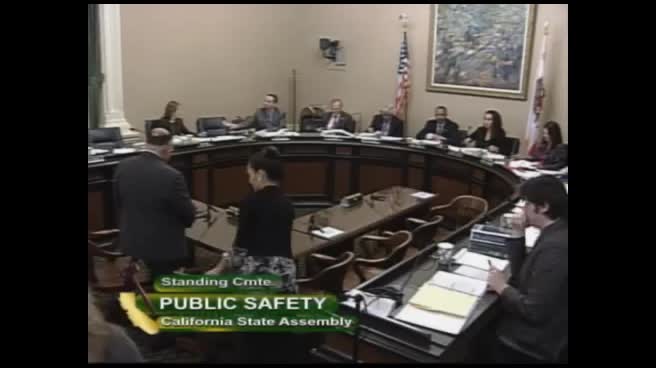
Bill Author