AB 1780: Greenhouse Gas Reduction Fund: trade corridors.
- Session Year: 2015-2016
- House: Assembly
- Latest Version Date: 2016-03-28
The California Global Warming Solutions Act of 2006 designates the State Air Resources Board as the state agency charged with monitoring and regulating sources of emissions of greenhouse gases. The state board is required to adopt a statewide greenhouse gas emissions limit equivalent to the statewide greenhouse gas emissions level in 1990 to be achieved by 2020. The act authorizes the state board to include the use of market-based compliance mechanisms. Existing law requires all moneys, except for fines and penalties, collected by the state board as part of a market-based compliance mechanism to be deposited in the Greenhouse Gas Reduction Fund and to be available upon appropriation. Existing law continuously appropriates 60% of the annual proceeds of the fund for transit, affordable housing, sustainable communities, and high-speed rail purposes.
This bill, beginning in the 201617 fiscal year, would continuously appropriate 25% 20% of the annual proceeds of the fund to the California Transportation Commission for the Sustainable Trade Corridors Program, which the bill would establish, to be allocated to reduce greenhouse gas emissions in trade corridors consistent with specified guidelines, thereby making an appropriation.
The California Global Warming Solutions Act of 2006 designates the State Air Resources Board as the state agency charged with monitoring and regulating sources of emissions of greenhouse gases. The state board is required to adopt a statewide greenhouse gas emissions limit equivalent to the statewide greenhouse gas emissions level in 1990 to be achieved by 2020. The act authorizes the state board to include the use of market-based compliance mechanisms. Existing law requires all moneys, except for fines and penalties, collected by the state board as part of a market-based compliance mechanism to be deposited in the Greenhouse Gas Reduction Fund and to be available upon appropriation. Existing law continuously appropriates 60% of the annual proceeds of the fund for transit, affordable housing, sustainable communities, and high-speed rail purposes.
This bill, beginning in the 201617 fiscal year, would continuously appropriate 25% of the annual proceeds of the fund to the California Transportation Commission for the Sustainable Trade Corridors Program, which the bill would establish, thereby making an appropriation.
(a)The Legislature shall appropriate the annual proceeds of the fund for the purpose of reducing greenhouse gas emissions in this state in accordance with the requirements of Section 39712.
(b)To carry out a portion of the requirements of subdivision (a), annual proceeds are continuously appropriated for the following:
(1)Beginning in the 201617 fiscal year, and notwithstanding Section 13340 of the Government Code, 60 55 percent of annual proceeds are continuously appropriated, without regard to fiscal years, for transit, affordable housing, and sustainable communities programs as follows:
(A)Ten percent of the annual proceeds of the fund is hereby continuously appropriated to the Transportation Agency for the Transit and Intercity Rail Capital Program created by Part 2 (commencing with Section 75220) of Division 44 of the Public Resources Code.
(B)Five percent of the annual proceeds of the fund is hereby continuously appropriated to the Low Carbon Transit Operations Program created by Part 3 (commencing with Section 75230) of Division 44 of the Public Resources Code. Moneys shall be allocated by the Controller, according to requirements of the program, and pursuant to the distribution formula in subdivision (b) or (c) of Section 99312 of, and Sections 99313 and 99314 of, the Public Utilities Code.
(C)Twenty percent of the annual proceeds of the fund is hereby continuously appropriated to the Strategic Growth Council for the Affordable Housing and Sustainable Communities Program created by Part 1 (commencing with Section 75200) of Division 44 of the Public Resources Code. Of the amount appropriated in this subparagraph, no less than 10 percent of the annual proceeds shall be expended for affordable housing, consistent with the provisions of that program.
(D)Twenty-five Twenty percent of the annual proceeds of the fund shall be transferred to the Trade Corridors Improvement Fund, continued in existence pursuant to Section 2192 of the Streets and Highways Code, and is hereby continuously appropriated to the California Transportation Commission for the Sustainable Trade Corridors Program created by Section 2192.4 of the Streets and Highways Code. to be allocated to reduce greenhouse gas emissions in trade corridors consistent with the Trade Corridors Improvement Fund guidelines developed by the commission.
(2)Beginning in the 201516 fiscal year, notwithstanding Section 13340 of the Government Code, 25 percent of the annual proceeds of the fund is hereby continuously appropriated to the High-Speed Rail Authority for the following components of the initial operating segment and Phase I Blended System as described in the 2012 business plan adopted pursuant to Section 185033 of the Public Utilities Code:
(A)Acquisition and construction costs of the project.
(B)Environmental review and design costs of the project.
(C)Other capital costs of the project.
(D)Repayment of any loans made to the authority to fund the project.
(c)In determining the amount of annual proceeds of the fund for purposes of the calculation in subdivision (b), the funds subject to Section 39719.1 shall not be included.
SEC. 2.Section 2192.4 is added to the Streets and Highways Code, to read:2192.4.(a)The Sustainable Trade Corridors Program is hereby established and shall be administered by the commission.
(b)(1)Moneys appropriated to the commission for the program from the Greenhouse Gas Reduction Fund, pursuant to Section 39719 of the Health and Safety Code, shall be allocated by the commission consistent with the requirements of this chapter.
(2)At least 10 percent of the moneys available for the program shall be allocated for research and development projects that promote sustainable trade corridors, consistent with the requirements of Section 2192.2.
(c)(1)Applications for grants under the program shall be submitted to the commission for evaluation in accordance with procedures and program guidelines approved by the commission.
(2)The application shall define the project purpose, intended scope, proposed cost, intended funding sources, and schedule for project completion.
(3)Eligible applicants may submit more than one application for grants under the program pursuant to this section.
(a)The Legislature shall appropriate the annual proceeds of the fund for the purpose of reducing greenhouse gas emissions in this state in accordance with the requirements of Section 39712.
(b)To carry out a portion of the requirements of subdivision (a), annual proceeds are continuously appropriated for the following:
(1)Beginning in the 201516 201617 fiscal year, and notwithstanding Section 13340 of the Government Code, 35 60 percent of annual proceeds are continuously appropriated, without regard to fiscal years, for transit, affordable housing, and sustainable communities programs as following: follows:
(A)Ten percent of the annual proceeds of the fund is hereby continuously appropriated to the Transportation Agency for the Transit and Intercity Rail Capital Program created by Part 2 (commencing with Section 75220) of Division 44 of the Public Resources Code.
(B)Five percent of the annual proceeds of the fund is hereby continuously appropriated to the Low Carbon Transit Operations Program created by Part 3 (commencing with Section 75230) of Division 44 of the Public Resources Code. Funds Moneys shall be allocated by the Controller, according to requirements of the program, and pursuant to the distribution formula in subdivision (b) or (c) of Section 99312 of, and Sections 99313 and 99314 of, the Public Utilities Code.
(C)Twenty percent of the annual proceeds of the fund is hereby continuously appropriated to the Strategic Growth Council for the Affordable Housing and Sustainable Communities Program created by Part 1 (commencing with Section 75200) of Division 44 of the Public Resources Code. Of the amount appropriated in this subparagraph, no less than 10 percent of the annual proceeds, proceeds shall be expended for affordable housing, consistent with the provisions of that program.
(D)Twenty-five percent of the annual proceeds of the fund shall be transferred to the Trade Corridors Improvement Fund, continued in existence pursuant to Section 2192 of the Streets and Highways Code, and is hereby continuously appropriated to the California Transportation Commission for the Sustainable Trade Corridors Program created by Section 2192.4 of the Streets and Highways Code.
(2)Beginning in the 201516 fiscal year, notwithstanding Section 13340 of the Government Code, 25 percent of the annual proceeds of the fund is hereby continuously appropriated to the High-Speed Rail Authority for the following components of the initial operating segment and Phase I Blended System as described in the 2012 business plan adopted pursuant to Section 185033 of the Public Utilities Code:
(A)Acquisition and construction costs of the project.
(B)Environmental review and design costs of the project.
(C)Other capital costs of the project.
(D)Repayment of any loans made to the authority to fund the project.
(c)In determining the amount of annual proceeds of the fund for purposes of the calculation in subdivision (b), the funds subject to Section 39719.1 shall not be included.
SEC. 2.Section 2192.4 is added to the Streets and Highways Code, to read:2192.4.(a)The Sustainable Trade Corridors Program is hereby established and shall be administered by the commission.
(b)(1)Moneys appropriated to the commission for the program from the Greenhouse Gas Reduction Fund, pursuant to Section 39719 of the Health and Safety Code, shall be allocated by the commission consistent with the requirements of this chapter.
(2)At least 10 percent of the moneys available for the program shall be allocated for research and development projects that promote sustainable trade corridors, consistent with the requirements of Section 2192.2.
(c)(1)Applications for grants under the program shall be submitted to the commission for evaluation in accordance with procedures and program guidelines approved by the commission.
(2)The application shall define the project purpose, intended scope, proposed cost, intended funding sources, and schedule for project completion.
(3)Eligible applicants may submit more than one application for grants under the program pursuant to this section.
|
Date
|
Status
|
|---|---|
| Feb 3, 2016 | Read first time. To print. |
| Feb 4, 2016 | From printer. May be heard in committee March 5. |
| Feb 18, 2016 | Referred to Com. on TRANS. |
| Mar 10, 2016 | In committee: Set, first hearing. Hearing canceled at the request of author. |
| Mar 28, 2016 | From committee chair, with author's amendments: Amend, and re-refer to Com. on TRANS. Read second time and amended. |
| Mar 29, 2016 | Re-referred to Com. on TRANS. |
| Apr 5, 2016 | From committee: Do pass and re-refer to Com. on APPR. (Ayes 15. Noes 0.) (April 4). Re-referred to Com. on APPR. |
| Apr 20, 2016 | In committee: Set, first hearing. Referred to APPR. suspense file. |
| May 27, 2016 | In committee: Held under submission. |
|
Date
|
Description
|
Location
|
Votes
|
|
|---|---|---|---|---|
| Apr 4, 2016 | Do pass and be re-referred to the Committee on [Appropriations] | Assembly Standing Committee on Transportation |
Passed |
This list shows positions taken on this bill by organizations on the date displayed, which is linked to the original source.
Positions by individuals are not included.
|
Organization
|
Position
|
Date
|
|---|---|---|
| Aaa Northern California, Nevada & Utah Insurance Exchange And Affiliates | * Support | Apr 4, 2016 |
| Alameda Corridor-East Construction Authority | ** Support | Apr 4, 2016 |
| Alameda county Quarters construction authority | * Support | Apr 4, 2016 |
| ASPCA | * Support | Jun 20, 2018 |
| Auto Club in Southern California | * Support | Apr 4, 2016 |
| Automobile Club of Southern California | ** Support | Apr 4, 2016 |
| California Association Of Port Authorities | * Support | Apr 4, 2016 |
| California Chamber Of Commerce | ** Against | Apr 4, 2016 |
| California railroad industry | * Support | Apr 4, 2016 |
| California Transportation Commission | ** Support | Apr 4, 2016 |
| Majestic Realty Co. | * Support | Apr 4, 2016 |
| Mobility 21 | ** Support | Apr 4, 2016 |
| Pacific Merchant Shipping Association | ** Support | Apr 4, 2016 |
| Riverside County Mayor | * Support | Apr 4, 2016 |
| Riverside County Transportation Commission | ** Support | Apr 4, 2016 |
| Rural County Representatives of California | ** Against | Apr 4, 2016 |
| Self-Help Counties Coalition | ** Support | Apr 4, 2016 |
| Suffolk County School Coalition | * Support | Apr 4, 2016 |
Date of Hearing: April 20, 2016
ASSEMBLY COMMITTEE ON APPROPRIATIONS
Lorena Gonzalez, Chair
ABPCA Bill Id:AB 1780
Author:(Medina) – As Amended Ver:March 28, 2016
Policy Committee: | Transportation | Vote: | 15 - 0 |
|
|
Urgency: No State Mandated Local Program: No Reimbursable: No
SUMMARY:
This bill continuously appropriates 20% of annual Greenhouse Gas Reduction Fund (GGRF) revenues to the Trade Corridor Improvement Fund (TCIF), to be distributed by the California Transportation Commission (CTC) in accordance with established TCIF guidelines.
FISCAL EFFECT:
Assuming GGRF revenues of $2 billion annually through 2020, this bill earmarks 20%, or $400 million of these revenues to the TCIF. (Current law continuously appropriates 60% of GGRF revenues for transit, affordable housing and sustainable communities programs, and high speed rail.)
COMMENTS:
- Background. In 2006, voters approved Proposition 1B, which authorized the issuance of almost $20 billion in general obligation bonds to fund transportation projects. Following passage of Proposition 1B, the TCIF was created for allocation of $2 billion included in the bond act for projects to improve goods movement on state highways, rail systems, and ports, and the CTC was directed to allocate the funds to goods movement projects identified in statewide planning documents. All of the $2 billion Proposition 1B bond proceeds have been expended or dedicated for specific projects.
Recognizing the benefits that the TCIF program provided in addressing air quality impacts and California's goods movement system needs, SB 1228 (Hueso), Chapter 787, Statues of 2014 continued the existence of TCIF and authorized the program to receive funds from other sources, including the GGRF.
- Purpose. The author points out that, while SB 1228 established a basic framework, it did not provide much- needed funding. AB 1780 establishes a dedicated funding stream for the TCIF by continuously appropriating 20% of annual GGRF funds.
- Opposition. The Rural County Representatives of California (RCRC), while supportive of the TCIF program, take issue with the continuous appropriation of GGRF funds into the TCIF, noting that a substantial portion of GGRF monies are already permanently allocated to other programs, leaving only a small portion available to support programs that are vital to rural communities.
- Related Legislation. AB 2170 (Frazier), also on today's committee agenda, requires that federal funding for freight-related infrastructure projects apportioned to California from the Fixing America's Surface Transportation (FAST) Act (about $116 million annually) be deposited into the TCIF.
Analysis Prepared by: Chuck Nicol / APPR. / (916) 319-2081
Date of Hearing: April 4, 2016
ASSEMBLY COMMITTEE ON TRANSPORTATION
Jim Frazier, Chair
ABPCA Bill Id:AB 1780 (
Author:Medina) – As Amended Ver:March 28, 2016
SUBJECT: Greenhouse Gas Reduction Fund: Sustainable Trade Corridors Program
SUMMARY: Continuously appropriates 20% of annual Greenhouse Gas Reduction Fund (GGRF) proceeds to the Trade Corridor Improvement Fund (TCIF) to be distributed by the California Transportation Commission (Commission) in accordance with established TCIF guidelines.
EXISTING LAW:
- Requires the Air Resources Board (ARB), pursuant to AB 32 (Nunez), Chapter 488, Statutes of 2006, to develop a plan of how to reduce statewide greenhouse gas (GHG) emissions to 1990 levels by 2020. Under AB 32, ARB is authorized to include the use of market-based mechanisms to comply with these regulations (cap and trade).
- Establishes the GGRF in the State Treasury and requires all money collected pursuant to cap and trade, with limited exceptions, be deposited into the fund and makes the GGRF funds available for appropriation by the Legislature.
- Continuously appropriates 60% of GGRF fund proceeds, beginning in the 2015-16 fiscal year, for transit, affordable housing and sustainable communities programs, and high speed rail.
- Established the TCIF, following the passage of the Highway Safety, Traffic Reduction, Air Quality, and Port Security Bond Act of 2006 (Proposition 1B) on November 7, 2006, for the distribution of $2 billion of Proposition 1B bond funds by the Commission in accordance with established criteria for infrastructure improvements along federally designated "Trade Corridors of National Significance" or along other corridors with high volumes of freight movement.
- Continues the existence of the TCIF to receive funding from sources other than Proposition 1B including transfers from the GGRF for specified trade corridor infrastructure improvements.
- Requires, pursuant to the federal Fixing America's Surface Transportation (FAST) Act, that states desiring to obtain freight formula funding have prepared a state freight plan, developed in accordance with federal requirements,
- Requires, pursuant to SB 535 (de León), Chapter 830, Statutes of 2012, that a minimum of 25% of the moneys available in GGRF be used to benefits disadvantaged communities.
FISCAL EFFECT: Unknown
COMMENTS: California's goods movement system is the bedrock of our economy, providing hundreds of thousands of jobs across the state and the nation. California's land, air, and sea ports of entry serve as key commercial gateways for the movement of more than $500 billion worth of products each year. These goods flow into and out of California's gateways and are moved across our surface transportation systems such as highways, rail systems, and local streets and roads.
Despite the economic benefits that goods movement represents, the industry also places a heavy burden on the state in terms of increased demand on transportation infrastructure and increased environmental impacts such as land development pressure, noise, and increased criteria pollutant and GHG emissions. These impacts are experienced across the state but are most keenly felt in disadvantaged communities that typically border major transportation corridors and hubs such as warehousing districts and sea ports.
In response to the increasing need for funding to improve the states deteriorating transportation infrastructure, voters approved Proposition 1B in 2006 that authorized the sale of general obligation bonds to fund transportation projects across the state to relieve congestion, improve goods movement flow, enhance the safety and security of the transportation system, and improve the state's air quality. Of the $19.9 billion approved by voters, $2 billion of bond proceeds were placed into the then-newly created TCIF program to fund transportation corridor improvements.
The TCIF program, administered by the Commission in accordance with the TCIF guidelines, was designated to fund projects identified in specified transportation infrastructure planning documents. The TCIF guidelines ensured that funds were equitably distributed across the state, that the highest statewide priority projects were funded, and that the funds were leveraged to ensure that the greatest number of projects were completed. The Commission's role was to ensure that the state and regions worked collaboratively to identify the highest priority projects that provide the greatest congestion relief benefits and that these projects were completed on schedule and within budget. Not only did TCIF achieve the goal of getting regions around the state to work together, it created jobs, reduced congestion, improved the state's air quality, and helped the state achieve its emissions reduction goals. Also, by requiring that projects receive matching funds, the TCIF successfully leveraged the program's $2 billion in bond funds to complete $7.2 billion in projects. To date, all of the Proposition 1B funds have been allocated and projects using TCIF are all nearly completed.
Recognizing the benefits that the TCIF program provided in addressing air quality impacts and California's goods movement system needs, the Legislature approved, and the Governor signed, SB 1228 (Hueso), Chapter 787, Statues of 2014, to continue the existence of TCIF and clear the way for it to receive funds other than Proposition 1B dollars, namely GGRF funds. SB 1228 also updated the list of key freight planning documents used guide program expenditures. The intent of SB 1228 was to allow state and local jurisdictions to leverage cap and trade funds to complete key freight corridor projects to reduce congestion and address the state's air quality and climate change goals, particularly in areas with the poorest air quality and in disadvantaged communities.
The author points out that while SB 1228 established a basic framework, it did not provide much needed funding. To address this need, the author introduced AB 1780 that establishes a dedicated funding stream for the TCIF by continuously appropriating 20% of GGRF funds annually to the TCIF. This appropriation would allow eligible, high priority freight projects to be developed by state, regional, and local entities to address California's goods movement, air quality, and climate change goals.
In addition to state efforts directed at goods movement, recent federal transportation bills have also highlighted the need for freight planning and funding at the state level. For example, in the last federal transportation reauthorization (MAP-21) the need for comprehensive goods movement planning across the nation was highlighted and states were encouraged to develop comprehensive freight planning documents. More recently, in the FAST Act, states with freight plans were made eligible to receive formula funding (approximately $150 million per year) for freight projects identified in state freight plans.
In responding to MAP-21's call for freight planning, Caltrans developed the California Freight Mobility Plan (CFMP), with input from the California Freight Advisory Committee, a group whose membership represents a broad cross section of state, federal, local, business, and community interests in goods movement. The CFMP identified over $138 billion in freight projects across the state including $30 billion in Tier 1 projects alone. While the $150 million annually in federal funding will be helpful, it will not come close to meeting the near- or the long-term need identified in the CFMP.
Writing in support of this bill, the Automobile Club of Southern California points out that this bill will result in much-needed infrastructure improvements on the state's major trade corridors and also have a positive impact on air pollution and GHG emissions. They correctly point out that by addressing key freight system bottlenecks, providing rail grade separations, and implementing other important infrastructure improvements, vehicle hours of delay will be reduced; travel time, reliability and congestion will be improved; traffic safety will be enhanced; and vehicle emissions will decline as trucks and trains move more efficiently throughout the state.
Writing in opposition to this bill, the Rural County Representatives of California (RCRC) note that, despite being supportive of the TCIF program, they take issue with the continuous appropriation of GGRF funds into the TCIF. They point out that a substantial portion of GGRF monies are already permanently allocated to other programs, leaving only a small portion available to support programs that are vital to rural communities. RCRC also points out that rural communities are not always able to access GGRF for transportation projects because they do not meet the statutorily-established definition of disadvantaged communities despite the fact that many rural communities meet other defining disadvantaged community criteria recognized by the state.
Related legislation: AB 2107 (Frazier), directs FAST Act freight funding into the TCIF for allocation by the Commission. AB 2107 is scheduled to be heard by this committee on April 4, 2016.
AB 1591 (Frazier), provides nearly $8 billion a year in additional transportation funding, including allocation 20 % of cap and trade revenues, through the TCIF, for projects along major freight corridors. AB 1591 is currently awaiting a hearing in this committee.
SBX1 1 (Beall), would, among other things, deposit approximately $300 million from a proposed diesel tax to fund TCIF projects. SBX1 1 is currently awaiting a hearing in the Senate Appropriations Committee.
Previous legislation: SB 1228 (Hueso), Chapter 787, Statutes of 2014, continued the existence of the TCIF to receive funding from sources including transfers from the GGRF for specified trade corridor infrastructure improvements.
SB 535 (de León), Chapter 830, Statutes of 2012, required, among other things, that a minimum of 25% of the moneys available in GGRF be used to benefits disadvantaged communities.
REGISTERED SUPPORT / OPPOSITION:
Support
Riverside County Transportation Commission (Sponsor)
Alameda Corridor-East Construction Authority
Automobile Club of Southern California
California Association of Port Authorities
California Transportation Commission
Mobility 21
Pacific Merchant Shipping Association
Self-Help Counties Coalition
Opposition
California Chamber of Commerce
Rural County Representatives of California
Analysis Prepared by: Victoria Alvarez / TRANS. / (916) 319-2093
Discussed in Hearing
 4MIN
Senate Standing Committee on Health
 9MIN
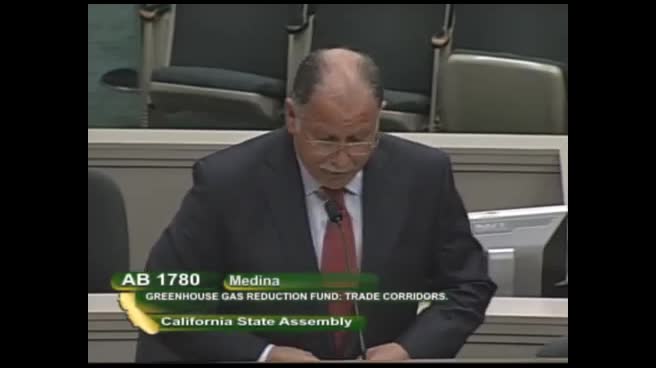
Assembly Standing Committee on Transportation
Bill Author

Bill Co-Author(s):