AB 1800: Utility outage compensation claims: annual posting.
- Session Year: 2015-2016
- House: Assembly
- Latest Version Date: 2016-04-26
Under existing law, the Public Utilities Commission has regulatory authority over public utilities, including electrical corporations, while local publicly owned electric utilities are under the direction of their governing boards. Existing law requires each electrical corporation to report annually on its compliance with specified standards or rules adopted by the commission, including, but not limited to, standards for operation, reliability, and safety during periods of emergency and disaster. Existing law requires the commission to adopt inspection, maintenance, repair, and replacement standards for the distribution systems of electrical corporations in order to provide high-quality, safe, and reliable service. Existing law requires the commission to conduct a review to determine whether the standards have been met and to perform the review after every major outage.
The existing restructuring of the electrical industry within the Public Utilities Act provides for the establishment of an Independent System Operator, or ISO, as a nonprofit public benefit corporation and requires the ISO to ensure efficient use and reliable operation of the electrical transmission grid consistent with achieving planning and operating reserve criteria no less stringent than those established by the Western Electricity Coordinating Council and the North American Electric Reliability Council. Existing law requires the ISO to perform a review after any major outage that affects at least 10% of the customers of the entity providing the local distribution service. If the ISO finds that the operation and maintenance practices of the transmission facility owner or operator prolonged the response time or was responsible for the outage, the ISO is authorized to order appropriate sanctions, subject to the Federal Energy Regulatory Commission approving that authority.
This bill would require each electrical corporation and local publicly owned electric utility to annually post on its Internet Web site specified information relating to utility outage compensation claims for the previous year. The bill would make these requirements applicable to those outages that the ISO, the commission, or the utility has determined are the fault of the utility. utility, or those claims relating to outages that the utility has determined to pay. By adding reporting requirements that are applicable to local publicly owned electric utilities, the bill would impose a state-mandated local program. The bill would prohibit information relating to utility outage compensation claims from being admitted as evidence in any action for damages against an electrical corporation or local publicly owned electric utility arising out of an outage.
The California Constitution requires the state to reimburse local agencies and school districts for certain costs mandated by the state. Statutory provisions establish procedures for making that reimbursement.
This bill would provide that no reimbursement is required by this act for a specified reason.
Under existing law, the Public Utilities Commission has regulatory authority over public utilities, including electrical corporations, while local publicly owned electric utilities are under the direction of their governing boards. Existing law requires each electrical corporation to report annually on its compliance with specified standards or rules adopted by the commission, including, but not limited to, standards for operation, reliability, and safety during periods of emergency and disaster. Existing law requires the commission to adopt inspection, maintenance, repair, and replacement standards for the distribution systems of electrical corporations in order to provide high-quality, safe, and reliable service. Existing law requires the commission to conduct a review to determine whether the standards have been met and to perform the review after every major outage.
The existing restructuring of the electrical industry within the Public Utilities Act provides for the establishment of an Independent System Operator, or ISO, as a nonprofit public benefit corporation and requires the ISO to ensure efficient use and reliable operation of the electrical transmission grid consistent with achieving planning and operating reserve criteria no less stringent than those established by the Western Electricity Coordinating Council and the North American Electric Reliability Council. Existing law requires the ISO to perform a review after any major outage that affects at least 10% of the customers of the entity providing the local distribution service. If the ISO finds that the operation and maintenance practices of the transmission facility owner or operator prolonged the response time or was responsible for the outage, the ISO is authorized to order appropriate sanctions, subject to the Federal Energy Regulatory Commission approving that authority.
This bill would require each electrical corporation and local publicly owned electric utility to annually post on its Internet Web site specified information relating to utility outage compensation claims for the previous year. The bill would make these requirements applicable to those outages that the ISO, the commission, or the utility has determined are the fault of the utility. By adding reporting requirements that are applicable to local publicly owned electric utilities, the bill would impose a state-mandated local program.
The California Constitution requires the state to reimburse local agencies and school districts for certain costs mandated by the state. Statutory provisions establish procedures for making that reimbursement.
This bill would provide that no reimbursement is required by this act for a specified reason.
Under existing law, the Public Utilities Commission has regulatory authority over public utilities, including electrical corporations, while local publicly owned electric utilities are under the direction of their governing boards. Existing law requires each electrical corporation to report annually on its compliance with specified standards or rules adopted by the commission, including, but not limited to, standards for operation, reliability, and safety during periods of emergency and disaster.
This bill would require each electrical corporation and local publicly owned electric utility to annually post on its Internet Web site specified information relating to utility outage compensation claims for the previous year.
The reporting requirements of this chapter apply only to those outages that the Independent System Operator, the commission, or the electrical corporation or local publicly owned electric utility has determined are the fault of the utility. utility, or those claims relating to outages that the utility has determined to pay.
8391.Each electrical corporation and local publicly owned electric utility shall annually post on its Internet Web site all of the following information relating to utility outage compensation claims for the previous year:
(a)The number of claims still open from the previous year.
(b)The number of new claims received.
(c)The total number of applicants awaiting determination or judgment at the end of the year.
(d)The median time taken to process claims once the outage was determined to be the fault of the utility. utility, or once the utility has determined to pay.
(e)The number of claims approved.
(f)The number of claims denied.
8392.Information relating to utility outage compensation claims shall not be admitted as evidence in any action for damages against an electrical corporation or local publicly owned electric utility arising out of an outage.
SEC. 2.No reimbursement is required by this act pursuant to Section 6 of Article XIIIB of the California Constitution because a local agency or school district has the authority to levy service charges, fees, or assessments sufficient to pay for the program or level of service mandated by this act, within the meaning of Section 17556 of the Government Code.
The reporting requirements of this chapter apply only to those outages that the Independent System Operator, the commission, or the electrical corporation or local publicly owned electric utility has determined are the fault of the utility.
8390.8391.Each electrical corporation and local publicly owned electric utility shall annually post on its Internet Web site all of the following information relating to utility outage compensation claims for the previous year:
(a)Applications The number of claims still open from the previous year.
(b)New applications The number of new claims received.
(c)The number of incomplete applications received.
(d)Total number of incomplete applications that were still left incomplete by the end of the year.
(e)Pool of total
(c)The total number of applicants awaiting determination or judgment at the end of the year.
(f)Progress on processing applications.
(g)Current average
(d)The median time taken to process applications. claims once the outage was determined to be the fault of the utility.
(h)
(e)The number of applications claims approved.
(i)The percentage of applications approved.
(j)
(f)The number of applications claims denied.
(k)The average number of days it took to close approved applications.
(l)The average number of days it took to close denied applications.
(m)The number of denied applications that were subsequently appealed.
(n)The number of successful appeals from denied applications.
(o)For the Successful appeals, the average number of days between the submission of the appeal and the closing of the appeal.
(p)The average amount paid for successful claims.
SEC. 2.No reimbursement is required by this act pursuant to Section 6 of Article XIIIB of the California Constitution because a local agency or school district has the authority to levy service charges, fees, or assessments sufficient to pay for the program or level of service mandated by this act, within the meaning of Section 17556 of the Government Code.
Each electrical corporation and local publicly owned electric utility shall annually post on its Internet Web site all of the following information relating to utility outage compensation claims for the previous year:
(a)Applications still open from the previous year.
(b)New applications received.
(c)The number of incomplete applications received.
(d)Total number of incomplete applications that were still left incomplete by the end of the year.
(e)Pool of total applicants awaiting determination or judgment at the end of the year.
(f)Progress on processing applications.
(g)Current average time taken to process applications.
(h)The number of applications approved.
(i)The percentage of applications approved.
(j)The number of applications denied.
(k)The average number of days it took to close approved applications.
(l)The average number of days it took to close denied applications.
(m)The number of denied applications that were subsequently appealed.
(n)The number of successful appeals from denied applications.
(o)For the Successful appeals, the average number of days between the submission of the appeal and the closing of the appeal.
(p)The average amount paid for successful claims.
|
Date
|
Status
|
|---|---|
| Feb 8, 2016 | Read first time. To print. |
| Feb 9, 2016 | From printer. May be heard in committee March 10. |
| Feb 18, 2016 | Referred to Com. on U. & C. |
| Mar 9, 2016 | In committee: Set, first hearing. Hearing canceled at the request of author. |
| Mar 28, 2016 | In committee: Set, second hearing. Hearing canceled at the request of author. |
| Apr 4, 2016 | From committee chair, with author's amendments: Amend, and re-refer to Com. on U. & C. Read second time and amended. |
| Apr 5, 2016 | Re-referred to Com. on U. & C. |
| Apr 25, 2016 | From committee: Amend, and do pass as amended and re-refer to Com. on APPR. (Ayes 14. Noes 0.) (April 20). |
| Apr 26, 2016 | Read second time and amended. |
| Apr 27, 2016 | Re-referred to Com. on APPR. |
| May 11, 2016 | In committee: Set, first hearing. Referred to APPR. suspense file. |
| May 27, 2016 | In committee: Held under submission. |
|
Date
|
Description
|
Location
|
Votes
|
|
|---|---|---|---|---|
| Apr 20, 2016 | Do pass as amended and be re-referred to the Committee on [Appropriations] | Assembly Standing Committee on Utilities and Commerce |
Passed |
This list shows positions taken on this bill by organizations on the date displayed, which is linked to the original source.
Positions by individuals are not included.
|
Organization
|
Position
|
Date
|
|---|---|---|
| California Municipal Utilities Association | ** Against | Apr 20, 2016 |
| City of Rancho Palos Verdes | ** Support | Apr 20, 2016 |
| Councilman for Rancho Palos Verdes | * Support | Apr 20, 2016 |
| Mayor of Rancho Palos Verdes | * Support | Apr 20, 2016 |
| The Utility Reform Network | ** Support | Apr 20, 2016 |
Date of Hearing: May 11, 2016
ASSEMBLY COMMITTEE ON APPROPRIATIONS
Lorena Gonzalez, Chair
ABPCA Bill Id:AB 1800
Author:(Hadley) – As Amended Ver:April 26, 2016
Policy Committee: | Utilities and Commerce | Vote: | 14 - 0 |
|
|
Urgency: No State Mandated Local Program: Yes Reimbursable: No
SUMMARY:
This bill requires electrical corporations and publicly-owned electric utilities to post specified information relating to utility outage compensation claims on their websites. Specifically, this bill:
- Requires each electrical corporation and local publicly-owned electric utility to annually post the following information relating to utility outage compensation claims for the previous year on its website:
- The number of claims that remain open from the previous year.
- The number of new claims received in the current year.
- The total number of applicants awaiting determination or judgment at the end of the year.
- The median time taken to process claims once the outage was determined to be the fault of the utility.
- The number of claims approved and denied.
- Specifies the posting requirements only apply to those outages that the Independent System Operator (ISO), the California Public Utilities Commission (PUC), or the electrical corporation or local publically-owned electric utility determined are the fault of the utility or those claims the utility has determined to pay.
- Prohibits information relating to utility outage compensation claims from being admitted as evidence in any legal action for damages arising from an outage.
FISCAL EFFECT
Increased one-time costs of approximately $170,000 (special fund) if the PUC determines a proceeding is necessary to address issues from stakeholders to establish the new program.
COMMENTS:
- Purpose. According to the author, this bill will inspire more confidence in the claims process by giving utility ratepayers the information necessary to know if their claims for reimbursement are being fairly and expeditiously processed.
- Background. In most cases, electric utilities provide businesses and residents reimbursements if they suffered a loss or damage due to a service interruption as a result of the utility. According to Southern California Edison’s (SCE) website, it evaluates each claim individually to determine if losses occurred due to its negligence, how the incident happened, the extent of damages, and what the law considers fair compensation. If SCE denies a claim, they will explain the reasons for the denial. SCE’s goal is to reach a decision on most claims within 30 days of receipt. Pacific Gas, and Electric (PG&E) and
San Diego Gas and Electric (SDG&E) also have similar claims processes. - Suggested Amendments. This bill was amended in the Utilities and Commerce Committee to prohibit information relating to utility outage compensation claims from being admitted as evidence in any legal action for damages arising from an outage. This amendment was not vetted with stakeholders or the appropriate policy committee and concerns have arisen regarding its interpretation and implementation.
The author may wish to remove this provision and continue working with stakeholders and others to address any liability issues, as warranted, resulting from this bill.
Analysis Prepared by: Jennifer Galehouse / APPR. / (916) 319-2081
Date of Hearing: April 20, 2016
ASSEMBLY COMMITTEE ON UTILITIES AND COMMERCE
Mike Gatto, Chair
ABPCA Bill Id:AB 1800 (
Author:Hadley) – As Amended Ver:April 4, 2016
SUBJECT: Utility outage compensation claims: annual posting
SUMMARY: Requires an electric utility to post specified information relating to utility outage compensation claims on its Internet Web site. Specifically, this bill:
- Requires each electrical corporation and local publicly owned electric utility to annually post all of the following information relating to utility outage compensation claims for the previous year on its Web site:
- The number of claims that remain open from the previous year.
- The number of new claims received in the current year.
- The total number of applicants awaiting determination or judgment at the end of the year.
- The median time taken to process claims once the outage was determined to be the fault of the utility.
- The number of claims approved.
- The number of claims denied.
- Specifies that the posting requirements only apply to those outages that the Independent System Operator (ISO), the California Public Utilities Commission (CPUC), or the electrical corporation or local publically owned electric utility has determined are the fault of the utility.
EXISTING LAW:
- Gives the CPUC regulatory authority over public utilities, including electrical corporations and gas corporations, as defined. (Public Utilities Code 218 and 222, et. seq.)
- Defines an "electrical corporation" to include every corporation or person owning, controlling, operating, or managing any electric plant for compensation within the state, as specified. (Public Utilities Code Section 218)
- Defines "local publicly owned electric utility" as a municipality or municipal corporation operating as a "public utility" furnishing electric service, a municipal utility district furnishing electric service, a public utility district furnishing electric service, an irrigation district furnishing electric service, or a joint powers authority that includes one or more of specified agencies and that owns generation or transmission facilities, or furnishes electric services over its own or its member's electric distribution system. (Public Utilities Code Section 224.3)
- Requires the CPUC to adopt inspection, maintenance, repair, and replacement standards for distribution systems of electrical corporations, as well as standards for operation, reliability, and safety during periods of emergency and disaster, as specified. (Public Utilities Code Section 364)
- Requires the CPUC to establish standards for disaster and emergency preparedness plans, as specified. (Public Utilities Code Section 768.6)
FISCAL EFFECT: Unknown.
COMMENTS:
- Author's Statement: "AB 1800 will give utility ratepayers the information necessary to know if their claims for reimbursement are being fairly and expeditiously processed, and will inspire more confidence in the claims process."
- Background: Power outages are not an uncommon occurrence and can sometimes last a few hours to a few days. Such outages not only create an inconvenience for residents and businesses, but can also cause health and safety issues, as well as economic damages to businesses and communities. Under current law, the CPUC is required to adopt inspection, maintenance, repair, and replacement standards for electric distribution systems, as well as standards for operation, reliability, and safety during periods of emergency and disaster. The CPUC is also required to establish standards for disaster and emergency preparedness plans.
- Major Power Outages in Southern California: There have been several major power outages that have affected the Southern California area, including the Southwest Power Outage and the Southern California Windstorm Power Outages in 2011, and the Long Beach power outages in 2015. On September 8, 2011 work being performed on a transmission line in Arizona, caused a power outage that affected approximately 1.4 million electricity customers in California, Arizona, and Mexico. Power was fully restored within 12 hours. In addition, from November 30 to December 1, 2011, hurricane force winds caused a power outage thought the Southern California region that affected approximately 430,000 electric customers in Southern California Edison’s (SCE) territory. Power was not fully restored until December 8, 2011. More recently, fires in underground electric vaults caused two power outages that affected thousands of residents and business in the downtown Long Beach area. The two separate fires on July 15, 2015, and July 30, 2015, took out power for Long Beach residents for several days.
- Outages and Claims: In most cases, electric utilities provide businesses and residents reimbursements if they suffered a loss or damage due to a service interruption as a result of the utility. According to SCE’s Web site, it states that it evaluates each claim individually to determine if losses occurred due to its negligence, how the incident happened, the extent of damages, and what the law considers fair compensation. If SCE denies a claim, they will explain the reasons for the denial. SCE’s goal is to reach a decision on most claims within 30 days of receipt. PG&E and SDG&E also have similar claims processes.
- Reporting of Outage Claims: Utilities judge each claim individually. According to SCE’s website, SCE evaluates each claim individually, and determines: a) if loses occurred due to their negligence; b) how the incident happened; c) the extent of damages; and d) what is considered fair compensation. Customers must submit proof and documentation to verify their claims along with the application.
Depending on the situation each claim can have different results. For example, claims involving food loss and spoilage might result in claims of a few hundred dollars, whereas, claims involving bodily injury or property damage could result in claims of thousands of dollars. Hence, depending on the detail of information available, such data could provide different representations of a utilities claims process.
The author may wish to consider an amendment to mitigate the risk that the report could be used as evidence in a legal proceeding on a specific claim.
This bill requires each electric utility to post specific information related to the utilities outage compensation claims, that the ISO, CPUC, and the electric utility has determined are the fault of the utility, for the previous year on its Web site.
The author may also wish to consider an amendment to clarify the reporting requirement for utilities that do not differentiate between claims paid that are at the fault of the utility or was paid without regard to fault.
- Suggested Amendments:
Amend Sections 8390 and 8391 as follows:
8390. The reporting requirements of this chapter apply only to those outages that the Independent System Operator, the commission, or the electrical corporation or local publicly owned electric utility has determined are the fault of the utility, or that the electrical utility has determined to pay.
8391. (d) The median time taken to process applications. claims once the outage was determined to be the fault of the utility, or that the electrical utility has determined to pay.
Add the following section to the Public Utilities Code (PUC).
PUC Section ---: Information relating to utility outage compensation claims shall not be admitted as evidence in any action for damages against the utility arising out of an outage or outages.
- Arguments in Support: According to the City of Rancho Palos Verdes, "Customers may file claims for reimbursement, but there is currently no way to know what percentage of claims are being approved and denied, or how quickly, or the rationale behind these decisions. Without readily accessible claims data, many customers assume that all claims are denied. On the Palos Verdes Peninsula, [SCE] has recently confirmed that only 37% of claims filed over the past three years were paid."
- Arguments in Opposition: According to the California Municipal Utilities Association (CMUA), "CMUA opposes AB 1800 because [Publicly Owned Utilities (POUs)] are already required under the Tort Claims Act (Government Code 900 et seq.) to review claims within 45 days and provide written notice to the claimant regarding the outcome. Creating a new Public Utilities Code with new requirements for POUs is neither necessary nor consistent with current applicable Government Code sections. Additionally, each POU serves a specific locality, where customers may raise questions regarding their utilities services through regularly scheduled public meetings convened by locally elected officials."
- Related Legislation:
AB 2381 (Roger Hernández) of 2016: Requires an electrical corporation to establish a utility service guarantee program to provide bill credits for customer that experience power outages for over 24 hours. Pending in the Assembly Utilities and Commerce Committee.
REGISTERED SUPPORT / OPPOSITION:
Support
City of Rancho Palos Verdes
The Utility Reform Network (TURN)
Opposition
California Municipal Utilities Association
Southern California Public Power Authority
Sacramento Municipal Utility District
Analysis Prepared by: Edmond Cheung / U. & C. / (916) 319-2083
Discussed in Hearing
 15MIN
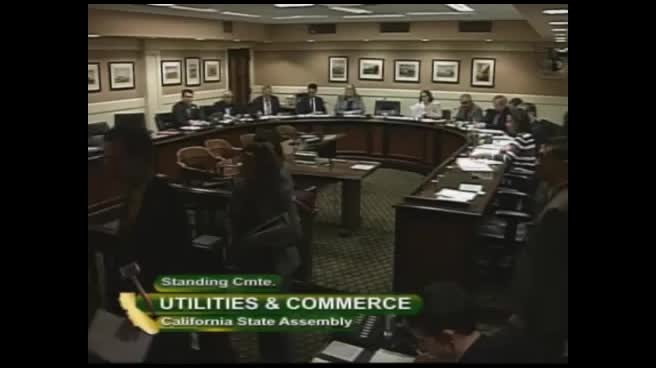
Assembly Standing Committee on Utilities and Commerce
Bill Author
Bill Co-Author(s):