AB 1889: High-Speed Rail Authority: high-speed train operation.
- Session Year: 2015-2016
- House: Assembly
- Latest Version Date: 2016-09-28
Existing law creates the High-Speed Rail Authority with specified powers and duties relative to the development and implementation of a high-speed train system. Existing law, pursuant to the Safe, Reliable High-Speed Passenger Train Bond Act for the 21st Century, approved by the voters as Proposition 1A at the November 4, 2008, statewide general election, provides for the issuance of $9.95 billion for high-speed train capital projects and other associated purposes. The bond act requires the authority to expend the proceeds of the bond act pursuant to certain planning and reporting requirements, which require the authority to approve that the corridor or usable segment would be suitable and ready for high-speed train operations.
This bill would provide for the purposes of a certain required funding plan that a corridor or usable segment thereof would be suitable and ready for high-speed train operation if specified conditions are met. The bill would also require the authority to include in its business plan and project update report information describing the use of these bond proceeds demonstrating that the investments made are consistent with the authoritys current business plan and advance the development of the Phase I blended system as described in the business plan.
Existing law creates the High-Speed Rail Authority with specified powers and duties relative to the development and implementation of a high-speed train system. Existing law, pursuant to the Safe, Reliable High-Speed Passenger Train Bond Act for the 21st Century, approved by the voters as Proposition 1A at the November 4, 2008, statewide general election, provides for the issuance of $9.95 billion for high-speed train capital projects and other associated purposes. The bond act requires the authority to expend the proceeds of the bond act pursuant to certain planning and reporting requirements, which require the authority to approve that the corridor or usable segment would be suitable and ready for high-speed train operations.
This bill would provide for the purposes of a certain plan that a corridor or usable segment thereof would be suitable and ready for high-speed train operation if specified conditions are met.
Existing law creates the High-Speed Rail Authority with specified powers and duties relative to the development and implementation of a high-speed train system. Existing law, pursuant to the Safe, Reliable High-Speed Passenger Train Bond Act for the 21st Century, approved by the voters as Proposition 1A at the November 4, 2008, statewide general election, provides for the issuance of $9.95 billion for high-speed train capital projects and other associated purposes. The bond act requires the authority to expend the proceeds of the bond act pursuant to certain planning and reporting requirements, which require the authority to approve that the corridor or usable segment would be suitable and ready for high-speed train operations.
The Budget Act of 2012 made appropriations for the support of state government, including an appropriation for, among other things, state operations, local assistance, or capital outlay for high-speed rail projects, as specified.
This bill would provide for the purposes of that appropriation that the approval by the authority a certain plan that a corridor or usable segment thereof would be suitable suitable and ready for high-speed train operation is conclusive. operation if specified conditions are met.
Existing law creates the High-Speed Rail Authority with specified powers and duties relative to the development and implementation of a high-speed train system. Existing law, pursuant to the Safe, Reliable High-Speed Passenger Train Bond Act for the 21st Century, approved by the voters as Proposition 1A at the November 4, 2008, statewide general election, provides for the issuance of $9.95 billion for high-speed train capital projects and other associated purposes. The bond act requires the authority to expend the proceeds of the bond act pursuant to certain planning and reporting requirements, which require the authority to approve that the corridor or usable segment would be suitable and ready for high-speed train operations.
The Budget Act of 2012 made appropriations for the support of state government, including an appropriation for, among other things, state operations, local assistance, or capital outlay for high-speed rail projects, as specified.
This bill would provide for the purposes of that appropriation that the approval by the authority that a corridor or usable segment thereof would be suitable and ready for high-speed train operation is conclusive.
Existing law, operative under certain conditions, redesignates the Peninsula Corridor Study Joint Powers Board as the Peninsula Rail Transit District, comprised of 9 members appointed from various governing bodies situated in the City and County of San Francisco and the Counties of San Mateo and Santa Clara, with specified powers.
This bill would repeal obsolete provisions relating to the Peninsula Rail Transit District.
Existing law provides for the creation of the Peninsula Corridor Joint Powers Board, which operates CalTrain as the commuter rail service along the San Francisco Peninsula commute corridor.
This bill would declare the intent of the Legislature to enact legislation to provide the Peninsula Corridor Joint Powers Board with the necessary tools to explore options that will help CalTrain obtain a dedicated source of funding.
(a)In passing AB 3034 (Chapter 267 of the Statutes of 2008), the Legislature placed before the voters the Safe, Reliable High-Speed Passenger Train Bond Act for the 21st Century (Proposition 1A), which was approved and provides $9 billion to initiate the construction of a high-speed train system connecting the San Francisco Transbay Terminal to Los Angeles Union Station and Anaheim and linking Californias major population centers.
(b)Additionally, Proposition 1A included $950 million for intercity, commuter, and urban rail systems that will ultimately provide connectivity to the high-speed train system.
(c)In 2012, the High-Speed Rail Authority released the Revised 2012 Business Plan, which called for near-term investments in northern and southern California, known as the Bookends, which would enable high-speed trains to share infrastructure with existing passenger rail service providers as part of a blended system, and is consistent with Proposition 1A.
(d)Also in 2012, using the Revised Business Plan as a guidepost, the Legislature passed and the Governor signed SB 1029 of the 201112 Regular Session (Chapter 152 of the Statutes of 2012), appropriating over $7.5 billion in state and federal funding to begin construction of the project in the central valley and in the Bookends, and for local connectivity projects throughout the state.
(e)Of the amount appropriated, the Legislature dedicated $1.1 billion to passenger rail projects on the systems Bookends that will ultimately be part of the blended system utilizing shared infrastructure.
(f)In 2013, the Legislature passed and the Governor signed SB 557 of the 201314 Regular Session (Chapter 216 of the Statutes of 2013), which reaffirmed the Legislatures commitment to investments in the Bookends.
(g)It is the intent of the Legislature, in appropriating funding for initial investments, that these projects should proceed to construction in the near-term to provide economic benefits, create jobs, and advance improved, safer, and cleaner rail transportation and that these initial investments are consistent with and further the goals of Proposition 1A.
(h)Consistent with Proposition 1A, these early investments will enable passenger train service providers to begin using the improvements on a corridor or useable segment thereof while additional work is completed to enable high-speed train service.
(i)Furthermore, it is the intent of the Legislature that nothing in this act relieves the High-Speed Rail Authority from its duties under Proposition 1A, including the submission to the Director of Finance of the plan required pursuant to subdivision (d) of Section 2704.08 of the Streets and Highways Code.
(j)As established in Proposition 1A, the required plan shall be informed by the work of one or more independent financial services firms, financial consulting firms, or other consultants, pursuant to paragraph (2) of subdivision (d) of Section 2704.08 of the Streets and Highways Code.
(k)This act clarifies that early investments in the Bookends and elsewhere along the system, as defined in SB 1029 of the 201112 Regular Session (Chapter 152 of the Statutes of 2012), which will ultimately be used by high-speed rail trains, are consistent with the intent of the Legislature in appropriating funding and is consistent with Proposition 1A.
SEC. 2.Section 2704.78 is added to the Streets and Highways Code, to read:2704.78.(a)For purposes of the funding plan required pursuant to subdivision (d) of Section 2704.08, a corridor or usable segment thereof is suitable and ready for high-speed train operation if the bond proceeds, as appropriated pursuant to Senate Bill 1029 of the 201112 Regular Session (Chapter 152 of the Statutes of 2012), are to be used for a capital cost for a project that would enable high-speed trains to operate immediately or after additional planned investments are made on the corridor or useable segment thereof and passenger train service providers will benefit from the project in the near-term.
(b)In each report prepared pursuant to Sections 185033 and 185033.5 of the Public Utilities Code, the authority shall include information describing the use of bond proceeds appropriated by Section 2.00 of the Budget Act of 2012, as added by Section 3 of Chapter 152 of the Statutes of 2012, demonstrating that the investments made are consistent with the authoritys current business plan and advance the development of the Phase I blended system as described in the business plan.
(a)In passing AB 3034 (Chapter 267 of the Statutes of 2008), the Legislature placed before the voters the Safe, Reliable High-Speed Passenger Train Bond Act for the 21st Century (Proposition 1A), which was approved and provides $9 billion to initiate the construction of a high-speed train system connecting the San Francisco Transbay Terminal to Los Angeles Union Station and Anaheim and linking Californias major population centers.
(b)Additionally, Proposition 1A included $950 million for intercity, commuter, and urban rail systems that will ultimately provide connectivity to the high-speed train system.
(c)In 2012, the High-Speed Rail Authority released the Revised 2012 Business Plan, which called for near-term investments in northern and southern California, known as the Bookends, which would enable high-speed trains to share infrastructure with existing passenger rail service providers as part of a blended system, as envisioned in and is consistent with Proposition 1A.
(d)Also in 2012, using the Revised Business Plan as a guidepost, the Legislature passed and the Governor signed SB 1029 of the 201112 Regular Session (Chapter 152 of the Statutes of 2012), appropriating over $7.5 billion in state and federal funding to begin construction of the project in the central valley and in the Bookends, and for local connectivity projects throughout the state.
(e)Of the amount appropriated, the Legislature dedicated $1.1 billion to passenger rail projects on the systems Bookends that will ultimately be part of the blended system utilizing shared infrastructure.
(f)In 2013, the Legislature passed and the Governor signed SB 557 of the 201314 Regular Session (Chapter 216 of the Statutes of 2013), which reaffirmed the Legislatures commitment to investments in the Bookends.
(g)It is the intent of the Legislature, in appropriating funding for initial investments, that these projects should proceed to construction in the near-term to provide economic benefits, create jobs, and advance improved, safer, and cleaner rail transportation and that these initial investments are consistent with and further the goals of Proposition 1A.
(h)Consistent with Proposition 1A, these early investments will enable passenger train service providers to begin using the improvements on a corridor or useable segment thereof while additional work is completed to enable high-speed train service.
(i)Furthermore, it is the intent of the Legislature that nothing in this act relieves the High-Speed Rail Authority from its duties under Proposition 1A, including the submission to the Director of Finance of the plan required pursuant to subdivision (d) of Section 2704.08 of the Streets and Highways Code.
(j)As established in Proposition 1A, the required plan shall be informed by the work of one or more independent financial services firms, financial consulting firms, or other consultants, pursuant to paragraph (2) of subdivision (d) of Section 2704.08 of the Streets and Highways Code.
(k)This act clarifies that early investments in the Bookends and elsewhere along the system, as defined in SB 1029 of the 201112 Regular Session (Chapter 152 of the Statutes of 2012), which will ultimately be used by high-speed rail trains, are consistent with the intent of the Legislature in appropriating funding and is consistent with the will of the voters in approving Proposition 1A.
SEC. 2.Section 2704.78 is added to the Streets and Highways Code, to read:2704.78.For purposes of the funding plan required pursuant to subdivision (d) of Section 2704.08, a corridor or usable segment thereof is suitable and ready for high-speed train operation if the bond proceeds proceeds, as appropriated pursuant to Senate Bill 1029 of the 201112 Regular Session (Chapter 152 of the Statutes of 2012), are to be used for a capital cost for a project that would enable high-speed trains to operate immediately or after additional planned investments are made on the corridor or useable segment thereof and passenger train service providers will benefit from the project in the near-term.
(a)In passing AB 3034 (Chapter 267 of the Statutes of 2008), the Legislature placed before the voters the Safe, Reliable High-Speed Passenger Train Bond Act for the 21st Century (Proposition 1A), which was approved and provides $9 billion to initiate the construction of a high-speed train system connecting the San Francisco Transbay Terminal to Los Angeles Union Station and Anaheim and linking Californias major population centers.
(b)Additionally, Proposition 1A included $950 million for intercity, commuter, and urban rail systems that will ultimately provide connectivity to the high-speed train system.
(c)In 2012, the High-Speed Rail Authority released the Revised 2012 Business Plan, which called for near-term investments in northern and southern California, known as the Bookends, which would enable high-speed trains to share infrastructure with existing passenger rail service providers as part of a blended system, as envisioned in Proposition 1A.
(d)Also in 2012, using the Revised Business Plan as a guidepost, the Legislature passed and the Governor signed SB 1029 (Chapter 152 of the Statutes of 2012), appropriating over $7.5 billion in state and federal funding to begin construction of the project in the central valley and in the Bookends, and for local connectivity projects throughout the state.
(e)Of the amount appropriated, the Legislature dedicated $1.1 billion to passenger rail projects on the systems Bookends that will ultimately be part of the blended system utilizing shared infrastructure.
(f)In 2013, the Legislature passed and the Governor signed SB 557 (Chapter 216 of the Statutes of 2013), which reaffirmed the Legislatures commitment to investments in the Bookends.
(g)It is the intent of the Legislature, in appropriating funding for initial investments, that these projects should proceed to construction in the near-term to provide economic benefits, create jobs, and advance improved, safer, and cleaner rail transportation and that these initial investments are consistent with and further the goals of Proposition 1A.
(h)Consistent with Proposition 1A, these early investments will enable passenger train service providers to begin using the improvements on a corridor or useable segment thereof while additional work is completed to enable high-speed train service.
(i)Furthermore, it is the intent of the Legislature that nothing in this act relieves the High-Speed Rail Authority from its duties under Proposition 1A, including the submission to the Director of Finance of the plan required pursuant to subdivision (d) of Section 2704.08 of the Streets and Highways Code.
(j)As established in Proposition 1A, the required plan shall be informed by the work of one or more independent financial services firms, financial consulting firms, or other consultants, pursuant to paragraph (2) of subdivision (d) of Section 2704.08 of the Streets and Highways Code.
(k)This act clarifies that early investments in the Bookends and elsewhere along the system, which will ultimately be used by high-speed rail trains, are consistent with the intent of the Legislature in appropriating funding and with the will of the voters in approving Proposition 1A.
SEC. 2.Section 2704.78 is added to the Streets and Highways Code, to read:2704.78.For purposes of the funding plan required pursuant to subdivision (d) of Section 2704.08, a corridor or usable segment thereof is suitable and ready for high-speed train operation if bond proceeds are to be used for a capital cost for a project that would enable high-speed trains to operate immediately or after additional planned investments are made on the corridor or useable segment thereof and passenger train service providers will benefit from the project in the near-term.
SECTION 1.Section 2704.78 is added to the Streets and Highways Code, to read:2704.78.(a)For the purposes of expenditure or liquidation of the appropriation made by Item 2665-104-6043 of Section 2.00 of the Budget Act of 2012, as added by Section 3 of Chapter 152 of the Statutes of 2012, the approval made by the High-Speed Rail Authority pursuant to Section 2704.08 that a corridor or usable segment thereof would be suitable and ready for high-speed train operation, within the meaning Section 2704.08, shall be conclusive.
(b)This section does not relieve the High-Speed Rail Authority of its duties under Section 2704.08, including the report required by subdivision (d) of that section.
(a)For the purposes of expenditure or liquidation of the appropriation made by Item 2665-104-6043 of Section 2.00 of the Budget Act of 2012, as added by Section 3 of Chapter 152 of the Statutes of 2012, the approval made by the High-Speed Rail Authority pursuant to Section 2704.08 that a corridor or usable segment thereof would be suitable and ready for high-speed train operation, within the meaning Section 2704.08, shall be conclusive.
(b)This section does not relieve the High-Speed Rail Authority of its duties under Section 2704.08, including the report required by subdivision (d) of that section.
SECTION 1.Division 16 (commencing with Section 160000) of the Public Utilities Code is repealed.The Legislature finds and declares all of the following:
(a)CalTrain is the only transit system in the San Francisco Bay area without a permanent, dedicated source of funding. Other agencies rely on money from sales taxes, property taxes, state funding, and other sources.
(b)As a result of not having a dedicated source of funding, CalTrain has been wrestling with a continuing fiscal crisis a budget that starts out short of funds every year.
(c)For the last several years, ____ percent of CalTrains annual operating budget has been covered by passenger fares, parking fees, and other revenues. Annual contributions from the three partners in the CalTrain system have been in the range of 40 percent.
(d)With a dedicated source of funding, CalTrain could more readily meet the demands of more than 60,000 daily riders that depend on CalTrain to get from their homes to some of the nations most high-profile companies in San Francisco and Silicon Valley.
(e)The ability of the regions infrastructure to keep pace with job and population growth continues to be one of the biggest barriers to sustained economic growth and competitiveness in the San Francisco Bay area. By providing a reliable daily commute alternative for residents and employees avoiding the congested Interstate 280 and 101 corridors, CalTrain has become one of the San Francisco Bay areas fastest growing transit systems.
(f)Dedicated funding will support CalTrains ability to remain the transit backbone of the San Francisco Peninsula commute corridor and better serve the needs of the region.
(g)CalTrain is managed by a Peninsula Corridor Joint Powers Board (JPB) that consists of a partnership between the San Mateo County Transit District (SamTrans), the Santa Clara Valley Transportation Authority (VTA), and the City and County of San Francisco through the San Francisco Municipal Transportation Agency (SFMTA).
SEC. 2.It is the intent of the Legislature to enact legislation to provide the Peninsula Corridor Joint Powers Board with the necessary tools to explore options obtain a dedicated source of funding.
The Legislature finds and declares all of the following:
(a)CalTrain is the only transit system in the San Francisco Bay area without a permanent, dedicated source of funding. Other agencies rely on money from sales taxes, property taxes, state funding, and other sources.
(b)As a result of not having a dedicated source of funding, CalTrain has been wrestling with a continuing fiscal crisis a budget that starts out short of funds every year.
(c)For the last several years, ____ percent of CalTrains annual operating budget has been covered by passenger fares, parking fees, and other revenues. Annual contributions from the three partners in the CalTrain system have been in the range of 40 percent.
(d)With a dedicated source of funding, CalTrain could more readily meet the demands of more than 60,000 daily riders that depend on CalTrain to get from their homes to some of the nations most high-profile companies in San Francisco and Silicon Valley.
(e)The ability of the regions infrastructure to keep pace with job and population growth continues to be one of the biggest barriers to sustained economic growth and competitiveness in the San Francisco Bay area. By providing a reliable daily commute alternative for residents and employees avoiding the congested Interstate 280 and 101 corridors, CalTrain has become one of the San Francisco Bay areas fastest growing transit systems.
(f)Dedicated funding will support CalTrains ability to remain the transit backbone of the San Francisco Peninsula commute corridor and better serve the needs of the region.
(g)CalTrain is managed by a Peninsula Corridor Joint Powers Board (JPB) that consists of a partnership between the San Mateo County Transit District (SamTrans), the Santa Clara Valley Transportation Authority (VTA), and the City and County of San Francisco through the San Francisco Municipal Transportation Agency (SFMTA).
SEC. 2.It is the intent of the Legislature to enact legislation to provide the Peninsula Corridor Joint Powers Board with the necessary tools to explore options obtain a dedicated source of funding.
|
Date
|
Status
|
|---|---|
| Aug 1, 2016 | In committee: Referred to APPR. suspense file. |
| Sep 9, 2016 | Enrolled and presented to the Governor at 2:30 p.m. |
| Aug 31, 2016 | Senate amendments concurred in. To Engrossing and Enrolling. |
| Aug 31, 2016 | From committee: That the Senate amendments be concurred in. (Ayes 10. Noes 5.) (August 31). |
| Aug 31, 2016 | Assembly Rule 63 suspended. |
| Aug 30, 2016 | Joint Rule 62(a), file notice suspended. (Page 6469.) |
| Aug 30, 2016 | Joint Rule 62(a), file notice suspended. |
| Aug 29, 2016 | Re-referred to Com. on TRANS. pursuant to Assembly Rule 77.2. |
| Aug 29, 2016 | In Assembly. Concurrence in Senate amendments pending. |
| Aug 25, 2016 | Read third time. Passed. Ordered to the Assembly. (Ayes 25. Noes 12. Page 5414.). |
| Aug 25, 2016 | Read third time. Passed. Ordered to the Assembly. |
| Aug 22, 2016 | Read second time. Ordered to third reading. |
| Aug 19, 2016 | Read third time and amended. Ordered to second reading. |
| Aug 15, 2016 | Read second time and amended. Ordered to third reading. |
| Aug 11, 2016 | From committee: Amend, and do pass as amended. (Ayes 5. Noes 2.) (August 11). |
| Feb 11, 2016 | Read first time. To print. |
| Aug 1, 2016 | From committee chair, with author's amendments: Amend, and re-refer to committee. Read second time, amended, and re-referred to Com. on APPR. |
| Jun 29, 2016 | From committee: Do pass and re-refer to Com. on APPR. (Ayes 6. Noes 4.) (June 28). Re-referred to Com. on APPR. |
| Jun 21, 2016 | From committee chair, with author's amendments: Amend, and re-refer to committee. Read second time, amended, and re-referred to Com. on T. & H. |
| Jun 13, 2016 | In committee: Set, first hearing. Hearing canceled at the request of author. |
| May 12, 2016 | Referred to Com. on T. & H. |
| May 5, 2016 | Read third time. Passed. Ordered to the Senate. (Ayes 79. Noes 0. Page 4689.) |
| May 5, 2016 | Read third time. Passed. Ordered to the Senate. |
| May 5, 2016 | In Senate. Read first time. To Com. on RLS. for assignment. |
| Apr 28, 2016 | Read second time. Ordered to Consent Calendar. |
| Apr 27, 2016 | From committee: Do pass. To Consent Calendar. (Ayes 9. Noes 0.) (April 27). |
| Mar 28, 2016 | Re-referred to Com. on L. GOV. |
| Mar 17, 2016 | Referred to Com. on L. GOV. |
| Mar 17, 2016 | From committee chair, with author's amendments: Amend, and re-refer to Com. on L. GOV. Read second time and amended. |
| Feb 12, 2016 | From printer. May be heard in committee March 13. |
|
Date
|
Description
|
Location
|
Votes
|
|
|---|---|---|---|---|
| Aug 31, 2016 | AB 1889 MULLIN Concurrence in Senate Amendments | Assembly Floor |
Passed |
|
| Aug 31, 2016 | With recommendation: That Senate amendments be concurred in. | Assembly Standing Committee on Transportation |
Passed |
|
| Aug 25, 2016 | Assembly 3rd Reading AB1889 Mullin By Galgiani | Senate Floor |
Passed |
|
| Aug 11, 2016 | Do pass as amended | Senate Standing Committee on Appropriations |
Passed |
|
| Aug 1, 2016 | Placed on suspense file | Senate Standing Committee on Appropriations |
Passed |
|
| Jun 28, 2016 | Do pass, but first be re-referred to the Committee on [Appropriations] | Senate Standing Committee on Transportation and Housing |
Passed |
|
| May 5, 2016 | AB 1889 MULLIN Consent Calendar Second Day Regular Session | Assembly Floor |
Passed |
|
| Apr 27, 2016 | Do pass. To Consent Calendar. | Assembly Standing Committee on Local Government |
Passed |
This list shows positions taken on this bill by organizations on the date displayed, which is linked to the original source.
Positions by individuals are not included.
|
Organization
|
Position
|
Date
|
|---|---|---|
| Bay Area Council | ** Support | Aug 25, 2016 |
| Cal Train | * Support | Jun 28, 2016 |
| California Municipal Utilities Association | * Support | Jun 27, 2018 |
| California Special District Association | * Support | Jun 27, 2018 |
| California State Conference Of Branches Of Naacp | * Support | Jun 27, 2018 |
| CalTrain | ** Support | Jun 28, 2016 |
| High Speed Rail Authority | * Neutral | Jun 28, 2016 |
| La Raza Roundtable De California | * Support | Jun 27, 2018 |
| Metropolitan Transportation Commission | ** Support | Aug 25, 2016 |
| Peninsula Corridor Joint Powers Board | ** Support | Aug 25, 2016 |
| San Mateo County Transit District | ** Support | Aug 25, 2016 |
| San Mateo County Transportation Authority | ** Support | Aug 25, 2016 |
| Santa Clara County Board of Supervisors | ** Support | Aug 25, 2016 |
| Santa Clara Valley Transportation Authority | ** Support | Aug 25, 2016 |
| Santa Clara Valley Water District | * Support | Jun 27, 2018 |
| Silicon Valley Leadership Group | ** Support | Aug 25, 2016 |
| Southern California Association Of Governments | ** Support | Aug 25, 2016 |
| State Building & Construction Trades Council Of California | * Support | Aug 1, 2016 |
| The California Rail Foundation | ** Against | Aug 25, 2016 |
| The Community Coalition on High Speed Rail | ** Against | Aug 25, 2016 |
| Transportation Solution Defense and Education Fund | ** Against | Aug 25, 2016 |
(Without Reference to File)
CONCURRENCE IN SENATE AMENDMENTS
CSA2 Bill Id:AB 1889
Author:(Mullin)
As Amended Ver:August 19, 2016
Majority vote
ASSEMBLY: | 79-0 | (May 5, 2016) | SENATE: | 25-12 | (August 25, 2016) |
COMMITTEE VOTE: | 10-5 | (August 31, 2016) | RECOMMENDATION: | concur |
Trans.
Original Committee Reference: L. GOV.
SUMMARY: Defines the terms "suitable and ready for high-speed train operation."
The Senate amendments delete the Assembly version of the bill and instead:
- Outline the history of the California High-Speed Rail Program, including funding and acts of the Legislature.
- Declare the intent of the Legislature in appropriating funds for the "Bookend" projects that the projects should proceed to construction in the near term and the investments are consistent with Proposition 1A of 2008.
- Declare the intent of the Legislature that nothing in the bill relives the California High-Speed Rail Authority (Authority) of any requirements of Proposition 1A, including the development of a funding plan for the use of bond funds.
- Declare that the bill clarifies that early investments in the Bookends and elsewhere along the system as defined in SB 1029 (Budget and Fiscal Review Committee), Chapter 152, Statutes of 2012, are consistent with the intent of the Legislature in appropriating the funding and consistent with Proposition 1A.
- Define, for the purposes of a funding plan required by Proposition 1A, that a corridor or usage segment thereof be "suitable and ready for high-speed train operation," for the use of bond funds, as appropriated in SB 1029, to mean a project that would enable high-speed trains to operate immediately or after additional planned investments are made on the corridor or usable segment thereof and passenger train service providers will benefit from the project in the near-term.
- Requires the Authority to include information in the Business Plan and Project Update Report describing the use of bond proceeds appropriated for the Bookends demonstrating that the investments made are consistent with the Authority's current Business Plan and advance the development of the Phase I blended system as described in the Business Plan.
EXISTING LAW:
- Establishes the Authority and vests with it the responsibility to develop and implement a high-speed rail system in California.
- Enacts the Safe, Reliable High-Speed passenger Train Bond Act for the 21st Century (Proposition 1A of 2008), which authorizes the sale of $9.95 billion in general obligation bonds to partially fund the development and construction of California's high-speed rail system and other passenger rail systems in the state that will provide for connectivity to the high-speed system.
- Continuously appropriates 25% of the cap and trade proceeds annually from the Greenhouse Gas Reduction Fund to the high-speed rail program.
- Requires the Authority to prepare a business plan by March 1, 2014, and every two years thereafter that includes specific requirements.
- Requires the Authority to develop a project update report on March 1, 2017, and every two years thereafter that includes specific requirements.
- Appropriates $8 billion in federal and state funds to begin construction of the Initial Operating Segment (IOS) of the high-speed rail system, the bookend projects as defined, and the rail connectivity projects administered by the California Transportation Commission, and requires funds to be encumbered by June 30, 2018.
- Defines the "Bookend" projects as early improvements for the Phase I Blended system as outlined in the Authority's 2012 Revised Business Plan and agreements with local transportation agencies in Northern and Southern California.
- Prohibits appropriated funds for the San Francisco to San Jose corridor to be spent on a 4-track system.
- Requires the Authority, prior to seeking an appropriation of bond funds for a specific corridor or usable segment, to submit a detailed funding plan, with specific requirements, to the Director of Finance, the High-Speed Rail Peer Review Group, and the Legislature.
- Requires the Authority, prior to committing bond funds for construction and real property and equipment acquisition for a specific corridor or usable segment that has been appropriated, to submit a detailed funding plan, with specific requirements, to the Director of Finance and the Joint Legislative Budget Committee.
- Requires the Authority, in conjunction with the funding plan prior to committing bond funds, obtain a report or reports by one or more independent financial consulting firms that includes an analysis on a number of elements, including whether the corridor or usable segment will be suitable and ready for high-speed train operation upon completion of construction.
- Requires the Director of Finance to approve the funding plan, with the abovementioned reports included, prior to the Authority entering any commitments to expend bond funds for a specific corridor or usable segment.
AS PASSED BY THE ASSEMBLY, this bill deleted obsolete provisions of law creating the Peninsula Rail Transit District.
FISCAL EFFECT: According to the Senate Appropriations Committee, this bill has potential accelerated expenditure of $1.1 billion in previously-appropriated bond funds, relative to current law (High-Speed Passenger Train Bond Fund). This bill would explicitly allow for expenditure of bond funds in the near-term for projects that benefit passenger train service without providing all necessary funding for investments in a usable segment that would be necessary for the immediate operation of high-speed trains. Absent this bill, these funds may not be available for project expenditures prior to the expiration of the June 30, 2018, encumbrance limitation tied to the previous appropriation of bond funds.
COMMENTS: The Authority was created in 1996 to direct development and implementation of intercity high-speed rail service in California that would be fully coordinated with other public transportation services. In 2008, voters approved the Safe, Reliable High Speed Passenger Train Bond Act for the 21st Century (Proposition 1A), which authorized $9.95 billion in general obligation bonds to develop and construct a high-speed rail system connecting San Francisco Transbay Terminal to Los Angeles Union Station and Anaheim, and for connecting intercity and commuter rail systems that would enhance those systems' capacity, safety, or connectivity to the high-speed rail system. Proposition 1A prescribes specific design and funding requirements for the high-speed rail system, and lays out specific requirements the Authority must meet in order to access and spend the bond funds, including submission of detailed funding plans to the Legislature and Department of Finance, with independent financial review.
When the bonds were approved in 2008, costs for the entire project were estimated to be
$45 billion, to be paid by a mix of state bonds, federal grants, and private investments. In November 2011, the Authority released a Business Plan, as called for in Proposition 1A, with an estimated cost of $98 billion. The Authority revised the Business Plan in April 2012 to build the project "better, cheaper, faster." The Revised Business Plan reduced the cost estimate to $68 billion by utilizing the "blended system,” or integrating high-speed rail by sharing tracks with existing rail systems in the San Jose/San Francisco segment and the Los Angeles/Anaheim segments. Additionally, the Authority proposed making near-term investment in the Bookends in the Bay Area and Los Angeles to produce "immediate benefits and enhance the ultimate utility of high-speed rail." The current 2016 Business plan estimates the cost of the system at $64 billion.
In July 2012, the Legislature approved SB 1029 which appropriated roughly $8 billion in federal and state funds to begin the construction of the IOS, fund the bookends and connectivity projects, and continue work on other high-speed rail segments, as outlined in the 2012 Revised Business Plan. Specifically, SB 1029 appropriated $1.1 billion of Proposition 1A funds for improvements in the Bookends. Specifically, $600 million was dedicated to the electrification of the Caltrain system in the San Francisco Bay Area, and $500 million to fund projects in the Los Angeles Basin as reflected in the 2012 Memorandum of Understanding (MOU) signed with the Southern California Association of Governments (SCAG) and its regional transportation members. SB 1029 requires that all funding provided be encumbered by July 30, 2018.
Prior to spending any bond funds, Proposition 1A requires the Authority to submit a detailed funding plan, referred to as Funding Plan (d), to the Department of Finance and the Legislature. Funding Plan (d) must include specific details about the corridor or usable segment. An additional report to accompany Funding Plan (d) must be completed by an independent financial services firm confirming the contents of the plan and that the corridor or usage segment thereof would be suitable and ready for high-speed train service, one or more passenger providers could begin using the tracks or stations for passenger train service, the planned passenger train service to be provided by the Authority, or pursuant to its authority, will not require an operating subsidy, and an assessment of risk. The funding plan must be reviewed by the Director of Finance and the Joint Legislative Budget Committee and the Director of Finance has 60 days to approve the plan.
The Authority awarded a contract in November 2015 for independent financial services to provide an independent review of the funding plan. Whether or not the firm will find that the system can operate without a subsidy is uncertain. Furthermore, based on experiences with Funding Plan (c), it is likely the merits of Funding Plan (d) will be litigated. If there is litigation, the Authority's ability to use the bond proceeds for the high-speed rail project and the Bookends will likely be delayed until the lawsuit is resolved.
Caltrain's Peninsula Corridor Electrification Project (PCEP) is ready to move forward with construction. In fact, in July, the Caltrain Board of Directors approved $1.25 billion in contracts to begin work, issuing a limited motion to proceed. Additionally, in August, the Authority Board of Directors approved a Caltrain corridor plan, including environmental findings and funding agreements to proceed with the project. In addition to the $600 million from Proposition 1A bond funds appropriated for the PCEP, the Authority committed an additional $113 million from other state funding sources. The Authority estimates that Caltrain will need $117 million for the project for the next fiscal year.
This bill would define, for the purposes of Funding Plan (d), that a corridor or usable segment is "suitable and ready for high-speed train operation," if the bond funds are used for capital projects that would enable high-speed trains to operate immediately or after additional planned investments are made on the corridor or usable segment and passenger train service providers will benefit from the project in the near-term. Additionally, this bill further declares the intent of the Legislature that early investments in the Bookends and other parts of the system, as outlined in the appropriation in SB 1029, is consistent with Proposition 1A.
According to the author, this bill provides the necessary conforming statutory changes to provide more expeditious access to Proposition 1A bond proceeds for the Caltrain electrification project in the Bay Area, bookend projects in Southern California, and California High-Speed Rail construction in the Central Valley, consistent with funding provided for those projects with the enactment of SB 1029. Additionally, the author states that in making the appropriation, the Legislature directed the Authority to make these early investments in the Phase 1 Blended system, and that this bill is necessary to expedite the availability to Proposition 1A bond funds for these projects. In writing in support of the bill, the Santa Clara County Board of Supervisors notes that while these early investments would benefit the existing Caltrain and Metrolink commuter rail services immediately, high-speed trains are not expected to operate in the Peninsula Corridor or in the Los Angeles Basin until sometime in the future. The Board further states that the bill is consistent with the Legislature's intent when it appropriated $1.1 billion for Bookend projects in SB 1029, including the electrification of the Peninsula Corridor.
Committee Comments: The intent of the author and sponsor of this bill is to expedite the spending of Proposition 1A bond funds for the Bookend projects as appropriated by the Legislature in 2012. However, it is unclear whether this bill would have the desired effect. Prior to expending bond funds, the Authority must submit the required Funding Plan (d) and the independent financial review and certification of that plan. Although the Authority has retained an independent firm, it is unclear when a funding plan will be submitted for review and approval, and what portions of the overall project would be covered. As previously mentioned, Funding Plan (c), submitted to the Legislature prior to the appropriation, was litigated after SB 1029 was approved 2012. The Authority eventually prevailed in 2014. It is expected that Funding Plan (d) will also face litigation. In writing in opposition to the bill, the Transportation Solutions Defense and Education Fund contends that the Legislature may not unilaterally change the terms of a bond measure, as understood and approved by the voters, by changing the meaning of a material term in the measure presented to the voters.
When the Authority submits a Funding Plan (d) for the Caltrain project, or any other corridor or usable segment, such as projects in the Southern Bookend or the initial construction in the Central Valley, is will likely face litigation. This bill could serve to provide a court with additional understanding of the intent of the Legislature when appropriating Proposition 1A funds, but it will likely not help avoid litigation all together. As previously mentioned the appropriations authority provided for in SB 1029 expires on July 30, 2018, and if the bonds funds are not encumbered by that time, the Legislature would need to revisit and re-appropriate funds in the future.
Analysis Prepared by: Melissa White / TRANS. / (916) 319-2093 FN: 0005030
CONCURRENCE IN SENATE AMENDMENTS
CSA1 Bill Id:AB 1889
Author:(Mullin)
As Amended Ver:August 19, 2016
Majority vote
ASSEMBLY: |
| (May 5, 2016) | SENATE: | 25-12 | (August 25, 2016) |
(vote not relevant)
Original Committee Reference: L. GOV.
SUMMARY: Defines the terms "suitable and ready for high-speed train operation."
The Senate amendments delete the Assembly version of the bill and instead:
- Outline the history of the California High-Speed Rail Program, including funding and acts of the Legislature.
- Declare the intent of the Legislature in appropriating funds for the "Bookend" projects that the projects should proceed to construction in the near term and the investments are consistent with Proposition 1A.
- Declare the intent of the Legislature that nothing in the bill relives the California High-Speed Rail Authority (Authority) of any requirements of Proposition 1A, including the development of a funding plan for the use of bond funds.
- Declare that the bill clarifies that early investments in the Bookends and elsewhere along the system as defined in SB 1029 (Committee on Budget and Fiscal Review), Chapter 152, Statutes of 2012, are consistent with the intent of the Legislature in appropriating the funding and consistent with Proposition 1A.
- Define, for the purposes of a funding plan required by Proposition 1A, that a corridor or usage segment thereof be "suitable and ready for high-speed train operation," for the use of bond funds, as appropriated in SB 1029 (Committee on Budget and Fiscal Review), Chapter 152, Statutes of 2012, to mean a project that would enable high-speed trains to operate immediately or after additional planned investments are made on the corridor or usable segment thereof and passenger train service providers will benefit from the project in the near-term.
- Require the Authority to include information in the Business Plan and Project Update Report describing the use of bond proceeds appropriated for the Bookends demonstrating that the investments made are consistent with the Authority's current Business Plan and advance the development of the Phase I blended system as described in the Business Plan.
EXISTING LAW:
- Establishes the Authority and vests with it the responsibility to develop and implement a high-speed rail system in California.
- Enacts the Safe, Reliable High-Speed passenger Train Bond Act for the 21st Century (Proposition 1A of 2008), which authorizes the sale of $9.95 billion in general obligation bonds to partially fund the development and construction of California's high-speed rail system and other passenger rail systems in the state that will provide for connectivity to the high-speed system.
- Continuously appropriates 25% of the cap and trade proceeds annually from the Greenhouse Gas Reduction Fund to the high-speed rail program.
- Requires the Authority to prepare a business plan by March 1, 2014, and every two years thereafter that includes specific requirements.
- Requires the Authority to develop a project update report on March 1, 2017, and every two years thereafter that includes specific requirements.
- Appropriates $8 billion in federal and state funds to begin construction of the Initial Operating Segment (IOS) of the high-speed rail system, the bookend projects as defined, and the rail connectivity projects administered by the California Transportation Commission, and requires funds to be encumbered by June 30, 2018.
- Defines the "Bookend" projects as early improvements for the Phase I Blended system as outlined in the Authority's 2012 Revised Business Plan and agreements with local transportation agencies in Northern and Southern California.
- Prohibits appropriated funds for the San Francisco to San Jose corridor to be spent on a 4 track system.
- Requires the Authority, prior to seeking an appropriation of bond funds for a specific corridor or usable segment, to submit a detailed funding plan, with specific requirements, to the Director of Finance, the High-Speed Rail Peer Review Group, and the Legislature.
- Requires the Authority, prior to committing bond funds for construction and real property and equipment acquisition for a specific corridor or usable segment that has been appropriated, to submit a detailed funding plan, with specific requirements, to the Director of Finance and the Joint Legislative Budget Committee.
- Requires the Authority, in conjunction with the funding plan prior to committing bond funds, obtain a report or reports by one or more independent financial consulting firms that includes an analysis on a number of elements, including whether the corridor or usable segment will be suitable and ready for high-speed train operation upon completion of construction.
- Requires the Director of Finance to approve the funding plan, with the abovementioned reports included, prior to the Authority entering any commitments to expend bond funds for a specific corridor or usable segment.
AS PASSED BY THE ASSEMBLY, this bill deleted obsolete provisions of law creating the Peninsula Rail Transit District.
FISCAL EFFECT: According to the Senate Appropriations Committee, the bill has potential accelerated expenditure of $1.1 billion in previously-appropriated bond funds, relative to current law (High-Speed Passenger Train Bond Fund). This bill would explicitly allow for expenditure of bond funds in the near-term for projects that benefit passenger train service without providing all necessary funding for investments in a usable segment that would be necessary for the immediate operation of high-speed trains. Absent this bill, these funds may not be available for project expenditures prior to the expiration of the June 30, 2018, encumbrance limitation tied to the previous appropriation of bond funds.
COMMENTS: The Authority was created in 1996 to direct development and implementation of intercity high-speed rail service in California that would be fully coordinated with other public transportation services. In 2008, voters approved the Safe, Reliable High Speed Passenger Train Bond Act for the 21st Century (Proposition 1A), which authorized $9.95 billion in general obligation bonds to develop and construct a high-speed rail system connecting San Francisco Transbay Terminal to Los Angeles Union Station and Anaheim, and for connecting intercity and commuter rail systems that would enhance those systems' capacity, safety, or connectivity to the high-speed rail system. Proposition 1A prescribes specific design and funding requirements for the high-speed rail system, and lays out specific requirements the Authority must meet in order to access and spend the bond funds, including submission of detailed funding plans to the Legislature and Department of Finance, with independent financial review.
When the bonds were approved in 2008, costs for the entire project were estimated to be
$45 billion, to be paid by a mix of state bonds, federal grants, and private investments. In November 2011, the Authority released a Business Plan, as called for in Proposition 1A, with an estimated cost of $98 billion. The Authority revised the Business Plan in April 2012 to build the project "better, cheaper, faster." The Revised Business Plan reduced the cost estimate to $68 billion by utilizing the "blended system," or integrating high-speed rail by sharing tracks with existing rail systems in the San Jose/San Francisco segment and the Los Angeles/Anaheim segments. Additionally, the Authority proposed making near-term investment in the Bookends in the Bay Area and Los Angeles to produce "immediate benefits and enhance the ultimate utility of high-speed rail." The current 2016 Business plan estimates the cost of the system at $64 billion.
In July 2012, the Legislature approved SB 1029 (Committee on Budget and Fiscal Review), Chapter 152, Statutes of 2012, that appropriated roughly $8 billion in federal and state funds to begin the construction of the IOS, fund the bookends and connectivity projects, and continue work on other high-speed rail segments, as outlined in the 2012 Revised Business Plan. Specifically, SB 1029 appropriated $1.1 billion of Proposition 1A funds for improvements in the Bookends. Specifically, $600 million was dedicated to the electrification of the Caltrain system in the San Francisco Bay Area, and $500 million to fund projects in the Los Angeles Basin as reflected in the 2012 Memorandum of Understanding (MOU) signed with the Southern California Association of Governments (SCAG) and its regional transportation members. SB 1029 requires that all funding provided be encumbered by July 30, 2018.
Prior to spending any bond funds, Proposition 1A requires the Authority to submit a detailed funding plan, referred to as Funding Plan (d), to the Department of Finance and the Legislature. Funding Plan (d) must include specific details about the corridor or usable segment. An additional report to accompany Funding Plan (d) must be completed by an independent financial services firm confirming the contents of the plan and that the corridor or usage segment thereof would be suitable and ready for high-speed train service, one or more passenger providers could begin using the tracks or stations for passenger train service, the planned passenger train service to be provided by the Authority, or pursuant to its authority, will not require an operating subsidy, and an assessment of risk. The funding plan must be reviewed by the Director of Finance and the Joint Legislative Budget Committee and the Director of Finance has 60 days to approve the plan.
The Authority awarded a contract in November 2015 for independent financial services to provide an independent review of the funding plan. Whether or not the firm will find that the system can operate without a subsidy is uncertain. Furthermore, based on experiences with Funding Plan (c), it is likely the merits of Funding Plan (d) will be litigated. If there is litigation, the Authority's ability to use the bond proceeds for the high-speed rail project and the Bookends will likely be delayed until the lawsuit is resolved.
Caltrain's Peninsula Corridor Electrification Project (PCEP) is ready to move forward with construction. In fact, in July, the Caltrain Board of Directors approved $1.25 billion in contracts to begin work, issuing a limited motion to proceed. Additionally, in August, the Authority Board of Directors approved a Caltrain corridor plan, including environmental findings and funding agreements to proceed with the project. In addition to the $600 million from Proposition 1A bond funds appropriated for the PCEP, the Authority committed an additional $113 million from other state funding sources. The Authority estimates that Caltrain will need $117 million for the project for the next fiscal year.
This bill would define, for the purposes of Funding Plan (d), that a corridor or usable segment is "suitable and ready for high-speed train operation," if the bond funds are used for capital projects that would enable high-speed trains to operate immediately or after additional planned investments are made on the corridor or usable segment and passenger train service providers will benefit from the project in the near-term. Additionally, this bill further declares the intent of the Legislature that early investments in the Bookends and other parts of the system, as outlined in the appropriation in SB 1029, is consistent with Proposition 1A.
According to the author, this bill provides the necessary conforming statutory changes to provide more expeditious access to Proposition 1A bond proceeds for the Caltrain electrification project in the Bay Area, bookend projects in Southern California, and California High-Speed Rail construction in the Central Valley, consistent with funding provided for those projects with the enactment of SB 1029. Additionally, the author states that in making the appropriation, the Legislature directed the Authority to make these early investments in the Phase 1 Blended system, and that this bill is necessary to expedite the availability to Proposition 1A bond funds for these projects. In writing in support of the bill, the Santa Clara County Board of Supervisors notes that while these early investments would benefit the existing Caltrain and Metrolink commuter rail services immediately, high-speed trains are not expected to operate in the Peninsula Corridor or in the Los Angeles Basin until sometime in the future. The Board further states that the bill is consistent with the Legislature's intent when it appropriated $1.1 billion for Bookend projects in SB 1029, including the electrification of the Peninsula Corridor.
Committee Comments: The intent of the author and sponsor of this bill is to expedite the spending of Proposition 1A bond funds for the Bookend projects as appropriated by the Legislature in 2012. However, it is unclear whether this bill would have the desired effect. Prior to expending bond funds, the Authority must submit the required Funding Plan (d) and the independent financial review and certification of that plan. Although the Authority has retained an independent firm, it is unclear when a funding plan will be submitted for review and approval, and what portions of the overall project would be covered. As previously mentioned, Funding Plan (c), submitted to the Legislature prior to the appropriation, was litigated after SB 1029 was approved 2012. The Authority eventually prevailed in 2014. It is expected that Funding Plan (d) will also face litigation. In writing in opposition to the bill, the Transportation Solutions Defense and Education Fund contends that the Legislature may not unilaterally change the terms of a bond measure, as understood and approved by the voters, by changing the meaning of a material term in the measure presented to the voters.
When the Authority submits a Funding Plan (d) for the Caltrain project, or any other corridor or usable segment, such as projects in the Southern Bookend or the initial construction in the Central Valley, is will likely face litigation. This bill could serve to provide a court with additional understanding of the intent of the Legislature when appropriating Proposition 1A funds, but it will likely not help avoid litigation all together. As previously mentioned the appropriations authority provided for in SB 1029 expires on July 30, 2018, and if the bonds funds are not encumbered by that time, the Legislature would need to revisit and re-appropriate funds in the future.
Analysis Prepared by: Melissa White / TRANS. / (916) 319-2093 FN: 0004789
Office of Senate Floor Analyses (916) 651-1520 Fax: (916) 327-4478 | AB |
THIRD READING
Bill No: AB 1889
:
PRIOR VOTES NOT RELEVANT
SENATE TRANS. & HOUSING COMMITTEE: 6-4, 6/28/16
AYES: Beall, Allen, Leyva, McGuire, Mendoza, Wieckowski
NOES: Bates, Gaines, Galgiani, Roth
NO VOTE RECORDED: Cannella
SENATE APPROPRIATIONS COMMITTEE: 5-2, 8/11/16
AYES: Lara, Beall, Hill, McGuire, Mendoza
NOES: Bates, Nielsen
DIGEST: This bill allows for the expenditure of bond proceeds identified in specified funding plans prepared by the High-Speed Rail Authority (HSRA) on a high-speed rail corridor or usable segment if the project would enable high-speed trains to operate either immediately or after additional planned investments are made, as specified.
Senate Floor Amendments of 8/19/16 requires HSRA to include information on how bond proceeds used for “bookend” projects as appropriated by the 2012 Budget Act are consistent with the HSRA’s most recent business plan and advances the development of the Phase 1 blended system as identified in the business plan.
Existing law:
- Establishes the HSRA and vests in it the responsibility to develop and implement a high-speed rail system in California.
- Enacts the Safe, Reliable High-Speed Passenger Train Bond Act for the 21st Century (Prop 1A, 2008). Prop 1A provides $9.95 billion in general-obligation bond authority to fund the planning and construction of a high-speed passenger train system and complementary improvements to other specified rail systems in the state.
- Appropriates, continuously, 25% of the state’s cap-and-trade program funds for the high-speed rail project.
- Appropriates, per SB 1029 (Budget Act of 2012), an estimated $8 billion in federal and state funds to construct the first high-speed rail segments in the Central Valley and fund 15 bookend and connectivity projects throughout California. SB 1029 also enacted a number of reporting requirements, including the issuance of a Project Update Report every two years.
- Requires HSRA to prepare a Project Update Report on March 1, 2017, and every two years thereafter, that includes a number of reporting requirements, as specified.
- Requires HSRA, prior to seeking an initial appropriation of bond funds for a specific corridor or usable segment using bond funds, to submit a detailed funding plan to the Director of Finance, the HSRA Peer Review Group, and the Legislature on the specific corridor or usable segment.
- Requires HSRA, prior to committing bond funds for construction or real property/equipment acquisition for a specific corridor or usable segment that has been appropriated, to obtain a report or reports by one or more financial consulting firms that includes an analysis on a number of elements, including whether the corridor or usable segment will be suitable and ready for high-speed train operation upon completion of construction.
- Requires the state Director of Finance to approve the funding plan, with the abovementioned reports included, prior to HSRA entering any commitments to expend bond funds for a specific corridor or usable segment.
This bill:
- Specifies that for purposes of a funding plan required to be prepared by HSRA for each usable segment of the high-speed rail project, that a corridor or usable segment is “suitable and ready for high-speed train operation” if bond proceeds are used for capital project costs that would enable high-speed trains to operate immediately or after additional planned investments on the corridor or usable segment, and passenger train service providers will benefit from the project in the near-term.
- Requires HSRA to include information on how bond proceeds used for bookend projects as appropriated by the 2012 Budget Act are consistent with the HSRA’s most recent business plan and advances the development of the Phase 1 blended system as identified in the business plan.
Comments
- Purpose. The author asserts, “Prop 1A is unclear when it comes to the initial investments that can be made in a corridor while still allowing a plan to go forward that would enable the [HSRA] to declare the investments as making the corridor ‘suitable and ready’ Therefore, AB 1889 would clarify the Legislature’s intent in appropriating these moneys: build the early investments that facilitate longer term high-speed train operations that can be used by commuter/intercity services in the meantime.”
- HSRA. The California HSRA was established in 1996 to direct development and implementation of intercity high-speed rail service that is fully coordinated with other public transportation services. In 2008, HSRA responsibilities increased as voters approved Prop 1A, authorizing $9.95 billion in general obligation bonds for the high-speed rail project. Prop 1A additionally included a number of reporting requirements.
- Funding plans. Amongst a variety of reporting requirements specified in the bond act, Prop 1A required HSRA to develop and submit a funding plan for a specific corridor or usable segment prior to HSRA seeking its initial request for appropriation of Prop 1A funds. HSRA completed this funding plan and submitted it to the Legislature, the peer review group, and the state Director of Finance in late 2011.
Prop 1A further requires HSRA to prepare, approve, and submit to the Director of Finance and to the Legislature a detailed funding plan on a specific corridor or usable segment prior to committing any proceeds from the appropriated funds. This funding plan must include a report(s) from an independent financial firm(s) indicating the particular segment can be completed within budget, is suitable and ready for high-speed train operation, will not require an operating subsidy, etc. Thus, in order for HSRA to provide funding for bookend projects in both the northern and southern regions of the state, HSRA will have to provide a funding plan accordingly.
- HSRA Project Update Report: SB 1029 (Budget Act of 2012) appropriated almost $8 billion in federal and state funds to construct the first high-speed rail segments in the Central Valley and fund 15 bookend and connectivity projects throughout California. This appropriation of $1.1 billion for bookend/connectivity projects would allow, in various corridors, for a “blended” system between high-speed and other forms of passenger rail service as described in the HSRA’s 2012 business plan. SB 1029 further included extensive reporting requirements to increase legislative oversight over the high-speed rail project. The Project Update Report is required to include a number of elements, including, but not limited to:
- A summary of the progress on the project
- The baseline budget for all project phase costs by segment or contract
- The current and projected budget for all project phase costs
- All expenditures to date for all project costs
- Clarification. This bill provides clarity that the 2012 appropriation of $1.1 billion in Prop 1A bond funds for “bookend” investments was intended to be consistent with the blended-system strategy identified in the HSRA’s 2012 Business Plan. The blended system provides for incremental investments in a bookend corridor that benefit regional rail in the short term and both regional and intercity high-speed rail in the long term. Thus, this bill aims to provide clarification to existing law to allow HSRA to proceed with submitting funding plans for various projects and proceed with expending existing bond allocations while ensuring HSRA is in compliance with the provisions specified in Prop 1A.
FISCAL EFFECT: Appropriation: Fiscal Com.: Local:
According to the Senate Appropriations Committee, potential accelerated expenditure of $1.1 billion in previously appropriated bond funds, relative to current law (High-Speed Passenger Train Bond Fund). This bill would explicitly allow for expenditure of bond funds in the near-term for projects that benefit passenger train service without providing all necessary funding for investments in a usable segment that would be necessary for the immediate operation of high-speed trains. Absent the bill, these funds may not be available for project expenditures prior to the expiration of the June 30, 2018, encumbrance limitation tied to the previous appropriation of bond funds.
Bay Area Council
Metropolitan Transportation Commission
Peninsula Corridor Joint Powers Board
Silicon Valley Leadership Group
Santa Clara County Board of Supervisors
Santa Clara Valley Transportation Authority
San Mateo County Transit District
San Mateo County Transportation Authority
Southern California Association of Governments
OPPOSITION: (Verified 8/19/16)
The California Rail Foundation
The Community Coalition on High Speed Rail
Transportation Solution Defense and Education Fund
AYES: Achadjian, Alejo, Travis Allen, Arambula, Atkins, Baker, Bigelow, Bloom, Bonilla, Bonta, Brough, Brown, Burke, Calderon, Campos, Chang, Chau, Chávez, Chiu, Chu, Cooley, Cooper, Dababneh, Dahle, Daly, Dodd, Eggman, Frazier, Gallagher, Cristina Garcia, Eduardo Garcia, Gatto, Gipson, Gomez, Gonzalez, Gordon, Gray, Grove, Hadley, Harper, Roger Hernández, Holden, Irwin, Jones, Jones-Sawyer, Kim, Lackey, Levine, Linder, Lopez, Low, Maienschein, Mathis, Mayes, McCarty, Medina, Melendez, Mullin, Nazarian, Obernolte, O'Donnell, Olsen, Patterson, Quirk, Ridley-Thomas, Rodriguez, Salas, Santiago, Steinorth, Mark Stone, Thurmond, Ting, Wagner, Waldron, Weber, Wilk, Williams, Wood, Rendon
NO VOTE RECORDED: Beth Gaines
8/22/16 22:10:18
**** END ****
Office of Senate Floor Analyses (916) 651-1520 Fax: (916) 327-4478 | AB |
THIRD READING
Bill No: AB 1889
:
PRIOR VOTES NOT RELEVANT
SENATE TRANS. & HOUSING COMMITTEE: 6-4, 6/28/16
AYES: Beall, Allen, Leyva, McGuire, Mendoza, Wieckowski
NOES: Bates, Gaines, Galgiani, Roth
NO VOTE RECORDED: Cannella
SENATE APPROPRIATIONS COMMITTEE: 5-2, 8/11/16
AYES: Lara, Beall, Hill, McGuire, Mendoza
NOES: Bates, Nielsen
DIGEST: This bill allows for the expenditure of bond proceeds identified in specified funding plans prepared by the High-Speed Rail Authority (HSRA) on a high-speed rail corridor or usable segment if the project would enable high-speed trains to operate either immediately or after additional planned investments are made, as specified.
Existing law:
- Establishes the HSRA and vests in it the responsibility to develop and implement a high-speed rail system in California.
- Enacts the Safe, Reliable High-Speed Passenger Train Bond Act for the 21st Century (Prop 1A, 2008). Prop 1A provides $9.95 billion in general-obligation bond authority to fund the planning and construction of a high-speed passenger train system and complementary improvements to other specified rail systems in the state.
- Appropriates, continuously, 25% of the state’s cap-and-trade program funds for the high-speed rail project.
- Appropriates per SB 1029 (Budget Act of 2012), an estimated $8 billion in federal and state funds to construct the first high-speed rail segments in the Central Valley and fund 15 “bookend” and connectivity projects throughout California. SB 1029 also enacted a number of reporting requirements, including the issuance of a Project Update Report every two years.
- Requires HSRA to prepare a Project Update Report on March 1, 2017, and every two years thereafter, that includes a number of reporting requirements, as specified.
- Requires HSRA, prior to seeking an initial appropriation of bond funds for a specific corridor or usable segment using bond funds, to submit a detailed funding plan to the Director of Finance, the HSRA Peer Review Group, and the Legislature on the specific corridor or usable segment.
- Requires HSRA, prior to committing bond funds for construction or real property/equipment acquisition for a specific corridor or usable segment that has been appropriated, to obtain a report or reports by one or more financial consulting firms that includes an analysis on a number of elements, including whether the corridor or usable segment will be suitable and ready for high-speed train operation upon completion of construction.
- Requires the state Director of Finance to approve the funding plan, with the abovementioned reports included, prior to HSRA entering any commitments to expend bond funds for a specific corridor or usable segment.
This bill specifies that for purposes of a funding plan required to be prepared by HSRA for each usable segment of the high-speed rail project, that a corridor or usable segment is “suitable and ready for high-speed train operation” if bond proceeds are used for capital project costs that would enable high-speed trains to operate immediately or after additional planned investments on the corridor or usable segment, and passenger train service providers will benefit from the project in the near-term.
Comments
- Purpose. The author asserts, “Prop 1A is unclear when it comes to the initial investments that can be made in a corridor while still allowing a plan to go forward that would enable the [HSRA] to declare the investments as making the corridor ‘suitable and ready’ Therefore, AB 1889 would clarify the Legislature’s intent in appropriating these moneys: build the early investments that facilitate longer term high-speed train operations that can be used by commuter/intercity services in the meantime.”
- HSRA. The California HSRA was established in 1996 to direct development and implementation of intercity high-speed rail service that is fully coordinated with other public transportation services. In 2008, HSRA responsibilities increased as voters approved Prop 1A, authorizing $9.95 billion in general obligation bonds for the high-speed rail project. Prop 1A additionally included a number of reporting requirements.
- Funding plans. Amongst a variety of reporting requirements specified in the bond act, Prop 1A required HSRA to develop and submit a funding plan for a specific corridor or usable segment prior to HSRA seeking its initial request for appropriation of Prop 1A funds. HSRA completed this funding plan and submitted it to the Legislature, the peer review group, and the state Director of Finance in late 2011.
Prop 1A further requires HSRA to prepare, approve, and submit to the Director of Finance and to the Legislature a detailed funding plan on a specific corridor or usable segment prior to committing any proceeds from the appropriated funds. This funding plan must include a report(s) from an independent financial firm(s) indicating the particular segment can be completed within budget, is suitable and ready for high-speed train operation, will not require an operating subsidy, etc. Thus, in order for HSRA to provide funding for bookend projects in both the northern and southern regions of the state, HSRA will have to provide a funding plan accordingly.
- HSRA Project Update Report: SB 1029 (Budget Act of 2012) appropriated almost $8 billion in federal and state funds to construct the first high-speed rail segments in the Central Valley and fund 15 “bookend” and connectivity projects throughout California. This appropriation of $1.1 billion for bookend/connectivity projects would allow, in various corridors, for a “blended” system between high-speed and other forms of passenger rail service as described in the HSRA’s 2012 business plan. SB 1029 further included extensive reporting requirements to increase legislative oversight over the high-speed rail project. The Project Update Report is required to include a number of elements, including, but not limited to:
- A summary of the progress on the project
- The baseline budget for all project phase costs by segment or contract
- The current and projected budget for all project phase costs
- All expenditures to date for all project costs
- Clarification. This bill provides clarity that the 2012 appropriation of $1.1 billion in Prop 1A bond funds for “bookend” investments was intended to be consistent with the blended-system strategy identified in the HSRA’s 2012 Business Plan. The blended system provides for incremental investments in a bookend corridor that benefit regional rail in the short term and both regional and intercity high-speed rail in the long term. Thus, this bill aims to provide clarification to existing law to allow HSRA to proceed with submitting funding plans for various projects and proceed with expending existing bond allocations while ensuring HSRA is compliance with the provisions specified in Prop 1A.
FISCAL EFFECT: Appropriation: Fiscal Com.: Local:
According to the Senate Appropriations Committee, potential accelerated expenditure of $1.1 billion in previously appropriated bond funds, relative to current law (High-Speed Passenger Train Bond Fund). This bill would explicitly allow for expenditure of bond funds in the near-term for projects that benefit passenger train service without providing all necessary funding for investments in a usable segment that would be necessary for the immediate operation of high-speed trains. Absent the bill, these funds may not be available for project expenditures prior to the expiration of the June 30, 2018, encumbrance limitation tied to the previous appropriation of bond funds.
Metropolitan Transportation Commission
Peninsula Corridor Joint Powers Board
Silicon Valley Leadership Group
Santa Clara County Board of Supervisors
Santa Clara Valley Transportation Authority
San Mateo County Transit District
San Mateo County Transportation Authority
OPPOSITION: (Verified 8/12/16)
The California Rail Foundation
The Community Coalition on High Speed Rail
Transportation Solution Defense and Education Fund
AYES: Achadjian, Alejo, Travis Allen, Arambula, Atkins, Baker, Bigelow, Bloom, Bonilla, Bonta, Brough, Brown, Burke, Calderon, Campos, Chang, Chau, Chávez, Chiu, Chu, Cooley, Cooper, Dababneh, Dahle, Daly, Dodd, Eggman, Frazier, Gallagher, Cristina Garcia, Eduardo Garcia, Gatto, Gipson, Gomez, Gonzalez, Gordon, Gray, Grove, Hadley, Harper, Roger Hernández, Holden, Irwin, Jones, Jones-Sawyer, Kim, Lackey, Levine, Linder, Lopez, Low, Maienschein, Mathis, Mayes, McCarty, Medina, Melendez, Mullin, Nazarian, Obernolte, O'Donnell, Olsen, Patterson, Quirk, Ridley-Thomas, Rodriguez, Salas, Santiago, Steinorth, Mark Stone, Thurmond, Ting, Wagner, Waldron, Weber, Wilk, Williams, Wood, Rendon
NO VOTE RECORDED: Beth Gaines
8/15/16 19:36:09
**** END ****
SENATE COMMITTEE ON APPROPRIATIONS
Senator Ricardo Lara, Chair
2015 - 2016 Regular Session
AB 1889 (Mullin) - High-Speed Rail Authority: high-speed train operation
Version: August 1, 2016 | Policy Vote: T. & H. 6 - 4 |
Urgency: No | Mandate: No |
Hearing Date: August 11, 2016 | Consultant: Mark McKenzie |
*********** ANALYSIS ADDENDUM – SUSPENSE FILE ***********
The following information is revised to reflect amendments
adopted by the committee on August 11, 2016
Bill Summary:
AB 1889 would explicitly allow for the expenditure of specified bond proceeds on a high-speed rail corridor or usable segment if the project would enable high-speed trains to operate either immediately or after additional planned investments are made.
Fiscal Impact:
- Potential accelerated expenditure of $1.1 billion in previously-appropriated bond funds, relative to current law (High-Speed Passenger Train Bond Fund). This bill would explicitly allow for expenditure of bond funds in the near-term for projects that benefit passenger train service without providing all necessary funding for investments in a usable segment that would be necessary for the immediate operation of high-speed trains. Absent the bill, these funds may not be available for project expenditures prior to the expiration of the June 30, 2018 encumbrance limitation tied to the previous appropriation of bond funds.
Author Amendments:
Make several technical and clarifying changes to the bill. Specifically this bill would:
- Clarify that investments in the bookends are consistent with Proposition 1A and the definition of the system, as specified in SB 1029 (Budget and Fiscal Review Committee), Chap. 152/2012.
- Explicitly specify that the bond proceeds referenced in the bill are those appropriated by SB 1029.
- Add co-authors and make several technical changes.
-- END --
SENATE COMMITTEE ON
Senator Ricardo Lara, Chair
2015 - 2016 Regular Session
AB 1889 (Mullin) - High-Speed Rail Authority: high-speed train operation
Version: | Policy Vote: |
Urgency: | Mandate: |
Hearing Date: | Consultant: |
This bill meets the criteria for referral to the Suspense File.
Bill Summary:
AB 1889 would explicitly allow for the expenditure of specified bond proceeds on a high-speed rail corridor or usable segment if the project would enable high-speed trains to operate either immediately or after additional planned investments are made.
Fiscal Impact:
Potential accelerated expenditure of $1.1 billion in previously-appropriated bond funds, relative to current law (High-Speed Passenger Train Bond Fund). This bill would explicitly allow for expenditure of bond funds in the near-term for projects that benefit passenger train service without providing all necessary funding for investments in a usable segment that would be necessary for the immediate operation of high-speed trains. Absent the bill, these funds may not be available for project expenditures prior to the expiration of the June 30, 2018 encumbrance limitation tied to the previous appropriation of bond funds.
Background:
Existing law, the Safe, Reliable High-Speed Passenger Train Bond Act for the 21st Century (Proposition 1A, 2008), provides $9.95 billion in general obligation bond authority to fund the planning and construction of a high-speed passenger train system and capital improvements to other rail systems that provide direct connectivity to high-speed rail. Proposition 1A requires the High-Speed Rail Authority (HSRA) to submit a detailed funding plan prior to seeking an initial appropriation of bond funds for a specific corridor or usable segment, as specified. The Bond Act also requires HSRA, prior to committing any bond proceeds for construction expenditures, to submit the following to the Director of Finance and Joint Legislative Budget Committee: (1) a detailed funding plan that includes an identification of the corridor or usable segment, the estimated full cost of construction, and the sources of all funds to be used and anticipated timelines for receiving those funds, and (2) a specified report that includes an indication that construction of the corridor or usable segment can be completed as proposed, and if so completed, it would be suitable and ready for high-speed train operation.
The HSRA released its Final 2012 Business Plan on April 2, 2012, which provided for a “blended operations” that share tracks with existing regional rail partners in the San Francisco/San Jose northern end of the project, and the Los Angeles/Anaheim segments on the southern end. The 2012 Business Plan called for the investment of $1.1 billion in Proposition 1A bond funds for “bookend” improvements to regional service in the short term, and to make initial investments in the blended system that support high-speed rail service.
As part of the 2012 Budget Act, SB 1029 (Budget and Fiscal Review Committee), Chap 152/2012, was enacted to appropriate $2.61 billion in Prop 1A bond funds for the initial construction segment in the Central Valley, $1.1 billion in bond funds for “bookend” investments, as well as additional high-speed rail-related appropriations. According to the Senate Floor analysis of SB 1029, the $1.1 billion appropriation would provide “funding as a match for two memoranda of understanding (MOUs) agreed to by the Authority and the Southern California Association of Governments (SCAG) for $500 million and the Metropolitan Transportation Commission (MTC) for $600 million. The MOU with MTC would primarily fund the electrification of the Caltrain corridor between San Francisco and San Jose. The MOU with SCAG would fund projects on the Metrolink Antelope Valley line between Palmdale and the San Fernando Valley necessary to improve travel times for Metrolink trains providing service for high-speed rail as part of the blended system, as well as lay the foundation for future, dedicated high-speed rail service on the southern end of the Initial Operating Segment.” The southern bookend projects include investments at Union Station to improve throughput for high-speed trains, and a number of grade separation projects. The control language for this appropriation specifies that the funds are available for encumbrance or liquidation until June 30, 2018.
Proposed Law:
AB 1889 would specify, for purposes of a certain funding plan required in existing law for each usable segment of the high-speed rail project, that a corridor or usable segment is “suitable and ready for high-speed train operation” if bond proceeds are used for capital project costs that would enable high-speed trains to operate immediately or after additional planned investments on the corridor or usable segment, and passenger train service providers will benefit from the project in the near-term.
Staff Comments:
This bill provides clarity that the 2012 appropriation of $1.1 billion in Prop 1A bond funds for “bookend” investments was intended to be consistent with the blended system strategy identified in the HSRA’s 2012 Business Plan. The blended system provides for incremental investments in a bookend corridor that benefit regional rail in the short term and both regional and intercity high-speed rail in the long term. Specifically, the bill explicitly states that a corridor is “suitable and ready for high-speed train operation” if bond allocations are used to benefit passenger train service providers in the short term while enabling high-speed trains to operate in the corridor after additional planned investments are completed in the future. The bill could be perceived as a simple clarification of legislative intent relative to the previous appropriation of $1.1 billion in Prop 1A bond funds for “bookend” projects, which may help accelerate those projects. Absent the bill, however, it is plausible that the initial appropriation authority provided in SB 1029 would expire before funds could be dedicated to investments in “bookend” projects. If this were to occur, the Legislature would need to re-appropriate funds in the future in order for the Caltrain electrification project on the northern end, and Union Station improvements and grade separation projects on the southern end, to move forward.
-- END --
SENATE COMMITTEE ON TRANSPORTATION AND HOUSING
Senator Jim Beall, Chair
2015 - 2016 Regular
Bill No: Hearing Date: 6/28/2016
Author: | Mullin | ||
Version: | 6/21/16 | ||
Urgency: | No | Fiscal: | Yes |
Consultant: | Manny Leon | ||
SUBJECT: High-Speed Rail Authority: high-speed train operation
DIGEST: This bill provides that upon approval of a funding plan for a specific corridor or usable segment by the High-Speed Rail Authority (HSRA), the project(s) identified in the funding plan will be deemed suitable and ready for high-speed train operation, as specified.
ANALYSIS:
Existing law:
- Establishes the California High-Speed Rail Authority (HSRA) and vests with it the responsibility to develop and implement a high-speed rail system in California.
- Enacts the Safe, Reliable High-Speed Passenger Train Bond Act for the 21st Century (Prop 1A, 2008). Prop 1A provides $9.95 billion in general obligation bond authority to fund the planning and construction of a high-speed passenger train system and complementary improvements to other specified rail systems in the state.
- Continuously appropriates 25% of the state’s cap-and-trade program funds for the high-speed rail project.
- Per SB 1029 (Budget Act of 2012), appropriated an estimated $8 billion in federal and state funds to construct the first high-speed rail segments in the Central Valley and fund 15 “bookend” and connectivity projects throughout California. SB 1029 also enacted a number of reporting requirements, including the issuance of a Project Update Report every two years.
- Requires HSRA to prepare a Project Update Report on March 1, 2017, and every two years thereafter that includes a number of reporting requirements, as specified.
- Requires HSRA, prior to seeking an initial appropriation of bond funds for a specific corridor or usable segment using bond funds, to submit a detailed funding plan to the Director of Finance, the HSRA Peer Review Group, and the Legislature on the specific corridor or usable segment.
- Requires HSRA, prior to committing bond funds for construction or real property/equipment acquisition for a specific corridor or usable segment that has been appropriated, to obtain a report or reports by one or more financial consulting firms that includes an analysis on a number of elements, including whether the corridor or usable segment will be suitable and ready for high-speed train operation upon completion of construction.
- Requires the state Director of Finance to approve the funding plan, with the abovementioned reports included, prior to HSRA entering any commitments to expend bond funds for a specific corridor or usable segment.
This bill:
- Provides that upon approval of a funding plan that was prepared to commit funds to a specific corridor or usable segment by the HSRA, the project identified in the funding plan will be deemed suitable and ready for high-speed train operation.
- Provides that approval by HSRA of a funding plan that identifies the corridor or usable segment that would be suitable and ready for high-speed train operation is conclusive.
COMMENTS:
- Purpose. The author asserts, “Prop 1A is unclear when it comes to the initial investments that can be made in a corridor while still allowing a plan to go forward that would enable the [HSRA] to declare the investments as making the corridor “suitable and ready” Therefore, AB 1889 would clarify the Legislature’s intent in appropriating these moneys: build the early investments that facilitate longer-term high-speed train operations that can be used by commuter/ intercity services in the meantime.”
- HSRA. The California HSRA was established in 1996 to direct development and implementation of intercity high-speed rail service that is fully coordinated with other public transportation services. In 2008, HSRA responsibilities increased as voters approved Prop 1A, authorizing $9.95 billion in general obligation bonds for the high-speed rail project. Prop 1A additionally included a number of reporting requirements.
- Funding Plans. Amongst a variety of reporting requirements specified in the bond act, Prop 1A required HSRA to develop and submit a funding plan for a specific corridor or usable segment prior to HSRA seeking its initial request for appropriation of Prop 1A funds. HSRA completed this funding plan and submitted it to the Legislature, the peer review group, and the state Director of Finance in late 2011.
Prop 1A further requires HSRA to prepare, approve, and submit to the Director of Finance and to the Legislature a detailed funding plan on a specific corridor or usable segment prior to committing any proceeds from the appropriated funds. This funding plan must include a report(s) from independent financial firm(s) indicating the particular segment can be completed within budget, is suitable and ready for high-speed train operation, will not require an operating subsidy, etc. Thus, in order for HSRA to provide funding for bookend projects in both the northern and southern regions of the state, HSRA will have to provide a funding plan accordingly.
- HSRA Project Update Report: SB 1029 (Budget Act of 2012) appropriated almost $8 billion in federal and state funds to construct the first high-speed rail segments in the Central Valley and fund 15 bookend and connectivity projects throughout California. SB 1029 further included extensive reporting requirements to increase legislative oversight over the high-speed rail project. The Project Update Report is required to include a number of elements, including, but not limited to:
- A summary of the progress on the project
- The baseline budget for all project phase costs by segment or contract
- The current and projected budget for all project phase costs
- All expenditures to date for all project costs
- Alignment. This bill intends to provide clarification on the approval process for funding plans HSRA is require to prepare prior to committing bond funds for a specified corridor or usable segment. While Prop 1A required funding plans to be submitted for both an initial appropriation of bond funds by the Legislature and prior to the commitment of bond funds to corridor-specific projects, Prop 1A is unclear on a number of provisions specified in the funding plan requirements. This has created some ambiguity in how HSRA is to proceed with submitting funding plans in order to commit bond funds for projects. For example, SB 1029 provided over $1 billion for bookend projects that will make significant improvements to local passenger rail systems in both northern and southern California that will eventually allow for a “blended” system comprised of both passenger rail and high-speed rail operation. However, these projects will also need to be completed over a period of time in multiple phases. Thus, providing funding for bookend improvement projects that will ultimately be suitable and ready for high-speed rail operation could also provide immediate mobility benefits to a specific corridor (i.e., Caltrain electrification) while other high-speed rail improvements are made within the corridor. This bill aims to remedy this ambiguity by allowing HSRA to proceed with submitting funding plans to commit bond funds to high-speed rail projects, while ensuring HSRA is compliance with the provisions specified in Prop 1A.
Assembly Votes:
Prior votes not relevant
FISCAL EFFECT: Appropriation: No Fiscal Com.: Yes Local: No
POSITIONS: (Communicated to the committee before noon on Wednesday,
June 22, 2016.)
SUPPORT:
None received
OPPOSITION:
None received
-- END --
SENATE COMMITTEE ON TRANSPORTATION AND HOUSING
Senator Jim Beall, Chair
2015 - 2016 Regular
Bill No: AB 1889 Hearing Date: June 14, 2016
Author: | Mullin | ||
Version: | 3/17/2016 | ||
Urgency: | No | Fiscal: | No |
Consultant: | Manny Leon | ||
SUBJECT: Peninsula Rail Transit District
DIGEST: This bill deletes obsolete provisions of law creating the Peninsula Rail Transit District.
ANALYSIS:
Existing law:
- Re-designates the Peninsula Corridor Study Joint Powers Board as the Peninsula Rail Transit District (District) and specifies the composition of the District's governing board.
- Additionally vests the District with specified powers and duties necessary for the operation of rail passenger and freight services between San Francisco and Alma, as well as the authority to provide commuter rail service between San Jose and Gilroy, as specified.
This bill deletes unnecessary provisions of law establishing various powers to the District.
COMMENTS:
- Purpose. The author notes, “AB 1889 repeals obsolete provisions in the Public Utilities Code enabling creation of a Peninsula Rail District to operate commuter rail service on the San Francisco Peninsula. Such a district was never formed. Rather, the Peninsula Corridor Joint Powers Board was formed under the Joint Powers Agency law in the Government Code to manage the commuter rail service now known as Caltrain.”
The author further highlights, "the fact that there is an unused and unnecessary body of law referring to a different agency as operator of rail service on the Peninsula causes confusion to those who administer various grants, provide services to, and oversee the Peninsula Corridor Joint Powers Board."
- A brief history of Caltrain. Caltrain provides commuter rail service along the San Francisco Peninsula, through the South Bay to San Jose and Gilroy. Beginning in 1980, Caltrans provided passenger service in the corridor, sharing operating subsidies with San Francisco, San Mateo, and Santa Clara counties. The state assumed sole responsibility for station acquisitions and other capital improvements until the service resulted in formation of the Peninsula Corridor Study Joint Powers Board in 1987.
In 1988, the Legislature enacted statutes re-designating the Peninsula Corridor Study Joint Powers Board as the District. However, the District was never formed. Instead, in 1992, the Peninsula Corridor Study Joint Powers Board became the Peninsula Corridor Joint Powers Board and assumed operating responsibilities for Caltrain.
- Technical cleanup. This bill provides technical cleanup to existing state law by removing provisions that are now obsolete.
Assembly votes:
Floor: 79-0
Local Gov: 9-0
FISCAL EFFECT: Appropriation: Fiscal Com.: Local:
POSITIONS: (Communicated to the committee before noon on Wednesday,
June 8, 2016.)
SUPPORT:
Caltrain
OPPOSITION:
None recieved
-- END --
Date of Hearing: April 27, 2016
ASSEMBLY COMMITTEE ON LOCAL GOVERNMENT
Susan Talamantes Eggman, Chair
ABPCA Bill Id:AB 1889 (
Author:Mullin) – As Amended Ver:March 17, 2016
SUBJECT: Peninsula Rail Transit District.
SUMMARY: Deletes obsolete provisions of law creating the Peninsula Rail Transit District.
EXISTING LAW re-designates the Peninsula Corridor Study Joint Powers Board as the Peninsula Rail Transit District (District), specifies the composition of the District's governing board, and vests the District with specified powers and duties necessary for the operation of rail passenger and freight services between San Francisco and Alma and points in between, as well as the authority to provide commuter rail service between San Jose and Gilroy, as specified.
FISCAL EFFECT: None
COMMENTS:
- Bill Summary. This bill deletes obsolete provisions of law creating the District. This bill is sponsored by the author.
- Author's Statement. According to the author, "AB 1889 repeals obsolete provisions in the Public Utility Code enabling creation of a Peninsula Rail District to operate commuter rail service on the San Francisco Peninsula…Such a district was never formed. Rather, the Peninsula Corridor Joint Powers Board was formed under the Joint Powers Agency law in the Government Code to manage the service now known as Caltrain.
"The fact that there is an unused and unnecessary body of law referring to a different agency as operator of rail service on the Peninsula causes confusion to those who administer various grants, provide services to, and oversee the Peninsula Corridor Joint Powers Board."
- Background. Caltrain provides commuter rail service along the San Francisco Peninsula, through the South Bay to San Jose and Gilroy. Beginning in 1980, Caltrans provided passenger service in the corridor, sharing operating subsidies with San Francisco, San Mateo and Santa Clara counties. The state assumed sole responsibility for station acquisitions and other capital improvements until the service resulted in formation of the Peninsula Corridor Study Joint Powers Board in 1987.
In 1988, the Legislature enacted statutes re-designating the Peninsula Corridor Study Joint Powers Board as the District. However, the District was never formed. Instead, in 1992, the Peninsula Corridor Study Joint Powers Board became the Peninsula Corridor Joint Powers Board and assumed operating responsibilities for Caltrain.
- Arguments in Support. Caltrain, in support, writes, "While existing state law created and named the Peninsula Rail Transit District as a follow-up agency to the Peninsula Corridor Joint Study Board, the Rail Transit District was never formed and has never operated Caltrain. Instead, the San Mateo County Transit District, Santa Clara Valley Transportation Authority, and City and County of San Francisco formed a Joint Powers Agency as authorized under Article 1 (commencing with Section 6500) of Chapter 5 of Division 7 of Title 1 of the Government Code. The Joint Powers Board assumed responsibility from the State for operating rail service on the Peninsula 1992.
"AB 1889 is a technical bill that will eliminate any possible confusion between this unused reference in state law regarding the Peninsula Rail Transit District and the actual Joint Powers Agency that was subsequently formed to operate Caltrain in 1992."
- Arguments in Opposition. None on file.
REGISTERED SUPPORT / OPPOSITION:
Support
Caltrain
Opposition
None on file
Analysis Prepared by: Angela Mapp / L. GOV. / (916) 319-3958
Discussed in Hearing
 9MIN
Senate Standing Committee on Governance and Finance
 13MIN
Assembly Floor
 4MIN
Senate Floor
 3MIN
Senate Standing Committee on Appropriations
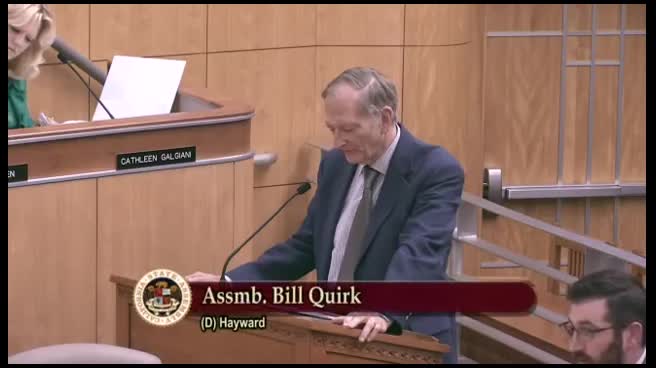 14MIN
Senate Standing Committee on Transportation and Housing
Bill Author

Bill Co-Author(s):