AB 1959: Assault on an emergency medical technician.
- Session Year: 2015-2016
- House: Assembly
- Latest Version Date: 2016-02-12
Existing law makes it a crime and specifies terms of imprisonment for assault on a peace officer or firefighter when the person knows or reasonably should know that the person is a peace officer or firefighter engaged in the performance of his or her duties. Existing law specifies various terms of imprisonment depending on whether the assault was committed with a deadly weapon that is not a firearm, a firearm, or one of a specified type of firearm, including machineguns and assault weapons.
This bill would make these provisions applicable to an assault on an emergency medical technician when the person knows or reasonably should know that the person is an emergency medical technician engaged in the performance of his or her duties. By increasing the penalty for a crime, this bill would impose a state-mandated local program.
The California Constitution requires the state to reimburse local agencies and school districts for certain costs mandated by the state. Statutory provisions establish procedures for making that reimbursement.
This bill would provide that no reimbursement is required by this act for a specified reason.
(a)(1)Any A person who commits an assault upon the person of another with a deadly weapon or instrument other than a firearm shall be punished by imprisonment in the state prison for two, three, or four years, or in a county jail for not exceeding one year, or by a fine not exceeding ten thousand dollars ($10,000), or by both the fine and imprisonment.
(2)Any A person who commits an assault upon the person of another with a firearm shall be punished by imprisonment in the state prison for two, three, or four years, or in a county jail for not less than six months and not exceeding one year, or by both a fine not exceeding ten thousand dollars ($10,000) and imprisonment.
(3)Any A person who commits an assault upon the person of another with a machinegun, as defined in Section 16880, or an assault weapon, as defined in Section 30510 or 30515, or a .50 BMG rifle, as defined in Section 30530, shall be punished by imprisonment in the state prison for 4, 8, or 12 years.
(4)Any A person who commits an assault upon the person of another by any means of force likely to produce great bodily injury shall be punished by imprisonment in the state prison for two, three, or four years, or in a county jail for not exceeding one year, or by a fine not exceeding ten thousand dollars ($10,000), or by both the fine and imprisonment.
(b)Any A person who commits an assault upon the person of another with a semiautomatic firearm shall be punished by imprisonment in the state prison for three, six, or nine years.
(c)Any A person who commits an assault with a deadly weapon or instrument, other than a firearm, or by any means likely to produce great bodily injury upon the person of a peace officer or officer, firefighter, or emergency medical technician, and who knows or reasonably should know that the victim is a peace officer or firefighter officer, firefighter, or emergency medical technician engaged in the performance of his or her duties, when the peace officer or firefighter officer, firefighter, or emergency medical technician is engaged in the performance of his or her duties, shall be punished by imprisonment in the state prison for three, four, or five years.
(d)(1)Any A person who commits an assault with a firearm upon the person of a peace officer or officer, firefighter, or emergency medical technician, and who knows or reasonably should know that the victim is a peace officer or firefighter officer, firefighter, or emergency medical technician engaged in the performance of his or her duties, when the peace officer or firefighter officer, firefighter, or emergency medical technician is engaged in the performance of his or her duties, shall be punished by imprisonment in the state prison for four, six, or eight years.
(2)Any A person who commits an assault upon the person of a peace officer or firefighter officer, firefighter, or emergency medical technician with a semiautomatic firearm and who knows or reasonably should know that the victim is a peace officer or firefighter officer, firefighter, or emergency medical technician engaged in the performance of his or her duties, when the peace officer or firefighter officer, firefighter, or emergency medical technician is engaged in the performance of his or her duties, shall be punished by imprisonment in the state prison for five, seven, or nine years.
(3)Any A person who commits an assault with a machinegun, as defined in Section 16880, or an assault weapon, as defined in Section 30510 or 30515, or a .50 BMG rifle, as defined in Section 30530, upon the person of a peace officer or officer, firefighter, or emergency medical technician, and who knows or reasonably should know that the victim is a peace officer or firefighter officer, firefighter, or emergency medical technician engaged in the performance of his or her duties, shall be punished by imprisonment in the state prison for 6, 9, or 12 years.
(e)When a person is convicted of a violation of this section in a case involving use of a deadly weapon or instrument or firearm, and the weapon or instrument or firearm is owned by that person, the court shall order that the weapon or instrument or firearm be deemed a nuisance, and it shall be confiscated and disposed of in the manner provided by Sections 18000 and 18005.
(f)As used in this section, peace officer refers to any person designated as a peace officer in Chapter 4.5 (commencing with Section 830) of Title 3 of Part 2.
SEC. 2.No reimbursement is required by this act pursuant to Section 6 of Article XIIIB of the California Constitution because the only costs that may be incurred by a local agency or school district will be incurred because this act creates a new crime or infraction, eliminates a crime or infraction, or changes the penalty for a crime or infraction, within the meaning of Section 17556 of the Government Code, or changes the definition of a crime within the meaning of Section 6 of Article XIIIB of the California Constitution.
|
Date
|
Status
|
|---|---|
| Feb 12, 2016 | Read first time. To print. |
| Feb 16, 2016 | From printer. May be heard in committee March 17. |
| Feb 25, 2016 | Referred to Com. on PUB. S. |
| Mar 30, 2016 | From committee: Do pass and re-refer to Com. on APPR. (Ayes 5. Noes 1.) (March 29). Re-referred to Com. on APPR. |
| Apr 13, 2016 | In committee: Set, first hearing. Referred to suspense file. |
| May 27, 2016 | In committee: Held under submission. |
|
Date
|
Description
|
Location
|
Votes
|
|
|---|---|---|---|---|
| Mar 29, 2016 | Do pass and be re-referred to the Committee on [Appropriations] | Assembly Standing Committee on Public Safety |
Passed |
This list shows positions taken on this bill by organizations on the date displayed, which is linked to the original source.
Positions by individuals are not included.
|
Organization
|
Position
|
Date
|
|---|---|---|
| American Medical Response | ** Support | Mar 29, 2016 |
| Association For Los Angeles Deputy Sheriffs | ** Support | Mar 29, 2016 |
| California Fire Chiefs Association | ** Support | Mar 29, 2016 |
| California State Sheriffs' Association | ** Support | Mar 29, 2016 |
| Fire Districts Association Of California | ** Support | Mar 29, 2016 |
| Los Angeles Police Protective League | ** Support | Mar 29, 2016 |
| Los Angeles Professional Peace Officers Association | ** Support | Mar 29, 2016 |
| PUB. S. | ** Against | Mar 29, 2016 |
| Riverside Sheriffs' Association | ** Support | Mar 29, 2016 |
Date of Hearing: April 13, 2016
ASSEMBLY COMMITTEE ON APPROPRIATIONS
Lorena Gonzalez, Chair
ABPCA Bill Id:AB 1959
Author:(Rodriguez) – As Introduced Ver:February 12, 2016
Policy Committee: | Public Safety | Vote: | 5 - 1 |
|
|
Urgency: No State Mandated Local Program: Yes Reimbursable: No
SUMMARY:
This bill increases the felony state prison punishment for assault on an emergency medical technician (EMT) as follows, for the use of a:
- deadly weapon (other than a fire arm), from two, three or four years, to three, four or five years;
- firearm, from three, four, or five years to four, six, or eight years;
- semiautomatic firearm, from three, six, or nine years, to five, seven, or nine years; and
- .50 caliber sniper rifle or machine gun, from four, eight, or twelve years, to six, nine, or twelve years.
FISCAL EFFECT:
According to the California Department of Corrections (CDCR), the contracted out-of-state bed rate is $29,000. CDCR statistics show that in 2012-13, there were 41 commitments for assault peace officer or firefighter with a firearm or a semiautomatic firearm. If 20 percent of these incidents include scenes where EMT are involved, the time served in state prison will increase by at least a year for eight individuals; GF costs to CDCR would be $232,000 every year; however, these additional costs will not be realized for several years since most of these commitments already include long terms and several enhancements.
COMMENTS:
- Background. Current law provides that any person who commits an assault with a deadly weapon or instrument other than a firearm, firearm, semiautomatic firearm, .50 caliber sniper rifle, or machine gun is subject to various punishments, which may include county jail and or a fine, or state prison and/or a fine, based on the actual weapon used. The imprisonment is in state prison and the commitments are longer if the person assaulted is a peace officer or a firefighter who is engaged in the performance of his or her duties.
- Purpose. According to the author, "Emergency medical technicians (EMTs) are often the first responders to crime, emergencies and disaster situations. And although EMTs work alongside peace officers and firefighters in dangerous environments, the penalties for assaulting an EMT are less than those given for assault against a peace officer or firefighter.
"In fact, EMTs are 14 times more likely to be violently injured on the job than the firefighters they work alongside. AB 1959 recognizes the importance of EMT workers, who often believe that assault against them is part of their jobs. By equalizing the penalties for assault against firefighters, peace officers and EMTs, EMTs can be reassured that their safety in the workplace is equal to that of their peace officer and firefighter counterparts."
AB 172 (Rodriguez) of the current Legislative Session would have increased the penalties for assault and battery committed against a physician, nurse, or other health care worker engaged in performing services within the emergency department, and the person committing the offense knows or reasonably should know that the victim is a physician, nurse, or other health care worker engaged in performing services within the emergency department. AB 172 was vetoed by the Governor. In his veto message, the Governor, in part, stated:
“If there were evidence that an additional six months in county jail (three months, once good-time credits are applied) would enhance the safety of these workers or serve as a deterrent, I would sign this bill. I doubt that it will do either.
"We need to find more creative ways to protect the safety of these critical workers. This bill isn't the answer."4
If the Governor wouldn't sign a bill that contained a modest six month county jail increase to protect health care workers in within the emergency department, it's unlikely he would sign this bill
- Prior Legislation:
- SB 390 (La Malfa), Chapter 249, Statutes of 2011, increased the penalties for assault and battery against a search and rescue member engaged in the performance of his or her duty.
- SB 406 (Lieu), Chapter 250, Statutes of 2011, increased the penalties for assault and battery against a security officer or custodial assistant engaged in the performance of his or her duty.
- SB 409 (Lowenthal), Chapter 410, Statutes of 2009, increased the penalties for assault and battery against a highway worker engaged in the performance of his or her duty.
- SB 1686 (Leno), Chapter 243, Statutes of 2007, increased the fine from $1,000 to $2,000 when an assault is committed against a parking control officer in the performance of his or her duty.
- SB 390 (La Malfa), Chapter 249, Statutes of 2011, increased the penalties for assault and battery against a search and rescue member engaged in the performance of his or her duty.
Analysis Prepared by: Pedro Reyes / APPR. / (916) 319-2081
Date of Hearing:
Chief Counsel: Gregory Pagan
ASSEMBLY COMMITTEE ON PUBLIC SAFETY
Reginald Byron Jones-Sawyer, Sr., Chair
ABPCA Bill Id:AB 1959
Author:(Rodriguez) – As Introduced Ver:February 12, 2016
SUMMARY:
Increases the felony state prison punishment for assault upon the person of an emergency medical technician with a deadly weapon, firearm, semiautomatic firearm, .50 caliber sniper rifle, or machine gun. Specifically, this bill:
- Makes an assault with a deadly weapon or instrument, other than a firearm, or by means likely to produce great bodily injury upon the person of an emergency medical technician and who knows or reasonably should know the victim is an emergency medical technician engaged in the performance of his or her duties is punishable by three, four, or five years in the state prison.
- Provides that any person who commits an assault with a firearm upon the person of an emergency medical technician and who knows or reasonably should know the victim is an emergency medical technician engaged in the performance of his or her duties is punishable by four, six, or eight years in the state prison.
- Provides that any person who commits an assault with a semiautomatic firearm upon the person of an emergency medical technician and who knows or reasonably should know the person is an emergency medical technician engaged in the performance of his or her duties is punishable by five, seven, or nine years in the state prison.
- Makes an assault with a machine gun or a .50 BMG rifle, as defined, upon the person of an emergency medical technician and who knows or reasonably should know the victim is an emergency medical technician engaged in the performance of his or her duties is punishable by 6, 9, or 12 years in the state prison.
EXISTING LAW:
- Provides that any person who commits an assault upon person of another with a deadly weapon or instrument other than a firearm is punishable by 2, 3, or 4 years in the state prison or in a county jail for not exceeding one year, or by a fine not to exceed $10,000, or by both a fine and imprisonment. (Penal Code Section 245(a)(1).)
- States that any person who commits an assault upon person of another with a firearm is punishable by 2, 3, or 4 years in the state prison or in a county jail for not less than six months and not exceeding one year, or by a fine not to exceed $10,000, or by both a fine and imprisonment. (Penal Code Section 245(a)(2).)
- Provides that any person who commits an assault upon person of another with a semiautomatic firearm is punishable by three, six, or nine years in the state prison. (Penal Code Section 245(b)
- Provides that any person who commits an assault upon person of another with a machine gun or a .50 BMG rifle, as defined, is punishable by four, eight, or twelve years in the state prison.
- Makes an assault upon person of another with force likely to produce great bodily injury is punishable by two, three, or four years in the state prison or in a county jail for not exceeding one year, or by a fine not to exceed $10,000, or by both a fine and imprisonment. (Penal Code Section 245(a)(4).)
- Provides that any person who commits an assault with a deadly weapon or instrument, other than a firearm, or by means likely to produce great bodily injury upon the person of a peace officer or firefighter and who knows or reasonably should know the victim is a peace officer or firefighter engaged in the performance of his or her duties is punishable by three, four, or five years in the state prison. (Penal Code Section 245, subd. (c).)
- States when battery committed upon any person and serious bodily injury is inflicted upon that person the offense is punishable by two, three, or four years in the state prison or by up to one year in the county jail. (Penal Code Section 243(d).)
- Provides that battery upon a peace officer, custodial officer, firefighter, emergency medical technician, lifeguard, traffic control officer, or animal control officer engaged in the performance of his or her duties is punishable by a fine not exceeding $2,000; imprisonment in the county jail not to exceed one year; or by both. (Penal Code Section 243(b)(2).)
- Provides that battery upon a peace officer, custodial officer, firefighter, emergency medical technician, lifeguard, traffic control officer, or animal control officer engaged in the performance of his or her duties, where an injury is inflicted, is punishable by imprisonment in the county jail up to one year or in the state prison for sixteen months, two or three years. (Penal Code Section 243(c)(2).)
- Defines "battery" as “the willful and unlawful use of force and violence upon another person”, punishable by up to six months in the county jail; by a fine not to exceed $2,000; or by both fine and imprisonment. (Penal Code Section 242.)
- Defines "assault" as an “unlawful attempt, coupled with a present ability, to inflict a violent injury upon the person of another”, and is punishable by a fine not exceeding $1,000; by imprisonment in the county jail not exceeding six months; or by both (Penal Code Sections 240 and 241.)
FISCAL EFFECT:
Unknown
COMMENTS:
- Author's Statement: According to the author, "Emergency medical technicians (EMTs) are often the first responders to crime, emergencies and disaster situations. And although EMTs work alongside peace officers and firefighters in dangerous environments, the penalties for assaulting an EMT are less than those given for assault against a peace officer or firefighter.
"In fact, EMTs are 14 times more likely to be violently injured on the job than the firefighters they work alongside. AB 1959 recognizes the importance of EMT workers, who often believe that assault against them is part of their jobs. By equalizing the penalties for assault against firefighters, peace officers and EMTs, EMTs can be reassured that their safety in the workplace is equal to that of their peace officer and firefighter counterparts."
- Assault with a Deadly Weapon: Under existing law, assault with a deadly weapon or with force likely to produce great bodily injury upon any person is punishable by two, three, or four years in the state prison, or in a county jail for a term not to exceed one year (Penal Code § 245 (a)(1)). This bill would make assault upon the person of an emergency medical technician in the performance of his or her duty punishable by three, four, or five years in the state prison. The existing penalty for assault with a deadly weapon upon any person, including emergency medical technicians, of two, three or four years in the state prison is a substantial penalty. Is there any evidence that this penalty is inadequate or is not being imposed in serious assault cases? What is the justification or need to increase this penalty?
- Assault with a Firearm: Under existing law, assault with a firearm upon any person is punishable by two, three, or four years in the state prison, or in a county jail for a term not to exceed one year (Penal Code § 245 (a)(2)). This bill would make assault upon the person of an emergency medical technician in the performance of his or her duty with a firearm punishable by four, six, or eight years in the state prison. Is it really necessary to double the existing already substantial penalty for assault with a firearm? Is there any evidence that emergency medical technicians are being assaulted with firearms?
Additionally, any person who personally uses a firearm in the commission of a felony is subject to an additional and consecutive term in the state prison of three, four, or ten years, even if the use of a firearm is an element of the offense (Penal Code § 12022.5 (a) and (d)). Therefore, a person who assaults an emergency medical technician, with a firearm use allegation, can be sentenced up to fourteen years in prison. Why is there a need to double the existing underlying penalty? - Assault with a Semiautomatic Firearm: Under existing law, assault with a semiautomatic firearm upon any person is punishable by three, six, or nine years in the state prison (Penal Code § 245 (d)(2)). This bill would make assault upon the person of an emergency medical technician in the performance of his or her duty with a semiautomatic firearm punishable by three, six, or nine years in the state prison. Under existing law, with the firearm use allegation mentioned above, a person that assaults any person, including emergency medical technicians can receive up to nineteen years in the state prison. Again, is there any evidence that emergency medical technicians are being assaulted with firearms? The author, in the background material, made a reference to assaults against emergency medical technicians, but failed to indicate if any of these assaults are with a firearm.
- Assault with a Machine Gun or .50 BMG Rifle: Under existing law, assault with a machine gun or .50 BMG Rifle upon any person is punishable by four, eight, or twelve years in the state prison (Penal Code § 245 (d)(3). This bill would make assault upon the person of an emergency medical technician in the performance of his or her duty with a machine gun or .50 BMG Rifle punishable by six, nine, or twelve years in the state prison. Again, under existing law, there is a three, four, or ten year firearm use enhancement (Penal Code § 12022.5 (a)). Is there any need or justification, other than not wanting to be treated differently than peace officers or firefighters, to increase the already substantial penalties for assaults upon any person with various firearms? Also, there hasn't been any evidence of an emergency medical technician ever having been assaulted with a machine gun or .50 caliber sniper rifle.
- Prison Overcrowding: On February 10, 2014, the federal court ordered California to reduce its in-state adult institution population to 137.5% of design capacity by February 28, 2016, as follows:
• 143% of design bed capacity by June 30, 2014;
• 141.5% of design bed capacity by February 28, 2015; and,
• 137.5% of design bed capacity by February 28, 2016.
In February of last year the administration reported that as "of February 11, 2015, 112,993 inmates were housed in the State’s 34 adult institutions, which amounts to 136.6% of design bed capacity, and 8,828 inmates were housed in out-of-state facilities. This current population is now below the court-ordered reduction to 137.5% of design bed capacity." (Defendants' February 2015 Status Report In Response To February 10, 2014 Order, 2:90-cv-00520 KJM DAD PC, 3-Judge Court, Coleman v. Brown, Plata v. Brown (fn. omitted).
While significant gains have been made in reducing the prison population, the state now must stabilize these advances and demonstrate to the federal court that California has in place the “durable solution” to prison overcrowding “consistently demanded” by the court. (Opinion Re: Order Granting in Part and Denying in Part Defendants’ Request For Extension of December 31, 2013 Deadline, NO. 2:90-cv-0520 LKK DAD (PC), 3-Judge Court, Coleman v. Brown, Plata v. Brown (2-10-14).
However, even though the state has complied with the federal court order, the prison population needs to be maintained, not increased. And according to the Legislative Analyst's Office (LAO), "CDCR is currently projecting that the prison population will increase by several thousand inmates in the next few years and will reach the cap by June 2018 and exceed it by 1,000 inmates by June 2019." (http://www.lao.ca.gov/reports/2014/budget/criminal-justice/criminal-justice-021914.aspx.) The LAO also notes that predicting the prison population is "inherently difficulty" and subject to "considerable uncertainty." (Ibid.) Nevertheless, increasing the felony prison sentences for assault with a firearm upon an emergency medical technician when the prison population is already expected to increase seems imprudent.
- Governor's Veto: AB 172 (Rodriguez) of the 2015-2016 Legislative Session would have increased the penalties for assault and battery committed against a physician, nurse, or other health care worker engaged in performing services within the emergency department, and the person committing the offense knows or reasonably should know that the victim is a physician, nurse, or other health care worker engaged in performing services within the emergency department. AB 172 was vetoed by the Governor.
The Governor, in his veto message, stated, "This bill would increase from six months to one year in the county jail the maximum punishment for assault or battery on health care worker inside an emergency department.
"Emergency rooms are overcrowded and often chaotic. I have great respect for the work done by emergency room staff and I recognize the daunting challenge they face every day. If there were evidence that an additional six months in county jail (three months, once good-time credits are applied) would enhance the safety of these workers or serve as a deterrent, I would sign this bill. I doubt that it will do either.
"We need to find more creative ways to protect the safety of these critical workers. This bill isn't the answer."
If the Governor wouldn't sign a bill that contained a modest six month county jail increase to protect health care workers in within the emergency department, it's unlikely he would sign this bill. - Prior Legislation:
- SB 390 (La Malfa), Chapter 249, Statutes of 2011, increased the penalties for assault and battery against the person of a search and rescue member engaged in the performance of his or her duty.
- SB 406 (Lieu), Chapter 250, Statutes of 2011, increased the penalties for assault and battery against the person of a security officer or custodial assistant engaged in the performance of his or her duty.
- SB 409 (Lowenthal), Chapter 410, Statutes of 2009, increased the penalties for assault and battery against the person of a highway worker engaged in the performance of his or her duty.
- AB 1686 (Leno), Chapter 243, Statutes of 2007, increased the fine from $1,000 to $2,000 when an assault is committed against a parking control officer in the performance of his or her duty.
- SB 390 (La Malfa), Chapter 249, Statutes of 2011, increased the penalties for assault and battery against the person of a search and rescue member engaged in the performance of his or her duty.
REGISTERED SUPPORT / OPPOSITION:
Support
American Medical Response
California Fire Chiefs Association
Fire Districts Association of California
California State Sheriffs' Association
Association for Los Angeles Deputy Sheriffs
Los Angeles Police Protective League
Riverside Sheriffs' association
Los Angeles Professional Peace officers Association
Opposition
American Civil Liberties Union
Legal Services for Prisoners with Children
Analysis Prepared by:
Gregory Pagan / PUB. S. / (916) 319-3744
Discussed in Hearing
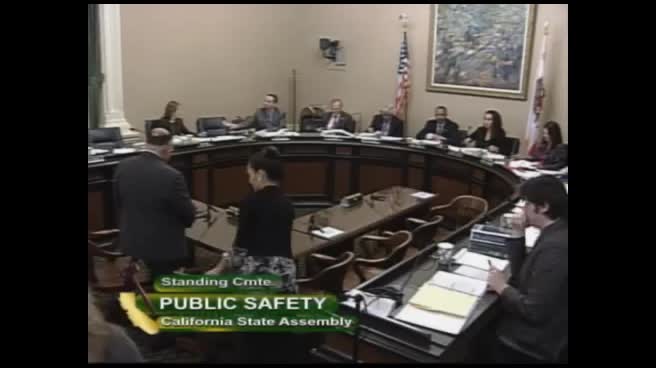 9MIN
Assembly Standing Committee on Public Safety
Bill Author

Bill Co-Author(s):