AB 2007: Youth athletics: youth sports organizations: concussions or other head injuries.
- Session Year: 2015-2016
- House: Assembly
- Latest Version Date: 2016-09-23
Existing law requires a school district, charter school, or private school, if it offers an athletic program, to immediately remove an athlete from an athletic activity for the remainder of the day if the athlete is suspected of sustaining a concussion or head injury, and prohibits the athlete from returning to the athletic activity until the athlete is evaluated by a licensed health care provider, trained in the management of concussions, and acting within the scope of his or her practice, and the athlete receives written clearance from the licensed health care provider to return to the athletic activity. Existing law also requires, on a yearly basis, a concussion and head injury information sheet to be signed and returned by the athlete and athletes parent or guardian before the athletes initiating practice or competition.
This bill would apply these provisions to athletes participating in youth sports organizations, as defined to include organizations, businesses, nonprofit entities, or local governmental agencies that sponsor or conduct amateur sports competitions, training, camps, or clubs in which persons 17 years of age or younger participate in any of 27 designated sports. The bill would require youth sports organizations to notify the parents or guardians of athletes 17 years of age or younger who have been removed from athletic activities due to suspected concussions, as specified. The bill would require youth sports organizations to offer concussion and head injury education, or related educational materials, or both, to each of their coaches and administrators on a yearly basis, as prescribed. The bill would require each of these coaches and administrators to successfully complete the concussion and head injury education offered under the bill at least once either online or in person.
The bill would also require a youth sports organization to identify procedures for ensuring compliance with the bills requirements for providing concussion and head injury education and a concussion and head injury information sheet. The bill would additionally require the youth sports organization to identify procedures to ensure compliance with the athlete removal provisions and the return-to-play protocol, as specified. The bill would specify that it applies to all persons participating in the activities of a youth sports organization, irrespective of their ages.
Existing law requires a school district, charter school, or private school, if it offers an athletic program, to immediately remove an athlete from an athletic activity for the remainder of the day if the athlete is suspected of sustaining a concussion or head injury, and prohibits the athlete from returning to the athletic activity until the athlete is evaluated by a licensed health care provider, trained in the management of concussions, and acting within the scope of his or her practice, and the athlete receives written clearance from the licensed health care provider to return to the athletic activity. Existing law also requires, on a yearly basis, a concussion and head injury information sheet to be signed and returned by the athlete and athletes parent or guardian before the athletes initiating practice or competition.
This bill would apply these provisions to athletes participating in youth sports organizations, as defined to include organizations, businesses, nonprofit entities, or local governmental agencies that sponsor or conduct amateur sports competitions, training, camps, or clubs in which persons 17 years of age or younger participate in any of 25 27 designated sports. The bill would require youth sports organizations to notify the parents or guardians of athletes 17 years of age or younger who have been removed from athletic activities due to suspected concussions, as specified. The bill would require youth sports organizations to offer concussion and head injury education, or related educational materials, or both, to each of their coaches and administrators on a yearly basis, as prescribed. The bill would require each of these coaches and administrators to successfully complete the concussion and head injury education offered under the bill at least once either online or in person.
The bill would also require a youth sports organization to identify an individual within the organization who is responsible procedures for ensuring compliance by the organization with the bills requirements for providing concussion and head injury education. education and a concussion and head injury information sheet. The bill would additionally require the youth sports organization to identify procedures to ensure compliance with the athlete removal provisions and the return-to-play protocol, as specified. The bill would specify that it applies to all persons participating in the activities of a youth sports organization, irrespective of their ages.
Existing law requires a school district, charter school, or private school, if it offers an athletic program, to immediately remove an athlete from an athletic activity for the remainder of the day if the athlete is suspected of sustaining a concussion or head injury, and prohibits the athlete from returning to the athletic activity until the athlete is evaluated by a licensed health care provider, trained in the management of concussions, and acting within the scope of his or her practice, and the athlete receives written clearance from the licensed health care provider to return to the athletic activity. Existing law also requires, on a yearly basis, a concussion and head injury information sheet to be signed and returned by the athlete and athletes parent or guardian before the athletes initiating practice or competition.
This bill would apply these provisions to athletes participating in youth sports organizations, as defined to include organizations, businesses, nonprofit entities, or local governmental agencies that sponsor or conduct amateur sports competitions, training, camps, or clubs in which persons 17 years of age or younger participate in any of 25 designated sports. The bill would require youth sports organizations to notify the parents or guardians of athletes 17 years of age or younger who have been removed from athletic activities due to suspected concussions, as specified. The bill would require youth sports organizations to offer concussion and head injury education, or related educational materials, or both, to each of their coaches and administrators on a yearly basis, as prescribed. The bill would require each of these coaches and administrators to successfully complete the concussion and head injury education offered under the bill at least once either online or in person.
The bill would also require a youth sports organization to identify an individual within the organization who is responsible for ensuring compliance by the organization with the bills requirements for providing concussion and head injury education. The bill would additionally require the youth sports organization to identify procedures to ensure compliance with the athlete removal provisions and the return-to-play protocol, as specified. The bill would specify that it applies to all persons participating in the activities of a youth sports organization, irrespective of their ages.
Existing law requires a school district, charter school, or private school, if it offers an athletic program, to immediately remove an athlete from an athletic activity for the remainder of the day if the athlete is suspected of sustaining a concussion or head injury, and prohibits the athlete from returning to the athletic activity until the athlete is evaluated by a licensed health care provider, trained in the management of concussions, and acting within the scope of his or her practice, and the athlete receives written clearance from the licensed health care provider to return to the athletic activity. Existing law also requires, on a yearly basis, a concussion and head injury information sheet to be signed and returned by the athlete and athletes parent or guardian before the athletes initiating practice or competition.
This bill would apply these provisions to athletes participating in youth sports organizations, as defined to include, but not necessarily limited to, a business or nonprofit entity or a include organizations, businesses, nonprofit entities, or local governmental agency, agencies that sponsor or conduct amateur athletic sports competitions, training, camps, or clubs. clubs in which persons 17 years of age or younger participate in any of 25 designated sports. The bill would require youth sports organizations to notify the parents or guardians of athletes 17 years of age or younger who have been removed from athletic activities due to suspected concussions, as specified. The bill would require youth sports organizations to give offer concussion and head injury education, or related educational materials, or both, to each of their coaches and administrators on a yearly basis, as prescribed. The The bill would require each of these coaches and administrators to successfully complete the concussion and head injury education offered under the bill at least once either online or in person.
The bill would also require a youth sports organizations organization to identify an individual within the organization who is responsible for ensuring compliance by the organization with the bills requirements for providing concussion and head injury education. The bill would additionally require the youth sports organization to identify the details of the procedures to ensure compliance with the athlete removal provisions and the return-to-play protocol, as specified. The bill would specify that it applies to all persons participating in the activities of a youth sports organization, irrespective of their ages.
Existing law requires a school district, charter school, or private school, if it offers an athletic program, to immediately remove an athlete from an athletic activity for the remainder of the day if the athlete is suspected of sustaining a concussion or head injury, and prohibits the athlete from returning to the athletic activity until the athlete is evaluated by a licensed health care provider, trained in the management of concussions, and acting within the scope of his or her practice, and the athlete receives written clearance from the licensed health care provider to return to the athletic activity. Existing law also requires, on a yearly basis, a concussion and head injury information sheet to be signed and returned by the athlete and athletes parent or guardian before the athletes initiating practice or competition.
This bill would additionally apply these provisions to athletes participating in youth sports organizations, as defined. defined to include, but not necessarily limited to, a business or nonprofit entity or a local governmental agency, that sponsor or conduct amateur athletic competitions, camps, or clubs. The bill would require youth sports organizations to notify the parents or guardians of athletes 17 years of age or younger who have been removed from athletic activities due to suspected concussions, as specified. The bill would require youth sports organizations to give concussion and head injury education, or educational materials, or both, to each of their coaches and administrators on a yearly basis, as prescribed. The bill would also require youth sports organizations to identify an individual within the organization who is responsible for ensuring compliance by the organization with the bills requirements for providing concussion and head injury education. The bill would additionally require the youth sports organization to identify the details of the return-to-play protocol, as specified.
Existing law requires a school district, charter school, or private school, if it offers an athletic program, to immediately remove an athlete from an athletic activity for the remainder of the day if the athlete is suspected of sustaining a concussion or head injury, and prohibits the athlete from returning to the athletic activity until the athlete is evaluated by a licensed health care provider, trained in the management of concussions, and acting within the scope of his or her practice, and the athlete receives written clearance from the licensed health care provider to return to the athletic activity. Existing law also requires, on a yearly basis, a concussion and head injury information sheet to be signed and returned by the athlete and athletes parent or guardian before the athletes initiating practice or competition.
This bill would additionally apply these provisions to athletes participating in youth sports organizations, as defined.
(a)A youth sports organization that elects to offer an athletic program shall comply with all of the following:
(1)An athlete who is suspected of sustaining a concussion or other head injury in an athletic activity shall be immediately removed from the athletic activity for the remainder of the day, and shall not be permitted to return to any athletic activity until he or she is evaluated by a licensed health care provider. The athlete shall not be permitted to return to athletic activity until he or she receives written clearance to return to athletic activity from a licensed health care provider. If the licensed health care provider determines that the athlete sustained a concussion or other head injury, the athlete shall also complete a graduated return-to-play protocol of no less than seven days in duration under the supervision of a licensed health care provider.
(2)If an athlete who is 17 years of age or younger has been removed from athletic activity due to a suspected concussion, the youth sports organization shall notify a parent or guardian of that athlete of the time and date of the injury, the symptoms observed, and any treatment provided to that athlete for the injury.
(3)On a yearly basis, the youth sports organization shall give a concussion and head injury information sheet to each athlete. The information sheet shall be signed and returned by the athlete and, if the athlete is 17 years of age or younger, shall also be signed by the athletes parent or guardian, before the athlete initiates practice or competition. The information sheet may be sent and returned through an electronic medium including, but not necessarily limited to, fax or electronic mail.
(4)On a yearly basis, the youth sports organization shall offer concussion and head injury education, or related educational materials, or both, to each coach and administrator of the youth sports organization.
(5)Each coach and administrator shall be required to successfully complete the concussion and head injury education offered pursuant to paragraph (4) at least once, either online or in person, before supervising an athlete in an activity of the youth sports organization.
(6)The youth sports organization shall identify both of the following:
(A)Procedures to ensure compliance with the requirements for providing concussion and head injury education and a concussion and head injury information sheet, as contained in paragraphs (3) to (5), inclusive.
(B)Procedures to ensure compliance with the athlete removal provisions and the return-to-play protocol required pursuant to paragraph (1).
(b)As used in this article, all of the following shall apply:
(1)Concussion and head injury education and educational materials and a concussion and head injury information sheet shall, at a minimum, include information relating to all of the following:
(A)Head injuries and their potential consequences.
(B)The signs and symptoms of a concussion.
(C)Best practices for removal of an athlete from an athletic activity after a suspected concussion.
(D)Steps for returning an athlete to school and athletic activity after a concussion or head injury.
(2)Licensed health care provider means a licensed health care provider who is trained in the evaluation and management of concussions and is acting within the scope of his or her practice.
(3)Youth sports organization means an organization, business, nonprofit entity, or a local governmental agency that sponsors or conducts amateur sports competitions, training, camps, or clubs in which persons 17 years of age or younger participate in any of the following sports:
(A)Baseball.
(B)Basketball.
(C)Bicycle motocross (BMX).
(D)Boxing.
(E)Competitive cheerleading.
(F)Diving.
(G)Equestrian activities.
(H)Field hockey.
(I)Football.
(J)Full contact martial arts.
(K)Gymnastics.
(L)Ice hockey.
(M)Lacrosse.
(N)Parkour.
(O)Rodeo.
(P)Roller derby.
(Q)Rugby.
(R)Skateboarding.
(S)Skiing.
(T)Soccer.
(U)Softball.
(V)Surfing.
(W)Swimming.
(X)Synchronized swimming.
(Y)Volleyball.
(Z)Water polo.
(AA)Wrestling.
(c)This section shall apply to all persons participating in the activities of a youth sports organization, irrespective of their ages. This section shall not be construed to prohibit a youth sports organization, or any other appropriate entity, from adopting and enforcing rules intended to provide a higher standard of safety for athletes than the standard established under this section.
(a)A youth sports organization that elects to offer an athletic program shall comply with all of the following:
(1)An athlete who is suspected of sustaining a concussion or other head injury in an athletic activity shall be immediately removed from the athletic activity for the remainder of the day, and shall not be permitted to return to any athletic activity until he or she is evaluated by a licensed health care provider. The athlete shall not be permitted to return to athletic activity until he or she receives written clearance to return to athletic activity from a licensed health care provider. If the licensed health care provider determines that the athlete sustained a concussion or other head injury, the athlete shall also complete a graduated return-to-play protocol of no less than seven days in duration under the supervision of a licensed health care provider.
(2)If an athlete who is 17 years of age or younger has been removed from athletic activity due to a suspected concussion, the youth sports organization shall notify a parent or guardian of that athlete of the time and date of the injury, the symptoms observed, and any treatment provided to that athlete for the injury.
(3)On a yearly basis, the youth sports organization shall give a concussion and head injury information sheet to each athlete. The information sheet shall be signed and returned by the athlete and, if the athlete is 17 years of age or younger, shall also be signed by the athletes parent or guardian, before the athlete initiates practice or competition. The information sheet may be sent and returned through an electronic medium including, but not necessarily limited to, fax or electronic mail.
(4)On a yearly basis, the youth sports organization shall offer concussion and head injury education, or related educational materials, or both, to each coach and administrator of the youth sports organization.
(5)Each coach and administrator shall be required to successfully complete the concussion and head injury education offered pursuant to paragraph (4) at least once, either online or in person, before supervising an athlete in an activity of the youth sports organization.
(6)The youth sports organization shall identify both of the following:
(A)An individual within the organization who is responsible for ensuring compliance by the organization Procedures to ensure compliance with the requirements for providing concussion and head injury education education and a concussion and head injury information sheet, as contained in paragraph (4). paragraphs (3) to (5), inclusive.
(B)Procedures to ensure compliance with the athlete removal provisions and the return-to-play protocol required pursuant to paragraph (1).
(b)As used in this article, all of the following shall apply:
(1)Concussion and head injury education and educational materials and a concussion and head injury information sheet shall, at a minimum, include information relating to all of the following:
(A)Head injuries and their potential consequences.
(B)The signs and symptoms of a concussion.
(C)Best practices for removal of an athlete from an athletic activity after a suspected concussion.
(D)Steps for returning an athlete to school and athletic activity after a concussion or head injury.
(2)Licensed health care provider means a licensed health care provider who is trained in the evaluation and management of concussions and is acting within the scope of his or her practice.
(3)Youth sports organization means an organization, business, nonprofit entity, or a local governmental agency that sponsors or conducts amateur sports competitions, training, camps, or clubs in which persons 17 years of age or younger participate in any of the following sports:
(A)Baseball.
(B)Basketball.
(C)Bicycle motocross (BMX).
(D)Boxing.
(E)Competitive cheerleading.
(F)Diving.
(G)Equestrian activities.
(H)Field hockey.
(I)Football.
(J)Full contact martial arts.
(K)Gymnastics.
(L)Ice hockey.
(M)Lacrosse.
(N)Parkour.
(O)Rodeo.
(P)Roller derby.
(Q)Rugby.
(R)Skateboarding.
(S)Skiing.
(T)Soccer.
(U)Softball.
(V)Surfing.
(W)Swimming.
(W)
(X)Synchronized swimming.
(Y)Volleyball.
(X)
(Z)Water polo.
(Y)
(AA)Wrestling.
(c)This section shall apply to all persons participating in the activities of a youth sports organization, irrespective of their ages. This section shall not be construed to prohibit a youth sports organization, or any other appropriate entity, from adopting and enforcing rules intended to provide a higher standard of safety for athletes than the standard established under this section.
(a)A youth sports organization that elects to offer an athletic program shall comply with all of the following:
(1)An athlete who is suspected of sustaining a concussion or other head injury in an athletic activity shall be immediately removed from the athletic activity for the remainder of the day, and shall not be permitted to return to any athletic activity until he or she is evaluated by a licensed health care provider. The athlete shall not be permitted to return to athletic activity until he or she receives written clearance to return to athletic activity from a licensed health care provider. If the licensed health care provider determines that the athlete sustained a concussion or other head injury, the athlete shall also complete a graduated return-to-play protocol of no less than seven days in duration under the supervision of a licensed health care provider.
(2)If an athlete who is 17 years of age or younger has been removed from athletic activity due to a suspected concussion, the youth sports organization shall notify a parent or guardian of that athlete of the time and date of the injury, the symptoms observed, and any treatment provided to that athlete for the injury.
(3)On a yearly basis, the youth sports organization shall give a concussion and head injury information sheet to each athlete. The information sheet shall be signed and returned by the athlete and, if the athlete is 17 years of age or younger, shall also be signed by the athletes parent or guardian, before the athlete initiates practice or competition. The information sheet may be sent and returned through an electronic medium including, but not necessarily limited to, fax or electronic mail.
(4)On a yearly basis, the youth sports organization shall offer concussion and head injury education, or related educational materials, or both, to each coach and administrator of the youth sports organization. Each coach and administrator shall be required to successfully complete the concussion and head injury education offered pursuant to this paragraph at least once, either online or in person, before supervising an athlete in an activity of the youth sports organization.
(5)Each coach and administrator shall be required to successfully complete the concussion and head injury education offered pursuant to paragraph (4) at least once, either online or in person, before supervising an athlete in an activity of the youth sports organization.
(5)
(6)The youth sports organization shall identify both of the following:
(A)An individual within the organization who is responsible for ensuring compliance by the organization with the requirements for providing concussion and head injury education contained in paragraph (4).
(B)Procedures to ensure compliance with the athlete removal provisions and the return-to-play protocol required pursuant to paragraph (1).
(b)As used in this article, all of the following shall apply:
(1)Concussion and head injury education and educational materials and a concussion and head injury information sheet shall, at a minimum, include information relating to all of the following:
(A)Head injuries and their potential consequences.
(B)The signs and symptoms of a concussion.
(C)Best practices for removal of an athlete from an athletic activity after a suspected concussion.
(D)Steps for returning an athlete to school and athletic activity after a concussion or head injury.
(2)Licensed health care provider means a licensed health care provider who is trained in the evaluation and management of concussions and is acting within the scope of his or her practice.
(3)Youth sports organization means an organization, business, nonprofit entity, or a local governmental agency that sponsors or conducts amateur sports competitions, training, camps, or clubs in which persons 17 years of age or younger participate in any of the following sports:
(A)Baseball.
(B)Basketball.
(C)Bicycle motocross (BMX).
(D)Boxing.
(E)Competitive cheerleading.
(F)Contact martial arts.
(G)
(F)Diving.
(H)
(G)Equestrian activities.
(I)
(H)Field hockey.
(J)
(I)Football.
(J)Full contact martial arts.
(K)Gymnastics.
(L)Ice hockey.
(M)Lacrosse.
(N)Parkour.
(O)Rodeo.
(P)Roller derby.
(Q)Rugby.
(R)Skateboarding.
(S)Skiing.
(T)Soccer.
(U)Softball.
(V)Surfing.
(W)Volleyball.
(X)Water polo.
(Y)Wrestling.
(c)This section shall apply to all persons participating in the activities of a youth sports organization, irrespective of their ages. This section shall not be construed to prohibit a youth sports organization, or any other appropriate entity, from adopting and enforcing rules intended to provide a higher standard of safety for athletes than the standard established under this section.
(a)A youth sports organization that elects to offer an athletic program shall comply with all of the following:
(1)An athlete who is suspected of sustaining a concussion or other head injury in an athletic activity shall be immediately removed from the athletic activity for the remainder of the day, and shall not be permitted to return to the any athletic activity until he or she is evaluated by a licensed health care provider. The athlete shall not be permitted to return to the athletic activity until he or she receives written clearance to return to the athletic activity from a licensed health care provider. If the licensed health care provider determines that the athlete sustained a concussion or other head injury, the athlete shall also complete a graduated return-to-play protocol of no less than seven days in duration under the supervision of a licensed health care provider.
(2)If an athlete who is 17 years of age or younger has been removed from athletic activity due to a suspected concussion, the youth sports organization shall notify a parent or guardian of that athlete of the time and date of the injury, the symptoms observed, and any treatment provided to that athlete for the injury.
(3)On a yearly basis, the youth sports organization shall give a concussion and head injury information sheet to each athlete. The information sheet shall be signed and returned by the athlete and, if the athlete is 17 years of age or younger, shall also be signed by the athletes parent or guardian, before the athlete initiates practice or competition. The information sheet may be sent and returned through an electronic medium including, but not necessarily limited to, fax or electronic mail.
(4)On a yearly basis, the youth sports organization shall give offer concussion and head injury education, or related educational materials, or both, to each coach and administrator of the youth sports organization. Each coach and administrator shall be required to successfully complete the concussion and head injury education offered pursuant to this paragraph at least once, either online or in person, before supervising an athlete in an activity of the youth sports organization.
(5)The youth sports organization shall identify both of the following:
(A)An individual within the organization who is responsible for ensuring compliance by the organization with the requirements for providing concussion and head injury education contained in paragraph (4).
(B)Details of Procedures to ensure compliance with the athlete removal provisions and the return-to-play protocol required pursuant to paragraph (1).
(b)As used in this section, article, all of the following terms have the following meanings: shall apply:
(1)Concussion and head injury education and educational materials and a concussion and head injury information sheet shall, at a minimum, include information relating to all of the following:
(A)Head injuries and their potential consequences.
(B)The signs and symptoms of a concussion.
(C)Best practices for removal of an athlete from an athletic activity after a suspected concussion.
(D)Steps for returning an athlete to school and athletic activity after a concussion or head injury.
(2)Licensed health care provider means a licensed health care provider who is trained in the evaluation and management of concussions and is acting within the scope of his or her practice.
(3)Youth sports organization means an organization, which may include, but is not necessarily limited to, a business or nonprofit entity or business, nonprofit entity, or a local governmental agency, agency that sponsors or conducts amateur athletic competitions, sports competitions, training, camps, or clubs in which persons 17 years of age or younger participate. participate in any of the following sports:
(A)Baseball.
(B)Basketball.
(C)Bicycle motocross (BMX).
(D)Boxing.
(E)Competitive cheerleading.
(F)Contact martial arts.
(G)Diving.
(H)Equestrian activities.
(I)Field hockey.
(J)Football.
(K)Gymnastics.
(L)Ice hockey.
(M)Lacrosse.
(N)Parkour.
(O)Rodeo.
(P)Roller derby.
(Q)Rugby.
(R)Skateboarding.
(S)Skiing.
(T)Soccer.
(U)Softball.
(V)Surfing.
(W)Volleyball.
(X)Water polo.
(Y)Wrestling.
(c)This section shall apply to all persons participating in the activities of a youth sports organization, irrespective of their ages. This section shall not be construed to prohibit a youth sports organization, or any other appropriate entity, from adopting and enforcing rules intended to provide a higher standard of safety for athletes than the standard established under this section.
(a)A youth sports organization that elects to offer an athletic program shall comply with both all of the following:
(1)An athlete who is suspected of sustaining a concussion or other head injury in an athletic activity shall be immediately removed from the athletic activity for the remainder of the day, and shall not be permitted to return to the athletic activity until he or she is evaluated by a licensed health care provider. The athlete shall not be permitted to return to the athletic activity until he or she receives written clearance to return to the athletic activity from a licensed health care provider. If the licensed health care provider determines that the athlete sustained a concussion or a other head injury, the athlete shall also complete a graduated return-to-play protocol of no less than seven days in duration under the supervision of a licensed health care provider.
(2)If an athlete who is 17 years of age or younger has been removed from athletic activity due to a suspected concussion, the youth sports organization shall notify a parent or guardian of that athlete of the time and date of the injury, the symptoms observed, and any treatment provided to that athlete for the injury.
(2)
(3)On a yearly basis, the youth sports organization shall give a concussion and head injury information sheet to each athlete. The information sheet shall be signed and returned by the athlete and, if the athlete is 17 years of age or younger, shall also be signed by the athletes parent or guardian, before the athlete initiates practice or competition.
(4)On a yearly basis, the youth sports organization shall give concussion and head injury education, or educational materials, or both, to each coach and administrator of the youth sports organization.
(5)The youth sports organization shall identify both of the following:
(A)An individual within the organization who is responsible for ensuring compliance by the organization with the requirements for providing concussion and head injury education contained in paragraph (4).
(B)Details of the return-to-play protocol required pursuant to paragraph (1).
(b)As used in this section, the following terms have the following meanings:
(1)Concussion and head injury education and educational materials and a concussion and head injury information sheet shall, at a minimum, include information relating to all of the following:
(A)Head injuries and their potential consequences.
(B)The signs and symptoms of a concussion.
(C)Best practices for removal of an athlete from an athletic activity after a suspected concussion.
(D)Steps for returning an athlete to school and athletic activity after a concussion or head injury.
(1)
(2)Licensed health care provider means a licensed health care provider who is trained in the evaluation and management of concussions and is acting within the scope of his or her practice.
(2)
(3)Youth sports organization means an organization organization, which may include, but is not necessarily limited to, a business or nonprofit entity or a local governmental agency, that sponsors or conducts amateur athletic competitions, camps, or clubs in which persons 17 years of age or younger participate.
(c)This section shall not be construed to prohibit a youth sports league, organization, or any other appropriate entity, from adopting and enforcing rules intended to provide a higher standard of safety for athletes than the standard established under this section.
(a)A youth sports organization that elects to offer an athletic program shall comply with both of the following:
(1)An athlete who is suspected of sustaining a concussion or head injury in an athletic activity shall be immediately removed from the athletic activity for the remainder of the day, and shall not be permitted to return to the athletic activity until he or she is evaluated by a licensed health care provider. The athlete shall not be permitted to return to the athletic activity until he or she receives written clearance to return to the athletic activity from a licensed health care provider. If the licensed health care provider determines that the athlete sustained a concussion or a head injury, the athlete shall also complete a graduated return-to-play protocol of no less than seven days in duration under the supervision of a licensed health care provider.
(2)On a yearly basis, a concussion and head injury information sheet shall be signed and returned by the athlete and, if the athlete is 17 years of age or younger, by the athletes parent or guardian, before the athlete initiates practice or competition.
(b)As used in this section, the following terms have the following meanings:
(1)Licensed health care provider means a licensed health care provider who is trained in the management of concussions and is acting within the scope of his or her practice.
(2)Youth sports organization means an organization that sponsors or conducts athletic competitions, camps, or clubs in which persons 17 years of age or younger participate.
(c)This section shall not be construed to prohibit a youth sports league, or any other appropriate entity, from adopting and enforcing rules intended to provide a higher standard of safety for athletes than the standard established under this section.
|
Date
|
Status
|
|---|---|
| Jun 9, 2016 | Referred to Com. on HEALTH. |
| Aug 26, 2016 | Enrolled and presented to the Governor at 4:30 p.m. |
| Aug 22, 2016 | Senate amendments concurred in. To Engrossing and Enrolling. (Ayes 70. Noes 7. Page 6033.). |
| Aug 22, 2016 | Senate amendments concurred in. To Engrossing and Enrolling. |
| Aug 16, 2016 | In Assembly. Concurrence in Senate amendments pending. May be considered on or after August 18 pursuant to Assembly Rule 77. |
| Aug 15, 2016 | Read third time. Passed. Ordered to the Assembly. (Ayes 33. Noes 4.). |
| Aug 15, 2016 | Read third time. Passed. Ordered to the Assembly. (Ayes 33. Noes 4. Page 4971.). |
| Aug 15, 2016 | Read third time. Passed. Ordered to the Assembly. |
| Aug 4, 2016 | Read second time. Ordered to third reading. |
| Aug 3, 2016 | Read third time and amended. Ordered to second reading. |
| Aug 1, 2016 | Read second time. Ordered to third reading. |
| Jun 30, 2016 | From committee: Do pass. (Ayes 8. Noes 0.) (June 29). |
| Jun 21, 2016 | From committee chair, with author's amendments: Amend, and re-refer to committee. Read second time, amended, and re-referred to Com. on HEALTH. |
| Feb 16, 2016 | Read first time. To print. |
| Jun 1, 2016 | In Senate. Read first time. To Com. on RLS. for assignment. |
| May 31, 2016 | Read third time. Passed. Ordered to the Senate. (Ayes 56. Noes 19.) |
| May 31, 2016 | Read third time. Passed. Ordered to the Senate. (Ayes 56. Noes 19. Page 5009.) |
| May 31, 2016 | Read third time. Passed. Ordered to the Senate. |
| May 27, 2016 | Read third time and amended. Ordered to third reading. (Ayes 48. Noes 23. Page 4948.) |
| May 27, 2016 | Read third time and amended. Ordered to third reading. |
| May 4, 2016 | Read second time. Ordered to third reading. |
| May 3, 2016 | From committee: Do pass. (Ayes 5. Noes 0.) (May 3). |
| Apr 27, 2016 | Re-referred to Com. on A.,E.,S.,T., & I.M. |
| Apr 26, 2016 | From committee chair, with author's amendments: Amend, and re-refer to Com. on A.,E.,S.,T., & I.M. Read second time and amended. |
| Feb 29, 2016 | Referred to Com. on A.,E.,S.,T., & I.M. |
| Feb 17, 2016 | From printer. May be heard in committee March 18. |
|
Date
|
Description
|
Location
|
Votes
|
|
|---|---|---|---|---|
| Aug 22, 2016 | AB 2007 MCCARTY Concurrence in Senate Amendments | Assembly Floor |
Passed |
|
| Aug 15, 2016 | Assembly 3rd Reading AB2007 McCarty By Hernandez | Senate Floor |
Passed |
|
| Jun 29, 2016 | Do pass | Senate Standing Committee on Health |
Passed |
|
| May 31, 2016 | AB 2007 MCCARTY Assembly Third Reading | Assembly Floor |
Passed |
|
| May 27, 2016 | AB 2007 MCCARTY Assembly Third Reading Amend By MCCARTY Set #1 | Assembly Floor |
Passed |
|
| May 3, 2016 | Do pass. | Assembly Standing Committee on Arts, Entertainment, Sports, Tourism, and Internet Media |
Passed |
This list shows positions taken on this bill by organizations on the date displayed, which is linked to the original source.
Positions by individuals are not included.
|
Organization
|
Position
|
Date
|
|---|---|---|
| American Academy of Pediatrics | ** Support | Aug 15, 2016 |
| American Medical Society for Sports Medicine | ** Support | Aug 15, 2016 |
| Brain Injury Association of California | ** Support | Aug 15, 2016 |
| California Athletic Trainers Association | ** Support | Aug 15, 2016 |
| California Coalition for Children's Safety | ** Support | Aug 15, 2016 |
| California Coalition for Children's Safety and Health | * Support | Jun 29, 2016 |
| California Medical Association, Inc. | * Support | Jun 29, 2016 |
| California Physical Therapy Association | * Support | Jun 29, 2016 |
| California School Nurses | * Support | Jun 29, 2016 |
| California School Nurses Organization | ** Support | Aug 15, 2016 |
| California State Parent Teacher Association | ** Support | May 3, 2016 |
| California State PTA | ** Support | Aug 15, 2016 |
| California Unintentional Injury Strategic Plan Projecy | * Support | May 3, 2016 |
| One individual | ** Support | Aug 15, 2016 |
| The Child Abuse Prevention Center | ** Support | Aug 15, 2016 |
| University of California, San Francisco's PlaySafe Program | ** Support | Aug 15, 2016 |
CONCURRENCE IN SENATE AMENDMENTS
CSA1 Bill Id:AB 2007
Author:(McCarty)
As Amended Ver:August 3, 2016
Majority vote
ASSEMBLY: | 56-19 | (May 31, 2016) | SENATE: | 33-4 | (August 15, 2016) |
Original Committee Reference: A.,E.,S.,T., & I.M.
SUMMARY: Youth athletics: youth sports organizations: concussions or other head injuries
The Senate amendments:
- Change the designation of one covered sport from "Contact martial arts" to "Full contact martial arts."
- Strike the requirement that a youth sports organization (YSO) must appoint an individual within the organization to be responsible for ensuring compliance by the organization, to instead require the YSO to adopt procedures to ensure compliance with the bill's provisions.
- Add swimming and synchronized swimming to the list of covered sports.
- Make additional technical and conforming changes.
EXISTING LAW:
Requires, a school district, charter school, or private school that elects to offer an athletic program, to comply with the following:
- Requires an athlete who is suspected of sustaining a concussion or head injury in an athletic activity to be immediately removed from the athletic activity for the remainder of the day, and not permitted to return to the athletic activity until he or she is evaluated by a licensed health care provider who is trained in the management of concussions and is acting within the scope of his or her practice. Prohibits the athlete from returning to the athletic activity until he or she receives written clearance to return to the athletic activity from that licensed health care provider.
- Requires, if the licensed health care provider determines that the athlete sustained a concussion or a head injury, the athlete to also complete a graduated return-to-play protocol of no less than seven days in duration under the supervision of a licensed health care provider.
- Urges the California Interscholastic Federation to work in consultation with the American Academy of Pediatrics and the American Medical Society for Sports Medicine to develop and adopt rules and protocols to implement b) above.
- Requires, on a yearly basis, a concussion and head injury information sheet to be signed and returned by the athlete and the athlete's parent or guardian before the athlete initiates practice or competition.
- Exempts an athlete engaging in an athletic activity during the regular school day or as part of a physical education course, as specified.
FISCAL EFFECT: None
COMMENTS: According to the author the amendments which replaced the requirement that a YSO must appoint an individual within the organization to be responsible for ensuring compliance by the organization, to instead require the YSO to adopt procedures to ensure compliance, were taken at the request of American Youth Soccer Organization to address their concern that the stricken language could create liability for one individual and not the league or organization as intended. In addition, the author points out that "Full contact martial arts" is defined in Business and Professions Code Section 18627, as: "The use of full unrestrained physical force in a martial arts contest," whereas "contact martial arts" has no existing definition.
Analysis Prepared by: Dana Mitchell / A.,E.,S.,T., & I.M. / (916) 319-3450 FN: 0004237
Office of Senate Floor Analyses (916) 651-1520 Fax: (916) 327-4478 | AB 2007 |
THIRD READING
Bill No: AB 2007
Amended: 8/3/16 in Senate
SENATE HEALTH COMMITTEE: 8-0, 6/29/16
AYES: Hernandez, Nguyen, Hall, Mitchell, Monning, Nielsen, Pan, Roth
NO VOTE RECORDED: Wolk
ASSEMBLY FLOOR: 56-19, 5/31/16 - See last page for vote
SUBJECT: Youth athletics: youth sports organizations: concussions or other head injuries
SOURCE: California Athletic Trainers’ Association
DIGEST: This bill establishes requirements for youth sports organizations to remove an athlete who is suspected of sustaining a concussion or other head injury until he or she is evaluated and cleared by a licensed health care provider.
Senate Floor Amendments of 8/3/16 require the youth sports organization to identify procedures to ensure compliance and a concussion and head injury information sheet, as specified, and add swimming and synchronized swimming as sports subject to the bill.
ANALYSIS: Existing law requires, a school district, charter school, or private school that elects to offer an athletic program, to comply with the following.
- Require an athlete who is suspected of sustaining a concussion or head injury in an athletic activity to be immediately removed from the athletic activity for the remainder of the day, and not permitted to return to the athletic activity until he or she is evaluated by a licensed health care provider who is trained in the management of concussions and is acting within the scope of his or her practice. Prohibit the athlete from returning to the athletic activity until he or she receives written clearance to return to the athletic activity from that licensed health care provider.
- Require, if the licensed health care provider determines that the athlete sustained a concussion or a head injury, the athlete to also complete a graduated return-to-play protocol of no less than seven days in duration under the supervision of a licensed health care provider.
- Urges the California Interscholastic Federation is urged to work in consultation with the American Academy of Pediatrics and the American Medical Society for Sports Medicine to develop and adopt rules and protocols to implement 2) above.
- Require, on a yearly basis, a concussion and head injury information sheet to be signed and returned by the athlete and the athlete’s parent or guardian before the athlete initiates practice or competition.
- Exempts an athlete engaging in an athletic activity during the regular schoolday or as part of a physical education course, as specified.
This bill:
- Requires a youth sports organization that elects to offer an athletic program to comply similar requirements as schools, and:
- Require if an athlete who is 17 years of age or younger has been removed from athletic activity due to a suspected concussion, the youth sports organization to notify a parent or guardian of that athlete of the time and date of the injury, the symptoms observed, and any treatment provided to that athlete for the injury;
- Require on a yearly basis, the youth sports organization to give a concussion and head injury information sheet to each athlete;
- Require the information sheet to be signed and returned by the athlete and, if the athlete is 17 years of age or younger, to also be signed by the athlete’s parent or guardian, before the athlete initiates practice or competition;
- Permit the information sheet to be sent and returned through an electronic medium including, but not necessarily limited to, fax or electronic mail;
- Require each coach and administrator to be required to successfully complete the concussion and head injury education offered pursuant to i) below at least once, either online or in person, before supervising an athlete in an activity of the youth sports organization;
- Require on a yearly basis, the youth sports organization to offer concussion and head injury education, or related educational materials, or both, to each coach and administrator of the youth sports organization; and,
- Require the youth sports organization to identify both of the following:
- Procedures to ensure compliance for providing concussion and head injury education and a concussion and head injury information sheet, as contained in paragraphs b) through f) above; and,
- Procedures to ensure compliance with the athlete removal provisions and the return-to-play protocol required pursuant to paragraph a-c) above.
- Defines a “youth sports organization” as an organization, business, nonprofit entity, or a local governmental agency that sponsors or conducts amateur sports competitions, training, camps, or clubs in which persons 17 years of age or younger participate in any of the 27 listed sports.
- Applies to all persons participating in the activities of a youth sports organization, irrespective of their ages. Prohibits anything in this bill from being construed to prohibit a youth sports organization, or any other appropriate entity, from adopting and enforcing rules intended to provide a higher standard of safety for athletes than the standard established under this bill.
Comments
- Author’s statement. According to the author, sports related injuries have become a growing concern in today’s society. Research shows that sports related injuries are not always immediately visible or evident, but may manifest in the future with extremely negative effects on the athlete’s health. Studies in the cumulative effects of concussion in young athletes show that even a mild concussion can result in serious long-term problems, especially if an athlete was returned to play too early, or has a history of concussions or other head injuries. The Legislature has already addressed concussion protocol in school sports, but more kids play sports in a community based setting, and with this legislation the author hopes to establish a proper protocol for concussion detections, treatment, and post-concussion management for youth sports leagues.
- CDC. The CDC has information including training videos and fact sheets that are designed specifically for coaches, which can be found at http://www.cdc.gov/headsup/youthsports/coach.html The following is from a CDC fact sheet:
Concussion, a type of traumatic brain injury, is caused by a bump, blow, or jolt to the head. Concussions can also occur from a blow to the body that causes the head and brain to move rapidly back and forth-literally causing the brain to bounce around or twist within the skull. This sudden movement of the brain causes stretching and tearing of brain cells, damaging the cells and creating chemical changes in the brain.
Sometimes people wrongly believe that it shows strength and courage to play injured. Some athletes may also try to hide their symptoms. Do not let your athlete convince you that he or she is “just fine” or that he or she can “tough it out.” Discourage others from pressuring injured athletes to play. Emphasize to athletes and parents that playing with a concussion is dangerous. Most athletes with a concussion will recover quickly and fully. But for some athletes, signs and symptoms of concussion can last for days, weeks, or longer. If an athlete has a concussion, his or her brain needs time to heal. A repeat concussion that occurs before the brain recovers from the first—usually within a short time period (hours, days, weeks)—can slow recovery or increase the chances for long-term problems. In rare cases, repeat concussions can result in brain swelling or permanent brain damage. It can even be fatal.
- Concussions and brain injuries in youth sports. One study published in December 2015 in the Rhode Island Medical Journal provided by the author, indicates that about 1.6-3.8 million sports-related concussions occur every year. Symptoms may appear mild but the injury can lead to life-long problems with physical function, concentration, memory, behavior, and emotional issues. Most concussions resolve within 7-10 days but the recovery process can be longer and more complicated in children and adolescents. Athletes with concussions are vulnerable to the second-impact syndrome where ongoing symptoms lead to another injury. Young athletes experience a complex recovery process after concussions. Recurrent concussions are especially destructive to the brain and are more likely during the first ten days after a concussion. It is recommended waiting at least seven days until return to play. The article indicates that education does reduce injuries. Among three groupings of coaches with none to varying levels of education about concussions, concussions in youth football players were lower in the group with the highest level injury prevention education compared to the non-educated cohort.
- Concerns. CSAC Excess Insurance Authority (CSAC EIA) expresses concern about this bill indicating that an onus will be placed on youth sports organizations for recordkeeping and removal of athletes from activities when suspected of having a concussion. Youth sport organizations do not have the resources to evaluate a youth athlete for concussion. Coaches are volunteer parents from the community. CSAC EIA is concerned people will not want to volunteer as coaches and the bill would potentially create a basis for liability if a youth sports organization does not distribute and/or obtain a parent’s signature on the information sheet.
FISCAL EFFECT: Appropriation: No Fiscal Com.: No Local: No
American Academy of Pediatrics
American Medical Society for Sports Medicine
Brain Injury Association of California
California Athletic Trainers’ Association
California Coalition for Children’s Safety
California State PTA
California School Nurses Organization
Child Abuse Prevention Center
University of California, San Francisco’s PlaySafe Program
One individual
None received
ARGUMENTS IN SUPPORT: The Brain Injury Association of California writes that young athletes experiencing head injuries are at greater risk of long-term brain damage if injured during the critical stages of brain development. From 2002 to 2012 the number of reported sports-related concussions among student athletes doubled. The increase is attributed to many factors including greater awareness and recognition of traumatic brain injuries. However, research also shows that it is likely that self-reported concussion symptoms are under diagnosed, which may lead to premature return to play. The California PTA supports this bill because research shows even mild concussions can have long-term negative consequences if not treated properly. The California School Nurses Organization believes extending the protections in this bill are necessary for those engaged in not only K-12 sports activities but those engaged in other organized sports activities.
ASSEMBLY FLOOR: 56-19, 5/31/16
AYES: Achadjian, Alejo, Arambula, Atkins, Baker, Bloom, Bonilla, Bonta, Brown, Burke, Calderon, Campos, Chau, Chiu, Chu, Cooley, Cooper, Dababneh, Daly, Dodd, Eggman, Frazier, Cristina Garcia, Eduardo Garcia, Gatto, Gipson, Gomez, Gonzalez, Gordon, Gray, Roger Hernández, Holden, Irwin, Jones-Sawyer, Lackey, Levine, Lopez, Low, Maienschein, McCarty, Medina, Mullin, Nazarian, O'Donnell, Quirk, Ridley-Thomas, Rodriguez, Salas, Santiago, Mark Stone, Thurmond, Ting, Weber, Williams, Wood, Rendon
NOES: Travis Allen, Brough, Chávez, Beth Gaines, Gallagher, Grove, Hadley, Harper, Jones, Kim, Linder, Mathis, Mayes, Obernolte, Olsen, Steinorth, Wagner, Waldron, Wilk
NO VOTE RECORDED: Bigelow, Chang, Dahle, Melendez, Patterson
Prepared by: Teri Boughton / HEALTH / (916) 651-4111
8/8/16 10:20:50
**** END ****
Office of Senate Floor Analyses (916) 651-1520 Fax: (916) 327-4478 | AB |
THIRD READING
Bill No: AB 2007
:
SENATE HEALTH COMMITTEE: 8-0, 6/29/16
AYES: Hernandez, Nguyen, Hall, Mitchell, Monning, Nielsen, Pan, Roth
NO VOTE RECORDED: Wolk
ASSEMBLY FLOOR: 56-19, 5/31/16 - See last page for vote
SOURCE: California Athletic Trainers’ Association
DIGEST: This bill establishes requirements for youth sports organizations to remove an athlete who is suspected of sustaining a concussion or other head injury until he or she is evaluated and cleared by a licensed health care provider.
Senate Floor Amendments of 8/3/16 require the youth sports organization to identify procedures to ensure compliance and a concussion and head injury information sheet, as specified, and add swimming and synchronized swimming as sports subject to the bill.
ANALYSIS: Existing law requires, a school district, charter school, or private school that elects to offer an athletic program, to comply with the following.
- Require an athlete who is suspected of sustaining a concussion or head injury in an athletic activity to be immediately removed from the athletic activity for the remainder of the day, and not permitted to return to the athletic activity until he or she is evaluated by a licensed health care provider who is trained in the management of concussions and is acting within the scope of his or her practice. Prohibit the athlete from returning to the athletic activity until he or she receives written clearance to return to the athletic activity from that licensed health care provider.
- Require, if the licensed health care provider determines that the athlete sustained a concussion or a head injury, the athlete to also complete a graduated return-to-play protocol of no less than seven days in duration under the supervision of a licensed health care provider.
- Urges the California Interscholastic Federation is urged to work in consultation with the American Academy of Pediatrics and the American Medical Society for Sports Medicine to develop and adopt rules and protocols to implement 2) above.
- Require, on a yearly basis, a concussion and head injury information sheet to be signed and returned by the athlete and the athlete’s parent or guardian before the athlete initiates practice or competition.
- Exempts an athlete engaging in an athletic activity during the regular schoolday or as part of a physical education course, as specified.
This bill:
- Requires a youth sports organization that elects to offer an athletic program to comply similar requirements as schools, and:
- Require if an athlete who is 17 years of age or younger has been removed from athletic activity due to a suspected concussion, the youth sports organization to notify a parent or guardian of that athlete of the time and date of the injury, the symptoms observed, and any treatment provided to that athlete for the injury;
- Require on a yearly basis, the youth sports organization to give a concussion and head injury information sheet to each athlete;
- Require the information sheet to be signed and returned by the athlete and, if the athlete is 17 years of age or younger, to also be signed by the athlete’s parent or guardian, before the athlete initiates practice or competition;
- Permit the information sheet to be sent and returned through an electronic medium including, but not necessarily limited to, fax or electronic mail;
- Require each coach and administrator to be required to successfully complete the concussion and head injury education offered pursuant to i) below at least once, either online or in person, before supervising an athlete in an activity of the youth sports organization;
- Require on a yearly basis, the youth sports organization to offer concussion and head injury education, or related educational materials, or both, to each coach and administrator of the youth sports organization; and,
- Require the youth sports organization to identify both of the following:
- Procedures to ensure compliance for providing concussion and head injury education and a concussion and head injury information sheet, as contained in paragraphs b) through f) above; and,
- Procedures to ensure compliance with the athlete removal provisions and the return-to-play protocol required pursuant to paragraph a-c) above.
- Defines a “youth sports organization” as an organization, business, nonprofit entity, or a local governmental agency that sponsors or conducts amateur sports competitions, training, camps, or clubs in which persons 17 years of age or younger participate in any of the 27 listed sports.
- Applies to all persons participating in the activities of a youth sports organization, irrespective of their ages. Prohibits anything in this bill from being construed to prohibit a youth sports organization, or any other appropriate entity, from adopting and enforcing rules intended to provide a higher standard of safety for athletes than the standard established under this bill.
Comments
- Author’s statement. According to the author, sports related injuries have become a growing concern in today’s society. Research shows that sports related injuries are not always immediately visible or evident, but may manifest in the future with extremely negative effects on the athlete’s health. Studies in the cumulative effects of concussion in young athletes show that even a mild concussion can result in serious long-term problems, especially if an athlete was returned to play too early, or has a history of concussions or other head injuries. The Legislature has already addressed concussion protocol in school sports, but more kids play sports in a community based setting, and with this legislation the author hopes to establish a proper protocol for concussion detections, treatment, and post-concussion management for youth sports leagues.
- CDC. The CDC has information including training videos and fact sheets that are designed specifically for coaches, which can be found at http://www.cdc.gov/headsup/youthsports/coach.html The following is from a CDC fact sheet.
Concussion, a type of traumatic brain injury, is caused by a bump, blow, or jolt to the head. Concussions can also occur from a blow to the body that causes the head and brain to move rapidly back and forth-literally causing the brain to bounce around or twist within the skull. This sudden movement of the brain causes stretching and tearing of brain cells, damaging the cells and creating chemical changes in the brain.
Sometimes people wrongly believe that it shows strength and courage to play injured. Some athletes may also try to hide their symptoms. Do not let your athlete convince you that he or she is “just fine” or that he or she can “tough it out.” Discourage others from pressuring injured athletes to play. Emphasize to athletes and parents that playing with a concussion is dangerous. Most athletes with a concussion will recover quickly and fully. But for some athletes, signs and symptoms of concussion can last for days, weeks, or longer. If an athlete has a concussion, his or her brain needs time to heal. A repeat concussion that occurs before the brain recovers from the first—usually within a short time period (hours, days, weeks)—can slow recovery or increase the chances for long-term problems. In rare cases, repeat concussions can result in brain swelling or permanent brain damage. It can even be fatal.
- Concussions and brain injuries in youth sports. One study published in December 2015 in the Rhode Island Medical Journal provided by the author, indicates that about 1.6-3.8 million sports-related concussions occur every year. Symptoms may appear mild but the injury can lead to life-long problems with physical function, concentration, memory, behavior, and emotional issues. Most concussions resolve within 7-10 days but the recovery process can be longer and more complicated in children and adolescents. Athletes with concussions are vulnerable to the second-impact syndrome where ongoing symptoms lead to another injury. Young athletes experience a complex recovery process after concussions. Recurrent concussions are especially destructive to the brain and are more likely during the first ten days after a concussion. It is recommended waiting at least seven days until return to play. The article indicates that education does reduce injuries. Among three groupings of coaches with none to varying levels of education about concussions, concussions in youth football players were lower in the group with the highest level injury prevention education compared to the non-educated cohort.
- Concerns. CSAC Excess Insurance Authority (CSAC EIA) expresses concern about this bill indicating that an onus will be placed on youth sports organizations for recordkeeping and removal of athletes from activities when suspected of having a concussion. Youth sport organizations do not have the resources to evaluate a youth athlete for concussion. Coaches are volunteer parents from the community. CSAC EIA is concerned people will not want to volunteer as coaches and the bill would potentially create a basis for liability if a youth sports organization does not distribute and/or obtain a parent’s signature on the information sheet.
FISCAL EFFECT: Appropriation: Fiscal Com.: Local:
American Academy of Pediatrics
American Medical Society for Sports Medicine
Brain Injury Association of California
California Athletic Trainers’ Association
California Coalition for Children’s Safety
California State PTA
California School Nurses Organization
Child Abuse Prevention Center
University of California, San Francisco’s PlaySafe Program
One individual
None received
ARGUMENTS IN SUPPORT: The Brain Injury Association of California writes that young athletes experiencing head injuries are at greater risk of long-term brain damage if injured during the critical stages of brain development. From 2002 to 2012 the number of reported sports-related concussions among student athletes doubled. The increase is attributed to many factors including greater awareness and recognition of traumatic brain injuries. However, research also shows that it is likely that self-reported concussion symptoms are under diagnosed, which may lead to premature return to play. The California PTA supports this bill because research shows even mild concussions can have long-term negative consequences if not treated properly. The California School Nurses Organization believes extending the protections in this bill are necessary for those engaged in not only K-12 sports activities but those engaged in other organized sports activities.
ASSEMBLY FLOOR: 56-19, 5/31/16
AYES: Achadjian, Alejo, Arambula, Atkins, Baker, Bloom, Bonilla, Bonta, Brown, Burke, Calderon, Campos, Chau, Chiu, Chu, Cooley, Cooper, Dababneh, Daly, Dodd, Eggman, Frazier, Cristina Garcia, Eduardo Garcia, Gatto, Gipson, Gomez, Gonzalez, Gordon, Gray, Roger Hernández, Holden, Irwin, Jones-Sawyer, Lackey, Levine, Lopez, Low, Maienschein, McCarty, Medina, Mullin, Nazarian, O'Donnell, Quirk, Ridley-Thomas, Rodriguez, Salas, Santiago, Mark Stone, Thurmond, Ting, Weber, Williams, Wood, Rendon
NOES: Travis Allen, Brough, Chávez, Beth Gaines, Gallagher, Grove, Hadley, Harper, Jones, Kim, Linder, Mathis, Mayes, Obernolte, Olsen, Steinorth, Wagner, Waldron, Wilk
NO VOTE RECORDED: Bigelow, Chang, Dahle, Melendez, Patterson
8/5/16 10:20:15
**** END ****
SENATE COMMITTEE ON HEALTH
Senator Ed Hernandez, O.D., Chair
BILL NO: AB 2007
AUTHOR: | McCarty | ||
VERSION: | June 21, 2016 Amended | ||
HEARING DATE: | June 29, 2016 | ||
CONSULTANT: | Teri Boughton | ||
SUBJECT: Youth athletics: youth sports organizations: concussions or other head injuries
SUMMARY:
Establishes requirements for youth sports organizations to remove an athlete who is suspected of sustaining a concussion or other head injury until he or she is evaluated and cleared by a licensed health care provider.
Existing law:
- Requires, a school district, charter school, or private school that elects to offer an athletic program, to comply with both of the following.
- Require an athlete who is suspected of sustaining a concussion or head injury in an athletic activity to be immediately removed from the athletic activity for the remainder of the day, and not permitted to return to the athletic activity until he or she is evaluated by a licensed health care provider who is trained in the management of concussions and is acting within the scope of his or her practice. Prohibit the athlete from returning to the athletic activity until he or she receives written clearance to return to the athletic activity from that licensed health care provider.
- Require, if the licensed health care provider determines that the athlete sustained a concussion or a head injury, the athlete to also complete a graduated return-to-play protocol of no less than seven days in duration under the supervision of a licensed health care provider.
- Urges the California Interscholastic Federation is urged to work in consultation with the American Academy of Pediatrics and the American Medical Society for Sports Medicine to develop and adopt rules and protocols to implement b) above.
- Require, on a yearly basis, a concussion and head injury information sheet to be signed and returned by the athlete and the athlete’s parent or guardian before the athlete initiates practice or competition.
- Exempts an athlete engaging in an athletic activity during the regular schoolday or as part of a physical education course, as specified.
- Require an athlete who is suspected of sustaining a concussion or head injury in an athletic activity to be immediately removed from the athletic activity for the remainder of the day, and not permitted to return to the athletic activity until he or she is evaluated by a licensed health care provider who is trained in the management of concussions and is acting within the scope of his or her practice. Prohibit the athlete from returning to the athletic activity until he or she receives written clearance to return to the athletic activity from that licensed health care provider.
This bill:
- Requires a youth sports organization that elects to offer an athletic program to comply with all of the following:
- Require an athlete who is suspected of sustaining a concussion or other head injury in an athletic activity to be immediately removed from the athletic activity for the remainder of the day, and not permitted to return to any athletic activity until he or she is evaluated by a licensed health care provider;
- Prohibit the athlete from returning to athletic activity until he or she receives written clearance to return to athletic activity from a licensed health care provider;
- Require, if the licensed health care provider determines that the athlete sustained a concussion or other head injury, the athlete to also complete a graduated return-to-play protocol of no less than seven days in duration under the supervision of a licensed health care provider;
- Require if an athlete who is 17 years of age or younger has been removed from athletic activity due to a suspected concussion, the youth sports organization to notify a parent or guardian of that athlete of the time and date of the injury, the symptoms observed, and any treatment provided to that athlete for the injury;
- Require on a yearly basis, the youth sports organization to give a concussion and head injury information sheet to each athlete;
- Require the information sheet to be signed and returned by the athlete and, if the athlete is 17 years of age or younger, to also be signed by the athlete’s parent or guardian, before the athlete initiates practice or competition;
- Permit the information sheet to be sent and returned through an electronic medium including, but not necessarily limited to, fax or electronic mail;
- Require each coach and administrator to be required to successfully complete the concussion and head injury education offered pursuant to i) below at least once, either online or in person, before supervising an athlete in an activity of the youth sports organization;
- Require on a yearly basis, the youth sports organization to offer concussion and head injury education, or related educational materials, or both, to each coach and administrator of the youth sports organization; and,
- Require the youth sports organization to identify both of the following:
- An individual within the organization who is responsible for ensuring compliance by the organization with the requirements for providing concussion and head injury education contained in paragraph h) above; and,
- Procedures to ensure compliance with the athlete removal provisions and the return-to-play protocol required pursuant to paragraph a-c) above.
- Establishes definitions including that a “youth sports organization” means an organization,
- Baseball;
- Basketball;
- Bicycle motocross;
- Boxing;
- Competitive cheerleading;
- Full Contact Martial Arts;
- Diving;
- Equestrian activities;
- Field hockey;
- Football;
- Gymnastics;
- Ice hockey;
- Lacrosse;
- Parkour;
- Rodeo;
- Roller derby;
- Rugby;
- Skateboarding;
- Skiing;
- Soccer;
- Softball;
- Surfing;
- Volleyball;
- Water polo; and,
- Wrestling.
- Defines “licensed health care provider” as a licensed health care provider who is trained in the evaluation and management of concussions and is acting within the scope of his or her practice.
- Requires this bill to apply to all persons participating in the activities of a youth sports organization, irrespective of their ages. Prohibits anything in this bill from being construed to prohibit a youth sports organization, or any other appropriate entity, from adopting and enforcing rules intended to provide a higher standard of safety for athletes than the standard established under this bill.
FISCAL EFFECT:
This bill is keyed non-fiscal.
PRIOR VOTES:
Assembly Floor: | 56 - 19 |
Assembly Arts, Entertainment, Sports, Tourism, and Internet Media Committee: | 5- 0 |
|
COMMENTS:
- Author’s statement. According to the author, sports related injuries have become a growing concern in today’s society. Research shows that sports related injuries are not always immediately visible or evident, but may manifest in the future with extremely negative effects on the athlete’s health. Studies in the cumulative effects of concussion in young athletes show that even a mild concussion can result in serious long-term problems, especially if an athlete was returned to play too early, or has a history of concussions or other head injuries. The Legislature has already addressed concussion protocol in school sports, but more kids play sports in a community based setting, and with this legislation I hope to establish a proper protocol for concussion detections, treatment, and post-concussion management for youth sports leagues.
- CDC. The CDC has information including training videos and fact sheets that are designed specifically for coaches, which can be found at http://www.cdc.gov/headsup/youthsports/coach.html The following is from a CDC fact sheet.
Concussion, a type of traumatic brain injury, is caused by a bump, blow, or jolt to the head. Concussions can also occur from a blow to the body that causes the head and brain to move rapidly back and forth-literally causing the brain to bounce around or twist within the skull. This sudden movement of the brain causes stretching and tearing of brain cells, damaging the cells and creating chemical changes in the brain.
Sometimes people wrongly believe that it shows strength and courage to play injured. Some athletes may also try to hide their symptoms. Do not let your athlete convince you that he or she is “just fine” or that he or she can “tough it out.” Discourage others from pressuring injured athletes to play. Emphasize to athletes and parents that playing with a concussion is dangerous. Most athletes with a concussion will recover quickly and fully. But for some athletes, signs and symptoms of concussion can last for days, weeks, or longer. If an athlete has a concussion, his or her brain needs time to heal. A repeat concussion that occurs before the brain recovers from the first—usually within a short time period (hours, days, weeks)—can slow recovery or increase the chances for long-term problems. In rare cases, repeat concussions can result in brain swelling or permanent brain damage. It can even be fatal.
- Concussions and brain injuries in youth sports. One study published in December 2015 in the Rhode Island Medical Journal provided by the author, indicates that about 1.6-3.8 million sports-related concussions occur every year. Symptoms may appear mild but the injury can lead to life-long problems with physical function, concentration, memory, behavior, and emotional issues. Most concussions resolve within 7-10 days but the recovery process can be longer and more complicated in children and adolescents. Athletes with concussions are vulnerable to the second-impact syndrome where ongoing symptoms lead to another injury. Young athletes experience a complex recovery process after concussions. Recurrent concussions are especially destructive to the brain and are more likely during the first ten days after a concussion. It is recommended waiting at least seven days until return to play. The article indicates that education does reduce injuries. Among three groupings of coaches with none to varying levels of education about concussions, concussions in youth football players were lower in the group with the highest level injury prevention education compared to the non-educated cohort.
- Prior legislation. AB 2127 (Cooley, Chapter 165, Statutes of 2014) limits full-contact football practices and requires a student-athlete who has suffered a concussion or head injury to complete a graduated return-to-play protocol of at least seven days, as specified.
AB 1451 (Hayashi, Chapter 173, Statutes of 2012), includes a basic understanding of the signs and symptoms of concussions and the appropriate response to concussions within the High School Coaching Education and Training Program, administered by school districts.
AB 1449 (Hayashi of 2012), would have required the Superintendent of Public Instruction to develop and make available a sample concussion and head injury information sheet for use by school districts. AB 1449 was held in the Assembly Education Committee.
AB 25 (Hayashi, Chapter 465, Statutes of 2011), requires a school district that elects to offer athletic programs to immediately remove an athlete who is suspected of sustaining a concussion or head injury during that activity; prohibits the return of the athlete to that activity until he or she is evaluated by, and receives written clearance from, a licensed health care provider; requires, on a yearly basis, a concussion and head injury information sheet to be signed and returned by the athlete and the athlete’s parent or guardian before the athlete’s initiating practice or competition.
AB 1646 (Hayashi of 2010), would have required training for coaches to be able to identify symptoms of head and neck injury. AB 1646 was held in the Assembly Appropriations Committee suspense file.
AB 1893 (Hayashi of 2010), would have required all high school spirit activities coaches to have valid certification in CPR and first aid, including an understanding of signs, symptoms, and appropriate emergency action steps regarding potentially catastrophic injury, including but not limited to, head and neck injury and concussion. Pupils participating in this activity who experience or show signs of trauma or other injury must obtain a release from the treating provider before resuming these activities. AB 1893 was held in the Assembly Education Committee.
AB 533 (Hayashi of 2009), would have required training for coaches to be able to identify symptoms of head and neck injury. AB 533 was held in the Assembly Appropriations Committee suspense file.
- Support. The Brain Injury Association of California writes that young athletes experiencing head injuries are at greater risk of long-term brain damage if injured during the critical stages of brain development. From 2002 to 2012 the number of reported sports-related concussions among student athletes doubled. The increase is attributed to many factors including greater awareness and recognition of traumatic brain injuries. However, research also shows that it is likely that self-reported concussion symptoms are under diagnosed, which may lead to premature return to play. The California PTA supports this bill because research shows even mild concussions can have long-term negative consequences if not treated properly. The California School Nurses Organization believes extending the protections in this bill are necessary for those engaged in not only K-12 sports activities but those engaged in other organized sports activities.
- Concern. CSAC Excess Insurance Authority (CSAC EIA) expresses concern about this bill indicating that an onus will be placed on youth sports organizations for recordkeeping and removal of athletes from activities when suspected of having a concussion. Youth sport organizations do not have the resources to evaluate a youth athlete for concussion. Coaches are volunteer parents from the community. CSAC EIA is concerned people will not want to volunteer as coaches and the bill would potentially create a basis for liability if a youth sports organization does not distribute and/or obtain a parent’s signature on the information sheet.
SUPPORT AND OPPOSITION:
Support: California Athletic Trainers’ Association (sponsor)
American Medical Society for Sports Medicine
Brain Injury Association of California
California State PTA
California School Nurses Organization
Child Abuse Prevention Center
One individual
Oppose: None received
-- END --
ASSEMBLY THIRD READING
ATR Bill Id:AB 2007
Author:(McCarty)
As Amended Ver:May 27, 2016
Majority vote
Committee | Votes | Ayes | Noes |
Arts | 5-0 | Chu, Levine, Low, Medina, Nazarian |
SUMMARY: This bill would require amateur youth sports organizations to adopt concussion treatment and recognition protocols similar to those in existing law for student athletes, as specified. Would also require youth sports organizations to develop return-to-play protocols, and provide yearly concussion and head injury information sheets and education, as specified. Specifically, this bill:
- Declares that a youth sports organization that elects to offer an athletic program shall comply with all the following:
- An athlete who is suspected of sustaining a concussion or other head injury in an athletic activity shall be immediately removed from the athletic activity for the remainder of the day, and shall not be permitted to return to any athletic activity until he or she is evaluated by a licensed health care provider.
- The athlete shall not be permitted to return to athletic activity until he or she receives written clearance to return to athletic activity from a licensed health care provider.
- If the licensed health care provider determines that the athlete sustained a concussion or other head injury, the athlete shall also complete a graduated return-to-play protocol of no less than seven days in duration under the supervision of a licensed health care provider.
- Provides that if an athlete who is 17 years of age or younger has been removed from athletic activity due to a suspected concussion, the youth sports organization shall notify a parent or guardian of that athlete of the time and date of the injury, the symptoms observed, and any treatment provided for the injury.
- Requires, on a yearly basis, the youth sports organization shall give a concussion and head injury information sheet to each athlete. The information sheet shall be signed and returned by the athlete and, if the athlete is 17 years of age or younger, shall also be signed by the athlete's parent or guardian, before the athlete initiates practice or competition.
Allows the information sheet to be sent and returned through an electronic medium including, but not necessarily limited to, fax or electronic mail.
- Further requires, on a yearly basis, that the youth sports organization shall offer concussion and head injury education or related educational materials or both to each coach and administrator of the youth sports organization.
Each coach and administrator shall be required to successfully complete the concussion and head injury education offered pursuant to this paragraph at least once, either online or in person, before supervising an athlete in an activity of the youth sport organization.
- States that the youth sports organization shall identify both of the following:
- An individual within the youth sports organization who is responsible for ensuring compliance by the organization with the requirements for providing concussion and head injury education contained in paragraph 4) above.
- Procedures to ensure compliance with the athlete removal provisions and the return-to-play protocol required pursuant to paragraph 1) above .
- Contains the following definitions:
- "Concussion and head injury education and educational materials" and a "concussion and head injury education information sheet" shall at a minimum include information relating to all of the following:
- Head injuries and their potential consequences.
- The signs and symptoms of concussion.
- Best practices for removal of an athlete from an athletic activity after a suspected concussion.
- Steps for returning an athlete to school and athletic activity after a concussion or head injury.
- "Licensed health care provider" means a licensed health care provider who is trained in the evaluation and management of concussions and is acting within the scope of his or her practice.
- "Youth sports organization" means an organization, business, nonprofit entity or a local governmental agency that sponsors or conducts amateur sports competitions, training, camps, or clubs in which persons 17 years of age or younger participate in any of the following sports:
- Baseball.
- Basketball.
- Bicycle motocross (BMX).
- Boxing.
- Competitive cheerleading.
- Contact martial arts.
- Diving.
- Equestrian activities.
- Field hockey.
- Football.
- Gymnastics.
- Ice hockey.
- Lacrosse.
- Parkour.
- Rodeo.
- Roller derby.
- Rugby.
- Skateboarding.
- Skiing.
- Soccer.
- Softball.
- Surfing.
- Volleyball.
- Water polo.
- Wrestling.
- Declares that this section shall apply to all persons participating in the activities of a youth sports organization, irrespective of their ages. This section shall not be construed to prohibit a youth sports organization, or any other appropriate entity, from adopting and enforcing rules intended to provide a higher standard of safety for athletes than the standard established under this section.
FISCAL EFFECT: None. The Legislative Counsel has keyed this measure as non-fiscal.
COMMENTS: The author states, "With this legislation I intend to mitigate the growing problem of injured athletes by creating awareness of sports-related head injuries and having a proper protocol for concussion detections, treatment, and post-concussion management for youth sports leagues." As need for such protection he points to a 2014 study, wherein the Boston University School of Medicine found former NFL players' who began playing football before age 12 "demonstrate significantly greater impairment" than those who started playing later in life. This bill's sponsors, the California Athletic Trainers' Association state in their support, "This bill will help close many loopholes in concussion management at the youth sports level, and help protect our most vulnerable athletes by providing similar safeguards that are afforded to high school and college athletes." The California State Parent Teacher Association draw attention in their letter of support to the provisions of this bill which "assure that parents are provided annually with a concussion and head injury information sheet and that young athletes are removed immediately from an athletic activity if they are suspected of sustaining a concussion or other head injury." There is no opposition on file.
Concussions have greater adverse effect on younger athletes: Studies show that the human brain does not fully develop until a person's mid-20s. Therefore, young athletes experiencing head injuries are at greater risk of long-term brain damage if injured during the critical stages of brain development. From 2002 to 2012 the number of reported sports-related concussions among student athletes doubled. This increase in reported concussions is attributed to various factors, including greater awareness and recognition of traumatic brain injuries. However, research also shows that it is likely that self-reported concussion symptoms are underdiagnosed, which may lead athletes to return to play prematurely.
According to recent research, "Although most (80-90%) concussions resolve within 7-10 days, the recovery process can be longer and more complicated in children and adolescents. Furthermore, younger athletes have a higher risk of severe symptoms and cognitive decline… Due to the more complex recovery process in young athletes, they need protection when they are most vulnerable." (Mukland and Serra, Concussions and Brain Injuries in Youth Sports, December 2015, Rhode Island Medical Journal).
In addition, studies show that the risk of a second concussion if an athlete returns to play too soon is greater for youth, both in likelihood and severity. "Athletes who return to play before their concussions have fully resolved may place themselves at an increased risk for prolonged recovery. Although very rare, the potential for catastrophic head injuries, including what is sometimes called 'second impact syndrome' is the primary concern. While catastrophic head injury is uncommon, it may occur more frequently in younger athletes between the ages of 12 to 18 years." (Graham, Rivara, et al, Sports-Related Concussions in Youth: Improving the science, changing the culture, 2014, National Academy of Sciences).
Please see Assembly Arts, Entertainment, Sports, Tourism, and Internet Media analysis for a full discussion of the measure.
Analysis Prepared by: Dana Mitchell / A.,E.,S.,T., & I.M. / (916) 319-3450 FN: 0003053
ASSEMBLY THIRD READING
ATR Bill Id:AB 2007
Author:(McCarty)
As Amended Ver:April 26, 2016
Majority vote
Committee | Votes | Ayes | Noes |
Arts | 5-0 | Chu, Levine, Low, Medina, Nazarian |
SUMMARY: Would require amateur youth sports organizations to adopt concussion treatment and recognition protocols similar to those in existing law for student athletes, as specified. Would also require youth sports organizations to develop return-to-play protocols, and provide yearly concussion and head injury information sheets and education, as specified. Specifically, this bill:
- Declares that a youth sports organization that elects to offer an athletic program shall comply with all the following:
- An athlete who is suspected of sustaining a concussion or other head injury in an athletic activity shall be immediately removed from the athletic activity for the remainder of the day, and shall not be permitted to return to the athletic activity until he or she is evaluated by a licensed health care provider.
- The athlete shall not be permitted to return to the athletic activity until he or she receives written clearance to return to the athletic activity from a licensed health care provider.
- If the licensed health care provider determines that the athlete sustained a concussion or other head injury, the athlete shall also complete a graduated return-to-play protocol of no less than seven days in duration under the supervision of a licensed health care provider.
- Provides that if an athlete who is 17 years of age or younger has been removed from athletic activity due to a suspected concussion, the youth sports organization shall notify a parent or guardian of that athlete of the time and date of the injury, the symptoms observed, and any treatment provided for the injury.
- Requires, on a yearly basis, the youth sports organization shall give a concussion and head injury information sheet to each athlete. The information sheet shall be signed and returned by the athlete and, if the athlete is 17 years of age or younger, shall also be signed by the athlete's parent or guardian, before the athlete initiates practice or competition.
- Further requires, on a yearly basis, that the youth sports organization shall give concussion and head injury education or educational materials or both to each coach and administrator of the youth sports organization.
- States that the youth sports organization shall identify both of the following:
- An individual within the youth sports organization who is responsible for ensuring compliance by the organization with the requirements for providing concussion and head injury education contained in paragraph (4).
- Details of the return-to-play protocol required pursuant to paragraph (1).
- Contains the following definitions:
- "Concussion and head injury education and educational materials" and a "concussion and head injury education information sheet" shall at a minimum include information relating to all of the following:
- Head injuries and their potential consequences.
- The signs and symptoms of concussion.
- Best practices for removal of an athlete from an athletic activity after a suspected concussion.
- Steps for returning an athlete to school and athletic activity after a concussion or head injury.
- "Licensed health care provider" means a licensed health care provider who is trained in the evaluation and management of concussions and is acting within the scope of his or her practice.
- "Youth sports organization" means an organization, which may include, but is not necessarily limited to, a business or nonprofit entity or a local governmental agency, that sponsors or conducts amateur athletic competitions, camps, or clubs in which persons 17 years of age or younger participate.
- Declares that this section shall not be construed to prohibit a youth sports organization, or any other appropriate entity, from adopting and enforcing rules intended to provide a higher standard of safety for athletes than the standard established under this section.
FISCAL EFFECT: None. This bill is keyed non-fiscal by the Legislative Counsel.
COMMENTS: The author states, "With this legislation I intend to mitigate the growing problem of injured athletes by creating awareness of sports-related head injuries and having a proper protocol for concussion detections, treatment, and post-concussion management for youth sports leagues." As need for such protection he points to a 2014 study, wherein the Boston University School of Medicine found former NFL players who began playing football before age 12 "demonstrate significantly greater impairment" than those who started playing later in life. The bill's sponsors, the California Athletic Trainers' Association state in their support, "This bill will help close many loopholes in concussion management at the youth sports level, and help protect our most vulnerable athletes by providing similar safeguards that are afforded to high school and college athletes." The California State Parent Teachers Association (PTA) draw attention in their letter of support to the provisions of the bill which "assure that parents are provided annually with a concussion and head injury information sheet and that young athletes are removed immediately from an athletic activity if they are suspected of sustaining a concussion or other head injury."
Concussions have greater adverse effect on younger athletes: Studies show that the human brain does not fully develop until a person's mid-20s. Therefore, young athletes experiencing head injuries are at greater risk of long-term brain damage if injured during the critical stages of brain development. From 2002 to 2012 the number of reported sports-related concussions among student athletes doubled. This increase in reported concussions is attributed to various factors, including greater awareness and recognition of traumatic brain injuries. However, research also shows that it is likely that self-reported concussion symptoms are under diagnosed, which may lead athletes to return to play prematurely.
According to recent research, "Although most (80-90%) concussions resolve within 7-10 days, the recovery process can be longer and more complicated in children and adolescents. Furthermore, younger athletes have a higher risk of severe symptoms and cognitive decline… Due to the more complex recovery process in young athletes, they need protection when they are most vulnerable." (Mukland and Serra, Concussions and Brain Injuries in Youth Sports, December 2015, Rhode Island Medical Journal).
In addition, studies show that the risk of a second concussion if an athlete returns to play too soon is greater for youth, both in likelihood and severity. "Athletes who return to play before their concussions have fully resolved may place themselves at an increased risk for prolonged recovery. Although very rare, the potential for catastrophic head injuries, including what is sometimes called 'second impact syndrome' is the primary concern. While catastrophic head injury is uncommon, it may occur more frequently in younger athletes between the ages of 12 to 18 years." (Graham, Rivara, et al, Sports-Related Concussions in Youth: Improving the science, changing the culture, 2014, National Academy of Sciences).
Please see Assembly Arts, Entertainment, Sports, Tourism, and Internet Media Committee analysis for a full discussion of the measure.
Analysis Prepared by: Dana Mitchell / A.,E.,S.,T., & I.M. / (916) 319-3450 FN: 0002852
Date of Hearing: May 3, 2016
ASSEMBLY COMMITTEE ON ARTS, ENTERTAINMENT, SPORTS, TOURISM, AND INTERNET MEDIA
Kansen Chu, Chair
ABPCA Bill Id:AB 2007 (
Author:McCarty) – As Amended Ver:April 26, 2016
SUBJECT: Youth athletics: youth sports organizations: concussions or other head injuries.
SUMMARY: Would require amateur youth sports organizations to adopt concussion treatment and recognition protocols similar to those in existing law for student athletes, as specified. Would also require youth sports organizations to develop return-to-play protocols, and provide yearly concussion and head injury information sheets and education, as specified. Specifically, this bill:
- Declares that a youth sports organization that elects to offer an athletic program shall comply with all the following:
- An athlete who is suspected of sustaining a concussion or other head injury in an athletic activity shall be immediately removed from the athletic activity for the remainder of the day, and shall not be permitted to return to the athletic activity until he or she is evaluated by a licensed health care provider.
- The athlete shall not be permitted to return to the athletic activity until he or she receives written clearance to return to the athletic activity from a licensed health care provider.
- If the licensed health care provider determines that the athlete sustained a concussion or other head injury, the athlete shall also complete a graduated return-to-play protocol of no less than seven days in duration under the supervision of a licensed health care provider.
- Provides that if an athlete who is 17 years of age or younger has been removed from athletic activity due to a suspected concussion, the youth sports organization shall notify a parent or guardian of that athlete of the time and date of the injury, the symptoms observed, and any treatment provided for the injury.
- Requires, on a yearly basis, the youth sports organization shall give a concussion and head injury information sheet to each athlete. The information sheet shall be signed and returned by the athlete and, if the athlete is 17 years of age or younger, shall also be signed by the athlete’s parent or guardian, before the athlete initiates practice or competition.
- Further requires, on a yearly basis, that the youth sports organization shall give concussion and head injury education or educational materials or both to each coach and administrator of the youth sports organization.
- States that the youth sports organization shall identify both of the following:
- An individual within the youth sports organization who is responsible for ensuring compliance by the organization with the requirements for providing concussion and head injury education contained in paragraph (4).
- Details of the return-to-play protocol required pursuant to paragraph (1).
- Contains the following definitions:
- “Concussion and head injury education and educational materials” and a “concussion and head injury education information sheet” shall at a minimum include information relating to all of the following:
- Head injuries and their potential consequences.
- The signs and symptoms of concussion.
- Best practices for removal of an athlete from an athletic activity after a suspected concussion.
- Steps for returning an athlete to school and athletic activity after a concussion or head injury.
- “Licensed health care provider” means a licensed health care provider who is trained in the evaluation and management of concussions and is acting within the scope of his or her practice.
- “Youth sports organization” means an organization, which may include, but is not necessarily limited to, a business or nonprofit entity or a local governmental agency, that sponsors or conducts amateur athletic competitions, camps, or clubs in which persons 17 years of age or younger participate.
- Declares that this section shall not be construed to prohibit a youth sports organization, or any other appropriate entity, from adopting and enforcing rules intended to provide a higher standard of safety for athletes than the standard established under this section.
EXISTING LAW:
- Limits full-contact practices, as defined, for high school and middle school football and urges the California Interscholastic Federation (CIF) adoption of rules to implement such guidelines. (Education Code 35179.5)
- Requires an athlete suspected of sustaining a concussion or head injury during athletic activity to be removed from that activity and not be permitted to return until evaluated and cleared by a licensed health care provider; urges the CIF to develop rules and protocols to implement this; requires athletes and parents to receive, sign and return a head injury information sheet annually before practice or competition; and excludes athletic activities during the regular school day or as part of a physical education course. (Education Code 49475)
- Requires a high school sports coach to complete education programs developed by his or her school district and the CIF and meeting specific guidelines. (Education Code 49032)
FISCAL EFFECT: None. The Legislative Counsel has keyed this measure as non-fiscal.
COMMENTS:
- Author's statement and supporters: Existing school-based protections for children in sports do not reach amateur youth sports organizations. The author adds that, “With this legislation I intend to mitigate the growing problem of injured athletes by creating awareness of sports-related head injuries and having a proper protocol for concussion detections, treatment, and post-concussion management for youth sports leagues.” As need for such protection he points to a 2014 study, wherein the Boston University School of Medicine found former NFL players’ who began playing football before age 12 “demonstrate significantly greater impairment” than those who started playing later in life. The bill's sponsors, the California Athletic Trainers’ Association state in their support, “This bill will help close many loopholes in concussion management at the youth sports level, and help protect our most vulnerable athletes by providing similar safeguards that are afforded to high school and college athletes." The California State PTA draw attention in their letter of support to the provisions of the bill which "assure that parents are provided annually with a concussion and head injury information sheet and that young athletes are removed immediately from an athletic activity if they are suspected of sustaining a concussion or other head injury."
- Background:
- Concussions and Chronic Traumatic Encephalopathy (CTE) making recent news. The dangers of concussions and head injuries in sport have been a growing concern, with frequent news reports of athletes, primarily football players, sustaining traumatic and lasting injuries. On March 1, 2016, this committee participated in a screening of the movie "Concussion" featuring Dr. Bennett Omalu who discussed his ground breaking research into CTE which was the focus of the film, in conjunction with a discussion of the topic of sports safety and concussion prevention by the California Athletic Trainers’ Association (CATA). In addition to a major motion picture on the issue, other dramatic news reports in March alone include:
A Purdue University study in 2015 indicated lasting brain changes among high school football players, even without concussions, and that changes were not completely healed at the end of an off-season. The study used brain scans and changes in brain chemistry to track players more extensively than neurocognitive testing.
- A representative of the National Football League testified that there is a connection between football and chronic traumatic encephalopathy.
- Women’s soccer standout Brandi Chastain announced she would donate her brain to science for research into head injuries.
- Ivy League schools announced they would eliminate full-contact practices for football.
The growing awareness of concussion dangers has led California to enact a series of bills to protect students by limiting full-contact practices; requiring education and information for coaches, pupils and their parents; and protocols for removing students from activity after injury and for returning them to play (See comment 5 below).
b) Concussions have greater adverse effect on younger athletes: As this committee learned in hearing AB 2182 (Mullin), at our last hearing, research shows that the human brain does not fully develop until a person’s mid-20s. Therefore, young athletes experiencing head injuries are at greater risk of long-term brain damage if injured during the critical stages of brain development. From 2002 to 2012 the number of reported sports-related concussions among student athletes doubled. This increase in reported concussions is attributed to various factors, including greater awareness and recognition of traumatic brain injuries. However, research shows that it is likely that self-reported concussion symptoms are under diagnosed, which may lead athletes to return to play prematurely.
According to recent research, "Although most (80-90%) concussions resolve within 7-10 days, the recovery process can be longer and more complicated in children and adolescents. Furthermore, younger athletes have a higher risk of severe symptoms and cognitive decline…Due to the more complex recovery process in young athletes, they need protection when they are most vulnerable." (Mukland and Serra, Concussions and Brain Injuries in Youth Sports, December 2015, Rhode Island Medical Journal).
In addition, studies show that the risk of a second concussion if an athlete returns to play too soon is greater for youth, both in likelihood and severity. "Athletes who return to play before their concussions have fully resolved may place themselves at an increased risk for prolonged recovery. Although very rare, the potential for catastrophic head injuries, including what is sometimes called 'second impact syndrome' is the primary concern. While catastrophic head injury is uncommon, it may occur more frequently in younger athletes between the ages of 12 to 18 years." (Graham, Rivara, et al, Sports-Related Concussions in Youth: Improving the science, changing the culture, 2014, National Academy of Sciences).
- What is CTE and how is it related to concussions? According to information on the website of the Bennett Omalu Foundation, "Chronic Traumatic Encephalopathy (CTE) is a progressive degenerative disease that afflicts the brain of people who have suffered repeated concussions and traumatic brain injuries (TBI). Though Bennet Omalu first discovered CTE in the brain of NFL Hall of Famer Mike Webster in 2002, it was previously thought to have existed in boxers, and was referred to as dementia pugilistica. It has since been found in the brains of more than ninety NFL players, and other athletes, including wrestlers and hockey players. It has also been identified in the brains of deceased military veterans, domestic abuse victims, and others.
"The brain of an individual who suffers from CTE gradually deteriorates and begins to lose mass. Brain trauma can also cause the accumulation of a type of protein called tau, which significantly interferes with brain function. As CTE progresses, it can cause memory loss, impulsive and erratic behavior, difficulty with balance, impaired judgment, and behavioral disturbances including aggression, depression, and increased suicidality. Ultimately, CTE progresses to the onset of dementia. A similar accumulation of tau protein is also seen in the brains of Alzheimer’s patients. CTE symptoms can manifest months or years after brain trauma, and a definitive diagnosis of CTE can only be made after death by analyzing brain tissue at autopsy.
"The CDC estimates that up to 3.8 million concussions occur each year, with up to ten percent of high school athletes suffering from post-concussion syndrome. Trauma is also often repeated: an athlete who sustains a concussion is four to six times more likely to sustain a second concussion. It’s not well understood how these incidents of trauma progress to CTE and currently there is no cure."
4) Return-to-Play Protocol: This bill would prohibit an athlete who is suspected of sustaining a concussion from returning to the athletic activity in which he or she suffered the concussion until the athlete has completed a return-to-play protocol of not less than 7 days in duration. This bill makes no reference to any particular protocol; however the United States' Center for Disease Control (CDC) describes a Return-To-Play Protocol, (RTP) which consists of 5 "steps" following a complete physical and the absence of concussion symptoms for a period of 24 hours. The steps progress from light aerobic exercise for 5-10 minutes, to moderate exercise, to non-contact but more intense exercise, a reintegration into full practice, and finally a return to play. The CDC emphasizes the need for each of these steps to be monitored for a return of concussion symptoms. In addition to the CDC protocol, the California Interscholastic Federation has similar guidelines for RTP which are in place for high school athletics.
5) Prior and related legislation:
- AB 2127 (Mullin), of 2016, would create a baseline neurocognitive testing pilot program for concussion and head injury, as defined, applying to students playing interscholastic sports, as provided, and requires specified schools to collect, maintain and report on traumatic brain injuries sustained by any pupil during athletic competition. That measure passed out of this committee on a 7-0 vote and is currently pending before the Assembly Appropriations Committee.
- AB 2127 (Cooley), Chapter 165, Statutes of 2014, among other things, limits full-contact practices for high school and middle school football teams for concussion and head injury prevention, and requires that a return-to-play protocol after concussion or head injury be no less than seven days in duration.
- AB 588 (Fox), Chapter 423, Statutes of 2013, applies existing law relating to students who sustain, or are suspecting of sustaining, a concussion during a school-sponsored athletic activity to charter schools and private schools.
- AB 1451 (Hayashi), Chapter 173, Statutes of 2012, includes a basic understanding of the signs and symptoms of concussions and the appropriate response to concussions within the HSCET, administered by school districts.
- AB 1449 (Hayashi), of 2012, would have required the SPI to develop and make available a sample concussion and head injury information sheet for use by school districts. That measure was held in the Assembly Education Committee.
- AB 25 (Hayashi), Chapter 465, Statutes of 2011, requires a school district that elects to offer athletic programs to immediately remove an athlete who is suspected of sustaining a concussion or head injury during that activity; prohibits the return of the athlete to that activity until he or she is evaluated by, and receives written clearance from, a licensed health care provider; requires, on a yearly basis, a concussion and head injury information sheet to be signed and returned by the athlete and the athlete’s parent or guardian before the athlete’s initiating practice or competition.
- AB 1646 (Hayashi) of 2010, would have required training for coaches to be able to identify symptoms of head and neck injury. That measure was held in the Assembly Appropriations Committee suspense file.
- AB 1893 (Hayashi), of 2010, would have required all high school spirit activities coaches to have valid certification in CPR and first aid, including an understanding of signs, symptoms, and appropriate emergency action steps regarding potentially catastrophic injury, including but not limited to, head and neck injury and concussion. Pupils participating in this activity who experience or show signs of trauma or other injury must obtain a release from the treating provider before resuming these activities. That measure was held in the Assembly Education Committee
- AB 533 (Hayashi), of 2009, would have required training for coaches to be able to identify symptoms of head and neck injury. That measure was held in the Assembly Appropriations Committee suspense file.
REGISTERED SUPPORT / OPPOSITION:
Support
California Athletic Trainers Association (Sponsor)
California School Nurses Association
California State Parent Teacher Association (PTA)
The Child Abuse Prevention Center
Opposition
There is no opposition on file.
Analysis Prepared by: Dana Mitchell / A.,E.,S.,T., & I.M. / (916) 319-3450
Discussed in Hearing
 54SEC
Assembly Floor
 2MIN
Senate Floor
 17MIN
Senate Standing Committee on Health
 5MIN
Assembly Floor
 1MIN
Assembly Floor
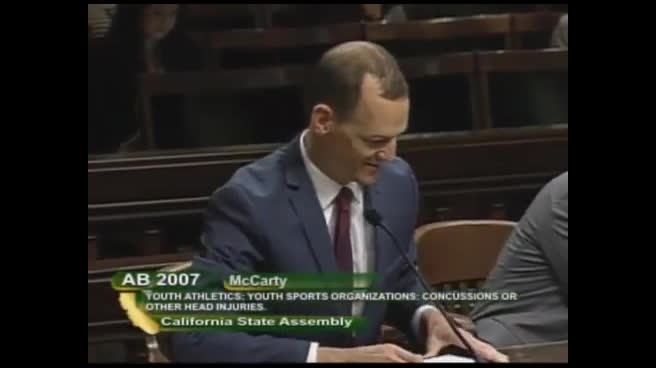 39MIN
Assembly Standing Committee on Arts, Entertainment, Sports, Tourism, and Internet Media
Bill Author

Bill Co-Author(s):