AB 2134: Clinics: notice: abortion pill reversal.
- Session Year: 2015-2016
- House: Assembly
- Latest Version Date: 2016-04-13
Existing law, the Reproductive FACT Act, requires a licensed covered facility, as defined, to disseminate a notice to clients stating, among other things, that California has public programs that provide immediate free or low-cost access to comprehensive family planning services, prenatal care, and abortion, for eligible women. Existing law authorizes the Attorney General, city attorney, or county counsel to bring an action to impose a specified civil penalty against covered facilities that fail to comply with these requirements.
This bill would additionally require those licensed covered facilities, if the facility provides abortions, to post a public notice advising clients that it may be possible to reverse the effects of the abortion pill.
Existing law, the Reproductive FACT Act, requires a licensed covered facility, as defined, to disseminate a notice to clients stating, among other things, that California has public programs that provide immediate free or low-cost access to comprehensive family planning services, prenatal care, and abortion, for eligible women. Existing law authorizes the Attorney General, city attorney, or county counsel to bring an action to impose a specified civil penalty against covered facilities that fail to comply with these requirements.
This bill would additionally require those licensed covered facilities, if the facility provides abortions, to post a public notice advising clients that it may be possible to reverse the effects of the abortion pill.
Existing law provides for the county-administered In-Home Supportive Services program, under which qualified aged, blind, or disabled persons are provided with supportive services in order to permit them to remain in their own homes and avoid institutionalization. Existing law specifies that supportive services include, among other things, domestic services, personal care services, and paramedical services that make it possible for the recipient to establish and maintain an independent living arrangement.
This bill would make technical, nonsubstantive changes to this provision.
Existing law provides for the county-administered In-Home Supportive Services program, under which qualified aged, blind, or disabled persons are provided with supportive services in order to permit them to remain in their own homes and avoid institutionalization. Existing law specifies that supportive services include, among other things, domestic services, personal care services, and paramedical services that make it possible for the recipient to establish and maintain an independent living arrangement.
This bill would make technical, nonsubstantive changes to this provision.
(a)A licensed covered facility that performs abortions shall post the following public notice in English and in the primary threshold languages for Medi-Cal beneficiaries, as determined by the State Department of Health Care Services for the county in which the facility is located:
It may be possible to reverse the effects of the abortion pill. If you change your mind after taking the abortion pill, time is of the essence. For more information, call the Abortion Pill Reversal Hotline at (877) 558-0333. [insert the telephone number or web site] for more information.
(b)The notice described in subdivision (a) shall be at least 8.5 inches by 11 inches, written in no less than 22-point type, and posted in a conspicuous place where individuals wait that may be easily read by those seeking services from the facility.
(a)A licensed covered facility that performs abortions shall post the following public notice in English and in the primary threshold languages for Medi-Cal beneficiaries, as determined by the State Department of Health Care Services for the county in which the facility is located:
It may be possible to reverse the effects of the abortion pill. If you change your mind after taking the abortion pill, time is of the essence. For more information, call the Abortion Pill Reversal Hotline at (877) 558-0333.
(b)The notice described in subdivision (a) shall be at least 8.5 inches by 11 inches, written in no less than 22-point type, and posted in a conspicuous place where individuals wait that may be easily read by those seeking services from the facility.
SECTION 1.Section 12300 of the Welfare and Institutions Code is amended to read:12300.(a)The purpose of this article is to provide in every county in a manner consistent with this chapter and the annual Budget Act those supportive services identified in this section to aged, blind, or disabled persons, as defined under this chapter, who are unable to perform the services themselves and who cannot safely remain in their homes or abodes of their own choosing unless these services are provided.
(b)Supportive services shall include domestic services and services related to domestic services, heavy cleaning, personal care services, accompaniment by a provider when needed during necessary travel to health-related appointments or to alternative resource sites, yard hazard abatement, protective supervision, teaching and demonstration directed at reducing the need for other supportive services, and paramedical services that make it possible for the recipient to establish and maintain an independent living arrangement.
(c)Personal care services shall mean all of the following:
(1)Assistance with ambulation.
(2)Bathing, oral hygiene, and grooming.
(3)Dressing.
(4)Care and assistance with prosthetic devices.
(5)Bowel, bladder, and menstrual care.
(6)Repositioning, skin care, range of motion exercises, and transfers.
(7)Feeding and assurance of adequate fluid intake.
(8)Respiration.
(9)Assistance with self-administration of medications.
(d)Personal care services are available if these services are provided in the beneficiarys home and other locations as may be authorized by the director. Among the locations that may be authorized by the director pursuant to this paragraph is the recipients place of employment if all of the following conditions are met:
(1)The personal care services are limited to those that are currently authorized for a recipient in the recipients home and those services are to be utilized by the recipient at the recipients place of employment to enable the recipient to obtain, retain, or return to work. Authorized services utilized by the recipient at the recipients place of employment shall be services that are relevant and necessary in supporting and maintaining employment. However, workplace services shall not be used to supplant any reasonable accommodations required of an employer by the federal Americans with Disabilities Act of 1990 (42 U.S.C. Sec. 12101 et seq.; ADA) or other legal entitlements or third-party obligations.
(2)The provision of personal care services at the recipients place of employment shall be authorized only to the extent that the total hours utilized at the workplace are within the total personal care services hours authorized for the recipient in the home. Additional personal care services hours shall not be authorized in connection with a recipients employment.
(e)When supportive services are provided by a person having the legal duty pursuant to the Family Code to provide for the care of his or her child who is the recipient, the provider of supportive services shall receive remuneration for the services only when the provider leaves full-time employment or is prevented from obtaining full-time employment because no other suitable provider is available and when the inability of the provider to provide supportive services may result in inappropriate placement or inadequate care.
These providers shall be paid only for the following:
(1)Services related to domestic services.
(2)Personal care services.
(3)Accompaniment by a provider when needed during necessary travel to health-related appointments or to alternative resource sites.
(4)Protective supervision only as needed because of the functional limitations of the child.
(5)Paramedical services.
(f)To encourage maximum voluntary services, so as to reduce governmental costs, respite care shall also be provided. Respite care is temporary or periodic service for eligible recipients to relieve persons who are providing care without compensation.
(g)A person who is eligible to receive a service or services under an approved federal waiver authorized pursuant to Section 14132.951, or a person who is eligible to receive a service or services authorized pursuant to Section 14132.95, shall not be eligible to receive the same service or services pursuant to this article. If the waiver authorized pursuant to Section 14132.951, as approved by the federal government, does not extend eligibility to all persons otherwise eligible for services under this article, or does not cover a service or particular services, or does not cover the scope of a service that a person would otherwise be eligible to receive under this article, those persons who are not eligible for services, or for a particular service under the waiver or Section 14132.95 shall be eligible for services pursuant to this article.
(h)(1)All services provided pursuant to this article shall be equal in amount, scope, and duration to the same services provided pursuant to Section 14132.95, including any adjustments that may be made to those services pursuant to subdivision (e) of Section 14132.95.
(2)Notwithstanding any other provision of this article, the rate of reimbursement for in-home supportive services provided through any mode of service shall not exceed the rate of reimbursement established under subdivision (j) of Section 14132.95 for the same mode of service unless otherwise provided in the annual Budget Act.
(3)The maximum number of hours available under Section 14132.95, Section 14132.951, and this section, combined, shall be 283 hours per month. A recipient of services under this article shall receive no more than the applicable maximum specified in Section 12303.4.
(a)The purpose of this article is to provide in every county in a manner consistent with this chapter and the annual Budget Act those supportive services identified in this section to aged, blind, or disabled persons, as defined under this chapter, who are unable to perform the services themselves and who cannot safely remain in their homes or abodes of their own choosing unless these services are provided.
(b)Supportive services shall include domestic services and services related to domestic services, heavy cleaning, personal care services, accompaniment by a provider when needed during necessary travel to health-related appointments or to alternative resource sites, yard hazard abatement, protective supervision, teaching and demonstration directed at reducing the need for other supportive services, and paramedical services which that make it possible for the recipient to establish and maintain an independent living arrangement.
(c)Personal care services shall mean all of the following:
(1)Assistance with ambulation.
(2)Bathing, oral hygiene, and grooming.
(3)Dressing.
(4)Care and assistance with prosthetic devices.
(5)Bowel, bladder, and menstrual care.
(6)Repositioning, skin care, range of motion exercises, and transfers.
(7)Feeding and assurance of adequate fluid intake.
(8)Respiration.
(9)Assistance with self-administration of medications.
(d)Personal care services are available if these services are provided in the beneficiarys home and other locations as may be authorized by the director. Among the locations that may be authorized by the director under pursuant to this paragraph is the recipients place of employment if all of the following conditions are met:
(1)The personal care services are limited to those that are currently authorized for a recipient in the recipients home and those services are to be utilized by the recipient at the recipients place of employment to enable the recipient to obtain, retain, or return to work. Authorized services utilized by the recipient at the recipients place of employment shall be services that are relevant and necessary in supporting and maintaining employment. However, workplace services shall not be used to supplant any reasonable accommodations required of an employer by the federal Americans with Disabilities Act of 1990 (42 U.S.C. Sec. 12101 et seq.; ADA) or other legal entitlements or third-party obligations.
(2)The provision of personal care services at the recipients place of employment shall be authorized only to the extent that the total hours utilized at the workplace are within the total personal care services hours authorized for the recipient in the home. Additional personal care services hours may shall not be authorized in connection with a recipients employment.
(e)Where When supportive services are provided by a person having the legal duty pursuant to the Family Code to provide for the care of his or her child who is the recipient, the provider of supportive services shall receive remuneration for the services only when the provider leaves full-time employment or is prevented from obtaining full-time employment because no other suitable provider is available and where when the inability of the provider to provide supportive services may result in inappropriate placement or inadequate care.
These providers shall be paid only for the following:
(1)Services related to domestic services.
(2)Personal care services.
(3)Accompaniment by a provider when needed during necessary travel to health-related appointments or to alternative resource sites.
(4)Protective supervision only as needed because of the functional limitations of the child.
(5)Paramedical services.
(f)To encourage maximum voluntary services, so as to reduce governmental costs, respite care shall also be provided. Respite care is temporary or periodic service for eligible recipients to relieve persons who are providing care without compensation.
(g)A person who is eligible to receive a service or services under an approved federal waiver authorized pursuant to Section 14132.951, or a person who is eligible to receive a service or services authorized pursuant to Section 14132.95, shall not be eligible to receive the same service or services pursuant to this article. In the event that If the waiver authorized pursuant to Section 14132.951, as approved by the federal government, does not extend eligibility to all persons otherwise eligible for services under this article, or does not cover a service or particular services, or does not cover the scope of a service that a person would otherwise be eligible to receive under this article, those persons who are not eligible for services, or for a particular service under the waiver or Section 14132.95 shall be eligible for services under pursuant to this article.
(h)(1)All services provided pursuant to this article shall be equal in amount, scope, and duration to the same services provided pursuant to Section 14132.95, including any adjustments that may be made to those services pursuant to subdivision (e) of Section 14132.95.
(2)Notwithstanding any other provision of this article, the rate of reimbursement for in-home supportive services provided through any mode of service shall not exceed the rate of reimbursement established under subdivision (j) of Section 14132.95 for the same mode of service unless otherwise provided in the annual Budget Act.
(3)The maximum number of hours available under Section 14132.95, Section 14132.951, and this section, combined, shall be 283 hours per month. Any A recipient of services under this article shall receive no more than the applicable maximum specified in Section 12303.4.
|
Date
|
Status
|
|---|---|
| Feb 17, 2016 | Read first time. To print. |
| Feb 18, 2016 | From printer. May be heard in committee March 19. |
| Mar 14, 2016 | Referred to Com. on HEALTH. |
| Mar 16, 2016 | From committee chair, with author's amendments: Amend, and re-refer to Com. on HEALTH. Read second time and amended. |
| Mar 17, 2016 | Re-referred to Com. on HEALTH. |
| Apr 13, 2016 | From committee chair, with author's amendments: Amend, and re-refer to Com. on HEALTH. Read second time and amended. |
| Apr 14, 2016 | Re-referred to Com. on HEALTH. |
| Apr 19, 2016 | In committee: Set, first hearing. Failed passage. Reconsideration granted. |
|
Date
|
Description
|
Location
|
Votes
|
|
|---|---|---|---|---|
| Apr 19, 2016 | Reconsideration. | Assembly Standing Committee on Health |
Passed |
|
| Apr 19, 2016 | Do pass as amended and be re-referred to the Committee on [Appropriations] | Assembly Standing Committee on Health |
Failed |
This list shows positions taken on this bill by organizations on the date displayed, which is linked to the original source.
Positions by individuals are not included.
|
Organization
|
Position
|
Date
|
|---|---|---|
| California Family Health Council Inc. | * Against | Apr 19, 2016 |
| Concern Women for America | * Support | Apr 19, 2016 |
| CR Pregnancy and Health | * Support | Apr 19, 2016 |
| Department of Obstetrics and Gynecology | * Against | Apr 19, 2016 |
| Planned Parenthood | * Against | Apr 19, 2016 |
Date of Hearing: April 19, 2016
ASSEMBLY COMMITTEE ON HEALTH
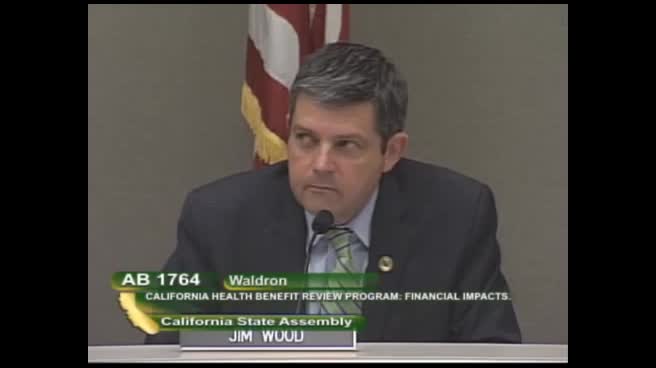
Jim Wood, Chair
ABPCA Bill Id:AB 2134
Author:(Waldron) – As Amended Ver:April 13, 2016
SUBJECT: Clinics: notice: abortion pill reversal.
SUMMARY: Requires licensed clinics that perform abortions to post a notice advising clients that it may be possible to reverse the effects of the abortion pill. Specifically, this bill:
- Requires a licensed facility that performs abortions to post the following public notice in English and the primary threshold languages for Medi-Cal beneficiaries, as determined by the Department of Health Care Services for the county in which the facility is located:
"It may be possible to reverse the effects of the abortion pill. If you change your mind after taking the abortion pill, time is of the essence. Contact the Abortion Pill Reversal Hotline <insert the telephone number or website>." - Requires the notice to be at least 8.5 inches by 11 inches, written in no less than 22-point type, and posted in a conspicuous place where individuals wait that may be easily read by those seeking services from the facility.
EXISTING LAW:
- Requires the Department of Public Health (DPH) to inspect and license health facilities, including but not limited to clinics.
- Provides for exemptions from licensing requirements for certain types of clinics, including federally operated clinics, local government primary care clinics, clinics affiliated with an institution of higher learning, clinics conducted as outpatient departments of hospitals, and community or free clinics. Provides for exemptions for community or free clinics that are operated on separate premises from the licensed clinic and are only open for limited services of no more than 20 hours per week (also known as intermittent clinics).
- Authorizes DPH to take various types of enforcement actions against a primary care clinic that has violated state law or regulation, including imposing fines, sanctions, civil or criminal penalties, and suspension or revocation of the clinic's license.
- Establishes the California Reproductive Privacy Act, which provides that the state shall not deny or interfere with a women's right to choose or obtain an abortion prior to viability of the fetus, or when the abortion is necessary to protect the life or health of the woman, and makes legislative findings and declarations that every individual possesses a fundamental right of privacy with respect to personal reproductive decisions, and that every woman has the fundamental right to choose to bear a child or to choose and to obtain an abortion, as specified.
- Enacts the Reproductive Freedom, Accountability, Comprehensive Care, and Transparency Act (Reproductive FACT Act) and requires clinics and other facilities that provide family planning or pregnancy-related services to provide specified notices to clients.
- Defines a “licensed covered facility,” for the purposes of the Reproductive FACT Act, as a licensed clinic or an intermittent clinic operating under a primary care clinic whose primary purpose is providing family planning or pregnancy-related services, and that satisfies two or more of the following:
- The facility offers obstetric ultrasounds, obstetric sonograms, or prenatal care to pregnant women;
b) The facility provides, or offers counseling about, contraception or contraceptive methods;
c) The facility offers pregnancy testing or pregnancy diagnosis;
d) The facility advertises or solicits patrons with offers to provide prenatal sonography, pregnancy tests, or pregnancy options counseling.
e) The facility offers abortion services; or,
f) The facility has staff or volunteers who collect health information from clients.
FISCAL EFFECT: This bill has not been analyzed by a fiscal committee.
COMMENTS:
- PURPOSE OF THIS BILL. According to the author, any licensed facility providing pregnancy-related services is required to post a sign in the waiting area alerting visitors to California’s free and low-cost public programs for family planning, prenatal care, and abortions. The author states that this bill will require a license covered facility to post a sign notifying the public about the option to reverse the effects of the abortion pill. The author states that the “RU-486” abortion drug is a combination of mifepristone and misoprostol, which is used to terminate a pregnancy. The author contends the abortion reversal protocol can reverse the effects of the first drug administered, mifepristone, by administering progesterone into a woman’s body. The author asserts that progesterone blocks the effects of mifepristone, found in the first step of the abortion pill, which cancels its effects and that this gives a pregnant woman the option in a timely manner to reverse the abortion if she changes her mind.
- BACKGROUND.
- Abortion data. According to a 2014 Guttmacher Institute document titled “State Facts About Unintended Pregnancy: California," contraceptive use is a key predictor of women's recourse to abortion. The very small group of American women who are at risk of experiencing an unintended pregnancy but are not using contraceptives account for more than half of all abortions. Many of these women did not think they would get pregnant or had concerns about contraceptive methods. The remainder of abortions occur among the much larger group of women who were using contraceptives in the month they became pregnant. Many of these women report difficulty using contraceptives consistently. According to the Guttmacher Institute, at current rates, about three in 10 American women will have had an abortion by the time she reaches age 45. Approximately 58% of women having abortions are in their 20s; 61% have one or more children; 85% are unmarried; 69% are economically disadvantaged; and 73% report a religious affiliation. No racial or ethnic group makes up a majority: 36% of women obtaining abortions are white non-Hispanic; 30% are black non-Hispanic; 25% are Hispanic; and, 9% are of other racial backgrounds.
According to the Centers for Disease Control and Prevention (CDC), in 2012, 699,202 legal induced abortions were reported to CDC from 49 reporting areas. The abortion rate for 2012 was 13.2 abortions per 1,000 women aged 15 to 44 years, and the abortion ratio was 210 abortions per 1,000 live births. Compared with 2011, the total number and ratio of reported abortions for 2012 decreased 4%, and the abortion rate decreased 5%. Additionally, from 2003 to 2012, the number, rate, and ratio of reported abortions decreased 17%, 18%, and 14%, respectively. Given the large decreases in the total number, rate, and ratio of reported abortions from 2011 to 2012, in combination with decreases that occurred during 2008 to 2011, all three measures reached historic lows. - Abortion procedures. Medical abortion, which involves the use of medications rather than a surgical procedure to induce an abortion, is an option for women who wish to terminate a first-trimester pregnancy. Although the method is most commonly used up to 63 days of gestation (calculated from the first day of the last menstrual period), the treatment also is effective after 63 days of gestation. The CDC estimates that 64% of abortions are performed before 63 days of gestation. Medical abortions currently comprise 16.5% of all abortions in the United States and 25.2% of all abortions at or before nine weeks of gestation. Mifepristone, combined with misoprostol, is the most commonly used medical abortion regimen in the United States.
"Abortion reversal" is a procedure in which the hormone progesterone is injected into a patient after she has taken mifepristone in an effort to reverse its effects. It was developed by an anti-abortion doctor, who in a 2012 article in the Annals of Pharmacotherapy claimed to have injected progesterone into six women to reverse the effects of mifepristone, which resulted in four of those women giving birth. The article concluded that some women who take mifepristone wish to reverse the medical abortion process and that progesterone competes with mifepristone for the progesterone receptor and may reverse the effects of mifepristone.
According to Physicians for Reproductive Health, if a woman takes both pills as part of RU-486 it is 98% effective and it is not known what taking just the first pill does to the effectiveness, regardless of the attempt to reverse the effects. Because there have been no clinical trials the "abortion reversal procedure" has not been tested for safety, effectiveness, or the likelihood of side effects. The approach is not recommended in the American Congress of Obstetricians and Gynecologists’ (ACOG) clinical guidance on medication abortion. Indeed, ACOG and the American Medical Association agree that there is no reliable evidence that medication abortions can, in fact, be ‘reversed’ through a course of treatment.
An article published in the May 2015 journal Contraception, "Continuing pregnancy after mifepristone and "reversal" of first-trimester medical abortion: a systematic review," notes that, women rarely change their minds after beginning a medical abortion. According to reports that physicians are required to submit to the drug's manufacturer, between 2000 and 2012, less than 0.004% of women taking mifepristone in the US later chose to continue the pregnancy, and notes that in such a case, a women should be counseled that there is a reasonable chance (10 to 45%) that the pregnancy will continue. The review found no credible evidence that using medication after ingestion of mifepristone is better than expectant management (watchful waiting) in assuring a continuing pregnancy and suggesting otherwise is scientifically untenable. The article concludes that legislative interference in the patient-physician relationship is unwarranted and dangerous.
- Abortion data. According to a 2014 Guttmacher Institute document titled “State Facts About Unintended Pregnancy: California," contraceptive use is a key predictor of women's recourse to abortion. The very small group of American women who are at risk of experiencing an unintended pregnancy but are not using contraceptives account for more than half of all abortions. Many of these women did not think they would get pregnant or had concerns about contraceptive methods. The remainder of abortions occur among the much larger group of women who were using contraceptives in the month they became pregnant. Many of these women report difficulty using contraceptives consistently. According to the Guttmacher Institute, at current rates, about three in 10 American women will have had an abortion by the time she reaches age 45. Approximately 58% of women having abortions are in their 20s; 61% have one or more children; 85% are unmarried; 69% are economically disadvantaged; and 73% report a religious affiliation. No racial or ethnic group makes up a majority: 36% of women obtaining abortions are white non-Hispanic; 30% are black non-Hispanic; 25% are Hispanic; and, 9% are of other racial backgrounds.
- SUPPORT. The California Catholic Conference (CCC) supports this bill stating, all women, particularly those who are low-income or poor, deserve the opportunity to be supported in their choice to parent a child by those who offer more personal and familial options than those clinics who offer primarily medical services and abortion. CCC concludes the state of California owes women the opportunity to exercise "their reproductive rights" by presenting all possible and available options.
- OPPOSITION. NARAL Pro-Choice California (NARAL) opposes this bill stating, "Abortion pill reversal" is a highly controversial experimental procedure that has not been well tested, and medical providers have argued it is not responsible to present women with the option. NARAL also notes, in addition to the risk of notifying patients about a medically unproven procedure, giving women information on medication abortion "reversal" is based on the false assumption that women who seek abortion care are not informed about their decision.
Planned Parenthood Affiliates of California (PPAC) oppose this bill noting that the bill forces health care professionals to provide abortion patients with information that is medically inaccurate and could be harmful to a woman's health. PPAC concludes that this bill impedes a woman's ability to make an informed decision because the abortion "reversal" procedure isn't just scientifically unproven, it could be dangerous. - RELATED LEGISLATION.
- AB 2775 (Gallagher) requires facilities that offer abortion services to disseminate a notice to clients providing a telephone number for a specific organization, and stating that non-profit pregnancy centers can provide a variety of specified services. AB 2775 is pending in Assembly Health Committee.
- AB 2081 (Grove) provides that a health care service plan is not required to include abortion as a covered benefit, and would prohibit the Director of the Department of Managed Health Care from denying, suspending, or revoking a plan's license, or otherwise sanction or discriminate against a health plan, if the health plan excludes coverage for abortions.
- PREVIOUS LEGISLATION.
- AB 775 (Chiu and Burke), Chapter 700, Statutes of 2015, enacts the Reproductive FACT Act and requires clinics and other facilities that provide family planning or pregnancy-related services to provide specified notices to clients.
- AB 1254 (Grove) of 2015, was substantially similar to AB 2081. AB 1254 failed passage in the Assembly Health Committee.
- AB 2336 (Grove) of 2014, would have prohibited a person from performing, or attempting to perform an abortion if they know the pregnant woman is seeking the abortion on account of the gender of the unborn child. AB 2336 failed passage in the Assembly Health Committee.
- ACA 5 (Grove) of 2014 would have prohibited, except in the case of an emergency, a physician from performing an abortion on an unemancipated minor unless the physician has notified one of her parents, or a judge has granted the unemancipated minor a waiver of the notification requirement. ACA 5 failed passage in the Assembly Health Committee.
REGISTERED SUPPORT / OPPOSITION:
Support
California Catholic Conference, Inc.
Opposition
American Civil Liberties Union
American Congress of Obstetricians and Gynecologists, District IX, California
Community Action Fund of Planned Parenthood of Orange and San Bernardino Counties
NARAL Pro-Choice California
Planned Parenthood Affiliates of California
Planned Parenthood Advocacy Project Los Angeles County
Planned Parenthood Mar Monte
Planned Parenthood Northern California Action Fund
Analysis Prepared by: Lara Flynn / HEALTH / (916) 319-2097
Bill Author

Bill Co-Author(s):