AB 2217: Notary public: service fees.
- Session Year: 2015-2016
- House: Assembly
- Latest Version Date: 2016-08-17
Existing law authorizes the Secretary of State to appoint and commission notaries public in the number that the secretary deems necessary for the public convenience. Existing law prohibits fees charged by a notary public for certain services, including taking an acknowledgment or proof of a deed, from exceeding specified amounts.
This bill would increase those amounts, as specified.
Existing law authorizes the Secretary of State to appoint and commission notaries public in the number as the secretary deems necessary for the public convenience. Existing law prohibits fees charged by a notary public for certain services, including taking an acknowledgment or proof of a deed, from exceeding specified amounts.
This bill would increase those amounts, as specified.
Fees charged by a notary public for the following services shall not exceed the fees prescribed by this section.
(a)For taking an acknowledgment or proof of a deed, or other instrument, to include the seal and the writing of the certificate, the sum of fifteen dollars ($15) for each signature taken.
(b)For administering an oath or affirmation to one person and executing the jurat, including the seal, the sum of fifteen dollars ($15).
(c)For all services rendered in connection with the taking of any deposition, the sum of thirty dollars ($30), and in addition thereto, the sum of seven dollars ($7) for administering the oath to the witness and the sum of seven dollars ($7) for the certificate to the deposition.
(d)No fee may be charged to notarize signatures on vote by mail ballot identification envelopes or other voting materials.
(e)For certifying a copy of a power of attorney under Section 4307 of the Probate Code the sum of fifteen dollars ($15).
(f)In accordance with Section 6107, no fee may be charged to a United States military veteran for notarization of an application or a claim for a pension, allotment, allowance, compensation, insurance, or any other veterans benefit.
SEC. 2.Section 8223 of the Government Code is amended to read:8223.(a)A notary public who holds himself or herself out as being an immigration specialist, immigration consultant, or any other title or description reflecting an expertise in immigration matters shall not advertise in any manner whatsoever that he or she is a notary public.
(b)A notary public qualified and bonded as an immigration consultant under Chapter 19.5 (commencing with Section 22440) of Division 8 of the Business and Professions Code may enter data, provided by the client, on immigration forms provided by a federal or state agency. The fee for this service shall not exceed fifteen dollars ($15) per individual for each set of forms. If notary services are performed in relation to the set of immigration forms, additional fees may be collected pursuant to Section 8211. This fee limitation shall not apply to an attorney, who is also a notary public, who is rendering professional services regarding immigration matters.
(c)This section shall not be construed to exempt a notary public who enters data on an immigration form at the direction of a client, or otherwise performs the services of an immigration consultant, as defined by Section 22441 of the Business and Professions Code, from the requirements of Chapter 19.5 (commencing with Section 22440) of Division 8 of the Business and Professions Code. A notary public who is not qualified and bonded as an immigration consultant under Chapter 19.5 (commencing with Section 22440) of Division 8 of the Business and Professions Code may not enter data provided by a client on immigration forms nor otherwise perform the services of an immigration consultant.
Fees charged by a notary public for the following services shall not exceed the fees prescribed by this section.
(a)For taking an acknowledgment or proof of a deed, or other instrument, to include the seal and the writing of the certificate, the sum of ten fifteen dollars ($10) ($15) for each signature taken.
(b)For administering an oath or affirmation to one person and executing the jurat, including the seal, the sum of ten fifteen dollars ($10). ($15).
(c)For all services rendered in connection with the taking of any deposition, the sum of twenty thirty dollars ($20), ($30), and in addition thereto, the sum of five seven dollars ($5) ($7) for administering the oath to the witness and the sum of five seven dollars ($5) ($7) for the certificate to the deposition.
(d)No fee may be charged to notarize signatures on vote by mail ballot identification envelopes or other voting materials.
(e)For certifying a copy of a power of attorney under Section 4307 of the Probate Code the sum of ten fifteen dollars ($10). ($15).
(f)In accordance with Section 6107, no fee may be charged to a United States military veteran for notarization of an application or a claim for a pension, allotment, allowance, compensation, insurance, or any other veterans benefit.
SEC. 2.Section 8223 of the Government Code is amended to read:8223.(a)No A notary public who holds himself or herself out as being an immigration specialist, immigration consultant consultant, or any other title or description reflecting an expertise in immigration matters shall not advertise in any manner whatsoever that he or she is a notary public.
(b)A notary public qualified and bonded as an immigration consultant under Chapter 19.5 (commencing with Section 22440) of Division 8 of the Business and Professions Code may enter data, provided by the client, on immigration forms provided by a federal or state agency. The fee for this service shall not exceed ten fifteen dollars ($10) ($15) per individual for each set of forms. If notary services are performed in relation to the set of immigration forms, additional fees may be collected pursuant to Section 8211. This fee limitation shall not apply to an attorney, who is also a notary public, who is rendering professional services regarding immigration matters.
(c)Nothing in this This section shall not be construed to exempt a notary public who enters data on an immigration form at the direction of a client, or otherwise performs the services of an immigration consultant, as defined by Section 22441 of the Business and Professions Code, from the requirements of Chapter 19.5 (commencing with Section 22440) of Division 8 of the Business and Professions Code. A notary public who is not qualified and bonded as an immigration consultant under Chapter 19.5 (commencing with Section 22440) of Division 8 of the Business and Professions Code may not enter data provided by a client on immigration forms nor otherwise perform the services of an immigration consultant.
|
Date
|
Status
|
|---|---|
| Jun 15, 2016 | From committee: Do pass. To Consent Calendar. (Ayes 7. Noes 0.) (June 14). |
| Aug 17, 2016 | Chaptered by Secretary of State - Chapter 133, Statutes of 2016. |
| Aug 17, 2016 | Approved by the Governor. |
| Aug 5, 2016 | Enrolled and presented to the Governor at 2:30 p.m. |
| Aug 2, 2016 | In Assembly. Ordered to Engrossing and Enrolling. |
| Aug 1, 2016 | Read third time. Passed. Ordered to the Assembly. (Ayes 38. Noes 1. Page 4727.). |
| Aug 1, 2016 | Read third time. Passed. Ordered to the Assembly. |
| Jun 20, 2016 | Ordered to third reading. |
| Jun 20, 2016 | From Consent Calendar. |
| Jun 16, 2016 | Read second time. Ordered to Consent Calendar. |
| Feb 18, 2016 | Read first time. To print. |
| May 12, 2016 | Referred to Com. on JUD. |
| May 2, 2016 | Read third time. Passed. Ordered to the Senate. (Ayes 76. Noes 0. Page 4627.) |
| May 2, 2016 | Read third time. Passed. Ordered to the Senate. |
| May 2, 2016 | In Senate. Read first time. To Com. on RLS. for assignment. |
| Apr 27, 2016 | Read second time. Ordered to Consent Calendar. |
| Apr 26, 2016 | From committee: Do pass. To Consent Calendar. (Ayes 16. Noes 0.) (April 26). |
| Mar 3, 2016 | Referred to Com. on B. & P. |
| Feb 19, 2016 | From printer. May be heard in committee March 20. |
|
Date
|
Description
|
Location
|
Votes
|
|
|---|---|---|---|---|
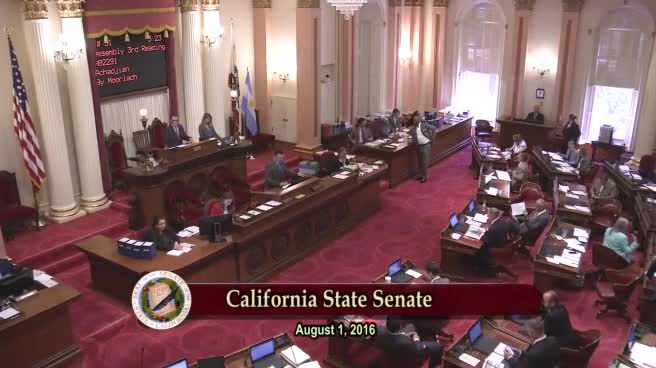
| Aug 1, 2016 | Assembly 3rd Reading AB2217 Hadley By Moorlach | Senate Floor |
Passed |
|
| Jun 14, 2016 | Do pass and be ordered to the Consent Calendar | Senate Standing Committee on Judiciary |
Passed |
|
| May 2, 2016 | AB 2217 HADLEY Consent Calendar Second Day Regular Session | Assembly Floor |
Passed |
|
| Apr 26, 2016 | Do pass. To Consent Calendar. | Assembly Standing Committee on Business and Professions |
Passed |
This list shows positions taken on this bill by organizations on the date displayed, which is linked to the original source.
Positions by individuals are not included.
|
Organization
|
Position
|
Date
|
|---|---|---|
| American Society of Notaries | ** Support | Aug 1, 2016 |
| National Notary Association | ** Support | Aug 1, 2016 |
| The American Association of Notaries | ** Support | Aug 1, 2016 |
Office of Senate Floor Analyses (916) 651-1520 Fax: (916) 327-4478 | AB 2217 |
THIRD READING
Bill No: AB 2217
Introduced: 2/18/16
SENATE JUDICIARY COMMITTEE: 7-0, 6/14/16
AYES: Jackson, Moorlach, Anderson, Hertzberg, Leno, Monning, Wieckowski
ASSEMBLY FLOOR: 76-0, 5/2/16 (Consent) - See last page for vote
SUBJECT: Notary public: service fees
DIGEST:
This bill allows notary publics to charge higher prices for some of their services.
Existing law:
- Authorizes the Secretary of State to appoint and commission notaries public who have met education, examination, and ethical requirements as specified. (Gov. Code Secs. 8200-8201.5)
- Provides that fees charged by a notary public for the following services shall not exceed the following:
- taking an acknowledgment or proof of a deed, or other instrument, to include the seal and the writing of the certificate, ten dollars ($10) for each signature taken;
- administering an oath or affirmation to one person and executing the jurat, including the seal, ten dollars ($10);
- providing services rendered to take a deposition, twenty dollars ($20), and in addition thereto, five dollars ($5) for administering the oath to the witness and five dollars ($5) for the certificate to the deposition;
- entering data provided by a client on immigration forms provided by a federal or state agency if the notary public is qualified and bonded as an immigration consultant, ten dollars ($10); and
- certifying a copy of a power of attorney under Section 4307 of the Probate Code, ten dollars ($10).
- Provides that no fees may be charged by notaries public for notarizing an application or a claim by a United States military veteran for a pension, allotment, allowance, compensation, insurance, or any other veteran’s benefit.
- Provides that no fees may be charged by notaries public for notarizing vote by mail ballot identification envelopes or other voting materials.
This bill:
- Allows a notary public to charge an additional $5 for the following services:
- each signature taken for an acknowledgment or proof or a deed, or other instrument, to include the seal and the writing of the certificate;
- administering an oath or affirmation to one person and executing the jurat, including the seal;
- certifying a copy of a power of attorney under Section 4307 of the Probate Code; and
- entering data provided by a client on immigration forms provided by a federal or state agency if the notary public is qualified and bonded as an immigration consultant.
- Allows, in connection with the taking of any deposition, a notary public to charge a fee up to $30, instead of $20, and in addition allows the notary to charge $7 instead of $5 for administering the oath to the witness and for the certificate to the deposition.
- Makes other nonsubstantive conforming changes.
Background
A notary public is a public officer appointed and commissioned by the Secretary of State to serve the public in non-contentious matters generally concerning estates, deeds, powers-of-attorney, foreign and international business, and other written instruments. Occasionally, an individual who is party to a more sensitive formal agreement, such as a child custody agreement, a confidential marriage license, or an advance healthcare directive, must have the agreement notarized before it can enter into force. A notary’s main functions are to take acknowledgements of various written instruments, administer oaths and affirmations, take depositions and affidavits, certify copies of powers of attorney under the Probate Code, demand acceptance and payment of foreign and inland bills of exchange or promissory notes, and to protest nonpayment and nonacceptance of bills and notes. (Gov. Code Sec. 8205.)
Notaries public are commissioned for four-year terms by the Secretary of State. In order to receive a commission, an individual must be a California resident who is at least 18 years old, complete a study course, pass an examination, clear a background check, and pay a fee to the Secretary of State. There is a statutory cap on the fees that a notary public may charge for the basic services that a notary public provides. For example, under current law a notary public may charge up to $10 for each signature taken for taking an acknowledgement or proof of a deed. The cap on fees that notaries public can charge has not increased for over 20 years, while the cost of living has increased over 60%. (See U.S. Department of Labor, Bureau of Labor Statistics Inflation Calculator <http://data.bls.gov/cgi-bin/cpicalc.pl [as of June 8, 2016]) Accordingly, this bill raises the amount notary publics can charge for some of their services between 25% and 50%.
Comments
The author writes:
California law does not set a minimum fee but currently caps the maximum fee that a Notary Public may charge at $10 per signature. This cap has not changed for over twenty years, during which time the cost of living has increased over 60%.
AB 2217 will increase the maximum fee that can be charged by Notaries Public in California.
By increasing the fees a notary may charge to $15 per signature, AB 2217 will align those fees with the increase of 64.8% seen in the Consumer Price Index (CPI) since 1993 – the last time the Notary fees were raised. AB 2217 also maintains current law, stating that no fee shall be charged to notarize voting materials, nor shall fees be charged to U.S. military veterans for notarization on veteran’s benefit claims.
It is important to note that AB 2217 does not set the price for Notary Public series, it simply raises the price. Notaries may continue to set their prices subject to customer demand and subject to the revised cap.
$10 in 1993 has the same buying power as $16.56 in 2016. According to the Bureau of Labor Statistic’s inflation calculator, $10 in 1993 has the same buying power as $16.56 in 2016. (See U.S. Department of Labor, Bureau of Labor Statistics Inflation Calculator <http://data.bls.gov/cgi-bin/cpicalc.pl [as of June 8, 2016]) For this reason alone an increase from $10 to $15 is arguably justified. The National Notary Association, in support, further points out that requirements for a Notary Public commission in California have considerably increased the cost to become a Notary. They note that every four years the employers of notaries public must pay for Livescan fingerprints, a background check, a color passport photograph, and a course of instruction. Additionally, supporters highlight that they must also pay for a surety bond, the official seal, journal of official acts, application fee and fees to file the bond and oath of office in the county of the applicant’s principal place of business.
FISCAL EFFECT: Appropriation: No Fiscal Com.: No Local: No
The American Association of Notaries
American Society of Notaries
National Notary Association
More than 1,100 individuals
OPPOSITION: (Verified 6/14/16)
None received
ASSEMBLY FLOOR: 76-0, 5/2/16
AYES: Achadjian, Alejo, Travis Allen, Arambula, Atkins, Baker, Bigelow, Bloom, Bonilla, Bonta, Brough, Brown, Burke, Calderon, Campos, Chang, Chau, Chávez, Chiu, Chu, Cooley, Cooper, Dababneh, Dahle, Daly, Dodd, Eggman, Frazier, Gallagher, Cristina Garcia, Eduardo Garcia, Gatto, Gipson, Gomez, Gonzalez, Gordon, Gray, Grove, Hadley, Harper, Holden, Irwin, Jones, Jones-Sawyer, Kim, Lackey, Levine, Linder, Lopez, Low, Maienschein, Mathis, Mayes, McCarty, Medina, Melendez, Mullin, Nazarian, Obernolte, O'Donnell, Olsen, Patterson, Quirk, Rodriguez, Salas, Santiago, Steinorth, Mark Stone, Thurmond, Ting, Wagner, Waldron, Weber, Wilk, Wood, Rendon
NO VOTE RECORDED: Beth Gaines, Roger Hernández, Ridley-Thomas, Williams
Prepared by: Margie Estrada / JUD. / (916) 651-4113
6/30/16 8:43:12
**** END ****
Office of Senate Floor Analyses (916) 651-1520 Fax: (916) 327-4478 | AB 2217 |
CONSENT
Bill No: AB 2217
Introduced: 2/18/16
SENATE JUDICIARY COMMITTEE: 7-0, 6/14/16
AYES: Jackson, Moorlach, Anderson, Hertzberg, Leno, Monning, Wieckowski
ASSEMBLY FLOOR: 76-0, 5/2/16 (Consent) - See last page for vote
SUBJECT: Notary public: service fees
DIGEST: This bill allows notary publics to charge higher prices for some of their services.
Existing law:
- Authorizes the Secretary of State to appoint and commission notaries public who have met education, examination, and ethical requirements as specified. (Gov. Code Secs. 8200-8201.5)
- Provides that fees charged by a notary public for the following services shall not exceed the following:
- taking an acknowledgment or proof of a deed, or other instrument, to include the seal and the writing of the certificate, ten dollars ($10) for each signature taken;
- administering an oath or affirmation to one person and executing the jurat, including the seal, ten dollars ($10);
- providing services rendered to take a deposition, twenty dollars ($20), and in addition thereto, five dollars ($5) for administering the oath to the witness and five dollars ($5) for the certificate to the deposition;
- entering data provided by a client on immigration forms provided by a federal or state agency if the notary public is qualified and bonded as an immigration consultant, ten dollars ($10); and
- certifying a copy of a power of attorney under Section 4307 of the Probate Code, ten dollars ($10).
- Provides that no fees may be charged by notaries public for notarizing an application or a claim by a United States military veteran for a pension, allotment, allowance, compensation, insurance, or any other veteran’s benefit.
- Provides that no fees may be charged by notaries public for notarizing vote by mail ballot identification envelopes or other voting materials.
This bill:
- Allows a notary public to charge an additional $5 for the following services:
- each signature taken for an acknowledgment or proof or a deed, or other instrument, to include the seal and the writing of the certificate;
- administering an oath or affirmation to one person and executing the jurat, including the seal;
- certifying a copy of a power of attorney under Section 4307 of the Probate Code; and
- entering data provided by a client on immigration forms provided by a federal or state agency if the notary public is qualified and bonded as an immigration consultant.
- Allows, in connection with the taking of any deposition, a notary public to charge a fee up to $30, instead of $20, and in addition allows the notary to charge $7 instead of $5 for administering the oath to the witness and for the certificate to the deposition.
- Makes other nonsubstantive conforming changes.
Background
A notary public is a public officer appointed and commissioned by the Secretary of State to serve the public in non-contentious matters generally concerning estates, deeds, powers-of-attorney, foreign and international business, and other written instruments. Occasionally, an individual who is party to a more sensitive formal agreement, such as a child custody agreement, a confidential marriage license, or an advance healthcare directive, must have the agreement notarized before it can enter into force. A notary’s main functions are to take acknowledgements of various written instruments, administer oaths and affirmations, take depositions and affidavits, certify copies of powers of attorney under the Probate Code, demand acceptance and payment of foreign and inland bills of exchange or promissory notes, and to protest nonpayment and nonacceptance of bills and notes. (Gov. Code Sec. 8205.)
Notaries public are commissioned for four-year terms by the Secretary of State. In order to receive a commission, an individual must be a California resident who is at least 18 years old, complete a study course, pass an examination, clear a background check, and pay a fee to the Secretary of State. There is a statutory cap on the fees that a notary public may charge for the basic services that a notary public provides. For example, under current law a notary public may charge up to $10 for each signature taken for taking an acknowledgement or proof of a deed. The cap on fees that notaries public can charge has not increased for over 20 years, while the cost of living has increased over 60%. (See U.S. Department of Labor, Bureau of Labor Statistics Inflation Calculator <http://data.bls.gov/cgi-bin/cpicalc.pl [as of June 8, 2016]) Accordingly, this bill raises the amount notary publics can charge for some of their services between 25% and 50%.
Comments
The author writes:
California law does not set a minimum fee but currently caps the maximum fee that a Notary Public may charge at $10 per signature. This cap has not changed for over twenty years, during which time the cost of living has increased over 60%.
AB 2217 will increase the maximum fee that can be charged by Notaries Public in California.
By increasing the fees a notary may charge to $15 per signature, AB 2217 will align those fees with the increase of 64.8% seen in the Consumer Price Index (CPI) since 1993 – the last time the Notary fees were raised. AB 2217 also maintains current law, stating that no fee shall be charged to notarize voting materials, nor shall fees be charged to U.S. military veterans for notarization on veteran’s benefit claims.
It is important to note that AB 2217 does not set the price for Notary Public series, it simply raises the price. Notaries may continue to set their prices subject to customer demand and subject to the revised cap.
$10 in 1993 has the same buying power as $16.56 in 2016. According to the Bureau of Labor Statistic’s inflation calculator, $10 in 1993 has the same buying power as $16.56 in 2016. (See U.S. Department of Labor, Bureau of Labor Statistics Inflation Calculator <http://data.bls.gov/cgi-bin/cpicalc.pl [as of June 8, 2016]) For this reason alone an increase from $10 to $15 is arguably justified. The National Notary Association, in support, further points out that requirements for a Notary Public commission in California have considerably increased the cost to become a Notary. They note that every four years the employers of notaries public must pay for Livescan fingerprints, a background check, a color passport photograph, and a course of instruction. Additionally, supporters highlight that they must also pay for a surety bond, the official seal, journal of official acts, application fee and fees to file the bond and oath of office in the county of the applicant’s principal place of business.
FISCAL EFFECT: Appropriation: No Fiscal Com.: No Local: No
The American Association of Notaries
American Society of Notaries
National Notary Association
More than 1,100 individuals
OPPOSITION: (Verified 6/14/16)
None received
ASSEMBLY FLOOR: 76-0, 5/2/16
AYES: Achadjian, Alejo, Travis Allen, Arambula, Atkins, Baker, Bigelow, Bloom, Bonilla, Bonta, Brough, Brown, Burke, Calderon, Campos, Chang, Chau, Chávez, Chiu, Chu, Cooley, Cooper, Dababneh, Dahle, Daly, Dodd, Eggman, Frazier, Gallagher, Cristina Garcia, Eduardo Garcia, Gatto, Gipson, Gomez, Gonzalez, Gordon, Gray, Grove, Hadley, Harper, Holden, Irwin, Jones, Jones-Sawyer, Kim, Lackey, Levine, Linder, Lopez, Low, Maienschein, Mathis, Mayes, McCarty, Medina, Melendez, Mullin, Nazarian, Obernolte, O'Donnell, Olsen, Patterson, Quirk, Rodriguez, Salas, Santiago, Steinorth, Mark Stone, Thurmond, Ting, Wagner, Waldron, Weber, Wilk, Wood, Rendon
NO VOTE RECORDED: Beth Gaines, Roger Hernández, Ridley-Thomas, Williams
Prepared by: Margie Estrada / JUD. / (916) 651-4113
6/17/16 15:03:44
**** END ****
Senator Hannah-Beth Jackson, Chair
2015-2016 Regular Session
Bill No: AB 2217 (Author:Hadley)
Version: February 18, 2016
Hearing Date: June 14, 2016
Fiscal: No
Urgency: No
Consultant: ME
SUBJECT
Notary public: service fees
DESCRIPTION
This bill would allow notary publics to charge higher prices for some of their services.
BACKGROUND
A notary public is a public officer appointed and commissioned by the Secretary of State to serve the public in non-contentious matters generally concerning estates, deeds, powers-of-attorney, foreign and international business, and other written instruments. Occasionally, an individual who is party to a more sensitive formal agreement, such as a child custody agreement, a confidential marriage license, or an advance healthcare directive, must have the agreement notarized before it can enter into force. A notary’s main functions are to take acknowledgements of various written instruments, administer oaths and affirmations, take depositions and affidavits, certify copies of powers of attorney under the Probate Code, demand acceptance and payment of foreign and inland bills of exchange or promissory notes, and to protest nonpayment and nonacceptance of bills and notes. (Gov. Code Sec. 8205.)
Notaries public are commissioned for four-year terms by the Secretary of State. In order to receive a commission, an individual must be a California resident who is at least 18 years old, complete a study course, pass an examination, clear a background check, and pay a fee to the Secretary of State. There is a statutory cap on the fees that a notary public may charge for the basic services that a notary public provides. For example, under current law a notary public may charge up to $10 for each signature taken for taking an acknowledgement or proof of a deed. The cap on fees that notaries public can charge has not increased for over 20 years, while the cost of living has increased over 60%. (See U.S. Department of Labor, Bureau of Labor Statistics Inflation Calculator <http://data.bls.gov/cgi-bin/cpicalc.pl> [as of June 8, 2016]) Accordingly, this bill would raise the amount notary publics can charge for some of their services between 25% and 50%.
CHANGES TO EXISTING LAW
Existing law authorizes the Secretary of State to appoint and commission notaries public who have met education, examination, and ethical requirements as specified. (Gov. Code Secs. 8200-8201.5)
Existing law provides that fees charged by a notary public for the following services shall not exceed the following:
- taking an acknowledgment or proof of a deed, or other instrument, to include the seal and the writing of the certificate, ten dollars ($10) for each signature taken;
- administering an oath or affirmation to one person and executing the jurat, including the seal, ten dollars ($10);
- providing services rendered to take a deposition, twenty dollars ($20), and in addition thereto, five dollars ($5) for administering the oath to the witness and five dollars ($5) for the certificate to the deposition;
- entering data provided by a client on immigration forms provided by a federal or state agency if the notary public is qualified and bonded as an immigration consultant, ten dollars ($10); and
- certifying a copy of a power of attorney under Section 4307 of the Probate Code, ten dollars ($10). (Gov. Code Sec. 8211.)
Existing law provides that no fees may be charged by notaries public for notarizing an application or a claim by a United States military veteran for a pension, allotment, allowance, compensation, insurance, or any other veteran’s benefit. (Gov. Code Sec. 6107.)
Existing law provides that no fees may be charged by notaries public for notarizing vote by mail ballot identification envelopes or other voting materials. (Gov. Code Sec. 8211(d).)
This bill would allow a notary public to charge an additional $5 for the following services:
- each signature taken for an acknowledgment or proof or a deed, or other instrument, to include the seal and the writing of the certificate;
- administering an oath or affirmation to one person and executing the jurat, including the seal;
- certifying a copy of a power of attorney under Section 4307 of the Probate Code; and
- entering data provided by a client on immigration forms provided by a federal or state agency if the notary public is qualified and bonded as an immigration consultant.
This bill, in connection with the taking of any deposition, would allow a notary public to charge a fee up to $30, instead of $20, and in addition would allow the notary to charge $7 instead of $5 for administering the oath to the witness and for the certificate to the deposition.
This bill makes other nonsubstantive conforming changes.
COMMENT
1. Stated need for the bill
According to the author:
California law does not set a minimum fee but currently caps the maximum fee that a Notary Public may charge at $10 per signature. This cap has not changed for over twenty years, during which time the cost of living has increased over 60%.
AB 2217 will increase the maximum fee that can be charged by Notaries Public in California.
By increasing the fees a notary may charge to $15 per signature, AB 2217 will align those fees with the increase of 64.8% seen in the Consumer Price Index (CPI) since 1993 – the last time the Notary fees were raised. AB 2217 also maintains current law, stating that no fee shall be charged to notarize voting materials, nor shall fees be charged to U.S. military veterans for notarization on veteran’s benefit claims.
It is important to note that AB 2217 does not set the price for Notary Public series, it simply raises the price. Notaries may continue to set their prices subject to customer demand and subject to the revised cap.
2. $10 in 1993 has the same buying power as $16.56 in 2016
According to the Bureau of Labor Statistic’s inflation calculator, $10 in 1993 has the same buying power as $16.56 in 2016. (See U.S. Department of Labor, Bureau of Labor Statistics Inflation Calculator <http://data.bls.gov/cgi-bin/cpicalc.pl> [as of June 8, 2016]) For this reason alone an increase from $10 to $15 is arguably justified. The National Notary Association, in support, further points out that requirements for a Notary Public commission in California have considerably increased the cost to become a Notary. They note that every four years the employers of notaries public must pay for Livescan fingerprints, a background check, a color passport photograph, and a course of instruction. Additionally, supporters highlight that they must also pay for a surety bond, the official seal, journal of official acts, application fee and fees to file the bond and oath of office in the county of the applicant’s principal place of business.
Support: The American Association of Notaries; American Society of Notaries; National Notary Association; more than 1,100 individuals
Opposition: None Known
HISTORY
Source: Author
Related Pending Legislation: None Known
Prior Legislation: AB 1408 (Hadley 2015) would have removed the statutory fee cap for specified notarial services. This bill died in the Assembly Committee on Judiciary.
Prior Vote:
Assembly Floor (Ayes 76, Noes 0)
Assembly Business and Professions Committee (Ayes 16, Noes 0)
Date of Hearing: April 26, 2016
ASSEMBLY COMMITTEE ON BUSINESS AND PROFESSIONS
Rudy Salas, Chair
ABPCA Bill Id:AB 2217
Author:(Hadley) – As Introduced Ver:February 18, 2016
SUBJECT: Notary public: service fees.
SUMMARY: Revises the current statutory fee cap to allow certified notaries public to increase fees for specified services.
EXISTING LAW:
- Authorizes the Secretary of State (SOS) to appoint and commission notaries public who have met specified education, examination, and ethical requirements. (Government Code (GOV) Section 8200- 8201.5)
- Provides that fees charged by a notary public for the following services shall not exceed the fees prescribed by this section:
- For taking an acknowledgment or proof of a deed, or other instrument, to include the seal and the writing of the certificate, the sum of $10 for each signature taken;
- For administering an oath or affirmation to one person and executing the jurat, including the seal, the sum of $10;
- For all services rendered in connection with the taking of any deposition, the sum of $20, and in addition thereto, the sum of $5 for administering the oath to the witness and the sum of $5 for the certificate to the deposition;
- No fee may be charged to notarize signatures on vote by mail ballot identification envelopes or other voting materials;
- For certifying a copy of a power of attorney under Probate Code Section 4307 in the sum of $10; and,
- In accordance with Section 6107, no fee may be charged to a United States military veteran for notarization of an application or a claim for a pension, allotment, allowance, compensation, insurance, or any other veteran’s benefit. (GOV Section 8211)
- A notary public who holds himself or herself out as being an immigration specialist, immigration consultant, or any other title or description reflecting an expertise in immigration matters shall not advertise in any manner whatsoever that he or she is a notary public. (GOV Section 8223(a))
- A notary public qualified and bonded as an immigration consultant under Business and Professions Code Section 22440 may enter data, provided by the client, on immigration forms provided by a federal or state agency. The fee for this service shall not exceed $10 per individual for each set of forms. If notary services are performed in relation to the set of immigration forms, additional fees may be collected pursuant to GOV Section 8211. This fee limitation shall not apply to an attorney, who is also a notary public, who is rendering professional services regarding immigration matters. (GOV Section 8223(b))
THIS BILL:
- Authorizes notaries public to increase fees for specified services, listed below:
- Revises maximum fee for taking an acknowledgment or proof of a deed, or other instrument from $10 to $15 dollars for each signature taken.
- Revises maximum fee for administering an oath or affirmation to one person and executing the jurat from $10 to $15.
- Revises maximum fee for services rendered in connection with the taking of any deposition from $20 to $30, from $5 to $7 for administering the oath to the witness, and from $5 to $7 for the certificate to the deposition.
- Revises maximum fee for certifying a copy of a power of attorney from $10 to $15.
- Maintains that no fees shall be charged for voting materials or to veterans for specified services.
- Revises maximum fee for notary publics qualified and bonded as an immigration consultant to enter data on immigration forms from $10 to $15.
FISCAL EFFECT: None. This bill is keyed non-fiscal by the Legislative Counsel.
COMMENTS:
Purpose. This bill is sponsored by the author. According to the author, “Notaries Public are small businessmen and women who provide an essential service. They should have more freedom to set their fees in the marketplace, and a raise in the maximum allowed fee is long overdue as is evidenced by the over 60% increase seen in the cost of living since 1993.”
Background. The SOS is authorized to appoint and commission notaries, who have met specified education, examination, and ethical background requirements. Notary appointments are good for four years. All applicants for appointment must complete the Notary Public Application form prescribed by the SOS each time they apply for a commission, whether they currently hold a commission as a notary public, a previous commission has expired, or they are applying for the first time. Notaries public who wish to renew their appointments must apply, complete a refresher course, and pass an exam before the expiration of their first appointment if they wish to avoid a break in notary public commission terms. A notary public’s jurisdiction is not limited to the county in which the notary public’s oath and bond are filed, but a California notary public cannot perform notarial acts outside of state borders.
The most common services provided by notaries public include acknowledgments, oaths and affirmations, witness signatures, and certified copies of documents that are not public or vital records. Notaries public are required to purchase a notarial seal from an approved vendor and to keep that seal secure in their own possession. Notaries public also have a responsibility to maintain a journal detailing all of their acknowledgements, and to keep that journal safely secured. California law does not set a minimum fee, but currently caps the maximum fee that a notary public may charge at $10 per signature for most notarial acts. The cap has not changed for over twenty years, during which time the cost of living has increased.
Bond. A notary public must obtain a bond from a California admitted surety insurer in the amount of $15,000. The bond must be filed with the county clerk of the county in which the notary public’s principal place of business is located (GOV Section 8212). The bond is to provide a limited fund to reimburse members of the public who are damaged by notarial misconduct. However, the notary public and the surety named on the notary public’s official bond are liable in a civil action for all the damages sustained from a notary public’s misconduct or neglect. Since there may be personal liability for the notary public to the surety for the amount paid on the bond as damages and if the damages exceed the amount of the bond, the SOS advises notary publics to consider purchasing errors and omissions insurance, or some other type of liability insurance, to cover damages that may occur in the course of performing their notarial duties.
Related Current Legislation. AB 1408 (Hadley) of the current legislative session would have removed entirely the statutory fee caps for specified notarial services. The Assembly Committee on Judiciary expressed concern that as a quasi-governmental profession, notaries provide a service to the public that is often required by law, and the complete removal of a statutory cap would place too great a burden on the public, especially poor and elderly people. NOTE: This bill died in the Assembly Committee on Judiciary.
Related Prior Legislation. AB 35 (Roger Hernández), Chapter 571, Statutes of 2013 prohibits immigration consultants, attorneys, notaries public, and organizations accredited by the United States Board of Immigration Appeals from participating in practices that amount to price gouging, as defined, when a client or prospective client solicits these services.
ARGUMENTS IN SUPPORT:
The American Association of Notaries writes, “Notaries provide valuable services to the public. Notary fees have not increased for the past two decades. Increasing the maximum allowable fees from $10 to $15 for performing the notarial acts specified in the bill is a necessary step toward aligning California’s notary fees with rising inflation.”
The American Society of Notaries writes, “These fees have been static for many years. The proposed fee increases in [this bill] are reasonable and reflect the significant value that a notary public brings to a document transaction.”
The National Notary Association writes, “It has been over 22 years since the Legislature established the current maximum notary fee of $10 per signature in 1994. And yet, since 2006, the requirements for a Notary Public commission in California have considerably increased the cost to become a Notary. Every four years, their employers now must pay for Livescan fingerprints and a background check, a color passport photograph, and a course of instruction. This is in addition to the costs for the required surety bond, official seal, journal of official acts, application fee and fees to file the bond and oath of office in the country of the applicant’s principal place of business.”
Several other individuals write, “Increased notary income of even $5 will help pay my gas and electric bill for one month, and it would buy [two] gallons of gasoline for my car to travel to a notary signing job. It would partially pay for a notary stamp and ink and for my annual notary errors and omissions insurance” and “While laws regulating notaries and potential liability faced by notaries have both expanded significantly during the last [twenty] years, the maximum fee that may be charged has not kept up with the cost to operate as a Notary in our state”
REGISTERED SUPPORT:
The American Association of Notaries
American Society of Notaries
National Notary Association
More than 1,100 Individuals
REGISTERED OPPOSITION:
None on file.
Analysis Prepared by: Tessa Nevarez / B. & P. / (916) 319-3301
Bill Author
Bill Co-Author(s):