AB 2256: Homelessness: report.
- Session Year: 2015-2016
- House: Assembly
- Latest Version Date: 2016-04-28
Existing law provides for various programs to provide services for people who are homeless within the California Health and Human Services Agency.
This bill would require a homeless services provider provider, as defined, to submit a report, as provided, an annual report to the California Health and Human Services Agency that contains specified data regarding homeless children or youth and homeless persons. The bill would define, among other things, a homeless services provider to mean a governmental or nonprofit provider that receives federal, state, or county or municipal funding to provide services to homeless children or youth and homeless persons or that is under contract to provide those services by a local homeless continuum of care organization. The bill would require the data reported to the California Health and Human Services Agency to be published on the California Health and Human Services Open Data Portal.
By imposing new duties upon certain local governments, entities to report this data, this bill would impose a state-mandated local program.
The California Constitution requires the state to reimburse local agencies and school districts for certain costs mandated by the state. Statutory provisions establish procedures for making that reimbursement.
This bill would provide that, if the Commission on State Mandates determines that the bill contains costs mandated by the state, reimbursement for those costs shall be made pursuant to these statutory provisions.
Existing law provides for various programs to provide services for people who are homeless within the California Health and Human Services Agency.
This bill would require a homeless services provider to submit a report, as provided, to the California Health and Human Services Agency that contains specified data regarding homeless children or youth and homeless persons. The bill would define, among other things, a homeless services provider to mean a governmental or nonprofit agency provider that receives federal, state, or county or municipal funding to provide services to homeless children or youth and homeless persons or that is otherwise sanctioned under contract to provide those services by a local homeless continuum of care organization. The bill would require the data reported to the California Health and Human Services Agency to be published on the California Health and Human Services Open Data Portal.
By imposing new duties upon local governments, this bill would impose a state-mandated local program.
The California Constitution requires the state to reimburse local agencies and school districts for certain costs mandated by the state. Statutory provisions establish procedures for making that reimbursement.
This bill would provide that, if the Commission on State Mandates determines that the bill contains costs mandated by the state, reimbursement for those costs shall be made pursuant to these statutory provisions.
Existing law provides for various programs to provide services for people who are homeless within the California Health and Human Services Agency.
This bill would require a homeless services provider to submit a report, as provided, to the California Health and Human Services Agency that contains specified data regarding homeless children or youth and homeless persons. The bill would define, among other things, a homeless services provider to mean a governmental or nonprofit agency that receives federal, state, or county or municipal funding to provide services to homeless children or youth and homeless persons or that is otherwise sanctioned to provide those services by a local homeless continuum of care organization. The bill would require the data reported to the California Health and Human Services Agency to be published on the California Health and Human Services Open Data Portal.
By imposing new duties upon local governments, this bill would impose a state-mandated local program.
The California Constitution requires the state to reimburse local agencies and school districts for certain costs mandated by the state. Statutory provisions establish procedures for making that reimbursement.
This bill would provide that, if the Commission on State Mandates determines that the bill contains costs mandated by the state, reimbursement for those costs shall be made pursuant to these statutory provisions.
The Legislature finds and declares both of the following:
(a)The purpose of asking homeless services providers to submit the information required by this act is to develop a statewide database of information regarding homeless children or youth and homeless persons and the public services being used.
(b)The data will enable state and local governments to develop better programs to target the needs of these individuals and utilize funding and other resources in the most efficient manner.
SEC. 2.Chapter 7 (commencing with Section 8260) is added to Division 8 of the Welfare and Institutions Code, to read:7.Homelessness Report8260.(a)On or before January 1, 2018, and on or before January 1 each year thereafter, a homeless services provider shall submit a report to the California Health and Human Services Agency that contains all of the following data for the previous calendar year regarding homeless children or youth and homeless persons:
(1)The number of ambulance rides.
(2)The number of hospital stays and length of each stay.
(3)The number of emergency room visits.
(4)The number of arrests and length of each incarceration.
(5)The number of homeless children or youth and homeless persons using services provided by the homeless services provider.
(6)Latest estimate by a local agency in the area in which services are provided on the total number of homeless persons in that area, if available.
(b)The report shall be submitted in an open format that meets all of the following requirements:
(1)Retrievable, downloadable, indexable, and electronically searchable by commonly used Internet search applications.
(2)Platform independent and machine readable.
(3)Available to the public free of charge and without any restriction that would impede the reuse or distribution of the data, if applicable.
(4)Retains the data definitions and structure present when the data was compiled, if applicable.
(c)The data reported to the California Health and Human Services Agency shall be published on the California Health and Human Services Open Data Portal.
(d)A report to be submitted pursuant to subdivision (a) shall be submitted in compliance with Section 9795 of the Government Code.
(e)This section shall only apply to homeless services providers that have access to the data listed in subdivision (a).
(f)A homeless services provider that reports data pursuant to subdivision (a) shall ensure that the data submitted is as accurate as practicable.
(e)
(g)For purposes of this section, all of the following definitions shall apply:
(1)Homeless children or youth has the same definition as that term is defined in the McKinney-Vento Homeless Assistance Act (42 U.S.C. Sec. 11301 et seq.).
(2)Homeless persons has the same definition as that term is defined in the McKinney-Vento Homeless Assistance Act (42 U.S.C. Sec. 11301 et seq.).
(3)Homeless services provider means a governmental or nonprofit provider that receives federal, state, or county or municipal funding to provide services to homeless children or youth and homeless persons or that is under contract to provide those services by a local homeless continuum of care organization. has the same meaning as defined in paragraph (3) of subdivision (d) of Section 103577 of the Health and Safety Code.
SEC. 3.If the Commission on State Mandates determines that this act contains costs mandated by the state, reimbursement to local agencies and school districts for those costs shall be made pursuant to Part 7 (commencing with Section 17500) of Division 4 of Title 2 of the Government Code.
The Legislature finds and declares both of the following:
(a)The purpose of asking homeless services providers to submit the information required by this act is to develop a statewide database of information regarding homeless children or youth and homeless persons and the public services being used.
(b)The data will enable state and local governments to develop better programs to target the needs of these individuals and utilize funding and other resources in the most efficient manner.
SEC. 2.Chapter 7 (commencing with Section 8260) is added to Division 8 of the Welfare and Institutions Code, to read:7.Homelessness Report8260.(a)On or before January 1, 2018, and on or before January 1 each year thereafter, a homeless services provider shall submit a report to the California Health and Human Services Agency that contains all of the following data for the previous calendar year regarding homeless children or youth and homeless persons:
(1)The number of ambulance rides.
(2)The number of hospital stays and length of each stay.
(3)The number of emergency room visits.
(4)The number of arrests and length of each incarceration.
(5)The number of homeless children or youth and homeless persons using services provided by the homeless services provider.
(6)Census data. Latest estimate by a local agency in the area in which services are provided on the total number of homeless persons in that area, if available.
(b)The report shall be submitted in an open format that meets all of the following requirements:
(1)Retrievable, downloadable, indexable, and electronically searchable by commonly used Internet search applications.
(2)Platform independent and machine readable.
(3)Available to the public free of charge and without any restriction that would impede the reuse or distribution of the data, if applicable.
(4)Retains the data definitions and structure present when the data was compiled, if applicable.
(c)The data reported to the California Health and Human Services Agency shall be published on the California Health and Human Services Open Data Portal.
(d)A report to be submitted pursuant to subdivision (a) shall be submitted in compliance with Section 9795 of the Government Code.
(e)For purposes of this section, all of the following definitions shall apply:
(1)Homeless children or youth has the same definition as that term is defined in the McKinney-Vento Homeless Assistance Act (42 U.S.C. Sec. 11301 et seq.).
(2)Homeless persons has the same definition as that term in is defined in the McKinney-Vento Homeless Assistance Act (42 U.S.C. Sec. 11301 et seq.).
(3)Homeless services provider means a governmental or nonprofit agency provider that receives federal, state, or county or municipal funding to provide services to homeless children or youth and homeless persons or that is otherwise sanctioned under contract to provide those services by a local homeless continuum of care organization.
SEC. 3.If the Commission on State Mandates determines that this act contains costs mandated by the state, reimbursement to local agencies and school districts for those costs shall be made pursuant to Part 7 (commencing with Section 17500) of Division 4 of Title 2 of the Government Code.
The Legislature finds and declares both of the following:
(a)The purpose of asking homeless services providers to submit the information required by this act is to develop a statewide database of information regarding homeless children or youth and homeless persons and the public services being used.
(b)The data will enable state and local governments to develop better programs to target the needs of these individuals and utilize funding and other resources in the most efficient manner.
SEC. 2.Chapter 7 (commencing with Section 8260) is added to Division 8 of the Welfare and Institutions Code, to read:7.Homelessness Report8260.(a)On or before January 1, 2018, and on or before January 1 each year thereafter, a homeless services provider shall submit a report to the California Health and Human Services Agency that contains all of the following data for the previous calendar year regarding homeless children or youth and homeless persons:
(1)The number of ambulance rides.
(2)The number of hospital stays and length of each stay.
(3)The number of emergency room visits.
(4)The number of arrests and length of each incarceration.
(5)The number of homeless children or youth and homeless persons using services provided by the homeless services provider.
(6)Census data.
(b)The report shall be submitted in an open format that meets all of the following requirements:
(1)Retrievable, downloadable, indexable, and electronically searchable by commonly used Internet search applications.
(2)Platform independent and machine readable.
(3)Available to the public free of charge and without any restriction that would impede the reuse or distribution of the data, if applicable.
(4)Retains the data definitions and structure present when the data was compiled, if applicable.
(c)The data reported to the California Health and Human Services Agency shall be published on the California Health and Human Services Open Data Portal.
(d)A report to be submitted pursuant to subdivision (a) shall be submitted in compliance with Section 9795 of the Government Code.
(e)For purposes of this section, all of the following definitions shall apply:
(1)Homeless children or youth has the same definition as that term is defined in the McKinney-Vento Homeless Assistance Act (42 U.S.C. Sec. 11301 et seq.).
(2)Homeless persons has the same definition as that term in defined in the McKinney-Vento Homeless Assistance Act (42 U.S.C. Sec. 11301 et seq.).
(3)Homeless services provider means a governmental or nonprofit agency that receives federal, state, or county or municipal funding to provide services to homeless children or youth and homeless persons or that is otherwise sanctioned to provide those services by a local homeless continuum of care organization.
SEC. 3.If the Commission on State Mandates determines that this act contains costs mandated by the state, reimbursement to local agencies and school districts for those costs shall be made pursuant to Part 7 (commencing with Section 17500) of Division 4 of Title 2 of the Government Code.
|
Date
|
Status
|
|---|---|
| Feb 18, 2016 | Read first time. To print. |
| Feb 19, 2016 | From printer. May be heard in committee March 20. |
| Mar 3, 2016 | Referred to Com. on HUM. S. |
| Mar 28, 2016 | From committee chair, with author's amendments: Amend, and re-refer to Com. on HUM. S. Read second time and amended. |
| Mar 29, 2016 | Re-referred to Com. on HUM. S. |
| Apr 13, 2016 | From committee: Do pass and re-refer to Com. on APPR. (Ayes 7. Noes 0.) (April 12). Re-referred to Com. on APPR. |
| Apr 28, 2016 | From committee chair, with author's amendments: Amend, and re-refer to Com. on APPR. Read second time and amended. |
| May 2, 2016 | Re-referred to Com. on APPR. |
| May 18, 2016 | In committee: Set, first hearing. Referred to APPR. suspense file. |
| May 27, 2016 | From committee: Do pass. (Ayes 20. Noes 0.) (May 27). |
| May 27, 2016 | Read second time. Ordered to third reading. |
| May 31, 2016 | Read third time. Passed. Ordered to the Senate. |
| May 31, 2016 | Read third time. Passed. Ordered to the Senate. (Ayes 80. Noes 0. Page 5031.) |
| May 31, 2016 | Read third time. Passed. Ordered to the Senate. (Ayes 80. Noes 0.) |
| Jun 1, 2016 | In Senate. Read first time. To Com. on RLS. for assignment. |
| Jun 9, 2016 | Referred to Com. on RLS. |
|
Date
|
Description
|
Location
|
Votes
|
|
|---|---|---|---|---|
| May 31, 2016 | AB 2256 MAIENSCHEIN Assembly Third Reading | Assembly Floor |
Passed |
|
| May 27, 2016 | Do pass. | Assembly Standing Committee on Appropriations |
Passed |
|
| Apr 12, 2016 | Do pass and be re-referred to the Committee on [Appropriations] | Assembly Standing Committee on Human Services |
Passed |
This list shows positions taken on this bill by organizations on the date displayed, which is linked to the original source.
Positions by individuals are not included.
|
Organization
|
Position
|
Date
|
|---|---|---|
| Coalition California Welfare Rights Organization | * Support | Apr 12, 2016 |
| Grassroots Lab, City of Long Beach Innovation and Technology Commission | * Support | Apr 12, 2016 |
ASSEMBLY THIRD READING
ATR Bill Id:AB 2256
Author:()
As Amended Ver:
Majority vote
Committee | Votes | Ayes | Noes |
Human Services | 7-0 | Bonilla, Grove, Calderon, Lopez, Maienschein, Mark Stone, Thurmond | |
Appropriations | 20-0 | Gonzalez, Bigelow, Bloom, Bonilla, Bonta, Calderon, Chang, Daly, Eggman, Gallagher, Eduardo Garcia, Roger Hernández, Holden, Jones, Obernolte, Quirk, Santiago, Wagner, Weber, Wood |
|
SUMMARY: Requires homeless services providers to submit a report to the California Health and Human Services Agency containing specified data regarding persons experiencing homelessness.
Specifically, this bill:
- Makes Legislative findings and declarations that state that the purpose of collecting specific data related to homelessness is to develop a statewide database of information regarding homeless children or youth and homeless persons and the public services being used in order to enable state and local governments to develop better programs to target the needs of those individuals and utilize funding and other resources in the most efficient manner.
- Requires a homeless provider to submit a report to the California Health and Human Services Agency (CHHSA) by January 1, 2018, and on or before January 1 each year, that contains specific data regarding homeless children, youth, and adults for the previous calendar year. Further requires this report to be submitted in an open format that meets certain stipulations, as specified.
- Requires the data provided to the CHHSA be published on the California Health and Human Services Open Data Portal.
- Stipulates that the reporting requirements contained in this bill shall only apply to service providers that have access to the required information, as specified.
- Requires that homeless services providers ensure that submitted data be as accurate as practicable.
- Defines "homeless children or youth" and "homeless persons" as having the same definitions provided for in the McKinney-Vento Homeless Assistance Act.
- Defines "homeless services provider" to mean certain entities, including specified governmental or nonprofit agencies, attorneys licensed to practice law in California, local education agencies, human services providers, and law enforcement officers.
EXISTING LAW:
- Establishes in federal law the McKinney-Vento Homeless Education Assistance Improvements Act of 2001 to ensure educational rights and protections for youth experiencing homelessness. (42 United States Code Section (U.S.C.) 11431 et seq.)
- Defines "homeless children or youth" as individuals who lack a fixed, regular, and adequate nighttime residence. (42 U.S.C. 11301 et seq.)
- Defines "homeless individual" and "homeless person" as:
- An individual or family who lacks a fixed, regular, and adequate nighttime residence;
- An individual or family with a primary nighttime residence that is a public or private place not designed for or ordinarily used as a regular sleeping accommodation for a human being, including a car, park, abandoned building, bus or train station, airport, or camping ground;
- An individual or family living in a supervised publicly or privately operated shelter designated to provide temporary living arrangements (including hotels and motels paid for by Federal, State, or local government programs for low-income individuals or by charitable organizations, congregate shelters, and transitional housing);
- An individual who resided in a shelter or place not meant for human habitation and who is exiting an institution where he or she temporarily resided;
- An individual or family who meets certain housing criteria;
- Unaccompanied youth and homeless families with children and youth defined as homeless under other federal statutes that meet certain criteria (42 U.S.C. 11301 et seq.).
- Defines "homeless services provider" to mean certain entities, including specified:
- Governmental or nonprofit agencies;
- Attorneys licensed to practice law in California;
- Local education agencies;
- Human services providers; and
- Law enforcement officers. (Health and Safety Code Section (HSC) 103577)
- Establishes the California Health and Human Services Agency (CHHSA) which is tasked with providing a wide range of services in the areas of health care, mental health, public health, alcohol and drug treatment, income assistance, social services and assistance to people with disabilities. (Government Code Section (GOV) 12803)
FISCAL EFFECT: According to the Assembly Appropriations Committee, this bill may result in the following costs:
- Unknown costs beginning in 2017-18 and ongoing, likely in the hundreds of thousands of dollars (General Fund), to CHHSA to review and de-identify the reports to ensure privacy and confidentiality, and to standardize and aggregate the data. Actual costs will depend on the number of reports received from providers by CHHSA.
- Costs to CHHSA to post the reports are minor and absorbable.
COMMENTS:
Homelessness in California: The federal McKinney-Vento Homeless Assistance Act of 2001 defines homeless children and youths as individuals who "lack a fixed, regular, and adequate nighttime residence," to include children and youths who: have to share housing with others due to loss of housing or economic hardship; are living in motels, hotels, trailer parks, or camp grounds because they lack other accommodations; are living in emergency or transitional shelters; are awaiting foster placement; or have a primary nighttime residence that is not designed as a regular sleeping accommodation for human beings.
According to the U.S. Department of Housing and Urban Development's 2015 Annual Homeless Assessment Report to Congress, on a single night in January 2015, California reported having 10,416 homeless unaccompanied youth; this equaled 28% of the national total. California also reported having the largest number (9,524) of unaccompanied homeless youth ages 18 to 24. However, these counts only reflect the population of homeless youth counted on one night. It is estimated that, throughout the course of the year, many more youth experience homelessness. For example, the Californian Homeless Youth Project reported that, for the 2012-13 school year, nearly 270,000 students experienced homelessness in California.
California Health and Human Services Open Data Portal: CHHSA launched its Open Data Portal Initiative in order to increase public access to non-confidential health and human services data. According to the CHHSA website, the goal of the portal is to spark innovation, promote research and economic opportunities, engage public participation in government, increase transparency, and inform decision-making. The portal offers access to standardized data that can be easily retrieved, combined, downloaded, sorted, searched, analyzed, redistributed and re-used by individuals, business, researchers, journalists, developers, and government to process, trend and innovate.
Homeless Management Information System (HMIS): According to Department of Housing and Urban Development (HUD), a Homeless Management Information System (HMIS) is a locally-administered data system used to record and analyze client, service, and housing data for individuals and families who are homeless or at risk of homelessness. HMIS is a valuable resource because of its capacity to integrate and unduplicate data across projects in a community. Aggregate HMIS data can be used to understand the size, characteristics, and needs of the homeless population at multiple levels, including project, system, local, state and national. The Annual Homeless Assessment Report (AHAR) is HUD's annual report that provides Congress with detailed data on individuals and households experiencing homelessness across the country each year.
Project 25: In April 2015, the Fermanian Business & Economic Institute at Point Loma Nazarene University released a study entitled "Project 25: Housing the Most Frequent Users of Public Services among the Homeless," which focused on individuals who were among the most frequent users of public services in the San Diego metropolitan area and assessed the results of providing housing and other services in an effort to reduce their use and costs of public services. Project 25 consisted of 28 individuals and was designed to determine if the provision of permanent housing with intensive individualized support, coupled with an identified "Medical Home" could significantly reduce the use and cost of various public programs by their most frequent homeless users in the San Diego metropolitan area. The report concluded that in the base year of 2010, the expenses of all public services used by the 28 individuals totaled approximately $3.5 million. In the first full year of participation in the program (2012) these costs were reduced by more than half to $1.5 million. In 2013, there was a further reduction of 25% to $1.1 million. Overall the program showed a 67% reduction in total costs comparing the base year of 2010 to 2013. The average expense per person fell from over $124,000 in 2010 to about $41,000 in 2013.
Need for this bill: According to the author's office, "This bill would require a homeless services provider to submit a report to the California Health and Human Services Agency that contains specified data regarding homeless children or youth and homeless persons. [This bill] would require the data reported to the California Health and Human Services Agency to be published on the California Health and Human Services Open Data Portal. The purpose of asking homeless services providers to submit the information required by this act is to develop a statewide database of information regarding homeless children or youth and homeless persons and the public services being used. The data will enable state and local governments to develop better programs to target the needs of these individuals and utilize funding and other resources in the most efficient manner. The formatting called for in the report is consistent with the passage of AB 169 (Maienschein), Chapter 737, Statutes of 2015 and will ensure broad public access to the information."
PRIOR LEGISLATION:
AB 1403 (Maienschein), Chapter 188, Statutes of 2015, allowed one or more private, non-profit 501(c) (3) corporations that provide services to homeless persons for the prevention of homelessness to form a joint powers agency, or enter into a joint powers agreement, with one or more public agencies.
AB 169 (Maienschein), Chapter 737, Statutes of 2015, required local agencies to use specified open data standards if they choose to post public records online that are prescribed as "open."
Analysis Prepared by: Kelsy Castillo / HUM. S. / (916) 319-2089 FN: 0003227
Date of Hearing: May 18, 2016
ASSEMBLY COMMITTEE ON APPROPRIATIONS
Lorena Gonzalez, Chair
ABPCA Bill Id:AB 2256
Author:(Maienschein) – As Amended Ver:April 28, 2016
Policy Committee: | Human Services | Vote: | 7 - 0 |
Urgency: No State Mandated Local Program: Yes Reimbursable: Yes
SUMMARY: This bill requires a homeless service provider to submit an annual report to the California Health and Human Services Agency (CHHSA) containing specified data regarding persons experiencing homelessness. Specifically, this bill:
- Requires a homeless services provider to submit a report to CHHSA before January 1, 2018, and on or before January 1 each year, that contains the following data regarding homeless children, youth, and adults for the previous calendar year:
- The number of ambulance rides;
- The number of hospital stays and length of each stay;
- The number of emergency room visits;
- The number of arrests and length of each incarceration;
- The number of homeless children or youth and homeless persons using services provided by the homeless services provider; and
- The latest estimate by a local agency in the area in which services are provided on the total number of homeless persons in that area, if available.
- Requires the report to be submitted in an open format that meets certain requirements, as specified.
- Requires the data provided to CHHSA be published on the California Health and Human Services Open Data Portal.
- Provides that these requirements only apply to homeless service providers that have access to the required data listed in (1) above.
FISCAL EFFECT:
- Unknown costs beginning in 2017-18 and ongoing, likely in the hundreds of thousands of dollars (GF), to CHHSA to review and de-identify the reports to ensure privacy and confidentiality, and to standardize and aggregate the data. Actual costs will depend on the number of reports received from providers by CHHSA.
- Costs to CHHSA to post the reports are minor and absorbable.
COMMENTS:
- Purpose. According to the author’s office, “The purpose of asking homeless services providers to submit the information required by this act is to develop a statewide database of information regarding homeless children or youth and homeless persons and the public services being used. The data will enable state and local governments to develop better programs to target the needs of these individuals and utilize funding and other resources in the most efficient manner. The formatting called for in the report is consistent with the passage of AB 169 (Maienschein), Chapter 737, Statutes of 2015, and will ensure broad public access to the information.”
- Background. Department of Housing and Urban Development (HUD) data indicate that California accounted for 21% of the nation’s homeless population in 2015, with 115,738 people identified as homeless. Between 2014 and 2015, California saw an increase in homelessness cases with an additional 1,786 identified as homeless; however between the years of 2007 and 2015, homelessness rates in California actually declined with 23,248 fewer people experiencing homelessness in 2015 than in 2007. California also has the largest number of veterans experiencing homelessness at 11,311 cases, representing 24% of the national homeless veteran population.
- Project 25: In April 2015, the Fermanian Business & Economic Institute at Point Loma Nazarene University released a study entitled “Project 25: Housing the Most Frequent Users of Public Services among the Homeless." Project 25 consisted of 28 individuals and was designed to determine if the provision of permanent housing with intensive individualized support, coupled with an identified “Medical Home” could significantly reduce the use and cost of various public programs by their most frequent homeless users in the San Diego metropolitan area.
The report concluded that in the base year of 2010, the expenses of all public services used by the 28 individuals totaled approximately $3.5 million. Hospitalization accounted for over three-fifths of the total at $2.2 million. In the first full year of participation in the program, (2012) these costs were reduced to $1.5 million. In 2013, there was a further reduction of 25% to $1.1 million. Overall, the program showed a 67% reduction in total costs comparing the base year of 2010 to 2013. The average expense per person fell from over $124,000 in 2010 to about $41,000 in 2013.
- Prior Legislation.
- AB 1403 (Maienschein), Chapter 188, Statutes of 2015, allows one or more private, non-profit 501(c) (3) corporations that provide services to homeless persons for the prevention of homelessness to form a joint powers agency, or enter into a joint powers agreement, with one or more public agencies.
- AB 169 (Maienschein), Chapter 737, Statutes of 2015, requires local agencies to use specified open data standards if they choose to post public records online that are prescribed as “open.”
Analysis Prepared by: Jennifer Swenson / APPR. / (916) 319-2081
Date of Hearing: April 12, 2016
ASSEMBLY COMMITTEE ON HUMAN SERVICES
Susan Bonilla, Chair
ABPCA Bill Id:AB 2256 (
Author:Maienschein) – As Amended Ver:March 28, 2016
SUBJECT: Homelessness: report
SUMMARY: Requires homeless services providers to submit a report to the California Health and Human Services Agency containing specified data regarding persons experiencing homelessness.
Specifically, this bill:
- States that the purpose of collecting specific data related to homelessness is to develop a statewide database of information regarding homeless children or youth and homeless persons and the public services being used in order to enable state and local governments to develop better programs to target the needs of those individuals and utilize funding and other resources in the most efficient manner.
- Requires a homeless provider to submit a report to the California Health and Human Services Agency before January 1, 2018, and on or before January 1 each year, that contains the following data regarding homeless children, youth, and adults for the previous calendar year:
- The number of ambulance rides;
- The number of hospital stays and length of each stay;
- The number of emergency room visits;
- The number of arrests and length of each incarceration;
- The number of homeless children or youth and homeless persons using services provided by the homeless services provider; and
- The latest estimate by a local agency in the area in which services are provided on the total number of homeless persons in that area, if available.
- Requires the report to be submitted in an open format that meets certain requirements, as specified.
- Requires the data provided to the California Health and Human Services Agency be published on the California Health and Human Services Open Data Portal.
- Defines “homeless children or youth” and “homeless persons” as having the same definitions provided for in the McKinney-Vento Homeless Assistance Act.
- Defines “homeless services provider” as a governmental or nonprofit provider that receives federal, state, or county or municipal funding to provide services to homeless children or youth and homeless persons or that is under contract to provide those services by a local homeless continuum of care organization.
EXISTING LAW:
- Establishes in federal law the McKinney-Vento Homeless Education Assistance Improvements Act of 2001 to ensure educational rights and protections for youth experiencing homelessness. (42 U.S.C. 11431 et seq.)
- Defines “homeless children or youth” as individuals who lack a fixed, regular, and adequate nighttime residence. The definition also includes:
- Children and youth who are sharing the housing of other persons due to loss of housing, economic hardship, or a similar reason;
- Children who may be living in motels, hotels, trailer parks, shelters, or awaiting foster care placement;
- Children and youth who have a primary nighttime residence that is a public or private place not designed for, or ordinarily used as, a regular sleeping accommodation for human beings;
- Children and youth who are living in cars, parks, public spaces, abandoned buildings, substandard housing, bus or train stations, or similar settings; or
- Migratory children who qualify as homeless because they are children who are living in similar circumstances to those listed above. (42 U.S.C. Section 11301 et seq.)
- Defines “homeless individual” and “homeless person” as:
- An individual or family who lacks a fixed, regular, and adequate nighttime residence;
- An individual or family with a primary nighttime residence that is a public or private place not designed for or ordinarily used as a regular sleeping accommodation for a human being, including a car, park, abandoned building, bus or train station, airport, or camping ground;
- An individual or family living in a supervised publicly or privately operated shelter designated to provide temporary living arrangements (including hotels and motels paid for by Federal, State, or local government programs for low-income individuals or by charitable organizations, congregate shelters, and transitional housing);
- An individual who resided in a shelter or place not meant for human habitation and who is exiting an institution where he or she temporarily resided;
- An individual or family who:
- will imminently lose their housing, including housing they own, rent, or live in without paying rent, are sharing with others, and rooms in hotels or motels not paid for by federal, state, or local government programs for low-income individuals or by charitable organizations, as evidenced by:
- a court order resulting from an eviction action that notifies the individual or family that they must leave within 14 days; or
- credible evidence indicating that the owner or renter of the housing will not allow the individual or family to stay for more than 14 days, and any oral statement from an individual or family seeking homeless assistance that is found to be credible shall be considered credible evidence for purposes of this clause;
- has no subsequent residence identified; and
- lacks the resources or support works needed to obtain other permanent housing.
- will imminently lose their housing, including housing they own, rent, or live in without paying rent, are sharing with others, and rooms in hotels or motels not paid for by federal, state, or local government programs for low-income individuals or by charitable organizations, as evidenced by:
- Unaccompanied youth and homeless families with children and youth defined as homeless under other federal statutes who:
- have experienced a long term period without living independently in permanent housing;
- have experienced persistent instability as measured by frequent moves over such period; and
- can be expected to continue in such status for an extended period of time because of chronic disabilities, chronic health or mental health conditions, substance addiction, histories of domestic violence or childhood abuse, the presence of a child or youth with a disability, or multiple barriers to employment. (42 U.S.C. Section 11301 et seq.)
- Establishes the California Health and Human Services Agency which is tasked with providing a wide range of services in the areas of health care, mental health, public health, alcohol and drug treatment, income assistance, social services and assistance to people with disabilities. (GOV 12803)
FISCAL EFFECT: Unknown.
COMMENTS:
Homelessness in California: The federal McKinney-Vento Homeless Assistance Act of 2001 defines homeless children and youths as individuals who “lack a fixed, regular, and adequate nighttime residence,” to include children and youths who: have to share housing with others due to loss of housing or economic hardship; are living in motels, hotels, trailer parks, or camp grounds because they lack other accommodations; are living in emergency or transitional shelters; are awaiting foster placement; or have a primary nighttime residence that is not designed as a regular sleeping accommodation for human beings.
According to the U.S. Department of Housing and Urban Development’s 2015 Annual Homeless Assessment Report to Congress, on a single night in January 2015, California reported having 10,416 homeless unaccompanied youth; this equaled 28% of the national total. California also reported having the largest number (9,524) of unaccompanied homeless youth ages 18 to 24. However, these counts only reflect the population of homeless youth counted on one night. It is estimated that, throughout the course of the year, many more youth experience homelessness. For example, the Californian Homeless Youth Project reported that, for the 2012-13 school year, nearly 270,000 students experienced homelessness in California.
In 2011, the California Homeless Youth Project conducted a point-in-time study to try to assess how many programs in the state provided services and support specifically to unaccompanied homeless youth, ultimately identifying 53 programs, from street outreach to transitional living, aimed at reaching unaccompanied homeless youth. Thirty counties were found to have no services of any kind specifically for homeless youth.
According to the Department of Housing and Urban Development (HUD), California accounted for 21% of the nation’s homeless population in 2015, with 115,738 people identified as homeless. Between 2014 and 2015 California saw an increase in homelessness cases with an additional 1,786 identified as homeless, however between the years of 2007 and 2015, homelessness rates in California actually declined with 23,248 fewer people experiencing homelessness in 2015 than in 2007. California also has the largest number of veterans experiencing homelessness at 11,311 cases, representing 24% of the national homeless veteran population.
California Health and Human Services Open Data Portal: The California Health and Human Services (CHHS) Agency launched its Open Data Portal Initiative in order to increase public access to non-confidential health and human services data. According to the CHHS website, the goal of the portal is to spark innovation, promote research and economic opportunities, engage public participation in government, increase transparency, and inform decision-making. The portal offers access to standardized data that can be easily retrieved, combined, downloaded, sorted, searched, analyzed, redistributed and re-used by individuals, business, researchers, journalists, developers, and government to process, trend and innovate.
Continuums of Care: A Continuum of Care (CoC) is a regional or local planning body that is designed to promote communitywide commitment to the goal of ending homelessness; provide funding for efforts by nonprofit providers, and State and local governments to quickly rehouse homeless individuals and families while minimizing the trauma and dislocation caused to homeless individuals, families, and communities by homelessness; promote access to and effect utilization of mainstream programs by homeless individuals and families; and optimize self-sufficiency among individuals and families experiencing homelessness. The U.S. Department of Housing and Urban Development identifies four necessary parts of a continuum:
- Outreach, intake and assessment in order to identify service and housing needs and provide a link to the appropriate level of both;
- Emergency shelter to provide an immediate and safe alternative to sleeping on the streets, especially for homeless families with children;
- Transitional housing with supportive services to allow for the development of skills that will be needed once permanently housed; and
- Permanent and supportive housing to provide individuals and families with an affordable place to live with services if needed.
CoCs are tasked to track and manage the homeless community in their area. One of the most important activities entrusted to CoCs is the biannual count of the homeless population and an annual enumeration of emergency systems, transitional housing units and beds that make up the homeless assistance systems. These counts provide an overview of the state of homelessness in a CoC, and offer the information necessary to redirect services, funding, and resources as necessary. The CoC also manages these services, offering both prevention strategies and homeless assistance programs to assist those at risk of experiencing homelessness.
Homeless Management Information System (HMIS): According to HUD, a Homeless Management Information System (HMIS) is a locally-administered data system used to record and analyze client, service, and housing data for individuals and families who are homeless or at risk of homelessness. HMIS is a valuable resource because of its capacity to integrate and unduplicate data across projects in a community. Aggregate HMIS data can be used to understand the size, characteristics, and needs of the homeless population at multiple levels, including project, system, local, state and national. The Annual Homeless Assessment Report (AHAR) is HUD’s annual report that provides Congress with detailed data on individuals and households experiencing homelessness across the country each year.
Project 25: In April 2015, the Fermanian Business & Economic Institute at Point Loma Nazarene University released a study entitled “Project 25: Housing the Most Frequent Users of Public Services among the Homeless,” which focused on individuals who were among the most frequent users of public services in the San Diego metropolitan area and assessed the results of providing housing and other services in an effort to reduce their use and costs of public services. Project 25 consisted of 28 individuals and was designed to determine if the provision of permanent housing with intensive individualized support, coupled with an identified “Medical Home” could significantly reduce the use and cost of various public programs by their most frequent homeless users in the San Diego metropolitan area. The report concluded that in the base year of 2010, the expenses of all public services used by the 28 individuals totaled approximately $3.5 million. Hospitalization accounted for over three-fifths of the total at $2.2 million. In the first full year of participation in the program (2012) these costs were reduced by more than half to $1.5 million. In 2013, there was a further reduction of 25% to $1.1 million. Overall the program showed a 67% reduction in total costs comparing the base year of 2010 to 2013. The average expense per person fell from over $124,000 in 2010 to about $41,000 in 2013.
Need for this bill: According to the author’s office, “This bill would require a homeless services provider to submit a report to the California Health and Human Services Agency that contains specified data regarding homeless children or youth and homeless persons. [This bill] would require the data reported to the California Health and Human Services Agency to be published on the California Health and Human Services Open Data Portal. The purpose of asking homeless services providers to submit the information required by this act is to develop a statewide database of information regarding homeless children or youth and homeless persons and the public services being used. The data will enable state and local governments to develop better programs to target the needs of these individuals and utilize funding and other resources in the most efficient manner. The formatting called for in the report is consistent with the passage of AB 169 (Maienschein), Chapter 737, Statutes of 2015 and will ensure broad public access to the information.”
According to a report released by the California Homeless Youth Project in January 2013 entitled “More Than a Roof: how California Can End Youth Homelessness,” California must improve its data collection systems. Without adequate data collection systems it is difficult to know whether current services are sufficient, if California is addressing the most pressing needs of this population, and whether programs are successful in reducing the number of youth experiencing homelessness.
Staff comments: Should this bill move forward, the author may wish to consider the following concerns:
Are homeless services providers as defined the most appropriate organizations to be collecting this data? The bill defines a homeless provider as “a governmental agency or nonprofit provider that receives federal, state, or county or municipal funding to provide services to homeless children or youth.” However, this definition is quite broad and may include hospitals, county welfare agencies, nonprofit organizations, and school districts, among others. The broad scope of this definition may likely encompass some organizations that already face tight budgets; requiring these organizations to perform extra services in order to collect, compile, format and provide data without additional funding to carry out these requirements may have the impact of diverting funds from direct service provision.
How reliable will the information be? The homeless services providers described in this bill often do not have access to the type of information being requested under the provisions of this bill, such as the number and duration of hospital stays, number of arrests, and the like. Because of this lack of access, homeless services providers rely on data that is self-reported and therefore likely underreported. While self-reporting can be cost-effective because it removes the requirement for more sophisticated means of data collection, it is often incomplete. Because the intent of this bill is to obtain a clear picture of public services being utilized by those experiencing homelessness and the associated costs of those services, one must ask whether self-reported data is the most effective way to obtain that information.
How do we measure success as it pertains to reducing homelessness? The specific data requested under the provisions of this bill are based on similar information requested under Project 25, which reported an annual cost savings to San Diego County of $2 million. However, this begs the question of how we measure success when it comes to reducing homelessness. Is success measured by reducing the costs associated with hospitalization and incarceration that is shouldered by the taxpayers, or is it in providing mental health services, job training and permanent, affordable housing – with the ultimate goal of facilitating the removal of barriers and acquisition of education, sufficient income, and stable housing? Certainly, it is helpful to know the associated costs of homelessness and on public resources, however, the link between this information and how it will contribute to the reduction in homelessness is unclear.
PRIOR LEGISLATION:
AB 1403 (Maienschein), Chapter 188, Statutes of 2015, allowed one or more private, non-profit 501(c) (3) corporations that provide services to homeless persons for the prevention of homelessness to form a joint powers agency, or enter into a joint powers agreement, with one or more public agencies.
AB 169 (Maienschein), Chapter 737, Statutes of 2015, required local agencies to use specified open data standards if they choose to post public records online that are prescribed as “open.”
REGISTERED SUPPORT / OPPOSITION:
Support
Coalition of California Welfare Rights Organizations, Inc.
Opposition
None on file.
Analysis Prepared by: Kelsy C. Castillo / HUM. S. / (916) 319-2089
Discussed in Hearing
View Older Hearings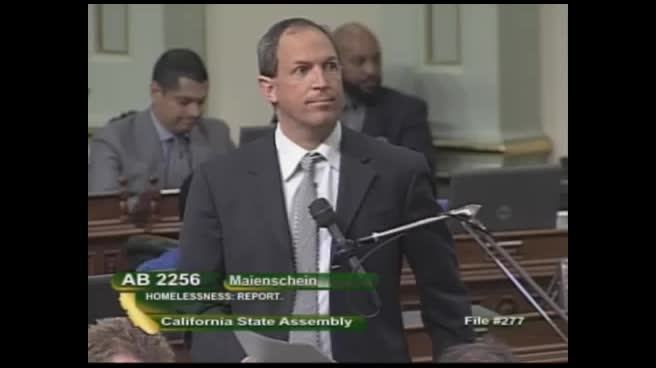
Bill Author



