AB 2291: Property taxes: delinquent taxes: partial payment: fee.
- Session Year: 2015-2016
- House: Assembly
- Latest Version Date: 2016-09-09
Under existing law, the board of supervisors of a county is required to comply with specified requirements prior to either approving an increase in an existing county fee or charge or initially imposing a new fee or charge.
Under existing property tax law, a tax collector is authorized, with the approval of the board of supervisors, to accept partial payments of delinquent taxes on tax-defaulted property.
This bill would, upon authorization by ordinance by the board of supervisors, authorize the county tax collector to charge a fee to recover the reasonable costs of instituting and maintaining a partial payment arrangement and would require the fee to be subject to those existing requirements applicable to increasing or initially imposing a new fee or charge. This bill would also require the ordinance authorizing the tax collector to charge a fee to require the fee to be paid prior to the application of any partial payments to penalties, interest, costs, and taxes due.
Under existing law, the board of supervisors of a county is required to comply with specified requirements prior to either approving an increase in an existing county fee or charge or initially imposing a new fee or charge.
Under existing property tax law, a tax collector is authorized, with the approval of the board of supervisors, to accept partial payments of delinquent taxes on tax-defaulted property.
This bill would, upon authorization by ordinance by the board of supervisors, authorize the county tax collector to charge a fee to recover the reasonable costs of instituting and maintaining a partial payment arrangement and would require the fee to be subject to those existing requirements applicable to increasing or initially imposing a new fee or charge. This bill would also require the ordinance authorizing the tax collector to charge a fee to include a limitation on the total amount of fees that may be imposed and to require the fee to be paid prior to the application of any partial payments to penalties, interest, costs, and taxes due.
Under existing law, the board of supervisors of a county is required to comply with specified requirements prior to either approving an increase in an existing county fee or charge or initially imposing a new fee or charge.
Under existing property tax law, a tax collector is authorized, with the approval of the board of supervisors, to accept partial payments of delinquent taxes on tax-defaulted property.
This bill would, upon authorization by ordinance by the board of supervisors, authorize the county tax collector to charge a fee to recover the reasonable costs of instituting and maintaining a partial payment arrangement and would require the fee to be subject to those existing requirements applicable to increasing or initially imposing a new fee or charge. This bill would also require the ordinance authorizing the tax collector to charge a fee to include a limitation on the total amount of fees that may be imposed. imposed and to require the fee to be paid prior to the application of any partial payments to penalties, interest, costs, and taxes due.
Under existing law, the board of supervisors of a county is required to comply with specified requirements prior to either approving an increase in an existing county fee or charge or initially imposing a new fee or charge.
Under existing property tax law, a tax collector is authorized, with the approval of the board of supervisors, to accept partial payments of delinquent taxes on tax-defaulted property.
This bill would, upon authorization by ordinance by the board of supervisors, authorize the county tax collector to charge a fee to recover the reasonable costs of instituting and maintaining a partial payment arrangement and would require the fee to be subject to those existing requirements applicable to increasing or initially imposing a new fee or charge. This bill would also require the ordinance authorizing the tax collector to charge a fee to include a limitation on the total amount of fees that may be imposed.
Under existing law, the board of supervisors of a county is required to comply with specified requirements prior to either approving an increase in an existing county fee or charge or initially imposing a new fee or charge.
Under existing property tax law, a tax collector is authorized, with the approval of the board of supervisors, to accept partial payments of delinquent taxes on tax-defaulted property.
This bill would, upon authorization by ordinance by the board of supervisors, authorize the county tax collector to charge a fee to recover the reasonable costs of instituting and maintaining a partial payment arrangement and would require the fee to be subject to those existing requirements applicable to increasing or initially imposing a new fee or charge.
(a)Notwithstanding any other provision of law, in the case of a deficiency in the payment of taxes due and payable pursuant to this part, the tax collector, with the approval of the board of supervisors, may accept partial payments from the taxpayer. The partial payments shall be applied first to all penalties, interest, and costs, and the balance, if any, shall be applied to the taxes due. The difference between the amount paid by the taxpayer and the amount due shall be treated as a delinquent tax in the same manner as any other defaulted tax.
(b)Partial payments made pursuant to this section shall not be deemed a redemption, a partial redemption, or an installment payment under this part and they shall not alter either the date upon which the property became tax defaulted or the date the property becomes subject to a power of sale.
(c)These partial payments shall not be construed as altering the amount of defaulted taxes for purposes of publications.
(d)An election may be made by the taxpayer to pay the delinquent taxes in installments under Chapter 3 (commencing with Section 4186) and, if so, the installment payment shall be based upon the balance of the redemption amount determined pursuant to this section.
(e)When the taxpayer requests a partial payment, or when the tax collector receives such a payment, the tax collector shall inform the taxpayer of the provisions of subdivision (b) by return mail.
(f)(1)Upon authorization by ordinance by the board of supervisors, the tax collector may charge a fee to recover the reasonable costs of instituting and maintaining a partial payment arrangement under the provisions of this chapter. The fee is a charge described in paragraph (2) of subdivision (e) of Section 1 of Article XIIIC of the California Constitution and shall be subject to the requirements of Chapter 12.5 (commencing with Section 54985) of Part 1 of Division 2 of Title 5 of the Government Code.
(2)The maximum fees that the tax collector may charge under the authorization of this section shall be established in the initial authorizing ordinance and limited to cost recovery only, pursuant to Section 54985 of the Government Code. Those fees, and any subsequent changes to those fees, shall be implemented consistent with Section 54985 of the Government Code, and after at least one public meeting, at which oral and written presentations may be made, as part of a regularly scheduled meeting held by the Board of Supervisors pursuant to Section 54986 of the Government Code.
(3)The ordinance authorizing the tax collector to charge a fee described in paragraph (1) shall require the fee to be paid prior to the application of any partial payments to penalties, interest, costs, and taxes due as specified in subdivision (a).
(a)Notwithstanding any other provision of law, in the case of a deficiency in the payment of taxes due and payable pursuant to this part, the tax collector, with the approval of the board of supervisors, may accept partial payments from the taxpayer. The partial payments shall be applied first to all penalties, interest, and costs, and the balance, if any, shall be applied to the taxes due. The difference between the amount paid by the taxpayer and the amount due shall be treated as a delinquent tax in the same manner as any other defaulted tax.
(b)Partial payments made pursuant to this section shall not be deemed a redemption, a partial redemption, or an installment payment under this part and they shall not alter either the date upon which the property became tax defaulted or the date the property becomes subject to a power of sale.
(c)These partial payments shall not be construed as altering the amount of defaulted taxes for purposes of publications.
(d)An election may be made by the taxpayer to pay the delinquent taxes in installments under Chapter 3 (commencing with Section 4186) and, if so, the installment payment shall be based upon the balance of the redemption amount determined pursuant to this section.
(e)When the taxpayer requests a partial payment, or when the tax collector receives such a payment, the tax collector shall inform the taxpayer of the provisions of subdivision (b) by return mail.
(f)(1)Upon authorization by ordinance by the board of supervisors, the tax collector may charge a fee to recover the reasonable costs of instituting and maintaining a partial payment arrangement under the provisions of this chapter. The fee is a charge described in paragraph (2) of subdivision (e) of Section 1 of Article XIIIC of the California Constitution and shall be subject to the requirements of Chapter 12.5 (commencing with Section 54985) of Part 1 of Division 2 of Title 5 of the Government Code.
(2)The ordinance authorizing the tax collector to charge a fee described in paragraph (1) shall include a limitation on the total amount of fees that may be imposed.
(a)Notwithstanding any other provision of law, in the case of a deficiency in the payment of taxes due and payable pursuant to this part, the tax collector, with the approval of the board of supervisors, may accept partial payments from the taxpayer. The partial payments shall be applied first to all penalties, interest, and costs, and the balance, if any, shall be applied to the taxes due. The difference between the amount paid by the taxpayer and the amount due shall be treated as a delinquent tax in the same manner as any other defaulted tax.
(b)Partial payments made pursuant to this section shall not be deemed a redemption, a partial redemption, or an installment payment under this part and they shall not alter either the date upon which the property became tax defaulted or the date the property becomes subject to a power of sale.
(c)These partial payments shall not be construed as altering the amount of defaulted taxes for purposes of publications.
(d)An election may be made by the taxpayer to pay the delinquent taxes in installments under Chapter 3 (commencing with Section 4186) and, if so, the installment payment shall be based upon the balance of the redemption amount determined pursuant to this section.
(e)When the taxpayer requests a partial payment, or when the tax collector receives such a payment, the tax collector shall inform the taxpayer of the provisions of subdivision (b) by return mail.
(f)Upon authorization by ordinance by the board of supervisors, the tax collector may charge a fee to recover the reasonable costs of instituting and maintaining a partial payment arrangement under the provisions of this chapter. The fee is a charge described in paragraph (2) of subdivision (e) of Section 1 of Article XIIIC of the California Constitution and shall be subject to the requirements of Chapter 12.5 (commencing with Section 54985) of Part 1 of Division 2 of Title 5 of the Government Code.
|
Date
|
Status
|
|---|---|
| May 27, 2016 | From committee chair, with author's amendments: Amend, and re-refer to committee. Read second time, amended, and re-referred to Com. on GOV. & F. |
| Sep 9, 2016 | Chaptered by Secretary of State - Chapter 266, Statutes of 2016. |
| Sep 9, 2016 | Approved by the Governor. |
| Aug 22, 2016 | Enrolled and presented to the Governor at 4 p.m. |
| Aug 4, 2016 | Senate amendments concurred in. To Engrossing and Enrolling. (Ayes 74. Noes 1. Page 5701.). |
| Aug 4, 2016 | Senate amendments concurred in. To Engrossing and Enrolling. |
| Aug 2, 2016 | In Assembly. Concurrence in Senate amendments pending. May be considered on or after August 4 pursuant to Assembly Rule 77. |
| Aug 1, 2016 | Read third time. Passed. Ordered to the Assembly. (Ayes 35. Noes 1. Page 4726.). |
| Aug 1, 2016 | Read third time. Passed. Ordered to the Assembly. |
| Jun 16, 2016 | Read second time. Ordered to third reading. |
| Jun 15, 2016 | From committee: Do pass. (Ayes 6. Noes 1.) (June 15). |
| Jun 8, 2016 | From committee chair, with author's amendments: Amend, and re-refer to committee. Read second time, amended, and re-referred to Com. on GOV. & F. |
| Feb 18, 2016 | Read first time. To print. |
| Apr 28, 2016 | Referred to Com. on GOV. & F. |
| Apr 14, 2016 | Read third time. Passed. Ordered to the Senate. (Ayes 74. Noes 0.) |
| Apr 14, 2016 | Read third time. Passed. Ordered to the Senate. (Ayes 74. Noes 0. Page 4356.) |
| Apr 14, 2016 | Read third time. Passed. Ordered to the Senate. |
| Apr 14, 2016 | In Senate. Read first time. To Com. on RLS. for assignment. |
| Apr 11, 2016 | Read second time. Ordered to third reading. |
| Apr 7, 2016 | Read second time and amended. Ordered returned to second reading. |
| Apr 6, 2016 | From committee: Amend, and do pass as amended. (Ayes 9. Noes 0.) (April 4). |
| Mar 3, 2016 | Referred to Com. on REV. & TAX. |
| Feb 19, 2016 | From printer. May be heard in committee March 20. |
|
Date
|
Description
|
Location
|
Votes
|
|
|---|---|---|---|---|
| Aug 4, 2016 | AB 2291 ACHADJIAN Concurrence in Senate Amendments | Assembly Floor |
Passed |
|
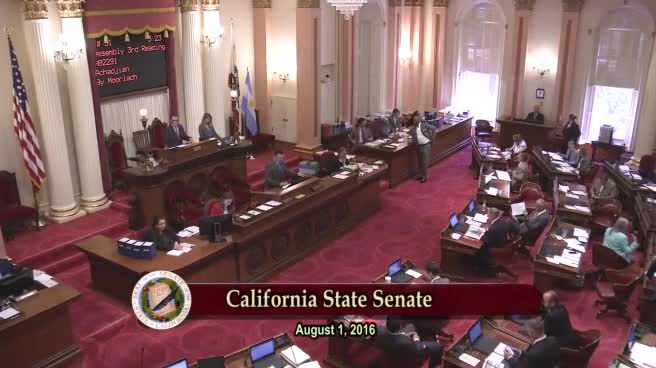
| Aug 1, 2016 | Assembly 3rd Reading AB2291 Achadjian By Moorlach | Senate Floor |
Passed |
|
| Jun 15, 2016 | Do pass | Senate Standing Committee on Governance and Finance |
Passed |
|
| Apr 14, 2016 | AB 2291 ACHADJIAN Assembly Third Reading | Assembly Floor |
Passed |
|
| Apr 4, 2016 | Do pass as amended. | Assembly Standing Committee on Revenue and Taxation |
Passed |
This list shows positions taken on this bill by organizations on the date displayed, which is linked to the original source.
Positions by individuals are not included.
|
Organization
|
Position
|
Date
|
|---|---|---|
| California Association of County Treasurer-Tax Collectors | ** Support | Aug 1, 2016 |
| California State Association Of Counties | ** Support | Aug 1, 2016 |
| Santa Clara County Board of Supervisors | ** Support | Aug 1, 2016 |
CONCURRENCE IN SENATE AMENDMENTS
CSA1 Bill Id:AB 2291
Author:(Achadjian)
As Amended Ver:June 8, 2016
Majority vote
ASSEMBLY: | 74-0 | (April 14, 2016) | SENATE: | 35-1 | (August 1, 2016) |
Original Committee Reference: REV. & TAX.
SUMMARY: Allows a county tax collector to charge a fee to recover the reasonable costs of instituting and maintaining an arrangement to accept partial payments of delinquent taxes on tax-defaulted property.
The Senate amendments:
- Require the ordinance authorizing the fee to establish the maximum fees that may be charged, as specified, instead of a limitation on the total amount of fees that may be imposed.
- Provide that the ordinance authorizing the fee must require the fee to be paid prior to the application of any partial payments to penalties, interest, costs, and taxes due.
EXISTING LAW:
- Requires an annual payment of property tax, and provides that unpaid taxes become delinquent and subject to penalties and costs.
- Requires tax-defaulted property to be sold to the highest bidder at public sale if the taxpayer fails to redeem the property by repaying in full the defaulted taxes, interest, and penalties within three to five years, as specified.
- Allows the tax collector to collect fees to reimburse the county for costs incurred preparing tax-defaulted property for sale.
- Allows a county tax collector, with the approval of the board of supervisors, to accept partial payments from taxpayers in the case of a deficiency in the payment of taxes due.
- Specifies that partial payments shall be applied first to all penalties and interest due, and the balance, if any, shall then be applied to the taxes due.
- Specifies that partial payments shall not be deemed a redemption, partial redemption, or installment payment and shall not alter either the date upon which the property became tax defaulted or the date the property becomes subject to a power of sale.
- Allows a taxpayer to choose to pay delinquent taxes in installments, subject to a fee for processing the taxpayer's request, during which time the property subject to the installment plan shall not become subject to sale unless payments are not made by the dates prescribed.
- Provides that a charge imposed for a specific government service or product provided directly to the payor that is not provided to those not charged, and which does not exceed the reasonable costs to the local government of providing the service or product, is an exception to the definition of a "tax" (Proposition 26).
- Allows a county board of supervisors to increase or decrease a fee or charge, otherwise authorized to be levied by another provision of law, in the amount reasonably necessary to recover the cost of providing the product or service.
- Requires the county board of supervisors to hold at least one public meeting to discuss the proposed fee or charge, and that the action to levy the new fee or charge must be taken by ordinance, amongst other requirements.
AS PASSED BY THE ASSEMBLY, this bill:
- Allowed, upon authorization by ordinance of the county board of supervisors, a county tax collector to charge a fee to recover the reasonable costs of instituting and maintaining a partial payment arrangement for delinquent taxes on tax-defaulted property.
- Specified that the fee is a charge imposed pursuant to Proposition 26 (2010) and subject to the requirements governing the process by which a county board of supervisors may increase or decrease a fee or charge.
- Specified that the ordinance authorizing the fee must include a limitation on the total amount of fees imposed.
FISCAL EFFECT: None
COMMENTS:
- Delinquent Property Taxes: Generally, property taxes on the secured roll are due in two installments on November 1 and February 1. Property taxes that are due but unpaid after December 10 or April 10 become delinquent and incur a 10% penalty per installment. After April 10, the taxpayer is also charged a $10 fee for preparation of their delinquent tax records. If there are any unpaid taxes after June 30, then the property taxes are declared to be in default and incur additional penalties at the rate of 1.5% per month of the unpaid taxes (18% per year), as well as a $15 redemption fee. If property taxes remain unpaid for five years, the taxpayer is given notice that the property has become subject to the power of sale and will be sold at a public auction; if the tax delinquent property is requested for affordable housing development, the property can be sold after three years. The taxpayer can redeem his/her property by paying the total amount of the unpaid taxes for all delinquent years, as well as all penalties and fees. Depending on when the property is redeemed in relation to its time of sale, the taxpayer may be subject to additional fees.
- Permanent Installment Plans: Counties are required to offer taxpayers a Permanent Installment Plan (PIP), through which they can make annual payments to redeem their tax defaulted property. The PIP may be opened any time prior to the property becoming subject to the power of sale, during which time the property will not be subject to sale unless payments are not made by the dates prescribed. The PIP requires the taxpayer to make an initial payment of at least 20% of the redemption amount and make subsequent yearly payments of at least 20%, in addition to paying current year taxes and any applicable penalties. Under existing law, any taxpayer choosing to pay delinquent taxes in installments may be subject to a fee, set by the board of supervisors, for processing the request and setting up the PIP. The fee varies from county to county as each county faces unique costs in administering the PIP given differences in existing staff, technological resources, and program need. For example, Fresno County charges a $95 set-up fee; San Francisco County charges a $50 set-up fee; and Riverside County charges a $19.22 set-up fee, plus a $36.36 annual maintenance fee.
- Partial Payment Arrangements: In addition to a PIP, a county tax collector may choose to accept partial payments from delinquent taxpayers, if authorized to do so by the board of supervisors. These partial payments could be accepted on an ad hoc basis or on a more formal basis in the form of a monthly payment plan. Making partial payments may serve as an alternative for taxpayers who want to catch up on delinquent taxes, but cannot afford to begin a PIP given the 20% down payment requirement. Even if the overall fee for a partial payment arrangement is higher than the fee for a PIP, since administrative costs for providing a monthly plan are naturally higher than those for a yearly plan, a partial payment arrangement may be more cost-effective for a taxpayer if increased flexibility helps the taxpayer budget for and pay off debt more quickly. Taxpayers would be able to decide which payment plan suits their needs best.
Existing law does not explicitly authorize a county to charge a fee to recover the costs of accepting partial payments as it does for administering a PIP. As a result, many counties do not allow partial payments as they do not have the budget, personnel, or technical capacity to support the additional expense of tracking partial payments and communicating an updated payment balance to individual taxpayers. According to the California Association of County Treasurers and Tax Collectors (CACTTC), there are a few counties that currently accept partial payments in any amount at any time as they have the capability to absorb such relatively infrequent administrative costs. However, for counties that wish to establish a more formalized partial payment arrangement, the costs of informing taxpayers about this new payment option and establishing a more comprehensive tracking and notification system may be prohibitive. This bill allows counties to recover the cost of accepting partial payments from delinquent taxpayers in the hope that more counties can begin offering such services on a regular basis.
- At What Cost? Similar to the costs of administering a PIP, the costs of administering a partial payment arrangement will vary by county given differences in program need and existing resources. Unlike the PIP, however, the county has discretion to decide for itself how it wants to accept partial payments, if at all, on delinquent taxes. Counties may already accept partial payments without charging taxpayers a fee, paying for any costs out of general funding. Although this bill does not specify what an appropriate fee amount may be, it requires the ordinance by the county board of supervisors authorizing the fee to establish the maximum fees that the tax collector may charge. This bill also specifies that the fee would be charged in accordance with the provisions of Proposition 26 and limited to the reasonable costs of providing the service.
Analysis Prepared by: Irene Ho / REV. & TAX. / (916) 319-2098 FN: 0003567
Office of Senate Floor Analyses (916) 651-1520 Fax: (916) 327-4478 | AB |
THIRD READING
Bill No: AB 2291
:
SENATE GOVERNANCE & FIN. COMMITTEE: 6-1, 6/15/16
AYES: Hertzberg, Beall, Hernandez, Lara, Moorlach, Pavley
NOES: Nguyen
ASSEMBLY FLOOR: 74-0, 4/14/16 - See last page for vote
DIGEST: This bill authorizes a county board of supervisors to allow the tax collector to charge a fee for the reasonable costs of partial property tax payments.
- Sets January 1 of each year as the “lien date,” or the date upon which the assessor values property, and property taxes are imposed on its owner in the form of a lien against the property.
- Requires tax collectors to send bills to taxpayers on the secured roll by November 1.
- Requires taxpayers must pay their bills in two installments: the first on November 1, which becomes delinquent December 10, and the second on February 1, with delinquency occurring on April 10, but allows taxpayers to pay in full in the first installment.
- Imposes a 10% penalty on each delinquent amount, and allows counties to also apply administrative charges.
- Provides that a property becomes tax defaulted if taxes remain unpaid as of June 30, triggering redemption penalties of 1.5% a month until the full amount is paid.
- Allows the tax collector with approval by the board of supervisors to sell a tax defaulted residential property to satisfy back taxes, penalties, costs, and other liens; for commercial property, the tax collector can do so after three years.
- Requires counties to allow taxpayers to pay in installments by making an initial payment of 20% of the amount outstanding, but only after a property becomes tax defaulted. Under an installment plan, taxpayers must make one payment a year for five years, in addition to paying current taxes. Failure to make timely payments on an installment plan again places the property in default; however, taxpayers can enter into another installment plan at the beginning of the next fiscal year.
- Allows tax collectors to also accept partial payments from delinquent taxpayers if authorized to do so by the board of supervisors.
- Authorizes tax collectors to charge fees for certain activities, such as an application fee for valuing property for the purpose of redemption, or a processing fee for entering into an installment payment plan; however, existing law does not clearly authorize the tax collector to charge a fee for accepting partial payments.
This bill:
- Allows a county board of supervisors to authorize the tax collector to recover the reasonable costs for instituting and maintaining a partial payment arrangement for property taxes.
- Requires the initial ordinance authorizing the fee to establish the maximum fees that the tax collector can charge, which the measure limits only to cost recovery.
- Requires the county board of supervisors to adopt the fee and any subsequent changes during a regularly scheduled meeting after at least one public meeting where oral and written presentations can be made.
- States that the fee is imposed for a specific government service or product provided directly to the payor that is not provided to those not charged, and which does not exceed the reasonable cost to provide the service for purposes of the California Constitution.
- Says that the fee is subject to statutory requirements that cap the fee at the amount reasonably necessary to provide the service.
Background
Tax collectors generally rely on county general fund allocations from the board of supervisors to operate their offices and fulfill their legal duties. As such, funding and service levels will vary from county to county, and tax collectors must compete for funding against many other worthy causes such as public safety, health care, and other county offices and services when the Board enacts the budget. State law explicitly allows tax collectors to charge fees to recover the reasonable costs for some specified services, but not do so for accepting partial payments. Many counties already accept partial payments without charging a fee, paying for any costs out of general funding. Any county that currently does not accept partial payments can commence doing so without charging a fee. Taxpayers with sufficient means are not likely to make partial payments given significant penalties, interest, and risk of tax sale, so adding a fee on to taxpayers who can only pay partially may serve as a financial barrier to taxpayers who can’t pay in full. Additionally, counties who have been accepting partial payments without a fee would have legal authorization to do so under AB 2291, which allows tax collectors to shift costs currently funded as part of general operations onto taxpayers who can only make partial payments. However, some counties that won’t currently accept partial payments without charging a fee may choose to do so under AB 2291.
FISCAL EFFECT: Appropriation: Fiscal Com.: Local:
California Association of County Treasurer-Tax Collectors
California State Association of Counties
Santa Clara County Board of Supervisors
OPPOSITION: (Verified 6/17/16)
None received
ARGUMENTS IN SUPPORT: According to the author, “AB 2291 would simply allow counties to recover the cost of providing an alternative for taxpayers with tax-defaulted property. Accepting payments on a monthly basis would offer a substantially lower barrier to entry than the existing, more restrictive Permanent Installment Plan. As a result, AB 2291 would allow more taxpayers to begin paying off their delinquent taxes with lower monthly payments in the same manner they typically pay other debt. This will have direct benefits to taxpayers who are making earnest efforts to pay taxes owed. AB 2291 is both taxpayer friendly and maintains local control for countries that choose to provide this service.”
ASSEMBLY FLOOR: 74-0, 4/14/16
AYES: Achadjian, Alejo, Travis Allen, Arambula, Atkins, Baker, Bigelow, Bloom, Bonilla, Bonta, Brough, Brown, Burke, Calderon, Campos, Chang, Chau, Chávez, Chiu, Chu, Cooley, Cooper, Dababneh, Dahle, Daly, Dodd, Eggman, Frazier, Beth Gaines, Gallagher, Cristina Garcia, Eduardo Garcia, Gatto, Gipson, Gomez, Gonzalez, Gordon, Gray, Grove, Hadley, Roger Hernández, Holden, Jones, Jones-Sawyer, Kim, Lackey, Linder, Lopez, Low, Maienschein, Mathis, Mayes, Medina, Mullin, Obernolte, O'Donnell, Olsen, Patterson, Quirk, Ridley-Thomas, Rodriguez, Salas, Santiago, Steinorth, Mark Stone, Thurmond, Ting, Wagner, Waldron, Weber, Wilk, Williams, Wood, Rendon
NO VOTE RECORDED: Harper, Irwin, Levine, McCarty, Melendez, Nazarian
6/17/16 15:03:51
**** END ****
SENATE COMMITTEE ON GOVERNANCE AND FINANCE
Senator Robert M. Hertzberg, Chair
2015 - 2016 Regular
Bill No: | AB 2291 | Hearing Date: | 6/15/16 |
Author: | Achadjian | Tax Levy: | No |
Version: | 6/8/16 Amended | Fiscal: | No |
Consultant: | Grinnell | ||
Property taxes: delinquent taxes: partial payment: fee
Authorizes a county board of supervisors to allow the tax collector to charge a fee for the reasonable costs of partial property tax payments.
Background
State law sets January 1st of each year as the “lien date,” or the date upon which the assessor values property, and property taxes are imposed on its owner in the form of a lien against the property. For property on the secured roll, which generally includes real property such as land and buildings, tax collectors must send bills to taxpayers by November 1st. Taxpayers must pay their bills in two installments: the first on November 1st, which becomes delinquent December 10th, and the second on February 1st, with delinquency occurring on April 10th. Taxpayers can pay in full at the first installment. Taxpayers with mortgages who pay property taxes through impound accounts collected as part of monthly mortgage payments don’t pay according to this schedule; they receive informational copies of tax bills instead. Many other locally-imposed charges, fees, taxes, and assessments, such as Mello-Roos taxes, benefit assessments, and parcel taxes, are also collected as part of the property tax bill, and subject to the same restrictions and penalties.
When taxes become delinquent, state law imposes a 10% penalty on each amount, and counties can also apply administrative charges. The property becomes tax defaulted if taxes remain unpaid as of June 30th, triggering redemption penalties of 1.5% a month until the full amount is paid. After five years, the tax collector with approval by the Board of Supervisors can sell a tax defaulted residential property to satisfy back taxes, penalties, costs, and other liens; for commercial property, the tax collector can do so after three years. Counties allow taxpayers to pay in installments by making an initial payment of 20% of the amount outstanding, but only after a property becomes tax defaulted. Under an installment plan, taxpayers must make one payment a year for five years, in addition to paying current taxes. Failure to make timely payments on an installment plan again places the property in default; however, taxpayers can enter into another installment plan at the beginning of the next fiscal year.
Additionally, tax collectors can also accept partial payments from delinquent taxpayers if authorized to do so by the board of supervisors. The tax collector must first apply the payment to penalties, interest, and costs, and if funds remain, to tax due. While many counties have authorized tax collectors to accept partial payments, tax collectors want to authorize a fee for instituting and maintaining a partial payment arrangement.
Proposed Law
Assembly Bill 2291 allows a county board of supervisors to authorize the tax collector to recover the reasonable costs for instituting and maintaining a partial payment arrangement for property taxes. The initial authorizing ordinance must establish the maximum fees that the tax collector can charge, and are limited to cost recovery only. The county board of supervisors must adopt the fee and any subsequent changes part of a regularly scheduled meeting after at least one public meeting where oral and written presentations can be made.
The measure states that the fee is imposed for a specific government service or product provided directly to the payor that is not provided to those not charged, and which does not exceed the reasonable cost to provide the service for purposes of the California Constitution. The bill also says that the fee is subject to statutory requirements that cap the fee at the amount reasonably necessary to provide the service.
State Revenue Impact
No estimate.
Comments
1. Purpose of the bill. According to the author, “AB 2291 would simply allow counties to recover the cost of providing an alternative for taxpayers with tax-defaulted property. Accepting payments on a monthly basis would offer a substantially lower barrier to entry than the existing, more restrictive Permanent Installment Plan. As a result, AB 2291 would allow more taxpayers to begin paying off their delinquent taxes with lower monthly payments in the same manner they typically pay other debt. This will have direct benefits to taxpayers who are making earnest efforts to pay taxes owed. AB 2291 is both taxpayer friendly and maintains local control for countries that choose to provide this service.”
2. Costs. Tax collectors generally rely on county general fund allocations from the Board of Supervisors to operate their offices and fulfill their legal duties. As such, funding and service levels will vary from county to county, and tax collectors must compete for funding against many other worthy causes such as public safety, health care, and other county offices and services when the Board enacts the budget. State law also allows tax collectors to charge fees to recover the reasonable costs for some specified services, such as an application fee for valuing property for the purpose of redemption, or a processing fee for entering into an installment payment plan, but doesn’t contain explicit authorization for many others, such as partial payment plans. Many counties already accept partial payments without charging a fee, paying for any costs out of general funding. Any county that currently does not accept partial payments can commence doing so without charging a fee. Taxpayers with sufficient means are not likely to make partial payments given significant penalties, interest, and risk of tax sale, so adding a fee on to taxpayers who can only pay partially may serve as a financial barrier to taxpayers who can’t pay in full. Additionally, counties who have been accepting partial payments without a fee would have legal authorization to do so under AB 2291, which could allow tax collectors to shift costs currently funded as part of general operations onto taxpayers who can only make partial payments. However, some counties that won’t currently accept partial payments without charging a fee may choose to do so under AB 2291. The Committee may wish to consider the effect on AB 2291 on taxpayers who have difficulty meeting their obligations.
Assembly Actions
Assembly Revenue and Taxation 9-0
Assembly Floor 74-0
Support and Opposition
(6/9/16)
Support: California Association of County Treasurer-Tax Collectors, California State Association of Countries, Santa Clara County Board of Supervisors.
Opposition: None received.
-- END --
ASSEMBLY THIRD READING
ATR Bill Id:AB 2291
Author:(Achadjian)
As Amended Ver:April 7, 2016
Majority vote
Committee | Votes | Ayes | Noes |
Revenue & Taxation | 9-0 | Ridley-Thomas, Brough, Dababneh, Gipson, Mullin, O'Donnell, Patterson, Quirk, Wagner |
SUMMARY: Allows a county tax collector to charge a fee to recover the reasonable costs of instituting and maintaining an arrangement to accept partial payments of delinquent taxes on tax-defaulted property. Specifically, this bill:
- Allows, upon authorization by ordinance of the county board of supervisors, a county tax collector to charge a fee to recover the reasonable costs of instituting and maintaining a partial payment arrangement for delinquent taxes on tax-defaulted property.
- Specifies that the fee is a charge imposed pursuant to Proposition 26 (2010) and subject to the requirements governing the process by which a county board of supervisors may increase or decrease a fee or charge.
- Specifies that the ordinance authorizing the fee must include a limitation on the total amount of fees imposed.
EXISTING LAW:
- Requires an annual payment of property tax, and provides that unpaid taxes become delinquent and subject to penalties and costs.
- Requires tax-defaulted property to be sold to the highest bidder at public sale if the taxpayer fails to redeem the property by repaying in full the defaulted taxes, interest, and penalties within three to five years, as specified.
- Allows the tax collector to collect fees to reimburse the county for costs incurred preparing tax-defaulted property for sale.
- Allows a county tax collector, with the approval of the board of supervisors, to accept partial payments from taxpayers in the case of a deficiency in the payment of taxes due.
- Specifies that partial payments shall be applied first to all penalties and interest due, and the balance, if any, shall then be applied to the taxes due.
- Specifies that partial payments shall not be deemed a redemption, partial redemption, or installment payment and shall not alter either the date upon which the property became tax defaulted or the date the property becomes subject to a power of sale.
- Allows a taxpayer to choose to pay delinquent taxes in installments, subject to a fee for processing the taxpayer's request, during which time the property subject to the installment plan shall not become subject to sale unless payments are not made by the dates prescribed.
- Provides that a charge imposed for a specific government service or product provided directly to the payor that is not provided to those not charged, and which does not exceed the reasonable costs to the local government of providing the service or product, is an exception to the definition of a "tax" (Proposition 26).
- Allows a county board of supervisors to increase or decrease a fee or charge, otherwise authorized to be levied by another provision of law, in the amount reasonably necessary to recover the cost of providing the product or service.
- Requires the county board of supervisors to hold at least one public meeting to discuss the proposed fee or charge, and that the action to levy the new fee or charge must be taken by ordinance, amongst other requirements.
FISCAL EFFECT: None
COMMENTS:
- Author's Statement: The author provided the following statement in support of this bill:
AB 2291 would simply allow counties to recover the cost of providing an alternative for taxpayers with tax defaulted property. Accepting payments on a monthly basis would offer a substantially lower barrier to entry than the existing, more restrictive Permanent Installment Plan. As a result, AB 2291 would allow more taxpayers to begin paying off their delinquent taxes with lower monthly payments in the same manner they typically pay other debt. This will have direct benefits to taxpayers who are making earnest efforts to pay taxes owed.
AB 2291 is both taxpayer friendly and maintains local control for counties that choose to provide this service.
- Arguments in Support: The sponsor of this bill, the California Association of County Treasurers and Tax Collectors (CACTTC), states:
The prospect of establishing a payment plan for an individual taxpayer requires in most counties a separate, local tracking process for payments. This can take a substantial amount of time to research, establish and maintain the plan going forward for any individual taxpayer. AB 2291 will authorize Tax Collectors to recover the costs to establish this plan for individuals, which will provide a direct benefit to affected taxpayers that choose to make an earnest effort to become current on their property taxes.
- Arguments in Opposition: There is no opposition on file.
- Delinquent Property Taxes: Generally, property taxes on the secured roll are due in two installments on November 1 and February 1. Property taxes that are due but unpaid after December 10 or April 10 become delinquent and incur a 10% penalty per installment. After April 10, the taxpayer is also charged a $10 fee for preparation of their delinquent tax records. If there are any unpaid taxes after June 30, then the property taxes are declared to be in default and incur additional penalties at the rate of 1.5% per month of the unpaid taxes (18% per year), as well as a $15 redemption fee. If property taxes remain unpaid for five years, the taxpayer is given notice that the property has become subject to the power of sale and will be sold at a public auction; if the tax delinquent property is requested for affordable housing development, the property can be sold after three years. The taxpayer can redeem his/her property by paying the total amount of the unpaid taxes for all delinquent years, as well as all penalties and fees. Depending on when the property is redeemed in relation to its time of sale, the taxpayer may be subject to additional fees.
- Permanent Installment Plans: Counties are required to offer taxpayers a Permanent Installment Plan (PIP), through which they can make annual payments to redeem their tax defaulted property. The PIP may be opened any time prior to the property becoming subject to the power of sale, during which time the property will not be subject to sale unless payments are not made by the dates prescribed. The PIP requires the taxpayer to make an initial payment of at least 20% of the redemption amount and make subsequent yearly payments of at least 20%, in addition to paying current year taxes and any applicable penalties. Under existing law, any taxpayer choosing to pay delinquent taxes in installments may be subject to a fee, set by the board of supervisors, for processing the request and setting up the PIP. The fee varies from county to county as each county faces unique costs in administering the PIP given differences in existing staff, technological resources, and program need. For example, Fresno County charges a $95 set-up fee; San Francisco County charges a $50 set-up fee; and Riverside County charges a $19.22 set-up fee, plus a $36.36 annual maintenance fee.
- Partial Payment Arrangements: In addition to a PIP, a county tax collector may choose to accept partial payments from delinquent taxpayers, if authorized to do so by the board of supervisors. These partial payments could be accepted on an ad hoc basis or on a more formal basis in the form of a monthly payment plan. Making partial payments may serve as an alternative for taxpayers who want to catch up on delinquent taxes, but cannot afford to begin a PIP given the 20% down payment requirement. Even if the overall fee for a partial payment arrangement is higher than the fee for a PIP, since administrative costs for providing a monthly plan are naturally higher than those for a yearly plan, a partial payment arrangement may be more cost-effective for a taxpayer if increased flexibility helps the taxpayer budget for and pay off debt more quickly. Taxpayers would be able to decide which payment plan suits their needs best.
Existing law does not explicitly authorize a county to charge a fee to recover the costs of accepting partial payments as it does for administering a PIP. As a result, many counties do not allow partial payments as they do not have the budget, personnel, or technical capacity to support the additional expense of tracking partial payments and communicating an updated payment balance to individual taxpayers. According to CACTTC, there are a few counties that currently accept partial payments in any amount at any time as they have the capability to absorb such relatively infrequent administrative costs. However, for counties that wish to establish a more formalized partial payment arrangement, the costs of informing taxpayers about this new payment option and establishing a more comprehensive tracking and notification system may be prohibitive. This bill allows counties to recover the cost of accepting partial payments from delinquent taxpayers in the hope that more counties can begin offering such services on a regular basis.
At What Cost? Similar to the costs of administering a PIP, the costs of administering a partial payment arrangement will vary by county given differences in program need and existing resources. Unlike the PIP, however, the county has discretion to decide for itself how it wants to accept partial payments, if at all, on delinquent taxes. Although this bill does not specify what an appropriate fee amount may be, it requires the ordinance by the county board of supervisors authorizing the fee to include a limitation on the total amount of fees imposed. This bill also specifies that the fee would be charged in accordance with the provisions of Proposition 26 and limited to the reasonable costs of providing the service.
Analysis Prepared by: Irene Ho / REV. & TAX. / (916) 319-2098 FN: 0002727
Date of Hearing: April 4, 2016
ASSEMBLY COMMITTEE ON REVENUE AND TAXATION
Sebastian Ridley-Thomas, Chair
ABPCA Bill Id:AB 2291 (
Author:Achadjian) – As Introduced Ver:February 18, 2016
Majority vote. Non-fiscal.
SUBJECT: Property taxes: delinquent taxes: partial payment: fee
SUMMARY: Allows a county tax collector to charge a fee to recover the reasonable costs of instituting and maintaining an arrangement to accept partial payments of delinquent taxes on tax-defaulted property. Specifically, this bill:
- Allows, upon authorization by ordinance of the county board of supervisors, a county tax collector to charge a fee to recover the reasonable costs of instituting and maintaining a partial payment arrangement for delinquent taxes on tax-defaulted property.
- Specifies that the fee is a charge imposed pursuant to Proposition 26 (2010) and subject to the requirements governing the process by which a county board of supervisors may increase or decrease a fee or charge.
EXISTING LAW:
- Requires an annual payment of property tax, and provides that unpaid taxes become delinquent and subject to penalties and costs.
- Requires tax-defaulted property to be sold to the highest bidder at public sale if the taxpayer fails to redeem the property by repaying in full the defaulted taxes, interest, and penalties within three to five years, as specified.
- Allows the tax collector to collect fees to reimburse the county for costs incurred preparing tax-defaulted property for sale.
- Allows a county tax collector, with the approval of the board of supervisors, to accept partial payments from taxpayers in the case of a deficiency in the payment of taxes due.
- Specifies that partial payments shall be applied first to all penalties and interest due, and the balance, if any, shall then be applied to the taxes due.
- Specifies that partial payments shall not be deemed a redemption, partial redemption, or installment payment and shall not alter either the date upon which the property became tax defaulted or the date the property becomes subject to a power of sale.
- Allows a taxpayer to choose to pay delinquent taxes in installments, subject to a fee for processing the taxpayer’s request, during which time the property subject to the installment plan shall not become subject to sale unless payments are not made by the dates prescribed.
- Provides that a charge imposed for a specific government service or product provided directly to the payor that is not provided to those not charged, and which does not exceed the reasonable costs to the local government of providing the service or product, is an exception to the definition of a "tax" (Proposition 26).
- Allows a county board of supervisors to increase or decrease a fee or charge, otherwise authorized to be levied by another provision of law, in the amount reasonably necessary to recover the cost of providing the product or service.
- Requires the county board of supervisors to hold at least one public meeting to discuss the proposed fee or charge, and that the action to levy the new fee or charge must be taken by ordinance, amongst other requirements.
FISCAL EFFECT: Unknown
COMMENTS:
- Author's Statement: The author provided the following statement in support of this bill:
AB 2291 would simply allow counties to recover the cost of providing an alternative for taxpayers with tax defaulted property. Accepting payments on a monthly basis would offer a substantially lower barrier to entry than the existing, more restrictive Permanent Installment Plan. As a result, AB 2291 would allow more taxpayers to begin paying off their delinquent taxes with lower monthly payments in the same manner they typically pay other debt. This will have direct benefits to taxpayers who are making earnest efforts to pay taxes owed.
AB 2291 is both taxpayer friendly and maintains local control for counties that choose to provide this service.
- Arguments in Support: The sponsor of this bill, the California Association of County Treasurers and Tax Collectors (CACTTC), states:
The prospect of establishing a payment plan for an individual taxpayer requires in most counties a separate, local tracking process for payments. This can take a substantial amount of time to research, establish and maintain the plan going forward for any individual taxpayer. AB 2291 will authorize Tax Collectors to recover the costs to establish this plan for individuals, which will provide a direct benefit to affected taxpayers that choose to make an earnest effort to become current on their property taxes.
- Delinquent Property Taxes: Generally, property taxes on the secured roll are due in two installments on November 1 and February 1. Property taxes that are due but unpaid after December 10 or April 10 become delinquent and incur a 10% penalty per installment. After April 10, the taxpayer is also charged a $10 fee for preparation of their delinquent tax records. If there are any unpaid taxes after June 30, then the property taxes are declared to be in default and incur additional penalties at the rate of 1.5% per month of the unpaid taxes (18% per year), as well as a $15 redemption fee. If property taxes remain unpaid for five years, the taxpayer is given notice that the property has become subject to the power of sale and will be sold at a public auction; if the tax delinquent property is requested for affordable housing development, the property can be sold after three years. The taxpayer can redeem his/her property by paying the total amount of the unpaid taxes for all delinquent years, as well as all penalties and fees. Depending on when the property is redeemed in relation to its time of sale, the taxpayer may be subject to additional fees.
- Permanent Installment Plans: Counties are required to offer taxpayers a Permanent Installment Plan (PIP), through which they can make annual payments to redeem their tax defaulted property. The PIP may be opened any time prior to the property becoming subject to the power of sale, during which time the property will not be subject to sale unless payments are not made by the dates prescribed. The PIP requires the taxpayer to make an initial payment of at least 20% of the redemption amount and make subsequent yearly payments of at least 20%, in addition to paying current year taxes and any applicable penalties. Under existing law, any taxpayer choosing to pay delinquent taxes in installments may be subject to a fee, set by the board of supervisors, for processing the request and setting up the PIP. The fee varies from county to county as each county faces unique costs in administering the PIP given differences in existing staff, technological resources, and program need. For example, Fresno County charges a $95 set-up fee; San Francisco County charges a $50 set-up fee; and Riverside County charges a $19.22 set-up fee, plus a $36.36 annual maintenance fee.
- Partial Payment Arrangements: In addition to a PIP, a county tax collector may choose to accept partial payments from delinquent taxpayers, if authorized to do so by the board of supervisors. These partial payments could be accepted on an ad hoc basis or on a more formal basis in the form of a monthly payment plan. Making partial payments may serve as an alternative for taxpayers who want to catch up on delinquent taxes, but cannot afford to begin a PIP given the 20% down payment requirement. Even if the overall fee for a partial payment arrangement is higher than the fee for a PIP, since administrative costs for providing a monthly plan are naturally higher than those for a yearly plan, a partial payment arrangement may be more cost-effective for a taxpayer if increased flexibility helps the taxpayer budget for and pay off debt more quickly. Taxpayers would be able to decide which payment plan suits their needs best.
Existing law does not explicitly authorize a county to charge a fee to recover the costs of accepting partial payments as it does for administering a PIP. As a result, many counties do not allow partial payments as they do not have the budget, personnel, or technical capacity to support the additional expense of tracking partial payments and communicating an updated payment balance to individual taxpayers. According to CACTTC, there are a few counties that currently accept partial payments in any amount at any time as they have the capability to absorb such relatively infrequent administrative costs. However, for counties that wish to establish a more formalized partial payment arrangement, the costs of informing taxpayers about this new payment option and establishing a more comprehensive tracking and notification system may be prohibitive. This bill allows counties to recover the cost of accepting partial payments from delinquent taxpayers in the hope that more counties can begin offering such services on a regular basis.
- At What Cost? Similar to the costs of administering a PIP, the costs of administering a partial payment arrangement will vary by county given differences in program need and existing resources. Accordingly, this bill does not specify what an appropriate fee amount may be, but instead specifies that it would be charged in accordance with the provisions of Proposition 26 and limited to the reasonable costs of providing the service. This bill also specifies that the fee would be set by ordinance of the county board of supervisors and subject to public evaluation, just as the PIP fee must be. Unlike the PIP, however, the county has discretion to decide for itself how it wants to accept partial payments, if at all, on delinquent taxes. Although the amount of any fee charged for administering partial payment arrangements will be limited by Proposition 26, the Committee may wish to consider whether a more uniform cap on the fee should also be set.
REGISTERED SUPPORT / OPPOSITION:
Support
California Association of County Treasurers and Tax Collectors (sponsor)
California State Association of Counties
Santa Clara County Board of Supervisors
Opposition
None on file
Analysis Prepared by: Irene Ho / REV. & TAX. / (916) 319-2098
Discussed in Hearing
View Older Hearings
Bill Author

Bill Co-Author(s):