AB 2298: Criminal gangs.
- Session Year: 2015-2016
- House: Assembly
- Latest Version Date: 2016-09-28
Existing law, the California Street Terrorism Enforcement and Prevention Act (act), provides specified punishments for certain crimes committed for the benefit of, at the direction of, or in association with, a criminal street gang, as specified. The act defines a shared gang database as having various attributes, including, among others, that the database contains personal, identifying information in which a person may be designated as a suspected gang member, associate, or affiliate, or for which entry of a person in the database reflects a designation of that person as a suspected gang member, associate, or affiliate. Existing law requires a law enforcement agency, before designating a person as a suspected gang member, associate, or affiliate in the database, to provide a written notice to the persons parent or guardian, if the person is a minor.
This bill would require the notice described above to be provided to an adult before designating a person as a suspected gang member, associate, or affiliate in the database. The bill would require these databases to comply with federal requirements regarding the privacy and accuracy of information in the database, and other operating principles for maintaining these databases. The bill would require local law enforcement, commencing January 15, 2018, and every January 15 thereafter to submit specified data pertaining to the database to the Department of Justice, and would require the Department of Justice, commencing February 15, 2018, and every February 15 thereafter, to post that information on the departments Internet Web site.
By imposing additional duties on local law enforcement entities, this bill would impose a state-mandated local program.
The bill would establish a procedure for a person designated in a shared gang database who has contested that designation with the local law enforcement agency and whose challenge has been denied to appeal to the superior court.
The California Constitution requires the state to reimburse local agencies and school districts for certain costs mandated by the state. Statutory provisions establish procedures for making that reimbursement.
This bill would provide that, if the Commission on State Mandates determines that the bill contains costs mandated by the state, reimbursement for those costs shall be made pursuant to these statutory provisions.
Existing law, the California Street Terrorism Enforcement and Prevention Act (act), provides specified punishments for certain crimes committed for the benefit of, at the direction of, or in association with, a criminal street gang, as specified. The act defines a shared gang database as having various attributes, including, among others, that the database contains personal, identifying information in which a person may be designated as a suspected gang member, associate, or affiliate, or for which entry of a person in the database reflects a designation of that person as a suspected gang member, associate, or affiliate. Existing law requires a law enforcement agency, before designating a person as a suspected gang member, associate, or affiliate in the database, to provide a written notice to the persons parent or guardian, if the person is a minor.
This bill would require the notice described above to be provided to an adult before designating a person as a suspected gang member, associate, or affiliate in the database. The bill would require these databases to comply with federal requirements regarding the privacy and accuracy of information in the database, and other operating principles for maintaining these databases. The bill would require local law enforcement, commencing January 15, 2018, and every January 15 thereafter to submit specified data pertaining to the database to the Department of Justice, and would require the Department of Justice, commencing February 15, 2018, and every February 15 thereafter, to post that information on the departments Internet Web site. The bill would require that a person designated as a suspected gang member, associate, or affiliate in a shared gang database who has not been convicted of a violation of gang-related crimes, as specified, within 3 years of the initial designation be removed from the database.
By imposing additional duties on local law enforcement entities, this bill would impose a state-mandated local program.
The bill would establish a procedure for a person designated in a shared gang database to challenge that designation through an administrative hearing and who has contested that designation with the local law enforcement agency and whose challenge has been denied to appeal to the superior court.
By requiring local law enforcement to implement an appeal process for persons designated in a shared gang database, this bill would impose a state-mandated local program.
The California Constitution requires the state to reimburse local agencies and school districts for certain costs mandated by the state. Statutory provisions establish procedures for making that reimbursement.
This bill would provide that, if the Commission on State Mandates determines that the bill contains costs mandated by the state, reimbursement for those costs shall be made pursuant to these statutory provisions.
Existing law, the California Street Terrorism Enforcement and Prevention Act (act) and (act), provides specified punishments for certain crimes committed for the benefit of, at the direction of, or in association with, a criminal street gang, as specified. The act defines a shared gang database as having various attributes, including, among others, that the database contains personal, identifying information in which a person may be designated as a suspected gang member, associate, or affiliate, or for which entry of a person in the database reflects a designation of that person as a suspected gang member, associate, or affiliate. Existing law requires a law enforcement agency, before designating a person as a suspected gang member, associate, or affiliate in the database, to provide a written notice to the persons parent or guardian, if the person is a minor.
This bill would require the notice described above to be provided to an adult before designating a person as a suspected gang member, associate, or affiliate in the database. The bill would require these databases to comply with federal requirements regarding the privacy and accuracy of information in the database, and other operating principles for maintaining these databases. The bill would require local law enforcement, commencing December 1, 2017, January 15, 2018, and every December 1st January 15 thereafter to submit specified data pertaining to the database to the Department of Justice, and would require the Department of Justice, commencing January 1, February 15, 2018, and every January 1 February 15 thereafter, to submit a report containing that information to the CalGang Executive Board and to the Legislature. post that information on the departments Internet Web site. The bill would require that a person designated as a suspected gang member, associate, or affiliate in a shared gang database who has not been convicted of a violation of gang-related crimes, as specified, within 3 years of the initial designation be removed from the database.
By imposing additional duties on local law enforcement entities, this bill would impose a state-mandated local program.
The bill would establish a procedure for a person designated in a shared gang database to challenge that designation through an administrative hearing and appeal to the superior court.
By requiring local law enforcement to implement an appeal process for persons designated in a shared gang database, this bill would impose a state-mandated local program.
The California Constitution requires the state to reimburse local agencies and school districts for certain costs mandated by the state. Statutory provisions establish procedures for making that reimbursement.
This bill would provide that, if the Commission on State Mandates determines that the bill contains costs mandated by the state, reimbursement for those costs shall be made pursuant to these statutory provisions.
Existing law generally provides for the compensation of victims and derivative victims of specified types of crimes by the California Victim Compensation and Government Claims Board from the Restitution Fund, a continuously appropriated fund, for specified losses suffered as a result of those crimes. Existing law sets forth eligibility requirements and limits on the amount of compensation the board may award, and requires the application for compensation to be verified under penalty of perjury. Existing law establishes limits on eligibility, including, among others, because of the victims involvement in the crime, as specified.
This bill would provide that an application for compensation would not be denied on the basis of the applicants membership or applicants family members membership in, association with, or affiliation with, a gang, or on the basis of the applicants designation or applicants family members designation as a suspected gang member, associate, or affiliate in a shared gang database, as defined.
Existing law, the California Street Terrorism Enforcement and Prevention Act (act) and provides specified punishments for certain crimes committed for the benefit of, at the direction of, or in association with, a criminal street gang, as specified. The act authorizes injunctions against specified gang activity, as provided. The act defines a shared gang database as having various attributes, including, among others, that the database contains personal, identifying information in which a person may be designated as a suspected gang member, associate, or affiliate, or for which entry of a person in the database reflects a designation of that person as a suspected gang member, associate, or affiliate. Existing law requires a law enforcement agency, before designating a person as a suspected gang member, associate, or affiliate in the database, to provide a written notice to the persons parent or guardian, if the person is a minor.
This bill would require the notice described above to be provided to an adult before designating a person as a suspected gang member, associate, or affiliate in the database. The bill would require these databases to comply with federal requirements regarding the privacy and accuracy of information in the database, and other operating principles for maintaining these databases. The bill would require local law enforcement, commencing December 1, 2017, and every December 1st thereafter to submit specified data pertaining to the database to the Department of Justice, and would require the Department of Justice, commencing January 1, 2018, and every January 1st 1 thereafter, to submit a report containing that information to the CalGang Executive Board and to the Legislature. The bill would require that a person designated as a suspected gang member, associate, or affiliate in a shared gang database who has not been convicted of a violation of gang-related crimes, as specified, within 3 years of the initial designation be removed from the database.
By imposing additional duties on local law enforcement entities, this bill would impose a state-mandated local program.
The bill would establish a procedure for a person designated in a shared gang database or who is subject to a gang injunction to challenge that designation or injunction through an administrative hearing and appeal to the superior court.
By requiring local law enforcement to implement an appeal process for persons designated in a shared gang database or subject to a gang injunction, database, this bill would impose a state-mandated local program.
The California Constitution requires the state to reimburse local agencies and school districts for certain costs mandated by the state. Statutory provisions establish procedures for making that reimbursement.
This bill would provide that, if the Commission on State Mandates determines that the bill contains costs mandated by the state, reimbursement for those costs shall be made pursuant to these statutory provisions.
Existing law generally provides for the compensation of victims and derivative victims of specified types of crimes by the California Victim Compensation and Government Claims Board from the Restitution Fund, a continuously appropriated fund, for specified losses suffered as a result of those crimes. Existing law sets forth eligibility requirements and limits on the amount of compensation the board may award, and requires the application for compensation to be verified under penalty of perjury. Existing law establishes limits on eligibility, including, among others, because of the victims involvement in the crime, as specified.
This bill would provide that an application for compensation would not be denied on the basis of the applicants membership or applicants family members membership in, association with, or affiliation with, a gang, or on the basis of the applicants designation or applicants family members designation as a suspected gang member, associate, or affiliate in a shared gang database, as defined.
Existing law, the California Street Terrorism Enforcement and Prevention Act (act) and provides specified punishments for certain crimes committed for the benefit of, at the direction of, or in association with, a criminal street gang, as specified. The act authorizes injunctions against specified gang activity, as provided. The act defines a shared gang database as having various attributes, including, among others, that the database contains personal, identifying information in which a person may be designated as a suspected gang member, associate, or affiliate, or for which entry of a person in the database reflects a designation of that person as a suspected gang member, associate, or affiliate. Existing law requires a law enforcement agency, before designating a person as a suspected gang member, associate, or affiliate in the database, to provide a written notice to the persons parent or guardian, if the person is a minor.
This bill would require the notice described above to be provided to an adult before designating a person as a suspected gang member, associate, or affiliate in the database. The bill would require these databases to comply with federal requirements regarding the privacy and accuracy of information in the database, and other operating principles for maintaining these databases. The bill would require local law enforcement, commencing December 1, 2017, and every December 1st thereafter to submit specified data pertaining to the database to the Department of Justice, and would require the Department of Justice, commencing January 1, 2018, and every January 1st thereafter, to submit a report containing that information to the CalGang Executive Board and to the Legislature. The bill would require that a person designated as a suspected gang member, associate, or affiliate in a shared gang database who has not been convicted of a violation of gang-related crimes, as specified, within 3 years of the initial designation be removed from the database.
By imposing additional duties on local law enforcement entities, this bill would impose a state-mandated local program.
The bill would establish a procedure for a person designated in a shared gang database or who is subject to a gang injunction to challenge that designation or injunction through an administrative hearing and appeal to the superior court.
By requiring local law enforcement to implement an appeal process for persons designated in a shared gang database or subject to a gang injunction, this bill would impose a state-mandated local program.
The California Constitution requires the state to reimburse local agencies and school districts for certain costs mandated by the state. Statutory provisions establish procedures for making that reimbursement.
This bill would provide that, if the Commission on State Mandates determines that the bill contains costs mandated by the state, reimbursement for those costs shall be made pursuant to these statutory provisions.
Existing law, the California Street Terrorism Enforcement and Prevention Act (Act), and provides specified punishments for certain crimes committed for the benefit of, at the direction of, or in association with, a criminal street gang, as specified. The act authorizes injunctions against specified gang activity, as provided. The act defines a shared gang database as having various attributes, including, among others, that the database contains personal, identifying information in which a person may be designated as a suspected gang member, associate, or affiliate, or for which entry of a person in the database reflects a designation of that person as a suspected gang member, associate, or affiliate. Existing law requires a law enforcement agency, before designating a person as a suspected gang member, associate, or affiliate in the database, to provide a written notice to the persons parent or guardian, if the person is a minor.
This bill would express the intent of the Legislature to enact legislation requiring local law enforcement agencies to provide written notice to an adult before making a gang designation and entering the adults personal, identifying information into a shared gang database.
The fee for filing any of the following appeals to the superior court is twenty-five dollars ($25):
(a)An appeal of a local agencys decision regarding an administrative fine or penalty under Section 53069.4.
(b)An appeal under Section 40230 of the Vehicle Code of an administrative agencys decision regarding a parking violation.
(c)An appeal under Section 99582 of the Public Utilities Code of a hearing officers determination regarding an administrative penalty for fare evasion or a passenger conduct violation.
(d)An appeal under Section 186.35 of the Penal Code of a law enforcement agencys determination regarding the placement of an individuals information in a shared gang database.
SEC. 2.Section 186.34 of the Penal Code is amended to read:186.34.(a)(1)For purposes of this section, shared gang database shall mean any database that satisfies all of the following:
(A)Allows access for any local law enforcement agency.
(B)Contains personal, identifying information in which a person may be designated as a suspected gang member, associate, or affiliate, or for which entry of a person in the database reflects a designation of that person as a suspected gang member, associate, or affiliate.
(C)Is subject to Part 23 of Title 28 of the Code of Federal Regulations. If federal funding is no longer available to a database through the federal Omnibus Crime Control and Safe Streets Act of 1968 (42 U.S.C. Sec. 3711 et seq.), a database shall not have to satisfy this subparagraph to meet the definition of a shared gang database.
(2)A shared gang database does not include dispatch operator reports, information used for the administration of jail or custodial facilities, criminal investigative reports, probation reports, or information required to be collected pursuant to Section 186.30.
(3)Notwithstanding subparagraph (C) of paragraph (1), a shared gang database includes the CalGang system, operated pursuant to Part 23 of Title 28 of the Code of Federal Regulations.
(b)Notwithstanding subparagraph (C) of paragraph (1) of subdivision (a), a shared gang database, as defined in this section, shall retain records related to the gang activity of the individuals in the database consistent with the provisions contained in Section 23.20(h) of Title 28 of the Code of Federal Regulations.
(c)(1)Commencing January 15, 2018, and annually on January 15 thereafter, any law enforcement agency that elects to utilize a shared gang database, as defined in subdivision (a), shall submit a report to the Department of Justice, in a format developed by the department, that contains, by ZIP Code, referring agency, race, gender, and age, the following information:
(A)The number of persons included in the database on the day of reporting.
(B)The number of persons added to the database during the immediately preceding 12 months.
(C)The number of requests for removal of a person from the database received during the immediately preceding 12 months.
(D)The number of requests for removal of a person from the database that were granted during the immediately preceding 12 months.
(E)The number of persons automatically removed from the database during the immediately preceding 12 months.
(2)Commencing February 15, 2018, and annually on February 15 thereafter, the Department of Justice shall post each law enforcement agencys report that contains the information collected pursuant to paragraph (1) on the departments Internet Web site.
(d)(1)To the extent a local law enforcement agency elects to utilize a shared gang database, as defined in subdivision (a), prior to a local law enforcement agency designating a person as a suspected gang member, associate, or affiliate in a shared gang database, or submitting a document to the Attorney Generals office for the purpose of designating a person in a shared gang database, or otherwise identifying the person in a shared gang database, the local law enforcement agency shall provide written notice to the person, and shall, if the person is under 18 years of age, provide written notice to the person and his or her parent or guardian, of the designation and the basis for the designation, unless providing that notification would compromise an active criminal investigation or compromise the health or safety of the minor.
(2)The notice described in paragraph (1) shall describe the process for the person, or, if the person is under 18 years of age, for his or her parent or guardian, or an attorney working on behalf of the person, to contest the designation of the person in the database. The notice shall also inform the person of the reason for his or her designation in the database.
(e)(1)(A)A person, or, if the person is under 18 years of age, his or her parent or guardian, or an attorney working on behalf of the person may request information of any law enforcement agency as to whether the person is designated as a suspected gang member, associate, or affiliate in a shared gang database accessible by that law enforcement agency and what law enforcement agency made the designation. A request pursuant to this paragraph shall be in writing.
(B)If a person about whom information is requested pursuant to subparagraph (A) is designated as a suspected gang member, associate, or affiliate in a shared gang database by that law enforcement agency, the person making the request may also request information as to the basis for the designation for the purpose of contesting the designation as described in subdivision (f).
(2)The law enforcement agency shall provide information requested under paragraph (1), unless doing so would compromise an active criminal investigation or compromise the health or safety of the person if the person is under 18 years of age.
(3)The law enforcement agency shall respond to a valid request pursuant to paragraph (1) in writing to the person making the request within 30 calendar days of receipt of the request.
(f)Subsequent to the notice described in subdivision (d), the person to be designated as a suspected gang member, associate, or affiliate, or his or her parent or guardian, may submit written documentation to the local law enforcement agency contesting the designation. The local law enforcement agency shall review the documentation, and if the agency determines that the person is not a suspected gang member, associate, or affiliate, the agency shall remove the person from the shared gang database. The local law enforcement agency shall provide the person and his or her parent or guardian with written verification of the agencys decision within 30 days of submission of the written documentation contesting the designation. If the law enforcement agency denies the request for removal, the notice of its determination shall state the reason for the denial. The person may appeal the denial pursuant to Section 186.35.
(g)Nothing in this section shall require a local law enforcement agency to disclose any information protected under Section 1040 or 1041 of the Evidence Code or Section 6254 of the Government Code.
SEC. 3.Section 186.35 is added to the Penal Code, to read:186.35.(a)A person who is listed by a law enforcement agency in a shared gang database as a gang member, suspected gang member, associate, or affiliate and who has contested his or her designation pursuant to subdivision (f) of Section 186.34, may seek review within 90 calendar days of the agencys mailing or personal service of the verification of the decision by filing an appeal to be heard by the superior court. A proceeding under this subdivision is a limited civil case. A copy of the notice of appeal shall be served in person or by first-class mail upon the agency by the person. For purposes of computing the 90-calendar-day period, Section 1013 of the Code of Civil Procedure shall be applicable.
(b)The evidentiary record for the appeal shall be limited to the agencys statement of basis of its designation made pursuant to subdivision (e) of Section 186.34, and the documentation provided to the agency by the appellant pursuant to subdivision (f) of Section 186.34. If, upon de novo review and any arguments presented to the court, the court finds that the law enforcement agency has failed to establish the petitioners active gang membership, associate status, or affiliate status by clear and convincing evidence, the court shall order the law enforcement agency to remove the name of the person from the shared gang database.
(c)The fee for filing the notice of appeal is as provided in Section 70615 of the Government Code. The court shall notify the person of the appearance date by mail or personal delivery. The court shall retain the fee under Section 70615 of the Government Code regardless of the outcome of the appeal. If the court finds in favor of the person, the amount of the fee shall be reimbursed to the person by the agency.
SEC. 4.If the Commission on State Mandates determines that this act contains costs mandated by the state, reimbursement to local agencies and school districts for those costs shall be made pursuant to Part 7 (commencing with Section 17500) of Division 4 of Title 2 of the Government Code.
The fee for filing any of the following appeals to the superior court is twenty-five dollars ($25):
(a)An appeal of a local agencys decision regarding an administrative fine or penalty under Section 53069.4.
(b)An appeal under Section 40230 of the Vehicle Code of an administrative agencys decision regarding a parking violation.
(c)An appeal under Section 99582 of the Public Utilities Code of a hearing officers determination regarding an administrative penalty for fare evasion or a passenger conduct violation.
(d)An appeal under Section 186.35 of the Penal Code of a law enforcement agencys determination regarding the placement of an individuals information in a shared gang database.
SECTION 1.SEC. 2.Section 186.34 of the Penal Code is amended to read:186.34.(a)(1)For purposes of this section, shared gang database shall mean any database that satisfies all of the following:
(A)Allows access for any local law enforcement agency.
(B)Contains personal, identifying information in which a person may be designated as a suspected gang member, associate, or affiliate, or for which entry of a person in the database reflects a designation of that person as a suspected gang member, associate, or affiliate.
(C)Is subject to Part 23 of Title 28 of the Code of Federal Regulations. If federal funding is no longer available to a database through the federal Omnibus Crime Control and Safe Streets Act of 1968 (42 U.S.C. Sec. 3711 et seq.), a database shall not have to satisfy this subparagraph to meet the definition of a shared gang database.
(2)A shared gang database does not include dispatch operator reports, information used for the administration of jail or custodial facilities, criminal investigative reports, probation reports, or information required to be collected pursuant to Section 186.30.
(3)Notwithstanding subparagraph (C) of paragraph (1), a shared gang database includes the CalGang system, operated pursuant to Part 23 of Title 28 of the Code of Federal Regulations.
(b)Notwithstanding subparagraph (C) of paragraph (1) of subdivision (a), a shared gang database, as defined in this section, shall retain records related to the gang activity of the individuals in the database consistent with the provisions contained in Section 23.20(h) of Title 28 of the Code of Federal Regulations.
(c)(1)Commencing January 15, 2018, and annually on January 15 thereafter, any law enforcement agency that elects to utilize a shared gang database, as defined in subdivision (a), shall submit a report to the Department of Justice, in a format developed by the department, that contains, by ZIP Code, referring agency, race, gender, and age, the following information:
(A)The number of persons included in the database on the day of reporting.
(B)The number of persons added to the database during the immediately preceding 12 months.
(C)The number of requests for removal of a person from the database received during the immediately preceding 12 months.
(D)The number of requests for removal of a person from the database that were granted during the immediately preceding 12 months.
(E)The number of persons automatically removed from the database during the immediately preceding 12 months.
(2)Commencing February 15, 2018, and annually on February 15 thereafter, the Department of Justice shall post each law enforcement agencys report that contains the information collected pursuant to paragraph (1) on the departments Internet Web site.
(d)(1)To the extent a local law enforcement agency elects to utilize a shared gang database, as defined in subdivision (a), prior to a local law enforcement agency designating a person as a suspected gang member, associate, or affiliate in a shared gang database, or submitting a document to the Attorney Generals office for the purpose of designating a person in a shared gang database, or otherwise identifying the person in a shared gang database, the local law enforcement agency shall provide written notice to the person, and shall, if the person is under 18 years of age, provide written notice to the person and his or her parent or guardian, of the designation and the basis for the designation, unless providing that notification would compromise an active criminal investigation or compromise the health or safety of the minor.
(2)The notice described in paragraph (1) shall describe the process for the person, or, if the person is under 18 years of age, for his or her parent or guardian, or an attorney working on behalf of the person, to contest the designation of the person in the database. The notice shall also inform the person of the reason for his or her designation in the database.
(e)(1)(A)A person, or, if the person is under 18 years of age, his or her parent or guardian, or an attorney working on behalf of the person may request information of any law enforcement agency as to whether the person is designated as a suspected gang member, associate, or affiliate in a shared gang database accessible by that law enforcement agency and what law enforcement agency made the designation. A request pursuant to this paragraph shall be in writing.
(B)If a person about whom information is requested pursuant to subparagraph (A) is designated as a suspected gang member, associate, or affiliate in a shared gang database by that law enforcement agency, the person making the request may also request information as to the reason basis for the designation for the purpose of contesting the designation as described in subdivision (f).
(2)The law enforcement agency shall provide information requested under paragraph (1), unless doing so would compromise an active criminal investigation or compromise the health or safety of the person if the person is under 18 years of age.
(3)The law enforcement agency shall respond to a valid request pursuant to paragraph (1) in writing to the person making the request within 30 calendar days of receipt of the request.
(f)Subsequent to the notice described in subdivision (d), the person to be designated as a suspected gang member, associate, or affiliate, or his or her parent or guardian, may submit written documentation to the local law enforcement agency contesting the designation. The local law enforcement agency shall review the documentation, and if the agency determines that the person is not a suspected gang member, associate, or affiliate, the agency shall remove the person from the shared gang database. The local law enforcement agency shall provide the person and his or her parent or guardian with written verification of the agencys decision within 30 days of submission of the written documentation contesting the designation. If the law enforcement agency denies the request for removal, the notice of its determination shall state the reason for the denial. The person may appeal the denial pursuant to Section 186.35.
(g)A person designated as a suspected gang member, associate, or affiliate in a shared gang database who has not been convicted of a violation of Section 186.22 within three years of the initial designation shall be removed from the database.
(h)
(g)Nothing in this section shall require a local law enforcement agency to disclose any information protected under Section 1040 or 1041 of the Evidence Code or Section 6254 of the Government Code.
SEC. 2.SEC. 3.Section 186.35 is added to the Penal Code, to read:186.35.(a)A person who is listed by a law enforcement agency in a shared gang database as a gang member, suspected gang member, associate, or affiliate may contest that designation pursuant to this section. The person may contest the designation initially pursuant to this section or a denial as specified in subdivision (f) of Section 186.34.
(b)The person may request an administrative hearing to review the designation decision.
(c)An administrative hearing shall be held within 90 calendar days following the receipt of a request for an administrative hearing. The person requesting the hearing may request one continuance, not to exceed 21 calendar days.
(d)The administrative hearing shall be conducted in accordance with written procedures established by the agency. The hearing shall provide an independent, objective, fair, and impartial review of a contested designation.
(e)The agency shall appoint or contract with qualified examiners or administrative hearing providers that employ qualified examiners to conduct the administrative hearings. Examiners shall demonstrate those qualifications, training, and objectivity necessary to conduct a fair and impartial review.
(f)The examiners decision following the administrative hearing may be personally delivered to the person by the examiner or sent by first-class mail, and, if the designation is not canceled, shall include a written reason for that denial.
(g)Within 30 calendar days after the mailing or personal delivery of the examiners decision, the person may seek review by filing an appeal to be heard by the superior court where the appeal shall be heard de novo. A copy of the notice of appeal shall be served in person or by first-class mail upon the agency by the person. For purposes of computing the 30-calendar-day period, Section 1013 of the Code of Civil Procedure shall be applicable.
186.35.(a)A person who is listed by a law enforcement agency in a shared gang database as a gang member, suspected gang member, associate, or affiliate and who has contested his or her designation pursuant to subdivision (f) of Section 186.34, may seek review within 90 calendar days of the agencys mailing or personal service of the verification of the decision by filing an appeal to be heard by the superior court. A proceeding under this subdivision is a limited civil case. A copy of the notice of appeal shall be served in person or by first-class mail upon the agency by the person. For purposes of computing the 90-calendar-day period, Section 1013 of the Code of Civil Procedure shall be applicable.
(b)The evidentiary record for the appeal shall be limited to the agencys statement of basis of its designation made pursuant to subdivision (e) of Section 186.34, and the documentation provided to the agency by the appellant pursuant to subdivision (f) of Section 186.34. If, upon de novo review and any arguments presented to the court, the court finds that the law enforcement agency has failed to establish the petitioners active gang membership, associate status, or affiliate status by clear and convincing evidence, the court shall order the law enforcement agency to remove the name of the person from the shared gang database.
(h)
(c)The fee for filing the notice of appeal is as provided in Section 70615 of the Government Code. The court shall notify the person of the appearance date by mail or personal delivery. The court shall retain the fee under Section 70615 of the Government Code regardless of the outcome of the appeal. If the court finds in favor of the person, the amount of the fee shall be reimbursed to the person by the agency.
(i)The law enforcement agency has the burden of demonstrating active gang membership, associate status, or affiliate status to the court by clear and convincing evidence.
(j)A successful challenge to the designation shall result in the removal of the person from the shared gang database.
SEC. 3.SEC. 4.If the Commission on State Mandates determines that this act contains costs mandated by the state, reimbursement to local agencies and school districts for those costs shall be made pursuant to Part 7 (commencing with Section 17500) of Division 4 of Title 2 of the Government Code.
(a)(1)For purposes of this section, shared gang database shall mean any database that satisfies all of the following:
(A)Allows access for any local law enforcement agency.
(B)Contains personal, identifying information in which a person may be designated as a suspected gang member, associate, or affiliate, or for which entry of a person in the database reflects a designation of that person as a suspected gang member, associate, or affiliate.
(C)Is subject to Part 23 of Title 28 of the Code of Federal Regulations. If federal funding is no longer available to a database through the federal Omnibus Crime Control and Safe Streets Act of 1968 (42 U.S.C. Sec. 3711 et seq.), a database shall not have to satisfy this subparagraph to meet the definition of a shared gang database.
(2)A shared gang database does not include dispatch operator reports, information used for the administration of jail or custodial facilities, criminal investigative reports, probation reports, or information required to be collected pursuant to Section 186.30.
(3)Notwithstanding subparagraph (C) of paragraph (1), a shared gang database includes the CalGang system, operated pursuant to Part 23 of Title 28 of the Code of Federal Regulations.
(b)Notwithstanding subparagraph (C) of paragraph (1) of subdivision (a), a shared gang database, as defined in this section, shall retain records related to the gang activity of the individuals in the database consistent with the provisions contained in Section 23.20(h) of Title 28 of the Code of Federal Regulations.
(c)(1)Commencing December 1, 2017, January 15, 2018, and annually on December 1 January 15 thereafter, any law enforcement agency that elects to utilize a shared gang database, as defined in subdivision (a), shall submit a report to the Department of Justice Justice, in a format developed by the department, that contains, by ZIP Code, referring agency, race, gender, and age, the following information:
(A)The number of persons included in the database on the day of reporting.
(B)The number of persons added to the database during the immediately preceding 12 months.
(C)The number of requests for removal of a person from the database received during the immediately preceding 12 months.
(D)The number of requests for removal of a person from the database that were granted during the immediately preceding 12 months.
(E)The number of persons automatically removed from the database during the immediately preceding 12 months.
(2)Commencing January 1, February 15, 2018, and annually on December 1 February 15 thereafter, the Department of Justice shall submit a report to the CalGang Executive Board and to the Legislature that contains the information collected pursuant to paragraph (1). post each law enforcement agencys report that contains the information collected pursuant to paragraph (1) on the departments Internet Web site.
(3)A report submitted to the Legislature pursuant to subdivision (a) shall comply with Section 9795 of the Government Code.
(d)(1)To the extent a local law enforcement agency elects to utilize a shared gang database, as defined in subdivision (a), prior to a local law enforcement agency designating a person as a suspected gang member, associate, or affiliate in a shared gang database, or submitting a document to the Attorney Generals office for the purpose of designating a person in a shared gang database, or otherwise identifying the person in a shared gang database, the local law enforcement agency shall provide written notice to the person, and shall, if the person is under 18 years of age, provide written notice to the person and his or her parent or guardian, of the designation and the basis for the designation, unless providing that notification would compromise an active criminal investigation or compromise the health or safety of the minor.
(2)The notice described in paragraph (1) shall describe the process for the person, or, if the person is under 18 years of age, for his or her parent or guardian, or an attorney working on behalf of the person, to contest the designation of the person in the database. The notice shall also inform the person of the reason for his or her designation in the database.
(e)(1)(A)A person, or, if the person is under 18 years of age, his or her parent or guardian, or an attorney working on behalf of the person may request information of any law enforcement agency as to whether the person is designated as a suspected gang member, associate, or affiliate in a shared gang database accessible by that law enforcement agency and what law enforcement agency made the designation. A request pursuant to this paragraph shall be in writing.
(B)If a person about whom information is requested pursuant to subparagraph (A) is designated as a suspected gang member, associate, or affiliate in a shared gang database by that law enforcement agency, the person making the request may also request information as to the reason for the designation for the purpose of contesting the designation as described in subdivision (f).
(2)The law enforcement agency shall provide information requested under paragraph (1), unless doing so would compromise an active criminal investigation or compromise the health or safety of the person if the person is under 18 years of age.
(3)The law enforcement agency shall respond to a valid request pursuant to paragraph (1) in writing to the person making the request within 30 calendar days of receipt of the request.
(f)Subsequent to the notice described in subdivision (d), the person to be designated as a suspected gang member, associate, or affiliate, or his or her parent or guardian, may submit written documentation to the local law enforcement agency contesting the designation. The local law enforcement agency shall review the documentation, and if the agency determines that the person is not a suspected gang member, associate, or affiliate, the agency shall remove the person from the shared gang database. The local law enforcement agency shall provide the person and his or her parent or guardian with written verification of the agencys decision within 30 days of submission of the written documentation contesting the designation. If the law enforcement agency denies the request for removal, the notice of its determination shall state the reason for the denial. The person may appeal the denial pursuant to Section 186.35.
(g)A person designated as a suspected gang member, associate, or affiliate in a shared gang database who has not been convicted of a violation of Section 186.22 within three years of the initial designation shall be removed from the database.
(h)Nothing in this section shall require a local law enforcement agency to disclose any information protected under Section 1040 or 1041 of the Evidence Code or Section 6254 of the Government Code.
SEC. 2.Section 186.35 is added to the Penal Code, to read:186.35.(a)A person who is listed by a law enforcement agency in a shared gang database as a gang member, suspected gang member, associate, or affiliate may contest that designation pursuant to this section. The person may contest the designation initially pursuant to this section or a denial as specified in subdivision (f) of Section 186.34.
(b)The person may request an administrative hearing to review the designation decision.
(c)An administrative hearing shall be held within 90 calendar days following the receipt of a request for an administrative hearing. The person requesting the hearing may request one continuance, not to exceed 21 calendar days.
(d)The administrative hearing shall be conducted in accordance with written procedures established by the agency. The hearing shall provide an independent, objective, fair, and impartial review of a contested designation.
(e)The agency shall appoint or contract with qualified examiners or administrative hearing providers that employ qualified examiners to conduct the administrative hearings. Examiners shall demonstrate those qualifications, training, and objectivity necessary to conduct a fair and impartial review.
(f)The examiners decision following the administrative hearing may be personally delivered to the person by the examiner or sent by first-class mail, and, if the designation is not canceled, shall include a written reason for that denial.
(g)Within 30 calendar days after the mailing or personal delivery of the examiners decision, the person may seek review by filing an appeal to be heard by the superior court where the appeal shall be heard de novo. A copy of the notice of appeal shall be served in person or by first-class mail upon the agency by the person. For purposes of computing the 30-calendar-day period, Section 1013 of the Code of Civil Procedure shall be applicable.
(h)The fee for filing the notice of appeal is as provided in Section 70615 of the Government Code. The court shall notify the person of the appearance date by mail or personal delivery. The court shall retain the fee under Section 70615 of the Government Code regardless of the outcome of the appeal. If the court finds in favor of the person, the amount of the fee shall be reimbursed to the person by the agency.
(i)The law enforcement agency has the burden of demonstrating active gang membership, associate status, or affiliate status to the court by clear and convincing evidence.
(j)A successful challenge to the designation shall result in the removal of the person from the shared gang database.
SEC. 3.If the Commission on State Mandates determines that this act contains costs mandated by the state, reimbursement to local agencies and school districts for those costs shall be made pursuant to Part 7 (commencing with Section 17500) of Division 4 of Title 2 of the Government Code.
Notwithstanding Section 13955, a person shall not be eligible for compensation under the following conditions:
(a)An application may be denied, in whole or in part, if the board finds that denial is appropriate because of the nature of the victims or other applicants involvement in the events leading to the crime, or the involvement of the person whose injury or death gives rise to the application.
(1)Factors that may be considered in determining whether the victim or derivative victim was involved in the events leading to the qualifying crime include, but are not limited to:
(A)The victim or derivative victim initiated the qualifying crime, or provoked or aggravated the suspect into initiating the qualifying crime.
(B)The qualifying crime was a reasonably foreseeable consequence of the conduct of the victim or derivative victim.
(C)The victim or derivative victim was committing a crime that could be charged as a felony and reasonably lead to him or her being victimized. However, committing a crime shall not be considered involvement if the victims injury or death occurred as a direct result of a crime committed in violation of Section 261, 262, or 273.5 of, or for a crime of unlawful sexual intercourse with a minor in violation of subdivision (d) of Section 261.5 of, the Penal Code.
(2)If the victim is determined to have been involved in the events leading to the qualifying crime, factors that may be considered to mitigate or overcome involvement include, but are not limited to:
(A)The victims injuries were significantly more serious than reasonably could have been expected based on the victims level of involvement.
(B)A third party interfered in a manner not reasonably foreseeable by the victim or derivative victim.
(C)The board shall consider the victims age, physical condition, and psychological state, as well as any compelling health and safety concerns, in determining whether the application should be denied pursuant to this section. The application of a derivative victim of domestic violence under 18 years of age or derivative victim of trafficking under 18 years of age shall not be denied on the basis of the denial of the victims application under this subdivision.
(b)(1)An application shall be denied if the board finds that the victim or, if compensation is sought by, or on behalf of, a derivative victim, either the victim or derivative victim failed to cooperate reasonably with a law enforcement agency in the apprehension and conviction of a criminal committing the crime. In determining whether cooperation has been reasonable, the board shall consider the victims or derivative victims age, physical condition, and psychological state, cultural or linguistic barriers, any compelling health and safety concerns, including, but not limited to, a reasonable fear of retaliation or harm that would jeopardize the well-being of the victim or the victims family or the derivative victim or the derivative victims family, and giving due consideration to the degree of cooperation of which the victim or derivative victim is capable in light of the presence of any of these factors. A victim of domestic violence shall not be determined to have failed to cooperate based on his or her conduct with law enforcement at the scene of the crime. Lack of cooperation shall also not be found solely because a victim of sexual assault, domestic violence, or human trafficking delayed reporting the qualifying crime.
(2)An application for a claim based on domestic violence shall not be denied solely because a police report was not made by the victim. The board shall adopt guidelines that allow the board to consider and approve applications for assistance based on domestic violence relying upon evidence other than a police report to establish that a domestic violence crime has occurred. Factors evidencing that a domestic violence crime has occurred may include, but are not limited to, medical records documenting injuries consistent with allegations of domestic violence, mental health records, or that the victim has obtained a permanent restraining order.
(3)An application for a claim based on a sexual assault shall not be denied solely because a police report was not made by the victim. The board shall adopt guidelines that allow it to consider and approve applications for assistance based on a sexual assault relying upon evidence other than a police report to establish that a sexual assault crime has occurred. Factors evidencing that a sexual assault crime has occurred may include, but are not limited to, medical records documenting injuries consistent with allegations of sexual assault, mental health records, or that the victim received a sexual assault examination.
(4)An application for a claim based on human trafficking as defined in Section 236.1 of the Penal Code shall not be denied solely because no police report was made by the victim. The board shall adopt guidelines that allow the board to consider and approve applications for assistance based on human trafficking relying upon evidence other than a police report to establish that a human trafficking crime as defined in Section 236.1 of the Penal Code has occurred. That evidence may include any reliable corroborating information approved by the board, including, but not limited to, the following:
(A)A Law Enforcement Agency endorsement issued pursuant to Section 236.5 of the Penal Code.
(B)A human trafficking caseworker, as identified in Section 1038.2 of the Evidence Code, has attested by affidavit that the individual was a victim of human trafficking.
(5)(A)An application for a claim by a military personnel victim based on a sexual assault by another military personnel shall not be denied solely because it was not reported to a superior officer or law enforcement at the time of the crime.
(B)Factors that the board shall consider for purposes of determining if a claim qualifies for compensation include, but are not limited to, the evidence of the following:
(i)Restricted or unrestricted reports to a military victim advocate, sexual assault response coordinator, chaplain, attorney, or other military personnel.
(ii)Medical or physical evidence consistent with sexual assault.
(iii)A written or oral report from military law enforcement or a civilian law enforcement agency concluding that a sexual assault crime was committed against the victim.
(iv)A letter or other written statement from a sexual assault counselor, as defined in Section 1035.2 of the Evidence Code, licensed therapist, or mental health counselor, stating that the victim is seeking services related to the allegation of sexual assault.
(v)A credible witness to whom the victim disclosed the details that a sexual assault crime occurred.
(vi)A restraining order from a military or civilian court against the perpetrator of the sexual assault.
(vii)Other behavior by the victim consistent with sexual assault.
(C)For purposes of this subdivision, the sexual assault at issue shall have occurred during military service, including deployment.
(D)For purposes of this subdivision, the sexual assault may have been committed off base.
(E)For purposes of this subdivision, a perpetrator means an individual who is any of the following at the time of the sexual assault:
(i)An active duty military personnel from the United States Army, Navy, Marine Corps, Air Force, or Coast Guard.
(ii)A civilian employee of any military branch specified in clause (i), military base, or military deployment.
(iii)A contractor or agent of a private military or private security company.
(iv)A member of the California National Guard.
(F)For purposes of this subdivision, sexual assault means an offense included in Section 261, 262, 264.1, 286, 288a, or 289 of the Penal Code, as of the date the act that added this paragraph was enacted.
(c)(1)Notwithstanding Section 13955, no person who is convicted of a violent felony listed in subdivision (c) of Section 667.5 of the Penal Code may be granted compensation until that person has been discharged from probation or has been released from a correctional institution and has been discharged from parole, or has been discharged from postrelease community supervision or mandatory supervision, if any, for that violent crime. In no case shall compensation be granted to an applicant pursuant to this chapter during any period of time the applicant is held in a correctional institution, or while an applicant is required to register as a sex offender pursuant to Section 290 of the Penal Code.
(2)A person who has been convicted of a violent felony listed in subdivision (c) of Section 667.5 of the Penal Code may apply for compensation pursuant to this chapter at any time, but the award of that compensation may not be considered until the applicant meets the requirements for compensation set forth in paragraph (1).
(d)The board shall not deny an application for compensation on the basis of the applicants membership or applicants family members membership in, association with, or affiliation with, a gang, or on the basis of the applicants designation or applicants family members designation as a suspected gang member, associate, or affiliate in a shared gang database as defined in Section 186.34 of the Penal Code.
SEC. 2.SECTION 1.Section 186.34 of the Penal Code is amended to read:186.34.(a)(1)For purposes of this section, shared gang database shall mean any database that satisfies all of the following:
(A)Allows access for any local law enforcement agency.
(B)Contains personal, identifying information in which a person may be designated as a suspected gang member, associate, or affiliate, or for which entry of a person in the database reflects a designation of that person as a suspected gang member, associate, or affiliate.
(C)Is subject to Part 23 of Title 28 of the Code of Federal Regulations. If federal funding is no longer available to a database through the federal Omnibus Crime Control and Safe Streets Act of 1968 (42 U.S.C. Sec. 3711 et seq.), a database shall not have to satisfy this subparagraph to meet the definition of a shared gang database.
(2)A shared gang database does not include dispatch operator reports, information used for the administration of jail or custodial facilities, criminal investigative reports, probation reports, or information required to be collected pursuant to Section 186.30.
(3)Notwithstanding subparagraph (C) of paragraph (1), a shared gang database includes the CalGang system, operated pursuant to Part 23 of Title 28 of the Code of Federal Regulations.
(b)Notwithstanding subparagraph (C) of paragraph (1) of subdivision (a), a shared gang database, as defined in this section, shall retain records related to the gang activity of the individuals in the database consistent with the provisions contained in Section 23.20(h) of Title 28 of the Code of Federal Regulations.
(c)(1) Commencing December 1, 2017, and annually on December 1 thereafter, any law enforcement agency that elects to utilize a shared gang database, as defined in subdivision (a), shall submit a report to the Department of Justice that contains, by ZIP Code, referring agency, race, gender, and age, the following information:
(A)The number of persons included in the database on the day of reporting.
(B)The number of persons added to the database during the immediately preceding 12 months.
(C)The number of requests for removal of a person from the database received during the immediately preceding 12 months.
(D)The number of requests for removal of a person from the database that were granted during the immediately preceding 12 months.
(E)The number of persons automatically removed from the database during the immediately preceding 12 months.
(2)Commencing January 1, 2018, and annually on December 1 thereafter, the Department of Justice shall submit a report to the CalGang Executive Board and to the Legislature that contains the information collected pursuant to paragraph (1).
(3)A report submitted to the Legislature pursuant to subdivision (a) shall comply with Section 9795 of the Government Code.
(d)(1)To the extent a local law enforcement agency elects to utilize a shared gang database, as defined in subdivision (a), prior to a local law enforcement agency designating a person as a suspected gang member, associate, or affiliate in a shared gang database, or submitting a document to the Attorney Generals office for the purpose of designating a person in a shared gang database, or otherwise identifying the person in a shared gang database, the local law enforcement agency shall provide written notice to the person, and shall, if the person is under 18 years of age, provide written notice to the person and his or her parent or guardian, of the designation and the basis for the designation, unless providing that notification would compromise an active criminal investigation or compromise the health or safety of the minor.
(2)The notice described in paragraph (1) shall describe the process for the person, or or, if the person is under 18 years of age, for his or her parent or guardian, or an attorney working on behalf of the person, to contest the designation of the person in the database. The notice shall also inform the person of the reason for his or her designation in the database.
(e)(1)(A)A person, or, if the person is under 18 years of age, his or her parent or guardian, or an attorney working on behalf of the person may request information of any law enforcement agency as to whether the person is designated as a suspected gang member, associate, or affiliate in a shared gang database accessible by that law enforcement agency and what law enforcement agency made the designation. A request pursuant to this paragraph shall be in writing.
(B)If a person about whom information is requested pursuant to subparagraph (A) is designated as a suspected gang member, associate, or affiliate in a shared gang database by that law enforcement agency, the person making the request may also request information as to the reason for the designation for the purpose of contesting the designation as described in subdivision (f).
(2)The law enforcement agency shall provide information requested under paragraph (1), unless doing so would compromise an active criminal investigation or compromise the health or safety of the person if the person is under 18 years of age.
(3)The law enforcement agency shall respond to a valid request pursuant to paragraph (1) in writing to the person making the request within 30 calendar days of receipt of the request.
(f)Subsequent to the notice described in subdivision (d), the person to be designated as a suspected gang member, associate, or affiliate, or his or her parent or guardian, may submit written documentation to the local law enforcement agency contesting the designation. The local law enforcement agency shall review the documentation, and if the agency determines that the person is not a suspected gang member, associate, or affiliate, the agency shall remove the person from the shared gang database. The local law enforcement agency shall provide the person and his or her parent or guardian with written verification of the agencys decision within 30 days of submission of the written documentation contesting the designation. If the law enforcement agency denies the request for removal, the notice of its determination shall state the reason for the denial. The person may appeal the denial pursuant to Section 186.35.
(g)A person designated as a suspected gang member, associate, or affiliate in a shared gang database who has not been convicted of a violation of Section 186.22 within three years of the initial designation shall be removed from the database.
(h)Nothing in this section shall require a local law enforcement agency to disclose any information protected under Section 1040 or 1041 of the Evidence Code or Section 6254 of the Government Code.
SEC. 3.SEC. 2.Section 186.35 is added to the Penal Code, to read:186.35.(a)A person who is listed by a law enforcement agency in a shared gang database or is subject to a gang injunction as a gang member, suspected gang member, associate, or affiliate may contest that designation or being subject to the gang injunction pursuant to this section. The person may contest the designation initially pursuant to this section, or other section or a denial as specified in subdivision (f) of Section 186.34.
(b)The person may request an administrative hearing to review the designation decision or applicability of the injunction. A person may challenge both a designation and gang injunction in one proceeding. decision.
(c)An administrative hearing shall be held within 90 calendar days following the receipt of a request for an administrative hearing. The person requesting the hearing may request one continuance, not to exceed 21 calendar days.
(d)The administrative hearing shall be conducted in accordance with written procedures established by the agency. The hearing shall provide an independent, objective, fair, and impartial review of a contested designation.
(e)The agency shall appoint or contract with qualified examiners or administrative hearing providers that employ qualified examiners to conduct the administrative hearings. Examiners shall demonstrate those qualifications, training, and objectivity necessary to conduct a fair and impartial review.
(f)The examiners decision following the administrative hearing may be personally delivered to the person by the examiner or sent by first-class mail, and, if the designation is not canceled, shall include a written reason for that denial.
(g)Within 30 calendar days after the mailing or personal delivery of the examiners decision, the person may seek review by filing an appeal to be heard by the superior court where the appeal shall be heard de novo. A copy of the notice of appeal shall be served in person or by first-class mail upon the agency by the person. For purposes of computing the 30-calendar-day period, Section 1013 of the Code of Civil Procedure shall be applicable.
(h)The fee for filing the notice of appeal is as provided in Section 70615 of the Government Code. The court shall notify the person of the appearance date by mail or personal delivery. The court shall retain the fee under Section 70615 of the Government Code regardless of the outcome of the appeal. If the court finds in favor of the person, the amount of the fee shall be reimbursed to the person by the agency.
(i)The law enforcement agency has the burden of demonstrating active gang membership, associate status, or affiliate status to the court by clear and convincing evidence.
(j)A successful challenge to the designation shall result in the removal of the person from the shared gang database or the contestant not being subject to the injunction, or both. database.
SEC. 4.SEC. 3.If the Commission on State Mandates determines that this act contains costs mandated by the state, reimbursement to local agencies and school districts for those costs shall be made pursuant to Part 7 (commencing with Section 17500) of Division 4 of Title 2 of the Government Code.
Notwithstanding Section 13955, a person shall not be eligible for compensation under the following conditions:
(a)An application may be denied, in whole or in part, if the board finds that denial is appropriate because of the nature of the victims or other applicants involvement in the events leading to the crime, or the involvement of the person whose injury or death gives rise to the application.
(1)Factors that may be considered in determining whether the victim or derivative victim was involved in the events leading to the qualifying crime include, but are not limited to:
(A)The victim or derivative victim initiated the qualifying crime, or provoked or aggravated the suspect into initiating the qualifying crime.
(B)The qualifying crime was a reasonably foreseeable consequence of the conduct of the victim or derivative victim.
(C)The victim or derivative victim was committing a crime that could be charged as a felony and reasonably lead to him or her being victimized. However, committing a crime shall not be considered involvement if the victims injury or death occurred as a direct result of a crime committed in violation of Section 261, 262, or 273.5 of, or for a crime of unlawful sexual intercourse with a minor in violation of subdivision (d) of Section 261.5 of, the Penal Code.
(2)If the victim is determined to have been involved in the events leading to the qualifying crime, factors that may be considered to mitigate or overcome involvement include, but are not limited to:
(A)The victims injuries were significantly more serious than reasonably could have been expected based on the victims level of involvement.
(B)A third party interfered in a manner not reasonably foreseeable by the victim or derivative victim.
(C)The board shall consider the victims age, physical condition, and psychological state, as well as any compelling health and safety concerns, in determining whether the application should be denied pursuant to this section. The application of a derivative victim of domestic violence under 18 years of age or derivative victim of trafficking under 18 years of age shall not be denied on the basis of the denial of the victims application under this subdivision.
(b)(1)An application shall be denied if the board finds that the victim or, if compensation is sought by, or on behalf of, a derivative victim, either the victim or derivative victim failed to cooperate reasonably with a law enforcement agency in the apprehension and conviction of a criminal committing the crime. In determining whether cooperation has been reasonable, the board shall consider the victims or derivative victims age, physical condition, and psychological state, cultural or linguistic barriers, any compelling health and safety concerns, including, but not limited to, a reasonable fear of retaliation or harm that would jeopardize the well-being of the victim or the victims family or the derivative victim or the derivative victims family, and giving due consideration to the degree of cooperation of which the victim or derivative victim is capable in light of the presence of any of these factors. A victim of domestic violence shall not be determined to have failed to cooperate based on his or her conduct with law enforcement at the scene of the crime. Lack of cooperation shall also not be found solely because a victim of sexual assault, domestic violence, or human trafficking delayed reporting the qualifying crime.
(2)An application for a claim based on domestic violence shall not be denied solely because a police report was not made by the victim. The board shall adopt guidelines that allow the board to consider and approve applications for assistance based on domestic violence relying upon evidence other than a police report to establish that a domestic violence crime has occurred. Factors evidencing that a domestic violence crime has occurred may include, but are not limited to, medical records documenting injuries consistent with allegations of domestic violence, mental health records, or that the victim has obtained a permanent restraining order.
(3)An application for a claim based on a sexual assault shall not be denied solely because a police report was not made by the victim. The board shall adopt guidelines that allow it to consider and approve applications for assistance based on a sexual assault relying upon evidence other than a police report to establish that a sexual assault crime has occurred. Factors evidencing that a sexual assault crime has occurred may include, but are not limited to, medical records documenting injuries consistent with allegations of sexual assault, mental health records, or that the victim received a sexual assault examination.
(4)An application for a claim based on human trafficking as defined in Section 236.1 of the Penal Code shall not be denied solely because no police report was made by the victim. The board shall adopt guidelines that allow the board to consider and approve applications for assistance based on human trafficking relying upon evidence other than a police report to establish that a human trafficking crime as defined in Section 236.1 of the Penal Code has occurred. That evidence may include any reliable corroborating information approved by the board, including, but not limited to, the following:
(A)A Law Enforcement Agency Endorsement endorsement issued pursuant to Section 236.2 236.5 of the Penal Code.
(B)A human trafficking caseworker, as identified in Section 1038.2 of the Evidence Code, has attested by affidavit that the individual was a victim of human trafficking.
(5)(A)An application for a claim by a military personnel victim based on a sexual assault by another military personnel shall not be denied solely because it was not reported to a superior officer or law enforcement at the time of the crime.
(B)Factors that the board shall consider for purposes of determining if a claim qualifies for compensation include, but are not limited to, the evidence of the following:
(i)Restricted or unrestricted reports to a military victim advocate, sexual assault response coordinator, chaplain, attorney, or other military personnel.
(ii)Medical or physical evidence consistent with sexual assault.
(iii)A written or oral report from military law enforcement or a civilian law enforcement agency concluding that a sexual assault crime was committed against the victim.
(iv)A letter or other written statement from a sexual assault counselor, as defined in Section 1035.2 of the Evidence Code, licensed therapist, or mental health counselor, stating that the victim is seeking services related to the allegation of sexual assault.
(v)A credible witness to whom the victim disclosed the details that a sexual assault crime occurred.
(vi)A restraining order from a military or civilian court against the perpetrator of the sexual assault.
(vii)Other behavior by the victim consistent with sexual assault.
(C)For purposes of this subdivision, the sexual assault at issue shall have occurred during military service, including deployment.
(D)For purposes of this subdivision, the sexual assault may have been committed off base.
(E)For purposes of this subdivision, a perpetrator means an individual who is any of the following at the time of the sexual assault:
(i)An active duty military personnel from the United States Army, Navy, Marine Corps, Air Force, or Coast Guard.
(ii)A civilian employee of any military branch specified in clause (i), military base, or military deployment.
(iii)A contractor or agent of a private military or private security company.
(iv)A member of the California National Guard.
(F)For purposes of this subdivision, sexual assault means an offense included in Section 261, 262, 264.1, 286, 288a, or 289 of the Penal Code, as of the date the act that added this paragraph was enacted.
(c)(1)Notwithstanding Section 13955, no person who is convicted of a violent felony listed in subdivision (c) of Section 667.5 of the Penal Code may be granted compensation until that person has been discharged from probation or has been released from a correctional institution and has been discharged from parole, or has been discharged from postrelease community supervision or mandatory supervision, if any, for that violent crime. In no case shall compensation be granted to an applicant pursuant to this chapter during any period of time the applicant is held in a correctional institution, or while an applicant is required to register as a sex offender pursuant to Section 290 of the Penal Code.
(2)A person who has been convicted of a violent felony listed in subdivision (c) of Section 667.5 of the Penal Code may apply for compensation pursuant to this chapter at any time, but the award of that compensation may not be considered until the applicant meets the requirements for compensation set forth in paragraph (1).
(d)The board shall not deny an application for compensation on the basis of the applicants membership or applicants family members membership in, association with, or affiliation with, a gang, or on the basis of the applicants designation or applicants family members designation as a suspected gang member, associate, or affiliate in a shared gang database as defined in Section 186.34 of the Penal Code.
SEC. 2.Section 186.34 of the Penal Code is amended to read:186.34.(a)(1)For purposes of this section, shared gang database shall mean any database that satisfies all of the following:
(A)Allows access for any local law enforcement agency.
(B)Contains personal, identifying information in which a person may be designated as a suspected gang member, associate, or affiliate, or for which entry of a person in the database reflects a designation of that person as a suspected gang member, associate, or affiliate.
(C)Is subject to Part 23 of Title 28 of the Code of Federal Regulations. If federal funding is no longer available to a database through the federal Omnibus Crime Control and Safe Streets Act of 1968 (42 U.S.C. Sec. 3711 et seq.), a database shall not have to satisfy this subparagraph to meet the definition of a shared gang database.
(2)A shared gang database does not include dispatch operator reports, information used for the administration of jail or custodial facilities, criminal investigative reports, probation reports, or information required to be collected pursuant to Section 186.30.
(3)Notwithstanding subparagraph (C) of paragraph (1), a shared gang database includes the CalGang system, operated pursuant to Part 23 of Title 28 of the Code of Federal Regulations.
(b)Notwithstanding subparagraph (C) of paragraph (1) of subdivision (a), a shared gang database, as defined in this section, shall retain records related to the gang activity of the individuals in the database consistent with the provisions contained in Section 23.20(h) of Title 28 of the Code of Federal Regulations.
(c)(1) Commencing December 1, 2017, and annually on December 1 thereafter, any law enforcement agency that elects to utilize a shared gang database, as defined in subdivision (a), shall submit a report to the Department of Justice that contains, by ZIP Code, referring agency, race, gender, and age, the following information:
(A)The number of persons included in the database on the day of reporting.
(B)The number of persons added to the database during the immediately preceding 12 months.
(C)The number of requests for removal of a person from the database received during the immediately preceding 12 months.
(D)The number of requests for removal of a person from the database that were granted during the immediately preceding 12 months.
(E)The number of persons automatically removed from the database during the immediately preceding 12 months.
(2)Commencing January 1, 2018, and annually on December 1 thereafter, the Department of Justice shall submit a report to the CalGang Executive Board and to the Legislature that contains the information collected pursuant to paragraph (1).
(3)A report submitted to the Legislature pursuant to subdivision (a) shall comply with Section 9795 of the Government Code.
(b)
(d)(1)To the extent a local law enforcement agency elects to utilize a shared gang database, as defined in subdivision (a), prior to a local law enforcement agency designating a person as a suspected gang member, associate, or affiliate in a shared gang database, or submitting a document to the Attorney Generals office for the purpose of designating a person in a shared gang database, or otherwise identifying the person in a shared gang database, the local law enforcement agency shall provide written notice to the person, and shall, if the person is under 18 years of age, provide written notice to the person and his or her parent or guardian guardian, of the designation and the basis for the designation, unless providing that notification would compromise an active criminal investigation or compromise the health or safety of the minor.
(2)The notice described in paragraph (1) shall describe the process for the person, or if the person is under 18 years of age, for his or her parent or guardian, or an attorney working on behalf of the person, to contest the designation of the person in the database. The notice shall also inform the person of the reason for his or her designation in the database.
(e)(1)(A)A person, or, if the person is under 18 years of age, his or her parent or guardian, or an attorney working on behalf of the person may request information of any law enforcement agency as to whether the person is designated as a suspected gang member, associate, or affiliate in a shared gang database accessible by that law enforcement agency and what law enforcement agency made the designation. A request pursuant to this paragraph shall be in writing.
(B)If a person about whom information is requested pursuant to subparagraph (A) is designated as a suspected gang member, associate, or affiliate in a shared gang database by that law enforcement agency, the person making the request may also request information as to the reason for the designation for the purpose of contesting the designation as described in subdivision (f).
(2)The law enforcement agency shall provide information requested under paragraph (1), unless doing so would compromise an active criminal investigation or compromise the health or safety of the person if the person is under 18 years of age.
(3)The law enforcement agency shall respond to a valid request pursuant to paragraph (1) in writing to the person making the request within 30 calendar days of receipt of the request.
(c)
(f)Subsequent to the notice described in subdivision (b), subdivision (d), the person to be designated as a suspected gang member, associate, or affiliate, or his or her parent or guardian, may submit written documentation to the local law enforcement agency contesting the designation. The local law enforcement agency shall review the documentation, and if the agency determines that the person is not a suspected gang member, associate, or affiliate, the agency shall remove the person from the shared gang database. The local law enforcement agency shall provide the person and his or her parent or guardian with written verification of the agencys decision within 60 30 days of submission of the written documentation contesting the designation. If the law enforcement agency denies the request for removal, the notice of its determination shall state the reason for the denial. The person may appeal the denial pursuant to Section 186.35.
(d)The person to be designated as a suspected gang member, associate, or affiliate, or his or her parent or guardian, shall be able to request information as to whether the person has been designated as a suspected gang member, associate, or affiliate, and the local law enforcement agency shall provide that information, unless doing so would compromise an active criminal investigation or compromise the health or safety of the minor.
(e)The local law enforcement agency shall not disclose the location of the
(g)A person to be designated as a suspected gang member, associate, or affiliate to his or her parent or guardian if in a shared gang database who has not been convicted of a violation of Section 186.22 within three years of the agency determines there is credible evidence that initial designation shall be removed from the information would endanger the health or safety of the minor. database.
(f)A shared gang database, as defined in this section, shall retain records related to the gang activity of the individuals in the database consistent with the provisions contained in Section 23.20(h) of Title 28 of the Code of Federal Regulations.
(g)
(h)Nothing in this section shall require a local law enforcement agency to disclose any information protected under Section 1040 or 1041 of the Evidence Code or Section 6254 of the Government Code.
SEC. 3.Section 186.35 is added to the Penal Code, to read:186.35.(a)A person who is listed by a law enforcement agency in a shared gang database or is subject to a gang injunction as a gang member, suspected gang member, associate, or affiliate may contest that designation or being subject to the gang injunction pursuant to this section. The person may contest the designation initially pursuant to this section, or other a denial as specified in subdivision (f) of Section 186.34.
(b)The person may request an administrative hearing to review the designation decision or applicability of the injunction. A person may challenge both a designation and gang injunction in one proceeding.
(c)An administrative hearing shall be held within 90 calendar days following the receipt of a request for an administrative hearing. The person requesting the hearing may request one continuance, not to exceed 21 calendar days.
(d)The administrative hearing shall be conducted in accordance with written procedures established by the agency. The hearing shall provide an independent, objective, fair, and impartial review of a contested designation.
(e)The agency shall appoint or contract with qualified examiners or administrative hearing providers that employ qualified examiners to conduct the administrative hearings. Examiners shall demonstrate those qualifications, training, and objectivity necessary to conduct a fair and impartial review.
(f)The examiners decision following the administrative hearing may be personally delivered to the person by the examiner or sent by first-class mail, and, if the designation is not canceled, shall include a written reason for that denial.
(g)Within 30 calendar days after the mailing or personal delivery of the examiners decision, the person may seek review by filing an appeal to be heard by the superior court where the appeal shall be heard de novo. A copy of the notice of appeal shall be served in person or by first-class mail upon the agency by the person. For purposes of computing the 30-calendar-day period, Section 1013 of the Code of Civil Procedure shall be applicable.
(h)The fee for filing the notice of appeal is as provided in Section 70615 of the Government Code. The court shall notify the person of the appearance date by mail or personal delivery. The court shall retain the fee under Section 70615 of the Government Code regardless of the outcome of the appeal. If the court finds in favor of the person, the amount of the fee shall be reimbursed to the person by the agency.
(i)The law enforcement agency has the burden of demonstrating active gang membership, associate status, or affiliate status to the court by clear and convincing evidence.
(j)A successful challenge to the designation shall result in the removal of the person from the shared gang database or the contestant not being subject to the injunction, or both.
SEC. 4.If the Commission on State Mandates determines that this act contains costs mandated by the state, reimbursement to local agencies and school districts for those costs shall be made pursuant to Part 7 (commencing with Section 17500) of Division 4 of Title 2 of the Government Code.
SECTION 1.It is the intent of the Legislature to enact legislation requiring local law enforcement agencies to provide written notice to an adult before making a gang designation and entering the adults personal, identifying information into a shared gang database.
It is the intent of the Legislature to enact legislation requiring local law enforcement agencies to provide written notice to an adult before making a gang designation and entering the adults personal, identifying information into a shared gang database.
|
Date
|
Status
|
|---|---|
| Jun 2, 2016 | Read third time. Passed. Ordered to the Senate. (Ayes 42. Noes 34. Page 5196.) |
| Sep 7, 2016 | Enrolled and presented to the Governor at 12 p.m. |
| Aug 29, 2016 | Senate amendments concurred in. To Engrossing and Enrolling. (Ayes 42. Noes 29. Page 6384.). |
| Aug 29, 2016 | Senate amendments concurred in. To Engrossing and Enrolling. |
| Aug 24, 2016 | In Assembly. Concurrence in Senate amendments pending. May be considered on or after August 26 pursuant to Assembly Rule 77. |
| Aug 23, 2016 | Read third time. Passed. Ordered to the Assembly. (Ayes 24. Noes 9. Page 5276.). |
| Aug 23, 2016 | Read third time. Passed. Ordered to the Assembly. |
| Aug 16, 2016 | Read second time and amended. Ordered to third reading. |
| Aug 15, 2016 | From committee: Amend, and do pass as amended. (Ayes 5. Noes 2.) (August 11). |
| Aug 1, 2016 | In committee: Referred to APPR. suspense file. |
| Jun 22, 2016 | From committee: Do pass and re-refer to Com. on APPR. (Ayes 5. Noes 2.) (June 21). Re-referred to Com. on APPR. |
| Jun 21, 2016 | From committee: Do pass and re-refer to Com. on APPR. (Ayes 5. Noes 2.) (June 21). Re-referred to Com. on APPR. |
| Jun 9, 2016 | Referred to Com. on PUB. S. |
| Jun 6, 2016 | In Senate. Read first time. To Com. on RLS. for assignment. |
| Jun 2, 2016 | Read third time. Passed. Ordered to the Senate. (Ayes 42. Noes 34.) |
| Feb 18, 2016 | Read first time. To print. |
| Jun 2, 2016 | Read third time. Passed. Ordered to the Senate. |
| Jun 1, 2016 | Read second time. Ordered to third reading. |
| May 31, 2016 | Read second time and amended. Ordered returned to second reading. |
| May 27, 2016 | From committee: Amend, and do pass as amended. (Ayes 13. Noes 7.) (May 27). |
| May 4, 2016 | In committee: Set, first hearing. Referred to APPR. suspense file. |
| Apr 13, 2016 | From committee: Do pass and re-refer to Com. on APPR. (Ayes 5. Noes 2.) (April 12). Re-referred to Com. on APPR. |
| Apr 7, 2016 | Re-referred to Com. on PUB. S. |
| Apr 6, 2016 | From committee chair, with author's amendments: Amend, and re-refer to Com. on PUB. S. Read second time and amended. |
| Apr 5, 2016 | In committee: Set, first hearing. Hearing canceled at the request of author. |
| Mar 28, 2016 | Re-referred to Com. on PUB. S. |
| Mar 17, 2016 | Referred to Com. on PUB. S. |
| Mar 17, 2016 | From committee chair, with author's amendments: Amend, and re-refer to Com. on PUB. S. Read second time and amended. |
| Feb 19, 2016 | From printer. May be heard in committee March 20. |
|
Date
|
Description
|
Location
|
Votes
|
|
|---|---|---|---|---|
| Aug 29, 2016 | AB 2298 WEBER Concurrence in Senate Amendments | Assembly Floor |
Passed |
|
| Aug 23, 2016 | Assembly 3rd Reading AB2298 Weber By Mitchell | Senate Floor |
Passed |
|
| Aug 11, 2016 | Do pass as amended | Senate Standing Committee on Appropriations |
Passed |
|
| Aug 1, 2016 | Placed on suspense file | Senate Standing Committee on Appropriations |
Passed |
|
| Jun 21, 2016 | Do pass, but first be re-referred to the Committee on [Appropriations] | Senate Standing Committee on Public Safety |
Passed |
|
| Jun 2, 2016 | AB 2298 WEBER Assembly Third Reading | Assembly Floor |
Passed |
|
| May 27, 2016 | Do pass as amended. | Assembly Standing Committee on Appropriations |
Passed |
|
| Apr 12, 2016 | Do pass and be re-referred to the Committee on [Appropriations] | Assembly Standing Committee on Public Safety |
Passed |
This list shows positions taken on this bill by organizations on the date displayed, which is linked to the original source.
Positions by individuals are not included.
|
Organization
|
Position
|
Date
|
|---|---|---|
| 1 Private Individual | ** Support | Jun 2, 2016 |
| A New PATH | ** Support | Aug 23, 2016 |
| ACLU of California | * Support | Jun 21, 2016 |
| All of Us or None | ** Support | Aug 23, 2016 |
| Alliance for Boys and Men of Color | ** Support | Aug 23, 2016 |
| Alliance San Diego | ** Support | Aug 23, 2016 |
| American Friends Service Committee | ** Support | Aug 23, 2016 |
| Arts for Incarcerated Youth Network | ** Support | Aug 23, 2016 |
| Asian Americans Advancing Justice - California | ** Support | Aug 23, 2016 |
| Asian Pacific American Legal Center/California Immigrant Policy Center | * Support | Jun 21, 2016 |
| Asian Pacific Policy & Planning Council | ** Support | Aug 23, 2016 |
| ASPIRE Los Angeles | ** Support | Aug 23, 2016 |
| Association For Los Angeles Deputy Sheriffs | * Against | Jun 21, 2016 |
| Association of Deputy District Attorneys | ** Against | Aug 23, 2016 |
| Bay Area Youth Summit | ** Support | Aug 23, 2016 |
| Boston-area Youth Organizing Project | ** Support | Aug 23, 2016 |
| California Association Of Code Enforcement Officers | ** Against | Jun 2, 2016 |
| California Attorneys For Criminal Justice | ** Support | Jun 2, 2016 |
| California Civil Liberties Advocacy | * Support | Jun 21, 2016 |
| California College And University Police Chiefs Association | ** Against | Jun 2, 2016 |
| California District Attorneys Association | ** Against | Aug 23, 2016 |
| California Immigrant Policy Center | ** Support | Aug 23, 2016 |
| California Immigrant Youth Justice Alliance | ** Support | Aug 23, 2016 |
| California Law Enforcement Association Of Records Supervisors (Clears) | * Against | Jun 21, 2016 |
| California Peace Officers Association | * Against | Jun 21, 2016 |
| California Police Chiefs Association | * Against | Jun 21, 2016 |
| California Public Defenders Association | ** Support | Jun 2, 2016 |
| California State Sheriffs' Association | ** Against | Aug 23, 2016 |
| Central American Resource Center-LA | ** Support | Aug 23, 2016 |
| Chance Films | ** Support | Aug 23, 2016 |
| Coalition for Humane Immigrant Rights of Los Angeles | ** Support | Aug 23, 2016 |
| Community Asset Development Redefining Education | ** Support | Jun 2, 2016 |
| Community Coalition | ** Support | Aug 23, 2016 |
| Community Coalition Dream Team Los Angeles | ** Support | Jun 2, 2016 |
| CSA San Diego County | ** Support | Aug 23, 2016 |
| Dream Team Los Angeles | ** Support | Aug 23, 2016 |
| Drug Policy Alliance | ** Support | Aug 23, 2016 |
| E3 Research | ** Against | Aug 23, 2016 |
| Electronic Frontier Foundation | ** Support | Aug 23, 2016 |
| Ella Baker Center For Human Rights | ** Support | Aug 23, 2016 |
| Fair Chance | ** Support | Jun 2, 2016 |
| Fair Chance Project | ** Support | Aug 23, 2016 |
| Filipino Migrant Center | ** Support | Aug 23, 2016 |
| Fraternal Order of Police | ** Against | Aug 23, 2016 |
| Fresno County Sheriff's Office | * Against | Jun 21, 2016 |
| Hernandez Strategy Group | * Support | Jun 21, 2016 |
| Homeboy Industries | ** Support | Aug 23, 2016 |
| House Keys not Handcuffs | ** Support | Aug 23, 2016 |
| Immigrant Defenders Law Center | ** Support | Aug 23, 2016 |
| Immigrant Legal Resource Center | ** Support | Aug 23, 2016 |
| Immigrant Youth Coalition | ** Support | Aug 23, 2016 |
| Injustice Not Jails Immigrant Youth Coalition | ** Support | Jun 2, 2016 |
| Inland Empire Immigrant Youth Coalition | ** Support | Aug 23, 2016 |
| Justice Not Jails | ** Support | Aug 23, 2016 |
| Khmer Girls in Action | ** Support | Aug 23, 2016 |
| KIWA Workers for Justice | ** Support | Aug 23, 2016 |
| Korean Resource Center | ** Support | Aug 23, 2016 |
| Law Offices of Chavez and Vigil | ** Support | Aug 23, 2016 |
| Learn Everything About the Parole Process | ** Support | Aug 23, 2016 |
| Legal Services for Prisoners with Children | ** Support | Aug 23, 2016 |
| Life After Uncivil Ruthless Acts | ** Support | Aug 23, 2016 |
| Long Beach Immigrant Rights Coalition | ** Support | Aug 23, 2016 |
| Los Angeles Brown Berets | ** Support | Aug 23, 2016 |
| Los Angeles Center for Law and Justice | ** Support | Aug 23, 2016 |
| Loyola Law School of Los Angeles | ** Support | Aug 23, 2016 |
| Mexican American Legal Defense and Education Fund | ** Support | Aug 23, 2016 |
| Motivating Individual Leadership for Public Advancement | ** Support | Aug 23, 2016 |
| National Association of Social Workers | ** Support | Jun 2, 2016 |
| National Association Of Social Workers, California Chapter | ** Support | Aug 23, 2016 |
| National Center for Youth Law | ** Support | Jun 2, 2016 |
| National Immigration Law Center | * Support | Jun 21, 2016 |
| National Juvenile Justice Network | ** Support | Aug 23, 2016 |
| New Way of Life Re-Entry Project | ** Support | Jun 2, 2016 |
| Orange County Immigrant Youth United | ** Support | Aug 23, 2016 |
| Page R | ** Support | Jun 2, 2016 |
| Page S | ** Support | Jun 2, 2016 |
| Page T | ** Support | Jun 2, 2016 |
| Page U | ** Support | Jun 2, 2016 |
| People Organized for Westside Renewal | ** Support | Aug 23, 2016 |
| PICO California | ** Support | Aug 23, 2016 |
| PolicyLink | ** Support | Aug 23, 2016 |
| PUB. S. | ** Against | Jun 2, 2016 |
| Public Counsel | ** Support | Aug 23, 2016 |
| Public Law Center | ** Support | Aug 23, 2016 |
| RAIZ | ** Support | Aug 23, 2016 |
| Read & Associates, Aaron | * Against | Jun 21, 2016 |
| San Bernardino County Sheriff'S Department | ** Against | Aug 23, 2016 |
| San Diego Immigrant Rights Consortium | ** Support | Aug 23, 2016 |
| Santa Ana Boys and Men of Color | ** Support | Aug 23, 2016 |
| Services, Immigrant Rights & Education Network | ** Support | Aug 23, 2016 |
| Silicon Valley De-Bug | ** Support | Aug 23, 2016 |
| Sonoma County Sheriff's Office | * Against | Jun 21, 2016 |
| Southeast Asia Resource Action Center | ** Support | Jun 2, 2016 |
| Southwestern Law School | ** Support | Aug 23, 2016 |
| Southwestern Law School's Immigration Law Clinic | ** Support | Jun 2, 2016 |
| T.R.U.S.T South Los Angeles | ** Support | Aug 23, 2016 |
| Teachers Unite; | ** Support | Aug 23, 2016 |
| Trust South LA | ** Support | Jun 2, 2016 |
| University of California Irvine School of Law | ** Support | Aug 23, 2016 |
| Urban Peace Institute | ** Support | Aug 23, 2016 |
| Violence Prevention Coalition | ** Support | Aug 23, 2016 |
| W. Haywood Burns Institute | ** Support | Jun 2, 2016 |
| Youth Justice Coalition | ** Support | Aug 23, 2016 |
CONCURRENCE IN SENATE AMENDMENTS
CSA1 Bill Id:AB 2298
Author:(Weber)
As Amended Ver:August 16, 2016
Majority vote
ASSEMBLY: | 42-34 | (June 2, 2016) | SENATE: | 24-9 | (August 23, 2016) |
Original Committee Reference: PUB. S.
SUMMARY: Imposes specified due process rights on California Shared Gang Databases.
The Senate amendments:
- Remove the administrative hearing proceedings for removal from the gang database and instead allow for direct appeal to the Superior Court when a law enforcement agency fails to remove a person from the database within 90-days.
- Remove the requirement that a person designated as a suspected gang member, associate, or affiliate in a shared gang database who has not been convicted of a violation of gang-related crimes, as specified, within three years of the initial designation be removed from the database.
AS PASSED BY THE ASSEMBLY, this bill:
- Expanded the notice requirement given to minors to include adults, by requiring notice be provided to an adult before designating a person as a suspected gang member, associate, or affiliate in the database.
- Required databases comply with federal requirements regarding the privacy and accuracy of information in the database, and other operating principles for maintaining these databases.
- Required local law enforcement, commencing December 1, 2017, and every January 15th thereafter to submit specified data pertaining to the database to the Department of Justice (DOJ) on a format developed by the DOJ, and would require the DOJ, commencing February 15, 2018, and every February 15th thereafter, to post each law enforcement agency's report that contains the information collected on the DOJ's Web site.
- Required that a person designated as a suspected gang member, associate, or affiliate in a shared gang database who has not been convicted of a violation of gang-related crimes, as specified, within three years of the initial designation be removed from the database.
- Established a procedure for a person designated in a shared gang database to challenge that designation through an administrative hearing and appeal to the superior court as follows:
- Provided that a person who is listed by a law enforcement agency in a shared gang database as a gang member, suspected gang member, associate, or affiliate may contest that designation pursuant to this section. The person may contest the designation initially pursuant to this section or a denial as specified.
- Stated that the person may request an administrative hearing to review the designation decision.
- Provided that an administrative hearing shall be held within 90 calendar days following the receipt of a request for an administrative hearing. The person requesting the hearing may request one continuance, not to exceed 21 calendar days.
- Stated that the administrative hearing shall be conducted in accordance with written procedures established by the agency. The hearing shall provide an independent, objective, fair, and impartial review of a contested designation.
- Provided that the agency shall appoint or contract with qualified examiners or administrative hearing providers that employ qualified examiners to conduct the administrative hearings. Examiners shall demonstrate those qualifications, training, and objectivity necessary to conduct a fair and impartial review.
- Stated that the examiner's decision following the administrative hearing may be personally delivered to the person by the examiner or sent by first-class mail, and, if the designation is not canceled, shall include a written reason for that denial.
- Provided that within 30 calendar days after the mailing or personal delivery of the examiner's decision, the person may seek review by filing an appeal to be heard by the superior court where the appeal shall be heard de novo. A copy of the notice of appeal shall be served in person or by first-class mail upon the agency by the person.
- Provided that the law enforcement agency has the burden of demonstrating active gang membership, associate status, or affiliate status to the court by clear and convincing evidence.
- Stated that a successful challenge to the designation shall result in the removal of the person from the shared gang database.
EXISTING LAW:
- Defines a "criminal street gang" as any ongoing organization, association, or group of three or more persons... having as one of its primary activities the commission of one or more enumerated offenses, having a common name or identifying sign or symbol, and whose members individually or collectively engage in a pattern of criminal gang activity.
- Provides that any person who actively participates in a criminal street gang with knowledge that its members engage in or have engaged in a pattern of criminal gang activity and who promotes, furthers, or assists in any felonious conduct by members of the gang is guilty of an alternate felony-misdemeanor.
- Provides that any person who is convicted of a felony committed for the benefit of, at the direction of, or in association with any criminal street gang, with the specific intent to promote, further, or assist in criminal conduct by gang members, shall receive a sentence enhancement, as specified.
- Provides that any person who is convicted of either a felony or misdemeanor that is committed for the benefit of, at the direction of, or in association with any criminal street gang, with the specific intent to promote, further, or assist in any criminal conduct by gang members, shall be punished by imprisonment in the county jail for up to one year or by one, two, or three years in state prison.
- Defines "pattern of criminal gang activity" as the commission of two or more of enumerated offenses, provided at least one of the offenses occurred after the effective date of the statute and the last of the offenses occurred within three years after a prior offense, and the offenses were committed on separate occasions, or by two or more persons.
- Requires any person who is convicted in criminal court or who has a petition sustained in a juvenile court of one of the specified criminal street gang offenses or enhancements to register with the local Police Chief or Sheriff within 10 days of release from custody or within 10 days of his or her arrival in any city, county, or city and county to reside there, whichever is first.
- Provides that when a minor has been tried as an adult and convicted in a criminal court or has had a petition sustained in a juvenile court for any of the specified criminal street gang offenses or enhancements, a law enforcement agency shall notify the minor and his or her parent that the minor belongs to a gang whose members engage in or have engaged in a pattern of criminal activity as described.
- Requires the court, at the time of sentencing in adult court or dispositional hearing in juvenile court, to inform any person subject to registration detailed above of his or her duty to register and requires that the parole or probation officer assigned to that person to verify that the person has complied with the registration requirements.
- Requires local law enforcement to notify a minor and his or her parent or guardian before designating that minor as a gang member, associate, or affiliate in a shared gang database and the basis for the designation.
FISCAL EFFECT: According to the Senate Appropriations Committee:
- CalGang system enhancements: One-time automation costs to the DOJ of $1 million (General Fund) for system enhancements.
- DOJ data collection and reporting: Ongoing DOJ workload increase of $200,000 (General Fund) to collect and post data submitted by shared gang database users.
- Local agency notices and data reporting: Potentially significant non-reimbursable local agency costs (Local Funds) for additional and more detailed written notifications, data collection, reporting, and retention requirements. Utilization of the CalGang system and other shared gang databases is permissive, and any additional workload imposed for the notification and data reporting provisions prospectively would not appear to be reimbursable by the state.
- Shared gang database inquiries: Potentially significant local law enforcement agency costs, potentially state-reimbursable (General Fund), to accept and respond to written requests for information of possible designation in a shared gang database. This bill provides that a person may request information of any law enforcement agency, which could include agencies that no longer utilize the database to designate gang members, yet is technically accessible to the agency, and requires that agency to respond to the request and provide written information of possible gang designation by other law enforcement agencies. The California Highway Patrol and California Department of Corrections and Rehabilitation, which have access to CalGang, anticipate minor costs to respond to any requests.
- Court hearing process: Potentially significant future costs for court hearings (General Fund*) to contest gang database designations.
COMMENTS: According to the author, "In 2013 SB 458 (Wright), [Chapter 797] which required youth under 18 and their parent or guardian had the right to be notified if they were added to a gang file and to challenge their designation, was signed into law. In just two years since the passing of SB 458, the number of people on the CalGang Database has dropped from nearly 202,000 to approximately 150,000.
"As an indication of how powerful transparency is in achieving fair and accurate implementation AB 2298 continues the work of SB 458 by 1) Extending to adults the current requirement that youth under 18 be given notice as well as an opportunity to contest inclusion in a shared gang database; 2) Removing individuals from the gang database after three years without a convicted violation of California's Street Terrorism Enforcement and Prevention Act; and 3) Requiring that the California Department of Justice (DOJ) provide an annual report on gang databases.
"Most important, for youth and young adults that police suspect of gang membership or association, they and their families should be both notified and flooded with intervention resources and other supports. Instead, the continued secrecy of CalGang and the increased surveillance and police contact it triggers, actually eliminate a vital and early opportunity to prevent victimization, injury, incarceration and death. In fact, CalGang and similar efforts exclude people and their families from the community when they most need that connection and support."
Please see the policy committee for a full discussion of this bill.
Analysis Prepared by: Gabriel Caswell / PUB. S. / (916) 319-3744 FN: 0004426
Office of Senate Floor Analyses (916) 651-1520 Fax: (916) 327-4478 | AB |
THIRD READING
Bill No: AB 2298
: 8/16/16 Senate
SENATE PUBLIC SAFETY COMMITTEE: 5-2, 6/21/16
AYES: Hancock, Glazer, Leno, Liu, Monning
NOES: Anderson, Stone
SENATE APPROPRIATIONS COMMITTEE: 5-2, 8/11/16
AYES: Lara, Beall, Hill, McGuire, Mendoza
NOES: Bates, Nielsen
ASSEMBLY FLOOR: 42-34, 6/2/16 - See last page for vote
DIGEST: This bill 1) extends to adults the right to be notified of inclusion in a shared gang database, as defined and including CalGang, and to seek removal of a person’s name and identifying information from the database; 2) requires that database operators comply with federal privacy and data accuracy rules, as specified; 3) establishes a civil court procedure for seeking removal from a gang database; 4) requires any agency that utilizes a shared gang database to annually report to the Department of Justice (DOJ) on the number of persons in the database, the number of people in each of the following categories in the previous year - those added to the database, who sought removal, who were granted removal and those automatically removed; and 5) requires DOJ to annually publish the information on its Web site, as specified.
Existing law:
- Defines a “criminal street gang” as any ongoing organization, association, or group of three or more persons . . . having as one of its primary activities the commission of one or more enumerated offenses, having a common name or identifying sign or symbol, and whose members individually or collectively engage in a pattern of criminal gang activity. (Pen. Code, § 186.22, subd. (f).
- Provides that any person who actively participates in a criminal street gang with knowledge that its members engage in or have engaged in a pattern of criminal gang activity and who promotes, furthers, or assists in any felonious conduct by members of the gang is guilty of an alternate felony-misdemeanor. (Pen. Code, § 186.22, subd. (a).)
- Provides that any person who is convicted of a felony committed for the benefit of, at the direction of, or in association with any criminal street gang, with the specific intent to promote, further, or assist in criminal conduct by gang members, shall receive a sentence enhancement or specified life term. (Pen. Code, § 186.22, subd. (b).)
- Provides that any person who is convicted of either a felony or misdemeanor that is committed for the benefit of, at the direction of, or in association with any criminal street gang, with the specific intent to promote, further, or assist in any criminal conduct by gang members, shall be punished by imprisonment in the county jail for up to one year or by 1, 2, or 3 years in state prison. (Pen. Code, § 186.22, subd. (d).)
- Defines “pattern of criminal gang activity” as the commission of two or more of enumerated offenses, provided at least one of the offenses occurred after the effective date of the statute and the last of the offenses occurred within three years after a prior offense, and the offenses were committed on separate occasions, or by two or more persons. (Pen. Code, § 186.22, subd. (e).)
- Requires any person who is convicted in criminal court or who has a petition sustained in a juvenile court of one of the specified criminal street gang offenses or enhancements to register with the local Police Chief or Sheriff within 10 days of release from custody or within 10 days of his or her arrival in any city, county, or city and county to reside there, whichever is first. (Pen. Code, § 186.30, subds. (a) & (b).)
- Provides that when a minor has been tried as an adult and convicted in a criminal court or has had a petition sustained in a juvenile court for any of the specified criminal street gang offenses or enhancements, a law enforcement agency shall notify the minor and his or her parent that the minor belongs to a gang whose members engage in or have engaged in a pattern of criminal activity as described. (Pen. Code, § 186.32 (a)(1)(B).)
- Requires the court, at the time of sentencing in adult court or dispositional hearing in juvenile court, to inform any person subject to registration detailed above of his or her duty to register and requires that the parole or probation officer assigned to that person to verify that the person has complied with the registration requirements. (Pen. Code, § 186.31.)
- Requires local law enforcement to notify a minor and his or her parent or guardian before designating that minor as a gang member, associate, or affiliate in a shared gang database and the basis for the designation. (Pen. Code § 186.34.)
- Authorizes a minor included in a gang data base, or the minor’s parent or guardian, to request, with supporting documentation, the relevant local law enforcement agency to remove the minor’s name and information from the database and gives the law enforcement agency 60 days to act on the request. (Pen. Code § 186.34 (c).)
This bill:
- Expands the notice requirement given to a minor of his or her inclusion in a gang database, as specified, to include adults, by requiring notice be provided to an adult before designating a person a suspected gang member, associate, or affiliate in the database.
- Requires databases to comply with federal requirements regarding the privacy and accuracy of information in the database, and other operating principles for maintaining these databases.
- Requires local law enforcement, commencing December 1, 2017, and every December 1st thereafter to submit specified data pertaining to the database to the Department of Justice, and would require the Department of Justice, commencing January 1, 2018, and every January 1st thereafter, to submit a report containing that information to the CalGang Executive Board and to the Legislature.
- Allows a person listed in a specified gang database to contest the designation through written documentation.
- Establishes a court appeal process if a law enforcement agency rejects a person’s challenge of his or her inclusion in a database to challenge that designation.
Background
According to the author:
In 2013 the enactment of SB 458 (Wright) gave a youth under 18 and his or her parent or guardian the right to be notified if they were added to a gang file and to challenge their designation. In just two years since the passing of SB 458, the number of people on the CalGang Database has dropped from nearly 202,000 to approximately 150,000. AB 2298 continues the work of SB 458 by 1) extending to adults the current requirement that youth under 18 be given notice as well as an opportunity to contest inclusion in a shared gang database; 2) removing individuals from the gang database after three years without a convicted violation of California’s Street Terrorism Enforcement and Prevention Act; and 3) requiring that the California Department of Justice (DOJ) post an annual data report on gang databases.
Most important, for youth and young adults that police suspect of gang membership or association, they and their families should be both notified and given intervention resources and other supports. The secrecy of CalGang and the increased surveillance and police contact it triggers, actually eliminate a vital and early opportunity to prevent victimization, injury, incarceration and death. In fact, CalGang and similar efforts exclude people and their families from the community when they most need that connection and support.
In 1987, the Los Angeles County Sheriff’s Department developed the Gang Reporting, Evaluation and Tracking System (GREAT), the nation’s first gang database. “Before GREAT existed, police departments collected information on gang members in locally maintained files, but could not access information that had been collected by other law enforcement agencies.” (Stacey Leyton, The New Blacklists: The Threat to Civil Liberties Posed by Gang Databases (a chapter in Crime Control and Social Justice: The Delicate Balance, edited by Darnell F. Hawkins, Samuel L. Myers Jr. and Randolph N. Stone, Westport, CT, 2003. The African American Experience, Greenwood Publishing Group, Mar. 27, 2013.)
In 1988, the Legislature passed the Street Terrorism Enforcement and Prevention (STEP) Act, asserting California to be “in a state of crisis…caused by violent street gangs whose members threaten, terrorize and commit…crimes against the peaceful citizens of their neighborhoods.” (Pen. Code, § 186.21 (1988).) The act defined of “criminal street gang,” “pattern of criminal gang activity” and set gang penalties.
In 1997, the regional GREAT databases were integrated into a new statewide database, CalGang, with the goals of making the database easier and less expensive use. CalGang operates pursuant to the Federal 1968 Omnibus Crime Control and Safe Streets Act, which requires that “all criminal intelligence systems … are utilized in conformance with the privacy and constitutional rights of individuals.”
Prior to 2013, if a minor was tried as an adult and convicted, or had a petition sustained in a juvenile court, his or her parent or guardian was required to be notified of a requirement to register with a local sheriff’s office upon release from custody or moving to a new city or county. (Pen. Code, § 186.32, subd. (a)(1)(B).) Parents were notified when a minor was designated in the CalGang database as a suspected gang member, associate, or affiliate. Although a conviction or declaration of wardship was not required for a minor to be placed in the CalGang database, serious consequences to the minor could flow from that action.
SB 458 (Wright, Chapter 797, Statutes of 2013) required a local law enforcement agency to notify any person under 18 years of age and his or her parent or guardian of the minor’s designation in a shared gang database and the basis for the designation before the minor was designated as a suspected gang member, associate or affiliate in a shared gang database, regardless of conviction status.
The CalGang system is widely accessed by law enforcement officers and tracks 200 data fields including name, address, description, social security number, and race or ethnicity. The database may include all of a person’s police encounters. (Leyton, supra, at 113.) CalGang is an intranet system that can be checked in real time, including through police vehicle computers (Ibid.)
Concerns have arisen about the accuracy and secrecy of CalGangs. In 1999, then-Attorney General Lockyer described the database as “mix[ing] verified criminal history and gang affiliations with unverified intelligence and hearsay evidence, including reports on persons who have committed no crime.” “This database… cannot and should not be used … to decide whether or not a person is dangerous or should be detained.” (Ibid.) Moreover, with 201,094 people currently listed on CalGang, community groups have expressed concern about transparency, accountability, notification, release of information.
Youth Justice Coalition states that CalGang “dramatically expands the criminalization of individuals and communities,” noting that the database is used to determine who should be served with civil gang injunctions, given gang sentences and targeted for saturation policing. Community members say that CalGang has become a “secret surveillance tool,” to monitor children, dramatically impacting the way they are seen and treated by law enforcement, without notifying families who may intervene or move to a new neighborhood. (Id.) Although the exact number of minors designated is unknown, approximately 10% of those listed on the CalGang database are 19 years of age or younger. (Id.)
Law enforcement representatives emphasize that unmodified records are purged after five years. Thus, a person need only avoid gang-qualifying criteria for five years to ensure that he or she will be stricken from the database. However, it may be difficult for a person living in a gang area to avoid qualifying criteria that include “is in a photograph with known gang members,” “name is on a gang document, hit list or gang-related graffiti” or “corresponds with known gang members.” In an environment with camera phones and social network comments, it may be challenging for a teenager to avoid such criteria.
FISCAL EFFECT: Appropriation: Fiscal Com.: Local:
According to the Senate Appropriations Committee:
CalGang system enhancements: One-time automation costs to the DOJ of $1 million for system enhancements.
DOJ data collection and reporting: Ongoing DOJ workload increase of $200,000 to collect and post data submitted by shared gang database users.
Local agency notices and data reporting: Potentially significant non-reimbursable local agency costs for additional and more detailed notifications, data collection, reporting, and retention requirements. Utilization of shared gang databases is permissive, and any additional workload imposed for the notification and data reporting provisions would not appear to be reimbursable.
Shared gang database inquiries: Potentially significant local law enforcement agency costs, potentially state-reimbursable, to accept and respond to written requests for information of possible designation in a shared gang database. The bill provides that a person may request information of any law enforcement agency, which could include agencies that no longer utilize the database to designate gang members, yet is technically accessible to the agency, and requires that agency to respond to the request and provide written information of possible gang designation by other law enforcement agencies. The CHP and CDCR, which have access to CalGang, anticipate minor costs to respond to any requests.
Court hearing process: Potentially significant future costs for court challenges.
A New Path
All of Us or None
Alliance for Boys and Men of Color
Alliance San Diego
American Civil Liberties Union
American Friends Service Committee
Arts for Incarcerated Youth Network
Asian Americans Advancing Justice – California
Asian Pacific Policy & Planning Council
Aspire Los Angeles
Bay Area Youth Summit
Boston-area Youth Organizing Project
California Immigrant Policy Center
California Immigrant Youth Justice Alliance
California League of United Latin American Citizens Public Interest Advocacy
The Center for Popular Democracy
Central American Resource Center-LA
Chance Films
Coalition for Humane Immigrant Rights of Los Angeles
Community Coalition
CSA San Diego County
Dream Team Los Angeles
Drug Policy Alliance
Electronic Frontier Foundation
Ella Baker Center for Human Rights
Fair Chance Project
Filipino Migrant Center
Homeboy Industries
House Keys not Handcuffs
Immigrant Defenders Law Center
Immigrant Legal Resource Center
Immigrant youth Coalition
Inland Empire Immigrant Youth Coalition
Justice Not Jails
Khmer Girls in Action
KIWA Workers for Justice
Korean Resource Center
Law Offices of Chavez and Vigil
Learn Everything About the Parole Process
Legal Services for Prisoners with Children
Life After Uncivil Ruthless Acts
Long Beach Immigrant Rights Coalition
Los Angeles Brown Berets
Los Angeles Center for Law and Justice
Loyola Law School of Los Angeles
Mexican American Legal Defense and Education Fund
Motivating Individual Leadership for Public Advancement
National Association of Social Workers, California Chapter
National Juvenile Justice Network
Orange County Immigrant Youth United
People Organized for Westside Renewal
PICO California
PolicyLink
Public Counsel
Public Law Center
RAIZ
Santa Ana Boys and Men of Color
San Diego Immigrant Rights Consortium
Services, Immigrant Rights & Education Network
Silicon Valley De-Bug
Southwestern Law School
Teachers Unite;
T.R.U.S.T South Los Angeles
Urban Peace Institute
University of California Irvine School of Law
Violence Prevention Coalition
The W. Haywood Burns Institute
The Women’s Foundation of California
Young Women’s Freedom Center
Youth Justice Coalition
OPPOSITION: (Verified 8/15/16)
Association of Deputy District Attorneys
California District Attorneys Association
California Police Chiefs Association Inc.
California State Sheriffs’ Association
E3 Research
Fraternal Order of Police
San Bernardino County Sheriff’s Department
ASSEMBLY FLOOR: 42-34, 6/2/16
AYES: Atkins, Bloom, Bonilla, Bonta, Brown, Burke, Calderon, Campos, Chau, Chu, Cooley, Dababneh, Daly, Eggman, Cristina Garcia, Eduardo Garcia, Gatto, Gipson, Gomez, Gonzalez, Gordon, Gray, Roger Hernández, Holden, Irwin, Jones-Sawyer, Levine, Lopez, Low, McCarty, Medina, Mullin, Nazarian, Quirk, Ridley-Thomas, Santiago, Mark Stone, Thurmond, Ting, Weber, Wood, Rendon
NOES: Achadjian, Travis Allen, Arambula, Baker, Bigelow, Brough, Chang, Chávez, Cooper, Dahle, Dodd, Frazier, Beth Gaines, Gallagher, Grove, Harper, Jones, Kim, Lackey, Linder, Maienschein, Mathis, Mayes, Melendez, Obernolte, O'Donnell, Olsen, Patterson, Salas, Steinorth, Wagner, Waldron, Wilk, Williams
NO VOTE RECORDED: Alejo, Chiu, Hadley, Rodriguez
Prepared by: Jerome McGuire / PUB. S. /
8/22/16 12:09:31 **** END ****
SENATE COMMITTEE ON
Senator Ricardo Lara, Chair
2015 - 2016 Regular Session
AB 2298 (Weber) - Criminal gangs
Version: | Policy Vote: |
Urgency: | Mandate: |
Hearing Date: | Consultant: |
*********** ANALYSIS ADDENDUM – SUSPENSE FILE ***********
The following information is revised to reflect amendments
adopted by the committee on August 11, 2016
Bill Summary:
AB 2298 would extend the right provided to minors to be notified of inclusion in a shared gang database to include adults, as specified. This bill would provide for an individualseeking removal from a shared gang database to petition the court, as specified, and would impose data collection, reporting, and retention requirements on local law enforcement agencies and the Department of Justice (DOJ), as specified.
Fiscal Impact:
>
- CalGang system enhancements: One-time automation costs to the DOJ of $1 million (General Fund) for system enhancements.
- DOJ data collection and reporting: Ongoing DOJ workload increase of $200,000 (General Fund) to collect and post data submitted by shared gang database users.
- Local agency notices and data reporting: Potentially significant non-reimbursable local agency costs (Local Funds) for additional and more detailed written notifications, data collection, reporting, and retention requirements. Utilization of the CalGang system and other shared gang databases is permissive, and any additional workload imposed for the notification and data reporting provisions prospectively would not appear to be reimbursable by the state.
- Shared gang database inquiries: Potentially significant local law enforcement agency costs, potentially state-reimbursable (General Fund), to accept and respond to written requests for information of possible designation in a shared gang database. The bill provides that a person may request information of any law enforcement agency, which could include agencies that no longer utilize the database to designate gang members, yet is technically accessible to the agency, and requires that agency to respond to the request and provide written information of possible gang designation by other law enforcement agencies. The CHP and CDCR, which have access to CalGang, anticipate minor costs to respond to any requests.
- Court hearing process: Potentially significant future costs for court hearings (General Fund*) to contest gang database designations.
Author Amendments:
- Delete the potentially state-reimbursable requirement for law enforcement agencies to establish an administrative appeals process and replace with the authority for a person to petition the court to contest a gang database designation.
- Add co-authors.
Committee Amendments:
Delete the requirement that a person designated as a suspected gang member, associate, or affiliate in a shared gang database who has not been convicted of a violation of gang-related crimes, as specified, within three years of the initial designation be removed from the database.
-- END --
SENATE COMMITTEE ON
Senator Ricardo Lara, Chair
2015 - 2016 Regular Session
AB 2298 (Weber) – Criminal gangs
Version: | Policy Vote: |
Urgency: | Mandate: |
Hearing Date: | Consultant: |
This bill meets the criteria for referral to the Suspense File.
Bill Summary:
AB 2298 would extend the right provided to minors to be notified of inclusion in a shared gang database to include adults, as specified. This bill would require the establishment of an administrative hearing process for persons seeking removal from a shared gang database, and would impose data collection, reporting, and retention requirements on local law enforcement agencies and the Department of Justice (DOJ), as specified.
Fiscal Impact:
- CalGang system enhancements: One-time automation costs to the DOJ of $1 million (General Fund) for system enhancements.
- DOJ data collection and reporting: Ongoing DOJ workload increase of $200,000 (General Fund) to collect and post data submitted by shared gang database users.
- Local agency notices and data reporting: Potentially significant non-reimbursable local agency costs (Local Funds) for additional and more detailed written notifications, data collection, reporting, and retention requirements. Utilization of the CalGang system and other shared gang databases is permissive, and any additional workload imposed for the notification and data reporting provisions prospectively would not appear to be reimbursable by the state.
- Shared gang database inquiries: Potentially significant local law enforcement agency costs, potentially state-reimbursable (General Fund), to accept and respond to written requests for information of possible designation in a shared gang database. The bill provides that a person may request information of any law enforcement agency, which could include agencies that no longer utilize the database to designate gang members, yet is technically accessible to the agency, and requires that agency to respond to the request and provide written information of possible gang designation by other law enforcement agencies. The CHP and CDCR, which have access to CalGang, anticipate minor costs to respond to any requests.
- Administrative hearing process: Potentially significant future costs for administrative hearings resulting from the mandated administrative hearing and appeals process. Potentially significant one-time and ongoing local law enforcement agency costs, potentially state-reimbursable (General Fund), to establish and administer the process, irrespective if the agency utilizes a gang database, as the administrative process is not restricted to persons designated on the list prospectively, but includes persons currently designated on the list. Even an agency that elects not to utilize the database prospectively would be subject to the administrative hearing process for any persons designated in prior years.
Background:
The CalGang system database, which is housed by the DOJ, is accessed by law enforcement officers in 58 counties and includes 200 data fields containing personal, identifying information such as age, race, photographs, tattoos, criminal associates, addresses, vehicles, criminal histories, and activities. According to the Youth Justice Coalition report, Tracked and Trapped: Youth of Color, Gang Databases and Gang Injunctions (December 2012), approximately 200,000 persons were listed on the CalGang database in 2012, with approximately 12 percent of those listed aged 19 years or younger.
In addition to the CalGang database, the DOJ website indicates 11 regional databases maintained by local law enforcement agencies in Los Angeles, San Bernardino, Riverside, Sonoma, San Diego, Kern, Fresno, San Jose, Santa Barbara, and Orange County.
Under existing law, if a minor is convicted of a gang-related offense and tried as an adult or has had a petition sustained in juvenile court, the parent or guardian must be notified of a requirement to register with a local sheriff’s office upon release from custody or moving to a new city or county. SB 458 (Wright) was enacted in 2013, which requires a local law enforcement agency to provide written notice to a minor and his/ her parent or guardian prior to designating that minor as a suspected gang member, associate, or affiliate in a shared gang database. (Penal Code § 186.34.)
Proposed Law:
This bill would enhance transparency and due process protections with regard to the usage of shared gang databases, as follows:
- Expands the notice requirement provided to minors to include adults, by requiring written notice be provided to an adult before designating a person as a suspected gang member, associate, or affiliate in the database.
- Requires the written notice to describe the process to contest the designation in the gang database and inform the person of the reason for his or her designation in the database.
- Requires databases to comply with federal requirements regarding the privacy and accuracy of information in the database, and other operating principles for maintaining these databases.
- Requires local law enforcement agencies, commencing January 15, 2018, and every January 15th thereafter to submit specified data pertaining to the database to the DOJ, and would require the DOJ, commencing February 15, 2018, and every February 15th thereafter, to post each law enforcement agency’s report on the DOJ website.
- Authorizes a person to make a written request for information of any law enforcement agency as to whether the person is designated as a suspected gang member, associate, or affiliate in a shared gang database accessible by that law enforcement agency and what law enforcement agency made the designation. Requires the law enforcement agency to accept the request, and respond to the request in writing within 30 calendar days of receipt of the request.
- Requires that a person designated as a suspected gang member, associate, or affiliate in a shared gang database who has not been convicted of a violation of gang-related crimes, as specified, within three years of the initial designation be removed from the database.
- Establishes a procedure for a person designated in a shared gang database to challenge that designation through an administrative hearing and appeal to the superior court as follows:
- Provides that a person who is listed by a law enforcement agency in a shared gang database as a gang member, suspected gang member, associate, or affiliate may contest that designation pursuant to this section. The person may contest the designation initially pursuant to this section or a denial, as specified.
- States that the person may request an administrative hearing to review the designation decision.
- Provides that an administrative hearing shall be held within 90 calendar days following the receipt of a request for an administrative hearing. The person requesting the hearing may request one continuance, not to exceed 21 calendar days.
- States that the administrative hearing shall be conducted in accordance with written procedures established by the agency. The hearing shall provide an independent, objective, fair, and impartial review of a contested designation.
- Provides that the agency shall appoint or contract with qualified examiners or administrative hearing providers that employ qualified examiners to conduct the administrative hearings. Examiners shall demonstrate those qualifications, training, and objectivity necessary to conduct a fair and impartial review.
- States that the examiner’s decision following the administrative hearing may be personally delivered to the person by the examiner or sent by first-class mail, and, if the designation is not canceled, shall include a written reason for that denial.
- Provides that within 30 calendar days after the mailing or personal delivery of the examiner’s decision, the person may seek review by filing an appeal to be heard by the superior court where the appeal shall be heard de novo. A copy of the notice of appeal shall be served in person or by first-class mail upon the agency by the person.
- Provides that the law enforcement agency has the burden of demonstrating active gang membership, associate status, or affiliate status to the court by clear and convincing evidence.
- States that a successful challenge to the designation shall result in the removal of the person from the shared gang database.
Prior Legislation:
SB 458 (Wright) Chapter 797/2013 requires a local law enforcement agency to provide written notice to a minor and his/ her parent or guardian prior to designating that minor as a suspected gang member, associate, or affiliate in a shared gang database, as specified.
-- END --
SENATE COMMITTEE ON PUBLIC SAFETY
Senator Loni Hancock, Chair
2015 - 2016 Regular
Bill No: AB 2298 Hearing Date: June 21, 2016
Author: | Weber | ||
Version: | May 31, 2016 | ||
Urgency: | No | Fiscal: | Yes |
Consultant: | JM | ||
Subject: Criminal Gangs
HISTORY
Source: Youth Justice Coalition; Urban Peace Initiative; PolicyLink
Prior Legislation: SB 458 (Wright) – Ch. 797 Stats. of 2013
Support: A New path; All of Us or None; Alliance for Boys and Men of Color; Alliance San Diego; American Civil Liberties Union; American Friends Service Committee; Arts for Incarcerated Youth Network; Asian Americans Advancing Justice – California; Asian Pacific Policy & Planning Council; Aspire Los Angeles; Bay Area Youth Summit; Boston-area Youth Organizing Project; California Immigrant Policy Center; California Immigrant Youth Justice Alliance; California League of United Latin American Citizens; Public Interest Advocacy; The Center for Popular Democracy; Central American Resource Center-LA; Chance Films; Coalition for Humane Immigrant Rights of Los Angeles; Community Coalition; CSA San Diego County; Dream Team Los Angeles; Drug Policy Alliance; Electronic Frontier Foundation; Ella Baker Center for Human Rights; Fair Chance Project; Filipino Migrant Center; Homeboy Industries; House Keys not Handcuffs; Immigrant Defenders Law Center; Immigrant Legal Resource Center; Immigrant youth Coalition; Inland Empire Immigrant Youth Coalition; Justice Not Jails; Khmer Girls in Action; KIWA Workers for Justice; Korean Resource Center; Law Offices of Chavez and Vigil; Learn Everything About the Parole Process; Legal Services for Prisoners with Children; Life After Uncivil Ruthless Acts; Long Beach Immigrant Rights Coalition; Los Angeles Brown Berets; Los Angeles Center for Law and Justice; Loyola Law School of Los Angeles; Mexican American Legal Defense and Education Fund; Motivating Individual Leadership for Public Advancement; National Association of Social Workers, California Chapter; national Juvenile Justice Network; Orange County Immigrant Youth United; People Organized for Westside Renewal; PICO California; PolicyLink; Public Counsel; Public Law Center; RAIZ; Santa Ana Boys and Men of Color; San Diego Immigrant Rights Consortium; Services, Immigrant Rights & Education Network; Silicon Valley De-Bug; Southwestern Law School; Teachers Unite; T.R.U.S.T. South Los Angeles; Urban Peace Institute; University of California Irvine School of Law; Violence Prevention Coalition; The W. Haywood Burns Institute; The Women’s Foundation of California; Young Women’s Freedom Center; Youth Justice Coalition
Opposition: Association of Deputy District Attorneys; California District Attorneys Association; California Police Chiefs Association Inc.; California State Sheriffs’ Association; E3 Research; Fraternal Order of Police; San Bernardino County Sheriff’s Department
Assembly Floor Vote: 42 - 34
PURPOSE
The purpose of this bill is to: 1) extend to adults the right to be notified of inclusion in a shared gang database and to seek removal of a person’s name and identifying information from the database; 2) require that database operators comply with federal privacy and data accuracy rules, as specified; 3) require that any person who has not been convicted of a gang-related crime within three years be removed from the data; 4) establish an administrative procedure, with an available superior court appeal, for seeking removal from a gang database; 5) require any agency that utilizes a shared gang database to annually report to the Department of Justice (DOJ) on the number of persons in the database, the number of people in each of the following categories in the previous year - added to the database, sought removal, were granted removal and automatically removed; and 6) require DOJ to annually publish the information on its Website, as specified.
Existing law defines a “criminal street gang” as any ongoing organization, association, or group of three or more persons . . . having as one of its primary activities the commission of one or more enumerated offenses, having a common name or identifying sign or symbol, and whose members individually or collectively engage in a pattern of criminal gang activity. (Pen. Code, § 186.22, subd. (f).)
Existing law provides that any person who actively participates in a criminal street gang with knowledge that its members engage in or have engaged in a pattern of criminal gang activity and who promotes, furthers, or assists in any felonious conduct by members of the gang is guilty of an alternate felony-misdemeanor. (Pen. Code, § 186.22, subd. (a).)
Existing law provides that any person who is convicted of a felony committed for the benefit of, at the direction of, or in association with any criminal street gang, with the specific intent to promote, further, or assist in criminal conduct by gang members, shall receive a sentence enhancement or specified life term. (Pen. Code, § 186.22, subd. (b).)
Existing law provides that any person who is convicted of either a felony or misdemeanor that is committed for the benefit of, at the direction of, or in association with any criminal street gang, with the specific intent to promote, further, or assist in any criminal conduct by gang members, shall be punished by imprisonment in the county jail for up to one year or by 1, 2, or 3 years in state prison. (Pen. Code, § 186.22, subd. (d).)
Existing law defines “pattern of criminal gang activity” as the commission of two or more of enumerated offenses, provided at least one of the offenses occurred after the effective date of the statute and the last of the offenses occurred within three years after a prior offense, and the offenses were committed on separate occasions, or by two or more persons. (Pen. Code, § 186.22, subd. (e).)
Existing law requires any person who is convicted in criminal court or who has a petition sustained in a juvenile court of one of the specified criminal street gang offenses or enhancements to register with the local Police Chief or Sheriff within 10 days of release from custody or within 10 days of his or her arrival in any city, county, or city and county to reside there, whichever is first. (Pen. Code, § 186.30, subds. (a) & (b).)
Existing law provides that when a minor has been tried as an adult and convicted in a criminal court or has had a petition sustained in a juvenile court for any of the specified criminal street gang offenses or enhancements, a law enforcement agency shall notify the minor and his or her parent that the minor belongs to a gang whose members engage in or have engaged in a pattern of criminal activity as described. (Pen. Code, § 186.32 (a)(1)(B).)
Existing law requires the court, at the time of sentencing in adult court or dispositional hearing in juvenile court, to inform any person subject to registration detailed above of his or her duty to register and requires that the parole or probation officer assigned to that person to verify that the person has complied with the registration requirements. (Pen. Code, § 186.31.)
Existing law requires local law enforcement to notify a minor and his or her parent or guardian before designating that minor as a gang member, associate, or affiliate in a shared gang database and the basis for the designation. (Pen. Code § 186.34.)
Existing law authorizes a minor included in a gang data base, or the minor’s parent or guardian, to request, with supporting documentation, the relevant local law enforcement agency to remove the minor’s name and information from the database and gives the law enforcement agency 60 days to act on the request. (Pen. Code § 186.34 (c).)
Existing law requires local law enforcement to notify a minor and his or her parent or guardian before designating that minor as a gang member, associate, or affiliate in a shared gang database and the basis for the designation. (Pen. Code § 186.34.)
This bill expands the notice requirement given to minors to include adults, by requiring notice be provided to an adult before designating a person as a suspected gang member, associate, or affiliate in the database.
This bill requires databases comply with federal requirements regarding the privacy and accuracy of information in the database, and other operating principles for maintaining these databases.
This bill requires local law enforcement, commencing December 1, 2017, and every December 1st thereafter to submit specified data pertaining to the database to the Department of Justice, and would require the Department of Justice, commencing January 1, 2018, and every January 1st thereafter, to submit a report containing that information to the CalGang Executive Board and to the Legislature.
This bill requires that a person designated as a suspected gang member, associate, or affiliate in a shared gang database who has not been convicted of a violation of gang-related crimes, as specified, within three years of the initial designation be removed from the database.
This bill establishes a procedure for a person designated in a shared gang database to challenge that designation through an administrative hearing and appeal to the superior court as follows:
- Provides that a person who is listed by a law enforcement agency in a shared gang database as a gang member, suspected gang member, associate, or affiliate may contest that designation pursuant to this section. The person may contest the designation initially pursuant to this section or a denial as specified.
- States that the person may request an administrative hearing to review the designation decision.
- Provides that an administrative hearing shall be held within 90 calendar days following the receipt of a request for an administrative hearing. The person requesting the hearing may request one continuance, not to exceed 21 calendar days.
- States that the administrative hearing shall be conducted in accordance with written procedures established by the agency. The hearing shall provide an independent, objective, fair, and impartial review of a contested designation.
- Provides that the agency shall appoint or contract with qualified examiners or administrative hearing providers that employ qualified examiners to conduct the administrative hearings. Examiners shall demonstrate those qualifications, training, and objectivity necessary to conduct a fair and impartial review.
- States that the examiner’s decision following the administrative hearing may be personally delivered to the person by the examiner or sent by first-class mail, and, if the designation is not canceled, shall include a written reason for that denial.
- Provides that within 30 calendar days after the mailing or personal delivery of the examiner’s decision, the person may seek review by filing an appeal to be heard by the superior court where the appeal shall be heard de novo. A copy of the notice of appeal shall be served in person or by first-class mail upon the agency by the person.
- Provides that the law enforcement agency has the burden of demonstrating active gang membership, associate status, or affiliate status to the court by clear and convincing evidence.
- States that a successful challenge to the designation shall result in the removal of the person from the shared gang database.
RECEIVERSHIP/OVERCROWDING CRISIS AGGRAVATION
For the past several years this Committee has scrutinized legislation referred to its jurisdiction for any potential impact on prison overcrowding. Mindful of the United States Supreme Court ruling and federal court orders relating to the state’s ability to provide a constitutional level of health care to its inmate population and the related issue of prison overcrowding, this Committee has applied its “ROCA” policy as a content-neutral, provisional measure necessary to ensure that the Legislature does not erode progress in reducing prison overcrowding.
On February 10, 2014, the federal court ordered California to reduce its in-state adult institution population to 137.5% of design capacity by February 28, 2016, as follows:
- 143% of design bed capacity by June 30, 2014;
- 141.5% of design bed capacity by February 28, 2015; and,
- 137.5% of design bed capacity by February 28, 2016.
In December of 2015 the administration reported that as “of December 9, 2015, 112,510 inmates were housed in the State’s 34 adult institutions, which amounts to 136.0% of design bed capacity, and 5,264 inmates were housed in out-of-state facilities. The current population is 1,212 inmates below the final court-ordered population benchmark of 137.5% of design bed capacity, and has been under that benchmark since February 2015.” (Defendants’ December 2015 Status Report in Response to February 10, 2014 Order, 2:90-cv-00520 KJM DAD PC, 3-Judge Court, Coleman v. Brown, Plata v. Brown (fn. omitted).) One year ago, 115,826 inmates were housed in the State’s 34 adult institutions, which amounted to 140.0% of design bed capacity, and 8,864 inmates were housed in out-of-state facilities. (Defendants’ December 2014 Status Report in Response to February 10, 2014 Order, 2:90-cv-00520 KJM DAD PC, 3-Judge Court, Coleman v. Brown, Plata v. Brown (fn. omitted).)
While significant gains have been made in reducing the prison population, the state must stabilize these advances and demonstrate to the federal court that California has in place the “durable solution” to prison overcrowding “consistently demanded” by the court. (Opinion Re: Order Granting in Part and Denying in Part Defendants’ Request For Extension of December 31, 2013 Deadline, NO. 2:90-cv-0520 LKK DAD (PC), 3-Judge Court, Coleman v. Brown, Plata v. Brown (2-10-14). The Committee’s consideration of bills that may impact the prison population therefore will be informed by the following questions:
- Whether a proposal erodes a measure which has contributed to reducing the prison population;
- Whether a proposal addresses a major area of public safety or criminal activity for which there is no other reasonable, appropriate remedy;
- Whether a proposal addresses a crime which is directly dangerous to the physical safety of others for which there is no other reasonably appropriate sanction;
- Whether a proposal corrects a constitutional problem or legislative drafting error; and
- Whether a proposal proposes penalties which are proportionate, and cannot be achieved through any other reasonably appropriate remedy.
COMMENTS
Need for This Bill
According to the author:
In 2013 the enactment of SB 458 (Wright) gave a youth under 18 and his or her parent or guardian the right to be notified if they were added to a gang file and to challenge their designation. In just two years since the passing of SB 458, the number of people on the CalGang Database has dropped from nearly 202,000 to approximately 150,000.
As an indication of how powerful transparency is in achieving fair and accurate implementation, AB 2298 continues the work of SB 458 by 1) Extending to adults the current requirement that youth under 18 be given notice as well as an opportunity to contest inclusion in a shared gang database; 2) Removing individuals from the gang database after three years without a convicted violation of California’s Street Terrorism Enforcement and Prevention Act; and 3) Requiring that the California Department of Justice (DOJ) post an annual local law enforcement data reports on gang databases.
Most important, for youth and young adults that police suspect of gang membership or association, they and their families should be both notified and flooded with intervention resources and other supports. Instead, the continued secrecy of CalGang and the increased surveillance and police contact it triggers, actually eliminate a vital and early opportunity to prevent victimization, injury, incarceration and death. In fact, CalGang and similar efforts exclude people and their families from the community when they most need that connection and support.
History of Shared Gang Databases
In 1987, the Los Angeles County Sheriff’s Department developed the Gang Reporting, Evaluation and Tracking System (GREAT), the nation’s first gang database. “Before GREAT existed, police departments collected information on gang members in locally maintained files, but could not access information that had been collected by other law enforcement agencies.” (Stacey Leyton, The New Blacklists: The Threat to Civil Liberties Posed by Gang Databases (a chapter in Crime Control and Social Justice: The Delicate Balance, edited by Darnell F. Hawkins, Samuel L. Myers Jr. and Randolph N. Stone, Westport, CT, 2003. The African American Experience, Greenwood Publishing Group, Mar. 27, 2013. Using GREAT, local law enforcement could collect, store, centralize, analyze, and disperse information about alleged gang members.
In 1988, the Legislature passed the Street Terrorism Enforcement and Prevention (STEP) Act, asserting California to be “in a state of crisis… caused by violent street gangs whose members threaten, terrorize and commit a multitude of crimes against the peaceful citizens of their neighborhoods.” (Pen. Code, § 186.21 (1988).) The STEP Act established the nation’s first definitions of “criminal street gang,” “pattern of criminal gang activity,” and codified penalties for participation in a criminal street gang.
In 1997, less than a decade after the regional GREAT database was first created, the regional GREAT databases were integrated into a new unified statewide database, CalGang, with the goals of making the database easier to use and less expensive to access. CalGang operates pursuant to the 1968 Omnibus Crime Control and Safe Streets Act, which requires that “all criminal intelligence systems … are utilized in conformance with the privacy and constitutional rights of individuals.”
3. Required Parental Notification of a Minor’s Duty to Register as a Gang Member
Prior to 2013, if a minor was tried as an adult and convicted, or had a petition sustained in a juvenile court, his or her parent or guardian was required to be notified of a requirement to register with a local sheriff’s office upon release from custody or moving to a new city or county. (Pen. Code, § 186.32, subd. (a)(1)(B).) Parents were notified when a minor was designated in the CalGang database as a suspected gang member, associate, or affiliate. Although a conviction or declaration of wardship was not required for a minor to be placed in the CalGang database, serious consequences to the minor could flow from that action.
SB 458 (Wright), Chapter 797, Statutes of 2013 required a local law enforcement agency to notify any person under 18 years of age and his or her parent or guardian of the minor’s designation in a shared gang database and the basis for the designation before the minor was designated as a suspected gang member, associate or affiliate in a shared gang database, regardless of conviction status.
- Application of Shared Gang Databases
The CalGang system is accessed by over 6,000 law enforcement officers in 58 counties. The database tracks 200 data fields including name, address, physical information, social security number, and racial makeup and records all encounters police have with the individual. (Leyton, supra, at 113.) CalGang is a web-based intranet system accessible by police departments by way of computer, telephone, and web browser that allows law enforcement to check an individual’s record in real time. (Ibid.) For example, qualified law enforcement personnel may sign on to the CalGang database from a laptop in their patrol car and locate a source document regarding a specific individual about whom law enforcement seeks information.
Concerns have been raised regarding the secrecy of the CalGang database and the accuracy of records entered into CalGang. For example, in 1999, then-Attorney General Bill Lockyer described the database as “mix[ing] verified criminal history and gang affiliations with unverified intelligence and hearsay evidence, including reports on persons who have committed no crime.” “This database,” he went on “cannot and should not be used, in California or elsewhere, to decide whether or not a person is dangerous or should be detained.” (Ibid.) Moreover, with 201,094 people currently listed on CalGang, community groups have expressed concern about transparency, accountability, notification, release of information to policy makers and the public, and independent evaluations regarding the effectiveness of such shared databases in reducing crime.
Youth Justice Coalition states that CalGang “dramatically expands the criminalization of individuals and communities” noting that the database is used routinely to determine who should be served with civil gang injunctions, given gang enhancements during sentencing and targeted for saturation policing. With no notification system, community members say, CalGang has become a “secret surveillance tool,” for monitoring children. This system dramatically impacts the way those children are seen and treated by law enforcement without notifying families who may wish to intervene, move to a new neighborhood or place their child into an intervention program. (Id.) Although the exact number of minors designated is unknown, approximately 10% of those listed on the CalGang database are 19 years of age or younger. (Id.)
Law enforcement representatives, however, have emphasized that any records which are not modified by the addition of new criteria for five years will be purged. Thus, a person need only avoid gang-qualifying criteria for five years to ensure that he or she will be stricken from the database.
However, as a practical matter, it may be difficult for a minor, or a young-adult, living in a gang-heavy community to avoid qualifying criteria when the list of behaviors includes items such as “is in a photograph with known gang members,” “name is on a gang document, hit list or gang-related graffiti” or “corresponds with known gang members or writes and/or receives correspondence.” In a media-heavy environment, replete with camera phones and social network comments, it may be challenging for a teenager aware of the exact parameters to avoid such criteria, let alone a teenager unaware of he or she is being held to such standards.
- Criminal Intelligence Systems
According to the United States Code of Federal Regulations, title 28, section 23, a Criminal Intelligence System is allowed to collect the names of individuals or organizations not reasonably suspected of involvement in criminal activity, as “noncriminal identifying information” if the information relates to the identification of a criminal subject or criminal activity. The broad definition of criminal activity allows the database to maintain identifying information of many people, whether or not they have been involved in gang activity. According to the Criminal Intelligence Systems website, the stated qualifications limit inclusion to “criminal activity that constitutes a significant and recognized threat to the community. In general, 28 CFR Part 23 views such criminal activity to be multijurisdictional and/or organized criminal activity that involves a significant degree of permanent criminal organization or is undertaken for the purpose of seeking illegal power or profits or poses a threat to the life and property of citizens. This would normally not include traffic or other misdemeanor violations.” (http://www.iir.com/Home/28CFR_Program/28CFR_FAQ/)
- Due Process and the Actions of Law Enforcement Agencies
Due Process Clauses of the U.S. Constitution serve as protections from arbitrary denials of life, liberty, or property by the government, absent law. The protections at risk regarding shared gang databases are both procedural and substantive. Procedural due process protects individuals from the coercive power of the government, which is in this case law enforcement agencies, by ensuring there are processes in place that allow a fair and impartial adjudication of issues.
Article I of the State Constitution says a person may not be deprived of life, liberty, or property without due process of law or be denied equal protection of the laws. In the 9th Circuit Court of Appeals case, Vasquez v. Rackauckas, the court stated that this due process clause provides greater procedural due process rights for private parties than does the federal Constitution. The defendants-appellants had been dismissed from a case to enforce a local gang injunction. The prosecution proceeded in the case and secured a gang injunction. When the injunction was being enforced, the police tried to apply the injunction to the two defendants who had been dismissed in the case. The defendant-appellants appealed the injunction on the basis that they were dismissed from the injunction case and were never afforded a due process hearing regarding the injunction. The court held that the defendant-appellants were entitled to a due process hearing prior to being subjected to the injunction order. (Vasquez v. Rackauckas, (2013) 734 F.3d 1025.)
Limited Existing Due Process Procedures: Currently, only minors and their parent or guardian, are allowed to be notified that the minor is being entered in the system. Adults have been totally omitted from the notification process even though they are affected by being included in the database. According to the report by the Coalition, these databases can be very harmful to anyone who is categorized as being connected to a gang, even if no such connection ever existed or they were part of a gang 20 years ago. There is no way today for an adult to find out if they have been “tagged” as a gang member by law enforcement and entered into this system. Even if that adult could discover that he or she were included in the database, there is no way today to challenge that inclusion. Finding
out that you are in the system during contact with police or when you are applying for college, places the individual in an unfair position and there are not many opportunities for a person to refute the designation. Furthermore, there must also be a process for having a person’s name removed from the system if the individual is not connected with a gang. What happens to a person who has a family member or relative who is associated with a gang? Is that innocent person also entered into the database because they qualify as an associate or an affiliate? Suppression of criminal activity is the job of law enforcement and there are many tools that they use to perform their jobs. However, the use of these shared databases has to be reviewed to ensure that their use doesn’t destroy the constitutional rights of those who have been entered.
- Argument in Support
Urban Peace Institute (UPI) argues in support:
Assembly Bill 2298 will require local law enforcement departments to notify people when they are added to a shared gang database, including the statewide CalGang Database. The bill will also enable people to inquire as to their status on a database, to challenge their designation if they no longer or never have never belonged to a gang. The bill provides a clear process for removal from a gang database and for notification of removal. The bill also requires the State Department of Justice to report on an annual basis how many people are added and removed from gang databases by age, race, gender and geography.
In the early 1980s, Los Angeles and quickly the whole state engaged in an aggressive “war on gangs,” including the creation of gang databases. Since then – for nearly 40 years – gang databases have operated without accuracy, consistency or transparency. Information for local databases is primarily collected through routine police stops – on the street, in schools and traffic stops. Police gather information through a field interview, and local departments then feed this information into shared databases and also into the statewide CalGang Database. Most people are added to local databases and the CalGang Database without having been arrested or accused of a crime. Until the recent passing of Senate Bill 458, no person had a legal right to be notified or an opportunity to appeal their designation as a gang member. SB 458 granted those rights only to minors.
Nearly 20% of the people on the CalGang Database are African- American and 66% are Latino. Since only 6.6% of Californians are African-Americans, and just 38.1% are Latino, this represents an alarming racial disparity. Databases are often used to add people to gang injunctions, contribute to evidence for gang enhancements in court, and are used to deny people access to victims’ compensation when a person is killed or injured. An individual’s information can also be shared and accessed by federal law enforcement agencies including the FBI and ICE, having huge implications for a person’s ability to realize immigration opportunities including deferred action and prosecutorial discretion.
To increase accuracy: AB 2298 will create a process for the removal from gang databases of individuals not currently active in a gang. To establish consistency:
AB 2298 will create standard processes for law enforcement agencies across the state for implementation of both SB 458 and AB 2298. To promote transparency: AB 2298 will provide notice to individuals before they are documented as gang members, allow individuals to inquire about their inclusion in gang databases and require the annual release of data on the numbers and demographics of people added to or removed from gang databases….
- Argument in Opposition
E3 Research argues in opposition:
E3 Research, which is comprised of researchers with experience in the field of law enforcement and gang expert testimony, opposes AB 2298, which would require notice to a person if he or she is placed in a gang database.
It is not a crime to be involved with a gang. The issue is when individuals engage in criminal activity for the benefit, at the direction of or in association with the gang. Some of the most challenging cases to solve in law enforcement are gang crimes. Many individuals are afraid for their safety and afraid of fear and intimidation. The fear not only extends from victims and witnesses, but it also occurs in the courtroom with jurors. The theory behind gang intelligence is to monitor the gang activity that is conducted by its members. Safety becomes the number one priority and maintaining intelligence helps to solve the criminal activity committed by gang members.
By releasing information in the gang database, you not only jeopardize the safety of the individual you are releasing the information to who is on the list, you are also jeopardizing the safety of others within the gang and their families. Rival gang members can use the information to identify their targets which can lead to violent crimes. Releasing the information also jeopardizes the integrity of law enforcement investigations that include drug sales, murders, robberies, selling and manufacturing firearms, just to name a few. Currently a majority of law enforcement agencies maintain someone in their gang database for
approximately five-years and then those individuals are purged from the system, unless there are additional validation criteria that shows the individual is continuing their affiliation with the gang. This has been proven to work in the court of law when gang cases and gang evidence is required to prove a case and obtain a conviction.
-- END –
ASSEMBLY THIRD READING
ATR Bill Id:AB 2298
Author:(Weber)
As Amended Ver:May 31, 2016
Majority vote
Committee | Votes | Ayes | Noes |
Public Safety | 5-2 | Jones-Sawyer, Lopez, Low, Quirk, Santiago | Melendez, Lackey |
Appropriations | 13-7 | Gonzalez, Bloom, Bonilla, Bonta, Calderon, Daly, Eggman, Eduardo Garcia, Holden, Quirk, Santiago, Weber, Wood | Bigelow, Chang, Gallagher, Roger Hernández, Jones, Obernolte, Wagner |
SUMMARY: Imposes specified due process rights on California Shared Gang Databases. Specifically, this bill:
- Expands the notice requirement given to minors to include adults, by requiring notice be provided to an adult before designating a person as a suspected gang member, associate, or affiliate in the database.
- Requires databases comply with federal requirements regarding the privacy and accuracy of information in the database, and other operating principles for maintaining these databases.
- Requires local law enforcement, commencing December 1, 2017, and every January 15th thereafter to submit specified data pertaining to the database to the Department of Justice (DOJ) on a format developed by the DOJ, and would require the DOJ, commencing February 15, 2018, and every February 15th thereafter, to post each law enforcement agency's report that contains the information collected on the DOJ's website.
- Requires that a person designated as a suspected gang member, associate, or affiliate in a shared gang database who has not been convicted of a violation of gang-related crimes, as specified, within three years of the initial designation be removed from the database.
- Establishes a procedure for a person designated in a shared gang database to challenge that designation through an administrative hearing and appeal to the superior court as follows:
- Provides that a person who is listed by a law enforcement agency in a shared gang database as a gang member, suspected gang member, associate, or affiliate may contest that designation pursuant to this section. The person may contest the designation initially pursuant to this section or a denial as specified.
- States that the person may request an administrative hearing to review the designation decision.
- Provides that an administrative hearing shall be held within 90 calendar days following the receipt of a request for an administrative hearing. The person requesting the hearing may request one continuance, not to exceed 21 calendar days.
- States that the administrative hearing shall be conducted in accordance with written procedures established by the agency. The hearing shall provide an independent, objective, fair, and impartial review of a contested designation.
- Provides that the agency shall appoint or contract with qualified examiners or administrative hearing providers that employ qualified examiners to conduct the administrative hearings. Examiners shall demonstrate those qualifications, training, and objectivity necessary to conduct a fair and impartial review.
- States that the examiner's decision following the administrative hearing may be personally delivered to the person by the examiner or sent by first-class mail, and, if the designation is not canceled, shall include a written reason for that denial.
- Provides that within 30 calendar days after the mailing or personal delivery of the examiner's decision, the person may seek review by filing an appeal to be heard by the superior court where the appeal shall be heard de novo. A copy of the notice of appeal shall be served in person or by first-class mail upon the agency by the person.
- Provides that the law enforcement agency has the burden of demonstrating active gang membership, associate status, or affiliate status to the court by clear and convincing evidence.
- States that a successful challenge to the designation shall result in the removal of the person from the shared gang database.
EXISTING LAW:
- Defines a "criminal street gang" as any ongoing organization, association, or group of three or more persons... having as one of its primary activities the commission of one or more enumerated offenses, having a common name or identifying sign or symbol, and whose members individually or collectively engage in a pattern of criminal gang activity.
- Provides that any person who actively participates in a criminal street gang with knowledge that its members engage in or have engaged in a pattern of criminal gang activity and who promotes, furthers, or assists in any felonious conduct by members of the gang is guilty of an alternate felony-misdemeanor.
- Provides that any person who is convicted of a felony committed for the benefit of, at the direction of, or in association with any criminal street gang, with the specific intent to promote, further, or assist in criminal conduct by gang members, shall receive a sentence enhancement, as specified.
- Provides that any person who is convicted of either a felony or misdemeanor that is committed for the benefit of, at the direction of, or in association with any criminal street gang, with the specific intent to promote, further, or assist in any criminal conduct by gang members, shall be punished by imprisonment in the county jail for up to one year or by 1, 2, or 3 years in state prison.
- Defines "pattern of criminal gang activity" as the commission of two or more of enumerated offenses, provided at least one of the offenses occurred after the effective date of the statute and the last of the offenses occurred within three years after a prior offense, and the offenses were committed on separate occasions, or by two or more persons.
- Requires any person who is convicted in criminal court or who has a petition sustained in a juvenile court of one of the specified criminal street gang offenses or enhancements to register with the local Police Chief or Sheriff within 10 days of release from custody or within 10 days of his or her arrival in any city, county, or city and county to reside there, whichever is first.
- Provides that when a minor has been tried as an adult and convicted in a criminal court or has had a petition sustained in a juvenile court for any of the specified criminal street gang offenses or enhancements, a law enforcement agency shall notify the minor and his or her parent that the minor belongs to a gang whose members engage in or have engaged in a pattern of criminal activity as described.
- Requires the court, at the time of sentencing in adult court or dispositional hearing in juvenile court, to inform any person subject to registration detailed above of his or her duty to register and requires that the parole or probation officer assigned to that person to verify that the person has complied with the registration requirements.
- Requires local law enforcement to notify a minor and his or her parent or guardian before designating that minor as a gang member, associate, or affiliate in a shared gang database and the basis for the designation.
FISCAL EFFECT: According to the Assembly Appropriations Committee, moderate nonreimbursable cost to local agencies to provide the required information to DOJ. Since participation in CalGANG is not mandatory, costs associated with the reporting requirement for participating agencies are not reimbursable mandated costs.
COMMENTS: According to the author, "In 2013 SB 458 (Wright), [Chapter 797] which required youth under 18 and their parent or guardian had the right to be notified if they were added to a gang file and to challenge their designation, was signed into law. In just two years since the passing of SB 458, the number of people on the CalGang Database has dropped from nearly 202,000 to approximately 150,000.
"As an indication of how powerful transparency is in achieving fair and accurate implementation AB 2298 continues the work of SB 458 by 1) Extending to adults the current requirement that youth under 18 be given notice as well as an opportunity to contest inclusion in a shared gang database; 2) Removing individuals from the gang database after three years without a convicted violation of California's Street Terrorism Enforcement and Prevention Act; and 3) Requiring that the California Department of Justice (DOJ) provide an annual report on gang databases.
"Most important, for youth and young adults that police suspect of gang membership or association, they and their families should be both notified and flooded with intervention resources and other supports. Instead, the continued secrecy of CalGang and the increased surveillance and police contact it triggers, actually eliminate a vital and early opportunity to prevent victimization, injury, incarceration and death. In fact, CalGang and similar efforts exclude people and their families from the community when they most need that connection and support."
Analysis Prepared by: Gabriel Caswell/ PUB. S. / (916) 319-3744 FN: 0003161
Date of Hearing: May 4, 2016
ASSEMBLY COMMITTEE ON APPROPRIATIONS
Lorena Gonzalez, Chair
ABPCA Bill Id:AB 2298
Author:(Weber) – As Amended Ver:April 6, 2016
Policy Committee: | Public Safety | Vote: | 5 - 2 |
|
|
Urgency: No State Mandated Local Program: Yes Reimbursable: No
SUMMARY:
This bill imposes specified due process rights on California Shared Gang Databases. Specifically, this bill:
- Expands the notice requirement given to minors to include adults, by requiring notice be provided to an adult before designating a person as a suspected gang member, associate, or affiliate in the database.
- Requires databases comply with federal requirements regarding the privacy and accuracy of information in the database, and other operating principles for maintaining these databases.
- Requires local law enforcement, commencing December 1, 2017, and every December 1st thereafter to submit specified data pertaining to the database to the Department of Justice (DOJ), and would require DOJ, commencing January 1, 2018, and every January 1st thereafter, to submit a report containing that information to the CalGang Executive Board and to the Legislature.
- Requires that a person designated as a suspected gang member, associate, or affiliate in a shared gang database who has not been convicted of a violation of gang-related crimes, as specified, within three years of the initial designation be removed from the database.
- Establishes a procedure for a person designated in a shared gang database to challenge that designation through an administrative hearing and appeal to the superior court.
FISCAL EFFECT:
- Significant one-time cost to DOJ in excess of $1 million (GF) for IT enhancements, and ongoing cost in excess of $200,000 to collect the required data and provide the annual report.
- Moderate nonreimbursable cost to local agencies to provide the required information to DOJ. Since participation in CalGANG is not mandatory, costs associated with the reporting requirement for participating agencies are not reimbursable mandated costs.
COMMENTS:
- Background. Current law defines a “criminal street gang” as any ongoing organization, association, or group of three or more persons . . . having as one of its primary activities the commission of one or more enumerated offenses, having a common name or identifying sign or symbol, and whose members individually or collectively engage in a pattern of criminal gang activity. Current law provides various enhancements for gang members convicted of specified crimes, and requires local law enforcement to notify a minor and his or her parent or guardian before designating that minor as a gang member, associate, or affiliate in a shared gang database and the basis for the designation.
- CalGANG. The CalGANG is an information database that was developed in 1997 to track anyone considered a gang member or associate in the state of California. There is a central database connected to the Department of Justice (DOJ) and almost 12 regional databases located throughout the state. The Regional Node Agency serves the region's criminal justice community including, federal, state, and local; by providing a computerized database of criminal justice intelligence and investigation information on gang activity to authorized users demonstrating a right and need to know. The goal is to improve the effectiveness of the regional law enforcement and criminal justice agencies through the efficient handling and exchange of criminal justice intelligence and investigative information on gangs and gang activity. The idea seems to be to allow for faster and more dependable access by providing multiple avenues to the information one wants. While the central CalGANG database is housed at DOJ, it is not managed by DOJ.
Today, the CalGang system is accessed by over 6,000 law enforcement officers in 58 counties. For example, qualified law enforcement personnel may sign on to the CalGang database from a laptop in their patrol car and locate a source document regarding a specific individual about whom law enforcement seeks information. The database tracks 200 data fields including name, address, physical information, social security number, and racial makeup and records all encounters police have with the individual.
Concerns have been raised regarding the secrecy of the CalGang database and the accuracy of records entered into CalGang. For example, in 1999, then-Attorney General Bill Lockyer described the database as “mix[ing] verified criminal history and gang affiliations with unverified intelligence and hearsay evidence, including reports on persons who have committed no crime.” “This database,” he went on “cannot and should not be used, in California or elsewhere, to decide whether or not a person is dangerous or should be detained.”
Youth Justice Coalition states that CalGang “dramatically expands the criminalization of individuals and communities” noting that the database is used routinely to determine who should be served with civil gang injunctions, given gang enhancements during sentencing and targeted for saturation policing. With no notification system, community members say, CalGang has become a “secret surveillance tool,” for monitoring children.
Law enforcement representatives have emphasized that any records which are not modified by the addition of new criteria for five years will be purged. Thus, a person need only avoid gang-qualifying criteria for five years to ensure that he or she will be stricken from the database. However, as a practical matter, it may be difficult for a minor, or a young-adult, living in a gang-heavy community to avoid qualifying criteria when the list of behaviors includes items such as “is in a photograph with known gang members,” “name is on a gang document, hit list or gang-related graffiti” or “corresponds with known gang members or writes and/or receives correspondence.”
- Purpose. According to the author, "In 2013 SB 458 (Wright), required youth under 18 and their parent or guardian to be notified if they were added to a gang file and to challenge their designation. In just two years since the passing of SB 458, the number of people on the CalGang Database has dropped from nearly 202,000 to approximately 150,000.
"As an indication of how powerful transparency is in achieving fair and accurate implementation, AB 2298 continues the work of SB 458 by 1) Extending to adults the current requirement that youth under 18 be given notice as well as an opportunity to contest inclusion in a shared gang database; 2) Removing individuals from the gang database after three years without a convicted violation of California’s Street Terrorism Enforcement and Prevention Act; and 3) Requiring that the California Department of Justice (DOJ) provide an annual report on gang databases.”
- Support. According to the American Civil Liberties Union, "AB 2298 would provide due process protections for people designated as gang members by law enforcement agencies, and require that data on the demographics of people in gang databases be annually published.” They also point to the process that will allow people who are not gang members be removed from the database.
- Opposition. According to the California State Sheriffs' Association, "AB 2298 would require law enforcement agencies to notify active participants of criminal street gangs that they are subject to an investigation. They also indicate AB 2298 will result in additional cost by requiring adiminstrative hearings to adjudicate determinations of gang affiliation.
- Related Legislation: AB 829 (Nazarian), would have outlined procedural due process rights for persons designated for inclusion in a shared gang database. AB 829 failed passage in the Assembly Judiciary Committee.
- Prior Legislation:
- SB 458 (Wright), Chapter 797, Statutes of 2013, required local law enforcement to notify a minor and his or her parent or guardian before designating that minor as a gang member, associate, or affiliate in a shared gang database and the basis for the designation.
- SB 296 (Wright), of the 2011-12 Legislative Session, would have created a process whereby a person subject to a gang injunction could petition for injunctive relief if the person met certain criteria. SB 296 was vetoed by the Governor.
- AB 1630 (Runner), of the 2007-08 Legislative Session, would have required those who are convicted of a street gang crime to annually register and re-register upon changing his or her residence. AB 1630 failed passage in Assembly Public Safety Committee.
- AB 2562 (Fuller), of the 2007-08 Legislative Session, would have increased the penalty from a misdemeanor to a felony punishable by 16 months or two or three years in the state prison for failing to register as a member of a criminal street gang under specified circumstances. AB 2562 failed passage in Assembly Public Safety Committee.
- SB 458 (Wright), Chapter 797, Statutes of 2013, required local law enforcement to notify a minor and his or her parent or guardian before designating that minor as a gang member, associate, or affiliate in a shared gang database and the basis for the designation.
Analysis Prepared by: Pedro Reyes / APPR. / (916) 319-2081
Date of Hearing:
Counsel: Gabriel Caswell
ASSEMBLY COMMITTEE ON PUBLIC SAFETY
Reginald Byron Jones-Sawyer, Sr., Chair
ABPCA Bill Id:AB 2298
Author:(Weber) – As Amended Ver:April 6, 2016
SUMMARY: Imposes specified due process rights on California Shared Gang Databases. Specifically, this bill:
- Expands the notice requirement given to minors to include adults, by requiring notice be provided to an adult before designating a person as a suspected gang member, associate, or affiliate in the database.
- Requires databases comply with federal requirements regarding the privacy and accuracy of information in the database, and other operating principles for maintaining these databases.
- Requires local law enforcement, commencing December 1, 2017, and every December 1st thereafter to submit specified data pertaining to the database to the Department of Justice, and would require the Department of Justice, commencing January 1, 2018, and every January 1st thereafter, to submit a report containing that information to the CalGang Executive Board and to the Legislature.
- Requires that a person designated as a suspected gang member, associate, or affiliate in a shared gang database who has not been convicted of a violation of gang-related crimes, as specified, within three years of the initial designation be removed from the database.
- Establishes a procedure for a person designated in a shared gang database to challenge that designation through an administrative hearing and appeal to the superior court as follows:
- Provides that a person who is listed by a law enforcement agency in a shared gang database as a gang member, suspected gang member, associate, or affiliate may contest that designation pursuant to this section. The person may contest the designation initially pursuant to this section or a denial as specified.
- States that the person may request an administrative hearing to review the designation decision.
- Provides that an administrative hearing shall be held within 90 calendar days following the receipt of a request for an administrative hearing. The person requesting the hearing may request one continuance, not to exceed 21 calendar days.
- States that the administrative hearing shall be conducted in accordance with written procedures established by the agency. The hearing shall provide an independent, objective, fair, and impartial review of a contested designation.
- Provides that the agency shall appoint or contract with qualified examiners or administrative hearing providers that employ qualified examiners to conduct the administrative hearings. Examiners shall demonstrate those qualifications, training, and objectivity necessary to conduct a fair and impartial review.
- States that the examiner’s decision following the administrative hearing may be personally delivered to the person by the examiner or sent by first-class mail, and, if the designation is not canceled, shall include a written reason for that denial.
- Provides that within 30 calendar days after the mailing or personal delivery of the examiner’s decision, the person may seek review by filing an appeal to be heard by the superior court where the appeal shall be heard de novo. A copy of the notice of appeal shall be served in person or by first-class mail upon the agency by the person.
- Provides that the law enforcement agency has the burden of demonstrating active gang membership, associate status, or affiliate status to the court by clear and convincing evidence.
- States that a successful challenge to the designation shall result in the removal of the person from the shared gang database.
EXISTING LAW:
- Defines a “criminal street gang” as any ongoing organization, association, or group of three or more persons . . . having as one of its primary activities the commission of one or more enumerated offenses, having a common name or identifying sign or symbol, and whose members individually or collectively engage in a pattern of criminal gang activity. (Pen. Code, § 186.22, subd. (f).)
- Provides that any person who actively participates in a criminal street gang with knowledge that its members engage in or have engaged in a pattern of criminal gang activity and who promotes, furthers, or assists in any felonious conduct by members of the gang is guilty of an alternate felony-misdemeanor. (Pen. Code, § 186.22, subd. (a).)
- Provides that any person who is convicted of a felony committed for the benefit of, at the direction of, or in association with any criminal street gang, with the specific intent to promote, further, or assist in criminal conduct by gang members, shall receive a sentence enhancement, as specified. (Pen. Code, § 186.22, subd. (b).)
- Provides that any person who is convicted of either a felony or misdemeanor that is committed for the benefit of, at the direction of, or in association with any criminal street gang, with the specific intent to promote, further, or assist in any criminal conduct by gang members, shall be punished by imprisonment in the county jail for up to one year or by 1, 2, or 3 years in state prison. (Pen. Code, § 186.22, subd. (d).)
- Defines “pattern of criminal gang activity” as the commission of two or more of enumerated offenses, provided at least one of the offenses occurred after the effective date of the statute and the last of the offenses occurred within three years after a prior offense, and the offenses were committed on separate occasions, or by two or more persons. (Pen. Code, § 186.22, subd. (e).)
- Requires any person who is convicted in criminal court or who has a petition sustained in a juvenile court of one of the specified criminal street gang offenses or enhancements to register with the local Police Chief or Sheriff within 10 days of release from custody or within 10 days of his or her arrival in any city, county, or city and county to reside there, whichever is first. (Pen. Code, § 186.30, subds. (a) & (b).)
- Provides that when a minor has been tried as an adult and convicted in a criminal court or has had a petition sustained in a juvenile court for any of the specified criminal street gang offenses or enhancements, a law enforcement agency shall notify the minor and his or her parent that the minor belongs to a gang whose members engage in or have engaged in a pattern of criminal activity as described. (Pen. Code, § 186.32 (a)(1)(B).)
- Requires the court, at the time of sentencing in adult court or dispositional hearing in juvenile court, to inform any person subject to registration detailed above of his or her duty to register and requires that the parole or probation officer assigned to that person to verify that the person has complied with the registration requirements. (Pen. Code, § 186.31.)
- Requires local law enforcement to notify a minor and his or her parent or guardian before designating that minor as a gang member, associate, or affiliate in a shared gang database and the basis for the designation. (Pen. Code § 186.34.)
FISCAL EFFECT: Unknown
COMMENTS:
- Author's Statement: According to the author, "In 2013 SB 458 (Wright), which required youth under 18 and their parent or guardian had the right to be notified if they were added to a gang file and to challenge their designation, was signed into law. In just two years since the passing of SB 458, the number of people on the CalGang Database has dropped from nearly 202,000 to approximately 150,000.
"As an indication of how powerful transparency is in achieving fair and accurate implementation AB 2298 continues the work of SB 458 by 1) Extending to adults the current requirement that youth under 18 be given notice as well as an opportunity to contest inclusion in a shared gang database; 2) Removing individuals from the gang database after three years without a convicted violation of California’s Street Terrorism Enforcement and Prevention Act; and 3) Requiring that the California Department of Justice (DOJ) provide an annual report on gang databases.
"Most important, for youth and young adults that police suspect of gang membership or association, they and their families should be both notified and flooded with intervention resources and other supports. Instead, the continued secrecy of CalGang and the increased surveillance and police contact it triggers, actually eliminate a vital and early opportunity to prevent victimization, injury, incarceration and death. In fact, CalGang and similar efforts exclude people and their families from the community when they most need that connection and support."
- General Effects of this Bill are to Include Due Process Rights for those Designated: In general this bill will do the following things as applied to persons who are being added to a CalGang database:
- Notice: This bill expands the notice requirement given to minors to include adults, by requiring notice be provided to an adult before designating a person as a suspected gang member, associate, or affiliate in the database.
- Compliance with Federal Standards: The legislation requires databases comply with federal requirements regarding the privacy and accuracy of information in the database, and other operating principles for maintaining these databases.
- Reporting Requirements: This bill requires local law enforcement, commencing December 1, 2017, and every December 1st thereafter to submit specified data pertaining to the database to the Department of Justice, and would require the Department of Justice, commencing January 1, 2018, and every January 1st thereafter, to submit a report containing that information to the CalGang Executive Board and to the Legislature.
- Requires a Gang Crime Violation: This legislation provides that a person designated as a suspected gang member, associate, or affiliate in a shared gang database who has not been convicted of a violation of gang-related crimes, as specified, within 3 years of the initial designation be removed from the database.
- Mandates Basic Due Process: The bill establishes a procedure for a person designated in a shared gang database to challenge that designation through an administrative hearing and appeal to the superior court.
- Notice: This bill expands the notice requirement given to minors to include adults, by requiring notice be provided to an adult before designating a person as a suspected gang member, associate, or affiliate in the database.
- History of Shared Gang Databases: In 1987, the Los Angeles County Sheriff’s Department developed the Gang Reporting, Evaluation and Tracking System (GREAT), the nation’s first gang database. “Before GREAT existed, police departments collected information on gang members in locally maintained files, but could not access information that had been collected by other law enforcement agencies.” (Stacey Leyton, The New Blacklists: The Threat to Civil Liberties Posed by Gang Databases (a chapter in Crime Control and Social Justice: The Delicate Balance, edited by Darnell F. Hawkins, Samuel L. Myers Jr. and Randolph N. Stone, Westport, CT, 2003. The African American Experience, Greenwood Publishing Group, Mar. 27, 2013.[1] Using GREAT, local law enforcement could collect, store, centralize, analyze, and disperse information about alleged gang members.
In 1988, the Legislature passed the Street Terrorism Enforcement and Prevention (STEP) Act, asserting California to be “in a state of crisis… caused by violent street gangs whose members threaten, terrorize and commit a multitude of crimes against the peaceful citizens of their neighborhoods.” (Pen. Code, § 186.21 (1988).) The STEP Act established the nation’s first definitions of “criminal street gang,” “pattern of criminal gang activity,” and codified penalties for participation in a criminal street gang.
In 1997, less than a decade after the regional GREAT database was first created, the regional GREAT databases were integrated into a new unified statewide database, CalGang, with the goals of making the database easier to use and less expensive to access.[2] CalGang operates pursuant to the 1968 Omnibus Crime Control and Safe Streets Act, which requires that “all criminal intelligence systems … are utilized in conformance with the privacy and constitutional rights of individuals.”[3]
- Required Parental Notification of a Minor’s Duty to Register as a Gang Member: Prior to 2013, if a minor is convicted when tried as an adult, or had a petition sustained in a juvenile court, his or her parent or guardian was required to be notified of a requirement to register with a local sheriff’s office upon release from custody or moving to a new city or county. (Pen. Code, § 186.32, subd. (a)(1)(B).) Parents were notified when a minor was designated in the CalGang database as a suspected gang member, associate, or affiliate. Although a conviction or declaration of wardship was not required for a minor to be placed in the CalGang database, serious consequences to the minor could flow from that action.
AB 458 (Wright), Chapter 797, Statutes of 2013 required a local law enforcement agency to notify any person under 18 years of age and his or her parent or guardian of the minor’s designation in a shared gang database and the basis for the designation before the minor was designated as a suspected gang member, associate or affiliate in a shared gang database, regardless of conviction status.
- Application of Shared Gang Databases: Today, the CalGang system is accessed by over 6,000 law enforcement officers in 58 counties. The database tracks 200 data fields including name, address, physical information, social security number, and racial makeup and records all encounters police have with the individual. (Leyton, supra, at 113.) CalGang is a web-based intranet system accessible by police departments by way of computer, telephone, and web browser that allows law enforcement to check an individual’s record in real time. (Ibid.) For example, qualified law enforcement personnel may sign on to the CalGang database from a laptop in their patrol car and locate a source document regarding a specific individual about whom law enforcement seeks information.
Concerns have been raised regarding the secrecy of the CalGang database and the accuracy of records entered into CalGang. For example, in 1999, then-Attorney General Bill Lockyer described the database as “mix[ing] verified criminal history and gang affiliations with unverified intelligence and hearsay evidence, including reports on persons who have committed no crime.” “This database,” he went on “cannot and should not be used, in California or elsewhere, to decide whether or not a person is dangerous or should be detained.” (Ibid.) Moreover, with 201,094 people currently listed on CalGang, community groups have expressed concern about transparency, accountability, notification, release of information to policy makers and the public, and independent evaluations regarding the effectiveness of such shared databases in reducing crime.[4]
Youth Justice Coalition states that CalGang “dramatically expands the criminalization of individuals and communities” noting that the database is used routinely to determine who should be served with civil gang injunctions, given gang enhancements during sentencing and targeted for saturation policing. With no notification system, community members say, CalGang has become a “secret surveillance tool,” for monitoring children. This system dramatically impacts the way those children are seen and treated by law enforcement without notifying families who may wish to intervene, move to a new neighborhood or place their child into an intervention program. (Id.) Although the exact number of minors designated is unknown, approximately 10% of those listed on the CalGang database are 19 years of age or younger. (Id.)
Law enforcement representatives, however, have emphasized that any records which are not modified by the addition of new criteria for five years will be purged. Thus, a person need only avoid gang-qualifying criteria for five years to ensure that he or she will be stricken from the database.
However, as a practical matter, it may be difficult for a minor, or a young-adult, living in a gang-heavy community to avoid qualifying criteria when the list of behaviors includes items such as “is in a photograph with known gang members,” “name is on a gang document, hit list or gang-related graffiti” or “corresponds with known gang members or writes and/or receives correspondence.” In a media-heavy environment, replete with camera phones and social network comments, it may be challenging for a teenager aware of the exact parameters to avoid such criteria, let alone a teenager unaware of he or she is being held to such standards.
- Criminal Intelligence Systems: According to the United States Code of Federal Regulations, title 28, section 23, a Criminal Intelligence System is allowed to collect the names of individuals or organizations not reasonably suspected of involvement in criminal activity, as “noncriminal identifying information” if the information relates to the identification of a criminal subject or criminal activity. The broad definition of criminal activity allows the database to maintain identifying information of many people, whether or not they have been involved in gang activity. According to the Criminal Intelligence Systems website, the stated qualifications limit inclusion to “criminal activity that constitutes a significant and recognized threat to the community. In general, 28 CFR Part 23 views such criminal activity to be multijurisdictional and/or organized criminal activity that involves a significant degree of permanent criminal organization or is undertaken for the purpose of seeking illegal power or profits or poses a threat to the life and property of citizens. This would normally not include traffic or other misdemeanor violations.” (http://www.iir.com/Home/28CFR_Program/28CFR_FAQ/)
- Due Process and the Actions of Law Enforcement Agencies: Due Process Clauses of the U.S. Constitution serve as protections from arbitrary denials of life, liberty, or property by the government, absent law. The protections at risk regarding shared gang databases are both procedural and substantive. Procedural due process protects individuals from the coercive power of the government, which is in this case law enforcement agencies, by ensuring there are processes in place that allow a fair and impartial adjudication of issues.
Article I of the State Constitution says a person may not be deprived of life, liberty, or property without due process of law or be denied equal protection of the laws. In the 9th Circuit Court of Appeals case, Vasquez v. Rackauckas, the court stated that this due process clause provides greater procedural due process rights for private parties than does the federal Constitution. The defendants-appellants had been dismissed from a case to enforce a local gang injunction. The prosecution proceeded in the case and secured a gang injunction. When the injunction was being enforced, the police tried to apply the injunction to the two defendants who had been dismissed in the case. The defendant-appellants appealed the injunction on the basis that they were dismissed from the injunction case and were never afforded a due process hearing regarding the injunction. The court held that the defendant-appellants were entitled to a due process hearing prior to being subjected to the injunction order. (Vasquez v. Rackauckas, (2013) 734 F.3d 1025.)
- Limited Existing Due Process Procedures: Currently, only minors and their parent or guardian, are allowed to be notified that the minor is being entered in the system. Adults have been totally omitted from the notification process even though they are affected by being included in the database. According to the report by the Coalition, these databases can be very harmful to anyone who is categorized as being connected to a gang, even if no such connection ever existed or they were part of a gang 20 years ago. There is no way today for an adult to find out if they have been “tagged” as a gang member by law enforcement and entered into this system. Even if that adult could discover that he or she were included in the database, there is no way today to challenge that inclusion. Finding out that you are in the system during contact with police or when you are applying for college, places the individual in an unfair position and there are not many opportunities for a person to refute the designation. Furthermore, there must also be a process for having a person’s name removed from the system if the individual is not connected with a gang. What happens to a person who has a family member or relative who is associated with a gang? Is that innocent person also entered into the database because they qualify as an associate or an affiliate? Suppression of criminal activity is the job of law enforcement and there are many tools that they use to perform their jobs. However, the use of these shared databases has to be reviewed to ensure that their use doesn’t destroy the constitutional rights of those who have been entered.
- Argument in Support: According to the American Civil Liberties Union, "AB 2298 would provide due process protections for people designated as gang members by law enforcement agencies, and require that data on the demographics of people in gang databases be annually published.
"Since the early 1980s, law enforcement agencies throughout California have designated people as gang members for inclusion in gang databases that are not accurate, consistent or transparent. Most people are added to gang databases without being arrested or accused of a crime. Until the recent passage of Senate Bill 458, no person labeled as a gang member had a legal right to be notified or an opportunity to appeal their designation. Under SB 458, only youth under the age of 18 have those rights. AB 2298 would extend this notice requirement to adults.
"Nearly 20% of the people on the CalGang Database are African-American and 66% are Latino. Since only 6.6% of Californians are African-Americans, and just 38.1% are Latino, this represents an alarming racial disparity. Databases are often used to add people to gang injunctions, support sentencing enhancements, and to deny people access to victims’ compensation. An individual’s gang designation can also be accessed by federal law enforcement agencies, such as the FBI and ICE, and result in negative immigration consequences.
"AB 2298 will help resolve these problems by, among other things, creating a process that allows people who are not gang members to be removed from gang databases, ensuring that people designated as gang members are notified, and by requiring that data on the demographics of people added to and removed from gang databases be annually published."
- Argument in Opposition: According to According to the California State Sheriffs' Association, "AB 2298 would require law enforcement agencies to notify active participants of criminal street gangs that they are subject to an investigation.
"In 2013, CSSA negotiated amendments to SB 458 (Wright), which provided for parental notification when a minor was entered into a shared criminal gang database. The idea was that parents could intervene in unknown activity by their children. AB 2298 undoes the agreement reached in SB 458 and goes far beyond providing for parental notification by requiring notification to adult gang members of their entry into a shared criminal gang database. In addition, this measure would allow for active adult participants of a criminal street gang to contest their entry into the database and request a formal hearing to remove that designation from a shared criminal database.
"This measure undermines public safety by informing gang members that they are subject to investigations. In addition, this measure creates unfunded costs by requiring administrative hearings to adjudicate determinations of gang affiliation."
- Related Legislation: AB 829 (Nazarian), would have outlined procedural due process rights for persons designated for inclusion in a shared gang database. AB 829 passed this committee and failed passage in the Assembly Judiciary Committee.
- Prior Legislation:
- SB 458 (Wright), Chapter 797, Statutes of 2013, required local law enforcement to notify a minor and his or her parent or guardian before designating that minor as a gang member, associate, or affiliate in a shared gang database and the basis for the designation.
- AB 177 (Mendoza), Chapter 258, Statutes of 2011, expanded the authority of the juvenile court to order the parent or guardian of a minor to attend anti-gang violence parenting classes.
- SB 296 (Wright), of the 2011-12 Legislative Session, would have created a process whereby a person subject to a gang injunction could petition for injunctive relief if the person met certain criteria. SB 296 was vetoed by the Governor.
- AB 1392 (Tran), of the 2009-10 Legislative Session, would have established the Graffiti and Gang Technology Fund, in which vandalism fines were to be deposited, to be continuously appropriated to the Department of Justice exclusively for the costs of technological advancements for law enforcement in the identification and apprehension of vandals and gang members, as specified. AB 1392 was held on the suspense file of the Assembly Committee on Appropriations.
- AB 1291 (Mendoza), Chapter 457, Statutes of 2007, authorized anti-gang violence classes for parents of juveniles found in violation of specified gang-related offenses.
- AB 1630 (Runner), of the 2007-08 Legislative Session, would have required those who are convicted of a street gang crime and to annually register and re-register upon changing his or her residence. AB 1630 failed passage in this committee.
- AB 2562 (Fuller), of the 2007-08 Legislative Session, would have increased the penalty from a misdemeanor to a felony punishable by 16 months or two or three years in the state prison for failing to register as a member of a criminal street gang under specified circumstances. AB 2562 failed passage in this committee.
- SB 458 (Wright), Chapter 797, Statutes of 2013, required local law enforcement to notify a minor and his or her parent or guardian before designating that minor as a gang member, associate, or affiliate in a shared gang database and the basis for the designation.
REGISTERED SUPPORT / OPPOSITION:
Support
All of Us or None
Alliance for Boys and Men of Color
American Civil Liberties Union
Arts for Incarcerated Youth Network
Asian Americans Advancing Justice
Bay Area Youth Summit
Boston Area Youth Organizing Project
California Attorneys for Criminal Justice
California Immigrant Policy Center
California Public Defenders Association
Coalition for Humane Immigrant Rights of Los Angeles
Community Asset Development Redefining Education
Critical Resistance
Community Coalition
Dream Team Los Angeles
Drug Policy Alliance
Ella Baker Center for Human Rights
Fair Chance
House Keys not Handcuffs
Immigrant Youth Coalition
Injustice Not Jails Immigrant Youth Coalition
Inland Empire Immigrant Youth Coalition
Khmer Girls in Action
Life After Uncivil ruthless Acts
Los Angeles Brown Berets
Los Angeles Center for Law and Justice
Motivating Individual Leadership for Public Advancement
National Association of Social Workers
National Center for Youth Law
National Immigration Law Center
National Juvenile Justice Network
New PATH
New Way of Life Re-Entry Project
Orange County Immigrant Youth United
PICO of California
Policy Link
Public Counsel
Services, Immigrant Rights, and Education Network
Southeast Asia Resource Action Center
Southwestern Law School's Immigration Law Clinic
TRUST South LA
UC Irvine, Immigrants Rights Clinic
Urban Peace Institute
Violence Prevention Coalition
W. Haywood Burns Institute
Women's Foundation of California
Youth Justice Alliance
Youth Justice Coalition
1 private individual
Opposition
Association for Los Angeles Deputy Sheriffs
Association of Deputy District Attorneys
California Association of Code Enforcement Officers
California College and University Police Chiefs Association
California District Attorneys Association
California Narcotic Officers Association
California Police Chiefs Association
California State Sheriffs' Association
Los Angeles County Professional Peace Officers Association
Los Angeles Police Protective League
Riverside Sheriffs Association
Analysis Prepared by:
Gabriel Caswell / PUB. S. / (916) 319-3744
<http://testaae.greenwood.com/doc_print.aspx?fileID=GM0790E&chapterID=GM0790E-643&path=chunkbook>, citing GREAT System Overview, The Eighth Annual Organized Crime and Criminal Intelligence Training Conference, August 23-26, 1994.) ↑
(Leyton, supra, at 113, citing Patrick Thibodeau, Cops Wield Database in War on Street Gangs, Computerworld, Sept. 1, 1997, at 4; and Ray Dassault, GangNet: A New Tool in the War on Gangs, California Computer News, January 1997 <http://www.govtech.com/magazines/gt/GangNet-A-New-Tool-in-the.html?page=3>.) ↑
(Criminal Intelligence Systems, Operating Policies, 28 CFR Part 23, <http://www.iir.com/28CFR_Program/28CFR_Resources/ExecOrder12291_28CFRPart23.pdf/>.) ↑
(See Ana Muniz and Kim McGill, Tracked and Trapped: Youth of Color, Gang Databases and Gang Injunctions, Youth Justice Coalition, Dec. 2012 <http://www.youth4justice.org/wp-content/uploads/2012/12/TrackedandTrapped.pdf>.) ↑
Discussed in Hearing
 8MIN
Assembly Floor
 9MIN
Senate Floor
Senate Standing Committee on Public Safety
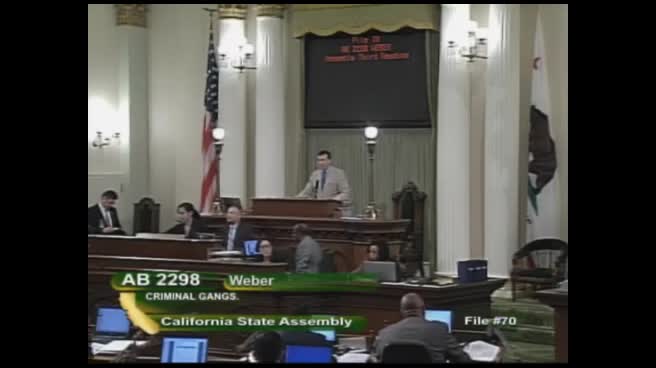 18MIN
Assembly Floor
Bill Author