AB 2327: Contacting or communicating with a minor.
- Session Year: 2015-2016
- House: Assembly
- Latest Version Date: 2016-03-28
Existing law, as added by Proposition 83 of the November 7, 2006, statewide general election, makes it a crime for a person to contact or communicate with a minor, or attempt to contact or communicate with a minor, who knows or reasonably should know that the person is a minor, with intent to commit a specified offense involving the minor, including, among other offenses, kidnaping and rape. Proposition 83 provides that the Legislature may amend the provisions of the act to expand the scope of their application or increase the punishment or penalties by a statute passed by a majority vote of each house of the Legislature.
This bill would additionally make it a crime to contact or communicate with a minor, or attempt to contact or communicate with a minor, as specified, with the intent to commit human trafficking of, or unlawful sexual intercourse with, of the minor. By expanding the definition of a crime, the bill would impose a state-mandated local program.
The California Constitution requires the state to reimburse local agencies and school districts for certain costs mandated by the state. Statutory provisions establish procedures for making that reimbursement.
This bill would provide that no reimbursement is required by this act for a specified reason.
Existing law, as added by Proposition 83 of the November 7, 2006, statewide general election, makes it a crime for a person to contact or communicate with a minor, or attempt to contact or communicate with a minor, who knows or reasonably should know that the person is a minor, with intent to commit a specified offense involving the minor, including, among other offenses, kidnaping and rape. Proposition 83 provides that the Legislature may amend the provisions of the act to expand the scope of their application or increase the punishment or penalties by a statute passed by a majority vote of each house of the Legislature.
This bill would additionally make it a crime to contact or communicate with a minor, or attempt to contact or communicate with a minor, as specified, with the intent to commit human trafficking of, or unlawful sexual intercourse with, the minor. By expanding the definition of a crime, the bill would impose a state-mandated local program.
The California Constitution requires the state to reimburse local agencies and school districts for certain costs mandated by the state. Statutory provisions establish procedures for making that reimbursement.
This bill would provide that no reimbursement is required by this act for a specified reason.
(a)A person who contacts or communicates with a minor, or attempts to contact or communicate with a minor, who knows or reasonably should know that the person is a minor, with intent to commit an offense specified in subdivision (c) of Section 236.1 or Section 207, 209, 261, 261.5, 264.1, 273a, 286, 288, 288a, 288.2, 289, 311.1, 311.2, 311.4 or 311.11 involving the minor shall be punished by imprisonment in the state prison for the term prescribed for an attempt to commit the intended offense.
(b)As used in this section, contacts or communicates with shall include direct and indirect contact or communication that may be achieved personally or by use of an agent or agency, any print medium, any postal service, a common carrier or communication common carrier, any electronic communications system, or any telecommunications, wire, computer, or radio communications device or system.
(c)A person convicted of a violation of subdivision (a) who has previously been convicted of a violation of subdivision (a) shall be punished by an additional and consecutive term of imprisonment in the state prison for five years.
SEC. 2.No reimbursement is required by this act pursuant to Section 6 of Article XIIIB of the California Constitution because the only costs that may be incurred by a local agency or school district will be incurred because this act creates a new crime or infraction, eliminates a crime or infraction, or changes the penalty for a crime or infraction, within the meaning of Section 17556 of the Government Code, or changes the definition of a crime within the meaning of Section 6 of Article XIIIB of the California Constitution.
(a)Every A person who contacts or communicates with a minor, or attempts to contact or communicate with a minor, who knows or reasonably should know that the person is a minor, with intent to commit an offense specified in subdivision (c) of Section 236.1 or Section 207, 209, 261, 261.5, 264.1, 273a, 286, 288, 288a, 288.2, 289, 311.1, 311.2, 311.4 or 311.11 involving the minor shall be punished by imprisonment in the state prison for the term prescribed for an attempt to commit the intended offense.
(b)As used in this section, contacts or communicates with shall include direct and indirect contact or communication that may be achieved personally or by use of an agent or agency, any print medium, any postal service, a common carrier or communication common carrier, any electronic communications system, or any telecommunications, wire, computer, or radio communications device or system.
(c)A person convicted of a violation of subdivision (a) who has previously been convicted of a violation of subdivision (a) shall be punished by an additional and consecutive term of imprisonment in the state prison for five years.
SEC. 2.No reimbursement is required by this act pursuant to Section 6 of Article XIIIB of the California Constitution because the only costs that may be incurred by a local agency or school district will be incurred because this act creates a new crime or infraction, eliminates a crime or infraction, or changes the penalty for a crime or infraction, within the meaning of Section 17556 of the Government Code, or changes the definition of a crime within the meaning of Section 6 of Article XIIIB of the California Constitution.
|
Date
|
Status
|
|---|---|
| May 27, 2016 | Read second time. Ordered to third reading. |
| Aug 11, 2016 | In committee: Held under submission. |
| Aug 1, 2016 | In committee: Referred to APPR. suspense file. |
| Jun 29, 2016 | From committee: Do pass and re-refer to Com. on APPR. (Ayes 7. Noes 0.) (June 28). Re-referred to Com. on APPR. |
| Jun 9, 2016 | Referred to Com. on PUB. S. |
| Jun 1, 2016 | In Senate. Read first time. To Com. on RLS. for assignment. |
| May 31, 2016 | Read third time. Passed. Ordered to the Senate. (Ayes 80. Noes 0.) |
| May 31, 2016 | Read third time. Passed. Ordered to the Senate. (Ayes 80. Noes 0. Page 5034.) |
| May 31, 2016 | Read third time. Passed. Ordered to the Senate. |
| Feb 18, 2016 | Read first time. To print. |
| May 27, 2016 | From committee: Do pass. (Ayes 20. Noes 0.) (May 27). |
| Apr 13, 2016 | In committee: Set, first hearing. Referred to suspense file. |
| Mar 30, 2016 | From committee: Do pass and re-refer to Com. on APPR. (Ayes 7. Noes 0.) (March 29). Re-referred to Com. on APPR. |
| Mar 29, 2016 | Re-referred to Com. on PUB. S. |
| Mar 28, 2016 | From committee chair, with author's amendments: Amend, and re-refer to Com. on PUB. S. Read second time and amended. |
| Mar 3, 2016 | Referred to Com. on PUB. S. |
| Feb 19, 2016 | From printer. May be heard in committee March 20. |
|
Date
|
Description
|
Location
|
Votes
|
|
|---|---|---|---|---|
| Aug 1, 2016 | Placed on suspense file | Senate Standing Committee on Appropriations |
Passed |
|
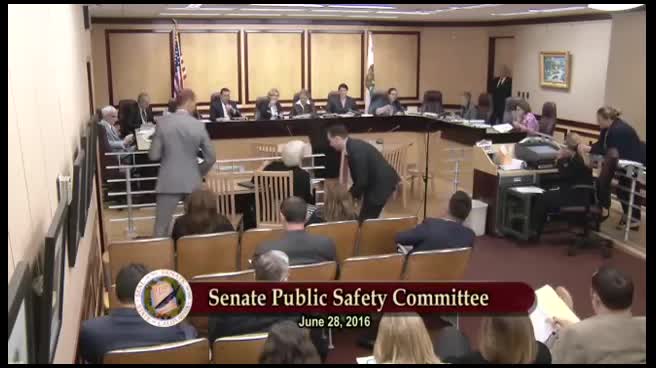
| Jun 28, 2016 | Do pass, but first be re-referred to the Committee on [Appropriations] | Senate Standing Committee on Public Safety |
Passed |
|
| May 31, 2016 | AB 2327 COOLEY Assembly Third Reading | Assembly Floor |
Passed |
|
| May 27, 2016 | Do pass. | Assembly Standing Committee on Appropriations |
Passed |
|
| Mar 29, 2016 | Do pass and be re-referred to the Committee on [Appropriations] | Assembly Standing Committee on Public Safety |
Passed |
This list shows positions taken on this bill by organizations on the date displayed, which is linked to the original source.
Positions by individuals are not included.
|
Organization
|
Position
|
Date
|
|---|---|---|
| Alameda County District Attorney's Office | * Support | Jun 28, 2016 |
| American Civil Liberties Union, California | ** Against | Mar 29, 2016 |
| Association For Los Angeles Deputy Sheriffs | ** Support | Mar 29, 2016 |
| California Association Of Code Enforcement Officers | ** Support | Mar 29, 2016 |
| California Attorneys for Criminal Justice Analysis Prepared | ** Against | Mar 29, 2016 |
| California Narcotic Officers Association California District Attorneys Association | ** Support | Mar 29, 2016 |
| California State Sheriffs' Association | * Support | Jun 28, 2016 |
| Los Angeles Police Protective League | ** Support | Mar 29, 2016 |
SENATE COMMITTEE ON
Senator Ricardo Lara, Chair
2015 - 2016 Regular Session
AB 2327 (Cooley) - Contacting or communicating with a minor
Version: | Policy Vote: |
Urgency: | Mandate: |
Hearing Date: | Consultant: |
This bill meets the criteria for referral to the Suspense File.
Bill Summary:
AB 2327 would expand the crime of contacting or communicating with a minor, with the intent to commit specified sexual offenses involving the minor, to include attempting to contact or communicate with a minor with the intent to commit human trafficking.
Fiscal Impact:
Potentially significant increase in state costs, potentially in excess of hundreds of thousands of dollars (General Fund) annually, for new and/or lengthier commitments to state prison. The potential state prison sentence for contacting a minor with the intent to commit human trafficking could range between 2.5 years, 4 years, or 6 years, or 7.5 years to life for cases involving force, fraud, or fear. For repeat offenders, an additional and consecutive state prison sentence of 5 years could be imposed.
Background:
Existing law specifies that a person who contacts or communicates with a minor, or attempts to contact or communicate with a minor, who knows or reasonably should know that the person is a minor, with intent to commit any of the following offenses involving the minor shall be punished by imprisonment in the state prison for the term prescribed for an attempt to commit the intended offense:
- Kidnapping;
- Kidnapping for ransom, reward, extortion, robbery, or rape;
- Rape;
- Sexual penetration other than rape or sodomy;
- Willful harm or injury to a child;
- Sodomy;
- Lewd and lascivious acts with a minor;
- Oral copulation;
- Harmful matter sent to minor;
- Forcible sexual penetration; and
- Child pornography. (Penal Code (PC) § 288.3 (a).)
Existing law provides that the punishment for the offense of contacting or communicating with a minor, or attempting to contact or communicate with a minor with the intent to commit an intended offense, is the same as an attempt to commit the intended offense. (PC § 288.3 (a).) California criminal law dictates that the punishment for attempt is generally one half the sentence of the completed offense. (PC § 664.)
Existing law specifies that "contacts or communicates with" shall include direct and indirect contact or communication that may be achieved personally or by use of an agent or agency, any print medium, any postal service, a common carrier or communication common carrier, any electronic communications system, or any telecommunications, wire, computer, or radio communications device or system. (PC § 288.3 (b).)
Existing law provides that a person convicted of a violation of contacting or communicating with a minor with the intent to commit a specified offense who has previously been convicted of a violation of contacting or communicating with a minor with the intent to commit a specified offense shall be punished by an additional and consecutive term of imprisonment in the state prison for five years. (PC § 288.3 (c).)
Proposed Law:
This bill would add human trafficking to the list of target crimes subject to the offense of contacting or communicating with a minor (PC § 288.3) with the intent to commit an offense involving the minor.
Related Legislation:
AB 2513 (Williams) 2016 would impose a sentence enhancement of one year in state prison for a human trafficking conviction in which the defendant recruited or enticed the victim from a shelter or placement designed to serve runaway youth, foster children, homeless persons, or victims of human trafficking or domestic violence. This bill is scheduled to be heard today by this Committee.
Prior Legislation: Proposition 83, November 2006 General Election, also known as “Jessica’s Law,” increased the penalties for specified sex offenses and mandated that registered sex offenders who have been convicted of a felony sex offense to be monitored by GPS devices while on parole and for the remainder of their lives. Proposition 83 also established the crime being expanded under the provisions of this bill.
Staff Comments:
By expanding the felony offense of contacting or communicating with a minor with the intent to commit a sex crime to include the offense of human trafficking, this bill could result in new commitments to state prison, as well as commitments to state prison with longer sentences.
Arrest data from the Department of Justice (DOJ) indicates nearly 250 arrests annually under the specified offense of communicating with a minor with the intent to commit a specified crime, with an average of 82 annual arrests (33 percent) leading to convictions. It is unknown how many new arrests and subsequent convictions would occur due to expanding the offense to include communicating with a minor with the intent to commit human trafficking, but to the extent additional prosecutions could proceed, additional workload and costs would be imposed on the courts.
The prison term triad for the offense of human trafficking pursuant to PC § 236.1(c) is five years, eight years, or 12 years, and additionally includes a fine of up to $500,000. For cases in which the offense involves force, fear, fraud, deceit, coercion, violence, duress, menace, or threat of unlawful injury to the victim or to another person, the punishment is 15 years to life and a fine of up to $500,000. As the sentence for the attempt to commit a crime is generally one half the sentence of the completed offense, the potential prison term triad under the provisions of this measure is 2.5 years, four years, or six years, and a fine of up to $250,000, or in cases involving force, fraud, or fear, a potential prison term of 7.5 years to life and a fine of up to $250,000.
The magnitude of new costs for commitments to state prison would be dependent on the number of convictions and the sentencing terms attached to those offenses. While costs in any one year may not be significant, the cumulative effect over time of overlapping sentences could be substantial.
The U.S. Supreme Court ordered the CDCR to reduce the prison population to 137.5 percent of the prison system’s design capacity by February 28, 2016. Although public safety realignment has achieved significant reductions in the prison population, and the 2016-17 Governor’s Budget projects meeting the population cap in the near-term, the analysis by the Legislative Analyst’s Office suggests that CDCR’s long-term prison caseload will likely exceed this cap. Because California's institutions are projected to exceed the population limit, any near-term and future increases to the state's prison population would likely require the state to pursue one of several options including contracting-out for additional bed space or releasing current inmates early onto parole. Both alternatives would result in additional state costs.
-- END --
SENATE COMMITTEE ON PUBLIC SAFETY
Senator Loni Hancock, Chair
2015 - 2016 Regular
Bill No: AB 2327 Hearing Date: June 28, 2016
Author: | Cooley | ||
Version: | March 28, 2016 | ||
Urgency: | No | Fiscal: | Yes |
Consultant: | JM | ||
Subject: Contacting or Communicating With a Minor
HISTORY
Source: Alameda County District Attorney's Office
Prior Legislation: Proposition 83, November 2006 General Election
Support: Association for Los Angeles Deputy Sheriffs; California Association of Code Enforcement Officers; California Narcotic Officers Association; California District Attorneys Association; California State Sheriffs’ Association; Los Angeles Police Protective League; Los Angeles Professional Peace Officers Association; Peace Officers Research Association of California; Riverside Sheriffs Association
Opposition: American Civil Liberties Union; California Attorneys for Criminal Justice
Assembly Floor Vote: 80 - 0
PURPOSE
This bill adds human trafficking to the list of target crimes in the offense of contacting or communicating with a minor for the purposes of committing a further, specified crime.
Existing law specifies that every person who contacts or communicates with a minor, or attempts to contact or communicate with a minor, who knows or reasonably should know that the person is a minor, with intent to commit any of the following offenses involving the minor shall be punished by imprisonment in the state prison for the term prescribed for an attempt to commit the intended offense. The offenses included in this section are listed as follows: (Pen. Code §, 288.3, subd. (a).)
- Kidnapping;
- Kidnapping for ransom, reward, extortion, robbery, or rape;
- Rape;
- Sexual penetration other than rape or sodomy;
- Willful harm or injury to a child;
- Sodomy;
- Lewd and lascivious acts with a minor;
- Oral copulation;
- Harmful matter sent to minor;
- Forcible sexual penetration; and
- Child pornography.
Existing law provides that the punishment for the offense of contacting or communicating with a minor is the same as an attempt to commit the crime. (Pen. Code §, 288.3, subd. (a).) California criminal law dictates that the punishment for attempt is generally one half the sentence of the completed crime. (Pen. Code § 664.)
Existing law specifies that "contacts or communicates with" shall include direct and indirect contact or communication that may be achieved personally or by use of an agent or agency, any print medium, any postal service, a common carrier or communication common carrier, any electronic communications system, or any telecommunications, wire, computer, or radio communications device or system. (Pen. Code §, 288.3, subd. (b).)
Existing law provides that a person convicted of a violation of contacting or communicating with a minor who has previously been convicted of a violation the same offense shall be punished by an additional and consecutive term of imprisonment in the state prison for five years. (Pen. Code §, 288.3, subd. (c).)
This bill expands the crime of communicating with a minor with the intent to commit specified sexual offenses with the minor to include attempting to contact or communicating with a minor with the intent to commit human trafficking.
RECEIVERSHIP/OVERCROWDING CRISIS AGGRAVATION
For the past several years this Committee has scrutinized legislation referred to its jurisdiction for any potential impact on prison overcrowding. Mindful of the United States Supreme Court ruling and federal court orders relating to the state’s ability to provide a constitutional level of health care to its inmate population and the related issue of prison overcrowding, this Committee has applied its “ROCA” policy as a content-neutral, provisional measure necessary to ensure that the Legislature does not erode progress in reducing prison overcrowding.
On February 10, 2014, the federal court ordered California to reduce its in-state adult institution population to 137.5% of design capacity by February 28, 2016, as follows:
- 143% of design bed capacity by June 30, 2014;
- 141.5% of design bed capacity by February 28, 2015; and,
- 137.5% of design bed capacity by February 28, 2016.
In December of 2015 the administration reported that as “of December 9, 2015, 112,510 inmates were housed in the State’s 34 adult institutions, which amounts to 136.0% of design bed capacity, and 5,264 inmates were housed in out-of-state facilities. The current population is 1,212 inmates below the final court-ordered population benchmark of 137.5% of design bed capacity, and has been under that benchmark since February 2015.” (Defendants’ December 2015 Status Report in Response to February 10, 2014 Order, 2:90-cv-00520 KJM DAD PC, 3-Judge Court, Coleman v. Brown, Plata v. Brown (fn. omitted).) One year ago, 115,826 inmates were housed in the State’s 34 adult institutions, which amounted to 140.0% of design bed capacity, and 8,864 inmates were housed in out-of-state facilities. (Defendants’ December 2014 Status Report in Response to February 10, 2014 Order, 2:90-cv-00520 KJM DAD PC, 3-Judge Court, Coleman v. Brown, Plata v. Brown (fn. omitted).)
While significant gains have been made in reducing the prison population, the state must stabilize these advances and demonstrate to the federal court that California has in place the “durable solution” to prison overcrowding “consistently demanded” by the court. (Opinion Re: Order Granting in Part and Denying in Part Defendants’ Request For Extension of December 31, 2013 Deadline, NO. 2:90-cv-0520 LKK DAD (PC), 3-Judge Court, Coleman v. Brown, Plata v. Brown (2-10-14). The Committee’s consideration of bills that may impact the prison population therefore will be informed by the following questions:
- Whether a proposal erodes a measure which has contributed to reducing the prison population;
- Whether a proposal addresses a major area of public safety or criminal activity for which there is no other reasonable, appropriate remedy;
- Whether a proposal addresses a crime which is directly dangerous to the physical safety of others for which there is no other reasonably appropriate sanction;
- Whether a proposal corrects a constitutional problem or legislative drafting error; and
- Whether a proposal proposes penalties which are proportionate, and cannot be achieved through any other reasonably appropriate remedy.
COMMENTS
Need for This Bill
According to the author:
Human trafficking is a profitable criminal industry. Unlike selling drugs, buying and selling human beings is a crime that can repeat itself multiple times. It is estimated that every year approximately 500,000 American youth are at-risk for being sold for sex in the United States. Traffickers and exploiters who prey on children know no boundaries; they are near schools, shopping malls, parks, foster homes, and online. Child trafficking criminals are making use of online resources, using technology to target their audience more efficiently. AB 2327 helps law enforcement target traffickers and 'Johns' more efficiently for their participation in this industry.
2. Rejections of Challenges to Penal Code Section 288.3 – Communicating with a Minor with the Intent to Commit a Sex Crime - in the Courts
There are few published appellate decisions considering the crime amended by this bill, although there have been a number of unpublished opinions. The unpublished opinions generally upheld convictions, but unpublished cases cannot be cited as authority on appeal or in a trial court in other cases.
In one published case, the Court of Appeal rejected arguments that the court should have instructed the jury on an allegedly lesser-included offense, that the statute violated the constitutional right to travel, was vague and denied equal protection of the law. Finally, the court rejected an argument that the initiative in which the statute was defined violated the California single subject rule. (People v. Keister (2011) 198 Cal.App.4th 442.)
Another case -- People v. Shapiro, previously at 228 Cal.App.4th 157 – was granted review by the California Supreme Court, but review was later dismissed and the appellate opinion depublished. His petition for certiorari in the United States Supreme Court was denied. The defendant in Shapiro had communicated over the Internet with a 16-year-old girl in Indiana. The defendant pretended to be only a few years older than the victim. He eventually convinced her to engage in explicit activity during their Internet conversation. The defendant argued that he could not be convicted because the victim was not a minor under Indiana law, where the age of consent is 16. He also argued that he could not have actually induced or caused her to engage in sexual penetration from thousands of miles away in Southern California. Shapiro’s convictions have thus been allowed to stand.
- California Human Trafficking Laws Generally
The basic human trafficking law was enacted by AB 22 (Lieber) Ch. 240, Stats. 2005. AB 22 provided that the essence of human trafficking is the deprivation of the victim’s liberty in order to place the person in sexual commerce or obtain labor. The human trafficking law was amended by Proposition 35 in 2012. The initiative greatly increased penalties, set special procedures and rules of evidence and eliminated the element of deprivation of liberty if the victim is a minor. The penalties established by the initiative are especially comprehensive and arguably cover the full range of circumstances in human trafficking. Human trafficking of minors can be done through inducements, persuasion and the like. The use of coercion, fraud, force or duress against a minor does, however, subjects as defendant to especially severe penalties, including life terms.
Proposition 35 provided for prison sentences up to 15-years-to-life and fines up to $1.5 million for human trafficking involving minors. The proposition specified that the fines collected are to be used for victim services and law enforcement. In criminal trials, the proposition prohibits the use of evidence that a person was involved in criminal sexual conduct (such as prostitution) to prosecute that person for that crime if the conduct was a result of being a victim of human trafficking, and makes evidence of sexual conduct by a victim of human trafficking inadmissible for the purposes of attacking the victim’s credibility or character in court. The proposition lowered the evidentiary requirements for showing of force in cases of minors.
Proposition 35 also requires persons convicted of human trafficking to register as sex offenders and expanded registration requirements by requiring registered sex offenders to provide the names of their internet providers and identifiers, such as e-mail addresses, user names, and screen names, to local police or sheriff’s departments.
After passage of Proposition 35, plaintiffs American Civil Liberties Union and Electronic Frontier Foundation filed a law suit claiming that these provisions unconstitutionally restrict the First Amendment rights of registered sex offenders in the states. A United States District Court judge granted a preliminary injunction prohibiting the implementation or enforcement of Proposition 35's provisions that require registered sex offenders to provide certain information concerning their Internet use to law enforcement. (Doe v. Harris (N.D. Cal., Jan. 11, 2013, No. C12-5713) 2013 LEXIS 5428.) A bill to address the decisions of the federal courts – SB 448 (Hueso) is pending in Assembly Public Safety.
- Federal Law - Trafficking Victims Protection Act of 2000
In October 2000, the Trafficking Victims Protection Act of 2000 (TVPA) was enacted and is comprehensive, addressing the various ways of combating trafficking, including prevention, protection and prosecution. (22 USC Sections 7101 et seq.)
The prevention measures include the authorization of educational and public awareness programs. Protection and assistance for victims of trafficking include making housing, educational, health-care, job training and other federally funded social service programs available to assist victims in rebuilding their lives. Finally, the TVPA provides law enforcement with tools to strengthen the prosecution and punishment of traffickers, making human trafficking a federal crime.
-- END –
ASSEMBLY THIRD READING
ATR Bill Id:AB 2327
Author:(Cooley)
As Amended Ver:March 28, 2016
Majority vote
Committee | Votes | Ayes | Noes |
Public Safety | 7-0 | Jones-Sawyer, Melendez, Lackey, Lopez, Low, Quirk, Santiago | |
Appropriations | 20-0 | Gonzalez, Bigelow, Bloom, Bonilla, Bonta, Calderon, Chang, Daly, Eggman, Gallagher, Eduardo Garcia, Roger Hernández, Holden, Jones, Obernolte, Quirk, Santiago, Wagner, Weber, Wood |
|
SUMMARY: Expands the crime of communicating with a minor with the intent to commit specified sexual offenses with the minor to include attempting to contact or communicating with a minor with the intent to commit human trafficking.
EXISTING LAW:
- Specifies that every person who contacts or communicates with a minor, or attempts to contact or communicate with a minor, who knows or reasonably should know that the person is a minor, with intent to commit any of the following offenses involving the minor shall be punished by imprisonment in the state prison for the term prescribed for an attempt to commit the intended offense. The offenses included in this section are listed as follows:
- Kidnapping;
- Kidnapping for ransom, reward, extortion, robbery, or rape;
- Rape;
- Rape by a foreign object;
- Willful harm or injury to a child;
- Sodomy;
- Lewd and lascivious acts with a minor;
- Oral copulation;
- Harmful matter sent to minor;
- Forcible sexual penetration; and
- Child pornography.
- Provides that the punishment for the offense of contacting or communicating with a minor is the same as an attempt to commit the crime. California criminal law dictates that the punishment for attempt is generally one half the sentence of the completed crime.
- Specifies that "contacts or communicates with" shall include direct and indirect contact or communication that may be achieved personally or by use of an agent or agency, any print medium, any postal service, a common carrier or communication common carrier, any electronic communications system, or any telecommunications, wire, computer, or radio communications device or system.
- Provides that a person convicted of a violation of contacting or communicating with a minor who has previously been convicted of a violation the same offense shall be punished by an additional and consecutive term of imprisonment in the state prison for five years.
FISCAL EFFECT: According to the Assembly Appropriations Committee, according to the California Department of Corrections, the contracted out-of-state bed rate is $29,000. If every year, two individuals serve four additional years in state prison, the first year cost will be $58,000, $116,000 the second, $174,000 the third, and $232,000 every year thereafter. This cost will be further increased by an additional $29,000 if the five year enhancement is applied to a repeat offender.
This bill results in 2.5 years, 4 years, or 6 years and a fine of $250,000 if an individual is convicted of contacting a minor with the intent of human trafficking for specified sexual purposes, this is half the punishment for the actual offense. However, the five-year enhancement for repeat offense is not halved.
COMMENTS: According to the author, "Human trafficking is a profitable criminal industry. Unlike selling drugs, buying and selling human beings is a crime that can repeat itself multiple times. It is estimated that every year approximately 500,000 American youth are at-risk for being sold for sex in the United States. Traffickers and exploiters who prey on children know no boundaries; they are near schools, shopping malls, parks, foster homes, and online. Child trafficking criminals are making use of online resources, using technology to target their audience more efficiently. AB 2327 helps law enforcement target traffickers and 'Johns' more efficiently for their participation in this industry."
Analysis Prepared by: Gabriel Caswell/ PUB. S. / (916) 319-3744 FN: 0003134
Date of Hearing: April 13, 2016
ASSEMBLY COMMITTEE ON APPROPRIATIONS
Lorena Gonzalez, Chair
ABPCA Bill Id:AB 2327
Author:(Cooley) – As Amended Ver:March 28, 2016
Policy Committee: | Public Safety | Vote: | 7 - 0 |
|
|
Urgency: No State Mandated Local Program: Yes Reimbursable: No
SUMMARY:
This bill expands the crime of communicating with a minor, with the intent to commit specified sexual offenses with the minor, to include attempting to contact or communicating with a minor with the intent to commit human trafficking.
FISCAL EFFECT:
According to the California Department of Corrections (CDCR), the contracted out-of-state bed rate is $29,000. If every year, two individuals serve four additional years in state prison, the first year cost will be $58,000, $116,000 the second, $174,000 the third, and $232,000 every year thereafter. This cost will be further increased by an additional $29,000 if the five year enhancement is applied to a repeat offender.
AB 2327 results in 2.5 years, 4 years, or 6 years and a fine of $250,000 if an individuals is convicted of contacting a minor with the intent of human trafficking for specified sexual purposes, this is half the punishment for the actual offense. However, the five-year enhancement for repeat offense is not halved.
COMMENTS:
- Background. Current law specifies that every person who contacts or communicates with a minor, or attempts to contact or communicate with a minor, who knows or reasonably should know that the person is a minor, with intent to commit any of several specified offenses involving the minor shall be punished by imprisonment in the state prison for the term prescribed for an attempt to commit the intended offense. The specified offenses include, but are not limited to: kidnapping, rape, willful harm or injury to a child, various sexual acts, and child pornography. Current law also provides that the punishment for the offense of contacting or communicating with a minor is the same as an attempt to commit the crime, the punishment for attempt is generally one half the sentence of the completed crime.
Current punishment for human trafficking of a minor is five, eight or 12 years and a $500,000 fine, and fifteen-to-life and a $500,000 fine if the offense involves force, fear, threat or bodily injury. Current law also provides that a person convicted of a violation of contacting or communicating with a minor who has previously been convicted of a violation of the same offense shall be punished by an additional and consecutive term of imprisonment in the state prison for five years.
Human trafficking involves the recruitment, transportation or sale of people for forced labor. Through violence, threats and coercion, victims are forced to work in, among other things, the sex trade, domestic labor, factories, hotels and agriculture. According to the January 2005 United States Department of State's Human Smuggling and Trafficking Center report, "Fact Sheet: Distinctions Between Human Smuggling and Human Trafficking", there is an estimated 600,000 to 800,000 men, women and children trafficked across international borders each year. Of these, approximately 80% are women and girls and up to 50% are minors.
In 2012, voters passed Proposition 35, which modified many provisions of California's already tough human trafficking laws. The proposition increased criminal penalties for human trafficking, including prison sentences up to 15-years-to-life and fines up to $1.5 million. Additionally, the proposition specified that the fines collected are to be used for victim services and law enforcement. Proposition 35 requires persons convicted of trafficking to register as sex offenders, and prohibits evidence from being used against a victim in court proceedings if that victim engaged in sexual conduct. Additionally, the proposition lowered the evidential requirements for a showing of force in cases of minors.
- Purpose. According to the author, "Human trafficking is a profitable criminal industry. Unlike selling drugs, buying and selling human beings is a crime that can repeat itself multiple times. It is estimated that every year approximately 500,000 American youth are at-risk for being sold for sex in the United States. Traffickers and exploiters who prey on children know no boundaries; they are near schools, shopping malls, parks, foster homes, and online. Child trafficking criminals are making use of online resources, using technology to target their audience more efficiently. AB 2327 helps law enforcement target traffickers and 'Johns' more efficiently for their participation in this industry."
- Support. According to the Alameda District Attorney's Office, "This bill adds sexual contact with a minor victim of human trafficking. We have seen a growing use of the internet to lure children into a destructive, assaultive situation where the sexual exploitation and sexual assault can occur. This bill protects children from those who lure children for the perpetrators own sexual gratification.
- Opposition: According to the American Civil Liberties Union, "given that a person can already be convicted and punished for engaging in the conduct contemplated in this bill, and given that our prisons and jails are already overcrowded and draining precious public safety resources, this bill appears unwise and unnecessary."
- Prior Legislation: SB 1128 (Alquist), Chapter 337, Statutes of 2006, created the "Sex Offender Punishment, Control and Containment Act of 2006" which makes several changes to the law relating to sex offenders.
Analysis Prepared by: Pedro Reyes / APPR. / (916) 319-2081
Date of Hearing: March 29, 2016
Counsel: Gabriel Caswell
ASSEMBLY COMMITTEE ON
, Sr., Chair
ABPCA Bill Id:
Author:() – As Amended Ver:March 28, 2016
SUMMARY: Expands the crime of communicating with a minor with the intent to commit specified sexual offenses with the minor to include attempting to contact or communicating with a minor with the intent to commit human trafficking.
EXISTING LAW:
- Specifies that every person who contacts or communicates with a minor, or attempts to contact or communicate with a minor, who knows or reasonably should know that the person is a minor, with intent to commit any of the following offenses involving the minor shall be punished by imprisonment in the state prison for the term prescribed for an attempt to commit the intended offense. The offenses included in this section are listed as follows: (Pen. Code §, 288.3, subd. (a).)
- Kidnapping;
- Kidnapping for ransom, reward, extortion, robbery, or rape;
- Rape;
- Rape by a foreign object;
- Willful harm or injury to a child;
- Sodomy;
- Lewd and lascivious acts with a minor;
- Oral copulation;
- Harmful matter sent to minor;
- Forcible sexual penetration; and
- Child pornography.
- Kidnapping;
- Provides that the punishment for the offense of contacting or communicating with a minor is the same as an attempt to commit the crime. (Pen. Code §, 288.3, subd. (a).) California criminal law dictates that the punishment for attempt is generally one half the sentence of the completed crime. (Pen. Code § 664.)
- Specifies that "contacts or communicates with" shall include direct and indirect contact or communication that may be achieved personally or by use of an agent or agency, any print medium, any postal service, a common carrier or communication common carrier, any electronic communications system, or any telecommunications, wire, computer, or radio communications device or system. (Pen. Code §, 288.3, subd. (b).)
- Provides that a person convicted of a violation of contacting or communicating with a minor who has previously been convicted of a violation the same offense shall be punished by an additional and consecutive term of imprisonment in the state prison for five years. (Pen. Code §, 288.3, subd. (c).)
FISCAL EFFECT:
COMMENTS:
- Author's Statement: According to the author, "Human trafficking is a profitable criminal industry. Unlike selling drugs, buying and selling human beings is a crime that can repeat itself multiple times. It is estimated that every year approximately 500,000 American youth are at-risk for being sold for sex in the United States. Traffickers and exploiters who prey on children know no boundaries; they are near schools, shopping malls, parks, foster homes, and online. Child trafficking criminals are making use of online resources, using technology to target their audience more efficiently. AB 2327 helps law enforcement target traffickers and 'Johns' more efficiently for their participation in this industry."
- Human Trafficking Generally: Human trafficking involves the recruitment, transportation or sale of people for forced labor. Through violence, threats and coercion, victims are forced to work in, among other things, the sex trade, domestic labor, factories, hotels and agriculture. According to the January 2005 United States Department of State's Human Smuggling and Trafficking Center report, "Fact Sheet: Distinctions Between Human Smuggling and Human Trafficking", there is an estimated 600,000 to 800,000 men, women and children trafficked across international borders each year. Of these, approximately 80% are women and girls and up to 50% are minors. A recent report by the Human Rights Center at the University of California, Berkeley cited 57 cases of forced labor in California between 1998 and 2003, with over 500 victims. The report, "Freedom Denied", notes most of the victims in California were from Thailand, Mexico, and Russia and had been forced to work as prostitutes, domestic slaves, farm laborers or sweatshop employees. (University of California, Berkeley Human Rights Center, "Freedom Denied: Forced Labor in California" (February, 2005).) According to the author:
"While the clandestine nature of human trafficking makes it enormously difficult to accurately track how many people are affected, the United States government estimates that about 17,000 to 20,000 women, men and children are trafficked into the United States each year, meaning there may be as many as 100,000 to 200,000 people in the United States working as modern slaves in homes, sweatshops, brothels, agricultural fields, construction projects and restaurants."
In 2012, Californians voted to pass Proposition 35, which modified many provisions of California's already tough human trafficking laws. The proposition increased criminal penalties for human trafficking, including prison sentences up to 15-years-to-life and fines up to $1,500,000. Additionally, the proposition specified that the fines collected are to be used for victim services and law enforcement. Proposition 35 requires persons convicted of trafficking to register as sex offenders. Proposition 35 prohibits evidence from being used against a victim in court proceedings if that victim engaged in sexual conduct. Additionally, the proposition lowered the evidential requirements for showing of force in cases of minors.
- Trafficking Victims Protection Act of 2000 (22 USC Sections 7101 et seq.): In October 2000, the Trafficking Victims Protection Act of 2000 (TVPA) was enacted and is comprehensive, addressing the various ways of combating trafficking, including prevention, protection and prosecution. The prevention measures include the authorization of educational and public awareness programs. Protection and assistance for victims of trafficking include making housing, educational, health-care, job training and other federally funded social service programs available to assist victims in rebuilding their lives. Finally, the TVPA provides law enforcement with tools to strengthen the prosecution and punishment of traffickers, making human trafficking a federal crime.
- Recent Update to Human Trafficking Laws: In 2012, Californians voted to pass Proposition 35, which modified many provisions of California's already tough human trafficking laws. Specifically, Proposition 35 increased criminal penalties for human trafficking offenses, including prison sentences up to 15-years-to-life and fines up to $1.5 million. The proposition specified that the fines collected are to be used for victim services and law enforcement. In criminal trials, the proposition prohibits the use of evidence that a person was involved in criminal sexual conduct (such as prostitution) to prosecute that person for that crime if the conduct was a result of being a victim of human trafficking, and makes evidence of sexual conduct by a victim of human trafficking inadmissible for the purposes of attacking the victim’s credibility or character in court. The proposition lowered the evidentiary requirements for showing of force in cases of minors.
Proposition 35 also requires persons convicted of human trafficking to register as sex offenders and expanded registration requirements by requiring registered sex offenders to provide the names of their internet providers and identifiers, such as e-mail addresses, user names, and screen names, to local police or sheriff’s departments. After passage of Proposition 35, plaintiffs American Civil Liberties Union and Electronic Frontier Foundation filed a law suit claiming that these provisions unconstitutionally restricts the First Amendment rights of registered sex offenders in the states. A United States District Court judge granted a preliminary injunction prohibiting the implementation or enforcement of Proposition 35's provisions that require registered sex offenders to provide certain information concerning their Internet use to law enforcement. (Doe v. Harris (N.D. Cal., Jan. 11, 2013, No. C12-5713) 2013 LEXIS 5428.)
- Trafficking Victims Protection Act of 2000 (22 USC Sections 7101 et seq.): In October 2000, the Trafficking Victims Protection Act of 2000 (TVPA) was enacted and is comprehensive, addressing the various ways of combating trafficking, including prevention, protection and prosecution. The prevention measures include the authorization of educational and public awareness programs. Protection and assistance for victims of trafficking include making housing, educational, health-care, job training and other federally funded social service programs available to assist victims in rebuilding their lives. Finally, the TVPA provides law enforcement with tools to strengthen the prosecution and punishment of traffickers, making human trafficking a federal crime.
- Argument in Support: According to the Alameda District Attorney's Office, "Existing law makes it a crime to contact or communicate with a minor with the intent to commit several child sexual assault related crimes such as child pornography, child abuse, and child sexual assault. This bill adds sexual contact with a minor victim of human trafficking. We have seen a growing use of the internet to lure children into a destructive, assaultive situation where the sexual exploitation and sexual assault can occur. This bill protects children from those who lure children for the perpetrators own sexual gratification.
"The Alameda County District Attorney's Office has been in the forefront on a state and national level, combating child sexual abuse and exploitation. Since 2005, we have been leading the state and national effort to educate and bring awareness to communities and policy makers that far too many of children are being trafficked and exploited. Through H.E.A.T. Watch, and the H.E.A.T. Institute, we have increased the focus on the purchasers.
"Existing law makes it a crime to contact a minor with the intent to commit an offense involving that minor including kidnapping and rape. AB 2327 simply includes human trafficking to the list of offenses."
- Argument in Opposition: According to the American Civil Liberties Union, "given that a person can already be convicted and punished for engaging in the conduct contemplated in this bill, and given that our prisons and jails are already overcrowded and draining precious public safety resources, this bill appears unwise and unnecessary."
- Prior Legislation: SB 1128 (Alquist), Chapter 337, Statutes of 2006, created the "Sex Offender Punishment, Control and Containment Act of 2006" which makes several changes to the law relating to sex offenders. These included creating this section.
REGISTERED SUPPORT / OPPOSITION:
Support
Alameda County District Attorney's Office (sponsor)
Association for Los Angeles Deputy Sheriffs
California Association of Code Enforcement Officers
California Narcotic Officers Association
California District Attorneys Association
California State Sheriffs Association
Los Angeles Police Protective League
Los Angeles Professional Peace Officers Association
Peace Officers Research Association of California
Riverside Sheriffs Association
Opposition
American Civil Liberties Union, California
California Attorneys for Criminal Justice
Analysis Prepared by:
Discussed in Hearing
 5MIN
Senate Standing Committee on Public Safety
 50SEC
Assembly Floor
 8MIN
Assembly Standing Committee on Public Safety
Bill Author

Bill Co-Author(s):