AB 2450: Property taxation.
- Session Year: 2015-2016
- House: Assembly
- Latest Version Date: 2016-09-12
Existing property tax law requires the county assessor to consider, when valuing real property for property taxation purposes, the effect of any enforceable restrictions to which the use of the land may be subjected. Under existing law these restrictions include, but are not limited to, zoning, recorded contracts with governmental agencies, and various other restrictions imposed by governments.
This bill would require contracts with governmental agencies that restrict the use of the property to owner-occupied housing available at affordable housing cost to be recorded. The bill would provide that this requirement would not prevent the assessor from considering a contract that restricts the use of the property to owner-occupied housing available at affordable housing cost, including under any locally adopted inclusionary housing program, for purposes of assessing real property, as provided.
The California Constitution exempts from property taxation property that is owned by the state or, with certain exceptions, by local governments. Existing property tax law establishes a procedure by which a public entity may cancel property taxes on property that it acquires. Under existing law, if a public entity proposes to acquire property for public use that will make the property exempt from taxation, the public entity is required to give notice to the county tax collector and to other public entities whose taxes are not collected by the county tax collector, as provided.
This bill would additionally require the public entity to give notice to the county assessor.
By adding to the duties of local government officials, this bill would impose a state-mandated local program.
The California Constitution requires the state to reimburse local agencies and school districts for certain costs mandated by the state. Statutory provisions establish procedures for making that reimbursement.
This bill would provide that, if the Commission on State Mandates determines that the bill contains costs mandated by the state, reimbursement for those costs shall be made pursuant to these statutory provisions.
Existing property tax law requires the county assessor to consider, when valuing real property for property taxation purposes, the effect of any enforceable restrictions to which the use of the land may be subjected. Under existing law these restrictions include, but are not limited to, zoning, recorded contracts with governmental agencies, and various other restrictions imposed by governments.
This bill would require contracts with governmental agencies that restrict the use of the property to owner-occupied housing available at affordable housing cost to be recorded.
The California Constitution exempts from property taxation property that is owned by the state or, with certain exceptions, by local governments. Existing property tax law establishes a procedure by which a public entity may cancel property taxes on property that it acquires. Under existing law, if a public entity proposes to acquire property for public use that will make the property exempt from taxation, the public entity is required to give notice to the county tax collector and to other public entities whose taxes are not collected by the county tax collector, as provided.
This bill would additionally require the public entity to give notice to the county assessor.
By adding to the duties of local government officials with regard to the cancellation of property taxes, officials, this bill would impose a state-mandated local program.
The California Constitution requires the state to reimburse local agencies and school districts for certain costs mandated by the state. Statutory provisions establish procedures for making that reimbursement.
This bill would provide that, if the Commission on State Mandates determines that the bill contains costs mandated by the state, reimbursement for those costs shall be made pursuant to these statutory provisions.
Existing property tax law, when there is a change in ownership of real property, a manufactured home, or a floating home that is subject to local property taxation, requires the transferee to file a change in ownership statement, under penalty of perjury, in the county where the real property, manufactured home, or floating home is located. Existing property tax law requires the change in ownership statement to include information relative to the real property, manufactured home, or floating home acquisition transaction, including, but not limited to, a description of the property, the parties to the transaction, the date of acquisition, the amount of the consideration paid for the property, and the terms of the transaction.
This bill would additionally require the change in ownership statement to include information regarding any enforceable restrictions placed upon the property that the assessor is required to consider, as specified.
By requiring additional information to be filed under penalty of perjury, thereby expanding the crime of perjury, this bill would impose a state-mandated local program.
The California Constitution exempts from property taxation property that is owned by the state or, with certain exceptions, by local governments. Existing property tax law establishes a procedure by which a public entity may cancel property taxes on property that it acquires. Under existing law, if a public entity proposes to acquire property for public use that will make the property exempt from taxation, the public entity is required to give notice to the county tax collector and to other public entities whose taxes are not collected by the county tax collector, as provided.
This bill would additionally require the public entity to give notice to the county assessor.
By adding to the duties of local government officials with regard to the cancellation of property taxes, this bill would impose a state-mandated local program.
The California Constitution requires the state to reimburse local agencies and school districts for certain costs mandated by the state. Statutory provisions establish procedures for making that reimbursement.
This bill would provide that with regard to certain mandates no reimbursement is required by this act for a specified reason.
With regard to any other mandates, this bill would provide that, if the Commission on State Mandates determines that the bill contains costs so mandated by the state, reimbursement for those costs shall be made pursuant to the statutory provisions noted above.
The California Constitution requires the state to reimburse local agencies and school districts for certain costs mandated by the state. Statutory provisions establish procedures for making that reimbursement.
This bill would provide that, if the Commission on State Mandates determines that the bill contains costs mandated by the state, reimbursement for those costs shall be made pursuant to these statutory provisions.
Existing property tax law, when there is a change in ownership of real property, a manufactured home, or a floating home that is subject to local property taxation, requires the transferee to file a change in ownership statement, under penalty of perjury, in the county where the real property, manufactured home, or floating home is located. Existing property tax law requires the change in ownership statement to include information relative to the real property, manufactured home, or floating home acquisition transaction, including, but not limited to, a description of the property, the parties to the transaction, the date of acquisition, the amount of the consideration paid for the property, and the terms of the transaction.
This bill would additionally require the change in ownership statement to include information regarding any enforceable restrictions placed upon the property that the assessor is required to consider, as specified.
By requiring additional information to be filed under penalty of perjury, thereby expanding the crime of perjury, this bill would impose a state-mandated local program.
The California Constitution exempts from property taxation property that is owned by the state or, with certain exceptions, by local governments. Existing property tax law establishes a procedure by which a public entity may cancel property taxes on property that it acquires. Under existing law, if a public entity proposes to acquire property for public use that will make the property exempt from taxation, the public entity is required to give notice to the county tax collector and to other public entities whose taxes are not collected by the county tax collector, as provided.
This bill would additionally require the public entity to give notice to the county assessor.
By adding to the duties of local government officials with regard to the cancellation of property taxes, this bill would impose a state-mandated local program.
The California Constitution requires the state to reimburse local agencies and school districts for certain costs mandated by the state. Statutory provisions establish procedures for making that reimbursement.
This bill would provide that with regard to certain mandates no reimbursement is required by this act for a specified reason.
With regard to any other mandates, this bill would provide that, if the Commission on State Mandates determines that the bill contains costs so mandated by the state, reimbursement for those costs shall be made pursuant to the statutory provisions noted above.
Existing property tax law requires the county assessor to consider, when valuing real property for property taxation purposes, the effect of any enforceable restrictions to which the use of the land may be subjected. Under existing law these restrictions include, but are not limited to, zoning, recorded contracts with governmental agencies, and various other restrictions imposed by governments.
This bill would require government agencies to provide copies of the recorded contracts to the assessor as soon as possible after the date of recordation.
The California Constitution requires the state to reimburse local agencies and school districts for certain costs mandated by the state. Statutory provisions establish procedures for making that reimbursement.
This bill would provide that, if the Commission on State Mandates determines that the bill contains costs mandated by the state, reimbursement for those costs shall be made pursuant to these statutory provisions.
Contracts with government agencies restricting the use of property for owner-occupied housing available at affordable cost shall be recorded. Nothing in this section shall be construed to prevent the assessor from considering a contract that restricts the use of the property to owner-occupied housing available at affordable housing cost, including under any locally adopted inclusionary housing program, for purposes of applying Section 402.1 or subdivision (a) of Section 110.
SEC. 2.Section 5091 of the Revenue and Taxation Code is amended to read:5091.(a)If a public entity proposes to acquire property for a public use that will make the property exempt from taxation, the public entity shall give notice to the county assessor, the county tax collector, and to any public entities whose taxes are not collected by the county tax collector but who at the time exercise the right of assessment and taxation.
(b)The notice shall be given within a reasonable time following the initial budgeting of funds for the proposed acquisition, and shall state all of the following:
(1)The approximate extent of the proposed project.
(2)The estimated time of completion of all acquisitions necessary for the proposed project.
(c)This section creates no rights or liabilities and does not affect the validity of any property acquisitions by negotiated purchase or eminent domain.
SEC. 3.If the Commission on State Mandates determines that this act contains costs mandated by the state, reimbursement to local agencies and school districts for those costs shall be made pursuant to Part 7 (commencing with Section 17500) of Division 4 of Title 2 of the Government Code.
(a)In the assessment of land, the assessor shall consider the effect upon value of any enforceable restrictions to which the use of the land may be subjected. These restrictions shall include, but are not limited to, all of the following:
(1)Zoning.
(2)Recorded contracts with governmental agencies other than those provided in Sections 422, 422.5, and 422.7.
(3)Permit authority of, and permits issued by, governmental agencies exercising land use powers concurrently with local governments, including the California Coastal Commission and regional coastal commissions, the San Francisco Bay Conservation and Development Commission, and the Tahoe Regional Planning Agency.
(4)Development controls of a local government in accordance with any local coastal program certified pursuant to Division 20 (commencing with Section 30000) of the Public Resources Code.
(5)Development controls of a local government in accordance with a local protection program, or any component thereof, certified pursuant to Division 19 (commencing with Section 29000) of the Public Resources Code.
(6)Environmental constraints applied to the use of land pursuant to provisions of statutes.
(7)Hazardous waste land use restriction pursuant to Section 25226 of the Health and Safety Code.
(8)(A)A recorded conservation, trail, or scenic easement, as described in Section 815.1 of the Civil Code, that is granted in favor of a public agency, or in favor of a nonprofit corporation organized pursuant to Section 501(c)(3) of the Internal Revenue Code that has as its primary purpose the preservation, protection, or enhancement of land in its natural, scenic, historical, agricultural, forested, or open-space condition or use.
(B)A recorded greenway easement, as described in Section 816.52 of the Civil Code, that is granted in favor of a public agency, or in favor of a nonprofit corporation organized pursuant to Section 501(c)(3) of the Internal Revenue Code that has as its primary purpose the developing and preserving of greenways.
(9)A solar-use easement pursuant to Chapter 6.9 (commencing with Section 51190) of Part 1 of Division 1 of Title 5 of the Government Code.
(10)A contract where the following apply:
(A)The contract is with a nonprofit corporation organized pursuant to Section 501(c)(3) of the Internal Revenue Code that has received a welfare exemption under Section 214.15 for properties intended to be sold to low-income families who participate in a special no-interest loan program.
(B)The contract restricts the use of the land for at least 30 years to owner-occupied housing available at affordable housing cost in accordance with Section 50052.5 of the Health and Safety Code.
(C)The contract includes a deed of trust on the property in favor of the nonprofit corporation to ensure compliance with the terms of the program, which has no value unless the owner fails to comply with the covenants and restrictions of the terms of the home sale.
(D)The local housing authority or an equivalent agency, or, if none exists, the city attorney or county counsel, has made a finding that the long-term deed restrictions in the contract serve a public purpose.
(E)The contract is recorded and provided to the assessor.
(b)There is a rebuttable presumption that restrictions will not be removed or substantially modified in the predictable future and that they will substantially equate the value of the land to the value attributable to the legally permissible use or uses.
(c)Grounds for rebutting the presumption may include, but are not necessarily limited to, the past history of like use restrictions in the jurisdiction in question and the similarity of sales prices for restricted and unrestricted land. The possible expiration of a restriction at a time certain shall not be conclusive evidence of the future removal or modification of the restriction unless there is no opportunity or likelihood of the continuation or renewal of the restriction, or unless a necessary party to the restriction has indicated an intent to permit its expiration at that time.
(d)In assessing land with respect to which the presumption is unrebutted, the assessor shall not consider sales of otherwise comparable land not similarly restricted as to use as indicative of value of land under restriction, unless the restrictions have a demonstrably minimal effect upon value.
(e)In assessing land under an enforceable use restriction wherein the presumption of no predictable removal or substantial modification of the restriction has been rebutted, but where the restriction nevertheless retains some future life and has some effect on present value, the assessor may consider, in addition to all other legally permissible information, representative sales of comparable lands that are not under restriction but upon which natural limitations have substantially the same effect as restrictions.
(f)Contracts with governmental agencies that restrict the use of the property to owner-occupied housing available at affordable housing cost, including under any locally adopted inclusionary housing program, shall be recorded.
(g)For the purposes of this section the following definitions apply:
(1)Comparable lands are lands that are similar to the land being valued in respect to legally permissible uses and physical attributes.
(2)Representative sales information is information from sales of a sufficient number of comparable lands to give an accurate indication of the full cash value of the land being valued.
(h)It is hereby declared that the purpose and intent of the Legislature in enacting this section is to provide for a method of determining whether a sufficient amount of representative sales information is available for land under use restriction to ensure the accurate assessment of that land. It is also hereby declared that the further purpose and intent of the Legislature in enacting this section and Section 1630 is to avoid an assessment policy which, in the absence of special circumstances, considers uses for land that legally are not available to the owner and not contemplated by government, and that these sections are necessary to implement the public policy of encouraging and maintaining effective land use planning. This statute shall not be construed as requiring the assessment of any land at a value less than as required by Section 401 or as prohibiting the use of representative comparable sales information on land under similar restrictions when this information is available.
SECTION 1.Section 402.2 is added to the Revenue and Taxation Code, to read:402.2.Contracts with government agencies restricting the use of property for owner-occupied housing available at affordable cost shall be recorded. Nothing in this section shall be construed to prevent the assessor from considering a contract that restricts the use of the property to owner-occupied housing available at affordable housing cost, including under any locally adopted inclusionary housing program, for purposes of applying Section 402.1 or subdivision (a) of Section 110.
SEC. 2.Section 5091 of the Revenue and Taxation Code is amended to read:5091.(a)If a public entity proposes to acquire property for a public use that will make the property exempt from taxation, the public entity shall give notice to the county assessor, the county tax collector, and to any public entities whose taxes are not collected by the county tax collector but who at the time exercise the right of assessment and taxation.
(b)The notice shall be given within a reasonable time following the initial budgeting of funds for the proposed acquisition, and shall state all of the following:
(1)The approximate extent of the proposed project.
(2)The estimated time of completion of all acquisitions necessary for the proposed project.
(c)This section creates no rights or liabilities and does not affect the validity of any property acquisitions by negotiated purchase or eminent domain.
SEC. 3.If the Commission on State Mandates determines that this act contains costs mandated by the state, reimbursement to local agencies and school districts for those costs shall be made pursuant to Part 7 (commencing with Section 17500) of Division 4 of Title 2 of the Government Code.
(a)In the assessment of land, the assessor shall consider the effect upon value of any enforceable restrictions to which the use of the land may be subjected. These restrictions shall include, but are not limited to, all of the following:
(1)Zoning.
(2)Recorded contracts with governmental agencies other than those provided in Sections 422, 422.5, and 422.7.
(3)Permit authority of, and permits issued by, governmental agencies exercising land use powers concurrently with local governments, including the California Coastal Commission and regional coastal commissions, the San Francisco Bay Conservation and Development Commission, and the Tahoe Regional Planning Agency.
(4)Development controls of a local government in accordance with any local coastal program certified pursuant to Division 20 (commencing with Section 30000) of the Public Resources Code.
(5)Development controls of a local government in accordance with a local protection program, or any component thereof, certified pursuant to Division 19 (commencing with Section 29000) of the Public Resources Code.
(6)Environmental constraints applied to the use of land pursuant to provisions of statutes.
(7)Hazardous waste land use restriction pursuant to Section 25226 of the Health and Safety Code.
(8)(A)A recorded conservation, trail, or scenic easement, as described in Section 815.1 of the Civil Code, that is granted in favor of a public agency, or in favor of a nonprofit corporation organized pursuant to Section 501(c)(3) of the Internal Revenue Code that has as its primary purpose the preservation, protection, or enhancement of land in its natural, scenic, historical, agricultural, forested, or open-space condition or use.
(B)A recorded greenway easement, as described in Section 816.52 of the Civil Code, that is granted in favor of a public agency, or in favor of a nonprofit corporation organized pursuant to Section 501(c)(3) of the Internal Revenue Code that has as its primary purpose the developing and preserving of greenways.
(9)A solar-use easement pursuant to Chapter 6.9 (commencing with Section 51190) of Part 1 of Division 1 of Title 5 of the Government Code.
(10)A contract where the following apply:
(A)The contract is with a nonprofit corporation organized pursuant to Section 501(c)(3) of the Internal Revenue Code that has received a welfare exemption under Section 214.15 for properties intended to be sold to low-income families who participate in a special no-interest loan program.
(B)The contract restricts the use of the land for at least 30 years to owner-occupied housing available at affordable housing cost in accordance with Section 50052.5 of the Health and Safety Code.
(C)The contract includes a deed of trust on the property in favor of the nonprofit corporation to ensure compliance with the terms of the program, which has no value unless the owner fails to comply with the covenants and restrictions of the terms of the home sale.
(D)The local housing authority or an equivalent agency, or, if none exists, the city attorney or county counsel, has made a finding that the long-term deed restrictions in the contract serve a public purpose.
(E)The contract is recorded and provided to the assessor.
(b)There is a rebuttable presumption that restrictions will not be removed or substantially modified in the predictable future and that they will substantially equate the value of the land to the value attributable to the legally permissible use or uses.
(c)Grounds for rebutting the presumption may include, but are not necessarily limited to, the past history of like use restrictions in the jurisdiction in question and the similarity of sales prices for restricted and unrestricted land. The possible expiration of a restriction at a time certain shall not be conclusive evidence of the future removal or modification of the restriction unless there is no opportunity or likelihood of the continuation or renewal of the restriction, or unless a necessary party to the restriction has indicated an intent to permit its expiration at that time.
(d)In assessing land with respect to which the presumption is unrebutted, the assessor shall not consider sales of otherwise comparable land not similarly restricted as to use as indicative of value of land under restriction, unless the restrictions have a demonstrably minimal effect upon value.
(e)In assessing land under an enforceable use restriction wherein the presumption of no predictable removal or substantial modification of the restriction has been rebutted, but where the restriction nevertheless retains some future life and has some effect on present value, the assessor may consider, in addition to all other legally permissible information, representative sales of comparable lands that are not under restriction but upon which natural limitations have substantially the same effect as restrictions.
(f)Contracts with governmental agencies that restrict the use of the property to owner-occupied housing available at affordable housing cost, including under any locally adopted inclusionary housing program, shall be recorded.
(f)
(g)For the purposes of this section the following definitions apply:
(1)Comparable lands are lands that are similar to the land being valued in respect to legally permissible uses and physical attributes.
(2)Representative sales information is information from sales of a sufficient number of comparable lands to give an accurate indication of the full cash value of the land being valued.
(g)
(h)It is hereby declared that the purpose and intent of the Legislature in enacting this section is to provide for a method of determining whether a sufficient amount of representative sales information is available for land under use restriction to ensure the accurate assessment of that land. It is also hereby declared that the further purpose and intent of the Legislature in enacting this section and Section 1630 is to avoid an assessment policy which, in the absence of special circumstances, considers uses for land that legally are not available to the owner and not contemplated by government, and that these sections are necessary to implement the public policy of encouraging and maintaining effective land use planning. This statute shall not be construed as requiring the assessment of any land at a value less than as required by Section 401 or as prohibiting the use of representative comparable sales information on land under similar restrictions when this information is available.
SECTION 1.SEC. 2.Section 5091 of the Revenue and Taxation Code is amended to read:5091.(a)If a public entity proposes to acquire property for a public use that will make the property exempt from taxation, the public entity shall give notice to the county assessor, the county tax collector, and to any public entities whose taxes are not collected by the county tax collector but who at the time exercise the right of assessment and taxation.
(b)The notice shall be given within a reasonable time following the initial budgeting of funds for the proposed acquisition, and shall state all of the following:
(1)The approximate extent of the proposed project.
(2)The estimated time of completion of all acquisitions necessary for the proposed project.
(c)This section creates no rights or liabilities and does not affect the validity of any property acquisitions by negotiated purchase or eminent domain.
SEC. 2.SEC. 3.If the Commission on State Mandates determines that this act contains costs mandated by the state, reimbursement to local agencies and school districts for those costs shall be made pursuant to Part 7 (commencing with Section 17500) of Division 4 of Title 2 of the Government Code.
(a)Whenever there occurs any change in ownership of real property, a manufactured home, or a floating home that is subject to local property taxation and is assessed by the county assessor, the transferee shall file a signed change in ownership statement in the county where the real property, manufactured home, or floating home is located, as provided for in subdivision (c). In the case of a change in ownership where the transferee is not locally assessed, no change in ownership statement is required.
(b)The personal representative shall file a change in ownership statement with the county recorder or assessor in each county in which the decedent owned real property at the time of death that is subject to probate proceedings. The statement shall be filed prior to or at the time the inventory and appraisal is filed with the court clerk. In all other cases in which an interest in real property is transferred by reason of death, including a transfer through the medium of a trust, the change in ownership statement or statements shall be filed by the trustee (if the property was held in trust) or the transferee with the county recorder or assessor in each county in which the decedent owned an interest in real property within 150 days after the date of death.
(c)Except as provided in subdivision (d), the change in ownership statement as required pursuant to subdivision (a) shall be declared to be true under penalty of perjury and shall give that information relative to the real property, manufactured home, or floating home acquisition transaction as the board shall prescribe after consultation with the California Assessors Association. The information shall include, but not be limited to, a description
of the property, the parties to the transaction, the date of acquisition, the amount, if any, of the consideration paid for the property, whether paid in money or otherwise, any enforceable restrictions placed upon the property that the assessor is required to consider pursuant to Section 402.1, and the terms of the transaction. The change in ownership statement shall not include any question that is not germane to the assessment function. The statement shall contain a notice informing the transferee of the property tax relief available under Section 69.5. The statement shall contain a notice that is printed, with the title in at least 12-point boldface type and the body in at least 8-point boldface type, in the following form:
Important Notice
The law requires any transferee acquiring an interest in real property, manufactured home, or floating home subject to local property taxation, and that is assessed by the county assessor, to file a change in ownership statement with the county recorder or assessor. The change in ownership statement must be filed at the time of recording or, if the transfer is not recorded, within 90 days of the date of the change in ownership, except that where the change in ownership has occurred by reason of death the statement shall be filed within 150 days after the date of death or, if the estate is probated, shall be filed at the time the inventory and appraisal is filed. The failure to file a change in ownership statement within 90 days from the date a written request is mailed by the assessor results in a penalty of either: (1) one hundred dollars ($100), or (2) 10 percent of the taxes applicable to the new base year value reflecting the change in ownership of the real property,
manufactured home, or floating home, whichever is greater, but not to exceed five thousand dollars ($5,000) if the property is eligible for the homeowners exemption or twenty thousand dollars ($20,000) if the property is not eligible for the homeowners exemption if that failure to file was not willful. This penalty will be added to the assessment roll and shall be collected like any other delinquent property taxes, and be subject to the same penalties for nonpayment.
(d)The change in ownership statement may be attached to or accompany the deed or other document evidencing a change in ownership filed for recording, in which case the notice, declaration under penalty of perjury, and any information contained in the deed or other transfer document otherwise required by subdivision (c) may be omitted.
(e)If the document evidencing a change in ownership is recorded in the county recorders office, then the statement shall be filed with the recorder at the time of recordation. However, the recordation of the deed or other document evidencing a change in ownership shall not be denied or delayed because of the failure to file a change of ownership statement, or filing of an incomplete statement, in accordance with this subdivision. If the document evidencing a change in ownership is not recorded or is recorded without the concurrent filing of a change in ownership statement, then the statement shall be filed with the assessor no later than 90 days from the date the change in ownership occurs, except that where the change in ownership has occurred by reason of death the statement shall be filed within 150 days after the date of death or, if the estate is probated, shall be filed at the time the inventory and appraisal is filed.
(f)Whenever a change in ownership statement is filed with the county recorders office, the recorder shall transmit, as soon as possible, the original statement or a true copy thereof to the assessor along with a copy of every recorded document as required by Section 255.7.
(g)(1)The change in ownership statement may be filed with the assessor through the United States mail, properly addressed with the postage prepaid.
(2)A change in ownership statement that is filed with the assessor, as authorized by paragraph (1), shall be deemed filed on either the date of the postmark affixed by the United States Postal Service containing the statement or on the date certified by a bona fide private courier service on the envelope containing the statement.
(h)In the case of a corporation, the change in ownership statement shall be signed either by an officer of the corporation or an employee or agent who has been designated in writing by the board of directors to sign those statements on behalf of the corporation. In the case of a partnership, limited liability company, or other legal entity, the statement shall be signed by an officer, partner, manager, or an employee or agent who has been designated in writing by the partnership, limited liability company, or legal entity.
(i)No person or entity acting for or on behalf of the parties to a transfer of real property shall incur liability for the consequences of assistance rendered to the transferee in preparation of any change in ownership statement, and no action may be brought or maintained against any person or entity as a result of that assistance.
Nothing in this section shall create a duty, either directly or by implication, that the assistance be rendered by any person or entity acting for or on behalf of parties to a transfer of real property.
SEC. 2.SECTION 1.Section 5091 of the Revenue and Taxation Code is amended to read:5091.(a)If a public entity proposes to acquire property for a public use that will make the property exempt from taxation, the public entity shall give notice to the county assessor, the county tax collector, and to any public entities whose taxes are not collected by the county tax collector but who at the time exercise the right of assessment and taxation.
(b)The notice shall be given within a reasonable time following the initial budgeting of funds for the proposed acquisition, and shall state all of the following:
(1)The approximate extent of the proposed project.
(2)The estimated time of completion of all acquisitions necessary for the proposed project.
(c)This section creates no rights or liabilities and does not affect the validity of any property acquisitions by negotiated purchase or eminent domain.
SEC. 3.No reimbursement is required by this act pursuant to Section 6 of Article XIIIB of the California Constitution for certain costs that may be incurred by a local agency or school district because, in that regard, this act creates a new crime or infraction, eliminates a crime or infraction, or changes the penalty for a crime or infraction, within the meaning of Section 17556 of the Government Code, or changes the definition of a crime within the meaning of Section 6 of Article XIIIB of the California Constitution.
However, if the Commission on State Mandates determines that this act contains other costs mandated by the state, reimbursement to local agencies and school districts for those costs shall be made pursuant to Part 7 (commencing with Section 17500) of Division 4 of Title 2 of the Government Code.
SEC. 2.If the Commission on State Mandates determines that this act contains costs mandated by the state, reimbursement to local agencies and school districts for those costs shall be made pursuant to Part 7 (commencing with Section 17500) of Division 4 of Title 2 of the Government Code.
(a)Whenever there occurs any change in ownership of real property, a manufactured home, or a floating home that is subject to local property taxation and is assessed by the county assessor, the transferee shall file a signed change in ownership statement in the county where the real property, manufactured home, or floating home is located, as provided for in subdivision (c). In the case of a change in ownership where the transferee is not locally assessed, no change in ownership statement is required.
(b)The personal representative shall file a change in ownership statement with the county recorder or assessor in each county in which the decedent owned real property at the time of death that is subject to probate proceedings. The statement shall be filed prior to or at the time the inventory and appraisal is filed with the court clerk. In all other cases in which an interest in real property is transferred by reason of death, including a transfer through the medium of a trust, the change in ownership statement or statements shall be filed by the trustee (if the property was held in trust) or the transferee with the county recorder or assessor in each county in which the decedent owned an interest in real property within 150 days after the date of death.
(c)Except as provided in subdivision (d), the change in ownership statement as required pursuant to subdivision (a) shall be declared to be true under penalty of perjury and shall give that information relative to the real property, manufactured home, or floating home acquisition transaction as the board shall prescribe after consultation with the California Assessors Association. The information shall include, but not be limited to, a description
of the property, the parties to the transaction, the date of acquisition, the amount, if any, of the consideration paid for the property, whether paid in money or otherwise, any enforceable restrictions placed upon the property that the assessor is required to consider pursuant to Section 402.1, and the terms of the transaction. The change in ownership statement shall not include any question that is not germane to the assessment function. The statement shall contain a notice informing the transferee of the property tax relief available under Section 69.5. The statement shall contain a notice that is printed, with the title in at least 12-point boldface type and the body in at least 8-point boldface type, in the following form:
Important Notice
The law requires any transferee acquiring an interest in real property, manufactured home, or floating home subject to local property taxation, and that is assessed by the county assessor, to file a change in ownership statement with the county recorder or assessor. The change in ownership statement must be filed at the time of recording or, if the transfer is not recorded, within 90 days of the date of the change in ownership, except that where the change in ownership has occurred by reason of death the statement shall be filed within 150 days after the date of death or, if the estate is probated, shall be filed at the time the inventory and appraisal is filed. The failure to file a change in ownership statement within 90 days from the date a written request is mailed by the assessor results in a penalty of either: (1) one hundred dollars ($100), or (2) 10 percent of the taxes applicable to the new base year value reflecting the change in ownership of the real property,
manufactured home, or floating home, whichever is greater, but not to exceed five thousand dollars ($5,000) if the property is eligible for the homeowners exemption or twenty thousand dollars ($20,000) if the property is not eligible for the homeowners exemption if that failure to file was not willful. This penalty will be added to the assessment roll and shall be collected like any other delinquent property taxes, and be subject to the same penalties for nonpayment.
(d)The change in ownership statement may be attached to or accompany the deed or other document evidencing a change in ownership filed for recording, in which case the notice, declaration under penalty of perjury, and any information contained in the deed or other transfer document otherwise required by subdivision (c) may be omitted.
(e)If the document evidencing a change in ownership is recorded in the county recorders office, then the statement shall be filed with the recorder at the time of recordation. However, the recordation of the deed or other document evidencing a change in ownership shall not be denied or delayed because of the failure to file a change of ownership statement, or filing of an incomplete statement, in accordance with this subdivision. If the document evidencing a change in ownership is not recorded or is recorded without the concurrent filing of a change in ownership statement, then the statement shall be filed with the assessor no later than 90 days from the date the change in ownership occurs, except that where the change in ownership has occurred by reason of death the statement shall be filed within 150 days after the date of death or, if the estate is probated, shall be filed at the time the inventory and appraisal is filed.
(f)Whenever a change in ownership statement is filed with the county recorders office, the recorder shall transmit, as soon as possible, the original statement or a true copy thereof to the assessor along with a copy of every recorded document as required by Section 255.7.
(g)(1)The change in ownership statement may be filed with the assessor through the United States mail, properly addressed with the postage prepaid.
(2)A change in ownership statement that is filed with the assessor, as authorized by paragraph (1), shall be deemed filed on either the date of the postmark affixed by the United States Postal Service containing the statement or on the date certified by a bona fide private courier service on the envelope containing the statement.
(h)In the case of a corporation, the change in ownership statement shall be signed either by an officer of the corporation or an employee or agent who has been designated in writing by the board of directors to sign those statements on behalf of the corporation. In the case of a partnership, limited liability company, or other legal entity, the statement shall be signed by an officer, partner, manager, or an employee or agent who has been designated in writing by the partnership, limited liability company, or legal entity.
(i)No person or entity acting for or on behalf of the parties to a transfer of real property shall incur liability for the consequences of assistance rendered to the transferee in preparation of any change in ownership statement, and no action may be brought or maintained against any person or entity as a result of that assistance.
Nothing in this section shall create a duty, either directly or by implication, that the assistance be rendered by any person or entity acting for or on behalf of parties to a transfer of real property.
SEC. 2.Section 5091 of the Revenue and Taxation Code is amended to read:5091.(a)If a public entity proposes to acquire property for a public use that will make the property exempt from taxation, the public entity shall give notice to the county assessor, the county tax collector collector, and to any public entities whose taxes are not collected by the county tax collector but who at the time exercise the right of assessment and taxation.
(b)The notice shall be given within a reasonable time following the initial budgeting of funds for the proposed acquisition, and shall state all of the following:
(1)The approximate extent of the proposed project.
(2)The estimated time of completion of all acquisitions necessary for the proposed project.
(c)This section creates no rights or liabilities and does not affect the validity of any property acquisitions by negotiated purchase or eminent domain.
SEC. 3.No reimbursement is required by this act pursuant to Section 6 of Article XIIIB of the California Constitution for certain costs that may be incurred by a local agency or school district because, in that regard, this act creates a new crime or infraction, eliminates a crime or infraction, or changes the penalty for a crime or infraction, within the meaning of Section 17556 of the Government Code, or changes the definition of a crime within the meaning of Section 6 of Article XIIIB of the California Constitution.
However, if the Commission on State Mandates determines that this act contains other costs mandated by the state, reimbursement to local agencies and school districts for those costs shall be made pursuant to Part 7 (commencing with Section 17500) of Division 4 of Title 2 of the Government Code.
SECTION 1.Section 402.1 of the Revenue and Taxation Code is amended to read:402.1.(a)In the assessment of land, the assessor shall consider the effect upon value of any enforceable restrictions to which the use of the land may be subjected. These restrictions shall include, but are not limited to, all of the following:
(1)Zoning.
(2)Recorded contracts with governmental agencies other than those provided in Sections 422, 422.5, and 422.7. Governmental agencies shall provide the recorded contracts to the assessor as soon as possible after the date of recordation.
(3)Permit authority of, and permits issued by, governmental agencies exercising land use powers concurrently with local governments, including the California Coastal Commission and regional coastal commissions, the San Francisco Bay Conservation and Development Commission, and the Tahoe Regional Planning Agency.
(4)Development controls of a local government in accordance with any local coastal program certified pursuant to Division 20 (commencing with Section 30000) of the Public Resources Code.
(5)Development controls of a local government in accordance with a local protection program, or any component thereof, certified pursuant to Division 19 (commencing with Section 29000) of the Public Resources Code.
(6)Environmental constraints applied to the use of land pursuant to provisions of statutes.
(7)Hazardous waste land use restriction pursuant to Section 25226 of the Health and Safety Code.
(8)(A)A recorded conservation, trail, or scenic easement, as described in Section 815.1 of the Civil Code, that is granted in favor of a public agency, or in favor of a nonprofit corporation organized pursuant to Section 501(c)(3) of the Internal Revenue Code that has as its primary purpose the preservation, protection, or enhancement of land in its natural, scenic, historical, agricultural, forested, or open-space condition or use.
(B)A recorded greenway easement, as described in Section 816.52 of the Civil Code, that is granted in favor of a public agency, or in favor of a nonprofit corporation organized pursuant to Section 501(c)(3) of the Internal Revenue Code that has as its primary purpose the developing and preserving of greenways.
(9)A solar-use easement pursuant to Chapter 6.9 (commencing with Section 51190) of Part 1 of Division 1 of Title 5 of the Government Code.
(10)A contract where the following apply:
(A)The contract is with a nonprofit corporation organized pursuant to Section 501(c)(3) of the Internal Revenue Code that has received a welfare exemption under Section 214.15 for properties intended to be sold to low-income families who participate in a special no-interest loan program.
(B)The contract restricts the use of the land for at least 30 years to owner-occupied housing available at affordable housing cost in accordance with Section 50052.5 of the Health and Safety Code.
(C)The contract includes a deed of trust on the property in favor of the nonprofit corporation to ensure compliance with the terms of the program, which has no value unless the owner fails to comply with the covenants and restrictions of the terms of the home sale.
(D)The local housing authority or an equivalent agency, or, if none exists, the city attorney or county counsel, has made a finding that the long-term deed restrictions in the contract serve a public purpose.
(E)The contract is recorded and provided to the assessor.
(b)There is a rebuttable presumption that restrictions will not be removed or substantially modified in the predictable future and that they will substantially equate the value of the land to the value attributable to the legally permissible use or uses.
(c)Grounds for rebutting the presumption may include, but are not necessarily limited to, the past history of like use restrictions in the jurisdiction in question and the similarity of sales prices for restricted and unrestricted land. The possible expiration of a restriction at a time certain shall not be conclusive evidence of the future removal or modification of the restriction unless there is no opportunity or likelihood of the continuation or renewal of the restriction, or unless a necessary party to the restriction has indicated an intent to permit its expiration at that time.
(d)In assessing land with respect to which the presumption is unrebutted, the assessor shall not consider sales of otherwise comparable land not similarly restricted as to use as indicative of value of land under restriction, unless the restrictions have a demonstrably minimal effect upon value.
(e)In assessing land under an enforceable use restriction wherein the presumption of no predictable removal or substantial modification of the restriction has been rebutted, but where the restriction nevertheless retains some future life and has some effect on present value, the assessor may consider, in addition to all other legally permissible information, representative sales of comparable lands that are not under restriction but upon which natural limitations have substantially the same effect as restrictions.
(f)For the purposes of this section the following definitions apply:
(1)Comparable lands are lands that are similar to the land being valued in respect to legally permissible uses and physical attributes.
(2)Representative sales information is information from sales of a sufficient number of comparable lands to give an accurate indication of the full cash value of the land being valued.
(g)It is hereby declared that the purpose and intent of the Legislature in enacting this section is to provide for a method of determining whether a sufficient amount of representative sales information is available for land under use restriction to ensure the accurate assessment of that land. It is also hereby declared that the further purpose and intent of the Legislature in enacting this section and Section 1630 is to avoid an assessment policy which, in the absence of special circumstances, considers uses for land that legally are not available to the owner and not contemplated by government, and that these sections are necessary to implement the public policy of encouraging and maintaining effective land use planning. This statute shall not be construed as requiring the assessment of any land at a value less than as required by Section 401 or as prohibiting the use of representative comparable sales information on land under similar restrictions when this information is available.
SEC. 2.If the Commission on State Mandates determines that this act contains costs mandated by the state, reimbursement to local agencies and school districts for those costs shall be made pursuant to Part 7 (commencing with Section 17500) of Division 4 of Title 2 of the Government Code.
(a)In the assessment of land, the assessor shall consider the effect upon value of any enforceable restrictions to which the use of the land may be subjected. These restrictions shall include, but are not limited to, all of the following:
(1)Zoning.
(2)Recorded contracts with governmental agencies other than those provided in Sections 422, 422.5, and 422.7. Governmental agencies shall provide the recorded contracts to the assessor as soon as possible after the date of recordation.
(3)Permit authority of, and permits issued by, governmental agencies exercising land use powers concurrently with local governments, including the California Coastal Commission and regional coastal commissions, the San Francisco Bay Conservation and Development Commission, and the Tahoe Regional Planning Agency.
(4)Development controls of a local government in accordance with any local coastal program certified pursuant to Division 20 (commencing with Section 30000) of the Public Resources Code.
(5)Development controls of a local government in accordance with a local protection program, or any component thereof, certified pursuant to Division 19 (commencing with Section 29000) of the Public Resources Code.
(6)Environmental constraints applied to the use of land pursuant to provisions of statutes.
(7)Hazardous waste land use restriction pursuant to Section 25226 of the Health and Safety Code.
(8)(A)A recorded conservation, trail, or scenic easement, as described in Section 815.1 of the Civil Code, that is granted in favor of a public agency, or in favor of a nonprofit corporation organized pursuant to Section 501(c)(3) of the Internal Revenue Code that has as its primary purpose the preservation, protection, or enhancement of land in its natural, scenic, historical, agricultural, forested, or open-space condition or use.
(B)A recorded greenway easement, as described in Section 816.52 of the Civil Code, that is granted in favor of a public agency, or in favor of a nonprofit corporation organized pursuant to Section 501(c)(3) of the Internal Revenue Code that has as its primary purpose the developing and preserving of greenways.
(9)A solar-use easement pursuant to Chapter 6.9 (commencing with Section 51190) of Part 1 of Division 1 of Title 5 of the Government Code.
(10)A contract where the following apply:
(A)The contract is with a nonprofit corporation organized pursuant to Section 501(c)(3) of the Internal Revenue Code that has received a welfare exemption under Section 214.15 for properties intended to be sold to low-income families who participate in a special no-interest loan program.
(B)The contract restricts the use of the land for at least 30 years to owner-occupied housing available at affordable housing cost in accordance with Section 50052.5 of the Health and Safety Code.
(C)The contract includes a deed of trust on the property in favor of the nonprofit corporation to ensure compliance with the terms of the program, which has no value unless the owner fails to comply with the covenants and restrictions of the terms of the home sale.
(D)The local housing authority or an equivalent agency, or, if none exists, the city attorney or county counsel, has made a finding that the long-term deed restrictions in the contract serve a public purpose.
(E)The contract is recorded and provided to the assessor.
(b)There is a rebuttable presumption that restrictions will not be removed or substantially modified in the predictable future and that they will substantially equate the value of the land to the value attributable to the legally permissible use or uses.
(c)Grounds for rebutting the presumption may include, but are not necessarily limited to, the past history of like use restrictions in the jurisdiction in question and the similarity of sales prices for restricted and unrestricted land. The possible expiration of a restriction at a time certain shall not be conclusive evidence of the future removal or modification of the restriction unless there is no opportunity or likelihood of the continuation or renewal of the restriction, or unless a necessary party to the restriction has indicated an intent to permit its expiration at that time.
(d)In assessing land with respect to which the presumption is unrebutted, the assessor shall not consider sales of otherwise comparable land not similarly restricted as to use as indicative of value of land under restriction, unless the restrictions have a demonstrably minimal effect upon value.
(e)In assessing land under an enforceable use restriction wherein the presumption of no predictable removal or substantial modification of the restriction has been rebutted, but where the restriction nevertheless retains some future life and has some effect on present value, the assessor may consider, in addition to all other legally permissible information, representative sales of comparable lands that are not under restriction but upon which natural limitations have substantially the same effect as restrictions.
(f)For the purposes of this section the following definitions apply:
(1)Comparable lands are lands that are similar to the land being valued in respect to legally permissible uses and physical attributes.
(2)Representative sales information is information from sales of a sufficient number of comparable lands to give an accurate indication of the full cash value of the land being valued.
(g)It is hereby declared that the purpose and intent of the Legislature in enacting this section is to provide for a method of determining whether a sufficient amount of representative sales information is available for land under use restriction to ensure the accurate assessment of that land. It is also hereby declared that the further purpose and intent of the Legislature in enacting this section and Section 1630 is to avoid an assessment policy which, in the absence of special circumstances, considers uses for land that legally are not available to the owner and not contemplated by government, and that these sections are necessary to implement the public policy of encouraging and maintaining effective land use planning. This statute shall not be construed as requiring the assessment of any land at a value less than as required by Section 401 or as prohibiting the use of representative comparable sales information on land under similar restrictions when this information is available.
SEC. 2.If the Commission on State Mandates determines that this act contains costs mandated by the state, reimbursement to local agencies and school districts for those costs shall be made pursuant to Part 7 (commencing with Section 17500) of Division 4 of Title 2 of the Government Code.
|
Date
|
Status
|
|---|---|
| May 26, 2016 | Referred to Com. on GOV. & F. |
| Sep 12, 2016 | Chaptered by Secretary of State - Chapter 300, Statutes of 2016. |
| Sep 12, 2016 | Approved by the Governor. |
| Aug 31, 2016 | Enrolled and presented to the Governor at 4 p.m. |
| Aug 23, 2016 | Senate amendments concurred in. To Engrossing and Enrolling. (Ayes 79. Noes 0. Page 6116.). |
| Aug 23, 2016 | Senate amendments concurred in. To Engrossing and Enrolling. |
| Aug 16, 2016 | Read third time. Passed. Ordered to the Assembly. (Ayes 38. Noes 0.). |
| Aug 16, 2016 | Read third time. Passed. Ordered to the Assembly. (Ayes 38. Noes 0. Page 5015.). |
| Aug 16, 2016 | Read third time. Passed. Ordered to the Assembly. |
| Aug 16, 2016 | In Assembly. Concurrence in Senate amendments pending. May be considered on or after August 18 pursuant to Assembly Rule 77. |
| Aug 9, 2016 | Read second time. Ordered to third reading. |
| Aug 8, 2016 | From committee: Be placed on second reading file pursuant to Senate Rule 28.8. |
| Aug 2, 2016 | Read second time and amended. Re-referred to Com. on APPR. |
| Aug 1, 2016 | From committee: Amend, and do pass as amended and re-refer to Com. on APPR. (Ayes 5. Noes 0.) (June 29). |
| Jun 16, 2016 | In committee: Hearing postponed by committee. |
| Jun 15, 2016 | From committee chair, with author's amendments: Amend, and re-refer to committee. Read second time, amended, and re-referred to Com. on GOV. & F. |
| Feb 19, 2016 | Introduced. To print. |
| May 19, 2016 | Read third time. Passed. Ordered to the Senate. (Ayes 76. Noes 0.) |
| May 19, 2016 | Read third time. Passed. Ordered to the Senate. (Ayes 76. Noes 0. Page 4870.) |
| May 19, 2016 | Read third time. Passed. Ordered to the Senate. |
| May 19, 2016 | In Senate. Read first time. To Com. on RLS. for assignment. |
| May 12, 2016 | Read second time. Ordered to Consent Calendar. |
| May 11, 2016 | From committee: Do pass. To Consent Calendar. (Ayes 20. Noes 0.) (May 11). |
| Apr 26, 2016 | Re-referred to Com. on APPR. |
| Apr 25, 2016 | Read second time and amended. |
| Apr 21, 2016 | From committee: Amend, and do pass as amended and re-refer to Com. on APPR. (Ayes 9. Noes 0.) (April 20). |
| Apr 13, 2016 | Re-referred to Com. on L. GOV. |
| Apr 12, 2016 | From committee chair, with author's amendments: Amend, and re-refer to Com. on L. GOV. Read second time and amended. |
| Apr 4, 2016 | In committee: Set, first hearing. Hearing canceled at the request of author. |
| Mar 8, 2016 | Referred to Com. on L. GOV. |
| Feb 22, 2016 | Read first time. |
| Feb 21, 2016 | From printer. May be heard in committee March 22. |
|
Date
|
Description
|
Location
|
Votes
|
|
|---|---|---|---|---|
| Aug 23, 2016 | AB 2450 ACHADJIAN Concurrence in Senate Amendments | Assembly Floor |
Passed |
|
| Aug 16, 2016 | Assembly 3rd Reading AB2450 Achadjian By Monning | Senate Floor |
Passed |
|
| Jun 29, 2016 | Do pass as amended, but first amend, and re-refer to the Committee on [Appropriations] | Senate Standing Committee on Governance and Finance |
Passed |
|
| May 19, 2016 | AB 2450 ACHADJIAN Consent Calendar Second Day Regular Session | Assembly Floor |
Passed |
|
| May 11, 2016 | Do pass. To Consent Calendar. | Assembly Standing Committee on Appropriations |
Passed |
|
| Apr 20, 2016 | Do pass as amended and be re-referred to the Committee on [Appropriations] | Assembly Standing Committee on Local Government |
Passed |
This list shows positions taken on this bill by organizations on the date displayed, which is linked to the original source.
Positions by individuals are not included.
|
Organization
|
Position
|
Date
|
|---|---|---|
| California Assessors Association [SPONSOR] | ** Support | Apr 20, 2016 |
| Cities Association of Santa Clara County | ** Support | Aug 16, 2016 |
CONCURRENCE IN SENATE AMENDMENTS
CSA1 Bill Id:AB 2450
Author:(Achadjian)
As Amended Ver:August 2, 2016
Majority vote
ASSEMBLY: | 76-0 | (May 19, 2016) | SENATE: | 38-0 | (August 16, 2016) |
Original Committee Reference: L. GOV.
SUMMARY: Requires contracts with government agencies restricting the use of property for owner-occupied housing available at affordable cost to be recorded.
The Senate amendments:
- Require contracts with government agencies restricting the use of property for owner-occupied housing available at affordable cost to be recorded.
- Provide that nothing in this bill shall be construed to prevent the assessor from considering a contract that restricts the use of the property to owner-occupied housing available at affordable housing cost, including under any locally adopted inclusionary housing program, for purposes of applying existing law.
AS PASSED BY THE ASSEMBLY, this bill required a public entity, if the public entity proposes to acquire property for a public use that will make the property exempt from taxation, to give notice to the county assessor, in the same manner as the notice provided to the county tax collector.
FISCAL EFFECT: According to the Senate Appropriations Committee, pursuant to Senate Rule 28.8, negligible state costs.
COMMENTS:
- Property Tax and County Assessors. California Constitution Article XIII Section One provides that all property is taxable, unless explicitly exempted by the Constitution or federal law. The Constitution limits the maximum amount of any ad valorem tax on real property at 1% of full cash value, and growth in the value of the property to 2% per year. Pursuant to existing law, assessors must consider enforceable restrictions, such as zoning, environmental restrictions, and recorded contracts with government entities when valuing property. Assessors subsequently estimate the value of the property based on its legal uses allowed by the enforceable restriction.
- Bill Summary. This bill requires contracts with government agencies restricting the use of property for owner-occupied housing available at affordable cost to be recorded. Additionally, this bill requires a public entity proposing to acquire tax exempt property to provide specified notice to the county assessor, in the same manner that existing law requires that notice be provided to the county tax collector. This bill is sponsored by the California Assessors Association.
- Author's Statement. According to the author, "Assessors are required to consider the effect of any enforceable restrictions on a property's value. For low income housing, also known as below market rate (BMR) properties, governmental agencies execute contracts to restrict the use of the land for owner occupied housing, which are sold at affordable or below market prices. These contracts come with governmentally imposed restrictions to ensure compliance with the terms of the affordable housing program.
"During the past several years, it has been increasingly difficult for assessors to properly assess BMR properties because property owners, and governmental agencies do not always disclose the existence of BMR contracts at the time of transfer. Currently, only the homeowner is required to disclose, and local housing agencies are not legally mandated to inform the assessors of the existence of these BMR contracts even though they maintain records for the purpose of enforcing the restrictions. The result is low-income homeowners are incorrectly over taxed. Correcting an overpayment is expensive, time consuming and may not result in a complete refund. This change will help the governmental agency achieve their objective of assisting low-income families by ensuring BMR families do not pay more property taxes than required."
- Arguments in Support. The California Assessors Association argues that this bill "will help assessors provide accurate and timely property tax relief to low-income homeowners. Moreover, it will assist cities and counties in assisting low-income families by ensuring these families do not pay more property taxes than required. In Santa Clara County, for example, the Assessor discovered that more than 200 property owners had been paying more property taxes than they owed – some, for as long as 18 years. When discovered in August 2015, the Assessor manually processed over 2,000 roll corrections, and worked with [the] County Board of Supervisors and the County Finance Agency to refund more than $3 million to taxpayers. All of this could have been avoided, had the Assessor been properly notified when the transactions occurred."
- Arguments in Opposition. None on file.
Analysis Prepared by: Misa Lennox / L. GOV. / (916) 319-3958 FN: 0003911
Office of Senate Floor Analyses (916) 651-1520 Fax: (916) 327-4478 | AB |
THIRD READING
Bill No: AB 2450
:
SENATE GOVERNANCE & FIN. COMMITTEE: 5-0, 6/29/16
AYES: Hertzberg, Nguyen, Hernandez, Lara, Moorlach
NO VOTE RECORDED: Beall, Pavley
SENATE APPROPRIATIONS COMMITTEE: Senate Rule 28.8
ASSEMBLY FLOOR: 76-0, 5/19/16 (Consent) - See last page for vote
SOURCE: California Assessors Association
DIGEST: This bill requires public agencies that want to acquire property also send to the assessor a notice currently required to be sent to the tax collector, and requires specified contracts with government agencies restricting the use of property to be recorded.
Existing law:
- Provides that all property is taxable unless explicitly exempted by the Constitution or federal law.
- Exempts from property tax any property owned by the state or a local government, unless the property is located outside the boundaries of the local government that owns it, and the property was taxable before its acquisition.
- Sets forth a specific process for informing the appropriate county officials to ensure that taxes are cancelled after a public agency acquires property, including:
- Notifying the county assessor and auditor by filing the instrument evidencing the acquisition, which must show the date of apportionment, as defined, a map of the property, and a request to cancel the taxes; and
- Sending notice to the tax collector as well as any other public entity which will lose revenue from the property as a result of becoming exempt. The notification must contain specified contents, and to be sent within a reasonable time following the initial budgeting of funds.
- Requires assessors to consider enforceable restrictions, such as zoning and environmental restrictions, as well as recorded contracts with government entities when valuing property.
This bill:
- Requires the notice that must currently be sent by the public agency seeking to acquire property to the tax collector to also be sent to the assessor.
- Provides that any contract with a government agency restricting the use of property for owner-occupied housing available at an affordable cost must be recorded. However, the recording requirement does not prevent the assessor from considering such a contract when determining value.
Background
AB 2450 requires agencies to record any contracts they enter into that restrict the use of property for owner-occupied housing available at an affordable cost. This change responds to a recent case in the City of Gilroy where 216 families living in below market rate housing had been over-assessed for up to 20 years because the assessor was not aware of the contract restricting the use of the property. Upon discovery, the assessor personally delivered a refund check to one family, and the county issued $3 million in total refunds.
FISCAL EFFECT: Appropriation: Fiscal Com.: Local:
California Assessors Association (source)
Cities Association of Santa Clara County
None received
ARGUMENTS IN SUPPORT: According to the author, “Assessors are required to consider the effect of any enforceable restrictions on a property’s value. For low-income housing, also known as below market rate (BMR) properties, governmental agencies execute contracts to restrict the use of the land for owner occupied housing, which are sold at affordable or below market prices. These contracts come with governmentally imposed restrictions to ensure compliance with the terms of the affordable housing program. During the past several years, it has been increasingly difficult for assessors to properly assess BMR properties because property owners, and governmental agencies do not always disclose the existence of BMR contracts at the time of transfer. The result is low income homeowners are incorrectly over taxed. Correcting an overpayment is expensive, time consuming and may not result in a complete refund. AB 2450 requires that contracts with governmental agencies that restrict the use of the property to owner-occupied housing available at an affordable housing cost, including those under any locally adopted inclusionary program, must be recorded.”
ASSEMBLY FLOOR: 76-0, 5/19/16
AYES: Achadjian, Alejo, Travis Allen, Arambula, Atkins, Baker, Bigelow, Bloom, Bonilla, Bonta, Brough, Brown, Burke, Calderon, Campos, Chau, Chávez, Chiu, Chu, Cooley, Cooper, Dababneh, Dahle, Daly, Dodd, Eggman, Frazier, Beth Gaines, Gallagher, Cristina Garcia, Eduardo Garcia, Gatto, Gipson, Gomez, Gonzalez, Gordon, Gray, Grove, Hadley, Harper, Roger Hernández, Holden, Irwin, Jones, Jones-Sawyer, Kim, Lackey, Levine, Linder, Lopez, Low, Maienschein, Mayes, Medina, Melendez, Mullin, Nazarian, Obernolte, O'Donnell, Olsen, Patterson, Quirk, Ridley-Thomas, Rodriguez, Salas, Santiago, Steinorth, Mark Stone, Thurmond, Ting, Wagner, Waldron, Weber, Wilk, Wood, Rendon
NO VOTE RECORDED: Chang, Mathis, McCarty, Williams
8/10/16 16:00:47
**** END ****
SENATE COMMITTEE ON GOVERNANCE AND FINANCE
Senator Robert M. Hertzberg, Chair
2015 - 2016 Regular
Bill No: | AB 2450 | Hearing Date: | 6/29/16 |
Author: | Achadjian | Tax Levy: | No |
Version: | 6/15/16 | Fiscal: | Yes |
Consultant: | Grinnell | ||
Property taxation
Makes two changes to help assessors accurately value property in a timely fashion.
Background
Article XIII of the California Constitution provides that all property is taxable unless explicitly exempted by the Constitution or federal law. One such exemption is for property owned by the state or a local government, unless the property is located outside the boundaries of the local government that owns it, and the property was taxable before its acquisition. The Constitution limits the maximum amount of any ad valorem tax on real property at 1% of full cash value, and directs assessors to only reappraise property when newly constructed, or ownership changes (Proposition 13, 1978). State law implementing Proposition 13 generally sets a property’s value as its price when purchased or when ownership changed, plus an annual inflation factor, calculated by the Department of Industrial Relations using the California Consumer Price Index for all items.
Public acquisition of property. When a public agency acquires property, state law sets forth a specific process for informing the appropriate county officials to ensure that taxes are cancelled after acquisition. The public agency acquiring the property must notify the county assessor and auditor by filing the instrument evidencing the acquisition, which must show the date of apportionment, as defined, a map of the property, and a request to cancel the taxes. Additionally, when the public agency proposes to acquire the property, that agency must notify the tax collector as well as any other public entity which will lose revenue from the property becoming exempt. State law requires this notification to contain specified contents, and to take place within a reasonable time following the initial budgeting of funds. The California Assessors Association wants assessors to also receive this notification to properly assess property by tracking any proposed government acquisition of taxable property that may lead to its eventual exemption.
Assessors’ considerations. As mentioned above, the law effectively presumes that a property’s purchase price in the transaction is its full cash or fair market value. The law further defines the purchase price to include the total consideration provided by the purchaser, or on the purchaser’s behalf, valued in money, paid in money or otherwise. However, assessors must consider enforceable restrictions, such as zoning and environmental restrictions, as well as recorded contracts with government entities when valuing property. State law establishes a rebuttable presumption that such a restriction is permanent, and that the value of the land is substantially equivalent to the value attributable to its legally permissible use. The assessor can overcome this presumption by showing by a preponderance of the evidence that the restriction will be lifted in the predictable future. The law does not require assessment of any land at less than its full value or as prohibiting the use of representative comparable sales information on land under similar restrictions when such information is available. As a general rule, private parties cannot reduce the taxable value of their property by imposing private encumbrances upon it; only enforceable government restrictions are recognized as limiting the full fee simple interest.
Assessors argue that governmental agencies enacting enforceable restrictions as part of low-income housing programs do not always disclose their existence at the time of transfer, despite the requirement that this information be included on the Preliminary Change of Ownership Report. Without this information, assessors may overvalue property, which requires subsequent correction. Assessors want government agencies entering into contracts that restrict the use of housing to record them.
Proposed Law
Assembly Bill 2450 makes two changes:
- First, the bill provides that when a public entity proposes to acquire property for public use that the required notice, which must currently be sent to the tax collector, also be sent to the assessor.
- Second, the measure amends the section of law setting forth enforceable restrictions that the assessor must consider to require that contracts with governmental agencies that restrict the use of the property to owner-occupied housing available at affordable housing cost, including under any locally adopted inclusionary housing program, must be recorded.
State Revenue Impact
Pending.
Comments
1. Purpose of the bill. According to the author, “Assessors are required to consider the effect of any enforceable restrictions on a property’s value. For low-income housing, also known as below market rate (BMR) properties, governmental agencies execute contracts to restrict the use of the land for owner occupied housing, which are sold at affordable or below market prices. These contracts come with governmentally imposed restrictions to ensure compliance with the terms of the affordable housing program. During the past several years, it has been increasingly difficult for assessors to properly assess BMR properties because property owners, and governmental agencies do not always disclose the existence of BMR contracts at the time of transfer. The result is low income homeowners are incorrectly over taxed. Correcting an overpayment is expensive, time consuming and may not result in a complete refund. AB 2450 requires that contracts with governmental agencies that restrict the use of the property to owner-occupied housing available at an affordable housing cost, including those under any locally adopted inclusionary program, must be recorded.”
2. Evolution. As introduced, AB 2450 amended the enforceable restriction section of law to require government agencies to provide recorded contracts to the assessor as soon as possible after the date of recordation regardless of the purpose of the contract. The measure was then amended to delete that language, instead requiring that a Change in Ownership Statement include any enforceable restrictions placed upon the property that the assessor is required to consider, as well as the bill’s current requirement that a public entity proposing to acquire property for public use must also send the required notice to the assessor. However, that provision was also removed. Today, the measure imposes this same requirement near the end of the enforceable restriction section of law, where government agencies providing affordable housing are unlikely to find it. Additionally, the measure may allow assessors to choose to ignore these restrictions unless they’re recorded because of its location in statute. The Committee may wish to consider amending AB 2450 to remove the recording requirement from the enforceable restriction section and place it in its own section, while clarifying that assessors can consider any contracts.
3. Impetus. Assessors point to a recent case in the City of Gilroy where 216 families living in below market rate housing had been over-assessed for up to 20 years because the assessor was not aware of the contract restricting the use of the property. Upon discovery, the assessor personally delivered a refund check to one family, and the county issued $3 million in total refunds. In this case, the contracts weren’t recorded, which AB 2450 seeks to require.
4. Careful. Assessors generally treat affordable housing projects fairly and equitably; however, this isn’t always the case. In June, 2012, Ventura County Assessor Dan Goodwin revoked the welfare exemption, and issued escape assessments for penalty, interest, and taxes for four previous years, for affordable housing projects who had agreed to “payment in lieu of tax” agreements, or PILOTs. These agreements compensate local agencies for the services it provides the property, but isn’t paid for in taxes due to the exemption, and were often required by cities as a condition of approving a development. Goodwin argued that because the property owner pays PILOT fees, he or she cannot demonstrate that the property tax savings maintains the affordability of the project or reduces rents, a necessary condition for the exemption. In response, the Legislature prohibited local agencies from requiring affordable housing project owners to enter into PILOTs, and cancelled and refunded any taxes resulting from Goodwin’s determination (SB 1203, Jackson, and AB 1760, Chau, 2014).
Assembly Actions
Assembly Local Government 9-0
Assembly Appropriations 20-0
Assembly Floor 76-0
Support and Opposition
(6/23/16)
Support: California Assessors Association, Cities Association of Santa Clara County.
Opposition: Unknown.
-- END --
Date of Hearing: May 11, 2016
ASSEMBLY COMMITTEE ON APPROPRIATIONS
Lorena Gonzalez, Chair
ABPCA Bill Id:AB 2450
Author:(Achadjian) – As Amended Ver:April 25, 2016
Policy Committee: | Local Government | Vote: | 9 - 0 |
Urgency: No State Mandated Local Program: Yes Reimbursable: Yes
SUMMARY:
This bill requires a public entity proposing to acquire tax exempt property to provide specified notice to the county assessor.
FISCAL EFFECT:
Minor, if any, costs to local entities to give notice to county assessors. Potentially a reimbursable state mandate, but it is unlikely any local entity would make a claim with the Commission on State Mandates.
COMMENTS:
Purpose and Background. According to the author, "Assessors are required to consider the effect of any enforceable restrictions on a property’s value. For low income housing, also known as below market rate (BMR) properties, governmental agencies execute contracts to restrict the use of the land for owner occupied housing, which are sold at affordable or below market prices. These contracts come with governmentally imposed restrictions to ensure compliance with the terms of the affordable housing program.
"During the past several years, it has been increasingly difficult for assessors to properly assess BMR properties because property owners, and governmental agencies do not always disclose the existence of BMR contracts at the time of transfer. Currently, only the homeowner is required to disclose, and local housing agencies are not legally mandated to inform the assessors of the existence of these BMR contracts even though they maintain records for the purpose of enforcing the restrictions. The result is low-income homeowners are incorrectly over taxed. Correcting an overpayment is expensive, time consuming and may not result in a complete refund. This change will help the governmental agency achieve their objective of assisting low-income families by ensuring BMR families do not pay more property taxes than required."
This bill requires a public entity proposing to acquire tax exempt property to provide specified notice to the county assessor, in the same manner that existing law requires that notice be provided to the county tax collector. The California Assessors Association, sponsor of the bill, argues that this bill "will help assessors provide accurate and timely property tax relief to low-income homeowners. Moreover, it will assist cities and counties in assisting low-income families by ensuring these families do not pay more property taxes than required."
Analysis Prepared by: Jennifer Swenson / APPR. / (916) 319-2081
Date of Hearing: April 20, 2016
ASSEMBLY COMMITTEE ON LOCAL GOVERNMENT
Susan Talamantes Eggman, Chair
ABPCA Bill Id:AB 2450 (
Author:Achadjian) – As Amended Ver:April 12, 2016
SUBJECT: Property tax.
SUMMARY: Requires additional information to be included in a Change of Ownership Statement in the case of real property transfers that must be reported to the local county assessor, and requires a public entity proposing to acquire tax exempt property to provide specified notice to the county assessor. Specifically, this bill:
- Requires a Change in Ownership Statement (COS) to include any enforceable restrictions placed upon the property that the assessor is required to consider when determining a property's value, pursuant to existing law.
- Requires a public entity, if the public entity proposes to acquire property for a public use that will make the property exempt from taxation, to give notice to the county assessor, in the same manner as the notice provided to the county tax collector.
- Provides that no reimbursement is required because of the creation of a new crime or infraction, unless the Commission on State Mandates determines that this bill contains costs mandated by the state.
EXISTING LAW:
- Requires the new owner, whenever a change in ownership of real property occurs, to file a signed COS in the county where the real property, manufactured home, or floating home subject to property tax is located.
- Requires the COS to provide information as prescribed by the State Board of Equalization (BOE) in consultation with the California Assessors' Association.
- Requires the information in a COS to include, but not be limited to, the following:
- A description of the property;
- The parties to the transaction;
- The date of acquisition;
- The amount, if any, of the consideration paid for the property, as specified; and,
- The terms of the transaction.
- Requires county assessors, when determining assessed valuation, to consider the effect on property of the value of any enforceable restrictions against the use of the land, such as recorded contracts with government agencies, zoning, and environmental constraints.
- Requires a public entity, the state, county, city, school, district, or other public entity, to provide the local assessor and auditor a copy of the instrument evidencing the acquisition
of property by the entity. - Requires a public entity, if a public entity proposes to acquire property for a public use that will make the property exempt from taxation, to give notice to the county tax collector and to any public entities whose taxes are not collected by the county tax collector, but who at the time exercise the right of assessment and taxation. Requires the notice to be given within a reasonable time following the initial budgeting of funds for the proposed acquisition, and requires the notice to state the following:
- The approximate extent of the proposed project; and,
- The estimated time of completion of all acquisitions necessary for the proposed project.
FISCAL EFFECT: This bill is keyed fiscal.
COMMENTS:
- Property Tax and County Assessors. Section One of Article XIII of the California Constitution provides that all property is taxable, unless explicitly exempted by the Constitution or federal law. The Constitution limits the maximum amount of any ad valorem tax on real property at one percent of full cash value, and growth in the value of the property to two percent per year. Pursuant to existing law, assessors must consider enforceable restrictions, such as zoning, environmental restrictions, and recorded contracts with government entities when valuing property. Assessors subsequently estimate the value of the property based on its legal uses allowed by the enforceable restriction.
Assessors reappraise property whenever there is new construction, or when ownership changes. Whenever ownership changes, the new owner must file a COS. Alternatively, the new owner may file a Preliminary Change in Ownership Report (PCOR), which is nearly identical to the COS, at the time the deed for change in ownership is recorded, thereby generally satisfying the requirement for filing the COS. Existing law prescribes the details
of the report, and tasks the BOE, after consultation with the California Assessors Association, with determining the exact form for COS.
Currently, both the PCOR and the COS include a check box to identify a transfer that is subject to subsidized low-income housing requirements with governmentally imposed restrictions.
- Bill Summary. This bill adds to the list of required information in a COS to include any enforceable restrictions placed upon the property that the assessor is required to consider when valuing property, pursuant to existing law. Additionally, this bill requires a public entity proposing to acquire tax exempt property to provide specified notice to the county assessor, in the same manner that existing law requires that notice be provided to the county tax collector. This bill is sponsored by the California Assessors Association.
- Author's Statement. According to the author, "Assessors are required to consider the effect of any enforceable restrictions on a property’s value. For low income housing, also known as below market rate (BMR) properties, governmental agencies execute contracts to restrict the use of the land for owner occupied housing, which are sold at affordable or below market prices. These contracts come with governmentally imposed restrictions to ensure compliance with the terms of the affordable housing program.
"During the past several years, it has been increasingly difficult for assessors to properly assess BMR properties because property owners, and governmental agencies do not always disclose the existence of BMR contracts at the time of transfer. Currently, only the homeowner is required to disclose, and local housing agencies are not legally mandated to inform the assessors of the existence of these BMR contracts even though they maintain records for the purpose of enforcing the restrictions. The result is low-income homeowners are incorrectly over taxed. Correcting an overpayment is expensive, time consuming and may not result in a complete refund. This change will help the governmental agency achieve their objective of assisting low-income families by ensuring BMR families do not pay more property taxes than required."
- Policy Considerations. The Committee may wish to consider if Section 1 of this bill is necessary given the PCOR and COS already include a check box to identify a property transfer subject to subsidized low-income housing requirements with governmentally imposed restrictions. If there are enforceable restrictions in existing law that the proponents feel need to be added to the forms, current law requires BOE to consult with the California Assessors Association in determining the exact form for a COS. Given this consideration, the Committee may wish to consider asking the author to remove Section 1 from the bill.
- Arguments in Support. The California Assessors Association argues that this bill "will help assessors provide accurate and timely property tax relief to low-income homeowners. Moreover, it will assist cities and counties in assisting low-income families by ensuring these families do not pay more property taxes than required. In Santa Clara County, for example, the Assessor discovered that more than 200 property owners had been paying more property taxes than they owed – some, for as long as eighteen years. When discovered in August 2015, the Assessor manually processed over 2,000 roll corrections, and worked with [the] County Board of Supervisors and the County Finance Agency to refund more than $3 million to taxpayers. All of this could have been avoided, had the Assessor been properly notified when the transactions occurred."
- Arguments in Opposition. None on file.
REGISTERED SUPPORT / OPPOSITION:
Support
California Assessors Association [SPONSOR]
Opposition
None on file
Analysis Prepared by: Misa Lennox / L. GOV. / (916) 319-3958
Discussed in Hearing
 2MIN
Assembly Floor
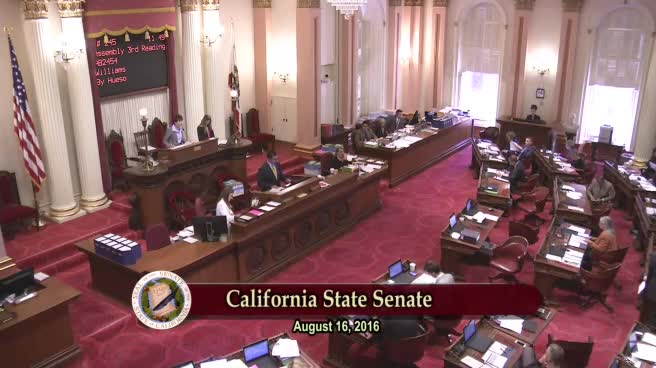 1MIN
Senate Floor
 1MIN
Senate Standing Committee on Governance and Finance
 3MIN
Assembly Standing Committee on Local Government
Bill Author

Bill Co-Author(s):