AB 246: Hate crimes: peace officers.
- Session Year: 2015-2016
- House: Assembly
- Latest Version Date: 2015-03-19
Existing law defines hate crime as a criminal act committed, in whole or in part, because of actual or perceived characteristics of the victim, including, among other things, race, religion, disability, and sexual orientation. Under existing law, that definition applies unless an explicit provision of law or the context clearly requires a different meaning. Existing law provides punishments for hate crimes that range from misdemeanors with specified penalties to felonies with additional terms of one to 3 years in state prison, depending on the underlying criminal act and other circumstances. Existing law requires, with conditions, the Attorney General to direct local law enforcement agencies to report specified information relative to hate crimes to the Department of Justice. Existing law requires the department to annually submit a report to the Legislature that analyzes the results of information obtained from local law enforcement pursuant to these provisions. Local law enforcement entities are required by existing law to provide a brochure on hate crimes to victims of these crimes and to the public, and the Department of Fair Employment and Housing is required by existing law to revise those brochures as needed and to provide those brochures to local law enforcement agencies upon request.
This bill would further define hate crime to include the assassination, rape, or kidnapping, or attempted assassination, rape, or kidnapping, of a peace officer. officer, when the offense was knowingly committed because of the victims status as a peace officer, or of an immediate family member of a peace officer, when the offense was knowingly committed because of the victims status as an immediate family member of a peace officer. By expanding the scope of an existing crime, this bill would impose a state-mandated local program. By expanding the information that law enforcement agencies are required to report to the Department of Justice and by expanding the number of victims to whom a brochure must be provided, this bill would impose a state-mandated local program.
The California Constitution requires the state to reimburse local agencies and school districts for certain costs mandated by the state. Statutory provisions establish procedures for making that reimbursement.
This bill would provide that with regard to certain mandates no reimbursement is required by this act for a specified reason.
With regard to any other mandates, this bill would provide that, if the Commission on State Mandates determines that the bill contains costs so mandated by the state, reimbursement for those costs shall be made pursuant to the statutory provisions noted above.
Existing law defines hate crime as a criminal act committed, in whole or in part, because of actual or perceived characteristics of the victim, including, among other things, race, religion, disability, and sexual orientation. Under existing law, that definition applies unless an explicit provision of law or the context clearly requires a different meaning. Existing law provides punishments for hate crimes that range from misdemeanors with specified penalties to felonies with additional terms of one to 3 years in state prison, depending on the underlying criminal act and other circumstances. Existing law requires, with conditions, the Attorney General to direct local law enforcement agencies to report specified information relative to hate crimes to the Department of Justice. Existing law requires the department to annually submit a report to the Legislature that analyzes the results of information obtained from local law enforcement pursuant to these provisions. Local law enforcement entities are required by existing law to provide a brochure on hate crimes to victims of these crimes and to the public, and the Department of Fair Employment and Housing is required by existing law to revise those brochures as needed and to provide those brochures to local law enforcement agencies upon request.
This bill would further define hate crime to include the assassination, or attempted assassination, of a peace officer. By expanding the scope of an existing crime, this bill would impose a state-mandated local program. By expanding the information that law enforcement agencies are required to report to the Department of Justice and by expanding the number of victims to whom a brochure must be provided, this bill would impose a state-mandated local program.
The California Constitution requires the state to reimburse local agencies and school districts for certain costs mandated by the state. Statutory provisions establish procedures for making that reimbursement.
This bill would provide that with regard to certain mandates no reimbursement is required by this act for a specified reason.
With regard to any other mandates, this bill would provide that, if the Commission on State Mandates determines that the bill contains costs so mandated by the state, reimbursement for those costs shall be made pursuant to the statutory provisions noted above.
For purposes of this title, and for purposes of all other state law unless an explicit provision of law or the context clearly requires a different meaning, the following shall apply:
(a)Hate crime means a criminal act committed, in whole or in part, because of one or more of the following actual or perceived characteristics of the victim:
(1)Disability.
(2)Gender.
(3)Nationality.
(4)Race or ethnicity.
(5)Religion.
(6)Sexual orientation.
(7)Association with a person or group with one or more of these actual or perceived characteristics.
(b)Hate crime includes, but is not limited to, a violation of Section 422.6.
(c)(1)Hate crime also means the assassination, rape, or kidnapping, or attempted assassination, rape, or kidnapping, of a peace officer. officer, when the offense was knowingly committed because of the victims status as a peace officer, or of an immediate family member of a peace officer, when the offense was knowingly committed because of the victims status as an immediate family member of a peace officer.
(2)For the purposes of this subdivision, the following terms have the following meanings:
(A)Assassination means murder, as defined in Section 187, when the victim and the defendant have not had a professional or personal encounter. 187.
(B)Immediate family member means a spouse or domestic partner, parent, or child of a peace officer.
(B)
(C)Peace officer means any person designated as a peace officer pursuant to Chapter 4.5 (commencing with Section 830) of Title 3 of Part 2.
SEC. 2.No reimbursement is required by this act pursuant to Section 6 of Article XIIIB of the California Constitution for certain costs that may be incurred by a local agency or school district because, in that regard, this act creates a new crime or infraction, eliminates a crime or infraction, or changes the penalty for a crime or infraction, within the meaning of Section 17556 of the Government Code, or changes the definition of a crime within the meaning of Section 6 of Article XIIIB of the California Constitution.
However, if the Commission on State Mandates determines that this act contains other costs mandated by the state, reimbursement to local agencies and school districts for those costs shall be made pursuant to Part 7 (commencing with Section 17500) of Division 4 of Title 2 of the Government Code.
For purposes of this title, and for purposes of all other state law unless an explicit provision of law or the context clearly requires a different meaning, the following shall apply:
(a)Hate crime means a criminal act committed, in whole or in part, because of one or more of the following actual or perceived characteristics of the victim:
(1)Disability.
(2)Gender.
(3)Nationality.
(4)Race or ethnicity.
(5)Religion.
(6)Sexual orientation.
(7)Association with a person or group with one or more of these actual or perceived characteristics.
(b)Hate crime includes, but is not limited to, a violation of Section 422.6.
(c)(1)Hate crime also means the assassination, or attempted assassination, of a peace officer.
(2)For the purposes of this subdivision, the following terms have the following meanings:
(A)Assassination means murder, as defined in Section 187, when the victim and the defendant have not had a professional or personal encounter.
(B)Peace officer means any person designated as a peace officer pursuant to Chapter 4.5 (commencing with Section 830) of Title 3 of Part 2.
SEC. 2.No reimbursement is required by this act pursuant to Section 6 of Article XIIIB of the California Constitution for certain costs that may be incurred by a local agency or school district because, in that regard, this act creates a new crime or infraction, eliminates a crime or infraction, or changes the penalty for a crime or infraction, within the meaning of Section 17556 of the Government Code, or changes the definition of a crime within the meaning of Section 6 of Article XIIIB of the California Constitution.
However, if the Commission on State Mandates determines that this act contains other costs mandated by the state, reimbursement to local agencies and school districts for those costs shall be made pursuant to Part 7 (commencing with Section 17500) of Division 4 of Title 2 of the Government Code.
|
Date
|
Status
|
|---|---|
| Feb 9, 2015 | Read first time. To print. |
| Feb 10, 2015 | From printer. May be heard in committee March 12. |
| Feb 17, 2015 | Referred to Com. on PUB. S. |
| Mar 17, 2015 | In committee: Set, first hearing. Hearing canceled at the request of author. |
| Mar 19, 2015 | From committee chair, with author's amendments: Amend, and re-refer to Com. on PUB. S. Read second time and amended. |
| Mar 23, 2015 | Re-referred to Com. on PUB. S. |
| Mar 24, 2015 | From committee: Do pass and re-refer to Com. on APPR. (Ayes 5. Noes 1.) (March 24). Re-referred to Com. on APPR. |
| Apr 15, 2015 | In committee: Set, first hearing. Referred to suspense file. |
| May 28, 2015 | In committee: Held under submission. |
| Jan 31, 2016 | Died pursuant to Article IV, Sec. 10(c) of the Constitution. |
| Feb 1, 2016 | From committee: Filed with the Chief Clerk pursuant to Joint Rule 56. |
|
Date
|
Description
|
Location
|
Votes
|
|
|---|---|---|---|---|
| Mar 24, 2015 | Do pass and be re-referred to the Committee on [Appropriations] | Assembly Standing Committee on Public Safety |
Passed |
This list shows positions taken on this bill by organizations on the date displayed, which is linked to the original source.
Positions by individuals are not included.
|
Organization
|
Position
|
Date
|
|---|---|---|
| American Civil Liberties Union of California | ** Against | Mar 24, 2015 |
| Association For Los Angeles Deputy Sheriffs | * Indeterminate | Mar 24, 2015 |
| association of L.A. Deputies and Sheriffs | * Indeterminate | Mar 24, 2015 |
| California College And University Police Chiefs Association | ** Support | Mar 24, 2015 |
| California Fraternal Order of Police | ** Support | Mar 24, 2015 |
| Legal Services for Prisoners with Children | * Indeterminate | Mar 24, 2015 |
| Long Beach Police Officers Association | ** Support | Mar 24, 2015 |
| Los Angeles County Professional Peace Officers Association | * Support | Mar 24, 2015 |
| Los Angeles County Professional Peace Officers Association | * Indeterminate | Mar 24, 2015 |
| Los Angeles Deputy Sheriffs | * Support | Mar 24, 2015 |
| Los Angeles Police Protective League | ** Support | Mar 24, 2015 |
| Sacramento County Deputy Sheriffs' Association | ** Support | Mar 24, 2015 |
| Santa Ana Police Officers Association | ** Support | Mar 24, 2015 |
AB 246
Page 2
Date of Hearing: April 15, 2015
ASSEMBLY COMMITTEE ON APPROPRIATIONS
Jimmy Gomez, Chair
AB 246
(Roger Hernández) – As Amended March 19, 2015
Policy Committee: |
Public Safety |
Vote: |
5 - 1 |
|
|
|
|
|
|
|
|
Urgency: No State Mandated Local Program: Yes Reimbursable: No
SUMMARY:
This bill makes the assassination, rape, and kidnap, as well as an attempt to commit these crimes, a hate crime when the crime is committed against a peace officer, or an immediate family member, and the crime was knowingly committed because of the peace officer status.
FISCAL EFFECT:
Potential one-time costs of $75,000 (GF) to the Department of Justice to establish a data base and for associated computer programming to collect the data in the Criminal Justice Statistics Center.
Potential one-time moderate reimbursable mandated costs (GF) for local law enforcement agencies in Information Technology costs for agencies to update the computer systems they use to report hate crime information to DOJ. If 50 law enforcement agencies have to incur programming costs, and the programming costs are $5,000 per agency, the potential cost would be $250,000.
Minor increase in state prison time commitments, as a result of the hate crime enhancements, in rare cases where the assailant is prosecuted under the proposed hate crime provisions. Assuming the annual contracted bed rate of $27,000 per inmate, the annual General Fund costs would be $27,000 per each additional year served under such conviction.
COMMENTS:
Background. Current law defines "hate crime" as any criminal act committed, in whole or in part, because of one or more of several actual or perceived characteristics of the victim, such as: Disability, gender, race or ethnicity, religion, sexual orientation.
Current law provides that a person who commits, or voluntarily acted in concert with another person, to commit a felony motivated by bias, or attempts to commit a bias-motivated felony, shall receive an additional term of one, two or three years in state prison, at the court's discretion. The penalty for a person who commits murder in the first degree in a hate crime, or knowingly murders a peace officer while the officer performs his or her duties, is death or imprisonment in the state prison for life wife without the possibility of parole.
The DOJ is required to provide an annual report on hate crime information provided by local law enforcement agencies.
Argument in Support. According to the Los Angeles Deputy Sheriffs, the sponsor of this bill, "The recent attacks on police officers - occasioned only due to their status as police officers - provides eloquent testimony to the need for this bill. The gravamen of a hate crime is that the crime is committed without any transactional motive; instead, the crime is committed because of the status of the prospective victim. The recent unprovoked and non-transactional shootings of police officers are an example of exactly that activity."
Argument in Opposition. The Anti-Defamation League writes, "At the outset, we want to acknowledge the importance of efforts to protect our peace officers from violence. In the wake of recent events across the country, tension and aggression against law enforcement officers has been heightened. Like Assemblymember Hernández, we believe protection of peace officers is critically important. While we understand AB 246 is intended to address this problem, adding peace officers to the groups protected by hate crime laws is not the approach we favor.
Related Legislation. AB 242 (Salas), pending in Assembly Public Safety Committee, adds "peace-officer status" to the list of actual or perceived characteristics of a victim for determining whether a criminal act qualifies as a hate crime.
Prior Legislation:
AB 1206 (Miller), of the 2009-2010 Legislative Session, would have added political affiliation to the list of actual or perceived characteristics qualifying for hate crime status. AB 1206 was never heard in committee.
SB 122 (Steinberg), of the 2007-2008 Legislative Session, would have added homelessness to the list of actual or perceived characteristics qualifying for hate crime status. SB 122 was held in the Senate Public Safety committee without recommendation.
Analysis Prepared by: Pedro R. Reyes / APPR. / (916) 319-2081
AB 246
Page 7
Date of Hearing: March 24, 2015
Counsel: Sandra Uribe
ASSEMBLY COMMITTEE ON PUBLIC SAFETY
Bill Quirk, Chair
AB 246
(Roger Hernández) – As Amended March 19, 2015
SUMMARY:
Makes the assassination, rape, and kidnap, as well as an attempt to
commit these crimes, a hate crime when the crime is committed against
a peace officer or an immediate family member and the crime was
knowingly committed because of that status. Specifically, this
bill:
States that a hate crime includes the assassination, rape, or kidnap, or attempted assassination, rape or kidnap of a peace officer, when the offense was knowingly committed because of the victim's status as a peace officer, or of an immediate family member of a peace officer, when the offense was knowingly committed because of the victim's status as an immediate family member of a peace officer.
Defines "assassination" as "murder, as defined in [Penal Code] Section 187."
Defines "immediate family member" as "a spouse or domestic partner, parent, or child of a peace officer."
Defines "peace officer" as "any person designated as a peace officer pursuant to Chapter 4.5 (commencing with Section 830) of Title 3 of Part 2."
EXISTING LAW:
Defines "hate crime" as any criminal act committed, in whole or in part, because of one or more of the following actual or perceived characteristics of the victim:
Disability.
Gender.
Nationality.
Race or ethnicity.
Religion.
Sexual orientation.
Association with a person or group with one or more of these actual or perceived characteristics. (Pen. Code, § 422.55, subd. (a).)
Provides that a hate crime includes, but is not limited to, a violation of interference with the exercise of civil rights because of actual or perceived characteristics of the victim. (Pen. Code, § 422.55, subd. (b).)
Provides that a person who interferes with the exercise of another's civil rights because of the actual or perceived characteristics of the victim, or of defacing the property of such a victim with the purpose intimidation or interference of the exercise of civil rights, is guilty of a misdemeanor punishable with imprisonment in a county jail not to exceed one year, or by a fine not to exceed $5,000, or by both the above imprisonment and fine, and requires the defendant to perform community service, not to exceed 400 hours. (Pen. Code, § 422.6.)
Provides that a person who commits a felony motived by bias, or attempts to commit a bias-motivated felony, except as specified, shall receive an additional term of one, two, or three years in the state prison, at the court's discretion. (Pen. Code, § 422.75, subd. (a).)
Provides that a person who commits a felony motived by bias, or attempts to commit a bias-motivated felony, except as specified, and who voluntarily acted in concert with another person in the commission of the crime shall receive an additional term of two, three, or four years in the state prison, at the court's discretion. (Pen. Code, § 422.75, subd. (b).)
Provides that a person who commits first-degree murder that is a hate crime shall be punished by imprisonment in the state prison for life without the possibility of parole. (Pen. Code, § 190.03, subd. (a).)
Provides that the penalty for a defendant who is found guilty of murder in the first degree is death or imprisonment in the state prison for life without the possibility of parole if 1 or more than 20 special circumstances is found to be true, including:
The victim was a peace officer who, while engaged in the course of the performance of his or her duties, was intentionally killed, and the defendant knew, or reasonably should have known, that the victim was a peace officer engaged in the performance of his or her duties; or the victim was a peace officer, as defined in the above-enumerated sections, or a former peace officer under any of those sections, and was intentionally killed in retaliation for the performance of his or her official duties;
The victim was a federal law enforcement officer or agent who, while engaged in the course of the performance of his or her duties, was intentionally killed, and the defendant knew, or reasonably should have known, that the victim was a federal law enforcement officer or agent engaged in the performance of his or her duties; or the victim was a federal law enforcement officer or agent, and was intentionally killed in retaliation for the performance of his or her official duties;
The murder was committed for the purpose of avoiding or preventing a lawful arrest, or perfecting or attempting to perfect, an escape from lawful custody;
The defendant intentionally killed the victim by means of lying in wait; and
The victim was intentionally killed because of his or her race, color, religion, nationality, or country of origin. (Pen. Code, § 190.2)
Provides that the penalty for the attempted murder of a peace officer engaged in the performance of his or her duties, the defendant shall be punished by imprisonment in the state prison for life with the possibility of parole. (Pen. Code, § 664, subd. (e).)
Provides that the penalty for kidnapping is three, five, or eight years in state prison. However, if a person kidnaps an individual to commit a robbery, rape, or other specified sex offenses, the punishment is life in prison with the possibility of parole. (Pen. Code, §§ 208, subd. (a) and 209, subd. (b)(1).
Provides that the penalty for rape is three, six or eight years in state prison. (Pen. Code, § 264, subd. (a).)
FISCAL EFFECT:
Unknown
COMMENTS:
Author's Statement: According to the author, "Police officers across our state put their lives at risk daily when they proudly put on their uniform. No one should be targeted for wearing a badge. AB 246 will send a loud and clear message: we value our law enforcement officers as those who stand between our families and those who wish to harm them."
Hate Crime Laws: Hate crimes, more correctly referred to in some jurisdictions as "bias crimes," are generally defined as crimes that are "committed not out of animosity toward the victim as an individual, but out of hostility toward the group to which the victim belongs." (Pendo, Recognizing Violence Against Women: Gender and the Hate Crimes Statistics Act (1994) 17 Harv. Women's L.J. 157, 159.) Looking at a more specific definition, a hate crime is defined as "a crime in which the defendant intentionally selects a victim because of the actual or perceived race, color, religion, national origin, ethnicity, gender, disability, or sexual orientation of any person." (Violent Crime Control and Law Enforcement Act of 1994, Pub. L. 103-322, 108 Stat. 1796 Section 280003 (1994) emphasis added (codified in part at 28 U.S.C. Section 994 (1994).)
Hate crime perpetrators target their victims based on discrimination against immutable characteristics such as age, color, disability, gender, gender identity, national origin, race, sex, and sexual orientation. Immutability can be characterized in one of two ways. Some characteristics, such as age, disability, and race, cannot be altered by an individual's voluntary act. However, other characteristics, such as religion and gender, can only be altered with substantial cost or difficulty to the individual. Although not literally immutable, scholars contend that "the power of a constructed category can be so overwhelming, and its terms, assumptions, and normative social requirements so deeply ingrained into the members of society, that it is experienced at the individual level as immutable." [Marcosson, Constructive Immutability (2001) 3 U. Pa. J. Const. L. 646, 650.] This implies that some characteristics that are entirely possible for individuals to change, such as religion, have such a powerful impact on the construction of individual identity that they effectively operate as if they were unchangeable.
This bill does not add "peace-officer status" to the list of actual or perceived characteristics of a victim for determining whether a criminal act qualifies as a hate crime. Rather, it makes the assassination, rape, and kidnap, or the attempted assassination, rape, and kidnap of a peace officer or his or her immediate family member, a hate crime if the offense was committed because the victim was a peace officer or an immediate family member of a peace officer. While the hate crime statute applies to any crime motivated by bias against a protected class, this bill limits application to the six aforementioned crimes.
A survey of the California Department of Justice's annual reports regarding hate crimes committed in California shows that, fortunately, murder, attempted murder, rape and kidnapping appear to occur infrequently as a bias-motivated crime. From 2003-2013, there were 14 murders and 11 forcible rapes committed as hate crimes. Kidnappings committed as hate crimes were either not listed, or none occurred. Attempted murders were also not listed (although arguably some might have been classified as aggravated assaults which can involve use of a weapon). Most of the violent hate crimes committed are aggravated assaults, simple assaults, and intimidation. And property crimes generally make up roughly 35-40% of hate crimes. (See Hate Crime in California publications found at: http://oag.ca.gov/cjsc/pubs#hate) This bill would not capture those crimes.
Necessity for this Bill: The murder of a peace officer is already punishable by either the death penalty or life in prison without the possibility of parole. Two of the aggravating factors for capital punishment include that the victim was a peace officers in the course of his or her duties, and the defendant killed the victim while lying in wait.
The Supreme Court has held that the trial court has the authority to impose an enhancement when the underlying offense is punishable by death or by life imprisonment without the possibility of parole. (People v. Shabazz (2006) 38 Cal.4th 55 69, [trial court had authority to impose the 25-year-to-life enhancement firearm-use enhancement, even though it imposed as the base term a longer term of imprisonment, life without the possibility of parole].) The court noted that a defendant sentenced to life without the possibility of parole could have his or her sentence commuted to life imprisonment with the possibility of parole or an even lesser sentence. (Id. at p. 70, fn. 9, citing Cal. Const., art. V, § 8; and People v. Ward (2005) 36 Cal.4th 186, 220.) Thus, it is technically possible for a defendant who "assassinates" a police officer to receive a three-year hate crime enhancement on a sentence of death or life without parole. Likewise, a defendant who attempts to "assassinate" a police officer can receive a three-year enhancement on a sentence of life without the possibility of parole. However, practically speaking, it is extremely unlikely that a defendant convicted of killing a police officer is going to have his or her sentence commuted to something less than life without the possibility of parole.
Admittedly, there are no aggravated penalties for the rape, attempted rape, kidnap, or attempted kidnap of a law enforcement officer. Yet, it has not been demonstrated that that peace officers are targeted for these crimes because of their employment status. The background material provided by the author point to the 2013 case of Christopher Dorner who targeted and shot law enforcement officers and their families after he was fired from the Los Angeles Police Department as an example of why additional penalties are necessary when the enumerated crimes are committed against peace officers. Media outlets reported that Dorner stalked the family members of several peace officers. However, it was not alleged that he raped or kidnapped any of his victims. (see e.g., <http://www.nbcnews.com/news/investigations/dorner-stalked-lapd-chief-becks-dad-dads-dog-n247751>.)
Trends in Killing of Police: Recently there have been several intentional shootings committed against peace officers, some of which, tragically, have resulted in the deaths of the officers.
Nevertheless, a recent study conducted by Franklin Zimring, Professor of Law at the University of California at Berkeley, found that in the past four decades, there has been a downward trend in the number of killings both of, and by, police. Although the number of people employed as peace officers has increased in the last generation, the violent killing of officers has deceased by more than half. Since 1976, the number of on-duty police officers killed in the United States has dropped somewhere between 69 and 75 percent. This is partly attributable to the use of the Kevlar vest. "Urban policing is a substantially less dangerous job in 2015 than in 1975." (Zimring and Arsiniega, Trends in Killings of and by Police: A Preliminary Analysis, 2015, Ohio State Journal of Criminal Law, Vol. 13.)
Argument in Support: According to the Los Angeles Deputy Sheriffs, the sponsor of this bill, "The recent attacks on police officers -occasioned only due to their status as police officers- provides eloquent testimony to the need for this bill. The gravamen of a hate crime is that the crime is committed without any transactional motive; instead, the crime is committed because of the status of the prospective victim. The recent unprovoked and non-transactional shootings of police officers are an example of exactly that activity."
Argument in Opposition: The Anti-Defamation League writes, "At the outset, we want to acknowledge the importance of efforts to protect our peace officers from violence. In the wake of recent events across the country, tension and aggression against law enforcement officers has been heightened. Like Assemblymember Hernández, we believe protection of peace officers is critically important. While we understand AB 246 is intended to address this problem, adding peace officers to the groups protected by hate crime laws is not the approach we favor.
"Instead, we recommend providing enhanced penalties for intentional crimes against peace officers through amending alternate penal code sections. As you probably know, California already has several statutes that enhance penalties for intentional crimes against peace officers. These include additional fines and imprisonment for assaulting a peace officer, additional prison time for assault with a deadly weapon against a peace officer, and the death sentence or life without parole for murder in the first degree of a peace officer.
"Existing California hate crime law provides enhancements for 'a criminal act committed, in whole or in part, because of one or more of the following actual or perceived characteristics of the victim: disability, gender, nationality, race or ethnicity, religion, and sexual orientation.' Even though the law is commonly referred to as hate crime law, a more precise term would probably be 'bias crimes.' For a number of reasons, we feel that adding peace officers to these hate crimes law categories would not be appropriate because they are not analogous to the existing groups protected by this law.
"As you know, each of the existing bias crime law categories represents personal characteristics inherent to the victim that cannot or should not be changed. Moreover, historic discrimination against members of each category has demonstrated the need for inclusion in housing, workplace, and public accommodation anti-discrimination statutes -- civil parallels to criminal bias crime laws. In the direct context of bias crime laws, inclusion of these categories has been demonstrated to be necessary for instances in which local law enforcement authorities were either unwilling or unable to prosecute crimes against these groups. Bitter experience has taught us that such crimes have a special emotional and psychological impact, expanding beyond the individual victim to intimidate others in the victim's community, making them feel isolated, vulnerable, and unprotected. The inclusion of each of these groups in hate crime legislation helps to raise awareness of this terrible impact.
"On the other hand, an individual's status as a peace officer is not a personal characteristic and, fortunately, peace officers have not historically required specific protection against discrimination. Furthermore, no one doubts the impact of these odious crimes against police in the community. Crimes committed against peace officers are already treated very seriously and rightfully garner a lot of public attention. Lastly, we are concerned that the specific language of the amendment referring to the 'assassination or attempted assassination' of a peace officer is more narrow than the existing protections which cover 'criminal acts' generally and may create needless confusion and raise doubts about existing protections."
Related Legislation:
AB 242 (Salas) adds "peace-officer status" to the list of actual or perceived characteristics of a victim for determining whether a criminal act qualifies as a hate crime. AB 242 was pulled by the author.
AB 860 (Daly) adds "political affiliation" to the list of actual or perceived characteristics necessary to determine whether a criminal act qualifies as a hate crime. AB 860 is pending referral by the Rules Committee.
Prior Legislation:
AB 1206 (Miller), of the 2009-2010 Legislative Session, would have added political affiliation to the list of actual or perceived characteristics qualifying for hate crime status. AB 1206 was never heard in committee.
SB 122 (Steinberg), of the 2007-2008 Legislative Session, would have added homelessness to the list of actual or perceived characteristics qualifying for hate crime status. SB 122 was held in the Senate Public Safety committee without recommendation.
REGISTERED SUPPORT / OPPOSITION:
Support
Los Angeles Deputy Sheriffs (Sponsor)
California College and
University Police Chiefs Association
California Fraternal Order
of Police
California Narcotic Officers Association
Long
Beach Police Officers Association
Los Angeles County
Professional Peace Officers Association
Los Angeles Police
Protective League
Riverside Sheriffs Association
Sacramento
County Deputy Sheriffs' Association
Santa Ana Police Officers
Association
Opposition
American Civil Liberties Union of California
Anti-Defamation
League – California Offices
California Attorneys for Criminal
Justice
California Public Defenders Association
Legal
Services for Prisoners with Children
Analysis Prepared by:
Sandy Uribe / PUB. S. / (916) 319-3744
Discussed in Hearing
 24MIN
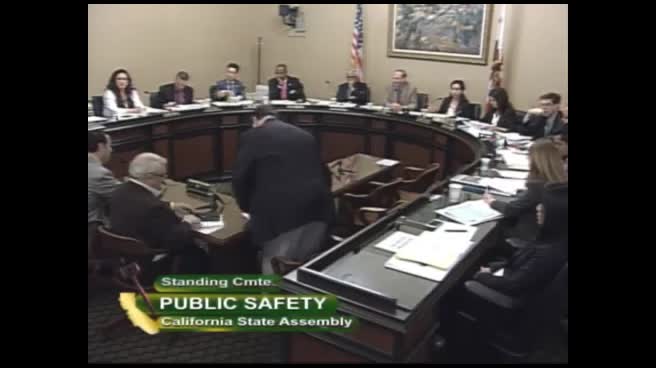
Assembly Standing Committee on Public Safety


Bill Co-Author(s):