AB 2490: Corporation Tax Law: exemption: regulated investment company.
- Session Year: 2015-2016
- House: Assembly
- Latest Version Date: 2016-05-16
Existing law, the Corporation Tax Law, generally conforms to the federal income tax laws that apply to a regulated investment company and further provides that for purposes of the Corporation Tax Law, its net income is equal to its investment company income. Existing law exempts from tax under the Corporation Tax Law, various organizations including credit unions, fraternal societies, social welfare organizations, and labor organizations.
This bill would provide that under the Corporation Tax Law, a regulated investment company that is a mutual fund investment management company owned by investors in the mutual funds that it serves a mutual fund investment management company wholly owned by one or more regulated investment companies and providing management services to the one or more regulated investment companies at cost is not subject to tax. tax, except as specified. The bill would authorize the Franchise Tax Board to promulgate regulations as necessary or appropriate to carry out this provision. The bill would repeal these provisions on January 1, 2022.
This bill would take effect immediately as a tax levy.
Existing law, the Corporation Tax Law, generally conforms to the federal income tax laws that apply to a regulated investment company and further provides that for purposes of the Corporation Tax Law, its net income is equal to its investment company income. Existing law exempts from tax under the Corporation Tax Law, various organizations including credit unions, fraternal societies, social welfare organizations, and labor organizations.
This bill would exempt from tax provide that under the Corporation Tax Law, a regulated investment company that is a mutual fund investment management company owned by investors in the mutual funds that it serves. serves is not subject to tax. The bill would authorize the Franchise Tax Board to promulgate regulations as necessary or appropriate to carry out this provision.
This bill would take effect immediately as a tax levy.
Existing law, the Corporation Tax Law, generally conforms to the federal income tax laws that apply to a regulated investment company and further provides that for purposes of the Corporation Tax Law, its net income is equal to its investment company income. Existing law exempts from tax under the Corporation Tax Law, various organizations including credit unions, fraternal societies, social welfare organizations, and labor organizations.
This bill would exempt from tax under the Corporation Tax Law, a regulated investment company that is a mutual fund investment management company owned by investors in the mutual funds that it serves.
This bill would take effect immediately as a tax levy.
Existing law requires the Franchise Tax Board to submit to the Legislature, and to make available to the public, on or before January 10 of each year, a report on all of the changes to the Internal Revenue Code enacted into law in the prior year, as provided.
This bill would instead require that report to be submitted and made available on or before January 31 of each year. The bill would make other nonsubstantive changes.
Existing law requires the Franchise Tax Board to submit to the Legislature, and to make available to the public, on or before January 10 of each year, a report on all of the changes to the Internal Revenue Code enacted into law in the prior year, as provided.
This bill would instead require that report to be submitted and made available on or before January 31 of each year. The bill would make other nonsubstantive changes.
The California Constitution grants the retirement board of a public pension or retirement system plenary authority and fiduciary responsibility for the investment of moneys and administration of the system. The constitution authorizes the Legislature to prohibit certain investments when it is in the public interest to do so and the prohibition satisfies standards of fiduciary care and loyalty. Existing law requires the Board of Administration of Public Employees Retirement System to provide an annual report to the Governor and the Legislature regarding its financial statements and investments for the fiscal year and a quarterly review of system assets to the Legislature.
This bill would state the intent of the Legislature to enact legislation that would require equity firms that contract for investment services with the Board of Administration of the Public Employees Retirement System and other pension systems to provide a clear accounting of clawbacks owed to the systems and to require the pension systems to track their clawbacks.
The California Constitution grants the retirement board of a public pension or retirement system plenary authority and fiduciary responsibility for the investment of moneys and administration of the system. The constitution authorizes the Legislature to prohibit certain investments when it is in the public interest to do so and the prohibition satisfies standards of fiduciary care and loyalty. Existing law requires the Board of Administration of Public Employees Retirement System to provide an annual report to the Governor and the Legislature regarding its financial statements and investments for the fiscal year and a quarterly review of system assets to the Legislature.
This bill would state the intent of the Legislature to enact legislation that would require equity firms that contract for investment services with the Board of Administration of the Public Employees Retirement System and other pension systems to provide a clear accounting of clawbacks owed to the systems and to require the pension systems to track their clawbacks.
(a)Notwithstanding any other law, a regulated investment company, a mutual fund investment management company wholly owned by one or more regulated investment companies, as defined in Section 851 of the Internal Revenue Code, relating to definition of regulated investment company, that is a mutual fund investment management company owned by investors in the mutual funds that it serves and providing management services to the one or more regulated investment companies at cost is exempt from the taxes imposed by this part, except as provided in Article 2 (commencing with Section 23731).
(b)The Franchise Tax Board may promulgate regulations as necessary or appropriate to carry out the purposes of this section.
(c)This section shall be repealed on January 1, 2022.
SEC. 2.This act provides for a tax levy within the meaning of Article IV of the California Constitution and shall go into immediate effect.
(a)Notwithstanding any other law, a regulated investment company, as defined in Section 851 of the Internal Revenue Code, relating to definition of regulated investment company, that is a mutual fund investment management company owned by the investors of in the mutual fund funds that it serves. serves is exempt from the taxes imposed by this part, except as provided in Article 2 (commencing with Section 23731).
(b)The Franchise Tax Board may promulgate regulations as necessary or appropriate to carry out the purposes of this section.
SEC. 2.This act provides for a tax levy within the meaning of Article IV of the Constitution and shall go into immediate effect.
Notwithstanding any other law, a regulated investment company, as defined in Section 851 of the Internal Revenue Code, relating to definition of regulated investment company, that is a mutual fund investment management company owned by the investors of mutual fund that it serves.
SEC. 2.This act provides for a tax levy within the meaning of Article IV of the Constitution and shall go into immediate effect.
SECTION 1.Section 19522 of the Revenue and Taxation Code is amended to read:19522.(a)(1)(A)On or before January 31 of each year, the Franchise Tax Board shall submit to the Legislature a report on all changes to the Internal Revenue Code enacted into law in the prior year. To the extent possible, the report shall contain an estimate of the revenue effect of conforming California law to each of those changes.
(B)In the event that changes to the Internal Revenue Code are enacted after September 15 of any year, the report described in subparagraph (A) shall be submitted to the Legislature within 120 days after signature by the President of the United States, rather than January 31.
(2)The report required by this section shall be made available to the public.
(3)It is the intent of the Legislature that the policy committee of each house of the Legislature hold at least one public hearing on the report required by this section.
(b)For any introduced bill that proposes changes in any of the dates in Section 17024.5, the Franchise Tax Board shall prepare a complete analysis of the bill that describes all changes to state law that will automatically occur by reference to federal law as of the changed date. The Franchise Tax Board shall immediately update and supplement that analysis upon any amendment to the bill. That analysis shall be made available to the public and shall be submitted to the Legislature for publication in the daily journal of each house of the Legislature. The digest of the Legislative Counsel shall indicate that an analysis of the bill shall be prepared by the Franchise Tax Board and printed in the daily journal of each house of the Legislature.
(a)(1)(A)On or before the 10th January 31 of January each year, the Franchise Tax Board shall submit to the Legislature a report on all changes to the Internal Revenue Code enacted into law in the prior year. To the extent possible, the report shall contain an estimate of the revenue effect of conforming California law to each of those changes.
(B)In the event that changes to the Internal Revenue Code are enacted after September 15 of any year, the report described in subparagraph (A) shall be submitted to the Legislature within 120 days after signature by the President of the United States, rather than the 10th of January. January 31.
(2)The report required by this section shall be made available to the public.
(3)It is the intent of the Legislature that the policy committee of each house of the Legislature hold at least one public hearing on the report required by this section.
(b)For any introduced bill which that proposes changes in any of the dates in Section 17024.5, the Franchise Tax Board shall prepare a complete analysis of the bill which that describes all changes to state law which that will automatically occur by reference to federal law as of the changed date. The Franchise Tax Board shall immediately update and supplement that analysis upon any amendment to the bill. That analysis shall be made available to the public and shall be submitted to the Legislature for publication in the daily journal of each house of the Legislature. The digest of the Legislative Counsel shall indicate that an analysis of the bill shall be prepared by the Franchise Tax Board and printed in the daily journal of each house of the Legislature.
SECTION 1.It is the intent of the Legislature to enact legislation that would require the equity firms that contract with the Board of Administration of the Public Employees Retirement System and other pension systems for the purpose of providing investment services to provide a clear accounting of clawbacks owed to the systems and to require the pension systems to track their clawbacks.
It is the intent of the Legislature to enact legislation that would require the equity firms that contract with the Board of Administration of the Public Employees Retirement System and other pension systems for the purpose of providing investment services to provide a clear accounting of clawbacks owed to the systems and to require the pension systems to track their clawbacks.
|
Date
|
Status
|
|---|---|
| Apr 26, 2016 | In committee: Hearing postponed by committee. |
| May 27, 2016 | Joint Rule 62(a), file notice suspended. (Page 4943.) |
| May 27, 2016 | Joint Rule 62(a), file notice suspended. |
| May 27, 2016 | In committee: Held under submission. |
| May 25, 2016 | In committee: Set, first hearing. Referred to APPR. suspense file. |
| May 17, 2016 | Re-referred to Com. on APPR. |
| May 16, 2016 | Read second time and amended. |
| May 12, 2016 | From committee: Amend, and do pass as amended and re-refer to Com. on APPR. (Ayes 9. Noes 0.) (May 9). |
| May 9, 2016 | In committee: Set, first hearing. Referred to REV. & TAX. suspense file. |
| Apr 27, 2016 | Re-referred to Com. on REV. & TAX. |
| Feb 19, 2016 | Introduced. To print. |
| Apr 26, 2016 | From committee chair, with author's amendments: Amend, and re-refer to Com. on REV. & TAX. Read second time and amended. |
| Apr 12, 2016 | Re-referred to Com. on REV. & TAX. |
| Apr 11, 2016 | From committee chair, with author's amendments: Amend, and re-refer to Com. on REV. & TAX. Read second time and amended. |
| Mar 28, 2016 | Re-referred to Com. on REV. & TAX. |
| Mar 17, 2016 | From committee chair, with author's amendments: Amend, and re-refer to Com. on REV. & TAX. Read second time and amended. |
| Mar 14, 2016 | Referred to Com. on REV. & TAX. |
| Feb 22, 2016 | Read first time. |
| Feb 21, 2016 | From printer. May be heard in committee March 22. |
|
Date
|
Description
|
Location
|
Votes
|
|
|---|---|---|---|---|
| May 9, 2016 | Do pass as amended and be re-referred to the Committee on [Appropriations] | Assembly Standing Committee on Revenue and Taxation |
Passed |
This list shows positions taken on this bill by organizations on the date displayed, which is linked to the original source.
Positions by individuals are not included.
|
Organization
|
Position
|
Date
|
|---|---|---|
| California Tax Reform Association | * Against | May 9, 2016 |
| California Tax Reform Association | * Support | May 9, 2016 |
Date of Hearing: May 25, 2016
ASSEMBLY COMMITTEE ON APPROPRIATIONS
Lorena Gonzalez, Chair
ABPCA Bill Id:AB 2490
Author:(Gatto) – As Amended Ver:May 16, 2016
Policy Committee: | Revenue and Taxation | Vote: | 9 - 0 |
Urgency: No State Mandated Local Program: No Reimbursable: No
SUMMARY:
This bill, until January 1, 2022, exempts a mutual fund investment management company that is wholly owned by one or more regulated investment (RICs) companies from the Corporation Tax (CT) if it provides management services to the one or more regulated investment companies “at cost.”
FISCAL EFFECT:
Unknown fiscal costs. Due to privacy concerns for the affected taxpayers, data that would allow revenue estimates are not publically available.
COMMENTS:
- Purpose. AB 2490 aims to codify existing practices regarding how Vanguard is currently taxed and to protect the company, and its customers, from a pending lawsuit that could result in increased fees.
- Regulated investment companies and mutual funds. A RIC, such as an eligible mutual fund, can pass the taxes on capital gains, dividends or interest earned on fund investments, directly to clients or individual investors. A RIC is qualified under Regulation M of the Internal Revenue Service (IRS) to pass taxes onto investors to be taxed at the individual level.
Mutual funds are companies that pool money from many investors and invest these funds in securities such as stocks, bonds and short-term debt. To the extent these mutual funds are qualified RICs meeting all of the applicable requirements, they are not subject to either federal or state income tax. The mutual fund manager, however, if organized as a "C" corporation, is subject to both state and federal taxes on the profits earned at the entity level.
- The Vanguard structure and whistleblower. Vanguard is structured differently than many other mutual funds. Most mutual funds are sold by an investment company, which is created to make a profit for its shareholders. In contrast, Vanguard is a “mutual ownership” company, where the investment manager, Vanguard, is owned by the funds. Since 1975, Vanguard has charged its domestic funds only the “costs” of providing services, such as investment management and advisory services. This structure has also allowed Vanguard to offer the lowest fees in the industry.
In 2015, a whistleblower alleged that Vanguard should have paid taxes on profits it never charged, but should have charged, fund investors. The whistleblower has argued that Vanguard is bound by state and federal law that requires transactions between affiliated companies to be paid at “arm’s length” prices, which is generally meant to be the prices paid by unrelated parties. Both the IRS and the FTB are investigating the claim.
Analysis Prepared by: Luke Reidenbach / APPR. / (916) 319-2081
Date of Hearing: May 9, 2016
ASSEMBLY COMMITTEE ON REVENUE AND TAXATION
Sebastian Ridley-Thomas, Chair
ABPCA Bill Id:AB 2490 (
Author:Gatto) – As Amended Ver:April 26, 2016
Majority vote. Tax levy. Fiscal committee.
SUBJECT: Corporation Tax Law: exemption: regulated investment company
SUMMARY: Exempts from the Corporation Tax (CT) a regulated investment company (RIC) that is a mutual fund investment management company owned by investors in the mutual fund that it serves. Specifically, this bill:
- Provides that, notwithstanding any other law, a RIC, as defined in Internal Revenue Code (IRC) Section 851, is exempt from the CT if the RIC meets both of the following requirements:
- Is a mutual fund investment management company; and,
- Is owned by investors in the mutual funds that it serves.
- Specifies that the exemption does not apply with respect to the RIC's unrelated business income, if any, as provided for in Revenue and Taxation Code (R&TC) Section 23731 et seq.
- Authorizes the Franchise Tax Board (FTB) to promulgate regulations as necessary or appropriate, as specified.
- Takes immediate effect as a tax levy.
EXISTING FEDERAL LAW allows a RIC to elect a special tax regime under IRC Section 851, as long as all of the applicable requirements are met.
EXISTING STATE LAW:
- Conforms generally to the federal treatment of RICs.
- Imposes tax on the unrelated trade or business income of a tax-exempt organization that regularly carries on a trade or business not substantially related to its exempt purpose.
FISCAL EFFECT: The FTB states that providing a revenue estimate would violate the FTB's taxpayer confidentiality rules because this bill would impact less than three taxpayers.
COMMENTS:
- The Author's statement: The author has provided the following statement in support of this bill:
At this time, the federal government (I.R.S.) is still considering the arguments both for and against Vanguard. And, while a New York judge dismissed the case against the mutual fund company, it settled with Texas by paying $2.3 million, a $117,000 paycheck for the whistleblower. Unfortunately, California may be following in Texas’s footsteps. In November, the Franchise Tax Board notified the whistleblower that his complaint against Vanguard warranted assigning criminal investigators, and that the mutual fund company may be on the hook for approximately $750 million. While legislation at the state level will not alleviate Vanguard of a potential tax liability at the federal level, explicit acknowledgment of its non-profit activities and an exemption from state tax law will protect this business model and help maintain low investor fees.
It is important to protect this model of investing because it currently provides a great savings opportunity for about 20 million Americans. This would not only have an impact on the company, but more importantly, for those seniors or Americans who have invested their retirement in Vanguard, there is the potential of an expensive unplanned shock. If the lawsuit were to be successful, these customers would suffer fee raises to cover the newly imposed taxes.
- Committee staff comments:
- Federal and state tax treatment of RICs: In general, a RIC is an electing domestic corporation that either meets, or is exempt from, certain registration requirements under the Investment Company Act of 1940, that derives at least 90% of its ordinary income from specified sources considered passive investment income, has a portfolio of investments that meet certain diversification requirements, and satisfies certain other conditions. Corporations or entities treated as such for tax purposes are subject to many of the regular rules of corporate tax, both on the federal and state level. However, RICs, most of which are more commonly known as "mutual funds," qualify for a special tax treatment under Subchapter M of the IRC and specified provisions of the R&TC.
Subchapter M prescribes the rules that a corporate entity must satisfy to qualify as a RIC for the taxable year and provides special tax treatment for a qualified RIC and its shareholders. Specifically, a RIC that distributes at least 90% of its net ordinary income and net tax-exempt interest to shareholders may deduct the dividend amount in computing its tax. While no corporate income tax is imposed on a RIC's income distributed to shareholders, the dividends are generally included in the income of the shareholders and thus the shareholders must report the distributions on their own personal income tax returns. Those distributions may be characterized as long-term or short-term capital gains or tax-exempt interest and this characterization depends on the type of income distributed by the RIC. The RIC may pass through to its shareholders the character of its long-term capital gain income by paying "capital gain dividend" and tax-exempt interest by paying "exempt-interest dividends." A RIC may also pass-through foreign tax credits and credits on tax-credit bonds, as well as certain other income received by the RIC. If a RIC fails to comply with the provisions of Subchapter M, it may be subject to federal and state corporate income taxes. In addition, its distributions to the shareholders will be characterized as "ordinary income" instead of "capital gain" or "tax-exempt interest," and thus will result in a greater amount of tax payable to the federal and state governments.
On December 22, 2010, President Obama signed into law the RIC Modernization Act of 2010 (P.L. 111-325) (Act), which revised Subchapter M of the IRC governing the taxation of RICs and their shareholders. The Act has not affected the fundamentals of the tax treatment afforded to RICs and their shareholders; instead, it updated the applicable tax rules, which were originally enacted in 1936, to alleviate unnecessary tax compliance burdens and to reflect the realities of the modern economy. The Act revised certain provisions of the federal tax law affecting a RIC's characterization as a RIC and the manner in which a RIC's shareholders are taxed on the distributions received from the RIC and gains that may be realized when the shareholders dispose of RIC shares.
- Federal and state tax treatment of RICs: In general, a RIC is an electing domestic corporation that either meets, or is exempt from, certain registration requirements under the Investment Company Act of 1940, that derives at least 90% of its ordinary income from specified sources considered passive investment income, has a portfolio of investments that meet certain diversification requirements, and satisfies certain other conditions. Corporations or entities treated as such for tax purposes are subject to many of the regular rules of corporate tax, both on the federal and state level. However, RICs, most of which are more commonly known as "mutual funds," qualify for a special tax treatment under Subchapter M of the IRC and specified provisions of the R&TC.
In 2011, the Legislature revised California's income tax laws to conform to several provisions of the Act, including provisions allowing for an unlimited carryover of net capital losses, the modified "asset diversification" and "qualifying income" tests, and revised dividend designation requirements, among others. [AB 1423 (Perea), Chapter 490, Statutes of 2011.]
- Mutual funds and their operations: Simply stated, mutual funds are companies that pool money from many investors and invest these funds in securities such as stocks, bonds and short-term debt. Mutual funds have allowed millions of individual investors to participate in the stock market. Mutual funds receive millions of dollars from small investors, purchase stock or debt in several companies, and attempt to produce capital gains and income for the investors. In exchange for this service, managers of the mutual funds charge fees, which include "shareholder fees" and "expense ratios." To the extent these mutual funds are qualified RICs meeting all of the applicable requirements, they are not subject to either federal or state income tax. The mutual fund manager, however, if organized as a "C" corporation, is subject to both state and federal taxes on the profits earned at the entity level.
- The Vanguard structure: One of the largest mutual funds in the country is the Vanguard Group, which is a Pennsylvania corporation with its principal place of business in Malvern, Pennsylvania. Vanguard's primary business is providing investment management and other services to a number of United States (U.S.) funds that are treated as RICs under federal and state laws. Vanguard provides brokerage services to fund investors through Vanguard Marketing Corporation, a wholly owned subsidiary, and it has more than $3 trillion in assets under management.[1] Some attribute Vanguard's success and its ability to charge lower costs than its competitors to its structure, which is unique in the mutual fund industry.[2]
Most mutual funds are sold by an investment company, which is created to make a profit for its shareholders. Vanguard's founder, Jack Bogle, recognized an inherent conflict of interest between the investment manager's duty to maximize the returns for fund investors and the obligation to increase profits for the investment company's shareholders. As a result, Bogle established Vanguard as a "mutual ownership" company, where the investment manager, Vanguard, is owned by the funds in proportion to their net asset value.[3] The funds sought and received an exemption from the Securities and Exchange Commission to provide certain non-investment advisory services to affiliated funds at "no cost" and to have the affiliated funds own the Vanguard. Since 1975, Vanguard has charged its domestic funds only the "costs" of providing services, including investment management and advisory services. The important fact is that these costs include wages and other administrative expenses but no profit or a return on capital. Vanguard is the investment manager and advisor for all of its index funds and most of its actively managed mutual funds. Thus, the Vanguard Group is not an independent company: investors in Vanguard mutual funds are the ultimate owners of the Vanguard Group, which provides services to the individual funds, and one board of directors oversees both. Vanguard's overall fees are the lowest in the industry, averaging expense ratios of only 0.16% annually (the average is 1.16% for the industry). As a corollary to the low fees, Vanguard shows little or no net income on its federal and state tax returns because of the "at cost" structure. - The Vanguard dilemma: Section 482 of the IRC: In 2015, Vanguard found itself at the center of a curious controversy and several whistleblower lawsuits claiming that the company owes billions in unpaid federal and state tax liabilities. A former tax counsel at Vanguard alleged that because the Vanguard Group is organized as a "C" corporation and is a for-profit entity, it should have paid both federal and state taxes on the profits it never charged, but should have charged, the fund investors. In other words, the company is required to account for the profits that it could have earned had it charged the fund investors the industry-wide higher fees. If the whistleblower claim is successful, Vanguard may owe billions of dollars in taxes on uncollected revenue.[4]
To understand this argument, one must begin with IRC Section 482, which deals with "transfer pricing". This section was enacted by Congress to prevent avoidance of taxes in the case of transactions between affiliated or commonly-controlled companies.[5] Transfer pricing problems usually arise when two affiliated companies (which are part of the same corporate group) enter into a transaction at a certain price, with the purpose of shifting income to minimize the group's overall tax liability. Section 482 is intended to correct the potential abuse of transfer pricing by requiring a determination of the true taxable income of each taxpayer in the transaction. The main standard to determine the "true taxable income" of a controlled taxpayer is that of a taxpayer dealing at arm's length with an uncontrolled taxpayer. The standard is met if the results of the controlled transaction are consistent with the results that would have been realized if uncontrolled taxpayers had engaged in the same transaction under the same circumstances (arms' length result). The whistleblower argued that Vanguard is bound by law to charge its funds, which are affiliated companies, the prices (fees for its management services) that would have been paid by unrelated parties. He asserted that Vanguard is not a tax-exempt organization and could never legally operate as such because Vanguard's investment management activities do not qualify as any of the exempt purposes under IRC Section 501(c)(3).[6]
Vanguard and its domestic subsidiaries are taxable corporations under Subchapter C of the IRC. The Vanguard Board of Directors is identical to the Trustees of the funds, and the Board of Directors and Trustees manage Vanguard and the funds with a common purpose. The funds are RICs, and therefore are not taxable at the entity level if they meet the requirements of Subchapter M of the IRC, including distributing 90% of their income to fund investors annually. However, Vanguard, which is wholly owned by its more than 150 U.S. mutual funds, is not a RIC and therefore is subject to corporate tax. - The proposed resolution: This bill is intended to protect Vanguard from the state corporate tax. To that end, this bill proposes to exempt from the CT any RIC that is a mutual fund investment management company owned by the mutual funds that it serves. As described above, however, current law already exempts qualified RIC from both the federal and state corporate tax. The problem is that Vanguard, the management company, is not a RIC. The Committee may wish to consider amending this bill to clarify that it is a "C" corporation that may be exempt from the state CT if it is an investment management company wholly owned by the mutual funds it serves.
While legislation at the state level will not help Vanguard with the potential federal income tax liability, the author believes that explicit acknowledgment of Vanguard's non-profit activities and an exemption from state tax will protect this unique business structure and will help maintain low investor fees. - How important is conformity to federal tax law? Conformity with federal law reduces taxpayer errors and eases tax filing and administration. This bill would create a state and federal difference, which adds complexity to the tax return as the income excluded by this bill may still subject to federal income tax. In the absence of similar federal treatment, taxpayers will need to keep separate accounting for state and federal tax purposes.
- FTB implementation concerns: The FTB staff notes that the phrase "mutual fund investment management company" is undefined. The absence of a definition could lead to disputes with taxpayers and would complicate the administration of this bill. Furthermore, the FTB staff notes that this bill does not specify whether an exempt RIC would have to comply with the current information return filing requirements. Compliance enforcement would be difficult for the FTB within such filing requirements.
- Potential sunset date: The Committee may wish to consider the inclusion of a five-year sunset date for this proposed exemption, to ensure application and foregone revenues are in line with legislative intent.
- Mutual funds and their operations: Simply stated, mutual funds are companies that pool money from many investors and invest these funds in securities such as stocks, bonds and short-term debt. Mutual funds have allowed millions of individual investors to participate in the stock market. Mutual funds receive millions of dollars from small investors, purchase stock or debt in several companies, and attempt to produce capital gains and income for the investors. In exchange for this service, managers of the mutual funds charge fees, which include "shareholder fees" and "expense ratios." To the extent these mutual funds are qualified RICs meeting all of the applicable requirements, they are not subject to either federal or state income tax. The mutual fund manager, however, if organized as a "C" corporation, is subject to both state and federal taxes on the profits earned at the entity level.
REGISTERED SUPPORT / OPPOSITION:
Support
None on file
Opposition
California Tax Reform Association
Analysis Prepared by: M. David Ruff / REV. & TAX. / (916) 319-2098
Expert Report of Prof. Reuven S. Avi-Yohan on the Estimated Federal Tax Liability of the Vanguard Group, Inc., September 21, 2015, p. 2. ↑
Id., p. 3. ↑
Ibid. ↑
The claim is that the estimated tax with interest and penalties for the 2007-2014 period is approximately $34.6 billion. It is based on the assumption that Vanguard should have charged its affiliated mutual funds on average a fee in a range of 0.71% to 0.82%. Id., p.8 ↑
"The purpose of section 482 is to ensure that taxpayers clearly reflect income attributable to controlled transactions and to prevent the avoidance of taxes with respect to such transactions. Section 482 places a controlled taxpayer on a tax parity with an uncontrolled taxpayer by determining the true taxable income of the controlled taxpayer." Treas. Reg. 1.482-1(a)(1). ↑
Expert Report of Prof. Reuven S. Avi-Yohan on the Estimated Federal Tax Liability of the Vanguard Group, Inc., September 21, 2015, p. 4. ↑
Discussed in Hearing
 5MIN
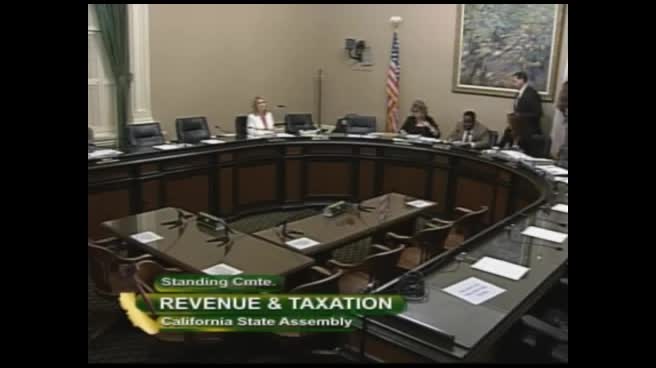
Assembly Standing Committee on Revenue and Taxation
Bill Author

Bill Co-Author(s):