AB 2569: Registered sex offenders.
- Session Year: 2015-2016
- House: Assembly
- Latest Version Date: 2016-08-02
Existing law requires the Department of Justice to make available specified information about registered sex offenders via an Internet Web site. Existing law authorizes an offender who has been convicted of the commission or attempted commission of felony sexual battery, misdemeanor child molestation, or other specified sexual offenses to apply to the department for exclusion from the Internet Web site. Existing law also authorizes an offender who has been convicted of the commission or attempted commission of an offense for which the offender is on probation at the time of his or her application or has successfully completed probation to apply for exclusion from the Internet Web site if he or she submits a certified copy of an official court document, as specified, that clearly demonstrates that the offender was the victims parent, stepparent, sibling, or grandparent, and the crime did not involve specified sexual offenses.
This bill would require a local assistance center for victims and witnesses, as specified, prior to the department granting an application for an exclusion, exclusion pursuant to the above specified provision, to speak to the victim to determine if granting the exclusion would be in the best interest of the victim. victim, as provided. The bill would require that an offender who is on probation at the time of his or her application for an exclusion be on probation for at least one year prior to the granting of his or her exclusion.
By imposing additional duties on local government agencies, this bill would impose a state-mandated local program.
The California Constitution requires the state to reimburse local agencies and school districts for certain costs mandated by the state. Statutory provisions establish procedures for making that reimbursement.
This bill would provide that, if the Commission on State Mandates determines that the bill contains costs mandated by the state, reimbursement for those costs shall be made pursuant to these statutory provisions.
Existing law requires the Department of Justice to make available specified information about registered sex offenders via an Internet Web site. Existing law authorizes an offender who has been convicted of the commission or attempted commission of felony sexual battery, misdemeanor child molestation, or other specified sexual offenses to apply to the department for exclusion from the Internet Web site. Existing law also authorizes an offender who has been convicted of the commission or attempted commission of an offense for which the offender is on probation at the time of his or her application or has successfully completed probation to apply for exclusion from the Internet Web site if he or she submits a certified copy of an official court document, as specified, that clearly demonstrates that the offender was the victims parent, stepparent, sibling, or grandparent, and the crime did not involve specified sexual offenses.
This bill would require the Department of Justice Office of Victim Assistance a local assistance center for victims and witnesses, as specified, prior to the department granting of an application for an exclusion, to speak to the victim to determine if granting the exclusion would be in the best interest of the victim. The bill would require that an offender who is on probation at the time of his or her application for an exclusion be on probation for at least one year prior to the granting of his or her exclusion.
By imposing additional duties on local government agencies, this bill would impose a state-mandated local program.
The California Constitution requires the state to reimburse local agencies and school districts for certain costs mandated by the state. Statutory provisions establish procedures for making that reimbursement.
This bill would provide that, if the Commission on State Mandates determines that the bill contains costs mandated by the state, reimbursement for those costs shall be made pursuant to these statutory provisions.
Existing law requires the Department of Justice to make available specified information about registered sex offenders via an Internet Web site. Existing law authorizes an offender who has been convicted of the commission or attempted commission of felony sexual battery, misdemeanor child molestation, or other specified sexual offenses, offenses to apply to the department for exclusion from the Internet Web site. Existing law also authorizes an offender who has been convicted of the commission or attempted commission of an offense for which the offender is on probation at the time of his or her application or has successfully completed probation, probation to apply for exclusion from the Internet Web site if he or she submits a certified copy of an official court document, as specified, that clearly demonstrates that the offender was the victims parent, stepparent, sibling, or grandparent, and the crime did not involve specified sexual offenses.
This bill would terminate the authorization for an offender who commits a specified sexual offense against a victim who is the child, stepchild, sibling, or grandchild of the offender from being eligible for exclusion from the Internet Web site.
This bill would require the Department of Justice Office of Victim Assistance, prior to the granting of an application for an exclusion, to speak to the victim to determine if granting the exclusion would be in the best interest of the victim. The bill would require that an offender who is on probation at the time of his or her application for an exclusion be on probation for at least one year prior to the granting of his or her exclusion.
Existing law requires the Department of Justice to make available specified information about registered sex offenders via an Internet Web site. Existing law authorizes an offender who has been convicted of the commission or attempted commission of felony sexual battery, misdemeanor child molestation, or other specified sexual offenses, to apply to the department for exclusion from the Internet Web site. Existing law also authorizes an offender who has been convicted of the commission or attempted commission of an offense for which the offender is on probation at the time of his or her application or has successfully completed probation, to apply for exclusion from the Internet Web site if he or she submits a certified copy of an official court document, as specified, that clearly demonstrates that the offender was the victims parent, stepparent, sibling, or grandparent, and the crime did not involve specified sexual offenses.
This bill would terminate the authorization for an offender who commits a specified sexual offense against a victim who is the child, stepchild, sibling, or grandchild of the offender from being eligible for exclusion from the Internet Web site.
(a)(1)On or before the dates specified in this section, the Department of Justice shall make available information concerning persons who are required to register pursuant to Section 290 to the public via an Internet Web site as specified in this section. The department shall update the Internet Web site on an ongoing basis. All information identifying the victim by name, birth date, address, or relationship to the registrant shall be excluded from the Internet Web site. The name or address of the persons employer and the listed persons criminal history other than the specific crimes for which the person is required to register shall not be included on the Internet Web site. The Internet Web site shall be translated into languages other than English as determined by the department.
(2)(A)On or before July 1, 2010, the Department of Justice shall make available to the public, via an Internet Web site as specified in this section, as to any person described in subdivision (b), (c), or (d), the following information:
(i)The year of conviction of his or her most recent offense requiring registration pursuant to Section 290.
(ii)The year he or she was released from incarceration for that offense.
(iii)Whether he or she was subsequently incarcerated for any other felony, if that fact is reported to the department. If the department has no information about a subsequent incarceration for any felony, that fact shall be noted on the Internet Web site.
However, no year of conviction shall be made available to the public unless the department also is able to make available the corresponding year of release of incarceration for that offense, and the required notation regarding any subsequent felony.
(B)(i)Any state facility that releases from incarceration a person who was incarcerated because of a crime for which he or she is required to register as a sex offender pursuant to Section 290 shall, within 30 days of release, provide the year of release for his or her most recent offense requiring registration to the Department of Justice in a manner and format approved by the department.
(ii)Any state facility that releases a person who is required to register pursuant to Section 290 from incarceration whose incarceration was for a felony committed subsequently to the offense for which he or she is required to register shall, within 30 days of release, advise the Department of Justice of that fact.
(iii)Any state facility that, prior to January 1, 2007, released from incarceration a person who was incarcerated because of a crime for which he or she is required to register as a sex offender pursuant to Section 290 shall provide the year of release for his or her most recent offense requiring registration to the Department of Justice in a manner and format approved by the department. The information provided by the Department of Corrections and Rehabilitation shall be limited to information that is currently maintained in an electronic format.
(iv)Any state facility that, prior to January 1, 2007, released a person who is required to register pursuant to Section 290 from incarceration whose incarceration was for a felony committed subsequently to the offense for which he or she is required to register shall advise the Department of Justice of that fact in a manner and format approved by the department. The information provided by the Department of Corrections and Rehabilitation shall be limited to information that is currently maintained in an electronic format.
(3)The State Department of State Hospitals shall provide to the Department of Justice Sex Offender Tracking Program the names of all persons committed to its custody pursuant to Article 4 (commencing with Section 6600) of Chapter 2 of Part 2 of Division 6 of the Welfare and Institutions Code, within 30 days of commitment, and shall provide the names of all of those persons released from its custody within five working days of release.
(b)(1)On or before July 1, 2005, with respect to a person who has been convicted of the commission or the attempted commission of any of the offenses listed in, or who is described in, paragraph (2), the Department of Justice shall make available to the public via the Internet Web site his or her name and known aliases, a photograph, a physical description, including gender and race, date of birth, criminal history, prior adjudication as a sexually violent predator, the address at which the person resides, and any other information that the Department of Justice deems relevant, but not the information excluded pursuant to subdivision (a). On or before January 1, 2013, the department shall make available to the public via the Internet Web site his or her static SARATSO score and information on an elevated risk level based on the SARATSO future violence tool.
(2)This subdivision shall apply to the following offenses and offenders:
(A)Section 187 committed in the perpetration, or an attempt to perpetrate, rape or any act punishable under Section 286, 288, 288a, or 289.
(B)Section 207 committed with intent to violate Section 261, 286, 288, 288a, or 289.
(C)Section 209 committed with intent to violate Section 261, 286, 288, 288a, or 289.
(D)Paragraph (2) or (6) of subdivision (a) of Section 261.
(E)Section 264.1.
(F)Section 269.
(G)Subdivision (c) or (d) of Section 286.
(H)Subdivision (a), (b), or (c) of Section 288, provided that the offense is a felony.
(I)Subdivision (c) or (d) of Section 288a.
(J)Section 288.3, provided that the offense is a felony.
(K)Section 288.4, provided that the offense is a felony.
(L)Section 288.5.
(M)Subdivision (a) or (j) of Section 289.
(N)Section 288.7.
(O)Any person who has ever been adjudicated a sexually violent predator, as defined in Section 6600 of the Welfare and Institutions Code.
(P)A felony violation of Section 311.1.
(Q)A felony violation of subdivision (b), (c), or (d) of Section 311.2.
(R)A felony violation of Section 311.3.
(S)A felony violation of subdivision (a), (b), or (c) of Section 311.4.
(T)Section 311.10.
(U)A felony violation of Section 311.11.
(c)(1)On or before July 1, 2005, with respect to a person who has been convicted of the commission or the attempted commission of any of the offenses listed in paragraph (2), the Department of Justice shall make available to the public via the Internet Web site his or her name and known aliases, a photograph, a physical description, including gender and race, date of birth, criminal history, the community of residence and ZIP Code in which the person resides or the county in which the person is registered as a transient, and any other information that the Department of Justice deems relevant, but not the information excluded pursuant to subdivision (a). On or before July 1, 2006, the Department of Justice shall determine whether any person convicted of an offense listed in paragraph (2) also has one or more prior or subsequent convictions of an offense listed in subdivision (c) of Section 290, and, for those persons, the Department of Justice shall make available to the public via the Internet Web site the address at which the person resides. However, the address at which the person resides shall not be disclosed until a determination is made that the person is, by virtue of his or her additional prior or subsequent conviction of an offense listed in subdivision (c) of Section 290, subject to this subdivision.
(2)This subdivision shall apply to the following offenses:
(A)Section 220, except assault to commit mayhem.
(B)Paragraph (1), (3), or (4) of subdivision (a) of Section 261.
(C)Paragraph (2) of subdivision (b), or subdivision (f), (g), or (i), of Section 286.
(D)Paragraph (2) of subdivision (b), or subdivision (f), (g), or (i), of Section 288a.
(E)Subdivision (b), (d), (e), or (i) of Section 289.
(d)(1)On or before July 1, 2005, with respect to a person who has been convicted of the commission or the attempted commission of any of the offenses listed in, or who is described in, this subdivision, the Department of Justice shall make available to the public via the Internet Web site his or her name and known aliases, a photograph, a physical description, including gender and race, date of birth, criminal history, the community of residence and ZIP Code in which the person resides or the county in which the person is registered as a transient, and any other information that the Department of Justice deems relevant, but not the information excluded pursuant to subdivision (a) or the address at which the person resides.
(2)This subdivision shall apply to the following offenses and offenders:
(A)Subdivision (a) of Section 243.4, provided that the offense is a felony.
(B)Section 266, provided that the offense is a felony.
(C)Section 266c, provided that the offense is a felony.
(D)Section 266j.
(E)Section 267.
(F)Subdivision (c) of Section 288, provided that the offense is a misdemeanor.
(G)Section 288.3, provided that the offense is a misdemeanor.
(H)Section 288.4, provided that the offense is a misdemeanor.
(I)Section 626.81.
(J)Section 647.6.
(K)Section 653c.
(L)Any person required to register pursuant to Section 290 based upon an out-of-state conviction, unless that person is excluded from the Internet Web site pursuant to subdivision (e). However, if the Department of Justice has determined that the out-of-state crime, if committed or attempted in this state, would have been punishable in this state as a crime described in subdivision (c) of Section 290, the person shall be placed on the Internet Web site as provided in subdivision (b) or (c), as applicable to the crime.
(e)(1)If a person has been convicted of the commission or the attempted commission of any of the offenses listed in this subdivision, and he or she has been convicted of no other offense listed in subdivision (b), (c), or (d) other than those listed in this subdivision, that person may file an application with the Department of Justice, on a form approved by the department, for exclusion from the Internet Web site. If Except as provided in clause (iii) of subparagraph (D) of paragraph (2), if the department determines that the person meets the requirements of this subdivision, the department shall grant the exclusion and no information concerning the person shall be made available via the Internet Web site described in this section. He or she bears the burden of proving the facts that make him or her eligible for exclusion from the Internet Web site. However, a person who has filed for or been granted an exclusion from the Internet Web site is not relieved of his or her duty to register as a sex offender pursuant to Section 290 nor from any otherwise applicable provision of law.
(2)This subdivision shall apply to the following offenses:
(A)A felony violation of subdivision (a) of Section 243.4.
(B)Section 647.6, if the offense is a misdemeanor.
(C)A felony violation of Section 311.1, subdivision (b), (c), or (d) of Section 311.2, or Section 311.3, 311.4, 311.10, or 311.11 if the person submits to the department a certified copy of a probation report filed in court that clearly states that all victims involved in the commission of the offense were at least 16 years of age or older at the time of the commission of the offense.
(D)(i)An offense for which the offender successfully completed probation, provided that the offender submits to the department a certified copy of a probation report, presentencing report, report prepared pursuant to Section 288.1, or other official court document that clearly demonstrates that the offender was the victims parent, stepparent, sibling, or grandparent and that the crime did not involve either oral copulation or penetration of the vagina or rectum of either the victim or the offender by the penis of the other or by any foreign object.
(ii)An offense for which the offender is on probation at the time of his or her application, provided that the offender submits to the department a certified copy of a probation report, presentencing report, report prepared pursuant to Section 288.1, or other official court document that clearly demonstrates that the offender was the victims parent, stepparent, sibling, or grandparent and that the crime did not involve either oral copulation or penetration of the vagina or rectum of either the victim or the offender by the penis of the other or by any foreign object. An offender who is on probation at the time of his or her application shall have been on probation for at least one year prior to the granting of his or her application.
(iii)(I)Prior to the department granting an application under this subparagraph, a local assistance center for victims and witnesses, established pursuant to Article 2 (commencing with Section 13835) of Chapter 4 of Title 6 of Part 4 shall speak to the victim to determine if granting the exemption would be in the best interest of the victim. Upon receiving the application, the department shall contact the local assistance center for victims and witnesses in the county in which the person was convicted. If the offense was committed in another state, the department shall contact the center in the county in which the offender is registered as a sex offender on the date the application for exclusion was filed. If the person was convicted for multiple offenses against multiple victims, the department shall contact only one center to make a determination pursuant to this subclause.
(II)The center shall provide its determination of whether granting an exemption would be in the best interest of the victim to the department within 60 days of being contacted by the department pursuant to subclause (I). If the victim cannot be located by the center, declines to speak with a representative of the center, or if the center does not otherwise speak with the victim and submit its determination within 60 days of being contacted by the department, the department shall grant the exclusion if the requirements of this subdivision are otherwise met.
(III)If the application for the exclusion is denied pursuant to this clause, the application may not be reconsidered until after 3 months after the date the application for exclusion was denied.
(IV)Notwithstanding paragraph (3), an exclusion application already granted prior to the effective date of the measure that adds this clause shall not be subject to recision pursuant to this clause.
(iv)If, subsequent to his or her application, the offender commits a violation of probation resulting in his or her incarceration in county jail or state prison, his or her exclusion, or application for exclusion, from the Internet Web site shall be terminated.
(v)For the purposes of this subparagraph, successfully completed probation means that during the period of probation the offender neither received additional county jail or state prison time for a violation of probation nor was convicted of another offense resulting in a sentence to county jail or state prison.
(3)If the department determines that a person who was granted an exclusion under a former version of this subdivision would not qualify for an exclusion under the current version of this subdivision, the department shall rescind the exclusion, make a reasonable effort to provide notification to the person that the exclusion has been rescinded, and, no sooner than 30 days after notification is attempted, make information about the offender available to the public on the Internet Web site as provided in this section.
(4)Effective January 1, 2012, no person shall be excluded pursuant to this subdivision unless the offender has submitted to the department documentation sufficient for the department to determine that he or she has a SARATSO risk level of low or moderate-low.
(f)The Department of Justice shall make a reasonable effort to provide notification to persons who have been convicted of the commission or attempted commission of an offense specified in subdivision (b), (c), or (d), that on or before July 1, 2005, the department is required to make information about specified sex offenders available to the public via an Internet Web site as specified in this section. The Department of Justice shall also make a reasonable effort to provide notice that some offenders are eligible to apply for exclusion from the Internet Web site.
(g)(1)A designated law enforcement entity, as defined in subdivision (f) of Section 290.45, may make available information concerning persons who are required to register pursuant to Section 290 to the public via an Internet Web site as specified in paragraph (2).
(2)The law enforcement entity may make available by way of an Internet Web site the information described in subdivision (c) if it determines that the public disclosure of the information about a specific offender by way of the entitys Internet Web site is necessary to ensure the public safety based upon information available to the entity concerning that specific offender.
(3)The information that may be provided pursuant to this subdivision may include the information specified in subdivision (b) of Section 290.45. However, that offenders address may not be disclosed unless he or she is a person whose address is on the Department of Justices Internet Web site pursuant to subdivision (b) or (c).
(h)For purposes of this section, offense includes the statutory predecessors of that offense, or any offense committed in another jurisdiction that, if committed or attempted to be committed in this state, would have been punishable in this state as an offense listed in subdivision (c) of Section 290.
(i)Notwithstanding Section 6254.5 of the Government Code, disclosure of information pursuant to this section is not a waiver of exemptions under Chapter 3.5 (commencing with Section 6250) of Title 1 of Division 7 of the Government Code and does not affect other statutory restrictions on disclosure in other situations.
(j)(1)Any person who uses information disclosed pursuant to this section to commit a misdemeanor shall be subject to, in addition to any other penalty or fine imposed, a fine of not less than ten thousand dollars ($10,000) and not more than fifty thousand dollars ($50,000).
(2)Any person who uses information disclosed pursuant to this section to commit a felony shall be punished, in addition and consecutive to any other punishment, by a five-year term of imprisonment pursuant to subdivision (h) of Section 1170.
(k)Any person who is required to register pursuant to Section 290 who enters an Internet Web site established pursuant to this section shall be punished by a fine not exceeding one thousand dollars ($1,000), imprisonment in a county jail for a period not to exceed six months, or by both that fine and imprisonment.
(l)(1)A person is authorized to use information disclosed pursuant to this section only to protect a person at risk.
(2)Except as authorized under paragraph (1) or any other law, use of any information that is disclosed pursuant to this section for purposes relating to any of the following is prohibited:
(A)Health insurance.
(B)Insurance.
(C)Loans.
(D)Credit.
(E)Employment.
(F)Education, scholarships, or fellowships.
(G)Housing or accommodations.
(H)Benefits, privileges, or services provided by any business establishment.
(3)This section shall not affect authorized access to, or use of, information pursuant to, among other provisions, Sections 11105 and 11105.3, Section 8808 of the Family Code, Sections 777.5 and 14409.2 of the Financial Code, Sections 1522.01 and 1596.871 of the Health and Safety Code, and Section 432.7 of the Labor Code.
(4)(A)Any use of information disclosed pursuant to this section for purposes other than those provided by paragraph (1) or in violation of paragraph (2) shall make the user liable for the actual damages, and any amount that may be determined by a jury or a court sitting without a jury, not exceeding three times the amount of actual damage, and not less than two hundred fifty dollars ($250), and attorneys fees, exemplary damages, or a civil penalty not exceeding twenty-five thousand dollars ($25,000).
(B)Whenever there is reasonable cause to believe that any person or group of persons is engaged in a pattern or practice of misuse of the information available via an Internet Web site established pursuant to this section in violation of paragraph (2), the Attorney General, any district attorney, or city attorney, or any person aggrieved by the misuse is authorized to bring a civil action in the appropriate court requesting preventive relief, including an application for a permanent or temporary injunction, restraining order, or other order against the person or group of persons responsible for the pattern or practice of misuse. The foregoing remedies shall be independent of any other remedies or procedures that may be available to an aggrieved party under other provisions of law, including Part 2 (commencing with Section 43) of Division 1 of the Civil Code.
(m)The public notification provisions of this section are applicable to every person described in this section, without regard to when his or her crimes were committed or his or her duty to register pursuant to Section 290 arose, and to every offense described in this section, regardless of when it was committed.
(n)A designated law enforcement entity and its employees shall be immune from liability for good faith conduct under this section.
(o)The Attorney General, in collaboration with local law enforcement and others knowledgeable about sex offenders, shall develop strategies to assist members of the public in understanding and using publicly available information about registered sex offenders to further public safety. These strategies may include, but are not limited to, a hotline for community inquiries, neighborhood and business guidelines for how to respond to information posted on this Internet Web site, and any other resource that promotes public education about these offenders.
SEC. 2.If the Commission on State Mandates determines that this act contains costs mandated by the state, reimbursement to local agencies and school districts for those costs shall be made pursuant to Part 7 (commencing with Section 17500) of Division 4 of Title 2 of the Government Code.
(a)(1)On or before the dates specified in this section, the Department of Justice shall make available information concerning persons who are required to register pursuant to Section 290 to the public via an Internet Web site as specified in this section. The department shall update the Internet Web site on an ongoing basis. All information identifying the victim by name, birth date, address, or relationship to the registrant shall be excluded from the Internet Web site. The name or address of the persons employer and the listed persons criminal history other than the specific crimes for which the person is required to register shall not be included on the Internet Web site. The Internet Web site shall be translated into languages other than English as determined by the department.
(2)(A)On or before July 1, 2010, the Department of Justice shall make available to the public, via an Internet Web site as specified in this section, as to any person described in subdivision (b), (c), or (d), the following information:
(i)The year of conviction of his or her most recent offense requiring registration pursuant to Section 290.
(ii)The year he or she was released from incarceration for that offense.
(iii)Whether he or she was subsequently incarcerated for any other felony, if that fact is reported to the department. If the department has no information about a subsequent incarceration for any felony, that fact shall be noted on the Internet Web site.
However, no year of conviction shall be made available to the public unless the department also is able to make available the corresponding year of release of incarceration for that offense, and the required notation regarding any subsequent felony.
(B)(i)Any state facility that releases from incarceration a person who was incarcerated because of a crime for which he or she is required to register as a sex offender pursuant to Section 290 shall, within 30 days of release, provide the year of release for his or her most recent offense requiring registration to the Department of Justice in a manner and format approved by the department.
(ii)Any state facility that releases a person who is required to register pursuant to Section 290 from incarceration whose incarceration was for a felony committed subsequently to the offense for which he or she is required to register shall, within 30 days of release, advise the Department of Justice of that fact.
(iii)Any state facility that, prior to January 1, 2007, released from incarceration a person who was incarcerated because of a crime for which he or she is required to register as a sex offender pursuant to Section 290 shall provide the year of release for his or her most recent offense requiring registration to the Department of Justice in a manner and format approved by the department. The information provided by the Department of Corrections and Rehabilitation shall be limited to information that is currently maintained in an electronic format.
(iv)Any state facility that, prior to January 1, 2007, released a person who is required to register pursuant to Section 290 from incarceration whose incarceration was for a felony committed subsequently to the offense for which he or she is required to register shall advise the Department of Justice of that fact in a manner and format approved by the department. The information provided by the Department of Corrections and Rehabilitation shall be limited to information that is currently maintained in an electronic format.
(3)The State Department of State Hospitals shall provide to the Department of Justice Sex Offender Tracking Program the names of all persons committed to its custody pursuant to Article 4 (commencing with Section 6600) of Chapter 2 of Part 2 of Division 6 of the Welfare and Institutions Code, within 30 days of commitment, and shall provide the names of all of those persons released from its custody within five working days of release.
(b)(1)On or before July 1, 2005, with respect to a person who has been convicted of the commission or the attempted commission of any of the offenses listed in, or who is described in, paragraph (2), the Department of Justice shall make available to the public via the Internet Web site his or her name and known aliases, a photograph, a physical description, including gender and race, date of birth, criminal history, prior adjudication as a sexually violent predator, the address at which the person resides, and any other information that the Department of Justice deems relevant, but not the information excluded pursuant to subdivision (a). On or before January 1, 2013, the department shall make available to the public via the Internet Web site his or her static SARATSO score and information on an elevated risk level based on the SARATSO future violence tool.
(2)This subdivision shall apply to the following offenses and offenders:
(A)Section 187 committed in the perpetration, or an attempt to perpetrate, rape or any act punishable under Section 286, 288, 288a, or 289.
(B)Section 207 committed with intent to violate Section 261, 286, 288, 288a, or 289.
(C)Section 209 committed with intent to violate Section 261, 286, 288, 288a, or 289.
(D)Paragraph (2) or (6) of subdivision (a) of Section 261.
(E)Section 264.1.
(F)Section 269.
(G)Subdivision (c) or (d) of Section 286.
(H)Subdivision (a), (b), or (c) of Section 288, provided that the offense is a felony.
(I)Subdivision (c) or (d) of Section 288a.
(J)Section 288.3, provided that the offense is a felony.
(K)Section 288.4, provided that the offense is a felony.
(L)Section 288.5.
(M)Subdivision (a) or (j) of Section 289.
(N)Section 288.7.
(O)Any person who has ever been adjudicated a sexually violent predator, as defined in Section 6600 of the Welfare and Institutions Code.
(P)A felony violation of Section 311.1.
(Q)A felony violation of subdivision (b), (c), or (d) of Section 311.2.
(R)A felony violation of Section 311.3.
(S)A felony violation of subdivision (a), (b), or (c) of Section 311.4.
(T)Section 311.10.
(U)A felony violation of Section 311.11.
(c)(1)On or before July 1, 2005, with respect to a person who has been convicted of the commission or the attempted commission of any of the offenses listed in paragraph (2), the Department of Justice shall make available to the public via the Internet Web site his or her name and known aliases, a photograph, a physical description, including gender and race, date of birth, criminal history, the community of residence and ZIP Code in which the person resides or the county in which the person is registered as a transient, and any other information that the Department of Justice deems relevant, but not the information excluded pursuant to subdivision (a). On or before July 1, 2006, the Department of Justice shall determine whether any person convicted of an offense listed in paragraph (2) also has one or more prior or subsequent convictions of an offense listed in subdivision (c) of Section 290, and, for those persons, the Department of Justice shall make available to the public via the Internet Web site the address at which the person resides. However, the address at which the person resides shall not be disclosed until a determination is made that the person is, by virtue of his or her additional prior or subsequent conviction of an offense listed in subdivision (c) of Section 290, subject to this subdivision.
(2)This subdivision shall apply to the following offenses:
(A)Section 220, except assault to commit mayhem.
(B)Paragraph (1), (3), or (4) of subdivision (a) of Section 261.
(C)Paragraph (2) of subdivision (b), or subdivision (f), (g), or (i), of Section 286.
(D)Paragraph (2) of subdivision (b), or subdivision (f), (g), or (i), of Section 288a.
(E)Subdivision (b), (d), (e), or (i) of Section 289.
(d)(1)On or before July 1, 2005, with respect to a person who has been convicted of the commission or the attempted commission of any of the offenses listed in, or who is described in, this subdivision, the Department of Justice shall make available to the public via the Internet Web site his or her name and known aliases, a photograph, a physical description, including gender and race, date of birth, criminal history, the community of residence and ZIP Code in which the person resides or the county in which the person is registered as a transient, and any other information that the Department of Justice deems relevant, but not the information excluded pursuant to subdivision (a) or the address at which the person resides.
(2)This subdivision shall apply to the following offenses and offenders:
(A)Subdivision (a) of Section 243.4, provided that the offense is a felony.
(B)Section 266, provided that the offense is a felony.
(C)Section 266c, provided that the offense is a felony.
(D)Section 266j.
(E)Section 267.
(F)Subdivision (c) of Section 288, provided that the offense is a misdemeanor.
(G)Section 288.3, provided that the offense is a misdemeanor.
(H)Section 288.4, provided that the offense is a misdemeanor.
(I)Section 626.81.
(J)Section 647.6.
(K)Section 653c.
(L)Any person required to register pursuant to Section 290 based upon an out-of-state conviction, unless that person is excluded from the Internet Web site pursuant to subdivision (e). However, if the Department of Justice has determined that the out-of-state crime, if committed or attempted in this state, would have been punishable in this state as a crime described in subdivision (c) of Section 290, the person shall be placed on the Internet Web site as provided in subdivision (b) or (c), as applicable to the crime.
(e)(1)If a person has been convicted of the commission or the attempted commission of any of the offenses listed in this subdivision, and he or she has been convicted of no other offense listed in subdivision (b), (c), or (d) other than those listed in this subdivision, that person may file an application with the Department of Justice, on a form approved by the department, for exclusion from the Internet Web site. If the department determines that the person meets the requirements of this subdivision, the department shall grant the exclusion and no information concerning the person shall be made available via the Internet Web site described in this section. He or she bears the burden of proving the facts that make him or her eligible for exclusion from the Internet Web site. However, a person who has filed for or been granted an exclusion from the Internet Web site is not relieved of his or her duty to register as a sex offender pursuant to Section 290 nor from any otherwise applicable provision of law.
(2)This subdivision shall apply to the following offenses:
(A)A felony violation of subdivision (a) of Section 243.4.
(B)Section 647.6, if the offense is a misdemeanor.
(C)A felony violation of Section 311.1, subdivision (b), (c), or (d) of Section 311.2, or Section 311.3, 311.4, 311.10, or 311.11 if the person submits to the department a certified copy of a probation report filed in court that clearly states that all victims involved in the commission of the offense were at least 16 years of age or older at the time of the commission of the offense.
(D)(i)An offense for which the offender successfully completed probation, provided that the offender submits to the department a certified copy of a probation report, presentencing report, report prepared pursuant to Section 288.1, or other official court document that clearly demonstrates that the offender was the victims parent, stepparent, sibling, or grandparent and that the crime did not involve either oral copulation or penetration of the vagina or rectum of either the victim or the offender by the penis of the other or by any foreign object.
(ii)An offense for which the offender is on probation at the time of his or her application, provided that the offender submits to the department a certified copy of a probation report, presentencing report, report prepared pursuant to Section 288.1, or other official court document that clearly demonstrates that the offender was the victims parent, stepparent, sibling, or grandparent and that the crime did not involve either oral copulation or penetration of the vagina or rectum of either the victim or the offender by the penis of the other or by any foreign object. An offender who is on probation at the time of his or her application shall have been on probation for at least one year prior to the granting of his or her application.
(iii)Prior to the department granting of an application under this subparagraph, the Department of Justice Office of Victim Assistance a local assistance center for victims and witnesses, established pursuant to Article 2 (commencing with Section 13835) of Chapter 4 of Title 6 of Part 4 shall speak to the victim to determine if granting the exemption would be in the best interest of the victim.
(iv)If, subsequent to his or her application, the offender commits a violation of probation resulting in his or her incarceration in county jail or state prison, his or her exclusion, or application for exclusion, from the Internet Web site shall be terminated.
(v)For the purposes of this subparagraph, successfully completed probation means that during the period of probation the offender neither received additional county jail or state prison time for a violation of probation nor was convicted of another offense resulting in a sentence to county jail or state prison.
(3)If the department determines that a person who was granted an exclusion under a former version of this subdivision would not qualify for an exclusion under the current version of this subdivision, the department shall rescind the exclusion, make a reasonable effort to provide notification to the person that the exclusion has been rescinded, and, no sooner than 30 days after notification is attempted, make information about the offender available to the public on the Internet Web site as provided in this section.
(4)Effective January 1, 2012, no person shall be excluded pursuant to this subdivision unless the offender has submitted to the department documentation sufficient for the department to determine that he or she has a SARATSO risk level of low or moderate-low.
(f)The Department of Justice shall make a reasonable effort to provide notification to persons who have been convicted of the commission or attempted commission of an offense specified in subdivision (b), (c), or (d), that on or before July 1, 2005, the department is required to make information about specified sex offenders available to the public via an Internet Web site as specified in this section. The Department of Justice shall also make a reasonable effort to provide notice that some offenders are eligible to apply for exclusion from the Internet Web site.
(g)(1)A designated law enforcement entity, as defined in subdivision (f) of Section 290.45, may make available information concerning persons who are required to register pursuant to Section 290 to the public via an Internet Web site as specified in paragraph (2).
(2)The law enforcement entity may make available by way of an Internet Web site the information described in subdivision (c) if it determines that the public disclosure of the information about a specific offender by way of the entitys Internet Web site is necessary to ensure the public safety based upon information available to the entity concerning that specific offender.
(3)The information that may be provided pursuant to this subdivision may include the information specified in subdivision (b) of Section 290.45. However, that offenders address may not be disclosed unless he or she is a person whose address is on the Department of Justices Internet Web site pursuant to subdivision (b) or (c).
(h)For purposes of this section, offense includes the statutory predecessors of that offense, or any offense committed in another jurisdiction that, if committed or attempted to be committed in this state, would have been punishable in this state as an offense listed in subdivision (c) of Section 290.
(i)Notwithstanding Section 6254.5 of the Government Code, disclosure of information pursuant to this section is not a waiver of exemptions under Chapter 3.5 (commencing with Section 6250) of Title 1 of Division 7 of the Government Code and does not affect other statutory restrictions on disclosure in other situations.
(j)(1)Any person who uses information disclosed pursuant to this section to commit a misdemeanor shall be subject to, in addition to any other penalty or fine imposed, a fine of not less than ten thousand dollars ($10,000) and not more than fifty thousand dollars ($50,000).
(2)Any person who uses information disclosed pursuant to this section to commit a felony shall be punished, in addition and consecutive to any other punishment, by a five-year term of imprisonment pursuant to subdivision (h) of Section 1170.
(k)Any person who is required to register pursuant to Section 290 who enters an Internet Web site established pursuant to this section shall be punished by a fine not exceeding one thousand dollars ($1,000), imprisonment in a county jail for a period not to exceed six months, or by both that fine and imprisonment.
(l)(1)A person is authorized to use information disclosed pursuant to this section only to protect a person at risk.
(2)Except as authorized under paragraph (1) or any other provision of law, use of any information that is disclosed pursuant to this section for purposes relating to any of the following is prohibited:
(A)Health insurance.
(B)Insurance.
(C)Loans.
(D)Credit.
(E)Employment.
(F)Education, scholarships, or fellowships.
(G)Housing or accommodations.
(H)Benefits, privileges, or services provided by any business establishment.
(3)This section shall not affect authorized access to, or use of, information pursuant to, among other provisions, Sections 11105 and 11105.3, Section 8808 of the Family Code, Sections 777.5 and 14409.2 of the Financial Code, Sections 1522.01 and 1596.871 of the Health and Safety Code, and Section 432.7 of the Labor Code.
(4)(A)Any use of information disclosed pursuant to this section for purposes other than those provided by paragraph (1) or in violation of paragraph (2) shall make the user liable for the actual damages, and any amount that may be determined by a jury or a court sitting without a jury, not exceeding three times the amount of actual damage, and not less than two hundred fifty dollars ($250), and attorneys fees, exemplary damages, or a civil penalty not exceeding twenty-five thousand dollars ($25,000).
(B)Whenever there is reasonable cause to believe that any person or group of persons is engaged in a pattern or practice of misuse of the information available via an Internet Web site established pursuant to this section in violation of paragraph (2), the Attorney General, any district attorney, or city attorney, or any person aggrieved by the misuse is authorized to bring a civil action in the appropriate court requesting preventive relief, including an application for a permanent or temporary injunction, restraining order, or other order against the person or group of persons responsible for the pattern or practice of misuse. The foregoing remedies shall be independent of any other remedies or procedures that may be available to an aggrieved party under other provisions of law, including Part 2 (commencing with Section 43) of Division 1 of the Civil Code.
(m)The public notification provisions of this section are applicable to every person described in this section, without regard to when his or her crimes were committed or his or her duty to register pursuant to Section 290 arose, and to every offense described in this section, regardless of when it was committed.
(n)A designated law enforcement entity and its employees shall be immune from liability for good faith conduct under this section.
(o)The Attorney General, in collaboration with local law enforcement and others knowledgeable about sex offenders, shall develop strategies to assist members of the public in understanding and using publicly available information about registered sex offenders to further public safety. These strategies may include, but are not limited to, a hotline for community inquiries, neighborhood and business guidelines for how to respond to information posted on this Internet Web site, and any other resource that promotes public education about these offenders.
SEC. 2.If the Commission on State Mandates determines that this act contains costs mandated by the state, reimbursement to local agencies and school districts for those costs shall be made pursuant to Part 7 (commencing with Section 17500) of Division 4 of Title 2 of the Government Code.
(a)(1)On or before the dates specified in this section, the Department of Justice shall make available information concerning persons who are required to register pursuant to Section 290 to the public via an Internet Web site as specified in this section. The department shall update the Internet Web site on an ongoing basis. All information identifying the victim by name, birth date, address, or relationship to the registrant shall be excluded from the Internet Web site. The name or address of the persons employer and the listed persons criminal history other than the specific crimes for which the person is required to register shall not be included on the Internet Web site. The Internet Web site shall be translated into languages other than English as determined by the department.
(2)(A)On or before July 1, 2010, the Department of Justice shall make available to the public, via an Internet Web site as specified in this section, as to any person described in subdivision (b), (c), or (d), the following information:
(i)The year of conviction of his or her most recent offense requiring registration pursuant to Section 290.
(ii)The year he or she was released from incarceration for that offense.
(iii)Whether he or she was subsequently incarcerated for any other felony, if that fact is reported to the department. If the department has no information about a subsequent incarceration for any felony, that fact shall be noted on the Internet Web site.
However, no year of conviction shall be made available to the public unless the department also is able to make available the corresponding year of release of incarceration for that offense, and the required notation regarding any subsequent felony.
(B)(i)Any state facility that releases from incarceration a person who was incarcerated because of a crime for which he or she is required to register as a sex offender pursuant to Section 290 shall, within 30 days of release, provide the year of release for his or her most recent offense requiring registration to the Department of Justice in a manner and format approved by the department.
(ii)Any state facility that releases a person who is required to register pursuant to Section 290 from incarceration whose incarceration was for a felony committed subsequently to the offense for which he or she is required to register shall, within 30 days of release, advise the Department of Justice of that fact.
(iii)Any state facility that, prior to January 1, 2007, released from incarceration a person who was incarcerated because of a crime for which he or she is required to register as a sex offender pursuant to Section 290 shall provide the year of release for his or her most recent offense requiring registration to the Department of Justice in a manner and format approved by the department. The information provided by the Department of Corrections and Rehabilitation shall be limited to information that is currently maintained in an electronic format.
(iv)Any state facility that, prior to January 1, 2007, released a person who is required to register pursuant to Section 290 from incarceration whose incarceration was for a felony committed subsequently to the offense for which he or she is required to register shall advise the Department of Justice of that fact in a manner and format approved by the department. The information provided by the Department of Corrections and Rehabilitation shall be limited to information that is currently maintained in an electronic format.
(3)The State Department of State Hospitals shall provide to the Department of Justice Sex Offender Tracking Program the names of all persons committed to its custody pursuant to Article 4 (commencing with Section 6600) of Chapter 2 of Part 2 of Division 6 of the Welfare and Institutions Code, within 30 days of commitment, and shall provide the names of all of those persons released from its custody within five working days of release.
(b)(1)On or before July 1, 2005, with respect to a person who has been convicted of the commission or the attempted commission of any of the offenses listed in, or who is described in, paragraph (2), the Department of Justice shall make available to the public via the Internet Web site his or her name and known aliases, a photograph, a physical description, including gender and race, date of birth, criminal history, prior adjudication as a sexually violent predator, the address at which the person resides, and any other information that the Department of Justice deems relevant, but not the information excluded pursuant to subdivision (a). On or before January 1, 2013, the department shall make available to the public via the Internet Web site his or her static SARATSO score and information on an elevated risk level based on the SARATSO future violence tool.
(2)This subdivision shall apply to the following offenses and offenders:
(A)Section 187 committed in the perpetration, or an attempt to perpetrate, rape or any act punishable under Section 286, 288, 288a, or 289.
(B)Section 207 committed with intent to violate Section 261, 286, 288, 288a, or 289.
(C)Section 209 committed with intent to violate Section 261, 286, 288, 288a, or 289.
(D)Paragraph (2) or (6) of subdivision (a) of Section 261.
(E)Section 264.1.
(F)Section 269.
(G)Subdivision (c) or (d) of Section 286.
(H)Subdivision (a), (b), or (c) of Section 288, provided that the offense is a felony.
(I)Subdivision (c) or (d) of Section 288a.
(J)Section 288.3, provided that the offense is a felony.
(K)Section 288.4, provided that the offense is a felony.
(L)Section 288.5.
(M)Subdivision (a) or (j) of Section 289.
(N)Section 288.7.
(O)Any person who has ever been adjudicated a sexually violent predator, as defined in Section 6600 of the Welfare and Institutions Code.
(P)A felony violation of Section 311.1.
(Q)A felony violation of subdivision (b), (c), or (d) of Section 311.2.
(R)A felony violation of Section 311.3.
(S)A felony violation of subdivision (a), (b), or (c) of Section 311.4.
(T)Section 311.10.
(U)A felony violation of Section 311.11.
(c)(1)On or before July 1, 2005, with respect to a person who has been convicted of the commission or the attempted commission of any of the offenses listed in paragraph (2), the Department of Justice shall make available to the public via the Internet Web site his or her name and known aliases, a photograph, a physical description, including gender and race, date of birth, criminal history, the community of residence and ZIP Code in which the person resides or the county in which the person is registered as a transient, and any other information that the Department of Justice deems relevant, but not the information excluded pursuant to subdivision (a). On or before July 1, 2006, the Department of Justice shall determine whether any person convicted of an offense listed in paragraph (2) also has one or more prior or subsequent convictions of an offense listed in subdivision (c) of Section 290, and, for those persons, the Department of Justice shall make available to the public via the Internet Web site the address at which the person resides. However, the address at which the person resides shall not be disclosed until a determination is made that the person is, by virtue of his or her additional prior or subsequent conviction of an offense listed in subdivision (c) of Section 290, subject to this subdivision.
(2)This subdivision shall apply to the following offenses:
(A)Section 220, except assault to commit mayhem.
(B)Paragraph (1), (3), or (4) of subdivision (a) of Section 261.
(C)Paragraph (2) of subdivision (b), or subdivision (f), (g), or (i), of Section 286.
(D)Paragraph (2) of subdivision (b), or subdivision (f), (g), or (i), of Section 288a.
(E)Subdivision (b), (d), (e), or (i) of Section 289.
(d)(1)On or before July 1, 2005, with respect to a person who has been convicted of the commission or the attempted commission of any of the offenses listed in, or who is described in, this subdivision, the Department of Justice shall make available to the public via the Internet Web site his or her name and known aliases, a photograph, a physical description, including gender and race, date of birth, criminal history, the community of residence and ZIP Code in which the person resides or the county in which the person is registered as a transient, and any other information that the Department of Justice deems relevant, but not the information excluded pursuant to subdivision (a) or the address at which the person resides.
(2)This subdivision shall apply to the following offenses and offenders:
(A)Subdivision (a) of Section 243.4, provided that the offense is a felony.
(B)Section 266, provided that the offense is a felony.
(C)Section 266c, provided that the offense is a felony.
(D)Section 266j.
(E)Section 267.
(F)Subdivision (c) of Section 288, provided that the offense is a misdemeanor.
(G)Section 288.3, provided that the offense is a misdemeanor.
(H)Section 288.4, provided that the offense is a misdemeanor.
(I)Section 626.81.
(J)Section 647.6.
(K)Section 653c.
(L)Any person required to register pursuant to Section 290 based upon an out-of-state conviction, unless that person is excluded from the Internet Web site pursuant to subdivision (e). However, if the Department of Justice has determined that the out-of-state crime, if committed or attempted in this state, would have been punishable in this state as a crime described in subdivision (c) of Section 290, the person shall be placed on the Internet Web site as provided in subdivision (b) or (c), as applicable to the crime.
(e)(1)If a person has been convicted of the commission or the attempted commission of any of the offenses listed in this subdivision, and he or she has been convicted of no other offense listed in subdivision (b), (c), or (d) other than those listed in this subdivision, that person may file an application with the Department of Justice, on a form approved by the department, for exclusion from the Internet Web site. If the department determines that the person meets the requirements of this subdivision, the department shall grant the exclusion and no information concerning the person shall be made available via the Internet Web site described in this section. He or she bears the burden of proving the facts that make him or her eligible for exclusion from the Internet Web site. However, a person who has filed for or been granted an exclusion from the Internet Web site is not relieved of his or her duty to register as a sex offender pursuant to Section 290 nor from any otherwise applicable provision of law.
(2)This subdivision shall apply to the following offenses:
(A)A felony violation of subdivision (a) of Section 243.4.
(B)Section 647.6, if the offense is a misdemeanor.
(C)A felony violation of Section 311.1, subdivision (b), (c), or (d) of Section 311.2, or Section 311.3, 311.4, 311.10, or 311.11 if the person submits to the department a certified copy of a probation report filed in court that clearly states that all victims involved in the commission of the offense were at least 16 years of age or older at the time of the commission of the offense.
(D)(i)An offense for which the offender successfully completed probation, provided that the offender submits to the department a certified copy of a probation report, presentencing report, report prepared pursuant to Section 288.1, or other official court document that clearly demonstrates that the offender was the victims parent, stepparent, sibling, or grandparent and that the crime did not involve either oral copulation or penetration of the vagina or rectum of either the victim or the offender by the penis of the other or by any foreign object.
(ii)An offense for which the offender is on probation at the time of his or her application, provided that the offender submits to the department a certified copy of a probation report, presentencing report, report prepared pursuant to Section 288.1, or other official court document that clearly demonstrates that the offender was the victims parent, stepparent, sibling, or grandparent and that the crime did not involve either oral copulation or penetration of the vagina or rectum of either the victim or the offender by the penis of the other or by any foreign object. An offender who is on probation at the time of his or her application shall have been on probation for at least one year prior to the granting of his or her application.
(iii)Prior to the granting of an application under this subparagraph, the Department of Justice Office of Victim Assistance shall speak to the victim to determine if granting the exemption would be in the best interest of the victim.
(iv)If, subsequent to his or her application, the offender commits a violation of probation resulting in his or her incarceration in county jail or state prison, his or her exclusion, or application for exclusion, from the Internet Web site shall be terminated.
(v)For the purposes of this subparagraph, successfully completed probation means that during the period of probation the offender neither received additional county jail or state prison time for a violation of probation nor was convicted of another offense resulting in a sentence to county jail or state prison.
(3)If the department determines that a person who was granted an exclusion under a former version of this subdivision would not qualify for an exclusion under the current version of this subdivision, the department shall rescind the exclusion, make a reasonable effort to provide notification to the person that the exclusion has been rescinded, and, no sooner than 30 days after notification is attempted, make information about the offender available to the public on the Internet Web site as provided in this section.
(4)Effective January 1, 2012, no person shall be excluded pursuant to this subdivision unless the offender has submitted to the department documentation sufficient for the department to determine that he or she has a SARATSO risk level of low or moderate-low.
(f)The Department of Justice shall make a reasonable effort to provide notification to persons who have been convicted of the commission or attempted commission of an offense specified in subdivision (b), (c), or (d), that on or before July 1, 2005, the department is required to make information about specified sex offenders available to the public via an Internet Web site as specified in this section. The Department of Justice shall also make a reasonable effort to provide notice that some offenders are eligible to apply for exclusion from the Internet Web site.
(g)(1)A designated law enforcement entity, as defined in subdivision (f) of Section 290.45, may make available information concerning persons who are required to register pursuant to Section 290 to the public via an Internet Web site as specified in paragraph (2).
(2)The law enforcement entity may make available by way of an Internet Web site the information described in subdivision (c) if it determines that the public disclosure of the information about a specific offender by way of the entitys Internet Web site is necessary to ensure the public safety based upon information available to the entity concerning that specific offender.
(3)The information that may be provided pursuant to this subdivision may include the information specified in subdivision (b) of Section 290.45. However, that offenders address may not be disclosed unless he or she is a person whose address is on the Department of Justices Internet Web site pursuant to subdivision (b) or (c).
(h)For purposes of this section, offense includes the statutory predecessors of that offense, or any offense committed in another jurisdiction that, if committed or attempted to be committed in this state, would have been punishable in this state as an offense listed in subdivision (c) of Section 290.
(i)Notwithstanding Section 6254.5 of the Government Code, disclosure of information pursuant to this section is not a waiver of exemptions under Chapter 3.5 (commencing with Section 6250) of Title 1 of Division 7 of the Government Code and does not affect other statutory restrictions on disclosure in other situations.
(j)(1)Any person who uses information disclosed pursuant to this section to commit a misdemeanor shall be subject to, in addition to any other penalty or fine imposed, a fine of not less than ten thousand dollars ($10,000) and not more than fifty thousand dollars ($50,000).
(2)Any person who uses information disclosed pursuant to this section to commit a felony shall be punished, in addition and consecutive to any other punishment, by a five-year term of imprisonment pursuant to subdivision (h) of Section 1170.
(k)Any person who is required to register pursuant to Section 290 who enters an Internet Web site established pursuant to this section shall be punished by a fine not exceeding one thousand dollars ($1,000), imprisonment in a county jail for a period not to exceed six months, or by both that fine and imprisonment.
(l)(1)A person is authorized to use information disclosed pursuant to this section only to protect a person at risk.
(2)Except as authorized under paragraph (1) or any other provision of law, use of any information that is disclosed pursuant to this section for purposes relating to any of the following is prohibited:
(A)Health insurance.
(B)Insurance.
(C)Loans.
(D)Credit.
(E)Employment.
(F)Education, scholarships, or fellowships.
(G)Housing or accommodations.
(H)Benefits, privileges, or services provided by any business establishment.
(3)This section shall not affect authorized access to, or use of, information pursuant to, among other provisions, Sections 11105 and 11105.3, Section 8808 of the Family Code, Sections 777.5 and 14409.2 of the Financial Code, Sections 1522.01 and 1596.871 of the Health and Safety Code, and Section 432.7 of the Labor Code.
(4)(A)Any use of information disclosed pursuant to this section for purposes other than those provided by paragraph (1) or in violation of paragraph (2) shall make the user liable for the actual damages, and any amount that may be determined by a jury or a court sitting without a jury, not exceeding three times the amount of actual damage, and not less than two hundred fifty dollars ($250), and attorneys fees, exemplary damages, or a civil penalty not exceeding twenty-five thousand dollars ($25,000).
(B)Whenever there is reasonable cause to believe that any person or group of persons is engaged in a pattern or practice of misuse of the information available via an Internet Web site established pursuant to this section in violation of paragraph (2), the Attorney General, any district attorney, or city attorney, or any person aggrieved by the misuse is authorized to bring a civil action in the appropriate court requesting preventive relief, including an application for a permanent or temporary injunction, restraining order, or other order against the person or group of persons responsible for the pattern or practice of misuse. The foregoing remedies shall be independent of any other remedies or procedures that may be available to an aggrieved party under other provisions of law, including Part 2 (commencing with Section 43) of Division 1 of the Civil Code.
(m)The public notification provisions of this section are applicable to every person described in this section, without regard to when his or her crimes were committed or his or her duty to register pursuant to Section 290 arose, and to every offense described in this section, regardless of when it was committed.
(n)A designated law enforcement entity and its employees shall be immune from liability for good faith conduct under this section.
(o)The Attorney General, in collaboration with local law enforcement and others knowledgeable about sex offenders, shall develop strategies to assist members of the public in understanding and using publicly available information about registered sex offenders to further public safety. These strategies may include, but are not limited to, a hotline for community inquiries, neighborhood and business guidelines for how to respond to information posted on this Internet Web site, and any other resource that promotes public education about these offenders.
(a)(1)On or before the dates specified in this section, the Department of Justice shall make available information concerning persons who are required to register pursuant to Section 290 to the public via an Internet Web site as specified in this section. The department shall update the Internet Web site on an ongoing basis. All information identifying the victim by name, birth date, address, or relationship to the registrant shall be excluded from the Internet Web site. The name or address of the persons employer and the listed persons criminal history other than the specific crimes for which the person is required to register shall not be included on the Internet Web site. The Internet Web site shall be translated into languages other than English as determined by the department.
(2)(A)On or before July 1, 2010, the Department of Justice shall make available to the public, via an Internet Web site as specified in this section, as to any person described in subdivision (b), (c), or (d), the following information:
(i)The year of conviction of his or her most recent offense requiring registration pursuant to Section 290.
(ii)The year he or she was released from incarceration for that offense.
(iii)Whether he or she was subsequently incarcerated for any other felony, if that fact is reported to the department. If the department has no information about a subsequent incarceration for any felony, that fact shall be noted on the Internet Web site.
However, no year of conviction shall be made available to the public unless the department also is able to make available the corresponding year of release of incarceration for that offense, and the required notation regarding any subsequent felony.
(B)(i)Any state facility that releases from incarceration a person who was incarcerated because of a crime for which he or she is required to register as a sex offender pursuant to Section 290 shall, within 30 days of release, provide the year of release for his or her most recent offense requiring registration to the Department of Justice in a manner and format approved by the department.
(ii)Any state facility that releases a person who is required to register pursuant to Section 290 from incarceration whose incarceration was for a felony committed subsequently to the offense for which he or she is required to register shall, within 30 days of release, advise the Department of Justice of that fact.
(iii)Any state facility that, prior to January 1, 2007, released from incarceration a person who was incarcerated because of a crime for which he or she is required to register as a sex offender pursuant to Section 290 shall provide the year of release for his or her most recent offense requiring registration to the Department of Justice in a manner and format approved by the department. The information provided by the Department of Corrections and Rehabilitation shall be limited to information that is currently maintained in an electronic format.
(iv)Any state facility that, prior to January 1, 2007, released a person who is required to register pursuant to Section 290 from incarceration whose incarceration was for a felony committed subsequently to the offense for which he or she is required to register shall advise the Department of Justice of that fact in a manner and format approved by the department. The information provided by the Department of Corrections and Rehabilitation shall be limited to information that is currently maintained in an electronic format.
(3)The State Department of State Hospitals shall provide to the Department of Justice Sex Offender Tracking Program the names of all persons committed to its custody pursuant to Article 4 (commencing with Section 6600) of Chapter 2 of Part 2 of Division 6 of the Welfare and Institutions Code, within 30 days of commitment, and shall provide the names of all of those persons released from its custody within five working days of release.
(b)(1)On or before July 1, 2005, with respect to a person who has been convicted of the commission or the attempted commission of any of the offenses listed in, or who is described in, paragraph (2), the Department of Justice shall make available to the public via the Internet Web site his or her name and known aliases, a photograph, a physical description, including gender and race, date of birth, criminal history, prior adjudication as a sexually violent predator, the address at which the person resides, and any other information that the Department of Justice deems relevant, but not the information excluded pursuant to subdivision (a). On or before January 1, 2013, the department shall make available to the public via the Internet Web site his or her static SARATSO score and information on an elevated risk level based on the SARATSO future violence tool.
(2)This subdivision shall apply to the following offenses and offenders:
(A)Section 187 committed in the perpetration, or an attempt to perpetrate, rape or any act punishable under Section 286, 288, 288a, or 289.
(B)Section 207 committed with intent to violate Section 261, 286, 288, 288a, or 289.
(C)Section 209 committed with intent to violate Section 261, 286, 288, 288a, or 289.
(D)Paragraph (2) or (6) of subdivision (a) of Section 261.
(E)Section 264.1.
(F)Section 269.
(G)Subdivision (c) or (d) of Section 286.
(H)Subdivision (a), (b), or (c) of Section 288, provided that the offense is a felony.
(I)Subdivision (c) or (d) of Section 288a.
(J)Section 288.3, provided that the offense is a felony.
(K)Section 288.4, provided that the offense is a felony.
(L)Section 288.5.
(M)Subdivision (a) or (j) of Section 289.
(N)Section 288.7.
(O)Any person who has ever been adjudicated a sexually violent predator, as defined in Section 6600 of the Welfare and Institutions Code.
(P)A felony violation of Section 311.1.
(Q)A felony violation of subdivision (b), (c), or (d) of Section 311.2.
(R)A felony violation of Section 311.3.
(S)A felony violation of subdivision (a), (b), or (c) of Section 311.4.
(T)Section 311.10.
(U)A felony violation of Section 311.11.
(c)(1)On or before July 1, 2005, with respect to a person who has been convicted of the commission or the attempted commission of any of the offenses listed in paragraph (2), the Department of Justice shall make available to the public via the Internet Web site his or her name and known aliases, a photograph, a physical description, including gender and race, date of birth, criminal history, the community of residence and ZIP Code in which the person resides or the county in which the person is registered as a transient, and any other information that the Department of Justice deems relevant, but not the information excluded pursuant to subdivision (a). On or before July 1, 2006, the Department of Justice shall determine whether any person convicted of an offense listed in paragraph (2) also has one or more prior or subsequent convictions of an offense listed in subdivision (c) of Section 290, and, for those persons, the Department of Justice shall make available to the public via the Internet Web site the address at which the person resides. However, the address at which the person resides shall not be disclosed until a determination is made that the person is, by virtue of his or her additional prior or subsequent conviction of an offense listed in subdivision (c) of Section 290, subject to this subdivision.
(2)This subdivision shall apply to the following offenses:
(A)Section 220, except assault to commit mayhem.
(B)Paragraph (1), (3), or (4) of subdivision (a) of Section 261.
(C)Paragraph (2) of subdivision (b), or subdivision (f), (g), or (i), of Section 286.
(D)Paragraph (2) of subdivision (b), or subdivision (f), (g), or (i), of Section 288a.
(E)Subdivision (b), (d), (e), or (i) of Section 289.
(d)(1)On or before July 1, 2005, with respect to a person who has been convicted of the commission or the attempted commission of any of the offenses listed in, or who is described in, this subdivision, the Department of Justice shall make available to the public via the Internet Web site his or her name and known aliases, a photograph, a physical description, including gender and race, date of birth, criminal history, the community of residence and ZIP Code in which the person resides or the county in which the person is registered as a transient, and any other information that the Department of Justice deems relevant, but not the information excluded pursuant to subdivision (a) or the address at which the person resides.
(2)This subdivision shall apply to the following offenses and offenders:
(A)Subdivision (a) of Section 243.4, provided that the offense is a felony.
(B)Section 266, provided that the offense is a felony.
(C)Section 266c, provided that the offense is a felony.
(D)Section 266j.
(E)Section 267.
(F)Subdivision (c) of Section 288, provided that the offense is a misdemeanor.
(G)Section 288.3, provided that the offense is a misdemeanor.
(H)Section 288.4, provided that the offense is a misdemeanor.
(I)Section 626.81.
(J)Section 647.6.
(K)Section 653c.
(L)Any person required to register pursuant to Section 290 based upon an out-of-state conviction, unless that person is excluded from the Internet Web site pursuant to subdivision (e). However, if the Department of Justice has determined that the out-of-state crime, if committed or attempted in this state, would have been punishable in this state as a crime described in subdivision (c) of Section 290, the person shall be placed on the Internet Web site as provided in subdivision (b) or (c), as applicable to the crime.
(e)(1)If a person has been convicted of the commission or the attempted commission of any of the offenses listed in this subdivision, and he or she has been convicted of no other offense listed in subdivision (b), (c), or (d) other than those listed in this subdivision, that person may file an application with the Department of Justice, on a form approved by the department, for exclusion from the Internet Web site. If the department determines that the person meets the requirements of this subdivision, the department shall grant the exclusion and no information concerning the person shall be made available via the Internet Web site described in this section. He or she bears the burden of proving the facts that make him or her eligible for exclusion from the Internet Web site. However, a person who has filed for or been granted an exclusion from the Internet Web site is not relieved of his or her duty to register as a sex offender pursuant to Section 290 nor from any otherwise applicable provision of law.
(2)This subdivision shall apply to the following offenses:
(A)A felony violation of subdivision (a) of Section 243.4.
(B)Section 647.6, if the offense is a misdemeanor.
(C)A felony violation of Section 311.1, subdivision (b), (c), or (d) of Section 311.2, or Section 311.3, 311.4, 311.10, or 311.11 if the person submits to the department a certified copy of a probation report filed in court that clearly states that all victims involved in the commission of the offense were at least 16 years of age or older at the time of the commission of the offense.
(D)(i)An offense for which the offender successfully completed probation, provided that the offender submits to the department a certified copy of a probation report, presentencing report, report prepared pursuant to Section 288.1, or other official court document that clearly demonstrates that the offender was the victims parent, stepparent, sibling, or grandparent and that the crime did not involve either oral copulation or penetration of the vagina or rectum of either the victim or the offender by the penis of the other or by any foreign object.
(ii)An offense for which the offender is on probation at the time of his or her application, provided that the offender submits to the department a certified copy of a probation report, presentencing report, report prepared pursuant to Section 288.1, or other official court document that clearly demonstrates that the offender was the victims parent, stepparent, sibling, or grandparent and that the crime did not involve either oral copulation or penetration of the vagina or rectum of either the victim or the offender by the penis of the other or by any foreign object.
(iii)If, subsequent to his or her application, the offender commits a violation of probation resulting in his or her incarceration in county jail or state prison, his or her exclusion, or application for exclusion, from the Internet Web site shall be terminated.
(iv)For the purposes of this subparagraph, successfully completed probation means that during the period of probation the offender neither received additional county jail or state prison time for a violation of probation nor was convicted of another offense resulting in a sentence to county jail or state prison.
(3)If the department determines that a person who was granted an exclusion under a former version of this subdivision would not qualify for an exclusion under the current version of this subdivision, the department shall rescind the exclusion, make a reasonable effort to provide notification to the person that the exclusion has been rescinded, and, no sooner than 30 days after notification is attempted, make information about the offender available to the public on the Internet Web site as provided in this section.
(4)Effective January 1, 2012, no person shall be excluded pursuant to this subdivision unless the offender has submitted to the department documentation sufficient for the department to determine that he or she has a SARATSO risk level of low or moderate-low.
(f)The Department of Justice shall make a reasonable effort to provide notification to persons who have been convicted of the commission or attempted commission of an offense specified in subdivision (b), (c), or (d), that on or before July 1, 2005, the department is required to make information about specified sex offenders available to the public via an Internet Web site as specified in this section. The Department of Justice shall also make a reasonable effort to provide notice that some offenders are eligible to apply for exclusion from the Internet Web site.
(g)(1)A designated law enforcement entity, as defined in subdivision (f) of Section 290.45, may make available information concerning persons who are required to register pursuant to Section 290 to the public via an Internet Web site as specified in paragraph (2).
(2)The law enforcement entity may make available by way of an Internet Web site the information described in subdivision (c) if it determines that the public disclosure of the information about a specific offender by way of the entitys Internet Web site is necessary to ensure the public safety based upon information available to the entity concerning that specific offender.
(3)The information that may be provided pursuant to this subdivision may include the information specified in subdivision (b) of Section 290.45. However, that offenders address may not be disclosed unless he or she is a person whose address is on the Department of Justices Internet Web site pursuant to subdivision (b) or (c).
(h)For purposes of this section, offense includes the statutory predecessors of that offense, or any offense committed in another jurisdiction that, if committed or attempted to be committed in this state, would have been punishable in this state as an offense listed in subdivision (c) of Section 290.
(i)Notwithstanding Section 6254.5 of the Government Code, disclosure of information pursuant to this section is not a waiver of exemptions under Chapter 3.5 (commencing with Section 6250) of Title 1 of Division 7 of the Government Code and does not affect other statutory restrictions on disclosure in other situations.
(j)(1)Any person who uses information disclosed pursuant to this section to commit a misdemeanor shall be subject to, in addition to any other penalty or fine imposed, a fine of not less than ten thousand dollars ($10,000) and not more than fifty thousand dollars ($50,000).
(2)Any person who uses information disclosed pursuant to this section to commit a felony shall be punished, in addition and consecutive to any other punishment, by a five-year term of imprisonment pursuant to subdivision (h) of Section 1170.
(k)Any person who is required to register pursuant to Section 290 who enters an Internet Web site established pursuant to this section shall be punished by a fine not exceeding one thousand dollars ($1,000), imprisonment in a county jail for a period not to exceed six months, or by both that fine and imprisonment.
(l)(1)A person is authorized to use information disclosed pursuant to this section only to protect a person at risk.
(2)Except as authorized under paragraph (1) or any other provision of law, use of any information that is disclosed pursuant to this section for purposes relating to any of the following is prohibited:
(A)Health insurance.
(B)Insurance.
(C)Loans.
(D)Credit.
(E)Employment.
(F)Education, scholarships, or fellowships.
(G)Housing or accommodations.
(H)Benefits, privileges, or services provided by any business establishment.
(3)This section shall not affect authorized access to, or use of, information pursuant to, among other provisions, Sections 11105 and 11105.3, Section 8808 of the Family Code, Sections 777.5 and 14409.2 of the Financial Code, Sections 1522.01 and 1596.871 of the Health and Safety Code, and Section 432.7 of the Labor Code.
(4)(A)Any use of information disclosed pursuant to this section for purposes other than those provided by paragraph (1) or in violation of paragraph (2) shall make the user liable for the actual damages, and any amount that may be determined by a jury or a court sitting without a jury, not exceeding three times the amount of actual damage, and not less than two hundred fifty dollars ($250), and attorneys fees, exemplary damages, or a civil penalty not exceeding twenty-five thousand dollars ($25,000).
(B)Whenever there is reasonable cause to believe that any person or group of persons is engaged in a pattern or practice of misuse of the information available via an Internet Web site established pursuant to this section in violation of paragraph (2), the Attorney General, any district attorney, or city attorney, or any person aggrieved by the misuse is authorized to bring a civil action in the appropriate court requesting preventive relief, including an application for a permanent or temporary injunction, restraining order, or other order against the person or group of persons responsible for the pattern or practice of misuse. The foregoing remedies shall be independent of any other remedies or procedures that may be available to an aggrieved party under other provisions of law, including Part 2 (commencing with Section 43) of Division 1 of the Civil Code.
(m)The public notification provisions of this section are applicable to every person described in this section, without regard to when his or her crimes were committed or his or her duty to register pursuant to Section 290 arose, and to every offense described in this section, regardless of when it was committed.
(n)A designated law enforcement entity and its employees shall be immune from liability for good faith conduct under this section.
(o)The Attorney General, in collaboration with local law enforcement and others knowledgeable about sex offenders, shall develop strategies to assist members of the public in understanding and using publicly available information about registered sex offenders to further public safety. These strategies may include, but are not limited to, a hotline for community inquiries, neighborhood and business guidelines for how to respond to information posted on this Internet Web site, and any other resource that promotes public education about these offenders.
|
Date
|
Status
|
|---|---|
| May 31, 2016 | Read second time. Ordered to third reading. |
| Aug 11, 2016 | In committee: Held under submission. |
| Aug 8, 2016 | Referred to APPR. suspense file. |
| Aug 2, 2016 | Read second time and amended. Re-referred to Com. on APPR. |
| Aug 1, 2016 | From committee: Amend, and do pass as amended and re-refer to Com. on APPR. (Ayes 4. Noes 3.) (June 28). |
| Jun 9, 2016 | Referred to Com. on PUB. S. |
| Jun 2, 2016 | In Senate. Read first time. To Com. on RLS. for assignment. |
| Jun 1, 2016 | Read third time. Passed. Ordered to the Senate. (Ayes 78. Noes 0.) |
| Jun 1, 2016 | Read third time. Passed. Ordered to the Senate. (Ayes 78. Noes 0. Page 5116.) |
| Jun 1, 2016 | Read third time. Passed. Ordered to the Senate. |
| Feb 19, 2016 | Introduced. To print. |
| May 27, 2016 | Read second time and amended. Ordered returned to second reading. |
| May 27, 2016 | From committee: Amend, and do pass as amended. (Ayes 20. Noes 0.) (May 27). |
| May 11, 2016 | In committee: Set, first hearing. Referred to APPR. suspense file. |
| Apr 26, 2016 | Re-referred to Com. on APPR. |
| Apr 25, 2016 | Read second time and amended. |
| Apr 21, 2016 | From committee: Amend, and do pass as amended and re-refer to Com. on APPR. (Ayes 6. Noes 0.) (April 20). |
| Mar 8, 2016 | Referred to Com. on PUB. S. |
| Feb 22, 2016 | Read first time. |
| Feb 21, 2016 | From printer. May be heard in committee March 22. |
|
Date
|
Description
|
Location
|
Votes
|
|
|---|---|---|---|---|
| Aug 8, 2016 | Placed on suspense file | Senate Standing Committee on Appropriations |
Passed |
|
| Jun 28, 2016 | Do pass as amended, but first amend, and re-refer to the Committee on [Appropriations] | Senate Standing Committee on Public Safety |
Passed |
|
| Jun 1, 2016 | AB 2569 MELENDEZ Assembly Third Reading | Assembly Floor |
Passed |
|
| May 27, 2016 | Do pass as amended. | Assembly Standing Committee on Appropriations |
Passed |
|
| Apr 20, 2016 | Do pass as amended and be re-referred to the Committee on [Appropriations] | Assembly Standing Committee on Public Safety |
Passed |
This list shows positions taken on this bill by organizations on the date displayed, which is linked to the original source.
Positions by individuals are not included.
|
Organization
|
Position
|
Date
|
|---|---|---|
| Alliance for Constitutional Sex Offence Laws | * Against | Jun 28, 2016 |
| California Alliance Of Child And Family Services | ** Support | Jun 1, 2016 |
| California Attorneys For Criminal Justice | ** Against | Jun 1, 2016 |
| California Civil Liberties Advocacy | ** Against | Jun 1, 2016 |
| California Protective Parents Association | * Support | Jun 28, 2016 |
| California Public Defenders Association | ** Against | Jun 1, 2016 |
| California Reform Sex Offender Laws | ** Against | Jun 1, 2016 |
| California Reformed Sex Offender Laws | * Against | Jun 28, 2016 |
| City and County of San Francisco | * Against | Jun 28, 2016 |
| City Of Hemet | ** Support | Jun 1, 2016 |
| Crime Victims United Of California | * Support | Jun 28, 2016 |
| Family Safety Foundation | * Against | Jun 28, 2016 |
| Incest Survivor Speakers Bureau | * Support | Jun 28, 2016 |
| Incest Survivors Speakers Bureau of California | ** Support | Jun 1, 2016 |
| Legal Services for Prisoners with Children | ** Against | Jun 1, 2016 |
| Modesto, City Of | * Against | Jun 28, 2016 |
| Murrieta, City Of | * Indeterminate | Jun 28, 2016 |
| National Organization for Women of California | ** Support | Jun 1, 2016 |
| Page U | ** Support | Jun 1, 2016 |
| PUB. S. | ** Against | Jun 1, 2016 |
| Stand! For Families Free of Violence | ** Support | Jun 1, 2016 |
| State of California | * Against | Jun 28, 2016 |
| United Advocates for Children and Families | ** Support | Jun 1, 2016 |
SENATE COMMITTEE ON APPROPRIATIONS
Senator Ricardo Lara, Chair
2015 - 2016 Regular Session
AB 2569 (Melendez) - Registered sex offenders
Version: August 2, 2016 | Policy Vote: PUB. S. 4 - 3 |
Urgency: No | Mandate: Yes |
Hearing Date: August 8, 2016 | Consultant: Jolie Onodera |
This bill meets the criteria for referral to the Suspense File.
Bill Summary:
AB 2569 would provide that before certain intra-familial sex offenders who have been granted probation can be excluded from public disclosure on the Megan’s Law website, (1) the defendant must have served probation for at least one year, and, (2) the local victim-witness assistance center (VWAC) is required to speak to the victim and make a determination, to be submitted to the Department of Justice (DOJ) within 60 days, of whether granting an exemption would be in the best interest of the victim.
Fiscal Impact:
- California Sex and Arson Registry (CSAR): Potential costs of $280,000 in FY 2016-17, $450,000 in FY 2017-18, and $450,000 in FY 2018-19 (General Fund) to the DOJ for necessary programming and system modifications to the CSAR database, validation clocks, and graphical user interface.
- DOJ workload: Potential increase in costs (General Fund) to the Appeals, Writs, and Trials (AWT) Unit of the Criminal Law Division of the DOJ to address the potential increase in workload generated from a greater number of sex offender applications for disclosure exclusions being denied, and a potential increase in workload to rescind exclusions that were previously granted under prior provisions of law (those applications approved that had not served a full year of probation prior to the granting of the exclusion). While the projected number of applicants impacted prospectively is estimated to be minor, the number of offenders already granted exclusions that may be impacted is unknown.
- Victim-witness assistance centers (VWACs): Potentially significant one-time and ongoing increase in costs (Special Fund*/Federal Fund/other state/private funds) to local VWACs to establish the new process, locate and meet with victims once contacted by the DOJ, and make determinations within 60 days of DOJ contact on the best interests of victims. In the absence of additional funding, the mandate to establish and implement this process could potentially result in the redirection of funds to support direct services that otherwise would be provided to victims of crimes including domestic violence, sexual assault, and human trafficking. Although the receipt of state funding by a VWAC is permissive, in the absence of clarifying language, the provisions of this bill may create a reimbursable state mandate on county VWACs to provide a higher level of service, potentially requiring reimbursement by the state (General Fund).
*Victim-Witness Assistance (VWA) Fund - staff notes the VWA Fund is insolvent, with a projected FY 2016-17 year-end balance of $49,000. In order to address the VWA Fund’s operating shortfall, one of the state’s short-term solutions has been to shift costs to other state funds such as the Restitution Fund.
Background:
Existing law generally requires persons convicted of specified sex offenses to register with law enforcement where they reside for the rest of their lives, as specified. (Penal Code (PC) § 290 et seq.) Under existing law, the Department of Justice (DOJ) is required to make available specified information about registered sex offenders via an internet website, which is more commonly known as the Megan’s Law website. (PC § 290.46.)
Existing law authorizes an offender who has been convicted of specified offenses to file an application with the DOJ for exclusion from disclosure on the internet website, but provides that exclusion from the website does not relieve the offender from the duty to register as a sex offender or other applicable provisions of law. Existing law additionally authorizes an exclusion from disclosure on the Megan’s Law website after application by an offender for certain intra-familial crimes, as follows:
- The offender was the victim’s parent, stepparent, sibling, or grandparent, the crime did not involve specified acts, and the offender successfully completed probation, as clearly demonstrated by a certified copy of an official document, as specified; or
- The offender was the victim’s parent, stepparent, sibling, or grandparent, the crime did not involve specified acts, and the offender is on probation at the time of his or her application, as clearly demonstrated by a certified copy of official documents, as specified. (PC 290.46(e)(2)(D).)
This bill seeks to impose additional requirements to be met prior to an application being granted by the DOJ for exclusion from disclosure on the Megan’s Law website for specified intra-familial sex offenders.
Proposed Law:
This bill would provide for the following requirements to be met before certain intra-familial sex offenders who have been granted probation can be excluded from public disclosure on the Megan’s Law website:
- For an offender who is on probation at the time of his or her application, the defendant must have served probation for at least one year prior to the granting of his or her application.
- Prior to granting an application for an offender who has completed probation or is currently serving probation, requires a local victim-witness assistance center (VWAC) to speak to the victim and make a determination, to be submitted to the Department of Justice (DOJ) within 60 days of being contacted by the DOJ, of whether granting an exemption would be in the best interest of the victim.
- Provides that if the victim cannot be located by the VWAC, declines to speak with a representative of the VWAC, or if the VWAC does not otherwise speak with the victim and submit its determination within 60 days of being contacted by the DOJ, the DOJ shall grant the exclusion if all other requirements are otherwise met.
- Provides that if the application for exclusion is denied due the VWAC process, the application may not be reconsidered until after three months from the denial.
- Provides that notwithstanding the existing provision of law that provides for the rescission of an exclusion granted under prior law, an exclusion application already granted prior to the effective date of this measure shall not be subject to rescission pursuant to the clause establishing the VWAC determination process.
Related Legislation:
AB 1844 (Fletcher) Chapter 219/2010 enacted "Chelsea's Law," which increased penalties for forcible sex acts against minors, created a penalty of life without the possibility of parole for specified sex acts against minors, created safe zones around parks, and mandated lifetime parole for specified sex offenses.
AB 1323 (Vargas) Chapter 722/2005 updated provisions of "Megan's Law" in order to conform to provisions requiring the DOJ to post sex offender registration information on the internet. AB 1323 modified provisions of law that allow specified registered sex offenders who have successfully completed probation to apply for, and be granted, exclusion from the DOJ Megan's Law website in specified instances of intra-familial sexual abuse and added a provision that specified sex offenders who are currently on probation may apply for exclusion provided the offender submit to the DOJ a certified copy of specified documents.
AB 488 (Parra) Chapter 745/2004 required the DOJ, on or before July 1, 2005, to make specified information about certain sex offenders available to the public via the internet website and to update that information on an ongoing basis, which would include the home address of specified offenders.
Staff Comments:
The DOJ has indicated one-time costs of $280,000 in FY 2016-17, $450,000 in FY 2017-18, and $450,000 in FY 2018-19 for necessary programming and system modifications to the CSAR database, validation clocks, and graphical user interface. The costs would be paid from the General Fund.
The DOJ will also potentially incur an increase in workload due to a greater number of sex offender applications for exclusion from disclosure being denied due to the VWAC determination process, and the potential requirement to rescind exclusions previously granted under prior provisions of law that did not at that time require a minimum of one full year of probation to be served prior to the granting of an application for exclusion.
Although the bill specifies no exclusions already granted will be rescinded due to the new provision of law requiring a VWAC to speak with the victim to determine whether granting an exemption would be in the best interests of the victim, a similar provision is not provided for the new requirement that imposes a minimum of one year served of probation for an offender who is on probation at the time of his or her application. As a result all exclusions granted to date for offenders who were on probation at the time of their application but who had not been on probation for at least one year could potentially have their exclusions rescinded. The number of prospective applicants is projected to be minor (less than 50 annually, based on an annual applicant caseload of about 500 offenders), however, the number of offenders that have been granted an exclusion to date that may be impacted by this measure is unknown but could be significant.
This bill imposes new activities on local VWACs, potentially resulting in significant one-time and ongoing costs to establish the new process, conduct training, locate and meet with victims once contacted by the DOJ, and make determinations within 60 days of DOJ contact on the best interests of victims. VWACs are supported by numerous funds sources including the Victim-Witness Assistance (VWA) Fund, Federal Funds, and other state, local, and private funds. Staff notes the VWA Fund is insolvent, with a projected year-end reserve balance of only $49,000. In the absence of adequate funding from alternative fund sources such as federal VOCA Funds or other local or private funds, the mandate to establish and implement this process could potentially result in the redirection of existing funds available to support direct services that otherwise would be provided to victims of crimes including domestic violence, sexual assault, and human trafficking. Although the receipt of state funding by a VWAC is permissive, and it appears the establishment of a VWAC is optional, in the absence of clarifying language, the provisions of this bill may create a reimbursable state mandate on county VWACs to provide a higher level of service, potentially requirement reimbursement by the state (General Fund).
Recommended Amendments:
- To address the potential increase in workload to the DOJ associated with the possible rescission of exclusions granted for offenders on probation at the time of their applications but who had not served a minimum of one year, the author may wish to consider an amendment as follows:
On page 7, in line 39, after (ii) insert “(I)”.
On page 8, between lines 10 and 11, insert the following:
(II) Notwithstanding paragraph (3), an exclusion application already granted prior to the effective date of this measure that modifies this clause shall not be subject to rescission pursuant to this clause.
- Staff also recommends the following technical amendment:
On page 8, in line 39, strike “recision” and insert “rescission”.
- To avoid the creation of a potential reimbursable state mandate, the author may wish to consider an amendment to clarify that the operation of a local VWAC is permissive.
On page 8, after line 39, insert:
(V) Nothing in this clause is intended to require a local agency to operate a local assistance center for victims and witnesses.
-- END --
SENATE COMMITTEE ON PUBLIC SAFETY
Senator Loni Hancock, Chair
2015 - 2016 Regular
Bill No: AB 2569 Hearing Date: June 28, 2016
Author: | Melendez | ||
Version: | May 27, 2016 | ||
Urgency: | No | Fiscal: | Yes |
Consultant: | AA | ||
Subject: Registered Sex Offenders; Megan’s Law
HISTORY
Source: Author
Prior Legislation: AB 1844 (Fletcher) – Ch. 219, Stats. of 2010
AB 1323 (Vargas) – Ch. 722, Stats. of 2005
AB 488 (Parra) – Ch. 745, Stats. of 2004
Support: California Alliance of Child and Family Services; California National Organization for Women; California Protective Parents Association; City of Hemet; City of Murrieta; City of Richmond; Crime Victims United of California; Incest Survivors’ Speakers Bureau of California; STAND! For Families Free of Violence; United Advocates for Children of California
Opposition: California Attorneys for Criminal Justice; California Civil Liberties Advocacy; California Public Defenders Association; California Reform Sex Offender Laws; Legal Services for Prisoners with Children; one individual
Assembly Floor Vote: 78 - 0
PURPOSE
The purpose of this bill is to provide that, before certain intra-familial sex offenders who have been granted probation can be excluded from public disclosure on Megan’s Law, 1) they would be required to have been on probation for at least one year, and 2) a local assistance center for victims and witnesses, as specified, would be required to speak to the victim to determine if granting the exemption would be in the best interest of the victim.
Current law generally requires persons convicted of specified sex offenses to register with law enforcement where they reside for life, as specified. (Penal Code § 290 et seq.)
Current law generally requires that the Department of Justice (“DOJ”) make available information concerning persons who are required to register as a sex offender to the public via an internet website, as specified. (Pen. Code § 290.46.)
Current law provides that persons required to register for certain enumerated sex offenses may file an application with DOJ for exclusion from the Internet Web site. “If the department determines that the person meets the requirements of this subdivision, the department shall grant the exclusion and no information concerning the person shall be made available via the Internet Web site described in this section. He or she bears the burden of proving the facts that make him or her eligible for exclusion from the Internet Web site. However, a person who has filed for or been granted an exclusion from the Internet Web site is not relieved of his or her duty to register as a sex offender pursuant to Section 290 nor from any otherwise applicable provision of law.” (Penal Code § 290.46(e).) No person may be excluded unless he or she is determined to have a risk level of low or moderate low risk according to the State Authorized Risk Assessment Tool for Sex Offenders (SARATSO). (Penal Code § 290.46(e)(4).)
Current law authorizes this exemption for the following offenses:
- A felony violation of sexual battery (Penal Code § 243.4(a).)
- Misdemeanor child annoyance (Penal Code § 647.6.)
- Felony crimes relating to obscene matter depicting a minor, as specified (Penal Code §§ 311.1, 311.2 (b), (c) or (d), or 311.3, 311.4, 311.10, or 311.11), if the person submits a certified copy of a probation report filed in court that clearly states that all victims involved in the commission of the offense were at least 16 years of age or older at the time of the commission of the offense. (Penal Code § 290.46(e).)
Current law additionally authorizes this exemption for certain intra-familial crimes, as follows:
- Where the offender was the victim’s parent, stepparent, sibling, or grandparent, the crime did not involve either oral copulation or penetration of the vagina or rectum of either the victim or the offender by the penis of the other or by any foreign object, and the offender successfully completed probation, as clearly demonstrated by a certified copy of an official document, as specified; or
- The offender was the victim’s parent, stepparent, sibling, or grandparent, the crime did not involve either oral copulation or penetration of the vagina or rectum of either the victim or the offender by the penis of the other or by any foreign object, and the offender is on probation at the time of his or her application, as clearly demonstrated by a certified copy of official documents, as specified. (Penal Code § 290.46(e)(2)(D).)
This bill would require, in the cases of intra-familial abuse described above, that an offender who is on probation at the time of his or her application have been on probation for at least one year prior to the granting of his or her application.
Current law provides that if, subsequent to his or her application, the offender commits a violation of probation resulting in his or her incarceration in county jail or state prison, his or her exclusion, or application for exclusion, from the Internet Web site shall be terminated. (Penal Code § 290.46(e)(2)(D)(iii).)
Current law provides that, for purposes of this subparagraph, “successfully completed probation” means that during the period of probation the offender neither received additional county jail or state prison time for a violation of probation nor was convicted of another offense resulting in a sentence to county jail or state prison. (Penal Code § 290.46(e) (2) (D)(iv).)
This bill would require additionally that, prior to DOJ granting an application under this subparagraph, a local assistance center for victims and witnesses, established pursuant to Article 2 (commencing with Section 13835) of Chapter 4 of Title 6 of Part 4 shall speak to the victim to determine if granting the exemption would be in the best interest of the victim.
RECEIVERSHIP/OVERCROWDING CRISIS AGGRAVATION
For the past several years this Committee has scrutinized legislation referred to its jurisdiction for any potential impact on prison overcrowding. Mindful of the United States Supreme Court ruling and federal court orders relating to the state’s ability to provide a constitutional level of health care to its inmate population and the related issue of prison overcrowding, this Committee has applied its “ROCA” policy as a content-neutral, provisional measure necessary to ensure that the Legislature does not erode progress in reducing prison overcrowding.
On February 10, 2014, the federal court ordered California to reduce its in-state adult institution population to 137.5% of design capacity by February 28, 2016, as follows:
- 143% of design bed capacity by June 30, 2014;
- 141.5% of design bed capacity by February 28, 2015; and,
- 137.5% of design bed capacity by February 28, 2016.
In December of 2015 the administration reported that as “of December 9, 2015, 112,510 inmates were housed in the State’s 34 adult institutions, which amounts to 136.0% of design bed capacity, and 5,264 inmates were housed in out-of-state facilities. The current population is 1,212 inmates below the final court-ordered population benchmark of 137.5% of design bed capacity, and has been under that benchmark since February 2015.” (Defendants’ December 2015 Status Report in Response to February 10, 2014 Order, 2:90-cv-00520 KJM DAD PC, 3-Judge Court, Coleman v. Brown, Plata v. Brown (fn. omitted).) One year ago, 115,826 inmates were housed in the State’s 34 adult institutions, which amounted to 140.0% of design bed capacity, and 8,864 inmates were housed in out-of-state facilities. (Defendants’ December 2014 Status Report in Response to February 10, 2014 Order, 2:90-cv-00520 KJM DAD PC, 3-Judge Court, Coleman v. Brown, Plata v. Brown (fn. omitted).)
While significant gains have been made in reducing the prison population, the state must stabilize these advances and demonstrate to the federal court that California has in place the “durable solution” to prison overcrowding “consistently demanded” by the court. (Opinion Re: Order Granting in Part and Denying in Part Defendants’ Request For Extension of December 31, 2013 Deadline, NO. 2:90-cv-0520 LKK DAD (PC), 3-Judge Court, Coleman v. Brown, Plata v. Brown (2-10-14). The Committee’s consideration of bills that may impact the prison population therefore will be informed by the following questions:
- Whether a proposal erodes a measure which has contributed to reducing the prison population;
- Whether a proposal addresses a major area of public safety or criminal activity for which there is no other reasonable, appropriate remedy;
- Whether a proposal addresses a crime which is directly dangerous to the physical safety of others for which there is no other reasonably appropriate sanction;
- Whether a proposal corrects a constitutional problem or legislative drafting error; and
- Whether a proposal proposes penalties which are proportionate, and cannot be achieved through any other reasonably appropriate remedy.
COMMENTS
- Stated Need for This Bill
The author states:
As statistics show, the most common sex crimes committed against children are committed by a family member, someone the child knows and trusts. Since 2011, over 1000 sex offenders have been excluded from the Megan's Law website with nearly half of those exclusions being from the family member exemption. The intent of Megan's Law is to provide the public with the information on the whereabouts of sex offenders so communities may protect themselves and their children. If the intent of Megan's Law is to protect the public against sex offenders, yet we are allowing the exclusion of people who are committing sex crimes against their own kin; then the intent of Megan's Law is not being met under the current law. We cannot continue to keep sexual predators and pedophiles hidden from the public. It heavily contradicts the main purpose of Megan's Law: to keep families safe.
Statistics also show that children who are sexually abused have a higher risk of committing crime throughout their life. Young boys who were molested are 19% more likely to commit burglary, 25% more likely to commit armed robbery and grand theft, and 41% more likely to commit assault than other young boys who were not sexually abused. Preventing sex offenders to continue with their crimes will prevent others from leading a life of crime and will overall decrease the recidivism rate in our state.
- Sex Offender Registration and the Megan's Law Website
California has had a sex offender registry since 1947. As explained by a 2014 report by the California Sex Offender Management Board[1], the original purpose of sex offender registration was to assist law enforcement in tracking and monitoring known sex offenders since they were viewed as the group most likely to commit another sex offense.
In 2004, legislation enacted “Megan’s Law,” to provide an Internet-based resource for the public to become aware of known sex offenders in their neighborhoods and communities. Exempting a narrow category of offenders from the publicly available registry was included in the original Megan’s Law legislation in 2004, and the following year these provisions were revised and tightened. As explained in a 2005 analysis by this Committee:
When the Legislature required the Department of Justice last year to establish a Megan's Law Web site containing information about registered sex offenders in California, the legislation created a limited category of offenders who could apply to be exempted from disclosure on the Internet (although would continue to be subject to all other registration and public disclosure laws). The intent of these provisions with respect to persons who receive probation for intrafamilial molestation was explained in the Committee analysis of AB 488 (Parra and Spitzer), Ch. 745, Stats. 2004 as follows:
This bill would allow persons who are eligible for, granted and have successfully completed probation pursuant to Penal Code Section 1203.066 to apply to be excluded from Internet listing. This is a very narrow category of non-violent, intra-familial offenders convicted of child molestation who, unlike all other sex offenders, are eligible for probation. (Penal Code §§ 1203.065; 1203.166.) In some instances, these are cases that can be prosecuted only because family member witnesses are willing to cooperate with prosecutors because of the availability of probation. . . .
. . . Members may wish to consider whether an approach more narrowly crafted than current law would assure the public safety interests of Megan's Law without unnecessarily exposing families where little value in terms of enhanced public safety is likely to be gained. For example, an approach that specifically excludes all penetration offenses, including oral copulation, is limited only to cases involving a parent, stepparent, sibling or grandparent, and applies only to cases where probation has been granted and not violated, may promote and balance these interests. These types of true incest cases (limited for these purposes to fondling and masturbation-type offenses) are predicated on a closer familial relationship where the offender is more likely to live with the victim and recidivism rates are low.
. . . With respect to the bill now before the Committee, members may wish to consider the extent, if any, to which the identity of victims might be disclosed if these particular offenders are included on the Megan's Law Web site, and whether the risk of this disclosure – which may include home address – is outweighed by the potential public and child safety risk posed by these offenders.[2]
Current law strictly limits, and largely prohibits, probation for child sex crimes. For offenses which are not expressly excluded from probation eligibility by law, probation in child molestation cases may be granted only if the following terms and conditions are met:
(A) If the defendant is a member of the victim’s household, the court finds that probation is in the best interest of the child victim.
(B) The court finds that rehabilitation of the defendant is feasible and that the defendant is amenable to undergoing treatment, and the defendant is placed in a recognized treatment program designed to deal with child molestation immediately after the grant of probation or the suspension of execution or imposition of sentence.
(C) If the defendant is a member of the victim’s household, probation shall not be granted unless the defendant is removed from the household of the victim until the court determines that the best interests of the victim would be served by his or her return. While removed from the household, the court shall prohibit contact by the defendant with the victim, with the exception that the court may permit supervised contact, upon the request of the director of the court-ordered supervised treatment program, and with the agreement of the victim and the victim’s parent or legal guardian, other than the defendant.
(D) If the defendant is not a member of the victim’s household, the court shall prohibit the defendant from being placed or residing within one-half mile of the child victim’s residence for the duration of the probation term unless the court, on the record, states its reasons for finding that this residency restriction would not serve the best interests of the victim.
(E) The court finds that there is no threat of physical harm to the victim if probation is granted. (Penal Code § 1203.066.)
The bill now before the Committee concerns the intra-family crimes eligible for probation, which under current law are required to have these limitations in order to not be publicly listed on Megan’s Law:
- the offender was the victim’s parent, stepparent, sibling, or grandparent;
- the crime did not involve either oral copulation or penetration of the vagina or rectum of either the victim or the offender by the penis of the other or by any foreign object; and
- the offender was granted probation and successfully completed it, or the offender is on probation at the time of the application to not be listed on the public Megan’s Law site.
This bill would apply two additional restrictions to this category of exemptions from public disclosure on Megan’s Law:
- This bill would require that an offender who is on probation at the time of his or her application have been on probation for at least one year prior to the granting of his or her application; and
- This bill would require that before DOJ could grant an application, a local assistance center for victims and witnesses, which in California often are located in the offices of district attorneys, “shall speak to the victim to determine if granting the exemption would be in the best interest of the victim.”
- Potential Equal Protection Issue
Members may wish to consider whether this bill would pose a constitutional question relating to equal protection because it could result in two similarly situated registrants confronted with different outcomes – one subject to the public Megan’s Law website, another not – potentially based on the determination of a victim.
It is not completely clear from the bill how its victim notification proposal would work. A victim/witness center speaking with a victim clearly would be a prerequisite to DOJ granting an exemption. What is not clear from the language is whether a victim’s objection would affect or determine the DOJ action. To the extent it would, members may wish to consider whether that would violate equal protection.
- Policy Considerations for This Bill
There are a number of policy considerations members of the Committee and the author may wish to discuss concerning this bill, including:
- Would public safety be improved if a parent, stepparent, sibling or grandparent who has been granted probation for child molestation is disclosed on the Megan’s Law website during his or her first year of probation?
- How would requiring an intra-familial offender who has been granted probation to be disclosed on the public Megan’s Law website for the first year of probation affect the victim?
- Would public disclosure that a parent, stepparent, sibling, or grandparent has been convicted of child molestation unnecessarily expose a child victim to further anguish and emotional pain?
- Would the public safety benefit of public exposure outweigh any potential negative impact on the child?
- How would requiring an intra-familial offender who has been granted probation to be on the public Megan’s Law website for the first year of probation affect the rehabilitation of the offender?
- Would the public safety benefit of this disclosure outweigh any potential negative impact on the ability of the offender to successfully rehabilitate?
- Would this bill discourage the reporting of intra-familial abuse by family members because it would assure the public disclosure of the crime and the family for at least some period of time?
- Would requiring a victim/witness center to speak to a victim about a Megan’s Law exemption be good for the victim, who in these cases are children?
- Should a child victim be put in the position of determining whether his or her parent, stepparent, sibling or grandparent should be publicly disclosed on Megan’s Law?
- Would this provision be somewhat redundant, since for an offender to be granted probation in these cases the court must make certain findings that probation would be in the best interest of the victim?
- Would this bill violate equal protection to the extent it would give victims the decision making authority to not allow an otherwise eligible offender to be excluded from the public Megan’s law website?
- Background
As explained in the Assembly Public Safety Committee analysis of this bill, there are about 98,000 registered sex offenders on California’s registry. About 76,000 live in California communities and the other 22,000 are currently in custody. Of these offenders, 80% are posted on the state’s Megan’s Law web site with their full address or ZIP Code and other information, depending upon the offense they committed. About 20% are not posted or are excluded from posting on the web site by law, again depending on the conviction offense. Posting on the web site does not take into account years in the community without reoffending, the offender’s risk level for committing a new sexual or violent crime, or successful completion of treatment. About one-third of registered offenders are considered “moderate to high risk” while the remaining two-thirds are “moderate to low risk” or “low risk.”
Local police departments and sheriff’s offices are charged with managing the registration process. Registered sex offenders must re-register annually on their birthdays as well as every time they have a change of address. Transient sex offenders re-register every 30 days and sexually violent predators every 90 days. Registration information collected by law enforcement is sent to the California Department of Justice (DOJ) and stored in the California Sex and Arson Registry. If an offender’s information is posted online and he fails to register or re-register on time, he will be shown as “in violation” on the Megan’s Law web site. When proof is provided by local law enforcement to DOJ of a registrant’s death, he or she is removed from the registry. Every ten years since the Registry was first established has been marked by a dramatic increase in the number of registrants.
A 2014 background paper prepared by the California Sex Offender Management Board summarized the research on what is known about sex offenders and effective sex offender management:
As noted above, the original goal of registration was to assist law enforcement in tracking and monitoring sex offenders. Over time, registration was expanded to include community notification and also began to encompass a wider variety of crimes and behaviors. Due to these changes, research has focused on exploring the changes in sex offender registration laws and this has resulted in a constantly growing body of research that has altered the perspective on sex offender registration. This research has made it clear that:
- The sexual recidivism rate of identified sex offenders is lower than the recidivism rate of individuals who have committed any other type of crime except for murder.
- Not all sex offenders are at equal risk to reoffend. Low risk offenders reoffend at low rates, high risk offenders at much higher rates.
- It is possible to use well-researched actuarial risk assessment instruments to assign offenders to groups according to risk level. (i.e. Low, Medium, High.)
- Risk of a new sex offense drops each year the offender remains offense-free in the community. Eventually, for many offenders, the risk becomes so low as to be meaningless and the identification of these individuals through a registry becomes unhelpful due to the sheer numbers on the registry. Research has identified differing time.
- Frames of decreased risk for the various categories of offenders (i.e. low, medium, high).
- Research on both general and sexual offenders has consistently indicated that focusing on higher risk offenders delivers the greatest return on efforts to reduce reoffending.
- Completing a properly designed and delivered specialized sex offender treatment program delivered within the context of effective supervision reduces recidivism risk even further. In California, all registered sex offenders on parole or probation are now required by state law to enter and complete such a program. [3]
6. Author Amendments
The author intends to offer the following amendments in Committee:
- The Department of Justice, which receives application, shall contact the local assistance center for victims and witnesses in the county of conviction for the registrable sex offense.
- Once the Department of Justice submits the request for the local assistance center for victims and witnesses to contact the victim, written determination of the victim’s best interest is due to Department of Justice within 60 days after the Department of Justice contacts the center.
- If the victim is unable to be located, refuses to partake in interview, or the local assistance center for victims and witnesses does not interview victim and submit determination within 60 days, the offender will be granted exclusion if statutory criteria are met.
- Reconsideration of the exclusion application can be granted only after 3 months from the denial of the last exclusion application.
- If there are multiple offenses committed by the offender against multiple victims, one local assistance center for victims and witnesses shall consider the familial situation and find that it would be in the best interest of all victims in the case to deny the application for exclusion.
- If offenders commit an offense in another state and want to apply for exclusion, the local assistance center for victims and witnesses in the county in which the offender is registered on the date the exclusion application is filed must contact the victim and determine if it is in the best interest of the victim to grant or deny the application for exclusion.
- Notwithstanding subdivision (m) of 290.46 exclusion applications already granted prior to the effective date of AB 2569 shall not be subject to reconsideration.
-- END –
http://www.cce.csus.edu/portal/admin/handouts/Tiering%20Background%20Paper%20FINAL %20FINAL%204-2-14.pdf ↑
Analysis of AB 1323 (Vargas), Senate Committee on Public Safety (June 28, 2005). ↑
A Better Path to Community Safety (2014), California Sex Offender Management Board (citations omitted) (http://www.casomb.org /docs/Tiering%20Background%20Paper%20FINAL%20FINAL%204-2-14.pdf) ↑
ASSEMBLY THIRD READING
ATR Bill Id:
Author:(Melendez)
As Amended: Ver:May 27, 2016
Majority vote
Committee | Votes | Ayes | Noes |
Public Safety | 6-0 | Jones-Sawyer, Melendez, Lackey, Lopez, Low, Santiago | |
Appropriations | 20-0 | Gonzalez, Bigelow, Bloom, Bonilla, Bonta, Calderon, Chang, Daly, Eggman, Gallagher, Eduardo Garcia, Roger Hernández, Holden, Jones, Obernolte, Quirk, Santiago, Wagner, Weber, Wood |
|
SUMMARY: Requires a local assistance center for victims and witnesses to speak to a victim, in order to determine if granting an exclusion from the Megan's Law Web site for an offender who commits a specified sexual offense against a victim who is the child, stepchild, sibling, or grandchild of the offender (the "interfamilial exemption") would be in the best in interest of the victim. Also, the offender is required to be on probation for at least one year before the application for exclusion can be granted.
EXISTING LAW:
- Provides that an offender may apply for an interfamilial exclusion if they were convicted of specified offenses, submit proper paperwork, and clearly demonstrate that they are the victim's parent, stepparent, sibling, or grandparent, and the offense did not involve oral copulation or sexual penetration, as specified. Clarifies that if subsequent to the application for interfamilial exclusion, the offender commits a violation of probation resulting in his or her incarceration in county jail or state prison, his or her exclusion, or application for exclusion, from the Megan's Law Web site shall be terminated. Additionally requires that for the application to be granted, the offender must have a State Authorized Risk Assessment Tool for Sex Offenders (SARATSO) showing a risk of re-offense of low to low-moderate.
- Requires persons convicted of specified sex offenses to register for life, or reregister if the person has been previously registered, upon release from incarceration, placement, commitment, or release on probation. States that the registration shall consist of all of the following:
- A statement signed in writing by the person, giving information as shall be required by Department of Justice (DOJ) and giving the name and address of the person's employer, and the address of the person's place of employment, if different from the employer's main address;
- Fingerprints and a current photograph taken by the registering official;
- The license plate number of any vehicle owned by, regularly driven by or registered in the name of the registrant;
- Notice to the person that he or she may have a duty to register in any other state where he or she may relocate; and,
- Copies of adequate proof of residence, such as a California driver's license or identification card, recent rent or utility receipt or any other information that the registering official believes is reliable.
- States every person who is required to register, as specified, who is living as a transient shall be required to register for the rest of his or her life as follows:
- He or she shall register, or reregister if the person has previously registered, within five working days from release from incarceration, placement or commitment, or release on probation, pursuant to Penal Code Section 290(b), except that if the person previously registered as a transient less than 30 days from the date of his or her release from incarceration, he or she does not need to reregister as a transient until his or her next required 30-day update of registration. If a transient is not physically present in any one jurisdiction for five consecutive working days, he or she shall register in the jurisdiction in which he or she is physically present on the fifth working day following release, as specified. Beginning on or before the 30th day following initial registration upon release, a transient shall reregister no less than once every 30 days thereafter. A transient shall register with the chief of police of the city in which he or she is physically present within that 30-day period, or the sheriff of the county if he or she is physically present in an unincorporated area or city that has no police department, and additionally, with the chief of police of a campus of the University of California, the California State University, or community college if he or she is physically present upon the campus or in any of its facilities. A transient shall reregister no less than once every 30 days regardless of the length of time he or she has been physically present in the particular jurisdiction in which he or she reregisters. If a transient fails to reregister within any 30-day period, he or she may be prosecuted in any jurisdiction in which he or she is physically present.
- A transient who moves to a residence shall have five working days within which to register at that address, in accordance with Penal Code Section 290(b). A person registered at a residence address in accordance with that provision who becomes transient shall have five working days within which to reregister as a transient in accordance with existing law.
- Beginning on his or her first birthday following registration, a transient shall register annually, within five working days of his or her birthday, to update his or her registration with the entities described in existing law. A transient shall register in whichever jurisdiction he or she is physically present on that date. At the 30-day updates and the annual update, a transient shall provide current information as required on the DOJ annual update form, including the information.
- A transient shall, upon registration and re-registration, provide current information as required on the DOJ registration forms, and shall also list the places where he or she sleeps, eats, works, frequents, and engages in leisure activities. If a transient changes or adds to the places listed on the form during the 30-day period, he or she does not need to report the new place or places until the next required re-registration.
FISCAL EFFECT: According to the Assembly Appropriations Committee, annual moderate cost to the DOJ in the $150,000 to $180,000 range (General Fund). According to background material provided, there are approximately 60 qualifying offenders per year. If the interview were to result in a cost of $2,500 to $3,000 per interview, for staff time, consultation with a child psychologist if necessary, preparation, travel, and any follow up, the annual cost to DOJ would be in the $150,000 to $180,000 range.
Potential state reimbursable state mandated cost to the extent the Office of Emergency Services grants do not cover the costs to the County District Attorney’s victim unit costs.
COMMENTS: According to the author, "As statistics show, the most common sex crimes committed against children are committed by a family member, someone the child knows and trusts. Since 2011, over 1000 sex offenders have been excluded from the Megan's Law website with nearly half of those exclusions being from the family member exemption. The intent of Megan's Law is to provide the public with the information on the whereabouts of sex offenders so communities may protect themselves and their children. If the intent of Megan's Law is to protect the public against sex offenders, yet we are allowing the exclusion of people who are committing sex crimes against their own kin; then the intent of Megan's Law is not being met under the current law. We cannot continue to keep sexual predators and pedophiles hidden from the public. It heavily contradicts the main purpose of Megan's Law: to keep families safe."
Analysis Prepared by: Gabriel Caswell/ PUB. S. / (916) 319-3744 FN: 0003170
Date of Hearing: May 11, 2016
ASSEMBLY COMMITTEE ON APPROPRIATIONS
Lorena Gonzalez, Chair
ABPCA Bill Id:AB 2569
Author:(Melendez) – As Amended Ver:April 25, 2016
Policy Committee: | Public Safety | Vote: | 6 - 0 |
Urgency: No State Mandated Local Program: No Reimbursable: No
SUMMARY:
This bill requires the Department of Justice Office of Victim Assistance to speak to a victim, in order to determine if granting an exclusion from the Megan's Law Website for an offender who commits a specified sexual offense against a victim who is the child, stepchild, sibling, or grandchild of the offender (the "interfamilial exemption") would be in the best in interest of the victim. Also, the offender is required to be on probation for at least one year before the application for exclusion can be granted.
FISCAL EFFECT:
According to background material provided, there are approximately 60 qualifying offenders per year. If the interview were to result in a cost of $2,500 to $3,000 per interview, for staff time, consultation with a child psychologist if necessary, preparation, travel, and any follow-up, the annual GF cost to DOJ would be in the $150,000 to $180,000 range.
COMMENTS:
- Background. Current law provides that an offender may apply for an interfamilial exclusion if they were convicted of specified offenses, submit proper paperwork, and clearly demonstrate that they are the victim's parent, stepparent, sibling, or grandparent, and the offense did not involve oral copulation or sexual penetration, as specified. If subsequent to the application for interfamilial exclusion, the offender commits a violation of probation resulting in his or her incarceration in county jail or state prison, his or her exclusion, or application for exclusion, from the Megan's Law Website shall be terminated. For the application to be granted, the offender must have a State Authorized Risk Assessment Tool for Sex Offenders (SARATSO) showing a low-to low-moderate risk of re-offense..
According to background information provided by the California Department of Justice at the time the exclusion was enacted, the interfamilial exemption was provided to protect the identity of minor victims of interfamilial molestation. The publishing of the perpetrator's name, offense, address, and photograph on the Megan's Law website would also provide information to the community that a reasonable person would piece together and disclose the fact that a minor was in fact a victim of molestation. Many victims’ families do not want their family member posted online. The fact that a family member may be posted could deter reporting the abuse at all. The idea of the exclusion was to encourage reporting and to shield victims and their families, who may be outed in small communities when the offender is posted.
- Purpose. According to the author, “Since 2011, over 1,000 sex offenders have been excluded from the Megan’s Law website. Nearly half of the approved applications each year are for sex offenders who commit their sex crimes against family members. Within the past two years, 121 offenders were excluded from the website because they were related to their victim. Even more horrifying is every application that meets the exclusion will automatically be granted.
AB 2569 will modify the Megan’s Law exclusion for sex offenders who are related to their victim. The DOJ will be required to interview the victim and the exclusion will be granted if they determine it is in the victim’s best interest.
- Support. According to United Advocates for Children and Families, "About 90% of children who are victims of abuse know their abuser. Only 10% of sexually abused children are abused by a stranger. Approximately 30% of children who are sexually abused are abused by family members.
"Familial abuse effects the whole family for a longer time because the abuser is often still around the family and victim and becomes the ‘secret’ in the family. This causes discord and suspicion within the family and extended family and the victim is traumatized over and over again."
- Argument in Opposition: According to the American Civil Liberties Union, "AB 2569, is a bill that seeks to eliminate the authority for the Department of Justice to exclude a person on the sex offender registry from disclosure of their information on the internet if the person is a parent, stepparent, sibling or grandparent of the victim, and specific criteria have been met. While it may seem counter-intuitive, the purpose of this provision is to protect the privacy and welfare of victims, particularly minor victims, and it should not be eliminated.
Analysis Prepared by: Pedro Reyes / APPR. / (916) 319-2081
Date of Hearing:
Counsel: Gabriel Caswell
ASSEMBLY COMMITTEE ON PUBLIC SAFETY
Reginald Byron Jones-Sawyer, Sr., Chair
ABPCA Bill Id:AB 2569
Author:(Melendez) – As Introduced Ver:February 19, 2016
SUMMARY: Eliminates the authorization for an offender who commits a specified sexual offense against a victim who is the child, stepchild, sibling, or grandchild of the offender (the "interfamilial exemption") from being eligible for exclusion from the Megan's Law Website. Specifically, this bill:
- Eliminates the opportunity for an offender who has been convicted of the commission or attempted commission of felony sexual battery, misdemeanor child molestation, or other specified sexual offenses, to apply to the Department of Justice (DOJ) for exclusion from the Megan's Law Website.
- Prevents an offender who has been convicted of the commission or attempted commission of an offense for which the offender is on probation at the time of his or her application or has successfully completed probation, from applying for exclusion from the Megan's Law Website if he or she submits a certified copy of an official court document, as specified, that clearly demonstrates that the offender was the victim’s parent, stepparent, sibling, or grandparent, and the crime did not involve specified sexual offenses.
EXISTING LAW:
- Provides that an offender may apply for an interfamilial exclusion if they were convicted of specified offenses, submit proper paperwork, and clearly demonstrate that they are the victim's parent, stepparent, sibling, or grandparent, and the offense did not involve oral copulation or sexual penetration, as specified. Clarifies that if subsequent to the application for interfamilial exclusion, the offender commits a violation of probation resulting in his or her incarceration in county jail or state prison, his or her exclusion, or application for exclusion, from the Megan's Law Website shall be terminated. Additionally requires that for the application to be granted, the offender must have a State Authorized Risk Assessment Tool for Sex Offenders (SARATSO) showing a risk of re-offense of low to low-moderate. (Pen. Code § 290.46.)
- Requires persons convicted of specified sex offenses to register for life, or reregister if the person has been previously registered, upon release from incarceration, placement, commitment, or release on probation. States that the registration shall consist of all of the following (Pen. Code, § 290.015, subd. (a).):
- A statement signed in writing by the person, giving information as shall be required by DOJ and giving the name and address of the person's employer, and the address of the person's place of employment, if different from the employer's main address;
- Fingerprints and a current photograph taken by the registering official;
- The license plate number of any vehicle owned by, regularly driven by or registered in the name of the registrant;
- Notice to the person that he or she may have a duty to register in any other state where he or she may relocate; and,
- Copies of adequate proof of residence, such as a California driver's license or identification card, recent rent or utility receipt or any other information that the registering official believes is reliable.
- A statement signed in writing by the person, giving information as shall be required by DOJ and giving the name and address of the person's employer, and the address of the person's place of employment, if different from the employer's main address;
- States every person who is required to register, as specified, who is living as a transient shall be required to register for the rest of his or her life as follows:
- He or she shall register, or reregister if the person has previously registered, within five working days from release from incarceration, placement or commitment, or release on probation, pursuant to Penal Code Section 290(b), except that if the person previously registered as a transient less than 30 days from the date of his or her release from incarceration, he or she does not need to reregister as a transient until his or her next required 30-day update of registration. If a transient is not physically present in any one jurisdiction for five consecutive working days, he or she shall register in the jurisdiction in which he or she is physically present on the fifth working day following release, as specified. Beginning on or before the 30th day following initial registration upon release, a transient shall reregister no less than once every 30 days thereafter. A transient shall register with the chief of police of the city in which he or she is physically present within that 30-day period, or the sheriff of the county if he or she is physically present in an unincorporated area or city that has no police department, and additionally, with the chief of police of a campus of the University of California, the California State University, or community college if he or she is physically present upon the campus or in any of its facilities. A transient shall reregister no less than once every 30 days regardless of the length of time he or she has been physically present in the particular jurisdiction in which he or she reregisters. If a transient fails to reregister within any 30-day period, he or she may be prosecuted in any jurisdiction in which he or she is physically present.
- A transient who moves to a residence shall have five working days within which to register at that address, in accordance with Penal Code Section 290(b). A person registered at a residence address in accordance with that provision who becomes transient shall have five working days within which to reregister as a transient in accordance with existing law.
- Beginning on his or her first birthday following registration, a transient shall register annually, within five working days of his or her birthday, to update his or her registration with the entities described in existing law. A transient shall register in whichever jurisdiction he or she is physically present on that date. At the 30-day updates and the annual update, a transient shall provide current information as required on the DOJ annual update form, including the information.
- A transient shall, upon registration and re-registration, provide current information as required on the DOJ registration forms, and shall also list the places where he or she sleeps, eats, works, frequents, and engages in leisure activities. If a transient changes or adds to the places listed on the form during the 30-day period, he or she does not need to report the new place or places until the next required re-registration. (Pen. Code, § 290.011, subds. (a) to (d).)
- He or she shall register, or reregister if the person has previously registered, within five working days from release from incarceration, placement or commitment, or release on probation, pursuant to Penal Code Section 290(b), except that if the person previously registered as a transient less than 30 days from the date of his or her release from incarceration, he or she does not need to reregister as a transient until his or her next required 30-day update of registration. If a transient is not physically present in any one jurisdiction for five consecutive working days, he or she shall register in the jurisdiction in which he or she is physically present on the fifth working day following release, as specified. Beginning on or before the 30th day following initial registration upon release, a transient shall reregister no less than once every 30 days thereafter. A transient shall register with the chief of police of the city in which he or she is physically present within that 30-day period, or the sheriff of the county if he or she is physically present in an unincorporated area or city that has no police department, and additionally, with the chief of police of a campus of the University of California, the California State University, or community college if he or she is physically present upon the campus or in any of its facilities. A transient shall reregister no less than once every 30 days regardless of the length of time he or she has been physically present in the particular jurisdiction in which he or she reregisters. If a transient fails to reregister within any 30-day period, he or she may be prosecuted in any jurisdiction in which he or she is physically present.
- Provides that willful violation of any part of the registration requirements constitutes a misdemeanor if the offense requiring registration was a misdemeanor, and constitutes a felony of the offense requiring registration was a felony or if the person has a prior conviction of failing to register. (Pen. Code, § 290.018, subds. (a)&(b).)
- Provides that within three days thereafter, the registering law enforcement agency or agencies shall forward the statement, fingerprints, photograph, and vehicle license plate number, if any, to the DOJ. (Pen. Code § 290.015, subd. (b).)
- States that a misdemeanor failure to register shall be punishable by imprisonment in a county jail not exceeding one year, and a felony failure to register shall be punishable in the state prison for 16 months, two or three years. (Pen. Code, § 290.018, subds. (a)&(b).)
- Provides that the DOJ shall make available information concerning persons who are required to register as a sex offender to the public via an internet website. The DOJ shall update the website on an ongoing basis. Victim information shall be excluded from the website. (Pen. Code § 290.46.) The information provided on the website is dependent upon what offenses the person has been convicted of, but generally includes identifying information and a photograph of the registrant.
- Generally prevents the use of the information on the Web Site from being used in relation to the following areas: (Pen. Code, § 290.46, subd. (l)(2).)
- Health insurance;
- Insurance;
- Loans;
- Credit;
- Employment;
- Education, scholarships, or fellowships;
- Housing or accommodations; and
- Benefits, privileges, or services provided by any business establishment.
- Health insurance;
FISCAL EFFECT: Unknown.
COMMENTS:
- Author's Statement: According to the author, "As statistics show, the most common sex crimes committed against children are committed by a family member, someone the child knows and trusts. Since 2011, over 1000 sex offenders have been excluded from the Megan's Law website with nearly half of those exclusions being from the family member exemption. The intent of Megan's Law is to provide the public with the information on the whereabouts of sex offenders so communities may protect themselves and their children. If the intent of Megan's Law is to protect the public against sex offenders, yet we are allowing the exclusion of people who are committing sex crimes against their own kin; then the intent of Megan's Law is not being met under the current law. We cannot continue to keep sexual predators and pedophiles hidden from the public. It heavily contradicts the main purpose of Megan's Law: to keep families safe."
- Sex Offender Registration and the Megan's Law Website: According to a 2014 report by the California Sex Offender Management Board[1], the intent of registration was to assist law enforcement in tracking and monitoring sex offenders since they were viewed as the group most likely to commit another sex offense. It was thought that having their names and addresses known to law enforcement and with the expansion of community notification also available to the public would dissuade them from committing a new offense, enable members of the public to exercise caution around them, enable law enforcement to monitor them and, if necessary, solve new sex offense cases more readily. Although research suggests that use of a registry may help law enforcement solve sex crimes against children involving strangers more quickly, United States DOJ statistics tell us that most crimes against children (about 93%) are committed not by a stranger but by a person known to the child and his or her family, usually an acquaintance or family member.
Since 1947, earlier by far than any other state, California has required “universal lifetime” registration for persons convicted of most sex crimes. (Pen. Code, § 290.) Though every other state has instituted some form of registration since then, California is among only four states which require lifetime registration for every convicted sex offender, no matter the nature of the crime or the level of risk for reoffending. Almost all other states use some version of a “tiering” or “level” system which: 1. recognizes that not all sex offenders are the same, 2. provides meaningful distinctions between different types of offenders and 3. requires registration at varying levels and for various periods of time. There are nearly 100,000 registrants today in California, a number accumulated over the past 66 years since the Registry was created in 1947. In 2004 California began to provide pictures and other identifying information on the Megan’s Law website for about 80% of registrants. (www.meganslaw.ca.gov)
There are about 98,000 registered sex offenders on California’s registry. About 76,000 live in California communities and the other 22,000 are currently in custody. Of these offenders, 80% are posted on the state’s Megan’s Law web site with their full address or ZIP Code and other information, depending upon the offense they committed. About 20% are not posted or are excluded from posting on the web site by law, again depending on the conviction offense. Posting on the web site does not take into account years in the community without reoffending, the offender’s risk level for committing a new sexual or violent crime, or successful completion of treatment. About one-third of registered offenders are considered “moderate to high risk” while the remaining two-thirds are “moderate to low risk” or “low risk.” Local police departments and sheriff’s offices are charged with managing the registration process. Registered sex offenders must re-register annually on their birthdays as well as every time they have a change of address. Transient sex offenders re-register every 30 days and sexually violent predators every 90 days. Registration information collected by law enforcement is sent to the California Department of Justice (DOJ) and stored in the California Sex and Arson Registry. If an offender’s information is posted online and he fails to register or re-register on time, he will be shown as “in violation” on the Megan’s Law web site. When proof is provided by local law enforcement to DOJ of a registrant’s death, he or she is removed from the registry. Every ten years since the Registry was first established has been marked by a dramatic increase in the number of registrants.
As noted above, the original goal of registration was to assist law enforcement in tracking and monitoring sex offenders. Over time, registration was expanded to include community notification and also began to encompass a wider variety of crimes and behaviors. Due to these changes, research has focused on exploring the changes in sex 4 CASOMB “Tiering Background Paper” offender registration laws and this has resulted in a constantly growing body of research that has altered the perspective on sex offender registration. This research has made it clear that:
- The sexual recidivism rate of identified sex offenders is lower than the recidivism rate of individuals who have committed any other type of crime except for murder.
- Not all sex offenders are at equal risk to reoffend. Low risk offenders reoffend at low rates, high risk offenders at much higher rates.
- It is possible to use well-researched actuarial risk assessment instruments to assign offenders to groups according to risk level. (i.e. Low, Medium, High.)
- Risk of a new sex offense drops each year the offender remains offense-free in the community. Eventually, for many offenders, the risk becomes so low as to be meaningless and the identification of these individuals through a registry becomes unhelpful due to the sheer numbers on the registry. Research has identified differing time frames of decreased risk for the various categories of offenders (i.e. low, medium, high).
- Research on both general and sexual offenders has consistently indicated that focusing on higher risk offenders delivers the greatest return on efforts to reduce reoffending.
Completing a properly designed and delivered specialized sex offender treatment program delivered within the context of effective supervision reduces recidivism risk even further. In California, all registered sex offenders on parole or probation are now required by state law to enter and complete such a program.
- The Current Sex Offender Registration System and Megan's Law Website has Become too Unwieldy to be Effective for Law Enforcement: Again, according to California's Sex Offender Management Board, there are a number of problems with the current system as a result of adding too many low-risk sex offenders. California’s system of lifetime registration for all convicted sex offenders has created a registry that is very large and that includes many individuals who do not necessarily pose a risk to the community. The consequences of these realities are that the registry has, in some ways, become counterproductive to improving public safety. When everyone is viewed as posing a significant risk, the ability for law enforcement and the community to differentiate between who is truly high risk and more likely to reoffend becomes impossible. There needs to be a way for all persons to distinguish between sex offenders who require increased monitoring, attention and resources and those who are unlikely to reoffend.
There are many unintended consequences and indirect costs associated with sex offender registration.
- Innocent families and children of offenders (including victims of intra-familial sexual abuse) also bear the consequences of lifetime registration since they can often be identified by the public. Adverse consequences also arise for employers, landlords, neighbors and others.
- There has been a proliferation of residence restrictions and exclusion zones for registered sex offenders in many jurisdictions in California. Violation of these can lead to criminal charges. The obstacles posed by registration status prevent many individuals from obtaining housing or employment and becoming functioning, contributing, tax-paying members of society.
- There is reason to believe that registration policies, especially lifetime registration, keep some victims, particularly family members of the offender, from disclosing the abuse because they wish to avoid the stigma that will impact their family and their own lives for a very long time.
- The presence nearby of one or more registered sex offenders can drive down property values in a neighborhood and make houses difficult to sell. If the current registration system was effective in the ways intended, these might be considered part of the price to pay for the greater good. But, since the current registry does not attain its intended purposes, many of these unintended consequences are without justification.
- AB 1323 (Vargas) Created the Interfamilial Exemption from the Megan's Law Website to Protect Victims of Sex Offenses from Public Disclosure: AB 1323 (Vargas), Chapter 722 of the Statutes of 2005 was a cleanup bill which was passed the year after Megan's Law which was instituted in California as AB 488 (Para), Chapter 745 of the Statutes of 2004. According to background information supplied by the author of AB 1323 (Vargas), as well as information provided by the California Department of Justice at the time, the interfamilial exemption was provided to protect the identity of minor victims of interfamilial molestation. The publishing of the perpetrator's name, offense, address, and photograph on the Megan's Law website would also provide information to the community that a reasonable person would piece together and disclose the fact that a minor was in fact a victim of molestation. At the time, the bill was supported by the California State Sheriff's Association, the California Probation Parole and Correctional Association, California District Attorneys Association, and the San Bernardino County Sheriff.
The bill proponents argue that offenders can relocate and reside with another family and might perpetrate the same crime on an unknowing victim. Additionally, they argue that parents of a friend of the minor victim are unable to check the Megan's Law website to determine if their children are at risk when they go and spend time at the house of a potential offender. Opponents state that while some family members may want to see the abuser posted online, many do not. Most family members who offend against another family member maintain some type of relationship with the victim and family and may even reunify. Posting the name of the offender online can disclose the victim’s identity and/or cause continuing embarrassment to the victim and whole family—not just the abuser. The law was already amended as a part of Chelsea's law, by the Department of Justice, to provide that DOJ can only exclude offenders who are low and low-moderate risk, but must post moderate-high risk and high risk offenders.
Interfamilial exempted offenders are registered as sex offenders, however their identities are not posted on the Megan's Law website. As a result, law enforcement has the mandated requirements for monitoring the offenders without the public disclosure of their identity. As stated previously, the reason for the non-disclosure of the offender's identity is to protect the identity of the victim.
- Only Low to Low-Moderate Risk Offenders may be Granted an Interfamilial Exemption: California passed Chelsea's Law in 2010 in the form of AB 1844 (Fletcher), Chapter 219, Statutes of 2010. As a part of Chelsea's law the state adopted the State Authorized Risk Assessment Tool for Sex Offenders (SARATSO). SARATSO utilizes evidence-based practices to measure the risk of re-offense of a particular offender. Chelsea's Law imposed the following additional requirement on persons applying for an interfamilial exclusion from the Megan's Law website:
"No person shall be excluded pursuant to this subdivision unless the offender has submitted to the department documentation sufficient for the department to determine that he or she has a SARATSO risk level of low or moderate-low." (Pen. Code § 290.46, subd. (e)(4).)
The term SARATSO refers to evidence-based, state authorized risk assessment tools used for evaluating sex offenders. State law established the SARATSO (State Authorized Risk Assessment Tool for Sex Offenders) Review Committee, to consider the selection of the risk assessment tools for California. Research shows that the most accurate way of predicting whether a sex offender will reoffend is by utilizing a validated risk assessment instrument.
A collaborative approach to sex offender management, known as the Containment Model, is used in California. Communication and collaboration among the supervising officer, treatment provider, and polygraph examiner are the heart of this model, which relies on ongoing communication about risk.
In September 2013 the SARATSO Committee selected a new dynamic risk tool, the Stable-2007/Acute-2007. Certified treatment providers must continue to use the previous dynamic instrument, the SRA-FVL, until being trained by a SARATSO-approved trainer in 2013-2014 on the Stable-2007/Acute-2007.
- Suggested Amendment: The committee has suggested an amendment that would balance a potential middle-ground between the public's right to know and a victim's right to not be "outed" as a victim of molestation. The committee has suggested that rather than eliminating the interfamilial exemption completely, that:
Pen. Code § 290.46 require that the Department of Justice Office of Victim Assistance must speak to the victim prior to the granting of an exemption to determine if the granting of the exemption is in the best interest of the victim.
- Contrary to the Thinking of the California Sex Offender Management Board: On September 20, 2006, Governor Arnold Schwarzenegger signed Assembly Bill 1015, which created the California Sex Offender Management Board. AB 1015 had been introduced by Assembly Members Judy Chu and Todd Spitzer and passed the California Legislature with nearly unanimous bipartisan support.
Because California is the most populated state in the Union and has had lifetime registration for its convicted sex offenders since 1947, California has more registered sex offenders than any other state with about 88,000 identified sex offenders (per DOJ, August 2007). Currently, the California Department of Corrections and Rehabilitation (CDCR) supervises about 10,000 of those 88,000 sex offenders, of which about 3,200 have been designated as "high-risk sex offenders". (CDCR Housing Summit, March 2007). Additionally, there are about 22,500 adult sex offenders serving time in one of 32 state prisons operated by CDCR (California Sex Offender Management Task Force Report, July 2007).
According to the Sex Offender Management Board, "Innocent families and children of offenders (including victims of intra-familial sexual abuse) also bear the consequences of lifetime registration since they can often be identified by the public. Adverse consequences also arise for employers, landlords, neighbors and others." California Sex Offender Management Board (2014). A Better Path to Community Safety. Available at: (http://www.casomb.org/docs/Tiering%20Background%20Paper%20FINAL%20FINAL%204-2-14.pdf). - Argument in Support: According to United Advocates for Children and Families, "AB 2569 is aimed at addressing a critical component missing in Megan’s Law. Our statewide Parent Partner Coalition supports AB 2569. Some of our members have first-hand experience with a relative sexually abusing our children. It compounds the hurt and trauma when that person is excluded from registering as a sex offender and may go on to hurt other family members. Many family members are to shamed or afraid to let other family members know what happened. According to the ‘National Center for Victims of Crime’ (http://www.victimsofcrime.org), “People who sexually abuse children usually know the victims before making sexual contact; Abusers can be anyone, even someone the victim used to look up to, like, or trust, such as a neighbor, babysitter, friend, or member of the family or household.
"About 90% of children who are victims of abuse know their abuser. Only 10% of sexually abused children are abused by a stranger. Approximately 30% of children who are sexually abused are abused by family members. (http://www.d2l.org/).
"Familial abuse effects the whole family for a longer time because the abuser is often still around the family and victim and becomes the ‘secret’ in the family. This causes discord and suspicion within the family and extended family and the victim is traumatized over and over again. We will continue to support AB 2569."
- Argument in Opposition: According to American Civil Liberties Union, "AB 2569, is a bill that seeks to eliminate the authority for the Department of Justice to exclude a person on the sex offender registry from disclosure of their information on the internet if the person is a parent, stepparent, sibling or grandparent of the victim, and specific criteria have been met. While it may seem counter-intuitive, the purpose of this provision is to protect the privacy and welfare of victims, particularly minor victims, and it should not be eliminated.
"Under current law, a person who is required to register as a sex offender may petition the Department of Justice to exclude their personal information from posting on the internet if all of the following conditions are met:
- The person is the parent, stepparent, sibling or grandparent of the victim;
- The person has completed probation or is on probation, meaning that he or she was not sentenced to state prison;
- The offense did not involve oral copulation or penetration of the genitals; and
- The person has submitted “documentation sufficient for the department to determine that he or she has a SARATSO risk level of low or moderate-low.”(Pen. Code sec. 290.46(e)(2)(D) and Pen. Code sec. 290.46(e)(4).)
"AB 2569 seeks to eliminate these provisions, thereby forcing the public posting on the internet of offenders who meet these criteria.
"The purpose of this exemption is to protect the privacy and welfare of the victim, particularly minor victims, in these cases. When the offender is a close family member – specifically a parent, stepparent, sibling or grandparent – public disclosure of information about the offender may result in the disclosure of the identity of the victim. It is important to note the very narrow set of offenders to whom this exemption applies: those who have been granted probation, and thus not sentenced to state prison; who have committed offenses involving only touching, not oral copulation or penetration; and who have a low or moderate-low risk level. Together, these criteria limit this posting exemption to the most low-level of offenses between very close family members. In these circumstances, it is highly likely that the offender and victim continue to have a relationship. They may in fact live in the same home, or the victim may regularly visit the home of the offender.
"In these situations, exempting the offender’s information from public posting on the internet is necessary to protect the privacy and welfare of the victim. If people know that your sibling, parent or grandparent has been convicted of a sex offense, you will likely face uncomfortable questions from friends, acquaintances and even strangers.[2] Worse yet, you could become the target of harassment for having a close family member on the sex offender list and/or may be impacted by harassment aimed at your family member, particularly if you live in the same home. These problems already exist even with the current exemption. A recent report of the California Sex Offender Management Board states:
- "Innocent families and children of offenders (including victims of intra-familial sexual abuse) also bear the consequences of lifetime registration since they can often be identified by the public. Adverse consequences also arise for employers, landlords, neighbors and others. . . .
- "There is reason to believe that registration policies, especially lifetime registration, keep some victims, particularly family members of the offender, from disclosing the abuse because they wish to avoid the stigma that will impact their family and their own lives for a very long time.[3]
"Eliminating the existing exemption will make these problems worse.
"The current exemption is narrowly tailored to a very limited class of offenders who have committed the lowest level of offense, who are at low risk of reoffending, and who have been deemed appropriate for a grant of probation. If a person does not meet all of these criteria, then their information will be disclosed. The current exemption thus appropriately balances the need for public safety with the need to protect the privacy and welfare of the victim. For these reasons, we must oppose AB 2569."
- Prior Legislation:
- AB 1844 (Fletcher), Chapter 219, Statutes of 2010, known as Chelsea's Law, specified that the only people eligible for an interfamilial exemption are those who can provide evidence that they are low risk or low-moderate risk on a SARATSO risk assessment.
- AB 1323 (Vargas), Chapter 722 of the Statutes of 2005 was a cleanup bill which was passed the year after Megan's Law which created the interfamilial exemption for the protection of public disclosure of victims who suffered molestation by immediately family members.
- AB 488 (Para), Chapter 745 of the Statutes of 2004, created the Megan's Law website.
REGISTERED SUPPORT / OPPOSITION:
Support
California Alliance of Child and Family Services
California Protective Parents Association
City of Hemet
City of Murrieta
Crime Victims United of California
Incest Survivors Speakers Bureau of California
National Organization for Women of California
Stand! For Families Free of Violence
United Advocates for Children and Families
Opposition
American Civil Liberties Union
California Attorneys for Criminal Justice
California Civil Liberties Advocacy
California Public Defenders Association
California Reform Sex Offender Laws
Legal Services for Prisoners with Children
Analysis Prepared by:
Gabriel Caswell / PUB. S. / (916) 319-3744
http://www.cce.csus.edu/portal/admin/handouts/Tiering%20Background%20Paper%20FINAL%20FINAL%204-2-14.pdf ↑
Levenson, J. S., & Tewksbury, R. (2009). Collateral damage: Family members of registered sex offenders. American Journal of Criminal Justice. Available at: http://ilvoices.com/media/ea99d28960ec776bffff84beffffe415.pdf ↑
California Sex Offender Management Board (2014). A Better Path to Community Safety. Available at: http://www.casomb.org/docs/Tiering%20Background%20Paper%20FINAL%20FINAL%204-2-14.pdf ↑
Discussed in Hearing
View Older Hearings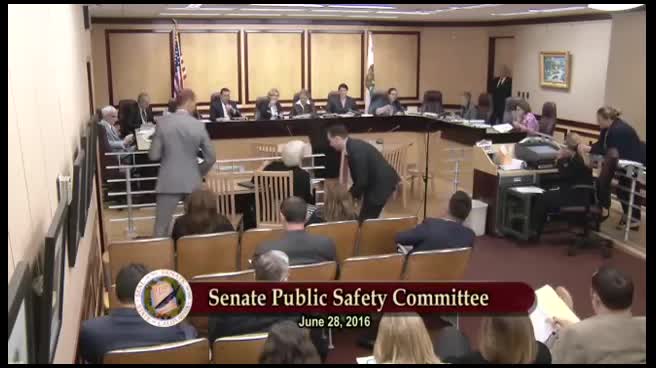
Bill Author

Bill Co-Author(s):