AB 2583: Sacramento-San Joaquin Delta Reform Act of 2009.
- Session Year: 2015-2016
- House: Assembly
- Latest Version Date: 2016-03-17
Existing law, the Sacramento-San Joaquin Delta Reform Act of 2009, establishes the Delta Stewardship Council and requires the council to develop, adopt, and commence implementation of a comprehensive management plan for the Delta, known as the Delta Plan. The Delta Plan is required to further the coequal goals of providing a more reliable water supply and protecting, restoring, and enhancing the Delta ecosystem. The act requires the council to consider the Bay Delta Conservation Plan (BDCP) for inclusion in the Delta Plan and requires the incorporation of the BDCP into the Delta Plan if the BDCP meets certain requirements.
This bill would add a definition of the California Water Fix to the act. This bill would eliminate certain provisions applicable to the BDCP and would revise other provisions to instead refer to a new Delta water conveyance project for the purpose of exporting water. This bill would require new Delta water conveyance infrastructure to be considered as interdependent parts of a system and to be operated in a way that maximizes benefits for each of the coequal goals.
The act requires a state or local public agency that proposes to undertake a covered action that will occur within the boundaries of the Delta or the Suisun Marsh to prepare, and submit to the council, a specified written certification of consistency with the Delta Plan prior to taking those actions. The act defines the term covered action to mean a plan, program, or project, as prescribed.
This bill would delete certain exclusions relating to the Bay Delta Conservation Plan BDCP from the definition of a covered action. This bill would prohibit any certification of consistency for a new Delta water conveyance project unless specified requirements are met.
The act requires the Department of Water Resources to coordinate with the Department of Fish and Wildlife, the State Water Resources Control Board, the California regional water quality control boards, and the State Lands Commission efforts to cooperate with the United States Bureau of Reclamation to construct and implement the Two-Gates Fish Protection Demonstration Project by December 1, 2010, to evaluate the effectiveness of the Three Mile Slough Barrier project, to expeditiously move ahead with certain near term actions, and to assist in implementing early action ecosystem restoration projects.
This bill would eliminate these requirements.
Under the act, until the State Water Resources Control Board issues an order approving a change in the point of diversion of the State Water Project and the federal Central Valley Project from the southern Delta to a certain point on the Sacramento River the Department of Water Resources is prohibited from commencing construction of any diversion, conveyance, or other facility necessary to divert and convey water pursuant to the change in point of diversion.
This bill would apply the above prohibition to a new point of diversion as well as a change in the point of diversion. This bill would prohibit the board from granting final approval of the requested change in or new point of diversion until the board has completed its update of a specified water quality control plan.
The act prohibits construction of a new Delta conveyance facility from being initiated until the persons or entities that contract to receive water from the State Water Project and the federal Central Valley Project or a joint powers authority representing those entities have made arrangements or entered into contracts to pay for certain costs required for the construction, operation, and maintenance of the facility and full mitigation of property tax or assessments levied for land use in the construction, location, mitigation, or operation of the facility.
This bill would instead prohibit the construction until legally binding financial agreements or contracts are signed by each of the state and federal water contractors that will receive water supplies that commit them to pay for the costs required for the federal Central Valley Project, State Water Project, and any new Delta water conveyance facility, as specified, and full mitigation of property tax or assessments levied for land use in the construction, location, mitigation, operation, or maintenance of the facility.
Existing law, the Sacramento-San Joaquin Delta Reform Act of 2009, establishes the Delta Stewardship Council and requires the council to develop, adopt, and commence implementation of a comprehensive management plan for the Delta, known as the Delta Plan.
This bill would add a definition of the California Water Fix to the act.
The act requires a state or local public agency that proposes to undertake a covered action that will occur within the boundaries of the Delta or the Suisun Marsh to prepare, and submit to the council, a specified written certification of consistency with the Delta Plan prior to taking those actions. The act defines the term covered action to mean a plan, program, or project, as prescribed.
This bill would delete certain exclusions relating to the Bay Delta Conservation Plan from the definition of a covered action.
The act requires the Department of Water Resources to coordinate with the Department of Fish and Wildlife, the State Water Resources Control Board, the California regional water quality control boards, and the State Lands Commission efforts to cooperate with the United States Bureau of Reclamation to construct and implement the Two-Gates Fish Protection Demonstration Project by December 1, 2010, to evaluate the effectiveness of the Three Mile Slough Barrier project, to expeditiously move ahead with certain near term actions, and to assist in implementing early action ecosystem restoration projects.
This bill would eliminate these requirements.
California Water Fix or Water Fix means a project, within the meaning of Section 21065 of the Public Resources Code and subdivision (a) of Section 85057.5, to construct new State Water Project conveyance facilities in the Delta.
SEC. 2.Section 85057.5 of the Water Code is amended to read:85057.5.(a)Covered action means a plan, program, or project as defined pursuant to Section 21065 of the Public Resources Code that meets all of the following conditions:
(1)Will occur, in whole or in part, within the boundaries of the Delta or Suisun Marsh.
(2)Will be carried out, approved, or funded by the state or a local public agency.
(3)Is covered by one or more provisions of the Delta Plan.
(4)Will have a significant impact on achievement of one or both of the coequal goals or the implementation of government-sponsored flood control programs to reduce risks to people, property, and state interests in the Delta.
(b)Covered action does not include any of the following:
(1)A regulatory action of a state agency.
(2)Routine maintenance and operation of the State Water Project or the federal Central Valley Project.
(3)Regional transportation plans prepared pursuant to Section 65080 of the Government Code.
(4)A plan, program, project, or activity within the secondary zone of the Delta that the applicable metropolitan planning organization pursuant to Section 65080 of the Government Code has determined is consistent with either a sustainable communities strategy or an alternative planning strategy that the State Air Resources Board has determined would, if implemented, achieve the greenhouse gas emission reduction targets established by that board pursuant to subparagraph (A) of paragraph (2) of subdivision (b) of Section 65080 of the Government Code. For purposes of this paragraph, consistent with means consistent with the use designation, density, building intensity, transportation plan, and applicable policies specified for the area in the sustainable communities strategy or the alternative planning strategy, as applicable, and any infrastructure necessary to support the plan, program, project, or activity.
(5)Routine maintenance and operation of a facility located, in whole or in part, in the Delta, that is owned or operated by a local public agency.
(6)A plan, program, project, or activity that occurs, in whole or in part, in the Delta, if both of the following conditions are met:
(A)The plan, program, project, or activity is undertaken by a local public agency that is located, in whole or in part, in the Delta.
(B)Either a notice of determination is filed, pursuant to Section 21152 of the Public Resources Code, for the plan, program, project, or activity by, or the plan, program, project, or activity is fully permitted by, September 30, 2009.
(7)A project within the secondary zone, as defined pursuant to Section 29731 of the Public Resources Code as of January 1, 2009, for which a notice of approval or determination pursuant to Section 21152 of the Public Resources Code has been filed before the date on which the Delta Plan becomes effective.
(8)Leases approved by a special district if all of the following apply:
(A)The uses proposed by the lease are authorized by the applicable general plan and zoning ordinances of the city where the special district is located.
(B)The uses proposed by the lease are approved by the city where the special district is located and the city complies with Chapter 3 (commencing with Section 85225) of Part 3, if applicable, prior to approval of the lease by the special district.
(C)The special district complies with the California Environmental Quality Act (Division 13 (commencing with Section 21000) of the Public Resources Code) prior to approving the lease.
(9)(A)Routine dredging activities that are necessary for maintenance of facilities operated by a special district.
(B)For purposes of this paragraph, routine dredging activities are limited to the following:
(i)Dredging to maintain the Stockton Deep Water Ship Channel at a depth of 40 feet in the sediment trap at the confluence of the San Joaquin River, between river mile 39.3 to river mile 40.2, and to maintain the remaining Stockton Deep Water Ship Channel at a depth of 35 feet plus two feet of overdredge from river mile 35 to river mile 43.
(ii)Dredging designed to maintain the Sacramento Deep Water Ship Channel at a depth of 30 feet plus two feet of overdredge from river mile 0.0 to river mile 30, and at a depth of 35 feet from river mile 35 to river mile 43.
(C)Except as provided by this subdivision, it is the intent of the Legislature that this exemption shall not be interpreted or treated as changing or modifying current substantive and procedural regulations applicable to the decision to approve dredging operations.
(c)For purposes of this section, special district means the Port of Stockton or the Port of West Sacramento.
(d)This section shall not be interpreted to authorize the abrogation of a vested right whether created by statute or by common law.
SEC. 3.Section 85085 of the Water Code is repealed.SEC. 3.Section 85086 of the Water Code is amended to read:85086.(a)The board shall establish an effective system of Delta watershed diversion data collection and public reporting by December 31, 2010.
(b)It is the intent of the Legislature to establish an accelerated process to determine instream flow needs of the Delta for the purposes of facilitating the planning decisions that are required to achieve the objectives of the Delta Plan.
(c)(1)For the purpose of informing planning decisions for the Delta Plan and the Bay Delta Conservation Plan, the board shall, pursuant to its public trust obligations, develop new flow criteria for the Delta ecosystem necessary to protect public trust resources. In carrying out this section, the board shall review existing water quality objectives and use the best available scientific information. The flow criteria for the Delta ecosystem shall include the volume, quality, and timing of water necessary for the Delta ecosystem under different conditions. The flow criteria shall be developed in a public process by the board within nine months of the enactment of this division. The public process shall be in the form of an informational proceeding conducted pursuant to Article 3 (commencing with Section 649) of Chapter 1.5 of Division 3 of Title 23 of the California Code of Regulations, and shall provide an opportunity for all interested persons to participate. The flow criteria shall not be considered predecisional with regard to any subsequent board consideration of a permit, including any permit in connection with a final BDCP. new Delta water conveyance project for the purpose of exporting water.
(2)Any order approving a change in the point of diversion of the State Water Project or the federal Central Valley Project from the southern Delta to a point on the Sacramento River shall include appropriate Delta flow criteria and shall be informed by the analysis conducted pursuant to this section. The flow criteria shall be subject to modification over time based on a science-based adaptive management program that integrates scientific and monitoring results, including the contribution of habitat and other conservation measures, into ongoing Delta water management.
(3)Nothing in this section amends or otherwise affects the application of the boards authority under Part 2 (commencing with Section 1200) of Division 2 to include terms and conditions in permits that in its judgment will best develop, conserve, and utilize in the public interest the water sought to be appropriated.
(d)The board shall enter into an agreement with the State Water Project contractors and the federal Central Valley Project contractors, who rely on water exported from the Sacramento River watershed, or a joint powers authority comprised of those contractors, for reimbursement of the costs of the analysis conducted pursuant to this section.
(e)The board shall submit its flow criteria determinations pursuant to this section to the council for its information within 30 days of completing the determinations.
SEC. 4.Section 85088 of the Water Code is amended to read:85088.Until the board issues an order approving a change in the or a new point of diversion of the State Water Project and the federal Central Valley Project from the southern Delta to a point on the Sacramento River as specified in subdivision (c) of Section 85086, the department shall not commence construction of any diversion, conveyance, or other facility necessary to divert and convey water pursuant to the change in or new point of diversion. In order to ensure protection of fish and wildlife and in-Delta beneficial uses of the Bay-Delta estuarys waters, final approval by the board of a change or new point of diversion described in this section shall not be granted until the board has completed its update of the 2006 water quality control plan for the Bay-Delta estuary that was initiated with a notice of preparation in 2009.
SEC. 5.Section 85089 of the Water Code is amended to read:85089.Construction of a new Delta conveyance facility shall not be initiated until the persons or entities that contract to receive water from the State Water Project and the federal Central Valley Project or a joint powers authority representing those entities have made arrangements or entered into legally binding financial agreements or contracts signed by each of the state and federal water contractors that will receive water supplies that commit them to pay for all costs, including reimbursement to the state for any General Fund or water bond funding used to date, that are associated with both of the following:
(a)The costs of the environmental review, planning, design, construction, and mitigation, including mitigation required pursuant to Division 13 (commencing with Section 21000 21000) of the Public Resources Code), Code, required for the construction, operation, and maintenance of the federal Central Valley Project, the State Water Project, and any new Delta water conveyance facility.
(b)Full mitigation of property tax or assessments levied by local governments or special districts for land used in the construction, location, mitigation, maintenance, or operation of a new Delta conveyance facilities. facility.
SEC. 6.The heading of Chapter 2 (commencing with Section 85320) of Part 4 of Division 35 of the Water Code is amended to read:2.Bay Delta Conservation Plan Delta Water ConveyanceSEC. 7.Section 85320 of the Water Code is amended to read:85320.(a)The Bay Delta Conservation Plan (BDCP) shall be considered for inclusion in the Delta Plan in accordance with this chapter.
(b)The BDCP shall not be incorporated into the Delta Plan and the public benefits associated with the BDCP shall not be eligible for state funding, unless the BDCP does all of the following:
(1)Complies with Chapter 10 (commencing with Section 2800) of Division 3 of the Fish and Game Code.
85320.(a)New Delta water conveyance infrastructure shall be considered as interdependent parts of a system and operated in a way that maximizes benefits for each of the coequal goals. A certification of consistency pursuant to Section 85225 shall not be made for a new Delta water conveyance project for the purpose of exporting water unless all of the following requirements are met:
(1)The costs of the design, construction, and operation of the water conveyance project and the associated mitigation and maintenance costs are not eligible for state funding. This includes implementation of existing habitat restoration requirements of the Department of Fish and Wildlife Longfin Smelt Incidental Take Permit for the State Water Project Delta operations and the United States Fish and Wildlife Service and National Oceanic and Atmospheric Administration National Marine Fisheries Service biological opinion for the current coordinated operations of the State Water Project and federal Central Valley Project. These costs shall be the responsibility of the water agencies that benefit from the conveyance project.
(2)The restrictions on the use of state bond funding for the acquisition of water pursuant to Section 79709 are met.
(3)A legally binding finance agreement is signed by all beneficiary state and federal water contractors committing them to pay all water conveyance project construction, mitigation, operation, maintenance, monitoring, and adaptive management costs, including reimbursement of local agency property taxes and assessments pursuant to subdivision (b) of Section 85089.
(4)An enforceable mitigation implementation plan and monitoring and an enforceable monitoring and adaptive management plan are completed and contain mechanisms, such as establishing an endowment fund, to ensure adequate and ongoing funding necessary to mitigate the impacts to communities and agricultural production in the project area and to carry out the plans that are finalized and approved by the Department of Fish and Wildlife. The Delta Independent Science Board shall perform oversight regarding implementation of these plans for the purposes of ensuring that implementation of all mitigation measures required pursuant to Division 13 (commencing with Section 21000) of the Public Resources Code is roughly proportional in time and extent to the impact on all resources analyzed in the environmental impact report and to assess the effectiveness and adequacy of mitigation performance, funding, and habitat protection measures. The Delta Independent Science Board shall annually submit its findings and recommendations to the department, the council, and the Department of Fish and Wildlife.
(5)The council determines that the proposed changes in Delta water conveyance are consistent with Section 85021 because each region that will import water from the Delta using the new Delta water conveyance demonstrates that it has improved its regional self-reliance for water by 50 percent over average regional water supply levels during the period of 2010 to 2015, inclusive, due to reduced import demand from the Delta through investment in water use efficiency, water recycling, advanced water technologies, local and regional water supply projects, and improved regional coordination of local and regional water supply efforts to the maximum extent possible.
(6)Water exported from the Delta will match more closely the surplus water supplies available to be exported based on water year type, compliance with water quality objectives of the water quality control plan for the Bay-Delta estuary, the coequal goals, and the Delta water supply protections of Chapter 1 (commencing with Section 12220) of Part 4.5 of Division 6.
(7)Conveyance infrastructure and operations enhance Delta inflows and outflows by reducing diversions in dry periods consistent with the beneficial use needs of the Delta ecosystem and water users and provide net benefits to the ecosystem beyond protecting the ecosystem from further degradation.
(8)The water conveyance project complies with real-time operational requirements in accordance with Section 85321.
(2)Complies with
(9)The requirements of Division 13 (commencing with Section 21000) of the Public Resources Code, Code are met, including a comprehensive review and analysis of all of the following:
(A)A reasonable range of flow criteria, rates of diversion, and other operational criteria required to satisfy the criteria for approval of a natural community conservation plan as provided in subdivision (a) of Section 2820 of the Fish and Game Code, and other operational requirements and flows necessary for recovering the Delta ecosystem and restoring fisheries fisheries, in compliance with all of the following, under a reasonable range of hydrologic conditions, which will identify the remaining water available for export and other beneficial uses. uses:
(i)Section 85031.
(ii)The federal Central Valley Project Improvement Act (Public Law 102-575).
(iii)The federal Water Supply, Reliability, and Environmental Improvement Act (Public Law 108-361).
(iv)The Department of Fish and Wildlife Longfin Smelt Incidental Take Permit for State Water Project Delta operations.
(v)The United States Fish and Wildlife Service and National Oceanic and Atmospheric Administration National Marine Fisheries Service biological opinion for the current coordinated operations of the State Water Project and federal Central Valley Project.
(B)A reasonable range of Delta conveyance alternatives, including through-Delta, dual conveyance, and isolated conveyance alternatives and including further capacity and design options of a lined canal, an unlined canal, and pipelines.
(C)The potential effects of climate change, possible sea level rise up to 55 inches, and possible changes in total precipitation and runoff patterns on the conveyance alternatives and habitat restoration activities considered in the environmental impact report.
(D)The potential effects on migratory fish and aquatic resources.
(E)The potential effects on Sacramento River and San Joaquin River flood management.
(F)The resilience and recovery of Delta conveyance alternatives in the event of catastrophic loss caused by earthquake or flood or other natural disaster.
(G)The potential effects of each Delta conveyance alternative on Delta water quality.
(c)
(b)The department shall consult with the council and the Delta Independent Science Board during the development of the BDCP. projects to construct new Delta water conveyance facilities for the purpose of exporting water. The council shall be a responsible agency in the development of the environmental impact report. The Delta Independent Science Board shall review the draft environmental impact report and submit its comments to the council department, the council, and the Department of Fish and Game. Wildlife.
(d)If the Department of Fish and Game approves the BDCP as a natural community conservation plan pursuant to Chapter 10 (commencing with Section 2800) of Division 3 of the Fish and Game Code, the council shall have at least one public hearing concerning the incorporation of the BDCP into the Delta Plan.
(e)If the Department of Fish and Game approves the BDCP as a natural community conservation plan pursuant to Chapter 10 (commencing with Section 2800) of Division 3 of the Fish and Game Code and determines that the BDCP meets the requirements of this section, and the BDCP has been approved as a habitat conservation plan pursuant to the federal Endangered Species Act (16 U.S.C. Section 1531 et seq.), the council shall incorporate the BDCP into the Delta Plan. The Department of Fish and Games determination that the BDCP has met the requirements of this section may be appealed to the council.
(f)
(c)The department, in coordination with the Department of Fish and Game, Wildlife, or any successor agencies or joint powers authority charged with BDCP implementation, implementation of a new Delta water conveyance project, shall report to the council on the implementation of the BDCP implementation, funding, and schedule at least once a year, including the status and effectiveness of mitigation measures, monitoring programs programs, and adaptive management.
(g)
(d)The council may make recommendations to BDCP for the purpose of the Delta Habitat Conservation and Conveyance Program and to the department, other Delta water conveyance implementing agencies agencies, and joint power authorities regarding the implementation of the BDCP. BDCP implementing a new Delta water conveyance project. Implementing agencies shall consult with the council on these recommendations. These recommendations shall not change the terms and conditions of the permits issued by state and federal regulatory agencies.
SEC. 8.Section 85321 of the Water Code is amended to read:85321.The BDCP A new Delta water conveyance project for the purpose of exporting water shall include a transparent, real-time real-time, annual, and long-term operational decisionmaking process in which fishery agencies ensure that applicable biological performance measures are achieved in a timely manner with respect to water system operations.
California Water Fix or Water Fix means a project, within the meaning of Section 21065 of the Public Resources Code and subdivision (a) of Section 85057.5, to construct new State Water Project conveyance facilities in the Delta.
SEC. 2.Section 85057.5 of the Water Code is amended to read:85057.5.(a)Covered action means a plan, program, or project as defined pursuant to Section 21065 of the Public Resources Code that meets all of the following conditions:
(1)Will occur, in whole or in part, within the boundaries of the Delta or Suisun Marsh.
(2)Will be carried out, approved, or funded by the state or a local public agency.
(3)Is covered by one or more provisions of the Delta Plan.
(4)Will have a significant impact on achievement of one or both of the coequal goals or the implementation of government-sponsored flood control programs to reduce risks to people, property, and state interests in the Delta.
(b)Covered action does not include any of the following:
(1)A regulatory action of a state agency.
(2)Routine maintenance and operation of the State Water Project or the federal Central Valley Project.
(3)Regional transportation plans prepared pursuant to Section 65080 of the Government Code.
(4)A plan, program, project, or activity within the secondary zone of the Delta that the applicable metropolitan planning organization pursuant to Section 65080 of the Government Code has determined is consistent with either a sustainable communities strategy or an alternative planning strategy that the State Air Resources Board has determined would, if implemented, achieve the greenhouse gas emission reduction targets established by that board pursuant to subparagraph (A) of paragraph (2) of subdivision (b) of Section 65080 of the Government Code. For purposes of this paragraph, consistent with means consistent with the use designation, density, building intensity, transportation plan, and applicable policies specified for the area in the sustainable communities strategy or the alternative planning strategy, as applicable, and any infrastructure necessary to support the plan, program, project, or activity.
(5)Routine maintenance and operation of a facility located, in whole or in part, in the Delta, that is owned or operated by a local public agency.
(6)A plan, program, project, or activity that occurs, in whole or in part, in the Delta, if both of the following conditions are met:
(A)The plan, program, project, or activity is undertaken by a local public agency that is located, in whole or in part, in the Delta.
(B)Either a notice of determination is filed, pursuant to Section 21152 of the Public Resources Code, for the plan, program, project, or activity by, or the plan, program, project, or activity is fully permitted by, September 30, 2009.
(7)(A)A project within the secondary zone, as defined pursuant to Section 29731 of the Public Resources Code as of January 1, 2009, for which a notice of approval or determination pursuant to Section 21152 of the Public Resources Code has been filed before the date on which the Delta Plan becomes effective.
(B)A project for which a notice of approval or determination is filed on or after the date on which the final Bay Delta Conservation Plan becomes effective, and before the date on which the Delta Plan becomes effective, is not a covered action but shall be consistent with the Bay Delta Conservation Plan.
(C)Subparagraphs (A) and (B) do not apply to either of the following:
(i)A project that is within a Restoration Opportunity Area as shown in Figure 3.1 of Chapter 3: Draft Conservation Strategy of the Bay Delta Conservation Plan, August 3, 2009, or as shown in a final Bay Delta Conservation Plan.
(ii)A project that is within the alignment of a conveyance facility as shown in Figures 1 to 5, inclusive, of the Final Draft Initial Assessment of Dual Delta Water Conveyance Report, April 23, 2008, and in future revisions of this document by the department.
(8)Leases approved by a special district if all of the following apply:
(A)The uses proposed by the lease are authorized by the applicable general plan and zoning ordinances of the city where the special district is located.
(B)The uses proposed by the lease are approved by the city where the special district is located and the city complies with Chapter 3 (commencing with Section 85225) of Part 3, if applicable, prior to approval of the lease by the special district.
(C)The special district complies with the California Environmental Quality Act (Division 13 (commencing with Section 21000) of the Public Resources Code) prior to approving the lease.
(9)(A)Routine dredging activities that are necessary for maintenance of facilities operated by a special district.
(B)For purposes of this paragraph, routine dredging activities are limited to the following:
(i)Dredging to maintain the Stockton Deep Water Ship Channel at a depth of 40 feet in the sediment trap at the confluence of the San Joaquin River, between river mile 39.3 to river mile 40.2, and to maintain the remaining Stockton Deep Water Ship Channel at a depth of 35 feet plus two feet of overdredge from river mile 35 to river mile 43.
(ii)Dredging designed to maintain the Sacramento Deep Water Ship Channel at a depth of 30 feet plus two feet of overdredge from river mile 0.0 to river mile 30, and at a depth of 35 feet from river mile 35 to river mile 43.
(C)Except as provided by this subdivision, it is the intent of the Legislature that this exemption shall not be interpreted or treated as changing or modifying current substantive and procedural regulations applicable to the decision to approve dredging operations.
(c)For purposes of this section, special district means the Port of Stockton or the Port of West Sacramento.
(d)This section shall not be interpreted to authorize the abrogation of a vested right whether created by statute or by common law.
SEC. 3.Section 85085 of the Water Code is repealed.85085.The department shall do all of the following:
(a)Coordinate with the Department of Fish and Game, the board, the California regional water quality control boards, and the State Lands Commission efforts to cooperate with the United States Bureau of Reclamation to construct and implement the Two-Gates Fish Protection Demonstration Project by December 1, 2010.
(b)Evaluate the effectiveness of the Three Mile Slough Barrier project.
(c)Expeditiously move ahead with other near term actions as identified in the Strategic Plan.
(d)Assist in implementing early action ecosystem restoration projects, including, but not limited to, Dutch Slough tidal marsh restoration and Meins Island tidal marsh restoration.
|
Date
|
Status
|
|---|---|
| Feb 19, 2016 | Introduced. To print. |
| Feb 21, 2016 | From printer. May be heard in committee March 22. |
| Feb 22, 2016 | Read first time. |
| Mar 10, 2016 | Referred to Com. on W., P., & W. |
| Mar 17, 2016 | From committee chair, with author's amendments: Amend, and re-refer to Com. on W., P., & W. Read second time and amended. |
| Mar 28, 2016 | Re-referred to Com. on W., P., & W. |
| Apr 7, 2016 | In committee: Hearing postponed by committee. |
| Apr 19, 2016 | In committee: Set, first hearing. Failed passage. |
| May 27, 2016 | From committee: Without further action pursuant to Joint Rule 62(a). |
|
Date
|
Description
|
Location
|
Votes
|
|
|---|---|---|---|---|
| Apr 19, 2016 | Do pass and be re-referred to the Committee on [Appropriations] | Assembly Standing Committee on Water, Parks, and Wildlife |
Failed |
This list shows positions taken on this bill by organizations on the date displayed, which is linked to the original source.
Positions by individuals are not included.
|
Organization
|
Position
|
Date
|
|---|---|---|
| Alameda County Zone 7 Water Agency | ** Against | Apr 19, 2016 |
| Associated General Contractors Of California | ** Against | Apr 19, 2016 |
| Association of California Cities, Orange County | ** Against | Apr 19, 2016 |
| Association Of California Water Agencies | * Against | Apr 19, 2016 |
| Bay Institute, The | ** Support | Apr 19, 2016 |
| Cafe Coop | * Support | Apr 19, 2016 |
| California Alliance for Jobs | ** Against | Apr 19, 2016 |
| California Asian Pacific Chamber Of Commerce | ** Against | Apr 19, 2016 |
| California Business Properties Association | ** Against | Apr 19, 2016 |
| California Central Valley Flood Control Association | ** Support | Apr 19, 2016 |
| California Chamber Of Commerce | ** Against | Apr 19, 2016 |
| California Contract Cities Association | ** Against | Apr 19, 2016 |
| California Delta and Chambers Visitors Bureau | ** Support | Apr 19, 2016 |
| California Professional Firefighters | ** Against | Apr 19, 2016 |
| California Small Business Association | ** Against | Apr 19, 2016 |
| California State Association Of Electrical Workers | * Against | Apr 19, 2016 |
| Center of Business and Policy Research at the Univeristy of Pacific | * Support | Apr 19, 2016 |
| Central Delta Water Agency | ** Support | Apr 19, 2016 |
| City of Rio Vista | ** Support | Apr 19, 2016 |
| Coachella Valley Water District | * Against | Apr 19, 2016 |
| Contra Costa County Farm Bureau | ** Support | Apr 19, 2016 |
| Delta Caucus | ** Support | Apr 19, 2016 |
| Delta Counties Coalition | ** Support | Apr 19, 2016 |
| Greater Stockton Chamber of Commerce | ** Support | Apr 19, 2016 |
| Inland Empire Utilities Agency | * Against | Apr 19, 2016 |
| Kern County Water Agency | * Against | Apr 19, 2016 |
| Local Agencies of the North Delta | ** Support | Apr 19, 2016 |
| Local Agencies of the North Delta (LAND) | * Support | Apr 19, 2016 |
| Metropolitan Water District | * Against | Apr 19, 2016 |
| North Delta Cares Action Committee | ** Support | Apr 19, 2016 |
| Planning And Conservation League | ** Support | Apr 19, 2016 |
| Restore the Delta | * Support | Apr 19, 2016 |
| Sacramento County Farm Bureau | ** Support | Apr 19, 2016 |
| San Joaquin County | ** Support | Apr 19, 2016 |
| San Joaquin County Farm Bureau | ** Support | Apr 19, 2016 |
| San joaquin Farm Bureau Federation | * Support | Apr 19, 2016 |
| Sierra Club California | ** Support | Apr 19, 2016 |
| Solano County Board of Supervisors | ** Support | Apr 19, 2016 |
| Solano County Farm Bureau | ** Support | Apr 19, 2016 |
| South Delta Water Agency | ** Support | Apr 19, 2016 |
| Yolo County Farm Bureau | ** Support | Apr 19, 2016 |
Date of Hearing: April 19, 2016
ASSEMBLY COMMITTEE ON WATER, PARKS, AND WILDLIFE
Marc Levine, Chair
ABPCA Bill Id:AB 2583 (
Author:Frazier) – As Amended Ver:March 17, 2016
SUBJECT: Sacramento-San Joaquin Delta Reform Act of 2009
SUMMARY: Places new requirements on the approval, financing, and operation of any new conveyance facility in the Sacramento-San Joaquin Delta (Delta). Specifically, this bill:
- Strikes reference in law to the Bay Delta Conversation Plan (BDCP) and replaces with new Delta water conveyance.
- Defines California WaterFix as a covered action project in the Delta and eliminates specific activities currently excluded from a covered action.
- Creates new requirements on the permit approval and financial commitments associated with new Delta conveyance.
- Creates new requirements for consistency with the Delta Plan.
EXISTING LAW:
- Provides the State Water Resources Control Board (State Water Board) authority to protect Delta municipal, industrial, agricultural and fish and wildlife beneficial water uses through the adoption and implementation of a Water Quality Control Plan (WQCP) for the Delta.
- Provides the Department of Water Resources (DWR) authority to construct and operate the State Water Project (SWP) and to construct, maintain, and operate additional SWP units that further the purposes of the SWP.
- Prohibits the DWR from constructing any diversion, conveyance, or other facility to divert from the Sacramento River to the south Delta until the State Water Board issues an order approving the change. Requires the State Water Board to include appropriate Delta flow criteria in any order approving a change in diversion.
- Prohibits construction of any new Delta conveyance facility until the SWP and the federal Central Valley Project (CVP) contractors enter into a contract to pay for environmental and community impacts associated with construction, operation, and maintenance of the facility.
- Establishes coequal goals in the Delta of a more reliable water supply for California and protecting, restoring and enhancing the Delta ecosystem while mandating that the coequal goals are to be achieved in a manner that protects and enhances the unique cultural, recreational, natural resource, and agricultural values of the Delta as an evolving place.
- Creates the Delta Stewardship Council (Council) which, among other tasks, must develop and implement the Delta Plan a long-term management plan that meets the coequal goals.
- Requires that the Delta Plan promote options for new and improved infrastructure relating to Delta water conveyance, storage systems, and operations to achieve the coequal goals. Requires the Delta Plan promote statewide water conservation, water use efficiency, and sustainable use of water.
- States the intent that any covered action in the Delta be consistent with the Delta Plan.
- Permits inclusion of the BDCP into the Delta Plan only if it complies with a Natural Community Conservation Plan (NCCP), the California Environmental Quality Act (CEQA), and that the CEQA analysis specifically looks at flow related operational requirements and a reasonable range of Delta conveyance alternatives.
FISCAL EFFECT: unknown
COMMENTS:
- Author’s Statement: Fiscal accountability and protection of Delta water supplies and natural resources must be the foundation of any proposal by the State to expand its water conveyance facilities in the Delta. In response to the recent decision by the Administration to abandon the BDCP as originally proposed when the Legislature adopted the Delta Reform Act in 2009, the bill will provide new legislative guidance to ensure fiscal accountability and project management performance standards for any new SWP/CVP conveyance project proposed in the Delta. This bill protects California taxpayers by requiring legally binding fiscal assurances and proposes to prevent any change in diversion from unreasonably harming water users in the Delta or public trust resources, including fish and wildlife.
- Background: There is broad agreement that the state’s water management system is currently unable to satisfactorily meet both ecological and human needs. Under current water use, demands surpass supply; especially, in times of drought. The State has taken action through the Water Action Plan to lay out a path to sustainable water management. This and other documents, necessarily put all options on the table to improve the water management system. Those options include but are not limited to conservation, efficiency, stormwater capture, groundwater replenishment, recycled water, and desalination. Due to limited resources it is important that the state invest first in actions of the highest value to create the greatest improvements in water reliability for human and natural requirements.
The Delta is crucial and is in decline: The Sacramento-San Joaquin Delta (Delta) is both the hub of the California Water System and the most valuable estuary and wetland ecosystem on the west coast of the Americas. The Delta provides water to more than 25 million Californians and 3 million acres of agricultural land. It supports a four hundred billion dollar a year economy, is part of the Pacific Flyway, is critical habitat to 700 native plant and animal species, and is home to more than 500,000 people.
California is an arid state with limited precipitation. The mountains in the northern part of the state serve as the state’s water catcher and largest natural surface reservoir. These mountains receive the bulk of their precipitation as snow in the winter. The majority of human needs in the state are hundreds of miles from the primary water source. This hurdle of time and place of use led to major reengineering of the hydrology of the state. Beginning in 1933 and largely culminating in 1968 a major redirecting of water from the mountains to the cities and valleys through the construction of the CVP and the SWP made the Delta the hub of water in California.
The Delta watershed and California’s water infrastructure are in crisis and existing pressures on the Delta are not sustainable. Among other human impacts the CVP and the SWP operations have altered the natural amount, duration, direction and timing of water flows. As a result, today there are about 100 Delta wildlife species, 140 plant species and 13 species of fish that have some form of legal or regulatory protection. There have been numerous species-related restrictions on the management of water exports from the Delta since 1991, with restrictions being in place continuously since 2008.
Simply receiving more precipitation does not appear to be sufficient to resolve the challenges for species and deliveries in the Delta as a significant part of the problem stems from the fact that the infrastructure associated with deliveries itself is environmentally damaging. 2016, an average precipitation year, is an example of what the future of this environmental and infrastructure challenge would appear to hold. CVP Sacramento Valley interests are projected to receive 100% of their deliveries while many CVP San Joaquin Valley interests are projected to receive 5% of deliveries. It seems that further restrictions on deliveries from the Delta and continued ecological decline are a certainty under the status quo.
The expectation behind proposed changes in conveyance in the Delta has always been that it will improve the reliability of water deliveries out of the Delta. A concern that has always gone along with that expectation is what the environmental impacts of that reliability will be, and what the impacts would be on the people who live in the Delta.
Long Look at Conveyance and Delta Management: Since prior to the completion of both the CVP and the SWP there has been an ongoing debate about how to manage the Delta. Management and conveyance in the Delta have been and continue to be closely linked together. Because management and conveyance have been the responsibility of federal, state, and local governments, plans have not always been coordinated and have occurred in overlapping ways. Much of the debate on coordination, conveyance, and management was settled in legislation that was passed in 2009. While the legislation contemplated Delta management under the scenario where BDCP did not move forward, the legislation specifically built BDCP into Delta management.
Delta Legislation 2009
In 2009, when California faced a third consecutive dry year, former Governor Schwarzenegger called an Extraordinary Session of the Legislature to address water issues. That Extraordinary Session produced several pieces of legislation including SB 1 (Simitian, Chapter 5, Statutes of the 7th Extraordinary Session 2009-2010). Among numerous changes, this legislation tied Delta conveyance, governance, and funding together. SB 1 x7 clarified that any new conveyance facility could not be constructed without approval from the State Water Board. It required the State Water Board to develop new flow criteria for the Delta and include that flow criteria in any approval for new conveyance.
SB 1 x7 set environmental bars for BDCP beyond those required under CEQA with specific analysis required for numerous conveyance alternatives, and included a reasonable range of flow criteria, rates of diversion, and other operational criteria. Importantly, SB 1 x7 required BDCP to be approved as a federal Habitat Conservation Plan (HCP) and a state Natural Community Conservation Plan (NCCP) in order to be eligible for public funding.
Additionally, SB 1 x7 established the Delta Stewardship Council (Council) as a governance body for the Delta. Part of the Council’s responsibility is to develop a Delta Plan and make determinations of consistency for construction in the Delta with the Delta Plan. Any new conveyance facility would fall under an action that would be evaluated by the Council for consistency with the Delta Plan.
Among other things, the Delta Plan is required to:
- Further the restoration of the Delta through advancing the coequal goals of providing water reliability and enhancing the Delta ecosystem in a manner that protects the unique culture of the Delta.
- Promote statewide water conservation, water use efficiency, and sustainable use of water.
- Promote options for conveyance, storage, and operation that achieve the coequal goals.
- Be based on the best available science and promote a healthy Delta ecosystem.
WaterFix 2015-Present
In 2015 federal agencies determined that BDCP likely would not meet the requirements of an HCP and that the Delta conveyance associated with BDCP would not receive long-term permits for operation. This effectively led to the end of the BDCP and resulted in the Department splitting BDCP into WaterFix, the Delta conveyance piece of BDCP, and EcoRestore the ecological restoration piece of BDCP.
Recent estimates put the cost of WaterFix at $17 billion and EcoRestore at $8 billion. Under existing law, the CVP and the SWP contractors will have to pay the cost of WaterFix. The funding for EcoRestore is less clear and while the CVP and the SWP contractors will have to pay the mitigation costs associated with any new conveyance it is not clear if that mitigation will cover all costs associated with EcoRestore.
Much of SB 1 x7 still applies to how conveyance and governance continue to be carried out in the Delta. Importantly, the approval process for conveyance at the State Water Board and the Council remains in place.
Status Quo vs Certain Improvement
Part of the consideration that went into passage of SB 1 x7 was the reality that the Delta watershed and California’s water infrastructure are in a crisis and existing Delta policies are not sustainable. As a result, the legislation considered the scenario where BDCP did not move forward. That scenario placed even greater importance on the Delta Plan, and specifically, the adaptive management strategy adopted in the Delta Plan. The adaptive management strategy currently adopted is one that provides for making management decisions using the best available science to build better approaches that move decisions beyond repeated delay in action until more information is available. The purpose of the adaptive management strategy is to increase the likelihood of success in managing natural resources where there is considerable uncertainty.
There is no silver bullet for solving the crisis in the Delta. At this point, the best available science only tells us the status quo is a sure fire path to failure. In short, the best available science says we must do something if we are to meet the coequal goals, but it doesn’t tell us what that something is.
SB 1 x7 envisioned new Delta conveyance being directly tied to environmental standards. Specifically, SB 1 x7 stated the intent that Delta conveyance be part of the Delta plan and conditioned the inclusion of BDCP in the Delta plan to BDCP becoming compliant with an HCP/NCCP, and further required specific analysis on flow that would meet an NCCP in the CEQA analysis, among other things.
Now that BDCP is no longer under consideration, an important question centers on the ability of the Delta Plan and its adaptive management strategy to reduce uncertainty; will the adaptive management strategy provide for a meaningful process to improve Delta management in meeting the coequal goals over time?
The Council has recently begun the process of updating the Delta Plan, has submitted a Budget Change Proposal in the budget process to pay for that update, and has established new principles for conveyance, water storage, and operations.
Where Do We Go Post BDCP?
The straight forward issue this bill raises is now that BDCP is a thing of the past, should the process approved in 2009 be improved to provide greater evaluation, financial assurances and environmental protection?
This bill lays out three broad ways in which it would adjust SB 1 x7:
- Provide financial certainty that every impact associated with a new Delta conveyance will be paid for.
- Provide for additional evaluation necessary to meet approval of new Delta conveyance from the State Water Board.
- Provide additional requirements necessary to meet approval of new Delta conveyance from the Council.
This bill sets a high bar in all three of those areas.
The financial requirements are expansive, including all costs to date, associated with the SWP and the CVP. It is questionable if the state has the ability to impose these costs on federal CVP contractors. It may be unconstitutional to require funding used for fish and wildlife enhancement associated with the SWP to be restricted or repaid. The language would require each state and federal water contractor to sign a legally binding financial agreement. This would essentially give any water contractor veto power over new Delta conveyance.
Potential Considerations
The committee may wish to clarify the following that the financial agreements will apply only to contractors who enter into a financial agreement; that for the project to move forward there is sufficient funding to meet the expected costs of construction; that in addition to identified mitigation there is a funding mechanism put in place to finance the adaptive management plan long-term; and that the CVP contractors will be requested, not required, to pay costs; that fish and wildlife enhancement associated with the SWP will continue to have elements of state funding, or provisions in existing law requiring that state funding be changed.
One of the requirements of BDCP was that a reasonable range of flows would be evaluated to meet the needs to recover fish and that only water beyond those requirements would be available for export. Existing law requires the State Water Board to uphold the public trust. It also requires the State Water Board to approve any new conveyance. This bill would require the update of the Bay-Delta water quality control plan be completed before the State Water Board could approve any new conveyance. The water quality control plan is a four phase plan that was initiated in 2009 and has yet to complete phase 1.
The committee may wish to reinstate the requirement that fish flow requirements be met. The committee may further wish to require that fish flow requirements be built into the Delta plan, or explicitly into the adaptive management plan.
The bill imposes numerous new requirements on any new conveyance to meet a certification of consistency with the Delta Plan. In total these requirements would establish a bar that would be essentially unattainable for new conveyance to meet a certification of consistency. Moreover, certification of consistency is a point in time event. Some of the requirements in this bill are ongoing, inherently raising the question if there is an ability to meet these requirements to gain a certification of consistency.
The committee may wish to establish requirements to be included in the Delta Plan that address the fact that BDCP will no longer be included in the Delta Plan. That may include some of the requirements currently proposed in this bill for a certification of consistency.
Approval of new Conveyance
A ballot initiative in this November’s election would require the state to seek voters' permission before funding projects of $2 billion or more with revenue bonds. The administration had been and may still propose such bonds for new Delta conveyance.
Any large scale conveyance project that moves water from the Sacramento River to the South Delta CVP and the SWP pumping plants would have to comply with CEQA and all of the associated requirements for approval of the project.
In addition, exclusive to the BDCP process, at least part of the ability to gain approval for a Delta conveyance facility was clearly laid out through SB 1 x7 and that process must be adhered to today. Among other things that process required the Council to make a certification of consistency with the Delta plan. It is not clear whether the Council will find new Delta conveyance to be consistent with the Delta Plan, but it seems likely that process would inform any CEQA challenge.
- Prior and Related Legislation:
AB 1713 (Eggman) of 2016, requires an initiative vote to authorize construction of any Delta conveyance. AB 1713 is pending in this committee.
AB 550 (Huber) of 2011, would have prohibited construction of a peripheral canal unless there was expressed legislative approval. The bill failed passage out of this Committee.
AB 1594 (Huber) of 2010, would have prohibited construction of a peripheral canal unless there was expressed legislative approval. The bill was held in this Committee.
SB 1 x 7 (Simitian) Chapter 5, Statues of the 7th Extraordinary Session of 2009-2010, established the Sacramento-San Joaquin Delta Reform Act requiring Delta management to meet the coequal goals.
- Supporting Arguments: AB 2583 will ensure that appropriate fiscal and environmental safeguards are applied to any new Delta conveyance. New Delta conveyance is not automatically incorporated in the Delta Plan as was the case with the BDCP. Specific criteria to guide approval and implementation of any new Delta water conveyance infrastructure that exports water out of the Delta is necessary. Greater environmental safeguards are necessary beyond those established in 2009 in order to ensure the protection of fish and wildlife and in-Delta beneficial uses. Requiring a completed update of the 2006 water quality control plan for the Bay-Delta estuary is crucial in protecting the Delta’s environment.
- Opposing Arguments: This bill would create onerous new requirments that would delay or even stop the construction of the California WaterFix. These provisions would cause years of delays and greatly reduce the reliability of water supplies for 2/3 of the state. This bill attempts to significantly change the rules for operation, funding, management, and construction of the project. These new rules will undo the collaborative, exhaustive process that has brought us to this point. Arriving at a Delta solution is a complex process. State and federal agencies have been working in collaboration with stakeholders and the science community for years to weigh alternatives in order to develop the best plan possible to ensure that the coequal goals are met.
REGISTERED SUPPORT / OPPOSITION:
Support
Bay Institute, The
California Central Valley Flood Control Association
California Delta and Chambers Visitors Bureau
Central Delta Water Agency
City of Rio Vista
Contra Costa County Farm Bureau
County of Sacramento
Delta Caucus
Delta Counties Coalition
Greater Stockton Chamber of Commerce
Local Agencies of the North Delta
North Delta Cares Action Committee
Planning and Conservation League
Restore the Delta
Sacramento County Farm Bureau
San Joaquin County
San Joaquin County Farm Bureau
Sierra Club California
Solano County Board of Supervisors
Solano County Farm Bureau
South Delta Water Agency
Yolo County Farm Bureau
Opposition
Alameda County Zone 7 Water Agency
American Council of Engineering Companies
Associated General Contractors of California
Association of California Cities, Orange County
Association of California Water Agencies
California Alliance for Jobs
California Asian Pacific Chamber of Commerce
California business Properties Association
California Chamber of Commerce
California Contract Cities Association
California Professional Firefighters
California Small Business Association
California State Association of Electrical Workers
California State Building & Construction Trades Council
Calleguas Municipal Water District
Camarillo Chamber of Commerce
Central City Association of Los Angeles
Chambers of Commerce Alliance of Ventura and Santa Barbara Counties
Coachella Valley Water District
Cucamonga Valley Water District
Eastern Municipal Water District
El Toro Water District
Elsinore Valley Municipal Water District
Engineering Contractor’s Association
Foothill Municipal Water District
Gateway Chambers Alliance
Great Bakersfield Chamber of Commerce
Greater Conejo Valley Chamber of Commerce
Greater Fresno Area Chamber of Commerce
Greater Los Angeles African American Chamber of Commerce
Greater Riverside Chambers of Commerce
Huntington Beach Chamber of Commerce
Imperial County Building & Construction Trades Council
Inland Action
Inland Empire African American Chamber of Commerce
Inland Empire Economic Partnership
Insulators & Allied Workers Local Union 5
International Association of Heat and Frost Insulators and Allied Workers Local Union 16
International Brotherhood of Boilermakers Local Union 549
International Brotherhood of Electrical Workers Local Union 6
International Brotherhood of Electrical Workers Local Union 11
International Brotherhood of Electrical Workers Local Union 45
International Brotherhood of Electrical Workers Local Union 234
International Brotherhood of Electrical Workers Local Union 332
International Brotherhood of Electrical Workers Local Union 428
International Brotherhood of Electrical Workers Local Union 441
International Brotherhood of Electrical Workers Local Union 477
International Brotherhood of Electrical Workers Local Union 551
International Brotherhood of Electrical Workers Local Union 684
International Union of Painters & Allied Trades, District Council 36
Ironworkers Local Union 433
Kern County Taxpayer Association
Kern County Water Agency
Kern, Inyo and Mono Counties Building and Construction Trades Council
Las Virgenes Municipal Water District
Los Angeles Area Chamber of Commerce
Los Angeles County Business Federation
Los Angeles/Orange County Building & Construction Trades Council
Marin County Building & Construction Trades Council
Mesa Water District
Metropolitan Water District of Southern California
Mojave Water Agency
Monterey/Santa Cruz Building & Construction Trades Council
Moreno Valley Chamber of Commerce
Municipal Water District of Orange County
Natural Heritage Institute
North Orange County Chamber of Commerce
Northeastern Counties Building & Construction Trades Council
Oxnard Chamber of Commerce
Piping Industry Progress and Education (P.I.P.E)
Pistachio Producers of California
Port Hueneme Chamber of Commerce
Redondo Beach Chamber of Commerce
San Bernardino Valley Municipal Water District
San Diego County Building & Construction Trades Council
San Francisco Chamber of Commerce
San Francisco Peninsula Fire Safe Council
San Gabriel Valley Economic Partnership
San Gorgonio Pass Water Agency
San Jose Silicon Valley Chamber of Commerce
San Jose/Silicon Valley NAACP
San Mateo County Building & Construction Trades Council
Santa Clara/San Benito County Building & Construction Trades Council
Santa Margarita Water District
Sheet Metal, Air, Rail & Transportation Workers 105
Sonoma, Mendocino and Lake Counties Building & Construction Trades Councils
South Bay Association of Chambers of Commerce
South Bay Labor Council
Southern California Water Committee
Southwest California Legislative Council
Southwest Riverside County Association of Realtors
Stanislaus, Merced, Tuolumne and Mariposa Counties Building & Construction Trades Council
Three Valleys Municipal Water District
Torrance Area Chamber of Commerce
Tulare Kings Hispanic Chamber of Commerce
United Association of Plumbers and Steamfitters Local Union 484
United Chambers of Commerce San Fernando Valley & Region
Valley Ag Coalition
Valley Industry & Commerce Association
Ventura County Taxpayers Association
Western Growers Association
Western Municipal Water District
Yorba Linda Water District
Analysis Prepared by: Ryan Ojakian / W., P., & W. / (916) 319-2096
Discussed in Hearing
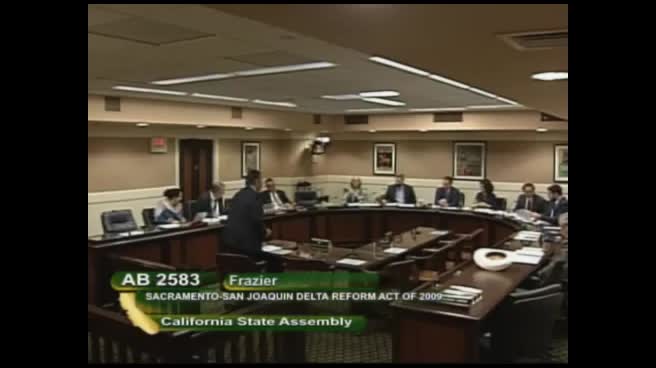 33MIN
Assembly Standing Committee on Water, Parks, and Wildlife
Bill Author

Bill Co-Author(s):