AB 264: Farm products: processors: produce dealers: seeds.
- Session Year: 2015-2016
- House: Assembly
- Latest Version Date: 2015-09-21
(1)Existing law, the California Seed Law, requires the Secretary of Food and Agriculture, by regulation, to adopt, among other things, specified lists of plants and crops that the secretary finds are or may be grown in the state or that the secretary finds are detrimental to agriculture if they occur incidentally in other crops, as prescribed, a list of noxious weed seed that the secretary finds are prohibitive noxious weed seed, and methods and procedures, upon recommendation of the Seed Advisory Board, for the conciliation, mediation, or arbitration of disputes between labelers and any persons concerning conformance with label statements, advertisements, or other disputes regarding the quality or performance of seed.
This bill would expand this regulation authority to also make those methods and procedures for the conciliation, mediation, or arbitration of those disputes applicable to disputes concerning conformance with financial terms or the lack of payment by a dealer to a grower, as provided. By expanding the scope of that regulation authority, a violation of which is a crime, the bill would impose a state-mandated local program.
(2)Existing law specifies that every producer of any farm product that sells any farm product that is grown by him or her to any processor under contract, express or implied, in addition to all other rights and remedies that are provided by law, has a lien upon that product and upon all processed or manufactured forms of that farm product for his or her labor, care, and expense in growing and harvesting that product.
This bill would also specify that every producer of a flower, agricultural, or vegetable seed that sells seed that is grown by him or her, when the seed was purchased or supplied by the grower and not supplied by the dealer or an independent 3rd party who paid for the seed, to any seed dealer under contract, express or implied, in addition to all rights and remedies that are provided for by law, has a lien upon that product and upon all processed or manufactured forms of that product for his or her labor, care, and expense in growing and harvesting that product.
(3)Existing law requires that any person engaged in the business of buying, receiving on consignment, soliciting for sale on commission, or negotiating the sale of farm products from a licensee or producer for resale, to be licensed. Existing law, for purposes of those provisions, defines farm product to include every agricultural, horticultural, viticultural, and vegetable product of the soil, poultry and poultry products, livestock products and livestock not for immediate slaughter, bees and apiary products, hay, dried beans, honey, and cut flowers, but excludes from that definition any timber or timber product, flower or agricultural or vegetable seed not purchased from a producer, any milk product that is subject to specified licensing requirements, any aquacultural product, or cattle sold to any person who is bonded under a specified federal law.
This bill would revise that definition to exclude flower, agricultural, or vegetable seeds from the definition of farm products, rather than only those that have not been purchased from a producer.
(4)The California Constitution requires the state to reimburse local agencies and school districts for certain costs mandated by the state. Statutory provisions establish procedures for making that reimbursement.
This bill would provide that no reimbursement is required by this act for a specified reason.
(1)Existing law, the California Seed Law, requires the Secretary of Food and Agriculture, by regulation, to adopt, among other things, specified lists of plants and crops that the secretary finds are or may be grown in the state or that the secretary finds are detrimental to agriculture if they occur incidentally in other crops, as prescribed, a list of noxious weed seed that the secretary finds are prohibitive noxious weed seed, and methods and procedures, upon recommendation of the Seed Advisory Board, for the conciliation, mediation, or arbitration of disputes between labelers and any persons concerning conformance with label statements, advertisements, or other disputes regarding the quality or performance of seed.
This bill would expand this regulation authority to also make those methods and procedures for the conciliation, mediation, or arbitration of those disputes applicable to disputes concerning conformance with financial terms or the lack of payment by a dealer to a grower. grower, as provided. By expanding the scope of that regulation authority, a violation of which is a crime, the bill would impose a state-mandated local program.
(2)Existing law specifies that every producer of any farm product that sells any farm product that is grown by him or her to any processor under contract, express or implied, in addition to all other rights and remedies that are provided by law, has a lien upon that product and upon all processed or manufactured forms of that farm product for his or her labor, care, and expense in growing and harvesting that product.
This bill would, instead, would also specify that every producer of a flower, agricultural, or vegetable seed that sells seed that is grown by him or her, when the seed was purchased or supplied by the grower and not supplied by the dealer or an independent third 3rd party who paid for the seed, to any seed dealer under contract, express or implied, in addition to all rights and remedies that are provided for by law, has a lien upon that product and upon all processed or manufactured forms of that product for his or her labor, care, and expense in growing and harvesting that product.
(3)Existing law requires that any person engaged in the business of buying, receiving on consignment, soliciting for sale on commission, or negotiating the sale of farm products from a licensee or producer for resale, to be licensed. Existing law, for purposes of those provisions, defines farm product to include every agricultural, horticultural, viticultural, and vegetable product of the soil, poultry and poultry products, livestock products and livestock not for immediate slaughter, bees and apiary products, hay, dried beans, honey, and cut flowers, but excludes from that definition any timber or timber product, flower or agricultural or vegetable seed not purchased from a producer, any milk product that is subject to specified licensing requirements, any aquacultural product, or cattle sold to any person who is bonded under a specified federal law.
This bill would revise that definition to exclude flower, agricultural, or vegetable seeds from the definition of farm products, rather than only those that have not been purchased from a producer.
(4)The California Constitution requires the state to reimburse local agencies and school districts for certain costs mandated by the state. Statutory provisions establish procedures for making that reimbursement.
This bill would provide that no reimbursement is required by this act for a specified reason.
Existing
(1)Existing law, the California Seed Law, requires the Secretary of Food and Agriculture, by regulation, to adopt, among other things, specified lists of plants and crops that the secretary finds are or may be grown in the state or that the secretary finds are detrimental to agriculture if they occur incidentally in other crops, as prescribed, a list of noxious weed seed that the secretary finds are prohibitive noxious weed seed, and methods and procedures, upon recommendation of the Seed Advisory Board, for the conciliation, mediation, or arbitration of disputes between labelers and any persons concerning conformance with label statements, advertisements, or other disputes regarding the quality or performance of seed.
This bill would expand this regulation authority to also make those methods and procedures for the conciliation, mediation, or arbitration of those disputes applicable to disputes concerning conformance with financial terms or the lack of payment by a dealer to a grower. By expanding the scope of that regulation authority, a violation of which is a crime, the bill would impose a state-mandated local program.
(2)Existing law specifies that every producer of any farm product that sells any farm product that is grown by him or her to any processor under contract, express or implied, in addition to all other rights and remedies that are provided by law, has a lien upon that product and upon all processed or manufactured forms of that farm product for his or her labor, care, and expense in growing and harvesting that product.
This bill would, instead, specify that every producer of a flower, agricultural or vegetable seed that sells seed that is grown by him or her, when the seed was purchased or supplied by the grower and not supplied by the dealer or an independent third party who paid for the seed, to any seed dealer under contract, express or implied, in addition to all rights and remedies that are provided for by law, has a lien upon that product and upon all processed or manufactured forms of that product for his or her labor, care, and expense in growing and harvesting that product.
(3)Existing law requires that any person engaged in the business of buying, receiving on consignment, soliciting for sale on commission, or negotiating the sale of farm products from a licensee or producer for resale, to be licensed. Existing law, for purposes of those provisions, defines farm product to include every agricultural, horticultural, viticultural, and vegetable product of the soil, poultry and poultry products, livestock products and livestock not for immediate slaughter, bees and apiary products, hay, dried beans, honey, and cut flowers, but excludes from that definition any timber or timber product, flower or agricultural or vegetable seed not purchased from a producer, any milk product that is subject to specified licensing requirements, any aquacultural product, or cattle sold to any person who is bonded under a specified federal law.
This bill would revise that definition to exclude flower, agricultural, or vegetable seeds from the definition of farm products, rather than only those that have not been purchased from a producer.
(4)The California Constitution requires the state to reimburse local agencies and school districts for certain costs mandated by the state. Statutory provisions establish procedures for making that reimbursement.
This bill would provide that no reimbursement is required by this act for a specified reason.
Existing law requires that any person engaged in the business of buying, receiving on consignment, soliciting for sale on commission, or negotiating the sale of farm products from a licensee or producer for resale, to be licensed. Existing law, for purposes of those provisions, defines farm product to include every agricultural, horticultural, viticultural, and vegetable product of the soil, poultry and poultry products, livestock products and livestock not for immediate slaughter, bees and apiary products, hay, dried beans, honey, and cut flowers, but excludes from that definition any timber or timber product, flower or agricultural or vegetable seed not purchased from a producer, any milk product that is subject to specified licensing requirements, any aquacultural product, or cattle sold to any person who is bonded under a specified federal law.
This bill would revise that definition to exclude flower, agricultural, or vegetable seeds from the definition of farm products, rather than only those that have not been purchased from a producer.
The secretary, by regulation, may adopt all of the following:
(a)A list of the plants and crops that the secretary finds are or may be grown in this state.
(b)A list of the plants and crops that the secretary finds are detrimental to agriculture if they occur incidentally in other crops, and which, therefore, are classed as weed seed except if sold alone or as a specific constituent of a definite seed mixture.
(c)A list of noxious weed seed that the secretary finds are prohibited noxious weed seed, as defined in this chapter.
(d)A list of those noxious weed seed that are not classified as prohibited noxious weed seed and are classified by this chapter as restricted noxious weed seed.
(e)A list of substances that are likely to be used for treating grain or other crop seed that the secretary finds and determines are toxic to human beings or animals if used, and an appropriate warning or caution statement for each substance.
(f)(1)(A)Establish methods and procedures, upon the recommendation of the board, for the conciliation, mediation, or arbitration of disputes between labelers and any persons concerning conformance with label statements, advertisements, financial terms or the lack of payment by a dealer to a grower, or other disputes regarding the quality or performance of seed. The methods and procedures shall be a mandatory prerequisite to pursuing other dispute resolution mechanisms, including, but not limited to, litigation. However, if conciliation, mediation, or arbitration proceedings are commenced under this section to resolve a controversy, the statute of limitations that applies to a civil action concerning that controversy is tolled upon commencement of conciliation, mediation, or arbitration proceedings, and until 30 days after the completion of those proceedings. As used in this subdivision, completion of those proceedings means the filing of a statement of agreement or nonagreement by the conciliator or mediator, or the rendering of a decision by an arbitrator or arbitration committee.
(B)If a proceeding for the conciliation, mediation, or arbitration of a dispute between a dealer and a grower is commenced under this subdivision for conformance with the financial terms by a dealer to a grower, and the decision in the proceeding is in favor of the grower, the decision may include a provision requiring compensation to the grower for the estimated value of the seed production services a grower provides to a dealer, including, but not limited to, labor, care, and expense in growing and harvesting that product.
(C)If a dealer fails to comply with the financial obligations of a judgment rendered in a conciliation, mediation, or arbitration proceeding between a dealer and a grower commenced pursuant to this subdivision following the conclusion of all appeals in the proceeding, the secretary may revoke the dealers registration and prevent the dealer from renewing his or her registration until the time the financial obligation is fulfilled.
(2)Conciliation, mediation, or arbitration shall not affect any enforcement action by the secretary pursuant to this chapter. Regulations adopted by the secretary for the mandatory conciliation, mediation, or arbitration of disputes shall require that adequate notice be provided on the seed label notifying any buyer of the requirement to submit a dispute to mandatory conciliation, mediation, or arbitration as a prerequisite to other dispute resolution mechanisms, including litigation.
(g)Establish additional labeling requirements for coated, pelleted, encapsulated, mat, tape, or any other germination medium or device used on seed in order that the purchaser or consumer will be informed as to the actual amount of seed purchased.
SEC. 2.Section 55631 of the Food and Agricultural Code is amended to read:55631.(a)Every producer of any farm product that sells any product that is grown by him or her to any processor under contract, express or implied, in addition to all other rights and remedies that are provided for by law, has a lien upon that product and upon all processed or manufactured forms of that farm product for his or her labor, care, and expense in growing and harvesting that product. The lien shall be to the extent of the agreed price, if any, for that product so sold. If there is no agreed price or a method for determining it that is agreed upon, the extent of the lien is the value of the farm product as of the date of the delivery. Any portion of that product or the processed or manufactured forms of that product, in excess of the amount necessary to satisfy the total amount owed to producers under contract, shall be free and clear of that lien.
(b)Every producer of a flower, agricultural, or vegetable seed that sells seed that is grown by him or her, when the seed was purchased or supplied by the grower and not supplied by the dealer or an independent third party who paid for the seed, to any seed dealer under contract, express or implied, in addition to all other rights and remedies that are provided for by law, has a lien upon that product and upon all processed or manufactured forms of that product for his or her labor, care, and expense in growing and harvesting that product. The lien shall be to the extent of the agreed price, if any, for that product so sold. If there is no agreed price or a method for determining it that is agreed upon, the extent of the lien is the value of that product as of the date of the delivery. Any portion of that product or the processed or manufactured forms of that product, in excess of the amount necessary to satisfy the total amount owed to producers under contract, shall be free and clear of that lien.
SEC. 3.Section 56109 of the Food and Agricultural Code is amended to read:56109.Farm product includes every agricultural, horticultural, viticultural, and vegetable product of the soil, poultry and poultry products, livestock products and livestock not for immediate slaughter, bees and apiary products, hay, dried beans, honey, and cut flowers. It does not, however, include any timber or timber product, flower or agricultural or vegetable seed, any milk product that is subject to the licensing and bonding provisions of Chapter 2 (commencing with Section 61801) of Part 3 of Division 21, any aquacultural product, or cattle sold to any person who is bonded under the federal Packers and Stockyards Act, 1921 (7 U.S.C. Sec. 181, et seq.).
SEC. 4.No reimbursement is required by this act pursuant to Section 6 of Article XIIIB of the California Constitution because the only costs that may be incurred by a local agency or school district will be incurred because this act creates a new crime or infraction, eliminates a crime or infraction, or changes the penalty for a crime or infraction, within the meaning of Section 17556 of the Government Code, or changes the definition of a crime within the meaning of Section 6 of Article XIIIB of the California Constitution.
The secretary, by regulation, may adopt all of the following:
(a)A list of the plants and crops that the secretary finds are or may be grown in this state.
(b)A list of the plants and crops that the secretary finds are detrimental to agriculture if they occur incidentally in other crops, and which, therefore, are classed as weed seed except if sold alone or as a specific constituent of a definite seed mixture.
(c)A list of noxious weed seed that the secretary finds are prohibited noxious weed seed, as defined in this chapter.
(d)A list of those noxious weed seed that are not classified as prohibited noxious weed seed and are classified by this chapter as restricted noxious weed seed.
(e)A list of substances that are likely to be used for treating grain or other crop seed that the secretary finds and determines are toxic to human beings or animals if used, and an appropriate warning or caution statement for each substance.
(f)(1)(A)Establish methods and procedures, upon the recommendation of the board, for the conciliation, mediation, or arbitration of disputes between labelers and any persons concerning conformance with label statements, advertisements, financial terms or the lack of payment by a dealer to a grower, or other disputes regarding the quality or performance of seed. The methods and procedures shall be a mandatory prerequisite to pursuing other dispute resolution mechanisms, including, but not limited to, litigation. However, if conciliation, mediation, or arbitration proceedings are commenced under this section to resolve a controversy, the statute of limitations that applies to a civil action concerning that controversy is tolled upon commencement of conciliation, mediation, or arbitration proceedings, and until 30 days after the completion of those proceedings. As used in this subdivision, completion of those proceedings means the filing of a statement of agreement or nonagreement by the conciliator or mediator, or the rendering of a decision by an arbitrator or arbitration committee.
(B)If a proceeding for the conciliation, mediation, or arbitration of a dispute between a dealer and a grower is commenced under this subdivision for conformance with the financial terms by a dealer to a grower, and the decision in the proceeding is in favor of the grower, the decision may include a provision requiring compensation to the grower for the estimated value of the seed production services a grower provides to a dealer. dealer, including, but not limited to, labor, care, and expense in growing and harvesting that product.
(C)If a dealer fails to comply with the financial obligations of a judgment rendered in a conciliation, mediation, or arbitration proceeding between a dealer and a grower commenced pursuant to this subdivision following the conclusion of all appeals in the proceeding, the secretary may revoke the dealers license registration and prevent the dealer from renewing his or her license registration until the time the financial obligation is fulfilled.
(2)Conciliation, mediation, or arbitration shall not affect any enforcement action by the secretary pursuant to this chapter. Regulations adopted by the secretary for the mandatory conciliation, mediation, or arbitration of disputes shall require that adequate notice be provided on the seed label notifying any buyer of the requirement to submit a dispute to mandatory conciliation, mediation, or arbitration as a prerequisite to other dispute resolution mechanisms, including litigation.
(g)Establish additional labeling requirements for coated, pelleted, encapsulated, mat, tape, or any other germination medium or device used on seed in order that the purchaser or consumer will be informed as to the actual amount of seed purchased.
SEC. 2.Section 55631 of the Food and Agricultural Code is amended to read:55631.(a)Every producer of any farm product that sells any product that is grown by him or her to any processor under contract, express or implied, in addition to all other rights and remedies that are provided for by law, has a lien upon that product and upon all processed or manufactured forms of that farm product for his or her labor, care, and expense in growing and harvesting that product. The lien shall be to the extent of the agreed price, if any, for that product so sold. If there is no agreed price or a method for determining it that is agreed upon, the extent of the lien is the value of the farm product as of the date of the delivery. Any portion of that product or the processed or manufactured forms of that product, in excess of the amount necessary to satisfy the total amount owed to producers under contract, shall be free and clear of that lien.
(b)Every producer of a flower, agricultural, or vegetable seed that sells seed that is grown by him or her, when the seed was purchased or supplied by the grower and not supplied by the dealer or an independent third party who paid for the seed, to any seed dealer under contract, express or implied, in addition to all other rights and remedies that are provided for by law, has a lien upon that product and upon all processed or manufactured forms of that product for his or her labor, care, and expense in growing and harvesting that product. The lien shall be to the extent of the agreed price, if any, for that product so sold. If there is no agreed price or a method for determining it that is agreed upon, the extent of the lien is the value of that product as of the date of the delivery. Any portion of that product or the processed or manufactured forms of that product, in excess of the amount necessary to satisfy the total amount owed to producers under contract, shall be free and clear of that lien.
SEC. 3.Section 56109 of the Food and Agricultural Code is amended to read:56109.Farm product includes every agricultural, horticultural, viticultural, and vegetable product of the soil, poultry and poultry products, livestock products and livestock not for immediate slaughter, bees and apiary products, hay, dried beans, honey, and cut flowers. It does not, however, include any timber or timber product, flower or agricultural or vegetable seed, any milk product that is subject to the licensing and bonding provisions of Chapter 2 (commencing with Section 61801) of Part 3 of Division 21, any aquacultural product, or cattle sold to any person who is bonded under the federal Packers and Stockyards Act, 1921 (7 U.S.C. Sec. 181, et seq.).
SEC. 4.No reimbursement is required by this act pursuant to Section 6 of Article XIIIB of the California Constitution because the only costs that may be incurred by a local agency or school district will be incurred because this act creates a new crime or infraction, eliminates a crime or infraction, or changes the penalty for a crime or infraction, within the meaning of Section 17556 of the Government Code, or changes the definition of a crime within the meaning of Section 6 of Article XIIIB of the California Constitution.
The secretary, by regulation, may adopt all of the following:
(a)A list of the plants and crops that the secretary finds are or may be grown in this state.
(b)A list of the plants and crops that the secretary finds are detrimental to agriculture if they occur incidentally in other crops, and which, therefore, are classed as weed seed except if sold alone or as a specific constituent of a definite seed mixture.
(c)A list of noxious weed seed that the secretary finds are prohibited noxious weed seed, as defined in this chapter.
(d)A list of those noxious weed seed that are not classified as prohibited noxious weed seed and are classified by this chapter as restricted noxious weed seed.
(e)A list of substances that are likely to be used for treating grain or other crop seed that the secretary finds and determines are toxic to human beings or animals if used, and an appropriate warning or caution statement for each substance.
(f)(1)(A)Establish methods and procedures, upon the recommendation of the board, for the conciliation, mediation, or arbitration of disputes between labelers and any persons concerning conformance with label statements, advertisements, financial terms or the lack of payment by a dealer to a grower, or other disputes regarding the quality or performance of seed. The methods and procedures shall be a mandatory prerequisite to pursuing other dispute resolution mechanisms, including, but not limited to, litigation. However, if conciliation, mediation, or arbitration proceedings are commenced under this section to resolve a controversy, the statute of limitations that applies to a civil action concerning that controversy is tolled upon commencement of conciliation, mediation, or arbitration proceedings, and until 30 days after the completion of those proceedings. As used in this subdivision, completion of those proceedings means the filing of a statement of agreement or nonagreement by the conciliator or mediator, or the rendering of a decision by an arbitrator or arbitration committee.
(B)If a proceeding for the conciliation, mediation, or arbitration of a dispute between a dealer and a grower is commenced under this subdivision for conformance with the financial terms by a dealer to a grower, and the decision in the proceeding is in favor of the grower, the decision may include a provision requiring compensation to the grower for the estimated value of the seed production services a grower provides to a dealer.
(C)If a dealer fails to comply with the financial obligations of a judgment rendered in a conciliation, mediation, or arbitration proceeding between a dealer and a grower commenced pursuant to this subdivision following the conclusion of all appeals in the proceeding, the secretary may revoke the dealers license and prevent the dealer from renewing his or her license until the time the financial obligation is fulfilled.
(2)Conciliation, mediation, or arbitration shall not affect any enforcement action by the secretary pursuant to this chapter. Regulations adopted by the secretary for the mandatory conciliation, mediation, or arbitration of disputes shall require that adequate notice be provided on the seed label notifying any buyer of the requirement to submit a dispute to mandatory conciliation, mediation, or arbitration as a prerequisite to other dispute resolution mechanisms, including litigation.
(g)Establish additional labeling requirements for coated, pelleted, encapsulated, mat, tape, or any other germination medium or device used on seed in order that the purchaser or consumer will be informed as to the actual amount of seed purchased.
SEC. 2.Section 55631 of the Food and Agricultural Code is amended to read:55631.Every (a)Every producer of any farm product that sells any product that is grown by him or her to any processor under contract, express or implied, in addition to all other rights and remedies that are provided for by law, has a lien upon that product and upon all processed or manufactured forms of that farm product for his or her labor, care, and expense in growing and harvesting that product. The lien shall be to the extent of the agreed price, if any, for that product so sold. If there is no agreed price or a method for determining it that is agreed upon, the extent of the lien is the value of the farm product as of the date of the delivery. Any portion of that product or the processed or manufactured forms of that product, in excess of the amount necessary to satisfy the total amount owed to producers under contract, shall be free and clear of that lien.
(b)Every producer of a flower, agricultural, or vegetable seed that sells seed that is grown by him or her, when the seed was purchased or supplied by the grower and not supplied by the dealer or an independent third party who paid for the seed, to any seed dealer under contract, express or implied, in addition to all other rights and remedies that are provided for by law, has a lien upon that product and upon all processed or manufactured forms of that product for his or her labor, care, and expense in growing and harvesting that product. The lien shall be to the extent of the agreed price, if any, for that product so sold. If there is no agreed price or a method for determining it that is agreed upon, the extent of the lien is the value of that product as of the date of the delivery. Any portion of that product or the processed or manufactured forms of that product, in excess of the amount necessary to satisfy the total amount owed to producers under contract, shall be free and clear of that lien.
SEC. 3.Section 56109 of the Food and Agricultural Code is amended to read:56109.Farm product includes every agricultural, horticultural, viticultural, and vegetable product of the soil, poultry and poultry products, livestock products and livestock not for immediate slaughter, bees and apiary products, hay, dried beans, honey, and cut flowers. It does not, however, include any timber or timber product, flower or agricultural or vegetable seed, any milk product that is subject to the licensing and bonding provisions of Chapter 2 (commencing with Section 61801) of Part 3 of Division 21, any aquacultural product, or cattle sold to any person who is bonded under the federal Packers and Stockyards Act, 1921 (7 U.S.C. Sec. 181, et seq.).
SEC. 4.No reimbursement is required by this act pursuant to Section 6 of Article XIIIB of the California Constitution because the only costs that may be incurred by a local agency or school district will be incurred because this act creates a new crime or infraction, eliminates a crime or infraction, or changes the penalty for a crime or infraction, within the meaning of Section 17556 of the Government Code, or changes the definition of a crime within the meaning of Section 6 of Article XIIIB of the California Constitution.
The secretary, by regulation, may adopt all of the following:
(a)A list of the plants and crops that the secretary finds are or may be grown in this state.
(b)A list of the plants and crops that the secretary finds are detrimental to agriculture if they occur incidentally in other crops, and which, therefore, are classed as weed seed except if sold alone or as a specific constituent of a definite seed mixture.
(c)A list of noxious weed seed that the secretary finds are prohibited noxious weed seed, as defined in this chapter.
(d)A list of those noxious weed seed that are not classified as prohibited noxious weed seed and are classified by this chapter as restricted noxious weed seed.
(e)A list of substances that are likely to be used for treating grain or other crop seed that the secretary finds and determines are toxic to human beings or animals if used, and an appropriate warning or caution statement for each substance.
(f)(1)Establish methods and procedures, upon the recommendation of the board, for the conciliation, mediation, or arbitration of disputes between labelers and any persons concerning conformance with label statements, advertisements, financial terms or the lack of payment by a dealer to a grower, or other disputes regarding the quality or performance of seed. The methods and procedures shall be a mandatory prerequisite to pursuing other dispute resolution mechanisms, including, but not limited to, litigation. However, if conciliation, mediation, or arbitration proceedings are commenced under this section to resolve a controversy, the statute of limitations that applies to a civil action concerning that controversy is tolled upon commencement of conciliation, mediation, or arbitration proceedings, and until 30 days after the completion of those proceedings. As used in this subdivision, completion of those proceedings means the filing of a statement of agreement or nonagreement by the conciliator or mediator, or the rendering of a decision by an arbitrator or arbitration committee.
(2)Conciliation, mediation, or arbitration shall not affect any enforcement action by the secretary pursuant to this chapter. Regulations adopted by the secretary for the mandatory conciliation, mediation, or arbitration of disputes shall require that adequate notice be provided on the seed label notifying any buyer of the requirement to submit a dispute to mandatory conciliation, mediation, or arbitration as a prerequisite to other dispute resolution mechanisms, including litigation.
(g)Establish additional labeling requirements for coated, pelleted, encapsulated, mat, tape, or any other germination medium or device used on seed in order that the purchaser or consumer will be informed as to the actual amount of seed purchased.
SEC. 2.Section 55631 of the Food and Agricultural Code is amended to read:55631.Every producer of a flower, agricultural, or vegetable seed that sells seed that is grown by him or her, when the seed was purchased or supplied by the grower and not supplied by the dealer or an independent third party who paid for the seed, to any seed dealer any farm product that sells any product which is grown by him to any processor under contract, express or implied, in addition to all other rights and remedies which that are provided for by law, has a lien upon such that product and upon all processed or manufactured forms of such farm that product for his or her labor, care, and expense in growing and harvesting such that product. The lien shall be to the extent of the agreed price, if any, for such that product so sold. If there is no agreed price or a method for determining it which that is agreed upon, the extent of the lien is the value of the farm that product as of the date of the delivery. Any portion of such that product or the processed or manufactured forms of such that product, in excess of the amount necessary to satisfy the total amount owed to producers under contract, shall be free and clear of such that lien.
SECTION 1.SEC. 3.Section 56109 of the Food and Agricultural Code is amended to read:56109.Farm product includes every agricultural, horticultural, viticultural, and vegetable product of the soil, poultry and poultry products, livestock products and livestock not for immediate slaughter, bees and apiary products, hay, dried beans, honey, and cut flowers. It does not, however, include any timber or timber product, flower or agricultural or vegetable seed, any milk product that is subject to the licensing and bonding provisions of Chapter 2 (commencing with Section 61801) of Part 3 of Division 21, any aquacultural product, or cattle sold to any person who is bonded under the federal Packers and Stockyards Act, 1921 (7 U.S.C. Sec. 181, et seq.).
SEC. 4.No reimbursement is required by this act pursuant to Section 6 of Article XIIIB of the California Constitution because the only costs that may be incurred by a local agency or school district will be incurred because this act creates a new crime or infraction, eliminates a crime or infraction, or changes the penalty for a crime or infraction, within the meaning of Section 17556 of the Government Code, or changes the definition of a crime within the meaning of Section 6 of Article XIIIB of the California Constitution.
Farm product includes every agricultural, horticultural, viticultural, and vegetable product of the soil, poultry and poultry products, livestock products and livestock not for immediate slaughter, bees and apiary products, hay, dried beans, honey, and cut flowers. It does not, however, include any timber or timber product, flower or agricultural or vegetable seed not purchased from a producer, any milk product which that is subject to the licensing and bonding provisions of Chapter 2 (commencing with Section 61801) of Part 3 of Division 21, any aquacultural product, or cattle sold to any person who is bonded under the federal Packers and Stockyards Act, 1921 (7 U.S.C. Sec. 181, et seq.).
|
Date
|
Status
|
|---|---|
| Jun 30, 2015 | From committee: Do pass and re-refer to Com. on JUD. (Ayes 3. Noes 0.) (June 30). Re-referred to Com. on JUD. |
| Sep 21, 2015 | Chaptered by Secretary of State - Chapter 294, Statutes of 2015. |
| Sep 21, 2015 | Approved by the Governor. |
| Sep 10, 2015 | Enrolled and presented to the Governor at 4 p.m. |
| Sep 1, 2015 | Senate amendments concurred in. To Engrossing and Enrolling. (Ayes 80. Noes 0.). |
| Sep 1, 2015 | Senate amendments concurred in. To Engrossing and Enrolling. (Ayes 80. Noes 0. Page 2745.). |
| Sep 1, 2015 | Assembly Rule 77 suspended. (Page 2729.) |
| Sep 1, 2015 | Assembly Rule 77 suspended. |
| Aug 31, 2015 | Read third time. Passed. Ordered to the Assembly. (Ayes 40. Noes 0. Page 2311.). |
| Aug 31, 2015 | Read third time. Passed. Ordered to the Assembly. |
| Aug 31, 2015 | In Assembly. Concurrence in Senate amendments pending. May be considered on or after September 2 pursuant to Assembly Rule 77. |
| Aug 26, 2015 | Ordered to special consent calendar. |
| Aug 19, 2015 | Read second time. Ordered to third reading. |
| Aug 18, 2015 | From committee: Do pass. (Ayes 7. Noes 0.) (August 17). |
| Jul 16, 2015 | Read second time and amended. Re-referred to Com. on APPR. |
| Jul 15, 2015 | From committee: Amend, and do pass as amended and re-refer to Com. on APPR. with recommendation: To Consent Calendar. (Ayes 7. Noes 0.) (July 14). |
| Feb 10, 2015 | Read first time. To print. |
| Jun 8, 2015 | From committee chair, with author's amendments: Amend, and re-refer to committee. Read second time, amended, and re-referred to Com. on AGRI. |
| May 28, 2015 | Referred to Coms. on AGRI. and JUD. |
| May 14, 2015 | Read third time. Passed. Ordered to the Senate. (Ayes 80. Noes 0. Page 1433.) |
| May 14, 2015 | Read third time. Passed. Ordered to the Senate. |
| May 14, 2015 | In Senate. Read first time. To Com. on RLS. for assignment. |
| May 7, 2015 | Ordered to third reading. |
| May 7, 2015 | From Consent Calendar. |
| Apr 30, 2015 | Read second time. Ordered to Consent Calendar. |
| Apr 29, 2015 | From committee: Do pass. To Consent Calendar. (Ayes 17. Noes 0.) (April 29). |
| Apr 22, 2015 | Re-referred to Com. on APPR. |
| Apr 21, 2015 | From committee chair, with author's amendments: Amend, and re-refer to Com. on APPR. Read second time and amended. |
| Apr 16, 2015 | From committee: Do pass and re-refer to Com. on APPR. (Ayes 10. Noes 0.) (April 15). Re-referred to Com. on APPR. |
| Mar 23, 2015 | In committee: Set, first hearing. Hearing canceled at the request of author. |
| Feb 17, 2015 | Referred to Com. on AGRI. |
| Feb 11, 2015 | From printer. May be heard in committee March 13. |
|
Date
|
Description
|
Location
|
Votes
|
|
|---|---|---|---|---|
| Sep 1, 2015 | AB 264 DAHLE Concurrence in Senate Amendments | Assembly Floor |
Passed |
|
| Aug 31, 2015 | Special Consent #8 AB264 Dahle By Galgiani | Senate Floor |
Passed |
|
| Aug 17, 2015 | Do pass | Senate Standing Committee on Appropriations |
Passed |
|
| Jul 14, 2015 | Do pass as amended, but first amend, and re-refer to the Committee on [Appropriations] with the recommendation: To Consent Calendar | Senate Standing Committee on Judiciary |
Passed |
|
| Jun 30, 2015 | Do pass, but first be re-referred to the Committee on [Judiciary] | Senate Standing Committee on Agriculture |
Passed |
|
| May 14, 2015 | AB 264 DAHLE Assembly Third Reading | Assembly Floor |
Passed |
|
| Apr 29, 2015 | Do pass. To Consent Calendar. | Assembly Standing Committee on Appropriations |
Passed |
|
| Apr 15, 2015 | Do pass and be re-referred to the Committee on [Appropriations] | Assembly Standing Committee on Agriculture |
Passed |
This list shows positions taken on this bill by organizations on the date displayed, which is linked to the original source.
Positions by individuals are not included.
|
Organization
|
Position
|
Date
|
|---|---|---|
| Analysis Prepared | ** Against | Apr 15, 2015 |
| California Farm Bureau | ** Against | Apr 15, 2015 |
| California Grain & Feed Association | * Support | Apr 15, 2015 |
| California Seed Association | ** Support | Sep 1, 2015 |
| Pacific Coast Rendering Association | * Support | Apr 15, 2015 |
| Pacific Egg & Poultry Association | * Support | Apr 15, 2015 |
AB 264
Page 2
CONCURRENCE IN SENATE AMENDMENTS
AB 264
(Dahle)
As Amended July 16, 2015
Majority vote
ASSEMBLY: |
80-0 |
(May 14, 2015) |
SENATE: |
40-0 |
(August 31, 2015) |
Original Committee Reference: AGRI.
SUMMARY: Removes seed from the definition of "farm product" under market enforcement provisions regarding produce dealers, thereby removing seed dealers from these provisions; retains one market enforcement provision pertaining to the use of product liens for seed owned and grown by a seed producer and sold to a seed dealer under contract; and, adds to the California Seed Law (CSL) the authority for the California Department of Food and Agriculture (CDFA) to establish methods and procedures to settle disputes regarding financial terms and lack of payment by a seed dealer to a seed grower.
The Senate amendments:
Allow, that if a dispute is resolved in favor of a grower, the compensation to the grower may reflect the cost of production services, as specified.
Allow the Secretary of CDFA to revoke a dealer's licenses if the dealer does not comply with a financial judgment as a result of a dispute.
Provide for a process for liens in the dispute process.
EXISTING LAW:
Requires that any person engaged in the business of buying or reselling, as specified, farm products from a licensee or producer for resale, to be licensed by the Market Enforcement Branch (MEB).
Defines farm products to include every agricultural, horticultural, viticultural, and vegetable product, as specified.
Provides exemption from licensing several classes of products, including flower or agricultural or vegetable seed not purchased from a producer.
Establishes CSL which requires every labeler of specified seeds for sale or that is sold in this state, or persons receiving or possessing seeds for sale or that sells in this state, to annually register with CDFA, as specified, and to pay an annual assessment that funds the activities of this law.
Requires labeling requirements for seed sold and that regulations be adopted for germination standards, enforcement tolerances and examination procedures, sampling methods, schedule of fees, and other such regulations, as specified. These regulations are required to be as near as practicable to the Federal Seed Act (FSA).
FISCAL EFFECT: According the Senate Appropriations Committee, CDFA estimates that the bill would result in a revenue loss of $68,000 (special funds). The department's administrative costs would be minor and absorbable.
COMMENTS: MEB has regulatory and fee authority over all farm products, which includes a broad definition of agricultural products. There are several exemptions to MEB authority, including flower or agricultural or vegetable seed not purchased from a producer. MEB enforces laws to protect against unfair business practices between those who grow, package, and process California farm products.
CSL was enacted in 1967 to ensure that agricultural and vegetable seed is properly and accurately identified on the product label and that it meets quality standards, including germination, variety and species. Seed labeling and standards are also regulated under FSA. According to the author, over the past few years there has been increasing confusion over which seed transactions are subject to MEB oversight, which dealers need to obtain licenses, and which seeds are regulated by CSL. Furthermore, MEB staff have been citing seed dealers and threatening them with fines unless they register as produce dealers under MEB.
The sponsor of this bill states it will simplify all seed transactions and consolidate them under the governance of CSL and FSA. Funding for the CSL program is through industry seed assessments and registration fees and is administered by CDFA. Furthermore, the sponsor stresses that there have not been any complaints from seed farmers to MEB in more than five years. In conversations, the sponsors pointed out that the seed industry is a highly regulated industry with both state and federal laws, and that only a small number of transactions in California fall under MEB rules. This bill will help streamline seed transactions, while still protecting buyers, sellers and the public.
The senate amendments strengthen protection to growers and establish a lien process under CLS, similar to what currently exist in MEB. This bill is substantially similar to the version that was passed by the Assembly.
Analysis Prepared by: Victor Francovich / AGRI. / (916) 319-2084 FN: 0001336
AB 264
Page 6
|
Office of Senate Floor Analyses (916) 651-1520 Fax: (916) 327-4478 |
THIRD READING
Bill No: AB 264
Amended: 7/16/15 in Senate
SENATE AGRICULTURE COMMITTEE: 3-0, 6/30/15
AYES: Galgiani, Cannella, Pan
NO VOTE RECORDED: Berryhill, Wolk
SENATE JUDICIARY COMMITTEE: 7-0, 7/14/15
AYES: Jackson, Moorlach, Anderson, Hertzberg, Leno, Monning, Wieckowski
SENATE APPROPRIATIONS COMMITTEE: 7-0, 8/17/15
AYES: Lara, Bates, Beall, Hill, Leyva, Mendoza, Nielsen
ASSEMBLY FLOOR: 80-0, 5/14/15 - See last page for vote
SUBJECT: Farm products: processors: produce dealers: seeds
SOURCE: California Seed Association
DIGEST: This bill removes seeds from the definition of “farm product” under market enforcement provisions regarding produce dealers, thus removing seed dealers from these provisions; retains one market enforcement provision in regards to the use of product liens for seed owned and grown by a seed producer and sold to a seed dealer under contract; and adds to the California Seed Law the authority for the California Department of Food and Agriculture (CDFA) to establish methods and procedures to settle disputes regarding financial terms and lack of payment by a seed dealer to a seed grower.
Existing law:
Authorizes the secretary of CDFA, through the Market Enforcement Branch (MEB), to enforce produce dealer marketing laws through licensing, fees, bonds, liens, audits, investigations, violations, and penalties (Food and Agricultural Code § 56101 et seq.).
Defines “farm product” to mean every agricultural, horticultural, viticultural, and vegetable product of the soil, poultry and poultry products, livestock products, bees and apiary products, hay, dried beans, honey, and cut flowers. It excludes timber, milk, aquaculture, cattle, and flower or agricultural or vegetable seed purchased from someone other than a producer.
Defines “dealer” to mean any person who obtains, buys, or agrees to buy any farm product from a producer at a designated price for the purpose of resale.
Requires that all produce dealers apply for and obtain licenses from CDFA. The application includes business information, type of farm products handled, an authorization for CDFA to access and obtain financial information, a notice that CDFA may obtain criminal records, and other requirements as specified.
Requires up to four years’ financial documentation as part of the license application. If the secretary is not satisfied that an applicant/licensee is financially responsible (able to pay in full for future farm product purchases), the applicant/licensee may be required to maintain a surety bond that is a minimum of $20,000 or 20% of the annual dollar volume of business.
Authorizes CDFA to deny, condition, suspend, or revoke a dealer’s license under specified conditions.
Authorizes the secretary of CDFA to regulate seed sold in California to ensure that agricultural and vegetable seed is properly and accurately identified on the product label (Food and Agricultural Code § 52251 et seq.).
Defines “labeler” to mean any person whose name and address appears on a seed label for sale and distribution in California and requires labelers to annually register with CDFA, with exceptions.
Establishes the Seed Advisory Board to make recommendations to the secretary of CDFA in regards to seed law and regulations, enforcement, seed laboratory diagnostics and annual budgets. Advisory board members are appointed by the secretary and consist of registered seed labelers representing seed production, conditioning, marketing and utilization; persons who receive or possess seed for sale in California; and two members of the public.
Authorizes CDFA to establish methods and procedures for the conciliation, mediation, or arbitration of disputes between labelers and any person concerning label statements, advertisements, or disputes regarding seed quality or performance.
This bill:
Expands CDFA regulatory authority within the California Seed Law (CSL) to establish methods and procedures to settle disputes regarding financial terms and lack of payment by a seed dealer to a seed grower.
Authorizes CDFA, should the dispute end in favor of the grower, to require compensation to the grower for the estimated value of the seed production services a grower provides to a dealer. If a dealer fails to comply, CDFA may revoke the dealer’s registration and prevent the dealer from renewing the registration until the debt has been paid.
Excludes flower, agricultural, and vegetable seed from the definition of “farm product” under market enforcement provisions regarding produce dealers, but not processors.
Authorizes the use of product liens for seed grown by a seed producer and sold to a dealer under contract, when that seed was purchased or supplied by the grower and not a separate entity. The lien includes the costs of labor, care, and expense in growing and harvesting the seed and shall be to the extent of the agreed price for that seed.
Background
The MEB was established in 1928 to ensure confidence and stability in the agricultural marketplace and to protect against unfair business practices among growers, handlers, and processors of California farm products.
MEB is responsible for the licensing of dealers, buyers, and processors, conducting audits and investigations; ensuring timely payment for producers and dealers of farm products; settling transaction complaints; and enforcing disciplinary action when appropriate.
MEB is supported by license fees paid by dealers, brokers, commission merchants, and processors that range from $136 to $400 annually, plus agent licensing fees ($55 per agent).
The CSL was enacted in 1967 to ensure that agricultural and vegetable seed is properly and accurately identified on the product label. Seed is analyzed through the Seed Services program administered by CDFA. The CSL is locally enforced by county agricultural commissioners, who enter into cooperative agreements with the secretary of CDFA and agree to maintain a statewide compliance level on all seed sold in the county. Funding for this program is entirely supported through industry seed assessments and registration fees and is administered by CDFA. (Food and Agriculture Code §52251, et seq.).
Comments
Seed Law vs. Market Enforcement. The CSL was designed to ensure that agricultural and vegetable seed is properly and accurately identified on the product label. The CSL was not designed to handle financial disputes and does not have historical expertise in this area. The MEB, however, is designed to handle financial disputes for nearly every agricultural product in the state with the exception of products that are highly regulated by other state and federal laws, such as dairy and beef cattle.
This bill adds the use of product liens for seed sold between growers and dealers within the MEB but removes all other provisions, such as requirements that dealers provide financial information, surety bonds, and other financial safeguards in order to be licensed. These proactive measures help to ensure that producers are conducting business with financially stable dealers. This bill authorizes CDFA, through the CSL, to handle disputes regarding financial terms or lack of payment; however, the additional protections previously described within the MEB are not carried over.
New protection for growers. This bill provides new protections for seed growers by authorizing the use of product liens for seed grown by a seed producer and sold to a dealer under contract, as specified. The lien includes the costs of labor, care, and expense in growing and harvesting the seed and shall be to the extent of the agreed price for that seed.
Producer complaints. There have been no verified complaints from seed producers to the MEB within the last five years (2010-2014). The author and the California Seed Association argue that this is one reason as to why this bill is necessary.
FISCAL EFFECT: Appropriation: No Fiscal Com.: Yes Local: Yes
According to the Senate Appropriations Committee, CDFA estimates that the bill would result in a revenue loss of $68,000 (special funds). CDFA’s administrative costs would be minor and absorbable.
California Seed Association (source)
OPPOSITION: (Verified 8/18/15)
None received
ARGUMENTS IN SUPPORT: According to the author, “AB 264 will harmonize all seed transactions and clarify [that] they are governed solely by the Seed Labeling Act and federal law and are not subject to the oversight and fees of the MEB. The law provides seed growers substantially the same protections as they have under the Market Enforcement Branch as well as additional recovery options for transactions that [are] in dispute. Over the past five years, there have been zero seed transactions disputed in the [M]arket Enforcement Branch, therefore, the double regulation is unjustified and AB 264 provides grower protections.”
ASSEMBLY FLOOR: 80-0, 5/14/15
AYES: Achadjian, Alejo, Travis Allen, Baker, Bigelow, Bloom, Bonilla, Bonta, Brough, Brown, Burke, Calderon, Campos, Chang, Chau, Chávez, Chiu, Chu, Cooley, Cooper, Dababneh, Dahle, Daly, Dodd, Eggman, Frazier, Beth Gaines, Gallagher, Cristina Garcia, Eduardo Garcia, Gatto, Gipson, Gomez, Gonzalez, Gordon, Gray, Grove, Hadley, Harper, Roger Hernández, Holden, Irwin, Jones, Jones-Sawyer, Kim, Lackey, Levine, Linder, Lopez, Low, Maienschein, Mathis, Mayes, McCarty, Medina, Melendez, Mullin, Nazarian, Obernolte, O'Donnell, Olsen, Patterson, Perea, Quirk, Rendon, Ridley-Thomas, Rodriguez, Salas, Santiago, Steinorth, Mark Stone, Thurmond, Ting, Wagner, Waldron, Weber, Wilk, Williams, Wood, Atkins
Prepared by: Anne Megaro / AGRI. / (916) 651-1508
8/18/15 16:54:07
**** END ****
AB 264 (Dahle) Page 3 of 3
SENATE COMMITTEE ON APPROPRIATIONS
Senator Ricardo Lara, Chair
2015 - 2016 Regular Session
AB 264 (Dahle) - Farm products: processors: produce dealers: seeds
|
|
Version: July 16, 2015 |
Policy Vote: AGRI. 3 - 0, JUD. 7 - 0 |
Urgency: No |
Mandate: Yes |
Hearing Date: August 17, 2015 |
Consultant: Robert Ingenito |
This bill does not meet the criteria for referral to the Suspense File.
Bill Summary:
AB 264 would (1) remove seeds from the definition of “farm product” under market enforcement provisions regarding produce dealers, thereby removing seed dealers from these provisions, (2) retain one market enforcement provision pertaining to the use of product liens for seed owned and grown by a seed producer and sold to a seed dealer under contract, and (3) add to the California Seed Law the authority for the California Department of Food and Agriculture (CDFA) to establish methods and procedures to settle disputes regarding financial terms and lack of payment by a seed dealer to a seed grower.
Fiscal Impact:
CDFA estimates that the bill would result in a revenue loss of $68,000 (special funds). The department’s administrative costs would be minor and absorbable.
Background:
The California Seed Law (CSL) was enacted in 1967 to ensure that agricultural and vegetable seed is properly and accurately identified taken to market.. Under the CSL, CDFA is empowered to make regulations concerning seed quality, including germination standards for various types of seeds. Seed quality is analyzed through the Seed Services program administered by CDFA. The CSL is generally enforced at the local level, specifically by county agricultural commissioners who enter into cooperative agreements with CDFA to maintain specified statewide compliance levels on all seed sold. In return, county agricultural commissioners receive annual subvention payments for expenses incurred in association with approved enforcement activities. Commissioners and CDFA are empowered to issue “stop-sale” orders to the owner or custodian of any lot of agricultural or vegetable seed that violates provisions of the CSL, as well as prevent the movement or disposal of seeds subject to a “stop-sale” order, or declare non-compliant seeds a nuisance and order them seized.
The CSL also empowers CDFA to establish methods and procedures for the resolution of disputes between labelers and others concerning conformance with label statements, advertisements, or other disputes regarding the quality or performance of seed. The CSL requires such disputes to go through these methods and procedures as a prerequisite to pursuing other dispute resolution mechanisms, such as litigation in court. Finally, the CSL requires seed labels to provide the purchaser with notice of the requirement to follow the resolution procedures, as well as of the consequences for failing to follow those procedures.
Funding for carrying out programs under the CSL is supported through industry seed assessments and registration fees, which are administered by CDFA. Every labeler of agricultural or vegetable seed offered for sale in California, or any person who sells that seed in California, must annually register as a seed labeler and pay an annual fee. In addition, those who are registered seed labelers must also pay an assessment based on their annual dollar volume in sales.
Proposed Law:
This bill would, among other things, do all of the following:
Expand CDFA regulatory authority within the CSL to establish methods and procedures to settle disputes regarding financial terms and lack of payment by a seed dealer to a seed grower.
Authorize CDFA, should the dispute end in favor of the grower, to require compensation for the estimated value of the seed production services a grower provides to a dealer. If a dealer fails to comply, CDFA may revoke the dealer’s registration and prevent the dealer from renewing the registration until the debt has been paid.
Exclude flower, agricultural, and vegetable seed from the definition of “farm product” under market enforcement provisions regarding produce dealers, but not processors.
Related Legislation:
SB 1399 (Galgiani, Chapter 277, Statutes of 2014) extended the operation and repeal dates for provisions of the California Seed Law, including an annual county subvention for enforcement activities necessary to carry out these provisions, until July 1, 2019, and January 1, 2020, respectively. This bill eliminated certain provisions establishing a method of calculating apportionments based on units of activity, and instead requires the amount of the subvention designated to each participating county to be established in a memorandum of understanding between the county agricultural commissioner and the Secretary of CDFA, in consultation with the Seed Advisory Board.
Staff Comments:
The Seed Services Program annually receives approximately $1.6 million from fees and assessment collections. As noted above, the funds are used to conduct a statewide compliance monitoring program and administer the dispute resolution process for seed complaints, which occur at a frequency of about one formal complaint per year. Since there has been two cases involving non-payment since 2005, the Seed Services Program does not foresee significant additional costs to administer the dispute resolution for those situations.
The Market Enforcement Branch (MEB) would lose approximately $68,000 in annual license fees that it collects from the 199 firms and 207 agents that buy seeds who would no longer need to be licensed under the provisions of the bill; however additional firms involved with seed transactions may require licensing. Licensing of these firms would generate additional potential revenue, the extent of which is currently unknown.
Any local government costs resulting from the mandate in this measure are not state-reimbursable because the mandate only involves the definition of a crime or the penalty for conviction of a crime.
-- END --
AB 264 (Dahle)
Page 8 of 8
Senator Hannah-Beth Jackson, Chair
2015-2016 Regular Session
AB 264 (Dahle)
Version: June 8, 2015
Hearing Date: July 14, 2015
Fiscal: Yes
Urgency: No
TH
SUBJECT
Farm Products: Processors: Produce Dealers: Seeds
DESCRIPTION
This bill would expand the California Seed Law (CSL), which authorizes the Secretary of Food and Agriculture (Secretary) to develop methods and procedures for the conciliation, mediation, or arbitration of disputes concerning label statements, advertisements, or other disputes regarding the quality or performance of seed, to also make those methods and procedures applicable to financial disputes between seed dealers and growers. This bill would provide, pursuant to the CSL, that every producer of a flower, agricultural, or vegetable seed that sells seed that is grown by him or her to any seed dealer under contract, has a lien upon that product and upon all processed or manufactured forms of that product for his or her labor, care, and expense in growing and harvesting that product. This bill would exclude flower, agricultural, or vegetable seeds from the definition of farm products subject to regulation, licensing, and enforcement by the Market Enforcement Branch of the California Department of Food and Agriculture (CDFA).
BACKGROUND
The California Seed Law (CSL) was enacted in 1967 to ensure that agricultural and vegetable seed is properly and accurately identified when labeled and sold in the marketplace. Under the CSL, the Secretary is empowered to make regulations concerning seed quality, including germination standards for different types of seeds. Seed quality is analyzed through the Seed Services program administered by CDFA. In general, the CSL is locally enforced by county agricultural commissioners who enter into cooperative agreements with the Secretary to maintain specified statewide compliance levels on all seed sold in the county. In return, county agricultural commissioners receive annual subvention payments for expenses incurred in association with approved enforcement activities. Commissioners and CDFA are empowered to issue “stop-sale” orders to the owner or custodian of any lot of agricultural or vegetable seed that violates provisions of the CSL, as well as prevent the movement or disposal of seeds subject to a “stop-sale” order, or declare non-compliant seeds a nuisance and order them seized. (Food & Agr. Code Sec. 52251 et seq.)
The CSL also empowers the Secretary to establish methods and procedures for the conciliation, mediation, or arbitration of disputes between labelers and any other person concerning conformance with label statements, advertisements, or other disputes regarding the quality or performance of seed. The CSL requires such disputes to go through these methods and procedures as a prerequisite to pursuing other dispute resolution mechanisms, such as litigation in court. The CSL also requires seed labels to provide the purchaser with notice of the requirement to follow the conciliation, mediation, or arbitration procedures, as well as of the consequences for failing to follow those procedures.
Funding for carrying out programs under the CSL is supported through industry seed assessments and registration fees, which are administered by CDFA. Every labeler of agricultural or vegetable seed offered for sale in California, or any person who sells that seed in this state, must annually register as a seed labeler and pay an annual fee. In addition, those who are registered seed labelers must also pay an assessment based on their annual dollar volume in sales.
This bill would expand the CSL’s dispute resolution procedures to include disputes concerning financial terms of seed sales or the lack of payment by a seed dealer to a grower. This bill would recognize that growers of seeds have a lien upon that product and on processed or manufactured forms of that product for the grower’s labor, care, and expense in growing and harvesting the seed. This bill would also remove flower, agricultural, or vegetable seeds from the definition of farm products subject to regulation, licensing, and enforcement under the Produce Dealers and Processors Act.
CHANGES TO EXISTING LAW
Existing federal law, the Federal Seed Act, makes it unlawful for any person to transport or to deliver for transportation in interstate commerce agricultural seeds with untruthful labels. (7 U.S.C. Sec. 1551 et seq.)
Existing law, the California Seed Law, regulates the quality, performance, and labeling of flower, agricultural, and vegetable seeds sold or offered for sale in the state. (Food & Agr. Code Sec. 52251 et seq.)
Existing law requires every labeler of agricultural or vegetable seed offered for sale in this state, or any person who sells that seed in this state, to annually register with the Secretary to obtain authorization to sell agricultural or vegetable seed before engaging in this activity, except as specified. (Food & Agr. Code Sec. 52351.)
Existing law requires each container of agricultural seed that is for sale or sold within this state for sowing purposes to bear upon it specified information, including the commonly accepted name of the kind, kind and variety, or kind and type of each agricultural seed component in excess of 5 percent of the whole, the lot number or other lot identification, the percentage by weight of all weed seeds, and the name and approximate number of each kind of restricted noxious weed seed per pound. (Food & Agr. Code Sec. 52352.)
Existing law empowers the Secretary of Food and Agriculture to establish methods and procedures for the conciliation, mediation, or arbitration of disputes between labelers and any persons concerning conformance with label statements, advertisements, or other disputes regarding the quality or performance of seed. These methods and procedures are a mandatory prerequisite to pursuing other dispute resolution mechanisms, including, but not limited to, litigation. (Food & Agr. Code Sec. 52332.)
Existing law requires all seed, except as specified, to conspicuously bear upon the label adequate notice of the requirement to follow the conciliation, mediation, or arbitration procedures governing disputes between labelers and another person, as authorized by the CSL, and the consequences of failing to follow those procedures. (Food & Agr. Code Sec. 52456.)
Existing law, the Produce Dealers and Processors Act, separately regulates the sale of farm products, including flower or agricultural or vegetable seed purchased from a seed producer. (Food & Agr. Code Sec. 56101 et seq.)
This bill would empower the Secretary, in addition to other authorities granted in the CSL, the power to establish methods and procedures for the conciliation, mediation, or arbitration of disputes between labelers and other persons concerning financial terms or the lack of payment by a dealer to a grower.
This bill would provide that if a proceeding for the conciliation, mediation, or arbitration of a dispute between a dealer and a grower is commenced for conformance with the financial terms by a dealer to a grower, and the decision in the proceeding is in favor of the grower, the decision may include a provision requiring compensation to the grower for the estimated value of the seed production services a grower provides to a dealer.
This bill would provide that if a dealer fails to comply with the financial obligations of a judgment rendered in a conciliation, mediation, or arbitration proceeding between a dealer and a grower following the conclusion of all appeals in the proceeding, the Secretary may revoke the dealer’s license and prevent the dealer from renewing his or her license until the time the financial obligation is fulfilled.
This bill would provide that every producer of a flower, agricultural, or vegetable seed that sells seed that is grown by him or her, when the seed was purchased or supplied by the grower and not supplied by the dealer or an independent third party who paid for the seed, to any seed dealer under contract, express or implied, in addition to all other rights and remedies that are provided for by law, has a lien upon that product and upon all processed or manufactured forms of that product for his or her labor, care, and expense in growing and harvesting that product, as specified.
This bill would remove flower or agricultural or vegetable seed purchased from a producer from the scope of “farm products” subject to regulation under the Produce Dealers and Processors Act.
COMMENT
Stated need for the bill
The author writes:
The California Seed Law was enacted in 1967 to ensure that agricultural and vegetable seed is properly and accurately identified on the product label and that it meets quality standards including germination, variety and species. [Separately,] [e]xisting law governing [the California Department of Food and Agriculture’s (CDFA)] Market Enforcement Branch [MEB] provides . . . regulatory and fee authority over all “farm Products” which includes a broad definition of agricultural products [such as agricultural and vegetable seeds].
Over the past few years there has been ever increasing confusion over which seed transactions are subject to MEB oversight, requiring dealers to obtain licenses and regulated by the act and which seeds are exempt. MEB staff have been citing seed dealers and threatening them with fines unless they register as produce dealers under the MEB.
AB 264 will harmonize all seed transactions and clarify they are governed solely by the [California Seed Law] and applicable federal law and not subject to the oversight and fees of the [MEB]. Funding for this program is entirely supported through industry seed assessments and registration fees and is administered by CDFA.
The California Seed Association, sponsor, states:
Transactions of seed in California are governed by the federal seed law and the California Seed [Law]. These are highly regulated transactions that were developed to protect farmers and retail purchasers of seed from unscrupulous seed sellers and to standardize seed labels. Since seeds and the genes they carry are difficult to discern from one another, the seed labeling law provides clear guidance on what needs to be stated on the label and how these products should be marketed . . .
This legislation will harmonize all seed transactions and clarify that they are governed by the state and federal seed acts and their dispute resolution process. By eliminating the confusing language in the [Produce Dealers and Processors Act] that exempts the vast majority of seed transactions from governance under that program, this bill will subject all seed transactions to one dispute resolution standard, one set of regulations and one registration program.
Regulation under the Produce Dealers and Processors Act
In addition to the California Seed Law (CSL), seed transactions in California are also currently regulated under the Produce Dealers and Processors Act (Food & Agr. Code Sec. 56101 et seq.). That act regulates “farm products,” which includes “every agricultural, horticultural, viticultural, and vegetable product of the soil, poultry and poultry products, livestock products and livestock not for immediate slaughter, bees and apiary products, hay, dried beans, honey, and cut flowers.” (Food & Agr. Code Sec. 56109.) Like the CSL, the Produce Dealers and Processors Act requires “any person engaged in the business of buying, receiving on consignment, soliciting for sale on commission, or negotiating the sale of farm products from a licensee or producer for resale to be licensed.” (Food & Agr. Code Sec. 56181.) Unlike the CSL, the licensure provisions of this act authorize CDFA, through its Market Enforcement Branch (MEB), to investigate a person’s criminal and financial records prior to issuing a license, or to require a licensee to post a surety bond or other “irrevocable guarantee of the obligations of the licensee” under specified circumstances that raise doubts about the financial solvency of a licensee, or for those licensees who repeatedly violate the act’s provisions. (Food & Agr. Code Secs. 56133.5, 56183.5, 56252.2) The act also contains dispute resolution procedures administered by CDFA that parallel those contained in the CSL, and allows CDFA to take disciplinary action against licensees who violate the act’s provisions. (Food & Agr. Code Secs. 56185, 56382.5.) Together, these provisions help ensure that farm product merchants are both financially solvent and reputable, and that marketplace participants are able to seek redress when transaction agreements are not honored.
This bill would remove seed merchants from the scope of the Produce Dealers and Processors Act, and would instead regulate these merchants solely under the CSL. While the CSL has historically focused on product standards and labeling, not financial disputes and merchant fitness, this bill would expand the CSL to address these new topics. This bill would empower the Secretary, under the CSL, to create dispute resolution processes for disputes concerning financial terms or the lack of payment by a dealer to a grower, would authorize the Secretary to require a seed dealer to compensate a grower for the value of the seed production services a grower provides to a dealer in certain situations, and would empower the Secretary to revoke a dealer’s license and prevent the dealer from renewing the license so long as certain financial obligations of the dealer remain unfulfilled. According to the author, these changes “will help streamline seed transactions, while still protecting buyers, sellers, and the public,” noting that “the seed industry is a highly regulated industry with both state and federal laws, and that only a small number of transactions in California fall under MEB rules” under current practice.
While this bill would not incorporate all of the Produce Dealers and Processors Act’s protections into the CSL, such as the ability to investigate criminal histories and financial solvency during the licensure process, or the ability to require dealers to post surety bonds as a condition of licensure, this bill would offer a new protection for growers in the form of a “producer’s lien.” This bill would provide that every seed producer that sells seed grown by him or her, except that grown from seed provided by a dealer or third party, has a lien upon that product and upon all processed or manufactured forms of that product for his or her labor, care, and expense in growing and harvesting that product. This new lien authority would complement an existing lien authority producers of farm products (including seeds) have against processors under Section 55631 of the Food and Agricultural Code. Coupled with the ability for a grower to recover compensation for the estimated value of the seed production services a grower provides to a dealer under the Secretary’s dispute resolution procedures, including the value of labor, care, and expense that went into growing and harvesting a product regardless of the source of its seed, these changes to the CSL help ensure that the interests of seed growers are protected in the marketplace.
Amendments Taken in the Senate Agriculture Committee
The author accepted the following amendments when this bill was heard in the Senate Agriculture Committee on June 30, 2015, with the understanding that they would be taken in this Committee. These amendments make technical corrections to the bill and enlarge the scope of relief available to growers under the Secretary’s dispute resolution procedures.
Author’s Amendments:
On page 4, line 7, replace “dealer” with “dealer, including but not limited to labor, care, and expense in growing and harvesting that product”
On page 4, lines 12 and 13, replace “license” with “registration”
Support: None Known
Opposition: None Known
HISTORY
Source: California Seed Association
Related Pending Legislation: None Known
Prior Legislation:
SB 1399 (Galgiani, Ch. 277, Stats. 2014) extended the operation and repeal dates for provisions of the California Seed Law, including an annual county subvention for enforcement activities necessary to carry out these provisions, until July 1, 2019, and January 1, 2020, respectively. This bill eliminated certain provisions establishing a method of calculating apportionments based on units of activity, and instead requires the amount of the subvention designated to each participating county to be established in a memorandum of understanding between the county agricultural commissioner and the Secretary of the Department of Food and Agriculture, in consultation with the Seed Advisory Board.
AB 2240 (Ma, Ch. 382, Stats. 2010), among other things, raised certain fees and deleted an outdated fee structure and reporting provisions of the Department of Food and Agriculture’s Market Enforcement Branch. Specifically, this bill increased from $60 to $100, the filing fee paid by a grower or licensee, with a complaint not subject to certain federal laws, seeking resolution of the complaint, increased from $35 to $55, the license fee paid by agents of produce dealers and food processors, and increased from $100 to $136, the fee paid by produce dealers and food processors.
AB 3024 (Assembly Committee on Agriculture, Ch. 459, Stats. 2004) granted the Secretary of the Department of Food and Agriculture the discretion to determine what enforcement activities are to be conducted by county agricultural commissioners and the California Department of Food and Agriculture, regarding enforcement of the California Seed Law.
Prior Vote:
Senate Agriculture Committee (Ayes 3, Noes 0)
Assembly Floor (Ayes 80, Noes 0)
Assembly Appropriations Committee (Ayes 17, Noes 0)
Assembly Agriculture Committee (Ayes 10, Noes 0)
**************
AB 264 (Dahle) Page 6 of 6
SENATE COMMITTEE ON AGRICULTURE
Senator Cathleen Galgiani, Chair
2015 - 2016 Regular
Bill No: AB 264 Hearing Date: 6/30/15
Author: |
Dahle |
||
Version: |
6/8/15 Amended |
||
Urgency: |
No |
Fiscal: |
Yes |
Consultant: |
Anne Megaro |
||
Subject: Farm products: processors: produce dealers: seeds.
SUMMARY
:
This bill would remove seeds from the definition of “farm product” under market enforcement provisions regarding produce dealers, thus removing seed dealers from these provisions; retain one market enforcement provision in regards to the use of product liens for seed owned and grown by a seed producer and sold to a seed dealer under contract; and add to the California Seed Law the authority for CDFA to establish methods and procedures to settle disputes regarding financial terms and lack of payment by a seed dealer to a seed grower.
BACKGROUND AND EXISTING LAW
:
The Market Enforcement Branch (MEB) of CDFA was established in 1928 to ensure confidence and stability in the agricultural marketplace and to protect against unfair business practices among growers, handlers, and processors of California farm products.
MEB is responsible for the licensing of dealers, buyers, and processors, conducting audits and investigations; ensuring timely payment for producers and dealers of farm products; settling transaction complaints; and enforcing disciplinary action when appropriate.
MEB is supported by license fees paid by dealers, brokers, commission merchants, and processors that range from $136 to $400 annually, plus agent licensing fees ($55 per agent).
The California Seed Law (CSL) was enacted in 1967 to ensure that agricultural and vegetable seed is properly and accurately identified on the product label. Seed is analyzed through the Seed Services program administered by CDFA. The CSL is locally enforced by county agricultural commissioners, who enter into cooperative agreements with the secretary of CDFA and agree to maintain a statewide compliance level on all seed sold in the county. Funding for this program is entirely supported through industry seed assessments and registration fees and is administered by CDFA. (Food and Agriculture Code (FAC) §52251, et seq.).
Existing law:
Authorizes the secretary of CDFA, through the MEB, to enforce produce dealer marketing laws through licensing, fees, bonds, liens, audits, investigations, violations, and penalties (Food and Agricultural Code § 56101 et seq.).
Defines “farm product” to mean every agricultural, horticultural, viticultural, and vegetable product of the soil, poultry and poultry products, livestock products, bees and apiary products, hay, dried beans, honey, and cut flowers. It excludes timber, milk, aquaculture, cattle, and flower or agricultural or vegetable seed purchased from someone other than a producer.
Defines “dealer” to mean any person who obtains, buys, or agrees to buy any farm product from a producer at a designated price for the purpose of resale.
Requires that all produce dealers apply for and obtain licenses from CDFA. The application includes business information, type of farm products handled, an authorization for CDFA to access and obtain financial information, a notice that CDFA may obtain criminal records, and other requirements as specified.
Requires up to four years’ financial documentation as part of the license application. If the secretary is not satisfied that an applicant/licensee is financially responsible (able to pay in full for future farm product purchases), the applicant/licensee may be required to maintain a surety bond that is a minimum of $20,000 or 20% of the annual dollar volume of business.
Authorizes CDFA to deny, condition, suspend, or revoke a dealer’s license under specified conditions.
Authorizes the secretary of CDFA to regulate seed sold in California to ensure that agricultural and vegetable seed is properly and accurately identified on the product label (Food and Agricultural Code § 52251 et seq.).
Defines “labeler” to mean any person whose name and address appears on a seed label for sale and distribution in California and requires labelers to annually register with CDFA, with exceptions.
Establishes the Seed Advisory Board to make recommendations to the secretary of CDFA in regards to seed law and regulations, enforcement, seed laboratory diagnostics and annual budgets. Advisory board members are appointed by the secretary and consist of registered seed labelers representing seed production, conditioning, marketing and utilization; persons who receive or possess seed for sale in California; and two members of the public.
Authorizes CDFA to establish methods and procedures for the conciliation, mediation, or arbitration of disputes between labelers and any person concerning label statements, advertisements, or disputes regarding seed quality or performance.
PROPOSED LAW
:
This bill:
Expands CDFA regulatory authority within the CSL to establish methods and procedures to settle disputes regarding financial terms and lack of payment by a seed dealer to a seed grower.
Authorizes CDFA, should the dispute end in favor of the grower, to require compensation to the grower for the estimated value of the seed production services a grower provides to a dealer. If a dealer fails to comply, CDFA may revoke the dealer’s license and prevent the dealer from renewing the license until the debt has been paid.
Excludes flower, agricultural, and vegetable seed from the definition of “farm product” under market enforcement provisions regarding produce dealers, but not processors.
Authorizes the use of product liens for seed grown by a seed producer and sold to a dealer under contract, when that seed was purchased or supplied by the grower and not a separate entity. The lien includes the costs of labor, care, and expense in growing and harvesting the seed and shall be to the extent of the agreed price for that seed.
ARGUMENTS IN SUPPORT:
According to the author, “AB 264 will harmonize all seed transactions and clarify [that] they are governed solely by the Seed Labeling Act and federal law and are not subject to the oversight and fees of the MEB. The law provides seed growers substantially the same protections as they have under the Market Enforcement Branch as well as additional recovery options for transactions that [are] in dispute. Over the past five years, there have been zero seed transactions disputed in the [M]arket Enforcement Branch, therefore, the double regulation is unjustified and AB 264 provides grower protections.”
COMMENTS
:
Seed Law vs. Market Enforcement. The California Seed Law (CSL) was designed to ensure that agricultural and vegetable seed is properly and accurately identified on the product label. The CSL was not designed to handle financial disputes and does not have historical expertise in this area. The Market Enforcement Branch (MEB), however, is designed to handle financial disputes for nearly every agricultural product in the state with the exception of products that are highly regulated by other state and federal laws, such as dairy and beef cattle.
This bill would add the use of product liens for seed sold between growers and dealers within the MEB but remove all other provisions, such as requirements that dealers provide financial information, surety bonds, and other financial safeguards in order to be licensed. These proactive measures help to ensure that producers are conducting business with financially stable dealers. This bill would authorize CDFA, through the CSL, to handle disputes regarding financial terms or lack of payment; however, the additional protections previously described within the MEB are not carried over.
The committee may wish to consider if additional provisions of the MEB should be retained or transferred to the CSL and if the current CSL arbitration process is fully capable of addressing financial disputes to the extent that is currently provided by the MEB.
New protection for growers. This bill provides new protections for seed growers by authorizing the use of product liens for seed grown by a seed producer and sold to a dealer under contract, as specified. The lien includes the costs of labor, care, and expense in growing and harvesting the seed and shall be to the extent of the agreed price for that seed.
Producer complaints. There have been no verified complaints from seed producers to the Market Enforcement Branch within the last five years (2010-2014). The author and the California Seed Association argue that this is one reason as to why this bill is necessary.
Suggested amendments. The committee may wish to consider the following amendments:
On page 4, line 7, replace “dealer” with “dealer, including but not limited to labor, care, and expense in growing and harvesting that product”
On page 4, lines 12 and 13, replace “license” with “registration”
Double-referral. The Senate Rules Committee has double referred this bill to the Senate Committee on Judiciary as the second committee of referral. Therefore, if this measure is approved by this committee, the motion should include an action to re-refer the bill to the Senate Committee on Judiciary.
RELATED LEGISLATION
:
SB 1399 (Galgiani), Chapter 277, Statutes of 2014. Extends to January 1, 2020, the operation of provisions of the California Seed Law, including a subvention program, and gives greater discretion to CDFA to determine the formula used to reimburse county agricultural commissioners for their work enforcing the seed law.
AB 2240 (Ma), Chapter 382, Statutes of 2010. Increases fees and fee structures to cover minimum administrative costs. Authorizes CDFA to appoint an advisory committee to provide guidance in establishing fees.
AB 1061 (Assembly Committee on Agriculture), Chapter 613, Statutes of 2005. Creates a procedure for complaints by growers or licensed produce dealers where the claimed damages do not exceed $30,000.
SB 1198 (Costa), Chapter 696, Statutes of 1997. Amends the Market Enforcement Code to conform to similar federal programs where possible and changes fee structure, license application process, and method of filing and processing claims with the intent to reduce fees to businesses and streamline the program.
PRIOR ACTIONS
:
Assembly Floor: |
80 - 0 |
Assembly Appropriations Committee: |
17 - 0 |
Assembly Agriculture Committee: |
10 - 0 |
SUPPORT
:
California Seed Association (Sponsor)
OPPOSITION
:
None received
-- END --
AB 264
Page 2
ASSEMBLY THIRD READING
AB 264
(Dahle)
As Amended April 21, 2015
Majority vote
Committee |
Votes |
Ayes |
Noes |
Agriculture |
10-0 |
Perea, Gallagher, Cooper, Dahle, Dodd, Eggman, Grove, Irwin, Quirk, Salas |
|
Appropriations |
17-0 |
Gomez, Bigelow, Bloom, Bonta, Calderon, Chang, Daly, Eggman, Gallagher, Eduardo Garcia, Holden, Jones, Quirk, Rendon, Wagner, Weber, Wood |
|
SUMMARY:
This bill removes flower, agricultural, or vegetable seeds not purchased from a producer from the list of farm products that are regulated by the California Department of Food and Agriculture's (CDFA) Market Enforcement Branch (MEB).
EXISTING LAW:.
Requires that any person engaged in the business of buying or reselling, as specified, farm products from a licensee or producer for resale, to be licensed by MEB.
Defines farm products to include every agricultural, horticultural, viticultural, and vegetable product, as specified.
Provides exemption from licensing several classes of products, including flower or agricultural or vegetable seed not purchased from a producer.
Establishes the California Seed Law (CSL) which requires every labeler of specified seeds for sale or that is sold in this state, or persons receiving or possessing seeds for sale or that sells in this state, to annually register with CDFA, as specified, and to pay an annual assessment that funds the activities of this law.
Requires labeling requirements for seed sold and that regulations be adopted for germination standards, enforcement tolerances and examination procedures, sampling methods, schedule of fees, and other such regulations, as specified. These regulations are required to be as near as practicable to the Federal Seed Act (FSA).
FISCAL EFFECT:
According the Assembly Appropriations Committee, this bill has minor and absorbable costs to DFA and a potential loss of fee revenue to MEB of up to $68,000 from seed dealers who no longer need to be licensed under the Producer Dealers Act.
COMMENTS:
MEB has regulatory and fee authority over all farm products, which includes a broad definition of agricultural products. There are several exemptions to MEB authority, including flower or agricultural or vegetable seed not purchased from a producer. MEB enforces laws to protect against unfair business practices between those who grow, package, and process California farm products.
CSL was enacted in 1967 to ensure that agricultural and vegetable seed is properly and accurately identified on the product label and that it meets quality standards, including germination, variety and species. Seed labeling and standards are also regulated under FSA. According to the author, over the past few years there has been increasing confusion over which seed transactions are subject to MEB oversight, which dealers need to obtain licenses, and which seeds are regulated by CSL. Furthermore, MEB staff have been citing seed dealers and threatening them with fines unless they register as produce dealers under MEB.
The sponsor of this bill states it will simplify all seed transactions and consolidate them under the governance of CSL and FSA. Funding for the CSL program is through industry seed assessments and registration fees and is administered by CDFA. Furthermore, the sponsor stresses that there have not been any complaints from seed farmers to MEB in more than five years. In conversations, the sponsors pointed out that the seed industry is a highly regulated industry with both state and federal laws, and that only a small number of transactions in California fall under MEB rules. This bill will help streamline seed transactions, while still protecting buyers, sellers and the public.
Analysis Prepared by: Victor Francovich / AGRI. / (916) 319-2084 FN: 0000325
AB 264
Page 1
Date of Hearing: April 29, 2015
ASSEMBLY COMMITTEE ON APPROPRIATIONS
Jimmy Gomez, Chair
AB 264
(Dahle) – As Amended April 21, 2015
Policy Committee: |
Agriculture |
Vote: |
10 - 0 |
Urgency: No State Mandated Local Program: Yes Reimbursable: No
SUMMARY:
This bill removes flower, agricultural, and vegetable seeds not purchased from a producer from the farm products regulated by the Department of Food and Agriculture's (DFA) Market Enforcement Branch (MEB) under the Producer Dealers Act, and instead consolidates the regulation of those seeds under the Seed Services Program (SSP) within the California Seed Law. As a result, enforcement of financial terms and unfair practices for the sale of seeds will be mediated by SSP and not MEB.
FISCAL EFFECT:
Minor and absorbable costs to DFA; potential loss of fee revenue to MEB of up to $68,000 from seed dealers who no longer need to be licensed under the Producer Dealers Act.
COMMENTS:
1) Purpose. The California Seed Law was enacted to ensure agricultural and vegetable seed is properly and accurately identified on the product label, and that it meets certain quality standards for germination, variety, and species. According to the author, there has been growing confusion over which seed transactions are subject to MEB oversight and which are exempt. MEB oversight of certain transactions has required some seed dealers to register and obtain licenses from MEB under the Producer Dealers Act.
The author contends that AB 264 will harmonize all seed transactions and clarify they are governed solely by state and federal seed laws, and not subject to the oversight and fees of the MEB. Funding for the seed program is supported through industry seed assessments and registration fees and is administered by DFA.
2) Seedy Dealings. The Market Enforcement Branch currently has regulatory and fee authority over a broad range of agricultural products. MEB enforces, among other things, laws to protect against unfair business practices between those who grow, package, and process California farm products. MEB attempts to ensure farmers who sell their products to California handlers and processors have adequate protections to ensure they are properly paid. Though seed dealings will still be regulated by the SSP under this bill, exempting all seeds from MEB's jurisdiction may leave farmers of these products without the same protections provided to other agricultural producers.
Analysis Prepared by: Joel Tashjian / APPR. / (916) 319-2081
AB 264
Page 2
Date of Hearing: April 15, 2015
ASSEMBLY COMMITTEE ON AGRICULTURE
Henry T. Perea, Chair
AB 264
(Dahle) – As Introduced February 10, 2015
SUBJECT:
Farm products: produce dealers: seeds.
SUMMARY:
This bill removes flower, agricultural, or vegetable seeds not purchased from a producer from the list of farm products that are regulated by the California Department of Food and Agriculture's (CDFA) Market Enforcement Branch (MEB).
EXISTING
LAW:
Requires that any person engaged in the business of buying or reselling, as specified, farm products from a licensee or producer for resale, to be licensed by MEB.
Defines farm products to include every agricultural, horticultural, viticultural, and vegetable product, as specified.
Provides exemption from licensing several classes of products, including flower or agricultural or vegetable seed not purchased from a producer.
Establishes the California Seed Law (CSL) which requires every labeler of specified seeds for sale or that is sold in this state, or persons receiving or possessing seeds for sale or that sells in this state, to annually register with CDFA, as specified, and to pay an annual assessment that funds the activities of this law.
Requires labeling requirements for seed sold and that regulations be adopted for germination standards, enforcement tolerances and examination procedures, sampling methods, schedule of fees, and other such regulations, as specified. These regulations are required to be as near as practicable to the Federal Seed Act (FSA).
FISCAL EFFECT:
Unknown. This bill has been keyed fiscal by Legislative Counsel.
COMMENTS:
MEB has regulatory and fee authority over all farm products, which includes a broad definition of agricultural products. There are several exemptions to MEB authority, including flower or agricultural or vegetable seed not purchased from a producer. MEB enforces laws to protect against unfair business practices between those who grow, package and process California farm products.
CSL was enacted in 1967 to ensure that agricultural and vegetable seed is properly and accurately identified on the product label and that it meets quality standards, including germination, variety and species. Seed labeling and standards are also regulated under FSA. According to the author, over the past few years there has been increasing confusion over which seed transactions are subject to MEB oversight, which dealers need to obtain licenses, and which seeds are regulated by CSL. Furthermore, MEB staff have been citing seed dealers and threatening them with fines unless they register as produce dealers under MEB.
The sponsor of this bill states it will simplify all seed transactions and consolidate them under the governance of CSL and FSA. Funding for the CSL program is through industry seed assessments and registration fees and is administered by CDFA. Furthermore, the sponsor stresses that there have not been any complaints from seed farmers to MEB in more than five years. In conversations, the sponsors pointed out that the seed industry is a highly regulated industry with both state and federal laws, and that only a small number of transactions in California fall under MEB rules. This bill will help streamline seed transactions, while still protecting buyers, sellers and the public.
Opponents state that MEB ensures that farmers who sell their farm products to California handlers and processors have protections in place to provide they are properly paid for their products and services. Exempting all seeds from products included in the MEB’s purview leaves farmers of these products without the same protections provided to other agricultural producers.
REGISTERED SUPPORT / OPPOSITION:
Support
California Seed Association (Sponsor)
Opposition
California Farm Bureau
Analysis Prepared by:
Victor Francovich/AGRI. (916) 319-2084
Discussed in Hearing
 42SEC
Assembly Floor
 4MIN
Senate Standing Committee on Appropriations
 1MIN
Assembly Floor
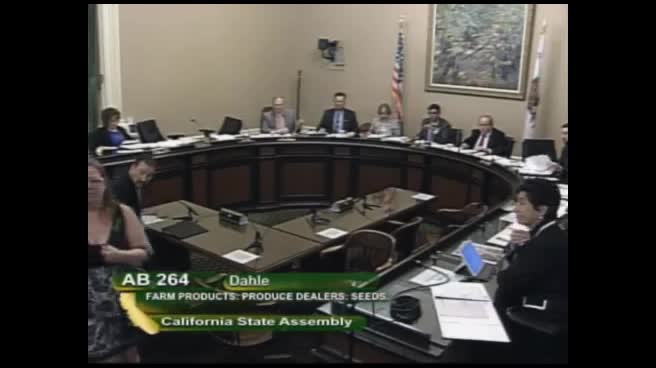 12MIN
Assembly Standing Committee on Agriculture
Bill Author

Bill Co-Author(s):