AB 2652: California Private Postsecondary Education Act of 2009: applicability.
- Session Year: 2015-2016
- House: Assembly
- Latest Version Date: 2016-04-21
Under existing law, the segments of postsecondary education in this state include the University of California, the California State University, the California Community Colleges, independent institutions of higher education, and private postsecondary educational institutions.
Existing law, the California Private Postsecondary Education Act of 2009, provides, among other things, for student protections and regulatory oversight of private postsecondary institutions in the state. The act is enforced by the Bureau for Private Postsecondary Education within the Department of Consumer Affairs. The act exempts specified institutions from its provisions, does not apply to private postsecondary educational institutions that do not maintain a physical presence in the state, and is repealed on January 1, 2017.
This bill would, to the extent authorized by federal law, require a private entity with no physical presence in this state, California, that would be subject to the requirements of this act if the entity was located in this state, to register with the bureau and participate in the acts Student Tuition Recovery Fund for its California students. The requirements of the bill would be repealed on July 1, 2018. 2020.
Under existing law, the segments of postsecondary education in this state include the University of California, the California State University, the California Community Colleges, independent institutions of higher education, and private postsecondary educational institutions.
Existing law, the California Private Postsecondary Education Act of 2009, provides, among other things, for student protections and regulatory oversight of private postsecondary institutions in the state. The act is enforced by the Bureau for Private Postsecondary Education within the Department of Consumer Affairs. The act exempts specified institutions from its provisions, does not apply to private postsecondary educational institutions that do not maintain a physical presence in the state, and is repealed on January 1, 2017.
This bill would, to the extent authorized by federal law, require a private entity with no physical presence in this state, that would be subject to the requirements of this act if the entity was located in this state, to register with the bureau and participate in the acts Student Tuition Recovery Fund for its California students. The bill would establish a private task force comprised of specified individuals to make recommendations, by July 1, 2018, to the Legislature and the Governor on how California should regulate educational programs offered, by institutions with no physical presence in this state, to the California public by means of distance education. The requirements of the bill would be repealed on July 1, 2018.
Under existing law, the segments of postsecondary education in this state include the University of California, the California State University, the California Community Colleges, independent institutions of higher education, and private postsecondary educational institutions.
Existing law, the California Private Postsecondary Education Act of 2009, provides, among other things, for student protections and regulatory oversight of private postsecondary institutions in the state. The act is enforced by the Bureau for Private Postsecondary Education within the Department of Consumer Affairs. The act exempts specified institutions from its provisions, does not apply to private postsecondary educational institutions that do not maintain a physical presence in the state, and is repealed on January 1, 2017.
This bill would instead, would, to the extent authorized by federal law, apply the act to a require a private entity that offers postsecondary education to the public in this state for an institutional charge. entity with no physical presence in this state, that would be subject to the requirements of this act if the entity was located in this state, to register with the bureau and participate in the acts Student Tuition Recovery Fund for its California students. The bill would establish a private task force comprised of specified individuals to make recommendations, by July 1, 2018, to the Legislature and the Governor on how California should regulate educational programs offered, by institutions with no physical presence in this state, to the California public by means of distance education. The requirements of the bill would be repealed on July 1, 2018.
Under existing law, the segments of postsecondary education in this state include the University of California, the California State University, the California Community Colleges, independent institutions of higher education, and private postsecondary educational institutions.
Existing law, the California Private Postsecondary Education Act of 2009, provides, among other things, for student protections and regulatory oversight of private postsecondary institutions in the state. The act is enforced by the Bureau for Private Postsecondary Education within the Department of Consumer Affairs. The act exempts specified institutions from its provisions, does not apply to private postsecondary educational institutions that do not maintain a physical presence in the state, and is repealed on January 1, 2017.
This bill would instead, to the extent authorized by federal law, apply the act to a private entity that offers postsecondary education to the public in this state for an institutional charge.
It is the intent of the Legislature that appropriate stakeholders work collaboratively to address how best to regulate educational programs offered to the public by means of distance education by institutions with no physical presence in California.
SEC. 2.Section 94801.5 is added to the Education Code, to read:94801.5.(a)Effective Notwithstanding Section 94858, effective July 1, 2017, to the extent authorized by federal law, a private entity with no physical presence in this state that, if the entity was geographically located in this state, would be subject to the requirements of this act shall do both of the following:
(1)Register with the bureau.
(2)Participate in the Student Tuition Recovery Fund for its California students.
(b)This section shall remain in effect only until July 1, 2018, 2020, and as of that date is repealed, unless a later enacted statute, that is enacted before July 1, 2018, 2020, deletes or extends that date.
It is the intent of the Legislature that appropriate stakeholders work collaboratively to address how best to regulate educational programs offered to the public by means of distance education by institutions with no physical presence in California.
SECTION 1.SEC. 2.Section 94801.5 is added to the Education Code, to read:94801.5.(a)Effective July 1, 2017, to the extent authorized by federal law, a private entity with no physical presence in this state that, if the entity was geographically located in this state, would be subject to the requirements of this act shall do both of the following:
(1)Register with the bureau.
(2)Participate in the Student Tuition Recovery Fund for its California students.
(b)Effective January 30, 2017, there shall be a Private Postsecondary Distance Learning Task Force comprised of the following representatives:
(1)A representative from the Student Aid Commission.
(2)A representative from the Department of Consumer Affairs.
(3)A representative from the Department of Veterans Affairs.
(4)A representative appointed by the Assembly.
(5)A representative appointed by the Senate.
(6)A representative appointed by the Governors office.
(7)A representative of a nonprofit consumer advocacy organization appointed by the director with a history of advocacy before the bureau.
(8)A representative of an accredited private postsecondary institution.
(9)A representative from the Attorney Generals office.
(10)A representative of a nonprofit legal aid organization that represents private postsecondary students.
(11)A representative of an unaccredited private postsecondary institution with geographic locations only in California.
(12)A representative of a nonprofit postsecondary institution and a representative of a public institution may be appointed by the director as nonvoting members.
(c)(1)The task force, by July 1, 2018, shall make recommendations to the Legislature and the Governor on how California, consistent with the bureaus primary aim of ensuring public protection, should regulate educational programs offered to the public by means of distance education by institutions with no physical presence in California that would, if geographically located in California, be subject to the requirements of this act.
(2)A report to be submitted pursuant to paragraph (1) shall be submitted in compliance with Section 9795 of the Government Code.
(d)
(b)This section shall remain in effect only until July 1, 2018, and as of that date is repealed, unless a later enacted statute, that is enacted before July 1, 2018, deletes or extends that date.
(a)Effective July 1, 2017, to the extent authorized by federal law, a private entity with no physical presence in this state that, if the entity was geographically located in this state, would be subject to the requirements of this act shall do both of the following:
(1)Register with the bureau.
(2)Participate in the Student Tuition Recovery Fund for its California students.
(b)Effective January 30, 2017, there shall be a Private Postsecondary Distance Learning Task Force comprised of the following representatives:
(1)A representative from the Student Aid Commission.
(2)A representative from the Department of Consumer Affairs.
(3)A representative from the Department of Veterans Affairs.
(4)A representative appointed by the Assembly.
(5)A representative appointed by the Senate.
(6)A representative appointed by the Governors office.
(7)A representative of a nonprofit consumer advocacy organization appointed by the director with a history of advocacy before the bureau.
(8)A representative of an accredited private postsecondary institution.
(9)A representative from the Attorney Generals office.
(10)A representative of a nonprofit legal aid organization that represents private postsecondary students.
(11)A representative of an unaccredited private postsecondary institution with geographic locations only in California.
(12)A representative of a nonprofit postsecondary institution and a representative of a public institution may be appointed by the director as nonvoting members.
(c)(1)The task force, by July 1, 2018, shall make recommendations to the Legislature and the Governor on how California, consistent with the bureaus primary aim of ensuring public protection, should regulate educational programs offered to the public by means of distance education by institutions with no physical presence in California that would, if geographically located in California, be subject to the requirements of this act.
(2)A report to be submitted pursuant to paragraph (1) shall be submitted in compliance with Section 9795 of the Government Code.
(d)This section shall remain in effect only until July 1, 2018, and as of that date is repealed, unless a later enacted statute, that is enacted before July 1, 2018, deletes or extends that date.
SECTION 1.Section 94858 of the Education Code is amended to read:94858.Private postsecondary educational institution means, to the extent authorized by federal law, a private entity that offers postsecondary education to the public in this state for an institutional charge.
Private postsecondary educational institution means means, to the extent authorized by federal law, a private entity with a physical presence in this state that offers postsecondary education to the public in this state for an institutional charge.
|
Date
|
Status
|
|---|---|
| Apr 25, 2016 | Re-referred to Com. on APPR. |
| Jun 15, 2016 | In committee: Hearing postponed by committee. |
| Jun 9, 2016 | Referred to Coms. on B., P. & E.D. and ED. |
| Jun 2, 2016 | In Senate. Read first time. To Com. on RLS. for assignment. |
| Jun 1, 2016 | Read third time. Passed. Ordered to the Senate. (Ayes 55. Noes 25.) |
| Jun 1, 2016 | Read third time. Passed. Ordered to the Senate. (Ayes 55. Noes 25. Page 5126.) |
| Jun 1, 2016 | Read third time. Passed. Ordered to the Senate. |
| May 31, 2016 | Read second time. Ordered to third reading. |
| May 27, 2016 | From committee: Do pass. (Ayes 14. Noes 6.) (May 27). |
| May 11, 2016 | In committee: Set, first hearing. Referred to APPR. suspense file. |
| Feb 19, 2016 | Introduced. To print. |
| Apr 21, 2016 | Read second time and amended. |
| Apr 20, 2016 | From committee: Amend, and do pass as amended and re-refer to Com. on APPR. (Ayes 10. Noes 3.) (April 19). |
| Apr 7, 2016 | Re-referred to Com. on HIGHER ED. |
| Apr 6, 2016 | From committee chair, with author's amendments: Amend, and re-refer to Com. on HIGHER ED. Read second time and amended. |
| Mar 30, 2016 | Re-referred to Com. on HIGHER ED. |
| Mar 29, 2016 | From committee chair, with author's amendments: Amend, and re-refer to Com. on HIGHER ED. Read second time and amended. |
| Mar 10, 2016 | Referred to Com. on HIGHER ED. |
| Feb 22, 2016 | Read first time. |
| Feb 21, 2016 | From printer. May be heard in committee March 22. |
|
Date
|
Description
|
Location
|
Votes
|
|
|---|---|---|---|---|
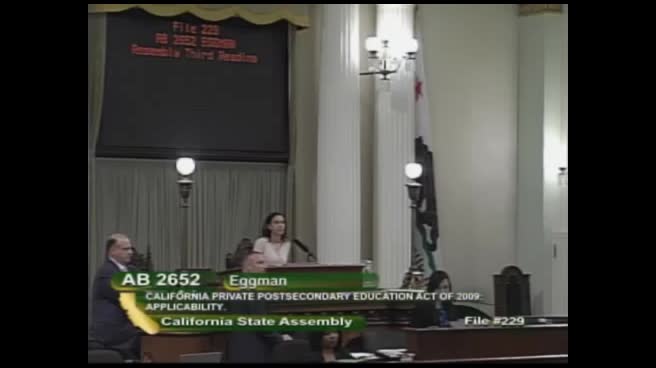
| Jun 1, 2016 | AB 2652 EGGMAN Assembly Third Reading | Assembly Floor |
Passed |
|
| May 27, 2016 | Do pass. | Assembly Standing Committee on Appropriations |
Passed |
|
| Apr 19, 2016 | Do pass as amended and be re-referred to the Committee on [Appropriations] | Assembly Standing Committee on Higher Education |
Passed |
This list shows positions taken on this bill by organizations on the date displayed, which is linked to the original source.
Positions by individuals are not included.
|
Organization
|
Position
|
Date
|
|---|---|---|
| Center for Public Interest Law | ** Support | Jun 1, 2016 |
| Children's Advocacy Institute | ** Support | Jun 1, 2016 |
| Consumer Federation Of California | ** Support | Jun 1, 2016 |
| Consumers Union | ** Support | Jun 1, 2016 |
| Housing and Economic Rights Advocates | ** Support | Jun 1, 2016 |
| Public Law Center | ** Support | Jun 1, 2016 |
| University of Phoenix | ** Against | Jun 1, 2016 |
| Veterans Legal Clinic | ** Support | Jun 1, 2016 |
ASSEMBLY THIRD READING
ATR Bill Id:AB 2652
Author:(Eggman)
As Amended Ver:April 21, 2016
Majority vote
Committee | Votes | Ayes | Noes |
Higher Education | 10-3 | Medina, Bloom, Chávez, Irwin, Jones-Sawyer, Levine, Low, Santiago, Weber, Williams | Baker, Linder, Olsen |
Appropriations | 14-6 | Gonzalez, Bloom, Bonilla, Bonta, Calderon, Daly, Eggman, Eduardo Garcia, Roger Hernández, Holden, Quirk, Santiago, Weber, Wood | Bigelow, Chang, Gallagher, Jones, Obernolte, Wagner |
SUMMARY: Requires a private distance education provider to register with the Bureau for Private Postsecondary Education (BPPE) and participate in the Student Tuition Recovery Fund (STRF). Specifically, this bill:
- Establishes that it is the intent of the Legislature that appropriate stakeholders work collaboratively to address how best to regulate educational programs offered to the public by means of distance education by institutions with no physical presence in California.
- Requires, effective July 1, 2017, to the extent authorized by federal law, a private entity with no physical presence in this state that, if the entity was geographically located in this state, would be subject to the requirements of this act to do both of the following:
- Register with BPPE; and,
- Participate in STRF for its California students.
- Provides that these provisions shall remain in effect until July 1, 2020.
EXISTING LAW:
- Establishes the BPPE within the Department of Consumer Affairs with the primary function of providing protection of students/consumers through the regulation and oversight of private postsecondary educational institutions. BPPE oversight activities are funded by licensing fees paid by regulated institutions. (Education Code Section (EDC) 94800 et seq.)
- Establishes the STRF, administered by the BPPE, to relieve or mitigate economic loss suffered by students enrolled at a non-exempt private postsecondary education institution due to the institutions' closure, the institutions' failure to pay refunds or reimburse loan proceeds, or the institutions' failure to pay students' restitution award for a violation of the Private Postsecondary Education Act (Act). STRF is capped in statute at $25 million. Institutions are required to assess students an amount established in regulation by the BPPE and remit fund to the BPPE for STRF. In 2010, that amount was established at $2.50 per $1000 of tuition charged. In 2013, that amount was reduced to $0.50 per $1000. In 2015, this amount was reduced to $0.00, as the STRF had exceeded the statutory cap (STRF is currently at approximately $28 million). (EDC 94923 – 94925)
FISCAL EFFECT: According to the Assembly Appropriations Committee, administrative costs for the bureau should be minor, assuming the bureau would simply contact out-of-state distance education providers, inform those with California-based students of their requirement to register with the bureau and to collect and remit STRF assessments from these students. (There is currently no STRF assessment because the fund balance exceeds a $25 million statutory cap.) Regardless of whether an out-of-state online institution complies with the STRF requirements, its California-based students would be eligible to recover from STRF for losses suffered due to their institution's closure. By bringing more students under the protections provided by STRF, this bill increases potential liabilities on the fund. As a result, a future payout from the fund could exceed $150,000. Based on actual data from fall 2013, there are about 900,000 students currently enrolled exclusively in distance education courses offered by private, for-profit schools nationwide. Assuming 13% of these students are in California yields a total of 117,000 students. The number of these student taking online courses at in-state versus out-of-state institutions is unknown, but given the universal accessibility of distance education, the number served by out-of-state institutions could easily exceed 10%.
COMMENTS: Purpose of this bill. According to the author, "This bill is seeking to establish consumer protections for Californian students enrolled in distance education. Many students are enrolled in online education programs and the number is only going to continue to increase. As a state, Governor Brown has declared he is supportive of online education and views it as a tool to increase access to higher education. As online education continues to grow, California should ensure that we are protecting students as they are protected in brick and mortar institutions."
Background. The Act defines private postsecondary educational institutions as private entities with a physical presence in California offering postsecondary education programs to the public for a charge. California students enrolled in distance/online programs offered by institutions located outside of California do not benefit from the oversight provided by the Act, including access to the STRF. Additionally, some institutional owners maintain physical campuses in California as well as online campuses housed in other states. For example, the recently closed Anthem College Online and Corinthian Colleges, Inc.'s Everest Online Campus enrolled California students in online courses through campuses accredited in other states. Unlike their counterparts attending physical campuses in California, online students, despite being California residents, were not provided BPPE protections or tuition reimbursement under STRF when their campuses abruptly closed.
Recognizing the need for oversight of the growing online education field, the initial federal Title IV "program integrity" regulations by the United States Department of Education (USDE) issued in 2010 required distance education programs to have authorization in the student's state of residence. The USDE regulations specific to distance education were subsequently vacated by federal court ruling. Institutions, however, are still required to comply with the laws and regulations of the states in which they operate.
In response to concerns over the complexity and cost of navigating differing requirements in multiple states, a group of institutions, states, and policy organizations developed the State Authorization Reciprocity Agreement (SARA). SARA provides that accredited, degree-granting institutions approved by an oversight body in one participating state will be deemed automatically to have met approval requirements in other participating states. The institution's "home" state is required to respond to student complaints only after the student has worked through the institution's standard complaint process. As of January 2016, 36 states agreed to participate in SARA.
In California, SB 634 (Block) of 2015 would have authorized state participation in SARA through the BPPE. The bill was supported by public and private higher education institutions, but was ultimately held without hearing in the Senate Education Committee at the request of the author. Several organizations representing students, veterans and consumers raised concerns that California participation in SARA would undermine the state's authority to regulate risky online for-profit colleges, and that SARA's provisions largely focused on decreasing regulation for institutions rather than providing adequate protections for students.
Temporary solution. This bill, as currently drafted, proposes a temporary solution to require institutions with no physical presence to participate in STRF. Committee staff understands that this is intended to provide stakeholders sufficient time to identify a permanent solution to ensure students are protected in the event of a school's illegal practices and/or school closure. This model is based on previous California law. From 2010 through 2016, non-Western Association of Schools and Colleges (WASC) regionally accredited institutions (including the California campuses of the University of Phoenix) were required to participate in STRF but not follow all other provisions of the Act.
BPPE Sunset Review. BPPE is currently undergoing the Sunset Review process. The issue of ensuring protection for students not covered by STRF and the possibility of a surety bond and/or STRF coverage is raised in the BPPE Sunset Review report, prepared by Committee staff. The author and Committee may wish to raise this issue through the 2016 Sunset Review process.
Analysis Prepared by: Laura Metune / HIGHER ED. / (916) 319-3960 FN: 0003132
Date of Hearing: May 11, 2016
ASSEMBLY COMMITTEE ON APPROPRIATIONS
Lorena Gonzalez, Chair
ABPCA Bill Id:AB 2652
Author:(Eggman) – As Amended Ver:April 21, 2016
Policy Committee: | Higher Education | Vote: | 10 - 3 |
Urgency: No State Mandated Local Program: No Reimbursable: No
SUMMARY:
This bill requires, from July 1, 2017, to July 1, 2020, to the extent authorized by federal law, for a private distance education provider with no physical presence in this state, if the entity was geographically located in this state and would be subject to the requirements of the Private Postsecondary Education Act of 2009, to:
- Register with Bureau for Private Postsecondary Education (BPPE); and,
- Contribute to the Student Tuition Recovery Fund for its California students.
FISCAL EFFECT:
Administrative costs for the bureau should be minor, assuming the bureau would simply contact out-of-state distance education providers, inform those with California-based students of their requirement to register with the bureau and to collect and remit STRF assessments from these students. (There is currently no STRF assessment because the fund balance exceeds a $25 million statutory cap.) Regardless of whether an out-of-state online institution complies with the STRF requirements, its California-based students would be eligible to recover from STRF for losses suffered due to their institution's closure. By bringing more students under the protections provided by STRF, this bill increases potential liabilities on the fund. As a result, a future payout from the fund could exceed $150,000.
Based on actual data from fall 2013, there are about 900,000 students currently enrolled exclusively in distance education courses offered by private, for-profit schools nationwide. Assuming 13% of these students are in California yields a total of 117,000 students. The number of these student taking online courses at in-state versus out-of-state institutions is unknown, but given the universal accessibility of distance education, the number served by out-of-state institutions could easily exceed 10%.
COMMENTS:
- Purpose. According to the author, "this bill is seeking to establish consumer protections for Californian students enrolled in distance education. Many students are enrolled in online education programs and the number is only going to continue to increase…As online education continues to grow, California should ensure that we are protecting students as they are protected in brick and mortar institutions."
- Background. The STRF, administered by the BPPE, is intended to relieve or mitigate economic loss suffered by students enrolled at a non-exempt private postsecondary education institution due to the institutions' closure, the institutions' failure to pay refunds or reimburse loan proceeds, or the institutions' failure to pay students' restitution award for a violation of the Private Postsecondary Education Act (Act). Institutions are required to assess students an amount established in regulation by the BPPE and remit funds to the BPPE for STRF.
The Act defines private postsecondary educational institutions as private entities with a physical presence in California offering postsecondary education programs to the public for a charge. California students enrolled in distance/online programs offered by institutions located outside of California do not benefit from the oversight provided by the Act, including access to the STRF. Additionally, some institutional owners maintain physical campuses in California as well as online campuses housed in other states. For example, the recently closed Anthem College Online and Corinthian Colleges, Inc.'s Everest Online Campus enrolled California students in online courses through campuses accredited in other states. Unlike their counterparts attending physical campuses in California, online students, despite being California residents, were not provided BPPE protections or tuition reimbursement under STRF when their campuses abruptly closed.
- SARA. In response to concerns over the complexity and cost of navigating differing requirements in multiple states, a group of institutions, states, and policy organizations developed the State Authorization Reciprocity Agreement (SARA). SARA provides that accredited, degree-granting institutions approved by an oversight body in one participating state will be deemed automatically to have met approval requirements in other participating states. The institution's “home” state is required to respond to student complaints only after the student has worked through the institution’s standard complaint process. As of January 2016, 36 states agreed to participate in SARA.
In California, SB 634 (Block, 2015) would have authorized state participation in SARA through the BPPE. The author decided to hold the bill in the Senate Education Committee due to concerns that SARA did not provide adequate student protections similar to the Act.
- Temporary Solution. This bill, as currently drafted, proposes a three-year temporary solution to require institutions with no physical presence to participate in STRF. This is intended to provide stakeholders sufficient time to identify a permanent solution to ensure students are protected in the event of a school's illegal practices and/or school closure. This model is based on current California law, which from 2010 through 2016 requires non-WASC regionally accredited institutions (including the California campuses of the University of Phoenix) to participate in STRF but not follow all other provisions of the Act.
Analysis Prepared by: Chuck Nicol / APPR. / (916) 319-2081
Date of Hearing: April 19, 2016
ASSEMBLY COMMITTEE ON HIGHER EDUCATION
Jose Medina, Chair
ABPCA Bill Id:AB 2652 (
Author:Eggman) – As Introduced Ver:February 19, 2016
SUBJECT: California Private Postsecondary Education Act of 2009: applicability
SUMMARY: Requires a private distance education provider to register with the Bureau for Private Postsecondary Education (BPPE) and participate in the Student Tuition Recovery Fund (STRF). Specifically, this bill:
- Establishes that it is the intent of the Legislature that appropriate stakeholders work collaboratively to address how best to regulate educational programs offered to the public by means of distance education by institutions with no physical presence in California.
- Requires, effective July 1, 2017, to the extent authorized by federal law, a private entity with no physical presence in this state that, if the entity was geographically located in this state, would be subject to the requirements of this act to do both of the following:
- Register with BPPE; and,
- Participate in STRF for its California students.
- Provides that these provisions shall remain in effect only until July 1, 2018.
EXISTING LAW:
- Establishes the BPPE within the Department of Consumer Affairs with the primary function of providing protection of students/consumers through the regulation and oversight of private postsecondary educational institutions. BPPE oversight activities are funded by licensing fees paid by regulated institutions. (Education Code Sec. 94800 et seq.)
- Establishes the STRF, administered by the BPPE, to relieve or mitigate economic loss suffered by students enrolled at a non-exempt private postsecondary education institution due to the institutions' closure, the institutions' failure to pay refunds or reimburse loan proceeds, or the institutions' failure to pay students' restitution award for a violation of the Private Postsecondary Education Act (Act). STRF is capped in statute at $25 million. Institutions are required to assess students an amount established in regulation by the BPPE and remit fund to the BPPE for STRF. In 2010, that amount was established at $2.50 per $1000 of tuition charged. In 2013, that amount was reduced to $0.50 per $1000. In 2015, this amount was reduced to $0.00, as the STRF had exceeded the statutory cap (STRF is currently at approximately $28 million). (EC Sec. 94923 – 94925)
FISCAL EFFECT: Unknown.
COMMENTS: Purpose of this bill. According to the author, "this bill is seeking to establish consumer protections for Californian students enrolled in distance education. Many students are enrolled in online education programs and the number is only going to continue to increase. As a state, Governor Brown has declared he is supportive of online education and views it as a tool to increase access to higher education. As online education continues to grow, California should ensure that we are protecting students as they are protected in brick and mortar institutions."
Background. The Act defines private postsecondary educational institutions as private entities with a physical presence in California offering postsecondary education programs to the public for a charge. California students enrolled in distance/online programs offered by institutions located outside of California do not benefit from the oversight provided by the Act, including access to the STRF. Additionally, some institutional owners maintain physical campuses in California as well as online campuses housed in other states. For example, the recently closed Anthem College Online and Corinthian Colleges, Inc.'s Everest Online Campus enrolled California students in online courses through campuses accredited in other states. Unlike their counterparts attending physical campuses in California, online students, despite being California residents, were not provided BPPE protections or tuition reimbursement under STRF when their campuses abruptly closed.
Recognizing the need for oversight of the growing online education field, the initial federal Title IV "program integrity" regulations by the United States Department of Education (USDE) issued in 2010 required distance education programs to have authorization in the student’s state of residence. The USDE regulations specific to distance education were subsequently vacated by federal court ruling. Institutions, however, are still required to comply with the laws and regulations of the states in which they operate.
In response to concerns over the complexity and cost of navigating differing requirements in multiple states, a group of institutions, states, and policy organizations developed the State Authorization Reciprocity Agreement (SARA). SARA provides that accredited, degree-granting institutions approved by an oversight body in one participating state will be deemed automatically to have met approval requirements in other participating states. The institution's “home” state is required to respond to student complaints only after the student has worked through the institution’s standard complaint process. As of January 2016, 36 states agreed to participate in SARA.
In California, SB 634 (Block, 2015) would have authorized state participation in SARA through the BPPE. The bill was supported by public and private higher education institutions, but was ultimately held without hearing in the Senate Education Committee at the request of the author. Several organizations representing students, veterans and consumers raised concerns that California participation in SARA would undermine the state's authority to regulate risky online for-profit colleges, and that SARA’s provisions largely focused on decreasing regulation for institutions rather than providing adequate protections for students.
Legislative options. It is clear that by limiting BPPE’s authority to only those institutions with a physical presence in this state, some California students are not properly protected. As discussed in the Committee Background Paper of the Sunset Review of BPPE, there are several possible approaches to rectifying this deficiency:
- The Legislature could amend the Act to remove the physical presence requirement and task the BPPE with full regulatory powers over out-of-state private distance education providers enrolling California students. This would enhance the student protections and recourse for students in the event of a school closure. However, there may be BPPE staffing and workload issues associated with full oversight of out-of-state institutions.
- The Legislature could amend the Act to provide some oversight of out-of-state distance education providers, such as disclosures to students, participation in STRF, and BPPE student complaint procedures and enforcement powers. The BPPE would not be responsible for conducting compliance inspections, for example.
- The Legislature could participate in SARA. However, relying on other states’ laws, regulations and enforcement may not provide these students the same protections as those attending brick and mortar schools. As such, if the BPPE is granted authority at some point in the future to enter into reciprocity agreements for purposes of regulating distance education programs, it may be necessary to clarify that the other states’ regulatory structure is comparable to California and provides the same opportunities for students as the Act.
Temporary solution. This bill, as currently drafted, proposes a one-year temporary solution to require institutions with no physical presence to participate in STRF. Committee staff understands that this is intended to provide stakeholders sufficient time to identify a permanent solution to ensure students are protected in the event of a school's illegal practices and/or school closure. This model is based on previous California law. From 2010 through 2016, non-WASC regionally accredited institutions (including the California campuses of the University of Phoenix) were required to participate in STRF but not follow all other provisions of the Act.
Suggested amendment. Committee staff recommends adding language to clarify that this requirement is notwithstanding the definition of private postsecondary educational institution contained in ED Code Section 94858. Additionally, Committee staff recommends extending the sunset of this bill from 18-months to 3 years to allow additional time for stakeholders to discuss and recommend an alternative approach to regulating online colleges and universities.
BPPE Sunset Review. BPPE is currently undergoing the Sunset Review process. The issue of ensuring protection for students not covered by STRF and the possibility of a surety bond and/or STRF coverage is raised in the BPPE Sunset Review report, prepared by Committee staff. The author and Committee may wish to raise this issue through the 2016 Sunset Review process.
REGISTERED SUPPORT / OPPOSITION:
Support
Center for Public Interest Law
Children's Advocacy Institute
Consumer Federation of California
Consumers Union
Housing and Economic Rights Advocates
Public Advocates Inc.
Public Law Center
SEIU California
Veterans Legal Clinic
Opposition
University of Phoenix
Analysis Prepared by: Laura Metune / HIGHER ED. / (916) 319-3960
Bill Author

Bill Co-Author(s):