AB 2686: Elections: all-mailed ballot elections.
- Session Year: 2015-2016
- House: Assembly
- Latest Version Date: 2016-09-28
Existing law generally does not allow special elections to fill vacancies in state offices, the Legislature, or Congress to be conducted wholly by mail. Existing law authorizes, until January 1, 2021, San Diego County to conduct, as a pilot program, an all-mailed ballot special election or special consolidated election (1) to fill a congressional or legislative vacancy if the congressional or legislative district lies wholly within San Diego County, (2) to fill a vacancy in the legislative body or governing body, and (3) for certain local initiative and referendum measures.
This bill would authorize San Diego County to additionally conduct such an all-mailed ballot special election (1) to fill a congressional or legislative vacancy if the congressional or legislative district lies partially within San Diego County, and (2) for the recall of a local officer.
This bill would also authorize, until January 1, 2021, any county to conduct, as a pilot program, an all-mailed ballot special election or special consolidated election to fill a congressional or legislative vacancy only if 50 percent or more of the total number of voters within the county are permanent vote by mail voters and the county board of supervisors adopts a resolution approving the countys participation in the pilot program. The bill would impose specific requirements for an all-mailed ballot special election or special consolidation election to be conducted under the pilot program. If a county conducts an all-mailed ballot special election or special consolidation election pursuant to these provisions, the bill would require the county to submit a report to the Legislature and the Secretary of State that includes certain information regarding the success of the election, including any statistics on the cost to conduct the election.
Existing law generally does not allow special elections to fill vacancies in state offices, the Legislature, or Congress to be conducted wholly by mail. Existing law authorizes, until January 1, 2021, San Diego County to conduct, as a pilot program, an all-mailed ballot special election or special consolidated election (1) to fill a congressional or legislative vacancy if the congressional or legislative district lies wholly within San Diego County, (2) to fill a vacancy in the legislative body or governing body, and (3) for certain local initiative and referendum measures.
This bill would extend the operation of that pilot program in San Diego County until January 1, 2023. The bill would authorize San Diego County to additionally conduct such an all-mailed ballot special election (1) to fill a congressional or legislative vacancy if the congressional or legislative district lies partially within San Diego County, and (2) for the recall of a local officer.
This bill would also authorize, until January 1, 2023, 2021, any county to conduct, as a pilot program, an all-mailed ballot special election or special consolidated election to fill a congressional or legislative vacancy only if 50 percent or more of the total number of voters within the county are permanent vote by mail voters and the county board of supervisors adopts a resolution approving the countys participation in the pilot program. The bill would impose specific requirements for an all-mailed ballot special election or special consolidation election to be conducted under the pilot program. If a county conducts an all-mailed ballot special election or special consolidation election pursuant to these provisions, the bill would require the county to submit a report to the Legislature and the Secretary of State that includes certain information regarding the success of the election, including any statistics on the cost to conduct the election.
Existing law generally does not allow special elections to fill vacancies in state offices, the Legislature, or Congress to be conducted wholly by mail. Existing law authorizes, until January 1, 2021, San Diego County to conduct, as a pilot program, an all-mailed ballot special election or special consolidated election (1) to fill a congressional or legislative vacancy. Existing law provides that a special election to fill a vacancy in a congressional or legislative office may be conducted as an all-mailed ballot election if, among other requirements, the Board of Supervisors of San Diego County, by resolution, authorizes the use of mailed ballots for the election and vacancy if the congressional or legislative district lies wholly within San Diego County. County, (2) to fill a vacancy in the legislative body or governing body, and (3) for certain local initiative and referendum measures.
This bill would authorize a special election to fill a vacancy in a state office, the Legislature, or Congress to be conducted wholly by mail if, among other requirements, the legislative body or the governing body of the eligible entity, by resolution, authorizes the all-mailed ballot election and notifies the Secretary of State of its intent to conduct an all-mailed ballot election at least 88 days before the date of the election. The bill would make conforming changes.
This bill would extend the operation of that pilot program in San Diego County until January 1, 2023. The bill would authorize San Diego County to additionally conduct such an all-mailed ballot special election (1) to fill a congressional or legislative vacancy if the congressional or legislative district lies partially within San Diego County, and (2) for the recall of a local officer.
This bill would also authorize, until January 1, 2023, any county to conduct, as a pilot program, an all-mailed ballot special election or special consolidated election to fill a congressional or legislative vacancy only if 50 percent or more of the total number of voters within the county are permanent vote by mail voters and the county board of supervisors adopts a resolution approving the countys participation in the pilot program. The bill would impose specific requirements for an all-mailed ballot special election or special consolidation election to be conducted under the pilot program. If a county conducts an all-mailed ballot special election or special consolidation election pursuant to these provisions, the bill would require the county to submit a report to the Legislature and the Secretary of State that includes certain information regarding the success of the election, including any statistics on the cost to conduct the election.
Existing law authorizes, until January 1, 2021, San Diego County to conduct, as a pilot program, an all-mailed ballot special election or special consolidated election to fill a congressional or legislative vacancy. Existing law provides that a special election to fill a vacancy in a congressional or legislative office may be conducted as an all-mailed ballot election if, among other requirements, the Board of Supervisors of San Diego County, by resolution, authorizes the use of mailed ballots for the election and the congressional or legislative district lies wholly within San Diego County.
This bill would authorize a special election to fill a vacancy in a state office, the Legislature, or Congress to be conducted wholly by mail if, among other requirements, the legislative body or the governing body of the eligible entity, by resolution, authorizes the all-mailed ballot election and notifies the Secretary of State of its intent to conduct an all-mailed ballot election at least 88 days before the date of the election. The bill would make conforming changes.
(a)Notwithstanding Section 4000 or any other law, as a pilot program, an all-mailed ballot special election or special consolidated election in San Diego County may be conducted by an eligible entity if the special election or special consolidated election is any of the following:
(1)A special election to fill a vacancy in a congressional or legislative office.
(2)A special election to fill a vacancy in the legislative body or governing body.
(3)A special election conducted pursuant to Chapter 2 (commencing with Section 9100), Chapter 3 (commencing with Section 9200), Chapter 4 (commencing with Section 9300), Chapter 5 (commencing with Section 9400), Chapter 6 (commencing with Section 9500) of Division 9, or Chapter 3 (commencing with Section 11200) of Division 11.
(b)A special election or special consolidated election described in paragraphs (1) to (3), inclusive, of subdivision (a) may be conducted wholly as an all-mailed ballot election if all of the following apply:
(1)(A)For a special election to fill a vacancy in a congressional or legislative office, the Board of Supervisors of San Diego County, by resolution, authorizes the use of mailed ballots for the election and the congressional or legislative district lies wholly or partially within San Diego County.
(B)For all other special elections, the legislative body or governing body of the eligible entity, by resolution, authorizes the use of mailed ballots for the election.
(2)The election does not occur on the same date as a statewide direct primary election, statewide general election, or any other election conducted in an overlapping jurisdiction that is not consolidated and conducted wholly by mail.
(3)(A)If the boundaries of the jurisdiction of the eligible entity overlap with the boundaries of a city, at least one ballot dropoff location is provided per city that is open during business hours to receive voted ballots beginning not less than seven days before the date of the election.
(B)The number of dropoff locations in unincorporated areas shall be based on the number of unincorporated registered voters divided by 100,000 (rounded to the next whole number) with no less than one location to be selected.
(C)A ballot dropoff location provided for under this section shall consist of a locked ballot box located in a secure public building that meets the accessibility requirements for a polling place.
(4)On at least one Saturday and Sunday on or after the date the elections official first delivers ballots to voters, the elections official allows any voter to vote the ballot at a satellite location within the jurisdiction of the eligible entity pursuant to Section 3018. The elections official shall determine the hours of operation for each Saturday and Sunday, provided that the satellite location is open to voters for a minimum of six hours on each designated Saturday and Sunday.
(5)(A)At least one polling place is provided per eligible entity or the polling places are fixed in a manner so that there is one polling place for every 10,000 registered voters within the jurisdiction of the eligible entity, as determined on the 88th day before the day of the election, whichever results in more polling places. A polling place shall allow a voter to request and vote a ballot between 7 a.m. and 8 p.m. on the day of the election.
(B)The polling places provided under this section shall be established in accordance with the accessibility requirements described in Article 5 (commencing with Section 12280) of Chapter 3 of Division 12, the federal Americans with Disabilities Act of 1990 (42 U.S.C. Sec. 12101 et seq.), the federal Help America Vote Act of 2002 (52 U.S.C. Sec. 20901 et seq.), and the federal Voting Rights Act of 1965 (52 U.S.C. Sec. 10101 et seq.), and shall, to the extent possible, ensure that access is evenly distributed throughout the jurisdiction of the eligible entity.
(C)The polling places provided under this section shall be established at accessible locations and shall be equipped with voting units or systems that are accessible to individuals with disabilities and that provide the same opportunity for access and participation as is provided to voters who are not disabled, including the ability to vote privately and independently in accordance with Sections 12280 and 19240.
(D)If a polling place consolidates one or more precincts for which the elections official is required to recruit precinct board members who are fluent in a language in addition to English pursuant to the federal Voting Rights Act of 1965 (52 U.S.C. Sec. 10101 et seq.), the elections official shall ensure that the polling place is staffed by precinct board members who speak that language.
(E)If a polling place consolidates one or more precincts for which the elections official is required to recruit precinct board members who are fluent in a language in addition to English pursuant to subdivision (c) of Section 12303, the elections official shall make reasonable efforts to ensure that the polling place is staffed by precinct board members who speak that language.
(6)(A)The elections official delivers to each voter all supplies necessary for the use and return of the mail ballot, including an envelope for the return of the voted mail ballot with postage prepaid.
(B)The elections official delivers to each voter, with either the sample ballot sent pursuant to Section 13303 or with the voters ballot, all of the following:
(i)A notice, translated in all languages required under subdivision (c) of Section 14201 and Section 203 of the federal Voting Rights Act of 1965 (52 U.S.C. Sec. 10101 et seq.), that informs voters of all of the following:
(I)An all-mailed ballot election is being conducted and each eligible voter will receive a ballot by mail.
(II)The voter may cast a ballot in person at a satellite location provided for under paragraph (4) or at a polling place on election day.
(III)The voter may request the elections official to send a vote by mail ballot in a language other than English pursuant to Section 203 of the federal Voting Rights Act of 1965 (52 U.S.C. Sec. 10101 et seq.) or a facsimile copy of the ballot printed in a language other than English pursuant to Section 14201.
(ii)A list of the ballot dropoff locations, satellite locations, and polling places established pursuant to this section. The list shall also be posted on the Internet Web site of the elections official.
(iii)A postage-paid postcard that the voter may return to the elections official for the purpose of requesting a vote by mail ballot in a language other than English.
(7)(A)The elections official submits to the Secretary of State a voter education and outreach plan to be implemented by the eligible entity for any election conducted pursuant to this section. The voter education and outreach plan shall include, but shall not be limited to, all of the following:
(i)One education and outreach meeting that includes representatives, advocates, and other stakeholders representing each community for which the eligible entity is required to provide voting materials and assistance in a language other than English under subdivision (c) of Section 14201 and the federal Voting Rights Act of 1965 (52 U.S.C. Sec. 10101 et seq.).
(ii)One education and outreach meeting that includes representatives from community organizations and individuals that advocate on behalf of, or provide services to, individuals with disabilities.
(iii)At least one in-person bilingual voter education workshop for each language in which the eligible entity is required to provide voting materials and assistance under subdivision (c) of Section 14201 and the federal Voting Rights Act of 1965 (52 U.S.C. Sec. 10101 et seq.).
(iv)At least one in-person voter education workshop to increase accessibility for participation of eligible voters with disabilities.
(v)A toll-free voter assistance hotline maintained by the elections official that is operational no later than the date that vote by mail ballots are mailed to voters until 5 p.m. on the day after the special election. The toll-free voter assistance hotline shall provide assistance to voters in all languages in which the eligible entity is required to provide voting materials and assistance under subdivision (c) of Section 14201 and the federal Voting Rights Act of 1965 (52 U.S.C. Sec. 10101 et seq.).
(vi)At least one public service announcement in the media, including newspapers, radio, and television, that serve English-speaking citizens for purposes of informing voters of the upcoming election and promoting the toll-free voter assistance hotline.
(vii)At least one public service announcement in the media, including newspapers, radio, and television, that serves non-English-speaking citizens for each language in which the eligible entity is required to provide voting materials and assistance under subdivision (c) of Section 14201 and the federal Voting Rights Act of 1965 (52 U.S.C. Sec. 10101 et seq.) for purposes of informing voters of the upcoming election and promoting the toll-free voter assistance hotline.
(viii)A voter education social media strategy that is developed in partnership with community organizations and individuals that advocate on behalf of, or provide services to, non-English-speaking individuals and individuals with disabilities.
(B)The voter education and outreach plan shall be posted on the Internet Web site of the Secretary of State and on the Internet Web site of the elections official.
(c)Except as otherwise provided in this section, the election day procedures shall be conducted in accordance with Division 14 (commencing with Section 14000).
(d)The elections official may provide, at his or her discretion, additional ballot dropoff locations and polling places for purposes of this section.
(e)The return of voted mail ballots is subject to Sections 3017 and 3020.
(f)(1)If the eligible entity conducts a special election pursuant to this section, it may process vote by mail ballot return envelopes beginning 29 days before the election. Processing vote by mail ballot return envelopes may include verifying the voters signature on the vote by mail ballot return envelope and updating voter history records.
(2)If the eligible entity conducts a special election pursuant to this section, it may start to process vote by mail ballots on the 10th business day before the election. Processing vote by mail ballots includes opening vote by mail ballot return envelopes, removing ballots, duplicating any damaged ballots, and preparing the ballots to be machine read, or machine reading them, but under no circumstances shall a vote count be accessed or released until 8 p.m. on the day of the election.
(g)Results of any vote by mail ballot tabulation or count shall not be released before the close of the polls on the day of the election.
(h)For the sole purpose of reporting the results of an election conducted pursuant to this section, upon completion of the ballot count, the elections official shall divide the jurisdiction into precincts pursuant to Article 2 (commencing with Section 12220) of Chapter 3 of Division 12 and shall prepare a statement of the results of the election in accordance with Sections 15373 and 15374.
(i)The elections official shall compile an index, list, or file of all persons who voted in an election conducted pursuant to this section. If the elections official uses data-processing equipment to compile the index, list, or file, he or she shall retain an accurate copy of that index, list, or file in electronic format for a period of 10 years.
(j)(1)If an election is conducted pursuant to this section, the eligible entity shall report to the Legislature and to the Secretary of State regarding the success of the election, including, but not limited to, all of the following:
(A)Any statistics on the cost to conduct the election.
(B)The turnout of different populations, including, but not limited to, and to the extent possible, the population categories of race, ethnicity, language preference, age, gender, disability, permanent vote by mail status, and political party preference.
(C)The number of ballots that were not counted and the reasons they were rejected.
(D)Voter fraud.
(E)Any other problems that become known to the eligible entity during the election or canvass.
(2)Whenever possible, using the criteria set forth in paragraph (1), the report shall compare the election conducted pursuant to this section to similar elections not conducted pursuant to this section in the same jurisdiction or comparable jurisdictions.
(3)Within six months after the date of the election or before the date of a subsequent election conducted pursuant to this section, whichever is sooner, the eligible entity shall do all of the following with respect to the report required by this subdivision:
(A)Submit the report to the Legislature in compliance with Section 9795 of the Government Code.
(B)Submit the report to the Secretary of State.
(C)Post the report on the Internet Web site of the elections official.
(k)For purposes of this section, eligible entity means both of the following:
(1)San Diego County.
(2)A city, school district, community college district, special district, or other district or political subdivision organized pursuant to state law, whose boundaries are located wholly or partially within San Diego County.
(l)An election conducted pursuant to this section is not subject to Section 4001.5.
(m)This section shall remain in effect only until January 1, 2021, and as of that date is repealed, unless a later enacted statute, that is enacted before January 1, 2021, deletes or extends that date.
SEC. 2.Section 4001.5 is added to the Elections Code, to read:4001.5.(a)Notwithstanding Section 4000 or any other law, as a pilot program, a county may conduct an all-mailed ballot special election or special consolidated election if the special election or special consolidated election is a special election to fill a vacancy in a congressional or legislative office.
(b)A special election or special consolidated election described in subdivision (a) may be conducted wholly as an all-mailed ballot election if all of the following apply:
(1)(A)The county board of supervisors, by resolution, approves the countys participation in the pilot program established by this section. A county may only participate in the pilot program if the percentage of permanent vote by mail voters in the county equals or exceeds 50 percent of the total number of voters in the county, as determined at the most recent statewide general election.
(B)If a county board of supervisors adopts a resolution pursuant to subparagraph (A), the county board of supervisors shall transmit the resolution to the Secretary of State within 10 days of adopting the resolution. Within 10 days of receiving a resolution adopted pursuant to subparagraph (A), the Secretary of State shall notify the Voting Accessibility Advisory Committee, established pursuant to Section 2053, and the Language Accessibility Advisory Committee, established pursuant to Section 2600, of the countys participation in the pilot program.
(2)The county board of supervisors, by resolution, authorizes the use of mailed ballots for the election and the congressional or legislative district lies wholly or partially within the county.
(3)The election does not occur on the same date as a statewide direct primary election, statewide general election, or any other election conducted in an overlapping jurisdiction that is not consolidated and conducted wholly by mail.
(4)(A)At least one ballot dropoff location is provided per city that is open during business hours to receive voted ballots beginning not less than seven days before the date of the election.
(B)The number of dropoff locations in unincorporated areas shall be based on the number of unincorporated registered voters divided by 100,000 (rounded to the next whole number) with no less than one location to be selected.
(C)A ballot dropoff location provided for under this section shall consist of a locked ballot box located in a secure public building that meets the accessibility requirements for a polling place.
(5)On at least one Saturday and Sunday on or after the date the county elections official first delivers ballots to voters, the county elections official allows any voter to vote the ballot at a satellite location within the county pursuant to Section 3018. The county elections official shall determine the hours of operation for each Saturday and Sunday, provided that the satellite location is open to voters for a minimum of six hours on each designated Saturday and Sunday.
(6)(A)The polling places are fixed in a manner so that there is one polling place for every 10,000 registered voters within the county, or the portion of the county in which the special election is being held, as determined on the 88th day before the day of the election. A polling place shall allow a voter to request and vote a ballot between 7 a.m. and 8 p.m. on the day of the election.
(B)The polling places provided under this section shall be established in accordance with the accessibility requirements described in Article 5 (commencing with Section 12280) of Chapter 3 of Division 12, the federal Americans with Disabilities Act of 1990 (42 U.S.C. Sec. 12101 et seq.), the federal Help America Vote Act of 2002 (52 U.S.C. Sec. 20901 et seq.), and the federal Voting Rights Act of 1965 (52 U.S.C. Sec. 10101 et seq.), and shall, to the extent possible, ensure that access is evenly distributed throughout the county, or the portion of the county in which the special election is being held.
(C)The polling places provided under this section shall be established at accessible locations and shall be equipped with voting units or systems that are accessible to individuals with disabilities and that provide the same opportunity for access and participation as is provided to voters who are not disabled, including the ability to vote privately and independently in accordance with Sections 12280 and 19240.
(D)The county elections official shall consider proximity to public transportation in determining the polling places to provide under this section.
(E)If a polling place consolidates one or more precincts for which the county elections official is required to recruit precinct board members who are fluent in a language in addition to English pursuant to the federal Voting Rights Act of 1965 (52 U.S.C. Sec. 10101 et seq.), the county elections official shall ensure that the polling place is staffed by precinct board members who speak that language.
(F)If a polling place consolidates one or more precincts for which the county elections official is required to recruit precinct board members who are fluent in a language in addition to English pursuant to subdivision (c) of Section 12303, the county elections official shall make reasonable efforts to ensure that the polling place is staffed by precinct board members who speak that language.
(7)(A)The county elections official delivers to each voter all supplies necessary for the use and return of the mail ballot, including an envelope for the return of the voted mail ballot with postage prepaid.
(B)In addition to the items required to be delivered to each voter under subparagraph (C), the county elections official delivers to each voter a notice, translated in all languages required under subdivision (c) of Section 14201 and Section 203 of the federal Voting Rights Act of 1965 (52 U.S.C. Sec. 10101 et seq.), that informs voters that an all-mailed ballot election is being conducted. The county elections official may send only one notice to a household if multiple registered voters reside within that household.
(C)The county elections official delivers to each voter, with the sample ballot sent pursuant to Section 13303 and with the voters ballot, all of the following:
(i)A notice, translated in all languages required under subdivision (c) of Section 14201 and Section 203 of the federal Voting Rights Act of 1965 (52 U.S.C. Sec. 10101 et seq.), that informs voters of all of the following:
(I)An all-mailed ballot election is being conducted and each eligible voter will receive a ballot by mail.
(II)The voter may cast a ballot in person at a satellite location provided for under paragraph (5) or at a polling place on election day.
(III)The voter may request the county elections official to send a vote by mail ballot in a language other than English pursuant to Section 203 of the federal Voting Rights Act of 1965 (52 U.S.C. Sec. 10101 et seq.) or a facsimile copy of the ballot printed in a language other than English pursuant to Section 14201.
(ii)A list of the ballot dropoff locations, satellite locations, and polling places established pursuant to this section. The list shall also be posted on the Internet Web site of the county elections official.
(iii)A postage-paid postcard that the voter may return to the county elections official for the purpose of requesting a vote by mail ballot in a language other than English.
(8)(A)The county elections official submits to the Secretary of State a voter education and outreach plan to be implemented by the county for any election conducted pursuant to this section. The voter education and outreach plan shall include, but shall not be limited to, all of the following:
(i)One education and outreach meeting that includes representatives, advocates, and other stakeholders representing each community for which the county is required to provide voting materials and assistance in a language other than English under subdivision (c) of Section 14201 and the federal Voting Rights Act of 1965 (52 U.S.C. Sec. 10101 et seq.).
(ii)One education and outreach meeting that includes representatives from community organizations and individuals that advocate on behalf of, or provide services to, individuals with disabilities.
(iii)At least one in-person bilingual voter education workshop for each language in which the county is required to provide voting materials and assistance under subdivision (c) of Section 14201 and the federal Voting Rights Act of 1965 (52 U.S.C. Sec. 10101 et seq.).
(iv)At least one in-person voter education workshop to increase accessibility for participation of eligible voters with disabilities.
(v)A toll-free voter assistance hotline maintained by the county elections official that is operational no later than the date that vote by mail ballots are mailed to voters until 5 p.m. on the day after the special election. The toll-free voter assistance hotline shall provide assistance to voters in all languages in which the county is required to provide voting materials and assistance under subdivision (c) of Section 14201 and the federal Voting Rights Act of 1965 (52 U.S.C. Sec. 10101 et seq.).
(vi)At least one public service announcement in the media, including newspapers, radio, and television, that serve English-speaking citizens for purposes of informing voters of the upcoming election and promoting the toll-free voter assistance hotline.
(vii)At least one public service announcement in the media, including newspapers, radio, and television, that serve non-English-speaking citizens for each language in which the county is required to provide voting materials and assistance under subdivision (c) of Section 14201 and the federal Voting Rights Act of 1965 (52 U.S.C. Sec. 10101 et seq.) for purposes of informing voters of the upcoming election and promoting the toll-free voter assistance hotline.
(viii)A voter education social media strategy that is developed in partnership with community organizations and individuals that advocate on behalf of, or provide services to, non-English-speaking individuals and individuals with disabilities.
(ix)The registration rates, participation rates, and rejection rates, including the reasons for rejection, of permanent vote by mail voters and in-person voters for the county. If the information is readily available, the county elections official shall include any statistics on the turnout of different populations, including, but not limited to, the population categories of race, ethnicity, language preference, age, gender, and disability. If the data reflects significant disparities in voter accessibility and participation, the county elections official shall include a statement of how he or she plans to address each disparity.
(B)The voter education and outreach plan shall be posted on the Internet Web site of the Secretary of State and on the Internet Web site of the county elections official.
(9)(A)The county elections official establishes a community election advisory committee that consists of community members representing minority groups covered under the federal Voting Rights Act of 1965 (52 U.S.C. Sec. 10101 et seq.) and subdivision (c) of Section 14201 and voters with disabilities including, but not limited to, mobility, sensory, physical, and mental disabilities. In lieu of a community election advisory committee, the county elections official may establish both a local voting accessibility advisory committee pursuant to the guidelines promulgated by the Secretary of State and a local language accessibility advisory committee. For purposes of this section, a local language accessibility advisory committee shall consist of community members representing minority groups covered under the federal Voting Rights Act of 1965 (52 U.S.C. Sec. 10101 et seq.) and subdivision (c) of Section 14201.
(B)The advisory committee or committees described in subparagraph (A) shall hold at least one meeting in the year prior to an all-mailed ballot election conducted pursuant to this section.
(c)Except as otherwise provided in this section, the election day procedures shall be conducted in accordance with Division 14 (commencing with Section 14000).
(d)The county elections official may provide, at his or her discretion, additional ballot dropoff locations and polling places for purposes of this section.
(e)The return of voted mail ballots is subject to Sections 3017 and 3020.
(f)Participating in the pilot program established by this section does not preclude the use of a remote accessible vote by mail system.
(g)(1)If the county conducts a special election pursuant to this section, it may process vote by mail ballot return envelopes beginning 29 days before the election. Processing vote by mail ballot return envelopes may include verifying the voters signature on the vote by mail ballot return envelope and updating voter history records.
(2)If the county conducts a special election pursuant to this section, it may start to process vote by mail ballots on the 10th business day before the election. Processing vote by mail ballots includes opening vote by mail ballot return envelopes, removing ballots, duplicating any damaged ballots, and preparing the ballots to be machine read, or machine reading them, but under no circumstances shall a vote count be accessed or released until 8 p.m. on the day of the election.
(h)Results of any vote by mail ballot tabulation or count shall not be released before the close of the polls on the day of the election.
(i)For the sole purpose of reporting the results of an election conducted pursuant to this section, upon completion of the ballot count, the county elections official shall divide the county, or the portion of the county in which the special election is being held into precincts pursuant to Article 2 (commencing with Section 12220) of Chapter 3 of Division 12 and shall prepare a statement of the results of the election in accordance with Sections 15373 and 15374.
(j)The county elections official shall compile an index, list, or file of all persons who voted in an election conducted pursuant to this section. If the county elections official uses data-processing equipment to compile the index, list, or file, he or she shall retain an accurate copy of that index, list, or file in electronic format for a period of 10 years.
(k)(1)If an election is conducted pursuant to this section, the county shall report to the Legislature and to the Secretary of State regarding the success of the election, including, but not limited to, all of the following:
(A)Any statistics on the cost to conduct the election.
(B)The turnout of different populations, including, but not limited to, and to the extent possible, the population categories of race, ethnicity, language preference, age, gender, disability, permanent vote by mail status, and political party preference.
(C)The number of ballots that were not counted and the reasons they were rejected.
(D)Voter fraud.
(E)Any other problems that become known to the county during the election or canvass.
(2)Whenever possible, using the criteria set forth in paragraph (1), the report shall compare the election conducted pursuant to this section to similar elections not conducted pursuant to this section in the same county or comparable counties.
(3)Within six months after the date of the election or before the date of a subsequent election conducted pursuant to this section, whichever is sooner, the county shall do all of the following with respect to the report required by this subdivision:
(A)Submit the report to the Legislature in compliance with Section 9795 of the Government Code.
(B)Submit the report to the Secretary of State.
(C)Post the report on the Internet Web site of the county elections official.
(l)This section shall remain in effect only until January 1, 2021, and as of that date is repealed, unless a later enacted statute, that is enacted before January 1, 2021, deletes or extends that date.
(a)Notwithstanding Section 4000 or any other law, as a pilot program, an all-mailed ballot special election or special consolidated election in San Diego County may be conducted by an eligible entity if the special election or special consolidated election is any of the following:
(1)A special election to fill a vacancy in a congressional or legislative office.
(2)A special election to fill a vacancy in the legislative body or governing body.
(3)A special election conducted pursuant to Chapter 2 (commencing with Section 9100), Chapter 3 (commencing with Section 9200), Chapter 4 (commencing with Section 9300), Chapter 5 (commencing with Section 9400), Chapter 6 (commencing with Section 9500) of Division 9, or Chapter 3 (commencing with Section 11200) of Division 11.
(b)A special election or special consolidated election described in paragraphs (1) to (3), inclusive, of subdivision (a) may be conducted wholly as an all-mailed ballot election if all of the following apply:
(1)(A)For a special election to fill a vacancy in a congressional or legislative office, the Board of Supervisors of San Diego County, by resolution, authorizes the use of mailed ballots for the election and the congressional or legislative district lies wholly or partially within San Diego County.
(B)For all other special elections, the legislative body or governing body of the eligible entity, by resolution, authorizes the use of mailed ballots for the election.
(2)The election does not occur on the same date as a statewide direct primary election, statewide general election, or any other election conducted in an overlapping jurisdiction that is not consolidated and conducted wholly by mail.
(3)(A)If the boundaries of the jurisdiction of the eligible entity overlap with the boundaries of a city, at least one ballot dropoff location is provided per city that is open during business hours to receive voted ballots beginning not less than seven days before the date of the election.
(B)The number of dropoff locations in unincorporated areas shall be based on the number of unincorporated registered voters divided by 100,000 (rounded to the next whole number) with no less than one location to be selected.
(C)A ballot dropoff location provided for under this section shall consist of a locked ballot box located in a secure public building that meets the accessibility requirements for a polling place.
(4)On at least one Saturday and Sunday on or after the date the elections official first delivers ballots to voters, the elections official allows any voter to vote the ballot at a satellite location within the jurisdiction of the eligible entity pursuant to Section 3018. The elections official shall determine the hours of operation for each Saturday and Sunday, provided that the satellite location is open to voters for a minimum of six hours on each designated Saturday and Sunday.
(5)(A)At least one polling place is provided per eligible entity or the polling places are fixed in a manner so that there is one polling place for every 10,000 registered voters within the jurisdiction of the eligible entity, as determined on the 88th day before the day of the election, whichever results in more polling places. A polling place shall allow a voter to request and vote a ballot between 7 a.m. and 8 p.m. on the day of the election.
(B)The polling places provided under this section shall be established in accordance with the accessibility requirements described in Article 5 (commencing with Section 12280) of Chapter 3 of Division 12, the federal Americans with Disabilities Act of 1990 (42 U.S.C. Sec. 12101 et seq.), the federal Help America Vote Act of 2002 (52 U.S.C. Sec. 20901 et seq.), and the federal Voting Rights Act of 1965 (52 U.S.C. Sec. 10101 et seq.), and shall, to the extent possible, ensure that access is evenly distributed throughout the jurisdiction of the eligible entity.
(C)The polling places provided under this section shall be established at accessible locations and shall be equipped with voting units or systems that are accessible to individuals with disabilities and that provide the same opportunity for access and participation as is provided to voters who are not disabled, including the ability to vote privately and independently in accordance with Sections 12280 and 19240.
(D)If a polling place consolidates one or more precincts for which the elections official is required to recruit precinct board members who are fluent in a language in addition to English pursuant to the federal Voting Rights Act of 1965 (52 U.S.C. Sec. 10101 et seq.), the elections official shall ensure that the polling place is staffed by precinct board members who speak that language.
(E)If a polling place consolidates one or more precincts for which the elections official is required to recruit precinct board members who are fluent in a language in addition to English pursuant to subdivision (c) of Section 12303, the elections official shall make reasonable efforts to ensure that the polling place is staffed by precinct board members who speak that language.
(6)(A)The elections official delivers to each voter all supplies necessary for the use and return of the mail ballot, including an envelope for the return of the voted mail ballot with postage prepaid.
(B)The elections official delivers to each voter, with either the sample ballot sent pursuant to Section 13303 or with the voters ballot, all of the following:
(i)A notice, translated in all languages required under subdivision (c) of Section 14201 and Section 203 of the federal Voting Rights Act of 1965 (52 U.S.C. Sec. 10101 et seq.), that informs voters of all of the following:
(I)An all-mailed ballot election is being conducted and each eligible voter will receive a ballot by mail.
(II)The voter may cast a ballot in person at a satellite location provided for under paragraph (4) or at a polling place on election day.
(III)The voter may request the elections official to send a vote by mail ballot in a language other than English pursuant to Section 203 of the federal Voting Rights Act of 1965 (52 U.S.C. Sec. 10101 et seq.) or a facsimile copy of the ballot printed in a language other than English pursuant to Section 14201.
(ii)A list of the ballot dropoff locations, satellite locations, and polling places established pursuant to this section. The list shall also be posted on the Internet Web site of the elections official.
(iii)A postage-paid postcard that the voter may return to the elections official for the purpose of requesting a vote by mail ballot in a language other than English.
(7)(A)The elections official submits to the Secretary of State a voter education and outreach plan to be implemented by the eligible entity for any election conducted pursuant to this section. The voter education and outreach plan shall include, but shall not be limited to, all of the following:
(i)One education and outreach meeting that includes representatives, advocates, and other stakeholders representing each community for which the eligible entity is required to provide voting materials and assistance in a language other than English under subdivision (c) of Section 14201 and the federal Voting Rights Act of 1965 (52 U.S.C. Sec. 10101 et seq.).
(ii)One education and outreach meeting that includes representatives from community organizations and individuals that advocate on behalf of, or provide services to, individuals with disabilities.
(iii)At least one in-person bilingual voter education workshop for each language in which the eligible entity is required to provide voting materials and assistance under subdivision (c) of Section 14201 and the federal Voting Rights Act of 1965 (52 U.S.C. Sec. 10101 et seq.).
(iv)At least one in-person voter education workshop to increase accessibility for participation of eligible voters with disabilities.
(v)A toll-free voter assistance hotline maintained by the elections official that is operational no later than the date that vote by mail ballots are mailed to voters until 5 p.m. on the day after the special election. The toll-free voter assistance hotline shall provide assistance to voters in all languages in which the eligible entity is required to provide voting materials and assistance under subdivision (c) of Section 14201 and the federal Voting Rights Act of 1965 (52 U.S.C. Sec. 10101 et seq.).
(vi)At least one public service announcement in the media, including newspapers, radio, and television, that serve English-speaking citizens for purposes of informing voters of the upcoming election and promoting the toll-free voter assistance hotline.
(vii)At least one public service announcement in the media, including newspapers, radio, and television, that serves non-English-speaking citizens for each language in which the eligible entity is required to provide voting materials and assistance under subdivision (c) of Section 14201 and the federal Voting Rights Act of 1965 (52 U.S.C. Sec. 10101 et seq.) for purposes of informing voters of the upcoming election and promoting the toll-free voter assistance hotline.
(viii)A voter education social media strategy that is developed in partnership with community organizations and individuals that advocate on behalf of, or provide services to, non-English-speaking individuals and individuals with disabilities.
(B)The voter education and outreach plan shall be posted on the Internet Web site of the Secretary of State and on the Internet Web site of the elections official.
(c)Except as otherwise provided in this section, the election day procedures shall be conducted in accordance with Division 14 (commencing with Section 14000).
(d)The elections official may provide, at his or her discretion, additional ballot dropoff locations and polling places for purposes of this section.
(e)The return of voted mail ballots is subject to Sections 3017 and 3020.
(f)(1)If the eligible entity conducts a special election pursuant to this section, it may process vote by mail ballot return envelopes beginning 29 days before the election. Processing vote by mail ballot return envelopes may include verifying the voters signature on the vote by mail ballot return envelope and updating voter history records.
(2)If the eligible entity conducts a special election pursuant to this section, it may start to process vote by mail ballots on the 10th business day before the election. Processing vote by mail ballots includes opening vote by mail ballot return envelopes, removing ballots, duplicating any damaged ballots, and preparing the ballots to be machine read, or machine reading them, but under no circumstances shall a vote count be accessed or released until 8 p.m. on the day of the election.
(g)Results of any vote by mail ballot tabulation or count shall not be released before the close of the polls on the day of the election.
(h)For the sole purpose of reporting the results of an election conducted pursuant to this section, upon completion of the ballot count, the elections official shall divide the jurisdiction into precincts pursuant to Article 2 (commencing with Section 12220) of Chapter 3 of Division 12 and shall prepare a statement of the results of the election in accordance with Sections 15373 and 15374.
(i)The elections official shall compile an index, list, or file of all persons who voted in an election conducted pursuant to this section. If the elections official uses data-processing equipment to compile the index, list, or file, he or she shall retain an accurate copy of that index, list, or file in electronic format for a period of 10 years.
(j)(1)If an election is conducted pursuant to this section, the eligible entity shall report to the Legislature and to the Secretary of State regarding the success of the election, including, but not limited to, all of the following:
(A)Any statistics on the cost to conduct the election.
(B)The turnout of different populations, including, but not limited to, and to the extent possible, the population categories of race, ethnicity, language preference, age, gender, disability, permanent vote by mail status, and political party preference.
(C)The number of ballots that were not counted and the reasons they were rejected.
(D)Voter fraud.
(E)Any other problems that become known to the eligible entity during the election or canvass.
(2)Whenever possible, using the criteria set forth in paragraph (1), the report shall compare the election conducted pursuant to this section to similar elections not conducted pursuant to this section in the same jurisdiction or comparable jurisdictions.
(3)Within six months after the date of the election or before the date of a subsequent election conducted pursuant to this section, whichever is sooner, the eligible entity shall do all of the following with respect to the report required by this subdivision:
(A)Submit the report to the Legislature in compliance with Section 9795 of the Government Code.
(B)Submit the report to the Secretary of State.
(C)Post the report on the Internet Web site of the elections official.
(k)For purposes of this section, eligible entity means both of the following:
(1)San Diego County.
(2)A city, school district, community college district, special district, or other district or political subdivision organized pursuant to state law, whose boundaries are located wholly or partially within San Diego County.
(l)An election conducted pursuant to this section is not subject to Section 4001.5.
(m)This section shall remain in effect only until January 1, 2021, and as of that date is repealed, unless a later enacted statute, that is enacted before January 1, 2021, deletes or extends that date.
SEC. 2.Section 4001.5 is added to the Elections Code, to read:4001.5.(a)Notwithstanding Section 4000 or any other law, as a pilot program, a county may conduct an all-mailed ballot special election or special consolidated election if the special election or special consolidated election is a special election to fill a vacancy in a congressional or legislative office.
(b)A special election or special consolidated election described in subdivision (a) may be conducted wholly as an all-mailed ballot election if all of the following apply:
(1)(A)The county board of supervisors, by resolution, approves the countys participation in the pilot program established by this section. A county may only participate in the pilot program if the percentage of permanent vote by mail voters in the county equals or exceeds 50 percent of the total number of voters in the county, as determined at the most recent statewide general election.
(B)If a county board of supervisors adopts a resolution pursuant to subparagraph (A), the county board of supervisors shall transmit the resolution to the Secretary of State within 10 days of adopting the resolution. Within 10 days of receiving a resolution adopted pursuant to subparagraph (A), the Secretary of State shall notify the Voting Accessibility Advisory Committee, established pursuant to Section 2053, and the Language Accessibility Advisory Committee, established pursuant to Section 2600, of the countys participation in the pilot program.
(2)The county board of supervisors, by resolution, authorizes the use of mailed ballots for the election and the congressional or legislative district lies wholly or partially within the county.
(3)The election does not occur on the same date as a statewide direct primary election, statewide general election, or any other election conducted in an overlapping jurisdiction that is not consolidated and conducted wholly by mail.
(4)(A)At least one ballot dropoff location is provided per city that is open during business hours to receive voted ballots beginning not less than seven days before the date of the election.
(B)The number of dropoff locations in unincorporated areas shall be based on the number of unincorporated registered voters divided by 100,000 (rounded to the next whole number) with no less than one location to be selected.
(C)A ballot dropoff location provided for under this section shall consist of a locked ballot box located in a secure public building that meets the accessibility requirements for a polling place.
(5)On at least one Saturday and Sunday on or after the date the county elections official first delivers ballots to voters, the county elections official allows any voter to vote the ballot at a satellite location within the county pursuant to Section 3018. The county elections official shall determine the hours of operation for each Saturday and Sunday, provided that the satellite location is open to voters for a minimum of six hours on each designated Saturday and Sunday.
(6)(A)The polling places are fixed in a manner so that there is one polling place for every 10,000 registered voters within the county, or the portion of the county in which the special election is being held, as determined on the 88th day before the day of the election. A polling place shall allow a voter to request and vote a ballot between 7 a.m. and 8 p.m. on the day of the election.
(B)The polling places provided under this section shall be established in accordance with the accessibility requirements described in Article 5 (commencing with Section 12280) of Chapter 3 of Division 12, the federal Americans with Disabilities Act of 1990 (42 U.S.C. Sec. 12101 et seq.), the federal Help America Vote Act of 2002 (52 U.S.C. Sec. 20901 et seq.), and the federal Voting Rights Act of 1965 (52 U.S.C. Sec. 10101 et seq.), and shall, to the extent possible, ensure that access is evenly distributed throughout the county, or the portion of the county in which the special election is being held.
(C)The polling places provided under this section shall be established at accessible locations and shall be equipped with voting units or systems that are accessible to individuals with disabilities and that provide the same opportunity for access and participation as is provided to voters who are not disabled, including the ability to vote privately and independently in accordance with Sections 12280 and 19240.
(D)The county elections official shall consider proximity to public transportation in determining the polling places to provide under this section.
(E)If a polling place consolidates one or more precincts for which the county elections official is required to recruit precinct board members who are fluent in a language in addition to English pursuant to the federal Voting Rights Act of 1965 (52 U.S.C. Sec. 10101 et seq.), the county elections official shall ensure that the polling place is staffed by precinct board members who speak that language.
(F)If a polling place consolidates one or more precincts for which the county elections official is required to recruit precinct board members who are fluent in a language in addition to English pursuant to subdivision (c) of Section 12303, the county elections official shall make reasonable efforts to ensure that the polling place is staffed by precinct board members who speak that language.
(7)(A)The county elections official delivers to each voter all supplies necessary for the use and return of the mail ballot, including an envelope for the return of the voted mail ballot with postage prepaid.
(B)The In addition to the items required to be delivered to each voter under subparagraph (C), the county elections official delivers to each voter a notice, in addition to the notice required by clause (i) of subparagraph (C), translated in all languages required under subdivision (c) of Section 14201 and Section 203 of the federal Voting Rights Act of 1965 (52 U.S.C. Sec. 10101 et seq.), that informs voters that an all-mailed ballot election is being conducted. The county elections official may send only one notice to a household if multiple registered voters reside within that household.
(C)The county elections official delivers to each voter, with either the sample ballot sent pursuant to Section 13303 or and with the voters ballot, all of the following:
(i)A notice, translated in all languages required under subdivision (c) of Section 14201 and Section 203 of the federal Voting Rights Act of 1965 (52 U.S.C. Sec. 10101 et seq.), that informs voters of all of the following:
(I)An all-mailed ballot election is being conducted and each eligible voter will receive a ballot by mail.
(II)The voter may cast a ballot in person at a satellite location provided for under paragraph (5) or at a polling place on election day.
(III)The voter may request the county elections official to send a vote by mail ballot in a language other than English pursuant to Section 203 of the federal Voting Rights Act of 1965 (52 U.S.C. Sec. 10101 et seq.) or a facsimile copy of the ballot printed in a language other than English pursuant to Section 14201.
(ii)A list of the ballot dropoff locations, satellite locations, and polling places established pursuant to this section. The list shall also be posted on the Internet Web site of the county elections official.
(iii)A postage-paid postcard that the voter may return to the county elections official for the purpose of requesting a vote by mail ballot in a language other than English.
(8)(A)The county elections official submits to the Secretary of State a voter education and outreach plan to be implemented by the county for any election conducted pursuant to this section. The voter education and outreach plan shall include, but shall not be limited to, all of the following:
(i)One education and outreach meeting that includes representatives, advocates, and other stakeholders representing each community for which the county is required to provide voting materials and assistance in a language other than English under subdivision (c) of Section 14201 and the federal Voting Rights Act of 1965 (52 U.S.C. Sec. 10101 et seq.).
(ii)One education and outreach meeting that includes representatives from community organizations and individuals that advocate on behalf of, or provide services to, individuals with disabilities.
(iii)At least one in-person bilingual voter education workshop for each language in which the county is required to provide voting materials and assistance under subdivision (c) of Section 14201 and the federal Voting Rights Act of 1965 (52 U.S.C. Sec. 10101 et seq.).
(iv)At least one in-person voter education workshop to increase accessibility for participation of eligible voters with disabilities.
(v)A toll-free voter assistance hotline maintained by the county elections official that is operational no later than the date that vote by mail ballots are mailed to voters until 5 p.m. on the day after the special election. The toll-free voter assistance hotline shall provide assistance to voters in all languages in which the county is required to provide voting materials and assistance under subdivision (c) of Section 14201 and the federal Voting Rights Act of 1965 (52 U.S.C. Sec. 10101 et seq.).
(vi)At least one public service announcement in the media, including newspapers, radio, and television, that serve English-speaking citizens for purposes of informing voters of the upcoming election and promoting the toll-free voter assistance hotline.
(vii)At least one public service announcement in the media, including newspapers, radio, and television, that serve non-English-speaking citizens for each language in which the county is required to provide voting materials and assistance under subdivision (c) of Section 14201 and the federal Voting Rights Act of 1965 (52 U.S.C. Sec. 10101 et seq.) for purposes of informing voters of the upcoming election and promoting the toll-free voter assistance hotline.
(viii)A voter education social media strategy that is developed in partnership with community organizations and individuals that advocate on behalf of, or provide services to, non-English-speaking individuals and individuals with disabilities.
(ix)The registration rates, participation rates, and rejection rates, including the reasons for rejection, of permanent vote by mail voters and in-person voters for the county. If the information is readily available, the county elections official shall include any statistics on the turnout of different populations, including, but not limited to, the population categories of race, ethnicity, language preference, age, gender, and disability. If the data reflects significant disparities in voter accessibility and participation, the county elections official shall include a statement of how he or she plans to address each disparity.
(B)The voter education and outreach plan shall be posted on the Internet Web site of the Secretary of State and on the Internet Web site of the county elections official.
(9)(A)The county elections official establishes a community election advisory committee that consists of community members representing minority groups covered under the federal Voting Rights Act of 1965 (52 U.S.C. Sec. 10101 et seq.) and subdivision (c) of Section 14201 and voters with disabilities including, but not limited to, mobility, sensory, physical, and mental disabilities. In lieu of a community election advisory committee, the county elections official may establish both a local voting accessibility advisory committee pursuant to the guidelines promulgated by the Secretary of State. and a local language accessibility advisory committee. For purposes of this section, a local language accessibility advisory committee shall consist of community members representing minority groups covered under the federal Voting Rights Act of 1965 (52 U.S.C. Sec. 10101 et seq.) and subdivision (c) of Section 14201.
(B)The advisory committee or committees described in subparagraph (A) shall hold at least one meeting in the year prior to an all-mailed ballot election conducted pursuant to this section.
(c)Except as otherwise provided in this section, the election day procedures shall be conducted in accordance with Division 14 (commencing with Section 14000).
(d)The county elections official may provide, at his or her discretion, additional ballot dropoff locations and polling places for purposes of this section.
(e)The return of voted mail ballots is subject to Sections 3017 and 3020.
(f)Participating in the pilot program established by this section does not preclude the use of a remote accessible vote by mail system.
(g)(1)If the county conducts a special election pursuant to this section, it may process vote by mail ballot return envelopes beginning 29 days before the election. Processing vote by mail ballot return envelopes may include verifying the voters signature on the vote by mail ballot return envelope and updating voter history records.
(2)If the county conducts a special election pursuant to this section, it may start to process vote by mail ballots on the 10th business day before the election. Processing vote by mail ballots includes opening vote by mail ballot return envelopes, removing ballots, duplicating any damaged ballots, and preparing the ballots to be machine read, or machine reading them, but under no circumstances shall a vote count be accessed or released until 8 p.m. on the day of the election.
(h)Results of any vote by mail ballot tabulation or count shall not be released before the close of the polls on the day of the election.
(i)For the sole purpose of reporting the results of an election conducted pursuant to this section, upon completion of the ballot count, the county elections official shall divide the county, or the portion of the county in which the special election is being held into precincts pursuant to Article 2 (commencing with Section 12220) of Chapter 3 of Division 12 and shall prepare a statement of the results of the election in accordance with Sections 15373 and 15374.
(j)The county elections official shall compile an index, list, or file of all persons who voted in an election conducted pursuant to this section. If the county elections official uses data-processing equipment to compile the index, list, or file, he or she shall retain an accurate copy of that index, list, or file in electronic format for a period of 10 years.
(k)(1)If an election is conducted pursuant to this section, the county shall report to the Legislature and to the Secretary of State regarding the success of the election, including, but not limited to, all of the following:
(A)Any statistics on the cost to conduct the election.
(B)The turnout of different populations, including, but not limited to, and to the extent possible, the population categories of race, ethnicity, language preference, age, gender, disability, permanent vote by mail status, and political party preference.
(C)The number of ballots that were not counted and the reasons they were rejected.
(D)Voter fraud.
(E)Any other problems that become known to the county during the election or canvass.
(2)Whenever possible, using the criteria set forth in paragraph (1), the report shall compare the election conducted pursuant to this section to similar elections not conducted pursuant to this section in the same county or comparable counties.
(3)Within six months after the date of the election or before the date of a subsequent election conducted pursuant to this section, whichever is sooner, the county shall do all of the following with respect to the report required by this subdivision:
(A)Submit the report to the Legislature in compliance with Section 9795 of the Government Code.
(B)Submit the report to the Secretary of State.
(C)Post the report on the Internet Web site of the county elections official.
(l)This section shall remain in effect only until January 1, 2021, and as of that date is repealed, unless a later enacted statute, that is enacted before January 1, 2021, deletes or extends that date.
(a)Notwithstanding Section 4000 or any other law, as a pilot program, an all-mailed ballot special election or special consolidated election in San Diego County may be conducted by an eligible entity if the special election or special consolidated election is any of the following:
(1)A special election to fill a vacancy in a congressional or legislative office.
(2)A special election to fill a vacancy in the legislative body or governing body.
(3)A special election conducted pursuant to Chapter 2 (commencing with Section 9100), Chapter 3 (commencing with Section 9200), Chapter 4 (commencing with Section 9300), Chapter 5 (commencing with Section 9400), Chapter 6 (commencing with Section 9500) of Division 9, or Chapter 3 (commencing with Section 11200) of Division 11.
(b)A special election or special consolidated election described in paragraphs (1) to (3), inclusive, of subdivision (a) may be conducted wholly as an all-mailed ballot election if all of the following apply:
(1)(A)For a special election to fill a vacancy in a congressional or legislative office, the Board of Supervisors of San Diego County, by resolution, authorizes the use of mailed ballots for the election and the congressional or legislative district lies wholly or partially within San Diego County.
(B)For all other special elections, the legislative body or governing body of the eligible entity, by resolution, authorizes the use of mailed ballots for the election.
(2)The election does not occur on the same date as a statewide direct primary election, statewide general election, or any other election conducted in an overlapping jurisdiction that is not consolidated and conducted wholly by mail.
(3)(A)If the boundaries of the jurisdiction of the eligible entity overlap with the boundaries of a city, at least one ballot dropoff location is provided per city that is open during business hours to receive voted ballots beginning not less than seven days before the date of the election.
(B)The number of dropoff locations in unincorporated areas shall be based on the number of unincorporated registered voters divided by 100,000 (rounded to the next whole number) with no less than one location to be selected.
(C)A ballot dropoff location provided for under this section shall consist of a locked ballot box located in a secure public building that meets the accessibility requirements for a polling place.
(4)On at least one Saturday and Sunday on or after the date the elections official first delivers ballots to voters, the elections official allows any voter to vote the ballot at a satellite location within the jurisdiction of the eligible entity pursuant to Section 3018. The elections official shall determine the hours of operation for each Saturday and Sunday, provided that the satellite location is open to voters for a minimum of six hours on each designated Saturday and Sunday.
(5)(A)At least one polling place is provided per eligible entity or the polling places are fixed in a manner so that there is one polling place for every 10,000 registered voters within the jurisdiction of the eligible entity, as determined on the 88th day before the day of the election, whichever results in more polling places. A polling place shall allow a voter to request and vote a ballot between 7 a.m. and 8 p.m. on the day of the election.
(B)The polling places provided under this section shall be established in accordance with the accessibility requirements described in Article 5 (commencing with Section 12280) of Chapter 3 of Division 12, the federal Americans with Disabilities Act of 1990 (42 U.S.C. Sec. 12101 et seq.), the federal Help America Vote Act of 2002 (52 U.S.C. Sec. 20901 et seq.), and the federal Voting Rights Act of 1965 (52 U.S.C. Sec. 10101 et seq.), and shall, to the extent possible, ensure that access is evenly distributed throughout the jurisdiction of the eligible entity.
(C)The polling places provided under this section shall be established at accessible locations and shall be equipped with voting units or systems that are accessible to individuals with disabilities and that provide the same opportunity for access and participation as is provided to voters who are not disabled, including the ability to vote privately and independently in accordance with Sections 12280 and 19240.
(D)If a polling place consolidates one or more precincts for which the elections official is required to recruit precinct board members who are fluent in a language in addition to English pursuant to the federal Voting Rights Act of 1965 (52 U.S.C. Sec. 10101 et seq.), the elections official shall ensure that the polling place is staffed by precinct board members who speak that language.
(E)If a polling place consolidates one or more precincts for which the elections official is required to recruit precinct board members who are fluent in a language in addition to English pursuant to subdivision (c) of Section 12303, the elections official shall make reasonable efforts to ensure that the polling place is staffed by precinct board members who speak that language.
(6)(A)The elections official delivers to each voter all supplies necessary for the use and return of the mail ballot, including an envelope for the return of the voted mail ballot with postage prepaid.
(B)The elections official delivers to each voter, with either the sample ballot sent pursuant to Section 13303 or with the voters ballot, all of the following:
(i)A notice, translated in all languages required under subdivision (c) of Section 14201 and Section 203 of the federal Voting Rights Act of 1965 (52 U.S.C. Sec. 10101 et seq.), that informs voters of all of the following:
(I)An all-mailed ballot election is being conducted and each eligible voter will receive a ballot by mail.
(II)The voter may cast a ballot in person at a satellite location provided for under paragraph (4) or at a polling place on election day.
(III)The voter may request the elections official to send a vote by mail ballot in a language other than English pursuant to Section 203 of the federal Voting Rights Act of 1965 (52 U.S.C. Sec. 10101 et seq.) or a facsimile copy of the ballot printed in a language other than English pursuant to Section 14201.
(ii)A list of the ballot dropoff locations, satellite locations, and polling places established pursuant to this section. The list shall also be posted on the Internet Web site of the elections official.
(iii)A postage-paid postcard that the voter may return to the elections official for the purpose of requesting a vote by mail ballot in a language other than English.
(7)(A)The elections official submits to the Secretary of State a voter education and outreach plan to be implemented by the eligible entity for any election conducted pursuant to this section. The voter education and outreach plan shall include, but shall not be limited to, all of the following:
(i)One education and outreach meeting that includes representatives, advocates, and other stakeholders representing each community for which the eligible entity is required to provide voting materials and assistance in a language other than English under subdivision (c) of Section 14201 and the federal Voting Rights Act of 1965 (52 U.S.C. Sec. 10101 et seq.).
(ii)One education and outreach meeting that includes representatives from community organizations and individuals that advocate on behalf of, or provide services to, individuals with disabilities.
(iii)At least one in-person bilingual voter education workshop for each language in which the eligible entity is required to provide voting materials and assistance under subdivision (c) of Section 14201 and the federal Voting Rights Act of 1965 (52 U.S.C. Sec. 10101 et seq.).
(iv)At least one in-person voter education workshop to increase accessibility for participation of eligible voters with disabilities.
(v)A toll-free voter assistance hotline maintained by the elections official that is operational no later than the date that vote by mail ballots are mailed to voters until 5 p.m. on the day after the special election. The toll-free voter assistance hotline shall provide assistance to voters in all languages in which the eligible entity is required to provide voting materials and assistance under subdivision (c) of Section 14201 and the federal Voting Rights Act of 1965 (52 U.S.C. Sec. 10101 et seq.).
(vi)At least one public service announcement in the media, including newspapers, radio, and television, that serve English-speaking citizens for purposes of informing voters of the upcoming election and promoting the toll-free voter assistance hotline.
(vii)At least one public service announcement in the media, including newspapers, radio, and television, that serves non-English-speaking citizens for each language in which the eligible entity is required to provide voting materials and assistance under subdivision (c) of Section 14201 and the federal Voting Rights Act of 1965 (52 U.S.C. Sec. 10101 et seq.) for purposes of informing voters of the upcoming election and promoting the toll-free voter assistance hotline.
(viii)A voter education social media strategy that is developed in partnership with community organizations and individuals that advocate on behalf of, or provide services to, non-English-speaking individuals and individuals with disabilities.
(B)The voter education and outreach plan shall be posted on the Internet Web site of the Secretary of State and on the Internet Web site of the elections official.
(c)Except as otherwise provided in this section, the election day procedures shall be conducted in accordance with Division 14 (commencing with Section 14000).
(d)The elections official may provide, at his or her discretion, additional ballot dropoff locations and polling places for purposes of this section.
(e)The return of voted mail ballots is subject to Sections 3017 and 3020.
(f)(1)If the eligible entity conducts a special election pursuant to this section, it may process vote by mail ballot return envelopes beginning 29 days before the election. Processing vote by mail ballot return envelopes may include verifying the voters signature on the vote by mail ballot return envelope and updating voter history records.
(2)If the eligible entity conducts a special election pursuant to this section, it may start to process vote by mail ballots on the 10th business day before the election. Processing vote by mail ballots includes opening vote by mail ballot return envelopes, removing ballots, duplicating any damaged ballots, and preparing the ballots to be machine read, or machine reading them, but under no circumstances shall a vote count be accessed or released until 8 p.m. on the day of the election.
(g)Results of any vote by mail ballot tabulation or count shall not be released before the close of the polls on the day of the election.
(h)For the sole purpose of reporting the results of an election conducted pursuant to this section, upon completion of the ballot count, the elections official shall divide the jurisdiction into precincts pursuant to Article 2 (commencing with Section 12220) of Chapter 3 of Division 12 and shall prepare a statement of the results of the election in accordance with Sections 15373 and 15374.
(i)The elections official shall compile an index, list, or file of all persons who voted in an election conducted pursuant to this section. If the elections official uses data-processing equipment to compile the index, list, or file, he or she shall retain an accurate copy of that index, list, or file in electronic format for a period of 10 years.
(j)(1)If an election is conducted pursuant to this section, the eligible entity shall report to the Legislature and to the Secretary of State regarding the success of the election, including, but not limited to, all of the following:
(A)Any statistics on the cost to conduct the election.
(B)The turnout of different populations, including, but not limited to, and to the extent possible, the population categories of race, ethnicity, language preference, age, gender, disability, permanent vote by mail status, and political party preference.
(C)The number of ballots that were not counted and the reasons they were rejected.
(D)Voter fraud.
(E)Any other problems that become known to the eligible entity during the election or canvass.
(2)Whenever possible, using the criteria set forth in paragraph (1), the report shall compare the election conducted pursuant to this section to similar elections not conducted pursuant to this section in the same jurisdiction or comparable jurisdictions.
(3)Within six months after the date of the election or before the date of a subsequent election conducted pursuant to this section, whichever is sooner, the eligible entity shall do all of the following with respect to the report required by this subdivision:
(A)Submit the report to the Legislature in compliance with Section 9795 of the Government Code.
(B)Submit the report to the Secretary of State.
(C)Post the report on the Internet Web site of the elections official.
(k)For purposes of this section, eligible entity means both of the following:
(1)San Diego County.
(2)A city, school district, community college district, special district, or other district or political subdivision organized pursuant to state law, whose boundaries are located wholly or partially within San Diego County.
(l)An election conducted pursuant to this section is not subject to Section 4001.5.
(m)This section shall remain in effect only until January 1, 2021, and as of that date is repealed, unless a later enacted statute, that is enacted before January 1, 2021, deletes or extends that date.
SEC. 2.Section 4001.5 is added to the Elections Code, to read:4001.5.(a)Notwithstanding Section 4000 or any other law, as a pilot program, a county may conduct an all-mailed ballot special election or special consolidated election if the special election or special consolidated election is a special election to fill a vacancy in a congressional or legislative office.
(b)A special election or special consolidated election described in subdivision (a) may be conducted wholly as an all-mailed ballot election if all of the following apply:
(1)(A)The county board of supervisors, by resolution, approves the countys participation in the pilot program established by this section. A county may only participate in the pilot program if the percentage of permanent vote by mail voters in the county equals or exceeds 50 percent of the total number of voters in the county, as determined at the most recent statewide general election.
(B)If a county board of supervisors adopts a resolution pursuant to subparagraph (A), the county board of supervisors shall transmit the resolution to the Secretary of State within 10 days of adopting the resolution. Within 10 days of receiving a resolution adopted pursuant to subparagraph (A), the Secretary of State shall notify the Voting Accessibility Advisory Committee, established pursuant to Section 2053, and the Language Accessibility Advisory Committee, established pursuant to Section 2600, of the countys participation in the pilot program.
(2)The county board of supervisors, by resolution, authorizes the use of mailed ballots for the election and the congressional or legislative district lies wholly or partially within the county.
(3)The election does not occur on the same date as a statewide direct primary election, statewide general election, or any other election conducted in an overlapping jurisdiction that is not consolidated and conducted wholly by mail.
(4)(A)At least one ballot dropoff location is provided per city that is open during business hours to receive voted ballots beginning not less than seven days before the date of the election.
(B)The number of dropoff locations in unincorporated areas shall be based on the number of unincorporated registered voters divided by 100,000 (rounded to the next whole number) with no less than one location to be selected.
(C)A ballot dropoff location provided for under this section shall consist of a locked ballot box located in a secure public building that meets the accessibility requirements for a polling place.
(5)On at least one Saturday and Sunday on or after the date the county elections official first delivers ballots to voters, the county elections official allows any voter to vote the ballot at a satellite location within the county pursuant to Section 3018. The county elections official shall determine the hours of operation for each Saturday and Sunday, provided that the satellite location is open to voters for a minimum of six hours on each designated Saturday and Sunday.
(6)(A)The polling places are fixed in a manner so that there is one polling place for every 10,000 registered voters within the county, or the portion of the county in which the special election is being held, as determined on the 88th day before the day of the election. A polling place shall allow a voter to request and vote a ballot between 7 a.m. and 8 p.m. on the day of the election.
(B)The polling places provided under this section shall be established in accordance with the accessibility requirements described in Article 5 (commencing with Section 12280) of Chapter 3 of Division 12, the federal Americans with Disabilities Act of 1990 (42 U.S.C. Sec. 12101 et seq.), the federal Help America Vote Act of 2002 (52 U.S.C. Sec. 20901 et seq.), and the federal Voting Rights Act of 1965 (52 U.S.C. Sec. 10101 et seq.), and shall, to the extent possible, ensure that access is evenly distributed throughout the county, or the portion of the county in which the special election is being held.
(C)The polling places provided under this section shall be established at accessible locations and shall be equipped with voting units or systems that are accessible to individuals with disabilities and that provide the same opportunity for access and participation as is provided to voters who are not disabled, including the ability to vote privately and independently in accordance with Sections 12280 and 19240.
(D)The county elections official shall consider proximity to public transportation in determining the polling places to provide under this section.
(E)If a polling place consolidates one or more precincts for which the county elections official is required to recruit precinct board members who are fluent in a language in addition to English pursuant to the federal Voting Rights Act of 1965 (52 U.S.C. Sec. 10101 et seq.), the county elections official shall ensure that the polling place is staffed by precinct board members who speak that language.
(F)If a polling place consolidates one or more precincts for which the county elections official is required to recruit precinct board members who are fluent in a language in addition to English pursuant to subdivision (c) of Section 12303, the county elections official shall make reasonable efforts to ensure that the polling place is staffed by precinct board members who speak that language.
(7)(A)The county elections official delivers to each voter all supplies necessary for the use and return of the mail ballot, including an envelope for the return of the voted mail ballot with postage prepaid.
(B)The county elections official delivers to each voter a notice, in addition to the notice required by clause (i) of subparagraph (C), translated in all languages required under subdivision (c) of Section 14201 and Section 203 of the federal Voting Rights Act of 1965 (52 U.S.C. Sec. 10101 et seq.), that informs voters that an all-mailed ballot election is being conducted. The county elections official may send only one notice to a household if multiple registered voters reside within that household.
(B)
(C)The county elections official delivers to each voter, with either the sample ballot sent pursuant to Section 13303 or with the voters ballot, all of the following:
(i)A notice, translated in all languages required under subdivision (c) of Section 14201 and Section 203 of the federal Voting Rights Act of 1965 (52 U.S.C. Sec. 10101 et seq.), that informs voters of all of the following:
(I)An all-mailed ballot election is being conducted and each eligible voter will receive a ballot by mail.
(II)The voter may cast a ballot in person at a satellite location provided for under paragraph (5) or at a polling place on election day.
(III)The voter may request the county elections official to send a vote by mail ballot in a language other than English pursuant to Section 203 of the federal Voting Rights Act of 1965 (52 U.S.C. Sec. 10101 et seq.) or a facsimile copy of the ballot printed in a language other than English pursuant to Section 14201.
(ii)A list of the ballot dropoff locations, satellite locations, and polling places established pursuant to this section. The list shall also be posted on the Internet Web site of the county elections official.
(iii)A postage-paid postcard that the voter may return to the county elections official for the purpose of requesting a vote by mail ballot in a language other than English.
(8)(A)The county elections official submits to the Secretary of State a voter education and outreach plan to be implemented by the county for any election conducted pursuant to this section. The voter education and outreach plan shall include, but shall not be limited to, all of the following:
(i)One education and outreach meeting that includes representatives, advocates, and other stakeholders representing each community for which the county is required to provide voting materials and assistance in a language other than English under subdivision (c) of Section 14201 and the federal Voting Rights Act of 1965 (52 U.S.C. Sec. 10101 et seq.).
(ii)One education and outreach meeting that includes representatives from community organizations and individuals that advocate on behalf of, or provide services to, individuals with disabilities.
(iii)At least one in-person bilingual voter education workshop for each language in which the county is required to provide voting materials and assistance under subdivision (c) of Section 14201 and the federal Voting Rights Act of 1965 (52 U.S.C. Sec. 10101 et seq.).
(iv)At least one in-person voter education workshop to increase accessibility for participation of eligible voters with disabilities.
(v)A toll-free voter assistance hotline maintained by the county elections official that is operational no later than the date that vote by mail ballots are mailed to voters until 5 p.m. on the day after the special election. The toll-free voter assistance hotline shall provide assistance to voters in all languages in which the county is required to provide voting materials and assistance under subdivision (c) of Section 14201 and the federal Voting Rights Act of 1965 (52 U.S.C. Sec. 10101 et seq.).
(vi)At least one public service announcement in the media, including newspapers, radio, and television, that serve English-speaking citizens for purposes of informing voters of the upcoming election and promoting the toll-free voter assistance hotline.
(vii)At least one public service announcement in the media, including newspapers, radio, and television, that serve non-English-speaking citizens for each language in which the county is required to provide voting materials and assistance under subdivision (c) of Section 14201 and the federal Voting Rights Act of 1965 (52 U.S.C. Sec. 10101 et seq.) for purposes of informing voters of the upcoming election and promoting the toll-free voter assistance hotline.
(viii)A voter education social media strategy that is developed in partnership with community organizations and individuals that advocate on behalf of, or provide services to, non-English-speaking individuals and individuals with disabilities.
(ix)The registration rates, participation rates, and rejection rates, including the reasons for rejection, of permanent vote by mail voters and in-person voters for the county. If the information is readily available, the county elections official shall include any statistics on the turnout of different populations, including, but not limited to, the population categories of race, ethnicity, language preference, age, gender, and disability. If the data reflects significant disparities in voter accessibility and participation, the county elections official shall include a statement of how he or she plans to address each disparity.
(B)The voter education and outreach plan shall be posted on the Internet Web site of the Secretary of State and on the Internet Web site of the county elections official.
(9)(A)The county elections official establishes a community election advisory committee that consists of community members representing minority groups covered under the federal Voting Rights Act of 1965 (52 U.S.C. Sec. 10101 et seq.) and subdivision (c) of Section 14201 and voters with disabilities including, but not limited to, mobility, sensory, physical, and mental disabilities. In lieu of a community election advisory committee, the county elections official may establish a local voting accessibility advisory committee pursuant to the guidelines promulgated by the Secretary of State.
(B)The advisory committee described in subparagraph (A) shall hold at least one meeting in the year prior to an all-mailed ballot election conducted pursuant to this section.
(c)Except as otherwise provided in this section, the election day procedures shall be conducted in accordance with Division 14 (commencing with Section 14000).
(d)The county elections official may provide, at his or her discretion, additional ballot dropoff locations and polling places for purposes of this section.
(e)The return of voted mail ballots is subject to Sections 3017 and 3020.
(f)Participating in the pilot program established by this section does not preclude the use of a remote accessible vote by mail system.
(g)(1)If the county conducts a special election pursuant to this section, it may process vote by mail ballot return envelopes beginning 29 days before the election. Processing vote by mail ballot return envelopes may include verifying the voters signature on the vote by mail ballot return envelope and updating voter history records.
(2)If the county conducts a special election pursuant to this section, it may start to process vote by mail ballots on the 10th business day before the election. Processing vote by mail ballots includes opening vote by mail ballot return envelopes, removing ballots, duplicating any damaged ballots, and preparing the ballots to be machine read, or machine reading them, but under no circumstances shall a vote count be accessed or released until 8 p.m. on the day of the election.
(h)Results of any vote by mail ballot tabulation or count shall not be released before the close of the polls on the day of the election.
(i)For the sole purpose of reporting the results of an election conducted pursuant to this section, upon completion of the ballot count, the county elections official shall divide the county, or the portion of the county in which the special election is being held into precincts pursuant to Article 2 (commencing with Section 12220) of Chapter 3 of Division 12 and shall prepare a statement of the results of the election in accordance with Sections 15373 and 15374.
(j)The county elections official shall compile an index, list, or file of all persons who voted in an election conducted pursuant to this section. If the county elections official uses data-processing equipment to compile the index, list, or file, he or she shall retain an accurate copy of that index, list, or file in electronic format for a period of 10 years.
(k)(1)If an election is conducted pursuant to this section, the county shall report to the Legislature and to the Secretary of State regarding the success of the election, including, but not limited to, all of the following:
(A)Any statistics on the cost to conduct the election.
(B)The turnout of different populations, including, but not limited to, and to the extent possible, the population categories of race, ethnicity, language preference, age, gender, disability, permanent vote by mail status, and political party preference.
(C)The number of ballots that were not counted and the reasons they were rejected.
(D)Voter fraud.
(E)Any other problems that become known to the county during the election or canvass.
(2)Whenever possible, using the criteria set forth in paragraph (1), the report shall compare the election conducted pursuant to this section to similar elections not conducted pursuant to this section in the same county or comparable counties.
(3)Within six months after the date of the election or before the date of a subsequent election conducted pursuant to this section, whichever is sooner, the county shall do all of the following with respect to the report required by this subdivision:
(A)Submit the report to the Legislature in compliance with Section 9795 of the Government Code.
(B)Submit the report to the Secretary of State.
(C)Post the report on the Internet Web site of the county elections official.
(l)This section shall remain in effect only until January 1, 2021, and as of that date is repealed, unless a later enacted statute, that is enacted before January 1, 2021, deletes or extends that date.
(a)Notwithstanding Section 4000 or any other law, as a pilot program, an all-mailed ballot special election or special consolidated election in San Diego County may be conducted by an eligible entity if the special election or special consolidated election is any of the following:
(1)A special election to fill a vacancy in a congressional or legislative office.
(2)A special election to fill a vacancy in the legislative body or governing body.
(3)A special election conducted pursuant to Chapter 2 (commencing with Section 9100), Chapter 3 (commencing with Section 9200), Chapter 4 (commencing with Section 9300), Chapter 5 (commencing with Section 9400), Chapter 6 (commencing with Section 9500) of Division 9, or Chapter 3 (commencing with Section 11200) of Division 11.
(b)A special election or special consolidated election described in paragraphs (1) to (3), inclusive, of subdivision (a), (a) may be conducted wholly as an all-mailed ballot election if all of the following apply:
(1)(A)For a special election to fill a vacancy in a congressional or legislative office, the Board of Supervisors of San Diego County, by resolution, authorizes the use of mailed ballots for the election and the congressional or legislative district lies wholly or partially within San Diego County.
(B)For all other special elections, the legislative body or governing body of the eligible entity, by resolution, authorizes the use of mailed ballots for the election.
(2)The election does not occur on the same date as a statewide direct primary election, statewide general election, or any other election conducted in an overlapping jurisdiction that is not consolidated and conducted wholly by mail.
(3)(A)If the boundaries of the jurisdiction of the eligible entity overlap with the boundaries of a city, at least one ballot dropoff location is provided per city that is open during business hours to receive voted ballots beginning not less than seven days before the date of the election.
(B)The number of dropoff locations in unincorporated areas shall be based on the number of unincorporated registered voters divided by 100,000 (rounded to the next whole number) with no less than one location to be selected.
(C)A ballot dropoff location provided for under this section shall consist of a locked ballot box located in a secure public building that meets the accessibility requirements for a polling place.
(4)On at least one Saturday and Sunday on or after the date the elections official first delivers ballots to voters, the elections official allows any voter to vote the ballot at a satellite location within the jurisdiction of the eligible entity pursuant to Section 3018. The elections official shall determine the hours of operation for each Saturday and Sunday, provided that the satellite location is open to voters for a minimum of six hours on each designated Saturday and Sunday.
(5)(A)At least one polling place is provided per eligible entity or the polling places are fixed in a manner so that there is one polling place for every 10,000 registered voters within the jurisdiction of the eligible entity, as determined on the 88th day before the day of the election, whichever results in more polling places. A polling place shall allow a voter to request and vote a ballot between 7 a.m. and 8 p.m. on the day of the election.
(B)The polling places provided under this section shall be established in accordance with the accessibility requirements described in Article 5 (commencing with Section 12280) of Chapter 3 of Division 12, the federal Americans with Disabilities Act of 1990 (42 U.S.C. Sec. 12101 et seq.), the federal Help America Vote Act of 2002 (52 U.S.C. Sec. 20901 et seq.), and the federal Voting Rights Act of 1965 (52 U.S.C. Sec. 10101 et seq.), and shall, to the extent possible, ensure that access is evenly distributed throughout the jurisdiction of the eligible entity.
(C)The polling places provided under this section shall be established at accessible locations and shall be equipped with voting units or systems that are accessible to individuals with disabilities and that provide the same opportunity for access and participation as is provided to voters who are not disabled, including the ability to vote privately and independently in accordance with Sections 12280 and 19240.
(D)If a polling place consolidates one or more precincts for which the elections official is required to recruit precinct board members who are fluent in a language in addition to English pursuant to the federal Voting Rights Act of 1965 (52 U.S.C. Sec. 10101 et seq.), the elections official shall ensure that the polling place is staffed by precinct board members who speak that language.
(E)If a polling place consolidates one or more precincts for which the elections official is required to recruit precinct board members who are fluent in a language in addition to English pursuant to subdivision (c) of Section 12303, the elections official shall make reasonable efforts to ensure that the polling place is staffed by precinct board members who speak that language.
(6)(A)The elections official delivers to each voter all supplies necessary for the use and return of the mail ballot, including an envelope for the return of the voted mail ballot with postage prepaid.
(B)The elections official delivers to each voter, with either the sample ballot sent pursuant to Section 13303 or with the voters ballot, all of the following:
(i)A notice, translated in all languages required under subdivision (c) of Section 14201 and Section 203 of the federal Voting Rights Act of 1965 (52 U.S.C. Sec. 10101 et seq.), that informs voters of all of the following:
(I)An all-mailed ballot election is being conducted and each eligible voter will receive a ballot by mail.
(II)The voter may cast a ballot in person at a satellite location provided for under paragraph (4) or at a polling place on election day.
(III)The voter may request the elections official to send a vote by mail ballot in a language other than English pursuant to Section 203 of the federal Voting Rights Act of 1965 (52 U.S.C. Sec. 10101 et seq.) or a facsimile copy of the ballot printed in a language other than English pursuant to Section 14201.
(ii)A list of the ballot dropoff locations, satellite locations, and polling places established pursuant to this section. The list shall also be posted on the Internet Web site of the elections official.
(iii)A postage-paid postcard that the voter may return to the elections official for the purpose of requesting a vote by mail ballot in a language other than English.
(7)(A)The elections official submits to the Secretary of State a voter education and outreach plan to be implemented by the eligible entity for any election conducted pursuant to this section. The voter education and outreach plan shall include, but shall not be limited to, all of the following:
(i)One education and outreach meeting that includes representatives, advocates, and other stakeholders representing each community for which the eligible entity is required to provide voting materials and assistance in a language other than English under subdivision (c) of Section 14201 and the federal Voting Rights Act of 1965 (52 U.S.C. Sec. 10101 et seq.).
(ii)One education and outreach meeting that includes representatives from community organizations and individuals that advocate on behalf of, or provide services to, individuals with disabilities.
(iii)At least one in-person bilingual voter education workshop for each language in which the eligible entity is required to provide voting materials and assistance under subdivision (c) of Section 14201 and the federal Voting Rights Act of 1965 (52 U.S.C. Sec. 10101 et seq.).
(iv)At least one in-person voter education workshop to increase accessibility for participation of eligible voters with disabilities.
(v)A toll-free voter assistance hotline maintained by the elections official that is operational no later than the date that vote by mail ballots are mailed to voters until 5 p.m. on the day after the special election. The toll-free voter assistance hotline shall provide assistance to voters in all languages in which the eligible entity is required to provide voting materials and assistance under subdivision (c) of Section 14201 and the federal Voting Rights Act of 1965 (52 U.S.C. Sec. 10101 et seq.).
(vi)At least one public service announcement in the media, including newspapers, radio, and television, that serve English-speaking citizens for purposes of informing voters of the upcoming election and promoting the toll-free voter assistance hotline.
(vii)At least one public service announcement in the media, including newspapers, radio, and television, that serves non-English-speaking citizens for each language in which the eligible entity is required to provide voting materials and assistance under subdivision (c) of Section 14201 and the federal Voting Rights Act of 1965 (52 U.S.C. Sec. 10101 et seq.) for purposes of informing voters of the upcoming election and promoting the toll-free voter assistance hotline.
(viii)A voter education social media strategy that is developed in partnership with community organizations and individuals that advocate on behalf of, or provide services to, non-English-speaking individuals and individuals with disabilities.
(B)The voter education and outreach plan shall be posted on the Internet Web site of the Secretary of State and on the Internet Web site of the elections official.
(c)Except as otherwise provided in this section, the election day procedures shall be conducted in accordance with Division 14 (commencing with Section 14000).
(d)The elections official may provide, at his or her discretion, additional ballot dropoff locations and polling places for purposes of this section.
(e)The return of voted mail ballots is subject to Sections 3017 and 3020.
(f)(1)If the eligible entity conducts a special election pursuant to this section, it may process vote by mail ballot return envelopes beginning 29 days before the election. Processing vote by mail ballot return envelopes may include verifying the voters signature on the vote by mail ballot return envelope and updating voter history records.
(2)If the eligible entity conducts a special election pursuant to this section, it may start to process vote by mail ballots on the 10th business day before the election. Processing vote by mail ballots includes opening vote by mail ballot return envelopes, removing ballots, duplicating any damaged ballots, and preparing the ballots to be machine read, or machine reading them, but under no circumstances shall a vote count be accessed or released until 8 p.m. on the day of the election.
(g)Results of any vote by mail ballot tabulation or count shall not be released before the close of the polls on the day of the election.
(h)For the sole purpose of reporting the results of an election conducted pursuant to this section, upon completion of the ballot count, the elections official shall divide the jurisdiction into precincts pursuant to Article 2 (commencing with Section 12220) of Chapter 3 of Division 12 and shall prepare a statement of the results of the election in accordance with Sections 15373 and 15374.
(i)The elections official shall compile an index, list, or file of all persons who voted in an election conducted pursuant to this section. If the elections official uses data-processing equipment to compile the index, list, or file, he or she shall retain an accurate copy of that index, list, or file in electronic format for a period of 10 years.
(j)(1)If an election is conducted pursuant to this section, the eligible entity shall report to the Legislature and to the Secretary of State regarding the success of the election, including, but not limited to, all of the following:
(A)Any statistics on the cost to conduct the election.
(B)The turnout of different populations, including, but not limited to, and to the extent possible, the population categories of race, ethnicity, language preference, age, gender, disability, permanent vote by mail status, and political party preference.
(C)The number of ballots that were not counted and the reasons they were rejected.
(D)Voter fraud.
(E)Any other problems that become known to the eligible entity during the election or canvass.
(2)Whenever possible, using the criteria set forth in paragraph (1), the report shall compare the election conducted pursuant to this section to similar elections not conducted pursuant to this section in the same jurisdiction or comparable jurisdictions.
(3)Within six months after the date of the election or before the date of a subsequent election conducted pursuant to this section, whichever is sooner, the eligible entity shall do all of the following with respect to the report required by this subdivision:
(A)Submit the report to the Legislature in compliance with Section 9795 of the Government Code.
(B)Submit the report to the Secretary of State.
(C)Post the report on the Internet Web site of the elections official.
(k)For purposes of this section, eligible entity means both of the following:
(1)San Diego County.
(2)A city, school district, community college district, special district, or other district or political subdivision organized pursuant to state law, whose boundaries are located wholly or partially within San Diego County.
(l)An election conducted pursuant to this section is not subject to Section 4001.5.
(m)This section shall remain in effect only until January 1, 2023, 2021, and as of that date is repealed, unless a later enacted statute, that is enacted before January 1, 2023, 2021, deletes or extends that date.
SEC. 2.Section 4001.5 is added to the Elections Code, to read:4001.5.(a)Notwithstanding Section 4000 or any other law, as a pilot program, a county may conduct an all-mailed ballot special election or special consolidated election if the special election or special consolidated election is a special election to fill a vacancy in a congressional or legislative office.
(b)A special election or special consolidated election described in subdivision (a) may be conducted wholly as an all-mailed ballot election if all of the following apply:
(1)(A)The county board of supervisors, by resolution, approves the countys participation in the pilot program established by this section. A county may only participate in the pilot program if the percentage of permanent vote by mail voters in the county equals or exceeds 50 percent of the total number of voters in the county, as determined at the most recent statewide general election.
(B)If a county board of supervisors adopts a resolution pursuant to subparagraph (A), the county board of supervisors shall transmit the resolution to the Secretary of State within 10 days of adopting the resolution. Within 10 days of receiving a resolution adopted pursuant to subparagraph (A), the Secretary of State shall notify the Voting Accessibility Advisory Committee, established pursuant to Section 2053, and the Language Accessibility Advisory Committee, established pursuant to Section 2600, of the countys participation in the pilot program.
(2)The county board of supervisors, by resolution, authorizes the use of mailed ballots for the election and the congressional or legislative district lies wholly or partially within the county.
(3)The election does not occur on the same date as a statewide direct primary election, statewide general election, or any other election conducted in an overlapping jurisdiction that is not consolidated and conducted wholly by mail.
(4)(A)At least one ballot dropoff location is provided per city that is open during business hours to receive voted ballots beginning not less than seven days before the date of the election.
(B)The number of dropoff locations in unincorporated areas shall be based on the number of unincorporated registered voters divided by 100,000 (rounded to the next whole number) with no less than one location to be selected.
(C)A ballot dropoff location provided for under this section shall consist of a locked ballot box located in a secure public building that meets the accessibility requirements for a polling place.
(5)On at least one Saturday and Sunday on or after the date the county elections official first delivers ballots to voters, the county elections official allows any voter to vote the ballot at a satellite location within the county pursuant to Section 3018. The county elections official shall determine the hours of operation for each Saturday and Sunday, provided that the satellite location is open to voters for a minimum of six hours on each designated Saturday and Sunday.
(6)(A)The polling places are fixed in a manner so that there is one polling place for every 10,000 registered voters within the county, or the portion of the county in which the special election is being held, as determined on the 88th day before the day of the election. A polling place shall allow a voter to request and vote a ballot between 7 a.m. and 8 p.m. on the day of the election.
(B)The polling places provided under this section shall be established in accordance with the accessibility requirements described in Article 5 (commencing with Section 12280) of Chapter 3 of Division 12, the federal Americans with Disabilities Act of 1990 (42 U.S.C. Sec. 12101 et seq.), the federal Help America Vote Act of 2002 (52 U.S.C. Sec. 20901 et seq.), and the federal Voting Rights Act of 1965 (52 U.S.C. Sec. 10101 et seq.), and shall, to the extent possible, ensure that access is evenly distributed throughout the county. county, or the portion of the county in which the special election is being held.
(C)The polling places provided under this section shall be established at accessible locations and shall be equipped with voting units or systems that are accessible to individuals with disabilities and that provide the same opportunity for access and participation as is provided to voters who are not disabled, including the ability to vote privately and independently in accordance with Sections 12280 and 19240.
(D)The county elections official shall consider proximity to public transportation in determining the polling places to provide under this section.
(E)If a polling place consolidates one or more precincts for which the county elections official is required to recruit precinct board members who are fluent in a language in addition to English pursuant to the federal Voting Rights Act of 1965 (52 U.S.C. Sec. 10101 et seq.), the county elections official shall ensure that the polling place is staffed by precinct board members who speak that language.
(F)If a polling place consolidates one or more precincts for which the county elections official is required to recruit precinct board members who are fluent in a language in addition to English pursuant to subdivision (c) of Section 12303, the county elections official shall make reasonable efforts to ensure that the polling place is staffed by precinct board members who speak that language.
(7)(A)The county elections official delivers to each voter all supplies necessary for the use and return of the mail ballot, including an envelope for the return of the voted mail ballot with postage prepaid.
(B)The county elections official delivers to each voter, with either the sample ballot sent pursuant to Section 13303 or with the voters ballot, all of the following:
(i)A notice, translated in all languages required under subdivision (c) of Section 14201 and Section 203 of the federal Voting Rights Act of 1965 (52 U.S.C. Sec. 10101 et seq.), that informs voters of all of the following:
(I)An all-mailed ballot election is being conducted and each eligible voter will receive a ballot by mail.
(II)The voter may cast a ballot in person at a satellite location provided for under paragraph (5) or at a polling place on election day.
(III)The voter may request the county elections official to send a vote by mail ballot in a language other than English pursuant to Section 203 of the federal Voting Rights Act of 1965 (52 U.S.C. Sec. 10101 et seq.) or a facsimile copy of the ballot printed in a language other than English pursuant to Section 14201.
(ii)A list of the ballot dropoff locations, satellite locations, and polling places established pursuant to this section. The list shall also be posted on the Internet Web site of the county elections official.
(iii)A postage-paid postcard that the voter may return to the county elections official for the purpose of requesting a vote by mail ballot in a language other than English.
(7)
(8)(A)The county elections official submits to the Secretary of State a voter education and outreach plan to be implemented by the county for any election conducted pursuant to this section. The voter education and outreach plan shall include, but shall not be limited to, all of the following:
(i)One education and outreach meeting that includes representatives, advocates, and other stakeholders representing each community for which the county is required to provide voting materials and assistance in a language other than English under subdivision (c) of Section 14201 and the federal Voting Rights Act of 1965 (52 U.S.C. Sec. 10101 et seq.).
(ii)One education and outreach meeting that includes representatives from community organizations and individuals that advocate on behalf of, or provide services to, individuals with disabilities.
(iii)At least one in-person bilingual voter education workshop for each language in which the county is required to provide voting materials and assistance under subdivision (c) of Section 14201 and the federal Voting Rights Act of 1965 (52 U.S.C. Sec. 10101 et seq.).
(iv)At least one in-person voter education workshop to increase accessibility for participation of eligible voters with disabilities.
(v)A toll-free voter assistance hotline maintained by the county elections official that is operational no later than the date that vote by mail ballots are mailed to voters until 5 p.m. on the day after the special election. The toll-free voter assistance hotline shall provide assistance to voters in all languages in which the county is required to provide voting materials and assistance under subdivision (c) of Section 14201 and the federal Voting Rights Act of 1965 (52 U.S.C. Sec. 10101 et seq.).
(vi)At least one public service announcement in the media, including newspapers, radio, and television, that serve English-speaking citizens for purposes of informing voters of the upcoming election and promoting the toll-free voter assistance hotline.
(vii)At least one public service announcement in the media, including newspapers, radio, and television, that serve non-English-speaking citizens for each language in which the county is required to provide voting materials and assistance under subdivision (c) of Section 14201 and the federal Voting Rights Act of 1965 (52 U.S.C. Sec. 10101 et seq.) for purposes of informing voters of the upcoming election and promoting the toll-free voter assistance hotline.
(viii)A voter education social media strategy that is developed in partnership with community organizations and individuals that advocate on behalf of, or provide services to, non-English-speaking individuals and individuals with disabilities.
(B)The voter education and outreach plan shall be posted on the Internet Web site of the Secretary of State and on the Internet Web site of the county elections official.
(c)Except as otherwise provided in this section, the election day procedures shall be conducted in accordance with Division 14 (commencing with Section 14000).
(d)The county elections official may provide, at his or her discretion, additional ballot dropoff locations and polling places for purposes of this section.
(e)The return of voted mail ballots is subject to Sections 3017 and 3020.
(f)Participating in the pilot program established by this section does not preclude the use of a remote accessible vote by mail system.
(g)(1)If the county conducts a special election pursuant to this section, it may process vote by mail ballot return envelopes beginning 29 days before the election. Processing vote by mail ballot return envelopes may include verifying the voters signature on the vote by mail ballot return envelope and updating voter history records.
(2)If the county conducts a special election pursuant to this section, it may start to process vote by mail ballots on the 10th business day before the election. Processing vote by mail ballots includes opening vote by mail ballot return envelopes, removing ballots, duplicating any damaged ballots, and preparing the ballots to be machine read, or machine reading them, but under no circumstances shall a vote count be accessed or released until 8 p.m. on the day of the election.
(h)Results of any vote by mail ballot tabulation or count shall not be released before the close of the polls on the day of the election.
(i)For the sole purpose of reporting the results of an election conducted pursuant to this section, upon completion of the ballot count, the county elections official shall divide the jurisdiction county, or the portion of the county in which the special election is being held into precincts pursuant to Article 2 (commencing with Section 12220) of Chapter 3 of Division 12 and shall prepare a statement of the results of the election in accordance with Sections 15373 and 15374.
(j)The county elections official shall compile an index, list, or file of all persons who voted in an election conducted pursuant to this section. If the county elections official uses data-processing equipment to compile the index, list, or file, he or she shall retain an accurate copy of that index, list, or file in electronic format for a period of 10 years.
(k)(1)If an election is conducted pursuant to this section, the county shall report to the Legislature and to the Secretary of State regarding the success of the election, including, but not limited to, all of the following:
(A)Any statistics on the cost to conduct the election.
(B)The turnout of different populations, including, but not limited to, and to the extent possible, the population categories of race, ethnicity, language preference, age, gender, disability, permanent vote by mail status, and political party preference.
(C)The number of ballots that were not counted and the reasons they were rejected.
(D)Voter fraud.
(E)Any other problems that become known to the county during the election or canvass.
(2)Whenever possible, using the criteria set forth in paragraph (1), the report shall compare the election conducted pursuant to this section to similar elections not conducted pursuant to this section in the same county or comparable counties.
(3)Within six months after the date of the election or before the date of a subsequent election conducted pursuant to this section, whichever is sooner, the county shall do all of the following with respect to the report required by this subdivision:
(A)Submit the report to the Legislature in compliance with Section 9795 of the Government Code.
(B)Submit the report to the Secretary of State.
(C)Post the report on the Internet Web site of the county elections official.
(l)This section shall remain in effect only until January 1, 2023, 2021, and as of that date is repealed, unless a later enacted statute, that is enacted before January 1, 2023, 2021, deletes or extends that date.
(a)Notwithstanding Section 4000 or any other law, as a pilot program, an all-mailed ballot special election or special consolidated election in San Diego County may be conducted by an eligible entity if the special election or special consolidated election is any of the following:
(1)A special election to fill a vacancy in a congressional or legislative office.
(1)
(2)A special election to fill a vacancy in the legislative body or governing body.
(2)
(3)A special election conducted pursuant to Chapter 2 (commencing with Section 9100), Chapter 3 (commencing with Section 9200), Chapter 4 (commencing with Section 9300), Chapter 5 (commencing with Section 9400), or Chapter 6 (commencing with Section 9500) of Division 9. 9, or Chapter 3 (commencing with Section 11200) of Division 11.
(b)A special election or special consolidated election described in paragraphs (1) and (2) to (3), inclusive, of subdivision (a), may be conducted wholly as an all-mailed ballot election if both all of the following apply:
(1) The legislative body or governing body of the eligible entity, by resolution, authorizes the use of mailed ballots for the election.
(1)(A)For a special election to fill a vacancy in a congressional or legislative office, the Board of Supervisors of San Diego County, by resolution, authorizes the use of mailed ballots for the election and the congressional or legislative district lies wholly or partially within San Diego County.
(B)For all other special elections, the legislative body or governing body of the eligible entity, by resolution, authorizes the use of mailed ballots for the election.
(2)The election does not occur on the same date as a statewide direct primary election, statewide general election, or any other election conducted in an overlapping jurisdiction that is not consolidated and conducted wholly by mail.
(3)(A)If the boundaries of the jurisdiction of the eligible entity overlap with the boundaries of a city, at least one ballot dropoff location is provided per city that is open during business hours to receive voted ballots beginning not less than seven days before the date of the election.
(B)The number of dropoff locations in unincorporated areas shall be based on the number of unincorporated registered voters divided by 100,000 (rounded to the next whole number) with no less than one location to be selected.
(C)A ballot dropoff location provided for under this section shall consist of a locked ballot box located in a secure public building that meets the accessibility requirements for a polling place.
(4)On at least one Saturday and Sunday on or after the date the elections official first delivers ballots to voters, the elections official allows any voter to vote the ballot at a satellite location within the jurisdiction of the eligible entity pursuant to Section 3018. The elections official shall determine the hours of operation for each Saturday and Sunday, provided that the satellite location is open to voters for a minimum of six hours on each designated Saturday and Sunday.
(5)(A)At least one polling place is provided per eligible entity or the polling places are fixed in a manner so that there is one polling place for every 10,000 registered voters within the jurisdiction of the eligible entity, as determined on the 88th day before the day of the election, whichever results in more polling places. A polling place shall allow a voter to request and vote a ballot between 7 a.m. and 8 p.m. on the day of the election.
(B)The polling places provided under this section shall be established in accordance with the accessibility requirements described in Article 5 (commencing with Section 12280) of Chapter 3 of Division 12, the federal Americans with Disabilities Act of 1990 (42 U.S.C. Sec. 12101 et seq.), the federal Help America Vote Act of 2002 (52 U.S.C. Sec. 20901 et seq.), and the federal Voting Rights Act of 1965 (52 U.S.C. Sec. 10101 et seq.), and shall, to the extent possible, ensure that access is evenly distributed throughout the jurisdiction of the eligible entity.
(C)The polling places provided under this section shall be established at accessible locations and shall be equipped with voting units or systems that are accessible to individuals with disabilities and that provide the same opportunity for access and participation as is provided to voters who are not disabled, including the ability to vote privately and independently in accordance with Sections 12280 and 19240.
(D)If a polling place consolidates one or more precincts for which the elections official is required to recruit precinct board members who are fluent in a language in addition to English pursuant to the federal Voting Rights Act of 1965 (52 U.S.C. Sec. 10101 et seq.), the elections official shall ensure that the polling place is staffed by precinct board members who speak that language.
(E)If a polling place consolidates one or more precincts for which the elections official is required to recruit precinct board members who are fluent in a language in addition to English pursuant to subdivision (c) of Section 12303, the elections official shall make reasonable efforts to ensure that the polling place is staffed by precinct board members who speak that language.
(6)(A)The elections official delivers to each voter all supplies necessary for the use and return of the mail ballot, including an envelope for the return of the voted mail ballot with postage prepaid.
(B)The elections official delivers to each voter, with either the sample ballot sent pursuant to Section 13303 or with the voters ballot, all of the following:
(i)A notice, translated in all languages required under subdivision (c) of Section 14201 and Section 203 of the federal Voting Rights Act of 1965 (52 U.S.C. Sec. 10101 et seq.), that informs voters of all of the following:
(I)An all-mailed ballot election is being conducted and each eligible voter will receive a ballot by mail.
(II)The voter may cast a ballot in person at a satellite location provided for under paragraph (4) or at a polling place on election day.
(III)The voter may request the elections official to send a vote by mail ballot in a language other than English pursuant to Section 203 of the federal Voting Rights Act of 1965 (52 U.S.C. Sec. 10101 et seq.) or a facsimile copy of the ballot printed in a language other than English pursuant to Section 14201.
(ii)A list of the ballot dropoff locations, satellite locations, and polling places established pursuant to this section. The list shall also be posted on the Internet Web site of the elections official.
(iii)A postage-paid postcard that the voter may return to the elections official for the purpose of requesting a vote by mail ballot in a language other than English.
(7)(A)The elections official submits to the Secretary of State a voter education and outreach plan to be implemented by the eligible entity for any election conducted pursuant to this section. The voter education and outreach plan shall include, but shall not be limited to, all of the following:
(i)One education and outreach meeting that includes representatives, advocates, and other stakeholders representing each community for which the eligible entity is required to provide voting materials and assistance in a language other than English under subdivision (c) of Section 14201 and the federal Voting Rights Act of 1965 (52 U.S.C. Sec. 10101 et seq.).
(ii)One education and outreach meeting that includes representatives from community organizations and individuals that advocate on behalf of, or provide services to, individuals with disabilities.
(iii)At least one in-person bilingual voter education workshop for each language in which the eligible entity is required to provide voting materials and assistance under subdivision (c) of Section 14201 and the federal Voting Rights Act of 1965 (52 U.S.C. Sec. 10101 et seq.).
(iv)At least one in-person voter education workshop to increase accessibility for participation of eligible voters with disabilities.
(v)A toll-free voter assistance hotline maintained by the elections official that is operational no later than the date that vote by mail ballots are mailed to voters until 5 p.m. on the day after the special election. The toll-free voter assistance hotline shall provide assistance to voters in all languages in which the eligible entity is required to provide voting materials and assistance under subdivision (c) of Section 14201 and the federal Voting Rights Act of 1965 (52 U.S.C. Sec. 10101 et seq.).
(vi)At least one public service announcement in the media, including newspapers, radio, and television, that serve English-speaking citizens for purposes of informing voters of the upcoming election and promoting the toll-free voter assistance hotline.
(vii)At least one public service announcement in the media, including newspapers, radio, and television, that serve serves non-English-speaking citizens for each language in which the eligible entity is required to provide voting materials and assistance under subdivision (c) of Section 14201 and the federal Voting Rights Act of 1965 (52 U.S.C. Sec. 10101 et seq.) for purposes of informing voters of the upcoming election and promoting the toll-free voter assistance hotline.
(viii)A voter education social media strategy that is developed in partnership with community organizations and individuals that advocate on behalf of, or provide services to, non-English-speaking individuals and individuals with disabilities.
(B)The voter education and outreach plan shall be posted on the Internet Web site of the Secretary of State and on the Internet Web site of the elections official.
(c)Except as otherwise provided in this section, the election day procedures shall be conducted in accordance with Division 14 (commencing with Section 14000).
(d)The elections official may provide, at his or her discretion, additional ballot dropoff locations and polling places for purposes of this section.
(e)The return of voted mail ballots is subject to Sections 3017 and 3020.
(f)(1)If the eligible entity conducts a special election pursuant to this section, it may process vote by mail ballot return envelopes beginning 29 days before the election. Processing vote by mail ballot return envelopes may include verifying the voters signature on the vote by mail ballot return envelope and updating voter history records.
(2)If the eligible entity conducts a special election pursuant to this section, it may start to process vote by mail ballots on the 10th business day before the election. Processing vote by mail ballots includes opening vote by mail ballot return envelopes, removing ballots, duplicating any damaged ballots, and preparing the ballots to be machine read, or machine reading them, but under no circumstances shall a vote count be accessed or released until 8 p.m. on the day of the election.
(g)Results of any vote by mail ballot tabulation or count shall not be released before the close of the polls on the day of the election.
(h)For the sole purpose of reporting the results of an election conducted pursuant to this section, upon completion of the ballot count, the elections official shall divide the jurisdiction into precincts pursuant to Article 2 (commencing with Section 12220) of Chapter 3 of Division 12 and shall prepare a statement of the results of the election in accordance with Sections 15373 and 15374.
(i)The elections official shall compile an index, list, or file of all persons who voted in an election conducted pursuant to this section. If the elections official uses data-processing equipment to compile the index, list, or file, he or she shall retain an accurate copy of that index, list, or file in electronic format for a period of 10 years.
(j)(1)If an election is conducted pursuant to this section, the eligible entity shall report to the Legislature and to the Secretary of State regarding the success of the election, including, but not limited to, all of the following:
(A)Any statistics on the cost to conduct the election.
(B)The turnout of different populations, including, but not limited to, and to the extent possible, the population categories of race, ethnicity, language preference, age, gender, disability, permanent vote by mail status, and political party preference.
(C)The number of ballots that were not counted and the reasons they were rejected.
(D)Voter fraud.
(E)Any other problems that become known to the eligible entity during the election or canvass.
(2)Whenever possible, using the criteria set forth in paragraph (1), the report shall compare the election conducted pursuant to this section to similar elections not conducted pursuant to this section in the same jurisdiction or comparable jurisdictions.
(3)Within six months after the date of the election or before the date of a subsequent election conducted pursuant to this section, whichever is sooner, the eligible entity shall do all of the following with respect to the report required by this subdivision:
(A)Submit the report to the Legislature in compliance with Section 9795 of the Government Code.
(B)Submit the report to the Secretary of State.
(C)Post the report on the Internet Web site of the elections official.
(k)For purposes of this section, eligible entity means both of the following:
(1)San Diego County.
(2)A city, school district, community college district, special district, or other district or political subdivision organized pursuant to state law, whose boundaries are located wholly within San Diego County.
(l)An election conducted pursuant to this section is not subject to Section 4001.5.
(l)
(m)This section shall remain in effect only until January 1, 2021, 2023, and as of that date is repealed, unless a later enacted statute, that is enacted before January 1, 2021, 2023, deletes or extends that date.
SEC. 2.Section 4001 of the Elections Code is amended to read:4001.(a)Notwithstanding Section 4000 or any other law, as a pilot program, elections in San Mateo County, Yolo County, Sacramento County, and Monterey County may be conducted wholly by mail if all of the following conditions are satisfied:
(1)The governing body of the city, county, or district, by resolution, authorizes the all-mailed ballot election and notifies the Secretary of State of its intent to conduct an all-mailed ballot election at least 88 days before the date of the election.
(2)The election does not occur on the same date as a statewide primary or general election or any other election conducted in an overlapping jurisdiction that is not consolidated and conducted wholly by mail pursuant to this section.
(3)(A)At least one ballot drop-off location is provided per city or the ballot drop-off locations are fixed in a manner so that the number of residents for each ballot drop-off location does not exceed 100,000 on the 88th day before the day of election, whichever results in more drop-off locations. A ballot drop-off location shall be open during business hours to receive voted ballots beginning 28 days before the date of the election and until 8 p.m. on the day of the election.
(B)(i)For San Mateo County and Yolo County, at least one polling place is provided per city.
(ii)For Monterey County and Sacramento County, at least one polling place is provided for every 50,000 registered voters, with a minimum of one polling place per city, in a manner so that the number of registered voters for each polling place does not exceed 50,000 on the 88th day before the day of election, whichever results in more polling places.
(iii)A polling place provided pursuant to this subparagraph shall allow voters to request a ballot between 7 a.m. and 8 p.m. on the day of the election if they have not received their ballots in the mail or if they need replacement ballots for any other reason.
(C)Upon the request of the city, county, or district, the elections official, at his or her discretion, may provide additional ballot drop-off locations and polling places.
(5)The elections official delivers to each voter all supplies necessary for the use and return of the mail ballot, including an envelope for the return of the voted mail ballot with postage prepaid.
(6)The elections official delivers to each voter, with either the sample ballot sent pursuant to Section 13303 or with the voters ballot, a list of the ballot drop-off locations and polling places provided pursuant to paragraph (4), and also posts that list on the Internet Web site of the county elections office.
(7)The return of voted mail ballots is subject to Section 3017.
(8)(A)The polling places provided under this section are at an accessible location and are equipped with voting units or systems that are accessible to individuals with disabilities and that provide the same opportunity for access and participation, including the ability to vote privately and independently.
(B)A ballot drop-off location provided for under this section shall consist of a locked ballot box located in a secure public building that meets the accessibility requirements for a polling place.
(9)Elections in the county conducted pursuant to this section may be held on no more than three different dates.
(b)(1)If the county conducts an all-mailed ballot election pursuant to this section, on or before December 31, 2017, the county shall report to the Legislature and to the Secretary of State regarding the success of the election, including, but not limited to, any statistics on the cost to conduct the election; the turnout of different populations, including, but not limited to, to the extent possible, the population categories of race, ethnicity, age, gender, disability, permanent vote by mail status, and political party affiliation; the number of ballots not counted and the reasons they were rejected; voter fraud; and, any other problems that become known to the county during the election or canvass.
(2)Whenever possible, using the criteria set forth in paragraph (1), the report of the county shall compare the success of the all-mailed ballot election to similar elections not conducted wholly by mail in the same jurisdiction or comparable jurisdictions.
(3)The report of the county shall be submitted to the Legislature pursuant to Section 9795 of the Government Code within six months after the date of the all-mailed ballot election or before the date of any other all-mailed ballot election subject to this section to be conducted in the county, whichever is sooner.
(c)This section shall remain in effect only until January 1, 2018, and as of that date is repealed, unless a later enacted statute, that is enacted before January 1, 2018, deletes or extends that date.
SEC. 3.Section 4002 is added to the Elections Code, to read:4002.(a)Notwithstanding Section 4000 or any other law, a special election to fill a vacancy in a state office, the Legislature, or Congress may be conducted wholly by mail if all of the following conditions are satisfied:
(1)The legislative body as the governing body of the eligible entity, by resolution, authorizes the all-mailed ballot election and notifies the Secretary of State of its intent to conduct an all-mailed ballot election at least 88 days before the date of the election.
(2)The election does not occur on the same date as a statewide primary or general election or any other election conducted in an overlapping jurisdiction that is not consolidated and conducted wholly by mail pursuant to this section.
(3)The elections official delivers to each voter all supplies necessary for the use and return of the mail ballot, including an envelope for the return of the voted mail ballot with postage prepaid.
(4)The elections official delivers to each voter, with either the sample ballot sent pursuant to Section 13303 or with the voters ballot, a list of the ballot drop-off locations and polling places provided pursuant to paragraph (4), and also posts that list on the Internet Web site of the county elections office.
(5)The return of voted mail ballots is subject to Section 3017.
(6)(A) The polling places provided for the election are at an accessible location and are equipped with voting units or systems that are accessible to individuals with disabilities and that provide the same opportunity for access and participation, including the ability to vote privately and independently.
(B)A ballot drop-off location provided for the election shall consist of a locked ballot box located in a secure public building that meets the accessibility requirements for a polling place.
(7)Elections conducted pursuant to this section may be held on no more than three different dates.
SEC. 2.Section 4001.5 is added to the Elections Code, to read:4001.5.(a)Notwithstanding Section 4000 or any other law, as a pilot program, a county may conduct an all-mailed ballot special election or special consolidated election if the special election or special consolidated election is a special election to fill a vacancy in a congressional or legislative office.
(b)A special election or special consolidated election described in subdivision (a) may be conducted wholly as an all-mailed ballot election if all of the following apply:
(1)(A)The county board of supervisors, by resolution, approves the countys participation in the pilot program established by this section. A county may only participate in the pilot program if the percentage of permanent vote by mail voters in the county equals or exceeds 50 percent of the total number of voters in the county, as determined at the most recent statewide general election.
(B)If a county board of supervisors adopts a resolution pursuant to subparagraph (A), the county board of supervisors shall transmit the resolution to the Secretary of State within 10 days of adopting the resolution. Within 10 days of receiving a resolution adopted pursuant to subparagraph (A), the Secretary of State shall notify the Voting Accessibility Advisory Committee, established pursuant to Section 2053, and the Language Accessibility Advisory Committee, established pursuant to Section 2600, of the countys participation in the pilot program.
(2)The county board of supervisors, by resolution, authorizes the use of mailed ballots for the election and the congressional or legislative district lies wholly or partially within the county.
(3)The election does not occur on the same date as a statewide direct primary election, statewide general election, or any other election conducted in an overlapping jurisdiction that is not consolidated and conducted wholly by mail.
(4)(A)At least one ballot dropoff location is provided per city that is open during business hours to receive voted ballots beginning not less than seven days before the date of the election.
(B)The number of dropoff locations in unincorporated areas shall be based on the number of unincorporated registered voters divided by 100,000 (rounded to the next whole number) with no less than one location to be selected.
(C)A ballot dropoff location provided for under this section shall consist of a locked ballot box located in a secure public building that meets the accessibility requirements for a polling place.
(5)On at least one Saturday and Sunday on or after the date the county elections official first delivers ballots to voters, the county elections official allows any voter to vote the ballot at a satellite location within the county pursuant to Section 3018. The county elections official shall determine the hours of operation for each Saturday and Sunday, provided that the satellite location is open to voters for a minimum of six hours on each designated Saturday and Sunday.
(6)(A)The polling places are fixed in a manner so that there is one polling place for every 10,000 registered voters within the county, as determined on the 88th day before the day of the election. A polling place shall allow a voter to request and vote a ballot between 7 a.m. and 8 p.m. on the day of the election.
(B)The polling places provided under this section shall be established in accordance with the accessibility requirements described in Article 5 (commencing with Section 12280) of Chapter 3 of Division 12, the federal Americans with Disabilities Act of 1990 (42 U.S.C. Sec. 12101 et seq.), the federal Help America Vote Act of 2002 (52 U.S.C. Sec. 20901 et seq.), and the federal Voting Rights Act of 1965 (52 U.S.C. Sec. 10101 et seq.), and shall, to the extent possible, ensure that access is evenly distributed throughout the county.
(C)The polling places provided under this section shall be established at accessible locations and shall be equipped with voting units or systems that are accessible to individuals with disabilities and that provide the same opportunity for access and participation as is provided to voters who are not disabled, including the ability to vote privately and independently in accordance with Sections 12280 and 19240.
(D)The county elections official shall consider proximity to public transportation in determining the polling places to provide under this section.
(E)If a polling place consolidates one or more precincts for which the county elections official is required to recruit precinct board members who are fluent in a language in addition to English pursuant to the federal Voting Rights Act of 1965 (52 U.S.C. Sec. 10101 et seq.), the county elections official shall ensure that the polling place is staffed by precinct board members who speak that language.
(F)If a polling place consolidates one or more precincts for which the county elections official is required to recruit precinct board members who are fluent in a language in addition to English pursuant to subdivision (c) of Section 12303, the county elections official shall make reasonable efforts to ensure that the polling place is staffed by precinct board members who speak that language.
(7)(A)The county elections official delivers to each voter all supplies necessary for the use and return of the mail ballot, including an envelope for the return of the voted mail ballot with postage prepaid.
(B)The county elections official delivers to each voter, with either the sample ballot sent pursuant to Section 13303 or with the voters ballot, all of the following:
(i)A notice, translated in all languages required under subdivision (c) of Section 14201 and Section 203 of the federal Voting Rights Act of 1965 (52 U.S.C. Sec. 10101 et seq.), that informs voters of all of the following:
(I)An all-mailed ballot election is being conducted and each eligible voter will receive a ballot by mail.
(II)The voter may cast a ballot in person at a satellite location provided for under paragraph (5) or at a polling place on election day.
(III)The voter may request the county elections official to send a vote by mail ballot in a language other than English pursuant to Section 203 of the federal Voting Rights Act of 1965 (52 U.S.C. Sec. 10101 et seq.) or a facsimile copy of the ballot printed in a language other than English pursuant to Section 14201.
(ii)A list of the ballot dropoff locations, satellite locations, and polling places established pursuant to this section. The list shall also be posted on the Internet Web site of the county elections official.
(iii)A postage-paid postcard that the voter may return to the county elections official for the purpose of requesting a vote by mail ballot in a language other than English.
(7)(A)The county elections official submits to the Secretary of State a voter education and outreach plan to be implemented by the county for any election conducted pursuant to this section. The voter education and outreach plan shall include, but shall not be limited to, all of the following:
(i)One education and outreach meeting that includes representatives, advocates, and other stakeholders representing each community for which the county is required to provide voting materials and assistance in a language other than English under subdivision (c) of Section 14201 and the federal Voting Rights Act of 1965 (52 U.S.C. Sec. 10101 et seq.).
(ii)One education and outreach meeting that includes representatives from community organizations and individuals that advocate on behalf of, or provide services to, individuals with disabilities.
(iii)At least one in-person bilingual voter education workshop for each language in which the county is required to provide voting materials and assistance under subdivision (c) of Section 14201 and the federal Voting Rights Act of 1965 (52 U.S.C. Sec. 10101 et seq.).
(iv)At least one in-person voter education workshop to increase accessibility for participation of eligible voters with disabilities.
(v)A toll-free voter assistance hotline maintained by the county elections official that is operational no later than the date that vote by mail ballots are mailed to voters until 5 p.m. on the day after the special election. The toll-free voter assistance hotline shall provide assistance to voters in all languages in which the county is required to provide voting materials and assistance under subdivision (c) of Section 14201 and the federal Voting Rights Act of 1965 (52 U.S.C. Sec. 10101 et seq.).
(vi)At least one public service announcement in the media, including newspapers, radio, and television, that serve English-speaking citizens for purposes of informing voters of the upcoming election and promoting the toll-free voter assistance hotline.
(vii)At least one public service announcement in the media, including newspapers, radio, and television, that serve non-English-speaking citizens for each language in which the county is required to provide voting materials and assistance under subdivision (c) of Section 14201 and the federal Voting Rights Act of 1965 (52 U.S.C. Sec. 10101 et seq.) for purposes of informing voters of the upcoming election and promoting the toll-free voter assistance hotline.
(viii)A voter education social media strategy that is developed in partnership with community organizations and individuals that advocate on behalf of, or provide services to, non-English-speaking individuals and individuals with disabilities.
(B)The voter education and outreach plan shall be posted on the Internet Web site of the Secretary of State and on the Internet Web site of the county elections official.
(c)Except as otherwise provided in this section, the election day procedures shall be conducted in accordance with Division 14 (commencing with Section 14000).
(d)The county elections official may provide, at his or her discretion, additional ballot dropoff locations and polling places for purposes of this section.
(e)The return of voted mail ballots is subject to Sections 3017 and 3020.
(f)Participating in the pilot program established by this section does not preclude the use of a remote accessible vote by mail system.
(g)(1)If the county conducts a special election pursuant to this section, it may process vote by mail ballot return envelopes beginning 29 days before the election. Processing vote by mail ballot return envelopes may include verifying the voters signature on the vote by mail ballot return envelope and updating voter history records.
(2)If the county conducts a special election pursuant to this section, it may start to process vote by mail ballots on the 10th business day before the election. Processing vote by mail ballots includes opening vote by mail ballot return envelopes, removing ballots, duplicating any damaged ballots, and preparing the ballots to be machine read, or machine reading them, but under no circumstances shall a vote count be accessed or released until 8 p.m. on the day of the election.
(h)Results of any vote by mail ballot tabulation or count shall not be released before the close of the polls on the day of the election.
(i)For the sole purpose of reporting the results of an election conducted pursuant to this section, upon completion of the ballot count, the county elections official shall divide the jurisdiction into precincts pursuant to Article 2 (commencing with Section 12220) of Chapter 3 of Division 12 and shall prepare a statement of the results of the election in accordance with Sections 15373 and 15374.
(j)The county elections official shall compile an index, list, or file of all persons who voted in an election conducted pursuant to this section. If the county elections official uses data-processing equipment to compile the index, list, or file, he or she shall retain an accurate copy of that index, list, or file in electronic format for a period of 10 years.
(k)(1)If an election is conducted pursuant to this section, the county shall report to the Legislature and to the Secretary of State regarding the success of the election, including, but not limited to, all of the following:
(A)Any statistics on the cost to conduct the election.
(B)The turnout of different populations, including, but not limited to, and to the extent possible, the population categories of race, ethnicity, language preference, age, gender, disability, permanent vote by mail status, and political party preference.
(C)The number of ballots that were not counted and the reasons they were rejected.
(D)Voter fraud.
(E)Any other problems that become known to the county during the election or canvass.
(2)Whenever possible, using the criteria set forth in paragraph (1), the report shall compare the election conducted pursuant to this section to similar elections not conducted pursuant to this section in the same county or comparable counties.
(3)Within six months after the date of the election or before the date of a subsequent election conducted pursuant to this section, whichever is sooner, the county shall do all of the following with respect to the report required by this subdivision:
(A)Submit the report to the Legislature in compliance with Section 9795 of the Government Code.
(B)Submit the report to the Secretary of State.
(C)Post the report on the Internet Web site of the county elections official.
(l)This section shall remain in effect only until January 1, 2023, and as of that date is repealed, unless a later enacted statute, that is enacted before January 1, 2023, deletes or extends that date.
(a)Notwithstanding Section 4000 or any other law, as a pilot program, an all-mailed ballot special election or special consolidated election in San Diego County may be conducted by an eligible entity if the special election or special consolidated election is any of the following:
(1)A special election to fill a vacancy in a congressional or legislative office.
(2)
(1)A special election to fill a vacancy in the legislative body or governing body.
(3)
(2)A special election conducted pursuant to Chapter 2 (commencing with Section 9100), Chapter 3 (commencing with Section 9200), Chapter 4 (commencing with Section 9300), Chapter 5 (commencing with Section 9400), or Chapter 6 (commencing with Section 9500) of Division 9.
(b)A special election or special consolidated election described in paragraphs (1) to (3), inclusive, and (2) of subdivision (a), may be conducted wholly as an all-mailed ballot election if all both of the following apply:
(1)(A)For a special election to fill a vacancy in a congressional or legislative office, the Board of Supervisors of San Diego County, by resolution, authorizes the use of mailed ballots for the election and the congressional or legislative district lies wholly within San Diego County. The legislative body or governing body of the eligible entity, by resolution, authorizes the use of mailed ballots for the election.
(B)For all other special elections the legislative body or governing body of the eligible entity, by resolution, authorizes the use of mailed ballots for the election.
(2)The election does not occur on the same date as a statewide direct primary election, statewide general election, or any other election conducted in an overlapping jurisdiction that is not consolidated and conducted wholly by mail.
(3)(A)If the boundaries of the jurisdiction of the eligible entity overlap with the boundaries of a city, at least one ballot dropoff location is provided per city that is open during business hours to receive voted ballots beginning not less than seven days before the date of the election.
(B)The number of dropoff locations in unincorporated areas shall be based on the number of unincorporated registered voters divided by 100,000 (rounded to the next whole number) with no less than one location to be selected.
(C)A ballot dropoff location provided for under this section shall consist of a locked ballot box located in a secure public building that meets the accessibility requirements for a polling place.
(4)On at least one Saturday and Sunday on or after the date the elections official first delivers ballots to voters, the elections official allows any voter to vote the ballot at a satellite location within the jurisdiction of the eligible entity pursuant to Section 3018. The elections official shall determine the hours of operation for each Saturday and Sunday, provided that the satellite location is open to voters for a minimum of six hours on each designated Saturday and Sunday.
(5)(A)At least one polling place is provided per eligible entity or the polling places are fixed in a manner so that there is one polling place for every 10,000 registered voters within the jurisdiction of the eligible entity, as determined on the 88th day before the day of the election, whichever results in more polling places. A polling place shall allow a voter to request and vote a ballot between 7 a.m. and 8 p.m. on the day of the election.
(B)The polling places provided under this section shall be established in accordance with the accessibility requirements described in Article 5 (commencing with Section 12280) of Chapter 3 of Division 12, the federal Americans with Disabilities Act of 1990 (42 U.S.C. Sec. 12101 et seq.), the federal Help America Vote Act of 2002 (52 U.S.C. Sec. 20901 et seq.), and the federal Voting Rights Act of 1965 (52 U.S.C. Sec. 10101 et seq.), and shall, to the extent possible, ensure that access is evenly distributed throughout the jurisdiction of the eligible entity.
(C)The polling places provided under this section shall be established at accessible locations and shall be equipped with voting units or systems that are accessible to individuals with disabilities and that provide the same opportunity for access and participation as is provided to voters who are not disabled, including the ability to vote privately and independently in accordance with Sections 12280 and 19240.
(D)If a polling place consolidates one or more precincts for which the elections official is required to recruit precinct board members who are fluent in a language in addition to English pursuant to the federal Voting Rights Act of 1965 (52 U.S.C. Sec. 10101 et seq.), the elections official shall ensure that the polling place is staffed by precinct board members who speak that language.
(E)If a polling place consolidates one or more precincts for which the elections official is required to recruit precinct board members who are fluent in a language in addition to English pursuant to subdivision (c) of Section 12303, the elections official shall make reasonable efforts to ensure that the polling place is staffed by precinct board members who speak that language.
(6)(A)The elections official delivers to each voter all supplies necessary for the use and return of the mail ballot, including an envelope for the return of the voted mail ballot with postage prepaid.
(B)The elections official delivers to each voter, with either the sample ballot sent pursuant to Section 13303 or with the voters ballot, all of the following:
(i)A notice, translated in all languages required under subdivision (c) of Section 14201 and Section 203 of the federal Voting Rights Act of 1965 (52 U.S.C. Sec. 10101 et seq.), that informs voters of all of the following:
(I)An all-mailed ballot election is being conducted and each eligible voter will receive a ballot by mail.
(II)The voter may cast a ballot in person at a satellite location provided for under paragraph (4) or at a polling place on election day.
(III)The voter may request the elections official to send a vote by mail ballot in a language other than English pursuant to Section 203 of the federal Voting Rights Act of 1965 (52 U.S.C. Sec. 10101 et seq.) or a facsimile copy of the ballot printed in a language other than English pursuant to Section 14201.
(ii)A list of the ballot dropoff locations, satellite locations, and polling places established pursuant to this section. The list shall also be posted on the Internet Web site of the elections official.
(iii)A postage-paid postcard that the voter may return to the elections official for the purpose of requesting a vote by mail ballot in a language other than English.
(7)(A)The elections official submits to the Secretary of State a voter education and outreach plan to be implemented by the eligible entity for any election conducted pursuant to this section. The voter education and outreach plan shall include, but shall not be limited to, all of the following:
(i)One education and outreach meeting that includes representatives, advocates, and other stakeholders representing each community for which the eligible entity is required to provide voting materials and assistance in a language other than English under subdivision (c) of Section 14201 and the federal Voting Rights Act of 1965 (52 U.S.C. Sec. 10101 et seq.).
(ii)One education and outreach meeting that includes representatives from community organizations and individuals that advocate on behalf of, or provide services to, individuals with disabilities.
(iii)At least one in-person bilingual voter education workshop for each language in which the eligible entity is required to provide voting materials and assistance under subdivision (c) of Section 14201 and the federal Voting Rights Act of 1965 (52 U.S.C. Sec. 10101 et seq.).
(iv)At least one in-person voter education workshop to increase accessibility for participation of eligible voters with disabilities.
(v)A toll-free voter assistance hotline maintained by the elections official that is operational no later than the date that vote by mail ballots are mailed to voters until 5 p.m. on the day after the special election. The toll-free voter assistance hotline shall provide assistance to voters in all languages in which the eligible entity is required to provide voting materials and assistance under subdivision (c) of Section 14201 and the federal Voting Rights Act of 1965 (52 U.S.C. Sec. 10101 et seq.).
(vi)At least one public service announcement in the media, including newspapers, radio, and television, that serve English-speaking citizens for purposes of informing voters of the upcoming election and promoting the toll-free voter assistance hotline.
(vii)At least one public service announcement in the media, including newspapers, radio, and television, that serve non-English-speaking citizens for each language in which the eligible entity is required to provide voting materials and assistance under subdivision (c) of Section 14201 and the federal Voting Rights Act of 1965 (52 U.S.C. Sec. 10101 et seq.) for purposes of informing voters of the upcoming election and promoting the toll-free voter assistance hotline.
(viii)A voter education social media strategy that is developed in partnership with community organizations and individuals that advocate on behalf of, or provide services to, non-English-speaking individuals and individuals with disabilities.
(B)The voter education and outreach plan shall be posted on the Internet Web site of the Secretary of State and on the Internet Web site of the elections official.
(c)Except as otherwise provided in this section, the election day procedures shall be conducted in accordance with Division 14 (commencing with Section 14000).
(d)The elections official may provide, at his or her discretion, additional ballot dropoff locations and polling places for purposes of this section.
(e)The return of voted mail ballots is subject to Sections 3017 and 3020.
(f)(1)If the eligible entity conducts a special election pursuant to this section, it may process vote by mail ballot return envelopes beginning 29 days before the election. Processing vote by mail ballot return envelopes may include verifying the voters signature on the vote by mail ballot return envelope and updating voter history records.
(2)If the eligible entity conducts a special election pursuant to this section, it may start to process vote by mail ballots on the 10th business day before the election. Processing vote by mail ballots includes opening vote by mail ballot return envelopes, removing ballots, duplicating any damaged ballots, and preparing the ballots to be machine read, or machine reading them, but under no circumstances shall a vote count be accessed or released until 8 p.m. on the day of the election.
(g)Results of any vote by mail ballot tabulation or count shall not be released before the close of the polls on the day of the election.
(h)For the sole purpose of reporting the results of an election conducted pursuant to this section, upon completion of the ballot count, the elections official shall divide the jurisdiction into precincts pursuant to Article 2 (commencing with Section 12220) of Chapter 3 of Division 12 and shall prepare a statement of the results of the election in accordance with Sections 15373 and 15374.
(i)The elections official shall compile an index, list, or file of all persons who voted in an election conducted pursuant to this section. If the elections official uses data-processing equipment to compile the index, list, or file, he or she shall retain an accurate copy of that index, list, or file in electronic format for a period of 10 years.
(j)(1)If an election is conducted pursuant to this section, the eligible entity shall report to the Legislature and to the Secretary of State regarding the success of the election, including, but not limited to, all of the following:
(A)Any statistics on the cost to conduct the election.
(B)The turnout of different populations, including, but not limited to, and to the extent possible, the population categories of race, ethnicity, language preference, age, gender, disability, permanent vote by mail status, and political party preference.
(C)The number of ballots that were not counted and the reasons they were rejected.
(D)Voter fraud.
(E)Any other problems that become known to the eligible entity during the election or canvass.
(2)Whenever possible, using the criteria set forth in paragraph (1), the report shall compare the election conducted pursuant to this section to similar elections not conducted pursuant to this section in the same jurisdiction or comparable jurisdictions.
(3)Within six months after the date of the election or before the date of a subsequent election conducted pursuant to this section, whichever is sooner, the eligible entity shall do all of the following with respect to the report required by this subdivision:
(A)Submit the report to the Legislature in compliance with Section 9795 of the Government Code.
(B)Submit the report to the Secretary of State.
(C)Post the report on the Internet Web site of the elections official.
(k)For purposes of this section, eligible entity means both of the following:
(1)San Diego County.
(2)A city, school district, community college district, special district, or other district or political subdivision organized pursuant to state law, whose boundaries are located wholly within San Diego County.
(l)This section shall remain in effect only until January 1, 2021, and as of that date is repealed, unless a later enacted statute, that is enacted before January 1, 2021, deletes or extends that date.
SEC. 2.Section 4001 of the Elections Code is amended to read:4001.(a)Notwithstanding Section 4000 or any other law, as a pilot program, elections in San Mateo County, Yolo County, Sacramento County, and Monterey County may be conducted wholly by mail if all of the following conditions are satisfied:
(1)The governing body of the city, county, or district, by resolution, authorizes the all-mailed ballot election and notifies the Secretary of State of its intent to conduct an all-mailed ballot election at least 88 days before the date of the election.
(2)The election does not occur on the same date as a statewide primary or general election or any other election conducted in an overlapping jurisdiction that is not consolidated and conducted wholly by mail pursuant to this section.
(3)The election is not a special election to fill a vacancy in a state office, the Legislature, or Congress.
(4)
(3)(A)At least one ballot drop-off location is provided per city or the ballot drop-off locations are fixed in a manner so that the number of residents for each ballot drop-off location does not exceed 100,000 on the 88th day before the day of election, whichever results in more drop-off locations. A ballot drop-off location shall be open during business hours to receive voted ballots beginning 28 days before the date of the election and until 8 p.m. on the day of the election.
(B)(i)For San Mateo County and Yolo County, at least one polling place is provided per city.
(ii)For Monterey County and Sacramento County, at least one polling place is provided for every 50,000 registered voters, with a minimum of one polling place per city, in a manner so that the number of registered voters for each polling place does not exceed 50,000 on the 88th day before the day of election, whichever results in more polling places.
(iii)A polling place provided pursuant to this subparagraph shall allow voters to request a ballot between 7 a.m. and 8 p.m. on the day of the election if they have not received their ballots in the mail or if they need replacement ballots for any other reason.
(C)Upon the request of the city, county, or district, the elections official, at his or her discretion, may provide additional ballot drop-off locations and polling places.
(5)The elections official delivers to each voter all supplies necessary for the use and return of the mail ballot, including an envelope for the return of the voted mail ballot with postage prepaid.
(6)The elections official delivers to each voter, with either the sample ballot sent pursuant to Section 13303 or with the voters ballot, a list of the ballot drop-off locations and polling places provided pursuant to paragraph (4), and also posts that list on the Internet Web site of the county elections office.
(7)The return of voted mail ballots is subject to Section 3017.
(8)(A)The polling places provided under this section are at an accessible location and are equipped with voting units or systems that are accessible to individuals with disabilities and that provide the same opportunity for access and participation, including the ability to vote privately and independently.
(B)A ballot drop-off location provided for under this section shall consist of a locked ballot box located in a secure public building that meets the accessibility requirements for a polling place.
(9)Elections in the county conducted pursuant to this section may be held on no more than three different dates.
(b)(1)If the county conducts an all-mailed ballot election pursuant to this section, on or before December 31, 2017, the county shall report to the Legislature and to the Secretary of State regarding the success of the election, including, but not limited to, any statistics on the cost to conduct the election; the turnout of different populations, including, but not limited to, to the extent possible, the population categories of race, ethnicity, age, gender, disability, permanent vote by mail status, and political party affiliation; the number of ballots not counted and the reasons they were rejected; voter fraud; and, any other problems that become known to the county during the election or canvass.
(2)Whenever possible, using the criteria set forth in paragraph (1), the report of the county shall compare the success of the all-mailed ballot election to similar elections not conducted wholly by mail in the same jurisdiction or comparable jurisdictions.
(3)The report of the county shall be submitted to the Legislature pursuant to Section 9795 of the Government Code within six months after the date of the all-mailed ballot election or before the date of any other all-mailed ballot election subject to this section to be conducted in the county, whichever is sooner.
(c)This section shall remain in effect only until January 1, 2018, and as of that date is repealed, unless a later enacted statute, that is enacted before January 1, 2018, deletes or extends that date.
SEC. 3.Section 4002 is added to the Elections Code, to read:4002.(a)Notwithstanding Section 4000 or any other law, a special election to fill a vacancy in a state office, the Legislature, or Congress may be conducted wholly by mail if all of the following conditions are satisfied:
(1)The legislative body as the governing body of the eligible entity, by resolution, authorizes the all-mailed ballot election and notifies the Secretary of State of its intent to conduct an all-mailed ballot election at least 88 days before the date of the election.
(2)The election does not occur on the same date as a statewide primary or general election or any other election conducted in an overlapping jurisdiction that is not consolidated and conducted wholly by mail pursuant to this section.
(3)The elections official delivers to each voter all supplies necessary for the use and return of the mail ballot, including an envelope for the return of the voted mail ballot with postage prepaid.
(4)The elections official delivers to each voter, with either the sample ballot sent pursuant to Section 13303 or with the voters ballot, a list of the ballot drop-off locations and polling places provided pursuant to paragraph (4), and also posts that list on the Internet Web site of the county elections office.
(5)The return of voted mail ballots is subject to Section 3017.
(6)(A) The polling places provided for the election are at an accessible location and are equipped with voting units or systems that are accessible to individuals with disabilities and that provide the same opportunity for access and participation, including the ability to vote privately and independently.
(B)A ballot drop-off location provided for the election shall consist of a locked ballot box located in a secure public building that meets the accessibility requirements for a polling place.
(7)Elections conducted pursuant to this section may be held on no more than three different dates.
|
Date
|
Status
|
|---|---|
| May 23, 2016 | Read third time. Passed. Ordered to the Senate. (Ayes 57. Noes 20.) |
| Sep 2, 2016 | Enrolled and presented to the Governor at 12 p.m. |
| Aug 25, 2016 | Senate amendments concurred in. To Engrossing and Enrolling. (Ayes 61. Noes 16. Page 6296.). |
| Aug 25, 2016 | Senate amendments concurred in. To Engrossing and Enrolling. |
| Aug 23, 2016 | In Assembly. Concurrence in Senate amendments pending. May be considered on or after August 25 pursuant to Assembly Rule 77. |
| Aug 22, 2016 | Read third time. Passed. Ordered to the Assembly. (Ayes 27. Noes 11. Page 5241.). |
| Aug 22, 2016 | Read third time. Passed. Ordered to the Assembly. |
| Jun 23, 2016 | Read second time. Ordered to third reading. |
| Jun 22, 2016 | From committee: Do pass. (Ayes 4. Noes 1.) (June 21). |
| Jun 16, 2016 | From committee chair, with author's amendments: Amend, and re-refer to committee. Read second time, amended, and re-referred to Com. on E. & C.A. |
| Jun 14, 2016 | From committee chair, with author's amendments: Amend, and re-refer to committee. Read second time, amended, and re-referred to Com. on E. & C.A. |
| Jun 9, 2016 | Referred to Com. on E. & C.A. |
| Feb 19, 2016 | Introduced. To print. |
| May 23, 2016 | Read third time. Passed. Ordered to the Senate. (Ayes 57. Noes 20. Page 4892.) |
| May 23, 2016 | Read third time. Passed. Ordered to the Senate. |
| May 23, 2016 | In Senate. Read first time. To Com. on RLS. for assignment. |
| May 4, 2016 | Read second time. Ordered to third reading. |
| May 3, 2016 | Read second time and amended. Ordered returned to second reading. |
| May 2, 2016 | From committee: Amend, and do pass as amended. (Ayes 5. Noes 2.) (April 27). |
| Apr 21, 2016 | Re-referred to Com. on E. & R. |
| Apr 20, 2016 | From committee chair, with author's amendments: Amend, and re-refer to Com. on E. & R. Read second time and amended. |
| Mar 10, 2016 | Referred to Com. on E. & R. |
| Feb 22, 2016 | Read first time. |
| Feb 21, 2016 | From printer. May be heard in committee March 22. |
|
Date
|
Description
|
Location
|
Votes
|
|
|---|---|---|---|---|
| Aug 25, 2016 | AB 2686 MULLIN Concurrence in Senate Amendments | Assembly Floor |
Passed |
|
| Aug 22, 2016 | Assembly 3rd Reading AB2686 Mullin By Hertzberg | Senate Floor |
Passed |
|
| Jun 21, 2016 | Do pass | Senate Standing Committee on Elections and Constitutional Amendments |
Passed |
|
| May 23, 2016 | AB 2686 MULLIN Assembly Third Reading | Assembly Floor |
Passed |
|
| Apr 27, 2016 | Do pass as amended. | Assembly Standing Committee on Elections and Redistricting |
Passed |
This list shows positions taken on this bill by organizations on the date displayed, which is linked to the original source.
Positions by individuals are not included.
|
Organization
|
Position
|
Date
|
|---|---|---|
| ACLU of California | * Against | Apr 27, 2016 |
| California Association of Clerks and Election Officials | ** Support | Aug 22, 2016 |
| California State Association Of Counties | ** Support | Aug 22, 2016 |
| County of San Bernardino | ** Support | Aug 22, 2016 |
| County Of San Diego | ** Support | Aug 22, 2016 |
| Disability Rights California | * Against | Apr 27, 2016 |
| Rural County Representatives of California | ** Support | Aug 22, 2016 |
| Sacramento County Board of Supervisors | ** Support | Aug 22, 2016 |
| San Diego County Red Straw Voters | * Support | Apr 27, 2016 |
| San Mateo County Board of Supervisors | ** Support | Aug 22, 2016 |
| Sonoma County Board of Supervisors | ** Support | Aug 22, 2016 |
| Urban Counties of California | ** Support | Aug 22, 2016 |
CONCURRENCE IN SENATE AMENDMENTS
CSA1 Bill Id:AB 2686
Author:(Mullin and Gonzalez)
As Amended Ver:June 16, 2016
Majority vote
ASSEMBLY: | 57-20 | (May 23, 2016) | SENATE: | 27-11 | (August 22, 2016) |
Original Committee Reference: E. & R.
SUMMARY: Allows a county to conduct a legislative or congressional vacancy election as a mailed ballot election as part of a pilot project, subject to certain conditions, if more than half the voters in the county are permanent vote by mail (VBM) voters. Broadens the scope of an ongoing mailed ballot election pilot project in San Diego County. Specifically, this bill:
- Expands a previously-authorized pilot project that allows San Diego County to conduct special elections as mailed ballot elections, subject to certain conditions, to allow the following types of elections to be conducted under the pilot project:
- Elections that are occurring in local government agencies that include territory outside of San Diego County, provided that only the San Diego County-portion of the election is conducted pursuant to the terms of the pilot project; and,
- Local recall elections.
- Allows a county, until January 1, 2021, to conduct a special election to fill a vacancy in Congress or the Legislature as a mailed ballot election as part of a pilot project that is subject to similar conditions as the San Diego pilot project, with the following key differences:
- Permits a special election to be conducted under the pilot project even if the congressional or legislative district is not wholly contained within the county.
- Permits a county to participate in the pilot program only if at least 50% of the voters in the county are permanent VBM voters.
- Requires the county elections official to consider proximity to public transportation when determining polling place locations.
- Makes corresponding and technical changes.
The Senate amendments permit a county to conduct a mailed ballot special election in accordance with this bill only if the county has done all of the following:
- Delivered not fewer than three separate notices, as specified, to each household in order to inform voters that an all-mailed ballot election is being conducted.
- Included information in its voter education and outreach plan about registration rates, participation rates, and ballot rejection rates for permanent VBM voters and in-person voters, and a discussion of how the elections official will address any significant disparities in accessibility or participation.
- Established at least one advisory committee that includes members representing minority groups covered by the federal Voting Rights Act and voters with disabilities, and that committee has held at least one meeting in the year prior to the mailed ballot election.
EXISTING LAW:
- Permits a special election in San Diego County, held before January 1, 2021, to be conducted by mailed ballot subject to the following conditions:
- The special election is being held entirely in San Diego County, and is for the purpose of filling a vacancy in the Legislature or in Congress; filling a vacancy on the governing body of a local agency; or voting on a local measure, other than a recall.
- The election does not occur on the same date as a statewide primary or general election, or an election in an overlapping jurisdiction that is not also conducted by mail.
- Ballot drop-off locations and polling places are provided, as specified, and the elections official provides at least six hours of voting within the jurisdiction on at least one Saturday and Sunday after the ballots are delivered to voters.
- Each voter receives specified information about the special election and all supplies necessary for the use and return of the mail ballot, including a return envelope for the voted ballot with postage prepaid.
- The elections official submits a voter education and outreach plan to the Secretary of State (SOS), as specified, and that plan is posted on the Web sites of the SOS and the elections official.
- Allows local elections held on no more than three different dates in Monterey, Sacramento, San Mateo, and Yolo counties to be conducted wholly by mail, as part of a pilot project lasting through January 1, 2018, subject to certain conditions.
FISCAL EFFECT: None. This bill is keyed non-fiscal by the Legislative Counsel.
COMMENTS: According to the author, "California consistently faces a combination of low turnout and high cost when special elections are called due to a vacancy in the Legislature and Congress. AB 2686 establishes a pilot program that a county may opt-in to conduct a special election to fill a vacancy in the Legislature or Congress via all-mail-ballot, providing that the county had a permanent vote-by-mail… adoption rate of at least 50% in the last general statewide election. By allowing the option to conduct these special elections by all-mailed-ballot, AB 2686 not only preserves the public's ability to choose their representative in the event of a vacancy, but also provides more flexibility for local jurisdictions in conducting special elections."
Two years ago, the Legislature approved and the Governor signed AB 1873 (Gonzalez), Chapter 598, Statutes of 2014, which allowed special elections in San Diego County to fill vacancies in the Legislature and Congress to be conducted by mailed ballot as a pilot project, as specified. That pilot project subsequently was modified to expand the types of elections that are allowed to be conducted as part of the pilot project.
In addition to the San Diego pilot project, there is another ongoing pilot project authorized by the Legislature and the Governor that allows Monterey, Sacramento, San Mateo, and Yolo Counties to conduct local elections as mailed ballot elections, subject to certain conditions. Yolo County conducted mailed ballot elections in March 2013 as a part of that pilot project, and submitted its report on those elections in December 2013. San Mateo County conducted an election under that pilot project in November 2015, but it has not yet submitted the report from that election.
The Senate amendments to this bill impose additional conditions on counties that wish to conduct special vacancy elections as mailed ballot elections. This bill, as amended in the Senate, is consistent with Assembly actions.
Please see the policy committee analysis for a full discussion of this bill.
Analysis Prepared by: Ethan Jones / E. & R. / (916) 319-2094 FN: 0003600
Office of Senate Floor Analyses (916) 651-1520 Fax: (916) 327-4478 | AB |
THIRD READING
Bill No: AB 2686
:
SENATE ELECTIONS & C.A. COMMITTEE: 4-1, 6/21/16
AYES: Allen, Hancock, Hertzberg, Liu
NOES: Anderson
ASSEMBLY FLOOR: 57-20, 5/23/16 - See last page for vote
DIGEST: This bill allows a county to conduct a legislative or congressional vacancy election as a mailed ballot election as part of a pilot project, subject to certain conditions, if more than half the voters in the county are permanent vote by mail (VBM) voters. Allows for an ongoing mailed ballot election pilot project in San Diego County, and broadens the scope of that pilot project until January 1, 2021.
Existing law:
- Permits a special election in San Diego County, held before January 1, 2021, to be conducted by mailed ballot subject to all of the following conditions:
- The special election is being held for any of the following purposes:
- To fill a vacancy in the Legislature or in Congress, and the legislative or congressional district lies wholly within San Diego County;
- To fill a vacancy on the governing body of San Diego County, or of any city, school district, community college district, special district, or other district or political subdivision located wholly within San Diego County; or,
- To vote on a local measure, other than a recall, for San Diego County, or for any city, school district, community college district, special district, or other district or political subdivision located wholly within San Diego County.
- The governing body of the jurisdiction, or the San Diego County Board of Supervisors in the case of a special election to fill a vacancy in the Legislature or in Congress, authorizes the use of mailed ballots for the election.
- The election does not occur on the same date as a statewide primary or general election, or any other election conducted in an overlapping jurisdiction that is not consolidated and conducted wholly by mail.
- Ballot drop-off locations, as specified, are provided such that there is at least one location per city (if the boundaries of the jurisdiction for which the election is being held overlap with the boundaries of a city) and at least one location for every 100,000 registered voters in unincorporated areas, and such locations are open during business hours to receive voted ballots beginning not less than seven days before the election.
- The elections official provides for at least six hours of voting at a satellite location within the jurisdiction on at least one Saturday and Sunday after the ballots are delivered to voters.
- At least one polling place is provided per jurisdiction for which the election is being held, or the polling places are fixed in a manner so that there is one polling place for every 10,000 registered voters within the district, as specified, whichever results in more polling places. Provides that a polling place shall allow voters to request a ballot between 7 a.m. and 8 p.m. on the day of the election if they need replacement ballots for any reason.
- Polling places are established in accordance with existing state and federal accessibility requirements, and access to polling places is evenly distributed throughout the jurisdiction for which the election is being held.
- The elections official does the following for polling places that consolidate one or more precincts for which the elections official has obligations to recruit or attempt to recruit precinct board members who are fluent in a language in addition to English:
- In the case of precincts covered by language requirements in federal law, the elections official ensures that the polling place is staffed by precinct board members who speak that language; and,
- In the case of precincts covered by language requirements in state law, the elections official makes reasonable efforts to ensure that the polling place is staffed by precinct board members who speak that language.
- Each voter receives all supplies necessary for the use and return of the mail ballot, including a return envelope for the voted ballot with postage prepaid.
- Each voter receives all of the following from the elections official:
- A notice, translated into all languages as required by state and federal law, that informs voters of the following:
- That the election is being conducted by mail and that each eligible voter will receive a ballot by mail;
- The voter may cast a ballot in person at a satellite location; and,
- The voter may request the county elections official to send a ballot in a language other than English pursuant to state and federal law.
- A list of the ballot drop-off, satellite, and polling place locations, and that list is posted on the Internet Web site of the county elections office; and,
- A postage-paid postcard that the voter may return to the elections official for the purpose of requesting a ballot in a language other than English.
- A notice, translated into all languages as required by state and federal law, that informs voters of the following:
- The elections official submits a voter education and outreach plan to the SOS that includes all of the following:
- Education and outreach meetings, and in-person educational workshops, related to providing voting materials and assistance in languages other than English, and ensuring the accessibility of the election process for individuals with disabilities.
- A toll-free voter assistance hotline, as specified, that is operational between the date that ballots are mailed to voters until 5 p.m. on the day after the special election.
- Public service announcements, as specified, informing voters of the upcoming election and promoting the voter assistance hotline.
- A voter education social media strategy, as specified.
- The voter education and outreach plan is posted on the Web sites of the SOS and of the elections official.
- Election results for the special election are reported by precincts, and the elections official maintains records of persons who voted in the election, as specified, for a minimum of 10 years.
- The special election is being held for any of the following purposes:
- Allows local elections held on no more than three different dates in Monterey, Sacramento, San Mateo, and Yolo counties to be conducted wholly by mail, as part of a pilot project lasting through January 1, 2018, subject to certain conditions.
- Requires Monterey, Sacramento, San Diego, San Mateo, or Yolo County, if it conducts an election by mailed ballot pursuant to one of the pilot projects detailed above, to report to the Legislature and to the SOS regarding the success of the election, including, but not limited to, all of the following:
- Any statistics on the cost to conduct the election;
- The turnout of different populations, including, but not limited to and to the extent possible, the population categories of race, ethnicity, language preference (for the San Diego pilot project only), age, gender, disability, permanent VBM status, and political party preference;
- The number of ballots that were not counted and the reasons they were rejected;
- Voter fraud; and,
- Any other problems that became known to the county during the election or canvass.
Requires the report, whenever possible, to compare the election conducted under the pilot project to similar elections not conducted as mailed ballot elections in the same jurisdiction or comparable jurisdictions.
- Permits an election to be conducted wholly by mail if the governing body authorizes the use of mailed ballots for the election, the election occurs on an established mailed ballot election date, and the election is one of the following:
- An election in which no more than 1,000 registered voters are eligible to participate;
- An election in a city, county, or district with 5,000 or fewer registered voters that is restricted to the imposition of special taxes, expenditure limitation overrides, or both;
- An election on the issuance of a general obligation water bond;
- An election in one of four specifically enumerated water districts; or,
- An election or assessment ballot proceeding required or authorized by the state constitution under Proposition 218.
- Authorizes a city with a population of 100,000 or less or a school district to conduct any special election held to fill a vacancy as a mailed ballot election.
- Authorizes a district to conduct any election as a mailed ballot election on any date other than an established election date.
- Permits every registered voter to request a VBM ballot for an election, and permits every registered voter to become a permanent VBM voter who automatically receives a VBM ballot for every election in which he or she is eligible to vote.
This bill:
- Expands a previously-authorized pilot project that allows San Diego County to conduct special elections as mailed ballot elections, subject to certain conditions, to allow the following types of elections to be conducted under the pilot project:
- Elections that are occurring in local government agencies that include territory outside of San Diego County, provided that only the San Diego County-portion of the election is conducted pursuant to the terms of the pilot project; and,
- Local recall elections.
- Allows any county, until January 1, 2021, to conduct a special election to fill a vacancy in Congress or the Legislature as a mailed ballot election as part of a pilot project that is subject to similar conditions as the San Diego pilot project, with the following key differences:
- Permits a special election to be conducted under the pilot project even if the congressional or legislative district is not wholly contained within the county.
- Permits a county to participate in the pilot program only if at least 50% of the voters in the county are permanent VBM voters.
- Requires the county elections official to consider proximity to public transportation when determining polling place locations.
- Requires the county elections official deliver to each voter a notice, in addition to the notice required by existing law, translated in all languages required under subdivision Section 203 of the federal Voting Rights Act of 1965, that informs voters that an all-mailed ballot election is being conducted. Permits the county elections official to send only one notice to a household if multiple registered voters reside within that household.
- Requires the county elections official report the registration rates, participation rates, and rejection rates, including the reasons for rejection, of permanent vote by mail voters and in-person voters for the county. If the information is readily available, the county elections official shall include any statistics on the turnout of different populations, including, but not limited to, the population categories of race, ethnicity, language preference, age, gender, and disability. If the data reflects significant disparities in voter accessibility and participation, the county elections official shall include a statement of how he or she plans to address each disparity in the voter education and outreach plan submitted to the Legislature and SOS.
- Requires the county elections official to establish a community election advisory committee that consists of community members representing minority groups covered under the federal Voting Rights Act of 1965 and existing law, and voters with disabilities including, but not limited to, mobility, sensory, physical, and mental disabilities.
- Permits the county elections official to establish, in lieu of a community election advisory committee, both a local voting accessibility advisory committee pursuant to the guidelines promulgated by the SOS and a local language accessibility advisory committee. Requires the local language accessibility advisory committee to consist of community members representing minority groups covered under the federal Voting Rights Act of 1965 (52 U.S.C. Sec. 10101 et seq.).
- Requires the advisory committee or committees to hold at least one meeting in the year prior to an all-mailed ballot election conducted pursuant to this bill.
- Makes corresponding and technical changes.
Background
Existing Mailed Ballot Pilot Projects: Two years ago, the Legislature approved and the Governor signed AB 1873 (Gonzalez and Mullin, Chapter 598, Statutes of 2014), which allowed special elections in San Diego County to fill vacancies in the Legislature and Congress to be conducted by mailed ballot until 2020, subject to certain conditions. Last year, the Legislature approved and the Governor signed AB 547 (Gonzalez, Chapter 727, Statutes of 2015), which modified some of the conditions in the San Diego pilot project, extended the sunset date by a year, and significantly expanded the types of elections that are allowed to be conducted as mailed ballot elections pursuant to the pilot project.
In addition to the San Diego pilot project that was authorized by AB 1873, there is another ongoing pilot project authorized by the Legislature and the Governor to examine the use of mailed ballot elections for local elections. That pilot project was originally authorized by AB 413 (Yamada, Chapter 187, Statutes of 2011), which allows Yolo County to conduct local elections on not more than three dates as mailed ballot elections. AB 413 was intended to serve as a pilot project to evaluate the desirability of further expanding the circumstances under which elections are permitted to be conducted as mailed ballot elections. Yolo County conducted mailed ballot elections in March 2013 in the City of Davis and the Washington Unified School District as permitted by AB 413, and submitted its report on those elections in December 2013. Yolo County is permitted to conduct local elections as mailed ballot elections on two additional dates before the conclusion of the pilot project.
In 2014, legislation was enacted to allow San Mateo County to join Yolo County in participating in that ongoing pilot project (AB 2028 (Mullin, Chapter 209, Statutes of 2014), and last year, the pilot project was further expanded to include Monterey and Sacramento Counties (AB 1504 (Alejo, Chapter 730, Statutes of 2015). San Mateo County conducted an election under that pilot project in November 2015, but it has not yet submitted the required report from that election.
Comments
- According to the author, California consistently faces a combination of low turnout and high cost when special elections are called due to a vacancy in the Legislature or Congress. In the last 5 years, including 27 special elections for a vacancy (excluding recalls and those consolidated with a statewide election), the average overall turnout was 15.57%. In some instances, turnout was as low as 5.55%. While California struggles with a voter turnout crisis even in general elections, special elections are even more likely to result in vast underrepresentation due to low turnout.
Aside from low turnout, special elections are extremely costly, and local jurisdictions are not reimbursed by the state, meaning local taxpayers pick up the tab for these expensive elections. Costs vary from county to county, but special elections can cost anywhere from $500,000 to $1 million or more, and due to the unexpected nature of special elections the cost is not usually built into the local budget.
AB 2686 will allow counties more flexibility in conducting costly special elections by allowing them to conduct them via all-mailed ballot.
FISCAL EFFECT: Appropriation: Fiscal Com.: Local:
California Association of Clerks and Election Officials
California State Association of Counties
County of San Bernardino
County of San Diego
Rural County Representatives of California
Sacramento County Board of Supervisors
San Mateo County Board of Supervisors
Sonoma County Board of Supervisors
Urban Counties of California
OPPOSITION: (Verified 6/22/16)
None received
ASSEMBLY FLOOR: 57-20, 5/23/16
AYES: Alejo, Atkins, Baker, Bloom, Bonilla, Bonta, Brown, Burke, Calderon, Campos, Chang, Chau, Chiu, Chu, Cooley, Cooper, Dababneh, Dahle, Daly, Dodd, Frazier, Gallagher, Cristina Garcia, Eduardo Garcia, Gipson, Gomez, Gonzalez, Gordon, Gray, Hadley, Roger Hernández, Holden, Irwin, Jones-Sawyer, Levine, Lopez, Low, Mayes, McCarty, Medina, Mullin, Nazarian, Obernolte, O'Donnell, Olsen, Quirk, Ridley-Thomas, Rodriguez, Santiago, Mark Stone, Thurmond, Ting, Weber, Wilk, Williams, Wood, Rendon
NOES: Achadjian, Travis Allen, Bigelow, Brough, Chávez, Beth Gaines, Gatto, Grove, Harper, Jones, Kim, Lackey, Linder, Maienschein, Mathis, Melendez, Salas, Steinorth, Wagner, Waldron
NO VOTE RECORDED: Arambula, Eggman, Patterson
7/29/16 12:28:44
SENATE COMMITTEE ON
ELECTIONS AND CONSTITUTIONAL AMENDMENTS
Senator Ben Allen, Chair
2015 - 2016 Regular
Bill No: 2686 Hearing Date: 6/21/16
Author: | Mullin | ||
Version: |
| ||
Urgency: | Fiscal: | ||
Consultant: | |||
Subject:
DIGEST
This bill allows a county to conduct a legislative or congressional vacancy election as a mailed ballot election as part of a pilot project, subject to certain conditions, if more than half the voters in the county are permanent vote by mail (VBM) voters. Allows for an ongoing mailed ballot election pilot project in San Diego County, and broadens the scope of that pilot project until January 1, 2021.
ANALYSIS
Existing law:
1) Permits a special election in San Diego County, held before January 1, 2021, to be conducted by mailed ballot subject to all of the following conditions:
a) The special election is being held for any of the following purposes:
- To fill a vacancy in the Legislature or in Congress, and the legislative or congressional district lies wholly within San Diego County;
ii) To fill a vacancy on the governing body of San Diego County, or of any city, school district, community college district, special district, or other district or political subdivision located wholly within San Diego County; or,
iii) To vote on a local measure, other than a recall, for San Diego County, or for any city, school district, community college district, special district, or other district or political subdivision located wholly within San Diego County.
b) The governing body of the jurisdiction, or the San Diego County Board of Supervisors in the case of a special election to fill a vacancy in the Legislature or in Congress, authorizes the use of mailed ballots for the election.
c) The election does not occur on the same date as a statewide primary or general election, or any other election conducted in an overlapping jurisdiction that is not consolidated and conducted wholly by mail.
d) Ballot drop-off locations, as specified, are provided such that there is at least one location per city (if the boundaries of the jurisdiction for which the election is being held overlap with the boundaries of a city) and at least one location for every 100,000 registered voters in unincorporated areas, and such locations are open during business hours to receive voted ballots beginning not less than seven days before the election.
e) The elections official provides for at least six hours of voting at a satellite location within the jurisdiction on at least one Saturday and Sunday after the ballots are delivered to voters.
f) At least one polling place is provided per jurisdiction for which the election is being held, or the polling places are fixed in a manner so that there is one polling place for every 10,000 registered voters within the district, as specified, whichever results in more polling places. Provides that a polling place shall allow voters to request a ballot between 7 a.m. and 8 p.m. on the day of the election if they need replacement ballots for any reason.
g) Polling places are established in accordance with existing state and federal accessibility requirements, and access to polling places is evenly distributed throughout the jurisdiction for which the election is being held.
h) The elections official does the following for polling places that consolidate one or more precincts for which the elections official has obligations to recruit or attempt to recruit precinct board members who are fluent in a language in addition to English:
i) In the case of precincts covered by language requirements in federal law, the elections official ensures that the polling place is staffed by precinct board members who speak that language; and,
ii) In the case of precincts covered by language requirements in state law, the elections official makes reasonable efforts to ensure that the polling place is staffed by precinct board members who speak that language.
i) Each voter receives all supplies necessary for the use and return of the mail ballot, including a return envelope for the voted ballot with postage prepaid.
j) Each voter receives all of the following from the elections official:
i) A notice, translated into all languages as required by state and federal law, that informs voters of the following:
(1) That the election is being conducted by mail and that each eligible voter will receive a ballot by mail;
(2) The voter may cast a ballot in person at a satellite location; and,
(3) The voter may request the county elections official to send a ballot in a language other than English pursuant to state and federal law.
ii) A list of the ballot drop-off, satellite, and polling place locations, and that list is posted on the Internet Web site of the county elections office; and,
iii) A postage-paid postcard that the voter may return to the elections official for the purpose of requesting a ballot in a language other than English.
k) The elections official submits a voter education and outreach plan to the SOS that includes all of the following:
i) Education and outreach meetings, and in-person educational workshops, related to providing voting materials and assistance in languages other than English, and ensuring the accessibility of the election process for individuals with disabilities.
ii) A toll-free voter assistance hotline, as specified, that is operational between the date that ballots are mailed to voters until 5 p.m. on the day after the special election.
iii) Public service announcements, as specified, informing voters of the upcoming election and promoting the voter assistance hotline.
iv) A voter education social media strategy, as specified.
l) The voter education and outreach plan is posted on the Web sites of the SOS and of the elections official.
m) Election results for the special election are reported by precincts, and the elections official maintains records of persons who voted in the election, as specified, for a minimum of 10 years.
2) Allows local elections held on no more than three different dates in Monterey, Sacramento, San Mateo, and Yolo counties to be conducted wholly by mail, as part of a pilot project lasting through January 1, 2018, subject to certain conditions.
3) Requires Monterey, Sacramento, San Diego, San Mateo, or Yolo County, if it conducts an election by mailed ballot pursuant to one of the pilot projects detailed above, to report to the Legislature and to the SOS regarding the success of the election, including, but not limited to, all of the following:
a) Any statistics on the cost to conduct the election;
b) The turnout of different populations, including, but not limited to and to the extent possible, the population categories of race, ethnicity, language preference (for the San Diego pilot project only), age, gender, disability, permanent VBM status, and political party preference;
c) The number of ballots that were not counted and the reasons they were rejected;
d) Voter fraud; and,
e) Any other problems that became known to the county during the election or canvass.
Requires the report, whenever possible, to compare the election conducted under the pilot project to similar elections not conducted as mailed ballot elections in the same jurisdiction or comparable jurisdictions.
4) Permits an election to be conducted wholly by mail if the governing body authorizes the use of mailed ballots for the election, the election occurs on an established mailed ballot election date, and the election is one of the following:
a) An election in which no more than 1,000 registered voters are eligible to participate;
b) An election in a city, county, or district with 5,000 or fewer registered voters that is restricted to the imposition of special taxes, expenditure limitation overrides, or both;
c) An election on the issuance of a general obligation water bond;
d) An election in one of four specifically enumerated water districts; or,
e) An election or assessment ballot proceeding required or authorized by the state constitution under Proposition 218.
5) Authorizes a city with a population of 100,000 or less or a school district to conduct any special election held to fill a vacancy as a mailed ballot election.
6) Authorizes a district to conduct any election as a mailed ballot election on any date other than an established election date.
7) Permits every registered voter to request a VBM ballot for an election, and permits every registered voter to become a permanent VBM voter who automatically receives a VBM ballot for every election in which he or she is eligible to vote.
This bill:
- Expands a previously-authorized pilot project that allows San Diego County to conduct special elections as mailed ballot elections, subject to certain conditions, to allow the following types of elections to be conducted under the pilot project:
- Elections that are occurring in local government agencies that include territory outside of San Diego County, provided that only the San Diego County-portion of the election is conducted pursuant to the terms of the pilot project; and,
b) Local recall elections.
- Allows any county, until January 1, 2021, to conduct a special election to fill a vacancy in Congress or the Legislature as a mailed ballot election as part of a pilot project that is subject to similar conditions as the San Diego pilot project, with the following key differences:
a) Permits a special election to be conducted under the pilot project even if the congressional or legislative district is not wholly contained within the county.
b) Permits a county to participate in the pilot program only if at least 50% of the voters in the county are permanent VBM voters.
c) Requires the county elections official to consider proximity to public transportation when determining polling place locations.
- Requires the county elections official deliver to each voter a notice, in addition to the notice required by existing law, translated in all languages required under subdivision Section 203 of the federal Voting Rights Act of 1965, that informs voters that an all-mailed ballot election is being conducted. Permits the county elections official to send only one notice to a household if multiple registered voters reside within that household.
- Requires the county elections official report the registration rates, participation rates, and rejection rates, including the reasons for rejection, of permanent vote by mail voters and in-person voters for the county. If the information is readily available, the county elections official shall include any statistics on the turnout of different populations, including, but not limited to, the population categories of race, ethnicity, language preference, age, gender, and disability. If the data reflects significant disparities in voter accessibility and participation, the county elections official shall include a statement of how he or she plans to address each disparity in the voter education and outreach plan submitted to the Legislature and SOS.
- Requires the county elections official to establish a community election advisory committee that consists of community members representing minority groups covered under the federal Voting Rights Act of 1965 and existing law, and voters with disabilities including, but not limited to, mobility, sensory, physical, and mental disabilities.
- Permits the county elections official to establish, in lieu of a community election advisory committee, both a local voting accessibility advisory committee pursuant to the guidelines promulgated by the SOS and a local language accessibility advisory committee. Requires the local language accessibility advisory committee to consist of community members representing minority groups covered under the federal Voting Rights Act of 1965 (52 U.S.C. Sec. 10101 et seq.).
- Requires the advisory committee or committees to hold at least one meeting in the year prior to an all-mailed ballot election conducted pursuant to this bill.
- Makes corresponding and technical changes.
BACKGROUND
Existing Mailed Ballot Pilot Projects: Two years ago, the Legislature approved and the Governor signed AB 1873 (Gonzalez and Mullin, Chapter 598, Statutes of 2014), which allowed special elections in San Diego County to fill vacancies in the Legislature and Congress to be conducted by mailed ballot until 2020, subject to certain conditions. Last year, the Legislature approved and the Governor signed AB 547 (Gonzalez, Chapter 727, Statutes of 2015), which modified some of the conditions in the San Diego pilot project, extended the sunset date by a year, and significantly expanded the types of elections that are allowed to be conducted as mailed ballot elections pursuant to the pilot project.
In addition to the San Diego pilot project that was authorized by AB 1873, there is another ongoing pilot project authorized by the Legislature and the Governor to examine the use of mailed ballot elections for local elections. That pilot project was originally authorized by AB 413 (Yamada, Chapter 187, Statutes of 2011), which allows Yolo County to conduct local elections on not more than three dates as mailed ballot elections. AB 413 was intended to serve as a pilot project to evaluate the desirability of further expanding the circumstances under which elections are permitted to be conducted as mailed ballot elections. Yolo County conducted mailed ballot elections in March 2013 in the City of Davis and the Washington Unified School District as permitted by AB 413, and submitted its report on those elections in December 2013. Yolo County is permitted to conduct local elections as mailed ballot elections on two additional dates before the conclusion of the pilot project.
In 2014, legislation was enacted to allow San Mateo County to join Yolo County in participating in that ongoing pilot project (AB 2028 (Mullin, Chapter 209, Statutes of 2014), and last year, the pilot project was further expanded to include Monterey and Sacramento Counties (AB 1504 (Alejo, Chapter 730, Statutes of 2015). San Mateo County conducted an election under that pilot project in November 2015, but it has not yet submitted the required report from that election.
COMMENTS
- According to the author: California consistently faces a combination of low turnout and high cost when special elections are called due to a vacancy in the Legislature or Congress. In the last 5 years, including 27 special elections for a vacancy (excluding recalls and those consolidated with a statewide election), the average overall turnout was 15.57%. In some instances, turnout was as low as 5.55%. While California struggles with a voter turnout crisis even in general elections, special elections are even more likely to result in vast underrepresentation due to low turnout.
Aside from low turnout, special elections are extremely costly, and local jurisdictions are not reimbursed by the state, meaning local taxpayers pick up the tab for these expensive elections. Costs vary from county to county, but special elections can cost anywhere from $500,000 to $1 million or more, and due to the unexpected nature of special elections the cost is not usually built into the local budget.
AB 2686 will allow counties more flexibility in conducting costly special elections by allowing them to conduct them via all-mailed ballot.
- Counties Eligible to Participate: This bill creates a new pilot project under which a county could conduct a special election to fill a vacancy in the Legislature or Congress as a mailed ballot election, but only if at least 50% of the voters in the county were signed-up as permanent VBM voters as of the most recent statewide general election. According to information from the SOS, at least 50% of the voters in the following counties were signed-up as permanent VBM voters at the November 2014 Statewide General Election: Alameda, Alpine, Amador, Butte, Calaveras, Contra Costa, Del Norte, El Dorado, Inyo, Lake, Madera, Marin, Mariposa, Monterey, Nevada, Orange, Placer, Plumas, Riverside, Sacramento, San Benito, San Diego, San Francisco, San Joaquin, San Luis Obispo, San Mateo, Santa Barbara, Santa Clara, Shasta, Solano, Sonoma, Stanislaus, Tehama, and Yuba.
In addition, Sierra County already conducts all its elections by mailed ballot, as state law allows any precinct that has 250 or fewer registered voters to be designated as a mailed ballot precinct, and all precincts in Sierra County have 250 or fewer registered voters. Finally, just fewer than 50% of voters were signed-up as permanent VBM voters in Tuolumne (48.71%) and Yolo (49.28%) counties as of the most recent statewide general election, so those counties may exceed the threshold for being able to participate in the pilot project by this November's general election.
RELATED/PRIOR LEGISLATION
SB 49 (Runner) permits the Governor to declare a candidate for legislative office elected at a special primary election to fill a legislative vacancy, as specified. The bill is currently on the Assembly Floor.
SB 450 (Allen) permits counties, beginning in 2018, to conduct elections in which every voter is mailed a ballot and vote centers and ballot drop-off locations are available prior to and on election day, in lieu of operating polling places for the election, subject to certain conditions. SB 450 is currently in Assembly Elections and Redistricting Committee.
SB 967 (Vidak) requires the State to reimburse counties for the costs of special elections held between January 1, 2008 and December 31, 2016. The bill was held in Senate Appropriations Committee.
AB 1504 (Alejo, Ch. 730, Statutes of 2015) authorizes Monterey and Sacramento Counties to join a pilot program currently underway in San Mateo and Yolo Counties, under which the participating counties are permitted to conduct all-mailed ballot elections on up to three different dates, subject to certain conditions and reporting requirements.
AB 547 (Gonzalez, Ch. 727, Statutes of 2015) expands a previously authorized mailed ballot election pilot project in San Diego County to allow certain local elections held in San Diego County to be conducted pursuant to the provisions of that project, and extended the pilot project by one year.
AB 2028 (Mullin, Ch. 209, Statutes of 2014) authorizes San Mateo County to participate in an ongoing pilot project that allows certain elections to be conducted entirely by mailed ballot.
PRIOR ACTION
Assembly Floor: | 57 - 20 |
Assembly Committee: | 5 - 2 |
POSITIONS
Sponsor: Author
Support: California Association of Clerks and Election Officials
California State Association of Counties
County of San Bernardino
County of San Diego
Rural County Representatives of California
Sacramento County Board of Supervisors
San Mateo County Board of Supervisors
Sonoma County Board of Supervisors
Urban Counties of California
Oppose: None received
-- END --
ASSEMBLY THIRD READING
ATR Bill Id:AB 2686
Author:(Mullin and Gonzalez)
As Amended Ver:May 3, 2016
Majority vote
Committee | Votes | Ayes | Noes |
Elections | 5-2 | Weber, Gordon, Low, Mullin, Nazarian | Harper, Travis Allen |
SUMMARY: Allows a county to conduct a legislative or congressional vacancy election as a mailed ballot election as part of a pilot project, subject to certain conditions, if more than half the voters in the county are permanent vote by mail (VBM) voters. Broadens the scope of an ongoing mailed ballot election pilot project in San Diego County. Specifically, this bill:
- Expands a previously-authorized pilot project that allows San Diego County to conduct special elections as mailed ballot elections, subject to certain conditions, to allow the following types of elections to be conducted under the pilot project:
- Elections that are occurring in local government agencies that include territory outside of San Diego County, provided that only the San Diego County-portion of the election is conducted pursuant to the terms of the pilot project; and,
- Local recall elections.
- Allows a county, until January 1, 2021, to conduct a special election to fill a vacancy in Congress or the Legislature as a mailed ballot election as part of a pilot project that is subject to similar conditions as the San Diego pilot project, with the following key differences:
- Permits a special election to be conducted under the pilot project even if the congressional or legislative district is not wholly contained within the county.
- Permits a county to participate in the pilot program only if at least 50% of the voters in the county are permanent VBM voters.
- Requires the county elections official to consider proximity to public transportation when determining polling place locations.
- Makes corresponding and technical changes.
EXISTING LAW:
- Permits a special election in San Diego County, held before January 1, 2021, to be conducted by mailed ballot subject to the following conditions:
- The special election is being held entirely in San Diego County, and is for the purpose of filling a vacancy in the Legislature or in Congress; filling a vacancy on the governing body of a local agency; or voting on a local measure, other than a recall.
- The election does not occur on the same date as a statewide primary or general election, or an election in an overlapping jurisdiction that is not also conducted by mail.
- Ballot drop-off locations and polling places are provided, as specified, and the elections official provides at least six hours of voting within the jurisdiction on at least one Saturday and Sunday after the ballots are delivered to voters.
- Each voter receives specified information about the special election and all supplies necessary for the use and return of the mail ballot, including a return envelope for the voted ballot with postage prepaid.
- The elections official submits a voter education and outreach plan to the Secretary of State (SOS), as specified, and that plan is posted on the Web sites of the SOS and the elections official.
- Allows local elections held on no more than three different dates in Monterey, Sacramento, San Mateo, and Yolo counties to be conducted wholly by mail, as part of a pilot project lasting through January 1, 2018, subject to certain conditions.
FISCAL EFFECT: None. This bill is keyed non-fiscal by the Legislative Counsel.
COMMENTS: According to the author, "California consistently faces a combination of low turnout and high cost when special elections are called due to a vacancy in the Legislature and Congress. AB 2686 establishes a pilot program that a county may opt-in to conduct a special election to fill a vacancy in the Legislature or Congress via all-mail-ballot, providing that the county had a permanent vote-by-mail… adoption rate of at least 50% in the last general statewide election. By allowing the option to conduct these special elections by all-mailed-ballot, AB 2686 not only preserves the public's ability to choose their representative in the event of a vacancy, but also provides more flexibility for local jurisdictions in conducting special elections."
Two years ago, the Legislature approved and the Governor signed AB 1873 (Gonzalez), Chapter 598, Statutes of 2014, which allowed special elections in San Diego County to fill vacancies in the Legislature and Congress to be conducted by mailed ballot as a pilot project, as specified. That pilot project subsequently was modified to expand the types of elections that are allowed to be conducted as part of the pilot project.
In addition to the San Diego pilot project, there is another ongoing pilot project authorized by the Legislature and the Governor that allows Monterey, Sacramento, San Mateo, and Yolo Counties to conduct local elections as mailed ballot elections, subject to certain conditions. Yolo County conducted mailed ballot elections in March 2013 as a part of that pilot project, and submitted its report on those elections in December 2013. San Mateo County conducted an election under that pilot project in November 2015, but it has not yet submitted the report from that election.
Please see the policy committee analysis for a full discussion of this bill.
Analysis Prepared by: Ethan Jones / E. & R. / (916) 319-2094 FN: 0002836
Date of Hearing: April 27, 2016
ASSEMBLY COMMITTEE ON ELECTIONS AND REDISTRICTING
Shirley Weber, Chair
ABPCA Bill Id:AB 2686 (
Author:Mullin and Gonzalez) – As Amended Ver:April 20, 2016
AS PROPOSED TO BE AMENDED BY THE AUTHOR'S AMENDMENT DESCRIBED IN COMMENT #1 BELOW
SUBJECT: Elections: all-mailed ballot elections.
SUMMARY: Allows a county to conduct a legislative or congressional vacancy election as a mailed ballot election as part of a pilot project, subject to certain conditions, if more than half the voters in the county are permanent vote by mail (VBM) voters. Extends the sunset date, from January 1, 2021, to January 1, 2023, on an ongoing mailed ballot election pilot project in San Diego County, and broadens the scope of that pilot project. Specifically, this bill:
- Extends the sunset date, from January 1, 2021, to January 1, 2023, on a previously authorized pilot project that allows San Diego County to conduct special elections as mailed ballot elections, subject to certain conditions, if the election is any of the following:
- A special election to fill a vacancy in Congress or the Legislature, if the district in which the vacancy exists is located wholly within San Diego County;
- A special election to fill a vacancy in the legislative body or governing body of local government agencies located wholly within San Diego County; or,
- A special election to vote on a ballot measure for a local government agency located wholly within San Diego County.
- Expands the San Diego pilot project to allow the following types of elections to be conducted under the pilot project:
- Elections that are occurring in local government agencies that include territory that is outside of San Diego County, provided that only the San Diego County-portion of the election is conducted pursuant to the terms of the pilot project; and,
- Local recall elections.
- Allows a county, until January 1, 2023, to conduct a special election to fill a vacancy in Congress or the Legislature as a mailed ballot election as part of a pilot project that is generally subject to the same conditions as the San Diego pilot project, with the following differences:
- Permits a special election to be conducted under the pilot project even if the congressional or legislative district is not wholly contained within the county.
- Provides that a county may only participate in the pilot program if the percentage of permanent VBM voters in the county equals or exceeds 50 percent of the total number of voters in the county, as determined at the most recent statewide general election.
- Requires a county board of supervisors to transmit its resolution approving the county's participation in the pilot program to the Secretary of State (SOS) within 10 days of adopting the resolution. Requires the SOS to notify the Voting Accessibility Advisory Committee and the Language Accessibility Advisory Committee, as created under existing law, within 10 days of receiving the resolution from the county.
- Requires the county elections official to consider proximity to public transportation when determining polling place locations.
- Provides that participating in the pilot project does not preclude the use of a remote accessible VBM system.
- Makes corresponding and technical changes.
EXISTING LAW:
- Permits a special election in San Diego County, held before January 1, 2021, to be conducted by mailed ballot subject to all of the following conditions:
- The special election is being held for any of the following purposes:
- To fill a vacancy in the Legislature or in Congress, and the legislative or congressional district lies wholly within San Diego County;
- To fill a vacancy on the governing body of San Diego County, or of any city, school district, community college district, special district, or other district or political subdivision located wholly within San Diego County; or,
- To vote on a local measure, other than a recall, for San Diego County, or for any city, school district, community college district, special district, or other district or political subdivision located wholly within San Diego County.
- To fill a vacancy in the Legislature or in Congress, and the legislative or congressional district lies wholly within San Diego County;
- The governing body of the jurisdiction, or the San Diego County Board of Supervisors in the case of a special election to fill a vacancy in the Legislature or in Congress, authorizes the use of mailed ballots for the election.
- The election does not occur on the same date as a statewide primary or general election, or any other election conducted in an overlapping jurisdiction that is not consolidated and conducted wholly by mail.
- Ballot drop-off locations, as specified, are provided such that there is at least one location per city (if the boundaries of the jurisdiction for which the election is being held overlap with the boundaries of a city) and at least one location for every 100,000 registered voters in unincorporated areas, and such locations are open during business hours to receive voted ballots beginning not less than seven days before the election.
- The elections official provides for at least six hours of voting at a satellite location within the jurisdiction on at least one Saturday and Sunday after the ballots are delivered to voters.
- At least one polling place is provided per jurisdiction for which the election is being held, or the polling places are fixed in a manner so that there is one polling place for every 10,000 registered voters within the district, as specified, whichever results in more polling places. Provides that a polling place shall allow voters to request a ballot between 7 a.m. and 8 p.m. on the day of the election if they need replacement ballots for any reason.
- Polling places are established in accordance with existing state and federal accessibility requirements, and access to polling places is evenly distributed throughout the jurisdiction for which the election is being held.
- The elections official does the following for polling places that consolidate one or more precincts for which the elections official has obligations to recruit or attempt to recruit precinct board members who are fluent in a language in addition to English:
- In the case of precincts covered by language requirements in federal law, the elections official ensures that the polling place is staffed by precinct board members who speak that language; and,
- In the case of precincts covered by language requirements in state law, the elections official makes reasonable efforts to ensure that the polling place is staffed by precinct board members who speak that language.
- In the case of precincts covered by language requirements in federal law, the elections official ensures that the polling place is staffed by precinct board members who speak that language; and,
- Each voter receives all supplies necessary for the use and return of the mail ballot, including a return envelope for the voted ballot with postage prepaid.
- Each voter receives all of the following from the elections official:
- A notice, translated into all languages as required by state and federal law, that informs voters of the following:
- That the election is being conducted by mail and that each eligible voter will receive a ballot by mail;
- The voter may cast a ballot in person at a satellite location; and,
- The voter may request the county elections official to send a ballot in a language other than English pursuant to state and federal law.
- That the election is being conducted by mail and that each eligible voter will receive a ballot by mail;
- A list of the ballot drop-off, satellite, and polling place locations, and that list is posted on the Internet Web site of the county elections office; and,
- A postage-paid postcard that the voter may return to the elections official for the purpose of requesting a ballot in a language other than English.
- A notice, translated into all languages as required by state and federal law, that informs voters of the following:
- The elections official submits a voter education and outreach plan to the SOS that includes all of the following:
- Education and outreach meetings, and in-person educational workshops, related to providing voting materials and assistance in languages other than English, and ensuring the accessibility of the election process for individuals with disabilities.
- A toll-free voter assistance hotline, as specified, that is operational between the date that ballots are mailed to voters until 5 p.m. on the day after the special election.
- Public service announcements, as specified, informing voters of the upcoming election and promoting the voter assistance hotline.
- A voter education social media strategy, as specified.
- Education and outreach meetings, and in-person educational workshops, related to providing voting materials and assistance in languages other than English, and ensuring the accessibility of the election process for individuals with disabilities.
- The voter education and outreach plan is posted on the Web sites of the SOS and of the elections official.
- Election results for the special election are reported by precincts, and the elections official maintains records of persons who voted in the election, as specified, for a minimum of 10 years.
- The special election is being held for any of the following purposes:
- Allows local elections held on no more than three different dates in Monterey, Sacramento, San Mateo, and Yolo counties to be conducted wholly by mail, as part of a pilot project lasting through January 1, 2018, subject to certain conditions.
- Requires Monterey, Sacramento, San Diego, San Mateo, or Yolo County, if it conducts an election by mailed ballot pursuant to one of the pilot projects detailed above, to report to the Legislature and to the SOS regarding the success of the election, including, but not limited to, all of the following:
- Any statistics on the cost to conduct the election;
- The turnout of different populations, including, but not limited to and to the extent possible, the population categories of race, ethnicity, language preference (for the San Diego pilot project only), age, gender, disability, permanent VBM status, and political party preference;
- The number of ballots that were not counted and the reasons they were rejected;
- Voter fraud; and,
- Any other problems that became known to the county during the election or canvass.
- Any statistics on the cost to conduct the election;
Requires the report, whenever possible, to compare the election conducted under the pilot project to similar elections not conducted as mailed ballot elections in the same jurisdiction or comparable jurisdictions.
- Permits an election to be conducted wholly by mail if the governing body authorizes the use of mailed ballots for the election, the election occurs on an established mailed ballot election date, and the election is one of the following:
- An election in which no more than 1,000 registered voters are eligible to participate;
- An election in a city, county, or district with 5,000 or fewer registered voters that is restricted to the imposition of special taxes, expenditure limitation overrides, or both;
- An election on the issuance of a general obligation water bond;
- An election in one of four specifically enumerated water districts; or,
- An election or assessment ballot proceeding required or authorized by the state constitution under Proposition 218.
- An election in which no more than 1,000 registered voters are eligible to participate;
- Authorizes a city with a population of 100,000 or less or a school district to conduct any special election held to fill a vacancy as a mailed ballot election.
- Authorizes a district to conduct any election as a mailed ballot election on any date other than an established election date.
- Permits every registered voter to request a VBM ballot for an election, and permits every registered voter to become a permanent VBM voter who automatically receives a VBM ballot for every election in which he or she is eligible to vote.
FISCAL EFFECT: None. This bill is keyed non-fiscal by the Legislative Counsel.
COMMENTS:
- Author's Amendment: According to the author's staff, the most recent set of amendments contained a drafting error. It was the author's intent that those amendments would expand the San Diego pilot project to allow elections to be conducted as a part of, and pursuant to the terms of, the pilot project even in local government agencies that are only partially contained in San Diego County. Currently, the pilot project is limited to agencies that are wholly contained within the county. To accomplish that intent, the author is proposing to amend page 8, line 31 of the bill to add the words "or partially" after the word "wholly." This analysis reflects the proposed author's amendment.
- Purpose of the Bill: According to the author:
California consistently faces a combination of low turnout and high cost when special elections are called due to a vacancy in the Legislature and Congress. AB 2686 establishes a pilot program that a county may opt-in to conduct a special election to fill a vacancy in the Legislature or Congress via all-mail-ballot, providing that the county had a permanent vote-by-mail…adoption rate of at least 50% in the last general statewide election.
By allowing the option to conduct these special elections by all-mailed-ballot, AB 2686 not only preserves the public’s ability to choose their representative in the event of a vacancy, but also provides more flexibility for local jurisdictions in conducting special elections.
- Existing Mailed Ballot Pilot Projects: Two years ago, the Legislature approved and the Governor signed AB 1873 (Gonzalez and Mullin), Chapter 598, Statutes of 2014, which allowed special elections in San Diego County to fill vacancies in the Legislature and Congress to be conducted by mailed ballot until 2020, subject to certain conditions. Last year, the Legislature approved and the Governor signed AB 547 (Gonzalez), Chapter 727, Statutes of 2015, which modified some of the conditions in the San Diego pilot project, extended the sunset date by a year, and significantly expanded the types of elections that are allowed to be conducted as mailed ballot elections pursuant to the pilot project.
In addition to the San Diego pilot project that was authorized by AB 1873, there is another ongoing pilot project authorized by the Legislature and the Governor to examine the use of mailed ballot elections for local elections. That pilot project was originally authorized by AB 413 (Yamada), Chapter 187, Statutes of 2011, which allows Yolo County to conduct local elections on not more than three dates as mailed ballot elections. AB 413 was intended to serve as a pilot project to evaluate the desirability of further expanding the circumstances under which elections are permitted to be conducted as mailed ballot elections. Yolo County conducted mailed ballot elections in March 2013 in the City of Davis and the Washington Unified School District as permitted by AB 413, and submitted its report on those elections in December 2013. Yolo County is permitted to conduct local elections as mailed ballot elections on two additional dates before the conclusion of the pilot project.
In 2014, legislation was enacted to allow San Mateo County to join Yolo County in participating in that ongoing pilot project (AB 2028 (Mullin), Chapter 209, Statutes of 2014), and last year, the pilot project was further expanded to include Monterey and Sacramento Counties (AB 1504 (Alejo), Chapter 730, Statutes of 2015). San Mateo County conducted an election under that pilot project in November 2015, but it has not yet submitted the required report from that election.
Given the fact that there are two separate, ongoing mailed ballot election pilot projects, and given the fact that only two sets of elections have been held under those pilot projects, the committee may wish to consider whether it is timely or warranted to create yet another mailed ballot pilot project. - Counties Eligible to Participate: This bill creates a new pilot project under which a county could conduct a special election to fill a vacancy in the Legislature or Congress as a mailed ballot election, but only if at least 50 percent of the voters in the county were signed-up as permanent VBM voters as of the most recent statewide general election. According to information from the SOS, at least 50 percent of the voters in the following counties were signed-up as permanent VBM voters at the November 2014 statewide general election: Alameda, Alpine, Amador, Butte, Calaveras, Contra Costa, Del Norte, El Dorado, Inyo, Lake, Madera, Marin, Mariposa, Monterey, Nevada, Orange, Placer, Plumas, Riverside, Sacramento, San Benito, San Diego, San Francisco, San Joaquin, San Luis Obispo, San Mateo, Santa Barbara, Santa Clara, Shasta, Solano, Sonoma, Stanislaus, Tehama, and Yuba. In addition, Sierra County already conducts all its elections by mailed ballot, as state law allows any precinct that has 250 or fewer registered voters to be designated as a mailed ballot precinct, and all precincts in Sierra County have 250 or fewer registered voters. Finally, just under 50 percent of voters were signed-up as permanent VBM voters in Tuolumne (48.71%) and Yolo (49.28%) counties as of the most recent statewide general election, so those counties may exceed the threshold for being able to participate in the pilot project by this November's general election.
- Special Vacancy Elections: In order to promptly fill vacancies in the Legislature and in Congress, special elections to fill such vacancies typically are conducted in a shortened time period, and elections officials have less time to prepare than they do for regularly scheduled elections. The special primary election to fill a vacancy in the Legislature or Congress can occur as soon as 56 days (or as long as 131 days) after the vacancy occurs, and the deadline to file as a candidate in such a special election is the 53rd day before the special primary election. By contrast, in regularly scheduled elections, the deadline to file as a candidate for the Legislature or Congress falls no later than the 83rd day before the primary election, and ballots begin going out to overseas and military voters on the 60th day before the election. Furthermore, because vacancies in the Legislature or in Congress can occur due to the death of an officeholder or an unexpected resignation, special vacancy elections often cannot be anticipated in advance, so elections officials may not be able to prepare in advance for these elections.
While certain elections may be conducted as mailed ballot elections under existing law, most elections—particularly for the Legislature and Congress—are still conducted as traditional elections, where voters have the ability to vote at a polling place on election day. As a result, many voters who are accustomed to voting at a polling place may expect that there will be a neighborhood polling place at which they will be able to vote in a special election for the Legislature or Congress. If the number of such polling places is going to be significantly reduced, voter education and outreach efforts may be necessary to ensure that voters who traditionally would vote at a polling place are not negatively affected by this change in election procedure. Given the unpredictable need and expedited time frame for special elections, however, the ability of elections officials to do effective voter education and outreach may be limited. While the existing pilot project in San Diego County may help assess the degree to which effective voter education and outreach can be done in such circumstances, there is no guarantee that a vacancy will occur in a legislative or congressional district that is wholly located within San Diego County during the time period covered by the pilot project. - Special Vacancy Elections in Multiple Counties: The ongoing mailed ballot pilot projects that are described above are limited to elections that are conducted solely within the county that is participating in the pilot project. That condition ensures that all voters within a given district will be voting in accordance with the same rules and procedures. Without that condition, if there was a special election in a legislative or congressional district, or in a local jurisdiction, that included portions of two or more counties, and if one county decided to conduct the special election as a mailed ballot election but another county did not, some voters within the district would vote using the mailed ballot method authorized by the pilot project, while the remaining voters in the district would vote using a traditional polling place-model election.
The pilot project created by this bill would allow a county to conduct a special election to fill a vacancy in the Legislature or Congress as a mailed ballot election even if the legislative or congressional district is not wholly located within that county, and even if the county or counties that contain the rest of the district are not conducting the election as a mailed ballot election. Additionally, the author's amendment to this bill, as described above, would allow special elections in the ongoing pilot project in San Diego County to be conducted as mailed ballot elections even in situations where the district or jurisdiction is only partially contained within the county. As a result, if a special election was held as a mailed ballot election pursuant to this bill in a district or jurisdiction that included territory in more than one county, it is possible that some voters participating in the special election would vote pursuant to the conditions of the mailed ballot election pilot projects, while other voters in the same district or jurisdiction would not. The committee may wish to consider whether this disparate treatment of voters within the same district or jurisdiction is appropriate. - Vote by Mail and Permanent Vote by Mail Voting: Under state law, any voter can request a VBM ballot for any election, and any voter can become a permanent VBM voter. Permanent VBM voters automatically receive a ballot in the mail for every election, without the need to re-apply for a VBM ballot. As such, any voter who prefers to vote by mail has the ability to do so under existing law.
Among the arguments that supporters of mailed ballot elections frequently make in support of such elections is that mailed ballot elections are more convenient for voters. However, it is not clear whether this is the case. Any voter who finds it more convenient to vote by mail has the option to do so under existing law, and voters who want to vote by mail at every election can sign up for permanent VBM status. Some voters, due to physical disability or language issues, may prefer to vote at the polls in order to take advantage of access or help provided by electronic voting machines or bilingual poll workers. - Arguments in Support: In support of this bill, Urban Counties of California writes:
In recent years counties have conducted numerous special elections to fill a vacancy in Congress, State Senate, and Assembly which is very costly and results in low voter turnout. In 2013, counties conducted eight special elections due to a vacancy in the State Assembly and State Senate. In Los Angeles County alone the cost to conduct special elections in 2013 was approximately $6.2 million. These elections require counties to have polling places and staff throughout the county open for 12 hours, when often only a few voters show up to the polls. In California, the permanent absentee rolls continue to grow and many voters choose to vote by mail…
This bill would allow counties to conduct these types of elections by all-mail ballots under certain conditions which includes safeguards to ensure voters are not disenfranchised, including having at least one polling station available for every 10,000 registered voters, adequate public notice, and voter education and outreach.
- Concerns Raised: While not taking an official position on this bill, the American Civil Liberties Union of California, Disability Rights California, and Asian Americans Advancing Justice—Los Angeles submitted a joint letter expressing concerns that if the San Diego pilot project is to be expanded, "further safeguards are needed to ensure voters are notified of the change, counties are sufficiently prepared to receive input from stakeholders, and counties with significant disparities in vote-by-mail are not…allowed to participate in the pilot." The letter indicates that the three organizations are "committed to working with [the author's] office" on amendments to require participating jurisdictions to notify voters at least four times by mail of the mailed ballot special election, to limit participation to counties that have active advisory committees for voter accessibility and language accessibility, and to prohibit participation by counties with significant disparities in permanent VBM use between all voters and protected classes of voters.
- Technical Amendments: In order to correct a drafting error and to ensure that this bill is implemented properly in situations where a special election is being held in a district that covers only a portion of a county, committee staff recommends the following technical amendments to this bill:
On page 13, line 7 of the bill, after "county," insert:
or the portion of the county in which the special election is being held,
On page 13, line 18 of the bill, strike out "county." and insert:
county, or the portion of the county in which the special election is being held.
On page 14, line 31 of the bill, strike out "(7)" and insert:
(8)
On page 16, line 34 of the bill, strike out "jurisdiction" and insert:
county, or the portion of the county in which the special election is being held, - Related Legislation: SB 450 (Allen), which is pending in this committee, permits counties, beginning in 2018, to conduct elections in which every voter is mailed a ballot and vote centers and ballot dropoff locations are available prior to and on election day, in lieu of operating polling places for the election, subject to certain conditions.
AB 2252 (Ting), which is pending on the Assembly Floor, allows a voter with disabilities to electronically receive and mark his or her VBM ballot using a remote accessible VBM system and establishes processes and procedures for the review and approval of remote accessible VBM systems by the SOS. AB 2252 was approved by this committee on a 7-0 vote.
REGISTERED SUPPORT / OPPOSITION:
Support
California State Association of Counties (prior version)
Rural County Representatives of California (prior version)
San Diego County
Urban Counties of California
Opposition
None on file.
Analysis Prepared by: Ethan Jones / E. & R. / (916) 319-2094
Discussed in Hearing
 46SEC
Assembly Floor
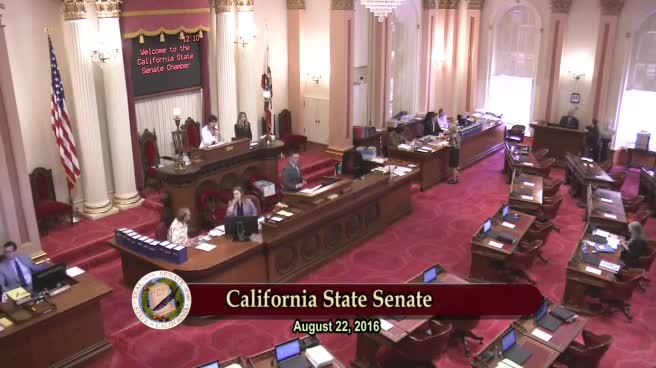 6MIN
Senate Floor
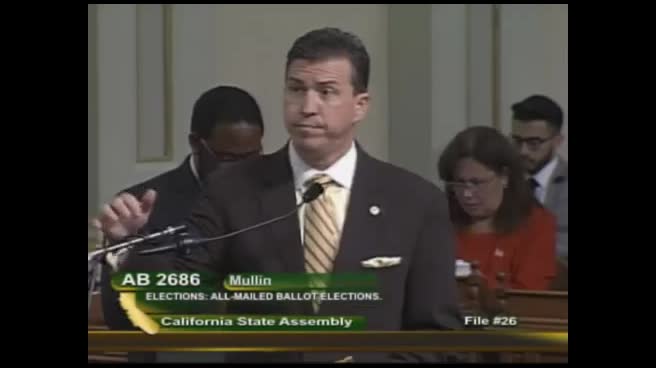 2MIN
Assembly Floor
 18MIN
Assembly Standing Committee on Elections and Redistricting


Bill Co-Author(s):