AB 2867: Cable, satellite, and Internet service providers: contracts.
- Session Year: 2015-2016
- House: Assembly
- Latest Version Date: 2016-05-03
Existing law states the intent of the Legislature to establish certain reasonable minimum standards with respect to consumer cable television contracts. Existing law imposes certain requirements on the imposition of late fees and sale or collection of delinquent cable television accounts.
This bill would require a cable cable, satellite, or Internet service provider that enables an individual to subscribe to its services through an Internet Web site to also enable those customers to cancel their subscriptions through the Internet Web site.
Existing law states the intent of the Legislature to establish certain reasonable minimum standards with respect to consumer cable television contracts. Existing law imposes certain requirements on the imposition of late fees and sale or collection of delinquent cable television accounts.
This bill would require a cable or Internet service provider that enables an individual to subscribe to its services through an Internet Web site to also enable those customers to cancel their subscriptions through the Internet Web site.
Under existing law, the Public Utilities Commission has regulatory authority over privately owned public utilities, including electrical corporations, gas corporations, telephone corporations, and water corporations.
Existing law authorizes the furnishing of utility services by local publicly owned public utilities, including municipal corporations, which are subject to control by their governing bodies, and municipal utility districts, public utility districts, and irrigation districts, which are subject to control by their boards of directors.
This bill would require a privately owned or local publicly owned public utility that enables an individual to subscribe to its services through an Internet Web site to also enable all of its customers to cancel their subscriptions through the site. To the extent this bill would require a local publicly owned public utility to change the options available on its Internet Web site, the bill would impose a state-mandated local program.
The California Constitution requires the state to reimburse local agencies and school districts for certain costs mandated by the state. Statutory provisions establish procedures for making that reimbursement.
This bill would provide that no reimbursement is required by this act for a specified reason.
Existing law, the California Community Care Facilities Act, provides for the licensing and regulation of community care facilities, as defined, by the State Department of Social Services.
This bill would make technical, nonsubstantive changes to a provision relating to the California Community Care Facilities Act.
If a cable cable, satellite, or Internet service provider enables an individual to subscribe to its services through an Internet Web site, it shall also enable all of its customers to cancel their subscriptions through the Internet Web site.
If a cable or Internet service provider enables an individual to subscribe to its services through an Internet Web site, it shall also enable all of its customers to cancel their subscriptions through the Internet Web site.
SECTION 1.Chapter 6 (commencing with Section 8390) is added to Division 4.1 of the Public Utilities Code, to read:6.Consumer Protection8390.If a privately owned or local publicly owned public utility enables an individual to subscribe to its services through an Internet Web site, it shall also enable all of its customers to cancel their subscriptions through the Internet Web site.
SEC. 2.No reimbursement is required by this act pursuant to Section 6 of Article XIIIB of the California Constitution because a local agency or school district has the authority to levy service charges, fees, or assessments sufficient to pay for the program or level of service mandated by this act, within the meaning of Section 17556 of the Government Code.
If a privately owned or local publicly owned public utility enables an individual to subscribe to its services through an Internet Web site, it shall also enable all of its customers to cancel their subscriptions through the Internet Web site.
SEC. 2.No reimbursement is required by this act pursuant to Section 6 of Article XIIIB of the California Constitution because a local agency or school district has the authority to levy service charges, fees, or assessments sufficient to pay for the program or level of service mandated by this act, within the meaning of Section 17556 of the Government Code.
SECTION 1.Section 1500 of the Health and Safety Code is amended to read:1500.This chapter shall be known, and may be cited, as the California Community Care Facilities Act.
This chapter shall be known known, and may be cited cited, as the California Community Care Facilities Act.
|
Date
|
Status
|
|---|---|
| Feb 19, 2016 | Introduced. To print. |
| Feb 21, 2016 | From printer. May be heard in committee March 22. |
| Feb 22, 2016 | Read first time. |
| Mar 17, 2016 | From committee chair, with author's amendments: Amend, and re-refer to Com. on U. & C. Read second time and amended. |
| Mar 17, 2016 | Referred to Com. on U. & C. |
| Mar 28, 2016 | From committee chair, with author's amendments: Amend, and re-refer to Com. on U. & C. Read second time and amended. |
| Mar 28, 2016 | Re-referred to Com. on U. & C. |
| Mar 29, 2016 | Re-referred to Com. on U. & C. |
| Mar 31, 2016 | Re-referred to Com. on RLS. pursuant to Assembly Rule 96. |
| Apr 4, 2016 | From committee: Be re-referred to Com. on U. & C. Re-referred. (Ayes 10. Noes 0.) (April 4). Re-referred to Com. on U. & C. |
| May 2, 2016 | From committee: Amend, and do pass as amended. (Ayes 9. Noes 3.) (April 27). |
| May 3, 2016 | Read second time and amended. Ordered returned to second reading. |
| May 4, 2016 | Read second time. Ordered to third reading. |
| Jun 13, 2016 | Stricken from file. |
|
Date
|
Description
|
Location
|
Votes
|
|
|---|---|---|---|---|
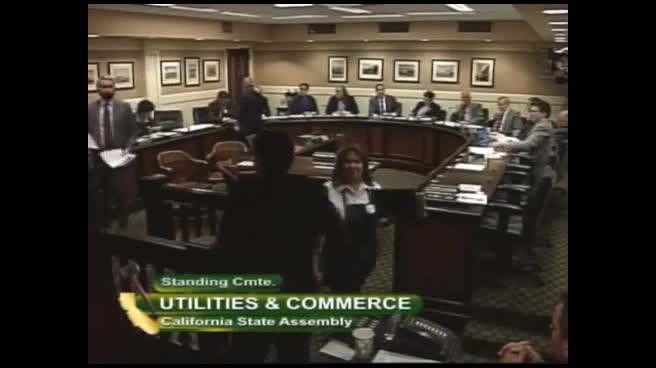
| Apr 27, 2016 | Do pass as amended. | Assembly Standing Committee on Utilities and Commerce |
Passed |
|
| Apr 4, 2016 | Be re-referred to the Committee on [Utilities and Commerce] | Assembly Standing Committee on Rules |
Passed |
This list shows positions taken on this bill by organizations on the date displayed, which is linked to the original source.
Positions by individuals are not included.
|
Organization
|
Position
|
Date
|
|---|---|---|
| California Association of Competitive Telecommunications Companies | ** Support | Apr 27, 2016 |
| California Cable & Telecommunications Association | ** Against | Apr 27, 2016 |
| California Chamber Of Commerce | ** Against | Apr 27, 2016 |
ASSEMBLY THIRD READING
ATR Bill Id:AB 2867
Author:(Gatto)
As Amended Ver:May 3, 2016
Majority vote
Committee | Votes | Ayes | Noes |
Utilities | 9-3 | Gatto, Burke, Dahle, Hadley, Obernolte, Quirk, Santiago, Ting, Williams | Patterson, Chávez, Eggman |
SUMMARY: Requires a cable, satellite, or Internet service provider, if it enables an individual to subscribe to its services through an Internet Web site, to also enable all of its customers to cancel their subscriptions through the Internet Web site.
FISCAL EFFECT: Unknown. This bill is keyed non-fiscal by the Legislative Counsel.
COMMENTS:
- Author's Statement: "Cable and Internet providers in particular continue to carry a reputation for poor customer service and have been known to use aggressive sales tactics to retain contracts, particularly when consumers request cancellation. A SoundCloud clip recently went viral highlighting these aggressive tactics. In this case, the individual was transferred to a service representative trained to talk people out of cancelling their contracts. The recording reveals the service representative continually asking for an explanation as to why this individual was choosing to cancel service, even though the man repeatedly declined to answer. This call was roughly 20 minutes long, at which point many other consumers would have hung up the phone before successfully canceling their service… Consumers should not have to endure aggressive sales tactics that border on harassment in order to cancel a service contact. Therefore, AB 2867 will require a cable or Internet service provider who allows consumers to subscribe to service online to also have the option to cancel their service online."
- Background: In 2009, the Legislature passed SB 340 (Yee), Chapter 350, Statutes of 2009, which requires any business making an automatic renewal or continuous service to clearly and conspicuously disclose terms of the offer and obtain the consumer's affirmative consent to the offer. SB 340 was prompted by an investigation by the Attorney General against Time, Inc. in which subscribers to Time, Inc. magazines were discovering that their subscriptions were automatically renewed even though the consumer claimed they had never knowingly consented to the renewal.
- Comcast SoundCloud Cancellation Call: In 2014, an audio recording between a Comcast customer and a customer retention specialist was posted on the online audio Web site SoundCloud. The call lasted approximately 20 minutes in which the customer repeatedly attempted to cancel his service while the customer retention specialist kept asking why he was doing so over and over again. Comcast issued an apology and in a memo to its employees said that it regretted that the incident had occurred, and that it was painful to listen to, but the customer retention specialist did a lot of what he was trained to do. According to the author, canceling services has become an ordeal that often involves consumers calling in and a company retention specialist trying to change the consumer's mind. Most customers would have hung up the phone before successfully cancelling their service.
This bill requires a cable, satellite, or Internet service provider that allows an individual to subscribe to its services through an Internet Web site, to also allow all of its customers to cancel their subscriptions through the Internet Web site.
This bill does not prohibit a cable, satellite, or Internet service provider from offering customers the option to cancel their subscription through existing mechanisms, in addition to cancelling their services online.
Analysis Prepared by: Edmond Cheung / U. & C. / (916) 319-2083 FN: 0002853
Date of Hearing: April 27, 2016
ASSEMBLY COMMITTEE ON UTILITIES AND COMMERCE
Mike Gatto, Chair
ABPCA Bill Id:AB 2867 (
Author:Gatto) – As Amended Ver:March 28, 2016
SUBJECT: Cable and Internet service providers: contracts
SUMMARY: Requires a cable or Internet service provider, if it enables an individual to subscribe to its services through an Internet Web site, to also enable all of its customers to cancel their subscriptions through the Internet Web site.
EXISTING LAW:
- Provides, under the Unfair Competition Law, that unfair competition includes any unlawful, unfair, or fraudulent business act or practice, including any unfair, deceptive, or untrue advertising, or any act prohibited by the False Advertising Act. (Business and Professions Code Section 17200 et seq.)
- Prohibits any person with the intent, directly or indirectly, to sell any goods or service by making any statement, which is untrue or misleading, and which is known, or which by the exercise of reasonable care should be known, to be untrue or misleading. Prohibits any person from making or disseminating any statement as part of a plan or scheme to sell any good or service at a price other than the state or advertised price. (Business and Professions Code Section 17500)
- Specifies that it is unlawful for any business making an automatic renewal or continuous service offer to a consumer to do any of the following:
- Fail to present the automatic renewal offer terms or continuous service offer terms in a clear and conspicuous manner before the subscription or purchasing agreement is fulfilled and in visual proximity, or in the case of an offer conveyed by voice, in temporal proximity, to the request for consent to the offer.
- Charge the consumer's credit or debit card or the consumer's account with a third party for an automatic renewal or continuous service without first obtaining the consumer's affirmative consent to the agreement containing the automatic renewal offer terms or continuous service offer terms.
- Fail to provide an acknowledgment that includes the automatic renewal or continuous service offer terms, cancellation policy, and information regarding how to cancel in a manner that is capable of being retained by the consumer. If the offer includes a free trial, the business shall also disclose in the acknowledgment how to cancel and allow the consumer to cancel before the consumer pays for the goods or services. (Business and Professions Code Section 17602)
FISCAL EFFECT: Unknown. This bill is keyed non-fiscal by the Legislative Counsel.
COMMENTS:
- Author's Statement: "Cable and Internet providers in particular continue to carry a reputation for poor customer service and have been known to use aggressive sales tactics to retain contracts, particularly when consumers request cancellation. A SoundCloud clip recently went viral highlighting these aggressive tactics. In this case, the individual was transferred to a service representative trained to talk people out of cancelling their contracts. The recording reveals the service representative continually asking for an explanation as to why this individual was choosing to cancel service, even though the man repeatedly declined to answer. This call was roughly 20 minutes long, at which point many other consumers would have hung up the phone before successfully canceling their service … Consumers should not have to endure aggressive sales tactics that border on harassment in order to cancel a service contact. Therefore, AB 2867 will require a cable or Internet service provider who allows consumers to subscribe to service online to also have the option to cancel their service online."
- Background: In 2010, Congress passed the Restore Online Shoppers' Confidence Act (ROSCA) which grew out of consumer complaints in which a consumer who completes an online transaction with one merchant is presented with a free trial promotional offer from another third party merchant. If a customer accepts the promotional offer, the original merchant transfers the consumers' data to the third party seller who continues to charge the customer on a recurring basis after the trail period, or until the customer cancels. This lead to customer complaints that they were unaware that their payment information would be transferred to a third party merchant during the time of the promotion and that they would continue to be charged after the free trial period. ROSCA prohibited an online merchant from sharing billing information with a third party seller, unless it obtained the consumer's expressed informed consent before charging their accounts. It also required sellers to provide simple mechanisms for a consumer to stop recurring charges from being placed on his or her account.
In addition, in 2009, the Legislature passed SB 340 (Yee), Chapter 350, Statutes of 2009, which requires any business making an automatic renewal or continuous service to clearly and conspicuously disclose terms of the offer and obtain the consumer's affirmative consent to the offer. SB 340 was prompted by an investigation by the Attorney General against Time, Inc. in which subscribers to Time, Inc. magazines were discovering that their subscriptions were automatically renewed even though the consumer claimed they had never knowingly consented to the renewal.
- Comcast SoundCloud Cancellation Call: In 2014, an audio recording between a Comcast customer and a customer retention specialist was posted on the online audio Web site SoundCloud. The call lasted approximately 20 minutes in which the customer repeatedly attempted to cancel his service while the customer retention specialist kept asking why he was doing so over and over again. Comcast issued an apology and in a memo to its employees said that it regretted that the incident had occurred, and that it was painful to listen to, but the customer retention specialist did a lot of what he was trained to do. According to the author, canceling services has become an ordeal that often involves consumer calling in and a company retention specialist trying to change the consumer's mind. Most customers would have hung up the phone before successfully cancelling their service.
This bill requires a cable or Internet service provider that allows an individual to subscribe to its services through an Internet Web site, to also allow all of its customers to cancel their subscriptions through the Internet Web site.
The author may wish to consider an amendment to also include satellite providers to the bill.
- Arguments in Support: According to the California Association of Competitive Telecommunications Companies (CALTEL), "Although it's always beneficial for the provider to understand, and attempt to address, the concerns that are prompting a customer to cancel, CALTEL recognizes that this practice has been prone to industry abuse and is not always perceived favorably by consumers."
- Arguments in Opposition: According to the California Chamber of Commerce, the California Manufacturers and Technology Association, the Direct Marketing Association, and CTIA – The Wireless Association, "AB 2867 is duplicative of existing federal law and the enactment of the measures would create confusion for both consumer and companies … AB 2867 adopts an unrealistic view of the marketplace that fails to account for the interests of customers, retailers and service providers in attracting and pleasing consumer and the consumer benefits that may be available. Indeed, by establishing rigid, unbending rules, AB 2867 discourages consumers from resolving problems in a way that is beneficial to them … AB 2867 would effectively create a significant hurdle to retention efforts and likely result in increased contract terminations that could have otherwise been avoided."
- Suggested Amendment:
1726. If a cable, satellite, or Internet service provider enables an individual to subscribe to its services through an Internet Web site, it shall also enable all of its customers to cancel their subscriptions through the Internet Web site.
- Prior Legislation:
SB 340 (Yee), Chapter 350, Statutes of 2009: Requires any business making an "automatic renewal" or "continuous service" to clearly and conspicuously disclose terms of the offer and obtain the consumers' affirmative consent to the offer.
REGISTERED SUPPORT / OPPOSITION:
Support
California Association of Competitive Telecommunications Companies
Opposition
California Cable & Telecommunications Association
California Chamber of Commerce
California Manufacturers and Technology Association
CTIA – The Wireless Association
Direct Marketing Association
Analysis Prepared by: Edmond Cheung / U. & C. / (916) 319-2083
Discussed in Hearing
 2H
Assembly Standing Committee on Utilities and Commerce
Bill Author

Bill Co-Author(s):