AB 35: Income taxes: credits: low-income housing: allocation increase.
- Session Year: 2015-2016
- House: Assembly
- Latest Version Date: 2015-09-14
Existing law establishes a low-income housing tax credit program pursuant to which the California Tax Credit Allocation Committee provides procedures and requirements for the allocation of state insurance, personal income, and corporation income tax credit amounts among low-income housing projects based on federal law. Existing law, in modified conformity to federal income tax law, allows the credit based upon the applicable percentage, as defined, of the qualified basis of each qualified low-income building. Existing law limits the total annual amount of the credit that the committee may allocate to $70 million per year, as specified.
This bill, for calendar years 2016 through 2021, inclusive, would increase the aggregate housing credit dollar amount that may be allocated among low-income housing projects by $100,000,000, as specified. The bill, under the insurance taxation law, the Personal Income Tax Law, and the Corporation Tax Law, would modify the definition of applicable percentage relating to qualified low-income buildings that meet specified criteria.
This bill would incorporate additional changes to Sections 12206, 17058, and 23610.5 of the Revenue and Taxation Code proposed by SB 377 that would become operative if this bill and SB 377 are chaptered and this bill is chaptered last.
This bill would take effect immediately as a tax levy.
Existing law establishes a low-income housing tax credit program pursuant to which the California Tax Credit Allocation Committee provides procedures and requirements for the allocation of state insurance, personal income, and corporation income tax credit amounts among low-income housing projects based on federal law. Existing law, in modified conformity to federal income tax law, allows the credit based upon the applicable percentage, as defined, of the qualified basis of each qualified low-income building. Existing law limits the total annual amount of the credit that the committee may allocate to $70 million per year, as specified.
This bill, for calendar years beginning in 2016, 2016 through 2021, inclusive, would increase the aggregate housing credit dollar amount that may be allocated among low-income housing projects by $300,000,000, $100,000,000, as specified. The bill, under the insurance taxation law, the Personal Income Tax Law, and the Corporation Tax Law, would modify the definition of applicable percentage relating to qualified low-income buildings that meet specified criteria. The bill would require the Treasurer to submit a report to the Legislature on or before January 1, 2020, regarding the increase in use, if any, of the credit on and after the effective date of this bill.
This bill would incorporate additional changes to Sections 12206, 17058, and 23610.5 of the Revenue and Taxation Code proposed by SB 377 that would become operative if this bill and SB 377 are chaptered and this bill is chaptered last.
This bill would take effect immediately as a tax levy.
Existing law establishes a low-income housing tax credit program pursuant to which the California Tax Credit Allocation Committee provides procedures and requirements for the allocation of state insurance, personal income, and corporation income tax credit amounts among low-income housing projects based on federal law. Existing law, in modified conformity to federal income tax law, allows the credit based upon the applicable percentage, as defined, of the qualified basis of each qualified low-income building. Existing law limits the total annual amount of the credit that the committee may allocate to $70 million per year, as specified.
This bill, for calendar years beginning in 2016, would increase the aggregate housing credit dollar amount that may be allocated among low-income housing projects by $300,000,000, as specified. The bill, under the insurance taxation law, the Personal Income Tax Law, and the Corporation Tax Law, would modify the definition of applicable percentage relating to qualified low-income buildings that meet specified criteria. The bill would require the Treasurer to submit a report to the Legislature on or before January 1, 2020, regarding the increase in use, if any, of the credit on and after the effective date of this bill.
This bill would incorporate additional changes to Sections 12206, 17058, and 23610.5 of the Revenue and Taxation Code proposed by SB 377 that would become operative if this bill and SB 377 are chaptered and this bill is chaptered last.
This bill would take effect immediately as a tax levy.
Existing law establishes a low-income housing tax credit program pursuant to which the California Tax Credit Allocation Committee provides procedures and requirements for the allocation of state insurance, personal income, and corporation income tax credit amounts among low-income housing projects based on federal law. Existing law, in modified conformity to federal income tax law, allows the credit based upon the applicable percentage, as defined, of the qualified basis of each qualified low-income building. Existing law limits the total annual amount of the credit that the committee may allocate to $70 million per year, as specified.
This bill, for calendar years beginning 2015, 2016, would increase the aggregate housing credit dollar amount that may be allocated among low-income housing projects by $300,000,000, as specified. The bill, under the insurance taxation law, the Personal Income Tax Law, and the Corporation Tax Law, would modify the definition of applicable percentage relating to qualified low-income buildings that meet specified criteria.
This bill would take effect immediately as a tax levy.
Existing law establishes a low-income housing tax credit program pursuant to which the California Tax Credit Allocation Committee provides procedures and requirements for the allocation of state insurance, personal income, and corporation income tax credit amounts among low-income housing projects based on federal law. Existing law, in modified conformity to federal income tax law, allows the credit based upon the applicable percentage, as defined, of the qualified basis of each qualified low-income building. Existing law limits the total annual amount of the credit that the committee may allocate to $70 million per year, as specified.
This bill, for calendar years beginning 2015, would increase the aggregate housing credit dollar amount that may be allocated among low-income housing projects by $300,000,000, as specified. The bill, under the insurance taxation law, the Personal Income Tax Law, and the Corporation Tax Law, would modify the definition of applicable percentage relating to qualified low-income buildings that meet specified criteria.
This bill would take effect immediately as a tax levy.
Existing law establishes a low-income housing tax credit program pursuant to which the California Tax Credit Allocation Committee provides procedures and requirements for the allocation of state insurance, personal income, and corporation income tax credit amounts among low-income housing projects based on federal law. Existing law, in modified conformity to federal income tax law, allows the credit based upon the applicable percentage, as defined, of the qualified basis of each qualified low-income building. Existing law limits the total annual amount of the credit that the committee may allocate to $70 million per year, as specified.
This bill, for calendar years beginning 2015, would increase the aggregate housing credit dollar amount that may be allocated among low-income housing projects by $300,000,000, as specified. The bill, under the insurance taxation law, the Personal Income Tax Law, and the Corporation Tax Law, would modify the definition of applicable percentage relating to qualified low-income buildings that meet specified criteria.
This bill would take effect immediately as a tax levy.
Existing law establishes a low-income housing tax credit program pursuant to which the California Tax Credit Allocation Committee provides procedures and requirements for the allocation of state insurance, income, and corporation tax credit amounts among low-income housing projects based on federal law. Existing law limits the total annual amount of the credit that the committee may allocate to $70 million per year, as specified.
This bill, for calendar years beginning 2015, would increase the aggregate housing credit dollar amount that may be allocated among low-income housing projects by $300,000,000, as specified.
This bill would take effect immediately as a tax levy.
The Personal Income Tax Law and the Corporation Tax Law allow various credits against the taxes imposed by those laws, including a state low-income housing tax credit, administered by the California Tax Credit Allocation Committee, which provides procedures and requirements for the allocation of state tax credit amounts among low-income housing projects based on federal law, which requires a 30 % present value credit for existing buildings, with the credit claimed over a 10-year period, as modified. Existing law generally requires the projects housing sponsor to have been allocated a credit for federal income tax purposes, as specified.
This bill would allow a very low-income and extremely low-income housing credit against those taxes for each taxable year on or after January 1, 2015, in an amount computed and allowed in accordance with a specified section of the Internal Revenue Code, as provided. The bill would specify that a project is not required to have been previously or currently allocated a credit for federal or state income tax purposes, as specified. The bill would make the aggregate housing credit dollar amount $40,000,000 to be allocated annually by the committee on a first-come-first-served basis subject to certain requirements being met, including that the project will be used exclusively for the restructuring, including the acquisition and substantial rehabilitation, of buildings at least 20 years old that currently serve very low-income, extremely low-income, single room occupancy (SRO) or rural area residents. The bill would authorize the committee and the Franchise Tax Board to adopt regulations to carry out the purposes of this section. The bill would make findings and declarations in this regard.
This bill would take effect immediately as a tax levy.
The Personal Income Tax Law and the Corporation Tax Law allow various credits against the taxes imposed by those laws, including a state low-income housing tax credit, administered by the California Tax Credit Allocation Committee, which provides procedures and requirements for the allocation of state tax credit amounts among low-income housing projects based on federal law, which requires a 30 % present value credit for existing buildings, with the credit claimed over a 10-year period, as modified. Existing law generally requires the projects housing sponsor to have been allocated a credit for federal income tax purposes, as specified.
This bill would allow a very low-income and extremely low-income housing credit against those taxes for each taxable year on or after January 1, 2015, in an amount computed and allowed in accordance with a specified section of the Internal Revenue Code, as provided. The bill would specify that a project is not required to have been previously or currently allocated a credit for federal or state income tax purposes, as specified. The bill would make the aggregate housing credit dollar amount $40,000,000 to be allocated annually by the committee on a first-come-first-served basis subject to certain requirements being met, including that the project will be used exclusively for the restructuring, including the acquisition and substantial rehabilitation, of buildings at least 20 years old that currently serve very low-income, extremely low-income, single room occupancy (SRO) or rural area residents. The bill would authorize the committee and the Franchise Tax Board to adopt regulations to carry out the purposes of this section. The bill would make findings and declarations in this regard.
This bill would take effect immediately as a tax levy.
(a)(1)There shall be allowed as a credit against the tax, as described by Section 12201, a state low-income housing tax credit in an amount equal to the amount determined in subdivision (c), computed in accordance with Section 42 of the Internal Revenue Code except as otherwise provided in this section.
(2)Taxpayer, for purposes of this section, means the sole owner in the case of a C corporation, the partners in the case of a partnership, members in the case of a limited liability company, and the shareholders in the case of an S corporation.
(3)Housing sponsor, for purposes of this section, means the sole owner in the case of a C corporation, the partnership in the case of a partnership, the limited liability company in the case of a limited liability company, and the S corporation in the case of an S corporation.
(4)Extremely low-income has the same meaning as in Section 50053 of the Health and Safety Code.
(5)Very low-income has the same meaning as in Section 50053 of the Health and Safety Code.
(b)(1)The amount of the credit allocated to any housing sponsor shall be authorized by the California Tax Credit Allocation Committee, or any successor thereof, based on a projects need for the credit for economic feasibility in accordance with the requirements of this section.
(A)Except for projects to provide farmworker housing, as defined in subdivision (h) of Section 50199.7 of the Health and Safety Code, that are allocated credits solely under the set-aside described in subdivision (c) of Section 50199.20 of the Health and Safety Code, the low-income housing project shall be located in California and shall meet either of the following requirements:
(i)The projects housing sponsor has been allocated by the California Tax Credit Allocation Committee a credit for federal income tax purposes under Section 42 of the Internal Revenue Code.
(ii)It qualifies for a credit under Section 42(h)(4)(B) of the Internal Revenue Code.
(B)The California Tax Credit Allocation Committee shall not require fees for the credit under this section in addition to those fees required for applications for the tax credit pursuant to Section 42 of the Internal Revenue Code. The committee may require a fee if the application for the credit under this section is submitted in a calendar year after the year the application is submitted for the federal tax credit.
(C)(i)For a project that receives a preliminary reservation of the state low-income housing tax credit, allowed pursuant to subdivision (a), on or after January 1, 2009, and before January 1, 2016, the credit shall be allocated to the partners of a partnership owning the project in accordance with the partnership agreement, regardless of how the federal low-income housing tax credit with respect to the project is allocated to the partners, or whether the allocation of the credit under the terms of the agreement has substantial economic effect, within the meaning of Section 704(b) of the Internal Revenue Code.
(ii)This subparagraph shall not apply to a project that receives a preliminary reservation of state low-income housing tax credits under the set-aside described in subdivision (c) of Section 50199.20 of the Health and Safety Code unless the project also receives a preliminary reservation of federal low-income housing tax credits.
(iii)This subparagraph shall cease to be operative with respect to any project that receives a preliminary reservation of a credit on or after January 1, 2016.
(2)(A)The California Tax Credit Allocation Committee shall certify to the housing sponsor the amount of tax credit under this section allocated to the housing sponsor for each credit period.
(B)In the case of a partnership or an S corporation, the housing sponsor shall provide a copy of the California Tax Credit Allocation Committee certification to the taxpayer.
(C)The taxpayer shall attach a copy of the certification to any return upon which a tax credit is claimed under this section.
(D)In the case of a failure to attach a copy of the certification for the year to the return in which a tax credit is claimed under this section, no credit under this section shall be allowed for that year until a copy of that certification is provided.
(E)All elections made by the taxpayer pursuant to Section 42 of the Internal Revenue Code shall apply to this section.
(F)(i)The California Tax Credit Allocation Committee may allocate a credit under this section in exchange for a credit allocated pursuant to Section 42(d)(5)(B) of the Internal Revenue Code in amounts up to 30 percent of the eligible basis of a building if the credits allowed under Section 42 of the Internal Revenue Code are reduced by an equivalent amount.
(ii)An equivalent amount shall be determined by the California Tax Credit Allocation Committee based upon the relative amount required to produce an equivalent state tax credit to the taxpayer.
(c)Section 42(b) of the Internal Revenue Code shall be modified as follows:
(1)In the case of any qualified low-income building that is a new building, as defined in Section 42 of the Internal Revenue Code and the regulations promulgated thereunder, and not federally subsidized, the term applicable percentage means the following:
(A)For each of the first three years, the percentage prescribed by the Secretary of the Treasury for new buildings that are not federally subsidized for the taxable year, determined in accordance with the requirements of Section 42(b)(1) of the Internal Revenue Code.
(B)For the fourth year, the difference between 30 percent and the sum of the applicable percentages for the first three years.
(2)In the case of any qualified low-income building that (i) is a new building, as defined in Section 42 of the Internal Revenue Code and the regulations promulgated thereunder, (ii) not located in designated difficult development areas (DDAs) or qualified census tracts (QCTs), as defined in Section 42(d)(5)(B) of the Internal Revenue Code, and (iii) is federally subsidized, the term applicable percentage means for the first three years, 15 percent of the qualified basis of the building, and for the fourth year, 5 percent of the qualified basis of the building.
(3)In the case of any qualified low-income building that is (i) an existing building, as defined in Section 42 of the Internal Revenue Code and the regulations promulgated thereunder, (ii) not located in designated difficult development areas (DDAs) or qualified census tracts (QCTs), as defined in Section 42(d)(5)(B) of the Internal Revenue Code, and (iii) is federally subsidized, the term applicable percentage means the following:
(A)For each of the first three years, the percentage prescribed by the Secretary of the Treasury for new buildings that are federally subsidized for the taxable year.
(B)For the fourth year, the difference between 13 percent and the sum of the applicable percentages for the first three years.
(4)In the case of any qualified low-income building that is (i) a new or an existing building, (ii) located in designated difficult development areas (DDAs) or qualified census tracts (QCTs) as defined in Section 42(d)(5)(B) of the Internal Revenue Code, and (iii) federally subsidized, the California Tax Credit Allocation Committee shall reduce the amount of California credit to be allocated under paragraph (2) and (3) by taking into account the increased federal credit received due to the basis boost provided under Section 42(d)(5)(B) of the Internal Revenue Code.
(5)In the case of any qualified low-income building that meets all of the requirements of subparagraphs (A) through (D), inclusive, the term applicable percentage means 30 percent for each of the first three years and 5 percent for the fourth year. A qualified low-income building receiving an allocation under this paragraph is ineligible to also receive an allocation under paragraph (3).
(A)The qualified low-income building is at least 15 years old.
(B)The qualified low-income building is serving households of very low-income or extremely low-income such that the average maximum household income as restricted, pursuant to an existing regulatory agreement with a federal, state, county, local, or other governmental agency, is not more than 45 percent of the area median gross income, as determined under Section 42 of the Internal Revenue Code, adjusted by household size, and a tax credit regulatory agreement is entered into for a period of not less than 55 years restricting the average targeted household income to no more than 45 percent of the area median income.
(C)The qualified low-income building would have insufficient credits under paragraphs (2) and (3) to complete substantial rehabilitation due to a low appraised value.
(D)The qualified low-income building will complete the substantial rehabilitation in connection with the credit allocation herein.
(d)The term qualified low-income housing project as defined in Section 42(c)(2) of the Internal Revenue Code is modified by adding the following requirements:
(1)The taxpayer shall be entitled to receive a cash distribution from the operations of the project, after funding required reserves, that, at the election of the taxpayer, is equal to:
(A)An amount not to exceed 8 percent of the lesser of:
(i)The owner equity that shall include the amount of the capital contributions actually paid to the housing sponsor and shall not include any amounts until they are paid on an investor note.
(ii)Twenty percent of the adjusted basis of the building as of the close of the first taxable year of the credit period.
(B)The amount of the cashflow from those units in the building that are not low-income units. For purposes of computing cashflow under this subparagraph, operating costs shall be allocated to the low-income units using the floor space fraction, as defined in Section 42 of the Internal Revenue Code.
(C)Any amount allowed to be distributed under subparagraph (A) that is not available for distribution during the first five years of the compliance period may be accumulated and distributed any time during the first 15 years of the compliance period but not thereafter.
(2)The limitation on return shall apply in the aggregate to the partners if the housing sponsor is a partnership and in the aggregate to the shareholders if the housing sponsor is an S corporation.
(3)The housing sponsor shall apply any cash available for distribution in excess of the amount eligible to be distributed under paragraph (1) to reduce the rent on rent-restricted units or to increase the number of rent-restricted units subject to the tests of Section 42(g)(1) of the Internal Revenue Code.
(e)The provisions of Section 42(f) of the Internal Revenue Code shall be modified as follows:
(1)The term credit period as defined in Section 42(f)(1) of the Internal Revenue Code is modified by substituting four taxable years for 10 taxable years.
(2)The special rule for the first taxable year of the credit period under Section 42(f)(2) of the Internal Revenue Code shall not apply to the tax credit under this section.
(3)Section 42(f)(3) of the Internal Revenue Code is modified to read:
If, as of the close of any taxable year in the compliance period, after the first year of the credit period, the qualified basis of any building exceeds the qualified basis of that building as of the close of the first year of the credit period, the housing sponsor, to the extent of its tax credit allocation, shall be eligible for a credit on the excess in an amount equal to the applicable percentage determined pursuant to subdivision (c) for the four-year period beginning with the taxable year in which the increase in qualified basis occurs.
(f)The provisions of Section 42(h) of the Internal Revenue Code shall be modified as follows:
(1)Section 42(h)(2) of the Internal Revenue Code shall not be applicable and instead the following provisions shall be applicable:
The total amount for the four-year credit period of the housing credit dollars allocated in a calendar year to any building shall reduce the aggregate housing credit dollar amount of the California Tax Credit Allocation Committee for the calendar year in which the allocation is made.
(2)Paragraphs (3), (4), (5), (6)(E)(i)(II), (6)(F), (6)(G), (6)(I), (7), and (8) of Section 42(h) of the Internal Revenue Code shall not be applicable.
(g)The aggregate housing credit dollar amount that may be allocated annually by the California Tax Credit Allocation Committee pursuant to this section, Section 17058, and Section 23610.5 shall be an amount equal to the sum of all the following:
(1)(A)Seventy million dollars ($70,000,000) for the 2001 calendar year, and, for the 2002 calendar year and each calendar year thereafter, seventy million dollars ($70,000,000) increased by the percentage, if any, by which the Consumer Price Index for the preceding calendar year exceeds the Consumer Price Index for the 2001 calendar year. For the purposes of this paragraph, the term Consumer Price Index means the last Consumer Price Index for All Urban Consumers published by the federal Department of Labor.
(B)For calendar years 2016 through 2021, inclusive, an additional one hundred million dollars ($100,000,000) for the 2016 calendar year, and, for the 2017 through 2021 calendar years, one hundred million dollars ($100,000,000) increased by the percentage, if any, by which the Consumer Price Index for the preceding calendar year exceeds the Consumer Price Index for the 2016 calendar year. For the purposes of this paragraph, the term Consumer Price Index means the last Consumer Price Index for All Urban Consumers published by the federal Department of Labor. A housing sponsor receiving an allocation under paragraph (1) of subdivision (c) shall not be eligible for receipt of the housing credit allocated from the increased amount under this subparagraph. A housing sponsor receiving an allocation under paragraph (1) of subdivision (c) shall remain eligible for receipt of the housing credit allocated from the credit ceiling amount under subparagraph (A).
(2)The unused housing credit ceiling, if any, for the preceding calendar years.
(3)The amount of housing credit ceiling returned in the calendar year. For purposes of this paragraph, the amount of housing credit dollar amount returned in the calendar year equals the housing credit dollar amount previously allocated to any project that does not become a qualified low-income housing project within the period required by this section or to any project with respect to which an allocation is canceled by mutual consent of the California Tax Credit Allocation Committee and the allocation recipient.
(4)Five hundred thousand dollars ($500,000) per calendar year for projects to provide farmworker housing, as defined in subdivision (h) of Section 50199.7 of the Health and Safety Code.
(5)The amount of any unallocated or returned credits under former Sections 17053.14, 23608.2, and 23608.3, as those sections read prior to January 1, 2009, until fully exhausted for projects to provide farmworker housing, as defined in subdivision (h) of Section 50199.7 of the Health and Safety Code.
(h)The term compliance period as defined in Section 42(i)(1) of the Internal Revenue Code is modified to mean, with respect to any building, the period of 30 consecutive taxable years beginning with the first taxable year of the credit period with respect thereto.
(i)(1)Section 42(j) of the Internal Revenue Code shall not be applicable and the provisions in paragraph (2) shall be substituted in its place.
(2)The requirements of this section shall be set forth in a regulatory agreement between the California Tax Credit Allocation Committee and the housing sponsor, and the regulatory agreement shall be subordinated, when required, to any lien or encumbrance of any banks or other institutional lenders to the project. The regulatory agreement entered into pursuant to subdivision (f) of Section 50199.14 of the Health and Safety Code, shall apply, provided that the agreement includes all of the following provisions:
(A)A term not less than the compliance period.
(B)A requirement that the agreement be recorded in the official records of the county in which the qualified low-income housing project is located.
(C)A provision stating which state and local agencies can enforce the regulatory agreement in the event the housing sponsor fails to satisfy any of the requirements of this section.
(D)A provision that the regulatory agreement shall be deemed a contract enforceable by tenants as third-party beneficiaries thereto and that allows individuals, whether prospective, present, or former occupants of the building, who meet the income limitation applicable to the building, the right to enforce the regulatory agreement in any state court.
(E)A provision incorporating the requirements of Section 42 of the Internal Revenue Code as modified by this section.
(F)A requirement that the housing sponsor notify the California Tax Credit Allocation Committee or its designee and the local agency that can enforce the regulatory agreement if there is a determination by the Internal Revenue Service that the project is not in compliance with Section 42(g) of the Internal Revenue Code.
(G)A requirement that the housing sponsor, as security for the performance of the housing sponsors obligations under the regulatory agreement, assign the housing sponsors interest in rents that it receives from the project, provided that until there is a default under the regulatory agreement, the housing sponsor is entitled to collect and retain the rents.
(H)The remedies available in the event of a default under the regulatory agreement that is not cured within a reasonable cure period, include, but are not limited to, allowing any of the parties designated to enforce the regulatory agreement to collect all rents with respect to the project; taking possession of the project and operating the project in accordance with the regulatory agreement until the enforcer determines the housing sponsor is in a position to operate the project in accordance with the regulatory agreement; applying to any court for specific performance; securing the appointment of a receiver to operate the project; or any other relief as may be appropriate.
(j)(1)The committee shall allocate the housing credit on a regular basis consisting of two or more periods in each calendar year during which applications may be filed and considered. The committee shall establish application filing deadlines, the maximum percentage of federal and state low-income housing tax credit ceiling that may be allocated by the committee in that period, and the approximate date on which allocations shall be made. If the enactment of federal or state law, the adoption of rules or regulations, or other similar events prevent the use of two allocation periods, the committee may reduce the number of periods and adjust the filing deadlines, maximum percentage of credit allocated, and allocation dates.
(2)The committee shall adopt a qualified allocation plan, as provided in Section 42(m)(1) of the Internal Revenue Code. In adopting this plan, the committee shall comply with the provisions of Sections 42(m)(1)(B) and 42(m)(1)(C) of the Internal Revenue Code, respectively.
(3)Notwithstanding Section 42(m) of the Internal Revenue Code the California Tax Credit Allocation Committee shall allocate housing credits in accordance with the qualified allocation plan and regulations, which shall include the following provisions:
(A)All housing sponsors, as defined by paragraph (3) of subdivision (a), shall demonstrate at the time the application is filed with the committee that the project meets the following threshold requirements:
(i)The housing sponsor shall demonstrate there is a need and demand for low-income housing in the community or region for which it is proposed.
(ii)The projects proposed financing, including tax credit proceeds, shall be sufficient to complete the project and that the proposed operating income shall be adequate to operate the project for the extended use period.
(iii)The project shall have enforceable financing commitments, either construction or permanent financing, for at least 50 percent of the total estimated financing of the project.
(iv)The housing sponsor shall have and maintain control of the site for the project.
(v)The housing sponsor shall demonstrate that the project complies with all applicable local land use and zoning ordinances.
(vi)The housing sponsor shall demonstrate that the project development team has the experience and the financial capacity to ensure project completion and operation for the extended use period.
(vii)The housing sponsor shall demonstrate the amount of tax credit that is necessary for the financial feasibility of the project and its viability as a qualified low-income housing project throughout the extended use period, taking into account operating expenses, a supportable debt service, reserves, funds set aside for rental subsidies, and required equity, and a development fee that does not exceed a specified percentage of the eligible basis of the project prior to inclusion of the development fee in the eligible basis, as determined by the committee.
(B)The committee shall give a preference to those projects satisfying all of the threshold requirements of subparagraph (A) if both of the following apply:
(i)The project serves the lowest income tenants at rents affordable to those tenants.
(ii)The project is obligated to serve qualified tenants for the longest period.
(C)In addition to the provisions of subparagraphs (A) and (B), the committee shall use the following criteria in allocating housing credits:
(i)Projects serving large families in which a substantial number, as defined by the committee, of all residential units are low-income units with three or more bedrooms.
(ii)Projects providing single-room occupancy units serving very low income tenants.
(iii)(I)Existing projects that are at risk of conversion.
(II)For purposes of this section, the term at risk of conversion, with respect to an existing property means a property that satisfies all of the following criteria:
(ia)The property is a multifamily rental housing development in which at least 50 percent of the units receive governmental assistance pursuant to any of the following:
(Ia)New construction, substantial rehabilitation, moderate rehabilitation, property disposition, and loan management set-aside programs, or any other program providing project-based assistance pursuant to Section 8 of the United States Housing Act of 1937, Section 1437f of Title 42 of the United States Code, as amended.
(Ib)The Below-Market-Interest-Rate Program pursuant to Section 221(d)(3) of the National Housing Act, Sections 1715l(d)(3) and (5) of Title 12 of the United States Code.
(Ic)Section 236 of the National Housing Act, Section 1715z-1 of Title 12 of the United States Code.
(Id)Programs for rent supplement assistance pursuant to Section 18 101 of the Housing and Urban Development Act of 1965, Section 1701s of Title 12 of the United States Code, as amended.
(Ie)Programs pursuant to Section 515 of the Housing Act of 1949, Section 1485 of Title 42 of the United States Code, as amended.
(If)The low-income housing credit program set forth in Section 42 of the Internal Revenue Code.
(ib)The restrictions on rent and income levels will terminate or the federal insured mortgage on the property is eligible for prepayment any time within five years before or after the date of application to the California Tax Credit Allocation Committee.
(ic)The entity acquiring the property enters into a regulatory agreement that requires the property to be operated in accordance with the requirements of this section for a period equal to the greater of 55 years or the life of the property.
(id)The property satisfies the requirements of Section 42(e) of the Internal Revenue Code, regarding rehabilitation expenditures except that the provisions of Section 42(e)(3)(A)(ii)(I) shall not apply.
(iv)Projects for which a public agency provides direct or indirect long-term financial support for at least 15 percent of the total project development costs or projects for which the owners equity constitutes at least 30 percent of the total project development costs.
(v)Projects that provide tenant amenities not generally available to residents of low-income housing projects.
(4)For purposes of allocating credits pursuant to this section, the committee shall not give preference to any project by virtue of the date of submission of its application except to break a tie when two or more of the projects have an equal rating.
(k)Section 42(l) of the Internal Revenue Code shall be modified as follows:
The term secretary shall be replaced by the term California Franchise Tax Board.
(l)In the case where the credit allowed under this section exceeds the tax, the excess may be carried over to reduce the tax in the following year, and succeeding years if necessary, until the credit has been exhausted.
(m)The provisions of Section 11407(a) of Public Law 101-508, relating to the effective date of the extension of the low-income housing credit, shall apply to calendar years after 1993.
(n)The provisions of Section 11407(c) of Public Law 101-508, relating to election to accelerate credit, shall not apply.
(o)This section shall remain in effect for as long as Section 42 of the Internal Revenue Code, relating to low-income housing credit, remains in effect.
SEC. 1.5.Section 12206 of the Revenue and Taxation Code is amended to read:12206.(a)(1)There shall be allowed as a credit against the tax, as described by Section 12201, a state low-income housing tax credit in an amount equal to the amount determined in subdivision (c), computed in accordance with Section 42 of the Internal Revenue Code, relating to low-income housing credit, except as otherwise provided in this section.
(2)Taxpayer, for purposes of this section, means the sole owner in the case of a C corporation, the partners in the case of a partnership, members in the case of a limited liability company, and the shareholders in the case of an S corporation.
(3)Housing sponsor, for purposes of this section, means the sole owner in the case of a C corporation, the partnership in the case of a partnership, the limited liability company in case of a limited liability company, and the S corporation in the case of an S corporation.
(4)Extremely low-income has the same meaning as in Section 50053 of the Health and Safety Code.
(5)Very low-income has the same meaning as in Section 50053 of the Health and Safety Code.
(b)(1)The amount of the credit allocated to any housing sponsor shall be authorized by the California Tax Credit Allocation Committee, or any successor thereof, based on a projects need for the credit for economic feasibility in accordance with the requirements of this section.
(A)Except for projects to provide farmworker housing, as defined in subdivision (h) of Section 50199.7 of the Health and Safety Code, that are allocated credits solely under the set-aside described in subdivision (c) of Section 50199.20 of the Health and Safety Code, the low-income housing project shall be located in California and shall meet either of the following requirements:
(i)The projects housing sponsor has been allocated by the California Tax Credit Allocation Committee a credit for federal income tax purposes under Section 42 of the Internal Revenue Code, relating to low-income housing credit.
(ii)It qualifies for a credit under Section 42(h)(4)(B) of the Internal Revenue Code, relating to special rule where 50 percent or more of building is financed with tax-exempt bonds subject to volume cap.
(B)The California Tax Credit Allocation Committee shall not require fees for the credit under this section in addition to those fees required for applications for the tax credit pursuant to Section 42 of the Internal Revenue Code, relating to low-income housing credit. The committee may require a fee if the application for the credit under this section is submitted in a calendar year after the year the application is submitted for the federal tax credit.
(C)(i)For a project that receives a preliminary reservation of the state low-income housing tax credit, allowed pursuant to subdivision (a), on or after January 1, 2009, the credit shall be allocated to the partners of a partnership owning the project in accordance with the partnership agreement, regardless of how the federal low-income housing tax credit with respect to the project is allocated to the partners, or whether the allocation of the credit under the terms of the agreement has substantial economic effect, within the meaning of Section 704(b) of the Internal Revenue Code, relating to determination of distributive share.
(ii)This subparagraph shall not apply to a project that receives a preliminary reservation of state low-income housing tax credits under the set-aside described in subdivision (c) of Section 50199.20 of the Health and Safety Code unless the project also receives a preliminary reservation of federal low-income housing tax credits.
(2)(A)The California Tax Credit Allocation Committee shall certify to the housing sponsor the amount of tax credit under this section allocated to the housing sponsor for each credit period.
(B)In the case of a partnership or an S corporation, the housing sponsor shall provide a copy of the California Tax Credit Allocation Committee certification to the taxpayer.
(C)The taxpayer shall attach a copy of the certification to any return upon which a tax credit is claimed under this section.
(D)In the case of a failure to attach a copy of the certification for the year to the return in which a tax credit is claimed under this section, no credit under this section shall be allowed for that year until a copy of that certification is provided.
(E)All elections made by the taxpayer pursuant to Section 42 of the Internal Revenue Code, relating to low-income housing credit, shall apply to this section.
(F)(i)The California Tax Credit Allocation Committee may allocate a credit under this section in exchange for a credit allocated pursuant to Section 42(d)(5)(B) of the Internal Revenue Code, relating to increase in credit for buildings in high-cost areas, in amounts up to 30 percent of the eligible basis of a building if the credits allowed under Section 42 of the Internal Revenue Code, relating to low-income housing credit, are reduced by an equivalent amount.
(ii)An equivalent amount shall be determined by the California Tax Credit Allocation Committee based upon the relative amount required to produce an equivalent state tax credit to the taxpayer.
(c)Section 42(b) of the Internal Revenue Code, relating to applicable percentage, shall be modified as follows:
(1)In the case of any qualified low-income building that is a new building, as defined in Section 42 of the Internal Revenue Code and the regulations promulgated thereunder, and not federally subsidized, the term applicable percentage means the following:
(A)For each of the first three years, the percentage prescribed by the Secretary of the Treasury for new buildings that are not federally subsidized for the taxable year, determined in accordance with the requirements of Section 42(b)(1) of the Internal Revenue Code.
(B)For the fourth year, the difference between 30 percent and the sum of the applicable percentages for the first three years.
(2)In the case of any qualified low-income building that (i) is a new building, as defined in Section 42 of the Internal Revenue Code and the regulations promulgated thereunder, (ii) not located in designated difficult development areas (DDAs) or qualified census tracts (QCTs), as defined in Section 42(d)(5)(B) of the Internal Revenue Code, and (iii) is federally subsidized, the term applicable percentage means for the first three years, 15 percent of the qualified basis of the building, and for the fourth year, 5 percent of the qualified basis of the building.
(3)In the case of any qualified low-income building that is (i) an existing building, as defined in Section 42 of the Internal Revenue Code and the regulations promulgated thereunder, (ii) not located in designated difficult development areas (DDAs) or qualified census tracts (QCTs), as defined in Section 42(d)(5)(B) of the Internal Revenue Code, and (iii) is federally subsidized, the term applicable percentage means the following:
(A)For each of the first three years, the percentage prescribed by the Secretary of the Treasury for new buildings that are federally subsidized for the taxable year.
(B)For the fourth year, the difference between 13 percent and the sum of the applicable percentages for the first three years.
(4)In the case of any qualified low-income building that is (i) a new or an existing building, (ii) located in designated difficult development areas (DDAs) or qualified census tracts (QCTs) as defined in Section 42(d)(5)(B) of the Internal Revenue Code, and (iii) federally subsidized, the California Tax Credit Allocation Committee shall reduce the amount of California credit to be allocated under paragraph (2) and (3) by taking into account the increased federal credit received due to the basis boost provided under Section 42(d)(5)(B) of the Internal Revenue Code.
(5)In the case of any qualified low-income building that meets all of the requirements of subparagraphs (A) through (D), inclusive, the term applicable percentage means 30 percent for each of the first three years and 5 percent for the fourth year. A qualified low-income building receiving an allocation under this paragraph is ineligible to also receive an allocation under paragraph (3).
(A)The qualified low-income building is at least 15 years old.
(B)The qualified low-income building is serving households of very low-income or extremely low-income such that the average maximum household income as restricted, pursuant to an existing regulatory agreement with a federal, state, county, local, or other governmental agency, is not more than 45 percent of the area median gross income, as determined under Section 42 of the Internal Revenue Code, adjusted by household size, and a tax credit regulatory agreement is entered into for a period of not less than 55 years restricting the average targeted household income to no more than 45 percent of the area median income.
(C)The qualified low-income building would have insufficient credits under paragraphs (2) and (3) to complete substantial rehabilitation due to a low appraised value.
(D)The qualified low-income building will complete the substantial rehabilitation in connection with the credit allocation herein.
(d)The term qualified low-income housing project as defined in Section 42(c)(2) of the Internal Revenue Code, relating to qualified low-income building, is modified by adding the following requirements:
(1)The taxpayer shall be entitled to receive a cash distribution from the operations of the project, after funding required reserves, that, at the election of the taxpayer, is equal to:
(A)An amount not to exceed 8 percent of the lesser of:
(i)The owner equity, which shall include the amount of the capital contributions actually paid to the housing sponsor and shall not include any amounts until they are paid on an investor note.
(ii)Twenty percent of the adjusted basis of the building as of the close of the first taxable year of the credit period.
(B)The amount of the cashflow from those units in the building that are not low-income units. For purposes of computing cashflow under this subparagraph, operating costs shall be allocated to the low-income units using the floor space fraction, as defined in Section 42 of the Internal Revenue Code, relating to low-income housing credit.
(C)Any amount allowed to be distributed under subparagraph (A) that is not available for distribution during the first five years of the compliance period may be accumulated and distributed any time during the first 15 years of the compliance period but not thereafter.
(2)The limitation on return shall apply in the aggregate to the partners if the housing sponsor is a partnership and in the aggregate to the shareholders if the housing sponsor is an S corporation.
(3)The housing sponsor shall apply any cash available for distribution in excess of the amount eligible to be distributed under paragraph (1) to reduce the rent on rent-restricted units or to increase the number of rent-restricted units subject to the tests of Section 42(g)(1) of the Internal Revenue Code, relating to in general.
(e)The provisions of Section 42(f) of the Internal Revenue Code, relating to definition and special rules relating to credit period, shall be modified as follows:
(1)The term credit period as defined in Section 42(f)(1) of the Internal Revenue Code, relating to credit period defined, is modified by substituting four taxable years for 10 taxable years.
(2)The special rule for the first taxable year of the credit period under Section 42(f)(2) of the Internal Revenue Code, relating to special rule for first year of credit period, shall not apply to the tax credit under this section.
(3)Section 42(f)(3) of the Internal Revenue Code, relating to determination of applicable percentage with respect to increases in qualified basis after first year of credit period, is modified to read:
If, as of the close of any taxable year in the compliance period, after the first year of the credit period, the qualified basis of any building exceeds the qualified basis of that building as of the close of the first year of the credit period, the housing sponsor, to the extent of its tax credit allocation, shall be eligible for a credit on the excess in an amount equal to the applicable percentage determined pursuant to subdivision (c) for the four-year period beginning with the taxable year in which the increase in qualified basis occurs.
(f)The provisions of Section 42(h) of the Internal Revenue Code, relating to limitation on aggregate credit allowable with respect to projects located in a state, shall be modified as follows:
(1)Section 42(h)(2) of the Internal Revenue Code, relating to allocated credit amount to apply to all taxable years ending during or after credit allocation year, shall not be applicable and instead the following provisions shall be applicable:
The total amount for the four-year credit period of the housing credit dollars allocated in a calendar year to any building shall reduce the aggregate housing credit dollar amount of the California Tax Credit Allocation Committee for the calendar year in which the allocation is made.
(2)Paragraphs (3), (4), (5), (6)(E)(i)(II), (6)(F), (6)(G), (6)(I), (7), and (8) of Section 42(h) of the Internal Revenue Code, relating to limitation on aggregate credit allowable with respect to projects located in a state, shall not be applicable.
(g)The aggregate housing credit dollar amount that may be allocated annually by the California Tax Credit Allocation Committee pursuant to this section, Section 17058, and Section 23610.5 shall be an amount equal to the sum of all the following:
(1)(A)Seventy million dollars ($70,000,000) for the 2001 calendar year, and, for the 2002 calendar year and each calendar year thereafter, seventy million dollars ($70,000,000) increased by the percentage, if any, by which the Consumer Price Index for the preceding calendar year exceeds the Consumer Price Index for the 2001 calendar year. For the purposes of this paragraph, the term Consumer Price Index means the last Consumer Price Index for All Urban Consumers published by the federal Department of Labor.
(B)For calendar years 2016 through 2021, inclusive, an additional one hundred million dollars ($100,000,000) for the 2016 calendar year, and, for the 2017 through 2021 calendar years, one hundred million dollars ($100,000,000) increased by the percentage, if any, by which the Consumer Price Index for the preceding calendar year exceeds the Consumer Price Index for the 2016 calendar year. For the purposes of this paragraph, the term Consumer Price Index means the last Consumer Price Index for All Urban Consumers published by the federal Department of Labor. A housing sponsor receiving an allocation under paragraph (1) of subdivision (c) shall not be eligible for receipt of the housing credit allocated from the increased amount under this subparagraph. A housing sponsor receiving an allocation under paragraph (1) of subdivision (c) shall remain eligible for receipt of the housing credit allocated from the credit ceiling amount under subparagraph (A).
(2)The unused housing credit ceiling, if any, for the preceding calendar years.
(3)The amount of housing credit ceiling returned in the calendar year. For purposes of this paragraph, the amount of housing credit dollar amount returned in the calendar year equals the housing credit dollar amount previously allocated to any project that does not become a qualified low-income housing project within the period required by this section or to any project with respect to which an allocation is canceled by mutual consent of the California Tax Credit Allocation Committee and the allocation recipient.
(4)Five hundred thousand dollars ($500,000) per calendar year for projects to provide farmworker housing, as defined in subdivision (h) of Section 50199.7 of the Health and Safety Code.
(5)The amount of any unallocated or returned credits under former Sections 17053.14, 23608.2, and 23608.3, as those sections read prior to January 1, 2009, until fully exhausted for projects to provide farmworker housing, as defined in subdivision (h) of Section 50199.7 of the Health and Safety Code.
(h)The term compliance period as defined in Section 42(i)(1) of the Internal Revenue Code, relating to compliance period, is modified to mean, with respect to any building, the period of 30 consecutive taxable years beginning with the first taxable year of the credit period with respect thereto.
(i)(1)Section 42(j) of the Internal Revenue Code, relating to recapture of credit, shall not be applicable and the provisions in paragraph (2) shall be substituted in its place.
(2)The requirements of this section shall be set forth in a regulatory agreement between the California Tax Credit Allocation Committee and the housing sponsor, and the regulatory agreement shall be subordinated, when required, to any lien or encumbrance of any banks or other institutional lenders to the project. The regulatory agreement entered into pursuant to subdivision (f) of Section 50199.14 of the Health and Safety Code, shall apply, provided that the agreement includes all of the following provisions:
(A)A term not less than the compliance period.
(B)A requirement that the agreement be recorded in the official records of the county in which the qualified low-income housing project is located.
(C)A provision stating which state and local agencies can enforce the regulatory agreement in the event the housing sponsor fails to satisfy any of the requirements of this section.
(D)A provision that the regulatory agreement shall be deemed a contract enforceable by tenants as third-party beneficiaries thereto and that allows individuals, whether prospective, present, or former occupants of the building, who meet the income limitation applicable to the building, the right to enforce the regulatory agreement in any state court.
(E)A provision incorporating the requirements of Section 42 of the Internal Revenue Code, relating to low-income housing credit, as modified by this section.
(F)A requirement that the housing sponsor notify the California Tax Credit Allocation Committee or its designee and the local agency that can enforce the regulatory agreement if there is a determination by the Internal Revenue Service that the project is not in compliance with Section 42(g) of the Internal Revenue Code, relating to qualified low-income housing project.
(G)A requirement that the housing sponsor, as security for the performance of the housing sponsors obligations under the regulatory agreement, assign the housing sponsors interest in rents that it receives from the project, provided that until there is a default under the regulatory agreement, the housing sponsor is entitled to collect and retain the rents.
(H)A provision that the remedies available in the event of a default under the regulatory agreement that is not cured within a reasonable cure period include, but are not limited to, allowing any of the parties designated to enforce the regulatory agreement to collect all rents with respect to the project; taking possession of the project and operating the project in accordance with the regulatory agreement until the enforcer determines the housing sponsor is in a position to operate the project in accordance with the regulatory agreement; applying to any court for specific performance; securing the appointment of a receiver to operate the project; or any other relief as may be appropriate.
(j)(1)The committee shall allocate the housing credit on a regular basis consisting of two or more periods in each calendar year during which applications may be filed and considered. The committee shall establish application filing deadlines, the maximum percentage of federal and state low-income housing tax credit ceiling that may be allocated by the committee in that period, and the approximate date on which allocations shall be made. If the enactment of federal or state law, the adoption of rules or regulations, or other similar events prevent the use of two allocation periods, the committee may reduce the number of periods and adjust the filing deadlines, maximum percentage of credit allocated, and allocation dates.
(2)The committee shall adopt a qualified allocation plan, as provided in Section 42(m)(1) of the Internal Revenue Code, relating to plans for allocation of credit among projects. In adopting this plan, the committee shall comply with the provisions of Sections 42(m)(1)(B) and 42(m)(1)(C) of the Internal Revenue Code, relating to qualified allocation plan and relating to certain selection criteria must be used, respectively.
(3)Notwithstanding Section 42(m) of the Internal Revenue Code, relating to responsibilities of housing credit agencies, the California Tax Credit Allocation Committee shall allocate housing credits in accordance with the qualified allocation plan and regulations, which shall include the following provisions:
(A)All housing sponsors, as defined by paragraph (3) of subdivision (a), shall demonstrate at the time the application is filed with the committee that the project meets the following threshold requirements:
(i)The housing sponsor shall demonstrate that there is a need and demand for low-income housing in the community or region for which it is proposed.
(ii)The projects proposed financing, including tax credit proceeds, shall be sufficient to complete the project and that the proposed operating income shall be adequate to operate the project for the extended use period.
(iii)The project shall have enforceable financing commitments, either construction or permanent financing, for at least 50 percent of the total estimated financing of the project.
(iv)The housing sponsor shall have and maintain control of the site for the project.
(v)The housing sponsor shall demonstrate that the project complies with all applicable local land use and zoning ordinances.
(vi)The housing sponsor shall demonstrate that the project development team has the experience and the financial capacity to ensure project completion and operation for the extended use period.
(vii)The housing sponsor shall demonstrate the amount of tax credit that is necessary for the financial feasibility of the project and its viability as a qualified low-income housing project throughout the extended use period, taking into account operating expenses, a supportable debt service, reserves, funds set aside for rental subsidies and required equity, and a development fee that does not exceed a specified percentage of the eligible basis of the project prior to inclusion of the development fee in the eligible basis, as determined by the committee.
(B)The committee shall give a preference to those projects satisfying all of the threshold requirements of subparagraph (A) if both of the following apply:
(i)The project serves the lowest income tenants at rents affordable to those tenants.
(ii)The project is obligated to serve qualified tenants for the longest period.
(C)In addition to the provisions of subparagraphs (A) and (B), the committee shall use the following criteria in allocating housing credits:
(i)Projects serving large families in which a substantial number, as defined by the committee, of all residential units are low-income units with three or more bedrooms.
(ii)Projects providing single-room occupancy units serving very low income tenants.
(iii)(I)Existing projects that are at risk of conversion.
(II)For purposes of this section, the term at risk of conversion, with respect to an existing property means a property that satisfies all of the following criteria:
(ia)The property is a multifamily rental housing development in which at least 50 percent of the units receive governmental assistance pursuant to any of the following:
(Ia)New construction, substantial rehabilitation, moderate rehabilitation, property disposition, and loan management set-aside programs, or any other program providing project-based assistance pursuant to Section 8 of the United States Housing Act of 1937, Section 1437f of Title 42 of the United States Code, as amended.
(Ib)The Below-Market-Interest-Rate Program pursuant to Section 221(d)(3) of the National Housing Act, Sections 1715l(d)(3) and (5) of Title 12 of the United States Code.
(Ic)Section 236 of the National Housing Act, Section 1715z-1 of Title 12 of the United States Code.
(Id)Programs for rent supplement assistance pursuant to Section 18 101 of the Housing and Urban Development Act of 1965, Section 1701s of Title 12 of the United States Code, as amended.
(Ie)Programs pursuant to Section 515 of the Housing Act of 1949, Section 1485 of Title 42 of the United States Code, as amended.
(If)The low-income housing credit program set forth in Section 42 of the Internal Revenue Code.
(ib)The restrictions on rent and income levels will terminate or the federal insured mortgage on the property is eligible for prepayment any time within five years before or after the date of application to the California Tax Credit Allocation Committee.
(ic)The entity acquiring the property enters into a regulatory agreement that requires the property to be operated in accordance with the requirements of this section for a period equal to the greater of 55 years or the life of the property.
(id)The property satisfies the requirements of Section 42(e) of the Internal Revenue Code, regarding rehabilitation expenditures except that the provisions of Section 42(e)(3)(A)(ii)(I) shall not apply.
(iv)Projects for which a public agency provides direct or indirect long-term financial support for at least 15 percent of the total project development costs or projects for which the owners equity constitutes at least 30 percent of the total project development costs.
(v)Projects that provide tenant amenities not generally available to residents of low-income housing projects.
(4)For purposes of allocating credits pursuant to this section, the committee shall not give preference to any project by virtue of the date of submission of its application except to break a tie when two or more of the projects have an equal rating.
(k)Section 42(l) of the Internal Revenue Code, relating to certifications and other reports to the secretary, shall be modified as follows:
The term secretary shall be replaced by the term Franchise Tax Board.
(l)In the case where the credit allowed under this section exceeds the tax, the excess may be carried over to reduce the tax in the following year, and succeeding years if necessary, until the credit has been exhausted.
(m)The provisions of Section 11407(a) of Public Law 101-508, relating to the effective date of the extension of the low-income housing credit, shall apply to calendar years after 1993.
(n)The provisions of Section 11407(c) of Public Law 101-508, relating to election to accelerate credit, shall not apply.
(o)(1)For a project that receives a preliminary reservation under this section beginning on or after January 1, 2016, a taxpayer may make an irrevocable election in its application to the California Tax Credit Allocation Committee to sell all or any portion of any credit allowed under this section to one or more unrelated parties for each taxable year in which the credit is allowed subject to both of the following conditions:
(A)The credit is sold for consideration that is not less than 80 percent of the amount of the credit.
(B)The unrelated party or parties purchasing any or all of the credit pursuant to this subdivision is a taxpayer allowed the credit under this section for the taxable year of the purchase or any prior taxable year or is a taxpayer allowed the federal credit under Section 42 of the Internal Revenue Code, relating to low-income housing credit, for the taxable year of the purchase or any prior taxable year in connection with any project located in this state. For purposes of this subparagraph, taxpayer allowed the credit under this section means a taxpayer that is allowed the credit under this section without regard to the purchase of a credit pursuant to this subdivision.
(2)(A)The taxpayer that originally received the credit shall report to the California Tax Credit Allocation Committee within 10 days of the sale of the credit, in the form and manner specified by the California Tax Credit Allocation Committee, all required information regarding the purchase and sale of the credit, including the social security or other taxpayer identification number of the unrelated party to whom the credit has been sold, the face amount of the credit sold, and the amount of consideration received by the taxpayer for the sale of the credit.
(B)The California Tax Credit Allocation Committee shall provide an annual listing to the Franchise Tax Board, in a form and manner agreed upon by the California Tax Credit Allocation Committee and the Franchise Tax Board, of the taxpayers that have sold or purchased a credit pursuant to this subdivision.
(3)(A)A credit may be sold pursuant to this subdivision to more than one unrelated party.
(B)(i)Except as provided in clause (ii), a credit shall not be resold by the unrelated party to another taxpayer or other party.
(ii)All or any portion of any credit allowed under this section may be resold once by an original purchaser to one or more unrelated parties, subject to all of the requirements of this subdivision.
(4)Notwithstanding any other provision of law, the taxpayer that originally received the credit that is sold pursuant to paragraph (1) shall remain solely liable for all obligations and liabilities imposed on the taxpayer by this section with respect to the credit, none of which shall apply to any party to whom the credit has been sold or subsequently transferred. Parties who purchase credits pursuant to paragraph (1) shall be entitled to utilize the purchased credits in the same manner in which the taxpayer that originally received the credit could utilize them.
(5)A taxpayer shall not sell a credit allowed by this section if the taxpayer was allowed the credit on any tax return of the taxpayer.
(6)Notwithstanding paragraph (1), the taxpayer, with the approval of the Executive Director of the California Tax Credit Allocation Committee, may rescind the election to sell all or any portion of the credit allowed under this section if the consideration for the credit falls below 80 percent of the amount of the credit after the California Tax Credit Allocation Committee reservation.
(p)The California Tax Credit Allocation Committee may prescribe rules, guidelines, or procedures necessary or appropriate to carry out the purposes of this section, including any guidelines regarding the allocation of the credit allowed under this section. Chapter 3.5 (commencing with Section 11340) of Part 1 of Division 3 of Title 2 of the Government Code shall not apply to any rule, guideline, or procedure prescribed by the California Tax Credit Allocation Committee pursuant to this section.
(q)This section shall remain in effect for as long as Section 42 of the Internal Revenue Code, relating to low-income housing credit, remains in effect.
SEC. 2.Section 17058 of the Revenue and Taxation Code is amended to read:17058.(a)(1)There shall be allowed as a credit against the net tax, as defined in Section 17039, a state low-income housing tax credit in an amount equal to the amount determined in subdivision (c), computed in accordance with Section 42 of the Internal Revenue Code except as otherwise provided in this section.
(2)Taxpayer for purposes of this section means the sole owner in the case of an individual, the partners in the case of a partnership, members in the case of a limited liability company, and the shareholders in the case of an S corporation.
(3)Housing sponsor for purposes of this section means the sole owner in the case of an individual, the partnership in the case of a partnership, the limited liability company in the case of a limited liability company, and the S corporation in the case of an S corporation.
(4)Extremely low-income has the same meaning as in Section 50053 of the Health and Safety Code.
(5)Very low-income has the same meaning as in Section 50053 of the Health and Safety Code.
(b)(1)The amount of the credit allocated to any housing sponsor shall be authorized by the California Tax Credit Allocation Committee, or any successor thereof, based on a projects need for the credit for economic feasibility in accordance with the requirements of this section.
(A)The low-income housing project shall be located in California and shall meet either of the following requirements:
(i)Except for projects to provide farmworker housing, as defined in subdivision (h) of Section 50199.7 of the Health and Safety Code, that are allocated credits solely under the set-aside described in subdivision (c) of Section 50199.20 of the Health and Safety Code, the projects housing sponsor has been allocated by the California Tax Credit Allocation Committee a credit for federal income tax purposes under Section 42 of the Internal Revenue Code.
(ii)It qualifies for a credit under Section 42(h)(4)(B) of the Internal Revenue Code.
(B)The California Tax Credit Allocation Committee shall not require fees for the credit under this section in addition to those fees required for applications for the tax credit pursuant to Section 42 of the Internal Revenue Code. The committee may require a fee if the application for the credit under this section is submitted in a calendar year after the year the application is submitted for the federal tax credit.
(C)(i)For a project that receives a preliminary reservation of the state low-income housing tax credit, allowed pursuant to subdivision (a), on or after January 1, 2009, and before January 1, 2016, the credit shall be allocated to the partners of a partnership owning the project in accordance with the partnership agreement, regardless of how the federal low-income housing tax credit with respect to the project is allocated to the partners, or whether the allocation of the credit under the terms of the agreement has substantial economic effect, within the meaning of Section 704(b) of the Internal Revenue Code.
(ii)To the extent the allocation of the credit to a partner under this section lacks substantial economic effect, any loss or deduction otherwise allowable under this part that is attributable to the sale or other disposition of that partners partnership interest made prior to the expiration of the federal credit shall not be allowed in the taxable year in which the sale or other disposition occurs, but shall instead be deferred until and treated as if it occurred in the first taxable year immediately following the taxable year in which the federal credit period expires for the project described in clause (i).
(iii)This subparagraph shall not apply to a project that receives a preliminary reservation of state low-income housing tax credits under the set-aside described in subdivision (c) of Section 50199.20 of the Health and Safety Code unless the project also receives a preliminary reservation of federal low-income housing tax credits.
(iv)This subparagraph shall cease to be operative with respect to any project that receives a preliminary reservation of a credit on or after January 1, 2016.
(2)(A)The California Tax Credit Allocation Committee shall certify to the housing sponsor the amount of tax credit under this section allocated to the housing sponsor for each credit period.
(B)In the case of a partnership, limited liability company, or an S corporation, the housing sponsor shall provide a copy of the California Tax Credit Allocation Committee certification to the taxpayer.
(C)The taxpayer shall, upon request, provide a copy of the certification to the Franchise Tax Board.
(D)All elections made by the taxpayer pursuant to Section 42 of the Internal Revenue Code shall apply to this section.
(E)(i)The California Tax Credit Allocation Committee may allocate a credit under this section in exchange for a credit allocated pursuant to Section 42(d)(5)(B) of the Internal Revenue Code in amounts up to 30 percent of the eligible basis of a building if the credits allowed under Section 42 of the Internal Revenue Code are reduced by an equivalent amount.
(ii)An equivalent amount shall be determined by the California Tax Credit Allocation Committee based upon the relative amount required to produce an equivalent state tax credit to the taxpayer.
(c)Section 42(b) of the Internal Revenue Code shall be modified as follows:
(1)In the case of any qualified low-income building that is a new building, as defined in Section 42 of the Internal Revenue Code and the regulations promulgated thereunder, and not federally subsidized, the term applicable percentage means the following:
(A)For each of the first three years, the percentage prescribed by the Secretary of the Treasury for new buildings that are not federally subsidized for the taxable year, determined in accordance with the requirements of Section 42(b)(1) of the Internal Revenue Code.
(B)For the fourth year, the difference between 30 percent and the sum of the applicable percentages for the first three years.
(2)In the case of any qualified low-income building that (i) is a new building, as defined in Section 42 of the Internal Revenue Code and the regulations promulgated thereunder, (ii) not located in designated difficult development areas (DDAs) or qualified census tracts (QCTs), as defined in Section 42(d)(5)(B) of the Internal Revenue Code, and (iii) is federally subsidized, the term applicable percentage means for the first three years, 15 percent of the qualified basis of the building, and for the fourth year, 5 percent of the qualified basis of the building.
(3)In the case of any qualified low-income building that is (i) an existing building, as defined in Section 42 of the Internal Revenue Code and the regulations promulgated thereunder, (ii) not located in designated difficult development areas (DDAs) or qualified census tracts (QCTs), as defined in Section 42(d)(5)(B) of the Internal Revenue Code, and (iii) is federally subsidized, the term applicable percentage means the following:
(A)For each of the first three years, the percentage prescribed by the Secretary of the Treasury for new buildings that are federally subsidized for the taxable year.
(B)For the fourth year, the difference between 13 percent and the sum of the applicable percentages for the first three years.
(4)In the case of any qualified low-income building that is (i) a new or an existing building, (ii) located in designated difficult development areas (DDAs) or qualified census tracts (QCTs) as defined in Section 42(d)(5)(B) of the Internal Revenue Code, and (iii) federally subsidized, the California Tax Credit Allocation Committee shall reduce the amount of California credit to be allocated under subparagraph (2) and (3) by taking into account the increased federal credit received due to the basis boost provided under Section 42(d)(5)(B) of the Internal Revenue Code.
(5)In the case of any qualified low-income building that meets all of the requirements of subparagraphs (A) through (D), inclusive, the term applicable percentage means 30 percent for each of the first three years and 5 percent for the fourth year. A qualified low-income building receiving an allocation under this paragraph is ineligible to also receive an allocation under paragraph (3).
(A)The qualified low-income building is at least 15 years old.
(B)The qualified low-income building is serving households of very low-income or extremely low-income such that the average maximum household income as restricted, pursuant to an existing regulatory agreement with a federal, state, county, local, or other governmental agency, is not more than 45 percent of the area median gross income, as determined under Section 42 of the Internal Revenue Code, adjusted by household size, and a tax credit regulatory agreement is entered into for a period of not less than 55 years restricting the average targeted household income to no more than 45 percent of the area median income.
(C)The qualified low-income building would have insufficient credits under paragraphs (2) and (3) to complete substantial rehabilitation due to a low appraised value.
(D)The qualified low-income building will complete the substantial rehabilitation in connection with the credit allocation herein.
(d)The term qualified low-income housing project as defined in Section 42(c)(2) of the Internal Revenue Code is modified by adding the following requirements:
(1)The taxpayer shall be entitled to receive a cash distribution from the operations of the project, after funding required reserves, that, at the election of the taxpayer, is equal to:
(A)An amount not to exceed 8 percent of the lesser of:
(i)The owner equity that shall include the amount of the capital contributions actually paid to the housing sponsor and shall not include any amounts until they are paid on an investor note.
(ii)Twenty percent of the adjusted basis of the building as of the close of the first taxable year of the credit period.
(B)The amount of the cashflow from those units in the building that are not low-income units. For purposes of computing cashflow under this subparagraph, operating costs shall be allocated to the low-income units using the floor space fraction, as defined in Section 42 of the Internal Revenue Code.
(C)Any amount allowed to be distributed under subparagraph (A) that is not available for distribution during the first five years of the compliance period may be accumulated and distributed any time during the first 15 years of the compliance period but not thereafter.
(2)The limitation on return shall apply in the aggregate to the partners if the housing sponsor is a partnership and in the aggregate to the shareholders if the housing sponsor is an S corporation.
(3)The housing sponsor shall apply any cash available for distribution in excess of the amount eligible to be distributed under paragraph (1) to reduce the rent on rent-restricted units or to increase the number of rent-restricted units subject to the tests of Section 42(g)(1) of the Internal Revenue Code.
(e)The provisions of Section 42(f) of the Internal Revenue Code shall be modified as follows:
(1)The term credit period as defined in Section 42(f)(1) of the Internal Revenue Code is modified by substituting four taxable years for 10 taxable years.
(2)The special rule for the first taxable year of the credit period under Section 42(f)(2) of the Internal Revenue Code shall not apply to the tax credit under this section.
(3)Section 42(f)(3) of the Internal Revenue Code is modified to read:
If, as of the close of any taxable year in the compliance period, after the first year of the credit period, the qualified basis of any building exceeds the qualified basis of that building as of the close of the first year of the credit period, the housing sponsor, to the extent of its tax credit allocation, shall be eligible for a credit on the excess in an amount equal to the applicable percentage determined pursuant to subdivision (c) for the four-year period beginning with the taxable year in which the increase in qualified basis occurs.
(f)The provisions of Section 42(h) of the Internal Revenue Code shall be modified as follows:
(1)Section 42(h)(2) of the Internal Revenue Code shall not be applicable and instead the following provisions shall be applicable:
The total amount for the four-year credit period of the housing credit dollars allocated in a calendar year to any building shall reduce the aggregate housing credit dollar amount of the California Tax Credit Allocation Committee for the calendar year in which the allocation is made.
(2)Paragraphs (3), (4), (5), (6)(E)(i)(II), (6)(F), (6)(G), (6)(I), (7), and (8) of Section 42(h) of the Internal Revenue Code shall not be applicable.
(g)The aggregate housing credit dollar amount that may be allocated annually by the California Tax Credit Allocation Committee pursuant to this section, Section 12206, and Section 23610.5 shall be an amount equal to the sum of all the following:
(1)(A)Seventy million dollars ($70,000,000) for the 2001 calendar year, and, for the 2002 calendar year and each calendar year thereafter, seventy million dollars ($70,000,000) increased by the percentage, if any, by which the Consumer Price Index for the preceding calendar year exceeds the Consumer Price Index for the 2001 calendar year. For the purposes of this paragraph, the term Consumer Price Index means the last Consumer Price Index for All Urban Consumers published by the federal Department of Labor.
(B)For calendar years 2016 through 2021, inclusive, an additional one hundred million dollars ($100,000,000) for the 2016 calendar year, and, for the 2017 through 2021 calendar years, one hundred million dollars ($100,000,000) increased by the percentage, if any, by which the Consumer Price Index for the preceding calendar year exceeds the Consumer Price Index for the 2016 calendar year. For the purposes of this paragraph, the term Consumer Price Index means the last Consumer Price Index for All Urban Consumers published by the federal Department of Labor. A housing sponsor receiving an allocation under paragraph (1) of subdivision (c) shall not be eligible for receipt of the housing credit allocated from the increased amount under this subparagraph. A housing sponsor receiving an allocation under paragraph (1) of subdivision (c) shall remain eligible for receipt of the housing credit allocated from the credit ceiling amount under subparagraph (A).
(2)The unused housing credit ceiling, if any, for the preceding calendar years.
(3)The amount of housing credit ceiling returned in the calendar year. For purposes of this paragraph, the amount of housing credit dollar amount returned in the calendar year equals the housing credit dollar amount previously allocated to any project that does not become a qualified low-income housing project within the period required by this section or to any project with respect to which an allocation is canceled by mutual consent of the California Tax Credit Allocation Committee and the allocation recipient.
(4)Five hundred thousand dollars ($500,000) per calendar year for projects to provide farmworker housing, as defined in subdivision (h) of Section 50199.7 of the Health and Safety Code.
(5)The amount of any unallocated or returned credits under former Sections 17053.14, 23608.2, and 23608.3, as those sections read prior to January 1, 2009, until fully exhausted for projects to provide farmworker housing, as defined in subdivision (h) of Section 50199.7 of the Health and Safety Code.
(h)The term compliance period as defined in Section 42(i)(1) of the Internal Revenue Code is modified to mean, with respect to any building, the period of 30 consecutive taxable years beginning with the first taxable year of the credit period with respect thereto.
(i)Section 42(j) of the Internal Revenue Code shall not be applicable and the following requirements of this section shall be set forth in a regulatory agreement between the California Tax Credit Allocation Committee and the housing sponsor, and the regulatory agreement shall be subordinated, when required, to any lien or encumbrance of any banks or other institutional lenders to the project. The regulatory agreement entered into pursuant to subdivision (f) of Section 50199.14 of the Health and Safety Code shall apply, provided that the agreement includes all of the following provisions:
(1)A term not less than the compliance period.
(2)A requirement that the agreement be recorded in the official records of the county in which the qualified low-income housing project is located.
(3)A provision stating which state and local agencies can enforce the regulatory agreement in the event the housing sponsor fails to satisfy any of the requirements of this section.
(4)A provision that the regulatory agreement shall be deemed a contract enforceable by tenants as third-party beneficiaries thereto and that allows individuals, whether prospective, present, or former occupants of the building, who meet the income limitation applicable to the building, the right to enforce the regulatory agreement in any state court.
(5)A provision incorporating the requirements of Section 42 of the Internal Revenue Code as modified by this section.
(6)A requirement that the housing sponsor notify the California Tax Credit Allocation Committee or its designee if there is a determination by the Internal Revenue Service that the project is not in compliance with Section 42(g) of the Internal Revenue Code.
(7)A requirement that the housing sponsor, as security for the performance of the housing sponsors obligations under the regulatory agreement, assign the housing sponsors interest in rents that it receives from the project, provided that until there is a default under the regulatory agreement, the housing sponsor is entitled to collect and retain the rents.
(8)The remedies available in the event of a default under the regulatory agreement that is not cured within a reasonable cure period, include, but are not limited to, allowing any of the parties designated to enforce the regulatory agreement to collect all rents with respect to the project; taking possession of the project and operating the project in accordance with the regulatory agreement until the enforcer determines the housing sponsor is in a position to operate the project in accordance with the regulatory agreement; applying to any court for specific performance; securing the appointment of a receiver to operate the project; or any other relief as may be appropriate.
(j)(1)The committee shall allocate the housing credit on a regular basis consisting of two or more periods in each calendar year during which applications may be filed and considered. The committee shall establish application filing deadlines, the maximum percentage of federal and state low-income housing tax credit ceiling that may be allocated by the committee in that period, and the approximate date on which allocations shall be made. If the enactment of federal or state law, the adoption of rules or regulations, or other similar events prevent the use of two allocation periods, the committee may reduce the number of periods and adjust the filing deadlines, maximum percentage of credit allocated, and allocation dates.
(2)The committee shall adopt a qualified allocation plan, as provided in Section 42(m)(1) of the Internal Revenue Code. In adopting this plan, the committee shall comply with the provisions of Sections 42(m)(1)(B) and 42(m)(1)(C) of the Internal Revenue Code, respectively.
(3)Notwithstanding Section 42(m) of the Internal Revenue Code the California Tax Credit Allocation Committee shall allocate housing credits in accordance with the qualified allocation plan and regulations, which shall include the following provisions:
(A)All housing sponsors, as defined by paragraph (3) of subdivision (a), shall demonstrate at the time the application is filed with the committee that the project meets the following threshold requirements:
(i)The housing sponsor shall demonstrate there is a need and demand for low-income housing in the community or region for which it is proposed.
(ii)The projects proposed financing, including tax credit proceeds, shall be sufficient to complete the project and that the proposed operating income shall be adequate to operate the project for the extended use period.
(iii)The project shall have enforceable financing commitments, either construction or permanent financing, for at least 50 percent of the total estimated financing of the project.
(iv)The housing sponsor shall have and maintain control of the site for the project.
(v)The housing sponsor shall demonstrate that the project complies with all applicable local land use and zoning ordinances.
(vi)The housing sponsor shall demonstrate that the project development team has the experience and the financial capacity to ensure project completion and operation for the extended use period.
(vii)The housing sponsor shall demonstrate the amount of tax credit that is necessary for the financial feasibility of the project and its viability as a qualified low-income housing project throughout the extended use period, taking into account operating expenses, a supportable debt service, reserves, funds set aside for rental subsidies and required equity, and a development fee that does not exceed a specified percentage of the eligible basis of the project prior to inclusion of the development fee in the eligible basis, as determined by the committee.
(B)The committee shall give a preference to those projects satisfying all of the threshold requirements of subparagraph (A) if both of the following apply:
(i)The project serves the lowest income tenants at rents affordable to those tenants.
(ii)The project is obligated to serve qualified tenants for the longest period.
(C)In addition to the provisions of subparagraphs (A) and (B), the committee shall use the following criteria in allocating housing credits:
(i)Projects serving large families in which a substantial number, as defined by the committee, of all residential units are low-income units with three or more bedrooms.
(ii)Projects providing single-room occupancy units serving very low income tenants.
(iii)(I)Existing projects that are at risk of conversion.
(II)For purposes of this section, the term at risk of conversion, with respect to an existing property means a property that satisfies all of the following criteria:
(ia)The property is a multifamily rental housing development in which at least 50 percent of the units receive governmental assistance pursuant to any of the following:
(Ia)New construction, substantial rehabilitation, moderate rehabilitation, property disposition, and loan management set-aside programs, or any other program providing project-based assistance pursuant to Section 8 of the United States Housing Act of 1937, Section 1437f of Title 42 of the United States Code, as amended.
(Ib)The Below-Market-Interest-Rate Program pursuant to Section 221(d)(3) of the National Housing Act, Sections 1715l(d)(3) and (5) of Title 12 of the United States Code.
(Ic)Section 236 of the National Housing Act, Section 1715z-1 of Title 12 of the United States Code.
(Id)Programs for rent supplement assistance pursuant to Section 18 101 of the Housing and Urban Development Act of 1965, Section 1701s of Title 12 of the United States Code, as amended.
(Ie)Programs pursuant to Section 515 of the Housing Act of 1949, Section 1485 of Title 42 of the United States Code, as amended.
(If)The low-income housing credit program set forth in Section 42 of the Internal Revenue Code.
(ib)The restrictions on rent and income levels will terminate or the federal insured mortgage on the property is eligible for prepayment any time within five years before or after the date of application to the California Tax Credit Allocation Committee.
(ic)The entity acquiring the property enters into a regulatory agreement that requires the property to be operated in accordance with the requirements of this section for a period equal to the greater of 55 years or the life of the property.
(id)The property satisfies the requirements of Section 42(e) of the Internal Revenue Code, regarding rehabilitation expenditures except that the provisions of Section 42(e)(3)(A)(ii)(I) shall not apply.
(iv)Projects for which a public agency provides direct or indirect long-term financial support for at least 15 percent of the total project development costs or projects for which the owners equity constitutes at least 30 percent of the total project development costs.
(v)Projects that provide tenant amenities not generally available to residents of low-income housing projects.
(4)For purposes of allocating credits pursuant to this section, the committee shall not give preference to any project by virtue of the date of submission of its application.
(k)Section 42(l) of the Internal Revenue Code shall be modified as follows:
The term secretary shall be replaced by the term California Franchise Tax Board.
(l)In the case where the credit allowed under this section exceeds the net tax, the excess may be carried over to reduce the net tax in the following year, and succeeding taxable years, if necessary, until the credit has been exhausted.
(m)A project that received an allocation of a 1989 federal housing credit dollar amount shall be eligible to receive an allocation of a 1990 state housing credit dollar amount, subject to all of the following conditions:
(1)The project was not placed in service prior to 1990.
(2)To the extent the amendments made to this section by the Statutes of 1990 conflict with any provisions existing in this section prior to those amendments, the prior provisions of law shall prevail.
(3)Notwithstanding paragraph (2), a project applying for an allocation under this subdivision shall be subject to the requirements of paragraph (3) of subdivision (j).
(n)The credit period with respect to an allocation of credit in 1989 by the California Tax Credit Allocation Committee of which any amount is attributable to unallocated credit from 1987 or 1988 shall not begin until after December 31, 1989.
(o)The provisions of Section 11407(a) of Public Law 101-508, relating to the effective date of the extension of the low-income housing credit, shall apply to calendar years after 1989.
(p)The provisions of Section 11407(c) of Public Law 101-508, relating to election to accelerate credit, shall not apply.
(q)Any unused credit may continue to be carried forward, as provided in subdivision (l), until the credit has been exhausted.
(r)This section shall remain in effect on and after December 1, 1990, for as long as Section 42 of the Internal Revenue Code, relating to low-income housing credit, remains in effect.
(s)The amendments to this section made by Chapter 1222 of the Statutes of 1993 shall apply only to taxable years beginning on or after January 1, 1994.
SEC. 2.5.Section 17058 of the Revenue and Taxation Code is amended to read:17058.(a)(1)There shall be allowed as a credit against the net tax, as defined by Section 17039, a state low-income housing tax credit in an amount equal to the amount determined in subdivision (c), computed in accordance with Section 42 of the Internal Revenue Code, relating to low-income housing credit, except as otherwise provided in this section.
(2)Taxpayer, for purposes of this section, means the sole owner in the case of an individual, the partners in the case of a partnership, members in the case of a limited liability company, and the shareholders in the case of an S corporation.
(3)Housing sponsor, for purposes of this section, means the sole owner in the case of an individual, the partnership in the case of a partnership, the limited liability company in the case of a limited liability company, and the S corporation in the case of an S corporation.
(4)Extremely low-income has the same meaning as in Section 50053 of the Health and Safety Code.
(5) Very low-income has the same meaning as in Section 50053 of the Health and Safety Code.
(b)(1)The amount of the credit allocated to any housing sponsor shall be authorized by the California Tax Credit Allocation Committee, or any successor thereof, based on a projects need for the credit for economic feasibility in accordance with the requirements of this section.
(A)The low-income housing project shall be located in California and shall meet either of the following requirements:
(i)Except for projects to provide farmworker housing, as defined in subdivision (h) of Section 50199.7 of the Health and Safety Code, that are allocated credits solely under the set-aside described in subdivision (c) of Section 50199.20 of the Health and Safety Code, the projects housing sponsor has been allocated by the California Tax Credit Allocation Committee a credit for federal income tax purposes under Section 42 of the Internal Revenue Code, relating to low-income housing credit.
(ii)It qualifies for a credit under Section 42(h)(4)(B) of the Internal Revenue Code, relating to special rule where 50 percent or more of building is financed with tax-exempt bonds subject to volume cap.
(B)The California Tax Credit Allocation Committee shall not require fees for the credit under this section in addition to those fees required for applications for the tax credit pursuant to Section 42 of the Internal Revenue Code, relating to low-income housing credit. The committee may require a fee if the application for the credit under this section is submitted in a calendar year after the year the application is submitted for the federal tax credit.
(C)(i)For a project that receives a preliminary reservation of the state low-income housing tax credit, allowed pursuant to subdivision (a), on or after January 1, 2009, the credit shall be allocated to the partners of a partnership owning the project in accordance with the partnership agreement, regardless of how the federal low-income housing tax credit with respect to the project is allocated to the partners, or whether the allocation of the credit under the terms of the agreement has substantial economic effect, within the meaning of Section 704(b) of the Internal Revenue Code, relating to determination of distributive share.
(ii)To the extent the allocation of the credit to a partner under this section lacks substantial economic effect, any loss or deduction otherwise allowable under this part that is attributable to the sale or other disposition of that partners partnership interest made prior to the expiration of the federal credit shall not be allowed in the taxable year in which the sale or other disposition occurs, but shall instead be deferred until and treated as if it occurred in the first taxable year immediately following the taxable year in which the federal credit period expires for the project described in clause (i).
(iii)This subparagraph shall not apply to a project that receives a preliminary reservation of state low-income housing tax credits under the set-aside described in subdivision (c) of Section 50199.20 of the Health and Safety Code unless the project also receives a preliminary reservation of federal low-income housing tax credits.
(2)(A)The California Tax Credit Allocation Committee shall certify to the housing sponsor the amount of tax credit under this section allocated to the housing sponsor for each credit period.
(B)In the case of a partnership, limited liability company, or an S corporation, the housing sponsor shall provide a copy of the California Tax Credit Allocation Committee certification to the taxpayer.
(C)The taxpayer shall, upon request, provide a copy of the certification to the Franchise Tax Board.
(D)All elections made by the taxpayer pursuant to Section 42 of the Internal Revenue Code, relating to low-income housing credit, shall apply to this section.
(E)(i)The California Tax Credit Allocation Committee may allocate a credit under this section in exchange for a credit allocated pursuant to Section 42(d)(5)(B) of the Internal Revenue Code, relating to increase in credit for buildings in high-cost areas, in amounts up to 30 percent of the eligible basis of a building if the credits allowed under Section 42 of the Internal Revenue Code, relating to low-income housing credit, are reduced by an equivalent amount.
(ii)An equivalent amount shall be determined by the California Tax Credit Allocation Committee based upon the relative amount required to produce an equivalent state tax credit to the taxpayer.
(c)Section 42(b) of the Internal Revenue Code, relating to applicable percentage, shall be modified as follows:
(1)In the case of any qualified low-income building that is a new building, as defined in Section 42 of the Internal Revenue Code and the regulations promulgated thereunder, and not federally subsidized, the term applicable percentage means the following:
(A)For each of the first three years, the percentage prescribed by the Secretary of the Treasury for new buildings that are not federally subsidized for the taxable year, determined in accordance with the requirements of Section 42(b)(1) of the Internal Revenue Code.
(B)For the fourth year, the difference between 30 percent and the sum of the applicable percentages for the first three years.
(2)In the case of any qualified low-income building that (i) is a new building, as defined in Section 42 of the Internal Revenue Code and the regulations promulgated thereunder, (ii) not located in designated difficult development areas (DDAs) or qualified census tracts (QCTs), as defined in Section 42(d)(5)(B) of the Internal Revenue Code, and (iii) is federally subsidized, the term applicable percentage means for the first three years, 15 percent of the qualified basis of the building, and for the fourth year, 5 percent of the qualified basis of the building.
(3)In the case of any qualified low-income building that is (i) an existing building, as defined in Section 42 of the Internal Revenue Code and the regulations promulgated thereunder, (ii) not located in designated difficult development areas (DDAs) or qualified census tracts (QCTs), as defined in Section 42(d)(5)(B) of the Internal Revenue Code, and (iii) is federally subsidized, the term applicable percentage means the following:
(A)For each of the first three years, the percentage prescribed by the Secretary of the Treasury for new buildings that are federally subsidized for the taxable year.
(B)For the fourth year, the difference between 13 percent and the sum of the applicable percentages for the first three years.
(4)In the case of any qualified low-income building that is (i) a new or an existing building, (ii) located in designated difficult development areas (DDAs) or qualified census tracts (QCTs) as defined in Section 42(d)(5)(B) of the Internal Revenue Code, and (iii) federally subsidized, the California Tax Credit Allocation Committee shall reduce the amount of California credit to be allocated under paragraphs (2) and (3) by taking into account the increased federal credit received due to the basis boost provided under Section 42(d)(5)(B) of the Internal Revenue Code.
(5)In the case of any qualified low-income building that meets all of the requirements of subparagraphs (A) through (D), inclusive, the term applicable percentage means 30 percent for each of the first three years and 5 percent for the fourth year. A qualified low-income building receiving an allocation under this paragraph is ineligible to also receive an allocation under paragraph (3).
(A)The qualified low-income building is at least 15 years old.
(B)The qualified low-income building is serving households of very low-income or extremely low-income such that the average maximum household income as restricted, pursuant to an existing regulatory agreement with a federal, state, county, local, or other governmental agency, is not more than 45 percent of the area median gross income, as determined under Section 42 of the Internal Revenue Code, adjusted by household size, and a tax credit regulatory agreement is entered into for a period of not less than 55 years restricting the average targeted household income to no more than 45 percent of the area median income.
(C)The qualified low-income building would have insufficient credits under paragraphs (2) and (3) to complete substantial rehabilitation due to a low appraised value.
(D)The qualified low-income building will complete the substantial rehabilitation in connection with the credit allocation herein.
(d)The term qualified low-income housing project as defined in Section 42(c)(2) of the Internal Revenue Code, relating to qualified low-income building, is modified by adding the following requirements:
(1)The taxpayer shall be entitled to receive a cash distribution from the operations of the project, after funding required reserves, that, at the election of the taxpayer, is equal to:
(A)An amount not to exceed 8 percent of the lesser of:
(i)The owner equity, which shall include the amount of the capital contributions actually paid to the housing sponsor and shall not include any amounts until they are paid on an investor note.
(ii)Twenty percent of the adjusted basis of the building as of the close of the first taxable year of the credit period.
(B)The amount of the cashflow from those units in the building that are not low-income units. For purposes of computing cashflow under this subparagraph, operating costs shall be allocated to the low-income units using the floor space fraction, as defined in Section 42 of the Internal Revenue Code, relating to low-income housing credit.
(C)Any amount allowed to be distributed under subparagraph (A) that is not available for distribution during the first five years of the compliance period may be accumulated and distributed any time during the first 15 years of the compliance period but not thereafter.
(2)The limitation on return shall apply in the aggregate to the partners if the housing sponsor is a partnership and in the aggregate to the shareholders if the housing sponsor is an S corporation.
(3)The housing sponsor shall apply any cash available for distribution in excess of the amount eligible to be distributed under paragraph (1) to reduce the rent on rent-restricted units or to increase the number of rent-restricted units subject to the tests of Section 42(g)(1) of the Internal Revenue Code, relating to in general.
(e)The provisions of Section 42(f) of the Internal Revenue Code, relating to definition and special rules relating to credit period, shall be modified as follows:
(1)The term credit period as defined in Section 42(f)(1) of the Internal Revenue Code, relating to credit period defined, is modified by substituting four taxable years for 10 taxable years.
(2)The special rule for the first taxable year of the credit period under Section 42(f)(2) of the Internal Revenue Code, relating to special rule for first year of credit period, shall not apply to the tax credit under this section.
(3)Section 42(f)(3) of the Internal Revenue Code, relating to determination of applicable percentage with respect to increases in qualified basis after first year of credit period, is modified to read:
If, as of the close of any taxable year in the compliance period, after the first year of the credit period, the qualified basis of any building exceeds the qualified basis of that building as of the close of the first year of the credit period, the housing sponsor, to the extent of its tax credit allocation, shall be eligible for a credit on the excess in an amount equal to the applicable percentage determined pursuant to subdivision (c) for the four-year period beginning with the taxable year in which the increase in qualified basis occurs.
(f)The provisions of Section 42(h) of the Internal Revenue Code, relating to limitation on aggregate credit allowable with respect to projects located in a state, shall be modified as follows:
(1)Section 42(h)(2) of the Internal Revenue Code, relating to allocated credit amount to apply to all taxable years ending during or after credit allocation year, shall not be applicable and instead the following provisions shall be applicable:
The total amount for the four-year credit period of the housing credit dollars allocated in a calendar year to any building shall reduce the aggregate housing credit dollar amount of the California Tax Credit Allocation Committee for the calendar year in which the allocation is made.
(2)Paragraphs (3), (4), (5), (6)(E)(i)(II), (6)(F), (6)(G), (6)(I), (7), and (8) of Section 42(h) of the Internal Revenue Code, relating to limitation on aggregate credit allowable with respect to projects located in a state, shall not be applicable.
(g)The aggregate housing credit dollar amount that may be allocated annually by the California Tax Credit Allocation Committee pursuant to this section, Section 12206, and Section 23610.5 shall be an amount equal to the sum of all the following:
(1)(A)Seventy million dollars ($70,000,000) for the 2001 calendar year, and, for the 2002 calendar year and each calendar year thereafter, seventy million dollars ($70,000,000) increased by the percentage, if any, by which the Consumer Price Index for the preceding calendar year exceeds the Consumer Price Index for the 2001 calendar year. For the purposes of this paragraph, the term Consumer Price Index means the last Consumer Price Index for All Urban Consumers published by the federal Department of Labor.
(B)For calendar years 2016 through 2021, inclusive, an additional one hundred million dollars ($100,000,000) for the 2016 calendar year, and, for the 2017 through 2021 calendar years, one hundred million dollars ($100,000,000) increased by the percentage, if any, by which the Consumer Price Index for the preceding calendar year exceeds the Consumer Price Index for the 2016 calendar year. For the purposes of this paragraph, the term Consumer Price Index means the last Consumer Price Index for All Urban Consumers published by the federal Department of Labor. A housing sponsor receiving an allocation under paragraph (1) of subdivision (c) shall not be eligible for receipt of the housing credit allocated from the increased amount under this subparagraph. A housing sponsor receiving an allocation under paragraph (1) of subdivision (c) shall remain eligible for receipt of the housing credit allocated from the credit ceiling amount under subparagraph (A).
(2)The unused housing credit ceiling, if any, for the preceding calendar years.
(3)The amount of housing credit ceiling returned in the calendar year. For purposes of this paragraph, the amount of housing credit dollar amount returned in the calendar year equals the housing credit dollar amount previously allocated to any project that does not become a qualified low-income housing project within the period required by this section or to any project with respect to which an allocation is canceled by mutual consent of the California Tax Credit Allocation Committee and the allocation recipient.
(4)Five hundred thousand dollars ($500,000) per calendar year for projects to provide farmworker housing, as defined in subdivision (h) of Section 50199.7 of the Health and Safety Code.
(5)The amount of any unallocated or returned credits under former Sections 17053.14, 23608.2, and 23608.3, as those sections read prior to January 1, 2009, until fully exhausted for projects to provide farmworker housing, as defined in subdivision (h) of Section 50199.7 of the Health and Safety Code.
(h)The term compliance period as defined in Section 42(i)(1) of the Internal Revenue Code, relating to compliance period, is modified to mean, with respect to any building, the period of 30 consecutive taxable years beginning with the first taxable year of the credit period with respect thereto.
(i)Section 42(j) of the Internal Revenue Code, relating to recapture of credit, shall not be applicable and the following requirements of this section shall be set forth in a regulatory agreement between the California Tax Credit Allocation Committee and the housing sponsor, and the regulatory agreement shall be subordinated, when required, to any lien or encumbrance of any banks or other institutional lenders to the project. The regulatory agreement entered into pursuant to subdivision (f) of Section 50199.14 of the Health and Safety Code shall apply, provided that the agreement includes all of the following provisions:
(1)A term not less than the compliance period.
(2)A requirement that the agreement be recorded in the official records of the county in which the qualified low-income housing project is located.
(3)A provision stating which state and local agencies can enforce the regulatory agreement in the event the housing sponsor fails to satisfy any of the requirements of this section.
(4)A provision that the regulatory agreement shall be deemed a contract enforceable by tenants as third-party beneficiaries thereto and that allows individuals, whether prospective, present, or former occupants of the building, who meet the income limitation applicable to the building, the right to enforce the regulatory agreement in any state court.
(5)A provision incorporating the requirements of Section 42 of the Internal Revenue Code, relating to low-income housing credit, as modified by this section.
(6)A requirement that the housing sponsor notify the California Tax Credit Allocation Committee or its designee if there is a determination by the Internal Revenue Service that the project is not in compliance with Section 42(g) of the Internal Revenue Code, relating to qualified low-income housing project.
(7)A requirement that the housing sponsor, as security for the performance of the housing sponsors obligations under the regulatory agreement, assign the housing sponsors interest in rents that it receives from the project, provided that until there is a default under the regulatory agreement, the housing sponsor is entitled to collect and retain the rents.
(8)A provision that the remedies available in the event of a default under the regulatory agreement that is not cured within a reasonable cure period include, but are not limited to, allowing any of the parties designated to enforce the regulatory agreement to collect all rents with respect to the project; taking possession of the project and operating the project in accordance with the regulatory agreement until the enforcer determines the housing sponsor is in a position to operate the project in accordance with the regulatory agreement; applying to any court for specific performance; securing the appointment of a receiver to operate the project; or any other relief as may be appropriate.
(j)(1)The committee shall allocate the housing credit on a regular basis consisting of two or more periods in each calendar year during which applications may be filed and considered. The committee shall establish application filing deadlines, the maximum percentage of federal and state low-income housing tax credit ceiling that may be allocated by the committee in that period, and the approximate date on which allocations shall be made. If the enactment of federal or state law, the adoption of rules or regulations, or other similar events prevent the use of two allocation periods, the committee may reduce the number of periods and adjust the filing deadlines, maximum percentage of credit allocated, and allocation dates.
(2)The committee shall adopt a qualified allocation plan, as provided in Section 42(m)(1) of the Internal Revenue Code, relating to plans for allocation of credit among projects. In adopting this plan, the committee shall comply with the provisions of Sections 42(m)(1)(B) and 42(m)(1)(C) of the Internal Revenue Code, relating to qualified allocation plan and relating to certain selection criteria must be used, respectively.
(3)Notwithstanding Section 42(m) of the Internal Revenue Code, relating to responsibilities of housing credit agencies, the California Tax Credit Allocation Committee shall allocate housing credits in accordance with the qualified allocation plan and regulations, which shall include the following provisions:
(A)All housing sponsors, as defined by paragraph (3) of subdivision (a), shall demonstrate at the time the application is filed with the committee that the project meets the following threshold requirements:
(i)The housing sponsor shall demonstrate that there is a need and demand for low-income housing in the community or region for which it is proposed.
(ii)The projects proposed financing, including tax credit proceeds, shall be sufficient to complete the project and that the proposed operating income shall be adequate to operate the project for the extended use period.
(iii)The project shall have enforceable financing commitments, either construction or permanent financing, for at least 50 percent of the total estimated financing of the project.
(iv)The housing sponsor shall have and maintain control of the site for the project.
(v)The housing sponsor shall demonstrate that the project complies with all applicable local land use and zoning ordinances.
(vi)The housing sponsor shall demonstrate that the project development team has the experience and the financial capacity to ensure project completion and operation for the extended use period.
(vii)The housing sponsor shall demonstrate the amount of tax credit that is necessary for the financial feasibility of the project and its viability as a qualified low-income housing project throughout the extended use period, taking into account operating expenses, a supportable debt service, reserves, funds set aside for rental subsidies and required equity, and a development fee that does not exceed a specified percentage of the eligible basis of the project prior to inclusion of the development fee in the eligible basis, as determined by the committee.
(B)The committee shall give a preference to those projects satisfying all of the threshold requirements of subparagraph (A) if both of the following apply:
(i)The project serves the lowest income tenants at rents affordable to those tenants.
(ii)The project is obligated to serve qualified tenants for the longest period.
(C)In addition to the provisions of subparagraphs (A) and (B), the committee shall use the following criteria in allocating housing credits:
(i)Projects serving large families in which a substantial number, as defined by the committee, of all residential units are low-income units with three or more bedrooms.
(ii)Projects providing single-room occupancy units serving very low income tenants.
(iii)(I)Existing projects that are at risk of conversion.
(II)For purposes of this section, the term at risk of conversion, with respect to an existing property means a property that satisfies all of the following criteria:
(ia)The property is a multifamily rental housing development in which at least 50 percent of the units receive governmental assistance pursuant to any of the following:
(Ia)New construction, substantial rehabilitation, moderate rehabilitation, property disposition, and loan management set-aside programs, or any other program providing project-based assistance pursuant to Section 8 of the United States Housing Act of 1937, Section 1437f of Title 42 of the United States Code, as amended.
(Ib)The Below-Market-Interest-Rate Program pursuant to Section 221(d)(3) of the National Housing Act, Sections 1715l(d)(3) and (5) of Title 12 of the United States Code.
(Ic)Section 236 of the National Housing Act, Section 1715z-1 of Title 12 of the United States Code.
(Id)Programs for rent supplement assistance pursuant to Section 18 101 of the Housing and Urban Development Act of 1965, Section 1701s of Title 12 of the United States Code, as amended.
(Ie)Programs pursuant to Section 515 of the Housing Act of 1949, Section 1485 of Title 42 of the United States Code, as amended.
(If)The low-income housing credit program set forth in Section 42 of the Internal Revenue Code.
(ib)The restrictions on rent and income levels will terminate or the federal insured mortgage on the property is eligible for prepayment any time within five years before or after the date of application to the California Tax Credit Allocation Committee.
(ic)The entity acquiring the property enters into a regulatory agreement that requires the property to be operated in accordance with the requirements of this section for a period equal to the greater of 55 years or the life of the property.
(id)The property satisfies the requirements of Section 42(e) of the Internal Revenue Code, regarding rehabilitation expenditures except that the provisions of Section 42(e)(3)(A)(ii)(I) shall not apply.
(iv)Projects for which a public agency provides direct or indirect long-term financial support for at least 15 percent of the total project development costs or projects for which the owners equity constitutes at least 30 percent of the total project development costs.
(v)Projects that provide tenant amenities not generally available to residents of low-income housing projects.
(4)For purposes of allocating credits pursuant to this section, the committee shall not give preference to any project by virtue of the date of submission of its application.
(k)Section 42(l) of the Internal Revenue Code, relating to certifications and other reports to secretary, shall be modified as follows:
The term secretary shall be replaced by the term Franchise Tax Board.
(l)In the case where the credit allowed under this section exceeds the net tax, the excess may be carried over to reduce the net tax in the following year, and succeeding years, if necessary, until the credit has been exhausted.
(m)A project that received an allocation of a 1989 federal housing credit dollar amount shall be eligible to receive an allocation of a 1990 state housing credit dollar amount, subject to all of the following conditions:
(1)The project was not placed in service prior to 1990.
(2)To the extent the amendments made to this section by the Statutes of 1990 conflict with any provisions existing in this section prior to those amendments, the prior provisions of law shall prevail.
(3)Notwithstanding paragraph (2), a project applying for an allocation under this subdivision shall be subject to the requirements of paragraph (3) of subdivision (j).
(n)The credit period with respect to an allocation of credit in 1989 by the California Tax Credit Allocation Committee of which any amount is attributable to unallocated credit from 1987 or 1988 shall not begin until after December 31, 1989.
(o)The provisions of Section 11407(a) of Public Law 101-508, relating to the effective date of the extension of the low-income housing credit, shall apply to calendar years after 1989.
(p)The provisions of Section 11407(c) of Public Law 101-508, relating to election to accelerate credit, shall not apply.
(q)Any unused credit may continue to be carried forward, as provided in subdivision (l), until the credit has been exhausted.
(r)This section shall remain in effect on and after December 1, 1990, for as long as Section 42 of the Internal Revenue Code, relating to low-income housing credit, remains in effect.
(s)(1)For a project that receives a preliminary reservation under this section beginning on or after January 1, 2016, a taxpayer may make an irrevocable election in its application to the California Tax Credit Allocation Committee to sell all or any portion of any credit allowed under this section to one or more unrelated parties for each taxable year in which the credit is allowed subject to both of the following conditions:
(A)The credit is sold for consideration that is not less than 80 percent of the amount of the credit.
(B)The unrelated party or parties purchasing any or all of the credit pursuant to this subdivision is a taxpayer allowed the credit under this section for the taxable year of the purchase or any prior taxable year or is a taxpayer allowed the federal credit under Section 42 of the Internal Revenue Code, relating to low-income housing credit, for the taxable year of the purchase or any prior taxable year in connection with any project located in this state. For purposes of this subparagraph, taxpayer allowed the credit under this section means a taxpayer that is allowed the credit under this section without regard to the purchase of a credit pursuant to this subdivision.
(2)(A)The taxpayer that originally received the credit shall report to the California Tax Credit Allocation Committee within 10 days of the sale of the credit, in the form and manner specified by the California Tax Credit Allocation Committee, all required information regarding the purchase and sale of the credit, including the social security or other taxpayer identification number of the unrelated party to whom the credit has been sold, the face amount of the credit sold, and the amount of consideration received by the taxpayer for the sale of the credit.
(B)The California Tax Credit Allocation Committee shall provide an annual listing to the Franchise Tax Board, in a form and manner agreed upon by the California Tax Credit Allocation Committee and the Franchise Tax Board, of the taxpayers that have sold or purchased a credit pursuant to this subdivision.
(3)(A)A credit may be sold pursuant to this subdivision to more than one unrelated party.
(B)(i)Except as provided in clause (ii), a credit shall not be resold by the unrelated party to another taxpayer or other party.
(ii)All or any portion of any credit allowed under this section may be resold once by an original purchaser to one or more unrelated parties, subject to all of the requirements of this subdivision.
(4)Notwithstanding any other provision of law, the taxpayer that originally received the credit that is sold pursuant to paragraph (1) shall remain solely liable for all obligations and liabilities imposed on the taxpayer by this section with respect to the credit, none of which shall apply to any party to whom the credit has been sold or subsequently transferred. Parties who purchase credits pursuant to paragraph (1) shall be entitled to utilize the purchased credits in the same manner in which the taxpayer that originally received the credit could utilize them.
(5)A taxpayer shall not sell a credit allowed by this section if the taxpayer was allowed the credit on any tax return of the taxpayer.
(6)Notwithstanding paragraph (1), the taxpayer, with the approval of the Executive Director of the California Tax Credit Allocation Committee, may rescind the election to sell all or any portion of the credit allowed under this section if the consideration for the credit falls below 80 percent of the amount of the credit after the California Tax Credit Allocation Committee reservation.
(t)The California Tax Credit Allocation Committee may prescribe rules, guidelines, or procedures necessary or appropriate to carry out the purposes of this section, including any guidelines regarding the allocation of the credit allowed under this section. Chapter 3.5 (commencing with Section 11340) of Part 1 of Division 3 of Title 2 of the Government Code shall not apply to any rule, guideline, or procedure prescribed by the California Tax Credit Allocation Committee pursuant to this section.
(u)The amendments to this section made by Chapter 1222 of the Statutes of 1993 shall apply only to taxable years beginning on or after January 1, 1994.
SEC. 3.Section 23610.5 of the Revenue and Taxation Code is amended to read:23610.5.(a)(1)There shall be allowed as a credit against the tax, as defined by Section 23036, a state low-income housing tax credit in an amount equal to the amount determined in subdivision (c), computed in accordance with Section 42 of the Internal Revenue Code except as otherwise provided in this section.
(2)Taxpayer, for purposes of this section, means the sole owner in the case of a C corporation, the partners in the case of a partnership, members in the case of a limited liability company, and the shareholders in the case of an S corporation.
(3)Housing sponsor, for purposes of this section, means the sole owner in the case of a C corporation, the partnership in the case of a partnership, the limited liability company in the case of a limited liability company, and the S corporation in the case of an S corporation.
(4)Extremely low-income has the same meaning as in Section 50053 of the Health and Safety Code.
(5)Very low-income has the same meaning as in Section 50053 of the Health and Safety Code.
(b)(1)The amount of the credit allocated to any housing sponsor shall be authorized by the California Tax Credit Allocation Committee, or any successor thereof, based on a projects need for the credit for economic feasibility in accordance with the requirements of this section.
(A)The low-income housing project shall be located in California and shall meet either of the following requirements:
(i)Except for projects to provide farmworker housing, as defined in subdivision (h) of Section 50199.7 of the Health and Safety Code, that are allocated credits solely under the set-aside described in subdivision (c) of Section 50199.20 of the Health and Safety Code, the projects housing sponsor has been allocated by the California Tax Credit Allocation Committee a credit for federal income tax purposes under Section 42 of the Internal Revenue Code.
(ii)It qualifies for a credit under Section 42(h)(4)(B) of the Internal Revenue Code.
(B)The California Tax Credit Allocation Committee shall not require fees for the credit under this section in addition to those fees required for applications for the tax credit pursuant to Section 42 of the Internal Revenue Code. The committee may require a fee if the application for the credit under this section is submitted in a calendar year after the year the application is submitted for the federal tax credit.
(C)(i)For a project that receives a preliminary reservation of the state low-income housing tax credit, allowed pursuant to subdivision (a), on or after January 1, 2009, and before January 1, 2016, the credit shall be allocated to the partners of a partnership owning the project in accordance with the partnership agreement, regardless of how the federal low-income housing tax credit with respect to the project is allocated to the partners, or whether the allocation of the credit under the terms of the agreement has substantial economic effect, within the meaning of Section 704(b) of the Internal Revenue Code.
(ii)To the extent the allocation of the credit to a partner under this section lacks substantial economic effect, any loss or deduction otherwise allowable under this part that is attributable to the sale or other disposition of that partners partnership interest made prior to the expiration of the federal credit shall not be allowed in the taxable year in which the sale or other disposition occurs, but shall instead be deferred until and treated as if it occurred in the first taxable year immediately following the taxable year in which the federal credit period expires for the project described in clause (i).
(iii)This subparagraph shall not apply to a project that receives a preliminary reservation of state low-income housing tax credits under the set-aside described in subdivision (c) of Section 50199.20 of the Health and Safety Code unless the project also receives a preliminary reservation of federal low-income housing tax credits.
(iv)This subparagraph shall cease to be operative with respect to any project that receives a preliminary reservation of a credit on or after January 1, 2016.
(2)(A)The California Tax Credit Allocation Committee shall certify to the housing sponsor the amount of tax credit under this section allocated to the housing sponsor for each credit period.
(B)In the case of a partnership, limited liability company, or an S corporation, the housing sponsor shall provide a copy of the California Tax Credit Allocation Committee certification to the taxpayer.
(C)The taxpayer shall, upon request, provide a copy of the certification to the Franchise Tax Board.
(D)All elections made by the taxpayer pursuant to Section 42 of the Internal Revenue Code shall apply to this section.
(E)(i)The California Tax Credit Allocation Committee may allocate a credit under this section in exchange for a credit allocated pursuant to Section 42(d)(5)(B) of the Internal Revenue Code in amounts up to 30 percent of the eligible basis of a building if the credits allowed under Section 42 of the Internal Revenue Code are reduced by an equivalent amount.
(ii)An equivalent amount shall be determined by the California Tax Credit Allocation Committee based upon the relative amount required to produce an equivalent state tax credit to the taxpayer.
(c)Section 42(b) of the Internal Revenue Code shall be modified as follows:
(1)In the case of any qualified low-income building that is a new building, as defined in Section 42 of the Internal Revenue Code and the regulations promulgated thereunder, and not federally subsidized, the term applicable percentage means the following:
(A)For each of the first three years, the percentage prescribed by the Secretary of the Treasury for new buildings that are not federally subsidized for the taxable year, determined in accordance with the requirements of Section 42(b)(1) of the Internal Revenue Code.
(B)For the fourth year, the difference between 30 percent and the sum of the applicable percentages for the first three years.
(2)In the case of any qualified low-income building that (i) is a new building, as defined in Section 42 of the Internal Revenue Code and the regulations promulgated thereunder, (ii) not located in designated difficult development areas (DDAs) or qualified census tracts (QCTs), as defined in Section 42(d)(5)(B) of the Internal Revenue Code, and (iii) is federally subsidized, the term applicable percentage means for the first three years, 15 percent of the qualified basis of the building, and for the fourth year, 5 percent of the qualified basis of the building.
(3)In the case of any qualified low-income building that is (i) an existing building, as defined in Section 42 of the Internal Revenue Code and the regulations promulgated thereunder, (ii) not located in designated difficult development areas (DDAs) or qualified census tracts (QCTs), as defined in Section 42(d)(5)(B) of the Internal Revenue Code, and (iii) is federally subsidized, the term applicable percentage means the following:
(A)For each of the first three years, the percentage prescribed by the Secretary of the Treasury for new buildings that are federally subsidized for the taxable year.
(B)For the fourth year, the difference between 13 percent and the sum of the applicable percentages for the first three years.
(4)In the case of any qualified low-income building that is (i) a new or an existing building, (ii) located in designated difficult development areas (DDAs) or qualified census tracts (QCTs) as defined in Section 42(d)(5)(B) of the Internal Revenue Code, and (iii) federally subsidized, the California Tax Credit Allocation Committee shall determine the amount of credit to be allocated under subparagraph (E) of paragraph (2) of subdivision (b) required to produce an equivalent state tax credit to the taxpayer, as produced in paragraph (2), taking into account the basis boost provided under Section 42(d)(5)(B) of the Internal Revenue Code.
(5)In the case of any qualified low-income building that meets all of the requirements of subparagraphs (A) through (D), inclusive, the term applicable percentage means 30 percent for each of the first three years and 5 percent for the fourth year. A qualified low-income building receiving an allocation under this paragraph is ineligible to also receive an allocation under paragraph (3).
(A)The qualified low-income building is at least 15 years old.
(B)The qualified low-income building is serving households of very low-income or extremely low-income such that the average maximum household income as restricted, pursuant to an existing regulatory agreement with a federal, state, county, local, or other governmental agency, is not more than 45 percent of the area median gross income, as determined under Section 42 of the Internal Revenue Code, adjusted by household size, and a tax credit regulatory agreement is entered into for a period of not less than 55 years restricting the average targeted household income to no more than 45 percent of the area median income.
(C)The qualified low-income building would have insufficient credits under paragraphs (2) and (3) to complete substantial rehabilitation due to a low appraised value.
(D)The qualified low-income building will complete the substantial rehabilitation in connection with the credit allocation herein.
(d)The term qualified low-income housing project as defined in Section 42(c)(2) of the Internal Revenue Code is modified by adding the following requirements:
(1)The taxpayer shall be entitled to receive a cash distribution from the operations of the project, after funding required reserves, that at the election of the taxpayer, is equal to:
(A)An amount not to exceed 8 percent of the lesser of:
(i)The owner equity, that shall include the amount of the capital contributions actually paid to the housing sponsor and shall not include any amounts until they are paid on an investor note.
(ii)Twenty percent of the adjusted basis of the building as of the close of the first taxable year of the credit period.
(B)The amount of the cashflow from those units in the building that are not low-income units. For purposes of computing cashflow under this subparagraph, operating costs shall be allocated to the low-income units using the floor space fraction, as defined in Section 42 of the Internal Revenue Code.
(C)Any amount allowed to be distributed under subparagraph (A) that is not available for distribution during the first five years of the compliance period may be accumulated and distributed any time during the first 15 years of the compliance period but not thereafter.
(2)The limitation on return shall apply in the aggregate to the partners if the housing sponsor is a partnership and in the aggregate to the shareholders if the housing sponsor is an S corporation.
(3)The housing sponsor shall apply any cash available for distribution in excess of the amount eligible to be distributed under paragraph (1) to reduce the rent on rent-restricted units or to increase the number of rent-restricted units subject to the tests of Section 42(g)(1) of the Internal Revenue Code.
(e)The provisions of Section 42(f) of the Internal Revenue Code shall be modified as follows:
(1)The term credit period as defined in Section 42(f)(1) of the Internal Revenue Code is modified by substituting four taxable years for 10 taxable years.
(2)The special rule for the first taxable year of the credit period under Section 42(f)(2) of the Internal Revenue Code shall not apply to the tax credit under this section.
(3)Section 42(f)(3) of the Internal Revenue Code is modified to read:
If, as of the close of any taxable year in the compliance period, after the first year of the credit period, the qualified basis of any building exceeds the qualified basis of that building as of the close of the first year of the credit period, the housing sponsor, to the extent of its tax credit allocation, shall be eligible for a credit on the excess in an amount equal to the applicable percentage determined pursuant to subdivision (c) for the four-year period beginning with the later of the taxable years in which the increase in qualified basis occurs.
(f)The provisions of Section 42(h) of the Internal Revenue Code shall be modified as follows:
(1)Section 42(h)(2) of the Internal Revenue Code shall not be applicable and instead the following provisions shall be applicable:
The total amount for the four-year credit period of the housing credit dollars allocated in a calendar year to any building shall reduce the aggregate housing credit dollar amount of the California Tax Credit Allocation Committee for the calendar year in which the allocation is made.
(2)Paragraphs (3), (4), (5), (6)(E)(i)(II), (6)(F), (6)(G), (6)(I), (7), and (8) of Section 42(h) of the Internal Revenue Code shall not be applicable.
(g)The aggregate housing credit dollar amount that may be allocated annually by the California Tax Credit Allocation Committee pursuant to this section, Section 12206, and Section 17058 shall be an amount equal to the sum of all the following:
(1)(A)Seventy million dollars ($70,000,000) for the 2001 calendar year, and, for the 2002 calendar year and each calendar year thereafter, seventy million dollars ($70,000,000) increased by the percentage, if any, by which the Consumer Price Index for the preceding calendar year exceeds the Consumer Price Index for the 2001 calendar year. For the purposes of this paragraph, the term Consumer Price Index means the last Consumer Price Index for All Urban Consumers published by the federal Department of Labor.
(B)For calendar years 2016 through 2021, inclusive, an additional one hundred million dollars ($100,000,000) for the 2016 calendar year, and, for the 2017 through 2021 calendar years, one hundred million dollars ($100,000,000) increased by the percentage, if any, by which the Consumer Price Index for the preceding calendar year exceeds the Consumer Price Index for the 2016 calendar year. For the purposes of this paragraph, the term Consumer Price Index means the last Consumer Price Index for All Urban Consumers published by the federal Department of Labor. A housing sponsor receiving an allocation under paragraph (1) of subdivision (c) shall not be eligible for receipt of the housing credit allocated from the increased amount under this subparagraph. A housing sponsor receiving an allocation under paragraph (1) of subdivision (c) shall remain eligible for receipt of the housing credit allocated from the credit ceiling amount under subparagraph (A).
(2)The unused housing credit ceiling, if any, for the preceding calendar years.
(3)The amount of housing credit ceiling returned in the calendar year. For purposes of this paragraph, the amount of housing credit dollar amount returned in the calendar year equals the housing credit dollar amount previously allocated to any project that does not become a qualified low-income housing project within the period required by this section or to any project with respect to which an allocation is canceled by mutual consent of the California Tax Credit Allocation Committee and the allocation recipient.
(4)Five hundred thousand dollars ($500,000) per calendar year for projects to provide farmworker housing, as defined in subdivision (h) of Section 50199.7 of the Health and Safety Code.
(5)The amount of any unallocated or returned credits under former Sections 17053.14, 23608.2, and 23608.3, as those sections read prior to January 1, 2009, until fully exhausted for projects to provide farmworker housing, as defined in subdivision (h) of Section 50199.7 of the Health and Safety Code.
(h)The term compliance period as defined in Section 42(i)(1) of the Internal Revenue Code is modified to mean, with respect to any building, the period of 30 consecutive taxable years beginning with the first taxable year of the credit period with respect thereto.
(i)Section 42(j) of the Internal Revenue Code shall not be applicable and the following shall be substituted in its place:
The requirements of this section shall be set forth in a regulatory agreement between the California Tax Credit Allocation Committee and the housing sponsor, and the regulatory agreement shall be subordinated, when required, to any lien or encumbrance of any banks or other institutional lenders to the project. The regulatory agreement entered into pursuant to subdivision (f) of Section 50199.14 of the Health and Safety Code shall apply, provided that the agreement includes all of the following provisions:
(1)A term not less than the compliance period.
(2)A requirement that the agreement be recorded in the official records of the county in which the qualified low-income housing project is located.
(3)A provision stating which state and local agencies can enforce the regulatory agreement in the event the housing sponsor fails to satisfy any of the requirements of this section.
(4)A provision that the regulatory agreement shall be deemed a contract enforceable by tenants as third-party beneficiaries thereto, and that allows individuals, whether prospective, present, or former occupants of the building, who meet the income limitation applicable to the building, the right to enforce the regulatory agreement in any state court.
(5)A provision incorporating the requirements of Section 42 of the Internal Revenue Code as modified by this section.
(6)A requirement that the housing sponsor notify the California Tax Credit Allocation Committee or its designee if there is a determination by the Internal Revenue Service that the project is not in compliance with Section 42(g) of the Internal Revenue Code.
(7)A requirement that the housing sponsor, as security for the performance of the housing sponsors obligations under the regulatory agreement, assign the housing sponsors interest in rents that it receives from the project, provided that until there is a default under the regulatory agreement, the housing sponsor is entitled to collect and retain the rents.
(8)The remedies available in the event of a default under the regulatory agreement that is not cured within a reasonable cure period include, but are not limited to, allowing any of the parties designated to enforce the regulatory agreement to collect all rents with respect to the project; taking possession of the project and operating the project in accordance with the regulatory agreement until the enforcer determines the housing sponsor is in a position to operate the project in accordance with the regulatory agreement; applying to any court for specific performance; securing the appointment of a receiver to operate the project; or any other relief as may be appropriate.
(j)(1)The committee shall allocate the housing credit on a regular basis consisting of two or more periods in each calendar year during which applications may be filed and considered. The committee shall establish application filing deadlines, the maximum percentage of federal and state low-income housing tax credit ceiling that may be allocated by the committee in that period, and the approximate date on which allocations shall be made. If the enactment of federal or state law, the adoption of rules or regulations, or other similar events prevent the use of two allocation periods, the committee may reduce the number of periods and adjust the filing deadlines, maximum percentage of credit allocated, and allocation dates.
(2)The committee shall adopt a qualified allocation plan, as provided in Section 42(m)(1) of the Internal Revenue Code. In adopting this plan, the committee shall comply with the provisions of Sections 42(m)(1)(B) and 42(m)(1)(C) of the Internal Revenue Code, respectively.
(3)Notwithstanding Section 42(m) of the Internal Revenue Code the California Tax Credit Allocation Committee shall allocate housing credits in accordance with the qualified allocation plan and regulations, which shall include the following provisions:
(A)All housing sponsors, as defined by paragraph (3) of subdivision (a), shall demonstrate at the time the application is filed with the committee that the project meets the following threshold requirements:
(i)The housing sponsor shall demonstrate there is a need for low-income housing in the community or region for which it is proposed.
(ii)The projects proposed financing, including tax credit proceeds, shall be sufficient to complete the project and shall be adequate to operate the project for the extended use period.
(iii)The project shall have enforceable financing commitments, either construction or permanent financing, for at least 50 percent of the total estimated financing of the project.
(iv)The housing sponsor shall have and maintain control of the site for the project.
(v)The housing sponsor shall demonstrate that the project complies with all applicable local land use and zoning ordinances.
(vi)The housing sponsor shall demonstrate that the project development team has the experience and the financial capacity to ensure project completion and operation for the extended use period.
(vii)The housing sponsor shall demonstrate the amount of tax credit that is necessary for the financial feasibility of the project and its viability as a qualified low-income housing project throughout the extended use period, taking into account operating expenses, a supportable debt service, reserves, funds set aside for rental subsidies and required equity, and a development fee that does not exceed a specified percentage of the eligible basis of the project prior to inclusion of the development fee in the eligible basis, as determined by the committee.
(B)The committee shall give a preference to those projects satisfying all of the threshold requirements of subparagraph (A) if both of the following apply:
(i)The project serves the lowest income tenants at rents affordable to those tenants.
(ii)The project is obligated to serve qualified tenants for the longest period.
(C)In addition to the provisions of subparagraphs (A) and (B), the committee shall use the following criteria in allocating housing credits:
(i)Projects serving large families in which a substantial number, as defined by the committee, of all residential units are low-income units with three or more bedrooms.
(ii)Projects providing single-room occupancy units serving very low income tenants.
(iii)(I)Existing projects that are at risk of conversion.
(II)For purposes of this section, the term at risk of conversion, with respect to an existing property means a property that satisfies all of the following criteria:
(ia)The property is a multifamily rental housing development in which at least 50 percent of the units receive governmental assistance pursuant to any of the following:
(Ia)New construction, substantial rehabilitation, moderate rehabilitation, property disposition, and loan management set-aside programs, or any other program providing project-based assistance pursuant to Section 8 of the United States Housing Act of 1937, Section 1437f of Title 42 of the United States Code, as amended.
(Ib)The Below-Market-Interest-Rate Program pursuant to Section 221(d)(3) of the National Housing Act, Sections 1715l(d)(3) and (5) of Title 12 of the United States Code.
(Ic)Section 236 of the National Housing Act, Section 1715z-1 of Title 12 of the United States Code.
(Id)Programs for rent supplement assistance pursuant to Section 18 101 of the Housing and Urban Development Act of 1965, Section 1701s of Title 12 of the United States Code, as amended.
(Ie)Programs pursuant to Section 515 of the Housing Act of 1949, Section 1485 of Title 42 of the United States Code, as amended.
(If)The low-income housing credit program set forth in Section 42 of the Internal Revenue Code.
(ib)The restrictions on rent and income levels will terminate or the federal insured mortgage on the property is eligible for prepayment any time within five years before or after the date of application to the California Tax Credit Allocation Committee.
(ic)The entity acquiring the property enters into a regulatory agreement that requires the property to be operated in accordance with the requirements of this section for a period equal to the greater of 55 years or the life of the property.
(id)The property satisfies the requirements of Section 42(e) of the Internal Revenue Code, regarding rehabilitation expenditures except that the provisions of Section 42(e)(3)(A)(ii)(I) shall not apply.
(iv)Projects for which a public agency provides direct or indirect long-term financial support for at least 15 percent of the total project development costs or projects for which the owners equity constitutes at least 30 percent of the total project development costs.
(v)Projects that provide tenant amenities not generally available to residents of low-income housing projects.
(4)For purposes of allocating credits pursuant to this section, the committee shall not give preference to any project by virtue of the date of submission of its application except to break a tie when two or more of the projects have an equal rating.
(5)Not less than 20 percent of the low-income housing tax credits available annually under this section, Section 12206, and Section 17058 shall be set aside for allocation to rural areas as defined in Section 50199.21 of the Health and Safety Code. Any amount of credit set aside for rural areas remaining on or after October 31 of any calendar year shall be available for allocation to any eligible project. No amount of credit set aside for rural areas shall be considered available for any eligible project so long as there are eligible rural applications pending on October 31.
(k)Section 42(l) of the Internal Revenue Code shall be modified as follows:
The term secretary shall be replaced by the term California Franchise Tax Board.
(l)In the case where the credit allowed under this section exceeds the tax, the excess may be carried over to reduce the tax in the following year, and succeeding taxable years if necessary, until the credit has been exhausted.
(m)A project that received an allocation of a 1989 federal housing credit dollar amount shall be eligible to receive an allocation of a 1990 state housing credit dollar amount, subject to all of the following conditions:
(1)The project was not placed in service prior to 1990.
(2)To the extent the amendments made to this section by the Statutes of 1990 conflict with any provisions existing in this section prior to those amendments, the prior provisions of law shall prevail.
(3)Notwithstanding paragraph (2), a project applying for an allocation under this subdivision shall be subject to the requirements of paragraph (3) of subdivision (j).
(n)The credit period with respect to an allocation of credit in 1989 by the California Tax Credit Allocation Committee of which any amount is attributable to unallocated credit from 1987 or 1988 shall not begin until after December 31, 1989.
(o)The provisions of Section 11407(a) of Public Law 101-508, relating to the effective date of the extension of the low-income housing credit, shall apply to calendar years after 1989.
(p)The provisions of Section 11407(c) of Public Law 101-508, relating to election to accelerate credit, shall not apply.
(q)(1)A corporation may elect to assign any portion of any credit allowed under this section to one or more affiliated corporations for each taxable year in which the credit is allowed. For purposes of this subdivision, affiliated corporation has the meaning provided in subdivision (b) of Section 25110, as that section was amended by Chapter 881 of the Statutes of 1993, as of the last day of the taxable year in which the credit is allowed, except that 100 percent is substituted for more than 50 percent wherever it appears in the section, as that section was amended by Chapter 881 of the Statutes of 1993, and voting common stock is substituted for voting stock wherever it appears in the section, as that section was amended by Chapter 881 of the Statutes of 1993.
(2)The election provided in paragraph (1):
(A)May be based on any method selected by the corporation that originally receives the credit.
(B)Shall be irrevocable for the taxable year the credit is allowed, once made.
(C)May be changed for any subsequent taxable year if the election to make the assignment is expressly shown on each of the returns of the affiliated corporations that assign and receive the credits.
(r)Any unused credit may continue to be carried forward, as provided in subdivision (l), until the credit has been exhausted.
(s)This section shall remain in effect on and after December 1, 1990, for as long as Section 42 of the Internal Revenue Code, relating to low-income housing credit, remains in effect.
(t)The amendments to this section made by Chapter 1222 of the Statutes of 1993 shall apply only to taxable years beginning on or after January 1, 1994, except that paragraph (1) of subdivision (q), as amended, shall apply to taxable years beginning on or after January 1, 1993.
SEC. 3.5.Section 23610.5 of the Revenue and Taxation Code is amended to read:23610.5.(a)(1)There shall be allowed as a credit against the tax, as defined by Section 23036, a state low-income housing tax credit in an amount equal to the amount determined in subdivision (c), computed in accordance with Section 42 of the Internal Revenue Code, relating to low-income housing credit, except as otherwise provided in this section.
(2)Taxpayer, for purposes of this section, means the sole owner in the case of a C corporation, the partners in the case of a partnership, members in the case of a limited liability company, and the shareholders in the case of an S corporation.
(3)Housing sponsor, for purposes of this section, means the sole owner in the case of a C corporation, the partnership in the case of a partnership, the limited liability company in the case of a limited liability company, and the S corporation in the case of an S corporation.
(4)Extremely low-income has the same meaning as in Section 50053 of the Health and Safety Code.
(5)Very low-income has the same meaning as in Section 50053 of the Health and Safety Code.
(b)(1)The amount of the credit allocated to any housing sponsor shall be authorized by the California Tax Credit Allocation Committee, or any successor thereof, based on a projects need for the credit for economic feasibility in accordance with the requirements of this section.
(A)The low-income housing project shall be located in California and shall meet either of the following requirements:
(i)Except for projects to provide farmworker housing, as defined in subdivision (h) of Section 50199.7 of the Health and Safety Code, that are allocated credits solely under the set-aside described in subdivision (c) of Section 50199.20 of the Health and Safety Code, the projects housing sponsor has been allocated by the California Tax Credit Allocation Committee a credit for federal income tax purposes under Section 42 of the Internal Revenue Code, relating to low-income housing credit.
(ii)It qualifies for a credit under Section 42(h)(4)(B) of the Internal Revenue Code, relating to special rule where 50 percent or more of building is financed with tax-exempt bonds subject to volume cap.
(B)The California Tax Credit Allocation Committee shall not require fees for the credit under this section in addition to those fees required for applications for the tax credit pursuant to Section 42 of the Internal Revenue Code, relating to low-income housing credit. The committee may require a fee if the application for the credit under this section is submitted in a calendar year after the year the application is submitted for the federal tax credit.
(C)(i)For a project that receives a preliminary reservation of the state low-income housing tax credit, allowed pursuant to subdivision (a), on or after January 1, 2009, the credit shall be allocated to the partners of a partnership owning the project in accordance with the partnership agreement, regardless of how the federal low-income housing tax credit with respect to the project is allocated to the partners, or whether the allocation of the credit under the terms of the agreement has substantial economic effect, within the meaning of Section 704(b) of the Internal Revenue Code, relating to determination of distributive share.
(ii)To the extent the allocation of the credit to a partner under this section lacks substantial economic effect, any loss or deduction otherwise allowable under this part that is attributable to the sale or other disposition of that partners partnership interest made prior to the expiration of the federal credit shall not be allowed in the taxable year in which the sale or other disposition occurs, but shall instead be deferred until and treated as if it occurred in the first taxable year immediately following the taxable year in which the federal credit period expires for the project described in clause (i).
(iii)This subparagraph shall not apply to a project that receives a preliminary reservation of state low-income housing tax credits under the set-aside described in subdivision (c) of Section 50199.20 of the Health and Safety Code unless the project also receives a preliminary reservation of federal low-income housing tax credits.
(2)(A)The California Tax Credit Allocation Committee shall certify to the housing sponsor the amount of tax credit under this section allocated to the housing sponsor for each credit period.
(B)In the case of a partnership, limited liability company, or an S corporation, the housing sponsor shall provide a copy of the California Tax Credit Allocation Committee certification to the taxpayer.
(C)The taxpayer shall, upon request, provide a copy of the certification to the Franchise Tax Board.
(D)All elections made by the taxpayer pursuant to Section 42 of the Internal Revenue Code, relating to low-income housing credit, shall apply to this section.
(E)(i)The California Tax Credit Allocation Committee may allocate a credit under this section in exchange for a credit allocated pursuant to Section 42(d)(5)(B) of the Internal Revenue Code, relating to increase in credit for buildings in high-cost areas, in amounts up to 30 percent of the eligible basis of a building if the credits allowed under Section 42 of the Internal Revenue Code, relating to low-income housing credit, are reduced by an equivalent amount.
(ii)An equivalent amount shall be determined by the California Tax Credit Allocation Committee based upon the relative amount required to produce an equivalent state tax credit to the taxpayer.
(c)Section 42(b) of the Internal Revenue Code, relating to applicable percentage, shall be modified as follows:
(1) In the case of any qualified low-income building that is a new building, as defined in Section 42 of the Internal Revenue Code and the regulations promulgated thereunder, and not federally subsidized, the term applicable percentage means the following:
(A)For each of the first three years, the percentage prescribed by the Secretary of the Treasury for new buildings that are not federally subsidized for the taxable year, determined in accordance with the requirements of Section 42(b)(1) of the Internal Revenue Code.
(B)For the fourth year, the difference between 30 percent and the sum of the applicable percentages for the first three years.
(2)In the case of any qualified low-income building that (i) is a new building, as defined in Section 42 of the Internal Revenue Code and the regulations promulgated thereunder, (ii) not located in designated difficult development areas (DDAs) or qualified census tracts (QCTs), as defined in Section 42(d)(5)(B) of the Internal Revenue Code, and (iii) is federally subsidized, the term applicable percentage means for the first three years, 15 percent of the qualified basis of the building, and for the fourth year, 5 percent of the qualified basis of the building.
(3)In the case of any qualified low-income building that is (i) an existing building, as defined in Section 42 of the Internal Revenue Code and the regulations promulgated thereunder, (ii) not located in designated difficult development areas (DDAs) or qualified census tracts (QCTs), as defined in Section 42(d)(5)(B) of the Internal Revenue Code, and (iii) is federally subsidized, the term applicable percentage means the following:
(A)For each of the first three years, the percentage prescribed by the Secretary of the Treasury for new buildings that are federally subsidized for the taxable year.
(B)For the fourth year, the difference between 13 percent and the sum of the applicable percentages for the first three years.
(4)In the case of any qualified low-income building that is (i) a new or an existing building, (ii) located in designated difficult development areas (DDAs) or qualified census tracts (QCTs) as defined in Section 42(d)(5)(B) of the Internal Revenue Code, and (iii) federally subsidized, the California Tax Credit Allocation Committee shall determine the amount of credit to be allocated under subparagraph (E) of paragraph (2) of subdivision (b) required to produce an equivalent state tax credit to the taxpayer, as produced in paragraph (2), taking into account the basis boost provided under Section 42(d)(5)(B) of the Internal Revenue Code.
(5)In the case of any qualified low-income building that meets all of the requirements of subparagraphs (A) through (D), inclusive, the term applicable percentage means 30 percent for each of the first three years and 5 percent for the fourth year. A qualified low-income building receiving an allocation under this paragraph is ineligible to also receive an allocation under paragraph (3).
(A)The qualified low-income building is at least 15 years old.
(B)The qualified low-income building is serving households of very low-income or extremely low-income such that the average maximum household income as restricted, pursuant to an existing regulatory agreement with a federal, state, county, local, or other governmental agency, is not more than 45 percent of the area median gross income, as determined under Section 42 of the Internal Revenue Code, adjusted by household size, and a tax credit regulatory agreement is entered into for a period of not less than 55 years restricting the average targeted household income to no more than 45 percent of the area median income.
(C)The qualified low-income building would have insufficient credits under paragraphs (2) and (3) to complete substantial rehabilitation due to a low appraised value.
(D)The qualified low-income building will complete the substantial rehabilitation in connection with the credit allocation herein.
(d)The term qualified low-income housing project as defined in Section 42(c)(2) of the Internal Revenue Code, relating to qualified low-income building, is modified by adding the following requirements:
(1)The taxpayer shall be entitled to receive a cash distribution from the operations of the project, after funding required reserves, that, at the election of the taxpayer, is equal to:
(A)An amount not to exceed 8 percent of the lesser of:
(i)The owner equity, which shall include the amount of the capital contributions actually paid to the housing sponsor and shall not include any amounts until they are paid on an investor note.
(ii)Twenty percent of the adjusted basis of the building as of the close of the first taxable year of the credit period.
(B)The amount of the cashflow from those units in the building that are not low-income units. For purposes of computing cashflow under this subparagraph, operating costs shall be allocated to the low-income units using the floor space fraction, as defined in Section 42 of the Internal Revenue Code, relating to low-income housing credit.
(C)Any amount allowed to be distributed under subparagraph (A) that is not available for distribution during the first five years of the compliance period may be accumulated and distributed any time during the first 15 years of the compliance period but not thereafter.
(2)The limitation on return shall apply in the aggregate to the partners if the housing sponsor is a partnership and in the aggregate to the shareholders if the housing sponsor is an S corporation.
(3)The housing sponsor shall apply any cash available for distribution in excess of the amount eligible to be distributed under paragraph (1) to reduce the rent on rent-restricted units or to increase the number of rent-restricted units subject to the tests of Section 42(g)(1) of the Internal Revenue Code, relating to in general.
(e)The provisions of Section 42(f) of the Internal Revenue Code, relating to definition and special rules relating to credit period, shall be modified as follows:
(1)The term credit period as defined in Section 42(f)(1) of the Internal Revenue Code, relating to credit period defined, is modified by substituting four taxable years for 10 taxable years.
(2)The special rule for the first taxable year of the credit period under Section 42(f)(2) of the Internal Revenue Code, relating to special rule for first year of credit period, shall not apply to the tax credit under this section.
(3)Section 42(f)(3) of the Internal Revenue Code, relating to determination of applicable percentage with respect to increases in qualified basis after first year of credit period, is modified to read:
If, as of the close of any taxable year in the compliance period, after the first year of the credit period, the qualified basis of any building exceeds the qualified basis of that building as of the close of the first year of the credit period, the housing sponsor, to the extent of its tax credit allocation, shall be eligible for a credit on the excess in an amount equal to the applicable percentage determined pursuant to subdivision (c) for the four-year period beginning with the later of the taxable years in which the increase in qualified basis occurs.
(f)The provisions of Section 42(h) of the Internal Revenue Code, relating to limitation on aggregate credit allowable with respect to projects located in a state, shall be modified as follows:
(1)Section 42(h)(2) of the Internal Revenue Code, relating to allocated credit amount to apply to all taxable years ending during or after credit allocation year, shall not be applicable and instead the following provisions shall be applicable:
The total amount for the four-year credit period of the housing credit dollars allocated in a calendar year to any building shall reduce the aggregate housing credit dollar amount of the California Tax Credit Allocation Committee for the calendar year in which the allocation is made.
(2)Paragraphs (3), (4), (5), (6)(E)(i)(II), (6)(F), (6)(G), (6)(I), (7), and (8) of Section 42(h) of the Internal Revenue Code, relating to limitation on aggregate credit allowable with respect to projects located in a state, shall not be applicable.
(g)The aggregate housing credit dollar amount that may be allocated annually by the California Tax Credit Allocation Committee pursuant to this section, Section 12206, and Section 17058 shall be an amount equal to the sum of all the following:
(1)(A)Seventy million dollars ($70,000,000) for the 2001 calendar year, and, for the 2002 calendar year and each calendar year thereafter, seventy million dollars ($70,000,000) increased by the percentage, if any, by which the Consumer Price Index for the preceding calendar year exceeds the Consumer Price Index for the 2001 calendar year. For the purposes of this paragraph, the term Consumer Price Index means the last Consumer Price Index for All Urban Consumers published by the federal Department of Labor.
(B)For calendar years 2016 through 2021, inclusive, an additional one hundred million dollars ($100,000,000) for the 2016 calendar year, and, for the 2017 through 2021 calendar years, one hundred million dollars ($100,000,000) increased by the percentage, if any, by which the Consumer Price Index for the preceding calendar year exceeds the Consumer Price Index for the 2016 calendar year. For the purposes of this paragraph, the term Consumer Price Index means the last Consumer Price Index for All Urban Consumers published by the federal Department of Labor. A housing sponsor receiving an allocation under paragraph (1) of subdivision (c) shall not be eligible for receipt of the housing credit allocated from the increased amount under this subparagraph. A housing sponsor receiving an allocation under paragraph (1) of subdivision (c) shall remain eligible for receipt of the housing credit allocated from the credit ceiling amount under subparagraph (A).
(2)The unused housing credit ceiling, if any, for the preceding calendar years.
(3)The amount of housing credit ceiling returned in the calendar year. For purposes of this paragraph, the amount of housing credit dollar amount returned in the calendar year equals the housing credit dollar amount previously allocated to any project that does not become a qualified low-income housing project within the period required by this section or to any project with respect to which an allocation is canceled by mutual consent of the California Tax Credit Allocation Committee and the allocation recipient.
(4)Five hundred thousand dollars ($500,000) per calendar year for projects to provide farmworker housing, as defined in subdivision (h) of Section 50199.7 of the Health and Safety Code.
(5)The amount of any unallocated or returned credits under former Sections 17053.14, 23608.2, and 23608.3, as those sections read prior to January 1, 2009, until fully exhausted for projects to provide farmworker housing, as defined in subdivision (h) of Section 50199.7 of the Health and Safety Code.
(h)The term compliance period as defined in Section 42(i)(1) of the Internal Revenue Code, relating to compliance period, is modified to mean, with respect to any building, the period of 30 consecutive taxable years beginning with the first taxable year of the credit period with respect thereto.
(i)Section 42(j) of the Internal Revenue Code, relating to recapture of credit, shall not be applicable and the following shall be substituted in its place:
The requirements of this section shall be set forth in a regulatory agreement between the California Tax Credit Allocation Committee and the housing sponsor, and the regulatory agreement shall be subordinated, when required, to any lien or encumbrance of any banks or other institutional lenders to the project. The regulatory agreement entered into pursuant to subdivision (f) of Section 50199.14 of the Health and Safety Code shall apply, provided that the agreement includes all of the following provisions:
(1)A term not less than the compliance period.
(2)A requirement that the agreement be recorded in the official records of the county in which the qualified low-income housing project is located.
(3)A provision stating which state and local agencies can enforce the regulatory agreement in the event the housing sponsor fails to satisfy any of the requirements of this section.
(4)A provision that the regulatory agreement shall be deemed a contract enforceable by tenants as third-party beneficiaries thereto and that allows individuals, whether prospective, present, or former occupants of the building, who meet the income limitation applicable to the building, the right to enforce the regulatory agreement in any state court.
(5)A provision incorporating the requirements of Section 42 of the Internal Revenue Code, relating to low-income housing credit, as modified by this section.
(6)A requirement that the housing sponsor notify the California Tax Credit Allocation Committee or its designee if there is a determination by the Internal Revenue Service that the project is not in compliance with Section 42(g) of the Internal Revenue Code, relating to qualified low-income housing project.
(7)A requirement that the housing sponsor, as security for the performance of the housing sponsors obligations under the regulatory agreement, assign the housing sponsors interest in rents that it receives from the project, provided that until there is a default under the regulatory agreement, the housing sponsor is entitled to collect and retain the rents.
(8)A provision that the remedies available in the event of a default under the regulatory agreement that is not cured within a reasonable cure period include, but are not limited to, allowing any of the parties designated to enforce the regulatory agreement to collect all rents with respect to the project; taking possession of the project and operating the project in accordance with the regulatory agreement until the enforcer determines the housing sponsor is in a position to operate the project in accordance with the regulatory agreement; applying to any court for specific performance; securing the appointment of a receiver to operate the project; or any other relief as may be appropriate.
(j)(1)The committee shall allocate the housing credit on a regular basis consisting of two or more periods in each calendar year during which applications may be filed and considered. The committee shall establish application filing deadlines, the maximum percentage of federal and state low-income housing tax credit ceiling that may be allocated by the committee in that period, and the approximate date on which allocations shall be made. If the enactment of federal or state law, the adoption of rules or regulations, or other similar events prevent the use of two allocation periods, the committee may reduce the number of periods and adjust the filing deadlines, maximum percentage of credit allocated, and allocation dates.
(2)The committee shall adopt a qualified allocation plan, as provided in Section 42(m)(1) of the Internal Revenue Code, relating to plans for allocation of credit among projects. In adopting this plan, the committee shall comply with the provisions of Sections 42(m)(1)(B) and 42(m)(1)(C) of the Internal Revenue Code, relating to qualified allocation plan and relating to certain selection criteria must be used, respectively.
(3)Notwithstanding Section 42(m) of the Internal Revenue Code, relating to responsibilities of housing credit agencies, the California Tax Credit Allocation Committee shall allocate housing credits in accordance with the qualified allocation plan and regulations, which shall include the following provisions:
(A)All housing sponsors, as defined by paragraph (3) of subdivision (a), shall demonstrate at the time the application is filed with the committee that the project meets the following threshold requirements:
(i)The housing sponsor shall demonstrate there is a need for low-income housing in the community or region for which it is proposed.
(ii)The projects proposed financing, including tax credit proceeds, shall be sufficient to complete the project and shall be adequate to operate the project for the extended use period.
(iii)The project shall have enforceable financing commitments, either construction or permanent financing, for at least 50 percent of the total estimated financing of the project.
(iv)The housing sponsor shall have and maintain control of the site for the project.
(v)The housing sponsor shall demonstrate that the project complies with all applicable local land use and zoning ordinances.
(vi)The housing sponsor shall demonstrate that the project development team has the experience and the financial capacity to ensure project completion and operation for the extended use period.
(vii)The housing sponsor shall demonstrate the amount of tax credit that is necessary for the financial feasibility of the project and its viability as a qualified low-income housing project throughout the extended use period, taking into account operating expenses, a supportable debt service, reserves, funds set aside for rental subsidies and required equity, and a development fee that does not exceed a specified percentage of the eligible basis of the project prior to inclusion of the development fee in the eligible basis, as determined by the committee.
(B)The committee shall give a preference to those projects satisfying all of the threshold requirements of subparagraph (A) if both of the following apply:
(i)The project serves the lowest income tenants at rents affordable to those tenants.
(ii)The project is obligated to serve qualified tenants for the longest period.
(C)In addition to the provisions of subparagraphs (A) and (B), the committee shall use the following criteria in allocating housing credits:
(i)Projects serving large families in which a substantial number, as defined by the committee, of all residential units are low-income units with three or more bedrooms.
(ii)Projects providing single-room occupancy units serving very low income tenants.
(iii)(I)Existing projects that are at risk of conversion.
(II)For purposes of this section, the term at risk of conversion, with respect to an existing property means a property that satisfies all of the following criteria:
(ia)The property is a multifamily rental housing development in which at least 50 percent of the units receive governmental assistance pursuant to any of the following:
(Ia)New construction, substantial rehabilitation, moderate rehabilitation, property disposition, and loan management set-aside programs, or any other program providing project-based assistance pursuant to Section 8 of the United States Housing Act of 1937, Section 1437f of Title 42 of the United States Code, as amended.
(Ib)The Below-Market-Interest-Rate Program pursuant to Section 221(d)(3) of the National Housing Act, Sections 1715l(d)(3) and (5) of Title 12 of the United States Code.
(Ic)Section 236 of the National Housing Act, Section 1715z-1 of Title 12 of the United States Code.
(Id)Programs for rent supplement assistance pursuant to Section 18 101 of the Housing and Urban Development Act of 1965, Section 1701s of Title 12 of the United States Code, as amended.
(Ie)Programs pursuant to Section 515 of the Housing Act of 1949, Section 1485 of Title 42 of the United States Code, as amended.
(If)The low-income housing credit program set forth in Section 42 of the Internal Revenue Code.
(ib)The restrictions on rent and income levels will terminate or the federal insured mortgage on the property is eligible for prepayment any time within five years before or after the date of application to the California Tax Credit Allocation Committee.
(ic)The entity acquiring the property enters into a regulatory agreement that requires the property to be operated in accordance with the requirements of this section for a period equal to the greater of 55 years or the life of the property.
(id)The property satisfies the requirements of Section 42(e) of the Internal Revenue Code, regarding rehabilitation expenditures except that the provisions of Section 42(e)(3)(A)(ii)(I) shall not apply.
(iv)Projects for which a public agency provides direct or indirect long-term financial support for at least 15 percent of the total project development costs or projects for which the owners equity constitutes at least 30 percent of the total project development costs.
(v)Projects that provide tenant amenities not generally available to residents of low-income housing projects.
(4)For purposes of allocating credits pursuant to this section, the committee shall not give preference to any project by virtue of the date of submission of its application except to break a tie when two or more of the projects have an equal rating.
(5)Not less than 20 percent of the low-income housing tax credits available annually under this section, Section 12206, and Section 17058 shall be set aside for allocation to rural areas as defined in Section 50199.21 of the Health and Safety Code. Any amount of credit set aside for rural areas remaining on or after October 31 of any calendar year shall be available for allocation to any eligible project. No amount of credit set aside for rural areas shall be considered available for any eligible project so long as there are eligible rural applications pending on October 31.
(k)Section 42(l) of the Internal Revenue Code, relating to certifications and other reports to secretary, shall be modified as follows:
The term secretary shall be replaced by the term Franchise Tax Board.
(l)In the case where the credit allowed under this section exceeds the tax, the excess may be carried over to reduce the tax in the following year, and succeeding taxable years if necessary, until the credit has been exhausted.
(m)A project that received an allocation of a 1989 federal housing credit dollar amount shall be eligible to receive an allocation of a 1990 state housing credit dollar amount, subject to all of the following conditions:
(1)The project was not placed in service prior to 1990.
(2)To the extent the amendments made to this section by the Statutes of 1990 conflict with any provisions existing in this section prior to those amendments, the prior provisions of law shall prevail.
(3)Notwithstanding paragraph (2), a project applying for an allocation under this subdivision shall be subject to the requirements of paragraph (3) of subdivision (j).
(n)The credit period with respect to an allocation of credit in 1989 by the California Tax Credit Allocation Committee of which any amount is attributable to unallocated credit from 1987 or 1988 shall not begin until after December 31, 1989.
(o)The provisions of Section 11407(a) of Public Law 101-508, relating to the effective date of the extension of the low-income housing credit, shall apply to calendar years after 1989.
(p)The provisions of Section 11407(c) of Public Law 101-508, relating to election to accelerate credit, shall not apply.
(q)(1)A corporation may elect to assign any portion of any credit allowed under this section to one or more affiliated corporations for each taxable year in which the credit is allowed. For purposes of this subdivision, affiliated corporation has the meaning provided in subdivision (b) of Section 25110, as that section was amended by Chapter 881 of the Statutes of 1993, as of the last day of the taxable year in which the credit is allowed, except that 100 percent is substituted for more than 50 percent wherever it appears in the section, as that section was amended by Chapter 881 of the Statutes of 1993, and voting common stock is substituted for voting stock wherever it appears in the section, as that section was amended by Chapter 881 of the Statutes of 1993.
(2)The election provided in paragraph (1):
(A)May be based on any method selected by the corporation that originally receives the credit.
(B)Shall be irrevocable for the taxable year the credit is allowed, once made.
(C)May be changed for any subsequent taxable year if the election to make the assignment is expressly shown on each of the returns of the affiliated corporations that assign and receive the credits.
(r)Any unused credit may continue to be carried forward, as provided in subdivision (l), until the credit has been exhausted.
(s)This section shall remain in effect on and after December 1, 1990, for as long as Section 42 of the Internal Revenue Code, relating to low-income housing credit, remains in effect.
(t)(1)For a project that receives a preliminary reservation under this section beginning on or after January 1, 2016, a taxpayer may make an irrevocable election in its application to the California Tax Credit Allocation Committee to sell all or any portion of any credit allowed under this section to one or more unrelated parties for each taxable year in which the credit is allowed subject to both of the following conditions:
(A)The credit is sold for consideration that is not less than 80 percent of the amount of the credit.
(B)(i)The unrelated party or parties purchasing any or all of the credit pursuant to this subdivision is a taxpayer allowed the credit under this section for the taxable year of the purchase or any prior taxable year or is a taxpayer allowed the federal credit under Section 42 of the Internal Revenue Code, relating to low-income housing credit, for the taxable year of the purchase or any prior taxable year in connection with any project located in this state.
(ii)For purposes of this subparagraph, taxpayer allowed the credit under this section means a taxpayer that is allowed the credit under this section without regard to any of the following:
(I)The purchase of a credit under this section pursuant to this subdivision.
(II)The assignment of a credit under this section pursuant to subdivision (q).
(III)The assignment of a credit under this section pursuant to Section 23363.
(2)(A)The taxpayer that originally received the credit shall report to the California Tax Credit Allocation Committee within 10 days of the sale of the credit, in the form and manner specified by the California Tax Credit Allocation Committee, all required information regarding the purchase and sale of the credit, including the social security or other taxpayer identification number of the unrelated party to whom the credit has been sold, the face amount of the credit sold, and the amount of consideration received by the taxpayer for the sale of the credit.
(B)The California Tax Credit Allocation Committee shall provide an annual listing to the Franchise Tax Board, in a form and manner agreed upon by the California Tax Credit Allocation Committee and the Franchise Tax Board, of the taxpayers that have sold or purchased a credit pursuant to this subdivision.
(3)(A)A credit may be sold pursuant to this subdivision to more than one unrelated party.
(B)(i)Except as provided in clause (ii), a credit shall not be resold by the unrelated party to another taxpayer or other party.
(ii)All or any portion of any credit allowed under this section may be resold once by an original purchaser to one or more unrelated parties, subject to all of the requirements of this subdivision.
(4)Notwithstanding any other provision of law, the taxpayer that originally received the credit that is sold pursuant to paragraph (1) shall remain solely liable for all obligations and liabilities imposed on the taxpayer by this section with respect to the credit, none of which shall apply to any party to whom the credit has been sold or subsequently transferred. Parties who purchase credits pursuant to paragraph (1) shall be entitled to utilize the purchased credits in the same manner in which the taxpayer that originally received the credit could utilize them.
(5)A taxpayer shall not sell a credit allowed by this section if the taxpayer was allowed the credit on any tax return of the taxpayer.
(6)Notwithstanding paragraph (1), the taxpayer, with the approval of the Executive Director of the California Tax Credit Allocation Committee, may rescind the election to sell all or any portion of the credit allowed under this section if the consideration for the credit falls below 80 percent of the amount of the credit after the California Tax Credit Allocation Committee reservation.
(u)The California Tax Credit Allocation Committee may prescribe rules, guidelines, or procedures necessary or appropriate to carry out the purposes of this section, including any guidelines regarding the allocation of the credit allowed under this section. Chapter 3.5 (commencing with Section 11340) of Part 1 of Division 3 of Title 2 of the Government Code shall not apply to any rule, guideline, or procedure prescribed by the California Tax Credit Allocation Committee pursuant to this section.
(v)The amendments to this section made by Chapter 1222 of the Statutes of 1993 shall apply only to taxable years beginning on or after January 1, 1994, except that paragraph (1) of subdivision (q), as amended, shall apply to taxable years beginning on or after January 1, 1993.
SEC. 4.The California Tax Credit Allocation Committee shall enter into an agreement with the Franchise Tax Board to pay any costs incurred by the Franchise Tax Board in the administration of subdivision (o) of Section 12206, subdivision (s) of Section 17058, and subdivision (t) of Section 23610.5 of the Revenue and Taxation Code.
SEC. 5.(a)Section 1.5 of this bill incorporates amendments to Section 12206 of the Revenue and Taxation Code proposed by both this bill and Senate Bill 377. It shall only become operative if (1) both bills are enacted and become effective on or before January 1, 2016, (2) each bill amends Section 12206 of the Revenue and Taxation Code, and (3) this bill is enacted after Senate Bill 377, in which case Section 1 of this bill shall not become operative.
(b)Section 2.5 of this bill incorporates amendments to Section 17058 of the Revenue and Taxation Code proposed by both this bill and Senate Bill 377. It shall only become operative if (1) both bills are enacted and become effective on or before January 1, 2016, (2) each bill amends Section 17058 of the Revenue and Taxation Code, and (3) this bill is enacted after Senate Bill 377, in which case Section 2 of this bill shall not become operative.
(c)Section 3.5 of this bill incorporates amendments to Section 23610.5 of the Revenue and Taxation Code proposed by both this bill and Senate Bill 377. It shall only become operative if (1) both bills are enacted and become effective on or before January 1, 2016, (2) each bill amends Section 23610.5 of the Revenue and Taxation Code, and (3) this bill is enacted after Senate Bill 377, in which case Section 3 of this bill shall not become operative.
(d)Section 5 of this bill, which adds an uncodified provision that requires the California Tax Credit Allocation Committee to enter a specified agreement with the Franchise Tax Board. proposed by both this bill and Senate Bill 377, shall only become operative if (1) both bills are enacted and become effective on or before January 1, 2016, (2) each bill amends Sections 12206, 17058, and 23610.5 of the Revenue and Taxation Code, (3) each bill adds the uncodified provision set forth in Section 5, and (4) this bill is enacted after Senate Bill 377.
SEC. 6.This act provides for a tax levy within the meaning of Article IV of the Constitution and shall go into immediate effect.
(a)(1)There shall be allowed as a credit against the tax, as described by Section 12201, a state low-income housing tax credit in an amount equal to the amount determined in subdivision (c), computed in accordance with Section 42 of the Internal Revenue Code except as otherwise provided in this section.
(2)Taxpayer, for purposes of this section, means the sole owner in the case of a C corporation, the partners in the case of a partnership, members in the case of a limited liability company, and the shareholders in the case of an S corporation.
(3)Housing sponsor, for purposes of this section, means the sole owner in the case of a C corporation, the partnership in the case of a partnership, the limited liability company in the case of a limited liability company, and the S corporation in the case of an S corporation.
(4)Extremely low-income has the same meaning as in Section 50053 of the Health and Safety Code.
(5)Very low-income has the same meaning as in Section 50053 of the Health and Safety Code.
(b)(1)The amount of the credit allocated to any housing sponsor shall be authorized by the California Tax Credit Allocation Committee, or any successor thereof, based on a projects need for the credit for economic feasibility in accordance with the requirements of this section.
(A)Except for projects to provide farmworker housing, as defined in subdivision (h) of Section 50199.7 of the Health and Safety Code, that are allocated credits solely under the set-aside described in subdivision (c) of Section 50199.20 of the Health and Safety Code, the low-income housing project shall be located in California and shall meet either of the following requirements:
(i)The projects housing sponsor has been allocated by the California Tax Credit Allocation Committee a credit for federal income tax purposes under Section 42 of the Internal Revenue Code.
(ii)It qualifies for a credit under Section 42(h)(4)(B) of the Internal Revenue Code.
(B)The California Tax Credit Allocation Committee shall not require fees for the credit under this section in addition to those fees required for applications for the tax credit pursuant to Section 42 of the Internal Revenue Code. The committee may require a fee if the application for the credit under this section is submitted in a calendar year after the year the application is submitted for the federal tax credit.
(C)(i)For a project that receives a preliminary reservation of the state low-income housing tax credit, allowed pursuant to subdivision (a), on or after January 1, 2009, and before January 1, 2016, the credit shall be allocated to the partners of a partnership owning the project in accordance with the partnership agreement, regardless of how the federal low-income housing tax credit with respect to the project is allocated to the partners, or whether the allocation of the credit under the terms of the agreement has substantial economic effect, within the meaning of Section 704(b) of the Internal Revenue Code.
(ii)This subparagraph shall not apply to a project that receives a preliminary reservation of state low-income housing tax credits under the set-aside described in subdivision (c) of Section 50199.20 of the Health and Safety Code unless the project also receives a preliminary reservation of federal low-income housing tax credits.
(iii)This subparagraph shall cease to be operative with respect to any project that receives a preliminary reservation of a credit on or after January 1, 2016.
(2)(A)The California Tax Credit Allocation Committee shall certify to the housing sponsor the amount of tax credit under this section allocated to the housing sponsor for each credit period.
(B)In the case of a partnership or an S corporation, the housing sponsor shall provide a copy of the California Tax Credit Allocation Committee certification to the taxpayer.
(C)The taxpayer shall attach a copy of the certification to any return upon which a tax credit is claimed under this section.
(D)In the case of a failure to attach a copy of the certification for the year to the return in which a tax credit is claimed under this section, no credit under this section shall be allowed for that year until a copy of that certification is provided.
(E)All elections made by the taxpayer pursuant to Section 42 of the Internal Revenue Code shall apply to this section.
(F)(i)The California Tax Credit Allocation Committee may allocate a credit under this section in exchange for a credit allocated pursuant to Section 42(d)(5)(B) of the Internal Revenue Code in amounts up to 30 percent of the eligible basis of a building if the credits allowed under Section 42 of the Internal Revenue Code are reduced by an equivalent amount.
(ii)An equivalent amount shall be determined by the California Tax Credit Allocation Committee based upon the relative amount required to produce an equivalent state tax credit to the taxpayer.
(c)Section 42(b) of the Internal Revenue Code shall be modified as follows:
(1)In the case of any qualified low-income building that is a new building, as defined in Section 42 of the Internal Revenue Code and the regulations promulgated thereunder, and not federally subsidized, the term applicable percentage means the following:
(A)For each of the first three years, the percentage prescribed by the Secretary of the Treasury for new buildings that are not federally subsidized for the taxable year, determined in accordance with the requirements of Section 42(b)(1) of the Internal Revenue Code.
(B)For the fourth year, the difference between 30 percent and the sum of the applicable percentages for the first three years.
(2)In the case of any qualified low-income building that (i) is a new building, as defined in Section 42 of the Internal Revenue Code and the regulations promulgated thereunder, (ii) not located in designated difficult development areas (DDAs) or qualified census tracts (QCTs), as defined in Section 42(d)(5)(B) of the Internal Revenue Code, and (iii) is federally subsidized, the term applicable percentage means for the first three years, 15 percent of the qualified basis of the building, and for the fourth year, 5 percent of the qualified basis of the building.
(3)In the case of any qualified low-income building that is (i) an existing building, as defined in Section 42 of the Internal Revenue Code and the regulations promulgated thereunder, (ii) not located in designated difficult development areas (DDAs) or qualified census tracts (QCTs), as defined in Section 42(d)(5)(B) of the Internal Revenue Code, and (iii) is federally subsidized, the term applicable percentage means the following:
(A)For each of the first three years, the percentage prescribed by the Secretary of the Treasury for new buildings that are federally subsidized for the taxable year.
(B)For the fourth year, the difference between 13 percent and the sum of the applicable percentages for the first three years.
(4)In the case of any qualified low-income building that is (i) a new or an existing building, (ii) located in designated difficult development areas (DDAs) or qualified census tracts (QCTs) as defined in Section 42(d)(5)(B) of the Internal Revenue Code, and (iii) federally subsidized, the California Tax Credit Allocation Committee shall reduce the amount of California credit to be allocated under paragraph (2) and (3) by taking into account the increased federal credit received due to the basis boost provided under Section 42(d)(5)(B) of the Internal Revenue Code.
(5)In the case of any qualified low-income building that meets all of the requirements of subparagraphs (A) through (D), inclusive, the term applicable percentage means 30 percent for each of the first three years and 5 percent for the fourth year. A qualified low-income building receiving an allocation under this paragraph is ineligible to also receive an allocation under paragraph (3).
(A)The qualified low-income building is at least 15 years old.
(B)The qualified low-income building is serving households of very low-income or extremely low-income such that the average maximum household income as restricted, pursuant to an existing regulatory agreement with a federal, state, county, local, or other governmental agency, is not more than 45 percent of the area median gross income, as determined under Section 42 of the Internal Revenue Code, adjusted by household size, and a tax credit regulatory agreement is entered into for a period of not less than 55 years restricting the average targeted household income to no more than 45 percent of the area median income.
(C)The qualified low-income building would have insufficient credits under paragraphs (2) and (3) to complete substantial rehabilitation due to a low appraised value.
(D)The qualified low-income building will complete the substantial rehabilitation in connection with the credit allocation herein.
(d)The term qualified low-income housing project as defined in Section 42(c)(2) of the Internal Revenue Code is modified by adding the following requirements:
(1)The taxpayer shall be entitled to receive a cash distribution from the operations of the project, after funding required reserves, that, at the election of the taxpayer, is equal to:
(A)An amount not to exceed 8 percent of the lesser of:
(i)The owner equity that shall include the amount of the capital contributions actually paid to the housing sponsor and shall not include any amounts until they are paid on an investor note.
(ii)Twenty percent of the adjusted basis of the building as of the close of the first taxable year of the credit period.
(B)The amount of the cashflow from those units in the building that are not low-income units. For purposes of computing cashflow under this subparagraph, operating costs shall be allocated to the low-income units using the floor space fraction, as defined in Section 42 of the Internal Revenue Code.
(C)Any amount allowed to be distributed under subparagraph (A) that is not available for distribution during the first five years of the compliance period may be accumulated and distributed any time during the first 15 years of the compliance period but not thereafter.
(2)The limitation on return shall apply in the aggregate to the partners if the housing sponsor is a partnership and in the aggregate to the shareholders if the housing sponsor is an S corporation.
(3)The housing sponsor shall apply any cash available for distribution in excess of the amount eligible to be distributed under paragraph (1) to reduce the rent on rent-restricted units or to increase the number of rent-restricted units subject to the tests of Section 42(g)(1) of the Internal Revenue Code.
(e)The provisions of Section 42(f) of the Internal Revenue Code shall be modified as follows:
(1)The term credit period as defined in Section 42(f)(1) of the Internal Revenue Code is modified by substituting four taxable years for 10 taxable years.
(2)The special rule for the first taxable year of the credit period under Section 42(f)(2) of the Internal Revenue Code shall not apply to the tax credit under this section.
(3)Section 42(f)(3) of the Internal Revenue Code is modified to read:
If, as of the close of any taxable year in the compliance period, after the first year of the credit period, the qualified basis of any building exceeds the qualified basis of that building as of the close of the first year of the credit period, the housing sponsor, to the extent of its tax credit allocation, shall be eligible for a credit on the excess in an amount equal to the applicable percentage determined pursuant to subdivision (c) for the four-year period beginning with the taxable year in which the increase in qualified basis occurs.
(f)The provisions of Section 42(h) of the Internal Revenue Code shall be modified as follows:
(1)Section 42(h)(2) of the Internal Revenue Code shall not be applicable and instead the following provisions shall be applicable:
The total amount for the four-year credit period of the housing credit dollars allocated in a calendar year to any building shall reduce the aggregate housing credit dollar amount of the California Tax Credit Allocation Committee for the calendar year in which the allocation is made.
(2)Paragraphs (3), (4), (5), (6)(E)(i)(II), (6)(F), (6)(G), (6)(I), (7), and (8) of Section 42(h) of the Internal Revenue Code shall not be applicable.
(g)The aggregate housing credit dollar amount that may be allocated annually by the California Tax Credit Allocation Committee pursuant to this section, Section 17058, and Section 23610.5 shall be an amount equal to the sum of all the following:
(1)(A)Seventy million dollars ($70,000,000) for the 2001 calendar year, and, for the 2002 calendar year and each calendar year thereafter, seventy million dollars ($70,000,000) increased by the percentage, if any, by which the Consumer Price Index for the preceding calendar year exceeds the Consumer Price Index for the 2001 calendar year. For the purposes of this paragraph, the term Consumer Price Index means the last Consumer Price Index for All Urban Consumers published by the federal Department of Labor.
(B)An For calendar years 2016 through 2021, inclusive, an additional three one hundred million dollars ($300,000,000) ($100,000,000) for the 2016 calendar year, and, for the 2017 calendar year and each calendar year thereafter, three hundred million dollars ($300,000,000) 2017 through 2021 calendar years, one hundred million dollars ($100,000,000) increased by the percentage, if any, by which the Consumer Price Index for the preceding calendar year exceeds the Consumer Price Index for the 2016 calendar year. For the purposes of this paragraph, the term Consumer Price Index means the last Consumer Price Index for All Urban Consumers published by the federal Department of Labor. A housing sponsor receiving an allocation under paragraph (1) of subdivision (c) shall not be eligible for receipt of the housing credit allocated from the increased amount under this subparagraph. A housing sponsor receiving an allocation under paragraph (1) of subdivision (c) shall remain eligible for receipt of the housing credit allocated from the credit ceiling amount under subparagraph (A).
(2)The unused housing credit ceiling, if any, for the preceding calendar years.
(3)The amount of housing credit ceiling returned in the calendar year. For purposes of this paragraph, the amount of housing credit dollar amount returned in the calendar year equals the housing credit dollar amount previously allocated to any project that does not become a qualified low-income housing project within the period required by this section or to any project with respect to which an allocation is canceled by mutual consent of the California Tax Credit Allocation Committee and the allocation recipient.
(4)Five hundred thousand dollars ($500,000) per calendar year for projects to provide farmworker housing, as defined in subdivision (h) of Section 50199.7 of the Health and Safety Code.
(5)The amount of any unallocated or returned credits under former Sections 17053.14, 23608.2, and 23608.3, as those sections read prior to January 1, 2009, until fully exhausted for projects to provide farmworker housing, as defined in subdivision (h) of Section 50199.7 of the Health and Safety Code.
(h)The term compliance period as defined in Section 42(i)(1) of the Internal Revenue Code is modified to mean, with respect to any building, the period of 30 consecutive taxable years beginning with the first taxable year of the credit period with respect thereto.
(i)(1)Section 42(j) of the Internal Revenue Code shall not be applicable and the provisions in paragraph (2) shall be substituted in its place.
(2)The requirements of this section shall be set forth in a regulatory agreement between the California Tax Credit Allocation Committee and the housing sponsor, and the regulatory agreement shall be subordinated, when required, to any lien or encumbrance of any banks or other institutional lenders to the project. The regulatory agreement entered into pursuant to subdivision (f) of Section 50199.14 of the Health and Safety Code, shall apply, provided that the agreement includes all of the following provisions:
(A)A term not less than the compliance period.
(B)A requirement that the agreement be recorded in the official records of the county in which the qualified low-income housing project is located.
(C)A provision stating which state and local agencies can enforce the regulatory agreement in the event the housing sponsor fails to satisfy any of the requirements of this section.
(D)A provision that the regulatory agreement shall be deemed a contract enforceable by tenants as third-party beneficiaries thereto and that allows individuals, whether prospective, present, or former occupants of the building, who meet the income limitation applicable to the building, the right to enforce the regulatory agreement in any state court.
(E)A provision incorporating the requirements of Section 42 of the Internal Revenue Code as modified by this section.
(F)A requirement that the housing sponsor notify the California Tax Credit Allocation Committee or its designee and the local agency that can enforce the regulatory agreement if there is a determination by the Internal Revenue Service that the project is not in compliance with Section 42(g) of the Internal Revenue Code.
(G)A requirement that the housing sponsor, as security for the performance of the housing sponsors obligations under the regulatory agreement, assign the housing sponsors interest in rents that it receives from the project, provided that until there is a default under the regulatory agreement, the housing sponsor is entitled to collect and retain the rents.
(H)The remedies available in the event of a default under the regulatory agreement that is not cured within a reasonable cure period, include, but are not limited to, allowing any of the parties designated to enforce the regulatory agreement to collect all rents with respect to the project; taking possession of the project and operating the project in accordance with the regulatory agreement until the enforcer determines the housing sponsor is in a position to operate the project in accordance with the regulatory agreement; applying to any court for specific performance; securing the appointment of a receiver to operate the project; or any other relief as may be appropriate.
(j)(1)The committee shall allocate the housing credit on a regular basis consisting of two or more periods in each calendar year during which applications may be filed and considered. The committee shall establish application filing deadlines, the maximum percentage of federal and state low-income housing tax credit ceiling that may be allocated by the committee in that period, and the approximate date on which allocations shall be made. If the enactment of federal or state law, the adoption of rules or regulations, or other similar events prevent the use of two allocation periods, the committee may reduce the number of periods and adjust the filing deadlines, maximum percentage of credit allocated, and allocation dates.
(2)The committee shall adopt a qualified allocation plan, as provided in Section 42(m)(1) of the Internal Revenue Code. In adopting this plan, the committee shall comply with the provisions of Sections 42(m)(1)(B) and 42(m)(1)(C) of the Internal Revenue Code, respectively.
(3)Notwithstanding Section 42(m) of the Internal Revenue Code the California Tax Credit Allocation Committee shall allocate housing credits in accordance with the qualified allocation plan and regulations, which shall include the following provisions:
(A)All housing sponsors, as defined by paragraph (3) of subdivision (a), shall demonstrate at the time the application is filed with the committee that the project meets the following threshold requirements:
(i)The housing sponsor shall demonstrate there is a need and demand for low-income housing in the community or region for which it is proposed.
(ii)The projects proposed financing, including tax credit proceeds, shall be sufficient to complete the project and that the proposed operating income shall be adequate to operate the project for the extended use period.
(iii)The project shall have enforceable financing commitments, either construction or permanent financing, for at least 50 percent of the total estimated financing of the project.
(iv)The housing sponsor shall have and maintain control of the site for the project.
(v)The housing sponsor shall demonstrate that the project complies with all applicable local land use and zoning ordinances.
(vi)The housing sponsor shall demonstrate that the project development team has the experience and the financial capacity to ensure project completion and operation for the extended use period.
(vii)The housing sponsor shall demonstrate the amount of tax credit that is necessary for the financial feasibility of the project and its viability as a qualified low-income housing project throughout the extended use period, taking into account operating expenses, a supportable debt service, reserves, funds set aside for rental subsidies, and required equity, and a development fee that does not exceed a specified percentage of the eligible basis of the project prior to inclusion of the development fee in the eligible basis, as determined by the committee.
(B)The committee shall give a preference to those projects satisfying all of the threshold requirements of subparagraph (A) if both of the following apply:
(i)The project serves the lowest income tenants at rents affordable to those tenants.
(ii)The project is obligated to serve qualified tenants for the longest period.
(C)In addition to the provisions of subparagraphs (A) and (B), the committee shall use the following criteria in allocating housing credits:
(i)Projects serving large families in which a substantial number, as defined by the committee, of all residential units are low-income units with three or more bedrooms.
(ii)Projects providing single-room occupancy units serving very low income tenants.
(iii)(I)Existing projects that are at risk of conversion.
(II)For purposes of this section, the term at risk of conversion, with respect to an existing property means a property that satisfies all of the following criteria:
(ia)The property is a multifamily rental housing development in which at least 50 percent of the units receive governmental assistance pursuant to any of the following:
(Ia)New construction, substantial rehabilitation, moderate rehabilitation, property disposition, and loan management set-aside programs, or any other program providing project-based assistance pursuant to Section 8 of the United States Housing Act of 1937, Section 1437f of Title 42 of the United States Code, as amended.
(Ib)The Below-Market-Interest-Rate Program pursuant to Section 221(d)(3) of the National Housing Act, Sections 1715l(d)(3) and (5) of Title 12 of the United States Code.
(Ic)Section 236 of the National Housing Act, Section 1715z-1 of Title 12 of the United States Code.
(Id)Programs for rent supplement assistance pursuant to Section 18 101 of the Housing and Urban Development Act of 1965, Section 1701s of Title 12 of the United States Code, as amended.
(Ie)Programs pursuant to Section 515 of the Housing Act of 1949, Section 1485 of Title 42 of the United States Code, as amended.
(If)The low-income housing credit program set forth in Section 42 of the Internal Revenue Code.
(ib)The restrictions on rent and income levels will terminate or the federal insured mortgage on the property is eligible for prepayment any time within five years before or after the date of application to the California Tax Credit Allocation Committee.
(ic)The entity acquiring the property enters into a regulatory agreement that requires the property to be operated in accordance with the requirements of this section for a period equal to the greater of 55 years or the life of the property.
(id)The property satisfies the requirements of Section 42(e) of the Internal Revenue Code, regarding rehabilitation expenditures except that the provisions of Section 42(e)(3)(A)(ii)(I) shall not apply.
(iv)Projects for which a public agency provides direct or indirect long-term financial support for at least 15 percent of the total project development costs or projects for which the owners equity constitutes at least 30 percent of the total project development costs.
(v)Projects that provide tenant amenities not generally available to residents of low-income housing projects.
(4)For purposes of allocating credits pursuant to this section, the committee shall not give preference to any project by virtue of the date of submission of its application except to break a tie when two or more of the projects have an equal rating.
(k)Section 42(l) of the Internal Revenue Code shall be modified as follows:
The term secretary shall be replaced by the term California Franchise Tax Board.
(l)In the case where the credit allowed under this section exceeds the tax, the excess may be carried over to reduce the tax in the following year, and succeeding years if necessary, until the credit has been exhausted.
(m)The provisions of Section 11407(a) of Public Law 101-508, relating to the effective date of the extension of the low-income housing credit, shall apply to calendar years after 1993.
(n)The provisions of Section 11407(c) of Public Law 101-508, relating to election to accelerate credit, shall not apply.
(o)This section shall remain in effect for as long as Section 42 of the Internal Revenue Code, relating to low-income housing credit, remains in effect.
SEC. 1.5.Section 12206 of the Revenue and Taxation Code is amended to read:12206.(a)(1)There shall be allowed as a credit against the tax, as described by Section 12201, a state low-income housing tax credit in an amount equal to the amount determined in subdivision (c), computed in accordance with Section 42 of the Internal Revenue Code, relating to low-income housing credit, except as otherwise provided in this section.
(2)Taxpayer, for purposes of this section, means the sole owner in the case of a C corporation, the partners in the case of a partnership, members in the case of a limited liability company, and the shareholders in the case of an S corporation.
(3)Housing sponsor, for purposes of this section, means the sole owner in the case of a C corporation, the partnership in the case of a partnership, the limited liability company in case of a limited liability company, and the S corporation in the case of an S corporation.
(4)Extremely low-income has the same meaning as in Section 50053 of the Health and Safety Code.
(5)Very low-income has the same meaning as in Section 50053 of the Health and Safety Code.
(b)(1)The amount of the credit allocated to any housing sponsor shall be authorized by the California Tax Credit Allocation Committee, or any successor thereof, based on a projects need for the credit for economic feasibility in accordance with the requirements of this section.
(A)Except for projects to provide farmworker housing, as defined in subdivision (h) of Section 50199.7 of the Health and Safety Code, that are allocated credits solely under the set-aside described in subdivision (c) of Section 50199.20 of the Health and Safety Code, the low-income housing project shall be located in California and shall meet either of the following requirements:
(i)The projects housing sponsor has been allocated by the California Tax Credit Allocation Committee a credit for federal income tax purposes under Section 42 of the Internal Revenue Code, relating to low-income housing credit.
(ii)It qualifies for a credit under Section 42(h)(4)(B) of the Internal Revenue Code, relating to special rule where 50 percent or more of building is financed with tax-exempt bonds subject to volume cap.
(B)The California Tax Credit Allocation Committee shall not require fees for the credit under this section in addition to those fees required for applications for the tax credit pursuant to Section 42 of the Internal Revenue Code, relating to low-income housing credit. The committee may require a fee if the application for the credit under this section is submitted in a calendar year after the year the application is submitted for the federal tax credit.
(C)(i)For a project that receives a preliminary reservation of the state low-income housing tax credit, allowed pursuant to subdivision (a), on or after January 1, 2009, the credit shall be allocated to the partners of a partnership owning the project in accordance with the partnership agreement, regardless of how the federal low-income housing tax credit with respect to the project is allocated to the partners, or whether the allocation of the credit under the terms of the agreement has substantial economic effect, within the meaning of Section 704(b) of the Internal Revenue Code, relating to determination of distributive share.
(ii)This subparagraph shall not apply to a project that receives a preliminary reservation of state low-income housing tax credits under the set-aside described in subdivision (c) of Section 50199.20 of the Health and Safety Code unless the project also receives a preliminary reservation of federal low-income housing tax credits.
(2)(A)The California Tax Credit Allocation Committee shall certify to the housing sponsor the amount of tax credit under this section allocated to the housing sponsor for each credit period.
(B)In the case of a partnership or an S corporation, the housing sponsor shall provide a copy of the California Tax Credit Allocation Committee certification to the taxpayer.
(C)The taxpayer shall attach a copy of the certification to any return upon which a tax credit is claimed under this section.
(D)In the case of a failure to attach a copy of the certification for the year to the return in which a tax credit is claimed under this section, no credit under this section shall be allowed for that year until a copy of that certification is provided.
(E)All elections made by the taxpayer pursuant to Section 42 of the Internal Revenue Code, relating to low-income housing credit, shall apply to this section.
(F)(i)The California Tax Credit Allocation Committee may allocate a credit under this section in exchange for a credit allocated pursuant to Section 42(d)(5)(B) of the Internal Revenue Code, relating to increase in credit for buildings in high-cost areas, in amounts up to 30 percent of the eligible basis of a building if the credits allowed under Section 42 of the Internal Revenue Code, relating to low-income housing credit, are reduced by an equivalent amount.
(ii)An equivalent amount shall be determined by the California Tax Credit Allocation Committee based upon the relative amount required to produce an equivalent state tax credit to the taxpayer.
(c)Section 42(b) of the Internal Revenue Code, relating to applicable percentage, shall be modified as follows:
(1)In the case of any qualified low-income building that is a new building, as defined in Section 42 of the Internal Revenue Code and the regulations promulgated thereunder, and not federally subsidized, the term applicable percentage means the following:
(A)For each of the first three years, the percentage prescribed by the Secretary of the Treasury for new buildings that are not federally subsidized for the taxable year, determined in accordance with the requirements of Section 42(b)(1) of the Internal Revenue Code.
(B)For the fourth year, the difference between 30 percent and the sum of the applicable percentages for the first three years.
(2)In the case of any qualified low-income building that (i) is a new building, as defined in Section 42 of the Internal Revenue Code and the regulations promulgated thereunder, (ii) not located in designated difficult development areas (DDAs) or qualified census tracts (QCTs), as defined in Section 42(d)(5)(B) of the Internal Revenue Code, and (iii) is federally subsidized, the term applicable percentage means for the first three years, 15 percent of the qualified basis of the building, and for the fourth year, 5 percent of the qualified basis of the building.
(3)In the case of any qualified low-income building that is (i) an existing building, as defined in Section 42 of the Internal Revenue Code and the regulations promulgated thereunder, (ii) not located in designated difficult development areas (DDAs) or qualified census tracts (QCTs), as defined in Section 42(d)(5)(B) of the Internal Revenue Code, and (iii) is federally subsidized, the term applicable percentage means the following:
(A)For each of the first three years, the percentage prescribed by the Secretary of the Treasury for new buildings that are federally subsidized for the taxable year.
(B)For the fourth year, the difference between 13 percent and the sum of the applicable percentages for the first three years.
(4)In the case of any qualified low-income building that is (i) a new or an existing building, (ii) located in designated difficult development areas (DDAs) or qualified census tracts (QCTs) as defined in Section 42(d)(5)(B) of the Internal Revenue Code, and (iii) federally subsidized, the California Tax Credit Allocation Committee shall reduce the amount of California credit to be allocated under paragraph (2) and (3) by taking into account the increased federal credit received due to the basis boost provided under Section 42(d)(5)(B) of the Internal Revenue Code.
(5)In the case of any qualified low-income building that meets all of the requirements of subparagraphs (A) through (D), inclusive, the term applicable percentage means 30 percent for each of the first three years and 5 percent for the fourth year. A qualified low-income building receiving an allocation under this paragraph is ineligible to also receive an allocation under paragraph (3).
(A)The qualified low-income building is at least 15 years old.
(B)The qualified low-income building is serving households of very low-income or extremely low-income such that the average maximum household income as restricted, pursuant to an existing regulatory agreement with a federal, state, county, local, or other governmental agency, is not more than 45 percent of the area median gross income, as determined under Section 42 of the Internal Revenue Code, adjusted by household size, and a tax credit regulatory agreement is entered into for a period of not less than 55 years restricting the average targeted household income to no more than 45 percent of the area median income.
(C)The qualified low-income building would have insufficient credits under paragraphs (2) and (3) to complete substantial rehabilitation due to a low appraised value.
(D)The qualified low-income building will complete the substantial rehabilitation in connection with the credit allocation herein.
(d)The term qualified low-income housing project as defined in Section 42(c)(2) of the Internal Revenue Code, relating to qualified low-income building, is modified by adding the following requirements:
(1)The taxpayer shall be entitled to receive a cash distribution from the operations of the project, after funding required reserves, that, at the election of the taxpayer, is equal to:
(A)An amount not to exceed 8 percent of the lesser of:
(i)The owner equity, which shall include the amount of the capital contributions actually paid to the housing sponsor and shall not include any amounts until they are paid on an investor note.
(ii)Twenty percent of the adjusted basis of the building as of the close of the first taxable year of the credit period.
(B)The amount of the cashflow from those units in the building that are not low-income units. For purposes of computing cashflow under this subparagraph, operating costs shall be allocated to the low-income units using the floor space fraction, as defined in Section 42 of the Internal Revenue Code, relating to low-income housing credit.
(C)Any amount allowed to be distributed under subparagraph (A) that is not available for distribution during the first five years of the compliance period may be accumulated and distributed any time during the first 15 years of the compliance period but not thereafter.
(2)The limitation on return shall apply in the aggregate to the partners if the housing sponsor is a partnership and in the aggregate to the shareholders if the housing sponsor is an S corporation.
(3)The housing sponsor shall apply any cash available for distribution in excess of the amount eligible to be distributed under paragraph (1) to reduce the rent on rent-restricted units or to increase the number of rent-restricted units subject to the tests of Section 42(g)(1) of the Internal Revenue Code, relating to in general.
(e)The provisions of Section 42(f) of the Internal Revenue Code, relating to definition and special rules relating to credit period, shall be modified as follows:
(1)The term credit period as defined in Section 42(f)(1) of the Internal Revenue Code, relating to credit period defined, is modified by substituting four taxable years for 10 taxable years.
(2)The special rule for the first taxable year of the credit period under Section 42(f)(2) of the Internal Revenue Code, relating to special rule for first year of credit period, shall not apply to the tax credit under this section.
(3)Section 42(f)(3) of the Internal Revenue Code, relating to determination of applicable percentage with respect to increases in qualified basis after first year of credit period, is modified to read:
If, as of the close of any taxable year in the compliance period, after the first year of the credit period, the qualified basis of any building exceeds the qualified basis of that building as of the close of the first year of the credit period, the housing sponsor, to the extent of its tax credit allocation, shall be eligible for a credit on the excess in an amount equal to the applicable percentage determined pursuant to subdivision (c) for the four-year period beginning with the taxable year in which the increase in qualified basis occurs.
(f)The provisions of Section 42(h) of the Internal Revenue Code, relating to limitation on aggregate credit allowable with respect to projects located in a state, shall be modified as follows:
(1)Section 42(h)(2) of the Internal Revenue Code, relating to allocated credit amount to apply to all taxable years ending during or after credit allocation year, shall not be applicable and instead the following provisions shall be applicable:
The total amount for the four-year credit period of the housing credit dollars allocated in a calendar year to any building shall reduce the aggregate housing credit dollar amount of the California Tax Credit Allocation Committee for the calendar year in which the allocation is made.
(2)Paragraphs (3), (4), (5), (6)(E)(i)(II), (6)(F), (6)(G), (6)(I), (7), and (8) of Section 42(h) of the Internal Revenue Code, relating to limitation on aggregate credit allowable with respect to projects located in a state, shall not be applicable.
(g)The aggregate housing credit dollar amount that may be allocated annually by the California Tax Credit Allocation Committee pursuant to this section, Section 17058, and Section 23610.5 shall be an amount equal to the sum of all the following:
(1)(A)Seventy million dollars ($70,000,000) for the 2001 calendar year, and, for the 2002 calendar year and each calendar year thereafter, seventy million dollars ($70,000,000) increased by the percentage, if any, by which the Consumer Price Index for the preceding calendar year exceeds the Consumer Price Index for the 2001 calendar year. For the purposes of this paragraph, the term Consumer Price Index means the last Consumer Price Index for All Urban Consumers published by the federal Department of Labor.
(B)An For calendar years 2016 through 2021, inclusive, an additional three one hundred million dollars ($300,000,000) ($100,000,000) for the 2016 calendar year, and, for the 2017 calendar year and each calendar year thereafter, three hundred million dollars ($300,000,000) 2017 through 2021 calendar years, one hundred million dollars ($100,000,000) increased by the percentage, if any, by which the Consumer Price Index for the preceding calendar year exceeds the Consumer Price Index for the 2016 calendar year. For the purposes of this paragraph, the term Consumer Price Index means the last Consumer Price Index for All Urban Consumers published by the federal Department of Labor. A housing sponsor receiving an allocation under paragraph (1) of subdivision (c) shall not be eligible for receipt of the housing credit allocated from the increased amount under this subparagraph. A housing sponsor receiving an allocation under paragraph (1) of subdivision (c) shall remain eligible for receipt of the housing credit allocated from the credit ceiling amount under subparagraph (A).
(2)The unused housing credit ceiling, if any, for the preceding calendar years.
(3)The amount of housing credit ceiling returned in the calendar year. For purposes of this paragraph, the amount of housing credit dollar amount returned in the calendar year equals the housing credit dollar amount previously allocated to any project that does not become a qualified low-income housing project within the period required by this section or to any project with respect to which an allocation is canceled by mutual consent of the California Tax Credit Allocation Committee and the allocation recipient.
(4)Five hundred thousand dollars ($500,000) per calendar year for projects to provide farmworker housing, as defined in subdivision (h) of Section 50199.7 of the Health and Safety Code.
(5)The amount of any unallocated or returned credits under former Sections 17053.14, 23608.2, and 23608.3, as those sections read prior to January 1, 2009, until fully exhausted for projects to provide farmworker housing, as defined in subdivision (h) of Section 50199.7 of the Health and Safety Code.
(h)The term compliance period as defined in Section 42(i)(1) of the Internal Revenue Code, relating to compliance period, is modified to mean, with respect to any building, the period of 30 consecutive taxable years beginning with the first taxable year of the credit period with respect thereto.
(i)(1)Section 42(j) of the Internal Revenue Code, relating to recapture of credit, shall not be applicable and the provisions in paragraph (2) shall be substituted in its place.
(2)The requirements of this section shall be set forth in a regulatory agreement between the California Tax Credit Allocation Committee and the housing sponsor, and the regulatory agreement shall be subordinated, when required, to any lien or encumbrance of any banks or other institutional lenders to the project. The regulatory agreement entered into pursuant to subdivision (f) of Section 50199.14 of the Health and Safety Code, shall apply, provided that the agreement includes all of the following provisions:
(A)A term not less than the compliance period.
(B)A requirement that the agreement be recorded in the official records of the county in which the qualified low-income housing project is located.
(C)A provision stating which state and local agencies can enforce the regulatory agreement in the event the housing sponsor fails to satisfy any of the requirements of this section.
(D)A provision that the regulatory agreement shall be deemed a contract enforceable by tenants as third-party beneficiaries thereto and that allows individuals, whether prospective, present, or former occupants of the building, who meet the income limitation applicable to the building, the right to enforce the regulatory agreement in any state court.
(E)A provision incorporating the requirements of Section 42 of the Internal Revenue Code, relating to low-income housing credit, as modified by this section.
(F)A requirement that the housing sponsor notify the California Tax Credit Allocation Committee or its designee and the local agency that can enforce the regulatory agreement if there is a determination by the Internal Revenue Service that the project is not in compliance with Section 42(g) of the Internal Revenue Code, relating to qualified low-income housing project.
(G)A requirement that the housing sponsor, as security for the performance of the housing sponsors obligations under the regulatory agreement, assign the housing sponsors interest in rents that it receives from the project, provided that until there is a default under the regulatory agreement, the housing sponsor is entitled to collect and retain the rents.
(H)A provision that the remedies available in the event of a default under the regulatory agreement that is not cured within a reasonable cure period include, but are not limited to, allowing any of the parties designated to enforce the regulatory agreement to collect all rents with respect to the project; taking possession of the project and operating the project in accordance with the regulatory agreement until the enforcer determines the housing sponsor is in a position to operate the project in accordance with the regulatory agreement; applying to any court for specific performance; securing the appointment of a receiver to operate the project; or any other relief as may be appropriate.
(j)(1)The committee shall allocate the housing credit on a regular basis consisting of two or more periods in each calendar year during which applications may be filed and considered. The committee shall establish application filing deadlines, the maximum percentage of federal and state low-income housing tax credit ceiling that may be allocated by the committee in that period, and the approximate date on which allocations shall be made. If the enactment of federal or state law, the adoption of rules or regulations, or other similar events prevent the use of two allocation periods, the committee may reduce the number of periods and adjust the filing deadlines, maximum percentage of credit allocated, and allocation dates.
(2)The committee shall adopt a qualified allocation plan, as provided in Section 42(m)(1) of the Internal Revenue Code, relating to plans for allocation of credit among projects. In adopting this plan, the committee shall comply with the provisions of Sections 42(m)(1)(B) and 42(m)(1)(C) of the Internal Revenue Code, relating to qualified allocation plan and relating to certain selection criteria must be used, respectively.
(3)Notwithstanding Section 42(m) of the Internal Revenue Code, relating to responsibilities of housing credit agencies, the California Tax Credit Allocation Committee shall allocate housing credits in accordance with the qualified allocation plan and regulations, which shall include the following provisions:
(A)All housing sponsors, as defined by paragraph (3) of subdivision (a), shall demonstrate at the time the application is filed with the committee that the project meets the following threshold requirements:
(i)The housing sponsor shall demonstrate that there is a need and demand for low-income housing in the community or region for which it is proposed.
(ii)The projects proposed financing, including tax credit proceeds, shall be sufficient to complete the project and that the proposed operating income shall be adequate to operate the project for the extended use period.
(iii)The project shall have enforceable financing commitments, either construction or permanent financing, for at least 50 percent of the total estimated financing of the project.
(iv)The housing sponsor shall have and maintain control of the site for the project.
(v)The housing sponsor shall demonstrate that the project complies with all applicable local land use and zoning ordinances.
(vi)The housing sponsor shall demonstrate that the project development team has the experience and the financial capacity to ensure project completion and operation for the extended use period.
(vii)The housing sponsor shall demonstrate the amount of tax credit that is necessary for the financial feasibility of the project and its viability as a qualified low-income housing project throughout the extended use period, taking into account operating expenses, a supportable debt service, reserves, funds set aside for rental subsidies and required equity, and a development fee that does not exceed a specified percentage of the eligible basis of the project prior to inclusion of the development fee in the eligible basis, as determined by the committee.
(B)The committee shall give a preference to those projects satisfying all of the threshold requirements of subparagraph (A) if both of the following apply:
(i)The project serves the lowest income tenants at rents affordable to those tenants.
(ii)The project is obligated to serve qualified tenants for the longest period.
(C)In addition to the provisions of subparagraphs (A) and (B), the committee shall use the following criteria in allocating housing credits:
(i)Projects serving large families in which a substantial number, as defined by the committee, of all residential units are low-income units with three or more bedrooms.
(ii)Projects providing single-room occupancy units serving very low income tenants.
(iii)(I)Existing projects that are at risk of conversion.
(II)For purposes of this section, the term at risk of conversion, with respect to an existing property means a property that satisfies all of the following criteria:
(ia)The property is a multifamily rental housing development in which at least 50 percent of the units receive governmental assistance pursuant to any of the following:
(Ia)New construction, substantial rehabilitation, moderate rehabilitation, property disposition, and loan management set-aside programs, or any other program providing project-based assistance pursuant to Section 8 of the United States Housing Act of 1937, Section 1437f of Title 42 of the United States Code, as amended.
(Ib)The Below-Market-Interest-Rate Program pursuant to Section 221(d)(3) of the National Housing Act, Sections 1715l(d)(3) and (5) of Title 12 of the United States Code.
(Ic)Section 236 of the National Housing Act, Section 1715z-1 of Title 12 of the United States Code.
(Id)Programs for rent supplement assistance pursuant to Section 18 101 of the Housing and Urban Development Act of 1965, Section 1701s of Title 12 of the United States Code, as amended.
(Ie)Programs pursuant to Section 515 of the Housing Act of 1949, Section 1485 of Title 42 of the United States Code, as amended.
(If)The low-income housing credit program set forth in Section 42 of the Internal Revenue Code.
(ib)The restrictions on rent and income levels will terminate or the federal insured mortgage on the property is eligible for prepayment any time within five years before or after the date of application to the California Tax Credit Allocation Committee.
(ic)The entity acquiring the property enters into a regulatory agreement that requires the property to be operated in accordance with the requirements of this section for a period equal to the greater of 55 years or the life of the property.
(id)The property satisfies the requirements of Section 42(e) of the Internal Revenue Code, regarding rehabilitation expenditures except that the provisions of Section 42(e)(3)(A)(ii)(I) shall not apply.
(iv)Projects for which a public agency provides direct or indirect long-term financial support for at least 15 percent of the total project development costs or projects for which the owners equity constitutes at least 30 percent of the total project development costs.
(v)Projects that provide tenant amenities not generally available to residents of low-income housing projects.
(4)For purposes of allocating credits pursuant to this section, the committee shall not give preference to any project by virtue of the date of submission of its application except to break a tie when two or more of the projects have an equal rating.
(k)Section 42(l) of the Internal Revenue Code, relating to certifications and other reports to the secretary, shall be modified as follows:
The term secretary shall be replaced by the term Franchise Tax Board.
(l)In the case where the credit allowed under this section exceeds the tax, the excess may be carried over to reduce the tax in the following year, and succeeding years if necessary, until the credit has been exhausted.
(m)The provisions of Section 11407(a) of Public Law 101-508, relating to the effective date of the extension of the low-income housing credit, shall apply to calendar years after 1993.
(n)The provisions of Section 11407(c) of Public Law 101-508, relating to election to accelerate credit, shall not apply.
(o)(1)For a project that receives a preliminary reservation under this section beginning on or after January 1, 2016, a taxpayer may make an irrevocable election in its application to the California Tax Credit Allocation Committee to sell all or any portion of any credit allowed under this section to one or more unrelated parties for each taxable year in which the credit is allowed subject to both of the following conditions:
(A)The credit is sold for consideration that is not less than 80 percent of the amount of the credit.
(B)The unrelated party or parties purchasing any or all of the credit pursuant to this subdivision is a taxpayer allowed the credit under this section for the taxable year of the purchase or any prior taxable year or is a taxpayer allowed the federal credit under Section 42 of the Internal Revenue Code, relating to low-income housing credit, for the taxable year of the purchase or any prior taxable year in connection with any project located in this state. For purposes of this subparagraph, taxpayer allowed the credit under this section means a taxpayer that is allowed the credit under this section without regard to the purchase of a credit pursuant to this subdivision.
(2)(A)The taxpayer that originally received the credit shall report to the California Tax Credit Allocation Committee within 10 days of the sale of the credit, in the form and manner specified by the California Tax Credit Allocation Committee, all required information regarding the purchase and sale of the credit, including the social security or other taxpayer identification number of the unrelated party to whom the credit has been sold, the face amount of the credit sold, and the amount of consideration received by the taxpayer for the sale of the credit.
(B)The California Tax Credit Allocation Committee shall provide an annual listing to the Franchise Tax Board, in a form and manner agreed upon by the California Tax Credit Allocation Committee and the Franchise Tax Board, of the taxpayers that have sold or purchased a credit pursuant to this subdivision.
(3)(A)A credit may be sold pursuant to this subdivision to more than one unrelated party.
(B)(i)Except as provided in clause (ii), a credit shall not be resold by the unrelated party to another taxpayer or other party.
(ii)All or any portion of any credit allowed under this section may be resold once by an original purchaser to one or more unrelated parties, subject to all of the requirements of this subdivision.
(4)Notwithstanding any other provision of law, the taxpayer that originally received the credit that is sold pursuant to paragraph (1) shall remain solely liable for all obligations and liabilities imposed on the taxpayer by this section with respect to the credit, none of which shall apply to any party to whom the credit has been sold or subsequently transferred. Parties who purchase credits pursuant to paragraph (1) shall be entitled to utilize the purchased credits in the same manner in which the taxpayer that originally received the credit could utilize them.
(5)A taxpayer shall not sell a credit allowed by this section if the taxpayer was allowed the credit on any tax return of the taxpayer.
(6)Notwithstanding paragraph (1), the taxpayer, with the approval of the Executive Director of the California Tax Credit Allocation Committee, may rescind the election to sell all or any portion of the credit allowed under this section if the consideration for the credit falls below 80 percent of the amount of the credit after the California Tax Credit Allocation Committee reservation.
(p)The California Tax Credit Allocation Committee may prescribe rules, guidelines, or procedures necessary or appropriate to carry out the purposes of this section, including any guidelines regarding the allocation of the credit allowed under this section. Chapter 3.5 (commencing with Section 11340) of Part 1 of Division 3 of Title 2 of the Government Code shall not apply to any rule, guideline, or procedure prescribed by the California Tax Credit Allocation Committee pursuant to this section.
(q)This section shall remain in effect for as long as Section 42 of the Internal Revenue Code, relating to low-income housing credit, remains in effect.
SEC. 2.Section 17058 of the Revenue and Taxation Code is amended to read:17058.(a)(1)There shall be allowed as a credit against the net tax, as defined in Section 17039, a state low-income housing tax credit in an amount equal to the amount determined in subdivision (c), computed in accordance with Section 42 of the Internal Revenue Code except as otherwise provided in this section.
(2)Taxpayer for purposes of this section means the sole owner in the case of an individual, the partners in the case of a partnership, members in the case of a limited liability company, and the shareholders in the case of an S corporation.
(3)Housing sponsor for purposes of this section means the sole owner in the case of an individual, the partnership in the case of a partnership, the limited liability company in the case of a limited liability company, and the S corporation in the case of an S corporation.
(4)Extremely low-income has the same meaning as in Section 50053 of the Health and Safety Code.
(5)Very low-income has the same meaning as in Section 50053 of the Health and Safety Code.
(b)(1)The amount of the credit allocated to any housing sponsor shall be authorized by the California Tax Credit Allocation Committee, or any successor thereof, based on a projects need for the credit for economic feasibility in accordance with the requirements of this section.
(A)The low-income housing project shall be located in California and shall meet either of the following requirements:
(i)Except for projects to provide farmworker housing, as defined in subdivision (h) of Section 50199.7 of the Health and Safety Code, that are allocated credits solely under the set-aside described in subdivision (c) of Section 50199.20 of the Health and Safety Code, the projects housing sponsor has been allocated by the California Tax Credit Allocation Committee a credit for federal income tax purposes under Section 42 of the Internal Revenue Code.
(ii)It qualifies for a credit under Section 42(h)(4)(B) of the Internal Revenue Code.
(B)The California Tax Credit Allocation Committee shall not require fees for the credit under this section in addition to those fees required for applications for the tax credit pursuant to Section 42 of the Internal Revenue Code. The committee may require a fee if the application for the credit under this section is submitted in a calendar year after the year the application is submitted for the federal tax credit.
(C)(i)For a project that receives a preliminary reservation of the state low-income housing tax credit, allowed pursuant to subdivision (a), on or after January 1, 2009, and before January 1, 2016, the credit shall be allocated to the partners of a partnership owning the project in accordance with the partnership agreement, regardless of how the federal low-income housing tax credit with respect to the project is allocated to the partners, or whether the allocation of the credit under the terms of the agreement has substantial economic effect, within the meaning of Section 704(b) of the Internal Revenue Code.
(ii)To the extent the allocation of the credit to a partner under this section lacks substantial economic effect, any loss or deduction otherwise allowable under this part that is attributable to the sale or other disposition of that partners partnership interest made prior to the expiration of the federal credit shall not be allowed in the taxable year in which the sale or other disposition occurs, but shall instead be deferred until and treated as if it occurred in the first taxable year immediately following the taxable year in which the federal credit period expires for the project described in clause (i).
(iii)This subparagraph shall not apply to a project that receives a preliminary reservation of state low-income housing tax credits under the set-aside described in subdivision (c) of Section 50199.20 of the Health and Safety Code unless the project also receives a preliminary reservation of federal low-income housing tax credits.
(iv)This subparagraph shall cease to be operative with respect to any project that receives a preliminary reservation of a credit on or after January 1, 2016.
(2)(A)The California Tax Credit Allocation Committee shall certify to the housing sponsor the amount of tax credit under this section allocated to the housing sponsor for each credit period.
(B)In the case of a partnership, limited liability company, or an S corporation, the housing sponsor shall provide a copy of the California Tax Credit Allocation Committee certification to the taxpayer.
(C)The taxpayer shall, upon request, provide a copy of the certification to the Franchise Tax Board.
(D)All elections made by the taxpayer pursuant to Section 42 of the Internal Revenue Code shall apply to this section.
(E)(i)The California Tax Credit Allocation Committee may allocate a credit under this section in exchange for a credit allocated pursuant to Section 42(d)(5)(B) of the Internal Revenue Code in amounts up to 30 percent of the eligible basis of a building if the credits allowed under Section 42 of the Internal Revenue Code are reduced by an equivalent amount.
(ii)An equivalent amount shall be determined by the California Tax Credit Allocation Committee based upon the relative amount required to produce an equivalent state tax credit to the taxpayer.
(c)Section 42(b) of the Internal Revenue Code shall be modified as follows:
(1)In the case of any qualified low-income building that is a new building, as defined in Section 42 of the Internal Revenue Code and the regulations promulgated thereunder, and not federally subsidized, the term applicable percentage means the following:
(A)For each of the first three years, the percentage prescribed by the Secretary of the Treasury for new buildings that are not federally subsidized for the taxable year, determined in accordance with the requirements of Section 42(b)(1) of the Internal Revenue Code.
(B)For the fourth year, the difference between 30 percent and the sum of the applicable percentages for the first three years.
(2)In the case of any qualified low-income building that (i) is a new building, as defined in Section 42 of the Internal Revenue Code and the regulations promulgated thereunder, (ii) not located in designated difficult development areas (DDAs) or qualified census tracts (QCTs), as defined in Section 42(d)(5)(B) of the Internal Revenue Code, and (iii) is federally subsidized, the term applicable percentage means for the first three years, 15 percent of the qualified basis of the building, and for the fourth year, 5 percent of the qualified basis of the building.
(3)In the case of any qualified low-income building that is (i) an existing building, as defined in Section 42 of the Internal Revenue Code and the regulations promulgated thereunder, (ii) not located in designated difficult development areas (DDAs) or qualified census tracts (QCTs), as defined in Section 42(d)(5)(B) of the Internal Revenue Code, and (iii) is federally subsidized, the term applicable percentage means the following:
(A)For each of the first three years, the percentage prescribed by the Secretary of the Treasury for new buildings that are federally subsidized for the taxable year.
(B)For the fourth year, the difference between 13 percent and the sum of the applicable percentages for the first three years.
(4)In the case of any qualified low-income building that is (i) a new or an existing building, (ii) located in designated difficult development areas (DDAs) or qualified census tracts (QCTs) as defined in Section 42(d)(5)(B) of the Internal Revenue Code, and (iii) federally subsidized, the California Tax Credit Allocation Committee shall reduce the amount of California credit to be allocated under subparagraph (2) and (3) by taking into account the increased federal credit received due to the basis boost provided under Section 42(d)(5)(B) of the Internal Revenue Code.
(5)In the case of any qualified low-income building that meets all of the requirements of subparagraphs (A) through (D), inclusive, the term applicable percentage means 30 percent for each of the first three years and 5 percent for the fourth year. A qualified low-income building receiving an allocation under this paragraph is ineligible to also receive an allocation under paragraph (3).
(A)The qualified low-income building is at least 15 years old.
(B)The qualified low-income building is serving households of very low-income or extremely low-income such that the average maximum household income as restricted, pursuant to an existing regulatory agreement with a federal, state, county, local, or other governmental agency, is not more than 45 percent of the area median gross income, as determined under Section 42 of the Internal Revenue Code, adjusted by household size, and a tax credit regulatory agreement is entered into for a period of not less than 55 years restricting the average targeted household income to no more than 45 percent of the area median income.
(C)The qualified low-income building would have insufficient credits under paragraphs (2) and (3) to complete substantial rehabilitation due to a low appraised value.
(D)The qualified low-income building will complete the substantial rehabilitation in connection with the credit allocation herein.
(d)The term qualified low-income housing project as defined in Section 42(c)(2) of the Internal Revenue Code is modified by adding the following requirements:
(1)The taxpayer shall be entitled to receive a cash distribution from the operations of the project, after funding required reserves, that, at the election of the taxpayer, is equal to:
(A)An amount not to exceed 8 percent of the lesser of:
(i)The owner equity that shall include the amount of the capital contributions actually paid to the housing sponsor and shall not include any amounts until they are paid on an investor note.
(ii)Twenty percent of the adjusted basis of the building as of the close of the first taxable year of the credit period.
(B)The amount of the cashflow from those units in the building that are not low-income units. For purposes of computing cashflow under this subparagraph, operating costs shall be allocated to the low-income units using the floor space fraction, as defined in Section 42 of the Internal Revenue Code.
(C)Any amount allowed to be distributed under subparagraph (A) that is not available for distribution during the first five years of the compliance period may be accumulated and distributed any time during the first 15 years of the compliance period but not thereafter.
(2)The limitation on return shall apply in the aggregate to the partners if the housing sponsor is a partnership and in the aggregate to the shareholders if the housing sponsor is an S corporation.
(3)The housing sponsor shall apply any cash available for distribution in excess of the amount eligible to be distributed under paragraph (1) to reduce the rent on rent-restricted units or to increase the number of rent-restricted units subject to the tests of Section 42(g)(1) of the Internal Revenue Code.
(e)The provisions of Section 42(f) of the Internal Revenue Code shall be modified as follows:
(1)The term credit period as defined in Section 42(f)(1) of the Internal Revenue Code is modified by substituting four taxable years for 10 taxable years.
(2)The special rule for the first taxable year of the credit period under Section 42(f)(2) of the Internal Revenue Code shall not apply to the tax credit under this section.
(3)Section 42(f)(3) of the Internal Revenue Code is modified to read:
If, as of the close of any taxable year in the compliance period, after the first year of the credit period, the qualified basis of any building exceeds the qualified basis of that building as of the close of the first year of the credit period, the housing sponsor, to the extent of its tax credit allocation, shall be eligible for a credit on the excess in an amount equal to the applicable percentage determined pursuant to subdivision (c) for the four-year period beginning with the taxable year in which the increase in qualified basis occurs.
(f)The provisions of Section 42(h) of the Internal Revenue Code shall be modified as follows:
(1)Section 42(h)(2) of the Internal Revenue Code shall not be applicable and instead the following provisions shall be applicable:
The total amount for the four-year credit period of the housing credit dollars allocated in a calendar year to any building shall reduce the aggregate housing credit dollar amount of the California Tax Credit Allocation Committee for the calendar year in which the allocation is made.
(2)Paragraphs (3), (4), (5), (6)(E)(i)(II), (6)(F), (6)(G), (6)(I), (7), and (8) of Section 42(h) of the Internal Revenue Code shall not be applicable.
(g)The aggregate housing credit dollar amount that may be allocated annually by the California Tax Credit Allocation Committee pursuant to this section, Section 12206, and Section 23610.5 shall be an amount equal to the sum of all the following:
(1)(A)Seventy million dollars ($70,000,000) for the 2001 calendar year, and, for the 2002 calendar year and each calendar year thereafter, seventy million dollars ($70,000,000) increased by the percentage, if any, by which the Consumer Price Index for the preceding calendar year exceeds the Consumer Price Index for the 2001 calendar year. For the purposes of this paragraph, the term Consumer Price Index means the last Consumer Price Index for All Urban Consumers published by the federal Department of Labor.
(B)An For calendar years 2016 through 2021, inclusive, an additional three one hundred million dollars ($300,000,000) ($100,000,000) for the 2016 calendar year, and, for the 2017 calendar year and each calendar year thereafter, three hundred million dollars ($300,000,000) 2017 through 2021 calendar years, one hundred million dollars ($100,000,000) increased by the percentage, if any, by which the Consumer Price Index for the preceding calendar year exceeds the Consumer Price Index for the 2016 calendar year. For the purposes of this paragraph, the term Consumer Price Index means the last Consumer Price Index for All Urban Consumers published by the federal Department of Labor. A housing sponsor receiving an allocation under paragraph (1) of subdivision (c) shall not be eligible for receipt of the housing credit allocated from the increased amount under this subparagraph. A housing sponsor receiving an allocation under paragraph (1) of subdivision (c) shall remain eligible for receipt of the housing credit allocated from the credit ceiling amount under subparagraph (A).
(2)The unused housing credit ceiling, if any, for the preceding calendar years.
(3)The amount of housing credit ceiling returned in the calendar year. For purposes of this paragraph, the amount of housing credit dollar amount returned in the calendar year equals the housing credit dollar amount previously allocated to any project that does not become a qualified low-income housing project within the period required by this section or to any project with respect to which an allocation is canceled by mutual consent of the California Tax Credit Allocation Committee and the allocation recipient.
(4)Five hundred thousand dollars ($500,000) per calendar year for projects to provide farmworker housing, as defined in subdivision (h) of Section 50199.7 of the Health and Safety Code.
(5)The amount of any unallocated or returned credits under former Sections 17053.14, 23608.2, and 23608.3, as those sections read prior to January 1, 2009, until fully exhausted for projects to provide farmworker housing, as defined in subdivision (h) of Section 50199.7 of the Health and Safety Code.
(h)The term compliance period as defined in Section 42(i)(1) of the Internal Revenue Code is modified to mean, with respect to any building, the period of 30 consecutive taxable years beginning with the first taxable year of the credit period with respect thereto.
(i)Section 42(j) of the Internal Revenue Code shall not be applicable and the following requirements of this section shall be set forth in a regulatory agreement between the California Tax Credit Allocation Committee and the housing sponsor, and the regulatory agreement shall be subordinated, when required, to any lien or encumbrance of any banks or other institutional lenders to the project. The regulatory agreement entered into pursuant to subdivision (f) of Section 50199.14 of the Health and Safety Code shall apply, provided that the agreement includes all of the following provisions:
(1)A term not less than the compliance period.
(2)A requirement that the agreement be recorded in the official records of the county in which the qualified low-income housing project is located.
(3)A provision stating which state and local agencies can enforce the regulatory agreement in the event the housing sponsor fails to satisfy any of the requirements of this section.
(4)A provision that the regulatory agreement shall be deemed a contract enforceable by tenants as third-party beneficiaries thereto and that allows individuals, whether prospective, present, or former occupants of the building, who meet the income limitation applicable to the building, the right to enforce the regulatory agreement in any state court.
(5)A provision incorporating the requirements of Section 42 of the Internal Revenue Code as modified by this section.
(6)A requirement that the housing sponsor notify the California Tax Credit Allocation Committee or its designee if there is a determination by the Internal Revenue Service that the project is not in compliance with Section 42(g) of the Internal Revenue Code.
(7)A requirement that the housing sponsor, as security for the performance of the housing sponsors obligations under the regulatory agreement, assign the housing sponsors interest in rents that it receives from the project, provided that until there is a default under the regulatory agreement, the housing sponsor is entitled to collect and retain the rents.
(8)The remedies available in the event of a default under the regulatory agreement that is not cured within a reasonable cure period, include, but are not limited to, allowing any of the parties designated to enforce the regulatory agreement to collect all rents with respect to the project; taking possession of the project and operating the project in accordance with the regulatory agreement until the enforcer determines the housing sponsor is in a position to operate the project in accordance with the regulatory agreement; applying to any court for specific performance; securing the appointment of a receiver to operate the project; or any other relief as may be appropriate.
(j)(1)The committee shall allocate the housing credit on a regular basis consisting of two or more periods in each calendar year during which applications may be filed and considered. The committee shall establish application filing deadlines, the maximum percentage of federal and state low-income housing tax credit ceiling that may be allocated by the committee in that period, and the approximate date on which allocations shall be made. If the enactment of federal or state law, the adoption of rules or regulations, or other similar events prevent the use of two allocation periods, the committee may reduce the number of periods and adjust the filing deadlines, maximum percentage of credit allocated, and allocation dates.
(2)The committee shall adopt a qualified allocation plan, as provided in Section 42(m)(1) of the Internal Revenue Code. In adopting this plan, the committee shall comply with the provisions of Sections 42(m)(1)(B) and 42(m)(1)(C) of the Internal Revenue Code, respectively.
(3)Notwithstanding Section 42(m) of the Internal Revenue Code the California Tax Credit Allocation Committee shall allocate housing credits in accordance with the qualified allocation plan and regulations, which shall include the following provisions:
(A)All housing sponsors, as defined by paragraph (3) of subdivision (a), shall demonstrate at the time the application is filed with the committee that the project meets the following threshold requirements:
(i)The housing sponsor shall demonstrate there is a need and demand for low-income housing in the community or region for which it is proposed.
(ii)The projects proposed financing, including tax credit proceeds, shall be sufficient to complete the project and that the proposed operating income shall be adequate to operate the project for the extended use period.
(iii)The project shall have enforceable financing commitments, either construction or permanent financing, for at least 50 percent of the total estimated financing of the project.
(iv)The housing sponsor shall have and maintain control of the site for the project.
(v)The housing sponsor shall demonstrate that the project complies with all applicable local land use and zoning ordinances.
(vi)The housing sponsor shall demonstrate that the project development team has the experience and the financial capacity to ensure project completion and operation for the extended use period.
(vii)The housing sponsor shall demonstrate the amount of tax credit that is necessary for the financial feasibility of the project and its viability as a qualified low-income housing project throughout the extended use period, taking into account operating expenses, a supportable debt service, reserves, funds set aside for rental subsidies and required equity, and a development fee that does not exceed a specified percentage of the eligible basis of the project prior to inclusion of the development fee in the eligible basis, as determined by the committee.
(B)The committee shall give a preference to those projects satisfying all of the threshold requirements of subparagraph (A) if both of the following apply:
(i)The project serves the lowest income tenants at rents affordable to those tenants.
(ii)The project is obligated to serve qualified tenants for the longest period.
(C)In addition to the provisions of subparagraphs (A) and (B), the committee shall use the following criteria in allocating housing credits:
(i)Projects serving large families in which a substantial number, as defined by the committee, of all residential units are low-income units with three or more bedrooms.
(ii)Projects providing single-room occupancy units serving very low income tenants.
(iii)(I)Existing projects that are at risk of conversion.
(II)For purposes of this section, the term at risk of conversion, with respect to an existing property means a property that satisfies all of the following criteria:
(ia)The property is a multifamily rental housing development in which at least 50 percent of the units receive governmental assistance pursuant to any of the following:
(Ia)New construction, substantial rehabilitation, moderate rehabilitation, property disposition, and loan management set-aside programs, or any other program providing project-based assistance pursuant to Section 8 of the United States Housing Act of 1937, Section 1437f of Title 42 of the United States Code, as amended.
(Ib)The Below-Market-Interest-Rate Program pursuant to Section 221(d)(3) of the National Housing Act, Sections 1715l(d)(3) and (5) of Title 12 of the United States Code.
(Ic)Section 236 of the National Housing Act, Section 1715z-1 of Title 12 of the United States Code.
(Id)Programs for rent supplement assistance pursuant to Section 18 101 of the Housing and Urban Development Act of 1965, Section 1701s of Title 12 of the United States Code, as amended.
(Ie)Programs pursuant to Section 515 of the Housing Act of 1949, Section 1485 of Title 42 of the United States Code, as amended.
(If)The low-income housing credit program set forth in Section 42 of the Internal Revenue Code.
(ib)The restrictions on rent and income levels will terminate or the federal insured mortgage on the property is eligible for prepayment any time within five years before or after the date of application to the California Tax Credit Allocation Committee.
(ic)The entity acquiring the property enters into a regulatory agreement that requires the property to be operated in accordance with the requirements of this section for a period equal to the greater of 55 years or the life of the property.
(id)The property satisfies the requirements of Section 42(e) of the Internal Revenue Code, regarding rehabilitation expenditures except that the provisions of Section 42(e)(3)(A)(ii)(I) shall not apply.
(iv)Projects for which a public agency provides direct or indirect long-term financial support for at least 15 percent of the total project development costs or projects for which the owners equity constitutes at least 30 percent of the total project development costs.
(v)Projects that provide tenant amenities not generally available to residents of low-income housing projects.
(4)For purposes of allocating credits pursuant to this section, the committee shall not give preference to any project by virtue of the date of submission of its application.
(k)Section 42(l) of the Internal Revenue Code shall be modified as follows:
The term secretary shall be replaced by the term California Franchise Tax Board.
(l)In the case where the credit allowed under this section exceeds the net tax, the excess may be carried over to reduce the net tax in the following year, and succeeding taxable years, if necessary, until the credit has been exhausted.
(m)A project that received an allocation of a 1989 federal housing credit dollar amount shall be eligible to receive an allocation of a 1990 state housing credit dollar amount, subject to all of the following conditions:
(1)The project was not placed in service prior to 1990.
(2)To the extent the amendments made to this section by the Statutes of 1990 conflict with any provisions existing in this section prior to those amendments, the prior provisions of law shall prevail.
(3)Notwithstanding paragraph (2), a project applying for an allocation under this subdivision shall be subject to the requirements of paragraph (3) of subdivision (j).
(n)The credit period with respect to an allocation of credit in 1989 by the California Tax Credit Allocation Committee of which any amount is attributable to unallocated credit from 1987 or 1988 shall not begin until after December 31, 1989.
(o)The provisions of Section 11407(a) of Public Law 101-508, relating to the effective date of the extension of the low-income housing credit, shall apply to calendar years after 1989.
(p)The provisions of Section 11407(c) of Public Law 101-508, relating to election to accelerate credit, shall not apply.
(q)Any unused credit may continue to be carried forward, as provided in subdivision (l), until the credit has been exhausted.
(r)This section shall remain in effect on and after December 1, 1990, for as long as Section 42 of the Internal Revenue Code, relating to low-income housing credit, remains in effect.
(s)The amendments to this section made by Chapter 1222 of the Statutes of 1993 shall apply only to taxable years beginning on or after January 1, 1994.
SEC. 2.5.Section 17058 of the Revenue and Taxation Code is amended to read:17058.(a)(1)There shall be allowed as a credit against the net tax, as defined by Section 17039, a state low-income housing tax credit in an amount equal to the amount determined in subdivision (c), computed in accordance with Section 42 of the Internal Revenue Code, relating to low-income housing credit, except as otherwise provided in this section.
(2)Taxpayer, for purposes of this section, means the sole owner in the case of an individual, the partners in the case of a partnership, members in the case of a limited liability company, and the shareholders in the case of an S corporation.
(3)Housing sponsor, for purposes of this section, means the sole owner in the case of an individual, the partnership in the case of a partnership, the limited liability company in the case of a limited liability company, and the S corporation in the case of an S corporation.
(4)Extremely low-income has the same meaning as in Section 50053 of the Health and Safety Code.
(5) Very low-income has the same meaning as in Section 50053 of the Health and Safety Code.
(b)(1)The amount of the credit allocated to any housing sponsor shall be authorized by the California Tax Credit Allocation Committee, or any successor thereof, based on a projects need for the credit for economic feasibility in accordance with the requirements of this section.
(A)The low-income housing project shall be located in California and shall meet either of the following requirements:
(i)Except for projects to provide farmworker housing, as defined in subdivision (h) of Section 50199.7 of the Health and Safety Code, that are allocated credits solely under the set-aside described in subdivision (c) of Section 50199.20 of the Health and Safety Code, the projects housing sponsor has been allocated by the California Tax Credit Allocation Committee a credit for federal income tax purposes under Section 42 of the Internal Revenue Code, relating to low-income housing credit.
(ii)It qualifies for a credit under Section 42(h)(4)(B) of the Internal Revenue Code, relating to special rule where 50 percent or more of building is financed with tax-exempt bonds subject to volume cap.
(B)The California Tax Credit Allocation Committee shall not require fees for the credit under this section in addition to those fees required for applications for the tax credit pursuant to Section 42 of the Internal Revenue Code, relating to low-income housing credit. The committee may require a fee if the application for the credit under this section is submitted in a calendar year after the year the application is submitted for the federal tax credit.
(C)(i)For a project that receives a preliminary reservation of the state low-income housing tax credit, allowed pursuant to subdivision (a), on or after January 1, 2009, the credit shall be allocated to the partners of a partnership owning the project in accordance with the partnership agreement, regardless of how the federal low-income housing tax credit with respect to the project is allocated to the partners, or whether the allocation of the credit under the terms of the agreement has substantial economic effect, within the meaning of Section 704(b) of the Internal Revenue Code, relating to determination of distributive share.
(ii)To the extent the allocation of the credit to a partner under this section lacks substantial economic effect, any loss or deduction otherwise allowable under this part that is attributable to the sale or other disposition of that partners partnership interest made prior to the expiration of the federal credit shall not be allowed in the taxable year in which the sale or other disposition occurs, but shall instead be deferred until and treated as if it occurred in the first taxable year immediately following the taxable year in which the federal credit period expires for the project described in clause (i).
(iii)This subparagraph shall not apply to a project that receives a preliminary reservation of state low-income housing tax credits under the set-aside described in subdivision (c) of Section 50199.20 of the Health and Safety Code unless the project also receives a preliminary reservation of federal low-income housing tax credits.
(2)(A)The California Tax Credit Allocation Committee shall certify to the housing sponsor the amount of tax credit under this section allocated to the housing sponsor for each credit period.
(B)In the case of a partnership, limited liability company, or an S corporation, the housing sponsor shall provide a copy of the California Tax Credit Allocation Committee certification to the taxpayer.
(C)The taxpayer shall, upon request, provide a copy of the certification to the Franchise Tax Board.
(D)All elections made by the taxpayer pursuant to Section 42 of the Internal Revenue Code, relating to low-income housing credit, shall apply to this section.
(E)(i)The California Tax Credit Allocation Committee may allocate a credit under this section in exchange for a credit allocated pursuant to Section 42(d)(5)(B) of the Internal Revenue Code, relating to increase in credit for buildings in high-cost areas, in amounts up to 30 percent of the eligible basis of a building if the credits allowed under Section 42 of the Internal Revenue Code, relating to low-income housing credit, are reduced by an equivalent amount.
(ii)An equivalent amount shall be determined by the California Tax Credit Allocation Committee based upon the relative amount required to produce an equivalent state tax credit to the taxpayer.
(c)Section 42(b) of the Internal Revenue Code, relating to applicable percentage, shall be modified as follows:
(1)In the case of any qualified low-income building that is a new building, as defined in Section 42 of the Internal Revenue Code and the regulations promulgated thereunder, and not federally subsidized, the term applicable percentage means the following:
(A)For each of the first three years, the percentage prescribed by the Secretary of the Treasury for new buildings that are not federally subsidized for the taxable year, determined in accordance with the requirements of Section 42(b)(1) of the Internal Revenue Code.
(B)For the fourth year, the difference between 30 percent and the sum of the applicable percentages for the first three years.
(2)In the case of any qualified low-income building that (i) is a new building, as defined in Section 42 of the Internal Revenue Code and the regulations promulgated thereunder, (ii) not located in designated difficult development areas (DDAs) or qualified census tracts (QCTs), as defined in Section 42(d)(5)(B) of the Internal Revenue Code, and (iii) is federally subsidized, the term applicable percentage means for the first three years, 15 percent of the qualified basis of the building, and for the fourth year, 5 percent of the qualified basis of the building.
(3)In the case of any qualified low-income building that is (i) an existing building, as defined in Section 42 of the Internal Revenue Code and the regulations promulgated thereunder, (ii) not located in designated difficult development areas (DDAs) or qualified census tracts (QCTs), as defined in Section 42(d)(5)(B) of the Internal Revenue Code, and (iii) is federally subsidized, the term applicable percentage means the following:
(A)For each of the first three years, the percentage prescribed by the Secretary of the Treasury for new buildings that are federally subsidized for the taxable year.
(B)For the fourth year, the difference between 13 percent and the sum of the applicable percentages for the first three years.
(4)In the case of any qualified low-income building that is (i) a new or an existing building, (ii) located in designated difficult development areas (DDAs) or qualified census tracts (QCTs) as defined in Section 42(d)(5)(B) of the Internal Revenue Code, and (iii) federally subsidized, the California Tax Credit Allocation Committee shall reduce the amount of California credit to be allocated under paragraphs (2) and (3) by taking into account the increased federal credit received due to the basis boost provided under Section 42(d)(5)(B) of the Internal Revenue Code.
(5)In the case of any qualified low-income building that meets all of the requirements of subparagraphs (A) through (D), inclusive, the term applicable percentage means 30 percent for each of the first three years and 5 percent for the fourth year. A qualified low-income building receiving an allocation under this paragraph is ineligible to also receive an allocation under paragraph (3).
(A)The qualified low-income building is at least 15 years old.
(B)The qualified low-income building is serving households of very low-income or extremely low-income such that the average maximum household income as restricted, pursuant to an existing regulatory agreement with a federal, state, county, local, or other governmental agency, is not more than 45 percent of the area median gross income, as determined under Section 42 of the Internal Revenue Code, adjusted by household size, and a tax credit regulatory agreement is entered into for a period of not less than 55 years restricting the average targeted household income to no more than 45 percent of the area median income.
(C)The qualified low-income building would have insufficient credits under paragraphs (2) and (3) to complete substantial rehabilitation due to a low appraised value.
(D)The qualified low-income building will complete the substantial rehabilitation in connection with the credit allocation herein.
(d)The term qualified low-income housing project as defined in Section 42(c)(2) of the Internal Revenue Code, relating to qualified low-income building, is modified by adding the following requirements:
(1)The taxpayer shall be entitled to receive a cash distribution from the operations of the project, after funding required reserves, that, at the election of the taxpayer, is equal to:
(A)An amount not to exceed 8 percent of the lesser of:
(i)The owner equity, which shall include the amount of the capital contributions actually paid to the housing sponsor and shall not include any amounts until they are paid on an investor note.
(ii)Twenty percent of the adjusted basis of the building as of the close of the first taxable year of the credit period.
(B)The amount of the cashflow from those units in the building that are not low-income units. For purposes of computing cashflow under this subparagraph, operating costs shall be allocated to the low-income units using the floor space fraction, as defined in Section 42 of the Internal Revenue Code, relating to low-income housing credit.
(C)Any amount allowed to be distributed under subparagraph (A) that is not available for distribution during the first five years of the compliance period may be accumulated and distributed any time during the first 15 years of the compliance period but not thereafter.
(2)The limitation on return shall apply in the aggregate to the partners if the housing sponsor is a partnership and in the aggregate to the shareholders if the housing sponsor is an S corporation.
(3)The housing sponsor shall apply any cash available for distribution in excess of the amount eligible to be distributed under paragraph (1) to reduce the rent on rent-restricted units or to increase the number of rent-restricted units subject to the tests of Section 42(g)(1) of the Internal Revenue Code, relating to in general.
(e)The provisions of Section 42(f) of the Internal Revenue Code, relating to definition and special rules relating to credit period, shall be modified as follows:
(1)The term credit period as defined in Section 42(f)(1) of the Internal Revenue Code, relating to credit period defined, is modified by substituting four taxable years for 10 taxable years.
(2)The special rule for the first taxable year of the credit period under Section 42(f)(2) of the Internal Revenue Code, relating to special rule for first year of credit period, shall not apply to the tax credit under this section.
(3)Section 42(f)(3) of the Internal Revenue Code, relating to determination of applicable percentage with respect to increases in qualified basis after first year of credit period, is modified to read:
If, as of the close of any taxable year in the compliance period, after the first year of the credit period, the qualified basis of any building exceeds the qualified basis of that building as of the close of the first year of the credit period, the housing sponsor, to the extent of its tax credit allocation, shall be eligible for a credit on the excess in an amount equal to the applicable percentage determined pursuant to subdivision (c) for the four-year period beginning with the taxable year in which the increase in qualified basis occurs.
(f)The provisions of Section 42(h) of the Internal Revenue Code, relating to limitation on aggregate credit allowable with respect to projects located in a state, shall be modified as follows:
(1)Section 42(h)(2) of the Internal Revenue Code, relating to allocated credit amount to apply to all taxable years ending during or after credit allocation year, shall not be applicable and instead the following provisions shall be applicable:
The total amount for the four-year credit period of the housing credit dollars allocated in a calendar year to any building shall reduce the aggregate housing credit dollar amount of the California Tax Credit Allocation Committee for the calendar year in which the allocation is made.
(2)Paragraphs (3), (4), (5), (6)(E)(i)(II), (6)(F), (6)(G), (6)(I), (7), and (8) of Section 42(h) of the Internal Revenue Code, relating to limitation on aggregate credit allowable with respect to projects located in a state, shall not be applicable.
(g)The aggregate housing credit dollar amount that may be allocated annually by the California Tax Credit Allocation Committee pursuant to this section, Section 12206, and Section 23610.5 shall be an amount equal to the sum of all the following:
(1)(A)Seventy million dollars ($70,000,000) for the 2001 calendar year, and, for the 2002 calendar year and each calendar year thereafter, seventy million dollars ($70,000,000) increased by the percentage, if any, by which the Consumer Price Index for the preceding calendar year exceeds the Consumer Price Index for the 2001 calendar year. For the purposes of this paragraph, the term Consumer Price Index means the last Consumer Price Index for All Urban Consumers published by the federal Department of Labor.
(B)An For calendar years 2016 through 2021, inclusive, an additional three one hundred million dollars ($300,000,000) ($100,000,000) for the 2016 calendar year, and, for the 2017 calendar year and each calendar year thereafter, three hundred million dollars ($300,000,000) 2017 through 2021 calendar years, one hundred million dollars ($100,000,000) increased by the percentage, if any, by which the Consumer Price Index for the preceding calendar year exceeds the Consumer Price Index for the 2016 calendar year. For the purposes of this paragraph, the term Consumer Price Index means the last Consumer Price Index for All Urban Consumers published by the federal Department of Labor. A housing sponsor receiving an allocation under paragraph (1) of subdivision (c) shall not be eligible for receipt of the housing credit allocated from the increased amount under this subparagraph. A housing sponsor receiving an allocation under paragraph (1) of subdivision (c) shall remain eligible for receipt of the housing credit allocated from the credit ceiling amount under subparagraph (A).
(2)The unused housing credit ceiling, if any, for the preceding calendar years.
(3)The amount of housing credit ceiling returned in the calendar year. For purposes of this paragraph, the amount of housing credit dollar amount returned in the calendar year equals the housing credit dollar amount previously allocated to any project that does not become a qualified low-income housing project within the period required by this section or to any project with respect to which an allocation is canceled by mutual consent of the California Tax Credit Allocation Committee and the allocation recipient.
(4)Five hundred thousand dollars ($500,000) per calendar year for projects to provide farmworker housing, as defined in subdivision (h) of Section 50199.7 of the Health and Safety Code.
(5)The amount of any unallocated or returned credits under former Sections 17053.14, 23608.2, and 23608.3, as those sections read prior to January 1, 2009, until fully exhausted for projects to provide farmworker housing, as defined in subdivision (h) of Section 50199.7 of the Health and Safety Code.
(h)The term compliance period as defined in Section 42(i)(1) of the Internal Revenue Code, relating to compliance period, is modified to mean, with respect to any building, the period of 30 consecutive taxable years beginning with the first taxable year of the credit period with respect thereto.
(i)Section 42(j) of the Internal Revenue Code, relating to recapture of credit, shall not be applicable and the following requirements of this section shall be set forth in a regulatory agreement between the California Tax Credit Allocation Committee and the housing sponsor, and the regulatory agreement shall be subordinated, when required, to any lien or encumbrance of any banks or other institutional lenders to the project. The regulatory agreement entered into pursuant to subdivision (f) of Section 50199.14 of the Health and Safety Code shall apply, provided that the agreement includes all of the following provisions:
(1)A term not less than the compliance period.
(2)A requirement that the agreement be recorded in the official records of the county in which the qualified low-income housing project is located.
(3)A provision stating which state and local agencies can enforce the regulatory agreement in the event the housing sponsor fails to satisfy any of the requirements of this section.
(4)A provision that the regulatory agreement shall be deemed a contract enforceable by tenants as third-party beneficiaries thereto and that allows individuals, whether prospective, present, or former occupants of the building, who meet the income limitation applicable to the building, the right to enforce the regulatory agreement in any state court.
(5)A provision incorporating the requirements of Section 42 of the Internal Revenue Code, relating to low-income housing credit, as modified by this section.
(6)A requirement that the housing sponsor notify the California Tax Credit Allocation Committee or its designee if there is a determination by the Internal Revenue Service that the project is not in compliance with Section 42(g) of the Internal Revenue Code, relating to qualified low-income housing project.
(7)A requirement that the housing sponsor, as security for the performance of the housing sponsors obligations under the regulatory agreement, assign the housing sponsors interest in rents that it receives from the project, provided that until there is a default under the regulatory agreement, the housing sponsor is entitled to collect and retain the rents.
(8)A provision that the remedies available in the event of a default under the regulatory agreement that is not cured within a reasonable cure period include, but are not limited to, allowing any of the parties designated to enforce the regulatory agreement to collect all rents with respect to the project; taking possession of the project and operating the project in accordance with the regulatory agreement until the enforcer determines the housing sponsor is in a position to operate the project in accordance with the regulatory agreement; applying to any court for specific performance; securing the appointment of a receiver to operate the project; or any other relief as may be appropriate.
(j)(1)The committee shall allocate the housing credit on a regular basis consisting of two or more periods in each calendar year during which applications may be filed and considered. The committee shall establish application filing deadlines, the maximum percentage of federal and state low-income housing tax credit ceiling that may be allocated by the committee in that period, and the approximate date on which allocations shall be made. If the enactment of federal or state law, the adoption of rules or regulations, or other similar events prevent the use of two allocation periods, the committee may reduce the number of periods and adjust the filing deadlines, maximum percentage of credit allocated, and allocation dates.
(2)The committee shall adopt a qualified allocation plan, as provided in Section 42(m)(1) of the Internal Revenue Code, relating to plans for allocation of credit among projects. In adopting this plan, the committee shall comply with the provisions of Sections 42(m)(1)(B) and 42(m)(1)(C) of the Internal Revenue Code, relating to qualified allocation plan and relating to certain selection criteria must be used, respectively.
(3)Notwithstanding Section 42(m) of the Internal Revenue Code, relating to responsibilities of housing credit agencies, the California Tax Credit Allocation Committee shall allocate housing credits in accordance with the qualified allocation plan and regulations, which shall include the following provisions:
(A)All housing sponsors, as defined by paragraph (3) of subdivision (a), shall demonstrate at the time the application is filed with the committee that the project meets the following threshold requirements:
(i)The housing sponsor shall demonstrate that there is a need and demand for low-income housing in the community or region for which it is proposed.
(ii)The projects proposed financing, including tax credit proceeds, shall be sufficient to complete the project and that the proposed operating income shall be adequate to operate the project for the extended use period.
(iii)The project shall have enforceable financing commitments, either construction or permanent financing, for at least 50 percent of the total estimated financing of the project.
(iv)The housing sponsor shall have and maintain control of the site for the project.
(v)The housing sponsor shall demonstrate that the project complies with all applicable local land use and zoning ordinances.
(vi)The housing sponsor shall demonstrate that the project development team has the experience and the financial capacity to ensure project completion and operation for the extended use period.
(vii)The housing sponsor shall demonstrate the amount of tax credit that is necessary for the financial feasibility of the project and its viability as a qualified low-income housing project throughout the extended use period, taking into account operating expenses, a supportable debt service, reserves, funds set aside for rental subsidies and required equity, and a development fee that does not exceed a specified percentage of the eligible basis of the project prior to inclusion of the development fee in the eligible basis, as determined by the committee.
(B)The committee shall give a preference to those projects satisfying all of the threshold requirements of subparagraph (A) if both of the following apply:
(i)The project serves the lowest income tenants at rents affordable to those tenants.
(ii)The project is obligated to serve qualified tenants for the longest period.
(C)In addition to the provisions of subparagraphs (A) and (B), the committee shall use the following criteria in allocating housing credits:
(i)Projects serving large families in which a substantial number, as defined by the committee, of all residential units are low-income units with three or more bedrooms.
(ii)Projects providing single-room occupancy units serving very low income tenants.
(iii)(I)Existing projects that are at risk of conversion.
(II)For purposes of this section, the term at risk of conversion, with respect to an existing property means a property that satisfies all of the following criteria:
(ia)The property is a multifamily rental housing development in which at least 50 percent of the units receive governmental assistance pursuant to any of the following:
(Ia)New construction, substantial rehabilitation, moderate rehabilitation, property disposition, and loan management set-aside programs, or any other program providing project-based assistance pursuant to Section 8 of the United States Housing Act of 1937, Section 1437f of Title 42 of the United States Code, as amended.
(Ib)The Below-Market-Interest-Rate Program pursuant to Section 221(d)(3) of the National Housing Act, Sections 1715l(d)(3) and (5) of Title 12 of the United States Code.
(Ic)Section 236 of the National Housing Act, Section 1715z-1 of Title 12 of the United States Code.
(Id)Programs for rent supplement assistance pursuant to Section 18 101 of the Housing and Urban Development Act of 1965, Section 1701s of Title 12 of the United States Code, as amended.
(Ie)Programs pursuant to Section 515 of the Housing Act of 1949, Section 1485 of Title 42 of the United States Code, as amended.
(If)The low-income housing credit program set forth in Section 42 of the Internal Revenue Code.
(ib)The restrictions on rent and income levels will terminate or the federal insured mortgage on the property is eligible for prepayment any time within five years before or after the date of application to the California Tax Credit Allocation Committee.
(ic)The entity acquiring the property enters into a regulatory agreement that requires the property to be operated in accordance with the requirements of this section for a period equal to the greater of 55 years or the life of the property.
(id)The property satisfies the requirements of Section 42(e) of the Internal Revenue Code, regarding rehabilitation expenditures except that the provisions of Section 42(e)(3)(A)(ii)(I) shall not apply.
(iv)Projects for which a public agency provides direct or indirect long-term financial support for at least 15 percent of the total project development costs or projects for which the owners equity constitutes at least 30 percent of the total project development costs.
(v)Projects that provide tenant amenities not generally available to residents of low-income housing projects.
(4)For purposes of allocating credits pursuant to this section, the committee shall not give preference to any project by virtue of the date of submission of its application.
(k)Section 42(l) of the Internal Revenue Code, relating to certifications and other reports to secretary, shall be modified as follows:
The term secretary shall be replaced by the term Franchise Tax Board.
(l)In the case where the credit allowed under this section exceeds the net tax, the excess may be carried over to reduce the net tax in the following year, and succeeding years, if necessary, until the credit has been exhausted.
(m)A project that received an allocation of a 1989 federal housing credit dollar amount shall be eligible to receive an allocation of a 1990 state housing credit dollar amount, subject to all of the following conditions:
(1)The project was not placed in service prior to 1990.
(2)To the extent the amendments made to this section by the Statutes of 1990 conflict with any provisions existing in this section prior to those amendments, the prior provisions of law shall prevail.
(3)Notwithstanding paragraph (2), a project applying for an allocation under this subdivision shall be subject to the requirements of paragraph (3) of subdivision (j).
(n)The credit period with respect to an allocation of credit in 1989 by the California Tax Credit Allocation Committee of which any amount is attributable to unallocated credit from 1987 or 1988 shall not begin until after December 31, 1989.
(o)The provisions of Section 11407(a) of Public Law 101-508, relating to the effective date of the extension of the low-income housing credit, shall apply to calendar years after 1989.
(p)The provisions of Section 11407(c) of Public Law 101-508, relating to election to accelerate credit, shall not apply.
(q)Any unused credit may continue to be carried forward, as provided in subdivision (l), until the credit has been exhausted.
(r)This section shall remain in effect on and after December 1, 1990, for as long as Section 42 of the Internal Revenue Code, relating to low-income housing credit, remains in effect.
(s)(1)For a project that receives a preliminary reservation under this section beginning on or after January 1, 2016, a taxpayer may make an irrevocable election in its application to the California Tax Credit Allocation Committee to sell all or any portion of any credit allowed under this section to one or more unrelated parties for each taxable year in which the credit is allowed subject to both of the following conditions:
(A)The credit is sold for consideration that is not less than 80 percent of the amount of the credit.
(B)The unrelated party or parties purchasing any or all of the credit pursuant to this subdivision is a taxpayer allowed the credit under this section for the taxable year of the purchase or any prior taxable year or is a taxpayer allowed the federal credit under Section 42 of the Internal Revenue Code, relating to low-income housing credit, for the taxable year of the purchase or any prior taxable year in connection with any project located in this state. For purposes of this subparagraph, taxpayer allowed the credit under this section means a taxpayer that is allowed the credit under this section without regard to the purchase of a credit pursuant to this subdivision.
(2)(A)The taxpayer that originally received the credit shall report to the California Tax Credit Allocation Committee within 10 days of the sale of the credit, in the form and manner specified by the California Tax Credit Allocation Committee, all required information regarding the purchase and sale of the credit, including the social security or other taxpayer identification number of the unrelated party to whom the credit has been sold, the face amount of the credit sold, and the amount of consideration received by the taxpayer for the sale of the credit.
(B)The California Tax Credit Allocation Committee shall provide an annual listing to the Franchise Tax Board, in a form and manner agreed upon by the California Tax Credit Allocation Committee and the Franchise Tax Board, of the taxpayers that have sold or purchased a credit pursuant to this subdivision.
(3)(A)A credit may be sold pursuant to this subdivision to more than one unrelated party.
(B)(i)Except as provided in clause (ii), a credit shall not be resold by the unrelated party to another taxpayer or other party.
(ii)All or any portion of any credit allowed under this section may be resold once by an original purchaser to one or more unrelated parties, subject to all of the requirements of this subdivision.
(4)Notwithstanding any other provision of law, the taxpayer that originally received the credit that is sold pursuant to paragraph (1) shall remain solely liable for all obligations and liabilities imposed on the taxpayer by this section with respect to the credit, none of which shall apply to any party to whom the credit has been sold or subsequently transferred. Parties who purchase credits pursuant to paragraph (1) shall be entitled to utilize the purchased credits in the same manner in which the taxpayer that originally received the credit could utilize them.
(5)A taxpayer shall not sell a credit allowed by this section if the taxpayer was allowed the credit on any tax return of the taxpayer.
(6)Notwithstanding paragraph (1), the taxpayer, with the approval of the Executive Director of the California Tax Credit Allocation Committee, may rescind the election to sell all or any portion of the credit allowed under this section if the consideration for the credit falls below 80 percent of the amount of the credit after the California Tax Credit Allocation Committee reservation.
(t)The California Tax Credit Allocation Committee may prescribe rules, guidelines, or procedures necessary or appropriate to carry out the purposes of this section, including any guidelines regarding the allocation of the credit allowed under this section. Chapter 3.5 (commencing with Section 11340) of Part 1 of Division 3 of Title 2 of the Government Code shall not apply to any rule, guideline, or procedure prescribed by the California Tax Credit Allocation Committee pursuant to this section.
(u)The amendments to this section made by Chapter 1222 of the Statutes of 1993 shall apply only to taxable years beginning on or after January 1, 1994.
SEC. 3.Section 23610.5 of the Revenue and Taxation Code is amended to read:23610.5.(a)(1)There shall be allowed as a credit against the tax, as defined by Section 23036, a state low-income housing tax credit in an amount equal to the amount determined in subdivision (c), computed in accordance with Section 42 of the Internal Revenue Code except as otherwise provided in this section.
(2)Taxpayer, for purposes of this section, means the sole owner in the case of a C corporation, the partners in the case of a partnership, members in the case of a limited liability company, and the shareholders in the case of an S corporation.
(3)Housing sponsor, for purposes of this section, means the sole owner in the case of a C corporation, the partnership in the case of a partnership, the limited liability company in the case of a limited liability company, and the S corporation in the case of an S corporation.
(4)Extremely low-income has the same meaning as in Section 50053 of the Health and Safety Code.
(5)Very low-income has the same meaning as in Section 50053 of the Health and Safety Code.
(b)(1)The amount of the credit allocated to any housing sponsor shall be authorized by the California Tax Credit Allocation Committee, or any successor thereof, based on a projects need for the credit for economic feasibility in accordance with the requirements of this section.
(A)The low-income housing project shall be located in California and shall meet either of the following requirements:
(i)Except for projects to provide farmworker housing, as defined in subdivision (h) of Section 50199.7 of the Health and Safety Code, that are allocated credits solely under the set-aside described in subdivision (c) of Section 50199.20 of the Health and Safety Code, the projects housing sponsor has been allocated by the California Tax Credit Allocation Committee a credit for federal income tax purposes under Section 42 of the Internal Revenue Code.
(ii)It qualifies for a credit under Section 42(h)(4)(B) of the Internal Revenue Code.
(B)The California Tax Credit Allocation Committee shall not require fees for the credit under this section in addition to those fees required for applications for the tax credit pursuant to Section 42 of the Internal Revenue Code. The committee may require a fee if the application for the credit under this section is submitted in a calendar year after the year the application is submitted for the federal tax credit.
(C)(i)For a project that receives a preliminary reservation of the state low-income housing tax credit, allowed pursuant to subdivision (a), on or after January 1, 2009, and before January 1, 2016, the credit shall be allocated to the partners of a partnership owning the project in accordance with the partnership agreement, regardless of how the federal low-income housing tax credit with respect to the project is allocated to the partners, or whether the allocation of the credit under the terms of the agreement has substantial economic effect, within the meaning of Section 704(b) of the Internal Revenue Code.
(ii)To the extent the allocation of the credit to a partner under this section lacks substantial economic effect, any loss or deduction otherwise allowable under this part that is attributable to the sale or other disposition of that partners partnership interest made prior to the expiration of the federal credit shall not be allowed in the taxable year in which the sale or other disposition occurs, but shall instead be deferred until and treated as if it occurred in the first taxable year immediately following the taxable year in which the federal credit period expires for the project described in clause (i).
(iii)This subparagraph shall not apply to a project that receives a preliminary reservation of state low-income housing tax credits under the set-aside described in subdivision (c) of Section 50199.20 of the Health and Safety Code unless the project also receives a preliminary reservation of federal low-income housing tax credits.
(iv)This subparagraph shall cease to be operative with respect to any project that receives a preliminary reservation of a credit on or after January 1, 2016.
(2)(A)The California Tax Credit Allocation Committee shall certify to the housing sponsor the amount of tax credit under this section allocated to the housing sponsor for each credit period.
(B)In the case of a partnership, limited liability company, or an S corporation, the housing sponsor shall provide a copy of the California Tax Credit Allocation Committee certification to the taxpayer.
(C)The taxpayer shall, upon request, provide a copy of the certification to the Franchise Tax Board.
(D)All elections made by the taxpayer pursuant to Section 42 of the Internal Revenue Code shall apply to this section.
(E)(i)The California Tax Credit Allocation Committee may allocate a credit under this section in exchange for a credit allocated pursuant to Section 42(d)(5)(B) of the Internal Revenue Code in amounts up to 30 percent of the eligible basis of a building if the credits allowed under Section 42 of the Internal Revenue Code are reduced by an equivalent amount.
(ii)An equivalent amount shall be determined by the California Tax Credit Allocation Committee based upon the relative amount required to produce an equivalent state tax credit to the taxpayer.
(c)Section 42(b) of the Internal Revenue Code shall be modified as follows:
(1)In the case of any qualified low-income building that is a new building, as defined in Section 42 of the Internal Revenue Code and the regulations promulgated thereunder, and not federally subsidized, the term applicable percentage means the following:
(A)For each of the first three years, the percentage prescribed by the Secretary of the Treasury for new buildings that are not federally subsidized for the taxable year, determined in accordance with the requirements of Section 42(b)(1) of the Internal Revenue Code.
(B)For the fourth year, the difference between 30 percent and the sum of the applicable percentages for the first three years.
(2)In the case of any qualified low-income building that (i) is a new building, as defined in Section 42 of the Internal Revenue Code and the regulations promulgated thereunder, (ii) not located in designated difficult development areas (DDAs) or qualified census tracts (QCTs), as defined in Section 42(d)(5)(B) of the Internal Revenue Code, and (iii) is federally subsidized, the term applicable percentage means for the first three years, 15 percent of the qualified basis of the building, and for the fourth year, 5 percent of the qualified basis of the building.
(3)In the case of any qualified low-income building that is (i) an existing building, as defined in Section 42 of the Internal Revenue Code and the regulations promulgated thereunder, (ii) not located in designated difficult development areas (DDAs) or qualified census tracts (QCTs), as defined in Section 42(d)(5)(B) of the Internal Revenue Code, and (iii) is federally subsidized, the term applicable percentage means the following:
(A)For each of the first three years, the percentage prescribed by the Secretary of the Treasury for new buildings that are federally subsidized for the taxable year.
(B)For the fourth year, the difference between 13 percent and the sum of the applicable percentages for the first three years.
(4)In the case of any qualified low-income building that is (i) a new or an existing building, (ii) located in designated difficult development areas (DDAs) or qualified census tracts (QCTs) as defined in Section 42(d)(5)(B) of the Internal Revenue Code, and (iii) federally subsidized, the California Tax Credit Allocation Committee shall determine the amount of credit to be allocated under subparagraph (E) of paragraph (2) of subdivision (b) required to produce an equivalent state tax credit to the taxpayer, as produced in paragraph (2), taking into account the basis boost provided under Section 42(d)(5)(B) of the Internal Revenue Code.
(5)In the case of any qualified low-income building that meets all of the requirements of subparagraphs (A) through (D), inclusive, the term applicable percentage means 30 percent for each of the first three years and 5 percent for the fourth year. A qualified low-income building receiving an allocation under this paragraph is ineligible to also receive an allocation under paragraph (3).
(A)The qualified low-income building is at least 15 years old.
(B)The qualified low-income building is serving households of very low-income or extremely low-income such that the average maximum household income as restricted, pursuant to an existing regulatory agreement with a federal, state, county, local, or other governmental agency, is not more than 45 percent of the area median gross income, as determined under Section 42 of the Internal Revenue Code, adjusted by household size, and a tax credit regulatory agreement is entered into for a period of not less than 55 years restricting the average targeted household income to no more than 45 percent of the area median income.
(C)The qualified low-income building would have insufficient credits under paragraphs (2) and (3) to complete substantial rehabilitation due to a low appraised value.
(D)The qualified low-income building will complete the substantial rehabilitation in connection with the credit allocation herein.
(d)The term qualified low-income housing project as defined in Section 42(c)(2) of the Internal Revenue Code is modified by adding the following requirements:
(1)The taxpayer shall be entitled to receive a cash distribution from the operations of the project, after funding required reserves, that at the election of the taxpayer, is equal to:
(A)An amount not to exceed 8 percent of the lesser of:
(i)The owner equity, that shall include the amount of the capital contributions actually paid to the housing sponsor and shall not include any amounts until they are paid on an investor note.
(ii)Twenty percent of the adjusted basis of the building as of the close of the first taxable year of the credit period.
(B)The amount of the cashflow from those units in the building that are not low-income units. For purposes of computing cashflow under this subparagraph, operating costs shall be allocated to the low-income units using the floor space fraction, as defined in Section 42 of the Internal Revenue Code.
(C)Any amount allowed to be distributed under subparagraph (A) that is not available for distribution during the first five years of the compliance period may be accumulated and distributed any time during the first 15 years of the compliance period but not thereafter.
(2)The limitation on return shall apply in the aggregate to the partners if the housing sponsor is a partnership and in the aggregate to the shareholders if the housing sponsor is an S corporation.
(3)The housing sponsor shall apply any cash available for distribution in excess of the amount eligible to be distributed under paragraph (1) to reduce the rent on rent-restricted units or to increase the number of rent-restricted units subject to the tests of Section 42(g)(1) of the Internal Revenue Code.
(e)The provisions of Section 42(f) of the Internal Revenue Code shall be modified as follows:
(1)The term credit period as defined in Section 42(f)(1) of the Internal Revenue Code is modified by substituting four taxable years for 10 taxable years.
(2)The special rule for the first taxable year of the credit period under Section 42(f)(2) of the Internal Revenue Code shall not apply to the tax credit under this section.
(3)Section 42(f)(3) of the Internal Revenue Code is modified to read:
If, as of the close of any taxable year in the compliance period, after the first year of the credit period, the qualified basis of any building exceeds the qualified basis of that building as of the close of the first year of the credit period, the housing sponsor, to the extent of its tax credit allocation, shall be eligible for a credit on the excess in an amount equal to the applicable percentage determined pursuant to subdivision (c) for the four-year period beginning with the later of the taxable years in which the increase in qualified basis occurs.
(f)The provisions of Section 42(h) of the Internal Revenue Code shall be modified as follows:
(1)Section 42(h)(2) of the Internal Revenue Code shall not be applicable and instead the following provisions shall be applicable:
The total amount for the four-year credit period of the housing credit dollars allocated in a calendar year to any building shall reduce the aggregate housing credit dollar amount of the California Tax Credit Allocation Committee for the calendar year in which the allocation is made.
(2)Paragraphs (3), (4), (5), (6)(E)(i)(II), (6)(F), (6)(G), (6)(I), (7), and (8) of Section 42(h) of the Internal Revenue Code shall not be applicable.
(g)The aggregate housing credit dollar amount that may be allocated annually by the California Tax Credit Allocation Committee pursuant to this section, Section 12206, and Section 17058 shall be an amount equal to the sum of all the following:
(1)(A)Seventy million dollars ($70,000,000) for the 2001 calendar year, and, for the 2002 calendar year and each calendar year thereafter, seventy million dollars ($70,000,000) increased by the percentage, if any, by which the Consumer Price Index for the preceding calendar year exceeds the Consumer Price Index for the 2001 calendar year. For the purposes of this paragraph, the term Consumer Price Index means the last Consumer Price Index for All Urban Consumers published by the federal Department of Labor.
(B)An For calendar years 2016 through 2021, inclusive, an additional three one hundred million dollars ($300,000,000) ($100,000,000) for the 2016 calendar year, and, for the 2017 calendar year and each calendar year thereafter, three hundred million dollars ($300,000,000) 2017 through 2021 calendar years, one hundred million dollars ($100,000,000) increased by the percentage, if any, by which the Consumer Price Index for the preceding calendar year exceeds the Consumer Price Index for the 2016 calendar year. For the purposes of this paragraph, the term Consumer Price Index means the last Consumer Price Index for All Urban Consumers published by the federal Department of Labor. A housing sponsor receiving an allocation under paragraph (1) of subdivision (c) shall not be eligible for receipt of the housing credit allocated from the increased amount under this subparagraph. A housing sponsor receiving an allocation under paragraph (1) of subdivision (c) shall remain eligible for receipt of the housing credit allocated from the credit ceiling amount under subparagraph (A).
(2)The unused housing credit ceiling, if any, for the preceding calendar years.
(3)The amount of housing credit ceiling returned in the calendar year. For purposes of this paragraph, the amount of housing credit dollar amount returned in the calendar year equals the housing credit dollar amount previously allocated to any project that does not become a qualified low-income housing project within the period required by this section or to any project with respect to which an allocation is canceled by mutual consent of the California Tax Credit Allocation Committee and the allocation recipient.
(4)Five hundred thousand dollars ($500,000) per calendar year for projects to provide farmworker housing, as defined in subdivision (h) of Section 50199.7 of the Health and Safety Code.
(5)The amount of any unallocated or returned credits under former Sections 17053.14, 23608.2, and 23608.3, as those sections read prior to January 1, 2009, until fully exhausted for projects to provide farmworker housing, as defined in subdivision (h) of Section 50199.7 of the Health and Safety Code.
(h)The term compliance period as defined in Section 42(i)(1) of the Internal Revenue Code is modified to mean, with respect to any building, the period of 30 consecutive taxable years beginning with the first taxable year of the credit period with respect thereto.
(i)Section 42(j) of the Internal Revenue Code shall not be applicable and the following shall be substituted in its place:
The requirements of this section shall be set forth in a regulatory agreement between the California Tax Credit Allocation Committee and the housing sponsor, and the regulatory agreement shall be subordinated, when required, to any lien or encumbrance of any banks or other institutional lenders to the project. The regulatory agreement entered into pursuant to subdivision (f) of Section 50199.14 of the Health and Safety Code shall apply, provided that the agreement includes all of the following provisions:
(1)A term not less than the compliance period.
(2)A requirement that the agreement be recorded in the official records of the county in which the qualified low-income housing project is located.
(3)A provision stating which state and local agencies can enforce the regulatory agreement in the event the housing sponsor fails to satisfy any of the requirements of this section.
(4)A provision that the regulatory agreement shall be deemed a contract enforceable by tenants as third-party beneficiaries thereto, and that allows individuals, whether prospective, present, or former occupants of the building, who meet the income limitation applicable to the building, the right to enforce the regulatory agreement in any state court.
(5)A provision incorporating the requirements of Section 42 of the Internal Revenue Code as modified by this section.
(6)A requirement that the housing sponsor notify the California Tax Credit Allocation Committee or its designee if there is a determination by the Internal Revenue Service that the project is not in compliance with Section 42(g) of the Internal Revenue Code.
(7)A requirement that the housing sponsor, as security for the performance of the housing sponsors obligations under the regulatory agreement, assign the housing sponsors interest in rents that it receives from the project, provided that until there is a default under the regulatory agreement, the housing sponsor is entitled to collect and retain the rents.
(8)The remedies available in the event of a default under the regulatory agreement that is not cured within a reasonable cure period include, but are not limited to, allowing any of the parties designated to enforce the regulatory agreement to collect all rents with respect to the project; taking possession of the project and operating the project in accordance with the regulatory agreement until the enforcer determines the housing sponsor is in a position to operate the project in accordance with the regulatory agreement; applying to any court for specific performance; securing the appointment of a receiver to operate the project; or any other relief as may be appropriate.
(j)(1)The committee shall allocate the housing credit on a regular basis consisting of two or more periods in each calendar year during which applications may be filed and considered. The committee shall establish application filing deadlines, the maximum percentage of federal and state low-income housing tax credit ceiling that may be allocated by the committee in that period, and the approximate date on which allocations shall be made. If the enactment of federal or state law, the adoption of rules or regulations, or other similar events prevent the use of two allocation periods, the committee may reduce the number of periods and adjust the filing deadlines, maximum percentage of credit allocated, and allocation dates.
(2)The committee shall adopt a qualified allocation plan, as provided in Section 42(m)(1) of the Internal Revenue Code. In adopting this plan, the committee shall comply with the provisions of Sections 42(m)(1)(B) and 42(m)(1)(C) of the Internal Revenue Code, respectively.
(3)Notwithstanding Section 42(m) of the Internal Revenue Code the California Tax Credit Allocation Committee shall allocate housing credits in accordance with the qualified allocation plan and regulations, which shall include the following provisions:
(A)All housing sponsors, as defined by paragraph (3) of subdivision (a), shall demonstrate at the time the application is filed with the committee that the project meets the following threshold requirements:
(i)The housing sponsor shall demonstrate there is a need for low-income housing in the community or region for which it is proposed.
(ii)The projects proposed financing, including tax credit proceeds, shall be sufficient to complete the project and shall be adequate to operate the project for the extended use period.
(iii)The project shall have enforceable financing commitments, either construction or permanent financing, for at least 50 percent of the total estimated financing of the project.
(iv)The housing sponsor shall have and maintain control of the site for the project.
(v)The housing sponsor shall demonstrate that the project complies with all applicable local land use and zoning ordinances.
(vi)The housing sponsor shall demonstrate that the project development team has the experience and the financial capacity to ensure project completion and operation for the extended use period.
(vii)The housing sponsor shall demonstrate the amount of tax credit that is necessary for the financial feasibility of the project and its viability as a qualified low-income housing project throughout the extended use period, taking into account operating expenses, a supportable debt service, reserves, funds set aside for rental subsidies and required equity, and a development fee that does not exceed a specified percentage of the eligible basis of the project prior to inclusion of the development fee in the eligible basis, as determined by the committee.
(B)The committee shall give a preference to those projects satisfying all of the threshold requirements of subparagraph (A) if both of the following apply:
(i)The project serves the lowest income tenants at rents affordable to those tenants.
(ii)The project is obligated to serve qualified tenants for the longest period.
(C)In addition to the provisions of subparagraphs (A) and (B), the committee shall use the following criteria in allocating housing credits:
(i)Projects serving large families in which a substantial number, as defined by the committee, of all residential units are low-income units with three or more bedrooms.
(ii)Projects providing single-room occupancy units serving very low income tenants.
(iii)(I)Existing projects that are at risk of conversion.
(II)For purposes of this section, the term at risk of conversion, with respect to an existing property means a property that satisfies all of the following criteria:
(ia)The property is a multifamily rental housing development in which at least 50 percent of the units receive governmental assistance pursuant to any of the following:
(Ia)New construction, substantial rehabilitation, moderate rehabilitation, property disposition, and loan management set-aside programs, or any other program providing project-based assistance pursuant to Section 8 of the United States Housing Act of 1937, Section 1437f of Title 42 of the United States Code, as amended.
(Ib)The Below-Market-Interest-Rate Program pursuant to Section 221(d)(3) of the National Housing Act, Sections 1715l(d)(3) and (5) of Title 12 of the United States Code.
(Ic)Section 236 of the National Housing Act, Section 1715z-1 of Title 12 of the United States Code.
(Id)Programs for rent supplement assistance pursuant to Section 18 101 of the Housing and Urban Development Act of 1965, Section 1701s of Title 12 of the United States Code, as amended.
(Ie)Programs pursuant to Section 515 of the Housing Act of 1949, Section 1485 of Title 42 of the United States Code, as amended.
(If)The low-income housing credit program set forth in Section 42 of the Internal Revenue Code.
(ib)The restrictions on rent and income levels will terminate or the federal insured mortgage on the property is eligible for prepayment any time within five years before or after the date of application to the California Tax Credit Allocation Committee.
(ic)The entity acquiring the property enters into a regulatory agreement that requires the property to be operated in accordance with the requirements of this section for a period equal to the greater of 55 years or the life of the property.
(id)The property satisfies the requirements of Section 42(e) of the Internal Revenue Code, regarding rehabilitation expenditures except that the provisions of Section 42(e)(3)(A)(ii)(I) shall not apply.
(iv)Projects for which a public agency provides direct or indirect long-term financial support for at least 15 percent of the total project development costs or projects for which the owners equity constitutes at least 30 percent of the total project development costs.
(v)Projects that provide tenant amenities not generally available to residents of low-income housing projects.
(4)For purposes of allocating credits pursuant to this section, the committee shall not give preference to any project by virtue of the date of submission of its application except to break a tie when two or more of the projects have an equal rating.
(5)Not less than 20 percent of the low-income housing tax credits available annually under this section, Section 12206, and Section 17058 shall be set aside for allocation to rural areas as defined in Section 50199.21 of the Health and Safety Code. Any amount of credit set aside for rural areas remaining on or after October 31 of any calendar year shall be available for allocation to any eligible project. No amount of credit set aside for rural areas shall be considered available for any eligible project so long as there are eligible rural applications pending on October 31.
(k)Section 42(l) of the Internal Revenue Code shall be modified as follows:
The term secretary shall be replaced by the term California Franchise Tax Board.
(l)In the case where the credit allowed under this section exceeds the tax, the excess may be carried over to reduce the tax in the following year, and succeeding taxable years if necessary, until the credit has been exhausted.
(m)A project that received an allocation of a 1989 federal housing credit dollar amount shall be eligible to receive an allocation of a 1990 state housing credit dollar amount, subject to all of the following conditions:
(1)The project was not placed in service prior to 1990.
(2)To the extent the amendments made to this section by the Statutes of 1990 conflict with any provisions existing in this section prior to those amendments, the prior provisions of law shall prevail.
(3)Notwithstanding paragraph (2), a project applying for an allocation under this subdivision shall be subject to the requirements of paragraph (3) of subdivision (j).
(n)The credit period with respect to an allocation of credit in 1989 by the California Tax Credit Allocation Committee of which any amount is attributable to unallocated credit from 1987 or 1988 shall not begin until after December 31, 1989.
(o)The provisions of Section 11407(a) of Public Law 101-508, relating to the effective date of the extension of the low-income housing credit, shall apply to calendar years after 1989.
(p)The provisions of Section 11407(c) of Public Law 101-508, relating to election to accelerate credit, shall not apply.
(q)(1)A corporation may elect to assign any portion of any credit allowed under this section to one or more affiliated corporations for each taxable year in which the credit is allowed. For purposes of this subdivision, affiliated corporation has the meaning provided in subdivision (b) of Section 25110, as that section was amended by Chapter 881 of the Statutes of 1993, as of the last day of the taxable year in which the credit is allowed, except that 100 percent is substituted for more than 50 percent wherever it appears in the section, as that section was amended by Chapter 881 of the Statutes of 1993, and voting common stock is substituted for voting stock wherever it appears in the section, as that section was amended by Chapter 881 of the Statutes of 1993.
(2)The election provided in paragraph (1):
(A)May be based on any method selected by the corporation that originally receives the credit.
(B)Shall be irrevocable for the taxable year the credit is allowed, once made.
(C)May be changed for any subsequent taxable year if the election to make the assignment is expressly shown on each of the returns of the affiliated corporations that assign and receive the credits.
(r)Any unused credit may continue to be carried forward, as provided in subdivision (l), until the credit has been exhausted.
(s)This section shall remain in effect on and after December 1, 1990, for as long as Section 42 of the Internal Revenue Code, relating to low-income housing credit, remains in effect.
(t)The amendments to this section made by Chapter 1222 of the Statutes of 1993 shall apply only to taxable years beginning on or after January 1, 1994, except that paragraph (1) of subdivision (q), as amended, shall apply to taxable years beginning on or after January 1, 1993.
SEC. 3.5.Section 23610.5 of the Revenue and Taxation Code is amended to read:23610.5.(a)(1)There shall be allowed as a credit against the tax, as defined by Section 23036, a state low-income housing tax credit in an amount equal to the amount determined in subdivision (c), computed in accordance with Section 42 of the Internal Revenue Code, relating to low-income housing credit, except as otherwise provided in this section.
(2)Taxpayer, for purposes of this section, means the sole owner in the case of a C corporation, the partners in the case of a partnership, members in the case of a limited liability company, and the shareholders in the case of an S corporation.
(3)Housing sponsor, for purposes of this section, means the sole owner in the case of a C corporation, the partnership in the case of a partnership, the limited liability company in the case of a limited liability company, and the S corporation in the case of an S corporation.
(4)Extremely low-income has the same meaning as in Section 50053 of the Health and Safety Code.
(5)Very low-income has the same meaning as in Section 50053 of the Health and Safety Code.
(b)(1)The amount of the credit allocated to any housing sponsor shall be authorized by the California Tax Credit Allocation Committee, or any successor thereof, based on a projects need for the credit for economic feasibility in accordance with the requirements of this section.
(A)The low-income housing project shall be located in California and shall meet either of the following requirements:
(i)Except for projects to provide farmworker housing, as defined in subdivision (h) of Section 50199.7 of the Health and Safety Code, that are allocated credits solely under the set-aside described in subdivision (c) of Section 50199.20 of the Health and Safety Code, the projects housing sponsor has been allocated by the California Tax Credit Allocation Committee a credit for federal income tax purposes under Section 42 of the Internal Revenue Code, relating to low-income housing credit.
(ii)It qualifies for a credit under Section 42(h)(4)(B) of the Internal Revenue Code, relating to special rule where 50 percent or more of building is financed with tax-exempt bonds subject to volume cap.
(B)The California Tax Credit Allocation Committee shall not require fees for the credit under this section in addition to those fees required for applications for the tax credit pursuant to Section 42 of the Internal Revenue Code, relating to low-income housing credit. The committee may require a fee if the application for the credit under this section is submitted in a calendar year after the year the application is submitted for the federal tax credit.
(C)(i)For a project that receives a preliminary reservation of the state low-income housing tax credit, allowed pursuant to subdivision (a), on or after January 1, 2009, the credit shall be allocated to the partners of a partnership owning the project in accordance with the partnership agreement, regardless of how the federal low-income housing tax credit with respect to the project is allocated to the partners, or whether the allocation of the credit under the terms of the agreement has substantial economic effect, within the meaning of Section 704(b) of the Internal Revenue Code, relating to determination of distributive share.
(ii)To the extent the allocation of the credit to a partner under this section lacks substantial economic effect, any loss or deduction otherwise allowable under this part that is attributable to the sale or other disposition of that partners partnership interest made prior to the expiration of the federal credit shall not be allowed in the taxable year in which the sale or other disposition occurs, but shall instead be deferred until and treated as if it occurred in the first taxable year immediately following the taxable year in which the federal credit period expires for the project described in clause (i).
(iii)This subparagraph shall not apply to a project that receives a preliminary reservation of state low-income housing tax credits under the set-aside described in subdivision (c) of Section 50199.20 of the Health and Safety Code unless the project also receives a preliminary reservation of federal low-income housing tax credits.
(2)(A)The California Tax Credit Allocation Committee shall certify to the housing sponsor the amount of tax credit under this section allocated to the housing sponsor for each credit period.
(B)In the case of a partnership, limited liability company, or an S corporation, the housing sponsor shall provide a copy of the California Tax Credit Allocation Committee certification to the taxpayer.
(C)The taxpayer shall, upon request, provide a copy of the certification to the Franchise Tax Board.
(D)All elections made by the taxpayer pursuant to Section 42 of the Internal Revenue Code, relating to low-income housing credit, shall apply to this section.
(E)(i)The California Tax Credit Allocation Committee may allocate a credit under this section in exchange for a credit allocated pursuant to Section 42(d)(5)(B) of the Internal Revenue Code, relating to increase in credit for buildings in high-cost areas, in amounts up to 30 percent of the eligible basis of a building if the credits allowed under Section 42 of the Internal Revenue Code, relating to low-income housing credit, are reduced by an equivalent amount.
(ii)An equivalent amount shall be determined by the California Tax Credit Allocation Committee based upon the relative amount required to produce an equivalent state tax credit to the taxpayer.
(c)Section 42(b) of the Internal Revenue Code, relating to applicable percentage, shall be modified as follows:
(1) In the case of any qualified low-income building that is a new building, as defined in Section 42 of the Internal Revenue Code and the regulations promulgated thereunder, and not federally subsidized, the term applicable percentage means the following:
(A)For each of the first three years, the percentage prescribed by the Secretary of the Treasury for new buildings that are not federally subsidized for the taxable year, determined in accordance with the requirements of Section 42(b)(1) of the Internal Revenue Code.
(B)For the fourth year, the difference between 30 percent and the sum of the applicable percentages for the first three years.
(2)In the case of any qualified low-income building that (i) is a new building, as defined in Section 42 of the Internal Revenue Code and the regulations promulgated thereunder, (ii) not located in designated difficult development areas (DDAs) or qualified census tracts (QCTs), as defined in Section 42(d)(5)(B) of the Internal Revenue Code, and (iii) is federally subsidized, the term applicable percentage means for the first three years, 15 percent of the qualified basis of the building, and for the fourth year, 5 percent of the qualified basis of the building.
(3)In the case of any qualified low-income building that is (i) an existing building, as defined in Section 42 of the Internal Revenue Code and the regulations promulgated thereunder, (ii) not located in designated difficult development areas (DDAs) or qualified census tracts (QCTs), as defined in Section 42(d)(5)(B) of the Internal Revenue Code, and (iii) is federally subsidized, the term applicable percentage means the following:
(A)For each of the first three years, the percentage prescribed by the Secretary of the Treasury for new buildings that are federally subsidized for the taxable year.
(B)For the fourth year, the difference between 13 percent and the sum of the applicable percentages for the first three years.
(4)In the case of any qualified low-income building that is (i) a new or an existing building, (ii) located in designated difficult development areas (DDAs) or qualified census tracts (QCTs) as defined in Section 42(d)(5)(B) of the Internal Revenue Code, and (iii) federally subsidized, the California Tax Credit Allocation Committee shall determine the amount of credit to be allocated under subparagraph (E) of paragraph (2) of subdivision (b) required to produce an equivalent state tax credit to the taxpayer, as produced in paragraph (2), taking into account the basis boost provided under Section 42(d)(5)(B) of the Internal Revenue Code.
(5)In the case of any qualified low-income building that meets all of the requirements of subparagraphs (A) through (D), inclusive, the term applicable percentage means 30 percent for each of the first three years and 5 percent for the fourth year. A qualified low-income building receiving an allocation under this paragraph is ineligible to also receive an allocation under paragraph (3).
(A)The qualified low-income building is at least 15 years old.
(B)The qualified low-income building is serving households of very low-income or extremely low-income such that the average maximum household income as restricted, pursuant to an existing regulatory agreement with a federal, state, county, local, or other governmental agency, is not more than 45 percent of the area median gross income, as determined under Section 42 of the Internal Revenue Code, adjusted by household size, and a tax credit regulatory agreement is entered into for a period of not less than 55 years restricting the average targeted household income to no more than 45 percent of the area median income.
(C)The qualified low-income building would have insufficient credits under paragraphs (2) and (3) to complete substantial rehabilitation due to a low appraised value.
(D)The qualified low-income building will complete the substantial rehabilitation in connection with the credit allocation herein.
(d)The term qualified low-income housing project as defined in Section 42(c)(2) of the Internal Revenue Code, relating to qualified low-income building, is modified by adding the following requirements:
(1)The taxpayer shall be entitled to receive a cash distribution from the operations of the project, after funding required reserves, that, at the election of the taxpayer, is equal to:
(A)An amount not to exceed 8 percent of the lesser of:
(i)The owner equity, which shall include the amount of the capital contributions actually paid to the housing sponsor and shall not include any amounts until they are paid on an investor note.
(ii)Twenty percent of the adjusted basis of the building as of the close of the first taxable year of the credit period.
(B)The amount of the cashflow from those units in the building that are not low-income units. For purposes of computing cashflow under this subparagraph, operating costs shall be allocated to the low-income units using the floor space fraction, as defined in Section 42 of the Internal Revenue Code, relating to low-income housing credit.
(C)Any amount allowed to be distributed under subparagraph (A) that is not available for distribution during the first five years of the compliance period may be accumulated and distributed any time during the first 15 years of the compliance period but not thereafter.
(2)The limitation on return shall apply in the aggregate to the partners if the housing sponsor is a partnership and in the aggregate to the shareholders if the housing sponsor is an S corporation.
(3)The housing sponsor shall apply any cash available for distribution in excess of the amount eligible to be distributed under paragraph (1) to reduce the rent on rent-restricted units or to increase the number of rent-restricted units subject to the tests of Section 42(g)(1) of the Internal Revenue Code, relating to in general.
(e)The provisions of Section 42(f) of the Internal Revenue Code, relating to definition and special rules relating to credit period, shall be modified as follows:
(1)The term credit period as defined in Section 42(f)(1) of the Internal Revenue Code, relating to credit period defined, is modified by substituting four taxable years for 10 taxable years.
(2)The special rule for the first taxable year of the credit period under Section 42(f)(2) of the Internal Revenue Code, relating to special rule for first year of credit period, shall not apply to the tax credit under this section.
(3)Section 42(f)(3) of the Internal Revenue Code, relating to determination of applicable percentage with respect to increases in qualified basis after first year of credit period, is modified to read:
If, as of the close of any taxable year in the compliance period, after the first year of the credit period, the qualified basis of any building exceeds the qualified basis of that building as of the close of the first year of the credit period, the housing sponsor, to the extent of its tax credit allocation, shall be eligible for a credit on the excess in an amount equal to the applicable percentage determined pursuant to subdivision (c) for the four-year period beginning with the later of the taxable years in which the increase in qualified basis occurs.
(f)The provisions of Section 42(h) of the Internal Revenue Code, relating to limitation on aggregate credit allowable with respect to projects located in a state, shall be modified as follows:
(1)Section 42(h)(2) of the Internal Revenue Code, relating to allocated credit amount to apply to all taxable years ending during or after credit allocation year, shall not be applicable and instead the following provisions shall be applicable:
The total amount for the four-year credit period of the housing credit dollars allocated in a calendar year to any building shall reduce the aggregate housing credit dollar amount of the California Tax Credit Allocation Committee for the calendar year in which the allocation is made.
(2)Paragraphs (3), (4), (5), (6)(E)(i)(II), (6)(F), (6)(G), (6)(I), (7), and (8) of Section 42(h) of the Internal Revenue Code, relating to limitation on aggregate credit allowable with respect to projects located in a state, shall not be applicable.
(g)The aggregate housing credit dollar amount that may be allocated annually by the California Tax Credit Allocation Committee pursuant to this section, Section 12206, and Section 17058 shall be an amount equal to the sum of all the following:
(1)(A)Seventy million dollars ($70,000,000) for the 2001 calendar year, and, for the 2002 calendar year and each calendar year thereafter, seventy million dollars ($70,000,000) increased by the percentage, if any, by which the Consumer Price Index for the preceding calendar year exceeds the Consumer Price Index for the 2001 calendar year. For the purposes of this paragraph, the term Consumer Price Index means the last Consumer Price Index for All Urban Consumers published by the federal Department of Labor.
(B)An For calendar years 2016 through 2021, inclusive, an additional three one hundred million dollars ($300,000,000) ($100,000,000) for the 2016 calendar year, and, for the 2017 calendar year and each calendar year thereafter, three hundred million dollars ($300,000,000) 2017 through 2021 calendar years, one hundred million dollars ($100,000,000) increased by the percentage, if any, by which the Consumer Price Index for the preceding calendar year exceeds the Consumer Price Index for the 2016 calendar year. For the purposes of this paragraph, the term Consumer Price Index means the last Consumer Price Index for All Urban Consumers published by the federal Department of Labor. A housing sponsor receiving an allocation under paragraph (1) of subdivision (c) shall not be eligible for receipt of the housing credit allocated from the increased amount under this subparagraph. A housing sponsor receiving an allocation under paragraph (1) of subdivision (c) shall remain eligible for receipt of the housing credit allocated from the credit ceiling amount under subparagraph (A).
(2)The unused housing credit ceiling, if any, for the preceding calendar years.
(3)The amount of housing credit ceiling returned in the calendar year. For purposes of this paragraph, the amount of housing credit dollar amount returned in the calendar year equals the housing credit dollar amount previously allocated to any project that does not become a qualified low-income housing project within the period required by this section or to any project with respect to which an allocation is canceled by mutual consent of the California Tax Credit Allocation Committee and the allocation recipient.
(4)Five hundred thousand dollars ($500,000) per calendar year for projects to provide farmworker housing, as defined in subdivision (h) of Section 50199.7 of the Health and Safety Code.
(5)The amount of any unallocated or returned credits under former Sections 17053.14, 23608.2, and 23608.3, as those sections read prior to January 1, 2009, until fully exhausted for projects to provide farmworker housing, as defined in subdivision (h) of Section 50199.7 of the Health and Safety Code.
(h)The term compliance period as defined in Section 42(i)(1) of the Internal Revenue Code, relating to compliance period, is modified to mean, with respect to any building, the period of 30 consecutive taxable years beginning with the first taxable year of the credit period with respect thereto.
(i)Section 42(j) of the Internal Revenue Code, relating to recapture of credit, shall not be applicable and the following shall be substituted in its place:
The requirements of this section shall be set forth in a regulatory agreement between the California Tax Credit Allocation Committee and the housing sponsor, and the regulatory agreement shall be subordinated, when required, to any lien or encumbrance of any banks or other institutional lenders to the project. The regulatory agreement entered into pursuant to subdivision (f) of Section 50199.14 of the Health and Safety Code shall apply, provided that the agreement includes all of the following provisions:
(1)A term not less than the compliance period.
(2)A requirement that the agreement be recorded in the official records of the county in which the qualified low-income housing project is located.
(3)A provision stating which state and local agencies can enforce the regulatory agreement in the event the housing sponsor fails to satisfy any of the requirements of this section.
(4)A provision that the regulatory agreement shall be deemed a contract enforceable by tenants as third-party beneficiaries thereto and that allows individuals, whether prospective, present, or former occupants of the building, who meet the income limitation applicable to the building, the right to enforce the regulatory agreement in any state court.
(5)A provision incorporating the requirements of Section 42 of the Internal Revenue Code, relating to low-income housing credit, as modified by this section.
(6)A requirement that the housing sponsor notify the California Tax Credit Allocation Committee or its designee if there is a determination by the Internal Revenue Service that the project is not in compliance with Section 42(g) of the Internal Revenue Code, relating to qualified low-income housing project.
(7)A requirement that the housing sponsor, as security for the performance of the housing sponsors obligations under the regulatory agreement, assign the housing sponsors interest in rents that it receives from the project, provided that until there is a default under the regulatory agreement, the housing sponsor is entitled to collect and retain the rents.
(8)A provision that the remedies available in the event of a default under the regulatory agreement that is not cured within a reasonable cure period include, but are not limited to, allowing any of the parties designated to enforce the regulatory agreement to collect all rents with respect to the project; taking possession of the project and operating the project in accordance with the regulatory agreement until the enforcer determines the housing sponsor is in a position to operate the project in accordance with the regulatory agreement; applying to any court for specific performance; securing the appointment of a receiver to operate the project; or any other relief as may be appropriate.
(j)(1)The committee shall allocate the housing credit on a regular basis consisting of two or more periods in each calendar year during which applications may be filed and considered. The committee shall establish application filing deadlines, the maximum percentage of federal and state low-income housing tax credit ceiling that may be allocated by the committee in that period, and the approximate date on which allocations shall be made. If the enactment of federal or state law, the adoption of rules or regulations, or other similar events prevent the use of two allocation periods, the committee may reduce the number of periods and adjust the filing deadlines, maximum percentage of credit allocated, and allocation dates.
(2)The committee shall adopt a qualified allocation plan, as provided in Section 42(m)(1) of the Internal Revenue Code, relating to plans for allocation of credit among projects. In adopting this plan, the committee shall comply with the provisions of Sections 42(m)(1)(B) and 42(m)(1)(C) of the Internal Revenue Code, relating to qualified allocation plan and relating to certain selection criteria must be used, respectively.
(3)Notwithstanding Section 42(m) of the Internal Revenue Code, relating to responsibilities of housing credit agencies, the California Tax Credit Allocation Committee shall allocate housing credits in accordance with the qualified allocation plan and regulations, which shall include the following provisions:
(A)All housing sponsors, as defined by paragraph (3) of subdivision (a), shall demonstrate at the time the application is filed with the committee that the project meets the following threshold requirements:
(i)The housing sponsor shall demonstrate there is a need for low-income housing in the community or region for which it is proposed.
(ii)The projects proposed financing, including tax credit proceeds, shall be sufficient to complete the project and shall be adequate to operate the project for the extended use period.
(iii)The project shall have enforceable financing commitments, either construction or permanent financing, for at least 50 percent of the total estimated financing of the project.
(iv)The housing sponsor shall have and maintain control of the site for the project.
(v)The housing sponsor shall demonstrate that the project complies with all applicable local land use and zoning ordinances.
(vi)The housing sponsor shall demonstrate that the project development team has the experience and the financial capacity to ensure project completion and operation for the extended use period.
(vii)The housing sponsor shall demonstrate the amount of tax credit that is necessary for the financial feasibility of the project and its viability as a qualified low-income housing project throughout the extended use period, taking into account operating expenses, a supportable debt service, reserves, funds set aside for rental subsidies and required equity, and a development fee that does not exceed a specified percentage of the eligible basis of the project prior to inclusion of the development fee in the eligible basis, as determined by the committee.
(B)The committee shall give a preference to those projects satisfying all of the threshold requirements of subparagraph (A) if both of the following apply:
(i)The project serves the lowest income tenants at rents affordable to those tenants.
(ii)The project is obligated to serve qualified tenants for the longest period.
(C)In addition to the provisions of subparagraphs (A) and (B), the committee shall use the following criteria in allocating housing credits:
(i)Projects serving large families in which a substantial number, as defined by the committee, of all residential units are low-income units with three or more bedrooms.
(ii)Projects providing single-room occupancy units serving very low income tenants.
(iii)(I)Existing projects that are at risk of conversion.
(II)For purposes of this section, the term at risk of conversion, with respect to an existing property means a property that satisfies all of the following criteria:
(ia)The property is a multifamily rental housing development in which at least 50 percent of the units receive governmental assistance pursuant to any of the following:
(Ia)New construction, substantial rehabilitation, moderate rehabilitation, property disposition, and loan management set-aside programs, or any other program providing project-based assistance pursuant to Section 8 of the United States Housing Act of 1937, Section 1437f of Title 42 of the United States Code, as amended.
(Ib)The Below-Market-Interest-Rate Program pursuant to Section 221(d)(3) of the National Housing Act, Sections 1715l(d)(3) and (5) of Title 12 of the United States Code.
(Ic)Section 236 of the National Housing Act, Section 1715z-1 of Title 12 of the United States Code.
(Id)Programs for rent supplement assistance pursuant to Section 18 101 of the Housing and Urban Development Act of 1965, Section 1701s of Title 12 of the United States Code, as amended.
(Ie)Programs pursuant to Section 515 of the Housing Act of 1949, Section 1485 of Title 42 of the United States Code, as amended.
(If)The low-income housing credit program set forth in Section 42 of the Internal Revenue Code.
(ib)The restrictions on rent and income levels will terminate or the federal insured mortgage on the property is eligible for prepayment any time within five years before or after the date of application to the California Tax Credit Allocation Committee.
(ic)The entity acquiring the property enters into a regulatory agreement that requires the property to be operated in accordance with the requirements of this section for a period equal to the greater of 55 years or the life of the property.
(id)The property satisfies the requirements of Section 42(e) of the Internal Revenue Code, regarding rehabilitation expenditures except that the provisions of Section 42(e)(3)(A)(ii)(I) shall not apply.
(iv)Projects for which a public agency provides direct or indirect long-term financial support for at least 15 percent of the total project development costs or projects for which the owners equity constitutes at least 30 percent of the total project development costs.
(v)Projects that provide tenant amenities not generally available to residents of low-income housing projects.
(4)For purposes of allocating credits pursuant to this section, the committee shall not give preference to any project by virtue of the date of submission of its application except to break a tie when two or more of the projects have an equal rating.
(5)Not less than 20 percent of the low-income housing tax credits available annually under this section, Section 12206, and Section 17058 shall be set aside for allocation to rural areas as defined in Section 50199.21 of the Health and Safety Code. Any amount of credit set aside for rural areas remaining on or after October 31 of any calendar year shall be available for allocation to any eligible project. No amount of credit set aside for rural areas shall be considered available for any eligible project so long as there are eligible rural applications pending on October 31.
(k)Section 42(l) of the Internal Revenue Code, relating to certifications and other reports to secretary, shall be modified as follows:
The term secretary shall be replaced by the term Franchise Tax Board.
(l)In the case where the credit allowed under this section exceeds the tax, the excess may be carried over to reduce the tax in the following year, and succeeding taxable years if necessary, until the credit has been exhausted.
(m)A project that received an allocation of a 1989 federal housing credit dollar amount shall be eligible to receive an allocation of a 1990 state housing credit dollar amount, subject to all of the following conditions:
(1)The project was not placed in service prior to 1990.
(2)To the extent the amendments made to this section by the Statutes of 1990 conflict with any provisions existing in this section prior to those amendments, the prior provisions of law shall prevail.
(3)Notwithstanding paragraph (2), a project applying for an allocation under this subdivision shall be subject to the requirements of paragraph (3) of subdivision (j).
(n)The credit period with respect to an allocation of credit in 1989 by the California Tax Credit Allocation Committee of which any amount is attributable to unallocated credit from 1987 or 1988 shall not begin until after December 31, 1989.
(o)The provisions of Section 11407(a) of Public Law 101-508, relating to the effective date of the extension of the low-income housing credit, shall apply to calendar years after 1989.
(p)The provisions of Section 11407(c) of Public Law 101-508, relating to election to accelerate credit, shall not apply.
(q)(1)A corporation may elect to assign any portion of any credit allowed under this section to one or more affiliated corporations for each taxable year in which the credit is allowed. For purposes of this subdivision, affiliated corporation has the meaning provided in subdivision (b) of Section 25110, as that section was amended by Chapter 881 of the Statutes of 1993, as of the last day of the taxable year in which the credit is allowed, except that 100 percent is substituted for more than 50 percent wherever it appears in the section, as that section was amended by Chapter 881 of the Statutes of 1993, and voting common stock is substituted for voting stock wherever it appears in the section, as that section was amended by Chapter 881 of the Statutes of 1993.
(2)The election provided in paragraph (1):
(A)May be based on any method selected by the corporation that originally receives the credit.
(B)Shall be irrevocable for the taxable year the credit is allowed, once made.
(C)May be changed for any subsequent taxable year if the election to make the assignment is expressly shown on each of the returns of the affiliated corporations that assign and receive the credits.
(r)Any unused credit may continue to be carried forward, as provided in subdivision (l), until the credit has been exhausted.
(s)This section shall remain in effect on and after December 1, 1990, for as long as Section 42 of the Internal Revenue Code, relating to low-income housing credit, remains in effect.
(t)(1)For a project that receives a preliminary reservation under this section beginning on or after January 1, 2016, a taxpayer may make an irrevocable election in its application to the California Tax Credit Allocation Committee to sell all or any portion of any credit allowed under this section to one or more unrelated parties for each taxable year in which the credit is allowed subject to both of the following conditions:
(A)The credit is sold for consideration that is not less than 80 percent of the amount of the credit.
(B)(i)The unrelated party or parties purchasing any or all of the credit pursuant to this subdivision is a taxpayer allowed the credit under this section for the taxable year of the purchase or any prior taxable year or is a taxpayer allowed the federal credit under Section 42 of the Internal Revenue Code, relating to low-income housing credit, for the taxable year of the purchase or any prior taxable year in connection with any project located in this state.
(ii)For purposes of this subparagraph, taxpayer allowed the credit under this section means a taxpayer that is allowed the credit under this section without regard to the purchase of a credit pursuant to this subdivision without regard to any of the following:
(I)The purchase of a credit under this section pursuant to this subdivision.
(II)The assignment of a credit under this section pursuant to subdivision (q).
(III)The assignment of a credit under this section pursuant to Section 23363.
(2)(A)The taxpayer that originally received the credit shall report to the California Tax Credit Allocation Committee within 10 days of the sale of the credit, in the form and manner specified by the California Tax Credit Allocation Committee, all required information regarding the purchase and sale of the credit, including the social security or other taxpayer identification number of the unrelated party to whom the credit has been sold, the face amount of the credit sold, and the amount of consideration received by the taxpayer for the sale of the credit.
(B)The California Tax Credit Allocation Committee shall provide an annual listing to the Franchise Tax Board, in a form and manner agreed upon by the California Tax Credit Allocation Committee and the Franchise Tax Board, of the taxpayers that have sold or purchased a credit pursuant to this subdivision.
(3)(A)A credit may be sold pursuant to this subdivision to more than one unrelated party.
(B)(i)Except as provided in clause (ii), a credit shall not be resold by the unrelated party to another taxpayer or other party.
(ii)All or any portion of any credit allowed under this section may be resold once by an original purchaser to one or more unrelated parties, subject to all of the requirements of this subdivision.
(4)Notwithstanding any other provision of law, the taxpayer that originally received the credit that is sold pursuant to paragraph (1) shall remain solely liable for all obligations and liabilities imposed on the taxpayer by this section with respect to the credit, none of which shall apply to any party to whom the credit has been sold or subsequently transferred. Parties who purchase credits pursuant to paragraph (1) shall be entitled to utilize the purchased credits in the same manner in which the taxpayer that originally received the credit could utilize them.
(5)A taxpayer shall not sell a credit allowed by this section if the taxpayer was allowed the credit on any tax return of the taxpayer.
(6)Notwithstanding paragraph (1), the taxpayer, with the approval of the Executive Director of the California Tax Credit Allocation Committee, may rescind the election to sell all or any portion of the credit allowed under this section if the consideration for the credit falls below 80 percent of the amount of the credit after the California Tax Credit Allocation Committee reservation.
(u)The California Tax Credit Allocation Committee may prescribe rules, guidelines, or procedures necessary or appropriate to carry out the purposes of this section, including any guidelines regarding the allocation of the credit allowed under this section. Chapter 3.5 (commencing with Section 11340) of Part 1 of Division 3 of Title 2 of the Government Code shall not apply to any rule, guideline, or procedure prescribed by the California Tax Credit Allocation Committee pursuant to this section.
(v)The amendments to this section made by Chapter 1222 of the Statutes of 1993 shall apply only to taxable years beginning on or after January 1, 1994, except that paragraph (1) of subdivision (q), as amended, shall apply to taxable years beginning on or after January 1, 1993.
SEC. 4.Notwithstanding Section 10231.5 of the Government Code, on or before January 1, 2020, the Treasurer shall issue a report to the Legislature describing the increase, if any, of the use of the 4 percent low-income housing credit, allocated pursuant to paragraphs (2) to (5), inclusive, of subdivision (c) of Sections 12206, 17058, and 23610.5 of the Revenue and Taxation Code. The report shall compare the use of those credits before the effective date of this act to the use of those credits after the effective date of this act. The report shall be submitted in compliance with Section 9795 of the Government Code.
SEC. 5. SEC. 4.The California Tax Credit Allocation Committee shall enter into an agreement with the Franchise Tax Board to pay any costs incurred by the Franchise Tax Board in the administration of subdivision (o) of Section 12206, subdivision (s) of Section 17058, and subdivision (t) of Section 23610.5 of the Revenue and Taxation Code.
SEC. 6. SEC. 5.(a)Section 1.5 of this bill incorporates amendments to Section 12206 of the Revenue and Taxation Code proposed by both this bill and Senate Bill 377. It shall only become operative if (1) both bills are enacted and become effective on or before January 1, 2016, (2) each bill amends Section 12206 of the Revenue and Taxation Code, and (3) this bill is enacted after Senate Bill 377, in which case Section 1 of this bill shall not become operative.
(b)Section 2.5 of this bill incorporates amendments to Section 17058 of the Revenue and Taxation Code proposed by both this bill and Senate Bill 377. It shall only become operative if (1) both bills are enacted and become effective on or before January 1, 2016, (2) each bill amends Section 17058 of the Revenue and Taxation Code, and (3) this bill is enacted after Senate Bill 377, in which case Section 2 of this bill shall not become operative.
(c)Section 3.5 of this bill incorporates amendments to Section 23610.5 of the Revenue and Taxation Code proposed by both this bill and Senate Bill 377. It shall only become operative if (1) both bills are enacted and become effective on or before January 1, 2016, (2) each bill amends Section 23610.5 of the Revenue and Taxation Code, and (3) this bill is enacted after Senate Bill 377, in which case Section 3 of this bill shall not become operative.
(d)Section 5 of this bill, which adds an uncodified provision that requires the California Tax Credit Allocation Committee to enter a specified agreement with the Franchise Tax Board. proposed by both this bill and Senate Bill 377, shall only become operative if (1) both bills are enacted and become effective on or before January 1, 2016, (2) each bill amends Sections 12206, 17058, and 23610.5 of the Revenue and Taxation Code, (3) each bill adds the uncodified provision set forth in Section 5, and (4) this bill is enacted after Senate Bill 377.
SEC. 7. SEC. 6.This act provides for a tax levy within the meaning of Article IV of the Constitution and shall go into immediate effect.
(a)(1)There shall be allowed as a credit against the tax, as described by Section 12201, a state low-income housing tax credit in an amount equal to the amount determined in subdivision (c), computed in accordance with Section 42 of the Internal Revenue Code except as otherwise provided in this section.
(2)Taxpayer, for purposes of this section, means the sole owner in the case of a C corporation, the partners in the case of a partnership, members in the case of a limited liability company, and the shareholders in the case of an S corporation.
(3)Housing sponsor, for purposes of this section, means the sole owner in the case of a C corporation, the partnership in the case of a partnership, the limited liability company in the case of a limited liability company, and the S corporation in the case of an S corporation.
(4)Extremely low-income has the same meaning as in Section 50053 of the Health and Safety Code.
(5)Very low-income has the same meaning as in Section 50053 of the Health and Safety Code.
(b)(1)The amount of the credit allocated to any housing sponsor shall be authorized by the California Tax Credit Allocation Committee, or any successor thereof, based on a projects need for the credit for economic feasibility in accordance with the requirements of this section.
(A)Except for projects to provide farmworker housing, as defined in subdivision (h) of Section 50199.7 of the Health and Safety Code, that are allocated credits solely under the set-aside described in subdivision (c) of Section 50199.20 of the Health and Safety Code, the low-income housing project shall be located in California and shall meet either of the following requirements:
(i)The projects housing sponsor has been allocated by the California Tax Credit Allocation Committee a credit for federal income tax purposes under Section 42 of the Internal Revenue Code.
(ii)It qualifies for a credit under Section 42(h)(4)(B) of the Internal Revenue Code.
(B)The California Tax Credit Allocation Committee shall not require fees for the credit under this section in addition to those fees required for applications for the tax credit pursuant to Section 42 of the Internal Revenue Code. The committee may require a fee if the application for the credit under this section is submitted in a calendar year after the year the application is submitted for the federal tax credit.
(C)(i)For a project that receives a preliminary reservation of the state low-income housing tax credit, allowed pursuant to subdivision (a), on or after January 1, 2009, and before January 1, 2016, the credit shall be allocated to the partners of a partnership owning the project in accordance with the partnership agreement, regardless of how the federal low-income housing tax credit with respect to the project is allocated to the partners, or whether the allocation of the credit under the terms of the agreement has substantial economic effect, within the meaning of Section 704(b) of the Internal Revenue Code.
(ii)This subparagraph shall not apply to a project that receives a preliminary reservation of state low-income housing tax credits under the set-aside described in subdivision (c) of Section 50199.20 of the Health and Safety Code unless the project also receives a preliminary reservation of federal low-income housing tax credits.
(iii)This subparagraph shall cease to be operative with respect to any project that receives a preliminary reservation of a credit on or after January 1, 2016.
(2)(A)The California Tax Credit Allocation Committee shall certify to the housing sponsor the amount of tax credit under this section allocated to the housing sponsor for each credit period.
(B)In the case of a partnership or an S corporation, the housing sponsor shall provide a copy of the California Tax Credit Allocation Committee certification to the taxpayer.
(C)The taxpayer shall attach a copy of the certification to any return upon which a tax credit is claimed under this section.
(D)In the case of a failure to attach a copy of the certification for the year to the return in which a tax credit is claimed under this section, no credit under this section shall be allowed for that year until a copy of that certification is provided.
(E)All elections made by the taxpayer pursuant to Section 42 of the Internal Revenue Code shall apply to this section.
(F)(i)The California Tax Credit Allocation Committee may allocate a credit under this section in exchange for a credit allocated pursuant to Section 42(d)(5)(B) of the Internal Revenue Code in amounts up to 30 percent of the eligible basis of a building if the credits allowed under Section 42 of the Internal Revenue Code are reduced by an equivalent amount.
(ii)An equivalent amount shall be determined by the California Tax Credit Allocation Committee based upon the relative amount required to produce an equivalent state tax credit to the taxpayer.
(c)Section 42(b) of the Internal Revenue Code shall be modified as follows:
(1)In the case of any qualified low-income building that is a new building, as defined in Section 42 of the Internal Revenue Code and the regulations promulgated thereunder, and not federally subsidized, the term applicable percentage means the following:
(A)For each of the first three years, the percentage prescribed by the Secretary of the Treasury for new buildings that are not federally subsidized for the taxable year, determined in accordance with the requirements of Section 42(b)(1) of the Internal Revenue Code in lieu of the percentage prescribed in Section 42(b)(1)(A) of the Internal Revenue Code. Code.
(B)For the fourth year, the difference between 30 percent and the sum of the applicable percentages for the first three years.
(2)In the case of any qualified low-income building that (i) is a new building, as defined in Section 42 of the Internal Revenue Code and the regulations promulgated thereunder, (ii) not located in designated difficult development areas (DDAs) or qualified census tracts (QCTs), as defined in Section 42(d)(5)(B) of the Internal Revenue Code, and (iii) is federally subsidized, the term applicable percentage means for the first three years, 15 percent of the qualified basis of the building, and for the fourth year, 5 percent of the qualified basis of the building.
(3)In the case of any qualified low-income building that is (i) an existing building, as defined in Section 42 of the Internal Revenue Code and the regulations promulgated thereunder, (ii) not located in designated difficult development areas (DDAs) or qualified census tracts (QCTs), as defined in Section 42(d)(5)(B) of the Internal Revenue Code, and (iii) is federally subsidized, the term applicable percentage means the following:
(A)For each of the first three years, the percentage prescribed by the Secretary of the Treasury for new buildings that are federally subsidized for the taxable year.
(B)For the fourth year, the difference between 13 percent and the sum of the applicable percentages for the first three years.
(4)In the case of any qualified low-income building that is (i) a new or an existing building, (ii) located in designated difficult development areas (DDAs) or qualified census tracts (QCTs) as defined in Section 42(d)(5)(B) of the Internal Revenue Code, and (iii) federally subsidized, the California Tax Credit Allocation Committee shall reduce the amount of California credit to be allocated under paragraph (2) and (3) by taking into account the increased federal credit received due to the basis boost provided under Section 42(d)(5)(B) of the Internal Revenue Code.
(5)In the case of any qualified low-income building that meets all of the requirements of subparagraphs (A) through (D), inclusive, the term applicable percentage means 30 percent for each of the first three years and 5 percent for the fourth year. A qualified low-income building receiving an allocation under this paragraph is ineligible to also receive an allocation under paragraph (3).
(A)The qualified low-income building is at least 15 years old.
(B)The qualified low-income building is serving households of very low-income or extremely low-income such that the average maximum household income as restricted, pursuant to an existing regulatory agreement with a federal, state, county, local, or other governmental agency, is not more than 45 percent of the area median gross income, as determined under Section 42 of the Internal Revenue Code, adjusted by household size, and a tax credit regulatory agreement is entered into for a period of not less than 55 years restricting the average targeted household income to no more than 45 percent of the area median income.
(C)The qualified low-income building would have insufficient credits under paragraphs (2) and (3) to complete substantial rehabilitation due to a low appraised value.
(D)The qualified low-income building will complete the substantial rehabilitation in connection with the credit allocation herein.
(d)The term qualified low-income housing project as defined in Section 42(c)(2) of the Internal Revenue Code is modified by adding the following requirements:
(1)The taxpayer shall be entitled to receive a cash distribution from the operations of the project, after funding required reserves, that, at the election of the taxpayer, is equal to:
(A)An amount not to exceed 8 percent of the lesser of:
(i)The owner equity that shall include the amount of the capital contributions actually paid to the housing sponsor and shall not include any amounts until they are paid on an investor note.
(ii)Twenty percent of the adjusted basis of the building as of the close of the first taxable year of the credit period.
(B)The amount of the cashflow from those units in the building that are not low-income units. For purposes of computing cashflow under this subparagraph, operating costs shall be allocated to the low-income units using the floor space fraction, as defined in Section 42 of the Internal Revenue Code.
(C)Any amount allowed to be distributed under subparagraph (A) that is not available for distribution during the first five years of the compliance period may be accumulated and distributed any time during the first 15 years of the compliance period but not thereafter.
(2)The limitation on return shall apply in the aggregate to the partners if the housing sponsor is a partnership and in the aggregate to the shareholders if the housing sponsor is an S corporation.
(3)The housing sponsor shall apply any cash available for distribution in excess of the amount eligible to be distributed under paragraph (1) to reduce the rent on rent-restricted units or to increase the number of rent-restricted units subject to the tests of Section 42(g)(1) of the Internal Revenue Code.
(e)The provisions of Section 42(f) of the Internal Revenue Code shall be modified as follows:
(1)The term credit period as defined in Section 42(f)(1) of the Internal Revenue Code is modified by substituting four taxable years for 10 taxable years.
(2)The special rule for the first taxable year of the credit period under Section 42(f)(2) of the Internal Revenue Code shall not apply to the tax credit under this section.
(3)Section 42(f)(3) of the Internal Revenue Code is modified to read:
If, as of the close of any taxable year in the compliance period, after the first year of the credit period, the qualified basis of any building exceeds the qualified basis of that building as of the close of the first year of the credit period, the housing sponsor, to the extent of its tax credit allocation, shall be eligible for a credit on the excess in an amount equal to the applicable percentage determined pursuant to subdivision (c) for the four-year period beginning with the taxable year in which the increase in qualified basis occurs.
(f)The provisions of Section 42(h) of the Internal Revenue Code shall be modified as follows:
(1)Section 42(h)(2) of the Internal Revenue Code shall not be applicable and instead the following provisions shall be applicable:
The total amount for the four-year credit period of the housing credit dollars allocated in a calendar year to any building shall reduce the aggregate housing credit dollar amount of the California Tax Credit Allocation Committee for the calendar year in which the allocation is made.
(2)Paragraphs (3), (4), (5), (6)(E)(i)(II), (6)(F), (6)(G), (6)(I), (7), and (8) of Section 42(h) of the Internal Revenue Code shall not be applicable.
(g)The aggregate housing credit dollar amount that may be allocated annually by the California Tax Credit Allocation Committee pursuant to this section, Section 17058, and Section 23610.5 shall be an amount equal to the sum of all the following:
(1)(A)Seventy million dollars ($70,000,000) for the 2001 calendar year, and, for the 2002 calendar year and each calendar year thereafter, seventy million dollars ($70,000,000) increased by the percentage, if any, by which the Consumer Price Index for the preceding calendar year exceeds the Consumer Price Index for the 2001 calendar year. For the purposes of this paragraph, the term Consumer Price Index means the last Consumer Price Index for All Urban Consumers published by the federal Department of Labor.
(B) An additional three hundred million dollars ($300,000,000) for the 2016 calendar year, and, for the 2017 calendar year and each calendar year thereafter, three hundred million dollars ($300,000,000) increased by the percentage, if any, by which the Consumer Price Index for the preceding calendar year exceeds the Consumer Price Index for the 2016 calendar year. For the purposes of this paragraph, the term Consumer Price Index means the last Consumer Price Index for All Urban Consumers published by the federal Department of Labor. A housing sponsor receiving an allocation under paragraph (1) of subdivision (c) shall not be eligible for receipt of the housing credit allocated from the increased amount under this subparagraph. A housing sponsor receiving an allocation under paragraph (1) of subdivision (c) shall remain eligible for receipt of the housing credit allocated from the credit ceiling amount under subparagraph (A).
(2)The unused housing credit ceiling, if any, for the preceding calendar years.
(3)The amount of housing credit ceiling returned in the calendar year. For purposes of this paragraph, the amount of housing credit dollar amount returned in the calendar year equals the housing credit dollar amount previously allocated to any project that does not become a qualified low-income housing project within the period required by this section or to any project with respect to which an allocation is canceled by mutual consent of the California Tax Credit Allocation Committee and the allocation recipient.
(4)Five hundred thousand dollars ($500,000) per calendar year for projects to provide farmworker housing, as defined in subdivision (h) of Section 50199.7 of the Health and Safety Code.
(5)The amount of any unallocated or returned credits under former Sections 17053.14, 23608.2, and 23608.3, as those sections read prior to January 1, 2009, until fully exhausted for projects to provide farmworker housing, as defined in subdivision (h) of Section 50199.7 of the Health and Safety Code.
(h)The term compliance period as defined in Section 42(i)(1) of the Internal Revenue Code is modified to mean, with respect to any building, the period of 30 consecutive taxable years beginning with the first taxable year of the credit period with respect thereto.
(i)(1)Section 42(j) of the Internal Revenue Code shall not be applicable and the provisions in paragraph (2) shall be substituted in its place.
(2)The requirements of this section shall be set forth in a regulatory agreement between the California Tax Credit Allocation Committee and the housing sponsor, and the regulatory agreement shall be subordinated, when required, to any lien or encumbrance of any banks or other institutional lenders to the project. The regulatory agreement entered into pursuant to subdivision (f) of Section 50199.14 of the Health and Safety Code, shall apply, provided that the agreement includes all of the following provisions:
(A)A term not less than the compliance period.
(B)A requirement that the agreement be recorded in the official records of the county in which the qualified low-income housing project is located.
(C)A provision stating which state and local agencies can enforce the regulatory agreement in the event the housing sponsor fails to satisfy any of the requirements of this section.
(D)A provision that the regulatory agreement shall be deemed a contract enforceable by tenants as third-party beneficiaries thereto and that allows individuals, whether prospective, present, or former occupants of the building, who meet the income limitation applicable to the building, the right to enforce the regulatory agreement in any state court.
(E)A provision incorporating the requirements of Section 42 of the Internal Revenue Code as modified by this section.
(F)A requirement that the housing sponsor notify the California Tax Credit Allocation Committee or its designee and the local agency that can enforce the regulatory agreement if there is a determination by the Internal Revenue Service that the project is not in compliance with Section 42(g) of the Internal Revenue Code.
(G)A requirement that the housing sponsor, as security for the performance of the housing sponsors obligations under the regulatory agreement, assign the housing sponsors interest in rents that it receives from the project, provided that until there is a default under the regulatory agreement, the housing sponsor is entitled to collect and retain the rents.
(H)The remedies available in the event of a default under the regulatory agreement that is not cured within a reasonable cure period, include, but are not limited to, allowing any of the parties designated to enforce the regulatory agreement to collect all rents with respect to the project; taking possession of the project and operating the project in accordance with the regulatory agreement until the enforcer determines the housing sponsor is in a position to operate the project in accordance with the regulatory agreement; applying to any court for specific performance; securing the appointment of a receiver to operate the project; or any other relief as may be appropriate.
(j)(1)The committee shall allocate the housing credit on a regular basis consisting of two or more periods in each calendar year during which applications may be filed and considered. The committee shall establish application filing deadlines, the maximum percentage of federal and state low-income housing tax credit ceiling that may be allocated by the committee in that period, and the approximate date on which allocations shall be made. If the enactment of federal or state law, the adoption of rules or regulations, or other similar events prevent the use of two allocation periods, the committee may reduce the number of periods and adjust the filing deadlines, maximum percentage of credit allocated, and allocation dates.
(2)The committee shall adopt a qualified allocation plan, as provided in Section 42(m)(1) of the Internal Revenue Code. In adopting this plan, the committee shall comply with the provisions of Sections 42(m)(1)(B) and 42(m)(1)(C) of the Internal Revenue Code, respectively.
(3)Notwithstanding Section 42(m) of the Internal Revenue Code the California Tax Credit Allocation Committee shall allocate housing credits in accordance with the qualified allocation plan and regulations, which shall include the following provisions:
(A)All housing sponsors, as defined by paragraph (3) of subdivision (a), shall demonstrate at the time the application is filed with the committee that the project meets the following threshold requirements:
(i)The housing sponsor shall demonstrate there is a need and demand for low-income housing in the community or region for which it is proposed.
(ii)The projects proposed financing, including tax credit proceeds, shall be sufficient to complete the project and that the proposed operating income shall be adequate to operate the project for the extended use period.
(iii)The project shall have enforceable financing commitments, either construction or permanent financing, for at least 50 percent of the total estimated financing of the project.
(iv)The housing sponsor shall have and maintain control of the site for the project.
(v)The housing sponsor shall demonstrate that the project complies with all applicable local land use and zoning ordinances.
(vi)The housing sponsor shall demonstrate that the project development team has the experience and the financial capacity to ensure project completion and operation for the extended use period.
(vii)The housing sponsor shall demonstrate the amount of tax credit that is necessary for the financial feasibility of the project and its viability as a qualified low-income housing project throughout the extended use period, taking into account operating expenses, a supportable debt service, reserves, funds set aside for rental subsidies, and required equity, and a development fee that does not exceed a specified percentage of the eligible basis of the project prior to inclusion of the development fee in the eligible basis, as determined by the committee.
(B)The committee shall give a preference to those projects satisfying all of the threshold requirements of subparagraph (A) if both of the following apply:
(i)The project serves the lowest income tenants at rents affordable to those tenants.
(ii)The project is obligated to serve qualified tenants for the longest period.
(C)In addition to the provisions of subparagraphs (A) and (B), the committee shall use the following criteria in allocating housing credits:
(i)Projects serving large families in which a substantial number, as defined by the committee, of all residential units are low-income units with three or more bedrooms.
(ii)Projects providing single-room occupancy units serving very low income tenants.
(iii)(I)Existing projects that are at risk of conversion.
(II)For purposes of this section, the term at risk of conversion, with respect to an existing property means a property that satisfies all of the following criteria:
(ia)The property is a multifamily rental housing development in which at least 50 percent of the units receive governmental assistance pursuant to any of the following:
(Ia)New construction, substantial rehabilitation, moderate rehabilitation, property disposition, and loan management set-aside programs, or any other program providing project-based assistance pursuant to Section 8 of the United States Housing Act of 1937, Section 1437f of Title 42 of the United States Code, as amended.
(Ib)The Below-Market-Interest-Rate Program pursuant to Section 221(d)(3) of the National Housing Act, Sections 1715l(d)(3) and (5) of Title 12 of the United States Code.
(Ic)Section 236 of the National Housing Act, Section 1715z-1 of Title 12 of the United States Code.
(Id)Programs for rent supplement assistance pursuant to Section 18 101 of the Housing and Urban Development Act of 1965, Section 1701s of Title 12 of the United States Code, as amended.
(Ie)Programs pursuant to Section 515 of the Housing Act of 1949, Section 1485 of Title 42 of the United States Code, as amended.
(If)The low-income housing credit program set forth in Section 42 of the Internal Revenue Code.
(ib)The restrictions on rent and income levels will terminate or the federal insured mortgage on the property is eligible for prepayment any time within five years before or after the date of application to the California Tax Credit Allocation Committee.
(ic)The entity acquiring the property enters into a regulatory agreement that requires the property to be operated in accordance with the requirements of this section for a period equal to the greater of 55 years or the life of the property.
(id)The property satisfies the requirements of Section 42(e) of the Internal Revenue Code, regarding rehabilitation expenditures except that the provisions of Section 42(e)(3)(A)(ii)(I) shall not apply.
(iv)Projects for which a public agency provides direct or indirect long-term financial support for at least 15 percent of the total project development costs or projects for which the owners equity constitutes at least 30 percent of the total project development costs.
(v)Projects that provide tenant amenities not generally available to residents of low-income housing projects.
(4)For purposes of allocating credits pursuant to this section, the committee shall not give preference to any project by virtue of the date of submission of its application except to break a tie when two or more of the projects have an equal rating.
(k)Section 42(l) of the Internal Revenue Code shall be modified as follows:
The term secretary shall be replaced by the term California Franchise Tax Board.
(l)In the case where the credit allowed under this section exceeds the tax, the excess may be carried over to reduce the tax in the following year, and succeeding years if necessary, until the credit has been exhausted.
(m)The provisions of Section 11407(a) of Public Law 101-508, relating to the effective date of the extension of the low-income housing credit, shall apply to calendar years after 1993.
(n)The provisions of Section 11407(c) of Public Law 101-508, relating to election to accelerate credit, shall not apply.
(o)This section shall remain in effect for as long as Section 42 of the Internal Revenue Code, relating to low-income housing credit, remains in effect.
SEC. 1.5.Section 12206 of the Revenue and Taxation Code is amended to read:12206.(a)(1)There shall be allowed as a credit against the tax (as tax, as described by Section 12201) 12201, a state low-income housing tax credit in an amount equal to the amount determined in subdivision (c), computed in accordance with Section 42 of the Internal Revenue Code, relating to low-income housing credit, except as otherwise provided in this section.
(2)Taxpayer, for purposes of this section, means the sole owner in the case of a C corporation, the partners in the case of a partnership, members in the case of a limited liability company, and the shareholders in the case of an S corporation.
(3)Housing sponsor, for purposes of this section, means the sole owner in the case of a C corporation, the partnership in the case of a partnership, the limited liability company in case of a limited liability company, and the S corporation in the case of an S corporation.
(4)Extremely low-income has the same meaning as in Section 50053 of the Health and Safety Code.
(5)Very low-income has the same meaning as in Section 50053 of the Health and Safety Code.
(b)(1)The amount of the credit allocated to any housing sponsor shall be authorized by the California Tax Credit Allocation Committee, or any successor thereof, based on a projects need for the credit for economic feasibility in accordance with the requirements of this section.
(A)Except for projects to provide farmworker housing, as defined in subdivision (h) of Section 50199.7 of the Health and Safety Code, that are allocated credits solely under the set-aside described in subdivision (c) of Section 50199.20 of the Health and Safety Code, the low-income housing project shall be located in California and shall meet either of the following requirements:
(i)The projects housing sponsor shall have has been allocated by the California Tax Credit Allocation Committee a credit for federal income tax purposes under Section 42 of the Internal Revenue Code. Code, relating to low-income housing credit.
(ii)It shall qualify qualifies for a credit under Section 42(h)(4)(B) of the Internal Revenue Code. Code, relating to special rule where 50 percent or more of building is financed with tax-exempt bonds subject to volume cap.
(B)The California Tax Credit Allocation Committee shall not require fees for the credit under this section in addition to those fees required for applications for the tax credit pursuant to Section 42 of the Internal Revenue Code. Code, relating to low-income housing credit. The committee may require a fee if the application for the credit under this section is submitted in a calendar year after the year the application is submitted for the federal tax credit.
(C)(i)For a project that receives a preliminary reservation of the state low-income housing tax credit, allowed pursuant to subdivision (a), on or after January 1, 2009, and before January 1, 2016, the credit shall be allocated to the partners of a partnership owning the project in accordance with the partnership agreement, regardless of how the federal low-income housing tax credit with respect to the project is allocated to the partners, or whether the allocation of the credit under the terms of the agreement has substantial economic effect, within the meaning of Section 704(b) of the Internal Revenue Code. Code, relating to determination of distributive share.
(ii)This subparagraph shall not apply to a project that receives a preliminary reservation of state low-income housing tax credits under the set-aside described in subdivision (c) of Section 50199.20 of the Health and Safety Code unless the project also receives a preliminary reservation of federal low-income housing tax credits.
(iii)This subparagraph shall cease to be operative with respect to any project that receives a preliminary reservation of a credit on or after January 1, 2016.
(2)(A)The California Tax Credit Allocation Committee shall certify to the housing sponsor the amount of tax credit under this section allocated to the housing sponsor for each credit period.
(B)In the case of a partnership or an S corporation, the housing sponsor shall provide a copy of the California Tax Credit Allocation Committee certification to the taxpayer.
(C)The taxpayer shall attach a copy of the certification to any return upon which a tax credit is claimed under this section.
(D)In the case of a failure to attach a copy of the certification for the year to the return in which a tax credit is claimed under this section, no credit under this section shall be allowed for that year until a copy of that certification is provided.
(E)All elections made by the taxpayer pursuant to Section 42 of the Internal Revenue Code Code, relating to low-income housing credit, shall apply to this section.
(F)(i)Except as described in clause (ii), for buildings located in designated difficult development areas (DDAs) or qualified census tracts (QCTs), as defined in Section 42(d)(5)(B) of the Internal Revenue Code, credits may be allocated under this section in the amounts prescribed in subdivision (c), provided that the amount of credit allocated under Section 42 of the Internal Revenue Code is computed on 100 percent of the qualified basis of the building.
(ii)Notwithstanding clause (i), the California Tax Credit Allocation Committee may allocate the credit for buildings located in DDAs or QCTs that are restricted to having 50 percent of its occupants be special needs households, as defined in the California Code of Regulations by the California Tax Credit Allocation Committee, even if the taxpayer receives federal credits pursuant to Section 42(d)(5)(B) of the Internal Revenue Code, provided that the credit allowed under this section shall not exceed 30 percent of the eligible basis of the building.
(G)
(F)(i)The California Tax Credit Allocation Committee may allocate a credit under this section in exchange for a credit allocated pursuant to Section 42(d)(5)(B) of the Internal Revenue Code Code, relating to increase in credit for buildings in high-cost areas, in amounts up to 30 percent of the eligible basis of a building if the credits allowed under Section 42 of the Internal Revenue Code Code, relating to low-income housing credit, are reduced by an equivalent amount.
(ii)An equivalent amount shall be determined by the California Tax Credit Allocation Committee based upon the relative amount required to produce an equivalent state tax credit to the taxpayer.
(c)Section 42(b) of the Internal Revenue Code Code, relating to applicable percentage, shall be modified as follows:
(1)In the case of any qualified low-income building that receives an allocation after 1989 and is a new building is a new building, as defined in Section 42 of the Internal Revenue Code and the regulations promulgated thereunder, and not federally subsidized, the term applicable percentage means the following:
(A)For each of the first three years, the percentage prescribed by the Secretary of the Treasury for new buildings that are not federally subsidized for the taxable year, determined in accordance with the requirements of Section 42(b)(2) 42(b)(1) of the Internal Revenue Code, in lieu of the percentage prescribed in Section 42(b)(1)(A) of the Internal Revenue Code. Code.
(B)For the fourth year, the difference between 30 percent and the sum of the applicable percentages for the first three years.
(2)In the case of any qualified low-income building that receives an allocation after 1989 and that is a new building that is federally subsidized or that is an existing building that is at risk of conversion, the term applicable percentage means the following: (i) is a new building, as defined in Section 42 of the Internal Revenue Code and the regulations promulgated thereunder, (ii) not located in designated difficult development areas (DDAs) or qualified census tracts (QCTs), as defined in Section 42(d)(5)(B) of the Internal Revenue Code, and (iii) is federally subsidized, the term applicable percentage means for the first three years, 15 percent of the qualified basis of the building, and for the fourth year, 5 percent of the qualified basis of the building.
(3)In the case of any qualified low-income building that is (i) an existing building, as defined in Section 42 of the Internal Revenue Code and the regulations promulgated thereunder, (ii) not located in designated difficult development areas (DDAs) or qualified census tracts (QCTs), as defined in Section 42(d)(5)(B) of the Internal Revenue Code, and (iii) is federally subsidized, the term applicable percentage means the following:
(A)For each of the first three years, the percentage prescribed by the Secretary of the Treasury for new buildings that are federally subsidized for the taxable year.
(B)For the fourth year, the difference between 13 percent and the sum of the applicable percentages for the first three years.
(3)For purposes of this section, the term at risk of conversion, with respect to an existing property means a property that satisfies all of the following criteria:
(A)The property is a multifamily rental housing development in which at least 50 percent of the units receive governmental assistance pursuant to any of the following:
(i)New construction, substantial rehabilitation, moderate rehabilitation, property disposition, and loan management set-aside programs, or any other program providing project-based assistance pursuant to Section 8 of the United States Housing Act of 1937, Section 1437f of Title 42 of the United States Code, as amended.
(ii)The Below-Market-Interest-Rate Program pursuant to Section 221(d)(3) of the National Housing Act, Sections 1715l(d)(3) and (5) of Title 12 of the United States Code.
(iii)Section 236 of the National Housing Act, Section 1715z-1 of Title 12 of the United States Code.
(iv)Programs for rent supplement assistance pursuant to Section 101 of the Housing and Urban Development Act of 1965, Section 1701s of Title 12 of the United States Code, as amended.
(v)Programs pursuant to Section 515 of the Housing Act of 1949, Section 1485 of Title 42 of the United States Code, as amended.
(vi)The low-income housing credit program set forth in Section 42 of the Internal Revenue Code.
(B)The restrictions on rent and income levels will terminate or the federal insured mortgage on the property is eligible for prepayment any time within five years before or after the date of application to the California Tax Credit Allocation Committee.
(C)The entity acquiring the property enters into a regulatory agreement that requires the property to be operated in accordance with the requirements of this section for a period equal to the greater of 55 years or the life of the property.
(D)The property satisfies the requirements of Section 42(e) of the Internal Revenue Code regarding rehabilitation expenditures, except that the provisions of Section 42(e)(3)(A)(ii)(I) shall not apply.
(4)In the case of any qualified low-income building that is (i) a new or an existing building, (ii) located in designated difficult development areas (DDAs) or qualified census tracts (QCTs) as defined in Section 42(d)(5)(B) of the Internal Revenue Code, and (iii) federally subsidized, the California Tax Credit Allocation Committee shall reduce the amount of California credit to be allocated under paragraph (2) and (3) by taking into account the increased federal credit received due to the basis boost provided under Section 42(d)(5)(B) of the Internal Revenue Code.
(5)In the case of any qualified low-income building that meets all of the requirements of subparagraphs (A) through (D), inclusive, the term applicable percentage means 30 percent for each of the first three years and 5 percent for the fourth year. A qualified low-income building receiving an allocation under this paragraph is ineligible to also receive an allocation under paragraph (3).
(A)The qualified low-income building is at least 15 years old.
(B)The qualified low-income building is serving households of very low-income or extremely low-income such that the average maximum household income as restricted, pursuant to an existing regulatory agreement with a federal, state, county, local, or other governmental agency, is not more than 45 percent of the area median gross income, as determined under Section 42 of the Internal Revenue Code, adjusted by household size, and a tax credit regulatory agreement is entered into for a period of not less than 55 years restricting the average targeted household income to no more than 45 percent of the area median income.
(C)The qualified low-income building would have insufficient credits under paragraphs (2) and (3) to complete substantial rehabilitation due to a low appraised value.
(D)The qualified low-income building will complete the substantial rehabilitation in connection with the credit allocation herein.
(d)The term qualified low-income housing project as defined in Section 42(c)(2) of the Internal Revenue Code Code, relating to qualified low-income building, is modified by adding the following requirements:
(1)The taxpayer shall be entitled to receive a cash distribution from the operations of the project, after funding required reserves, which, that, at the election of the taxpayer, is equal to:
(A)An amount not to exceed 8 percent of the lesser of:
(i)The owner equity equity, which shall include the amount of the capital contributions actually paid to the housing sponsor and shall not include any amounts until they are paid on an investor note.
(ii)Twenty percent of the adjusted basis of the building as of the close of the first taxable year of the credit period.
(B)The amount of the cashflow from those units in the building that are not low-income units. For purposes of computing cashflow under this subparagraph, operating costs shall be allocated to the low-income units using the floor space fraction, as defined in Section 42 of the Internal Revenue Code. Code, relating to low-income housing credit.
(C)Any amount allowed to be distributed under subparagraph (A) that is not available for distribution during the first five years of the compliance period may accumulate and be be accumulated and distributed any time during the first 15 years of the compliance period but not thereafter.
(2)The limitation on return shall apply in the aggregate to the partners if the housing sponsor is a partnership and in the aggregate to the shareholders if the housing sponsor is an S corporation.
(3)The housing sponsor shall apply any cash available for distribution in excess of the amount eligible to be distributed under paragraph (1) to reduce the rent on rent-restricted units or to increase the number of rent-restricted units subject to the tests of Section 42(g)(1) of the Internal Revenue Code. Code, relating to in general.
(e)The provisions of Section 42(f) of the Internal Revenue Code Code, relating to definition and special rules relating to credit period, shall be modified as follows:
(1)The term credit period as defined in Section 42(f)(1) of the Internal Revenue Code Code, relating to credit period defined, is modified by substituting four taxable years for 10 taxable years.
(2)The special rule for the first taxable year of the credit period under Section 42(f)(2) of the Internal Revenue Code Code, relating to special rule for first year of credit period, shall not apply to the tax credit under this section.
(3)Section 42(f)(3) of the Internal Revenue Code Code, relating to determination of applicable percentage with respect to increases in qualified basis after first year of credit period, is modified to read:
If, as of the close of any taxable year in the compliance period, after the first year of the credit period, the qualified basis of any building exceeds the qualified basis of that building as of the close of the first year of the credit period, the housing sponsor, to the extent of its tax credit allocation, shall be eligible for a credit on the excess in an amount equal to the applicable percentage determined pursuant to subdivision (c) for the four-year period beginning with the later of the taxable years taxable year in which the increase in qualified basis occurs.
(f)The provisions of Section 42(h) of the Internal Revenue Code Code, relating to limitation on aggregate credit allowable with respect to projects located in a state, shall be modified as follows:
(1)Section 42(h)(2) of the Internal Revenue Code Code, relating to allocated credit amount to apply to all taxable years ending during or after credit allocation year, shall not be applicable and instead the following provisions shall be applicable:
The total amount for the four-year credit period of the housing credit dollars allocated in a calendar year to any building shall reduce the aggregate housing credit dollar amount of the California Tax Credit Allocation Committee for the calendar year in which the allocation is made.
(2)Paragraphs (3), (4), (5), (6)(E)(i)(II), (6)(F), (6)(G), (6)(I), (7), and (8) of Section 42(h) of the Internal Revenue Code Code, relating to limitation on aggregate credit allowable with respect to projects located in a state, shall not be applicable.
(g)The aggregate housing credit dollar amount that may be allocated annually by the California Tax Credit Allocation Committee pursuant to this section, Section 17058, and Section 23610.5 shall be an amount equal to the sum of all the following:
(1)(A)Seventy million dollars ($70,000,000) for the 2001 calendar year, and, for the 2002 calendar year and each calendar year thereafter, seventy million dollars ($70,000,000) increased by the percentage, if any, by which the Consumer Price Index for the preceding calendar year exceeds the Consumer Price Index for the 2001 calendar year. For the purposes of this paragraph, the term Consumer Price Index means the last Consumer Price Index for All Urban Consumers published by the federal Department of Labor.
(B)An additional three hundred million dollars ($300,000,000) for the 2016 calendar year, and, for the 2017 calendar year and each calendar year thereafter, three hundred million dollars ($300,000,000) increased by the percentage, if any, by which the Consumer Price Index for the preceding calendar year exceeds the Consumer Price Index for the 2016 calendar year. For the purposes of this paragraph, the term Consumer Price Index means the last Consumer Price Index for All Urban Consumers published by the federal Department of Labor. A housing sponsor receiving an allocation under paragraph (1) of subdivision (c) shall not be eligible for receipt of the housing credit allocated from the increased amount under this subparagraph. A housing sponsor receiving an allocation under paragraph (1) of subdivision (c) shall remain eligible for receipt of the housing credit allocated from the credit ceiling amount under subparagraph (A).
(2)The unused housing credit ceiling, if any, for the preceding calendar years.
(3)The amount of housing credit ceiling returned in the calendar year. For purposes of this paragraph, the amount of housing credit dollar amount returned in the calendar year equals the housing credit dollar amount previously allocated to any project that does not become a qualified low-income housing project within the period required by this section or to any project with respect to which an allocation is canceled by mutual consent of the California Tax Credit Allocation Committee and the allocation recipient.
(4)Five hundred thousand dollars ($500,000) per calendar year for projects to provide farmworker housing, as defined in subdivision (h) of Section 50199.7 of the Health and Safety Code.
(5)The amount of any unallocated or returned credits under former Sections 17053.14, 23608.2, and 23608.3, as those sections read prior to January 1, 2009, until fully exhausted for projects to provide farmworker housing, as defined in subdivision (h) of Section 50199.7 of the Health and Safety Code.
(h)The term compliance period as defined in Section 42(i)(1) of the Internal Revenue Code Code, relating to compliance period, is modified to mean, with respect to any building, the period of 30 consecutive taxable years beginning with the first taxable year of the credit period with respect thereto.
(i)(1)Section 42(j) of the Internal Revenue Code Code, relating to recapture of credit, shall not be applicable and the provisions in paragraph (2) shall be substituted in its place.
(2)The requirements of this section shall be set forth in a regulatory agreement between the California Tax Credit Allocation Committee and the housing sponsor, which and the regulatory agreement shall be subordinated, when required, to any lien or encumbrance of any banks or other institutional lenders to the project. The regulatory agreement entered into pursuant to subdivision (f) of Section 50199.14 of the Health and Safety Code, shall apply, providing provided that the agreement includes all of the following provisions:
(A)A term not less than the compliance period.
(B)A requirement that the agreement be recorded in the official records of the county in which the qualified low-income housing project is located.
(C)A provision stating which state and local agencies can enforce the regulatory agreement in the event the housing sponsor fails to satisfy any of the requirements of this section.
(D)A provision that the regulatory agreement shall be deemed a contract enforceable by tenants as third-party beneficiaries thereto and which that allows individuals, whether prospective, present, or former occupants of the building, who meet the income limitation applicable to the building, the right to enforce the regulatory agreement in any state court.
(E)A provision incorporating the requirements of Section 42 of the Internal Revenue Code Code, relating to low-income housing credit, as modified by this section.
(F)A requirement that the housing sponsor notify the California Tax Credit Allocation Committee or its designee and the local agency that can enforce the regulatory agreement if there is a determination by the Internal Revenue Service that the project is not in compliance with Section 42(g) of the Internal Revenue Code. Code, relating to qualified low-income housing project.
(G)A requirement that the housing sponsor, as security for the performance of the housing sponsors obligations under the regulatory agreement, assign the housing sponsors interest in rents that it receives from the project, provided that until there is a default under the regulatory agreement, the housing sponsor is entitled to collect and retain the rents.
(H)The A provision that the remedies available in the event of a default under the regulatory agreement that is not cured within a reasonable cure period, period include, but are not limited to, allowing any of the parties designated to enforce the regulatory agreement to collect all rents with respect to the project; taking possession of the project and operating the project in accordance with the regulatory agreement until the enforcer determines the housing sponsor is in a position to operate the project in accordance with the regulatory agreement; applying to any court for specific performance; securing the appointment of a receiver to operate the project; or any other relief as may be appropriate.
(j)(1)The committee shall allocate the housing credit on a regular basis consisting of two or more periods in each calendar year during which applications may be filed and considered. The committee shall establish application filing deadlines, the maximum percentage of federal and state low-income housing tax credit ceiling that may be allocated by the committee in that period, and the approximate date on which allocations shall be made. If the enactment of federal or state law, the adoption of rules or regulations, or other similar events prevent the use of two allocation periods, the committee may reduce the number of periods and adjust the filing deadlines, maximum percentage of credit allocated, and the allocation dates.
(2)The committee shall adopt a qualified allocation plan, as provided in Section 42(m)(1) of the Internal Revenue Code. Code, relating to plans for allocation of credit among projects. In adopting this plan, the committee shall comply with the provisions of Sections 42(m)(1)(B) and 42(m)(1)(C) of the Internal Revenue Code. Code, relating to qualified allocation plan and relating to certain selection criteria must be used, respectively.
(3)Notwithstanding Section 42(m) of the Internal Revenue Code, relating to responsibilities of housing credit agencies, the California Tax Credit Allocation Committee shall allocate housing credits in accordance with the qualified allocation plan and regulations, which shall include the following provisions:
(A)All housing sponsors, as defined by paragraph (3) of subdivision (a), shall demonstrate at the time the application is filed with the committee that the project meets the following threshold requirements:
(i)The housing sponsor shall demonstrate that there is a need and demand for low-income housing in the community or region for which it is proposed.
(ii)The projects proposed financing, including tax credit proceeds, shall be sufficient to complete the project and that the proposed operating income shall be adequate to operate the project for the extended use period.
(iii)The project shall have enforceable financing commitments, either construction or permanent financing, for at least 50 percent of the total estimated financing of the project.
(iv)The housing sponsor shall have and maintain control of the site for the project.
(v)The housing sponsor shall demonstrate that the project complies with all applicable local land use and zoning ordinances.
(vi)The housing sponsor shall demonstrate that the project development team has the experience and the financial capacity to ensure project completion and operation for the extended use period.
(vii)The housing sponsor shall demonstrate the amount of tax credit that is necessary for the financial feasibility of the project and its viability as a qualified low-income housing project throughout the extended use period, taking into account operating expenses, a supportable debt service, reserves, funds set aside for rental subsidies, subsidies and required equity, and a development fee that does not exceed a specified percentage of the eligible basis of the project prior to inclusion of the development fee in the eligible basis, as determined by the committee.
(B)The committee shall give a preference to those projects satisfying all of the threshold requirements of subparagraph (A) if both of the following apply:
(i)The project serves the lowest income tenants at rents affordable to those tenants.
(ii)The project is obligated to serve qualified tenants for the longest period.
(C)In addition to the provisions of subparagraphs (A) and (B), the committee shall use the following criteria in allocating housing credits:
(i)Projects serving large families in which a substantial number, as defined by the committee, of all residential units is comprised of are low-income units with three and or more bedrooms.
(ii)Projects providing single-room occupancy units serving very low income tenants.
(iii)(I)Existing projects that are at risk of conversion, as defined by paragraph (3) of subdivision (c). conversion.
(II)For purposes of this section, the term at risk of conversion, with respect to an existing property means a property that satisfies all of the following criteria:
(ia)The property is a multifamily rental housing development in which at least 50 percent of the units receive governmental assistance pursuant to any of the following:
(Ia)New construction, substantial rehabilitation, moderate rehabilitation, property disposition, and loan management set-aside programs, or any other program providing project-based assistance pursuant to Section 8 of the United States Housing Act of 1937, Section 1437f of Title 42 of the United States Code, as amended.
(Ib)The Below-Market-Interest-Rate Program pursuant to Section 221(d)(3) of the National Housing Act, Sections 1715l(d)(3) and (5) of Title 12 of the United States Code.
(Ic)Section 236 of the National Housing Act, Section 1715z-1 of Title 12 of the United States Code.
(Id)Programs for rent supplement assistance pursuant to Section 18 101 of the Housing and Urban Development Act of 1965, Section 1701s of Title 12 of the United States Code, as amended.
(Ie)Programs pursuant to Section 515 of the Housing Act of 1949, Section 1485 of Title 42 of the United States Code, as amended.
(If)The low-income housing credit program set forth in Section 42 of the Internal Revenue Code.
(ib)The restrictions on rent and income levels will terminate or the federal insured mortgage on the property is eligible for prepayment any time within five years before or after the date of application to the California Tax Credit Allocation Committee.
(ic)The entity acquiring the property enters into a regulatory agreement that requires the property to be operated in accordance with the requirements of this section for a period equal to the greater of 55 years or the life of the property.
(id)The property satisfies the requirements of Section 42(e) of the Internal Revenue Code, regarding rehabilitation expenditures except that the provisions of Section 42(e)(3)(A)(ii)(I) shall not apply.
(iv)Projects for which a public agency provides direct or indirect long-term financial support for at least 15 percent of the total project development costs or projects for which the owners equity constitutes at least 30 percent of the total project development costs.
(v)Projects that provide tenant amenities not generally available to residents of low-income housing projects.
(4)For purposes of allocating credits pursuant to this section, the committee shall not give preference to any project by virtue of the date of submission of its application except to break a tie when two or more of the projects have an equal rating.
(k)Section 42(l) of the Internal Revenue Code Code, relating to certifications and other reports to the secretary, shall be modified as follows:
The term secretary shall be replaced by the term California Franchise Franchise Tax Board.
(l)In the case where the state credit allowed under this section exceeds the tax, the excess may be carried over to reduce the tax in the following year, and succeeding years if necessary, until the credit has been exhausted.
(m)The provisions of Section 11407(a) of Public Law 101-508, relating to the effective date of the extension of the low-income housing credit, shall apply to calendar years after 1993.
(n)The provisions of Section 11407(c) of Public Law 101-508, relating to election to accelerate credit, shall not apply.
(o)(1)For a project that receives a preliminary reservation under this section beginning on or after January 1, 2016, a taxpayer may make an irrevocable election in its application to the California Tax Credit Allocation Committee to sell all or any portion of any credit allowed under this section to one or more unrelated parties for each taxable year in which the credit is allowed subject to both of the following conditions:
(A)The credit is sold for consideration that is not less than 80 percent of the amount of the credit.
(B)The unrelated party or parties purchasing any or all of the credit pursuant to this subdivision is a taxpayer allowed the credit under this section for the taxable year of the purchase or any prior taxable year or is a taxpayer allowed the federal credit under Section 42 of the Internal Revenue Code, relating to low-income housing credit, for the taxable year of the purchase or any prior taxable year in connection with any project located in this state. For purposes of this subparagraph, taxpayer allowed the credit under this section means a taxpayer that is allowed the credit under this section without regard to the purchase of a credit pursuant to this subdivision.
(2)(A)The taxpayer that originally received the credit shall report to the California Tax Credit Allocation Committee within 10 days of the sale of the credit, in the form and manner specified by the California Tax Credit Allocation Committee, all required information regarding the purchase and sale of the credit, including the social security or other taxpayer identification number of the unrelated party to whom the credit has been sold, the face amount of the credit sold, and the amount of consideration received by the taxpayer for the sale of the credit.
(B)The California Tax Credit Allocation Committee shall provide an annual listing to the Franchise Tax Board, in a form and manner agreed upon by the California Tax Credit Allocation Committee and the Franchise Tax Board, of the taxpayers that have sold or purchased a credit pursuant to this subdivision.
(3)(A)A credit may be sold pursuant to this subdivision to more than one unrelated party.
(B)(i)Except as provided in clause (ii), a credit shall not be resold by the unrelated party to another taxpayer or other party.
(ii)All or any portion of any credit allowed under this section may be resold once by an original purchaser to one or more unrelated parties, subject to all of the requirements of this subdivision.
(4)Notwithstanding any other provision of law, the taxpayer that originally received the credit that is sold pursuant to paragraph (1) shall remain solely liable for all obligations and liabilities imposed on the taxpayer by this section with respect to the credit, none of which shall apply to any party to whom the credit has been sold or subsequently transferred. Parties who purchase credits pursuant to paragraph (1) shall be entitled to utilize the purchased credits in the same manner in which the taxpayer that originally received the credit could utilize them.
(5)A taxpayer shall not sell a credit allowed by this section if the taxpayer was allowed the credit on any tax return of the taxpayer.
(6)Notwithstanding paragraph (1), the taxpayer, with the approval of the Executive Director of the California Tax Credit Allocation Committee, may rescind the election to sell all or any portion of the credit allowed under this section if the consideration for the credit falls below 80 percent of the amount of the credit after the California Tax Credit Allocation Committee reservation.
(p)The California Tax Credit Allocation Committee may prescribe rules, guidelines, or procedures necessary or appropriate to carry out the purposes of this section, including any guidelines regarding the allocation of the credit allowed under this section. Chapter 3.5 (commencing with Section 11340) of Part 1 of Division 3 of Title 2 of the Government Code shall not apply to any rule, guideline, or procedure prescribed by the California Tax Credit Allocation Committee pursuant to this section.
(o)
(q)This section shall remain in effect for as long as Section 42 of the Internal Revenue Code, relating to low-income housing credits, credit, remains in effect.
SEC. 2.Section 17058 of the Revenue and Taxation Code is amended to read:17058.(a)(1)There shall be allowed as a credit against the net tax, as defined in Section 17039, a state low-income housing tax credit in an amount equal to the amount determined in subdivision (c), computed in accordance with Section 42 of the Internal Revenue Code except as otherwise provided in this section.
(2)Taxpayer for purposes of this section means the sole owner in the case of an individual, the partners in the case of a partnership, members in the case of a limited liability company, and the shareholders in the case of an S corporation.
(3)Housing sponsor for purposes of this section means the sole owner in the case of an individual, the partnership in the case of a partnership, the limited liability company in the case of a limited liability company, and the S corporation in the case of an S corporation.
(4)Extremely low-income has the same meaning as in Section 50053 of the Health and Safety Code.
(5)Very low-income has the same meaning as in Section 50053 of the Health and Safety Code.
(b)(1)The amount of the credit allocated to any housing sponsor shall be authorized by the California Tax Credit Allocation Committee, or any successor thereof, based on a projects need for the credit for economic feasibility in accordance with the requirements of this section.
(A)The low-income housing project shall be located in California and shall meet either of the following requirements:
(i)Except for projects to provide farmworker housing, as defined in subdivision (h) of Section 50199.7 of the Health and Safety Code, that are allocated credits solely under the set-aside described in subdivision (c) of Section 50199.20 of the Health and Safety Code, the projects housing sponsor has been allocated by the California Tax Credit Allocation Committee a credit for federal income tax purposes under Section 42 of the Internal Revenue Code.
(ii)It qualifies for a credit under Section 42(h)(4)(B) of the Internal Revenue Code.
(B)The California Tax Credit Allocation Committee shall not require fees for the credit under this section in addition to those fees required for applications for the tax credit pursuant to Section 42 of the Internal Revenue Code. The committee may require a fee if the application for the credit under this section is submitted in a calendar year after the year the application is submitted for the federal tax credit.
(C)(i)For a project that receives a preliminary reservation of the state low-income housing tax credit, allowed pursuant to subdivision (a), on or after January 1, 2009, and before January 1, 2016, the credit shall be allocated to the partners of a partnership owning the project in accordance with the partnership agreement, regardless of how the federal low-income housing tax credit with respect to the project is allocated to the partners, or whether the allocation of the credit under the terms of the agreement has substantial economic effect, within the meaning of Section 704(b) of the Internal Revenue Code.
(ii)To the extent the allocation of the credit to a partner under this section lacks substantial economic effect, any loss or deduction otherwise allowable under this part that is attributable to the sale or other disposition of that partners partnership interest made prior to the expiration of the federal credit shall not be allowed in the taxable year in which the sale or other disposition occurs, but shall instead be deferred until and treated as if it occurred in the first taxable year immediately following the taxable year in which the federal credit period expires for the project described in clause (i).
(iii)This subparagraph shall not apply to a project that receives a preliminary reservation of state low-income housing tax credits under the set-aside described in subdivision (c) of Section 50199.20 of the Health and Safety Code unless the project also receives a preliminary reservation of federal low-income housing tax credits.
(iv)This subparagraph shall cease to be operative with respect to any project that receives a preliminary reservation of a credit on or after January 1, 2016.
(2)(A)The California Tax Credit Allocation Committee shall certify to the housing sponsor the amount of tax credit under this section allocated to the housing sponsor for each credit period.
(B)In the case of a partnership, limited liability company, or an S corporation, the housing sponsor shall provide a copy of the California Tax Credit Allocation Committee certification to the taxpayer.
(C)The taxpayer shall, upon request, provide a copy of the certification to the Franchise Tax Board.
(D)All elections made by the taxpayer pursuant to Section 42 of the Internal Revenue Code shall apply to this section.
(E)(i)The California Tax Credit Allocation Committee may allocate a credit under this section in exchange for a credit allocated pursuant to Section 42(d)(5)(B) of the Internal Revenue Code in amounts up to 30 percent of the eligible basis of a building if the credits allowed under Section 42 of the Internal Revenue Code are reduced by an equivalent amount.
(ii)An equivalent amount shall be determined by the California Tax Credit Allocation Committee based upon the relative amount required to produce an equivalent state tax credit to the taxpayer.
(c)Section 42(b) of the Internal Revenue Code shall be modified as follows:
(1)In the case of any qualified low-income building that is a new building, as defined in Section 42 of the Internal Revenue Code and the regulations promulgated thereunder, and not federally subsidized, the term applicable percentage means the following:
(A)For each of the first three years, the percentage prescribed by the Secretary of the Treasury for new buildings that are not federally subsidized for the taxable year, determined in accordance with the requirements of Section 42(b)(1) of the Internal Revenue Code in lieu of the percentage prescribed in Section 42(b)(1)(A) of the Internal Revenue Code. Code.
(B)For the fourth year, the difference between 30 percent and the sum of the applicable percentages for the first three years.
(2)In the case of any qualified low-income building that (i) is a new building, as defined in Section 42 of the Internal Revenue Code and the regulations promulgated thereunder, (ii) not located in designated difficult development areas (DDAs) or qualified census tracts (QCTs), as defined in Section 42(d)(5)(B) of the Internal Revenue Code, and (iii) is federally subsidized, the term applicable percentage means for the first three years, 15 percent of the qualified basis of the building, and for the fourth year, 5 percent of the qualified basis of the building.
(3)In the case of any qualified low-income building that is (i) an existing building, as defined in Section 42 of the Internal Revenue Code and the regulations promulgated thereunder, (ii) not located in designated difficult development areas (DDAs) or qualified census tracts (QCTs), as defined in Section 42(d)(5)(B) of the Internal Revenue Code, and (iii) is federally subsidized, the term applicable percentage means the following:
(A)For each of the first three years, the percentage prescribed by the Secretary of the Treasury for new buildings that are federally subsidized for the taxable year.
(B)For the fourth year, the difference between 13 percent and the sum of the applicable percentages for the first three years.
(4)In the case of any qualified low-income building that is (i) a new or an existing building, (ii) located in designated difficult development areas (DDAs) or qualified census tracts (QCTs) as defined in Section 42(d)(5)(B) of the Internal Revenue Code, and (iii) federally subsidized, the California Tax Credit Allocation Committee shall reduce the amount of California credit to be allocated under subparagraph (2) and (3) by taking into account the increased federal credit received due to the basis boost provided under Section 42(d)(5)(B) of the Internal Revenue Code.
(5)In the case of any qualified low-income building that meets all of the requirements of subparagraphs (A) through (D), inclusive, the term applicable percentage means 30 percent for each of the first three years and 5 percent for the fourth year. A qualified low-income building receiving an allocation under this paragraph is ineligible to also receive an allocation under paragraph (3).
(A)The qualified low-income building is at least 15 years old.
(B)The qualified low-income building is serving households of very low-income or extremely low-income such that the average maximum household income as restricted, pursuant to an existing regulatory agreement with a federal, state, county, local, or other governmental agency, is not more than 45 percent of the area median gross income, as determined under Section 42 of the Internal Revenue Code, adjusted by household size, and a tax credit regulatory agreement is entered into for a period of not less than 55 years restricting the average targeted household income to no more than 45 percent of the area median income.
(C)The qualified low-income building would have insufficient credits under paragraphs (2) and (3) to complete substantial rehabilitation due to a low appraised value.
(D)The qualified low-income building will complete the substantial rehabilitation in connection with the credit allocation herein.
(d)The term qualified low-income housing project as defined in Section 42(c)(2) of the Internal Revenue Code is modified by adding the following requirements:
(1)The taxpayer shall be entitled to receive a cash distribution from the operations of the project, after funding required reserves, that, at the election of the taxpayer, is equal to:
(A)An amount not to exceed 8 percent of the lesser of:
(i)The owner equity that shall include the amount of the capital contributions actually paid to the housing sponsor and shall not include any amounts until they are paid on an investor note.
(ii)Twenty percent of the adjusted basis of the building as of the close of the first taxable year of the credit period.
(B)The amount of the cashflow from those units in the building that are not low-income units. For purposes of computing cashflow under this subparagraph, operating costs shall be allocated to the low-income units using the floor space fraction, as defined in Section 42 of the Internal Revenue Code.
(C)Any amount allowed to be distributed under subparagraph (A) that is not available for distribution during the first five years of the compliance period may be accumulated and distributed any time during the first 15 years of the compliance period but not thereafter.
(2)The limitation on return shall apply in the aggregate to the partners if the housing sponsor is a partnership and in the aggregate to the shareholders if the housing sponsor is an S corporation.
(3)The housing sponsor shall apply any cash available for distribution in excess of the amount eligible to be distributed under paragraph (1) to reduce the rent on rent-restricted units or to increase the number of rent-restricted units subject to the tests of Section 42(g)(1) of the Internal Revenue Code.
(e)The provisions of Section 42(f) of the Internal Revenue Code shall be modified as follows:
(1)The term credit period as defined in Section 42(f)(1) of the Internal Revenue Code is modified by substituting four taxable years for 10 taxable years.
(2)The special rule for the first taxable year of the credit period under Section 42(f)(2) of the Internal Revenue Code shall not apply to the tax credit under this section.
(3)Section 42(f)(3) of the Internal Revenue Code is modified to read:
If, as of the close of any taxable year in the compliance period, after the first year of the credit period, the qualified basis of any building exceeds the qualified basis of that building as of the close of the first year of the credit period, the housing sponsor, to the extent of its tax credit allocation, shall be eligible for a credit on the excess in an amount equal to the applicable percentage determined pursuant to subdivision (c) for the four-year period beginning with the taxable year in which the increase in qualified basis occurs.
(f)The provisions of Section 42(h) of the Internal Revenue Code shall be modified as follows:
(1)Section 42(h)(2) of the Internal Revenue Code shall not be applicable and instead the following provisions shall be applicable:
The total amount for the four-year credit period of the housing credit dollars allocated in a calendar year to any building shall reduce the aggregate housing credit dollar amount of the California Tax Credit Allocation Committee for the calendar year in which the allocation is made.
(2)Paragraphs (3), (4), (5), (6)(E)(i)(II), (6)(F), (6)(G), (6)(I), (7), and (8) of Section 42(h) of the Internal Revenue Code shall not be applicable.
(g)The aggregate housing credit dollar amount that may be allocated annually by the California Tax Credit Allocation Committee pursuant to this section, Section 12206, and Section 23610.5 shall be an amount equal to the sum of all the following:
(1)(A)Seventy million dollars ($70,000,000) for the 2001 calendar year, and, for the 2002 calendar year and each calendar year thereafter, seventy million dollars ($70,000,000) increased by the percentage, if any, by which the Consumer Price Index for the preceding calendar year exceeds the Consumer Price Index for the 2001 calendar year. For the purposes of this paragraph, the term Consumer Price Index means the last Consumer Price Index for All Urban Consumers published by the federal Department of Labor.
(B) An additional three hundred million dollars ($300,000,000) for the 2016 calendar year, and, for the 2017 calendar year and each calendar year thereafter, three hundred million dollars ($300,000,000) increased by the percentage, if any, by which the Consumer Price Index for the preceding calendar year exceeds the Consumer Price Index for the 2016 calendar year. For the purposes of this paragraph, the term Consumer Price Index means the last Consumer Price Index for All Urban Consumers published by the federal Department of Labor. A housing sponsor receiving an allocation under paragraph (1) of subdivision (c) shall not be eligible for receipt of the housing credit allocated from the increased amount under this subparagraph. A housing sponsor receiving an allocation under paragraph (1) of subdivision (c) shall remain eligible for receipt of the housing credit allocated from the credit ceiling amount under subparagraph (A).
(2)The unused housing credit ceiling, if any, for the preceding calendar years.
(3)The amount of housing credit ceiling returned in the calendar year. For purposes of this paragraph, the amount of housing credit dollar amount returned in the calendar year equals the housing credit dollar amount previously allocated to any project that does not become a qualified low-income housing project within the period required by this section or to any project with respect to which an allocation is canceled by mutual consent of the California Tax Credit Allocation Committee and the allocation recipient.
(4)Five hundred thousand dollars ($500,000) per calendar year for projects to provide farmworker housing, as defined in subdivision (h) of Section 50199.7 of the Health and Safety Code.
(5)The amount of any unallocated or returned credits under former Sections 17053.14, 23608.2, and 23608.3, as those sections read prior to January 1, 2009, until fully exhausted for projects to provide farmworker housing, as defined in subdivision (h) of Section 50199.7 of the Health and Safety Code.
(h)The term compliance period as defined in Section 42(i)(1) of the Internal Revenue Code is modified to mean, with respect to any building, the period of 30 consecutive taxable years beginning with the first taxable year of the credit period with respect thereto.
(i)Section 42(j) of the Internal Revenue Code shall not be applicable and the following requirements of this section shall be set forth in a regulatory agreement between the California Tax Credit Allocation Committee and the housing sponsor, and the regulatory agreement shall be subordinated, when required, to any lien or encumbrance of any banks or other institutional lenders to the project. The regulatory agreement entered into pursuant to subdivision (f) of Section 50199.14 of the Health and Safety Code shall apply, provided that the agreement includes all of the following provisions:
(1)A term not less than the compliance period.
(2)A requirement that the agreement be recorded in the official records of the county in which the qualified low-income housing project is located.
(3)A provision stating which state and local agencies can enforce the regulatory agreement in the event the housing sponsor fails to satisfy any of the requirements of this section.
(4)A provision that the regulatory agreement shall be deemed a contract enforceable by tenants as third-party beneficiaries thereto and that allows individuals, whether prospective, present, or former occupants of the building, who meet the income limitation applicable to the building, the right to enforce the regulatory agreement in any state court.
(5)A provision incorporating the requirements of Section 42 of the Internal Revenue Code as modified by this section.
(6)A requirement that the housing sponsor notify the California Tax Credit Allocation Committee or its designee if there is a determination by the Internal Revenue Service that the project is not in compliance with Section 42(g) of the Internal Revenue Code.
(7)A requirement that the housing sponsor, as security for the performance of the housing sponsors obligations under the regulatory agreement, assign the housing sponsors interest in rents that it receives from the project, provided that until there is a default under the regulatory agreement, the housing sponsor is entitled to collect and retain the rents.
(8)The remedies available in the event of a default under the regulatory agreement that is not cured within a reasonable cure period, include, but are not limited to, allowing any of the parties designated to enforce the regulatory agreement to collect all rents with respect to the project; taking possession of the project and operating the project in accordance with the regulatory agreement until the enforcer determines the housing sponsor is in a position to operate the project in accordance with the regulatory agreement; applying to any court for specific performance; securing the appointment of a receiver to operate the project; or any other relief as may be appropriate.
(j)(1)The committee shall allocate the housing credit on a regular basis consisting of two or more periods in each calendar year during which applications may be filed and considered. The committee shall establish application filing deadlines, the maximum percentage of federal and state low-income housing tax credit ceiling that may be allocated by the committee in that period, and the approximate date on which allocations shall be made. If the enactment of federal or state law, the adoption of rules or regulations, or other similar events prevent the use of two allocation periods, the committee may reduce the number of periods and adjust the filing deadlines, maximum percentage of credit allocated, and allocation dates.
(2)The committee shall adopt a qualified allocation plan, as provided in Section 42(m)(1) of the Internal Revenue Code. In adopting this plan, the committee shall comply with the provisions of Sections 42(m)(1)(B) and 42(m)(1)(C) of the Internal Revenue Code, respectively.
(3)Notwithstanding Section 42(m) of the Internal Revenue Code the California Tax Credit Allocation Committee shall allocate housing credits in accordance with the qualified allocation plan and regulations, which shall include the following provisions:
(A)All housing sponsors, as defined by paragraph (3) of subdivision (a), shall demonstrate at the time the application is filed with the committee that the project meets the following threshold requirements:
(i)The housing sponsor shall demonstrate there is a need and demand for low-income housing in the community or region for which it is proposed.
(ii)The projects proposed financing, including tax credit proceeds, shall be sufficient to complete the project and that the proposed operating income shall be adequate to operate the project for the extended use period.
(iii)The project shall have enforceable financing commitments, either construction or permanent financing, for at least 50 percent of the total estimated financing of the project.
(iv)The housing sponsor shall have and maintain control of the site for the project.
(v)The housing sponsor shall demonstrate that the project complies with all applicable local land use and zoning ordinances.
(vi)The housing sponsor shall demonstrate that the project development team has the experience and the financial capacity to ensure project completion and operation for the extended use period.
(vii)The housing sponsor shall demonstrate the amount of tax credit that is necessary for the financial feasibility of the project and its viability as a qualified low-income housing project throughout the extended use period, taking into account operating expenses, a supportable debt service, reserves, funds set aside for rental subsidies and required equity, and a development fee that does not exceed a specified percentage of the eligible basis of the project prior to inclusion of the development fee in the eligible basis, as determined by the committee.
(B)The committee shall give a preference to those projects satisfying all of the threshold requirements of subparagraph (A) if both of the following apply:
(i)The project serves the lowest income tenants at rents affordable to those tenants.
(ii)The project is obligated to serve qualified tenants for the longest period.
(C)In addition to the provisions of subparagraphs (A) and (B), the committee shall use the following criteria in allocating housing credits:
(i)Projects serving large families in which a substantial number, as defined by the committee, of all residential units are low-income units with three or more bedrooms.
(ii)Projects providing single-room occupancy units serving very low income tenants.
(iii)(I)Existing projects that are at risk of conversion.
(II)For purposes of this section, the term at risk of conversion, with respect to an existing property means a property that satisfies all of the following criteria:
(ia)The property is a multifamily rental housing development in which at least 50 percent of the units receive governmental assistance pursuant to any of the following:
(Ia)New construction, substantial rehabilitation, moderate rehabilitation, property disposition, and loan management set-aside programs, or any other program providing project-based assistance pursuant to Section 8 of the United States Housing Act of 1937, Section 1437f of Title 42 of the United States Code, as amended.
(Ib)The Below-Market-Interest-Rate Program pursuant to Section 221(d)(3) of the National Housing Act, Sections 1715l(d)(3) and (5) of Title 12 of the United States Code.
(Ic)Section 236 of the National Housing Act, Section 1715z-1 of Title 12 of the United States Code.
(Id)Programs for rent supplement assistance pursuant to Section 18 101 of the Housing and Urban Development Act of 1965, Section 1701s of Title 12 of the United States Code, as amended.
(Ie)Programs pursuant to Section 515 of the Housing Act of 1949, Section 1485 of Title 42 of the United States Code, as amended.
(If)The low-income housing credit program set forth in Section 42 of the Internal Revenue Code.
(ib)The restrictions on rent and income levels will terminate or the federal insured mortgage on the property is eligible for prepayment any time within five years before or after the date of application to the California Tax Credit Allocation Committee.
(ic)The entity acquiring the property enters into a regulatory agreement that requires the property to be operated in accordance with the requirements of this section for a period equal to the greater of 55 years or the life of the property.
(id)The property satisfies the requirements of Section 42(e) of the Internal Revenue Code, regarding rehabilitation expenditures except that the provisions of Section 42(e)(3)(A)(ii)(I) shall not apply.
(iv)Projects for which a public agency provides direct or indirect long-term financial support for at least 15 percent of the total project development costs or projects for which the owners equity constitutes at least 30 percent of the total project development costs.
(v)Projects that provide tenant amenities not generally available to residents of low-income housing projects.
(4)For purposes of allocating credits pursuant to this section, the committee shall not give preference to any project by virtue of the date of submission of its application.
(k)Section 42(l) of the Internal Revenue Code shall be modified as follows:
The term secretary shall be replaced by the term California Franchise Tax Board.
(l)In the case where the credit allowed under this section exceeds the net tax, the excess may be carried over to reduce the net tax in the following year, and succeeding taxable years, if necessary, until the credit has been exhausted.
(m)A project that received an allocation of a 1989 federal housing credit dollar amount shall be eligible to receive an allocation of a 1990 state housing credit dollar amount, subject to all of the following conditions:
(1)The project was not placed in service prior to 1990.
(2)To the extent the amendments made to this section by the Statutes of 1990 conflict with any provisions existing in this section prior to those amendments, the prior provisions of law shall prevail.
(3)Notwithstanding paragraph (2), a project applying for an allocation under this subdivision shall be subject to the requirements of paragraph (3) of subdivision (j).
(n)The credit period with respect to an allocation of credit in 1989 by the California Tax Credit Allocation Committee of which any amount is attributable to unallocated credit from 1987 or 1988 shall not begin until after December 31, 1989.
(o)The provisions of Section 11407(a) of Public Law 101-508, relating to the effective date of the extension of the low-income housing credit, shall apply to calendar years after 1989.
(p)The provisions of Section 11407(c) of Public Law 101-508, relating to election to accelerate credit, shall not apply.
(q)Any unused credit may continue to be carried forward, as provided in subdivision (l), until the credit has been exhausted.
(r)This section shall remain in effect on and after December 1, 1990, for as long as Section 42 of the Internal Revenue Code, relating to low-income housing credit, remains in effect.
(s)The amendments to this section made by Chapter 1222 of the Statutes of 1993 shall apply only to taxable years beginning on or after January 1, 1994.
SEC. 2.5.Section 17058 of the Revenue and Taxation Code is amended to read:17058.(a)(1)There shall be allowed as a credit against the net tax (as tax, as defined in by Section 17039) 17039, a state low-income housing tax credit in an amount equal to the amount determined in subdivision (c), computed in accordance with the provisions of Section 42 of the Internal Revenue Code, relating to low-income housing credit, except as otherwise provided in this section.
(2)Taxpayer Taxpayer, for purposes of this section section, means the sole owner in the case of an individual, the partners in the case of a partnership, members in the case of a limited liability company, and the shareholders in the case of an S corporation.
(3)Housing sponsor sponsor, for purposes of this section section, means the sole owner in the case of an individual, the partnership in the case of a partnership, the limited liability company in the case of a limited liability company, and the S corporation in the case of an S corporation.
(4)Extremely low-income has the same meaning as in Section 50053 of the Health and Safety Code.
(5) Very low-income has the same meaning as in Section 50053 of the Health and Safety Code.
(b)(1)The amount of the credit allocated to any housing sponsor shall be authorized by the California Tax Credit Allocation Committee, or any successor thereof, based on a projects need for the credit for economic feasibility in accordance with the requirements of this section.
(A)The low-income housing project shall be located in California and shall meet either of the following requirements:
(i)Except for projects to provide farmworker housing, as defined in subdivision (h) of Section 50199.7 of the Health and Safety Code, that are allocated credits solely under the set-aside described in subdivision (c) of Section 50199.20 of the Health and Safety Code, the projects housing sponsor has been allocated by the California Tax Credit Allocation Committee a credit for federal income tax purposes under Section 42 of the Internal Revenue Code. Code, relating to low-income housing credit.
(ii)It qualifies for a credit under Section 42(h)(4)(B) of the Internal Revenue Code. Code, relating to special rule where 50 percent or more of building is financed with tax-exempt bonds subject to volume cap.
(B)The California Tax Credit Allocation Committee shall not require fees for the credit under this section in addition to those fees required for applications for the tax credit pursuant to Section 42 of the Internal Revenue Code. Code, relating to low-income housing credit. The committee may require a fee if the application for the credit under this section is submitted in a calendar year after the year the application is submitted for the federal tax credit.
(C)(i)For a project that receives a preliminary reservation of the state low-income housing tax credit, allowed pursuant to subdivision (a), on or after January 1, 2009, and before January 1, 2016, the credit shall be allocated to the partners of a partnership owning the project in accordance with the partnership agreement, regardless of how the federal low-income housing tax credit with respect to the project is allocated to the partners, or whether the allocation of the credit under the terms of the agreement has substantial economic effect, within the meaning of Section 704(b) of the Internal Revenue Code. Code, relating to determination of distributive share.
(ii)To the extent the allocation of the credit to a partner under this section lacks substantial economic effect, any loss or deduction otherwise allowable under this part that is attributable to the sale or other disposition of that partners partnership interest made prior to the expiration of the federal credit shall not be allowed in the taxable year in which the sale or other disposition occurs, but shall instead be deferred until and treated as if it occurred in the first taxable year immediately following the taxable year in which the federal credit period expires for the project described in clause (i).
(iii)This subparagraph shall not apply to a project that receives a preliminary reservation of state low-income housing tax credits under the set-aside described in subdivision (c) of Section 50199.20 of the Health and Safety Code unless the project also receives a preliminary reservation of federal low-income housing tax credits.
(iv)This subparagraph shall cease to be operative with respect to any project that receives a preliminary reservation of a credit on or after January 1, 2016.
(2)(A)The California Tax Credit Allocation Committee shall certify to the housing sponsor the amount of tax credit under this section allocated to the housing sponsor for each credit period.
(B)In the case of a partnership partnership, limited liability company, or an S corporation, the housing sponsor shall provide a copy of the California Tax Credit Allocation Committee certification to the taxpayer.
(C)The taxpayer shall, upon request, provide a copy of the certification to the Franchise Tax Board.
(D)All elections made by the taxpayer pursuant to Section 42 of the Internal Revenue Code Code, relating to low-income housing credit, shall apply to this section.
(E)(i)Except as described in clause (ii), for buildings located in designated difficult development areas (DDAs) or qualified census tracts (QCTs), as defined in Section 42(d)(5)(B) of the Internal Revenue Code, credits may be allocated under this section in the amounts prescribed in subdivision (c), provided that the amount of credit allocated under Section 42 of the Internal Revenue Code is computed on 100 percent of the qualified basis of the building.
(ii)Notwithstanding clause (i), the California Tax Credit Allocation Committee may allocate the credit for buildings located in DDAs or QCTs that are restricted to having 50 percent of its occupants be special needs households, as defined in the California Code of Regulations by the California Tax Credit Allocation Committee, even if the taxpayer receives federal credits pursuant to Section 42(d)(5)(B) of the Internal Revenue Code, provided that the credit allowed under this section shall not exceed 30 percent of the eligible basis of the building.
(G)
(E)(i)The California Tax Credit Allocation Committee may allocate a credit under this section in exchange for a credit allocated pursuant to Section 42(d)(5)(B) of the Internal Revenue Code Code, relating to increase in credit for buildings in high-cost areas, in amounts up to 30 percent of the eligible basis of a building if the credits allowed under Section 42 of the Internal Revenue Code Code, relating to low-income housing credit, are reduced by an equivalent amount.
(ii)An equivalent amount shall be determined by the California Tax Credit Allocation Committee based upon the relative amount required to produce an equivalent state tax credit to the taxpayer.
(c)Section 42(b) of the Internal Revenue Code Code, relating to applicable percentage, shall be modified as follows:
(1)In the case of any qualified low-income building placed in service by the housing sponsor during 1987, the term applicable percentage means 9 percent for each of the first three years and 3 percent for the fourth year for new buildings (whether or not the building is federally subsidized) and for existing buildings.
(2)In the case of any qualified low-income building that receives an allocation after 1989 and is a new building not federally subsidized, the term applicable percentage means the following:
(1)In the case of any qualified low-income building that is a new building, as defined in Section 42 of the Internal Revenue Code and the regulations promulgated thereunder, and not federally subsidized, the term applicable percentage means the following:
(A)For each of the first three years, the percentage prescribed by the Secretary of the Treasury for new buildings that are not federally subsidized for the taxable year, determined in accordance with the requirements of Section 42(b)(2) 42(b)(1) of the Internal Revenue Code, in lieu of the percentage prescribed in Section 42(b)(1)(A) of the Internal Revenue Code. Code.
(B)For the fourth year, the difference between 30 percent and the sum of the applicable percentages for the first three years.
(3)In the case of any qualified low-income building that receives an allocation after 1989 and that is a new building that is federally subsidized or that is an existing building that is at risk of conversion, the term applicable percentage means the following:
(2)In the case of any qualified low-income building that (i) is a new building, as defined in Section 42 of the Internal Revenue Code and the regulations promulgated thereunder, (ii) not located in designated difficult development areas (DDAs) or qualified census tracts (QCTs), as defined in Section 42(d)(5)(B) of the Internal Revenue Code, and (iii) is federally subsidized, the term applicable percentage means for the first three years, 15 percent of the qualified basis of the building, and for the fourth year, 5 percent of the qualified basis of the building.
(3)In the case of any qualified low-income building that is (i) an existing building, as defined in Section 42 of the Internal Revenue Code and the regulations promulgated thereunder, (ii) not located in designated difficult development areas (DDAs) or qualified census tracts (QCTs), as defined in Section 42(d)(5)(B) of the Internal Revenue Code, and (iii) is federally subsidized, the term applicable percentage means the following:
(A)For each of the first three years, the percentage prescribed by the Secretary of the Treasury for new buildings that are federally subsidized for the taxable year.
(B)For the fourth year, the difference between 13 percent and the sum of the applicable percentages for the first three years.
(4)For purposes of this section, the term at risk of conversion, with respect to an existing property means a property that satisfies all of the following criteria:
(A)The property is a multifamily rental housing development in which at least 50 percent of the units receive governmental assistance pursuant to any of the following:
(i)New construction, substantial rehabilitation, moderate rehabilitation, property disposition, and loan management set-aside programs, or any other program providing project-based assistance pursuant to Section 8 of the United States Housing Act of 1937, Section 1437f of Title 42 of the United States Code, as amended.
(ii)The Below-Market-Interest-Rate Program pursuant to Section 221(d)(3) of the National Housing Act, Sections 1715l(d)(3) and (5) of Title 12 of the United States Code.
(iii)Section 236 of the National Housing Act, Section 1715z-1 of Title 12 of the United States Code.
(iv)Programs for rent supplement assistance pursuant to Section 101 of the Housing and Urban Development Act of 1965, Section 1701s of Title 12 of the United States Code, as amended.
(v)Programs pursuant to Section 515 of the Housing Act of 1949, Section 1485 of Title 42 of the United States Code, as amended.
(vi)The low-income housing credit program set forth in Section 42 of the Internal Revenue Code.
(B)The restrictions on rent and income levels will terminate or the federal insured mortgage on the property is eligible for prepayment any time within five years before or after the date of application to the California Tax Credit Allocation Committee.
(C)The entity acquiring the property enters into a regulatory agreement that requires the property to be operated in accordance with the requirements of this section for a period equal to the greater of 55 years or the life of the property.
(D)The property satisfies the requirements of Section 42(e) of the Internal Revenue Code regarding rehabilitation expenditures, except that the provisions of Section 42(e)(3)(A)(ii)(I) shall not apply.
(4)In the case of any qualified low-income building that is (i) a new or an existing building, (ii) located in designated difficult development areas (DDAs) or qualified census tracts (QCTs) as defined in Section 42(d)(5)(B) of the Internal Revenue Code, and (iii) federally subsidized, the California Tax Credit Allocation Committee shall reduce the amount of California credit to be allocated under paragraphs (2) and (3) by taking into account the increased federal credit received due to the basis boost provided under Section 42(d)(5)(B) of the Internal Revenue Code.
(5)In the case of any qualified low-income building that meets all of the requirements of subparagraphs (A) through (D), inclusive, the term applicable percentage means 30 percent for each of the first three years and 5 percent for the fourth year. A qualified low-income building receiving an allocation under this paragraph is ineligible to also receive an allocation under paragraph (3).
(A)The qualified low-income building is at least 15 years old.
(B)The qualified low-income building is serving households of very low-income or extremely low-income such that the average maximum household income as restricted, pursuant to an existing regulatory agreement with a federal, state, county, local, or other governmental agency, is not more than 45 percent of the area median gross income, as determined under Section 42 of the Internal Revenue Code, adjusted by household size, and a tax credit regulatory agreement is entered into for a period of not less than 55 years restricting the average targeted household income to no more than 45 percent of the area median income.
(C)The qualified low-income building would have insufficient credits under paragraphs (2) and (3) to complete substantial rehabilitation due to a low appraised value.
(D)The qualified low-income building will complete the substantial rehabilitation in connection with the credit allocation herein.
(d)The term qualified low-income housing project as defined in Section 42(c)(2) of the Internal Revenue Code Code, relating to qualified low-income building, is modified by adding the following requirements:
(1)The taxpayer shall be entitled to receive a cash distribution from the operations of the project, after funding required reserves, that, at the election of the taxpayer, is equal to:
(A)An amount not to exceed 8 percent of the lesser of:
(i)The owner equity that equity, which shall include the amount of the capital contributions actually paid to the housing sponsor and shall not include any amounts until they are paid on an investor note.
(ii)Twenty percent of the adjusted basis of the building as of the close of the first taxable year of the credit period.
(B)The amount of the cashflow from those units in the building that are not low-income units. For purposes of computing cashflow under this subparagraph, operating costs shall be allocated to the low-income units using the floor space fraction, as defined in Section 42 of the Internal Revenue Code. Code, relating to low-income housing credit.
(C)Any amount allowed to be distributed under subparagraph (A) that is not available for distribution during the first five years of the compliance period may be accumulated and distributed any time during the first 15 years of the compliance period but not thereafter.
(2)The limitation on return shall apply in the aggregate to the partners if the housing sponsor is a partnership and in the aggregate to the shareholders if the housing sponsor is an S corporation.
(3)The housing sponsor shall apply any cash available for distribution in excess of the amount eligible to be distributed under paragraph (1) to reduce the rent on rent-restricted units or to increase the number of rent-restricted units subject to the tests of Section 42(g)(1) of the Internal Revenue Code. Code, relating to in general.
(e)The provisions of Section 42(f) of the Internal Revenue Code Code, relating to definition and special rules relating to credit period, shall be modified as follows:
(1)The term credit period as defined in Section 42(f)(1) of the Internal Revenue Code Code, relating to credit period defined, is modified by substituting four taxable years for 10 taxable years.
(2)The special rule for the first taxable year of the credit period under Section 42(f)(2) of the Internal Revenue Code Code, relating to special rule for first year of credit period, shall not apply to the tax credit under this section.
(3)Section 42(f)(3) of the Internal Revenue Code Code, relating to determination of applicable percentage with respect to increases in qualified basis after first year of credit period, is modified to read:
If, as of the close of any taxable year in the compliance period, after the first year of the credit period, the qualified basis of any building exceeds the qualified basis of that building as of the close of the first year of the credit period, the housing sponsor, to the extent of its tax credit allocation, shall be eligible for a credit on the excess in an amount equal to the applicable percentage determined pursuant to subdivision (c) for the four-year period beginning with the taxable year in which the increase in qualified basis occurs.
(f)The provisions of Section 42(h) of the Internal Revenue Code Code, relating to limitation on aggregate credit allowable with respect to projects located in a state, shall be modified as follows:
(1)Section 42(h)(2) of the Internal Revenue Code Code, relating to allocated credit amount to apply to all taxable years ending during or after credit allocation year, shall not be applicable and instead the following provisions shall be applicable:
The total amount for the four-year credit period of the housing credit dollars allocated in a calendar year to any building shall reduce the aggregate housing credit dollar amount of the California Tax Credit Allocation Committee for the calendar year in which the allocation is made.
(2)Paragraphs (3), (4), (5), (6)(E)(i)(II), (6)(F), (6)(G), (6)(I), (7), and (8) of Section 42(h) of the Internal Revenue Code Code, relating to limitation on aggregate credit allowable with respect to projects located in a state, shall not be applicable to this section. applicable.
(g)The aggregate housing credit dollar amount that may be allocated annually by the California Tax Credit Allocation Committee pursuant to this section, Section 12206, and Section 23610.5 shall be an amount equal to the sum of all the following:
(1)(A)Seventy million dollars ($70,000,000) for the 2001 calendar year, and, for the 2002 calendar year and each calendar year thereafter, seventy million dollars ($70,000,000) increased by the percentage, if any, by which the Consumer Price Index for the preceding calendar year exceeds the Consumer Price Index for the 2001 calendar year. For the purposes of this paragraph, the term Consumer Price Index means the last Consumer Price Index for All Urban Consumers published by the federal Department of Labor.
(B)An additional three hundred million dollars ($300,000,000) for the 2016 calendar year, and, for the 2017 calendar year and each calendar year thereafter, three hundred million dollars ($300,000,000) increased by the percentage, if any, by which the Consumer Price Index for the preceding calendar year exceeds the Consumer Price Index for the 2016 calendar year. For the purposes of this paragraph, the term Consumer Price Index means the last Consumer Price Index for All Urban Consumers published by the federal Department of Labor. A housing sponsor receiving an allocation under paragraph (1) of subdivision (c) shall not be eligible for receipt of the housing credit allocated from the increased amount under this subparagraph. A housing sponsor receiving an allocation under paragraph (1) of subdivision (c) shall remain eligible for receipt of the housing credit allocated from the credit ceiling amount under subparagraph (A).
(2)The unused housing credit ceiling, if any, for the preceding calendar years.
(3)The amount of housing credit ceiling returned in the calendar year. For purposes of this paragraph, the amount of housing credit dollar amount returned in the calendar year equals the housing credit dollar amount previously allocated to any project that does not become a qualified low-income housing project within the period required by this section or to any project with respect to which an allocation is canceled by mutual consent of the California Tax Credit Allocation Committee and the allocation recipient.
(4)Five hundred thousand dollars ($500,000) per calendar year for projects to provide farmworker housing, as defined in subdivision (h) of Section 50199.7 of the Health and Safety Code.
(5)The amount of any unallocated or returned credits under former Sections 17053.14, 23608.2, and 23608.3, as those sections read prior to January 1, 2009, until fully exhausted for projects to provide farmworker housing, as defined in subdivision (h) of Section 50199.7 of the Health and Safety Code.
(h)The term compliance period as defined in Section 42(i)(1) of the Internal Revenue Code Code, relating to compliance period, is modified to mean, with respect to any building, the period of 30 consecutive taxable years beginning with the first taxable year of the credit period with respect thereto.
(i)Section 42(j) of the Internal Revenue Code Code, relating to recapture of credit, shall not be applicable and the following requirements of this section shall be set forth in a regulatory agreement between the California Tax Credit Allocation Committee and the housing sponsor, which and the regulatory agreement shall be subordinated, when required, to any lien or encumbrance of any banks or other institutional lenders to the project. The regulatory agreement entered into pursuant to subdivision (f) of Section 50199.14 of the Health and Safety Code shall apply, provided that the agreement includes all of the following provisions:
(1)A term not less than the compliance period.
(2)A requirement that the agreement be recorded in the official records of the county in which the qualified low-income housing project is located.
(3)A provision stating which state and local agencies can enforce the regulatory agreement in the event the housing sponsor fails to satisfy any of the requirements of this section.
(4)A provision that the regulatory agreement shall be deemed a contract enforceable by tenants as third-party beneficiaries thereto and that allows individuals, whether prospective, present, or former occupants of the building, who meet the income limitation applicable to the building, the right to enforce the regulatory agreement in any state court.
(5)A provision incorporating the requirements of Section 42 of the Internal Revenue Code Code, relating to low-income housing credit, as modified by this section.
(6)A requirement that the housing sponsor notify the California Tax Credit Allocation Committee or its designee if there is a determination by the Internal Revenue Service that the project is not in compliance with Section 42(g) of the Internal Revenue Code. Code, relating to qualified low-income housing project.
(7)A requirement that the housing sponsor, as security for the performance of the housing sponsors obligations under the regulatory agreement, assign the housing sponsors interest in rents that it receives from the project, provided that until there is a default under the regulatory agreement, the housing sponsor is entitled to collect and retain the rents.
(8)The A provision that the remedies available in the event of a default under the regulatory agreement that is not cured within a reasonable cure period, period include, but are not limited to, allowing any of the parties designated to enforce the regulatory agreement to collect all rents with respect to the project; taking possession of the project and operating the project in accordance with the regulatory agreement until the enforcer determines the housing sponsor is in a position to operate the project in accordance with the regulatory agreement; applying to any court for specific performance; securing the appointment of a receiver to operate the project; or any other relief as may be appropriate.
(j)(1)The committee shall allocate the housing credit on a regular basis consisting of two or more periods in each calendar year during which applications may be filed and considered. The committee shall establish application filing deadlines, the maximum percentage of federal and state low-income housing tax credit ceiling that may be allocated by the committee in that period, and the approximate date on which allocations shall be made. If the enactment of federal or state law, the adoption of rules or regulations, or other similar events prevent the use of two allocation periods, the committee may reduce the number of periods and adjust the filing deadlines, maximum percentage of credit allocated, and the allocation dates.
(2)The committee shall adopt a qualified allocation plan, as provided in Section 42(m)(1) of the Internal Revenue Code. Code, relating to plans for allocation of credit among projects. In adopting this plan, the committee shall comply with the provisions of Sections 42(m)(1)(B) and 42(m)(1)(C) of the Internal Revenue Code. Code, relating to qualified allocation plan and relating to certain selection criteria must be used, respectively.
(3)Notwithstanding Section 42(m) of the Internal Revenue Code, relating to responsibilities of housing credit agencies, the California Tax Credit Allocation Committee shall allocate housing credits in accordance with the qualified allocation plan and regulations, which shall include the following provisions:
(A)All housing sponsors, as defined by paragraph (3) of subdivision (a), shall demonstrate at the time the application is filed with the committee that the project meets the following threshold requirements:
(i)The housing sponsor shall demonstrate that there is a need and demand for low-income housing in the community or region for which it is proposed.
(ii)The projects proposed financing, including tax credit proceeds, shall be sufficient to complete the project and that the proposed operating income shall be adequate to operate the project for the extended use period.
(iii)The project shall have enforceable financing commitments, either construction or permanent financing, for at least 50 percent of the total estimated financing of the project.
(iv)The housing sponsor shall have and maintain control of the site for the project.
(v)The housing sponsor shall demonstrate that the project complies with all applicable local land use and zoning ordinances.
(vi)The housing sponsor shall demonstrate that the project development team has the experience and the financial capacity to ensure project completion and operation for the extended use period.
(vii)The housing sponsor shall demonstrate the amount of tax credit that is necessary for the financial feasibility of the project and its viability as a qualified low-income housing project throughout the extended use period, taking into account operating expenses, a supportable debt service, reserves, funds set aside for rental subsidies and required equity, and a development fee that does not exceed a specified percentage of the eligible basis of the project prior to inclusion of the development fee in the eligible basis, as determined by the committee.
(B)The committee shall give a preference to those projects satisfying all of the threshold requirements of subparagraph (A) if both of the following apply:
(i)The project serves the lowest income tenants at rents affordable to those tenants.
(ii)The project is obligated to serve qualified tenants for the longest period.
(C)In addition to the provisions of subparagraphs (A) and (B), the committee shall use the following criteria in allocating housing credits:
(i)Projects serving large families in which a substantial number, as defined by the committee, of all residential units is comprised of are low-income units with three and or more bedrooms.
(ii)Projects providing single-room occupancy units serving very low income tenants.
(iii)(I)Existing projects that are at risk of conversion, as defined by paragraph (4) of subdivision (c). conversion.
(II)For purposes of this section, the term at risk of conversion, with respect to an existing property means a property that satisfies all of the following criteria:
(ia)The property is a multifamily rental housing development in which at least 50 percent of the units receive governmental assistance pursuant to any of the following:
(Ia)New construction, substantial rehabilitation, moderate rehabilitation, property disposition, and loan management set-aside programs, or any other program providing project-based assistance pursuant to Section 8 of the United States Housing Act of 1937, Section 1437f of Title 42 of the United States Code, as amended.
(Ib)The Below-Market-Interest-Rate Program pursuant to Section 221(d)(3) of the National Housing Act, Sections 1715l(d)(3) and (5) of Title 12 of the United States Code.
(Ic)Section 236 of the National Housing Act, Section 1715z-1 of Title 12 of the United States Code.
(Id)Programs for rent supplement assistance pursuant to Section 18 101 of the Housing and Urban Development Act of 1965, Section 1701s of Title 12 of the United States Code, as amended.
(Ie)Programs pursuant to Section 515 of the Housing Act of 1949, Section 1485 of Title 42 of the United States Code, as amended.
(If)The low-income housing credit program set forth in Section 42 of the Internal Revenue Code.
(ib)The restrictions on rent and income levels will terminate or the federal insured mortgage on the property is eligible for prepayment any time within five years before or after the date of application to the California Tax Credit Allocation Committee.
(ic)The entity acquiring the property enters into a regulatory agreement that requires the property to be operated in accordance with the requirements of this section for a period equal to the greater of 55 years or the life of the property.
(id)The property satisfies the requirements of Section 42(e) of the Internal Revenue Code, regarding rehabilitation expenditures except that the provisions of Section 42(e)(3)(A)(ii)(I) shall not apply.
(iv)Projects for which a public agency provides direct or indirect long-term financial support for at least 15 percent of the total project development costs or projects for which the owners equity constitutes at least 30 percent of the total project development costs.
(v)Projects that provide tenant amenities not generally available to residents of low-income housing projects.
(4)For purposes of allocating credits pursuant to this section, the committee shall not give preference to any project by virtue of the date of submission of its application.
(k)Section 42(l) of the Internal Revenue Code Code, relating to certifications and other reports to secretary, shall be modified as follows:
The term secretary shall be replaced by the term California Franchise Franchise Tax Board.
(l)In the case where the credit allowed under this section exceeds the net tax, the excess credit may be carried over to reduce the net tax in the following year, and succeeding taxable years, if necessary, until the credit has been exhausted.
(m)A project that received an allocation of a 1989 federal housing credit dollar amount shall be eligible to receive an allocation of a 1990 state housing credit dollar amount, subject to all of the following conditions:
(1)The project was not placed in service prior to 1990.
(2)To the extent the amendments made to this section by the Statutes of 1990 conflict with any provisions existing in this section prior to those amendments, the prior provisions of law shall prevail.
(3)Notwithstanding paragraph (2), a project applying for an allocation under this subdivision shall be subject to the requirements of paragraph (3) of subdivision (j).
(n)The credit period with respect to an allocation of credit in 1989 by the California Tax Credit Allocation Committee of which any amount is attributable to unallocated credit from 1987 or 1988 shall not begin until after December 31, 1989.
(o)The provisions of Section 11407(a) of Public Law 101-508, relating to the effective date of the extension of the low-income housing credit, shall apply to calendar years after 1989.
(p)The provisions of Section 11407(c) of Public Law 101-508, relating to election to accelerate credit, shall not apply.
(q)Any unused credit may continue to be carried forward, as provided in subdivision (l), until the credit has been exhausted.
(r)This section shall remain in effect on and after December 1, 1990, for as long as Section 42 of the Internal Revenue Code, relating to low-income housing credits, credit, remains in effect.
(s)(1)For a project that receives a preliminary reservation under this section beginning on or after January 1, 2016, a taxpayer may make an irrevocable election in its application to the California Tax Credit Allocation Committee to sell all or any portion of any credit allowed under this section to one or more unrelated parties for each taxable year in which the credit is allowed subject to both of the following conditions:
(A)The credit is sold for consideration that is not less than 80 percent of the amount of the credit.
(B)The unrelated party or parties purchasing any or all of the credit pursuant to this subdivision is a taxpayer allowed the credit under this section for the taxable year of the purchase or any prior taxable year or is a taxpayer allowed the federal credit under Section 42 of the Internal Revenue Code, relating to low-income housing credit, for the taxable year of the purchase or any prior taxable year in connection with any project located in this state. For purposes of this subparagraph, taxpayer allowed the credit under this section means a taxpayer that is allowed the credit under this section without regard to the purchase of a credit pursuant to this subdivision.
(2)(A)The taxpayer that originally received the credit shall report to the California Tax Credit Allocation Committee within 10 days of the sale of the credit, in the form and manner specified by the California Tax Credit Allocation Committee, all required information regarding the purchase and sale of the credit, including the social security or other taxpayer identification number of the unrelated party to whom the credit has been sold, the face amount of the credit sold, and the amount of consideration received by the taxpayer for the sale of the credit.
(B)The California Tax Credit Allocation Committee shall provide an annual listing to the Franchise Tax Board, in a form and manner agreed upon by the California Tax Credit Allocation Committee and the Franchise Tax Board, of the taxpayers that have sold or purchased a credit pursuant to this subdivision.
(3)(A)A credit may be sold pursuant to this subdivision to more than one unrelated party.
(B)(i)Except as provided in clause (ii), a credit shall not be resold by the unrelated party to another taxpayer or other party.
(ii)All or any portion of any credit allowed under this section may be resold once by an original purchaser to one or more unrelated parties, subject to all of the requirements of this subdivision.
(4)Notwithstanding any other provision of law, the taxpayer that originally received the credit that is sold pursuant to paragraph (1) shall remain solely liable for all obligations and liabilities imposed on the taxpayer by this section with respect to the credit, none of which shall apply to any party to whom the credit has been sold or subsequently transferred. Parties who purchase credits pursuant to paragraph (1) shall be entitled to utilize the purchased credits in the same manner in which the taxpayer that originally received the credit could utilize them.
(5)A taxpayer shall not sell a credit allowed by this section if the taxpayer was allowed the credit on any tax return of the taxpayer.
(6)Notwithstanding paragraph (1), the taxpayer, with the approval of the Executive Director of the California Tax Credit Allocation Committee, may rescind the election to sell all or any portion of the credit allowed under this section if the consideration for the credit falls below 80 percent of the amount of the credit after the California Tax Credit Allocation Committee reservation.
(t)The California Tax Credit Allocation Committee may prescribe rules, guidelines, or procedures necessary or appropriate to carry out the purposes of this section, including any guidelines regarding the allocation of the credit allowed under this section. Chapter 3.5 (commencing with Section 11340) of Part 1 of Division 3 of Title 2 of the Government Code shall not apply to any rule, guideline, or procedure prescribed by the California Tax Credit Allocation Committee pursuant to this section.
(r)
(u)The amendments to this section made by the act adding this subdivision Chapter 1222 of the Statutes of 1993 shall apply only to taxable years beginning on or after January 1, 1994.
SEC. 3.Section 23610.5 of the Revenue and Taxation Code is amended to read:23610.5.(a)(1)There shall be allowed as a credit against the tax, as defined by Section 23036, a state low-income housing tax credit in an amount equal to the amount determined in subdivision (c), computed in accordance with Section 42 of the Internal Revenue Code except as otherwise provided in this section.
(2)Taxpayer, for purposes of this section, means the sole owner in the case of a C corporation, the partners in the case of a partnership, members in the case of a limited liability company, and the shareholders in the case of an S corporation.
(3)Housing sponsor, for purposes of this section, means the sole owner in the case of a C corporation, the partnership in the case of a partnership, the limited liability company in the case of a limited liability company, and the S corporation in the case of an S corporation.
(4)Extremely low-income has the same meaning as in Section 50053 of the Health and Safety Code.
(5)Very low-income has the same meaning as in Section 50053 of the Health and Safety Code.
(b)(1)The amount of the credit allocated to any housing sponsor shall be authorized by the California Tax Credit Allocation Committee, or any successor thereof, based on a projects need for the credit for economic feasibility in accordance with the requirements of this section.
(A)The low-income housing project shall be located in California and shall meet either of the following requirements:
(i)Except for projects to provide farmworker housing, as defined in subdivision (h) of Section 50199.7 of the Health and Safety Code, that are allocated credits solely under the set-aside described in subdivision (c) of Section 50199.20 of the Health and Safety Code, the projects housing sponsor has been allocated by the California Tax Credit Allocation Committee a credit for federal income tax purposes under Section 42 of the Internal Revenue Code.
(ii)It qualifies for a credit under Section 42(h)(4)(B) of the Internal Revenue Code.
(B)The California Tax Credit Allocation Committee shall not require fees for the credit under this section in addition to those fees required for applications for the tax credit pursuant to Section 42 of the Internal Revenue Code. The committee may require a fee if the application for the credit under this section is submitted in a calendar year after the year the application is submitted for the federal tax credit.
(C)(i)For a project that receives a preliminary reservation of the state low-income housing tax credit, allowed pursuant to subdivision (a), on or after January 1, 2009, and before January 1, 2016, the credit shall be allocated to the partners of a partnership owning the project in accordance with the partnership agreement, regardless of how the federal low-income housing tax credit with respect to the project is allocated to the partners, or whether the allocation of the credit under the terms of the agreement has substantial economic effect, within the meaning of Section 704(b) of the Internal Revenue Code.
(ii)To the extent the allocation of the credit to a partner under this section lacks substantial economic effect, any loss or deduction otherwise allowable under this part that is attributable to the sale or other disposition of that partners partnership interest made prior to the expiration of the federal credit shall not be allowed in the taxable year in which the sale or other disposition occurs, but shall instead be deferred until and treated as if it occurred in the first taxable year immediately following the taxable year in which the federal credit period expires for the project described in clause (i).
(iii)This subparagraph shall not apply to a project that receives a preliminary reservation of state low-income housing tax credits under the set-aside described in subdivision (c) of Section 50199.20 of the Health and Safety Code unless the project also receives a preliminary reservation of federal low-income housing tax credits.
(iv)This subparagraph shall cease to be operative with respect to any project that receives a preliminary reservation of a credit on or after January 1, 2016.
(2)(A)The California Tax Credit Allocation Committee shall certify to the housing sponsor the amount of tax credit under this section allocated to the housing sponsor for each credit period.
(B)In the case of a partnership, limited liability company, or an S corporation, the housing sponsor shall provide a copy of the California Tax Credit Allocation Committee certification to the taxpayer.
(C)The taxpayer shall, upon request, provide a copy of the certification to the Franchise Tax Board.
(D)All elections made by the taxpayer pursuant to Section 42 of the Internal Revenue Code shall apply to this section.
(E)(i)The California Tax Credit Allocation Committee may allocate a credit under this section in exchange for a credit allocated pursuant to Section 42(d)(5)(B) of the Internal Revenue Code in amounts up to 30 percent of the eligible basis of a building if the credits allowed under Section 42 of the Internal Revenue Code are reduced by an equivalent amount.
(ii)An equivalent amount shall be determined by the California Tax Credit Allocation Committee based upon the relative amount required to produce an equivalent state tax credit to the taxpayer.
(c)Section 42(b) of the Internal Revenue Code shall be modified as follows:
(1)In the case of any qualified low-income building that is a new building, as defined in Section 42 of the Internal Revenue Code and the regulations promulgated thereunder, and not federally subsidized, the term applicable percentage means the following:
(A)For each of the first three years, the percentage prescribed by the Secretary of the Treasury for new buildings that are not federally subsidized for the taxable year, determined in accordance with the requirements of Section 42(b)(1) of the Internal Revenue Code in lieu of the percentage prescribed in Section 42(b)(1)(A) of the Internal Revenue Code. Code.
(B)For the fourth year, the difference between 30 percent and the sum of the applicable percentages for the first three years.
(2)In the case of any qualified low-income building that (i) is a new building, as defined in Section 42 of the Internal Revenue Code and the regulations promulgated thereunder, (ii) not located in designated difficult development areas (DDAs) or qualified census tracts (QCTs), as defined in Section 42(d)(5)(B) of the Internal Revenue Code, and (iii) is federally subsidized, the term applicable percentage means for the first three years, 15 percent of the qualified basis of the building, and for the fourth year, 5 percent of the qualified basis of the building.
(3)In the case of any qualified low-income building that is (i) an existing building, as defined in Section 42 of the Internal Revenue Code and the regulations promulgated thereunder, (ii) not located in designated difficult development areas (DDAs) or qualified census tracts (QCTs), as defined in Section 42(d)(5)(B) of the Internal Revenue Code, and (iii) is federally subsidized, the term applicable percentage means the following:
(A)For each of the first three years, the percentage prescribed by the Secretary of the Treasury for new buildings that are federally subsidized for the taxable year.
(B)For the fourth year, the difference between 13 percent and the sum of the applicable percentages for the first three years.
(4)In the case of any qualified low-income building that is (i) a new or an existing building, (ii) located in designated difficult development areas (DDAs) or qualified census tracts (QCTs) as defined in Section 42(d)(5)(B) of the Internal Revenue Code, and (iii) federally subsidized, the California Tax Credit Allocation Committee shall determine the amount of credit to be allocated under subparagraph (E) of paragraph (2) of subdivision (b) required to produce an equivalent state tax credit to the taxpayer, as produced in paragraph (2), taking into account the basis boost provided under Section 42(d)(5)(B) of the Internal Revenue Code.
(5)In the case of any qualified low-income building that meets all of the requirements of subparagraphs (A) through (D), inclusive, the term applicable percentage means 30 percent for each of the first three years and 5 percent for the fourth year. A qualified low-income building receiving an allocation under this paragraph is ineligible to also receive an allocation under paragraph (3).
(A)The qualified low-income building is at least 15 years old.
(B)The qualified low-income building is serving households of very low-income or extremely low-income such that the average maximum household income as restricted, pursuant to an existing regulatory agreement with a federal, state, county, local, or other governmental agency, is not more than 45 percent of the area median gross income, as determined under Section 42 of the Internal Revenue Code, adjusted by household size, and a tax credit regulatory agreement is entered into for a period of not less than 55 years restricting the average targeted household income to no more than 45 percent of the area median income.
(C)The qualified low-income building would have insufficient credits under paragraphs (2) and (3) to complete substantial rehabilitation due to a low appraised value.
(D)The qualified low-income building will complete the substantial rehabilitation in connection with the credit allocation herein.
(d)The term qualified low-income housing project as defined in Section 42(c)(2) of the Internal Revenue Code is modified by adding the following requirements:
(1)The taxpayer shall be entitled to receive a cash distribution from the operations of the project, after funding required reserves, that at the election of the taxpayer, is equal to:
(A)An amount not to exceed 8 percent of the lesser of:
(i)The owner equity, that shall include the amount of the capital contributions actually paid to the housing sponsor and shall not include any amounts until they are paid on an investor note.
(ii)Twenty percent of the adjusted basis of the building as of the close of the first taxable year of the credit period.
(B)The amount of the cashflow from those units in the building that are not low-income units. For purposes of computing cashflow under this subparagraph, operating costs shall be allocated to the low-income units using the floor space fraction, as defined in Section 42 of the Internal Revenue Code.
(C)Any amount allowed to be distributed under subparagraph (A) that is not available for distribution during the first five years of the compliance period may be accumulated and distributed any time during the first 15 years of the compliance period but not thereafter.
(2)The limitation on return shall apply in the aggregate to the partners if the housing sponsor is a partnership and in the aggregate to the shareholders if the housing sponsor is an S corporation.
(3)The housing sponsor shall apply any cash available for distribution in excess of the amount eligible to be distributed under paragraph (1) to reduce the rent on rent-restricted units or to increase the number of rent-restricted units subject to the tests of Section 42(g)(1) of the Internal Revenue Code.
(e)The provisions of Section 42(f) of the Internal Revenue Code shall be modified as follows:
(1)The term credit period as defined in Section 42(f)(1) of the Internal Revenue Code is modified by substituting four taxable years for 10 taxable years.
(2)The special rule for the first taxable year of the credit period under Section 42(f)(2) of the Internal Revenue Code shall not apply to the tax credit under this section.
(3)Section 42(f)(3) of the Internal Revenue Code is modified to read:
If, as of the close of any taxable year in the compliance period, after the first year of the credit period, the qualified basis of any building exceeds the qualified basis of that building as of the close of the first year of the credit period, the housing sponsor, to the extent of its tax credit allocation, shall be eligible for a credit on the excess in an amount equal to the applicable percentage determined pursuant to subdivision (c) for the four-year period beginning with the later of the taxable years in which the increase in qualified basis occurs.
(f)The provisions of Section 42(h) of the Internal Revenue Code shall be modified as follows:
(1)Section 42(h)(2) of the Internal Revenue Code shall not be applicable and instead the following provisions shall be applicable:
The total amount for the four-year credit period of the housing credit dollars allocated in a calendar year to any building shall reduce the aggregate housing credit dollar amount of the California Tax Credit Allocation Committee for the calendar year in which the allocation is made.
(2)Paragraphs (3), (4), (5), (6)(E)(i)(II), (6)(F), (6)(G), (6)(I), (7), and (8) of Section 42(h) of the Internal Revenue Code shall not be applicable.
(g)The aggregate housing credit dollar amount that may be allocated annually by the California Tax Credit Allocation Committee pursuant to this section, Section 12206, and Section 17058 shall be an amount equal to the sum of all the following:
(1)(A)Seventy million dollars ($70,000,000) for the 2001 calendar year, and, for the 2002 calendar year and each calendar year thereafter, seventy million dollars ($70,000,000) increased by the percentage, if any, by which the Consumer Price Index for the preceding calendar year exceeds the Consumer Price Index for the 2001 calendar year. For the purposes of this paragraph, the term Consumer Price Index means the last Consumer Price Index for All Urban Consumers published by the federal Department of Labor.
(B) An additional three hundred million dollars ($300,000,000) for the 2016 calendar year, and, for the 2017 calendar year and each calendar year thereafter, three hundred million dollars ($300,000,000) increased by the percentage, if any, by which the Consumer Price Index for the preceding calendar year exceeds the Consumer Price Index for the 2016 calendar year. For the purposes of this paragraph, the term Consumer Price Index means the last Consumer Price Index for All Urban Consumers published by the federal Department of Labor. A housing sponsor receiving an allocation under paragraph (1) of subdivision (c) shall not be eligible for receipt of the housing credit allocated from the increased amount under this subparagraph. A housing sponsor receiving an allocation under paragraph (1) of subdivision (c) shall remain eligible for receipt of the housing credit allocated from the credit ceiling amount under subparagraph (A).
(2)The unused housing credit ceiling, if any, for the preceding calendar years.
(3)The amount of housing credit ceiling returned in the calendar year. For purposes of this paragraph, the amount of housing credit dollar amount returned in the calendar year equals the housing credit dollar amount previously allocated to any project that does not become a qualified low-income housing project within the period required by this section or to any project with respect to which an allocation is canceled by mutual consent of the California Tax Credit Allocation Committee and the allocation recipient.
(4)Five hundred thousand dollars ($500,000) per calendar year for projects to provide farmworker housing, as defined in subdivision (h) of Section 50199.7 of the Health and Safety Code.
(5)The amount of any unallocated or returned credits under former Sections 17053.14, 23608.2, and 23608.3, as those sections read prior to January 1, 2009, until fully exhausted for projects to provide farmworker housing, as defined in subdivision (h) of Section 50199.7 of the Health and Safety Code.
(h)The term compliance period as defined in Section 42(i)(1) of the Internal Revenue Code is modified to mean, with respect to any building, the period of 30 consecutive taxable years beginning with the first taxable year of the credit period with respect thereto.
(i)Section 42(j) of the Internal Revenue Code shall not be applicable and the following shall be substituted in its place:
The requirements of this section shall be set forth in a regulatory agreement between the California Tax Credit Allocation Committee and the housing sponsor, and the regulatory agreement shall be subordinated, when required, to any lien or encumbrance of any banks or other institutional lenders to the project. The regulatory agreement entered into pursuant to subdivision (f) of Section 50199.14 of the Health and Safety Code shall apply, provided that the agreement includes all of the following provisions:
(1)A term not less than the compliance period.
(2)A requirement that the agreement be recorded in the official records of the county in which the qualified low-income housing project is located.
(3)A provision stating which state and local agencies can enforce the regulatory agreement in the event the housing sponsor fails to satisfy any of the requirements of this section.
(4)A provision that the regulatory agreement shall be deemed a contract enforceable by tenants as third-party beneficiaries thereto, and that allows individuals, whether prospective, present, or former occupants of the building, who meet the income limitation applicable to the building, the right to enforce the regulatory agreement in any state court.
(5)A provision incorporating the requirements of Section 42 of the Internal Revenue Code as modified by this section.
(6)A requirement that the housing sponsor notify the California Tax Credit Allocation Committee or its designee if there is a determination by the Internal Revenue Service that the project is not in compliance with Section 42(g) of the Internal Revenue Code.
(7)A requirement that the housing sponsor, as security for the performance of the housing sponsors obligations under the regulatory agreement, assign the housing sponsors interest in rents that it receives from the project, provided that until there is a default under the regulatory agreement, the housing sponsor is entitled to collect and retain the rents.
(8)The remedies available in the event of a default under the regulatory agreement that is not cured within a reasonable cure period include, but are not limited to, allowing any of the parties designated to enforce the regulatory agreement to collect all rents with respect to the project; taking possession of the project and operating the project in accordance with the regulatory agreement until the enforcer determines the housing sponsor is in a position to operate the project in accordance with the regulatory agreement; applying to any court for specific performance; securing the appointment of a receiver to operate the project; or any other relief as may be appropriate.
(j)(1)The committee shall allocate the housing credit on a regular basis consisting of two or more periods in each calendar year during which applications may be filed and considered. The committee shall establish application filing deadlines, the maximum percentage of federal and state low-income housing tax credit ceiling that may be allocated by the committee in that period, and the approximate date on which allocations shall be made. If the enactment of federal or state law, the adoption of rules or regulations, or other similar events prevent the use of two allocation periods, the committee may reduce the number of periods and adjust the filing deadlines, maximum percentage of credit allocated, and allocation dates.
(2)The committee shall adopt a qualified allocation plan, as provided in Section 42(m)(1) of the Internal Revenue Code. In adopting this plan, the committee shall comply with the provisions of Sections 42(m)(1)(B) and 42(m)(1)(C) of the Internal Revenue Code, respectively.
(3)Notwithstanding Section 42(m) of the Internal Revenue Code the California Tax Credit Allocation Committee shall allocate housing credits in accordance with the qualified allocation plan and regulations, which shall include the following provisions:
(A)All housing sponsors, as defined by paragraph (3) of subdivision (a), shall demonstrate at the time the application is filed with the committee that the project meets the following threshold requirements:
(i)The housing sponsor shall demonstrate there is a need for low-income housing in the community or region for which it is proposed.
(ii)The projects proposed financing, including tax credit proceeds, shall be sufficient to complete the project and shall be adequate to operate the project for the extended use period.
(iii)The project shall have enforceable financing commitments, either construction or permanent financing, for at least 50 percent of the total estimated financing of the project.
(iv)The housing sponsor shall have and maintain control of the site for the project.
(v)The housing sponsor shall demonstrate that the project complies with all applicable local land use and zoning ordinances.
(vi)The housing sponsor shall demonstrate that the project development team has the experience and the financial capacity to ensure project completion and operation for the extended use period.
(vii)The housing sponsor shall demonstrate the amount of tax credit that is necessary for the financial feasibility of the project and its viability as a qualified low-income housing project throughout the extended use period, taking into account operating expenses, a supportable debt service, reserves, funds set aside for rental subsidies and required equity, and a development fee that does not exceed a specified percentage of the eligible basis of the project prior to inclusion of the development fee in the eligible basis, as determined by the committee.
(B)The committee shall give a preference to those projects satisfying all of the threshold requirements of subparagraph (A) if both of the following apply:
(i)The project serves the lowest income tenants at rents affordable to those tenants.
(ii)The project is obligated to serve qualified tenants for the longest period.
(C)In addition to the provisions of subparagraphs (A) and (B), the committee shall use the following criteria in allocating housing credits:
(i)Projects serving large families in which a substantial number, as defined by the committee, of all residential units are low-income units with three or more bedrooms.
(ii)Projects providing single-room occupancy units serving very low income tenants.
(iii)(I)Existing projects that are at risk of conversion.
(II)For purposes of this section, the term at risk of conversion, with respect to an existing property means a property that satisfies all of the following criteria:
(ia)The property is a multifamily rental housing development in which at least 50 percent of the units receive governmental assistance pursuant to any of the following:
(Ia)New construction, substantial rehabilitation, moderate rehabilitation, property disposition, and loan management set-aside programs, or any other program providing project-based assistance pursuant to Section 8 of the United States Housing Act of 1937, Section 1437f of Title 42 of the United States Code, as amended.
(Ib)The Below-Market-Interest-Rate Program pursuant to Section 221(d)(3) of the National Housing Act, Sections 1715l(d)(3) and (5) of Title 12 of the United States Code.
(Ic)Section 236 of the National Housing Act, Section 1715z-1 of Title 12 of the United States Code.
(Id)Programs for rent supplement assistance pursuant to Section 18 101 of the Housing and Urban Development Act of 1965, Section 1701s of Title 12 of the United States Code, as amended.
(Ie)Programs pursuant to Section 515 of the Housing Act of 1949, Section 1485 of Title 42 of the United States Code, as amended.
(If)The low-income housing credit program set forth in Section 42 of the Internal Revenue Code.
(ib)The restrictions on rent and income levels will terminate or the federal insured mortgage on the property is eligible for prepayment any time within five years before or after the date of application to the California Tax Credit Allocation Committee.
(ic)The entity acquiring the property enters into a regulatory agreement that requires the property to be operated in accordance with the requirements of this section for a period equal to the greater of 55 years or the life of the property.
(id)The property satisfies the requirements of Section 42(e) of the Internal Revenue Code, regarding rehabilitation expenditures except that the provisions of Section 42(e)(3)(A)(ii)(I) shall not apply.
(iv)Projects for which a public agency provides direct or indirect long-term financial support for at least 15 percent of the total project development costs or projects for which the owners equity constitutes at least 30 percent of the total project development costs.
(v)Projects that provide tenant amenities not generally available to residents of low-income housing projects.
(4)For purposes of allocating credits pursuant to this section, the committee shall not give preference to any project by virtue of the date of submission of its application except to break a tie when two or more of the projects have an equal rating.
(5)Not less than 20 percent of the low-income housing tax credits available annually under this section, Section 12206, and Section 17058 shall be set aside for allocation to rural areas as defined in Section 50199.21 of the Health and Safety Code. Any amount of credit set aside for rural areas remaining on or after October 31 of any calendar year shall be available for allocation to any eligible project. No amount of credit set aside for rural areas shall be considered available for any eligible project so long as there are eligible rural applications pending on October 31.
(k)Section 42(l) of the Internal Revenue Code shall be modified as follows:
The term secretary shall be replaced by the term California Franchise Tax Board.
(l)In the case where the credit allowed under this section exceeds the tax, the excess may be carried over to reduce the tax in the following year, and succeeding taxable years if necessary, until the credit has been exhausted.
(m)A project that received an allocation of a 1989 federal housing credit dollar amount shall be eligible to receive an allocation of a 1990 state housing credit dollar amount, subject to all of the following conditions:
(1)The project was not placed in service prior to 1990.
(2)To the extent the amendments made to this section by the Statutes of 1990 conflict with any provisions existing in this section prior to those amendments, the prior provisions of law shall prevail.
(3)Notwithstanding paragraph (2), a project applying for an allocation under this subdivision shall be subject to the requirements of paragraph (3) of subdivision (j).
(n)The credit period with respect to an allocation of credit in 1989 by the California Tax Credit Allocation Committee of which any amount is attributable to unallocated credit from 1987 or 1988 shall not begin until after December 31, 1989.
(o)The provisions of Section 11407(a) of Public Law 101-508, relating to the effective date of the extension of the low-income housing credit, shall apply to calendar years after 1989.
(p)The provisions of Section 11407(c) of Public Law 101-508, relating to election to accelerate credit, shall not apply.
(q)(1)A corporation may elect to assign any portion of any credit allowed under this section to one or more affiliated corporations for each taxable year in which the credit is allowed. For purposes of this subdivision, affiliated corporation has the meaning provided in subdivision (b) of Section 25110, as that section was amended by Chapter 881 of the Statutes of 1993, as of the last day of the taxable year in which the credit is allowed, except that 100 percent is substituted for more than 50 percent wherever it appears in the section, as that section was amended by Chapter 881 of the Statutes of 1993, and voting common stock is substituted for voting stock wherever it appears in the section, as that section was amended by Chapter 881 of the Statutes of 1993.
(2)The election provided in paragraph (1):
(A)May be based on any method selected by the corporation that originally receives the credit.
(B)Shall be irrevocable for the taxable year the credit is allowed, once made.
(C)May be changed for any subsequent taxable year if the election to make the assignment is expressly shown on each of the returns of the affiliated corporations that assign and receive the credits.
(r)Any unused credit may continue to be carried forward, as provided in subdivision (l), until the credit has been exhausted.
(s)This section shall remain in effect on and after December 1, 1990, for as long as Section 42 of the Internal Revenue Code, relating to low-income housing credit, remains in effect.
(t)The amendments to this section made by Chapter 1222 of the Statutes of 1993 shall apply only to taxable years beginning on or after January 1, 1994, except that paragraph (1) of subdivision (q), as amended, shall apply to taxable years beginning on or after January 1, 1993.
SEC. 3.5.Section 23610.5 of the Revenue and Taxation Code is amended to read:23610.5.(a)(1)There shall be allowed as a credit against the tax (as tax, as defined by Section 23036) 23036, a state low-income housing tax credit in an amount equal to the amount determined in subdivision (c), computed in accordance with Section 42 of the Internal Revenue Code of 1986, Code, relating to low-income housing credit, except as otherwise provided in this section.
(2)Taxpayer, for purposes of this section, means the sole owner in the case of a C corporation, the partners in the case of a partnership, members in the case of a limited liability company, and the shareholders in the case of an S corporation.
(3)Housing sponsor, for purposes of this section, means the sole owner in the case of a C corporation, the partnership in the case of a partnership, the limited liability company in the case of a limited liability company, and the S corporation in the case of an S corporation.
(4)Extremely low-income has the same meaning as in Section 50053 of the Health and Safety Code.
(5)Very low-income has the same meaning as in Section 50053 of the Health and Safety Code.
(b)(1)The amount of the credit allocated to any housing sponsor shall be authorized by the California Tax Credit Allocation Committee, or any successor thereof, based on a projects need for the credit for economic feasibility in accordance with the requirements of this section.
(A)The low-income housing project shall be located in California and shall meet either of the following requirements:
(i)Except for projects to provide farmworker housing, as defined in subdivision (h) of Section 50199.7 of the Health and Safety Code, that are allocated credits solely under the set-aside described in subdivision (c) of Section 50199.20 of the Health and Safety Code, the projects housing sponsor has been allocated by the California Tax Credit Allocation Committee a credit for federal income tax purposes under Section 42 of the Internal Revenue Code. Code, relating to low-income housing credit.
(ii)It qualifies for a credit under Section 42(h)(4)(B) of the Internal Revenue Code. Code, relating to special rule where 50 percent or more of building is financed with tax-exempt bonds subject to volume cap.
(B)The California Tax Credit Allocation Committee shall not require fees for the credit under this section in addition to those fees required for applications for the tax credit pursuant to Section 42 of the Internal Revenue Code. Code, relating to low-income housing credit. The committee may require a fee if the application for the credit under this section is submitted in a calendar year after the year the application is submitted for the federal tax credit.
(C)(i)For a project that receives a preliminary reservation of the state low-income housing tax credit, allowed pursuant to subdivision (a), on or after January 1, 2009, and before January 1, 2016, the credit shall be allocated to the partners of a partnership owning the project in accordance with the partnership agreement, regardless of how the federal low-income housing tax credit with respect to the project is allocated to the partners, or whether the allocation of the credit under the terms of the agreement has substantial economic effect, within the meaning of Section 704(b) of the Internal Revenue Code. Code, relating to determination of distributive share.
(ii)To the extent the allocation of the credit to a partner under this section lacks substantial economic effect, any loss or deduction otherwise allowable under this part that is attributable to the sale or other disposition of that partners partnership interest made prior to the expiration of the federal credit shall not be allowed in the taxable year in which the sale or other disposition occurs, but shall instead be deferred until and treated as if it occurred in the first taxable year immediately following the taxable year in which the federal credit period expires for the project described in clause (i).
(iii)This subparagraph shall not apply to a project that receives a preliminary reservation of state low-income housing tax credits under the set-aside described in subdivision (c) of Section 50199.20 of the Health and Safety Code unless the project also receives a preliminary reservation of federal low-income housing tax credits.
(iv)This subparagraph shall cease to be operative with respect to any project that receives a preliminary reservation of a credit on or after January 1, 2016.
(2)(A)The California Tax Credit Allocation Committee shall certify to the housing sponsor the amount of tax credit under this section allocated to the housing sponsor for each credit period.
(B)In the case of a partnership partnership, limited liability company, or an S corporation, the housing sponsor shall provide a copy of the California Tax Credit Allocation Committee certification to the taxpayer.
(C)The taxpayer shall, upon request, provide a copy of the certification to the Franchise Tax Board.
(D)All elections made by the taxpayer pursuant to Section 42 of the Internal Revenue Code Code, relating to low-income housing credit, shall apply to this section.
(E)(i)Except as described in clause (ii), for buildings located in designated difficult development areas (DDAs) or qualified census tracts (QCTs), as defined in Section 42(d)(5)(B) of the Internal Revenue Code, credits may be allocated under this section in the amounts prescribed in subdivision (c), provided that the amount of credit allocated under Section 42 of the Internal Revenue Code is computed on 100 percent of the qualified basis of the building.
(ii)Notwithstanding clause (i), the California Tax Credit Allocation Committee may allocate the credit for buildings located in DDAs or QCTs that are restricted to having 50 percent of its occupants be special needs households, as defined in the California Code of Regulations by the California Tax Credit Allocation Committee, even if the taxpayer receives federal credits pursuant to Section 42(d)(5)(B) of the Internal Revenue Code, provided that the credit allowed under this section shall not exceed 30 percent of the eligible basis of the building.
(G)
(E)(i)The California Tax Credit Allocation Committee may allocate a credit under this section in exchange for a credit allocated pursuant to Section 42(d)(5)(B) of the Internal Revenue Code Code, relating to increase in credit for buildings in high-cost areas, in amounts up to 30 percent of the eligible basis of a building if the credits allowed under Section 42 of the Internal Revenue Code Code, relating to low-income housing credit, are reduced by an equivalent amount.
(ii)An equivalent amount shall be determined by the California Tax Credit Allocation Committee based upon the relative amount required to produce an equivalent state tax credit to the taxpayer.
(c)Section 42(b) of the Internal Revenue Code Code, relating to applicable percentage, shall be modified as follows:
(1)In the case of any qualified low-income building placed in service by the housing sponsor during 1987, the term applicable percentage means 9 percent for each of the first three years and 3 percent for the fourth year for new buildings (whether or not the building is federally subsidized) and for existing buildings.
(2)In the case of any qualified low-income building that receives an allocation after 1989 and is a new building not federally subsidized, the term applicable percentage means the following:
(1) In the case of any qualified low-income building that is a new building, as defined in Section 42 of the Internal Revenue Code and the regulations promulgated thereunder, and not federally subsidized, the term applicable percentage means the following:
(A)For each of the first three years, the percentage prescribed by the Secretary of the Treasury for new buildings that are not federally subsidized for the taxable year, determined in accordance with the requirements of Section 42(b)(2) 42(b)(1) of the Internal Revenue Code, in lieu of the percentage prescribed in Section 42(b)(1)(A) of the Internal Revenue Code. Code.
(B)For the fourth year, the difference between 30 percent and the sum of the applicable percentages for the first three years.
(2)In the case of any qualified low-income building that (i) is a new building, as defined in Section 42 of the Internal Revenue Code and the regulations promulgated thereunder, (ii) not located in designated difficult development areas (DDAs) or qualified census tracts (QCTs), as defined in Section 42(d)(5)(B) of the Internal Revenue Code, and (iii) is federally subsidized, the term applicable percentage means for the first three years, 15 percent of the qualified basis of the building, and for the fourth year, 5 percent of the qualified basis of the building.
(3)In the case of any qualified low-income building that receives an allocation after 1989 and that is a new building that is federally subsidized or that is an existing building that is at risk of conversion, the term applicable percentage means the following: that is (i) an existing building, as defined in Section 42 of the Internal Revenue Code and the regulations promulgated thereunder, (ii) not located in designated difficult development areas (DDAs) or qualified census tracts (QCTs), as defined in Section 42(d)(5)(B) of the Internal Revenue Code, and (iii) is federally subsidized, the term applicable percentage means the following:
(A)For each of the first three years, the percentage prescribed by the Secretary of the Treasury for new buildings that are federally subsidized for the taxable year.
(B)For the fourth year, the difference between 13 percent and the sum of the applicable percentages for the first three years.
(4)For purposes of this section, the term at risk of conversion, with respect to an existing property means a property that satisfies all of the following criteria:
(A)The property is a multifamily rental housing development in which at least 50 percent of the units receive governmental assistance pursuant to any of the following:
(i)New construction, substantial rehabilitation, moderate rehabilitation, property disposition, and loan management set-aside programs, or any other program providing project-based assistance pursuant to Section 8 of the United States Housing Act of 1937, Section 1437f of Title 42 of the United States Code, as amended.
(ii)The Below-Market-Interest-Rate Program pursuant to Section 221(d)(3) of the National Housing Act, Sections 1715l(d)(3) and (5) of Title 12 of the United States Code.
(iii)Section 236 of the National Housing Act, Section 1715z-1 of Title 12 of the United States Code.
(iv)Programs for rent supplement assistance pursuant to Section 101 of the Housing and Urban Development Act of 1965, Section 1701s of Title 12 of the United States Code, as amended.
(v)Programs pursuant to Section 515 of the Housing Act of 1949, Section 1485 of Title 42 of the United States Code, as amended.
(vi)The low-income housing credit program set forth in Section 42 of the Internal Revenue Code.
(B)The restrictions on rent and income levels will terminate or the federally insured mortgage on the property is eligible for prepayment any time within five years before or after the date of application to the California Tax Credit Allocation Committee.
(C)The entity acquiring the property enters into a regulatory agreement that requires the property to be operated in accordance with the requirements of this section for a period equal to the greater of 55 years or the life of the property.
(D)The property satisfies the requirements of Section 42(e) of the Internal Revenue Code regarding rehabilitation expenditures, except that the provisions of Section 42(e)(3)(A)(ii)(I) shall not apply.
(4)In the case of any qualified low-income building that is (i) a new or an existing building, (ii) located in designated difficult development areas (DDAs) or qualified census tracts (QCTs) as defined in Section 42(d)(5)(B) of the Internal Revenue Code, and (iii) federally subsidized, the California Tax Credit Allocation Committee shall determine the amount of credit to be allocated under subparagraph (E) of paragraph (2) of subdivision (b) required to produce an equivalent state tax credit to the taxpayer, as produced in paragraph (2), taking into account the basis boost provided under Section 42(d)(5)(B) of the Internal Revenue Code.
(5)In the case of any qualified low-income building that meets all of the requirements of subparagraphs (A) through (D), inclusive, the term applicable percentage means 30 percent for each of the first three years and 5 percent for the fourth year. A qualified low-income building receiving an allocation under this paragraph is ineligible to also receive an allocation under paragraph (3).
(A)The qualified low-income building is at least 15 years old.
(B)The qualified low-income building is serving households of very low-income or extremely low-income such that the average maximum household income as restricted, pursuant to an existing regulatory agreement with a federal, state, county, local, or other governmental agency, is not more than 45 percent of the area median gross income, as determined under Section 42 of the Internal Revenue Code, adjusted by household size, and a tax credit regulatory agreement is entered into for a period of not less than 55 years restricting the average targeted household income to no more than 45 percent of the area median income.
(C)The qualified low-income building would have insufficient credits under paragraphs (2) and (3) to complete substantial rehabilitation due to a low appraised value.
(D)The qualified low-income building will complete the substantial rehabilitation in connection with the credit allocation herein.
(d)The term qualified low-income housing project as defined in Section 42(c)(2) of the Internal Revenue Code Code, relating to qualified low-income building, is modified by adding the following requirements:
(1)The taxpayer shall be entitled to receive a cash distribution from the operations of the project, after funding required reserves, that that, at the election of the taxpayer, is equal to:
(A)An amount not to exceed 8 percent of the lesser of:
(i)The owner equity, that which shall include the amount of the capital contributions actually paid to the housing sponsor and shall not include any amounts until they are paid on an investor note.
(ii)Twenty percent of the adjusted basis of the building as of the close of the first taxable year of the credit period.
(B)The amount of the cashflow from those units in the building that are not low-income units. For purposes of computing cashflow under this subparagraph, operating costs shall be allocated to the low-income units using the floor space fraction, as defined in Section 42 of the Internal Revenue Code. Code, relating to low-income housing credit.
(C)Any amount allowed to be distributed under subparagraph (A) that is not available for distribution during the first five years of the compliance period may be accumulated and distributed any time during the first 15 years of the compliance period but not thereafter.
(2)The limitation on return shall apply in the aggregate to the partners if the housing sponsor is a partnership and in the aggregate to the shareholders if the housing sponsor is an S corporation.
(3)The housing sponsor shall apply any cash available for distribution in excess of the amount eligible to be distributed under paragraph (1) to reduce the rent on rent-restricted units or to increase the number of rent-restricted units subject to the tests of Section 42(g)(1) of the Internal Revenue Code. Code, relating to in general.
(e)The provisions of Section 42(f) of the Internal Revenue Code Code, relating to definition and special rules relating to credit period, shall be modified as follows:
(1)The term credit period as defined in Section 42(f)(1) of the Internal Revenue Code Code, relating to credit period defined, is modified by substituting four taxable years for 10 taxable years.
(2)The special rule for the first taxable year of the credit period under Section 42(f)(2) of the Internal Revenue Code Code, relating to special rule for first year of credit period, shall not apply to the tax credit under this section.
(3)Section 42(f)(3) of the Internal Revenue Code Code, relating to determination of applicable percentage with respect to increases in qualified basis after first year of credit period, is modified to read:
If, as of the close of any taxable year in the compliance period, after the first year of the credit period, the qualified basis of any building exceeds the qualified basis of that building as of the close of the first year of the credit period, the housing sponsor, to the extent of its tax credit allocation, shall be eligible for a credit on the excess in an amount equal to the applicable percentage determined pursuant to subdivision (c) for the four-year period beginning with the later of the taxable years in which the increase in qualified basis occurs.
(f)The provisions of Section 42(h) of the Internal Revenue Code Code, relating to limitation on aggregate credit allowable with respect to projects located in a state, shall be modified as follows:
(1)Section 42(h)(2) of the Internal Revenue Code Code, relating to allocated credit amount to apply to all taxable years ending during or after credit allocation year, shall not be applicable and instead the following provisions shall be applicable:
The total amount for the four-year credit period of the housing credit dollars allocated in a calendar year to any building shall reduce the aggregate housing credit dollar amount of the California Tax Credit Allocation Committee for the calendar year in which the allocation is made.
(2)Paragraphs (3), (4), (5), (6)(E)(i)(II), (6)(F), (6)(G), (6)(I), (7), and (8) of Section 42(h) of the Internal Revenue Code Code, relating to limitation on aggregate credit allowable with respect to projects located in a state, shall not be applicable.
(g)The aggregate housing credit dollar amount that may be allocated annually by the California Tax Credit Allocation Committee pursuant to this section, Section 12206, and Section 17058 shall be an amount equal to the sum of all the following:
(1)(A)Seventy million dollars ($70,000,000) for the 2001 calendar year, and, for the 2002 calendar year and each calendar year thereafter, seventy million dollars ($70,000,000) increased by the percentage, if any, by which the Consumer Price Index for the preceding calendar year exceeds the Consumer Price Index for the 2001 calendar year. For the purposes of this paragraph, the term Consumer Price Index means the last Consumer Price Index for All Urban Consumers published by the federal Department of Labor.
(B)An additional three hundred million dollars ($300,000,000) for the 2016 calendar year, and, for the 2017 calendar year and each calendar year thereafter, three hundred million dollars ($300,000,000) increased by the percentage, if any, by which the Consumer Price Index for the preceding calendar year exceeds the Consumer Price Index for the 2016 calendar year. For the purposes of this paragraph, the term Consumer Price Index means the last Consumer Price Index for All Urban Consumers published by the federal Department of Labor. A housing sponsor receiving an allocation under paragraph (1) of subdivision (c) shall not be eligible for receipt of the housing credit allocated from the increased amount under this subparagraph. A housing sponsor receiving an allocation under paragraph (1) of subdivision (c) shall remain eligible for receipt of the housing credit allocated from the credit ceiling amount under subparagraph (A).
(2)The unused housing credit ceiling, if any, for the preceding calendar years.
(3)The amount of housing credit ceiling returned in the calendar year. For purposes of this paragraph, the amount of housing credit dollar amount returned in the calendar year equals the housing credit dollar amount previously allocated to any project that does not become a qualified low-income housing project within the period required by this section or to any project with respect to which an allocation is canceled by mutual consent of the California Tax Credit Allocation Committee and the allocation recipient.
(4)Five hundred thousand dollars ($500,000) per calendar year for projects to provide farmworker housing, as defined in subdivision (h) of Section 50199.7 of the Health and Safety Code.
(5)The amount of any unallocated or returned credits under former Sections 17053.14, 23608.2, and 23608.3, as those sections read prior to January 1, 2009, until fully exhausted for projects to provide farmworker housing, as defined in subdivision (h) of Section 50199.7 of the Health and Safety Code.
(h)The term compliance period as defined in Section 42(i)(1) of the Internal Revenue Code Code, relating to compliance period, is modified to mean, with respect to any building, the period of 30 consecutive taxable years beginning with the first taxable year of the credit period with respect thereto.
(i)Section 42(j) of the Internal Revenue Code Code, relating to recapture of credit, shall not be applicable and the following shall be substituted in its place:
The requirements of this section shall be set forth in a regulatory agreement between the California Tax Credit Allocation Committee and the housing sponsor, and this the regulatory agreement shall be subordinated, when required, to any lien or encumbrance of any banks or other institutional lenders to the project. The regulatory agreement entered into pursuant to subdivision (f) of Section 50199.14 of the Health and Safety Code shall apply, provided that the agreement includes all of the following provisions:
(1)A term not less than the compliance period.
(2)A requirement that the agreement be recorded in the official records of the county in which the qualified low-income housing project is located.
(3)A provision stating which state and local agencies can enforce the regulatory agreement in the event the housing sponsor fails to satisfy any of the requirements of this section.
(4)A provision that the regulatory agreement shall be deemed a contract enforceable by tenants as third-party beneficiaries thereto, thereto and that allows individuals, whether prospective, present, or former occupants of the building, who meet the income limitation applicable to the building, the right to enforce the regulatory agreement in any state court.
(5)A provision incorporating the requirements of Section 42 of the Internal Revenue Code Code, relating to low-income housing credit, as modified by this section.
(6)A requirement that the housing sponsor notify the California Tax Credit Allocation Committee or its designee if there is a determination by the Internal Revenue Service that the project is not in compliance with Section 42(g) of the Internal Revenue Code. Code, relating to qualified low-income housing project.
(7)A requirement that the housing sponsor, as security for the performance of the housing sponsors obligations under the regulatory agreement, assign the housing sponsors interest in rents that it receives from the project, provided that until there is a default under the regulatory agreement, the housing sponsor is entitled to collect and retain the rents.
(8)A provision that the remedies available in the event of a default under the regulatory agreement that is not cured within a reasonable cure period include, but are not limited to, allowing any of the parties designated to enforce the regulatory agreement to collect all rents with respect to the project; taking possession of the project and operating the project in accordance with the regulatory agreement until the enforcer determines the housing sponsor is in a position to operate the project in accordance with the regulatory agreement; applying to any court for specific performance; securing the appointment of a receiver to operate the project; or any other relief as may be appropriate.
(j)(1)The committee shall allocate the housing credit on a regular basis consisting of two or more periods in each calendar year during which applications may be filed and considered. The committee shall establish application filing deadlines, the maximum percentage of federal and state low-income housing tax credit ceiling that may be allocated by the committee in that period, and the approximate date on which allocations shall be made. If the enactment of federal or state law, the adoption of rules or regulations, or other similar events prevent the use of two allocation periods, the committee may reduce the number of periods and adjust the filing deadlines, maximum percentage of credit allocated, and allocation dates.
(2)The committee shall adopt a qualified allocation plan, as provided in Section 42(m)(1) of the Internal Revenue Code. Code, relating to plans for allocation of credit among projects. In adopting this plan, the committee shall comply with the provisions of Sections 42(m)(1)(B) and 42(m)(1)(C) of the Internal Revenue Code. Code, relating to qualified allocation plan and relating to certain selection criteria must be used, respectively.
(3)Notwithstanding Section 42(m) of the Internal Revenue Code, relating to responsibilities of housing credit agencies, the California Tax Credit Allocation Committee shall allocate housing credits in accordance with the qualified allocation plan and regulations, which shall include the following provisions:
(A)All housing sponsors, as defined by paragraph (3) of subdivision (a), shall demonstrate at the time the application is filed with the committee that the project meets the following threshold requirements:
(i)The housing sponsor shall demonstrate that there is a need for low-income housing in the community or region for which it is proposed.
(ii)The projects proposed financing, including tax credit proceeds, shall be sufficient to complete the project and shall be adequate to operate the project for the extended use period.
(iii)The project shall have enforceable financing commitments, either construction or permanent financing, for at least 50 percent of the total estimated financing of the project.
(iv)The housing sponsor shall have and maintain control of the site for the project.
(v)The housing sponsor shall demonstrate that the project complies with all applicable local land use and zoning ordinances.
(vi)The housing sponsor shall demonstrate that the project development team has the experience and the financial capacity to ensure project completion and operation for the extended use period.
(vii)The housing sponsor shall demonstrate the amount of tax credit that is necessary for the financial feasibility of the project and its viability as a qualified low-income housing project throughout the extended use period, taking into account operating expenses, a supportable debt service, reserves, funds set aside for rental subsidies and required equity, and a development fee that does not exceed a specified percentage of the eligible basis of the project prior to inclusion of the development fee in the eligible basis, as determined by the committee.
(B)The committee shall give a preference to those projects satisfying all of the threshold requirements of subparagraph (A) if both of the following apply:
(i)The project serves the lowest income tenants at rents affordable to those tenants.
(ii)The project is obligated to serve qualified tenants for the longest period.
(C)In addition to the provisions of subparagraphs (A) and (B), the committee shall use the following criteria in allocating housing credits:
(i)Projects serving large families in which a substantial number, as defined by the committee, of all residential units are low-income units with three and or more bedrooms.
(ii)Projects providing single-room occupancy units serving very low income tenants.
(iii)(I)Existing projects that are at risk of conversion, as defined by paragraph (4) of subdivision (c). conversion.
(II)For purposes of this section, the term at risk of conversion, with respect to an existing property means a property that satisfies all of the following criteria:
(ia)The property is a multifamily rental housing development in which at least 50 percent of the units receive governmental assistance pursuant to any of the following:
(Ia)New construction, substantial rehabilitation, moderate rehabilitation, property disposition, and loan management set-aside programs, or any other program providing project-based assistance pursuant to Section 8 of the United States Housing Act of 1937, Section 1437f of Title 42 of the United States Code, as amended.
(Ib)The Below-Market-Interest-Rate Program pursuant to Section 221(d)(3) of the National Housing Act, Sections 1715l(d)(3) and (5) of Title 12 of the United States Code.
(Ic)Section 236 of the National Housing Act, Section 1715z-1 of Title 12 of the United States Code.
(Id)Programs for rent supplement assistance pursuant to Section 18 101 of the Housing and Urban Development Act of 1965, Section 1701s of Title 12 of the United States Code, as amended.
(Ie)Programs pursuant to Section 515 of the Housing Act of 1949, Section 1485 of Title 42 of the United States Code, as amended.
(If)The low-income housing credit program set forth in Section 42 of the Internal Revenue Code.
(ib)The restrictions on rent and income levels will terminate or the federal insured mortgage on the property is eligible for prepayment any time within five years before or after the date of application to the California Tax Credit Allocation Committee.
(ic)The entity acquiring the property enters into a regulatory agreement that requires the property to be operated in accordance with the requirements of this section for a period equal to the greater of 55 years or the life of the property.
(id)The property satisfies the requirements of Section 42(e) of the Internal Revenue Code, regarding rehabilitation expenditures except that the provisions of Section 42(e)(3)(A)(ii)(I) shall not apply.
(iv)Projects for which a public agency provides direct or indirect long-term financial support for at least 15 percent of the total project development costs or projects for which the owners equity constitutes at least 30 percent of the total project development costs.
(v)Projects that provide tenant amenities not generally available to residents of low-income housing projects.
(4)For purposes of allocating credits pursuant to this section, the committee shall not give preference to any project by virtue of the date of submission of its application except to break a tie when two or more of the projects have an equal rating.
(5)Not less than 20 percent of the low-income housing tax credits available annually under this section, Section 12206, and Section 17058 shall be set aside for allocation to rural areas as defined in Section 50199.21 of the Health and Safety Code. Any amount of credit set aside for rural areas remaining on or after October 31 of any calendar year shall be available for allocation to any eligible project. No amount of credit set aside for rural areas shall be considered available for any eligible project so long as there are eligible rural applications pending on October 31.
(k)Section 42(l) of the Internal Revenue Code Code, relating to certifications and other reports to secretary, shall be modified as follows:
The term secretary shall be replaced by the term California Franchise Franchise Tax Board.
(l)In the case where the state credit allowed under this section exceeds the tax, the excess may be carried over to reduce the tax in the following year, and succeeding taxable years if necessary, until the credit has been exhausted.
(m)A project that received an allocation of a 1989 federal housing credit dollar amount shall be eligible to receive an allocation of a 1990 state housing credit dollar amount, subject to all of the following conditions:
(1)The project was not placed in service prior to 1990.
(2)To the extent the amendments made to this section by the Statutes of 1990 conflict with any provisions existing in this section prior to those amendments, the prior provisions of law shall prevail.
(3)Notwithstanding paragraph (2), a project applying for an allocation under this subdivision shall be subject to the requirements of paragraph (3) of subdivision (j).
(n)The credit period with respect to an allocation of credit in 1989 by the California Tax Credit Allocation Committee of which any amount is attributable to unallocated credit from 1987 or 1988 shall not begin until after December 31, 1989.
(o)The provisions of Section 11407(a) of Public Law 101-508, relating to the effective date of the extension of the low-income housing credit, shall apply to calendar years after 1989.
(p)The provisions of Section 11407(c) of Public Law 101-508, relating to election to accelerate credit, shall not apply.
(q)(1)A corporation may elect to assign any portion of any credit allowed under this section to one or more affiliated corporations for each taxable year in which the credit is allowed. For purposes of this subdivision, affiliated corporation has the meaning provided in subdivision (b) of Section 25110, as that section was amended by Chapter 881 of the Statutes of 1993, as of the last day of the taxable year in which the credit is allowed, except that 100 percent is substituted for more than 50 percent wherever it appears in the section, as that section was amended by Chapter 881 of the Statutes of 1993, and voting common stock is substituted for voting stock wherever it appears in the section, as that section was amended by Chapter 881 of the Statutes of 1993.
(2)The election provided in paragraph (1):
(A)May be based on any method selected by the corporation that originally receives the credit.
(B)Shall be irrevocable for the taxable year the credit is allowed, once made.
(C)May be changed for any subsequent taxable year if the election to make the assignment is expressly shown on each of the returns of the affiliated corporations that assign and receive the credits.
(r)Any unused credit may continue to be carried forward, as provided in subdivision (l), until the credit has been exhausted.
(s)This section shall remain in effect on and after December 1, 1990, for as long as Section 42 of the Internal Revenue Code, relating to low-income housing credits, credit, remains in effect.
(t)(1)For a project that receives a preliminary reservation under this section beginning on or after January 1, 2016, a taxpayer may make an irrevocable election in its application to the California Tax Credit Allocation Committee to sell all or any portion of any credit allowed under this section to one or more unrelated parties for each taxable year in which the credit is allowed subject to both of the following conditions:
(A)The credit is sold for consideration that is not less than 80 percent of the amount of the credit.
(B)(i)The unrelated party or parties purchasing any or all of the credit pursuant to this subdivision is a taxpayer allowed the credit under this section for the taxable year of the purchase or any prior taxable year or is a taxpayer allowed the federal credit under Section 42 of the Internal Revenue Code, relating to low-income housing credit, for the taxable year of the purchase or any prior taxable year in connection with any project located in this state.
(ii)For purposes of this subparagraph, taxpayer allowed the credit under this section means a taxpayer that is allowed the credit under this section without regard to the purchase of a credit pursuant to this subdivision without regard to any of the following:
(I)The purchase of a credit under this section pursuant to this subdivision.
(II)The assignment of a credit under this section pursuant to subdivision (q).
(III)The assignment of a credit under this section pursuant to Section 23363.
(2)(A)The taxpayer that originally received the credit shall report to the California Tax Credit Allocation Committee within 10 days of the sale of the credit, in the form and manner specified by the California Tax Credit Allocation Committee, all required information regarding the purchase and sale of the credit, including the social security or other taxpayer identification number of the unrelated party to whom the credit has been sold, the face amount of the credit sold, and the amount of consideration received by the taxpayer for the sale of the credit.
(B)The California Tax Credit Allocation Committee shall provide an annual listing to the Franchise Tax Board, in a form and manner agreed upon by the California Tax Credit Allocation Committee and the Franchise Tax Board, of the taxpayers that have sold or purchased a credit pursuant to this subdivision.
(3)(A)A credit may be sold pursuant to this subdivision to more than one unrelated party.
(B)(i)Except as provided in clause (ii), a credit shall not be resold by the unrelated party to another taxpayer or other party.
(ii)All or any portion of any credit allowed under this section may be resold once by an original purchaser to one or more unrelated parties, subject to all of the requirements of this subdivision.
(4)Notwithstanding any other provision of law, the taxpayer that originally received the credit that is sold pursuant to paragraph (1) shall remain solely liable for all obligations and liabilities imposed on the taxpayer by this section with respect to the credit, none of which shall apply to any party to whom the credit has been sold or subsequently transferred. Parties who purchase credits pursuant to paragraph (1) shall be entitled to utilize the purchased credits in the same manner in which the taxpayer that originally received the credit could utilize them.
(5)A taxpayer shall not sell a credit allowed by this section if the taxpayer was allowed the credit on any tax return of the taxpayer.
(6)Notwithstanding paragraph (1), the taxpayer, with the approval of the Executive Director of the California Tax Credit Allocation Committee, may rescind the election to sell all or any portion of the credit allowed under this section if the consideration for the credit falls below 80 percent of the amount of the credit after the California Tax Credit Allocation Committee reservation.
(u)The California Tax Credit Allocation Committee may prescribe rules, guidelines, or procedures necessary or appropriate to carry out the purposes of this section, including any guidelines regarding the allocation of the credit allowed under this section. Chapter 3.5 (commencing with Section 11340) of Part 1 of Division 3 of Title 2 of the Government Code shall not apply to any rule, guideline, or procedure prescribed by the California Tax Credit Allocation Committee pursuant to this section.
(s)
(v)The amendments to this section made by the act adding this subdivision Chapter 1222 of the Statutes of 1993 shall apply only to taxable years beginning on or after January 1, 1994, except that paragraph (1) of subdivision (q), as amended, shall apply to taxable years beginning on or after January 1, 1993.
SEC. 4.Notwithstanding Section 10231.5 of the Government Code, on or before January 1, 2020, the Treasurer shall issue a report to the Legislature describing the increase, if any, of the use of the 4 percent low-income housing credit, allocated pursuant to paragraphs (2) to (5), inclusive, of subdivision (c) of Sections 12206, 17058, and 23610.5 of the Revenue and Taxation Code. The report shall compare the use of those credits before the effective date of this act to the use of those credits after the effective date of this act. The report shall be submitted in compliance with Section 9795 of the Government Code.
SEC. 5.The California Tax Credit Allocation Committee shall enter into an agreement with the Franchise Tax Board to pay any costs incurred by the Franchise Tax Board in the administration of subdivision (o) of Section 12206, subdivision (s) of Section 17058, and subdivision (t) of Section 23610.5 of the Revenue and Taxation Code.
SEC. 6.(a)Section 1.5 of this bill incorporates amendments to Section 12206 of the Revenue and Taxation Code proposed by both this bill and Senate Bill 377. It shall only become operative if (1) both bills are enacted and become effective on or before January 1, 2016, (2) each bill amends Section 12206 of the Revenue and Taxation Code, and (3) this bill is enacted after Senate Bill 377, in which case Section 1 of this bill shall not become operative.
(b)Section 2.5 of this bill incorporates amendments to Section 17058 of the Revenue and Taxation Code proposed by both this bill and Senate Bill 377. It shall only become operative if (1) both bills are enacted and become effective on or before January 1, 2016, (2) each bill amends Section 17058 of the Revenue and Taxation Code, and (3) this bill is enacted after Senate Bill 377, in which case Section 2 of this bill shall not become operative.
(c)Section 3.5 of this bill incorporates amendments to Section 23610.5 of the Revenue and Taxation Code proposed by both this bill and Senate Bill 377. It shall only become operative if (1) both bills are enacted and become effective on or before January 1, 2016, (2) each bill amends Section 23610.5 of the Revenue and Taxation Code, and (3) this bill is enacted after Senate Bill 377, in which case Section 3 of this bill shall not become operative.
(d)Section 5 of this bill, which adds an uncodified provision that requires the California Tax Credit Allocation Committee to enter a specified agreement with the Franchise Tax Board. proposed by both this bill and Senate Bill 377, shall only become operative if (1) both bills are enacted and become effective on or before January 1, 2016, (2) each bill amends Sections 12206, 17058, and 23610.5 of the Revenue and Taxation Code, (3) each bill adds the uncodified provision set forth in Section 5, and (4) this bill is enacted after Senate Bill 377.
SEC. 4. SEC. 7.This act provides for a tax levy within the meaning of Article IV of the Constitution and shall go into immediate effect.
(a)(1)There shall be allowed as a credit against the tax, as described by Section 12201, a state low-income housing tax credit in an amount equal to the amount determined in subdivision (c), computed in accordance with Section 42 of the Internal Revenue Code except as otherwise provided in this section.
(2)Taxpayer, for purposes of this section, means the sole owner in the case of a C corporation, the partners in the case of a partnership, members in the case of a limited liability company, and the shareholders in the case of an S corporation.
(3)Housing sponsor, for purposes of this section, means the sole owner in the case of a C corporation, the partnership in the case of a partnership, the limited liability company in the case of a limited liability company, and the S corporation in the case of an S corporation.
(4)Extremely low-income has the same meaning as in Section 50053 of the Health and Safety Code.
(5)Rural area means a rural area as defined in Section 50199.21 of the Health and Safety Code.
(6)Special needs housing has the meaning as in paragraph (4) of subdivision (g) of Section 10325 of Title 4 of the California Code of Regulations.
(7)SRO means single room occupancy.
(8)
(5)Very low-income has the same meaning as in Section 50053 of the Health and Safety Code. Code.
(b)(1)The amount of the credit allocated to any housing sponsor shall be authorized by the California Tax Credit Allocation Committee, or any successor thereof, based on a projects need for the credit for economic feasibility in accordance with the requirements of this section.
(A)Except for projects to provide farmworker housing, as defined in subdivision (h) of Section 50199.7 of the Health and Safety Code, that are allocated credits solely under the set-aside described in subdivision (c) of Section 50199.20 of the Health and Safety Code, the low-income housing project shall be located in California and shall meet either of the following requirements:
(i)The projects housing sponsor has been allocated by the California Tax Credit Allocation Committee a credit for federal income tax purposes under Section 42 of the Internal Revenue Code.
(ii)It qualifies for a credit under Section 42(h)(4)(B) of the Internal Revenue Code.
(B)The California Tax Credit Allocation Committee shall not require fees for the credit under this section in addition to those fees required for applications for the tax credit pursuant to Section 42 of the Internal Revenue Code. The committee may require a fee if the application for the credit under this section is submitted in a calendar year after the year the application is submitted for the federal tax credit.
(C)(i)For a project that receives a preliminary reservation of the state low-income housing tax credit, allowed pursuant to subdivision (a), on or after January 1, 2009, and before January 1, 2016, the credit shall be allocated to the partners of a partnership owning the project in accordance with the partnership agreement, regardless of how the federal low-income housing tax credit with respect to the project is allocated to the partners, or whether the allocation of the credit under the terms of the agreement has substantial economic effect, within the meaning of Section 704(b) of the Internal Revenue Code.
(ii)This subparagraph shall not apply to a project that receives a preliminary reservation of state low-income housing tax credits under the set-aside described in subdivision (c) of Section 50199.20 of the Health and Safety Code unless the project also receives a preliminary reservation of federal low-income housing tax credits.
(iii)This subparagraph shall cease to be operative with respect to any project that receives a preliminary reservation of a credit on or after January 1, 2016.
(2)(A)The California Tax Credit Allocation Committee shall certify to the housing sponsor the amount of tax credit under this section allocated to the housing sponsor for each credit period.
(B)In the case of a partnership or an S corporation, the housing sponsor shall provide a copy of the California Tax Credit Allocation Committee certification to the taxpayer.
(C)The taxpayer shall attach a copy of the certification to any return upon which a tax credit is claimed under this section.
(D)In the case of a failure to attach a copy of the certification for the year to the return in which a tax credit is claimed under this section, no credit under this section shall be allowed for that year until a copy of that certification is provided.
(E)All elections made by the taxpayer pursuant to Section 42 of the Internal Revenue Code shall apply to this section.
(F)(i)The California Tax Credit Allocation Committee may allocate a credit under this section in exchange for a credit allocated pursuant to Section 42(d)(5)(B) of the Internal Revenue Code in amounts up to 30 percent of the eligible basis of a building if the credits allowed under Section 42 of the Internal Revenue Code are reduced by an equivalent amount.
(ii)An equivalent amount shall be determined by the California Tax Credit Allocation Committee based upon the relative amount required to produce an equivalent state tax credit to the taxpayer.
(c)Section 42(b) of the Internal Revenue Code shall be modified as follows:
(1)In the case of any qualified low-income building that is a new building building, as defined in Section 42 of the Internal Revenue Code and the regulations promulgated thereunder, and not federally subsidized, the term applicable percentage means the following:
(A)For each of the first three years, the percentage prescribed by the Secretary of the Treasury for new buildings that are not federally subsidized for the taxable year, determined in accordance with the requirements of Section 42(b)(1) of the Internal Revenue Code in lieu of the percentage prescribed in Section 42(b)(1)(A) of the Internal Revenue Code.
(B)For the fourth year, the difference between 30 percent and the sum of the applicable percentages for the first three years.
(2)In the case of any qualified low-income building that (i) is a new building, as defined in Section 42 of the Internal Revenue Code and the regulations promulgated thereunder, (ii) not located in designated difficult development areas (DDAs) or qualified census tracts (QCTs), as defined in Section 42(d)(5)(B) of the Internal Revenue Code, and (iii) is federally subsidized, the term applicable percentage means for the first three years, 15 percent of the qualified basis of the building, and for the fourth year, 5 percent of the qualified basis of the building.
(3)In the case of any qualified low-income building that is (i) an existing building, as defined in Section 42 of the Internal Revenue Code and the regulations promulgated thereunder, (ii) not located in designated difficult development areas (DDAs) or qualified census tracts (QCTs), as defined in Section 42(d)(5)(B) of the Internal Revenue Code, and (iii) is federally subsidized, the term applicable percentage means the following:
(A)For each of the first three years, the percentage prescribed by the Secretary of the Treasury for new buildings that are federally subsidized for the taxable year.
(B)For the fourth year, the difference between 13 percent and the sum of the applicable percentages for the first three years.
(4)In the case of any qualified low-income building that is (i) a new or an existing building, (ii) located in designated difficult development areas (DDAs) or qualified census tracts (QCTs) as defined in Section 42(d)(5)(B) of the Internal Revenue Code, and (iii) federally subsidized, the California Tax Credit Allocation Committee shall determine reduce the amount of California credit to be allocated under subparagraph (F) of paragraph (2) of subdivision (b) required to produce an equivalent state tax credit to the taxpayer, as produced in paragraph (2), paragraph (2) and (3) by taking into account the increased federal credit received due to the basis boost provided under Section 42(d)(5)(B) of the Internal Revenue Code.
(5)In the case of any qualified low-income building that meets all of the requirements of subparagraphs (A) through (D), inclusive, the term applicable percentage means 30 percent for each of the first three years and 5 percent for the fourth year. A qualified low-income building receiving an allocation under this paragraph is ineligible to also receive an allocation under paragraph (3).
(A)The qualified low-income building is at least 15 years old.
(B)The qualified low-income building is a SRO, special needs housing, is in a rural area, or serves households with very low-income or extremely low-income residents.
(C)The qualified low-income building is serving households of very low-income or extremely low-income provided that the average income at time admission is not more than 45 percent of the median gross income, as determined under Section 42 of the Internal Revenue Code, adjusted by household size.
(B)The qualified low-income building is serving households of very low-income or extremely low-income such that the average maximum household income as restricted, pursuant to an existing regulatory agreement with a federal, state, county, local, or other governmental agency, is not more than 45 percent of the area median gross income, as determined under Section 42 of the Internal Revenue Code, adjusted by household size, and a tax credit regulatory agreement is entered into for a period of not less than 55 years restricting the average targeted household income to no more than 45 percent of the area median income.
(D)
(C)The qualified low-income building would have insufficient credits under paragraphs (1) and (2) and (3) to complete substantial rehabilitation due to a low appraised value.
(D)The qualified low-income building will complete the substantial rehabilitation in connection with the credit allocation herein.
(d)The term qualified low-income housing project as defined in Section 42(c)(2) of the Internal Revenue Code is modified by adding the following requirements:
(1)The taxpayer shall be entitled to receive a cash distribution from the operations of the project, after funding required reserves, that, at the election of the taxpayer, is equal to:
(A)An amount not to exceed 8 percent of the lesser of:
(i)The owner equity that shall include the amount of the capital contributions actually paid to the housing sponsor and shall not include any amounts until they are paid on an investor note.
(ii)Twenty percent of the adjusted basis of the building as of the close of the first taxable year of the credit period.
(B)The amount of the cashflow from those units in the building that are not low-income units. For purposes of computing cashflow under this subparagraph, operating costs shall be allocated to the low-income units using the floor space fraction, as defined in Section 42 of the Internal Revenue Code.
(C)Any amount allowed to be distributed under subparagraph (A) that is not available for distribution during the first five years of the compliance period may be accumulated and distributed any time during the first 15 years of the compliance period but not thereafter.
(2)The limitation on return shall apply in the aggregate to the partners if the housing sponsor is a partnership and in the aggregate to the shareholders if the housing sponsor is an S corporation.
(3)The housing sponsor shall apply any cash available for distribution in excess of the amount eligible to be distributed under paragraph (1) to reduce the rent on rent-restricted units or to increase the number of rent-restricted units subject to the tests of Section 42(g)(1) of the Internal Revenue Code.
(e)The provisions of Section 42(f) of the Internal Revenue Code shall be modified as follows:
(1)The term credit period as defined in Section 42(f)(1) of the Internal Revenue Code is modified by substituting four taxable years for 10 taxable years.
(2)The special rule for the first taxable year of the credit period under Section 42(f)(2) of the Internal Revenue Code shall not apply to the tax credit under this section.
(3)Section 42(f)(3) of the Internal Revenue Code is modified to read:
If, as of the close of any taxable year in the compliance period, after the first year of the credit period, the qualified basis of any building exceeds the qualified basis of that building as of the close of the first year of the credit period, the housing sponsor, to the extent of its tax credit allocation, shall be eligible for a credit on the excess in an amount equal to the applicable percentage determined pursuant to subdivision (c) for the four-year period beginning with the the taxable year in which the increase in qualified basis occurs.
(f)The provisions of Section 42(h) of the Internal Revenue Code shall be modified as follows:
(1)Section 42(h)(2) of the Internal Revenue Code shall not be applicable and instead the following provisions shall be applicable:
The total amount for the four-year credit period of the housing credit dollars allocated in a calendar year to any building shall reduce the aggregate housing credit dollar amount of the California Tax Credit Allocation Committee for the calendar year in which the allocation is made.
(2)Paragraphs (3), (4), (5), (6)(E)(i)(II), (6)(F), (6)(G), (6)(I), (7), and (8) of Section 42(h) of the Internal Revenue Code shall not be applicable.
(g)The aggregate housing credit dollar amount that may be allocated annually by the California Tax Credit Allocation Committee pursuant to this section, Section 17058, and Section 23610.5 shall be an amount equal to the sum of all the following:
(1)(A)Seventy million dollars ($70,000,000) for the 2001 calendar year, and, for the 2002 calendar year and each calendar year thereafter, seventy million dollars ($70,000,000) increased by the percentage, if any, by which the Consumer Price Index for the preceding calendar year exceeds the Consumer Price Index for the 2001 calendar year. For the purposes of this paragraph, the term Consumer Price Index means the last Consumer Price Index for All Urban Consumers published by the federal Department of Labor.
(B) An additional three hundred million dollars ($300,000,000) for the 2015 2016 calendar year, and, for the 2016 2017 calendar year and each calendar year thereafter, three hundred million dollars ($300,000,000) increased by the percentage, if any, by which the Consumer Price Index for the preceding calendar year exceeds the Consumer Price Index for the 2015 2016 calendar year. For the purposes of this paragraph, the term Consumer Price Index means the last Consumer Price Index for All Urban Consumers published by the federal Department of Labor. A housing sponsor receiving an allocation under paragraph (1) of subdivision (c) shall not be eligible for receipt of the housing credit allocated from the increased amount under this subparagraph. A housing sponsor receiving an allocation under paragraph (1) of subdivision (c) shall remain eligible for receipt of the housing credit allocated from the credit ceiling amount under subparagraph (A).
(2)The unused housing credit ceiling, if any, for the preceding calendar years.
(3)The amount of housing credit ceiling returned in the calendar year. For purposes of this paragraph, the amount of housing credit dollar amount returned in the calendar year equals the housing credit dollar amount previously allocated to any project that does not become a qualified low-income housing project within the period required by this section or to any project with respect to which an allocation is canceled by mutual consent of the California Tax Credit Allocation Committee and the allocation recipient.
(4)Five hundred thousand dollars ($500,000) per calendar year for projects to provide farmworker housing, as defined in subdivision (h) of Section 50199.7 of the Health and Safety Code.
(5)The amount of any unallocated or returned credits under former Sections 17053.14, 23608.2, and 23608.3, as those sections read prior to January 1, 2009, until fully exhausted for projects to provide farmworker housing, as defined in subdivision (h) of Section 50199.7 of the Health and Safety Code.
(h)The term compliance period as defined in Section 42(i)(1) of the Internal Revenue Code is modified to mean, with respect to any building, the period of 30 consecutive taxable years beginning with the first taxable year of the credit period with respect thereto.
(i)(1)Section 42(j) of the Internal Revenue Code shall not be applicable and the provisions in paragraph (2) shall be substituted in its place.
(2)The requirements of this section shall be set forth in a regulatory agreement between the California Tax Credit Allocation Committee and the housing sponsor, and the regulatory agreement shall be subordinated, when required, to any lien or encumbrance of any banks or other institutional lenders to the project. The regulatory agreement entered into pursuant to subdivision (f) of Section 50199.14 of the Health and Safety Code, shall apply, provided that the agreement includes all of the following provisions:
(A)A term not less than the compliance period.
(B)A requirement that the agreement be recorded in the official records of the county in which the qualified low-income housing project is located.
(C)A provision stating which state and local agencies can enforce the regulatory agreement in the event the housing sponsor fails to satisfy any of the requirements of this section.
(D)A provision that the regulatory agreement shall be deemed a contract enforceable by tenants as third-party beneficiaries thereto and that allows individuals, whether prospective, present, or former occupants of the building, who meet the income limitation applicable to the building, the right to enforce the regulatory agreement in any state court.
(E)A provision incorporating the requirements of Section 42 of the Internal Revenue Code as modified by this section.
(F)A requirement that the housing sponsor notify the California Tax Credit Allocation Committee or its designee and the local agency that can enforce the regulatory agreement if there is a determination by the Internal Revenue Service that the project is not in compliance with Section 42(g) of the Internal Revenue Code.
(G)A requirement that the housing sponsor, as security for the performance of the housing sponsors obligations under the regulatory agreement, assign the housing sponsors interest in rents that it receives from the project, provided that until there is a default under the regulatory agreement, the housing sponsor is entitled to collect and retain the rents.
(H)The remedies available in the event of a default under the regulatory agreement that is not cured within a reasonable cure period, include, but are not limited to, allowing any of the parties designated to enforce the regulatory agreement to collect all rents with respect to the project; taking possession of the project and operating the project in accordance with the regulatory agreement until the enforcer determines the housing sponsor is in a position to operate the project in accordance with the regulatory agreement; applying to any court for specific performance; securing the appointment of a receiver to operate the project; or any other relief as may be appropriate.
(j)(1)The committee shall allocate the housing credit on a regular basis consisting of two or more periods in each calendar year during which applications may be filed and considered. The committee shall establish application filing deadlines, the maximum percentage of federal and state low-income housing tax credit ceiling that may be allocated by the committee in that period, and the approximate date on which allocations shall be made. If the enactment of federal or state law, the adoption of rules or regulations, or other similar events prevent the use of two allocation periods, the committee may reduce the number of periods and adjust the filing deadlines, maximum percentage of credit allocated, and allocation dates.
(2)The committee shall adopt a qualified allocation plan, as provided in Section 42(m)(1) of the Internal Revenue Code. In adopting this plan, the committee shall comply with the provisions of Sections 42(m)(1)(B) and 42(m)(1)(C) of the Internal Revenue Code, respectively.
(3)Notwithstanding Section 42(m) of the Internal Revenue Code the California Tax Credit Allocation Committee shall allocate housing credits in accordance with the qualified allocation plan and regulations, which shall include the following provisions:
(A)All housing sponsors, as defined by paragraph (3) of subdivision (a), shall demonstrate at the time the application is filed with the committee that the project meets the following threshold requirements:
(i)The housing sponsor shall demonstrate there is a need and demand for low-income housing in the community or region for which it is proposed.
(ii)The projects proposed financing, including tax credit proceeds, shall be sufficient to complete the project and that the proposed operating income shall be adequate to operate the project for the extended use period.
(iii)The project shall have enforceable financing commitments, either construction or permanent financing, for at least 50 percent of the total estimated financing of the project.
(iv)The housing sponsor shall have and maintain control of the site for the project.
(v)The housing sponsor shall demonstrate that the project complies with all applicable local land use and zoning ordinances.
(vi)The housing sponsor shall demonstrate that the project development team has the experience and the financial capacity to ensure project completion and operation for the extended use period.
(vii)The housing sponsor shall demonstrate the amount of tax credit that is necessary for the financial feasibility of the project and its viability as a qualified low-income housing project throughout the extended use period, taking into account operating expenses, a supportable debt service, reserves, funds set aside for rental subsidies, and required equity, and a development fee that does not exceed a specified percentage of the eligible basis of the project prior to inclusion of the development fee in the eligible basis, as determined by the committee.
(B)The committee shall give a preference to those projects satisfying all of the threshold requirements of subparagraph (A) if both of the following apply:
(i)The project serves the lowest income tenants at rents affordable to those tenants.
(ii)The project is obligated to serve qualified tenants for the longest period.
(C)In addition to the provisions of subparagraphs (A) and (B), the committee shall use the following criteria in allocating housing credits:
(i)Projects serving large families in which a substantial number, as defined by the committee, of all residential units are low-income units with three and or more bedrooms.
(ii)Projects providing single-room occupancy units serving very low income tenants.
(iii)(I)Existing projects that are at risk of conversion.
(II)For purposes of this section, the term at risk of conversion, with respect to an existing property means a property that satisfies all of the following criteria:
(ia)The property is a multifamily rental housing development in which at least 50 percent of the units receive governmental assistance pursuant to any of the following:
(Ia)New construction, substantial rehabilitation, moderate rehabilitation, property disposition, and loan management set-aside programs, or any other program providing project-based assistance pursuant to Section 8 of the United States Housing Act of 1937, Section 1437f of Title 42 of the United States Code, as amended.
(Ib)The Below-Market-Interest-Rate Program pursuant to Section 221(d)(3) of the National Housing Act, Sections 1715l(d)(3) and (5) of Title 12 of the United States Code.
(Ic)Section 236 of the National Housing Act, Section 1715z-1 of Title 12 of the United States Code.
(Id)Programs for rent supplement assistance pursuant to Section 18 101 of the Housing and Urban Development Act of 1965, Section 1701s of Title 12 of the United States Code, as amended.
(Ie)Programs pursuant to Section 515 of the Housing Act of 1949, Section 1485 of Title 42 of the United States Code, as amended.
(If)The low-income housing credit program set forth in Section 42 of the Internal Revenue Code.
(ib)The restrictions on rent and income levels will terminate or the federal insured mortgage on the property is eligible for prepayment any time within five years before or after the date of application to the California Tax Credit Allocation Committee.
(ic)The entity acquiring the property enters into a regulatory agreement that requires the property to be operated in accordance with the requirements of this section for a period equal to the greater of 55 years or the life of the property.
(id)The property satisfies the requirements of Section 42(e) of the Internal Revenue Code, regarding rehabilitation expenditures except that the provisions of Section 42(e)(3)(A)(ii)(I) shall not apply.
(iv)Projects for which a public agency provides direct or indirect long-term financial support for at least 15 percent of the total project development costs or projects for which the owners equity constitutes at least 30 percent of the total project development costs.
(v)Projects that provide tenant amenities not generally available to residents of low-income housing projects.
(4)For purposes of allocating credits pursuant to this section, the committee shall not give preference to any project by virtue of the date of submission of its application except to break a tie when two or more of the projects have an equal rating.
(k)Section 42(l) of the Internal Revenue Code shall be modified as follows:
The term secretary shall be replaced by the term California Franchise Tax Board.
(l)In the case where the credit allowed under this section exceeds the tax, the excess may be carried over to reduce the tax in the following year, and succeeding years if necessary, until the credit has been exhausted.
(m)The provisions of Section 11407(a) of Public Law 101-508, relating to the effective date of the extension of the low-income housing credit, shall apply to calendar years after 1993.
(n)The provisions of Section 11407(c) of Public Law 101-508, relating to election to accelerate credit, shall not apply.
(o)This section shall remain in effect for as long as Section 42 of the Internal Revenue Code, relating to low-income housing credit, remains in effect.
SEC. 2.Section 17058 of the Revenue and Taxation Code is amended to read:17058.(a)(1)There shall be allowed as a credit against the net tax, as defined in Section 17039, a state low-income housing tax credit in an amount equal to the amount determined in subdivision (c), computed in accordance with Section 42 of the Internal Revenue Code except as otherwise provided in this section.
(2)Taxpayer for purposes of this section means the sole owner in the case of an individual, the partners in the case of a partnership, members in the case of a limited liability company, and the shareholders in the case of an S corporation.
(3)Housing sponsor for purposes of this section means the sole owner in the case of an individual, the partnership in the case of a partnership, the limited liability company in the case of a limited liability company, and the S corporation in the case of an S corporation.
(4)Extremely low-income has the same meaning as in Section 50053 of the Health and Safety Code.
(5)Rural area means a rural area as defined in Section 50199.21 of the Health and Safety Code.
(6)Special needs housing has the meaning as in paragraph (4) of subdivision (g) of Section 10325 of Title 4 of the California Code of Regulations.
(7)SRO means single room occupancy.
(8)
(5)Very low-income has the same meaning as in Section 50053 of the Health and Safety Code. Code.
(b)(1)The amount of the credit allocated to any housing sponsor shall be authorized by the California Tax Credit Allocation Committee, or any successor thereof, based on a projects need for the credit for economic feasibility in accordance with the requirements of this section.
(A)The low-income housing project shall be located in California and shall meet either of the following requirements:
(i)Except for projects to provide farmworker housing, as defined in subdivision (h) of Section 50199.7 of the Health and Safety Code, that are allocated credits solely under the set-aside described in subdivision (c) of Section 50199.20 of the Health and Safety Code, the projects housing sponsor has been allocated by the California Tax Credit Allocation Committee a credit for federal income tax purposes under Section 42 of the Internal Revenue Code.
(ii)It qualifies for a credit under Section 42(h)(4)(B) of the Internal Revenue Code.
(B)The California Tax Credit Allocation Committee shall not require fees for the credit under this section in addition to those fees required for applications for the tax credit pursuant to Section 42 of the Internal Revenue Code. The committee may require a fee if the application for the credit under this section is submitted in a calendar year after the year the application is submitted for the federal tax credit.
(C)(i)For a project that receives a preliminary reservation of the state low-income housing tax credit, allowed pursuant to subdivision (a), on or after January 1, 2009, and before January 1, 2016, the credit shall be allocated to the partners of a partnership owning the project in accordance with the partnership agreement, regardless of how the federal low-income housing tax credit with respect to the project is allocated to the partners, or whether the allocation of the credit under the terms of the agreement has substantial economic effect, within the meaning of Section 704(b) of the Internal Revenue Code.
(ii)To the extent the allocation of the credit to a partner under this section lacks substantial economic effect, any loss or deduction otherwise allowable under this part that is attributable to the sale or other disposition of that partners partnership interest made prior to the expiration of the federal credit shall not be allowed in the taxable year in which the sale or other disposition occurs, but shall instead be deferred until and treated as if it occurred in the first taxable year immediately following the taxable year in which the federal credit period expires for the project described in clause (i).
(iii)This subparagraph shall not apply to a project that receives a preliminary reservation of state low-income housing tax credits under the set-aside described in subdivision (c) of Section 50199.20 of the Health and Safety Code unless the project also receives a preliminary reservation of federal low-income housing tax credits.
(iv)This subparagraph shall cease to be operative with respect to any project that receives a preliminary reservation of a credit on or after January 1, 2016.
(2)(A)The California Tax Credit Allocation Committee shall certify to the housing sponsor the amount of tax credit under this section allocated to the housing sponsor for each credit period.
(B)In the case of a partnership, limited liability company, or an S corporation, the housing sponsor shall provide a copy of the California Tax Credit Allocation Committee certification to the taxpayer.
(C)The taxpayer shall, upon request, provide a copy of the certification to the Franchise Tax Board.
(D)All elections made by the taxpayer pursuant to Section 42 of the Internal Revenue Code shall apply to this section.
(E)(i)The California Tax Credit Allocation Committee may allocate a credit under this section in exchange for a credit allocated pursuant to Section 42(d)(5)(B) of the Internal Revenue Code in amounts up to 30 percent of the eligible basis of a building if the credits allowed under Section 42 of the Internal Revenue Code are reduced by an equivalent amount.
(ii)An equivalent amount shall be determined by the California Tax Credit Allocation Committee based upon the relative amount required to produce an equivalent state tax credit to the taxpayer.
(c)Section 42(b) of the Internal Revenue Code shall be modified as follows:
(1)In the case of any qualified low-income building that is a new building building, as defined in Section 42 of the Internal Revenue Code and the regulations promulgated thereunder, and not federally subsidized, the term applicable percentage means the following:
(A)For each of the first three years, the percentage prescribed by the Secretary of the Treasury for new buildings that are not federally subsidized for the taxable year, determined in accordance with the requirements of Section 42(b)(1) of the Internal Revenue Code in lieu of the percentage prescribed in Section 42(b)(1)(A) of the Internal Revenue Code.
(B)For the fourth year, the difference between 30 percent and the sum of the applicable percentages for the first three years.
(2)In the case of any qualified low-income building that (i) is a new building, as defined in Section 42 of the Internal Revenue Code and the regulations promulgated thereunder, (ii) not located in designated difficult development areas (DDAs) or qualified census tracts (QCTs), as defined in Section 42(d)(5)(B) of the Internal Revenue Code, and (iii) is federally subsidized, the term applicable percentage means for the first three years, 15 percent of the qualified basis of the building, and for the fourth year, 5 percent of the qualified basis of the building.
(3)In the case of any qualified low-income building that is (i) an existing building, as defined in Section 42 of the Internal Revenue Code and the regulations promulgated thereunder, (ii) not located in designated difficult development areas (DDAs) or qualified census tracts (QCTs), as defined in Section 42(d)(5)(B) of the Internal Revenue Code, and (iii) is federally subsidized, the term applicable percentage means the following:
(A)For each of the first three years, the percentage prescribed by the Secretary of the Treasury for new buildings that are federally subsidized for the taxable year.
(B)For the fourth year, the difference between 13 percent and the sum of the applicable percentages for the first three years.
(4)In the case of any qualified low-income building that is (i) a new or an existing building, (ii) located in designated difficult development areas (DDAs) or qualified census tracts (QCTs) as defined in Section 42(d)(5)(B) of the Internal Revenue Code, and (iii) federally subsidized, the California Tax Credit Allocation Committee shall determine reduce the amount of California credit to be allocated under subparagraph (E) of paragraph (2) of subdivision (b) required to produce an equivalent state tax credit to the taxpayer, as produced in paragraph (2), subparagraph (2) and (3) by taking into account the increased federal credit received due to the basis boost provided under Section 42(d)(5)(B) of the Internal Revenue Code.
(5)In the case of any qualified low-income building that meets all of the requirements of subparagraphs (A) through (D), inclusive, the term applicable percentage means 30 percent for each of the first three years and 5 percent for the fourth year. A qualified low-income building receiving an allocation under this paragraph is ineligible to also receive an allocation under paragraph (3).
(A)The qualified low-income building is at least 15 years old.
(B)The qualified low-income building is a SRO, special needs housing, is in a rural area, or serves households with very low-income or extremely low-income residents.
(C)The qualified low-income building is serving households of very low-income or extremely low-income provided that the average income at time admission is not more than 45 percent of the median gross income, as determined under Section 42 of the Internal Revenue Code, adjusted by household size.
(D)
(B)The qualified low-income building is serving households of very low-income or extremely low-income such that the average maximum household income as restricted, pursuant to an existing regulatory agreement with a federal, state, county, local, or other governmental agency, is not more than 45 percent of the area median gross income, as determined under Section 42 of the Internal Revenue Code, adjusted by household size, and a tax credit regulatory agreement is entered into for a period of not less than 55 years restricting the average targeted household income to no more than 45 percent of the area median income.
(C)The qualified low-income building would have insufficient credits under paragraphs (1) and (2) and (3) to complete substantial rehabilitation due to a low appraised value.
(D)The qualified low-income building will complete the substantial rehabilitation in connection with the credit allocation herein.
(d)The term qualified low-income housing project as defined in Section 42(c)(2) of the Internal Revenue Code is modified by adding the following requirements:
(1)The taxpayer shall be entitled to receive a cash distribution from the operations of the project, after funding required reserves, that, at the election of the taxpayer, is equal to:
(A)An amount not to exceed 8 percent of the lesser of:
(i)The owner equity that shall include the amount of the capital contributions actually paid to the housing sponsor and shall not include any amounts until they are paid on an investor note.
(ii)Twenty percent of the adjusted basis of the building as of the close of the first taxable year of the credit period.
(B)The amount of the cashflow from those units in the building that are not low-income units. For purposes of computing cashflow under this subparagraph, operating costs shall be allocated to the low-income units using the floor space fraction, as defined in Section 42 of the Internal Revenue Code.
(C)Any amount allowed to be distributed under subparagraph (A) that is not available for distribution during the first five years of the compliance period may be accumulated and distributed any time during the first 15 years of the compliance period but not thereafter.
(2)The limitation on return shall apply in the aggregate to the partners if the housing sponsor is a partnership and in the aggregate to the shareholders if the housing sponsor is an S corporation.
(3)The housing sponsor shall apply any cash available for distribution in excess of the amount eligible to be distributed under paragraph (1) to reduce the rent on rent-restricted units or to increase the number of rent-restricted units subject to the tests of Section 42(g)(1) of the Internal Revenue Code.
(e)The provisions of Section 42(f) of the Internal Revenue Code shall be modified as follows:
(1)The term credit period as defined in Section 42(f)(1) of the Internal Revenue Code is modified by substituting four taxable years for 10 taxable years.
(2)The special rule for the first taxable year of the credit period under Section 42(f)(2) of the Internal Revenue Code shall not apply to the tax credit under this section.
(3)Section 42(f)(3) of the Internal Revenue Code is modified to read:
If, as of the close of any taxable year in the compliance period, after the first year of the credit period, the qualified basis of any building exceeds the qualified basis of that building as of the close of the first year of the credit period, the housing sponsor, to the extent of its tax credit allocation, shall be eligible for a credit on the excess in an amount equal to the applicable percentage determined pursuant to subdivision (c) for the four-year period beginning with the taxable year in which the increase in qualified basis occurs.
(f)The provisions of Section 42(h) of the Internal Revenue Code shall be modified as follows:
(1)Section 42(h)(2) of the Internal Revenue Code shall not be applicable and instead the following provisions shall be applicable:
The total amount for the four-year credit period of the housing credit dollars allocated in a calendar year to any building shall reduce the aggregate housing credit dollar amount of the California Tax Credit Allocation Committee for the calendar year in which the allocation is made.
(2)Paragraphs (3), (4), (5), (6)(E)(i)(II), (6)(F), (6)(G), (6)(I), (7), and (8) of Section 42(h) of the Internal Revenue Code shall not be applicable.
(g)The aggregate housing credit dollar amount that may be allocated annually by the California Tax Credit Allocation Committee pursuant to this section, Section 12206, and Section 23610.5 shall be an amount equal to the sum of all the following:
(1)(A)Seventy million dollars ($70,000,000) for the 2001 calendar year, and, for the 2002 calendar year and each calendar year thereafter, seventy million dollars ($70,000,000) increased by the percentage, if any, by which the Consumer Price Index for the preceding calendar year exceeds the Consumer Price Index for the 2001 calendar year. For the purposes of this paragraph, the term Consumer Price Index means the last Consumer Price Index for All Urban Consumers published by the federal Department of Labor.
(B) An additional three hundred million dollars ($300,000,000) for the 2015 2016 calendar year, and, for the 2016 2017 calendar year and each calendar year thereafter, three hundred million dollars ($300,000,000) increased by the percentage, if any, by which the Consumer Price Index for the preceding calendar year exceeds the Consumer Price Index for the 2015 2016 calendar year. For the purposes of this paragraph, the term Consumer Price Index means the last Consumer Price Index for All Urban Consumers published by the federal Department of Labor. A housing sponsor receiving an allocation under paragraph (1) of subdivision (c) shall not be eligible for receipt of the housing credit allocated from the increased amount under this subparagraph. A housing sponsor receiving an allocation under paragraph (1) of subdivision (c) shall remain eligible for receipt of the housing credit allocated from the credit ceiling amount under subparagraph (A).
(2)The unused housing credit ceiling, if any, for the preceding calendar years.
(3)The amount of housing credit ceiling returned in the calendar year. For purposes of this paragraph, the amount of housing credit dollar amount returned in the calendar year equals the housing credit dollar amount previously allocated to any project that does not become a qualified low-income housing project within the period required by this section or to any project with respect to which an allocation is canceled by mutual consent of the California Tax Credit Allocation Committee and the allocation recipient.
(4)Five hundred thousand dollars ($500,000) per calendar year for projects to provide farmworker housing, as defined in subdivision (h) of Section 50199.7 of the Health and Safety Code.
(5)The amount of any unallocated or returned credits under former Sections 17053.14, 23608.2, and 23608.3, as those sections read prior to January 1, 2009, until fully exhausted for projects to provide farmworker housing, as defined in subdivision (h) of Section 50199.7 of the Health and Safety Code.
(h)The term compliance period as defined in Section 42(i)(1) of the Internal Revenue Code is modified to mean, with respect to any building, the period of 30 consecutive taxable years beginning with the first taxable year of the credit period with respect thereto.
(i)Section 42(j) of the Internal Revenue Code shall not be applicable and the following requirements of this section shall be set forth in a regulatory agreement between the California Tax Credit Allocation Committee and the housing sponsor, and the regulatory agreement shall be subordinated, when required, to any lien or encumbrance of any banks or other institutional lenders to the project. The regulatory agreement entered into pursuant to subdivision (f) of Section 50199.14 of the Health and Safety Code shall apply, provided that the agreement includes all of the following provisions:
(1)A term not less than the compliance period.
(2)A requirement that the agreement be recorded in the official records of the county in which the qualified low-income housing project is located.
(3)A provision stating which state and local agencies can enforce the regulatory agreement in the event the housing sponsor fails to satisfy any of the requirements of this section.
(4)A provision that the regulatory agreement shall be deemed a contract enforceable by tenants as third-party beneficiaries thereto and that allows individuals, whether prospective, present, or former occupants of the building, who meet the income limitation applicable to the building, the right to enforce the regulatory agreement in any state court.
(5)A provision incorporating the requirements of Section 42 of the Internal Revenue Code as modified by this section.
(6)A requirement that the housing sponsor notify the California Tax Credit Allocation Committee or its designee if there is a determination by the Internal Revenue Service that the project is not in compliance with Section 42(g) of the Internal Revenue Code.
(7)A requirement that the housing sponsor, as security for the performance of the housing sponsors obligations under the regulatory agreement, assign the housing sponsors interest in rents that it receives from the project, provided that until there is a default under the regulatory agreement, the housing sponsor is entitled to collect and retain the rents.
(8)The remedies available in the event of a default under the regulatory agreement that is not cured within a reasonable cure period, include, but are not limited to, allowing any of the parties designated to enforce the regulatory agreement to collect all rents with respect to the project; taking possession of the project and operating the project in accordance with the regulatory agreement until the enforcer determines the housing sponsor is in a position to operate the project in accordance with the regulatory agreement; applying to any court for specific performance; securing the appointment of a receiver to operate the project; or any other relief as may be appropriate.
(j)(1)The committee shall allocate the housing credit on a regular basis consisting of two or more periods in each calendar year during which applications may be filed and considered. The committee shall establish application filing deadlines, the maximum percentage of federal and state low-income housing tax credit ceiling that may be allocated by the committee in that period, and the approximate date on which allocations shall be made. If the enactment of federal or state law, the adoption of rules or regulations, or other similar events prevent the use of two allocation periods, the committee may reduce the number of periods and adjust the filing deadlines, maximum percentage of credit allocated, and allocation dates.
(2)The committee shall adopt a qualified allocation plan, as provided in Section 42(m)(1) of the Internal Revenue Code. In adopting this plan, the committee shall comply with the provisions of Sections 42(m)(1)(B) and 42(m)(1)(C) of the Internal Revenue Code, respectively.
(3)Notwithstanding Section 42(m) of the Internal Revenue Code the California Tax Credit Allocation Committee shall allocate housing credits in accordance with the qualified allocation plan and regulations, which shall include the following provisions:
(A)All housing sponsors, as defined by paragraph (3) of subdivision (a), shall demonstrate at the time the application is filed with the committee that the project meets the following threshold requirements:
(i)The housing sponsor shall demonstrate there is a need and demand for low-income housing in the community or region for which it is proposed.
(ii)The projects proposed financing, including tax credit proceeds, shall be sufficient to complete the project and that the proposed operating income shall be adequate to operate the project for the extended use period.
(iii)The project shall have enforceable financing commitments, either construction or permanent financing, for at least 50 percent of the total estimated financing of the project.
(iv)The housing sponsor shall have and maintain control of the site for the project.
(v)The housing sponsor shall demonstrate that the project complies with all applicable local land use and zoning ordinances.
(vi)The housing sponsor shall demonstrate that the project development team has the experience and the financial capacity to ensure project completion and operation for the extended use period.
(vii)The housing sponsor shall demonstrate the amount of tax credit that is necessary for the financial feasibility of the project and its viability as a qualified low-income housing project throughout the extended use period, taking into account operating expenses, a supportable debt service, reserves, funds set aside for rental subsidies and required equity, and a development fee that does not exceed a specified percentage of the eligible basis of the project prior to inclusion of the development fee in the eligible basis, as determined by the committee.
(B)The committee shall give a preference to those projects satisfying all of the threshold requirements of subparagraph (A) if both of the following apply:
(i)The project serves the lowest income tenants at rents affordable to those tenants.
(ii)The project is obligated to serve qualified tenants for the longest period.
(C)In addition to the provisions of subparagraphs (A) and (B), the committee shall use the following criteria in allocating housing credits:
(i)Projects serving large families in which a substantial number, as defined by the committee, of all residential units are low-income units with three and or more bedrooms.
(ii)Projects providing single-room occupancy units serving very low income tenants.
(iii)(I)Existing projects that are at risk of conversion.
(II)For purposes of this section, the term at risk of conversion, with respect to an existing property means a property that satisfies all of the following criteria:
(ia)The property is a multifamily rental housing development in which at least 50 percent of the units receive governmental assistance pursuant to any of the following:
(Ia)New construction, substantial rehabilitation, moderate rehabilitation, property disposition, and loan management set-aside programs, or any other program providing project-based assistance pursuant to Section 8 of the United States Housing Act of 1937, Section 1437f of Title 42 of the United States Code, as amended.
(Ib)The Below-Market-Interest-Rate Program pursuant to Section 221(d)(3) of the National Housing Act, Sections 1715l(d)(3) and (5) of Title 12 of the United States Code.
(Ic)Section 236 of the National Housing Act, Section 1715z-1 of Title 12 of the United States Code.
(Id)Programs for rent supplement assistance pursuant to Section 18 101 of the Housing and Urban Development Act of 1965, Section 1701s of Title 12 of the United States Code, as amended.
(Ie)Programs pursuant to Section 515 of the Housing Act of 1949, Section 1485 of Title 42 of the United States Code, as amended.
(If)The low-income housing credit program set forth in Section 42 of the Internal Revenue Code.
(ib)The restrictions on rent and income levels will terminate or the federal insured mortgage on the property is eligible for prepayment any time within five years before or after the date of application to the California Tax Credit Allocation Committee.
(ic)The entity acquiring the property enters into a regulatory agreement that requires the property to be operated in accordance with the requirements of this section for a period equal to the greater of 55 years or the life of the property.
(id)The property satisfies the requirements of Section 42(e) of the Internal Revenue Code, regarding rehabilitation expenditures except that the provisions of Section 42(e)(3)(A)(ii)(I) shall not apply.
(iv)Projects for which a public agency provides direct or indirect long-term financial support for at least 15 percent of the total project development costs or projects for which the owners equity constitutes at least 30 percent of the total project development costs.
(v)Projects that provide tenant amenities not generally available to residents of low-income housing projects.
(4)For purposes of allocating credits pursuant to this section, the committee shall not give preference to any project by virtue of the date of submission of its application.
(k)Section 42(l) of the Internal Revenue Code shall be modified as follows:
The term secretary shall be replaced by the term California Franchise Tax Board.
(l)In the case where the credit allowed under this section exceeds the net tax, the excess may be carried over to reduce the net tax in the following year, and succeeding taxable years, if necessary, until the credit has been exhausted.
(m)A project that received an allocation of a 1989 federal housing credit dollar amount shall be eligible to receive an allocation of a 1990 state housing credit dollar amount, subject to all of the following conditions:
(1)The project was not placed in service prior to 1990.
(2)To the extent the amendments made to this section by the Statutes of 1990 conflict with any provisions existing in this section prior to those amendments, the prior provisions of law shall prevail.
(3)Notwithstanding paragraph (2), a project applying for an allocation under this subdivision shall be subject to the requirements of paragraph (3) of subdivision (j).
(n)The credit period with respect to an allocation of credit in 1989 by the California Tax Credit Allocation Committee of which any amount is attributable to unallocated credit from 1987 or 1988 shall not begin until after December 31, 1989.
(o)The provisions of Section 11407(a) of Public Law 101-508, relating to the effective date of the extension of the low-income housing credit, shall apply to calendar years after 1989.
(p)The provisions of Section 11407(c) of Public Law 101-508, relating to election to accelerate credit, shall not apply.
(q)Any unused credit may continue to be carried forward, as provided in subdivision (l), until the credit has been exhausted.
(r)This section shall remain in effect on and after December 1, 1990, for as long as Section 42 of the Internal Revenue Code, relating to low-income housing credit, remains in effect.
(s)The amendments to this section made by Chapter 1222 of the Statutes of 1993 shall apply only to taxable years beginning on or after January 1, 1994.
SEC. 3.Section 23610.5 of the Revenue and Taxation Code is amended to read:23610.5.(a)(1)There shall be allowed as a credit against the tax, as defined by Section 23036, a state low-income housing tax credit in an amount equal to the amount determined in subdivision (c), computed in accordance with Section 42 of the Internal Revenue Code except as otherwise provided in this section.
(2)Taxpayer, for purposes of this section, means the sole owner in the case of a C corporation, the partners in the case of a partnership, members in the case of a limited liability company, and the shareholders in the case of an S corporation.
(3)Housing sponsor, for purposes of this section, means the sole owner in the case of a C corporation, the partnership in the case of a partnership, the limited liability company in the case of a limited liability company, and the S corporation in the case of an S corporation.
(4)Extremely low-income has the same meaning as in Section 50053 of the Health and Safety Code.
(5)Rural area means a rural area as defined in Section 50199.21 of the Health and Safety Code.
(6)Special needs housing has the meaning as in paragraph (4) of subdivision (g) of Section 10325 of Title 4 of the California Code of Regulations.
(7)SRO means single room occupancy.
(8)
(5)Very low-income has the same meaning as in Section 50053 of the Health and Safety Code. Code.
(b)(1)The amount of the credit allocated to any housing sponsor shall be authorized by the California Tax Credit Allocation Committee, or any successor thereof, based on a projects need for the credit for economic feasibility in accordance with the requirements of this section.
(A)The low-income housing project shall be located in California and shall meet either of the following requirements:
(i)Except for projects to provide farmworker housing, as defined in subdivision (h) of Section 50199.7 of the Health and Safety Code, that are allocated credits solely under the set-aside described in subdivision (c) of Section 50199.20 of the Health and Safety Code, the projects housing sponsor has been allocated by the California Tax Credit Allocation Committee a credit for federal income tax purposes under Section 42 of the Internal Revenue Code.
(ii)It qualifies for a credit under Section 42(h)(4)(B) of the Internal Revenue Code.
(B)The California Tax Credit Allocation Committee shall not require fees for the credit under this section in addition to those fees required for applications for the tax credit pursuant to Section 42 of the Internal Revenue Code. The committee may require a fee if the application for the credit under this section is submitted in a calendar year after the year the application is submitted for the federal tax credit.
(C)(i)For a project that receives a preliminary reservation of the state low-income housing tax credit, allowed pursuant to subdivision (a), on or after January 1, 2009, and before January 1, 2016, the credit shall be allocated to the partners of a partnership owning the project in accordance with the partnership agreement, regardless of how the federal low-income housing tax credit with respect to the project is allocated to the partners, or whether the allocation of the credit under the terms of the agreement has substantial economic effect, within the meaning of Section 704(b) of the Internal Revenue Code.
(ii)To the extent the allocation of the credit to a partner under this section lacks substantial economic effect, any loss or deduction otherwise allowable under this part that is attributable to the sale or other disposition of that partners partnership interest made prior to the expiration of the federal credit shall not be allowed in the taxable year in which the sale or other disposition occurs, but shall instead be deferred until and treated as if it occurred in the first taxable year immediately following the taxable year in which the federal credit period expires for the project described in clause (i).
(iii)This subparagraph shall not apply to a project that receives a preliminary reservation of state low-income housing tax credits under the set-aside described in subdivision (c) of Section 50199.20 of the Health and Safety Code unless the project also receives a preliminary reservation of federal low-income housing tax credits.
(iv)This subparagraph shall cease to be operative with respect to any project that receives a preliminary reservation of a credit on or after January 1, 2016.
(2)(A)The California Tax Credit Allocation Committee shall certify to the housing sponsor the amount of tax credit under this section allocated to the housing sponsor for each credit period.
(B)In the case of a partnership, limited liability company, or an S corporation, the housing sponsor shall provide a copy of the California Tax Credit Allocation Committee certification to the taxpayer.
(C)The taxpayer shall, upon request, provide a copy of the certification to the Franchise Tax Board.
(D)All elections made by the taxpayer pursuant to Section 42 of the Internal Revenue Code shall apply to this section.
(E)(i)The California Tax Credit Allocation Committee may allocate a credit under this section in exchange for a credit allocated pursuant to Section 42(d)(5)(B) of the Internal Revenue Code in amounts up to 30 percent of the eligible basis of a building if the credits allowed under Section 42 of the Internal Revenue Code are reduced by an equivalent amount.
(ii)An equivalent amount shall be determined by the California Tax Credit Allocation Committee based upon the relative amount required to produce an equivalent state tax credit to the taxpayer.
(c)Section 42(b) of the Internal Revenue Code shall be modified as follows:
(1)In the case of any qualified low-income building that is a new building building, as defined in Section 42 of the Internal Revenue Code and the regulations promulgated thereunder, and not federally subsidized, the term applicable percentage means the following:
(A)For each of the first three years, the percentage prescribed by the Secretary of the Treasury for new buildings that are not federally subsidized for the taxable year, determined in accordance with the requirements of Section 42(b)(1) of the Internal Revenue Code in lieu of the percentage prescribed in Section 42(b)(1)(A) of the Internal Revenue Code.
(B)For the fourth year, the difference between 30 percent and the sum of the applicable percentages for the first three years.
(2)In the case of any qualified low-income building that (i) is a new building, as defined in Section 42 of the Internal Revenue Code and the regulations promulgated thereunder, (ii) not located in designated difficult development areas (DDAs) or qualified census tracts (QCTs), as defined in Section 42(d)(5)(B) of the Internal Revenue Code, and (iii) is federally subsidized, the term applicable percentage means for the first three years, 15 percent of the qualified basis of the building, and for the fourth year, 5 percent of the qualified basis of the building.
(3)In the case of any qualified low-income building that is (i) an existing building, as defined in Section 42 of the Internal Revenue Code and the regulations promulgated thereunder, (ii) not located in designated difficult development areas (DDAs) or qualified census tracts (QCTs), as defined in Section 42(d)(5)(B) of the Internal Revenue Code, and (iii) is federally subsidized, the term applicable percentage means the following:
(A)For each of the first three years, the percentage prescribed by the Secretary of the Treasury for new buildings that are federally subsidized for the taxable year.
(B)For the fourth year, the difference between 13 percent and the sum of the applicable percentages for the first three years.
(4)In the case of any qualified low-income building that is (i) a new or an existing building, (ii) located in designated difficult development areas (DDAs) or qualified census tracts (QCTs) as defined in Section 42(d)(5)(B) of the Internal Revenue Code, and (iii) federally subsidized, the California Tax Credit Allocation Committee shall determine the amount of credit to be allocated under subparagraph (E) of paragraph (2) of subdivision (b) required to produce an equivalent state tax credit to the taxpayer, as produced in paragraph (2), taking into account the basis boost provided under Section 42(d)(5)(B) of the Internal Revenue Code.
(5)In the case of any qualified low-income building that meets all of the requirements of subparagraphs (A) through (D), inclusive, the term applicable percentage means 30 percent for each of the first three years and 5 percent for the fourth year. A qualified low-income building receiving an allocation under this paragraph is ineligible to also receive an allocation under paragraph (3).
(A)The qualified low-income building is at least 15 years old.
(B)The qualified low-income building is a SRO, special needs housing, is in a rural area, or serves households with very low-income or extremely low-income residents.
(C)The qualified low-income building is serving households of very low-income or extremely low-income provided that the average income at time admission is not more than 45 percent of the median gross income, as determined under Section 42 of the Internal Revenue Code, adjusted by household size.
(D)
(B)The qualified low-income building is serving households of very low-income or extremely low-income such that the average maximum household income as restricted, pursuant to an existing regulatory agreement with a federal, state, county, local, or other governmental agency, is not more than 45 percent of the area median gross income, as determined under Section 42 of the Internal Revenue Code, adjusted by household size, and a tax credit regulatory agreement is entered into for a period of not less than 55 years restricting the average targeted household income to no more than 45 percent of the area median income.
(C)The qualified low-income building would have insufficient credits under paragraphs (1) and (2) and (3) to complete substantial rehabilitation due to a low appraised value.
(D)The qualified low-income building will complete the substantial rehabilitation in connection with the credit allocation herein.
(d)The term qualified low-income housing project as defined in Section 42(c)(2) of the Internal Revenue Code is modified by adding the following requirements:
(1)The taxpayer shall be entitled to receive a cash distribution from the operations of the project, after funding required reserves, that at the election of the taxpayer, is equal to:
(A)An amount not to exceed 8 percent of the lesser of:
(i)The owner equity, that shall include the amount of the capital contributions actually paid to the housing sponsor and shall not include any amounts until they are paid on an investor note.
(ii)Twenty percent of the adjusted basis of the building as of the close of the first taxable year of the credit period.
(B)The amount of the cashflow from those units in the building that are not low-income units. For purposes of computing cashflow under this subparagraph, operating costs shall be allocated to the low-income units using the floor space fraction, as defined in Section 42 of the Internal Revenue Code.
(C)Any amount allowed to be distributed under subparagraph (A) that is not available for distribution during the first five years of the compliance period may be accumulated and distributed any time during the first 15 years of the compliance period but not thereafter.
(2)The limitation on return shall apply in the aggregate to the partners if the housing sponsor is a partnership and in the aggregate to the shareholders if the housing sponsor is an S corporation.
(3)The housing sponsor shall apply any cash available for distribution in excess of the amount eligible to be distributed under paragraph (1) to reduce the rent on rent-restricted units or to increase the number of rent-restricted units subject to the tests of Section 42(g)(1) of the Internal Revenue Code.
(e)The provisions of Section 42(f) of the Internal Revenue Code shall be modified as follows:
(1)The term credit period as defined in Section 42(f)(1) of the Internal Revenue Code is modified by substituting four taxable years for 10 taxable years.
(2)The special rule for the first taxable year of the credit period under Section 42(f)(2) of the Internal Revenue Code shall not apply to the tax credit under this section.
(3)Section 42(f)(3) of the Internal Revenue Code is modified to read:
If, as of the close of any taxable year in the compliance period, after the first year of the credit period, the qualified basis of any building exceeds the qualified basis of that building as of the close of the first year of the credit period, the housing sponsor, to the extent of its tax credit allocation, shall be eligible for a credit on the excess in an amount equal to the applicable percentage determined pursuant to subdivision (c) for the four-year period beginning with the later of the taxable years in which the increase in qualified basis occurs.
(f)The provisions of Section 42(h) of the Internal Revenue Code shall be modified as follows:
(1)Section 42(h)(2) of the Internal Revenue Code shall not be applicable and instead the following provisions shall be applicable:
The total amount for the four-year credit period of the housing credit dollars allocated in a calendar year to any building shall reduce the aggregate housing credit dollar amount of the California Tax Credit Allocation Committee for the calendar year in which the allocation is made.
(2)Paragraphs (3), (4), (5), (6)(E)(i)(II), (6)(F), (6)(G), (6)(I), (7), and (8) of Section 42(h) of the Internal Revenue Code shall not be applicable.
(g)The aggregate housing credit dollar amount that may be allocated annually by the California Tax Credit Allocation Committee pursuant to this section, Section 12206, and Section 17058 shall be an amount equal to the sum of all the following:
(1)(A)Seventy million dollars ($70,000,000) for the 2001 calendar year, and, for the 2002 calendar year and each calendar year thereafter, seventy million dollars ($70,000,000) increased by the percentage, if any, by which the Consumer Price Index for the preceding calendar year exceeds the Consumer Price Index for the 2001 calendar year. For the purposes of this paragraph, the term Consumer Price Index means the last Consumer Price Index for All Urban Consumers published by the federal Department of Labor.
(B) An additional three hundred million dollars ($300,000,000) for the 2015 2016 calendar year, and, for the 2016 2017 calendar year and each calendar year thereafter, three hundred million dollars ($300,000,000) increased by the percentage, if any, by which the Consumer Price Index for the preceding calendar year exceeds the Consumer Price Index for the 2015 2016 calendar year. For the purposes of this paragraph, the term Consumer Price Index means the last Consumer Price Index for All Urban Consumers published by the federal Department of Labor. A housing sponsor receiving an allocation under paragraph (1) of subdivision (c) shall not be eligible for receipt of the housing credit allocated from the increased amount under this subparagraph. A housing sponsor receiving an allocation under paragraph (1) of subdivision (c) shall remain eligible for receipt of the housing credit allocated from the credit ceiling amount under subparagraph (A).
(2)The unused housing credit ceiling, if any, for the preceding calendar years.
(3)The amount of housing credit ceiling returned in the calendar year. For purposes of this paragraph, the amount of housing credit dollar amount returned in the calendar year equals the housing credit dollar amount previously allocated to any project that does not become a qualified low-income housing project within the period required by this section or to any project with respect to which an allocation is canceled by mutual consent of the California Tax Credit Allocation Committee and the allocation recipient.
(4)Five hundred thousand dollars ($500,000) per calendar year for projects to provide farmworker housing, as defined in subdivision (h) of Section 50199.7 of the Health and Safety Code.
(5)The amount of any unallocated or returned credits under former Sections 17053.14, 23608.2, and 23608.3, as those sections read prior to January 1, 2009, until fully exhausted for projects to provide farmworker housing, as defined in subdivision (h) of Section 50199.7 of the Health and Safety Code.
(h)The term compliance period as defined in Section 42(i)(1) of the Internal Revenue Code is modified to mean, with respect to any building, the period of 30 consecutive taxable years beginning with the first taxable year of the credit period with respect thereto.
(i)Section 42(j) of the Internal Revenue Code shall not be applicable and the following shall be substituted in its place:
The requirements of this section shall be set forth in a regulatory agreement between the California Tax Credit Allocation Committee and the housing sponsor, and the regulatory agreement shall be subordinated, when required, to any lien or encumbrance of any banks or other institutional lenders to the project. The regulatory agreement entered into pursuant to subdivision (f) of Section 50199.14 of the Health and Safety Code shall apply, provided that the agreement includes all of the following provisions:
(1)A term not less than the compliance period.
(2)A requirement that the agreement be recorded in the official records of the county in which the qualified low-income housing project is located.
(3)A provision stating which state and local agencies can enforce the regulatory agreement in the event the housing sponsor fails to satisfy any of the requirements of this section.
(4)A provision that the regulatory agreement shall be deemed a contract enforceable by tenants as third-party beneficiaries thereto, and that allows individuals, whether prospective, present, or former occupants of the building, who meet the income limitation applicable to the building, the right to enforce the regulatory agreement in any state court.
(5)A provision incorporating the requirements of Section 42 of the Internal Revenue Code as modified by this section.
(6)A requirement that the housing sponsor notify the California Tax Credit Allocation Committee or its designee if there is a determination by the Internal Revenue Service that the project is not in compliance with Section 42(g) of the Internal Revenue Code.
(7)A requirement that the housing sponsor, as security for the performance of the housing sponsors obligations under the regulatory agreement, assign the housing sponsors interest in rents that it receives from the project, provided that until there is a default under the regulatory agreement, the housing sponsor is entitled to collect and retain the rents.
(8)The remedies available in the event of a default under the regulatory agreement that is not cured within a reasonable cure period include, but are not limited to, allowing any of the parties designated to enforce the regulatory agreement to collect all rents with respect to the project; taking possession of the project and operating the project in accordance with the regulatory agreement until the enforcer determines the housing sponsor is in a position to operate the project in accordance with the regulatory agreement; applying to any court for specific performance; securing the appointment of a receiver to operate the project; or any other relief as may be appropriate.
(j)(1)The committee shall allocate the housing credit on a regular basis consisting of two or more periods in each calendar year during which applications may be filed and considered. The committee shall establish application filing deadlines, the maximum percentage of federal and state low-income housing tax credit ceiling that may be allocated by the committee in that period, and the approximate date on which allocations shall be made. If the enactment of federal or state law, the adoption of rules or regulations, or other similar events prevent the use of two allocation periods, the committee may reduce the number of periods and adjust the filing deadlines, maximum percentage of credit allocated, and allocation dates.
(2)The committee shall adopt a qualified allocation plan, as provided in Section 42(m)(1) of the Internal Revenue Code. In adopting this plan, the committee shall comply with the provisions of Sections 42(m)(1)(B) and 42(m)(1)(C) of the Internal Revenue Code, respectively.
(3)Notwithstanding Section 42(m) of the Internal Revenue Code the California Tax Credit Allocation Committee shall allocate housing credits in accordance with the qualified allocation plan and regulations, which shall include the following provisions:
(A)All housing sponsors, as defined by paragraph (3) of subdivision (a), shall demonstrate at the time the application is filed with the committee that the project meets the following threshold requirements:
(i)The housing sponsor shall demonstrate there is a need for low-income housing in the community or region for which it is proposed.
(ii)The projects proposed financing, including tax credit proceeds, shall be sufficient to complete the project and shall be adequate to operate the project for the extended use period.
(iii)The project shall have enforceable financing commitments, either construction or permanent financing, for at least 50 percent of the total estimated financing of the project.
(iv)The housing sponsor shall have and maintain control of the site for the project.
(v)The housing sponsor shall demonstrate that the project complies with all applicable local land use and zoning ordinances.
(vi)The housing sponsor shall demonstrate that the project development team has the experience and the financial capacity to ensure project completion and operation for the extended use period.
(vii)The housing sponsor shall demonstrate the amount of tax credit that is necessary for the financial feasibility of the project and its viability as a qualified low-income housing project throughout the extended use period, taking into account operating expenses, a supportable debt service, reserves, funds set aside for rental subsidies and required equity, and a development fee that does not exceed a specified percentage of the eligible basis of the project prior to inclusion of the development fee in the eligible basis, as determined by the committee.
(B)The committee shall give a preference to those projects satisfying all of the threshold requirements of subparagraph (A) if both of the following apply:
(i)The project serves the lowest income tenants at rents affordable to those tenants.
(ii)The project is obligated to serve qualified tenants for the longest period.
(C)In addition to the provisions of subparagraphs (A) and (B), the committee shall use the following criteria in allocating housing credits:
(i)Projects serving large families in which a substantial number, as defined by the committee, of all residential units are low-income units with three and or more bedrooms.
(ii)Projects providing single-room occupancy units serving very low income tenants.
(iii)(I)Existing projects that are at risk of conversion.
(II)For purposes of this section, the term at risk of conversion, with respect to an existing property means a property that satisfies all of the following criteria:
(ia)The property is a multifamily rental housing development in which at least 50 percent of the units receive governmental assistance pursuant to any of the following:
(Ia)New construction, substantial rehabilitation, moderate rehabilitation, property disposition, and loan management set-aside programs, or any other program providing project-based assistance pursuant to Section 8 of the United States Housing Act of 1937, Section 1437f of Title 42 of the United States Code, as amended.
(Ib)The Below-Market-Interest-Rate Program pursuant to Section 221(d)(3) of the National Housing Act, Sections 1715l(d)(3) and (5) of Title 12 of the United States Code.
(Ic)Section 236 of the National Housing Act, Section 1715z-1 of Title 12 of the United States Code.
(Id)Programs for rent supplement assistance pursuant to Section 18 101 of the Housing and Urban Development Act of 1965, Section 1701s of Title 12 of the United States Code, as amended.
(Ie)Programs pursuant to Section 515 of the Housing Act of 1949, Section 1485 of Title 42 of the United States Code, as amended.
(If)The low-income housing credit program set forth in Section 42 of the Internal Revenue Code.
(ib)The restrictions on rent and income levels will terminate or the federal insured mortgage on the property is eligible for prepayment any time within five years before or after the date of application to the California Tax Credit Allocation Committee.
(ic)The entity acquiring the property enters into a regulatory agreement that requires the property to be operated in accordance with the requirements of this section for a period equal to the greater of 55 years or the life of the property.
(id)The property satisfies the requirements of Section 42(e) of the Internal Revenue Code, regarding rehabilitation expenditures except that the provisions of Section 42(e)(3)(A)(ii)(I) shall not apply.
(iv)Projects for which a public agency provides direct or indirect long-term financial support for at least 15 percent of the total project development costs or projects for which the owners equity constitutes at least 30 percent of the total project development costs.
(v)Projects that provide tenant amenities not generally available to residents of low-income housing projects.
(4)For purposes of allocating credits pursuant to this section, the committee shall not give preference to any project by virtue of the date of submission of its application except to break a tie when two or more of the projects have an equal rating.
(5)Not less than 20 percent of the low-income housing tax credits available annually under this section, Section 12206, and Section 17058 shall be set aside for allocation to rural areas as defined in Section 50199.21 of the Health and Safety Code. Any amount of credit set aside for rural areas remaining on or after October 31 of any calendar year shall be available for allocation to any eligible project. No amount of credit set aside for rural areas shall be considered available for any eligible project so long as there are eligible rural applications pending on October 31.
(k)Section 42(l) of the Internal Revenue Code shall be modified as follows:
The term secretary shall be replaced by the term California Franchise Tax Board.
(l)In the case where the credit allowed under this section exceeds the tax, the excess may be carried over to reduce the tax in the following year, and succeeding taxable years if necessary, until the credit has been exhausted.
(m)A project that received an allocation of a 1989 federal housing credit dollar amount shall be eligible to receive an allocation of a 1990 state housing credit dollar amount, subject to all of the following conditions:
(1)The project was not placed in service prior to 1990.
(2)To the extent the amendments made to this section by the Statutes of 1990 conflict with any provisions existing in this section prior to those amendments, the prior provisions of law shall prevail.
(3)Notwithstanding paragraph (2), a project applying for an allocation under this subdivision shall be subject to the requirements of paragraph (3) of subdivision (j).
(n)The credit period with respect to an allocation of credit in 1989 by the California Tax Credit Allocation Committee of which any amount is attributable to unallocated credit from 1987 or 1988 shall not begin until after December 31, 1989.
(o)The provisions of Section 11407(a) of Public Law 101-508, relating to the effective date of the extension of the low-income housing credit, shall apply to calendar years after 1989.
(p)The provisions of Section 11407(c) of Public Law 101-508, relating to election to accelerate credit, shall not apply.
(q)(1)A corporation may elect to assign any portion of any credit allowed under this section to one or more affiliated corporations for each taxable year in which the credit is allowed. For purposes of this subdivision, affiliated corporation has the meaning provided in subdivision (b) of Section 25110, as that section was amended by Chapter 881 of the Statutes of 1993, as of the last day of the taxable year in which the credit is allowed, except that 100 percent is substituted for more than 50 percent wherever it appears in the section, as that section was amended by Chapter 881 of the Statutes of 1993, and voting common stock is substituted for voting stock wherever it appears in the section, as that section was amended by Chapter 881 of the Statutes of 1993.
(2)The election provided in paragraph (1):
(A)May be based on any method selected by the corporation that originally receives the credit.
(B)Shall be irrevocable for the taxable year the credit is allowed, once made.
(C)May be changed for any subsequent taxable year if the election to make the assignment is expressly shown on each of the returns of the affiliated corporations that assign and receive the credits.
(r)Any unused credit may continue to be carried forward, as provided in subdivision (l), until the credit has been exhausted.
(s)This section shall remain in effect on and after December 1, 1990, for as long as Section 42 of the Internal Revenue Code, relating to low-income housing credit, remains in effect.
(t)The amendments to this section made by Chapter 1222 of the Statutes of 1993 shall apply only to taxable years beginning on or after January 1, 1994, except that paragraph (1) of subdivision (q), as amended, shall apply to taxable years beginning on or after January 1, 1993.
SEC. 4.This act provides for a tax levy within the meaning of Article IV of the Constitution and shall go into immediate effect.
(a)(1)There shall be allowed as a credit against the tax, as described by Section 12201, a state low-income housing tax credit in an amount equal to the amount determined in subdivision (c), computed in accordance with Section 42 of the Internal Revenue Code except as otherwise provided in this section.
(2)Taxpayer, for purposes of this section, means the sole owner in the case of a C corporation, the partners in the case of a partnership, members in the case of a limited liability company, and the shareholders in the case of an S corporation.
(3)Housing sponsor, for purposes of this section, means the sole owner in the case of a C corporation, the partnership in the case of a partnership, the limited liability company in the case of a limited liability company, and the S corporation in the case of an S corporation.
(4)Extremely low-income has the same meaning as in Section 50053 of the Health and Safety Code.
(5)Rural area means a rural area as defined in Section 50199.21 of the Health and Safety Code.
(6)Special needs housing has the meaning as in paragraph (4) of subdivision (g) of Section 10325 of Title 4 of the California Code of Regulations.
(7)SRO means single room occupancy.
(8)Very low-income has the same meaning as in Section 50053 of the Health and Safety Code.
(b)(1)The amount of the credit allocated to any housing sponsor shall be authorized by the California Tax Credit Allocation Committee, or any successor thereof, based on a projects need for the credit for economic feasibility in accordance with the requirements of this section.
(A)Except for projects to provide farmworker housing, as defined in subdivision (h) of Section 50199.7 of the Health and Safety Code, that are allocated credits solely under the set-aside described in subdivision (c) of Section 50199.20 of the Health and Safety Code, the low-income housing project shall be located in California and shall meet either of the following requirements:
(i)The projects housing sponsor has been allocated by the California Tax Credit Allocation Committee a credit for federal income tax purposes under Section 42 of the Internal Revenue Code.
(ii)It qualifies for a credit under Section 42(h)(4)(B) of the Internal Revenue Code.
(B)The California Tax Credit Allocation Committee shall not require fees for the credit under this section in addition to those fees required for applications for the tax credit pursuant to Section 42 of the Internal Revenue Code. The committee may require a fee if the application for the credit under this section is submitted in a calendar year after the year the application is submitted for the federal tax credit.
(C)(i)For a project that receives a preliminary reservation of the state low-income housing tax credit, allowed pursuant to subdivision (a), on or after January 1, 2009, and before January 1, 2016, the credit shall be allocated to the partners of a partnership owning the project in accordance with the partnership agreement, regardless of how the federal low-income housing tax credit with respect to the project is allocated to the partners, or whether the allocation of the credit under the terms of the agreement has substantial economic effect, within the meaning of Section 704(b) of the Internal Revenue Code.
(ii)This subparagraph shall not apply to a project that receives a preliminary reservation of state low-income housing tax credits under the set-aside described in subdivision (c) of Section 50199.20 of the Health and Safety Code unless the project also receives a preliminary reservation of federal low-income housing tax credits.
(iii)This subparagraph shall cease to be operative with respect to any project that receives a preliminary reservation of a credit on or after January 1, 2016.
(2)(A)The California Tax Credit Allocation Committee shall certify to the housing sponsor the amount of tax credit under this section allocated to the housing sponsor for each credit period.
(B)In the case of a partnership or an S corporation, the housing sponsor shall provide a copy of the California Tax Credit Allocation Committee certification to the taxpayer.
(C)The taxpayer shall attach a copy of the certification to any return upon which a tax credit is claimed under this section.
(D)In the case of a failure to attach a copy of the certification for the year to the return in which a tax credit is claimed under this section, no credit under this section shall be allowed for that year until a copy of that certification is provided.
(E)All elections made by the taxpayer pursuant to Section 42 of the Internal Revenue Code shall apply to this section.
(F)(i)The California Tax Credit Allocation Committee may allocate a credit under this section in exchange for a credit allocated pursuant to Section 42(d)(5)(B) of the Internal Revenue Code in amounts up to 30 percent of the eligible basis of a building if the credits allowed under Section 42 of the Internal Revenue Code are reduced by an equivalent amount.
(ii)An equivalent amount shall be determined by the California Tax Credit Allocation Committee based upon the relative amount required to produce an equivalent state tax credit to the taxpayer.
(c)Section 42(b) of the Internal Revenue Code shall be modified as follows:
(1)In the case of any qualified low-income building that is a new building not federally subsidized, the term applicable percentage means the following:
(A)For each of the first three years, the percentage prescribed by the Secretary of the Treasury for new buildings that are not federally subsidized for the taxable year, determined in accordance with the requirements of Section 42(b)(1) of the Internal Revenue Code in lieu of the percentage prescribed in Section 42(b)(1)(A) of the Internal Revenue Code.
(B)For the fourth year, the difference between 30 percent and the sum of the applicable percentages for the first three years.
(2)In the case of any qualified low-income building that (i) is a new building, (ii) not located in designated difficult development areas (DDAs) or qualified census tracts (QCTs), as defined in Section 45(d)(5)(B) 42(d)(5)(B) of the Internal Revenue Code, and (iii) is federally subsidized, the term applicable percentage means for the first three years, 15 percent of the qualified basis of the building, and for the fourth year, 5 percent of the qualified basis of the building.
(3)In the case of any qualified low-income building that is (i) an existing building, (ii) not located in designated difficult development areas (DDAs) or qualified census tracts (QCTs), as defined in Section 45(d)(5)(B) 42(d)(5)(B) of the Internal Revenue Code, and (iii) is federally subsidized, the term applicable percentage means the following:
(A)For each of the first three years, the percentage prescribed by the Secretary of the Treasury for new buildings that are federally subsidized for the taxable year.
(B)For the fourth year, the difference between 13 percent and the sum of the applicable percentages for the first three years.
(4)In the case of any qualified low-income building that is (i) a new or an existing building, (ii) located in designated difficult development areas (DDAs) or qualified census tracts (QCTs) as defined in Section 42(d)(5)(B) of the Internal Revenue Code, and (iii) federally subsidized, the California Tax Credit Allocation Committee shall determine the amount of credit to be allocated under subparagraph (F) of paragraph (2) of subdivision (b) required to produce an equivalent state tax credit to the taxpayer, as produced in paragraph (2), taking into account the basis boost provided under Section 42(d)(5)(B) of the Internal Revenue Code.
(5)In the case of any qualified low-income building that meets all of the requirements of subparagraphs (A) through (D), inclusive, the term applicable percentage means 30 percent for each of the first three years and 5 percent for the fourth year.
(A)The qualified low-income building is at least 15 years old.
(B)The qualified low-income building is a SRO, special needs housing, is in a rural area, or serves households with very low-income or extremely low-income residents.
(C)The qualified low-income building is serving households of very low-income or extremely low-income provided that the average income at time admission is not more than 45 percent of the median gross income, as determined under Section 42 of the Internal Revenue Code, adjusted by household size.
(D)The qualified low-income building would have insufficient credits under paragraphs (1) and (2) to complete substantial rehabilitation due to a low appraised value.
(d)The term qualified low-income housing project as defined in Section 42(c)(2) of the Internal Revenue Code is modified by adding the following requirements:
(1)The taxpayer shall be entitled to receive a cash distribution from the operations of the project, after funding required reserves, that, at the election of the taxpayer, is equal to:
(A)An amount not to exceed 8 percent of the lesser of:
(i)The owner equity that shall include the amount of the capital contributions actually paid to the housing sponsor and shall not include any amounts until they are paid on an investor note.
(ii)Twenty percent of the adjusted basis of the building as of the close of the first taxable year of the credit period.
(B)The amount of the cashflow from those units in the building that are not low-income units. For purposes of computing cashflow under this subparagraph, operating costs shall be allocated to the low-income units using the floor space fraction, as defined in Section 42 of the Internal Revenue Code.
(C)Any amount allowed to be distributed under subparagraph (A) that is not available for distribution during the first five years of the compliance period may be accumulated and distributed any time during the first 15 years of the compliance period but not thereafter.
(2)The limitation on return shall apply in the aggregate to the partners if the housing sponsor is a partnership and in the aggregate to the shareholders if the housing sponsor is an S corporation.
(3)The housing sponsor shall apply any cash available for distribution in excess of the amount eligible to be distributed under paragraph (1) to reduce the rent on rent-restricted units or to increase the number of rent-restricted units subject to the tests of Section 42(g)(1) of the Internal Revenue Code.
(e)The provisions of Section 42(f) of the Internal Revenue Code shall be modified as follows:
(1)The term credit period as defined in Section 42(f)(1) of the Internal Revenue Code is modified by substituting four taxable years for 10 taxable years.
(2)The special rule for the first taxable year of the credit period under Section 42(f)(2) of the Internal Revenue Code shall not apply to the tax credit under this section.
(3)Section 42(f)(3) of the Internal Revenue Code is modified to read:
If, as of the close of any taxable year in the compliance period, after the first year of the credit period, the qualified basis of any building exceeds the qualified basis of that building as of the close of the first year of the credit period, the housing sponsor, to the extent of its tax credit allocation, shall be eligible for a credit on the excess in an amount equal to the applicable percentage determined pursuant to subdivision (c) for the four-year period beginning with the the taxable year in which the increase in qualified basis occurs.
(f)The provisions of Section 42(h) of the Internal Revenue Code shall be modified as follows:
(1)Section 42(h)(2) of the Internal Revenue Code shall not be applicable and instead the following provisions shall be applicable:
The total amount for the four-year credit period of the housing credit dollars allocated in a calendar year to any building shall reduce the aggregate housing credit dollar amount of the California Tax Credit Allocation Committee for the calendar year in which the allocation is made.
(2)Paragraphs (3), (4), (5), (6)(E)(i)(II), (6)(F), (6)(G), (6)(I), (7), and (8) of Section 42(h) of the Internal Revenue Code shall not be applicable.
(g)The aggregate housing credit dollar amount that may be allocated annually by the California Tax Credit Allocation Committee pursuant to this section, Section 17058, and Section 23610.5 shall be an amount equal to the sum of all the following:
(1)(A)Seventy million dollars ($70,000,000) for the 2001 calendar year, and, for the 2002 calendar year and each calendar year thereafter, seventy million dollars ($70,000,000) increased by the percentage, if any, by which the Consumer Price Index for the preceding calendar year exceeds the Consumer Price Index for the 2001 calendar year. For the purposes of this paragraph, the term Consumer Price Index means the last Consumer Price Index for All Urban Consumers published by the federal Department of Labor.
(B) An additional three hundred million dollars ($300,000,000) for the 2015 calendar year, and, for the 2016 calendar year and each calendar year thereafter, three hundred million dollars ($300,000,000) increased by the percentage, if any, by which the Consumer Price Index for the preceding calendar year exceeds the Consumer Price Index for the 2015 calendar year. For the purposes of this paragraph, the term Consumer Price Index means the last Consumer Price Index for All Urban Consumers published by the federal Department of Labor. A housing sponsor receiving an allocation under paragraph (1) of subdivision (c) shall not be eligible for receipt of the housing credit allocated from the increased amount under this subparagraph. A housing sponsor receiving an allocation under paragraph (1) of subdivision (c) shall remain eligible for receipt of the housing credit allocated from the credit ceiling amount under subparagraph (A).
(2)The unused housing credit ceiling, if any, for the preceding calendar years.
(3)The amount of housing credit ceiling returned in the calendar year. For purposes of this paragraph, the amount of housing credit dollar amount returned in the calendar year equals the housing credit dollar amount previously allocated to any project that does not become a qualified low-income housing project within the period required by this section or to any project with respect to which an allocation is canceled by mutual consent of the California Tax Credit Allocation Committee and the allocation recipient.
(4)Five hundred thousand dollars ($500,000) per calendar year for projects to provide farmworker housing, as defined in subdivision (h) of Section 50199.7 of the Health and Safety Code.
(5)The amount of any unallocated or returned credits under former Sections 17053.14, 23608.2, and 23608.3, as those sections read prior to January 1, 2009, until fully exhausted for projects to provide farmworker housing, as defined in subdivision (h) of Section 50199.7 of the Health and Safety Code.
(h)The term compliance period as defined in Section 42(i)(1) of the Internal Revenue Code is modified to mean, with respect to any building, the period of 30 consecutive taxable years beginning with the first taxable year of the credit period with respect thereto.
(i)(1)Section 42(j) of the Internal Revenue Code shall not be applicable and the provisions in paragraph (2) shall be substituted in its place.
(2)The requirements of this section shall be set forth in a regulatory agreement between the California Tax Credit Allocation Committee and the housing sponsor, and the regulatory agreement shall be subordinated, when required, to any lien or encumbrance of any banks or other institutional lenders to the project. The regulatory agreement entered into pursuant to subdivision (f) of Section 50199.14 of the Health and Safety Code, shall apply, provided that the agreement includes all of the following provisions:
(A)A term not less than the compliance period.
(B)A requirement that the agreement be recorded in the official records of the county in which the qualified low-income housing project is located.
(C)A provision stating which state and local agencies can enforce the regulatory agreement in the event the housing sponsor fails to satisfy any of the requirements of this section.
(D)A provision that the regulatory agreement shall be deemed a contract enforceable by tenants as third-party beneficiaries thereto and that allows individuals, whether prospective, present, or former occupants of the building, who meet the income limitation applicable to the building, the right to enforce the regulatory agreement in any state court.
(E)A provision incorporating the requirements of Section 42 of the Internal Revenue Code as modified by this section.
(F)A requirement that the housing sponsor notify the California Tax Credit Allocation Committee or its designee and the local agency that can enforce the regulatory agreement if there is a determination by the Internal Revenue Service that the project is not in compliance with Section 42(g) of the Internal Revenue Code.
(G)A requirement that the housing sponsor, as security for the performance of the housing sponsors obligations under the regulatory agreement, assign the housing sponsors interest in rents that it receives from the project, provided that until there is a default under the regulatory agreement, the housing sponsor is entitled to collect and retain the rents.
(H)The remedies available in the event of a default under the regulatory agreement that is not cured within a reasonable cure period, include, but are not limited to, allowing any of the parties designated to enforce the regulatory agreement to collect all rents with respect to the project; taking possession of the project and operating the project in accordance with the regulatory agreement until the enforcer determines the housing sponsor is in a position to operate the project in accordance with the regulatory agreement; applying to any court for specific performance; securing the appointment of a receiver to operate the project; or any other relief as may be appropriate.
(j)(1)The committee shall allocate the housing credit on a regular basis consisting of two or more periods in each calendar year during which applications may be filed and considered. The committee shall establish application filing deadlines, the maximum percentage of federal and state low-income housing tax credit ceiling that may be allocated by the committee in that period, and the approximate date on which allocations shall be made. If the enactment of federal or state law, the adoption of rules or regulations, or other similar events prevent the use of two allocation periods, the committee may reduce the number of periods and adjust the filing deadlines, maximum percentage of credit allocated, and allocation dates.
(2)The committee shall adopt a qualified allocation plan, as provided in Section 42(m)(1) of the Internal Revenue Code. In adopting this plan, the committee shall comply with the provisions of Sections 42(m)(1)(B) and 42(m)(1)(C) of the Internal Revenue Code, respectively.
(3)Notwithstanding Section 42(m) of the Internal Revenue Code the California Tax Credit Allocation Committee shall allocate housing credits in accordance with the qualified allocation plan and regulations, which shall include the following provisions:
(A)All housing sponsors, as defined by paragraph (3) of subdivision (a), shall demonstrate at the time the application is filed with the committee that the project meets the following threshold requirements:
(i)The housing sponsor shall demonstrate there is a need and demand for low-income housing in the community or region for which it is proposed.
(ii)The projects proposed financing, including tax credit proceeds, shall be sufficient to complete the project and that the proposed operating income shall be adequate to operate the project for the extended use period.
(iii)The project shall have enforceable financing commitments, either construction or permanent financing, for at least 50 percent of the total estimated financing of the project.
(iv)The housing sponsor shall have and maintain control of the site for the project.
(v)The housing sponsor shall demonstrate that the project complies with all applicable local land use and zoning ordinances.
(vi)The housing sponsor shall demonstrate that the project development team has the experience and the financial capacity to ensure project completion and operation for the extended use period.
(vii)The housing sponsor shall demonstrate the amount of tax credit that is necessary for the financial feasibility of the project and its viability as a qualified low-income housing project throughout the extended use period, taking into account operating expenses, a supportable debt service, reserves, funds set aside for rental subsidies, and required equity, and a development fee that does not exceed a specified percentage of the eligible basis of the project prior to inclusion of the development fee in the eligible basis, as determined by the committee.
(B)The committee shall give a preference to those projects satisfying all of the threshold requirements of subparagraph (A) if both of the following apply:
(i)The project serves the lowest income tenants at rents affordable to those tenants.
(ii)The project is obligated to serve qualified tenants for the longest period.
(C)In addition to the provisions of subparagraphs (A) and (B), the committee shall use the following criteria in allocating housing credits:
(i)Projects serving large families in which a substantial number, as defined by the committee, of all residential units are low-income units with three and more bedrooms.
(ii)Projects providing single-room occupancy units serving very low income tenants.
(iii)(I)Existing projects that are at risk of conversion.
(II)For purposes of this section, the term at risk of conversion, with respect to an existing property means a property that satisfies all of the following criteria:
(ia)The property is a multifamily rental housing development in which at least 50 percent of the units receive governmental assistance pursuant to any of the following:
(Ia)New construction, substantial rehabilitation, moderate rehabilitation, property disposition, and loan management set-aside programs, or any other program providing project-based assistance pursuant to Section 8 of the United States Housing Act of 1937, Section 1437f of Title 42 of the United States Code, as amended.
(Ib)The Below-Market-Interest-Rate Program pursuant to Section 221(d)(3) of the National Housing Act, Sections 1715l(d)(3) and (5) of Title 12 of the United States Code.
(Ic)Section 236 of the National Housing Act, Section 1715z-1 of Title 12 of the United States Code.
(Id)Programs for rent supplement assistance pursuant to Section 18 101 of the Housing and Urban Development Act of 1965, Section 1701s of Title 12 of the United States Code, as amended.
(Ie)Programs pursuant to Section 515 of the Housing Act of 1949, Section 1485 of Title 42 of the United States Code, as amended.
(If)The low-income housing credit program set forth in Section 42 of the Internal Revenue Code.
(ib)The restrictions on rent and income levels will terminate or the federal insured mortgage on the property is eligible for prepayment any time within five years before or after the date of application to the California Tax Credit Allocation Committee.
(ic)The entity acquiring the property enters into a regulatory agreement that requires the property to be operated in accordance with the requirements of this section for a period equal to the greater of 55 years or the life of the property.
(id)The property satisfies the requirements of Section 42(e) of the Internal Revenue Code, regarding rehabilitation expenditures except that the provisions of Section 42(e)(3)(A)(ii)(I) shall not apply.
(iv)Projects for which a public agency provides direct or indirect long-term financial support for at least 15 percent of the total project development costs or projects for which the owners equity constitutes at least 30 percent of the total project development costs.
(v)Projects that provide tenant amenities not generally available to residents of low-income housing projects.
(4)For purposes of allocating credits pursuant to this section, the committee shall not give preference to any project by virtue of the date of submission of its application except to break a tie when two or more of the projects have an equal rating.
(k)Section 42(l) of the Internal Revenue Code shall be modified as follows:
The term secretary shall be replaced by the term California Franchise Tax Board.
(l)In the case where the credit allowed under this section exceeds the tax, the excess may be carried over to reduce the tax in the following year, and succeeding years if necessary, until the credit has been exhausted.
(m)The provisions of Section 11407(a) of Public Law 101-508, relating to the effective date of the extension of the low-income housing credit, shall apply to calendar years after 1993.
(n)The provisions of Section 11407(c) of Public Law 101-508, relating to election to accelerate credit, shall not apply.
(o)This section shall remain in effect for as long as Section 42 of the Internal Revenue Code, relating to low-income housing credit, remains in effect.
SEC. 2.Section 17058 of the Revenue and Taxation Code is amended to read:17058.(a)(1)There shall be allowed as a credit against the net tax, as defined in Section 17039, a state low-income housing tax credit in an amount equal to the amount determined in subdivision (c), computed in accordance with Section 42 of the Internal Revenue Code except as otherwise provided in this section.
(2)Taxpayer for purposes of this section means the sole owner in the case of an individual, the partners in the case of a partnership, members in the case of a limited liability company, and the shareholders in the case of an S corporation.
(3)Housing sponsor for purposes of this section means the sole owner in the case of an individual, the partnership in the case of a partnership, the limited liability company in the case of a limited liability company, and the S corporation in the case of an S corporation.
(4)Extremely low-income has the same meaning as in Section 50053 of the Health and Safety Code.
(5)Rural area means a rural area as defined in Section 50199.21 of the Health and Safety Code.
(6)Special needs housing has the meaning as in paragraph (4) of subdivision (g) of Section 10325 of Title 4 of the California Code of Regulations.
(7)SRO means single room occupancy.
(8)Very low-income has the same meaning as in Section 50053 of the Health and Safety Code.
(b)(1)The amount of the credit allocated to any housing sponsor shall be authorized by the California Tax Credit Allocation Committee, or any successor thereof, based on a projects need for the credit for economic feasibility in accordance with the requirements of this section.
(A)The low-income housing project shall be located in California and shall meet either of the following requirements:
(i)Except for projects to provide farmworker housing, as defined in subdivision (h) of Section 50199.7 of the Health and Safety Code, that are allocated credits solely under the set-aside described in subdivision (c) of Section 50199.20 of the Health and Safety Code, the projects housing sponsor has been allocated by the California Tax Credit Allocation Committee a credit for federal income tax purposes under Section 42 of the Internal Revenue Code.
(ii)It qualifies for a credit under Section 42(h)(4)(B) of the Internal Revenue Code.
(B)The California Tax Credit Allocation Committee shall not require fees for the credit under this section in addition to those fees required for applications for the tax credit pursuant to Section 42 of the Internal Revenue Code. The committee may require a fee if the application for the credit under this section is submitted in a calendar year after the year the application is submitted for the federal tax credit.
(C)(i)For a project that receives a preliminary reservation of the state low-income housing tax credit, allowed pursuant to subdivision (a), on or after January 1, 2009, and before January 1, 2016, the credit shall be allocated to the partners of a partnership owning the project in accordance with the partnership agreement, regardless of how the federal low-income housing tax credit with respect to the project is allocated to the partners, or whether the allocation of the credit under the terms of the agreement has substantial economic effect, within the meaning of Section 704(b) of the Internal Revenue Code.
(ii)To the extent the allocation of the credit to a partner under this section lacks substantial economic effect, any loss or deduction otherwise allowable under this part that is attributable to the sale or other disposition of that partners partnership interest made prior to the expiration of the federal credit shall not be allowed in the taxable year in which the sale or other disposition occurs, but shall instead be deferred until and treated as if it occurred in the first taxable year immediately following the taxable year in which the federal credit period expires for the project described in clause (i).
(iii)This subparagraph shall not apply to a project that receives a preliminary reservation of state low-income housing tax credits under the set-aside described in subdivision (c) of Section 50199.20 of the Health and Safety Code unless the project also receives a preliminary reservation of federal low-income housing tax credits.
(iv)This subparagraph shall cease to be operative with respect to any project that receives a preliminary reservation of a credit on or after January 1, 2016.
(2)(A)The California Tax Credit Allocation Committee shall certify to the housing sponsor the amount of tax credit under this section allocated to the housing sponsor for each credit period.
(B)In the case of a partnership, limited liability company, or an S corporation, the housing sponsor shall provide a copy of the California Tax Credit Allocation Committee certification to the taxpayer.
(C)The taxpayer shall, upon request, provide a copy of the certification to the Franchise Tax Board.
(D)All elections made by the taxpayer pursuant to Section 42 of the Internal Revenue Code shall apply to this section.
(E)(i)The California Tax Credit Allocation Committee may allocate a credit under this section in exchange for a credit allocated pursuant to Section 42(d)(5)(B) of the Internal Revenue Code in amounts up to 30 percent of the eligible basis of a building if the credits allowed under Section 42 of the Internal Revenue Code are reduced by an equivalent amount.
(ii)An equivalent amount shall be determined by the California Tax Credit Allocation Committee based upon the relative amount required to produce an equivalent state tax credit to the taxpayer.
(c)Section 42(b) of the Internal Revenue Code shall be modified as follows:
(1)In the case of any qualified low-income building that is a new building not federally subsidized, the term applicable percentage means the following:
(A)For each of the first three years, the percentage prescribed by the Secretary of the Treasury for new buildings that are not federally subsidized for the taxable year, determined in accordance with the requirements of Section 42(b)(1) of the Internal Revenue Code in lieu of the percentage prescribed in Section 42(b)(1)(A) of the Internal Revenue Code.
(B)For the fourth year, the difference between 30 percent and the sum of the applicable percentages for the first three years.
(2)In the case of any qualified low-income building that (i) is a new building, (ii) not located in designated difficult development areas (DDAs) or qualified census tracts (QCTs), as defined in Section 45(d)(5)(B) 42(d)(5)(B) of the Internal Revenue Code, and (iii) is federally subsidized, the term applicable percentage means for the first three years, 15 percent of the qualified basis of the building, and for the fourth year, 5 percent of the qualified basis of the building.
(3)In the case of any qualified low-income building that is (i) an existing building, (ii) not located in designated difficult development areas (DDAs) or qualified census tracts (QCTs), as defined in Section 45(d)(5)(B) 42(d)(5)(B) of the Internal Revenue Code, and (iii) is federally subsidized, the term applicable percentage means the following:
(A)For each of the first three years, the percentage prescribed by the Secretary of the Treasury for new buildings that are federally subsidized for the taxable year.
(B)For the fourth year, the difference between 13 percent and the sum of the applicable percentages for the first three years.
(4)In the case of any qualified low-income building that is (i) a new or an existing building, (ii) located in designated difficult development areas (DDAs) or qualified census tracts (QCTs) as defined in Section 42(d)(5)(B) of the Internal Revenue Code, and (iii) federally subsidized, the California Tax Credit Allocation Committee shall determine the amount of credit to be allocated under subparagraph (E) of paragraph (2) of subdivision (b) required to produce an equivalent state tax credit to the taxpayer, as produced in paragraph (2), taking into account the basis boost provided under Section 42(d)(5)(B) of the Internal Revenue Code.
(5)In the case of any qualified low-income building that meets all of the requirements of subparagraphs (A) through (D), inclusive, the term applicable percentage means 30 percent for each of the first three years and 5 percent for the fourth year.
(A)The qualified low-income building is at least 15 years old.
(B)The qualified low-income building is a SRO, special needs housing, is in a rural area, or serves households with very low-income or extremely low-income residents.
(C)The qualified low-income building is serving households of very low-income or extremely low-income provided that the average income at time admission is not more than 45 percent of the median gross income, as determined under Section 42 of the Internal Revenue Code, adjusted by household size.
(D)The qualified low-income building would have insufficient credits under paragraphs (1) and (2) to complete substantial rehabilitation due to a low appraised value.
(d)The term qualified low-income housing project as defined in Section 42(c)(2) of the Internal Revenue Code is modified by adding the following requirements:
(1)The taxpayer shall be entitled to receive a cash distribution from the operations of the project, after funding required reserves, that, at the election of the taxpayer, is equal to:
(A)An amount not to exceed 8 percent of the lesser of:
(i)The owner equity that shall include the amount of the capital contributions actually paid to the housing sponsor and shall not include any amounts until they are paid on an investor note.
(ii)Twenty percent of the adjusted basis of the building as of the close of the first taxable year of the credit period.
(B)The amount of the cashflow from those units in the building that are not low-income units. For purposes of computing cashflow under this subparagraph, operating costs shall be allocated to the low-income units using the floor space fraction, as defined in Section 42 of the Internal Revenue Code.
(C)Any amount allowed to be distributed under subparagraph (A) that is not available for distribution during the first five years of the compliance period may be accumulated and distributed any time during the first 15 years of the compliance period but not thereafter.
(2)The limitation on return shall apply in the aggregate to the partners if the housing sponsor is a partnership and in the aggregate to the shareholders if the housing sponsor is an S corporation.
(3)The housing sponsor shall apply any cash available for distribution in excess of the amount eligible to be distributed under paragraph (1) to reduce the rent on rent-restricted units or to increase the number of rent-restricted units subject to the tests of Section 42(g)(1) of the Internal Revenue Code.
(e)The provisions of Section 42(f) of the Internal Revenue Code shall be modified as follows:
(1)The term credit period as defined in Section 42(f)(1) of the Internal Revenue Code is modified by substituting four taxable years for 10 taxable years.
(2)The special rule for the first taxable year of the credit period under Section 42(f)(2) of the Internal Revenue Code shall not apply to the tax credit under this section.
(3)Section 42(f)(3) of the Internal Revenue Code is modified to read:
If, as of the close of any taxable year in the compliance period, after the first year of the credit period, the qualified basis of any building exceeds the qualified basis of that building as of the close of the first year of the credit period, the housing sponsor, to the extent of its tax credit allocation, shall be eligible for a credit on the excess in an amount equal to the applicable percentage determined pursuant to subdivision (c) for the four-year period beginning with the taxable year in which the increase in qualified basis occurs.
(f)The provisions of Section 42(h) of the Internal Revenue Code shall be modified as follows:
(1)Section 42(h)(2) of the Internal Revenue Code shall not be applicable and instead the following provisions shall be applicable:
The total amount for the four-year credit period of the housing credit dollars allocated in a calendar year to any building shall reduce the aggregate housing credit dollar amount of the California Tax Credit Allocation Committee for the calendar year in which the allocation is made.
(2)Paragraphs (3), (4), (5), (6)(E)(i)(II), (6)(F), (6)(G), (6)(I), (7), and (8) of Section 42(h) of the Internal Revenue Code shall not be applicable.
(g)The aggregate housing credit dollar amount that may be allocated annually by the California Tax Credit Allocation Committee pursuant to this section, Section 12206, and Section 23610.5 shall be an amount equal to the sum of all the following:
(1)(A)Seventy million dollars ($70,000,000) for the 2001 calendar year, and, for the 2002 calendar year and each calendar year thereafter, seventy million dollars ($70,000,000) increased by the percentage, if any, by which the Consumer Price Index for the preceding calendar year exceeds the Consumer Price Index for the 2001 calendar year. For the purposes of this paragraph, the term Consumer Price Index means the last Consumer Price Index for All Urban Consumers published by the federal Department of Labor.
(B) An additional three hundred million dollars ($300,000,000) for the 2015 calendar year, and, for the 2016 calendar year and each calendar year thereafter, three hundred million dollars ($300,000,000) increased by the percentage, if any, by which the Consumer Price Index for the preceding calendar year exceeds the Consumer Price Index for the 2015 calendar year. For the purposes of this paragraph, the term Consumer Price Index means the last Consumer Price Index for All Urban Consumers published by the federal Department of Labor. A housing sponsor receiving an allocation under paragraph (1) of subdivision (c) shall not be eligible for receipt of the housing credit allocated from the increased amount under this subparagraph. A housing sponsor receiving an allocation under paragraph (1) of subdivision (c) shall remain eligible for receipt of the housing credit allocated from the credit ceiling amount under subparagraph (A).
(2)The unused housing credit ceiling, if any, for the preceding calendar years.
(3)The amount of housing credit ceiling returned in the calendar year. For purposes of this paragraph, the amount of housing credit dollar amount returned in the calendar year equals the housing credit dollar amount previously allocated to any project that does not become a qualified low-income housing project within the period required by this section or to any project with respect to which an allocation is canceled by mutual consent of the California Tax Credit Allocation Committee and the allocation recipient.
(4)Five hundred thousand dollars ($500,000) per calendar year for projects to provide farmworker housing, as defined in subdivision (h) of Section 50199.7 of the Health and Safety Code.
(5)The amount of any unallocated or returned credits under former Sections 17053.14, 23608.2, and 23608.3, as those sections read prior to January 1, 2009, until fully exhausted for projects to provide farmworker housing, as defined in subdivision (h) of Section 50199.7 of the Health and Safety Code.
(h)The term compliance period as defined in Section 42(i)(1) of the Internal Revenue Code is modified to mean, with respect to any building, the period of 30 consecutive taxable years beginning with the first taxable year of the credit period with respect thereto.
(i)Section 42(j) of the Internal Revenue Code shall not be applicable and the following requirements of this section shall be set forth in a regulatory agreement between the California Tax Credit Allocation Committee and the housing sponsor, and the regulatory agreement shall be subordinated, when required, to any lien or encumbrance of any banks or other institutional lenders to the project. The regulatory agreement entered into pursuant to subdivision (f) of Section 50199.14 of the Health and Safety Code shall apply, provided that the agreement includes all of the following provisions:
(1)A term not less than the compliance period.
(2)A requirement that the agreement be recorded in the official records of the county in which the qualified low-income housing project is located.
(3)A provision stating which state and local agencies can enforce the regulatory agreement in the event the housing sponsor fails to satisfy any of the requirements of this section.
(4)A provision that the regulatory agreement shall be deemed a contract enforceable by tenants as third-party beneficiaries thereto and that allows individuals, whether prospective, present, or former occupants of the building, who meet the income limitation applicable to the building, the right to enforce the regulatory agreement in any state court.
(5)A provision incorporating the requirements of Section 42 of the Internal Revenue Code as modified by this section.
(6)A requirement that the housing sponsor notify the California Tax Credit Allocation Committee or its designee if there is a determination by the Internal Revenue Service that the project is not in compliance with Section 42(g) of the Internal Revenue Code.
(7)A requirement that the housing sponsor, as security for the performance of the housing sponsors obligations under the regulatory agreement, assign the housing sponsors interest in rents that it receives from the project, provided that until there is a default under the regulatory agreement, the housing sponsor is entitled to collect and retain the rents.
(8)The remedies available in the event of a default under the regulatory agreement that is not cured within a reasonable cure period, include, but are not limited to, allowing any of the parties designated to enforce the regulatory agreement to collect all rents with respect to the project; taking possession of the project and operating the project in accordance with the regulatory agreement until the enforcer determines the housing sponsor is in a position to operate the project in accordance with the regulatory agreement; applying to any court for specific performance; securing the appointment of a receiver to operate the project; or any other relief as may be appropriate.
(j)(1)The committee shall allocate the housing credit on a regular basis consisting of two or more periods in each calendar year during which applications may be filed and considered. The committee shall establish application filing deadlines, the maximum percentage of federal and state low-income housing tax credit ceiling that may be allocated by the committee in that period, and the approximate date on which allocations shall be made. If the enactment of federal or state law, the adoption of rules or regulations, or other similar events prevent the use of two allocation periods, the committee may reduce the number of periods and adjust the filing deadlines, maximum percentage of credit allocated, and allocation dates.
(2)The committee shall adopt a qualified allocation plan, as provided in Section 42(m)(1) of the Internal Revenue Code. In adopting this plan, the committee shall comply with the provisions of Sections 42(m)(1)(B) and 42(m)(1)(C) of the Internal Revenue Code, respectively.
(3)Notwithstanding Section 42(m) of the Internal Revenue Code the California Tax Credit Allocation Committee shall allocate housing credits in accordance with the qualified allocation plan and regulations, which shall include the following provisions:
(A)All housing sponsors, as defined by paragraph (3) of subdivision (a), shall demonstrate at the time the application is filed with the committee that the project meets the following threshold requirements:
(i)The housing sponsor shall demonstrate there is a need and demand for low-income housing in the community or region for which it is proposed.
(ii)The projects proposed financing, including tax credit proceeds, shall be sufficient to complete the project and that the proposed operating income shall be adequate to operate the project for the extended use period.
(iii)The project shall have enforceable financing commitments, either construction or permanent financing, for at least 50 percent of the total estimated financing of the project.
(iv)The housing sponsor shall have and maintain control of the site for the project.
(v)The housing sponsor shall demonstrate that the project complies with all applicable local land use and zoning ordinances.
(vi)The housing sponsor shall demonstrate that the project development team has the experience and the financial capacity to ensure project completion and operation for the extended use period.
(vii)The housing sponsor shall demonstrate the amount of tax credit that is necessary for the financial feasibility of the project and its viability as a qualified low-income housing project throughout the extended use period, taking into account operating expenses, a supportable debt service, reserves, funds set aside for rental subsidies and required equity, and a development fee that does not exceed a specified percentage of the eligible basis of the project prior to inclusion of the development fee in the eligible basis, as determined by the committee.
(B)The committee shall give a preference to those projects satisfying all of the threshold requirements of subparagraph (A) if both of the following apply:
(i)The project serves the lowest income tenants at rents affordable to those tenants.
(ii)The project is obligated to serve qualified tenants for the longest period.
(C)In addition to the provisions of subparagraphs (A) and (B), the committee shall use the following criteria in allocating housing credits:
(i)Projects serving large families in which a substantial number, as defined by the committee, of all residential units are low-income units with three and more bedrooms.
(ii)Projects providing single-room occupancy units serving very low income tenants.
(iii)(I)Existing projects that are at risk of conversion.
(II)For purposes of this section, the term at risk of conversion, with respect to an existing property means a property that satisfies all of the following criteria:
(ia)The property is a multifamily rental housing development in which at least 50 percent of the units receive governmental assistance pursuant to any of the following:
(Ia)New construction, substantial rehabilitation, moderate rehabilitation, property disposition, and loan management set-aside programs, or any other program providing project-based assistance pursuant to Section 8 of the United States Housing Act of 1937, Section 1437f of Title 42 of the United States Code, as amended.
(Ib)The Below-Market-Interest-Rate Program pursuant to Section 221(d)(3) of the National Housing Act, Sections 1715l(d)(3) and (5) of Title 12 of the United States Code.
(Ic)Section 236 of the National Housing Act, Section 1715z-1 of Title 12 of the United States Code.
(Id)Programs for rent supplement assistance pursuant to Section 18 101 of the Housing and Urban Development Act of 1965, Section 1701s of Title 12 of the United States Code, as amended.
(Ie)Programs pursuant to Section 515 of the Housing Act of 1949, Section 1485 of Title 42 of the United States Code, as amended.
(If)The low-income housing credit program set forth in Section 42 of the Internal Revenue Code.
(ib)The restrictions on rent and income levels will terminate or the federal insured mortgage on the property is eligible for prepayment any time within five years before or after the date of application to the California Tax Credit Allocation Committee.
(ic)The entity acquiring the property enters into a regulatory agreement that requires the property to be operated in accordance with the requirements of this section for a period equal to the greater of 55 years or the life of the property.
(id)The property satisfies the requirements of Section 42(e) of the Internal Revenue Code, regarding rehabilitation expenditures except that the provisions of Section 42(e)(3)(A)(ii)(I) shall not apply.
(iv)Projects for which a public agency provides direct or indirect long-term financial support for at least 15 percent of the total project development costs or projects for which the owners equity constitutes at least 30 percent of the total project development costs.
(v)Projects that provide tenant amenities not generally available to residents of low-income housing projects.
(4)For purposes of allocating credits pursuant to this section, the committee shall not give preference to any project by virtue of the date of submission of its application.
(k)Section 42(l) of the Internal Revenue Code shall be modified as follows:
The term secretary shall be replaced by the term California Franchise Tax Board.
(l)In the case where the credit allowed under this section exceeds the net tax, the excess may be carried over to reduce the net tax in the following year, and succeeding taxable years, if necessary, until the credit has been exhausted.
(m)A project that received an allocation of a 1989 federal housing credit dollar amount shall be eligible to receive an allocation of a 1990 state housing credit dollar amount, subject to all of the following conditions:
(1)The project was not placed in service prior to 1990.
(2)To the extent the amendments made to this section by the Statutes of 1990 conflict with any provisions existing in this section prior to those amendments, the prior provisions of law shall prevail.
(3)Notwithstanding paragraph (2), a project applying for an allocation under this subdivision shall be subject to the requirements of paragraph (3) of subdivision (j).
(n)The credit period with respect to an allocation of credit in 1989 by the California Tax Credit Allocation Committee of which any amount is attributable to unallocated credit from 1987 or 1988 shall not begin until after December 31, 1989.
(o)The provisions of Section 11407(a) of Public Law 101-508, relating to the effective date of the extension of the low-income housing credit, shall apply to calendar years after 1989.
(p)The provisions of Section 11407(c) of Public Law 101-508, relating to election to accelerate credit, shall not apply.
(q)Any unused credit may continue to be carried forward, as provided in subdivision (l), until the credit has been exhausted.
(r)This section shall remain in effect on and after December 1, 1990, for as long as Section 42 of the Internal Revenue Code, relating to low-income housing credit, remains in effect.
(s)The amendments to this section made by Chapter 1222 of the Statutes of 1993 shall apply only to taxable years beginning on or after January 1, 1994.
SEC. 3.Section 23610.5 of the Revenue and Taxation Code is amended to read:23610.5.(a)(1)There shall be allowed as a credit against the tax, as defined by Section 23036, a state low-income housing tax credit in an amount equal to the amount determined in subdivision (c), computed in accordance with Section 42 of the Internal Revenue Code except as otherwise provided in this section.
(2)Taxpayer, for purposes of this section, means the sole owner in the case of a C corporation, the partners in the case of a partnership, members in the case of a limited liability company, and the shareholders in the case of an S corporation.
(3)Housing sponsor, for purposes of this section, means the sole owner in the case of a C corporation, the partnership in the case of a partnership, the limited liability company in the case of a limited liability company, and the S corporation in the case of an S corporation.
(4)Extremely low-income has the same meaning as in Section 50053 of the Health and Safety Code.
(5)Rural area means a rural area as defined in Section 50199.21 of the Health and Safety Code.
(6)Special needs housing has the meaning as in paragraph (4) of subdivision (g) of Section 10325 of Title 4 of the California Code of Regulations.
(7)SRO means single room occupancy.
(8)Very low-income has the same meaning as in Section 50053 of the Health and Safety Code.
(b)(1)The amount of the credit allocated to any housing sponsor shall be authorized by the California Tax Credit Allocation Committee, or any successor thereof, based on a projects need for the credit for economic feasibility in accordance with the requirements of this section.
(A)The low-income housing project shall be located in California and shall meet either of the following requirements:
(i)Except for projects to provide farmworker housing, as defined in subdivision (h) of Section 50199.7 of the Health and Safety Code, that are allocated credits solely under the set-aside described in subdivision (c) of Section 50199.20 of the Health and Safety Code, the projects housing sponsor has been allocated by the California Tax Credit Allocation Committee a credit for federal income tax purposes under Section 42 of the Internal Revenue Code.
(ii)It qualifies for a credit under Section 42(h)(4)(B) of the Internal Revenue Code.
(B)The California Tax Credit Allocation Committee shall not require fees for the credit under this section in addition to those fees required for applications for the tax credit pursuant to Section 42 of the Internal Revenue Code. The committee may require a fee if the application for the credit under this section is submitted in a calendar year after the year the application is submitted for the federal tax credit.
(C)(i)For a project that receives a preliminary reservation of the state low-income housing tax credit, allowed pursuant to subdivision (a), on or after January 1, 2009, and before January 1, 2016, the credit shall be allocated to the partners of a partnership owning the project in accordance with the partnership agreement, regardless of how the federal low-income housing tax credit with respect to the project is allocated to the partners, or whether the allocation of the credit under the terms of the agreement has substantial economic effect, within the meaning of Section 704(b) of the Internal Revenue Code.
(ii)To the extent the allocation of the credit to a partner under this section lacks substantial economic effect, any loss or deduction otherwise allowable under this part that is attributable to the sale or other disposition of that partners partnership interest made prior to the expiration of the federal credit shall not be allowed in the taxable year in which the sale or other disposition occurs, but shall instead be deferred until and treated as if it occurred in the first taxable year immediately following the taxable year in which the federal credit period expires for the project described in clause (i).
(iii)This subparagraph shall not apply to a project that receives a preliminary reservation of state low-income housing tax credits under the set-aside described in subdivision (c) of Section 50199.20 of the Health and Safety Code unless the project also receives a preliminary reservation of federal low-income housing tax credits.
(iv)This subparagraph shall cease to be operative with respect to any project that receives a preliminary reservation of a credit on or after January 1, 2016.
(2)(A)The California Tax Credit Allocation Committee shall certify to the housing sponsor the amount of tax credit under this section allocated to the housing sponsor for each credit period.
(B)In the case of a partnership, limited liability company, or an S corporation, the housing sponsor shall provide a copy of the California Tax Credit Allocation Committee certification to the taxpayer.
(C)The taxpayer shall, upon request, provide a copy of the certification to the Franchise Tax Board.
(D)All elections made by the taxpayer pursuant to Section 42 of the Internal Revenue Code shall apply to this section.
(E)(i)The California Tax Credit Allocation Committee may allocate a credit under this section in exchange for a credit allocated pursuant to Section 42(d)(5)(B) of the Internal Revenue Code in amounts up to 30 percent of the eligible basis of a building if the credits allowed under Section 42 of the Internal Revenue Code are reduced by an equivalent amount.
(ii)An equivalent amount shall be determined by the California Tax Credit Allocation Committee based upon the relative amount required to produce an equivalent state tax credit to the taxpayer.
(c)Section 42(b) of the Internal Revenue Code shall be modified as follows:
(1)In the case of any qualified low-income building that is a new building not federally subsidized, the term applicable percentage means the following:
(A)For each of the first three years, the percentage prescribed by the Secretary of the Treasury for new buildings that are not federally subsidized for the taxable year, determined in accordance with the requirements of Section 42(b)(1) of the Internal Revenue Code in lieu of the percentage prescribed in Section 42(b)(1)(A) of the Internal Revenue Code.
(B)For the fourth year, the difference between 30 percent and the sum of the applicable percentages for the first three years.
(2)In the case of any qualified low-income building that (i) is a new building, (ii) not located in designated difficult development areas (DDAs) or qualified census tracts (QCTs), as defined in Section 45(d)(5)(B) 42(d)(5)(B) of the Internal Revenue Code, and (iii) is federally subsidized, the term applicable percentage means for the first three years, 15 percent of the qualified basis of the building, and for the fourth year, 5 percent of the qualified basis of the building.
(3)In the case of any qualified low-income building that is (i) an existing building, (ii) not located in designated difficult development areas (DDAs) or qualified census tracts (QCTs), as defined in Section 45(d)(5)(B) 42(d)(5)(B) of the Internal Revenue Code, and (iii) is federally subsidized, the term applicable percentage means the following:
(A)For each of the first three years, the percentage prescribed by the Secretary of the Treasury for new buildings that are federally subsidized for the taxable year.
(B)For the fourth year, the difference between 13 percent and the sum of the applicable percentages for the first three years.
(4)In the case of any qualified low-income building that is (i) a new or an existing building, (ii) located in designated difficult development areas (DDAs) or qualified census tracts (QCTs) as defined in Section 42(d)(5)(B) of the Internal Revenue Code, and (iii) federally subsidized, the California Tax Credit Allocation Committee shall determine the amount of credit to be allocated under subparagraph (E) of paragraph (2) of subdivision (b) required to produce an equivalent state tax credit to the taxpayer, as produced in paragraph (2), taking into account the basis boost provided under Section 42(d)(5)(B) of the Internal Revenue Code.
(5)In the case of any qualified low-income building that meets all of the requirements of subparagraphs (A) through (D), inclusive, the term applicable percentage means 30 percent for each of the first three years and 5 percent for the fourth year.
(A)The qualified low-income building is at least 15 years old.
(B)The qualified low-income building is a SRO, special needs housing, is in a rural area, or serves households with very low-income or extremely low-income residents.
(C)The qualified low-income building is serving households of very low-income or extremely low-income provided that the average income at time admission is not more than 45 percent of the median gross income, as determined under Section 42 of the Internal Revenue Code, adjusted by household size.
(D)The qualified low-income building would have insufficient credits under paragraphs (1) and (2) to complete substantial rehabilitation due to a low appraised value.
(d)The term qualified low-income housing project as defined in Section 42(c)(2) of the Internal Revenue Code is modified by adding the following requirements:
(1)The taxpayer shall be entitled to receive a cash distribution from the operations of the project, after funding required reserves, that at the election of the taxpayer, is equal to:
(A)An amount not to exceed 8 percent of the lesser of:
(i)The owner equity, that shall include the amount of the capital contributions actually paid to the housing sponsor and shall not include any amounts until they are paid on an investor note.
(ii)Twenty percent of the adjusted basis of the building as of the close of the first taxable year of the credit period.
(B)The amount of the cashflow from those units in the building that are not low-income units. For purposes of computing cashflow under this subparagraph, operating costs shall be allocated to the low-income units using the floor space fraction, as defined in Section 42 of the Internal Revenue Code.
(C)Any amount allowed to be distributed under subparagraph (A) that is not available for distribution during the first five years of the compliance period may be accumulated and distributed any time during the first 15 years of the compliance period but not thereafter.
(2)The limitation on return shall apply in the aggregate to the partners if the housing sponsor is a partnership and in the aggregate to the shareholders if the housing sponsor is an S corporation.
(3)The housing sponsor shall apply any cash available for distribution in excess of the amount eligible to be distributed under paragraph (1) to reduce the rent on rent-restricted units or to increase the number of rent-restricted units subject to the tests of Section 42(g)(1) of the Internal Revenue Code.
(e)The provisions of Section 42(f) of the Internal Revenue Code shall be modified as follows:
(1)The term credit period as defined in Section 42(f)(1) of the Internal Revenue Code is modified by substituting four taxable years for 10 taxable years.
(2)The special rule for the first taxable year of the credit period under Section 42(f)(2) of the Internal Revenue Code shall not apply to the tax credit under this section.
(3)Section 42(f)(3) of the Internal Revenue Code is modified to read:
If, as of the close of any taxable year in the compliance period, after the first year of the credit period, the qualified basis of any building exceeds the qualified basis of that building as of the close of the first year of the credit period, the housing sponsor, to the extent of its tax credit allocation, shall be eligible for a credit on the excess in an amount equal to the applicable percentage determined pursuant to subdivision (c) for the four-year period beginning with the later of the taxable years in which the increase in qualified basis occurs.
(f)The provisions of Section 42(h) of the Internal Revenue Code shall be modified as follows:
(1)Section 42(h)(2) of the Internal Revenue Code shall not be applicable and instead the following provisions shall be applicable:
The total amount for the four-year credit period of the housing credit dollars allocated in a calendar year to any building shall reduce the aggregate housing credit dollar amount of the California Tax Credit Allocation Committee for the calendar year in which the allocation is made.
(2)Paragraphs (3), (4), (5), (6)(E)(i)(II), (6)(F), (6)(G), (6)(I), (7), and (8) of Section 42(h) of the Internal Revenue Code shall not be applicable.
(g)The aggregate housing credit dollar amount that may be allocated annually by the California Tax Credit Allocation Committee pursuant to this section, Section 12206, and Section 17058 shall be an amount equal to the sum of all the following:
(1)(A)Seventy million dollars ($70,000,000) for the 2001 calendar year, and, for the 2002 calendar year and each calendar year thereafter, seventy million dollars ($70,000,000) increased by the percentage, if any, by which the Consumer Price Index for the preceding calendar year exceeds the Consumer Price Index for the 2001 calendar year. For the purposes of this paragraph, the term Consumer Price Index means the last Consumer Price Index for All Urban Consumers published by the federal Department of Labor.
(B) An additional three hundred million dollars ($300,000,000) for the 2015 calendar year, and, for the 2016 calendar year and each calendar year thereafter, three hundred million dollars ($300,000,000) increased by the percentage, if any, by which the Consumer Price Index for the preceding calendar year exceeds the Consumer Price Index for the 2015 calendar year. For the purposes of this paragraph, the term Consumer Price Index means the last Consumer Price Index for All Urban Consumers published by the federal Department of Labor. A housing sponsor receiving an allocation under paragraph (1) of subdivision (c) shall not be eligible for receipt of the housing credit allocated from the increased amount under this subparagraph. A housing sponsor receiving an allocation under paragraph (1) of subdivision (c) shall remain eligible for receipt of the housing credit allocated from the credit ceiling amount under subparagraph (A).
(2)The unused housing credit ceiling, if any, for the preceding calendar years.
(3)The amount of housing credit ceiling returned in the calendar year. For purposes of this paragraph, the amount of housing credit dollar amount returned in the calendar year equals the housing credit dollar amount previously allocated to any project that does not become a qualified low-income housing project within the period required by this section or to any project with respect to which an allocation is canceled by mutual consent of the California Tax Credit Allocation Committee and the allocation recipient.
(4)Five hundred thousand dollars ($500,000) per calendar year for projects to provide farmworker housing, as defined in subdivision (h) of Section 50199.7 of the Health and Safety Code.
(5)The amount of any unallocated or returned credits under former Sections 17053.14, 23608.2, and 23608.3, as those sections read prior to January 1, 2009, until fully exhausted for projects to provide farmworker housing, as defined in subdivision (h) of Section 50199.7 of the Health and Safety Code.
(h)The term compliance period as defined in Section 42(i)(1) of the Internal Revenue Code is modified to mean, with respect to any building, the period of 30 consecutive taxable years beginning with the first taxable year of the credit period with respect thereto.
(i)Section 42(j) of the Internal Revenue Code shall not be applicable and the following shall be substituted in its place:
The requirements of this section shall be set forth in a regulatory agreement between the California Tax Credit Allocation Committee and the housing sponsor, and the regulatory agreement shall be subordinated, when required, to any lien or encumbrance of any banks or other institutional lenders to the project. The regulatory agreement entered into pursuant to subdivision (f) of Section 50199.14 of the Health and Safety Code shall apply, provided that the agreement includes all of the following provisions:
(1)A term not less than the compliance period.
(2)A requirement that the agreement be recorded in the official records of the county in which the qualified low-income housing project is located.
(3)A provision stating which state and local agencies can enforce the regulatory agreement in the event the housing sponsor fails to satisfy any of the requirements of this section.
(4)A provision that the regulatory agreement shall be deemed a contract enforceable by tenants as third-party beneficiaries thereto, and that allows individuals, whether prospective, present, or former occupants of the building, who meet the income limitation applicable to the building, the right to enforce the regulatory agreement in any state court.
(5)A provision incorporating the requirements of Section 42 of the Internal Revenue Code as modified by this section.
(6)A requirement that the housing sponsor notify the California Tax Credit Allocation Committee or its designee if there is a determination by the Internal Revenue Service that the project is not in compliance with Section 42(g) of the Internal Revenue Code.
(7)A requirement that the housing sponsor, as security for the performance of the housing sponsors obligations under the regulatory agreement, assign the housing sponsors interest in rents that it receives from the project, provided that until there is a default under the regulatory agreement, the housing sponsor is entitled to collect and retain the rents.
(8)The remedies available in the event of a default under the regulatory agreement that is not cured within a reasonable cure period include, but are not limited to, allowing any of the parties designated to enforce the regulatory agreement to collect all rents with respect to the project; taking possession of the project and operating the project in accordance with the regulatory agreement until the enforcer determines the housing sponsor is in a position to operate the project in accordance with the regulatory agreement; applying to any court for specific performance; securing the appointment of a receiver to operate the project; or any other relief as may be appropriate.
(j)(1)The committee shall allocate the housing credit on a regular basis consisting of two or more periods in each calendar year during which applications may be filed and considered. The committee shall establish application filing deadlines, the maximum percentage of federal and state low-income housing tax credit ceiling that may be allocated by the committee in that period, and the approximate date on which allocations shall be made. If the enactment of federal or state law, the adoption of rules or regulations, or other similar events prevent the use of two allocation periods, the committee may reduce the number of periods and adjust the filing deadlines, maximum percentage of credit allocated, and allocation dates.
(2)The committee shall adopt a qualified allocation plan, as provided in Section 42(m)(1) of the Internal Revenue Code. In adopting this plan, the committee shall comply with the provisions of Sections 42(m)(1)(B) and 42(m)(1)(C) of the Internal Revenue Code, respectively.
(3)Notwithstanding Section 42(m) of the Internal Revenue Code the California Tax Credit Allocation Committee shall allocate housing credits in accordance with the qualified allocation plan and regulations, which shall include the following provisions:
(A)All housing sponsors, as defined by paragraph (3) of subdivision (a), shall demonstrate at the time the application is filed with the committee that the project meets the following threshold requirements:
(i)The housing sponsor shall demonstrate there is a need for low-income housing in the community or region for which it is proposed.
(ii)The projects proposed financing, including tax credit proceeds, shall be sufficient to complete the project and shall be adequate to operate the project for the extended use period.
(iii)The project shall have enforceable financing commitments, either construction or permanent financing, for at least 50 percent of the total estimated financing of the project.
(iv)The housing sponsor shall have and maintain control of the site for the project.
(v)The housing sponsor shall demonstrate that the project complies with all applicable local land use and zoning ordinances.
(vi)The housing sponsor shall demonstrate that the project development team has the experience and the financial capacity to ensure project completion and operation for the extended use period.
(vii)The housing sponsor shall demonstrate the amount of tax credit that is necessary for the financial feasibility of the project and its viability as a qualified low-income housing project throughout the extended use period, taking into account operating expenses, a supportable debt service, reserves, funds set aside for rental subsidies and required equity, and a development fee that does not exceed a specified percentage of the eligible basis of the project prior to inclusion of the development fee in the eligible basis, as determined by the committee.
(B)The committee shall give a preference to those projects satisfying all of the threshold requirements of subparagraph (A) if both of the following apply:
(i)The project serves the lowest income tenants at rents affordable to those tenants.
(ii)The project is obligated to serve qualified tenants for the longest period.
(C)In addition to the provisions of subparagraphs (A) and (B), the committee shall use the following criteria in allocating housing credits:
(i)Projects serving large families in which a substantial number, as defined by the committee, of all residential units are low-income units with three and more bedrooms.
(ii)Projects providing single-room occupancy units serving very low income tenants.
(iii)(I)Existing projects that are at risk of conversion.
(II)For purposes of this section, the term at risk of conversion, with respect to an existing property means a property that satisfies all of the following criteria:
(ia)The property is a multifamily rental housing development in which at least 50 percent of the units receive governmental assistance pursuant to any of the following:
(Ia)New construction, substantial rehabilitation, moderate rehabilitation, property disposition, and loan management set-aside programs, or any other program providing project-based assistance pursuant to Section 8 of the United States Housing Act of 1937, Section 1437f of Title 42 of the United States Code, as amended.
(Ib)The Below-Market-Interest-Rate Program pursuant to Section 221(d)(3) of the National Housing Act, Sections 1715l(d)(3) and (5) of Title 12 of the United States Code.
(Ic)Section 236 of the National Housing Act, Section 1715z-1 of Title 12 of the United States Code.
(Id)Programs for rent supplement assistance pursuant to Section 18 101 of the Housing and Urban Development Act of 1965, Section 1701s of Title 12 of the United States Code, as amended.
(Ie)Programs pursuant to Section 515 of the Housing Act of 1949, Section 1485 of Title 42 of the United States Code, as amended.
(If)The low-income housing credit program set forth in Section 42 of the Internal Revenue Code.
(ib)The restrictions on rent and income levels will terminate or the federal insured mortgage on the property is eligible for prepayment any time within five years before or after the date of application to the California Tax Credit Allocation Committee.
(ic)The entity acquiring the property enters into a regulatory agreement that requires the property to be operated in accordance with the requirements of this section for a period equal to the greater of 55 years or the life of the property.
(id)The property satisfies the requirements of Section 42(e) of the Internal Revenue Code, regarding rehabilitation expenditures except that the provisions of Section 42(e)(3)(A)(ii)(I) shall not apply.
(iv)Projects for which a public agency provides direct or indirect long-term financial support for at least 15 percent of the total project development costs or projects for which the owners equity constitutes at least 30 percent of the total project development costs.
(v)Projects that provide tenant amenities not generally available to residents of low-income housing projects.
(4)For purposes of allocating credits pursuant to this section, the committee shall not give preference to any project by virtue of the date of submission of its application except to break a tie when two or more of the projects have an equal rating.
(5)Not less than 20 percent of the low-income housing tax credits available annually under this section, Section 12206, and Section 17058 shall be set aside for allocation to rural areas as defined in Section 50199.21 of the Health and Safety Code. Any amount of credit set aside for rural areas remaining on or after October 31 of any calendar year shall be available for allocation to any eligible project. No amount of credit set aside for rural areas shall be considered available for any eligible project so long as there are eligible rural applications pending on October 31.
(k)Section 42(l) of the Internal Revenue Code shall be modified as follows:
The term secretary shall be replaced by the term California Franchise Tax Board.
(l)In the case where the credit allowed under this section exceeds the tax, the excess may be carried over to reduce the tax in the following year, and succeeding taxable years if necessary, until the credit has been exhausted.
(m)A project that received an allocation of a 1989 federal housing credit dollar amount shall be eligible to receive an allocation of a 1990 state housing credit dollar amount, subject to all of the following conditions:
(1)The project was not placed in service prior to 1990.
(2)To the extent the amendments made to this section by the Statutes of 1990 conflict with any provisions existing in this section prior to those amendments, the prior provisions of law shall prevail.
(3)Notwithstanding paragraph (2), a project applying for an allocation under this subdivision shall be subject to the requirements of paragraph (3) of subdivision (j).
(n)The credit period with respect to an allocation of credit in 1989 by the California Tax Credit Allocation Committee of which any amount is attributable to unallocated credit from 1987 or 1988 shall not begin until after December 31, 1989.
(o)The provisions of Section 11407(a) of Public Law 101-508, relating to the effective date of the extension of the low-income housing credit, shall apply to calendar years after 1989.
(p)The provisions of Section 11407(c) of Public Law 101-508, relating to election to accelerate credit, shall not apply.
(q)(1)A corporation may elect to assign any portion of any credit allowed under this section to one or more affiliated corporations for each taxable year in which the credit is allowed. For purposes of this subdivision, affiliated corporation has the meaning provided in subdivision (b) of Section 25110, as that section was amended by Chapter 881 of the Statutes of 1993, as of the last day of the taxable year in which the credit is allowed, except that 100 percent is substituted for more than 50 percent wherever it appears in the section, as that section was amended by Chapter 881 of the Statutes of 1993, and voting common stock is substituted for voting stock wherever it appears in the section, as that section was amended by Chapter 881 of the Statutes of 1993.
(2)The election provided in paragraph (1):
(A)May be based on any method selected by the corporation that originally receives the credit.
(B)Shall be irrevocable for the taxable year the credit is allowed, once made.
(C)May be changed for any subsequent taxable year if the election to make the assignment is expressly shown on each of the returns of the affiliated corporations that assign and receive the credits.
(r)Any unused credit may continue to be carried forward, as provided in subdivision (l), until the credit has been exhausted.
(s)This section shall remain in effect on and after December 1, 1990, for as long as Section 42 of the Internal Revenue Code, relating to low-income housing credit, remains in effect.
(t)The amendments to this section made by Chapter 1222 of the Statutes of 1993 shall apply only to taxable years beginning on or after January 1, 1994, except that paragraph (1) of subdivision (q), as amended, shall apply to taxable years beginning on or after January 1, 1993.
SEC. 4.This act provides for a tax levy within the meaning of Article IV of the Constitution and shall go into immediate effect.
(a)(1)There shall be allowed as a credit against the tax, as described by Section 12201, a state low-income housing tax credit in an amount equal to the amount determined in subdivision (c), computed in accordance with Section 42 of the Internal Revenue Code, relating to low-income housing credit, Code except as otherwise provided in this section.
(2)Taxpayer, for purposes of this section, means the sole owner in the case of a C corporation, the partners in the case of a partnership, members in the case of a limited liability company, and the shareholders in the case of an S corporation.
(3)Housing sponsor, for purposes of this section, means the sole owner in the case of a C corporation, the partnership in the case of a partnership, the limited liability company in the case of a limited liability company, and the S corporation in the case of an S corporation.
(4)Extremely low-income has the same meaning as in Section 50053 of the Health and Safety Code.
(5)Rural area means a rural area as defined in Section 50199.21 of the Health and Safety Code.
(6)Special needs housing has the meaning as in paragraph (4) of subdivision (g) of Section 10325 of Title 4 of the California Code of Regulations.
(7)SRO means single room occupancy.
(8)Very low-income has the same meaning as in Section 50053 of the Health and Safety Code.
(b)(1)The amount of the credit allocated to any housing sponsor shall be authorized by the California Tax Credit Allocation Committee, or any successor thereof, based on a projects need for the credit for economic feasibility in accordance with the requirements of this section.
(A)Except for projects to provide farmworker housing, as defined in subdivision (h) of Section 50199.7 of the Health and Safety Code, that are allocated credits solely under the set-aside described in subdivision (c) of Section 50199.20 of the Health and Safety Code, the low-income housing project shall be located in California and shall meet either of the following requirements:
(i)The projects housing sponsor has been allocated by the California Tax Credit Allocation Committee a credit for federal income tax purposes under Section 42 of the Internal Revenue Code, relating to low-income housing credit Code.
(ii)It qualifies for a credit under Section 42(h)(4)(B) of the Internal Revenue Code, relating to special rule where 50 percent or more of building is financed with tax-exempt bonds subject to volume cap Code.
(B)The California Tax Credit Allocation Committee shall not require fees for the credit under this section in addition to those fees required for applications for the tax credit pursuant to Section 42 of the Internal Revenue Code, relating to low-income housing credit Code. The committee may require a fee if the application for the credit under this section is submitted in a calendar year after the year the application is submitted for the federal tax credit.
(C)(i)For a project that receives a preliminary reservation of the state low-income housing tax credit, allowed pursuant to subdivision (a), on or after January 1, 2009, and before January 1, 2016, the credit shall be allocated to the partners of a partnership owning the project in accordance with the partnership agreement, regardless of how the federal low-income housing tax credit with respect to the project is allocated to the partners, or whether the allocation of the credit under the terms of the agreement has substantial economic effect, within the meaning of Section 704(b) of the Internal Revenue Code, relating to determination of distributive share Code.
(ii)This subparagraph shall not apply to a project that receives a preliminary reservation of state low-income housing tax credits under the set-aside described in subdivision (c) of Section 50199.20 of the Health and Safety Code unless the project also receives a preliminary reservation of federal low-income housing tax credits.
(iii)This subparagraph shall cease to be operative with respect to any project that receives a preliminary reservation of a credit on or after January 1, 2016.
(2)(A)The California Tax Credit Allocation Committee shall certify to the housing sponsor the amount of tax credit under this section allocated to the housing sponsor for each credit period.
(B)In the case of a partnership or an S corporation, the housing sponsor shall provide a copy of the California Tax Credit Allocation Committee certification to the taxpayer.
(C)The taxpayer shall attach a copy of the certification to any return upon which a tax credit is claimed under this section.
(D)In the case of a failure to attach a copy of the certification for the year to the return in which a tax credit is claimed under this section, no credit under this section shall be allowed for that year until a copy of that certification is provided.
(E)All elections made by the taxpayer pursuant to Section 42 of the Internal Revenue Code, relating to low-income housing credit, Code shall apply to this section.
(F)(i)Except as described in clause (ii), for buildings located in designated difficult development areas (DDAs) or qualified census tracts (QCTs), as defined in Section 42(d)(5)(B) of the Internal Revenue Code, relating to increase in credit for buildings in high-cost areas, credits may be allocated under this section in the amounts prescribed in subdivision (c), provided that the amount of credit allocated under Section 42 of the Internal Revenue Code, relating to low-income housing credit, is computed on 100 percent of the qualified basis of the building.
(ii)Notwithstanding clause (i), the California Tax Credit Allocation Committee may allocate the credit for buildings located in DDAs or QCTs that are restricted to having 50 percent of its occupants be special needs households, as defined in the California Code of Regulations by the California Tax Credit Allocation Committee, even if the taxpayer receives federal credits pursuant to Section 42(d)(5)(B) of the Internal Revenue Code, relating to increase in credit for buildings in high-cost areas, provided that the credit allowed under this section shall not exceed 30 percent of the eligible basis of the building.
(G)
(F)(i)The California Tax Credit Allocation Committee may allocate a credit under this section in exchange for a credit allocated pursuant to Section 42(d)(5)(B) of the Internal Revenue Code, relating to increase in credit for buildings in high-cost areas, Code in amounts up to 30 percent of the eligible basis of a building if the credits allowed under Section 42 of the Internal Revenue Code, relating to low-income nursing credit, Code are reduced by an equivalent amount.
(ii)An equivalent amount shall be determined by the California Tax Credit Allocation Committee based upon the relative amount required to produce an equivalent state tax credit to the taxpayer.
(c)Section 42(b) of the Internal Revenue Code, relating to applicable percentage, Code shall be modified as follows:
(1)In the case of any qualified low-income building that receives an allocation after 1989 and is a new building not federally subsidized, the term applicable percentage means the following:
(A)For each of the first three years, the percentage prescribed by the Secretary of the Treasury for new buildings that are not federally subsidized for the taxable year, determined in accordance with the requirements of Section 42(b)(2) 42(b)(1) of the Internal Revenue Code, relating to temporary minimum credit rate for nonfederally subsidized new buildings, Code in lieu of the percentage prescribed in Section 42(b)(1)(A) of the Internal Revenue Code.
(B)For the fourth year, the difference between 30 percent and the sum of the applicable percentages for the first three years.
(2)In the case of any qualified low-income building that receives an allocation after 1989 and that is a new building that is federally subsidized or that is an existing building that is at risk of conversion, the term applicable percentage means the following:
(A)For each of the first three years, the percentage prescribed by the Secretary of the Treasury for new buildings that are federally subsidized for the taxable year.
(B)For the fourth year, the difference between 13 percent and the sum of the applicable percentages for the first three years.
(3)For purposes of this section, the term at risk of conversion, with respect to an existing property means a property that satisfies all of the following criteria:
(A)The property is a multifamily rental housing development in which at least 50 percent of the units receive governmental assistance pursuant to any of the following:
(i)New construction, substantial rehabilitation, moderate rehabilitation, property disposition, and loan management set-aside programs, or any other program providing project-based assistance pursuant to Section 8 of the United States Housing Act of 1937, Section 1437f of Title 42 of the United States Code, as amended.
(ii)The Below-Market-Interest-Rate Program pursuant to Section 221(d)(3) of the National Housing Act, Sections 1715l(d)(3) and (5) of Title 12 of the United States Code.
(iii)Section 236 of the National Housing Act, Section 1715z-1 of Title 12 of the United States Code.
(iv)Programs for rent supplement assistance pursuant to Section 101 of the Housing and Urban Development Act of 1965, Section 1701s of Title 12 of the United States Code, as amended.
(v)Programs pursuant to Section 515 of the Housing Act of 1949, Section 1485 of Title 42 of the United States Code, as amended.
(vi)The low-income housing credit program set forth in Section 42 of the Internal Revenue Code, relating to low-income housing credit.
(B)The restrictions on rent and income levels will terminate or the federal insured mortgage on the property is eligible for prepayment any time within five years before or after the date of application to the California Tax Credit Allocation Committee.
(C)The entity acquiring the property enters into a regulatory agreement that requires the property to be operated in accordance with the requirements of this section for a period equal to the greater of 55 years or the life of the property.
(D)The property satisfies the requirements of Section 42(e) of the Internal Revenue Code, relating to rehabilitation expenditures treated as separate new building, regarding rehabilitation expenditures, except that the provisions of Section 42(e)(3)(A)(ii)(I) shall not apply.
(2)In the case of any qualified low-income building that (i) is a new building, (ii) not located in designated difficult development areas (DDAs) or qualified census tracts (QCTs), as defined in Section 45(d)(5)(B) of the Internal Revenue Code, and (iii) is federally subsidized, the term applicable percentage means for the first three years, 15 percent of the qualified basis of the building, and for the fourth year, 5 percent of the qualified basis of the building.
(3)In the case of any qualified low-income building that is (i) an existing building, (ii) not located in designated difficult development areas (DDAs) or qualified census tracts (QCTs), as defined in Section 45(d)(5)(B) of the Internal Revenue Code, and (iii) is federally subsidized, the term applicable percentage means the following:
(A)For each of the first three years, the percentage prescribed by the Secretary of the Treasury for new buildings that are federally subsidized for the taxable year.
(B)For the fourth year, the difference between 13 percent and the sum of the applicable percentages for the first three years.
(4)In the case of any qualified low-income building that is (i) a new or an existing building, (ii) located in designated difficult development areas (DDAs) or qualified census tracts (QCTs) as defined in Section 42(d)(5)(B) of the Internal Revenue Code, and (iii) federally subsidized, the California Tax Credit Allocation Committee shall determine the amount of credit to be allocated under subparagraph (F) of paragraph (2) of subdivision (b) required to produce an equivalent state tax credit to the taxpayer, as produced in paragraph (2), taking into account the basis boost provided under Section 42(d)(5)(B) of the Internal Revenue Code.
(5)In the case of any qualified low-income building that meets all of the requirements of subparagraphs (A) through (D), inclusive, the term applicable percentage means 30 percent for each of the first three years and 5 percent for the fourth year.
(A)The qualified low-income building is at least 15 years old.
(B)The qualified low-income building is a SRO, special needs housing, is in a rural area, or serves households with very low-income or extremely low-income residents.
(C)The qualified low-income building is serving households of very low-income or extremely low-income provided that the average income at time admission is not more than 45 percent of the median gross income, as determined under Section 42 of the Internal Revenue Code, adjusted by household size.
(D)The qualified low-income building would have insufficient credits under paragraphs (1) and (2) to complete substantial rehabilitation due to a low appraised value.
(d)The term qualified low-income housing project as defined in Section 42(c)(2) of the Internal Revenue Code, relating to qualified low-income building, Code is modified by adding the following requirements:
(1)The taxpayer shall be entitled to receive a cash distribution from the operations of the project, after funding required reserves, that, at the election of the taxpayer, is equal to:
(A)An amount not to exceed 8 percent of the lesser of:
(i)The owner equity that shall include the amount of the capital contributions actually paid to the housing sponsor and shall not include any amounts until they are paid on an investor note.
(ii)Twenty percent of the adjusted basis of the building as of the close of the first taxable year of the credit period.
(B)The amount of the cashflow from those units in the building that are not low-income units. For purposes of computing cashflow under this subparagraph, operating costs shall be allocated to the low-income units using the floor space fraction, as defined in Section 42 of the Internal Revenue Code, relating to low-income housing credit Code.
(C)Any amount allowed to be distributed under subparagraph (A) that is not available for distribution during the first five years of the compliance period may accumulate be accumulated and be distributed any time during the first 15 years of the compliance period but not thereafter.
(2)The limitation on return shall apply in the aggregate to the partners if the housing sponsor is a partnership and in the aggregate to the shareholders if the housing sponsor is an S corporation.
(3)The housing sponsor shall apply any cash available for distribution in excess of the amount eligible to be distributed under paragraph (1) to reduce the rent on rent-restricted units or to increase the number of rent-restricted units subject to the tests of Section 42(g)(1) of the Internal Revenue Code, relating to in general Code.
(e)The provisions of Section 42(f) of the Internal Revenue Code, relating to definition and special rules relating to credit period, Code shall be modified as follows:
(1)The term credit period as defined in Section 42(f)(1) of the Internal Revenue Code, relating to credit period defined, Code is modified by substituting four taxable years for 10 taxable years.
(2)The special rule for the first taxable year of the credit period under Section 42(f)(2) of the Internal Revenue Code, relating to special rule for first year of credit period, Code shall not apply to the tax credit under this section.
(3)Section 42(f)(3) of the Internal Revenue Code, relating to determination of applicable percentage with respect to increases in qualified basis after first year of credit period, Code is modified to read:
If, as of the close of any taxable year in the compliance period, after the first year of the credit period, the qualified basis of any building exceeds the qualified basis of that building as of the close of the first year of the credit period, the housing sponsor, to the extent of its tax credit allocation, shall be eligible for a credit on the excess in an amount equal to the applicable percentage determined pursuant to subdivision (c) for the four-year period beginning with the later of the taxable years year in which the increase in qualified basis occurs.
(f)The provisions of Section 42(h) of the Internal Revenue Code, relating to limitation on aggregate credit allowable with respect to projects located in a state, Code shall be modified as follows:
(1)Section 42(h)(2) of the Internal Revenue Code, relating to allocated credit amount to apply to all taxable years ending during or after credit allocation year, Code shall not be applicable and instead the following provisions shall be applicable:
The total amount for the four-year credit period of the housing credit dollars allocated in a calendar year to any building shall reduce the aggregate housing credit dollar amount of the California Tax Credit Allocation Committee for the calendar year in which the allocation is made.
(2)Paragraphs (3), (4), (5), (6)(E)(i)(II), (6)(F), (6)(G), (6)(I), (7), and (8) of Section 42(h) of the Internal Revenue Code, relating to limitation on aggregate credit allowable with respect to projects located in a state, Code shall not be applicable.
(g)The aggregate housing credit dollar amount that may be allocated annually by the California Tax Credit Allocation Committee pursuant to this section, Section 17058, and Section 23610.5 shall be an amount equal to the sum of all the following:
(1)(A)Seventy million dollars ($70,000,000) for the 2001 calendar year, and, for calendar years 2002 to 2014, inclusive, the 2002 calendar year and each calendar year thereafter, seventy million dollars ($70,000,000) increased by the percentage, if any, by which the Consumer Price Index for the preceding calendar year exceeds the Consumer Price Index for the 2001 calendar year. For the purposes of this paragraph, the term Consumer Price Index means the last Consumer Price Index for All Urban Consumers published by the federal Department of Labor.
(B)Three hundred seventy million dollars ($370,000,000) An additional three hundred million dollars ($300,000,000) for the 2015 calendar year, and, for the 2016 calendar year and each calendar year thereafter, three hundred seventy million dollars ($370,000,000) three hundred million dollars ($300,000,000) increased by the percentage, if any, by which the Consumer Price Index for the preceding calendar year exceeds the Consumer Price Index for the 2015 calendar year. For the purposes of this paragraph, the term Consumer Price Index means the last Consumer Price Index for All Urban Consumers published by the federal Department of Labor. A housing sponsor receiving an allocation under paragraph (1) of subdivision (c) shall not be eligible for receipt of the housing credit allocated from the increased amount under this subparagraph. A housing sponsor receiving an allocation under paragraph (1) of subdivision (c) shall remain eligible for receipt of the housing credit allocated from the credit ceiling amount under subparagraph (A).
(2)The unused housing credit ceiling, if any, for the preceding calendar years.
(3)The amount of housing credit ceiling returned in the calendar year. For purposes of this paragraph, the amount of housing credit dollar amount returned in the calendar year equals the housing credit dollar amount previously allocated to any project that does not become a qualified low-income housing project within the period required by this section or to any project with respect to which an allocation is canceled by mutual consent of the California Tax Credit Allocation Committee and the allocation recipient.
(4)Five hundred thousand dollars ($500,000) per calendar year for projects to provide farmworker housing, as defined in subdivision (h) of Section 50199.7 of the Health and Safety Code.
(5)The amount of any unallocated or returned credits under former Sections 17053.14, 23608.2, and 23608.3, as those sections read prior to January 1, 2009, until fully exhausted for projects to provide farmworker housing, as defined in subdivision (h) of Section 50199.7 of the Health and Safety Code.
(h)The term compliance period as defined in Section 42(i)(1) of the Internal Revenue Code, relating to compliance period, Code is modified to mean, with respect to any building, the period of 30 consecutive taxable years beginning with the first taxable year of the credit period with respect thereto.
(i)(1)Section 42(j) of the Internal Revenue Code, relating to recapture of credit, Code shall not be applicable and the provisions in paragraph (2) shall be substituted in its place.
(2)The requirements of this section shall be set forth in a regulatory agreement between the California Tax Credit Allocation Committee and the housing sponsor, and this the regulatory agreement shall be subordinated, when required, to any lien or encumbrance of any banks or other institutional lenders to the project. The regulatory agreement entered into pursuant to subdivision (f) of Section 50199.14 of the Health and Safety Code, shall apply, providing provided that the agreement includes all of the following provisions:
(A)A term not less than the compliance period.
(B)A requirement that the agreement be recorded in the official records of the county in which the qualified low-income housing project is located.
(C)A provision stating which state and local agencies can enforce the regulatory agreement in the event the housing sponsor fails to satisfy any of the requirements of this section.
(D)A provision that the regulatory agreement shall be deemed a contract enforceable by tenants as third-party beneficiaries thereto and that allows individuals, whether prospective, present, or former occupants of the building, who meet the income limitation applicable to the building, the right to enforce the regulatory agreement in any state court.
(E)A provision incorporating the requirements of Section 42 of the Internal Revenue Code, relating to low-income housing credit, Code as modified by this section.
(F)A requirement that the housing sponsor notify the California Tax Credit Allocation Committee or its designee and the local agency that can enforce the regulatory agreement if there is a determination by the Internal Revenue Service that the project is not in compliance with Section 42(g) of the Internal Revenue Code, relating to qualified low-income housing project Code.
(G)A requirement that the housing sponsor, as security for the performance of the housing sponsors obligations under the regulatory agreement, assign the housing sponsors interest in rents that it receives from the project, provided that until there is a default under the regulatory agreement, the housing sponsor is entitled to collect and retain the rents.
(H)The remedies available in the event of a default under the regulatory agreement that is not cured within a reasonable cure period, include, but are not limited to, allowing any of the parties designated to enforce the regulatory agreement to collect all rents with respect to the project; taking possession of the project and operating the project in accordance with the regulatory agreement until the enforcer determines the housing sponsor is in a position to operate the project in accordance with the regulatory agreement; applying to any court for specific performance; securing the appointment of a receiver to operate the project; or any other relief as may be appropriate.
(j)(1)The committee shall allocate the housing credit on a regular basis consisting of two or more periods in each calendar year during which applications may be filed and considered. The committee shall establish application filing deadlines, the maximum percentage of federal and state low-income housing tax credit ceiling that may be allocated by the committee in that period, and the approximate date on which allocations shall be made. If the enactment of federal or state law, the adoption of rules or regulations, or other similar events prevent the use of two allocation periods, the committee may reduce the number of periods and adjust the filing deadlines, maximum percentage of credit allocated, and the allocation dates.
(2)The committee shall adopt a qualified allocation plan, as provided in Section 42(m)(1) of the Internal Revenue Code, relating to plans for allocation of credit among projects Code. In adopting this plan, the committee shall comply with the provisions of Sections 42(m)(1)(B) and 42(m)(1)(C) of the Internal Revenue Code, relating to qualified allocation plan and relating to certain selection criteria must be used, respectively.
(3)Notwithstanding Section 42(m) of the Internal Revenue Code, relating to responsibilities of housing credit agencies, Code the California Tax Credit Allocation Committee shall allocate housing credits in accordance with the qualified allocation plan and regulations, which shall include the following provisions:
(A)All housing sponsors, as defined by paragraph (3) of subdivision (a), shall demonstrate at the time the application is filed with the committee that the project meets the following threshold requirements:
(i)The housing sponsor shall demonstrate there is a need and demand for low-income housing in the community or region for which it is proposed.
(ii)The projects proposed financing, including tax credit proceeds, shall be sufficient to complete the project and that the proposed operating income shall be adequate to operate the project for the extended use period.
(iii)The project shall have enforceable financing commitments, either construction or permanent financing, for at least 50 percent of the total estimated financing of the project.
(iv)The housing sponsor shall have and maintain control of the site for the project.
(v)The housing sponsor shall demonstrate that the project complies with all applicable local land use and zoning ordinances.
(vi)The housing sponsor shall demonstrate that the project development team has the experience and the financial capacity to ensure project completion and operation for the extended use period.
(vii)The housing sponsor shall demonstrate the amount of tax credit that is necessary for the financial feasibility of the project and its viability as a qualified low-income housing project throughout the extended use period, taking into account operating expenses, a supportable debt service, reserves, funds set aside for rental subsidies, and required equity, and a development fee that does not exceed a specified percentage of the eligible basis of the project prior to inclusion of the development fee in the eligible basis, as determined by the committee.
(B)The committee shall give a preference to those projects satisfying all of the threshold requirements of subparagraph (A) if both of the following apply:
(i)The project serves the lowest income tenants at rents affordable to those tenants.
(ii)The project is obligated to serve qualified tenants for the longest period.
(C)In addition to the provisions of subparagraphs (A) and (B), the committee shall use the following criteria in allocating housing credits:
(i)Projects serving large families in which a substantial number, as defined by the committee, of all residential units is comprised of are low-income units with three and more bedrooms.
(ii)Projects providing single-room occupancy units serving very low income tenants.
(iii)(I)Existing projects that are at risk of conversion, as defined by paragraph (3) of subdivision (c). conversion.
(II)For purposes of this section, the term at risk of conversion, with respect to an existing property means a property that satisfies all of the following criteria:
(ia)The property is a multifamily rental housing development in which at least 50 percent of the units receive governmental assistance pursuant to any of the following:
(Ia)New construction, substantial rehabilitation, moderate rehabilitation, property disposition, and loan management set-aside programs, or any other program providing project-based assistance pursuant to Section 8 of the United States Housing Act of 1937, Section 1437f of Title 42 of the United States Code, as amended.
(Ib)The Below-Market-Interest-Rate Program pursuant to Section 221(d)(3) of the National Housing Act, Sections 1715l(d)(3) and (5) of Title 12 of the United States Code.
(Ic)Section 236 of the National Housing Act, Section 1715z-1 of Title 12 of the United States Code.
(Id)Programs for rent supplement assistance pursuant to Section 18 101 of the Housing and Urban Development Act of 1965, Section 1701s of Title 12 of the United States Code, as amended.
(Ie)Programs pursuant to Section 515 of the Housing Act of 1949, Section 1485 of Title 42 of the United States Code, as amended.
(If)The low-income housing credit program set forth in Section 42 of the Internal Revenue Code.
(ib)The restrictions on rent and income levels will terminate or the federal insured mortgage on the property is eligible for prepayment any time within five years before or after the date of application to the California Tax Credit Allocation Committee.
(ic)The entity acquiring the property enters into a regulatory agreement that requires the property to be operated in accordance with the requirements of this section for a period equal to the greater of 55 years or the life of the property.
(id)The property satisfies the requirements of Section 42(e) of the Internal Revenue Code, regarding rehabilitation expenditures except that the provisions of Section 42(e)(3)(A)(ii)(I) shall not apply.
(iv)Projects for which a public agency provides direct or indirect long-term financial support for at least 15 percent of the total project development costs or projects for which the owners equity constitutes at least 30 percent of the total project development costs.
(v)Projects that provide tenant amenities not generally available to residents of low-income housing projects.
(4)For purposes of allocating credits pursuant to this section, the committee shall not give preference to any project by virtue of the date of submission of its application except to break a tie when two or more of the projects have an equal rating.
(k)Section 42(l) of the Internal Revenue Code, relating to certifications and other reports to secretary, Code shall be modified as follows:
The term secretary shall be replaced by the term California Franchise Tax Board.
(l)In the case where the credit allowed under this section exceeds the tax, the excess may be carried over to reduce the tax in the following year, and succeeding years if necessary, until the credit has been exhausted.
(m)The provisions of Section 11407(a) of Public Law 101-508, relating to the effective date of the extension of the low-income housing credit, shall apply to calendar years after 1993.
(n)The provisions of Section 11407(c) of Public Law 101-508, relating to election to accelerate credit, shall not apply.
(o)This section shall remain in effect for as long as Section 42 of the Internal Revenue Code, relating to low-income housing credit, remains in effect.
SEC. 2.Section 17058 of the Revenue and Taxation Code is amended to read:17058.(a)(1)There shall be allowed as a credit against the net tax, as defined in Section 17039, a state low-income housing tax credit in an amount equal to the amount determined in subdivision (c), computed in accordance with Section 42 of the Internal Revenue Code, relating to low-income housing credit, Code except as otherwise provided in this section.
(2)Taxpayer for purposes of this section means the sole owner in the case of an individual, the partners in the case of a partnership, members in the case of a limited liability company, and the shareholders in the case of an S corporation.
(3)Housing sponsor for purposes of this section means the sole owner in the case of an individual, the partnership in the case of a partnership, the limited liability company in the case of a limited liability company, and the S corporation in the case of an S corporation.
(4)Extremely low-income has the same meaning as in Section 50053 of the Health and Safety Code.
(5)Rural area means a rural area as defined in Section 50199.21 of the Health and Safety Code.
(6)Special needs housing has the meaning as in paragraph (4) of subdivision (g) of Section 10325 of Title 4 of the California Code of Regulations.
(7)SRO means single room occupancy.
(8)Very low-income has the same meaning as in Section 50053 of the Health and Safety Code.
(b)(1)The amount of the credit allocated to any housing sponsor shall be authorized by the California Tax Credit Allocation Committee, or any successor thereof, based on a projects need for the credit for economic feasibility in accordance with the requirements of this section.
(A)The low-income housing project shall be located in California and shall meet either of the following requirements:
(i)Except for projects to provide farmworker housing, as defined in subdivision (h) of Section 50199.7 of the Health and Safety Code, that are allocated credits solely under the set-aside described in subdivision (c) of Section 50199.20 of the Health and Safety Code, the projects housing sponsor has been allocated by the California Tax Credit Allocation Committee a credit for federal income tax purposes under Section 42 of the Internal Revenue Code, relating to low-income housing credit Code.
(ii)It qualifies for a credit under Section 42(h)(4)(B) of the Internal Revenue Code, relating to special rule where 50 percent or more of building is financed with tax-exempt bonds subject to volume cap Code.
(B)The California Tax Credit Allocation Committee shall not require fees for the credit under this section in addition to those fees required for applications for the tax credit pursuant to Section 42 of the Internal Revenue Code, relating to low-income housing credit Code. The committee may require a fee if the application for the credit under this section is submitted in a calendar year after the year the application is submitted for the federal tax credit.
(C)(i)For a project that receives a preliminary reservation of the state low-income housing tax credit, allowed pursuant to subdivision (a), on or after January 1, 2009, and before January 1, 2016, the credit shall be allocated to the partners of a partnership owning the project in accordance with the partnership agreement, regardless of how the federal low-income housing tax credit with respect to the project is allocated to the partners, or whether the allocation of the credit under the terms of the agreement has substantial economic effect, within the meaning of Section 704(b) of the Internal Revenue Code, relating to determination of distributive share Code.
(ii)To the extent the allocation of the credit to a partner under this section lacks substantial economic effect, any loss or deduction otherwise allowable under this part that is attributable to the sale or other disposition of that partners partnership interest made prior to the expiration of the federal credit shall not be allowed in the taxable year in which the sale or other disposition occurs, but shall instead be deferred until and treated as if it occurred in the first taxable year immediately following the taxable year in which the federal credit period expires for the project described in clause (i).
(iii)This subparagraph shall not apply to a project that receives a preliminary reservation of state low-income housing tax credits under the set-aside described in subdivision (c) of Section 50199.20 of the Health and Safety Code unless the project also receives a preliminary reservation of federal low-income housing tax credits.
(iv)This subparagraph shall cease to be operative with respect to any project that receives a preliminary reservation of a credit on or after January 1, 2016.
(2)(A)The California Tax Credit Allocation Committee shall certify to the housing sponsor the amount of tax credit under this section allocated to the housing sponsor for each credit period.
(B)In the case of a partnership, limited liability company, or an S corporation, the housing sponsor shall provide a copy of the California Tax Credit Allocation Committee certification to the taxpayer.
(C)The taxpayer shall, upon request, provide a copy of the certification to the Franchise Tax Board.
(D)All elections made by the taxpayer pursuant to Section 42 of the Internal Revenue Code, relating to low-income housing credit, Code shall apply to this section.
(E)(i)Except as described in clause (ii), for buildings located in designated difficult development areas (DDAs) or qualified census tracts (QCTs), as defined in Section 42(d)(5)(B) of the Internal Revenue Code, relating to increase in credit for buildings in high-cost areas, credits may be allocated under this section in the amounts prescribed in subdivision (c), provided that the amount of credit allocated under Section 42 of the Internal Revenue Code, relating to low-income housing credit, is computed on 100 percent of the qualified basis of the building.
(ii)Notwithstanding clause (i), the California Tax Credit Allocation Committee may allocate the credit for buildings located in DDAs or QCTs that are restricted to having 50 percent of its occupants be special needs households, as defined in the California Code of Regulations by the California Tax Credit Allocation Committee, even if the taxpayer receives federal credits pursuant to Section 42(d)(5)(B) of the Internal Revenue Code, relating to increase in credit for buildings in high-cost areas, provided that the credit allowed under this section shall not exceed 30 percent of the eligible basis of the building.
(G)
(E)(i)The California Tax Credit Allocation Committee may allocate a credit under this section in exchange for a credit allocated pursuant to Section 42(d)(5)(B) of the Internal Revenue Code, relating to increase in credit for buildings in high-cost areas, Code in amounts up to 30 percent of the eligible basis of a building if the credits allowed under Section 42 of the Internal Revenue Code, relating to low-income nursing credit, Code are reduced by an equivalent amount.
(ii)An equivalent amount shall be determined by the California Tax Credit Allocation Committee based upon the relative amount required to produce an equivalent state tax credit to the taxpayer.
(c)Section 42(b) of the Internal Revenue Code, relating to applicable percentage, Code shall be modified as follows:
(1)In the case of any qualified low-income building placed in service by the housing sponsor during 1987, the term applicable percentage means 9 percent for each of the first three years and 3 percent for the fourth year for new buildings (whether or not the building is federally subsidized) and for existing buildings.
(2)
(1)In the case of any qualified low-income building that receives an allocation after 1989 and is a new building not federally subsidized, the term applicable percentage means the following:
(A)For each of the first three years, the percentage prescribed by the Secretary of the Treasury for new buildings that are not federally subsidized for the taxable year, determined in accordance with the requirements of Section 42(b)(2) 42(b)(1) of the Internal Revenue Code, relating to temporary minimum credit rate for nonfederally subsidized new buildings, Code in lieu of the percentage prescribed in Section 42(b)(1)(A) of the Internal Revenue Code.
(B)For the fourth year, the difference between 30 percent and the sum of the applicable percentages for the first three years.
(3)In the case of any qualified low-income building that receives an allocation after 1989 and that is a new building that is federally subsidized or that is an existing building that is at risk of conversion, the term applicable percentage means the following:
(A)For each of the first three years, the percentage prescribed by the Secretary of the Treasury for new buildings that are federally subsidized for the taxable year.
(B)For the fourth year, the difference between 13 percent and the sum of the applicable percentages for the first three years.
(4)For purposes of this section, the term at risk of conversion, with respect to an existing property means a property that satisfies all of the following criteria:
(A)The property is a multifamily rental housing development in which at least 50 percent of the units receive governmental assistance pursuant to any of the following:
(i)New construction, substantial rehabilitation, moderate rehabilitation, property disposition, and loan management set-aside programs, or any other program providing project-based assistance pursuant to Section 8 of the United States Housing Act of 1937, Section 1437f of Title 42 of the United States Code, as amended.
(ii)The Below-Market-Interest-Rate Program pursuant to Section 221(d)(3) of the National Housing Act, Sections 1715l(d)(3) and (5) of Title 12 of the United States Code.
(iii)Section 236 of the National Housing Act, Section 1715z-1 of Title 12 of the United States Code.
(iv)Programs for rent supplement assistance pursuant to Section 101 of the Housing and Urban Development Act of 1965, Section 1701s of Title 12 of the United States Code, as amended.
(v)Programs pursuant to Section 515 of the Housing Act of 1949, Section 1485 of Title 42 of the United States Code, as amended.
(vi)The low-income housing credit program set forth in Section 42 of the Internal Revenue Code, relating to low-income housing credit.
(B)The restrictions on rent and income levels will terminate or the federally insured mortgage on the property is eligible for prepayment any time within five years before or after the date of application to the California Tax Credit Allocation Committee.
(C)The entity acquiring the property enters into a regulatory agreement that requires the property to be operated in accordance with the requirements of this section for a period equal to the greater of 55 years or the life of the property.
(D)The property satisfies the requirements of Section 42(e) of the Internal Revenue Code, relating to rehabilitation expenditures treated as separate new building, regarding rehabilitation expenditures, except that the provisions of Section 42(e)(3)(A)(ii)(I) shall not apply.
(2)In the case of any qualified low-income building that (i) is a new building, (ii) not located in designated difficult development areas (DDAs) or qualified census tracts (QCTs), as defined in Section 45(d)(5)(B) of the Internal Revenue Code, and (iii) is federally subsidized, the term applicable percentage means for the first three years, 15 percent of the qualified basis of the building, and for the fourth year, 5 percent of the qualified basis of the building.
(3)In the case of any qualified low-income building that is (i) an existing building, (ii) not located in designated difficult development areas (DDAs) or qualified census tracts (QCTs), as defined in Section 45(d)(5)(B) of the Internal Revenue Code, and (iii) is federally subsidized, the term applicable percentage means the following:
(A)For each of the first three years, the percentage prescribed by the Secretary of the Treasury for new buildings that are federally subsidized for the taxable year.
(B)For the fourth year, the difference between 13 percent and the sum of the applicable percentages for the first three years.
(4)In the case of any qualified low-income building that is (i) a new or an existing building, (ii) located in designated difficult development areas (DDAs) or qualified census tracts (QCTs) as defined in Section 42(d)(5)(B) of the Internal Revenue Code, and (iii) federally subsidized, the California Tax Credit Allocation Committee shall determine the amount of credit to be allocated under subparagraph (E) of paragraph (2) of subdivision (b) required to produce an equivalent state tax credit to the taxpayer, as produced in paragraph (2), taking into account the basis boost provided under Section 42(d)(5)(B) of the Internal Revenue Code.
(5)In the case of any qualified low-income building that meets all of the requirements of subparagraphs (A) through (D), inclusive, the term applicable percentage means 30 percent for each of the first three years and 5 percent for the fourth year.
(A)The qualified low-income building is at least 15 years old.
(B)The qualified low-income building is a SRO, special needs housing, is in a rural area, or serves households with very low-income or extremely low-income residents.
(C)The qualified low-income building is serving households of very low-income or extremely low-income provided that the average income at time admission is not more than 45 percent of the median gross income, as determined under Section 42 of the Internal Revenue Code, adjusted by household size.
(D)The qualified low-income building would have insufficient credits under paragraphs (1) and (2) to complete substantial rehabilitation due to a low appraised value.
(d)The term qualified low-income housing project as defined in Section 42(c)(2) of the Internal Revenue Code, relating to qualified low-income building, Code is modified by adding the following requirements:
(1)The taxpayer shall be entitled to receive a cash distribution from the operations of the project, after funding required reserves, that, at the election of the taxpayer, is equal to:
(A)An amount not to exceed 8 percent of the lesser of:
(i)The owner equity that shall include the amount of the capital contributions actually paid to the housing sponsor and shall not include any amounts until they are paid on an investor note.
(ii)Twenty percent of the adjusted basis of the building as of the close of the first taxable year of the credit period.
(B)The amount of the cashflow from those units in the building that are not low-income units. For purposes of computing cashflow under this subparagraph, operating costs shall be allocated to the low-income units using the floor space fraction, as defined in Section 42 of the Internal Revenue Code, relating to low-income housing credit Code.
(C)Any amount allowed to be distributed under subparagraph (A) that is not available for distribution during the first five years of the compliance period may be accumulated and distributed any time during the first 15 years of the compliance period but not thereafter.
(2)The limitation on return shall apply in the aggregate to the partners if the housing sponsor is a partnership and in the aggregate to the shareholders if the housing sponsor is an S corporation.
(3)The housing sponsor shall apply any cash available for distribution in excess of the amount eligible to be distributed under paragraph (1) to reduce the rent on rent-restricted units or to increase the number of rent-restricted units subject to the tests of Section 42(g)(1) of the Internal Revenue Code, relating to in general Code.
(e)The provisions of Section 42(f) of the Internal Revenue Code, relating to definition and special rules relating to credit period, Code shall be modified as follows:
(1)The term credit period as defined in Section 42(f)(1) of the Internal Revenue Code, relating to credit period defined, Code is modified by substituting four taxable years for 10 taxable years.
(2)The special rule for the first taxable year of the credit period under Section 42(f)(2) of the Internal Revenue Code, relating to special rule for first year of credit period, Code shall not apply to the tax credit under this section.
(3)Section 42(f)(3) of the Internal Revenue Code, relating to determination of applicable percentage with respect to increases in qualified basis after first year of credit period, Code is modified to read:
If, as of the close of any taxable year in the compliance period, after the first year of the credit period, the qualified basis of any building exceeds the qualified basis of that building as of the close of the first year of the credit period, the housing sponsor, to the extent of its tax credit allocation, shall be eligible for a credit on the excess in an amount equal to the applicable percentage determined pursuant to subdivision (c) for the four-year period beginning with the taxable year in which the increase in qualified basis occurs.
(f)The provisions of Section 42(h) of the Internal Revenue Code, relating to limitation on aggregate credit allowable with respect to projects located in a state, Code shall be modified as follows:
(1)Section 42(h)(2) of the Internal Revenue Code, relating to allocated credit amount to apply to all taxable years ending during or after credit allocation year, Code shall not be applicable and instead the following provisions shall be applicable:
The total amount for the four-year credit period of the housing credit dollars allocated in a calendar year to any building shall reduce the aggregate housing credit dollar amount of the California Tax Credit Allocation Committee for the calendar year in which the allocation is made.
(2)Paragraphs (3), (4), (5), (6)(E)(i)(II), (6)(F), (6)(G), (6)(I), (7), and (8) of Section 42(h) of the Internal Revenue Code, relating to limitation on aggregate credit allowable with respect to projects located in a state, Code shall not be applicable.
(g)The aggregate housing credit dollar amount that may be allocated annually by the California Tax Credit Allocation Committee pursuant to this section, Section 12206, and Section 23610.5 shall be an amount equal to the sum of all the following:
(1)(A)Seventy million dollars ($70,000,000) for the 2001 calendar year, and, for calendar years 2002 to 2014, inclusive, the 2002 calendar year and each calendar year thereafter, seventy million dollars ($70,000,000) increased by the percentage, if any, by which the Consumer Price Index for the preceding calendar year exceeds the Consumer Price Index for the 2001 calendar year. For the purposes of this paragraph, the term Consumer Price Index means the last Consumer Price Index for All Urban Consumers published by the federal Department of Labor.
(B)Three hundred seventy million dollars ($370,000,000) An additional three hundred million dollars ($300,000,000) for the 2015 calendar year, and, for the 2016 calendar year and each calendar year thereafter, three hundred seventy million dollars ($370,000,000) three hundred million dollars ($300,000,000) increased by the percentage, if any, by which the Consumer Price Index for the preceding calendar year exceeds the Consumer Price Index for the 2015 calendar year. For the purposes of this paragraph, the term Consumer Price Index means the last Consumer Price Index for All Urban Consumers published by the federal Department of Labor. A housing sponsor receiving an allocation under paragraph (1) of subdivision (c) shall not be eligible for receipt of the housing credit allocated from the increased amount under this subparagraph. A housing sponsor receiving an allocation under paragraph (1) of subdivision (c) shall remain eligible for receipt of the housing credit allocated from the credit ceiling amount under subparagraph (A).
(2)The unused housing credit ceiling, if any, for the preceding calendar years.
(3)The amount of housing credit ceiling returned in the calendar year. For purposes of this paragraph, the amount of housing credit dollar amount returned in the calendar year equals the housing credit dollar amount previously allocated to any project that does not become a qualified low-income housing project within the period required by this section or to any project with respect to which an allocation is canceled by mutual consent of the California Tax Credit Allocation Committee and the allocation recipient.
(4)Five hundred thousand dollars ($500,000) per calendar year for projects to provide farmworker housing, as defined in subdivision (h) of Section 50199.7 of the Health and Safety Code.
(5)The amount of any unallocated or returned credits under former Sections 17053.14, 23608.2, and 23608.3, as those sections read prior to January 1, 2009, until fully exhausted for projects to provide farmworker housing, as defined in subdivision (h) of Section 50199.7 of the Health and Safety Code.
(h)The term compliance period as defined in Section 42(i)(1) of the Internal Revenue Code, relating to compliance period, Code is modified to mean, with respect to any building, the period of 30 consecutive taxable years beginning with the first taxable year of the credit period with respect thereto.
(i)Section 42(j) of the Internal Revenue Code, relating to recapture of credit, Code shall not be applicable and the following requirements of this section shall be set forth in a regulatory agreement between the California Tax Credit Allocation Committee and the housing sponsor, and this the regulatory agreement shall be subordinated, when required, to any lien or encumbrance of any banks or other institutional lenders to the project. The regulatory agreement entered into pursuant to subdivision (f) of Section 50199.14 of the Health and Safety Code shall apply, provided that the agreement includes all of the following provisions:
(1)A term not less than the compliance period.
(2)A requirement that the agreement be recorded in the official records of the county in which the qualified low-income housing project is located.
(3)A provision stating which state and local agencies can enforce the regulatory agreement in the event the housing sponsor fails to satisfy any of the requirements of this section.
(4)A provision that the regulatory agreement shall be deemed a contract enforceable by tenants as third-party beneficiaries thereto and that allows individuals, whether prospective, present, or former occupants of the building, who meet the income limitation applicable to the building, the right to enforce the regulatory agreement in any state court.
(5)A provision incorporating the requirements of Section 42 of the Internal Revenue Code, relating to low-income housing credit, Code as modified by this section.
(6)A requirement that the housing sponsor notify the California Tax Credit Allocation Committee or its designee if there is a determination by the Internal Revenue Service that the project is not in compliance with Section 42(g) of the Internal Revenue Code, relating to qualified low-income housing project Code.
(7)A requirement that the housing sponsor, as security for the performance of the housing sponsors obligations under the regulatory agreement, assign the housing sponsors interest in rents that it receives from the project, provided that until there is a default under the regulatory agreement, the housing sponsor is entitled to collect and retain the rents.
(8)The remedies available in the event of a default under the regulatory agreement that is not cured within a reasonable cure period, include, but are not limited to, allowing any of the parties designated to enforce the regulatory agreement to collect all rents with respect to the project; taking possession of the project and operating the project in accordance with the regulatory agreement until the enforcer determines the housing sponsor is in a position to operate the project in accordance with the regulatory agreement; applying to any court for specific performance; securing the appointment of a receiver to operate the project; or any other relief as may be appropriate.
(j)(1)The committee shall allocate the housing credit on a regular basis consisting of two or more periods in each calendar year during which applications may be filed and considered. The committee shall establish application filing deadlines, the maximum percentage of federal and state low-income housing tax credit ceiling that may be allocated by the committee in that period, and the approximate date on which allocations shall be made. If the enactment of federal or state law, the adoption of rules or regulations, or other similar events prevent the use of two allocation periods, the committee may reduce the number of periods and adjust the filing deadlines, maximum percentage of credit allocated, and the allocation dates.
(2)The committee shall adopt a qualified allocation plan, as provided in Section 42(m)(1) of the Internal Revenue Code, relating to plans for allocation of credit among projects Code. In adopting this plan, the committee shall comply with the provisions of Sections 42(m)(1)(B) and 42(m)(1)(C) of the Internal Revenue Code, relating to qualified allocation plan and relating to certain selection criteria must be used, respectively.
(3)Notwithstanding Section 42(m) of the Internal Revenue Code, relating to responsibilities of housing credit agencies, Code the California Tax Credit Allocation Committee shall allocate housing credits in accordance with the qualified allocation plan and regulations, which shall include the following provisions:
(A)All housing sponsors, as defined by paragraph (3) of subdivision (a), shall demonstrate at the time the application is filed with the committee that the project meets the following threshold requirements:
(i)The housing sponsor shall demonstrate there is a need and demand for low-income housing in the community or region for which it is proposed.
(ii)The projects proposed financing, including tax credit proceeds, shall be sufficient to complete the project and that the proposed operating income shall be adequate to operate the project for the extended use period.
(iii)The project shall have enforceable financing commitments, either construction or permanent financing, for at least 50 percent of the total estimated financing of the project.
(iv)The housing sponsor shall have and maintain control of the site for the project.
(v)The housing sponsor shall demonstrate that the project complies with all applicable local land use and zoning ordinances.
(vi)The housing sponsor shall demonstrate that the project development team has the experience and the financial capacity to ensure project completion and operation for the extended use period.
(vii)The housing sponsor shall demonstrate the amount of tax credit that is necessary for the financial feasibility of the project and its viability as a qualified low-income housing project throughout the extended use period, taking into account operating expenses, a supportable debt service, reserves, funds set aside for rental subsidies and required equity, and a development fee that does not exceed a specified percentage of the eligible basis of the project prior to inclusion of the development fee in the eligible basis, as determined by the committee.
(B)The committee shall give a preference to those projects satisfying all of the threshold requirements of subparagraph (A) if both of the following apply:
(i)The project serves the lowest income tenants at rents affordable to those tenants.
(ii)The project is obligated to serve qualified tenants for the longest period.
(C)In addition to the provisions of subparagraphs (A) and (B), the committee shall use the following criteria in allocating housing credits:
(i)Projects serving large families in which a substantial number, as defined by the committee, of all residential units are low-income units with three and more bedrooms.
(ii)Projects providing single-room occupancy units serving very low income tenants.
(iii)(I)Existing projects that are at risk of conversion, as defined by paragraph (4) of subdivision (c). conversion.
(II)For purposes of this section, the term at risk of conversion, with respect to an existing property means a property that satisfies all of the following criteria:
(ia)The property is a multifamily rental housing development in which at least 50 percent of the units receive governmental assistance pursuant to any of the following:
(Ia)New construction, substantial rehabilitation, moderate rehabilitation, property disposition, and loan management set-aside programs, or any other program providing project-based assistance pursuant to Section 8 of the United States Housing Act of 1937, Section 1437f of Title 42 of the United States Code, as amended.
(Ib)The Below-Market-Interest-Rate Program pursuant to Section 221(d)(3) of the National Housing Act, Sections 1715l(d)(3) and (5) of Title 12 of the United States Code.
(Ic)Section 236 of the National Housing Act, Section 1715z-1 of Title 12 of the United States Code.
(Id)Programs for rent supplement assistance pursuant to Section 18 101 of the Housing and Urban Development Act of 1965, Section 1701s of Title 12 of the United States Code, as amended.
(Ie)Programs pursuant to Section 515 of the Housing Act of 1949, Section 1485 of Title 42 of the United States Code, as amended.
(If)The low-income housing credit program set forth in Section 42 of the Internal Revenue Code.
(ib)The restrictions on rent and income levels will terminate or the federal insured mortgage on the property is eligible for prepayment any time within five years before or after the date of application to the California Tax Credit Allocation Committee.
(ic)The entity acquiring the property enters into a regulatory agreement that requires the property to be operated in accordance with the requirements of this section for a period equal to the greater of 55 years or the life of the property.
(id)The property satisfies the requirements of Section 42(e) of the Internal Revenue Code, regarding rehabilitation expenditures except that the provisions of Section 42(e)(3)(A)(ii)(I) shall not apply.
(iv)Projects for which a public agency provides direct or indirect long-term financial support for at least 15 percent of the total project development costs or projects for which the owners equity constitutes at least 30 percent of the total project development costs.
(v)Projects that provide tenant amenities not generally available to residents of low-income housing projects.
(4)For purposes of allocating credits pursuant to this section, the committee shall not give preference to any project by virtue of the date of submission of its application.
(k)Section 42(l) of the Internal Revenue Code, relating to certifications and other reports to secretary, Code shall be modified as follows:
The term secretary shall be replaced by the term California Franchise Tax Board.
(l)In the case where the credit allowed under this section exceeds the net tax, the excess may be carried over to reduce the net tax in the following year, and succeeding taxable years, if necessary, until the credit has been exhausted.
(m)A project that received an allocation of a 1989 federal housing credit dollar amount shall be eligible to receive an allocation of a 1990 state housing credit dollar amount, subject to all of the following conditions:
(1)The project was not placed in service prior to 1990.
(2)To the extent the amendments made to this section by the Statutes of 1990 conflict with any provisions existing in this section prior to those amendments, the prior provisions of law shall prevail.
(3)Notwithstanding paragraph (2), a project applying for an allocation under this subdivision shall be subject to the requirements of paragraph (3) of subdivision (j).
(n)The credit period with respect to an allocation of credit in 1989 by the California Tax Credit Allocation Committee of which any amount is attributable to unallocated credit from 1987 or 1988 shall not begin until after December 31, 1989.
(o)The provisions of Section 11407(a) of Public Law 101-508, relating to the effective date of the extension of the low-income housing credit, shall apply to calendar years after 1989.
(p)The provisions of Section 11407(c) of Public Law 101-508, relating to election to accelerate credit, shall not apply.
(q)Any unused credit may continue to be carried forward, as provided in subdivision (l), until the credit has been exhausted.
This
(r)This section shall remain in effect on and after December 1, 1990, for as long as Section 42 of the Internal Revenue Code, relating to low-income housing credit, remains in effect.
(r)
(s)The amendments to this section made by Chapter 1222 of the Statutes of 1993 shall apply only to taxable years beginning on or after January 1, 1994.
SEC. 3.Section 23610.5 of the Revenue and Taxation Code is amended to read:23610.5.(a)(1)There shall be allowed as a credit against the tax, as defined by Section 23036, a state low-income housing tax credit in an amount equal to the amount determined in subdivision (c), computed in accordance with Section 42 of the Internal Revenue Code of 1986, relating to low-income housing credit, except as otherwise provided in this section.
(2)Taxpayer, for purposes of this section, means the sole owner in the case of a C corporation, the partners in the case of a partnership, members in the case of a limited liability company, and the shareholders in the case of an S corporation.
(3)Housing sponsor, for purposes of this section, means the sole owner in the case of a C corporation, the partnership in the case of a partnership, the limited liability company in the case of a limited liability company, and the S corporation in the case of an S corporation.
(4)Extremely low-income has the same meaning as in Section 50053 of the Health and Safety Code.
(5)Rural area means a rural area as defined in Section 50199.21 of the Health and Safety Code.
(6)Special needs housing has the meaning as in paragraph (4) of subdivision (g) of Section 10325 of Title 4 of the California Code of Regulations.
(7)SRO means single room occupancy.
(8)Very low-income has the same meaning as in Section 50053 of the Health and Safety Code.
(b)(1)The amount of the credit allocated to any housing sponsor shall be authorized by the California Tax Credit Allocation Committee, or any successor thereof, based on a projects need for the credit for economic feasibility in accordance with the requirements of this section.
(A)The low-income housing project shall be located in California and shall meet either of the following requirements:
(i)Except for projects to provide farmworker housing, as defined in subdivision (h) of Section 50199.7 of the Health and Safety Code, that are allocated credits solely under the set-aside described in subdivision (c) of Section 50199.20 of the Health and Safety Code, the projects housing sponsor has been allocated by the California Tax Credit Allocation Committee a credit for federal income tax purposes under Section 42 of the Internal Revenue Code, relating to low-income housing credit Code.
(ii)It qualifies for a credit under Section 42(h)(4)(B) of the Internal Revenue Code, relating to special rule where 50 percent or more of building is financed with tax-exempt bonds subject to volume cap Code.
(B)The California Tax Credit Allocation Committee shall not require fees for the credit under this section in addition to those fees required for applications for the tax credit pursuant to Section 42 of the Internal Revenue Code, relating to low-income housing credit Code. The committee may require a fee if the application for the credit under this section is submitted in a calendar year after the year the application is submitted for the federal tax credit.
(C)(i)For a project that receives a preliminary reservation of the state low-income housing tax credit, allowed pursuant to subdivision (a), on or after January 1, 2009, and before January 1, 2016, the credit shall be allocated to the partners of a partnership owning the project in accordance with the partnership agreement, regardless of how the federal low-income housing tax credit with respect to the project is allocated to the partners, or whether the allocation of the credit under the terms of the agreement has substantial economic effect, within the meaning of Section 704(b) of the Internal Revenue Code, relating to determination of distributive share Code.
(ii)To the extent the allocation of the credit to a partner under this section lacks substantial economic effect, any loss or deduction otherwise allowable under this part that is attributable to the sale or other disposition of that partners partnership interest made prior to the expiration of the federal credit shall not be allowed in the taxable year in which the sale or other disposition occurs, but shall instead be deferred until and treated as if it occurred in the first taxable year immediately following the taxable year in which the federal credit period expires for the project described in clause (i).
(iii)This subparagraph shall not apply to a project that receives a preliminary reservation of state low-income housing tax credits under the set-aside described in subdivision (c) of Section 50199.20 of the Health and Safety Code unless the project also receives a preliminary reservation of federal low-income housing tax credits.
(iv)This subparagraph shall cease to be operative with respect to any project that receives a preliminary reservation of a credit on or after January 1, 2016.
(2)(A)The California Tax Credit Allocation Committee shall certify to the housing sponsor the amount of tax credit under this section allocated to the housing sponsor for each credit period.
(B)In the case of a partnership, limited liability company, or an S corporation, the housing sponsor shall provide a copy of the California Tax Credit Allocation Committee certification to the taxpayer.
(C)The taxpayer shall, upon request, provide a copy of the certification to the Franchise Tax Board.
(D)All elections made by the taxpayer pursuant to Section 42 of the Internal Revenue Code, relating to low-income housing credit, Code shall apply to this section.
(E)(i)Except as described in clause (ii), for buildings located in designated difficult development areas (DDAs) or qualified census tracts (QCTs), as defined in Section 42(d)(5)(B) of the Internal Revenue Code, relating to increase in credit for buildings in high-cost areas, credits may be allocated under this section in the amounts prescribed in subdivision (c), provided that the amount of credit allocated under Section 42 of the Internal Revenue Code, relating to low-income housing credit, is computed on 100 percent of the qualified basis of the building.
(ii)Notwithstanding clause (i), the California Tax Credit Allocation Committee may allocate the credit for buildings located in DDAs or QCTs that are restricted to having 50 percent of its occupants be special needs households, as defined in the California Code of Regulations by the California Tax Credit Allocation Committee, even if the taxpayer receives federal credits pursuant to Section 42(d)(5)(B) of the Internal Revenue Code, relating to increase in credit for buildings in high-cost areas, provided that the credit allowed under this section shall not exceed 30 percent of the eligible basis of the building.
(G)
(E)(i)The California Tax Credit Allocation Committee may allocate a credit under this section in exchange for a credit allocated pursuant to Section 42(d)(5)(B) of the Internal Revenue Code, relating to increase in credit for buildings in high-cost areas, Code in amounts up to 30 percent of the eligible basis of a building if the credits allowed under Section 42 of the Internal Revenue Code are reduced by an equivalent amount.
(ii)An equivalent amount shall be determined by the California Tax Credit Allocation Committee based upon the relative amount required to produce an equivalent state tax credit to the taxpayer.
(c)Section 42(b) of the Internal Revenue Code, relating to applicable percentage, Code shall be modified as follows:
(1)In the case of any qualified low-income building placed in service by the housing sponsor during 1987, the term applicable percentage means 9 percent for each of the first three years and 3 percent for the fourth year for new buildings (whether or not the building is federally subsidized) and for existing buildings.
(2)
(1)In the case of any qualified low-income building that receives an allocation after 1989 and is a new building not federally subsidized, the term applicable percentage means the following:
(A)For each of the first three years, the percentage prescribed by the Secretary of the Treasury for new buildings that are not federally subsidized for the taxable year, determined in accordance with the requirements of Section 42(b)(2) 42(b)(1) of the Internal Revenue Code, relating to temporary minimum credit rate for nonfederally subsidized new buildings, Code in lieu of the percentage prescribed in Section 42(b)(1)(A) of the Internal Revenue Code.
(B)For the fourth year, the difference between 30 percent and the sum of the applicable percentages for the first three years.
(3)In the case of any qualified low-income building that receives an allocation after 1989 and that is a new building that is federally subsidized or that is an existing building that is at risk of conversion, the term applicable percentage means the following:
(A)For each of the first three years, the percentage prescribed by the Secretary of the Treasury for new buildings that are federally subsidized for the taxable year.
(B)For the fourth year, the difference between 13 percent and the sum of the applicable percentages for the first three years.
(4) For purposes of this section, the term at risk of conversion, with respect to an existing property means a property that satisfies all of the following criteria:
(A)The property is a multifamily rental housing development in which at least 50 percent of the units receive governmental assistance pursuant to any of the following:
(i)New construction, substantial rehabilitation, moderate rehabilitation, property disposition, and loan management set-aside programs, or any other program providing project-based assistance pursuant to Section 8 of the United States Housing Act of 1937, Section 1437f of Title 42 of the United States Code, as amended.
(ii)The Below-Market-Interest-Rate Program pursuant to Section 221(d)(3) of the National Housing Act, Sections 1715l(d)(3) and (5) of Title 12 of the United States Code.
(iii)Section 236 of the National Housing Act, Section 1715z-1 of Title 12 of the United States Code.
(iv)Programs for rent supplement assistance pursuant to Section 101 of the Housing and Urban Development Act of 1965, Section 1701s of Title 12 of the United States Code, as amended.
(v)Programs pursuant to Section 515 of the Housing Act of 1949, Section 1485 of Title 42 of the United States Code, as amended.
(vi)The low-income housing credit program set forth in Section 42 of the Internal Revenue Code, relating to low-income housing credit.
(B)The restrictions on rent and income levels will terminate or the federally insured mortgage on the property is eligible for prepayment any time within five years before or after the date of application to the California Tax Credit Allocation Committee.
(C)The entity acquiring the property enters into a regulatory agreement that requires the property to be operated in accordance with the requirements of this section for a period equal to the greater of 55 years or the life of the property.
(D)The property satisfies the requirements of Section 42(e) of the Internal Revenue Code, relating to rehabilitation expenditures treated as separate new building, regarding rehabilitation expenditures, except that the provisions of Section 42(e)(3)(A)(ii)(I) shall not apply.
(2)In the case of any qualified low-income building that (i) is a new building, (ii) not located in designated difficult development areas (DDAs) or qualified census tracts (QCTs), as defined in Section 45(d)(5)(B) of the Internal Revenue Code, and (iii) is federally subsidized, the term applicable percentage means for the first three years, 15 percent of the qualified basis of the building, and for the fourth year, 5 percent of the qualified basis of the building.
(3)In the case of any qualified low-income building that is (i) an existing building, (ii) not located in designated difficult development areas (DDAs) or qualified census tracts (QCTs), as defined in Section 45(d)(5)(B) of the Internal Revenue Code, and (iii) is federally subsidized, the term applicable percentage means the following:
(A)For each of the first three years, the percentage prescribed by the Secretary of the Treasury for new buildings that are federally subsidized for the taxable year.
(B)For the fourth year, the difference between 13 percent and the sum of the applicable percentages for the first three years.
(4)In the case of any qualified low-income building that is (i) a new or an existing building, (ii) located in designated difficult development areas (DDAs) or qualified census tracts (QCTs) as defined in Section 42(d)(5)(B) of the Internal Revenue Code, and (iii) federally subsidized, the California Tax Credit Allocation Committee shall determine the amount of credit to be allocated under subparagraph (E) of paragraph (2) of subdivision (b) required to produce an equivalent state tax credit to the taxpayer, as produced in paragraph (2), taking into account the basis boost provided under Section 42(d)(5)(B) of the Internal Revenue Code.
(5)In the case of any qualified low-income building that meets all of the requirements of subparagraphs (A) through (D), inclusive, the term applicable percentage means 30 percent for each of the first three years and 5 percent for the fourth year.
(A)The qualified low-income building is at least 15 years old.
(B)The qualified low-income building is a SRO, special needs housing, is in a rural area, or serves households with very low-income or extremely low-income residents.
(C)The qualified low-income building is serving households of very low-income or extremely low-income provided that the average income at time admission is not more than 45 percent of the median gross income, as determined under Section 42 of the Internal Revenue Code, adjusted by household size.
(D)The qualified low-income building would have insufficient credits under paragraphs (1) and (2) to complete substantial rehabilitation due to a low appraised value.
(d)The term qualified low-income housing project as defined in Section 42(c)(2) of the Internal Revenue Code, relating to qualified low-income building, Code is modified by adding the following requirements:
(1)The taxpayer shall be entitled to receive a cash distribution from the operations of the project, after funding required reserves, that at the election of the taxpayer, is equal to:
(A)An amount not to exceed 8 percent of the lesser of:
(i)The owner equity, that shall include the amount of the capital contributions actually paid to the housing sponsor and shall not include any amounts until they are paid on an investor note.
(ii)Twenty percent of the adjusted basis of the building as of the close of the first taxable year of the credit period.
(B)The amount of the cashflow from those units in the building that are not low-income units. For purposes of computing cashflow under this subparagraph, operating costs shall be allocated to the low-income units using the floor space fraction, as defined in Section 42 of the Internal Revenue Code, relating to low-income housing credit Code.
(C)Any amount allowed to be distributed under subparagraph (A) that is not available for distribution during the first five years of the compliance period may be accumulated and distributed any time during the first 15 years of the compliance period but not thereafter.
(2)The limitation on return shall apply in the aggregate to the partners if the housing sponsor is a partnership and in the aggregate to the shareholders if the housing sponsor is an S corporation.
(3)The housing sponsor shall apply any cash available for distribution in excess of the amount eligible to be distributed under paragraph (1) to reduce the rent on rent-restricted units or to increase the number of rent-restricted units subject to the tests of Section 42(g)(1) of the Internal Revenue Code, relating to in general Code.
(e)The provisions of Section 42(f) of the Internal Revenue Code, relating to definition and special rules relating to credit period, Code shall be modified as follows:
(1)The term credit period as defined in Section 42(f)(1) of the Internal Revenue Code, relating to credit period defined, Code is modified by substituting four taxable years for 10 taxable years.
(2)The special rule for the first taxable year of the credit period under Section 42(f)(2) of the Internal Revenue Code, relating to special rule for first year of credit period, Code shall not apply to the tax credit under this section.
(3)Section 42(f)(3) of the Internal Revenue Code, relating to determination of applicable percentage with respect to increases in qualified basis after first year of credit period, Code is modified to read:
If, as of the close of any taxable year in the compliance period, after the first year of the credit period, the qualified basis of any building exceeds the qualified basis of that building as of the close of the first year of the credit period, the housing sponsor, to the extent of its tax credit allocation, shall be eligible for a credit on the excess in an amount equal to the applicable percentage determined pursuant to subdivision (c) for the four-year period beginning with the later of the taxable years in which the increase in qualified basis occurs.
(f)The provisions of Section 42(h) of the Internal Revenue Code, relating to limitation on aggregate credit allowable with respect to projects located in a state, Code shall be modified as follows:
(1)Section 42(h)(2) of the Internal Revenue Code, relating to allocated credit amount to apply to all taxable years ending during or after credit allocation year, Code shall not be applicable and instead the following provisions shall be applicable:
The total amount for the four-year credit period of the housing credit dollars allocated in a calendar year to any building shall reduce the aggregate housing credit dollar amount of the California Tax Credit Allocation Committee for the calendar year in which the allocation is made.
(2)Paragraphs (3), (4), (5), (6)(E)(i)(II), (6)(F), (6)(G), (6)(I), (7), and (8) of Section 42(h) of the Internal Revenue Code, relating to limitation on aggregate credit allowable with respect to projects located in a state, Code shall not be applicable.
(g)The aggregate housing credit dollar amount that may be allocated annually by the California Tax Credit Allocation Committee pursuant to this section, Section 12206, and Section 17058 shall be an amount equal to the sum of all the following:
(1)(A)Seventy million dollars ($70,000,000) for the 2001 calendar year, and, for calendar years 2002 to 2014, inclusive, the 2002 calendar year and each calendar year thereafter, seventy million dollars ($70,000,000) increased by the percentage, if any, by which the Consumer Price Index for the preceding calendar year exceeds the Consumer Price Index for the 2001 calendar year. For the purposes of this paragraph, the term Consumer Price Index means the last Consumer Price Index for All Urban Consumers published by the federal Department of Labor.
(B)Three hundred seventy million dollars ($370,000,000) An additional three hundred million dollars ($300,000,000) for the 2015 calendar year, and, for the 2016 calendar year and each calendar year thereafter, three hundred seventy million dollars ($370,000,000) three hundred million dollars ($300,000,000) increased by the percentage, if any, by which the Consumer Price Index for the preceding calendar year exceeds the Consumer Price Index for the 2015 calendar year. For the purposes of this paragraph, the term Consumer Price Index means the last Consumer Price Index for All Urban Consumers published by the federal Department of Labor. A housing sponsor receiving an allocation under paragraph (1) of subdivision (c) shall not be eligible for receipt of the housing credit allocated from the increased amount under this subparagraph. A housing sponsor receiving an allocation under paragraph (1) of subdivision (c) shall remain eligible for receipt of the housing credit allocated from the credit ceiling amount under subparagraph (A).
(2)The unused housing credit ceiling, if any, for the preceding calendar years.
(3)The amount of housing credit ceiling returned in the calendar year. For purposes of this paragraph, the amount of housing credit dollar amount returned in the calendar year equals the housing credit dollar amount previously allocated to any project that does not become a qualified low-income housing project within the period required by this section or to any project with respect to which an allocation is canceled by mutual consent of the California Tax Credit Allocation Committee and the allocation recipient.
(4)Five hundred thousand dollars ($500,000) per calendar year for projects to provide farmworker housing, as defined in subdivision (h) of Section 50199.7 of the Health and Safety Code.
(5)The amount of any unallocated or returned credits under former Sections 17053.14, 23608.2, and 23608.3, as those sections read prior to January 1, 2009, until fully exhausted for projects to provide farmworker housing, as defined in subdivision (h) of Section 50199.7 of the Health and Safety Code.
(h)The term compliance period as defined in Section 42(i)(1) of the Internal Revenue Code, relating to compliance period, Code is modified to mean, with respect to any building, the period of 30 consecutive taxable years beginning with the first taxable year of the credit period with respect thereto.
(i)Section 42(j) of the Internal Revenue Code, relating to recapture of credit, Code shall not be applicable and the following shall be substituted in its place:
The requirements of this section shall be set forth in a regulatory agreement between the California Tax Credit Allocation Committee and the housing sponsor, and this the regulatory agreement shall be subordinated, when required, to any lien or encumbrance of any banks or other institutional lenders to the project. The regulatory agreement entered into pursuant to subdivision (f) of Section 50199.14 of the Health and Safety Code shall apply, provided that the agreement includes all of the following provisions:
(1)A term not less than the compliance period.
(2)A requirement that the agreement be recorded in the official records of the county in which the qualified low-income housing project is located.
(3)A provision stating which state and local agencies can enforce the regulatory agreement in the event the housing sponsor fails to satisfy any of the requirements of this section.
(4)A provision that the regulatory agreement shall be deemed a contract enforceable by tenants as third-party beneficiaries thereto, and that allows individuals, whether prospective, present, or former occupants of the building, who meet the income limitation applicable to the building, the right to enforce the regulatory agreement in any state court.
(5)A provision incorporating the requirements of Section 42 of the Internal Revenue Code, relating to low-income housing credit, Code as modified by this section.
(6)A requirement that the housing sponsor notify the California Tax Credit Allocation Committee or its designee if there is a determination by the Internal Revenue Service that the project is not in compliance with Section 42(g) of the Internal Revenue Code, relating to qualified low-income housing project Code.
(7)A requirement that the housing sponsor, as security for the performance of the housing sponsors obligations under the regulatory agreement, assign the housing sponsors interest in rents that it receives from the project, provided that until there is a default under the regulatory agreement, the housing sponsor is entitled to collect and retain the rents.
(8)The remedies available in the event of a default under the regulatory agreement that is not cured within a reasonable cure period include, but are not limited to, allowing any of the parties designated to enforce the regulatory agreement to collect all rents with respect to the project; taking possession of the project and operating the project in accordance with the regulatory agreement until the enforcer determines the housing sponsor is in a position to operate the project in accordance with the regulatory agreement; applying to any court for specific performance; securing the appointment of a receiver to operate the project; or any other relief as may be appropriate.
(j)(1)The committee shall allocate the housing credit on a regular basis consisting of two or more periods in each calendar year during which applications may be filed and considered. The committee shall establish application filing deadlines, the maximum percentage of federal and state low-income housing tax credit ceiling that may be allocated by the committee in that period, and the approximate date on which allocations shall be made. If the enactment of federal or state law, the adoption of rules or regulations, or other similar events prevent the use of two allocation periods, the committee may reduce the number of periods and adjust the filing deadlines, maximum percentage of credit allocated, and allocation dates.
(2)The committee shall adopt a qualified allocation plan, as provided in Section 42(m)(1) of the Internal Revenue Code, relating to plans for allocation of credit among projects Code. In adopting this plan, the committee shall comply with the provisions of Sections 42(m)(1)(B) and 42(m)(1)(C) of the Internal Revenue Code, relating to qualified allocation plan and relating to certain selection criteria must be used, respectively.
(3)Notwithstanding Section 42(m) of the Internal Revenue Code, relating to responsibilities of housing credit agencies, Code the California Tax Credit Allocation Committee shall allocate housing credits in accordance with the qualified allocation plan and regulations, which shall include the following provisions:
(A)All housing sponsors, as defined by paragraph (3) of subdivision (a), shall demonstrate at the time the application is filed with the committee that the project meets the following threshold requirements:
(i)The housing sponsor shall demonstrate there is a need for low-income housing in the community or region for which it is proposed.
(ii)The projects proposed financing, including tax credit proceeds, shall be sufficient to complete the project and shall be adequate to operate the project for the extended use period.
(iii)The project shall have enforceable financing commitments, either construction or permanent financing, for at least 50 percent of the total estimated financing of the project.
(iv)The housing sponsor shall have and maintain control of the site for the project.
(v)The housing sponsor shall demonstrate that the project complies with all applicable local land use and zoning ordinances.
(vi)The housing sponsor shall demonstrate that the project development team has the experience and the financial capacity to ensure project completion and operation for the extended use period.
(vii)The housing sponsor shall demonstrate the amount of tax credit that is necessary for the financial feasibility of the project and its viability as a qualified low-income housing project throughout the extended use period, taking into account operating expenses, a supportable debt service, reserves, funds set aside for rental subsidies and required equity, and a development fee that does not exceed a specified percentage of the eligible basis of the project prior to inclusion of the development fee in the eligible basis, as determined by the committee.
(B)The committee shall give a preference to those projects satisfying all of the threshold requirements of subparagraph (A) if both of the following apply:
(i)The project serves the lowest income tenants at rents affordable to those tenants.
(ii)The project is obligated to serve qualified tenants for the longest period.
(C)In addition to the provisions of subparagraphs (A) and (B), the committee shall use the following criteria in allocating housing credits:
(i)Projects serving large families in which a substantial number, as defined by the committee, of all residential units are low-income units with three and more bedrooms.
(ii)Projects providing single-room occupancy units serving very low income tenants.
(iii)(I)Existing projects that are at risk of conversion, as defined by paragraph (4) of subdivision (c). conversion.
(II)For purposes of this section, the term at risk of conversion, with respect to an existing property means a property that satisfies all of the following criteria:
(ia)The property is a multifamily rental housing development in which at least 50 percent of the units receive governmental assistance pursuant to any of the following:
(Ia)New construction, substantial rehabilitation, moderate rehabilitation, property disposition, and loan management set-aside programs, or any other program providing project-based assistance pursuant to Section 8 of the United States Housing Act of 1937, Section 1437f of Title 42 of the United States Code, as amended.
(Ib)The Below-Market-Interest-Rate Program pursuant to Section 221(d)(3) of the National Housing Act, Sections 1715l(d)(3) and (5) of Title 12 of the United States Code.
(Ic)Section 236 of the National Housing Act, Section 1715z-1 of Title 12 of the United States Code.
(Id)Programs for rent supplement assistance pursuant to Section 18 101 of the Housing and Urban Development Act of 1965, Section 1701s of Title 12 of the United States Code, as amended.
(Ie)Programs pursuant to Section 515 of the Housing Act of 1949, Section 1485 of Title 42 of the United States Code, as amended.
(If)The low-income housing credit program set forth in Section 42 of the Internal Revenue Code.
(ib)The restrictions on rent and income levels will terminate or the federal insured mortgage on the property is eligible for prepayment any time within five years before or after the date of application to the California Tax Credit Allocation Committee.
(ic)The entity acquiring the property enters into a regulatory agreement that requires the property to be operated in accordance with the requirements of this section for a period equal to the greater of 55 years or the life of the property.
(id)The property satisfies the requirements of Section 42(e) of the Internal Revenue Code, regarding rehabilitation expenditures except that the provisions of Section 42(e)(3)(A)(ii)(I) shall not apply.
(iv)Projects for which a public agency provides direct or indirect long-term financial support for at least 15 percent of the total project development costs or projects for which the owners equity constitutes at least 30 percent of the total project development costs.
(v)Projects that provide tenant amenities not generally available to residents of low-income housing projects.
(4)For purposes of allocating credits pursuant to this section, the committee shall not give preference to any project by virtue of the date of submission of its application except to break a tie when two or more of the projects have an equal rating.
(5)Not less than 20 percent of the low-income housing tax credits available annually under this section, Section 12206, and Section 17058 shall be set aside for allocation to rural areas as defined in Section 50199.21 of the Health and Safety Code. Any amount of credit set aside for rural areas remaining on or after October 31 of any calendar year shall be available for allocation to any eligible project. No amount of credit set aside for rural areas shall be considered available for any eligible project so long as there are eligible rural applications pending on October 31.
(k)Section 42(l) of the Internal Revenue Code, relating to certifications and other reports to secretary, Code shall be modified as follows:
The term secretary shall be replaced by the term California Franchise Tax Board.
(l)In the case where the credit allowed under this section exceeds the tax, the excess may be carried over to reduce the tax in the following year, and succeeding taxable years if necessary, until the credit has been exhausted.
(m)A project that received an allocation of a 1989 federal housing credit dollar amount shall be eligible to receive an allocation of a 1990 state housing credit dollar amount, subject to all of the following conditions:
(1)The project was not placed in service prior to 1990.
(2)To the extent the amendments made to this section by the Statutes of 1990 conflict with any provisions existing in this section prior to those amendments, the prior provisions of law shall prevail.
(3)Notwithstanding paragraph (2), a project applying for an allocation under this subdivision shall be subject to the requirements of paragraph (3) of subdivision (j).
(n)The credit period with respect to an allocation of credit in 1989 by the California Tax Credit Allocation Committee of which any amount is attributable to unallocated credit from 1987 or 1988 shall not begin until after December 31, 1989.
(o)The provisions of Section 11407(a) of Public Law 101-508, relating to the effective date of the extension of the low-income housing credit, shall apply to calendar years after 1989.
(p)The provisions of Section 11407(c) of Public Law 101-508, relating to election to accelerate credit, shall not apply.
(q)(1)A corporation may elect to assign any portion of any credit allowed under this section to one or more affiliated corporations for each taxable year in which the credit is allowed. For purposes of this subdivision, affiliated corporation has the meaning provided in subdivision (b) of Section 25110, as that section was amended by Chapter 881 of the Statutes of 1993, as of the last day of the taxable year in which the credit is allowed, except that 100 percent is substituted for more than 50 percent wherever it appears in the section, as that section was amended by Chapter 881 of the Statutes of 1993, and voting common stock is substituted for voting stock wherever it appears in the section, as that section was amended by Chapter 881 of the Statutes of 1993.
(2)The election provided in paragraph (1):
(A)May be based on any method selected by the corporation that originally receives the credit.
(B)Shall be irrevocable for the taxable year the credit is allowed, once made.
(C)May be changed for any subsequent taxable year if the election to make the assignment is expressly shown on each of the returns of the affiliated corporations that assign and receive the credits.
(r)Any unused credit may continue to be carried forward, as provided in subdivision (l), until the credit has been exhausted.
This
(s)This section shall remain in effect on and after December 1, 1990, for as long as Section 42 of the Internal Revenue Code, relating to low-income housing credit, remains in effect.
(s)
(t)The amendments to this section made by Chapter 1222 of the Statutes of 1993 shall apply only to taxable years beginning on or after January 1, 1994, except that paragraph (1) of subdivision (q), as amended, shall apply to taxable years beginning on or after January 1, 1993.
SEC. 4.This act provides for a tax levy within the meaning of Article IV of the Constitution and shall go into immediate effect.
(a)(1)There shall be allowed as a credit against the tax (as tax, as described by Section 12201) 12201, a state low-income housing tax credit in an amount equal to the amount determined in subdivision (c), computed in accordance with Section 42 of the Internal Revenue Code, relating to low-income housing credit, except as otherwise provided in this section.
(2)Taxpayer, for purposes of this section, means the sole owner in the case of a C corporation, the partners in the case of a partnership, and the shareholders in the case of an S corporation.
(3)Housing sponsor, for purposes of this section, means the sole owner in the case of a C corporation, the partnership in the case of a partnership, and the S corporation in the case of an S corporation.
(b)(1)The amount of the credit allocated to any housing sponsor shall be authorized by the California Tax Credit Allocation Committee, or any successor thereof, based on a projects need for the credit for economic feasibility in accordance with the requirements of this section.
(A)Except for projects to provide farmworker housing, as defined in subdivision (h) of Section 50199.7 of the Health and Safety Code, that are allocated credits solely under the set-aside described in subdivision (c) of Section 50199.20 of the Health and Safety Code, the low-income housing project shall be located in California and shall meet either of the following requirements:
(i)The projects housing sponsor shall have has been allocated by the California Tax Credit Allocation Committee a credit for federal income tax purposes under Section 42 of the Internal Revenue Code, relating to low-income housing credit.
(ii)It shall qualify qualifies for a credit under Section 42(h)(4)(B) of the Internal Revenue Code, relating to special rule where 50 percent or more of building is financed with tax-exempt bonds subject to volume cap.
(B)The California Tax Credit Allocation Committee shall not require fees for the credit under this section in addition to those fees required for applications for the tax credit pursuant to Section 42 of the Internal Revenue Code, relating to low-income housing credit. The committee may require a fee if the application for the credit under this section is submitted in a calendar year after the year the application is submitted for the federal tax credit.
(C)(i)For a project that receives a preliminary reservation of the state low-income housing tax credit, allowed pursuant to subdivision (a), on or after January 1, 2009, and before January 1, 2016, the credit shall be allocated to the partners of a partnership owning the project in accordance with the partnership agreement, regardless of how the federal low-income housing tax credit with respect to the project is allocated to the partners, or whether the allocation of the credit under the terms of the agreement has substantial economic effect, within the meaning of Section 704(b) of the Internal Revenue Code, relating to determination of distributive share.
(ii)This subparagraph shall not apply to a project that receives a preliminary reservation of state low-income housing tax credits under the set-aside described in subdivision (c) of Section 50199.20 of the Health and Safety Code unless the project also receives a preliminary reservation of federal low-income housing tax credits.
(iii)This subparagraph shall cease to be operative with respect to any project that receives a preliminary reservation of a credit on or after January 1, 2016.
(2)(A)The California Tax Credit Allocation Committee shall certify to the housing sponsor the amount of tax credit under this section allocated to the housing sponsor for each credit period.
(B)In the case of a partnership or an S corporation, the housing sponsor shall provide a copy of the California Tax Credit Allocation Committee certification to the taxpayer.
(C)The taxpayer shall attach a copy of the certification to any return upon which a tax credit is claimed under this section.
(D)In the case of a failure to attach a copy of the certification for the year to the return in which a tax credit is claimed under this section, no credit under this section shall be allowed for that year until a copy of that certification is provided.
(E)All elections made by the taxpayer pursuant to Section 42 of the Internal Revenue Code, relating to low-income housing credit, shall apply to this section.
(F)(i)Except as described in clause (ii), for buildings located in designated difficult development areas (DDAs) or qualified census tracts (QCTs), as defined in Section 42(d)(5)(B) of the Internal Revenue Code, relating to increase in credit for buildings in high-cost areas, credits may be allocated under this section in the amounts prescribed in subdivision (c), provided that the amount of credit allocated under Section 42 of the Internal Revenue Code, relating to low-income housing credit, is computed on 100 percent of the qualified basis of the building.
(ii)Notwithstanding clause (i), the California Tax Credit Allocation Committee may allocate the credit for buildings located in DDAs or QCTs that are restricted to having 50 percent of its occupants be special needs households, as defined in the California Code of Regulations by the California Tax Credit Allocation Committee, even if the taxpayer receives federal credits pursuant to Section 42(d)(5)(B) of the Internal Revenue Code, relating to increase in credit for buildings in high-cost areas, provided that the credit allowed under this section shall not exceed 30 percent of the eligible basis of the building.
(G)(i)The California Tax Credit Allocation Committee may allocate a credit under this section in exchange for a credit allocated pursuant to Section 42(d)(5)(B) of the Internal Revenue Code, relating to increase in credit for buildings in high-cost areas, in amounts up to 30 percent of the eligible basis of a building if the credits allowed under Section 42 of the Internal Revenue Code, relating to low-income nursing credit, are reduced by an equivalent amount.
(ii)An equivalent amount shall be determined by the California Tax Credit Allocation Committee based upon the relative amount required to produce an equivalent state tax credit to the taxpayer.
(c)Section 42(b) of the Internal Revenue Code, relating to applicable percentage, shall be modified as follows:
(1)In the case of any qualified low-income building that receives an allocation after 1989 and is a new building not federally subsidized, the term applicable percentage means the following:
(A)For each of the first three years, the percentage prescribed by the Secretary of the Treasury for new buildings that are not federally subsidized for the taxable year, determined in accordance with the requirements of Section 42(b)(2) of the Internal Revenue Code, relating to temporary minimum credit rate for nonfederally subsidized new buildings, in lieu of the percentage prescribed in Section 42(b)(1)(A) of the Internal Revenue Code.
(B)For the fourth year, the difference between 30 percent and the sum of the applicable percentages for the first three years.
(2)In the case of any qualified low-income building that receives an allocation after 1989 and that is a new building that is federally subsidized or that is an existing building that is at risk of conversion, the term applicable percentage means the following:
(A)For each of the first three years, the percentage prescribed by the Secretary of the Treasury for new buildings that are federally subsidized for the taxable year.
(B)For the fourth year, the difference between 13 percent and the sum of the applicable percentages for the first three years.
(3)For purposes of this section, the term at risk of conversion, with respect to an existing property means a property that satisfies all of the following criteria:
(A)The property is a multifamily rental housing development in which at least 50 percent of the units receive governmental assistance pursuant to any of the following:
(i)New construction, substantial rehabilitation, moderate rehabilitation, property disposition, and loan management set-aside programs, or any other program providing project-based assistance pursuant to Section 8 of the United States Housing Act of 1937, Section 1437f of Title 42 of the United States Code, as amended.
(ii)The Below-Market-Interest-Rate Program pursuant to Section 221(d)(3) of the National Housing Act, Sections 1715l(d)(3) and (5) of Title 12 of the United States Code.
(iii)Section 236 of the National Housing Act, Section 1715z-1 of Title 12 of the United States Code.
(iv)Programs for rent supplement assistance pursuant to Section 101 of the Housing and Urban Development Act of 1965, Section 1701s of Title 12 of the United States Code, as amended.
(v)Programs pursuant to Section 515 of the Housing Act of 1949, Section 1485 of Title 42 of the United States Code, as amended.
(vi)The low-income housing credit program set forth in Section 42 of the Internal Revenue Code, relating to low-income housing credit.
(B)The restrictions on rent and income levels will terminate or the federal insured mortgage on the property is eligible for prepayment any time within five years before or after the date of application to the California Tax Credit Allocation Committee.
(C)The entity acquiring the property enters into a regulatory agreement that requires the property to be operated in accordance with the requirements of this section for a period equal to the greater of 55 years or the life of the property.
(D)The property satisfies the requirements of Section 42(e) of the Internal Revenue Code, relating to rehabilitation expenditures treated as separate new building, regarding rehabilitation expenditures, except that the provisions of Section 42(e)(3)(A)(ii)(I) shall not apply.
(d)The term qualified low-income housing project as defined in Section 42(c)(2) of the Internal Revenue Code, relating to qualified low-income building, is modified by adding the following requirements:
(1)The taxpayer shall be entitled to receive a cash distribution from the operations of the project, after funding required reserves, which, that, at the election of the taxpayer, is equal to:
(A)An amount not to exceed 8 percent of the lesser of:
(i)The owner equity which that shall include the amount of the capital contributions actually paid to the housing sponsor and shall not include any amounts until they are paid on an investor note.
(ii)Twenty percent of the adjusted basis of the building as of the close of the first taxable year of the credit period.
(B)The amount of the cashflow from those units in the building that are not low-income units. For purposes of computing cashflow under this subparagraph, operating costs shall be allocated to the low-income units using the floor space fraction, as defined in Section 42 of the Internal Revenue Code, relating to low-income housing credit.
(C)Any amount allowed to be distributed under subparagraph (A) that is not available for distribution during the first five years of the compliance period may accumulate and be distributed any time during the first 15 years of the compliance period but not thereafter.
(2)The limitation on return shall apply in the aggregate to the partners if the housing sponsor is a partnership and in the aggregate to the shareholders if the housing sponsor is an S corporation.
(3)The housing sponsor shall apply any cash available for distribution in excess of the amount eligible to be distributed under paragraph (1) to reduce the rent on rent-restricted units or to increase the number of rent-restricted units subject to the tests of Section 42(g)(1) of the Internal Revenue Code, relating to in general.
(e)The provisions of Section 42(f) of the Internal Revenue Code, relating to definition and special rules relating to credit period, shall be modified as follows:
(1)The term credit period as defined in Section 42(f)(1) of the Internal Revenue Code, relating to credit period defined, is modified by substituting four taxable years for 10 taxable years.
(2)The special rule for the first taxable year of the credit period under Section 42(f)(2) of the Internal Revenue Code, relating to special rule for first year of credit period, shall not apply to the tax credit under this section.
(3)Section 42(f)(3) of the Internal Revenue Code, relating to determination of applicable percentage with respect to increases in qualified basis after first year of credit period, is modified to read:
If, as of the close of any taxable year in the compliance period, after the first year of the credit period, the qualified basis of any building exceeds the qualified basis of that building as of the close of the first year of the credit period, the housing sponsor, to the extent of its tax credit allocation, shall be eligible for a credit on the excess in an amount equal to the applicable percentage determined pursuant to subdivision (c) for the four-year period beginning with the later of the taxable years in which the increase in qualified basis occurs.
(f)The provisions of Section 42(h) of the Internal Revenue Code, relating to limitation on aggregate credit allowable with respect to projects located in a state, shall be modified as follows:
(1)Section 42(h)(2) of the Internal Revenue Code, relating to allocated credit amount to apply to all taxable years ending during or after credit allocation year, shall not be applicable and instead the following provisions shall be applicable:
The total amount for the four-year credit period of the housing credit dollars allocated in a calendar year to any building shall reduce the aggregate housing credit dollar amount of the California Tax Credit Allocation Committee for the calendar year in which the allocation is made.
(2)Paragraphs (3), (4), (5), (6)(E)(i)(II), (6)(F), (6)(G), (6)(I), (7), and (8) of Section 42(h) of the Internal Revenue Code, relating to limitation on aggregate credit allowable with respect to projects located in a state, shall not be applicable.
(g)The aggregate housing credit dollar amount that may be allocated annually by the California Tax Credit Allocation Committee pursuant to this section, Section 17058, and Section 23610.5 shall be an amount equal to the sum of all the following:
(1)(A)Seventy million dollars ($70,000,000) for the 2001 calendar year, and, for the 2002 calendar year and each calendar year thereafter, calendar years 2002 to 2014, inclusive, seventy million dollars ($70,000,000) increased by the percentage, if any, by which the Consumer Price Index for the preceding calendar year exceeds the Consumer Price Index for the 2001 calendar year. For the purposes of this paragraph, the term Consumer Price Index means the last Consumer Price Index for All Urban Consumers published by the federal Department of Labor.
(B)Three hundred seventy million dollars ($370,000,000) for the 2015 calendar year, and, for the 2016 calendar year and each calendar year thereafter, three hundred seventy million dollars ($370,000,000) increased by the percentage, if any, by which the Consumer Price Index for the preceding calendar year exceeds the Consumer Price Index for the 2015 calendar year. For the purposes of this paragraph, the term Consumer Price Index means the last Consumer Price Index for All Urban Consumers published by the federal Department of Labor.
(2)The unused housing credit ceiling, if any, for the preceding calendar years.
(3)The amount of housing credit ceiling returned in the calendar year. For purposes of this paragraph, the amount of housing credit dollar amount returned in the calendar year equals the housing credit dollar amount previously allocated to any project that does not become a qualified low-income housing project within the period required by this section or to any project with respect to which an allocation is canceled by mutual consent of the California Tax Credit Allocation Committee and the allocation recipient.
(4)Five hundred thousand dollars ($500,000) per calendar year for projects to provide farmworker housing, as defined in subdivision (h) of Section 50199.7 of the Health and Safety Code.
(5)The amount of any unallocated or returned credits under former Sections 17053.14, 23608.2, and 23608.3, as those sections read prior to January 1, 2009, until fully exhausted for projects to provide farmworker housing, as defined in subdivision (h) of Section 50199.7 of the Health and Safety Code.
(h)The term compliance period as defined in Section 42(i)(1) of the Internal Revenue Code, relating to compliance period, is modified to mean, with respect to any building, the period of 30 consecutive taxable years beginning with the first taxable year of the credit period with respect thereto.
(i)(1)Section 42(j) of the Internal Revenue Code, relating to recapture of credit, shall not be applicable and the provisions in paragraph (2) shall be substituted in its place.
(2)The requirements of this section shall be set forth in a regulatory agreement between the California Tax Credit Allocation Committee and the housing sponsor, which and this agreement shall be subordinated, when required, to any lien or encumbrance of any banks or other institutional lenders to the project. The regulatory agreement entered into pursuant to subdivision (f) of Section 50199.14 of the Health and Safety Code, shall apply, providing the agreement includes all of the following provisions:
(A)A term not less than the compliance period.
(B)A requirement that the agreement be recorded in the official records of the county in which the qualified low-income housing project is located.
(C)A provision stating which state and local agencies can enforce the regulatory agreement in the event the housing sponsor fails to satisfy any of the requirements of this section.
(D)A provision that the regulatory agreement shall be deemed a contract enforceable by tenants as third-party beneficiaries thereto and which that allows individuals, whether prospective, present, or former occupants of the building, who meet the income limitation applicable to the building, the right to enforce the regulatory agreement in any state court.
(E)A provision incorporating the requirements of Section 42 of the Internal Revenue Code, relating to low-income housing credit, as modified by this section.
(F)A requirement that the housing sponsor notify the California Tax Credit Allocation Committee or its designee and the local agency that can enforce the regulatory agreement if there is a determination by the Internal Revenue Service that the project is not in compliance with Section 42(g) of the Internal Revenue Code, relating to qualified low-income housing project.
(G)A requirement that the housing sponsor, as security for the performance of the housing sponsors obligations under the regulatory agreement, assign the housing sponsors interest in rents that it receives from the project, provided that until there is a default under the regulatory agreement, the housing sponsor is entitled to collect and retain the rents.
(H)The remedies available in the event of a default under the regulatory agreement that is not cured within a reasonable cure period, include, but are not limited to, allowing any of the parties designated to enforce the regulatory agreement to collect all rents with respect to the project; taking possession of the project and operating the project in accordance with the regulatory agreement until the enforcer determines the housing sponsor is in a position to operate the project in accordance with the regulatory agreement; applying to any court for specific performance; securing the appointment of a receiver to operate the project; or any other relief as may be appropriate.
(j)(1)The committee shall allocate the housing credit on a regular basis consisting of two or more periods in each calendar year during which applications may be filed and considered. The committee shall establish application filing deadlines, the maximum percentage of federal and state low-income housing tax credit ceiling that may be allocated by the committee in that period, and the approximate date on which allocations shall be made. If the enactment of federal or state law, the adoption of rules or regulations, or other similar events prevent the use of two allocation periods, the committee may reduce the number of periods and adjust the filing deadlines, maximum percentage of credit allocated, and the allocation dates.
(2)The committee shall adopt a qualified allocation plan, as provided in Section 42(m)(1) of the Internal Revenue Code, relating to plans for allocation of credit among projects. In adopting this plan, the committee shall comply with the provisions of Sections 42(m)(1)(B) and 42(m)(1)(C) of the Internal Revenue Code, relating to qualified allocation plan and relating to certain selection criteria must be used, respectively.
(3)Notwithstanding Section 42(m) of the Internal Revenue Code, relating to responsibilities of housing credit agencies, the California Tax Credit Allocation Committee shall allocate housing credits in accordance with the qualified allocation plan and regulations, which shall include the following provisions:
(A)All housing sponsors, as defined by paragraph (3) of subdivision (a), shall demonstrate at the time the application is filed with the committee that the project meets the following threshold requirements:
(i)The housing sponsor shall demonstrate there is a need and demand for low-income housing in the community or region for which it is proposed.
(ii)The projects proposed financing, including tax credit proceeds, shall be sufficient to complete the project and that the proposed operating income shall be adequate to operate the project for the extended use period.
(iii)The project shall have enforceable financing commitments, either construction or permanent financing, for at least 50 percent of the total estimated financing of the project.
(iv)The housing sponsor shall have and maintain control of the site for the project.
(v)The housing sponsor shall demonstrate that the project complies with all applicable local land use and zoning ordinances.
(vi)The housing sponsor shall demonstrate that the project development team has the experience and the financial capacity to ensure project completion and operation for the extended use period.
(vii)The housing sponsor shall demonstrate the amount of tax credit that is necessary for the financial feasibility of the project and its viability as a qualified low-income housing project throughout the extended use period, taking into account operating expenses, a supportable debt service, reserves, funds set aside for rental subsidies, and required equity, and a development fee that does not exceed a specified percentage of the eligible basis of the project prior to inclusion of the development fee in the eligible basis, as determined by the committee.
(B)The committee shall give a preference to those projects satisfying all of the threshold requirements of subparagraph (A) if both of the following apply:
(i)The project serves the lowest income tenants at rents affordable to those tenants.
(ii)The project is obligated to serve qualified tenants for the longest period.
(C)In addition to the provisions of subparagraphs (A) and (B), the committee shall use the following criteria in allocating housing credits:
(i)Projects serving large families in which a substantial number, as defined by the committee, of all residential units is comprised of low-income units with three and more bedrooms.
(ii)Projects providing single-room occupancy units serving very low income tenants.
(iii)Existing projects that are at risk of conversion, as defined by paragraph (3) of subdivision (c).
(iv)Projects for which a public agency provides direct or indirect long-term financial support for at least 15 percent of the total project development costs or projects for which the owners equity constitutes at least 30 percent of the total project development costs.
(v)Projects that provide tenant amenities not generally available to residents of low-income housing projects.
(4)For purposes of allocating credits pursuant to this section, the committee shall not give preference to any project by virtue of the date of submission of its application except to break a tie when two or more of the projects have an equal rating.
(k)Section 42(l) of the Internal Revenue Code, relating to certifications and other reports to secretary, shall be modified as follows:
The term secretary shall be replaced by the term California Franchise Tax Board.
(l)In the case where the state credit allowed under this section exceeds the tax, the excess may be carried over to reduce the tax in the following year, and succeeding years if necessary, until the credit has been exhausted.
(m)The provisions of Section 11407(a) of Public Law 101-508, relating to the effective date of the extension of the low-income housing credit, shall apply to calendar years after 1993.
(n)The provisions of Section 11407(c) of Public Law 101-508, relating to election to accelerate credit, shall not apply.
(o)This section shall remain in effect for as long as Section 42 of the Internal Revenue Code, relating to low-income housing credits, credit, remains in effect.
SEC. 2.Section 17058 of the Revenue and Taxation Code is amended to read:17058.(a)(1)There shall be allowed as a credit against the net tax (as tax, as defined in Section 17039) 17039, a state low-income housing tax credit in an amount equal to the amount determined in subdivision (c), computed in accordance with the provisions of Section 42 of the Internal Revenue Code, relating to low-income housing credit, except as otherwise provided in this section.
(2)Taxpayer for purposes of this section means the sole owner in the case of an individual, the partners in the case of a partnership, and the shareholders in the case of an S corporation.
(3)Housing sponsor for purposes of this section means the sole owner in the case of an individual, the partnership in the case of a partnership, and the S corporation in the case of an S corporation.
(b)(1)The amount of the credit allocated to any housing sponsor shall be authorized by the California Tax Credit Allocation Committee, or any successor thereof, based on a projects need for the credit for economic feasibility in accordance with the requirements of this section.
(A)The low-income housing project shall be located in California and shall meet either of the following requirements:
(i)Except for projects to provide farmworker housing, as defined in subdivision (h) of Section 50199.7 of the Health and Safety Code, that are allocated credits solely under the set-aside described in subdivision (c) of Section 50199.20 of the Health and Safety Code, the projects housing sponsor has been allocated by the California Tax Credit Allocation Committee a credit for federal income tax purposes under Section 42 of the Internal Revenue Code, relating to low-income housing credit.
(ii)It qualifies for a credit under Section 42(h)(4)(B) of the Internal Revenue Code, relating to special rule where 50 percent or more of building is financed with tax-exempt bonds subject to volume cap.
(B)The California Tax Credit Allocation Committee shall not require fees for the credit under this section in addition to those fees required for applications for the tax credit pursuant to Section 42 of the Internal Revenue Code, relating to low-income housing credit. The committee may require a fee if the application for the credit under this section is submitted in a calendar year after the year the application is submitted for the federal tax credit.
(C)(i)For a project that receives a preliminary reservation of the state low-income housing tax credit, allowed pursuant to subdivision (a), on or after January 1, 2009, and before January 1, 2016, the credit shall be allocated to the partners of a partnership owning the project in accordance with the partnership agreement, regardless of how the federal low-income housing tax credit with respect to the project is allocated to the partners, or whether the allocation of the credit under the terms of the agreement has substantial economic effect, within the meaning of Section 704(b) of the Internal Revenue Code, relating to determination of distributive share.
(ii)To the extent the allocation of the credit to a partner under this section lacks substantial economic effect, any loss or deduction otherwise allowable under this part that is attributable to the sale or other disposition of that partners partnership interest made prior to the expiration of the federal credit shall not be allowed in the taxable year in which the sale or other disposition occurs, but shall instead be deferred until and treated as if it occurred in the first taxable year immediately following the taxable year in which the federal credit period expires for the project described in clause (i).
(iii)This subparagraph shall not apply to a project that receives a preliminary reservation of state low-income housing tax credits under the set-aside described in subdivision (c) of Section 50199.20 of the Health and Safety Code unless the project also receives a preliminary reservation of federal low-income housing tax credits.
(iv)This subparagraph shall cease to be operative with respect to any project that receives a preliminary reservation of a credit on or after January 1, 2016.
(2)(A)The California Tax Credit Allocation Committee shall certify to the housing sponsor the amount of tax credit under this section allocated to the housing sponsor for each credit period.
(B)In the case of a partnership or an S corporation, the housing sponsor shall provide a copy of the California Tax Credit Allocation Committee certification to the taxpayer.
(C)The taxpayer shall, upon request, provide a copy of the certification to the Franchise Tax Board.
(D)All elections made by the taxpayer pursuant to Section 42 of the Internal Revenue Code, relating to low-income housing credit, shall apply to this section.
(E)(i)Except as described in clause (ii), for buildings located in designated difficult development areas (DDAs) or qualified census tracts (QCTs), as defined in Section 42(d)(5)(B) of the Internal Revenue Code, relating to increase in credit for buildings in high-cost areas, credits may be allocated under this section in the amounts prescribed in subdivision (c), provided that the amount of credit allocated under Section 42 of the Internal Revenue Code, relating to low-income housing credit, is computed on 100 percent of the qualified basis of the building.
(ii)Notwithstanding clause (i), the California Tax Credit Allocation Committee may allocate the credit for buildings located in DDAs or QCTs that are restricted to having 50 percent of its occupants be special needs households, as defined in the California Code of Regulations by the California Tax Credit Allocation Committee, even if the taxpayer receives federal credits pursuant to Section 42(d)(5)(B) of the Internal Revenue Code, relating to increase in credit for buildings in high-cost areas, provided that the credit allowed under this section shall not exceed 30 percent of the eligible basis of the building.
(G)(i)The California Tax Credit Allocation Committee may allocate a credit under this section in exchange for a credit allocated pursuant to Section 42(d)(5)(B) of the Internal Revenue Code, relating to increase in credit for buildings in high-cost areas, in amounts up to 30 percent of the eligible basis of a building if the credits allowed under Section 42 of the Internal Revenue Code, relating to low-income nursing credit, are reduced by an equivalent amount.
(ii)An equivalent amount shall be determined by the California Tax Credit Allocation Committee based upon the relative amount required to produce an equivalent state tax credit to the taxpayer.
(c)Section 42(b) of the Internal Revenue Code, relating to applicable percentage, shall be modified as follows:
(1)In the case of any qualified low-income building placed in service by the housing sponsor during 1987, the term applicable percentage means 9 percent for each of the first three years and 3 percent for the fourth year for new buildings (whether or not the building is federally subsidized) and for existing buildings.
(2)In the case of any qualified low-income building that receives an allocation after 1989 and is a new building not federally subsidized, the term applicable percentage means the following:
(A)For each of the first three years, the percentage prescribed by the Secretary of the Treasury for new buildings that are not federally subsidized for the taxable year, determined in accordance with the requirements of Section 42(b)(2) of the Internal Revenue Code, relating to temporary minimum credit rate for nonfederally subsidized new buildings, in lieu of the percentage prescribed in Section 42(b)(1)(A) of the Internal Revenue Code.
(B)For the fourth year, the difference between 30 percent and the sum of the applicable percentages for the first three years.
(3)In the case of any qualified low-income building that receives an allocation after 1989 and that is a new building that is federally subsidized or that is an existing building that is at risk of conversion, the term applicable percentage means the following:
(A)For each of the first three years, the percentage prescribed by the Secretary of the Treasury for new buildings that are federally subsidized for the taxable year.
(B)For the fourth year, the difference between 13 percent and the sum of the applicable percentages for the first three years.
(4)For purposes of this section, the term at risk of conversion, with respect to an existing property means a property that satisfies all of the following criteria:
(A)The property is a multifamily rental housing development in which at least 50 percent of the units receive governmental assistance pursuant to any of the following:
(i)New construction, substantial rehabilitation, moderate rehabilitation, property disposition, and loan management set-aside programs, or any other program providing project-based assistance pursuant to Section 8 of the United States Housing Act of 1937, Section 1437f of Title 42 of the United States Code, as amended.
(ii)The Below-Market-Interest-Rate Program pursuant to Section 221(d)(3) of the National Housing Act, Sections 1715l(d)(3) and (5) of Title 12 of the United States Code.
(iii)Section 236 of the National Housing Act, Section 1715z-1 of Title 12 of the United States Code.
(iv)Programs for rent supplement assistance pursuant to Section 101 of the Housing and Urban Development Act of 1965, Section 1701s of Title 12 of the United States Code, as amended.
(v)Programs pursuant to Section 515 of the Housing Act of 1949, Section 1485 of Title 42 of the United States Code, as amended.
(vi)The low-income housing credit program set forth in Section 42 of the Internal Revenue Code, relating to low-income housing credit.
(B)The restrictions on rent and income levels will terminate or the federal federally insured mortgage on the property is eligible for prepayment any time within five years before or after the date of application to the California Tax Credit Allocation Committee.
(C)The entity acquiring the property enters into a regulatory agreement that requires the property to be operated in accordance with the requirements of this section for a period equal to the greater of 55 years or the life of the property.
(D)The property satisfies the requirements of Section 42(e) of the Internal Revenue Code, relating to rehabilitation expenditures treated as separate new building, regarding rehabilitation expenditures, except that the provisions of Section 42(e)(3)(A)(ii)(I) shall not apply.
(d)The term qualified low-income housing project as defined in Section 42(c)(2) of the Internal Revenue Code, relating to qualified low-income building, is modified by adding the following requirements:
(1)The taxpayer shall be entitled to receive a cash distribution from the operations of the project, after funding required reserves, that, at the election of the taxpayer, is equal to:
(A)An amount not to exceed 8 percent of the lesser of:
(i)The owner equity that shall include the amount of the capital contributions actually paid to the housing sponsor and shall not include any amounts until they are paid on an investor note.
(ii)Twenty percent of the adjusted basis of the building as of the close of the first taxable year of the credit period.
(B)The amount of the cashflow from those units in the building that are not low-income units. For purposes of computing cashflow under this subparagraph, operating costs shall be allocated to the low-income units using the floor space fraction, as defined in Section 42 of the Internal Revenue Code, relating to low-income housing credit.
(C)Any amount allowed to be distributed under subparagraph (A) that is not available for distribution during the first five years of the compliance period may be accumulated and distributed any time during the first 15 years of the compliance period but not thereafter.
(2)The limitation on return shall apply in the aggregate to the partners if the housing sponsor is a partnership and in the aggregate to the shareholders if the housing sponsor is an S corporation.
(3)The housing sponsor shall apply any cash available for distribution in excess of the amount eligible to be distributed under paragraph (1) to reduce the rent on rent-restricted units or to increase the number of rent-restricted units subject to the tests of Section 42(g)(1) of the Internal Revenue Code, relating to in general.
(e)The provisions of Section 42(f) of the Internal Revenue Code, relating to definition and special rules relating to credit period, shall be modified as follows:
(1)The term credit period as defined in Section 42(f)(1) of the Internal Revenue Code, relating to credit period defined, is modified by substituting four taxable years for 10 taxable years.
(2)The special rule for the first taxable year of the credit period under Section 42(f)(2) of the Internal Revenue Code, relating to special rule for first year of credit period, shall not apply to the tax credit under this section.
(3)Section 42(f)(3) of the Internal Revenue Code, relating to determination of applicable percentage with respect to increases in qualified basis after first year of credit period, is modified to read:
If, as of the close of any taxable year in the compliance period, after the first year of the credit period, the qualified basis of any building exceeds the qualified basis of that building as of the close of the first year of the credit period, the housing sponsor, to the extent of its tax credit allocation, shall be eligible for a credit on the excess in an amount equal to the applicable percentage determined pursuant to subdivision (c) for the four-year period beginning with the taxable year in which the increase in qualified basis occurs.
(f)The provisions of Section 42(h) of the Internal Revenue Code, relating to limitation on aggregate credit allowable with respect to projects located in a state, shall be modified as follows:
(1)Section 42(h)(2) of the Internal Revenue Code, relating to allocated credit amount to apply to all taxable years ending during or after credit allocation year, shall not be applicable and instead the following provisions shall be applicable:
The total amount for the four-year credit period of the housing credit dollars allocated in a calendar year to any building shall reduce the aggregate housing credit dollar amount of the California Tax Credit Allocation Committee for the calendar year in which the allocation is made.
(2)Paragraphs (3), (4), (5), (6)(E)(i)(II), (6)(F), (6)(G), (6)(I), (7), and (8) of Section 42(h) of the Internal Revenue Code, relating to limitation on aggregate credit allowable with respect to projects located in a state, shall not be applicable to this section. applicable.
(g)The aggregate housing credit dollar amount that may be allocated annually by the California Tax Credit Allocation Committee pursuant to this section, Section 12206, and Section 23610.5 shall be an amount equal to the sum of all the following:
(1)(A)Seventy million dollars ($70,000,000) for the 2001 calendar year, and, for the 2002 calendar year and each calendar year thereafter, calendar years 2002 to 2014, inclusive, seventy million dollars ($70,000,000) increased by the percentage, if any, by which the Consumer Price Index for the preceding calendar year exceeds the Consumer Price Index for the 2001 calendar year. For the purposes of this paragraph, the term Consumer Price Index means the last Consumer Price Index for All Urban Consumers published by the federal Department of Labor.
(B)Three hundred seventy million dollars ($370,000,000) for the 2015 calendar year, and, for the 2016 calendar year and each calendar year thereafter, three hundred seventy million dollars ($370,000,000) increased by the percentage, if any, by which the Consumer Price Index for the preceding calendar year exceeds the Consumer Price Index for the 2015 calendar year. For the purposes of this paragraph, the term Consumer Price Index means the last Consumer Price Index for All Urban Consumers published by the federal Department of Labor.
(2)The unused housing credit ceiling, if any, for the preceding calendar years.
(3)The amount of housing credit ceiling returned in the calendar year. For purposes of this paragraph, the amount of housing credit dollar amount returned in the calendar year equals the housing credit dollar amount previously allocated to any project that does not become a qualified low-income housing project within the period required by this section or to any project with respect to which an allocation is canceled by mutual consent of the California Tax Credit Allocation Committee and the allocation recipient.
(4)Five hundred thousand dollars ($500,000) per calendar year for projects to provide farmworker housing, as defined in subdivision (h) of Section 50199.7 of the Health and Safety Code.
(5)The amount of any unallocated or returned credits under former Sections 17053.14, 23608.2, and 23608.3, as those sections read prior to January 1, 2009, until fully exhausted for projects to provide farmworker housing, as defined in subdivision (h) of Section 50199.7 of the Health and Safety Code.
(h)The term compliance period as defined in Section 42(i)(1) of the Internal Revenue Code, relating to compliance period, is modified to mean, with respect to any building, the period of 30 consecutive taxable years beginning with the first taxable year of the credit period with respect thereto.
(i)Section 42(j) of the Internal Revenue Code, relating to recapture of credit, shall not be applicable and the following requirements of this section shall be set forth in a regulatory agreement between the California Tax Credit Allocation Committee and the housing sponsor, which and this agreement shall be subordinated, when required, to any lien or encumbrance of any banks or other institutional lenders to the project. The regulatory agreement entered into pursuant to subdivision (f) of Section 50199.14 of the Health and Safety Code shall apply, provided that the agreement includes all of the following provisions:
(1)A term not less than the compliance period.
(2)A requirement that the agreement be recorded in the official records of the county in which the qualified low-income housing project is located.
(3)A provision stating which state and local agencies can enforce the regulatory agreement in the event the housing sponsor fails to satisfy any of the requirements of this section.
(4)A provision that the regulatory agreement shall be deemed a contract enforceable by tenants as third-party beneficiaries thereto and that allows individuals, whether prospective, present, or former occupants of the building, who meet the income limitation applicable to the building, the right to enforce the regulatory agreement in any state court.
(5)A provision incorporating the requirements of Section 42 of the Internal Revenue Code, relating to low-income housing credit, as modified by this section.
(6)A requirement that the housing sponsor notify the California Tax Credit Allocation Committee or its designee if there is a determination by the Internal Revenue Service that the project is not in compliance with Section 42(g) of the Internal Revenue Code, relating to qualified low-income housing project.
(7)A requirement that the housing sponsor, as security for the performance of the housing sponsors obligations under the regulatory agreement, assign the housing sponsors interest in rents that it receives from the project, provided that until there is a default under the regulatory agreement, the housing sponsor is entitled to collect and retain the rents.
(8)The remedies available in the event of a default under the regulatory agreement that is not cured within a reasonable cure period, include, but are not limited to, allowing any of the parties designated to enforce the regulatory agreement to collect all rents with respect to the project; taking possession of the project and operating the project in accordance with the regulatory agreement until the enforcer determines the housing sponsor is in a position to operate the project in accordance with the regulatory agreement; applying to any court for specific performance; securing the appointment of a receiver to operate the project; or any other relief as may be appropriate.
(j)(1)The committee shall allocate the housing credit on a regular basis consisting of two or more periods in each calendar year during which applications may be filed and considered. The committee shall establish application filing deadlines, the maximum percentage of federal and state low-income housing tax credit ceiling that may be allocated by the committee in that period, and the approximate date on which allocations shall be made. If the enactment of federal or state law, the adoption of rules or regulations, or other similar events prevent the use of two allocation periods, the committee may reduce the number of periods and adjust the filing deadlines, maximum percentage of credit allocated, and the allocation dates.
(2)The committee shall adopt a qualified allocation plan, as provided in Section 42(m)(1) of the Internal Revenue Code, relating to plans for allocation of credit among projects. In adopting this plan, the committee shall comply with the provisions of Sections 42(m)(1)(B) and 42(m)(1)(C) of the Internal Revenue Code, relating to qualified allocation plan and relating to certain selection criteria must be used, respectively.
(3)Notwithstanding Section 42(m) of the Internal Revenue Code, relating to responsibilities of housing credit agencies, the California Tax Credit Allocation Committee shall allocate housing credits in accordance with the qualified allocation plan and regulations, which shall include the following provisions:
(A)All housing sponsors, as defined by paragraph (3) of subdivision (a), shall demonstrate at the time the application is filed with the committee that the project meets the following threshold requirements:
(i)The housing sponsor shall demonstrate there is a need and demand for low-income housing in the community or region for which it is proposed.
(ii)The projects proposed financing, including tax credit proceeds, shall be sufficient to complete the project and that the proposed operating income shall be adequate to operate the project for the extended use period.
(iii)The project shall have enforceable financing commitments, either construction or permanent financing, for at least 50 percent of the total estimated financing of the project.
(iv)The housing sponsor shall have and maintain control of the site for the project.
(v)The housing sponsor shall demonstrate that the project complies with all applicable local land use and zoning ordinances.
(vi)The housing sponsor shall demonstrate that the project development team has the experience and the financial capacity to ensure project completion and operation for the extended use period.
(vii)The housing sponsor shall demonstrate the amount of tax credit that is necessary for the financial feasibility of the project and its viability as a qualified low-income housing project throughout the extended use period, taking into account operating expenses, a supportable debt service, reserves, funds set aside for rental subsidies and required equity, and a development fee that does not exceed a specified percentage of the eligible basis of the project prior to inclusion of the development fee in the eligible basis, as determined by the committee.
(B)The committee shall give a preference to those projects satisfying all of the threshold requirements of subparagraph (A) if both of the following apply:
(i)The project serves the lowest income tenants at rents affordable to those tenants.
(ii)The project is obligated to serve qualified tenants for the longest period.
(C)In addition to the provisions of subparagraphs (A) and (B), the committee shall use the following criteria in allocating housing credits:
(i)Projects serving large families in which a substantial number, as defined by the committee, of all residential units is comprised of are low-income units with three and more bedrooms.
(ii)Projects providing single-room occupancy units serving very low income tenants.
(iii)Existing projects that are at risk of conversion, as defined by paragraph (4) of subdivision (c).
(iv)Projects for which a public agency provides direct or indirect long-term financial support for at least 15 percent of the total project development costs or projects for which the owners equity constitutes at least 30 percent of the total project development costs.
(v)Projects that provide tenant amenities not generally available to residents of low-income housing projects.
(4)For purposes of allocating credits pursuant to this section, the committee shall not give preference to any project by virtue of the date of submission of its application.
(k)Section 42(l) of the Internal Revenue Code, relating to certifications and other reports to secretary, shall be modified as follows:
The term secretary shall be replaced by the term California Franchise Tax Board.
(l)In the case where the credit allowed under this section exceeds the net tax, the excess credit may be carried over to reduce the net tax in the following year, and succeeding taxable years, if necessary, until the credit has been exhausted.
(m)A project that received an allocation of a 1989 federal housing credit dollar amount shall be eligible to receive an allocation of a 1990 state housing credit dollar amount, subject to all of the following conditions:
(1)The project was not placed in service prior to 1990.
(2)To the extent the amendments made to this section by the Statutes of 1990 conflict with any provisions existing in this section prior to those amendments, the prior provisions of law shall prevail.
(3)Notwithstanding paragraph (2), a project applying for an allocation under this subdivision shall be subject to the requirements of paragraph (3) of subdivision (j).
(n)The credit period with respect to an allocation of credit in 1989 by the California Tax Credit Allocation Committee of which any amount is attributable to unallocated credit from 1987 or 1988 shall not begin until after December 31, 1989.
(o)The provisions of Section 11407(a) of Public Law 101-508, relating to the effective date of the extension of the low-income housing credit, shall apply to calendar years after 1989.
(p)The provisions of Section 11407(c) of Public Law 101-508, relating to election to accelerate credit, shall not apply.
(q)Any unused credit may continue to be carried forward, as provided in subdivision (l), until the credit has been exhausted.
This section shall remain in effect on and after December 1, 1990, for as long as Section 42 of the Internal Revenue Code, relating to low-income housing credits, credit, remains in effect.
(r)The amendments to this section made by the act adding this subdivision Chapter 1222 of the Statutes of 1993 shall apply only to taxable years beginning on or after January 1, 1994.
SEC. 3.Section 23610.5 of the Revenue and Taxation Code is amended to read:23610.5.(a)(1)There shall be allowed as a credit against the tax (as tax, as defined by Section 23036) 23036, a state low-income housing tax credit in an amount equal to the amount determined in subdivision (c), computed in accordance with Section 42 of the Internal Revenue Code of 1986, relating to low-income housing credit, except as otherwise provided in this section.
(2)Taxpayer, for purposes of this section, means the sole owner in the case of a C corporation, the partners in the case of a partnership, and the shareholders in the case of an S corporation.
(3)Housing sponsor, for purposes of this section, means the sole owner in the case of a C corporation, the partnership in the case of a partnership, and the S corporation in the case of an S corporation.
(b)(1)The amount of the credit allocated to any housing sponsor shall be authorized by the California Tax Credit Allocation Committee, or any successor thereof, based on a projects need for the credit for economic feasibility in accordance with the requirements of this section.
(A)The low-income housing project shall be located in California and shall meet either of the following requirements:
(i)Except for projects to provide farmworker housing, as defined in subdivision (h) of Section 50199.7 of the Health and Safety Code, that are allocated credits solely under the set-aside described in subdivision (c) of Section 50199.20 of the Health and Safety Code, the projects housing sponsor has been allocated by the California Tax Credit Allocation Committee a credit for federal income tax purposes under Section 42 of the Internal Revenue Code, relating to low-income housing credit.
(ii)It qualifies for a credit under Section 42(h)(4)(B) of the Internal Revenue Code, relating to special rule where 50 percent or more of building is financed with tax-exempt bonds subject to volume cap.
(B)The California Tax Credit Allocation Committee shall not require fees for the credit under this section in addition to those fees required for applications for the tax credit pursuant to Section 42 of the Internal Revenue Code, relating to low-income housing credit. The committee may require a fee if the application for the credit under this section is submitted in a calendar year after the year the application is submitted for the federal tax credit.
(C)(i)For a project that receives a preliminary reservation of the state low-income housing tax credit, allowed pursuant to subdivision (a), on or after January 1, 2009, and before January 1, 2016, the credit shall be allocated to the partners of a partnership owning the project in accordance with the partnership agreement, regardless of how the federal low-income housing tax credit with respect to the project is allocated to the partners, or whether the allocation of the credit under the terms of the agreement has substantial economic effect, within the meaning of Section 704(b) of the Internal Revenue Code, relating to determination of distributive share.
(ii)To the extent the allocation of the credit to a partner under this section lacks substantial economic effect, any loss or deduction otherwise allowable under this part that is attributable to the sale or other disposition of that partners partnership interest made prior to the expiration of the federal credit shall not be allowed in the taxable year in which the sale or other disposition occurs, but shall instead be deferred until and treated as if it occurred in the first taxable year immediately following the taxable year in which the federal credit period expires for the project described in clause (i).
(iii)This subparagraph shall not apply to a project that receives a preliminary reservation of state low-income housing tax credits under the set-aside described in subdivision (c) of Section 50199.20 of the Health and Safety Code unless the project also receives a preliminary reservation of federal low-income housing tax credits.
(iv)This subparagraph shall cease to be operative with respect to any project that receives a preliminary reservation of a credit on or after January 1, 2016.
(2)(A)The California Tax Credit Allocation Committee shall certify to the housing sponsor the amount of tax credit under this section allocated to the housing sponsor for each credit period.
(B)In the case of a partnership or an S corporation, the housing sponsor shall provide a copy of the California Tax Credit Allocation Committee certification to the taxpayer.
(C)The taxpayer shall, upon request, provide a copy of the certification to the Franchise Tax Board.
(D)All elections made by the taxpayer pursuant to Section 42 of the Internal Revenue Code, relating to low-income housing credit, shall apply to this section.
(E)(i)Except as described in clause (ii), for buildings located in designated difficult development areas (DDAs) or qualified census tracts (QCTs), as defined in Section 42(d)(5)(B) of the Internal Revenue Code, relating to increase in credit for buildings in high-cost areas, credits may be allocated under this section in the amounts prescribed in subdivision (c), provided that the amount of credit allocated under Section 42 of the Internal Revenue Code, relating to low-income housing credit, is computed on 100 percent of the qualified basis of the building.
(ii)Notwithstanding clause (i), the California Tax Credit Allocation Committee may allocate the credit for buildings located in DDAs or QCTs that are restricted to having 50 percent of its occupants be special needs households, as defined in the California Code of Regulations by the California Tax Credit Allocation Committee, even if the taxpayer receives federal credits pursuant to Section 42(d)(5)(B) of the Internal Revenue Code, relating to increase in credit for buildings in high-cost areas, provided that the credit allowed under this section shall not exceed 30 percent of the eligible basis of the building.
(G)(i)The California Tax Credit Allocation Committee may allocate a credit under this section in exchange for a credit allocated pursuant to Section 42(d)(5)(B) of the Internal Revenue Code, relating to increase in credit for buildings in high-cost areas, in amounts up to 30 percent of the eligible basis of a building if the credits allowed under Section 42 of the Internal Revenue Code are reduced by an equivalent amount.
(ii)An equivalent amount shall be determined by the California Tax Credit Allocation Committee based upon the relative amount required to produce an equivalent state tax credit to the taxpayer.
(c)Section 42(b) of the Internal Revenue Code, relating to applicable percentage, shall be modified as follows:
(1)In the case of any qualified low-income building placed in service by the housing sponsor during 1987, the term applicable percentage means 9 percent for each of the first three years and 3 percent for the fourth year for new buildings (whether or not the building is federally subsidized) and for existing buildings.
(2)In the case of any qualified low-income building that receives an allocation after 1989 and is a new building not federally subsidized, the term applicable percentage means the following:
(A)For each of the first three years, the percentage prescribed by the Secretary of the Treasury for new buildings that are not federally subsidized for the taxable year, determined in accordance with the requirements of Section 42(b)(2) of the Internal Revenue Code, relating to temporary minimum credit rate for nonfederally subsidized new buildings, in lieu of the percentage prescribed in Section 42(b)(1)(A) of the Internal Revenue Code.
(B)For the fourth year, the difference between 30 percent and the sum of the applicable percentages for the first three years.
(3)In the case of any qualified low-income building that receives an allocation after 1989 and that is a new building that is federally subsidized or that is an existing building that is at risk of conversion, the term applicable percentage means the following:
(A)For each of the first three years, the percentage prescribed by the Secretary of the Treasury for new buildings that are federally subsidized for the taxable year.
(B)For the fourth year, the difference between 13 percent and the sum of the applicable percentages for the first three years.
(4)For purposes of this section, the term at risk of conversion, with respect to an existing property means a property that satisfies all of the following criteria:
(A)The property is a multifamily rental housing development in which at least 50 percent of the units receive governmental assistance pursuant to any of the following:
(i)New construction, substantial rehabilitation, moderate rehabilitation, property disposition, and loan management set-aside programs, or any other program providing project-based assistance pursuant to Section 8 of the United States Housing Act of 1937, Section 1437f of Title 42 of the United States Code, as amended.
(ii)The Below-Market-Interest-Rate Program pursuant to Section 221(d)(3) of the National Housing Act, Sections 1715l(d)(3) and (5) of Title 12 of the United States Code.
(iii)Section 236 of the National Housing Act, Section 1715z-1 of Title 12 of the United States Code.
(iv)Programs for rent supplement assistance pursuant to Section 101 of the Housing and Urban Development Act of 1965, Section 1701s of Title 12 of the United States Code, as amended.
(v)Programs pursuant to Section 515 of the Housing Act of 1949, Section 1485 of Title 42 of the United States Code, as amended.
(vi)The low-income housing credit program set forth in Section 42 of the Internal Revenue Code, relating to low-income housing credit.
(B)The restrictions on rent and income levels will terminate or the federally insured mortgage on the property is eligible for prepayment any time within five years before or after the date of application to the California Tax Credit Allocation Committee.
(C)The entity acquiring the property enters into a regulatory agreement that requires the property to be operated in accordance with the requirements of this section for a period equal to the greater of 55 years or the life of the property.
(D)The property satisfies the requirements of Section 42(e) of the Internal Revenue Code, relating to rehabilitation expenditures treated as separate new building, regarding rehabilitation expenditures, except that the provisions of Section 42(e)(3)(A)(ii)(I) shall not apply.
(d)The term qualified low-income housing project as defined in Section 42(c)(2) of the Internal Revenue Code, relating to qualified low-income building, is modified by adding the following requirements:
(1)The taxpayer shall be entitled to receive a cash distribution from the operations of the project, after funding required reserves, that at the election of the taxpayer, is equal to:
(A)An amount not to exceed 8 percent of the lesser of:
(i)The owner equity, that shall include the amount of the capital contributions actually paid to the housing sponsor and shall not include any amounts until they are paid on an investor note.
(ii)Twenty percent of the adjusted basis of the building as of the close of the first taxable year of the credit period.
(B)The amount of the cashflow from those units in the building that are not low-income units. For purposes of computing cashflow under this subparagraph, operating costs shall be allocated to the low-income units using the floor space fraction, as defined in Section 42 of the Internal Revenue Code, relating to low-income housing credit.
(C)Any amount allowed to be distributed under subparagraph (A) that is not available for distribution during the first five years of the compliance period may be accumulated and distributed any time during the first 15 years of the compliance period but not thereafter.
(2)The limitation on return shall apply in the aggregate to the partners if the housing sponsor is a partnership and in the aggregate to the shareholders if the housing sponsor is an S corporation.
(3)The housing sponsor shall apply any cash available for distribution in excess of the amount eligible to be distributed under paragraph (1) to reduce the rent on rent-restricted units or to increase the number of rent-restricted units subject to the tests of Section 42(g)(1) of the Internal Revenue Code, relating to in general.
(e)The provisions of Section 42(f) of the Internal Revenue Code, relating to definition and special rules relating to credit period, shall be modified as follows:
(1)The term credit period as defined in Section 42(f)(1) of the Internal Revenue Code, relating to credit period defined, is modified by substituting four taxable years for 10 taxable years.
(2)The special rule for the first taxable year of the credit period under Section 42(f)(2) of the Internal Revenue Code, relating to special rule for first year of credit period, shall not apply to the tax credit under this section.
(3)Section 42(f)(3) of the Internal Revenue Code, relating to determination of applicable percentage with respect to increases in qualified basis after first year of credit period, is modified to read:
If, as of the close of any taxable year in the compliance period, after the first year of the credit period, the qualified basis of any building exceeds the qualified basis of that building as of the close of the first year of the credit period, the housing sponsor, to the extent of its tax credit allocation, shall be eligible for a credit on the excess in an amount equal to the applicable percentage determined pursuant to subdivision (c) for the four-year period beginning with the later of the taxable years in which the increase in qualified basis occurs.
(f)The provisions of Section 42(h) of the Internal Revenue Code, relating to limitation on aggregate credit allowable with respect to projects located in a state, shall be modified as follows:
(1)Section 42(h)(2) of the Internal Revenue Code, relating to allocated credit amount to apply to all taxable years ending during or after credit allocation year, shall not be applicable and instead the following provisions shall be applicable:
The total amount for the four-year credit period of the housing credit dollars allocated in a calendar year to any building shall reduce the aggregate housing credit dollar amount of the California Tax Credit Allocation Committee for the calendar year in which the allocation is made.
(2)Paragraphs (3), (4), (5), (6)(E)(i)(II), (6)(F), (6)(G), (6)(I), (7), and (8) of Section 42(h) of the Internal Revenue Code, relating to limitation on aggregate credit allowable with respect to projects located in a state, shall not be applicable.
(g)The aggregate housing credit dollar amount that may be allocated annually by the California Tax Credit Allocation Committee pursuant to this section, Section 12206, and Section 17058 shall be an amount equal to the sum of all the following:
(1)(A)Seventy million dollars ($70,000,000) for the 2001 calendar year, and, for the 2002 calendar year and each calendar year thereafter, calendar years 2002 to 2014, inclusive, seventy million dollars ($70,000,000) increased by the percentage, if any, by which the Consumer Price Index for the preceding calendar year exceeds the Consumer Price Index for the 2001 calendar year. For the purposes of this paragraph, the term Consumer Price Index means the last Consumer Price Index for All Urban Consumers published by the federal Department of Labor.
(B)Three hundred seventy million dollars ($370,000,000) for the 2015 calendar year, and, for the 2016 calendar year and each calendar year thereafter, three hundred seventy million dollars ($370,000,000) increased by the percentage, if any, by which the Consumer Price Index for the preceding calendar year exceeds the Consumer Price Index for the 2015 calendar year. For the purposes of this paragraph, the term Consumer Price Index means the last Consumer Price Index for All Urban Consumers published by the federal Department of Labor.
(2)The unused housing credit ceiling, if any, for the preceding calendar years.
(3)The amount of housing credit ceiling returned in the calendar year. For purposes of this paragraph, the amount of housing credit dollar amount returned in the calendar year equals the housing credit dollar amount previously allocated to any project that does not become a qualified low-income housing project within the period required by this section or to any project with respect to which an allocation is canceled by mutual consent of the California Tax Credit Allocation Committee and the allocation recipient.
(4)Five hundred thousand dollars ($500,000) per calendar year for projects to provide farmworker housing, as defined in subdivision (h) of Section 50199.7 of the Health and Safety Code.
(5)The amount of any unallocated or returned credits under former Sections 17053.14, 23608.2, and 23608.3, as those sections read prior to January 1, 2009, until fully exhausted for projects to provide farmworker housing, as defined in subdivision (h) of Section 50199.7 of the Health and Safety Code.
(h)The term compliance period as defined in Section 42(i)(1) of the Internal Revenue Code, relating to compliance period, is modified to mean, with respect to any building, the period of 30 consecutive taxable years beginning with the first taxable year of the credit period with respect thereto.
(i)Section 42(j) of the Internal Revenue Code, relating to recapture of credit, shall not be applicable and the following shall be substituted in its place:
The requirements of this section shall be set forth in a regulatory agreement between the California Tax Credit Allocation Committee and the housing sponsor, and this agreement shall be subordinated, when required, to any lien or encumbrance of any banks or other institutional lenders to the project. The regulatory agreement entered into pursuant to subdivision (f) of Section 50199.14 of the Health and Safety Code shall apply, provided that the agreement includes all of the following provisions:
(1)A term not less than the compliance period.
(2)A requirement that the agreement be recorded in the official records of the county in which the qualified low-income housing project is located.
(3)A provision stating which state and local agencies can enforce the regulatory agreement in the event the housing sponsor fails to satisfy any of the requirements of this section.
(4)A provision that the regulatory agreement shall be deemed a contract enforceable by tenants as third-party beneficiaries thereto, and that allows individuals, whether prospective, present, or former occupants of the building, who meet the income limitation applicable to the building, the right to enforce the regulatory agreement in any state court.
(5)A provision incorporating the requirements of Section 42 of the Internal Revenue Code, relating to low-income housing credit, as modified by this section.
(6)A requirement that the housing sponsor notify the California Tax Credit Allocation Committee or its designee if there is a determination by the Internal Revenue Service that the project is not in compliance with Section 42(g) of the Internal Revenue Code, relating to qualified low-income housing project.
(7)A requirement that the housing sponsor, as security for the performance of the housing sponsors obligations under the regulatory agreement, assign the housing sponsors interest in rents that it receives from the project, provided that until there is a default under the regulatory agreement, the housing sponsor is entitled to collect and retain the rents.
(8)A provision that the The remedies available in the event of a default under the regulatory agreement that is not cured within a reasonable cure period include, but are not limited to, allowing any of the parties designated to enforce the regulatory agreement to collect all rents with respect to the project; taking possession of the project and operating the project in accordance with the regulatory agreement until the enforcer determines the housing sponsor is in a position to operate the project in accordance with the regulatory agreement; applying to any court for specific performance; securing the appointment of a receiver to operate the project; or any other relief as may be appropriate.
(j)(1)The committee shall allocate the housing credit on a regular basis consisting of two or more periods in each calendar year during which applications may be filed and considered. The committee shall establish application filing deadlines, the maximum percentage of federal and state low-income housing tax credit ceiling that may be allocated by the committee in that period, and the approximate date on which allocations shall be made. If the enactment of federal or state law, the adoption of rules or regulations, or other similar events prevent the use of two allocation periods, the committee may reduce the number of periods and adjust the filing deadlines, maximum percentage of credit allocated, and allocation dates.
(2)The committee shall adopt a qualified allocation plan, as provided in Section 42(m)(1) of the Internal Revenue Code, relating to plans for allocation of credit among projects. In adopting this plan, the committee shall comply with the provisions of Sections 42(m)(1)(B) and 42(m)(1)(C) of the Internal Revenue Code, relating to qualified allocation plan and relating to certain selection criteria must be used, respectively.
(3)Notwithstanding Section 42(m) of the Internal Revenue Code, relating to responsibilities of housing credit agencies, the California Tax Credit Allocation Committee shall allocate housing credits in accordance with the qualified allocation plan and regulations, which shall include the following provisions:
(A)All housing sponsors, as defined by paragraph (3) of subdivision (a), shall demonstrate at the time the application is filed with the committee that the project meets the following threshold requirements:
(i)The housing sponsor shall demonstrate that there is a need for low-income housing in the community or region for which it is proposed.
(ii)The projects proposed financing, including tax credit proceeds, shall be sufficient to complete the project and shall be adequate to operate the project for the extended use period.
(iii)The project shall have enforceable financing commitments, either construction or permanent financing, for at least 50 percent of the total estimated financing of the project.
(iv)The housing sponsor shall have and maintain control of the site for the project.
(v)The housing sponsor shall demonstrate that the project complies with all applicable local land use and zoning ordinances.
(vi)The housing sponsor shall demonstrate that the project development team has the experience and the financial capacity to ensure project completion and operation for the extended use period.
(vii)The housing sponsor shall demonstrate the amount of tax credit that is necessary for the financial feasibility of the project and its viability as a qualified low-income housing project throughout the extended use period, taking into account operating expenses, a supportable debt service, reserves, funds set aside for rental subsidies and required equity, and a development fee that does not exceed a specified percentage of the eligible basis of the project prior to inclusion of the development fee in the eligible basis, as determined by the committee.
(B)The committee shall give a preference to those projects satisfying all of the threshold requirements of subparagraph (A) if both of the following apply:
(i)The project serves the lowest income tenants at rents affordable to those tenants.
(ii)The project is obligated to serve qualified tenants for the longest period.
(C)In addition to the provisions of subparagraphs (A) and (B), the committee shall use the following criteria in allocating housing credits:
(i)Projects serving large families in which a substantial number, as defined by the committee, of all residential units are low-income units with three and more bedrooms.
(ii)Projects providing single-room occupancy units serving very low income tenants.
(iii)Existing projects that are at risk of conversion, as defined by paragraph (4) of subdivision (c).
(iv)Projects for which a public agency provides direct or indirect long-term financial support for at least 15 percent of the total project development costs or projects for which the owners equity constitutes at least 30 percent of the total project development costs.
(v)Projects that provide tenant amenities not generally available to residents of low-income housing projects.
(4)For purposes of allocating credits pursuant to this section, the committee shall not give preference to any project by virtue of the date of submission of its application except to break a tie when two or more of the projects have an equal rating.
(5)Not less than 20 percent of the low-income housing tax credits available annually under this section, Section 12206, and Section 17058 shall be set aside for allocation to rural areas as defined in Section 50199.21 of the Health and Safety Code. Any amount of credit set aside for rural areas remaining on or after October 31 of any calendar year shall be available for allocation to any eligible project. No amount of credit set aside for rural areas shall be considered available for any eligible project so long as there are eligible rural applications pending on October 31.
(k)Section 42(l) of the Internal Revenue Code, relating to certifications and other reports to secretary, shall be modified as follows:
The term secretary shall be replaced by the term California Franchise Tax Board.
(l)In the case where the state credit allowed under this section exceeds the tax, the excess may be carried over to reduce the tax in the following year, and succeeding taxable years if necessary, until the credit has been exhausted.
(m)A project that received an allocation of a 1989 federal housing credit dollar amount shall be eligible to receive an allocation of a 1990 state housing credit dollar amount, subject to all of the following conditions:
(1)The project was not placed in service prior to 1990.
(2)To the extent the amendments made to this section by the Statutes of 1990 conflict with any provisions existing in this section prior to those amendments, the prior provisions of law shall prevail.
(3)Notwithstanding paragraph (2), a project applying for an allocation under this subdivision shall be subject to the requirements of paragraph (3) of subdivision (j).
(n)The credit period with respect to an allocation of credit in 1989 by the California Tax Credit Allocation Committee of which any amount is attributable to unallocated credit from 1987 or 1988 shall not begin until after December 31, 1989.
(o)The provisions of Section 11407(a) of Public Law 101-508, relating to the effective date of the extension of the low-income housing credit, shall apply to calendar years after 1989.
(p)The provisions of Section 11407(c) of Public Law 101-508, relating to election to accelerate credit, shall not apply.
(q)(1)A corporation may elect to assign any portion of any credit allowed under this section to one or more affiliated corporations for each taxable year in which the credit is allowed. For purposes of this subdivision, affiliated corporation has the meaning provided in subdivision (b) of Section 25110, as that section was amended by Chapter 881 of the Statutes of 1993, as of the last day of the taxable year in which the credit is allowed, except that 100 percent is substituted for more than 50 percent wherever it appears in the section, as that section was amended by Chapter 881 of the Statutes of 1993, and voting common stock is substituted for voting stock wherever it appears in the section, as that section was amended by Chapter 881 of the Statutes of 1993.
(2)The election provided in paragraph (1):
(A)May be based on any method selected by the corporation that originally receives the credit.
(B)Shall be irrevocable for the taxable year the credit is allowed, once made.
(C)May be changed for any subsequent taxable year if the election to make the assignment is expressly shown on each of the returns of the affiliated corporations that assign and receive the credits.
(r)Any unused credit may continue to be carried forward, as provided in subdivision (l), until the credit has been exhausted.
This section shall remain in effect on and after December 1, 1990, for as long as Section 42 of the Internal Revenue Code, relating to low-income housing credits, credit, remains in effect.
(s)The amendments to this section made by the act adding this subdivision Chapter 1222 of the Statutes of 1993 shall apply only to taxable years beginning on or after January 1, 1994, except that paragraph (1) of subdivision (q), as amended, shall apply to taxable years beginning on or after January 1, 1993.
SEC. 4.This act provides for a tax levy within the meaning of Article IV of the Constitution and shall go into immediate effect.
SECTION 1.(a)The Legislature finds and declares all of the following:
(1)The preservation and rehabilitation of existing affordable housing stock initially created through public investment is a critical strategy to address the affordable housing crisis in our state.
(2)It is particularly important that older single room occupancy (SRO), special needs, and other buildings with deeply income-targeted rents be preserved and refurbished for low-income tenants and the public investment protected.
(3)However, currently, most properties that are being recapitalized and resyndicated through the California Tax Credit Allocation Committee system for substantial rehabilitation tend to have higher rents and shallower income targeting because they appraise well and generate significant acquisition credits.
(4)Unfortunately, the deeply targeted mostly SRO, special needs, and rural projects that very much need to capitalize are largely shut out of this opportunity precisely because they have agreed to very deep income-targeting which excludes them from acquisition credits.
(b)Therefore, it is the intent of the Legislature to create a new source of investment and a pipeline for these older but very valuable public assets, which are often in the greatest need of rehabilitation.
SEC. 2.Section 17059 is added to the Revenue and Taxation Code, to read:17059.(a)For each taxable year beginning on or after January 1, 2015, there shall be allowed as a credit against the net tax, as defined in Section 17039, a very low-income and extremely low-income housing credit in an amount computed in accordance with Section 42 of the Internal Revenue Code, except as otherwise provided in this section.
(b)For the purposes of this section, the following definitions shall apply:
(1)Taxpayer means the sole owner in the case of an individual, the partners in the case of a partnership, and the shareholders in the case of an S corporation.
(2)Housing sponsor means the sole owner in the case of an individual, the partnership in the case of a partnership, and the S corporation in the case of an S corporation.
(3)Very low-income has the same meaning as in Section 50053 of the Health and Safety Code.
(4)Extremely low-income has the same meaning as in Section 50053 of the Health and Safety Code.
(5)SRO means single room occupancy.
(6)Rural area resident means a resident of a rural area as defined in Section 50199.21 of the Health and Safety Code.
(7)Committee means the California Tax Credit Allocation Committee.
(c)(1)The amount of the credit allocated to any housing sponsor shall be authorized by the committee, or any successor thereof, based on a projects need for the credit in accordance with paragraph (2) of subdivision (e).
(A)The very low-income or extremely low-income housing project shall be located in California.
(B)Nothing in this section shall be construed to require a housing sponsor to have been previously or currently allocated a credit for federal income tax purposes under Section 42 of the Internal Revenue Code or for state income tax purposes under Section 17058.
(2)(A)The committee shall certify to the housing sponsor the amount of tax credit under this section allocated to the housing sponsor for each credit period.
(B)In the case of a partnership or an S corporation, the housing sponsor shall provide a copy of the committee certification to the taxpayer.
(C)The taxpayer shall, upon request, provide a copy of the certification to the Franchise Tax Board.
(d)The aggregate housing credit dollar amount that may be allocated annually by the committee pursuant to this section and Section 23610.6 shall be an amount equal to the sum of all of the following:
(1)Forty million dollars ($40,000,000).
(2)The unused allocation credit amount, if any, for the preceding fiscal year.
(3)The amount of housing credits returned in the calendar year.
(e)(1)Subject to subdivision (c), the committee shall allocate the housing credit on a regular basis consisting of two or more periods in each calendar year during which applications may be filed and considered. The committee shall establish application filing deadlines, the maximum amounts of state very low-income and extremely low-income housing tax credits that may be allocated by the committee in that period, and the approximate date on which allocations shall be made. If the enactment of federal or state law, the adoption of rules or regulations, or other similar events prevent the use of two allocation periods, the committee may reduce the number of periods and adjust the filing deadlines, maximum percentage of credit allocated, and the allocation dates.
(2)The committee shall, on a first-come-first-served basis, allocate the very low-income and extremely low-income housing credit in accordance with the following provisions:
(A)All housing sponsors shall demonstrate at the time the application is filed with the committee that the project meets the following threshold requirements:
(B)The housing sponsor shall demonstrate that the project will be used exclusively for the restructuring, including the acquisition and substantial rehabilitation, of buildings at least 20 years old and that currently serve very low-income, extremely low-income, SRO, or rural area residents. No new construction shall be eligible for a credit under this section.
(C)The housing sponsor shall demonstrate that acquisition credits that would be received as part of the restructuring through the existing state credit program described in Section 17058 would be insufficient to complete substantial rehabilitation due to a low appraised fair market value.
(D)The housing sponsor shall demonstrate that the project is currently subsidized, but may or may not currently be at risk for conversion to market rate.
(E)There is no requirement that the project previously received federal or state tax credits when originally constructed.
(f)In the case where the credit allowed under this section exceeds the net tax, the excess may be carried over to reduce the net tax in the following year, and succeeding taxable years, if necessary, until the credit is exhausted.
(g)A deduction otherwise allowed under this part for any amount paid or incurred by the qualified taxpayer upon which the credit is based shall be reduced by the amount of the credit allowed by this section.
(h)Credit under this section shall be allowed only for credits claimed on a timely filed original return of the qualified taxpayer.
(i)(1)The committee and the Franchise Tax Board may adopt regulations, rules, guidelines, or procedures necessary or appropriate to carry out the purposes of this section.
(2)The Administrative Procedure Act (Chapter 3.5 (commencing with Section 11340) of Part 1 of Division 3 of Title 2 of the Government Code) shall apply to any regulation, rule, guideline, or procedure adopted pursuant to this section.
SEC. 3.Section 23610.6 is added to the Revenue and Taxation Code, to read:23610.6.(a)For each taxable year beginning on or after January 1, 2015, there shall be allowed as a credit against the tax, as defined in Section 23036, a very low-income and extremely low-income housing credit in an amount computed in accordance with Section 42 of the Internal Revenue Code, except as otherwise provided in this section.
(b)For the purposes of this section, the following definitions shall apply:
(1)Taxpayer means the sole owner in the case of a C corporation, the partners in the case of a partnership, and the shareholders in the case of an S corporation.
(2)Housing sponsor means the sole owner in the case of a C corporation, the partnership in the case of a partnership, and the S corporation in the case of an S corporation.
(3)Very low-income has the same meaning as in Section 50053 of the Health and Safety Code.
(4)Extremely low-income has the same meaning as in Section 50053 of the Health and Safety Code.
(5)SRO means single room occupancy.
(6)Rural area resident means a resident of a rural area as defined in Section 50199.21 of the Health and Safety Code.
(7)Committee means the California Tax Credit Allocation Committee.
(c)(1)The amount of the credit allocated to any housing sponsor shall be authorized by the committee, or any successor thereof, based on a projects need for the credit in accordance with paragraph (2) of subdivision (e).
(A)The very low-income or extremely low-income housing project shall be located in California.
(B)Nothing in this section shall be construed to require a housing sponsor to have been previously or currently allocated a credit for federal income tax purposes under Section 42 of the Internal Revenue Code or for state income tax purposes under Section 23610.5.
(2)(A)The committee shall certify to the housing sponsor the amount of tax credit under this section allocated to the housing sponsor for each credit period.
(B)In the case of a partnership or an S corporation, the housing sponsor shall provide a copy of the committee certification to the taxpayer.
(C)The taxpayer shall, upon request, provide a copy of the certification to the Franchise Tax Board.
(d)(1)The aggregate housing credit dollar amount that may be allocated annually by the committee pursuant to this section and Section 17059 shall be an amount equal to the sum of all of the following:
(1)Forty million dollars ($40,000,000).
(2)The unused allocation credit amount, if any, for the preceding fiscal year.
(3)The amount of housing credits returned in the calendar year.
(e)(1)Subject to subdivision (c), the committee shall allocate the housing credit on a regular basis consisting of two or more periods in each calendar year during which applications may be filed and considered. The committee shall establish application filing deadlines, the maximum amounts of state very low-income and extremely low-income housing tax credits that may be allocated by the committee in that period, and the approximate date on which allocations shall be made. If the enactment of federal or state law, the adoption of rules or regulations, or other similar events prevent the use of two allocation periods, the committee may reduce the number of periods and adjust the filing deadlines, maximum percentage of credit allocated, and the allocation dates.
(2)The committee shall, on a first-come-first-served basis, allocate the very low-income and extremely low-income housing credit in accordance with the following provisions:
(A)All housing sponsors shall demonstrate at the time the application is filed with the committee that the project meets the following threshold requirements:
(B)The housing sponsor shall demonstrate that the project will be used exclusively for the restructuring, including the acquisition and substantial rehabilitation, of buildings at least 20 years old and that currently serve very low-income, extremely low-income, SRO, or rural area residents. No new construction shall be eligible for a credit under this section.
(C)The housing sponsor shall demonstrate that acquisition credits that would be received as part of the restructuring through the existing state credit program described in Section 23610.5 would be insufficient to complete substantial rehabilitation due to a low appraised fair market value.
(D)The housing sponsor shall demonstrate that the project is currently subsidized, but may or may not currently be at risk for conversion to market rate.
(E)There is no requirement that the project previously received federal or state tax credits when originally constructed.
(f)(1)A corporation may elect to assign any portion of any credit allowed under this section to one or more affiliated corporations for each taxable year in which the credit is allowed. For purposes of this subdivision, affiliated corporation has the meaning provided in subdivision (b) of Section 25110, as of the last day of the taxable year in which the credit is allowed, except that 100 percent is substituted for more than 50 percent wherever it appears in the section, and voting common stock is substituted for voting stock wherever it appears in the section.
(2)The election provided in paragraph (1):
(A)May be based on any method selected by the corporation that originally receives the credit.
(B)Shall be irrevocable for the taxable year the credit is allowed, once made.
(C)May be changed for any subsequent taxable year if the election to make the assignment is expressly shown on each of the returns of the affiliated corporations that assign and receive the credits.
(g)In the case where the credit allowed under this section exceeds the tax, the excess may be carried over to reduce the tax in the following year, and succeeding taxable years, if necessary, until the credit is exhausted.
(h)A deduction otherwise allowed under this part for any amount paid or incurred by the qualified taxpayer upon which the credit is based shall be reduced by the amount of the credit allowed by this section.
(i)Credit under this section shall be allowed only for credits claimed on a timely filed original return of the qualified taxpayer.
(j)(1)The committee and the Franchise Tax Board may adopt regulations, rules, guidelines, or procedures necessary or appropriate to carry out the purposes of this section.
(2)The Administrative Procedure Act (Chapter 3.5 (commencing with Section 11340) of Part 1 of Division 3 of Title 2 of the Government Code) shall apply to any regulation, rule, guideline, or procedure adopted pursuant to this section.
SEC. 4.In order to comply with the requirements of Section 41 of the Revenue and Taxation Code, it is the intent of the Legislature that the California Tax Credit Allocation Committee provide the information required by that section to the Legislature.
SEC. 5.This act provides for a tax levy within the meaning of Article IV of the Constitution and shall go into immediate effect.
(a)The Legislature finds and declares all of the following:
(1)The preservation and rehabilitation of existing affordable housing stock initially created through public investment is a critical strategy to address the affordable housing crisis in our state.
(2)It is particularly important that older single room occupancy (SRO), special needs, and other buildings with deeply income-targeted rents be preserved and refurbished for low-income tenants and the public investment protected.
(3)However, currently, most properties that are being recapitalized and resyndicated through the California Tax Credit Allocation Committee system for substantial rehabilitation tend to have higher rents and shallower income targeting because they appraise well and generate significant acquisition credits.
(4)Unfortunately, the deeply targeted mostly SRO, special needs, and rural projects that very much need to capitalize are largely shut out of this opportunity precisely because they have agreed to very deep income-targeting which excludes them from acquisition credits.
(b)Therefore, it is the intent of the Legislature to create a new source of investment and a pipeline for these older but very valuable public assets, which are often in the greatest need of rehabilitation.
SEC. 2.Section 17059 is added to the Revenue and Taxation Code, to read:17059.(a)For each taxable year beginning on or after January 1, 2015, there shall be allowed as a credit against the net tax, as defined in Section 17039, a very low-income and extremely low-income housing credit in an amount computed in accordance with Section 42 of the Internal Revenue Code, except as otherwise provided in this section.
(b)For the purposes of this section, the following definitions shall apply:
(1)Taxpayer means the sole owner in the case of an individual, the partners in the case of a partnership, and the shareholders in the case of an S corporation.
(2)Housing sponsor means the sole owner in the case of an individual, the partnership in the case of a partnership, and the S corporation in the case of an S corporation.
(3)Very low-income has the same meaning as in Section 50053 of the Health and Safety Code.
(4)Extremely low-income has the same meaning as in Section 50053 of the Health and Safety Code.
(5)SRO means single room occupancy.
(6)Rural area resident means a resident of a rural area as defined in Section 50199.21 of the Health and Safety Code.
(7)Committee means the California Tax Credit Allocation Committee.
(c)(1)The amount of the credit allocated to any housing sponsor shall be authorized by the committee, or any successor thereof, based on a projects need for the credit in accordance with paragraph (2) of subdivision (e).
(A)The very low-income or extremely low-income housing project shall be located in California.
(B)Nothing in this section shall be construed to require a housing sponsor to have been previously or currently allocated a credit for federal income tax purposes under Section 42 of the Internal Revenue Code or for state income tax purposes under Section 17058.
(2)(A)The committee shall certify to the housing sponsor the amount of tax credit under this section allocated to the housing sponsor for each credit period.
(B)In the case of a partnership or an S corporation, the housing sponsor shall provide a copy of the committee certification to the taxpayer.
(C)The taxpayer shall, upon request, provide a copy of the certification to the Franchise Tax Board.
(d)The aggregate housing credit dollar amount that may be allocated annually by the committee pursuant to this section and Section 23610.6 shall be an amount equal to the sum of all of the following:
(1)Forty million dollars ($40,000,000).
(2)The unused allocation credit amount, if any, for the preceding fiscal year.
(3)The amount of housing credits returned in the calendar year.
(e)(1)Subject to subdivision (c), the committee shall allocate the housing credit on a regular basis consisting of two or more periods in each calendar year during which applications may be filed and considered. The committee shall establish application filing deadlines, the maximum amounts of state very low-income and extremely low-income housing tax credits that may be allocated by the committee in that period, and the approximate date on which allocations shall be made. If the enactment of federal or state law, the adoption of rules or regulations, or other similar events prevent the use of two allocation periods, the committee may reduce the number of periods and adjust the filing deadlines, maximum percentage of credit allocated, and the allocation dates.
(2)The committee shall, on a first-come-first-served basis, allocate the very low-income and extremely low-income housing credit in accordance with the following provisions:
(A)All housing sponsors shall demonstrate at the time the application is filed with the committee that the project meets the following threshold requirements:
(B)The housing sponsor shall demonstrate that the project will be used exclusively for the restructuring, including the acquisition and substantial rehabilitation, of buildings at least 20 years old and that currently serve very low-income, extremely low-income, SRO, or rural area residents. No new construction shall be eligible for a credit under this section.
(C)The housing sponsor shall demonstrate that acquisition credits that would be received as part of the restructuring through the existing state credit program described in Section 17058 would be insufficient to complete substantial rehabilitation due to a low appraised fair market value.
(D)The housing sponsor shall demonstrate that the project is currently subsidized, but may or may not currently be at risk for conversion to market rate.
(E)There is no requirement that the project previously received federal or state tax credits when originally constructed.
(f)In the case where the credit allowed under this section exceeds the net tax, the excess may be carried over to reduce the net tax in the following year, and succeeding taxable years, if necessary, until the credit is exhausted.
(g)A deduction otherwise allowed under this part for any amount paid or incurred by the qualified taxpayer upon which the credit is based shall be reduced by the amount of the credit allowed by this section.
(h)Credit under this section shall be allowed only for credits claimed on a timely filed original return of the qualified taxpayer.
(i)(1)The committee and the Franchise Tax Board may adopt regulations, rules, guidelines, or procedures necessary or appropriate to carry out the purposes of this section.
(2)The Administrative Procedure Act (Chapter 3.5 (commencing with Section 11340) of Part 1 of Division 3 of Title 2 of the Government Code) shall apply to any regulation, rule, guideline, or procedure adopted pursuant to this section.
SEC. 3.Section 23610.6 is added to the Revenue and Taxation Code, to read:23610.6.(a)For each taxable year beginning on or after January 1, 2015, there shall be allowed as a credit against the tax, as defined in Section 23036, a very low-income and extremely low-income housing credit in an amount computed in accordance with Section 42 of the Internal Revenue Code, except as otherwise provided in this section.
(b)For the purposes of this section, the following definitions shall apply:
(1)Taxpayer means the sole owner in the case of a C corporation, the partners in the case of a partnership, and the shareholders in the case of an S corporation.
(2)Housing sponsor means the sole owner in the case of a C corporation, the partnership in the case of a partnership, and the S corporation in the case of an S corporation.
(3)Very low-income has the same meaning as in Section 50053 of the Health and Safety Code.
(4)Extremely low-income has the same meaning as in Section 50053 of the Health and Safety Code.
(5)SRO means single room occupancy.
(6)Rural area resident means a resident of a rural area as defined in Section 50199.21 of the Health and Safety Code.
(7)Committee means the California Tax Credit Allocation Committee.
(c)(1)The amount of the credit allocated to any housing sponsor shall be authorized by the committee, or any successor thereof, based on a projects need for the credit in accordance with paragraph (2) of subdivision (e).
(A)The very low-income or extremely low-income housing project shall be located in California.
(B)Nothing in this section shall be construed to require a housing sponsor to have been previously or currently allocated a credit for federal income tax purposes under Section 42 of the Internal Revenue Code or for state income tax purposes under Section 23610.5.
(2)(A)The committee shall certify to the housing sponsor the amount of tax credit under this section allocated to the housing sponsor for each credit period.
(B)In the case of a partnership or an S corporation, the housing sponsor shall provide a copy of the committee certification to the taxpayer.
(C)The taxpayer shall, upon request, provide a copy of the certification to the Franchise Tax Board.
(d)(1)The aggregate housing credit dollar amount that may be allocated annually by the committee pursuant to this section and Section 17059 shall be an amount equal to the sum of all of the following:
(1)Forty million dollars ($40,000,000).
(2)The unused allocation credit amount, if any, for the preceding fiscal year.
(3)The amount of housing credits returned in the calendar year.
(e)(1)Subject to subdivision (c), the committee shall allocate the housing credit on a regular basis consisting of two or more periods in each calendar year during which applications may be filed and considered. The committee shall establish application filing deadlines, the maximum amounts of state very low-income and extremely low-income housing tax credits that may be allocated by the committee in that period, and the approximate date on which allocations shall be made. If the enactment of federal or state law, the adoption of rules or regulations, or other similar events prevent the use of two allocation periods, the committee may reduce the number of periods and adjust the filing deadlines, maximum percentage of credit allocated, and the allocation dates.
(2)The committee shall, on a first-come-first-served basis, allocate the very low-income and extremely low-income housing credit in accordance with the following provisions:
(A)All housing sponsors shall demonstrate at the time the application is filed with the committee that the project meets the following threshold requirements:
(B)The housing sponsor shall demonstrate that the project will be used exclusively for the restructuring, including the acquisition and substantial rehabilitation, of buildings at least 20 years old and that currently serve very low-income, extremely low-income, SRO, or rural area residents. No new construction shall be eligible for a credit under this section.
(C)The housing sponsor shall demonstrate that acquisition credits that would be received as part of the restructuring through the existing state credit program described in Section 23610.5 would be insufficient to complete substantial rehabilitation due to a low appraised fair market value.
(D)The housing sponsor shall demonstrate that the project is currently subsidized, but may or may not currently be at risk for conversion to market rate.
(E)There is no requirement that the project previously received federal or state tax credits when originally constructed.
(f)(1)A corporation may elect to assign any portion of any credit allowed under this section to one or more affiliated corporations for each taxable year in which the credit is allowed. For purposes of this subdivision, affiliated corporation has the meaning provided in subdivision (b) of Section 25110, as of the last day of the taxable year in which the credit is allowed, except that 100 percent is substituted for more than 50 percent wherever it appears in the section, and voting common stock is substituted for voting stock wherever it appears in the section.
(2)The election provided in paragraph (1):
(A)May be based on any method selected by the corporation that originally receives the credit.
(B)Shall be irrevocable for the taxable year the credit is allowed, once made.
(C)May be changed for any subsequent taxable year if the election to make the assignment is expressly shown on each of the returns of the affiliated corporations that assign and receive the credits.
(g)In the case where the credit allowed under this section exceeds the tax, the excess may be carried over to reduce the tax in the following year, and succeeding taxable years, if necessary, until the credit is exhausted.
(h)A deduction otherwise allowed under this part for any amount paid or incurred by the qualified taxpayer upon which the credit is based shall be reduced by the amount of the credit allowed by this section.
(i)Credit under this section shall be allowed only for credits claimed on a timely filed original return of the qualified taxpayer.
(j)(1)The committee and the Franchise Tax Board may adopt regulations, rules, guidelines, or procedures necessary or appropriate to carry out the purposes of this section.
(2)The Administrative Procedure Act (Chapter 3.5 (commencing with Section 11340) of Part 1 of Division 3 of Title 2 of the Government Code) shall apply to any regulation, rule, guideline, or procedure adopted pursuant to this section.
SEC. 4.In order to comply with the requirements of Section 41 of the Revenue and Taxation Code, it is the intent of the Legislature that the California Tax Credit Allocation Committee provide the information required by that section to the Legislature.
SEC. 5.This act provides for a tax levy within the meaning of Article IV of the Constitution and shall go into immediate effect.
|
Date
|
Status
|
|---|---|
| Sep 11, 2015 | Ordered to third reading. |
| Aug 17, 2015 | In committee: Referred to APPR. suspense file. |
| Aug 27, 2015 | From committee: Do pass. (Ayes 6. Noes 0.) (August 27). |
| Aug 31, 2015 | Read second time. Ordered to third reading. |
| Sep 3, 2015 | Read third time and amended. Ordered to second reading. |
| Sep 4, 2015 | Re-referred to Com. on RLS. |
| Sep 4, 2015 | Read second time. Ordered to third reading. |
| Sep 10, 2015 | From committee chair, with author's amendments: Amend, and re-refer to committee. Read second time, amended, and re-referred to Com. on RLS. |
| Sep 10, 2015 | Senate Rule 29.3(b) suspended. (Ayes 26. Noes 1. Page 2715.) |
| Sep 10, 2015 | Senate Rule 29.3(b) suspended. (Ayes 26. Noes 1.) |
| Sep 11, 2015 | (Ayes 24. Noes 3. Page 2737.) |
| Sep 11, 2015 | (Ayes 24. Noes 3.) |
| Sep 11, 2015 | In Assembly. Concurrence in Senate amendments pending. |
| Jul 15, 2015 | From committee: Do pass and re-refer to Com. on APPR. (Ayes 10. Noes 0.) (July 14). Re-referred to Com. on APPR. |
| Sep 11, 2015 | Read third time. Passed. Ordered to the Assembly. |
| Sep 11, 2015 | Read third time. Passed. Ordered to the Assembly. (Ayes 38. Noes 2. Page 2759.). |
| Sep 11, 2015 | Withdrawn from committee. |
| Sep 12, 2015 | Assembly Rule 63 suspended. |
| Sep 12, 2015 | Assembly Rule 63 suspended. (Page 3211.) |
| Sep 12, 2015 | Senate amendments concurred in. To Engrossing and Enrolling. |
| Sep 12, 2015 | Senate amendments concurred in. To Engrossing and Enrolling. (Ayes 79. Noes 0. Page 3211.). |
| Sep 12, 2015 | Senate amendments concurred in. To Engrossing and Enrolling. (Ayes 79. Noes 0.). |
| Sep 25, 2015 | Enrolled and presented to the Governor at 2 p.m. |
| Oct 10, 2015 | Vetoed by Governor. |
| Jan 15, 2016 | Consideration of Governor's veto stricken from file. |
| May 20, 2015 | Read second time and amended. |
| Dec 2, 2014 | From printer. May be heard in committee January 1. |
| Jan 22, 2015 | Referred to Coms. on REV. & TAX. and H. & C.D. |
| Mar 2, 2015 | From committee chair, with author's amendments: Amend, and re-refer to Com. on REV. & TAX. Read second time and amended. |
| Mar 3, 2015 | Re-referred to Com. on REV. & TAX. |
| Mar 5, 2015 | Re-referred to Coms. on H. & C.D. and REV. & TAX. pursuant to Assembly Rule 96. |
| Apr 6, 2015 | From committee chair, with author's amendments: Amend, and re-refer to Com. on H. & C.D. Read second time and amended. |
| Apr 7, 2015 | Re-referred to Com. on H. & C.D. |
| Apr 15, 2015 | From committee: Amend, and do pass as amended and re-refer to Com. on REV. & TAX. (Ayes 7. Noes 0.) (April 15). |
| Apr 16, 2015 | Read second time and amended. |
| Apr 20, 2015 | Re-referred to Com. on REV. & TAX. |
| May 11, 2015 | In committee: Set, first hearing. Referred to REV. & TAX. suspense file. |
| May 19, 2015 | From committee: Amend, and do pass as amended and re-refer to Com. on APPR. (Ayes 9. Noes 0.) (May 18). |
| Dec 1, 2014 | Read first time. To print. |
| May 21, 2015 | Re-referred to Com. on APPR. |
| May 27, 2015 | In committee: Set, first hearing. Referred to APPR. suspense file. |
| May 28, 2015 | From committee: Do pass. (Ayes 17. Noes 0.) (May 28). |
| May 28, 2015 | Joint Rule 62(a), file notice suspended. |
| May 28, 2015 | Joint Rule 62(a), file notice suspended. (Page 1613.) |
| May 28, 2015 | Read second time. Ordered to third reading. |
| Jun 4, 2015 | In Senate. Read first time. To Com. on RLS. for assignment. |
| Jun 4, 2015 | Read third time. Passed. Ordered to the Senate. |
| Jun 4, 2015 | Read third time. Passed. Ordered to the Senate. (Ayes 78. Noes 0. Page 1925.) |
| Jun 18, 2015 | Referred to Coms. on GOV. & F. and T. & H. |
| Jul 1, 2015 | From committee: Do pass and re-refer to Com. on T. & H. (Ayes 6. Noes 0.) (July 1). Re-referred to Com. on T. & H. |
|
Date
|
Description
|
Location
|
Votes
|
|
|---|---|---|---|---|
| Sep 12, 2015 | AB 35 CHIU Concurrence in Senate Amendments | Assembly Floor |
Passed |
|
| Sep 11, 2015 | Assembly 3rd Reading (Supplemental File 1) AB35 Chiu By Beall | Senate Floor |
Passed |
|
| Aug 27, 2015 | Do pass | Senate Standing Committee on Appropriations |
Passed |
|
| Aug 17, 2015 | Placed on suspense file | Senate Standing Committee on Appropriations |
Passed |
|
| Jul 14, 2015 | Do pass, but first be re-referred to the Committee on [Appropriations] | Senate Standing Committee on Transportation and Housing |
Passed |
|
| Jul 1, 2015 | Do pass, but first be re-referred to the Committee on [Transportation and Housing] | Senate Standing Committee on Governance and Finance |
Passed |
|
| Jun 4, 2015 | AB 35 CHIU Assembly Third Reading | Assembly Floor |
Passed |
|
| May 28, 2015 | Do pass. | Assembly Standing Committee on Appropriations |
Passed |
|
| May 18, 2015 | Do pass as amended and be re-referred to the Committee on [Appropriations] | Assembly Standing Committee on Revenue and Taxation |
Passed |
|
| Apr 15, 2015 | Do pass as amended and be re-referred to the Committee on [Revenue and Taxation] | Assembly Standing Committee on Housing and Community Development |
Passed |
This list shows positions taken on this bill by organizations on the date displayed, which is linked to the original source.
Positions by individuals are not included.
|
Organization
|
Position
|
Date
|
|---|---|---|
| A Community of Friends | ** Support | Sep 11, 2015 |
| ABHOW | ** Support | Sep 11, 2015 |
| Abode Communities | ** Support | Jul 14, 2015 |
| Adobe Community | ** Support | Sep 11, 2015 |
| Affirmed Housing | ** Support | Sep 11, 2015 |
| Affordable Housing Access | ** Support | May 11, 2015 |
| Affordable Housing Association-Pacific Southwest | ** Support | Sep 11, 2015 |
| Affordable Housing Collaborative | * Support | Jul 14, 2015 |
| Affordable Housing Management Association-Pacific Southwest | ** Support | May 11, 2015 |
| Affordable Housing, Inc. | ** Support | Sep 11, 2015 |
| Alameda County Development Disabilities Council | ** Support | Sep 11, 2015 |
| Alameda County Housing Authority | ** Support | Sep 11, 2015 |
| Alpha Construction Co., Inc. | ** Support | Sep 11, 2015 |
| American Association of Retired Persons | ** Support | Sep 11, 2015 |
| American Planning Association, California Chapter | ** Support | Sep 11, 2015 |
| Amy Hiestand Consulting | ** Support | Sep 11, 2015 |
| Angelus Plaza | ** Support | May 11, 2015 |
| Angelus Plaza, a Retirement Housing Foundation | ** Support | Sep 11, 2015 |
| Apartment Association | ** Support | May 11, 2015 |
| Apartment Association Of Orange County | ** Support | Jul 14, 2015 |
| Apartment Association, California Southern Cities | ** Support | Jul 14, 2015 |
| Aspira Net | ** Support | Sep 11, 2015 |
| Association Of Bay Area Governments | ** Support | Sep 11, 2015 |
| Association Of Regional Center Agencies | * Support | Jul 14, 2015 |
| Bay Area Council | ** Support | Sep 11, 2015 |
| Be.grou | ** Support | Sep 11, 2015 |
| Be.group | ** Support | Jun 4, 2015 |
| Beacon Communities | ** Support | Sep 11, 2015 |
| Bennett House | ** Support | Jul 14, 2015 |
| Berkeley, City Of | ** Support | Sep 11, 2015 |
| Berwyn County | * Support | May 11, 2015 |
| BRIDGE Housing | ** Support | Sep 11, 2015 |
| Bridge Housing and the Infield Builders Federation | * Indeterminate | Jul 1, 2015 |
| Burbank Housing Corporation | ** Support | Sep 11, 2015 |
| Burbank Housing Development Corporation | ** Support | Sep 11, 2015 |
| Burbank Redevelopment Agency | ** Support | Jul 14, 2015 |
| Burbank, City of | ** Support | Sep 11, 2015 |
| Cabrillo Economic Development Corporation | ** Support | Sep 11, 2015 |
| California Alliance For Retired Americans | ** Support | Sep 11, 2015 |
| California Apartment Association | ** Support | Sep 11, 2015 |
| California Association Of Housing Authorities | ** Support | Sep 11, 2015 |
| California Association Of Local Housing Finance Agencies | ** Support | Sep 11, 2015 |
| California Bankers Association | ** Support | Sep 11, 2015 |
| California Building Industry Association | ** Support | Sep 11, 2015 |
| California Center for Cooperative Development | ** Support | Sep 11, 2015 |
| California Chamber Of Commerce | ** Support | Sep 11, 2015 |
| California Coalition For Rural Housing | ** Support | Sep 11, 2015 |
| California Coalition For Youth | ** Support | Sep 11, 2015 |
| California Community Loan Fund | ** Support | Sep 11, 2015 |
| California Council For Affordable Housing | ** Support | Sep 11, 2015 |
| California Council Of Community Mental Health Agencies | ** Support | Sep 11, 2015 |
| California Economic Summit | ** Support | Jul 14, 2015 |
| California Housing Consortium | ** Support | Sep 11, 2015 |
| California Housing Partnership Corporation | ** Support | Sep 11, 2015 |
| California Infill Builders Federation | ** Support | Sep 11, 2015 |
| California Institute for Rural Studies | ** Support | Sep 11, 2015 |
| California Labor Federation, Afl-Cio | * Indeterminate | Jul 1, 2015 |
| California Partnership To End Domestic Violence | ** Support | Sep 11, 2015 |
| California Political Consulting Group | ** Support | Sep 11, 2015 |
| California Rural Legal Assistance Foundation, Inc. | * Support | Jul 14, 2015 |
| California Southern Cities | ** Support | May 11, 2015 |
| California Special Districts Association | ** Support | Sep 11, 2015 |
| California State Association Of Counties | ** Support | Sep 11, 2015 |
| California State Controller Betty T. Yee | ** Support | Sep 11, 2015 |
| California State Treasurer | ** Support | Jul 14, 2015 |
| California State Treasurer John Chiang | ** Support | Sep 11, 2015 |
| Camarillo, City Of | * Support | Jul 14, 2015 |
| Capitol Area Development Authority | ** Support | Sep 11, 2015 |
| Christian Church Pacific Southwest Region | ** Support | Jul 14, 2015 |
| Christian Church Homes | ** Support | Sep 11, 2015 |
| Christian Church Pacific Southwestern Region | ** Support | Sep 11, 2015 |
| Cities Association of Santa Clara County | ** Support | Sep 11, 2015 |
| City and County of San Francisco | ** Support | Sep 11, 2015 |
| City of Banning, City Council | ** Support | May 11, 2015 |
| City of Culver City | ** Support | Sep 11, 2015 |
| City of Danville | ** Support | Sep 11, 2015 |
| City of Dublin | ** Support | Sep 11, 2015 |
| City of Eureka | ** Support | Sep 11, 2015 |
| City of Fremont | ** Support | Sep 11, 2015 |
| City of Lafayette | ** Support | Sep 11, 2015 |
| City of Lakeport | ** Support | Sep 11, 2015 |
| City Of Livermore | ** Support | Sep 11, 2015 |
| City of Lodi | ** Support | Sep 11, 2015 |
| City of Morgan Hill | ** Support | Sep 11, 2015 |
| City of Napa | ** Support | Sep 11, 2015 |
| City Of Oakland | ** Support | Jul 14, 2015 |
| City Of San Carlos | ** Support | Sep 11, 2015 |
| City Of San Diego | ** Support | Sep 11, 2015 |
| City of San Francisco | ** Support | Jul 14, 2015 |
| City Of Taft | ** Support | Sep 11, 2015 |
| City of Union City | ** Support | Sep 11, 2015 |
| City of Vista | ** Support | Sep 11, 2015 |
| City of West Hollywood | ** Support | Sep 11, 2015 |
| Community Action North Bay | ** Support | Sep 11, 2015 |
| Community Corporation of Santa Monica | ** Support | Sep 11, 2015 |
| Community Economics, Inc. | ** Support | Sep 11, 2015 |
| Community Housing Opportunities Corporation | ** Support | Sep 11, 2015 |
| Community Housing Partnership | ** Support | Sep 11, 2015 |
| Community Housing Works | ** Support | Sep 11, 2015 |
| Community Land Trust Association | ** Support | Sep 11, 2015 |
| Community Land Trust Association of West Marin | ** Support | Jul 14, 2015 |
| Community Leadership Association | ** Support | Sep 11, 2015 |
| Community Overcoming Relationship Abuse | ** Support | Sep 11, 2015 |
| Concord, City Of | ** Support | Sep 11, 2015 |
| Contra Costa County | ** Support | Jul 14, 2015 |
| Contra Costa Interfaith Housing | ** Support | Sep 11, 2015 |
| Corporation For Supportive Housing | ** Support | Sep 11, 2015 |
| County Welfare Directors Association | ** Support | Sep 11, 2015 |
| Devine & Gong, Inc. | ** Support | Jun 4, 2015 |
| Devine & Gong, Ink | ** Support | May 11, 2015 |
| Disability Rights California | ** Support | Sep 11, 2015 |
| Domus Development | ** Support | Sep 11, 2015 |
| Downtown Women's Center | ** Support | Sep 11, 2015 |
| Dr. Jaime Becker | ** Support | May 11, 2015 |
| EAH Housing | ** Support | Sep 11, 2015 |
| East Bay Developmental Disabilities Legislative Coalition | ** Support | Sep 11, 2015 |
| East Bay Legislative Coalition | ** Support | Sep 11, 2015 |
| East Bay Rental Housing Association | ** Support | Jul 14, 2015 |
| Eden Housing | ** Support | Sep 11, 2015 |
| Elder Advocates for Community Health | ** Support | Jul 14, 2015 |
| Emeryville, City Of | ** Support | Sep 11, 2015 |
| Episcopal Diocese of Los Angeles | ** Support | Sep 11, 2015 |
| Fairfield, City Of | ** Support | Sep 11, 2015 |
| First Community Housing | ** Support | Sep 11, 2015 |
| Glendale, City Of | ** Support | Sep 11, 2015 |
| Greenbelt Alliance | ** Support | Jul 14, 2015 |
| Habitat For Humanity | ** Support | Sep 11, 2015 |
| HCEB | ** Support | Sep 11, 2015 |
| Highridge Costa Housing Partners, LLC | ** Support | Sep 11, 2015 |
| Highridge Costa Investors, LLC | ** Support | Sep 11, 2015 |
| HIP Housing, Inc. | ** Support | Sep 11, 2015 |
| HKIT Architects | ** Support | Sep 11, 2015 |
| Hollywood Adventist Church | ** Support | Sep 11, 2015 |
| Home Ownership for Personal Empowerment | ** Support | Jul 14, 2015 |
| Hope Home Ownership for Personal Empowerment, LLC | ** Support | Sep 11, 2015 |
| Housing Authority of the City of San Buenaventura | ** Support | Jul 14, 2015 |
| Housing Authority of the City of Santa Barbara | ** Support | Jul 14, 2015 |
| Housing Authority of the County of Alameda | ** Support | Jul 14, 2015 |
| Housing Authority of the County of Santa Clara | ** Support | May 11, 2015 |
| Housing California | ** Support | Sep 11, 2015 |
| Housing Choices Coalition | ** Support | Sep 11, 2015 |
| Housing Consortium of the East Bay | ** Support | May 11, 2015 |
| Housing Element of the City of Emeryville | ** Support | Sep 11, 2015 |
| Housing Leadership Council of San Mateo County | ** Support | Sep 11, 2015 |
| Housing Trust Silicon Valley | ** Support | Sep 11, 2015 |
| Hudson Housing Capital | ** Support | Sep 11, 2015 |
| Hunger Advocacy Network | ** Support | Sep 11, 2015 |
| Indian Wells, City Of | * Support | Jul 14, 2015 |
| Infill Builders Federation | ** Support | Jul 14, 2015 |
| Irvine Community Land Trust | ** Support | Sep 11, 2015 |
| Islamic Shura Council of Northern California | ** Support | Jul 14, 2015 |
| Iturriaga, Nicole, MA | ** Support | May 11, 2015 |
| Iturriaga, Rodolfo H., Ph.D. | ** Support | May 11, 2015 |
| Jamboree | ** Support | May 11, 2015 |
| Jamboree Housing Corporation | ** Support | Sep 11, 2015 |
| Kennedy Commission | ** Support | Sep 11, 2015 |
| Korean Resource Center | ** Support | Sep 11, 2015 |
| Lakewood, City Of | * Support | Jul 14, 2015 |
| Larkin Street Youth Services | ** Support | Sep 11, 2015 |
| Laurin Associates | ** Support | Sep 11, 2015 |
| Law Foundation of Silicon Valley | ** Support | Sep 11, 2015 |
| Leadership Counsel for Justice and Accountability | ** Support | Sep 11, 2015 |
| Leading Edge California | * Support | Jul 14, 2015 |
| LeadingAge California | ** Support | Sep 11, 2015 |
| League of Cities | ** Support | Sep 11, 2015 |
| League Of Women Voters Of California | ** Support | May 11, 2015 |
| Leich, Douglas A. | ** Support | May 11, 2015 |
| LINC Housing | ** Support | Sep 11, 2015 |
| Linda M. Nelson DBA Nelson Rental Consultant | ** Support | Sep 11, 2015 |
| Little Tokyo Service Center CDC | ** Support | Sep 11, 2015 |
| Loaves and Fishes | ** Support | Sep 11, 2015 |
| Loni Gray | ** Support | May 11, 2015 |
| Los Angeles Area Chamber Of Commerce | ** Support | Sep 11, 2015 |
| Los Angeles Community Action Network | ** Support | Sep 11, 2015 |
| Los Angeles, City Of | ** Support | Sep 11, 2015 |
| Lutheran Office Of Public Policy - California | ** Support | Jul 14, 2015 |
| Lynette Jung Lee | ** Support | May 11, 2015 |
| Many Mansions | ** Support | Sep 11, 2015 |
| Marin County Board of Supervisors | ** Support | Sep 11, 2015 |
| Mayor of Long Beach | ** Support | Jul 14, 2015 |
| Mayor of Los Angeles | ** Support | Jul 14, 2015 |
| Mayor of Santa Barbara | ** Support | Jul 14, 2015 |
| Mental Health America of California | ** Support | Sep 11, 2015 |
| Mercy Housing California | ** Support | Sep 11, 2015 |
| MidPen Housing | ** Support | Sep 11, 2015 |
| Monterey County Board of Supervisors | ** Support | Sep 11, 2015 |
| Nancy Lewis Associates, Inc. | ** Support | Sep 11, 2015 |
| Nancy Lewis Associates, Inc. Napa Valley Community Housing | ** Support | Jun 4, 2015 |
| Napa Valley Community Housing | ** Support | Sep 11, 2015 |
| National Association of Social Workers | ** Support | Jul 14, 2015 |
| National Association Of Social Workers, California Chapter | ** Support | Sep 11, 2015 |
| National Housing Law Project | ** Support | Sep 11, 2015 |
| NeighborWorks Orange County | ** Support | Sep 11, 2015 |
| Nelson Rental Consultant | ** Support | Jul 14, 2015 |
| Newman Garrison and Partners, Inc. | ** Support | Sep 11, 2015 |
| Non-Profit Housing Association of Northern California | ** Support | Sep 11, 2015 |
| Nor Cal Rental Property Association | ** Support | Jul 14, 2015 |
| North Bay Leadership Council | ** Support | Sep 11, 2015 |
| North Los Angeles County Regional Center | ** Support | Sep 11, 2015 |
| North Valley Property Owners Association | ** Support | Jul 14, 2015 |
| Northern California Community Loan Fund | ** Support | Sep 11, 2015 |
| Northern California Presbyterian Homes and Services | ** Support | Sep 11, 2015 |
| Onyx Architects | ** Support | Sep 11, 2015 |
| Orange Coast Interfaith Shelter | ** Support | Sep 11, 2015 |
| Pacific West Communities | ** Support | Sep 11, 2015 |
| Page U | ** Support | Jun 4, 2015 |
| Page V | ** Support | Jun 4, 2015 |
| Page W | ** Support | Jun 4, 2015 |
| Page X | ** Support | Jun 4, 2015 |
| Page Y | ** Support | Jun 4, 2015 |
| Page Z | ** Support | Jun 4, 2015 |
| Palm Communities | ** Support | Sep 11, 2015 |
| PEP Housing | ** Support | Sep 11, 2015 |
| Phil Ritter, CPA | ** Support | May 11, 2015 |
| Powell & Partners, Architects | ** Support | Sep 11, 2015 |
| Project Access Recourse Center | ** Support | May 11, 2015 |
| Promise Energy | ** Support | Sep 11, 2015 |
| Resources for Community Development | ** Support | Sep 11, 2015 |
| Retirement Housing Foundation | ** Support | Sep 11, 2015 |
| Rosemead, City Of | * Support | Jul 14, 2015 |
| Rural Communities Assistance Corporation | ** Support | May 11, 2015 |
| Rural Communities Housing Development Corporation | ** Support | Sep 11, 2015 |
| Rural Communities Housing Development CorporationSupport | ** Support | Jun 4, 2015 |
| Rural Community Assistance Corporation | ** Support | Sep 11, 2015 |
| Rural Smart Growth Task Force | ** Support | May 11, 2015 |
| Rystad, Robert D. | ** Support | May 11, 2015 |
| Sacramento Housing Alliance | ** Support | Sep 11, 2015 |
| Sacramento Loaves And Fishes | ** Support | Sep 11, 2015 |
| San Diego County Apartment Association | ** Support | Sep 11, 2015 |
| San Diego Housing Commission | ** Support | Sep 11, 2015 |
| San Diego Housing Federation | ** Support | Sep 11, 2015 |
| San Diego Organizing Project | ** Support | Sep 11, 2015 |
| San Diego Regional Chamber Of Commerce | ** Support | Sep 11, 2015 |
| San Diego Tenant Association | ** Support | Sep 11, 2015 |
| San Francisco Housing Action Coalition | ** Support | Sep 11, 2015 |
| San Francisco Unified School District | ** Support | Sep 11, 2015 |
| San Joaquin Valley Housing Collaborative | ** Support | Sep 11, 2015 |
| San Jose, City Of | ** Support | Sep 11, 2015 |
| San Luis Obispo County Housing Trust Fund | ** Support | Sep 11, 2015 |
| San Mateo County | ** Support | Jul 14, 2015 |
| Santa Ana, City Of | * Support | May 11, 2015 |
| Santa Barbara, County Of | ** Support | Sep 11, 2015 |
| Santa Clara Board of Supervisors | * Support | May 11, 2015 |
| Santa Clara County Board of Supervisors | ** Support | Sep 11, 2015 |
| Santa Clara; County Of | ** Support | Sep 11, 2015 |
| Santa Monica, City Of | ** Support | Sep 11, 2015 |
| Santa Rosa, City Of | ** Support | Sep 11, 2015 |
| Satellite Affordable Housing Associates | ** Support | Sep 11, 2015 |
| Schreiber, Debora | ** Support | May 11, 2015 |
| Self-Help Enterprises | ** Support | Sep 11, 2015 |
| Seventh-Day Adventist Church, Santa Clarita | ** Support | Jul 14, 2015 |
| Seventy Day Adventist Church | ** Support | Sep 11, 2015 |
| Shelter Partnership, Inc. | ** Support | Sep 11, 2015 |
| Sierra Business Council | ** Support | Sep 11, 2015 |
| Silicon Valley Bank | ** Support | Sep 11, 2015 |
| Silicon Valley Leadership Group | ** Support | Sep 11, 2015 |
| Skid Row Housing Trust | ** Support | Sep 11, 2015 |
| Sonoma County Housing Advocacy Group | ** Support | Sep 11, 2015 |
| South San Francisco, City Of | ** Support | Sep 11, 2015 |
| Southern California Association of Non-Profit Housing | ** Support | Sep 11, 2015 |
| Southern California Legislative Council | ** Support | Sep 11, 2015 |
| Southwest California Legislative Council | ** Support | Jul 14, 2015 |
| St. Anthony Foundation | ** Support | Jun 4, 2015 |
| St. Anthony Foundation; St. Vincent's | ** Support | Sep 11, 2015 |
| St. Vincent's | ** Support | Jun 4, 2015 |
| T.R.U.S.T. South LA | ** Support | May 11, 2015 |
| TELACU | ** Support | May 11, 2015 |
| TELACU Residential Management | ** Support | Sep 11, 2015 |
| Tenemos que Reclamar y Unidos Salvar La Tierra | ** Support | Jun 4, 2015 |
| The Pacific Companies | ** Support | Jul 14, 2015 |
| Thomas Safran & Associates | ** Support | Sep 11, 2015 |
| Thousand Oaks, City Of | ** Support | Sep 11, 2015 |
| Torrance, City Of | ** Support | Sep 11, 2015 |
| Transform | ** Support | May 11, 2015 |
| Trinity Center | ** Support | Jul 14, 2015 |
| Trinity Center Walnut Creek | ** Support | Sep 11, 2015 |
| Trinity Center Walnut Greek | ** Support | May 11, 2015 |
| Turlock, City Of | ** Support | Sep 11, 2015 |
| Twenty-Nine Palms Band Of Mission Indians | * Support | Jul 14, 2015 |
| UC Berkeley Institute of Transportation Studies | ** Support | Sep 11, 2015 |
| United Ways Of California | ** Support | Sep 11, 2015 |
| Urban Habitat | ** Support | Sep 11, 2015 |
| Venice Community Housing Corporation | ** Support | Sep 11, 2015 |
| Walkland Housing and Development Corporation | ** Support | Sep 11, 2015 |
| Ward Economic Development Corporation | ** Support | Sep 11, 2015 |
| Western Center On Law And Poverty Inc. | ** Support | May 11, 2015 |
| Western Seniors Housing, Inc. | ** Support | Sep 11, 2015 |
| Wolfe, Marian, Ph.D. | ** Support | May 11, 2015 |
| Women Organizing Resources, Knowledge and Services | ** Support | Jul 14, 2015 |
| WORKS | ** Support | Sep 11, 2015 |
| Yolo Housing | ** Support | Sep 11, 2015 |
| Yuba Sutter Homeless Consortium. | * Indeterminate | Jul 1, 2015 |
GOVERNOR'S VETO
AB 35
(Chiu and Atkins)
As Enrolled September 14, 2015
2/3 vote
ASSEMBLY: |
78-0 |
(June 4, 2015) |
SENATE: |
38-2 |
(September 11, 2015) |
ASSEMBLY: |
79-0 |
(September 12, 2015) |
|
|
|
Original Committee Reference: REV. & TAX.
SUMMARY: Modifies the existing Low-Income Housing Tax Credit (LIHTC) program and increases the aggregate credit amount that may be annually allocated to low-income housing projects by $100 million for calendar years 2016 through 2021, inclusive, as provided.
The Senate amendments:
Reduce the additional amount of LIHTC that may be annually allocated among low-income housing projects from $300 million to $100 million (thereby increasing the amount currently authorized to be annually allocated from $70 million, as adjusted for inflation, to $170 million, as adjusted for inflation).
Authorize the additional annual $100 million allocation of LIHTCs only for calendar years 2016 through 2021, inclusive.
Incorporate additional changes to Revenue and Taxation Code Sections 12206, 17058, and 23610.5 proposed by SB 377 (Beall) of the current legislative session, that would become operative if this bill and SB 377 are chaptered, and this bill is chaptered last.
AS PASSED BY THE ASSEMBLY, this bill:
Beginning in 2016 and each year thereafter, increased the amount of state LIHTC by an additional $300 million, as adjusted for inflation starting in 2017.
Provided that a low-income housing building that has received an award of 9% federal LIHTC is not eligible for an allocation from the additional $300 million of state LIHTC, but shall remain eligible for the existing $70 million allocation, as annually adjusted.
Modified the allocation of state LIHTC that may be awarded to a federally subsidized low-income housing project receiving federal 4% LIHTC as follows:
A new qualified low-income housing building is eligible for a cumulative state LIHTC over four years of 50% of the qualified basis of the building, provided that the building is not located in a Difficult to Develop Area (DDA) or a Qualified Census Tract (QCT).
An existing qualified low-income housing building that is not located in a DDA or a QCT is eligible for a cumulative state LIHTC over four years of 13% of the qualified basis of the building.
A new or existing low-income housing building that is located in a DDA or QCT may be awarded a cumulative state LIHTC in an amount not to exceed 50% of the qualified basis of the building, provided that the federal LIHTC is replaced with state LIHTC, as specified.
A qualified low-income building is eligible for a cumulative state LIHTC of 95% of the qualified basis over four years if it meets all of the following requirement:
Is at least 15 years old;
Serves households with very-low income or extremely low-income residents, as specified;
Is restricted, for a period of not less than 55 years, to serving residents with the average targeted household income of no more than 45% of the area median income; and,
It would receive insufficient state credits, due to the building's low appraised value, to complete substantial rehabilitation and the rehabilitation will be completed.
Revised the definition of a "taxpayer" for purposes of the state LIHTC program to include members of a limited liability company.
Revised the definition of a "housing sponsor" for purposes of the LIHTC program to include a limited liability company.
Added the following definitions:
"Extremely low-income" has the same meaning as Health and Safety Code (H&SC) Section 50053; and,
"Very low-income" has the same meaning as in H&SC Section 50053.
Made technical, non-substantive changes to the provisions of the LITHC program.
Took effect immediately as a tax levy.
FISCAL EFFECT: Unknown
COMMENTS:
Author's Statement. The author has provided the following statement in support of this bill:
California's shortfall of 1.5 million affordable rentals impedes our state's economic growth by slowing job creation and driving Californians into poverty. When housing costs are accounted for, the proportion of people unable to meet their basic needs – food, shelter, transportation – rises from 16 percent to 23 percent, the highest rate of poverty in the nation.
A recent report from the California Housing Partnership depicts a growing statewide crisis driven by a growing divide between incomes and rents. Statewide, median incomes have fallen 8 percent since 2000; meanwhile, rental prices have soared by 21 percent in the same timeframe. There isn't a single county in California with enough affordable rentals for families struggling to make ends meet.
Rising rents are locking broad swaths of Californians – people who are key contributors to our communities – out of San Francisco, San Diego and many other California cities and crowding their families into unsafe housing. Twenty-one of the nation's least affordable cities are in California; our home-health aides, child-care workers, and teachers' assistants have virtually nowhere to live in the communities where they work, even if they work full-time.
Small businesses and creators of entry-level jobs face particular difficulties recruiting employees. Closing our communities to struggling workers reverberates through our entire economy and impacts all taxpayers.'
California leaders must act to replace the $1.5 billion annual state investment wiped out when voter-approved housing bonds were expended and redevelopment funding was eliminated. AB 35 would take a step in the right direction by increasing the California Low-Income Housing Tax Credit, a proven public-private-partnership model, by $300 million per year, and enable the state to attract $600 million in additional federal funding that would otherwise not come to California.
State LIHTC Program. In 1987, the Legislature authorized a state LIHTC Program to augment the federal tax credit program. State tax credits can only be awarded to projects that have also received, or are concurrently receiving, an allocation of the federal LIHTCs. The amount of state LIHTC that may be annually allocated by the California Tax Credit Allocation Committee (TCAC) is limited to $70 million, adjusted for inflation. In 2014, the total credit amount available for allocation was $103 million (representing all four years of allocation) plus any unused or returned credit allocations from previous years.
Current state tax law generally conforms to federal law with respect to the LIHTC, except that it is limited to projects located in California. While the state LIHTC program is patterned after the federal LIHTC program, there are several differences. First, investors may claim the state LIHTC over four years rather than the 10-year federal allocation period. Second, the rates used to determine the total amount of the state tax credit (representing all four years of allocation) are 30% of the qualified basis of a project that is not federally subsidized and 13% of the qualified basis of a project that is federally subsidized, in contrast to 70% and 30% (representing all 10 years of allocation on a present-value basis), respectively, for purposes of the federal LIHTCs. Furthermore, state tax credits are not available for acquisition costs, except for previously subsidized projects that qualify as "at-risk" of being converted to market rate.
TCAC is authorized to replace federal LIHTC with state LIHTC of up to 30% of a project's eligible basis if the federal LIHTC is reduced in an equivalent amount. This provision allows TCAC to increase the number of projects funded with the limited federal credits in a given year. As discussed, the maximum federal tax credit that can be awarded (the 9% credit) is generally equal to 70% (on a present-value basis) of a taxpayer's qualified basis in the project, spread over a 10-year period. Thus, a project that receives the maximum in both state and federal credits receives an amount equal to 100% of the taxpayer's qualified basis over a 10-year period.
SB 377 Proposes Additional Changes to the LIHTC Program. SB 377 would allow taxpayers to sell LIHTCs to existing investors in any low-income housing project in California and would remove the sunset date on provisions relating to the bifurcation of federal and state LIHTCs. Both SB 377 and this bill, if enacted, would amend the same Revenue and Taxation Code sections. Generally, in the absence of "any express provision to the contrary in a bill which is chaptered last, the last (higher) chapter law prevails. Consequently, unless some consideration is made for the earlier chaptered bill, the last chaptered bill will eliminate any changes proposed by the earlier bill." [George H. Murphy, Legislative Counsel, Legislative Drafting Manual (1975).] To avoid this so-called "chaptering out" problem, this bill incorporates the changes proposed to the LIHTC program by SB 377.
I am returning the following nine bills without my signature:
Assembly Bill 35
Assembly Bill 88
Assembly Bill 99
Assembly Bill 428
Assembly Bill 437
Assembly Bill 515
Assembly Bill 931
Senate Bill 251
Senate Bill 377
Each of these bills creates a new tax credit or expands an existing tax credit.
Despite strong revenue performance over the past few years, the state's budget has remained precariously balanced due to unexpected costs and the provision of new services. Now, without the extension of the managed care organization tax that I called for in special session, next year's budget faces the prospect of over $1 billion in cuts.
Given these financial uncertainties, I cannot support providing additional tax credits that will make balancing the state's budget even more difficult. Tax credits, like new spending on programs, need to be considered comprehensively as part of the budget deliberations.
Analysis Prepared by: Oksana Jaffe / REV. & TAX. / (916) 319-2098 FN: 0002538
AB 35
Page 4
(Without Reference to File)
CONCURRENCE IN SENATE AMENDMENTS
AB 35
(Chiu and Atkins)
As Amended September 10, 2015
Majority vote. Tax levy
ASSEMBLY: |
78-0 |
(June 4, 2015) |
SENATE: |
|
(September 11, 2015) |
(vote not available)
Original Committee Reference: REV. & TAX.
SUMMARY: Modifies the existing Low-Income Housing Tax Credit (LIHTC) program and increases the aggregate credit amount that may be annually allocated to low-income housing projects by $100 million for calendar years 2016 through 2021, inclusive, as provided.
The Senate amendments:
Reduce the additional amount of LIHTC that may be annually allocated among low-income housing projects from $300 million to $100 million (thereby increasing the amount currently authorized to be annually allocated from $70 million, as adjusted for inflation, to $170 million, as adjusted for inflation).
Authorize the additional annual $100 million allocation of LIHTCs only for calendar years 2016 through 2021, inclusive.
Incorporate additional changes to Revenue and Taxation Code Sections 12206, 17058, and 23610.5 proposed by SB 377 (Beall) of the current legislative session, that would become operative if this bill and SB 377 are chaptered, and this bill is chaptered last.
AS PASSED BY THE ASSEMBLY, this bill:
Beginning in 2016 and each year thereafter, increased the amount of state LIHTC by an additional $300 million, as adjusted for inflation starting in 2017.
Provided that a low-income housing building that has received an award of 9% federal LIHTC is not eligible for an allocation from the additional $300 million of state LIHTC, but shall remain eligible for the existing $70 million allocation, as annually adjusted.
Modified the allocation of state LIHTC that may be awarded to a federally subsidized low-income housing project receiving federal 4% LIHTC as follows:
A new qualified low-income housing building is eligible for a cumulative state LIHTC over four years of 50% of the qualified basis of the building, provided that the building is not located in a Difficult to Develop Area (DDA) or a Qualified Census Tract (QCT).
An existing qualified low-income housing building that is not located in a DDA or a QCT is eligible for a cumulative state LIHTC over four years of 13% of the qualified basis of the building.
A new or existing low-income housing building that is located in a DDA or QCT may be awarded a cumulative state LIHTC in an amount not to exceed 50% of the qualified basis of the building, provided that the federal LIHTC is replaced with state LIHTC, as specified.
A qualified low-income building is eligible for a cumulative state LIHTC of 95% of the qualified basis over four years if it meets all of the following requirement:
Is at least 15 years old;
Serves households with very-low income or extremely low-income residents, as specified;
Is restricted, for a period of not less than 55 years, to serving residents with the average targeted household income of no more than 45% of the area median income; and,
It would receive insufficient state credits, due to the building's low appraised value, to complete substantial rehabilitation and the rehabilitation will be completed.
Revised the definition of a "taxpayer" for purposes of the state LIHTC program to include members of a limited liability company.
Revised the definition of a "housing sponsor" for purposes of the LIHTC program to include a limited liability company.
Added the following definitions:
"Extremely low-income" has the same meaning as Health and Safety Code (H&SC) Section 50053; and,
"Very low-income" has the same meaning as in H&SC Section 50053.
Made technical, non-substantive changes to the provisions of the LITHC program.
Took effect immediately as a tax levy.
FISCAL EFFECT: Unknown
COMMENTS:
Author's Statement. The author has provided the following statement in support of this bill:
California's shortfall of 1.5 million affordable rentals impedes our state's economic growth by slowing job creation and driving Californians into poverty. When housing costs are accounted for, the proportion of people unable to meet their basic needs – food, shelter, transportation – rises from 16 percent to 23 percent, the highest rate of poverty in the nation.
A recent report from the California Housing Partnership depicts a growing statewide crisis driven by a growing divide between incomes and rents. Statewide, median incomes have fallen 8 percent since 2000; meanwhile, rental prices have soared by 21 percent in the same timeframe. There isn't a single county in California with enough affordable rentals for families struggling to make ends meet.
Rising rents are locking broad swaths of Californians – people who are key contributors to our communities – out of San Francisco, San Diego and many other California cities and crowding their families into unsafe housing. Twenty-one of the nation's least affordable cities are in California; our home-health aides, child-care workers, and teachers' assistants have virtually nowhere to live in the communities where they work, even if they work full-time.
Small businesses and creators of entry-level jobs face particular difficulties recruiting employees. Closing our communities to struggling workers reverberates through our entire economy and impacts all taxpayers.'
California leaders must act to replace the $1.5 billion annual state investment wiped out when voter-approved housing bonds were expended and redevelopment funding was eliminated. AB 35 would take a step in the right direction by increasing the California Low-Income Housing Tax Credit, a proven public-private-partnership model, by $300 million per year, and enable the state to attract $600 million in additional federal funding that would otherwise not come to California.
State LIHTC Program. In 1987, the Legislature authorized a state LIHTC Program to augment the federal tax credit program. State tax credits can only be awarded to projects that have also received, or are concurrently receiving, an allocation of the federal LIHTCs. The amount of state LIHTC that may be annually allocated by the California Tax Credit Allocation Committee (TCAC) is limited to $70 million, adjusted for inflation. In 2014, the total credit amount available for allocation was $103 million (representing all four years of allocation) plus any unused or returned credit allocations from previous years.
Current state tax law generally conforms to federal law with respect to the LIHTC, except that it is limited to projects located in California. While the state LIHTC program is patterned after the federal LIHTC program, there are several differences. First, investors may claim the state LIHTC over four years rather than the 10-year federal allocation period. Second, the rates used to determine the total amount of the state tax credit (representing all four years of allocation) are 30% of the qualified basis of a project that is not federally subsidized and 13% of the qualified basis of a project that is federally subsidized, in contrast to 70% and 30% (representing all 10 years of allocation on a present-value basis), respectively, for purposes of the federal LIHTCs. Furthermore, state tax credits are not available for acquisition costs, except for previously subsidized projects that qualify as "at-risk" of being converted to market rate.
TCAC is authorized to replace federal LIHTC with state LIHTC of up to 30% of a project's eligible basis if the federal LIHTC is reduced in an equivalent amount. This provision allows TCAC to increase the number of projects funded with the limited federal credits in a given year. As discussed, the maximum federal tax credit that can be awarded (the 9% credit) is generally equal to 70% (on a present-value basis) of a taxpayer's qualified basis in the project, spread over a 10-year period. Thus, a project that receives the maximum in both state and federal credits receives an amount equal to 100% of the taxpayer's qualified basis over a 10-year period.
SB 377 Proposes Additional Changes to the LIHTC Program. SB 377 would allow taxpayers to sell LIHTCs to existing investors in any low-income housing project in California and would remove the sunset date on provisions relating to the bifurcation of federal and state LIHTCs. Both SB 377 and this bill, if enacted, would amend the same Revenue and Taxation Code sections. Generally, in the absence of "any express provision to the contrary in a bill which is chaptered last, the last (higher) chapter law prevails. Consequently, unless some consideration is made for the earlier chaptered bill, the last chaptered bill will eliminate any changes proposed by the earlier bill." [George H. Murphy, Legislative Counsel, Legislative Drafting Manual (1975).] To avoid this so-called "chaptering out" problem, this bill incorporates the changes proposed to the LIHTC program by SB 377.
Analysis Prepared by: Oksana Jaffe / REV. & TAX. / (916) 319-2098 FN: 0002426
AB 35
Page 12
|
Office of Senate Floor Analyses (916) 651-1520 Fax: (916) 327-4478 |
THIRD READING
Bill No: AB 35
Author: Chiu (D) and Atkins (D), et al.
Amended: 9/10/15 in Senate
SENATE GOVERNANCE & FIN. COMMITTEE: 6-0, 7/1/15
AYES: Hertzberg, Nguyen, Beall, Hernandez, Lara, Pavley
NO VOTE RECORDED: Moorlach
SENATE TRANS. & HOUSING COMMITTEE: 10-0, 7/14/15
AYES: Beall, Cannella, Allen, Bates, Gaines, Leyva, McGuire, Mendoza, Roth, Wieckowski
NO VOTE RECORDED: Galgiani
SENATE APPROPRIATIONS COMMITTEE: 6-0, 8/27/15
AYES: Lara, Bates, Beall, Hill, Leyva, Mendoza
NO VOTE RECORDED: Nielsen
ASSEMBLY FLOOR: 78-0, 6/4/15 - See last page for vote
SUBJECT: Income taxes: credits: low-income housing: allocation increase
DIGEST: This bill increases the amount of low-income housing tax credits (LIHTCs) the California Tax Credit Allocation Commission (CTCAC) can allocate for low-income housing; revises percentages; and establishes new categories.
Existing law:
Allows tax credits against the Personal Income Tax, Corporation Tax, and Gross Premiums Tax for investors who provide project capital to low-income rental housing projects to complement credits allowed by federal law. Credits are computed in modified conformity with federal law, but can only be claimed in fixed percentages equal to 30% of qualified basis over four years. Under the state credit, projects must remain affordable for 30 years.
Establishes CTCAC, comprised of the State Treasurer, the State Controller, the Director of Finance, and three non-voting members, to allocate both federal and state credits.
CTCAC can award federal credits to a project, or state and federal credits together, but cannot solely award state credits to a project except for farmworker housing.
CTCAC can annually allocate federal 9% credits to projects up to a cap set by federal law, currently $2.30 per capita for each state, but can allocate federal 4% credits without limit.
CTCAC can annually allocate state credits to federal 9% credit projects up to an amount equal to $70 million each year, adjusted for inflation since the Legislature initially set the $70 million figure in statute in 2001, plus any unallocated credits from previous years.
CTCAC can allocate credits for 4% credit projects for federally subsidized projects, but can only do some out of the same authorized amount as the 9% credits.
Prohibits CTCAC from allocating state credits to projects in Qualified Census Tracts (QCTs) and Difficult to Develop Areas (DDAs) unless it swaps out federal credits willing to forgo the “basis boost,” as the maximum basis for these projects is 130%, not 100% for other projects.
QCTs are designated by the Secretary of the United States Department of Housing and Urban Development (HUD) in which either 50% or more of the households have an income that is less than 60% of the area median gross income or has a poverty rate of 25%.
The Secretary of HUD also draws DDAs using a ratio of construction, land, and utility costs to area median gross income.
This bill:
Increases credit percentages for new buildings that are federally subsidized, and not in QCTs or DDAs, from the current 4% of qualified basis over the first three years, and 3% in the fourth year, for a total of 15%, to 15% for each of the first three years, and 5% in the fourth year, for a total of 50%.
Allows CTCAC to allocate state credits for new or existing buildings in QCTs and DDAs up to 50% of basis, but must replace federal credits with state ones when doing so.
Establishes a new, targeted category for existing buildings at least 15 years old that are eligible for a credit of 30% in the first three years, and 5% in the fourth, for a total of 95%, if:
The project serves households of very-low and extremely-low income such that its average maximum household income is not more than 45% of the area median gross income.
The project is subject to a regulatory agreement restricting the average maximum household income to the above standard for 55 years.
The project would have insufficient credits under current categories to complete substantial rehabilitation.
The credit allocation results in the completion of the project.
Authorizes CTCAC to allocate up to $100 million in credits beginning in the 2016 calendar year, plus an inflation adjustment for each subsequent year before expiring in 2021, for projects under the new category, or for projects currently only eligible for the 4% credit.
Allows CTCAC to allocate credits to developers eligible for the 9% credit from the current $75 million authorization, but developers of these projects are ineligible for allocations from the new $100 million.
Imports current definitions in the Health and Safety Code for CTCAC to sue when determining “low-income” and “extremely low-income.”
Applies its changes to the Gross Premiums Tax, Personal Income Tax, and Corporation Tax.
Makes conforming and grammatical changes.
9) Contains double-jointing provisions resolving conflict with SB 377 (Beall).
Background
The LIHTC induces investment in low-income housing by providing a tax shelter for investors for allocating capital to an asset class with a relatively poor rate of return. In return for providing the tax shelter, the state gets more low-income housing than it otherwise would have. Low-income housing projects face many barriers in California: high costs of land, labor, and capital; resistance from local residents and state and local laws and policies protecting the environment, among others. Because the credit is capped and allocated, CTCAC awards tax credits to projects on a competitive process based on an evaluation of the most effective use of the tax credits. This program is much different than other tax credits, where any individual or businesses can qualify for a credit by virtue of incurring specific costs such as research and development or hiring specific individuals. Currently, housing sponsors apply to CTCAC for credits, and if granted, then form partnership agreements with investors, who provide capital to fund the housing construction in exchange for the allocated tax credits. The tax credits exceed the value of the investment because demand for the tax credits does not meet supply. For example, a partnership agreement may allocate 100% of tax credits to an investor that provides 75% of the necessary project funding; the value of the discounted tax credits is sufficient for investors to participate. Investors claim the credit until exhausted, then walk away from the partnership, and deduct the amount paid to the partnership in exchange for the tax credits as a capital loss.
The Internal Revenue Service may recapture federal credits; however, the Franchise Tax Board cannot. Instead, CTCAC maintains an enforcement staff to monitor affordability, and a party can bring suit in Superior Court to enforce the project’s affordability.
Comments
Federal law allows CTCAC to allocate 9% credit for projects that are not “federally subsidized,” but 4% for ones that are. Developers that obtain federal 9% credits and combine them with state credits generally have a sufficient subsidy to construct a low-income housing project; however, CTCAC can only allocated these credits up to a cap set by federal law. While the 4% credits aren’t subject to a similar cap, they often do not have the value necessary to generate sufficient project capital for a project to pencil out in a post-redevelopment world. AB 35 seeks to fill this gap by increasing the value of state credits to hopefully secure more interest in 4% projects to generate sufficient subsidy amounts to construct projects. Another vital component is the federal subsidy, which isn’t a direct monetary subsidy, but instead the issuance of mortgage revenue bonds, where the subsidy is the federal and state income tax exclusion for interest payments. Local housing authorities apply to the California Debt Limit Allocation Committee (CDLAC) for an allocation of tax-exempt private activity bond ceiling. If approved, the local housing authority sells the bonds, loans the proceeds to housing developers, who combine these funds with capital raised from state and federal LIHTCs to construct the project, and then repay the bonds out of rents. Last year, CDLAC allocated $1.25 billion in ceiling for multifamily projects, an amount that should increase if AB 35 is enacted.
Related Legislation
SB 377 (Beall, 2015) allows developers receiving LIHTC credit reservations to sell credits to unrelated parties under specified conditions. The bill is pending in the Assembly Appropriations Committee.
FISCAL EFFECT: Appropriation: No Fiscal Com.: Yes Local: No
According to Senate Appropriations Committee, the previous version of this bill which authorized $300 million annually, plus inflation, in additional credits results in General Fund revenue losses of $44 million in 2015-16, $150 million in 2016-17, and $180 million in fiscal year 2017-18. CTCAC would incur first-year administrative costs of $246,000, increasing potentially in the out years. However, the fiscal effect should be reduced because AB 35 now authorizes only $100 million annually in credits, plus inflation.
California State Controller Betty T. Yee
California State Treasurer John Chiang
A Community of Friends
Adobe Community
Affirmed Housing
Affordable Housing Association-Pacific Southwest
Affordable Housing, Inc.
Alameda County Development Disabilities Council
Alameda County Housing Authority
Alpha Construction Co., Inc.
American Association of Retired Persons
American Planning Association, California Chapter
Amy Hiestand Consulting
Angelus Plaza, a Retirement Housing Foundation
Aspira Net
Association of Bay Area Governments
Bay Area Council
Be.grou
Beacon Communities/ABHOW
Bridge Housing
Burbank Housing Corporation
Burbank Housing Development Corporation
Cabrillo Economic Development Corporation
California Alliance for Retired Americans
California Apartment Association
California Association of Housing Authorities
California Association of Local Housing Finance Agencies
California Bankers Association
California Building Industry Association
California Center for Cooperative Development
California Chamber of Commerce
California Coalition for Rural Housing
California Coalition for Youth
California Community Loan Fund
California Council for Affordable Housing
California Council of Community Mental Health Agencies
California Housing Consortium
California Housing Partnership Corporation
California Infill Builders Federation
California Institute for Rural Studies
California Partnership to End Domestic Violence
California Political Consulting Group
California Special Districts Association
California State Association of Counties
Capitol Area Development Authority
Christian Church Homes
Christian Church Pacific Southwestern Region
Cities Association of Santa Clara County
City and County of San Francisco
City of Alameda
City of Banning
City of Berkeley
City of Burbank
City of Camarillo
City of Chowchilla
City of Concord
City of Culver City
City of Danville
City of Dublin
City of El Centro
City of Emeryville
City of Eureka
City of Fairfield
City of Fremont
City of Glendale
City of Lafayette
City of Lakeport
City of Lakewood
City of Livermore
City of Lodi
City of Los Angeles
City of Merced
City of Morgan Hill
City of Napa
City of Rocklin
City of Sacramento
City of San Carlos
City of San Diego
City of San Jose
City of Santa Barbara
City of Santa Monica
City of Santa Rosa
City of South San Francisco
City of Taft
City of Thousand Oaks
City of Torrance
City of Tulare
City of Turlock
City of Union City
City of Vista
City of West Hollywood
Community Action North Bay
Community Corporation of Santa Monica
Community Economics, Inc.
Community Housing Opportunities Corporation
Community Housing Partnership
Community Housing Works
Community Land Trust Association
Community Leadership Association
Community Overcoming Relationship Abuse
Contra Costa Interfaith Housing
Core Affordable Housing
Corporation for Supportive Housing
County of Santa Clara
County Welfare Directors Association
Disability Rights California
Domus Development
Downtown Women's Center
EAH Housing
East Bay Developmental Disabilities Legislative Coalition
East Bay Legislative Coalition
Eden Housing
Episcopal Diocese of Los Angeles
First Community Housing
Goldfarb & Lipman LLP
Habitat for Humanity
HCEB
Highridge Costa Housing Partners, LLC
Highridge Costa Investors, LLC
HIP Housing, Inc.
HKIT Architects
Hollywood Adventist Church
Hope Home Ownership for Personal Empowerment, LLC
Housing Authority, City of San Buenaventura
Housing Authority, City of Santa Barbara
Housing Authority, City of Santa Clara
Housing California
Housing Choices Coalition
Housing Element of the City of Emeryville
Housing Leadership Council of San Mateo County
Housing Trust Silicon Valley
Hudson Housing Capital
Hunger Advocacy Network
Irvine Community Land Trust
Jamboree Housing Corporation
Kennedy Commission
Korean Resource Center
Larkin Street Youth Services
Laurin Associates
Law Foundation of Silicon Valley
Leadership Counsel for Justice and Accountability
LeadingAge California
League of Cities
LINC Housing
Linda M. Nelson DBA Nelson Rental Consultant
Little Tokyo Service Center CDC
Loaves and Fishes
Los Angeles Area Chamber of Commerce
Los Angeles Community Action Network
Many Mansions
Marin County Board of Supervisors
Mental Health America of California
Mercy Housing California
MidPen Housing
Monterey County Board of Supervisors
Nancy Lewis Associates, Inc.
Napa Valley Community Housing
National Association of Social Workers, California Chapter
National Housing Law Project
NeighborWorks Orange County
Newman Garrison and Partners, Inc.
Non-Profit Housing Association of Northern California
North Bay Leadership Council
North Los Angeles County Regional Center
Northern California Community Loan Fund
Northern California Presbyterian Homes and Services
Onyx Architects
Orange Coast Interfaith Shelter
Pacific West Communities
Palm Communities
PATH
People's Self Help Housing Corporation
PEP Housing
Powell & Partners, Architects
Project Access, Inc.
Promise Energy
Resources for Community Development
Retirement Housing Foundation
Rural Communities Housing Development Corporation
Rural Community Assistance Corporation
Sacramento Homeless Organizing Committee
Sacramento Housing Alliance
Sacramento Loaves and Fishes
San Diego County Apartment Association
San Diego Housing Commission
San Diego Housing Federation
San Diego Organizing Project
San Diego Regional Chamber of Commerce
San Diego Tenant Association
San Francisco Housing Action Coalition
San Francisco Unified School District
San Joaquin Valley Housing Collaborative
San Luis Obispo County Housing Trust Fund
Santa Clara County Board of Supervisors
Satellite Affordable Housing Associates
Self-Help Enterprises
Seventy Day Adventist Church
Shelter Partnership, Inc.
Shelter, Inc.
Sierra Business Council
Silicon Valley Bank
Silicon Valley Leadership Group
Skid Row Housing Trust
Sonoma County Housing Advocacy Group
Southern California Association of Non-Profit Housing
Southern California Legislative Council
St. Anthony Foundation; St. Vincent's
TELACU Residential Management
Tenemos que Reclamar y Unidos Salvar La Tierra - South Los Angeles
Thomas Safran & Associates
Trinity Center Walnut Creek
United Ways of California
Urban Habitat
Venice Community Housing Corporation
Walkland Housing and Development Corporation
Ward Economic Development Corporation
Western Seniors Housing, Inc.
WORKS
Yolo Housing
19 individuals
OPPOSITION: (Verified 9/10/15)
None received
ARGUMENTS IN SUPPORT: According to the author “California's shortfall of 1.5 million affordable rentals impedes our state's economic growth by slowing job creation and driving Californians into poverty. When housing costs are accounted for, the proportion of people unable to meet their basic needs – food, shelter, transportation – rises from 16 percent to 23 percent, the highest rate of poverty in the nation. A recent report from the California Housing Partnership depicts a growing statewide crisis driven by a growing divide between incomes and rents. Statewide, median incomes have fallen 8 percent since 2000; meanwhile, rental prices have soared by 21 percent in the same timeframe. There isn't a single county in California with enough affordable rentals for families struggling to make ends meet. Rising rents are locking broad swaths of Californians – people who are key contributors to our communities – out of San Francisco, San Diego and many other California cities and crowding their families into unsafe housing. Twenty-one of the nation's least affordable cities are in California; our home-health aides, child-care workers, and teachers' assistants have virtually nowhere to live in the communities where they work, even if they work full-time. Small businesses and creators of entry-level jobs face particular difficulties recruiting employees. Closing our communities to struggling workers reverberates through our entire economy and impacts all taxpayers. California leaders must act to replace the $1.5 billion annual state investment wiped out when voter-approved housing bonds were expended and redevelopment funding was eliminated. AB 35 would take a step in the right direction by increasing the California Low-Income Housing Tax Credit, a proven public-private-partnership model, by $100 million per year, and enable the state to attract additional federal funding that would otherwise not come to California.”
ASSEMBLY FLOOR: 78-0, 6/4/15
AYES: Achadjian, Alejo, Travis Allen, Baker, Bigelow, Bloom, Bonilla, Bonta, Brough, Brown, Burke, Calderon, Campos, Chang, Chau, Chávez, Chiu, Chu, Cooley, Cooper, Dababneh, Daly, Dodd, Eggman, Frazier, Beth Gaines, Gallagher, Cristina Garcia, Eduardo Garcia, Gatto, Gipson, Gomez, Gonzalez, Gordon, Gray, Grove, Hadley, Harper, Roger Hernández, Holden, Irwin, Jones-Sawyer, Kim, Lackey, Levine, Linder, Lopez, Low, Maienschein, Mathis, Mayes, McCarty, Medina, Melendez, Mullin, Nazarian, Obernolte, O'Donnell, Olsen, Patterson, Perea, Quirk, Rendon, Ridley-Thomas, Rodriguez, Salas, Santiago, Steinorth, Mark Stone, Thurmond, Ting, Wagner, Waldron, Weber, Wilk, Williams, Wood, Atkins
NO VOTE RECORDED: Dahle, Jones
Prepared by: Colin Grinnell / GOV. & F. / (916) 651-4119
9/11/15 13:44:26
**** END ****
AB 35
Page 12
|
Office of Senate Floor Analyses (916) 651-1520 Fax: (916) 327-4478 |
THIRD READING
Bill No: AB 35
Author: Chiu (D) and Atkins (D), et al.
Amended: 9/3/15 in Senate
SENATE GOVERNANCE & FIN. COMMITTEE: 6-0, 7/1/15
AYES: Hertzberg, Nguyen, Beall, Hernandez, Lara, Pavley
NO VOTE RECORDED: Moorlach
SENATE TRANS. & HOUSING COMMITTEE: 10-0, 7/14/15
AYES: Beall, Cannella, Allen, Bates, Gaines, Leyva, McGuire, Mendoza, Roth, Wieckowski
NO VOTE RECORDED: Galgiani
SENATE APPROPRIATIONS COMMITTEE: 6-0, 8/27/15
AYES: Lara, Bates, Beall, Hill, Leyva, Mendoza
NO VOTE RECORDED: Nielsen
ASSEMBLY FLOOR: 78-0, 6/4/15 - See last page for vote
SUBJECT: Income taxes: credits: low-income housing: allocation increase
DIGEST: This bill increases the amount of low-income housing tax credits (LIHTCs) the California Tax Credit Allocation Commission (CTCAC) can allocate for low-income housing; revises percentages; and establishes new categories.
Senate Floor Amendments of 9/3/15 address conflicts with SB 377 (Beall), require the State Treasurer to report to the Legislature describing the increase, if any, in the use of 4% credits on or before January 1, 2020; and make technical and conforming changes.
Existing law:
Allows tax credits against the Personal Income Tax, Corporation Tax, and Gross Premiums Tax for investors who provide project capital to low-income rental housing projects to complement credits allowed by federal law. Credits are computed in modified conformity with federal law, but can only be claimed in fixed percentages equal to 30% of qualified basis over four years. Under the state credit, projects must remain affordable for 30 years.
Establishes CTCAC, comprised of the State Treasurer, the State Controller, the Director of Finance, and three non-voting members, to allocate both federal and state credits.
CTCAC can award federal credits to a project, or state and federal credits together, but cannot solely award state credits to a project except for farmworker housing.
CTCAC can annually allocate federal 9% credits to projects up to a cap set by federal law, currently $2.30 per capita for each state, but can allocate federal 4% credits without limit.
CTCAC can annually allocate state credits to federal 9% credit projects up to an amount equal to $70 million each year, adjusted for inflation since the Legislature initially set the $70 million figure in statute in 2001, plus any unallocated credits from previous years.
CTCAC can allocate credits for 4% credit projects for federally subsidized projects, but can only do some out of the same authorized amount as the 9% credits.
Prohibits CTCAC from allocating state credits to projects in Qualified Census Tracts (QCTs) and Difficult to Develop Areas (DDAs) unless it swaps out federal credits willing to forgo the “basis boost,” as the maximum basis for these projects is 130%, not 100% for other projects.
QCTs are designated by the Secretary of the United States Department of Housing and Urban Development (HUD) in which either 50% or more of the households have an income that is less than 60% of the area median gross income or has a poverty rate of 25%.
The Secretary of HUD also draws DDAs using a ratio of construction, land, and utility costs to area median gross income.
This bill:
Increases credit percentages for new buildings that are federally subsidized, and not in QCTs or DDAs, from the current 4% of qualified basis over the first three years, and 3% in the fourth year, for a total of 15%, to 15% for each of the first three years, and 5% in the fourth year, for a total of 50%.
Allows CTCAC to allocate state credits for new or existing buildings in QCTs and DDAs up to 50% of basis, but must replace federal credits with state ones when doing so.
Establishes a new, targeted category for existing buildings at least 15 years old that are eligible for a credit of 30% in the first three years, and 5% in the fourth, for a total of 95%, if:
The project serves households of very-low and extremely-low income such that its average maximum household income is not more than 45% of the area median gross income.
The project is subject to a regulatory agreement restricting the average maximum household income to the above standard for 55 years.
The project would have insufficient credits under current categories to complete substantial rehabilitation.
The credit allocation results in the completion of the project.
Authorizes CTCAC to allocate up to $300 million in credits in the 2016-17 fiscal year, plus $300 million each fiscal year thereafter plus an inflation adjustment, for projects under the new category, or for projects currently only eligible for the 4% credit.
Allows CTCAC to allocate credits to developers eligible for the 9% credit from the current $75 million authorization, but developers of these projects are ineligible for allocations from the new $300 million.
Imports current definitions in the Health and Safety Code for CTCAC to sue when determining “low-income” and “extremely low-income.”
Applies its changes to the Gross Premiums Tax, Personal Income Tax, and Corporation Tax.
Requires the State Treasurer to report to the Legislature describing the increase, if any, in the use of 4% credits on or before January 1, 2020
Makes conforming and grammatical changes.
Contains double-jointing provisions resolving conflict with SB 377 (Beall).
Background
The LIHTC induces investment in low-income housing by providing a tax shelter for investors for allocating capital to an asset class with a relatively poor rate of return. In return for providing the tax shelter, the state gets more low-income housing than it otherwise would have. Low-income housing projects face many barriers in California: high costs of land, labor, and capital; resistance from local residents and state and local laws and policies protecting the environment, among others. Because the credit is capped and allocated, CTCAC awards tax credits to projects on a competitive process based on an evaluation of the most effective use of the tax credits. This program is much different than other tax credits, where any individual or businesses can qualify for a credit by virtue of incurring specific costs such as research and development or hiring specific individuals. Currently, housing sponsors apply to CTCAC for credits, and if granted, then form partnership agreements with investors, who provide capital to fund the housing construction in exchange for the allocated tax credits. The tax credits exceed the value of the investment because demand for the tax credits does not meet supply. For example, a partnership agreement may allocate 100% of tax credits to an investor that provides 75% of the necessary project funding; the value of the discounted tax credits is sufficient for investors to participate. Investors claim the credit until exhausted, then walk away from the partnership, and deduct the amount paid to the partnership in exchange for the tax credits as a capital loss.
The Internal Revenue Service may recapture federal credits; however, the Franchise Tax Board cannot. Instead, CTCAC maintains an enforcement staff to monitor affordability, and a party can bring suit in Superior Court to enforce the project’s affordability.
Comments
Federal law allows CTCAC to allocate 9% credit for projects that are not “federally subsidized,” but 4% for ones that are. Developers that obtain federal 9% credits and combine them with state credits generally have a sufficient subsidy to construct a low-income housing project; however, CTCAC can only allocated these credits up to a cap set by federal law. While the 4% credits aren’t subject to a similar cap, they often do not have the value necessary to generate sufficient project capital for a project to pencil out in a post-redevelopment world. AB 35 seeks to fill this gap by increasing the value of state credits to hopefully secure more interest in 4% projects to generate sufficient subsidy amounts to construct projects. Another vital component is the federal subsidy, which isn’t a direct monetary subsidy, but instead the issuance of mortgage revenue bonds, where the subsidy is the federal and state income tax exclusion for interest payments. Local housing authorities apply to the California Debt Limit Allocation Committee (CDLAC) for an allocation of tax-exempt private activity bond ceiling. If approved, the local housing authority sells the bonds, loans the proceeds to housing developers, who combine these funds with capital raised from state and federal LIHTCs to construct the project, and then repay the bonds out of rents. Last year, CDLAC allocated $1.25 billion in ceiling for multifamily projects, an amount that should increase if AB 35 is enacted.
Related Legislation
SB 377 (Beall, 2015) allows developers receiving LIHTC credit reservations to sell credits to unrelated parties under specified conditions. The bill is pending in the Assembly Appropriations Committee.
FISCAL EFFECT: Appropriation: No Fiscal Com.: Yes Local: No
According to Senate Appropriations Committee, this bill will result in General Fund revenue losses of $44 million in 2015-16, $150 million in 2016-17, and $180 million in fiscal year 2017-18. CTCAC would incur first-year administrative costs of $246,000, increasing potentially in the out years.
California State Controller Betty T. Yee
California State Treasurer John Chiang
A Community of Friends
Adobe Community
Affirmed Housing
Affordable Housing Association-Pacific Southwest
Affordable Housing, Inc.
Alameda County Development Disabilities Council
Alameda County Housing Authority
Alpha Construction Co., Inc.
American Association of Retired Persons
American Planning Association, California Chapter
Amy Hiestand Consulting
Angelus Plaza, a Retirement Housing Foundation
Aspira Net
Association of Bay Area Governments
Bay Area Council
Be.grou
Beacon Communities/ABHOW
Bridge Housing
Burbank Housing Corporation
Burbank Housing Development Corporation
Cabrillo Economic Development Corporation
California Alliance for Retired Americans
California Apartment Association
California Association of Housing Authorities
California Association of Local Housing Finance Agencies
California Bankers Association
California Building Industry Association
California Center for Cooperative Development
California Chamber of Commerce
California Coalition for Rural Housing
California Coalition for Youth
California Community Loan Fund
California Council for Affordable Housing
California Council of Community Mental Health Agencies
California Housing Consortium
California Housing Partnership Corporation
California Infill Builders Federation
California Institute for Rural Studies
California Partnership to End Domestic Violence
California Political Consulting Group
California Special Districts Association
California State Association of Counties
Capitol Area Development Authority
Christian Church Homes
Christian Church Pacific Southwestern Region
Cities Association of Santa Clara County
City and County of San Francisco
City of Alameda
City of Banning
City of Berkeley
City of Burbank
City of Camarillo
City of Chowchilla
City of Concord
City of Culver City
City of Danville
City of Dublin
City of El Centro
City of Emeryville
City of Eureka
City of Fairfield
City of Fremont
City of Glendale
City of Lafayette
City of Lakeport
City of Lakewood
City of Livermore
City of Lodi
City of Los Angeles
City of Merced
City of Morgan Hill
City of Napa
City of Rocklin
City of Sacramento
City of San Carlos
City of San Diego
City of San Jose
City of Santa Barbara
City of Santa Monica
City of Santa Rosa
City of South San Francisco
City of Taft
City of Thousand Oaks
City of Torrance
City of Tulare
City of Turlock
City of Union City
City of Vista
City of West Hollywood
Community Action North Bay
Community Corporation of Santa Monica
Community Economics, Inc.
Community Housing Opportunities Corporation
Community Housing Partnership
Community Housing Works
Community Land Trust Association
Community Leadership Association
Community Overcoming Relationship Abuse
Contra Costa Interfaith Housing
Core Affordable Housing
Corporation for Supportive Housing
County of Santa Clara
County Welfare Directors Association
Disability Rights California
Domus Development
Downtown Women's Center
EAH Housing
East Bay Developmental Disabilities Legislative Coalition
East Bay Legislative Coalition
Eden Housing
Episcopal Diocese of Los Angeles
First Community Housing
Goldfarb & Lipman LLP
Habitat for Humanity
HCEB
Highridge Costa Housing Partners, LLC
Highridge Costa Investors, LLC
HIP Housing, Inc.
HKIT Architects
Hollywood Adventist Church
Hope Home Ownership for Personal Empowerment, LLC
Housing Authority, City of San Buenaventura
Housing Authority, City of Santa Barbara
Housing Authority, City of Santa Clara
Housing California
Housing Choices Coalition
Housing Element of the City of Emeryville
Housing Leadership Council of San Mateo County
Housing Trust Silicon Valley
Hudson Housing Capital
Hunger Advocacy Network
Irvine Community Land Trust
Jamboree Housing Corporation
Kennedy Commission
Korean Resource Center
Larkin Street Youth Services
Laurin Associates
Law Foundation of Silicon Valley
Leadership Counsel for Justice and Accountability
LeadingAge California
League of Cities
LINC Housing
Linda M. Nelson DBA Nelson Rental Consultant
Little Tokyo Service Center CDC
Loaves and Fishes
Los Angeles Area Chamber of Commerce
Los Angeles Community Action Network
Many Mansions
Marin County Board of Supervisors
Mental Health America of California
Mercy Housing California
MidPen Housing
Monterey County Board of Supervisors
Nancy Lewis Associates, Inc.
Napa Valley Community Housing
National Association of Social Workers, California Chapter
National Housing Law Project
NeighborWorks Orange County
Newman Garrison and Partners, Inc.
Non-Profit Housing Association of Northern California
North Bay Leadership Council
North Los Angeles County Regional Center
Northern California Community Loan Fund
Northern California Presbyterian Homes and Services
Onyx Architects
Orange Coast Interfaith Shelter
Pacific West Communities
Palm Communities
PATH
People's Self Help Housing Corporation
PEP Housing
Powell & Partners, Architects
Project Access, Inc.
Promise Energy
Resources for Community Development
Retirement Housing Foundation
Rural Communities Housing Development Corporation
Rural Community Assistance Corporation
Sacramento Homeless Organizing Committee
Sacramento Housing Alliance
Sacramento Loaves and Fishes
San Diego County Apartment Association
San Diego Housing Commission
San Diego Housing Federation
San Diego Organizing Project
San Diego Regional Chamber of Commerce
San Diego Tenant Association
San Francisco Housing Action Coalition
San Francisco Unified School District
San Joaquin Valley Housing Collaborative
San Luis Obispo County Housing Trust Fund
Santa Clara County Board of Supervisors
Satellite Affordable Housing Associates
Self-Help Enterprises
Seventy Day Adventist Church
Shelter Partnership, Inc.
Shelter, Inc.
Sierra Business Council
Silicon Valley Bank
Silicon Valley Leadership Group
Skid Row Housing Trust
Sonoma County Housing Advocacy Group
Southern California Association of Non-Profit Housing
Southern California Legislative Council
St. Anthony Foundation; St. Vincent's
TELACU Residential Management
Tenemos que Reclamar y Unidos Salvar La Tierra - South Los Angeles
Thomas Safran & Associates
Trinity Center Walnut Creek
United Ways of California
Urban Habitat
Venice Community Housing Corporation
Walkland Housing and Development Corporation
Ward Economic Development Corporation
Western Seniors Housing, Inc.
WORKS
Yolo Housing
19 individuals
None received
ARGUMENTS IN SUPPORT: According to the author “California's shortfall of 1.5 million affordable rentals impedes our state's economic growth by slowing job creation and driving Californians into poverty. When housing costs are accounted for, the proportion of people unable to meet their basic needs – food, shelter, transportation – rises from 16 percent to 23 percent, the highest rate of poverty in the nation. A recent report from the California Housing Partnership depicts a growing statewide crisis driven by a growing divide between incomes and rents. Statewide, median incomes have fallen 8 percent since 2000; meanwhile, rental prices have soared by 21 percent in the same timeframe. There isn't a single county in California with enough affordable rentals for families struggling to make ends meet. Rising rents are locking broad swaths of Californians – people who are key contributors to our communities – out of San Francisco, San Diego and many other California cities and crowding their families into unsafe housing. Twenty-one of the nation's least affordable cities are in California; our home-health aides, child-care workers, and teachers' assistants have virtually nowhere to live in the communities where they work, even if they work full-time. Small businesses and creators of entry-level jobs face particular difficulties recruiting employees. Closing our communities to struggling workers reverberates through our entire economy and impacts all taxpayers. California leaders must act to replace the $1.5 billion annual state investment wiped out when voter-approved housing bonds were expended and redevelopment funding was eliminated. AB 35 would take a step in the right direction by increasing the California Low-Income Housing Tax Credit, a proven public-private-partnership model, by $300 million per year, and enable the state to attract $600 million in additional federal funding that would otherwise not come to California.”
ASSEMBLY FLOOR: 78-0, 6/4/15
AYES: Achadjian, Alejo, Travis Allen, Baker, Bigelow, Bloom, Bonilla, Bonta, Brough, Brown, Burke, Calderon, Campos, Chang, Chau, Chávez, Chiu, Chu, Cooley, Cooper, Dababneh, Daly, Dodd, Eggman, Frazier, Beth Gaines, Gallagher, Cristina Garcia, Eduardo Garcia, Gatto, Gipson, Gomez, Gonzalez, Gordon, Gray, Grove, Hadley, Harper, Roger Hernández, Holden, Irwin, Jones-Sawyer, Kim, Lackey, Levine, Linder, Lopez, Low, Maienschein, Mathis, Mayes, McCarty, Medina, Melendez, Mullin, Nazarian, Obernolte, O'Donnell, Olsen, Patterson, Perea, Quirk, Rendon, Ridley-Thomas, Rodriguez, Salas, Santiago, Steinorth, Mark Stone, Thurmond, Ting, Wagner, Waldron, Weber, Wilk, Williams, Wood, Atkins
NO VOTE RECORDED: Dahle, Jones
Prepared by: Colin Grinnell / GOV. & F. / (916) 651-4119
9/4/15 18:03:51
**** END ****
AB 35
Page 12
|
Office of Senate Floor Analyses (916) 651-1520 Fax: (916) 327-4478 |
THIRD READING
Bill No: AB 35
Author: Chiu (D) and Atkins (D), et al.
Amended: 5/20/15 in Assembly
SENATE GOVERNANCE & FIN. COMMITTEE: 6-0, 7/1/15
AYES: Hertzberg, Nguyen, Beall, Hernandez, Lara, Pavley
NO VOTE RECORDED: Moorlach
SENATE TRANS. & HOUSING COMMITTEE: 10-0, 7/14/15
AYES: Beall, Cannella, Allen, Bates, Gaines, Leyva, McGuire, Mendoza, Roth, Wieckowski
NO VOTE RECORDED: Galgiani
SENATE APPROPRIATIONS COMMITTEE: 6-0, 8/27/15
AYES: Lara, Bates, Beall, Hill, Leyva, Mendoza
NO VOTE RECORDED: Nielsen
ASSEMBLY FLOOR: 78-0, 6/4/15 - See last page for vote
SUBJECT: Income taxes: credits: low-income housing: allocation increase.
DIGEST: This bill increases the amount of low-income housing tax credits (LIHTCs) the California Tax Credit Allocation Commission (CTCAC) can allocate for low-income housing; revises percentages; and establishes new categories.
Existing law:
Allows tax credits against the Personal Income Tax, Corporation Tax, and Gross Premiums Tax for investors who provide project capital to low-income rental housing projects to complement credits allowed by federal law. Credits are computed in modified conformity with federal law, but can only be claimed in fixed percentages equal to 30% of qualified basis over four years. Under the state credit, projects must remain affordable for 30 years.
Establishes CTCAC, comprised of the State Treasurer, the State Controller, the Director of Finance, and three non-voting members, to allocate both federal and state credits.
CTCAC can award federal credits to a project, or state and federal credits together, but cannot solely award state credits to a project except for farmworker housing.
CTCAC can annually allocate federal 9% credits to projects up to a cap set by federal law, currently $2.30 per capita for each state, but can allocate federal 4% credits without limit.
CTCAC can annually allocate state credits to federal 9% credit projects up to an amount equal to $70 million each year, adjusted for inflation since the Legislature initially set the $70 million figure in statute in 2001, plus any unallocated credits from previous years.
CTCAC can allocate credits for 4% credit projects for federally subsidized projects, but can only do some out of the same authorized amount as the 9% credits.
Prohibits CTCAC from allocating state credits to projects in Qualified Census Tracts (QCTs) and Difficult to Develop Areas (DDAs) unless it swaps out federal credits willing to forgo the “basis boost,” as the maximum basis for these projects is 130%, not 100% for other projects.
QCTs are designated by the Secretary of the United States Department of Housing and Urban Development (HUD) in which either 50% or more of the households have an income that is less than 60% of the area median gross income or has a poverty rate of 25%.
The Secretary of HUD also draws DDAs using a ratio of construction, land, and utility costs to area median gross income.
This bill:
Increases credit percentages for new buildings that are federally subsidized, and not in QCTs or DDAs, from the current 4% of qualified basis over the first three years, and 3% in the fourth year, for a total of 15%, to 15% for each of the first three years, and 5% in the fourth year, for a total of 50%.
Allows CTCAC to allocate state credits for new or existing buildings in QCTs and DDAs up to 50% of basis, but must replace federal credits with state ones when doing so.
Establishes a new, targeted category for existing buildings at least 15 years old that are eligible for a credit of 30% in the first three years, and 5% in the fourth, for a total of 95%, if:
The project serves households of very-low and extremely-low income such that its average maximum household income is not more than 45% of the area median gross income.
The project is subject to a regulatory agreement restricting the average maximum household income to the above standard for 55 years.
The project would have insufficient credits under current categories to complete substantial rehabilitation.
The credit allocation results in the completion of the project.
Authorizes CTCAC to allocate up to $300 million in credits in the 2016-17 fiscal year, plus $300 million each fiscal year thereafter plus an inflation adjustment, for projects under the new category, or for projects currently only eligible for the 4% credit.
Allows CTCAC to allocate credits to developers eligible for the 9% credit from the current $75 million authorization, but developers of these projects are ineligible for allocations from the new $300 million.
Imports current definitions in the Health and Safety Code for CTCAC to sue when determining “low-income” and “extremely low-income.”
Applies its changes to the Gross Premiums Tax, Personal Income Tax, and Corporation Tax.
Makes conforming and grammatical changes.
Background
The LIHTC induces investment in low-income housing by providing a tax shelter for investors for allocating capital to an asset class with a relatively poor rate of return. In return for providing the tax shelter, the state gets more low-income housing than it otherwise would have. Low-income housing projects face many barriers in California: high costs of land, labor, and capital; resistance from local residents and state and local laws and policies protecting the environment, among others. Because the credit is capped and allocated, CTCAC awards tax credits to projects on a competitive process based on an evaluation of the most effective use of the tax credits. This program is much different than other tax credits, where any individual or businesses can qualify for a credit by virtue of incurring specific costs such as research and development or hiring specific individuals. Currently, housing sponsors apply to CTCAC for credits, and if granted, then form partnership agreements with investors, who provide capital to fund the housing construction in exchange for the allocated tax credits. The tax credits exceed the value of the investment because demand for the tax credits does not meet supply. For example, a partnership agreement may allocate 100% of tax credits to an investor that provides 75% of the necessary project funding; the value of the discounted tax credits is sufficient for investors to participate. Investors claim the credit until exhausted, then walk away from the partnership, and deduct the amount paid to the partnership in exchange for the tax credits as a capital loss.
The Internal Revenue Service may recapture federal credits; however, the Franchise Tax Board cannot. Instead, CTCAC maintains an enforcement staff to monitor affordability, and a party can bring suit in Superior Court to enforce the project’s affordability.
Comments
Federal law allows CTCAC to allocate 9% credit for projects that are not “federally subsidized,” but 4% for ones that are. Developers that obtain federal 9% credits and combine them with state credits generally have a sufficient subsidy to construct a low-income housing project; however, CTCAC can only allocated these credits up to a cap set by federal law. While the 4% credits aren’t subject to a similar cap, they often do not have the value necessary to generate sufficient project capital for a project to pencil out in a post-redevelopment world. AB 35 seeks to fill this gap by increasing the value of state credits to hopefully secure more interest in 4% projects to generate sufficient subsidy amounts to construct projects. Another vital component is the federal subsidy, which isn’t a direct monetary subsidy, but instead the issuance of mortgage revenue bonds, where the subsidy is the federal and state income tax exclusion for interest payments. Local housing authorities apply to the California Debt Limit Allocation Committee (CDLAC) for an allocation of tax-exempt private activity bond ceiling. If approved, the local housing authority sells the bonds, loans the proceeds to housing developers, who combine these funds with capital raised from state and federal LIHTCs to construct the project, and then repay the bonds out of rents. Last year, CDLAC allocated $1.25 billion in ceiling for multifamily projects, an amount that should increase if AB 35 is enacted.
Related Legislation
SB 377 (Beall, 2015) allows developers receiving LIHTC credit reservations to sell credits to unrelated parties under specified conditions. The bill is pending in the Assembly Appropriations Committee.
FISCAL EFFECT: Appropriation: No Fiscal Com.: Yes Local: No
According to Senate Appropriations Committee, this bill will result in General Fund revenue losses of $44 million in 2015-16, $150 million in 2016-17, and $180 million in FY 2017-18. CTCAC would incur first-year administrative costs of $246,000, increasing potentially in the out years.
California State Controller Betty T. Yee
California State Treasurer John Chiang
A Community of Friends
Adobe Community
Affirmed Housing
Affordable Housing Association-Pacific Southwest
Affordable Housing, Inc.
Alameda County Development Disabilities Council
Alameda County Housing Authority
Alpha Construction Co., Inc.
American Association of Retired Persons
American Planning Association, California Chapter
Amy Hiestand Consulting
Angelus Plaza, a Retirement Housing Foundation
Aspira Net
Association of Bay Area Governments
Bay Area Council
Be.grou
Beacon Communities/ABHOW
Bridge Housing
Burbank Housing Corporation
Burbank Housing Development Corporation
Cabrillo Economic Development Corporation
California Alliance for Retired Americans
California Apartment Association
California Association of Housing Authorities
California Association of Local Housing Finance Agencies
California Bankers Association
California Building Industry Association
California Center for Cooperative Development
California Chamber of Commerce
California Coalition for Rural Housing
California Coalition for Youth
California Community Loan Fund
California Council for Affordable Housing
California Council of Community Mental Health Agencies
California Housing Consortium
California Housing Partnership Corporation
California Infill Builders Federation
California Institute for Rural Studies
California Partnership to End Domestic Violence
California Political Consulting Group
California Special Districts Association
California State Association of Counties
Capitol Area Development Authority
Christian Church Homes
Christian Church Pacific Southwestern Region
Cities Association of Santa Clara County
City and County of San Francisco
City of Alameda
City of Banning
City of Berkeley
City of Burbank
City of Camarillo
City of Chowchilla
City of Concord
City of Culver City
City of Danville
City of Dublin
City of El Centro
City of Emeryville
City of Eureka
City of Fairfield
City of Fremont
City of Glendale
City of Lafayette
City of Lakeport
City of Lakewood
City of Livermore
City of Lodi
City of Los Angeles
City of Merced
City of Morgan Hill
City of Napa
City of Rocklin
City of Sacramento
City of San Carlos
City of San Diego
City of San Jose
City of Santa Barbara
City of Santa Monica
City of Santa Rosa
City of South San Francisco
City of Taft
City of Thousand Oaks
City of Torrance
City of Tulare
City of Turlock
City of Union City
City of Vista
City of West Hollywood
Community Action North Bay
Community Corporation of Santa Monica
Community Economics, Inc.
Community Housing Opportunities Corporation
Community Housing Partnership
Community Housing Works
Community Land Trust Association
Community Leadership Association
Community Overcoming Relationship Abuse
Contra Costa Interfaith Housing
Core Affordable Housing
Corporation for Supportive Housing
County of Santa Clara
County Welfare Directors Association
Disability Rights California
Domus Development
Downtown Women's Center
EAH Housing
East Bay Developmental Disabilities Legislative Coalition
East Bay Legislative Coalition
Eden Housing
Episcopal Diocese of Los Angeles
First Community Housing
Goldfarb & Lipman LLP
Habitat for Humanity
HCEB
Highridge Costa Housing Partners, LLC
Highridge Costa Investors, LLC
HIP Housing, Inc.
HKIT Architects
Hollywood Adventist Church
Hope Home Ownership for Personal Empowerment, LLC
Housing Authority, City of San Buenaventura
Housing Authority, City of Santa Barbara
Housing Authority, City of Santa Clara
Housing California
Housing Choices Coalition
Housing Element of the City of Emeryville
Housing Leadership Council of San Mateo County
Housing Trust Silicon Valley
Hudson Housing Capital
Hunger Advocacy Network
Irvine Community Land Trust
Jamboree Housing Corporation
Kennedy Commission
Korean Resource Center
Larkin Street Youth Services
Laurin Associates
Law Foundation of Silicon Valley
Leadership Counsel for Justice and Accountability
LeadingAge California
League of Cities
LINC Housing
Linda M. Nelson DBA Nelson Rental Consultant
Little Tokyo Service Center CDC
Loaves and Fishes
Los Angeles Area Chamber of Commerce
Los Angeles Community Action Network
Many Mansions
Marin County Board of Supervisors
Mental Health America of California
Mercy Housing California
MidPen Housing
Monterey County Board of Supervisors
Nancy Lewis Associates, Inc.
Napa Valley Community Housing
National Association of Social Workers, California Chapter
National Housing Law Project
NeighborWorks Orange County
Newman Garrison and Partners, Inc.
Non-Profit Housing Association of Northern California
North Bay Leadership Council
North Los Angeles County Regional Center
Northern California Community Loan Fund
Northern California Presbyterian Homes and Services
Onyx Architects
Orange Coast Interfaith Shelter
Pacific West Communities
Palm Communities
PATH
People's Self Help Housing Corporation
PEP Housing
Powell & Partners, Architects
Project Access, Inc.
Promise Energy
Resources for Community Development
Retirement Housing Foundation
Rural Communities Housing Development Corporation
Rural Community Assistance Corporation
Sacramento Homeless Organizing Committee
Sacramento Housing Alliance
Sacramento Loaves and Fishes
San Diego County Apartment Association
San Diego Housing Commission
San Diego Housing Federation
San Diego Organizing Project
San Diego Regional Chamber of Commerce
San Diego Tenant Association
San Francisco Housing Action Coalition
San Francisco Unified School District
San Joaquin Valley Housing Collaborative
San Luis Obispo County Housing Trust Fund
Santa Clara County Board of Supervisors
Satellite Affordable Housing Associates
Self-Help Enterprises
Seventy Day Adventist Church
Shelter Partnership, Inc.
Shelter, Inc.
Sierra Business Council
Silicon Valley Bank
Silicon Valley Leadership Group
Skid Row Housing Trust
Sonoma County Housing Advocacy Group
Southern California Association of Non-Profit Housing
Southern California Legislative Council
St. Anthony Foundation; St. Vincent's
TELACU Residential Management
Tenemos que Reclamar y Unidos Salvar La Tierra - South Los Angeles
Thomas Safran & Associates
Trinity Center Walnut Creek
United Ways of California
Urban Habitat
Venice Community Housing Corporation
Walkland Housing and Development Corporation
Ward Economic Development Corporation
Western Seniors Housing, Inc.
WORKS
Yolo Housing
19 individuals
OPPOSITION: (Verified 8/28/15)
None received
ARGUMENTS IN SUPPORT: According to the author “California's shortfall of 1.5 million affordable rentals impedes our state's economic growth by slowing job creation and driving Californians into poverty. When housing costs are accounted for, the proportion of people unable to meet their basic needs – food, shelter, transportation – rises from 16 percent to 23 percent, the highest rate of poverty in the nation. A recent report from the California Housing Partnership depicts a growing statewide crisis driven by a growing divide between incomes and rents. Statewide, median incomes have fallen 8 percent since 2000; meanwhile, rental prices have soared by 21 percent in the same timeframe. There isn't a single county in California with enough affordable rentals for families struggling to make ends meet. Rising rents are locking broad swaths of Californians – people who are key contributors to our communities – out of San Francisco, San Diego and many other California cities and crowding their families into unsafe housing. Twenty-one of the nation's least affordable cities are in California; our home-health aides, child-care workers, and teachers' assistants have virtually nowhere to live in the communities where they work, even if they work full-time. Small businesses and creators of entry-level jobs face particular difficulties recruiting employees. Closing our communities to struggling workers reverberates through our entire economy and impacts all taxpayers. California leaders must act to replace the $1.5 billion annual state investment wiped out when voter-approved housing bonds were expended and redevelopment funding was eliminated. AB 35 would take a step in the right direction by increasing the California Low-Income Housing Tax Credit, a proven public-private-partnership model, by $300 million per year, and enable the state to attract $600 million in additional federal funding that would otherwise not come to California.”
ASSEMBLY FLOOR: 78-0, 6/4/15
AYES: Achadjian, Alejo, Travis Allen, Baker, Bigelow, Bloom, Bonilla, Bonta, Brough, Brown, Burke, Calderon, Campos, Chang, Chau, Chávez, Chiu, Chu, Cooley, Cooper, Dababneh, Daly, Dodd, Eggman, Frazier, Beth Gaines, Gallagher, Cristina Garcia, Eduardo Garcia, Gatto, Gipson, Gomez, Gonzalez, Gordon, Gray, Grove, Hadley, Harper, Roger Hernández, Holden, Irwin, Jones-Sawyer, Kim, Lackey, Levine, Linder, Lopez, Low, Maienschein, Mathis, Mayes, McCarty, Medina, Melendez, Mullin, Nazarian, Obernolte, O'Donnell, Olsen, Patterson, Perea, Quirk, Rendon, Ridley-Thomas, Rodriguez, Salas, Santiago, Steinorth, Mark Stone, Thurmond, Ting, Wagner, Waldron, Weber, Wilk, Williams, Wood, Atkins
NO VOTE RECORDED: Dahle, Jones
Prepared by: Colin Grinnell / GOV. & F. / (916) 651-4119
8/30/15 19:48:54
**** END ****
AB 35 (Chiu) Page 4 of 4
SENATE COMMITTEE ON APPROPRIATIONS
Senator Ricardo Lara, Chair
2015 - 2016 Regular Session
AB 35 (Chiu) - Income taxes: credits: low-income housing: allocation increase
|
|
Version: May 20, 2015 |
Policy Vote: GOV. & F. 6 - 0, T. & H. 10 - 0 |
Urgency: No |
Mandate: No |
Hearing Date: August 17, 2015 |
Consultant: Robert Ingenito |
This bill meets the criteria for referral to the Suspense File.
Bill Summary:
AB 35 would (1) increase the amount of tax credits the California Tax Credit Allocation Committee (CTCAC) can allocate, (2) modify credit percentages, as specified, and (3) create a new category of credit eligibility.
Fiscal Impact:
The Franchise Tax Board (FTB) estimates that this bill would result in General Fund revenue losses of $44 million in 2015-16, $150 million in 2016-17, and $180 million in FY 2017-18. FTB’s administrative costs would not be impacted by the bill.
CTCAC would incur first-year administrative costs of $246,000, increasing potentially in the out years (special funds).
Background:
Current federal law allows tax credits for investors who provide project capital to low-income rental housing projects. Taxpayers claim Low-Income Housing Tax Credits (LIHTCs) equal to either (1) 9 percent annually of the basis in a new building (not federally subsidized), or (2) 4 percent annually of the basis of an existing building (federally subsidized) over 10 years. Taxpayers can begin applying the credit in the taxable year in which the project is placed in service, and projects must remain affordable to residents for 15 years.
California also allows its own LIHTCs for investments made in low-income housing constructed in California to complement the federal credit. Credits are computed in modified conformity with federal law, but can only be claimed in fixed percentages equal 30% of qualified basis over four years. Under the state credit, projects must remain affordable for 30 years.
CTCAC allocates both federal and state credits. CTCAC awards federal 9 percent credits for projects up to a cap set by federal law, currently $2.30 per capita for each state; CTCAC can allocate 4 percent credits without limit. CTCAC also allocates state credits of 30 percent of basis over four years to 9 percent credit projects up to an amount equal to inflation adjusted of the $70 million initially set in statute in 2001, plus any unallocated credits from previous years, which equaled $103 million in 2014. CTCAC can allocate credits of 13 percent of basis over four years for 4 percent credit projects, but can only do some out of the same authorized amount as the 9 percent credits. Housing developers design projects, and apply to CTCAC for both credits. Should CTCAC approve the application and grant the developer credits, he or she forms partnership agreements with taxpayers that provide project capital in exchange for the credits at a discount.
CTCAC can award federal credits to a project, or state and federal credits together, but cannot solely award state credits to a project except for farmworker housing, because a threshold amount of federal credits ensures that the Internal Revenue Service’s (IRS’s) interest in enforcing the project’s affordability over the compliance period. IRS may recapture credits; however, FTB cannot. Instead, CTCAC maintains an enforcement staff to monitor affordability, and a party can bring suit in Superior Court to enforce the project’s affordability.
Combining federal 9 percent credits with state credits generally equals 100% of a project’s eligible basis, or its cost less non-depreciable items. However, the eligible basis is reduced by the applicable percentage, a measure of the amount of affordable units of floor space in the project as a share of the entire project. However, federal law also allows credits equal to 130 percent of eligible basis if the project is located in a Qualified Census Tract (QCT) or a Difficult to Develop Area (DDA), a so-called “basis boost.” QCTs are designated by the Secretary of the United States Department of Housing and Urban Development (HUD) in which either 50 percent or more of the households have an income that is less than 60 percent of the area median gross income or has a poverty rate of 25 percent. The Secretary of HUD also draws DDAs using a ratio of construction, land, and utility costs to area median gross income.
State law restricts CTCAC from allocating state credits in QCTs or DDAs unless it swaps out federal credits willing to forgo the “basis boost,” so that the combined credit amount doesn’t exceed 130 percent of basis. Additionally, CTCAC regulation allows CTCAC to swap state credits for federal credits for any authorized project when the state has unused credits at the end of the year; CTCAC subsequently awards the swapped out federal credits to different projects. Recently, the Legislature modified this restriction to allow CTCAC to allocate state credits when the project contains at least 50% of its occupants are special needs households, currently defined in CTCAC regulations as developmentally disabled, are survivors of physical abuse, are homeless, have chronic illness such as HIV and mental illness, are displaced teenage parents (or expectant parents) or another group as designated by CTCAC’s executive director (AB 952, Atkins, 2013). The change allows these projects to receive state credits of 30% of basis in addition to federal ones generated on 130 percent of basis. That measure also codified CTCTAC regulation to swap an equivalent amount of state credits for federal ones in any project, and makes technical changes.
Proposed Law:
This bill would amend the LIHTC program, increasing the aggregate credit amount that may be allocated to low-income housing projects by $300 million for the 2016 calendar year, and by $300 million, adjusted for inflation, each calendar year thereafter. As a result, the program will authorize the original $70 million, adjusted for inflation from 2001, plus the additional $300 million, adjusted for inflation after 2015. In addition, the bill would do the following:
Specify that a low-income housing project that has received an award of 9 percent federal LIHTC is not eligible for an allocation from the additional $300 million of state LIHTC, but shall remain eligible for the existing $70 million, as adjusted.
Modify the allocation of state LIHTC that may be awarded to a project that has received an award of 4 percent federal LIHTC to provide:
A cumulative state LIHTC of 50 percent of the qualified basis of the building over 4 years for new low-income housing.
A cumulative state LIHTC of 13 percent of the qualified basis of the building over 4 years for existing low-income housing;
In the case of a new or existing building that is located in a "difficult to develop area" or qualified census tract, as defined, and receiving a federal subsidy, the cumulative state LIHTC shall be reduced by the amount of federal subsidy such that the total subsidy is the same as it would otherwise have been under (a) or (b), respectively; and
A cumulative state LIHTC of 95 percent of the qualified basis of the building over 4 years for very low or extremely low income housing, that is at least 15 years old, and could not complete the proposed rehabilitation absent the credits.
Related Legislation:
AB 377 (Beall) would, among other things, amend the LIHTC to allow the credit to be sold to an unrelated party. AB 377 is currently in the Assembly Revenue and Taxation Committee.
Staff Comments:
Using LIHTC allocation data from CTCAC, FTB assumes that the maximum credit allocation would be reached each year. As the bill would authorize an additional $300 million in LIHTC allocations, FTB assumes that five percent, or $15 million, of the allocation would ultimately be returned to CTCAC resulting from unforeseen project issues. Based on current credit awards and usage, FTB estimates that 70 percent of the remaining annual credits would be used to offset income and franchise taxes. Further, FTB assumes that 75 percent of the credit would be used in the year generated and the remaining 25 percent would be carried forward to future years. Current usage indicates that 98 percent would be claimed by corporations and the remaining 2 percent would be claimed by personal income taxpayers. FTB estimates that once fully phased in, the average annual revenue loss would be approximately $190 million.
-- END --
AB 35 (Chiu) Page 12 of 12
SENATE COMMITTEE ON TRANSPORTATION AND HOUSING
Senator Jim Beall, Chair
2015 - 2016 Regular
Bill No: AB 35 Hearing Date: 7/14/2015
Author: |
Chiu |
||
Version: |
5/20/2015 |
||
Urgency: |
Yes, Tax Levy |
Fiscal: |
Yes |
Consultant: |
Alison Dinmore |
||
SUBJECT: Income taxes: credits: low-income housing: allocation increase
DIGEST: This bill increases the amount of state tax credits the California Tax Credit Allocation Committee (TCAC) can allocate for low-income housing and makes other changes to the state low-income housing tax credit (LIHTC) program.
ANALYSIS:
Existing law:
Provides that a low-income housing development that is a new building and is receiving 9% federal LIHTC credits is eligible to receive state LIHTC over four years of 30% of the eligible basis of the building.
Provides that a low-income housing development that is a new building that is receiving federal LIHTC and is “at risk of conversion” to market rate is eligible to receive state LIHTC over four years of 13% of the eligible basis of the building.
Allows TCAC to award state LIHTCs to developments in a qualified census tract (QCT) or a difficult to designated difficult development area (DDA) if the project is also receiving federal LIHTC, under the following conditions:
Developments restrict at least 50% of the units to special needs households; and
The state credits do not exceed 130% of the eligible basis of the building.
Allows TCAC to replace federal LIHTC with state LIHTC of up to 130% of a project’s eligible basis if the federal LIHTC is reduced in an equivalent amount.
Defines a QCT as any census tract designated by the U.S. Department of Housing and Urban Development (HUD) in which either 50% or more of the households have an income that is less than 60% of the area median gross income or that has a poverty rate of at least 25%.
Defines a DDA as an area designated by HUD on an annual basis that has high construction, land, and utility costs relative to area median gross income.
This bill:
Modifies the allocation of state LIHTC that may be awarded to a federally subsidized low-income housing project receiving federal 4% LIHTC so that:
A new qualified low-income housing building is eligible for a cumulative state LIHTC over four years of 50% of the eligible basis of the building, provided that the building is not located in a DDA or a QCT.
An existing qualified low-income housing building that is not located in a DDA or a QCT is eligible for a cumulative state LIHTC over four years of 13% of the eligible basis of the building.
A new or existing low-income housing building that is located in a DDA or QCT may be awarded a cumulative state LIHTC in an amount not to exceed 50% of the eligible basis of the building, provided that the federal LIHTC is replaced with state LIHTC, as specified.
A qualified existing, low-income building that is at least 15 years old is eligible for a cumulative state LIHTC of 95% of the eligible basis over four years if it meets all of the following requirements:
The project serves households of very low and extremely low income such that its average maximum household income is not more than 45% of the area median gross income;
The project is subject to a regulatory agreement restricting the average maximum household income to the above standard for 55 years;
The project would have insufficient credits under current categories to complete substantial rehabilitation; and
The credit allocation results in the completion of the project.
Authorizes TCAC to allocate up to $300 million in credits in the 2016-17 fiscal year, plus $300 million each fiscal year thereafter plus an inflation adjustment for projects under the new category, or for projects only eligible for the 4% credit. TCAC can allocate credits to developers eligible for the 9% credit from the current $75 million authorization, but developers of these projects are ineligible for allocations from the new $300 million.
Imports current definitions for “low-income” and “extremely low-income” and makes other conforming changes.
Takes effect immediately as a tax levy.
COMMENTS:
Purpose of the bill. According to the author, California’s shortfall of 1.5 million affordable rental units impedes its economic growth by slowing job creation and driving Californians into poverty. When housing costs are accounted for, the proportion of people unable to meet their basic needs — food, shelter, transportation — rises from 16% to 23%, the highest rate of poverty in the nation. Additionally, 21 of the nation’s least affordable cities are in California.
A recent report from the California Housing Partnership depicts a growing statewide crisis driven by a growing divide between incomes and rents. Statewide, median incomes have fallen 8% since 2000; meanwhile, rental prices have risen to 21% in the same timeframe. Further, no county in California has sufficient affordable rental units for low-income individuals.
With the loss of redevelopment and expenditure of the last voter-approved housing bonds, $1.5 billion of annual state investment dedicated to housing has been eliminated. AB 35 would reverse that by increasing the California LIHTC, a proven public-private-partnership model, by $300 million per year, and enable the state to attract $600 million in additional federal funding.
Background of the federal LIHTC program. The LIHTC is an indirect federal subsidy developed in 1986 to incentivize the private development of affordable rental housing for low-income households. The federal LIHTC program enables low-income housing sponsors and developers to raise project equity through the allocation of tax benefits to investors. TCAC administers the program and awards credits to qualified developers who can then sell those credits to private investors who use the credits to reduce their federal tax liability. The developer in turn invests the capital into the affordable housing project.
Two types of federal tax credits are available: the 9% and 4% credits. These terms refer to the approximate percentage of a project’s “eligible basis” a taxpayer may deduct from his/her annual federal tax liability in each of 10 years. “Eligible basis” means the cost of development excluding land, transaction costs, and costs incurred for work outside the property boundary. For projects that are not financed with a federal subsidy, the applicable rate is 9%. For projects that are federally subsidized (including projects financed more than 50% with tax-exempt bonds), the applicable rate is 4%. Although the credits are known as the “9% and 4% credits,” the actual tax rates fluctuate every month, based on the determination made by the Internal Revenue Service on a monthly basis. Generally, the 9% tax credit amounts to 70% of a taxpayer’s eligible basis and the 4% tax credit amounts to 30% of a taxpayer’s eligible basis, spread over a 10-year period.
Each year, the federal government allocates funding to the states for LIHTCs on the basis of a per-resident formula. In California, TCAC is the entity that reviews proposals submitted by developers and selects projects based on a variety of prescribed criteria. Only rental housing buildings, which are either undergoing rehabilitation or newly constructed, are eligible for the LIHTC programs. In addition, the qualified low-income housing projects must comply with both rent and income restrictions.
Each state receives an annual ceiling of 9% federal tax credits and they are oversubscribed by a 3:1 ratio. Unlike 9% LIHTC, federal 4% tax credits are not capped; however, they must be used in conjunction with tax-exempt private activity mortgage revenue bonds which are capped and are administered by the California Debt Limit Allocation Committee. In 2015, the state ceiling for private activity bonds is set at $5.61 billion.
The value of the 4% tax credits is less than half of the 9% tax credits and, as a result, 4% federal credits are generally used in conjunction with another funding source, like state housing bonds or local funding sources. In 2014, developers only used $80.5 million in annual federal 4% tax credits, significantly less than prior years. This is because, unlike in prior years, there is little supplemental funding from housing bonds or local funding sources to fill the remaining financing gap The loss of redevelopment funding and state housing bond funds, which were used in combination with 4% federal credits to achieve higher affordability, has made the 4% federal credits less effective.
Background of the state LIHTC program. In 1987, the Legislature authorized a state LIHTC program to augment the federal tax credit program. State tax credits can only be awarded to projects that have also received, or are concurrently receiving, an allocation of the federal LIHTCs. The amount of state LIHTC that may be annually allocated by the TCAC is limited to $70 million, adjusted for inflation. In 2014, the total credit amount available for allocation was $103 million plus any unused or returned credit allocations from previous years. Current state tax law generally conforms to federal law with respect to the LIHTC, except that it is limited to projects located in California.
While the state LIHTC program is patterned after the federal LIHTC program, there are several differences. First, investors may claim the state LIHTC over four years rather than the 10-year federal allocation period. Second, the rates used to determine the total amount of the state tax credit (representing all four years of allocation) are 30% of the eligible basis of a project that is not federally subsidized and 13% of the eligible basis of a project that is federally subsidized, in contrast to 70% and 30% (representing all 10 years of allocation on a present-value basis), respectively, for purposes of the federal LIHTCs. Furthermore, state tax credits are not available for acquisition costs, except for previously subsidized projects that qualify as “at-risk” of being converted to market rate.
Combining federal 9% credits (which amounts to roughly 70%) with state credits (which amounts to 30%) generally equals 100% of a project’s eligible basis. Combining federal 4% credits (which amounts to roughly 30%) with state credits (which amounts to 13%), only results in 43% of a project’s eligible basis.
Background of state credits in DDAs and QCTs. Federal law also allows credits equal to 130% of eligible basis if the project is located in a QCT or a DDA, a so-called “basis boost” of 30%. QCTs are designated by the Secretary of HUD, in which either 50% or more of the households have an income that is less than 60% of the area median gross income or have a poverty rate of 25%. The Secretary of HUD also draws DDAs using a ratio of construction, land, and utility costs to area median gross income.
State law prohibits TCAC from allocating state credits in QCTs or DDAs unless TCAC swaps out federal credits willing to forgo the “basis boost,” so that the combined credit amount doesn’t exceed 130% of basis. The rationale for this prohibition is that projects in these areas can qualify for more federal tax credits through a basis boost and therefore are already advantaged.
State law was recently amended to authorize TCAC, in limited cases, to award state LIHTCs for use in DDAs or QCTs, in addition to the federal credits. To qualify, a development must restrict at least 50% of the units to special-needs households. The change allows these projects to receive state credits of 30% of basis in addition to federal ones generated on 130% of basis.
Increasing amount of state credits. This bill would increase the state LIHTC allocation by $300 million per year, in addition to the existing $70 million cap, as adjusted for inflation. The increase in the amount of state LIHTC would allow the state to leverage an additional $200 million in federal 4% LIHTC and at least $400 million in federal tax-exempt bond authority annually. The increase would help fill the gap in funding that was created by the loss of redevelopment and the exhaustion of state voter-approved bonds.
Filling the gap. This bill also increases the amount of state tax credits awarded to each qualified low-income housing project from 13% to 50% of the eligible basis, provided the project is also receiving a 4% federal tax credit. Developers that receive federal 9% credits can combine them with a sufficient subsidy to construct a low-income housing project, but TCAC can only allocate those credits up to a federal cap. While the 4% credits are not subject to a cap, they do not have the same value because developers cannot generate sufficient capital needed to cover the cost of the project. This bill would increase the value of the state credits to secure more interest than the 4% to generate sufficient amounts to construct projects.
This increase would apply to new construction and rehabilitation costs of the project and would more than triple the amount of equity that an investor in the project would receive, which would bring the return on 4% credits in line with 9% credits and would likely result in greater affordability for the project. The costs of acquiring an existing low-income building would also be eligible for the state LIHTC allocated from the new additional funding of $300 million, but the applicable percentage used to calculate the amount of that credit would be limited to 13% of the project’s eligible basis.
An extra boost. Federal law gives projects an extra 30% boost on eligible basis if the project is located in a DDA or QCT. These areas have a higher poverty level and a higher concentration of extremely low-income individuals and families, so deep subsidy is required to make housing affordable. State law does not allow state credits to be awarded in DDAs or QCTs, except for housing developments where 50% of the units are for special-needs populations. The rationale for the prohibition is that projects in these areas can qualify for more federal tax credits and are already advantaged.
The bill allows TCAC to allocate state credits for new or existing buildings in QCTs and DDAs up to 50% of basis of a project receiving a 4% credit, but must replace federal credits with state ones when doing so. In other words, the state would provide the percentage necessary so that the aggregate of the state credits and the federal boost equal 50% of basis. The main purpose of this change is to provide enough state tax credits to match the value of a 9% federal tax credit. As with the other provisions of the bill, this only changes the state tax credit for projects receiving 4% credits and does not affect projects receiving 9% tax credits.
Rehabilitating existing housing stock. Many low-income housing developments in the state are older and need significant rehabilitation. These projects, therefore, require more investment due to their age and level of repairs, combined with low rents. This bill will significantly increase an amount of state LIHTC — 95% of the eligible basis — that may be awarded to a qualified low-income housing building that houses very low-income or extremely low-income tenants and meets all specified requirements, including the building’s location, age, and value.
Costs and effects. The increase in state LIHTCs is a tax credit, which means this is tax liability that would have otherwise gone to the general fund from corporations, which instead choose to invest in low-income housing tax credits. While it’s possible that it could take $300 million from the general fund, the idea is that investors would likely be seeking tax credits elsewhere and might, with the enactment of this bill, now build affordable housing. As previously noted, the increase in the amount of state LIHTC would allow the state to leverage an additional $200 million in federal 4% LIHTC and at least $400 million in federal tax-exempt bond authority annually. The sponsors also estimate that if this bill were enacted, 2,000 new rental homes would be created annually.
Further, there are economic impacts from the construction, job creation, and local tax benefits of building multifamily homes. The estimated one-year impacts of building 100 rental apartments in a typical local area include $11.7 million in local income, $2.2 million in taxes and other revenue for local governments, and 161 local jobs (1.62 jobs per apartment). The additional, annually recurring impacts of building 100 rental apartments in a typical local area include $2.6 million in local income, $503,000 in taxes and other revenue for local governments, and 44 local jobs (.44 jobs per apartment).
Double-referred. This bill was heard in the Senate Governance and Finance Committee on July 1, 2015, and approved 6-0.
Assembly Votes:
Floor: 78-0
Appr: 17-0
Rev&Tax: 9-0
H&CD: 7-0
Related Legislation:
SB 377 (Beall, 2015) — allows a taxpayer who receives an allocation of state LIHTC from TCAC to sell all or any portion of the credit to one or more unrelated parties for each taxable year in which the credit is allowed for not less than 80% of the amount of the credit. This bill is pending in the Assembly Revenue and Taxation Committee.
AB 952 (Atkins, Chapter 771, Statutes of 2013) — authorizes TCAC to allocate a state LIHTC for buildings located in a DDA or QCT that have at least 50% special-needs occupants.
FISCAL EFFECT: Appropriation: No Fiscal Com.: Yes Local: No
POSITIONS: (Communicated to the committee before noon on Wednesday,
July 8, 2015.)
SUPPORT:
California Housing Consortium (co-sponsor)
California Housing Partnership (co-sponsor)
Non-Profit Housing Association of Northern California (co-sponsor)
AARP California
Abode Communities
Apartment Association, California Southern Cities
Apartment Association of Orange County
Aspiranet
BRIDGE Housing
Burbank Housing Corporation
Burbank Housing Development Corporation
California Alliance for Retired Americans
California Apartment Association
California Bankers Association
California Building Industry Association
California Center for Cooperative Development
California Coalition for Youth
California Council for Affordable Housing
California Council of Community Mental Health Agencies
California Economic Summit
California Infill Builders Federation
California Special Districts Association
California State Association of Counties
California
State Treasurer
Christian Church (Disciples of Christ) Pacific
Southwest Region
City
of Alameda
City of Burbank/Burbank Redevelopment Agency
City of Camarillo
City of Chowchilla
City of Concord
City of Culver City
City of Danville
City of Dublin
City of El Centro
City of Emeryville
City of Eureka
City of Fairfield
City
of Fremont
City of Glendale
City of Lafayette
City of Lakeport
City of Lakewood
City of Livermore
City of Lodi
City of Los Angeles
City of Merced
City of Morgan Hill
City of Napa
City of Oakland
City of Rocklin
City of Sacramento
City of San Carlos
City of San Francisco
City of San Jose
City of Santa Barbara
City
of Santa Monica
City of Santa Rosa
City of Taft
City of Thousand Oaks
City of Torrance
City of Tulare
City of Turlock
City of Union City
City of Ventura
City of Vista
City of West Hollywood
Community Economics, Inc.
Community Housing Opportunities Corporation
Community HousingWorks
Community Land Trust Association of West Marin
Contra Costa County
Contra Costa Interfaith Housing
Core Affordable Housing
County Welfare Directors Association of California
Disability Rights California
Domus Development
EAH Housing
East Bay Developmental Disabilities Legislative Coalition
East Bay Rental Housing Association
Elder Advocates for Community Health
The Episcopal Diocese of Los Angeles
Goldfarb & Lipman LLP
Greenbelt Alliance
Highridge Costa Housing Partners, LLC
Highridge Costa Investors
HIP Housing, Inc.
HKIT Architects
Hollywood Adventist Church
Home Ownership for Personal Empowerment
Housing Authority of the City of San Buenaventura
Housing Authority of the City of Santa Barbara
Housing Authority of the County of Alameda
Housing Leadership Council of San Mateo County
Housing Trust Silicon Valley
Hudson Housing Capital
Irvine Community Land Trust
Islamic Shura Council of Northern California
Jamboree Housing Corporation
The Kennedy Commission
Korean Resource Center
Larkin Street Youth Services
Law Foundation of Silicon Valley
League of California Cities
LINC Housing
Lutheran Office of Public Policy — California
Many Mansions
Marin County Board of Supervisors
Mayor of Long Beach
Mayor of Los Angeles
Mayor of Santa Barbara
Mental Health America of California
Mercy Housing/Bennett House
MidPen Housing Corporation
Monterey County Board of Supervisors
Nancy Lewis Associates
Napa Valley Community Housing
National Association of Social Workers
Nelson Rental Consultant
Nor Cal Rental Property Association
North Los Angeles County Regional Center
North Valley Property Owners Association
Northern California Community Loan Fund
The
Pacific Companies
Palm Communities
Peoples’ Self-Help Housing
Powell & Partners,, Architects
Rural Communities Housing Development Corporation
Rural Community Assistance Corporation
Sacramento Loaves & Fishes
San Diego County Apartment Association
San Diego Housing Commission
San Francisco County
San Francisco Housing Action Coalition
San Francisco Unified School District
San Luis Obispo County Housing Trust Fund
San Mateo County
Santa Clara County Board of Supervisors
Satellite Affordable Housing Associates
Seventh-Day Adventist Church, Santa Clarita
SHELTER, Inc.
Shelter Partnership, Inc.
Silicon Valley Bank
Southwest California Legislative Council
Trinity Center
United Ways of California
Venice Community Housing Corporation
Ward Economic Development Corporation
Western Seniors Housing, Inc.
Women Organizing Resources, Knowledge and Services
Yolo Housing
17
individuals
OPPOSITION:
City of Banning
-- END –
AB 35 (Chiu) 5/20/15 Page 7 of 7
SENATE COMMITTEE ON GOVERNANCE AND FINANCE
Senator Robert M. Hertzberg, Chair
2015 - 2016 Regular
Bill No: |
AB 35 |
Hearing Date: |
7/1/15 |
Author: |
Chiu |
Tax Levy: |
Yes |
Version: |
5/20/15 |
Fiscal: |
Yes |
Consultant: |
Grinnell |
||
INCOME TAXES: CREDITS: LOW-INCOME HOUSING: ALLOCATION INCREASE
Increases the amount if tax credits CTCAC can allocate for low-income housing; revises percentages and establishes new categories
Background and Existing Law
Current federal law allows tax credits against the Personal Income Tax, Corporation Tax, and Gross Premiums Tax for investors who provide project capital to low-income rental housing projects. Taxpayers claim Low-Income Housing Tax Credits (LIHTCs) equal to either 9% annually of the basis in a new building (not federally subsidized), or 4% annually of the basis of an existing building (federally subsidized) over 10 years, and can begin applying the credit in the taxable year in which the project is placed in service. Projects must remain affordable to residents for 15 years.
California also allows its own LIHTCs against the Gross Premiums Tax, Personal Income Tax, and Corporation Tax for investments made in low-income housing constructed in California to complement the federal credit. Credits are computed in modified conformity with federal law, but can only be claimed in fixed percentages equal 30% of qualified basis over four years. Under the state credit, projects must remain affordable for 30 years.
The California Tax Credit Allocation Committee (CTCAC), comprised of the State Treasurer, the State Controller, the Director of Finance, and three non-voting members, allocates both federal and state credits. CTCAC awards federal 9% credits for projects up to a cap set by federal law, currently $2.30 per capita for each state; CTCAC can allocate 4% credits without limit. CTCAC also allocate state credits of 30% of basis over four years to 9% credit projects up to an amount equal to inflation adjusted of the $70 million initially set in statute in 2001, plus any unallocated credits from previous years, which equaled $103 million in 2014. CTCAC can allocate credits of 13% of basis over four years for 4% credit projects, but can only do some out of the same authorized amount as the 9% credits. Housing developers design projects, and apply to CTCAC for both credits. Should CTCAC approve the application and grant the developer credits, he or she forms partnership agreements with taxpayers that provide project capital in exchange for the credits at a discount.
CTCAC can award federal credits to a project, or state and federal credits together, but cannot solely award state credits to a project except for farmworker housing, because a threshold amount of federal credits ensures that the Internal Revenue Service’s (IRS’s) interest in enforcing the project’s affordability over the compliance period. IRS may recapture credits; however, the Franchise Tax Board (FTB) cannot. Instead, CTCAC maintains an enforcement staff to monitor affordability, and a party can bring suit in Superior Court to enforce the project’s affordability.
Combining federal 9% credits with state credits generally equals 100% of a project’s eligible basis, or its cost less non-depreciable items. However, the eligible basis is reduced by the applicable percentage, a measure of the amount of affordable units of floor space in the project as a share of the entire project. For example, a project with $5 million in total development costs but $1 million in land acquisition costs has a $4 million basis. If half of the units will be affordable, the total basis is $2 million, which is multiplied by 9% to determine the annual amount of the credit of $180,000, for a ten-year value of $1.8 million. However, federal law also allows credits equal to 130% of eligible basis if the project is located in a Qualified Census Tract (QCT) or a Difficult to Develop Area (DDA), a so-called “basis boost.” QCTs are designated by the Secretary of the United States Department of Housing and Urban Development (HUD) in which either 50% or more of the households have an income that is less than 60% of the area median gross income or has a poverty rate of 25%. The Secretary of HUD also draws DDAs using a ratio of construction, land, and utility costs to area median gross income.
State law restricts CTCAC from allocating state credits in QCTs or DDAs unless it swaps out federal credits willing to forgo the “basis boost,” so that the combined credit amount doesn’t exceed 130% of basis. Additionally, CTCAC regulation allows CTCAC to swap state credits for federal credits for any authorized project when the state has unused credits at the end of the year; CTCAC subsequently awards the swapped out federal credits to different projects. Recently, the Legislature modified this restriction to allow CTCAC to allocate state credits when the project contains at least 50% of its occupants are special needs households, currently defined in CTCAC regulations as developmentally disabled, are survivors of physical abuse, are homeless, have chronic illness such as HIV and mental illness, are displaced teenage parents (or expectant parents) or another group as designated by CTCAC’s executive director (AB 952, Atkins, 2013). The change allows these projects to receive state credits of 30% of basis in addition to federal ones generated on 130% of basis. That measure also codified CTCTAC regulation to swap an equivalent amount of state credits for federal ones in any project, and makes technical changes.
Given the demise of redevelopment agencies and the depletion of general obligation bond funds for housing, the author wants to increase the state’s usage of 4% credits by increasing both the state credit percentages, and the overall amount that CTCAC can allocate to projects qualifying for the 4% credits.
Proposed Law
Assembly Bill 35 makes several changes to the state LIHTC to establish a new category for LIHTC projects, modify credit percentages, and additionally authorize CTCAC to allocate $300 million in additional credits.
First, the measure increases credit percentages for new buildings that are federally subsidized, and not in QCTs or DDAs, from the current 4% of qualified basis over the first three years, and 3% in the fourth year, for a total of 15% to 15% for each of the first three years, and 5% in the fourth year, for a total of 50%, an increase of more than three times. Second, the bill allows CTCAC to allocate state credits for new or existing buildings in QCTs and DDAs up to 50% of basis, but must replace federal credits with state ones when doing so. Lastly, AB 35 establishes a new, targeted category for existing buildings at least fifteen years old that are eligible for a credit of 30% in the first three years, and 5% in the fourth, for a total of 95%, if:
The project serves households of very-low and extremely-low income such that its average maximum household income is not more than 45% of the area median gross income,
The project is subject to a regulatory agreement restricting the average maximum household income to the above standard for 55 years,
The project would have insufficient credits under current categories to complete substantial rehabilitation,
The credit allocation results in the completion of the project
The measure authorizes CTCAC to allocate up to $300 million in credits in the 2016-17 fiscal year, plus $300 million each fiscal year thereafter plus an inflation adjustment for projects under the new category, or for projects only eligible for the 4% credit. CTCAC can allocate credits to developers eligible for the 9% credit from the current $75 million authorization, but developers of these projects are ineligible for allocations from the new $300 million.
The measure deletes provisions allowing CTCAC to allocate state credits when the project contains at least 50 percent of its occupants are special needs households.
AB 35 also imports current definitions in the Health and Safety Code for CTCAC to sue when determining “low-income” and “extremely low-income.” The measure applies it changes to LIHTC sections in the Gross Premiums Tax, Personal Income Tax, and Corporation Tax. The bill also makes conforming changes.
State Revenue Impact
According to FTB, AB 35 results in revenue losses of $190 million in 2015-16, and $180 million each fiscal year thereafter.
Comments
1.
Purpose of the bill.
According to the author “California's shortfall of 1.5 million
affordable rentals impedes our state's economic growth by slowing job
creation and driving Californians into poverty. When housing costs
are accounted for, the proportion of people unable to meet their
basic needs – food, shelter, transportation – rises from 16
percent to 23 percent, the highest rate of poverty in the nation. A
recent report from the California Housing Partnership depicts a
growing statewide crisis driven by a growing divide between incomes
and rents. Statewide, median incomes have fallen 8 percent since
2000; meanwhile, rental prices have soared by 21 percent in the same
timeframe. There isn't a single county in California with enough
affordable rentals for families struggling to make ends meet. Rising
rents are locking broad swaths of Californians – people who are key
contributors to our communities – out of San Francisco, San Diego
and many other California cities and crowding their families into
unsafe housing. Twenty-one of the nation's least affordable cities
are in California; our home-health aides, child-care workers, and
teachers' assistants have virtually nowhere to live in the
communities where they work, even if they work full-time. Small
businesses and creators of entry-level jobs face particular
difficulties recruiting employees. Closing our communities to
struggling workers reverberates through our entire economy and
impacts all taxpayers.' California leaders must act to replace the
$1.5 billion annual state investment wiped out when voter-approved
housing bonds were expended and redevelopment funding was eliminated.
AB 35 would take a step in the right direction by increasing the
California Low-Income Housing Tax Credit, a proven
public-private-partnership model, by $300 million per year, and
enable the state to attract $600 million in additional federal
funding that would otherwise not come to California.”
2.
Bigger and better.
Federal law allows CTCAC to allocate 9% credit for projects that are
not “federally subsidized,” but 4% for ones that are. Developers
that obtain federal 9% credits and combine them with state credits
generally have a sufficient subsidy to construct a low-income housing
project; however, CTCAC can only allocated these credits up to a cap
set by federal law. While the 4% credits aren’t subject to a
similar cap, they often do not have the value necessary to generate
sufficient project capital for a project to pencil out in a
post-redevelopment world. AB 35 seeks to fill this gap by increasing
the value of state credits to hopefully secure more interest in 4%
projects to generate sufficient subsidy amounts to construct
projects. Another vital component is the federal subsidy, which
isn’t a direct monetary subsidy, but instead the issuance of
mortgage revenue bonds, where the subsidy is the federal and state
income tax exclusion for interest payments. Local housing
authorities apply to the California Debt Limit Allocation Committee
(CDLAC) for an allocation of tax-exempt private activity bond
ceiling. If approved, the local housing authority sells the bonds,
loans the proceeds to housing developers, who combine these funds
with capital raised from state and federal LIHTCs to construct the
project, and then repay the bonds out of rents. Last year, CDLAC
allocated $1.25 billion in ceiling for multifamily projects, an
amount that should increase if AB 35 is enacted.
3. A different kind of credit. The LIHTC induces investment in low-income housing by providing a tax shelter for investors for allocating capital to an asset class with a relatively poor rate of return. In return for providing the tax shelter, the state gets more low-income housing than it otherwise would have. Low-income housing projects face many barriers in California: high costs of land, labor, and capital; resistance from local residents and state and local laws and policies protecting the environment, among others. Because the credit is capped and allocated, CTCAC awards tax credits to projects on a competitive process based on an evaluation of the most effective use of the tax credits. This program is much different than other tax credits, where any individual or businesses can qualify for a credit by virtue of incurring specific costs such as research and development or hiring specific individuals. Currently, housing sponsors form partnership agreements with investors, who provide capital to fund the housing construction in exchange for the allocated tax credits. The tax credits exceed the value of the investment because demand for the tax credits does not meet supply. For example, a partnership agreement may allocate 100% of tax credits to an investor that provides 75% of the necessary project funding; the value of the discounted tax credits is sufficient for investors to participate. Investors claim the credit until exhausted, then walk away from the partnership, and deduct the amount paid to the partnership in exchange for the tax credits as a capital loss.
4. Who pays? In addition to LIHTC, the state’s response to its lack of affordable housing has been to fund projects through general obligation bonds, and until recently, authorizing redevelopment agencies to fund projects by securitizing future property tax growth within redevelopment project areas. Both responses are premised on the idea that the lack of affordable housing is a statewide responsibility that should be paid for by the general public in the form of general obligation debt service or foregone revenue from tax expenditures. However, local agencies may also use inclusionary zoning ordinances, which require developers of market rate housing to set aside units as part of a project that are affordable for to residents across the income spectrum. Despite legal challenges from the construction industry, the California Supreme Court recently unanimously upheld the City of San Jose’s inclusionary zoning ordinance which required developers of projects of 20 or more units to set aside 15% of units for individuals earning no more than 120% of the Santa Clara County area median income to purchase in California Building Industry Association v. City of San Jose (Case #S212072). Developers could also pay an in-lieu fee, construct off-site units, dedicate land, or acquire and rehabilitate other units. However, this case only spoke to housing for sale; state law does not yet clearly authorize inclusionary zoning for rental units.
5. Related Legislation. Earlier this year, the Committee approved SB 377 (Beall), which allowed developers receiving LIHTC credit reservations to sell credits to unrelated parties under specified conditions. That bill is awaiting hearing in the Assembly Revenue and Taxation Committee.
6. Coming and going. Senate Rules Committee ordered a double-referral for AB 35 to the Committees on Governance and Finance and Transportation and Housing.
Assembly Actions
Assembly
Floor 78-0
Assembly Appropriations 17-0
Assembly
Revenue and Taxation 9-0
Assembly Housing and Community
Development 7-0
Support and Opposition
(6/23/15)
California
State Treasurer, John Chiang; California State Controller, Betty T.
Yee; A Community of Friends; Adobe Community; Affirmed Housing;
Affordable Housing, Inc.; Affordable Housing Association-Pacific
Southwest; Alameda County Development Disabilities Council; Alameda
County Housing Authority; Alpha Construction Co., Inc.; American
Association of Retired Persons (AARP); American Planning Association,
California Chapter; Amy Hiestand Consulting; Angelus Plaza, a
Retirement Housing Foundation; Aspira Net;
Association of Bay
Area Governments; Bay Area Council; Be.group; Beacon
Communities/ABHOW; Bridge Housing; Burbank Housing Corporation;
Burbank Housing Development Corporation; Cabrillo Economic
Development Corporation; California Alliance for Retired Americans;
California Apartment Association; California Association of Housing
Authorities; California Association of Local Housing Finance
Agencies; California Bankers Association; California Building
Industry Association; California Center for Cooperative Development;
California Chamber of Commerce; California Community Loan Fund;
California
Coalition for Rural Housing; California Coalition for Youth;
California Council for Affordable Housing; California Council of
Community Mental Health Agencies; California Housing Consortium;
California Housing Partnership Corporation; California Infill
Builders Federation; California Institute for Rural Studies;
California Partnership to End Domestic Violence; California Political
Consulting Group; California Special Districts Association;
California State Association of Counties; Capitol Area Development
Authority;
Christian Church Homes; Christian Church Pacific
Southwestern Region; Cities Association of Santa Clara County; City
and County of San Francisco; City of Alameda; City of Banning; City
of Berkeley; City of Burbank; City of Camarillo; City of Chowchilla;
City of Concord; City of Culver City; City of Danville; City of
Dublin; City of El Centro; City of Emeryville; City of Eureka; City
of Fairfield; City of Fremont; City of Glendale; City of Lakeport;
City of Lakewood; City of Lafayette; City of Livermore; City of Lodi;
City of Los Angeles; City of Merced; City of Morgan Hill; City of
Napa; City of Rocklin; City of Sacramento; City of San Carlos; City
of San Diego; City of Santa Barbara; City of San Jose; City of Santa
Monica;
City
of Santa Rosa; City of South San Francisco; City of Taft; City of
Thousand Oaks; City of Torrance; City of Tulare; City of Turlock;
City of Union City; City of Vista; City of West Hollywood; Community
Action North Bay; Community Corporation of Santa Monica; Community
Economics, Inc.; Community Housing Opportunities Corporation;
Community Housing Partnership; Community Housing Works; Community
Land Trust Association; Community Leadership Association; Community
Overcoming Relationship Abuse; Contra Costa Interfaith Housing; Core
Affordable Housing; Corporation for Supportive Housing;
County
of Santa Clara; County Welfare Directors Association; Disability
Rights California;
Domus Development; Downtown Women's Center;
EAH Housing; East Bay Developmental Disabilities Legislative
Coalition; East B ay Legislative Coalition; Eden Housing;
Episcopal
Diocese of Los Angeles; First Community Housing; Goldfarb &
Lipman LLP;
Habitat for Humanity; HCEB; Highridge Costa Housing
Partners, LLC; Highridge Costa Investors, LLC; HIP Housing, Inc.;
HKIT Architects; Hollywood Adventist Church;
Hope
Home Ownership for Personal Empowerment, LLC; Housing Authority, City
of San Buenaventura; Housing Authority, City of Santa Barbara;
Housing Authority, City of Santa Clara; Housing California; Housing
Choices Coalition; Housing Element of the City of Emeryville; Housing
Leadership Council of San Mateo County; Housing Trust Silicon Valley;
Hudson Housing Capital; Hunger Advocacy Network; Irvine Community
Land Trust;
Jamboree Housing Corporation; Kennedy Commission;
Korean Resource Center; Larkin Street Youth Services; Laurin
Associates; Law Foundation of Silicon Valley; Leadership Counsel for
Justice and Accountability; LeadingAge California; League of Cities;
LINC Housing;
Linda M. Nelson DBA Nelson Rental Consultant;
Little Tokyo Service Center CDC; Loaves and Fishes; Los Angeles Area
Chamber of Commerce; Los Angeles Community Action Network;
Many
Mansions; Marin County Board of Supervisors; Mental Health America of
California;
Mercy
Housing California; MidPen Housing; Monterey County Board of
Supervisors;
Nancy Lewis Associates, Inc. ; Napa Valley
Community Housing; National Association of Social Workers, California
Chapter; National Housing Law Project; NeighborWorks Orange County;
Newman Garrison and Partners, Inc.; Non-Profit Housing
Association of Northern California; North Bay Leadership Council;
North Los Angeles County Regional Center; Northern California
Community Loan Fund; Northern California Presbyterian Homes and
Services; Onyx Architects;
Orange Coast Interfaith Shelter;
Pacific West Communities; PATH; Palm Communities;
People's Self
Help Housing Corporation; PEP Housing; Powell & Partners,
Architects;
Project Access, Inc.; Promise Energy; Resources for
Community Development; Retirement Housing Foundation; Rural
Communities Housing Development Corporation; Rural Community
Assistance Corporation; Sacramento Housing Alliance; Sacramento
Homeless Organizing Committee; Sacramento Loaves and Fishes; San
Diego County Apartment Association; San Diego Housing Commission; San
Diego Housing Federation; San Diego Organizing Project;
San
Diego Regional Chamber of Commerce; San Diego Tenant Association; San
Francisco Housing Action Coalition; San Francisco Unified School
District; San Joaquin Valley Housing Collaborative; San Luis Obispo
County Housing Trust Fund; Santa Clara County Board of Supervisors;
Satellite Affordable Housing Associates; Self-Help Enterprises;
Seventy Day Adventist Church; Sierra Business Council; Shelter
Partnership, Inc.; Shelter, Inc.; Silicon Valley Bank; Silicon Valley
Leadership Group; Skid Row Housing Trust; Sonoma County Housing
Advocacy Group; Southern California Association of Non-Profit
Housing;
Southern California Legislative Council; St. Anthony
Foundation; St. Vincent's;
TELACU
Residential Management; Tenemos que Reclamar y Unidos Salvar La
Tierra (T.R.U.S.T. South LA); Thomas Safran & Associates; Trinity
Center Walnut Creek;
United Ways of California; Urban Habitat;
Venice Community Housing Corporation; Walkland Housing and
Development Corporation; Ward Economic Development Corporation;
Western Seniors Housing, Inc.; WORKS; Yolo Housing; Nineteen private
individuals
Opposition: Unknown.
AB 35
Page 5
ASSEMBLY THIRD READING
AB 35
(Chiu and Atkins)
As Amended May 20, 2015
Majority vote. Tax levy
Committee |
Votes |
Ayes |
Noes |
Housing |
7-0 |
Chau, Steinorth, Burke, Chiu, Beth Gaines, Lopez, Mullin |
|
Revenue & Taxation |
9-0 |
Ting, Brough, Dababneh, Gipson, Roger Hernández, Mullin, Patterson, Quirk, Wagner |
|
Appropriations |
17-0 |
Gomez, Bigelow, Bonta, Calderon, Chang, Daly, Eggman, Gallagher, Eduardo Garcia, Gordon, Holden, Jones, Quirk, Rendon, Wagner, Weber, Wood |
|
SUMMARY: Modifies the existing Low-Income Housing Tax Credit (LIHTC) program and increases the aggregate credit amount that may be annually allocated to low-income housing projects by $300 million for the 2016 calendar year and each calendar year thereafter, as provided. Specifically, this bill:
Beginning in 2016 and each year thereafter, increases the amount of state LIHTC by an additional $300 million, as adjusted for inflation starting in 2017.
Provides that a low-income housing building that has received an award of 9% federal LIHTC is not eligible for an allocation from the additional $300 million of state LIHTC, but shall remain eligible for the existing $70 million allocation, as annually adjusted.
Modifies the allocation of state LIHTC that may be awarded to a federally subsidized low-income housing project receiving federal 4% LIHTC as follows:
A new qualified low-income housing building is eligible for a cumulative state LIHTC over four years of 50% of the qualified basis of the building, provided that the building is not located in a Difficult to Develop Area (DDA) or a Qualified Census Tract (QCT).
An existing qualified low-income housing building that is not located in a DDA or a QCT is eligible for a cumulative state LIHTC over four years of 13% of the qualified basis of the building.
A new or existing low-income housing building that is located in a DDA or QCT may be awarded a cumulative state LIHTC in an amount not to exceed 50% of the qualified basis of the building, provided that the federal LIHTC is replaced with state LIHTC, as specified.
A qualified low-income building is eligible for a cumulative state LIHTC of 95% of the qualified basis over four years if it meets all of the following requirement:
Is at least 15 years old;
Serves households with very-low income or extremely low-income residents, as specified;
Is restricted, for a period of not less than 55 years, to serving residents with the average targeted household income of no more than 45% of the area median income; and,
It would receive insufficient state credits, due to the building's low appraised value, to complete substantial rehabilitation and the rehabilitation will be completed.
Revises the definition of a "taxpayer" for purposes of the state LIHTC program to include members of a limited liability company.
Revises the definition of a "housing sponsor" for purposes of the LIHTC program to include a limited liability company.
Adds the following definitions:
"Extremely low-income" has the same meaning as Health and Safety Code (H&SC) Section 50053; and,
"Very low-income" has the same meaning as in H&SC Section 50053.
Makes technical, non-substantive changes to the provisions of the LITHC program.
Takes effect immediately as a tax levy.
FISCAL EFFECT: According to the Assembly Appropriations Committee:
1) Potentially significant General Fund costs to the California Tax Credit Allocation Committee (TCAC), administrator of the LIHTC program for the State Treasurer, to administer changes to the program; minor and absorbable costs to Franchise Tax Board to administer program changes.
2) Estimated General Fund revenue decreases of $44 million, $150 million, and $180 million in Fiscal Year (FY) 2015-16, FY 2016-17, and FY 2017-18, respectively.
COMMENTS:
Author's Statement. The author has provided the following statement in support of this bill:
California's shortfall of 1.5 million affordable rentals impedes our state's economic growth by slowing job creation and driving Californians into poverty. When housing costs are accounted for, the proportion of people unable to meet their basic needs – food, shelter, transportation – rises from 16 percent to 23 percent, the highest rate of poverty in the nation.
A recent report from the California Housing Partnership depicts a growing statewide crisis driven by a growing divide between incomes and rents. Statewide, median incomes have fallen 8 percent since 2000; meanwhile, rental prices have soared by 21 percent in the same timeframe. There isn't a single county in California with enough affordable rentals for families struggling to make ends meet.
Rising rents are locking broad swaths of Californians – people who are key contributors to our communities – out of San Francisco, San Diego and many other California cities and crowding their families into unsafe housing. Twenty-one of the nation's least affordable cities are in California; our home-health aides, child-care workers, and teachers' assistants have virtually nowhere to live in the communities where they work, even if they work full-time.
Small businesses and creators of entry-level jobs face particular difficulties recruiting employees. Closing our communities to struggling workers reverberates through our entire economy and impacts all taxpayers.'
California leaders must act to replace the $1.5 billion annual state investment wiped out when voter-approved housing bonds were expended and redevelopment funding was eliminated. AB 35 would take a step in the right direction by increasing the California Low-Income Housing Tax Credit, a proven public-private-partnership model, by $300 million per year, and enable the state to attract $600 million in additional federal funding that would otherwise not come to California.
State LIHTC Program. In 1987, the Legislature authorized a state LIHTC Program to augment the federal tax credit program. State tax credits can only be awarded to projects that have also received, or are concurrently receiving, an allocation of the federal LIHTCs. The amount of state LIHTC that may be annually allocated by the TCAC is limited to $70 million, adjusted for inflation. In 2014, the total credit amount available for allocation was $103 million (representing all four years of allocation) plus any unused or returned credit allocations from previous years.
Current state tax law generally conforms to federal law with respect to the LIHTC, except that it is limited to projects located in California. While the state LIHTC program is patterned after the federal LIHTC program, there are several differences. First, investors may claim the state LIHTC over four years rather than the 10-year federal allocation period. Second, the rates used to determine the total amount of the state tax credit (representing all four years of allocation) are 30% of the qualified basis of a project that is not federally subsidized and 13% of the qualified basis of a project that is federally subsidized, in contrast to 70% and 30% (representing all 10 years of allocation on a present-value basis), respectively, for purposes of the federal LIHTCs. Furthermore, state tax credits are not available for acquisition costs, except for previously subsidized projects that qualify as "at-risk" of being converted to market rate.
TCAC is authorized to replace federal LIHTC with state LIHTC of up to 30% of a project's eligible basis if the federal LIHTC is reduced in an equivalent amount. This provision allows TCAC to increase the number of projects funded with the limited federal credits in a given year. As discussed, the maximum federal tax credit that can be awarded (the 9% credit) is generally equal to 70% (on a present-value basis) of a taxpayer's qualified basis in the project, spread over a ten-year period. Thus, a project that receives the maximum in both state and federal credits receives an amount equal to 100% of the taxpayer's qualified basis over a 10-year period.
DDAs and QCTs. Federal LIHTCs can be used anywhere, but a project is given an additional 30% on its eligible basis (a "basis boost") if the project is located in a DDA or a QCT. These areas, by definition, have a higher poverty level and a higher concentration of extremely low-income or homeless individuals and families, who typically need larger housing subsidies. Prior to 2014, TCAC was not allowed to award state tax credits for projects located in DDAs and QCTs. The rationale for this prohibition was that projects in these areas could qualify for more federal tax credits through a basis "boost" and therefore are already advantaged. State law, however, was recently amended to authorize TCAC, in limited cases, to award state LIHTCs for use in DDAs or QCTs, in addition to the federal credits. To qualify, a development must restrict at least 50% of the units to special needs households. Projects that serve special needs populations need greater subsidy in order to offer deeply affordable rents.
Deficiency in Current Law: According to the California Housing Partnership, California used more of the federal 4% LIHTC than any other state during the early part of last decade. However, with the elimination of California's redevelopment agencies and the exhaustion of state housing bond funding, developers of low-income housing have been left with very few resources to leverage the 4% credit. As a result, the number of newly constructed LIHTC units that have been funded with the 4% credit has plummeted in the last two years, from 4,000 in 2012 to fewer than 2,000 in 2014.
Existing state law prescribes two different tax credit rates – 30% and 13% – to calculate the amount of the state LIHTC. The first one is allowed for projects that are not federally subsidized and, thus, qualify for the higher 9% federal LIHTC. In contrast, federally subsidized projects that qualify only for the 4% federal LIHTC receive the state LIHTC in the amount equal to 13% of the project's qualified basis. Furthermore, no state credit may be allocated to a low-income housing project located in a DDA or QCT if the project has received a federal LIHTC calculated on the 130% of eligible basis, unless the state LIHTC is computed on 100% of the qualified basis or at least 50% of the building's units are restricted to special need occupants. Thus, existing state law limits the availability of the state LIHTC to projects located outside a DDA or QCT, since they do not receive a federal "basis boost" of 30% that is available to projects located in those areas. However, the bill's proponents argue that developing housing in these areas is inherently more expensive because of a higher concentration of extremely low-income or homeless individuals and families.
What Does This Bill Do? This bill would increase the state LIHTC allocation by $300 million per year, in addition to the existing $70 million cap, as adjusted for inflation. While increasing the total amount of state LIHTC, this bill proposes to limit the new funding only to projects that qualify for the 4% federal LIHTC. The projects that receive the 9% federal LIHTC would still qualify for the state LIHTC, albeit the annual amount of those state credits would remain at $70 million, as adjusted for inflation. According to the California Housing Partnership Corporation, the increase in the amount of state LIHTC would allow the state to leverage an additional $200 million in federal 4% LIHTC and at least $400 million in federal tax-exempt bond authority annually. This additional funding is intended to be used exclusively for the construction, rehabilitation and preservation of affordable rental homes for a broad range of lower income households throughout the state. The expectation is that an increase in the amount of state LIHTC would help fill the gap in funding that was created by the loss of redevelopment and the exhaustion of state voter-approved bonds.
Furthermore, this bill would increase the amount of state tax credits awarded to each qualified low-income housing project from 13% to 50% of the qualified basis, provided the project is also receiving a 4% federal tax credit. This increase would apply to new construction and rehabilitation costs of the project and would more than triple the amount of equity that an investor in the project would receive, which would bring the return on 4% credits in line with 9% credits and would likely result in greater affordability for the project. The costs of acquiring an existing low-income building would also be eligible for the state LIHTC allocated from the new additional funding of $300 million, but the applicable percentage used to calculate the amount of that credit would be limited to 13% of the project's qualified basis.
In addition, this bill would allow state tax credits to be awarded to qualified projects without regard to DDA or QCT status, with the main purpose of providing enough state tax credits to match the value of a 9% federal tax credit. However, to ensure a level playing field between DDA/QCT areas and non-DDA/QCT areas, this bill would explicitly allow TCAC to adjust the new higher state credit percentage downward for projects in DDAs or QCRs to equalize the value of the state credit available in the different areas.
Finally, this bill would significantly increase an amount of state LIHTC – 95% of the qualified basis – that may be awarded to a qualified low-income housing building that houses very low-income or extremely low-income tenants and meets all specified requirements, including the building's location, age, and value.
Analysis Prepared by: Oksana Jaffe / REV. & TAX. / (916) 319-2098 FN: 0000641
AB 35
Page 3
Date of Hearing: May 27, 2015
ASSEMBLY COMMITTEE ON APPROPRIATIONS
Jimmy Gomez, Chair
AB 35
(Chiu) – As Amended May 20, 2015
Policy Committee: |
Housing and Community Development |
Vote: |
7 - 0 |
|
Revenue and Taxation |
|
9 - 0 |
Urgency: Yes State Mandated Local Program: No Reimbursable: No
SUMMARY:
This bill amends the existing Low-Income Housing Tax Credit (LIHTC) program, increasing the aggregate credit amount that may be allocated to low-income housing projects by $300 million for the 2016 calendar year, and by $300 million, adjusted for inflation, each calendar year thereafter. As a result, the program will authorize the original $70 million, adjusted for inflation from 2001, plus the additional $300 million, adjusted for inflation after 2015. In summary, the modifications to the program:
1) Specify that a low-income housing project that has received an award of 9% federal LIHTC is not eligible for an allocation from the additional $300 million of state LIHTC, but shall remain eligible for the existing $70 million, as adjusted.
2) Modify the allocation of state LIHTC that may be awarded to a project that has received an award of 4% federal LIHTC to provide:
a) A cumulative state LIHTC of 50% of the qualified basis of the building over 4 years for new low-income housing;
b) A cumulative state LIHTC of 13% of the qualified basis of the building over 4 years for existing low-income housing;
c) In the case of a new or existing building that is located in a "difficult to develop area" or qualified census tract, as defined, and receiving a federal subsidy, the cumulative state LIHTC shall be reduced by the amount of federal subsidy such that the total subsidy is the same as it would otherwise have been under (a) or (b), respectively; and
d) A cumulative state LIHTC of 95% of the qualified basis of the building over 4 years for very low or extremely low income housing, that is at least 15 years old, and could not complete the proposed rehabilitation absent the credits.
FISCAL EFFECT:
1) Potentially significant GF costs to the California Tax Credit Allocation Committee, administrator of the LIHTC program for the State Treasurer, to administer changes to program; minor and absorbable costs to Franchise Tax Board (FTB) to administer program changes.
2) Estimated GF revenue decreases of $44 million, $150 million, and $180 million in FY 2015-16, FY 2016-17, and FY 2017-18, respectively.
COMMENTS:
1) Purpose. According to the author, California faces a growing crisis created by an increasing divide between income and rents. The author claims the state has a 1.5 million unit shortfall in affordable rentals, impeding the state's economic growth and driving residents into poverty. Under the supplemental poverty measure developed by the US Census Bureau, which factors in the cost of housing when determining poverty levels, California led the nation with a 23.4% poverty rate in 2013.
The author claims statewide median income decreased 8% since 2000, while rental prices increased 21% over the same period. The author believes the problem is particularly acute in California's large coastal metropolises, with families increasingly crowding together in unsafe conditions, and essential service workers priced out of many communities. The author claims AB 35 leverages a proven public-private partnership model, investing $300 million per year and attracting $600 million in additional federal funding.
Proponents argue the lack of affordable housing contributes to a weaker business climate in the state, citing a February 2015 report by Standard and Poor's. They claim that while this bill will not fully compensate for the dissolution of the state's redevelopment agencies, it will leverage additional federal tax credits and tax-exempt bonding authority, filling some of the gap in funding affordable housing statewide.
2) Low Income Housing Tax Credit. The LIHTC program incentivizes investment into low-income housing by sanctioning a tax shelter structure to compensate private investors for allocating capital to an asset class with a traditionally poor rate of return. Low income housing projects face several obstacles in California, including high cost of land, labor, and capital, as well as restrictive and cumbersome laws and regulations on development and the environment. Unlike many other tax incentives, the LIHTC is capped and allocated by the Tax Credit Allocation Committee on a competitive basis, comparable to a grant program, focusing on the maximizing the total amount of affordable housing created. Opponents argue, however, LIHTC programs are not as efficient as demand-based subsidies, and require complex financing structures that result in a high cost of capital.
3) A Very Small Step. The state LIHTC program augments the federal program, authorizing state credits to be awarded only to projects that have also received federal credits. The state LIHTC program currently limits annual allocations to $70 million, adjusted for inflation. In 2014, total credits available for allocation amounted to $103 million. This bill would add $300 million to that amount.
According to the California Housing Partnership, California used more of the federal LIHTC before the elimination of redevelopment agencies and the exhaustion of state housing bond funding. As a result, the number of newly-constructed LIHTC units that have been funded with the federal credit targeted by this bill has fallen from 4,000 in 2012 to under 2,000 in 2014. Yet the housing shortage will remain problematic as demand continues to grow relative to supply. An additional $900 million in state and federal funds available to incentivize housing appears unlikely to fund the construction of even 1% of the author's claimed 1.5 million unit affordable housing shortfall.
Analysis Prepared by: Joel Tashjian / APPR. / (916) 319-2081
AB 35
Page 14
Date of Hearing: May 18, 2015
ASSEMBLY COMMITTEE ON REVENUE AND TAXATION
Philip Ting, Chair
AB 35 (
Chiu) – As Amended April 16, 2015
SUSPENSE
Majority vote. Fiscal committee. Tax levy.
SUBJECT: Income taxes: credits: low-income housing: allocation increase.
SUMMARY: Modifies the existing Low-Income Housing Tax Credit (LIHTC) program and increases the aggregate credit amount that may be annually allocated to low-income housing projects by $300 million for the 2015 calendar year and each calendar year thereafter. Specifically, this bill:
Beginning in 2015 and each year thereafter, increases the amount of state LIHTC by an additional $300 million, as adjusted for inflation beginning in 2016.
Provides that a low-income housing building that has received an award of 9% federal LIHTC is not eligible for an allocation from the additional $300 million of state LIHTC, but shall remain eligible for the existing $70 million allocation, as annually adjusted.
Modifies the allocation of state LIHTC that may be awarded to a federally subsidized low-income housing project receiving federal 4% LIHTC as follows:
A new qualified low-income housing building is eligible for a cumulative state LIHTC over four years of 50% of the qualified basis of the building, provided that the building is not located in a Difficult to Develop Area (DDA) or a Qualified Census Tract (QCT).
An existing qualified low-income housing building that is not located in a DDA or a QCT is eligible for a cumulative state LIHTC over four years of 13% of the qualified basis of the building.
A new or existing low-income housing building that is located in a DDA or QCT may be awarded a cumulative state LIHTC in an amount not to exceed 50% of the qualified basis of the building, provided that the federal LIHTC is replaced with state LIHTC, as specified.
A qualified low-income building is eligible for a cumulative state LIHTC of 95% of the qualified basis over four years if it meets all of the following requirement:
It is at least 15 years old;
It is a SRO, special needs housing building, is in a rural area, or serves households with very-low income or extremely low-income residents;
It is serving households of very low-income or extremely low-income residents, provided that the average income at the time of admission is no more than 45% of the median gross income adjusted for household size; and,
It would, otherwise, receive insufficient state credits, due to the building's low appraised value, to complete substantial rehabilitation.
Revises the definition of a "taxpayer" for purposes of the state LIHTC program to include members of a limited liability company.
Revises the definition of a "housing sponsor" for purposes of the LIHTC program to include a limited liability company.
Adds the following definitions:
"Extremely low-income" has the same meaning as Health and Safety Code (H&SC) Section 50053;
"Rural area" means a rural area as defined in H&SC Section 50199.21;
"Special needs housing" has the same meaning as paragraph (4) of Subdivision (g) of Section 10325 of Title 4 of the California Code of Regulations; and,
"SRO" means single room occupancy.
"Very low-income" has the same meaning as in H&SC Section 50053.
Makes technical, non-substantive changes to the provisions of the LITHC program.
Takes effect immediately as a tax levy.
EXISTING LAW:
Allows a state tax credit for costs related to construction, rehabilitation, or acquisition of low-income housing. This credit, which mirrors a federal LIHTC, may be used by taxpayers to offset the tax under the Personal Income Tax (PIT), the Corporation Tax (CT), and the Insurance Tax (IT) laws.
Requires the California Tax Credit Allocation Committee (TCAC) to allocate each year the California LIHTC based upon qualification of the applicant and proposed project. The California LIHTC is available only to projects that received an allocation of the federal LIHTC.
Limits the annual aggregate amount of the state LIHTC to $70 million, as adjusted for an increase in the California consumer price index from 2002, plus any unused LIHTC for the preceding calendar year and any LIHTC returned in the calendar year. The California LIHTC awarded may be claimed as a credit against tax over a four-year period.
Requires TCAC to certify the amount of tax credit amount allocated. In the case of a partnership or an S Corporation, a copy of the certificate is provided to each taxpayer. The taxpayer is required, upon request, to provide a copy of the certificate to the Franchise Tax Board (FTB).
Allows any unused credit to be carried forward until the credit is exhausted.
Allows TCAC to award state LIHTCs to developments in a QCT or a DDA, if the project is also receiving federal LIHTC, under the following conditions:
The amount of state credit is computed on 100% of the qualified basis of the building; or,
If the usage of at least 50% of the units in a low-income housing building is restricted to special needs households, the amount of an allowable state LIHTC may not exceed 30% of the eligible basis of the building.
Allows TCAC to replace federal LIHTC with state LIHTC of up to 30% of a project's eligible basis of a building, if the federal LIHTC is reduced in an equivalent amount.
Defines a "QTC" as any census tract designated by the federal Department of Housing and Urban Development (HUD) in which either 50% or more of the households have an income that is less than 60% of the area median gross income or that has a poverty rate of at least 25%.
Defines a "DDA" as an area designated by HUD on an annual basis that has high construction, land, and utility costs relative to area median gross income.
Provides that a low-income housing development that is a new building and is receiving 9% federal LIHTC credits is eligible to receive state LIHTC over four years of 30% of the qualified basis of the building.
Provides that a low-income housing development that is a new building receiving federal LIHTC that is "at risk of conversion" is eligible to receive state LIHTC over four years of 13% of the qualified basis of the building.
Defines "at risk of conversion" to mean a property that satisfies all of the following criteria:
A multifamily rental housing development in which at least 50% of the units receive government assistance pursuant to any of the following:
Project based Section 8 vouchers;
Below-Market-Interest-Rate Program;
Federal Rental Housing Assistance Program;
Programs for rent supplement assistance pursuant to Section 101 of the Housing and Urban Development Act of 1965;
Programs pursuant to Section 515 of the Housing Act of 1949; and,
Federal LIHTC.
FISCAL EFFECT: The Franchise Tax Board (FTB) staff estimates that this bill would result in an annual revenue loss of $190 million in the fiscal year (FY) 2015-16, $180 million in FY 2016-17, and $180 million in FY 2017-18.
COMMENTS:
Author's Statement. The author has provided the following statement in support of this bill:
"California's shortfall of 1.5 million affordable rentals impedes our state's economic growth by slowing job creation and driving Californians into poverty. When housing costs are accounted for, the proportion of people unable to meet their basic needs – food, shelter, transportation – rises from 16 percent to 23 percent, the highest rate of poverty in the nation.
"A recent report from the California Housing Partnership depicts a growing statewide crisis driven by a growing divide between incomes and rents. Statewide, median incomes have fallen 8 percent since 2000; meanwhile, rental prices have soared by 21 percent in the same timeframe. There isn't a single county in California with enough affordable rentals for families struggling to make ends meet.
"Rising rents are locking broad swaths of Californians – people who are key contributors to our communities – out of San Francisco, San Diego and many other California cities and crowding their families into unsafe housing. Twenty-one of the nation's least affordable cities are in California; our home-health aides, child-care workers, and teachers' assistants have virtually nowhere to live in the communities where they work, even if they work full-time.
"Small businesses and creators of entry-level jobs face particular difficulties recruiting employees. Closing our communities to struggling workers reverberates through our entire economy and impacts all taxpayers.'
"California leaders must act to replace the $1.5 billion annual state investment wiped out when voter-approved housing bonds were expended and redevelopment funding was eliminated. AB 35 would take a step in the right direction by increasing the California Low-Income Housing Tax Credit, a proven public-private-partnership model, by $300 million per year, and enable the state to attract $600 million in additional federal funding that would otherwise not come to California."
Arguments in Support. The proponents state that the lack of affordable housing is "the main reason why California has the second lowest homeownership rate in the nation." The proponents note that, while the state "has invested a considerable amount of money through the sale of voter-approved bonds and other measures to incentivize the construction of affordable housing, the cost of housing is either out of reach for many people or consumes a significant portion of their family budget." The proponents, citing a February 2015 report by Standard and Poor's, assert that the lack of affordable housing "contributes to a relatively weaker business climate in California." They argue that, although this bill "will not make up for the dissolution of the state's redevelopment agencies that previously served as a critical source of capital for affordable housing projects, it does have the potential to allow California to pull down hundreds of millions of dollars in federal tax credits and federal tax-exempt bonding authority each year to create and preserve affordable homes for low income Californians." This bill would not only increase "California investment in low-income housing, but it will help leverage an additional $600 million in federal housing resources." Finally, the proponents assert that "increasing the aggregate housing state credit dollar amount that may be allocated among low-income housing developments and allowing the state to more effectively leverage federal tax-exempt bond financing will help fill the gap in funding affordable housing units across our communities and the state."
Federal LIHTC Program: Background. The LIHTC is an indirect federal subsidy developed in 1986 to incentivize the private development of affordable rental housing for low-income households. As explained by the CTCAC, the federal LIHTC program replaced traditional housing tax incentives, such as accelerated depreciation, with a tax credit that enables low-income housing sponsors and developers to raise project equity through the allocation of tax benefits to investors. Two types of federal tax credits are available: the 9% and 4% credits. These terms refer to the approximate percentage of a project's "qualified basis" a taxpayer may deduct from his/her annual federal tax liability in each of 10 years. For projects that are not financed with a federal subsidy, the applicable rate is 9%. For projects that are federally subsidized (including projects financed more than 50% with tax-exempt bonds), the applicable rate is 4%. Although the credits are known as the "9% and 4% credits", the actual tax rates fluctuate every month, based on the determination made by the Internal Revenue Service on a monthly basis. Nonetheless, Congress has established the minimum applicable percentage of 9% for allocations made for non-federally subsidized new buildings before January 1, 2015.
Each year, the Federal Government allocates funding to the states for LIHTCs on the basis of a per-resident formula. State or local housing authorities review proposals submitted by developers and select projects based on a variety of prescribed criteria. Only rental housing buildings, which are either undergoing rehabilitation or newly constructed, are eligible for the LIHTC programs. In addition, the qualified low-income housing projects must comply with both rent and income restrictions. Rents on tax credit units cannot exceed 30% of an imputed income based on 1.5 persons per bedroom. Furthermore, the initial incomes of households in those units may not exceed either 60% or 50% of the area median income, adjusted for household size. A project developer or sponsor who applies for the tax credit allocation must also elect to set aside a minimum of either 40% of the units to be occupied by households with incomes of 60% or less of the area median gross income or 20% of the units to household with incomes of 50% or less of the area median gross income. Finally, credit projects must remain affordable for at least 30 years. However, in California, project developers or housing sponsors must agree to a minimum of 55 years rent and income restrictions.
The federal law specifies that each state must designate a
"housing credit agency" to administer the federal LIHTC
program. In California, responsibility for administering the federal
program is assigned to the California TCAC.
The 9% credit: projects not financed with a federal subsidy. In 2014, the amount of the 9% LIHTC credit allocated by the Federal Government to each state was based on $2.30 per capita. In addition, states annually qualify for a pro rata share of credits in a national pool of unused credits. From the total amount of federal LIHTC available to California calendar year, the TCAC allocates this credit to housing sponsors of qualified projects, based on the estimated amount of eligible costs, as defined in Internal Revenue Code (IRC) Section 42, minus non-depreciable costs (such as land, permanent financing costs, rent reserves and marketing expenses). The amount of the credit is calculated by multiplying this "eligible basis" of the project by the "applicable fraction"1 and then by the LIHTC 9% rate (in reality, that rate fluctuates monthly and currently is set at 7.70%). If the development is located in the HUD-designated DDA or QCT, the development's "eligible basis" receives a 30% increase or "basis boost." This "boost" allows qualified low-income housing projects to receive a credit equal to 130% of its "eligible basis." The 9% credit is awarded on a competitive basis so that only those projects that meet the highest housing priorities and public policy objectives, as determined by the TCAC, have access to this credit.
The 4% credit: federally subsidized projects. Unlike the 9% credit, the amount of 4% credit allocated to states is not limited on a per capita basis. In order to access the 4% credit, a developer must first obtain an allocation of tax-exempt private activity mortgage revenue bonds, which are allocated to states on a per capita basis. The amount of the 4% credit is calculated in the same manner as the 9% credit, other than an "eligible basis" is multiplied by the federal tax credit summarized as 4%. The actual rate also fluctuates and currently TCAC uses 3.36% to determine a project's initial tax credit reservation.
Tax-exempts bonds are debt obligations issued by state or local government agencies for multi-family rental housing, infrastructure improvements and other qualified municipal endeavors having a public purpose. Federal tax law provides that interest on any obligation issued by, or on behalf of, any state or political subdivision is excluded from gross income [IRC Section 103(a)]. Federal tax law limits this exemption in the case of private activity bonds [IRC Section 103(b)], but allows certain facilities to be financed with tax-exempt bonds. Qualified private activity bonds are issued by government agencies on behalf of private businesses and may be issued for various purposes including low-income, multi-family housing. Unlike typical municipal bonds, the payment of principal and interest on private activity bonds is not the responsibility of the issuing government agency. Instead, the payment is the responsibility of the private business receiving the proceeds. The interest rate on tax-exempt bonds is lower than conventional bank financing, and these savings can promote housing affordability. These bonds assist developers of multifamily rental housing units to acquire land and construct new units or purchase and rehabilitate existing units. The developers, in turn, produce market rate and affordable rental housing for low- and very low-income households by reducing rental rates to these individuals and families. Projects that receive an award of bond authority have the right to apply for non-competitive 4% LIHTC allocations.
Federal law imposes a limit on how much private activity bonds can be issued in a state each year. Agencies and organizations authorized to issue tax-exempt private activity bonds or mortgage credit certificates must receive an allocation from the California Debt Limit Allocation Committee (CDLAC). The limit is determined by a state's population, multiplied by a specified dollar amount. Out of the 2015 state debt ceiling of over $3.8 billion, multifamily housing reservations account for $1.25 billion.
In 2014, California developers, according to the California Housing Partnership, used $80.5 million in annual federal 4% credits, which is a significantly lower amount in comparison to prior years, when the redevelopment and Proposition 1C funding was still available.
State LIHTC Program. In 1987, the Legislature authorized a state LIHTC Program to augment the federal tax credit program. State tax credits can only be awarded to projects that have also received, or are concurrently receiving, an allocation of the federal LIHTCs. The amount of state LIHTC that may be annually allocated by the TCAC is limited to $70 million, adjusted for inflation. In 2014, the total credit amount available for allocation was $103 million (representing all four years of allocation) plus any unused or returned credit allocations from previous years.
Current state tax law generally conforms to federal law with respect to the LIHTC, except that it is limited to projects located in California. While the state LIHTC program is patterned after the federal LIHTC program, there are several differences. First, investors may claim the state LIHTC over four years rather than the 10-year federal allocation period. Second, the rates used to determine the total amount of the state tax credit (representing all four years of allocation) are 30% of the qualified basis of a project that is not federally subsidized and 13% of the qualified basis of a project that is federally subsidized, in contrast to 70% and 30% (representing all 10 years of allocation on a present-value basis), respectively, for purposes of the federal LIHTCs. Furthermore, state tax credits are not available for acquisition costs, except for previously subsidized projects that qualify as "at-risk" of being converted to market rate.
TCAC is authorized to replace federal LIHTC with state LIHTC of up to 30% of a project's eligible basis if the federal LIHTC is reduced in an equivalent amount. This provision allows TCAC to increase the number of projects funded with the limited federal credits in a given year. As discussed, the maximum federal tax credit that can be awarded (the 9% credit) is generally equal to 70% (on a present-value basis) of a taxpayer's qualified basis in the project, spread over a ten-year period. Thus, a project that receives the maximum in both state and federal credits receives an amount equal to 100% of the taxpayer's qualified basis over a 10-year period.
DDAs and QCTs. Federal LIHTCs can be used anywhere, but a project is given an additional 30% on its eligible basis (a "basis boost") if the project is located in a DDA or a QCT. These areas, by definition, have a higher poverty level and a higher concentration of extremely low-income or homeless individuals and families, who typically need larger housing subsidies. Prior to 2014, TCAC was not allowed to award state tax credits for projects located in DDAs and QCTs. The rationale for this prohibition was that projects in these areas could qualify for more federal tax credits through a basis "boost" and therefore are already advantaged. State law, however, was recently amended to authorize TCAC, in limited cases, to award state LIHTCs for use in DDAs or QCTs, in addition to the federal credits. To qualify, a development must restrict at least 50% of the units to special needs households. Projects that serve special needs populations need greater subsidy in order to offer deeply affordable rents.
The Financing Structure. In order to raise funds for construction or rehabilitation of low-income housing buildings, the project developers or housing sponsors usually enter into various financing transactions with private entities. Investment partnerships are a primary source of equity financing for LIHTC projects. A typical arrangement is to match a corporate tax credit investor with a project developer or sponsor, creating a partnership (such as a general partnership or a LLC) where the investor is allocated the LIHTCs in exchange for cash and the developer acts as a general partner (or managing member). The money that investors pay for the partnership interest is paid into the LIHTC project as equity financing. Although investors are buying an interest in a rental housing partnership, this process is commonly referred to as "buying" tax credits because they receive tax credits in return for their investment. According to the TCAC report, partnership equity contributed to the project in exchange for the credit usually finances 30% to 60% of the capital costs of project construction.
The financing of a low-income housing building construction or
rehabilitation using the LIHTC, thus, requires the participation of a
private investor (mostly a taxable corporation) that could take
advantage of the credits to reduce its income tax liability. Once
the LIHTC project is placed in service, or ready for occupancy,
investors can receive their share of the federal and/or state credits
each year of the 10-year or 4-year credit period, whichever is
applicable, and can use the credit to offset federal or state income
taxes otherwise owed on their tax returns as long as the project
meets the LIHTC requirements. An investor must retain ownership of
the property (i.e. remain in the partnership) for at least 15 years
after the project is placed in service in order to receive the full
benefit of the tax credits, or the tax credits will be subject to
recapture.
Deficiency in Current Law: According to the California Housing Partnership, California used more of the federal 4% LIHTC than any other state during the early part of last decade. However, with the elimination of California's redevelopment agencies and the exhaustion of state housing bond funding, developers of low-income housing have been left with very few resources to leverage the 4% credit. As a result, the number of newly constructed LIHTC units that have been funded with the 4% credit has plummeted in the last two years, from 4,000 in 2012 to fewer than 2,000 in 2014.
Existing state law prescribes two different tax credit rates – 30% and 13% - to calculate the amount of the state LIHTC. The first one is allowed for projects that are not federally subsidized and, thus, qualify for the higher 9% federal LIHTC. In contrast, federally subsidized projects that qualify only for the 4% federal LIHTC receive the state LIHTC in the amount equal to 13% of the project's qualified basis. Furthermore, no state credit may be allocated to a low-income housing project located in a DDA or QCT if the project has received a federal LIHTC calculated on the 130% of eligible basis, unless the state LIHTC is computed on 100% of the qualified basis or at least 50% of the building's units are restricted to special need occupants. Thus, existing state law limits the availability of the state LIHTC to projects located outside a DDA or QCT, since they do not receive a federal "basis boost" of 30% that is available to projects located in those areas. However, the bill's proponents argue that developing housing in these areas is inherently more expensive because of a higher concentration of extremely low-income or homeless individuals and families.What Does This Bill Do? This bill would increase the state LIHTC allocation by $300 million per year, in addition to the existing $70 million cap, as adjusted for inflation. While increasing the total amount of state LIHTC, this bill proposes to limit the new funding only to projects that qualify for the 4% federal LIHTC. The projects that receive the 9% federal LIHTC would still qualify for the state LIHTC, albeit the annual amount of those state credits would remain at $70 million, as adjusted for inflation. According to the California Housing Partnership Corporation, the increase in the amount of state LIHTC would allow the state to leverage an additional $200 million in federal 4% LIHTC and at least $400 million in federal tax-exempt bond authority annually. This additional funding is intended to be used exclusively for the construction, rehabilitation and preservation of affordable rental homes for a broad range of lower income households throughout the state. The expectation is that an increase in the amount of state LIHTC would help fill the gap in funding that was created by the loss of redevelopment and the exhaustion of state voter-approved bonds.
Furthermore, this bill would increase the amount of state tax credits awarded to each qualified low-income housing project from 13% to 50% of the qualified basis, provided the project is also receiving a 4% federal tax credit. This increase would apply to new construction and rehabilitation costs of the project and would more than triple the amount of equity that an investor in the project would receive, which would bring the return on 4% credits in line with 9% credits and would likely result in greater affordability for the project. The costs of acquiring an existing low-income building would also be eligible for the state LIHTC allocated from the new additional funding of $300 million, but the applicable percentage used to calculate the amount of that credit would be limited to 13% of the project's qualified basis.
In addition, this bill would allow state tax credits to be awarded to
qualified projects without regard to DDA or QCT status, with the main
purpose of providing enough state tax credits to match the value of a
9% federal tax credit. However, to ensure a level playing field
between DDA/QCT areas and non-DDA/QCT areas, this bill would
explicitly allow TCAC to adjust the new higher state credit
percentage downward for projects in DDAs or QCRs to equalize the
value of the state credit available in the different areas.
Finally, this bill would significantly increase an amount
of state LIHTC - 95% of the qualified basis – that may be awarded
to a qualified low-income housing building that houses very
low-income or extremely low-income tenants and meets all specified
requirements, including the building's location, age, and value.
Tax Incentives: Do They Work? Generally, advocates for tax incentives, such as Arthur Laffer and N. Gregory Mankiw, argue that reduced taxes allow taxpayers to invest money that would otherwise be paid in taxes to better use, thereby creating additional economic activity. "Supply-siders" posit that higher taxes do not result in more government revenue; instead, they suppress additional innovation and investment that would have led to more economic activity and, therefore, healthier public treasuries under lower marginal tax rates. Industry-specific credits complement this theory by lowering tax costs for industries that provide positive multiplier effects, such as stimulating economic activity among suppliers and increasing economy-wide purchasing power resulting from hiring additional employees.
Critics, however, assert that tax incentives rarely result in additional economic activity. Companies locate in California because of its competitive advantages, namely its environment, weather, transportation infrastructure, access to ports, highways, and railroads, as well as its highly skilled workforce and world class higher education system. These advantages trump perceived disadvantages resulting from California's tax structure and other policies. Additionally, critics argue that industry-specific tax incentives do not actually affect business decisions; instead, enhanced credits and deductions reward firms for investments they would have made anyway.2
As noted by the Legislative Analyst Office (LAO) in the presentation at this Committee's hearing "Assessing Tax Expenditure Programs in Light of California's Fiscal Challenges" on February 22, 2012, "Policymakers should regard many TEPs [tax expenditure programs] evaluations with skepticism." The LAO further explained that, "Analysis of alternative uses of public funds is difficult and often omitted entirely from . . . studies [of TEPs]. These studies also usually rely on extensive and sometimes subjective assumptions which, if changed, can produce very different results . . . . It is rare that the value of TEPs can be demonstrated conclusively compared to these alternate uses of tax dollars. If the Legislature wishes to use TEPs, despite these challenges, it is important that TEPs be used cautiously, structured carefully, and reviewed regularly to consider if they operate in an effective and cost-efficient manner."
A Different Kind of Credit? The LIHTC program induces investment into low-income housing by sanctioning a tax shelter structure that helps compensate private investors for allocating capital to an asset class with a relatively poor rate of return. Low-income housing projects face many barriers in California: the high cost of land, labor, and capitol, as well as state laws and policies protecting the environment, among others. In return for providing the LIHTC, the state arguably gets more affordable housing.
This program is much different from other tax credits. In contrast to many tax incentives in California, the LIHTC is targeted; capped at $70 million, as adjusted for inflation, per calendar year; and is allocated to taxpayers by the TCAC mostly on a competitive basis. The TCAC evaluates the applications and allocates the available funds to those investors/developers who promise to produce the most housing for the state's dollar. Although the program is in the form of a tax credit, all the participants behave virtually as though they were dealing with an allocation of grant funds. Thus, traditionally, the state LIHTC program, similarly to the federal program, has been administered just as though it were an allocated grant program.
However, some opponents of the federal LIHTC program believe that government subsidies to the supply of housing are not as efficient as demand-based subsidies, and that the LIHTC program is not efficient as compared with other subsidy mechanisms.3 They also argue that the equity capital raised from investment generally comes from syndicates of individual investors or from corporations, at a steep price. Furthermore, because the credit is very complex and risky to investors, investors require high after-tax rates of return. Finally, the costs of the LIHTC include the costs of administration by federal and state housing and tax agencies.
Suggested Amendments. This bill proposes to increase the amount of state LIHTC from 30% to 95% of qualified basis for certain projects serving very low-income or extremely low-income households. This increased credit amount is intended to incentivize developers to develop or rehabilitate existing buildings that are at least 15 years old. Apparently, certain types of low-income housing buildings that serve special needs or extremely low-income households are difficult to develop or rehabilitate because of their low appraised value. The author may wish to clarify that the "low appraised value" requirement must be satisfied regardless of whether the project has received an insufficient state credit. The author may also wish to consider technical amendments to clarify the language relating to the calculation of an applicable percentage in the case of a new or existing building located in a DDA or a QCT.
REGISTERED SUPPORT / OPPOSITION:
Support
A Community of
Friends
Affirmed Housing
Affordable Housing,
Inc.
Affordable Housing Association-Pacific Southwest
Alameda
County Development Disabilities Council
Alameda County Housing
Authority
Alpha Construction Co., Inc.
American Planning
Association, California Chapter
Amy Hiestand Consulting
Angelus
Plaza, a Retirement Housing Foundation
Association of Bay Area
Governments
Bay Area Council
Be.group
Beacon
Communities/ABHOW
Betty T. Yee, California State Controller
Bridge Housing
Burbank Housing
Corporation
Burbank Housing Development Corporation
Cabrillo
Economic Development Corporation
California Alliance for Retired
Americans
California Apartment Association
California
Association of Housing Authorities
California Association of
Local Housing Finance Agencies
California Bankers Association
California Building Industry Association
California Center
for Cooperative Development
California Chamber of Commerce
California Coalition
for Rural Housing
California Coalition for Youth
California
Council for Affordable Housing
California Council of Community
Mental Health Agencies
California Housing
Consortium
California Housing Partnership Corporation
California
Infill Builders Federation
California Institute
for Rural Studies
California Partnership to End Domestic
Violence
California Special Districts Association
Capitol Area
Development Authority
Christian Church Homes
Cities
Association of Santa Clara County
City and County of San
Francisco
City of Banning
City of
Berkeley
City of Concord
City of Lakewood
City of Napa
City
of Sacramento
City of San Diego
City of Santa
Barbara
City of South San Francisco
City of Thousand Oaks
City of Union
City
Community Action North Bay
Community Corporation of
Santa Monica
Community Economics, Inc.
Community Housing
Opportunities Corporation
Community Housing
Partnership
Community Housing Works
Community Land Trust
Association
Community Leadership Association
Community
Overcoming Relationship Abuse
Contra Costa Interfaith
Housing
Core Affordable Housing
Corporation for Supportive
Housing
County of Santa Clara
Devine & Gong, Inc.
Domus
Development
Downtown Women's Center
EAH Housing
East
Bay Legislative Coalition
Eden Housing
First Community
Housing
Goldfarb & Lipman LLP
Habitat for Humanity
HCEB
Highridge
Costa Housing Partners, LLC
Highridge Costa Investors, LLC
HIP
Housing, Inc.
HKIT Architects
Housing Authority, City of
San Buenaventura
Housing Authority, City of Santa
Barbara
Housing Authority, City of Santa Clara
Housing
California
Housing Choices Coalition
Housing Element of the
City of Emeryville
Housing Leadership Council of San Mateo
County
Housing Trust Silicon Valley
Hudson Housing
Capital
Hunger Advocacy Network
Jamboree Housing
Corporation
Kennedy Commission
Korean Resource
Center
Larkin Street Youth Services
Laurin Associates
Law
Foundation of Silicon Valley
Leadership Counsel for Justice and
Accountability Support
LeadingAge California
LINC
Housing
Linda M. Nelson DBA Nelson Rental Consultant
Little
Tokyo Service Center CDC
Los Angeles Area Chamber of
Commerce
Los Angeles community Action Network
Many
Mansions
Mental Health America of California
Mercy Housing
California
Nancy Lewis Associates, Inc.
Napa Valley
Community Housing
National Association of Social Workers,
California Chapter
National Housing Law
Project
NeighborWorks Orange County
Newman Garrison and
Partners, Inc.
Non-Profit Housing Association of Northern
California
North Bay Leadership Council
Northern California
Community Loan Fund
Northern California Presbyterian Homes and
Services
Onyx Architects
Orange Coast Interfaith
Shelter
Pacific West Communities
PATH
Palm
Communities
People's Self Help Housing Corporation
PEP
Housing
Powell & Partners, Architects
Project Access,
Inc.
Promise Energy
Resources for Community
Development
Retirement Housing Foundation
Rural Communities
Housing Development Corporation Support
Rural Community
Assistance Corporation
Sacramento Housing Alliance
Sacramento
Homeless Organizing Committee
Sacramento Loaves and Fishes
San
Diego County Apartment Association
San Diego Housing
Commission
San Diego Housing Federation
San Diego
Organizing Project
San Diego Regional Chamber of Commerce
San
Diego Tenant Association
San Francisco Housing Action Coalition
San Francisco
Unified School District
San Joaquin Valley Housing
Collaborative
San Luis Obispo County Housing Trust Fund
Santa
Clara County Board of Supervisors
Satellite
Affordable Housing Associates
Self-Help Enterprises
Sierra
Business Council
Shelter Partnership, Inc.
Silicon Valley
Bank
Silicon Valley Leadership Group
Skid Row Housing
Trust
Sonoma County Housing Advocacy Group
Southern
California Association of Non-Profit Housing Support
St. Anthony
Foundation
St. Vincent's
TELACU Residential
Management
Tenemos que Reclamar y Unidos Salvar La Tierra
(T.R.U.S.T. South LA)
Thomas Safran & Associates
Trinity
Center Walnut Creek
United Ways of California
Urban
Habitat
Venice Community Housing Corporation
Walkland
Housing and Development Corporation
Ward Economic Development
Corporation
Western Seniors Housing, Inc.
WORKS
Yolo
Housing
Nine private individuals
Opposition
None on file
Analysis Prepared by: Oksana Jaffe / REV. & TAX. / (916) 319-2098
1 The "applicable fraction" is defined as the smaller of: (1) the percentage of low-income units to total units, or (2) the percentage of square footage of the low-income units to the square footage of the total units.
2 See, e.g., D. Neumark, J. Zhang, and J. Kolko, Are Businesses Fleeing the State? Interstate Business Location and Employment Change in California, (a PPIC report showing that, while California loses jobs due to firms leaving the state, these losses have a minimal effect on the economy); D. Neumark and J. Kolko, Are California Companies Shifting Their Employment to Other States? (finding that while California companies have shifted jobs to other states, out-of-state firms have offset these losses by hiring more in California).
3 See, e.g., Low-Income Housing Credit, L. E. Burman, Tax Policy Center.
AB 35
Page 11
Date of Hearing: May 11, 2015
ASSEMBLY COMMITTEE ON REVENUE AND TAXATION
Philip Ting, Chair
AB 35
(Chiu) – As Amended April 16, 2015
Majority vote. Fiscal committee. Tax levy.
SUBJECT: Income taxes: credits: low-income housing: allocation increase
SUMMARY: Modifies the existing Low-Income Housing Tax Credit (LIHTC) program and increases the aggregate credit amount that may be annually allocated to low-income housing projects by $300 million for the 2015 calendar year and each calendar year thereafter. Specifically, this bill:
Beginning in 2015 and each year thereafter, increases the amount of state LIHTC by an additional $300 million, as adjusted for inflation beginning in 2016.
Provides that a low-income housing building that has received an award of 9% federal LIHTC is not eligible for an allocation from the additional $300 million of state LIHTC, but shall remain eligible for the existing $70 million allocation, as annually adjusted.
Modifies the allocation of state LIHTC that may be awarded to a federally subsidized low-income housing project receiving federal 4% LIHTC as follows:
A new qualified low-income housing building is eligible for a cumulative state LIHTC over four years of 50% of the qualified basis of the building, provided that the building is not located in a Difficult to Develop Area (DDA) or a Qualified Census Tract (QCT).
An existing qualified low-income housing building that is not located in a DDA or a QCT is eligible for a cumulative state LIHTC over four years of 13% of the qualified basis of the building.
A new or existing low-income housing building that is located in a DDA or QCT may be awarded a cumulative state LIHTC in an amount not to exceed 50% of the qualified basis of the building, provided that the federal LIHTC is replaced with state LIHTC, as specified.
A qualified low-income building is eligible for a cumulative state LIHTC of 95% of the qualified basis over four years if it meets all of the following requirement:
It is at least 15 years old;
It is a SRO, special needs housing building, is in a rural area, or serves households with very-low income or extremely low-income residents;
It is serving households of very low-income or extremely low-income residents, provided that the average income at the time of admission is no more than 45% of the median gross income adjusted for household size; and,
It would, otherwise, receive insufficient state credits, due to the building's low appraised value, to complete substantial rehabilitation.
Revises the definition of a "taxpayer" for purposes of the state LIHTC program to include members of a limited liability company.
Revises the definition of a "housing sponsor" for purposes of the LIHTC program to include a limited liability company.
Adds the following definitions:
"Extremely low-income" has the same meaning as Health and Safety Code (H&SC) Section 50053;
"Rural area" means a rural area as defined in H&SC Section 50199.21;
"Special needs housing" has the same meaning as paragraph (4) of Subdivision (g) of Section 10325 of Title 4 of the California Code of Regulations; and,
"SRO" means single room occupancy.
"Very low-income" has the same meaning as in H&SC Section 50053.
Makes technical, non-substantive changes to the provisions of the LITHC program.
Takes effect immediately as a tax levy.
EXISTING LAW:
Allows a state tax credit for costs related to construction, rehabilitation, or acquisition of low-income housing. This credit, which mirrors a federal LIHTC, may be used by taxpayers to offset the tax under the Personal Income Tax (PIT), the Corporation Tax (CT), and the Insurance Tax (IT) laws.
Requires the California Tax Credit Allocation Committee (TCAC) to allocate each year the California LIHTC based upon qualification of the applicant and proposed project. The California LIHTC is available only to projects that received an allocation of the federal LIHTC.
Limits the annual aggregate amount of the state LIHTC to $70 million, as adjusted for an increase in the California consumer price index from 2002, plus any unused LIHTC for the preceding calendar year and any LIHTC returned in the calendar year. The California LIHTC awarded may be claimed as a credit against tax over a four-year period.
Requires TCAC to certify the amount of tax credit amount allocated. In the case of a partnership or an S Corporation, a copy of the certificate is provided to each taxpayer. The taxpayer is required, upon request, to provide a copy of the certificate to the Franchise Tax Board (FTB).
Allows any unused credit to be carried forward until the credit is exhausted.
Allows TCAC to award state LIHTCs to developments in a QCT or a DDA, if the project is also receiving federal LIHTC, under the following conditions:
The amount of state credit is computed on 100% of the qualified basis of the building; or,
If the usage of at least 50% of the units in a low-income housing building is restricted to special needs households, the amount of an allowable state LIHTC may not exceed 30% of the eligible basis of the building.
Allows TCAC to replace federal LIHTC with state LIHTC of up to 30% of a project's eligible basis of a building, if the federal LIHTC is reduced in an equivalent amount.
Defines a "QTC" as any census tract designated by the federal Department of Housing and Urban Development (HUD) in which either 50% or more of the households have an income that is less than 60% of the area median gross income or that has a poverty rate of at least 25%.
Defines a "DDA" as an area designated by HUD on an annual basis that has high construction, land, and utility costs relative to area median gross income.
Provides that a low-income housing development that is a new building and is receiving 9% federal LIHTC credits is eligible to receive state LIHTC over four years of 30% of the qualified basis of the building.
Provides that a low-income housing development that is a new building receiving federal LIHTC that is "at risk of conversion" is eligible to receive state LIHTC over four years of 13% of the qualified basis of the building.
Defines "at risk of conversion" to mean a property that satisfies all of the following criteria:
A multifamily rental housing development in which at least 50% of the units receive government assistance pursuant to any of the following:
Project based Section 8 vouchers;
Below-Market-Interest-Rate Program;
Federal Rental Housing Assistance Program;
Programs for rent supplement assistance pursuant to Section 101 of the Housing and Urban Development Act of 1965;
Programs pursuant to Section 515 of the Housing Act of 1949; and,
Federal LIHTC.
FISCAL EFFECT: The Franchise Tax Board (FTB) staff estimates that this bill would result in an annual revenue loss of $190 million in the fiscal year (FY) 2015-16, $180 million in FY 2016-17, and $180 million in FY 2017-18.
COMMENTS:
Author's Statement. The author has provided the following statement in support of this bill:
"California's shortfall of 1.5 million affordable rentals impedes our state's economic growth by slowing job creation and driving Californians into poverty. When housing costs are accounted for, the proportion of people unable to meet their basic needs – food, shelter, transportation – rises from 16 percent to 23 percent, the highest rate of poverty in the nation.
"A recent report from the California Housing Partnership depicts a growing statewide crisis driven by a growing divide between incomes and rents. Statewide, median incomes have fallen 8 percent since 2000; meanwhile, rental prices have soared by 21 percent in the same timeframe. There isn't a single county in California with enough affordable rentals for families struggling to make ends meet.
"Rising rents are locking broad swaths of Californians – people who are key contributors to our communities – out of San Francisco, San Diego and many other California cities and crowding their families into unsafe housing. Twenty-one of the nation's least affordable cities are in California; our home-health aides, child-care workers, and teachers' assistants have virtually nowhere to live in the communities where they work, even if they work full-time.
"Small businesses and creators of entry-level jobs face particular difficulties recruiting employees. Closing our communities to struggling workers reverberates through our entire economy and impacts all taxpayers.'
"California leaders must act to replace the $1.5 billion annual state investment wiped out when voter-approved housing bonds were expended and redevelopment funding was eliminated. AB 35 would take a step in the right direction by increasing the California Low-Income Housing Tax Credit, a proven public-private-partnership model, by $300 million per year, and enable the state to attract $600 million in additional federal funding that would otherwise not come to California."
Arguments in Support. The proponents state that the lack of affordable housing is "the main reason why California has the second lowest homeownership rate in the nation." The proponents note that, while the state "has invested a considerable amount of money through the sale of voter-approved bonds and other measures to incentivize the construction of affordable housing, the cost of housing is either out of reach for many people or consumes a significant portion of their family budget." The proponents, citing a February 2015 report by Standard and Poor's, assert that the lack of affordable housing "contributes to a relatively weaker business climate in California." They argue that, although this bill "will not make up for the dissolution of the state's redevelopment agencies that previously served as a critical source of capital for affordable housing projects, it does have the potential to allow California to pull down hundreds of millions of dollars in federal tax credits and federal tax-exempt bonding authority each year to create and preserve affordable homes for low income Californians." This bill would not only increase "California investment in low-income housing, but it will help leverage an additional $600 million in federal housing resources." Finally, the proponents assert that "increasing the aggregate housing state credit dollar amount that may be allocated among low-income housing developments and allowing the state to more effectively leverage federal tax-exempt bond financing will help fill the gap in funding affordable housing units across our communities and the state."
Federal LIHTC Program: Background. The LIHTC is an indirect federal subsidy developed in 1986 to incentivize the private development of affordable rental housing for low-income households. As explained by the CTCAC, the federal LIHTC program replaced traditional housing tax incentives, such as accelerated depreciation, with a tax credit that enables low-income housing sponsors and developers to raise project equity through the allocation of tax benefits to investors. Two types of federal tax credits are available: the 9% and 4% credits. These terms refer to the approximate percentage of a project's "qualified basis" a taxpayer may deduct from his/her annual federal tax liability in each of 10 years. For projects that are not financed with a federal subsidy, the applicable rate is 9%. For projects that are federally subsidized (including projects financed more than 50% with tax-exempt bonds), the applicable rate is 4%. Although the credits are known as the "9% and 4% credits", the actual tax rates fluctuate every month, based on the determination made by the Internal Revenue Service on a monthly basis. Nonetheless, Congress has established the minimum applicable percentage of 9% for allocations made for non-federally subsidized new buildings before January 1, 2015.
Each year, the Federal Government allocates funding to the states for LIHTCs on the basis of a per-resident formula. State or local housing authorities review proposals submitted by developers and select projects based on a variety of prescribed criteria. Only rental housing buildings, which are either undergoing rehabilitation or newly constructed, are eligible for the LIHTC programs. In addition, the qualified low-income housing projects must comply with both rent and income restrictions. Rents on tax credit units cannot exceed 30% of an imputed income based on 1.5 persons per bedroom. Furthermore, the initial incomes of households in those units may not exceed either 60% or 50% of the area median income, adjusted for household size. A project developer or sponsor who applies for the tax credit allocation must also elect to set aside a minimum of either 40% of the units to be occupied by households with incomes of 60% or less of the area median gross income or 20% of the units to household with incomes of 50% or less of the area median gross income. Finally, credit projects must remain affordable for at least 30 years. However, in California, project developers or housing sponsors must agree to a minimum of 55 years rent and income restrictions.
The federal law specifies that each state must designate a
"housing credit agency" to administer the federal LIHTC
program. In California, responsibility for administering the federal
program is assigned to the California TCAC.
The 9% credit: projects not financed with a federal subsidy. In 2014, the amount of the 9% LIHTC credit allocated by the Federal Government to each state was based on $2.30 per capita. In addition, states annually qualify for a pro rata share of credits in a national pool of unused credits. From the total amount of federal LIHTC available to California calendar year, the TCAC allocates this credit to housing sponsors of qualified projects, based on the estimated amount of eligible costs, as defined in Internal Revenue Code (IRC) Section 42, minus non-depreciable costs (such as land, permanent financing costs, rent reserves and marketing expenses). The amount of the credit is calculated by multiplying this "eligible basis" of the project by the "applicable fraction"1 and then by the LIHTC 9% rate (in reality, that rate fluctuates monthly and currently is set at 7.70%). If the development is located in the HUD-designated DDA or QCT, the development's "eligible basis" receives a 30% increase or "basis boost." This "boost" allows qualified low-income housing projects to receive a credit equal to 130% of its "eligible basis." The 9% credit is awarded on a competitive basis so that only those projects that meet the highest housing priorities and public policy objectives, as determined by the TCAC, have access to this credit.
The 4% credit: federally subsidized projects. Unlike the 9% credit, the amount of 4% credit allocated to states is not limited on a per capita basis. In order to access the 4% credit, a developer must first obtain an allocation of tax-exempt private activity mortgage revenue bonds, which are allocated to states on a per capita basis. The amount of the 4% credit is calculated in the same manner as the 9% credit, other than an "eligible basis" is multiplied by the federal tax credit summarized as 4%. The actual rate also fluctuates and currently TCAC uses 3.36% to determine a project's initial tax credit reservation.
Tax-exempts bonds are debt obligations issued by state or local government agencies for multi-family rental housing, infrastructure improvements and other qualified municipal endeavors having a public purpose. Federal tax law provides that interest on any obligation issued by, or on behalf of, any state or political subdivision is excluded from gross income [IRC Section 103(a)]. Federal tax law limits this exemption in the case of private activity bonds [IRC Section 103(b)], but allows certain facilities to be financed with tax-exempt bonds. Qualified private activity bonds are issued by government agencies on behalf of private businesses and may be issued for various purposes including low-income, multi-family housing. Unlike typical municipal bonds, the payment of principal and interest on private activity bonds is not the responsibility of the issuing government agency. Instead, the payment is the responsibility of the private business receiving the proceeds. The interest rate on tax-exempt bonds is lower than conventional bank financing, and these savings can promote housing affordability. These bonds assist developers of multifamily rental housing units to acquire land and construct new units or purchase and rehabilitate existing units. The developers, in turn, produce market rate and affordable rental housing for low- and very low-income households by reducing rental rates to these individuals and families. Projects that receive an award of bond authority have the right to apply for non-competitive 4% LIHTC allocations.
Federal law imposes a limit on how much private activity bonds can be issued in a state each year. Agencies and organizations authorized to issue tax-exempt private activity bonds or mortgage credit certificates must receive an allocation from the California Debt Limit Allocation Committee (CDLAC). The limit is determined by a state's population, multiplied by a specified dollar amount. Out of the 2015 state debt ceiling of over $3.8 billion, multifamily housing reservations account for $1.25 billion.
In 2014, California developers, according to the California Housing Partnership, used $80.5 million in annual federal 4% credits, which is a significantly lower amount in comparison to prior years, when the redevelopment and Proposition 1C funding was still available.
State LIHTC Program. In 1987, the Legislature authorized a state LIHTC Program to augment the federal tax credit program. State tax credits can only be awarded to projects that have also received, or are concurrently receiving, an allocation of the federal LIHTCs. The amount of state LIHTC that may be annually allocated by the TCAC is limited to $70 million, adjusted for inflation. In 2014, the total credit amount available for allocation was $103 million (representing all four years of allocation) plus any unused or returned credit allocations from previous years.
Current state tax law generally conforms to federal law with respect to the LIHTC, except that it is limited to projects located in California. While the state LIHTC program is patterned after the federal LIHTC program, there are several differences. First, investors may claim the state LIHTC over four years rather than the 10-year federal allocation period. Second, the rates used to determine the total amount of the state tax credit (representing all four years of allocation) are 30% of the qualified basis of a project that is not federally subsidized and 13% of the qualified basis of a project that is federally subsidized, in contrast to 70% and 30% (representing all 10 years of allocation on a present-value basis), respectively, for purposes of the federal LIHTCs. Furthermore, state tax credits are not available for acquisition costs, except for previously subsidized projects that qualify as "at-risk" of being converted to market rate.
TCAC is authorized to replace federal LIHTC with state LIHTC of up to 30% of a project's eligible basis if the federal LIHTC is reduced in an equivalent amount. This provision allows TCAC to increase the number of projects funded with the limited federal credits in a given year. As discussed, the maximum federal tax credit that can be awarded (the 9% credit) is generally equal to 70% (on a present-value basis) of a taxpayer's qualified basis in the project, spread over a ten-year period. Thus, a project that receives the maximum in both state and federal credits receives an amount equal to 100% of the taxpayer's qualified basis over a 10-year period.
DDAs and QCTs. Federal LIHTCs can be used anywhere, but a project is given an additional 30% on its eligible basis (a "basis boost") if the project is located in a DDA or a QCT. These areas, by definition, have a higher poverty level and a higher concentration of extremely low-income or homeless individuals and families, who typically need larger housing subsidies. Prior to 2014, TCAC was not allowed to award state tax credits for projects located in DDAs and QCTs. The rationale for this prohibition was that projects in these areas could qualify for more federal tax credits through a basis "boost" and therefore are already advantaged. State law, however, was recently amended to authorize TCAC, in limited cases, to award state LIHTCs for use in DDAs or QCTs, in addition to the federal credits. To qualify, a development must restrict at least 50% of the units to special needs households. Projects that serve special needs populations need greater subsidy in order to offer deeply affordable rents.
The Financing Structure. In order to raise funds for construction or rehabilitation of low-income housing buildings, the project developers or housing sponsors usually enter into various financing transactions with private entities. Investment partnerships are a primary source of equity financing for LIHTC projects. A typical arrangement is to match a corporate tax credit investor with a project developer or sponsor, creating a partnership (such as a general partnership or a LLC) where the investor is allocated the LIHTCs in exchange for cash and the developer acts as a general partner (or managing member). The money that investors pay for the partnership interest is paid into the LIHTC project as equity financing. Although investors are buying an interest in a rental housing partnership, this process is commonly referred to as "buying" tax credits because they receive tax credits in return for their investment. According to the TCAC report, partnership equity contributed to the project in exchange for the credit usually finances 30% to 60% of the capital costs of project construction.
The financing of a low-income housing building construction or
rehabilitation using the LIHTC, thus, requires the participation of a
private investor (mostly a taxable corporation) that could take
advantage of the credits to reduce its income tax liability. Once
the LIHTC project is placed in service, or ready for occupancy,
investors can receive their share of the federal and/or state credits
each year of the 10-year or 4-year credit period, whichever is
applicable, and can use the credit to offset federal or state income
taxes otherwise owed on their tax returns as long as the project
meets the LIHTC requirements. An investor must retain ownership of
the property (i.e. remain in the partnership) for at least 15 years
after the project is placed in service in order to receive the full
benefit of the tax credits, or the tax credits will be subject to
recapture.
Deficiency in Current Law: According to the California Housing Partnership, California used more of the federal 4% LIHTC than any other state during the early part of last decade. However, with the elimination of California's redevelopment agencies and the exhaustion of state housing bond funding, developers of low-income housing have been left with very few resources to leverage the 4% credit. As a result, the number of newly constructed LIHTC units that have been funded with the 4% credit has plummeted in the last two years, from 4,000 in 2012 to fewer than 2,000 in 2014.
Existing state law prescribes two different tax credit rates – 30% and 13% - to calculate the amount of the state LIHTC. The first one is allowed for projects that are not federally subsidized and, thus, qualify for the higher 9% federal LIHTC. In contrast, federally subsidized projects that qualify only for the 4% federal LIHTC receive the state LIHTC in the amount equal to 13% of the project's qualified basis. Furthermore, no state credit may be allocated to a low-income housing project located in a DDA or QCT if the project has received a federal LIHTC calculated on the 130% of eligible basis, unless the state LIHTC is computed on 100% of the qualified basis or at least 50% of the building's units are restricted to special need occupants. Thus, existing state law limits the availability of the state LIHTC to projects located outside a DDA or QCT, since they do not receive a federal "basis boost" of 30% that is available to projects located in those areas. However, the bill's proponents argue that developing housing in these areas is inherently more expensive because of a higher concentration of extremely low-income or homeless individuals and families.What Does This Bill Do? This bill would increase the state LIHTC allocation by $300 million per year, in addition to the existing $70 million cap, as adjusted for inflation. While increasing the total amount of state LIHTC, this bill proposes to limit the new funding only to projects that qualify for the 4% federal LIHTC. The projects that receive the 9% federal LIHTC would still qualify for the state LIHTC, albeit the annual amount of those state credits would remain at $70 million, as adjusted for inflation. According to the California Housing Partnership Corporation, the increase in the amount of state LIHTC would allow the state to leverage an additional $200 million in federal 4% LIHTC and at least $400 million in federal tax-exempt bond authority annually. This additional funding is intended to be used exclusively for the construction, rehabilitation and preservation of affordable rental homes for a broad range of lower income households throughout the state. The expectation is that an increase in the amount of state LIHTC would help fill the gap in funding that was created by the loss of redevelopment and the exhaustion of state voter-approved bonds.
Furthermore, this bill would increase the amount of state tax credits awarded to each qualified low-income housing project from 13% to 50% of the qualified basis, provided the project is also receiving a 4% federal tax credit. This increase would apply to new construction and rehabilitation costs of the project and would more than triple the amount of equity that an investor in the project would receive, which would bring the return on 4% credits in line with 9% credits and would likely result in greater affordability for the project. The costs of acquiring an existing low-income building would also be eligible for the state LIHTC allocated from the new additional funding of $300 million, but the applicable percentage used to calculate the amount of that credit would be limited to 13% of the project's qualified basis.
In addition, this bill would allow state tax credits to be awarded to
qualified projects without regard to DDA or QCT status, with the main
purpose of providing enough state tax credits to match the value of a
9% federal tax credit. However, to ensure a level playing field
between DDA/QCT areas and non-DDA/QCT areas, this bill would
explicitly allow TCAC to adjust the new higher state credit
percentage downward for projects in DDAs or QCRs to equalize the
value of the state credit available in the different areas.
Finally, this bill would significantly increase an amount
of state LIHTC - 95% of the qualified basis – that may be awarded
to a qualified low-income housing building that houses very
low-income or extremely low-income tenants and meets all specified
requirements, including the building's location, age, and value.
Tax Incentives: Do They Work? Generally, advocates for tax incentives, such as Arthur Laffer and N. Gregory Mankiw, argue that reduced taxes allow taxpayers to invest money that would otherwise be paid in taxes to better use, thereby creating additional economic activity. "Supply-siders" posit that higher taxes do not result in more government revenue; instead, they suppress additional innovation and investment that would have led to more economic activity and, therefore, healthier public treasuries under lower marginal tax rates. Industry-specific credits complement this theory by lowering tax costs for industries that provide positive multiplier effects, such as stimulating economic activity among suppliers and increasing economy-wide purchasing power resulting from hiring additional employees.
Critics, however, assert that tax incentives rarely result in additional economic activity. Companies locate in California because of its competitive advantages, namely its environment, weather, transportation infrastructure, access to ports, highways, and railroads, as well as its highly skilled workforce and world class higher education system. These advantages trump perceived disadvantages resulting from California's tax structure and other policies. Additionally, critics argue that industry-specific tax incentives do not actually affect business decisions; instead, enhanced credits and deductions reward firms for investments they would have made anyway.2
As noted by the Legislative Analyst Office (LAO) in the presentation at this Committee's hearing "Assessing Tax Expenditure Programs in Light of California's Fiscal Challenges" on February 22, 2012, "Policymakers should regard many TEPs [tax expenditure programs] evaluations with skepticism." The LAO further explained that, "Analysis of alternative uses of public funds is difficult and often omitted entirely from . . . studies [of TEPs]. These studies also usually rely on extensive and sometimes subjective assumptions which, if changed, can produce very different results . . . . It is rare that the value of TEPs can be demonstrated conclusively compared to these alternate uses of tax dollars. If the Legislature wishes to use TEPs, despite these challenges, it is important that TEPs be used cautiously, structured carefully, and reviewed regularly to consider if they operate in an effective and cost-efficient manner."
A Different Kind of Credit? The LIHTC program induces investment into low-income housing by sanctioning a tax shelter structure that helps compensate private investors for allocating capital to an asset class with a relatively poor rate of return. Low-income housing projects face many barriers in California: the high cost of land, labor, and capitol, as well as state laws and policies protecting the environment, among others. In return for providing the LIHTC, the state arguably gets more affordable housing.
This program is much different from other tax credits. In contrast to many tax incentives in California, the LIHTC is targeted; capped at $70 million, as adjusted for inflation, per calendar year; and is allocated to taxpayers by the TCAC mostly on a competitive basis. The TCAC evaluates the applications and allocates the available funds to those investors/developers who promise to produce the most housing for the state's dollar. Although the program is in the form of a tax credit, all the participants behave virtually as though they were dealing with an allocation of grant funds. Thus, traditionally, the state LIHTC program, similarly to the federal program, has been administered just as though it were an allocated grant program.
However, some opponents of the federal LIHTC program believe that government subsidies to the supply of housing are not as efficient as demand-based subsidies, and that the LIHTC program is not efficient as compared with other subsidy mechanisms.3 They also argue that the equity capital raised from investment generally comes from syndicates of individual investors or from corporations, at a steep price. Furthermore, because the credit is very complex and risky to investors, investors require high after-tax rates of return. Finally, the costs of the LIHTC include the costs of administration by federal and state housing and tax agencies.
Suggested Amendments. This bill proposes to increase the amount of state LIHTC from 30% to 95% of qualified basis for certain projects serving very low-income or extremely low-income households. This increased credit amount is intended to incentivize developers to develop or rehabilitate existing buildings that are at least 15 years old. Apparently, certain types of low-income housing buildings that serve special needs or extremely low-income households are difficult to develop or rehabilitate because of their low appraised value. The author may wish to clarify that the "low appraised value" requirement must be satisfied regardless of whether the project has received an insufficient state credit. The author may also wish to consider technical amendments to clarify the language relating to the calculation of an applicable percentage in the case of a new or existing building located in a DDA or a QCT.
REGISTERED SUPPORT / OPPOSITION:
Support
Betty T. Yee, California State Controller
Bridge Housing
California Apartment Association
California Bankers Association
California Building Industry Association
California Council of Community Mental Health Agencies
California Infill Builders Federation
California Special Districts Association
California State Association of Counties
Cities Association of Santa Clara County
City of Banning, City Council
City of Concord
City of Lakewood
City of Sacramento
City of San Diego
City of Thousand Oaks
Habitat for Humanity
Mental Health America of California
National Association of Social Workers, California Chapter
San Diego County Apartment Association
Santa Clara County Board of Supervisors
California Chamber of Commerce
Opposition
None on file
Analysis Prepared by: Oksana Jaffe / REV. & TAX. / (916) 319-2098
1 The "applicable fraction" is defined as the smaller of: (1) the percentage of low-income units to total units, or (2) the percentage of square footage of the low-income units to the square footage of the total units.
2 See, e.g., D. Neumark, J. Zhang, and J. Kolko, Are Businesses Fleeing the State? Interstate Business Location and Employment Change in California, (a PPIC report showing that, while California loses jobs due to firms leaving the state, these losses have a minimal effect on the economy); D. Neumark and J. Kolko, Are California Companies Shifting Their Employment to Other States? (finding that while California companies have shifted jobs to other states, out-of-state firms have offset these losses by hiring more in California).
3 See, e.g., Low-Income Housing Credit, L. E. Burman, Tax Policy Center.
AB 35
Page 8
Date of Hearing: April 15, 2015
ASSEMBLY COMMITTEE ON HOUSING AND COMMUNITY DEVELOPMENT
Ed Chau, Chair
AB 35
(Chiu) – As Amended April 6, 2015
SUBJECT: Income taxes: credits: low-income housing: allocation increase
SUMMARY: Makes changes to the state Low-Income Housing Tax Credit (LIHTC) Program. Specifically, this bill:
Beginning in 2015 and each year thereafter, increases the allocation of state LIHTC by an additional $300 million and adjusts that amount for inflation beginning in 2016.
Provides that a sponsor that receives an award of 9% federal LIHTC cannot receive an allocation from the additional $300 million of state LIHTC but shall remain eligible for the $70 million allocation available prior to 2015.
Provides a newly constructed or the rehabilitation portion of an existing low-income housing project that is not located in a Difficult to Develop Area (DDA) or a Qualified Census Tract (QCT) and receives federal 4% LIHTC is eligible for cumulative state LIHTC over four years of 50% of the qualified basis of the building.
Provides the acquisition portion of an existing low-income housing project that is not located in a DDA or a QCT and receives federal 4% LIHTC is eligible for state LIHTC over four years of 13% of the qualified basis of the building.
Allows the Tax Credit Allocation Committee (TCAC) to replace federal LIHTC with state LIHTC for a new or existing low-income housing project that is a located in a DDA or QCT and receives federal 4% LIHTC of up to 50% of the qualified basis of the building, provided that the total amount of credits does not exceed 130%.
Provides that a low-income housing project is eligible for a cumulative state LIHTC of 95% of the qualified basis of the building over four years of the eligible basis if it meets all of the following requirements:
It is at least 15 years old;
It is a SRO, special needs housing building, is in a rural area, or serves households with very-low income or extremely low-income residents;
It is serving households of very low-income or extremely low-income provided that the average income at the time of admission is no more than 45% of the median gross income adjusted for household size; and
It would have insufficient state credits to qualify to complete substantial rehabilitation due to a low appraised value.
Adds the following definitions:
"Extremely low-income" has the same meaning as Health and Safety Code Section 50053.
"Rural area" means a rural area as defined in Health and Safety Code Section 50199.21.
"Special needs housing" has the same meaning as paragraph (4) of Subdivision (g) of Section 10325 of Title 4 of the California Code of Regulations.
"SRO" means single room occupancy.
"Very low-income" has the same meaning as in Health and Safety Code Section 50053.
EXISTING LAW:
Allows TCAC to award state LIHTCs to developments in a QCT or a DDA if the project is also receiving federal LIHTC, under the following conditions:
Developments restrict at least 50% of the units to special needs households; and
The state credits do not exceed 130% of the eligible basis of the building.
Allows TCAC to replace federal LIHTC with state LIHTC of up to 130% of a project's eligible basis if the federal LIHTC is reduced in an equivalent amount.
Defines a QTC as any census tract designated by the Department of Housing and Urban Development (HUD) in which either 50% or more of the households have an income that is less than 60% of the area median gross income or that has a poverty rate of at least 25%.
Defines a DDA as an area designated by HUD on an annual basis that has high construction, land, and utility costs relative to area median gross income.
Provides that a low-income housing development that is a new building and is receiving 9% federal LIHTC credits is eligible to receive state LIHTC over four years of 30% of the qualified basis of the building.
Provides that a low-income housing development that is a new building that is receiving federal LIHTC that is "at risk of conversion" is eligible to receive state LIHTC over four years of 13% of the qualified basis of the building.
Defines "at risk of conversion" to mean a property that satisfies all of the following criteria:
A multifamily rental housing development in which at least 50% of the units receive government assistance pursuant to any of the following:
Project based Section 8 vouchers;
Below-Market-Interest-Rate Program;
Federal Rental Housing Assistance Program;
Programs for rent supplement assistance pursuant to Section 101 of the Housing and Urban Development Act of 1965;
Programs pursuant to Section 515 of the Housing Act of 1949; and
Federal LIHTC.
Includes an urgency clause.
FISCAL EFFECT: Unknown.
COMMENTS:
Background:
In 1986, the federal government authorized the LIHTC program to enable affordable housing developers to raise private capital through the sale of tax credits to investors. Two types of federal tax credits are available and are generally referred to as nine percent (9%) and four percent (4%) credits. TCAC administers the program and awards credits to qualified developers who can then sell those credits to private investors who use the credits to reduce their federal tax liability. The developer in turn invests the capital into the affordable housing project.
Each state receives an annual ceiling of 9% federal tax credits. In 2015 it was $2.30 per capita, which worked out to $88.5 million in credits in California that can be taken by investors each year for 10 years. Federal LIHTCs are oversubscribed by a 3:1 ratio. Unlike 9% LIHTC, federal 4% tax credits are not capped, however they must be used in conjunction with tax-exempt private activity mortgage revenue bonds which are capped and are administered by the California Debt Limit Allocation Committee. In 2015, the state ceiling for private activity bonds is set at $5.61 billion. The value of the 4% tax credits are less than half of the 9% tax credits and, as a result, 4% federal credits are generally used in conjunction with another funding source like state housing bonds or local funding sources. In 2014, developers only used $80.5 million in annual federal 4% tax credits, significantly less than prior years. The loss of redevelopment funding and state housing bond funds, which were used in combination with 4% federal credits to achieve higher affordability, has made the 4% federal credits less effective.
In 1987, the legislature authorized a state LIHTC program to augment the federal tax credit program. State tax credits can only be awarded to projects that also receive federal LIHTCs, except for farmworker housing projects, which can receive state credits without federal credits. Investors can claim the state credit over four years. TCAC has authority for approximately $103 million in state tax credits each year but has as many as $25 million in credits remaining at the end of the year due to lack of demand. Projects that receive either state or federal tax credits are required to maintain the housing at affordable levels for 55 years.
Purpose of this bill:
According to the author, "California is undergoing a serious housing affordability crisis with a shortfall of over one million affordable homes. According to a 2014 report by the California Housing Partnership Corporation, median rents in California have increased by over 20 percent while the median income has dropped by 8 percent. The private housing market is simply not meeting the demand for low to moderate income homes. The shortage is particularly challenging in the rental market, typically the last resort for lower-income households, many of whom were forced out of single-family homes during the great recession.
State and Federal divestment in affordable housing has exacerbated this problem. With the elimination of California’s redevelopment agencies and the exhaustion of state housing bonds, California has reduced its funding for the development and preservation of affordable homes by 79 percent -- from approximately $1.7 billion a year to nearly nothing. There is currently no permanent source of funding to compensate for this loss.
The housing crisis has contributed to a growing homeless population, increased pressure on local public safety nets, an unstable development and construction marketplace, and the outward migration of thousands of long-time California residents.
The LIHTC program is the only major source of funding available for affordable development in the state, making it competitive and overprescribed. In 2014, only 49 percent of applicants were awarded credits – leaving many qualified projects without a secure source of funding or any incentive to build additional affordable housing units."
The proposal:
AB 35 would increase the state LIHTC allocation by an additional $300 million which would allow the state to leverage and additional $200 million in federal 4% LIHTC and at least $400 million in federal tax-exempt bond authority annually for the creation and preservation of affordable rental homes for a broad range of lower income households through the state. An increase in the amount of state LIHTC would help to fill the gap in funding that was created by the loss of redevelopment and the exhaustion of state voter-approved bonds. In addition to increasing the total amount of state LIHTC, AB 35 proposes to increase the amount of state tax credits awarded to a project that is also receiving 4% federal tax credits from 13% to 50% of the qualified basis. This would more than triple the amount of equity that an investor purchasing a state tax credit would receive which would bring the return on 4% credits in line with 9% credits and result in greater affordability for the project.
Federal LIHTC can be used anywhere in the state, but projects are given an additional 30% boost on their eligible basis if the project is located in a DDA or a QCT. Because these areas by definition have a higher-poverty level and there is a higher concentration of extremely low-income or homeless individuals and families, housing needs deep subsidy to make it affordable. Existing state law does not allow state tax credits to be awarded in DDAs and QCTs with one exception: housing developments where 50% of the units are for special needs populations. The rationale for this prohibition is projects in these areas can qualify for more federal tax credits and therefore are already advantaged. AB 35 would also allow state tax credits to be awarded to projects without regard to DDA or QCT status with the main purpose of providing enough state tax credits to match the value of a 9% federal tax credit.
Older housing stock:
Many low-income housing developments in the state are older and in need of rehabilitation. These projects need higher levels of equity investments because of their age , level of repairs needed, and the low rents. It is hard for these projects to compete for state tax credits because the assessed value is low and therefore the eligible basis upon which the amount of tax credits the project can qualify for is also low. To assist these projects, AB 35 would allow these older projects to receive state tax credits of 95% over four years. To qualify projects would need to be at least 15 years old, serve low- and extremely low-income households, be an SRO, in a rural area, and have insufficient state credits to complete substantial rehabilitation due to a low appraised value.
Technical amendment:
On page 6, line 36, delete "45" and replace it with "42"
On page 7, line 4, delete "45" and replace it with "42"
On page 20, line 33, delete "45" and replace it with "42"
On page 21, line 1, delete "45" and replace it with "42"
On page 35, line 11, delete "45" and replace it with "42"
On page 35, line 19 delete "45" and replace it with "42"
REGISTERED SUPPORT / OPPOSITION:
Support
A Community of Friends (ACOF)
Affirmed Housing Group
Affordable Housing Access (AHA)
Affordable Housing Management Association-Pacific Southwest (AHMA)
Alameda County Housing Authority
Alpha Construction
American Planning Association California Chapter (APA California)
Amy Hiestand Consulting
Angelus Plaza
Apartment Association
Apartment Association of Orange County
Association of Bay Area Governments (ABAG)
Be.group
Bridge Housing
Burbank Housing Corporation
Burbank Housing Development Corporation
Cabrillo Economic Development Corporation (CEDC)
California Alliance for Retired Americans
California Association of Local Housing Finance Agencies (CAL-ALHFA)
California Building Industry Association (CBIA)
California Center for Cooperative Development
California Coalition for Rural Housing
California Coalition for Youth (CCY)
California Council for Affordable Housing (CCAH)
California Housing Consortium (CHC)
California Infill Builders Federation
California Partnership to End Domestic Violence
California Southern Cities
California Rural Legal Assistance Foundation
Capitol Area Development Authority (CADA)
City of Concord
City of Emeryville
City of Eureka
City of Fremont
City of Lafayette
City of Lakeport
City of Livermore
City of Napa
City of National City
City of Oakland
City of Sacramento
City of San Diego
City of Santa Barbara
City of Taft
City of Tulare
City of Union City
Community Action North Bay (CAN-B)
Community Economics
Community Housing Opportunities Corporation (CHOC)
Community Housing Partnership
Community Land Trust Association (CLAM)
Community Overcoming Relationship Abuse (CORA)
Contra Costa Interfaith Housing
Core Affordable Housing
Corporation For Supportive Housing (CSH)
Devine & Gong, Ink
Domus Development
Downtown Women's Center
Dr. Jaime Becker
EAH Housing
East Bay Developmental Disabilities Legislative Coalition
East Bay Rental Housing Association
Eden Housing
Goldfarb & Lipman LLP
Habitat for Humanity
Highridge Costa Investors, LLC
HIP Housing, Inc.
HKIT Architects
Housing Authority of the County of Santa Clara (HACSC)
Housing Authority of the City of San Buenaventura
Housing Authority of the City of Santa Barbara
Housing California
Housing Choices Coalition
Housing Consortium of the East Bay (HCEB)
Housing Leadership Council of San Mateo County
Housing Trust Silicon Valley
Hudson Housing Capital
Iturriaga, Nicole, MA
Iturriaga, Rodolfo H., Ph.D.
Jamboree
Korean Resource center (KRC)
Larkin Street Youth Services
Laurin Associates
Law Foundation of Silicon Valley
Leading Age California
League of California Cities
League of Women Voters of California (Support if Amended)
Leich, Douglas A.
LINC Housing
Little Tokyo Service Center CDC (LTSC CDC)
Loaves & Fishes
Loni Gray
Los Angeles Community Action Network (LA CAN)
Lutheran Office of Public Policy - California
Lynette Jung Lee
Many Mansions
Mercy Housing
Nancy Lewis Associates, Inc.
Napa Valley Community Housing (NVCH)
NASW
Neighbor Works Orange County
Nelson Rental Consultant
Non-Profit Housing Association of Northern California (NPH)
Nor Cal Rental Property Association
North Bay Leadership Council
North Valley Property Owners Association
Northern California Community Loan Fund
Orange Coast Interfaith Shelter
Pacific West Communities
Palm Communities
Peoples' Self-Help Housing
PEP Housing
Phil Ritter, CPA
Powell & Partners Architects
Project Access Recourse Center
Promise Energy Inc.
Retirement Housing Foundation (RHF)
Rural Communities Assistance Corporation (RCAC)
Rural Communities Housing Development Corporation (RCHDC)
Rural Smart Growth Task Force
Rystad, Robert D.
Sacramento Homeless Organizing Committee (SHOC)
San Diego County Apartment Association (SDCAA)
San Diego Housing Federation
San Diego Organizing Project (SDOP)
San Francisco Housing Action Coalition
San Francisco Unified School District
San Luis Obispo County Housing Trust Fund (HTF)
Satellite Affordable Housing Associates (SAHA)
Schreiber, Debora
Shelter Partnership
Silicon Valley Bank
Skid Row Housing Trust
Sonoma County Housing Advocacy Group
Southern California Association of Non Profit Housing (SCANPH)
St. Anthony Foundation
St. Vincent's
T.R.U.S.T. South LA
TELACU
The Kennedy Commission
Thomas Safran & Associates
TransForm
Trinity Center Walnut Greek
Urban Habitat
Venice Community Housing Corporation
Ward Economic Development Corporation (WEDC)
Western Center on Law and Poverty
Western Seniors Housing
Wolfe, Marian, Ph.D.
Works
Yolo Housing
Opposition
None on file.
Analysis Prepared by: Lisa Engel / H. & C.D. / (916) 319-2085
Discussed in Hearing
 2MIN
Assembly Floor
 1MIN
Senate Floor
 39SEC
Senate Standing Committee on Appropriations
 6MIN
Senate Standing Committee on Transportation and Housing
 26MIN
Senate Standing Committee on Governance and Finance
 5MIN
Assembly Floor
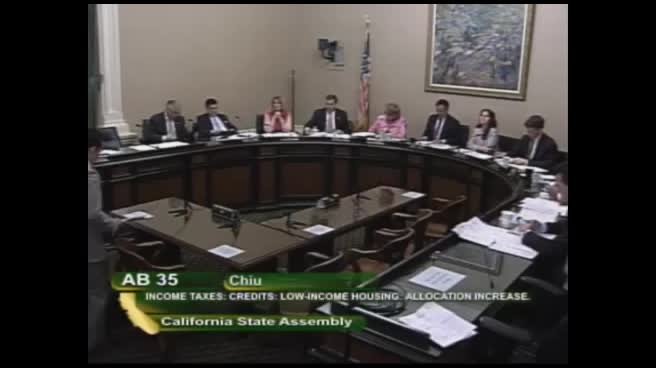 8MIN