AB 38: Mental health: Early Diagnosis and Preventive Treatment Program.
- Session Year: 2015-2016
- House: Assembly
- Latest Version Date: 2016-09-24
Existing law, the Bronzan-McCorquodale Act, sets out a system of community mental health care services provided by counties and administered by the State Department of Health Care Services.
This bill would establish the Early Diagnosis and Preventive Treatment (EDAPT) Program Fund in the State Treasury to provide funding to the Regents of the University of California for the purpose of providing reimbursement to an EDAPT program that would utilize integrated systems of care to provide early intervention, assessment, diagnosis, a treatment plan, and necessary services for individuals with severe mental illness and children with severe emotional disturbance, as specified. The bill would authorize moneys from private or other sources to be deposited into the fund and used for purposes of the bill. The bill would require, when the Department of Finance has determined that the total amount of the moneys in the fund has reached or exceeded $1,200,000, the Controller to distribute all of the moneys in the fund to the Regents of the University of California for the purpose of providing reimbursement to an EDAPT program for services provided to persons who are referred to that program, but whose private health benefit plan, as defined, does not cover the full range of required services, thereby making an appropriation. The bill would require the Regents of the University of California, if the regents accept the money, or if the regents accept federal funding distributed by the State Department of Health Care Services for the purpose of supporting an EDAPT program, as specified, to report, on or after January 1, 2022, but prior to January 1, 2023, specified information to the health committees of both houses of the Legislature. The bill would repeal the program as of January 1, 2023.
Existing law, the Bronzan-McCorquodale Act, sets out a system of community mental health care services provided by counties and administered by the State Department of Health Care Services.
This bill would establish the Early Diagnosis and Preventive Treatment (EDAPT) Program Fund in the State Treasury to provide funding to the Regents of the University of California for the purpose of providing reimbursement to an EDAPT program that would utilize integrated systems of care to provide early intervention, assessment, diagnosis, a treatment plan, and necessary services for individuals with severe mental illness and children with severe emotional disturbance, as specified. The bill would authorize moneys from private or other sources to be deposited into the fund and used for purposes of the bill. The bill would require, when the Department of Finance has determined that the total amount of the moneys in the fund has reached or exceeded $1,200,000, the Controller to distribute all of the moneys in the fund to the Regents of the University of California for the purpose of providing reimbursement to an EDAPT program for services provided to persons who are referred to that program, but whose private health benefit plan, as defined, does not cover the full range of required services, thereby making an appropriation. The bill would require the Regents of the University of California, if the regents accept the money, or if the regents accept federal funding distributed by the State Department of Health Care Services for the purpose of supporting an EDAPT program, as specified, to report, on or after January 1, 2022, but prior to January 1, 2023, specified information to the health committees of both houses of the Legislature. The bill would repeal the program as of January 1, 2023.
Existing law, the Bronzan-McCorquodale Act, sets out a system of community mental health care services provided by counties and administered by the State Department of Health Care Services.
This bill would establish the EDAPT pilot program in the department to Early Diagnosis and Preventive Treatment (EDAPT) Program Fund in the State Treasury to provide funding to the Regents of the University of California for the purpose of providing reimbursement to an EDAPT program that would utilize integrated systems of care to provide early intervention, assessment, diagnosis, a treatment plan, and necessary services for individuals with severe mental illness and children with severe emotional disturbance, as specified. The bill would authorize moneys from private or other sources to be deposited into the fund and used for purposes of the bill. The bill would require the department to use funds appropriated for this purpose by the Legislature to provide require, when the Department of Finance has determined that the total amount of the moneys in the fund has reached or exceeded $1,200,000, the Controller to distribute all of the moneys in the fund to the Regents of the University of California for the purpose of providing reimbursement to the an EDAPT program for services provided to persons who are referred to that program, but whose private health benefit plan, as defined, does not cover the full range of required services. services, thereby making an appropriation. The bill would require the University of California, Davis, if they accept money from the program, in the 4th year after the program is established but no later than January 1, 2022, to report Regents of the University of California, if the regents accept the money, or if the regents accept federal funding distributed by the State Department of Health Care Services for the purpose of supporting an EDAPT program, as specified, to report, on or after January 1, 2022, but prior to January 1, 2023, specified information to the health committees of both houses of the Legislature. The bill would repeal the program as of January 1, 2022. 2023.
Existing law, the Bronzan-McCorquodale Act, sets out a system of community mental health care services provided by counties and administered by the State Department of Health Care Services.
This bill would establish the EDAPT pilot program in the department to utilize integrated systems of care to provide early intervention, assessment, diagnosis, a treatment plan, and necessary services for individuals with severe mental illness and children with severe emotional disturbance, as specified. The bill would require the department to use funds appropriated for this purpose by the Legislature to provide reimbursement to the EDAPT program for services provided to persons who are referred to that program, but whose private health benefit plan, as defined, does not cover the full range of required services. The bill would require the University of California, Davis, if they accept money from the program, in the 4th year after the program is established but no later than January 1, 2022, to report specified information to the health committees of both houses of the Legislature. The bill would repeal the program as of January 1, 2022.
Existing law, the Knox-Keene Health Care Service Plan Act of 1975, provides for the licensure and regulation of health care service plans by the Department of Managed Health Care. Existing law requires health care service plans to meet specified criteria. Existing law makes a willful violation of that act a crime.
This bill would, commencing July 1, 2017, authorize health care service plans that offer health care services within the greater Sacramento area to require enrollees seeking services for a mental health condition to participate in a Mental Health Delivery Demonstration Project through an Early Diagnosis and Psychosis Treatment (EDAPT) program, as defined. The bill would require plans that choose to participate to develop clinical guidelines for enrollees and to make those guidelines available as part of their evidence of coverage and to primary care providers and specialty mental health providers in their contracted network. The bill would allow an enrollee to opt out of the EDAPT program if a psychiatrist notifies the plan that the enrollee is under his or her care. These provisions would be repealed on January 1, 2020. Because a willful violation of these provisions would be a crime, this bill would impose a state-mandated local program.
The California Constitution requires the state to reimburse local agencies and school districts for certain costs mandated by the state. Statutory provisions establish procedures for making that reimbursement.
This bill would provide that no reimbursement is required by this act for a specified reason.
Existing law, the Knox-Keene Health Care Service Plan Act of 1975, provides for the licensure and regulation of health care service plans by the Department of Managed Health Care. Existing law requires health care service plans to meet specified criteria. Existing law makes a willful violation of that act a crime.
This bill would, commencing July 1, 2017, authorize health care service plans that offer health care services within the greater Sacramento area to require enrollees seeking services for a mental health condition to participate in a Mental Health Delivery Demonstration Project through an Early Diagnosis and Psychosis Treatment (EDAPT) program, as defined. The bill would require plans that choose to participate to develop clinical guidelines for enrollees and to make those guidelines available as part of their evidence of coverage and to primary care providers and specialty mental health providers in their contracted network. The bill would allow an enrollee to opt out of the EDAPT program if a psychiatrist notifies the plan that the enrollee is under his or her care. These provisions would be repealed on January 1, 2020. Because a willful violation of these provisions would be a crime, this bill would impose a state-mandated local program.
The California Constitution requires the state to reimburse local agencies and school districts for certain costs mandated by the state. Statutory provisions establish procedures for making that reimbursement.
This bill would provide that no reimbursement is required by this act for a specified reason.
Existing law establishes the California State University, under the administration of the Trustees of the California State University, as one of the segments of public postsecondary education in this state. The university comprises 23 independent campuses.
This bill would require the Legislative Analysts Office to conduct an initial analysis to assess the need for a new campus of the university. The bill would specify data to be included in the analysis, to the extent that applicable data is available. The bill would require the university to provide whatever data is needed to meet the requirements of this bill to the Legislative Analysts Office upon that offices request. The bill would require the Legislative Analysts Office to submit a report containing this analysis to the Legislature and Department of Finance on or before January 1, 2017.
Existing law establishes the California State University, under the administration of the Trustees of the California State University, as one of the segments of public postsecondary education in this state. The university comprises 23 independent campuses.
This bill would require the Legislative Analysts Office to conduct a study and report to the Legislature on the feasibility of establishing an independent campus of the California State University in Stockton. an initial analysis to assess the need for a new campus of the university. The bill would specify data to be included in the analysis, to the extent that applicable data is available. The bill would require the university to provide whatever data is needed to meet the requirements of this bill to the Legislative Analysts Office upon that offices request. The bill would require the Legislative Analysts Office to submit a report containing this analysis to the Legislature and Department of Finance on or before January 1, 2017.
Existing law establishes the California State University, under the administration of the Trustees of the California State University, as one of the segments of public postsecondary education in this state. The university comprises 23 independent campuses
This bill would require the Legislative Analysts Office to conduct a study and report to the Legislature on the feasibility of establishing an independent campus of the California State University in Stockton.
(a)The Legislature finds and declares all of the following:
(1)There are approximately 1.2 million adult Californians who suffer from severe mental illness and over 700,000 children in California who deal with severe emotional disturbance.
(2)Despite the importance of and emphasis on mental health parity, management of mental illness within a system of care is far more difficult than most types of physical illness. There are significant differences between the delivery systems for the Medi-Cal population and the delivery systems for those covered by private insurance, and there are unique problems associated with each system. While changes are needed in both, there is an immediate need to look for ways to better serve the insured population.
(3)The limited number of providers, the lack of facilities for treatment, and the difficulties of arranging for and coordinating ancillary services have made it extremely difficult for health insurers to meet the needs of enrollees facing significant mental health issues.
(4)Attempts to develop truly accessible provider networks that can link with the array of administrative and ancillary services that the mentally ill need to manage their disease and to improve will take an investment of time and resources.
(5)Systems of care known as Early Diagnosis and Preventive Treatment (EDAPT) programs may hold the key to these problems. These integrated systems of care provide early intervention, assessment, diagnosis, a treatment plan, and the services necessary to implement that plan. EDAPT programs have interdisciplinary teams of physicians, clinicians, advocates, and staff that coordinate care on an outpatient basis.
(6)EDAPT programs do not yet exist in sufficient numbers to allow them to meet the provider network requirements health insurers must meet. While it is possible under existing law for health insurers to contract with existing EDAPT programs, there are a number of regulatory and practical issues that stand in the way of directing patients to them so that the patients conditions can be effectively managed. If insurers could designate an EDAPT program as an exclusive provider for their enrollees, an assessment could be made of the overall efficacy of the model.
(b)Therefore, it is the intent of the Legislature to provide funding to augment private health benefit plan coverage in order to provide patients with the full range of necessary EDAPT services.
SEC. 2.Part 6 (commencing with Section 5950) is added to Division 5 of the Welfare and Institutions Code, to read:6.EDAPT Funding Pilot Program5950.(a)There is hereby established the Early Diagnosis and Preventive Treatment (EDAPT) Program Fund within the State Treasury. Moneys from private or other sources may be deposited into the fund and used for purposes of this part. General Fund moneys shall not be deposited into the fund.
(b)When the Department of Finance has determined that the total amount of the moneys in the fund established pursuant to subdivision (a) has reached or exceeded one million two hundred thousand dollars ($1,200,000), the Controller shall distribute all of the moneys in the fund to the Regents of the University of California for the purpose of providing reimbursement to an EDAPT program for services provided to persons who are referred to that program, but whose private health benefit plan does not cover the full range of required services.
(c)Funds distributed pursuant to this part shall not be used to pay for services normally covered by the patients private health benefit plan and shall only be used to augment private health benefit plan coverage to provide the patient with the full range of necessary services.
(d)For purposes of this part, the following definitions shall apply:
(1)EDAPT program means an Early Diagnosis and Preventive Treatment program and refers to a program that utilizes integrated systems of care to provide early intervention, assessment, diagnosis, a treatment plan, and necessary services for individuals with severe mental illness and children with severe emotional disturbance using an interdisciplinary team of physicians, clinicians, advocates, and staff who coordinate care on an outpatient basis.
(2)Private health benefit plan means a program or entity that provides, arranges, pays for, or reimburses the cost of health benefits, but does not include coverage provided through the Medi-Cal system.
5951.(a)If the Regents of the University of California accept moneys from the fund established pursuant to this part, or accept federal funds distributed by the State Department of Health Care Services as described in subdivision (b), the regents shall report, on or after January 1, 2022, but prior to January 1, 2023, to the health committees of both houses of the Legislature all of the following:
(1)Evidence as to whether the early psychosis approach reduces the duration of untreated psychosis, reduces the severity of symptoms, improves relapse rates, decreases the use of inpatient care in comparison to standard care, supports educational and career progress, and reduces the cost of treatment in comparison to standard treatment methodologies.
(2)The number of patients with private health benefit plans served by an EDAPT program in the 12 months prior to the implementation of this part.
(3)The number of patients with private health benefit plans served by an EDAPT program that has received funding pursuant to this part.
(4)The number of patients participating in an EDAPT program that has received funding pursuant to this part who are considered stabilized, as a percentage of patients served.
(5)The number of patients participating in an EDAPT program that has received funding pursuant to this part who need services beyond those provided in the program and the nature of those services.
(6)Any other information the regents deem necessary.
(b)If the State Department of Health Care Services distributes federal funds to the Regents of the University of California for the purpose of supporting an EDAPT program, the regents shall issue the report described in subdivision (a), to the extent permitted by federal law.
(c)A report to be submitted pursuant to this section shall be submitted in compliance with Section 9795 of the Government Code.
5952.This part shall remain in effect only until January 1, 2023, and as of that date is repealed, unless a later enacted statute, that is enacted before January 1, 2023, deletes or extends that date.
(a)The Legislature finds and declares all of the following:
(1)There are approximately 1.2 million adult Californians who suffer from severe mental illness and over 700,000 children in California who deal with severe emotional disturbance.
(2)Despite the importance of and emphasis on mental health parity, management of mental illness within a system of care is far more difficult than most types of physical illness. There are significant differences between the delivery systems for the Medi-Cal population and the delivery systems for those covered by private insurance, and there are unique problems associated with each system. While changes are needed in both, there is an immediate need to look for ways to better serve the insured population.
(3)The limited number of providers, the lack of facilities for treatment, and the difficulties of arranging for and coordinating ancillary services have made it extremely difficult for health insurers to meet the needs of enrollees facing significant mental health issues.
(4)Attempts to develop truly accessible provider networks that can link with the array of administrative and ancillary services that the mentally ill need to manage their disease and to improve will take an investment of time and resources.
(5)Systems of care known as Early Diagnosis and Preventive Treatment (EDAPT) programs may hold the key to these problems. These integrated systems of care provide early intervention, assessment, diagnosis, a treatment plan, and the services necessary to implement that plan. EDAPT programs have interdisciplinary teams of physicians, clinicians, advocates, and staff that coordinate care on an outpatient basis.
(6)EDAPT programs do not yet exist in sufficient numbers to allow them to meet the provider network requirements health insurers must meet. While it is possible under existing law for health insurers to contract with existing EDAPT programs, there are a number of regulatory and practical issues that stand in the way of directing patients to them so that the patients conditions can be effectively managed. If insurers could designate an EDAPT program as an exclusive provider for their enrollees, an assessment could be made of the overall efficacy of the model.
(b)Therefore, it is the intent of the Legislature to provide funding to augment private health benefit plan coverage in order to provide patients with the full range of necessary EDAPT services.
SEC. 2.Part 6 (commencing with Section 5950) is added to Division 5 of the Welfare and Institutions Code, to read:6.EDAPT Funding Pilot Program5950.(a)There is hereby established the Early Diagnosis and Preventive Treatment (EDAPT) Program Fund within the State Treasury. Moneys from private or other sources may be deposited into the fund and used for purposes of this part. General Fund moneys shall not be deposited into the fund.
(b)When the Department of Finance has determined that the total amount of the moneys in the fund established pursuant to subdivision (a) has reached or exceeded one million two hundred thousand dollars ($1,200,000), the Controller shall distribute all of the moneys in the fund to the Regents of the University of California for the purpose of providing reimbursement to an EDAPT program for services provided to persons who are referred to that program, but whose private health benefit plan does not cover the full range of required services.
(c)Funds distributed pursuant to this part shall not be used to pay for services normally covered by the patients private health benefit plan and shall only be used to augment private health benefit plan coverage to provide the patient with the full range of necessary services.
(d)For purposes of this part, the following definitions shall apply:
(1)EDAPT program means an Early Diagnosis and Preventive Treatment program and refers to a program that utilizes integrated systems of care to provide early intervention, assessment, diagnosis, a treatment plan, and necessary services for individuals with severe mental illness and children with severe emotional disturbance using an interdisciplinary team of physicians, clinicians, advocates, and staff who coordinate care on an outpatient basis.
(2)Private health benefit plan means a program or entity that provides, arranges, pays for, or reimburses the cost of health benefits, but does not include coverage provided through the Medi-Cal system.
5951.(a)If the Regents of the University of California accept moneys from the fund established pursuant to this part, or accept federal funds distributed by the State Department of Health Care Services as described in subdivision (b), the regents shall report, on or after January 1, 2022, but prior to January 1, 2023, to the health committees of both houses of the Legislature all of the following:
(1)Evidence as to whether the early psychosis approach reduces the duration of untreated psychosis, reduces the severity of symptoms, improves relapse rates, decreases the use of inpatient care in comparison to standard care, supports educational and career progress, and reduces the cost of treatment in comparison to standard treatment methodologies.
(2)The number of patients with private health benefit plans served by an EDAPT program in the 12 months prior to the implementation of this part.
(3)The number of patients with private health benefit plans served by an EDAPT program that has received funding pursuant to this part.
(4)The number of patients participating in an EDAPT program that has received funding pursuant to this part who are considered stabilized, as a percentage of patients served.
(5)The number of patients participating in an EDAPT program that has received funding pursuant to this part who need services beyond those provided in the program and the nature of those services.
(6)Any other information the regents deem necessary.
(b)If the State Department of Health Care Services distributes federal funds to the Regents of the University of California for the purpose of supporting an EDAPT program, the regents shall issue the report described in subdivision (a), to the extent permitted by federal law.
(c)A report to be submitted pursuant to this section shall be submitted in compliance with Section 9795 of the Government Code.
5952.This part shall remain in effect only until January 1, 2023, and as of that date is repealed, unless a later enacted statute, that is enacted before January 1, 2023, deletes or extends that date.
(a)The Legislature finds and declares all of the following:
(1)There are approximately 1.2 million adult Californians who suffer from severe mental illness and over 700,000 children in California who deal with severe emotional disturbance.
(2)Despite the importance of and emphasis on mental health parity, management of mental illness within a system of care is far more difficult than most types of physical illness. There are significant differences between the delivery systems for the Medi-Cal population and the delivery systems for those covered by private insurance, and there are unique problems associated with each system. While changes are needed in both, there is an immediate need to look for ways to better serve the insured population.
(3)The limited number of providers, the lack of facilities for treatment, and the difficulties of arranging for and coordinating ancillary services have made it extremely difficult for health insurers to meet the needs of enrollees facing significant mental health issues.
(4)Attempts to develop truly accessible provider networks that can link with the array of administrative and ancillary services that the mentally ill need to manage their disease and to improve will take an investment of time and resources.
(5)Systems of care known as Early Diagnosis and Preventive Treatment (EDAPT) programs may hold the key to these problems. These integrated systems of care provide early intervention, assessment, diagnosis, a treatment plan, and the services necessary to implement that plan. EDAPT programs have interdisciplinary teams of physicians, clinicians, advocates, and staff that coordinate care on an outpatient basis.
(6)EDAPT programs do not yet exist in sufficient number numbers to allow them to meet the provider network requirements health insurers must meet. While it is possible under existing law for health insurers to contract with existing EDAPT programs, there are a number of regulatory and practical issues that stand in the way of directing patients to them so that the patients conditions can be effectively managed. If insurers could designate an EDAPT program as an exclusive provider for their enrollees, an assessment can could be made of the overall efficacy of the model.
(b)Therefore, it is the intent of the Legislature to establish a demonstration project to allow health insurers to opt in to utilizing the full range of EDAPT services to preserve the functioning of the insurers enrollees in need of these services. provide funding to augment private health benefit plan coverage in order to provide patients with the full range of necessary EDAPT services.
SEC. 2.Part 6 (commencing with Section 5950) is added to Division 5 of the Welfare and Institutions Code, to read:6.EDAPT Funding Pilot Program5950.(a)There is hereby established the EDAPT pilot program Early Diagnosis and Preventive Treatment (EDAPT) Program Fund within the State Department of Health Care Services to utilize integrated systems of care to provide early intervention, assessment, diagnosis, a treatment plan, and necessary services for individuals with severe mental illness and children with severe emotional disturbance using an interdisciplinary team of physicians, clinicians, advocates, and staff who coordinate care on an outpatient basis. State Treasury. Moneys from private or other sources may be deposited into the fund and used for purposes of this part. General Fund moneys shall not be deposited into the fund.
(b)(1)The department shall use funds appropriated for this purpose by the Legislature to provide When the Department of Finance has determined that the total amount of the moneys in the fund established pursuant to subdivision (a) has reached or exceeded one million two hundred thousand dollars ($1,200,000), the Controller shall distribute all of the moneys in the fund to the Regents of the University of California for the purpose of providing reimbursement to the an EDAPT program for services provided to persons who are referred to that program, but whose private health benefit plan does not cover the full range of required services.
(2)The department may solicit and accept funds from private, federal, or other sources to use for purposes of this program.
(c)Funds provided distributed pursuant to this program part shall not be used to pay for services normally covered by the patients private health benefit plan and shall only be used to augment private health benefit plan coverage to provide the patient with the full range of necessary services.
(d)For purposes of this part, the following definitions shall apply:
(1)EDAPT program means the Early Diagnosis and Preventive Treatment program provided at the Davis campus of the University of California. means an Early Diagnosis and Preventive Treatment program and refers to a program that utilizes integrated systems of care to provide early intervention, assessment, diagnosis, a treatment plan, and necessary services for individuals with severe mental illness and children with severe emotional disturbance using an interdisciplinary team of physicians, clinicians, advocates, and staff who coordinate care on an outpatient basis.
(2)Private health benefit plan means a program or entity that provides, arranges, pays for, or reimburses the cost of health benefits, but does not include coverage provided through the Medi-Cal system.
5951.(a)If the University of California, Davis accepts money from the department through the EDAPT pilot program, in the fourth year after the program is established but no later than January 1, 2022, it shall report
5951.(a)If the Regents of the University of California accept moneys from the fund established pursuant to this part, or accept federal funds distributed by the State Department of Health Care Services as described in subdivision (b), the regents shall report, on or after January 1, 2022, but prior to January 1, 2023, to the health committees of both houses of the Legislature all of the following:
(1)Evidence as to whether the early psychosis approach reduces the duration of untreated psychosis, reduces the severity of symptoms, improves relapse rates, decreases the use of inpatient care in comparison to standard care, supports educational and career progress, and reduces the cost of treatment in comparison to standard treatment methodologies.
(2)The number of patients with private health benefit plans served by the EDAPT pilot an EDAPT program in the 12 months prior to the implementation of the pilot program. this part.
(3)The number of patients with private health benefit plans served by the EDAPT pilot program. an EDAPT program that has received funding pursuant to this part.
(4)The number of patients in the program participating in an EDAPT program that has received funding pursuant to this part who are considered stabilized, as a percentage of patients served.
(5)The number of patients needing participating in an EDAPT program that has received funding pursuant to this part who need services beyond those provided in the program and the nature of those services.
(6)Any other information the university deems regents deem necessary.
(b)If the State Department of Health Care Services distributes federal funds to the Regents of the University of California for the purpose of supporting an EDAPT program, the regents shall issue the report described in subdivision (a), to the extent permitted by federal law.
(b)
(c)A report to be submitted pursuant to this section shall be submitted in compliance with Section 9795 of the Government Code.
5952.This part shall remain in effect only until January 1, 2022, 2023, and as of that date is repealed, unless a later enacted statute, that is enacted before January 1, 2022, 2023, deletes or extends that date.
(a)The Legislature finds and declares all of the following:
(1)There are approximately 1.2 million adult Californians who suffer from severe mental illness and over 700,000 children in California who deal with severe emotional disturbance.
(1)
(2)Despite the importance of and emphasis on mental health parity, management of mental illness within a system of care is far more difficult than most types of physical illness. There are significant differences between the delivery systems for the Medi-Cal population and the delivery systems for those covered by private insurance, and there are unique problems associated with each system. While changes are needed in both, there is an immediate need to look for ways to better serve the insured population.
(2)
(3)The limited number of providers, the lack of facilities for treatment, and the difficulties of arranging for and coordinating ancillary services have made it extremely difficult for health insurers to meet the needs of enrollees facing significant mental health issues.
(3)
(4)Attempts to develop truly accessible provider networks that can link with the array of administrative and ancillary services that the mentally ill need to manage their disease and to improve will take an investment of time and resources.
(4)
(5)Systems of care known as Early Diagnosis and Psychosis Preventive Treatment (EDAPT) programs may hold the key to these problems. These integrated systems of care provide early intervention, assessment, diagnosis, a treatment plan, and the services necessary to implement that plan. EDAPT programs have interdisciplinary teams of physicians, clinicians, advocates, and staff that coordinate care on an outpatient basis.
(5)
(6)EDAPT programs do not yet exist in sufficient number to allow them to meet the provider network requirements health insurers must meet. While it is possible under existing law for health insurers to contract with existing EDAPT programs, there are a number of regulatory and practical issues that stand in the way of directing patients to them so that the patients conditions can be effectively managed. If insurers could designate an EDAPT program as an exclusive provider for their enrollees, an assessment can be made of the overall efficacy of the model.
(b)Therefore, it is the intent of the Legislature to establish a demonstration project or projects in geographic areas of the state where EDAPT programs exist to allow health insurers to opt in to utilizing the full range of EDAPT programs as exclusive provider networks for services to preserve the functioning of the insurers enrollees in need of these services.
SEC. 2.Section 1367.020 is added to the Health and Safety Code, to read:1367.020.(a)Notwithstanding any other law, commencing July 1, 2017, a health care service plan that offers health care services on an individual or group basis in the greater Sacramento area may require enrollees seeking services for a mental health condition to participate in a Mental Health Delivery Demonstration Project through an Early Diagnosis and Psychosis Treatment Program.
(b)If a plan chooses to require its enrollees to participate in the project, it shall develop clinical guidelines for those enrollees and make those guidelines available as part of its evidence of coverage. The plan shall also make those guidelines available to all primary care providers and specialty mental health providers in its contracted network.
(c)An enrollee directed to a Mental Health Delivery Demonstration Project site for services shall be able to opt out of those services if a psychiatrist notifies the plan that the enrollee is under his or her care.
(d)For purposes of this section, Early Diagnosis and Psychosis Treatment Program means a mental health service program that provides early intervention, diagnosis, treatment, and necessary support through interdisciplinary teams of physicians, mental health professionals, social workers, and advocates on an outpatient basis and through a single point of entry.
(e)This section shall remain in effect only until January 1, 2020, and as of that date is repealed, unless a later enacted statute, that is enacted before January 1, 2020, deletes or extends that date.
SEC. 3.No reimbursement is required by this act pursuant to Section 6 of Article XIIIB of the California Constitution because the only costs that may be incurred by a local agency or school district will be incurred because this act creates a new crime or infraction, eliminates a crime or infraction, or changes the penalty for a crime or infraction, within the meaning of Section 17556 of the Government Code, or changes the definition of a crime within the meaning of Section 6 of Article XIIIB of the California Constitution.
SEC. 2.Part 6 (commencing with Section 5950) is added to Division 5 of the Welfare and Institutions Code, to read:6.EDAPT Pilot Program5950.(a)There is hereby established the EDAPT pilot program within the State Department of Health Care Services to utilize integrated systems of care to provide early intervention, assessment, diagnosis, a treatment plan, and necessary services for individuals with severe mental illness and children with severe emotional disturbance using an interdisciplinary team of physicians, clinicians, advocates, and staff who coordinate care on an outpatient basis.
(b)(1)The department shall use funds appropriated for this purpose by the Legislature to provide reimbursement to the EDAPT program for services provided to persons who are referred to that program, but whose private health benefit plan does not cover the full range of required services.
(2)The department may solicit and accept funds from private, federal, or other sources to use for purposes of this program.
(c)Funds provided pursuant to this program shall not be used to pay for services normally covered by the patients private health benefit plan and shall only be used to augment private health benefit plan coverage to provide the patient with the full range of necessary services.
(d)For purposes of this part, the following definitions shall apply:
(1)EDAPT program means the Early Diagnosis and Preventive Treatment program provided at the Davis campus of the University of California.
(2)Private health benefit plan means a program or entity that provides, arranges, pays for, or reimburses the cost of health benefits, but does not include coverage provided through the Medi-Cal system.
5951.(a)If the University of California, Davis accepts money from the department through the EDAPT pilot program, in the fourth year after the program is established but no later than January 1, 2022, it shall report to the health committees of both houses of the Legislature all of the following:
(1)Evidence as to whether the early psychosis approach reduces the duration of untreated psychosis, reduces the severity of symptoms, improves relapse rates, decreases the use of inpatient care in comparison to standard care, supports educational and career progress, and reduces the cost of treatment in comparison to standard treatment methodologies.
(2)The number of patients with private health benefit plans served by the EDAPT pilot program in the 12 months prior to the implementation of the pilot program.
(3)The number of patients with private health benefit plans served by the EDAPT pilot program.
(4)The number of patients in the program who are considered stabilized, as a percentage of patients served.
(5)The number of patients needing services beyond those provided in the program and the nature of those services.
(6)Any other information the university deems necessary.
(b)A report to be submitted pursuant to this section shall be submitted in compliance with Section 9795 of the Government Code.
5952.This part shall remain in effect only until January 1, 2022, and as of that date is repealed, unless a later enacted statute, that is enacted before January 1, 2022, deletes or extends that date.
(a)The Legislature finds and declares all of the following:
(1)Despite the importance of and emphasis on mental health parity, management of mental illness within a system of care is far more difficult than most types of physical illness. There are significant differences between the delivery systems for the Medi-Cal population and the delivery systems for those covered by private insurance, and there are unique problems associated with each system. While changes are needed in both, there is an immediate need to look for ways to better serve the insured population.
(2)The limited number of providers, the lack of facilities for treatment, and the difficulties of arranging for and coordinating ancillary services have made it extremely difficult for health insurers to meet the needs of enrollees facing significant mental health issues.
(3)Attempts to develop truly accessible provider networks that can link with the array of administrative and ancillary services that the mentally ill need to manage their disease and to improve will take an investment of time and resources.
(4)Systems of care known as Early Diagnosis and Psychosis Treatment (EDAPT) programs may hold the key to these problems. These integrated systems of care provide early intervention, assessment, diagnosis, a treatment plan, and the services necessary to implement that plan. EDAPT programs have interdisciplinary teams of physicians, clinicians, advocates, and staff that coordinate care on an outpatient basis.
(5)EDAPT programs do not yet exist in sufficient number to allow them to meet the provider network requirements health insurers must meet. While it is possible under existing law for health insurers to contract with existing EDAPT programs, there are a number of regulatory and practical issues that stand in the way of directing patients to them so that the patients conditions can be effectively managed. If insurers could designate an EDAPT program as an exclusive provider for their enrollees, an assessment can be made of the overall efficacy of the model.
(b)Therefore, it is the intent of the Legislature to establish a demonstration project or projects in geographic areas of the state where EDAPT programs exist to allow health insurers to opt in to utilizing the EDAPT programs as exclusive provider networks for the insurers enrollees in need of these services.
SEC. 2.Section 1367.020 is added to the Health and Safety Code, to read:1367.020.(a)Notwithstanding any other law, commencing July 1, 2017, a health care service plan that offers health care services on an individual or group basis in the greater Sacramento area may require enrollees seeking services for a mental health condition to participate in a Mental Health Delivery Demonstration Project through an Early Diagnosis and Psychosis Treatment Program.
(b)If a plan chooses to require its enrollees to participate in the project, it shall develop clinical guidelines for those enrollees and make those guidelines available as part of its evidence of coverage. The plan shall also make those guidelines available to all primary care providers and specialty mental health providers in its contracted network.
(c)An enrollee directed to a Mental Health Delivery Demonstration Project site for services shall be able to opt out of those services if a psychiatrist notifies the plan that the enrollee is under his or her care.
(d)For purposes of this section, Early Diagnosis and Psychosis Treatment Program means a mental health service program that provides early intervention, diagnosis, treatment, and necessary support through interdisciplinary teams of physicians, mental health professionals, social workers, and advocates on an outpatient basis and through a single point of entry.
(e)This section shall remain in effect only until January 1, 2020, and as of that date is repealed, unless a later enacted statute, that is enacted before January 1, 2020, deletes or extends that date.
SEC. 3.No reimbursement is required by this act pursuant to Section 6 of Article XIIIB of the California Constitution because the only costs that may be incurred by a local agency or school district will be incurred because this act creates a new crime or infraction, eliminates a crime or infraction, or changes the penalty for a crime or infraction, within the meaning of Section 17556 of the Government Code, or changes the definition of a crime within the meaning of Section 6 of Article XIIIB of the California Constitution.
SECTION 1.(a)The Legislature finds and declares all of the following:
(1)The Master Plan for Higher Education in California established the following criteria for determining the need for a new public university campus:
(A)The relative numbers of high school graduates, the location of existing institutions in the various areas of the state, and the relation between their capacities and the estimated enrollment in the area served by each such institution.
(B)The relative numbers of potential students within reasonable commuting distance of each of the proposed sites.
(2)The need to accommodate students in excess of the physical capacities of existing community colleges, California State University (CSU) campuses, and University of California campuses.
(3)The Master Plan designates CSU to draw its freshman class from the top third of the states public high school graduates and admit transfer-prepared applicants with a minimum GPA of 2.0. Most CSU campuses provide priority admission to local applicants.
(b)The Legislative Analysts Office shall conduct an initial analysis to assess the need for a new CSU campus. The analysis shall consist of the following parts:
(1)An analysis of the need within certain regions for a CSU campus. This part shall include all of the following to the extent applicable data are available:
(A)Consideration of enrollment demand based on relative demographic levels and eligible students for each county. This part shall include five- to 10-year projections of the college-age population and public high school graduates. It also shall include data for the most recent year available on college preparedness, including the number and share of high school graduates completing the A-G admissions requirements and the number and share of transfer-prepared community college students.
(B)For each county, data on CSU applications, admissions, and enrollment for the most recent year available to estimate college-going rates to CSU.
(C)Data on adult educational attainment by county for the most recent year available.
(2)An analysis of the physical capacities of existing CSU campuses, as set forth in their master plans, relative to current enrollment. This analysis shall identify CSU campuses already at maximum capacity and those with remaining physical capacity. The analysis also shall identify which CSU campuses no longer provide enrollment priority for local applicants.
(c)The CSU shall provide whatever data is needed to meet the requirements of this section to the Legislative Analysts Office upon that offices request. The Legislative Analysts Office shall submit a report containing the analysis required by this section to the Legislature and Department of Finance on or before January 1, 2017.
(a)The Legislature finds and declares all of the following:
(1)The Master Plan for Higher Education in California established the following criteria for determining the need for a new public university campus:
(A)The relative numbers of high school graduates, the location of existing institutions in the various areas of the state, and the relation between their capacities and the estimated enrollment in the area served by each such institution.
(B)The relative numbers of potential students within reasonable commuting distance of each of the proposed sites.
(2)The need to accommodate students in excess of the physical capacities of existing community colleges, California State University (CSU) campuses, and University of California campuses.
(3)The Master Plan designates CSU to draw its freshman class from the top third of the states public high school graduates and admit transfer-prepared applicants with a minimum GPA of 2.0. Most CSU campuses provide priority admission to local applicants.
(b)The Legislative Analysts Office shall conduct an initial analysis to assess the need for a new CSU campus. The analysis shall consist of the following parts:
(1)An analysis of the need within certain regions for a CSU campus. This part shall include all of the following to the extent applicable data are available:
(A)Consideration of enrollment demand based on relative demographic levels and eligible students for each county. This part shall include five- to 10-year projections of the college-age population and public high school graduates. It also shall include data for the most recent year available on college preparedness, including the number and share of high school graduates completing the A-G admissions requirements and the number and share of transfer-prepared community college students.
(B)For each county, data on CSU applications, admissions, and enrollment for the most recent year available to estimate college-going rates to CSU.
(C)Data on adult educational attainment by county for the most recent year available.
(2)An analysis of the physical capacities of existing CSU campuses, as set forth in their master plans, relative to current enrollment. This analysis shall identify CSU campuses already at maximum capacity and those with remaining physical capacity. The analysis also shall identify which CSU campuses no longer provide enrollment priority for local applicants.
(c)The CSU shall provide whatever data is needed to meet the requirements of this section to the Legislative Analysts Office upon that offices request. The Legislative Analysts Office shall submit a report containing the analysis required by this section to the Legislature and Department of Finance on or before January 1, 2017.
SECTION 1.The Legislative Analysts Office shall conduct a study and report to the Legislature on the feasibility of establishing an independent campus of the California State University in Stockton.
The Legislative Analysts Office shall conduct a study and report to the Legislature on the feasibility of establishing an independent campus of the California State University in Stockton.
|
Date
|
Status
|
|---|---|
| Aug 29, 2016 | Read third time. Passed. Ordered to the Assembly. |
| Aug 16, 2016 | Re-referred to Com. on RLS. |
| Aug 16, 2016 | Withdrawn from committee. |
| Aug 17, 2016 | (Ayes 26. Noes 13. Page 5065.) |
| Aug 17, 2016 | (Ayes 26. Noes 13.) |
| Aug 17, 2016 | Ordered to second reading. |
| Aug 17, 2016 | Withdrawn from committee. |
| Aug 18, 2016 | Read second time. Ordered to third reading. |
| Aug 19, 2016 | Read third time and amended. Ordered to second reading. |
| Aug 22, 2016 | Read second time. Ordered to third reading. |
| Aug 11, 2016 | In committee: Held under submission. |
| Aug 29, 2016 | Read third time. Passed. Ordered to the Assembly. (Ayes 39. Noes 0. Page 5485.). |
| Aug 30, 2016 | From committee: That the Senate amendments be concurred in. (Ayes 16. Noes 0.) (August 30). |
| Aug 30, 2016 | In Assembly. Concurrence in Senate amendments pending. |
| Aug 30, 2016 | Joint Rule 62(a), file notice suspended. |
| Aug 30, 2016 | Joint Rule 62(a), file notice suspended. (Page 6474.) |
| Aug 30, 2016 | Re-referred to Com. on HEALTH. pursuant to Assembly Rule 77.2. |
| Aug 31, 2016 | Senate amendments concurred in. To Engrossing and Enrolling. |
| Sep 9, 2016 | Enrolled and presented to the Governor at 2:30 p.m. |
| Jun 2, 2015 | In Senate. Read first time. To Com. on RLS. for assignment. |
| Dec 2, 2014 | From printer. May be heard in committee January 1. |
| Jan 22, 2015 | Referred to Com. on HIGHER ED. |
| Mar 3, 2015 | In committee: Set, first hearing. Hearing canceled at the request of author. |
| Mar 23, 2015 | From committee chair, with author's amendments: Amend, and re-refer to Com. on HIGHER ED. Read second time and amended. |
| Mar 24, 2015 | Re-referred to Com. on HIGHER ED. |
| Apr 8, 2015 | From committee: Do pass and re-refer to Com. on APPR. (Ayes 12. Noes 1.) (April 7). Re-referred to Com. on APPR. |
| Apr 22, 2015 | In committee: Set, first hearing. Referred to APPR. suspense file. |
| May 28, 2015 | From committee: Do pass. (Ayes 16. Noes 1.) (May 28). |
| Jun 1, 2015 | Read second time. Ordered to third reading. |
| Dec 1, 2014 | Read first time. To print. |
| Jun 2, 2015 | Read third time. Passed. Ordered to the Senate. |
| Jun 2, 2015 | Read third time. Passed. Ordered to the Senate. (Ayes 70. Noes 5. Page 1775.) |
| Jun 11, 2015 | Referred to Com. on RLS. |
| May 18, 2016 | From committee chair, with author's amendments: Amend, and re-refer to committee. Read second time, amended, and re-referred to Com. on RLS. |
| May 26, 2016 | Re-referred to Com. on HEALTH. |
| Jun 13, 2016 | From committee chair, with author's amendments: Amend, and re-refer to committee. Read second time, amended, and re-referred to Com. on HEALTH. |
| Jun 23, 2016 | From committee: Do pass and re-refer to Com. on APPR. (Ayes 9. Noes 0.) (June 22). Re-referred to Com. on APPR. |
| Aug 1, 2016 | In committee: Referred to APPR. suspense file. |
|
Date
|
Description
|
Location
|
Votes
|
|
|---|---|---|---|---|
| Aug 31, 2016 | AB 38 EGGMAN Concurrence in Senate Amendments | Assembly Floor |
Passed |
|
| Aug 30, 2016 | With recommendation: That Senate amendments be concurred in. | Assembly Standing Committee on Health |
Passed |
|
| Aug 29, 2016 | Assembly 3rd Reading AB38 Eggman By Lara | Senate Floor |
Passed |
|
| Aug 1, 2016 | Placed on suspense file | Senate Standing Committee on Appropriations |
Passed |
|
| Jun 22, 2016 | Do pass, but first be re-referred to the Committee on [Appropriations] | Senate Standing Committee on Health |
Passed |
|
| Jun 2, 2015 | AB 38 EGGMAN Assembly Third Reading | Assembly Floor |
Passed |
|
| May 28, 2015 | Do pass. | Assembly Standing Committee on Appropriations |
Passed |
|
| Apr 7, 2015 | Do pass and be re-referred to the Committee on [Appropriations] | Assembly Standing Committee on Higher Education |
Passed |
This list shows positions taken on this bill by organizations on the date displayed, which is linked to the original source.
Positions by individuals are not included.
|
Organization
|
Position
|
Date
|
|---|---|---|
| American Academy Of Pediatrics, California | ** Support | Aug 31, 2016 |
| California Academy of Physician Assistants | ** Support | Aug 31, 2016 |
| California Faculty Association | * Indeterminate | Apr 7, 2015 |
| California Hospital Association | ** Support | Aug 31, 2016 |
| California Kelmey PA | * Support | Jun 22, 2016 |
| california low income consumer coalition | * Indeterminate | Jun 20, 2018 |
| California Psychiatric Association | ** Support | Aug 31, 2016 |
| California Psychological Association | * Indeterminate | Jun 22, 2016 |
| Consumers Union | * Indeterminate | Jun 20, 2018 |
| Educational Credit Management Corp. | * Support | Jun 20, 2018 |
| National Association of Social Workers | ** Support | Aug 31, 2016 |
| National Association Of Social Workers, California Chapter | ** Support | Aug 29, 2016 |
| NextGen California | * Support | Jun 20, 2018 |
| Receivables Management Association | * Support | Jun 20, 2018 |
| Shaw/Yoder/Antwih, Inc. | * Indeterminate | Apr 7, 2015 |
| UC Student Association | * Support | Jun 20, 2018 |
Date of Hearing: August 30, 2016
ASSEMBLY COMMITTEE ON HEALTH
Jim Wood, Chair
ABPCA Bill Id:AB 38 (
Author:Eggman) – As Amended Ver:August 19, 2016
SUBJECT: Mental health: Early Diagnosis and Preventive Treatment Program
SUMMARY: Establishes the Early Diagnosis and Preventive Treatment (EDAPT) Program Fund, for the purpose of utilizing integrated systems of care to provide early intervention, assessment, diagnosis, a treatment plan, and necessary services for individuals with severe mental illness and children with severe emotional disturbance, as specified.
The Senate amendments delete the Assembly approved version, and instead:
- Establish the EDAPT Program Fund within the State Treasury, which moneys from private or other sources may be deposited and used for purposes of the EDAPT Program.
- Define the EDAPT Programs as programs that utilize integrated systems of care to provide early intervention, assessment, diagnosis, a treatment plan, and necessary services for individuals with severe mental illness and children with severe emotional disturbance using an interdisciplinary team of physicians, clinicians, advocates, and staff who coordinate care on an outpatient basis.
- Require, once the EDAPT Program Fund has reached or exceeded $1.2 million, the State Controller to distribute all of the moneys to the Regents of the University of California (UC) for the purpose of providing reimbursement to an EDAPT Program for services provided to persons who are referred to that program, but whose private health benefit plan does not cover the full range of required services.
- Prohibit the EDAPT Program Fund from being used to pay for services normally covered by the patient’s private health benefit plan. Require the EDAPT Program Fund to be used only to augment private health benefit plan coverage so that patients are provided the full range of necessary services.
- Require, upon acceptance of moneys from the EDAPT Program Fund by the UC Regents, the UC Regents to report, on or after January 1, 2022, but before January 1, 2023, to the Health Committees of both houses of the Legislature information on the EDAPT Program, as specified.
- Sunset the EDAPT Program and Program Fund on January 1, 2023.
As passed by the Assembly, this bill required the Legislative Analyst's Office to conduct an initial analysis to assess the need for a new campus of the California State University.
EXISTING LAW:
- Establishes the Department of Managed Health Care to regulate health plans and the California Department of Insurance to regulate health insurers.
- Establishes as California's essential health benefits benchmark the Kaiser Small Group Health Maintenance Organization plan, existing California mandates, and 10 federal Patient Protection and Affordable Care Act mandated benefits including mental health and behaviorial health treatment.
- Requires every health plan contract that provides hospital, medical, or surgical coverage and health insurance policy to also provide coverage for behavioral health treatment for pervasive developmental disorder or autism. Requires that coverage to be subject to the same rules that apply under California’s mental health parity law.
- Establishes the Mental Health Services Act (MHSA), enacted by voters in 2004 as Proposition 63, which provides funds to counties to expand services and develop innovative programs and integrated service plans for mentally ill children, adults, and seniors through a 1% income tax on personal income above $1 million to be deposited to the Mental Health Services Fund.
- Establishes the Mental Health Services Oversight and Accountability Commission (OAC) to oversee the implementation of the MHSA.
- Requires each county mental health program to prepare and submit a three-year program and expenditure plan, with annual updates, to the OAC within 30 days after adoption. Requires the plan to include programs for services to adults and seniors.
FISCAL EFFECT: According to the Senate Appropriations Committee:
- Ongoing administrative costs likely in the range of $75,000 to $150,000 per year over the life of the EDAPT program for the Department of Health Care Services to manage the EDAPT program and ensure that state funding is used for the allowed uses (General Fund (GF)).
- Ongoing program costs of about $400,000 per year to provide state funding for services and supports not covered by private health care coverage (GF). Currently, the University of California, Davis (UCD) program admits 50 to 60 new patients each year, patients generally participate for two years, annual costs are about $15,000, and roughly 40% of per-capita program costs are not covered by private insurance.
- One-time costs likely between $100,000 and $200,000 for an evaluation of the UCD program (GF).
COMMENTS: According to the author, this bill establishes the framework for the private and federal funding and studying of the EDAPT pilot program operated by the UC. This bill requires that UC report to the Legislature on the outcomes and cost effectiveness of a comprehensive mental health delivery system and early intervention in psychosis. Currently, the private health plan system lags far behind the county mental health system in providing comprehensive mental health care. Data produced through the UC and backed by the state will demonstrate to plans that a more robust range of services earlier in treatment is not only beneficial to those in care, but to the health plans as well. Rather than asking that the State mandate that plans cover services, this bill seeks to contribute to the research necessary for plans to make that decision for themselves, and provide it to the Legislature if action is necessary. The author states that the longer we wait for studies of EDAPT programs, the more Californians dealing with severe mental illness, along with their families and communities, will suffer without adequate care.
According to its Website, the UCD EPADT Programs are nationally recognized as a leading provider of early psychosis care that utilizes a diverse interdisciplinary team with unique expertise in the art of assessments and evidence based practices for early identification and intervention for psychotic disorders. EPADT programs provide coordinated specialty care in an outpatient setting that incorporates targeted medication management, individual, family and group psychosocial interventions, case management services, and supported education and employment with the goals of early diagnosis, treatment, and disability prevention.
This bill, as amended, has not been heard in an Assembly policy committee.
The sponsor of this bill, the California Psychiatric Association (CPA), states that this bill addresses the vast gulf between the comprehensive array of mental health services available throughout public mental health system, and the relatively narrow range of benefits available for privately insured patients. The problem is that too often people deteriorate significantly and at length after their first episode of psychosis. Many will enter the public mental health system where one of the threshold qualifications is disability so severe that it interferes with the activities of daily living. This “hitting bottom” before you can access a comprehensive array of services is unnecessary and cruel. Ample data from the National Institute of Mental Health (NIMH) collected for over a decade demonstrate an array of wrap around services necessary to stem deterioration before it become severe disability after an initial psychotic episode.
CPA argues that the participation of managed health care organizations in programs like EDAPT is any formal way, not only within California but also nationally, is unknown. The UC Davis’ EADPT program was one of the original NIMH centers contributing to demonstrate the efficacy of early intervention. UCD’s EDAPT Program accepts privately insured patients, but reimbursement to the program from private insurance is typically for a traditional array of services like psychiatrist visits, medications, and a therapist. Privately insured families then pay out of pocket for the remainder of the wrap around service that have been identified as effective by NIMH. With data demonstrating expensive repeat hospitalizations, as well as failure at school and/or work, deterioration in social relationships and alienation from their family, the CPA hopes to persuade health insurers that spending upfront for wraparound services not only improves beneficiaries health and mental health outcomes, but is ultimately less costly.
The California Hospital Association states that behavioral health services provided by California’s private health insurance market lags behind that of other medically necessary care. The traditional model of mental health care in the private health care services market is to provide appointments with psychiatrists and other therapists, and enable access to psychiatric medications. For many people, particularly those with severe mental illness, this array of services is insufficient to successfully stabilize and control their illness. Early intervention programs, such as EDAPT, have shown potential for improving outcomes for those first experiencing psychosis. They consolidate the service delivery model and provide services through a single point of entry, including: assessment; diagnosis; treatment; and, ancillary services like outreach, family education and support, and case management. Unfortunately, the full bundle of EDAPT benefits are not covered in the private insurance market. Recovering from mental illness then becomes more difficult for individuals with private insurance.
The American Academy of Pediatrics, California states that this bill represents an innovative response to California’s mental health crisis and, in particular, to concerns regarding the provision of mental health care to the remaining two-thirds of youth in the U.S. who are undiagnosed and 88% are untreated.
REGISTERED SUPPORT / OPPOSITION:
Support
California Psychiatric Association (sponsor)
American Academy of Pediatrics, California
California Academy of Physician Assistants
California Hospital Association
National Association of Social Workers
Opposition
None on file.
Analysis Prepared by: Paula Villescaz / HEALTH / (916) 319-2097
CONCURRENCE IN SENATE AMENDMENTS
CSA2 Bill Id:AB 38
Author:(Eggman)
As Amended Ver:August 19, 2016
Majority vote
ASSEMBLY: |
| (June 2, 2015) | SENATE: | 39-0 | (August 29, 2016) |
(vote not relevant)
COMMITTEE VOTE: | 16-0 | (August 30, 2016) | RECOMMENDATION: | concur |
(Health)
Original Committee Reference: HIGHER ED.
SUMMARY: Establishes the Early Diagnosis and Preventive Treatment (EDAPT) Program Fund, for the purpose of utilizing integrated systems of care to provide early intervention, assessment, diagnosis, a treatment plan, and necessary services for individuals with severe mental illness and children with severe emotional disturbance, as specified.
The Senate amendments delete the Assembly approved version, and instead:
- Establish the EDAPT Program Fund within the State Treasury, from which moneys from private or other sources may be deposited into the fund and used for purposes of the EDAPT Program.
- Define the EDAPT Programs as programs that utilizes integrated systems of care to provide early intervention, assessment, diagnosis, a treatment plan, and necessary services for individuals with severe mental illness and children with severe emotional disturbance using an interdisciplinary team of physicians, clinicians, advocates, and staff who coordinate care on an outpatient basis.
- Require, once the EDAPT Program Fund has reached or exceeded $1,200,000, the State Controller to distribute all of the moneys in the fund to the Regents of the University of California (UC) for the purpose of providing reimbursement to an EDAPT Program for services provided to persons who are referred to that program, but whose private health benefit plan does not cover the full range of required services.
- Require, upon acceptance of moneys from the EDAPT Program fund by the Regents of the UC, the Regents to report, on or after January 1, 2022, but before January 1, 2023, to the health committees of both houses of the Legislature information on the EDAPT Program, as specified.
- Sunset the EDAPT Program and Program Fund on January 1, 2023.
AS PASSED BY THE ASSEMBLY, this bill required the Legislative Analyst's Office to conduct an initial analysis to assess the need for a new campus of the California State University.
FISCAL EFFECT: According to the Senate Appropriations Committee:
- Ongoing administrative costs likely in the range of $75,000 to $150,000 per year over the life of the EDAPT program for the Department of Health Care Services to manage the EDAPT program and ensure that state funding is used for the allowed uses (General Fund (GF)).
- Ongoing program costs of about $400,000 per year to provide state funding for services and supports not covered by private health care coverage (GF). Currently, the University of California, Davis (UCD) program admits 50-60 new patients each year, patients generally participate for two years, annual costs are about $15,000, and roughly 40% of per-capita program costs are not covered by private insurance.
- One-time costs likely between $100,000 and $200,000 for an evaluation of the UCD program (GF).
COMMENTS: According to the author, this bill establishes the framework for the private and federal funding and studying of the EDAPT pilot program operated by the UC. This bill requires that UC report to the Legislature on the outcomes and cost effectiveness of a comprehensive mental health delivery system and early intervention in psychosis. Currently, the private health plan system lags far behind the county mental health system in providing comprehensive mental health care. Data produced through the UC and backed by the state will demonstrate to plans that a more robust range of services earlier in treatment is not only beneficial to those in care, but to the health plans as well. Rather than asking that the State mandate that plans cover services, this bill seeks to contribute to the research necessary for plans to make that decision for themselves, and provide it to the Legislature if action is necessary. The author states that the longer we wait for studies of EDAPT programs, the more Californians dealing with severe mental illness, along with their families and communities, will suffer without adequate care.
The sponsor of this bill, the California Psychiatric Association (CPA), states that this bill addresses the vast gulf between the comprehensive array of mental health services available throughout public mental health system, and the relatively narrow range of benefits available for privately insured patients. Ample data from the National Institute of Mental Health (NIMH) collected for over a decade demonstrate an array of wrap around services necessary to stem deterioration before it become severe disability after an initial psychotic episode.
CPA argues that the participation of managed health care organizations in programs like EDAPT is any formal way, not only within California but also nationally, is unknown. The UCD EADPT program was one of the original NIMH centers contributing to demonstrate the efficacy of early intervention. UCD's EDAPT Program accepts privately insured patients, but reimbursement to the program from private insurance is typically for a traditional array of services like psychiatrist visits, medications, and a therapist. Privately insured families then pay out of pocket for the remainder of the wrap around service that have been identified as effective by NIMH. With data demonstrating expensive repeat hospitalizations, as well as failure at school and/or work, deterioration in social relationships and alienation from their family, the CPA hopes to persuade health insurers that spending upfront for wraparound services not only improves beneficiaries health and mental health outcomes, but is ultimately less costly.
Analysis Prepared by: Paula Villescaz / HEALTH / (916) 319-2097 FN: 0005000
Office of Senate Floor Analyses (916) 651-1520 Fax: (916) 327-4478 | AB 38 |
THIRD READING
Bill No: AB 38
Amended: 8/19/16 in Senate
SENATE HEALTH COMMITTEE: 9-0, 6/22/16
AYES: Hernandez, Nguyen, Hall, Mitchell, Monning, Nielsen, Pan, Roth, Wolk
SENATE APPROPRIATIONS: 7-0, 8/1/16
AYES: Lara, Bates, Beall, Hill, McGuire, Mendoza, Nielsen
ASSEMBLY FLOOR: 70-5, 6/2/15 - See last page for vote
SUBJECT: Mental health: Early Diagnosis and Preventive Treatment Program
SOURCE: California Psychiatric Association
DIGEST: This bill establishes the Early Diagnosis and Preventive Treatment (EDAPT) program Fund in the state Treasury to fund EDAPT programs which utilize integrated systems of care for persons with severe mental illness and children with severe emotional disturbance who have private health benefit coverage that does not cover the full range of services.
Senate Floor Amendments of 8/19/16 amendments revise this bill from establishing a pilot program, to instead establish the EDAPT Program Fund in the State Treasury, which shall accept moneys from private or other sources and shall not accept General Fund moneys. The amendments require the Controller to distribute all of the moneys in the fund to the Regents of the University of California for the purposes of reimbursing the EDAPT program once the Department of Finance has determined that there is at least $1.2 million in the fund. The amendments revise the definition of EDAPT program. The amendments push the due date of a report back from 2022 to 2023 and change the sunset from 2022 to 2023.
Existing law:
- Establishes the Medi-Cal program, administered by the Department of Health Care Services (DHCS), under which qualified low-income persons receive health care benefits. Establishes, under the terms of a federal Medicaid waiver, a managed care program providing Medi-Cal specialty mental health services for eligible low-income persons administered through local county mental health plans under contract with DHCS.
- Requires county mental health plans to provide specialty mental health services to eligible Medi-Cal beneficiaries, including both adults and children.
- Establishes the Department of Managed Health Care to regulate health plans and the California Department of Insurance to regulate health insurers, and establishes essential health benefits which include mental health and substance use disorder services, including behavioral health treatment.
- Establishes the Mental Health Services Act (MHSA), enacted by voters in 2004 as Proposition 63, which provides funds to counties to expand services and develop innovative programs and integrated service plans for mentally ill children, adults, and seniors through a one percent income tax on personal income above $1 million to be deposited to the Mental Health Services Fund (MHSF).
This bill:
- Establishes the Early Diagnosis and Preventive Treatment (EDAPT) program fund within the State Treasury. Requires the fund to accept moneys from private or other sources, and prohibits the fund from accepting General Fund moneys.
- Requires the Controller to distribute all of the moneys in the fund to the Regents of the University of California once the Department of Finance has determined that there is at least $1.2 million in the fund for the purposes of reimbursing the EDAPT program for services provided to persons who are referred to that program but whose private health benefit plan does not cover the full range of services.
- Prohibits these funds from being used to pay for services normally covered by the patient’s private health benefit plan and requires that the funds only be used to augment private health benefit plan coverage to provide the patient with the full range of necessary services.
- Defines “EDAPT program” as a program that utilizes integrated systems of care to provide early interventions, assessment, diagnosis, a treatment plan, and necessary services for individuals with severe mental illness and children with severe emotional disturbance using an interdisciplinary team of physicians, clinicians, advocates, and staff who coordinate care on an outpatient basis.
- Defines “private health benefit plan” as a program or entity that provides, arranges, pays for, or reimburses the cost of health benefits, but does not include coverage provided through the Medi-Cal system.
- Requires an evaluation if the University of California Regents accepts moneys from the fund or accepts federal funds distributed by the Department of Health Care Services to report to the health committees of both houses on or after January 1, 2022 but prior to January 1, 2023. Requires the report to include:
- Evidence as to whether the early psychosis approach reduces the duration of untreated psychosis, reduces the severity of symptoms, improves relapse rates, decreases the use of inpatient care in comparison to standard care, supports educational and career progress, and reduces the cost of treatment in comparison to standard treatment methodologies;
- The number of patients with private health benefit plans served by the EDAPT program that has received funding pursuant to this bill in the 12 months prior to implementation of the program;
- The number of patients with private health benefit plans served by the EDAPT program;
- The number of patients in the program who are considered stabilized, as a percentage of patients served;
- The number of patients needing services beyond those provided in the program and the nature of those services; and,
- Any other information the regents deem necessary.
- Sunsets this bill’s provisions on January 1, 2023.
Comments
- Author’s statement. According to the author, of the 58 counties in California, only 17 currently provide early detection and intervention for the prevention of psychosis. While research conducted throughout the United States and Canada shows that these programs improve the symptoms and overall outcomes for those experiencing psychosis, the full bundle of effective services may not be available to those consumers with private insurance. This pilot project seeks to fill the gap by providing for the those ancillary services that are pivotal for the best possible outcome, while demonstrating for insurance providers the benefits of the full bundle of services. With the research produced by this pilot program, more providers may be able to establish early detection and intervention for psychosis, and improve lives across the state.
- EDAPT program. The program began in 2004 and is a specialty within the UC Davis Department of Psychiatry. It is a recovery-based treatment approach that provides services for two years focusing on reducing and managing symptoms and distress and improving individuals' ability to achieve success in independent roles. State-of-the-art clinical assessment tools are used to evaluate each client to determine the appropriate diagnosis in order to guide treatment. Assessments of psychosocial functioning also determine areas where targeted treatment is needed. Regular and frequent appointments with a psychiatrist are tailored to control and alleviate symptoms with the fewest amounts of side effects. Each client has a clinical case manager who helps to identify the client's unique needs and recovery goals, which will be used to develop a treatment plan that encourages the client to build upon their strengths and take an active role in treatment decisions. Weekly groups for clients and their family members are designed to provide support and improve understanding of the illness, develop stress and symptom management techniques, and enhance communication and problem-solving skills. Psychoeducation and support are provided to increase understanding about the illness, improve stress management and communication skills within the family, and develop problem solving skills. Supported Education and Employment services are provided as part of a collaboration with Crossroads Diversified Services, Inc. at an hourly fee-for-service rate. These services can be provided within the client's home, school or workplace to improve everyday functioning and help clients achieve their goals of social, academic and occupational recovery
The services include all those listed above, and an estimate of cost from the program is between $12,000-$15,000 per year for each patient. Of this, roughly 60% is covered by Medi-Cal and the remainder is covered through MHSA-Prevention and Early Intervention (PEI) funds through Sacramento County. The program also provides services to those with private insurance, but does not receive the MHSA funds to cover the remaining 40% of the service costs, and these cannot be billed to the insurance, so the patients are left without, or with high out-of-pocket costs. Of the roughly 50-60 new cases referred to the program each year, half have private insurance and half have Medi-Cal. - Research. Background provided by the author’s office includes a study published in 2008 indicating that clinicians and researchers in Canada and the United States have established a number of early intervention programs and research sites on the early course of psychosis and the prodromal period (period of initial symptom to full development) that commonly precedes psychotic disorders. In the United States several programs were described including EDAPT. The study states that EDAPT focuses on the reduction of long-term disability by fostering collaboration between a clinical team and an extensive community network. Researchers from sites in both countries have formed a consortium to launch the North American Prodrome Longitudinal Study to gain a better understanding of the prodromal period of the illness and prediction of conversion from the prodromal to psychosis.
FISCAL EFFECT: Appropriation: No Fiscal Com.: Yes Local: No
According to Senate Appropriations Committee:
- Ongoing administrative costs likely in the range of $75,000 to $150,000 per year over the life of the program for the DHCS to manage the program and ensure that state funding is used for the allowed uses (General Fund).
- Ongoing program costs of about $400,000 per year to provide state funding for services and supports not covered by private health care coverage (General Fund). Currently, the UC Davis program admits 50-60 new patients each year, patients generally participate for two years, annual costs are about $15,000, and roughly 40% of per-capita program costs are not covered by private insurance.
- One-time costs likely between $100,000 and $200,000 for an evaluation of the UC Davis program (General Fund).
American Academy of Pediatrics, California
California Academy of Physician Assistants
California Hospital Association
California Psychiatric Association
National Association of Social Workers, California Chapter
OPPOSITION: (Verified 8/19/16)
None received
ARGUMENTS IN SUPPORT: According to the California Psychiatric Association, this bill will provide incentives for health plans or insurers - who typically solely provide access to psychiatrists, medications and therapy – to provide community education and outreach, case management and evidence-based education, vocation, and family support services. In turn, over the four years of the program, cost savings found in the reduction of expensive first hospital admissions are expected to demonstrate that the provision of previously uncovered benefits can be cost effective. This bill provides for results to be collected and reported out to the Legislature. In employing a coordinated specialty care model, the associated high rates of engagement among individuals who are typically difficult to engage in treatment will yield further dividends as measures of occupational and social functioning improve significantly over time, symptoms decline, and rates of remission increase. Psychosis will no longer mean an assurance of severe disability, disrupted education and vocational goals, strained relationships and untold suffering in the individual, the family and community. People with psychotic disorders can be productive contributing citizens.
The California Academy of Physicians Assistants writes that EDAPT is a promising model that has shown success in improving health outcomes for people experiencing mental illness nationally and in other pilot projects.
ASSEMBLY FLOOR: 70-5, 6/2/15
AYES: Achadjian, Alejo, Travis Allen, Baker, Bloom, Bonilla, Bonta, Brown, Burke, Calderon, Campos, Chang, Chau, Chiu, Chu, Cooley, Cooper, Dababneh, Dahle, Daly, Dodd, Eggman, Frazier, Gallagher, Cristina Garcia, Eduardo Garcia, Gatto, Gipson, Gomez, Gonzalez, Gordon, Gray, Hadley, Roger Hernández, Holden, Irwin, Jones, Jones-Sawyer, Lackey, Levine, Linder, Lopez, Low, Maienschein, Mathis, McCarty, Medina, Mullin, Nazarian, Obernolte, O'Donnell, Olsen, Patterson, Perea, Quirk, Rendon, Ridley-Thomas, Rodriguez, Salas, Santiago, Steinorth, Mark Stone, Thurmond, Ting, Wagner, Weber, Wilk, Williams, Wood, Atkins
NOES: Bigelow, Beth Gaines, Grove, Harper, Kim
NO VOTE RECORDED: Brough, Chávez, Mayes, Melendez, Waldron
Prepared by: Teri Boughton / HEALTH / (916) 651-4111
8/22/16 20:38:04
**** END ****
Office of Senate Floor Analyses (916) 651-1520 Fax: (916) 327-4478 | AB 38 |
THIRD READING
Bill No: AB 38
Amended: 6/13/16 in Senate
SENATE HEALTH COMMITTEE: 9-0, 6/22/16
AYES: Hernandez, Nguyen, Hall, Mitchell, Monning, Nielsen, Pan, Roth, Wolk
SENATE APPROPRIATIONS: 7-0, 8/1/16
AYES: Lara, Bates, Beall, Hill, McGuire, Mendoza, Nielsen
ASSEMBLY FLOOR: 70-5, 6/2/15 - See last page for vote
SUBJECT: Mental health: Early Diagnosis and Preventive Treatment Program
SOURCE: California Psychiatric Association
DIGEST: This bill establishes the Early Diagnosis and Preventive Treatment pilot program at the Department of Health Care Services to utilize integrated systems of care for persons with severe mental illness and children with severe emotional disturbance who have private health benefit coverage.
Existing law:
- Establishes the Medi-Cal program, administered by the Department of Health Care Services (DHCS), under which qualified low-income persons receive health care benefits. Establishes, under the terms of a federal Medicaid waiver, a managed care program providing Medi-Cal specialty mental health services for eligible low-income persons administered through local county mental health plans under contract with DHCS.
- Requires county mental health plans to provide specialty mental health services to eligible Medi-Cal beneficiaries, including both adults and children.
- Establishes the Department of Managed Health Care to regulate health plans and the California Department of Insurance to regulate health insurers, and establishes essential health benefits which include mental health and substance use disorder services, including behavioral health treatment.
- Establishes the Mental Health Services Act (MHSA), enacted by voters in 2004 as Proposition 63, which provides funds to counties to expand services and develop innovative programs and integrated service plans for mentally ill children, adults, and seniors through a one percent income tax on personal income above $1 million to be deposited to the Mental Health Services Fund (MHSF).
This bill:
- Establishes the Early Diagnosis and Preventive Treatment (EDAPT) pilot program within DHCS to utilize integrated systems of care to provide early interventions, assessment, diagnosis, a treatment plan, and necessary services for individuals with severe mental illness and children with severe emotional disturbance using an interdisciplinary team of physicians, clinicians, advocates, and staff who coordinate care on an outpatient basis.
- Requires DHCS to use funds appropriated by the Legislature to provide reimbursement to the EDAPT program for services provided to persons who are referred to that program but whose private health benefit plan does not cover the full range of services.
- Permits DHCS to solicit and accept funds from private, federal, or other sources to use for purposes of this program.
- Prohibits these funds from being used to pay for services normally covered by the patient’s private health benefit plan and requires that the funds only be used to augment private health benefit plan coverage to provide the patient with the full range of necessary services.
- Defines “EDAPT program” as the EDAPT program provided at the Davis campus of the University of California.
- Defines “private health benefit plan” as a program or entity that provides, arranges, pays for, or reimburses the cost of health benefits, but does not include coverage provided through the Medi-Cal system.
- Requires an evaluation if the University of California (UC), Davis accepts money for this purpose in the fourth year after the program is established but not later than January 1, 2022. Requires the evaluation to include:
- Evidence as to whether the early psychosis approach reduces the duration of untreated psychosis, reduces the severity of symptoms, improves relapse rates, decreases the use of inpatient care in comparison to standard care, supports educational and career progress, and reduces the cost of treatment in comparison to standard treatment methodologies;
- The number of patients with private health benefit plans served by the EDAPT pilot program in the 12 months prior to implementation of the pilot program;
- The number of patients with private health benefit plans served by the EDAPT pilot program;
- The number of patients in the program who are considered stabilized, as a percentage of patients served;
- The number of patients needing services beyond those provided in the program and the nature of those services; and,
- Any other information the university deems necessary.
- Sunsets this bill’s provisions on January 1, 2022.
Comments
- Author’s statement. According to the author, of the 58 counties in California, only 17 currently provide early detection and intervention for the prevention of psychosis. While research conducted throughout the United States and Canada shows that these programs improve the symptoms and overall outcomes for those experiencing psychosis, the full bundle of effective services may not be available to those consumers with private insurance. This pilot project seeks to fill the gap by providing for the those ancillary services that are pivotal for the best possible outcome, while demonstrating for insurance providers the benefits of the full bundle of services. With the research produced by this pilot program, more providers may be able to establish early detection and intervention for psychosis, and improve lives across the state.
- EDAPT program. The program began in 2004 and is a specialty within the UC Davis Department of Psychiatry. It is a recovery-based treatment approach that provides services for two years focusing on reducing and managing symptoms and distress and improving individuals' ability to achieve success in independent roles. State-of-the-art clinical assessment tools are used to evaluate each client to determine the appropriate diagnosis in order to guide treatment. Assessments of psychosocial functioning also determine areas where targeted treatment is needed. Regular and frequent appointments with a psychiatrist are tailored to control and alleviate symptoms with the fewest amounts of side effects. Each client has a clinical case manager who helps to identify the client's unique needs and recovery goals, which will be used to develop a treatment plan that encourages the client to build upon their strengths and take an active role in treatment decisions. Weekly groups for clients and their family members are designed to provide support and improve understanding of the illness, develop stress and symptom management techniques, and enhance communication and problem-solving skills. Psychoeducation and support are provided to increase understanding about the illness, improve stress management and communication skills within the family, and develop problem solving skills. Supported Education and Employment services are provided as part of a collaboration with Crossroads Diversified Services, Inc. at an hourly fee-for-service rate. These services can be provided within the client's home, school or workplace to improve everyday functioning and help clients achieve their goals of social, academic and occupational recovery
The services include all those listed above, and an estimate of cost from the program is between $12,000-$15,000 per year for each patient. Of this, roughly 60% is covered by Medi-Cal and the remainder is covered through MHSA-Prevention and Early Intervention (PEI) funds through Sacramento County. The program also provides services to those with private insurance, but does not receive the MHSA funds to cover the remaining 40% of the service costs, and these cannot be billed to the insurance, so the patients are left without, or with high out-of-pocket costs. Of the roughly 50-60 new cases referred to the program each year, half have private insurance and half have Medi-Cal. - Research. Background provided by the author’s office includes a study published in 2008 indicating that clinicians and researchers in Canada and the United States have established a number of early intervention programs and research sites on the early course of psychosis and the prodromal period (period of initial symptom to full development) that commonly precedes psychotic disorders. In the United States several programs were described including EDAPT. The study states that EDAPT focuses on the reduction of long-term disability by fostering collaboration between a clinical team and an extensive community network. Researchers from sites in both countries have formed a consortium to launch the North American Prodrome Longitudinal Study to gain a better understanding of the prodromal period of the illness and prediction of conversion from the prodromal to psychosis.
FISCAL EFFECT: Appropriation: No Fiscal Com.: Yes Local: No
According to Senate Appropriations Committee:
- Ongoing administrative costs likely in the range of $75,000 to $150,000 per year over the life of the program for the DHCS to manage the program and ensure that state funding is used for the allowed uses (General Fund).
- Ongoing program costs of about $400,000 per year to provide state funding for services and supports not covered by private health care coverage (General Fund). Currently, the UC Davis program admits 50-60 new patients each year, patients generally participate for two years, annual costs are about $15,000, and roughly 40% of per-capita program costs are not covered by private insurance.
- One-time costs likely between $100,000 and $200,000 for an evaluation of the UC Davis program (General Fund).
California Academy of Physician Assistants
California Hospital Association
California Psychiatric Association
National Association of Social Workers, California Chapter
OPPOSITION: (Verified 8/17/16)
None received
ARGUMENTS IN SUPPORT: According to the California Psychiatric Association, this bill will provide incentives for health plans or insurers - who typically solely provide access to psychiatrists, medications and therapy – to provide community education and outreach, case management and evidence-based education, vocation, and family support services. In turn, over the four years of the program, cost savings found in the reduction of expensive first hospital admissions are expected to demonstrate that the provision of previously uncovered benefits can be cost effective. This bill provides for results to be collected and reported out to the Legislature. In employing a coordinated specialty care model, the associated high rates of engagement among individuals who are typically difficult to engage in treatment will yield further dividends as measures of occupational and social functioning improve significantly over time, symptoms decline, and rates of remission increase. Psychosis will no longer mean an assurance of severe disability, disrupted education and vocational goals, strained relationships and untold suffering in the individual, the family and community. People with psychotic disorders can be productive contributing citizens.
The California Academy of PAs writes that EDAPT is a promising model that has shown success in improving health outcomes for people experiencing mental illness nationally and in other pilot projects.
ASSEMBLY FLOOR: 70-5, 6/2/15
AYES: Achadjian, Alejo, Travis Allen, Baker, Bloom, Bonilla, Bonta, Brown, Burke, Calderon, Campos, Chang, Chau, Chiu, Chu, Cooley, Cooper, Dababneh, Dahle, Daly, Dodd, Eggman, Frazier, Gallagher, Cristina Garcia, Eduardo Garcia, Gatto, Gipson, Gomez, Gonzalez, Gordon, Gray, Hadley, Roger Hernández, Holden, Irwin, Jones, Jones-Sawyer, Lackey, Levine, Linder, Lopez, Low, Maienschein, Mathis, McCarty, Medina, Mullin, Nazarian, Obernolte, O'Donnell, Olsen, Patterson, Perea, Quirk, Rendon, Ridley-Thomas, Rodriguez, Salas, Santiago, Steinorth, Mark Stone, Thurmond, Ting, Wagner, Weber, Wilk, Williams, Wood, Atkins
NOES: Bigelow, Beth Gaines, Grove, Harper, Kim
NO VOTE RECORDED: Brough, Chávez, Mayes, Melendez, Waldron
Prepared by: Teri Boughton / HEALTH / (916) 651-4111
8/18/16 16:34:39
**** END ****
SENATE COMMITTEE ON APPROPRIATIONS
Senator Ricardo Lara, Chair
2015 - 2016 Regular Session
AB 38 (Eggman) - Mental health: Early Diagnosis and Preventive Treatment Program
Version: June 13, 2016 | Policy Vote: HEALTH 9 - 0 |
Urgency: No | Mandate: No |
Hearing Date: August 1, 2016 | Consultant: Brendan McCarthy |
This bill meets the criteria for referral to the Suspense File.
Bill Summary:
AB 38 would require the Department of Health Care Services to provide funding to a program at UC Davis that provides comprehensive mental health services, in order to pay for the costs to provide services and supports not covered by private health care coverage.
Fiscal Impact:
- Ongoing administrative costs likely in the range of $75,000 to $150,000 per year over the life of the program for the Department of Health Care Services to manage the program and ensure that state funding is used for the allowed uses (General Fund).
- Ongoing program costs of about $400,000 per year to provide state funding for services and supports not covered by private health care coverage (General Fund). Currently, the UC Davis program admits 50-60 new patients each year, patients generally participate for two years, annual costs are about $15,000, and roughly 40% of per-capita program costs are not covered by private insurance.
- One-time costs likely between $100,000 and $200,000 for an evaluation of the UC Davis program (General Fund).
Background:
Under current law and regulation, both the Medi-Cal program and private health care coverage are required to provide coverage for mental health services at parity with coverage for physical health care needs.
Under the Mental Health Services Act (Proposition 63) about $1.8 billion per year is available to pay for mental health programs, including to provide for services and supports not provided by Medi-Cal or private health care coverage.
The UC Davis Department of Psychiatry currently operates the Early Diagnosis and Preventative Treatment Program. The purpose of this program is to provide early interventions for individuals with a mental illness that has the potential to become debilitating without significant intervention. The Program provides clinical mental health services as well as non-medical services and supports such as family education, job training, and other services. The Program has a contract with Sacramento County which provides Mental Health Services Act funding to cover the cost of providing the non-covered services to Medi-Cal beneficiaries. To date, private health care plans have not provided any funding for the additional services and supports provided by the Program to their enrollees.
Proposed Law:
AB 38 would require the Department of Health Care Services to provide funding to a program at UC Davis that provides comprehensive mental health services, in order to pay for the costs to provide services and supports not covered by private health care coverage.
Specific provisions of the bill would:
- Establish a program at the Department of Health Care Services to support integrated, outpatient mental health programs;
- Require the Department to use funds appropriated by the Legislature to provide reimbursement to an existing program operated by the UC Davis Department of Psychiatry, to cover the costs of providing services not reimbursed by private health care coverage;
- Authorize the Department to accept non-state funds for the program;
- Require the University of California, Davis to the report to the Legislature on the outcomes of the program, if the University receives state funding;
- Sunset the provisions of the bill on January 1, 2022.
Related Legislation:
AB 1576 (Eggman) is similar to this bill. That bill was not heard in the Assembly Health Committee.
Staff Comments:
Staff is not aware of other state programs designed to use state funding to augment private health care benefits. The sponsors of the bill indicate that the purpose of the bill is to allow the Program to demonstrate that its interventions will have positive clinical outcomes and reduce future health care costs (such as psychiatric hospitalizations). Since the Program currently provides enhanced services and supports to Medi-Cal beneficiaries (using Mental Health Services Act funding), it is not clear why an evaluation of the costs and benefits of services provided to that population could not be used to evaluate the benefits of the program.
-- END --
SENATE COMMITTEE ON HEALTH
Senator Ed Hernandez, O.D., Chair
BILL NO: AB 38
AUTHOR: | Eggman | ||
VERSION: | June 13, 2016 | ||
HEARING DATE: | June 22, 2016 | ||
CONSULTANT: | Teri Boughton | ||
SUBJECT: Mental Health Early Diagnosis and PreventiveTreatment Program
SUMMARY:
Establishes the Early Diagnosis and Preventive Treatment pilot program at the Department of Health Care Services to utilize integrated systems of care for persons with severe mental illness and children with severe emotional disturbance who have private health benefit coverage.
Existing law:
- Establishes the Medi-Cal program, administered by the Department of Health Care Services (DHCS), under which qualified low-income persons receive health care benefits.
- Establishes, under the terms of a federal Medicaid waiver, a managed care program providing Medi-Cal specialty mental health services for eligible low-income persons administered through local county mental health plans under contract with DHCS.
- Requires county mental health plans to provide specialty mental health services to eligible Medi-Cal beneficiaries, including both adults and children.
- Establishes the Department of Managed Health Care to regulate health plans and the California Department of Insurance to regulate health insurers.
- Establishes as California's essential health benefits benchmark the Kaiser Small Group Health Maintenance Organization plan, existing California mandates, and the following 10 federal Affordable Care Act mandated benefits:
- Ambulatory patient services;
- Emergency services;
- Hospitalization;
- Maternity and newborn care;
- Mental health and substance use disorder services, including behavioral health treatment;
- Prescription drugs;
- Rehabilitative and habilitative services and devices;
- Laboratory services;
- Preventive and wellness services and chronic disease management; and,
- Pediatric services, including oral and vision care.
- Requires every health plan contract that provides hospital, medical, or surgical coverage and health insurance policy to also provide coverage for behavioral health treatment for pervasive developmental disorder or autism no later than July 1, 2012. Requires the coverage to be provided in the same manner and to be subject to the same requirements as provided in California’s mental health parity law.
- Establishes the Mental Health Services Act (MHSA), enacted by voters in 2004 as Proposition 63, which provides funds to counties to expand services and develop innovative programs and integrated service plans for mentally ill children, adults, and seniors through a one percent income tax on personal income above $1 million to be deposited to the Mental Health Services Fund (MHSF).
- Establishes the Mental Health Services Oversight and Accountability Commission (OAC) to oversee the implementation of the MHSA.
- Requires each county mental health program to prepare and submit a three-year program and expenditure plan, with annual updates, adopted by the county board of supervisors, to the OAC within 30 days after adoption. Requires the plan to include, among other things, programs for services to adults and seniors.
This bill:
- Establishes the Early Diagnosis and Preventive Treatment (EDAPT) pilot program within DHCS to utilize integrated systems of care to provide early interventions, assessment, diagnosis, a treatment plan, and necessary services for individuals with severe mental illness and children with severe emotional disturbance using an interdisciplinary team of physicians, clinicians, advocates, and staff who coordinate care on an outpatient basis.
- Requires DHCS to use funds appropriated by the Legislature to provide reimbursement to the EDAPT program for services provided to persons who are referred to that program but whose private health benefit plan does not cover the full range of services.
- Permits DHCS to solicit and accept funds from private, federal, or other sources to use for purposes of this program.
- Prohibits these funds from being used to pay for services normally covered by the patient’s private health benefit plan and requires that the funds only be used to augment private health benefit plan coverage to provide the patient with the full range of necessary services.
- Defines “EDAPT program” as the EDAPT program provided at the Davis campus of the University of California.
- Defines “private health benefit plan” as a program or entity that provides, arranges, pays for, or reimburses the cost of health benefits, but does not include coverage provided through the Medi-Cal system.
- Requires an evaluation if the University of California, Davis accepts money for this purpose in the fourth year after the program is established but not later than January 1, 2022. Requires the evaluation to include:
- Evidence as to whether the early psychosis approach reduces the duration of untreated psychosis, reduces the severity of symptoms, improves relapse rates, decreases the use of inpatient care in comparison to standard care, supports educational and career progress, and reduces the cost of treatment in comparison to standard treatment methodologies;
- The number of patients with private health benefit plans served by the EDAPT pilot program in the 12 months prior to implementation of the pilot program;
- The number of patients with private health benefit plans served by the EDAPT pilot program;
- The number of patients in the program who are considered stabilized, as a percentage of patients served;
- The number of patients needing services beyond those provided in the program and the nature of those services; and,
- Any other information the university deems necessary.
- Sunsets this bill’s provisions on January 1, 2022.
FISCAL EFFECT:
This bill has not been analyzed by a fiscal committee.
PRIOR VOTES:
Assembly Floor: | Not Relevant |
Assembly Appropriations Committee: | Not Relevant |
Assembly Higher Education Committee: | Not Relevant |
COMMENTS:
- Author’s statement. According to the author, of the 58 counties in California, only 17 currently provide early detection and intervention for the prevention of psychosis. While research conducted throughout the United States and Canada shows that these programs improve the symptoms and overall outcomes for those experiencing psychosis, the full bundle of effective services may not be available to those consumers with private insurance. This pilot project seeks to fill the gap by providing for the those ancillary services that are pivotal for the best possible outcome, while demonstrating for insurance providers the benefits of the full bundle of services. With the research produced by this pilot program, more providers may be able to establish early detection and intervention for psychosis, and improve lives across the state.
- EDAPT program. The program began in 2004 and is a specialty within the UC Davis Department of Psychiatry. It is a recovery-based treatment approach that provides services for two years focusing on reducing and managing symptoms and distress and improving individuals' ability to achieve success in independent roles. State-of-the-art clinical assessment tools are used to evaluate each client to determine the appropriate diagnosis in order to guide treatment. Assessments of psychosocial functioning also determine areas where targeted treatment is needed. Regular and frequent appointments with a psychiatrist are tailored to control and alleviate symptoms with the fewest amounts of side effects. Each client has a clinical case manager who helps to identify the client's unique needs and recovery goals, which will be used to develop a treatment plan that encourages the client to build upon their strengths and take an active role in treatment decisions. Weekly groups for clients and their family members are designed to provide support and improve understanding of the illness, develop stress and symptom management techniques, and enhance communication and problem-solving skills. Psychoeducation and support are provided to increase understanding about the illness, improve stress management and communication skills within the family, and develop problem solving skills. Supported Education and Employment services are provided as part of a collaboration with Crossroads Diversified Services, Inc. at an hourly fee-for-service rate. These services can be provided within the client's home, school or workplace to improve everyday functioning and help clients achieve their goals of social, academic and occupational recovery
The services include all those listed above, and an estimate of cost from the program is between $12,000-$15,000 per year for each patient. Of this, roughly 60% is covered by Medi-Cal and the remainder is covered through MHSA-Prevention and Early Intervention (PEI) funds through Sacramento County. The program also provides services to those with private insurance, but does not receive the MHSA funds to cover the remaining 40% of the service costs, and these cannot be billed to the insurance, so the patients are left without, or with high out-of-pocket costs. Of the roughly 50-60 new cases referred to the program each year, half have private insurance and half have Medi-Cal. | - MHSA. The MHSA provides funding for programs within five components:
- Community Services and Supports (CSS): provides direct mental health services to the severely and seriously mentally ill, such as mental health treatment, cost of health care treatment, and housing supports. CSS requires counties to direct the majority of its funds to full-service partnerships, which are county-coordinated plans, in collaboration with the client and the family to provide the full spectrum of community services and utilize a “whatever it takes” approach to providing services. Such services include peer support and crisis intervention services, and non-mental health services and supports, such as food, clothing, housing, and the cost of medical treatment;
- PEI: provides services to mental health clients in order to help prevent mental illness from becoming severe and disabling, emphasizing improving timely access to services for underserved populations. PEI programs are also required to emphasize strategies to reduce negative outcomes resulting from untreated mental illness, including suicide, school failure or dropout, incarcerations, and unemployment;
- Innovation: provides services and approaches that are creative in an effort to address mental health clients’ persistent issues, such as improving services for underserved or unserved populations within the community. Innovation is funded by 5% from CSS and 5% from PEI funds;
- Capital Facilities and Technological Needs: creates additional county infrastructure, such as additional clinics and facilities, and/or development of a technological infrastructure for the mental health system, such as electronic health records for mental health services; and,
- Workforce Education and Training: provides training for existing county mental health employees, outreach and recruitment to increase employment in the mental health system, and financial incentives to recruit or retain employees within the public mental health system.
- Prevention and early intervention (PEI). The 2015-16 fiscal year (FY) Governor’s Budget projected that $1.776 billion would be deposited into the MHSF, with $320.5 million dedicated to the PEI component.
According to its Web site, the OAC controls funding approval for PEI. The goal of PEI is to help counties implement services that promote wellness, foster health, and prevent the suffering that can result from untreated mental illness. The PEI component requires collaboration with consumers and family members in the development of PEI projects and programs. In October 2015, the OAC finalized regulations for the PEI component, which among other things, requires the Program and Evaluation Report to describe the evaluation of each PEI component program and two strategies: access and linkage to treatment, and improving timely access to services for underserved populations.
- Research. Background provided by the author’s office includes a study published in 2008 indicating that clinicians and researchers in Canada and the United States have established a number of early intervention programs and research sites on the early course of psychosis and the prodromal period (period of initial symptom to full development) that commonly precedes psychotic disorders. In the United States several programs were described including EDAPT. The study states that EDAPT focuses on reduction of long-term disability by fostering collaboration between a clinical team and an extensive community network. Researchers from sites in both countries have formed a consortium to launch the North American Prodrome Longitudinal Study to gain a better understanding of the prodromal period of the illness and prediction of conversion from the prodromal to psychosis. Another study published in 2014 on a program called Family-aided Assertive Community Treatment (FACT) indicates that FACT is effective in improving positive, negative, disorganized and general symptoms, Global Assessment of Functioning, work and school participation and global outcome in youth at risk for, or experiencing very early, psychosis.
- Related legislation. AB 1576 (Eggman) is similar to this bill. AB 1576 is pending in the Assembly Health Committee.
AB 2017 (McCarty) establishes the College Mental Health Services Program Act, as specified, until January 1, 2022, with specified dedicated funding. Requires the Department of Health Care Services to create a grant program for specified colleges to provide required services to college students related to improved access to mental health services and early identification and intervention programs, and requires grant awardees to report to specified entities on the use of funds for programs. AB 2017 is pending in the Senate Health Committee.
- Support. According to the California Psychiatric Association, this bill will provide incentives for health plans or insurers - who typically solely provide access to psychiatrists, medications and therapy – to provide community education and outreach, case management and evidence-based education, vocation, and family support services. In turn, over the four years of the program, cost savings found in the reduction of expensive first hospital admissions are expected to demonstrate that the provision of previously uncovered benefits can be cost effective. This bill provides for results to be collected and reported out to the Legislature. In employing a coordinated specialty care model, the associated high rates of engagement among individuals who are typically difficult to engage in treatment will yield further dividends as measures of occupational and social functioning improve significantly over time, symptoms decline, and rates of remission increase. Psychosis will no longer mean an assurance of severe disability, disrupted education and vocational goals, strained relationships and untold suffering in the individual, the family and community. People with psychotic disorders can be productive contributing citizens.
The California Academy of PAs writes that EDAPT is a promising model that has shown success in improving health outcomes for people experiencing mental illness nationally and in other pilot projects.
- Policy Questions Comments.
- It is not clear what role DHCS has other than to appropriate funds to the UC Davis program to supplement private insurance payments for privately insured patients. It is also not clear what specific services health plans and insurers would be covered with this funding.
- Should there be additional eligibility criteria for those individuals for whom supplemental payments would be made? The only criteria articulated in this bill are that the patient’s private insurance does not cover the full cost and the patient has been referred to the program.
- Information on the EDAPT website suggests that studies of other early psychosis intervention programs have demonstrated cost savings. However, the author or sponsor has not provided the committee with an evaluation with outcome data or a cost impact analysis on this specific program.
SUPPORT AND OPPOSITION:
Support: California Psychiatric Association (sponsor)
California Hospital Association
California Academy of PAs
National Association of Social Workers, California Chapter
Oppose: None received
-- END --
AB 38
Page 3
ASSEMBLY THIRD READING
AB 38
(Eggman)
As Amended March 23, 2015
Majority vote
Committee |
Votes |
Ayes |
Noes |
Higher Education |
12-1 |
Medina, Baker, Bloom, Chávez, Irwin, Jones-Sawyer, Levine, Linder, Low, Santiago, Weber, Williams |
Harper |
Appropriations |
16-1 |
Gomez, Bonta, Calderon, Chang, Daly, Eggman, Gallagher, Eduardo Garcia, Gordon, Holden, Jones, Quirk, Rendon, Wagner, Weber, Wood |
Bigelow |
SUMMARY:
Requires the Legislative Analyst's Office (LAO) to conduct an initial analysis to assess the need for a new campus of the California State University (CSU). Specifically, this bill:
Declares the following findings of the Legislature:
The Master Plan for Higher Education in California established the following criteria for determining the need for a new public university campus: i) the relative numbers of high school graduates, the location of existing institutions in the various areas of the state, and the relation between their capacities and the estimate enrollment in the area served by each institution; and, ii) the relative numbers of potential students within reasonable commuting distance of each of the proposed sites; iii) the need to accommodate students in excess of the physical capacities of existing California Community Colleges (CCC), CSU, and University of California (UC) campuses; and, iv) the Master Plan designates CSU to draw its freshman class from the top third of the state's public high school graduates and admit transfer-prepared applicants with a minimum grade point average of 2.0.
Requires the LAO to conduct an initial analysis to assess the need for a new CSU campus, specifying the analysis shall consist of the following elements:
An analysis of the need within certain regions for a CSU campus, which shall include all of the following to the extent applicable data is available: i) Consideration of enrollment demand based on relative demographic levels and eligible students for each county, including all of the following: (1) five to 10 year projections of the college-age population and public high school graduates, and (2) data for the most recent year available on college preparedness, including the number and share of high school graduates completing the "A-G" admissions requirements and the number and share of transfer-prepared community college students, ii) for each county, data on CSU applicants, admissions, and enrollment for the most recent year available to estimate college-going rates to CSU, and, iii) data on adult educational attainment by county for the most recent year available; and, iv) an analysis of the physical capacities of existing CSU campuses, as outlined in their master plans, relative to current enrollment; specifying which CSU campuses are already at maximum capacity and those with remaining physical capacity; and, identifying which CSU campuses no longer provide enrollment priority for local applicants.
Requires the CSU to provide whatever data is needed in order to meet the requirements, as specified, to the LAO upon the LAO's request.
Requires the LAO with submitting a report containing their analysis to the Legislature and the Department of Finance on or before January 1, 2017.
EXISTING LAW:
Declares the intent of the Legislature that sites for new institutions or branches of the CSU shall not be authorized or acquired unless recommended by the California Postsecondary Education Commission (CPEC) and that CPEC should advise the Legislature and the Governor regarding the need for, and location of, new institutions and campuses of public higher education (Education Code (EC) Sections 66900 and 66904).
Establishes the CSU administered by the Board of Trustees, and provides that the Trustees shall have the full power over the construction and development of any CSU campus and any buildings or other facilities or improvements (EC Section 89030, et seq.).
FISCAL EFFECT:
According to the Assembly Appropriations Committee, the LAO indicates it can prepare the required analysis within its existing resources. Given that this is an initial, somewhat high-level analysis, CSU's costs to provide LAO with needed data should be minor and absorbable. CSU's costs will be more significant if regional market analyses, sphere of influence studies, or assessments of the potential academic and fiscal impacts on other CSU institutions were to be requested.
COMMENTS:
California Postsecondary Education Commission (CPEC). There is currently no coordinating entity for higher education in California. Existing law establishes CPEC to be responsible for coordinating public, independent, and private postsecondary education in California and to provide independent policy analyses and recommendations to the Legislature and the Governor on postsecondary education issues. However, over time, CPEC's budget was reduced, resulting in its inability to perform all of its responsibilities, casting doubt on its effectiveness and triggering calls for its restructuring. As part of his 2011-12 Budget, Governor Brown proposed eliminating CPEC. Both Houses rejected this proposal, but the Governor exercised his line item veto to remove all General Fund support for CPEC, describing the commission as "ineffective." In his veto message, however, the Governor acknowledged the need for coordinating and guiding state higher education policy and requested that stakeholders explore alternative ways these functions could be fulfilled. CPEC shut down in Fall 2011, transferring its federal Teacher Quality Improvement grant program to the California Department of Education and extensive data resources to the CCC Chancellor's Office.
Purpose of this bill. According to the author, "There is currently no coordinating body that assesses the needs for a new CSU or UC campuses. Instead, we have almost ad hoc expansion that results in an unequal distribution of infrastructure and educational services statewide. For example, Stockton, California, is the only city with 300,000 or more people in California without a public university in its proximity." To note, the nearest CSU campuses – Sacramento State, CSU Stanislaus, and CSU East Bay – are at least 45 miles away from Stockton, without public transportation linkages for students who do not own a vehicle. The author contends that this is an example of a regional inequality of services and infrastructure that contributes to poor educational attainment and unemployment.
The author contends this measure is a necessary first step in establishing an objective process for evaluating California’s needs for a new public university campus – through a statewide study that examines various factors in determining what areas are the best locations for the establishment of a new CSU campus.
Review process for new campus. California Postsecondary Education Commission's review process for a potential new campus of the UC, CSU, and/or CCC was very layered and structured, including the need for the asking segment to submit a preliminary notice at the beginning of the segment's planning process for a new campus or off-site center. The preliminary notice had to include information on the proposed institution's general location, type of operations, time frame for development, projected enrollment, and near-term capital outlay plan. The next step in CPEC's process was for the asking segment to submit a letter of intent when they were within five years (two for a CCC) of requesting state funds for capital outlay. To note, the letter of intent had to contain similar information as the preliminary notice but with greater specificity. CPEC then responded to the letter of intent within 60 days and would include any concerns with the proposal and opined as to if the segment should proceed with development plans. The last step in the review process was for the asking segment to submit to CPEC a study that provided a justification for the campus or center on the site identified. The needs study included nine different areas (enrollment, alternatives, academic planning, student services, costs, accessibility, effects on other institutions, environmental impact, and economic efficiency) according to which the proposal was evaluated. CPEC responded to the needs study within one year for the new campus and within six months for a new center; their response included a formal recommendation to the Governor and the Legislature as it if a new campus and/or center should be created.
Appropriate entity to fill the role of CPEC? With the state no longer having a coordinating body for higher education, how is the state going to fulfill the former CPEC functions? This measure tasks the LAO, in conjunction with the CSU to conduct a detailed analysis as to the need for an additional CSU campus; is the LAO the correct entity to conduct the analysis?
The Legislature may want to consider whether or not it tasks various entities with fulfilling the work of the former CPEC or halting all projects that would otherwise be under the jurisdiction of the former CPEC until the state creates a new higher education coordinating body.
Previous legislation. AB 736 (Fox) of 2013, which was held in the Senate Appropriations Committee, required the CSU to conduct a study, as specified, regarding the feasibility of a CSU satellite program, and ultimately, an independent CSU campus in the Antelope Valley. AB 24 (Block) of 2009, which was vetoed by Governor Schwarzenegger, proposed a study regarding the feasibility of establishing a CSU satellite program and campus at Chula Vista. AB 500 (Conway)of 2009, which was held in the Higher Education Committee, was virtually identical to this measure except it called for a CSU campus in the high desert. SCR 92 (Peace), Resolution Chapter 104, Statutes of 1998, resolved that the Legislature endorse a proposed city site for possible future use as a UC campus.
Analysis Prepared by: Jeanice Warden / HIGHER ED. / (916) 319-3960 FN: 0000751
AB 38
Page 2
Date of Hearing: April 22, 2015
ASSEMBLY COMMITTEE ON APPROPRIATIONS
Jimmy Gomez, Chair
AB 38
(Eggman) – As Amended March 23, 2015
Policy Committee: |
Higher Education |
Vote: |
12 - 1 |
|
|
|
|
|
|
|
|
Urgency: No State Mandated Local Program: No Reimbursable: No
SUMMARY:
This bill requires the Legislative Analyst's Office (LAO) to conduct an initial analysis assessing the need for a new California State University (CSU) campus and report its findings to the Legislature and the Department of Finance by January 1, 2017. Specifically, this bill:
Requires the analysis to include the following:
The need within certain regions for a CSU campus, including all of the following to the extent applicable data is available:
Enrollment demand, as specified, based on relative demographic levels and eligible students for each county.
For each county, data on CSU applicants, admissions, and enrollment for the most recent year available to estimate college-going rates to CSU, and,
Data on adult educational attainment by county for the most recent year available.
An analysis of the physical capacities of existing CSU campuses, as outlined in their master plans, relative to current enrollment.
Requires CSU to provide whatever data the LAO requests to complete its analysis.
FISCAL EFFECT:
The LAO indicates it can prepare the required analysis within its existing resources. Given that this is an initial, somewhat high-level analysis, CSU's costs to provide LAO with needed data should be minor and absorbable. CSU's costs will be more significant if regional market analyses, sphere of influence studies, or assessments of the potential academic and fiscal impacts on other CSU institutions were to be requested.
COMMENTS:
Purpose. The author contends this measure is a necessary first step in establishing an objective process for evaluating California’s needs for a new public university campus – through a statewide study that examines various factors in determining what areas are the best locations for the establishment of a new CSU campus.
Background. Current law declares legislative intent that sites for new institutions or branches of the CSU not be authorized or acquired unless recommended by the California Postsecondary Education Commission (CPEC) and that CPEC should advise the Legislature and the Governor regarding the need for, and location of, new institutions and campuses of public higher education. After several years of declining budgets and then elimination of all funding by the Governor in 2011-12, however, CPEC ceased operations in the Fall 2011.
CPEC's review process for a potential new campus of the CSU (or for the University of California or the community colleges) involved several stages. The last step in the review process required the segment to submit to CPEC a study providing a justification for the campus or center on the site identified. This needs study encompassed nine different areas (enrollment, alternatives, academic planning, student services, costs, accessibility, effects on other institutions, environmental impact, and economic efficiency) according to which the proposal was evaluated.
The study called for in this bill appears to be preliminary in nature, specifically looking at enrollment demand, educational attainment, and planned physical capacity of existing CSU campuses. It should be noted that the Department of Finance's most recent demographic projections show only a 0.6% increase in high school graduates over the next 10 years, and only a 10% growth in the college age population through 2060.
Prior Legislation. AB 736 (Fox) of 2013, which required CSU to study the feasibility of a CSU satellite program, and ultimately, an independent CSU campus in the Antelope Valley, was held on Suspense in Senate Appropriations.
AB 24 (Block) of 2009, which was a similar bill regarding a new campus in Chula Vista, was vetoed by Governor Schwarzenegger, who argued that the bill was unnecessary.
Analysis Prepared by: Chuck Nicol / APPR. / (916) 319-2081
AB 38
Page 4
Date of Hearing: April 7, 2015
ASSEMBLY COMMITTEE ON HIGHER EDUCATION
Medina, Chair
AB 38
(Eggman) – As Amended March 23, 2015
SUBJECT:
California State University: Legislative Analyst's Office: initial analysis to assess need for new campus
SUMMARY:
Requires the Legislative Analyst's Office (LAO) to conduct an initial analysis to assess the need for a new campus of the California State University (CSU). Specifically, this bill:
Declares the following findings of the Legislature:
The Master Plan for Higher Education in California established the following criteria for determining the need for a new public university campus: i) the relative numbers of high school graduates, the location of existing institutions in the various areas of the state, and the relation between their capacities and the estimate enrollment in the area served by each institution; and, ii) the relative numbers of potential students within reasonable commuting distance of each of the proposed sites;
The need to accommodate students in excess of the physical capacities of existing California Community Colleges (CCC), CSU and University of California (UC) campuses; and,
The Master Plan designates CSU to draw its freshman class from the top third of the state's public high school graduates and admit transfer-prepared applicants with a minimum grade point average of 2.0.
Requires the LAO to conduct an initial analysis to assess the need for a new CSU campus, specifying the analysis shall consist of the following elements:
An analysis of the need within certain regions for a CSU campus, which shall include all of the following to the extent applicable data is available:
Consideration of enrollment demand based on relative demographic levels and eligible students for each county, including all of the following: (1) five to 10 year projections of the college-age population and public high school graduates, and (2) data for the most recent year available on college preparedness, including the number and share of high school graduates completing the "A-G" admissions requirements and the number and share of transfer-prepared community college students,
For each county, data on CSU applicants, admissions, and enrollment for the most recent year available to estimate college-going rates to CSU, and,
Data on adult educational attainment by county for the most recent year available.
An analysis of the physical capacities of existing CSU campuses, as outlined in their master plans, relative to current enrollment; specifying which CSU campuses are already at maximum capacity and those with remaining physical capacity; and, identifying which CSU campuses no longer provide enrollment priority for local applicants.
Requires the CSU to provide whatever data is needed in order to meet the requirements, as specified, to the LAO upon the LAO's request.
Requires the LAO with submitting a report containing their analysis to the Legislature and the Department of Finance on or before January 1, 2017.
EXISTING LAW:
Declares the intent of the Legislature that sites for new institutions or branches of the CSU shall not be authorized or acquired unless recommended by the California Postsecondary Education Commission (CPEC) and that CPEC should advise the Legislature and the Governor regarding the need for, and location of, new institutions and campuses of public higher education (Education Code Sections 66900 and 66904).
Establishes the CSU administered by the Board of Trustees, and provides that the Trustees shall have the full power over the construction and development of any CSU campus and any buildings or other facilities or improvements (EC Section 89030, et seq.).
FISCAL EFFECT:
Unknown
COMMENTS:
California Postsecondary Education Commission (CPEC). There is currently no coordinating entity for higher education in California. Existing law establishes CPEC to be responsible for coordinating public, independent, and private postsecondary education in California and to provide independent policy analyses and recommendations to the Legislature and the Governor on postsecondary education issues. However, over time, CPEC's budget was reduced, resulting in its inability to perform all of its responsibilities, casting doubt on its effectiveness and triggering calls for its restructuring. As part of his 2011-12 Budget, Governor Brown proposed eliminating CPEC. Both Houses rejected this proposal, but the Governor exercised his line item veto to remove all General Fund support for CPEC, describing the commission as "ineffective." In his veto message, however, the Governor acknowledged the need for coordinating and guiding state higher education policy and requested that stakeholders explore alternative ways these functions could be fulfilled. CPEC shut down in Fall 2011, transferring its federal Teacher Quality Improvement grant program to the California Department of Education and extensive data resources to the CCC Chancellor's Office.
Purpose of this bill. According to the author, "There is currently no coordinating body that assesses the needs for a new CSU or UC campuses. Instead, we have almost ad hoc expansion that results in an unequal distribution of infrastructure and educational services statewide. For example, Stockton, California, is the only city with 300,000 or more people in California without a public university in its proximity." To note, the nearest CSU campuses – Sacramento State, CSU Stanislaus, and CSU East Bay – are at least 45 miles away from Stockton, without public transportation linkages for students who do not own a vehicle. The author contends that this is an example of a regional inequality of services and infrastructure that contributes to poor educational attainment and unemployment.
The author contends this measure is a necessary first step in establishing an objective process for evaluating California’s needs for a new public university campus – through a statewide study that examines various factors in determining what areas are the best locations for the establishment of a new CSU campus.
Review process for new campus. California Postsecondary Education Commission's review process for a potential new campus of the UC, CSU, and/or CCC was very layered and structured, including the need for the asking segment to submit a preliminary notice at the beginning of the segment's planning process for a new campus or off-site center. The preliminary notice had to include information on the proposed institution's general location, type of operations, time frame for development, projected enrollment, and near-term capital outlay plan.
The next step in CPEC's process was for the asking segment to submit a letter of intent when they were within five years (two for a CCC) of requesting state funds for capital outlay. To note, the letter of intent had to contain similar information as the preliminary notice but with greater specificity. CPEC then responded to the letter of intent within 60 days and would include any concerns with the proposal and opined as to if the segment should proceed with development plans.
The last step in the review process was for the asking segment to submit to CPEC a study that provided a justification for the campus or center on the site identified. The needs study included nine different areas (enrollment, alternatives, academic planning, student services, costs, accessibility, effects on other institutions, environmental impact, and economic efficiency) according to which the proposal was evaluated. CPEC responded to the needs study within one year for the new campus and within six months for a new center; their response included a formal recommendation to the Governor and the Legislature as it if a new campus and/or center should be created.
Committee considerations. Appropriate entity to fill the role of CPEC? With the state no longer having a coordinating body for higher education, how is the state going to fulfill the former CPEC functions? This measure tasks the LAO, in conjunction with the CSU to conduct a detailed analysis as to the need for an additional CSU campus; is the LAO the correct entity to conduct the analysis?
This Committee may want to consider whether or not it tasks various entities with fulfilling the work of the former CPEC or halting all projects that would otherwise be under the jurisdiction of the former CPEC until the state creates a new higher education coordinating body.
Previous legislation. AB 736 (Fox, 2013), which died in the Senate Appropriations Committee, required the CSU to conduct a study, as specified, regarding the feasibility of a CSU satellite program, and ultimately, an independent CSU campus in the Antelope Valley. AB 24 (Block, 2009), which was vetoed by Governor Schwarzenegger, proposed a study regarding the feasibility of establishing a CSU satellite program and campus at Chula Vista. AB 500 (Conway, 2009), which died in the Higher Education Committee, was virtually identical to this measure except it called for a CSU campus in the high desert. SCR 92 (Peace), Resolution Chapter 104, Statutes of 1998, resolved that the Legislature endorse a proposed City site for possible future use as a UC campus.
REGISTERED SUPPORT / OPPOSITION:
Support
None on file.
Opposition
None on file.
Analysis Prepared by:
Jeanice Warden/HIGHER ED./(916) 319-3960
Discussed in Hearing
 6MIN
Senate Standing Committee on Banking and Financial Institutions
 50SEC
Assembly Floor
 2MIN
Senate Floor
 9MIN
Senate Standing Committee on Health
 49SEC
Assembly Floor
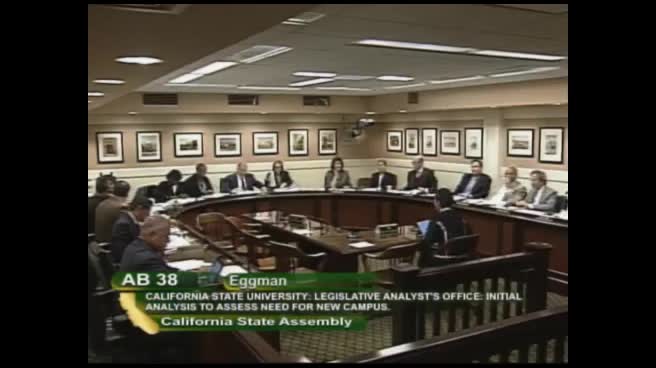 4MIN
Assembly Standing Committee on Higher Education
Bill Author
Bill Co-Author(s):