AB 443: Forfeiture.
- Session Year: 2015-2016
- House: Assembly
- Latest Version Date: 2015-08-18
Existing law subjects property acquired through or as proceeds of criminal profiteering activity to forfeiture. Existing law defines criminal profiteering activity as any specified acts or threats made for financial gain or advantage. Existing law requires a prosecuting agency to file a petition of forfeiture in conjunction with the criminal proceeding for the underlying offense.
This bill would allow the prosecuting agency to file a petition of forfeiture prior to the commencement of the underlying criminal proceeding if the value of the assets seized exceeds $100,000, there is a substantial probability that the prosecuting agency will file a criminal complaint, there is a substantial probability the prosecuting agency will prevail on the issue of forfeiture and failure to enter the order will result in the property being destroyed or otherwise removed from the jurisdiction of the court, the need to preserve the property outweighs the hardship on any party against whom the order is entered, and there is a substantial probability that the assets subject to forfeiture represent direct or indirect proceeds of criminal activity committed for the benefit of, at the direction of, or in association with, a transnational criminal organization, as defined. The bill would allow a person claiming an interest in the property or proceeds to move for return of the property on the grounds there is not probable cause to believe that the property is subject to forfeiture, and if the prosecuting agency does not establish substantial probability that the property is subject to forfeiture the court shall would be required to order the seized property returned. The bill would require the Attorney General, on or before January 1, 2018, to report to the Governor and specified committees on the use of these proceedings. The bill would provide for the repeal of these changes on January 1, 2019.
Existing law subjects property acquired through or as proceeds of criminal profiteering activity to forfeiture. Existing law defines criminal profiteering activity as any specified acts or threats made for financial gain or advantage. Existing law requires a prosecuting agency to file a petition of forfeiture in conjunction with the criminal proceeding for the underlying offense.
This bill would allow the prosecuting agency to file a petition of forfeiture prior to the commencement of the underlying criminal proceeding if the value of the assets seized exceeds $100,000, there is a substantial probability that the prosecuting agency will file a criminal complaint, there is a substantial probability the prosecuting agency will prevail on the issue of forfeiture and failure to enter the order will result in the property being destroyed or otherwise removed from the jurisdiction of the court, and the need to preserve the property outweighs the hardship on any party against whom the order is entered. entered, and there is a substantial probability that the assets subject to forfeiture represent direct or indirect proceeds of criminal activity committed for the benefit of, at the direction of, or in association with, a transnational criminal organization, as defined. The bill would allow a person claiming an interest in the property or proceeds to move for return of the property on the grounds there is not probable cause to believe that the property is subject to forfeiture, and if the prosecuting agency does not establish probable cause substantial probability that the property is subject to forfeiture the court shall order the seized property returned.
Existing law subjects property acquired through or as proceeds of criminal profiteering activity to forfeiture. Existing law defines criminal profiteering activity as any specified acts or threats made for financial gain or advantage.
This bill would add trafficking in firearms or other deadly weapons and trafficking in endangered species to the list of acts which can constitute criminal profiteering activity.
Existing advantage. Existing law requires a prosecuting agency to file a petition of forfeiture in conjunction with the criminal proceeding for the underlying offense.
This bill would allow the prosecuting agency to file a petition of forfeiture prior to the commencement of the underlying criminal proceeding if the value of the assets seized exceeds $10,000, $100,000, there is a substantial probability that the prosecuting agency will file a criminal complaint, there is a substantial probability the prosecuting agency will prevail on the issue of forfeiture and failure to enter the order will result in the property being destroyed or otherwise removed from the jurisdiction of the court, and the need to preserve the property outweighs the hardship on any party against whom the order is entered. The bill would allow a person claiming an interest in the property or proceeds to move for return of the property on the grounds there is not probable cause to believe that the property is subject to forfeiture, and if the prosecuting agency does not establish probable cause that the property is subject to forfeiture the court shall order the seized property returned.
Existing law subjects property acquired through or as proceeds of criminal profiteering activity to forfeiture. Existing law defines criminal profiteering activity as any specified acts or threats made for financial gain or advantage.
This bill would add trafficking in firearms or other deadly weapons and trafficking in endangered species to the list of acts which can constitute criminal profiteering activity.
Existing law requires a prosecuting agency to file a petition of forfeiture in conjunction with the criminal proceeding for the underlying offense.
This bill would allow the prosecuting agency to file a petition of forfeiture prior to the commencement of the underlying criminal proceeding if the value of the assets seized exceeds $10,000, there is a substantial probability that the prosecuting agency will file a criminal complaint, there is a substantial probability the prosecuting agency will prevail on the issue of forfeiture and failure to enter the order will result in the property being destroyed or otherwise removed from the jurisdiction of the court, and the need to preserve the property outweighs the hardship on any party against whom the order is entered.
For purposes of this chapter, the following definitions apply:
(a)Criminal profiteering activity means any act committed or attempted or any threat made for financial gain or advantage, which act or threat may be charged as a crime under any of the following sections:
(1)Arson, as defined in Section 451.
(2)Bribery, as defined in Sections 67, 67.5, and 68.
(3)Child pornography or exploitation, as defined in subdivision (b) of Section 311.2, or Section 311.3 or 311.4, which may be prosecuted as a felony.
(4)Felonious assault, as defined in Section 245.
(5)Embezzlement, as defined in Sections 424 and 503.
(6)Extortion, as defined in Section 518.
(7)Forgery, as defined in Section 470.
(8)Gambling, as defined in Sections 337a to 337f, inclusive, and Section 337i, except the activities of a person who participates solely as an individual bettor.
(9)Kidnapping, as defined in Section 207.
(10)Mayhem, as defined in Section 203.
(11)Murder, as defined in Section 187.
(12)Pimping and pandering, as defined in Section 266.
(13)Receiving stolen property, as defined in Section 496.
(14)Robbery, as defined in Section 211.
(15)Solicitation of crimes, as defined in Section 653f.
(16)Grand theft, as defined in Section 487 or subdivision (a) of Section 487a.
(17)Trafficking in controlled substances, as defined in Sections 11351, 11352, and 11353 of the Health and Safety Code.
(18)Violation of the laws governing corporate securities, as defined in Section 25541 of the Corporations Code.
(19)Any of the offenses contained in Chapter 7.5 (commencing with Section 311) of Title 9, relating to obscene matter, or in Chapter 7.6 (commencing with Section 313) of Title 9, relating to harmful matter that may be prosecuted as a felony.
(20)Presentation of a false or fraudulent claim, as defined in Section 550.
(21)False or fraudulent activities, schemes, or artifices, as described in Section 14107 of the Welfare and Institutions Code.
(22)Money laundering, as defined in Section 186.10.
(23)Offenses relating to the counterfeit of a registered mark, as specified in Section 350.
(24)Offenses relating to the unauthorized access to computers, computer systems, and computer data, as specified in Section 502.
(25)Conspiracy to commit any of the crimes listed above, as defined in Section 182.
(26)Subdivision (a) of Section 186.22, or a felony subject to enhancement as specified in subdivision (b) of Section 186.22.
(27)Any offenses related to fraud or theft against the states beverage container recycling program, including, but not limited to, those offenses specified in this subdivision and those criminal offenses specified in the California Beverage Container Recycling and Litter Reduction Act, commencing at Section 14500 of the Public Resources Code.
(28)Human trafficking, as defined in Section 236.1.
(29)Any crime in which the perpetrator induces, encourages, or persuades a person under 18 years of age to engage in a commercial sex act. For purposes of this paragraph, a commercial sex act means any sexual conduct on account of which anything of value is given or received by any person.
(30)Any crime in which the perpetrator, through force, fear, coercion, deceit, violence, duress, menace, or threat of unlawful injury to the victim or to another person, causes a person under 18 years of age to engage in a commercial sex act. For purposes of this paragraph, a commercial sex act means any sexual conduct on account of which anything of value is given or received by any person.
(31)Theft of personal identifying information, as defined in Section 530.5.
(32)Offenses involving the theft of a motor vehicle, as specified in Section 10851 of the Vehicle Code.
(33)Abduction or procurement by fraudulent inducement for prostitution, as defined in Section 266a.
(b)Organized crime means crime that is of a conspiratorial nature and that is either of an organized nature and seeks to supply illegal goods and services such as narcotics, prostitution, loan-sharking, gambling, and pornography, or that, through planning and coordination of individual efforts, seeks to conduct the illegal activities of arson for profit, hijacking, insurance fraud, smuggling, operating vehicle theft rings, fraud against the beverage container recycling program, or systematically encumbering the assets of a business for the purpose of defrauding creditors. Organized crime also means crime committed by a criminal street gang, as defined in subdivision (f) of Section 186.22. Organized crime also means false or fraudulent activities, schemes, or artifices, as described in Section 14107 of the Welfare and Institutions Code, and the theft of personal identifying information, as defined in Section 530.5.
(c)(1)Pattern of criminal profiteering activity means engaging in at least two incidents of criminal profiteering, as defined by this chapter, that meet the following requirements:
(A)Have the same or a similar purpose, result, principals, victims, or methods of commission, or are otherwise interrelated by distinguishing characteristics.
(B)Are not isolated events.
(C)Were committed as a criminal activity of organized crime.
(2)Acts that would constitute a pattern of criminal profiteering activity may not be used by a prosecuting agency to seek the remedies provided by this chapter unless the underlying offense occurred after the effective date of this chapter and the prior act occurred within 10 years, excluding any period of imprisonment, of the commission of the underlying offense. A prior act may not be used by a prosecuting agency to seek remedies provided by this chapter if a prosecution for that act resulted in an acquittal.
(d)Prosecuting agency means the Attorney General or the district attorney of any county.
(e)Transnational criminal organization means an ongoing organization, group, or association having leaders, associates, operations, or activities in more than one country, with one of its primary activities being the commission of one or more of the criminal acts enumerated in paragraphs (1) to (25), inclusive, or (31) to (33), inclusive, of subdivision (e) of Section 186.22.
(f)Underlying offense means an offense enumerated in subdivision (a) for which the defendant is being prosecuted.
(g)This section shall remain in effect only until January 1, 2019, and as of that date is repealed, unless a later enacted statute, that is enacted before January 1, 2019, deletes or extends that date.
SEC. 2.Section 186.2 is added to the Penal Code, to read:186.2.For purposes of this chapter, the following definitions apply:
(a)Criminal profiteering activity means any act committed or attempted or any threat made for financial gain or advantage, which act or threat may be charged as a crime under any of the following sections:
(1)Arson, as defined in Section 451.
(2)Bribery, as defined in Sections 67, 67.5, and 68.
(3)Child pornography or exploitation, as defined in subdivision (b) of Section 311.2, or Section 311.3 or 311.4, which may be prosecuted as a felony.
(4)Felonious assault, as defined in Section 245.
(5)Embezzlement, as defined in Sections 424 and 503.
(6)Extortion, as defined in Section 518.
(7)Forgery, as defined in Section 470.
(8)Gambling, as defined in Sections 337a to 337f, inclusive, and Section 337i, except the activities of a person who participates solely as an individual bettor.
(9)Kidnapping, as defined in Section 207.
(10)Mayhem, as defined in Section 203.
(11)Murder, as defined in Section 187.
(12)Pimping and pandering, as defined in Section 266.
(13)Receiving stolen property, as defined in Section 496.
(14)Robbery, as defined in Section 211.
(15)Solicitation of crimes, as defined in Section 653f.
(16)Grand theft, as defined in Section 487 or subdivision (a) of Section 487a.
(17)Trafficking in controlled substances, as defined in Sections 11351, 11352, and 11353 of the Health and Safety Code.
(18)Violation of the laws governing corporate securities, as defined in Section 25541 of the Corporations Code.
(19)Any of the offenses contained in Chapter 7.5 (commencing with Section 311) of Title 9, relating to obscene matter, or in Chapter 7.6 (commencing with Section 313) of Title 9, relating to harmful matter that may be prosecuted as a felony.
(20)Presentation of a false or fraudulent claim, as defined in Section 550.
(21)False or fraudulent activities, schemes, or artifices, as described in Section 14107 of the Welfare and Institutions Code.
(22)Money laundering, as defined in Section 186.10.
(23)Offenses relating to the counterfeit of a registered mark, as specified in Section 350.
(24)Offenses relating to the unauthorized access to computers, computer systems, and computer data, as specified in Section 502.
(25)Conspiracy to commit any of the crimes listed above, as defined in Section 182.
(26)Subdivision (a) of Section 186.22, or a felony subject to enhancement as specified in subdivision (b) of Section 186.22.
(27)Any offenses related to fraud or theft against the states beverage container recycling program, including, but not limited to, those offenses specified in this subdivision and those criminal offenses specified in the California Beverage Container Recycling and Litter Reduction Act, commencing at Section 14500 of the Public Resources Code.
(28)Human trafficking, as defined in Section 236.1.
(29)Any crime in which the perpetrator induces, encourages, or persuades a person under 18 years of age to engage in a commercial sex act. For purposes of this paragraph, a commercial sex act means any sexual conduct on account of which anything of value is given or received by any person.
(30)Any crime in which the perpetrator, through force, fear, coercion, deceit, violence, duress, menace, or threat of unlawful injury to the victim or to another person, causes a person under 18 years of age to engage in a commercial sex act. For purposes of this paragraph, a commercial sex act means any sexual conduct on account of which anything of value is given or received by any person.
(31)Theft of personal identifying information, as defined in Section 530.5.
(32)Offenses involving the theft of a motor vehicle, as specified in Section 10851 of the Vehicle Code.
(33)Abduction or procurement by fraudulent inducement for prostitution, as defined in Section 266a.
(b)Organized crime means crime that is of a conspiratorial nature and that is either of an organized nature and seeks to supply illegal goods and services such as narcotics, prostitution, loan-sharking, gambling, and pornography, or that, through planning and coordination of individual efforts, seeks to conduct the illegal activities of arson for profit, hijacking, insurance fraud, smuggling, operating vehicle theft rings, fraud against the beverage container recycling program, or systematically encumbering the assets of a business for the purpose of defrauding creditors. Organized crime also means crime committed by a criminal street gang, as defined in subdivision (f) of Section 186.22. Organized crime also means false or fraudulent activities, schemes, or artifices, as described in Section 14107 of the Welfare and Institutions Code, and the theft of personal identifying information, as defined in Section 530.5.
(c)(1)Pattern of criminal profiteering activity means engaging in at least two incidents of criminal profiteering, as defined by this chapter, that meet the following requirements:
(A)Have the same or a similar purpose, result, principals, victims, or methods of commission, or are otherwise interrelated by distinguishing characteristics.
(B)Are not isolated events.
(C)Were committed as a criminal activity of organized crime.
(2)Acts that would constitute a pattern of criminal profiteering activity may not be used by a prosecuting agency to seek the remedies provided by this chapter unless the underlying offense occurred after the effective date of this chapter and the prior act occurred within 10 years, excluding any period of imprisonment, of the commission of the underlying offense. A prior act may not be used by a prosecuting agency to seek remedies provided by this chapter if a prosecution for that act resulted in an acquittal.
(d)Prosecuting agency means the Attorney General or the district attorney of any county.
(e)Underlying offense means an offense enumerated in subdivision (a) for which the defendant is being prosecuted.
(f)This section shall become operative on January 1, 2019.
SEC. 2.SEC. 3.Section 186.4 of the Penal Code is amended to read:186.4.(a)(1)The prosecuting agency shall, in conjunction with the criminal proceeding, file a petition of forfeiture with the superior court of the county in which the defendant has been charged with the underlying criminal offense, which shall allege that the defendant has engaged in a pattern of criminal profiteering activity, including the acts or threats chargeable as crimes and the property forfeitable pursuant to Section 186.3.
(2)The prosecuting agency may, prior to the commencement of a criminal proceeding, file a petition of forfeiture with the superior court of the county in which the defendant is being investigated, which shall allege that the defendant has engaged in a pattern of criminal profiteering activity, including the acts or threats chargeable as crimes and the property forfeitable pursuant to Section 186.3, provided the court determines that:
(A)The value of the assets to be seized exceeds one hundred thousand dollars ($100,000).
(B)There is a substantial probability that the prosecuting agency will file a criminal complaint or seek a grand jury indictment against the defendant.
(C)There is a substantial probability that the prosecuting agency will prevail on the issue of forfeiture and that failure to enter the order will result in the property being destroyed, removed from the jurisdiction of the court, or otherwise made unavailable for forfeiture.
(D)The need to preserve the availability of the property through the entry of the requested order outweighs the hardship on any party against whom the order is to be entered.
(E)There is a substantial probability that the assets subject to forfeiture represent direct or indirect proceeds of criminal activity committed for the benefit of, at the direction of, or in association with, a transnational criminal organization, as defined in Section 186.2.
(b)The prosecuting agency shall make service of process of a notice regarding that petition upon every individual who may have a property interest in the alleged proceeds, which notice shall state that any interested party may file a verified claim with the superior court stating the amount of their claimed interest and an affirmation or denial of the prosecuting agencys allegation. If the notices cannot be given by registered mail or personal delivery, the notices shall be published for at least three successive weeks in a newspaper of general circulation in the county where the property is located. If the property alleged to be subject to forfeiture is real property, the prosecuting agency shall, at the time of filing the petition of forfeiture, record a lis pendens in each county in which the real property is situated which specifically identifies the real property alleged to be subject to forfeiture. The judgment of forfeiture shall not affect the interest in real property of any third party which was acquired prior to the recording of the lis pendens.
(c)(1)If a forfeiture petition is filed pursuant to paragraph (2) of subdivision (a), prior to the filing of the complaint in a criminal action, a person claiming an interest in the property or proceeds may move for the return of the property on the grounds that there is not probable cause to believe the property is forfeitable pursuant to Section 186.3 and is not automatically subject to court order of forfeiture or destruction by another provision of this chapter. The motion may be made prior to, during, or subsequent to, the filing of criminal charges or a grand jury indictment. If the prosecuting agency does not establish a substantial probability that the property is subject to forfeiture, the court shall order the seized property released to the person it determines is entitled to the property.
(2)If a claimants motion filed pursuant to paragraph (1) is granted, the people may, within 15 days, file a petition for a writ of mandate or prohibition seeking appellate review of the ruling.
(d)If a forfeiture petition is filed pursuant to paragraph (2) of subdivision (a), prior to the filing of the complaint in a criminal action, the motion and any injunctive order shall be dismissed if a criminal complaint or grand jury indictment is not filed within 60 days of the grant of the motion. If a forfeiture petition is dismissed pursuant to this subdivision, the motion shall not be refiled, except upon the filing of a criminal complaint.
(e)All notices shall set forth the time within which a claim of interest in the property seized is required to be filed pursuant to Section 186.5.
(f)On or before January 1, 2018, the Attorney General shall report to the Senate Committee on Public Safety, the Assembly Committee on Public Safety, and the Governor. The report shall include, but not be limited to, the following information regarding petitions filed pursuant to paragraph (2) of subdivision (a) between January 1, 2016, and January 1, 2018:
(1)The number of cases in which the process authorized by paragraph (2) of subdivision (a) has been used.
(2)The value and kinds of property seized in each case.
(3)The criminal charges filed, if any, in conjunction with each forfeiture action.
(4)The number of cases in which related charges were not filed.
(5)The number of cases in which property was returned because charges were not filed.
(6)The length of time between dismissal, if any, of the forfeiture petition and the return of the property pursuant to subdivision (d) in each case.
(7)The number of cases in which property was returned pursuant to a motion filed under paragraph (1) of subdivision (c).
(g)This section shall remain in effect only until January 1, 2019, and as of that date is repealed, unless a later enacted statute, that is enacted before January 1, 2019, deletes or extends that date.
SEC. 4.Section 186.4 is added to the Penal Code, to read:186.4.(a)The prosecuting agency shall, in conjunction with the criminal proceeding, file a petition of forfeiture with the superior court of the county in which the defendant has been charged with the underlying criminal offense, which shall allege that the defendant has engaged in a pattern of criminal profiteering activity, including the acts or threats chargeable as crimes and the property forfeitable pursuant to Section 186.3.
(b)The prosecuting agency shall make service of process of a notice regarding that petition upon every individual who may have a property interest in the alleged proceeds, which notice shall state that any interested party may file a verified claim with the superior court stating the amount of their claimed interest and an affirmation or denial of the prosecuting agencys allegation. If the notices cannot be given by registered mail or personal delivery, the notices shall be published for at least three successive weeks in a newspaper of general circulation in the county where the property is located. If the property alleged to be subject to forfeiture is real property, the prosecuting agency shall, at the time of filing the petition of forfeiture, record a lis pendens in each county in which the real property is situated which specifically identifies the real property alleged to be subject to forfeiture. The judgment of forfeiture shall not affect the interest in real property of any third party which was acquired prior to the recording of the lis pendens.
(c)All notices shall set forth the time within which a claim of interest in the property seized is required to be filed pursuant to Section 186.5.
(d)This section shall become operative on January 1, 2019.
For purposes of this chapter, the following definitions apply:
(a)Criminal profiteering activity means any act committed or attempted or any threat made for financial gain or advantage, which act or threat may be charged as a crime under any of the following sections:
(1)Arson, as defined in Section 451.
(2)Bribery, as defined in Sections 67, 67.5, and 68.
(3)Child pornography or exploitation, as defined in subdivision (b) of Section 311.2, or Section 311.3 or 311.4, which may be prosecuted as a felony.
(4)Felonious assault, as defined in Section 245.
(5)Embezzlement, as defined in Sections 424 and 503.
(6)Extortion, as defined in Section 518.
(7)Forgery, as defined in Section 470.
(8)Gambling, as defined in Sections 337a to 337f, inclusive, and Section 337i, except the activities of a person who participates solely as an individual bettor.
(9)Kidnapping, as defined in Section 207.
(10)Mayhem, as defined in Section 203.
(11)Murder, as defined in Section 187.
(12)Pimping and pandering, as defined in Section 266.
(13)Receiving stolen property, as defined in Section 496.
(14)Robbery, as defined in Section 211.
(15)Solicitation of crimes, as defined in Section 653f.
(16)Grand theft, as defined in Section 487 or subdivision (a) of Section 487a.
(17)Trafficking in controlled substances, as defined in Sections 11351, 11352, and 11353 of the Health and Safety Code.
(18)Violation of the laws governing corporate securities, as defined in Section 25541 of the Corporations Code.
(19)Any of the offenses contained in Chapter 7.5 (commencing with Section 311) of Title 9, relating to obscene matter, or in Chapter 7.6 (commencing with Section 313) of Title 9, relating to harmful matter that may be prosecuted as a felony.
(20)Presentation of a false or fraudulent claim, as defined in Section 550.
(21)False or fraudulent activities, schemes, or artifices, as described in Section 14107 of the Welfare and Institutions Code.
(22)Money laundering, as defined in Section 186.10.
(23)Offenses relating to the counterfeit of a registered mark, as specified in Section 350.
(24)Offenses relating to the unauthorized access to computers, computer systems, and computer data, as specified in Section 502.
(25)Conspiracy to commit any of the crimes listed above, as defined in Section 182.
(26)Subdivision (a) of Section 186.22, or a felony subject to enhancement as specified in subdivision (b) of Section 186.22.
(27)Any offenses related to fraud or theft against the states beverage container recycling program, including, but not limited to, those offenses specified in this subdivision and those criminal offenses specified in the California Beverage Container Recycling and Litter Reduction Act, commencing at Section 14500 of the Public Resources Code.
(28)Human trafficking, as defined in Section 236.1.
(29)Any crime in which the perpetrator induces, encourages, or persuades a person under 18 years of age to engage in a commercial sex act. For purposes of this paragraph, a commercial sex act means any sexual conduct on account of which anything of value is given or received by any person.
(30)Any crime in which the perpetrator, through force, fear, coercion, deceit, violence, duress, menace, or threat of unlawful injury to the victim or to another person, causes a person under 18 years of age to engage in a commercial sex act. For purposes of this paragraph, a commercial sex act means any sexual conduct on account of which anything of value is given or received by any person.
(31)Theft of personal identifying information, as defined in Section 530.5.
(32)Offenses involving the theft of a motor vehicle, as specified in Section 10851 of the Vehicle Code.
(33)Abduction or procurement by fraudulent inducement for prostitution, as defined in Section 266a.
(b)Organized crime means crime that is of a conspiratorial nature and that is either of an organized nature and seeks to supply illegal goods and services such as narcotics, prostitution, loan-sharking, gambling, and pornography, or that, through planning and coordination of individual efforts, seeks to conduct the illegal activities of arson for profit, hijacking, insurance fraud, smuggling, operating vehicle theft rings, fraud against the beverage container recycling program, or systematically encumbering the assets of a business for the purpose of defrauding creditors. Organized crime also means crime committed by a criminal street gang, as defined in subdivision (f) of Section 186.22. Organized crime also means false or fraudulent activities, schemes, or artifices, as described in Section 14107 of the Welfare and Institutions Code, and the theft of personal identifying information, as defined in Section 530.5.
(b)
(c)(1)Pattern of criminal profiteering activity means engaging in at least two incidents of criminal profiteering, as defined by this chapter, that meet the following requirements:
(A)Have the same or a similar purpose, result, principals, victims, or methods of commission, or are otherwise interrelated by distinguishing characteristics.
(B)Are not isolated events.
(C)Were committed as a criminal activity of organized crime.
(2)Acts that would constitute a pattern of criminal profiteering activity may not be used by a prosecuting agency to seek the remedies provided by this chapter unless the underlying offense occurred after the effective date of this chapter and the prior act occurred within 10 years, excluding any period of imprisonment, of the commission of the underlying offense. A prior act may not be used by a prosecuting agency to seek remedies provided by this chapter if a prosecution for that act resulted in an acquittal.
(c)
(d)Prosecuting agency means the Attorney General or the district attorney of any county.
(d)Organized crime means crime that is of a conspiratorial nature and that is either of an organized nature and seeks to supply illegal goods and services such as narcotics, prostitution, loan-sharking, gambling, and pornography, or that, through planning and coordination of individual efforts, seeks to conduct the illegal activities of arson for profit, hijacking, insurance fraud, smuggling, operating vehicle theft rings, fraud against the beverage container recycling program, or systematically encumbering the assets of a business for the purpose of defrauding creditors. Organized crime also means crime committed by a criminal street gang, as defined in subdivision (f) of Section 186.22. Organized crime also means false or fraudulent activities, schemes, or artifices, as described in Section 14107 of the Welfare and Institutions Code, and the theft of personal identifying information, as defined in Section 530.5.
(e)Transnational criminal organization means an ongoing organization, group, or association having leaders, associates, operations, or activities in more than one country, with one of its primary activities being the commission of one or more of the criminal acts enumerated in paragraphs (1) to (25), inclusive, or (31) to (33), inclusive, of subdivision (e) of Section 186.22.
(e)
(f)Underlying offense means an offense enumerated in subdivision (a) for which the defendant is being prosecuted.
SECTION 1.SEC. 2.Section 186.4 of the Penal Code is amended to read:186.4.(a)(1)The prosecuting agency shall, in conjunction with the criminal proceeding, file a petition of forfeiture with the superior court of the county in which the defendant has been charged with the underlying criminal offense, which shall allege that the defendant has engaged in a pattern of criminal profiteering activity, including the acts or threats chargeable as crimes and the property forfeitable pursuant to Section 186.3.
(2)The prosecuting agency may, prior to the commencement of a criminal proceeding, file a petition of forfeiture with the superior court of the county in which the defendant is being investigated, which shall allege that the defendant has engaged in a pattern of criminal profiteering activity, including the acts or threats chargeable as crimes and the property forfeitable pursuant to Section 186.3, provided the court determines that:
(A)The value of the assets to be seized exceeds one hundred thousand dollars ($100,000).
(B)There is a substantial probability that the prosecuting agency will file a criminal complaint or seek a grand jury indictment against the defendant.
(C)There is a substantial probability that the prosecuting agency will prevail on the issue of forfeiture and that failure to enter the order will result in the property being destroyed, removed from the jurisdiction of the court, or otherwise made unavailable for forfeiture.
(D)The need to preserve the availability of the property through the entry of the requested order outweighs the hardship on any party against whom the order is to be entered.
(E)There is a substantial probability that the assets subject to forfeiture represent direct or indirect proceeds of criminal activity committed for the benefit of, at the direction of, or in association with, a transnational criminal organization, as defined in Section 186.2.
(b)The prosecuting agency shall make service of process of a notice regarding that petition upon every individual who may have a property interest in the alleged proceeds, which notice shall state that any interested party may file a verified claim with the superior court stating the amount of their claimed interest and an affirmation or denial of the prosecuting agencys allegation. If the notices cannot be given by registered mail or personal delivery, the notices shall be published for at least three successive weeks in a newspaper of general circulation in the county where the property is located. If the property alleged to be subject to forfeiture is real property, the prosecuting agency shall, at the time of filing the petition of forfeiture, record a lis pendens in each county in which the real property is situated which specifically identifies the real property alleged to be subject to forfeiture. The judgment of forfeiture shall not affect the interest in real property of any third party which was acquired prior to the recording of the lis pendens.
(c)(1)If a forfeiture petition is filed pursuant to paragraph (2) of subdivision (a), prior to the filing of the complaint in a criminal action, a person claiming an interest in the property or proceeds may move for the return of the property on the grounds that there is not probable cause to believe the property is forfeitable pursuant to Section 186.3 and is not automatically subject to court order of forfeiture or destruction by another provision of this chapter. The motion may be made prior to, during, or subsequent to, the filing of criminal charges or a grand jury indictment. If the prosecuting agency does not establish probable cause a substantial probability that the property is subject to forfeiture, the court shall order the seized property released to the person it determines is entitled to the property.
(2)If a claimants motion filed pursuant to paragraph (1) is granted, the people may, within 15 days, file a petition for a writ of mandate or prohibition seeking appellate review of the ruling.
(d)If a forfeiture petition is filed pursuant to paragraph (2) of subdivision (a), prior to the filing of the complaint in a criminal action, the motion and any injunctive order shall be dismissed if a criminal complaint or grand jury indictment is not filed within 60 days of the grant of the motion. If a forfeiture petition is dismissed pursuant to this subdivision, the motion shall not be refiled, except upon the filing of a criminal complaint.
(e)All notices shall set forth the time within which a claim of interest in the property seized is required to be filed pursuant to Section 186.5.
For purposes of this chapter, the following definitions apply:
(a)Criminal profiteering activity means any act committed or attempted or any threat made for financial gain or advantage, which act or threat may be charged as a crime under any of the following sections:
(1)Arson, as defined in Section 451.
(2)Bribery, as defined in Sections 67, 67.5, and 68.
(3)Child pornography or exploitation, as defined in subdivision (b) of Section 311.2, or Section 311.3 or 311.4, which may be prosecuted as a felony.
(4)Felonious assault, as defined in Section 245.
(5)Embezzlement, as defined in Sections 424 and 503.
(6)Extortion, as defined in Section 518.
(7)Forgery, as defined in Section 470.
(8)Gambling, as defined in Sections 337a to 337f, inclusive, and Section 337i, except the activities of a person who participates solely as an individual bettor.
(9)Kidnapping, as defined in Section 207.
(10)Mayhem, as defined in Section 203.
(11)Murder, as defined in Section 187.
(12)Pimping and pandering, as defined in Section 266.
(13)Receiving stolen property, as defined in Section 496.
(14)Robbery, as defined in Section 211.
(15)Solicitation of crimes, as defined in Section 653f.
(16)Grand theft, as defined in Section 487 or subdivision (a) of Section 487a.
(17)Trafficking in controlled substances, as defined in Sections 11351, 11352, and 11353 of the Health and Safety Code.
(18)Violation of the laws governing corporate securities, as defined in Section 25541 of the Corporations Code.
(19)Any of the offenses contained in Chapter 7.5 (commencing with Section 311) of Title 9, relating to obscene matter, or in Chapter 7.6 (commencing with Section 313) of Title 9, relating to harmful matter that may be prosecuted as a felony.
(20)Presentation of a false or fraudulent claim, as defined in Section 550.
(21)False or fraudulent activities, schemes, or artifices, as described in Section 14107 of the Welfare and Institutions Code.
(22)Money laundering, as defined in Section 186.10.
(23)Offenses relating to the counterfeit of a registered mark, as specified in Section 350.
(24)Offenses relating to the unauthorized access to computers, computer systems, and computer data, as specified in Section 502.
(25)Conspiracy to commit any of the crimes listed above, as defined in Section 182.
(26)Subdivision (a) of Section 186.22, or a felony subject to enhancement as specified in subdivision (b) of Section 186.22.
(27)Any offenses related to fraud or theft against the states beverage container recycling program, including, but not limited to, those offenses specified in this subdivision and those criminal offenses specified in the California Beverage Container Recycling and Litter Reduction Act, commencing at Section 14500 of the Public Resources Code.
(28)Human trafficking, as defined in Section 236.1.
(29)Any crime in which the perpetrator induces, encourages, or persuades a person under 18 years of age to engage in a commercial sex act. For purposes of this paragraph, a commercial sex act means any sexual conduct on account of which anything of value is given or received by any person.
(30)Any crime in which the perpetrator, through force, fear, coercion, deceit, violence, duress, menace, or threat of unlawful injury to the victim or to another person, causes a person under 18 years of age to engage in a commercial sex act. For purposes of this paragraph, a commercial sex act means any sexual conduct on account of which anything of value is given or received by any person.
(31)Theft of personal identifying information, as defined in Section 530.5.
(32)Offenses involving the theft of a motor vehicle, as specified in Section 10851 of the Vehicle Code.
(33)Abduction or procurement by fraudulent inducement for prostitution, as defined in Section 266a.
(34)Trafficking in firearms or other deadly weapons.
(35)Trafficking in endangered species, as defined by Section 2062 of the Fish and Game Code or the federal Endangered Species Act of 1973.
(b)(1)Pattern of criminal profiteering activity means engaging in at least two incidents of criminal profiteering, as defined by this chapter, that meet the following requirements:
(A)Have the same or a similar purpose, result, principals, victims, or methods of commission, or are otherwise interrelated by distinguishing characteristics.
(B)Are not isolated events.
(C)Were committed as a criminal activity of organized crime.
(2)Acts that would constitute a pattern of criminal profiteering activity may not be used by a prosecuting agency to seek the remedies provided by this chapter unless the underlying offense occurred after the effective date of this chapter and the prior act occurred within 10 years, excluding any period of imprisonment, of the commission of the underlying offense. A prior act may not be used by a prosecuting agency to seek remedies provided by this chapter if a prosecution for that act resulted in an acquittal.
(c)Prosecuting agency means the Attorney General or the district attorney of any county.
(d)Organized crime means crime that is of a conspiratorial nature and that is either of an organized nature and seeks to supply illegal goods and services such as narcotics, weapons, prostitution, loan-sharking, gambling, and pornography, or that, through planning and coordination of individual efforts, seeks to conduct the illegal activities of arson for profit, hijacking, insurance fraud, smuggling, operating vehicle theft rings, fraud against the beverage container recycling program, or systematically encumbering the assets of a business for the purpose of defrauding creditors. Organized crime also means crime committed by a criminal street gang, as defined in subdivision (f) of Section 186.22. Organized crime also means false or fraudulent activities, schemes, or artifices, as described in Section 14107 of the Welfare and Institutions Code, and the theft of personal identifying information, as defined in Section 530.5.
(e)Underlying offense means an offense enumerated in subdivision (a) for which the defendant is being prosecuted.
SEC. 2.SECTION 1.Section 186.4 of the Penal Code is amended to read:186.4.(a)(1)The prosecuting agency shall, in conjunction with the criminal proceeding, file a petition of forfeiture with the superior court of the county in which the defendant has been charged with the underlying criminal offense, which shall allege that the defendant has engaged in a pattern of criminal profiteering activity, including the acts or threats chargeable as crimes and the property forfeitable pursuant to Section 186.3.
(2)The prosecuting agency may, prior to the commencement of a criminal proceeding, file a petition of forfeiture with the superior court of the county in which the defendant will be charged with a criminal offense, is being investigated, which shall allege that the defendant has engaged in a pattern of criminal profiteering activity, including the acts or threats chargeable as crimes and the property forfeitable pursuant to Section 186.3, provided the court determines that:
(A)The value of the assets to be seized exceeds $10,000. one hundred thousand dollars ($100,000).
(B)There is a substantial probability that the prosecuting agency will file a criminal complaint or seek a grand jury indictment against the defendant.
(C)There is a substantial probability that the prosecuting agency will prevail on the issue of forfeiture and that failure to enter the order will result in the property being destroyed, removed from the jurisdiction of the court, or otherwise made unavailable for forfeiture.
(D)The need to preserve the availability of the property through the entry of the requested order outweighs the hardship on any party against whom the order is to be entered.
(b)The prosecuting agency shall make service of process of a notice regarding that petition upon every individual who may have a property interest in the alleged proceeds, which notice shall state that any interested party may file a verified claim with the superior court stating the amount of their claimed interest and an affirmation or denial of the prosecuting agencys allegation. If the notices cannot be given by registered mail or personal delivery, the notices shall be published for at least three successive weeks in a newspaper of general circulation in the county where the property is located. If the property alleged to be subject to forfeiture is real property, the prosecuting agency shall, at the time of filing the petition of forfeiture, record a lis pendens in each county in which the real property is situated which specifically identifies the real property alleged to be subject to forfeiture. The judgment of forfeiture shall not affect the interest in real property of any third party which was acquired prior to the recording of the lis pendens.
(c)(1)If a forfeiture petition is filed pursuant to paragraph (2) of subdivision (a), prior to the filing of the complaint in a criminal action, a person claiming an interest in the property or proceeds may move for the return of the property on the grounds that there is not probable cause to believe the property is forfeitable pursuant to Section 186.3 and is not automatically subject to court order of forfeiture or destruction by another provision of this chapter. The motion may be made prior to, during, or subsequent to, the filing of criminal charges or a grand jury indictment. If the prosecuting agency does not establish probable cause that the property is subject to forfeiture, the court shall order the seized property released to the person it determines is entitled to the property.
(2)If a claimants motion filed pursuant to paragraph (1) is granted, the people may, within 15 days, file a petition for a writ of mandate or prohibition seeking appellate review of the ruling.
(c)
(d)If a forfeiture petition is filed pursuant to Paragraph paragraph (2) of Subdivision subdivision (a), prior to the filing of the complaint in a criminal action, the motion and any injunctive order shall be dismissed by operation of law unless if a criminal complaint or grand jury indictment is not filed within 60 days of the grant of the motion. If a forfeiture petition is dismissed pursuant to this subdivision, the motion shall not be refiled, except upon the filing of a criminal complain. complaint.
(d)
(e)All notices shall set forth the time within which a claim of interest in the property seized is required to be filed pursuant to Section 186.5.
For purposes of this chapter, the following definitions apply:
(a)Criminal profiteering activity means any act committed or attempted or any threat made for financial gain or advantage, which act or threat may be charged as a crime under any of the following sections:
(1)Arson, as defined in Section 451.
(2)Bribery, as defined in Sections 67, 67.5, and 68.
(3)Child pornography or exploitation, as defined in subdivision (b) of Section 311.2, or Section 311.3 or 311.4, which may be prosecuted as a felony.
(4)Felonious assault, as defined in Section 245.
(5)Embezzlement, as defined in Sections 424 and 503.
(6)Extortion, as defined in Section 518.
(7)Forgery, as defined in Section 470.
(8)Gambling, as defined in Sections 337a to 337f, inclusive, and Section 337i, except the activities of a person who participates solely as an individual bettor.
(9)Kidnapping, as defined in Section 207.
(10)Mayhem, as defined in Section 203.
(11)Murder, as defined in Section 187.
(12)Pimping and pandering, as defined in Section 266.
(13)Receiving stolen property, as defined in Section 496.
(14)Robbery, as defined in Section 211.
(15)Solicitation of crimes, as defined in Section 653f.
(16)Grand theft, as defined in Section 487 or subdivision (a) of Section 487a.
(17)Trafficking in controlled substances, as defined in Sections 11351, 11352, and 11353 of the Health and Safety Code.
(18)Violation of the laws governing corporate securities, as defined in Section 25541 of the Corporations Code.
(19)Any of the offenses contained in Chapter 7.5 (commencing with Section 311) of Title 9, relating to obscene matter, or in Chapter 7.6 (commencing with Section 313) of Title 9, relating to harmful matter that may be prosecuted as a felony.
(20)Presentation of a false or fraudulent claim, as defined in Section 550.
(21)False or fraudulent activities, schemes, or artifices, as described in Section 14107 of the Welfare and Institutions Code.
(22)Money laundering, as defined in Section 186.10.
(23)Offenses relating to the counterfeit of a registered mark, as specified in Section 350.
(24)Offenses relating to the unauthorized access to computers, computer systems, and computer data, as specified in Section 502.
(25)Conspiracy to commit any of the crimes listed above, as defined in Section 182.
(26)Subdivision (a) of Section 186.22, or a felony subject to enhancement as specified in subdivision (b) of Section 186.22.
(27)Any offenses related to fraud or theft against the states beverage container recycling program, including, but not limited to, those offenses specified in this subdivision and those criminal offenses specified in the California Beverage Container Recycling and Litter Reduction Act, commencing at Section 14500 of the Public Resources Code.
(28)Human trafficking, as defined in Section 236.1.
(29)Any crime in which the perpetrator induces, encourages, or persuades a person under 18 years of age to engage in a commercial sex act. For purposes of this paragraph, a commercial sex act means any sexual conduct on account of which anything of value is given or received by any person.
(30)Any crime in which the perpetrator, through force, fear, coercion, deceit, violence, duress, menace, or threat of unlawful injury to the victim or to another person, causes a person under 18 years of age to engage in a commercial sex act. For purposes of this paragraph, a commercial sex act means any sexual conduct on account of which anything of value is given or received by any person.
(31)Theft of personal identifying information, as defined in Section 530.5.
(32)Offenses involving the theft of a motor vehicle, as specified in Section 10851 of the Vehicle Code.
(33)Abduction or procurement by fraudulent inducement for prostitution, as defined in Section 266a.
(34)Trafficking in firearms or other deadly weapons.
(35)Trafficking in endangered species, as defined by Section 2062 of the Fish and Game Code or the federal Endangered Species Act of 1973.
(b)(1)Pattern of criminal profiteering activity means engaging in at least two incidents of criminal profiteering, as defined by this chapter, that meet the following requirements:
(A)Have the same or a similar purpose, result, principals, victims, or methods of commission, or are otherwise interrelated by distinguishing characteristics.
(B)Are not isolated events.
(C)Were committed as a criminal activity of organized crime.
(2)Acts that would constitute a pattern of criminal profiteering activity may not be used by a prosecuting agency to seek the remedies provided by this chapter unless the underlying offense occurred after the effective date of this chapter and the prior act occurred within 10 years, excluding any period of imprisonment, of the commission of the underlying offense. A prior act may not be used by a prosecuting agency to seek remedies provided by this chapter if a prosecution for that act resulted in an acquittal.
(c)Prosecuting agency means the Attorney General or the district attorney of any county.
(d)Organized crime means crime that is of a conspiratorial nature and that is either of an organized nature and seeks to supply illegal goods and services such as narcotics, weapons, prostitution, loan-sharking, gambling, and pornography, or that, through planning and coordination of individual efforts, seeks to conduct the illegal activities of arson for profit, hijacking, insurance fraud, smuggling, operating vehicle theft rings, fraud against the beverage container recycling program, or systematically encumbering the assets of a business for the purpose of defrauding creditors. Organized crime also means crime committed by a criminal street gang, as defined in subdivision (f) of Section 186.22. Organized crime also means false or fraudulent activities, schemes, or artifices, as described in Section 14107 of the Welfare and Institutions Code, and the theft of personal identifying information, as defined in Section 530.5.
(e)Underlying offense means an offense enumerated in subdivision (a) for which the defendant is being prosecuted.
SEC. 2.Section 186.4 of the Penal Code is amended to read:186.4.(a)(1)The prosecuting agency shall, in conjunction with the criminal proceeding, file a petition of forfeiture with the superior court of the county in which the defendant has been charged with the underlying criminal offense, which shall allege that the defendant has engaged in a pattern of criminal profiteering activity, including the acts or threats chargeable as crimes and the property forfeitable pursuant to Section 186.3. The
(2)The prosecuting agency may, prior to the commencement of a criminal proceeding, file a petition of forfeiture with the superior court of the county in which the defendant will be charged with a criminal offense, which shall allege that the defendant has engaged in a pattern of criminal profiteering activity, including the acts or threats chargeable as crimes and the property forfeitable pursuant to Section 186.3, provided the court determines that:
(A)The value of the assets to be seized exceeds $10,000.
(B)There is a substantial probability that the prosecuting agency will file a criminal complaint or seek a grand jury indictment against the defendant.
(C)There is a substantial probability that the prosecuting agency will prevail on the issue of forfeiture and that failure to enter the order will result in the property being destroyed, removed from the jurisdiction of the court, or otherwise made unavailable for forfeiture.
(D)The need to preserve the availability of the property through the entry of the requested order outweighs the hardship on any party against whom the order is to be entered.
(b)The prosecuting agency shall make service of process of a notice regarding that petition upon every individual who may have a property interest in the alleged proceeds, which notice shall state that any interested party may file a verified claim with the superior court stating the amount of their claimed interest and an affirmation or denial of the prosecuting agencys allegation. If the notices cannot be given by registered mail or personal delivery, the notices shall be published for at least three successive weeks in a newspaper of general circulation in the county where the property is located. If the property alleged to be subject to forfeiture is real property, the prosecuting agency shall, at the time of filing the petition of forfeiture, record a lis pendens in each county in which the real property is situated which specifically identifies the real property alleged to be subject to forfeiture. The judgment of forfeiture shall not affect the interest in real property of any third party which was acquired prior to the recording of the lis pendens.
(c)If a forfeiture petition is filed pursuant to Paragraph (2) of Subdivision (a), prior to the filing of the complaint in a criminal action, the motion and any injunctive order shall be dismissed by operation of law unless a criminal complaint or grand jury indictment is filed within 60 days of the grant of the motion. If a forfeiture petition is dismissed pursuant to this subdivision, the motion shall not be refiled, except upon the filing of a criminal complain.
(b)
(d)All notices shall set forth the time within which a claim of interest in the property seized is required to be filed pursuant to Section 186.5.
|
Date
|
Status
|
|---|---|
| May 13, 2015 | In committee: Hearing postponed by committee. |
| Aug 27, 2015 | In committee: Held under submission. |
| Aug 24, 2015 | In committee: Referred to APPR. suspense file. |
| Aug 18, 2015 | Read second time and amended. Re-referred to Com. on APPR. |
| Aug 17, 2015 | From committee: Amend, and do pass as amended and re-refer to Com. on APPR. (Ayes 7. Noes 0.) (July 14). |
| Jun 18, 2015 | Referred to Com. on PUB. S. |
| May 28, 2015 | Read third time. Passed. Ordered to the Senate. (Ayes 71. Noes 5.) |
| May 28, 2015 | Read third time. Passed. Ordered to the Senate. (Ayes 71. Noes 5. Page 1628.) |
| May 28, 2015 | In Senate. Read first time. To Com. on RLS. for assignment. |
| May 21, 2015 | Read second time. Ordered to third reading. |
| May 20, 2015 | From committee: Do pass. (Ayes 14. Noes 0.) (May 20). |
| Feb 23, 2015 | Read first time. To print. |
| May 5, 2015 | Re-referred to Com. on APPR. |
| May 4, 2015 | Read second time and amended. |
| Apr 30, 2015 | From committee: Amend, and do pass as amended and re-refer to Com. on APPR. (Ayes 4. Noes 0.) (April 28). |
| Apr 22, 2015 | Re-referred to Com. on PUB. S. |
| Apr 21, 2015 | In committee: Hearing postponed by committee. |
| Apr 21, 2015 | From committee chair, with author's amendments: Amend, and re-refer to Com. on PUB. S. Read second time and amended. |
| Apr 14, 2015 | In committee: Set, second hearing. Hearing canceled at the request of author. |
| Apr 7, 2015 | In committee: Set, first hearing. Hearing canceled at the request of author. |
| Mar 5, 2015 | Referred to Com. on PUB. S. |
| Feb 24, 2015 | From printer. May be heard in committee March 26. |
|
Date
|
Description
|
Location
|
Votes
|
|
|---|---|---|---|---|
| Aug 24, 2015 | Placed on suspense file | Senate Standing Committee on Appropriations |
Passed |
|
| Jul 14, 2015 | Do pass as amended, but first amend, and re-refer to the Committee on [Appropriations] | Senate Standing Committee on Public Safety |
Passed |
|
| May 28, 2015 | AB 443 ALEJO Assembly Third Reading | Assembly Floor |
Passed |
|
| May 20, 2015 | Do pass. | Assembly Standing Committee on Appropriations |
Passed |
|
| Apr 28, 2015 | Do pass as amended and be re-referred to the Committee on [Appropriations] | Assembly Standing Committee on Public Safety |
Passed |
This list shows positions taken on this bill by organizations on the date displayed, which is linked to the original source.
Positions by individuals are not included.
|
Organization
|
Position
|
Date
|
|---|---|---|
| Alameda County District Attorney's Office | ** Support | May 20, 2015 |
| Association For Los Angeles Deputy Sheriffs | * Support | May 20, 2015 |
| California Association Of Code Enforcement Officers | * Support | May 20, 2015 |
| California Attorney General's Office | ** Support | May 20, 2015 |
| California Attorneys For Criminal Justice | ** Against | May 20, 2015 |
| California College And University Police Chiefs Association | * Support | May 20, 2015 |
| California Narcotic Officers' Association | * Support | May 20, 2015 |
| California Police Chiefs Association | * Support | May 20, 2015 |
| California Public Defenders Association Firearms Policy Coalition | ** Against | May 20, 2015 |
| California Public Defenders Association Gun Owners of California | ** Against | May 20, 2015 |
| California Statewide Law Enforcement Association | ** Support | May 20, 2015 |
| Gonzalez Police Department | ** Support | May 20, 2015 |
| L.A. Deputy Sheriffs Association | * Support | May 20, 2015 |
| L.A. Police and Detective League Association | * Support | May 20, 2015 |
| Los Angeles Police Protective League | * Support | May 20, 2015 |
| Peace Officers Research Association Of California | ** Support | May 20, 2015 |
| PUB. S. | ** Against | May 20, 2015 |
| Riverside Sheriffs' Association | * Support | May 20, 2015 |
| Santa Clara District Attorney's Office Soledad Police Department | ** Support | May 20, 2015 |
AB 443 (Alejo) Page 4 of 4
SENATE COMMITTEE ON APPROPRIATIONS
Senator Ricardo Lara, Chair
2015 - 2016 Regular Session
AB 443 (Alejo) - Forfeiture
|
|
Version: August 18, 2015 |
Policy Vote: PUB. S. 7 - 0 |
Urgency: No |
Mandate: No |
Hearing Date: August 24, 2015 |
Consultant: Jolie Onodera |
This bill meets the criteria for referral to the Suspense File.
Bill Summary:
AB 443 would permit, until January 1, 2019, prosecutors in a criminal profiteering matter to file a petition of forfeiture of assets and property of individuals associated with transnational criminal organizations up to 60 days prior to the filing of criminal charges, as specified. This bill would require the Attorney General to submit a specified report to the Legislature and Governor by January 1, 2018.
Fiscal Impact:
One-time minor workload costs likely less than $10,000 (General Fund), to the Department of Justice (DOJ) to gather, compile, and submit the detailed report.
Potentially significant increase in trial court costs (General Fund*) to review additional petitions for forfeiture that otherwise would not have been filed and/or filed in conjunction with criminal charges, and for motions for the return of property on grounds of no probable cause.
Potential future increase in state and local revenues to the extent the provisions of this bill result in additional asset forfeiture proceeds that would not have occurred under existing law.
*Trial Court Trust Fund
Background:
Under existing law, property acquired through or proceeds of criminal profiteering (organized crime) activity is subject to forfeiture. Under existing state law, a prosecutor is required to file a petition of forfeiture in conjunction with the criminal proceeding for the underlying offense and provide notice to persons who may have an interest in the property that is alleged to be subject to forfeiture. (Penal Code § 186.4.)
When or after charges and a forfeiture petition are filed in a criminal profiteering forfeiture case, existing state law provides that a prosecutor may move the court for orders preserving the defendant’s assets that may be subject to forfeiture through the following means: 1) an injunction to restrain all interested parties from transferring, encumbering, or otherwise disposing of property subject to forfeiture, 2) appointment of a receiver to manage the property, or 3) requirement of a surety bond to preserve the interests of interested parties. (Penal Code § 186.6.)
In contrast to California law, federal law authorizes a pre-indictment seizure of assets and property with or without prior notice. A prosecutor may request a temporary restraining order without notice if he or she can establish probable cause that, upon conviction, the property will be subject to forfeiture, and that notice will jeopardize the availability of the property for future forfeiture. The temporary restraining order, if granted, expires after 14 days unless extended for good cause shown or unless the party against whom it is entered consents to an extension for a longer period. Alternatively, a federal prosecutor can request a noticed hearing where he or she must demonstrate that there is a substantial probability that the government will prevail on the issue of forfeiture, failure to allow seizure will result in the property being destroyed or removed from the jurisdiction, and the need to preserve the seized property outweighs the hardship on the opposing party. An order so entered is effective for up to 90 days, unless extended by the court for good cause shown or unless an indictment has been filed. (18 U.S.C. § 1963(d).)
The California Attorney General’s report, Gangs Beyond Borders: California and the Fight Against Transnational Organized Crime (March 2014), included a recommendation for the Legislature to amend California law to enable prosecutors to temporarily freeze the assets of transnational criminal organizations and their gang associates before the filing of an indictment. In summary, the report stated, “Under current law, transnational criminal organizations are often given the equivalent of advance warning that their criminal proceeds and assets are about to be seized by law enforcement. That is because of a legal void that prevents the seizure of any assets until the filing of a formal criminal indictment. As a result, in cases where illicit assets are discovered before an indictment can be filed, criminals have the chance to remove their assets before they can be taken. This loophole must be eliminated by empowering law enforcement to temporarily freeze an organization’s illicit proceeds or property in advance of a formal prosecution.” (Executive Summary, vi.)
This bill seeks to codify the specified recommendation in the Attorney General report.
Proposed Law:
This bill would permit, until January 1, 2019, a prosecutor to seize assets and property of individuals associated with transnational criminal organizations, as defined, up to 60 days prior to the filing of criminal charges pursuant to criminal profiteering forfeiture proceedings. Specifically, this bill:
Authorizes a prosecuting agency to file a petition for forfeiture in cases of criminal profiteering prior to commencement of criminal proceedings upon the following showing:
The value of the assets to be seized exceeds $100,000.
There is a substantial probability that the prosecuting agency will file a criminal complaint or seek a grand jury indictment against the defendant.
There is a substantial probability that the prosecuting agency will prevail on the issue of forfeiture and that failure to enter the order will result in the property being destroyed, removed from the jurisdiction of the court, or otherwise made unavailable for forfeiture.
The need to preserve the availability of the property through the entry of the requested order outweighs the hardship on any party against whom the order is to be entered.
There is a substantial probability that the assets subject to forfeiture represent direct or indirect proceeds of criminal activity committed for the benefit of, at the direction of, or in association with, a transnational criminal organization, as defined.
Defines, for purposes of criminal profiteering forfeiture, a “transnational criminal organization” as "any ongoing organization, group, or association having leaders, associates, operations, or activities in more than one country, with one of its primary activities being the commission of one or more specified criminal profiteering-related acts.
States that if a forfeiture petition is filed prior to the filing of the complaint in a criminal action, the petition and any injunctive order shall be dismissed by operation of law unless a criminal complaint or grand jury indictment is filed within 60 days of the grant of the motion.
Provides that if a forfeiture petition is dismissed because criminal charges were not filed within 60 days, the motion shall not be re-filed, except upon the filing of a criminal complaint.
Provides that if a forfeiture petition is filed prior to the filing of criminal charges, a person claiming an interest in the property may move for the return of the property on the grounds that there is not probable cause to believe the property is forfeitable and is not otherwise subject to court order of forfeiture or destruction by another specified statute.
Provides that a motion for return of property may be made prior to, during, or subsequent to the filing of criminal charges or a grand jury indictment. If the prosecuting agency does not establish a substantial probability that the property is subject to forfeiture, the court shall order the seized property released to the person it determines is entitled to the property.
On or before January 1, 2018, requires the Attorney General to provide a report to specified committees of the Legislature and the Governor. The report is to include, but not be limited to, the following information regarding petitions filed for forfeiture under the provisions of this bill:
The number of cases in which the process authorized by this bill has been used.
The value and kinds of property seized in each case.
The criminal charges filed, if any, in conjunction with each forfeiture action.
The number of cases in which related charges were not filed.
The number of cases in which property was returned because charges were not filed.
The length of time between dismissal, if any, of the forfeiture petition and the return of the property, as specified.
The number of cases in which property was returned pursuant to a motion filed, as specified.
Staff Comments:
The DOJ has indicated one-time minor workload to gather, compile, and submit the mandated legislative report. The trial courts could incur additional workload to review additional petitions for forfeiture that otherwise would have been filed in conjunction with criminal charges or may not have been filed at all. In the absence of available data to determine the volume of petitions to review, however, the magnitude of the additional court workload is unknown at this time. To the extent the provisions of this measure result in additional asset forfeiture proceeds would result in increased state and local revenue of an unknown but potentially significant amount.
-- END --
AB 443 (Alejo ) Page 11 of 11
SENATE COMMITTEE ON PUBLIC SAFETY
Senator Loni Hancock, Chair
2015 - 2016 Regular
Bill No: AB 443 Hearing Date: July 14, 2015
Author: |
Alejo |
||
Version: |
May 4, 2015 |
||
Urgency: |
No |
Fiscal: |
Yes |
Consultant: |
JM |
||
Subject: Forfeiture
HISTORY
Source: Attorney General of California
Prior Legislation: AB 2466 (Blumenfield) – Ch. 512, Stats. 2012
AB 364 (Bonilla) – Ch. 182, Stats. 2011
AB 1293 (Blumenfield) – Ch. 371 Stats. 2011
AB 17 (Swanson) – Ch. 211, Stats. 2010
AB 1199 (Richardson) – Ch. 408, Stats. 2007
SB 968 (Bowen) – Ch. 125, Stats. 2003
AB 215 (Leslie) – 2003; failed passage in Assembly Public Safety
AB 1990 (Liu) – Ch. 991, Stats. 2002
AB 662 (Wesson) – 1999 Legislative Session; vetoed
Support: Alameda County District Attorney; California District Attorneys Association; California Police Chiefs Association; California Statewide Law Enforcement Association; Gonzalez Police Department; Law Center to Prevent Gun Violence; Monterey County District Attorney; Peace Officers Research Association of California; Santa Clara County District Attorney; Soledad Police Department
Opposition: American Civil Liberties Union; California Attorneys for Criminal Justice; California Public Defenders Association; Gun Owners of California
Assembly Floor Vote: 71 - 5
PURPOSE
The purpose of this bill is to: 1) authorize a prosecutor in a criminal profiteering (organized crime) matter to file a petition for forfeiture of illicitly derived assets and profits from persons associated with transnational criminal organizations up to 60 days prior to the filing of criminal charges; 2) require the prosecutor to provide notice to any party that may have an interest in property subject to forfeiture; 3) authorize a person claiming an interest in seized property to move the court “for return” of the property on the grounds that there is no probable cause that the property is forfeitable; and 4) provide that the court may issue the order if it finds the following: there is a substantial probability that criminal charges will be filed or a grand jury indictment sought, there is a substantial probability that the prosecuting agency will prevail on the issue of forfeiture, and that failure to enter the order will result in the property being destroyed, removed from the court's jurisdiction, or otherwise kept from forfeiture.
Existing law:
Defines "criminal profiteering activity" as any act made for financial gain or advantage if the act may be charged as one of the following crimes: arson, bribery, child pornography, assault, embezzlement, extortion, forgery, gambling, kidnapping, mayhem, murder, pimping and pandering, receiving stolen property, robbery, criminal solicitation, grand theft, drug trafficking, making a fraudulent claim, money laundering, conspiracy, active participation in a criminal street gang, any felony committed for the benefit of a gang, beverage recycling fraud, human trafficking, causing a minor through force, coercion or deceit to engage in commercial sexual conduct, abduction or procurement by fraud for prostitution, auto theft, or identity theft(Pen. Code § 186.2, subd. (a).)
Defines "pattern of criminal profiteering activity" as engaging in at least two incidents of criminal profiteering that meet the following requirements:
Have the same or a similar purpose, result, principals, victims, or methods of commission, or are otherwise interrelated by distinguishing characteristics;
Are not isolated events; and
Were committed as a criminal activity of organized crime. (Pen. Code § 186.2, subd. (b).)
Provides that after conviction of the qualifying offense, a person may be subject to asset forfeiture if the prior act occurred within 10 years, excluding any period of imprisonment, of the commission of the underlying offense. (Pen. Code § 186.2, subd. (b).)
Provides that upon proof of specified provisions, the following assets shall be subject to forfeiture:
A property interest acquired through a pattern of criminal profiteering activity; and
All proceeds of a pattern of criminal profiteering activity, including all things of value . . . received in exchange for the proceeds . . . derived from the pattern of criminal profiteering activity. (Pen. Code § 186.3.)
Provides that the prosecutor shall file the forfeiture petition in conjunction with the criminal proceeding and provide notice to persons who may have an interest in the property that is alleged to be subject to forfeiture. (Pen. Code § 186.4.)
Provides that when or after charges and a forfeiture petition are filed in a criminal profiteering forfeiture case, the prosecutor may move the court for orders preserving the defendant’s assets that may be subject to forfeiture, as follows:
An injunction to restrain all interested parties from transferring, encumbering or
otherwise disposing of property subject to forfeiture.
Appoint a receiver to manage the property.
Require a surety bond if necessary to preserved the interests of interested parties. (Pen. Code § 186.6.)
Provides that where the prosecutor seeks an order preserving property for purposes of forfeiture, notice must be given to interested parties and a hearing held to determine that an order is necessary to preserve the property pending disposition of the criminal case, there is probable cause that the property is truly subject to forfeiture. Neither an injunction may be granted nor a receiver appointed without a hearing. The court may issue a temporary restraining order pending a hearing. (Pen. Code § 186.6.)
Provides that the forfeiture proceedings shall be set for hearing in the superior court in which the underlying criminal offense will be tried. If the defendant is found guilty of the underlying offense, the issue of forfeiture shall be promptly tried, before the same jury or a new jury in the discretion of the court, unless waived by all parties. (Pen. Code § 186, subds. (c)-(d) .)
Requires that before assets are forfeited, the prosecuting agency shall have the burden of establishing beyond a reasonable doubt that the defendant was engaged in a pattern of criminal profiteering activity. (Pen. Code § 186.5.)
Provides that where a defendant is convicted of two or more related felonies involving fraud or embezzlement, and the pattern of conduct involves the taking or loss of more than $100,000, the defendant shall be punished by an “aggravated white collar crime [prison term] enhancement.” (Pen. Code § 186.11.)
Provides, with respect to white collar enhancement and large-scale fraud cases, that to “prevent dissipation or secreting of assets or property, the [prosecutor] may, at the same time as or subsequent to the filing of [the applicable charges] seek a temporary restraining order … or any other protective relief necessary to preserve the property or assets.” (Pen. Code §§ 186.11, subd. (e).)
Authorizes the court to place a white collar crime defendant on probation for up to 10 years to ensure payment of restitution. The provisions for protection of assets seized from defendants shall remain in effect through sentencing in order to satisfy fines and restitution orders. (Pen. Code § 186.11, subds. (d).)
Sets out detailed procedures that apply to a petition for preserving property in a white collar crime cases. These include, but are not limited to, the following:
The orders (preliminary injunction and temporary restraining order) must be
issued solely to preserve property so that restitution and fines will be paid;
The prosecutor shall file a lis pendens (notice of a lawsuit affecting real property)
as to all real property subject to the orders;
The prosecutor may obtain an order that any financial institution to disclose specified information about relevant accounts;
The court may issue a temporary restraining order (TRO) supported by an affidavit by a peace officer with personal knowledge about the case. The TRO may be issued without notice to the defendant upon a showing of good cause;
A person who claims an interest in the protected property may file a claim concerning his or her interest in seized property, as specified;
The defendant or a person who has filed a verified property claim may seek modification of any orders, including relief from a lis pendens;
The court may appoint a receiver to manage property. The defendant may be ordered to post a bond;
The court may order sale of a property that is liable to perish or substantially drop in value; and
The court shall weigh the relative certainty of the outcome of the prosecution and the consequences to interested parties if property preservation orders are issued.
The court shall give significant weight to the following factors:
The public interest in preserving the property;
The difficult of preserving the assets;
The purpose for the preservation orders;
The likelihood that the charged crime caused substantial public harm;
The court shall seek to protect the interests of innocent parties, including an innocent spouse;
The court may consider a defendant’s request to release property to pay bail, legal fees, and living expenses, but must consider the public interest, the nature of the crime and the purpose for the preservation orders; and
The court may issue orders to preserve the continuing viability of any lawful business. (Pen. Code §§ 186.11, subds. (d)-(f).)
Provides that where the jury finds the defendant not guilty of the underlying fraud crime, or it finds the white-collar enhancement allegation untrue, any preliminary injunction or TRO shall be dissolved. (Pen. Code § 186.11.)
Authorizes prosecuting agencies, at the same time as the filing of a complaint or indictment charging human trafficking, to file a petition for protective relief necessary to preserve property or assets that could be used to pay for remedies relating to human trafficking, including, but not limited to, restitution and fines. (Pen. Code § 236.6, subd. (a).)
Specifies the process by which a preliminary injunction, temporary restraining order, or sale of property or assets may be ordered. The process is essentially the same as the process set out in Penal Code Section 186.11 – preservation of assets in white collar crime cases, and 186.12 – preservation of assets in large-scale elder and dependent abuse financial cases. (Pen. Code § 236.6, subds. (b)-(j).)
This bill:
Provides that to prevent dissipation or secreting of assets or property in criminal asset forfeiture matter involving a transnational criminal organization, as defined, the prosecuting agency may file a petition for forfeiture prior to commencement of criminal proceedings upon the following showing:
The value of the assets to be seized exceeds $100,000.
There is a substantial probability that the prosecuting agency will file a criminal complaint or seek a grand jury indictment against the defendant.
There is a substantial probability that the prosecuting agency will prevail on the issue of forfeiture and that failure to enter the order will result in the property being destroyed, removed from the jurisdiction of the court, or otherwise made unavailable for forfeiture.
The need to preserve the availability of the property through the entry of the requested order outweighs the hardship on any party against whom the order is to be entered.
There is a substantial probability that the assets subject to forfeiture represent direct or indirect proceeds of criminal activity committed for the benefit of, at the direction of, or in association with, a transnational criminal organization, as defined.
Defines, for purposes of criminal profiteering forfeiture, a “transnational criminal organization” as "any ongoing organization, association, or group, having leaders, associates, operations, or activities in more than one country, with one of its primary activities being the commission of one or more” specified criminal profiteering related acts.
States that if a forfeiture petition is filed prior to the filing of the complaint in a criminal action, the petition and any injunctive order shall be dismissed by operation of law unless a criminal complaint or grand jury indictment is filed within 60 days of the grant of the motion.
Provides that if a forfeiture petition is dismissed because criminal charges were not filed within 60 days, the motion shall not be refiled, except upon the filing of a criminal complaint.
Provides that if a forfeiture petition is filed prior to the filing of criminal charges, a person claiming an interest in the property may move for the return of the property on the grounds that there is not probable cause to believe the property is forfeitable and is not otherwise subject to court order of forfeiture or destruction by another specified statute.
Provides that a motion for return of property may be made prior to, during, or subsequent to the filing of criminal charges or a grand jury indictment. If the prosecuting agency does not establish a substantial probability that the property is subject to forfeiture, the court shall order the seized property released to the person it determines is entitled to the property.
RECEIVERSHIP/OVERCROWDING CRISIS AGGRAVATION
For the past eight years, this Committee has scrutinized legislation referred to its jurisdiction for any potential impact on prison overcrowding. Mindful of the United States Supreme Court ruling and federal court orders relating to the state’s ability to provide a constitutional level of health care to its inmate population and the related issue of prison overcrowding, this Committee has applied its “ROCA” policy as a content-neutral, provisional measure necessary to ensure that the Legislature does not erode progress in reducing prison overcrowding.
On February 10, 2014, the federal court ordered California to reduce its in-state adult institution population to 137.5% of design capacity by February 28, 2016, as follows:
143% of design bed capacity by June 30, 2014;
141.5% of design bed capacity by February 28, 2015; and,
137.5% of design bed capacity by February 28, 2016.
In February of this year the administration reported that as “of February 11, 2015, 112,993 inmates were housed in the State’s 34 adult institutions, which amounts to 136.6% of design bed capacity, and 8,828 inmates were housed in out-of-state facilities. This current population is now below the court-ordered reduction to 137.5% of design bed capacity.”( Defendants’ February 2015 Status Report In Response To February 10, 2014 Order, 2:90-cv-00520 KJM DAD PC, 3-Judge Court, Coleman v. Brown, Plata v. Brown (fn. omitted).
While significant gains have been made in reducing the prison population, the state now must stabilize these advances and demonstrate to the federal court that California has in place the “durable solution” to prison overcrowding “consistently demanded” by the court. (Opinion Re: Order Granting in Part and Denying in Part Defendants’ Request For Extension of December 31, 2013 Deadline, NO. 2:90-cv-0520 LKK DAD (PC), 3-Judge Court, Coleman v. Brown, Plata v. Brown (2-10-14). The Committee’s consideration of bills that may impact the prison population therefore will be informed by the following questions:
Whether a proposal erodes a measure which has contributed to reducing the prison population;
Whether a proposal addresses a major area of public safety or criminal activity for which there is no other reasonable, appropriate remedy;
Whether a proposal addresses a crime which is directly dangerous to the physical safety of others for which there is no other reasonably appropriate sanction;
Whether a proposal corrects a constitutional problem or legislative drafting error; and
Whether a proposal proposes penalties which are proportionate, and cannot be achieved through any other reasonably appropriate remedy.
COMMENTS
Need for This Bill
According to the author:
AB 443 - sponsored by Attorney General Kamala Harris - will allow a prosecuting agency to file a petition of forfeiture for good cause prior to the commencement of a criminal proceeding in cases of criminal profiteering. The bill is focused at freezing and preserving the assets of transnational criminal organizations. Gang violence and crime continue to be serious problems across the state, and we must take steps to diminish the grip they have on many of our most disadvantaged communities. By freezing the assets of criminal organizations, we hit them where it hurts most, and we can put a halt to their operations.
According to a report released by Attorney General Harris - "Gangs Beyond Boarders: California and the Fight Against Transnational Organized Crime," “[t]ransnational Criminal Organizations are self-perpetuating associations operating across national borders that use violence, corruption, and fraud to protect and disguise their illicit, and profit-driven activities.”
This bill comes directly from a recommendation in the stating “[t]he Legislature should amend California law to enable prosecutors to temporarily freeze the assets of transnational criminal organizations and their gang associates before the filing of an indictment.” A void in current law essentially gives transnational criminal organizations notice prior to the freezing of assets, allowing the organization to move funds beyond the prosecutor’s reach. This perpetuating system that gives criminals a leg up over law enforcement must end. AB 443 shifts the advantage and allows law enforcement to effectively address transnational crime in our state.
Background on Criminal Asset Forfeiture
In 1982, the California Legislature passed the California Control of Profits of Organized Crime Act. The express purpose of the Act was to punish the activities of organized crime through the forfeiture of profits acquired and accumulated as a result of engaging in a pattern of criminal profiteering activity. All property gained through that activity is subject to forfeiture. (Penal Code §§ 186 and 186.1.)
Criminal profiteering asset forfeiture is a criminal proceeding held in conjunction with the trial of the underlying criminal offense. Often, the same jury that heard the criminal charges determines whether the defendant's assets were the ill-gotten gains of criminal profiteering. As a practical matter, the prosecution must assemble its evidence for the forfeiture matter simultaneously with the evidence of the crime.
Under existing law the forfeited proceeds of criminal profiteering are placed in the county general fund with no directions for use. There are limited exceptions. For example, forfeiture in child pornography cases is deposited in the county or State Children's Trust Fund for child abuse and neglect prevention and intervention. (Pen. Code § 186.8; Welf. Inst. Code §§ 18966 and 18969.)
In contrast to criminal asset forfeiture, drug asset forfeiture is a separate civil action. With limited exceptions, a conviction for an underlying drug offense is required. However, the prosecution in drug asset forfeiture can conduct substantial civil discovery to find the defendant's assets. Law enforcement receives 65% of drug forfeiture proceeds. Federal forfeiture law authorizes a federal agency to “adopt” a state seizure and return as much as 80% of the proceeds to the state or local agency. The United States Attorney General has recently limited adoption of state forfeitures.1
3. History of Seize and Freeze Statutes; This Bill
In 1995, SB 950 (Killea) created a special sentencing scheme for defendants convicted of relatively egregious forms of white collar crime. The law provided for sentence enhancements and high fines. The law included a procedure for the preservation of the assets of persons alleged to be subject to this punishment enhancement. The law authorized the court to levy upon the assets upon the defendant’s conviction, in order to pay restitution and fines.
In 2011, the white collar crime asset preservation law was extended to any case involving white collar financial fraud over $100,000. (AB 364 (Bonilla) Ch. 182, Stats. 2011.) Also in 2011, the asset preservation provisions were adapted to cases of large-scale elder and dependent abuse. (AB 1293 (Blumenfield) Ch. 371 Stats. 2011.) The process in each kind of case is essentially the same.
Human trafficking laws include a seize and freeze asset preservation process. The process is largely equivalent to the white collar crime and elder abuse asset preservation statutes.
This bill would allow prosecutors to seize assets up to 60 days prior to filing a criminal action in an organized crime - criminal profiteering matter. To obtain the order, the prosecutor must show the following:
The value of the assets to be seized exceeds $100,000.
There is a substantial probability that the prosecuting agency will file a criminal complaint or seek a grand jury indictment against the defendant.
There is a substantial probability that the prosecuting agency will prevail on the issue of forfeiture and that failure to enter the order will result in the property being destroyed, removed from the jurisdiction of the court, or otherwise made unavailable for forfeiture.
The need to preserve the availability of the property through the entry of the requested order outweighs the hardship on any party against whom the order is to be entered.
There is a substantial probability that the assets subject to forfeiture represent direct or indirect proceeds of criminal activity committed for the benefit of, at the direction of, or in association with, a transnational criminal organization, as defined.
4. Constitutional Issues
Constitutional due process generally requires that a person's property may not be confiscated by the state without "some kind of notice and opportunity to be heard." (Fuentes v. Shevin (1972) 407 U.S. 67, 79-80.) "We start with the basic proposition that in every case involving a deprivation of property within the purview of the due process clause, the Constitution requires some form of notice and a hearing." Beaudreau v. Superior Court (1975) 14 Cal.3d. 448, 458; See also, Horn v. County Of Ventura (1979) 24 Cal. 3d 605; 612.)
This bill does not expressly state that the initial hearing on a petition for forfeiture is an ex parte hearing - a hearing where only one party addresses the court, and would not eliminate the requirement in existing law that the prosecutor provide notice to persons or entities affected by the seizure. However, it is not entirely clear when the notice must be given. Under the bill, a person whose property has been seized would appear to be limited to disputing the prosecutor’s factual allegations and legal argument through a motion for return of property after it has been seized.
The United States Supreme Court has explained the very limited exceptions to the requirement of notice and the opportunity to be heard before a person is deprived of property:
We tolerate some exceptions to the general rule requiring pre-deprivation notice and hearing, but only in extraordinary situations where some valid governmental interest is at stake that justifies postponing the hearing until after the event. …The three-part inquiry set forth in Mathews v. Eldridge (1976) 424 U.S. 319, provides guidance in this regard. The Mathews analysis requires us to consider the private interest affected by the official action; the risk of an erroneous deprivation of that interest through the procedures used, as well as the probable value of additional safeguards; and the Government's interest, including the administrative burden that additional procedural requirements would impose. (Id., at 335.)
…[In] Calero-Toledo … the Government's interest in immediate seizure of a yacht subject to civil forfeiture justified dispensing with the usual requirement of prior notice and hearing. Two essential considerations informed our ruling in that case: First, immediate seizure was necessary to establish the court's jurisdiction over the property, 416 U.S. at 679, and second, the yacht might have disappeared had the Government given advance warning of the forfeiture action, ibid. See also United States v. Von Neumann, 474 U.S. 242, 251, 88 L. Ed. 2d 587, 106 S. Ct. 610 (1986) (no pre-seizure hearing is required when customs officials seize an automobile at the border). Neither of these factors is present when the target of forfeiture is real property. Because real property cannot abscond, the court's jurisdiction can be preserved without prior seizure. United States v. Good (1993) 510 U.S. 43, 53, 57, italics added.)
The sponsor - the Attorney General - argues that an ex parte proceeding is necessary to prevent the property owner from hiding or moving assets. Members may wish to consider whether a specific determination, based on the facts of each case, would be necessary to conclude that an ex-parte proceeding is justified, and whether United States Supreme Court decisions require the court hearing the ex-parte seizure motion to use the balancing test in Matthews v. Eldridge noted above.
The ACLU, which opposes this bill, argues that this bill “permits the government to seize property without sufficient evidence to bring charges. It also appears to permit the government to seize property without an adequate opportunity to be heard. Both issues raise significant Due Process concerns.” The bill does provide for an opportunity for a person claiming interest in the property to make a motion for return of the property during the 60 day period prior to the filing of criminal charges. While this does not provide for a hearing prior to the seizure of the property, it does provide a remedy which allows an interest holder in the seized property to move for return of the property on the basis of the prosecution not meeting their burden in the ex parte proceeding.
WOULD THE BLANKET EX PARTE PROCEEDING PROPOSED BY THIS BILL SATISFY CONSTITUTIONAL DUE PROCESS REQUIREMENTS?
The bill also provides that the prosecution must allege to a magistrate that there is a "substantial probability" that the agency will file a criminal complaint or seek a criminal grand jury indictment. Additionally, the prosecutor must allege that there is a "substantial probability" that the prosecuting agency will prevail on the issue of forfeiture.
According to the sponsor, the standard of substantial probability is intended to be at least as demanding as probable cause. California courts have found the term to be synonymous with “strong probability” or “strong likelihood.” (Walbrook Ins. Co. v. Liberty Mut. Ins. Co. (1992) 5 Cal.App.4th 1445, 1460-1461.) In the search warrant context, the term is also synonymous with “probable cause.” (See Fenwick & W. v. Superior Court (1996) 43 Cal.App.4th 1272, 1278-1279. “Substantial probability” also appears several times in the U.S. Code, including in the asset forfeiture context (21 U.S.C. § 853(e)(1)(B)(i)). Courts addressing the use of the term in federal statutes have uniformly held that substantial probability actually affords defendants greater protection than the probable cause standard. (See United States v. Gotti (2d Cir. 1986) 794 F.2d 773, 777.)
5. Potential Loss of Value if Property is Returned to the Owner
The
bill would allow for seizing property for up to 60 days prior to the
filing of criminal proceedings against the property owner or asset
holder. The bill does provide however that the property may not be
forfeited if the agency fails to file criminal charges within the
prescribed 60-day window. However, the bill does not address
compensation to the property owner for the interim value of the
property. For instance, if a business owner must shut down his or
her business, there is no provision for that owner to receive
remuneration for their economic losses during that period.
6. Background; 2014 DOJ Report
As noted by the author, in March of 2014 the California Department of Justice released a report entitled, Gangs Beyond Borders California and the Fight Against Transnational Organized Crime. That report states in part:
California is a global leader on a number of fronts and, unfortunately, transnational criminal activity is one of them . . . . In 2012 alone, 305 drug-related transnational criminal organizations were found operating in the state, including Mexico-based drug cartels in at least 22 cities from Northern California to the southern border. Based in part on its population and network of interstate highways connecting the western U.S., California is a major portal through which drugs flow to other U.S. states and cities, as well as Canada. California is also the top state in the U.S. for human trafficking, due in part to its proximity to the U.S. southwest border, robust economy, and large immigrant population. Finally, with a gross domestic product of $2 trillion and substantial international trade activity, California’s economic and financial infrastructure is often targeted for transnational criminal money laundering schemes.
. . .
The seizure of laundered money is essential to disrupting and dismantling transnational criminal operations. Currently, two provisions in California law enable state authorities to seize laundered money:
Criminal Asset Forfeiture Provision: Money, monetary instruments, and property derived from criminal profiteering are subject to forfeiture under the California Control of Profits of Organized Crime Act. (Penal Code, §§ 186–186.8.)
Civil Narcotics-Related Asset Forfeiture Provision: Money or other things of value (including real property) used to procure controlled substances or to facilitate specified narcotics offenses are subject to civil asset forfeiture. (Health & Safety Code, § 11470.)
Significantly, both of these provisions permit the seizure of criminal proceeds and assets only after the commencement of formal legal proceedings, such as the filing of a criminal complaint or indictment. This loophole allows transnational criminal organizations to safely remove assets that have been discovered by law enforcement, so long as formal legal proceedings have not yet begun. . . . (T)his loophole must be closed. New legislation should amend California law to permit law enforcement to temporarily freeze an organization’s illicit proceeds or property even if no formal prosecution has commenced yet.2
-- END –
1 SB 443 (Mitchell), which passed this Committee (5-2) and is scheduled to be heard on July 14, 2015 in the Assembly Public Safety Committee, would prohibit state or local law enforcement agencies from transferring seized property to a federal agency for adoption, require that property seized pursuant to federal law be distributed to state and local law enforcement agencies according to state law formulas, and that convictions be obtained before the agencies could share in federal forfeiture proceeds.
2 http://oag.ca.gov/transnational-organized-crime/ch2.
AB 443
Page 4
ASSEMBLY THIRD READING
AB 443
(Alejo)
As Amended May 4, 2015
Majority vote
Committee |
Votes |
Ayes |
Noes |
Public Safety |
4-0 |
Quirk, Melendez, Jones-Sawyer, Lackey |
|
Appropriations |
14-0 |
Gomez, Bigelow, Bloom, Bonta, Calderon, Chang, Eggman, Gallagher, Eduardo Garcia, Holden, Quirk, Rendon, Wagner, Wood |
|
SUMMARY:
Permits prosecutors to seize assets and property of individuals associated with transnational criminal organizations up to 60 days prior to the filing of criminal charges pursuant to criminal profiteering forfeiture proceedings. Specifically, this bill:
Provides that the prosecuting agency may, prior to the commencement of a criminal proceeding, file a petition of forfeiture with the superior court of the county in which the defendant will be charged with a criminal offense, which shall allege that the defendant has engaged in a pattern of criminal profiteering activity, including the acts or threats chargeable as crimes and the property forfeitable, provided the court determines that:
The value of the assets to be seized exceeds $100,000.
There is a substantial probability that the prosecuting agency will file a criminal complaint or seek a grand jury indictment against the defendant.
There is a substantial probability that the prosecuting agency will prevail on the issue of forfeiture and that failure to enter the order will result in the property being destroyed, removed from the jurisdiction of the court, or otherwise made unavailable for forfeiture.
The need to preserve the availability of the property through the entry of the requested order outweighs the hardship on any party against whom the order is to be entered.
There is a substantial probability that the assets subject to forfeiture represent direct or indirect proceeds of criminal activity committed for the benefit of, at the direction of, or in association with, a transnational criminal organization, as defined.
Defines, for purposes of criminal profiteering forfeiture, a "transnational criminal organization" as "any ongoing organization, association, or group, having leaders, associates, operations, or activities in more than one country, with one of its primary activities being the commission of one or more specified criminal profiteering related acts."
States that if a forfeiture petition is filed prior to the filing of the complaint in a criminal action, the motion and any injunctive order shall be dismissed by operation of law unless a criminal complaint or grand jury indictment is filed within 60 days of the grant of the motion. If a forfeiture petition is dismissed pursuant to this subdivision, the motion shall not be refiled, except upon the filing of a criminal complaint.
Provides that if a forfeiture petition is filed prior to the filing of the complaint in a criminal action, a person claiming an interest in the property or proceeds may move for the return of the property on the grounds that there is not probable cause to believe the property is forfeitable and is not automatically subject to court order of forfeiture or destruction by another provision of this chapter. The motion may be made prior to, during, or subsequent to the filing of criminal charges or a grand jury indictment. If the prosecuting agency does not establish a substantial probability that the property is subject to forfeiture, the court shall order the seized property released to the person it determines is entitled thereto.
EXISTING LAW:
Establishes the "California Control Profits of Organized Crime Act."
Declares that the Legislature finds and declares that an effective means of punishing and deterring criminal activities of organized crime is through the forfeiture of profits acquired and accumulated as a result of such criminal activities. It is the intent of the Legislature that the "California Control of Profits of Organized Crime Act" be used by prosecutors to punish and deter only such activities.
Defines "criminal profiteering activity" as any act committed or attempted or any threat made for financial gain or advantage, which act or threat may be charged as a crime under any of the following offenses: arson, bribery, child pornography or exploitation, felonious assault, embezzlement, extortion, forgery, gambling, kidnapping, mayhem, murder, pimping and pandering, receiving stolen property, robbery, solicitation of crimes, grand theft, trafficking in controlled substances, violation of the laws governing corporate securities, specified crimes involving obscenity, presentation of a false or fraudulent claim, false or fraudulent activities, schemes, or artifices, money laundering, offenses relating to the counterfeit of a registered mark, offenses relating to the unauthorized access to computers, computer systems, and computer data, conspiracy to commit any of the crimes listed above, offenses committed on behalf of a criminal street gang, offenses related to fraud or theft against the state's beverage container recycling program, human trafficking, any crime in which the perpetrator induces, encourages, or persuades a person under 18 years of age to engage in a commercial sex act, any crime in which the perpetrator, through force, fear, coercion, deceit, violence, duress, menace, or threat of unlawful injury to the victim or to another person, causes a person under 18 years of age to engage in a commercial sex act, theft of personal identifying information, offenses involving the theft of a motor vehicle, abduction or procurement by fraudulent inducement for prostitution.
Defines "pattern of criminal profiteering activity" means engaging in at least two incidents of criminal profiteering, as defined by this chapter, that meet the following requirements:
Have the same or a similar purpose, result, principals, victims, or methods of commission, or are otherwise interrelated by distinguishing characteristics;
Are not isolated events; and/or
Were committed as a criminal activity of organized crime.
Defines "organized crime" as a crime that is of a conspiratorial nature and that is either of an organized nature and seeks to supply illegal goods and services such as narcotics, prostitution, loan-sharking, gambling, and pornography, or that, through planning and coordination of individual efforts, seeks to conduct the illegal activities of arson for profit, hijacking, insurance fraud, smuggling, operating vehicle theft rings, fraud against the beverage container recycling program, or systematically encumbering the assets of a business for the purpose of defrauding creditors. "Organized crime" also means crime committed by a criminal street gang, as defined. "Organized crime" also means false or fraudulent activities, schemes, or artifices, as defined, and the theft of personal identifying information, as defined.
States that the following assets of any person who is convicted a specified underlying offense and of engaging in a pattern of criminal profiteering activity are subject to forfeiture:
Any property interest whether tangible or intangible, acquired through a pattern of criminal profiteering activity; and
All proceeds of a pattern of criminal profiteering activity, which property shall include all things of value that may have been received in exchange for the proceeds immediately derived from the pattern of criminal profiteering activity.
States that, notwithstanding that no response or claim has been filed, in all cases where property is forfeited, as specified, and, if necessary, sold by the Department of General Services (DGS) or local governmental entity, the money forfeited or the proceeds of sale shall be distributed by the state or local governmental entity as follows:
To the bona fide or innocent purchaser, conditional sales vendor, or holder of a valid lien, mortgage, or security interest, if any, up to the amount of his or her interest in the property or proceeds, when the court declaring the forfeiture orders a distribution to that person. The court shall endeavor to discover all those lien holders and protect their interests and may, at its discretion, order the proceeds placed in escrow for up to an additional 60 days to ensure that all valid claims are received and processed;
To DGS or local governmental entity for all expenditures made or incurred by it in connection with the sale of the property, including expenditures for any necessary repairs, storage, or transportation of any property seized, as specified; and
To the State's General Fund or local governmental entity, whichever prosecutes.
FISCAL EFFECT:
According to the Assembly Appropriations Committee:
Unknown, probably minor impact to the courts.
Minor absorbable cost to the Department of Justice (DOJ). The assumption is made that DOJ will take the lead prosecutor role in most transnational criminal organization cases.
Unknown potential General Fund or local revenue if assets are seized that would not have been available for seizure in the absence of this bill, and are eventually forfeited. The frequency is unknown, but it would probably be in excess of $100,000 if and when it occurs.
COMMENTS:
According to the author, "AB 443 seeks to empower a prosecuting agency's ability to effectively dismantle criminal organizations by targeting the proceeds of criminal activity while respecting the due process rights of suspects, arrestees, and criminal defendants.
"Specifically, AB 443 provides a prosecuting agency with the ability to freeze criminal assets before the commencement of a criminal proceeding. Waiting until the filing of a criminal proceeding to bring a petition for asset forfeiture brings the risk of providing an early notification to the criminal organization under investigation. Criminal organizations benefit from the early warning system by transferring or removing their assets from the jurisdiction of the court. While the criminal proceeding may affect an individual in the criminal organization, the criminal operations of these gangs can proceed as their funds remain available.
"Although this tool allows for a forfeiture petition to be filed before the filing of a criminal complaint, the bill includes several safeguards to protect the due process rights of criminal suspects, arrestees, and defendants. The bill strikes an appropriate line between these constitutional rights and the need for protecting the public from organized crime. Many of these organizations are operating in cities throughout the state.
"In addition, AB 443 aims to punish and deter the trafficking in firearms and endangered species by adding these crimes to the definition of 'criminal profiteering activity,' making the profits of these crimes subject to forfeiture."
Analysis Prepared by: Gabriel Caswell / PUB. S. / (916) 319-3744 FN: 0000476
AB 443
Page 4
Date of Hearing: May 20, 2015
ASSEMBLY COMMITTEE ON APPROPRIATIONS
Jimmy Gomez, Chair
AB 443
(Alejo) – As Amended May 4, 2015
Policy Committee: |
Public Safety |
Vote: |
4 - 0 |
|
|
|
|
|
|
|
|
Urgency: No State Mandated Local Program: No Reimbursable: No
SUMMARY:
This bill permits prosecutors to seize assets and property of individuals associated with transnational criminal organizations up to 60 days prior to the filing of criminal charges pursuant to criminal profiteering forfeiture proceedings. Specifically, this bill:
Provides that the prosecuting agency may, prior to the commencement of a criminal proceeding, file a petition of forfeiture with the superior court of the county in which the defendant will be charged with a criminal offense, which must allege that the defendant has engaged in a pattern of criminal profiteering activity, including the acts or threats chargeable as crimes and the property forfeitable, provided the court determines that:
The value of the assets to be seized exceeds $100,000.
There is a substantial probability that the prosecuting agency will file a criminal complaint or seek a grand jury indictment against the defendant.
There is a substantial probability that the prosecuting agency will prevail on the issue of forfeiture and that failure to enter the order will result in the property being destroyed, removed from the jurisdiction of the court, or otherwise made unavailable for forfeiture.
The need to preserve the availability of the property through the entry of the requested order outweighs the hardship on any party against whom the order is to be entered.
There is a substantial probability that the assets subject to forfeiture represent direct or indirect proceeds of criminal activity committed for the benefit of, at the direction of, or in association with, a transnational criminal organization, as defined.
Defines, for purposes of criminal profiteering forfeiture, a “transnational criminal organization” as "any ongoing organization, association, or group, having leaders, associates, operations, or activities in more than one country, with one of its primary activities being the commission of one or more specified criminal profiteering related acts."
Requires that if a forfeiture petition is filed prior to the filing of the complaint in a criminal action, the motion and any injunctive order shall be dismissed by operation of law unless a criminal complaint or grand jury indictment is filed within 60 days of the grant of the motion. If a forfeiture petition is dismissed pursuant to this subdivision, the motion will not be refiled, except upon the filing of a criminal complaint.
Provides that if a forfeiture petition is filed prior to the filing of the complaint in a criminal action, a person claiming an interest in the property or proceeds may move for the return of the property on the grounds that there is not probable cause to believe the property is forfeitable and is not automatically subject to court order of forfeiture or destruction by another provision of law. Also, if the prosecuting agency does not establish a substantial probability that the property is subject to forfeiture, the court is required to order the seized property released to the person it determines is entitled thereto.
FISCAL EFFECT:
Unknown, probably minor impact to the courts.
Minor absorbable cost to the Department of Justice (DOJ). The assumption is made that DOJ will take the lead prosecutor role in most transnational criminal organization cases.
Unknown potential GF or local revenue if assets are seized that would not have been available for seizure in the absence of this bill, and are eventually forfeited. The frequency is unknown, but it would probably be in excess of $100,000 if and when it occurs.
COMMENTS:
Purpose. According to the author, "AB 443 seeks to empower a prosecuting agency’s ability to effectively dismantle criminal organizations by targeting the proceeds of criminal activity while respecting the due process rights of suspects, arrestees, and criminal defendants."
"Specifically, AB 443 provides a prosecuting agency with the ability to freeze criminal assets before the commencement of a criminal proceeding. Waiting until the filing of a criminal proceeding to bring a petition for asset forfeiture brings the risk of providing an early notification to the criminal organization under investigation. Criminal organizations benefit from the early warning system by transferring or removing their assets from the jurisdiction of the court. While the criminal proceeding may affect an individual in the criminal organization, the criminal operations of these gangs can proceed as their funds remain available."
"Although this tool allows for a forfeiture petition to be filed before the filing of a criminal complaint, the bill includes several safeguards to protect the due process rights of criminal suspects, arrestees, and defendants. The bill strikes an appropriate line between these constitutional rights and the need for protecting the public from organized crime. Many of these organizations are operating in cities throughout the state.
Background. Current law, the California Control Profits of Organized Crime Act, states that the Legislature finds and declares that an effective means of punishing and deterring criminal activities of organized crime is through the forfeiture of profits acquired and accumulated as a result of such criminal activities. It also states that the intent of the Legislature is that the "California Control of Profits of Organized Crime Act" be used by prosecutors to punish and deter such activities.
Current law states that specific assets of any person who is convicted of a specified underlying offense and of engaging in a pattern of criminal profiteering activity are subject to forfeiture. In all cases where property is forfeited, as specified, and, if necessary, sold by the Department of General Services (DGS) or a local governmental entity, the money forfeited or the proceeds of sale are generally distributed by the state or local governmental to the victim, the State GF or local general fund (depend on the prosecuting agency), and the agency responsible for the sale of assets to cover expenses associated with the sale.
Argument in Support: According to the Attorney General, "AB 443 has been carefully crafted to preserve due process rights. Moreover, existing law has protections that would apply to any changes made by AB 443. These include:
the burden to prove that the assets are subject to forfeiture and tied to criminal activity lies on the state
the state must prove their tie by the legal standard “beyond a reasonable doubt”
any proceeds from the forfeiture of assets or monies does not go back to the seizing entity.
"The first two provisions ensure one of the cornerstones of our legal system: innocent until proven guilty. Laws that permit the seizure of assets prior to a conviction receive criticism by placing the burden of proof on the defendant. States that place the burden of proof on the owner create a barrier to due process and force innocent owners to navigate the legal system. California law protects innocent owners by placing the burden on the government entity. Moreover, the standard of proof required increases the burden. As reported by the Institute for Justice, 'beyond a reasonable doubt' is the hardest standard under which it is hardest to forfeit assets. Not only does the government have the responsibility to prove the assets are subject to forfeiture but it must also do so by meeting the highest standards of a courtroom.
"California law does not create an incentive for law enforcement to seize assets."
"While California law currently ensures these protections, AB 443 also implements further provisions to safeguard due process. Foremost, the bill merely establishes a process by which a prosecuting agency can petition to freeze assets for an individual suspected of engaging in a pattern of criminal profiteering activity. The power to approve a petition for the preservation of assets will remain with the courts. Given this provision, no law enforcement or prosecuting agency will have the ability to freeze or seize assets without the approval of the petition. This will protect many assets from seizure. For example, an individual pulled over for a traffic stop, found in the possession of a large sum of money, may not have his or her assets frozen. The law enforcement officer will not have the approval of a court as no petition was sought beforehand nor does a traffic stop count as 'engaged in a pattern of criminal profiteering."
Argument in Opposition: According to California Attorneys for Criminal Justice, "This bill allows a prosecuting agency to file a petition of forfeiture prior to the commencement of the underlying criminal proceeding if there is a 'substantial probability' that the prosecuting agency will file a criminal complaint and there is a 'substantial probability' the prosecuting agency will prevail on the issue of forfeiture.
"As written, the agency anticipating the commencement of criminal proceedings can seize first without sufficient evidence to bring charges. This will cause the forfeiture of an innocent owner’s valuable property without provision of any concomitant avenue of Due Process. The implied hearing rights suggested in context of pre-complaint seizure would be a plenary action in the superior court. In other words, an action that the aggrieved property owner would have to initiate and pay for, or suffer forfeiture. The provision in AB 443 dismissing the motion by 'operation of law' does absolutely nothing to restore the interim value of property that has been seized. The interim harm could be significant to someone who is not charged with a crime, especially if all his or her assets are seized for the two-month period."
Related Legislation:
AB 160 (Dababneh), pending in Revenue and Taxation suspense file, adds piracy, insurance fraud, and tax fraud to the list of crimes for which a prosecutor can seek criminal profiteering forfeiture. Additionally, amends the organized crime element of criminal profiteering to provide additional examples of matter which constitute criminal profiteering. AB 160 is awaiting a hearing in this committee.
SB 298 (Block), pending in Senate Appropriations, adds money laundering for criminal profiteering to the crimes for which a wiretap may be sought.
Analysis Prepared by: Pedro R. Reyes / APPR. / (916) 319-2081
AB 443
Page 13
Date of Hearing: April 28, 2015
Counsel: Gabriel Caswell
ASSEMBLY COMMITTEE ON PUBLIC SAFETY
Bill Quirk, Chair
AB 443
(Alejo) – As Amended April 21, 2015
As Proposed to be Amended in Committee
SUMMARY:
Permits prosecutors to seize assets and property of individuals associated with transnational criminal organizations up to 60 days prior to the filing of criminal charges pursuant to criminal profiteering forfeiture proceedings. Specifically, this bill:
Provides that the prosecuting agency may, prior to the commencement of a criminal proceeding, file a petition of forfeiture with the superior court of the county in which the defendant will be charged with a criminal offense, which shall allege that the defendant has engaged in a pattern of criminal profiteering activity, including the acts or threats chargeable as crimes and the property forfeitable, provided the court determines that:
The value of the assets to be seized exceeds $100,000.
There is a substantial probability that the prosecuting agency will file a criminal complaint or seek a grand jury indictment against the defendant.
There is a substantial probability that the prosecuting agency will prevail on the issue of forfeiture and that failure to enter the order will result in the property being destroyed, removed from the jurisdiction of the court, or otherwise made unavailable for forfeiture.
The need to preserve the availability of the property through the entry of the requested order outweighs the hardship on any party against whom the order is to be entered.
There is a substantial probability that the assets subject to forfeiture represent direct or indirect proceeds of criminal activity committed for the benefit of, at the direction of, or in association with, a transnational criminal organization, as defined.
Defines, for purposes of criminal profiteering forfeiture, a “transnational criminal organization” as "any ongoing organization, association, or group, having leaders, associates, operations, or activities in more than one country, with one of its primary activities being the commission of one or more specified criminal profiteering related acts."
States that if a forfeiture petition is filed prior to the filing of the complaint in a criminal action, the motion and any injunctive order shall be dismissed by operation of law unless a criminal complaint or grand jury indictment is filed within 60 days of the grant of the motion. If a forfeiture petition is dismissed pursuant to this subdivision, the motion shall not be refiled, except upon the filing of a criminal complaint.
Provides that if a forfeiture petition is filed prior to the filing of the complaint in a criminal action, a person claiming an interest in the property or proceeds may move for the return of the property on the grounds that there is not probable cause to believe the property is forfeitable and is not automatically subject to court order of forfeiture or destruction by another provision of this chapter. The motion may be made prior to, during, or subsequent to the filing of criminal charges or a grand jury indictment. If the prosecuting agency does not establish a substantial probability that the property is subject to forfeiture, the court shall order the seized property released to the person it determines is entitled thereto.
EXISTING LAW:
Establishes the "California Control Profits of Organized Crime Act." (Pen. Code, § 186.)
Declares that the Legislature finds and declares that an effective means of punishing and deterring criminal activities of organized crime is through the forfeiture of profits acquired and accumulated as a result of such criminal activities. It is the intent of the Legislature that the "California Control of Profits of Organized Crime Act" be used by prosecutors to punish and deter only such activities. (Pen. Code, § 186.1).
Defines "criminal profiteering activity" as any act committed or attempted or any threat made for financial gain or advantage, which act or threat may be charged as a crime under any of the following offenses: arson, bribery, child pornography or exploitation, felonious assault, embezzlement, extortion, forgery, gambling, kidnapping, mayhem, murder, pimping and pandering, receiving stolen property, robbery, solicitation of crimes, grand theft, trafficking in controlled substances, violation of the laws governing corporate securities, specified crimes involving obscenity, presentation of a false or fraudulent claim, false or fraudulent activities, schemes, or artifices, money laundering, offenses relating to the counterfeit of a registered mark, offenses relating to the unauthorized access to computers, computer systems, and computer data, conspiracy to commit any of the crimes listed above, offenses committed on behalf of a criminal street gang, offenses related to fraud or theft against the state's beverage container recycling program, human trafficking, any crime in which the perpetrator induces, encourages, or persuades a person under 18 years of age to engage in a commercial sex act, any crime in which the perpetrator, through force, fear, coercion, deceit, violence, duress, menace, or threat of unlawful injury to the victim or to another person, causes a person under 18 years of age to engage in a commercial sex act, theft of personal identifying information, offenses involving the theft of a motor vehicle, abduction or procurement by fraudulent inducement for prostitution. (Pen. Code, § 186.2(a).)
Defines "pattern of criminal profiteering activity" means engaging in at least two incidents of criminal profiteering, as defined by this chapter, that meet the following requirements: (Pen. Code, § 186.2(b)(1).)
Have the same or a similar purpose, result, principals, victims, or methods of commission, or are otherwise interrelated by distinguishing characteristics;
Are not isolated events; and/or
Were committed as a criminal activity of organized crime.
Defines "organized crime" as a crime that is of a conspiratorial nature and that is either of an organized nature and seeks to supply illegal goods and services such as narcotics, prostitution, loan-sharking, gambling, and pornography, or that, through planning and coordination of individual efforts, seeks to conduct the illegal activities of arson for profit, hijacking, insurance fraud, smuggling, operating vehicle theft rings, fraud against the beverage container recycling program, or systematically encumbering the assets of a business for the purpose of defrauding creditors. "Organized crime" also means crime committed by a criminal street gang, as defined. "Organized crime" also means false or fraudulent activities, schemes, or artifices, as defined, and the theft of personal identifying information, as defined. (Pen. Code, § 186.2(d).)
States that the following assets of any person who is convicted a specified underlying offense and of engaging in a pattern of criminal profiteering activity are subject to forfeiture (Pen. Code, § 186.3):
Any property interest whether tangible or intangible, acquired through a pattern of criminal profiteering activity; and
All proceeds of a pattern of criminal profiteering activity, which property shall include all things of value that may have been received in exchange for the proceeds immediately derived from the pattern of criminal profiteering activity.
States that, notwithstanding that no response or claim has been filed, in all cases where property is forfeited, as specified, and, if necessary, sold by the Department of General Services (DGS) or local governmental entity, the money forfeited or the proceeds of sale shall be distributed by the state or local governmental entity as follows (Pen. Code, § 186.8):
To the bona fide or innocent purchaser, conditional sales vendor, or holder of a valid lien, mortgage, or security interest, if any, up to the amount of his or her interest in the property or proceeds, when the court declaring the forfeiture orders a distribution to that person. The court shall endeavor to discover all those lien holders and protect their interests and may, at its discretion, order the proceeds placed in escrow for up to an additional 60 days to ensure that all valid claims are received and processed;
To DGS or local governmental entity for all expenditures made or incurred by it in connection with the sale of the property, including expenditures for any necessary repairs, storage, or transportation of any property seized, as specified; and
To the State's General Fund or local governmental entity, whichever prosecutes.
FISCAL EFFECT:
Unknown
COMMENTS:
Author's Statement: According to the author, "AB 443 seeks to empower a prosecuting agency’s ability to effectively dismantle criminal organizations by targeting the proceeds of criminal activity while respecting the due process rights of suspects, arrestees, and criminal defendants.
"Specifically, AB 443 provides a prosecuting agency with the ability to freeze criminal assets before the commencement of a criminal proceeding. Waiting until the filing of a criminal proceeding to bring a petition for asset forfeiture brings the risk of providing an early notification to the criminal organization under investigation. Criminal organizations benefit from the early warning system by transferring or removing their assets from the jurisdiction of the court. While the criminal proceeding may affect an individual in the criminal organization, the criminal operations of these gangs can proceed as their funds remain available.
"Although this tool allows for a forfeiture petition to be filed before the filing of a criminal complaint, the bill includes several safeguards to protect the due process rights of criminal suspects, arrestees, and defendants. The bill strikes an appropriate line between these constitutional rights and the need for protecting the public from organized crime. Many of these organizations are operating in cities throughout the state.
"In addition, AB 443 aims to punish and deter the trafficking in firearms and endangered species by adding these crimes to the definition of “criminal profiteering activity,” making the profits of these crimes subject to forfeiture."
The Proposed Amendments: This bill includes a number of amendments that were negotiated between the author, the bill sponsor, and committee staff, in consultation with some of the opposition to the bill. The arguments in support and in opposition were submitted prior to the proposed amendments. The amendments do not remove opposition, but they were made in an attempt to address some of their concerns and limit the applicability of the proposed legislation. The amendments fall into the following categories:
Transnational Criminal Organizations: The original bill applied the seize and freeze provisions to all criminal profiteering forfeiture proceedings. However, the background provided by the sponsor indicated that the purpose of the bill was to seize the assets of transnational gangs. The bill, as introduced did not limit the applicability of the seizure provisions to transnational gangs.
The
bill as proposed to be amended today defines transnational criminal
organizations for purposes of criminal forfeiture as: "any
ongoing organization, association, or group, having leaders,
associates, operations, or activities in more than one country, with
one of its primary activities being the commission of one or more
specified criminal profiteering related acts." The proposed
amendments additionally add an additional element to the proposed
seizure language that require prosecutors show "a substantial
probability that the assets subject to forfeiture represent direct or
indirect proceeds of criminal activity committed for the benefit of,
at the direction of, or in association with, a transnational criminal
organization." The bill, as proposed to be amended, therefore
limits the applicability of the seizure to transnational criminal
organizations, as defined.
Threshold Amount: The threshold amount triggering the seize and freeze provisions is $100,000. Forfeiture covers anything from liquid (or cash) assets, to vehicles, to real estate. The author's office originally set a minimum of $10,000 and the amendments have raised the minimum to $100,000.
Motion for Return of Seized Property: As discussed in the "Due Process" section below, there are a number of constitutional concerns when the government seeks to deprive a person of their property. Namely, people have a right to be heard. A more thorough analysis of this concept is included in the following section. However, the amendments seek to improve upon these concerns. As introduced, the bill did not provide for an opportunity for a person with an interest in the property to be heard on the issue of whether the property should or should not be seized until the civil forfeiture proceeding ran its course. This would be after the conclusion of the criminal case.
The
bill, as amended, provides an opportunity for an interest holder to
make a motion to the court for return of their property and argue
that the prosecution has failed to meet the requirements set forth in
the seizure provisions.
Due Process: Seize and Freeze: This bill seeks to add a provision to the criminal profiteering section which will allow prosecutors to seize assets up to 60 days prior to filing a criminal action if the following criteria are shown to a judge by a prosecutor:
The value of the assets to be seized exceeds $100,000.
There is a substantial probability that the prosecuting agency will file a criminal complaint or seek a grand jury indictment against the defendant.
There is a substantial probability that the prosecuting agency will prevail on the issue of forfeiture and that failure to enter the order will result in the property being destroyed, removed from the jurisdiction of the court, or otherwise made unavailable for forfeiture.
The need to preserve the availability of the property through the entry of the requested order outweighs the hardship on any party against whom the order is to be entered.
There is a substantial probability that the assets subject to forfeiture represent direct or indirect proceeds of criminal activity committed for the benefit of, at the direction of, or in association with, a transnational criminal organization, as defined.
The showing is made by a prosecutor in an ex parte proceeding. Thus the person whose property is being seized is not present at the proceeding and is not able to refute any allegations made by the prosecution prior to the seizing of the assets. The bill, as drafted and as proposed to be amended, does not provide a person with an opportunity to be heard prior to the seizure of their property. A person's property may not be confiscated by the state without "some kind of notice and opportunity to be heard." Fuentes v. Shevin (1972) 407 U.S. 67, 79-80. "We start with the basic proposition that in every case involving a deprivation of property within the purview of the due process clause, the Constitution requires some form of notice and a hearing." Beaudreau v. Superior Court (1975) 14 Cal.3d. 448, 458). The bill's sponsor argues that the ex parte nature of the proceeding is necessary to prevent the property owner from hiding or moving assets. Opponents argue that prosecutors can first seize the property without sufficient evidence to bring criminal charges against a prospective defendant and will allow for seizure of an innocent owner's property without due process.
The proposed amendments to the bill do provide for an opportunity for a person claiming interest in the property to make a motion for return of the property during the 60 day period prior to the filing of criminal charges. While this does not provide for a hearing prior to the seizure of the property, it does provide a remedy that was not present in the original bill which allows an interest holder in the seized property to move for return of the property on the basis of the prosecution not meeting their burden in the ex parte proceeding.
Substantial Probability: The bill does provide that the prosecution must allege to a magistrate that there is a "substantial probability" that the agency will file a criminal complaint or seek a criminal grand jury indictment. Additionally, the prosecutor must allege that there is a "substantial probability" that the prosecuting agency will prevail on the issue of forfeiture.
According to the sponsor, the standard of
substantial probability is intended to be at least as demanding as
probable cause. California courts have found the term to be
synonymous with “strong probability” or “strong likelihood.”
(Walbrook Ins. Co. v. Liberty Mut.
Ins. Co. (1992) 5 Cal.App.4th 1445,
1460-1461.) In the search warrant context, the term is also
synonymous with “probable cause.” (See Fenwick
& W. v. Superior Court (1996) 43
Cal.App.4th 1272, 1278-1279 [“Probable cause must attach to each
place to be searched. Thus, an affidavit for a search warrant must
contain facts demonstrating a substantial probability that evidence
of a crime will be located in a particular place.”]; People
v. Garcia (2003) 111 Cal.App.4th
715, 721 [same].) “Substantial probability” also appears
several times in the U.S. Code, including in the asset forfeiture
context (21 U.S.C. § 853(e)(1)(B)(i)). Courts addressing the use of
the term in federal statutes have uniformly held that substantial
probability actually affords defendants greater
protection than the probable cause
standard. (See United States v.
Gotti (2d Cir. 1986) 794 F.2d 773,
777 [“Congress was aware that the ‘probable cause’ standard is
less demanding than a requirement of ‘substantial probability”];
United States v. Wong
(D. Haw. 2012) 2012 WL 5464178, at *3 [same].)
Interim Property Value: The bill would allow for seizure of property for up to 60 days prior to the filing of criminal proceedings against the property owner or asset holder. The bill does provide however that the property may not be forfeited if the agency fails to file criminal charges within the prescribed 60-day window allotted. However, the bill does not address compensation to the property owner for the interim value of the property. For instance, if a business owner must shut down his or her business, there is no provision for that owner to receive remuneration for their economic losses during that period. In fact, such a seizure could result in the loss of a business completely.
Criminal Profiteering Asset Forfeiture Generally: Criminal profiteering asset forfeiture is a criminal proceeding held in conjunction with the trial of the underlying criminal offense. Often, the same jury who heard the criminal charges also determines whether the defendant's assets were the ill-gotten gains of criminal profiteering. As a practical matter, the prosecution must assemble its evidence for the forfeiture matter simultaneously with the evidence of the crime.
Under Penal Code Section 186.2, asset forfeiture for is allowed upon conviction of more than thirty crimes under specified circumstances.
"Criminal profiteering activity means any act committed or attempted or any threat made for financial gain or advantage, which act or threat may be charged as a crime [under various criminal statutes]. Those crimes include: arson; bribery, child pornography or exploitation, which may be prosecuted as a felony; felonious assault, embezzlement; extortion, forgery, gambling, kidnapping, mayhem, murder, pimping and pandering, receiving stolen property, robbery, solicitation of crimes, grand theft, trafficking in controlled substances, violation of the laws governing corporate securities, crimes related to possession and distribution of obscene or harmful matter, presentation of a false or fraudulent claim, false or fraudulent activities, schemes, or artifices, money laundering, offenses relating to the counterfeit of a registered mark, offenses relating to the unauthorized access to computers, computer systems, and computer data, conspiracy to commit any of the crimes listed above, felony gang activity, as specified, any offenses related to fraud or theft against the state's beverage container recycling program, including, but not limited to, those offenses specified in this subdivision and those criminal offenses specified in the California Beverage Container Recycling and Litter Reduction Act, human trafficking, any crime in which the perpetrator induces, encourages or persuades a person under 18 years of age to engage in a commercial sex act, any crime in which the perpetrator, through force, fear, or coercion, deceit violence, duress, menace, or threat of unlawful injury to the victim or to another person, causes a person under 18 years of age to engage in a commercial sex act, theft of personal identifying information, motor vehicle theft, and abduction or procurement by fraudulent inducement for prostitution". (Pen. Code, § 186.2(a)(1) to (33).)
Criminal Profiteering Proceeds: Under existing law, forfeited assets are distributed as follows:
To the bona fide or innocent purchaser, conditional sales vendor, or holder of a valid lien, mortgage, or security interest, if any, up to the amount of his or her interest in the property or proceeds, when the court declaring the forfeiture orders a distribution to that person. The court shall endeavor to discover all those lien holders and protect their interests and may, at its discretion, order the proceeds placed in escrow for up to an additional 60 days to ensure that all valid claims are received and processed.
To the Department of General Services or local governmental entity for all expenditures made or incurred by it in connection with the sale of the property, including expenditures for any necessary repairs, storage, or transportation of any property seized, as specified.
To the State's General Fund or local governmental entity, whichever prosecutes.
Under existing law, the forfeited proceeds of criminal profiteering are placed in the county general fund with no directions for use. There is an exception for forfeiture in child pornography cases. In such cases, the money is deposited in the county or State Children's Trust Fund for child abuse and neglect prevention and intervention. (Pen. Code, § 186.8 and Welf. and Inst. Code, § 18966 and 18969.) In California drug asset forfeiture, law enforcement receives 65% of forfeiture proceeds. (Health and Safety Code Sections 11469 et seq.) Of this amount, 15% must be placed in a special county or city fund used "to combat drug abuse and divert gang activity." Under federal forfeiture law allowing "adoption" of state seizures of drug proceeds, the agency seizing that property may receive as much as 80% of these proceeds. This money must be used according to guidelines set by the United States Department of Justice and require that the money be used largely for law enforcement.
Elements of the Offense: Proceeds can be forfeited if the proceeds were gained through a pattern of criminal activity and were gained through involvement in organized crime.
Pattern of Criminal Activity: "Pattern of criminal profiteering activity" means engaging in at least two incidents of criminal profiteering (listed above), that meet the following requirements
Have the same or a similar purpose, result, principals, victims, or methods of commission, or are otherwise interrelated by distinguishing characteristics;
Are not isolated events; and/or
Were committed as a criminal activity of organized crime.
Organized Crime: "Organized crime" means crime that is of a conspiratorial nature and that is either of an organized nature and seeks to supply illegal goods and services such as narcotics, prostitution, loan-sharking, gambling, and pornography, or that, through planning and coordination of individual efforts, seeks to conduct the illegal activities of arson for profit, hijacking, insurance fraud, smuggling, operating vehicle theft rings, fraud against the beverage container recycling program, or systematically encumbering the assets of a business for the purpose of defrauding creditors. "Organized crime" also means crime committed by a criminal street gang. "Organized crime" also means false or fraudulent activities, schemes, or artifices, and the theft of personal identifying information.
Argument in Support: According to the The Attorney General, "AB 443 has been carefully crafted to preserve due process rights. Moreover, existing law has protections that would apply to any changes made by AB 443. These include:
the burden to prove that the assets are subject to forfeiture and tied to criminal activity lies on the state
the state must prove their tie by the legal standard “beyond a reasonable doubt”
any proceeds from the forfeiture of assets or monies does not go back to the seizing entity.
"The first two provisions ensure one of the cornerstones of our legal system: innocent until proven guilty. Laws that permit the seizure of assets prior to a conviction receive criticism by placing the burden of proof on the defendant. States that place the burden of proof on the owner create a barrier to due process and force innocent owners to navigate the legal system. California law protects innocent owners by placing the burden on the government entity. Moreover, the standard of proof required increases the burden. As reported by the Institute for Justice, 'beyond a reasonable doubt' is the hardest standard under which it is hardest to forfeit assets. Not only does the government have the responsibility to prove the assets are subject to forfeiture but it must also do so by meeting the highest standards of a courtroom.
"Finally, California law does not create an incentive for law enforcement to seize assets. . Currently, California’s order of distribution statute mandates any money forfeited or proceeds from a sale to be distributed accordingly:
To any innocent purchasers, conditional sales vendor, or holder of a valid lien, mortgage, or security interest
To the Department of General Services or local governmental entity for all expenses related to the sales
To the General Fund of the State or the general fund of a local governmental entity
"There are also provisions that allow for the funds to go into a County’s Children’s Trust Fund, the California Beverage Container Recycling Fund, and to the Victim-Witness Assistance Fund for certain crimes for which the assets were forfeited. State and local law enforcement are not on the order of distribution. They do not receive any budget increases as a result of any proceeds from seized assets.
"In California, the intent of asset forfeiture is not to fund local enforcement agencies. In California, assets are seized to reduce the profitability of criminal enterprises, remove the assets required to fund these criminal activities, and protect public safety throughout the state.
"While California law currently ensures these protections, AB 443 also implements further provisions to safeguard due process. Foremost, the bill merely establishes a process by which a prosecuting agency can petition to freeze assets for an individual suspected of engaging in a pattern of criminal profiteering activity. The power to approve a petition for the preservation of assets will remain with the courts. Given this provision, no law enforcement or prosecuting agency will have the ability to freeze or seize assets without the approval of the petition. This will protect many assets from seizure. For example, an individual pulled over for a traffic stop, found in the possession of a large sum of money, may not have his or her assets frozen. The law enforcement officer will not have the approval of a court as no petition was sought beforehand nor does a traffic stop count as 'engaged in a pattern of criminal profiteering'.
"In deciding whether or not to approve a petition to freeze assets, the court cannot grant approval unless certain conditions are met. As mentioned earlier, the court must find that the value of the assets to be seized exceeds $10,000. In a review of the recently terminated Federal Equitable Sharing Program, which was a means for states to seize assets without charges or a conviction, the Washington Post found that half of the seizures were below $8,800. AB 443 casts a much narrower net by setting the floor at $10,000. This provision ensures that law enforcement agencies target larger operations.
"Second, the court must find a substantial probability that the prosecuting agency will file a criminal complaint and that there is a substantial probability that the prosecuting agency will prevail on the issue of forfeiture. When a prosecuting agency petitions the court for asset preservation before filing for a criminal proceeding, they will still need to convince the courts that the assets are tied to criminal activity. Without securing substantial probability on these two fronts, the courts may deny the petition. Finally, in the case where a prosecuting agency may be granted permission but does not file for a criminal proceeding, the order to freeze the assets will be dismissed within 60 days from when it was granted. Nor could a prosecuting agency return to the court and petition to freeze the same assets unless accompanied by a new criminal complaint.
"With these protections, the people of California can feel confident that their rights are protected. As the chief law enforcement officer in the state, the Attorney General is deeply committed to protecting the rights of Californians. AB 443 protects and ensures due process while also enabling law enforcement agencies to dismantle transnational organizations. These criminal organizations threaten the safety of our neighborhoods and place Californians in danger. We are proud to sponsor AB 443 as part of the efforts to rid these international criminal organizations from California’s streets."
Argument in Opposition: According to California Attorneys for Criminal Justice, "This bill allows a prosecuting agency to file a petition of forfeiture prior to the commencement of the underlying criminal proceeding if there is a 'substantial probability' that the prosecuting agency will file a criminal complaint and there is a 'substantial probability' the prosecuting agency will prevail on the issue of forfeiture.
"As written, the agency anticipating the commencement of criminal proceedings can seize first without sufficient evidence to bring charges. This will cause the forfeiture of an innocent owner’s valuable property without provision of any concomitant avenue of Due Process. The implied hearing rights suggested in context of pre-complaint seizure would be a plenary action in the superior court. In other words, an action that the aggrieved property owner would have to both initiate and pay for, or suffer forfeiture. The provision in AB 443 dismissing the motion by 'operation of law' does absolutely nothing to restore the interim value of property that has been seized. The interim harm could be significant to someone who is not charged with a crime, especially if all his or her assets are seized for the two-month period.
"The statutory provision for pre-charging /post-seizure hearing inherent in AB 443 fails to meet constitutional requirements. A person’s property may not be confiscated by the state without 'some kind of notice and opportunity to be heard.' Fuentes v. Shevin (1972) 407 U.S. 67, 79-80. . "We start with the basic proposition that in every case involving a deprivation of property within the purview of the due process clause, the Constitution requires some form of notice and a hearing.'Beaudreau v. Superior Court (1975) 14 Cal.3d 448, 458. Many controversies have raged about the cryptic and abstract words of the Due Process Clause but there can be no doubt that at a minimum they require that deprivation of life, liberty or property . . . be preceded by notice and opportunity for hearing appropriate to the nature of the case.' Mullane v. Central Hanover Tr. Co. (1950) 339 U.S. 306, 313. CACJ believes that the proposed governmental 'need' for private property in AB 443 can never outweigh the need of the true owner not to be deprived of property without due process of law.
"Such hearings are virtually always required before the taking. Kash Enterprises, Inc. v. City of Los Angeles (1977) 19 Cal.3d 294, 308. Postponement of notice and provision of a due process hearing until after the initial taking has occurred is generally disfavored. Id. Even if criminal charges are ultimately filed, due to the time sensitive value of various instruments and property, the delays inherent in AB 443 would probably cause many seizing agencies to become belatedly liable to the person whose property was seized. Hunt v. United States Dep’t of Justice (5th Cir. Tex. 1993) 2 F.3d 96.
"AB 443 contains a self-executing clause which vests inappropriate authority in the hands of prosecutors. This bill requires showing that it is 'substantially probable' that charges will be filed since this pre-hearing is attended only by the prosecutor, the prosecutor would simply be able to make an assertion and that assertion is to be taken as fact. The defense is not present to cross-examine the prosecutor to assure the veracity of the statement. The burden is met simply because the prosecutor says so.
"Affected property owners would be caught in an inevitable and unconstitutional 'Catch-22'. On the one hand between seeking immediate redress, or, requiring the Court to delay discovery (which, due to the civil nature of a pre-complaint seizure, the seizing agency would then have an obligation to provide) until disposition of the criminal matter. Pacers, Inc. v. Superior Court (1984) 162 Cal. App. 3d 686, 690. Given the ever increasing statutes of criminal limitations in this state, such cases could take decades to resolve. Viewed in this context, the mischief of a pre-complaint 'criminal' seizure statute becomes plainly apparent not only in the cost to individuals, but to the already heavily burdened superior courts of this state.
"The state can have no legitimate interest in the seizure of the property of others, until such time as there occurs a nexus and sufficient evidence to support the filing of a criminal charge against the owner that will then allow the accused person to litigate the matter in a single action, thus saving scarce judicial resources and preserving the accused’s established rights to due process of law."
Related Legislation:
AB 160 (Dababneh), adds piracy, insurance fraud, and tax fraud to the list of crimes for which a prosecutor can seek criminal profiteering forfeiture. Additionally, amends the organized crime element of criminal profiteering to provide additional examples of matter which constitute criminal profiteering. AB 160 is awaiting a hearing in the Assembly Appropriations Committee.
SB 298 (Block), adds money laundering for criminal profiteering to the crimes for which a wiretap may be sought. SB 298 is awaiting a hearing in the Senate Appropriations Committee.
Prior Legislation:
AB 1791 (Galgiani), of the 2011-2012 Legislative Session, would have included within the definition of "criminal profiteering activity" the sale of tangible personal property or other secondhand goods, including, but not limited to, gold and other precious metals, excluding "coin dealers" as defined, without a license. AB 1791 failed passage in the Assembly Public Safety Committee.
AB 17 (Swanson), Chapter 211, Statutes of 2009, included abduction or procurement by fraudulent inducement for prostitution within the definition of criminal profiteering activity.
AB 924 (Emerson), Chapter 111, Statutes of 2007, included vehicle theft within the definition of criminal profiteering activity.
AB 988 (Bogh), Chapter 53, Statutes of 2005, included identity theft within the definition of criminal profiteering activity.
AB 22 (Lieber), Chapter 240, Statutes of 2005, included human trafficking within the definition of criminal profiteering activity.
SB 968 (Bowen), Chapter 125, Statutes of 2003, included Beverage Act fraud within the definition of criminal profiteering activity.
SB 1520 (Schiff), Chapter 994, Statutes of 2000, requires that secondhand dealers make reports electronically to local law enforcement, of pawned property, and requires DOJ, in consultation with law enforcement agencies, to develop clear descriptive categories of personal property that a secondhand dealer must report to local law enforcement agencies.
REGISTERED SUPPORT / OPPOSITION:
Support
California Attorney General's Office (sponsor)
Alameda County District Attorney's Office
California Police Chiefs Association
California Statewide Law Enforcement Association
Gonzalez Police Department
Law Center to Prevent Gun Violence
Monterey County District Attorney's Office
Peace Officers Research Association of California
Santa Clara District Attorney's Office
Soledad Police Department
Opposition
American Civil Liberties Union
California Attorneys for Criminal Justice
California Public Defenders Association
Gun Owners of California
Analysis Prepared by:
Gabriel Caswell / PUB. S. / (916) 319-3744
AB 443
Page 11
Date of Hearing: April 21, 2015
Counsel: Gabriel Caswell
ASSEMBLY COMMITTEE ON PUBLIC SAFETY
Bill Quirk, Chair
AB 443
(Alejo) – As Introduced February 23, 2015
SUMMARY:
Permits prosecutors to seize assets and property of individuals up to 60 days prior to the filing of criminal charges pursuant to criminal profiteering forfeiture proceedings. Additionally adds trafficking of firearms or other deadly weapons, and trafficking of endangered species to the list of offenses which can constitute criminal profiteering activity. Specifically, this bill:
Provides that the prosecuting agency may, prior to the commencement of a criminal proceeding, file a petition of forfeiture with the superior court of the county in which the defendant will be charged with a criminal offense, which shall allege that the defendant has engaged in a pattern of criminal profiteering activity, including the acts or threats chargeable as crimes and the property forfeitable, provided the court determines that:
The value of the assets to be seized exceeds $10,000.
There is a substantial probability that the prosecuting agency will file a criminal complaint or seek a grand jury indictment against the defendant.
There is a substantial probability that the prosecuting agency will prevail on the issue of forfeiture and that failure to enter the order will result in the property being destroyed, removed from the jurisdiction of the court, or otherwise made unavailable for forfeiture.
The need to preserve the availability of the property through the entry of the requested order outweighs the hardship on any party against whom the order is to be entered.
If a forfeiture petition is filed prior to the filing of the complaint in a criminal action, the motion and any injunctive order shall be dismissed by operation of law unless a criminal complaint or grand jury indictment is filed within 60 days of the grant of the motion. If a forfeiture petition is dismissed pursuant to this subdivision, the motion shall not be refiled, except upon the filing of a criminal complaint.
Adds trafficking in firearms or other deadly weapons, and trafficking in endangered species to the list of crimes that can constitute criminal profiteering activity.
EXISTING LAW:
Establishes the "California Control Profits of Organized Crime Act." (Pen. Code, § 186.)
Declares that the Legislature finds and declares that an effective means of punishing and deterring criminal activities of organized crime is through the forfeiture of profits acquired and accumulated as a result of such criminal activities. It is the intent of the Legislature that the "California Control of Profits of Organized Crime Act" be used by prosecutors to punish and deter only such activities. (Pen. Code, § 186.1).
Defines "criminal profiteering activity" as any act committed or attempted or any threat made for financial gain or advantage, which act or threat may be charged as a crime under any of the following offenses: arson, bribery, child pornography or exploitation, felonious assault, embezzlement, extortion, forgery, gambling, kidnapping, mayhem, murder, pimping and pandering, receiving stolen property, robbery, solicitation of crimes, grand theft, trafficking in controlled substances, violation of the laws governing corporate securities, specified crimes involving obscenity, presentation of a false or fraudulent claim, false or fraudulent activities, schemes, or artifices, money laundering, offenses relating to the counterfeit of a registered mark, offenses relating to the unauthorized access to computers, computer systems, and computer data, conspiracy to commit any of the crimes listed above, offenses committed on behalf of a criminal street gang, offenses related to fraud or theft against the state's beverage container recycling program, human trafficking, any crime in which the perpetrator induces, encourages, or persuades a person under 18 years of age to engage in a commercial sex act, any crime in which the perpetrator, through force, fear, coercion, deceit, violence, duress, menace, or threat of unlawful injury to the victim or to another person, causes a person under 18 years of age to engage in a commercial sex act, theft of personal identifying information, offenses involving the theft of a motor vehicle, abduction or procurement by fraudulent inducement for prostitution. (Pen. Code, § 186.2(a).)
Defines "pattern of criminal profiteering activity" means engaging in at least two incidents of criminal profiteering, as defined by this chapter, that meet the following requirements: (Pen. Code, § 186.2(b)(1).)
Have the same or a similar purpose, result, principals, victims, or methods of commission, or are otherwise interrelated by distinguishing characteristics;
Are not isolated events; and/or
Were committed as a criminal activity of organized crime.
Defines "organized crime" as a crime that is of a conspiratorial nature and that is either of an organized nature and seeks to supply illegal goods and services such as narcotics, prostitution, loan-sharking, gambling, and pornography, or that, through planning and coordination of individual efforts, seeks to conduct the illegal activities of arson for profit, hijacking, insurance fraud, smuggling, operating vehicle theft rings, fraud against the beverage container recycling program, or systematically encumbering the assets of a business for the purpose of defrauding creditors. "Organized crime" also means crime committed by a criminal street gang, as defined. "Organized crime" also means false or fraudulent activities, schemes, or artifices, as defined, and the theft of personal identifying information, as defined. (Pen. Code, § 186.2(d).)
States that the following assets of any person who is convicted a specified underlying offense and of engaging in a pattern of criminal profiteering activity are subject to forfeiture (Pen. Code, § 186.3):
Any property interest whether tangible or intangible, acquired through a pattern of criminal profiteering activity; and
All proceeds of a pattern of criminal profiteering activity, which property shall include all things of value that may have been received in exchange for the proceeds immediately derived from the pattern of criminal profiteering activity.
States that, notwithstanding that no response or claim has been filed, in all cases where property is forfeited, as specified, and, if necessary, sold by the Department of General Services (DGS) or local governmental entity, the money forfeited or the proceeds of sale shall be distributed by the state or local governmental entity as follows (Pen. Code, § 186.8):
To the bona fide or innocent purchaser, conditional sales vendor, or holder of a valid lien, mortgage, or security interest, if any, up to the amount of his or her interest in the property or proceeds, when the court declaring the forfeiture orders a distribution to that person. The court shall endeavor to discover all those lien holders and protect their interests and may, at its discretion, order the proceeds placed in escrow for up to an additional 60 days to ensure that all valid claims are received and processed;
To DGS or local governmental entity for all expenditures made or incurred by it in connection with the sale of the property, including expenditures for any necessary repairs, storage, or transportation of any property seized, as specified; and
To the State's General Fund or local governmental entity, whichever prosecutes.
FISCAL EFFECT:
Unknown
COMMENTS:
Author's Statement: According to the author, "AB 443 seeks to empower a prosecuting agency’s ability to effectively dismantle criminal organizations by targeting the proceeds of criminal activity while respecting the due process rights of suspects, arrestees, and criminal defendants.
"Specifically, AB 443 provides a prosecuting agency with the ability to freeze criminal assets before the commencement of a criminal proceeding. Waiting until the filing of a criminal proceeding to bring a petition for asset forfeiture brings the risk of providing an early notification to the criminal organization under investigation. Criminal organizations benefit from the early warning system by transferring or removing their assets from the jurisdiction of the court. While the criminal proceeding may affect an individual in the criminal organization, the criminal operations of these gangs can proceed as their funds remain available.
"Although this tool allows for a forfeiture petition to be filed before the filing of a criminal complaint, the bill includes several safeguards to protect the due process rights of criminal suspects, arrestees, and defendants. The bill strikes an appropriate line between these constitutional rights and the need for protecting the public from organized crime. Many of these organizations are operating in cities throughout the state.
"In addition, AB 443 aims to punish and deter the trafficking in firearms and endangered species by adding these crimes to the definition of “criminal profiteering activity,” making the profits of these crimes subject to forfeiture."
Due Process: Seize and Freeze: This bill seeks to add a provision to the criminal profiteering section which will allow prosecutors to seize assets up to 60 days prior to filing a criminal action if the following criteria are shown to a judge by a prosecutor:
The value of the assets to be seized exceeds $10,000.
There is a substantial probability that the prosecuting agency will file a criminal complaint or seek a grand jury indictment against the defendant.
There is a substantial probability that the prosecuting agency will prevail on the issue of forfeiture and that failure to enter the order will result in the property being destroyed, removed from the jurisdiction of the court, or otherwise made unavailable for forfeiture.
The need to preserve the availability of the property through the entry of the requested order outweighs the hardship on any party against whom the order is to be entered.
The showing is made by a prosecutor in an ex parte proceeding. Thus the person whose property is being seized is not present at the proceeding and is not able to refute any allegations made by the prosecution prior to the seizing of the assets. The bill, as drafted does not provide a person with an opportunity to be heard prior to the seizure of their property. A person's property may not be confiscated by the state without "some kind of notice and opportunity to be heard." Fuentes v. Shevin (1972) 407 U.S. 67, 79-80. "We start with the basic proposition that in every case involving a deprivation of property within the purview of the due process clause, the Constitution requires some form of notice and a hearing." Beaudreau v. Superior Court (1975) 14 Cal.3d. 448, 458). The bill's sponsor argues that the ex parte nature of the proceeding is necessary to prevent the property owner from hiding or moving assets. Opponents argue that prosecutors can first seize the property without sufficient evidence to bring criminal charges against a prospective defendant and will allow for seizure of an innocent owner's property without due process.
Substantial Probability: The bill does provide that the prosecution must allege to a magistrate that there is a "substantial probability" that the agency will file a criminal complaint or seek a criminal grand jury indictment. Additionally, the prosecutor must allege that there is a "substantial probability" that the prosecuting agency will prevail on the issue of forfeiture.
According to the sponsor, the standard of substantial probability is intended to be at least as demanding as probable cause. California courts have found the term to be synonymous with “strong probability” or “strong likelihood.” (Walbrook Ins. Co. v. Liberty Mut. Ins. Co. (1992) 5 Cal.App.4th 1445, 1460-1461.) In the search warrant context, the term is also synonymous with “probable cause.” (See Fenwick & W. v. Superior Court (1996) 43 Cal.App.4th 1272, 1278-1279 [“Probable cause must attach to each place to be searched. Thus, an affidavit for a search warrant must contain facts demonstrating a substantial probability that evidence of a crime will be located in a particular place.”]; People v. Garcia (2003) 111 Cal.App.4th 715, 721 [same].) “Substantial probability” also appears several times in the U.S. Code, including in the asset forfeiture context (21 U.S.C. § 853(e)(1)(B)(i)). Courts addressing the use of the term in federal statutes have uniformly held that substantial probability actually affords defendants greater protection than the probable cause standard. (See United States v. Gotti (2d Cir. 1986) 794 F.2d 773, 777 [“Congress was aware that the ‘probable cause’ standard is less demanding than a requirement of ‘substantial probability”]; United States v. Wong (D. Haw. 2012) 2012 WL 5464178, at *3 [same].)
Threshold Amount: The threshold amount triggering the seize and freeze provisions is $10,000. Forfeiture covers anything from liquid (or cash) assets, to vehicles, to real estate. The author's office has indicated a willingness to modify this threshold amount to $100,000.
Interim Property Value: The bill would allow for seizure of property for up to 60 days prior to the filing of criminal proceedings against the property owner or asset holder. The bill does provide however that the property may not be forfeited if the agency fails to file criminal charges within the prescribed 60-day window allotted. However, the bill does not address compensation to the property owner for the interim value of the property. For instance, if a business owner must shut down his or her business, there is no provision for that owner to receive remuneration for their economic losses during that period. In fact, such a seizure could result in the loss of a business completely.
Criminal Profiteering Asset Forfeiture Generally: Criminal profiteering asset forfeiture is a criminal proceeding held in conjunction with the trial of the underlying criminal offense. Often, the same jury who heard the criminal charges also determines whether the defendant's assets were the ill-gotten gains of criminal profiteering. As a practical matter, the prosecution must assemble its evidence for the forfeiture matter simultaneously with the evidence of the crime.
Under Penal Code Section 186.2, asset forfeiture for is allowed upon conviction of more than thirty crimes under specified circumstances.
"Criminal profiteering activity means any act committed or attempted or any threat made for financial gain or advantage, which act or threat may be charged as a crime [under various criminal statutes]. Those crimes include: arson; bribery, child pornography or exploitation, which may be prosecuted as a felony; felonious assault, embezzlement; extortion, forgery, gambling, kidnapping, mayhem, murder, pimping and pandering, receiving stolen property, robbery, solicitation of crimes, grand theft, trafficking in controlled substances, violation of the laws governing corporate securities, crimes related to possession and distribution of obscene or harmful matter, presentation of a false or fraudulent claim, false or fraudulent activities, schemes, or artifices, money laundering, offenses relating to the counterfeit of a registered mark, offenses relating to the unauthorized access to computers, computer systems, and computer data, conspiracy to commit any of the crimes listed above, felony gang activity, as specified, any offenses related to fraud or theft against the state's beverage container recycling program, including, but not limited to, those offenses specified in this subdivision and those criminal offenses specified in the California Beverage Container Recycling and Litter Reduction Act, human trafficking, any crime in which the perpetrator induces, encourages or persuades a person under 18 years of age to engage in a commercial sex act, any crime in which the perpetrator, through force, fear, or coercion, deceit violence, duress, menace, or threat of unlawful injury to the victim or to another person, causes a person under 18 years of age to engage in a commercial sex act, theft of personal identifying information, motor vehicle theft, and abduction or procurement by fraudulent inducement for prostitution". (Pen. Code, § 186.2(a)(1) to (33).)
Criminal Profiteering Proceeds: Under existing law, forfeited assets are distributed as follows:
To the bona fide or innocent purchaser, conditional sales vendor, or holder of a valid lien, mortgage, or security interest, if any, up to the amount of his or her interest in the property or proceeds, when the court declaring the forfeiture orders a distribution to that person. The court shall endeavor to discover all those lien holders and protect their interests and may, at its discretion, order the proceeds placed in escrow for up to an additional 60 days to ensure that all valid claims are received and processed.
To the Department of General Services or local governmental entity for all expenditures made or incurred by it in connection with the sale of the property, including expenditures for any necessary repairs, storage, or transportation of any property seized, as specified.
To the State's General Fund or local governmental entity, whichever prosecutes.
Under existing law, the forfeited proceeds of criminal profiteering are placed in the county general fund with no directions for use. There is an exception for forfeiture in child pornography cases. In such cases, the money is deposited in the county or State Children's Trust Fund for child abuse and neglect prevention and intervention. (Pen. Code, § 186.8 and Welf. and Inst. Code, § 18966 and 18969.) In California drug asset forfeiture, law enforcement receives 65% of forfeiture proceeds. (Health and Safety Code Sections 11469 et seq.) Of this amount, 15% must be placed in a special county or city fund used "to combat drug abuse and divert gang activity." Under federal forfeiture law allowing "adoption" of state seizures of drug proceeds, the agency seizing that property may receive as much as 80% of these proceeds. This money must be used according to guidelines set by the United States Department of Justice and require that the money be used largely for law enforcement.
Elements of the Offense: Proceeds can be forfeited if the proceeds were gained through a pattern of criminal activity and were gained through involvement in organized crime.
Pattern of Criminal Activity: "Pattern of criminal profiteering activity" means engaging in at least two incidents of criminal profiteering (listed above), that meet the following requirements
Have the same or a similar purpose, result, principals, victims, or methods of commission, or are otherwise interrelated by distinguishing characteristics;
Are not isolated events; and/or
Were committed as a criminal activity of organized crime.
Organized Crime: "Organized crime" means crime that is of a conspiratorial nature and that is either of an organized nature and seeks to supply illegal goods and services such as narcotics, prostitution, loan-sharking, gambling, and pornography, or that, through planning and coordination of individual efforts, seeks to conduct the illegal activities of arson for profit, hijacking, insurance fraud, smuggling, operating vehicle theft rings, fraud against the beverage container recycling program, or systematically encumbering the assets of a business for the purpose of defrauding creditors. "Organized crime" also means crime committed by a criminal street gang. "Organized crime" also means false or fraudulent activities, schemes, or artifices, and the theft of personal identifying information.
Trans-National Gangs: The sponsor of the bill has indicated that the intention of the bill is to target trans-national gangs. However, the language of the bill applies across the board to all criminal profiteering activity. Nothing in this bill prevents local law enforcement from going into court and seizing assets prior to the filing of criminal charges on any number of criminal offenses which do not involve trans-national gangs. Perhaps the author would consider limiting the applicability of the bill to only target trans-national gangs rather than revising the entire criminal profiteering section.
Argument in Support: According to the The Attorney General, "AB 443 has been carefully crafted to preserve due process rights. Moreover, existing law has protections that would apply to any changes made by AB 443. These include:
the burden to prove that the assets are subject to forfeiture and tied to criminal activity lies on the state
the state must prove their tie by the legal standard “beyond a reasonable doubt”
any proceeds from the forfeiture of assets or monies does not go back to the seizing entity.
"The first two provisions ensure one of the cornerstones of our legal system: innocent until proven guilty. Laws that permit the seizure of assets prior to a conviction receive criticism by placing the burden of proof on the defendant. States that place the burden of proof on the owner create a barrier to due process and force innocent owners to navigate the legal system. California law protects innocent owners by placing the burden on the government entity. Moreover, the standard of proof required increases the burden. As reported by the Institute for Justice, 'beyond a reasonable doubt' is the hardest standard under which it is hardest to forfeit assets. Not only does the government have the responsibility to prove the assets are subject to forfeiture but it must also do so by meeting the highest standards of a courtroom.
"Finally, California law does not create an incentive for law enforcement to seize assets. . Currently, California’s order of distribution statute mandates any money forfeited or proceeds from a sale to be distributed accordingly:
To any innocent purchasers, conditional sales vendor, or holder of a valid lien, mortgage, or security interest
To the Department of General Services or local governmental entity for all expenses related to the sales
To the General Fund of the State or the general fund of a local governmental entity
"There are also provisions that allow for the funds to go into a County’s Children’s Trust Fund, the California Beverage Container Recycling Fund, and to the Victim-Witness Assistance Fund for certain crimes for which the assets were forfeited. State and local law enforcement are not on the order of distribution. They do not receive any budget increases as a result of any proceeds from seized assets.
"In California, the intent of asset forfeiture is not to fund local enforcement agencies. In California, assets are seized to reduce the profitability of criminal enterprises, remove the assets required to fund these criminal activities, and protect public safety throughout the state.
"While California law currently ensures these protections, AB 443 also implements further provisions to safeguard due process. Foremost, the bill merely establishes a process by which a prosecuting agency can petition to freeze assets for an individual suspected of engaging in a pattern of criminal profiteering activity. The power to approve a petition for the preservation of assets will remain with the courts. Given this provision, no law enforcement or prosecuting agency will have the ability to freeze or seize assets without the approval of the petition. This will protect many assets from seizure. For example, an individual pulled over for a traffic stop, found in the possession of a large sum of money, may not have his or her assets frozen. The law enforcement officer will not have the approval of a court as no petition was sought beforehand nor does a traffic stop count as 'engaged in a pattern of criminal profiteering'.
"In deciding whether or not to approve a petition to freeze assets, the court cannot grant approval unless certain conditions are met. As mentioned earlier, the court must find that the value of the assets to be seized exceeds $10,000. In a review of the recently terminated Federal Equitable Sharing Program, which was a means for states to seize assets without charges or a conviction, the Washington Post found that half of the seizures were below $8,800. AB 443 casts a much narrower net by setting the floor at $10,000. This provision ensures that law enforcement agencies target larger operations.
"Second, the court must find a substantial probability that the prosecuting agency will file a criminal complaint and that there is a substantial probability that the prosecuting agency will prevail on the issue of forfeiture. When a prosecuting agency petitions the court for asset preservation before filing for a criminal proceeding, they will still need to convince the courts that the assets are tied to criminal activity. Without securing substantial probability on these two fronts, the courts may deny the petition. Finally, in the case where a prosecuting agency may be granted permission but does not file for a criminal proceeding, the order to freeze the assets will be dismissed within 60 days from when it was granted. Nor could a prosecuting agency return to the court and petition to freeze the same assets unless accompanied by a new criminal complaint.
"With these protections, the people of California can feel confident that their rights are protected. As the chief law enforcement officer in the state, the Attorney General is deeply committed to protecting the rights of Californians. AB 443 protects and ensures due process while also enabling law enforcement agencies to dismantle transnational organizations. These criminal organizations threaten the safety of our neighborhoods and place Californians in danger. We are proud to sponsor AB 443 as part of the efforts to rid these international criminal organizations from California’s streets."
Argument in Opposition: According to California Attorneys for Criminal Justice, "This bill allows a prosecuting agency to file a petition of forfeiture prior to the commencement of the underlying criminal proceeding if there is a 'substantial probability' that the prosecuting agency will file a criminal complaint and there is a 'substantial probability' the prosecuting agency will prevail on the issue of forfeiture.
"As written, the agency anticipating the commencement of criminal proceedings can seize first without sufficient evidence to bring charges. This will cause the forfeiture of an innocent owner’s valuable property without provision of any concomitant avenue of Due Process. The implied hearing rights suggested in context of pre-complaint seizure would be a plenary action in the superior court. In other words, an action that the aggrieved property owner would have to both initiate and pay for, or suffer forfeiture. The provision in AB 443 dismissing the motion by 'operation of law' does absolutely nothing to restore the interim value of property that has been seized. The interim harm could be significant to someone who is not charged with a crime, especially if all his or her assets are seized for the two-month period.
"The statutory provision for pre-charging /post-seizure hearing inherent in AB 443 fails to meet constitutional requirements. A person’s property may not be confiscated by the state without 'some kind of notice and opportunity to be heard.' Fuentes v. Shevin (1972) 407 U.S. 67, 79-80. . "We start with the basic proposition that in every case involving a deprivation of property within the purview of the due process clause, the Constitution requires some form of notice and a hearing.'Beaudreau v. Superior Court (1975) 14 Cal.3d 448, 458. Many controversies have raged about the cryptic and abstract words of the Due Process Clause but there can be no doubt that at a minimum they require that deprivation of life, liberty or property . . . be preceded by notice and opportunity for hearing appropriate to the nature of the case.' Mullane v. Central Hanover Tr. Co. (1950) 339 U.S. 306, 313. CACJ believes that the proposed governmental 'need' for private property in AB 443 can never outweigh the need of the true owner not to be deprived of property without due process of law.
"Such hearings are virtually always required before the taking. Kash Enterprises, Inc. v. City of Los Angeles (1977) 19 Cal.3d 294, 308. Postponement of notice and provision of a due process hearing until after the initial taking has occurred is generally disfavored. Id. Even if criminal charges are ultimately filed, due to the time sensitive value of various instruments and property, the delays inherent in AB 443 would probably cause many seizing agencies to become belatedly liable to the person whose property was seized. Hunt v. United States Dep’t of Justice (5th Cir. Tex. 1993) 2 F.3d 96.
"AB 443 contains a self-executing clause which vests inappropriate authority in the hands of prosecutors. This bill requires showing that it is 'substantially probable' that charges will be filed since this pre-hearing is attended only by the prosecutor, the prosecutor would simply be able to make an assertion and that assertion is to be taken as fact. The defense is not present to cross-examine the prosecutor to assure the veracity of the statement. The burden is met simply because the prosecutor says so.
"Affected property owners would be caught in an inevitable and unconstitutional 'Catch-22'. On the one hand between seeking immediate redress, or, requiring the Court to delay discovery (which, due to the civil nature of a pre-complaint seizure, the seizing agency would then have an obligation to provide) until disposition of the criminal matter. Pacers, Inc. v. Superior Court (1984) 162 Cal. App. 3d 686, 690. Given the ever increasing statutes of criminal limitations in this state, such cases could take decades to resolve. Viewed in this context, the mischief of a pre-complaint 'criminal' seizure statute becomes plainly apparent not only in the cost to individuals, but to the already heavily burdened superior courts of this state.
"The state can have no legitimate interest in the seizure of the property of others, until such time as there occurs a nexus and sufficient evidence to support the filing of a criminal charge against the owner that will then allow the accused person to litigate the matter in a single action, thus saving scarce judicial resources and preserving the accused’s established rights to due process of law."
Related Legislation:
AB 160 (Dababneh), adds piracy, insurance fraud, and tax fraud to the list of crimes for which a prosecutor can seek criminal profiteering forfeiture. Additionally, amends the organized crime element of criminal profiteering to provide additional examples of matter which constitute criminal profiteering. AB 160 is awaiting a hearing in the Assembly Appropriations Committee.
SB 298 (Block), adds money laundering for criminal profiteering to the crimes for which a wiretap may be sought. SB 298 is awaiting a hearing in the Senate Appropriations Committee.
Prior Legislation:
AB 1791 (Galgiani), of the 2011-2012 Legislative Session, would have included within the definition of "criminal profiteering activity" the sale of tangible personal property or other secondhand goods, including, but not limited to, gold and other precious metals, excluding "coin dealers" as defined, without a license. AB 1791 failed passage in the Assembly Public Safety Committee.
AB 17 (Swanson), Chapter 211, Statutes of 2009, included abduction or procurement by fraudulent inducement for prostitution within the definition of criminal profiteering activity.
AB 924 (Emerson), Chapter 111, Statutes of 2007, included vehicle theft within the definition of criminal profiteering activity.
AB 988 (Bogh), Chapter 53, Statutes of 2005, included identity theft within the definition of criminal profiteering activity.
AB 22 (Lieber), Chapter 240, Statutes of 2005, included human trafficking within the definition of criminal profiteering activity.
SB 968 (Bowen), Chapter 125, Statutes of 2003, included Beverage Act fraud within the definition of criminal profiteering activity.
SB 1520 (Schiff), Chapter 994, Statutes of 2000, requires that secondhand dealers make reports electronically to local law enforcement, of pawned property, and requires DOJ, in consultation with law enforcement agencies, to develop clear descriptive categories of personal property that a secondhand dealer must report to local law enforcement agencies.
REGISTERED SUPPORT / OPPOSITION:
Support
California Attorney General's Office (sponsor)
Alameda County District Attorney's Office
California Police Chiefs Association
California Statewide Law Enforcement Association
Gonzalez Police Department
Law Center to Prevent Gun Violence
Monterey County District Attorney's Office
Peace Officers Research Association of California
Santa Clara District Attorney's Office
Soledad Police Department
Opposition
American Civil Liberties Union
California Attorneys for Criminal Justice
California Public Defenders Association
Firearms
Policy Coalition
Analysis Prepared by:
Gabriel Caswell / PUB. S. / (916) 319-3744
Discussed in Hearing
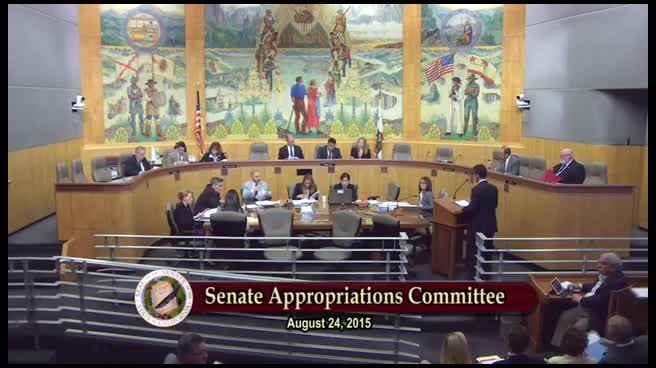 16MIN
Senate Standing Committee on Appropriations
 5MIN
Assembly Floor
 4MIN
Assembly Standing Committee on Appropriations
Bill Author

Bill Co-Author(s):