AB 476: Taxation: homeowners’ exemption and renters’ credit.
- Session Year: 2015-2016
- House: Assembly
- Latest Version Date: 2015-03-25
Existing property tax law provides, pursuant to the authority of a specified provision of the California Constitution, for a homeowners exemption in the amount of $7,000 of the full value of a dwelling, as defined, and authorizes the Legislature to increase this exemption.
This bill, beginning with the lien date for the 201617 fiscal year, would increase the homeowners exemption from $7,000 to $25,000 of the full value of a dwelling. This bill would also require, for the 201718 fiscal year and for each fiscal year thereafter, the county assessor to adjust the amount of the homeowners exemption by the percentage change in the House Price Index for California for the first 3 quarters of the prior calendar year, as specified.
The California Constitution requires the Legislature, whenever it increases the homeowners property tax exemption, to provide a comparable increase in benefits to qualified renters. The Personal Income Tax Law authorizes various credits against the taxes imposed by that law, including a credit for qualified renters in the amount of $120 for married couples filing joint returns, heads of household, and surviving spouses if adjusted gross income is $50,000 or less, and in the amount of $60 for other individuals if adjusted gross income is $25,000 or less. Existing law requires the Franchise Tax Board to annually adjust for inflation these adjusted gross income amounts.
This bill would, for taxable years beginning on and after January 1, 2016, increase this credit for a qualified renter to $428 for married couples filing joint returns, heads of household, and surviving spouses if adjusted gross income is $50,000 or less, as adjusted for inflation, and to an amount equal to $214 for other individuals if adjusted gross income is $25,000 or less, as adjusted for inflation. The bill would also require, for taxable years beginning on or after January 1, 2017, the Franchise Tax Board to annually adjust for inflation, based upon the California Consumer Price Index, the amount of these credits. The bill would also make technical, nonsubstantive changes to the renters credit.
Section 2229 of the Revenue and Taxation Code requires the Legislature to reimburse local agencies annually for certain property tax revenues lost as a result of any exemption or classification of property for purposes of ad valorem property taxation.
The California Constitution requires the Legislature, in each fiscal year, to reimburse local governments for the revenue losses incurred by those governments in that fiscal year as a result of the homeowners property tax exemption.
This bill would provide that, if the Commission on State Mandates determines that the bill contains costs mandated by the state, reimbursement for those costs shall be made pursuant to these statutory provisions.
This bill would take effect immediately as a tax levy.
Existing property tax law provides, pursuant to the authority of a specified provision of the California Constitution, for a homeowners exemption in the amount of $7,000 of the full value of a dwelling, as defined, and authorizes the Legislature to increase this exemption.
This bill, beginning with the lien date for the 201617 fiscal year, would increase the homeowners exemption from $7,000 to $25,000 of the full value of a dwelling. This bill would also require, for the 201718 fiscal year and for each fiscal year thereafter, the county assessor to adjust the amount of the homeowners exemption by the percentage change in the House Price Index for California for the first 3 quarters of the prior calendar year, as specified.
The California Constitution requires the Legislature, whenever it increases the homeowners property tax exemption, to provide a comparable increase in benefits to qualified renters. The Personal Income Tax Law authorizes various credits against the taxes imposed by that law, including a credit for qualified renters in the amount of $120 for married couples filing joint returns, heads of household, and surviving spouses if adjusted gross income is $50,000 or less, and in the amount of $60 for other individuals if adjusted gross income is $25,000 or less. Existing law requires the Franchise Tax Board to annually adjust for inflation these adjusted gross income amounts.
This bill would, for taxable years beginning on and after January 1, 2016, increase this credit for a qualified renter to $428 for married couples filing joint returns, heads of household, and surviving spouses if adjusted gross income is $50,000 or less, as adjusted for inflation, and to an amount equal to $214 for other individuals if adjusted gross income is $25,000 or less, as adjusted for inflation. The bill would also require, for taxable years beginning on or after January 1, 2017, the Franchise Tax Board to annually adjust for inflation, based upon the California Consumer Price Index, the amount of these credits. The bill would also make technical, nonsubstantive changes to the renters credit.
Section 2229 of the Revenue and Taxation Code requires the Legislature to reimburse local agencies annually for certain property tax revenues lost as a result of any exemption or classification of property for purposes of ad valorem property taxation.
This bill would take effect immediately as a tax levy.
Existing property tax law provides, pursuant to the authority of a specified provision of the California Constitution, for a homeowners exemption in the amount of $7,000 of the full value of a dwelling, as defined, and authorizes the Legislature to increase this exemption.
This bill, beginning with the lien date for the 201617 fiscal year, would increase the homeowners exemption from $7,000 to $25,000 of the full value of a dwelling. This bill would also require, for the 201718 fiscal year and for each fiscal year thereafter, the county assessor to adjust the amount of the homeowners exemption by the percentage change in the House Price Index for California for the first 3 quarters of the prior calendar year, as specified.
The California Constitution requires the Legislature, whenever it increases the homeowners property tax exemption, to provide a comparable increase in benefits to qualified renters. The Personal Income Tax Law authorizes various credits against the taxes imposed by that law, including a credit for qualified renters in the amount of $120 for married couples filing joint returns, heads of household, and surviving spouses if adjusted gross income is $50,000 or less, and in the amount of $60 for other individuals if adjusted gross income is $25,000 or less. Existing law requires the Franchise Tax Board to annually adjust for inflation these adjusted gross income amounts.
This bill would, for taxable years beginning on and after January 1, 2016, increase this credit for a qualified renter to $428 for married couples filing joint returns, heads of household, and surviving spouses if adjusted gross income is $50,000 or less, as adjusted for inflation, and to an amount equal to $214 for other individuals if adjusted gross income is $25,000 or less, as adjusted for inflation. The bill would also require, for taxable years beginning on or after January 1, 2017, the Franchise Tax Board to annually adjust for inflation, based upon the California Consumer Price Index, the amount of these credits. The bill would also make technical, nonsubstantive changes to the renters credit.
Section 2229 of the Revenue and Taxation Code requires the Legislature to reimburse local agencies annually for certain property tax revenues lost as a result of any exemption or classification of property for purposes of ad valorem property taxation.
This bill would take effect immediately as a tax levy.
(a)The homeowners property tax exemption is in the amount of the assessed value of the dwelling specified in this section, as authorized pursuant to subdivision (k) of Section 3 of Article XIII of the Constitution. That exemption is in the following amounts:
(1)Seven thousand dollars ($7,000) of the full value of the dwelling through the 201516 fiscal year.
(2)(A)Beginning with the lien date for the 201617 fiscal year, twenty-five thousand dollars ($25,000) of the full value of the dwelling.
(B)Beginning with the lien date for the 201718 fiscal year and for each fiscal year thereafter, the assessor shall adjust the exemption amount of the prior fiscal year by the percentage change, rounded to the nearest one-thousandth of 1 percent, in the House Price Index for California for the first three quarters of the prior calendar year, as determined by the federal Housing Finance Agency.
(b)(1)The exemption does not extend to property that is rented, vacant, under construction on the lien date, or that is a vacation or secondary home of the owner or owners, nor does it apply to property on which an owner receives the veterans exemption.
(2)Notwithstanding paragraph (1), if a person receiving the exemption is not occupying the dwelling on the lien date because the dwelling was damaged in a misfortune or calamity, the person shall be deemed to occupy that same dwelling as his or her principal place of residence on the lien date, provided the persons absence from the dwelling is temporary and the person intends to return to the dwelling when possible to do so. Except as provided in paragraph (3), when a dwelling has been totally destroyed, and thus no dwelling exists on the lien date, the exemption provided by this section shall not be applicable until the structure has been replaced and is occupied as a dwelling.
(3)A dwelling that was totally destroyed in a disaster for which the Governor proclaimed a state of emergency, that qualified for the exemption provided by this section prior to the commencement date of the disaster and that has not changed ownership since the commencement date of the disaster, shall be deemed occupied by the person receiving the exemption on the lien date provided the person intends to reconstruct a dwelling on the property and occupy the dwelling as his or her principal place of residence when it is possible to do so.
(c)For purposes of this section, all of the following apply:
(1)Owner includes a person purchasing the dwelling under a contract of sale or who holds shares or membership in a cooperative housing corporation, which holding is a requisite to the exclusive right of occupancy of a dwelling.
(2)(A)Dwelling means a building, structure, or other shelter constituting a place of abode, whether real property or personal property, and any land on which it may be situated. A two-dwelling unit shall be considered as two separate single-family dwellings.
(B)Dwelling includes the following:
(i)A single-family dwelling occupied by an owner thereof as his or her principal place of residence on the lien date.
(ii)A multiple-dwelling unit occupied by an owner thereof on the lien date as his or her principal place of residence.
(iii)A condominium occupied by an owner thereof as his or her principal place of residence on the lien date.
(iv)Premises occupied by the owner of shares or a membership interest in a cooperative housing corporation, as defined in subdivision (i) of Section 61, as his or her principal place of residence on the lien date. Each exemption allowed pursuant to this subdivision shall be deducted from the total assessed valuation of the cooperative housing corporation. The exemption shall be taken into account in apportioning property taxes among owners of share or membership interests in the cooperative housing corporations so as to benefit those owners who qualify for the exemption.
(d)The exemption provided for in subdivision (k) of Section 3 of Article XIII of the California Constitution shall first be applied to the building, structure, or other shelter and the excess, if any, shall be applied to any land on which it may be located.
SEC. 2.Section 17053.5 of the Revenue and Taxation Code is amended to read:17053.5.(a)(1)For a qualified renter, there shall be allowed a credit against his or her net tax, as defined in Section 17039. The amount of the credit shall be as follows:
(A)(i)For married couples filing joint returns, heads of household, and surviving spouses, as defined in Section 17046, the credit shall be equal to one hundred twenty dollars ($120) if adjusted gross income is fifty thousand dollars ($50,000) or less.
(ii)For taxable years beginning on or after January 1, 2016, the credit shall be equal to four hundred twenty-eight dollars ($428) for taxpayers described in clause (i). For taxable years beginning on or after January 1, 2017, the Franchise Tax Board shall adjust the amount of the credit as provided by subdivision (j).
(B)(i)For other individuals, the credit shall be equal to sixty dollars ($60) if adjusted gross income is twenty-five thousand dollars ($25,000) or less.
(ii)For taxable years beginning on or after January 1, 2016, the credit shall be equal to two hundred fourteen dollars ($214) for taxpayers described in clause (i). For taxable years beginning on or after January 1, 2017, the Franchise Tax Board shall adjust the amount of the credit as provided by subdivision (j).
(2)Except as provided in subdivision (b), a husband and wife shall receive but one credit under this section. If the husband and wife file separate returns, the credit may be taken by either or equally divided between them, except as follows:
(A)If one spouse was a resident for the entire taxable year and the other spouse was a nonresident for part or all of the taxable year, the resident spouse shall be allowed one-half the credit allowed to married persons and the nonresident spouse shall be permitted one-half the credit allowed to married persons, prorated as provided in subdivision (e).
(B)If both spouses were nonresidents for part of the taxable year, the credit allowed to married persons shall be divided equally between them subject to the proration provided in subdivision (e).
(b)For a husband and wife, if each spouse maintained a separate place of residence and resided in this state during the entire taxable year, each spouse will be allowed one-half the full credit allowed to married persons provided in subdivision (a).
(c)For purposes of this section, a qualified renter means an individual who satisfies both of the following:
(1)Was a resident of this state, as defined in Section 17014.
(2)Rented and occupied premises in this state which constituted his or her principal place of residence during at least 50 percent of the taxable year.
(d)Qualified renter does not include any of the following:
(1)An individual who for more than 50 percent of the taxable year rented and occupied premises that were exempt from property taxes, except that an individual, otherwise qualified, is deemed a qualified renter if he or she or his or her landlord pays possessory interest taxes, or the owner of those premises makes payments in lieu of property taxes that are substantially equivalent to property taxes paid on properties of comparable market value.
(2)An individual whose principal place of residence for more than 50 percent of the taxable year is with any other person who claimed that individual as a dependent for income tax purposes.
(3)An individual who has been granted or whose spouse has been granted the homeowners property tax exemption during the taxable year. This paragraph does not apply to an individual whose spouse has been granted the homeowners property tax exemption if each spouse maintained a separate residence for the entire taxable year.
(e)An otherwise qualified renter who is a nonresident for any portion of the taxable year shall claim the credits set forth in subdivision (a) at the rate of one-twelfth of those credits for each full month that individual resided within this state during the taxable year.
(f)A person claiming the credit provided in this section shall, as part of that claim, and under penalty of perjury, furnish that information as the Franchise Tax Board prescribes on a form supplied by the board.
(g)The credit provided in this section shall be claimed on returns in the form as the Franchise Tax Board may from time to time prescribe.
(h)For purposes of this section, premises means a house or a dwelling unit used to provide living accommodations in a building or structure and the land incidental thereto, but does not include land only, unless the dwelling unit is a mobilehome. The credit is not allowed for any taxable year for the rental of land upon which a mobilehome is located if the mobilehome has been granted a homeowners exemption under Section 218 in that year.
(i)This section shall become operative on January 1, 1998, and applies to any taxable year beginning on or after January 1, 1998.
(j)For each taxable year beginning on or after January 1, 1999, the Franchise Tax Board shall recompute the adjusted gross income amounts set forth in subdivision (a). For each taxable year beginning on or after January 1, 2017, the Franchise Tax Board shall also recompute the amount of the credit set forth in subdivision (a). These computations shall be made as follows:
(1)The Department of Industrial Relations shall transmit annually to the Franchise Tax Board the percentage change in the California Consumer Price Index for all items from June of the prior calendar year to June of the current year, no later than August 1 of the current calendar year.
(2)The Franchise Tax Board shall compute an inflation adjustment factor by adding 100 percent to that portion of the percentage change figure furnished pursuant to paragraph (1) and dividing the result by 100.
(3)The Franchise Tax Board shall multiply the amounts in paragraph (1) of subdivision (a) for the preceding taxable year by the inflation adjustment factor determined in paragraph (2), and round off the resulting products to the nearest one dollar ($1).
(4)In computing the amounts pursuant to this subdivision, the amounts provided in subparagraph (A) of paragraph (1) of subdivision (a) shall be twice the amount provided in subparagraph (B) of paragraph (1) of subdivision (a).
SEC. 3.Notwithstanding Section 2229 of the Revenue and Taxation Code, no appropriation is made by this act and the state shall not reimburse any local agency for any property tax revenues lost by it pursuant to this act.
SEC. 3.If the Commission on State Mandates determines that this act contains costs mandated by the state, reimbursement to local agencies and school districts for those costs shall be made pursuant to Part 7 (commencing with Section 17500) of Division 4 of Title 2 of the Government Code.
SEC. 4.This act provides for a tax levy within the meaning of Article IV of the Constitution and shall go into immediate effect.
(a)The homeowners property tax exemption is in the amount of the assessed value of the dwelling specified in this section, as authorized by pursuant to subdivision (k) of Section 3 of Article XIII of the Constitution. That exemption is in the following amounts:
(1)Seven thousand dollars ($7,000) of the full value of the dwelling through the 201516 fiscal year.
(2)(A)Beginning with the lien date for the 201617 fiscal year, twenty-five thousand dollars ($25,000) of the full value of the dwelling.
(B)Beginning with the lien date for the 201718 fiscal year and for each fiscal year thereafter, the assessor shall adjust the exemption amount of the prior fiscal year by the percentage change, rounded to the nearest one-thousandth of 1 percent, in the House Price Index for California for the first three quarters of the prior calendar year, as determined by the federal Housing Finance Agency.
(b)(1)The exemption does not extend to property that is rented, vacant, under construction on the lien date, or that is a vacation or secondary home of the owner or owners, nor does it apply to property on which an owner receives the veterans exemption.
(2)Notwithstanding paragraph (1), if a person receiving the exemption is not occupying the dwelling on the lien date because the dwelling was damaged in a misfortune or calamity, the person shall be deemed to occupy that same dwelling as his or her principal place of residence on the lien date, provided the persons absence from the dwelling is temporary and the person intends to return to the dwelling when possible to do so. Except as provided in paragraph (3), when a dwelling has been totally destroyed, and thus no dwelling exists on the lien date, the exemption provided by this section shall not be applicable until the structure has been replaced and is occupied as a dwelling.
(3)A dwelling that was totally destroyed in a disaster for which the Governor proclaimed a state of emergency, that qualified for the exemption provided by this section prior to the commencement date of the disaster and that has not changed ownership since the commencement date of the disaster, shall be deemed occupied by the person receiving the exemption on the lien date provided the person intends to reconstruct a dwelling on the property and occupy the dwelling as his or her principal place of residence when it is possible to do so.
(c)For purposes of this section, all of the following apply:
(1)Owner includes a person purchasing the dwelling under a contract of sale or who holds shares or membership in a cooperative housing corporation, which holding is a requisite to the exclusive right of occupancy of a dwelling.
(2)(A)Dwelling means a building, structure, or other shelter constituting a place of abode, whether real property or personal property, and any land on which it may be situated. A two-dwelling unit shall be considered as two separate single-family dwellings.
(B)Dwelling includes the following:
(i)A single-family dwelling occupied by an owner thereof as his or her principal place of residence on the lien date.
(ii)A multiple-dwelling unit occupied by an owner thereof on the lien date as his or her principal place of residence.
(iii)A condominium occupied by an owner thereof as his or her principal place of residence on the lien date.
(iv)Premises occupied by the owner of shares or a membership interest in a cooperative housing corporation, as defined in subdivision (i) of Section 61, as his or her principal place of residence on the lien date. Each exemption allowed pursuant to this subdivision shall be deducted from the total assessed valuation of the cooperative housing corporation. The exemption shall be taken into account in apportioning property taxes among owners of share or membership interests in the cooperative housing corporations so as to benefit those owners who qualify for the exemption.
(d)The exemption provided for in subdivision (k) of Section 3 of Article XIII of the California Constitution shall first be applied to the building, structure, or other shelter and the excess, if any, shall be applied to any land on which it may be located.
SEC. 2.Section 17053.5 of the Revenue and Taxation Code is amended to read:17053.5.(a)(1)For a qualified renter, there shall be allowed a credit against his or her net tax, as defined in Section 17039. The amount of the credit shall be as follows:
(A)(i)For married couples filing joint returns, heads of household, and surviving spouses, as defined in Section 17046, the credit shall be equal to one hundred twenty dollars ($120) if adjusted gross income is fifty thousand dollars ($50,000) or less.
(ii)For taxable years beginning on or after January 1, 2016, the credit shall be equal to four hundred twenty-eight dollars ($428) for taxpayers described in clause (i). For taxable years beginning on or after January 1, 2017, the Franchise Tax Board shall adjust the amount of the credit as provided by subdivision (j).
(B)(i)For other individuals, the credit shall be equal to sixty dollars ($60) if adjusted gross income is twenty-five thousand dollars ($25,000) or less.
(ii)For taxable years beginning on or after January 1, 2016, the credit shall be equal to two hundred fourteen dollars ($214) for taxpayers described in clause (i). For taxable years beginning on or after January 1, 2017, the Franchise Tax Board shall adjust the amount of the credit as provided by subdivision (j).
(2)Except as provided in subdivision (b), a husband and wife shall receive but one credit under this section. If the husband and wife file separate returns, the credit may be taken by either or equally divided between them, except as follows:
(A)If one spouse was a resident for the entire taxable year and the other spouse was a nonresident for part or all of the taxable year, the resident spouse shall be allowed one-half the credit allowed to married persons and the nonresident spouse shall be permitted one-half the credit allowed to married persons, prorated as provided in subdivision (e).
(B)If both spouses were nonresidents for part of the taxable year, the credit allowed to married persons shall be divided equally between them subject to the proration provided in subdivision (e).
(b)For a husband and wife, if each spouse maintained a separate place of residence and resided in this state during the entire taxable year, each spouse will be allowed one-half the full credit allowed to married persons provided in subdivision (a).
(c)For purposes of this section, a qualified renter means an individual who satisfies both of the following:
(1)Was a resident of this state, as defined in Section 17014.
(2)Rented and occupied premises in this state which constituted his or her principal place of residence during at least 50 percent of the taxable year.
(d)Qualified renter does not include any of the following:
(1)An individual who for more than 50 percent of the taxable year rented and occupied premises that were exempt from property taxes, except that an individual, otherwise qualified, is deemed a qualified renter if he or she or his or her landlord pays possessory interest taxes, or the owner of those premises makes payments in lieu of property taxes that are substantially equivalent to property taxes paid on properties of comparable market value.
(2)An individual whose principal place of residence for more than 50 percent of the taxable year is with any other person who claimed that individual as a dependent for income tax purposes.
(3)An individual who has been granted or whose spouse has been granted the homeowners property tax exemption during the taxable year. This paragraph does not apply to an individual whose spouse has been granted the homeowners property tax exemption if each spouse maintained a separate residence for the entire taxable year.
(e)An otherwise qualified renter who is a nonresident for any portion of the taxable year shall claim the credits set forth in subdivision (a) at the rate of one-twelfth of those credits for each full month that individual resided within this state during the taxable year.
(f)A person claiming the credit provided in this section shall, as part of that claim, and under penalty of perjury, furnish that information as the Franchise Tax Board prescribes on a form supplied by the board.
(g)The credit provided in this section shall be claimed on returns in the form as the Franchise Tax Board may from time to time prescribe.
(h)For purposes of this section, premises means a house or a dwelling unit used to provide living accommodations in a building or structure and the land incidental thereto, but does not include land only, unless the dwelling unit is a mobilehome. The credit is not allowed for any taxable year for the rental of land upon which a mobilehome is located if the mobilehome has been granted a homeowners exemption under Section 218 in that year.
(i)This section shall become operative on January 1, 1998, and applies to any taxable year beginning on or after January 1, 1998.
(j)For each taxable year beginning on or after January 1, 1999, the Franchise Tax Board shall recompute the adjusted gross income amounts set forth in subdivision (a). For each taxable year beginning on or after January 1, 2017, the Franchise Tax Board shall also recompute the amount of the credit set forth in subdivision (a). These computations shall be made as follows:
(1)The Department of Industrial Relations shall transmit annually to the Franchise Tax Board the percentage change in the California Consumer Price Index for all items from June of the prior calendar year to June of the current year, no later than August 1 of the current calendar year.
(2)The Franchise Tax Board shall compute an inflation adjustment factor by adding 100 percent to that portion of the percentage change figure furnished pursuant to paragraph (1) and dividing the result by 100.
(3)The Franchise Tax Board shall multiply the amounts in paragraph (1) of subdivision (a) for the preceding taxable year by the inflation adjustment factor determined in paragraph (2), and round off the resulting products to the nearest one dollar ($1).
(4)In computing the amounts pursuant to this subdivision, the amounts provided in subparagraph (A) of paragraph (1) of subdivision (a) shall be twice the amount provided in subparagraph (B) of paragraph (1) of subdivision (a).
SEC. 3.Notwithstanding Section 2229 of the Revenue and Taxation Code, no appropriation is made by this act and the state shall not reimburse any local agency for any property tax revenues lost by it pursuant to this act.
SEC. 4.This act provides for a tax levy within the meaning of Article IV of the Constitution and shall go into immediate effect.
(a)The homeowners property tax exemption is in the amount of the assessed value of the dwelling specified in this section, as authorized by subdivision (k) of Section 3 of Article XIII of the California Constitution. That exemption shall be in the amount of seven thousand dollars ($7,000) of the full value of the dwelling. is in the following amounts:
(1)Seven thousand dollars ($7,000) of the full value of the dwelling through the 201516 fiscal year.
(2)(A)Beginning with the lien date for the 201617 fiscal year, twenty-five thousand dollars ($25,000) of the full value of the dwelling.
(B)Beginning with the lien date for the 201718 fiscal year and for each fiscal year thereafter, the assessor shall adjust the exemption amount of the prior fiscal year by the percentage change, rounded to the nearest one-thousandth of 1 percent, in the House Price Index for California for the first three quarters of the prior calendar year, as determined by the federal Housing Finance Agency.
(b)(1)The exemption does not extend to property that is rented, vacant, under construction on the lien date, or that is a vacation or secondary home of the owner or owners, nor does it apply to property on which an owner receives the veterans exemption.
(2)Notwithstanding paragraph (1), if a person receiving the exemption is not occupying the dwelling on the lien date because the dwelling was damaged in a misfortune or calamity, the person shall be deemed to occupy that same dwelling as his or her principal place of residence on the lien date, provided the persons absence from the dwelling is temporary and the person intends to return to the dwelling when possible to do so. Except as provided in paragraph (3), when a dwelling has been totally destroyed, and thus no dwelling exists on the lien date, the exemption provided by this section shall not be applicable until the structure has been replaced and is occupied as a dwelling.
(3)A dwelling that was totally destroyed in a disaster for which the Governor proclaimed a state of emergency, that qualified for the exemption provided by this section prior to the commencement date of the disaster and that has not changed ownership since the commencement date of the disaster, shall be deemed occupied by the person receiving the exemption on the lien date provided the person intends to reconstruct a dwelling on the property and occupy the dwelling as his or her principal place of residence when it is possible to do so.
(c)For purposes of this section, all of the following apply:
(1)Owner includes a person purchasing the dwelling under a contract of sale or who holds shares or membership in a cooperative housing corporation, which holding is a requisite to the exclusive right of occupancy of a dwelling.
(2)(A)Dwelling means a building, structure, or other shelter constituting a place of abode, whether real property or personal property, and any land on which it may be situated. A two-dwelling unit shall be considered as two separate single-family dwellings.
(B)Dwelling includes the following:
(i)A single-family dwelling occupied by an owner thereof as his or her principal place of residence on the lien date.
(ii)A multiple-dwelling unit occupied by an owner thereof on the lien date as his or her principal place of residence.
(iii)A condominium occupied by an owner thereof as his or her principal place of residence on the lien date.
(iv)Premises occupied by the owner of shares or a membership interest in a cooperative housing corporation, as defined in subdivision (i) of Section 61, as his or her principal place of residence on the lien date. Each exemption allowed pursuant to this subdivision shall be deducted from the total assessed valuation of the cooperative housing corporation. The exemption shall be taken into account in apportioning property taxes among owners of share or membership interests in the cooperative housing corporations so as to benefit those owners who qualify for the exemption.
(d)The exemption provided for in subdivision (k) of Section 3 of Article XIII of the California Constitution shall first be applied to the building, structure, or other shelter and the excess, if any, shall be applied to any land on which it may be located.
SEC. 2.Section 17053.5 of the Revenue and Taxation Code is amended to read:17053.5.(a)(1)For a qualified renter, there shall be allowed a credit against his or her net tax, as defined in Section 17039. The amount of the credit shall be as follows:
(A)(i)For married couples filing joint returns, heads of household, and surviving spouses, as defined in Section 17046, the credit shall be equal to one hundred twenty dollars ($120) if adjusted gross income is fifty thousand dollars ($50,000) or less.
(ii)For taxable years beginning on or after January 1, 2016, the credit shall be equal to four hundred twenty-eight dollars ($428) for taxpayers described in clause (i). For taxable years beginning on or after January 1, 2017, the Franchise Tax Board shall adjust the amount of the credit as provided by subdivision (j).
(B)(i)For other individuals, the credit shall be equal to sixty dollars ($60) if adjusted gross income is twenty-five thousand dollars ($25,000) or less.
(ii)For taxable years beginning on or after January 1, 2016, the credit shall be equal to two hundred fourteen dollars ($214) for taxpayers described in clause (i). For taxable years beginning on or after January 1, 2017, the Franchise Tax Board shall adjust the amount of the credit as provided by subdivision (j).
(2)Except as provided in subdivision (b), a husband and wife shall receive but one credit under this section. If the husband and wife file separate returns, the credit may be taken by either or equally divided between them, except as follows:
(A)If one spouse was a resident for the entire taxable year and the other spouse was a nonresident for part or all of the taxable year, the resident spouse shall be allowed one-half the credit allowed to married persons and the nonresident spouse shall be permitted one-half the credit allowed to married persons, prorated as provided in subdivision (e).
(B)If both spouses were nonresidents for part of the taxable year, the credit allowed to married persons shall be divided equally between them subject to the proration provided in subdivision (e).
(b)For a husband and wife, if each spouse maintained a separate place of residence and resided in this state during the entire taxable year, each spouse will be allowed one-half the full credit allowed to married persons provided in subdivision (a).
(c)For purposes of this section, a qualified renter means an individual who satisfies both of the following:
(1)Was a resident of this state, as defined in Section 17014.
(2)Rented and occupied premises in this state which constituted his or her principal place of residence during at least 50 percent of the taxable year.
(d)Qualified renter does not include any of the following:
(1)An individual who for more than 50 percent of the taxable year rented and occupied premises that were exempt from property taxes, except that an individual, otherwise qualified, is deemed a qualified renter if he or she or his or her landlord pays possessory interest taxes, or the owner of those premises makes payments in lieu of property taxes that are substantially equivalent to property taxes paid on properties of comparable market value.
(2)An individual whose principal place of residence for more than 50 percent of the taxable year is with another any other person who claimed that individual as a dependent for income tax purposes.
(3)An individual who has been granted or whose spouse has been granted the homeowners property tax exemption during the taxable year. This paragraph does not apply to an individual whose spouse has been granted the homeowners property tax exemption if each spouse maintained a separate residence for the entire taxable year.
(e)An otherwise qualified renter who is a nonresident for any portion of the taxable year shall claim the credits set forth in subdivision (a) at the rate of one-twelfth of those credits for each full month that individual resided within this state during the taxable year.
(f)A person claiming the credit provided in this section shall, as part of that claim, and under penalty of perjury, furnish that information as the Franchise Tax Board prescribes on a form supplied by the board.
(g)The credit provided in this section shall be claimed on returns in the form as the Franchise Tax Board may from time to time prescribe.
(h)For purposes of this section, premises means a house or a dwelling unit used to provide living accommodations in a building or structure and the land incidental thereto, but does not include land only, unless the dwelling unit is a mobilehome. The credit is not allowed for any taxable year for the rental of land upon which a mobilehome is located if the mobilehome has been granted a homeowners exemption under Section 218 in that year.
(i)This section shall become operative on January 1, 1998, and applies to any taxable year beginning on or after January 1, 1998.
(j)For each taxable year beginning on or after January 1, 1999, the Franchise Tax Board shall recompute the adjusted gross income amounts set forth in subdivision (a). The computation For each taxable year beginning on or after January 1, 2017, the Franchise Tax Board shall also recompute the amount of the credit set forth in subdivision (a). These computations shall be made as follows:
(1)The Department of Industrial Relations shall transmit annually to the Franchise Tax Board the percentage change in the California Consumer Price Index for all items from June of the prior calendar year to June of the current year, no later than August 1 of the current calendar year.
(2)The Franchise Tax Board shall compute an inflation adjustment factor by adding 100 percent to the that portion of the percentage change figure which is furnished pursuant to paragraph (1) and dividing the result by 100.
(3)The Franchise Tax Board shall multiply the amount in subparagraph (B) of amounts in paragraph (1) of subdivision (d) (a) for the preceding taxable year by the inflation adjustment factor determined in paragraph (2), and round off the resulting products to the nearest one dollar ($1).
(4)In computing the amounts pursuant to this subdivision, the amounts provided in subparagraph (A) of paragraph (1) of subdivision (a) shall be twice the amount provided in subparagraph (B) of paragraph (1) of subdivision (a).
SEC. 3.Notwithstanding Section 2229 of the Revenue and Taxation Code, no appropriation is made by this act and the state shall not reimburse any local agency for any property tax revenues lost by it pursuant to this act.
SEC. 4.This act provides for a tax levy within the meaning of Article IV of the Constitution and shall go into immediate effect.
|
Date
|
Status
|
|---|---|
| Feb 23, 2015 | Read first time. To print. |
| Feb 24, 2015 | From printer. May be heard in committee March 26. |
| Mar 5, 2015 | Referred to Com. on REV. & TAX. |
| Mar 19, 2015 | From committee chair, with author's amendments: Amend, and re-refer to Com. on REV. & TAX. Read second time and amended. |
| Mar 23, 2015 | Re-referred to Com. on REV. & TAX. |
| Mar 25, 2015 | From committee chair, with author's amendments: Amend, and re-refer to Com. on REV. & TAX. Read second time and amended. |
| Mar 26, 2015 | Re-referred to Com. on REV. & TAX. |
| May 11, 2015 | In committee: Set, first hearing. Referred to REV. & TAX. suspense file. |
| May 18, 2015 | Retained in suspense file. |
| Jan 31, 2016 | Died pursuant to Article IV, Sec. 10(c) of the Constitution. |
| Feb 1, 2016 | From committee: Filed with the Chief Clerk pursuant to Joint Rule 56. |
This list shows positions taken on this bill by organizations on the date displayed, which is linked to the original source.
Positions by individuals are not included.
|
Organization
|
Position
|
Date
|
|---|---|---|
| B. Dutton, Assessor-Recorder-County Clerk, San Bernardino County | ** Support | May 11, 2015 |
| California Association Of Realtors | ** Support | May 11, 2015 |
| Contra Costa Taxpayers Association | ** Support | May 11, 2015 |
| D. Harkey, State Board of Equalization, Member | ** Support | May 11, 2015 |
| Fullerton Taxpayers Association | ** Support | May 11, 2015 |
| G. Runner, State Board of Equalization, Member | ** Support | May 11, 2015 |
| Howard Jarvis Association | * Support | May 11, 2015 |
| Howard Jarvis Taxpayers Association | * Support | May 11, 2015 |
| Humboldt County Taxpayers League | ** Support | May 11, 2015 |
| Kern County Taxpayers Association | ** Support | May 11, 2015 |
| KernTax Fact Through Research | ** Support | May 11, 2015 |
| Long Beach Taxpayers Association | ** Support | May 11, 2015 |
| Napa County Taxpayers Association | ** Support | May 11, 2015 |
| National Tax-Limitation Committee | ** Support | May 11, 2015 |
| Orange County Taxpayers Association | ** Support | May 11, 2015 |
| Page K | ** Support | May 11, 2015 |
| Page L | ** Against | May 11, 2015 |
| Placer County Taxpayers Association | ** Support | May 11, 2015 |
| San Diego Tax Fighters | ** Support | May 11, 2015 |
AB 476
Page 6
Date of Hearing: May 18, 2015
ASSEMBLY COMMITTEE ON REVENUE AND TAXATION
Philip Ting, Chair
AB 476 (
Chang) – As Amended March 25, 2015
SUSPENSE
Majority vote. Fiscal committee. Tax levy.
SUBJECT: Taxation: homeowners’ exemption and renters’ credit
SUMMARY: Increases the homeowners' property tax exemption and the renters' credit amounts. Specifically, this bill:
Increases the homeowners' property tax exemption from $7,000 to $25,000, beginning with the lien date for 2016-17 fiscal year (FY).
Requires a county assessor, for the 2017-18 FY and each fiscal year thereafter, to adjust the amount of the homeowners' exemption by the percentage change in the Housing Price Index for California for the first three quarters of the prior calendar year, as specified.
Increases the nonrefundable renter's tax credit for taxable years beginning on and after January 1, 2016, according to filing status of the individual as follows:
From $60 to $214 for individual taxpayers filing single, or married filing separate, with an adjusted gross income of $39,182 or less.
From $120 to $428 for married couples filing joint returns, heads of household, and surviving spouses with an adjusted gross income of $78,363 or less.
Requires the Franchise Tax Board (FTB) to adjust annually the amount of the renter's credit for inflation, beginning with the 2017 taxable year, based upon the California Consumer Price Index.
Makes technical, non-substantive changes to the renters' credit provisions.
Takes effect immediately as a tax levy.
EXISTING LAW:
Provides that all property is taxable, unless otherwise provided by the California Constitution or federal laws [Section 1(a), Article XIII, California Constitution].
Limits ad valorem taxes on real property to 1% of the full cash value of that property and limits future annual increases in assessed values to the rate of inflation, not to exceed 2%, as long as the property remains under the same ownership (Proposition 13).
Exempts from property taxation the first $7,000 of assessed valued of an owner-occupied principal place of residence (usually referred to as the "homeowners' exemption") [Section 3(k), Article XIII, California Constitution].
California Constitution, Article XIII, Section 25, requires the state to reimburse each local government for the revenue loss from the homeowners' exemption. The Constitution establishes the minimum amount of the homeowners' exemption, but permits statutory increases under certain conditions.
Authorizes the Legislature to increase the amount of the homeowners' exemption if both of the following requirements are satisfied:
Local governments are reimbursed for the revenue loss, and,
Benefits to renters, currently provided via the renters' income tax credit, are increased by a comparable amount. [Section 3(k), Article XIII, California Constitution.]
Allows a nonrefundable credit for qualified renters in the following amounts:
$60 for single and married filing separate with an adjusted gross income (AGI) of $37,768 or less; and,
$120 for married or registered domestic partners filing jointly, heads of household, or surviving spouses with an AGI of $75,536 or less.
Requires the FTB to adjust annually for inflation the amount of the AGI used for purposes of calculating the renters' credit. (R&TC Section 17053.5).
Allows an individual, under the California Personal Income Tax (PIT) Law, to deduct real property taxes if that taxpayer reports itemized deductions in a taxable year. The PIT Law allows a renters' credit to qualified taxpayers.
Requires the Legislature to provide increases in benefits to qualified renters that are comparable to the average increase in benefits allowed to homeowners under the homeowners' property tax exemption.
FISCAL EFFECT: The State Board of Equalization (BOE) staff estimates that this bill would result in an annual General Fund (GF) revenue loss of $1.07 billion (from the increase in the state reimbursement for the homeowners' exemption). In addition, the FTB staff estimates that this bill would result in an annual GF revenue loss of $340 million in FY 2016-17, and $220 million in FY 2017-18.
COMMENTS:
Author's Statement. The author has provided the following statement in support of this bill:
"The current homeowners' exemption in California is $7,000. This is taken off the value of a homeowner's primary residence, amounting to $70 annually off of your property tax bill, or one percent. As of 1972, when the homeowner's exemption was last changed, the median California home price was approximately $21,000. Today, it is nearly $425,000 and climbing. Clearly this benefit to taxpayers has not kept up with the price of homes.
"Since 1985, there have been at least 30 bills introduced into the state Legislature attempting to increase the exemption amount, either for all homeowners or for certain groups (such as seniors or first-time home buyers) or to index it to inflation. All have failed.
"Beginning with the 2015-16 fiscal year, the exemption would increase from $7,000 to $25,000. This would increase the annual exemption every homeowner would receive from $70 (1% of exemption) to $250. Some would argue that this increase is not necessary because Proposition 13 already saves homeowners thousands of dollars every year. However, property taxes remain high because of local bond debt and special taxes – especially special parcel taxes –which do not count against Proposition 13's one percent cap.
"According to the non-partisan Tax Foundation, California ranks 19th out of 50 states in per capita property tax collections. We would argue there is much more government can do to bring increased property taxes under control. This is especially true considering California ranks at or near the top of a number of major tax categories including income, sales, and gas taxes. With California experiencing a revenue surplus in the billions of dollars, and the highest General Fund budget since before the recession, the time seems right for broad based tax relief. With homeowners constituting a majority of California's population, an increase in the exemption represents sound public policy.
"The proposed bill would also annually index the homeowner's exemption to the House Price Index for California as determined by the federal Housing Finance Agency to ensure that current and future homeowners can also benefit from the full value of the homeowners' exemption."Arguments in Support. The proponents argue that the time "is right for tax relief…that supports the greatest number of taxpayers" and that, "while Proposition 13 continues to provide necessary property tax relief for all homeowners, more is needed." They assert that inflation, "as well as bonds and voter-approved parcel taxes, have added additional burdens to homeowners' tax bills." Thus, the proponents believe that, given "California's homeownership base and increased General Fund revenues, increasing the homeowners' exemption represents appropriate public policy."
One of the Lowest Property Tax Burden for Owner-Occupied Housing in the Nation. Proposition 13, passed by the voters in 1978, was designed to provide real property tax relief by imposing a set of interlocking limitations upon the assessment and taxing powers of state and local governments. Proposition 13 generally limits the maximum amount of any ad valorem tax on real property to no more than 1% of the property's full cash value, as adjusted for the lesser of inflation or 2% per year1. Proposition 13 also requires cities, counties, and special districts to obtain approval of two-thirds of their qualified electors in order to impose an undefined class of "special taxes."2 Consequently, California homeowners bear a low property tax burden in comparison to homeowners in other states: California ranks 34th for property taxes paid as a percentage of owner-occupied housing value. The effective property tax rate on owner-occupied housing (which is calculated as total real property taxes paid divided by total home value) amounts to 0.81% in California. In contrast, that rate is 2.38% in New Jersey, 1.64% in New York, and 1.90% in Texas. Hawaii has the lowest rate of 0.28%.
Homeowners' Property Tax Exemption. In addition to Proposition 13, the California Constitution provides for a property tax homeowners' exemption, which amounts to annual tax relief for homeowners of almost $75. The exemption, which reduces the taxable value of a home, may be claimed only by a taxpayer who owns and occupies a home as his/her principal residence. According to the BOE staff, in fiscal year 2013-14, the homeowners' exemption was claimed by 5.2 million property owners.
The amount of the exemption was set at $7,000 in 1974, prior to the passage of Proposition13, and has remained unchanged since then. Clearly, the amount of tax relief due to the homeowners' exemption was more valuable in 1974. However, it may be argued that the need for the homeowners' exemption was made obsolete by the passage of Proposition 13 because protections against rising property taxes are now built into the tax system.
The Value of the Homeowners' Exemption: Who Benefits the Most? Since the homeowners' exemption is set at a fixed amount, the real benefit of this exemption varies depending on the assessed value of the house. For example, under this bill, a taxpayer who owns a house with the assessed value of $100,000 would see an 18% reduction in his/her property tax bill. In contrast, the same exemption would result in a 4.5% reduction in the property tax burden imposed on a taxpayer whose house is identical, yet assessed at $400,000. In light of the acquisition value system created by Proposition 13, the increase of the exemption amount from $7,000 to $25,000 would disproportionately benefit taxpayers who have owned their houses for a longer period of time, i.e. those with the lower assessed value. The Committee may wish to consider whether the state should provide yet another General Fund subsidy that would mostly benefit those taxpayers, regardless of their income.
One of the Most Subsidized Assets. In addition to protections guaranteed by Proposition 13, owner-occupied housing is also heavily subsidized by the federal and state governments. Existing federal and state income tax laws allow deductions from income for mortgage interest on the first and second homes and exclude from income up to $500,000/ $250,000 of gain on the sale of a principal residence. Tax preferences that encourage homeownership also include deductibility from income of property taxes for state and federal tax purposes. Homeownership is also encouraged by the non-taxability of the housing services that are received by the owner, as well as by the exclusion from income of the cancellation of indebtedness income made temporarily available as part of the recent economic stimulus packages. Furthermore, both state and federal laws provide a special tax treatment of assets inherited after the owner dies. Thus, if the heir sells the asset, the capital gain is calculated based on the asset's "stepped-up" value when the owner died, not its value when the owner bought that asset. Although this preferential tax treatment is not limited to owner-occupied housing, the "step-up basis" treatment of capital gains significantly affects housing transactions.3 Originally, this preferential tax treatment was justified as a way to avoid double taxation of capital gains on inherited property, but California removed its taxes on inherited property in 1982. Finally, the applicability of the federal estate tax has also been recently limited.4
Homeownership is clearly a public goal because similar income tax benefits are not afforded to any other asset class. According to the CRS report,5 some analysts argue that this preferential tax treatment of housing encourages households to over-invest in housing and invest less in business ventures that might contribute more to the nation's productivity and output. The Committee may wish to consider whether an increase in the amount of the homeowner's tax exemption is warranted in light of the myriad of other types of tax relief, both state and federal, afforded to home ownership.
Indexing. This bill requires the county assessor to index the amount of the homeowners' exemption every year by the percentage change in the House Price Index, as specified. The proposed adjustment would provide on-going property tax reductions, even if values of houses in California soar, while an adjustment to the assessed value of a house would remain subject to the 2% constitutional inflation cap. The Committee may wish to consider whether indexing the homeowners' exemption amount without a corresponding annual adjustment to the assessed value is justified, given the existence of Proposition 13 limitations on the assessment of real property in the state.
Renters' Credit. The Personal Income Tax (PIT) law allows an eligible individual who rents his/her principal residence to reduce his/her state income tax with a tax credit. The renters' credit was suspended for the 1993 through 1997 taxable years, but was reinstated beginning with the 1998 taxable year. The credit eligibility is based on the taxpayer's AGI and his/her filing status. AGI amounts are indexed annually for inflation. For the 2015 tax year, a credit of $120 is allowed for married taxpayers filing joint returns; heads of household and surviving spouses with an AGI of $75,536 or less; and $60 for other individuals (single or married/RDP filing separately) with an AGI of $37,768 or less.6 The renters' credit is nonrefundable.
The Constitutional Requirement. The $7,000 homeowners' exemption amount prescribed by the California Constitution is the minimum exemption amount, which means that it may be increased by the Legislature. However, the California Constitution requires the Legislature to provide an equivalent increase in the amount of the renters' credit whenever the homeowners' exemption amount is increased. Furthermore, the state is required by the Constitution to reimburse local governments for the property tax revenue loss due to the homeowners' exemption. In fact, this exemption is the only property tax exemption for which the state fully reimburses local governments.
REGISTERED SUPPORT / OPPOSITION:
Support
B. Dutton, Assessor-Recorder-County Clerk, San Bernardino County
California Apartment Association
California Association of Realtors
Contra Costa Taxpayers Association
D. Harkey, State Board of Equalization, Member
Fullerton Taxpayers Association
G. Runner, State Board of Equalization, Member
Habitat for Humanity California
Howard Jarvis Association
Humboldt County Taxpayers League
Kern County Taxpayers Association
KernTax Fact Through Research
Long Beach Taxpayers Association
Napa County Taxpayers Association
National Tax-Limitation Committee
Orange County Taxpayers Association
Placer County Taxpayers Association
San Diego Tax Fighters
Opposition
California Tax Reform Association
Analysis Prepared by: Oksana Jaffe / REV. & TAX. / (916) 319-2098
1 California Constitution, Section 1 of Article XIII A.
2 California Constitution, Section 4 of Article XIII A.
3 Housing-Related Tax Expenditure Programs, a Presentation to the Assembly Revenue and Taxation Committee, prepared by the Legislative Analyst's Office, March 18, 2013, page 9.
4 Ibid.
5 Congressional Research Services, The Mortgage Interest and Property Tax Deductions: Analysis and Options, Mark P. Keightley, p.17.
6
The California Constitution requires the State Legislature to
provide a comparable increase in benefits to qualified renters
wherever it proposes to increase the homeowner's exemption, as
provided by Article XIII, Section 3(k) of the California
Constitution. The current exemption amount is the first $7,000 of
the full value of a dwelling occupied as the owner's principal
residence on the January 1 lien date from property taxation. The
Legislature may increase the size of the homeowners' exemption; but
if it does so, it must also: (a) increase the rate of state taxes
in an amount sufficient to pay for the increased cost of state
subventions to local governments, and (b) provide a comparable
increase in benefits to qualified renters.
AB 476
Page 6
Date of Hearing: May 11, 2015
ASSEMBLY COMMITTEE ON REVENUE AND TAXATION
Philip Ting, Chair
AB 476
(Chang) – As Amended March 25, 2015
Majority vote. Fiscal committee. Tax levy.
SUBJECT: Taxation: homeowners’ exemption and renters’ credit
SUMMARY: Increases the homeowners' property tax exemption and the renters' credit amounts. Specifically, this bill:
Increases the homeowners' property tax exemption from $7,000 to $25,000, beginning with the lien date for 2016-17 fiscal year (FY).
Requires a county assessor, for the 2017-18 FY and each fiscal year thereafter, to adjust the amount of the homeowners' exemption by the percentage change in the Housing Price Index for California for the first three quarters of the prior calendar year, as specified.
Increases the nonrefundable renter's tax credit for taxable years beginning on and after January 1, 2016, according to filing status of the individual as follows:
From $60 to $214 for individual taxpayers filing single, or married filing separate, with an adjusted gross income of $39,182 or less.
From $120 to $428 for married couples filing joint returns, heads of household, and surviving spouses with an adjusted gross income of $78,363 or less.
Requires the Franchise Tax Board (FTB) to adjust annually the amount of the renter's credit for inflation, beginning with the 2017 taxable year, based upon the California Consumer Price Index.
Makes technical, non-substantive changes to the renters' credit provisions.
Takes effect immediately as a tax levy.
EXISTING LAW:
Provides that all property is taxable, unless otherwise provided by the California Constitution or federal laws [Section 1(a), Article XIII, California Constitution].
Limits ad valorem taxes on real property to 1% of the full cash value of that property and limits future annual increases in assessed values to the rate of inflation, not to exceed 2%, as long as the property remains under the same ownership (Proposition 13).
Exempts from property taxation the first $7,000 of assessed valued of an owner-occupied principal place of residence (usually referred to as the "homeowners' exemption") [Section 3(k), Article XIII, California Constitution].
California Constitution, Article XIII, Section 25, requires the state to reimburse each local government for the revenue loss from the homeowners' exemption. The Constitution establishes the minimum amount of the homeowners' exemption, but permits statutory increases under certain conditions.
Authorizes the Legislature to increase the amount of the homeowners' exemption if both of the following requirements are satisfied:
Local governments are reimbursed for the revenue loss, and,
Benefits to renters, currently provided via the renters' income tax credit, are increased by a comparable amount. [Section 3(k), Article XIII, California Constitution.]
Allows a nonrefundable credit for qualified renters in the following amounts:
$60 for single and married filing separate with an adjusted gross income (AGI) of $37,768 or less; and,
$120 for married or registered domestic partners filing jointly, heads of household, or surviving spouses with an AGI of $75,536 or less.
Requires the FTB to adjust annually for inflation the amount of the AGI used for purposes of calculating the renters' credit. (R&TC Section 17053.5).
Allows an individual, under the California Personal Income Tax (PIT) Law, to deduct real property taxes if that taxpayer reports itemized deductions in a taxable year. The PIT Law allows a renters' credit to qualified taxpayers.
Requires the Legislature to provide increases in benefits to qualified renters that are comparable to the average increase in benefits allowed to homeowners under the homeowners' property tax exemption.
FISCAL EFFECT: The State Board of Equalization (BOE) staff estimates that this bill would result in an annual General Fund (GF) revenue loss of $1.07 billion (from the increase in the state reimbursement for the homeowners' exemption). In addition, the FTB staff estimates that this bill would result in an annual GF revenue loss of $340 million in FY 2016-17, and $220 million in FY 2017-18.
COMMENTS:
Author's Statement. The author has provided the following statement in support of this bill:
"The current homeowners' exemption in California is $7,000. This is taken off the value of a homeowner's primary residence, amounting to $70 annually off of your property tax bill, or one percent. As of 1972, when the homeowner's exemption was last changed, the median California home price was approximately $21,000. Today, it is nearly $425,000 and climbing. Clearly this benefit to taxpayers has not kept up with the price of homes.
"Since 1985, there have been at least 30 bills introduced into the state Legislature attempting to increase the exemption amount, either for all homeowners or for certain groups (such as seniors or first-time home buyers) or to index it to inflation. All have failed.
"Beginning with the 2015-16 fiscal year, the exemption would increase from $7,000 to $25,000. This would increase the annual exemption every homeowner would receive from $70 (1% of exemption) to $250. Some would argue that this increase is not necessary because Proposition 13 already saves homeowners thousands of dollars every year. However, property taxes remain high because of local bond debt and special taxes – especially special parcel taxes –which do not count against Proposition 13's one percent cap.
"According to the non-partisan Tax Foundation, California ranks 19th out of 50 states in per capita property tax collections. We would argue there is much more government can do to bring increased property taxes under control. This is especially true considering California ranks at or near the top of a number of major tax categories including income, sales, and gas taxes. With California experiencing a revenue surplus in the billions of dollars, and the highest General Fund budget since before the recession, the time seems right for broad based tax relief. With homeowners constituting a majority of California's population, an increase in the exemption represents sound public policy.
"The proposed bill would also annually index the homeowner's exemption to the House Price Index for California as determined by the federal Housing Finance Agency to ensure that current and future homeowners can also benefit from the full value of the homeowners' exemption."Arguments in Support. The proponents argue that the time "is right for tax relief…that supports the greatest number of taxpayers" and that, "while Proposition 13 continues to provide necessary property tax relief for all homeowners, more is needed." They assert that inflation, "as well as bonds and voter-approved parcel taxes, have added additional burdens to homeowners' tax bills." Thus, the proponents believe that, given "California's homeownership base and increased General Fund revenues, increasing the homeowners' exemption represents appropriate public policy."
One of the Lowest Property Tax Burden for Owner-Occupied Housing in the Nation. Proposition 13, passed by the voters in 1978, was designed to provide real property tax relief by imposing a set of interlocking limitations upon the assessment and taxing powers of state and local governments. Proposition 13 generally limits the maximum amount of any ad valorem tax on real property to no more than 1% of the property's full cash value, as adjusted for the lesser of inflation or 2% per year1. Proposition 13 also requires cities, counties, and special districts to obtain approval of two-thirds of their qualified electors in order to impose an undefined class of "special taxes."2 Consequently, California homeowners bear a low property tax burden in comparison to homeowners in other states: California ranks 34th for property taxes paid as a percentage of owner-occupied housing value. The effective property tax rate on owner-occupied housing (which is calculated as total real property taxes paid divided by total home value) amounts to 0.81% in California. In contrast, that rate is 2.38% in New Jersey, 1.64% in New York, and 1.90% in Texas. Hawaii has the lowest rate of 0.28%.
Homeowners' Property Tax Exemption. In addition to Proposition 13, the California Constitution provides for a property tax homeowners' exemption, which amounts to annual tax relief for homeowners of almost $75. The exemption, which reduces the taxable value of a home, may be claimed only by a taxpayer who owns and occupies a home as his/her principal residence. According to the BOE staff, in fiscal year 2013-14, the homeowners' exemption was claimed by 5.2 million property owners.
The amount of the exemption was set at $7,000 in 1974, prior to the passage of Proposition13, and has remained unchanged since then. Clearly, the amount of tax relief due to the homeowners' exemption was more valuable in 1974. However, it may be argued that the need for the homeowners' exemption was made obsolete by the passage of Proposition 13 because protections against rising property taxes are now built into the tax system.
The Value of the Homeowners' Exemption: Who Benefits the Most? Since the homeowners' exemption is set at a fixed amount, the real benefit of this exemption varies depending on the assessed value of the house. For example, under this bill, a taxpayer who owns a house with the assessed value of $100,000 would see an 18% reduction in his/her property tax bill. In contrast, the same exemption would result in a 4.5% reduction in the property tax burden imposed on a taxpayer whose house is identical, yet assessed at $400,000. In light of the acquisition value system created by Proposition 13, the increase of the exemption amount from $7,000 to $25,000 would disproportionately benefit taxpayers who have owned their houses for a longer period of time, i.e. those with the lower assessed value. The Committee may wish to consider whether the state should provide yet another General Fund subsidy that would mostly benefit those taxpayers, regardless of their income.
One of the Most Subsidized Assets. In addition to protections guaranteed by Proposition 13, owner-occupied housing is also heavily subsidized by the federal and state governments. Existing federal and state income tax laws allow deductions from income for mortgage interest on the first and second homes and exclude from income up to $500,000/ $250,000 of gain on the sale of a principal residence. Tax preferences that encourage homeownership also include deductibility from income of property taxes for state and federal tax purposes. Homeownership is also encouraged by the non-taxability of the housing services that are received by the owner, as well as by the exclusion from income of the cancellation of indebtedness income made temporarily available as part of the recent economic stimulus packages. Furthermore, both state and federal laws provide a special tax treatment of assets inherited after the owner dies. Thus, if the heir sells the asset, the capital gain is calculated based on the asset's "stepped-up" value when the owner died, not its value when the owner bought that asset. Although this preferential tax treatment is not limited to owner-occupied housing, the "step-up basis" treatment of capital gains significantly affects housing transactions.3 Originally, this preferential tax treatment was justified as a way to avoid double taxation of capital gains on inherited property, but California removed its taxes on inherited property in 1982. Finally, the applicability of the federal estate tax has also been recently limited.4
Homeownership is clearly a public goal because similar income tax benefits are not afforded to any other asset class. According to the CRS report,5 some analysts argue that this preferential tax treatment of housing encourages households to over-invest in housing and invest less in business ventures that might contribute more to the nation's productivity and output. The Committee may wish to consider whether an increase in the amount of the homeowner's tax exemption is warranted in light of the myriad of other types of tax relief, both state and federal, afforded to home ownership.
Indexing. This bill requires the county assessor to index the amount of the homeowners' exemption every year by the percentage change in the House Price Index, as specified. The proposed adjustment would provide on-going property tax reductions, even if values of houses in California soar, while an adjustment to the assessed value of a house would remain subject to the 2% constitutional inflation cap. The Committee may wish to consider whether indexing the homeowners' exemption amount without a corresponding annual adjustment to the assessed value is justified, given the existence of Proposition 13 limitations on the assessment of real property in the state.
Renters' Credit. The Personal Income Tax (PIT) law allows an eligible individual who rents his/her principal residence to reduce his/her state income tax with a tax credit. The renters' credit was suspended for the 1993 through 1997 taxable years, but was reinstated beginning with the 1998 taxable year. The credit eligibility is based on the taxpayer's AGI and his/her filing status. AGI amounts are indexed annually for inflation. For the 2015 tax year, a credit of $120 is allowed for married taxpayers filing joint returns; heads of household and surviving spouses with an AGI of $75,536 or less; and $60 for other individuals (single or married/RDP filing separately) with an AGI of $37,768 or less.6 The renters' credit is nonrefundable.
The Constitutional Requirement. The $7,000 homeowners' exemption amount prescribed by the California Constitution is the minimum exemption amount, which means that it may be increased by the Legislature. However, the California Constitution requires the Legislature to provide an equivalent increase in the amount of the renters' credit whenever the homeowners' exemption amount is increased. Furthermore, the state is required by the Constitution to reimburse local governments for the property tax revenue loss due to the homeowners' exemption. In fact, this exemption is the only property tax exemption for which the state fully reimburses local governments.
REGISTERED SUPPORT / OPPOSITION:
Support
B. Dutton, Assessor-Recorder-County Clerk, San Bernardino County
California Association of Realtors
Contra Costa Taxpayers Association
D. Harkey, State Board of Equalization, Member
Fullerton Taxpayers Association
G. Runner, State Board of Equalization, Member
Howard Jarvis Association
Humboldt County Taxpayers League
Kern County Taxpayers Association
KernTax Fact Through Research
Long Beach Taxpayers Association
Napa County Taxpayers Association
National Tax-Limitation Committee
Orange County Taxpayers Association
Placer County Taxpayers Association
San Diego Tax Fighters
Opposition
None on file
Analysis Prepared by: Oksana Jaffe / REV. & TAX. / (916) 319-2098
1 California Constitution, Section 1 of Article XIII A.
2 California Constitution, Section 4 of Article XIII A.
3 Housing-Related Tax Expenditure Programs, a Presentation to the Assembly Revenue and Taxation Committee, prepared by the Legislative Analyst's Office, March 18, 2013, page 9.
4 Ibid.
5 Congressional Research Services, The Mortgage Interest and Property Tax Deductions: Analysis and Options, Mark P. Keightley, p.17.
6
The California Constitution requires the State Legislature to
provide a comparable increase in benefits to qualified renters
wherever it proposes to increase the homeowner's exemption, as
provided by Article XIII, Section 3(k) of the California
Constitution. The current exemption amount is the first $7,000 of
the full value of a dwelling occupied as the owner's principal
residence on the January 1 lien date from property taxation. The
Legislature may increase the size of the homeowners' exemption; but
if it does so, it must also: (a) increase the rate of state taxes
in an amount sufficient to pay for the increased cost of state
subventions to local governments, and (b) provide a comparable
increase in benefits to qualified renters.
Discussed in Hearing
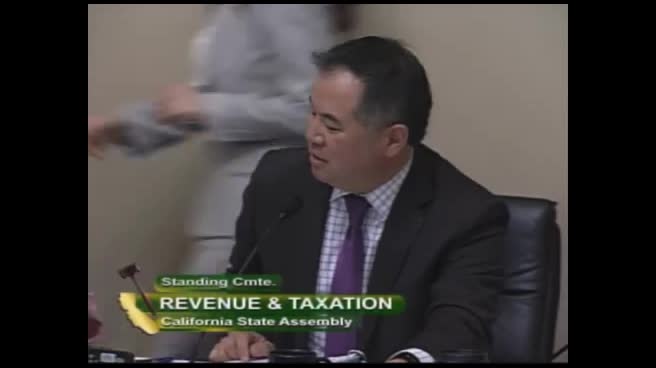 11MIN
Assembly Standing Committee on Revenue and Taxation
Bill Author

Bill Co-Author(s):