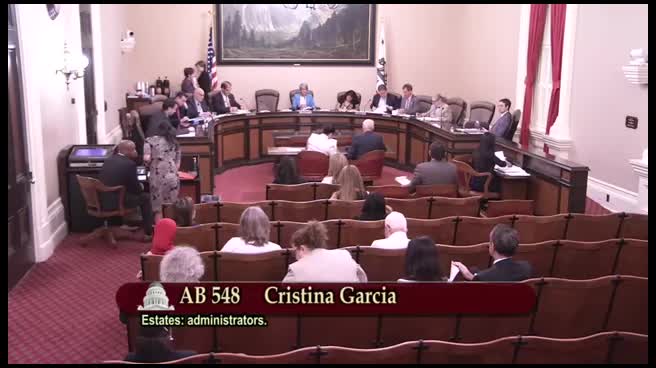
AB 548: Estates: administrators.
- Session Year: 2015-2016
- House: Assembly
- Latest Version Date: 2015-07-06
Under existing law, when an individual dies intestate, a court is authorized to appoint certain specified persons to act as that individuals personal representative and to administer the individuals estate. Further, existing law prescribes an order of preference for appointment among those persons. Existing law authorizes the court to appoint an administrator who is nominated by a person who is not a United States resident if the nominator would otherwise be entitled to appointment as an administrator of the decedents estate, after meeting specified conditions. Under existing law, the provisions on administrators who are nominated by a person who is not a United States resident are to be repealed on January 1, 2016.
This bill would delete the January 1, 2016 date of repeal, and thereby extend indefinitely the authorization of the court to appoint an administrator who is nominated by a person who is not a United States resident.
(a)The court may appoint as administrator a person nominated by any of the following persons:
(1)A person otherwise entitled to appointment.
(2)A person who would otherwise be entitled for appointment but who is ineligible for appointment under paragraph (4) of subdivision (a) of Section 8402 because he or she is not a resident of the United States.
(3)The guardian or conservator of the estate of a person otherwise entitled to appointment. The nomination shall be made in writing and filed with the court.
(b)If a person making a nomination for appointment of an administrator is the surviving spouse or domestic partner, child, grandchild, other issue, parent, brother or sister, or grandparent of the decedent, the nominee has priority next after those in the class of the person making the nomination.
(c)If a person making a nomination for appointment of an administrator is other than a person described in subdivision (b), the court in its discretion may appoint either the nominee or a person of a class lower in priority to that of the person making the nomination, but other persons of the class of the person making the nomination have priority over the nominee.
(d)If a person making a nomination for appointment of an administrator is a person described in paragraph (2) of subdivision (a), the court shall not appoint a nominee who is not a California resident to act as administrator. For California residents nominated under paragraph (2) of subdivision (a), the court shall consider whether the nominee is capable of faithfully executing the duties of the office. The court may in its discretion deny the appointment and appoint another person. In determining whether to appoint the nominee, the factors the court may consider include, but are not limited to, the following:
(1)Whether the nominee has a conflict of interest with the heirs or any other interested party.
(2)Whether the nominee had a business or personal relationship with the decedent or decedents family before the decedents death.
(3)Whether the nominee is engaged in or acting on behalf of an individual, a business, or other entity that solicits heirs to obtain the persons nomination for appointment as administrator.
(4)Whether the nominee has been appointed as a personal representative in any other estate.
(e)If the court decides to appoint a nominee under the circumstances described in subdivision (d), the court shall require the nominee to obtain bond, unless the court orders otherwise for good cause. Any order for good cause must be supported by specific findings of fact, and shall consider the need for the protection of creditors, heirs, and any other interested parties. Before waiving a bond, the court shall consider all other alternatives, including, but not limited to, the deposit of property in the estate pursuant to Chapter 3 (commencing with Section 9700) of Part 5 on the condition that the property, including any earnings thereon, will not be withdrawn except on authorization of the court. The waiver of all of the heirs of the requirement of a bond shall not constitute good cause.
(f)If the appointed nominee ceases to be a California resident following his or her appointment, he or she shall be deemed to have resigned as administrator for the purposes of Article 7 (commencing with Section 8520). The court shall not lose jurisdiction of the proceeding by any resignation under this subdivision.
(g)By accepting appointment as personal representative, the nominee shall submit personally to the jurisdiction of the court.
SEC. 2.Section 8465 of the Probate Code, as added by Section 2 of Chapter 635 of the Statutes of 2012, is repealed.(a)The court may appoint as administrator a person nominated by any of the following persons:
(1)A person otherwise entitled to appointment.
(2)A person who would otherwise be entitled for appointment but who is ineligible for appointment under paragraph (4) of subdivision (a) of Section 8402 because he or she is not a resident of the United States.
(3)The guardian or conservator of the estate of a person otherwise entitled to appointment. The nomination shall be made in writing and filed with the court.
(b)If a person making a nomination for appointment of an administrator is the surviving spouse or domestic partner, child, grandchild, other issue, parent, brother or sister, or grandparent of the decedent, the nominee has priority next after those in the class of the person making the nomination.
(c)If a person making a nomination for appointment of an administrator is other than a person described in subdivision (b), the court in its discretion may appoint either the nominee or a person of a class lower in priority to that of the person making the nomination, but other persons of the class of the person making the nomination have priority over the nominee.
(d)If a person making a nomination for appointment of an administrator is a person described in paragraph (2) of subdivision (a), the court shall not appoint a nominee who is not a California resident to act as administrator. For California residents nominated under paragraph (2) of subdivision (a), the court shall consider whether the nominee is capable of faithfully executing the duties of the office. The court may in its discretion deny the appointment and appoint another person. In determining whether to appoint the nominee, the factors the court may consider include, but are not limited to, the following:
(1)Whether the nominee has a conflict of interest with the heirs or any other interested party.
(2)Whether the nominee had a business or personal relationship with the decedent or decedents family before the decedents death.
(3)Whether the nominee is engaged in or acting on behalf of an individual, a business, or other entity that solicits heirs to obtain the persons nomination for appointment as administrator.
(4)Whether the nominee has been appointed as a personal representative in any other estate.
(e)If the court decides to appoint a nominee under the circumstances described in subdivision (d), the court shall require the nominee to obtain bond, unless the court orders otherwise for good cause. Any order for good cause must be supported by specific findings of fact, and shall consider the need for the protection of creditors, heirs, and any other interested parties. Before waiving a bond, the court shall consider all other alternatives, including, but not limited to, the deposit of property in the estate pursuant to Chapter 3 (commencing with Section 9700) of Part 5 on the condition that the property, including any earnings thereon, will not be withdrawn except on authorization of the court. The waiver of all of the heirs of the requirement of a bond shall not constitute good cause.
(f)If the appointed nominee ceases to be a California resident following his or her appointment, he or she shall be deemed to have resigned as administrator for the purposes of Article 7 (commencing with Section 8520). The court shall not lose jurisdiction of the proceeding by any resignation under this subdivision.
(g)By accepting appointment as personal representative, the nominee shall submit personally to the jurisdiction of the court.
(h)This section shall remain in effect only until January 1, 2016, and as of that date is repealed, unless a later enacted statute, that is enacted before January 1, 2016, deletes or extends that date.
SEC. 2.Section 8465 of the Probate Code, as added by Section 2 of Chapter 635 of the Statutes of 2012, is repealed.8465.(a)The court may appoint as administrator a person nominated by a person otherwise entitled to appointment or by the guardian or conservator of the estate of a person otherwise entitled to appointment. The nomination shall be made in writing and filed with the court.
(b)If a person making a nomination for appointment of an administrator is the surviving spouse or domestic partner, child, grandchild, other issue, parent, brother or sister, or grandparent of the decedent, the nominee has priority next after those in the class of the person making the nomination.
(c)If a person making a nomination for appointment of an administrator is other than a person described in subdivision (b), the court in its discretion may appoint either the nominee or a person of a class lower in priority to that of the person making the nomination, but other persons of the class of the person making the nomination have priority over the nominee.
(d)This section shall become operative on January 1, 2016.
|
Date
|
Status
|
|---|---|
| Jun 10, 2015 | From committee: Do pass. (Ayes 7. Noes 0.) (June 9). |
| Jul 6, 2015 | Chaptered by Secretary of State - Chapter 54, Statutes of 2015. |
| Jul 6, 2015 | Approved by the Governor. |
| Jun 26, 2015 | Enrolled and presented to the Governor at 11 a.m. |
| Jun 23, 2015 | In Assembly. Ordered to Engrossing and Enrolling. |
| Jun 22, 2015 | Read third time. Passed. Ordered to the Assembly. (Ayes 37. Noes 0. Page 1550.). |
| Jun 22, 2015 | Read third time. Passed. Ordered to the Assembly. |
| Jun 17, 2015 | Ordered to special consent calendar. |
| Jun 11, 2015 | Read second time. Ordered to third reading. |
| Feb 23, 2015 | Read first time. To print. |
| May 7, 2015 | Referred to Com. on JUD. |
| Apr 9, 2015 | Read third time. Passed. Ordered to the Senate. (Ayes 76. Noes 0.) |
| Apr 9, 2015 | Read third time. Passed. Ordered to the Senate. (Ayes 76. Noes 0. Page 855.) |
| Apr 9, 2015 | In Senate. Read first time. To Com. on RLS. for assignment. |
| Apr 8, 2015 | Read second time. Ordered to third reading. |
| Apr 7, 2015 | From committee: Do pass. (Ayes 10. Noes 0.) (April 7). |
| Mar 5, 2015 | Referred to Com. on JUD. |
| Feb 24, 2015 | From printer. May be heard in committee March 26. |
|
Date
|
Description
|
Location
|
Votes
|
|
|---|---|---|---|---|
| Jun 22, 2015 | Special Consent #3 AB548 Cristina Garcia | Senate Floor |
Passed |
|
| Jun 9, 2015 | Do pass | Senate Standing Committee on Judiciary |
Passed |
|
| Apr 9, 2015 | AB 548 GARCIA, C. Assembly Third Reading | Assembly Floor |
Passed |
|
| Apr 7, 2015 | Do pass. | Assembly Standing Committee on Judiciary |
Passed |
This list shows positions taken on this bill by organizations on the date displayed, which is linked to the original source.
Positions by individuals are not included.
|
Organization
|
Position
|
Date
|
|---|---|---|
| California Conference of Bar Associations | * Indeterminate | Jun 9, 2015 |
| Conference of California Bar Associations | * Support | Jun 9, 2015 |
| Trusts & Estates Section of the State Bar | ** Support | Jun 9, 2015 |
| United Farm Workers | ** Support | Jun 9, 2015 |
AB 548
Page 7
|
Office of Senate Floor Analyses (916) 651-1520 Fax: (916) 327-4478 |
THIRD READING
Bill No: AB 548
Introduced: 2/23/15
SENATE JUDICIARY COMMITTEE: 7-0, 6/9/15
AYES: Jackson, Moorlach, Anderson, Hertzberg, Leno, Monning, Wieckowski
ASSEMBLY FLOOR: 76-0, 4/9/15 - See last page for vote
SUBJECT: Estates: administrators
SOURCE: Conference of California Bar Associations
DIGEST: This bill removes the January 1, 2016, sunset, thus, extending the authorization indefinitely, for a court to have authorization to appoint an administrator nominated by a non-U.S. relative to administer a decedent’s estate.
Existing law:
Provides that, if a person dies intestate, the court shall appoint an administrator as personal representative.
Provides that a person is not competent to act as a personal representative in any of the following circumstances:
The person is under the age of majority;
The person is subject to a conservatorship of the estate or is otherwise incapable of executing, or is otherwise unfit to execute, the duties of the office;
There are grounds for removal of the person from office;
The person is not a resident of the United States; or
The person is a surviving partner of the decedent and an interested person objects to the appointment.
Provides that items (d) and (e) above do not apply to a person named as executor or successor executor in the decedent’s will.
Provides that a person is entitled to appointment as administrator in the following order of priority based upon the relation to the decedent: a) surviving spouse or domestic partner; b) children; c) grandchildren; d) other issue; e) parents; f) brothers and sisters; g) issue of brothers and sisters; h) grandparents; i) issue of grandparents; j) children of a predeceased spouse or domestic partner; k) other issue of a predeceased spouse or domestic partner; l) other next of kin; m) parents of a predeceased spouse or domestic partner; n) issue of parents of a predeceased spouse or domestic partner; o) conservator or guardian of the estate acting in that capacity at the time of death who has filed a first account and is not acting as conservator or guardian for any other person; p) public administrator; q) creditors; or r) any other person.
Authorizes a court to appoint as administrator a person nominated by any of the following persons:
A person otherwise entitled to appointment;
A person who would otherwise be entitled for appointment but who is ineligible for appointment because he or she is not a resident of the United States; or
The guardian or conservator of the estate of a person otherwise entitled to appointment. The nomination shall be made in writing and filed with the court.
Provides that if a person making a nomination for appointment of an administrator is the surviving spouse or domestic partner, child, grandchild, other issue, parent, brother or sister, or grandparent of the decedent, the nominee has priority next after those in the class of the person making the nomination. Existing law further provides that if the person making the nomination is not the surviving spouse or domestic partner, child, grandchild, other issue, parent, brother or sister, or grandparent of the decedent, the court is authorized to appoint either the nominee or a person of a class lower in priority to that of the person making the nomination, but other persons of the class of the person making the nomination have priority over the nominee.
Provides that if a person making a nomination for appointment of an administrator is a person who would otherwise be entitled for appointment but who is ineligible for appointment because he or she is not a resident of the United States, the court is prohibited from appointing a nominee who is not a California resident to act as administrator. For California residents nominated by a person who would otherwise be entitled for appointment but who is ineligible for appointment because he or she is not a resident of the United States, existing law requires the court to consider whether the nominee is capable of faithfully executing the duties of the office.
Authorizes the court in its discretion to deny the appointment of an administrator nominated by a non-U.S. relative and appoint another person. In determining whether to appoint the nominee, the factors the court may consider include, but are not limited to, the following:
Whether the nominee has a conflict of interest with the heirs or any other interested party;
Whether the nominee had a business or personal relationship with the decedent or decedent’s family before the decedent’s death;
Whether the nominee is engaged in or acting on behalf of an individual, a business, or other entity that solicits heirs to obtain the person’s nomination for appointment as administrator; and
Whether the nominee has been appointed as a personal representative in any other estate.
Requires, if the court decides to appoint a nominee of a non-U.S. relative, the nominee to obtain a bond, unless the court orders otherwise for good cause, and any order for good cause must be supported by specific findings of fact, and requires the court to consider the need for the protection of creditors, heirs, and any other interested parties. Before waiving a bond, the court is required to consider all other alternatives, including, but not limited to, the deposit of property in the estate on the condition that the property, including any earnings thereon, will not be withdrawn except on authorization of the court. Existing law provides that the waiver of all of the heirs of the requirement of a bond shall not constitute good cause.
Requires, if the appointed nominee ceases to be a California resident following his or her appointment, the appointed nominee to be deemed to have resigned as administrator, and maintains the court’s jurisdiction of the proceeding following that resignation.
Provides that by accepting appointment as personal representative, the nominee submits personally to the jurisdiction of the court.
Provides that the above provisions authorizing a non-U.S. relative to nominate a California resident to be the administrator of the decedent’s estate sunsets on January 1, 2016.
This bill removes that sunset.
Background
In California, if a person dies intestate, the court must appoint a personal representative to administer the decedent’s estate. Under existing law, only certain individuals, such as United States residents, may be appointed as an administrator. (Prob. Code Sec. 8402(a).) A person (typically a relative and potential heir of the decedent), who would otherwise qualify to be the administrator, may nominate another person to be appointed as administrator. Such nomination may occur because the beneficiary may believe another person is more qualified to act as the estate administrator.
Prior to 2013, a relative, who would qualify to be nominated as an administrator but for the fact that the relative was not a U.S. resident, could not nominate another person to administer the decedent’s estate. The problem with the residency requirements for both the relative and the nominee was demonstrated in the Estate of Damskog (1991) 1 Cal.App.4th 78, in which the decedent died intestate and his two sisters, residents of Norway, nominated an estate administrator. The public administrator objected to the nomination. The court held that California law required United States residency for both nominators and administrators, and the court appointed the public administrator to oversee the estate administration. The court, having discussed the legislative history of the nomination and appointment of administrator provisions, determined that “although there is no explicit residency requirement for the nominator in section 8465, she must herself be ‘entitled to appointment’ and that entitlement depends on United States residence under section 8402. Had the Legislature wished to retain differing residency requirements for administrators and nominators, it could easily have said so in the same ‘but for’ language it used in 1967 about California residency.” (Id. at pp. 81-82.)
AB 1670 (Lara, Chapter 635, Statutes of 2012) was enacted in response to the Damskog ruling and authorized court-appointment of an estate administrator nominated by a foreign person. AB 1670 recognized the development of the global economy with U.S. born beneficiaries now living and working in foreign countries. Children of California residents who accept jobs in other countries previously were prohibited from nominating an estate administrator, who may be an individual known to the family and who knows the wishes of the decedent better than the public administrator. AB 1670 ensured that non-resident families of the decedent had the right to select the person best suited to manage the estate assets.
AB 1670 sunsets on January 1, 2016. This bill removes that sunset, thus, permanently authorizing a court to appoint an administrator, who is nominated by a non-U.S. relative, to administer the decedent’s estate.
Comments
The author writes:
When someone dies without a will, the court appoints a personal representative to administer the estate. The Probate Code lists in order of priority the persons who are entitled to appointment as estate administrator, with the closest relatives (e.g., spouses and children), who are the legal heirs of the estate, receiving the highest priority. The code also generally permits a person entitled to appointment as personal representative to nominate someone else to serve in that capacity.
Until 2013, there was one major exception to the ability of a person entitled to appointment to nominate a personal representative: An heir otherwise entitled to nominate a personal representative could not do so if the heir was not a U.S. resident. Recent legislation (AB 1670 (Lara), Chapter 635, Statutes of 2012), allowed non-resident heirs to nominate administrators of the estate. To protect against any possible fraud, additional conditions were added to the law which applied if a non-resident heir nominated the estate administrator. These conditions include requiring that the administrator reside in California during the entire estate administration; requiring the court to consider, among other things, whether the nominee has a conflict of interest with the heirs or any other interested party, whether the nominee had a business or personal relationship with the decedent or decedent’s family before the decedent’s death, whether the nominee is acting on behalf of an entity that solicits heirs to obtain the person’s nomination for appointment as administrator; and requiring the nominee to obtain a bond, unless the court orders otherwise for good cause. This change in the law is scheduled to sunset on January 1, 2016.
AB 548 would remove the sunset clause on the changes enacted by the Legislature through AB 1670 of 2012, thereby making permanent the ability of heirs of an intestate California decedent to nominate someone they know and trust as personal representative for the estate – subject to all the protections built into the law.
Prior Legislation
AB 1670 (Lara, Chapter 635, Statutes of 2012) - See Background.
AB 239 (Kaloogian, Chapter 175, Statutes of 1999) contained a provision that was substantially similar to an initial version of AB 1670. AB 239 originally failed passage in the Senate Judiciary Committee but was approved after that provision was deleted from the bill.
FISCAL EFFECT: Appropriation: No Fiscal Com.: No Local: No
Conference of California Bar Associations (source)
Executive Committee of the Trusts and Estates Section of the State Bar of California
OPPOSITION: (Verified 6/11/15)
None received
ASSEMBLY FLOOR: 76-0, 4/9/15
AYES: Achadjian, Alejo, Travis Allen, Baker, Bigelow, Bloom, Bonilla, Bonta, Brown, Burke, Campos, Chang, Chau, Chávez, Chiu, Chu, Cooley, Cooper, Dababneh, Dahle, Daly, Dodd, Eggman, Frazier, Beth Gaines, Gallagher, Cristina Garcia, Eduardo Garcia, Gatto, Gipson, Gomez, Gonzalez, Gordon, Gray, Grove, Hadley, Harper, Roger Hernández, Holden, Irwin, Jones, Jones-Sawyer, Kim, Lackey, Levine, Linder, Lopez, Low, Maienschein, Mathis, Mayes, McCarty, Medina, Melendez, Mullin, Nazarian, Obernolte, Olsen, Perea, Quirk, Rendon, Ridley-Thomas, Rodriguez, Salas, Santiago, Steinorth, Mark Stone, Thurmond, Ting, Wagner, Waldron, Weber, Wilk, Williams, Wood, Atkins
NO VOTE RECORDED: Brough, Calderon, O’Donnell, Patterson
Prepared by: Tara Welch / JUD. / (916) 651-4113
6/12/15 9:44:59
**** END ****
AB 548 (Cristina Garcia)
Page 8 of 8
Senator Hannah-Beth Jackson, Chair
2015-2016 Regular Session
AB 548 (Cristina Garcia)
Version: February 23, 2015
Hearing Date: June 9, 2015
Fiscal: No
Urgency: No
TMW
SUBJECT
Estates: administrators
DESCRIPTION
Existing law provides that, if a California resident dies intestate (without a will), the court must appoint an administrator to manage the decedent’s estate, and the court-appointed administrator must meet several qualifications, including being a United States resident. Existing law, until January 1, 2016, authorizes the court to appoint an administrator nominated by a non-U.S. relative to administer the decedent’s estate. This bill would remove that sunset, thus, extending the authorization indefinitely.
BACKGROUND
In California, if a person dies intestate, the court must appoint a personal representative to administer the decedent’s estate. Under existing law, only certain individuals, such as United States residents, may be appointed as an administrator. (Prob. Code Sec. 8402(a).) A person (typically a relative and potential heir of the decedent), who would otherwise qualify to be the administrator, may nominate another person to be appointed as administrator. Such nomination may occur because the beneficiary may believe another person is more qualified to act as the estate administrator.
Prior to 2013, a relative, who would qualify to be nominated as an administrator but for the fact that the relative was not a U.S. resident, could not nominate another person to administer the decedent’s estate. The problem with the residency requirements for both the relative and the nominee was demonstrated in the Estate of Damskog (1991) 1 Cal.App.4th 78, in which the decedent died intestate and his two sisters, residents of Norway, nominated an estate administrator. The public administrator objected to the nomination. The court held that California law required United States residency for both nominators and administrators, and the court appointed the public administrator to oversee the estate administration. The court, having discussed the legislative history of the nomination and appointment of administrator provisions, determined that “although there is no explicit residency requirement for the nominator in section 8465, she must herself be ‘entitled to appointment’ and that entitlement depends on United States residence under section 8402. Had the Legislature wished to retain differing residency requirements for administrators and nominators, it could easily have said so in the same ‘but for’ language it used in 1967 about California residency.” (Id. at pp. 81-82.)
AB 1670 (Lara, Chapter 635, Statutes of 2012) was enacted in response to the Damskog ruling and authorized court-appointment of an estate administrator nominated by a foreign person. AB 1670 recognized the development of the global economy with U.S. born beneficiaries now living and working in foreign countries. Children of California residents who accept jobs in other countries previously were prohibited from nominating an estate administrator, who may be an individual known to the family and who knows the wishes of the decedent better than the public administrator. AB 1670 ensured that non-resident families of the decedent had the right to select the person best suited to manage the estate assets.
AB 1670 sunsets on January 1, 2016. This bill would remove that sunset, thus, permanently authorizing a court to appoint an administrator, who is nominated by a non-U.S. relative, to administer the decedent’s estate.
CHANGES TO EXISTING LAW
Existing law provides that, if a person dies intestate, the court shall appoint an administrator as personal representative. (Prob. Code Sec. 8460(a).)
Existing law provides that a person is not competent to act as a personal representative in any of the following circumstances:
(1) the person is under the age of majority;
(2) the person is subject to a conservatorship of the estate or is otherwise incapable of executing, or is otherwise unfit to execute, the duties of the office;
(3) there are grounds for removal of the person from office;
(4) the person is not a resident of the United States; or
(5) the person is a surviving partner of the decedent and an interested person objects to the appointment. (Prob. Code Sec. 8402(a).)
Existing law provides that items (4) and (5) above do not apply to a person named as executor or successor executor in the decedent’s will. (Prob. Code Sec. 8402(b).)
Existing law provides that a person is entitled to appointment as administrator in the following order of priority based upon the relation to the decedent: (a) surviving spouse or domestic partner; (b) children; (c) grandchildren; (d) other issue; (e) parents; (f) brothers and sisters; (g) issue of brothers and sisters; (h) grandparents; (i) issue of grandparents; (j) children of a predeceased spouse or domestic partner; (k) other issue of a predeceased spouse or domestic partner; (l) other next of kin; (m) parents of a predeceased spouse or domestic partner; (n) issue of parents of a predeceased spouse or domestic partner; (o) conservator or guardian of the estate acting in that capacity at the time of death who has filed a first account and is not acting as conservator or guardian for any other person; (p) public administrator; (q) creditors; or (r) any other person. (Prob. Code Sec. 8461.)
Existing law authorizes a court to appoint as administrator a person nominated by any of the following persons:
(1) a person otherwise entitled to appointment;
(2) a person who would otherwise be entitled for appointment but who is ineligible for appointment because he or she is not a resident of the United States; or
(3) the guardian or conservator of the estate of a person otherwise entitled to appointment. The nomination shall be made in writing and filed with the court. (Prob. Code Sec. 8465(a).)
Existing law provides that if a person making a nomination for appointment of an administrator is the surviving spouse or domestic partner, child, grandchild, other issue, parent, brother or sister, or grandparent of the decedent, the nominee has priority next after those in the class of the person making the nomination. Existing law further provides that if the person making the nomination is not the surviving spouse or domestic partner, child, grandchild, other issue, parent, brother or sister, or grandparent of the decedent, the court is authorized to appoint either the nominee or a person of a class lower in priority to that of the person making the nomination, but other persons of the class of the person making the nomination have priority over the nominee. (Prob. Code Sec. 8465(b), (c).)
Existing law provides that if a person making a nomination for appointment of an administrator is a person who would otherwise be entitled for appointment but who is ineligible for appointment because he or she is not a resident of the United States, the court is prohibited from appointing a nominee who is not a California resident to act as administrator. For California residents nominated by a person who would otherwise be entitled for appointment but who is ineligible for appointment because he or she is not a resident of the United States, existing law requires the court to consider whether the nominee is capable of faithfully executing the duties of the office. (Prob. Code Sec. 8465(d).)
Existing law authorizes the court in its discretion to deny the appointment of an administrator nominated by a non-U.S. relative and appoint another person. In determining whether to appoint the nominee, the factors the court may consider include, but are not limited to, the following:
(1) whether the nominee has a conflict of interest with the heirs or any other interested party;
(2) whether the nominee had a business or personal relationship with the decedent or decedent’s family before the decedent’s death;
(3) whether the nominee is engaged in or acting on behalf of an individual, a business, or other entity that solicits heirs to obtain the person’s nomination for appointment as administrator; and
(4) whether the nominee has been appointed as a personal representative in any other estate. (Prob. Code Sec. 8465(d).)
Existing law, if the court decides to appoint a nominee of a non-U.S. relative, requires the nominee to obtain a bond, unless the court orders otherwise for good cause, and any order for good cause must be supported by specific findings of fact, and requires the court to consider the need for the protection of creditors, heirs, and any other interested parties. (Prob. Code Sec. 8465(e).) Before waiving a bond, the court is required to consider all other alternatives, including, but not limited to, the deposit of property in the estate on the condition that the property, including any earnings thereon, will not be withdrawn except on authorization of the court. (Id.) Existing law provides that the waiver of all of the heirs of the requirement of a bond shall not constitute good cause. (Id.)
Existing law, if the appointed nominee ceases to be a California resident following his or her appointment, requires the appointed nominee to be deemed to have resigned as administrator, and maintains the court’s jurisdiction of the proceeding following that resignation. (Prob. Code Sec. 8465(f).)
Existing law provides that by accepting appointment as personal representative, the nominee submits personally to the jurisdiction of the court. (Prob. Code Sec. 8465(g).)
Existing law provides that the above provisions authorizing a non-U.S. relative to nominate a California resident to be the administrator of the decedent’s estate sunsets on January 1, 2016.
This bill would remove that sunset.
COMMENT
1. Stated need for the bill
The author writes:
When someone dies without a will, the court appoints a personal representative to administer the estate. The Probate Code lists in order of priority the persons who are entitled to appointment as estate administrator, with the closest relatives (e.g., spouses and children), who are the legal heirs of the estate, receiving the highest priority. The code also generally permits a person entitled to appointment as personal representative to nominate someone else to serve in that capacity.
Until 2013, there was one major exception to the ability of a person entitled to appointment to nominate a personal representative: An heir otherwise entitled to nominate a personal representative could not do so if the heir was not a U.S. resident. Recent legislation (AB 1670 (Lara), Chapter 635, Statutes of 2012), allowed non-resident heirs to nominate administrators of the estate. To protect against any possible fraud, additional conditions were added to the law which applied if a non-resident heir nominated the estate administrator. These conditions include requiring that the administrator reside in California during the entire estate administration; requiring the court to consider, among other things, whether the nominee has a conflict of interest with the heirs or any other interested party, whether the nominee had a business or personal relationship with the decedent or decedent’s family before the decedent’s death, whether the nominee is acting on behalf of an entity that solicits heirs to obtain the person’s nomination for appointment as administrator; and requiring the nominee to obtain a bond, unless the court orders otherwise for good cause. This change in the law is scheduled to sunset on January 1, 2016.
AB 548 would remove the sunset clause on the changes enacted by the Legislature through AB 1670 of 2012, thereby making permanent the ability of heirs of an intestate California decedent to nominate someone they know and trust as personal representative for the estate – subject to all the protections built into the law.
2. Removing sunset on authorization for non-U.S. relative nomination of administrator
When AB 1670 (Lara, Chapter 635, Statutes of 2012) was reviewed by the Assembly Judiciary Committee, the sunset of January 1, 2016, was added to the bill so that the Legislature could review the policy considerations and make certain the bill was working as intended. When AB 1670 was reviewed by this Committee, additional protections were added that:
prohibited the appointment of a non-California resident nominee;
required the court to consider whether the nominee was capable of faithfully executing the duties of the office;
requiring the appointed nominee to obtain a bond, unless the court orders otherwise for good cause, which must be supported by specific findings of fact, including the need for the protection of creditors, heirs, and any other interested parties;
deeming an appointed nominee, who ceases to be a California resident following his or her appointment, to have resigned as administrator;
maintaining the court’s jurisdiction of the proceeding following an appointed nominee’s resignation; and
requiring the appointed nominee to submit personally to the jurisdiction of the court.
Additional provisions were added to the bill that allowed the court, when determining whether to appoint the nominee as the decedent’s estate administrator, to consider whether the nominee has any conflicts of interest with the decedent’s heirs or any other interested party, whether the nominee has a business or personal relationship with the decedent or decedent’s family before the decedent’s death, whether the nominee is engaged in or acting on behalf of an individual, a business, or other entity that solicits heirs to obtain the person’s nomination for appointment as administrator, and whether the nominee has been appointed as a personal representative in any other estate. These provisions were added to determine whether the nominee is an “heir hunter,” who may have solicited his or her services to foreign beneficiaries in order to take a large percentage of the estate, and who may not take complete action to identify all potential beneficiaries of the estate so as to maintain a large portion going to the nominating beneficiary.
The Conference of California Bar Associations, sponsor, argues that “AB 1670 brought equity, fairness and dignity to a situation which for many years had none of those qualities. Prior to 2013, if a decedent immigrated from Puerto Rico, accumulated a significant estate, then died as a California resident leaving heirs in Puerto Rico, his or her heirs would be permitted to nominate the administrator of the estate – but if the decedent had come from Mexico and left heirs in Mexico, those heirs would have no right to nominate. Instead, administration of the estate likely would be handed to the Public Guardian or other designee of the court, who had no relationship to the decedent and no knowledge of the decedent’s wishes with regard to his or her family. AB 1670 corrected this unjust result, which was the unintended result of a code reorganization. To our knowledge, absolutely no problems have resulted from this change in the law.”
To determine whether AB 1670 has worked as intended and not created a way for unscrupulous individuals to prey on foreign families after a relative’s death in California, staff searched for administrator appointment cases appealed after the enactment of AB 1670. Surprisingly, the search revealed only one case, which actually supports the continued enactment of that bill. In Estate of Schneider (2013) Cal.App. Unpub. LEXIS 8115, the Court of Appeal, Fourth Appellate District, reviewed the trial court’s issuance of letters of administration to a person affiliated with the decedent’s mother and brother (both residents of Germany) and denial of a petition to appoint the public administrator brought by the decedent’s live-in boyfriend. The court noted several concerns with the live-in boyfriend: (1) the boyfriend initially petitioned the court for non-probate transfer of the decedent’s property because the boyfriend alleged he was the spouse of the decedent; (2) eight months later, the boyfriend filed the petition to appoint the public administrator and represented in that petition the decedent had no spouse at the time of her death; (3) in a separate document submitted to the court, the boyfriend contended he and the decedent held themselves to the public as husband and wife and had a nonmarital oral agreement that he would inherit the decedent’s property; and (4) the decedent’s estate consisted of nothing of substance except litigation claims of an unknown value (largely against the boyfriend). (Id. at pp. 3, 6, 40.) The mother and brother initially filed a petition nominating a California accountant with experience in the administration of estates. The nominee ultimately withdrew his nomination, and counsel for the mother and brother explained to the court they were looking for a new proposed administrator to pursue litigation claims on behalf of the estate. (Id. at p. 7.) The court noted that the mother’s nomination of the proposed administrator would have had priority over the public administrator nominated by the boyfriend, but the mother’s petition was filed before AB 1670 went into effect. (Id. at pp. 28-29.) Ultimately, an attorney affiliated with the mother was appointed as the administrator of the decedent’s estate because the public administrator opposed the boyfriend’s petition to appoint the public administrator. This bill, by removing the sunset from current law, would provide families similarly situated with the mother and brother in the Schneider case the ability to nominate a California resident, who may have known the decedent, to administer the decedent’s estate.
Support: Executive Committee of the Trusts and Estates Section of the State Bar of California
Opposition: None Known
HISTORY
Source: Conference of California Bar Associations
Related Pending Legislation: None Known
Prior Legislation:
AB 1670 (Lara, Chapter 635, Statutes of 2012) See Background, Comment 2.
AB 239 (Kaloogian, Chapter 175, Statutes of 1999) contained a provision that was substantially similar to an initial version of AB 1670. AB 239 originally failed passage in this Committee but was approved after that provision was deleted from the bill.
Prior Vote:
Assembly Floor (Ayes 76, Noes 0)
Assembly Judiciary Committee (Ayes 10, Noes 0)
**************
AB 548
Page 3
ASSEMBLY THIRD READING
AB 548
(Cristina Garcia)
As Introduced February 23, 2015
Majority vote
Committee |
Votes |
Ayes |
Noes |
Judiciary |
10-0 |
Mark Stone, Wagner, Alejo, Chau, Chiu, Gallagher, Cristina Garcia, Holden, Maienschein, O'Donnell |
|
SUMMARY: Allows a foreign heir to nominate an administrator of a decedent's estate indefinitely. Specifically, this bill lifts the sunset so that the following provisions exist indefinitely:
Authorizes the court to appoint, as administrator of a decedent's estate, the nominee of a person who would be entitled to appointment, or the nominee of the guardian or conservator of that person, even if that person is not a resident of the United States.
Requires an administrator, nominated by a non-United States resident, to reside in California and provides that if the administrator ceases to be a California resident he or she will be deemed to have resigned as administrator.
Provides that a court may, in its discretion, deny the appointment of an administrator nominated by a non-United States resident and appoint another person. In determining whether to appoint the nominee, requires the court to consider, among other things, whether the nominee has a conflict of interest with the heirs or any other interested party; whether the nominee had a business or personal relationship with the decedent or decedent’s family before the decedent’s death; and, whether the nominee is engaged in or acting on behalf of an individual, a business, or other entity that solicits heirs to obtain the person’s nomination for appointment as administrator.
Provides that, if the court decides to appoint a nominee of a non-United States resident, the court shall require the nominee to obtain a bond, unless the court orders otherwise for good cause, as provided.
EXISTING LAW:
Provides that a person has no power to administer an estate until that person is appointed as personal representative.
Provides that a person named as executor in the decedent's will has the right to appointment as personal representative even if that person is not a United States resident.
Provides that if a decedent dies intestate (without a will), the court must appoint an administrator as a personal representative.
Authorizes the court to appoint as administrator of a decedent's estate the nominee of a person entitled to the appointment or the nominee of the guardian or conservator of that person.
Sets forth individuals entitled to appointment in a priority list, which begins with the surviving spouse and children, and includes in priority order grandchildren, parents, other relatives, conservator or guardian of the estate of the deceased, public guardian and creditors.
Allows a court to appoint a qualified non-resident of California as administrator of a decedent's estate, provided certain requirements are met.
Authorizes the court, until January 1, 2016, to appoint, as administrator of a decedent's estate the nominee of a person who would be entitled to appointment, or the nominee of the guardian or conservator of that person, even if that person is not a resident of the United States, subject to specified conditions.
Allows the public administrator of the county in which an estate is administered to petition for appointment as personal representative of the estate if no person of higher priority has petitioned and if the value of the estate exceeds $150,000.
FISCAL EFFECT: None
COMMENTS: When someone creates a will, he or she can name an executor in the will, whether or not a United States resident, who has the right to be appointed as the personal representative and administer the estate in court. When someone dies without a will, the court appoints a personal representative to administer the estate. A personal representative must meet specified qualifications, including being a resident of the United States. The Probate Code lists persons who are entitled to appointment as estate administrator, and that list is in order of priority. Relatives, who are the legal heirs of the estate, receive high priority, with the closest relatives, including spouses and children, receiving the highest priority. If no relatives are available, the court may next consider a guardian or conservator of the decedent’s estate, then the public guardian and finally creditors of the decedent.
Until 2013, California law provided that an heir otherwise entitled to appoint a personal representative cannot do so if he or she is not a United States resident, even though a decedent could appoint a non-United States resident to serve in that capacity. Recent legislation (AB 1670 (Lara), Chapter 635, Statutes of 2012), created a pilot program to allow non-resident heirs to nominate administrators of the estate. To protect against any possible fraud, additional conditions were added to the law which applied if a non-resident heir nominated the estate administrator. These conditions include requiring that the administrator reside in California during the entire estate administration; requiring the court to consider, among other things, whether the nominee has a conflict of interest with the heirs or any other interested party, whether the nominee had a business or personal relationship with the decedent or decedent’s family before the decedent’s death, whether the nominee is acting on behalf of an entity that solicits heirs to obtain the person’s nomination for appointment as administrator; and requiring the nominee to obtain a bond, unless the court orders otherwise for good cause. The pilot program sunsets on January 1, 2016.
The Assembly Judiciary Committee is not aware of any instances where the nomination by a non-resident heir during the course of the pilot resulted in any harm to any interested party and neither have the attorney organizations supporting this bill. This bill, sponsored by the Conference of California Bar Associations, removes the sunset and allows non-resident heirs to nominate administrators of the estate, subject to all the limiting conditions in the existing pilot.
Case Law Demonstrates Difficulties with Law Prior to 2013: Pre-2013 cases interpreting the statutory scheme for appointment of an administrator when the heirs are non-United States residents were in conflict. In Estate of Kaussen (1987) 190 Cal.App.3d 1644 (but later unpublished), a decedent left his $26 million estate to his partner and their four children, all residents of Germany. The heirs then petitioned the court to appoint an administrator of their choosing. The trial court appointed the public guardian instead because the heirs were not United States residents. The court of appeals, while acknowledging that the heirs could not themselves be the estate administrator since none of them resided in the United States, nonetheless reversed, finding that the heirs' lack of residency did not prevent them from nominating a personal representative of their own choosing.
Four years later, the same court of appeals reversed course. In Estate of Damskog (1991) 1 Cal.App.4th 78, the appeals court vacated the appointment of the attorney and holder of a durable power of attorney of a decedent and ordered the appointment of the public guardian, despite the fact that the only heirs of the decedent, his two sisters and the children of a deceased sister, residents of Norway, nominated the attorney. The court acknowledged that if the sisters from Norway had the right to nominate (which as non-residents they did not have under then-existing law), their nominee would have had priority over the public guardian. In a footnote, the court referred to its decision in Kaussen, and stated that "the policy considerations which informed our earlier decision are best left to the Legislature." (Id. at 82, footnote 5.)
The Damskog court however explicitly stated that "[w]hile it makes sense to require administrators to reside in the United States where the probate court can exercise personal jurisdiction over them, if need be, as they perform their duties, no such jurisdictional need justifies a residency requirement for nominators. This very persuasive argument is better addressed to the Legislature than to the courts." (Id. [emphasis added].) It should be noted that an administrator appointed by the court, whether public or private, is responsible to the court.
Analysis Prepared by: Leora Gershenzon / JUD. / (916) 319-2334 FN: 0000093
AB 548
Page 5
Date of Hearing: April 7, 2015
ASSEMBLY COMMITTEE ON JUDICIARY
Mark Stone, Chair
AB 548
(Cristina Garcia) – As Introduced February 23, 2015
SUBJECT: ESTATE ADMINISTRATION: NOMINATION OF PERSONAL REPRESENTATIVE
KEY ISSUE: SHOULD THE SUNSET BE LIFTED SO THAT OTHERWISE QUALIFIED NON-U.S. RESIDENTS ARE PERMITTED, ON AN INDEFINITE BASIS, TO NOMINATE A PERSONAL REPRESENTATIVE TO ADMINISTER THE ESTATE TO WHICH THEY ARE HEIRS?
SYNOPSIS
When someone creates a will, he or she can name an executor in the will, whether or not a U.S. resident, who has the right to be appointed as the personal representative and administer the estate in court. When someone dies without a will, the court appoints a personal representative to administer the estate. Under current law, the personal representative must meet specified qualifications, including the requirement that he or she is a resident of the United States. There is a statutory list of persons who are entitled to appointment as administrator, and that list is in order of priority, with heirs (who stand to inherit the estate) given the highest priority. If no heirs are available, the court may next consider a guardian or conservator of the decedent’s estate, then the public guardian and finally creditors of the decedent. Until 2013, a U.S. resident heir could nominate an administrator, but an otherwise qualified non-U.S. resident heir could not. In 2012 the Legislature approved a pilot project to allow non-resident heirs to nominate administrators under specified circumstances. That pilot project is set to expire at the end of the year and neither this Committee, nor legal organizations supporting this bill, have heard of any problems with its operation. This bill, sponsored by the Conference of California Bar Associations, lifts the sunset so that non-resident heirs can continue to nominate administrators, subject to the existing conditions. This allows foreign heirs to nominate a trusted family friend or lawyer as administrator of the estate, rather than the public administrator who would in almost all cases be a stranger to the heirs. It is supported by the United Farm Workers and the Trusts & Estates Section of the State Bar. There is no known opposition.
SUMMARY: Allows a foreign heir to nominate an administrator of a decedent's estate indefinitely. Specifically, this bill lifts the sunset so that the following provisions exist indefinitely:
Authorizes the court to appoint, as administrator of a decedent's estate, the nominee of a person who would be entitled to appointment, or the nominee of the guardian or conservator of that person, even if that person is not a resident of the United States.
Requires an administrator, nominated by a non-United States resident, to reside in California and provides that if the administrator ceases to be a California resident he or she will be deemed to have resigned as administrator.
Provides that a court may, in its discretion, deny the appointment of an administrator nominated by a non-United States resident and appoint another person. In determining whether to appoint the nominee, requires the court to consider, among other things, whether the nominee has a conflict of interest with the heirs or any other interested party; whether the nominee had a business or personal relationship with the decedent or decedent’s family before the decedent’s death; and, whether the nominee is engaged in or acting on behalf of an individual, a business, or other entity that solicits heirs to obtain the person’s nomination for appointment as administrator.
Provides that, if the court decides to appoint a nominee of a non-United States resident, the court shall require the nominee to obtain a bond, unless the court orders otherwise for good cause, as provided.
EXISTING LAW:
Provides that a person has no power to administer an estate until that person is appointed as personal representative. (Probate Code Section 8400. Unless stated otherwise, all further statutory references are to that code.)
Provides that a person named as executor in the decedent's will has the right to appointment as personal representative even if that person is not a United States resident. (Sections 8402, 8420.)
Provides that if a decedent dies intestate (without a will), the court must appoint an administrator as a personal representative. (Section 8460.)
Authorizes the court to appoint as administrator of a decedent's estate the nominee of a person entitled to the appointment or the nominee of the guardian or conservator of that person. (Section 8465(a).)
Sets forth individuals entitled to appointment in a priority list, which begins with the surviving spouse and children, and includes in priority order grandchildren, parents, other relatives, conservator or guardian of the estate of the deceased, public guardian and creditors. (Section 8461.)
Allows a court to appoint a qualified non-resident of California as administrator of a decedent's estate, provided certain requirements are met. (Section 8570 et seq.)
Authorizes the court, until January 1, 2016, to appoint, as administrator of a decedent's estate the nominee of a person who would be entitled to appointment, or the nominee of the guardian or conservator of that person, even if that person is not a resident of the United States, subject to specified conditions. (Section 8465.)
Allows the public administrator of the county in which an estate is administered to petition for appointment as personal representative of the estate if no person of higher priority has petitioned and if the value of the estate exceeds $150,000. (Section 7620.)
FISCAL EFFECT: As currently in print this bill is keyed non-fiscal.
COMMENTS: When someone creates a will, he or she can name an executor in the will, whether or not a U.S. resident, who has the right to be appointed as the personal representative and administer the estate in court. When someone dies without a will, the court appoints a personal representative to administer the estate. A personal representative must meet specified qualifications, including being a resident of the United States. The Probate Code lists persons who are entitled to appointment as estate administrator, and that list is in order of priority. Relatives, who are the legal heirs of the estate, receive high priority, with the closest relatives, including spouses and children, receiving the highest priority. If no relatives are available, the court may next consider a guardian or conservator of the decedent’s estate, then the public guardian and finally creditors of the decedent.
Until 2013, California law provided that an heir otherwise entitled to appoint a personal representative cannot do so if he or she is not a U.S. resident, even though a decedent could appoint a non-U.S. resident to serve in that capacity. Recent legislation (AB 1670 (Lara), Chap. 635, Stats. 2012), created a pilot program to allow non-resident heirs to nominate administrators of the estate. To protect against any possible fraud, additional conditions were added to the law which applied if a non-resident heir nominated the estate administrator. These conditions include requiring that the administrator reside in California during the entire estate administration; requiring the court to consider, among other things, whether the nominee has a conflict of interest with the heirs or any other interested party, whether the nominee had a business or personal relationship with the decedent or decedent’s family before the decedent’s death, whether the nominee is acting on behalf of an entity that solicits heirs to obtain the person’s nomination for appointment as administrator; and requiring the nominee to obtain a bond, unless the court orders otherwise for good cause. The pilot program sunsets on January 1, 2016.
This Committee is not aware of any instances where the nomination by a non-resident heir during the course of the pilot resulted in any harm to any interested party and neither have the attorney organizations supporting this bill. This bill, sponsored by the Conference of California Bar Associations, removes the sunset and allows non-resident heirs to nominate administrators of the estate, subject to all the limiting conditions in the existing pilot.
In support of the bill, the author writes:
In a nation (and a state) of immigrants such as ours the requirement that only heirs who are United States residents can nominate another resident to serve has no basis in logic or fact. Suppose that a decedent immigrated from Mexico, accumulated a significant estate, then died as a California resident leaving heirs in Mexico. Under pre-2013 law the heirs would be prohibited from nominating an administrator (even a California resident) to manage the estate, even though the family stands to receive all of the assets. The family would have no say over who controls the decedent's estate. AB 1670 corrected this unjust result, which was the unintended result of a code reorganization. To our knowledge, absolutely no problems have resulted from this change in the law.
Case Law Demonstrates Difficulties with Law Prior to 2013: Pre-2013 cases interpreting the statutory scheme for appointment of an administrator when the heirs are non-U.S. residents were in conflict. In Estate of Kaussen (1987) 190 Cal.App.3d 1644 (but later unpublished), a decedent left his $26 million estate to his partner and their four children, all residents of Germany. The heirs then petitioned the court to appoint an administrator of their choosing. The trial court appointed the public guardian instead because the heirs were not United States residents. The court of appeals, while acknowledging that the heirs could not themselves be the estate administrator since none of them resided in the United States, nonetheless reversed, finding that the heirs' lack of residency did not prevent them from nominating a personal representative of their own choosing.
Four years later, the same court of appeals reversed course. In Estate of Damskog (1991) 1 Cal.App.4th 78, the appeals court vacated the appointment of the attorney and holder of a durable power of attorney of a decedent and ordered the appointment of the public guardian, despite the fact that the only heirs of the decedent, his two sisters and the children of a deceased sister, residents of Norway, nominated the attorney. The court acknowledged that if the sisters from Norway had the right to nominate (which as non-residents they did not have under then-existing law), their nominee would have had priority over the public guardian. In a footnote, the court referred to its decision in Kaussen, and stated that "the policy considerations which informed our earlier decision are best left to the Legislature." (Id. at 82, footnote 5.)
The Damskog court however explicitly stated that "[w]hile it makes sense to require administrators to reside in the United States where the probate court can exercise personal jurisdiction over them, if need be, as they perform their duties, no such jurisdictional need justifies a residency requirement for nominators. This very persuasive argument is better addressed to the Legislature than to the courts." (Id. [emphasis added].) It should be noted that an administrator appointed by the court, whether public or private, is responsible to the court.
ARGUMENTS IN SUPPORT: In support of the bill, the United Farm Workers writes that before AB 1670, "heirs were prohibited from nominating an administrator (even a California resident) to manage the estate, even though the family stood to receive all of the assets. The family didn't even have any say over who controlled the decedent's estate. AB 1670 corrected this unjust result. AB 548 would remove the sunset clause in order to preserve this correction."
The Trusts & Estates Section of the State Bar states that "AB 1670 was an improvement to the law" and that the Section "is not aware of any problems created by that law, and believes it has worked well."
Adds the Conference of California Bar Associations: "AB 1670 brought equity, fairness and dignity to a situation which for many years had none of these qualities. . . . To our knowledge, absolutely no problems have resulted from this change of law."
Previous Legislation: AB 1670 (Lara), Chap. 635, Stats. 2012, created the pilot program to allow non-resident heirs to nominate administrators of the estate. That pilot sunsets on January 1, 2016.
AB 239 (Kaloogian), Chap. 175, Stats. 1999 would have permitted the nominee of a non-resident heir to be appointed administrator of the estate. That provision was dropped from the bill in the Senate.
REGISTERED SUPPORT / OPPOSITION:
Support
Conference of California Bar Associations (sponsor)
Trusts & Estates Section of the State Bar
United Farm Workers
Opposition
None on file
Analysis Prepared by: Leora Gershenzon / JUD. / (916) 319-2334
Bill Author

Bill Co-Author(s):