AB 585: Outdoor Water Efficiency Act of 2015: personal income tax credits: outdoor water efficiency.
- Session Year: 2015-2016
- House: Assembly
- Latest Version Date: 2015-07-15
The Personal Income Tax Law allows various credits against the taxes imposed by that law.
This bill, for taxable years beginning on or after January 1, 2015, 2016, and before January 1, 2021, or an earlier specified date, would allow a credit equal to 25% of the amount paid or incurred by a qualified taxpayer for water-efficiency improvements made to outdoor landscapes improvements, as defined, on qualified real property in this state, not to exceed $2,500 per taxable year, as specified. The bill would limit the cumulative amount of the credit to $2,500 for each qualified real property for all taxable years. The bill would require a qualified taxpayer to obtain and retain a certification of the water-efficiency improvements from the appropriate regional or local water agency after completion of the improvements and to provide a copy of this certification to the Franchise Tax Board upon request.
This bill would take effect immediately as a tax levy.
The Personal Income Tax Law allows various credits against the taxes imposed by that law.
This bill, for taxable years beginning on or after January 1, 2015, and before January 1, 2021, or an earlier specified date, would allow a credit equal to 25% of the amount paid or incurred by a qualified taxpayer for water-efficiency improvements made to outdoor landscapes on qualified real property in this state, not to exceed $2,500 per taxable year, as specified.
This bill would take effect immediately as a tax levy.
The Personal Income Tax Law allows various credits against the taxes imposed by that law.
This bill, for taxable years beginning on or after January 1, 2015, and before January 1, 2021, or an earlier specified date, would allow a credit equal to 25% of the amount paid or incurred by a qualified taxpayer for improvements made to outdoor landscapes on real property in this state, not to exceed $2,500 per taxable year, as specified.
This bill would take effect immediately as a tax levy.
The Legislature finds and declares all of the following:
(a)The 2014 water year, ending on September 30, was the third driest based on the 119-year long statewide precipitation record.
(b)Temperatures in the first nine months of 2014 were record breaking4.1 a record-breaking 4.1 degrees above the 20th century average across the state.
(c)Responding to these unprecedented dry and hot conditions, the United States Drought Monitor classified more than 80 percent of California in an extreme drought condition, with 58 percent of California in an exceptional drought, the highest condition.
(d)On January 17, 2014, the Governor called upon retail water providers throughout California to reduce residential per capita water use by 20 percent as compared to 2013 levels.
(e)Outdoor water use accounts for the highest percentage of regional water use.
(f)Landscape design, installation, maintenance, and management can and should be water efficient. The use of water-efficient landscapes contributes to the states efforts to increase the reliability of its water supplies.
(g)Municipalities and local water agencies are tasked with enforcing water conservation ordinances to eliminate water waste and restrict outdoor water use.
(h)It is the intent of the Legislature to provide an income tax credit for the purchase of outdoor water use efficiency improvements during the exceptional drought that California is facing.
SEC. 2.Section 17053.37 is added to the Revenue and Taxation Code, to read:17053.37.(a)For each taxable year beginning on or after January 1, 2015, 2016, and before January 1, 2021, there shall be allowed as a credit against the net tax, as defined in Section 17039, an amount equal to 25 percent of the amount paid or incurred during the taxable year by a qualified taxpayer for water-efficiency improvements for outdoor landscapes on qualified real property in this state, not state.
(b)The credit shall not exceed two thousand five hundred dollars ($2,500) per taxable year. year for each qualified real property. For each qualified real property, the credit allowed under this section shall not cumulatively exceed two thousand five hundred dollars ($2,500) for all taxable years.
(b)
(c)For the purposes of this section, the following definitions shall apply:
(1)Multifamily residential real property means any real property that is improved with, or consisting of, a building containing more than one unit that is intended for human habitation, or any mixed residential-commercial buildings or portions thereof that are intended for human habitation. Multifamily residential real property includes residential hotels but does not include hotels and motels that are not residential hotels.
(2)
(1)Qualified real property means either multifamily residential real property or single-family real property. a principal residence of the qualified taxpayer, within the meaning of Section 121 of the Internal Revenue Code, relating to exclusion of gain from sale of principal residence, in this state.
(3)
(2)Qualified taxpayer means the owner of any qualified real property.
(4)Single-family residential real property means any real property that is improved with, or consisting of, a building containing not more than one unit that is intended for human habitation.
(5)Water efficiency
(3)(A)Water-efficiency improvements means expenditures voluntarily paid or incurred by the qualified taxpayer to meet the requirements of that are certified by the appropriate regional or local water agency as water-efficient improvements compatible with any of the following:
(A)
(i)A local water-efficient landscape ordinance of a regional or local water agency adopted or in effect pursuant to subdivision (c) of Section 65595 of the Government Code. at the time the improvements are made.
(B)A local landscape regulation or restriction on the use of water adopted pursuant to Section 353 or Section 375 of the Water Code.
(ii)The state water-efficient landscape statutes adopted or in effect at the time the improvements are made.
(C)
(iii)A water-efficient landscape program that is developed and implemented by a regional or local water agency for the specific purpose of reducing water use.
(B)Water-efficiency improvements do not include improvements performed to bring landscaping into mandatory compliance with a local water-efficient landscape ordinance or state law.
(d)A qualified taxpayer shall:
(A)Obtain certification of the water-efficiency improvements from the appropriate regional or local water agency specified in paragraph (3) of subdivision (c) after completion of those improvements.
(B)Retain a copy of the certification specified in subparagraph (A) and, upon request, provide a copy of that certification to the Franchise Tax Board.
(e)This credit shall be in lieu of any other credit or deduction that the qualified taxpayer may otherwise claim pursuant to this part with respect to the amounts paid or incurred for water-efficiency improvements for outdoor landscapes on qualified real property in this state.
(f)In the case where the credit allowed under this section exceeds the net tax, as defined by Section 17039, for a taxable year, the excess credit may be carried over to reduce the net tax in the following taxable year, and succeeding three taxable years, if necessary, until the credit has been exhausted.
(c)
(g)Section 41 does not apply to the credit allowed by this section.
(d) This section shall remain in effect until December 1, 2021, unless the drought state of emergency declared by the Governor on January 17, 2014, is terminated before that date, in accordance with Section 8629 of the Government Code. In that event, this section shall remain in effect only until midnight on the first day of the first calendar quarter commencing more than 60 days after the date of the termination of the state of emergency, or until December 1, 2021, whichever is earlier, and credits shall be allowed only for that portion of the taxable year before the date this section becomes inoperative.
(e)This section is repealed on December 1, 2021.
(h)This section shall remain in effect until December 1, 2021, and as of that date is repealed.
SEC. 3.This act provides for a tax levy within the meaning of Article IV of the Constitution and shall go into immediate effect.
The Legislature finds and declares all of the following:
(a)The 2014 water year, ending on September 30, was the third driest based on the 119-year long statewide precipitation record.
(b)Temperatures in the first nine months of 2014 were record breaking4.1 degrees above the 20th century average across the state.
(c)Responding to these unprecedented dry and hot conditions, the United States Drought Monitor classified more than 80 percent of California in an extreme drought condition, with 58% of California in an exceptional drought, the highest condition.
(d)On January 17, 2014, the Governor called upon retail water providers throughout California to reduce residential per capita water use by 20% as compared to 2013 levels.
(e)Outdoor water use accounts for the highest percentage of regional water use.
(f)Landscape design, installation, maintenance, and management can and should be water efficient. The use of water-efficient landscapes contributes to the states efforts to increase the reliability of its water supplies.
(g)Municipalities and local water agencies are tasked with enforcing water conservation ordinances to eliminate water waste and restrict outdoor water use.
(h)It is the intent of the Legislature to provide an income tax credit for the purchase of outdoor water use efficiency improvements during the exceptional drought that California is facing.
SEC. 2.Section 17053.37 is added to the Revenue and Taxation Code, to read:17053.37.(a)For each taxable year beginning on or after January 1, 2015, and before January 1, 2021, there shall be allowed as a credit against the net tax, as defined in Section 17039, an amount equal to 25 percent of the amount paid or incurred during the taxable year by a qualified taxpayer for water-efficiency improvements for outdoor landscapes on qualified real property in this state, not exceed two thousand five hundred dollars ($2,500) per taxable year.
(b)For the purposes of this section, the following definitions shall apply:
(1)Multifamily residential real property means any real property that is improved with, or consisting of, a building containing more than one unit that is intended for human habitation, or any mixed residential-commercial buildings or portions thereof that are intended for human habitation. Multifamily residential real property includes residential hotels but does not include hotels and motels that are not residential hotels.
(2)Qualified real property means either multifamily residential real property or single-family real property.
(3)Qualified taxpayer means the owner of any qualified real property.
(4)Single-family residential real property means any real property that is improved with, or consisting of, a building containing not more than one unit that is intended for human habitation.
(5)Water-efficiency improvements means any expenditure paid or incurred by the qualified taxpayer to meet a locally adopted, water-efficient landscape ordinance, regulation, or established outdoor landscape efficiency program.
(5)Water efficiency improvements means expenditures paid or incurred by the qualified taxpayer to meet the requirements of any of the following:
(A)A local water-efficient landscape ordinance adopted or in effect pursuant to subdivision (c) of Section 65595 of the Government Code.
(B)A local landscape regulation or restriction on the use of water adopted pursuant to Section 353 or Section 375 of the Water Code.
(C)A water-efficient landscape program that is developed and implemented by a regional or local water agency for the specific purpose of reducing water use.
(c)Section 42 41 does not apply to the credit allowed by this section.
(d)This section shall remain in effect until December 1, 2021, and as of that date is repealed, unless the drought state of emergency declared by the Governor on January 17, 2014, is terminated before that date, in accordance with Section 8629 of the Government Code. In that event, this section shall remain operative in effect only until midnight on the first day of the first calendar quarter commencing more than 60 days after the date of the termination of the state of emergency, or until December 1, 2021, whichever is earlier, and credits shall be allowed only for taxable years beginning on or that portion of the taxable year before the date this section becomes inoperative, and as of December 1, 2021, is repealed.
(e)This section is repealed on December 1, 2021.
SEC. 3.This act provides for a tax levy within the meaning of Article IV of the Constitution and shall go into immediate effect.
The Legislature finds and declares all of the following:
(a)The 2014 water year, ending on September 30, was the third driest based on the 119-year long statewide precipitation record.
(b)Temperatures in the first nine months of 2014 were record breaking4.1 degrees above the 20th century average across the state.
(c)Responding to these unprecedented dry and hot conditions, the United States Drought Monitor classified more than 80 percent of California in an extreme drought condition, with 58% of California in an exceptional drought, the highest condition.
(d)On January 17, 2014, the Governor called upon retail water providers throughout California to reduce residential per capita water use by 20% as compared to 2013 levels.
(e)Outdoor water use accounts for the highest percentage of regional water use.
(f)Landscape design, installation, maintenance, and management can and should be water efficient. The use of water-efficient landscapes contributes to the states efforts to increase the reliability of its water supplies.
(g)Municipalities and local water agencies are tasked with enforcing water conservation ordinances to eliminate water waste and restrict outdoor water use.
(h)It is the intent of the Legislature to provide an income tax credit for the purchase of outdoor water use efficiency improvements during the exceptional drought that California is facing.
SEC. 2.Section 17053.37 is added to the Revenue and Taxation Code, to read:17053.37.(a)For each taxable year beginning on or after January 1, 2015, and before January 1, 2021, there shall be allowed as a credit against the net tax, as defined in Section 17039, an amount equal to 25 percent of the amount paid or incurred during the taxable year by a qualified taxpayer for water-efficiency improvements for outdoor landscapes on qualified real property in this state, not exceed two thousand five hundred dollars ($2,500) per taxable year.
(b) For the purposes of this section, the following definitions shall apply:
(1) Multifamily residential real property means any real property that is improved with, or consisting of, a building containing more than one unit that is intended for human habitation, or any mixed residential-commercial buildings or portions thereof that are intended for human habitation. Multifamily residential real property includes residential hotels but does not include hotels and motels that are not residential hotels.
(2)Qualified real property means either multifamily residential real property or single-family real property.
(3)Qualified taxpayer means the owner of any qualified real property.
(4)Single-family residential real property means any real property that is improved with, or consisting of, a building containing not more than one unit that is intended for human habitation.
(5)Water-efficiency improvements means any expenditure paid or incurred by the qualified taxpayer to meet a locally adopted, water-efficient landscape ordinance, regulation, or established outdoor landscape efficiency program.
(c)Section 42 does not apply to the credit allowed by this section.
(d)This section shall remain in effect until December 1, 2021, and as of that date is repealed, unless the drought state of emergency declared by the Governor on January 17, 2014, is terminated before that date, in accordance with Section 8629 of the Government Code. In that event, this section shall remain operative only until midnight on the first day of the first calendar quarter commencing more than 60 days after the date of the termination of the state of emergency, and credits shall be allowed only for taxable years beginning on or before the date this section becomes inoperative, and as of December 1, 2021, is repealed.
SEC. 3.This act provides for a tax levy within the meaning of Article IV of the Constitution and shall go into immediate effect.
|
Date
|
Status
|
|---|---|
| Feb 24, 2015 | Read first time. To print. |
| Feb 25, 2015 | From printer. May be heard in committee March 27. |
| Mar 9, 2015 | Referred to Com. on REV. & TAX. |
| Mar 16, 2015 | From committee chair, with author's amendments: Amend, and re-refer to Com. on REV. & TAX. Read second time and amended. |
| Mar 17, 2015 | Re-referred to Com. on REV. & TAX. |
| May 4, 2015 | In committee: Set, first hearing. Referred to suspense file. |
| May 18, 2015 | Retained in suspense file. |
| Jul 14, 2015 | From committee: Amend, and do pass as amended and re-refer to Com. on APPR. (Ayes 9. Noes 0.) (July 13). |
| Jul 15, 2015 | Read second time and amended. |
| Jul 15, 2015 | Read second time and amended. Ordered returned to second reading. |
| Jul 16, 2015 | Re-referred to Com. on APPR. |
| Aug 19, 2015 | In committee: Set, first hearing. Referred to suspense file. |
| Aug 27, 2015 | In committee: Held under submission. |
| Jan 31, 2016 | Died pursuant to Article IV, Sec. 10(c) of the Constitution. |
| Feb 1, 2016 | From committee: Filed with the Chief Clerk pursuant to Joint Rule 56. |
|
Date
|
Description
|
Location
|
Votes
|
|
|---|---|---|---|---|
| Jul 13, 2015 | Do pass as amended and be re-referred to the Committee on [Appropriations] | Assembly Standing Committee on Revenue and Taxation |
Passed |
This list shows positions taken on this bill by organizations on the date displayed, which is linked to the original source.
Positions by individuals are not included.
|
Organization
|
Position
|
Date
|
|---|---|---|
| Association Of California Water Agencies | ** Support | May 4, 2015 |
| Eastern Municipal Water District | ** Support | May 4, 2015 |
| Irvine Ranch Water District | ** Support | May 4, 2015 |
| San Diego County Apartment Association | ** Support | May 4, 2015 |
| Southwest California Legislative Council | ** Support | May 4, 2015 |
| Western Municipal Water District | ** Support | May 4, 2015 |
AB 585
Page 2
Date of Hearing: August 19, 2015
ASSEMBLY COMMITTEE ON APPROPRIATIONS
Jimmy Gomez, Chair
AB 585
(Melendez) – As Amended July 15, 2015
Policy Committee: |
Revenue and Taxation |
Vote: |
9 - 0 |
Urgency: Yes State Mandated Local Program: No Reimbursable: No
SUMMARY:
This bill allows a tax credit under the personal income tax law, for years beginning on or after January 1, 2016 and before January 1, 2021, equal to 25% of the amount paid or incurred by a taxpayer on voluntary water efficiency improvements to outdoor landscapes on real property owned by the taxpayer and used as the taxpayer's principal residence. The bill places a $2,500 cap on total credits and allows taxpayers to carry forward unused credits up to 4 years.
The bill limits eligible water efficiency improvements to those certified by a regional or local water agency as compatible with state or local water-efficient landscape statutes or ordinances, or certain water-efficient landscape programs developed by a regional or local water agency. The bill excludes amounts paid or incurred for water-efficiency improvements mandated by local ordinance or state law.
FISCAL EFFECT:
1) Potentially significant GF costs to Franchise Tax Board (FTB) to administer changes to forms and systems.
2) Estimated GF revenue decreases of $21 million, $44 million, and $55 million in FY 2015-16, FY 2016-17, and FY 2017-18, respectively.
COMMENTS:
1) Purpose. According to the author, the severity of the current drought makes it imperative that all Californians conserve water. The author believes many residents have voluntarily implemented water conservation strategies, including installation of drought-friendly landscaping. However, the author believes those water conscious efforts can be expensive, and sometimes cost prohibitive. This bill is intended to encourage water-efficient landscape improvements that exceed mandated water conservation requirements.
Proponents note the bill provides incentives to install water-efficient drip systems, plant drought-tolerant landscapes, and remove lawns, resulting in reduced water usage of up to 80% over traditional turf landscapes in some areas during the year's hottest periods.
2) Local Water Rebate Programs. Several local governments and agencies offer rebate programs to encourage water conservation. For example, the Metropolitan Water District of Southern California and the City of Sacramento Department of Utilities both offer rebates for water-intensive turf removal based on the square footage of turf removed. The popularity of lawn replacement programs is expected to increase as residents continue to cope with the effects of the drought.
3) Turf Removal Windfall? While this tax credit applies to all homeowner taxpayers who voluntarily implement water-efficient landscape improvements, it includes those participating in local water agency lawn replacement programs. Those who are selected to receive water rebates will also be able to claim the credit, receiving both incentives for the same activity. As a result, a significant portion of this credit will go to taxpayers who are already incentivized to implement water-efficient landscape improvements through local water rebate programs.
While the goal of this tax credit may be laudable, the cost of allowing taxpayers to receive both local and state incentives will likely be substantial. AB 603 (Salas) provided a 25% tax credit, up to $1,500, for taxpayers selected to participate in a local turf removal program, and FTB estimated the program would result in a $30 million annual loss of revenue. Given this bill provides a $2,500 cap, it is reasonable to expect a substantial portion, perhaps even a majority, of the revenue loss will benefit taxpayers already receiving local turf removal incentives.
4) Is Section 41 Already Doomed? Tax credits are often used to encourage or influence socially beneficial behavior, and provide relief to taxpayers who incur expenses from desired behavior. Tax credits are often more appealing than tax deductions as the taxpayer may take the same credit regardless of income.
This bill expressly ignores Section 41 of the revenue and taxation code, authorized just last year in SB 1335 (Leno), Statutes of 2014, which requires tax credits to articulate specific goals, purposes, and objectives for the credit, as well as establish performance indicators to measure the credit's success in achieving those goals. While the policy goals of this bill may be laudable, there is no indication that 25% or $2,500 is the appropriate credit amount to achieve the desired increase in water-efficient landscape improvements, and there are no metrics proposed with which to evaluate whether the credit is achieving its aims. Ensuring the Legislature conducts some objective and dispassionate evaluation of tax credits was the goal of SB 1335, and the Committee might wish to consider whether this is precisely the type of tax credit for which Section 41 ought to apply.
Analysis Prepared by: Joel Tashjian / APPR. / (916) 319-2081
AB 585
Page 7
Date of Hearing: July 13, 2015
ASSEMBLY COMMITTEE ON REVENUE AND TAXATION
Philip Ting, Chair
AB 585 (
Melendez) – As Amended March 16, 2015
SUSPENSE
Majority vote. Tax levy. Fiscal committee.
SUBJECT: Outdoor Water Efficiency Act of 2015: personal income tax credits: outdoor water efficiency.
SUMMARY: Allows a tax credit, under the Personal Income Tax (PIT) Law, equal to 25% of the amount paid or incurred during the taxable year by a "qualified taxpayer" for "water- efficiency improvements" for outdoor landscapes on "qualified real property" in California, not to exceed $2,500 per taxable year. Specifically, this bill:
Contains the following legislative findings:
The 2014 water year, ending on September 30, was the third driest based on the 119-year long statewide precipitation record;
Temperatures in the first nine months of 2014 were record breaking – 4.1 degrees above the 20th century average across the state;
Responding to these unprecedented dry and hot conditions, the United States (U.S.) Drought Monitor classified more than 80% of California in an "extreme" drought condition, with 58% of California in an "exceptional" drought, the highest condition;
On January 17, 2014, the Governor called upon retail water providers throughout California to reduce residential per capita water use by 20% as compared to 2013 levels;
Outdoor water use accounts for the highest percentage of regional water use;
Landscape design, installation, maintenance, and management can and should be water efficient. The use of water-efficient landscapes contributes to the state's efforts to increase the reliability of its water supplies;
Municipalities and local water agencies are tasked with enforcing water conservation ordinances to eliminate water waste and restrict outdoor water use; and,
It is the Legislature's intent to provide an income tax credit for the purchase of outdoor water use efficiency improvements during the exceptional drought that California is facing.
Allows the PIT credit for taxable years beginning on or after January 1, 2015, and before January 1, 2021.
Defines a "qualified taxpayer" as the owner of any "qualified real property".
Defines "qualified real property" as either "multifamily residential real property" or "single-family [residential] real property".
Defines "multifamily residential real property" as any real property that is improved with, or consisting of, a building containing more than one unit that is intended for human habitation, or any mixed residential-commercial buildings or portions thereof that are intended for human habitation. Multifamily residential real property includes residential hotels but does not include hotels and motels that are not residential hotels.
Defines "single-family residential real property" as any real property that is improved with, or consisting of, a building containing not more than one unit that is intended for human habitation.
Defines "water efficiency improvements" as expenditures by the qualified taxpayer to meet the requirements of any of the following:
A local water-efficient landscape ordinance adopted or in effect pursuant to Government Code (GC) Section 65595(c);
A local landscape regulation or restriction on the use of water adopted pursuant to Water Code (WC) Section 353 or Section 375; or,
A water-efficient landscape program that is developed and implemented by a regional or local water agency for the specific purpose of reducing water use.
Provides that Revenue and Taxation Code (R&TC) Section 41 shall not apply to the credit allowed by this bill.
Provides that this bill's provisions shall remain in effect until December 1, 2021, unless the drought state of emergency declared by the Governor on January 17, 2014, is terminated before that date, in accordance with GC Section 8629. In that event, this bill's provisions shall remain in effect only until midnight on the first day of the first calendar quarter beginning more than 60 days after the date of the termination of the state of emergency, or until December 1, 2021, whichever is earlier.
Takes immediate effect as a tax levy.
EXISTING LAW:
Allows various tax credits under the PIT Law. These credits are generally designed to encourage socially beneficial behavior or to provide relief to taxpayers who incur specified expenses.
Requires any bill authorizing a new credit to contain all of the following:
Specific goals, purposes, and objectives that the tax credit will achieve;
Detailed performance indicators for the Legislature to use when measuring whether the tax credit meets the goals, purposes, and objectives stated in the bill; and,
Data collection requirements to enable the Legislature to determine whether the tax credit is meeting, failing to meet, or exceeding those specific goals, purposes, and objectives. The requirements shall include the specific data and baseline measurements to be collected and remitted in each year the credit is in effect, for the Legislature to measure the change in performance indicators, and the specific taxpayers, state agencies, or other entities required to collect and remit data. (R&TC Section 41.)
Provides, for taxable years beginning on or after January 1, 2014, and before January 1, 2019, a gross income exclusion for amounts received as a rebate, voucher, or other financial incentive issued by a local water agency or supplier for participation in a turf removal water conservation program.
Provides that, on or before January 1, 2010, every city, county, or city and county shall adopt one of the following:
A water efficient landscape ordinance that is, based on evidence in the record, at least as effective in conserving water as the updated model ordinance adopted by the Department of Water Resources pursuant to law; or,
The updated model ordinance, as specified. (GC Section 65595(c).)
Authorizes the governing body of a public water supply distributor, whether publicly or privately owned, to declare a water shortage emergency condition to prevail within the distributor's service area whenever it determines that the ordinary requirements of water consumers cannot be satisfied without depleting the distributor's water supply, as specified. (WC Section 350.) Further provides that, when a governing body has declared the existence of an emergency water shortage, it shall adopt such regulations and restrictions on the delivery of water as will in its sound discretion conserve the water supply for the greatest public benefit, as specified. (WC Section 353.)
FISCAL EFFECT: The Franchise Tax Board (FTB) estimates General Fund revenue losses of $86 million in fiscal year (FY) 2015-16, $95 million in FY 2016-17, and $110 million in FY 2017-18.
COMMENTS:
The author has provided the following statement in support of this bill:
Due to the severity of this unprecedented drought, it is imperative that all [Californians] conserve water. This has been echoed by our local, state and federal officials. In response, Californians up and down the state have taken it upon themselves to implement water conservation strategies, including the installation of drought friendly landscaping. However, many of these water conscious efforts are expensive and cost-prohibitive to those who wish to partake.
In order to further encourage these efforts and extend water saving methods to everyone, AB 585 provides a tax credit for individuals who go above and beyond the mandated water conservation.
Proponents of this bill note the following:
Now that California is in the fourth year of a drought and the state's way of life is threatened, it is important that we encourage residents to take action to better conserve water. AB 585 is a positive step toward encouraging the change we need by providing incentives to install water-efficient drip systems, plant drought-tolerant landscapes, and remove lawns and replace them with patios or low-water landscaping. [We estimate] that low water use landscapes require 60-80 percent less water than traditional turf landscapes during the hottest times of the year.
The FTB notes the following implementation and policy concerns in its staff analysis of this bill:
"This bill lacks a certification process. Typically, credits involving areas for which the department lacks expertise are certified by another agency or agencies that possess the relevant expertise. The certification language would specify the responsibilities of both the certifying agency and the taxpayer. It is recommended that this bill be amended to include a certifying agency.
"Operative dates for tax credits are generally allowed on a taxable year basis. This bill would provide an operative date that would be based on a conditional event. This language creates ambiguity that would be impracticable to administer.
"The bill should be amended to provide an operative date that is tied directly to expenditures paid or incurred during a calendar quarter or prior to a calendar date.
"It is unclear if the $2,500 cap would apply to the amount of credit per taxable year to a qualified taxpayer or costs eligible for a credit per taxable year. The absence of clarity could lead to disputes with taxpayers and would complicate the administration of this credit.
"Because the bill fails to specify otherwise, the $2,500 annual cap on the credit would apply to each owner of a qualified property. For example, a qualified property owned by two qualified taxpayers could generate a credit of up to $5,000. If this is contrary to the author's intent, the bill should be amended to specify that the $2,500 per year is per property.
"This bill uses terms that are undefined, i.e., 'residential hotels,' and 'outdoor landscapes.' The absence of definitions to clarify these terms could lead to disputes with taxpayers and would complicate the administration of this credit.
"The definition of 'water-efficiency improvement' could be broadly interpreted. For example, the language of the bill states that a credit shall be allowed to meet a 'locally adopted regulation or restriction.' If a city requires that its residents only water one day a week and a resident installs a timer to meet that ordinance, is that a qualified improvement? It is recommended that the bill be amended to clearly express the author's intent."
Committee Staff Comments
What is a "tax expenditure"? Existing law provides various credits, deductions, exclusions, and exemptions for particular taxpayer groups. In the late 1960s, U.S. Treasury officials began arguing that these features of the tax law should be referred to as "expenditures" since they are generally enacted to accomplish some governmental purpose and there is a determinable cost associated with each (in the form of foregone revenues).
How is a tax expenditure different from a direct expenditure? As the Department of Finance notes in its annual Tax Expenditure Report, there are several key differences between tax expenditures and direct expenditures. First, tax expenditures are reviewed less frequently than direct expenditures once they are put in place. While this affords taxpayers greater financial predictability, it can also result in tax expenditures remaining a part of the tax code without demonstrating any public benefit. Second, there is generally no control over the amount of revenue losses associated with any given tax expenditure. Finally, it should also be noted that, once enacted, it takes a two-thirds vote to rescind an existing tax expenditure absent a sunset date, effectively resulting in a "one-way ratchet" whereby tax expenditures can be conferred by majority vote, but cannot be rescinded, irrespective of their cost or efficacy, without a supermajority vote.
California's drought enters its fourth year: California is currently facing a fourth year of severe drought. The Sierra Nevada snowpack, which provides roughly 30% of the state's water supply, is currently at its second-lowest level on record. The Federal Government has informed farmers for the second year in a row that it will not be providing any water from its Central Valley Project reservoir system. State regulators, in turn, recently voted to impose a new round of water conservation rules, including severe restrictions on landscape watering. According to climate change simulations, droughts are only likely to increase in both frequency and severity.
Where does our limited water go? According to the Public Policy Institute of California, California agriculture is largely dependent on irrigation, which accounts for roughly 80% of the state's human water use. Households and non-farm businesses, in turn, account for about 20% of human water use in California. Major metropolitan regions in Southern California and the Bay Area are still relatively well supplied, owing to significant investments in conservation, infrastructure, and supply diversification. In the northern and central parts of California, however, communities without diverse water supplies have faced dramatic cutbacks in water use, with some communities receiving emergency supplies from the state. One important key to conservation is reducing the amount of water used for landscaping, which currently accounts for roughly 50% of all urban water use.
Keep calm and carry forward: Statutes allowing new credits are typically drafted to include standard "carry forward" provisions. These provisions state that, in cases where there is no further tax liability to offset for a given taxable year, the taxpayer may carry forward the remaining credit amount for a specified number of years. The author may wish to consider amendments adding such a provision.
R&TC Section 41 shall not apply: On September 29, 2014, Governor Brown signed SB 1335 (Leno), Chapter 845, Statutes of 2014, which added R&TC Section 41. SB 1335 recognized that the Legislature should apply the same level of review used for government spending programs to tax preference programs, including tax credits. Thus, Section 41 requires any bill introduced on or after January 1, 2015 that allows a new income tax credit to contain specific goals, purposes, and objectives that the tax credit will achieve. In addition, Section 41 requires detailed performance indicators for the Legislature to use when measuring whether the tax credit meets the goals, purposes, and objectives so-identified.
This bill provides that R&TC Section 41 shall not apply to this
credit. The Committee may wish to consider the appropriateness of
this Section 41 exemption. Advocates of the exemption may argue that
obtaining useful performance data (e.g., year-over-year increases in
water conservation expenditures) would be cumbersome in light of the
relatively modest per-taxpayer financial subsidy proposed. Critics
of a Section 41 exemption, however, might argue that the carve-out
exacerbates one of the primary problems inherent in crafting tax
expenditure measures – namely, it is often unclear what objectives
the Legislature is aiming to achieve and how it plans to measure the
attainment of such objectives.
What exactly are we incentivizing? Generally, tax credits are provided as a matter of
legislative grace to encourage socially beneficial behavior that likely would not occur
absent
a financial incentive. This bill, in turn, would allow a credit for
costs incurred to comply with the law (e.g., a local water efficiency
landscape ordinance). In addition, because this bill applies to
taxable years beginning on or after January 1, 2015, this bill would
be providing a credit for behavior that had already taken place
before this bill's enactment. The Committee may wish to consider the
policy implications of providing such an incentive.
Double-dipping: This bill would allow a credit for costs that may currently be deductible as business expenses. Generally, a credit is allowed in lieu of a deduction in order to
eliminate multiple tax benefits for the same item of expense.
Technical amendments: Committee staff suggests the following technical amendments to this bill:
On page 2, in line 32, strike "not exceed" and insert "not to exceed"; and,
On page 3, in line 4, strike "single-family" and insert "single-family residential".
Related legislation: The following related bills have been introduced in the current legislative session:
AB 603 (Salas) would allow a tax credit, under the PIT Law and the Corporation Tax Law, equal to 25% of qualified costs paid or incurred to replace conventional lawn on the qualified taxpayer's property. AB 603 is being held on the Assembly Committee on Appropriations' Suspense File.
AB 1139 (Campos) would, for taxable years beginning on or after January 1, 2015, allow a credit to a taxpayer participating in a lawn replacement program, as defined, in an amount equal to $2 per square foot of conventional lawn removed from the taxpayer's property, up to $50,000 per taxable year, as provided. AB 1139 is currently a two-year bill.
REGISTERED SUPPORT / OPPOSITION:
Support
Association of California Water Agencies
California Apartment Association
California Landscape Contractors Association
California Municipal Utilities Association
City of Santa Monica
East Valley Water District
Eastern Municipal Water District
Irvine Ranch Water District
Metropolitan Water District of Southern California
San Diego County Apartment Association
Santa Clara Valley Water District
Sierra Club California
Southwest California Legislative Council
Western Municipal Water District
Opposition
None on file
Analysis Prepared by: M. David Ruff / REV. & TAX. / (916) 319-2098
AB 585
Page 7
Date of Hearing: May 18, 2015
ASSEMBLY COMMITTEE ON REVENUE AND TAXATION
Philip Ting, Chair
AB 585 (
Melendez) – As Amended March 16, 2015
SUSPENSE
Majority vote. Tax levy. Fiscal committee.
SUBJECT: Outdoor Water Efficiency Act of 2015: personal income tax credits: outdoor water efficiency.
SUMMARY: Allows a tax credit, under the Personal Income Tax (PIT) Law, equal to 25% of the amount paid or incurred during the taxable year by a "qualified taxpayer" for "water- efficiency improvements" for outdoor landscapes on "qualified real property" in California, not to exceed $2,500 per taxable year. Specifically, this bill:
Contains the following legislative findings:
The 2014 water year, ending on September 30, was the third driest based on the 119-year long statewide precipitation record;
Temperatures in the first nine months of 2014 were record breaking – 4.1 degrees above the 20th century average across the state;
Responding to these unprecedented dry and hot conditions, the United States (U.S.) Drought Monitor classified more than 80% of California in an "extreme" drought condition, with 58% of California in an "exceptional" drought, the highest condition;
On January 17, 2014, the Governor called upon retail water providers throughout California to reduce residential per capita water use by 20% as compared to 2013 levels;
Outdoor water use accounts for the highest percentage of regional water use;
Landscape design, installation, maintenance, and management can and should be water efficient. The use of water-efficient landscapes contributes to the state's efforts to increase the reliability of its water supplies;
Municipalities and local water agencies are tasked with enforcing water conservation ordinances to eliminate water waste and restrict outdoor water use; and,
It is the Legislature's intent to provide an income tax credit for the purchase of outdoor water use efficiency improvements during the exceptional drought that California is facing.
Allows the PIT credit for taxable years beginning on or after January 1, 2015, and before January 1, 2021.
Defines a "qualified taxpayer" as the owner of any "qualified real property".
Defines "qualified real property" as either "multifamily residential real property" or "single-family [residential] real property".
Defines "multifamily residential real property" as any real property that is improved with, or consisting of, a building containing more than one unit that is intended for human habitation, or any mixed residential-commercial buildings or portions thereof that are intended for human habitation. Multifamily residential real property includes residential hotels but does not include hotels and motels that are not residential hotels.
Defines "single-family residential real property" as any real property that is improved with, or consisting of, a building containing not more than one unit that is intended for human habitation.
Defines "water efficiency improvements" as expenditures by the qualified taxpayer to meet the requirements of any of the following:
A local water-efficient landscape ordinance adopted or in effect pursuant to Government Code (GC) Section 65595(c);
A local landscape regulation or restriction on the use of water adopted pursuant to Water Code (WC) Section 353 or Section 375; or,
A water-efficient landscape program that is developed and implemented by a regional or local water agency for the specific purpose of reducing water use.
Provides that Revenue and Taxation Code (R&TC) Section 41 shall not apply to the credit allowed by this bill.
Provides that this bill's provisions shall remain in effect until December 1, 2021, unless the drought state of emergency declared by the Governor on January 17, 2014, is terminated before that date, in accordance with GC Section 8629. In that event, this bill's provisions shall remain in effect only until midnight on the first day of the first calendar quarter beginning more than 60 days after the date of the termination of the state of emergency, or until December 1, 2021, whichever is earlier.
Takes immediate effect as a tax levy.
EXISTING LAW:
Allows various tax credits under the PIT Law. These credits are generally designed to encourage socially beneficial behavior or to provide relief to taxpayers who incur specified expenses.
Requires any bill authorizing a new credit to contain all of the following:
Specific goals, purposes, and objectives that the tax credit will achieve;
Detailed performance indicators for the Legislature to use when measuring whether the tax credit meets the goals, purposes, and objectives stated in the bill; and,
Data collection requirements to enable the Legislature to determine whether the tax credit is meeting, failing to meet, or exceeding those specific goals, purposes, and objectives. The requirements shall include the specific data and baseline measurements to be collected and remitted in each year the credit is in effect, for the Legislature to measure the change in performance indicators, and the specific taxpayers, state agencies, or other entities required to collect and remit data. (R&TC Section 41.)
Provides, for taxable years beginning on or after January 1, 2014, and before January 1, 2019, a gross income exclusion for amounts received as a rebate, voucher, or other financial incentive issued by a local water agency or supplier for participation in a turf removal water conservation program.
Provides that, on or before January 1, 2010, every city, county, or city and county shall adopt one of the following:
A water efficient landscape ordinance that is, based on evidence in the record, at least as effective in conserving water as the updated model ordinance adopted by the Department of Water Resources pursuant to law; or,
The updated model ordinance, as specified. (GC Section 65595(c).)
Authorizes the governing body of a public water supply distributor, whether publicly or privately owned, to declare a water shortage emergency condition to prevail within the distributor's service area whenever it determines that the ordinary requirements of water consumers cannot be satisfied without depleting the distributor's water supply, as specified. (WC Section 350.) Further provides that, when a governing body has declared the existence of an emergency water shortage, it shall adopt such regulations and restrictions on the delivery of water as will in its sound discretion conserve the water supply for the greatest public benefit, as specified. (WC Section 353.)
FISCAL EFFECT: The Franchise Tax Board (FTB) estimates General Fund revenue losses of $86 million in fiscal year (FY) 2015-16, $95 million in FY 2016-17, and $110 million in FY 2017-18.
COMMENTS:
The author has provided the following statement in support of this bill:
Due to the severity of this unprecedented drought, it is imperative that all [Californians] conserve water. This has been echoed by our local, state and federal officials. In response, Californians up and down the state have taken it upon themselves to implement water conservation strategies, including the installation of drought friendly landscaping. However, many of these water conscious efforts are expensive and cost-prohibitive to those who wish to partake.
In order to further encourage these efforts and extend water saving methods to everyone, AB 585 provides a tax credit for individuals who go above and beyond the mandated water conservation.
Proponents of this bill note the following:
Now that California is in the fourth year of a drought and the state's way of life is threatened, it is important that we encourage residents to take action to better conserve water. AB 585 is a positive step toward encouraging the change we need by providing incentives to install water-efficient drip systems, plant drought-tolerant landscapes, and remove lawns and replace them with patios or low-water landscaping. [We estimate] that low water use landscapes require 60-80 percent less water than traditional turf landscapes during the hottest times of the year.
The FTB notes the following implementation and policy concerns in its staff analysis of this bill:
"This bill lacks a certification process. Typically, credits involving areas for which the department lacks expertise are certified by another agency or agencies that possess the relevant expertise. The certification language would specify the responsibilities of both the certifying agency and the taxpayer. It is recommended that this bill be amended to include a certifying agency.
"Operative dates for tax credits are generally allowed on a taxable year basis. This bill would provide an operative date that would be based on a conditional event. This language creates ambiguity that would be impracticable to administer.
"The bill should be amended to provide an operative date that is tied directly to expenditures paid or incurred during a calendar quarter or prior to a calendar date.
"It is unclear if the $2,500 cap would apply to the amount of credit per taxable year to a qualified taxpayer or costs eligible for a credit per taxable year. The absence of clarity could lead to disputes with taxpayers and would complicate the administration of this credit.
"Because the bill fails to specify otherwise, the $2,500 annual cap on the credit would apply to each owner of a qualified property. For example, a qualified property owned by two qualified taxpayers could generate a credit of up to $5,000. If this is contrary to the author's intent, the bill should be amended to specify that the $2,500 per year is per property.
"This bill uses terms that are undefined, i.e., 'residential hotels,' and 'outdoor landscapes.' The absence of definitions to clarify these terms could lead to disputes with taxpayers and would complicate the administration of this credit.
"The definition of 'water-efficiency improvement' could be broadly interpreted. For example, the language of the bill states that a credit shall be allowed to meet a 'locally adopted regulation or restriction.' If a city requires that its residents only water one day a week and a resident installs a timer to meet that ordinance, is that a qualified improvement? It is recommended that the bill be amended to clearly express the author's intent."
Committee Staff Comments
What is a "tax expenditure"? Existing law provides various credits, deductions, exclusions, and exemptions for particular taxpayer groups. In the late 1960s, U.S. Treasury officials began arguing that these features of the tax law should be referred to as "expenditures" since they are generally enacted to accomplish some governmental purpose and there is a determinable cost associated with each (in the form of foregone revenues).
How is a tax expenditure different from a direct expenditure? As the Department of Finance notes in its annual Tax Expenditure Report, there are several key differences between tax expenditures and direct expenditures. First, tax expenditures are reviewed less frequently than direct expenditures once they are put in place. While this affords taxpayers greater financial predictability, it can also result in tax expenditures remaining a part of the tax code without demonstrating any public benefit. Second, there is generally no control over the amount of revenue losses associated with any given tax expenditure. Finally, it should also be noted that, once enacted, it takes a two-thirds vote to rescind an existing tax expenditure absent a sunset date, effectively resulting in a "one-way ratchet" whereby tax expenditures can be conferred by majority vote, but cannot be rescinded, irrespective of their cost or efficacy, without a supermajority vote.
California's drought enters its fourth year: California is currently facing a fourth year of severe drought. The Sierra Nevada snowpack, which provides roughly 30% of the state's water supply, is currently at its second-lowest level on record. The Federal Government has informed farmers for the second year in a row that it will not be providing any water from its Central Valley Project reservoir system. State regulators, in turn, recently voted to impose a new round of water conservation rules, including severe restrictions on landscape watering. According to climate change simulations, droughts are only likely to increase in both frequency and severity.
Where does our limited water go? According to the Public Policy Institute of California, California agriculture is largely dependent on irrigation, which accounts for roughly 80% of the state's human water use. Households and non-farm businesses, in turn, account for about 20% of human water use in California. Major metropolitan regions in Southern California and the Bay Area are still relatively well supplied, owing to significant investments in conservation, infrastructure, and supply diversification. In the northern and central parts of California, however, communities without diverse water supplies have faced dramatic cutbacks in water use, with some communities receiving emergency supplies from the state. One important key to conservation is reducing the amount of water used for landscaping, which currently accounts for roughly 50% of all urban water use.
Keep calm and carry forward: Statutes allowing new credits are typically drafted to include standard "carry forward" provisions. These provisions state that, in cases where there is no further tax liability to offset for a given taxable year, the taxpayer may carry forward the remaining credit amount for a specified number of years. The author may wish to consider amendments adding such a provision.
R&TC Section 41 shall not apply: On September 29, 2014, Governor Brown signed SB 1335 (Leno), Chapter 845, Statutes of 2014, which added R&TC Section 41. SB 1335 recognized that the Legislature should apply the same level of review used for government spending programs to tax preference programs, including tax credits. Thus, Section 41 requires any bill introduced on or after January 1, 2015 that allows a new income tax credit to contain specific goals, purposes, and objectives that the tax credit will achieve. In addition, Section 41 requires detailed performance indicators for the Legislature to use when measuring whether the tax credit meets the goals, purposes, and objectives so-identified.
This bill provides that R&TC Section 41 shall not apply to this
credit. The Committee may wish to consider the appropriateness of
this Section 41 exemption. Advocates of the exemption may argue that
obtaining useful performance data (e.g., year-over-year increases in
water conservation expenditures) would be cumbersome in light of the
relatively modest per-taxpayer financial subsidy proposed. Critics
of a Section 41 exemption, however, might argue that the carve-out
exacerbates one of the primary problems inherent in crafting tax
expenditure measures – namely, it is often unclear what objectives
the Legislature is aiming to achieve and how it plans to measure the
attainment of such objectives.
What exactly are we incentivizing? Generally, tax credits are provided as a matter of
legislative grace to encourage socially beneficial behavior that likely would not occur
absent
a financial incentive. This bill, in turn, would allow a credit for
costs incurred to comply with the law (e.g., a local water efficiency
landscape ordinance). In addition, because this bill applies to
taxable years beginning on or after January 1, 2015, this bill would
be providing a credit for behavior that had already taken place
before this bill's enactment. The Committee may wish to consider the
policy implications of providing such an incentive.
Double-dipping: This bill would allow a credit for costs that may currently be deductible as business expenses. Generally, a credit is allowed in lieu of a deduction in order to
eliminate multiple tax benefits for the same item of expense.
Technical amendments: Committee staff suggests the following technical amendments to this bill:
On page 2, in line 32, strike "not exceed" and insert "not to exceed"; and,
On page 3, in line 4, strike "single-family" and insert "single-family residential".
Related legislation: The following related bills have been introduced in the current legislative session:
AB 603 (Salas) would allow a tax credit, under the PIT Law and the Corporation Tax Law, equal to $2 per square foot of conventional lawn removed from a "qualified taxpayer's" property. AB 603 is pending on this Committee's Suspense File.
AB 1139 (Campos) would, for taxable years beginning on or after January 1, 2015, allow a credit to a taxpayer participating in a lawn replacement program, as defined, in an amount equal to $2 per square foot of conventional lawn removed from the taxpayer's property, up to $50,000 per taxable year, as provided. AB 1139 is currently a two-year bill.
REGISTERED SUPPORT / OPPOSITION:
Support
Association of California Water Agencies
California Apartment Association
California Landscape Contractors Association
California Municipal Utilities Association
City of Santa Monica
East Valley Water District
Eastern Municipal Water District
Irvine Ranch Water District
Metropolitan Water District of Southern California
San Diego County Apartment Association
Santa Clara Valley Water District
Sierra Club California
Southwest California Legislative Council
Western Municipal Water District
Opposition
None on file
Analysis Prepared by: M. David Ruff / REV. & TAX. / (916) 319-2098
AB 585
Page 7
Date of Hearing: May 4, 2015
ASSEMBLY COMMITTEE ON REVENUE AND TAXATION
Philip Ting, Chair
AB 585
(Melendez) – As Amended March 16, 2015
Majority vote. Tax levy. Fiscal committee.
SUBJECT: Outdoor Water Efficiency Act of 2015: personal income tax credits: outdoor water efficiency
SUMMARY: Allows a tax credit, under the Personal Income Tax (PIT) Law, equal to 25% of the amount paid or incurred during the taxable year by a "qualified taxpayer" for "water- efficiency improvements" for outdoor landscapes on "qualified real property" in California, not to exceed $2,500 per taxable year. Specifically, this bill:
Contains the following legislative findings:
The 2014 water year, ending on September 30, was the third driest based on the 119-year long statewide precipitation record;
Temperatures in the first nine months of 2014 were record breaking – 4.1 degrees above the 20th century average across the state;
Responding to these unprecedented dry and hot conditions, the United States (U.S.) Drought Monitor classified more than 80% of California in an "extreme" drought condition, with 58% of California in an "exceptional" drought, the highest condition;
On January 17, 2014, the Governor called upon retail water providers throughout California to reduce residential per capita water use by 20% as compared to 2013 levels;
Outdoor water use accounts for the highest percentage of regional water use;
Landscape design, installation, maintenance, and management can and should be water efficient. The use of water-efficient landscapes contributes to the state's efforts to increase the reliability of its water supplies;
Municipalities and local water agencies are tasked with enforcing water conservation ordinances to eliminate water waste and restrict outdoor water use; and,
It is the Legislature's intent to provide an income tax credit for the purchase of outdoor water use efficiency improvements during the exceptional drought that California is facing.
Allows the PIT credit for taxable years beginning on or after January 1, 2015, and before January 1, 2021.
Defines a "qualified taxpayer" as the owner of any "qualified real property".
Defines "qualified real property" as either "multifamily residential real property" or "single-family [residential] real property".
Defines "multifamily residential real property" as any real property that is improved with, or consisting of, a building containing more than one unit that is intended for human habitation, or any mixed residential-commercial buildings or portions thereof that are intended for human habitation. Multifamily residential real property includes residential hotels but does not include hotels and motels that are not residential hotels.
Defines "single-family residential real property" as any real property that is improved with, or consisting of, a building containing not more than one unit that is intended for human habitation.
Defines "water efficiency improvements" as expenditures by the qualified taxpayer to meet the requirements of any of the following:
A local water-efficient landscape ordinance adopted or in effect pursuant to Government Code (GC) Section 65595(c);
A local landscape regulation or restriction on the use of water adopted pursuant to Water Code (WC) Section 353 or Section 375; or,
A water-efficient landscape program that is developed and implemented by a regional or local water agency for the specific purpose of reducing water use.
Provides that Revenue and Taxation Code (R&TC) Section 41 shall not apply to the credit allowed by this bill.
Provides that this bill's provisions shall remain in effect until December 1, 2021, unless the drought state of emergency declared by the Governor on January 17, 2014, is terminated before that date, in accordance with GC Section 8629. In that event, this bill's provisions shall remain in effect only until midnight on the first day of the first calendar quarter beginning more than 60 days after the date of the termination of the state of emergency, or until December 1, 2021, whichever is earlier.
Takes immediate effect as a tax levy.
EXISTING LAW:
Allows various tax credits under the PIT Law. These credits are generally designed to encourage socially beneficial behavior or to provide relief to taxpayers who incur specified expenses.
Requires any bill authorizing a new credit to contain all of the following:
Specific goals, purposes, and objectives that the tax credit will achieve;
Detailed performance indicators for the Legislature to use when measuring whether the tax credit meets the goals, purposes, and objectives stated in the bill; and,
Data collection requirements to enable the Legislature to determine whether the tax credit is meeting, failing to meet, or exceeding those specific goals, purposes, and objectives. The requirements shall include the specific data and baseline measurements to be collected and remitted in each year the credit is in effect, for the Legislature to measure the change in performance indicators, and the specific taxpayers, state agencies, or other entities required to collect and remit data. (R&TC Section 41.)
Provides, for taxable years beginning on or after January 1, 2014, and before January 1, 2019, a gross income exclusion for amounts received as a rebate, voucher, or other financial incentive issued by a local water agency or supplier for participation in a turf removal water conservation program.
Provides that, on or before January 1, 2010, every city, county, or city and county shall adopt one of the following:
A water efficient landscape ordinance that is, based on evidence in the record, at least as effective in conserving water as the updated model ordinance adopted by the Department of Water Resources pursuant to law; or,
The updated model ordinance, as specified. (GC Section 65595(c).)
Authorizes the governing body of a public water supply distributor, whether publicly or privately owned, to declare a water shortage emergency condition to prevail within the distributor's service area whenever it determines that the ordinary requirements of water consumers cannot be satisfied without depleting the distributor's water supply, as specified. (WC Section 350.) Further provides that, when a governing body has declared the existence of an emergency water shortage, it shall adopt such regulations and restrictions on the delivery of water as will in its sound discretion conserve the water supply for the greatest public benefit, as specified. (WC Section 353.)
FISCAL EFFECT: The Franchise Tax Board (FTB) estimates General Fund revenue losses of $86 million in fiscal year (FY) 2015-16, $95 million in FY 2016-17, and $110 million in FY 2017-18.
COMMENTS:
The author has provided the following statement in support of this bill:
Due to the severity of this unprecedented drought, it is imperative that all [Californians] conserve water. This has been echoed by our local, state and federal officials. In response, Californians up and down the state have taken it upon themselves to implement water conservation strategies, including the installation of drought friendly landscaping. However, many of these water conscious efforts are expensive and cost-prohibitive to those who wish to partake.
In order to further encourage these efforts and extend water saving methods to everyone, AB 585 provides a tax credit for individuals who go above and beyond the mandated water conservation.
Proponents of this bill note the following:
Now that California is in the fourth year of a drought and the state's way of life is threatened, it is important that we encourage residents to take action to better conserve water. AB 585 is a positive step toward encouraging the change we need by providing incentives to install water-efficient drip systems, plant drought-tolerant landscapes, and remove lawns and replace them with patios or low-water landscaping. [We estimate] that low water use landscapes require 60-80 percent less water than traditional turf landscapes during the hottest times of the year.
The FTB notes the following implementation and policy concerns in its staff analysis of this bill:
"This bill lacks a certification process. Typically, credits involving areas for which the department lacks expertise are certified by another agency or agencies that possess the relevant expertise. The certification language would specify the responsibilities of both the certifying agency and the taxpayer. It is recommended that this bill be amended to include a certifying agency.
"Operative dates for tax credits are generally allowed on a taxable year basis. This bill would provide an operative date that would be based on a conditional event. This language creates ambiguity that would be impracticable to administer.
"The bill should be amended to provide an operative date that is tied directly to expenditures paid or incurred during a calendar quarter or prior to a calendar date.
"It is unclear if the $2,500 cap would apply to the amount of credit per taxable year to a qualified taxpayer or costs eligible for a credit per taxable year. The absence of clarity could lead to disputes with taxpayers and would complicate the administration of this credit.
"Because the bill fails to specify otherwise, the $2,500 annual cap on the credit would apply to each owner of a qualified property. For example, a qualified property owned by two qualified taxpayers could generate a credit of up to $5,000. If this is contrary to the author's intent, the bill should be amended to specify that the $2,500 per year is per property.
"This bill uses terms that are undefined, i.e., 'residential hotels,' and 'outdoor landscapes.' The absence of definitions to clarify these terms could lead to disputes with taxpayers and would complicate the administration of this credit.
"The definition of 'water-efficiency improvement' could be broadly interpreted. For example, the language of the bill states that a credit shall be allowed to meet a 'locally adopted regulation or restriction.' If a city requires that its residents only water one day a week and a resident installs a timer to meet that ordinance, is that a qualified improvement? It is recommended that the bill be amended to clearly express the author's intent."
Committee Staff Comments
What is a "tax expenditure"? Existing law provides various credits, deductions, exclusions, and exemptions for particular taxpayer groups. In the late 1960s, U.S. Treasury officials began arguing that these features of the tax law should be referred to as "expenditures" since they are generally enacted to accomplish some governmental purpose and there is a determinable cost associated with each (in the form of foregone revenues).
How is a tax expenditure different from a direct expenditure? As the Department of Finance notes in its annual Tax Expenditure Report, there are several key differences between tax expenditures and direct expenditures. First, tax expenditures are reviewed less frequently than direct expenditures once they are put in place. While this affords taxpayers greater financial predictability, it can also result in tax expenditures remaining a part of the tax code without demonstrating any public benefit. Second, there is generally no control over the amount of revenue losses associated with any given tax expenditure. Finally, it should also be noted that, once enacted, it takes a two-thirds vote to rescind an existing tax expenditure absent a sunset date, effectively resulting in a "one-way ratchet" whereby tax expenditures can be conferred by majority vote, but cannot be rescinded, irrespective of their cost or efficacy, without a supermajority vote.
California's drought enters its fourth year: California is currently facing a fourth year of severe drought. The Sierra Nevada snowpack, which provides roughly 30% of the state's water supply, is currently at its second-lowest level on record. The Federal Government has informed farmers for the second year in a row that it will not be providing any water from its Central Valley Project reservoir system. State regulators, in turn, recently voted to impose a new round of water conservation rules, including severe restrictions on landscape watering. According to climate change simulations, droughts are only likely to increase in both frequency and severity.
Where does our limited water go? According to the Public Policy Institute of California, California agriculture is largely dependent on irrigation, which accounts for roughly 80% of the state's human water use. Households and non-farm businesses, in turn, account for about 20% of human water use in California. Major metropolitan regions in Southern California and the Bay Area are still relatively well supplied, owing to significant investments in conservation, infrastructure, and supply diversification. In the northern and central parts of California, however, communities without diverse water supplies have faced dramatic cutbacks in water use, with some communities receiving emergency supplies from the state. One important key to conservation is reducing the amount of water used for landscaping, which currently accounts for roughly 50% of all urban water use.
Keep calm and carry forward: Statutes allowing new credits are typically drafted to include standard "carry forward" provisions. These provisions state that, in cases where there is no further tax liability to offset for a given taxable year, the taxpayer may carry forward the remaining credit amount for a specified number of years. The author may wish to consider amendments adding such a provision.
R&TC Section 41 shall not apply: On September 29, 2014, Governor Brown signed SB 1335 (Leno), Chapter 845, Statutes of 2014, which added R&TC Section 41. SB 1335 recognized that the Legislature should apply the same level of review used for government spending programs to tax preference programs, including tax credits. Thus, Section 41 requires any bill introduced on or after January 1, 2015 that allows a new income tax credit to contain specific goals, purposes, and objectives that the tax credit will achieve. In addition, Section 41 requires detailed performance indicators for the Legislature to use when measuring whether the tax credit meets the goals, purposes, and objectives so-identified.
This bill provides that R&TC Section 41 shall not apply to this
credit. The Committee may wish to consider the appropriateness of
this Section 41 exemption. Advocates of the exemption may argue that
obtaining useful performance data (e.g., year-over-year increases in
water conservation expenditures) would be cumbersome in light of the
relatively modest per-taxpayer financial subsidy proposed. Critics
of a Section 41 exemption, however, might argue that the carve-out
exacerbates one of the primary problems inherent in crafting tax
expenditure measures – namely, it is often unclear what objectives
the Legislature is aiming to achieve and how it plans to measure the
attainment of such objectives.
What exactly are we incentivizing? Generally, tax credits are provided as a matter of
legislative grace to encourage socially beneficial behavior that likely would not occur
absent
a financial incentive. This bill, in turn, would allow a credit for
costs incurred to comply with the law (e.g., a local water efficiency
landscape ordinance). In addition, because this bill applies to
taxable years beginning on or after January 1, 2015, this bill would
be providing a credit for behavior that had already taken place
before this bill's enactment. The Committee may wish to consider the
policy implications of providing such an incentive.
Double-dipping: This bill would allow a credit for costs that may currently be deductible as business expenses. Generally, a credit is allowed in lieu of a deduction in order to
eliminate multiple tax benefits for the same item of expense.
Technical amendments: Committee staff suggests the following technical amendments to this bill:
On page 2, in line 32, strike "not exceed" and insert "not to exceed"; and,
On page 3, in line 4, strike "single-family" and insert "single-family residential".
Related legislation: The following related bills have been introduced in the current legislative session:
AB 603 (Salas) would allow a tax credit, under the PIT Law and the Corporation Tax Law, equal to $2 per square foot of conventional lawn removed from a "qualified taxpayer's" property. AB 603 is pending on this Committee's Suspense File.
AB 1139 (Campos) would, for taxable years beginning on or after January 1, 2015, allow a credit to a taxpayer participating in a lawn replacement program, as defined, in an amount equal to $2 per square foot of conventional lawn removed from the taxpayer's property, up to $50,000 per taxable year, as provided. AB 1139 is pending hearing by this Committee.
REGISTERED SUPPORT / OPPOSITION:
Support
Association of California Water Agencies
Eastern Municipal Water District
Irvine Ranch Water District
San Diego County Apartment Association
Southwest California Legislative Council
Western Municipal Water District
Opposition
None on file
Analysis Prepared by: M. David Ruff / REV. & TAX. / (916) 319-2098
Discussed in Hearing
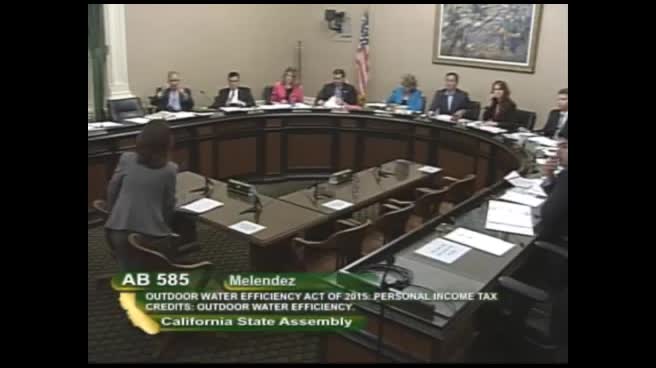 5MIN
Assembly Standing Committee on Revenue and Taxation
Bill Author

Bill Co-Author(s):