AB 604: Electrically motorized boards.
- Session Year: 2015-2016
- House: Assembly
- Latest Version Date: 2015-10-11
Existing law regulates the operation of bicycles, motorized scooters, and electric personal assistive mobility devices, as defined. Existing law makes a violation of these provisions punishable as an infraction.
This bill would define the term electrically motorized board. The bill would prohibit the operation of an electrically motorized board upon a highway while under the influence of an alcoholic beverage or any drug, or under the combined influence of an alcoholic beverage and any drug. The bill would require the operator of an electrically motorized board to wear a helmet while operating an electrically motorized board upon a highway, bikeway, or any other public bicycle path, sidewalk, or trail. The bill would require an operator to be at least 16 years of age in order to operate an electrically motorized board. The bill would also require electrically motorized boards to be equipped with safety equipment, as specified, and restrict the operation speed of electrically motorized boards. Because a violation of these provisions would be punishable as an infraction, this bill would impose a state-mandated local program.
The bill would also require the Commissioner of the California Highway Patrol to submit a report, as specified, to the Legislature, on or before January 1, 2021, to assist in determining the effect that the use of electrically motorized boards has on traffic safety.
Existing law authorizes transit development boards and public agencies, including, but not limited to, the Regents of the University of California and the Trustees of the California State University, to adopt ordinances, rules, or regulations, respectively, to restrict, or specify the conditions for, the use of bicycles, motorized bicycles, skateboards, and roller skates on property under the control of, or any portion of property used by, the board, or on public property under the jurisdiction of the agency, respectively.
This bill would additionally authorize those boards and agencies to adopt ordinances, rules, and regulations, respectively, for the use of electrically motorized boards.
Existing law authorizes local authorities to adopt rules and regulations by ordinance or resolution prohibiting or restricting persons from riding or propelling skateboards on highways, sidewalks, or roadways.
This bill would additionally authorize local authorities to adopt rules and regulations by ordinance or resolution prohibiting or restricting persons from riding or propelling electrically motorized boards on highways, sidewalks, or roadways.
Existing law makes it a crime to operate a motorized skateboard on any sidewalk, roadway, or any other part of a highway or on any bikeway, bicycle path or trail, equestrian trail, or hiking or recreational trail.
This bill would provide that an electrically motorized board is not a motorized skateboard for those purposes.
Existing law authorizes the Department of Transportation and local authorities to prohibit or restrict the use of bicycles, motorized bicycles, and motorized scooters upon freeways or expressways.
This bill would authorize the Department of Transportation and local authorities to also prohibit or restrict the use of electrically motorized boards upon freeways or expressways.
This bill would incorporate additional changes to Section 21113 of the Vehicle Code proposed by AB 1096 that would become operative only if this bill and AB 1096 are both chaptered, and this bill is chaptered last.
The California Constitution requires the state to reimburse local agencies and school districts for certain costs mandated by the state. Statutory provisions establish procedures for making that reimbursement.
This bill would provide that no reimbursement is required by this act for a specified reason.
Existing law regulates the operation of bicycles, motorized scooters, and electric personal assistive mobility devices, as defined. Existing law makes a violation of these provisions punishable as an infraction.
This bill would define the term electrically motorized skateboard. board. The bill would prohibit the operation of an electrically motorized skateboard board upon a highway while under the influence of an alcoholic beverage or any drug, or under the combined influence of an alcoholic beverage and any drug. The bill would require the operator of an electrically motorized skateboard who is under 18 years of age board to wear a helmet while operating an electrically motorized skateboard. board upon a highway, bikeway, or any other public bicycle path, sidewalk, or trail. The bill would require an operator to be at least 14 16 years of age in order to operate an electrically motorized skateboard. board. The bill would also require electrically motorized boards to be equipped with safety equipment, as specified, and restrict the operation speed of electrically motorized boards. Because a violation of these provisions would be punishable as an infraction, this bill would impose a state-mandated local program.
The bill would also require the Commissioner of the California Highway Patrol to submit a report, as specified, to the Legislature, on or before January 1, 2021, to assist in determining the effect that the use of electrically motorized boards has on traffic safety.
Existing law authorizes transit development boards and public agencies, including, but not limited to, the Regents of the University of California and the Trustees of the California State University, to adopt ordinances, rules, or regulations, respectively, to restrict, or specify the conditions for, the use of bicycles, motorized bicycles, skateboards, and roller skates on property under the control of, or any portion of property used by, the board, or on public property under the jurisdiction of the agency, respectively.
This bill would additionally authorize those boards and agencies to adopt ordinances, rules, and regulations, respectively, for the use of electrically motorized skateboards. boards.
Existing law authorizes local authorities to adopt rules and regulations by ordinance or resolution prohibiting or restricting persons from riding or propelling skateboards on highways, sidewalks, or roadways.
This bill would additionally authorize local authorities to adopt rules and regulations by ordinance or resolution prohibiting or restricting persons from riding or propelling electrically motorized skateboards boards on highways, sidewalks, or roadways.
Existing law makes it a crime to operate a motorized skateboard on any sidewalk, roadway, or any other part of a highway or on any bikeway, bicycle path or trail, equestrian trail, or hiking or recreational trail.
This bill would provide that an electrically motorized skateboard board is not a motorized skateboard for those purposes.
Existing law authorizes the Department of Transportation and local authorities to prohibit or restrict the use of bicycles, motorized bicycles, and motorized scooters upon freeways or expressways.
This bill would authorize the Department of Transportation and local authorities to also prohibit or restrict the use of electrically motorized boards upon freeways or expressways.
This bill would incorporate additional changes to Section 21113 of the Vehicle Code proposed by AB 1096 that would become operative only if this bill and AB 1096 are both chaptered, and this bill is chaptered last.
The California Constitution requires the state to reimburse local agencies and school districts for certain costs mandated by the state. Statutory provisions establish procedures for making that reimbursement.
This bill would provide that no reimbursement is required by this act for a specified reason.
Existing law regulates the operation of bicycles, motorized scooters, and electric personal assistive mobility devices, as defined. Existing law makes a violation of these provisions punishable as an infraction.
This bill would define the term “electrically motorized skateboard.” The bill would prohibit the operation of an electrically motorized skateboard upon a highway while under the influence of an alcoholic beverage or any drug, or under the combined influence of an alcoholic beverage and any drug. The bill would require the operator of an electrically motorized skateboard who is under 18 years of age to wear a helmet while operating an electrically motorized skateboard. The bill would require an operator to be at least 14 years of age in order to operate an electrically motorized skateboard. Because a violation of these provisions would be punishable as an infraction, this bill would impose a state-mandated local program.
Existing law authorizes transit development boards and public agencies, including, but not limited to, the Regents of the University of California and the Trustees of the California State University, to adopt ordinances, rules, or regulations, respectively, to restrict, or specify the conditions for, the use of bicycles, motorized bicycles, skateboards, and roller skates on property under the control of, or any portion of property used by, the board, or on public property under the jurisdiction of the agency, respectively.
This bill would additionally authorize those boards and agencies to adopt ordinances, rules, and regulations, respectively, for the use of electrically motorized skateboards.
Existing law authorizes local authorities to adopt rules and regulations by ordinance or resolution prohibiting or restricting persons from riding or propelling skateboards on highways, sidewalks, or roadways.
This bill would additionally authorize local authorities to adopt rules and regulations by ordinance or resolution prohibiting or restricting persons from riding or propelling electrically motorized skateboards on highways, sidewalks, or roadways.
Existing law makes it a crime to operate a motorized skateboard on any sidewalk, roadway, or any other part of a highway or on any bikeway, bicycle path or trail, equestrian trail, or hiking or recreational trail.
This bill would provide that an electrically motorized skateboard is not a motorized skateboard for those purposes.
The California Constitution requires the state to reimburse local agencies and school districts for certain costs mandated by the state. Statutory provisions establish procedures for making that reimbursement.
This bill would provide that no reimbursement is required by this act for a specified reason.
Existing law regulates the operation of bicycles, motorized scooters, and electric personal assistive mobility devices, as defined. Existing law makes a violation of these provisions punishable as an infraction.
This bill would define the term electrically motorized skateboard. The bill would prohibit the operation of an electrically motorized skateboard upon a highway while under the influence of an alcoholic beverage or any drug, or under the combined influence of an alcoholic beverage and any drug. The bill would require the operator of an electrically motorized skateboard who is under 18 years of age to wear a helmet while operating an electrically motorized skateboard. The bill would require an operator to be at least 14 years of age in order to operate an electrically motorized skateboard. Because a violation of these provisions would be punishable as an infraction, this bill would impose a state-mandated local program.
Existing law authorizes transit development boards and public agencies, including, but not limited to, the Regents of the University of California and the Trustees of the California State University, to adopt ordinances, rules, or regulations, respectively, to restrict, or specify the conditions for, the use of bicycles, motorized bicycles, skateboards, and roller skates on property under the control of, or any portion of property used by, the board, or on public property under the jurisdiction of the agency, respectively.
This bill would additionally authorize those boards and agencies to adopt ordinances, rules, and regulations, respectively, for the use of electrically motorized skateboards.
Existing law authorizes local authorities to adopt rules and regulations by ordinance or resolution prohibiting or restricting persons from riding or propelling skateboards on highways, sidewalks, or roadways.
This bill would additionally authorize local authorities to adopt rules and regulations by ordinance or resolution prohibiting or restricting persons from riding or propelling electrically motorized skateboards on highways, sidewalks, or roadways.
Existing law makes it a crime to operate a motorized skateboard on any sidewalk, roadway, or any other part of a highway or on any bikeway, bicycle path or trail, equestrian trail, or hiking or recreational trail.
This bill would provide that an electrically motorized skateboard is not a motorized skateboard for those purposes.
The California Constitution requires the state to reimburse local agencies and school districts for certain costs mandated by the state. Statutory provisions establish procedures for making that reimbursement.
This bill would provide that no reimbursement is required by this act for a specified reason.
Existing law regulates the operation of bicycles, motorized scooters, and electric personal assistive mobility devices, as defined.
This bill would define the term electrically motorized skateboard and would provide that those devices are subject to the provisions of law applicable to a driver of a vehicle, except as specified. By making the operation of an electrically motorized skateboard subject to existing laws, the violation of which are offenses, this bill would expand the scope of existing crimes, and impose a state-mandated local program. skateboard.
The bill would make it an infraction for a person to operate an electrically motorized skateboard upon a highway while under the influence of an alcoholic beverage or any drug, or under the combined influence of an alcoholic beverage and any drug. The bill would, subject to restrictions, authorize the operation of electrically motorized skateboards on highways, bikeways, and sidewalks, would require an operator under 18 years of age to wear a helmet, and would require an operator to be at least 12 years of age in order to operate an electrically motorized skateboard on a highway or bikeway. The bill would prohibit the operation of an electrically motorized skateboard at a speed in excess of 20 miles per hour. The bill would require specified braking and lighting equipment for the operation of an electrically motorized skateboard. A violation of these provisions would be an infraction under existing law. By creating a new infraction and expanding the scope of existing crimes, this bill would impose a state-mandated local program.
Existing law authorizes transit development boards and public agencies, including, but not limited to, the Regents of the University of California and the Trustees of the California State University, to adopt ordinances, rules, or regulations, respectively, to restrict, or specify the conditions for, the use of bicycles, motorized bicycles, skateboards, and roller skates on property under the control of, or any portion of property used by, the board, or on public property under the jurisdiction of the agency, respectively.
This bill would additionally authorize those boards and agencies to adopt ordinances, rules, and regulations, respectively, for the use of electrically motorized skateboards.
Existing law authorizes local authorities to adopt rules and regulations by ordinance or resolution prohibiting or restricting persons from riding or propelling skateboards on highways, sidewalks, or roadways.
This bill would additionally authorize local authorities to adopt rules and regulations by ordinance or resolution prohibiting or restricting persons from riding or propelling electrically motorized skateboards on highways, sidewalks, or roadways.
Existing law makes it a crime to operate a motorized skateboard on any sidewalk, roadway, or any other part of a highway or on any bikeway, bicycle path or trail, equestrian trail, or hiking or recreational trail.
This bill would provide that an electrically motorized skateboard is not a motorized skateboard for those purposes.
The bill would state findings and declarations of the Legislature relative to electrically motorized skateboards.
The California Constitution requires the state to reimburse local agencies and school districts for certain costs mandated by the state. Statutory provisions establish procedures for making that reimbursement.
This bill would provide that no reimbursement is required by this act for a specified reason.
Existing law regulates the operation of bicycles, motorized scooters, and electric personal assistive mobility devices, as defined.
This bill would define the term electrically motorized skateboard and would provide that those devices are subject to the provisions of law applicable to a driver of a vehicle, except as specified. By making the operation of an electrically motorized skateboard subject to existing laws, the violation of which are offenses, this bill would expand the scope of existing crimes, and impose a state-mandated local program.
The bill would make it an infraction for a person to operate an electrically motorized skateboard upon a highway while under the influence of an alcoholic beverage or any drug, or under the combined influence of an alcoholic beverage and any drug. The bill would, subject to restrictions, authorize the operation of electrically motorized skateboards on highways, bikeways, and sidewalks, would require an operator under 18 years of age to wear a helmet, and would require an operator to be at least 12 years of age in order to operate an electrically motorized skateboard on a highway or bikeway. The bill would prohibit the operation of an electrically motorized skateboard at a speed in excess of 20 miles per hour. The bill would require specified braking and lighting equipment for the operation of an electrically motorized skateboard. A violation of these provisions would be an infraction under existing law. By creating a new infraction and expanding the scope of existing crimes, this bill would impose a state-mandated local program.
Existing law makes it a crime to operate a motorized skateboard on any sidewalk, roadway, or any other part of a highway or on any bikeway, bicycle path or trail, equestrian trail, or hiking or recreational trail.
This bill would provide that an electrically motorized skateboard is not a motorized skateboard for those purposes.
The bill would state findings and declarations of the Legislature relative to electrically motorized skateboards.
The California Constitution requires the state to reimburse local agencies and school districts for certain costs mandated by the state. Statutory provisions establish procedures for making that reimbursement.
This bill would provide that no reimbursement is required by this act for a specified reason.
An electrically motorized board is any wheeled device that has a floorboard designed to be stood upon when riding that is not greater than 60 inches deep and 18 inches wide, is designed to transport only one person, and has an electric propulsion system averaging less than 1,000 watts, the maximum speed of which, when powered solely by a propulsion system on a paved level surface, is no more than 20 miles per hour. The device may be designed to also be powered by human propulsion.
SEC. 2.Section 21113 of the Vehicle Code is amended to read:21113.(a)A person shall not drive a vehicle or animal, or stop, park, or leave standing a vehicle or animal, whether attended or unattended, upon the driveways, paths, parking facilities, or the grounds of any public school, state university, state college, unit of the state park system, county park, municipal airport, rapid transit district, transit development board, transit district, public transportation agency, county transportation commission created pursuant to Section 130050 of the Public Utilities Code, joint powers agency operating or managing a commuter rail system, or any property under the direct control of the legislative body of a municipality, or a state, county, or hospital district institution or building, or an educational institution exempted, in whole or in part, from taxation, or any harbor improvement district or harbor district formed pursuant to Part 2 (commencing with Section 5800) or Part 3 (commencing with Section 6000) of Division 8 of the Harbors and Navigation Code, a district organized pursuant to Part 3 (commencing with Section 27000) of Division 16 of the Streets and Highways Code, or state grounds served by the Department of the California Highway Patrol, or any property under the possession or control of a housing authority formed pursuant to Article 2 (commencing with Section 34240) of Chapter 1 of Part 2 of Division 24 of the Health and Safety Code, except with the permission of, and upon and subject to any condition or regulation that may be imposed by, the legislative body of the municipality, or the governing board or officer of the public school, state university, state college, county park, municipal airport, rapid transit district, transit development board, transit district, public transportation agency, county transportation commission, joint powers agency operating or managing a commuter rail system, or state, county, or hospital district institution or building, or educational institution, or harbor district, or a district organized pursuant to Part 3 (commencing with Section 27000) of Division 16 of the Streets and Highways Code, or housing authority, or the Director of Parks and Recreation regarding units of the state park system or the state agency with jurisdiction over the grounds served by the Department of the California Highway Patrol.
(b)A governing board, legislative body, or officer shall erect or place appropriate signs giving notice of any special conditions or regulations that are imposed under this section and the governing board, legislative body, or officer shall also prepare and keep available at the principal administrative office of the governing board, legislative body, or officer, for examination by all interested persons, a written statement of all those special conditions and regulations adopted pursuant to this section.
(c)When a governing board, legislative body, or officer permits public traffic upon the driveways, paths, parking facilities, or grounds under their control then, except for those conditions imposed or regulations enacted by the governing board, legislative body, or officer applicable to the traffic, all the provisions of this code relating to traffic upon the highways shall be applicable to the traffic upon the driveways, paths, parking facilities, or grounds.
(d)A public transportation agency that imposes any condition or regulation upon a person who parks or leaves standing a vehicle, pursuant to subdivision (a), is authorized to do either of the following:
(1)Enforce that condition or regulation in the manner provided in Article 3 (commencing with Section 40200) of Chapter 1 of Division 17 of this code. The public transportation agency shall be considered the issuing agency for that purpose.
(2)Designate regularly employed and salaried employees, who are engaged in directing traffic or enforcing parking laws and regulations, for the purpose of removing any vehicle in the same manner as a city, county, or jurisdiction of a state agency pursuant to Chapter 10 (commencing with Section 22650) of Division 11 of this code.
(e)With respect to the permitted use of vehicles or animals on property under the direct control of the legislative body of a municipality, no change in the use of vehicles or animals on the property, that had been permitted on January 1, 1976, shall be effective unless and until the legislative body, at a meeting open to the general public, determines that the use of vehicles or animals on the property should be prohibited or regulated.
(f)A transit development board may adopt ordinances, rules, or regulations to restrict, or specify the conditions for, the use of bicycles, motorized bicycles, skateboards, electrically motorized boards, and roller skates on property under the control of, or any portion of property used by, the board.
(g)A public agency, including, but not limited to, the Regents of the University of California and the Trustees of the California State University, may adopt rules or regulations to restrict, or specify the conditions for, the use of bicycles, motorized bicycles, skateboards, electrically motorized boards, and roller skates on public property under the jurisdiction of that agency.
(h)Housing authority, for the purposes of this section, means a housing authority located within a county with a population of over 6,000,000 people, and any other housing authority that complies with the requirements of this section.
(i)Public transportation agency, for purposes of this section, means a public agency that provides public transportation as defined in paragraph (1) of subdivision (f) of Section 1 of Article XIXA of the California Constitution.
SEC. 2.5.Section 21113 of the Vehicle Code is amended to read:21113.(a)A person shall not drive a vehicle or animal, or stop, park, or leave standing a vehicle or animal, whether attended or unattended, upon the driveways, paths, parking facilities, or the grounds of any public school, state university, state college, unit of the state park system, county park, municipal airport, rapid transit district, transit development board, transit district, public transportation agency, county transportation commission created pursuant to Section 130050 of the Public Utilities Code, joint powers agency operating or managing a commuter rail system, or any property under the direct control of the legislative body of a municipality, or a state, county, or hospital district institution or building, or an educational institution exempted, in whole or in part, from taxation, or any harbor improvement district or harbor district formed pursuant to Part 2 (commencing with Section 5800) or Part 3 (commencing with Section 6000) of Division 8 of the Harbors and Navigation Code, a district organized pursuant to Part 3 (commencing with Section 27000) of Division 16 of the Streets and Highways Code, or state grounds served by the Department of the California Highway Patrol, or any property under the possession or control of a housing authority formed pursuant to Article 2 (commencing with Section 34240) of Chapter 1 of Part 2 of Division 24 of the Health and Safety Code, except with the permission of, and upon and subject to any condition or regulation that may be imposed by, the legislative body of the municipality, or the governing board or officer of the public school, state university, state college, county park, municipal airport, rapid transit district, transit development board, transit district, public transportation agency, county transportation commission, joint powers agency operating or managing a commuter rail system, or state, county, or hospital district institution or building, or educational institution, or harbor district, or a district organized pursuant to Part 3 (commencing with Section 27000) of Division 16 of the Streets and Highways Code, or housing authority, or the Director of Parks and Recreation regarding units of the state park system or the state agency with jurisdiction over the grounds served by the Department of the California Highway Patrol.
(b)A governing board, legislative body, or officer shall erect or place appropriate signs giving notice of any special conditions or regulations that are imposed under this section and the governing board, legislative body, or officer shall also prepare and keep available at the principal administrative office of the governing board, legislative body, or officer, for examination by all interested persons, a written statement of all those special conditions and regulations adopted pursuant to this section.
(c)When a governing board, legislative body, or officer permits public traffic upon the driveways, paths, parking facilities, or grounds under their control then, except for those conditions imposed or regulations enacted by the governing board, legislative body, or officer applicable to the traffic, all the provisions of this code relating to traffic upon the highways shall be applicable to the traffic upon the driveways, paths, parking facilities, or grounds.
(d)A public transportation agency that imposes any condition or regulation upon a person who parks or leaves standing a vehicle, pursuant to subdivision (a), is authorized to do either of the following:
(1)Enforce that condition or regulation in the manner provided in Article 3 (commencing with Section 40200) of Chapter 1 of Division 17 of this code. The public transportation agency shall be considered the issuing agency for that purpose.
(2)Designate regularly employed and salaried employees, who are engaged in directing traffic or enforcing parking laws and regulations, for the purpose of removing any vehicle in the same manner as a city, county, or jurisdiction of a state agency pursuant to Chapter 10 (commencing with Section 22650) of Division 11 of this code.
(e)With respect to the permitted use of vehicles or animals on property under the direct control of the legislative body of a municipality, no change in the use of vehicles or animals on the property, that had been permitted on January 1, 1976, shall be effective unless and until the legislative body, at a meeting open to the general public, determines that the use of vehicles or animals on the property should be prohibited or regulated.
(f)A transit development board may adopt ordinances, rules, or regulations to restrict, or specify the conditions for, the use of bicycles, motorized bicycles, electric bicycles, skateboards, electrically motorized boards, and roller skates on property under the control of, or any portion of property used by, the board.
(g)A public agency, including, but not limited to, the Regents of the University of California and the Trustees of the California State University, may adopt rules or regulations to restrict, or specify the conditions for, the use of bicycles, motorized bicycles, electric bicycles, skateboards, electrically motorized boards, and roller skates on public property under the jurisdiction of that agency.
(h)Housing authority, for the purposes of this section, means a housing authority located within a county with a population of over 6,000,000 people, and any other housing authority that complies with the requirements of this section.
(i)Public transportation agency, for purposes of this section, means a public agency that provides public transportation as defined in paragraph (1) of subdivision (f) of Section 1 of Article XIXA of the California Constitution.
SEC. 3.Article 7 (commencing with Section 21290) is added to Chapter 1 of Division 11 of the Vehicle Code, to read:7.Operation of Electrically Motorized Boards21290.(a)For purposes of this article, bikeway is defined in Section 890.4 of the Streets and Highways Code.
(b)For purposes of this article, an electrically motorized board is defined in Section 313.5.
21291.An electrically motorized board shall be operated only by a person who is 16 years of age or older.
21292.A person shall not operate an electrically motorized board upon a highway, bikeway, or any other public bicycle path, sidewalk, or trail, unless that person is wearing a properly fitted and fastened bicycle helmet that meets the standards described in Section 21212.
21293.(a)Every electrically motorized board operated upon a highway during darkness shall be equipped with all of the following:
(1)Except as provided in subdivision (b), a lamp emitting a white light that, while the electrically motorized board is in motion, illuminates the highway in front of the operator and is visible from a distance of 300 feet in front of the electrically motorized board.
(2)Except as provided in subdivision (c), a red reflector on the rear that is visible from a distance of 500 feet to the rear when directly in front of lawful upper beams of headlamps on a motor vehicle.
(3)Except as provided in subdivision (d), a white or yellow reflector on each side that is visible from a distance of 200 feet from the sides of the electrically motorized board.
(b)A lamp or lamp combination, emitting a white light, attached to the operator and visible from a distance of 300 feet in front of the electrically motorized board, may be used in lieu of the lamp required by paragraph (1) of subdivision (a).
(c)A red reflector, or reflectorizing material meeting the requirements of Section 25500, attached to the operator and visible from a distance of 500 feet to the rear when directly in front of lawful upper beams of headlamps on a motor vehicle, may be used in lieu of the reflector required by paragraph (2) of subdivision (a).
(d)A white or yellow reflector, or reflectorizing material meeting the requirements of Section 25500, attached to the operator and visible from a distance of 200 feet from the sides of the electrically motorized board, may be used in lieu of the reflector required by paragraph (3) of subdivision (a).
21294.(a)Electrically motorized boards shall only operate upon a highway designated with a speed limit of 35 miles per hour or less, unless the electrically motorized board is operated entirely within a designated Class II or Class IV bikeway.
(b)A person shall not operate an electrically motorized board upon a highway, bikeway, or any other public bicycle path, sidewalk, or trail, at a speed in excess of 15 miles per hour.
(c)Notwithstanding subdivision (b), a person shall not operate an electrically motorized board at a speed greater than is reasonable or prudent having due regard for weather, visibility, pedestrian and vehicular traffic, and the surface and width of the highway, bikeway, public bicycle path, sidewalk, or trail, and in no event at a speed that endangers the safety of any person or property.
21295.The Commissioner of the California Highway Patrol shall submit a report to the Legislature, on or before January 1, 2021, to assist in determining the effect that the use of electrically motorized boards has on traffic safety. The report shall include detailed statewide traffic collision data involving electrically motorized boards, including property damage only, injury, and fatal traffic collisions. The report shall be submitted in compliance with Section 9795 of the Government Code. Pursuant to Section 10231.5 of the Government Code, this section is repealed on January 1, 2025.
21296.(a)It is unlawful for a person to operate an electrically motorized board upon a highway while under the influence of an alcoholic beverage or any drug, or under the combined influence of an alcoholic beverage and any drug.
(b)A person arrested for a violation of this section may request to have a chemical test made of his or her blood or breath for the purpose of determining the alcoholic or drug content of that persons blood pursuant to subdivision (d) of Section 23612, and, if so requested, the arresting officer shall have the test performed.
(c)A conviction for a violation of this section shall be punished by a fine of not more than two hundred fifty dollars ($250).
SEC. 4.Section 21960 of the Vehicle Code is amended to read:21960.(a)The Department of Transportation and local authorities, by order, ordinance, or resolution, with respect to freeways, expressways, or designated portions thereof under their respective jurisdictions, to which vehicle access is completely or partially controlled, may prohibit or restrict the use of the freeways, expressways, or any portion thereof by pedestrians, bicycles or other nonmotorized traffic or by any person operating a motor-driven cycle, motorized bicycle, motorized scooter, or electrically motorized board. A prohibition or restriction pertaining to bicycles, motor-driven cycles, motorized scooters, or electrically motorized boards shall be deemed to include motorized bicycles. A person shall not operate a motorized bicycle wherever that prohibition or restriction is in force. Notwithstanding any order, ordinance, or resolution to the contrary, the driver or passengers of a disabled vehicle stopped on a freeway or expressway may walk to the nearest exit, in either direction, on that side of the freeway or expressway upon which the vehicle is disabled, from which telephone or motor vehicle repair services are available.
(b)The prohibitory regulation authorized by subdivision (a) shall be effective when appropriate signs giving notice thereof are erected upon any freeway or expressway and the approaches thereto. If any portion of a county freeway or expressway is contained within the limits of a city within the county, the county may erect signs on that portion as required under this subdivision if the ordinance has been approved by the city pursuant to subdivision (b) of Section 1730 of the Streets and Highways Code.
(c)No ordinance or resolution of local authorities shall apply to any state highway until the proposed ordinance or resolution has been presented to, and approved in writing by, the Department of Transportation.
(d)An ordinance or resolution adopted under this section on or after January 1, 2005, to prohibit pedestrian access to a county freeway or expressway shall not be effective unless it is supported by a finding by the local authority that the freeway or expressway does not have pedestrian facilities and pedestrian use would pose a safety risk to the pedestrian.
SEC. 5.Section 21967 of the Vehicle Code is amended to read:21967.Except as provided in Section 21968, a local authority may adopt rules and regulations by ordinance or resolution prohibiting or restricting persons from riding or propelling skateboards, or electrically motorized boards, on highways, sidewalks, or roadways.
SEC. 6.Section 21968 of the Vehicle Code is amended to read:21968.(a)A motorized skateboard shall not be propelled on any sidewalk, roadway, or any other part of a highway or on any bikeway, bicycle path or trail, equestrian trail, or hiking or recreational trail.
(b)For purposes of this section, an electrically motorized board, as defined in Section 313.5, is not a motorized skateboard.
SEC. 7.Section 2.5 of this bill incorporates amendments to Section 21113 of the Vehicle Code proposed by both this bill and Assembly Bill 1096. It shall only become operative if (1) both bills are enacted and become effective on or before January 1, 2016, (2) each bill amends Section 21113 of the Vehicle Code, and (3) this bill is enacted after Assembly Bill 1096, in which case Section 2 of this bill shall not become operative.
SEC. 8.No reimbursement is required by this act pursuant to Section 6 of Article XIIIB of the California Constitution because the only costs that may be incurred by a local agency or school district will be incurred because this act creates a new crime or infraction, eliminates a crime or infraction, or changes the penalty for a crime or infraction, within the meaning of Section 17556 of the Government Code, or changes the definition of a crime within the meaning of Section 6 of Article XIIIB of the California Constitution.
(a)An electrically motorized skateboard board is any four-wheeled wheeled device that has a floorboard designed to be stood upon when riding that is not greater than 60 inches deep and 18 inches wide, is designed to transport only one person, and has an electric propulsion system averaging less than 1,000 watts, the maximum speed of which, when powered solely by a propulsion system on a paved level surface, is no more than 20 miles per hour. The device may be designed to also be powered by human propulsion.
(b)An electrically motorized skateboard does not include an electric personal assistive mobility device, as defined in Section 313, a motorcycle, as defined in Section 400, a motor-driven cycle, as defined in Section 405, a motorized bicycle or moped, as defined in Section 406, or a motorized scooter, as defined in Section 407.5.
SEC. 2.Section 21113 of the Vehicle Code is amended to read:21113.(a)A person shall not drive a vehicle or animal, or stop, park, or leave standing a vehicle or animal, whether attended or unattended, upon the driveways, paths, parking facilities, or the grounds of any public school, state university, state college, unit of the state park system, county park, municipal airport, rapid transit district, transit development board, transit district, public transportation agency, county transportation commission created pursuant to Section 130050 of the Public Utilities Code, joint powers agency operating or managing a commuter rail system, or any property under the direct control of the legislative body of a municipality, or a state, county, or hospital district institution or building, or an educational institution exempted, in whole or in part, from taxation, or any harbor improvement district or harbor district formed pursuant to Part 2 (commencing with Section 5800) or Part 3 (commencing with Section 6000) of Division 8 of the Harbors and Navigation Code, a district organized pursuant to Part 3 (commencing with Section 27000) of Division 16 of the Streets and Highways Code, or state grounds served by the Department of the California Highway Patrol, or any property under the possession or control of a housing authority formed pursuant to Article 2 (commencing with Section 34240) of Chapter 1 of Part 2 of Division 24 of the Health and Safety Code, except with the permission of, and upon and subject to any condition or regulation that may be imposed by, the legislative body of the municipality, or the governing board or officer of the public school, state university, state college, county park, municipal airport, rapid transit district, transit development board, transit district, public transportation agency, county transportation commission, joint powers agency operating or managing a commuter rail system, or state, county, or hospital district institution or building, or educational institution, or harbor district, or a district organized pursuant to Part 3 (commencing with Section 27000) of Division 16 of the Streets and Highways Code, or housing authority, or the Director of Parks and Recreation regarding units of the state park system or the state agency with jurisdiction over the grounds served by the Department of the California Highway Patrol.
(b)A governing board, legislative body, or officer shall erect or place appropriate signs giving notice of any special conditions or regulations that are imposed under this section and the governing board, legislative body, or officer shall also prepare and keep available at the principal administrative office of the governing board, legislative body, or officer, for examination by all interested persons, a written statement of all those special conditions and regulations adopted pursuant to this section.
(c)When a governing board, legislative body, or officer permits public traffic upon the driveways, paths, parking facilities, or grounds under their control then, except for those conditions imposed or regulations enacted by the governing board, legislative body, or officer applicable to the traffic, all the provisions of this code relating to traffic upon the highways shall be applicable to the traffic upon the driveways, paths, parking facilities, or grounds.
(d)A public transportation agency that imposes any condition or regulation upon a person who parks or leaves standing a vehicle, pursuant to subdivision (a), is authorized to do either of the following:
(1)Enforce that condition or regulation in the manner provided in Article 3 (commencing with Section 40200) of Chapter 1 of Division 17 of this code. The public transportation agency shall be considered the issuing agency for that purpose.
(2)Designate regularly employed and salaried employees, who are engaged in directing traffic or enforcing parking laws and regulations, for the purpose of removing any vehicle in the same manner as a city, county, or jurisdiction of a state agency pursuant to Chapter 10 (commencing with Section 22650) of Division 11 of this code.
(e)With respect to the permitted use of vehicles or animals on property under the direct control of the legislative body of a municipality, no change in the use of vehicles or animals on the property, that had been permitted on January 1, 1976, shall be effective unless and until the legislative body, at a meeting open to the general public, determines that the use of vehicles or animals on the property should be prohibited or regulated.
(f)A transit development board may adopt ordinances, rules, or regulations to restrict, or specify the conditions for, the use of bicycles, motorized bicycles, skateboards, electrically motorized skateboards, boards, and roller skates on property under the control of, or any portion of property used by, the board.
(g)A public agency, including, but not limited to, the Regents of the University of California and the Trustees of the California State University, may adopt rules or regulations to restrict, or specify the conditions for, the use of bicycles, motorized bicycles, skateboards, electrically motorized skateboards, boards, and roller skates on public property under the jurisdiction of that agency.
(h)Housing authority, for the purposes of this section, means a housing authority located within a county with a population of over six million 6,000,000 people, and any other housing authority that complies with the requirements of this section.
(i)Public transportation agency, for purposes of this section, means a public agency that provides public transportation as defined in paragraph (1) of subdivision (f) of Section 1 of Article XIXA of the California Constitution.
SEC. 2.5.Section 21113 of the Vehicle Code is amended to read:21113.(a)A person shall not drive a vehicle or animal, or stop, park, or leave standing a vehicle or animal, whether attended or unattended, upon the driveways, paths, parking facilities, or the grounds of any public school, state university, state college, unit of the state park system, county park, municipal airport, rapid transit district, transit development board, transit district, public transportation agency, county transportation commission created pursuant to Section 130050 of the Public Utilities Code, joint powers agency operating or managing a commuter rail system, or any property under the direct control of the legislative body of a municipality, or a state, county, or hospital district institution or building, or an educational institution exempted, in whole or in part, from taxation, or any harbor improvement district or harbor district formed pursuant to Part 2 (commencing with Section 5800) or Part 3 (commencing with Section 6000) of Division 8 of the Harbors and Navigation Code, a district organized pursuant to Part 3 (commencing with Section 27000) of Division 16 of the Streets and Highways Code, or state grounds served by the Department of the California Highway Patrol, or any property under the possession or control of a housing authority formed pursuant to Article 2 (commencing with Section 34240) of Chapter 1 of Part 2 of Division 24 of the Health and Safety Code, except with the permission of, and upon and subject to any condition or regulation that may be imposed by, the legislative body of the municipality, or the governing board or officer of the public school, state university, state college, county park, municipal airport, rapid transit district, transit development board, transit district, public transportation agency, county transportation commission, joint powers agency operating or managing a commuter rail system, or state, county, or hospital district institution or building, or educational institution, or harbor district, or a district organized pursuant to Part 3 (commencing with Section 27000) of Division 16 of the Streets and Highways Code, or housing authority, or the Director of Parks and Recreation regarding units of the state park system or the state agency with jurisdiction over the grounds served by the Department of the California Highway Patrol.
(b)A governing board, legislative body, or officer shall erect or place appropriate signs giving notice of any special conditions or regulations that are imposed under this section and the governing board, legislative body, or officer shall also prepare and keep available at the principal administrative office of the governing board, legislative body, or officer, for examination by all interested persons, a written statement of all those special conditions and regulations adopted pursuant to this section.
(c)When a governing board, legislative body, or officer permits public traffic upon the driveways, paths, parking facilities, or grounds under their control then, except for those conditions imposed or regulations enacted by the governing board, legislative body, or officer applicable to the traffic, all the provisions of this code relating to traffic upon the highways shall be applicable to the traffic upon the driveways, paths, parking facilities, or grounds.
(d)A public transportation agency that imposes any condition or regulation upon a person who parks or leaves standing a vehicle, pursuant to subdivision (a), is authorized to do either of the following:
(1)Enforce that condition or regulation in the manner provided in Article 3 (commencing with Section 40200) of Chapter 1 of Division 17 of this code. The public transportation agency shall be considered the issuing agency for that purpose.
(2)Designate regularly employed and salaried employees, who are engaged in directing traffic or enforcing parking laws and regulations, for the purpose of removing any vehicle in the same manner as a city, county, or jurisdiction of a state agency pursuant to Chapter 10 (commencing with Section 22650) of Division 11 of this code.
(e)With respect to the permitted use of vehicles or animals on property under the direct control of the legislative body of a municipality, no change in the use of vehicles or animals on the property, that had been permitted on January 1, 1976, shall be effective unless and until the legislative body, at a meeting open to the general public, determines that the use of vehicles or animals on the property should be prohibited or regulated.
(f)A transit development board may adopt ordinances, rules, or regulations to restrict, or specify the conditions for, the use of bicycles, motorized bicycles, electric bicycles, skateboards, electrically motorized boards, and roller skates on property under the control of, or any portion of property used by, the board.
(g)A public agency, including, but not limited to, the Regents of the University of California and the Trustees of the California State University, may adopt rules or regulations to restrict, or specify the conditions for, the use of bicycles, motorized bicycles, electric bicycles, skateboards, electrically motorized boards, and roller skates on public property under the jurisdiction of that agency.
(h)Housing authority, for the purposes of this section, means a housing authority located within a county with a population of over six million 6,000,000 people, and any other housing authority that complies with the requirements of this section.
(i)Public transportation agency, for purposes of this section, means a public agency that provides public transportation as defined in paragraph (1) of subdivision (f) of Section 1 of Article XIXA of the California Constitution.
SEC. 3.Article 7 (commencing with Section 21290) is added to Chapter 1 of Division 11 of the Vehicle Code, to read:7.Operation of Electrically Motorized Skateboards21290.For purposes of this article, an electrically motorized skateboard is defined in Section 313.5.
21292.An electrically motorized skateboard shall be operated only by a person who is 14 years of age or older.
21294.An electrically motorized skateboard may be operated by a person under 18 years of age only if the operator is wearing a properly fitted and fastened bicycle helmet that meets the standards described in Section 21212.
21296.(a)It is unlawful for a person to operate an electrically motorized skateboard upon a highway while under the influence of an alcoholic beverage or any drug, or under the combined influence of an alcoholic beverage and any drug.
(b)A person arrested for a violation of this section may request to have a chemical test made of the persons blood or breath for the purpose of determining the alcoholic or drug content of that persons blood pursuant to subdivision (d) of Section 23612, and, if so requested, the arresting officer shall have the test performed.
(c) A conviction for a violation of this section shall be punished by a fine of not more than two hundred fifty dollars ($250).
SEC. 3.Article 7 (commencing with Section 21290) is added to Chapter 1 of Division 11 of the Vehicle Code, to read:7.Operation of Electrically Motorized Boards21290.(a)For purposes of this article, bikeway is defined in Section 890.4 of the Streets and Highways Code.
(b)For purposes of this article, an electrically motorized board is defined in Section 313.5.
21291.An electrically motorized board shall be operated only by a person who is 16 years of age or older.
21292.A person shall not operate an electrically motorized board upon a highway, bikeway, or any other public bicycle path, sidewalk, or trail, unless that person is wearing a properly fitted and fastened bicycle helmet that meets the standards described in Section 21212.
21293.(a)Every electrically motorized board operated upon a highway during darkness shall be equipped with all of the following:
(1)Except as provided in subdivision (b), a lamp emitting a white light that, while the electrically motorized board is in motion, illuminates the highway in front of the operator and is visible from a distance of 300 feet in front of the electrically motorized board.
(2)Except as provided in subdivision (c), a red reflector on the rear that is visible from a distance of 500 feet to the rear when directly in front of lawful upper beams of headlamps on a motor vehicle.
(3)Except as provided in subdivision (d), a white or yellow reflector on each side that is visible from a distance of 200 feet from the sides of the electrically motorized board.
(b)A lamp or lamp combination, emitting a white light, attached to the operator and visible from a distance of 300 feet in front of the electrically motorized board, may be used in lieu of the lamp required by paragraph (1) of subdivision (a).
(c)A red reflector, or reflectorizing material meeting the requirements of Section 25500, attached to the operator and visible from a distance of 500 feet to the rear when directly in front of lawful upper beams of headlamps on a motor vehicle, may be used in lieu of the reflector required by paragraph (2) of subdivision (a).
(d)A white or yellow reflector, or reflectorizing material meeting the requirements of Section 25500, attached to the operator and visible from a distance of 200 feet from the sides of the electrically motorized board, may be used in lieu of the reflector required by paragraph (3) of subdivision (a).
21294.(a)Electrically motorized boards shall only operate upon a highway designated with a speed limit of 35 miles per hour or less, unless the electrically motorized board is operated entirely within a designated Class II or Class IV bikeway.
(b)A person shall not operate an electrically motorized board upon a highway, bikeway, or any other public bicycle path, sidewalk, or trail, at a speed in excess of 15 miles per hour.
(c)Notwithstanding subdivision (b), a person shall not operate an electrically motorized board at a speed greater than is reasonable or prudent having due regard for weather, visibility, pedestrian and vehicular traffic, and the surface and width of the highway, bikeway, public bicycle path, sidewalk, or trail, and in no event at a speed that endangers the safety of any person or property.
21295.The Commissioner of the California Highway Patrol shall submit a report to the Legislature, on or before January 1, 2021, to assist in determining the effect that the use of electrically motorized boards has on traffic safety. The report shall include detailed statewide traffic collision data involving electrically motorized boards, including property damage only, injury, and fatal traffic collisions. The report shall be submitted in compliance with Section 9795 of the Government Code. Pursuant to Section 10231.5 of the Government Code, this section is repealed on January 1, 2025.
21296.(a)It is unlawful for a person to operate an electrically motorized board upon a highway while under the influence of an alcoholic beverage or any drug, or under the combined influence of an alcoholic beverage and any drug.
(b)A person arrested for a violation of this section may request to have a chemical test made of his or her blood or breath for the purpose of determining the alcoholic or drug content of that persons blood pursuant to subdivision (d) of Section 23612, and, if so requested, the arresting officer shall have the test performed.
(c)A conviction for a violation of this section shall be punished by a fine of not more than two hundred fifty dollars ($250).
SEC. 4.Section 21960 of the Vehicle Code is amended to read:21960.(a)The Department of Transportation and local authorities, by order, ordinance, or resolution, with respect to freeways, expressways, or designated portions thereof under their respective jurisdictions, to which vehicle access is completely or partially controlled, may prohibit or restrict the use of the freeways, expressways, or any portion thereof by pedestrians, bicycles or other nonmotorized traffic or by any person operating a motor-driven cycle, motorized bicycle, or motorized scooter. scooter, or electrically motorized board. A prohibition or restriction pertaining to bicycles, motor-driven cycles, or motorized scooters scooters, or electrically motorized boards shall be deemed to include motorized bicycles; and no person may bicycles. A person shall not operate a motorized bicycle wherever that prohibition or restriction is in force. Notwithstanding any provisions of any order, ordinance, or resolution to the contrary, the driver or passengers of a disabled vehicle stopped on a freeway or expressway may walk to the nearest exit, in either direction, on that side of the freeway or expressway upon which the vehicle is disabled, from which telephone or motor vehicle repair services are available.
(b)The prohibitory regulation authorized by subdivision (a) shall be effective when appropriate signs giving notice thereof are erected upon any freeway or expressway and the approaches thereto. If any portion of a county freeway or expressway is contained within the limits of a city within the county, the county may erect signs on that portion as required under this subdivision if the ordinance has been approved by the city pursuant to subdivision (b) of Section 1730 of the Streets and Highways Code.
(c)No ordinance or resolution of local authorities shall apply to any state highway until the proposed ordinance or resolution has been presented to, and approved in writing by, the Department of Transportation.
(d)An ordinance or resolution adopted under this section on or after January 1, 2005, to prohibit pedestrian access to a county freeway or expressway shall not be effective unless it is supported by a finding by the local authority that the freeway or expressway does not have pedestrian facilities and pedestrian use would pose a safety risk to the pedestrian.
SEC. 4.SEC. 5.Section 21967 of the Vehicle Code is amended to read:21967.Except as provided in Section 21968, a local authority may adopt rules and regulations by ordinance or resolution prohibiting or restricting persons from riding or propelling skateboards, or electrically motorized skateboards, boards, on highways, sidewalks, or roadways.
SEC. 5.SEC. 6.Section 21968 of the Vehicle Code is amended to read:21968.(a)A motorized skateboard shall not be propelled on any sidewalk, roadway, or any other part of a highway or on any bikeway, bicycle path or trail, equestrian trail, or hiking or recreational trail.
(b)For purposes of this section, an electrically motorized skateboard, board, as defined in Section 313.5, is not a motorized skateboard.
SEC. 7.Section 2.5 of this bill incorporates amendments to Section 21113 of the Vehicle Code proposed by both this bill and Assembly Bill 1096. It shall only become operative if (1) both bills are enacted and become effective on or before January 1, 2016, (2) each bill amends Section 21113 of the Vehicle Code, and (3) this bill is enacted after Assembly Bill 1096, in which case Section 2 of this bill shall not become operative.
SEC. 6.SEC. 8.No reimbursement is required by this act pursuant to Section 6 of Article XIIIB of the California Constitution because the only costs that may be incurred by a local agency or school district will be incurred because this act creates a new crime or infraction, eliminates a crime or infraction, or changes the penalty for a crime or infraction, within the meaning of Section 17556 of the Government Code, or changes the definition of a crime within the meaning of Section 6 of Article XIIIB of the California Constitution.
(a)An “electrically motorized skateboard” is any four-wheeled device that has a floorboard designed to be stood upon when riding that is not greater than 60 inches deep and 18 inches wide, is designed to transport only one person, and has an electric propulsion system averaging less than 1,000 watts, the maximum speed of which, when powered solely by a propulsion system on a paved level surface, is no more than 20 miles per hour. The device may be designed to also be powered by human propulsion.
(b)An electrically motorized skateboard does not include an electric personal assistive mobility device, as defined in Section 313, a motorcycle, as defined in Section 400, a motor-driven cycle, as defined in Section 405, a motorized bicycle or moped, as defined in Section 406, or a motorized scooter, as defined in Section 407.5.
SEC. 2.Section 21113 of the Vehicle Code is amended to read:21113.(a)A person shall not drive a vehicle or animal, or stop, park, or leave standing a vehicle or animal, whether attended or unattended, upon the driveways, paths, parking facilities, or the grounds of any public school, state university, state college, unit of the state park system, county park, municipal airport, rapid transit district, transit development board, transit district, public transportation agency, county transportation commission created pursuant to Section 130050 of the Public Utilities Code, joint powers agency operating or managing a commuter rail system, or any property under the direct control of the legislative body of a municipality, or a state, county, or hospital district institution or building, or an educational institution exempted, in whole or in part, from taxation, or any harbor improvement district or harbor district formed pursuant to Part 2 (commencing with Section 5800) or Part 3 (commencing with Section 6000) of Division 8 of the Harbors and Navigation Code, a district organized pursuant to Part 3 (commencing with Section 27000) of Division 16 of the Streets and Highways Code, or state grounds served by the Department of the California Highway Patrol, or any property under the possession or control of a housing authority formed pursuant to Article 2 (commencing with Section 34240) of Chapter 1 of Part 2 of Division 24 of the Health and Safety Code, except with the permission of, and upon and subject to any condition or regulation that may be imposed by, the legislative body of the municipality, or the governing board or officer of the public school, state university, state college, county park, municipal airport, rapid transit district, transit development board, transit district, public transportation agency, county transportation commission, joint powers agency operating or managing a commuter rail system, or state, county, or hospital district institution or building, or educational institution, or harbor district, or a district organized pursuant to Part 3 (commencing with Section 27000) of Division 16 of the Streets and Highways Code, or housing authority, or the Director of Parks and Recreation regarding units of the state park system or the state agency with jurisdiction over the grounds served by the Department of the California Highway Patrol.
(b)A governing board, legislative body, or officer shall erect or place appropriate signs giving notice of any special conditions or regulations that are imposed under this section and the governing board, legislative body, or officer shall also prepare and keep available at the principal administrative office of the governing board, legislative body, or officer, for examination by all interested persons, a written statement of all those special conditions and regulations adopted pursuant to this section.
(c)When a governing board, legislative body, or officer permits public traffic upon the driveways, paths, parking facilities, or grounds under their control then, except for those conditions imposed or regulations enacted by the governing board, legislative body, or officer applicable to the traffic, all the provisions of this code relating to traffic upon the highways shall be applicable to the traffic upon the driveways, paths, parking facilities, or grounds.
(d)A public transportation agency that imposes any condition or regulation upon a person who parks or leaves standing a vehicle, pursuant to subdivision (a), is authorized to do either of the following:
(1)Enforce that condition or regulation in the manner provided in Article 3 (commencing with Section 40200) of Chapter 1 of Division 17 of this code. The public transportation agency shall be considered the issuing agency for that purpose.
(2)Designate regularly employed and salaried employees, who are engaged in directing traffic or enforcing parking laws and regulations, for the purpose of removing any vehicle in the same manner as a city, county, or jurisdiction of a state agency pursuant to Chapter 10 (commencing with Section 22650) of Division 11 of this code.
(e)With respect to the permitted use of vehicles or animals on property under the direct control of the legislative body of a municipality, no change in the use of vehicles or animals on the property, that had been permitted on January 1, 1976, shall be effective unless and until the legislative body, at a meeting open to the general public, determines that the use of vehicles or animals on the property should be prohibited or regulated.
(f)A transit development board may adopt ordinances, rules, or regulations to restrict, or specify the conditions for, the use of bicycles, motorized bicycles, skateboards, electrically motorized skateboards, and roller skates on property under the control of, or any portion of property used by, the board.
(g)A public agency, including, but not limited to, the Regents of the University of California and the Trustees of the California State University, may adopt rules or regulations to restrict, or specify the conditions for, the use of bicycles, motorized bicycles, skateboards, electrically motorized skateboards, and roller skates on public property under the jurisdiction of that agency.
(h)“Housing authority,” for the purposes of this section, means a housing authority located within a county with a population of over six million people, and any other housing authority that complies with the requirements of this section.
(i)“Public transportation agency,” for purposes of this section, means a public agency that provides public transportation as defined in paragraph (1) of subdivision (f) of Section 1 of Article XIXA of the California Constitution.
SEC. 3.Article 7 (commencing with Section 21290) is added to Chapter 1 of Division 11 of the Vehicle Code, to read:7.Operation of Electrically Motorized Skateboards21290.For purposes of this article, an “electrically motorized skateboard” is defined in Section 313.5.
21292.An electrically motorized skateboard shall be operated only by a person who is 14 years of age or older.
21294.An electrically motorized skateboard may be operated by a person under 18 years of age only if the operator is wearing a properly fitted and fastened bicycle helmet that meets the standards described in Section 21212.
21296.(a)It is unlawful for a person to operate an electrically motorized skateboard upon a highway while under the influence of an alcoholic beverage or any drug, or under the combined influence of an alcoholic beverage and any drug.
(b)A person arrested for a violation of this section may request to have a chemical test made of the person’s blood or breath for the purpose of determining the alcoholic or drug content of that person’s blood pursuant to subdivision (d) of Section 23612, and, if so requested, the arresting officer shall have the test performed.
(c) A conviction for a violation of this section shall be punished by a fine of not more than two hundred fifty dollars ($250).
SEC. 4.Section 21967 of the Vehicle Code is amended to read:21967.Except as provided in Section 21968, a local authority may adopt rules and regulations by ordinance or resolution prohibiting or restricting persons from riding or propelling skateboards, or electrically motorized skateboards, on highways, sidewalks, or roadways.
SEC. 5.Section 21968 of the Vehicle Code is amended to read:21968.(a)A motorized skateboard shall not be propelled on any sidewalk, roadway, or any other part of a highway or on any bikeway, bicycle path or trail, equestrian trail, or hiking or recreational trail.
(b)For purposes of this section, an electrically motorized skateboard, as defined in Section 313.5, is not a motorized skateboard.
SEC. 6.No reimbursement is required by this act pursuant to Section 6 of Article XIIIB of the California Constitution because the only costs that may be incurred by a local agency or school district will be incurred because this act creates a new crime or infraction, eliminates a crime or infraction, or changes the penalty for a crime or infraction, within the meaning of Section 17556 of the Government Code, or changes the definition of a crime within the meaning of Section 6 of Article XIIIB of the California Constitution.
(a)An electrically motorized skateboard is any four-wheeled device that has a floorboard designed to be stood upon when riding that is not greater than 60 inches deep and 18 inches wide, is designed to transport only one person, and has an electric propulsion system averaging less than 1000 1,000 watts, the maximum speed of which, when powered solely by a propulsion system on a paved level surface, is no more than 20 miles per hour. The device may be designed to also be powered by human propulsion.
(b)An electrically motorized skateboard does not include an electric personal assistive mobility device, as defined in Section 313, a motorcycle, as defined in Section 400, a motor-driven cycle, as defined in Section 405, a motorized bicycle or moped, as defined in Section 406, or a motorized scooter, as defined in Section 407.5.
SEC. 2.Section 21113 of the Vehicle Code is amended to read:21113.(a)A person shall not drive a vehicle or animal, or stop, park, or leave standing a vehicle or animal, whether attended or unattended, upon the driveways, paths, parking facilities, or the grounds of any public school, state university, state college, unit of the state park system, county park, municipal airport, rapid transit district, transit development board, transit district, public transportation agency, county transportation commission created pursuant to Section 130050 of the Public Utilities Code, joint powers agency operating or managing a commuter rail system, or any property under the direct control of the legislative body of a municipality, or a state, county, or hospital district institution or building, or an educational institution exempted, in whole or in part, from taxation, or any harbor improvement district or harbor district formed pursuant to Part 2 (commencing with Section 5800) or Part 3 (commencing with Section 6000) of Division 8 of the Harbors and Navigation Code, a district organized pursuant to Part 3 (commencing with Section 27000) of Division 16 of the Streets and Highways Code, or state grounds served by the Department of the California Highway Patrol, or any property under the possession or control of a housing authority formed pursuant to Article 2 (commencing with Section 34240) of Chapter 1 of Part 2 of Division 24 of the Health and Safety Code, except with the permission of, and upon and subject to any condition or regulation that may be imposed by, the legislative body of the municipality, or the governing board or officer of the public school, state university, state college, county park, municipal airport, rapid transit district, transit development board, transit district, public transportation agency, county transportation commission, joint powers agency operating or managing a commuter rail system, or state, county, or hospital district institution or building, or educational institution, or harbor district, or a district organized pursuant to Part 3 (commencing with Section 27000) of Division 16 of the Streets and Highways Code, or housing authority, or the Director of Parks and Recreation regarding units of the state park system or the state agency with jurisdiction over the grounds served by the Department of the California Highway Patrol.
(b)A governing board, legislative body, or officer shall erect or place appropriate signs giving notice of any special conditions or regulations that are imposed under this section and the governing board, legislative body, or officer shall also prepare and keep available at the principal administrative office of the governing board, legislative body, or officer, for examination by all interested persons, a written statement of all those special conditions and regulations adopted pursuant to this section.
(c)When a governing board, legislative body, or officer permits public traffic upon the driveways, paths, parking facilities, or grounds under their control then, except for those conditions imposed or regulations enacted by the governing board, legislative body, or officer applicable to the traffic, all the provisions of this code relating to traffic upon the highways shall be applicable to the traffic upon the driveways, paths, parking facilities, or grounds.
(d)A public transportation agency that imposes any condition or regulation upon a person who parks or leaves standing a vehicle, pursuant to subdivision (a), is authorized to do either of the following:
(1)Enforce that condition or regulation in the manner provided in Article 3 (commencing with Section 40200) of Chapter 1 of Division 17 of this code. The public transportation agency shall be considered the issuing agency for that purpose.
(2)Designate regularly employed and salaried employees, who are engaged in directing traffic or enforcing parking laws and regulations, for the purpose of removing any vehicle in the same manner as a city, county, or jurisdiction of a state agency pursuant to Chapter 10 (commencing with Section 22650) of Division 11 of this code.
(e)With respect to the permitted use of vehicles or animals on property under the direct control of the legislative body of a municipality, no change in the use of vehicles or animals on the property, that had been permitted on January 1, 1976, shall be effective unless and until the legislative body, at a meeting open to the general public, determines that the use of vehicles or animals on the property should be prohibited or regulated.
(f)A transit development board may adopt ordinances, rules, or regulations to restrict, or specify the conditions for, the use of bicycles, motorized bicycles, skateboards, electrically motorized skateboards, and roller skates on property under the control of, or any portion of property used by, the board.
(g)A public agency, including, but not limited to, the Regents of the University of California and the Trustees of the California State University, may adopt rules or regulations to restrict, or specify the conditions for, the use of bicycles, motorized bicycles, skateboards, electrically motorized skateboards, and roller skates on public property under the jurisdiction of that agency.
(h)Housing authority, for the purposes of this section, means a housing authority located within a county with a population of over six million people, and any other housing authority that complies with the requirements of this section.
(i)Public transportation agency, for purposes of this section, means a public agency that provides public transportation as defined in paragraph (1) of subdivision (f) of Section 1 of Article XIXA of the California Constitution.
SEC. 3.Article 7 (commencing with Section 21290) is added to Chapter 1 of Division 11 of the Vehicle Code, to read:7.Operation of Electrically Motorized Skateboards21290.For purposes of this article, an electrically motorized skateboard is defined in Section 313.5.
21292.An electrically motorized skateboard shall be operated only by a person who is 14 years of age or older.
21294.An electrically motorized skateboard may be operated by a person under 18 years of age only if the operator is wearing a properly fitted and fastened bicycle helmet that meets the standards described in Section 21212.
21296.(a)It is unlawful for a person to operate an electrically motorized skateboard upon a highway while under the influence of an alcoholic beverage or any drug, or under the combined influence of an alcoholic beverage and any drug.
(b)A person arrested for a violation of this section may request to have a chemical test made of the persons blood or breath for the purpose of determining the alcoholic or drug content of that persons blood pursuant to subdivision (d) of Section 23612, and, if so requested, the arresting officer shall have the test performed.
(c) A conviction for a violation of this section shall be punished by a fine of not more than two hundred fifty dollars ($250).
SEC. 3.SEC. 4.Section 21967 of the Vehicle Code is amended to read:21967.Except as provided in Section 21968, a local authority may adopt rules and regulations by ordinance or resolution prohibiting or restricting persons from riding or propelling skateboards, or electrically motorized skateboards, on highways, sidewalks, or roadways.
SEC. 4.SEC. 5.Section 21968 of the Vehicle Code is amended to read:21968.(a)A motorized skateboard shall not be propelled on any sidewalk, roadway, or any other part of a highway or on any bikeway, bicycle path or trail, equestrian trail, or hiking or recreational trail.
(b)For purposes of this section, an electrically motorized skateboard, as defined in Section 313.5, is not a motorized skateboard.
SEC. 6.No reimbursement is required by this act pursuant to Section 6 of Article XIIIB of the California Constitution because the only costs that may be incurred by a local agency or school district will be incurred because this act creates a new crime or infraction, eliminates a crime or infraction, or changes the penalty for a crime or infraction, within the meaning of Section 17556 of the Government Code, or changes the definition of a crime within the meaning of Section 6 of Article XIIIB of the California Constitution.
(a)An electrically motorized skateboard is any four-wheeled device that has a floorboard designed to be stood upon when riding that is not greater than 60 inches deep and 18 inches wide, is designed to transport only one person, and has an electric propulsion system averaging less than 1000 watts, the maximum speed of which, when powered solely by a propulsion system on a paved level surface, is no more than 20 miles per hour. The device may be designed to also be powered by human propulsion.
(b)An electrically motorized skateboard does not include an electric personal assistive mobility device, as defined in Section 313, a motorcycle, as defined in Section 400, a motor-driven cycle, as defined in Section 405, a motorized bicycle or moped, as defined in Section 406, or a motorized scooter, as defined in Section 407.5.
SEC. 2.Article 7 (commencing with Section 21290) is added to Chapter 1 of Division 11 of the Vehicle Code, to read:7.Operation of Electrically Motorized Skateboards21290.(a)The Legislature finds and declares all of the following:
(1)This state has severe traffic congestion and air pollution problems, particularly in its cities, and finding ways to reduce these problems is of paramount importance.
(2)Reducing the millions of single passenger automobile trips of five miles or less that Californians take each year will significantly reduce the pollution caused by fuel emissions and aggravated by automobile congestion.
(3)Electrically motorized skateboards enable California businesses, public officials, and individuals to travel farther and carry more without the use of traditional vehicles, thereby promoting gains in productivity, minimizing environmental impacts, and facilitating better use of public ways.
(b)The Legislature is enacting this article as part of its program to promote the use of zero-emission transportation.
21292.For purposes of this article, an electrically motorized skateboard is defined in Section 313.5.
21294.A person operating an electrically motorized skateboard upon a highway has all the rights and is subject to all the provisions applicable to the driver of a vehicle by this division, including, but not limited to, provisions concerning driving under the influence of alcoholic beverages or drugs, and by Division 10 (commencing with Section 20000), Division 17 (commencing with Section 40000.1), and Division 18 (commencing with Section 42000), except those provisions which, by their very nature, can have no application.
21296.(a)Notwithstanding Section 21294, it is unlawful for a person to operate an electrically motorized skateboard upon a highway while under the influence of an alcoholic beverage or any drug, or under the combined influence of an alcoholic beverage and any drug.
(b)A person arrested for a violation of this section may request to have a chemical test made of the persons blood or breath for the purpose of determining the alcoholic or drug content of that persons blood pursuant to subdivision (d) of Section 23612, and, if so requested, the arresting officer shall have the test performed.
(c) A conviction of a violation of this section shall be punished by a fine of not more than two hundred fifty dollars ($250).
21298.Notwithstanding any other law, an electrically motorized skateboard may be operated on a bikeway, unless the local authority or the governing body of a local agency having jurisdiction over that bikeway prohibits that operation by ordinance.
21300.(a)Whenever a Class II or Class IV bikeway has been established on a roadway, a person operating an electrically motorized skateboard upon the roadway shall ride within the bikeway, except that the person may move out of the bikeway under any of the following situations:
(1)When overtaking and passing another vehicle or pedestrian within the bikeway or when about to enter the bikeway if the overtaking and passing cannot be done safely within the bikeway.
(2)When preparing for a left turn, the operator shall stop and dismount as close as practicable to the right-hand curb or right edge of the roadway and complete the turn by crossing the roadway on foot, subject to the restrictions placed on pedestrians in Chapter 5 (commencing with Section 21949).
(3)When reasonably necessary to leave the bikeway to avoid debris or other hazardous conditions.
(4)When approaching a place where a right turn is authorized.
(b)A person operating an electrically motorized skateboard shall not leave a bicycle lane until the movement can be made with reasonable safety, and then only after giving an appropriate signal in the manner provided in Chapter 6 (commencing with Section 22100) if a vehicle may be affected by the movement.
21302.(a)Except as provided in subdivision (b), a person operating an electrically motorized skateboard upon a highway at a speed less than the normal speed of traffic moving in the same direction at that time shall ride as close as practicable to the right-hand curb or right edge of the roadway, except under the following situations:
(1)When overtaking and passing another vehicle proceeding in the same direction.
(2)When preparing for a left turn, the operator shall stop and dismount as close as practicable to the right-hand curb or right edge of the roadway and complete the turn by crossing the roadway on foot, subject to the restrictions placed on pedestrians in Chapter 5 (commencing with Section 21949).
(3)(A) When reasonably necessary to avoid conditions, including, but not limited to, fixed or moving objects, vehicles, bicycles, pedestrians, animals, surface hazards, or substandard width lanes, which make it unsafe to continue along the right-hand curb or right edge of the roadway, subject to Section 21656.
(B)For the purposes of paragraph (1), a substandard width lane is a lane that is too narrow for an electrically motorized skateboard and another vehicle to travel safely side by side within the lane.
(b)A person operating an electrically motorized skateboard upon a highway that carries traffic in one direction only and has two or more marked traffic lanes may operate the electrically motorized skateboard as near the left-hand curb or left edge of that roadway as practicable. However, when preparing for a right turn, the operator shall stop and dismount as close as practicable to the left-hand curb or left edge of the highway and complete the turn by crossing the roadway on foot, subject to the restrictions placed on pedestrians in Chapter 5 (commencing with Section 21949).
21304.The operator of an electrically motorized skateboard shall not do any of the following:
(a)Operate an electrically motorized skateboard unless it is equipped with a brake or braking function that will enable the operator to make a braked wheel skid on dry, level, clean pavement.
(b)Operate an electrically motorized skateboard on a highway with a speed limit in excess of 25 miles per hour unless the electrically motorized skateboard is operated within a Class II or Class IV bikeway.
(c)Operate an electrically motorized skateboard without wearing a properly fitted and fastened bicycle helmet that meets the standards described in Section 21212, if the operator is under 18 years of age.
(d)Operate an electrically motorized skateboard with any passengers in addition to the operator.
(e)Operate an electrically motorized skateboard upon a sidewalk at a speed in excess of five miles per hour or the pace of pedestrian traffic, whichever is slower, except as may be necessary to enter or leave adjacent property.
(f)Leave or park an electrically motorized skateboard on any sidewalk, in any position, so that there is not an adequate path for pedestrian traffic.
(g)Attach the electrically motorized skateboard or operator, while on the roadway, by any means, to any other vehicle on the roadway.
(h)Operate an electrically motorized skateboard on a highway or bikeway if the operator is under 12 years of age.
(i)Operate an electrically motorized skateboard at a speed in excess of 20 miles per hour.
21306.An electrically motorized skateboard operated upon a highway or bikeway during darkness shall be equipped with the following:
(a)A lamp or lamp combination, emitting a white light, attached to either the electrically motorized skateboard or the operator and visible from a distance of 300 feet in front and from the sides of the electrically motorized skateboard.
(b)Either a red reflector, or reflectorized material meeting the requirements of Section 25500, attached to the operator, or a lamp or lamp combination, emitting red light attached to the electrically motorized skateboard, and visible from a distance of 500 feet to the rear when directly in front of lawful upper beams of headlamps on a motor vehicle.
21308.(a)A person operating an electrically motorized skateboard is not subject to the provisions of this code relating to financial responsibility, registration, and license plate requirements, and, for those purposes, an electrically motorized skateboard is not a motor vehicle.
(b)An electrically motorized skateboard is exempt from the equipment requirements in Division 12 (commencing with Section 24000), except for Sections 24003 and 27400, Article 4 (commencing with Section 27450) of Chapter 5 of Division 12, and Section 27602.
(c)Notwithstanding subdivision (b), an electrically motorized skateboard may be equipped with equipment authorized by Division 12 (commencing with Section 24000).
(d)An electrically motorized skateboard equipped with lighting equipment that is authorized by Division 12 (commencing with Section 24000) shall meet the lighting requirements in Article 1 (commencing with Section 24250) of Chapter 2 of Division 12 for that equipment.
21310.This article does not prevent a local authority, by ordinance, from regulating the registration of electrically motorized skateboards and the parking and operation of electrically motorized skateboards on pedestrian or bicycle facilities and local streets and highways, if that regulation is not in conflict with this code.
21312.If the operator of an electrically motorized skateboard is injured or causes injury to another person or property, arising out of the operators failure to adhere to the limitations and restrictions included in this article, the local government authority having jurisdiction over the street where the injury occurred shall be immune from liability for the injury, except as otherwise provided by law.
SEC. 2.Section 21113 of the Vehicle Code is amended to read:21113.(a)A person shall not drive a vehicle or animal, or stop, park, or leave standing a vehicle or animal, whether attended or unattended, upon the driveways, paths, parking facilities, or the grounds of any public school, state university, state college, unit of the state park system, county park, municipal airport, rapid transit district, transit development board, transit district, public transportation agency, county transportation commission created pursuant to Section 130050 of the Public Utilities Code, joint powers agency operating or managing a commuter rail system, or any property under the direct control of the legislative body of a municipality, or a state, county, or hospital district institution or building, or an educational institution exempted, in whole or in part, from taxation, or any harbor improvement district or harbor district formed pursuant to Part 2 (commencing with Section 5800) or Part 3 (commencing with Section 6000) of Division 8 of the Harbors and Navigation Code, a district organized pursuant to Part 3 (commencing with Section 27000) of Division 16 of the Streets and Highways Code, or state grounds served by the Department of the California Highway Patrol, or any property under the possession or control of a housing authority formed pursuant to Article 2 (commencing with Section 34240) of Chapter 1 of Part 2 of Division 24 of the Health and Safety Code, except with the permission of, and upon and subject to any condition or regulation that may be imposed by, the legislative body of the municipality, or the governing board or officer of the public school, state university, state college, county park, municipal airport, rapid transit district, transit development board, transit district, public transportation agency, county transportation commission, joint powers agency operating or managing a commuter rail system, or state, county, or hospital district institution or building, or educational institution, or harbor district, or a district organized pursuant to Part 3 (commencing with Section 27000) of Division 16 of the Streets and Highways Code, or housing authority, or the Director of Parks and Recreation regarding units of the state park system or the state agency with jurisdiction over the grounds served by the Department of the California Highway Patrol.
(b)A governing board, legislative body, or officer shall erect or place appropriate signs giving notice of any special conditions or regulations that are imposed under this section and the governing board, legislative body, or officer shall also prepare and keep available at the principal administrative office of the governing board, legislative body, or officer, for examination by all interested persons, a written statement of all those special conditions and regulations adopted pursuant to this section.
(c)When a governing board, legislative body, or officer permits public traffic upon the driveways, paths, parking facilities, or grounds under their control then, except for those conditions imposed or regulations enacted by the governing board, legislative body, or officer applicable to the traffic, all the provisions of this code relating to traffic upon the highways shall be applicable to the traffic upon the driveways, paths, parking facilities, or grounds.
(d)A public transportation agency that imposes any condition or regulation upon a person who parks or leaves standing a vehicle, pursuant to subdivision (a), is authorized to do either of the following:
(1)Enforce that condition or regulation in the manner provided in Article 3 (commencing with Section 40200) of Chapter 1 of Division 17 of this code. The public transportation agency shall be considered the issuing agency for that purpose.
(2)Designate regularly employed and salaried employees, who are engaged in directing traffic or enforcing parking laws and regulations, for the purpose of removing any vehicle in the same manner as a city, county, or jurisdiction of a state agency pursuant to Chapter 10 (commencing with Section 22650) of Division 11 of this code.
(e)With respect to the permitted use of vehicles or animals on property under the direct control of the legislative body of a municipality, no change in the use of vehicles or animals on the property, that had been permitted on January 1, 1976, shall be effective unless and until the legislative body, at a meeting open to the general public, determines that the use of vehicles or animals on the property should be prohibited or regulated.
(f)A transit development board may adopt ordinances, rules, or regulations to restrict, or specify the conditions for, the use of bicycles, motorized bicycles, skateboards, electrically motorized skateboards, and roller skates on property under the control of, or any portion of property used by, the board.
(g)A public agency, including, but not limited to, the Regents of the University of California and the Trustees of the California State University, may adopt rules or regulations to restrict, or specify the conditions for, the use of bicycles, motorized bicycles, skateboards, electrically motorized skateboards, and roller skates on public property under the jurisdiction of that agency.
(h)Housing authority, for the purposes of this section, means a housing authority located within a county with a population of over six million people, and any other housing authority that complies with the requirements of this section.
(i)Public transportation agency, for purposes of this section, means a public agency that provides public transportation as defined in paragraph (1) of subdivision (f) of Section 1 of Article XIXA of the California Constitution.
SEC. 3.Section 21967 of the Vehicle Code is amended to read:21967.Except as provided in Section 21968, a local authority may adopt rules and regulations by ordinance or resolution prohibiting or restricting persons from riding or propelling skateboards skateboards, or electrically motorized skateboards, on highways, sidewalks, or roadways.
SEC. 3.SEC. 4.Section 21968 of the Vehicle Code is amended to read:21968.(a)A motorized skateboard shall not be propelled on any sidewalk, roadway, or any other part of a highway or on any bikeway, bicycle path or trail, equestrian trail, or hiking or recreational trail.
(b)For purposes of this section, an electrically motorized skateboard, as defined in Section 313.5, is not a motorized skateboard.
SEC. 4.No reimbursement is required by this act pursuant to Section 6 of Article XIIIB of the California Constitution because the only costs that may be incurred by a local agency or school district will be incurred because this act creates a new crime or infraction, eliminates a crime or infraction, or changes the penalty for a crime or infraction, within the meaning of Section 17556 of the Government Code, or changes the definition of a crime within the meaning of Section 6 of Article XIIIB of the California Constitution.
(a)An electrically motorized skateboard is any four-wheeled device that has a floorboard designed to be stood upon when riding that is not greater than 60 inches deep and 18 inches wide, is designed to transport only one person, and has an electric propulsion system averaging less than 1000 watts, the maximum speed of which, when powered solely by a propulsion system on a paved level surface, is no more than 20 miles per hour. The device may be designed to also be powered by human propulsion.
(b)An electrically motorized skateboard does not include an electric personal assistive mobility device, as defined in Section 313, a motorcycle, as defined in Section 400, a motor-driven cycle, as defined in Section 405, a motorized bicycle or moped, as defined in Section 406, or a motorized scooter, as defined in Section 407.5.
SEC. 2.Article 7 (commencing with Section 21290) is added to Chapter 1 of Division 11 of the Vehicle Code, to read:7.Operation of Electrically Motorized Skateboards21290.(a)The Legislature finds and declares all of the following:
(1)This state has severe traffic congestion and air pollution problems, particularly in its cities, and finding ways to reduce these problems is of paramount importance.
(2)Reducing the millions of single passenger automobile trips of five miles or less that Californians take each year will significantly reduce the pollution caused by fuel emissions and aggravated by automobile congestion.
(3)Electrically motorized skateboards enable California businesses, public officials, and individuals to travel farther and carry more without the use of traditional vehicles, thereby promoting gains in productivity, minimizing environmental impacts, and facilitating better use of public ways.
(b)The Legislature is enacting this article as part of its program to promote the use of zero-emission transportation.
21292.For purposes of this article, an electrically motorized skateboard is defined in Section 313.5.
21294.A person operating an electrically motorized skateboard upon a highway has all the rights and is subject to all the provisions applicable to the driver of a vehicle by this division, including, but not limited to, provisions concerning driving under the influence of alcoholic beverages or drugs, and by Division 10 (commencing with Section 20000), Division 17 (commencing with Section 40000.1), and Division 18 (commencing with Section 42000), except those provisions which, by their very nature, can have no application.
21296.(a)Notwithstanding Section 21294, it is unlawful for a person to operate an electrically motorized skateboard upon a highway while under the influence of an alcoholic beverage or any drug, or under the combined influence of an alcoholic beverage and any drug.
(b)A person arrested for a violation of this section may request to have a chemical test made of the persons blood or breath for the purpose of determining the alcoholic or drug content of that persons blood pursuant to subdivision (d) of Section 23612, and, if so requested, the arresting officer shall have the test performed.
(c) A conviction of a violation of this section shall be punished by a fine of not more than two hundred fifty dollars ($250).
21298.Notwithstanding any other law, an electrically motorized skateboard may be operated on a bikeway, unless the local authority or the governing body of a local agency having jurisdiction over that bikeway prohibits that operation by ordinance.
21300.(a)Whenever a Class II or Class IV bikeway has been established on a roadway, a person operating an electrically motorized skateboard upon the roadway shall ride within the bikeway, except that the person may move out of the bikeway under any of the following situations:
(1)When overtaking and passing another vehicle or pedestrian within the bikeway or when about to enter the bikeway if the overtaking and passing cannot be done safely within the bikeway.
(2)When preparing for a left turn, the operator shall stop and dismount as close as practicable to the right-hand curb or right edge of the roadway and complete the turn by crossing the roadway on foot, subject to the restrictions placed on pedestrians in Chapter 5 (commencing with Section 21949).
(3)When reasonably necessary to leave the bikeway to avoid debris or other hazardous conditions.
(4)When approaching a place where a right turn is authorized.
(b)A person operating an electrically motorized skateboard shall not leave a bicycle lane until the movement can be made with reasonable safety, and then only after giving an appropriate signal in the manner provided in Chapter 6 (commencing with Section 22100) if a vehicle may be affected by the movement.
21302.(a)Except as provided in subdivision (b), a person operating an electrically motorized skateboard upon a highway at a speed less than the normal speed of traffic moving in the same direction at that time shall ride as close as practicable to the right-hand curb or right edge of the roadway, except under the following situations:
(1)When overtaking and passing another vehicle proceeding in the same direction.
(2)When preparing for a left turn, the operator shall stop and dismount as close as practicable to the right-hand curb or right edge of the roadway and complete the turn by crossing the roadway on foot, subject to the restrictions placed on pedestrians in Chapter 5 (commencing with Section 21949).
(3)(A) When reasonably necessary to avoid conditions, including, but not limited to, fixed or moving objects, vehicles, bicycles, pedestrians, animals, surface hazards, or substandard width lanes, which make it unsafe to continue along the right-hand curb or right edge of the roadway, subject to Section 21656.
(B)For the purposes of paragraph (1), a substandard width lane is a lane that is too narrow for an electrically motorized skateboard and another vehicle to travel safely side by side within the lane.
(b)A person operating an electrically motorized skateboard upon a highway that carries traffic in one direction only and has two or more marked traffic lanes may operate the electrically motorized skateboard as near the left-hand curb or left edge of that roadway as practicable. However, when preparing for a right turn, the operator shall stop and dismount as close as practicable to the left-hand curb or left edge of the highway and complete the turn by crossing the roadway on foot, subject to the restrictions placed on pedestrians in Chapter 5 (commencing with Section 21949).
21304.The operator of an electrically motorized skateboard shall not do any of the following:
(a)Operate an electrically motorized skateboard unless it is equipped with a brake or braking function that will enable the operator to make a braked wheel skid on dry, level, clean pavement.
(b)Operate an electrically motorized skateboard on a highway with a speed limit in excess of 25 miles per hour unless the electrically motorized skateboard is operated within a Class II or Class IV bikeway.
(c)Operate an electrically motorized skateboard without wearing a properly fitted and fastened bicycle helmet that meets the standards described in Section 21212, if the operator is under 18 years of age.
(d)Operate an electrically motorized skateboard with any passengers in addition to the operator.
(e)Operate an electrically motorized skateboard upon a sidewalk at a speed in excess of five miles per hour or the pace of pedestrian traffic, whichever is slower, except as may be necessary to enter or leave adjacent property.
(f)Leave or park an electrically motorized skateboard on any sidewalk, in any position, so that there is not an adequate path for pedestrian traffic.
(g)Attach the electrically motorized skateboard or operator, while on the roadway, by any means, to any other vehicle on the roadway.
(h)Operate an electrically motorized skateboard on a highway or bikeway if the operator is under 12 years of age.
(i)Operate an electrically motorized skateboard at a speed in excess of 20 miles per hour.
21306.An electrically motorized skateboard operated upon a highway or bikeway during darkness shall be equipped with the following:
(a)A lamp or lamp combination, emitting a white light, attached to either the electrically motorized skateboard or the operator and visible from a distance of 300 feet in front and from the sides of the electrically motorized skateboard.
(b)Either a red reflector, or reflectorized material meeting the requirements of Section 25500, attached to the operator, or a lamp or lamp combination, emitting red light attached to the electrically motorized skateboard, and visible from a distance of 500 feet to the rear when directly in front of lawful upper beams of headlamps on a motor vehicle.
21308.(a)A person operating an electrically motorized skateboard is not subject to the provisions of this code relating to financial responsibility, registration, and license plate requirements, and, for those purposes, an electrically motorized skateboard is not a motor vehicle.
(b)An electrically motorized skateboard is exempt from the equipment requirements in Division 12 (commencing with Section 24000), except for Sections 24003 and 27400, Article 4 (commencing with Section 27450) of Chapter 5 of Division 12, and Section 27602.
(c)Notwithstanding subdivision (b), an electrically motorized skateboard may be equipped with equipment authorized by Division 12 (commencing with Section 24000).
(d)An electrically motorized skateboard equipped with lighting equipment that is authorized by Division 12 (commencing with Section 24000) shall meet the lighting requirements in Article 1 (commencing with Section 24250) of Chapter 2 of Division 12 for that equipment.
21310.This article does not prevent a local authority, by ordinance, from regulating the registration of electrically motorized skateboards and the parking and operation of electrically motorized skateboards on pedestrian or bicycle facilities and local streets and highways, if that regulation is not in conflict with this code.
21312.If the operator of an electrically motorized skateboard is injured or causes injury to another person or property, arising out of the operators failure to adhere to the limitations and restrictions included in this article, the local government authority having jurisdiction over the street where the injury occurred shall be immune from liability for the injury, except as otherwise provided by law.
SEC. 3.Section 21968 of the Vehicle Code is amended to read:21968.No (a)A motorized skateboard may shall not be propelled on any sidewalk, roadway, or any other part of a highway or on any bikeway, bicycle path or trail, equestrian trail, or hiking or recreational trail.
(b)For purposes of this section, an electrically motorized skateboard, as defined in Section 313.5, is not a motorized skateboard.
SEC. 4.No reimbursement is required by this act pursuant to Section 6 of Article XIIIB of the California Constitution because the only costs that may be incurred by a local agency or school district will be incurred because this act creates a new crime or infraction, eliminates a crime or infraction, or changes the penalty for a crime or infraction, within the meaning of Section 17556 of the Government Code, or changes the definition of a crime within the meaning of Section 6 of Article XIIIB of the California Constitution.
|
Date
|
Status
|
|---|---|
| Sep 11, 2015 | Assembly Rule 63 suspended. (Page 3194.) |
| Aug 17, 2015 | Withdrawn from Engrossing and Enrolling. |
| Sep 4, 2015 | Action rescinded whereby the bill was read third time, passed, and to Assembly. |
| Sep 4, 2015 | Ordered to third reading. |
| Sep 4, 2015 | Read third time and amended. Ordered to second reading. |
| Sep 8, 2015 | Read second time. Ordered to third reading. |
| Sep 10, 2015 | (Ayes 23. Noes 13. Page 2695.) |
| Sep 10, 2015 | (Ayes 23. Noes 13.) |
| Sep 10, 2015 | Re-referred to Com. on RLS. |
| Sep 11, 2015 | (Ayes 24. Noes 3. Page 2437.) |
| Sep 11, 2015 | (Ayes 24. Noes 3.) |
| Sep 11, 2015 | Assembly Rule 63 suspended. |
| Aug 17, 2015 | Ordered to the Senate. |
| Sep 11, 2015 | In Assembly. Concurrence in Senate amendments pending. |
| Sep 11, 2015 | Ordered to third reading. |
| Sep 11, 2015 | Read third time. Passed. Ordered to the Assembly. |
| Sep 11, 2015 | Read third time. Passed. Ordered to the Assembly. (Ayes 37. Noes 0. Page 2760.). |
| Sep 11, 2015 | Senate amendments concurred in. To Engrossing and Enrolling. |
| Sep 11, 2015 | Senate amendments concurred in. To Engrossing and Enrolling. (Ayes 75. Noes 1. Page 3196.). |
| Sep 11, 2015 | Senate amendments concurred in. To Engrossing and Enrolling. (Ayes 75. Noes 1.). |
| Sep 11, 2015 | Withdrawn from committee. |
| Sep 23, 2015 | Enrolled and presented to the Governor at 4 p.m. |
| Oct 11, 2015 | Approved by the Governor. |
| Oct 11, 2015 | Chaptered by Secretary of State - Chapter 777, Statutes of 2015. |
| May 28, 2015 | Referred to Com. on T. & H. |
| Feb 25, 2015 | From printer. May be heard in committee March 27. |
| Mar 9, 2015 | Referred to Com. on TRANS. |
| Mar 26, 2015 | In committee: Set, first hearing. Hearing canceled at the request of author. |
| Apr 16, 2015 | In committee: Hearing postponed by committee. |
| Apr 20, 2015 | From committee chair, with author's amendments: Amend, and re-refer to Com. on TRANS. Read second time and amended. |
| Apr 21, 2015 | Re-referred to Com. on TRANS. |
| Apr 28, 2015 | From committee: Do pass and re-refer to Com. on APPR. (Ayes 11. Noes 3.) (April 27). Re-referred to Com. on APPR. |
| May 6, 2015 | From committee: Do pass. (Ayes 17. Noes 0.) (May 6). |
| May 7, 2015 | Read second time. Ordered to third reading. |
| May 18, 2015 | In Senate. Read first time. To Com. on RLS. for assignment. |
| May 18, 2015 | Read third time. Passed. Ordered to the Senate. (Ayes 61. Noes 8. Page 1479.) |
| Feb 24, 2015 | Read first time. To print. |
| Jun 23, 2015 | From committee: Amend, and do pass as amended and re-refer to Com. on APPR. (Ayes 10. Noes 1.) (June 16). |
| Jun 24, 2015 | Read second time and amended. Re-referred to Com. on APPR. |
| Jul 6, 2015 | From committee: Be placed on second reading file pursuant to Senate Rule 28.8. |
| Jul 7, 2015 | Read second time. Ordered to third reading. |
| Jul 9, 2015 | In Assembly. Concurrence in Senate amendments pending. May be considered on or after July 11 pursuant to Assembly Rule 77. |
| Jul 9, 2015 | Read third time. Passed. Ordered to the Assembly. |
| Jul 9, 2015 | Read third time. Passed. Ordered to the Assembly. (Ayes 32. Noes 1. Page 1877.). |
| Jul 16, 2015 | Senate amendments concurred in. To Engrossing and Enrolling. |
| Jul 16, 2015 | Senate amendments concurred in. To Engrossing and Enrolling. (Ayes 76. Noes 1. Page 2408.). |
| Aug 17, 2015 | Action rescinded whereby the Assembly concurred in Senate amendments. |
| Aug 17, 2015 | In Senate. Held at Desk. |
|
Date
|
Description
|
Location
|
Votes
|
|
|---|---|---|---|---|
| Sep 11, 2015 | AB 604 OLSEN Concurrence in Senate Amendments | Assembly Floor |
Passed |
|
| Sep 11, 2015 | Assembly 3rd Reading (Supplemental File 1) AB604 Olsen By Beall | Senate Floor |
Passed |
|
| Jul 16, 2015 | AB 604 OLSEN Concurrence in Senate Amendments | Assembly Floor |
Passed |
|
| Jul 9, 2015 | Assembly 3rd Reading AB604 Olsen By Beall | Senate Floor |
Passed |
|
| Jun 16, 2015 | Do pass as amended, but first amend, and re-refer to the Committee on [Appropriations] | Senate Standing Committee on Transportation and Housing |
Passed |
|
| May 18, 2015 | AB 604 OLSEN Assembly Third Reading | Assembly Floor |
Passed |
|
| May 6, 2015 | Do pass. | Assembly Standing Committee on Appropriations |
Passed |
|
| Apr 27, 2015 | Do pass and be re-referred to the Committee on [Appropriations] | Assembly Standing Committee on Transportation |
Passed |
This list shows positions taken on this bill by organizations on the date displayed, which is linked to the original source.
Positions by individuals are not included.
|
Organization
|
Position
|
Date
|
|---|---|---|
| Boosted Incorporated | * Support | Apr 27, 2015 |
| Boosted, Inc. | ** Support | Sep 11, 2015 |
| California Chapter of the American College of Emergency Physicians | ** Against | Sep 11, 2015 |
| Inboard Sports | ** Support | Sep 11, 2015 |
| Intuitive Motion Inc. | * Support | Apr 27, 2015 |
| TRANS. | ** Against | Apr 27, 2015 |
AB 604
Page 2
(Without Reference to File)
CONCURRENCE IN SENATE AMENDMENTS
AB 604
(Olsen)
As Amended September 4, 2015
Majority vote
ASSEMBLY: |
61-8 |
(May 18, 2015) |
SENATE: |
|
(September 11, 2015) |
(vote not available)
Original Committee Reference: TRANS.
SUMMARY: Defines "electrically motorized board," restricts their operation on public facilities, requires boards to be equipped with safety equipment, and authorizes cities and counties to further regulate their use.
The Senate amendments:
Change the name of the defined vehicle to "electrically motorized board."
Make it a crime to operate an electrically motorized board while under the influence of drugs or alcohol.
Prohibit persons under the age of 16 years old from operating an electrically motorized board.
Require the use of a helmet for any person operating an electrically motorized skateboard on public facilities.
Require lamps and reflectors while operating an electrically motorized board in darkness.
Restrict the use of electrically motorized boards to streets with speed limits of 35 mph or less, unless operated in a bike lane.
Prohibit the operation of electrically motorized boards at speeds greater than 15 mph.
Require the California Highway Patrol to submit a report to Legislature by January 1, 2021, to assist in determining the effect of electrically motorized boards on traffic safety.
Allow the Department of Transportation and local authorities to prohibit or restrict the use of electrically motorized boards on freeways or expressways.
Add provisions from AB 1096 (Chu) of the current legislative session, to avoid chaptering out conflicts.
AS PASSED BY THE ASSEMBLY, this bill:
Defined "electrically motorized skateboard" as any four-wheeled device that has a floorboard designed to be stood upon when riding that is not greater than 60 inches deep and 18 inches wide, is designed to transport only one person, and has an electric propulsion system averaging less than 1,000 watts, the maximum speed of which, when powered solely by a propulsion system on a paved level surface, is no more than 20 miles per hour.
Specified that an electrically motorized skateboard may be designed to also be powered by human propulsion.
Specified that an electrically motorized skateboard is not a motorized skateboard for purposes of an existing ban on motorized skateboards on sidewalks, roadways, highways, bikeways, bicycle paths, bike trails, equestrian trails, hiking trails, and recreational trails.
Authorized local authority to adopt rules and regulations by ordinance or resolution prohibiting or restricting persons from riding or propelling electrically motorized skateboards on highways, sidewalks, or roadways.
Authorized a transit development board to adopt ordinances, rules, or regulations to restrict, or specify the conditions for, the use of electrically motorized skateboards on property under the control of, or any portion of property used by, the board.
Authorized public agencies, including, but not limited to, the Regents of the University of California and the Trustees of the California State University, to adopt rules or regulations to restrict, or specify the conditions for, the use of electrically motorized skateboards on public property under the jurisdiction of that agency.
FISCAL EFFECT: According to the Senate Appropriations Committee, pursuant to Senate Rule 28.8, negligible state costs.
COMMENTS: Current law prohibits the use of motorized skateboards in California. This prohibition dates back to 1977, when skateboards were being equipped with loud, polluting gas motors and had no brakes or other safety features. Newer electrically motorized boards are difficult to distinguish from regular skateboards while in use, are silent and produce no emissions, and include brakes. The author believes the current prohibition unacceptably limits the use of an otherwise safe and environmentally clean mode of transportation.
This bill defines an electrically motorized board and authorizes local governments and other specified entities, such as universities on their campuses, to regulate the use of these boards as other vehicles are regulated. This bill establishes safety provisions, including requiring visibility equipment and restricting usage on roadways, similar to the restrictions placed on other vehicles, such as bicycles.
These boards do raise safety concerns with respect to their use by children. These boards can reach speeds of up to 20 miles per hour and, unlike bicycles, do not have handlebars or some other steering mechanism to help the rider maintain control. Younger children may not have the level of maturity or judgment necessary to safely operate a motorized skateboard. This bill limits the use of these devices to persons 16 years of age or older and requires the user to wear a helmet, thereby enhancing safety both for riders and for other road and sidewalk users.
The additional safety requirements in this version of this bill were added when this bill was returned to the Senate after late concerns were raised by the Administration.
Analysis Prepared by: Justin Behrens / TRANS. / (916) 319-2093 FN: 0002317
AB 604
Page 3
|
Office of Senate Floor Analyses (916) 651-1520 Fax: (916) 327-4478 |
THIRD READING
Bill No: AB 604
Amended: 9/4/15 in Senate
SENATE TRANS. & HOUSING COMMITTEE: 10-1, 6/16/15
AYES: Beall, Cannella, Bates, Gaines, Galgiani, Leyva, McGuire, Mendoza, Roth, Wieckowski
NOES: Allen
SENATE APPROPRIATIONS COMMITTEE: Senate Rule 28.8
ASSEMBLY FLOOR: 76-1, 7/16/15 - See last page for vote
SUBJECT: Electrically motorized skateboards
DIGEST: This bill allows electrically motorized skateboards to be operated on sidewalks, roads and bike paths unless prohibited by a local government, with specified restrictions.
Senate Floor Amendments of 9/4/15 generally require more safety features on the motorized skateboards, such as lights and reflectors; raise the minimum age to 16; require all users to wear helmets; and limit the use of these vehicles to streets with speed limits of 35 mph or less, unless it is operated in a bike lane. The California Highway Patrol is also required to submit a report to the Legislature by January 1, 2021, regarding the effect of these skateboards on traffic safety.
ANALYSIS:
Existing law:
Prohibits the use of motorized skateboards on any sidewalk, roadway, bikepath, or trail.
Requires helmets for persons under 18 when operating a bicycle, non-motorized scooter, roller skates, or non-motorized skateboard.
This bill:
Creates a new type of vehicle known as an “electrically motorized skateboard,” which is a four-wheeled device that is a) designed to be stood upon, b) not longer than five feet, c) not wider than 18 inches, d) designed to transport only one person, and e) equipped with an electric propulsion system of less than 1,000 watts (i.e., about 1.34 horsepower) with a maximum speed of 20 miles per hour on a level paved surface.
Allows electrically motorized skateboards to be used only by persons aged 16 or older and requires the use of a helmet.
Requires electrically motorized skateboards to have lights and reflectors.
Establishes a speed limit of 15 mph for electrically motorized skateboards.
Makes it illegal to operate an electrically motorized skateboard while under the influence of drugs or alcohol.
Exempts electrically motorized skateboards from the prohibition on the use of motorized skateboards on sidewalks, roads, bike paths, equestrian trails, or recreational trails.
Authorizes local governments and other public agencies to establish regulations prohibiting or restricting the use of electrically motorized skateboards.
Comments
Purpose. The author believes that the current prohibition on motorized skateboards is archaic, having been established in 1977 and targeted at skateboards with dirty, noisy gas motors. Newer electric-powered skateboards are cleaner and quieter, and provide an alternative, clean mode of transportation.
More choice. Providing Californians with choices in their modes of transportation is one of the keys to meeting our greenhouse gas reduction goals. This is particularly helpful in leveraging the use of transit, as these other transportation modes can help people cover the parts of their trips which the transit services do not.
Seen this before. This bill passed the Senate earlier this year but was returned for amendments after late concerns were raised by the Administration.
FISCAL EFFECT: Appropriation: No Fiscal Com.: Yes Local: Yes
Boosted, Inc.
Inboard Sports
Four individuals
California Chapter of the American College of Emergency Physicians
ASSEMBLY FLOOR: 76-1, 7/16/15
AYES: Achadjian, Alejo, Travis Allen, Baker, Bigelow, Bloom, Bonilla, Bonta, Brough, Brown, Burke, Calderon, Campos, Chang, Chau, Chávez, Chiu, Chu, Cooley, Dababneh, Dahle, Daly, Dodd, Eggman, Frazier, Beth Gaines, Gallagher, Cristina Garcia, Eduardo Garcia, Gatto, Gipson, Gomez, Gray, Grove, Hadley, Harper, Roger Hernández, Holden, Irwin, Jones, Jones-Sawyer, Kim, Lackey, Levine, Linder, Lopez, Low, Maienschein, Mathis, Mayes, McCarty, Medina, Melendez, Mullin, Obernolte, O'Donnell, Olsen, Patterson, Perea, Quirk, Rendon, Ridley-Thomas, Rodriguez, Salas, Santiago, Steinorth, Mark Stone, Thurmond, Ting, Wagner, Waldron, Weber, Wilk, Williams, Wood, Atkins
NOES: Cooper
NO VOTE RECORDED: Gonzalez, Gordon, Nazarian
Prepared by: Randy Chinn / T. & H. / (916) 651-4121
9/8/15 14:42:05
AB 604
Page 2
CONCURRENCE IN SENATE AMENDMENTS
AB 604
(Olsen)
As Amended June 24, 2015
Majority vote
ASSEMBLY: |
61-8 |
(May 18, 2015) |
SENATE: |
32-1 |
(July 9, 2015) |
Original Committee Reference: TRANS.
SUMMARY: Defines "electrically motorized skateboard" and authorizes cities and counties to regulate their use.
The Senate amendments:
Prohibit persons under the age of 14 years old from operating a motorized skateboard.
Require the use of a helmet for any person under age 18 using a motorized skateboard.
Make it a crime to operate a motorize skateboard while under the influence of drugs or alcohol.
AS PASSED BY THE ASSEMBLY, this bill:
Defined "electrically motorized skateboard" as any four-wheeled device that has a floorboard designed to be stood upon when riding that is not greater than 60 inches deep and 18 inches wide, is designed to transport only one person, and has an electric propulsion system averaging less than 1,000 watts, the maximum speed of which, when powered solely by a propulsion system on a paved level surface, is no more than 20 miles per hour.
Specified that an electrically motorized skateboard may be designed to also be powered by human propulsion.
Specified that an electrically motorized skateboard is not a motorized skateboard for purposes of an existing ban on motorized skateboards on sidewalks, roadways, highways, bikeways, bicycle paths, bike trails, equestrian trails, hiking trails, and recreational trails.
Provided that an electrically motorized skateboard is not an electric personal assistive mobility device, a motorcycle, a motor-driven cycle, a motorized bicycle or moped, or a motorized scooter.
Authorized local authority to adopt rules and regulations by ordinance or resolution prohibiting or restricting persons from riding or propelling electrically motorized skateboards on highways, sidewalks, or roadways.
Authorized a transit development board to adopt ordinances, rules, or regulations to restrict, or specify the conditions for, the use of electrically motorized skateboards on property under the control of, or any portion of property used by, the board.
Authorized public agencies, including, but not limited to, the Regents of the University of California and the Trustees of the California State University, to adopt rules or regulations to restrict, or specify the conditions for, the use of electrically motorized skateboards on public property under the jurisdiction of that agency.
FISCAL EFFECT: According to the Senate Appropriations Committee, pursuant to Senate Rule 28.8, negligible state costs.
COMMENTS: Current law prohibits the use of motorized skateboards in California. This prohibition has been in place since 1977 and came about in response to skateboards that were being equipped with loud, polluting gas motors and that had no brakes or other safety features. The motorized skateboard of the 21st century is a very different product. The boards are difficult to distinguish from regular skateboards while in use, are silent and produce no emissions, and include brakes.
This bill defines an electrically motorized skateboard and authorizes local governments and other specified entities, such as universities on their campuses, to regulate their use. Effectively, this bill treats electrically motorized skateboards the same way that current law treats skateboards. According to the author, the current prohibition on motorized skateboards "directly affects manufacturers that build this product right here in California. It is unacceptable that an environmentally conscious and safe product, assembled and designed in our state, cannot be legally operated under existing law."
While there appears to be little reason to continue to ban motorized skateboards, the boards do raise safety concerns with respect to use by children. These boards can reach speeds of up to 20 miles per hour and, unlike bicycles, do not have handlebars or some other steering mechanism to help the rider maintain control. Younger children may not have the level of maturity or judgment necessary to safely operate a motorized skateboard. Fortunately, this bill limits the use of these devices to persons 14 years of age or older, thereby enhancing safety for both riders and for other road and sidewalk users with whom riders will come into contact.
Analysis Prepared by: Janet Dawson / TRANS. / (916) 319-2093 FN: 0001198
AB 604
Page 3
|
Office of Senate Floor Analyses (916) 651-1520 Fax: (916) 327-4478 |
THIRD READING
Bill No: AB 604
Amended: 6/24/15 in Senate
SENATE TRANS. & HOUSING COMMITTEE: 10-1, 6/16/15
AYES: Beall, Cannella, Bates, Gaines, Galgiani, Leyva, McGuire, Mendoza, Roth, Wieckowski
NOES: Allen
SENATE APPROPRIATIONS COMMITTEE: Senate Rule 28.8
ASSEMBLY FLOOR: 61-8, 5/18/15 - See last page for vote
SUBJECT: Electrically motorized skateboards
DIGEST: This bill allows electrically motorized skateboards to be operated on sidewalks, roads and bike paths unless prohibited by a local government, with specified restrictions.
Existing law:
Prohibits the use of motorized skateboards on any sidewalk, roadway, bikepath, or trail.
Requires helmets for persons under 18 when operating a bicycle, non-motorized scooter, roller skates, or non-motorized skateboard.
This bill:
Creates a new type of vehicle known as an “electrically motorized skateboard,” which is a four-wheeled device that is a) designed to be stood upon, b) not longer than five feet, c) not wider than 18 inches, d) designed to transport only one person, and e) equipped with an electric propulsion system of less than 1,000 watts (i.e., about 1.34 horsepower) with a maximum speed of 20 miles per hour on a level paved surface.
Allows electrically motorized skateboards to be used only by persons aged 14 or older.
Requires users under 18 years of age to wear a helmet.
Makes it illegal to operate an electrically motorized skateboard while under the influence of drugs or alcohol.
Exempts electrically motorized skateboards from the prohibition on the use of motorized skateboards on sidewalks, roads, bike paths, equestrian trails, or recreational trails.
Authorizes local governments and other public agencies to establish regulations prohibiting or restricting the use of electrically motorized skateboards.
Comments
Purpose. The author believes that the current prohibition on motorized skateboards is archaic, having been established in 1977 and targeted at skateboards with dirty, noisy gas motors. Newer electric-powered skateboards are cleaner and quieter, and provide an alternative, clean mode of transportation.
More choice. Providing Californians with choices in their modes for transportation is one of the keys to meeting our greenhouse gas reduction goals. This is particularly helpful in leveraging the use of transit, as these other transportation modes can help people cover the parts of their trips which the transit services do not.
FISCAL EFFECT: Appropriation: No Fiscal Com.: Yes Local: Yes
Boosted, Inc.
Inboard Sports
Five individuals
American College of Emergency Physicians
ASSEMBLY FLOOR: 61-8, 5/18/15
AYES: Achadjian, Alejo, Travis Allen, Baker, Bigelow, Bloom, Bonilla, Brough, Brown, Burke, Calderon, Chang, Chau, Chávez, Chiu, Chu, Cooley, Dababneh, Dahle, Dodd, Beth Gaines, Gallagher, Cristina Garcia, Gipson, Gray, Grove, Hadley, Harper, Roger Hernández, Holden, Irwin, Jones, Jones-Sawyer, Lackey, Levine, Linder, Lopez, Low, Maienschein, Mayes, McCarty, Medina, Mullin, Obernolte, O'Donnell, Olsen, Patterson, Perea, Quirk, Ridley-Thomas, Rodriguez, Salas, Santiago, Steinorth, Mark Stone, Thurmond, Ting, Wagner, Waldron, Wilk, Atkins
NOES: Campos, Frazier, Gatto, Gomez, Gonzalez, Rendon, Weber, Williams
NO VOTE RECORDED: Bonta, Cooper, Daly, Eggman, Eduardo Garcia, Gordon, Kim, Mathis, Melendez, Nazarian, Wood
Prepared by: Randy Chinn / T. & H. / (916) 651-4121
7/7/15 17:15:50
**** END ****
AB 604 (Olsen) Page 3 of 3
SENATE COMMITTEE ON TRANSPORTATION AND HOUSING
Senator Jim Beall, Chair
2015 - 2016 Regular
Bill No: AB 604 Hearing Date: 6/16/2015
Author: |
Olsen |
||
Version: |
4/20/2015 |
||
Urgency: |
No |
Fiscal: |
Yes |
Consultant: |
Randy Chinn |
||
SUBJECT: Electrically motorized skateboards
DIGEST: This bill allows electrically motorized skateboards to be operated on sidewalks, roads and bike paths unless prohibited by a local government.
ANALYSIS:
Existing law:
Prohibits the use of motorized skateboards on any sidewalk, roadway, bikepath, or trail.
Requires helmets for persons under 18 when operating a bicycle, non-motorized scooter, roller skates, or non-motorized skateboard.
This bill:
Creates a new type of vehicle known as an “electrically motorized skateboard,” which is a four-wheeled device that is 1) designed to be stood upon, 2) not longer than five feet, 3) not wider than 18 inches, 4) designed to transport only one person, and 5) is equipped with an electric propulsion system of less than 1,000 watts (i.e., about 1.34 horsepower) with a maximum speed of 20 miles per hour on a level paved surface.
Exempts electrically motorized skateboards from the prohibition on the use of motorized skateboards on sidewalks, roads, bike paths, equestrian trails, or recreational trails.
Authorizes local governments and other public agencies to establish regulations prohibiting or restricting the use of electrically motorized skateboards.
COMMENTS:
Purpose. The author believes that the current prohibition on motorized skateboards is archaic, having been established in 1977 and targeted at skateboards with dirty, noisy gas motors. Newer electric-powered skateboards are cleaner and quieter, and provide an alternative, clean mode of transportation.
What are they? Electrically motorized skateboards are relatively new devices. Boosted, Inc. and Inboard Sports, two of the supporters of this bill, make several models costing in the range of $1,000 to $1,500, with a range of 7 to 24 miles, and weighing 13 to 18 pounds. (It should be noted that some of their offerings would not qualify as electrically motorized skateboards under this bill as they are too powerful.) Other manufacturers make less expensive models with lesser capabilities. Some of these models have brakes.
More choice. Providing Californians with choices in their modes for transportation is one of the keys to meeting our greenhouse gas reduction goals. This is particularly helpful in leveraging the use of transit, as these other transportation modes can help people cover the parts of their trips which the transit services do not.
Safety first. California law seeks to ensure the safety of both the user of the vehicle and the public at large. The fun and convenience of riding an electrically motorized skateboard must be tempered against the potential injury to others from an accidental collision at a speed faster than that at which most adults can run. These devices may also be more prone than bicycles to throw their operator. When bicycles are braked hard the rider can hold onto the handlebars to stay upright. There is no such support for a skateboard, so hard braking will throw the rider. (Some electric skateboards do not have brakes, which raises other safety issues.) Also, skateboards have much smaller wheels than bicycles, making them less able to smoothly navigate ruts, cracks, joints, twigs, and stones in the road.
Under this bill, local governments have the authority to regulate the use of electrically motorized skateboards, and so can decide whether and where these devices can be used. But does the state have an interest in requiring the use of helmets? As described above, helmets are required for persons under 18 who operated non-motorized skateboards. It should be noted that in the videos and photos used on the websites of the major electrically motorized skateboard manufacturers, all operators wear helmets. The author and committee may wish to consider adding this requirement for persons under 18.
A second consideration is whether there should be a minimum age requirement. While kids will undoubtedly be far more skilled operators of these devices than their parents, will those kids have the judgement and knowledge of the traffic rules to operate these fast-moving devices in ways which neither endanger themselves nor others? The author and committee may wish to consider establishing a minimum age requirement. By way of comparison, motorized bicycles and motorized scooters may only be used by persons 16 and older. Segways and bicycles have no minimum age requirement.
Finally, almost all vehicle operators, including bicycle riders, are prohibited from operating their vehicle while under the influence of drugs or alcohol. The author and committee may wish to consider adding such a provision to the operators of these vehicles.
Assembly votes:
Floor: 61-8
Appr: 17-0
Trans: 11-3
FISCAL EFFECT: Appropriation: No Fiscal Com.: Yes Local: No
POSITIONS: (Communicated to the committee before noon on Wednesday,
June 10, 2015.)
SUPPORT:
Boosted, Inc.
Inboard Sports
Five individuals
OPPOSITION:
American College of Emergency Physicians
-- END --
AB 604
Page 2
ASSEMBLY THIRD READING
AB 604
(Olsen)
As Amended April 20, 2015
Majority vote
Committee |
Votes |
Ayes |
Noes |
Transportation |
11-3 |
Achadjian, Baker, Bloom, Chu, Daly, Dodd, Kim, Linder, Medina, Melendez, O'Donnell |
Frazier, Nazarian, Santiago |
Appropriations |
17-0 |
Gomez, Bigelow, Bloom, Bonta, Calderon, Chang, Daly, Eggman, Gallagher, Eduardo Garcia, Holden, Jones, Quirk, Rendon, Wagner, Weber, Wood |
|
SUMMARY: Defines "electrically motorized skateboard" and authorizes cities and counties to regulate their use. Specifically, this bill:
Defines "electrically motorized skateboard" as any four-wheeled device that has a floorboard designed to be stood upon when riding that is not greater than 60 inches deep and 18 inches wide, is designed to transport only one person, and has an electric propulsion system averaging less than 1,000 watts, the maximum speed of which, when powered solely by a propulsion system on a paved level surface, is no more than 20 miles per hour.
Specifies that an electrically motorized skateboard may be designed to also be powered by human propulsion.
Specifies that an electrically motorized skateboard is not a motorized skateboard for purposes of an existing ban on motorized skateboards on sidewalks, roadways, highways, bikeways, bicycle paths, bike trails, equestrian trails, hiking trails, and recreational trails.
Provides that an electrically motorized skateboard is not an electric personal assistive mobility device, a motorcycle, a motor-driven cycle, a motorized bicycle or moped, or a motorized scooter.
Authorizes local authority to adopt rules and regulations by ordinance or resolution prohibiting or restricting persons from riding or propelling electrically motorized skateboards on highways, sidewalks, or roadways.
Authorizes a transit development board to adopt ordinances, rules, or regulations to restrict, or specify the conditions for, the use of electrically motorized skateboards on property under the control of, or any portion of property used by, the board.
Authorizes public agencies, including, but not limited to, the Regents of the University of California and the Trustees of the California State University, to adopt rules or regulations to restrict, or specify the conditions for, the use of electrically motorized skateboards on public property under the jurisdiction of that agency.
EXISTING LAW:
Prohibits motorized skateboards on sidewalks, roadways, highways, bikeways, bicycle paths, trails, equestrian trails, hiking trails, and recreational trails.
Authorizes local authorities to adopt rules and regulations by ordinance or resolution prohibiting or restricting persons from riding skateboards on highways, sidewalks, or roadways.
Authorizes a transit development board to adopt ordinances, rules, or regulations to restrict, or specify the conditions for, the use of bicycles, motorized bicycles, skateboards, and roller skates on property under the control of, or any portion of property used by, the board.
Authorizes public agencies, including, but not limited to, the Regents of the University of California and the Trustees of the California State University, to adopt rules or regulations to restrict, or specify the conditions for, the use of bicycles, motorized bicycles, skateboards, and roller skates on public property under the jurisdiction of that agency.
FISCAL EFFECT: According to the Assembly Appropriations Committee, negligible fiscal impact.
COMMENTS: Current law prohibits the use of motorized skateboards in California. This prohibition has been in place since 1977 and came about in response to skateboards that were being equipped with loud, polluting gas motors and that had no brakes or other safety features. The motorized skateboard of the 21st century is a very different product. The boards are difficult to distinguish from regular skateboards while in use, are silent and produce no emissions, and include brakes.
This bill defines an electrically motorized skateboard and authorizes local governments and other specified entities, such as universities on their campuses, to regulate their use. Effectively, this bill treats electrically motorized skateboards the same way that current law treats skateboards. According to the author, the current prohibition on motorized skateboards "directly affects manufacturers that build this product right here in California. It is unacceptable that an environmentally conscious and safe product, assembled and designed in our state, cannot be legally operated under existing law."
While there appears to be little reason to continue to ban motorized skateboards, the boards do raise safety concerns with respect to use by children. These boards can reach speeds of up to 20 miles per hour and, unlike bicycles, do not have handlebars or some other steering mechanism to help the rider maintain control. Younger children may not have the level of maturity or judgment necessary to safely operate a motorized skateboard. Limiting the use of these devices to those 16 and over would enhance safety for both riders and for other road and sidewalk users with whom riders will come into contact.
Analysis Prepared by: Anya Lawler / TRANS. / (916) 319-2093 FN: 0000358
AB 604
Page 1
Date of Hearing: May 6, 2015
ASSEMBLY COMMITTEE ON APPROPRIATIONS
Jimmy Gomez, Chair
AB 604
(Olsen) – As Amended April 20, 2015
Policy Committee: |
Transportation |
Vote: |
11 - 3 |
|
|
|
|
|
|
|
|
Urgency: No State Mandated Local Program: No Reimbursable: No
SUMMARY:
This bill authorizes public agencies, including, but not limited to, the Regents of the University of California (UC) and the Trustees of the California State University (CSU), to adopt rules or regulations to restrict, or specify the conditions for, the use of electrically motorized skateboards on public property under the jurisdiction of that agency.
The bill defines “electrically motorized skateboard” as any four-wheeled device that has a floorboard designed to be stood upon when riding that is not greater than 60 inches deep and 18 inches wide, is designed to transport only one person, and has an electric propulsion system averaging less than 1,000 watts, the maximum speed of which, when powered solely by a propulsion system on a paved level surface, is no more than 20 miles per hour.
FISCAL EFFECT:
Negligible fiscal impact.
COMMENTS:
Background and Purpose. Current law prohibits the use of motorized skateboards in California. This prohibition has been in place since 1977 and came about in response to skateboards that were being equipped with loud, polluting gas motors and that had no brakes or other safety features. The motorized skateboard of the 21st century is a very different product. The boards are difficult to distinguish from regular skateboards while in use, are silent and produce no emissions, and include brakes.
AB 604 defines an electrically motorized skateboard and authorizes local governments and other specified entities, such as universities on their campuses, to regulate their use. Effectively, the bill treats electrically motorized skateboards the same way that current law treats skateboards. According to the author, the current prohibition on motorized skateboards "directly affects manufacturers that build this product right here in California. It is unacceptable that an environmentally conscious and safe product, assembled and designed in our state, cannot be legally operated under existing law."
Analysis Prepared by: Chuck Nicol / APPR. / (916) 319-2081
AB 604
Page 2
Date of Hearing: April 27, 2015
ASSEMBLY COMMITTEE ON TRANSPORTATION
Jim Frazier, Chair
AB 604
(Olsen) – As Amended April 20, 2015
SUBJECT: Electrically motorized skateboards
SUMMARY: Defines "electrically motorized skateboard" and authorizes cities and counties to regulate their use. Specifically, this bill:
Defines “electrically motorized skateboard” as any four-wheeled device that has a floorboard designed to be stood upon when riding that is not greater than 60 inches deep and 18 inches wide, is designed to transport only one person, and has an electric propulsion system averaging less than 1,000 watts, the maximum speed of which, when powered solely by a propulsion system on a paved level surface, is no more than 20 miles per hour.
Specifies that an electrically motorized skateboard may be designed to also be powered by human propulsion.
Specifies that an electrically motorized skateboard is not a motorized skateboard for purposes of an existing ban on motorized skateboards on sidewalks, roadways, highways, bikeways, bicycle paths, bike trails, equestrian trails, hiking trails, and recreational trails.
Provides that an electrically motorized skateboard is not an electric personal assistive mobility device, a motorcycle, a motor-driven cycle, a motorized bicycle or moped, or a motorized scooter.
Authorizes local authority to adopt rules and regulations by ordinance or resolution prohibiting or restricting persons from riding or propelling electrically motorized skateboards on highways, sidewalks, or roadways.
Authorizes a transit development board to adopt ordinances, rules, or regulations to restrict, or specify the conditions for, the use of electrically motorized skateboards on property under the control of, or any portion of property used by, the board.
Authorizes public agencies, including, but not limited to, the Regents of the University of California and the Trustees of the California State University, to adopt rules or regulations to restrict, or specify the conditions for, the use of electrically motorized skateboards on public property under the jurisdiction of that agency.
EXISTING LAW:
Prohibits motorized skateboards on sidewalks, roadways, highways, bikeways, bicycle paths, trails, equestrian trails, hiking trails, and recreational trails.
Authorizes local authorities to adopt rules and regulations by ordinance or resolution prohibiting or restricting persons from riding skateboards on highways, sidewalks, or roadways.
Authorizes a transit development board to adopt ordinances, rules, or regulations to restrict, or specify the conditions for, the use of bicycles, motorized bicycles, skateboards, and roller skates on property under the control of, or any portion of property used by, the board.
Authorizes public agencies, including, but not limited to, the Regents of the University of California and the Trustees of the California State University, to adopt rules or regulations to restrict, or specify the conditions for, the use of bicycles, motorized bicycles, skateboards, and roller skates on public property under the jurisdiction of that agency.
FISCAL EFFECT: Unknown
COMMENTS: Current law prohibits the use of motorized skateboards in California. This prohibition has been in place since 1977 and came about in response to skateboards that were being equipped with loud, polluting gas motors and that had no brakes or other safety features. The motorized skateboard of the 21st century is a very different product. The boards are difficult to distinguish from regular skateboards while in use, are silent and produce no emissions, and include brakes.
AB 604 defines an electrically motorized skateboard and authorizes local governments and other specified entities, such as universities on their campuses, to regulate their use. Effectively, the bill treats electrically motorized skateboards the same way that current law treats skateboards. According to the author, the current prohibition on motorized skateboards "directly affects manufacturers that build this product right here in California. It is unacceptable that an environmentally conscious and safe product, assembled and designed in our state, cannot be legally operated under existing law."
California has established bold policy goals around reducing greenhouse gas emissions and developing a more multi-modal transportation network so that people do not have to be reliant on cars. However, outdated laws sometimes stand in the way of tools that could help achieve those goals, even in small ways. AB 604 recognizes that innovations in motorized skateboards have moved their design well beyond the product that led to the state's ban and provides a framework for authorizing their use subject to local discretion.
Proposed amendment: The committee may wish to consider asking the author to amend AB 604 to prohibit the use of an electrically motorized skateboard by anyone under 16. Younger children may not have the level of maturity or judgment necessary to safely operate a motorized device and are likely to be less familiar with the rules of the road.
REGISTERED SUPPORT / OPPOSITION:
Support
None on file
Opposition
California Chapter, American College of Emergency Physicians
Analysis Prepared by: Anya Lawler / TRANS. / (916) 319-2093
Discussed in Hearing
Assembly Floor
 2MIN
Senate Floor
 44SEC
Assembly Floor
 3MIN
Senate Floor
 2MIN
Assembly Floor
 2MIN
Assembly Standing Committee on Appropriations
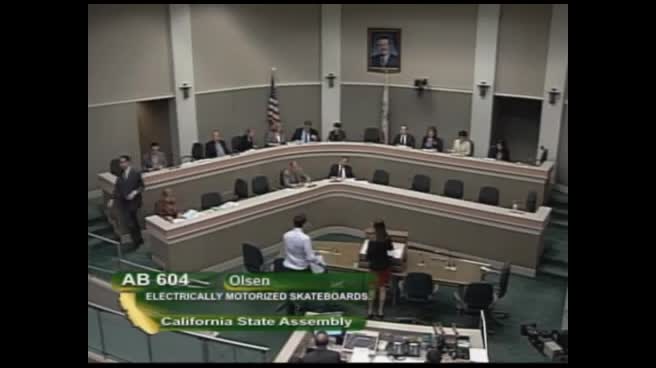 20MIN
Assembly Standing Committee on Transportation
Bill Author

Bill Co-Author(s):