AB 620: High-occupancy toll lanes: exemptions from tolls.
- Session Year: 2015-2016
- House: Assembly
- Latest Version Date: 2016-09-28
Existing law authorizes a value-pricing and transit development program involving high-occupancy toll (HOT) lanes to be conducted, administered, developed, and operated on State Highway Routes 10 and 110 in the County of Los Angeles by the Los Angeles County Metropolitan Transportation Authority (LACMTA) under certain conditions.
Existing law requires LACMTA, in implementing the program, to continue to work with the affected communities in the respective corridors and provide mitigation measures for commuters and transit users of low income, including reduced toll charges and toll credits. Existing law requires eligible commuters and transit users to meet the eligibility requirements for specified assistance programs.
This bill would require LACMTA to take additional steps, beyond the previous implementation of a low-income assistance program, to increase enrollment and participation in the low-income assistance program, as specified, through advertising and work with community organizations and social service agencies. The bill would also require LACMTA and the Department of Transportation to report to the Legislature by December 31, 2018, on efforts to improve the HOT lane program, including efforts to increase participation in the low-income assistance program.
Existing law authorizes a value-pricing and transit development program involving high-occupancy toll (HOT) lanes to be conducted, administered, developed, and operated on State Highway Routes 10 and 110 in the County of Los Angeles by the Los Angeles County Metropolitan Transportation Authority (LACMTA) under certain conditions.
Existing law requires LACMTA, in implementing the program, to continue to work with the affected communities in the respective corridors and provide mitigation measures for commuters and transit users of low income, including reduced toll charges and toll credits. Existing law requires eligible commuters and transit users to meet the eligibility requirements for specified assistance programs.
This bill would instead require LACMTA, in implementing the program, to provide mitigation measures for commuters and transit users of low income and would also require LACMTA, until January 1, 2022, to provide hardship exemptions from the payment of toll charges for commuters who meet the eligibility requirements for specified assistance programs. The bill would authorize LACMTA to discontinue issuing hardship exemptions if it determines at a public hearing that issuing additional exemptions would significantly jeopardize the amount of toll revenues necessary to operate and maintain the program. The bill would require LACMTA to report to the Legislature by January 31, 2019, the number of hardship exemptions provided during the time period from January 1, 2017, to December 31, 2018, inclusive, to commuters in total and to commuters residing in the San Gabriel Valley. require LACMTA to take additional steps, beyond the previous implementation of a low-income assistance program, to increase enrollment and participation in the low-income assistance program, as specified, through advertising and work with community organizations and social service agencies. The bill would also require LACMTA and the Department of Transportation to report to the Legislature by December 31, 2018, on efforts to improve the HOT lane program, including efforts to increase participation in the low-income assistance program.
Existing law authorizes a value-pricing and transit development program involving high-occupancy toll (HOT) lanes to be conducted, administered, developed, and operated on State Highway Routes 10 and 110 in the County of Los Angeles by the Los Angeles County Metropolitan Transportation Authority (LACMTA) under certain conditions.
Existing law requires LACMTA, in implementing the program, to continue to work with the affected communities in the respective corridors and provide mitigation measures for commuters and transit users of low income, including reduced toll charges and toll credits. Existing law requires eligible commuters and transit users to meet the eligibility requirements for specified assistance programs.
This bill would instead require LACMTA, in implementing the program, to adopt eligibility requirements for provide mitigation measures for commuters and transit users of low and moderate income, as defined, income and would also require LACMTA, until January 1, 2022, to provide hardship exemptions from the payment of toll charges for commuters who meet the eligibility requirements for specified assistance programs. The bill would authorize LACMTA to discontinue issuing hardship exemptions if it determines at a public hearing that issuing additional exemptions would significantly jeopardize the amount of toll revenues necessary to operate and maintain the program. The bill would require LACMTA to report to the Legislature by January 31, 2019, the number of hardship exemptions provided during the time period from January 1, 2017, to December 31, 2018, inclusive, to commuters in total and to commuters residing in the San Gabriel Valley.
Existing law authorizes a value-pricing and transit development program involving high-occupancy toll (HOT) lanes to be conducted, administered, developed, and operated on State Highway Routes 10 and 110 in the County of Los Angeles by the Los Angeles County Metropolitan Transportation Authority (LACMTA) under certain conditions.
Existing law requires LACMTA, in implementing the program, to continue to work with the affected communities in the respective corridors and provide mitigation measures for commuters and transit users of low income, including reduced toll charges and toll credits. Existing law requires eligible commuters and transit users to meet the eligibility requirements for specified assistance programs.
This bill would instead require LACMTA, in implementing the program, to adopt eligibility requirements for mitigation measures for commuters and transit users of low and moderate income, as defined, and would also require LACMTA to provide hardship exemptions from the payment of toll charges for commuters who meet the eligibility requirements for specified assistance programs.
The Legislature finds and declares all of the following:
(a)Section 149.9 of the Streets and Highways Code, the statute authorizing the Los Angeles County Metropolitan Transportation Authority (LACMTA) and the Department of Transportation to pursue the implementation of high-occupancy toll (HOT) lanes on State Highway Routes 10 and 110, requires LACMTA to develop a program to offset the impact on tolls on certain income groups in Los Angeles County.
(b)LACMTA has implemented a low-income assistance program in this regard and has developed other ways to respond to this requirement.
(c)LACMTAs report to the Legislature and subsequent information provided by LACMTA identified the progress of the HOT lanes overall and the level of participation in the low-income assistance program.
(d)While the HOT lanes have met their stated objectives, and while participation in the low-income assistance program has grown over time, improvements can be made.
(e)LACMTA and the department should continue to improve the overall performance of the HOT lanes, including identifying ways to improve travel speeds in both corridors.
(f)LACMTA and the department should continue to work to improve awareness of the low-income assistance program through advertising and working with local community groups and social service agencies to distribute information about the program.
(g)LACMTA should consider offering greater incentives in the low-income assistance program in order to incentivize participation in the program.
SEC. 2.Section 149.9 of the Streets and Highways Code is amended to read:149.9.(a)Notwithstanding Sections 149 and 30800 of this code, and Section 21655.5 of the Vehicle Code, the Los Angeles County Metropolitan Transportation Authority (LACMTA) may conduct, administer, and operate a value-pricing and transit development program involving high-occupancy toll (HOT) lanes on State Highway Routes 10 and 110 in the County of Los Angeles. LACMTA, with the consent of the department, may direct and authorize the entry and use of the State Highway Routes 10 and 110 high-occupancy vehicle lanes by single-occupant vehicles and those vehicles that do not meet minimum occupancy requirements, as defined by LACMTA, for a fee. The amount of the fee shall be established by, and collected in a manner to be determined by, LACMTA. LACMTA may continue to require high-occupancy vehicles to have an electronic transponder or other electronic device for enforcement purposes.
(b)LACMTA shall implement the program in cooperation with the department, and with the active participation of the Department of the California Highway Patrol, pursuant to an agreement that addresses all matters related to design, construction, maintenance, and operation of state highway system facilities in connection with the program. With the consent of the department, LACMTA shall establish appropriate performance measures, such as speed or travel times, for the purpose of ensuring optimal use of the HOT lanes by high-occupancy vehicles without adversely affecting other traffic on the state highway system.
(1)Agreements between LACMTA, the department, and the Department of the California Highway Patrol shall identify the respective obligations and liabilities of each party to the agreement and assign them responsibilities relating to the program. The agreements entered into pursuant to this section shall be consistent with agreements between the department and the United States Department of Transportation relating to programs of this nature. The agreements entered into pursuant to this section shall include clear and concise procedures for enforcement by the Department of the California Highway Patrol of laws prohibiting the unauthorized use of the HOT lanes. The agreements shall provide for reimbursement of state agencies, from revenues generated by the program or other funding sources that are not otherwise available to state agencies for transportation-related projects, for costs incurred in connection with the implementation or operation of the program, as well as maintenance of state highway system facilities in connection with the program.
(2)All remaining revenue generated by the program shall be used in the corridor from which the revenue was generated exclusively for preconstruction, construction, and other related costs of high-occupancy vehicle facilities, transportation corridor improvements, and the improvement of transit service in the corridor, including, but not limited to, support for transit operations pursuant to an expenditure plan adopted by LACMTA. LACMTAs administrative expenses related to the operation of the program shall not exceed 3 percent of the revenues.
(c)Single-occupant vehicles and those vehicles that do not meet minimum occupancy requirements that are certified or authorized by LACMTA for entry into, and use of, the State Highway Routes 10 and 110 high-occupancy vehicle lanes are exempt from Section 21655.5 of the Vehicle Code, and the driver shall not be in violation of the Vehicle Code because of that entry and use.
(d)(1)In implementing the program, LACMTA shall continue to work with the affected communities in the respective corridors and provide mitigation measures for commuters of low income, including reduced toll charges and toll credits for transit users. Eligible commuters for reduced toll charges or toll credits for transit users shall meet the eligibility requirements for assistance programs under Chapter 2 (commencing with Section 11200) or Chapter 3 (commencing with Section 12000) of Part 3 of, Part 5 (commencing with Section 17000) of, or Chapter 10 (commencing with Section 18900), Chapter 10.1 (commencing with Section 18930), or Chapter 10.3 (commencing with Section 18937) of Part 6 of, Division 9 of the Welfare and Institutions Code.
(2)Beyond the measures already implemented to create a low-income assistance program, LACMTA shall take additional steps to increase enrollment and participation in the low-income assistance program. LACMTA, in that regard, shall improve awareness of the low-income assistance program through advertising and by working with local community groups and social service agencies to distribute information about the low-income assistance program. In addition, LACMTA shall consider offering greater incentives to encourage participation in the low-income assistance program.
(e)(1)LACMTA and the department shall report to the Legislature by January 31, 2015. The report shall include, but not be limited to, a summary of the program, a survey of its users, the impact on carpoolers, revenues generated, how transit service or alternative modes of transportation were impacted, any potential effect on traffic congestion in the high-occupancy vehicle lanes and in the neighboring lanes, the number of toll-paying vehicles that utilized the HOT lanes, any potential reductions in the greenhouse gas emissions that are attributable to congestion reduction resulting from the HOT lane program, any comments submitted by the Department of the California Highway Patrol regarding operation of the lanes, and a description of the mitigation measures on the affected communities and commuters in the program. The report shall be submitted in compliance with Section 9795 of the Government Code. This subdivision shall become inoperative on January 31, 2019, pursuant to Section 10231.5 of the Government Code.
(2)LACMTA and the department shall report to the policy committees of the Legislature with responsibility for transportation matters by December 31, 2018, on the efforts to improve the program authorized by this section. The report shall address efforts by LACMTA to increase participation in the low-income participation program, any additional incentives that have been developed to encourage participation in the low-income participation program, and the performance of the HOT lanes overall in improving congestion in the affected corridors and offsetting the impact to low-income commuters. This paragraph shall become inoperative on January 1, 2021, pursuant to Section 10231.5 of the Government Code.
(f)Toll paying commuters shall have the option to purchase any necessary toll paying equipment, prepay tolls, and renew toll payments by cash or by using a credit card.
(g)This section shall not prevent the department or any local agency from constructing facilities that compete with a HOT lane program, and LACMTA shall not be entitled to compensation for adverse effects on toll revenue due to those facilities.
(h)LACMTA may issue bonds, as set forth in Chapter 5 (commencing with Section 130500) of Division 12 of the Public Utilities Code, at any time to finance any costs necessary to implement a value-pricing and transit development program established in accordance with this section and to finance any expenditures payable from the revenues generated from the program.
The Legislature finds and declares all of the following:
(a)Section 149.9 of the Streets and Highways Code, the statute authorizing the Los Angeles County Metropolitan Transportation Authority (LACMTA) and the Department of Transportation to pursue the implementation of high-occupancy toll (HOT) lanes on State Highway Routes 10 and 110, requires LACMTA to develop a program to offset the impact on tolls on certain income groups in Los Angeles County.
(b)LACMTA has implemented a low-income assistance program in this regard and has developed other ways to respond to this requirement.
(c)LACMTAs report to the Legislature and subsequent information provided by LACMTA identified the progress of the HOT lanes overall and the level of participation in the low-income assistance program.
(d)While the HOT lanes have met their stated objectives, and while participation in the low-income assistance program has grown over time, improvements can be made.
(e)LACMTA and the department should continue to improve the overall performance of the HOT lanes, including identifying ways to improve travel speeds in both corridors.
(f)LACMTA and the department should continue to work to improve awareness of the low-income assistance program through advertising and working with local community groups and social service agencies to distribute information about the program.
(g)LACMTA should consider offering greater incentives in the low-income assistance program in order to incentivize participation in the program.
SECTION 1.SEC. 2.Section 149.9 of the Streets and Highways Code is amended to read:149.9.(a)Notwithstanding Sections 149 and 30800 of this code, and Section 21655.5 of the Vehicle Code, the Los Angeles County Metropolitan Transportation Authority (LACMTA) may conduct, administer, and operate a value-pricing and transit development program involving high-occupancy toll (HOT) lanes on State Highway Routes 10 and 110 in the County of Los Angeles. LACMTA, with the consent of the department, may direct and authorize the entry and use of the State Highway Routes 10 and 110 high-occupancy vehicle lanes by single-occupant vehicles and those vehicles that do not meet minimum occupancy requirements, as defined by LACMTA, for a fee. The amount of the fee shall be established by, and collected in a manner to be determined by, LACMTA. LACMTA may continue to require high-occupancy vehicles to have an electronic transponder or other electronic device for enforcement purposes.
(b)LACMTA shall implement the program in cooperation with the department, and with the active participation of the Department of the California Highway Patrol, pursuant to an agreement that addresses all matters related to design, construction, maintenance, and operation of state highway system facilities in connection with the program. With the consent of the department, LACMTA shall establish appropriate performance measures, such as speed or travel times, for the purpose of ensuring optimal use of the HOT lanes by high-occupancy vehicles without adversely affecting other traffic on the state highway system.
(1)Agreements between LACMTA, the department, and the Department of the California Highway Patrol shall identify the respective obligations and liabilities of each party to the agreement and assign them responsibilities relating to the program. The agreements entered into pursuant to this section shall be consistent with agreements between the department and the United States Department of Transportation relating to programs of this nature. The agreements entered into pursuant to this section shall include clear and concise procedures for enforcement by the Department of the California Highway Patrol of laws prohibiting the unauthorized use of the HOT lanes. The agreements shall provide for reimbursement of state agencies, from revenues generated by the program or other funding sources that are not otherwise available to state agencies for transportation-related projects, for costs incurred in connection with the implementation or operation of the program, as well as maintenance of state highway system facilities in connection with the program.
(2)All remaining revenue generated by the program shall be used in the corridor from which the revenue was generated exclusively for preconstruction, construction, and other related costs of high-occupancy vehicle facilities, transportation corridor improvements, and the improvement of transit service in the corridor, including, but not limited to, support for transit operations pursuant to an expenditure plan adopted by LACMTA. LACMTAs administrative expenses related to the operation of the program shall not exceed 3 percent of the revenues.
(c)Single-occupant vehicles and those vehicles that do not meet minimum occupancy requirements that are certified or authorized by LACMTA for entry into, and use of, the State Highway Routes 10 and 110 high-occupancy vehicle lanes are exempt from Section 21655.5 of the Vehicle Code, and the driver shall not be in violation of the Vehicle Code because of that entry and use.
(d)(1)In implementing the program, LACMTA shall continue to work with the affected communities in the respective corridors and provide mitigation measures for commuters and transit users of low income, including reduced toll charges and toll credits for transit users, if they do not qualify under paragraph (2) for a hardship exemption as long as paragraph (2) remains operative. users. Eligible commuters for reduced toll charges or toll credits for transit users shall meet the eligibility requirements for assistance programs under Chapter 2 (commencing with Section 11200) or Chapter 3 (commencing with Section 12000) of Part 3 of, Part 5 (commencing with Section 17000) of, or Chapter 10 (commencing with Section 18900), Chapter 10.1 (commencing with Section 18930), or Chapter 10.3 (commencing with Section 18937) of Part 6 of, Division 9 of the Welfare and Institutions Code.
(2)(A)Except as provided in subparagraph (B), LACMTA shall also provide hardship exemptions from the payment of toll charges for commuters who meet the eligibility requirements for assistance programs under Chapter 2 (commencing with Section 11200) or Chapter 3 (commencing with Section 12000) of Part 3 of, Part 5 (commencing with Section 17000) of, or Chapter 10 (commencing with Section 18900), Chapter 10.1 (commencing with Section 18930), or Chapter 10.3 (commencing with Section 18937) of Part 6 of, Division 9 of the Welfare and Institutions Code.
(B)LACMTA may discontinue issuing hardship exemptions pursuant to subparagraph (A) if it determines at a public hearing that issuing additional hardship exemptions would significantly jeopardize the amount of toll revenues necessary to operate and maintain the program. In making that determination, LACMTA shall not consider the cost of providing the mitigation measures required by paragraph (1) as part of the costs necessary to operate and maintain the program.
(C)This paragraph shall become inoperative on January 1, 2022.
(3)LACMTA shall report to the Legislature by January 31, 2019, the number of hardship exemptions provided pursuant to paragraph (2) during the time period from January 1, 2017, to December 31, 2018, inclusive, to commuters in total and to commuters residing in the San Gabriel Valley. The report shall be submitted in compliance with Section 9795 of the Government Code. This paragraph shall become inoperative on January 31, 2023, pursuant to Section 10231.5 of the Government Code.
(2)Beyond the measures already implemented to create a low-income assistance program, LACMTA shall take additional steps to increase enrollment and participation in the low-income assistance program. LACMTA, in that regard, shall improve awareness of the low-income assistance program through advertising and by working with local community groups and social service agencies to distribute information about the low-income assistance program. In addition, LACMTA shall consider offering greater incentives to encourage participation in the low-income assistance program.
(e)(1)LACMTA and the department shall report to the Legislature by January 31, 2015. The report shall include, but not be limited to, a summary of the program, a survey of its users, the impact on carpoolers, revenues generated, how transit service or alternative modes of transportation were impacted, any potential effect on traffic congestion in the high-occupancy vehicle lanes and in the neighboring lanes, the number of toll-paying vehicles that utilized the HOT lanes, any potential reductions in the greenhouse gas emissions that are attributable to congestion reduction resulting from the HOT lane program, any comments submitted by the Department of the California Highway Patrol regarding operation of the lanes, and a description of the mitigation measures on the affected communities and commuters in the program. The report shall be submitted in compliance with Section 9795 of the Government Code. This subdivision shall become inoperative on January 31, 2019, pursuant to Section 10231.5 of the Government Code.
(2)LACMTA and the department shall report to the policy committees of the Legislature with responsibility for transportation matters by December 31, 2018, on the efforts to improve the program authorized by this section. The report shall address efforts by LACMTA to increase participation in the low-income participation program, any additional incentives that have been developed to encourage participation in the low-income participation program, and the performance of the HOT lanes overall in improving congestion in the affected corridors and offsetting the impact to low-income commuters. This paragraph shall become inoperative on January 1, 2021, pursuant to Section 10231.5 of the Government Code.
(f)Toll paying commuters shall have the option to purchase any necessary toll paying equipment, prepay tolls, and renew toll payments by cash or by using a credit card.
(g)This section shall not prevent the department or any local agency from constructing facilities that compete with a HOT lane program, and LACMTA shall not be entitled to compensation for adverse effects on toll revenue due to those facilities.
(h)LACMTA may issue bonds, as set forth in Chapter 5 (commencing with Section 130500) of Division 12 of the Public Utilities Code, at any time to finance any costs necessary to implement a value-pricing and transit development program established in accordance with this section and to finance any expenditures payable from the revenues generated from the program.
(a)Notwithstanding Sections 149 and 30800 of this code, and Section 21655.5 of the Vehicle Code, the Los Angeles County Metropolitan Transportation Authority (LACMTA) may conduct, administer, and operate a value-pricing and transit development program involving high-occupancy toll (HOT) lanes on State Highway Routes 10 and 110 in the County of Los Angeles. LACMTA, with the consent of the department, may direct and authorize the entry and use of the State Highway Routes 10 and 110 high-occupancy vehicle lanes by single-occupant vehicles and those vehicles that do not meet minimum occupancy requirements, as defined by LACMTA, for a fee. The amount of the fee shall be established by, and collected in a manner to be determined by, LACMTA. LACMTA may continue to require high-occupancy vehicles to have an electronic transponder or other electronic device for enforcement purposes.
(b)LACMTA shall implement the program in cooperation with the department, and with the active participation of the Department of the California Highway Patrol, pursuant to an agreement that addresses all matters related to design, construction, maintenance, and operation of state highway system facilities in connection with the program. With the consent of the department, LACMTA shall establish appropriate performance measures, such as speed or travel times, for the purpose of ensuring optimal use of the HOT lanes by high-occupancy vehicles without adversely affecting other traffic on the state highway system.
(1)Agreements between LACMTA, the department, and the Department of the California Highway Patrol shall identify the respective obligations and liabilities of each party to the agreement and assign them responsibilities relating to the program. The agreements entered into pursuant to this section shall be consistent with agreements between the department and the United States Department of Transportation relating to programs of this nature. The agreements entered into pursuant to this section shall include clear and concise procedures for enforcement by the Department of the California Highway Patrol of laws prohibiting the unauthorized use of the HOT lanes. The agreements shall provide for reimbursement of state agencies, from revenues generated by the program or other funding sources that are not otherwise available to state agencies for transportation-related projects, for costs incurred in connection with the implementation or operation of the program, as well as maintenance of state highway system facilities in connection with the program.
(2)All remaining revenue generated by the program shall be used in the corridor from which the revenue was generated exclusively for preconstruction, construction, and other related costs of high-occupancy vehicle facilities, transportation corridor improvements, and the improvement of transit service in the corridor, including, but not limited to, support for transit operations pursuant to an expenditure plan adopted by LACMTA. LACMTAs administrative expenses related to the operation of the program shall not exceed 3 percent of the revenues.
(c)Single-occupant vehicles and those vehicles that do not meet minimum occupancy requirements that are certified or authorized by LACMTA for entry into, and use of, the State Highway Routes 10 and 110 high-occupancy vehicle lanes are exempt from Section 21655.5 of the Vehicle Code, and the driver shall not be in violation of the Vehicle Code because of that entry and use.
(d)(1)In implementing the program, LACMTA shall continue to work with the affected communities in the respective corridors and provide mitigation measures for commuters and transit users of low and moderate income, within the meaning of Section 50093 of the Health and Safety Code, income, including reduced toll charges and toll credits for transit users, if they do not qualify under paragraph (2) for a hardship exemption. exemption as long as paragraph (2) remains operative.
(2)LACMTA (A)Except as provided in subparagraph (B), LACMTA shall also provide hardship exemptions from the payment of toll charges for commuters who meet the eligibility requirements for assistance programs under Chapter 2 (commencing with Section 11200) or Chapter 3 (commencing with Section 12000) of Part 3 of, Part 5 (commencing with Section 17000) of, or Chapter 10 (commencing with Section 18900), Chapter 10.1 (commencing with Section 18930), or Chapter 10.3 (commencing with Section 18937) of Part 6 of, Division 9 of the Welfare and Institutions Code.
(B)LACMTA may discontinue issuing hardship exemptions pursuant to subparagraph (A) if it determines at a public hearing that issuing additional hardship exemptions would significantly jeopardize the amount of toll revenues necessary to operate and maintain the program. In making that determination, LACMTA shall not consider the cost of providing the mitigation measures required by paragraph (1) as part of the costs necessary to operate and maintain the program.
(C)This paragraph shall become inoperative on January 1, 2022.
(3)LACMTA shall report to the Legislature by January 31, 2019, the number of hardship exemptions provided pursuant to paragraph (2) during the time period from January 1, 2017, to December 31, 2018, inclusive, to commuters in total and to commuters residing in the San Gabriel Valley. The report shall be submitted in compliance with Section 9795 of the Government Code. This paragraph shall become inoperative on January 31, 2023, pursuant to Section 10231.5 of the Government Code.
(e)LACMTA and the department shall report to the Legislature by January 31, 2015. The report shall include, but not be limited to, a summary of the program, a survey of its users, the impact on carpoolers, revenues generated, how transit service or alternative modes of transportation were impacted, any potential effect on traffic congestion in the high-occupancy vehicle lanes and in the neighboring lanes, the number of toll-paying vehicles that utilized the HOT lanes, any potential reductions in the greenhouse gas emissions that are attributable to congestion reduction resulting from the HOT lane program, any comments submitted by the Department of the California Highway Patrol regarding operation of the lanes, and a description of the mitigation measures on the affected communities and commuters in the program. The report shall be submitted in compliance with Section 9795 of the Government Code. This subdivision shall become inoperative on January 31, 2019, pursuant to Section 10231.5 of the Government Code.
(f)Toll paying commuters shall have the option to purchase any necessary toll paying equipment, prepay tolls, and renew toll payments by cash or by using a credit card.
(g)This section shall not prevent the department or any local agency from constructing facilities that compete with a HOT lane program, and LACMTA shall not be entitled to compensation for adverse effects on toll revenue due to those facilities.
(h)LACMTA may issue bonds, as set forth in Chapter 5 (commencing with Section 130500) of Division 12 of the Public Utilities Code, at any time to finance any costs necessary to implement a value-pricing and transit development program established in accordance with this section and to finance any expenditures payable from the revenues generated from the program.
(a)Notwithstanding Sections 149 and 30800 of this code, and Section 21655.5 of the Vehicle Code, the Los Angeles County Metropolitan Transportation Authority (LACMTA) may conduct, administer, and operate a value-pricing and transit development program involving high-occupancy toll (HOT) lanes on State Highway Routes 10 and 110 in the County of Los Angeles. LACMTA, with the consent of the department, may direct and authorize the entry and use of the State Highway Routes 10 and 110 high-occupancy vehicle lanes by single-occupant vehicles and those vehicles that do not meet minimum occupancy requirements, as defined by LACMTA, for a fee. The amount of the fee shall be established by, and collected in a manner to be determined by, LACMTA. LACMTA may continue to require high-occupancy vehicles to have an electronic transponder or other electronic device for enforcement purposes.
(b)LACMTA shall implement the program in cooperation with the department, and with the active participation of the Department of the California Highway Patrol, pursuant to an agreement that addresses all matters related to design, construction, maintenance, and operation of state highway system facilities in connection with the program. With the consent of the department, LACMTA shall establish appropriate performance measures, such as speed or travel times, for the purpose of ensuring optimal use of the HOT lanes by high-occupancy vehicles without adversely affecting other traffic on the state highway system.
(1)Agreements between LACMTA, the department, and the Department of the California Highway Patrol shall identify the respective obligations and liabilities of each party to the agreement and assign them responsibilities relating to the program. The agreements entered into pursuant to this section shall be consistent with agreements between the department and the United States Department of Transportation relating to programs of this nature. The agreements entered into pursuant to this section shall include clear and concise procedures for enforcement by the Department of the California Highway Patrol of laws prohibiting the unauthorized use of the HOT lanes. The agreements shall provide for reimbursement of state agencies, from revenues generated by the program or other funding sources that are not otherwise available to state agencies for transportation-related projects, for costs incurred in connection with the implementation or operation of the program, as well as maintenance of state highway system facilities in connection with the program.
(2)All remaining revenue generated by the program shall be used in the corridor from which the revenue was generated exclusively for preconstruction, construction, and other related costs of high-occupancy vehicle facilities, transportation corridor improvements, and the improvement of transit service in the corridor, including, but not limited to, support for transit operations pursuant to an expenditure plan adopted by LACMTA. LACMTAs administrative expenses related to the operation of the program shall not exceed 3 percent of the revenues.
(c)Single-occupant vehicles and those vehicles that do not meet minimum occupancy requirements that are certified or authorized by LACMTA for entry into, and use of, the State Highway Routes 10 and 110 high-occupancy vehicle lanes are exempt from Section 21655.5 of the Vehicle Code, and the driver shall not be in violation of the Vehicle Code because of that entry and use.
(d)(1)In implementing the program, LACMTA shall continue to work with the affected communities in the respective corridors and provide mitigation measures for commuters and transit users of low and moderate income, within the meaning of Section 50093 of the Health and Safety Code, including reduced toll charges and toll credits for transit users. Eligible users, if they do not qualify under paragraph (2) for a hardship exemption.
(2)LACMTA shall also provide hardship exemptions from the payment of toll charges for commuters for reduced toll charges or toll credits for transit users shall who meet the eligibility requirements for assistance programs under Chapter 2 (commencing with Section 11200) or Chapter 3 (commencing with Section 12000) of Part 3 of, Part 5 (commencing with Section 17000) of, or Chapter 10 (commencing with Section 18900), Chapter 10.1 (commencing with Section 18930), or Chapter 10.3 (commencing with Section 18937) of Part 6 of, Division 9 of the Welfare and Institutions Code.
(e)LACMTA and the department shall report to the Legislature by January 31, 2015. The report shall include, but not be limited to, a summary of the program, a survey of its users, the impact on carpoolers, revenues generated, how transit service or alternative modes of transportation were impacted, any potential effect on traffic congestion in the high-occupancy vehicle lanes and in the neighboring lanes, the number of toll-paying vehicles that utilized the HOT lanes, any potential reductions in the greenhouse gas emissions that are attributable to congestion reduction resulting from the HOT lane program, any comments submitted by the Department of the California Highway Patrol regarding operation of the lanes, and a description of the mitigation measures on the affected communities and commuters in the program. The report shall be submitted in compliance with Section 9795 of the Government Code. This subdivision shall become inoperative on January 31, 2019, pursuant to Section 10231.5 of the Government Code.
(f)Toll paying commuters shall have the option to purchase any necessary toll paying equipment, prepay tolls, and renew toll payments by cash or by using a credit card.
(g)This section shall not prevent the department or any local agency from constructing facilities that compete with a HOT lane program, and LACMTA shall not be entitled to compensation for adverse effects on toll revenue due to those facilities.
(h)LACMTA may issue bonds, as set forth in Chapter 5 (commencing with Section 130500) of Division 12 of the Public Utilities Code, at any time to finance any costs necessary to implement a value-pricing and transit development program established in accordance with this section and to finance any expenditures payable from the revenues generated from the program.
|
Date
|
Status
|
|---|---|
| Jan 28, 2016 | Assembly Rule 69 suspended. (Page 3521.) |
| Aug 30, 2016 | Enrolled and presented to the Governor at 4 p.m. |
| Aug 23, 2016 | In Assembly. Ordered to Engrossing and Enrolling. |
| Aug 22, 2016 | Read third time. Passed. Ordered to the Assembly. (Ayes 28. Noes 11. Page 5242.). |
| Aug 22, 2016 | Read third time. Passed. Ordered to the Assembly. |
| Aug 3, 2016 | Read second time. Ordered to third reading. |
| Aug 2, 2016 | From committee: Do pass. (Ayes 5. Noes 2.) (August 1). |
| Jun 29, 2016 | From committee: Do pass and re-refer to Com. on APPR. (Ayes 9. Noes 1.) (June 28). Re-referred to Com. on APPR. |
| Feb 18, 2016 | Referred to Com. on T. & H. |
| Jan 28, 2016 | Read third time. Passed. Ordered to the Senate. (Ayes 51. Noes 26. Page 3523.) |
| Jan 28, 2016 | In Senate. Read first time. To Com. on RLS. for assignment. |
| Feb 24, 2015 | Read first time. To print. |
| Jan 27, 2016 | Read third time and amended. Ordered to third reading. (Page 3497.) |
| Jan 27, 2016 | Assembly Rule 69 suspended. (Page 3496.) |
| Jan 13, 2016 | Read second time. Ordered to third reading. |
| Jan 12, 2016 | From committee: Do pass. (Ayes 9. Noes 3.) (January 11). |
| Jan 6, 2016 | Re-referred to Com. on TRANS. |
| Jan 5, 2016 | From committee chair, with author's amendments: Amend, and re-refer to Com. on TRANS. Read second time and amended. |
| Apr 27, 2015 | In committee: Set, first hearing. Hearing canceled at the request of author. |
| Mar 9, 2015 | Referred to Com. on TRANS. |
| Feb 25, 2015 | From printer. May be heard in committee March 27. |
|
Date
|
Description
|
Location
|
Votes
|
|
|---|---|---|---|---|
| Aug 22, 2016 | Assembly 3rd Reading AB620 Roger Hernández By Lara | Senate Floor |
Passed |
|
| Aug 1, 2016 | Do pass | Senate Standing Committee on Appropriations |
Passed |
|
| Jun 28, 2016 | Do pass, but first be re-referred to the Committee on [Appropriations] | Senate Standing Committee on Transportation and Housing |
Passed |
|
| Jan 28, 2016 | AB 620 HERNÁNDEZ Assembly Third Reading | Assembly Floor |
Passed |
|
| Jan 11, 2016 | Do pass. | Assembly Standing Committee on Transportation |
Passed |
This list shows positions taken on this bill by organizations on the date displayed, which is linked to the original source.
Positions by individuals are not included.
|
Organization
|
Position
|
Date
|
|---|---|---|
| Los Angeles County Metropolitan Transportation Authority | ** Against | Jan 27, 2016 |
Office of Senate Floor Analyses (916) 651-1520 Fax: (916) 327-4478 | AB |
THIRD READING
Bill No: AB 620
:
SENATE TRANS. & HOUSING COMMITTEE: 9-1, 6/28/16
AYES: Beall, Cannella, Allen, Gaines, Leyva, McGuire, Mendoza, Roth, Wieckowski
NOES: Bates
NO VOTE RECORDED: Galgiani
SENATE APPROPRIATIONS COMMITTEE: 5-2, 8/1/16
AYES: Lara, Beall, Hill, McGuire, Mendoza
NOES: Bates, Nielsen
ASSEMBLY FLOOR: 51-26, 1/28/16 - See last page for vote
DIGEST: This bill directs the Los Angeles County Metropolitan Transportation Authority (METRO) to make additional outreach efforts for the low-income assistance program related to its high-occupancy toll (HOT) lane program known as the ExpressLanes.
Existing law:
- Authorizes METRO to conduct, administer, and operate the ExpressLanes program on Interstate 10 (I-10) and Interstate 110 (I-110) in Los Angeles County.
- Requires METRO, when implementing the program, to work with affected communities in the two highway corridors and provide mitigation measures for low-income commuters, including reduced toll charges and toll credits for transit users.
- Requires that participants in the low-income assistance program meet eligibility requirements for any one of several specific public assistance programs.
This bill:
- Makes legislative findings and declarations regarding the potential for greater participation in METRO’s low-income assistance program.
- Directs METRO to take additional steps to increase enrollment in its low-income assistance program, including consideration of greater incentives to encourage participation in the program.
- Directs METRO and the California Department of Transportation (Caltrans) to report to the Legislature on efforts to improve METRO’s ExpressLanes program, including greater participation in the low-income assistance program and the overall performance of the HOT lanes.
Comments
- Purpose. The author introduced this bill because he is concerned about the impact that the ExpressLanes program is having on constituents in his district, particularly low-income constituents. He has voiced concerns that the ExpressLanes program was supposed to improve commutes for all users in the corridor, not just the toll-paying ones. He asserts that these improvements have not, however, materialized, and that lanes adjacent to the tolled lanes experience longer periods of congestion now than they did prior to the start of the ExpressLanes program. Consequently, commuters that can afford to pay the tolls enjoy shorter commutes at the expense of non-paying commuters (including his low-income constituents), for those whose travel times have worsened.
- METRO’s ExpressLanes program. SB 1422 (Ridley-Thomas, Chapter 547, Statutes of 2008) authorized METRO, until January 15, 2013, to develop and operate a value-pricing and transit development demonstration program involving HOT lanes, referred to as ExpressLanes. The program was primarily funded with a $210 million congestion reduction demonstration grant from the U.S. Department of Transportation. Tolling began in November 2012 on the I-110 and in February 2013 on the I-10. AB 1224 (Eng, Chapter 441, Statutes of 2010) extended the sunset and reporting dates for the ExpressLanes program from January 2013 to January 2015, and SB 1298 (Hernández, Chapter 531, Statutes of 2013) recast the program and extended it indefinitely.
- METRO’s low-income assistance program. METRO’s low-income assistance program is the first in the nation to address equity concerns on toll-lane projects and has been, by many accounts, generally successful. METRO reports that the ExpressLanes program has invested over $150 million in transit-related improvements along the I-110 and I-10 corridors, including a new transit center in El Monte, 59 new buses for transit providers, and safety improvements to the Harbor Transitway.
To participate in METRO’s low-income assistance program, an individual must be a Los Angeles County resident with an annual household income at or below two times the federal poverty level (e.g., $40,180 for a three-person household). Applications for the program can be submitted by mail or at one of two walk-in centers. Qualifying residents receive a $25 credit when they set up an account, which can be applied to either the transponder deposit or pre-paid toll deposit. The monthly account maintenance fee is waived. As of May 2016, 10,344 households are enrolled in the low-income assistance program out of over 488,802 Express Lane accounts.
This bill simply provides METRO with clarification and direction to continue its efforts in administering its low-income assistance programs and further provides additional legislative oversight by requiring METRO to issue a report on its efforts to improve mobility options for low-income travelers along these corridors.
FISCAL EFFECT: Appropriation: No Fiscal Com.: Yes Local: No
According to the Senate Appropriations Committee, one-time Caltrans costs of up to $100,000 over two years for administrative duties related to the study. These costs are likely recoverable from toll revenues, subject to a supplementary agreement with METRO.
None received
None received
ASSEMBLY FLOOR: 51-26, 1/28/16
AYES: Alejo, Bloom, Bonilla, Bonta, Brown, Burke, Calderon, Campos, Chau, Chiu, Chu, Cooley, Cooper, Dababneh, Daly, Dodd, Eggman, Frazier, Cristina Garcia, Eduardo Garcia, Gipson, Gomez, Gonzalez, Gordon, Gray, Roger Hernández, Holden, Irwin, Jones-Sawyer, Lackey, Levine, Linder, Lopez, Low, McCarty, Medina, Mullin, O'Donnell, Quirk, Rendon, Ridley-Thomas, Rodriguez, Salas, Santiago, Mark Stone, Thurmond, Ting, Weber, Williams, Wood, Atkins
NOES: Achadjian, Travis Allen, Baker, Bigelow, Brough, Chang, Chávez, Dahle, Beth Gaines, Gallagher, Gatto, Grove, Hadley, Harper, Jones, Kim, Maienschein, Mayes, Melendez, Obernolte, Olsen, Patterson, Steinorth, Wagner, Waldron, Wilk
NO VOTE RECORDED: Mathis, Nazarian
8/3/16 18:43:12
**** END ****
SENATE COMMITTEE ON APPROPRIATIONS
Senator Ricardo Lara, Chair
2015 - 2016 Regular Session
AB 620 (Roger Hernández) - High-occupancy toll lanes: exemptions from tolls
Version: January 27, 2016 | Policy Vote: T. & H. 9 - 1 |
Urgency: No | Mandate: No |
Hearing Date: August 1, 2016 | Consultant: Mark McKenzie |
This bill does not meet the criteria for referral to the Suspense File.
Bill Summary:
AB 620 would require the Los Angeles County Metropolitan Transportation Authority (MTA) to take additional actions to increase participation in the low-income assistance program associated with high-occupancy toll (HOT) lanes on I-10 and I-110. The bill would also require MTA and the Department of Transportation (Caltrans) to submit a specified report to the Legislature on the low-income assistance program and HOT lane performance by the end of 2018.
Fiscal Impact:
One-time Caltrans costs of up to $100,000 over two years for administrative duties related to the study. These costs are likely recoverable from toll revenues, subject to a supplementary agreement with MTA.
Background:
Existing law authorizes MTA to operate a value-pricing and transit development program involving HOT lanes on I-10 and I-110 in Los Angeles County. HOT lanes allow vehicles that do not meet occupancy requirements for accessing a high-occupancy vehicle (HOV) lane to access those lanes for a fee. Existing law requires MTA to work with affected communities in the respective corridors and provide mitigation measures for low-income commuters, including reduced toll charges and toll credits for transit users. The HOT lane demonstration program, known locally as the ExpressLanes program, was primarily funded by a $210 million federal grant, and the toll lanes were opened in both corridors by February of 2013.
MTA indicates that the ExpressLanes program has invested over $150 million in transit-related improvements along the I-110 and I-10 corridors, including a new transit center in El Monte, 59 new buses for transit providers, and safety improvements to the Harbor Transitway. MTA also established a low-income assistance program, which provides qualifying residents with a one-time $25 credit to either offset the transponder deposit or serve as a pre-paid toll deposit when they set up an account. MTA also waives the $1 monthly account maintenance fee for low-income participants. As of May 2016, 10,344 households are enrolled in the low-income assistance program out of over 488,802 Express Lane accounts.
Proposed Law:
AB 620 would require MTA to take additional steps to increase enrollment and participation in the low-income assistance program, including improving awareness of the program through advertising and working with local community groups and social service agencies to distribute information about the program. MTA would also be required to consider offering greater incentives to encourage participation.
The bill would also require MTA and Caltrans to submit a report to the Legislature by December 31, 2018 on the efforts to improve the ExpressLanes program. The report must address MTA’s efforts to increase participation in the low-income assistance program, any additional incentives developed to encourage participation in that program, and the overall performance of the HOT lanes in improving congestion in the affected corridors and offsetting the impact to low-income commuters.
Staff Comments:
Caltrans estimates costs of up to $100,000 related to the study requirement, depending on the division of responsibilities with MTA. These costs include analysis of the ExpressLanes themselves and associated transportation facilities in those corridors that serve the highways, as well as the impacts of the program on low-income commuters. These costs would likely be recoverable from ExpressLanes toll revenues, which would require a supplemental agreement with MTA.
-- END --
SENATE COMMITTEE ON TRANSPORTATION AND HOUSING
Senator Jim Beall, Chair
2015 - 2016 Regular
Bill No: Hearing Date: 6/28/2016
Author: | Roger Hernández | ||
Version: | 1/27/2016 | ||
Urgency: | No | Fiscal: | Yes |
Consultant: | Manny Leon | ||
SUBJECT:
DIGEST: This bill directs the Los Angeles County METROpolitan Transportation Authority (METRO) to make additional outreach efforts for the low-income assistance program related to its high-occupancy toll (HOT) lane program known as the ExpressLanes.
ANALYSIS:
Existing law:
- Authorizes METRO to conduct, administer, and operate the ExpressLanes Program on Interstate 10 (I-10) and Interstate 110 (I-110) in Los Angeles County.
- Requires METRO, when implementing the program, to work with affected communities in the two highway corridors and provide mitigation measures for low-income commuters, including reduced toll charges and toll credits for transit users.
- Requires that participants in the low-income assistance program meet eligibility requirements for any one of several specific public assistance programs.
This bill:
- Makes legislative findings and declarations regarding the potential for greater participation in METRO’s low-income assistance program.
- Directs METRO to take additional steps to increase enrollment in its low-income assistance program, including consideration of greater incentives to encourage participation in the program.
- Directs METRO and the California Department of Transportation to report to the Legislature on efforts to improve METRO’s ExpressLanes program, including greater participation in the low-income assistance program and the overall performance of the high-occupancy toll lanes.
COMMENTS:
- Purpose. The author introduced this bill because he is concerned about the impact that the ExpressLanes program is having on constituents in his district, particularly low-income constituents. He has voiced concerns that the ExpressLanes Program was supposed to improve commutes for all users in the corridor, not just the toll-paying ones. He asserts that these improvements have not, however, materialized, and that lanes adjacent to the tolled lanes experience longer periods of congestion now than they did prior to the start of the ExpressLanes Program. Consequently, commuters that can afford to pay the tolls enjoy shorter commutes at the expense of non-paying commuters (including his low-income constituents) for whom travel times have worsened.
- METRO’s ExpressLanes Program. SB 1422 (Ridley-Thomas, Chapter 547, Statutes of 2008) authorized METRO, until January 15, 2013, to develop and operate a value-pricing and transit development demonstration program involving high-occupancy toll lanes, referred to as ExpressLanes. The program was primarily funded with a $210 million congestion reduction demonstration grant from the U.S. Department of Transportation. Tolling began in November 2012 on the I-110 and in February 2013 on the I-10. AB 1224 (Eng, Chapter 441, Statutes of 2010) extended the sunset and reporting dates for the ExpressLanes Program from January 2013 to January 2015, and SB 1298 (Hernández, Chapter 531, Statutes of 2013) recast the program and extended it indefinitely.
- METRO’s Low-Income Assistance Program. METRO’s low-income assistance program is the first in the nation to address equity concerns on toll-lane projects and has been, by many accounts, generally successful. METRO reports that the ExpressLanes Program has invested over $150 million in transit-related improvements along the I-110 and I-10 corridors, including a new transit center in El Monte, 59 new buses for transit providers, and safety improvements to the Harbor Transitway.
To participate in METRO’s low-income assistance program, an individual must be a Los Angeles County resident with an annual household income at or below two times the federal poverty level (e.g., $40,180 for a 3-person household). Applications for the program can be submitted by mail or at one of two walk-in centers. Qualifying residents receive a $25 credit when they set up an account, which can be applied to either the transponder deposit or pre-paid toll deposit. The monthly account maintenance fee is waived. As of May 2016, 10,344 households are enrolled in the low-income assistance program out of over 488,802 Express Lane accounts.
This bill simply provides METRO with clarification and direction to continue its efforts in administering its low-income assistance programs and further provides additional legislative oversight by requiring METRO to issue a report on its efforts to improve mobility options for low-income travelers along these corridors.
Related Legislation:
SB 1298 (Hernández, Chapter 531, Statutes of 2013) — recast the ExpressLanes program and extended it indefinitely.
AB 1224 (Eng, Chapter 441, Statutes of 2010) — extended the sunset and reporting dates for the ExpressLanes Program from January 2013 to January 2015.
SB 1422 (Ridley-Thomas, Chapter 547, Statutes of 2008) — authorized, until January 15, 2013, METRO to operate the ExpressLanes Program.
FISCAL EFFECT: Appropriation: No Fiscal Com.: Yes Local: No
Assembly Votes:
Floor: 51-26
Trans: 9-3
POSITIONS: (Communicated to the committee before noon on Wednesday,
June 22, 2016.)
SUPPORT:
None received
OPPOSITION:
None received
-- END --
ASSEMBLY THIRD READING
ATR Bill Id:AB 620
Author:(Roger Hernández)
As Amended Ver:January 27, 2016
Majority vote
Committee | Votes | Ayes | Noes |
Transportation | 9-3 | Frazier, Campos, Chu, Daly, Dodd, Eduardo Garcia, Linder, Medina, O'Donnell | Baker, Kim, Melendez |
SUMMARY: Directs the Los Angeles County Metropolitan Transportation Authority (Metro) to take steps to improve the low-income assistance program related to its high-occupancy toll (HOT) lane program known as ExpressLanes. Specifically, this bill:
- Makes legislative findings and declarations regarding the potential for greater participation in Metro's low-income assistance program.
- Directs Metro to take additional steps to increase enrollment in its low-income assistance program, including consideration of greater incentives to encourage participation in the program.
- Directs Metro and the California Department of Transportation to report to the Legislature on efforts to improve Metro's ExpressLanes program, including greater participation in the low-income assistance program and the overall performance of the high-occupancy toll lanes.
FISCAL EFFECT: Unknown. This bill is keyed non-fiscal by the Legislative Counsel.
COMMENTS: SB 1422 (Ridley-Thomas), Chapter 547, Statutes of 2008, authorized Metro, until January 15, 2013, to develop and operate a value-pricing and transit development demonstration program involving high-occupancy toll lanes, referred to as ExpressLanes. The program was primarily funded with a $210 million congestion reduction demonstration grant from the United States Department of Transportation. Tolling began in November 2012 on the I-110 and in February 2013 on the I-10. AB 1224 (Eng), Chapter 441, Statutes of 2010, extended the sunset and reporting dates for the ExpressLanes Program from January 2013 to January 2015, and SB 1298 (Hernandez), Chapter 531, Statutes of 2013, recast the program and extended it indefinitely.
The author introduced this bill because he is concerned about the impact that the ExpressLanes program is having on constituents in his district, particularly low-income constituents. He has voiced concerns that the ExpressLanes Program was supposed to improve commutes for all users in the corridor, not just the toll-paying ones. He asserts that these improvements have not, however, materialized and that lanes adjacent to the tolled lanes experience longer periods of congestion now than they did prior to the start of the ExpressLanes Program. Consequently, commuters that can afford to pay the tolls enjoy shorter commutes at the expense of non-paying commuters (including his low-income constituents) for whom travel times have worsened.
The author also believes Metro's low-income assistance program is underperforming, as demonstrated by low enrollment rates in the program and the fact that there are only two facilities in all of Los Angeles County where applicants can take proof of eligibility to participate in the low-income assistance program (in addition to being able to mail the information in).
To participate in Metro's low-income assistance program, an individual must be a Los Angeles County resident with an annual household income at or below two times the federal poverty level (e.g., $40,180 for a 3-person household). Applications for the program can be submitted by mail or at one of two walk-in centers. Qualifying residents receive a $25 credit when they set up an account, which can be applied to either the transponder deposit or pre-paid toll deposit. The monthly account maintenance fee is waived. To date, 8,877 households are enrolled in the low-income assistance program out of over 450,000 Express Lane accounts.
According to Metro, its low-income assistance program is the first in the nation to address equity concerns on toll lane projects and has been, by many accounts generally successful. Metro claims that it has relied heavily on independent consultants and extensive outreach with affected communities to design and improve the program to ensure it reflects community concerns and meets the needs of low-income commuters. Metro reports that, to date, the ExpressLanes Program has invested over $150 million in transit-related improvements along the I-110 and I-10 corridors, including a new transit center in El Monte, 59 new buses for transit providers and safety improvements to the Harbor Transitway.
Analysis Prepared by: Janet Dawson / TRANS. / (916) 319-2093 FN: 0002610
ASSEMBLY THIRD READING
ATR Bill Id:AB 620
Author:(Roger Hernández)
As Amended Ver:January 5, 2016
Majority vote
Committee | Votes | Ayes | Noes |
Transportation | 9-3 | Frazier, Campos, Chu, Daly, Dodd, Eduardo Garcia, Linder, Medina, O'Donnell | Baker, Kim, Melendez |
SUMMARY: Expands the low-income assistance program associated with the Los Angeles County Metropolitan Transportation Authority's (Metro's) value-pricing and transit development program (ExpressLanes Program). Specifically, this bill:
- Expands the requirement that Metro work with low-income commuters in communities affected by the ExpressLanes Program in the Interstate 10 (I-10) and Interstate 110 (I-110) corridors to require that mitigation measures (such as reduced toll charges and toll credits for transit users) be extended also to low-income transit users.
- Provides that these mitigation measures apply to low-income commuters and transit users that do not otherwise meet the criteria for a hardship exemption, as described below.
- Requires Metro, until January 1, 2022, to exempt commuters from ExpressLanes toll charges if they meet the eligibility requirements for any one of the following public assistance programs:
- California Work Opportunity and Responsibility to Kids Act (CalWORKS Program);
- State Supplementary Program for Aged, Blind and Disabled;
- County Aid Relief to Indigents;
- CalFresh (a.k.a. Food Stamp Program);
- Food Assistance Program for Legal Immigrants; or
- Cash Assistance Program for Aged, Blind, and Disabled Legal Immigrants.
- Authorizes Metro to discontinue issuing hardship exemptions if it determines at a public hearing that issuing additional exemptions will "significantly jeopardize" the amount of toll revenues necessary to operate and maintain the ExpressLanes Program.
- Requires Metro to report to the Legislature by January 31, 2019, the number of hardship exemptions that were provided during the period between January 1, 2017, and December 31, 2018, and specifically how many were provided to commuters residing in the San Gabriel Valley.
FISCAL EFFECT: Unknown. This bill is keyed non-fiscal by the Legislative Counsel.
COMMENTS: SB 1422 (Ridley-Thomas), Chapter 547, Statutes of 2008, authorized Metro, until January 15, 2013, to develop and operate a value-pricing and transit development demonstration program involving high-occupancy toll lanes, referred to as ExpressLanes. The program was primarily funded with a $210 million congestion reduction demonstration grant from the United States Department of Transportation. Tolling began in November 2012 on the I-110 and in February 2013 on the I-10. AB 1224 (Eng), Chapter 441, Statutes of 2010, extended the sunset and reporting dates for the ExpressLanes Program from January 2013 to January 2015, and SB 1298 (Hernandez), Chapter 531, Statutes of 2013, recast the program and extended it indefinitely.
The author introduced this bill because he is concerned about the impact that the ExpressLanes program is having on constituents in his district, particularly low-income constituents. He has voiced concerns that the ExpressLanes Program was supposed to improve commutes for all users in the corridor, not just the toll-paying ones. He asserts that these improvements have not, however, materialized and that lanes adjacent to the tolled lanes experience longer periods of congestion now than they did prior to the start of the ExpressLanes Program. Consequently, commuters that can afford to pay the tolls enjoy shorter commutes at the expense of non-paying commuters (including his low-income constituents) for whom travel times have worsened.
The author also believes Metro's low-income assistance program is underperforming, as demonstrated by low enrollment rates in the program and the fact that there are only two facilities in all of Los Angeles County where applicants can take proof of eligibility to participate in the low-income assistance program (in addition to being able to mail the information in).
Generally, concerns for the economic impact that toll facilities could have on low-income commuters are well founded, considering that economic studies show that the biggest burden on family incomes is the cost of housing and transportation. For example, a report by Smart Growth America found that transportation is the second largest expense for American households, costing more than food, clothing, and health care. Furthermore, it has been documented that the working poor spend a fraction of what other workers spend on commuting expenses, but those costs amounted to a significantly higher proportion of their income.
To participate in Metro's low-income assistance program, an individual must be a Los Angeles County resident with an annual household income at or below two times the federal poverty level (e.g., $40,180 for a three-person household). Applications for the program can be submitted by mail or at one of two walk-in centers. Qualifying residents receive a $25 credit when they set up an account, which can be applied to either the transponder deposit or pre-paid toll deposit. The monthly account maintenance fee is waived. To date, 8,877 households are enrolled in the low-income assistance program out of over 450,000 Express Lane accounts.
This bill requires Metro to modify its low-income assistance program by: 1) expanding it to require mitigation measures for low-income transit users as well as low-income commuters; and 2) requiring Metro to offer, for five years, toll-free passage to commuters that are eligible for specific public assistance programs. This bill tries to mitigate the financial impact that hardship exemptions could create by granting Metro the authority to opt-out of the hardship exemption requirement upon a finding that granting the hardships would jeopardize the ExpressLanes operation. Hardship exemptions up to that point would still be valid until 2022.
According to Metro, its low-income assistance program is the first in the nation to address equity concerns on toll lane projects and has been, by many accounts generally successful. Metro claims that it has relied heavily on independent consultants and extensive outreach with affected communities to design and improve the program to ensure it reflects community concerns and meets the needs of low-income commuters. Metro reports that, to date, the ExpressLanes Program has invested over $150 million in transit-related improvements along the I-110 and I-10 corridors, including a new transit center in El Monte, 59 new buses for transit providers and safety improvements to the Harbor Transitway.
Metro is opposing AB 620. Metro's chairman of the Board of Directors, Mr. Mark Ridley-Thomas writes in opposition, "As the original author [of the legislation authorizing the ExpressLanes Program], I appreciate and share Assemblymember Hernández' interest in ensuring that the Program benefits low-income commuters. At the time that my bill was being developed, I insisted that Metro address this issue in a comprehensive and thoughtful manner, requiring an Equity Plan, and that the agency work directly with affected communities to address their concerns. In response, Metro implemented a robust outreach effort that has included over 700 meetings and briefings." Mr. Ridley-Thomas also argues that the overwhelming and consistent priority voiced by low-income commuters in the ExpressLane corridors has been for toll revenues to be invested in transit services and that exemptions from the tolls were not a priority for these commuters.
Assembly Transportation Committee concerns: The committee has some concerns with the bill:
- This bill will increase congestion in the tolled lanes. Consequently, Metro may have to increase toll rates to manage the increased congestion.
- This bill does not define "low-income" other than for purposes of providing hardship exemptions. It is not clear, then, who would be eligible for the other mitigation measures required by the bill.
- Clear statements of desired, measurable performance outcomes should be included in this bill.
- Last year, the Legislature passed and the Governor signed AB 194 (Frazier), Chapter 687, Statues of 2015, which grants broad authority to the California Department of Transportation (Caltrans) and to regional transportation authorities to develop and operate toll facilities, upon approval of the California Transportation Commission. A major tenet of AB 194 is local control for locally-sponsored toll facilities, in acknowledgement that community-specific needs should influence how toll facilities are developed and operated and how any excess revenues are spent. Generally, the emphasis on local control of locally sponsored facilities should be maintained, consistent with the spirit of AB 194. [Regarding this bill, however, the author argues that, because the ExpressLanes Program (including requirements for the low-income assistance program) were specifically authorized in statute, it is appropriate that the Legislature remain involved in refining this specific program.]
Analysis Prepared by: Janet Dawson / TRANS. / (916) 319-2093 FN: 0002548
Date of Hearing: January 11, 2016
ASSEMBLY COMMITTEE ON TRANSPORTATION
Jim Frazier, Chair
ABPCA Bill Id:AB 620
Author:Roger Hernández – As Amended Ver:January 5, 2016
SUBJECT: High-occupancy toll lanes: exemptions from tolls
SUMMARY: Expands the low-income assistance program associated with the Los Angeles County Metropolitan Transportation Authority's (Metro's) value-pricing and transit development program (ExpressLanes Program). Specifically, this bill:
- Expands the requirement that Metro work with low-income commuters in communities affected by the ExpressLanes Program in the Interstate 10 (I-10) and Interstate 110 (I-110) corridors to require that mitigation measures (such as reduced toll charges and toll credits for transit users) be extended also to low-income transit users.
- Provides that these mitigation measures apply to low-income commuters and transit users that do not otherwise meet the criteria for a hardship exemption, as described below.
- Requires Metro, until January 1, 2022, to exempt commuters from ExpressLanes toll charges if they meet the eligibility requirements for any one of the following public assistance programs:
- California Work Opportunity and Responsibility to Kids Act (CalWORKS Program);
- State Supplementary Program for Aged, Blind and Disabled;
- County Aid Relief to Indigents;
- CalFresh (a.k.a. Food Stamp Program);
- Food Assistance Program for Legal Immigrants; or
- Cash Assistance Program for Aged, Blind, and Disabled Legal Immigrants.
- Authorizes Metro to discontinue issuing hardship exemptions if it determines at a public hearing that issuing additional exemptions will "significantly jeopardize" the amount of toll revenues necessary to operate and maintain the ExpressLanes Program.
- Requires Metro to report to the Legislature by January 31, 2019, the number of hardship exemptions that were provided during the period between January 1, 2017, and December 31, 2018, and specifically how many were provided to commuters residing in the San Gabriel Valley.
EXISTING LAW:
- Authorizes Metro to conduct, administer, and operate the ExpressLanes Program on I-10 and I-110 in Los Angeles County.
- Requires Metro, when implementing the program, to work with affected communities in the two highway corridors and provide mitigation measures for low-income commuters, including reduced toll charges and toll credits for transit users.
- Requires that participants in the low-income assistance program meet eligibility requirements for any one of several specific public assistance programs.
FISCAL EFFECT: Unknown
COMMENTS: SB 1422 (Ridley-Thomas), Chapter 547, Statutes of 2008, authorized Metro, until January 15, 2013, to develop and operate a value-pricing and transit development demonstration program involving high-occupancy toll lanes, referred to as ExpressLanes. The program was primarily funded with a $210 million congestion reduction demonstration grant from the U.S. Department of Transportation. Tolling began in November 2012 on the I-110 and in February 2013 on the I-10. AB 1224 (Eng), Chapter 441, Statutes of 2010, extended the sunset and reporting dates for the ExpressLanes Program from January 2013 to January 2015, and SB 1298 (Hernández), Chapter 531, Statutes of 2013, recast the program and extended it indefinitely.
The author introduced AB 620 because he is concerned about the impact that the ExpressLanes program is having on constituents in his district, particularly low-income constituents. He has voiced concerns that the ExpressLanes Program was supposed to improve commutes for all users in the corridor, not just the toll-paying ones. He asserts that these improvements have not, however, materialized and that lanes adjacent to the tolled lanes experience longer periods of congestion now than they did prior to the start of the ExpressLanes Program. Consequently, commuters that can afford to pay the tolls enjoy shorter commutes at the expense of non-paying commuters (including his low-income constituents) for whom travel times have worsened.
The author also believes Metro's low-income assistance program is underperforming, as demonstrated by low enrollment rates in the program and the fact that there are only two facilities in all of Los Angeles County where applicants can take proof of eligibility to participate in the low-income assistance program (in addition to being able to mail the information in).
Generally, concerns for the economic impact that toll facilities could have on low-income commuters are well founded, considering that economic studies show that the biggest burden on family incomes is the cost of housing and transportation. For example, a report by Smart Growth America found that transportation is the second largest expense for American households, costing more than food, clothing, and health care. Furthermore, it has been documented that the working poor spend a fraction of what other workers spend on commuting expenses, but those costs amounted to a significantly higher proportion of their income.
To participate in Metro's low-income assistance program, an individual must be a Los Angeles County resident with an annual household income at or below two times the federal poverty level (e.g., $40,180 for a 3-person household). Applications for the program can be submitted by mail or at one of two walk-in centers. Qualifying residents receive a $25 credit when they set up an account, which can be applied to either the transponder deposit or pre-paid toll deposit. The monthly account maintenance fee is waived. To date, 8,877 households are enrolled in the low-income assistance program out of over 450,000 Express Lane accounts.
AB 620 requires Metro to modify its low-income assistance program by: 1) expanding it to require mitigation measures for low-income transit users as well as low-income commuters; and 2) requiring Metro to offer, for five years, toll-free passage to commuters that are eligible for specific public assistance programs. AB 620 tries to mitigate the financial impact that hardship exemptions could create by granting Metro the authority to opt-out of the hardship exemption requirement upon a finding that granting the hardships would jeopardize the ExpressLanes operation. Hardship exemptions up to that point would still be valid until 2022.
According to Metro, its low-income assistance program is the first in the nation to address equity concerns on toll lane projects and has been, by many accounts generally successful. Metro claims that it has relied heavily on independent consultants and extensive outreach with affected communities to design and improve the program to ensure it reflects community concerns and meets the needs of low-income commuters. Metro reports that, to date, the ExpressLanes Program has invested over $150 million in transit-related improvements along the I-110 and I-10 corridors, including a new transit center in El Monte, 59 new buses for transit providers and safety improvements to the Harbor Transitway.
Metro is opposing AB 620. Metro's chairman of the Board of Directors, Mr. Mark Ridley-Thomas writes in opposition, "As the original author [of the legislation authorizing the ExpressLanes Program], I appreciate and share Assemblymember Hernández' interest in ensuring that the Program benefits low-income commuters. At the time that my bill was being developed, I insisted that Metro address this issue in a comprehensive and thoughtful manner, requiring an Equity Plan, and that the agency work directly with affected communities to address their concerns. In response, Metro implemented a robust outreach effort that has included over 700 meetings and briefings." Mr. Ridley-Thomas also argues that the overwhelming and consistent priority voiced by low-income commuters in the ExpressLane corridors has been for toll revenues to be invested in transit services and that exemptions from the tolls were not a priority for these commuters.
Committee concerns: The committee has some concerns with the bill:
- The bill will increase congestion in the tolled lanes. Consequently, Metro may have to increase toll rates to manage the increased congestion.
- AB 620 bill does not define "low-income" other than for purposes of providing hardship exemptions. It is not clear, then, who would be eligible for the other mitigation measures required by the bill.
- Clear statements of desired, measurable performance outcomes should be included in the bill.
- Last year, the Legislature passed and the Governor signed AB 194 (Frazier), Chapter 687, Statues of 2015, which grants broad authority to the Caltrans and to regional transportation authorities to develop and operate toll facilities, upon approval of the California Transportation Commission. A major tenet of AB 194 is local control for locally-sponsored toll facilities, in acknowledgement that community-specific needs should influence how toll facilities are developed and operated and how any excess revenues are spent. Generally, the emphasis on local control of locally sponsored facilities should be maintained, consistent with the spirit of AB 194. [Regarding AB 620, however, the author argues that, because the ExpressLanes Program (including requirements for the low-income assistance program) were specifically authorized in statute, it is appropriate that the Legislature remain involved in refining this specific program.]
Previous legislation: SB 1298 (Hernández), Chapter 531, Statutes of 2013, recast the program and extended it indefinitely.
AB 1224 (Eng), Chapter 441, Statutes of 2010, extended the sunset and reporting dates for the ExpressLanes Program from January 2013 to January 2015.
SB 1422 (Ridley-Thomas), Chapter 547, Statutes of 2008, authorized, until January 15, 2013, Metro to operate the ExpressLanes Program.
REGISTERED SUPPORT / OPPOSITION:
Support
None on file
Opposition
Los Angeles County Metropolitan Transportation Authority
Analysis Prepared by: Janet Dawson / TRANS. / (916) 319-2093
AB 620
Page 3
Date of Hearing: April 27, 2015
ASSEMBLY COMMITTEE ON TRANSPORTATION
Jim Frazier, Chair
AB 620
(Roger Hernández) – As Introduced February 24, 2015
SUBJECT: High-occupancy toll lanes: exemptions from tolls
SUMMARY: Expands the low-income assistance program associated with the Los Angeles County Metropolitan Transportation Authority's (Metro's) value-pricing and transit development program (Express Lanes Program). Specifically, this bill:
Expands the requirement that Metro work with low-income commuters in communities affected by the Express Lanes Program in the Interstate 10 (I-10) and Interstate 110 (I-110) corridors to require that mitigation measures (such as reduced toll charges and toll charges for transit users) be extended also to moderate-income commuters and transit users; refers to provisions within the state's housing and home finance laws to define "moderate- and low-income."
Requires Metro to exempt commuters from Express Lanes toll charges if they meet the eligibility requirements for any one of the following public assistance programs:
California Work Opportunity and Responsibility to Kids Act (CalWORKS Program);
State Supplementary Program for Aged, Blind and Disabled;
County Aid Relief to Indigents;
CalFresh (a.k.a. Food Stamp Program);
Food Assistance Program for Legal Immigrants; or
Cash Assistance Program for Aged, Blind, and Disabled Legal Immigrants.
EXISTING LAW:
Authorizes Metro to conduct, administer, and operate the Express Lanes Program on I-10 and I-110 in Los Angeles County.
Requires Metro, when implementing the program, to work with affected communities in the two highway corridors and provide mitigation measures for low-income commuters, including reduced toll charges and toll credits for transit users.
Requires that participants in the low-income assistance program meet eligibility requirements for any one of several specific public assistance programs.
Requires Metro and the California Department of Transportation (Caltrans) to report to the Legislature by January 15, 2015, on the results of the demonstration program.
FISCAL EFFECT: None
COMMENTS: SB 1422 (Ridley-Thomas), Chapter 547, Statutes of 2008, authorized Metro, until January 15, 2013, to develop and operate a value-pricing and transit development demonstration program involving HOT lanes, referred to as Express Lanes. The program was primarily funded with a $210 million congestion reduction demonstration grant from the U.S. Department of Transportation. Tolling began on November 10, 2012, on the I-110 and February 23, 2013, on the I-10. AB 1224 (Eng), Chapter 441, Statutes of 2010, extended the sunset and reporting dates for the Express Lanes program from January 2013 to January 2015, and SB 1298 (Hernández), Chapter 531, Statutes of 2013, recast the program and extended it indefinitely.
According to Metro, its low-income assistance program is the first in the nation to address equity concerns on toll lane projects. Metro supported provisions in enabling legislation that require it to work with communities affected by the Express Lanes Program. The low-income assistance program was developed by an independent consultant through extensive outreach with affected communities and designed to reflect community concerns. Metro reports that the program was subsequently reviewed and endorsed by a peer review team of individuals representing the Environmental Defense Fund, the University of California, Los Angeles, and the University of Southern California.
Eligibility criteria for the low-income assistance program require that the applicant be a Los Angeles County resident with an annual household income at or below two times the federal poverty level (i.e., $39,060 in 2013). Qualifying residents receive a $25 credit when they set up an account, which can be applied to either the transponder deposit or pre-paid toll deposit. The monthly account maintenance fee is waived. As of December 31, 2014, 5,740 households were enrolled in the low-income assistance program. Under AB 620, commuters whose annual income is roughly $75,000 or less would be eligible for reduced toll charges and toll credits for transit.
Numerous economic studies show that the biggest burden on family incomes is the cost of housing and transportation. For example, a report by Smart Growth America found that transportation is the second largest expense for American households, costing more than food, clothing, and health care. Furthermore, it has been documented that the working poor spend a fraction of what other workers spend on commuting expenses, but those costs amounted to a significantly higher proportion of their income. Consequently, concerns about the impact that Metro's Express Lanes Program could have on low-income families are well founded.
Although studies indicate that low-income commuters heartily support the Express Lanes Program, data show that they do not use the toll lanes in large numbers. In fact, Metro reports that participants in its low-income assistance program made up only 1.2% of the tolled lane usage. Arguably, these numbers support the author's belief that Metro's low-income assistance program is underperforming. Of the nearly 200,000 Express Lanes account holders, just over 4,000 are enrolled in the low-income assistance program.
In 2008, when congestion pricing was in its infancy in the United States, the Federal Highway Administration (FHWA) published a primer entitled, "Income-Based Equity Impact of Congestion Pricing." According to the report, a well-designed value-pricing program like Express Lanes can be less burdensome to low-income citizens than current systems of highway financing that are based on regressive taxes, such as car registration fees, sales taxes, and the gas tax. The report found that, while fewer low-income drivers use express lanes than those in other income categories, they are as likely to approve of the lanes as drivers with higher incomes. This is not surprising given that studies have shown that lower income individuals face the greatest financial harm when they are denied adequate travel choices. Lack of choice to pay a toll in exchange for reliable travel times can result in lost wages or late fees for daycare, for example.
AB 620 requires Metro to expand its low-income program for commuters to include moderate-income commuters and transit users as well. Furthermore, AB 620 would require Metro to offer toll-free passage to commuters that are eligible for any of the above-listed public assistance programs.
Writing in opposition to the bill, Metro argues that the overall goal of the Express Lanes is to improve mobility for commuters in the two corridors. Metro is concerned that AB 620 could allow a significantly larger number of vehicles into the Express Lanes and could obviate the usefulness of tolling as a congestion management tool. Furthermore, Metro argues that AB 620 could have far-reaching, unintended consequences by reducing the toll revenues used to operate enhanced transit services in the corridor. Finally, Metro is concerned that AB 620 would significantly impair its ability to secure the financing necessary to extend or implement additional Express Lanes, among other transportation improvements.
Committee concerns: More can and should be done to reduce the disproportionate impact that transportation costs have on low-income families, but AB 620 goes too far. Allowing significantly more commuters into the lanes for toll-free or reduce-rate passage diminishes the ability of the Express Lanes Program to manage congestion and reduces revenue from toll-paying commuters. This is a "no-win" scenario. The lanes will be congested and transit service in the corridors will be harmed.
Previous
legislation: SB 1298 (Hernández), Chapter 531, Statutes of
2013, recast the program and extended it indefinitely.
AB 1224 (Eng),Chapter 441, Statutes of 2010, extended the sunset and reporting dates for the Express Lanes program from January 2013 to January 2015.
SB 1422 (Ridley-Thomas), Chapter 547, Statutes of 2008, authorized, until January 15, 2013, Metro to operate the Express Lanes Program.
REGISTERED SUPPORT / OPPOSITION:
Support
None on file
Opposition
Los Angeles County Metropolitan Transportation Authority
Analysis Prepared by: Janet Dawson / TRANS. / (916) 319-2093
Discussed in Hearing
 2MIN
Senate Floor
 3MIN
Senate Standing Committee on Appropriations
 3MIN
Senate Standing Committee on Transportation and Housing
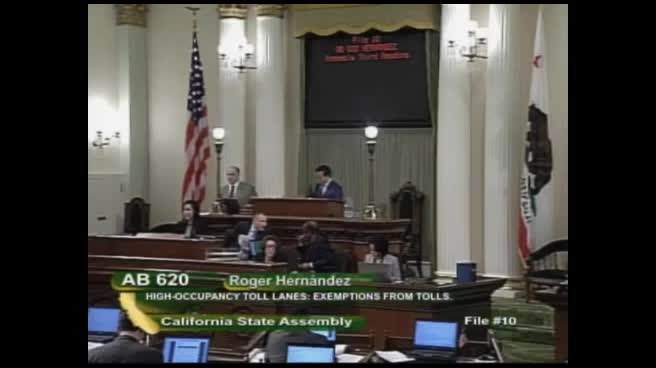 3MIN
Assembly Floor
 39SEC
Assembly Floor
 3MIN
Assembly Standing Committee on Transportation
Bill Author

Bill Co-Author(s):