AB 67: Double Pay on the Holiday Act of 2016.
- Session Year: 2015-2016
- House: Assembly
- Latest Version Date: 2016-08-03
Existing law provides that 8 hours of labor constitutes a days work. Under existing law, any work in excess of 8 hours in one workday and any work in excess of 40 hours in any one workweek, and the first 8 hours worked on the 7th day of work in any one workweek, is required to be compensated at the rate of no less than 11/2 times the regular rate of pay for an employee. Existing law also provides that hours worked in excess of 12 hours in one day as well as hours worked in excess of 8 hours on any 7th day of work are to be compensated at the rate of no less than twice the regular rate of pay of an employee. A violation of these overtime wage provisions constitutes a crime.
This bill would enact the Double Pay on the Holiday Act of 2016, which would require an employer to pay at least 2 times the regular rate of pay to employees at retail and grocery store establishments, as defined, except employees in specified categories, for work on a family holiday, as defined. The bill would exempt retail food facilities, as defined, from the act unless the retail food facility is a grocery store establishment, or is located within a retail establishment, or is located within a grocery store establishment and primarily sells food for onsite consumption.
Because this bill would expand the definition of a crime, it would impose a state-mandated local program.
The California Constitution requires the state to reimburse local agencies and school districts for certain costs mandated by the state. Statutory provisions establish procedures for making that reimbursement.
This bill would provide that no reimbursement is required by this act for a specified reason.
Existing law provides that 8 hours of labor constitutes a days work. Under existing law, any work in excess of 8 hours in one workday and any work in excess of 40 hours in any one workweek, and the first 8 hours worked on the 7th day of work in any one workweek, is required to be compensated at the rate of no less than 11/2 times the regular rate of pay for an employee. Existing law also provides that hours worked in excess of 12 hours in one day as well as hours worked in excess of 8 hours on any 7th day of work are to be compensated at the rate of no less than twice the regular rate of pay of an employee. A violation of these overtime wage provisions constitutes a crime.
This bill would enact the Double Pay on the Holiday Act of 2016, which would require an employer to pay at least 2 times the regular rate of pay to employees at retail and grocery store establishments, as defined, except employees in specified categories, for work on a family holiday, as defined. The bill would exempt restaurants, except for restaurants retail food facilities, as defined, from the act unless the retail food facility is a grocery store establishment, or is located within a retail establishment, or is located within a grocery store establishments, from the act. establishment and primarily sells food for onsite consumption.
Because this bill would expand the definition of a crime, it would impose a state-mandated local program.
The California Constitution requires the state to reimburse local agencies and school districts for certain costs mandated by the state. Statutory provisions establish procedures for making that reimbursement.
This bill would provide that no reimbursement is required by this act for a specified reason.
Existing law provides that 8 hours of labor constitutes a days work. Under existing law, any work in excess of 8 hours in one workday and any work in excess of 40 hours in any one workweek, and the first 8 hours worked on the 7th day of work in any one workweek, is required to be compensated at the rate of no less than 11/2 times the regular rate of pay for an employee. Existing law also provides that hours worked in excess of 12 hours in one day as well as hours worked in excess of 8 hours on any 7th day of work are to be compensated at the rate of no less than twice the regular rate of pay of an employee. A violation of these overtime wage provisions constitutes a crime.
This bill would enact the Double Pay on the Holiday Act of 2016 that 2016, which would require an employer to pay at least 2 times the regular rate of pay to an employee employees at retail and grocery store establishments, as defined, except employees in specified categories, for work on a family holiday, as defined. The bill would exempt restaurants, except for restaurants located within retail or grocery store establishments, from the act.
Because this bill would expand the definition of a crime, it would impose a state-mandated local program.
The California Constitution requires the state to reimburse local agencies and school districts for certain costs mandated by the state. Statutory provisions establish procedures for making that reimbursement.
This bill would provide that no reimbursement is required by this act for a specified reason.
Existing law provides that 8 hours of labor constitutes a days work. Under existing law, any work in excess of 8 hours in one workday and any work in excess of 40 hours in any one workweek, and the first 8 hours worked on the 7th day of work in any one workweek, is required to be compensated at the rate of no less than 11/2 times the regular rate of pay for an employee. Existing law also provides that hours worked in excess of 12 hours in one day as well as hours worked in excess of 8 hours on any 7th day of work are to be compensated at the rate of no less than twice the regular rate of pay of an employee. A violation of these overtime wage provisions constitutes a crime.
This bill would enact the Double Pay on the Holiday Act of 2015 2016 that would require an employer to pay at least 2 times the regular rate of pay to an employee, employee at retail and grocery establishments, as defined, except employees in specified categories, for work on a family holiday, as defined.
Because this bill would expand the definition of a crime, it would impose a state-mandated local program.
The California Constitution requires the state to reimburse local agencies and school districts for certain costs mandated by the state. Statutory provisions establish procedures for making that reimbursement.
This bill would provide that no reimbursement is required by this act for a specified reason.
Existing law provides that 8 hours of labor constitutes a days work. Under existing law, any work in excess of 8 hours in one workday and any work in excess of 40 hours in any one workweek, and the first 8 hours worked on the 7th day of work in any one workweek, is required to be compensated at the rate of no less than 1 1/2 times the regular rate of pay for an employee. Existing law also provides that hours worked in excess of 12 hours in one day as well as hours worked in excess of 8 hours on any 7th day of work are to be compensated at the rate of no less than twice the regular rate of pay of an employee. A violation of these overtime wage provisions constitutes a crime.
This bill would enact the Double Pay on the Holiday Act of 2015 that would require an employer to pay at least 2 times the regular rate of pay to specified employees an employee, except employees in specified categories, for work on a family holiday, as defined.
Because this bill would expand the definition of a crime, it would impose a state-mandated local program.
The California Constitution requires the state to reimburse local agencies and school districts for certain costs mandated by the state. Statutory provisions establish procedures for making that reimbursement.
This bill would provide that no reimbursement is required by this act for a specified reason.
Existing law provides that 8 hours of labor constitutes a days work. Under existing law, any work in excess of 8 hours in one workday and any work in excess of 40 hours in any one workweek, and the first 8 hours worked on the 7th day of work in any one workweek, is required to be compensated at the rate of no less than 1 1/2 times the regular rate of pay for an employee. Existing law also provides that hours worked in excess of 12 hours in one day as well as hours worked in excess of 8 hours on any 7th day of work are to be compensated at the rate of no less than twice the regular rate of pay of an employee. A violation of these overtime wage provisions constitutes a crime.
This bill would enact the Double Pay on the Holiday Act of 2015 that would require an employer to pay at least 2 times the regular rate of pay to an employee specified employees for work on a family holiday holiday, as defined.
Because this bill would expand the definition of a crime, it would impose a state-mandated local program.
The California Constitution requires the state to reimburse local agencies and school districts for certain costs mandated by the state. Statutory provisions establish procedures for making that reimbursement.
This bill would provide that no reimbursement is required by this act for a specified reason.
Existing law provides that 8 hours of labor constitutes a days work. Under existing law, any work in excess of 8 hours in one workday and any work in excess of 40 hours in any one workweek, and the first 8 hours worked on the 7th day of work in any one workweek, is required to be compensated at the rate of no less than 1 1/2 times the regular rate of pay for an employee. Existing law also provides that hours worked in excess of 12 hours in one day as well as hours worked in excess of 8 hours on any 7th day of work are to be compensated at the rate of no less than twice the regular rate of pay of an employee. A violation of these overtime wage provisions constitutes a crime.
This bill would enact the Double Pay on the Holiday Act of 2015 that would require an employer to pay at least 2 times the regular rate of pay to an employee for work on a family holiday as defined.
Because this bill would expand the definition of a crime, it would impose a state-mandated local program.
The California Constitution requires the state to reimburse local agencies and school districts for certain costs mandated by the state. Statutory provisions establish procedures for making that reimbursement.
This bill would provide that no reimbursement is required by this act for a specified reason.
(a)This section shall be known, and may be cited, as the Double Pay on the Holiday Act of 2016.
(b)Any work performed at a retail store establishment or a grocery store establishment on a family holiday shall be compensated by the employer at no less than twice the employees regular rate of pay.
(c)The provisions of this section are in addition to and independent of any other rights, remedies, or procedures available under any other law to an aggrieved employee.
(d)This section does not apply to a retail food facility unless it is a grocery store establishment, or is located within a retail store establishment, or is located within a grocery store establishment and primarily sells food for onsite consumption.
(e)As used in this section:
(1)Employee does not include the following:
(A)An employee covered by a valid collective bargaining agreement if the agreement expressly provides for the wages, hours of work, and working conditions of employees, and expressly provides for holiday premium pay for those employees, premium wage rates for all overtime hours worked, and a regular hourly rate of pay of not less than 30 percent more than the state minimum wage.
(B)An employee who is exempt from the payment of an overtime rate of compensation for executive, administrative, and professional employees pursuant to wage orders issued by the Industrial Welfare Commission described in Section 515.
(C)An employee who is employed by an employer who employs 500 or fewer employees.
(2)Employer means any person who employs another under any arrangement or contract of hire for a retail store establishment or grocery store establishment.
(3)Retail store establishment means a physical store within the state with more than 50 percent of its revenue generated from merchandise subject to the states sales and use taxes, including, but not limited to, electronics, appliances, clothing, furniture, sporting goods, health and personal products. A retail store establishment includes a retail food facility, if the retail food facility is located within a retail store establishment. A retail store establishment does not include a retail store establishment located in an amusement park, park or in a retail, dining, and entertainment area under common control of the amusement park, hotel, movie theater, a new motor vehicle dealer, as defined in Section 426 of the Vehicle Code, or a ski resort.
(4)Grocery store establishment means a physical store within the state that sells primarily household foodstuffs for offsite consumption, including, but not limited to, the sale of fresh produce, meats, poultry, fish, deli products, dairy products, canned foods, dry foods, beverages, and baked or prepared foods. Other household supplies or products are secondary to the primary purpose of food sales. A grocery store establishment includes a separate retail food facility that is located within a grocery store establishment and primarily sells food for onsite consumption. A grocery store establishment does not include a store that occupies 5,000 square feet or less of floor space and that sells transportation fuels in conjunction with, and at the same physical location as, household foodstuffs for offsite consumption.
(5)Family holiday means the fourth Thursday of November of each year.
(6)Retail food facility has the same meaning as in Section 113789 of the Health and Safety Code.
SEC. 2.No reimbursement is required by this act pursuant to Section 6 of Article XIIIB of the California Constitution because the only costs that may be incurred by a local agency or school district will be incurred because this act creates a new crime or infraction, eliminates a crime or infraction, or changes the penalty for a crime or infraction, within the meaning of Section 17556 of the Government Code, or changes the definition of a crime within the meaning of Section 6 of Article XIIIB of the California Constitution.
(a)This section shall be known, and may be cited, as the Double Pay on the Holiday Act of 2016.
(b)Any work performed at a retail store establishment or a grocery store establishment on a family holiday shall be compensated by the employer at no less than twice the employees regular rate of pay.
(c)The provisions of this section are in addition to and independent of any other rights, remedies, or procedures available under any other law to an aggrieved employee.
(d)This section does not apply to a retail food facility unless it is a grocery store establishment, or is located within a retail store establishment, or is located within a grocery store establishment and primarily sells food for onsite consumption.
(d)
(e)As used in this section:
(1)Employee does not include the following:
(A)An employee covered by a valid collective bargaining agreement if the agreement expressly provides for the wages, hours of work, and working conditions of employees, and expressly provides for holiday premium pay for those employees, premium wage rates for all overtime hours worked, and a regular hourly rate of pay of not less than 30 percent more than the state minimum wage.
(B)An employee who is exempt from the payment of an overtime rate of compensation for executive, administrative, and professional employees pursuant to wage orders issued by the Industrial Welfare Commission described in Section 515.
(C)An employee who is employed by an employer who employs 500 or fewer employees.
(2)Employer means any person employing another under any arrangement or contract of hire and includes the state, political subdivisions of the state, and municipalities. who employs another under any arrangement or contract of hire for a retail store establishment or grocery store establishment.
(3)Retail store establishment means a physical store within the state with more than 50 percent of its revenue generated from merchandise subject to the states sales and use taxes, including, but not limited to, electronics, appliances, clothing, furniture, sporting goods, health and personal products, or a limited line of food products for onsite consumption. products. A retail store establishment includes a retail food facility, if the retail food facility is located within a retail store establishment. A retail store establishment does not include a retail store establishment located in a hotel, an amusement park, or hotel, movie theater, or a new motor vehicle dealer, as defined in Section 426 of the Vehicle Code. Code, or a ski resort.
(4)Grocery store establishment means a physical store within the state that sells primarily household foodstuffs for offsite consumption, including, but not limited to, the sale of fresh produce, meats, poultry, fish, deli products, dairy products, canned foods, dry foods, beverages, and baked or prepared foods. Other household supplies or products are secondary to the primary purpose of food sales. A grocery store establishment includes a separate retail food facility that is located within a grocery store establishment and primarily sells food for onsite consumption. A grocery store establishment does not include a store that occupies 5,000 square feet or less of floor space and that sells transportation fuels in conjunction with, and at the same physical location as, household foodstuffs for offsite consumption.
(5)Family holiday means the fourth Thursday of November of each year.
(e)This section shall not apply to restaurants, except for restaurants that are located within a retail store establishment or a grocery store establishment.
(6)Retail food facility has the same meaning as in Section 113789 of the Health and Safety Code.
SEC. 2.No reimbursement is required by this act pursuant to Section 6 of Article XIIIB of the California Constitution because the only costs that may be incurred by a local agency or school district will be incurred because this act creates a new crime or infraction, eliminates a crime or infraction, or changes the penalty for a crime or infraction, within the meaning of Section 17556 of the Government Code, or changes the definition of a crime within the meaning of Section 6 of Article XIIIB of the California Constitution.
(a)This section shall be known, and may be cited, as the Double Pay on the Holiday Act of 2016.
(b)Any work performed at a retail store establishment or a grocery store establishment on a family holiday shall be compensated by the employer at no less than twice the employees regular rate of pay.
(c)The provisions of this section are in addition to and independent of any other rights, remedies, or procedures available under any other law to an aggrieved employee.
(d)As used in this section:
(1)Employee does not include the following:
(A)An employee covered by a valid collective bargaining agreement if the agreement expressly provides for the wages, hours of work, and working conditions of employees, and expressly provides for holiday premium pay for those employees, premium wage rates for all overtime hours worked, and a regular hourly rate of pay of not less than 30 percent more than the state minimum wage.
(B)An employee who is exempt from the payment of an overtime rate of compensation for executive, administrative, and professional employees pursuant to wage orders issued by the Industrial Welfare Commission described in Section 515.
(C)An employee who is employed by an employer who employs 500 or fewer employees.
(2)Employer means any person employing another under any arrangement or contract of hire and includes the state, political subdivisions of the state, and municipalities.
(3)Retail store establishment means a physical store within the state with more than 50 percent of its revenue generated from merchandise subject to the states sales and use tax, taxes, including, but not limited to, electronics, appliances, clothing, furniture, sporting goods, health and personal products, or a limited line of food products for onsite consumption. A retail store establishment does not include a store located in a hotel, amusement park, or movie theater. theater, or a new motor vehicle dealer, as defined in Section 426 of the Vehicle Code.
(4)Grocery store establishment means a physical store within the state that sells primarily household foodstuffs for offsite consumption, including, but not limited to, the sale of fresh produce, meats, poultry, fish, deli products, dairy products, canned foods, dry foods, beverages, and baked or prepared foods. Other household supplies or products are secondary to the primary purpose of food sales. A grocery store establishment does not include a store that occupies 5,000 square feet or less of floor space and that sells transportation fuels in conjunction with, and at the same physical location as, household foodstuffs for offsite consumption.
(5)Family holiday means the fourth Thursday of November of each year.
(e)This section shall not apply to restaurants, except for restaurants that are located within a retail store establishment or a grocery store establishment.
SEC. 2.No reimbursement is required by this act pursuant to Section 6 of Article XIIIB of the California Constitution because the only costs that may be incurred by a local agency or school district will be incurred because this act creates a new crime or infraction, eliminates a crime or infraction, or changes the penalty for a crime or infraction, within the meaning of Section 17556 of the Government Code, or changes the definition of a crime within the meaning of Section 6 of Article XIIIB of the California Constitution.
(a)This section shall be known, and may be cited, as the Double Pay on the Holiday Act of 2015. 2016.
(b)Any work performed at a retail store establishment or a grocery store establishment on a family holiday shall be compensated by the employer at no less than twice the employees regular rate of pay.
(c)The provisions of this section are in addition to and independent of any other rights, remedies, or procedures available under any other law to an aggrieved employee.
(d)As used in this section:
(1)Employee does not include the following:
(A)An employee covered by a valid collective bargaining agreement if the agreement expressly provides for the wages, hours of work, and working conditions of employees, and expressly provides for holiday premium pay for those employees, premium wage rates for all overtime hours worked, and a regular hourly rate of pay of not less than 30 percent more than the state minimum wage.
(B)An employee who is exempt from the payment of an overtime rate of compensation for executive, administrative, and professional employees pursuant to wage orders issued by the Industrial Welfare Commission described in Section 515.
(C)An employee who is employed by an employer who employs 25 500 or fewer employees.
(D)An employee who is employed as a first responder or emergency personnel.
(2)Employer means any person employing another under any arrangement or contract of hire and includes the state, political subdivisions of the state, and municipalities.
(3)Retail store establishment means a physical store within the state with more than 50 percent of its revenue generated from merchandise subject to the states sales and use tax, including, but not limited to, electronics, appliances, clothing, furniture, sporting goods, health and personal products, or a limited line of food products for onsite consumption. A retail store establishment does not include a store located in a hotel, amusement park, or movie theater.
(4)Grocery store establishment means a physical store within the state that sells primarily household foodstuffs for offsite consumption, including, but not limited to, the sale of fresh produce, meats, poultry, fish, deli products, dairy products, canned foods, dry foods, beverages, and baked or prepared foods. Other household supplies or products are secondary to the primary purpose of food sales.
(3)
(5)Family holiday means the fourth Thursday of November of each year.
SEC. 2.No reimbursement is required by this act pursuant to Section 6 of Article XIIIB of the California Constitution because the only costs that may be incurred by a local agency or school district will be incurred because this act creates a new crime or infraction, eliminates a crime or infraction, or changes the penalty for a crime or infraction, within the meaning of Section 17556 of the Government Code, or changes the definition of a crime within the meaning of Section 6 of Article XIIIB of the California Constitution.
(a)This section shall be known, and may be cited, as the Double Pay on the Holiday Act of 2015.
(b)Any work on a family holiday shall be compensated by the employer at no less than twice the employees regular rate of pay.
(c)The provisions of this section are in addition to and independent of any other rights, remedies, or procedures available under any other law to an aggrieved employee.
(d)As used in this section:
(1)Employee does not include the following:
(A)An employee covered by a valid collective bargaining agreement if the agreement expressly provides for the wages, hours of work, and working conditions of employees, and expressly provides for holiday premium pay for those employees, premium wage rates for all overtime hours worked, and regular hourly rate of pay of not less than 30 percent more than the state minimum wage.
(B)An employee who is exempt from the payment of an overtime rate of compensation for executive, administrative, and professional employees pursuant to wage orders issued by the Industrial Welfare Commission described in Section 515.
(C)An employee who is employed by an employer who employs 25 or fewer employees.
(D)An employee who is employed as a first responder or emergency personnel.
(2)Employer means any person employing another under any arrangement or contract of hire and includes the state, political subdivisions of the state, and municipalities.
(3)Family holiday means the fourth Thursday of November of each year.
SEC. 2.No reimbursement is required by this act pursuant to Section 6 of Article XIIIB of the California Constitution because the only costs that may be incurred by a local agency or school district will be incurred because this act creates a new crime or infraction, eliminates a crime or infraction, or changes the penalty for a crime or infraction, within the meaning of Section 17556 of the Government Code, or changes the definition of a crime within the meaning of Section 6 of Article XIIIB of the California Constitution.
(a)This section shall be known, and may be cited, as the Double Pay on the Holiday Act of 2015.
(b)Any work on a family holiday shall be compensated by the employer at no less than twice the employees regular rate of pay.
(c)The provisions of this section are in addition to and independent of any other rights, remedies, or procedures available under any other law to an aggrieved employee.
(d)As used in this section:
(1)Employee does not include an employee the following:
(A)An employee covered by a valid collective bargaining agreement if the agreement expressly provides for the wages, hours of work, and working conditions of employees, and expressly provides for paid sick days or a paid leave or paid time off policy that permits the use of sick days for those employees, final and binding arbitration of disputes concerning the application of its holiday premium pay provisions, for those employees, premium wage rates for all overtime hours worked, and regular hourly rate of pay of not less than 30 percent more than the state minimum wage.
(B)An employee who is exempt from the payment of an overtime rate of compensation for executive, administrative, and professional employees pursuant to wage orders issued by the Industrial Welfare Commission described in Section 515.
(2)Employer means any person employing another under any arrangement or contract of hire and includes the state, political subdivisions of the state, and municipalities.
(3)Family holiday means either:
(A)December 25 of each year.
(B)The the fourth Thursday of November of each year.
SEC. 2.No reimbursement is required by this act pursuant to Section 6 of Article XIIIB of the California Constitution because the only costs that may be incurred by a local agency or school district will be incurred because this act creates a new crime or infraction, eliminates a crime or infraction, or changes the penalty for a crime or infraction, within the meaning of Section 17556 of the Government Code, or changes the definition of a crime within the meaning of Section 6 of Article XIIIB of the California Constitution.
(a)This section shall be known, and may be cited, as the Double Pay on the Holiday Act of 2015.
(b)Any work on a family holiday shall be compensated at no less than twice the employees regular rate of pay.
(c)The provisions of this section are in addition to and independent of any other rights, remedies, or procedures available under any other law to an aggrieved employee.
(d)As used in this section:
(1)Employee does not include an employee covered by a valid collective bargaining agreement if the agreement expressly provides for the wages, hours of work, and working conditions of employees, and expressly provides for paid sick days or a paid leave or paid time off policy that permits the use of sick days for those employees, final and binding arbitration of disputes concerning the application of its holiday premium pay provisions, premium wage rates for all overtime hours worked, and regular hourly rate of pay of not less than 30 percent more than the state minimum wage.
(2)Employer means any person employing another under any arrangement or contract of hire and includes the state, political subdivisions of the state, and municipalities.
(3)Family holiday means either:
(A)December 25 of each year.
(B)The fourth Thursday of November of each year.
SEC. 2.No reimbursement is required by this act pursuant to Section 6 of Article XIIIB of the California Constitution because the only costs that may be incurred by a local agency or school district will be incurred because this act creates a new crime or infraction, eliminates a crime or infraction, or changes the penalty for a crime or infraction, within the meaning of Section 17556 of the Government Code, or changes the definition of a crime within the meaning of Section 6 of Article XIIIB of the California Constitution.
|
Date
|
Status
|
|---|---|
| Jun 21, 2016 | In committee: Hearing postponed by committee. |
| Jan 20, 2016 | From inactive file. |
| Jan 20, 2016 | Ordered to third reading. |
| Jan 25, 2016 | Read third time and amended. Ordered to third reading. (Page 3474.) |
| Jan 27, 2016 | In Senate. Read first time. To Com. on RLS. for assignment. |
| Jan 27, 2016 | Read third time. Passed. Ordered to the Senate. (Ayes 43. Noes 32. Page 3508.) |
| Feb 4, 2016 | Referred to Com. on L. & I.R. |
| May 19, 2016 | From committee chair, with author's amendments: Amend, and re-refer to committee. Read second time, amended, and re-referred to Com. on L. & I.R. |
| Jun 13, 2016 | From committee: Amend, and do pass as amended and re-refer to Com. on APPR. (Ayes 3. Noes 1.) (June 8). |
| Jun 14, 2016 | Read second time and amended. Re-referred to Com. on APPR. |
| Jan 19, 2016 | Notice of intention to remove from inactive file given by Assembly Member Gonzalez. |
| Aug 1, 2016 | From committee: Be placed on second reading file pursuant to Senate Rule 28.8. |
| Aug 2, 2016 | Read second time. Ordered to third reading. |
| Aug 3, 2016 | Read third time and amended. Ordered to second reading. |
| Aug 4, 2016 | Read second time. Ordered to third reading. |
| Aug 29, 2016 | Read third time. Passed. Ordered to the Assembly. |
| Aug 29, 2016 | Read third time. Passed. Ordered to the Assembly. (Ayes 22. Noes 14. Page 5494.). |
| Aug 30, 2016 | In Assembly. Concurrence in Senate amendments pending. |
| Aug 31, 2016 | Assembly refused to concur in Senate amendments. |
| Jun 3, 2015 | Ordered to third reading. |
| Dec 18, 2014 | From printer. May be heard in committee January 17. |
| Jan 5, 2015 | Read first time. |
| Jan 22, 2015 | Referred to Com. on L. & E. |
| Mar 19, 2015 | From committee: Do pass and re-refer to Com. on APPR. (Ayes 5. Noes 2.) (March 18). Re-referred to Com. on APPR. |
| Apr 15, 2015 | In committee: Set, first hearing. Referred to suspense file. |
| Jun 1, 2015 | From committee: Amend, and do pass as amended. (Ayes 10. Noes 5.) (May 28). |
| Jun 2, 2015 | Read second time and amended. Ordered returned to second reading. |
| Jun 3, 2015 | Amended. |
| Dec 17, 2014 | Introduced. To print. |
| Jun 3, 2015 | Read second time. |
| Jun 4, 2015 | Assembly Rule 69(d) suspended. |
| Jun 4, 2015 | Assembly Rule 69(d) suspended. (Page 1903.) |
| Jun 4, 2015 | Motion to reconsider made by Assembly Member Gonzalez. |
| Jun 4, 2015 | Read third time. Refused passage. (Ayes 29. Noes 34. Page 1928.). |
| Jun 8, 2015 | Ordered to inactive file at the request of Assembly Member Gonzalez. |
| Jun 8, 2015 | Reconsideration granted. |
| Jun 8, 2015 | Reconsideration granted. (Page 1943.) |
|
Date
|
Description
|
Location
|
Votes
|
|
|---|---|---|---|---|
| Aug 31, 2016 | AB 67 GONZALEZ Concurrence in Senate Amendments | Assembly Floor |
Failed |
|
| Aug 29, 2016 | Assembly 3rd Reading AB67 Gonzalez By Allen | Senate Floor |
Passed |
|
| Jun 8, 2016 | Do pass as amended, but first amend, and re-refer to the Committee on [Appropriations] | Senate Standing Committee on Labor and Industrial Relations |
Passed |
|
| Jan 27, 2016 | AB 67 GONZALEZ Assembly Third Reading | Assembly Floor |
Passed |
|
| Jun 4, 2015 | AB 67 GONZALEZ Assembly Third Reading | Assembly Floor |
Failed |
|
| May 28, 2015 | Do pass as amended. | Assembly Standing Committee on Appropriations |
Passed |
|
| Mar 18, 2015 | Do pass and be re-referred to the Committee on [Appropriations] | Assembly Standing Committee on Labor and Employment |
Passed |
This list shows positions taken on this bill by organizations on the date displayed, which is linked to the original source.
Positions by individuals are not included.
|
Organization
|
Position
|
Date
|
|---|---|---|
| Agricultural Council Of California | ** Against | Aug 29, 2016 |
| Air Conditioning Trade Association | ** Against | Jun 8, 2016 |
| Alhambra Chamber of Commerce | ** Against | Aug 29, 2016 |
| American Petroleum and Convenience Store Association | ** Against | Jun 8, 2016 |
| Brea Chamber of Commerce | ** Against | Aug 29, 2016 |
| California Association of Bed and Breakfast Inns | ** Against | Aug 29, 2016 |
| California Broadcasters Association | * Against | Mar 18, 2015 |
| California Catholic Conference | * Support | Mar 18, 2015 |
| California Chamber Of Commerce | ** Against | Aug 29, 2016 |
| California Conference Board Of The Amalgamated Transit Union | ** Support | Aug 29, 2016 |
| California Conference Of Machinists | ** Support | Aug 29, 2016 |
| California Dairies Incorporated | * Against | Mar 18, 2015 |
| California Employment Law Council | ** Against | Aug 29, 2016 |
| California Employment Lawyers Association | ** Support | Aug 29, 2016 |
| California Farm Bureau Association | ** Against | Jun 8, 2016 |
| California Grocers Association | ** Against | Aug 29, 2016 |
| California Hotel & Lodging Association | ** Against | Aug 29, 2016 |
| California Immigrant Policy Center | ** Support | Aug 29, 2016 |
| California Labor Federation, Afl-Cio | ** Support | Jun 8, 2016 |
| California League of Food Processors | ** Against | Aug 29, 2016 |
| California Manufacturers And Technology Association | * Against Unless Amend | Jun 8, 2016 |
| California Newspaper Publishers Association | * Against | Mar 18, 2015 |
| California Nurses Association | ** Support | Aug 29, 2016 |
| California Pool & Spa Association | ** Against | Aug 29, 2016 |
| California Restaurants Association | ** Against | Aug 29, 2016 |
| California Retailers Association | * Against | Jun 8, 2016 |
| California Retailers Association California Travel Association | ** Against | Aug 29, 2016 |
| California School Employees Association | ** Support | Aug 29, 2016 |
| California Ski Industry Association | * Neutral | Jun 8, 2016 |
| California State Association Of Electrical Workers | ** Support | Aug 29, 2016 |
| California State Pipe Trades Council | ** Support | Aug 29, 2016 |
| California Teamsters Public Affairs Council | ** Support | Aug 29, 2016 |
| Camarillo Chamber of Commerce | ** Against | Aug 29, 2016 |
| CAWA - Representing the Automotive Parts Industry | ** Against | Aug 29, 2016 |
| Cerritos Regional Chamber of Commerce | ** Against | Jun 8, 2016 |
| Communication Workers of America, District 9 | ** Support | Aug 29, 2016 |
| Computing Technology Industry Association - CompTIA | ** Against | Jun 8, 2016 |
| Culver City Chamber of Commerce | ** Against | Jun 8, 2016 |
| East Valley Legislative Advocacy Council | ** Against | Jun 8, 2016 |
| El Dorado County Chamber of Commerce | ** Against | Jun 8, 2016 |
| Engineers & Scientists of California | ** Support | Aug 29, 2016 |
| Gateway Chambers Alliance | ** Against | Jun 8, 2016 |
| Goleta Valley Chamber of Commerce | ** Against | Jun 8, 2016 |
| Greater Conejo Valley Chamber of Commerce | ** Against | Jun 8, 2016 |
| Greater Riverside Chambers of Commerce | ** Against | Jun 8, 2016 |
| Greater San Fernando Valley Chamber of Commerce | ** Against | Jun 8, 2016 |
| International Longshore & Warehouse Union | ** Support | Aug 29, 2016 |
| Lake Tahoe South Shore Chamber of Commerce | ** Against | Jun 8, 2016 |
| Long Beach Area Chamber of Commerce | ** Against | Jun 8, 2016 |
| Macy's | * Support | Jun 8, 2016 |
| Maxim Healthcare Services, Inc. | ** Against | Jun 8, 2016 |
| National Association Of Theatre Owners Of California/Nevada | * Against | Mar 18, 2015 |
| North Lake Tahoe Chamber of Commerce | ** Against | Jun 8, 2016 |
| North Orange County Chamber | ** Against | Jun 8, 2016 |
| Orange County Business Council | ** Against | Jun 8, 2016 |
| Oxnard Chamber of Commerce | ** Against | Jun 8, 2016 |
| Plumbing-Heating-Cooling Contractors Association of California | ** Against | Jun 8, 2016 |
| Professional & Technical Engineers | ** Support | Aug 29, 2016 |
| Rancho Cordova Chamber of Commerce | ** Against | Jun 8, 2016 |
| San Diego Regional Chamber Of Commerce | * Against | Mar 18, 2015 |
| UNITE HERE, AFL-CIO | ** Support | Aug 29, 2016 |
| United Farm Workers | ** Support | Aug 29, 2016 |
| United Food & Commercial Workers, Western States Council | ** Support | Aug 29, 2016 |
| Utility Workers Union of America | ** Support | Aug 29, 2016 |
| Walmart | * Support | Mar 18, 2015 |
| Western Growers Association | * Against | Mar 18, 2015 |
| Western States Council Of Sheet Metal Workers | ** Support | Aug 29, 2016 |
(Without Reference to File)
CONCURRENCE IN SENATE AMENDMENTS
CSA1 Bill Id:AB 67
Author:(Gonzalez)
As Amended Ver:August 3, 2016
Majority vote
ASSEMBLY: | 43-32 | (January 27, 2016) | SENATE: | 22-14 | (August 29, 2016) |
Original Committee Reference: L. & E.
SUMMARY: Enacts the "Double Pay on the Holiday Act of 2016," as specified.
The Senate amendments:
- Provide that this bill does not apply to a retail food facility unless it is a grocery establishment, or is located within a retail store establishment, or is located within a grocery store establishment and primarily sells food for offsite consumption.
- Provides that a "retail store establishment" includes a retail food facility if the retail food facility is located within a retail store establishment.
- Provides that a "retail store establishment" does not include one located on an amusement park or in a retail, dining, and entertainment area under common control of the amusement park.
- Provide that a "retail store establishment" does not include a new motor vehicle dealer or a ski resort.
- Provides that a "grocery store establishment" does not include a store that occupies 5,000 square feet or less of floor space and that sells transportation fuels in conjunction with, and at the same physical location as, household food stuffs for offsite consumption.
- Provides that a "grocery store establishment" includes a separate retail food facility that is located within a grocery store establishment and primarily sells food for offsite consumption.
FISCAL EFFECT: According to the Senate Appropriations Committee, pursuant to Senate Rule 28.8, negligible state costs.
COMMENTS: This bill would enact the Double Pay on the Holiday Act of 2015 that would require an employer to pay at least two times the regular rate of pay to an employee for work on a family holiday, as defined.
Supporters argue that this bill guarantees that employees are fairly compensated for the undue hardships associated with working on the traditional family holiday of Thanksgiving. They contend that the increasing commercialization of the holiday in recent years has forced workers to miss out on celebrating the holiday and spending time with their families in order to keep their jobs. In some cases, this work has become mandatory, forcing workers to give up their holiday or risk losing their jobs.
Opponents argue that this bill will result in unavoidable cost increases for certain businesses. Opponents also argue that this bill would create a competitive disadvantage for "brick-and-mortar" stores. They state that this bill would unilaterally increase the cost of doing business only for those employers who have a physical presence in California, thereby automatically placing them at a competitive disadvantage with online companies and out-of-state businesses that would not be subject to this cost.
Analysis Prepared by: Ben Ebbink / L. & E. / (916) 319-2091 FN: 0003800
Office of Senate Floor Analyses (916) 651-1520 Fax: (916) 327-4478 | AB |
THIRD READING
Bill No: AB 67
:
SENATE LABOR & IND. REL. COMMITTEE: 3-1, 6/8/16
AYES: Mendoza, Leno, Mitchell
NOES: Stone
NO VOTE RECORDED: Jackson
SENATE APPROPRIATIONS COMMITTEE: Senate Rule 28.8
ASSEMBLY FLOOR: 43-32, 1/27/16 - See last page for vote
SOURCE: United Food & Commercial Workers
DIGEST: This bill enacts the Double Pay on the Holiday Act of 2016 requiring a grocery or retail store establishment employer to pay two times the regular rate of pay to an employee for work on Thanksgiving Day. This bill defines grocery store establishment and retail store establishment and, among other things, specifies that a retail store establishment does not include a retail store located in an amusement park.
Senate Floor Amendments of 8/3/16 further clarify the exemption of amusement parks by specifying that “retail store establishment” does not include a retail store establishment located in an amusement park or in a retail, dining, and entertainment area under common control of the amusement park.
Existing law:
- Defines a full workday as eight hours of labor, and 40 hours as a workweek. Any additional hours worked must be compensated with the payment of overtime wage rates. (Labor Code §510)
- Requires the payment of overtime compensation as follows:
- Work in excess of eight hours a day, and over 40 hours in a workweek, and the first eight hours worked on the seventh day of a workweek shall be compensated at the rate of no less than 1½ times the regular pay rate.
- Work in excess of 12 hours in one day shall be compensated at the rate of no less than twice the regular rate of pay for an employee.
- Work in excess of eight hours on any seventh day of a workweek shall be compensated at the rate of no less than twice the regular pay rate.
- Provides that the overtime compensation requirements do not apply to certain executive, administrative and professional employees that meet specified criteria for exemption.
- States that any person who violates these overtime wage provisions is guilty of a misdemeanor.
This bill:
- Enacts the Double Pay on the Holiday Act of 2016 requiring any work performed at a retail or grocery store establishment on a family holiday to be compensated at no less than twice the employee’s regular rate of pay.
- Defines "family holiday" as the fourth Thursday of November of each year.
- Defines “retail store establishment” as a physical store within the state with more than 50 percent of its revenue generated from merchandise subject to the state’s sales and use taxes, including, but not limited to, electronics, appliances, clothing, furniture, sporting goods, health and personal products. A “retail store establishment” includes a retail food facility, if the retail food facility is located within a retail store establishment. A “retail store establishment” does not include a retail store establishment located in an amusement park, hotel, movie theater, a new motor vehicle dealer, as defined, or a ski resort.
- Defines “grocery store establishment” as a physical store within the state that sells primarily household foodstuffs for offsite consumption, including, but not limited to, the sale of fresh produce, meats, poultry, fish, deli products, dairy products, canned foods, dry foods, beverages, and baked or prepared foods. Other household supplies or products are secondary to the primary purpose of food sales. A “grocery store establishment” includes a separate retail food facility that is located within a grocery store establishment and primarily sells food for onsite consumption. A “grocery store establishment” does not include a store that occupies 5,000 square feet or less of floor space and that sells transportation fuels in conjunction with, and at the same physical location as, household foodstuffs for offsite consumption.
- Provides that “employee” does not include the following:
- An employee covered by a valid collective bargaining agreement that meets specified criteria, including the payment of holiday premium pay and a regular hourly rate of pay of not less than 30 percent more than the state minimum wage.
- An employee who is exempt from the payment of overtime under the executive, administrative, and professional employee exemption under current law.
- An employee who is employed by an employer with 500 or fewer employees.
- Specifies that these provisions do not apply to a retail food facility unless it is a grocery store establishment, or is located within a retail store establishment, or is located within a grocery store establishment and primarily sells food for onsite consumption.
- Specifies that “retail food facility” has the same meaning as in Section 113789 of the Health and Safety Code.
Background
Black Friday, the day following Thanksgiving Day in the United States, and the sales that many stores offer to entice customers has set the beginning of the holiday shopping season in motion for many decades. Black Friday has routinely been the busiest shopping day of the year; with stores opening their doors to customers as early as 4:00am. However, in recent years there has been a changing trend of starting the Black Friday specials early – on Thanksgiving Day. Several large retailers have started opening their doors as early as 5:00pm on Thanksgiving Day and staying open overnight in an attempt to appeal to the sale seeking shoppers.
Although appealing to many, these retail practices come with several consequences including that of making high demands on staff who are needed in order to keep such long open hours, and especially for those required to work on Thanksgiving Day. Additionally, both customers and employees face health and safety risks due to insufficient staff for the high number of consumers walking in the door. Even as many stores stretch their hours into the holiday, there has been some push back from several retailers who have decided to do the opposite and close their stores completely on Thanksgiving Day giving their employees the opportunity to spend the day with their families and friends for the holiday.
Need for the bill? California law does not require that an employer provide its employees with paid holidays, that it close its business on any holiday, or that employees be given the day off for any particular holiday. Hours worked on holidays, Saturdays, and Sundays are treated like hours worked on any other day of the week. Employers are free to create their own policies regarding holidays and can choose to give their employees time off from work with pay, but nothing in the law requires such a practice. Additionally, there is nothing in the law mandating that an employer pay an employee a special premium for work performed on a holiday, Saturday, or Sunday, other than the overtime premium required for work performed in excess of eight hours in a workday or 40 hours in a workweek.
According to the author, the recent trend of Black Friday shopping deals spreading into the Thanksgiving holiday is forcing workers to miss out on celebrating the holiday and spending time with their families in order to keep their jobs. In some cases, this work has become mandatory and as such, the author believes that employees should be fairly compensated for the undue hardships associated with working on the traditional family holiday. This bill requires retail and grocery store employers to pay at least two times the regular rate of pay to an employee for work on Thanksgiving Day.
FISCAL EFFECT: Appropriation: Fiscal Com.: Local:
United Food & Commercial Workers, Western States Council (source)
California Conference Board of the Amalgamated Transit Union
California Conference of Machinists
California Employment Lawyers Association
California Immigrant Policy Center
California Labor Federation
California Nurses Association
California School Employees Association
California State Association of Electrical Workers
California State Pipe Trades Council
California Teamsters Public Affairs Council
Communication Workers of America, District 9
Engineers & Scientists of California
Professional & Technical Engineers
UNITE HERE, AFL-CIO
International Longshore & Warehouse Union
United Farm Workers
Utility Workers Union of America
Western States Council of Sheet Metal Workers
Agricultural Council of California
Alhambra Chamber of Commerce
Brea Chamber of Commerce
California Association of Bed and Breakfast Inns
California Chamber of Commerce
California Employment Law Council
California Grocers Association
California Hotel & Lodging Association
California League of Food Processors
California Pool & Spa Association
California Restaurants Association
California Retailers Association
California Travel Association
Camarillo Chamber of Commerce
CAWA – Representing the Automotive Parts Industry
Cerritos Regional Chamber of Commerce
Chambers of Commerce Alliance of Ventura and Santa Barbara Counties
Computing Technology Industry Association - CompTIA
Culver City Chamber of Commerce
Desert Hot Springs Chamber of Commerce and Visitors Center
East Valley Legislative Advocacy Council
El Dorado County Chamber of Commerce
El Dorado Hills Chamber of Commerce & California Welcome Center
Gateway Chambers Alliance
Goleta Valley Chamber of Commerce
Greater Conejo Valley Chamber of Commerce
Greater Riverside Chambers of Commerce
Greater San Fernando Valley Chamber of Commerce
Lake Tahoe South Shore Chamber of Commerce
Long Beach Area Chamber of Commerce
Maxim Healthcare Services
North Lake Tahoe Chamber of Commerce
North Orange County Chamber
Orange County Business Council
Oxnard Chamber of Commerce
Rancho Cordova Chamber of Commerce
Redondo Beach Chamber of Commerce & Visitors Bureau
San Diego Regional Chamber of Commerce
San Jose Silicon Valley Chamber of Commerce
Santa Clara Chamber of Commerce & Convention-Visitors Bureau
Santa Maria Valley Chamber of Commerce Visitor & Convention Bureau
Simi Valley Chamber of Commerce
Southwest California Legislative Council
Torrance Chamber of Commerce
Valley Industry and Commerce Association
ARGUMENTS IN SUPPORT: According to proponents, in recent years, Black Friday shopping deals have increasingly spread into the Thanksgiving holiday, forcing workers to miss out on celebrating the holiday with their families in order to keep their jobs. In some cases this work has become mandatory, forcing workers to give up their holiday or risk losing their jobs. The author and proponents argue that this bill simply seeks to provide employees with double pay in order to meet the increase in consumer demand on Thanksgiving Day and “pre”-Black Friday shopping. Proponents believe this bill would guarantee that employees are fairly compensated for the undue hardships associated with working on the traditional family holiday of Thanksgiving.
ARGUMENTS IN OPPOSITION: A coalition of opponents argue that this bill unfairly targets two classifications of employers, retail and grocery store establishments, increases their costs, and creating a competitive disadvantage by forcing them to recognize Thanksgiving as a “family holiday” and compensate all employees with double the regular rate of pay for work on that day. Any other employer who opens on Thanksgiving can continue to pay their employees minimum wage. Opponents also argue that this bill unilaterally increases the cost of doing business only for those employers who have a “physical store” in California, thereby automatically placing them at a competitive disadvantage with online retailers and out-of-state businesses not subject to this costly mandate.
Additionally, opponents argue that many of the “retail store establishment” employers surveyed confirmed they voluntarily pay their employees time and a half for work on Thanksgiving. They also note that numerous grocery store establishments also pay increased compensation on Thanksgiving, as negotiated through the collective bargaining process, yet would still be subject to the provisions of AB 67 as they do not qualify for the collective bargaining exemption.
Also of concern to opponents is the requirement that employers pay double the employee’s “regular rate” of pay rather than double the “hourly rate,” a significant different, they argue, as the determination of the regular rate of pay requires a detailed calculation that goes beyond just an employee’s hourly pay. They argue that good faith errors made in calculating the regular rate of pay or failure to comply with other provisions of AB 67 would be subject to Private Attorneys General Act and add another threat of litigation against California employers. Lastly, opponents argue that this bill provides preferential treatment for one day out of the year that not all recognize as a family holiday and may be offensive to those that believe other days within the year deserve that recognition.
A restaurant specific point of opposition comes from the California Restaurant Association which argues that this bill, although exempting a share of the restaurant community, leaves many subject to the double-pay requirements based on the mere fact that they operate within retail or grocery establishments even though they are separate and independent. They argue that these restaurants will face unfair competition as they will be forced to pay double hourly pay to its employees while restaurants outside a retail or grocery store, but in the same shopping center or across the street, do not.
ASSEMBLY FLOOR: 43-32, 1/27/16
AYES: Alejo, Bloom, Bonilla, Bonta, Brown, Burke, Calderon, Campos, Chau, Chiu, Chu, Eggman, Cristina Garcia, Eduardo Garcia, Gatto, Gipson, Gomez, Gonzalez, Gordon, Gray, Roger Hernández, Holden, Jones-Sawyer, Levine, Lopez, Low, McCarty, Medina, Mullin, Nazarian, O'Donnell, Quirk, Rendon, Ridley-Thomas, Rodriguez, Santiago, Mark Stone, Thurmond, Ting, Weber, Williams, Wood, Atkins
NOES: Achadjian, Travis Allen, Baker, Bigelow, Brough, Chang, Chávez, Cooley, Dababneh, Dahle, Dodd, Frazier, Beth Gaines, Gallagher, Grove, Hadley, Harper, Irwin, Jones, Kim, Lackey, Maienschein, Mathis, Mayes, Melendez, Obernolte, Olsen, Patterson, Steinorth, Wagner, Waldron, Wilk
NO VOTE RECORDED: Cooper, Daly, Linder, Salas
8/5/16 11:08:23
**** END ****
SENATE COMMITTEE ON LABOR AND INDUSTRIAL RELATIONS
Senator Tony Mendoza, Chair
2015 - 2016 Regular
Bill No: AB 67 Hearing Date: June 8, 2016
Author: | Gonzalez | ||
Version: | May 19, 2016 | ||
Urgency: | No | Fiscal: | Yes |
Consultant: | Alma Perez-Schwab | ||
Subject: Double Pay on the Holiday Act of 2016
KEY ISSUES
Should the Legislature require retail and grocery store establishments of 500 or more employees to pay their employees at twice the regular rate of pay for working on Thanksgiving Day?
Should the double pay for work on Thanksgiving Day requirement exclude restaurants, except for restaurants that are located within retail or grocery store establishments?
ANALYSIS
Existing law:
- Defines a full workday as 8 hours of labor, and 40 hours as a workweek. Any additional hours worked must be compensated with the payment of overtime wage rates.
(Labor Code §510)
- Requires the payment of overtime compensation as follows:
- Work in excess of 8 hours a day, and over 40 hours in a workweek, and the first 8 hours worked on the 7th day of a workweek shall be compensated at the rate of no less than 1 ½ times the regular rate of pay;
- Work in excess of 12 hours in one day shall be compensated at the rate of no less than twice the regular rate of pay for an employee;
- Work in excess of 8 hours on any 7th day of a workweek shall be compensated at the rate of no less than twice the regular rate of pay of an employee.
- Provides that the overtime compensation requirements do not apply to certain executive, administrative and professional employees that meet specified criteria for exemption.
- Any person who violates these overtime wage provisions is guilty of a misdemeanor.
This Bill would enact the Double Pay on the Holiday Act of 2016 that would require an employer to pay at least two times the regular rate of pay to an employee for work on a family holiday, as defined.
Specifically, this bill:
- Requires any work performed at a retail or grocery store establishment on a family holiday to be compensated at no less than twice the employee’s regular rate of pay.
- Defines "family holiday" as the fourth Thursday of November of each year.
- Defines “retail store establishment” as a physical store within the state with more than 50 percent of its revenue generated from merchandise subject to the state’s sales and use taxes, including, but not limited to, electronics, appliances, clothing, furniture, sporting goods, health and personal products, or a limited line of food products for onsite consumption. A “retail store establishment” does not include a store located in a hotel, amusement park, movie theater, or a new motor vehicle dealer, as defined.
- Defines “grocery store establishment” as a physical store within the state that sells primarily household foodstuffs for offsite consumption, including, but not limited to, the sale of fresh produce, meats, poultry, fish, deli products, dairy products, canned foods, dry foods, beverages, and baked or prepared foods. Other household supplies or products are secondary to the primary purpose of food sales. A “grocery store establishment” does not include a store that occupies 5,000 square feet or less of floor space and that sells transportation fuels in conjunction with, and at the same physical location as, household foodstuffs for offsite consumption.
- Provides that “employee” does not include the following:
- An employee covered by a valid collective bargaining agreement that meets specified criteria, including the payment of holiday premium pay and a regular hourly rate of pay of not less than 30 percent more than the state minimum wage.
- An employee who is exempt from the payment of overtime under the executive, administrative, and professional employee exemption under current law.
- An employee who is employed by an employer with 500 or fewer employees
- Specifies that these provisions do not apply to restaurants, except for restaurants that are located within retail or grocery store establishments.
COMMENTS
1. Background: Black Friday on Thanksgiving Day
Black Friday, the day following Thanksgiving Day in the United States, and the sales that many stores offer to entice customers has set the beginning of the holiday shopping season in motion for many decades. Black Friday has routinely been the busiest shopping day of the year; with stores opening their doors to customers as early as 4:00am. However, in recent years there has been a changing trend of starting the Black Friday specials early – on Thanksgiving Day. Several large retailers have started opening their doors as early as 5:00pm on Thanksgiving Day and staying open overnight in an attempt to appeal to the sale seeking shoppers.
Although appealing to many, these retail practices come with several consequences including that of making high demands on staff who are needed in order to keep such long open hours, and especially for those required to work on Thanksgiving Day. Additionally, both customers and employees face health and safety risks due to insufficient staff for the high number of consumers walking in the door. Even as many stores stretch their hours into the holiday, there has been some push back from several retailers who have decided to do the opposite and close their stores completely on Thanksgiving Day giving their employees the opportunity to spend the day with their families and friends for the holiday.
For many minimum wage workers all hours of work are welcomed to help provide for their families, including work on federally recognized holidays. According to various news accounts, workers who refuse to work on holidays often face intimidation or fear the loss of their jobs. This increasing commercialization of the holiday season has generated significant public backlash, including petitions asking retailers not to open their stores on Thanksgiving Day, media criticism and worker protests.
2. Need for the bill?
California law does not require that an employer provide its employees with paid holidays, that it close its business on any holiday, or that employees be given the day off for any particular holiday. Hours worked on holidays, Saturdays, and Sundays are treated like hours worked on any other day of the week. Employers are free to create their own policies regarding holidays and can choose to give their employees time off from work with pay, but nothing in the law requires such a practice. Additionally, there is nothing in the law mandating that an employer pay an employee a special premium for work performed on a holiday, Saturday, or Sunday, other than the overtime premium required for work performed in excess of eight hours in a workday or 40 hours in a workweek.
According to the author, the recent trend of Black Friday shopping deals spreading into the Thanksgiving holiday is forcing workers to miss out on celebrating the holiday and spending time with their families in order to keep their jobs. In some cases, this work has become mandatory and as such, the author believes that employees should be fairly compensated for the undue hardships associated with working on the traditional family holiday. This bill would require retail and grocery store employers to pay at least two times the regular rate of pay to an employee for work on Thanksgiving Day.
3. Work Restrictions in Other States:
Much like California, the federal Fair Labor Standards Act (FLSA) does not require payment for time not worked, such as vacations or holidays. These benefits are generally a matter of agreement between an employer and an employee. This bill would appear to establish the first law in the nation that would require double pay for working on specified holidays. However, other state laws prohibit work from being performed on specified holidays or restricts the types of work that may be performed on certain days, usually Sundays.
Currently three states (Massachusetts, Rhode Island, and Maine) actually prohibit most retail stores, including grocery stores, from opening on Thanksgiving and Christmas. In Massachusetts, state law also prohibits stores from opening on the mornings of Columbus Day and Veterans Day without state permission. Maine allows certain sporting goods stores to remain open, an exemption that allows Maine-based outdoor retailer L.L. Bean to operate on a year-round basis.
Many states and local jurisdictions have laws on the books that restrict work (or certain types of work) from being performed on Sundays. These laws are generally referred to as "blue laws." For example, more than 30 counties in the South have "blue laws" restricting the hours stores can open on Sundays. For instance, Aiken, South Carolina has a "blue law" that bans most stores from opening their doors before 1:30 on Sunday afternoons. Maine was the last New England state to repeal laws that prohibited department stores from opening on Sundays, a law ended by referendum in 1990. Recent efforts to overturn the laws restricting automobile dealerships from opening on Sunday have died in committee in the Maine legislature. In addition in Maine, alcohol sales remain restricted between the hours of 1 a.m. and 7 a.m. Monday - Saturday and 1 a.m. and 9 a.m. on Sunday.
In the past, certain state "blue laws" have been challenged on constitutional grounds. However, in the 1961 case of McGowan v. Maryland, 366 U.S. 420, the U.S. Supreme Court held that Maryland's laws violated neither the Free Exercise Clause nor the Establishment Clause of the First Amendment. It approved the state's blue law restricting commercial activities on Sunday, noting that while such laws originated to encourage attendance at Christian churches, the contemporary Maryland laws were intended to serve "to provide a uniform day of rest for all citizens" on a secular basis and to promote the secular values of "health, safety, recreation, and general well-being" through a common day of rest. That this day coincides with the Christian Sabbath is not a bar to the state's secular goals - it neither reduces its effectiveness for secular purposes nor prevents adherents of other religions from observing their own holy days.
4. Proponent Arguments:
According to proponents, in recent years, Black Friday shopping deals have increasingly spread into the Thanksgiving holiday, forcing workers to miss out on celebrating the holiday with their families in order to keep their jobs. In some cases this work has become mandatory, forcing workers to give up their holiday or risk losing their jobs. According to the author, polling by consumer research advisors at Loyalty One found that half of Americans think that it’s a bad idea for stores to be open on Thanksgiving, and despite talk about consumer demand, data shows that opening earlier didn’t actually boost overall sales.
The author and proponents argue that this bill simply seeks to provide employees with double pay in order to meet the increase in demand of consumers on Thanksgiving Day and “pre”-Black Friday shopping. It is no surprise that the increasing commercialization of the holiday season has created significant public backlash, including petitions, media criticism and worker protests. Proponents believe this bill would guarantee that employees are fairly compensated for the undue hardships associated with working on the traditional family holiday of Thanksgiving.
5. Opponent Arguments:
A coalition of opponents argue that this bill unfairly targets two classifications of employers, retail and grocery store establishments, increases their costs, and creating a competitive disadvantage by forcing them to recognize Thanksgiving as a “family holiday” and compensate all employees with double the regular rate of pay for work on that day. Any other employer who opens on Thanksgiving can continue to pay their employees minimum wage. In fact, recent amendments specifically exempt certain industries, something they argue is discriminatory treatment intended to punish retail and grocery stores, rather than compensate employees for time away from their family on Thanksgiving.
Opponents also argue that this bill unilaterally increases the cost of doing business only for those employers who have a “physical store” in California, thereby automatically placing them at a competitive disadvantage with online retailers and out-of-state businesses not subject to this costly mandate. Additionally, opponents argue that many of the “retail store establishment” employers surveyed confirmed they voluntarily pay their employees time and a half for work on Thanksgiving. They also note that numerous grocery store establishments also pay increased compensation on Thanksgiving, as negotiated through the collective bargaining process, yet would still be subject to the provisions of AB 67 as they do not qualify for the collective bargaining exemption in the bill.
Also of concern to opponents is the requirement that employers pay double the employee’s “regular rate” of pay rather than double the “hourly rate,” a significant different, they argue, as the determination of the regular rate of pay requires a detailed calculation that goes beyond just an employee’s hourly pay. They argue that good faith errors made in calculating the regular rate of pay or failure to comply with other provisions of AB 67 would be subject to Private Attorneys General Act (PAGA) and add another threat of litigation against California employers. Lastly, opponents argue that this bill provides preferential treatment for one day out of the year that not all recognize as a family holiday and may be offensive to those that believe other days within the year deserve that same recognition.
A restaurant specific point of opposition comes from the California Restaurant Association which argues that recent amendments, although exempting a share of the restaurant community, leave many subject to the double-pay requirements based on the mere fact that they operate within a retail or grocery establishment. They argue that these restaurants are separate, independent from the stores they are located within. Furthermore, they argue that these restaurants will face unfair competition as they will be forced to pay double hourly pay to its employees while locations not located within a retail or grocery store, but in the same shopping center or across the street do not.
SUPPORT
United Food & Commercial Workers, Western States Council – Sponsor
California Conference Board of the Amalgamated Transit Union
California Conference of Machinists
California Employment Lawyers Association
California Immigrant Policy Center
California Labor Federation, AFL-CIO
California Nurses Association
California School Employees Association
California State Association of Electrical Workers
California State Pipe Trades Council
California Teamsters Public Affairs Council
Communication Workers of America, District 9
Engineers & Scientists of California
Professional & Technical Engineers
UNITE HERE, AFL-CIO
International Longshore & Warehouse Union
United Farm Workers
Utility Workers Union of America
Western States Council of Sheet Metal Workers
OPPOSITION
Agricultural Council of California
Air Conditioning Trade Association
Alhambra Chamber of Commerce
American Petroleum and Convenience Store Association
Brea Chamber of Commerce
California Association of Bed and Breakfast Inns
California Chamber of Commerce
California Employment Law Council
California Farm Bureau Association
California Grocers Association
California Hotel & Lodging Association
California League of Food Processors
California Pool & Spa Association
California Restaurants Association
California Retailers Association
California Travel Association
Camarillo Chamber of Commerce
CAWA – Representing the Automotive Parts Industry
Cerritos Regional Chamber of Commerce
Chambers of Commerce Alliance of Ventura and Santa Barbara Counties
Computing Technology Industry Association - CompTIA
Culver City Chamber of Commerce
Desert Hot Springs Chamber of Commerce and Visitors Center
East Valley Legislative Advocacy Council
El Dorado County Chamber of Commerce
El Dorado Hills Chamber of Commerce & California Welcome Center
Gateway Chambers Alliance
Goleta Valley Chamber of Commerce
Greater Conejo Valley Chamber of Commerce
Greater Riverside Chambers of Commerce
Greater San Fernando Valley Chamber of Commerce
Lake Tahoe South Shore Chamber of Commerce
Long Beach Area Chamber of Commerce
Maxim Healthcare Services
North Lake Tahoe Chamber of Commerce
North Orange County Chamber
Orange County Business Council
Oxnard Chamber of Commerce
Plumbing-Heating-Cooling Contractors Association of California
Rancho Cordova Chamber of Commerce
Redondo Beach Chamber of Commerce & Visitors Bureau
San Diego Regional Chamber of Commerce
San Jose Silicon Valley Chamber of Commerce
Santa Clara Chamber of Commerce & Convention-Visitors Bureau
Santa Maria Valley Chamber of Commerce Visitor & Convention Bureau
Simi Valley Chamber of Commerce
Southwest California Legislative Council
Torrance Chamber of Commerce
Valley Industry and Commerce Association
Western Electrical Contractors Association
-- END --
ASSEMBLY THIRD READING
ATR Bill Id:AB 67
Author:(Gonzalez)
As Amended Ver:January 25, 2016
Majority vote
Committee | Votes | Ayes | Noes |
Labor | 5-2 | Roger Hernández, Chu, Low, McCarty, Thurmond | Harper, Patterson |
Appropriations | 10-5 | Gomez, Bonta, Calderon, Eggman, Gordon, Holden, Quirk, Rendon, Weber, Wood | Bigelow, Chang, Gallagher, Jones, Wagner |
SUMMARY: Enacts the "Double Pay on the Holiday Act of 2016," as specified. Specifically, this bill:
- Defines "family holiday" to mean the fourth Thursday of November each year.
- Provides that any work performed at a retail store establishment or a grocery store establishment on a family holiday shall be compensated by the employer at no less than twice the employee's regular rate of pay.
- Defines "retail store establishment" to mean a physical store within the state with more than 50% of its revenue generated from merchandise subject to the state's sales and use tax, including, but not limited to, electronics, appliances, clothing, furniture, sporting goods, health and personal products, or a limited line of food products for onsite consumption. A "retail store establishment" does not include a store located in a hotel, amusement park, or movie theater.
- Defines "grocery store establishment" to mean a physical store within the state that sells primarily household foodstuffs for offsite consumption, including, but not limited to, the sale of fresh produce, meats, poultry, fish, deli products, dairy products, canned foods, dry foods, beverages, and baked or prepared foods. Other household supplies or products are secondary to the primary purpose of food sales.
- Provides that "employee" does not include an employee covered by a valid collective bargaining agreement that meets specified criteria.
- Provides that "employee" does not include an employee who is exempt from the payment of an overtime rate of compensation for executive, administrative, and professional employees pursuant to wage orders issued by the Industrial Welfare Commission, as specified.
- Provides that "employee" does not include an employee who is employed by an employer with 500 or fewer employees.
- Provides that "employee" does not include an employee who is employed as a first responder or emergency personnel.
FISCAL EFFECT: According to the Assembly Appropriations Committee, unknown General Fund costs, potentially in the low millions, to provide state employees and in home supportive services (IHSS) providers not covered by a valid collective bargaining agreement with two times the regular rate of pay for work provided on a "family holiday".
There are 462,000 IHSS providers, many of whom work on Thanksgiving or Christmas and are not covered under a valid collective bargaining agreement. For illustration, if 10% of IHSS providers were provided double pay for one day of work, the state would incur costs of approximately $4.7 million.
COMMENTS: This bill would enact the Double Pay on the Holiday Act of 2015 that would require an employer to pay at least two times the regular rate of pay to an employee for work on a family holiday, as defined.
Supporters argue that this bill guarantees that employees are fairly compensated for the undue hardships associated with working on the traditional family holiday of Thanksgiving. They contend that the increasing commercialization of the holiday in recent years has forced workers to miss out on celebrating the holiday and spending time with their families in order to keep their jobs. In some cases, this work has become mandatory, forcing workers to give up their holiday or risk losing their jobs.
Opponents argue that this bill will result in unavoidable cost increases for certain businesses. Opponents also argue that this bill would create a competitive disadvantage for "brick-and-mortar" stores. They state that this bill would unilaterally increase the cost of doing business only for those employers who have a physical presence in California, thereby automatically placing them at a competitive disadvantage with online companies and out-of-state businesses that would not be subject to this cost.
Analysis Prepared by: Ben Ebbink / L. & E. / (916) 319-2091 FN: 0002563
AB 67
Page 2
ASSEMBLY THIRD READING
AB 67
(Gonzalez)
As Amended June 3, 2015
Majority vote
Committee |
Votes |
Ayes |
Noes |
Labor |
5-2 |
Roger Hernández, Chu, Low, McCarty, Thurmond |
Harper, Patterson |
Appropriations |
10-5 |
Gomez, Bonta, Calderon, Eggman, Gordon, Holden, Quirk, Rendon, Weber, Wood |
Bigelow, Chang, Gallagher, Jones, Wagner |
SUMMARY: Enacts the "Double Pay on the Holiday Act of 2015," as specified. Specifically, this bill:
Defines "family holiday" to mean the fourth Thursday of November each year.
Provides that any work performed on a family holiday shall be compensated by the employer at no less than twice the employee's regular rate of pay.
Provides that "employee" does not include an employee covered by a valid collective bargaining agreement that meets specified criteria.
Provides that "employee" does not include an employee who is exempt from the payment of an overtime rate of compensation for executive, administrative, and professional employees pursuant to wage orders issued by the Industrial Welfare Commission, as specified.
Provides that "employee" does not include an employee who is employed by an employer with 25 or fewer employees.
Provides that "employee" does not include an employee who is employed as a first responder or emergency personnel.
FISCAL EFFECT: According to the Assembly Appropriations Committee, unknown General Fund costs, potentially in the low millions, to provide state employees and in home supportive services (IHSS) providers not covered by a valid collective bargaining agreement with two times the regular rate of pay for work provided on a "family holiday".
There are 462,000 IHSS providers, many of whom work on Thanksgiving or Christmas and are not covered under a valid collective bargaining agreement. For illustration, if 10% of IHSS providers were provided double pay for one day of work, the state would incur costs of approximately $4.7 million.
COMMENTS: This bill would enact the Double Pay on the Holiday Act of 2015 that would require an employer to pay at least two times the regular rate of pay to an employee for work on a family holiday, as defined.
Supporters argue that this bill guarantees that employees are fairly compensated for the undue hardships associated with working on the traditional family holiday of Thanksgiving. They contend that the increasing commercialization of the holiday in recent years has forced workers to miss out on celebrating the holiday and spending time with their families in order to keep their jobs. In some cases, this work has become mandatory, forcing workers to give up their holiday or risk losing their jobs.
Opponents argue that this bill will result in unavoidable cost increases for certain businesses. Opponents also argue that this bill would create a competitive disadvantage for "brick-and-mortar" stores. They state that this bill would unilaterally increase the cost of doing business only for those employers who have a physical presence in California, thereby automatically placing them at a competitive disadvantage with online companies and out-of-state businesses that would not be subject to this cost.
Analysis Prepared by: Benjamin Ebbink / L. & E. / (916) 319-2091 FN: 0000889
AB 67
Page 2
Date of Hearing: April 15, 2015
ASSEMBLY COMMITTEE ON APPROPRIATIONS
Jimmy Gomez, Chair
AB 67
(Gonzalez) – As Introduced December 17, 2014
Policy Committee: |
Labor and Employment |
Vote: |
5 - 2 |
|
|
|
|
|
|
|
|
Urgency: No State Mandated Local Program: Yes Reimbursable: No
SUMMARY:
This bill enacts the Double Pay on the Holiday Act of 2015. Specifically, this bill:
Requires any work on a "family holiday" to be compensated at no less than twice the employee's regular rate of pay. Defines "family holiday" as either December 25 or the fourth Thursday of November of each year (Thanksgiving).
Specifies the requirements of the bill are in addition to and independent of any other rights, remedies, or procedures available under any other law to an aggrieved employee.
Exempts an employee covered by a valid collective bargaining agreement if the agreement includes the wages, hours of work and working conditions of employees; paid sick days or a paid leave or paid time off policy that permits the use of sick days for those employees; final and binding arbitration of disputes concerning the application of the holiday premium pay previsions; premium wage rates for all overtime hours worked; and, regular hourly rate of pay not less than 30 percent more than the state's minimum wage.
Defines "employer" as any person employing another under any arrangement or contract of hire that includes the state, political subdivisions of the state, or municipalities.
FISCAL EFFECT: Unknown General Fund costs, potentially in the low millions, to provide state employees and in home supportive services (IHSS) providers not covered by a valid collective bargaining agreement with two times the regular rate of pay for work provided on a "family holiday".
There are 462,000 IHSS providers, many of whom work on Thanksgiving or Christmas and are not covered under a valid collective bargaining agreement. For illustration, if 10 percent of IHSS providers were provided double pay for one day of work, the state would incur costs of approximately $4.7 million.
COMMENTS:
Purpose. According to the author, in recent years, Black Friday shopping deals have increasingly spread into the Thanksgiving holiday, forcing workers to give up their holiday or risk losing their jobs. The author contends that requiring employers in California to pay at least two times the regular rate of pay on Christmas or Thanksgiving will increase the level of respect for California's workers, assist in paying towards a living wage, and perhaps reevaluate holiday work policies.
Paid and unpaid holidays. California law does not require an employer to provide its employees with paid holidays, to close its business on any holiday, or give employees the day off for any particular holiday. An employer's decision to close its business on holidays and give its employees time off from work with or without pay, or to pay overtime wages on holidays, results from an adopted employer policy or practice, the terms of a collective bargaining agreement, or the terms of an employment agreement.
State government code entitles employees required to work on any of the 12 paid holidays to straight-time pay and eight hours of holiday credit. This bill amends the labor code and may be in conflict with existing government code provisions.
Opposition. The opposition, including the California Chamber of Commerce, raises concerns that the bill increases costs, creates a competitive disadvantage and potentially violates employers' constitutional rights by forcing employers to recognize certain days as "family holidays". They note that certain business models, such as hospitals, medical facilities and lodging accommodations need to stay open during these holidays for the public benefit. Further, they note the bill applies to exempt, salaried employees, who could be entitled to double compensation for the entire "family holiday" even if only one hour of work was performed.
Analysis Prepared by: Misty Feusahrens / APPR. / (916) 319-2081
AB 67
Page 6
Date of Hearing: March 18, 2015
ASSEMBLY COMMITTEE ON LABOR AND EMPLOYMENT
Roger Hernández, Chair
AB 67
(Gonzalez) – As Introduced December 17, 2014
SUBJECT: Double Pay on the Holiday Act of 2015
SUMMARY: Enacts the "Double Pay on the Holiday Act of 2015," as specified. Specifically, this bill:
Defines "family holiday" to mean either December 25 or the fourth Thursday of November each year.
Provides that any work performed on a family holiday shall be compensated at no less than twice the employee's regular rate of pay.
Provides that "employee" does not include an employee covered by a valid collective bargaining agreement that meets specified criteria.
FISCAL EFFECT: Unknown
COMMENTS: This bill would enact the Double Pay on the Holiday Act of 2015 that would require an employer to pay at least two times the regular rate of pay to an employee for work on a family holiday, as defined.
According to the author:
"In recent years, Black Friday shopping deals have increasingly spread into the Thanksgiving holiday, forcing workers to miss out on celebrating the holiday and spending time with their families in order to keep their jobs. In some cases, this work has become mandatory, forcing workers to give up their holiday or risk losing their jobs. Many of these business practices have carried over to Christmas as well. The increasing commercialization of the holiday season has created significant public backlash, including petitions, media criticism and worker protests.
This past Thanksgiving, millions of Americans worked at a dozen major retailers: Walmart, Macys, Sears/Kmart, Kohl’s, Gap/Old Navy/Banana Republic, Target, Staples, JC Penney, Toys R Us, Sports Authority, Best Buy and Radio Shack. That includes nearly a million people at Walmart stores alone, and many more at food outlets like Starbucks.
Current California law allows employers to mandate working scheduled overtime, and nationally there have been reports of retailers like Kmart threatening employees with termination if they don’t work on Thanksgiving.
In fact, more than three-fifths of the country’s large employers have Thanksgiving shifts, while just one in five small businesses do the same.
Recent polling found that half of Americans think that it’s a bad idea for stores to be open on Thanksgiving, and despite talk about consumer demand, data shows that opening earlier didn’t actually boost overall sales. Instead, sales on Thanksgiving Day just came out of Black Friday sales, meaning taking away employees’ holiday didn’t actually help the bottom line.
Holiday work scheduling has inspired multiple petitions from workers and their families across the country. Nearly two-thirds of wealthy nations guarantee paid holidays, though the United States isn’t one of them. On top of that, the United States is the only one not to guarantee any vacation days."
Work Restrictions in Other States and "Blue Laws"
This bill would appear to establish the first law in the nation that would require double pay for working on specified holidays. However, other state laws prohibit work from being performed on specified holidays or restrict the types of work that may performed on certain days, usually Sundays.
Currently three states (Massachusetts, Rhode Island, and Maine) actually prohibit most retail stores, including grocery stores, from opening on Thanksgiving and Christmas. In Massachusetts, state law also prohibits stores from opening on the mornings of Columbus Day and Veterans Day without state permission. Maine allows certain sporting goods stores to remain open, an exemption that allows Maine-based outdoor retailer L.L. Bean to operate on a year-round basis.
Many states and local jurisdictions have laws on the books that restrict work (or certain types of work) from being performed on Sundays. These laws are generally referred to as "blue laws."
For example, more than 30 counties in the South have "blue laws" restricting the hours stores can open on Sundays. For instance, Aiken, South Carolina has a "blue law" that bans most stores from opening their doors before 1:30 on Sunday afternoons.
Arizona previously limited alcohol sales hours on Sundays (10 a.m. to 2 a.m., the other six days of the week alcohol could be purchased starting at 6 a.m.). This law was repealed in 2010.
Arkansas prohibits alcohol sales on Sundays. In addition, car dealerships may not open for sales on Sundays.
Maine was the last New England state to repeal laws that prohibited department stores from opening on Sundays. The law prohibiting department stores from opening on Sundays was ended by referendum in 1990. Recent efforts to overturn the laws restricting automobile dealerships from opening on Sunday have died in committee in the Maine legislature. In addition in Maine, alcohol sales remain restricted between the hours of 1 a.m. and 7 a.m. Monday - Saturday and 1 a.m. and 9 a.m. on Sunday.
In the past, certain state "blue laws" have been challenged on constitutional grounds. However, in the 1961 case of McGowan v. Maryland, 366 U.S. 420, the U.S. Supreme Court held that Maryland's laws violated neither the Free Exercise Clause nor the Establishment Clause of the First Amendment. It approved the state's blue law restricting commercial activities on Sunday, noting that while such laws originated to encourage attendance at Christian churches, the contemporary Maryland laws were intended to serve "to provide a uniform day of rest for all citizens" on a secular basis and to promote the secular values of "health, safety, recreation, and general well-being" through a common day of rest. That this day coincides with the Christian Sabbath is not a bar to the state's secular goals - it neither reduces its effectiveness for secular purposes nor prevents adherents of other religions from observing their own holy days.
ARGUMENTS IN SUPPORT
Supporters argue that this bill guarantees that employees are fairly compensated for the undue hardships associated with working on the traditional family holidays of Thanksgiving and Christmas. Like the author, they contend that the increasing commercialization of these holidays in recent years has forced workers to miss out on celebrating the holiday and spending time with their families in order to keep their jobs. In some cases, this work has become mandatory, forcing workers to give up their holiday or risk losing their jobs.
They state that requiring employers in California to pay at least two times the regular rate of pay to an employee that works on Thanksgiving or Christmas will increase the level of respect for California's workers, assist in paying towards a living wage, and perhaps have retailers think twice about forcing a worker to miss a special holiday with his or her family.
ARGUMENTS IN OPPOSITION
Opponents argue that this bill will result in unavoidable cost increases for certain businesses. While some employers may close their place of business on a “family holiday” to accommodate their employees, others do not realistically have that option for their business models. For example, hospitals, medical facilities, and lodging accommodations, need to stay open even on “family holidays” for public benefit. Despite this, this bill would increase these employers’ costs of doing business by forcing them to provide all employees with double pay. This mandate places such employers in an unfair predicament as they do not have the option to avoid those costs by closing down.
Opponents also argue that this bill would create a competitive disadvantage for "brick-and-mortar" stores. They state that this bill would unilaterally increase the cost of doing business only for those employers who have a physical presence in California, thereby automatically placing them at a competitive disadvantage with online companies and out-of-state businesses that would not be subject to this cost.
Opponents also argue that this bill is not explicitly limited to hourly paid employees, and therefore includes exempt, salaried employees. They contend that under this bill, no matter how long the exempt employee actually worked on a “family holiday,” the exempt employee would be entitled to double compensation for the entire day, thereby significantly increasing the cost of all employers. This mandate would create a windfall for exempt employees who may work only an hour on a “family holiday.”
Finally, opponents argue that this bill violates constitutional rights to religious freedom. They state:
"Forcing a non-Christian employer to recognize Christmas as a unique workday by paying all employees double their regular rate of pay is likely a violation of that employer’s constitutional free exercise of religion. See Sands v. Morongo Unified School District, 53 Cal.3d 863, 879 (1991)(quoting Justice O’Connor that ‘[i]f government is to be neutral in matters of religion, rather than showing either favoritism or disapproval . . ., government cannot endorse the religious practices and beliefs of some citizens without sending a clear message to nonadherents that they are outsiders or less than full members of the political community.’”) (citations omitted); Catholic Charities of Sacramento, Inc. v. Superior Ct., 32 Cal.4th 527, 547-548 (2004)(stating “[t]he government may not regulate beliefs as such by compelling or punishing their affirmation, nor may it target conduct for regulation only because it is undertaken for religious reasons . . .”). [This bill] is not neutral on its face, but rather, affirmatively recognizes Christmas as a “family holiday” on which employers must provide double compensation to all employees. This is a government endorsement of a Christian holiday, to the detriment of all other non-Christian religious denominations and beliefs.
Similarly, forcing an employer, especially those who are immigrants and do not embrace American culture to recognize Thanksgiving as a special “family holiday” fails to embrace other cultures and beliefs. The Legislature should not mandate certain days as more significant based upon religious or cultural beliefs that are not maintained by all."
In addition, the Construction Employers' Association opposes this bill unless amended because the collective bargaining exemption only applies if the agreement provides for paid sick days. They contend that this requirement is not germane to the bill and the exemption should be limited to the subject matter of the bill.
COMMITTEE STAFF COMMENT:
As discussed above, certain state or local laws that prohibit work (or certain work) from being performed on Sundays have generally been held to survive constitutional scrutiny. See, for example, McGowan v. Maryland, 366 U.S. 420 (1961), discussed above.
In addition, federal law making Christmas a national holiday has similarly survived constitutional challenge. For example, a 1999 case argued that the federal recognition of Christmas as a holiday violated the First Amendment's establishment clause. However, the U.S. District Court rejected that argument. Ganulin v. U.S., 71 F.Supp. 2d 824 (S.D. Ohio 1999). In 2000, the 6th U.S. Circuit Court of Appeals affirmed the lower court decision, and the U.S. Supreme Court subsequently refused to grant certiorari.
In a somewhat unusual precedent, the District Court Judge (Susan J. Dlott) prefaced her opinion with the following nine-stanza poem:
The Court will address plaintiff’s seasonal confusion
erroneously
believing Christmas merely a religious intuition.
Whatever the reason constitutional or other,
Christmas is
not an act of Big Brother!
Christmas is about joy and giving and sharing,
it is about the
child within us, it is most about caring!
One is never jailed for not having a tree,
for not going to
church, for not spreading glee!
The Court will uphold seemingly contradictory causes,
*826 decreeing
“the establishment” and “Santa” both
worthwhile “Claus(es)!“
We are all better for Santa, the Easter bunny too,
and maybe the
great pumpkin, to name just a few!
An extra day off is hardly high treason.
It may be spent as you
wish, regardless of reason.
The Court having read the lessons of “Lynch”
refuses to
play the role of the Grinch!
There is room in this country and in all our hearts too,
for
different convictions and a day off too!
Nevertheless, as discussed above, opponents argue that this bill, in mandating employers (including private employers) to pay premium wages for work performed on Christmas and Thanksgiving, violates constitutional rights to religious freedom.
REGISTERED SUPPORT / OPPOSITION:
Support
CA Conference Board of the Amalgamated Transit Union
CA Conference of Machinists
California Immigrant Policy Center
California Labor Federation, AFL-CIO
California Nurses Association
California School Employees Association
California Teamsters Public Affairs Council
Engineers & Scientists of California
International Longshore & Warehouse Union
Professional & Technical Engineers
UNITE-HERE
Utility Workers Union of America
Opposition
Agricultural Council of California
Alhambra Chamber of Commerce
Associated General Contractors
CalChamber
California Association of Bed and Breakfast Inns
California Association of Health Services at Home
California Attractions and Parks Association
California Automotive Wholesalers Association
California Broadcasters Association
California Citrus Mutual
California Cotton Ginners Association
California Employment Law Council
California Farm Bureau Association
California Grocers Association
California Hotel & Lodging Association
California Manufacturers & Technology Association
California New Car Dealers Association
California Newspaper Association
California Pool & Spa Association
California Restaurants Association
Camarillo Chamber of Commerce
Construction Employers' Association
Culver City Chamber of Commerce
El Dorado Hills Chamber of Commerce & California Welcome Center
Fullerton Chamber of Commerce
Goleta Valley Chamber of Commerce
Greater Conejo Valley Chamber of Commerce
Greater Riverside Chambers of Commerce
Greater San Fernando Valley Chamber of Commerce
Lake Tahoe South Shore Chamber of Commerce
Long Beach Area Chamber of Commerce
Maxim Healthcare Services
Motion Picture Association of America
National Association of Theatre Owners of California/Nevada (NATO)
Oxnard Chamber of Commerce
Rancho Cordova Chamber of Commerce
Redondo Beach Chamber of Commerce & Visitors Bureau
San Jose Silicon Valley Chamber of Commerce
Santa Clara Chamber of Commerce & Convention-Visitors Bureau
Southwest California Legislative Council
Southwest California Legislative Council
Torrance Chamber of Commerce
Valley Industry and Commerce Association
Western Agricultural Processors Association California Dairies, Inc.
Western Growers Association
Analysis Prepared by: Ben Ebbink / L. & E. / (916) 319-2091
Discussed in Hearing
 2MIN
Assembly Floor
 2MIN
Senate Floor
 18MIN
Senate Standing Committee on Labor and Industrial Relations
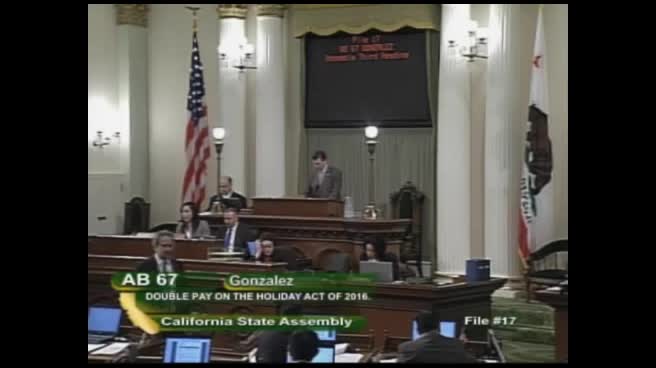 42MIN
Assembly Floor
 56SEC
Assembly Floor
 20MIN
Assembly Floor
 51SEC
Assembly Floor
 48MIN
Assembly Standing Committee on Labor and Employment
Bill Author




