AB 796: Health care coverage: autism and pervasive developmental disorders.
- Session Year: 2015-2016
- House: Assembly
- Latest Version Date: 2016-09-23
Existing law, the Lanterman Developmental Disabilities Services Act, requires the State Department of Developmental Services to contract with regional centers to provide services and supports to individuals with developmental disabilities and their families. Existing law defines developmental disability for these purposes, to include, among other things, autism.
Existing law provides for the licensure and regulation of health care service plans by the Department of Managed Health Care. A violation of those provisions is a crime. Existing law provides for the licensure and regulation of health insurers by the Department of Insurance.
Existing law requires every health care service plan contract and health insurance policy to provide coverage for behavioral health treatment for pervasive developmental disorder or autism until January 1, 2017, and defines behavioral health treatment to mean specified services provided by, among others, a qualified autism service professional supervised and employed by a qualified autism service provider. For purposes of this provision, existing law defines a qualified autism service professional to mean a person who, among other requirements, is a behavioral service provider approved as a vendor by a California regional center to provide services as an associate behavior analyst, behavior analyst, behavior management assistant, behavior management consultant, or behavior management program pursuant to specified regulations adopted under the Lanterman Developmental Disabilities Services Act.
This bill would delete the sunset date, thereby extending the operation of these provisions indefinitely. By extending the operation of these provisions, the violation of which by a health care service plan would be a crime, the bill would impose a state-mandated local program.
The California Constitution requires the state to reimburse local agencies and school districts for certain costs mandated by the state. Statutory provisions establish procedures for making that reimbursement.
This bill would provide that no reimbursement is required by this act for a specified reason.
Existing law, the Lanterman Developmental Disabilities Services Act, requires the State Department of Developmental Services to contract with regional centers to provide services and supports to individuals with developmental disabilities and their families. Existing law defines developmental disability for these purposes, to include, among other things, autism.
Existing law provides for the licensure and regulation of health care service plans by the Department of Managed Health Care. A violation of those provisions is a crime. Existing law provides for the licensure and regulation of health insurers by the Department of Insurance.
Existing law requires every health care service plan contract and health insurance policy to provide coverage for behavioral health treatment for pervasive developmental disorder or autism until January 1, 2017, and defines behavioral health treatment to mean specified services provided by, among others, a qualified autism service professional supervised and employed by a qualified autism service provider. For purposes of this provision, existing law defines a qualified autism service professional to mean a person who, among other requirements, is a behavioral service provider approved as a vendor by a California regional center to provide services as an associate behavior analyst, behavior analyst, behavior management assistant, behavior management consultant, or behavior management program pursuant to specified regulations adopted under the Lanterman Developmental Disabilities Services Act.
This bill would delete the sunset date, thereby extending the operation of these provisions indefinitely. By extending the operation of these provisions, the violation of which by a health care service plan would be a crime, the bill would impose a state-mandated local program.
The California Constitution requires the state to reimburse local agencies and school districts for certain costs mandated by the state. Statutory provisions establish procedures for making that reimbursement.
This bill would provide that no reimbursement is required by this act for a specified reason.
Existing law, the Lanterman Developmental Disabilities Services Act, requires the State Department of Developmental Services to contract with regional centers to provide services and supports to individuals with developmental disabilities and their families. Existing law defines developmental disability for these purposes, to include, among other things, autism.
Existing law provides for the licensure and regulation of health care service plans by the Department of Managed Health Care. A violation of those provisions is a crime. Existing law provides for the licensure and regulation of health insurers by the Department of Insurance.
Existing law requires every health care service plan contract and health insurance policy to provide coverage for behavioral health treatment for pervasive developmental disorder or autism until January 1, 2017, and defines behavioral health treatment to mean specified services provided by, among others, a qualified autism service professional supervised and employed by a qualified autism service provider. For purposes of this provision, existing law defines a qualified autism service professional to mean a person who, among other requirements, is a behavior behavioral service provider approved as a vendor by a California regional center to provide services as an associate behavior analyst, behavior analyst, behavior management assistant, behavior management consultant, or behavior management program pursuant to specified regulations adopted under the Lanterman Developmental Disabilities Services Act.
This bill would delete the sunset date, thereby extending the operation of these provisions indefinitely. By extending the operation of these provisions, the violation of which by a health care service plan would be a crime, the bill would impose a state-mandated local program.
The bill would also require the State Department of Developmental Services, no later than July 1, 2018, with input from stakeholders, to update regulations to set forth the minimum standards of education, training, and professional experience for qualified autism service professionals and paraprofessionals, as specified.
The California Constitution requires the state to reimburse local agencies and school districts for certain costs mandated by the state. Statutory provisions establish procedures for making that reimbursement.
This bill would provide that no reimbursement is required by this act for a specified reason.
Existing law, the Lanterman Developmental Disabilities Services Act, requires the State Department of Developmental Services to contract with regional centers to provide services and supports to individuals with developmental disabilities and their families. Existing law defines developmental disability for these purposes, to include, among other things, autism.
Existing law provides for the licensure and regulation of health care service plans by the Department of Managed Health Care. A violation of those provisions is a crime. Existing law provides for the licensure and regulation of health insurers by the Department of Insurance.
Existing law requires every health care service plan contract and health insurance policy to provide coverage for behavioral health treatment for pervasive developmental disorder or autism until January 1, 2017, and defines behavioral health treatment to mean specified services provided by, among others, a qualified autism service professional supervised and employed by a qualified autism service provider. For purposes of this provision, existing law defines a qualified autism service professional to mean a person who, among other requirements, is a behavior service provider approved as a vendor by a California regional center to provide services as an associate behavior analyst, behavior analyst, behavior management assistant, behavior management consultant, or behavior management program pursuant to specified regulations adopted under the Lanterman Developmental Disabilities Services Act.
This bill would delete the sunset date, thereby extending the operation of these provisions indefinitely. By extending the operation of these provisions, the violation of which by a health care service plan would be a crime, the bill would impose a state-mandated local program.
The bill would also require the State Department of Developmental Services, no later than July 1, 2018, with input from stakeholders, as specified, to develop a methodology for determining what constitutes an evidence-based practice in the field of behavioral health treatment for autism and pervasive developmental disorder and to update regulations to set forth the minimum standards of education, training, and professional experience for qualified autism service professionals and paraprofessionals, as specified.
The California Constitution requires the state to reimburse local agencies and school districts for certain costs mandated by the state. Statutory provisions establish procedures for making that reimbursement.
This bill would provide that no reimbursement is required by this act for a specified reason.
Existing law, the Lanterman Developmental Disabilities Services Act, requires the State Department of Developmental Services to contract with regional centers to provide services and supports to individuals with developmental disabilities and their families. Existing law defines developmental disability for these purposes, to include, among other things, autism.
Existing law provides for the licensure and regulation of health care service plans by the Department of Managed Health Care. A violation of those provisions is a crime. Existing law provides for the licensure and regulation of health insurers by the Department of Insurance.
Existing law requires every health care service plan contract and health insurance policy to provide coverage for behavioral health treatment for pervasive developmental disorder or autism until January 1, 2017, and defines behavioral health treatment to mean specified services provided by, among others, a qualified autism service professional supervised and employed by a qualified autism service provider. For purposes of this provision, existing law defines a qualified autism service professional to mean a person who, among other requirements, is a behavior service provider approved as a vendor by a California regional center to provide services as an associate behavior analyst, behavior analyst, behavior management assistant, behavior management consultant, or behavior management program pursuant to specified regulations adopted under the Lanterman Developmental Disabilities Services Act.
This bill would delete the sunset date, thereby extending the operation of these provisions indefinitely. By extending the operation of these provisions, the violation of which by a health care service plan would be a crime, the bill would impose a state-mandated local program. The bill would require the Department of Managed Health Care, in conjunction with the Department of Insurance, to develop procedure codes for evidence-based behavioral health treatment other than applied behavior analysis. The bill would also require the Department of Managed Health Care, in conjunction with the Department of Insurance as the lead agency, to convene a task force, as specified. The bill would also provide that the list of behavioral health treatment modalities developed shall constitute evidence that a particular form of treatment is evidence-based in an independent medical review. The bill would also prohibit the absence of a particular form of treatment from the list of behavioral health treatment modalities developed from constituting evidence that a particular form of treatment is not evidence-based.
The bill would also require the State Department of Developmental Services, no later than July 1, 2018, with input from stakeholders, as specified, to develop a methodology for determining what constitutes an evidence-based practice in the field of behavioral health treatment for autism and pervasive developmental disorder and to update regulations to set forth the minimum standards of education, training, and professional experience for qualified autism service professionals and paraprofessionals, as specified.
The California Constitution requires the state to reimburse local agencies and school districts for certain costs mandated by the state. Statutory provisions establish procedures for making that reimbursement.
This bill would provide that no reimbursement is required by this act for a specified reason.
Existing law provides for the licensure and regulation of health care service plans by the Department of Managed Health Care. A violation of those provisions is a crime. Existing law provides for the licensure and regulation of health insurers by the Department of Insurance.
Existing law requires every health care service plan contract and health insurance policy to provide coverage for behavioral health treatment for pervasive developmental disorder or autism until January 1, 2017, and defines behavioral health treatment to mean specified services provided by, among others, a qualified autism service professional supervised and employed by a qualified autism service provider. For purposes of this provision, existing law defines a qualified autism service professional to mean a person who, among other requirements, is a behavior service provider approved as a vendor by a California regional center to provide services as an associate behavior analyst, behavior analyst, behavior management assistant, behavior management consultant, or behavior management program pursuant to specified regulations adopted under the Lanterman Developmental Disabilities Services Act.
This bill would extend delete the sunset date, thereby extending the operation of these provisions to January 1, 2022. indefinitely. By extending the operation of these provisions, the violation of which by a health care service plan would be a crime, the bill would impose a state-mandated local program. The bill would require the Board of Psychology, no later than December 31, 2017, and thereafter as necessary, to convene a committee to create a list of evidence-based treatment modalities for purposes of behavioral health treatment for pervasive developmental disorder or autism, and to post the list on the departments Internet Web site no later than January 1, 2019. The bill would require the Department of Managed Health Care, in conjunction with the Department of Insurance, to develop procedure codes for evidence-based behavioral health treatment other than applied behavior analysis. The bill would also require the Department of Managed Health Care, in conjunction with the Department of Insurance as the lead agency, to convene a task force, as specified. The bill would also provide that the list of behavioral health treatment modalities developed shall constitute evidence that a particular form of treatment is evidence-based in an independent medical review. The bill would also prohibit the absence of a particular form of treatment from the list of behavioral health treatment modalities developed from constituting evidence that a particular form of treatment is not evidence-based.
The California Constitution requires the state to reimburse local agencies and school districts for certain costs mandated by the state. Statutory provisions establish procedures for making that reimbursement.
This bill would provide that no reimbursement is required by this act for a specified reason.
Existing law provides for the licensure and regulation of health care service plans by the Department of Managed Health Care. A violation of those provisions is a crime. Existing law provides for the licensure and regulation of health insurers by the Department of Insurance.
Existing law requires every health care service plan contract and health insurance policy to provide coverage for behavioral health treatment for pervasive developmental disorder or autism until January 1, 2017, and defines behavioral health treatment to mean specified services provided by, among others, a qualified autism service professional supervised and employed by a qualified autism service provider. For purposes of this provision, existing law defines a qualified autism service professional to mean a person who, among other requirements, is a behavior service provider approved as a vendor by a California regional center to provide services as an associate behavior analyst, behavior analyst, behavior management assistant, behavior management consultant, or behavior management program pursuant to specified regulations adopted under the Lanterman Developmental Disabilities Services Act.
This bill would extend the operation of these provisions to January 1, 2022. By extending the operation of these provisions, the violation of which by a health care service plan would be a crime, the bill would impose a state-mandated local program. The bill would require the Board of Psychology, no later than December 31, 2017, and thereafter as necessary, to convene a committee to create a list of evidence-based treatment modalities for purposes of developing mandated behavioral health treatment modalities for pervasive developmental disorder or autism. autism, and to post the list on the departments Internet Web site no later than January 1, 2019.
The California Constitution requires the state to reimburse local agencies and school districts for certain costs mandated by the state. Statutory provisions establish procedures for making that reimbursement.
This bill would provide that no reimbursement is required by this act for a specified reason.
Existing law provides for the licensure and regulation of health care service plans by the Department of Managed Health Care. A violation of those provisions is a crime. Existing law provides for the licensure and regulation of health insurers by the Department of Insurance.
Existing law requires every health care service plan contract and health insurance policy to provide coverage for behavioral health treatment for pervasive developmental disorder or autism. Existing law requires every health care service plan and health insurance policy to maintain an adequate network that includes qualified autism service providers who supervise and employ qualified autism service professionals or paraprofessionals who provide and administer behavioral health treatment. Existing law defines qualified autism service professional and qualified autism service paraprofessional for this purpose to mean a person who meets specified educational and training requirements. autism until January 1, 2017, and defines behavioral health treatment to mean specified services provided by, among others, a qualified autism service professional supervised and employed by a qualified autism service provider. For purposes of this provision, existing law defines a qualified autism service professional to mean a person who, among other requirements, is a behavior service provider approved as a vendor by a California regional center to provide services as an associate behavior analyst, behavior analyst, behavior management assistant, behavior management consultant, or behavior management program pursuant to specified regulations adopted under the Lanterman Developmental Disabilities Services Act.
This bill would expand the eligibility for a person to be a qualified autism service professional to include a person who possesses a bachelor of arts or science degree and meets other specified requirements, a registered psychological assistant, a registered psychologist, or an associate clinical social worker. The bill would also expand the eligibility for a person to be a qualified autism service paraprofessional to include a person with a high school diploma or equivalent and, among other things, 6 months experience working with persons with developmental disabilities. extend the operation of these provisions to January 1, 2022. By extending the operation of these provisions, the violation of which by a health care service plan would be a crime, the bill would impose a state-mandated local program. The bill would require the Board of Psychology, no later than December 31, 2017, and thereafter as necessary, to convene a committee to create a list of evidence-based treatment modalities for purposes of developing mandated behavioral health treatment modalities for pervasive developmental disorder or autism.
The California Constitution requires the state to reimburse local agencies and school districts for certain costs mandated by the state. Statutory provisions establish procedures for making that reimbursement.
This bill would provide that no reimbursement is required by this act for a specified reason.
Existing law provides for the licensure and regulation of health care service plans by the Department of Managed Health Care. A violation of those provisions is a crime. Existing law provides for the licensure and regulation of health insurers by the Department of Insurance.
Existing law requires every health care service plan contract and health insurance policy to provide coverage for behavioral health treatment for pervasive developmental disorder or autism. Existing law requires every health care service plan and health insurance policy to maintain an adequate network that includes qualified autism service providers who supervise and employ qualified autism service professionals or paraprofessionals who provide and administer behavioral health treatment. Existing law defines qualified autism service professional and qualified autism service paraprofessional for this purpose to mean a person who meets specified educational and training requirements.
This bill would expand the eligibility for a person to be a qualified autism service professional to include a person who possesses a bachelor of arts or science degree and meets other specified requirements, a registered psychological assistant, a registered psychologist, or an associate clinical social worker. The bill would also expand the eligibility for a person to be a qualified autism service paraprofessional to include a person with a high school diploma or equivalent and, among other things, 6 months experience working with persons with developmental disabilities.
(a)(1)Every health care service plan contract that provides hospital, medical, or surgical coverage shall also provide coverage for behavioral health treatment for pervasive developmental disorder or autism no later than July 1, 2012. The coverage shall be provided in the same manner and shall be subject to the same requirements as provided in Section 1374.72.
(2)Notwithstanding paragraph (1), as of the date that proposed final rulemaking for essential health benefits is issued, this section does not require any benefits to be provided that exceed the essential health benefits that all health plans will be required by federal regulations to provide under Section 1302(b) of the federal Patient Protection and Affordable Care Act (Public Law 111-148), as amended by the federal Health Care and Education Reconciliation Act of 2010 (Public Law 111-152).
(3)This section shall not affect services for which an individual is eligible pursuant to Division 4.5 (commencing with Section 4500) of the Welfare and Institutions Code or Title 14 (commencing with Section 95000) of the Government Code.
(4)This section shall not affect or reduce any obligation to provide services under an individualized education program, as defined in Section 56032 of the Education Code, or an individual service plan, as described in Section 5600.4 of the Welfare and Institutions Code, or under the federal Individuals with Disabilities Education Act (20 U.S.C. Sec. 1400 et seq.) and its implementing regulations.
(b)Every health care service plan subject to this section shall maintain an adequate network that includes qualified autism service providers who supervise and employ qualified autism service professionals or paraprofessionals who provide and administer behavioral health treatment. Nothing shall prevent a health care service plan from selectively contracting with providers within these requirements.
(c)For the purposes of this section, the following definitions shall apply:
(1)Behavioral health treatment means professional services and treatment programs, including applied behavior analysis and evidence-based behavior intervention programs, that develop or restore, to the maximum extent practicable, the functioning of an individual with pervasive developmental disorder or autism and that meet all of the following criteria:
(A)The treatment is prescribed by a physician and surgeon licensed pursuant to Chapter 5 (commencing with Section 2000) of, or is developed by a psychologist licensed pursuant to Chapter 6.6 (commencing with Section 2900) of, Division 2 of the Business and Professions Code.
(B)The treatment is provided under a treatment plan prescribed by a qualified autism service provider and is administered by one of the following:
(i)A qualified autism service provider.
(ii)A qualified autism service professional supervised and employed by the qualified autism service provider.
(iii)A qualified autism service paraprofessional supervised and employed by a qualified autism service provider.
(C)The treatment plan has measurable goals over a specific timeline that is developed and approved by the qualified autism service provider for the specific patient being treated. The treatment plan shall be reviewed no less than once every six months by the qualified autism service provider and modified whenever appropriate, and shall be consistent with Section 4686.2 of the Welfare and Institutions Code pursuant to which the qualified autism service provider does all of the following:
(i)Describes the patients behavioral health impairments or developmental challenges that are to be treated.
(ii)Designs an intervention plan that includes the service type, number of hours, and parent participation needed to achieve the plans goal and objectives, and the frequency at which the patients progress is evaluated and reported.
(iii)Provides intervention plans that utilize evidence-based practices, with demonstrated clinical efficacy in treating pervasive developmental disorder or autism.
(iv)Discontinues intensive behavioral intervention services when the treatment goals and objectives are achieved or no longer appropriate.
(D)The treatment plan is not used for purposes of providing or for the reimbursement of respite, day care, or educational services and is not used to reimburse a parent for participating in the treatment program. The treatment plan shall be made available to the health care service plan upon request.
(2)Pervasive developmental disorder or autism shall have the same meaning and interpretation as used in Section 1374.72.
(3)Qualified autism service provider means either of the following:
(A)A person, entity, or group that is certified by a national entity, such as the Behavior Analyst Certification Board, that is accredited by the National Commission for Certifying Agencies, and who designs, supervises, or provides treatment for pervasive developmental disorder or autism, provided the services are within the experience and competence of the person, entity, or group that is nationally certified.
(B)A person licensed as a physician and surgeon, physical therapist, occupational therapist, psychologist, marriage and family therapist, educational psychologist, clinical social worker, professional clinical counselor, speech-language pathologist, or audiologist pursuant to Division 2 (commencing with Section 500) of the Business and Professions Code, who designs, supervises, or provides treatment for pervasive developmental disorder or autism, provided the services are within the experience and competence of the licensee.
(4)Qualified autism service professional means an individual who meets all of the following criteria:
(A)Provides behavioral health treatment.
(B)Is employed and supervised by a qualified autism service provider.
(C)Provides treatment pursuant to a treatment plan developed and approved by the qualified autism service provider.
(D)Is a behavioral service provider approved as a vendor by a California regional center to provide services as an Associate Behavior Analyst, Behavior Analyst, Behavior Management Assistant, Behavior Management Consultant, or Behavior Management Program as defined in Section 54342 of Article 3 of Subchapter 2 of Chapter 3 of Division 2 of Title 17 of the California Code of Regulations.
(E)Has training and experience in providing services for pervasive developmental disorder or autism pursuant to Division 4.5 (commencing with Section 4500) of the Welfare and Institutions Code or Title 14 (commencing with Section 95000) of the Government Code.
(5)Qualified autism service paraprofessional means an unlicensed and uncertified individual who meets all of the following criteria:
(A)Is employed and supervised by a qualified autism service provider.
(B)Provides treatment and implements services pursuant to a treatment plan developed and approved by the qualified autism service provider.
(C)Meets the criteria set forth in the regulations adopted pursuant to Section 4686.3 of the Welfare and Institutions Code.
(D)Has adequate education, training, and experience, as certified by a qualified autism service provider.
(d)This section shall not apply to the following:
(1)A specialized health care service plan that does not deliver mental health or behavioral health services to enrollees.
(2)A health care service plan contract in the Medi-Cal program (Chapter 7 (commencing with Section 14000) of Part 3 of Division 9 of the Welfare and Institutions Code).
(3)A health care service plan contract in the Healthy Families Program (Part 6.2 (commencing with Section 12693) of Division 2 of the Insurance Code).
(4)A health care benefit plan or contract entered into with the Board of Administration of the Public Employees Retirement System pursuant to the Public Employees Medical and Hospital Care Act (Part 5 (commencing with Section 22750) of Division 5 of Title 2 of the Government Code).
(e)Nothing in this section shall be construed to limit the obligation to provide services under Section 1374.72.
(f)As provided in Section 1374.72 and in paragraph (1) of subdivision (a), in the provision of benefits required by this section, a health care service plan may utilize case management, network providers, utilization review techniques, prior authorization, copayments, or other cost sharing.
SEC. 2.Section 10144.51 of the Insurance Code is amended to read:10144.51.(a)(1)Every health insurance policy shall also provide coverage for behavioral health treatment for pervasive developmental disorder or autism no later than July 1, 2012. The coverage shall be provided in the same manner and shall be subject to the same requirements as provided in Section 10144.5.
(2)Notwithstanding paragraph (1), as of the date that proposed final rulemaking for essential health benefits is issued, this section does not require any benefits to be provided that exceed the essential health benefits that all health insurers will be required by federal regulations to provide under Section 1302(b) of the federal Patient Protection and Affordable Care Act (Public Law 111-148), as amended by the federal Health Care and Education Reconciliation Act of 2010 (Public Law 111-152).
(3)This section shall not affect services for which an individual is eligible pursuant to Division 4.5 (commencing with Section 4500) of the Welfare and Institutions Code or Title 14 (commencing with Section 95000) of the Government Code.
(4)This section shall not affect or reduce any obligation to provide services under an individualized education program, as defined in Section 56032 of the Education Code, or an individual service plan, as described in Section 5600.4 of the Welfare and Institutions Code, or under the federal Individuals with Disabilities Education Act (20 U.S.C. Sec. 1400 et seq.) and its implementing regulations.
(b)Pursuant to Article 6 (commencing with Section 2240) of Subchapter 2 of Chapter 5 of Title 10 of the California Code of Regulations, every health insurer subject to this section shall maintain an adequate network that includes qualified autism service providers who supervise and employ qualified autism service professionals or paraprofessionals who provide and administer behavioral health treatment. Nothing shall prevent a health insurer from selectively contracting with providers within these requirements.
(c)For the purposes of this section, the following definitions shall apply:
(1)Behavioral health treatment means professional services and treatment programs, including applied behavior analysis and evidence-based behavior intervention programs, that develop or restore, to the maximum extent practicable, the functioning of an individual with pervasive developmental disorder or autism, and that meet all of the following criteria:
(A)The treatment is prescribed by a physician and surgeon licensed pursuant to Chapter 5 (commencing with Section 2000) of, or is developed by a psychologist licensed pursuant to Chapter 6.6 (commencing with Section 2900) of, Division 2 of the Business and Professions Code.
(B)The treatment is provided under a treatment plan prescribed by a qualified autism service provider and is administered by one of the following:
(i)A qualified autism service provider.
(ii)A qualified autism service professional supervised and employed by the qualified autism service provider.
(iii)A qualified autism service paraprofessional supervised and employed by a qualified autism service provider.
(C)The treatment plan has measurable goals over a specific timeline that is developed and approved by the qualified autism service provider for the specific patient being treated. The treatment plan shall be reviewed no less than once every six months by the qualified autism service provider and modified whenever appropriate, and shall be consistent with Section 4686.2 of the Welfare and Institutions Code pursuant to which the qualified autism service provider does all of the following:
(i)Describes the patients behavioral health impairments or developmental challenges that are to be treated.
(ii)Designs an intervention plan that includes the service type, number of hours, and parent participation needed to achieve the plans goal and objectives, and the frequency at which the patients progress is evaluated and reported.
(iii)Provides intervention plans that utilize evidence-based practices, with demonstrated clinical efficacy in treating pervasive developmental disorder or autism.
(iv)Discontinues intensive behavioral intervention services when the treatment goals and objectives are achieved or no longer appropriate.
(D)The treatment plan is not used for purposes of providing or for the reimbursement of respite, day care, or educational services and is not used to reimburse a parent for participating in the treatment program. The treatment plan shall be made available to the insurer upon request.
(2)Pervasive developmental disorder or autism shall have the same meaning and interpretation as used in Section 10144.5.
(3)Qualified autism service provider means either of the following:
(A)A person, entity, or group that is certified by a national entity, such as the Behavior Analyst Certification Board, that is accredited by the National Commission for Certifying Agencies, and who designs, supervises, or provides treatment for pervasive developmental disorder or autism, provided the services are within the experience and competence of the person, entity, or group that is nationally certified.
(B)A person licensed as a physician and surgeon, physical therapist, occupational therapist, psychologist, marriage and family therapist, educational psychologist, clinical social worker, professional clinical counselor, speech-language pathologist, or audiologist pursuant to Division 2 (commencing with Section 500) of the Business and Professions Code, who designs, supervises, or provides treatment for pervasive developmental disorder or autism, provided the services are within the experience and competence of the licensee.
(4)Qualified autism service professional means an individual who meets all of the following criteria:
(A)Provides behavioral health treatment.
(B)Is employed and supervised by a qualified autism service provider.
(C)Provides treatment pursuant to a treatment plan developed and approved by the qualified autism service provider.
(D)Is a behavioral service provider approved as a vendor by a California regional center to provide services as an Associate Behavior Analyst, Behavior Analyst, Behavior Management Assistant, Behavior Management Consultant, or Behavior Management Program as defined in Section 54342 of Article 3 of Subchapter 2 of Chapter 3 of Division 2 of Title 17 of the California Code of Regulations.
(E)Has training and experience in providing services for pervasive developmental disorder or autism pursuant to Division 4.5 (commencing with Section 4500) of the Welfare and Institutions Code or Title 14 (commencing with Section 95000) of the Government Code.
(5)Qualified autism service paraprofessional means an unlicensed and uncertified individual who meets all of the following criteria:
(A)Is employed and supervised by a qualified autism service provider.
(B)Provides treatment and implements services pursuant to a treatment plan developed and approved by the qualified autism service provider.
(C)Meets the criteria set forth in the regulations adopted pursuant to Section 4686.3 of the Welfare and Institutions Code.
(D)Has adequate education, training, and experience, as certified by a qualified autism service provider.
(d)This section shall not apply to the following:
(1)A specialized health insurance policy that does not cover mental health or behavioral health services or an accident only, specified disease, hospital indemnity, or Medicare supplement policy.
(2)A health insurance policy in the Medi-Cal program (Chapter 7 (commencing with Section 14000) of Part 3 of Division 9 of the Welfare and Institutions Code).
(3)A health insurance policy in the Healthy Families Program (Part 6.2 (commencing with Section 12693)).
(4)A health care benefit plan or policy entered into with the Board of Administration of the Public Employees Retirement System pursuant to the Public Employees Medical and Hospital Care Act (Part 5 (commencing with Section 22750) of Division 5 of Title 2 of the Government Code).
(e)Nothing in this section shall be construed to limit the obligation to provide services under Section 10144.5.
(f)As provided in Section 10144.5 and in paragraph (1) of subdivision (a), in the provision of benefits required by this section, a health insurer may utilize case management, network providers, utilization review techniques, prior authorization, copayments, or other cost sharing.
SEC. 3.No reimbursement is required by this act pursuant to Section 6 of Article XIIIB of the California Constitution because the only costs that may be incurred by a local agency or school district will be incurred because this act creates a new crime or infraction, eliminates a crime or infraction, or changes the penalty for a crime or infraction, within the meaning of Section 17556 of the Government Code, or changes the definition of a crime within the meaning of Section 6 of Article XIIIB of the California Constitution.
(a)(1)Every health care service plan contract that provides hospital, medical, or surgical coverage shall also provide coverage for behavioral health treatment for pervasive developmental disorder or autism no later than July 1, 2012. The coverage shall be provided in the same manner and shall be subject to the same requirements as provided in Section 1374.72.
(2)Notwithstanding paragraph (1), as of the date that proposed final rulemaking for essential health benefits is issued, this section does not require any benefits to be provided that exceed the essential health benefits that all health plans will be required by federal regulations to provide under Section 1302(b) of the federal Patient Protection and Affordable Care Act (Public Law 111-148), as amended by the federal Health Care and Education Reconciliation Act of 2010 (Public Law 111-152).
(3)This section shall not affect services for which an individual is eligible pursuant to Division 4.5 (commencing with Section 4500) of the Welfare and Institutions Code or Title 14 (commencing with Section 95000) of the Government Code.
(4)This section shall not affect or reduce any obligation to provide services under an individualized education program, as defined in Section 56032 of the Education Code, or an individual service plan, as described in Section 5600.4 of the Welfare and Institutions Code, or under the federal Individuals with Disabilities Education Act (20 U.S.C. Sec. 1400 et seq.) and its implementing regulations.
(b)Every health care service plan subject to this section shall maintain an adequate network that includes qualified autism service providers who supervise and employ qualified autism service professionals or paraprofessionals who provide and administer behavioral health treatment. Nothing shall prevent a health care service plan from selectively contracting with providers within these requirements.
(c)For the purposes of this section, the following definitions shall apply:
(1)Behavioral health treatment means professional services and treatment programs, including applied behavior analysis and evidence-based behavior intervention programs, that develop or restore, to the maximum extent practicable, the functioning of an individual with pervasive developmental disorder or autism and that meet all of the following criteria:
(A)The treatment is prescribed by a physician and surgeon licensed pursuant to Chapter 5 (commencing with Section 2000) of, or is developed by a psychologist licensed pursuant to Chapter 6.6 (commencing with Section 2900) of, Division 2 of the Business and Professions Code.
(B)The treatment is provided under a treatment plan prescribed by a qualified autism service provider and is administered by one of the following:
(i)A qualified autism service provider.
(ii)A qualified autism service professional supervised and employed by the qualified autism service provider.
(iii)A qualified autism service paraprofessional supervised and employed by a qualified autism service provider.
(C)The treatment plan has measurable goals over a specific timeline that is developed and approved by the qualified autism service provider for the specific patient being treated. The treatment plan shall be reviewed no less than once every six months by the qualified autism service provider and modified whenever appropriate, and shall be consistent with Section 4686.2 of the Welfare and Institutions Code pursuant to which the qualified autism service provider does all of the following:
(i)Describes the patients behavioral health impairments or developmental challenges that are to be treated.
(ii)Designs an intervention plan that includes the service type, number of hours, and parent participation needed to achieve the plans goal and objectives, and the frequency at which the patients progress is evaluated and reported.
(iii)Provides intervention plans that utilize evidence-based practices, with demonstrated clinical efficacy in treating pervasive developmental disorder or autism.
(iv)Discontinues intensive behavioral intervention services when the treatment goals and objectives are achieved or no longer appropriate.
(D)The treatment plan is not used for purposes of providing or for the reimbursement of respite, day care, or educational services and is not used to reimburse a parent for participating in the treatment program. The treatment plan shall be made available to the health care service plan upon request.
(2)Pervasive developmental disorder or autism shall have the same meaning and interpretation as used in Section 1374.72.
(3)Qualified autism service provider means either of the following:
(A)A person, entity, or group that is certified by a national entity, such as the Behavior Analyst Certification Board, that is accredited by the National Commission for Certifying Agencies, and who designs, supervises, or provides treatment for pervasive developmental disorder or autism, provided the services are within the experience and competence of the person, entity, or group that is nationally certified.
(B)A person licensed as a physician and surgeon, physical therapist, occupational therapist, psychologist, marriage and family therapist, educational psychologist, clinical social worker, professional clinical counselor, speech-language pathologist, or audiologist pursuant to Division 2 (commencing with Section 500) of the Business and Professions Code, who designs, supervises, or provides treatment for pervasive developmental disorder or autism, provided the services are within the experience and competence of the licensee.
(4)Qualified autism service professional means an individual who meets all of the following criteria:
(A)Provides behavioral health treatment.
(B)Is employed and supervised by a qualified autism service provider.
(C)Provides treatment pursuant to a treatment plan developed and approved by the qualified autism service provider.
(D)Is a behavioral service provider approved as a vendor by a California regional center to provide services as an Associate Behavior Analyst, Behavior Analyst, Behavior Management Assistant, Behavior Management Consultant, or Behavior Management Program as defined in Section 54342 of Article 3 of Subchapter 2 of Chapter 3 of Division 2 of Title 17 of the California Code of Regulations.
(E)Has training and experience in providing services for pervasive developmental disorder or autism pursuant to Division 4.5 (commencing with Section 4500) of the Welfare and Institutions Code or Title 14 (commencing with Section 95000) of the Government Code.
(5)Qualified autism service paraprofessional means an unlicensed and uncertified individual who meets all of the following criteria:
(A)Is employed and supervised by a qualified autism service provider.
(B)Provides treatment and implements services pursuant to a treatment plan developed and approved by the qualified autism service provider.
(C)Meets the criteria set forth in the regulations adopted pursuant to Section 4686.3 of the Welfare and Institutions Code.
(D)Has adequate education, training, and experience, as certified by a qualified autism service provider.
(d)This section shall not apply to the following:
(1)A specialized health care service plan that does not deliver mental health or behavioral health services to enrollees.
(2)A health care service plan contract in the Medi-Cal program (Chapter 7 (commencing with Section 14000) of Part 3 of Division 9 of the Welfare and Institutions Code).
(3)A health care service plan contract in the Healthy Families Program (Part 6.2 (commencing with Section 12693) of Division 2 of the Insurance Code).
(4)A health care benefit plan or contract entered into with the Board of Administration of the Public Employees Retirement System pursuant to the Public Employees Medical and Hospital Care Act (Part 5 (commencing with Section 22750) of Division 5 of Title 2 of the Government Code).
(e)Nothing in this section shall be construed to limit the obligation to provide services under Section 1374.72.
(f)As provided in Section 1374.72 and in paragraph (1) of subdivision (a), in the provision of benefits required by this section, a health care service plan may utilize case management, network providers, utilization review techniques, prior authorization, copayments, or other cost sharing.
SEC. 2.Section 10144.51 of the Insurance Code is amended to read:10144.51.(a)(1)Every health insurance policy shall also provide coverage for behavioral health treatment for pervasive developmental disorder or autism no later than July 1, 2012. The coverage shall be provided in the same manner and shall be subject to the same requirements as provided in Section 10144.5.
(2)Notwithstanding paragraph (1), as of the date that proposed final rulemaking for essential health benefits is issued, this section does not require any benefits to be provided that exceed the essential health benefits that all health insurers will be required by federal regulations to provide under Section 1302(b) of the federal Patient Protection and Affordable Care Act (Public Law 111-148), as amended by the federal Health Care and Education Reconciliation Act of 2010 (Public Law 111-152).
(3)This section shall not affect services for which an individual is eligible pursuant to Division 4.5 (commencing with Section 4500) of the Welfare and Institutions Code or Title 14 (commencing with Section 95000) of the Government Code.
(4)This section shall not affect or reduce any obligation to provide services under an individualized education program, as defined in Section 56032 of the Education Code, or an individual service plan, as described in Section 5600.4 of the Welfare and Institutions Code, or under the federal Individuals with Disabilities Education Act (20 U.S.C. Sec. 1400 et seq.) and its implementing regulations.
(b)Pursuant to Article 6 (commencing with Section 2240) of Subchapter 2 of Chapter 5 of Title 10 of the California Code of Regulations, every health insurer subject to this section shall maintain an adequate network that includes qualified autism service providers who supervise and employ qualified autism service professionals or paraprofessionals who provide and administer behavioral health treatment. Nothing shall prevent a health insurer from selectively contracting with providers within these requirements.
(c)For the purposes of this section, the following definitions shall apply:
(1)Behavioral health treatment means professional services and treatment programs, including applied behavior analysis and evidence-based behavior intervention programs, that develop or restore, to the maximum extent practicable, the functioning of an individual with pervasive developmental disorder or autism, and that meet all of the following criteria:
(A)The treatment is prescribed by a physician and surgeon licensed pursuant to Chapter 5 (commencing with Section 2000) of, or is developed by a psychologist licensed pursuant to Chapter 6.6 (commencing with Section 2900) of, Division 2 of the Business and Professions Code.
(B)The treatment is provided under a treatment plan prescribed by a qualified autism service provider and is administered by one of the following:
(i)A qualified autism service provider.
(ii)A qualified autism service professional supervised and employed by the qualified autism service provider.
(iii)A qualified autism service paraprofessional supervised and employed by a qualified autism service provider.
(C)The treatment plan has measurable goals over a specific timeline that is developed and approved by the qualified autism service provider for the specific patient being treated. The treatment plan shall be reviewed no less than once every six months by the qualified autism service provider and modified whenever appropriate, and shall be consistent with Section 4686.2 of the Welfare and Institutions Code pursuant to which the qualified autism service provider does all of the following:
(i)Describes the patients behavioral health impairments or developmental challenges that are to be treated.
(ii)Designs an intervention plan that includes the service type, number of hours, and parent participation needed to achieve the plans goal and objectives, and the frequency at which the patients progress is evaluated and reported.
(iii)Provides intervention plans that utilize evidence-based practices, with demonstrated clinical efficacy in treating pervasive developmental disorder or autism.
(iv)Discontinues intensive behavioral intervention services when the treatment goals and objectives are achieved or no longer appropriate.
(D)The treatment plan is not used for purposes of providing or for the reimbursement of respite, day care, or educational services and is not used to reimburse a parent for participating in the treatment program. The treatment plan shall be made available to the insurer upon request.
(2)Pervasive developmental disorder or autism shall have the same meaning and interpretation as used in Section 10144.5.
(3)Qualified autism service provider means either of the following:
(A)A person, entity, or group that is certified by a national entity, such as the Behavior Analyst Certification Board, that is accredited by the National Commission for Certifying Agencies, and who designs, supervises, or provides treatment for pervasive developmental disorder or autism, provided the services are within the experience and competence of the person, entity, or group that is nationally certified.
(B)A person licensed as a physician and surgeon, physical therapist, occupational therapist, psychologist, marriage and family therapist, educational psychologist, clinical social worker, professional clinical counselor, speech-language pathologist, or audiologist pursuant to Division 2 (commencing with Section 500) of the Business and Professions Code, who designs, supervises, or provides treatment for pervasive developmental disorder or autism, provided the services are within the experience and competence of the licensee.
(4)Qualified autism service professional means an individual who meets all of the following criteria:
(A)Provides behavioral health treatment.
(B)Is employed and supervised by a qualified autism service provider.
(C)Provides treatment pursuant to a treatment plan developed and approved by the qualified autism service provider.
(D)Is a behavioral service provider approved as a vendor by a California regional center to provide services as an Associate Behavior Analyst, Behavior Analyst, Behavior Management Assistant, Behavior Management Consultant, or Behavior Management Program as defined in Section 54342 of Article 3 of Subchapter 2 of Chapter 3 of Division 2 of Title 17 of the California Code of Regulations.
(E)Has training and experience in providing services for pervasive developmental disorder or autism pursuant to Division 4.5 (commencing with Section 4500) of the Welfare and Institutions Code or Title 14 (commencing with Section 95000) of the Government Code.
(5)Qualified autism service paraprofessional means an unlicensed and uncertified individual who meets all of the following criteria:
(A)Is employed and supervised by a qualified autism service provider.
(B)Provides treatment and implements services pursuant to a treatment plan developed and approved by the qualified autism service provider.
(C)Meets the criteria set forth in the regulations adopted pursuant to Section 4686.3 of the Welfare and Institutions Code.
(D)Has adequate education, training, and experience, as certified by a qualified autism service provider.
(d)This section shall not apply to the following:
(1)A specialized health insurance policy that does not cover mental health or behavioral health services or an accident only, specified disease, hospital indemnity, or Medicare supplement policy.
(2)A health insurance policy in the Medi-Cal program (Chapter 7 (commencing with Section 14000) of Part 3 of Division 9 of the Welfare and Institutions Code).
(3)A health insurance policy in the Healthy Families Program (Part 6.2 (commencing with Section 12693)).
(4)A health care benefit plan or policy entered into with the Board of Administration of the Public Employees Retirement System pursuant to the Public Employees Medical and Hospital Care Act (Part 5 (commencing with Section 22750) of Division 5 of Title 2 of the Government Code).
(e)Nothing in this section shall be construed to limit the obligation to provide services under Section 10144.5.
(f)As provided in Section 10144.5 and in paragraph (1) of subdivision (a), in the provision of benefits required by this section, a health insurer may utilize case management, network providers, utilization review techniques, prior authorization, copayments, or other cost sharing.
SEC. 3.No reimbursement is required by this act pursuant to Section 6 of Article XIIIB of the California Constitution because the only costs that may be incurred by a local agency or school district will be incurred because this act creates a new crime or infraction, eliminates a crime or infraction, or changes the penalty for a crime or infraction, within the meaning of Section 17556 of the Government Code, or changes the definition of a crime within the meaning of Section 6 of Article XIIIB of the California Constitution.
The Legislature finds and declares all of the following:
(a)Autism and other pervasive developmental disorders are complex neurobehavioral disorders that include impairments in social communication and social interaction combined with rigid, repetitive behaviors, interests, and activities.
(b)Autism covers a large spectrum of symptoms and levels of impairment ranging in severity from somewhat limiting to a severe disability that may require institutional care.
(c)One in 68 children born today will be diagnosed with autism or another pervasive developmental disorder.
(d)Research has demonstrated that children diagnosed with autism can often be helped with early administration of behavioral health treatment.
(e)There are several forms of evidence-based behavioral health treatment, including, but not limited to, applied behavioral analysis.
(f)Children diagnosed with autism respond differently to behavioral health treatment.
(g)It is critical that each child diagnosed with autism receives the specific type of evidence-based behavioral health treatment best suited to him or her, as prescribed by his or her physician or developed by a psychologist.
(h)The Legislature intends that evidence-based behavioral health treatment be covered by health care service plans, pursuant to Section 1374.73 of the Health and Safety Code, and health insurance policies, pursuant to Section 10144.51 of the Insurance Code.
(i)The Legislature intends that health care service plan provider networks include qualified professionals practicing all forms of evidence-based behavioral health treatment other than just applied behavioral analysis.
SEC. 2.SECTION 1.Section 1374.73 of the Health and Safety Code is amended to read:1374.73.(a)(1)Every health care service plan contract that provides hospital, medical, or surgical coverage shall also provide coverage for behavioral health treatment for pervasive developmental disorder or autism no later than July 1, 2012. The coverage shall be provided in the same manner and shall be subject to the same requirements as provided in Section 1374.72.
(2)Notwithstanding paragraph (1), as of the date that proposed final rulemaking for essential health benefits is issued, this section does not require any benefits to be provided that exceed the essential health benefits that all health plans will be required by federal regulations to provide under Section 1302(b) of the federal Patient Protection and Affordable Care Act (Public Law 111-148), as amended by the federal Health Care and Education Reconciliation Act of 2010 (Public Law 111-152).
(3)This section shall not affect services for which an individual is eligible pursuant to Division 4.5 (commencing with Section 4500) of the Welfare and Institutions Code or Title 14 (commencing with Section 95000) of the Government Code.
(4)This section shall not affect or reduce any obligation to provide services under an individualized education program, as defined in Section 56032 of the Education Code, or an individual service plan, as described in Section 5600.4 of the Welfare and Institutions Code, or under the federal Individuals with Disabilities Education Act (20 U.S.C. Sec. 1400 et seq.) and its implementing regulations.
(b)Every health care service plan subject to this section shall maintain an adequate network that includes qualified autism service providers who supervise and employ qualified autism service professionals or paraprofessionals who provide and administer behavioral health treatment. Nothing shall prevent a health care service plan from selectively contracting with providers within these requirements.
(c)For the purposes of this section, the following definitions shall apply:
(1)Behavioral health treatment means professional services and treatment programs, including applied behavior analysis and evidence-based behavior intervention programs, that develop or restore, to the maximum extent practicable, the functioning of an individual with pervasive developmental disorder or autism and that meet all of the following criteria:
(A)The treatment is prescribed by a physician and surgeon licensed pursuant to Chapter 5 (commencing with Section 2000) of, or is developed by a psychologist licensed pursuant to Chapter 6.6 (commencing with Section 2900) of, Division 2 of the Business and Professions Code.
(B)The treatment is provided under a treatment plan prescribed by a qualified autism service provider and is administered by one of the following:
(i)A qualified autism service provider.
(ii)A qualified autism service professional supervised and employed by the qualified autism service provider.
(iii)A qualified autism service paraprofessional supervised and employed by a qualified autism service provider.
(C)The treatment plan has measurable goals over a specific timeline that is developed and approved by the qualified autism service provider for the specific patient being treated. The treatment plan shall be reviewed no less than once every six months by the qualified autism service provider and modified whenever appropriate, and shall be consistent with Section 4686.2 of the Welfare and Institutions Code pursuant to which the qualified autism service provider does all of the following:
(i)Describes the patients behavioral health impairments or developmental challenges that are to be treated.
(ii)Designs an intervention plan that includes the service type, number of hours, and parent participation needed to achieve the plans goal and objectives, and the frequency at which the patients progress is evaluated and reported.
(iii)Provides intervention plans that utilize evidence-based practices, with demonstrated clinical efficacy in treating pervasive developmental disorder or autism.
(iv)Discontinues intensive behavioral intervention services when the treatment goals and objectives are achieved or no longer appropriate.
(D)The treatment plan is not used for purposes of providing or for the reimbursement of respite, day care, or educational services and is not used to reimburse a parent for participating in the treatment program. The treatment plan shall be made available to the health care service plan upon request.
(2)Pervasive developmental disorder or autism shall have the same meaning and interpretation as used in Section 1374.72.
(3)Qualified autism service provider means either of the following:
(A)A person, entity, or group that is certified by a national entity, such as the Behavior Analyst Certification Board, that is accredited by the National Commission for Certifying Agencies, and who designs, supervises, or provides treatment for pervasive developmental disorder or autism, provided the services are within the experience and competence of the person, entity, or group that is nationally certified.
(B)A person licensed as a physician and surgeon, physical therapist, occupational therapist, psychologist, marriage and family therapist, educational psychologist, clinical social worker, professional clinical counselor, speech-language pathologist, or audiologist pursuant to Division 2 (commencing with Section 500) of the Business and Professions Code, who designs, supervises, or provides treatment for pervasive developmental disorder or autism, provided the services are within the experience and competence of the licensee.
(4)Qualified autism service professional means an individual who meets all of the following criteria:
(A)Provides behavioral health treatment.
(B)Is employed and supervised by a qualified autism service provider.
(C)Provides treatment pursuant to a treatment plan developed and approved by the qualified autism service provider.
(D)Is a behavioral service provider approved as a vendor by a California regional center to provide services as an Associate Behavior Analyst, Behavior Analyst, Behavior Management Assistant, Behavior Management Consultant, or Behavior Management Program as defined in Section 54342 of Article 3 of Subchapter 2 of Chapter 3 of Division 2 of Title 17 of the California Code of Regulations.
(E)Has training and experience in providing services for pervasive developmental disorder or autism pursuant to Division 4.5 (commencing with Section 4500) of the Welfare and Institutions Code or Title 14 (commencing with Section 95000) of the Government Code.
(5)Qualified autism service paraprofessional means an unlicensed and uncertified individual who meets all of the following criteria:
(A)Is employed and supervised by a qualified autism service provider.
(B)Provides treatment and implements services pursuant to a treatment plan developed and approved by the qualified autism service provider.
(C)Meets the criteria set forth in the regulations adopted pursuant to Section 4686.3 of the Welfare and Institutions Code.
(D)Has adequate education, training, and experience, as certified by a qualified autism service provider.
(d)This section shall not apply to the following:
(1)A specialized health care service plan that does not deliver mental health or behavioral health services to enrollees.
(2)A health care service plan contract in the Medi-Cal program (Chapter 7 (commencing with Section 14000) of Part 3 of Division 9 of the Welfare and Institutions Code).
(3)A health care service plan contract in the Healthy Families Program (Part 6.2 (commencing with Section 12693) of Division 2 of the Insurance Code).
(4)A health care benefit plan or contract entered into with the Board of Administration of the Public Employees Retirement System pursuant to the Public Employees Medical and Hospital Care Act (Part 5 (commencing with Section 22750) of Division 5 of Title 2 of the Government Code).
(e)Nothing in this section shall be construed to limit the obligation to provide services under Section 1374.72.
(f)As provided in Section 1374.72 and in paragraph (1) of subdivision (a), in the provision of benefits required by this section, a health care service plan may utilize case management, network providers, utilization review techniques, prior authorization, copayments, or other cost sharing.
SEC. 3.SEC. 2.Section 10144.51 of the Insurance Code is amended to read:10144.51.(a)(1)Every health insurance policy shall also provide coverage for behavioral health treatment for pervasive developmental disorder or autism no later than July 1, 2012. The coverage shall be provided in the same manner and shall be subject to the same requirements as provided in Section 10144.5.
(2)Notwithstanding paragraph (1), as of the date that proposed final rulemaking for essential health benefits is issued, this section does not require any benefits to be provided that exceed the essential health benefits that all health insurers will be required by federal regulations to provide under Section 1302(b) of the federal Patient Protection and Affordable Care Act (Public Law 111-148), as amended by the federal Health Care and Education Reconciliation Act of 2010 (Public Law 111-152).
(3)This section shall not affect services for which an individual is eligible pursuant to Division 4.5 (commencing with Section 4500) of the Welfare and Institutions Code or Title 14 (commencing with Section 95000) of the Government Code.
(4)This section shall not affect or reduce any obligation to provide services under an individualized education program, as defined in Section 56032 of the Education Code, or an individual service plan, as described in Section 5600.4 of the Welfare and Institutions Code, or under the federal Individuals with Disabilities Education Act (20 U.S.C. Sec. 1400 et seq.) and its implementing regulations.
(b)Pursuant to Article 6 (commencing with Section 2240) of Subchapter 2 of Chapter 5 of Title 10 of the California Code of Regulations, every health insurer subject to this section shall maintain an adequate network that includes qualified autism service providers who supervise and employ qualified autism service professionals or paraprofessionals who provide and administer behavioral health treatment. Nothing shall prevent a health insurer from selectively contracting with providers within these requirements.
(c)For the purposes of this section, the following definitions shall apply:
(1)Behavioral health treatment means professional services and treatment programs, including applied behavior analysis and evidence-based behavior intervention programs, that develop or restore, to the maximum extent practicable, the functioning of an individual with pervasive developmental disorder or autism, and that meet all of the following criteria:
(A)The treatment is prescribed by a physician and surgeon licensed pursuant to Chapter 5 (commencing with Section 2000) of, or is developed by a psychologist licensed pursuant to Chapter 6.6 (commencing with Section 2900) of, Division 2 of the Business and Professions Code.
(B)The treatment is provided under a treatment plan prescribed by a qualified autism service provider and is administered by one of the following:
(i)A qualified autism service provider.
(ii)A qualified autism service professional supervised and employed by the qualified autism service provider.
(iii)A qualified autism service paraprofessional supervised and employed by a qualified autism service provider.
(C)The treatment plan has measurable goals over a specific timeline that is developed and approved by the qualified autism service provider for the specific patient being treated. The treatment plan shall be reviewed no less than once every six months by the qualified autism service provider and modified whenever appropriate, and shall be consistent with Section 4686.2 of the Welfare and Institutions Code pursuant to which the qualified autism service provider does all of the following:
(i)Describes the patients behavioral health impairments or developmental challenges that are to be treated.
(ii)Designs an intervention plan that includes the service type, number of hours, and parent participation needed to achieve the plans goal and objectives, and the frequency at which the patients progress is evaluated and reported.
(iii)Provides intervention plans that utilize evidence-based practices, with demonstrated clinical efficacy in treating pervasive developmental disorder or autism.
(iv)Discontinues intensive behavioral intervention services when the treatment goals and objectives are achieved or no longer appropriate.
(D)The treatment plan is not used for purposes of providing or for the reimbursement of respite, day care, or educational services and is not used to reimburse a parent for participating in the treatment program. The treatment plan shall be made available to the insurer upon request.
(2)Pervasive developmental disorder or autism shall have the same meaning and interpretation as used in Section 10144.5.
(3)Qualified autism service provider means either of the following:
(A)A person, entity, or group that is certified by a national entity, such as the Behavior Analyst Certification Board, that is accredited by the National Commission for Certifying Agencies, and who designs, supervises, or provides treatment for pervasive developmental disorder or autism, provided the services are within the experience and competence of the person, entity, or group that is nationally certified.
(B)A person licensed as a physician and surgeon, physical therapist, occupational therapist, psychologist, marriage and family therapist, educational psychologist, clinical social worker, professional clinical counselor, speech-language pathologist, or audiologist pursuant to Division 2 (commencing with Section 500) of the Business and Professions Code, who designs, supervises, or provides treatment for pervasive developmental disorder or autism, provided the services are within the experience and competence of the licensee.
(4)Qualified autism service professional means an individual who meets all of the following criteria:
(A)Provides behavioral health treatment.
(B)Is employed and supervised by a qualified autism service provider.
(C)Provides treatment pursuant to a treatment plan developed and approved by the qualified autism service provider.
(D)Is a behavioral service provider approved as a vendor by a California regional center to provide services as an Associate Behavior Analyst, Behavior Analyst, Behavior Management Assistant, Behavior Management Consultant, or Behavior Management Program as defined in Section 54342 of Article 3 of Subchapter 2 of Chapter 3 of Division 2 of Title 17 of the California Code of Regulations.
(E)Has training and experience in providing services for pervasive developmental disorder or autism pursuant to Division 4.5 (commencing with Section 4500) of the Welfare and Institutions Code or Title 14 (commencing with Section 95000) of the Government Code.
(5)Qualified autism service paraprofessional means an unlicensed and uncertified individual who meets all of the following criteria:
(A)Is employed and supervised by a qualified autism service provider.
(B)Provides treatment and implements services pursuant to a treatment plan developed and approved by the qualified autism service provider.
(C)Meets the criteria set forth in the regulations adopted pursuant to Section 4686.3 of the Welfare and Institutions Code.
(D)Has adequate education, training, and experience, as certified by a qualified autism service provider.
(d)This section shall not apply to the following:
(1)A specialized health insurance policy that does not cover mental health or behavioral health services or an accident only, specified disease, hospital indemnity, or Medicare supplement policy.
(2)A health insurance policy in the Medi-Cal program (Chapter 7 (commencing with Section 14000) of Part 3 of Division 9 of the Welfare and Institutions Code).
(3)A health insurance policy in the Healthy Families Program (Part 6.2 (commencing with Section 12693)).
(4)A health care benefit plan or policy entered into with the Board of Administration of the Public Employees Retirement System pursuant to the Public Employees Medical and Hospital Care Act (Part 5 (commencing with Section 22750) of Division 5 of Title 2 of the Government Code).
(e)Nothing in this section shall be construed to limit the obligation to provide services under Section 10144.5.
(f)As provided in Section 10144.5 and in paragraph (1) of subdivision (a), in the provision of benefits required by this section, a health insurer may utilize case management, network providers, utilization review techniques, prior authorization, copayments, or other cost sharing.
SEC. 4.Section 4513.1 is added to the Welfare and Institutions Code, to read:4513.1.The department, no later than July 1, 2018, with input from stakeholders, shall update regulations as appropriate to set forth the minimum standards of education, training, and professional experience for qualified autism service professionals and paraprofessionals practicing behavioral health treatment other than applied behavioral analysis that shall be no less rigorous than the requirements set forth in subdivision (b) of Section 54342 of Article 3 of Subchapter 2 of Chapter 3 of Division 2 of Title 17 of the California Code of Regulations.
SEC. 5.SEC. 3.No reimbursement is required by this act pursuant to Section 6 of Article XIIIB of the California Constitution because the only costs that may be incurred by a local agency or school district will be incurred because this act creates a new crime or infraction, eliminates a crime or infraction, or changes the penalty for a crime or infraction, within the meaning of Section 17556 of the Government Code, or changes the definition of a crime within the meaning of Section 6 of Article XIIIB of the California Constitution.
The Legislature finds and declares all of the following:
(a)Autism and other pervasive developmental disorders are complex neurobehavioral disorders that include impairments in social communication and social interaction combined with rigid, repetitive behaviors, interests, and activities.
(b)Autism covers a large spectrum of symptoms and levels of impairment ranging in severity from somewhat limiting to a severe disability that may require institutional care.
(c)One in 68 children born today will be diagnosed with autism or another pervasive developmental disorder.
(d)Research has demonstrated that children diagnosed with autism can often be helped with early administration of behavioral health treatment.
(e)There are several forms of evidence-based behavioral health treatment, including, but not limited to, applied behavioral analysis.
(f)Children diagnosed with autism respond differently to behavioral health treatment.
(g)It is critical that each child diagnosed with autism receives the specific type of evidence-based behavioral health treatment best suited to him or her, as prescribed by his or her physician or developed by a psychologist.
(h)The Legislature intends that evidence-based behavioral health treatment be covered by health care service plans, pursuant to Section 1374.73 of the Health and Safety Code, and health insurance policies, pursuant to Section 10144.51 of the Insurance Code.
(i)The Legislature intends that health care service plan provider networks include qualified professionals practicing all forms of evidence-based behavioral health treatment other than just applied behavioral analysis.
SEC. 2.Section 1374.73 of the Health and Safety Code is amended to read:1374.73.(a)(1)Every health care service plan contract that provides hospital, medical, or surgical coverage shall also provide coverage for behavioral health treatment for pervasive developmental disorder or autism no later than July 1, 2012. The coverage shall be provided in the same manner and shall be subject to the same requirements as provided in Section 1374.72.
(2)Notwithstanding paragraph (1), as of the date that proposed final rulemaking for essential health benefits is issued, this section does not require any benefits to be provided that exceed the essential health benefits that all health plans will be required by federal regulations to provide under Section 1302(b) of the federal Patient Protection and Affordable Care Act (Public Law 111-148), as amended by the federal Health Care and Education Reconciliation Act of 2010 (Public Law 111-152).
(3)This section shall not affect services for which an individual is eligible pursuant to Division 4.5 (commencing with Section 4500) of the Welfare and Institutions Code or Title 14 (commencing with Section 95000) of the Government Code.
(4)This section shall not affect or reduce any obligation to provide services under an individualized education program, as defined in Section 56032 of the Education Code, or an individual service plan, as described in Section 5600.4 of the Welfare and Institutions Code, or under the federal Individuals with Disabilities Education Act (20 U.S.C. Sec. 1400 et seq.) and its implementing regulations.
(b)Every health care service plan subject to this section shall maintain an adequate network that includes qualified autism service providers who supervise and employ qualified autism service professionals or paraprofessionals who provide and administer behavioral health treatment. Nothing shall prevent a health care service plan from selectively contracting with providers within these requirements.
(c)For the purposes of this section, the following definitions shall apply:
(1)Behavioral health treatment means professional services and treatment programs, including applied behavior analysis and evidence-based behavior intervention programs, that develop or restore, to the maximum extent practicable, the functioning of an individual with pervasive developmental disorder or autism and that meet all of the following criteria:
(A)The treatment is prescribed by a physician and surgeon licensed pursuant to Chapter 5 (commencing with Section 2000) of, or is developed by a psychologist licensed pursuant to Chapter 6.6 (commencing with Section 2900) of, Division 2 of the Business and Professions Code.
(B)The treatment is provided under a treatment plan prescribed by a qualified autism service provider and is administered by one of the following:
(i)A qualified autism service provider.
(ii)A qualified autism service professional supervised and employed by the qualified autism service provider.
(iii)A qualified autism service paraprofessional supervised and employed by a qualified autism service provider.
(C)The treatment plan has measurable goals over a specific timeline that is developed and approved by the qualified autism service provider for the specific patient being treated. The treatment plan shall be reviewed no less than once every six months by the qualified autism service provider and modified whenever appropriate, and shall be consistent with Section 4686.2 of the Welfare and Institutions Code pursuant to which the qualified autism service provider does all of the following:
(i)Describes the patients behavioral health impairments or developmental challenges that are to be treated.
(ii)Designs an intervention plan that includes the service type, number of hours, and parent participation needed to achieve the plans goal and objectives, and the frequency at which the patients progress is evaluated and reported.
(iii)Provides intervention plans that utilize evidence-based practices, with demonstrated clinical efficacy in treating pervasive developmental disorder or autism.
(iv)Discontinues intensive behavioral intervention services when the treatment goals and objectives are achieved or no longer appropriate.
(D)The treatment plan is not used for purposes of providing or for the reimbursement of respite, day care, or educational services and is not used to reimburse a parent for participating in the treatment program. The treatment plan shall be made available to the health care service plan upon request.
(2)Pervasive developmental disorder or autism shall have the same meaning and interpretation as used in Section 1374.72.
(3)Qualified autism service provider means either of the following:
(A)A person, entity, or group that is certified by a national entity, such as the Behavior Analyst Certification Board, that is accredited by the National Commission for Certifying Agencies, and who designs, supervises, or provides treatment for pervasive developmental disorder or autism, provided the services are within the experience and competence of the person, entity, or group that is nationally certified.
(B)A person licensed as a physician and surgeon, physical therapist, occupational therapist, psychologist, marriage and family therapist, educational psychologist, clinical social worker, professional clinical counselor, speech-language pathologist, or audiologist pursuant to Division 2 (commencing with Section 500) of the Business and Professions Code, who designs, supervises, or provides treatment for pervasive developmental disorder or autism, provided the services are within the experience and competence of the licensee.
(4)Qualified autism service professional means an individual who meets all of the following criteria:
(A)Provides behavioral health treatment.
(B)Is employed and supervised by a qualified autism service provider.
(C)Provides treatment pursuant to a treatment plan developed and approved by the qualified autism service provider.
(D)Is a behavioral service provider approved as a vendor by a California regional center to provide services as an Associate Behavior Analyst, Behavior Analyst, Behavior Management Assistant, Behavior Management Consultant, or Behavior Management Program as defined in Section 54342 of Article 3 of Subchapter 2 of Chapter 3 of Division 2 of Title 17 of the California Code of Regulations.
(E)Has training and experience in providing services for pervasive developmental disorder or autism pursuant to Division 4.5 (commencing with Section 4500) of the Welfare and Institutions Code or Title 14 (commencing with Section 95000) of the Government Code.
(5)Qualified autism service paraprofessional means an unlicensed and uncertified individual who meets all of the following criteria:
(A)Is employed and supervised by a qualified autism service provider.
(B)Provides treatment and implements services pursuant to a treatment plan developed and approved by the qualified autism service provider.
(C)Meets the criteria set forth in the regulations adopted pursuant to Section 4686.3 of the Welfare and Institutions Code.
(D)Has adequate education, training, and experience, as certified by a qualified autism service provider.
(d)This section shall not apply to the following:
(1)A specialized health care service plan that does not deliver mental health or behavioral health services to enrollees.
(2)A health care service plan contract in the Medi-Cal program (Chapter 7 (commencing with Section 14000) of Part 3 of Division 9 of the Welfare and Institutions Code).
(3)A health care service plan contract in the Healthy Families Program (Part 6.2 (commencing with Section 12693) of Division 2 of the Insurance Code).
(4)A health care benefit plan or contract entered into with the Board of Administration of the Public Employees Retirement System pursuant to the Public Employees Medical and Hospital Care Act (Part 5 (commencing with Section 22750) of Division 5 of Title 2 of the Government Code).
(e)Nothing in this section shall be construed to limit the obligation to provide services under Section 1374.72.
(f)As provided in Section 1374.72 and in paragraph (1) of subdivision (a), in the provision of benefits required by this section, a health care service plan may utilize case management, network providers, utilization review techniques, prior authorization, copayments, or other cost sharing.
SEC. 3.Section 10144.51 of the Insurance Code is amended to read:10144.51.(a)(1)Every health insurance policy shall also provide coverage for behavioral health treatment for pervasive developmental disorder or autism no later than July 1, 2012. The coverage shall be provided in the same manner and shall be subject to the same requirements as provided in Section 10144.5.
(2)Notwithstanding paragraph (1), as of the date that proposed final rulemaking for essential health benefits is issued, this section does not require any benefits to be provided that exceed the essential health benefits that all health insurers will be required by federal regulations to provide under Section 1302(b) of the federal Patient Protection and Affordable Care Act (Public Law 111-148), as amended by the federal Health Care and Education Reconciliation Act of 2010 (Public Law 111-152).
(3)This section shall not affect services for which an individual is eligible pursuant to Division 4.5 (commencing with Section 4500) of the Welfare and Institutions Code or Title 14 (commencing with Section 95000) of the Government Code.
(4)This section shall not affect or reduce any obligation to provide services under an individualized education program, as defined in Section 56032 of the Education Code, or an individual service plan, as described in Section 5600.4 of the Welfare and Institutions Code, or under the federal Individuals with Disabilities Education Act (20 U.S.C. Sec. 1400 et seq.) and its implementing regulations.
(b)Pursuant to Article 6 (commencing with Section 2240) of Subchapter 2 of Chapter 5 of Title 10 of the California Code of Regulations, every health insurer subject to this section shall maintain an adequate network that includes qualified autism service providers who supervise and employ qualified autism service professionals or paraprofessionals who provide and administer behavioral health treatment. Nothing shall prevent a health insurer from selectively contracting with providers within these requirements.
(c)For the purposes of this section, the following definitions shall apply:
(1)Behavioral health treatment means professional services and treatment programs, including applied behavior analysis and evidence-based behavior intervention programs, that develop or restore, to the maximum extent practicable, the functioning of an individual with pervasive developmental disorder or autism, and that meet all of the following criteria:
(A)The treatment is prescribed by a physician and surgeon licensed pursuant to Chapter 5 (commencing with Section 2000) of, or is developed by a psychologist licensed pursuant to Chapter 6.6 (commencing with Section 2900) of, Division 2 of the Business and Professions Code.
(B)The treatment is provided under a treatment plan prescribed by a qualified autism service provider and is administered by one of the following:
(i)A qualified autism service provider.
(ii)A qualified autism service professional supervised and employed by the qualified autism service provider.
(iii)A qualified autism service paraprofessional supervised and employed by a qualified autism service provider.
(C)The treatment plan has measurable goals over a specific timeline that is developed and approved by the qualified autism service provider for the specific patient being treated. The treatment plan shall be reviewed no less than once every six months by the qualified autism service provider and modified whenever appropriate, and shall be consistent with Section 4686.2 of the Welfare and Institutions Code pursuant to which the qualified autism service provider does all of the following:
(i)Describes the patients behavioral health impairments or developmental challenges that are to be treated.
(ii)Designs an intervention plan that includes the service type, number of hours, and parent participation needed to achieve the plans goal and objectives, and the frequency at which the patients progress is evaluated and reported.
(iii)Provides intervention plans that utilize evidence-based practices, with demonstrated clinical efficacy in treating pervasive developmental disorder or autism.
(iv)Discontinues intensive behavioral intervention services when the treatment goals and objectives are achieved or no longer appropriate.
(D)The treatment plan is not used for purposes of providing or for the reimbursement of respite, day care, or educational services and is not used to reimburse a parent for participating in the treatment program. The treatment plan shall be made available to the insurer upon request.
(2)Pervasive developmental disorder or autism shall have the same meaning and interpretation as used in Section 10144.5.
(3)Qualified autism service provider means either of the following:
(A)A person, entity, or group that is certified by a national entity, such as the Behavior Analyst Certification Board, that is accredited by the National Commission for Certifying Agencies, and who designs, supervises, or provides treatment for pervasive developmental disorder or autism, provided the services are within the experience and competence of the person, entity, or group that is nationally certified.
(B)A person licensed as a physician and surgeon, physical therapist, occupational therapist, psychologist, marriage and family therapist, educational psychologist, clinical social worker, professional clinical counselor, speech-language pathologist, or audiologist pursuant to Division 2 (commencing with Section 500) of the Business and Professions Code, who designs, supervises, or provides treatment for pervasive developmental disorder or autism, provided the services are within the experience and competence of the licensee.
(4)Qualified autism service professional means an individual who meets all of the following criteria:
(A)Provides behavioral health treatment.
(B)Is employed and supervised by a qualified autism service provider.
(C)Provides treatment pursuant to a treatment plan developed and approved by the qualified autism service provider.
(D)Is a behavioral service provider approved as a vendor by a California regional center to provide services as an Associate Behavior Analyst, Behavior Analyst, Behavior Management Assistant, Behavior Management Consultant, or Behavior Management Program as defined in Section 54342 of Article 3 of Subchapter 2 of Chapter 3 of Division 2 of Title 17 of the California Code of Regulations.
(E)Has training and experience in providing services for pervasive developmental disorder or autism pursuant to Division 4.5 (commencing with Section 4500) of the Welfare and Institutions Code or Title 14 (commencing with Section 95000) of the Government Code.
(5)Qualified autism service paraprofessional means an unlicensed and uncertified individual who meets all of the following criteria:
(A)Is employed and supervised by a qualified autism service provider.
(B)Provides treatment and implements services pursuant to a treatment plan developed and approved by the qualified autism service provider.
(C)Meets the criteria set forth in the regulations adopted pursuant to Section 4686.3 of the Welfare and Institutions Code.
(D)Has adequate education, training, and experience, as certified by a qualified autism service provider.
(d)This section shall not apply to the following:
(1)A specialized health insurance policy that does not cover mental health or behavioral health services or an accident only, specified disease, hospital indemnity, or Medicare supplement policy.
(2)A health insurance policy in the Medi-Cal program (Chapter 7 (commencing with Section 14000) of Part 3 of Division 9 of the Welfare and Institutions Code).
(3)A health insurance policy in the Healthy Families Program (Part 6.2 (commencing with Section 12693)).
(4)A health care benefit plan or policy entered into with the Board of Administration of the Public Employees Retirement System pursuant to the Public Employees Medical and Hospital Care Act (Part 5 (commencing with Section 22750) of Division 5 of Title 2 of the Government Code).
(e)Nothing in this section shall be construed to limit the obligation to provide services under Section 10144.5.
(f)As provided in Section 10144.5 and in paragraph (1) of subdivision (a), in the provision of benefits required by this section, a health insurer may utilize case management, network providers, utilization review techniques, prior authorization, copayments, or other cost sharing.
SEC. 4.Section 4513.1 is added to the Welfare and Institutions Code, to read:4513.1.(a)The department, no later than July 1, 2018, with input from the stakeholders identified in subdivision (b), shall do both of the following:
(1)Develop a methodology for determining what constitutes an evidence-based practice in the field of behavioral health treatment for autism and pervasive developmental disorder.
(2)Update regulations stakeholders, shall update regulations as appropriate to set forth the minimum standards of education, training, and professional experience for qualified autism service professionals and paraprofessionals practicing behavioral health treatment other than applied behavioral analysis that shall be no less rigorous than the requirements set forth in subdivision (b) of Section 54342 of Article 3 of Subchapter 2 of Chapter 3 of Division 2 of Title 17 of the California Code of Regulations.
(b)Stakeholders shall include professionals trained in interpreting research data and shall represent a balanced diversity of treatment modalities, including both behavioral and developmental approaches. These professionals shall include, at a minimum, a developmental pediatrician, a marriage and family therapist, a child and adolescent psychiatrist, a psychologist, a neuropsychologist, a board certified behavior analyst, and a University of California autism researcher.
SEC. 5.No reimbursement is required by this act pursuant to Section 6 of Article XIIIB of the California Constitution because the only costs that may be incurred by a local agency or school district will be incurred because this act creates a new crime or infraction, eliminates a crime or infraction, or changes the penalty for a crime or infraction, within the meaning of Section 17556 of the Government Code, or changes the definition of a crime within the meaning of Section 6 of Article XIIIB of the California Constitution.
The Legislature finds and declares all of the following:
(a)Autism and other pervasive developmental disorders are complex neurobehavioral disorders that include impairments in social communication and social interaction combined with rigid, repetitive behaviors, interests, and activities.
(b)Autism covers a large spectrum of symptoms and levels of impairment ranging in severity from somewhat limiting to a severe disability that may require institutional care.
(c)One in 68 children born today will be diagnosed with autism or another pervasive developmental disorder.
(d)Research has demonstrated that children diagnosed with autism can often be helped with early administration of behavioral health treatment.
(e)There are several forms of evidence-based behavioral health treatment, including, but not limited to, applied behavioral analysis.
(f)Children diagnosed with autism respond differently to behavioral health treatment.
(g)It is critical that each child diagnosed with autism receives the specific type of evidence-based behavioral health treatment best suited to him or her, as prescribed by his or her physician or developed by a psychologist.
(h)The Legislature intends that all forms of evidence-based behavioral health treatment be covered by health care service plans, pursuant to Section 1374.73 of the Health and Safety Code, and health insurance policies, pursuant to Section 10144.51 of the Insurance Code.
(i)The Legislature intends that health care service plan provider networks include qualified professionals practicing all forms of evidence-based behavioral health treatment other than just applied behavioral analysis.
SEC. 2.Section 1374.73 of the Health and Safety Code is amended to read:1374.73.(a)(1)Every health care service plan contract that provides hospital, medical, or surgical coverage shall also provide coverage for behavioral health treatment for pervasive developmental disorder or autism no later than July 1, 2012. The coverage shall be provided in the same manner and shall be subject to the same requirements as provided in Section 1374.72.
(2)Notwithstanding paragraph (1), as of the date that proposed final rulemaking for essential health benefits is issued, this section does not require any benefits to be provided that exceed the essential health benefits that all health plans will be required by federal regulations to provide under Section 1302(b) of the federal Patient Protection and Affordable Care Act (Public Law 111-148), as amended by the federal Health Care and Education Reconciliation Act of 2010 (Public Law 111-152).
(3)This section shall not affect services for which an individual is eligible pursuant to Division 4.5 (commencing with Section 4500) of the Welfare and Institutions Code or Title 14 (commencing with Section 95000) of the Government Code.
(4)This section shall not affect or reduce any obligation to provide services under an individualized education program, as defined in Section 56032 of the Education Code, or an individual service plan, as described in Section 5600.4 of the Welfare and Institutions Code, or under the federal Individuals with Disabilities Education Act (20 U.S.C. Sec. 1400 et seq.) and its implementing regulations.
(b)Every health care service plan subject to this section shall maintain an adequate network that includes qualified autism service providers who supervise and employ qualified autism service professionals or paraprofessionals who provide and administer behavioral health treatment. Nothing shall prevent a health care service plan from selectively contracting with providers within these requirements.
(c)For the purposes of this section, the following definitions shall apply:
(1)Behavioral health treatment means professional services and treatment programs, including applied behavior analysis and evidence-based behavior intervention programs, that develop or restore, to the maximum extent practicable, the functioning of an individual with pervasive developmental disorder or autism and that meet all of the following criteria:
(A)The treatment is prescribed by a physician and surgeon licensed pursuant to Chapter 5 (commencing with Section 2000) of, or is developed by a psychologist licensed pursuant to Chapter 6.6 (commencing with Section 2900) of, Division 2 of the Business and Professions Code.
(B)The treatment is provided under a treatment plan prescribed by a qualified autism service provider and is administered by one of the following:
(i)A qualified autism service provider.
(ii)A qualified autism service professional supervised and employed by the qualified autism service provider.
(iii)A qualified autism service paraprofessional supervised and employed by a qualified autism service provider.
(C)The treatment plan has measurable goals over a specific timeline that is developed and approved by the qualified autism service provider for the specific patient being treated. The treatment plan shall be reviewed no less than once every six months by the qualified autism service provider and modified whenever appropriate, and shall be consistent with Section 4686.2 of the Welfare and Institutions Code pursuant to which the qualified autism service provider does all of the following:
(i)Describes the patients behavioral health impairments or developmental challenges that are to be treated.
(ii)Designs an intervention plan that includes the service type, number of hours, and parent participation needed to achieve the plans goal and objectives, and the frequency at which the patients progress is evaluated and reported.
(iii)Provides intervention plans that utilize evidence-based practices, with demonstrated clinical efficacy in treating pervasive developmental disorder or autism.
(iv)Discontinues intensive behavioral intervention services when the treatment goals and objectives are achieved or no longer appropriate.
(D)The treatment plan is not used for purposes of providing or for the reimbursement of respite, day care, or educational services and is not used to reimburse a parent for participating in the treatment program. The treatment plan shall be made available to the health care service plan upon request.
(2)Pervasive developmental disorder or autism shall have the same meaning and interpretation as used in Section 1374.72.
(3)Qualified autism service provider means either of the following:
(A)A person, entity, or group that is certified by a national entity, such as the Behavior Analyst Certification Board, that is accredited by the National Commission for Certifying Agencies, and who designs, supervises, or provides treatment for pervasive developmental disorder or autism, provided the services are within the experience and competence of the person, entity, or group that is nationally certified.
(B)A person licensed as a physician and surgeon, physical therapist, occupational therapist, psychologist, marriage and family therapist, educational psychologist, clinical social worker, professional clinical counselor, speech-language pathologist, or audiologist pursuant to Division 2 (commencing with Section 500) of the Business and Professions Code, who designs, supervises, or provides treatment for pervasive developmental disorder or autism, provided the services are within the experience and competence of the licensee.
(4)Qualified autism service professional means an individual who meets all of the following criteria:
(A)Provides behavioral health treatment.
(B)Is employed and supervised by a qualified autism service provider.
(C)Provides treatment pursuant to a treatment plan developed and approved by the qualified autism service provider.
(D)Is a behavioral service provider approved as a vendor by a California regional center to provide services as an Associate Behavior Analyst, Behavior Analyst, Behavior Management Assistant, Behavior Management Consultant, or Behavior Management Program as defined in Section 54342 of Article 3 of Subchapter 2 of Chapter 3 of Division 2 of Title 17 of the California Code of Regulations.
(E)Has training and experience in providing services for pervasive developmental disorder or autism pursuant to Division 4.5 (commencing with Section 4500) of the Welfare and Institutions Code or Title 14 (commencing with Section 95000) of the Government Code.
(5)Qualified autism service paraprofessional means an unlicensed and uncertified individual who meets all of the following criteria:
(A)Is employed and supervised by a qualified autism service provider.
(B)Provides treatment and implements services pursuant to a treatment plan developed and approved by the qualified autism service provider.
(C)Meets the criteria set forth in the regulations adopted pursuant to Section 4686.3 of the Welfare and Institutions Code.
(D)Has adequate education, training, and experience, as certified by a qualified autism service provider.
(d)This section shall not apply to the following:
(1)A specialized health care service plan that does not deliver mental health or behavioral health services to enrollees.
(2)A health care service plan contract in the Medi-Cal program (Chapter 7 (commencing with Section 14000) of Part 3 of Division 9 of the Welfare and Institutions Code).
(3)A health care service plan contract in the Healthy Families Program (Part 6.2 (commencing with Section 12693) of Division 2 of the Insurance Code).
(4)A health care benefit plan or contract entered into with the Board of Administration of the Public Employees Retirement System pursuant to the Public Employees Medical and Hospital Care Act (Part 5 (commencing with Section 22750) of Division 5 of Title 2 of the Government Code).
(e)Nothing in this section shall be construed to limit the obligation to provide services under Section 1374.72.
(f)As provided in Section 1374.72 and in paragraph (1) of subdivision (a), in the provision of benefits required by this section, a health care service plan may utilize case management, network providers, utilization review techniques, prior authorization, copayments, or other cost sharing.
(g)No later than July 1, 2017, the department, in conjunction with the Department of Insurance, shall develop procedure codes for evidence-based behavioral health treatment other than applied behavior analysis.
(h)No later than December 31, 2017, and thereafter as necessary, the department, in conjunction with the Department of Insurance as lead agency, shall convene a task force that, at a minimum, shall include a developmental pediatrician, a marriage and family therapist, a child and adolescent psychiatrist, a psychologist, a neuropsychologist, a board certified behavior analyst, and a University of California autism researcher as voting representatives, as well as nonvoting representatives from the State Department of Developmental Services, the Department of Insurance, and the department. All voting members shall be professionals trained in interpreting research data and shall represent a balanced diversity of treatment modalities, including both behavioral and developmental approaches. The task force shall do all of the following:
(1)Develop a methodology for determining what constitutes an evidence-based practice in the field of behavioral health treatment for autism and pervasive developmental disorder.
(2)Develop a list of behavioral health treatment modalities for autism and pervasive developmental disorder supported by research that shall be displayed on the department Web site and distributed to the State Department of Developmental Services, all regional centers, and health care service plans.
(3)Develop minimum standards of education, training, and professional experience for qualified autism service professionals practicing behavioral health treatment other than applied behavior analysis that shall be no less rigorous than the requirements as defined in subdivision (b) of Section 54342 of Article 3 of Subchapter 2 of Chapter 3 of Division 2 of Title 17 of the California Code of Regulations.
(4)Develop minimum standards of education, training, and professional experience for qualified autism service paraprofessionals practicing behavioral health treatment other than applied behavior analysis that shall be no less rigorous than the education and training qualifications defined in the regulations adopted pursuant to Section 4686.3 of the Welfare and Institutions Code.
(i)The list of behavioral health treatment modalities developed pursuant to this section shall constitute evidence that a particular form of treatment is evidence-based in an independent medical review.
(j)The absence of a particular form of treatment from the list of behavioral health treatment modalities developed pursuant to this section shall not constitute evidence that a particular form of treatment is not evidence-based.
SEC. 3.Section 10144.51 of the Insurance Code is amended to read:10144.51.(a)(1)Every health insurance policy shall also provide coverage for behavioral health treatment for pervasive developmental disorder or autism no later than July 1, 2012. The coverage shall be provided in the same manner and shall be subject to the same requirements as provided in Section 10144.5.
(2)Notwithstanding paragraph (1), as of the date that proposed final rulemaking for essential health benefits is issued, this section does not require any benefits to be provided that exceed the essential health benefits that all health insurers will be required by federal regulations to provide under Section 1302(b) of the federal Patient Protection and Affordable Care Act (Public Law 111-148), as amended by the federal Health Care and Education Reconciliation Act of 2010 (Public Law 111-152).
(3)This section shall not affect services for which an individual is eligible pursuant to Division 4.5 (commencing with Section 4500) of the Welfare and Institutions Code or Title 14 (commencing with Section 95000) of the Government Code.
(4)This section shall not affect or reduce any obligation to provide services under an individualized education program, as defined in Section 56032 of the Education Code, or an individual service plan, as described in Section 5600.4 of the Welfare and Institutions Code, or under the federal Individuals with Disabilities Education Act (20 U.S.C. Sec. 1400 et seq.) and its implementing regulations.
(b)Pursuant to Article 6 (commencing with Section 2240) of Subchapter 2 of Chapter 5 of Title 10 of the California Code of Regulations, every health insurer subject to this section shall maintain an adequate network that includes qualified autism service providers who supervise and employ qualified autism service professionals or paraprofessionals who provide and administer behavioral health treatment. Nothing shall prevent a health insurer from selectively contracting with providers within these requirements.
(c)For the purposes of this section, the following definitions shall apply:
(1)Behavioral health treatment means professional services and treatment programs, including applied behavior analysis and evidence-based behavior intervention programs, that develop or restore, to the maximum extent practicable, the functioning of an individual with pervasive developmental disorder or autism, and that meet all of the following criteria:
(A)The treatment is prescribed by a physician and surgeon licensed pursuant to Chapter 5 (commencing with Section 2000) of, or is developed by a psychologist licensed pursuant to Chapter 6.6 (commencing with Section 2900) of, Division 2 of the Business and Professions Code.
(B)The treatment is provided under a treatment plan prescribed by a qualified autism service provider and is administered by one of the following:
(i)A qualified autism service provider.
(ii)A qualified autism service professional supervised and employed by the qualified autism service provider.
(iii)A qualified autism service paraprofessional supervised and employed by a qualified autism service provider.
(C)The treatment plan has measurable goals over a specific timeline that is developed and approved by the qualified autism service provider for the specific patient being treated. The treatment plan shall be reviewed no less than once every six months by the qualified autism service provider and modified whenever appropriate, and shall be consistent with Section 4686.2 of the Welfare and Institutions Code pursuant to which the qualified autism service provider does all of the following:
(i)Describes the patients behavioral health impairments or developmental challenges that are to be treated.
(ii)Designs an intervention plan that includes the service type, number of hours, and parent participation needed to achieve the plans goal and objectives, and the frequency at which the patients progress is evaluated and reported.
(iii)Provides intervention plans that utilize evidence-based practices, with demonstrated clinical efficacy in treating pervasive developmental disorder or autism.
(iv)Discontinues intensive behavioral intervention services when the treatment goals and objectives are achieved or no longer appropriate.
(D)The treatment plan is not used for purposes of providing or for the reimbursement of respite, day care, or educational services and is not used to reimburse a parent for participating in the treatment program. The treatment plan shall be made available to the insurer upon request.
(2)Pervasive developmental disorder or autism shall have the same meaning and interpretation as used in Section 10144.5.
(3)Qualified autism service provider means either of the following:
(A)A person, entity, or group that is certified by a national entity, such as the Behavior Analyst Certification Board, that is accredited by the National Commission for Certifying Agencies, and who designs, supervises, or provides treatment for pervasive developmental disorder or autism, provided the services are within the experience and competence of the person, entity, or group that is nationally certified.
(B)A person licensed as a physician and surgeon, physical therapist, occupational therapist, psychologist, marriage and family therapist, educational psychologist, clinical social worker, professional clinical counselor, speech-language pathologist, or audiologist pursuant to Division 2 (commencing with Section 500) of the Business and Professions Code, who designs, supervises, or provides treatment for pervasive developmental disorder or autism, provided the services are within the experience and competence of the licensee.
(4)Qualified autism service professional means an individual who meets all of the following criteria:
(A)Provides behavioral health treatment.
(B)Is employed and supervised by a qualified autism service provider.
(C)Provides treatment pursuant to a treatment plan developed and approved by the qualified autism service provider.
(D)Is a behavioral service provider approved as a vendor by a California regional center to provide services as an Associate Behavior Analyst, Behavior Analyst, Behavior Management Assistant, Behavior Management Consultant, or Behavior Management Program as defined in Section 54342 of Article 3 of Subchapter 2 of Chapter 3 of Division 2 of Title 17 of the California Code of Regulations.
(E)Has training and experience in providing services for pervasive developmental disorder or autism pursuant to Division 4.5 (commencing with Section 4500) of the Welfare and Institutions Code or Title 14 (commencing with Section 95000) of the Government Code.
(5)Qualified autism service paraprofessional means an unlicensed and uncertified individual who meets all of the following criteria:
(A)Is employed and supervised by a qualified autism service provider.
(B)Provides treatment and implements services pursuant to a treatment plan developed and approved by the qualified autism service provider.
(C)Meets the criteria set forth in the regulations adopted pursuant to Section 4686.3 of the Welfare and Institutions Code.
(D)Has adequate education, training, and experience, as certified by a qualified autism service provider.
(d)This section shall not apply to the following:
(1)A specialized health insurance policy that does not cover mental health or behavioral health services or an accident only, specified disease, hospital indemnity, or Medicare supplement policy.
(2)A health insurance policy in the Medi-Cal program (Chapter 7 (commencing with Section 14000) of Part 3 of Division 9 of the Welfare and Institutions Code).
(3)A health insurance policy in the Healthy Families Program (Part 6.2 (commencing with Section 12693)).
(4)A health care benefit plan or policy entered into with the Board of Administration of the Public Employees Retirement System pursuant to the Public Employees Medical and Hospital Care Act (Part 5 (commencing with Section 22750) of Division 5 of Title 2 of the Government Code).
(e)Nothing in this section shall be construed to limit the obligation to provide services under Section 10144.5.
(f)As provided in Section 10144.5 and in paragraph (1) of subdivision (a), in the provision of benefits required by this section, a health insurer may utilize case management, network providers, utilization review techniques, prior authorization, copayments, or other cost sharing.
SEC. 4.Section 4513.1 is added to the Welfare and Institutions Code, to read:4513.1.(a)The department, no later than July 1, 2018, with input from the stakeholders identified in subdivision (b), shall do both of the following:
(1)Develop a methodology for determining what constitutes an evidence-based practice in the field of behavioral health treatment for autism and pervasive developmental disorder.
(2)Update regulations to set forth the minimum standards of education, training, and professional experience for qualified autism service professionals and paraprofessionals practicing behavioral health treatment other than applied behavioral analysis that shall be no less rigorous than the requirements set forth in subdivision (b) of Section 54342 of Article 3 of Subchapter 2 of Chapter 3 of Division 2 of Title 17 of the California Code of Regulations.
(b)Stakeholders shall include professionals trained in interpreting research data and shall represent a balanced diversity of treatment modalities, including both behavioral and developmental approaches. These professionals shall include, at a minimum, a developmental pediatrician, a marriage and family therapist, a child and adolescent psychiatrist, a psychologist, a neuropsychologist, a board certified behavior analyst, and a University of California autism researcher.
SEC. 4.SEC. 5.No reimbursement is required by this act pursuant to Section 6 of Article XIIIB of the California Constitution because the only costs that may be incurred by a local agency or school district will be incurred because this act creates a new crime or infraction, eliminates a crime or infraction, or changes the penalty for a crime or infraction, within the meaning of Section 17556 of the Government Code, or changes the definition of a crime within the meaning of Section 6 of Article XIIIB of the California Constitution.
The Legislature finds and declares all of the following:
(a)Autism and other pervasive developmental disorders are complex neurobehavioral disorders that include impairments in social communication and social interaction combined with rigid, repetitive behaviors, interests, and activities.
(b)Autism covers a large spectrum of symptoms and levels of impairment ranging in severity from somewhat limiting to a severe disability that may require institutional care.
(c)One in 68 children born today will be diagnosed with autism or another pervasive developmental disorder.
(d)Research has demonstrated that children diagnosed with autism can often be helped with early administration of behavioral health treatment.
(e)There are several forms of evidence-based behavioral health treatment, including, but not limited to, applied behavioral analysis.
(f)Children diagnosed with autism respond differently to behavioral health treatment.
(g)It is critical that each child diagnosed with autism receives the specific type of evidence-based behavioral health treatment best suited to him or her, as prescribed by his or her physician or developed by a psychologist.
(h)The Legislature intends that all forms of evidence-based behavioral health treatment be covered by health care service plans, pursuant to Section 1374.73 of the Health and Safety Code, and health insurance policies, pursuant to Section 10144.51 of the Insurance Code.
(i)The Legislature intends that health care service plan provider networks include qualified professionals practicing all forms of evidence-based behavioral health treatment other than just applied behavioral analysis.
SEC. 2.Section 1374.73 of the Health and Safety Code is amended to read:1374.73.(a)(1)Every health care service plan contract that provides hospital, medical, or surgical coverage shall also provide coverage for behavioral health treatment for pervasive developmental disorder or autism no later than July 1, 2012. The coverage shall be provided in the same manner and shall be subject to the same requirements as provided in Section 1374.72.
(2)Notwithstanding paragraph (1), as of the date that proposed final rulemaking for essential health benefits is issued, this section does not require any benefits to be provided that exceed the essential health benefits that all health plans will be required by federal regulations to provide under Section 1302(b) of the federal Patient Protection and Affordable Care Act (Public Law 111-148), as amended by the federal Health Care and Education Reconciliation Act of 2010 (Public Law 111-152).
(3)This section shall not affect services for which an individual is eligible pursuant to Division 4.5 (commencing with Section 4500) of the Welfare and Institutions Code or Title 14 (commencing with Section 95000) of the Government Code.
(4)This section shall not affect or reduce any obligation to provide services under an individualized education program, as defined in Section 56032 of the Education Code, or an individual service plan, as described in Section 5600.4 of the Welfare and Institutions Code, or under the federal Individuals with Disabilities Education Act (20 U.S.C. Sec. 1400 et seq.) and its implementing regulations.
(b)Every health care service plan subject to this section shall maintain an adequate network that includes qualified autism service providers who supervise and employ qualified autism service professionals or paraprofessionals who provide and administer behavioral health treatment. Nothing shall prevent a health care service plan from selectively contracting with providers within these requirements.
(c)For the purposes of this section, the following definitions shall apply:
(1)Behavioral health treatment means professional services and treatment programs, including applied behavior analysis and evidence-based behavior intervention programs, that develop or restore, to the maximum extent practicable, the functioning of an individual with pervasive developmental disorder or autism and that meet all of the following criteria:
(A)The treatment is prescribed by a physician and surgeon licensed pursuant to Chapter 5 (commencing with Section 2000) of, or is developed by a psychologist licensed pursuant to Chapter 6.6 (commencing with Section 2900) of, Division 2 of the Business and Professions Code.
(B)The treatment is provided under a treatment plan prescribed by a qualified autism service provider and is administered by one of the following:
(i)A qualified autism service provider.
(ii)A qualified autism service professional supervised and employed by the qualified autism service provider.
(iii)A qualified autism service paraprofessional supervised and employed by a qualified autism service provider.
(C)The treatment plan has measurable goals over a specific timeline that is developed and approved by the qualified autism service provider for the specific patient being treated. The treatment plan shall be reviewed no less than once every six months by the qualified autism service provider and modified whenever appropriate, and shall be consistent with Section 4686.2 of the Welfare and Institutions Code pursuant to which the qualified autism service provider does all of the following:
(i)Describes the patients behavioral health impairments or developmental challenges that are to be treated.
(ii)Designs an intervention plan that includes the service type, number of hours, and parent participation needed to achieve the plans goal and objectives, and the frequency at which the patients progress is evaluated and reported.
(iii)Provides intervention plans that utilize evidence-based practices, with demonstrated clinical efficacy in treating pervasive developmental disorder or autism.
(iv)Discontinues intensive behavioral intervention services when the treatment goals and objectives are achieved or no longer appropriate.
(D)The treatment plan is not used for purposes of providing or for the reimbursement of respite, day care, or educational services and is not used to reimburse a parent for participating in the treatment program. The treatment plan shall be made available to the health care service plan upon request.
(2)Pervasive developmental disorder or autism shall have the same meaning and interpretation as used in Section 1374.72.
(3)Qualified autism service provider means either of the following:
(A)A person, entity, or group that is certified by a national entity, such as the Behavior Analyst Certification Board, that is accredited by the National Commission for Certifying Agencies, and who designs, supervises, or provides treatment for pervasive developmental disorder or autism, provided the services are within the experience and competence of the person, entity, or group that is nationally certified.
(B)A person licensed as a physician and surgeon, physical therapist, occupational therapist, psychologist, marriage and family therapist, educational psychologist, clinical social worker, professional clinical counselor, speech-language pathologist, or audiologist pursuant to Division 2 (commencing with Section 500) of the Business and Professions Code, who designs, supervises, or provides treatment for pervasive developmental disorder or autism, provided the services are within the experience and competence of the licensee.
(4)Qualified autism service professional means an individual who meets all of the following criteria:
(A)Provides behavioral health treatment.
(B)Is employed and supervised by a qualified autism service provider.
(C)Provides treatment pursuant to a treatment plan developed and approved by the qualified autism service provider.
(D)Is a behavioral service provider approved as a vendor by a California regional center to provide services as an Associate Behavior Analyst, Behavior Analyst, Behavior Management Assistant, Behavior Management Consultant, or Behavior Management Program as defined in Section 54342 of Article 3 of Subchapter 2 of Chapter 3 of Division 2 of Title 17 of the California Code of Regulations.
(E)Has training and experience in providing services for pervasive developmental disorder or autism pursuant to Division 4.5 (commencing with Section 4500) of the Welfare and Institutions Code or Title 14 (commencing with Section 95000) of the Government Code.
(5)Qualified autism service paraprofessional means an unlicensed and uncertified individual who meets all of the following criteria:
(A)Is employed and supervised by a qualified autism service provider.
(B)Provides treatment and implements services pursuant to a treatment plan developed and approved by the qualified autism service provider.
(C)Meets the criteria set forth in the regulations adopted pursuant to Section 4686.3 of the Welfare and Institutions Code.
(D)Has adequate education, training, and experience, as certified by a qualified autism service provider.
(d)This section shall not apply to the following:
(1)A specialized health care service plan that does not deliver mental health or behavioral health services to enrollees.
(2)A health care service plan contract in the Medi-Cal program (Chapter 7 (commencing with Section 14000) of Part 3 of Division 9 of the Welfare and Institutions Code).
(3)A health care service plan contract in the Healthy Families Program (Part 6.2 (commencing with Section 12693) of Division 2 of the Insurance Code).
(4)A health care benefit plan or contract entered into with the Board of Administration of the Public Employees Retirement System pursuant to the Public Employees Medical and Hospital Care Act (Part 5 (commencing with Section 22750) of Division 5 of Title 2 of the Government Code).
(e)Nothing in this section shall be construed to limit the obligation to provide services under Section 1374.72.
(f)As provided in Section 1374.72 and in paragraph (1) of subdivision (a), in the provision of benefits required by this section, a health care service plan may utilize case management, network providers, utilization review techniques, prior authorization, copayments, or other cost sharing.
(g)No later than December 31, 2017, and thereafter as necessary, the Board of Psychology, upon appropriation of the Legislature, shall convene a committee to create a list of evidence-based treatment modalities for purposes of behavioral health treatment for pervasive developmental disorder or autism. The Board of Psychology shall post the list of evidence-based treatment modalities on its Internet Web site no later than January 1, 2019.
(h)This section shall remain in effect only until January 1, 2022, and as of that date is repealed, unless a later enacted statute, that is enacted before January 1, 2022, deletes or extends that date.
(g)No later than July 1, 2017, the department, in conjunction with the Department of Insurance, shall develop procedure codes for evidence-based behavioral health treatment other than applied behavior analysis.
(h)No later than December 31, 2017, and thereafter as necessary, the department, in conjunction with the Department of Insurance as lead agency, shall convene a task force that, at a minimum, shall include a developmental pediatrician, a marriage and family therapist, a child and adolescent psychiatrist, a psychologist, a neuropsychologist, a board certified behavior analyst, and a University of California autism researcher as voting representatives, as well as nonvoting representatives from the State Department of Developmental Services, the Department of Insurance, and the department. All voting members shall be professionals trained in interpreting research data and shall represent a balanced diversity of treatment modalities, including both behavioral and developmental approaches. The task force shall do all of the following:
(1)Develop a methodology for determining what constitutes an evidence-based practice in the field of behavioral health treatment for autism and pervasive developmental disorder.
(2)Develop a list of behavioral health treatment modalities for autism and pervasive developmental disorder supported by research that shall be displayed on the department Web site and distributed to the State Department of Developmental Services, all regional centers, and health care service plans.
(3)Develop minimum standards of education, training, and professional experience for qualified autism service professionals practicing behavioral health treatment other than applied behavior analysis that shall be no less rigorous than the requirements as defined in subdivision (b) of Section 54342 of Article 3 of Subchapter 2 of Chapter 3 of Division 2 of Title 17 of the California Code of Regulations.
(4)Develop minimum standards of education, training, and professional experience for qualified autism service paraprofessionals practicing behavioral health treatment other than applied behavior analysis that shall be no less rigorous than the education and training qualifications defined in the regulations adopted pursuant to Section 4686.3 of the Welfare and Institutions Code.
(i)The list of behavioral health treatment modalities developed pursuant to this section shall constitute evidence that a particular form of treatment is evidence-based in an independent medical review.
(j)The absence of a particular form of treatment from the list of behavioral health treatment modalities developed pursuant to this section shall not constitute evidence that a particular form of treatment is not evidence-based.
SEC. 3.Section 10144.51 of the Insurance Code is amended to read:10144.51.(a)(1)Every health insurance policy shall also provide coverage for behavioral health treatment for pervasive developmental disorder or autism no later than July 1, 2012. The coverage shall be provided in the same manner and shall be subject to the same requirements as provided in Section 10144.5.
(2)Notwithstanding paragraph (1), as of the date that proposed final rulemaking for essential health benefits is issued, this section does not require any benefits to be provided that exceed the essential health benefits that all health insurers will be required by federal regulations to provide under Section 1302(b) of the federal Patient Protection and Affordable Care Act (Public Law 111-148), as amended by the federal Health Care and Education Reconciliation Act of 2010 (Public Law 111-152).
(3)This section shall not affect services for which an individual is eligible pursuant to Division 4.5 (commencing with Section 4500) of the Welfare and Institutions Code or Title 14 (commencing with Section 95000) of the Government Code.
(4)This section shall not affect or reduce any obligation to provide services under an individualized education program, as defined in Section 56032 of the Education Code, or an individual service plan, as described in Section 5600.4 of the Welfare and Institutions Code, or under the federal Individuals with Disabilities Education Act (20 U.S.C. Sec. 1400 et seq.) and its implementing regulations.
(b)Pursuant to Article 6 (commencing with Section 2240) of Subchapter 2 of Chapter 5 of Title 10 of the California Code of Regulations, every health insurer subject to this section shall maintain an adequate network that includes qualified autism service providers who supervise and employ qualified autism service professionals or paraprofessionals who provide and administer behavioral health treatment. Nothing shall prevent a health insurer from selectively contracting with providers within these requirements.
(c)For the purposes of this section, the following definitions shall apply:
(1)Behavioral health treatment means professional services and treatment programs, including applied behavior analysis and evidence-based behavior intervention programs, that develop or restore, to the maximum extent practicable, the functioning of an individual with pervasive developmental disorder or autism, and that meet all of the following criteria:
(A)The treatment is prescribed by a physician and surgeon licensed pursuant to Chapter 5 (commencing with Section 2000) of, or is developed by a psychologist licensed pursuant to Chapter 6.6 (commencing with Section 2900) of, Division 2 of the Business and Professions Code.
(B)The treatment is provided under a treatment plan prescribed by a qualified autism service provider and is administered by one of the following:
(i)A qualified autism service provider.
(ii)A qualified autism service professional supervised and employed by the qualified autism service provider.
(iii)A qualified autism service paraprofessional supervised and employed by a qualified autism service provider.
(C)The treatment plan has measurable goals over a specific timeline that is developed and approved by the qualified autism service provider for the specific patient being treated. The treatment plan shall be reviewed no less than once every six months by the qualified autism service provider and modified whenever appropriate, and shall be consistent with Section 4686.2 of the Welfare and Institutions Code pursuant to which the qualified autism service provider does all of the following:
(i)Describes the patients behavioral health impairments or developmental challenges that are to be treated.
(ii)Designs an intervention plan that includes the service type, number of hours, and parent participation needed to achieve the plans goal and objectives, and the frequency at which the patients progress is evaluated and reported.
(iii)Provides intervention plans that utilize evidence-based practices, with demonstrated clinical efficacy in treating pervasive developmental disorder or autism.
(iv)Discontinues intensive behavioral intervention services when the treatment goals and objectives are achieved or no longer appropriate.
(D)The treatment plan is not used for purposes of providing or for the reimbursement of respite, day care, or educational services and is not used to reimburse a parent for participating in the treatment program. The treatment plan shall be made available to the insurer upon request.
(2)Pervasive developmental disorder or autism shall have the same meaning and interpretation as used in Section 10144.5.
(3)Qualified autism service provider means either of the following:
(A)A person, entity, or group that is certified by a national entity, such as the Behavior Analyst Certification Board, that is accredited by the National Commission for Certifying Agencies, and who designs, supervises, or provides treatment for pervasive developmental disorder or autism, provided the services are within the experience and competence of the person, entity, or group that is nationally certified.
(B)A person licensed as a physician and surgeon, physical therapist, occupational therapist, psychologist, marriage and family therapist, educational psychologist, clinical social worker, professional clinical counselor, speech-language pathologist, or audiologist pursuant to Division 2 (commencing with Section 500) of the Business and Professions Code, who designs, supervises, or provides treatment for pervasive developmental disorder or autism, provided the services are within the experience and competence of the licensee.
(4)Qualified autism service professional means an individual who meets all of the following criteria:
(A)Provides behavioral health treatment.
(B)Is employed and supervised by a qualified autism service provider.
(C)Provides treatment pursuant to a treatment plan developed and approved by the qualified autism service provider.
(D)Is a behavioral service provider approved as a vendor by a California regional center to provide services as an Associate Behavior Analyst, Behavior Analyst, Behavior Management Assistant, Behavior Management Consultant, or Behavior Management Program as defined in Section 54342 of Article 3 of Subchapter 2 of Chapter 3 of Division 2 of Title 17 of the California Code of Regulations.
(E)Has training and experience in providing services for pervasive developmental disorder or autism pursuant to Division 4.5 (commencing with Section 4500) of the Welfare and Institutions Code or Title 14 (commencing with Section 95000) of the Government Code.
(5)Qualified autism service paraprofessional means an unlicensed and uncertified individual who meets all of the following criteria:
(A)Is employed and supervised by a qualified autism service provider.
(B)Provides treatment and implements services pursuant to a treatment plan developed and approved by the qualified autism service provider.
(C)Meets the criteria set forth in the regulations adopted pursuant to Section 4686.3 of the Welfare and Institutions Code.
(D)Has adequate education, training, and experience, as certified by a qualified autism service provider.
(d)This section shall not apply to the following:
(1)A specialized health insurance policy that does not cover mental health or behavioral health services or an accident only, specified disease, hospital indemnity, or Medicare supplement policy.
(2)A health insurance policy in the Medi-Cal program (Chapter 7 (commencing with Section 14000) of Part 3 of Division 9 of the Welfare and Institutions Code).
(3)A health insurance policy in the Healthy Families Program (Part 6.2 (commencing with Section 12693)).
(4)A health care benefit plan or policy entered into with the Board of Administration of the Public Employees Retirement System pursuant to the Public Employees Medical and Hospital Care Act (Part 5 (commencing with Section 22750) of Division 5 of Title 2 of the Government Code).
(e)Nothing in this section shall be construed to limit the obligation to provide services under Section 10144.5.
(f)As provided in Section 10144.5 and in paragraph (1) of subdivision (a), in the provision of benefits required by this section, a health insurer may utilize case management, network providers, utilization review techniques, prior authorization, copayments, or other cost sharing.
(g)No later than December 31, 2017, and thereafter as necessary, the Board of Psychology, upon appropriation by the Legislature, shall convene a committee to create a list of evidence-based treatment modalities for purposes of behavioral health treatment for pervasive developmental disorder or autism. The Board of Psychology shall post the list of evidence-based treatment modalities on its Internet Web site no later than January 1, 2019.
(h)This section shall remain in effect only until January 1, 2022, and as of that date is repealed, unless a later enacted statute, that is enacted before January 1, 2022, deletes or extends that date.
SEC. 4.No reimbursement is required by this act pursuant to Section 6 of Article XIIIB of the California Constitution because the only costs that may be incurred by a local agency or school district will be incurred because this act creates a new crime or infraction, eliminates a crime or infraction, or changes the penalty for a crime or infraction, within the meaning of Section 17556 of the Government Code, or changes the definition of a crime within the meaning of Section 6 of Article XIIIB of the California Constitution.
The Legislature finds and declares all of the following:
(a)Autism and other pervasive developmental disorders are complex neurobehavioral disorders that include impairments in social communication and social interaction combined with rigid, repetitive behaviors, interests, and activities.
(b)Autism covers a large spectrum of symptoms and levels of impairment ranging in severity from somewhat limiting to a severe disability that may require institutional care.
(c)One in 68 children born today will be diagnosed with autism or another pervasive developmental disorder.
(d)Research has demonstrated that children diagnosed with autism can often be helped with early administration of behavioral health treatment.
(e)There are several forms of evidence-based behavioral health treatment, including, but not limited to, applied behavioral analysis.
(f)Children diagnosed with autism respond differently to behavioral health treatment.
(g)It is critical that each child diagnosed with autism receives the specific type of evidence-based behavioral health treatment best suited to him or her, as prescribed by his or her physician or developed by a psychologist.
(h)The Legislature intends that all forms of evidence-based behavioral health treatment be covered by health care service plans, pursuant to Section 1374.73 of the Health and Safety Code, and health insurance policies, pursuant to Section 10144.51 of the Insurance Code.
(i)The Legislature intends that health care service plan provider networks include qualified professionals practicing all forms of evidence-based behavioral health treatment other than just applied behavioral analysis.
SEC. 2.Section 1374.73 of the Health and Safety Code is amended to read:1374.73.(a)(1)Every health care service plan contract that provides hospital, medical, or surgical coverage shall also provide coverage for behavioral health treatment for pervasive developmental disorder or autism no later than July 1, 2012. The coverage shall be provided in the same manner and shall be subject to the same requirements as provided in Section 1374.72.
(2)Notwithstanding paragraph (1), as of the date that proposed final rulemaking for essential health benefits is issued, this section does not require any benefits to be provided that exceed the essential health benefits that all health plans will be required by federal regulations to provide under Section 1302(b) of the federal Patient Protection and Affordable Care Act (Public Law 111-148), as amended by the federal Health Care and Education Reconciliation Act of 2010 (Public Law 111-152).
(3)This section shall not affect services for which an individual is eligible pursuant to Division 4.5 (commencing with Section 4500) of the Welfare and Institutions Code or Title 14 (commencing with Section 95000) of the Government Code.
(4)This section shall not affect or reduce any obligation to provide services under an individualized education program, as defined in Section 56032 of the Education Code, or an individual service plan, as described in Section 5600.4 of the Welfare and Institutions Code, or under the federal Individuals with Disabilities Education Act (20 U.S.C. Sec. 1400 et seq.) and its implementing regulations.
(b)Every health care service plan subject to this section shall maintain an adequate network that includes qualified autism service providers who supervise and employ qualified autism service professionals or paraprofessionals who provide and administer behavioral health treatment. Nothing shall prevent a health care service plan from selectively contracting with providers within these requirements.
(c)For the purposes of this section, the following definitions shall apply:
(1)Behavioral health treatment means professional services and treatment programs, including applied behavior analysis and evidence-based behavior intervention programs, that develop or restore, to the maximum extent practicable, the functioning of an individual with pervasive developmental disorder or autism and that meet all of the following criteria:
(A)The treatment is prescribed by a physician and surgeon licensed pursuant to Chapter 5 (commencing with Section 2000) of, or is developed by a psychologist licensed pursuant to Chapter 6.6 (commencing with Section 2900) of, Division 2 of the Business and Professions Code.
(B)The treatment is provided under a treatment plan prescribed by a qualified autism service provider and is administered by one of the following:
(i)A qualified autism service provider.
(ii)A qualified autism service professional supervised and employed by the qualified autism service provider.
(iii)A qualified autism service paraprofessional supervised and employed by a qualified autism service provider.
(C)The treatment plan has measurable goals over a specific timeline that is developed and approved by the qualified autism service provider for the specific patient being treated. The treatment plan shall be reviewed no less than once every six months by the qualified autism service provider and modified whenever appropriate, and shall be consistent with Section 4686.2 of the Welfare and Institutions Code pursuant to which the qualified autism service provider does all of the following:
(i)Describes the patients behavioral health impairments or developmental challenges that are to be treated.
(ii)Designs an intervention plan that includes the service type, number of hours, and parent participation needed to achieve the plans goal and objectives, and the frequency at which the patients progress is evaluated and reported.
(iii)Provides intervention plans that utilize evidence-based practices, with demonstrated clinical efficacy in treating pervasive developmental disorder or autism.
(iv)Discontinues intensive behavioral intervention services when the treatment goals and objectives are achieved or no longer appropriate.
(D)The treatment plan is not used for purposes of providing or for the reimbursement of respite, day care, or educational services and is not used to reimburse a parent for participating in the treatment program. The treatment plan shall be made available to the health care service plan upon request.
(2)Pervasive developmental disorder or autism shall have the same meaning and interpretation as used in Section 1374.72.
(3)Qualified autism service provider means either of the following:
(A)A person, entity, or group that is certified by a national entity, such as the Behavior Analyst Certification Board, that is accredited by the National Commission for Certifying Agencies, and who designs, supervises, or provides treatment for pervasive developmental disorder or autism, provided the services are within the experience and competence of the person, entity, or group that is nationally certified.
(B)A person licensed as a physician and surgeon, physical therapist, occupational therapist, psychologist, marriage and family therapist, educational psychologist, clinical social worker, professional clinical counselor, speech-language pathologist, or audiologist pursuant to Division 2 (commencing with Section 500) of the Business and Professions Code, who designs, supervises, or provides treatment for pervasive developmental disorder or autism, provided the services are within the experience and competence of the licensee.
(4)Qualified autism service professional means an individual who meets all of the following criteria:
(A)Provides behavioral health treatment.
(B)Is employed and supervised by a qualified autism service provider.
(C)Provides treatment pursuant to a treatment plan developed and approved by the qualified autism service provider.
(D)Is a behavioral service provider approved as a vendor by a California regional center to provide services as an Associate Behavior Analyst, Behavior Analyst, Behavior Management Assistant, Behavior Management Consultant, or Behavior Management Program as defined in Section 54342 of Subchapter 2 of Chapter 3 of Division 2 of Title 17 of the California Code of Regulations.
(E)Has training and experience in providing services for pervasive developmental disorder or autism pursuant to Division 4.5 (commencing with Section 4500) of the Welfare and Institutions Code or Title 14 (commencing with Section 95000) of the Government Code.
(5)Qualified autism service paraprofessional means an unlicensed and uncertified individual who meets all of the following criteria:
(A)Is employed and supervised by a qualified autism service provider.
(B)Provides treatment and implements services pursuant to a treatment plan developed and approved by the qualified autism service provider.
(C)Meets the criteria set forth in the regulations adopted pursuant to Section 4686.3 of the Welfare and Institutions Code.
(D)Has adequate education, training, and experience, as certified by a qualified autism service provider.
(d)This section shall not apply to the following:
(1)A specialized health care service plan that does not deliver mental health or behavioral health services to enrollees.
(2)A health care service plan contract in the Medi-Cal program (Chapter 7 (commencing with Section 14000) of Part 3 of Division 9 of the Welfare and Institutions Code).
(3)A health care service plan contract in the Healthy Families Program (Part 6.2 (commencing with Section 12693) of Division 2 of the Insurance Code).
(4)A health care benefit plan or contract entered into with the Board of Administration of the Public Employees Retirement System pursuant to the Public Employees Medical and Hospital Care Act (Part 5 (commencing with Section 22750) of Division 5 of Title 2 of the Government Code).
(e)Nothing in this section shall be construed to limit the obligation to provide services under Section 1374.72.
(f)As provided in Section 1374.72 and in paragraph (1) of subdivision (a), in the provision of benefits required by this section, a health care service plan may utilize case management, network providers, utilization review techniques, prior authorization, copayments, or other cost sharing.
(g)No later than December 31, 2017, and thereafter as necessary, the Board of Psychology, upon appropriation of the Legislature, shall convene a committee to create a list of evidence-based treatment modalities for purposes of developing mandated behavioral health treatment modalities for pervasive developmental disorder or autism. The Board of Psychology shall post the list of evidence-based treatment modalities on its Internet Web site no later than January 1, 2019.
(h)This section shall remain in effect only until January 1, 2022, and as of that date is repealed, unless a later enacted statute, that is enacted before January 1, 2022, deletes or extends that date.
SEC. 3.Section 10144.51 of the Insurance Code is amended to read:10144.51.(a)(1)Every health insurance policy shall also provide coverage for behavioral health treatment for pervasive developmental disorder or autism no later than July 1, 2012. The coverage shall be provided in the same manner and shall be subject to the same requirements as provided in Section 10144.5.
(2)Notwithstanding paragraph (1), as of the date that proposed final rulemaking for essential health benefits is issued, this section does not require any benefits to be provided that exceed the essential health benefits that all health insurers will be required by federal regulations to provide under Section 1302(b) of the federal Patient Protection and Affordable Care Act (Public Law 111-148), as amended by the federal Health Care and Education Reconciliation Act of 2010 (Public Law 111-152).
(3)This section shall not affect services for which an individual is eligible pursuant to Division 4.5 (commencing with Section 4500) of the Welfare and Institutions Code or Title 14 (commencing with Section 95000) of the Government Code.
(4)This section shall not affect or reduce any obligation to provide services under an individualized education program, as defined in Section 56032 of the Education Code, or an individual service plan, as described in Section 5600.4 of the Welfare and Institutions Code, or under the federal Individuals with Disabilities Education Act (20 U.S.C. Sec. 1400 et seq.) and its implementing regulations.
(b)Pursuant to Article 6 (commencing with Section 2240) of Subchapter 2 of Chapter 5 of Title 10 of the California Code of Regulations, every health insurer subject to this section shall maintain an adequate network that includes qualified autism service providers who supervise and employ qualified autism service professionals or paraprofessionals who provide and administer behavioral health treatment. Nothing shall prevent a health insurer from selectively contracting with providers within these requirements.
(c)For the purposes of this section, the following definitions shall apply:
(1)Behavioral health treatment means professional services and treatment programs, including applied behavior analysis and evidence-based behavior intervention programs, that develop or restore, to the maximum extent practicable, the functioning of an individual with pervasive developmental disorder or autism, and that meet all of the following criteria:
(A)The treatment is prescribed by a physician and surgeon licensed pursuant to Chapter 5 (commencing with Section 2000) of, or is developed by a psychologist licensed pursuant to Chapter 6.6 (commencing with Section 2900) of, Division 2 of the Business and Professions Code.
(B)The treatment is provided under a treatment plan prescribed by a qualified autism service provider and is administered by one of the following:
(i)A qualified autism service provider.
(ii)A qualified autism service professional supervised and employed by the qualified autism service provider.
(iii)A qualified autism service paraprofessional supervised and employed by a qualified autism service provider.
(C)The treatment plan has measurable goals over a specific timeline that is developed and approved by the qualified autism service provider for the specific patient being treated. The treatment plan shall be reviewed no less than once every six months by the qualified autism service provider and modified whenever appropriate, and shall be consistent with Section 4686.2 of the Welfare and Institutions Code pursuant to which the qualified autism service provider does all of the following:
(i)Describes the patients behavioral health impairments or developmental challenges that are to be treated.
(ii)Designs an intervention plan that includes the service type, number of hours, and parent participation needed to achieve the plans goal and objectives, and the frequency at which the patients progress is evaluated and reported.
(iii)Provides intervention plans that utilize evidence-based practices, with demonstrated clinical efficacy in treating pervasive developmental disorder or autism.
(iv)Discontinues intensive behavioral intervention services when the treatment goals and objectives are achieved or no longer appropriate.
(D)The treatment plan is not used for purposes of providing or for the reimbursement of respite, day care, or educational services and is not used to reimburse a parent for participating in the treatment program. The treatment plan shall be made available to the insurer upon request.
(2)Pervasive developmental disorder or autism shall have the same meaning and interpretation as used in Section 10144.5.
(3)Qualified autism service provider means either of the following:
(A)A person, entity, or group that is certified by a national entity, such as the Behavior Analyst Certification Board, that is accredited by the National Commission for Certifying Agencies, and who designs, supervises, or provides treatment for pervasive developmental disorder or autism, provided the services are within the experience and competence of the person, entity, or group that is nationally certified.
(B)A person licensed as a physician and surgeon, physical therapist, occupational therapist, psychologist, marriage and family therapist, educational psychologist, clinical social worker, professional clinical counselor, speech-language pathologist, or audiologist pursuant to Division 2 (commencing with Section 500) of the Business and Professions Code, who designs, supervises, or provides treatment for pervasive developmental disorder or autism, provided the services are within the experience and competence of the licensee.
(4)Qualified autism service professional means an individual who meets all of the following criteria:
(A)Provides behavioral health treatment.
(B)Is employed and supervised by a qualified autism service provider.
(C)Provides treatment pursuant to a treatment plan developed and approved by the qualified autism service provider.
(D)Is a behavioral service provider approved as a vendor by a California regional center to provide services as an Associate Behavior Analyst, Behavior Analyst, Behavior Management Assistant, Behavior Management Consultant, or Behavior Management Program as defined in Section 54342 of Subchapter 2 of Chapter 3 of Division 2 of Title 17 of the California Code of Regulations.
(E)Has training and experience in providing services for pervasive developmental disorder or autism pursuant to Division 4.5 (commencing with Section 4500) of the Welfare and Institutions Code or Title 14 (commencing with Section 95000) of the Government Code.
(5)Qualified autism service paraprofessional means an unlicensed and uncertified individual who meets all of the following criteria:
(A)Is employed and supervised by a qualified autism service provider.
(B)Provides treatment and implements services pursuant to a treatment plan developed and approved by the qualified autism service provider.
(C)Meets the criteria set forth in the regulations adopted pursuant to Section 4686.3 of the Welfare and Institutions Code.
(D)Has adequate education, training, and experience, as certified by a qualified autism service provider.
(d)This section shall not apply to the following:
(1)A specialized health insurance policy that does not cover mental health or behavioral health services or an accident only, specified disease, hospital indemnity, or Medicare supplement policy.
(2)A health insurance policy in the Medi-Cal program (Chapter 7 (commencing with Section 14000) of Part 3 of Division 9 of the Welfare and Institutions Code).
(3)A health insurance policy in the Healthy Families Program (Part 6.2 (commencing with Section 12693)).
(4)A health care benefit plan or policy entered into with the Board of Administration of the Public Employees Retirement System pursuant to the Public Employees Medical and Hospital Care Act (Part 5 (commencing with Section 22750) of Division 5 of Title 2 of the Government Code).
(e)Nothing in this section shall be construed to limit the obligation to provide services under Section 10144.5.
(f)As provided in Section 10144.5 and in paragraph (1) of subdivision (a), in the provision of benefits required by this section, a health insurer may utilize case management, network providers, utilization review techniques, prior authorization, copayments, or other cost sharing.
(g)No later than December 31, 2017, and thereafter as necessary, the Board of Psychology, upon appropriation by the Legislature, shall convene a committee to create a list of evidence-based treatment modalities for purposes of developing mandated behavioral health treatment modalities for pervasive developmental disorder or autism. The Board of Psychology shall post the list of evidence-based treatment modalities on its Internet Web site no later than January 1, 2019.
(h)This section shall remain in effect only until January 1, 2022, and as of that date is repealed, unless a later enacted statute, that is enacted before January 1, 2022, deletes or extends that date.
SEC. 4.No reimbursement is required by this act pursuant to Section 6 of Article XIIIB of the California Constitution because the only costs that may be incurred by a local agency or school district will be incurred because this act creates a new crime or infraction, eliminates a crime or infraction, or changes the penalty for a crime or infraction, within the meaning of Section 17556 of the Government Code, or changes the definition of a crime within the meaning of Section 6 of Article XIIIB of the California Constitution.
The Legislature finds and declares all of the following:
(a)Autism and other pervasive developmental disorders are complex neurobehavioral disorders that include impairments in social communication and social interaction combined with rigid, repetitive behaviors, interests, and activities.
(b)Autism covers a large spectrum of symptoms and levels of impairment ranging in severity from somewhat limiting to a severe disability that may require institutional care.
(c)One in 68 children born today will be diagnosed with autism or another pervasive developmental disorder.
(d)Research has demonstrated that children diagnosed with autism can often be helped with early administration of behavioral health treatment.
(e)There are several forms of evidence-based behavioral health treatment, including, but not limited to, applied behavioral analysis.
(f)Children diagnosed with autism respond differently to behavioral health treatment.
(g)It is critical that each child diagnosed with autism receives the specific type of evidence-based behavioral health treatment best suited to him or her, as prescribed by his or her physician or developed by a psychologist.
(h)The Legislature intends that all forms of evidence-based behavioral health treatment be covered by health care service plans, pursuant to Section 1374.73 of the Health and Safety Code, and health insurance policies, pursuant to Section 10144.51 of the Insurance Code.
(i)The Legislature intends that health care service plan provider networks include qualified professionals practicing all forms of evidence-based behavioral health treatment other than just applied behavioral analysis.
SEC. 2.Section 1374.73 of the Health and Safety Code is amended to read:1374.73.(a)(1)Every health care service plan contract that provides hospital, medical, or surgical coverage shall also provide coverage for behavioral health treatment for pervasive developmental disorder or autism no later than July 1, 2012. The coverage shall be provided in the same manner and shall be subject to the same requirements as provided in Section 1374.72.
(2)Notwithstanding paragraph (1), as of the date that proposed final rulemaking for essential health benefits is issued, this section does not require benefits to be provided that exceed the essential health benefits that all health plans will be required by federal regulations to provide under Section 1302(b) of the federal Patient Protection and Affordable Care Act (Public Law 111-148), as amended by the federal Health Care and Education Reconciliation Act of 2010 (Public Law 111-152).
(3)This section shall not affect services for which an individual is eligible pursuant to Division 4.5 (commencing with Section 4500) of the Welfare and Institutions Code or Title 14 (commencing with Section 95000) of the Government Code.
(4)This section shall not affect or reduce any obligation to provide services under an individualized education program, as defined in Section 56032 of the Education Code, or an individual service plan, as described in Section 5600.4 of the Welfare and Institutions Code, or under the federal Individuals with Disabilities Education Act (20 U.S.C. Sec. 1400 et seq.) and its implementing regulations.
(b)Every health care service plan subject to this section shall maintain an adequate network that includes qualified autism service providers who supervise and employ qualified autism service professionals or paraprofessionals who provide and administer behavioral health treatment. Nothing shall prevent a health care service plan from selectively contracting with providers within these requirements.
(c)For the purposes of this section, the following definitions shall apply:
(1)Behavioral health treatment means professional services and treatment programs, including applied behavior analysis and evidence-based behavior intervention programs, that develop or restore, to the maximum extent practicable, the functioning of an individual with pervasive developmental disorder or autism and that meet all of the following criteria:
(A)The treatment is prescribed by a physician and surgeon licensed pursuant to Chapter 5 (commencing with Section 2000) of, or is developed by a psychologist licensed pursuant to Chapter 6.6 (commencing with Section 2900) of, Division 2 of the Business and Professions Code.
(B)The treatment is provided under a treatment plan prescribed by a qualified autism service provider and is administered by one of the following:
(i)A qualified autism service provider.
(ii)A qualified autism service professional supervised and employed by the qualified autism service provider.
(iii)A qualified autism service paraprofessional supervised and employed by a qualified autism service provider.
(C)The treatment plan has measurable goals over a specific timeline that is developed and approved by the qualified autism service provider for the specific patient being treated. The treatment plan shall be reviewed no less than once every six months by the qualified autism service provider and modified whenever appropriate, and shall be consistent with Section 4686.2 of the Welfare and Institutions Code pursuant to which the qualified autism service provider does all of the following:
(i)Describes the patients behavioral health impairments or developmental challenges that are to be treated.
(ii)Designs an intervention plan that includes the service type, number of hours, and parent participation needed to achieve the plans goal and objectives, and the frequency at which the patients progress is evaluated and reported.
(iii)Provides intervention plans that utilize evidence-based practices, with demonstrated clinical efficacy in treating pervasive developmental disorder or autism.
(iv)Discontinues intensive behavioral intervention services when the treatment goals and objectives are achieved or no longer appropriate.
(D)The treatment plan is not used for purposes of providing or for the reimbursement of respite, day care, or educational services and is not used to reimburse a parent for participating in the treatment program. The treatment plan shall be made available to the health care service plan upon request.
(2)Pervasive developmental disorder or autism shall have the same meaning and interpretation as used in Section 1374.72.
(3)Qualified autism service provider means either of the following:
(A)A person, entity, or group that is certified by a national entity, such as the Behavior Analyst Certification Board, that is accredited by the National Commission for Certifying Agencies, and who designs, supervises, or provides treatment for pervasive developmental disorder or autism, provided the services are within the experience and competence of the person, entity, or group that is nationally certified.
(B)A person licensed as a physician and surgeon, physical therapist, occupational therapist, psychologist, marriage and family therapist, educational psychologist, clinical social worker, professional clinical counselor, speech-language pathologist, or audiologist pursuant to Division 2 (commencing with Section 500) of the Business and Professions Code, who designs, supervises, or provides treatment for pervasive developmental disorder or autism, provided the services are within the experience and competence of the licensee.
(4)Qualified autism service professional means an individual who meets all of the following criteria:
(A)Provides behavioral health treatment.
(B)Is employed and supervised by a qualified autism service provider.
(C)Provides treatment pursuant to a treatment plan developed and approved by the qualified autism service provider.
(D)Is a behavioral service provider who meets one of the following criteria:
(i)Is approved as a vendor by a California regional center to provide services as an Associate Behavior Analyst, Behavior Analyst, Behavior Management Assistant, Behavior Management Consultant, or Behavior Management Program as defined in Section 54342 of Title 17 of the California Code of Regulations.
(ii)Possesses a bachelor of arts or science degree and has either of the following:
(I)Twelve semester units from an accredited institute of higher learning in either applied behavioral analysis or clinical coursework in behavioral health and one year of experience in designing or implementing behavioral health treatment.
(II)two years of experience in designing or implementing behavioral health treatment.
(iii)The person is a registered psychological assistant or registered psychologist pursuant to Chapter 6.6 (commencing with Section 2900) of Division 2 of the Business and Professions Code.
(iv)The person is an associate clinical social worker registered with the Board of Behavioral Sciences pursuant to Section 4996.18 of the Business and Professions Code.
(E)Has training and experience in providing services for pervasive developmental disorder or autism pursuant to Division 4.5 (commencing with Section 4500) of the Welfare and Institutions Code or Title 14 (commencing with Section 95000) of the Government Code.
(5)Qualified autism service paraprofessional means an unlicensed and uncertified individual who meets all of the following criteria:
(A)Is employed and supervised by a qualified autism service provider.
(B)Provides treatment and implements services pursuant to a treatment plan developed and approved by the qualified autism service provider.
(C)Meets the criteria set forth in the regulations adopted pursuant to Section 4686.3 of the Welfare and Institutions Code or meets all of the following:
(i)Possesses a high school diploma or equivalent.
(ii)Has six months experience working with persons with a developmental disability.
(iii)Has 30 hours of training in the specific form of evidence-based behavioral health treatment administered by a qualified autism provider or qualified autism service professional.
(iv)Has successfully passed a background check conducted by a state-approved agency.
(D)Has adequate education, training, and experience, as certified by a qualified autism service provider.
(d)This section shall not apply to the following:
(1)A specialized health care service plan that does not deliver mental health or behavioral health services to enrollees.
(2)A health care service plan contract in the Medi-Cal program (Chapter 7 (commencing with Section 14000) of Part 3 of Division 9 of the Welfare and Institutions Code).
(3)A health care service plan contract in the Healthy Families Program (Part 6.2 (commencing with Section 12693) of Division 2 of the Insurance Code).
(4)A health care benefit plan or contract entered into with the Board of Administration of the Public Employees Retirement System pursuant to the Public Employees Medical and Hospital Care Act (Part 5 (commencing with Section 22750) of Division 5 of Title 2 of the Government Code).
(e)Nothing in this section shall be construed to limit the obligation to provide services under Section 1374.72.
(f)As provided in Section 1374.72 and in paragraph (1) of subdivision (a), in the provision of benefits required by this section, a health care service plan may utilize case management, network providers, utilization review techniques, prior authorization, copayments, or other cost sharing.
(g)This section shall remain in effect only until January 1, 2017, and as of that date is repealed, unless a later enacted statute, that is enacted before January 1, 2017, deletes or extends that date.
SEC. 3.Section 10144.51 of the Insurance Code is amended to read:10144.51.(a)(1)Every health insurance policy shall also provide coverage for behavioral health treatment for pervasive developmental disorder or autism no later than July 1, 2012. The coverage shall be provided in the same manner and shall be subject to the same requirements as provided in Section 10144.5.
(2)Notwithstanding paragraph (1), as of the date that proposed final rulemaking for essential health benefits is issued, this section does not require any benefits to be provided that exceed the essential health benefits that all health insurers will be required by federal regulations to provide under Section 1302(b) of the federal Patient Protection and Affordable Care Act (Public Law 111-148), as amended by the federal Health Care and Education Reconciliation Act of 2010 (Public Law 111-152).
(3)This section shall not affect services for which an individual is eligible pursuant to Division 4.5 (commencing with Section 4500) of the Welfare and Institutions Code or Title 14 (commencing with Section 95000) of the Government Code.
(4)This section shall not affect or reduce any obligation to provide services under an individualized education program, as defined in Section 56032 of the Education Code, or an individual service plan, as described in Section 5600.4 of the Welfare and Institutions Code, or under the federal Individuals with Disabilities Education Act (20 U.S.C. Sec. 1400 et seq.) and its implementing regulations.
(b)Pursuant to Article 6 (commencing with Section 2240) of Title 10 of the California Code of Regulations, every health insurer subject to this section shall maintain an adequate network that includes qualified autism service providers who supervise and employ qualified autism service professionals or paraprofessionals who provide and administer behavioral health treatment. Nothing shall prevent a health insurer from selectively contracting with providers within these requirements.
(c)For the purposes of this section, the following definitions shall apply:
(1)Behavioral health treatment means professional services and treatment programs, including applied behavior analysis and evidence-based behavior intervention programs, that develop or restore, to the maximum extent practicable, the functioning of an individual with pervasive developmental disorder or autism, and that meet all of the following criteria:
(A)The treatment is prescribed by a physician and surgeon licensed pursuant to Chapter 5 (commencing with Section 2000) of, or is developed by a psychologist licensed pursuant to Chapter 6.6 (commencing with Section 2900) of, Division 2 of the Business and Professions Code.
(B)The treatment is provided under a treatment plan prescribed by a qualified autism service provider and is administered by one of the following:
(i)A qualified autism service provider.
(ii)A qualified autism service professional supervised and employed by the qualified autism service provider.
(iii)A qualified autism service paraprofessional supervised and employed by a qualified autism service provider.
(C)The treatment plan has measurable goals over a specific timeline that is developed and approved by the qualified autism service provider for the specific patient being treated. The treatment plan shall be reviewed no less than once every six months by the qualified autism service provider and modified whenever appropriate, and shall be consistent with Section 4686.2 of the Welfare and Institutions Code pursuant to which the qualified autism service provider does all of the following:
(i)Describes the patients behavioral health impairments or developmental challenges that are to be treated.
(ii)Designs an intervention plan that includes the service type, number of hours, and parent participation needed to achieve the plans goal and objectives, and the frequency at which the patients progress is evaluated and reported.
(iii)Provides intervention plans that utilize evidence-based practices, with demonstrated clinical efficacy in treating pervasive developmental disorder or autism.
(iv)Discontinues intensive behavioral intervention services when the treatment goals and objectives are achieved or no longer appropriate.
(D)The treatment plan is not used for purposes of providing or for the reimbursement of respite, day care, or educational services and is not used to reimburse a parent for participating in the treatment program. The treatment plan shall be made available to the insurer upon request.
(2)Pervasive developmental disorder or autism shall have the same meaning and interpretation as used in Section 10144.5.
(3)Qualified autism service provider means either of the following:
(A)A person, entity, or group that is certified by a national entity, such as the Behavior Analyst Certification Board, that is accredited by the National Commission for Certifying Agencies, and who designs, supervises, or provides treatment for pervasive developmental disorder or autism, provided the services are within the experience and competence of the person, entity, or group that is nationally certified.
(B)A person licensed as a physician and surgeon, physical therapist, occupational therapist, psychologist, marriage and family therapist, educational psychologist, clinical social worker, professional clinical counselor, speech-language pathologist, or audiologist pursuant to Division 2 (commencing with Section 500) of the Business and Professions Code, who designs, supervises, or provides treatment for pervasive developmental disorder or autism, provided the services are within the experience and competence of the licensee.
(4)Qualified autism service professional means an individual who meets all of the following criteria:
(A)Provides behavioral health treatment.
(B)Is employed and supervised by a qualified autism service provider.
(C)Provides treatment pursuant to a treatment plan developed and approved by the qualified autism service provider.
(D)Is a behavioral service provider who meets one of the following criteria:
(i)Is approved as a vendor by a California regional center to provide services as an Associate Behavior Analyst, Behavior Analyst, Behavior Management Assistant, Behavior Management Consultant, or Behavior Management Program as defined in Section 54342 of Title 17 of the California Code of Regulations.
(ii)Possesses a bachelor of arts or science degree and has either of the following:
(I)Twelve semester units from an accredited institute of higher learning in either applied behavioral analysis or clinical coursework in behavioral health and one year of experience in designing or implementing behavioral health treatment.
(II)Two years of experience in designing or implementing behavioral health treatment.
(iii)The person is a registered psychological assistant or registered psychologist pursuant to Chapter 6.6 (commencing with Section 2900) of Division 2 of the Business and Professions Code.
(iv)The person is an associate clinical social worker registered with the Board of Behavioral Sciences pursuant to Section 4996.18 of the Business and Professions Code.
(E)Has training and experience in providing services for pervasive developmental disorder or autism pursuant to Division 4.5 (commencing with Section 4500) of the Welfare and Institutions Code or Title 14 (commencing with Section 95000) of the Government Code.
(5)Qualified autism service paraprofessional means an unlicensed and uncertified individual who meets all of the following criteria:
(A)Is employed and supervised by a qualified autism service provider.
(B)Provides treatment and implements services pursuant to a treatment plan developed and approved by the qualified autism service provider.
(C)Meets the criteria set forth in the regulations adopted pursuant to Section 4686.3 of the Welfare and Institutions Code or meets all of the following:
(i)Possesses a high school diploma or equivalent.
(ii)Has six months experience working with persons with a developmental disability.
(iii)Has 30 hours of training in the specific form of evidence-based behavioral health treatment administered by a qualified autism provider or qualified autism service professional.
(iv)Has successfully passed a background check conducted by a state-approved agency.
(D)Has adequate education, training, and experience, as certified by a qualified autism service provider.
(d)This section shall not apply to the following:
(1)A specialized health insurance policy that does not cover mental health or behavioral health services or an accident only, specified disease, hospital indemnity, or Medicare supplement policy.
(2)A health insurance policy in the Medi-Cal program (Chapter 7 (commencing with Section 14000) of Part 3 of Division 9 of the Welfare and Institutions Code).
(3)A health insurance policy in the Healthy Families Program (Part 6.2 (commencing with Section 12693)).
(4)A health care benefit plan or policy entered into with the Board of Administration of the Public Employees Retirement System pursuant to the Public Employees Medical and Hospital Care Act (Part 5 (commencing with Section 22750) of Division 5 of Title 2 of the Government Code).
(e)Nothing in this section shall be construed to limit the obligation to provide services under Section 10144.5.
(f)As provided in Section 10144.5 and in paragraph (1) of subdivision (a), in the provision of benefits required by this section, a health insurer may utilize case management, network providers, utilization review techniques, prior authorization, copayments, or other cost sharing.
(g)This section shall remain in effect only until January 1, 2017, and as of that date is repealed, unless a later enacted statute, that is enacted before January 1, 2017, deletes or extends that date.
SEC. 2.Section 1374.73 of the Health and Safety Code is amended to read:1374.73.(a)(1)Every health care service plan contract that provides hospital, medical, or surgical coverage shall also provide coverage for behavioral health treatment for pervasive developmental disorder or autism no later than July 1, 2012. The coverage shall be provided in the same manner and shall be subject to the same requirements as provided in Section 1374.72.
(2)Notwithstanding paragraph (1), as of the date that proposed final rulemaking for essential health benefits is issued, this section does not require any benefits to be provided that exceed the essential health benefits that all health plans will be required by federal regulations to provide under Section 1302(b) of the federal Patient Protection and Affordable Care Act (Public Law 111-148), as amended by the federal Health Care and Education Reconciliation Act of 2010 (Public Law 111-152).
(3)This section shall not affect services for which an individual is eligible pursuant to Division 4.5 (commencing with Section 4500) of the Welfare and Institutions Code or Title 14 (commencing with Section 95000) of the Government Code.
(4)This section shall not affect or reduce any obligation to provide services under an individualized education program, as defined in Section 56032 of the Education Code, or an individual service plan, as described in Section 5600.4 of the Welfare and Institutions Code, or under the federal Individuals with Disabilities Education Act (20 U.S.C. Sec. 1400 et seq.) and its implementing regulations.
(b)Every health care service plan subject to this section shall maintain an adequate network that includes qualified autism service providers who supervise and employ qualified autism service professionals or paraprofessionals who provide and administer behavioral health treatment. Nothing shall prevent a health care service plan from selectively contracting with providers within these requirements.
(c)For the purposes of this section, the following definitions shall apply:
(1)Behavioral health treatment means professional services and treatment programs, including applied behavior analysis and evidence-based behavior intervention programs, that develop or restore, to the maximum extent practicable, the functioning of an individual with pervasive developmental disorder or autism and that meet all of the following criteria:
(A)The treatment is prescribed by a physician and surgeon licensed pursuant to Chapter 5 (commencing with Section 2000) of, or is developed by a psychologist licensed pursuant to Chapter 6.6 (commencing with Section 2900) of, Division 2 of the Business and Professions Code.
(B)The treatment is provided under a treatment plan prescribed by a qualified autism service provider and is administered by one of the following:
(i)A qualified autism service provider.
(ii)A qualified autism service professional supervised and employed by the qualified autism service provider.
(iii)A qualified autism service paraprofessional supervised and employed by a qualified autism service provider.
(C)The treatment plan has measurable goals over a specific timeline that is developed and approved by the qualified autism service provider for the specific patient being treated. The treatment plan shall be reviewed no less than once every six months by the qualified autism service provider and modified whenever appropriate, and shall be consistent with Section 4686.2 of the Welfare and Institutions Code pursuant to which the qualified autism service provider does all of the following:
(i)Describes the patients behavioral health impairments or developmental challenges that are to be treated.
(ii)Designs an intervention plan that includes the service type, number of hours, and parent participation needed to achieve the plans goal and objectives, and the frequency at which the patients progress is evaluated and reported.
(iii)Provides intervention plans that utilize evidence-based practices, with demonstrated clinical efficacy in treating pervasive developmental disorder or autism.
(iv)Discontinues intensive behavioral intervention services when the treatment goals and objectives are achieved or no longer appropriate.
(D)The treatment plan is not used for purposes of providing or for the reimbursement of respite, day care, or educational services and is not used to reimburse a parent for participating in the treatment program. The treatment plan shall be made available to the health care service plan upon request.
(2)Pervasive developmental disorder or autism shall have the same meaning and interpretation as used in Section 1374.72.
(3)Qualified autism service provider means either of the following:
(A)A person, entity, or group that is certified by a national entity, such as the Behavior Analyst Certification Board, that is accredited by the National Commission for Certifying Agencies, and who designs, supervises, or provides treatment for pervasive developmental disorder or autism, provided the services are within the experience and competence of the person, entity, or group that is nationally certified.
(B)A person licensed as a physician and surgeon, physical therapist, occupational therapist, psychologist, marriage and family therapist, educational psychologist, clinical social worker, professional clinical counselor, speech-language pathologist, or audiologist pursuant to Division 2 (commencing with Section 500) of the Business and Professions Code, who designs, supervises, or provides treatment for pervasive developmental disorder or autism, provided the services are within the experience and competence of the licensee.
(4)Qualified autism service professional means an individual who meets all of the following criteria:
(A)Provides behavioral health treatment.
(B)Is employed and supervised by a qualified autism service provider.
(C)Provides treatment pursuant to a treatment plan developed and approved by the qualified autism service provider.
(D)Is a behavioral service provider approved as a vendor by a California regional center to provide services as an Associate Behavior Analyst, Behavior Analyst, Behavior Management Assistant, Behavior Management Consultant, or Behavior Management Program as defined in Section 54342 of Title 17 of the California Code of Regulations.
(E)Has training and experience in providing services for pervasive developmental disorder or autism pursuant to Division 4.5 (commencing with Section 4500) of the Welfare and Institutions Code or Title 14 (commencing with Section 95000) of the Government Code.
(5)Qualified autism service paraprofessional means an unlicensed and uncertified individual who meets all of the following criteria:
(A)Is employed and supervised by a qualified autism service provider.
(B)Provides treatment and implements services pursuant to a treatment plan developed and approved by the qualified autism service provider.
(C)Meets the criteria set forth in the regulations adopted pursuant to Section 4686.3 of the Welfare and Institutions Code.
(D)Has adequate education, training, and experience, as certified by a qualified autism service provider.
(d)This section shall not apply to the following:
(1)A specialized health care service plan that does not deliver mental health or behavioral health services to enrollees.
(2)A health care service plan contract in the Medi-Cal program (Chapter 7 (commencing with Section 14000) of Part 3 of Division 9 of the Welfare and Institutions Code).
(3)A health care service plan contract in the Healthy Families Program (Part 6.2 (commencing with Section 12693) of Division 2 of the Insurance Code).
(4)A health care benefit plan or contract entered into with the Board of Administration of the Public Employees Retirement System pursuant to the Public Employees Medical and Hospital Care Act (Part 5 (commencing with Section 22750) of Division 5 of Title 2 of the Government Code).
(e)Nothing in this section shall be construed to limit the obligation to provide services under Section 1374.72.
(f)As provided in Section 1374.72 and in paragraph (1) of subdivision (a), in the provision of benefits required by this section, a health care service plan may utilize case management, network providers, utilization review techniques, prior authorization, copayments, or other cost sharing.
(g)No later than December 31, 2017, and thereafter as necessary, the Board of Psychology, upon appropriation of the Legislature, shall convene a committee to create a list of evidence-based treatment modalities for purposes of developing mandated behavioral health treatment modalities for pervasive developmental disorder or autism.
(g)
(h)This section shall remain in effect only until January 1, 2017, 2022, and as of that date is repealed, unless a later enacted statute, that is enacted before January 1, 2017, 2022, deletes or extends that date.
SEC. 3.Section 10144.51 of the Insurance Code is amended to read:10144.51.(a)(1)Every health insurance policy shall also provide coverage for behavioral health treatment for pervasive developmental disorder or autism no later than July 1, 2012. The coverage shall be provided in the same manner and shall be subject to the same requirements as provided in Section 10144.5.
(2)Notwithstanding paragraph (1), as of the date that proposed final rulemaking for essential health benefits is issued, this section does not require any benefits to be provided that exceed the essential health benefits that all health insurers will be required by federal regulations to provide under Section 1302(b) of the federal Patient Protection and Affordable Care Act (Public Law 111-148), as amended by the federal Health Care and Education Reconciliation Act of 2010 (Public Law 111-152).
(3)This section shall not affect services for which an individual is eligible pursuant to Division 4.5 (commencing with Section 4500) of the Welfare and Institutions Code or Title 14 (commencing with Section 95000) of the Government Code.
(4)This section shall not affect or reduce any obligation to provide services under an individualized education program, as defined in Section 56032 of the Education Code, or an individual service plan, as described in Section 5600.4 of the Welfare and Institutions Code, or under the federal Individuals with Disabilities Education Act (20 U.S.C. Sec. 1400 et seq.) and its implementing regulations.
(b)Pursuant to Article 6 (commencing with Section 2240) of Title 10 of the California Code of Regulations, every health insurer subject to this section shall maintain an adequate network that includes qualified autism service providers who supervise and employ qualified autism service professionals or paraprofessionals who provide and administer behavioral health treatment. Nothing shall prevent a health insurer from selectively contracting with providers within these requirements.
(c)For the purposes of this section, the following definitions shall apply:
(1)Behavioral health treatment means professional services and treatment programs, including applied behavior analysis and evidence-based behavior intervention programs, that develop or restore, to the maximum extent practicable, the functioning of an individual with pervasive developmental disorder or autism, and that meet all of the following criteria:
(A)The treatment is prescribed by a physician and surgeon licensed pursuant to Chapter 5 (commencing with Section 2000) of, or is developed by a psychologist licensed pursuant to Chapter 6.6 (commencing with Section 2900) of, Division 2 of the Business and Professions Code.
(B)The treatment is provided under a treatment plan prescribed by a qualified autism service provider and is administered by one of the following:
(i)A qualified autism service provider.
(ii)A qualified autism service professional supervised and employed by the qualified autism service provider.
(iii)A qualified autism service paraprofessional supervised and employed by a qualified autism service provider.
(C)The treatment plan has measurable goals over a specific timeline that is developed and approved by the qualified autism service provider for the specific patient being treated. The treatment plan shall be reviewed no less than once every six months by the qualified autism service provider and modified whenever appropriate, and shall be consistent with Section 4686.2 of the Welfare and Institutions Code pursuant to which the qualified autism service provider does all of the following:
(i)Describes the patients behavioral health impairments or developmental challenges that are to be treated.
(ii)Designs an intervention plan that includes the service type, number of hours, and parent participation needed to achieve the plans goal and objectives, and the frequency at which the patients progress is evaluated and reported.
(iii)Provides intervention plans that utilize evidence-based practices, with demonstrated clinical efficacy in treating pervasive developmental disorder or autism.
(iv)Discontinues intensive behavioral intervention services when the treatment goals and objectives are achieved or no longer appropriate.
(D)The treatment plan is not used for purposes of providing or for the reimbursement of respite, day care, or educational services and is not used to reimburse a parent for participating in the treatment program. The treatment plan shall be made available to the insurer upon request.
(2)Pervasive developmental disorder or autism shall have the same meaning and interpretation as used in Section 10144.5.
(3)Qualified autism service provider means either of the following:
(A)A person, entity, or group that is certified by a national entity, such as the Behavior Analyst Certification Board, that is accredited by the National Commission for Certifying Agencies, and who designs, supervises, or provides treatment for pervasive developmental disorder or autism, provided the services are within the experience and competence of the person, entity, or group that is nationally certified.
(B)A person licensed as a physician and surgeon, physical therapist, occupational therapist, psychologist, marriage and family therapist, educational psychologist, clinical social worker, professional clinical counselor, speech-language pathologist, or audiologist pursuant to Division 2 (commencing with Section 500) of the Business and Professions Code, who designs, supervises, or provides treatment for pervasive developmental disorder or autism, provided the services are within the experience and competence of the licensee.
(4)Qualified autism service professional means an individual who meets all of the following criteria:
(A)Provides behavioral health treatment.
(B)Is employed and supervised by a qualified autism service provider.
(C)Provides treatment pursuant to a treatment plan developed and approved by the qualified autism service provider.
(D)Is a behavioral service provider approved as a vendor by a California regional center to provide services as an Associate Behavior Analyst, Behavior Analyst, Behavior Management Assistant, Behavior Management Consultant, or Behavior Management Program as defined in Section 54342 of Title 17 of the California Code of Regulations.
(E)Has training and experience in providing services for pervasive developmental disorder or autism pursuant to Division 4.5 (commencing with Section 4500) of the Welfare and Institutions Code or Title 14 (commencing with Section 95000) of the Government Code.
(5)Qualified autism service paraprofessional means an unlicensed and uncertified individual who meets all of the following criteria:
(A)Is employed and supervised by a qualified autism service provider.
(B)Provides treatment and implements services pursuant to a treatment plan developed and approved by the qualified autism service provider.
(C)Meets the criteria set forth in the regulations adopted pursuant to Section 4686.3 of the Welfare and Institutions Code.
(D)Has adequate education, training, and experience, as certified by a qualified autism service provider.
(d)This section shall not apply to the following:
(1)A specialized health insurance policy that does not cover mental health or behavioral health services or an accident only, specified disease, hospital indemnity, or Medicare supplement policy.
(2)A health insurance policy in the Medi-Cal program (Chapter 7 (commencing with Section 14000) of Part 3 of Division 9 of the Welfare and Institutions Code).
(3)A health insurance policy in the Healthy Families Program (Part 6.2 (commencing with Section 12693)).
(4)A health care benefit plan or policy entered into with the Board of Administration of the Public Employees Retirement System pursuant to the Public Employees Medical and Hospital Care Act (Part 5 (commencing with Section 22750) of Division 5 of Title 2 of the Government Code).
(e)Nothing in this section shall be construed to limit the obligation to provide services under Section 10144.5.
(f)As provided in Section 10144.5 and in paragraph (1) of subdivision (a), in the provision of benefits required by this section, a health insurer may utilize case management, network providers, utilization review techniques, prior authorization, copayments, or other cost sharing.
(g)No later than December 31, 2017, and thereafter as necessary, the Board of Psychology, upon appropriation by the Legislature, shall convene a committee to create a list of evidence-based treatment modalities for purposes of developing mandated behavioral health treatment modalities for pervasive developmental disorder or autism.
(g)
(h)This section shall remain in effect only until January 1, 2017, 2022, and as of that date is repealed, unless a later enacted statute, that is enacted before January 1, 2017, 2022, deletes or extends that date.
SEC. 4.No reimbursement is required by this act pursuant to Section 6 of Article XIIIB of the California Constitution because the only costs that may be incurred by a local agency or school district will be incurred because this act creates a new crime or infraction, eliminates a crime or infraction, or changes the penalty for a crime or infraction, within the meaning of Section 17556 of the Government Code, or changes the definition of a crime within the meaning of Section 6 of Article XIIIB of the California Constitution.
The Legislature finds and declares all of the following:
(a)Autism and other pervasive developmental disorders are complex neurobehavioral disorders that include impairments in social communication and social interaction combined with rigid, repetitive behaviors, interests, and activities.
(b)Autism covers a large spectrum of symptoms and levels of impairment ranging in severity from somewhat limiting to a severe disability that may require institutional care.
(c)One in 68 children born today will be diagnosed with autism or another pervasive developmental disorder.
(d)Research has demonstrated that children diagnosed with autism can often be helped with early administration of behavioral health treatment.
(e)There are several forms of evidence-based behavioral health treatment, including, but not limited to, applied behavioral analysis.
(f)Children diagnosed with autism respond differently to behavioral health treatment.
(g)It is critical that each child diagnosed with autism receives the specific type of evidence-based behavioral health treatment best suited to him or her, as prescribed by his or her physician or developed by a psychologist.
(h)The Legislature intends that all forms of evidence-based behavioral health treatment be covered by health care service plans, pursuant to Section 1374.73 of the Health and Safety Code, and health insurance policies, pursuant to Section 10144.51 of the Insurance Code.
(i)The Legislature intends that health care service plan provider networks include qualified professionals practicing all forms of evidence-based behavioral health treatment other than just applied behavioral analysis.
SEC. 2.Section 1374.73 of the Health and Safety Code is amended to read:1374.73.(a)(1)Every health care service plan contract that provides hospital, medical, or surgical coverage shall also provide coverage for behavioral health treatment for pervasive developmental disorder or autism no later than July 1, 2012. The coverage shall be provided in the same manner and shall be subject to the same requirements as provided in Section 1374.72.
(2)Notwithstanding paragraph (1), as of the date that proposed final rulemaking for essential health benefits is issued, this section does not require any benefits to be provided that exceed the essential health benefits that all health plans will be required by federal regulations to provide under Section 1302(b) of the federal Patient Protection and Affordable Care Act (Public Law 111-148), as amended by the federal Health Care and Education Reconciliation Act of 2010 (Public Law 111-152).
(3)This section shall not affect services for which an individual is eligible pursuant to Division 4.5 (commencing with Section 4500) of the Welfare and Institutions Code or Title 14 (commencing with Section 95000) of the Government Code.
(4)This section shall not affect or reduce any obligation to provide services under an individualized education program, as defined in Section 56032 of the Education Code, or an individual service plan, as described in Section 5600.4 of the Welfare and Institutions Code, or under the federal Individuals with Disabilities Education Act (20 U.S.C. Sec. 1400 et seq.) and its implementing regulations.
(b)Every health care service plan subject to this section shall maintain an adequate network that includes qualified autism service providers who supervise and employ qualified autism service professionals or paraprofessionals who provide and administer behavioral health treatment. Nothing shall prevent a health care service plan from selectively contracting with providers within these requirements.
(c)For the purposes of this section, the following definitions shall apply:
(1)Behavioral health treatment means professional services and treatment programs, including applied behavior analysis and evidence-based behavior intervention programs, that develop or restore, to the maximum extent practicable, the functioning of an individual with pervasive developmental disorder or autism and that meet all of the following criteria:
(A)The treatment is prescribed by a physician and surgeon licensed pursuant to Chapter 5 (commencing with Section 2000) of, or is developed by a psychologist licensed pursuant to Chapter 6.6 (commencing with Section 2900) of, Division 2 of the Business and Professions Code.
(B)The treatment is provided under a treatment plan prescribed by a qualified autism service provider and is administered by one of the following:
(i)A qualified autism service provider.
(ii)A qualified autism service professional supervised and employed by the qualified autism service provider.
(iii)A qualified autism service paraprofessional supervised and employed by a qualified autism service provider.
(C)The treatment plan has measurable goals over a specific timeline that is developed and approved by the qualified autism service provider for the specific patient being treated. The treatment plan shall be reviewed no less than once every six months by the qualified autism service provider and modified whenever appropriate, and shall be consistent with Section 4686.2 of the Welfare and Institutions Code pursuant to which the qualified autism service provider does all of the following:
(i)Describes the patients behavioral health impairments or developmental challenges that are to be treated.
(ii)Designs an intervention plan that includes the service type, number of hours, and parent participation needed to achieve the plans goal and objectives, and the frequency at which the patients progress is evaluated and reported.
(iii)Provides intervention plans that utilize evidence-based practices, with demonstrated clinical efficacy in treating pervasive developmental disorder or autism.
(iv)Discontinues intensive behavioral intervention services when the treatment goals and objectives are achieved or no longer appropriate.
(D)The treatment plan is not used for purposes of providing or for the reimbursement of respite, day care, or educational services and is not used to reimburse a parent for participating in the treatment program. The treatment plan shall be made available to the health care service plan upon request.
(2)Pervasive developmental disorder or autism shall have the same meaning and interpretation as used in Section 1374.72.
(3)Qualified autism service provider means either of the following:
(A)A person, entity, or group that is certified by a national entity, such as the Behavior Analyst Certification Board, that is accredited by the National Commission for Certifying Agencies, and who designs, supervises, or provides treatment for pervasive developmental disorder or autism, provided the services are within the experience and competence of the person, entity, or group that is nationally certified.
(B)A person licensed as a physician and surgeon, physical therapist, occupational therapist, psychologist, marriage and family therapist, educational psychologist, clinical social worker, professional clinical counselor, speech-language pathologist, or audiologist pursuant to Division 2 (commencing with Section 500) of the Business and Professions Code, who designs, supervises, or provides treatment for pervasive developmental disorder or autism, provided the services are within the experience and competence of the licensee.
(4)Qualified autism service professional means an individual who meets all of the following criteria:
(A)Provides behavioral health treatment.
(B)Is employed and supervised by a qualified autism service provider.
(C)Provides treatment pursuant to a treatment plan developed and approved by the qualified autism service provider.
(D)Is a behavioral service provider approved who meets one of the following criteria:
(i)Is approved as a vendor by a California regional center to provide services as an Associate Behavior Analyst, Behavior Analyst, Behavior Management Assistant, Behavior Management Consultant, or Behavior Management Program as defined in Section 54342 of Title 17 of the California Code of Regulations.
(ii)Possesses a bachelor of arts or science degree and has either of the following:
(I)Twelve semester units from an accredited institute of higher learning in either applied behavioral analysis or clinical coursework in behavioral health and one year of experience in designing or implementing behavioral health treatment.
(II)two years of experience in designing or implementing behavioral health treatment.
(iii)The person is a registered psychological assistant or registered psychologist pursuant to Chapter 6.6 (commencing with Section 2900) of Division 2 of the Business and Professions Code.
(iv)The person is an associate clinical social worker registered with the Board of Behavioral Sciences pursuant to Section 4996.18 of the Business and Professions Code.
(E)Has training and experience in providing services for pervasive developmental disorder or autism pursuant to Division 4.5 (commencing with Section 4500) of the Welfare and Institutions Code or Title 14 (commencing with Section 95000) of the Government Code.
(5)Qualified autism service paraprofessional means an unlicensed and uncertified individual who meets all of the following criteria:
(A)Is employed and supervised by a qualified autism service provider.
(B)Provides treatment and implements services pursuant to a treatment plan developed and approved by the qualified autism service provider.
(C)Meets the criteria set forth in the regulations adopted pursuant to Section 4686.3 of the Welfare and Institutions Code. Code or meets all of the following:
(i)Possesses a high school diploma or equivalent.
(ii)Has six months experience working with persons with a developmental disability.
(iii)Has 30 hours of training in the specific form of evidence-based behavioral health treatment administered by a qualified autism provider or qualified autism service professional.
(iv)Has successfully passed a background check conducted by a state-approved agency.
(D)Has adequate education, training, and experience, as certified by a qualified autism service provider.
(d)This section shall not apply to the following:
(1)A specialized health care service plan that does not deliver mental health or behavioral health services to enrollees.
(2)A health care service plan contract in the Medi-Cal program (Chapter 7 (commencing with Section 14000) of Part 3 of Division 9 of the Welfare and Institutions Code).
(3)A health care service plan contract in the Healthy Families Program (Part 6.2 (commencing with Section 12693) of Division 2 of the Insurance Code).
(4)A health care benefit plan or contract entered into with the Board of Administration of the Public Employees Retirement System pursuant to the Public Employees Medical and Hospital Care Act (Part 5 (commencing with Section 22750) of Division 5 of Title 2 of the Government Code).
(e)Nothing in this section shall be construed to limit the obligation to provide services under Section 1374.72.
(f)As provided in Section 1374.72 and in paragraph (1) of subdivision (a), in the provision of benefits required by this section, a health care service plan may utilize case management, network providers, utilization review techniques, prior authorization, copayments, or other cost sharing.
(g)This section shall remain in effect only until January 1, 2017, and as of that date is repealed, unless a later enacted statute, that is enacted before January 1, 2017, deletes or extends that date.
SEC. 3.Section 10144.51 of the Insurance Code is amended to read:10144.51.(a)(1)Every health insurance policy shall also provide coverage for behavioral health treatment for pervasive developmental disorder or autism no later than July 1, 2012. The coverage shall be provided in the same manner and shall be subject to the same requirements as provided in Section 10144.5.
(2)Notwithstanding paragraph (1), as of the date that proposed final rulemaking for essential health benefits is issued, this section does not require any benefits to be provided that exceed the essential health benefits that all health insurers will be required by federal regulations to provide under Section 1302(b) of the federal Patient Protection and Affordable Care Act (Public Law 111-148), as amended by the federal Health Care and Education Reconciliation Act of 2010 (Public Law 111-152).
(3)This section shall not affect services for which an individual is eligible pursuant to Division 4.5 (commencing with Section 4500) of the Welfare and Institutions Code or Title 14 (commencing with Section 95000) of the Government Code.
(4)This section shall not affect or reduce any obligation to provide services under an individualized education program, as defined in Section 56032 of the Education Code, or an individual service plan, as described in Section 5600.4 of the Welfare and Institutions Code, or under the federal Individuals with Disabilities Education Act (20 U.S.C. Sec. 1400 et seq.) and its implementing regulations.
(b)Pursuant to Article 6 (commencing with Section 2240) of Title 10 of the California Code of Regulations, every health insurer subject to this section shall maintain an adequate network that includes qualified autism service providers who supervise and employ qualified autism service professionals or paraprofessionals who provide and administer behavioral health treatment. Nothing shall prevent a health insurer from selectively contracting with providers within these requirements.
(c)For the purposes of this section, the following definitions shall apply:
(1)Behavioral health treatment means professional services and treatment programs, including applied behavior analysis and evidence-based behavior intervention programs, that develop or restore, to the maximum extent practicable, the functioning of an individual with pervasive developmental disorder or autism, and that meet all of the following criteria:
(A)The treatment is prescribed by a physician and surgeon licensed pursuant to Chapter 5 (commencing with Section 2000) of, or is developed by a psychologist licensed pursuant to Chapter 6.6 (commencing with Section 2900) of, Division 2 of the Business and Professions Code.
(B)The treatment is provided under a treatment plan prescribed by a qualified autism service provider and is administered by one of the following:
(i)A qualified autism service provider.
(ii)A qualified autism service professional supervised and employed by the qualified autism service provider.
(iii)A qualified autism service paraprofessional supervised and employed by a qualified autism service provider.
(C)The treatment plan has measurable goals over a specific timeline that is developed and approved by the qualified autism service provider for the specific patient being treated. The treatment plan shall be reviewed no less than once every six months by the qualified autism service provider and modified whenever appropriate, and shall be consistent with Section 4686.2 of the Welfare and Institutions Code pursuant to which the qualified autism service provider does all of the following:
(i)Describes the patients behavioral health impairments or developmental challenges that are to be treated.
(ii)Designs an intervention plan that includes the service type, number of hours, and parent participation needed to achieve the plans goal and objectives, and the frequency at which the patients progress is evaluated and reported.
(iii)Provides intervention plans that utilize evidence-based practices, with demonstrated clinical efficacy in treating pervasive developmental disorder or autism.
(iv)Discontinues intensive behavioral intervention services when the treatment goals and objectives are achieved or no longer appropriate.
(D)The treatment plan is not used for purposes of providing or for the reimbursement of respite, day care, or educational services and is not used to reimburse a parent for participating in the treatment program. The treatment plan shall be made available to the insurer upon request.
(2)Pervasive developmental disorder or autism shall have the same meaning and interpretation as used in Section 10144.5.
(3)Qualified autism service provider means either of the following:
(A)A person, entity, or group that is certified by a national entity, such as the Behavior Analyst Certification Board, that is accredited by the National Commission for Certifying Agencies, and who designs, supervises, or provides treatment for pervasive developmental disorder or autism, provided the services are within the experience and competence of the person, entity, or group that is nationally certified.
(B)A person licensed as a physician and surgeon, physical therapist, occupational therapist, psychologist, marriage and family therapist, educational psychologist, clinical social worker, professional clinical counselor, speech-language pathologist, or audiologist pursuant to Division 2 (commencing with Section 500) of the Business and Professions Code, who designs, supervises, or provides treatment for pervasive developmental disorder or autism, provided the services are within the experience and competence of the licensee.
(4)Qualified autism service professional means an individual who meets all of the following criteria:
(A)Provides behavioral health treatment.
(B)Is employed and supervised by a qualified autism service provider.
(C)Provides treatment pursuant to a treatment plan developed and approved by the qualified autism service provider.
(D)Is a behavioral service provider approved who meets one of the following criteria:
(i)Is approved as a vendor by a California regional center to provide services as an Associate Behavior Analyst, Behavior Analyst, Behavior Management Assistant, Behavior Management Consultant, or Behavior Management Program as defined in Section 54342 of Title 17 of the California Code of Regulations.
(ii)Possesses a bachelor of arts or science degree and has either of the following:
(I)Twelve semester units from an accredited institute of higher learning in either applied behavioral analysis or clinical coursework in behavioral health and one year of experience in designing or implementing behavioral health treatment.
(II)Two years of experience in designing or implementing behavioral health treatment.
(iii)The person is a registered psychological assistant or registered psychologist pursuant to Chapter 6.6 (commencing with Section 2900) of Division 2 of the Business and Professions Code.
(iv)The person is an associate clinical social worker registered with the Board of Behavioral Sciences pursuant to Section 4996.18 of the Business and Professions Code.
(E)Has training and experience in providing services for pervasive developmental disorder or autism pursuant to Division 4.5 (commencing with Section 4500) of the Welfare and Institutions Code or Title 14 (commencing with Section 95000) of the Government Code.
(5)Qualified autism service paraprofessional means an unlicensed and uncertified individual who meets all of the following criteria:
(A)Is employed and supervised by a qualified autism service provider.
(B)Provides treatment and implements services pursuant to a treatment plan developed and approved by the qualified autism service provider.
(C)Meets the criteria set forth in the regulations adopted pursuant to Section 4686.3 of the Welfare and Institutions Code. Code or meets all of the following:
(i)Possesses a high school diploma or equivalent.
(ii)Has six months experience working with persons with a developmental disability.
(iii)Has 30 hours of training in the specific form of evidence-based behavioral health treatment administered by a qualified autism provider or qualified autism service professional.
(iv)Has successfully passed a background check conducted by a state-approved agency.
(D)Has adequate education, training, and experience, as certified by a qualified autism service provider.
(d)This section shall not apply to the following:
(1)A specialized health insurance policy that does not cover mental health or behavioral health services or an accident only, specified disease, hospital indemnity, or Medicare supplement policy.
(2)A health insurance policy in the Medi-Cal program (Chapter 7 (commencing with Section 14000) of Part 3 of Division 9 of the Welfare and Institutions Code).
(3)A health insurance policy in the Healthy Families Program (Part 6.2 (commencing with Section 12693)).
(4)A health care benefit plan or policy entered into with the Board of Administration of the Public Employees Retirement System pursuant to the Public Employees Medical and Hospital Care Act (Part 5 (commencing with Section 22750) of Division 5 of Title 2 of the Government Code).
(e)Nothing in this section shall be construed to limit the obligation to provide services under Section 10144.5.
(f)As provided in Section 10144.5 and in paragraph (1) of subdivision (a), in the provision of benefits required by this section, a health insurer may utilize case management, network providers, utilization review techniques, prior authorization, copayments, or other cost sharing.
(g)This section shall remain in effect only until January 1, 2017, and as of that date is repealed, unless a later enacted statute, that is enacted before January 1, 2017, deletes or extends that date.
|
Date
|
Status
|
|---|---|
| Jun 30, 2016 | Read second time and amended. Re-referred to Com. on APPR. |
| Jan 21, 2016 | Read second time. Ordered to third reading. |
| Jan 25, 2016 | In Senate. Read first time. To Com. on RLS. for assignment. |
| Jan 25, 2016 | Read third time. Passed. Ordered to the Senate. (Ayes 75. Noes 0. Page 3476.) |
| Feb 4, 2016 | Referred to Coms. on HEALTH and HUMAN S. |
| Jun 8, 2016 | From committee chair, with author's amendments: Amend, and re-refer to committee. Read second time, amended, and re-referred to Com. on HEALTH. |
| Jun 20, 2016 | From committee: Amend, and do pass as amended and re-refer to Com. on HUMAN S. (Ayes 6. Noes 2.) (June 15). |
| Jun 21, 2016 | From committee chair, with author's amendments: Amend, and re-refer to committee. Read second time, amended, and re-referred to Com. on HUMAN S. |
| Jun 21, 2016 | Read second time and amended. Re-referred to Com. on HUMAN S. |
| Jun 29, 2016 | From committee: Amend, and do pass as amended and re-refer to Com. on APPR. (Ayes 5. Noes 0.) (June 28). |
| Jan 21, 2016 | From committee: Do pass. (Ayes 17. Noes 0.) (January 21). |
| Aug 1, 2016 | In committee: Referred to APPR. suspense file. |
| Aug 15, 2016 | From committee: Amend, and do pass as amended. (Ayes 5. Noes 0.) (August 11). |
| Aug 16, 2016 | Read second time and amended. Ordered to third reading. |
| Aug 24, 2016 | Read third time. Passed. Ordered to the Assembly. |
| Aug 24, 2016 | Read third time. Passed. Ordered to the Assembly. (Ayes 39. Noes 0. Page 5342.). |
| Aug 26, 2016 | In Assembly. Concurrence in Senate amendments pending. May be considered on or after August 28 pursuant to Assembly Rule 77. |
| Aug 30, 2016 | Senate amendments concurred in. To Engrossing and Enrolling. |
| Aug 30, 2016 | Senate amendments concurred in. To Engrossing and Enrolling. (Ayes 80. Noes 0. Page 6451.). |
| Sep 8, 2016 | Enrolled and presented to the Governor at 4 p.m. |
| May 7, 2015 | Joint Rule 62(a), file notice suspended. |
| Feb 27, 2015 | From printer. May be heard in committee March 29. |
| Mar 12, 2015 | Referred to Coms. on HEALTH and B. & P. |
| Mar 26, 2015 | In committee: Hearing postponed by committee. |
| Apr 8, 2015 | In committee: Hearing postponed by committee. |
| Apr 9, 2015 | (Ayes 51. Noes 26. Page 845.) |
| Apr 9, 2015 | Re-referred to Coms. on B. & P. and HEALTH pursuant to Assembly Rule 96. |
| Apr 28, 2015 | In committee: Hearing postponed by committee. |
| May 5, 2015 | In committee: Set, first hearing. Failed passage. |
| May 7, 2015 | In committee: Reconsideration granted. |
| Feb 26, 2015 | Read first time. To print. |
| May 7, 2015 | Joint Rule 62(a), file notice suspended. (Page 1320.) |
| Jan 4, 2016 | From committee chair, with author's amendments: Amend, and re-refer to Com. on B. & P. Read second time and amended. |
| Jan 4, 2016 | Re-referred to Com. on B. & P. |
| Jan 7, 2016 | (pending re-refer to Com. on HEALTH.) |
| Jan 7, 2016 | Assembly Rule 56 suspended. (Page 3366.) |
| Jan 12, 2016 | From committee: Do pass and re-refer to Com. on HEALTH. (Ayes 12. Noes 0.) (January 12). Re-referred to Com. on HEALTH. |
| Jan 13, 2016 | From committee chair, with author's amendments: Amend, and re-refer to Com. on APPR. Read second time and amended. |
| Jan 13, 2016 | From committee: Do pass and re-refer to Com. on APPR. (Ayes 18. Noes 0.) (January 12). Re-referred to Com. on APPR. |
| Jan 14, 2016 | Re-referred to Com. on APPR. |
|
Date
|
Description
|
Location
|
Votes
|
|
|---|---|---|---|---|
| Aug 30, 2016 | AB 796 NAZARIAN Concurrence in Senate Amendments | Assembly Floor |
Passed |
|
| Aug 24, 2016 | Assembly 3rd Reading AB796 Nazarian By Pan | Senate Floor |
Passed |
|
| Aug 11, 2016 | Do pass as amended | Senate Standing Committee on Appropriations |
Passed |
|
| Aug 1, 2016 | Placed on suspense file | Senate Standing Committee on Appropriations |
Passed |
|
| Jun 28, 2016 | Do pass as amended, but first amend, and re-refer to the Committee on [Appropriations] | Senate Standing Committee on Human Services |
Passed |
|
| Jun 15, 2016 | Do pass as amended, but first amend, and re-refer to the Committee on [Human Services] | Senate Standing Committee on Health |
Passed |
|
| Jan 25, 2016 | AB 796 NAZARIAN Assembly Third Reading | Assembly Floor |
Passed |
|
| Jan 21, 2016 | Do pass. | Assembly Standing Committee on Appropriations |
Passed |
|
| Jan 12, 2016 | Do pass and be re-referred to the Committee on [Health] | Assembly Standing Committee on Business and Professions |
Passed |
|
| Jan 12, 2016 | Do pass and be re-referred to the Committee on [Appropriations] | Assembly Standing Committee on Health |
Passed |
|
| May 7, 2015 | Reconsideration. | Assembly Standing Committee on Business and Professions |
Passed |
|
| May 5, 2015 | Do pass and be re-referred to the Committee on [Health] | Assembly Standing Committee on Business and Professions |
Failed |
This list shows positions taken on this bill by organizations on the date displayed, which is linked to the original source.
Positions by individuals are not included.
|
Organization
|
Position
|
Date
|
|---|---|---|
| Association Of Regional Center Agencies | ** Support | Aug 24, 2016 |
| Autism Behavior Services | * Support | Jun 28, 2016 |
| Autism Business Association | ** Support | Jun 28, 2016 |
| Autism Research Group | ** Against | Jan 21, 2016 |
| Behavioral Intervention Association | * Support | Jun 28, 2016 |
| California Disability Rights | * Support | Jun 28, 2016 |
| Center for Autism & Related Disorders | ** Against | Jan 21, 2016 |
| Department of Developmental Disabilities | ** Against | Aug 24, 2016 |
| Department of Developmental Services | ** Against | Jun 28, 2016 |
| do both of the following: | ** Support | Jun 28, 2016 |
| Floortime Coalition of California | ** Support | Aug 24, 2016 |
| input from strike the | ** Support | Jun 28, 2016 |
| Occupational Therapy Association Of California | ** Support | Aug 24, 2016 |
| or u COMMENTS | ** Support | Jun 28, 2016 |
| strike shall | ** Support | Jun 28, 2016 |
| Support: The DIR | ** Support | Jun 28, 2016 |
| u POSITIONS | ** Support | Jun 28, 2016 |
| u PRIOR VOTES | ** Support | Jun 28, 2016 |
| u to set forth the strike | ** Support | Jun 28, 2016 |
| u update regulations , as appropriate, | ** Support | Jun 28, 2016 |
CONCURRENCE IN SENATE AMENDMENTS
CSA1 Bill Id:AB 796
Author:(Nazarian)
As Amended Ver:August 16, 2016
Majority vote
ASSEMBLY: | 75-0 | (January 25, 2016) | SENATE: | 39-0 | (August 24, 2016) |
Original Committee Reference: B. & P.
SUMMARY: Requires the Board of Psychology (BOP) to convene a committee to create a list of evidence-based treatment modalities for purposes of developing mandated behavioral health treatment (BHT) modalities for pervasive development disorder or autism (PDD/A). Extends the sunset provisions requiring health care service plans to provide health coverage for BHT for PDD/A to January 1, 2022.
The Senate amendments delete provisions that require the BOP to convene a committee to create a list of evidence-based treatment modalities for purposes of developing mandated BHT modalities for PDD/A, add clarifying amendments regarding the definition of a qualified autism service professional, and delete the January 1, 2017 sunset provisions requiring health care service plans to provide health coverage for BHT for PDD/A.
FISCAL EFFECT: According to the Senate Appropriations Committee:
- One-time costs of about $50,000 and ongoing costs of $15,000 per year to review health plan filings for compliance with the requirements of the bill and to undertake any necessary enforcement actions by the Department of Managed Health Care (Managed Care Fund).
- Likely costs of less than $100,000 per year for review of health insurance plan filings and enforcement actions by the Department of Insurance (Insurance Fund).
- No state costs are anticipated due to the elimination of the existing sunset on the benefit mandate. Current law exempts Medi-Cal managed care plans and the California Public Employees' Retirement System coverage from the benefit mandate. This bill does not eliminate those exemptions.
While existing law specifically mandates coverage for behavioral health treatment, separate federal and state mental health parity requirements and requirements for the provision of essential health benefits implicitly require coverage for behavioral health treatment for autism and related disorders. Therefore, elimination of the statutory sunset will not materially impact coverage for behavioral health treatment. Nor will eliminating the sunset require the state to pay for the costs to subsidize coverage for behavioral health treatment coverage for subsidized Covered California plans.
COMMENTS: According to the author, this bill recognizes that there is no one size fits all BHT for an individual diagnosed with autism. Every child on the autism spectrum presents differently, as such treatment options must reflect that spectrum. The author states that this bill ensures children diagnosed with autism will receive insurance coverage for the type of evidence-based BHT that is right and selected for them by the medical professional that knows the child best.
- DMHC Autism Advisory Task Force. SB 946 (Steinberg), Chapter 650, Statutes of 2011, requires DMHC to convene an Autism Advisory Task Force (Task Force) by February 1, 2012, to develop recommendations regarding medically necessary BHT for individuals with PDD/A, as well as the appropriate qualifications, training, and supervision for providers of such treatment. SB 946 also requires the Task Force to develop recommendations regarding the education, training, and experience requirements that unlicensed individuals providing BHT must meet in order to obtain licensure from the state. The Task Force consisted of 18 members including research experts, treating providers, health plan representatives, consumer advocates, and members-at-large, many of whom were also parents of individuals with PDD/A.
The Task Force concluded that behavioral health interventions need to be highly individualized and that treatment selection should be made by a team of individuals who can consider the unique needs and history of the individual with PDD/A. The Task Force determined that it would not be informative to state policy makers to merely develop a list of BHTs that are determined to be effective, based solely on current scientific literature.
- Pervasive Developmental Disorders and Autism. PDD/As are neurodevelopmental disorders that typically become symptomatic in children aged two to three years. They are chronic conditions characterized by impairments in social interactions, communication, sensory processing, repetitive behaviors or interests, and sometimes cognitive function. Symptoms range from mild to severe, as reflected by the phrase "autism spectrum disorders" (ASD). The California Health Benefits Review Program estimates that approximately 87,000 Californians have PDD/A. Many persons with PDD/A (primarily children) are treated with Intensive Behavioral Intervention Therapy, which aim to improve behavior, cognitive function, language, and social skills.
- Behavioral Health Treatment. Behavior analysis focuses on the principles that explain how learning takes place. Positive reinforcement is one such principle. When a behavior is followed by some sort of reward, the behavior is more likely to be repeated. Through decades of research, the field of behavior analysis has developed many techniques for increasing useful behaviors and reducing those that may cause harm or interfere with learning. Applied Behavior Analysis (ABA) is the use of these techniques and principles to bring about meaningful and positive change in behavior. ABA emerged in the early 1960's as a treatment therapy and is therefore one of the most researched and recognized therapies. However, PDD/A is a complex disorder that impacts every child differently and typically involves more than one type of treatment therapy, of which there are many. Other therapies include the Early Start Denver Model, a developmental, relationship-based intervention approach that utilizes teaching techniques consistent with ABA, Developmental, Individual-differences, & Relationship-based Floortime (DIR/Floortime) a specific technique to both follow the child's natural emotional interests and at the same time challenge the child towards mastery of the social, emotional, and intellectual capacities.
Hundreds of individuals writing in support of a previous version of this bill state that by requiring frontline providers to be vendored by the regional centers, SB 946 limits treatment for ASD to only one therapy, ABA. This bill would apply the same level of requirements to other evidence-based forms of therapy and will allow parents the opportunity to receive insurance coverage for the BHT that is the most appropriate for their child.
The DIR/Floortime Coalition of California writes in strong support to a previous version of the bill that by allowing frontline personnel trained in the specific form of treatment contained within the scope of the treatment plan developed by their physician or psychologist, parents, and treatment providers will be able to seek the most appropriate treatment for their child with Autism.
Center for Autism & Related Disorders (CARD) states in opposition to a previous version of this bill, that it will amend California's landmark autism mandate to expand the definition of "qualified autism service professional" to include individuals who are not qualified to provide evidence-based BHT and who were never intended to be included in the definition of qualified autism service professional. CARD argues that the effectiveness of evidence-based autism treatment requires trained and experienced individuals to oversee and implement it.
Analysis Prepared by: Paula Villescaz / HEALTH / (916) 319-2097 FN: 0004958
Office of Senate Floor Analyses (916) 651-1520 Fax: (916) 327-4478 | AB |
THIRD READING
Bill No: AB 796
:
SENATE HEALTH COMMITTEE: 6-2, 6/15/16
AYES: Hernandez, Hall, Monning, Pan, Roth, Wolk
NOES: Nguyen, Nielsen
NO VOTE RECORDED: Mitchell
SENATE HUMAN SERVICES COMMITTEE: 5-0, 6/28/16
AYES: McGuire, Berryhill, Hancock, Liu, Nguyen
SENATE APPROPRIATIONS COMMITTEE: 5-0, 8/11/16
AYES: Lara, Beall, Hill, McGuire, Mendoza
NO VOTE RECORDED: Bates, Nielsen
ASSEMBLY FLOOR: 75-0, 1/25/16 - See last page for vote
SOURCE: DIR/Floortime Coalition of California
DIGEST: This bill eliminates the sunset date on the health insurance mandate to cover behavioral health treatment for pervasive developmental disorder or autism.
Existing law:
- Establishes the Department of Managed Health Care (DMHC) to regulate health plans under the Knox-Keene Health Care Services Plan Act of 1975; the California Department of Insurance (CDI) to regulate health insurers under; and, the California Health Benefit Exchange (Exchange) to compare and make available through selective contracting health insurance for individual and small business purchasers as authorized under the federal Patient Protection and Affordable Care Act (ACA).
- Establishes as California's essential health benefits (EHBs) benchmark the Kaiser Small Group Health Maintenance Organization plan, existing California mandates, and 10 ACA mandated benefits, which include mental health and substance use disorder services, including behavioral health treatment.
- Requires every health plan contract that provides hospital, medical, or surgical coverage and health insurance policy to also provide coverage for behavioral health treatment for pervasive developmental disorder or autism no later than July 1, 2012. Requires the coverage to be provided in the same manner and to be subject to the same requirements as provided in California’s mental health parity law.
- Establishes a definition for “qualified autism service professional” which includes a requirement that the individual is a behavioral service provider approved as a vendor by a California regional center to provide services as an Associate Behavior Analyst, Behavior Analyst, Behavior Management Assistant, Behavior Management Consultant, or Behavior Management Program as defined in existing law and regulations; and a definition for “qualified autism service paraprofessional” which includes a requirement to meet criteria set forth in different section of existing law and regulations.
- Exempts from 3) above a specialized health plan or health insurance policy that does not deliver mental health or behavioral health services to enrollees, or an accident only, specified disease, hospital indemnity, or Medicare supplement policy, a health plan contract or health insurance policy under Medi-Cal or Healthy Families program, and a health care benefit plan or contract pursuant to the Public Employees’ Retirement System (CalPERS).
- Sunsets the provisions above on January 1, 2017.
- Establishes a system of nonprofit Regional Centers, overseen by the State Department of Developmental Services (DDS), to provide fixed points of contact in the community for all persons with developmental disabilities and their families, to coordinate services and supports best suited to them throughout their lifetime.
- Defines in state regulations, for purposes of regional center vendorization, Behavior Management Assistant, Behavior Management Consultant, Behavior Analyst and Associate Behavior Analyst and requires education or experience in applied behavioral analysis, as specified.
This bill deletes the January 1, 2017 sunset date.
Comments
- Author’s statement. According to the author, this bill would ensure that children diagnosed with autism continue to have access to medically necessary treatments to increase their quality of life and functional independence by removing the 2017 sunset on the requirement for health plans and insurers to provide behavioral health treatments to children with autism.
FISCAL EFFECT: Appropriation: Fiscal Com.: Local:
According to the Senate Committee on Appropriations:
- One-time costs of about $50,000 and ongoing costs of $15,000 per year to review health plan filings for compliance with the requirements of the bill and to undertake any necessary enforcement actions by DMHC (Managed Care Fund).
- Likely costs of less than $100,000 per year for review of health insurance plan filings and enforcement actions by CDI (Insurance Fund).
- No state costs are anticipated due to the elimination of the existing sunset on the benefit mandate. Current law exempts Medi-Cal managed care plans and CalPERS coverage from the benefit mandate. This bill does not eliminate those exemptions,
While existing law specifically mandates coverage for behavioral health treatment, separate federal and state mental health parity requirements and requirements for the provision of essential health benefits implicitly require coverage for behavioral health treatment for autism and related disorders. Therefore, elimination of the statutory sunset will not materially impact coverage for behavioral health treatment. Nor will eliminating the sunset require the state to pay for the costs to subsidize coverage for behavioral health treatment coverage for subsidized Covered California plans.
DIR/Floortime Coalition of California (source)
Association of Regional Center Agencies
Occupational Therapy Association of California
Several hundred individuals
OPPOSITION: (Verified 8/10/16)
Department of Developmental Disabilities
ARGUMENTS IN SUPPORT: The DIR Floortime Coalition of California writes that as supporters of SB 946, they are familiar with the intent of the legislation. The DMHC was tasked with convening a task force to provide recommendations concerning the legislation, and they unanimously adopted the guiding principle that behavioral health interventions should be highly individualized and that the choice of treatment should be grounded in scientific evidence, clinical practice guidelines, and/or evidence-based practice. (This support argument is based on a prior version of this bill.)
ARGUMENTS IN OPPOSITION: DDS writes in opposition that it recognizes that timely and effective behavioral health treatment reduces the lifelong costs associated with providing services to individuals with Autism Spectrum Disorders (ASD) and that conversely, the absence of effective interventions, or use of ineffective or harmful treatment modalities, can inhibit meaningful progress. The determination of effectiveness of treatment modalities must be based on sound, scientifically validated principles and supported by empirical data. Several well-established sources of information already exist regarding evidence-based practices for ASD. (This opposition argument is based on a prior version of this bill.)
ASSEMBLY FLOOR: 75-0, 1/25/16
AYES: Achadjian, Alejo, Travis Allen, Baker, Bigelow, Bloom, Bonilla, Bonta, Brough, Brown, Burke, Calderon, Campos, Chang, Chau, Chávez, Chiu, Chu, Cooley, Cooper, Dahle, Daly, Dodd, Eggman, Frazier, Beth Gaines, Gallagher, Cristina Garcia, Gatto, Gipson, Gomez, Gonzalez, Gordon, Gray, Grove, Hadley, Harper, Roger Hernández, Holden, Irwin, Jones, Jones-Sawyer, Kim, Lackey, Levine, Linder, Lopez, Low, Maienschein, Mathis, Mayes, McCarty, Medina, Mullin, Nazarian, Obernolte, O'Donnell, Olsen, Patterson, Quirk, Rendon, Ridley-Thomas, Rodriguez, Salas, Santiago, Steinorth, Mark Stone, Thurmond, Ting, Wagner, Waldron, Weber, Williams, Wood, Atkins
NO VOTE RECORDED: Dababneh, Eduardo Garcia, Melendez, Wilk
8/16/16 17:38:44
**** END ****
SENATE COMMITTEE ON
Senator Ricardo Lara, Chair
2015 - 2016 Regular Session
AB 796 (Nazarian) - Health care coverage: autism and pervasive developmental disorders
Version: | Policy Vote: |
Urgency: | Mandate: |
Hearing Date: | Consultant: |
*********** ANALYSIS ADDENDUM – SUSPENSE FILE ***********
The following information is revised to reflect amendments
adopted by the committee on August 11, 2016
Bill Summary:
AB 796 would delete the existing statutory sunset on the mandate to provide health care coverage for behavioral health treatment for autism and related disorders.
Fiscal Impact:
- One-time costs of about $50,000 and ongoing costs of $15,000 per year to review health plan filings for compliance with the requirements of the bill and to undertake any necessary enforcement actions by the Department of Managed Health Care (Managed Care Fund).
- Likely costs of less than $100,000 per year for review of health insurance plan filings and enforcement actions by the Department of Insurance (Insurance Fund).
- No state costs are anticipated due to the elimination of the existing sunset on the benefit mandate. Current law exempts Medi-Cal managed care plans and CalPERS coverage from the benefit mandate. This bill does not eliminate those exemptions,
While existing law specifically mandates coverage for behavioral health treatment, separate federal and state mental health parity requirements and requirements for the provision of essential health benefits implicitly require coverage for behavioral health treatment for autism and related disorders. Therefore, elimination of the statutory sunset will not materially impact coverage for behavioral health treatment. Nor will eliminating the sunset require the state to pay for the costs to subsidize coverage for behavioral health treatment coverage for subsidized Covered California plans.
Committee Amendments:
Delete the requirement that the Department of Developmental Services to update its regulations to set forth minimum standards for autism service professionals and paraprofessionals providing behavioral health treatments other than applied behavioral analysis (ABA).
-- END --
SENATE COMMITTEE ON APPROPRIATIONS
Senator Ricardo Lara, Chair
2015 - 2016 Regular Session
AB 796 (Nazarian) - Health care coverage: autism and pervasive developmental disorders
Version: June 30, 2016 | Policy Vote: HEALTH 6 - 2, HUMAN S. 5 - 0 |
Urgency: No | Mandate: Yes |
Hearing Date: August 1, 2016 | Consultant: Brendan McCarthy |
This bill meets the criteria for referral to the Suspense File.
Bill Summary:
AB 796 would delete the existing statutory sunset on the mandate to provide health care coverage for behavioral health treatment for autism and related disorders. The bill would require the Department of Developmental Services to update its regulations to set forth minimum standards for autism service professionals and paraprofessionals providing behavioral health treatments other than applied behavioral analysis (ABA).
Fiscal Impact:
- One-time costs of about $50,000 and ongoing costs of $15,000 per year to review health plan filings for compliance with the requirements of the bill and to undertake any necessary enforcement actions by the Department of Managed Health Care (Managed Care Fund).
- Likely costs of less than $100,000 per year for review of health insurance plan filings and enforcement actions by the Department of Insurance (Insurance Fund).
- No state costs are anticipated due to the elimination of the existing sunset on the benefit mandate. Current law exempts Medi-Cal managed care plans and CalPERS coverage from the benefit mandate. This bill does not eliminate those exemptions,
While existing law specifically mandates coverage for behavioral health treatment, separate federal and state mental health parity requirements and requirements for the provision of essential health benefits implicitly require coverage for behavioral health treatment for autism and related disorders. Therefore, elimination of the statutory sunset will not materially impact coverage for behavioral health treatment. Nor will eliminating the sunset require the state to pay for the costs to subsidize coverage for behavioral health treatment coverage for subsidized Covered California plans.
- Likely one-time costs in the hundreds of thousands for development of regulations specifying the training and educational requirements for non-ABA professionals (General Fund). According to the Department, there are many categories of professionals and paraprofessionals that are providing or could provide behavioral health treatments. The Department would need to evaluate the appropriate level of education and training for each of those types of service provider.
- Unknown potential increased costs for services currently being provided to regional center consumers (General Fund and federal funds). By establishing additional standards for autism service professionals and paraprofessionals, it is possible that some vendors who are currently providing services to regional center consumers under different codes would be able to bill as either a Behavior Management Assistant or a Behavior Management Consultant. Since those service codes generally receive higher rates than other behavioral services, this could increase overall costs for services currently being provided. For example, if 5 percent of the hours billed to the regional centers for an Adaptive Skills Trainer were billed for a Behavior Management Consultant, the annual costs would be about $670,000 per year. Similarly, if 5 percent of the hours billed to the regional centers for Community Integration were billed for a Behavior Management Assistant, the annual costs would be about $3.8 million per year.
- Unknown potential savings to the state from shifting costs from the regional centers to private insurance coverage. The sponsors of this bill have indicated that health insurance coverage for certain types of non-ABA behavioral health treatment is being denied by health insurers and health plans. In such cases, families may seek such services from the regional center system. The intention of the bill is to expand the types of providers that can provide non-ABA services in the regional center system, which would in turn increase those providers ability to provide services through private insurance.
According to the California Health Benefits Review Program, to date there is no indication that the supply of providers is significantly constraining the coverage for behavioral health treatment. Therefore, the Program indicates that the bill is unlikely to result in a significant increase in private insurance coverage for non-ABA behavioral health treatment. Thus, it does not seem likely that the state would experience significant cost savings from shifting of services from the regional center system to private insurance.
Background:
:
Current state law (SB 88, Thompson, Statutes of 1999) requires health plans and health insurers who provide hospital, medical, or surgical coverage to provide coverage for the diagnosis and treatment of severe mental illness (as specified in statute). In addition, health plans and health insurers are required to provide additional coverage for serious emotional disturbances of a child. In both cases, coverage is required to be provided under the same terms and conditions applied to other medical conditions. Under current federal law, health plans and health insurers that offer coverage for mental health or substance abuse disorders are required to provide that coverage under the same terms and conditions as other covered benefits. Collectively, these requirements are referred to as “mental health parity” requirements.
Current state law (SB 946, Steinberg, Statutes of 2011) specifically requires health plans and health insurers to cover behavioral health therapy for pervasive development disorder or autism. The statutory sunset in SB 946 was extended to January 1, 2017 in SB 126 (Steinberg, 2013).
Under the federal Patient Protection and Affordable Care Act, health coverage provided in the small group or individual market (including through health exchanges) must provide essential health benefits. Under federal law, individuals purchasing coverage through health benefit exchanges will be eligible for subsidies, based on income, paid by the federal government. However, if a state imposes a benefit mandate after January 1, 2012 that exceeds the benefits provided by the essential health benefits benchmark plan, the state is responsible for providing the subsidies for coverage of that mandated benefit.
California provides community-based services to approximately 250,000 persons with developmental disabilities and their families through a statewide system of 21 regional centers. Regional centers are private, nonprofit agencies under contract with the Department of Developmental Services for the provision of various services and supports to people with developmental disabilities. As a single point of entry, regional centers provide diagnostic and assessment services to determine eligibility; convene planning teams to develop an Individual Program Plan for each eligible consumer; and either provide or obtain from generic agencies appropriate services for each consumer in accordance with the Individual Program Plan.
Over the past several years, there have been a number of medical entities that have concluded that intensive behavioral treatments are effective in treating children and adults with autism. There are a several different types of behavioral health treatment. One of the best-known and most commonly accepted as being an evidence-based practice is Applied Behavioral Analysis.
Proposed Law:
AB 796 would delete the existing statutory sunset on the mandate to provide health care coverage for behavioral health treatment for autism and related disorders.
The bill would require the Department of Developmental Services to update its regulations to set forth minimum standards for autism service professionals and paraprofessionals providing behavioral health treatments other than applied behavioral analysis (ABA).
Related Legislation:
- SB 1034 (Mitchell) would delete the existing statutory sunset on the mandate to provide health care coverage for behavioral health treatment for autism and related disorders. The bill would also revise the existing benefit mandate and apply the benefit mandate to health care coverage provided by CalPERS. That bill is pending in the Assembly.
- AB 2041 (Jones, 2014) would have defined the professional activities and the educational and training requirements necessary for vendorization by a regional center as a Behavior Management Assistant or a Behavior Management Consultant. That bill was held on this committee’s Suspense File.
Staff Comments:
The sponsors have indicated that health insurers and health plans are denying coverage for behavior health treatments that are not applied behavioral analysis because a provision in current law that defines a “Qualified Autism Service professional” as a person vendorized by a regional center to provide certain services, as defined in regulations. The sponsors indicate that by requiring the Department of Developmental Services to adopt regulations specifying the educational and training requirements for qualified autism service professionals and paraprofessionals to include behavioral health treatments in addition to applied behavioral analysis, this will allow such individuals to provide behavioral health treatments to individuals covered by private insurance. However, current law requires that behavioral health treatment be provided by one of three categories of provider: qualified autism service providers, qualified autism service professionals, and qualified autism service paraprofessionals. Of those categories, only the latter two must be vendorized in the regional center system. Therefore, it is possible for some other licensed health care providers (such as a person with certain national certifications or certain licensed health professionals) to provide behavioral health treatment without being vendorized by a regional center.
As noted above, the California Health Benefits Review Program did not find that the bill would increase coverage for or utilization of behavioral health treatments by private insurers or health plans.
According to data from the Department of Insurance and the Department of Managed Health Care, challenges by enrollees to private health insurance or health plan denials of coverage for behavioral health treatment (both ABA and non-ABA) have overwhelmingly been ruled in favor of requiring coverage. The overall number of challenges is less than 200. This may indicate that enrollees are not aware of their right to an independent medical review. On the other hand, this may indicate that consumers are not having problems accessing coverage for behavioral health treatment.
The only costs that may be incurred by a local agency relate to crimes and infractions. Under the California Constitution, such costs are not reimbursable by the state.
-- END --
SENATE COMMITTEE ON HUMAN SERVICES
Senator McGuire, Chair
2015 - 2016 Regular
Bill No: AB 796
Author: | Nazarian | ||
Version: | June 21, 2016 | Hearing Date: | June 28, 2016 |
Urgency: | No | Fiscal: | Yes |
Consultant: | Mareva Brown | ||
Subject: Health care coverage: autism and pervasive developmental disorders
SUMMARY
This bill deletes the sunset date for health care service plans’ required coverage of autism-related behavioral health treatment. It additionally requires the State Department of Developmental Services (DDS), no later than July 1, 2018, with input from specified stakeholders to develop a methodology for determining what constitutes an evidence-based practice in the field of behavioral health treatment for autism and pervasive developmental disorder and to update regulations to set forth the minimum standards of education, training, and professional experience for qualified autism service professionals and paraprofessionals, as specified.
ABSTRACT
Existing law:
- Establishes the Lanterman Developmental Disabilities Services Act, which states that California is responsible for providing an array of services and supports sufficiently complete to meet the needs and choices of each person with developmental disabilities, regardless of age or degree of disability, and at each stage of life and to support their integration into the mainstream life of the community. (WIC 4500, et seq.)
- Establishes a system of nonprofit Regional Centers, overseen by DDS, to provide fixed points of contact in the community for all persons with developmental disabilities and their families, to coordinate services and supports best suited to them throughout their lifetime. (WIC 4620)
- Establishes an Individual Program Plan (IPP) and defines that planning process as the vehicle to ensure that services and supports are customized to meet the needs of consumers who are served by regional centers. (WIC 4512)
- Requires a regional center to secure services and supports that meet the needs of the consumer, as determined in the IPP, and to give highest preference to those which would allow minors with developmental disabilities to live with their families, adults to live as independently as possible in the community, and that allow all consumers to interact with persons without disabilities in positive, meaningful ways. (WIC 4648)
- Requires every health care service plan contract that provides hospital, medical, or surgical coverage to also provide coverage for behavioral health treatment for pervasive developmental disorder or autism, as specified, with a sunset date of January 1, 2017. (WIC 1374.73. (a) (1))
- Requires every health insurance policy to provide coverage for behavioral health treatment for pervasive developmental disorder or autism, as specified, with a sunset date of January 1, 2017. (INS 10144.51)
- Requires that every health care service plan maintain an adequate network that includes qualified autism service providers who supervise and employ qualified autism service professionals or paraprofessionals who provide and administer behavioral health treatment. (WIC 1374.73 (b))
- Defines behavioral health treatment, for purposes of payment under a health care service plan contract or a health insurance policy, as professional services and treatment programs, including applied behavior analysis and evidence-based behavior intervention programs, which develop or restore, to the maximum extent practicable, the functioning of an individual with pervasive developmental disorder or autism, and sets requirements for the treatment plan, prescription of the treatment, and the providers authorized to provide such treatment, including qualified autism service professionals, as specified. (HSC 1374.73(c)(1), INS 10144.51(c)(1))
- Includes in the definition of a "qualified autism service professional" a behavioral service provider approved as a vendor by a California regional center to provide services as an Associate Behavior Analyst, Behavior Analyst, Behavior Management Assistant, Behavior Management Consultant, or Behavior Management Program as defined. (HSC 1374.73 (c)(4)(D), INS 10144.51(c)(4)(D))
- Defines in state regulations, for purposes of regional center vendorization, Behavior Management Assistant, Behavior Management Consultant, Behavior Analyst and Associate Behavior Analyst and requires education or experience in ABA, as specified. (17 CCR §54342)
This bill:
- Makes a series of uncodified Legislative findings about autism, its symptoms and prevalence, the use of behavioral health treatment to ameliorate its effects, and states Legislative intent that health care service plan provider networks include qualified professionals practicing all forms of evidence-based behavioral health treatment other than just applied behavioral analysis.
- Deletes the sunset date of January 1, 2017 for HSC 1374.73 and INS 10144.51, which together require insurance policies and plans to provide coverage for behavioral health treatment for pervasive developmental disorder or autism.
- Requires DDS no later than July 1, 2018, with input from specified stakeholders, to do both of the following:
- Develop a methodology for determining what constitutes an evidence-based practice in the field of behavioral health treatment for autism and pervasive development disorder.
- Update regulations to set forth the minimum standards of education, training, and professional experience for qualified autism service professionals and paraprofessionals practicing behavioral health treatment other than applied behavioral analysis that shall be no less rigorous than the requirements set forth in existing regulations for ABA.
- Requires that DDS consult stakeholders including professionals trained in interpreting research data who represent a balanced diversity of treatment modalities, including both behavioral and developmental approaches. These professionals shall include, at a minimum, a developmental pediatrician, a marriage and family therapist, a child and adolescent psychiatrist, a psychologist, a neuropsychologist, a board certified behavior analyst, and a University of California autism researcher.
FISCAL IMPACT
An analysis by the Assembly Committee on Appropriations reflected costs related to a prior version of the bill. The current language of the bill has not been analyzed by a fiscal committee. However the Assembly Appropriations analysis did note that The California Health Benefits Review Program (CHBRP) estimated no impact on private insurance premium cost or on public health from a previous bill (SB 126, Steinberg, Chapter 680, Statutes of 2013) that extended the sunset on the behavioral health treatment mandate from January 1, 2014 to January 1, 2017, given that state mental health parity laws already require coverage for this treatment. Although a CHBRP analysis was not performed on the current version of this bill, it appears as though the same reasoning would hold, and there would be no premium cost impact from a provision extending the mandate for additional years, the analysis stated.
BACKGROUND AND DISCUSSION
Purpose of the bill:
According to the author, passage of a 2011 bill (SB 946, Steinberg, Chapter 650, Statutes of 2011) was supposed to ensure that health plans and insurance policies would cover behavioral health therapy for autism or pervasive developmental disorder. The bill required plans and insurers to maintain adequate networks of autism service providers. However, the author states, the number of trained practitioners cannot meet the growing demand for services.
Additionally, the author states, SB 946 is being narrowly interpreted by insurance companies to apply to a single type of behavioral therapy, Applied Behavioral Analysis (ABA), but children respond uniquely to treatment. “AB 796 recognizes that there is no one size fits all Behavioral Health Treatment system for an individual diagnosed with autism,” the author states.
Autism Spectrum Disorder
Autism is a neurodevelopmental disorder characterized by difficulty in language, social interaction, and by the presence of repetitive and stereotyped behaviors. The National Institutes of Health describes autism as the most severe form of a range of conditions that together make up Autism Spectrum Disorder, or ASD. Other conditions along the spectrum include Asperger syndrome, and pervasive developmental disorder not otherwise specified, or PDD-NOS. The most notable feature of ASD is impaired social interaction, according to the National Institutes of Health. An infant with ASD may not respond to people or may focus intently on one item to the exclusion of others for long periods of time.
Children with ASD may avoid eye contact with other people, or not respond to verbal commands or conversation. They cannot interpret facial expressions or changes in voice inflection, so they do not understand what others are thinking or feeling. ASD occurs in all ethnic and socioeconomic groups and affects every age group. Experts estimate that 1 out of 88 children age 8 will have an ASD.[1] Males are four times more likely to have an ASD than females. DDS data shows that in March 2016, nearly 85,000 regional center consumers had a diagnosis of autism or PDD-NOS – about one-third of all consumers.
Prevalence
The prevalence of autism has grown exponentially over the past several decades. Studies published before 1985, for example, reported prevalence rates of 4 to 5 per 10,000 children for the broader autism spectrum, and about 2 per 10,000 for the classic autism definition. Since then, studies from the UK indicate a prevalence rate of 16.8 per 10,000 children for autistic disorder, and 62.6 per 10,000 for the entire classification of autistic spectrum disorders. In the United States, in 3- to 10-year-old children, there was a prevalence of 40 per 10,000 for autistic disorder and 67 per 10,000 children for the entire autism spectrum. Researchers have concluded that although many factors are at play, it is evident that there has been an increase in autism.[2]
In the United States, the most recent prevalence data released by the Centers for Disease Control[3] shows about 1 in 68 children has been identified with autism spectrum disorder.
Evaluating Best Practices in treatment
Agency for Health Care Research and Quality
The federal Agency for Healthcare Research and Quality within the U.S. Department of Health and Human Services conducts systematic reviews on emerging treatments to provide clinicians with information and context on the usefulness of these new treatments. The agency notes that systematic reviews are the building blocks underlying evidence-based practice. In part, they focus on the strengths and limitations of evidence from research studies about the effectiveness and safety of a clinical intervention.
In 2014, the Agency published a 513-page report entitled, “Therapies for Children With Autism Spectrum Disorder: Behavioral Interventions Update.”[4] The report concluded that while a growing evidence base “suggests that behavioral interventions can be associated with positive outcomes for children with ASD … a need remains for studies of interventions across settings and continued improvements in methodologic rigor. Substantial scientific advances are needed to enhance our understanding of which interventions are most effective for specific children with ASD and to isolate elements or components of interventions most associated with effects.”
National Professional Development Center
In 2015, the National Professional Development Center on Autism Spectrum Disorder published a report[5] that included identification of 27-evidence based practices for autism treatment. The 114-page report compared various methods of intervention, reviewed research and established a methodology for determining an evidence-based practice.
Treatment Modalities
The most recognized form of behavioral health treatment for autism is Applied Behavioral Analysis, or ABA, which focuses on positive reinforcement and intensive teaching to bring about a change in behavior. ABA has been acknowledged as effective by the US Surgeon General, US Department of Education and others. One of the pioneers of autism treatment, Dr. O Ivar Lovaas at UCLA, used ABA in one-on-one sessions of 40 hours per week with children aged 2 or 3 for several years to direct children’s behaviors. According to Lovaas’ website, the primary instructional method during the first year is spent in individual training in the child’s home. In the second year, children spend increasing amounts of time having supervised play-dates with typically developing peers to provide opportunities for peer tutoring and increase social skills, enter general education preschools to facilitate adjustment to school, and participate in incidental teaching in addition to discrete trial training. During the third and final year, the focus is on gradually reducing individual instruction and increasing inclusion into classroom settings.[6]
ABA encompasses several different treatment modalities, and there are also other interventions that have been scientifically studied and found to be effective. One of those is the Early Start Denver Model, which is a relationship-based intervention provided in the home by trained therapists and parents during natural play and daily routines. Researchers at the UC Davis MIND Institute have been studying the Early Start Denver Model’s effectiveness.
There also are a number of behavioral treatments in practice that have not been studied and have not met other criteria to be considered “evidence-based.”
California Code of Regulations
Title 17 CCR §54342 defines various types of service providers for regional center consumers, from dance therapist to occupational therapist to psychologist, and specifies the type of billing code for regional centers to use for each. These definitions include:
Behavior Analyst means an individual who assesses the function of a behavior of a consumer and designs, implements, and evaluates instructional and environmental modifications to produce socially significant improvements in the consumer's behavior through skill acquisition and the reduction of behavior. Behavior Analysts engage in functional assessments or functional analyses to identify environmental factors of which behavior is a function. A Behavior Analyst shall not practice psychology, as defined. A regional center shall classify a vendor as a Behavior Analyst if an individual is recognized by the national Behavior Analyst Certification Board as a Board Certified Behavior Analyst.
A regional center shall classify a vendor as an Associate Behavior Analyst if the vendor assesses the function of a behavior of a consumer and designs, implements, and evaluates instructional and environmental modifications to produce socially significant improvements in the consumer's behavior through skill acquisition and the reduction of behavior, under direct supervision of a Behavior Analyst or Behavior Management Consultant. A regional center shall classify a vendor as an Associate Behavior Analyst if an individual is recognized by the National Behavior Analyst Certification Board as a Board Certified Associate Behavior Analyst.
A regional center shall classify a vendor as a Behavior Management Assistant if the vendor designs or implements behavior modification intervention services under the direct supervision of a behavior management consultant; or if the vendor assesses the function of a behavior of a consumer and designs, implements, and evaluates instructional and environmental modifications to produce socially significant improvements in the consumer's behavior under direct supervision of a Behavior Analyst or Behavior Management Consultant. The regulations specify educational, training and professional requirements.
Permits a regional center to classify a vendor as a Behavior Management Consultant if the vendor designs and/or implements behavior modification intervention services, has completed 12 semester units in applied behavior analysis and possesses a license and experience as a psychologist, licensed clinical social worker, licensed marriage and family therapist or other licensed professional that designs or implements behavior modification intervention services and has two years of experience in designing and implementing these interventions.
Related legislation:
SB 1034 (Mitchell, 2016) modifies the requirements of a qualified autism service professional and requires that a treatment plan be reviewed no more than once every 6 months, unless a shorter period is recommended by the qualified autism service provider.
AB 2041 (Jones, 2014) would have expanded the scope of treatment providers in the regional center vendor system to include a behavior management consultant or behavior management assistant, with specified requirements.
SB 946 (Steinberg) Chapter 650, statutes of 2011 required health plans and insurers to pay for behavioral health treatment when a consumer’s IPP identified the need.
AB 171 (Beall) 2011) would have required health plans and insurers to cover the screening, diagnosis and treatment of ASD. This bill died in the Senate Health committee.
Support:
The sponsor of AB 796, DIR Floortime Inc., writes that while a task force convened in 2011 unanimously adopted the guiding principle that behavioral health interventions should be highly individualized and that the choice of BHT should be grounded in scientific evidence, clinical practice guidelines, and/or evidence-based practice, most insurance plans are failing to cover anything except Applied Behavior Analysis.
“We are vitally concerned with the choice of evidence-based behavioral health treatments available and covered by health insurance in California. Unfortunately, in far too many cases, children with autism are being denied coverage for the specific type of evidence-based treatment recommended or prescribed by their doctor or psychologist.” DIR Floortime Inc. writes that the existing statutory definition of evidence-based practices is vague and that DDS-issued regulations only identify requirements to provide ABA.
Opposition:
The Department of Developmental Services opposes this bill, noting that there are other “well-established sources of information” regarding evidence based practices for treating ASD. The Department expresses concern that the bill does not establish “definitive criteria for evaluating the quality of the evidence available on treatment modalities.” The Department writes that any determination of effectiveness of treatment modalities must be based on sound, scientifically validated principles and supported by empirical data. However, the Department cites concerns about this bill, including the fact that national entities already have published information on evidence-based treatment.
COMMENTS
This bill has been amended to shift the responsibility for conducting a work group to define best practices in behavioral therapy from the board of psychology to the Department of Managed Health Care. The most recent amendments move this responsibility to the Department of Developmental Services, which already had expressed concerns about the qualifications of individuals tasked with identifying best practices. Given the reluctance of various state agencies and boards to convene such a task force, and expressed concern about the state’s role in defining evidence-based treatments, staff recommends the following amendments:
WIC 4513.1. (a) The department, no later than July 1, 2018, with input from the stakeholders identified in subdivision (b), shall do both of the following:
Develop a methodology for determining what constitutes an evidence-based practice in the field of behavioral health treatment for autism and pervasive developmental disorder.
(2) shall update regulations, as appropriate, to set forth the minimum standards of education, training, and professional experience for qualified autism service professionals and paraprofessionals practicing behavioral health treatment other than applied behavioral analysis that shall be no less rigorous than the requirements set forth in subdivision (b) of Section 54342 of Article 3 of Subchapter 2 of Chapter 3 of Division 2 of Title 17 of the California Code of Regulations.
(b) Stakeholders shall include professionals trained in interpreting research data and shall represent a balanced diversity of treatment modalities, including both behavioral and developmental approaches. These professionals shall include, at a minimum, a developmental pediatrician, a marriage and family therapist, a child and adolescent psychiatrist, a psychologist, a neuropsychologist, a board certified behavior analyst, and a University of California autism researcher.
PRIOR VOTES
Assembly Floor: | 75 - 0 |
Assembly Appropriations Committee: | 17 - 0 |
Assembly Business and Professions Committee: | 7 - 4 |
POSITIONS
Support:
The DIR/Floortime Coalition of California (sponsor)
Autism Business Association
Oppose:
Department of Developmental Services
Center for Autism and Related Disorders
-- END --
Centers for Disease Control and Prevention: Morbidity and Mortality Weekly Report, March 30, 2012 ↑
Merrick, J et al., “Trends in Autism,” International Journal of Adolescent Medicine and Health,” March 2006. ↑
http://www.cdc.gov/ncbddd/autism/data.html ↑
Weitlauf AS, et al, “Therapies for Children With Autism Spectrum Disorder: Behavioral Interventions Update.” Comparative Effectiveness Review No. 137. ↑
Wong, C., et al, “Evidence-based practices for children, youth, and young adults with autism spectrum disorder: A comprehensive review.” Journal of Autism and Developmental Disorders. (2015). ↑
http://thelovaascenter.com/aba-treatment/ ↑
SENATE COMMITTEE ON HEALTH
Senator Ed Hernandez, O.D., Chair
BILL NO: AB 796
AUTHOR: | Nazarian | ||
VERSION: | June 8, 2016 | ||
HEARING DATE: | June 15, 2016 | ||
CONSULTANT: | Teri Boughton | ||
SUBJECT: Health care coverage: autism and pervasive developmental disorders
SUMMARY:
Requires the Department of Managed Health Care (DMHC) in conjunction with the California Department of Insurance (CDI) to develop procedure codes for evidence-based behavioral health treatment other than applied behavioral analysis. Requires DMHC to convene a task force, with CDI as lead agency, to develop a methodology for determining evidence-based practices in the field of behavioral health treatment, a list of modalities to be distributed to health plans, and minimum education and training standards for qualified autism service professionals and paraprofessionals practicing behavioral health treatment other than applied behavior analysis.
Existing law:
- Establishes the DMHC to regulate health plans under the Knox-Keene Health Care Services Plan Act of 1975; the California Department of Insurance (CDI) to regulate health insurers under; and, the California Health Benefit Exchange (Exchange) to compare and make available through selective contracting health insurance for individual and small business purchasers as authorized under the federal Patient Protection and Affordable Care Act (ACA).
- Establishes as California's essential health benefits (EHBs) benchmark the Kaiser Small Group Health Maintenance Organization plan, existing California mandates, and the following 10 ACA mandated benefits:
- Ambulatory patient services;
- Emergency services;
- Hospitalization;
- Maternity and newborn care;
- Mental health and substance use disorder services, including behavioral health treatment;
- Prescription drugs;
- Rehabilitative and habilitative services and devices;
- Laboratory services;
- Preventive and wellness services and chronic disease management; and,
- Pediatric services, including oral and vision care.
- Requires every health plan contract that provides hospital, medical, or surgical coverage and health insurance policy to also provide coverage for behavioral health treatment for pervasive developmental disorder or autism no later than July 1, 2012. Requires the coverage to be provided in the same manner and to be subject to the same requirements as provided in California’s mental health parity law.
- Establishes a definition for “qualified autism service professional” which includes a requirement that the individual is a behavioral service provider approved as a vendor by a California regional center to provide services as an Associate Behavior Analyst, Behavior Analyst, Behavior Management Assistant, Behavior Management Consultant, or Behavior Management Program as defined in existing law and regulations; and a definition for “qualified autism service paraprofessional” which includes a requirement to meet criteria set forth in different section of existing law and regulations.
- Requires DMHC, in consultation with CDI, to convene a task force by February 1, 2012, to develop recommendations regarding behavioral health treatment that are medically necessary for the treatment of individuals with pervasive developmental disorder or autism, as specified.
- Exempts from 3) above a specialized health plan or health insurance policy that does not deliver mental health or behavioral health services to enrollees, or an accident only, specified disease, hospital indemnity, or Medicare supplement policy, a health plan contract or health insurance policy under Medi-Cal or Healthy Families program, and a health care benefit plan or contract pursuant to the Public Employees’ Retirement System (CalPERS).
- Sunsets the provisions described in 3) through 6) above on January 1, 2017.
This bill:
- Requires, no later than July 1, 2017, DMHC, in conjunction with CDI, to develop procedure codes for evidence-based behavioral health treatment other than applied behavioral analysis.
- Requires no later than December 31, 2017, and thereafter as necessary, DMHC in conjunction with CDI as lead agency, to convene a task force and requires the task force, at a minimum include a developmental pediatrician, a marriage and family therapist, a child and adolescent psychiatrist, a psychologist, a neuropsychologist, a board certified behavior analyst, and a University of California autism researcher as voting representatives, as well as nonvoting representatives from the California Department of Developmental Services (DDS), CDI, and DMHC. Requires all voting members to be trained in interpreting research data and to represent a balanced diversity of treatment modalities, including both behavioral and developmental approaches.
- Requires the task force to do all of the following:
- Develop a methodology for determining what constitutes evidence-based practice in the field of behavioral health treatment modalities for autism and pervasive developmental disorder.
- Develop a list of behavioral health treatment modalities for autism and pervasive developmental disorder that will be displayed on the DMHC website and distributed to DDS, regional centers, and health care service plans.
- Develop minimum standards of education, training, and professional experience for qualified autism service professionals and paraprofessionals practicing behavioral health treatment other than applied behavior analysis that shall be no less rigorous than the requirements defined in DDS regulations, as specified.
- Requires the list of behavioral health treatment modalities developed pursuant to this bill to constitute evidence that a particular form of treatment is evidence-based in an independent medical review.
- States that the absence of a particular form of treatment from the list does not constitute evidence that a particular form of treatment is not evidence-based.
- Deletes the January 1, 2017 sunset date described in 7) above.
- States legislative intent that all forms of evidence-based behavioral health treatment be covered by health plans and health insurance policies, and that health plan provider networks include qualified professionals practicing all forms of evidence-based behavioral health treatment other than just applied behavioral analysis.
FISCAL EFFECT:
According to the Assembly Appropriations Committee:
- Costs to the Board of Psychology (BOP) of under $50,000 for each update to the list of evidence-based BHT models for an unspecified number of updates between 2017 and the bill's sunset in 2022. June 8, 2016 amendments transfer this responsibility to DMHC.
- The California Health Benefits Review Program (CHBRP) estimated no impact on private insurance premium cost or on public health from a previous bill (SB 126 (Steinberg), Chapter 680, Statutes of 2013) that extended the sunset on the behavioral health treatment mandate from January 1, 2014 to January 1, 2017, given that state mental health parity laws already require coverage for this treatment. Although a CHBRP analysis was not performed on the current version of this bill, it appears as though the same reasoning would hold, and there would be no premium cost impact from a provision extending the mandate for additional years. June 8, 2016 amendments delete the sunset provision.
- Potential minor and absorbable costs to DMHC (Managed Care Fund) and CDI (Insurance Fund) to oversee compliance with the existing mandate for an additional five years. Compliance costs for coverage of behavioral health therapy generally are due to state and federal mental health parity laws, and not to this mandate. However, extending this mandate would extend important definitions of qualified providers and network requirements, as well as some specificity in what must be covered, for an additional five years.
- The creation of a state-sanctioned list of evidence-based treatments is intended to lead to coverage of more types of behavioral health treatment by health plans and insurers. Although the current mandate already requires coverage of behavioral health treatment, which is defined to include "evidence-based behavior intervention programs," to the extent this bill increases coverage for and utilization of various behavioral health treatments, it could result in unknown cost pressure to premiums in the private market. State-provided health insurance, including Medi-Cal and plans offered by CalPERS, are exempt from this mandate.
PRIOR VOTES:
Assembly Floor: | 75 - 0 |
Assembly Appropriations Committee: | 17 - 0 |
Assembly Business and Professions Committee: | 7 - 4 |
COMMENTS:
- Author’s statement. According to the author, this bill would ensure that children diagnosed with autism continue to have access to medically necessary treatments to increase their quality of life and functional independence by removing the 2017 sunset on the requirement for health plans and insurers to provide behavioral health treatments to children with autism.
- CHBRP analysis. AB 1996 (Thomson, Chapter 795, Statutes of 2002), requests the University of California to assess legislation proposing a mandated benefit or service and prepare a written analysis with relevant data on the medical, economic, and public health impacts of proposed health plan and health insurance benefit mandate legislation. CHBRP was created in response to AB 1996, and reviewed this bill. CHBRP reviewed an earlier version of this bill, as well as other related bills, and issued a letter in response to a request from the Assembly Health Committee for an updated review of this bill. Relevant information from CHBRP’s earlier analyses and the more recent letter is below.
The American Academy of Child and Adolescent Psychiatry (AACAP) and the American Academy of Pediatrics (AAP) have developed recommendations for evidence-based behavioral and education treatments (which would include treatments CHBRP is terming intensive behavioral intervention treatments) for children and adolescents with pervasive developmental disorder or autism (Myers, 2007; Volkmar at el., 2014). The primary goals of treatment are to maximize independence, learning, and quality of life by minimizing the core autism disorder attributes. Behavioral interventions such as applied behavioral analysis draw upon the theories of B.F. Skinner and emphasize using reinforcement to teach children with pervasive developmental disorder or autism basic social skill skills such as attention, compliance, and imitation. There are different types of applied behavioral analysis-based programs, such as the Discrete Trial Training, Early Intensive Behavioral Intervention, and Pivotal Response Training. Educational interventions, such as the Early Start Denver Model, combine applied behavioral analysis-based and developmental approaches. An individualized education plan developed by an interdisciplinary team of personnel and parents explicitly describes intensive services to be provided with the goal of enhancing communication, motor, and academic skills. Other intensive behavioral intervention treatments models are based on developmental theory of behavior change, such as the Developmental, Individual Difference, Relationship-based Floortime model (DIR/Floortime). The DIR/Floortime method is relationship-based and emphasizes emotionally meaningful exchanges with the goal to increase skills in the processes of social engagement and communicating.
While there is evidence that intensive behavioral intervention treatments are associated with better outcomes, the consensus across the AAP and AACAP is that the quality of research in the area is variable (Volkmar et a., 2014). Among the different intensive behavioral intervention treatment models, none has been clearly identified as superior (Myers, 2007). Neither the AACAP nor the AAP have developed recommendations on the optimal personnel for delivering intensive behavioral intervention treatments for children with pervasive developmental disorder or autism.
In terms of requiring coverage for intensive behavioral intervention treatments as a treatment for autism and pervasive developmental disorder, there may be overlap between the current benefit mandate and California’s mandate regarding mental health parity, which are applicable to all DMHC-regulated plans and all CDI-regulated policies.
- Task Force. The Autism Advisory Task Force was established pursuant to SB 946 (Chapter 650, Statutes of 2011). The Chair of the task force was the DMHC Director, who was a non-voting member, and another 17 members were appointed by the DMHC Director. Members of the task force include parents of children with autism and individuals with legal, health plan, behavioral health, and medical expertise. The charge of the task force was to make recommendations to inform state policymaking and guide future recommendations addressing six subjects and develop recommendations regarding the education, training, and experience requirements that unlicensed individuals providing autism services shall meet in order to secure a license from the state. The six subjects are:
- Interventions that have been scientifically validated and have demonstrated clinical efficacy;
- Interventions that have measurable treatment outcomes;
- Patient selection, monitoring, and duration of therapy;
- Qualifications, training, and supervision of providers;
- Adequate networks of providers; and,
- The education, training, and experience requirements that unlicensed individuals providing autism services shall meet in order to secure a license from the state.
With regard to pervasive development disorder or autism, the task force considers the following diagnoses to fall under the definition: pervasive developmental disorder-not otherwise specified, Autistic Disorder, Asperger Syndrome, Rett's Syndrome, and Childhood Disintegrative Disorder. In all 55 recommendations were adopted, all but one, on a consensus basis.
- List Not Endorsed. A guiding principle of the task force was that every individual with autism or pervasive developmental disorder is unique. According to the task force report, individuals have different combinations of characteristics, different needs for assistance, and respond differently to treatment. Therefore, behavioral health interventions need to be highly individualized. Since treatment selection should be made by a team of individuals who can consider the unique needs and history of the individual with autism or pervasive developmental disorder, the task force determined that it would not be informative to state policy makers to merely develop a list of behavioral health treatments that are determined to be effective, based solely on current scientific literature. Since scientific research and findings naturally advance, the task force determined that the choice of behavioral health treatment should be grounded in scientific evidence, clinical practice guidelines, and/or evidence-based practice.
- Providers should be Licensed. The task force concludes that all "top level" (undefined) providers should be licensed by the state, and set forth a process for establishing a new professional license for "Licensed Behavioral Health Practitioner." The task force recommended that the license requirement not take effect until three years after the license is established, and an interim commission be formed to implement the new license until a board is able to do so. The task force also recommended all providers of autism services be registered with the state's TrustLine Registry or comparable system as a condition of employment by service organizations and contracting with health plans and health insurers. TrustLine uses the criminal history background check system to check the fingerprints of applicants, and checks for evidence of additional criminal records.
- Double Referral. This bill is double referred. Should it pass out of this committee, it will be referred to the Senate Committee on Human Services.
- Related legislation. SB 1034 (Mitchell), eliminates the sunset date on the health insurance mandate to cover behavioral health treatment for pervasive developmental disorder or autism, and makes other revisions to the law such as prohibiting denials for medically necessary behavioral health treatment based on the setting, location or time of the treatment. SB 1034 is pending in the Assembly.
SB 479 (Bates) would establish the Behavior Analyst Act (Act), which provides for the licensure, registration, and regulation of behavior analysts and assistant behavior analysts, and requires the California BOP, until January 1, 2021, to administer and enforce the Act. SB 479 is pending in the Assembly Appropriations Committee.
AB 1715 (Holden) would establish the Behavior Analyst Act (Act), which provides for the licensure, registration, and regulation of behavior analysts and assistant behavior analysts, and requires the California BOP, until January 1, 2022, to administer and enforce the Act. AB 1715 is pending in the Senate Business, Professions and Economic Development Committee.
- Prior legislation. AB 2041 (Jones of 2014), would have required that a regional center classify a vendor as a behavior management consultant or behavior management assistant if the vendor designs or implements evidence-based behavioral health treatment, has a specified amount of experience in designing or implementing that treatment, and meets other licensure and education requirements. AB 2041 would have required DDS to amend its regulations as necessary to implement the provisions of the bill. AB 2041 died in the Senate Appropriations Committee.
SB 126 (Steinberg, Chapter 680, Statutes of 2013), extends, until January 1, 2017, the sunset date of an existing state health benefit mandate that requires health plans and health insurance policies to cover behavioral health treatment for pervasive developmental disorder or autism and requires plans and insurers to maintain adequate networks of these service providers.
SB 946 (Steinberg, Chapter 650, Statutes of 2011), requires health plans and health insurance policies to cover behavioral health treatment for pervasive developmental disorder or autism, requires health plans and insurers to maintain adequate networks of autism service providers, establishes a task force in DMHC, sunsets the autism mandate provisions on July 1, 2014, and makes other technical changes to existing law regarding HIV reporting and mental health services payments.
SB 770 (Steinberg of 2010), would have required health plans and insurance policies to provide coverage for behavioral health treatment. SB 770 was held in the Assembly Appropriations Committee.
SB 166 (Steinberg of 2011), would have required health care service plans licensed by DMHC and health insurers licensed by CDI to provide coverage for behavioral health treatment for autism. SB 166 was held in the Senate Health Committee.
AB 1205 (Bill Berryhill of 2011), would have required the Board of Behavioral Sciences to license behavioral analysts and assistant behavioral analysts, on and after January 1, 2015, and included standards for licensure such as specified higher education and training, fieldwork, passage of relevant examinations, and national board accreditation. AB 1205 was held in the Assembly Appropriations Committee on the suspense file.
- Support. The DIR Floortime Coalition of California writes that as supporters of SB 946, they are familiar with the intent of the legislation. The DMHC was tasked with convening a task force to provide recommendations concerning the legislation, and they unanimously adopted the guiding principle that behavioral health interventions should be highly individualized and that the choice of treatment should be grounded in scientific evidence, clinical practice guidelines, and/or evidence-based practice. Despite this and the best intentions of the Legislature, the law limited this choice of treatment modalities in practice and too many children have been denied the specific form of prescribed therapy they need. The Occupational Therapy Association of California writes that people with autism benefit from a number of different service models, including occupational therapy. By extending the requirement that health insurance companies continue to cover all types of evidence-based behavioral health services, this bill will ensure that children and others diagnosed with autism receive customized treatment that works best. Another proponent indicates that SB 946 refers the requirements for frontline providers to be vendored by the regional centers in only one form of therapy. This bill would apply the same level of requirements to other evidence-based forms of therapy, which will allow parents the opportunity to receive insurance coverage for the treatment that is most appropriate for their children.
- Opposition. DDS writes in opposition that it recognizes that timely and effective behavioral health treatment reduces the lifelong costs associated with providing services to individuals with Autism Spectrum Disorders (ASD) and that conversely, the absence of effective interventions, or use of ineffective or harmful treatment modalities, can inhibit meaningful progress. The determination of effectiveness of treatment modalities must be based on sound, scientifically validated principles and supported by empirical data. Several well-established sources of information already exist regarding evidence-based practices for ASD. DDS supports the use of evidence-based treatment modalities and efforts to make information available to the public but it opposes the requirement that BOP (amended recently to DMHC) develop and post a list of evidence-based treatment modalities for several reasons including: The SB 946 task force determined that it would not be informative to state policy makers to merely develop a list of behavioral health treatments determined to be effective; a list, devoid of details, could be confusing and lead to inappropriate treatment decisions; several well-established sources of information already exist; and a legislatively mandated list could be interpreted as policy or regulation, viewed as an official endorsement of specific treatment modalities, assumed to prescribe an exclusive course of treatment, or used to replace clinical judgement without preferences of the families.
- Role of DMHC. DMHC’s primary purpose is to regulate health plans and monitor and enforce the laws that apply to those plans. The department’s staffing and resources are funded by an assessment on health plans which ultimately is calculated into the premiums purchasers pay for health insurance.
- Procedure Codes. This bill calls upon DMHC to develop procedure codes, related to behavioral health treatment for autism or pervasive developmental disorder that is not applied behavioral analysis. DMHC is a regulator of health plans and not a purchaser of health care services, and does not currently develop procedure codes. There are existing entities better suited than DMHC to develop procedure codes, such as the American Medical Association, which has a process for requesting additions and updates to Current Procedural Terminology. The federal Centers for Medicare and Medicaid Services is responsible for the Health Care Common Procedure Coding System.
- Professional Standard Development. This bill also requires DMHC to convene a task force to develop methodologies, modalities, education standards, training and professional experience requirements related to behavioral health treatment for autism or pervasive developmental disorder that is not applied behavioral analysis. DMHC, as a regulator of health plans, does not develop education standards, training, and professional experience requirements for health care providers. Requiring DMHC to convene a task force that would develop minimum standards of education, training and professional experience for qualified autism service professionals and paraprofessionals is outside of the expertise and mission of DMHC and is more appropriately the role of entities involved in workforce or health profession regulation. Professional boards of experts typically develop such standards and regulate the profession. AB 1715 is legislation pending to establish a licensing structure for behavior analysts.
- DMHC and CDI Responsibilities. This bill tasks DMHC to convene the task force established by this bill and makes CDI the lead agency. It is not clear how this structure would work and why CDI should be designated the lead entity as its function is to regulate insurance companies. With regard to health insurance, CDI regulates a very small percentage of the products sold to Californians compared to DMHC.
- Technical Amendments. This bill should be amended to avoid chaptering out conflicts with SB 1034 (Mitchell).
SUPPORT AND OPPOSITION:
Support: DIR/Floortime Coalition of California (sponsor)
Association of Regional Center Agencies
Occupational Therapy Association of California
Several hundred individuals
Oppose: Department of Developmental Disabilities (prior version)
-- END --
ASSEMBLY THIRD READING
ATR Bill Id:
Author:(Nazarian)
As Amended Ver:
Majority vote
Committee | Votes | Ayes | Noes |
Business & Professions | 12-0 | Bonilla, Jones, Baker, Bloom, Campos, Chang, Dodd, Gatto, Holden, Mullin, Ting, Wood |
|
Health | 18-0 | Bonta, Maienschein, Bonilla, Burke, Chiu, Gomez, Gonzalez, Roger Hernández, Lackey, Nazarian, Patterson, Ridley-Thomas, Rodriguez, Santiago, Steinorth, Thurmond, Waldron, Wood | |
Appropriations | 17-0 | Gomez, Bigelow, Bloom, Bonilla, Bonta, Calderon, Chang, Daly, Eggman, Gallagher, Eduardo Garcia, Holden, Jones, Quirk, Wagner, Weber, Wood |
SUMMARY: Requires the Board of Psychology (BOP) to convene a committee to create a list of evidence-based treatment modalities for purposes of developing mandated behavioral health treatment (BHT) modalities for pervasive development disorder or autism (PDD/A). Extends the sunset provisions requiring health care service plans to provide health coverage for BHT for PDD/A to January 1, 2022.
FISCAL EFFECT: According to the Assembly Appropriations Committee:
- Costs to BOP of under $50,000 for each update to the list of evidence-based BHT models for an unspecified number of updates between 2017 and the bill's sunset in 2022.
- The California Health Benefits Review Program (CHBRP) estimated no impact on private insurance premium cost or on public health from a previous bill (SB 126 (Steinberg), Chapter 680, Statutes of 2013) that extended the sunset on the BHT mandate from January 1, 2014 to January 1, 2017, given that state mental health parity laws already require coverage for this treatment. Although a CHBRP analysis was not performed on the current version of this bill, it appears as through the same reasoning would hold, and there would be no premium cost impact from a provision extending the mandate for additional years.
- Potential minor and absorbable costs to the Department of Managed Health Care (DMHC) (Managed Care Fund) and the California Department of Insurance (Insurance Fund) to oversee compliance with the existing mandate for an additional five years. Compliance costs for coverage of BHT generally are due to state and federal mental health parity laws, and not to this mandate. However, extending this mandate would extend important definitions of qualified providers and network requirements, as well as some specificity in what must be covered, for an additional five years.
- The creation of a state-sanctioned list of evidence-based treatments is intended to lead to coverage of more types of behavioral health treatment by health plans and insurers. Although the current mandate already requires coverage of BHT, which is defined to include "evidence-based behavior intervention programs," to the extent this bill increases coverage for and utilization of various BHTs, it could result in unknown cost pressure to premiums in the private market. State-provided health insurance, including Medi-Cal and plans offered by CalPERS, are exempt from this mandate.
COMMENTS: According to the author, this bill recognizes that there is no one size fits all BHT for an individual diagnosed with autism. Every child on the autism spectrum presents differently, as such treatment options must reflect that spectrum. The author states that this bill ensures children diagnosed with autism will receive insurance coverage for the type of evidence-based BHT that is right and selected for them by the medical professional that knows the child best.
- DMHC Autism Advisory Task Force. SB 946 (Steinberg), Chapter 650, Statutes of 2011, requires DMHC to convene an Autism Advisory Task Force (Task Force) by February 1, 2012, to develop recommendations regarding medically necessary BHT for individuals with PDD/A, as well as the appropriate qualifications, training, and supervision for providers of such treatment. SB 946 also requires the Task Force to develop recommendations regarding the education, training, and experience requirements that unlicensed individuals providing BHT must meet in order to obtain licensure from the state. The Task Force consisted of 18 members including research experts, treating providers, health plan representatives, consumer advocates, and members-at-large, many of whom were also parents of individuals with PDD/A.
The Task Force concluded that behavioral health interventions need to be highly individualized and that treatment selection should be made by a team of individuals who can consider the unique needs and history of the individual with PDD/A. The Task Force determined that it would not be informative to state policy makers to merely develop a list of BHTs that are determined to be effective, based solely on current scientific literature.
- Pervasive Developmental Disorders and Autism. PDD/As are neurodevelopmental disorders that typically become symptomatic in children aged two to three years. They are chronic conditions characterized by impairments in social interactions, communication, sensory processing, repetitive behaviors or interests, and sometimes cognitive function. Symptoms range from mild to severe, as reflected by the phrase "autism spectrum disorders" (ASD). CHBRP estimates that approximately 87,000 Californians have PDD/A. Many persons with PDD/A (primarily children) are treated with Intensive Behavioral Intervention Therapy, which aim to improve behavior, cognitive function, language, and social skills.
- Behavioral Health Treatment. Behavior analysis focuses on the principles that explain how learning takes place. Positive reinforcement is one such principle. When a behavior is followed by some sort of reward, the behavior is more likely to be repeated. Through decades of research, the field of behavior analysis has developed many techniques for increasing useful behaviors and reducing those that may cause harm or interfere with learning. Applied Behavior Analysis (ABA) is the use of these techniques and principles to bring about meaningful and positive change in behavior. ABA emerged in the early 1960's as a treatment therapy and is therefore one of the most researched and recognized therapies. However, PDD/A is a complex disorder that impacts every child differently and typically involves more than one type of treatment therapy, of which there are many. Other therapies include the Early Start Denver Model, a developmental, relationship-based intervention approach that utilizes teaching techniques consistent with ABA, Developmental, Individual-differences, & Relationship-based Floortime (DIR/Floortime) a specific technique to both follow the child's natural emotional interests and at the same time challenge the child towards mastery of the social, emotional, and intellectual capacities.
Hundreds of individuals writing in support of a previous version of this bill state that by requiring frontline providers to be vendored by the regional centers, SB 946 limits treatment for ASD to only one therapy, ABA. This bill would apply the same level of requirements to other evidence-based forms of therapy and will allow parents the opportunity to receive insurance coverage for the BHT that is the most appropriate for their child.
The DIR/Floortime Coalition of California writes in strong support to a previous version of the bill that by allowing frontline personnel trained in the specific form of treatment contained within the scope of the treatment plan developed by their physician or psychologist, parents, and treatment providers will be able to seek the most appropriate treatment for their child with Autism.
Center for Autism & Related Disorders (CARD) states in opposition to a previous version of this bill, that it will amend California's landmark autism mandate to expand the definition of "qualified autism service professional" to include individuals who are not qualified to provide evidence-based BHT and who were never intended to be included in the definition of QAS professional. CARD argues that the effectiveness of evidence-based autism treatment requires trained and experienced individuals to oversee and implement it.
Analysis Prepared by: Paula Villescaz / HEALTH / (916) 319-2097 FN: 0002577
Date of Hearing: January 12, 2016
ASSEMBLY COMMITTEE ON HEALTH
Rob Bonta, Chair
ABPCA Bill Id:AB 796
Author:(Nazarian) – As Amended Ver:January 4, 2016
SUBJECT: Health care coverage: autism and pervasive developmental disorders.
SUMMARY: Requires the Board of Psychology (BOP) to convene a committee to create a list of evidence-based treatment modalities for purposes of developing mandated behavioral health treatment (BHT) modalities for pervasive development disorder or autism (PDD/A). Extends the sunset provisions requiring health care service plans to provide health coverage for BHT for PDD/A to January 1, 2022.
EXISTING LAW:
- Requires every health care plan that provides hospital, medical, or surgical coverage to provide coverage for BHT for PDD/A;
- Does not require any benefits to be provided that exceed the essential health benefits (EHBs) required by federal regulations pursuant to the federal Patient Protection and Affordable Care Act;
- Exempts from 1) above a specialized health plan or health insurance policy that does not deliver mental health or behavioral health services to enrollees, or an accident only, specified disease, hospital indemnity, or Medicare supplement policy, a health plan contract or health insurance policy under Medi-Cal or Healthy Families program, and a health care benefit plan or contract pursuant to the Public Employees’ Retirement System.
- Requires health care plans to maintain an adequate network that includes qualified autism service (QAS) providers who supervise and employ QAS professionals or paraprofessionals who provide and administer BHT;
- Sunsets above provisions requiring health care service plans to provide health coverage for BHT for PDD/A on January 1, 2017.
- Defines “Behavioral health treatment” as professional services and treatment programs, including applied behavior analysis and evidence-based behavior intervention programs, that develop or restore, to the maximum extent practicable, the functioning of an individual with PDD/A and that meet all of the following criteria:
- The treatment is prescribed by a licensed physician and surgeon, or is developed by a licensed psychologist;
- The treatment is provided under a treatment plan prescribed by a QAS provider and is administered by one of the following:
- A QAS provider;
- A QAS professional supervised and employed by the QAS provider; or,
- A QAS paraprofessional supervised and employed by a QAS provider.
- The treatment plan has measurable goals over a specific timeline that is developed and approved by the QAS provider for the specific patient being treated.
- Requires a treatment plan to be reviewed no less than once every six months by the QAS provider and modified whenever appropriate, and in which the QAS provider does all of the following:
- Describes the patient’s behavioral health impairments or developmental challenges that are to be treated;
- Designs an intervention plan that includes the service type, number of hours, and parent participation needed to achieve the plan’s goal and objectives, and the frequency at which the patient’s progress is evaluated and reported;
- Provides intervention plans that utilize evidence-based practices, with demonstrated clinical efficacy in treating PDD/A; and,
- Discontinues intensive behavioral intervention services when the treatment goals and objectives are achieved or no longer appropriate.
- Prohibits the treatment plan from being used for purposes of providing respite, day care, or educational services or reimbursement and from being used to reimburse a parent for participating in the treatment program;
- Requires the treatment plan to be made available to the health care plan upon request.
- Defines “Qualified autism service provider” as either of the following:
- A person, entity, or group that is certified by a national entity, such as the Behavior Analyst Certification Board, that is accredited by the National Commission for Certifying Agencies, and who designs, supervises, or provides treatment for PDD/A, provided the services are within the experience and competence of the person, entity, or group that is nationally certified; or,
- A person licensed as a physician and surgeon, physical therapist, occupational therapist, psychologist, marriage and family therapist, educational psychologist, clinical social worker, professional clinical counselor, speech-language pathologist, or audiologist, who designs, supervises, or provides treatment for PDD/A, provided the services are within the experience and competence of the licensee.
- Defines “Qualified autism service professional” as an individual who meets all of the following criteria:
- Provides BHT;
- Is employed and supervised by a QAS provider;
- Provides treatment pursuant to a treatment plan developed and approved by the QAS provider;
- Is a behavioral service provider approved as a vendor by a California regional center to provide services as an Associate Behavior Analyst, Behavior Analyst, Behavior Management Assistant, Behavior Management Consultant, or Behavior Management Program; and,
- Has training and experience in providing services for PDD/A, as specified.
- Defines a “Qualified autism service paraprofessional” as an unlicensed and uncertified individual who meets all of the following criteria:
- Is employed and supervised by a QAS provider;
- Provides treatment and implements services pursuant to a treatment plan developed and approved by the QAS provider;
- Meets the criteria set forth in the regulations adopted pursuant to Section 4686.3 of the Welfare and Institutions Code; and,
- Has adequate education, training, and experience, as certified by a QAS provider.
- Establishes the BOP, which consists of nine members, five of which are professional members and four are public member. Requires the BOP to enforce and administer the Psychology Licensing Law.
- Provides for the licensure, registration, and regulation of psychologists and psychological assistants under the Psychology Licensing Law.
FISCAL EFFECT: This bill has not yet been analyzed by a fiscal committee.
COMMENTS:
- PURPOSE OF THIS BILL. According to the author, this bill recognizes that there is no one size fits all BHT for an individual diagnosed with autism. Every child on the autism spectrum presents differently, as such treatment options must reflect that spectrum. The author states that this bill ensures children diagnosed with autism will receive insurance coverage for the type of evidence-based BHT that is right and selected for them by the medical professional that knows the child best.
- BACKGROUND.
- DMHC Autism Advisory Task Force. SB 946 (Steinberg), Chapter 650, Statutes of 2011, requires the California Department of Managed Health Care (DMHC) to convene an Autism Advisory Task Force (Task Force) by February 1, 2012, to develop recommendations regarding medically necessary BHT for individuals with PDD/A, as well as the appropriate qualifications, training, and supervision for providers of such treatment. SB 946 also requires the Task Force to develop recommendations regarding the education, training, and experience requirements that unlicensed individuals providing BHT must meet in order to obtain licensure from the state. The Task Force consisted of 18 members including research experts, treating providers, health plan representatives, consumer advocates, and members-at-large, many of whom were also parents of individuals with PDD/A.
The Task Force concluded that behavioral health interventions need to be highly individualized and that treatment selection should be made by a team of individuals who can consider the unique needs and history of the individual with PDD/A. The Task Force determined that it would not be informative to state policy makers to merely develop a list of BHTs that are determined to be effective, based solely on current scientific literature.
- California Health Benefits Review Program (CHBRP) Analysis. AB 1996 (Thomson), Chapter 795, Statutes of 2002, requests the University of California to assess legislation proposing or repealing a health coverage mandated benefit or service and prepare a written analysis with relevant data on the medical, economic, and public health impacts of the proposed legislation. CHBRP was created in response to AB 1996. SB 125 (Ed Hernandez), Chapter 9, Statutes of 2015, added an impact assessment on EHBs, and legislation that impacts health insurance benefit designs, cost sharing, premiums, and other health insurance topics. CHBRP completed an analysis of AB 796 on April 21, 2015. However, the CHBRP analysis of this bill was on the introduced version, which changed the definition of QAS professional and QAS paraprofessional and no increase in cost and benefit was identified. CHBRP points out, in a letter responding to a request by the Committee for an updated analysis of this bill, that as the Legislature considers the current version of this bill, aspects of California law and federal law that may be relevant include the following:
“First, California’s current Essential Health Benefit (EHB) base benchmark plan, effective through December 31, 2016, was influenced by the current benefit mandate (established by SB 946 in 2011). Similarly, California’s 2017 EHB base benchmark plan, was influenced by the current benefit mandate. Therefore, the provisions of SB 946 may be relevant to the small-group market and individual market plans and policies required to cover EHBs regardless of whether the current benefit mandate sunsets. This issue may warrant further analysis as well as review by both the California Department of Managed Health Care (DMHC) and the California Department of Insurance (CDI).
Second, in terms of requiring coverage for intensive behavioral intervention therapy (IBIT) as a treatment for PDD/A, there may be overlap between the current benefit mandate and California’s mandate regarding mental health parity, which are applicable to all DMHC-regulated plans and all CDI-regulated policies. However, were the provisions of the current benefit mandate (established by 2011’s SB 946) to sunset, the definitions of QAS professionals, QAS paraprofessionals, and QAS providers might change, which could affect access to and utilization of IBIT. This issue, too, may warrant further analysis as well as review by both DMHC and CDI.”
- Pervasive Developmental Disorders and Autism. PDD/As are neurodevelopmental disorders that typically become symptomatic in children aged two to three years. They are chronic conditions characterized by impairments in social interactions, communication, sensory processing, repetitive behaviors or interests, and sometimes cognitive function. Symptoms range from mild to severe, as reflected by the phrase “autism spectrum disorders” (ASD). CHBRP estimates that approximately 87,000 Californians have PDD/A. Many persons with PDD/A (primarily children) are treated with IBITs, which aim to improve behavior, cognitive function, language, and social skills.
- Behavioral Health Treatment. Behavior analysis focuses on the principles that explain how learning takes place. Positive reinforcement is one such principle. When a behavior is followed by some sort of reward, the behavior is more likely to be repeated. Through decades of research, the field of behavior analysis has developed many techniques for increasing useful behaviors and reducing those that may cause harm or interfere with learning. ABA is the use of these techniques and principles to bring about meaningful and positive change in behavior. ABA emerged in the early 1960's as a treatment therapy and is therefore one of the most researched and recognized therapies. However, PDD/A is a complex disorder that impacts every child differently and typically involves more than one type of treatment therapy, of which there are many. Other therapies include the Early Start Denver Model, a developmental, relationship-based intervention approach that utilizes teaching techniques consistent with ABA, Developmental, Individual-differences, & Relationship-based Floortime (DIR/Floortime) a specific technique to both follow the child’s natural emotional interests and at the same time challenge the child towards mastery of the social, emotional, and intellectual capacities.
- IMR. Individuals covered by health plans or health insurers in California are entitled to an Independent Medical Review (IMR) if a health plan or insurer denies health care services or payment for health care services based on medical necessity. An IMR is a process where expert independent medical professionals are selected to review specific medical decisions made by the plans or insurers. DMHC and CDI administer the IMR program to enable consumers to request an impartial appraisal of medical decisions within certain guidelines specified in law. An IMR can only be requested if the plan or insurer’s decision involves the medical necessity of a treatment, an experimental or investigational therapy for certain medical conditions, or a claims denial for emergency or urgent medical services. According to CDI, between the years of 2011-15, 76 behavioral intensive therapy or applied behavioral analysis cases have gone to IMR and 56, or approximately 74%, were overturned. According to the DMHC, since 2009, 93% of 148 disputes brought to DMHC by consumers, whose health plans have denied some form of autism treatment, have been resolved in favor of the consumer.
- Board of Psychology. The BOP is one of 30 regulatory entities which fall under the organizational structure of the Department of Consumer Affairs. The BOP regulates psychologists, registered psychologists, and psychological assistants. Only licensed psychologists can practice psychology independently in the private sector in California. Registered psychologists are registered to work and train under supervision in non-profit agencies that receive government funding and registered psychological assistants are employed and supervised by a qualified licensed psychologist in private settings. The BOP consists of nine appointed members and is composed as follows: i) five licensed psychologists appointed by the Governor; ii) two public members appointed by the Governor; iii) one public member appointed by the Senate Rules Committee; and, iv) one public member appointed by the Speaker of the Assembly.
Board members are appointed to the BOP for four-year terms and each member may serve a maximum of two terms. The BOP is funded through license, application, and examination fees.
- SUPPORT. Hundreds of individuals writing in support of a previous version of this bill state that by requiring frontline providers to be vendored by the regional centers, SB 946 limits treatment for ASD to only one therapy, ABA. This bill would apply the same level of requirements to other evidence-based forms of therapy and will allow parents the opportunity to receive insurance coverage for the BHT that is the most appropriate for their child.
The DIR/Floortime Coalition of California writes in strong support to a previous version of the bill that by allowing frontline personnel trained in the specific form of treatment contained within the scope of the treatment plan developed by their physician or psychologist, parents, and treatment providers will be able to seek the most appropriate treatment for their child with Autism.
- OPPOSITION. Center for Autism & Related Disorders (CARD) states in opposition to a previous version of this bill, that it will amend California's landmark autism mandate to expand the definition of "qualified autism service professional" to include individuals who are not qualified to provide evidence-based BHT and who were never intended to be included in the definition of QAS professional. CARD argues that the effectiveness of evidence-based autism treatment requires trained and experienced individuals to oversee and implement it.
- RELATED LEGISLATION. SB 479 (Bates) establishes the Behavior Analyst Act which requires a person to apply for and obtain a license from the BOP prior to engaging in the practice of behavior analysis, as defined, either as a behavior analyst or an assistant behavior analyst, and meet certain educational and training requirements. SB 479 is pending in the Assembly Appropriations Committee.
- PREVIOUS LEGISLATION.
- AB 2041 (Jones) of 2014, would have required that a regional center classify a vendor as a behavior management consultant or behavior management assistant if the vendor designs or implements evidence-based BHT, has a specified amount of experience in designing or implementing that treatment, and meets other licensure and education requirements. AB 2041 would have required the Department of Developmental Services to amend its regulations as necessary to implement the provisions of the bill. AB 2041 died in the Senate Appropriations Committee.
- SB 126 (Steinberg), Chapter 680, Statutes of 2013, extends the operation of the BHT mandate until January 1, 2017.
- SB 946 requires health plans and health insurance policies to cover BHT for PDD/A, requires plans and insurers to maintain adequate networks of autism service providers, establishes an Autism Advisory Task Force in the Department of Managed Health Care, and sunsets autism mandate provisions on July 1, 2014.
- DOUBLE REFERRAL. This bill is double referred and is currently set for hearing on January 12, 2016 in the Assembly Business and Professions Committee.
- COMMITTEE AMENDMENTS.
- Report Requirements. This bill requires the BOP to convene a committee to create a list of evidence-based treatment modalities. To ensure that the resulting list is available for appropriate use, the Committee may wish to consider requiring the BOP to post its findings on their Website no later than January 1, 2019.
- Clarifying Amendment. This bill currently states that the evidence-based treatment modalities should be established for purposes of developing mandated BHT modalities. Coverage for BHTs is a mandate established by federal and state mental health parity laws and this bill does not seek to alter that in anyway. The Committee may wish to amend this bill as follows: No later than December 31, 2017, and thereafter as necessary, the Board of Psychology, upon appropriation of the Legislature, shall convene a committee to create a list of evidence-based treatment modalities for purposes of behavioral health treatment for pervasive developmental disorder or autism.
REGISTERED SUPPORT / OPPOSITION:
Support
327 Individuals
Opposition
Autism Research Group (previous version)
Center for Autism & Related Disorders (previous version)
Analysis Prepared by: Paula Villescaz / HEALTH / (916) 319-2097
Date of Hearing: January 21, 2016
ASSEMBLY COMMITTEE ON APPROPRIATIONS
Jimmy Gomez, Chair
ABPCA Bill Id:AB 796
Author:(Nazarian) – As Amended Ver:January 13, 2016
Policy Committee: | Business and Professions | Vote: | 12-0 |
Health | 18 - 0 |
Urgency: No State Mandated Local Program: Yes Reimbursable: No
SUMMARY:
This bill requires the Board of Psychology (BOP), no later than December 31, 2017, and thereafter as necessary, upon appropriation of the Legislature, to convene a committee to create a list of evidence-based treatment modalities for purposes of behavioral health treatment for pervasive developmental disorder or autism (PDD/A, hereafter referred to as autism).
It also extends the sunset on the existing behavioral health treatment (BHT) mandate for an additional five years, from January 1, 2017 to January 1, 2022.
FISCAL EFFECT:
- Costs to the Board of Psychology of under $50,000 for each update to the list of evidence-based BHT models for an unspecified number of updates between 2017 and the bill's sunset in 2022.
- The California Health Benefits Review Program (CHBRP) estimated no impact on private insurance premium cost or on public health from a previous bill (SB 126 (Steinberg), Chapter 680, Statutes of 2013) that extended the sunset on the BHT mandate from January 1, 2014 to January 1, 2017, given that state mental health parity laws already require coverage for this treatment. Although a CHBRP analysis was not performed on the current version of this bill, it appears as through the same reasoning would hold, and there would be no premium cost impact from a provision extending the mandate for additional years.
- Potential minor and absorbable costs to the Department of Managed Health Care (DMHC) (Managed Care Fund) and the California Department of Insurance (CDI) (Insurance Fund) to oversee compliance with the existing mandate for an additional five years. Compliance costs for coverage of BHT generally are due to state and federal mental health parity laws, and not to this mandate. However, extending this mandate would extend important definitions of qualified providers and network requirements, as well as some specificity in what must be covered, for an additional five years.
- The creation of a state-sanctioned list of evidence-based treatments is intended to lead to coverage of more types of behavioral health treatment by health plans and insurers. Although the current mandate already requires coverage of BHT, which is defined to include "evidence-based behavior intervention programs," to the extent this bill increases coverage for and utilization of various BHTs, it could result in unknown cost pressure to premiums in the private market. State-provided health insurance, including Medi-Cal and plans offered by CalPERS, are exempt from this mandate.
COMMENTS:
- Purpose. The purpose of this bill is to provide expert guidance on what constitutes evidence-based treatment for autism with the intent that such guidance leads to greater coverage of different types of BHT, as well as to extend the existing BHT coverage mandate for five years. The author indicates autism treatment should not be one-size-fits-all, and this bill is intended to provide guidance that will allow children to receive coverage for the type of evidence-based treatment that is appropriate for their unique needs. Specifically, it appears this bill is attempting to establish a basis for what types of coverage must be offered by health plans, as well as a basis upon which families can challenge coverage denials, by having BOP, a third party made up of psychological professionals, establish a list of what treatments are evidence-based.
This bill is sponsored by the DIR Floortime Coalition, practitioners of an autism treatment called Developmental, Individual-differences, & Relationship-based (DIR) Floortime. DIR Floortime is a developmental model of treatment used for autism that attempts to build healthy foundations for social, emotional, and intellectual capacities by following the child's lead (which for young children often means interacting with them through play on the floor).
- Autism Treatment. The most well-known and studied treatment for autism is Applied Behavioral Analysis (ABA), a behavioral model that uses learning techniques to increase desirable behaviors and reduce harmful ones. There are also other, less widely-used treatments, some of which use a developmental model and others that are a hybrid of both models. A recent evidence review in the Journal of Clinical Child and Adolescent Psychology notes the evidence base for interventions has grown substantially since 2008, and that an increasing number of interventions have some empirical support, while others are emerging as potentially effective.
- Coverage for BHT. SB 946 (Steinberg), Chapter 650, Statutes of 2011, instituted the current BHT mandate, which this bill proposes to extend for an additional five years. The mandate requires health plans and insurers to cover BHT for autism if certain criteria are met. The sunset on the mandate was extended once in 2013 by SB 126, as noted above. Regulators maintain that even without this mandate, in order to comply with mental health parity laws, BHT would have to be covered. Both state and federal mental health parity laws apply, and they generally require mental health benefits to be covered at "parity" with medical benefits, or subject only to limits that are no more restrictive than those on medical benefits. California's mental health parity law, AB 88 (Thomson), Chapter 534, Statutes of 1999, specifically lists autism as a covered condition. Anecdotally, this bill's proponents have indicated difficulty in securing health care coverage for treatment other than ABA. According to figures obtained from CDI and DMHC, the vast majority of independent medical review (IMR) decisions about coverage denials have been resolved in favor of the families seeking coverage.
- DMHC Autism Advisory Task Force. When the BHT mandate was put into place, SB 946 also required DMHC to convene an Autism Advisory Task Force (Task Force) by February 1, 2012, to develop recommendations regarding medically necessary BHT for individuals with autism, as well as the appropriate qualifications, training, and supervision for providers of such treatment.
The Task Force declined to develop a list of BHTs for autism. The report instead concluded that BHT interventions need to be highly individualized and that treatment selection should be made by a team of individuals who can consider the unique needs and history of the individual with autism. It further states it would not be informative to state policy makers to merely develop a list of BHTs that are determined to be effective, based solely on current scientific literature. It states many scientific studies have addressed the efficacy of BHTs for autism, and that the choice of treatment should be grounded in scientific evidence, clinical practice guidelines, or evidence-based practice.
- Staff Comments. Treatment and research for autism are rapidly evolving. CHBRP notes in their April 21, 2015 analysis of a previous version of this bill that while a preponderance of evidence suggests that intensive autism treatments are more effective than usual treatments in increasing IQ and improving adaptive behaviors, outcomes for individual children vary widely, and the literature on effectiveness is limited in several respects, including that most studies are not randomized. Further, there seems to be consensus that individual cases are unique and may respond differently to the same treatment. Given the confusing, limited, and rapidly evolving evidence base, it is perhaps no surprise providers, parents, and plans have difficulty definitively identifying what may appropriate for an individual child.
Analysis Prepared by: Lisa Murawski / APPR. / (916) 319-2081
Date of Hearing: January 12, 2016
ASSEMBLY COMMITTEE ON BUSINESS AND PROFESSIONS
Susan Bonilla, Chair
ABPCA Bill Id:AB 796
Author:(Nazarian) – As Amended Ver:January 4, 2016
NOTE: This bill is double referred, and if passed by this Committee, it will be referred to the Assembly Committee on Health.
SUBJECT: Health care coverage: autism and pervasive developmental disorders.
SUMMARY: Extends the sunset date for health care service plans to contract, and health insurance policies to provide coverage for behavioral health treatment for pervasive developmental disorders, from January 1, 2017 to January 1, 2022, and requires the Board of Psychology to create a list of evidence-based treatment modalities for autism or pervasive developmental disorders by December 31, 2017.
EXISTING LAW:
- Establishes the Board of Psychology, within the Department of Consumer Affairs (DCA), to license and regulate the practice of psychology. (BPC § 2900 et seq.)
- Establishes the Board of Behavioral Sciences, within the DCA, to license and regulate clinical social workers, professional clinical counselors, marriage and family therapists and educational psychologists. (BPC § 4990 et seq.)
- Establishes the Medical Board, within the DCA, to license physicians and surgeons and regulate the practice of medicine. (BPC § 2000 et seq.)
- Establishes the Physical Therapy Board, within the DCA, to license physical therapists, and regulate the practice of physical therapy. (BPC § 2600 et seq.)
- Establishes the Occupational Therapy Board, within DCA, to license occupational therapists, and regulate the practice of occupational therapy. (BPC § 2570 et seq.)
- Establishes the Speech-Language Pathologists and Audiologists and Hearing Aid Dispensers Board, within DCA, to license and regulate the practice or speech-language pathology, audiology and hearing aid dispensing. (BPC § 2530 et seq.)
- Establishes an entitlement to services for individuals with developmental disabilities under the Lanterman Developmental Disabilities Services Act (Lanterman Act). (Welfare and Institutions Code (WIC) § 4500 et seq.)
- Grants all individuals with developmental disabilities, among all other rights and responsibilities established for any individual by the United States Constitution and laws and the California Constitution and laws, the right to treatment and habilitation services and supports in the least restrictive environment. (WIC § 4502)
- Defines “behavioral health treatment,” for purposes of payment under a health care service plan contract or a health insurance policy, as professional services and treatment programs, including applied behavior analysis and evidence-based behavior intervention programs, which develop or restore, to the maximum extent practicable, the functioning of an individual with pervasive developmental disorder or autism, and sets forth criteria that must be met related to the treatment plan, prescription of the treatment, and the providers authorized to provide such treatment, which includes qualified autism service professionals, as specified. (Health and Safety Code (HSC) § 1374.73(c)(1), Insurance Code (INS) 10144.51(c)(1))
- Defines as “qualified autism service provider” as:
- A person, entity or group that is certified by a national entity, such as the Behavior Analyst Certification Board, that is accredited by the National Commission for Certifying Agencies, and who designs, supervises, or provides treatment for pervasive developmental disorders or autism, as specified; or,
- A person licensed as a physician and surgeon, physical therapist, occupational therapist, educational psychologist, clinical social worker, professional clinical counselor, speech-language pathologists, or audiologist, who designs, supervises or provides treatment for pervasive developmental disorders or autism, as specified. (HSC § 1374.73(c)(3) et seq.)
- Defines a "qualified autism service professional" as a behavioral service provider approved as a vendor by a California regional center to provide services as an associate behavior analyst, behavior analyst, behavior management assistant, behavior management consultant, or behavior management program as defined in Title 17 CCR § 54342. (HSC § 1374.73 (c)(4)(D), INS § 10144.51(c)(4)(D))
- Defines “qualified autism service paraprofessional” as an unlicensed and uncertified individuals who is employed and supervised by a qualified autism service provider; and, provides treatment and implements services pursuant to a treatment plan developed and approved by the qualified autism service provider, as specified. (HSC § 1374.73 (c)(4))
- Defines a “qualified autism service professional” as an individual who provides behavioral health treatment and is employed and supervised by a qualified autism service provider, as specified. (WIC § 1374.73 (c)(4))
- Defines a “qualified autism service paraprofessional” as an unlicensed and uncertified individual who is employed and supervised by a qualified autism service provider; and, provides treatment and implements services pursuant to a treatment plan developed and approved by the qualified autism service provider. (WIC § 1374.73 (c)(5))
- Defines a “qualified autism service professional” as an individual who provides behavioral health treatment; is employed and supervised by a qualified autism service provider; provides treatment pursuant to a treatment plan developed and approved by the provider; and, is a behavioral service provider, as specified. (INS § 10144.51 (c)(4))
- Defines a “qualified autism service paraprofessional” as an unlicensed and uncertified individual who is employed and supervised by a qualified autism service provider; provides treatment and implements services pursuant to a treatment plan developed and approved by the qualified autism service provider; has adequate education, training and experience as certified by a qualified autism service provider, as specified. (INS § 10144.51 (c)(5))
THIS BILL:
- Extends the sunset date for health care service plans to contract, and health insurance policies to provide coverage for behavioral health treatment for pervasive developmental disorders, and extends the definition of “behavioral health treatment” and “qualified autism service professional” from January 1, 2017 to January 1, 2022.
- Requires the Board of Psychology to convene a committee to create a list of evidence-based treatment modalities for pervasive developmental disorders or autism by December 31, 2017.
FISCAL EFFECT: Unknown. This bill is keyed fiscal by the Legislative Counsel.
COMMENTS:
Purpose. This bill is sponsored by the DIR Floor Time Coalition. According to the author, “AB 796 recognizes that there is no one size fits all behavior health treatment for an individual diagnosed with autism. Every child on the autism spectrum presents differently, as such treatment options must reflect that spectrum. This bill ensures children diagnosed with autism will receive insurance coverage for the type of evidence-based behavior health treatment that is right and selected for them by the medical professional that knows the child best.”
Background. The Lanterman Act guides the provision of services and supports for Californians with developmental disabilities. Each individual under the Lanterman Act, is legally entitled to treatment and habilitation services and supports in the least restrictive environment. Lanterman Act services are designed to enable all consumers to live more independent and productive lives in the community.
The term "developmental disability" means a disability that originates before an individual attains 18 years of age, is expected to continue indefinitely, and constitutes a substantial disability for that individual. It includes intellectual disabilities, cerebral palsy, epilepsy, and pervasive developmental disorder/autism spectrum disorder (PDD/ASD). Other developmental disabilities are those disabling conditions similar to an intellectual disability that require treatment (e.g., care and management) similar to that required by individuals with an intellectual disability.
Autism Spectrum Disorders. Defined as a group of neurodevelopmental disorders linked to atypical biology and chemistry in the brain that generally appears within the first three years of life, autism is a growing epidemic among children. The diagnosis is often characterized by delayed, impaired, or otherwise atypical verbal and social communication skills, sensitivity to sensory stimulation, atypical behaviors and body movements, and sensitivity to changes in routines. Although symptoms and severity differ among individuals with an autism diagnosis, all individuals affected by the disorder have impaired communication skills, difficulties initiating and sustaining social interactions, and restricted, repetitive patterns of behavior and/or interests. According to the American Psychiatric Association, people with ASD tend to have communication deficits, such as responding inappropriately in conversations, misreading nonverbal interactions, or having difficulty building friendships appropriate to their age. In addition, people with ASD may be overly dependent on routines, highly sensitive to changes in their environment, or intensely focused on inappropriate items. The symptoms of people with ASD will fall on a continuum, with some individuals showing mild symptoms and others having much more severe symptoms.
Information released in March 2014 by the Centers for Disease Control (CDC) Autism and Developmental Disabilities Monitoring (ADDM) Network estimates prevalence of ASD for children born in 2002 and surveyed in 2010 to be 14.7 per 1,000 children, which translates to one in 68 children. This is a drastic increase from CDC data for children born in 2000 and surveyed in 2008, which estimated the prevalence of children with ASD to be one in 88. Average prevalence for children surveyed in 2006 was one in 110 children. ASD continues to be five times more prevalent for boys than for girls.
Early Intervention Services. Research shows that a child's development can be greatly impacted by early intervention treatment services, especially when provided during a child's first three years. During that time, a child is developing motor skills and language, and begins to socialize with others. Early intervention services for babies and toddlers that have been diagnosed with, or seem to be at risk for, a developmental delay or disability often include physical, cognitive, communication, social/emotional and self-help skill building. While there is no proven cure for ASD, early intervention can dramatically change the trajectory of a child's life over time, including his or her ability to learn new skills throughout childhood and an increased ability to integrate into, and have a positive relationship with, his or her community.
Treatments for ASD. According to information retrieved from the National Institute of Mental Health, there are various modalities for treating ASD including a combination of medication, occupational therapy, speech therapy, physical therapy, and behavioral interventions. With regard to behavioral interventions, there are several different types that have been scientifically studied and found to be effective. There are also a number of behavioral treatments in practice that have not yet met the criteria to be considered “evidence-based.” In California, many practitioners report that the most widely reimbursed evidence-based behavioral treatment for ASD is Applied Behavioral Analysis. Providers also report that they utilize other forms of behavioral health treatment, e.g. Developmental, Individual Difference, Relationship-based (DIR) Floortime, but they list the treatment modalities under different billing codes to ensure they receive reimbursement.
Applied Behavior Analysis (ABA). A widely accepted evidence-based treatment for ASD is ABA. There are many research articles demonstrating the efficacy of ABA as an intervention for individuals with autism. These studies range from group design outcome studies to single subject studies supporting the use of one specific intervention or technique.
The goals of ABA are to shape and reinforce new behaviors, such as learning to speak and play, and reduce undesirable ones. This is done by systematically applying interventions, based upon the principles of learning theory, to improve socially significant behaviors to a meaningful degree. Further, the contingent use of reinforcement and other important principles to increase behaviors, generalize learned behaviors or reduce undesirable behaviors is fundamental to ABA.
For example, ABA techniques use rewards—goldfish crackers, playing with toys, praise—to teach children all kinds of behaviors, lessons and life skills, step by tiny step, in intensive, one-on-one drills.
Developmental, Individual Difference, Relationship-based (DIR)/Floortime Model—aims to build healthy and meaningful relationships and abilities by following the natural emotions and interests of the child. One particular example is the Early Start Denver Model, which fosters improvements in communication, thinking, language, and other social skills and seeks to reduce atypical behaviors. Using developmental and relationship-based approaches, this therapy can be delivered in natural settings such as the home or pre-school.
SB 946. SB 946 (Steinberg), Chapter 650, Statutes of 2011, defined “behavioral health treatment” (BHT) as professional services and treatment programs, including ABA and evidence-based behavior intervention programs, that develop or restore, to the maximum extent practicable, the functioning of an individual with PDD or ASD. The bill mandated coverage of all evidence-based BHTs prescribed by a physician and surgeon, or developed by a psychologist, provided under a treatment plan prescribed by a qualified autism service provider, and administered by a qualified autism service provider, a qualified autism service professional, or qualified autism service paraprofessional. When defining the minimum requirements for providers, the bill referred to a section of Title 17 which references only one type of evidence-based BHTs, ABA. The sponsor believes that this was a mistake. The sponsor also believes that the spirit of the legislation was to allow for various modalities of treatment. The sponsor indicates that this discrepancy in existing law makes it difficult for parents to obtain coverage for prescribed treatments that their children need.
Department of Managed Healthcare (DMHC) Task Force. SB 946 called for the DMHC to convene a task force to report to the Governor and Legislature with recommendations for implementing SB 946. The 18 member task force met for one year. An excerpt from the report summarizes the Task Force’s recommendations regarding BHT:
A guiding principle of the Task Force was that every individual with autism or PDD is unique. Therefore, behavioral health interventions need to be highly individualized. Since treatment selection should be made by a team of individuals, who can consider the unique needs and history of the individual with autism or PDD, the Task Force determined that it would not be informative to state policy makers to merely develop a list of BHTs that are determined to be effective, based solely on current scientific literature. Since scientific research and findings naturally advance, the Task Force determined that the choice of BHTs should be grounded in scientific evidence, clinical practice guidelines, and/or evidence based practice.
In regards to the individuals who are most appropriate to administer BHT, the Task Force concluded:
The Task Force concluded that all top level providers [physician and surgeon, physical therapist, occupational therapist, psychologist, marriage and family therapist, educational psychologist, clinical social worker, professional clinical counselor, or speech language pathologist or audiologists] should be licensed by the state.
The Task Force also included requirements for individuals who are unlicensed and who are not certified as follows:
- Have adequate training and specific competence in implementing BHT for autism, including competence in the scope of treatments outlined in the treatment plan and a minimum of 30 hours of interactive, competency-based autism-specific training, as verified by the treatment plan developer or treatment provider;
- Be enrolled in a bachelor’s program or possess a bachelor’s degree; be enrolled in an associate’s degree program or possess an associate’s degree; or, at minimum, possess a high school diploma;
- Receive adequate supervision. At least 60 to 75 percent of the supervision should be direct fact-to-face supervision and include significant co-therapy with the top or mid-level supervisor; and,
- The supervision shall cover the functions of ongoing treatment planning and case supervision.
Prior Related Legislation. SB 479 (Bates) of 2015, would have established the Behavior Analyst Act which would have required a person to apply for and obtain a license from the Board of Psychology prior to engaging in the practice of behavior analysis, as defined, either as a behavior analyst or an assistant behavior analyst, and meet certain educational and training requirements. NOTE: This bill was held in the Assembly Appropriations Committee.
SB 946 (Steinberg), Chapter 650, Statutes of 2011, required health plan and health insurance policies to cover behavioral health therapy for pervasive developmental disorders or autism. The bill also requires plans and insurers to maintain adequate networks of autism service providers.
AB 2041 (Jones) of 2014, would have required that a regional center classify a vendor as a behavior management consultant or behavior management assistant if the vendor designs or implements evidence-based behavioral health treatment, has a specified amount of experience in designing or implementing that treatment, and meets other licensure and education requirements. The bill would have required the Department of Developmental Services to amend its regulations as necessary to implement the provisions of the bill. NOTE: The bill died in the Senate Appropriations Committee.
POLICY ISSUES:
- The author has proposed that a subcommittee of the Board of Psychology develop a list of evidence-based treatments for behavioral health treatment. This would require the Board to consistently review treatments that emerge and add them to the list. An alternative would be to task the Board’s subcommittee with defining evidence based practices. This may help to clarify the standards that guide the classification of behavioral health treatments as evidence- based.
- The author should consider the following technical and clarifying amendments:
On page 16, line 19, and on page 20, line 22, consider amending the bill as follows:
(g) No later than December 31, 2017, and thereafter as necessary, the Board of Psychology, upon appropriation of the Legislature, shall convene a committee to create a list of evidence-based treatment modalities for purposes of developing mandated behavioral health treatment modalities for pervasive developmental disorder or autism. The Board of Psychology shall post the list of evidence-based treatment modalities on their webpage no later than January 1, 2019.
REGISTERED SUPPORT:
None on file.
REGISTERED OPPOSITION:
None on file.
Analysis Prepared by: Le Ondra Clark Harvey, Ph.D. / B. & P. / (916) 319-3301
AB 796
Page 9
Date of Hearing: May 5, 2015
ASSEMBLY COMMITTEE ON BUSINESS AND PROFESSIONS
Susan Bonilla, Chair
AB 796
(Nazarian) – As Introduced February 26, 2015
NOTE: This bill is double referred, and if passed by this Committee, it will be referred to the Assembly Health Committee.
SUBJECT: Health care coverage: autism and pervasive developmental disorders.
SUMMARY: Expands the eligibility for a person to be a qualified autism service professional to include a person who possesses a bachelor of arts or science degree and meets other requirements as specified, or is a registered psychological assistant, a registered psychologist or an associate clinical social worker. Expands the eligibility for a person to be a qualified autism service paraprofessional to include a person with a high school diploma or equivalent, and six months experience working with persons with developmental disabilities.
EXISTING LAW:
Establishes the Board of Psychology, within the Department of Consumer Affairs (DCA), to license and regulate the practice of psychology. (BPC § 2900 et seq.)
Establishes the Board of Behavioral Sciences, within the DCA, to license and regulate clinical social workers, professional clinical counselors, marriage and family therapists and educational psychologists. (BPC § 4990 et seq.)
Establishes the Medical Board, within the DCA, to license physicians and surgeons and regulate the practice of medicine. (BPC § 2000 et seq.)
Establishes the Physical Therapy Board, within the DCA, to license physical therapists, and regulate the practice of physical therapy. (BPC § 2600 et seq.)
Establishes the Occupational Therapy Board, within DCA, to license occupational therapists, and regulate the practice of occupational therapy. (BPC § 2570 et seq.)
Establishes the Speech-Language Pathologists and Audiologists and Hearing Aid Dispensers Board, within DCA, to license and regulate the practice or speech-language pathology, audiology and hearing aid dispensing. (BPC § 2530 et seq.)
Establishes an entitlement to services for individuals with developmental disabilities under the Lanterman Developmental Disabilities Services Act (Lanterman Act). (Welfare and Institutions Code (WIC) § 4500 et seq.)
Grants all individuals with developmental disabilities, among all other rights and responsibilities established for any individual by the United States Constitution and laws and the California Constitution and laws, the right to treatment and habilitation services and supports in the least restrictive environment. (WIC § 4502)
Defines “behavioral health treatment,” for purposes of payment under a health care service plan contract or a health insurance policy, as professional services and treatment programs, including applied behavior analysis and evidence-based behavior intervention programs, which develop or restore, to the maximum extent practicable, the functioning of an individual with pervasive developmental disorder or autism, and sets forth criteria that must be met related to the treatment plan, prescription of the treatment, and the providers authorized to provide such treatment, which includes qualified autism service professionals, as specified. (Health and Safety Code (HSC) § 1374.73(c)(1), Insurance Code (INS) 10144.51(c)(1))
Defines as “qualified autism service provider” as:
A person, entity or group that is certified by a national entity, such as the Behavior Analyst Certification Board, that is accredited by the National Commission for Certifying Agencies, and who designs, supervises, or provides treatment for pervasive developmental disorders or autism, as specified; or,
A person licensed as a physician and surgeon, physical therapist, occupational therapist, educational psychologist, clinical social worker, professional clinical counselor, speech-language pathologists, or audiologist, who designs, supervises or provides treatment for pervasive developmental disorders or autism, as specified. (HSC § 1374.73(c)(3) et seq.)
Defines a "qualified autism service professional" a behavioral service provider approved as a vendor by a California regional center to provide services as an associate behavior analyst, behavior analyst, behavior management assistant, behavior management consultant, or behavior management program as defined in Title 17 CCR § 54342. (HSC § 1374.73 (c)(4)(D), INS § 10144.51(c)(4)(D))
Defines “qualified autism service paraprofessional” as an unlicensed and uncertified individuals who is employed and supervised by a qualified autism service provider; and, provides treatment and implements services pursuant to a treatment plan developed and approved by the qualified autism service provider, as specified. (HSC § 1374.73 (c)(4))
Defines a “qualified autism service professional” as an individual who provides behavioral health treatment and is employed and supervised by a qualified autism service provider, as specified. (WIC § 1374.73 (c)(4))
Defines a “qualified autism service paraprofessional” as an unlicensed and uncertified individual who is employed and supervised by a qualified autism service provider; and, provides treatment and implements services pursuant to a treatment plan developed and approved by the qualified autism service provider. (WIC § 1374.73 (c)(5))
Defines a “qualified autism service professional” as an individual who provides behavioral health treatment; is employed and supervised by a qualified autism service provider; provides treatment pursuant to a treatment plan developed and approved by the provider; and, is a behavioral service provider, as specified. (INS § 10144.51 (c)(4))
Defines a “qualified autism service paraprofessional” as an unlicensed and uncertified individual who is employed and supervised by a qualified autism service provider; provides treatment and implements services pursuant to a treatment plan developed and approved by the qualified autism service provider; has adequate education, training and experience as certified by a qualified autism service provider, as specified. (INS § 10144.51 (c)(5))
THIS BILL:
Adds additional criteria to the definition of “qualified autism service professional” within the HSC as follows:
Is approved as a vendor by a California regional center to provide services as an associate behavior analyst, behavior analyst, behavior management assistant, behavior management consultant, or behavior management program as defined in Section 54342 of Title 17 of the California Code of Regulations.
Possesses a bachelor of arts or science degree and has either of the following:
Twelve semester units from an accredited institute of higher learning in either applied behavioral analysis or clinical coursework in behavioral health and one year of experience in designing or implementing behavioral health treatment; or,
Two years of experience in designing or implementing behavioral health treatment.
The person is a registered psychological assistant or registered psychologist.
The person is an associate clinical social worker registered with the Board of Behavioral Sciences.
Adds additional criteria to the definition of a “qualified autism service paraprofessional” within the HSC as follows:
Meets the criteria set forth in the regulations adopted pursuant to Section 4686.3 of the WIC or meets all of the following:
Possesses a high school diploma or equivalent;
Has six months experience working with persons with a developmental disability;
Has 30 hours of training in the specific form of evidence-based behavioral health treatment administered by a qualified autism provider or qualified autism service professional; and,
Has successfully passed a background check conducted by a state-approved agency.
Adds additional criteria to the definition of a “qualified autism service professional” within the INS as follows:
Is a behavioral service provider who meets one of the following criteria:
Is approved as a vendor by a California regional center to provide services as an associate behavior analyst, behavior analyst, behavior management assistant, behavior management consultant, or behavior management program as defined in Section 54342 of Title 17 of the California Code of Regulations; or,
Possesses a bachelor of arts or science degree and has either of the following:
Twelve semester units from an accredited institute of higher learning in either applied behavioral analysis or clinical coursework in behavioral health and one year of experience in designing or implementing behavioral health treatment; or,
Two years of experience in designing or implementing behavioral health treatment.
The person is a registered psychological assistant or registered psychologist.
The person is an associate clinical social worker registered with the Board of Behavioral Sciences.
Adds additional criteria to the definition of a “qualified autism service paraprofessional” within the INS as follows:
Meets the criteria set forth in the regulations adopted pursuant to Section 4686.3 of the WIC or meets all of the following:
Possesses a high school diploma or equivalent;
Has six months experience working with persons with a developmental disability;
Has 30 hours of training in the specific form of evidence-based behavioral health treatment administered by a qualified autism provider or qualified autism service professional; and,
Has successfully passed a background check conducted by a state-approved agency.
FISCAL EFFECT: None. This bill has been keyed non-fiscal by the Legislative Counsel.
COMMENTS:
Purpose. This bill is sponsored by the DIR Floor Time Coalition. According to the author, “AB 796 recognizes that there is no one size fits all behavior health treatment for an individual diagnosed with autism. Every child on the autism spectrum presents differently, as such treatment options must reflect that spectrum. This bill ensures children diagnosed with autism will receive insurance coverage for the type of evidence-based behavior health treatment that is right and selected for them by the medical professional that knows the child best.”
Background. The Lanterman Act guides the provision of services and supports for Californians with developmental disabilities. Each individual under the Lanterman Act, is legally entitled to treatment and habilitation services and supports in the least restrictive environment. Lanterman Act services are designed to enable all consumers to live more independent and productive lives in the community.
The term "developmental disability" means a disability that originates before an individual attains 18 years of age, is expected to continue indefinitely, and constitutes a substantial disability for that individual. It includes intellectual disabilities, cerebral palsy, epilepsy, and pervasive developmental disorder/autism spectrum disorder (PDD/ASD). Other developmental disabilities are those disabling conditions similar to an intellectual disability that require treatment (e.g., care and management) similar to that required by individuals with an intellectual disability.
Autism Spectrum Disorders. Defined as a group of neurodevelopmental disorders linked to atypical biology and chemistry in the brain that generally appears within the first three years of life, autism is a growing epidemic among children. While there are many "autisms," the diagnosis is often characterized by delayed, impaired or otherwise atypical verbal and social communication skills, sensitivity to sensory stimulation, atypical behaviors and body movements, and sensitivity to changes in routines. Although symptoms and severity differ among individuals with an autism diagnosis, all individuals affected by the disorder have impaired communication skills, difficulties initiating and sustaining social interactions and restricted, repetitive patterns of behavior and/or interests. ASD, is one of the commonly-used terms to describe the various "autisms" and other PDD, and it more appropriately captures the array of symptoms and varying levels in the severity of symptoms experienced by individuals with a diagnosis within ASD.
Information released in March 2014 by the Centers for Disease Control (CDC) Autism and Developmental Disabilities Monitoring (ADDM) Network, estimates prevalence of ASD for children born in 2002 and surveyed in 2010 to be 14.7 per 1,000 children, which translates to one in 68 children. This is a drastic increase from CDC data for children born in 2000 and surveyed in 2008, which estimated the prevalence of children with ASD to be one in 88. Average prevalence for children surveyed in 2006 was one in 110 children. ASD continues to be five times more prevalent for boys than for girls.
Early Intervention Services. Research shows that a child's development can be greatly impacted by early intervention treatment services, especially when provided during a child's first three years. During that time, a child is developing motor skills and language, and begins to socialize with others. Early intervention services for babies and toddlers that have been diagnosed with, or seem to be at risk for, a developmental delay or disability often include physical, cognitive, communication, social/emotional and self-help skill building. While there is no proven cure for ASD, early intervention can dramatically change the trajectory of a child's life over time, including his or her ability to learn new skills throughout childhood and an increased ability to integrate into, and have a positive relationship with, his or her community.
Treatments for ASD. According to information retrieved from the National Institute of Mental Health, there are various modalities for treating ASD. Specifically, there are a several different types of behavioral health treatment that have been scientifically studied and found to be effective. There are also a number of behavioral treatments in practice that have not yet met the criteria to be considered “evidence-based.”
Applied Behavior Analysis (ABA). A widely accepted evidence-based treatment for ASD is ABA. There are many research articles demonstrating the efficacy of ABA as an intervention for individuals with autism. These studies range from group design outcome studies to single subject studies supporting the use of one specific intervention or technique.
The goals of ABA are to shape and reinforce new behaviors, such as learning to speak and play, and reduce undesirable ones. This is done by systematically applying interventions, based upon the principles of learning theory, to improve socially significant behaviors to a meaningful degree. Further, the contingent use of reinforcement and other important principles to increase behaviors, generalize learned behaviors or reduce undesirable behaviors is fundamental to ABA.
For example, ABA techniques use rewards—goldfish crackers, playing with toys, praise—to teach children all kinds of behaviors, lessons and life skills, step by tiny step, in intensive, one-on-one drills.
Developmental, Individual Difference, Relationship-based (DIR)/Floortime Model—aims to build healthy and meaningful relationships and abilities by following the natural emotions and interests of the child. One particular example is the Early Start Denver Model, which fosters improvements in communication, thinking, language, and other social skills and seeks to reduce atypical behaviors. Using developmental and relationship-based approaches, this therapy can be delivered in natural settings such as the home or pre-school.
TEACCH (Treatment and Education of Autistic and related Communication Handicapped Children)—emphasizes adapting the child's physical environment and using visual cues (for example, having classroom materials clearly marked and located so that students can access them independently). Using individualized plans for each student, TEACCH builds on the child's strengths and emerging skills.
Interpersonal Synchrony—targets social development and imitation skills, and focuses on teaching children how to establish and maintain engagement with others.
SB 946. SB 946 (Steinberg), Chapter 650, Statutes of 2011, defined “behavioral health treatment” (BHT) as professional services and treatment programs, including ABA and evidence-based behavior intervention programs, that develop or restore, to the maximum extent practicable, the functioning of an individual with PDD or ASD. The bill mandated coverage of all evidence-based BHTs prescribed by a physician and surgeon, or developed by a psychologist, provided under a treatment plan prescribed by a qualified autism service provider, and administered by a qualified autism service provider, a qualified autism service professional, or qualified autism service paraprofessional. When defining the minimum requirements for providers, the bill referred to a section of Title 17 which references only one type of evidence based BHTs, ABA. The sponsor believes that this was a mistake. The sponsor also believes that the spirit of the legislation was to allow for various modalities of treatment. The sponsor indicates that this discrepancy in existing law makes it difficult for parents to obtain coverage for prescribed treatments that their children need.
Department of Managed Healthcare (DMHC) Task Force. SB 946 called for the DMHC to convene a task force to report to the Governor and Legislature with recommendations for implementing SB 946. The 18 member task force met for one year. An excerpt from the report summarizes the Task Force’s recommendations regarding BHT:
A guiding principle of the Task Force was that every individual with autism or PDD is unique. Therefore, behavioral health interventions need to be highly individualized. Since treatment selection should be made by a team of individuals, who can consider the unique needs and history of the individual with autism or PDD, the Task Force determined that it would not be informative to state policy makers to merely develop a list of BHTs that are determined to be effective, based solely on current scientific literature. Since scientific research and findings naturally advance, the Task Force determined that the choice of BHTs should be grounded in scientific evidence, clinical practice guidelines, and/or evidence based practice.
In regards to the individuals who are most appropriate to administer BHT, the Task Force concluded:
The Task Force concluded that all top level providers [physician and surgeon, physical therapist, occupational therapist, psychologist, marriage and family therapist, educational psychologist, clinical social worker, professional clinical counselor, or speech language pathologist or audiologists] should be licensed by the state.
The Task Force also included requirements for individuals who are unlicensed and who are not certified as follows:
Have adequate training and specific competence in implementing BHT for autism, including competence in the scope of treatments outlined in the treatment plan and a minimum of 30 hours of interactive, competency-based autism-specific training, as verified by the treatment plan developer or treatment provider;
Be enrolled in a bachelor’s program or possess a bachelor’s degree; be enrolled in an associate’s degree program or possess an associate’s degree; or, at minimum, possess a high school diploma;
Receive adequate supervision. At lease 60-75 percent of the supervision should be direct fact-to-face supervision and include significant co-therapy with the top or mid-level supervisor; and,
The supervision shall cover the functions of ongoing treatment planning and case supervision.
Current Related Legislation. SB 479 (Bates), of the current legislative session, establishes the Behavior Analyst Act which would require a person to apply for and obtain a license from the Board of Psychology prior to engaging in the practice of behavior analysis, as defined, either as a behavior analyst or an assistant behavior analyst, and meet certain educational and training requirements. STATUS: This bill passed the Senate Committee on Business, Professions and Economic Development with an 8-0 vote and is now in the Senate Appropriations Committee.
Prior Related Legislation. SB 946 (Steinberg), Chapter 650, Statutes of 2011, required health plan and health insurance policies to cover behavioral health therapy for pervasive developmental disorders or autism. The bill also requires plans and insurers to maintain adequate networks of autism service providers.
AB 2041 (Jones) of 2014, would have required that a regional center classify a vendor as a behavior management consultant or behavior management assistant if the vendor designs or implements evidence-based behavioral health treatment, has a specified amount of experience in designing or implementing that treatment, and meets other licensure and education requirements. The bill would have required the Department of Developmental Services to amend its regulations as necessary to implement the provisions of the bill. NOTE: The bill died in the Senate Appropriations Committee.
ARGUMENTS IN SUPPORT:
Hundreds of individuals wrote letters of support. They write, “When the members of the Legislature passed SB 946, the definition for “behavioral health treatments” was broadly defined to include all physician or psychologist prescribed evidence-based forms of therapy. Despite the best intentions of the Legislature, the law limited this in practice. Many children are being denied specific forms of prescribed therapy they need. AB 796 is right for children with autism, for parents of those children and for the state. By passing this bill, children in California will be able to receive the treatment they need and deserve and state costs will be reduced as health insurance will cover all forms of prescribed, evidence-based treatment for autism.”
ARGUMENTS IN OPPOSITION:
The Autism Research Group opposes the bill and writes, “…we are especially concerned about the potential effects of a bill that would allow paraprofessionals untrained in applied behavior analysis to replace ABA professionals. The developmental window during which children with ASD can optimally benefit from treatment is narrow, and AB 796 could potentially allow precious time to be squandered “treating” children with ASD with experimental treatment, rather than treating children using ABA.”
The California Association of Behavior Analysts also write in opposition, “Our concern is less about the particular discipline being employed by the service providers, and more about diluting the training and education requirements of anyone providing services for this population. SB 946 established standards applicable to the principle treatment for autism, which is behavior analysis. Since its enactment, the health insurance industry has accepted this as the appropriate treatment for autism, based both on the science and on the qualifications of those providing the services. AB 796 proposes to elevate into the realm of accepted providers for the delivery of behavior analysis individuals that lack the requisite training and education to provide those services at the level of ‘qualified autism professional.’”
The Center for Autism & Related Disorders shares their opposition to the bill, “AB 796 would jeopardize Californians who seek medically necessary treatment for autism spectrum disorder by diluting California’s professional standards and allowing children with ASD to be treated by unqualified personnel.”
POLICY ISSUES FOR CONSIDERATION:
This bill would amend the definitions of a qualified autism service professional and qualified autism service paraprofessional. The author contends that there is a need to expand these definitions to allow more individuals the ability to offer, and be reimbursed for, a variety of behavioral health treatment modalities, other than evidence-based treatment and ABA, for individuals who have ASD and PDD. The Committee may wish to consider if this bill takes the right approach to achieving this goal. Currently, providers can only be reimbursed for ABA and evidence-based interventions.
In the DMHC’s Task Force report, it outlines the qualifications for unlicensed and uncertified front line treatment providers and many of the recommended qualifications have been codified. The author has included some of these qualifications in this bill and aims to allow these unlicensed providers to be recognized as qualified autism services paraprofessionals. For example, the author wishes to expand the definition of a qualified paraprofessional to include an individual who has a high school diploma and six months of working with individuals who have a developmental disability.
The author also wishes to expand the definition of a qualified professional to include an individual who has a bachelors degree, coursework in behavioral health and experience in designing or implementing BHT, while current law requires that the individual be recognized as a vendor approved by a Regional Center. The vendors that are approved have to be able to show evidence of being able to provide ABA or evidence-based treatment. By adding these additional qualifications to the definition of a qualified professional, additional modalities of treatment would be permitted to be utilized, such as DIR Floortime.
It is clear that the author’s intent is to allow for other methodologies to be recognized as reimbursable treatment for developmental disabilities such as ASD and PDD. The way the author seeks to do this is by curtailing the existing definitions of autism professionals and paraprofessionals which will allow them to utilize other forms of treatment that are not evidence-based or currently recognized in the code of regulations. Rather than curtail the criteria for the providers of evidence-based treatments for ASD and PDD, that the DMHC has already thoroughly reviewed and established in law and in the regulations, perhaps a better approach would be to propose legislation that would amend the Insurance Code and the Health and Safety Code to recognize non-evidence-based treatments as acceptable and reimbursable forms of treatment for developmental disabilities such as ASD and PDD.
REGISTERED SUPPORT:
Hundreds of individuals
REGISTERED OPPOSITION:
Autism Research Group
California Association of Behavior Analysts
Center for Autism & Related Disorders
Southern California Consortium for Behavior Analysis
Analysis Prepared by: Le Ondra Clark Harvey, Ph.D. / B. & P. / (916) 319-3301
Discussed in Hearing
 51SEC
Assembly Floor
 2MIN
Senate Floor
 14MIN
Senate Standing Committee on Human Services
 1MIN
Assembly Floor
 1MIN
Assembly Standing Committee on Appropriations
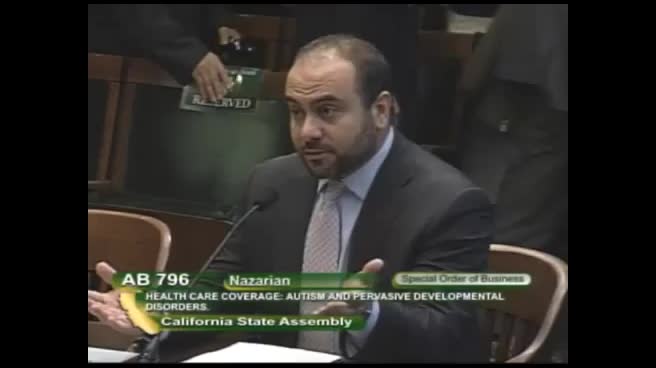 25MIN
Assembly Standing Committee on Business and Professions
 16MIN
Assembly Standing Committee on Health
Bill Author
Bill Co-Author(s):