AB 828: Vehicles: transportation services.
- Session Year: 2015-2016
- House: Assembly
- Latest Version Date: 2016-06-30
Existing law establishes the Public Utilities Commission and designates the duties of the commission, including regulating specified transportation carriers.
This bill would require the commission to conduct an investigation to consider whether existing statutes and regulations relating to for-hire passenger transportation services serve the public interest, encourage innovation, and create a fair and competitive transportation market between among companies that provide regulated transportation services. The bill would require the commission to complete the investigation and report its conclusions and recommendations to the Legislature on or before January 1, 2017.
Existing law defines commercial vehicle, for the purposes of the Vehicle Code, as a motor vehicle of a type required to be registered under that code that is used or maintained for the transportation of persons for hire, compensation, or profit or designed, used, or maintained primarily for the transportation of property. Existing law, the Passenger Charter-party Carriers Act, provides for the regulation of transportation network companies by the Public Utilities Commission. Existing law defines a transportation network company to mean an organization, including, but not limited to, a corporation, limited liability company, partnership, sole proprietor, or any other entity, operating in California that provides prearranged transportation services for compensation using an online-enabled application or platform to connect passengers with drivers using a personal vehicle.
This bill, until January 1, 2018, would exclude from the definition of commercial vehicle, for purposes of the Vehicle Code, any motor vehicle operated in connection with a transportation network company, if specified conditions are satisfied.
Existing law establishes the Public Utilities Commission and designates the duties of the commission, including regulating specified transportation carriers.
This bill would require the commission to conduct an investigation to consider whether existing statutes and regulations relating to transportation services serve the public interest, encourage innovation, and create a fair and competitive transportation market between companies that provide regulated transportation services. The bill would require the commission to complete the investigation and report its conclusions and recommendations to the Legislature on or before January 1, 2017.
Existing law defines commercial vehicle, for the purposes of the Vehicle Code, as a motor vehicle of a type required to be registered under that code that is used or maintained for the transportation of persons for hire, compensation, or profit or designed, used, or maintained primarily for the transportation of property. Existing law, the Passenger Charter-party Carriers Act, provides for the regulation of transportation network companies by the Public Utilities Commission. Existing law defines a transportation network company to mean an organization, including, but not limited to, a corporation, limited liability company, partnership, sole proprietor, or any other entity, operating in California that provides prearranged transportation services for compensation using an online-enabled application or platform to connect passengers with drivers using a personal vehicle.
This bill, until January 1, 2018, would exclude from the definition of commercial vehicle, for purposes of the Vehicle Code, any motor vehicle operated in connection with a transportation network company, if specified conditions are satisfied.
Existing law defines commercial vehicle, for the purposes of the Vehicle Code, as a motor vehicle of a type required to be registered under that code that is used or maintained for the transportation of persons for hire, compensation, or profit or designed, used, or maintained primarily for the transportation of property. Existing law, the Passenger Charter-party Carriers Act, provides for the regulation of transportation network companies by the Public Utilities Commission. Existing law defines a transportation network company to mean an organization, including, but not limited to, a corporation, limited liability company, partnership, sole proprietor, or any other entity, operating in California that provides prearranged transportation services for compensation using an online-enabled application or platform to connect passengers with drivers using a personal vehicle.
This bill would exclude from the definition of commercial vehicle, for purposes of the Vehicle Code, any motor vehicle operated in connection with a transportation network company. company, if specified conditions are satisfied.
Existing law defines commercial vehicle, for the purposes of the Vehicle Code, as a motor vehicle of a type required to be registered under that code that is used or maintained for the transportation of persons for hire, compensation, or profit or designed, used, or maintained primarily for the transportation of property. Existing law, the Passenger Charter-party Carriers Act, provides for the regulation of transportation network companies by the Public Utilities Commission. Existing law defines a transportation network company to mean an organization, including, but not limited to, a corporation, limited liability company, partnership, sole proprietor, or any other entity, operating in California that provides prearranged transportation services for compensation using an online-enabled application or platform to connect passengers with drivers using a personal vehicle.
This bill would exclude from the definition of commercial vehicle, for purposes of the Vehicle Code, any motor vehicle operated in connection with a transportation network company.
(a)The Public Utilities Commission shall conduct an investigation to consider whether existing statutes and regulations relating to for-hire passenger transportation services serve the public interest, encourage innovation, and create a fair and competitive transportation market between among companies that provide regulated transportation services, including, but not limited to, taxi services, transportation network companies, other charter-party carriers of passengers, and passenger stages. The commission shall consult with the Department of Motor Vehicles, local governments, and other entities responsible for the regulation of transportation services, as the commission deems necessary. The commission shall complete the investigation and report its conclusions and recommendations to the Legislature on or before January 1, 2017.
(b)The report required by this section shall be submitted in compliance with Section 9795 of the Government Code.
(c)This section shall remain in effect only until January 1, 2018, and as of that date is repealed, unless a later enacted statute, that is enacted before January 1, 2018, deletes or extends that date.
SEC. 2.Section 260 of the Vehicle Code is amended to read:260.(a)A commercial vehicle is a motor vehicle of a type required to be registered under this code used or maintained for the transportation of persons for hire, compensation, or profit or designed, used, or maintained primarily for the transportation of property.
(b)Passenger vehicles and house cars that are not used for the transportation of persons for hire, compensation, or profit are not commercial vehicles. This subdivision does not apply to Chapter 4 (commencing with Section 6700) of Division 3.
(c)A vanpool vehicle is not a commercial vehicle.
(d)(1)A motor vehicle operated in connection with a transportation network company, as defined in Section 5431 of the Public Utilities Code, is not a commercial vehicle if all of the following conditions are satisfied:
(A)The vehicle is operated for passenger service only and is a passenger vehicle limited to seven passengers, not including the driver.
(B)The vehicle is operated exclusively by the person to whom the vehicle is registered or insured.
(C)The vehicle is not a paratransit vehicle.
(D)The vehicle is not operated for public transit services.
(E)The vehicle is not operated for school bus services.
(2)This subdivision does not change the insurance requirements established under Section 5433 of the Public Utilities Code for a transportation network company and any participating driver. This subdivision does not change the insurance limitations set forth in Section 5434 of the Public Utilities Code.
(e)The definition of a commercial vehicle in this section does not apply to Chapter 7 (commencing with Section 15200) of Division 6.
(f)This section shall remain in effect only until January 1, 2018, and as of that date is repealed, unless a later enacted statute, that is enacted before January 1, 2018, deletes or extends that date.
SEC. 3.Section 260 is added to the Vehicle Code, to read:260.(a)A commercial vehicle is a motor vehicle of a type required to be registered under this code used or maintained for the transportation of persons for hire, compensation, or profit or designed, used, or maintained primarily for the transportation of property.
(b)Passenger vehicles and house cars that are not used for the transportation of persons for hire, compensation, or profit are not commercial vehicles. This subdivision shall not apply to Chapter 4 (commencing with Section 6700) of Division 3.
(c)Any vanpool vehicle is not a commercial vehicle.
(d)The definition of a commercial vehicle in this section does not apply to Chapter 7 (commencing with Section 15200) of Division 6.
(e)This section shall become operative on January 1, 2018.
(a)The Public Utilities Commission shall conduct an investigation to consider whether existing statutes and regulations relating to transportation services serve the public interest, encourage innovation, and create a fair and competitive transportation market between companies that provide regulated transportation services, including, but not limited to, taxi services, transportation network companies, other charter-party carriers of passengers, and passenger stages. The commission shall consult with the Department of Motor Vehicles, local governments, and other entities responsible for the regulation of transportation services, as the commission deems necessary. The commission shall complete the investigation and report its conclusions and recommendations to the Legislature on or before January 1, 2017.
(b)The report required by this section shall be submitted in compliance with Section 9795 of the Government Code.
(c)This section shall remain in effect only until January 1, 2018, and as of that date is repealed, unless a later enacted statute, that is enacted before January 1, 2018, deletes or extends that date.
SECTION 1.SEC. 2.Section 260 of the Vehicle Code is amended to read:260.(a)A commercial vehicle is a motor vehicle of a type required to be registered under this code used or maintained for the transportation of persons for hire, compensation, or profit or designed, used, or maintained primarily for the transportation of property.
(b)Passenger vehicles and house cars that are not used for the transportation of persons for hire, compensation, or profit are not commercial vehicles. This subdivision does not apply to Chapter 4 (commencing with Section 6700) of Division 3.
(c)A vanpool vehicle is not a commercial vehicle.
(d)(1)A motor vehicle operated in connection with a transportation network company, as defined in Section 5431 of the Public Utilities Code, is not a commercial vehicle if all of the following conditions are satisfied:
(A)The vehicle is operated for passenger service only and is a passenger vehicle limited to seven passengers, not including the driver.
(B)The vehicle is operated exclusively by the person to whom the vehicle is registered or insured.
(C)The vehicle is not a paratransit vehicle.
(D)The vehicle is not operated for public transit services.
(E)The vehicle is not operated for school bus services.
(2)This subdivision does not change the insurance requirements established under Section 5433 of the Public Utilities Code for a transportation network company and any participating driver. This subdivision does not change the insurance limitations set forth in Section 5434 of the Public Utilities Code.
(e)The definition of a commercial vehicle in this section does not apply to Chapter 7 (commencing with Section 15200) of Division 6.
(f)This section shall remain in effect only until January 1, 2018, and as of that date is repealed, unless a later enacted statute, that is enacted before January 1, 2018, deletes or extends that date.
SEC. 3.Section 260 is added to the Vehicle Code, to read:260.(a)A commercial vehicle is a motor vehicle of a type required to be registered under this code used or maintained for the transportation of persons for hire, compensation, or profit or designed, used, or maintained primarily for the transportation of property.
(b)Passenger vehicles and house cars that are not used for the transportation of persons for hire, compensation, or profit are not commercial vehicles. This subdivision shall not apply to Chapter 4 (commencing with Section 6700) of Division 3.
(c)Any vanpool vehicle is not a commercial vehicle.
(d)The definition of a commercial vehicle in this section does not apply to Chapter 7 (commencing with Section 15200) of Division 6.
(a)A commercial vehicle is a motor vehicle of a type required to be registered under this code used or maintained for the transportation of persons for hire, compensation, or profit or designed, used, or maintained primarily for the transportation of property.
(b)Passenger vehicles and house cars that are not used for the transportation of persons for hire, compensation, or profit are not commercial vehicles. This subdivision does not apply to Chapter 4 (commencing with Section 6700) of Division 3.
(c)A vanpool vehicle is not a commercial vehicle.
(d)(1)A motor vehicle operated in connection with a transportation network company, as defined in Section 5431 of the Public Utilities Code, is not a commercial vehicle. vehicle if all of the following conditions are satisfied:
(A)The vehicle is operated for passenger service only and is a passenger vehicle limited to seven passengers, not including the driver.
(B)The vehicle is operated exclusively by the person to whom the vehicle is registered or insured.
(C)The vehicle is not a paratransit vehicle.
(D)The vehicle is not operated for public transit services.
(E)The vehicle is not operated for school bus services.
(2)This subdivision does not change the insurance requirements established under Section 5433 of the Public Utilities Code for a transportation network company and any participating driver. This subdivision does not change the insurance limitations set forth in Section 5434 of the Public Utilities Code.
(e)The definition of a commercial vehicle in this section does not apply to Chapter 7 (commencing with Section 15200) of Division 6.
(a)A commercial vehicle is a motor vehicle of a type required to be registered under this code used or maintained for the transportation of persons for hire, compensation, or profit or designed, used, or maintained primarily for the transportation of property.
(b)Passenger vehicles and house cars that are not used for the transportation of persons for hire, compensation, or profit are not commercial vehicles. This subdivision shall does not apply to Chapter 4 (commencing with Section 6700) of Division 3.
(c)Any A vanpool vehicle is not a commercial vehicle.
(d)A motor vehicle operated in connection with a transportation network company, as defined in Section 5431 of the Public Utilities Code, is not a commercial vehicle.
(d)
(e)The definition of a commercial vehicle in this section does not apply to Chapter 7 (commencing with Section 15200) of Division 6.
|
Date
|
Status
|
|---|---|
| May 14, 2015 | Referred to Com. on T. & H. |
| Aug 11, 2016 | In committee: Held under submission. |
| Aug 1, 2016 | In committee: Referred to APPR. suspense file. |
| Jun 30, 2016 | Read second time and amended. Re-referred to Com. on APPR. |
| Jun 29, 2016 | From committee: Amend, and do pass as amended and re-refer to Com. on APPR. (Ayes 6. Noes 4.) (June 21). |
| Jul 16, 2015 | Re-referred to Com. on E., U., & C. |
| Jul 16, 2015 | Joint Rule 61 suspended. (Page 1988.) |
| Jul 16, 2015 | Joint Rule 61 suspended. |
| Jul 14, 2015 | Read second time and amended. Re-referred to Com. on RLS. |
| Jul 13, 2015 | From committee: Amend, and do pass as amended and re-refer to Com. on RLS. (Ayes 6. Noes 5.) (July 7). |
| Jun 25, 2015 | In committee: Hearing postponed by committee. |
| Jun 15, 2015 | In committee: Hearing postponed by committee. |
| Feb 26, 2015 | Read first time. To print. |
| May 4, 2015 | Read third time. Passed. Ordered to the Senate. (Ayes 71. Noes 1. Page 1257.) |
| May 4, 2015 | Read third time. Passed. Ordered to the Senate. |
| May 4, 2015 | In Senate. Read first time. To Com. on RLS. for assignment. |
| Apr 29, 2015 | Read second time. Ordered to third reading. |
| Apr 28, 2015 | From committee: Do pass. (Ayes 14. Noes 0.) (April 27). |
| Apr 21, 2015 | Re-referred to Com. on TRANS. |
| Apr 20, 2015 | From committee chair, with author's amendments: Amend, and re-refer to Com. on TRANS. Read second time and amended. |
| Apr 16, 2015 | Re-referred to Com. on TRANS. pursuant to Assembly Rule 96. |
| Apr 13, 2015 | In committee: Hearing postponed by committee. |
| Mar 12, 2015 | Referred to Coms. on U. & C. and TRANS. |
| Feb 27, 2015 | From printer. May be heard in committee March 29. |
|
Date
|
Description
|
Location
|
Votes
|
|
|---|---|---|---|---|
| Aug 1, 2016 | Placed on suspense file | Senate Standing Committee on Appropriations |
Passed |
|
| Jun 21, 2016 | Do pass as amended, but first amend, and re-refer to the Committee on [Appropriations] | Senate Standing Committee on Energy, Utilities and Communications |
Passed |
|
| Jul 7, 2015 | Do pass as amended, but first amend, and re-refer to the Committee on [Rules] | Senate Standing Committee on Transportation and Housing |
Passed |
|
| May 4, 2015 | AB 828 LOW Assembly Third Reading | Assembly Floor |
Passed |
|
| Apr 27, 2015 | Do pass. | Assembly Standing Committee on Transportation |
Passed |
This list shows positions taken on this bill by organizations on the date displayed, which is linked to the original source.
Positions by individuals are not included.
|
Organization
|
Position
|
Date
|
|---|---|---|
| American Insurance Association | ** Support | Jun 21, 2016 |
| Association Of California Insurance Companies | ** Support | Jun 21, 2016 |
| Bay Area Council | ** Support | Jun 21, 2016 |
| Brea Chamber of Commerce | ** Support | Jun 21, 2016 |
| California Bus Association | ** Against | Jun 21, 2016 |
| California Chamber Of Commerce | * Support | Apr 27, 2015 |
| California Delivery Association | * Against | Jun 21, 2016 |
| California Labor Federation, Afl-Cio | * Against | Apr 27, 2015 |
| Capital Cab | * Against | Jul 7, 2015 |
| Clean Coalition | ** Support | Jun 21, 2016 |
| County of Orange Supervisor, 2nd District | ** Support | Jun 21, 2016 |
| Greater California Liberty Association | * Against | Jun 21, 2016 |
| Greater California Livery Association The | * Against | Jul 7, 2015 |
| Ground Transportation Operators | * Against | Apr 27, 2015 |
| Lift | * Support | Jun 21, 2016 |
| Los Angeles Area Chamber Of Commerce | ** Support | Jun 21, 2016 |
| Los Angeles Taxi Workers Alliance | ** Against | Jul 7, 2015 |
| Lyft, Inc. | ** Support | Jun 21, 2016 |
| Metropolitan Transportation Commission | ** Support | Jul 7, 2015 |
| National Association of Mutual Insurance Companies | ** Support | Jun 21, 2016 |
| Orange County Business Council | ** Support | Jun 21, 2016 |
| Orange County Supervisor Michelle Steel | ** Support | Jul 7, 2015 |
| Pacific Association Of Domestic Insurance Companies | ** Support | Jun 21, 2016 |
| Personal Insurance Federation Of California | ** Support | Jun 21, 2016 |
| Planning & Conservation League | ** Support | Jun 21, 2016 |
| Royal Taxi | * Against | Jul 7, 2015 |
| Sacramento Taxi Cab Union | ** Against | Jul 7, 2015 |
| Sacramento Taxicab Driver | * Against | Jul 7, 2015 |
| San Francisco African American Chamber of Commerce | ** Support | Apr 27, 2015 |
| San Francisco Cab Driver | * Against | Jul 7, 2015 |
| San Francisco Chamber of Commerce | ** Support | Jun 21, 2016 |
| San Francisco International Union of Taxi Drivers | * Against | Jul 7, 2015 |
| San Francisco Taxi Cab Driver | * Against | Jul 7, 2015 |
| San Francisco Taxi Workers Alliance | * Against | Jun 21, 2016 |
| San Francisco Taxicab Driver | * Against | Jul 7, 2015 |
| San Francisco Yellow Cab | * Against | Jun 21, 2016 |
| San Francisco Yellow Cab Co-Op | ** Against | Jun 21, 2016 |
| San Jose Taxi Drivers Association | ** Against | Jul 7, 2015 |
| SPUR | ** Support | Jun 21, 2016 |
| Taxi Cab Paratransit Association of California | * Against | Jul 7, 2015 |
| Taxi Commissioner | * Against | Jul 7, 2015 |
| Taxi Driver | * Against | Jul 7, 2015 |
| Taxi Workers Alliance | * Against | Jun 21, 2016 |
| Technet | * Support | Jul 7, 2015 |
| The Internet Association | * Support | Jul 7, 2015 |
| Travelers United | ** Support | Jun 21, 2016 |
| Uber | ** Support | Jun 21, 2016 |
| United Taxi Workers of San Diego | ** Against | Jul 7, 2015 |
| VALLEY INDUSTRY AND COMMERCE ASSOCIATION | ** Support | Apr 27, 2015 |
| Westward Liberty | ** Support | Jul 7, 2015 |
| Yellow Cab | * Against | Jul 7, 2015 |
| Yellow Cab San Francisco | * Against | Jul 7, 2015 |
| Yellow Cab San Jose | * Against | Jul 7, 2015 |
SENATE COMMITTEE ON
Senator Ricardo Lara, Chair
2015 - 2016 Regular Session
AB 828 (Low) - Vehicles: transportation services
Version: | Policy Vote: |
Urgency: | Mandate: |
Hearing Date: | Consultant: |
This bill meets the criteria for referral to the Suspense File.
Bill Summary:
AB 828 would exclude a motor vehicle operated in connection with a transportation network company (TNC) from the definition of “commercial vehicle” for vehicle registration purposes, including the payment of weight fees, until January 1, 2018, if certain conditions are satisfied. The bill would also require the California Public Utilities Commission (CPUC) to conduct an investigation on the existing statutes and regulations relating to for-hire passenger transportation services, as specified, and report conclusions and recommendations to the Legislature by January 1, 2017.
Fiscal Impact:
- CPUC estimates costs could be as high as $509,000 annually for two years to conduct a specified public proceeding. (Public Utilities Commission Transportation Reimbursement Account) -----see staff comments-----
- Unknown foregone weight fee revenues, potentially in excess of $10 million in 2017, to the extent that TNC vehicles would otherwise be registered as commercial vehicles subject to weight fees. Actual costs would depend upon the overall number of vehicles, the mix of vehicle types, and their corresponding gross weights. (State Highway Account. Weight fees are currently used to pay off transportation debt, thereby offsetting General Fund expenditures) -----see staff comments-----
- Minor and absorbable costs to the Department of Motor Vehicles (DMV) to consult with the CPUC on its investigation related to for-hire passenger transportation services. (Motor Vehicle Account)
Background:
Existing law defines a commercial vehicle as a motor vehicle used or maintained for the transportation of persons for hire, compensation, or profit, or designed, used, or maintained primarily for the transportation of property. Existing law requires a vehicle to be registered as a passenger or commercial vehicle based on how the vehicle is used and/or designed, but also requires commercial registration for all pickup trucks, regardless of whether they are used for commercial activities. A person registering a passenger vehicle with DMV must pay registration fees, vehicle license fees, and any applicable locally-imposed county or district fees. A person registering a commercial vehicle must also pay an additional fee based on the weight of the vehicle which is generally assessed based on the gross vehicle weight and number of axles. The weight fee is designed to offset the additional wear and tear that a commercial vehicle causes on the state's roads and highways. Additionally, commercial license plates differ from passenger vehicle license plates so that law enforcement can easily identify commercially-operating vehicles.
Existing law grants the CPUC the authority to supervise and regulate charter-party carrier of passengers, which includes licensing, safety, and insurance requirements, as well as enforcement actions. Taxicabs are excluded from the definition of charter-party carrier and are instead regulated at the local level by cities and counties. Existing law defines a TNC as a type of charter-party carrier that is a specified organization or entity operating in California that provides prearranged transportation services for compensation using an online-enabled application or platform to connect passengers with drivers using a personal vehicle. Existing law also imposes specified insurance requirements on TNCs and their drivers.
The CPUC issued a decision in 2013 requiring TNCs to obtain a permit to operate from the CPUC, conduct criminal background checks on drivers, check driver's records, establish a driver training program, implement a zero-tolerance policy on drugs and alcohol, conduct vehicle inspections, and obtain authorization from airports before conducting any operations on or into airport property. The CPUC has continued to examine and modify TNC regulations, issuing a Phase II decision in June of this year, and announcing the initiation of a Phase III investigation to explore further changes and clarifications.
On January 5, 2015, DMV issued an advisory memo due to a number of dealers and customers seeking clarification on how to register a vehicle that would be used to provide TNC services. These inquiries were derived from purchasers buying new vehicles through financing programs offered by TNCs. The memo stated that "any passenger vehicle used or maintained for the transportation of persons for hire, compensation, or profit is a commercial vehicle. Even occasional use of a vehicle in this manner requires the vehicle to be registered commercially." DMV ultimately retracted the advisory memo clarifying that further analysis is warranted, but has not offered further guidance to date.
Proposed Law:
AB 828 would place a temporary moratorium on requiring TNC vehicles to register as commercial vehicles. Specifically, until January 1, 2018, this bill would exclude vehicles operated in connection with a TNC from the definition of commercial vehicle if it satisfies all of the following conditions:
- It is operated exclusively by the person to whom it is registered or insured.
- It is not a paratransit vehicle.
- It is not operated for public transit services.
- It is not operated for school bus services.
The bill would also require the CPUC to conduct an investigation to consider whether existing statutes and regulations relating to for-hire passenger services serve the public interest, encourage innovation, and create a fair and competitive transportation market among companies that provide regulated transportation services, including taxi services, TNCs, other charter-party carriers of passengers, and passenger stages. The CPUC must consult with other specified entities responsible for regulation of transportation services as it deems necessary, and submit a report of its conclusions and recommendations to the Legislature by January 1, 2017.
Staff Comments:
Commercial registration fees vary depending on the gross weight of the vehicle (GVW). For example:
- $8 annual fee for a vehicle with a GVW of less than 3000 pounds (Ford Focus).
- $24 annual fee for a vehicle with a GVW of 3000-4000 pounds (Honda Accord).
- $80 annual fee for a vehicle with a GVW of 4000-5000 pounds (Lincoln Continental or Toyota Highlander).
- $154 annual fee for a vehicle with a GVW of 5000-6000 pounds (Chevy Tahoe or Suburban).
The number of vehicles operated in connection with a TNC is currently unknown, but could be as high as 200,000 to 300,000, according estimates in the Senate Energy and Utilities Committee analysis of this bill, and those provided by DMV. This bill would exempt TNC vehicles from commercial registration requirements and payment of weight fees until January 1, 2018. To the extent these vehicles currently meet the definition of a commercial vehicle and would otherwise be required to pay weight fees, this bill could result in foregone revenues in 2017 of over $2 million, and potentially over $10 million. The actual amount would depend on the total number of TNC vehicles, the mix of vehicle types, and their corresponding GVWs. Staff notes that there is currently no way for DMV to identify whether a passenger vehicle will be operated in connection with a TNC at the time of registration, unless the owner self certifies that the vehicle will be used for the transportation of persons for hire.
CPUC indicates that the requirement to conduct the specified investigation would impose costs of up to $508,837 for 4 PY of staff time (two analysts, one legal counsel, and one administrative law judge) to conduct a proceeding. CPUC further estimates that the proceeding could take up to two years, including public comment, responses, and resolution of any investigation appeals. While the investigation is likely to require the two full PY of analyst staff time, it is unclear whether the proceeding would require a fully dedicated PY of Counsel and Judge staff time for the investigation.
Recommended Amendments:
The bill currently requires the CPUC to complete the specified investigation on the existing statutes and regulations relating to for-hire transportation services by January 1, 2017, which is the same day that the bill would take effect. Furthermore, the CPUC indicates it may require two years for a proceeding of this nature. The due date for the report to the Legislature should be adjusted accordingly.
-- END --
SENATE COMMITTEE ON ENERGY, UTILITIES AND COMMUNICATIONS
Senator Ben Hueso, Chair
2015 - 2016 Regular
Bill No: Hearing Date: 6/21/2016
Author: | |||
Version: | As Amended | ||
Urgency: | Fiscal: | ||
Consultant: | |||
SUBJECT:
DIGEST: This bill excludes motor vehicles operating in connection with a transportation network company (TNC) from the requirement to register as a commercial vehicle, if certain conditions are met. This bill also requires the California Public Utilities Commission (CPUC) to conduct an investigation to consider whether existing rules related to transportation services serve the public interest, encourage innovation, and create a fair and competitive transportation market between companies that provide regulated transportation services.
ANALYSIS:
Existing law:
- Defines a “commercial vehicle” as a motor vehicle used or maintained for the transportation of persons for hire, compensation, or profit or designed, used, or maintained primarily for the transportation of property. (Vehicle Code §260)
- Establishes the Department of Motor Vehicles (DMV) within the State Transportation Agency and charged with the responsibility to issue vehicle registration and driver’s licenses. (Vehicle Code §1500, et seq.)
- Establishes the “Passenger Charter-Party Carriers Act”, which directs the CPUC to regulate, require license or permit to operate, require insurance and workers compensation, takes appropriate enforcement action and other provisions related to transportation charter-party carriers (CPCs). (Public Utilities Code §5351 et seq.)
- Defines transportation network company (TNC) as a type of charter-party carrier that is an organization, including, but not limited to, a corporation, limited liability company, partnership, sole proprietor, or any other entity, operating in California that provides prearranged transportation services for compensation using an online-enabled application or platform to connect passengers with drivers using a personal vehicle. (Public Utilities Code §5431)
- Requires specified liability insurance requirements for TNCs. (Public Utilities Code §§5433 and 5434)
This bill:
- Excludes from the definition of “commercial vehicle,” until January 1, 2018, unless a new statute is enacted, those motor vehicles operated in connection with a TNC provided that the vehicle is:
- operated for passenger service only and is limited to seven passengers excluding the driver;
- operated exclusively by the person to whom the vehicle is registered or insured;
- not a paratransit vehicle;
- not operated for public transit services; and
- not operated for school bus services.
- Requires that changes to the definition of commercial vehicle per this bill does not change the insurance requirements established for TNCs under Public Utilities Code §5433 and 5434.
- Requires the CPUC to conduct an investigation, in consultation with the DMV and relevant local agencies, and report to the legislature by January 1, 2017, to consider whether existing statutes and regulations relating to transportation services serve the public interest, encourage innovation, and create a fair and competitive transportation market between companies that provide regulated transportations services.
Background
Role of the DMV. The DMV is charged with ensuring proper vehicle registration for all vehicles and licensing of all drivers on California roads, per the requirements in the Vehicle Code and related regulations. The purpose of a vehicle registration is to establish ownership and collect related fees from motorists in exchange for the costs of maintaining public streets and roads.
Role of the CPUC. While the DMV is tasked with vehicle registration and individual driver licensing, other state and local entities issue separate permits to authorize companies, including their drivers and vehicles, to transport passengers for compensation. Within the state, the CPUC regulates most, but not all, of these transportation for-hire activities, including those of CPCs. The CPUC determines whether a CPC meets the various requirements prior to issuing a license that would allow a given CPC to operate on a for-hire basis to carry passengers, these include limousines, buses (not school or transit), and TNCs. In the case of taxicab services, local cities and counties issue permits to operate under those activities. Whether transportation for-hire licenses are issued by the CPUC or a city/county, vehicle registration is maintained as the exclusive purview of the DMV and required of all vehicles on the roads, with some exceptions.
Enter TNCs. TNCs have grown dramatically, with a reported 120,000 drivers across the state for one company, according to their testimony to this committee[1]. The entrance of TNCs into the transportation for-hire market has disrupted the sector. TNCs are successfully competing with taxi cabs, limousines, and other regulated transit operators. While most closely related to a taxicab, TNCs prearrange transportation services via an online application on a smartphone or computer. Patrons request a ride to a predetermined location, and the application connects them with a TNC driver. Payment is processed through the application so that no physical financial transaction occurs between the patron and driver and the TNC takes a commission on each trip. TNCs enjoy differing regulations as compared to taxicabs, including the ability to set their own fares, flexibility to increase supply, and, generally less stringent requirements – including those related to vehicle inspections, driver background checks, insurance coverage, driver training and others. Whereas taxicabs are regulated by locals, TNCs are regulated at the state level by the CPUC.
Commercial vehicle registration. The Vehicle Code provides that certain vehicles must be registered as commercial vehicles, with specified plates and fees. This includes vehicles used to transport people or property for compensation. However, commercial registration is also required of all pick-up trucks regardless of whether they are used for commercial activity. Vehicles registered as commercial are required to pay an additional fee based on the weight of the vehicle which is generally assessed based on the gross vehicle weight and number of axles. Overall, the weight fee is designed to offset the additional wear and tear that a commercial vehicle causes on the state’s roads and highways. As such a commercial license plate is more costly than a non-commercial plate. For cars weighing less than 3,000 pounds (e.g. Ford Focus), the additional cost is $8/year; for cars weighing between 3,000 and 4,000 pounds (e.g. Honda Accord), the additional costs is $24/year; and for cars weighing between 4,000 and 5,000 pounds the additional cost is $80/year. Commercial plates are also easily distinguishable from regular license plates by law enforcement. Commercial license plates use a digit sequence of NANNNNN and regular plates use a sequence of NAAANNN, where N=number and A=letter. This distinction can be beneficial to law enforcement in an investigation of an accident or incident or as they patrol vehicles on the roads.
Not so fast. On January 5, 2015, the DMV issued an advisory memo due to a number of dealers and customers seeking clarification on how to register a vehicle that would be used to provide TNC services. These inquiries were derived from purchasers buying new vehicles through financing programs offered by TNCs. The memo stated that “any passenger vehicle used or maintained for the transportation of persons for hire, compensation, or profit is a commercial vehicle. Even occasional use of a vehicle in this manner requires the vehicle to be registered commercially.” Within about a week, after backlash from the TNCs, the DMV retracted the advisory memo clarifying that further analysis is warranted.
Personal vehicle and commercial vehicle are not exclusive. A personal vehicle can have a commercial registration. The question of what defines a personal vehicle as it relates to TNCs is not directly related to the question of commercial vehicle registration requirements. For purposes of defining a personal vehicle, the CPUC’s Phase II decision is attempting to define whether a leased or rented vehicle can be used for TNC services and under what conditions. However, the question of vehicle registration is one that is the exclusive purview of the DMV and that would not be directly related to the decision on personal vehicle. In fact, a separate bill has been introduced to address the definition of personal vehicle as it relates to the CPUC’s proposed decision to place conditions on the use by TNCs of leased and rented vehicles. Whether or not the DMV requires commercial vehicle registration is not hinged on the definition of personal vehicle, which as noted above, other personal vehicles are already required to have commercial vehicle registration (e.g. pick-up trucks used for non-commercial activity).
Transportation deficit. As the state grapples with a transportation budget deficit to maintain roads and highways, the administration and legislature explore various options to reduce costs and increase revenues to support transportation infrastructure. Just last week, the Senate approved a budget bill that would increase the vehicle registration fee $10 annually for every registered vehicle, and peg the increase to the consumer price index. Yet, the administration has chosen to forgo the revenues that would be derived from requiring vehicles operating TNCs from commercial registration. Assuming close to 200,000 TNCs on California’s roads, the state is forgoing upwards of $5 million dollars annually. While not officially confirmed, there are rumors that the Administration may be exploring a settlement price with each of the TNC individual companies, in lieu of requiring individual commercial plates on each vehicle. It would seem that such an arrangement could be unprecedented, and would lack the benefits of individual commercial plates that could be easily identifiable by law enforcement and accurately assessed an annual fee. However, if such an arrangement is being pursued by the Administration, the language in this bill that would exempt TNCs from the requirement of commercial vehicle registration could directly undermine those efforts. Currently, the Governor has the ability to enforce the law and require commercial registration of TNCs should the companies not negotiate in good faith.
The requirement in this bill to exempt TNCs from commercial vehicle registration seems premature at best. The current statute is not being enforced by the Administration so there’s no demonstrated need for this bill. Furthermore, the DMV has not finalized a decision or made a recommendation about commercial plates on TNCs. On the other hand, the request for the study by the CPUC, in consultation with DMV and others, seems timely and appropriate to help inform this issue and others as it pertains the disparate regulations on similar transportation services. The author and committee may wish to amend this bill to remove the provisions related to exempting TNCs from the commercial vehicle registration requirements.
Technical amendments. The author and committee may also wish to narrow the requirement that the CPUC, in consultation with DMV and others, conduct an investigation and report by narrowing the report to regulations and rules related to transportation for-hire services
Prior/Related Legislation
AB 1360 (Ting, 2015) would allow charter-party carriers of passengers, including transportation network companies, to charge individual fares, rather than a single group fare when providing carpool services. The bill is scheduled to be heard by this committee on June 27, 2016.
AB 1422 (Cooper, Chapter 791, Statutes of 2015) required transportation network companies to participate in the DMV employer pull-notice (EPN) system to regularly check the driving records of a participating driver.
AB 1610 (Committee on Budget, 2016) would among other items, increase the annual vehicle registration fee by $10 per registration to fund state highway and local road construction, maintenance and mitigation and associated administrative costs. The bill is in the Assembly awaiting a concurrence vote.
AB 2293 (Bonilla, Chapter 389, Statutes of 2014) established guidelines for insurance coverage for TNCs to ensure personal and financial safety of consumers.
SB 1035 (Hueso, 2016) would have instituted a number of public safety and consumer protection requirements on TNCs. The bill failed passage in the Senate Committee on Transportation.
FISCAL EFFECT: Appropriation: Fiscal Com.: Local:
SUPPORT:
American Insurance Association
Association of California Insurance Companies
Bay Area Council
Brea Chamber of Commerce
Clean Coalition
County of Orange Supervisor, 2nd District
Los Angeles Area Chamber of Commerce
Lyft
National Association of Mutual Insurance Companies
Orange County Business Council
Pacific Association of Domestic Insurance Companies
Personal Insurance Federation of California
Planning & Conservation League
SPUR
San Francisco Chamber of Commerce
Travelers United
Uber
OPPOSITION:
California Bus Association
California Delivery Association
California Labor Federation
Greater California Livery Association
San Francisco Taxi Workers Alliance
San Francisco Yellow Cab Co-Op
ARGUMENTS IN SUPPORT: According to the author’s office: “this bill will affect users of TNCs by increasing access to a driver in a timely manner without additional hurdles for the operator of the TNC to jump through. This bill also helps other industries that provide similar services by requiring the CPUC to do a study on how to best serve the public interest. Once the CPUC has concluded their study, recommendations will be given to the legislature on how best for all the companies to serve the users of these services.”
Lyft and Uber both assert that requiring TNC drivers to register their vehicles as commercial vehicles is an onerous requirement that would likely deter part-time drivers – who represent the majority of TNC drivers – from participating in the sector. These companies argue that the law must be clarified to provide certainty for the TNC sector.
ARGUMENTS IN OPPOSITION: In opposition to this bill, the California Delivery Association states: “Our industry is comprised of small businesses that have been creating jobs, contributing to our economy and supporting our communities, many for nearly half a century, in California. While we realize that every business must work hard to compete in the marketplace, we oppose “carve-out” exemptions created by government or any other entity that unfairly gives one segment of our industry the upper hand and leaves many struggling family businesses at a competitive disadvantage.”
The San Francisco Taxi states “there is no reason to exclude TNC vehicles from commercial registration while not excluding other vehicles that are used commercially in the same manner. Many taxi drivers and small business owners also use their vehicles for personal purposes and work part-time, yet must register their vehicles commercially. It is a simple and inexpensive process: a single visit to a weigh station, which may charge $25, and payment of an additional registration fee of $8-24 for a small or medium-sized sedan.”
-- END --
Uber testimony. Joint Hearing of the Senate Energy, Utilities and Communications and Transportation and Housing Committees. Leveling the Playing Field: Ride-hailing disruption. February 2016. ↑
AB 828 (Low) Page 5 of 5
SENATE COMMITTEE ON TRANSPORTATION AND HOUSING
Senator Jim Beall, Chair
2015 - 2016 Regular
Bill No: AB 828 Hearing Date: 7/7/2015
Author: |
Low |
||
Version: |
4/20/2015 |
||
Urgency: |
No |
Fiscal: |
No |
Consultant: |
Randy Chinn |
||
SUBJECT: Vehicles: transportation network companies
DIGEST: This bill excludes from the definition of “motor vehicles” any motor vehicle operated in connection with a transportation network company (TNC), under specified conditions.
ANALYSIS:
Existing law defines a “commercial vehicle” as a motor vehicle used for the transportation of persons for hire or the transportation of property.
This bill excludes motor vehicles operated in connection with a TNC from the definition of commercial vehicle provided that:
The vehicle is operated for passenger service only and is limited to seven passengers excluding the driver;
The vehicle is operated exclusively by the person to whom the vehicle is registered or insured;
The vehicle is not a paratransit vehicle;
The vehicle is not operated for public transit services; and
The vehicle is not operated for school bus services.
COMMENTS:
Author’s Statement. According to the author, TNCs are at the cutting edge of transportation innovation. The convenience of TNCs has led to many more people using them, which cuts down on traffic and emissions from cars. Exempting TNC drivers from the commercial vehicle registration process encourages the expansion of TNCs, which reduces vehicle trips, total vehicle miles driven and the carbon emissions that contribute to climate change.
Purpose. In January 2015, the Department of Motor Vehicles (DMV) announced that any passenger vehicle used for the transportation of persons for compensation is a commercial vehicle. A week later, after some concern from TNCs, the DMV retracted that announcement. This bill updates the definition of a commercial vehicle to clarify that it does not include vehicles used in connection with TNCs.
The growing TNC industry. In California, the TNC business is large and growing rapidly. A January 2015 report from Uber1, the largest TNC, reports 20,000 active Uber drivers in Los Angeles, 16,000 in the San Francisco area, and almost 5,000 each in San Diego and Orange County, up from zero in July 2012. Some estimates put the total number of active TNC drivers in the United States at 150,000. TNCs are successfully competing with taxi cabs, limousines, and other regulated transit operators.
What this bill does. By exempting vehicles operated in connection with TNCs — hereafter referred to as TNC vehicles — from the definition of commercial vehicle, this bill simply exempts those vehicles from having to obtain commercial license plates. A commercial license plate is more costly than a non-commercial plate. For cars weighing less than 3,000 pounds (e.g., Ford Focus), the additional cost is $8/year; for cars weighing between 3,000 and 4,000 pounds (e.g., Honda Accord), the additional cost is $24/year; and for cars weighing between 4,000 and 5,000 pounds (e.g., Volvo XC 90 SUV), the additional cost is $80/year. The reason for higher licensing costs for commercial vehicles is to compensate for the additional wear on the roads caused by these vehicles, which is why the cost increases as the vehicle weight increases.
Commercial plates are easily distinguishable by law enforcement from regular license plates. Knowing that a vehicle is operating commercially can be helpful in the investigation of an accident, as insurance requirements are more substantial for vehicles which are used commercially. The California Public Utilities Commission (CPUC) requires that TNC vehicles carry additional insurance.
What else the bill does, potentially. According to supporters, classifying a TNC vehicle as a commercial vehicle may create additional problems with financing and insurance. A vehicle that was originally financed as a personal vehicle may be in technical violation of the financing agreement if that vehicle becomes a commercial vehicle. The concern with insurance potentially arises because the CPUC’s recent decision refers to TNC vehicles as personal vehicles, not commercial vehicles. While these concerns have not yet been raised by the financing and insurance industries, the supporters are concerned that this risk will deter potential new TNC drivers.
An unlevel playing field. The different types of transportation companies (e.g., TNCs, limousines, Super Shuttles, taxis) are all regulated differently. Rates, routes, insurance requirements, vehicle inspections, and driver requirements vary. State law has begun to address the biggest differences between TNCs, but there’s little dispute that big differences remain. In an ideal world, companies would compete based on the differences in their business models and competence, not on the differences in how they are regulated.
Creating a level playing field slowly. The laws and regulations governing the provision of transportation services are many decades old. These laws and regulations have evolved slowly, as evidenced by the arcane and complicated carrier classifications. At least over the last several decades, the few new laws have focused on safety issues. The rapid growth of TNCs has disrupted this relatively quiet corner of our economy, changing the economics of transportation and challenging the economic models of the traditional transportation providers. This has upended the lives of many people in the transportation industry, while at the same time providing many benefits to transportation consumers.
Regulators are struggling to keep up with the rapidly evolving transportation industry, a bit hamstrung by laws which never anticipated the different ways that TNCs operate. In September 2013, the CPUC, which has regulatory authority over much, though not all, of the passenger transportation industry, issued its first set of rules2 intended to foster the growth of TNCs, without compromising public safety. These rules started the process of establishing a level playing field so that all transportation companies would have similar regulatory obligations, allowing them to compete based on their business models. Among the rules were requirements for obtaining an operating permit from the CPUC, requiring criminal background checks for drivers, establishing driver training programs, implementing zero-tolerance policies on drugs and alcohol, and minimum insurance requirements.
The CPUC has initiated a second phase of its investigation to look more closely at the regulation of TNCs and the traditional transportation companies, known as charter-party carriers3. A set of issues has been proposed and comments on the scope of those issues have been submitted; a decision on the scope of issues is expected shortly. As the state’s regulatory agency over transportation matters, the CPUC is in the best position to consider whether its current regulations provide for a fair and competitive market. It can recommend specific changes to law and, in some cases, can implement changes to its own regulations to achieve the goal of a level playing field.
If it looks like a duck … There is no question that TNC drivers, like drivers of taxis, limos, and shuttles, do it to make money; they are “commercial” by definition. So it is hard to see how a full-time TNC driver should be treated any differently than a full-time taxi driver or full-time limousine driver; they do the same work and perform the same service.
The argument for exempting vehicles used by TNC drivers from the definition of a commercial vehicle is that many of the drivers are part-time, driving their personal cars infrequently just to pick up a few dollars. The January 2015 Uber report cited above notes that 55% of their drivers drive 15 hours/week or less. Given this, it may be reasonable to limit the exemption from the commercial vehicle definition for part-time drivers, just as it is reasonable not to regulate the lemonade stand on the corner. Some may question whether a part-time exemption can be enforced. But this can be dealt with just like any other commercial vehicle. If that individual’s vehicle happens to be a part of any law enforcement inquiry, say because of an accident or driving infraction, the investigating officer can inquire about the status of the vehicle. While this may not be perfect, it is at least a concrete step towards establishing a level playing field. The author and committee may wish to consider exempting TNC drivers whose vehicles are driven 10 hours or less per week in connection with any TNC from the definition of commercial vehicle.
Double referred. The Rules Committee has requested this bill if it passes out of this committee.
Related Legislation:
AB 1360 (Ting) — allows transportation network companies more flexibility in how they charge multiple riders. This bill is pending in the Senate Energy, Utilities and Communications Committee.
AB 1422 (Cooper) — requires transportation network companies to participate in the Department of Motor Vehicles program for notifying employers of the driving records of their drivers. This bill is pending in the Senate Transportation and Housing Committee.
AB 2293 (Bonilla, Chapter 389, Statutes of 2014) — requires specified levels of insurance coverage for TNCs and their drivers.
Assembly votes:
Floor: 71-1
Trans: 14-0
FISCAL EFFECT: Appropriation: No Fiscal Com.: No Local: No
POSITIONS: (Communicated to the committee before noon on Wednesday,
July 1, 2015.)
SUPPORT:
Bay Area Council
Brea Chamber of Commerce
Clean Coalition
Internet Association
Los Angeles Area Chamber of Commerce
Lyft
Metropolitan Transportation Commission
Orange County Business Council
Orange County Supervisor Michelle Steel
Planning and Conservation League
San Francisco Chamber of Commerce
SPUR
Uber
Westward Liberty
OPPOSITION:
California Delivery Association
California Labor Federation
Greater California Livery Association
Los Angeles Taxi Workers Alliance
Sacramento Taxi Cab Union
San Francisco Taxi Workers Alliance
San Jose Taxi Drivers Association
United Taxi Workers of San Diego
Numerous individuals
-- END --
1 An Analysis of the Labor Market for Uber’s Driver-Partners in the United States, by Jonathan V. Hall and Alan B. Kreuger; January 22, 2015.
2 D.13-09-045; issued September 23, 2013.
3 Assigned Commissioner and Administrative Law Judge’s Ruling Amending the Scoping Memo and Ruling for Phase II of Proceeding; Rulemaking 12-12-011; April 28, 2015.
AB 828 (Low) Page 5 of 5
SENATE COMMITTEE ON TRANSPORTATION AND HOUSING
Senator Jim Beall, Chair
2015 - 2016 Regular
Bill No: AB 828 Hearing Date: 6/16/2015
Author: |
Low |
||
Version: |
4/20/2015 |
||
Urgency: |
No |
Fiscal: |
No |
Consultant: |
Randy Chinn |
||
SUBJECT: Vehicles: transportation network companies
DIGEST: This bill excludes from the definition of “motor vehicles” any motor vehicle operated in connection with a transportation network company (TNC), under specified conditions.
ANALYSIS:
Existing law defines a “commercial vehicle” as a motor vehicle used for the transportation of persons for hire or the transportation of property.
This bill excludes motor vehicles operated in connection with a TNC from the definition of commercial vehicle provided that:
The vehicle is operated for passenger service only and is limited to seven passengers excluding the driver;
The vehicle is operated exclusively by the person to whom the vehicle is registered or insured;
The vehicle is not a paratransit vehicle;
The vehicle is not operated for public transit services; and
The vehicle is not operated for school bus services.
COMMENTS:
Purpose. In January 2015, the Department of Motor Vehicles (DMV) announced that any passenger vehicle used for the transportation of persons for compensation is a commercial vehicle. A week later, after some concern from TNCs, the DMV retracted that announcement. This bill updates the definition of a commercial vehicle to clarify that it does not include vehicles used in connection with TNCs.
The growing TNC industry. In California, the TNC business is large and growing rapidly. A January 2015 report from Uber1, the largest TNC, reports 20,000 active Uber drivers in Los Angeles, 16,000 in the San Francisco area, and almost 5,000 each in San Diego and Orange County, up from zero in July 2012. Some estimates put the total number of active TNC drivers in the United States at 150,000. TNCs are successfully competing with taxi cabs, limousines, and other regulated transit operators.
What this bill does. By exempting vehicles operated in connection with TNCs — hereafter referred to as TNC vehicles — from the definition of commercial vehicle, this bill simply exempts those vehicles from having to obtain commercial license plates. A commercial license plate is more costly than a non-commercial plate. For cars weighing less than 3,000 pounds (e.g., Ford Focus), the additional cost is $8/year; for cars weighing between 3,000 and 4,000 pounds (e.g., Honda Accord), the additional cost is $24/year; and for cars weighing between 4,000 and 5,000 pounds (e.g., Volvo XC 90 SUV), the additional cost is $80/year. The reason for higher licensing costs for commercial vehicles is to compensate for the additional wear on the roads caused by these vehicles, which is why the cost increases as the vehicle weight increases.
Commercial plates are easily distinguishable by law enforcement from regular license plates. Knowing that a vehicle is operating commercially can be helpful in the investigation of an accident, as insurance requirements are more substantial for vehicles which are used commercially. The California Public Utilities Commission (CPUC) requires that TNC vehicles carry additional insurance.
What else the bill does, potentially. According to supporters, classifying a TNC vehicle as a commercial vehicle may create additional problems with financing and insurance. A vehicle that was originally financed as a personal vehicle may be in technical violation of the financing agreement if that vehicle becomes a commercial vehicle. The concern with insurance potentially arises because the CPUC’s recent decision refers to TNC vehicles as personal vehicles, not commercial vehicles. While these concerns have not yet been raised by the financing and insurance industries, the supporters are concerned that this risk will deter potential new TNC drivers.
An unlevel playing field. The different types of transportation companies (e.g., TNCs, limousines, Super Shuttles, taxis) are all regulated differently. Rates, routes, insurance requirements, vehicle inspections, and driver requirements vary. State law has begun to address the biggest differences between TNCs, but there’s little dispute that big differences remain. In an ideal world, companies would compete based on the differences in their business models and competence, not on the differences in how they are regulated.
Creating a level playing field slowly. The laws and regulations governing the provision of transportation services are many decades old. These laws and regulations have evolved slowly, as evidenced by the arcane and complicated carrier classifications. At least over the last several decades, the few new laws have focused on safety issues. The rapid growth of TNCs has disrupted this relatively quiet corner of our economy, changing the economics of transportation and challenging the economic models of the traditional transportation providers. This has upended the lives of many people in the transportation industry, while at the same time providing many benefits to transportation consumers.
Regulators are struggling to keep up with the rapidly evolving transportation industry, a bit hamstrung by laws which never anticipated the different ways that TNCs operate. In September 2013, the CPUC, which has regulatory authority over much, though not all, of the passenger transportation industry, issued its first set of rules2 intended to foster the growth of TNCs, without compromising public safety. These rules started the process of establishing a level playing field so that all transportation companies would have similar regulatory obligations, allowing them to compete based on their business models. Among the rules were requirements for obtaining an operating permit from the CPUC, requiring criminal background checks for drivers, establishing driver training programs, implementing zero-tolerance policies on drugs and alcohol, and minimum insurance requirements.
The CPUC has initiated a second phase of its investigation to look more closely at the regulation of TNCs and the traditional transportation companies, known as charter-party carriers3. A set of issues has been proposed and comments on the scope of those issues are due in June. As the state’s expert agency over transportation matters, the CPUC is in the best position to consider whether its current regulations provide for a fair and competitive market. It can recommend specific changes to law and, in some cases, can implement changes to its own regulations to achieve the goal of a level playing field. The author and committee may wish to consider requiring the CPUC to report to the Legislature on the changes to regulation and statute that will help achieve a level playing field and foster innovation, including whether other passenger vehicles being used by charter-party carriers should also be considered non-commercial.
Related Legislation:
AB 1360 (Ting) — Allows transportation network companies more flexibility in how they charge multiple riders. This bill is pending in the Senate Transportation and Housing Committee.
AB 1422 (Cooper) — Requires transportation network companies to participate in the Department of Motor Vehicles program for notifying employers of the driving records of their drivers. This bill is pending assignment in the Senate Energy, Utilities and Communications Committee.
Assembly votes:
Floor: 71-1
Trans: 14-0
FISCAL EFFECT: Appropriation: No Fiscal Com.: No Local: No
POSITIONS: (Communicated to the committee before noon on Wednesday,
June 10, 2015.)
SUPPORT:
Bay Area Council
Brea Chamber of Commerce
Clean Coalition
Internet Association
Los Angeles Area Chamber of Commerce
Lyft
Metropolitan Transportation Commission
Orange County Business Council
Orange County Supervisor Michelle Steel
Planning and Conservation League
San Francisco Chamber of Commerce
SPUR
Uber
OPPOSITION:
California Delivery Association
California Labor Federation
Greater California Livery Association
Los Angeles Taxi Workers Alliance
Sacramento Taxi Cab Union
San Francisco Taxi Workers Alliance
San Jose Taxi Drivers Association
United Taxi Workers of San Diego
Four individuals
-- END --
1 An Analysis of the Labor Market for Uber’s Driver-Partners in the United States, by Jonathan V. Hall and Alan B. Kreuger; January 22, 2015.
2 D.13-09-045; issued September 23, 2013.
3 Assigned Commissioner and Administrative Law Judge’s Ruling Amending the Scoping Memo and Ruling for Phase II of Proceeding; Rulemaking 12-12-011; April 28, 2015.
AB 828
Page 2
ASSEMBLY THIRD READING
AB 828
(Low and Chang)
As Amended April 20, 2015
Majority vote
Committee |
Votes |
Ayes |
Noes |
Transportation |
14-0 |
Frazier, Achadjian, Baker, Bloom, Daly, Dodd, Eduardo Garcia, Gomez, Kim, Linder, Medina, Melendez, O'Donnell, Santiago |
|
SUMMARY: Excludes motor vehicles operating in connection with a transportation network company (TNC) from being required to register as a commercial vehicle if certain conditions are met.
FISCAL EFFECT: Unknown. This bill is keyed non-fiscal by the Legislative Counsel.
COMMENTS: Existing law requires the California Public Utilities Commission (PUC) to regulate various transportation services, including charter-party carrier of passengers ( CPCs). CPCs perform various types of transportation services including, but not limited to, a limousine with seating capacity up to eight passengers, a bus providing prearranged services with capacity up to 15 passengers, or buses providing round-trip sightseeing trips. In order to obtain an operating permit or certificate from PUC, CPCs must meet a number of requirements including providing sufficient proof of financial responsibility, maintaining a preventative maintenance program for all vehicles, possessing a safety education and training program, and regularly checking the driving records of all persons operating vehicles used in transportation for compensation.
Approximately five years ago, a new model of transportation service began to take place in cities across the United States. Known as TNCs, these companies allow patrons to prearrange transportation services through an online application on their smartphone or computer. Patrons request a ride to a predetermined location, and the application connects them with a TNC driver. Payment is processed through the application so that no physical financial transaction occurs during the trip itself between the patron and the driver. Under this model drivers are considered independent contractors and TNCs take a commission on each trip.
In a September 2013 decision, the PUC began regulating TNCs by creating a distinct new category of CPCs. The PUC tailored specific new rules in response to the introduction of this new technology into an existing industry. The decision requires TNCs to obtain a permit from the PUC, conduct criminal background checks on drivers, check driver's records, establish a driver training program, implement a zero-tolerance policy on drugs and alcohol, conduct vehicle inspections, and obtain authorization from airports before conducting any operations on or into airport property. PUC is currently in the process of rolling out the second phase of the September 2013 decision which will include an evaluation of the original set of regulations and also consider any modifications to existing regulations relative to other CPC categories.
On January 5, 2015, the California Department of Motor Vehicles (DMV) issued an advisory memo due to a number of dealers and customers seeking clarification on how to register a vehicle that would be used to provide TNC services. These inquiries were derived from purchasers buying new vehicles through financing programs offered by TNCs. The memo stated that "any passenger vehicle used or maintained for the transportation of persons for hire, compensation, or profit is a commercial vehicle. Even occasional use of a vehicle in this manner requires the vehicle to be registered commercially." DMV ultimately retracted the advisory memo clarifying that further analysis is warranted.
Existing law requires a vehicle to be registered as a passenger or commercial vehicle based on how the vehicle is used and/or designed. Registration for a passenger vehicle typically includes several vehicle-related fees including registration fees, vehicle licensing fees, and locally imposed county/district fees (e.g. vehicle abatement, air quality, Service Authority for Freeway Emergencies). Vehicles registered as commercial are required to pay an additional fee based on the weight of the vehicle which is generally assessed based on the gross vehicle weight and number of axles. Overall, the weight fee is designed to offset the additional wear and tear that a commercial vehicle causes on the state's roads and highways. Additionally, commercial license plates defer from passenger vehicle license plates in order to ensure law enforcement has the ability to easily identify commercially operating vehicles.
The author introduced this bill in response to DMV's advisory memo. Advocates claim that commercial registration requirements are outdated and do not adequately address new services provided through advancements in technology. Respectively, this bill attempts to develop an exclusion for TNC drivers using their passenger vehicles while ensuring that other types of commercial vehicles continue to be subject to commercial registration requirements. The author notes, "TNCs are the cutting edge of transportation innovation and are a large part of the rapidly increasing 'sharing' economy model. With the convenience of TNCs many more people are starting to use them which cuts down on traffic and emissions from cars. Many TNC drivers are part-time or occasional drivers, working an average of 22.69 hours per month, driving to supplement their income. To that end, mandating TNC drivers to register their personal vehicle as a commercial vehicle needlessly increases business costs and curtails growth and innovation."
Please see the policy committee analysis for a full discussion of this bill.
Analysis Prepared by: Manny Leon / TRANS. / (916) 319-2093 FN: 0000216
AB 828
Page 3
Date of Hearing: April 27, 2015
ASSEMBLY COMMITTEE ON TRANSPORTATION
Jim Frazier, Chair
AB 828
(Low) – As Amended April 20, 2015
SUBJECT: Vehicles: transportation network companies
SUMMARY: Excludes motor vehicles operating in connection with a transportation network company (TNC) from being required to register as a commercial vehicle if certain conditions are met.
EXISTING LAW:
Defines a commercial vehicle as a motor vehicle used or maintained for the transportation of persons for hire, compensation, or profit or designed, used, or maintained primarily for the transportation of property.
Specifies that passenger vehicles and house cars, as defined, that are not used for the transportation of persons for hire, compensation, or profit are not commercial vehicles. Additionally specifies a vanpool vehicle is not a commercial vehicle.
Defines passenger vehicle as any motor vehicle, other than a motortruck, truck tractor, or a bus, as defined, and used or maintained for the transportation of persons.
Establishes the "Passenger Charter-Party Carriers Act," which directs the state Public Utilities Commission (PUC) to issue permits or certificates to carriers, investigate complaints against carriers, and cancel, revoke, or suspend permits and certificates for specific violations.
Defines charter-party carrier of passengers (CPC) as every person engaged in the transportation of persons by motor vehicle for compensation, whether in common or contract carriage, over any public highway in the state and includes any person, corporation, or other entity engaged in the provision of a hired driver service when a rented motor vehicle is being operated by a hired driver.
Defines transportation network company as an organization, including, but not limited to, a corporation, limited liability company, partnership, sole proprietor or any other entity operating in California that provides prearranged transportation services for compensation using an online-enabled application or platform to connect passengers with drivers using a personal vehicle.
FISCAL EFFECT: Unknown
COMMENTS: Existing law requires PUC to regulate various transportation services, including CPCs. CPCs perform various types of transportation services including, but not limited to, a limousine with seating capacity up to eight passengers, a bus providing prearranged services with capacity up to 15 passengers, or buses providing round-trip sightseeing trips. In order to obtain an operating permit or certificate from PUC, CPCs must meet a number of requirements including providing sufficient proof of financial responsibility, maintaining a preventative maintenance program for all vehicles, possessing a safety education and training program, and regularly checking the driving records of all persons operating vehicles used in transportation for compensation.
Approximately five years ago, a new model of transportation service began to take place in cities across the United States. Known as TNCs, these companies allow patrons to prearrange transportation services through an online application on their smartphone or computer. Patrons request a ride to a predetermined location, and the application connects them with a TNC driver. Payment is processed through the application so that no physical financial transaction occurs during the trip itself between the patron and the driver. Under this model drivers are considered independent contractors and TNCs take a commission on each trip.
In a September 2013 decision, the PUC began regulating TNCs by creating a distinct new category of CPCs. The PUC tailored specific new rules in response to the introduction of this new technology into an existing industry. The decision requires TNCs to obtain a permit from the PUC, conduct criminal background checks on drivers, check driver's records, establish a driver training program, implement a zero-tolerance policy on drugs and alcohol, conduct vehicle inspections, and obtain authorization from airports before conducting any operations on or into airport property. PUC is currently in the process of rolling out the second phase of the September 2013 decision which will include an evaluation of the original set of regulations and also consider any modifications to existing regulations relative to other CPC categories.
On January 5, 2015, DMV issued an advisory memo due to a number of dealers and customers seeking clarification on how to register a vehicle that would be used to provide TNC services. These inquiries were derived from purchasers buying new vehicles through financing programs offered by TNCs. The memo stated that "any passenger vehicle used or maintained for the transportation of persons for hire, compensation, or profit is a commercial vehicle. Even occasional use of a vehicle in this manner requires the vehicle to be registered commercially." DMV ultimately retracted the advisory memo clarifying that further analysis is warranted.
Existing law requires a vehicle to be registered as a passenger or commercial vehicle based on how the vehicle is used and/or designed. Registration for a passenger vehicle typically includes several vehicle-related fees including registration fees, vehicle licensing fees, and locally imposed county/district fees (e.g. vehicle abatement, air quality, Service Authority for Freeway Emergencies). Vehicles registered as commercial are required to pay an additional fee based on the weight of the vehicle which is generally assessed based on the gross vehicle weight and number of axles. Overall, the weight fee is designed to offset the additional wear and tear that a commercial vehicle causes on the state's roads and highways. Additionally, commercial license plates defer from passenger vehicle license plates in order to ensure law enforcement has the ability to easily identify commercially operating vehicles.
The author introduced AB 828 in response to DMV's advisory memo. Advocates claim that commercial registration requirements are outdated and do not adequately address new services provided through advancements in technology. Respectively, AB 828 attempts to develop an exclusion for TNC drivers using their passenger vehicles while ensuring that other types of commercial vehicles continue to be subject to commercial registration requirements. The author notes, "TNCs are the cutting edge of transportation innovation and are a large part of the rapidly increasing "sharing" economy model. With the convenience of TNCs many more people are starting to use them which cuts down on traffic and emissions from cars. Many TNC drivers are part-time or occasional drivers, working an average of 22.69 hours per month, driving to supplement their income. To that end, mandating TNC drivers to register their personal vehicle as a commercial vehicle needlessly increases business costs and curtails growth and innovation."
Related legislation: AB 24 (Nazarian) requires CPCs and TNCs to participate in EPN and requires TNCs to submit their drivers to mandatory drug and alcohol testing. AB 24 passed out of the Assembly Utilities and Commerce Committee on April 20, 2015, with an 8-2 vote and is scheduled to be heard by this committee on April 27, 2015.
AB 1422 (Cooper) requires TNCs to participate in DMV's EPN. AB 1422 passed out of the Assembly Utilities and Commerce Committee on April 20, 2015, with a 14-0 vote and is scheduled to be heard by this committee on April 27, 2015.
REGISTERED SUPPORT / OPPOSITION:
Support
Bay Area Council
Clean Coalition
Los Angeles Area Chamber of Commerce
Lyft
Orange County Business Council
Planning and Conservation League
San Francisco African American Chamber of Commerce
SPUR
The Internet Association
Valley Industry and Commerce Association
Uber Technologies Inc.
Opposition
California Labor Federation
San Francisco Taxi Workers Alliance
Analysis Prepared by: Manny Leon / TRANS. / (916) 319-2093
Discussed in Hearing
 35MIN
Senate Standing Committee on Energy, Utilities and Communications
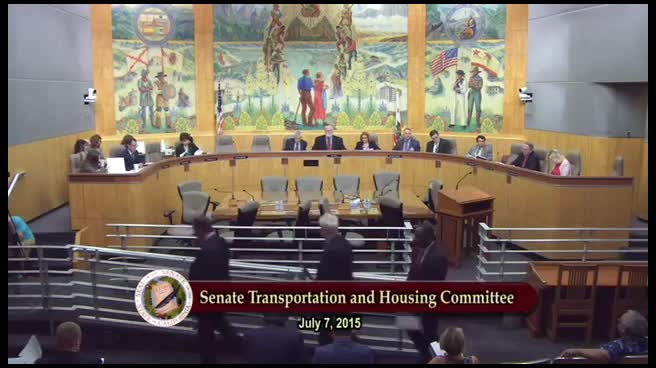 1H
Senate Standing Committee on Transportation and Housing
 4MIN
Assembly Floor
 10MIN
Assembly Standing Committee on Transportation


Bill Co-Author(s):
