AB 888: Waste management: plastic microbeads.
- Session Year: 2015-2016
- House: Assembly
- Latest Version Date: 2015-10-08
The Safe Drinking Water and Toxic Enforcement Act of 1986 (Proposition 65) prohibits any person, in the course of doing business, from knowingly and intentionally exposing any individual to a chemical known to the state to cause cancer or reproductive toxicity without giving a specified warning, or from discharging or releasing such a chemical into any source of drinking water, except as specified. Existing law prohibits the sale of expanded polystyrene packaging material by a wholesaler or manufacturer. Existing law prohibits a person from selling a plastic product in this state that is labeled with the term compostable, home compostable, or marine degradable unless, at the time of sale, the plastic product meets the applicable ASTM International standard specification.
This bill would prohibit, on and after January 1, 2020, a person, as defined, from selling or offering for promotional purposes in this state a personal care product containing plastic microbeads that are used to exfoliate or cleanse in a rinse-off product, as specified. The bill would exempt from those prohibitions the sale or promotional offer of a product containing less than 1 part per million (ppm) by weight of plastic microbeads.
The bill would make a violator liable for a civil penalty not to exceed $2,500 per day for each violation. The bill would authorize the penalty to be assessed and recovered in a civil action brought in any court of competent jurisdiction by the Attorney General or local officials. The bill would require the civil penalties collected in an action brought pursuant to the act to be retained by the office that brought the action.
The Safe Drinking Water and Toxic Enforcement Act of 1986 (Proposition 65) prohibits any person, in the course of doing business, from knowingly and intentionally exposing any individual to a chemical known to the state to cause cancer or reproductive toxicity without giving a specified warning, or from discharging or releasing such a chemical into any source of drinking water, except as specified. Existing law prohibits the sale of expanded polystyrene packaging material by a wholesaler or manufacturer. Existing law prohibits a person from selling a plastic product in this state that is labeled with the term compostable, home compostable, or marine degradable unless, at the time of sale, the plastic product meets the applicable ASTM International standard specification.
This bill would prohibit, on and after January 1, 2020, a person, as defined, from selling or offering for promotional purposes in this state a personal care product containing plastic microbeads that are used to exfoliate or cleanse in a rinse-off product, as specified. The bill would exempt from those prohibitions the sale or promotional offer of a product containing less than 1 part per million (ppm) by weight of plastic microbeads, as provided. The bill would authorize the Department of Toxic Substances Control to additionally exempt plastic microbeads contained in a personal care product, alternatives to plastic microbeads contained in a personal care product, and a personal care product containing plastic microbeads following a specified alternative analysis process, if a certain finding is made. The bill would require the manufacturer submitting an alternative analysis to reimburse the department for reasonable costs incurred implementing these alternative analysis provisions. microbeads.
The bill would make a violator liable for a civil penalty not to exceed $2,500 per day for each violation. The bill would authorize the penalty to be assessed and recovered in a civil action brought in any court of competent jurisdiction by the Attorney General or local officials. The bill would require the civil penalties collected in an action brought pursuant to the act to be retained by the office that brought the action.
The Safe Drinking Water and Toxic Enforcement Act of 1986 (Proposition 65) prohibits any person, in the course of doing business, from knowingly and intentionally exposing any individual to a chemical known to the state to cause cancer or reproductive toxicity without giving a specified warning, or from discharging or releasing such a chemical into any source of drinking water, except as specified. Existing law prohibits the sale of expanded polystyrene packaging material by a wholesaler or manufacturer. Existing law prohibits a person from selling a plastic product in this state that is labeled with the term compostable, home compostable, or marine degradable unless, at the time of sale, the plastic product meets the applicable ASTM International standard specification.
This bill would prohibit, on and after January 1, 2020, a person, as defined, from selling or offering for promotional purposes in this state a personal care product containing plastic microbeads that are used to exfoliate or cleanse in a rinse-off product, as specified. The bill would exempt from those prohibitions the sale or promotional offer of a product containing less than 1 part per million (ppm) by weight of plastic microbeads, as provided. The bill would authorize the Department of Toxic Substances Control to additionally exempt plastic microbeads contained in a personal care product, alternatives to plastic microbeads contained in a personal care product, and a personal care product containing plastic microbeads following a specified alternative analysis process, if a certain finding is made. The bill would require the manufacturer submitting an alternative analysis to reimburse the department for reasonable costs incurred implementing these alternative analysis provisions.
The bill would make a violator liable for a civil penalty not to exceed $2,500 per day for each violation. The bill would authorize the penalty to be assessed and recovered in a civil action brought in any court of competent jurisdiction by the Attorney General or local officials. The bill would require the civil penalties collected in an action brought pursuant to the act to be retained by the office that brought the action.
The Safe Drinking Water and Toxic Enforcement Act of 1986 (Proposition 65) prohibits any person, in the course of doing business, from knowingly and intentionally exposing any individual to a chemical known to the state to cause cancer or reproductive toxicity without giving a specified warning, or from discharging or releasing such a chemical into any source of drinking water, except as specified. Existing law prohibits the sale of expanded polystyrene packaging material by a wholesaler or manufacturer. Existing law prohibits a person from selling a plastic product in this state that is labeled with the term compostable, home compostable, or marine degradable unless, at the time of sale, the plastic product meets the applicable ASTM International standard specification.
This bill would prohibit, on and after January 1, 2020, a person, as defined, from selling or offering for promotional purposes in this state a personal care product containing intentionally added plastic microbeads that are used to exfoliate or cleanse in a rinse-off product, as specified. The bill would exempt from those prohibitions the sale or promotional offer of a product containing less than 1 part per million (ppm) by weight of plastic microbeads, as provided.
The bill would make a violator liable for a civil penalty not to exceed $2,500 per day for each violation. The bill would authorize the penalty to be assessed and recovered in a civil action brought in any court of competent jurisdiction by the Attorney General or local officials. The bill would require the civil penalties collected in an action brought pursuant to the act to be retained by the office that brought the action.
The Safe Drinking Water and Toxic Enforcement Act of 1986 (Proposition 65) prohibits any person, in the course of doing business, from knowingly and intentionally exposing any individual to a chemical known to the state to cause cancer or reproductive toxicity without giving a specified warning, or from discharging or releasing such a chemical into any source of drinking water, except as specified. Existing law prohibits the sale of expanded polystyrene packaging material by a wholesaler or manufacturer. Existing law prohibits a person from selling a plastic product in this state that is labeled with the term compostable, home compostable, or marine degradable unless, at the time of sale, the plastic product meets the applicable ASTM International standard specification.
This bill would prohibit, on and after January 1, 2020, a person, as defined, from selling or offering for promotional purposes in this state a personal care product containing intentionally added plastic microbeads, as specified. The bill would exempt from those prohibitions the sale or promotional offer of a product containing less than 1 part per million (ppm) by weight of plastic microbeads, as provided.
The bill would make a violator liable for a civil penalty not to exceed $2,500 per day for each violation. The bill would authorize the penalty to be assessed and recovered in a civil action brought in any court of competent jurisdiction by the Attorney General or local officials, or by a person in the public interest, as provided. officials. The bill would require 50% of the civil penalties collected in an action brought pursuant to the act to be retained by the entity or person who brough office that brought the action.
The bill would establish the Plastic Pollution Fund in the State Treasury. The bill would authorize the Department of Resources Recycling and Recovery to expend the funds, upon appropriation by the Legislature, to implement and administer the act and reduce plastic pollution by, among other things, providing grants to local governments or other entities. The bill would require 50% of all civil penalties collected pursuant to the act, and any interest earned on the money in the fund, to be deposited into the fund.
The Safe Drinking Water and Toxic Enforcement Act of 1986 (Proposition 65) prohibits any person, in the course of doing business, from knowingly and intentionally exposing any individual to a chemical known to the state to cause cancer or reproductive toxicity without giving a specified warning, or from discharging or releasing such a chemical into any source of drinking water, except as specified. Existing law prohibits the sale of expanded polystyrene packaging material by a wholesaler or manufacturer. Existing law prohibits a person from selling a plastic product in this state that is labeled with the term compostable, home compostable, or marine degradable unless, at the time of sale, the plastic product meets the applicable ASTM International standard specification.
This bill would prohibit, on and after January 1, 2020, a person, as defined, from selling or offering for promotional purposes in this state a personal care product containing intentionally added plastic microbeads, as specified. The bill would exempt from those prohibitions the sale or promotional offer of a product containing less than 1 part per million (ppm) by weight of plastic microbeads, as provided.
The bill would make a violator liable for a civil penalty not to exceed $2,500 per day for each violation. The bill would authorize the penalty to be assessed and recovered in a civil action brought in any court of competent jurisdiction by the Attorney General or local officials, or by a person in the public interest, as provided. The bill would require 50% of the civil penalties collected in an action brought pursuant to the act to be retained by the entity or person who brough the action.
The bill would establish the Plastic Pollution Fund in the State Treasury. The bill would authorize the Department of Resources Recycling and Recovery to expend the funds, upon appropriation by the Legislature, to implement and administer the act and reduce plastic pollution by, among other things, providing grants to local governments or other entities. The bill would require 50% of all civil penalties collected pursuant to the act, and any interest earned on the money in the fund, to be deposited into the fund.
The Legislature finds and declares all of the following:
(a)Plastic does not biodegrade into elements or compounds commonly found in nature like other organic materials, but, instead, upon exposure to the elements photodegrades into smaller pieces of plastic causing land and water pollution that is virtually impossible to remediate.
(b)Plastic pollution is the dominant type of anthropogenic debris found throughout the marine environment.
(c)Plastic pollution is an environmental and human health hazard and a public nuisance.
(d)Microplastics that are five millimeters or less in diameter become bioavailable as soon as they enter the marine environment and are ingested by marine organisms.
(e)Microplastics are persistent organic compounds that attract other pollutants commonly present in the environment, many of which are recognized to have serious deleterious impacts on human health or the environment, including DDT, DDE, PCBs, and flame retardants.
(f)PAHs, PCBs, and PBDEs from plastic transfer to fish tissue when ingested and bioaccumulate.
(g)Fish that humans consume have been found to ingest microplastics, which are then ingested by the humans who consume these fish.
(h)Consumer personal care products such as facial scrubs, soaps, and toothpaste increasingly contain thousands of microplastics in the form of plastic microbeads that are flushed down drains or make their way into the environment by other means as part of their intended use.
(i)Plastic microbeads in personal care products are generally not recoverable through ordinary wastewater treatment and can be released into the environment.
(j)Plastic microbeads have been found in surface waters within the United States, as well as in fish, marine mammals, reptiles, mussels, and worms.
(k)There are economically feasible alternatives to plastic microbeads used in personal care products, as evidenced by the current use of biodegradable, natural, abrasive materials in personal care products such as beeswax, shells, nuts, seeds, and sand.
42361.As used in this chapter, the following terms have the following meanings:
(a)Person means an individual, business, or other entity.
(b)(1)Personal care product means an article intended to be rubbed, poured, sprinkled, or sprayed on, introduced to, or otherwise applied to, the human body or any part thereof for cleansing, beautifying, promoting attractiveness, or altering the appearance, and an article intended for use as a component of that type of article.
(2)Personal care product does not include a prescription drug, as defined in Section 110010.2 of the Health and Safety Code.
(c)Plastic microbead means an intentionally added solid plastic particle measuring five millimeters or less in every dimension.
42362.On and after January 1, 2020, a person shall not sell or offer for promotional purposes in this state any personal care products containing plastic microbeads that are used to exfoliate or cleanse in a rinse-off product, including, but not limited to, toothpaste.
42363.Section 42362 shall not apply to a person that sells or offers for promotional purposes a personal care product containing plastic microbeads in an amount less than 1 part per million (ppm) by weight.
42364.(a)A person who violates or threatens to violate Section 42362 may be enjoined in any court of competent jurisdiction.
(b)(1)A person who has violated Section 42362 is liable for a civil penalty not to exceed two thousand five hundred dollars ($2,500) per day for each violation in addition to any other penalty established by law. That civil penalty may be assessed and recovered in a civil action brought in any court of competent jurisdiction.
(2)In assessing the amount of a civil penalty for a violation of this chapter, the court shall consider all of the following:
(A)The nature and extent of the violation.
(B)The number of, and severity of, the violations.
(C)The economic effect of the penalty on the violator.
(D)Whether the violator took good faith measures to comply with this chapter and when these measures were taken.
(E)The deterrent effect that the imposition of the penalty would have on both the violator and the regulated community as a whole.
(F)Any other factor that justice may require.
(c)Actions pursuant to this section may be brought by the Attorney General in the name of the people of the state, by a district attorney, by a city attorney, or by a city prosecutor in a city or city and county having a full-time city prosecutor.
(d)Civil penalties collected pursuant to this section shall be paid to the office of the city attorney, city prosecutor, district attorney, or Attorney General, whichever office brought the action.
42366.This chapter does not alter or diminish any legal obligation otherwise required in common law or by statute or regulation, and this chapter does not create or enlarge any defense in any action to enforce the legal obligation. Penalties and sanctions imposed pursuant to this chapter shall be in addition to any penalties or sanctions otherwise prescribed by law.
The Legislature finds and declares all of the following:
(a)Plastic does not biodegrade into elements or compounds commonly found in nature like other organic materials, but, instead, upon exposure to the elements photodegrades into smaller pieces of plastic causing land and water pollution that is virtually impossible to remediate.
(b)Plastic pollution is the dominant type of anthropogenic debris found throughout the marine environment.
(c)Plastic pollution is an environmental and human health hazard and a public nuisance.
(d)Microplastics that are five millimeters or less in diameter become bioavailable as soon as they enter the marine environment and are ingested by marine organisms.
(e)Microplastics are persistent organic compounds that attract other pollutants commonly present in the environment, many of which are recognized to have serious deleterious impacts on human health or the environment, including DDT, DDE, PCBs, and flame retardants.
(f)PAHs, PCBs, and PBDEs from plastic transfer to fish tissue when ingested and bioaccumulate.
(g)Fish that humans consume have been found to ingest microplastics, which are then ingested by the humans who consume these fish.
(h)Consumer personal care products such as facial scrubs, soaps, and toothpaste increasingly contain thousands of microplastics in the form of plastic microbeads that are flushed down drains or make their way into the environment by other means as part of their intended use.
(i)Plastic microbeads in personal care products are generally not recoverable through ordinary wastewater treatment and can be released into the environment.
(j)Plastic microbeads have been found in surface waters within the United States, as well as in fish, marine mammals, reptiles, mussels, and worms.
(k)There are economically feasible alternatives to plastic microbeads used in personal care products, as evidenced by the current use of biodegradable, natural, abrasive materials in personal care products such as beeswax, shells, nuts, seeds, and sand.
42361.As used in this chapter, the following terms have the following meanings:
(a)Department means Department of Toxic Substances Control.
(b)Natural exfoliant means a substance occurring in and generated by the natural environment and includes, but is not limited to, the following substances: walnut shells, apricot hulls, sand, clay, or beeswax.
(c)
(a)Person means an individual, business, or other entity.
(d)
(b)(1)Personal care product means an article intended to be rubbed, poured, sprinkled, or sprayed on, introduced to, or otherwise applied to, the human body or any part thereof for cleansing, beautifying, promoting attractiveness, or altering the appearance, and an article intended for use as a component of that type of article.
(2)Personal care product does not include a prescription drug, as defined in Section 110010.2 of the Health and Safety Code.
(e)
(c)Plastic microbead means an intentionally added solid plastic particle measuring five millimeters or less in every dimension.
42362.On and after January 1, 2020, a person shall not sell or offer for promotional purposes in this state any personal care products containing plastic microbeads that are used to exfoliate or cleanse in a rinse-off product, including, but not limited to, toothpaste.
42363.Section 42362 shall not apply to any of the following: a person that sells or offers for promotional purposes a personal care product containing plastic microbeads in an amount less than 1 part per million (ppm) by weight.
(a)A person that sells or offers for promotional purposes a personal care product containing plastic microbeads in less than 1 part per million (ppm) by weight.
(b)A product containing natural exfoliants that does not contain plastic microbeads.
(c)A personal care product containing plastic microbeads, or a potential alternative to plastic microbeads, that has been exempted by the department pursuant to Section 42363.5.
(d)Plastic microbeads and alternatives to plastic microbeads that are contained in a personal care product and that have been exempted by the department pursuant to Section 42363.5.
42363.5.(a)The department shall make available the two-stage alternative analysis process established in regulations adopted pursuant to Section 25253 of the Health and Safety Code for the purpose of evaluating plastic microbeads and alternatives to plastic microbeads to the following entities for voluntary submissions pursuant to subdivision (b):
(1)A manufacturer of a personal care product containing plastic microbeads, or a potential alternative to plastic microbeads.
(2)A manufacturer of a plastic microbead that is contained in a personal care product.
(3)A manufacturer of an alternative to a plastic microbead that is contained in a personal care product.
(b)The department, in accordance with that two-stage alternative analysis process, and consistent with subdivision (c), shall evaluate the alternative analysis to determine if the plastic microbead, proposed alternative, or personal care product containing plastic microbeads or an alternative poses a hazard to public health or the environment and how to limit or to reduce the level of hazard posed by the plastic microbead or the alternative. Following evaluation, the department may exempt the plastic microbead, its alternative, or the personal care product from the requirements of Section 42362 under either of the following circumstances:
(1)The department finds that a regulatory response, as described in Article 6 (commencing with Section 69506) of Chapter 55 of Division 4.5 of Title 22 of the California Code of Regulations, for the plastic microbead, its alternative, or the personal care product is necessary to protect public health, the environment, or both, and the department requires implementation of one or more of the regulatory responses as a condition of exempting the plastic microbead, its alternative or the personal care product from Section 42362.
(2)The department finds that a regulatory response for the plastic microbead, its alternative, or the personal care product is not necessary to protect public health, the environment, or both.
(c)For purposes of an alternative analysis under this section, all of the following apply:
(1)Evaluation of the alternative analysis and selection of any regulatory responses shall be in consultation with the State Water Resources Control Board and the Department of Fish and Wildlife.
(2)An alternative analysis shall consider natural exfoliant alternatives.
(3)The department shall only accept complete alternative analyses for evaluation. An abridged alternative analysis shall not be accepted for purposes of evaluation under this section.
(4)For alternative analyses submitted before January 1, 2017, the department shall complete the evaluation and notify the manufacturer of its decision before January 1, 2018, including whether the product is exempt or if a regulatory response is necessary. The department shall establish a schedule to implement this paragraph. It is the intent of the Legislature, in enacting this paragraph, to provide product manufacturers with a minimum of two years following the departments decision to develop acceptable alternatives to plastic microbeads.
(d)(1)A manufacturer that submits an alternative analysis pursuant to this section shall reimburse, within 60 days of receiving an invoice, the department for the reasonable costs incurred by the department in implementing this section. If there is a dispute over costs, the manufacturer shall pay any undisputed costs and shall meet and confer with the department to resolve the disputed items.
(2)A manufacturer may resubmit an alternative analysis, which shall be considered a new review.
(3)The department shall strive to limit the costs of each review conducted pursuant to this section to no more than two hundred fifty thousand dollars ($250,000). If the department estimates that costs of a review may exceed two hundred fifty thousand dollars ($250,000), the department shall seek approval of the manufacturer submitting the alternative analysis before incurring costs in excess of two hundred fifty thousand dollars ($250,000). A manufacturer submitting an alternative analysis shall have the right to withdraw the analysis before incurring costs in excess of two hundred fifty thousand dollars ($250,000).
42364.(a)A person who violates or threatens to violate Section 42362 may be enjoined in any court of competent jurisdiction.
(b)(1)A person who has violated Section 42362 is liable for a civil penalty not to exceed two thousand five hundred dollars ($2,500) per day for each violation in addition to any other penalty established by law. That civil penalty may be assessed and recovered in a civil action brought in any court of competent jurisdiction.
(2)In assessing the amount of a civil penalty for a violation of this chapter, the court shall consider all of the following:
(A)The nature and extent of the violation.
(B)The number of, and severity of, the violations.
(C)The economic effect of the penalty on the violator.
(D)Whether the violator took good faith measures to comply with this chapter and when these measures were taken.
(E)The deterrent effect that the imposition of the penalty would have on both the violator and the regulated community as a whole.
(F)Any other factor that justice may require.
(c)Actions pursuant to this section may be brought by the Attorney General in the name of the people of the state, by a district attorney, by a city attorney, or by a city prosecutor in a city or city and county having a full-time city prosecutor.
(d)Civil penalties collected pursuant to this section shall be paid to the office of the city attorney, city prosecutor, district attorney, or Attorney General, whichever office brought the action.
42366.This chapter does not alter or diminish any legal obligation otherwise required in common law or by statute or regulation, and this chapter does not create or enlarge any defense in any action to enforce the legal obligation. Penalties and sanctions imposed pursuant to this chapter shall be in addition to any penalties or sanctions otherwise prescribed by law.
The Legislature finds and declares all of the following:
(a)Plastic does not biodegrade into elements or compounds commonly found in nature like other organic materials, but, instead, upon exposure to the elements photodegrades into smaller pieces of plastic causing land and water pollution that is virtually impossible to remediate.
(b)Plastic pollution is the dominant type of anthropogenic debris found throughout the marine environment.
(c)Plastic pollution is an environmental and human health hazard and a public nuisance.
(d)Microplastics that are five millimeters or less in diameter become bioavailable as soon as they enter the marine environment and are ingested by marine organisms.
(e)Microplastics are persistent organic compounds that attract other pollutants commonly present in the environment, many of which are recognized to have serious deleterious impacts on human health or the environment, including DDT, DDE, PCBs, and flame retardants.
(f)PAHs, PCBs, and PBDEs from plastic transfer to fish tissue when ingested and bioaccumulate.
(g)Fish that humans consume have been found to ingest microplastics, which are then ingested by the humans who consume these fish.
(h)Consumer personal care products such as facial scrubs, soaps, and toothpaste increasingly contain thousands of microplastics in the form of plastic microbeads that are flushed down drains or make their way into the environment by other means as part of their intended use.
(i)Plastic microbeads in personal care products are generally not recoverable through ordinary wastewater treatment and can be released into the environment.
(j)Plastic microbeads have been found in surface waters within the United States, as well as in fish, marine mammals, reptiles, mussels, and worms.
(k)There are economically feasible alternatives to plastic microbeads used in personal care products, as evidenced by the current use of biodegradable, natural, abrasive materials in personal care products such as beeswax, shells, nuts, seeds, and sand.
42361.As used in this chapter, the following terms have the following meanings:
(a)Department means Department of Toxic Substances Control.
(a)
(b)Natural exfoliant means a substance occurring in and generated by the natural environment and includes, but is not limited to, the following substances: walnut shells, apricot hulls, sand, clay, or beeswax.
(b)
(c)Person means an individual, business, or other entity.
(c)
(d)(1)Personal care product means an article intended to be rubbed, poured, sprinkled, or sprayed on, introduced to, or otherwise applied to, the human body or any part thereof for cleansing, beautifying, promoting attractiveness, or altering the appearance, and an article intended for use as a component of that type of article.
(2)Personal care product does not include a prescription drug, as defined in Section 110010.2 of the Health and Safety Code.
(d)
(e)Plastic microbead means an intentionally added solid plastic particle measuring five millimeters or less in every dimension.
42362.On and after January 1, 2020, a person shall not sell or offer for promotional purposes in this state any personal care products containing plastic microbeads that are used to exfoliate or cleanse in a rinse-off product, including, but not limited to, toothpaste.
42363.Section 42362 shall not apply to either any of the following:
(a)A person that sells or offers for promotional purposes a personal care product containing plastic microbeads in less than 1 part per million (ppm) by weight.
(b)A product containing natural exfoliants that does not contain plastic microbeads.
(c)A personal care product containing plastic microbeads, or a potential alternative to plastic microbeads, that has been exempted by the department pursuant to Section 42363.5.
(d)Plastic microbeads and alternatives to plastic microbeads that are contained in a personal care product and that have been exempted by the department pursuant to Section 42363.5.
42363.5.(a)The department shall make available the two-stage alternative analysis process established in regulations adopted pursuant to Section 25253 of the Health and Safety Code for the purpose of evaluating plastic microbeads and alternatives to plastic microbeads to the following entities for voluntary submissions pursuant to subdivision (b):
(1)A manufacturer of a personal care product containing plastic microbeads, or a potential alternative to plastic microbeads.
(2)A manufacturer of a plastic microbead that is contained in a personal care product.
(3)A manufacturer of an alternative to a plastic microbead that is contained in a personal care product.
(b)The department, in accordance with that two-stage alternative analysis process, and consistent with subdivision (c), shall evaluate the alternative analysis to determine if the plastic microbead, proposed alternative, or personal care product containing plastic microbeads or an alternative poses a hazard to public health or the environment and how to limit or to reduce the level of hazard posed by the plastic microbead or the alternative. Following evaluation, the department may exempt the plastic microbead, its alternative, or the personal care product from the requirements of Section 42362 under either of the following circumstances:
(1)The department finds that a regulatory response, as described in Article 6 (commencing with Section 69506) of Chapter 55 of Division 4.5 of Title 22 of the California Code of Regulations, for the plastic microbead, its alternative, or the personal care product is necessary to protect public health, the environment, or both, and the department requires implementation of one or more of the regulatory responses as a condition of exempting the plastic microbead, its alternative or the personal care product from Section 42362.
(2)The department finds that a regulatory response for the plastic microbead, its alternative, or the personal care product is not necessary to protect public health, the environment, or both.
(c)For purposes of an alternative analysis under this section, all of the following apply:
(1)Evaluation of the alternative analysis and selection of any regulatory responses shall be in consultation with the State Water Resources Control Board and the Department of Fish and Wildlife.
(2)An alternative analysis shall consider natural exfoliant alternatives.
(3)The department shall only accept complete alternative analyses for evaluation. An abridged alternative analysis shall not be accepted for purposes of evaluation under this section.
(4)For alternative analyses submitted before January 1, 2017, the department shall complete the evaluation and notify the manufacturer of its decision before January 1, 2018, including whether the product is exempt or if a regulatory response is necessary. The department shall establish a schedule to implement this paragraph. It is the intent of the Legislature, in enacting this paragraph, to provide product manufacturers with a minimum of two years following the departments decision to develop acceptable alternatives to plastic microbeads.
(d)(1)A manufacturer that submits an alternative analysis pursuant to this section shall reimburse, within 60 days of receiving an invoice, the department for the reasonable costs incurred by the department in implementing this section. If there is a dispute over costs, the manufacturer shall pay any undisputed costs and shall meet and confer with the department to resolve the disputed items.
(2)A manufacturer may resubmit an alternative analysis, which shall be considered a new review.
(3)The department shall strive to limit the costs of each review conducted pursuant to this section to no more than two hundred fifty thousand dollars ($250,000). If the department estimates that costs of a review may exceed two hundred fifty thousand dollars ($250,000), the department shall seek approval of the manufacturer submitting the alternative analysis before incurring costs in excess of two hundred fifty thousand dollars ($250,000). A manufacturer submitting an alternative analysis shall have the right to withdraw the analysis before incurring costs in excess of two hundred fifty thousand dollars ($250,000).
42364.(a)A person who violates or threatens to violate Section 42362 may be enjoined in any court of competent jurisdiction.
(b)(1)A person who has violated Section 42362 is liable for a civil penalty not to exceed two thousand five hundred dollars ($2,500) per day for each violation in addition to any other penalty established by law. That civil penalty may be assessed and recovered in a civil action brought in any court of competent jurisdiction.
(2)In assessing the amount of a civil penalty for a violation of this chapter, the court shall consider all of the following:
(A)The nature and extent of the violation.
(B)The number of, and severity of, the violations.
(C)The economic effect of the penalty on the violator.
(D)Whether the violator took good faith measures to comply with this chapter and when these measures were taken.
(E)The deterrent effect that the imposition of the penalty would have on both the violator and the regulated community as a whole.
(F)Any other factor that justice may require.
(c)Actions pursuant to this section may be brought by the Attorney General in the name of the people of the state, by a district attorney, by a city attorney, or by a city prosecutor in a city or city and county having a full-time city prosecutor.
(d)Civil penalties collected pursuant to this section shall be paid to the office of the city attorney, city prosecutor, district attorney, or Attorney General, whichever office brought the action.
42366.This chapter does not alter or diminish any legal obligation otherwise required in common law or by statute or regulation, and this chapter does not create or enlarge any defense in any action to enforce the legal obligation. Penalties and sanctions imposed pursuant to this chapter shall be in addition to any penalties or sanctions otherwise prescribed by law.
The Legislature finds and declares all of the following:
(a)Plastic does not biodegrade into elements or compounds commonly found in nature like other organic materials, but, instead, upon exposure to the elements photodegrades into smaller pieces of plastic causing land and water pollution that is virtually impossible to remediate.
(b)Plastic pollution is the dominant type of anthropogenic debris found throughout the marine environment.
(c)Plastic pollution is an environmental and human health hazard and a public nuisance.
(d)Microplastics that are five millimeters or less in diameter become bioavailable as soon as they enter the marine environment and are ingested by marine organisms.
(e)Microplastics are persistent organic compounds that attract other pollutants commonly present in the environment, many of which are recognized to have serious deleterious impacts on human health or the environment, including DDT, DDE, PCBs, and flame retardants.
(f)PAHs, PCBs, and PBDEs from plastic transfer to fish tissue when ingested and bioaccumulate.
(g)Fish that humans consume have been found to ingest microplastics, which are then ingested by the humans who consume these fish.
(h)Consumer personal care products such as facial scrubs, soaps, and toothpaste increasingly contain thousands of microplastics in the form of plastic microbeads that are flushed down drains or make their way into the environment by other means as part of their intended use.
(i)Plastic microbeads in personal care products are generally not recoverable through ordinary wastewater treatment and can be released into the environment.
(j)Plastic microbeads have been found in surface waters within the United States, as well as in fish, marine mammals, reptiles, mussels, and worms.
(k)There are economically feasible alternatives to plastic microbeads used in personal care products, as evidenced by the current use of biodegradable, natural, abrasive materials in personal care products such as beeswax, shells, nuts, seeds, and sand.
42361.As used in this chapter, the following terms have the following meanings:
(a)Natural Exfoliant exfoliant means a substance occurring in and generated by the natural environment and includes, but is not limited to, the following substances: walnut shells, apricot hulls, sand, clay, or beeswax.
(b)Person means an individual, business, or other entity.
(c)(1)Personal care product means an article intended to be rubbed, poured, sprinkled, or sprayed on, introduced to, or otherwise applied to, the human body or any part thereof for cleansing, beautifying, promoting attractiveness, or altering the appearance, and an article intended for use as a component of that type of article.
(2)Personal care product does not include a prescription drug, as defined in Section 110010.2 of the Health and Safety Code.
(d)Plastic microbead means an intentionally added solid plastic particle measuring five millimeters or less in every dimension.
42362.On and after January 1, 2020, a person shall not sell or offer for promotional purposes in this state any personal care products containing plastic microbeads that are used to exfoliate or cleanse in a rinse-off product, including, but not limited to, toothpaste.
42363.Section 42362 shall not apply to either of the following:
(a)A person that sells or offers for promotional purposes a personal care product containing plastic microbeads in less than 1 part per million (ppm) by weight.
(b)A product containing natural exfoliants that does not contain plastic microbeads.
42364.(a)A person who violates or threatens to violate Section 42362 may be enjoined in any court of competent jurisdiction.
(b)(1)A person who has violated Section 42362 is liable for a civil penalty not to exceed two thousand five hundred dollars ($2,500) per day for each violation in addition to any other penalty established by law. That civil penalty may be assessed and recovered in a civil action brought in any court of competent jurisdiction.
(2)In assessing the amount of a civil penalty for a violation of this chapter, the court shall consider all of the following:
(A)The nature and extent of the violation.
(B)The number of, and severity of, the violations.
(C)The economic effect of the penalty on the violator.
(D)Whether the violator took good faith measures to comply with this chapter and when these measures were taken.
(E)The deterrent effect that the imposition of the penalty would have on both the violator and the regulated community as a whole.
(F)Any other factor that justice may require.
(c)Actions pursuant to this section may be brought by the Attorney General in the name of the people of the state, by a district attorney, by a city attorney, or by a city prosecutor in a city or city and county having a full-time city prosecutor.
(d)Civil penalties collected pursuant to this section shall be paid to the office of the city attorney, city prosecutor, district attorney, or Attorney General, whichever office brought the action.
42366.This chapter does not alter or diminish any legal obligation otherwise required in common law or by statute or regulation, and this chapter does not create or enlarge any defense in any action to enforce the legal obligation. Penalties and sanctions imposed pursuant to this chapter shall be in addition to any penalties or sanctions otherwise prescribed by law.
The Legislature finds and declares all of the following:
(a)Plastic does not biodegrade into elements or compounds commonly found in nature like other organic materials, but but, instead, upon exposure to the elements photodegrades into smaller pieces of plastic causing land and water pollution that is virtually impossible to remediate.
(b)Plastic pollution is the dominant type of anthropogenic debris found throughout the marine environment.
(c)Plastic pollution is an environmental and human health hazard and a public nuisance.
(d)Microplastics that are five millimeters or less in diameter become bioavailable as soon as they enter the marine environment and are ingested by marine organisms.
(e)Microplastics are persistent organic compounds that attract other pollutants commonly present in the environment, many of which are recognized to have serious deleterious impacts on human health or the environment, including DDT, DDE, PCBs, and flame retardants.
(f)PAHs, PCBs PCBs, and PBDEs from plastic transfer to fish tissue during digestion when ingested and bioaccumulate, resulting in liver damage. bioaccumulate.
(g)Fish that humans consume have been found to ingest microplastics. microplastics, which are then ingested by the humans who consume these fish.
(h)Consumer personal care products such as facial scrubs, soaps, and toothpaste increasingly contain thousands of microplastics in the form of plastic microbeads which that are flushed down drains or make their way into the environment by other means as part of their intended use.
(i)Some plastic Plastic microbeads in personal care products are generally not recoverable through ordinary wastewater treatment and can be released into the environment.
(j)Plastic microbeads have been found in surface waters within the United States, as well as in fish, marine mammals, and reptiles, and in the digestive and circulatory systems of mussels mussels, and worms.
(k)There are economically feasible alternatives to plastic microbeads used in personal care products, as evidenced by the current use of biodegradable, natural, abrasive materials in personal care products such as beeswax, shells, nuts, seeds, and sand.
42361.As used in this chapter, the following terms have the following meanings:
(a)Natural Exfoliant means a substance occurring in and generated by the natural environment and includes, but is not limited to, the following substances: walnut shells, apricot hulls, sand, clay, or beeswax.
(b)Person means an individual, business, or other entity.
(c)Personal care product means an article intended to be rubbed, poured, sprinkled, or sprayed on, introduced to, or otherwise applied to, the human body or any part thereof for cleansing, beautifying, promoting attractiveness, or altering the appearance, and an article intended for use as a component of such an that type of article.
(d)Plastic microbead means an intentionally added plastic particle measuring five millimeters or less in every dimension.
42362.On and after January 1, 2020, a person shall not sell or offer for promotional purposes in this state any personal care products containing plastic microbeads.
42363.Section 42362 shall not apply to either of the following:
(a)A person that sells or offers for promotional purposes a personal care product containing plastic microbeads in less than 1 part per million (ppm) by weight.
(b)A product containing natural exfoliants that does not contain plastic microbeads.
42364.(a)A person who violates or threatens to violate Section 42362 may be enjoined in any court of competent jurisdiction.
(b)(1)A person who has violated Section 42362 is liable for a civil penalty not to exceed two thousand five hundred dollars ($2,500) per day for each violation in addition to any other penalty established by law. That civil penalty may be assessed and recovered in a civil action brought in any court of competent jurisdiction.
(2)In assessing the amount of a civil penalty for a violation of this chapter, the court shall consider all of the following:
(A)The nature and extent of the violation.
(B)The number of, and severity of, the violations.
(C)The economic effect of the penalty on the violator.
(D)Whether the violator took good faith measures to comply with this chapter and when these measures were taken.
(E)The deterrent effect that the imposition of the penalty would have on both the violator and the regulated community as a whole.
(F)Any other factor that justice may require.
(c)Actions pursuant to this section may be brought by the Attorney General in the name of the people of the state, by a district attorney, by a city attorney, or by a city prosecutor in a city or city and county having a full-time city prosecutor, or as provided in subdivision (d). prosecutor.
(d)Actions pursuant to this section may be brought by a person in the public interest if both of the following requirements are met:
(1)The private action is commenced more than 30 days from the date that the person has given notice of an alleged violation of Section 42362 that is the subject of the private action to the Attorney General and the district attorney, city attorney, or prosecutor in whose jurisdiction the violation is alleged to have occurred, and to the alleged violator.
(2)Neither the Attorney General, a district attorney, a city attorney, nor a prosecutor has commenced and is diligently prosecuting an action against the violation.
(3)The court, in issuing any final order in any action brought pursuant to this section, shall award costs of litigation, including reasonable attorney and expert witness fees, to any prevailing or substantially prevailing plaintiff.
(e)Fifty percent of all civil
(d)Civil penalties collected pursuant to this section shall be paid to the office of the city attorney, city prosecutor, district attorney, or Attorney General, whichever office brought the action, or, in the case of an action brought by a person under subdivision (d), to the person taking action in the public interest. action.
42365.(a)The Plastic Pollution Fund is hereby established in the State Treasury. The department may expend the funds in the Plastic Pollution Fund, upon appropriation by the Legislature, to implement and administer this chapter and for the purpose of reducing plastic pollution.
(b)In addition to any other money that may be deposited in the Plastic Pollution Fund, all of the following amounts shall be deposited in the fund:
(1)Fifty percent of all civil penalties collected pursuant to this chapter.
(2)Any interest earned upon the money deposited into the Plastic Pollution Fund.
(c)The department may expend the funds in the Plastic Pollution Fund by directly expending those funds, by transferring those funds to other state agencies, or by providing grants to local governments or other entities deemed eligible by the department, including, but not limited to, nongovernmental organizations and conservation corps.
42366.This chapter does not alter or diminish any legal obligation otherwise required in common law or by statute or regulation, and this chapter does not create or enlarge any defense in any action to enforce the legal obligation. Penalties and sanctions imposed pursuant to this chapter shall be in addition to any penalties or sanctions otherwise prescribed by law.
The Legislature finds and declares all of the following:
(a)Plastic does not biodegrade into elements or compounds commonly found in nature like other organic materials, but instead, upon exposure to the elements photodegrades into smaller pieces of plastic causing land and water pollution that is virtually impossible to remediate.
(b)Plastic pollution is the dominant type of anthropogenic debris found throughout the marine environment.
(c)Plastic pollution is an environmental and human health hazard and a public nuisance.
(d)Microplastics that are five millimeters or less in diameter become bioavailable as soon as they enter the marine environment and are ingested by marine organisms.
(e)Microplastics are persistent organic compounds that attract other pollutants commonly present in the environment, many of which are recognized to have serious deleterious impacts on human health or the environment, including DDT, DDE, PCBs, and flame retardants.
(f)PAHs, PCBs and PBDEs from plastic transfer to fish tissue during digestion and bioaccumulate, resulting in liver damage.
(g)Fish that humans consume have been found to ingest microplastics.
(h)Consumer personal care products such as facial scrubs, soaps, and toothpaste increasingly contain thousands of microplastics in the form of plastic microbeads which are flushed down drains or make their way into the environment by other means as part of their intended use.
(i)Some plastic microbeads in personal care products are not recoverable through ordinary wastewater treatment and can be released into the environment.
(j)Plastic microbeads have been found in surface waters within the United States, as well as in fish, marine mammals, and reptiles, and in the digestive and circulatory systems of mussels and worms.
(k)There are economically feasible alternatives to plastic microbeads used in personal care products, as evidenced by the current use of biodegradable, natural, abrasive materials in personal care products such as beeswax, shells, nuts, seeds, and sand.
42361.As used in this chapter, the following terms have the following meanings:
(a)Natural Exfoliant means a substance occurring in and generated by the natural environment and includes, but is not limited to, the following substances: walnut shells, apricot hulls, sand, clay, or beeswax.
(b)Person means an individual, business, or other entity.
(c)Personal care product means an article intended to be rubbed, poured, sprinkled, or sprayed on, introduced to, or otherwise applied to, the human body or any part thereof for cleansing, beautifying, promoting attractiveness, or altering the appearance, and an article intended for use as a component of such an article.
(d)Plastic microbead means an intentionally added plastic particle measuring five millimeters or less in every dimension.
42362.On and after January 1, 2020, a person shall not sell or offer for promotional purposes in this state any personal care products containing plastic microbeads.
42363.Section 42362 shall not apply to either of the following:
(a)A person that sells or offers for promotional purposes a personal care product containing plastic microbeads in less than 1 part per million (ppm) by weight.
(b)A product containing natural exfoliants that does not contain plastic microbeads.
42364.(a)A person who violates or threatens to violate Section 42362 may be enjoined in any court of competent jurisdiction.
(b)(1)A person who has violated Section 42362 is liable for a civil penalty not to exceed two thousand five hundred dollars ($2,500) per day for each violation in addition to any other penalty established by law. That civil penalty may be assessed and recovered in a civil action brought in any court of competent jurisdiction.
(2)In assessing the amount of a civil penalty for a violation of this chapter, the court shall consider all of the following:
(A)The nature and extent of the violation.
(B)The number of, and severity of, the violations.
(C)The economic effect of the penalty on the violator.
(D)Whether the violator took good faith measures to comply with this chapter and when these measures were taken.
(E)The deterrent effect that the imposition of the penalty would have on both the violator and the regulated community as a whole.
(F)Any other factor that justice may require.
(c)Actions pursuant to this section may be brought by the Attorney General in the name of the people of the state, by a district attorney, by a city attorney, or by a city prosecutor in a city or city and county having a full-time city prosecutor, or as provided in subdivision (d).
(d)Actions pursuant to this section may be brought by a person in the public interest if both of the following requirements are met:
(1)The private action is commenced more than 30 days from the date that the person has given notice of an alleged violation of Section 42362 that is the subject of the private action to the Attorney General and the district attorney, city attorney, or prosecutor in whose jurisdiction the violation is alleged to have occurred, and to the alleged violator.
(2)Neither the Attorney General, a district attorney, a city attorney, nor a prosecutor has commenced and is diligently prosecuting an action against the violation.
(3)The court, in issuing any final order in any action brought pursuant to this section, shall award costs of litigation, including reasonable attorney and expert witness fees, to any prevailing or substantially prevailing plaintiff.
(e)Fifty percent of all civil penalties collected pursuant to this section shall be paid to the office of the city attorney, city prosecutor, district attorney, or Attorney General, whichever office brought the action, or, in the case of an action brought by a person under subdivision (d), to the person taking action in the public interest.
42365.(a)The Plastic Pollution Fund is hereby established in the State Treasury. The department may expend the funds in the Plastic Pollution Fund, upon appropriation by the Legislature, to implement and administer this chapter and for the purpose of reducing plastic pollution.
(b)In addition to any other money that may be deposited in the Plastic Pollution Fund, all of the following amounts shall be deposited in the fund:
(1)Fifty percent of all civil penalties collected pursuant to this chapter.
(2)Any interest earned upon the money deposited into the Plastic Pollution Fund.
(c)The department may expend the funds in the Plastic Pollution Fund by directly expending those funds, by transferring those funds to other state agencies, or by providing grants to local governments or other entities deemed eligible by the department, including, but not limited to, nongovernmental organizations and conservation corps.
42366.This chapter does not alter or diminish any legal obligation otherwise required in common law or by statute or regulation, and this chapter does not create or enlarge any defense in any action to enforce the legal obligation. Penalties and sanctions imposed pursuant to this chapter shall be in addition to any penalties or sanctions otherwise prescribed by law.
|
Date
|
Status
|
|---|---|
| Sep 4, 2015 | Read third time. Passed. Ordered to the Assembly. |
| Sep 2, 2015 | Read second time. Ordered to third reading. |
| Sep 3, 2015 | Motion to reconsider made by Senator Hueso. |
| Sep 3, 2015 | Read third time and amended. Ordered to second reading. |
| Sep 3, 2015 | Read third time. Refused passage. |
| Sep 3, 2015 | Read third time. Refused passage. (Ayes 19. Noes 16. Page 2483.). |
| Sep 3, 2015 | Reconsideration granted. |
| Sep 3, 2015 | Reconsideration granted. (Ayes 39. Noes 0. Page 2483.) |
| Sep 4, 2015 | In Assembly. Concurrence in Senate amendments pending. May be considered on or after September 6 pursuant to Assembly Rule 77. |
| Sep 4, 2015 | Read second time. Ordered to third reading. |
| Sep 1, 2015 | Read third time and amended. Ordered to second reading. |
| Sep 4, 2015 | Read third time. Passed. Ordered to the Assembly. (Ayes 24. Noes 14. Page 2507.). |
| Sep 4, 2015 | Senate Rule 29.3 (a) suspended. |
| Sep 4, 2015 | Senate Rule 29.3 (a) suspended. (Ayes 26. Noes 12. Page 2506.) |
| Sep 8, 2015 | Senate amendments concurred in. To Engrossing and Enrolling. |
| Sep 8, 2015 | Senate amendments concurred in. To Engrossing and Enrolling. (Ayes 64. Noes 12. Page 2958.). |
| Sep 8, 2015 | Senate amendments concurred in. To Engrossing and Enrolling. (Ayes 64. Noes 12.). |
| Sep 17, 2015 | Enrolled and presented to the Governor at 11:30 a.m. |
| Oct 8, 2015 | Approved by the Governor. |
| Oct 8, 2015 | Chaptered by Secretary of State - Chapter 594, Statutes of 2015. |
| May 14, 2015 | Read second time. Ordered to third reading. |
| Feb 27, 2015 | From printer. May be heard in committee March 29. |
| Mar 16, 2015 | Referred to Coms. on NAT. RES. and E.S. & T.M. |
| Apr 6, 2015 | From committee chair, with author's amendments: Amend, and re-refer to Com. on NAT. RES. Read second time and amended. |
| Apr 7, 2015 | Re-referred to Com. on NAT. RES. |
| Apr 14, 2015 | From committee: Do pass and re-refer to Com. on E.S. & T.M. (Ayes 7. Noes 0.) (April 13). Re-referred to Com. on E.S. & T.M. |
| Apr 22, 2015 | From committee chair, with author's amendments: Amend, and re-refer to Com. on E.S. & T.M. Read second time and amended. |
| Apr 23, 2015 | Re-referred to Com. on E.S. & T.M. |
| Apr 29, 2015 | From committee: Do pass and re-refer to Com. on APPR. (Ayes 6. Noes 0.) (April 28). Re-referred to Com. on APPR. |
| May 13, 2015 | From committee: Do pass. (Ayes 12. Noes 4.) (May 13). |
| Feb 26, 2015 | Read first time. To print. |
| May 22, 2015 | In Senate. Read first time. To Com. on RLS. for assignment. |
| May 22, 2015 | Read third time. Passed. Ordered to the Senate. |
| May 22, 2015 | Read third time. Passed. Ordered to the Senate. (Ayes 59. Noes 12. Page 1546.) |
| Jun 4, 2015 | Referred to Coms. on E.Q. and JUD. |
| Jun 17, 2015 | From committee: Do pass and re-refer to Com. on JUD. (Ayes 5. Noes 1.) (June 17). Re-referred to Com. on JUD. |
| Jul 1, 2015 | From committee: Do pass and re-refer to Com. on APPR. (Ayes 4. Noes 1.) (June 30). Re-referred to Com. on APPR. |
| Jul 13, 2015 | From committee: Be placed on second reading file pursuant to Senate Rule 28.8. |
| Jul 14, 2015 | Read second time. Ordered to third reading. |
|
Date
|
Description
|
Location
|
Votes
|
|
|---|---|---|---|---|
| Sep 8, 2015 | AB 888 BLOOM Concurrence in Senate Amendments | Assembly Floor |
Passed |
|
| Sep 4, 2015 | Assembly 2nd Reading AB888 Bloom By Hueso | Senate Floor |
Passed |
|
| Sep 3, 2015 | Assembly 3rd Reading AB888 Bloom By Hueso Reconsider | Senate Floor |
Passed |
|
| Sep 3, 2015 | Assembly 3rd Reading AB888 Bloom By Hueso | Senate Floor |
Failed |
|
| Jun 30, 2015 | Do pass, but first be re-referred to the Committee on [Appropriations] | Senate Standing Committee on Judiciary |
Passed |
|
| Jun 17, 2015 | Do pass, but first be re-referred to the Committee on [Judiciary] | Senate Standing Committee on Environmental Quality |
Passed |
|
| May 22, 2015 | AB 888 BLOOM Assembly Third Reading | Assembly Floor |
Passed |
|
| May 13, 2015 | Do pass. | Assembly Standing Committee on Appropriations |
Passed |
|
| Apr 28, 2015 | Do pass and be re-referred to the Committee on [Appropriations] | Assembly Standing Committee on Environmental Safety and Toxic Materials |
Passed |
|
| Apr 13, 2015 | Do pass and be re-referred to the Committee on [Environmental Safety and Toxic Materials] | Assembly Standing Committee on Natural Resources |
Passed |
This list shows positions taken on this bill by organizations on the date displayed, which is linked to the original source.
Positions by individuals are not included.
|
Organization
|
Position
|
Date
|
|---|---|---|
| 5 Gyres Institute | ** Support | Sep 4, 2015 |
| Aaron Reed and Associates | * Support | Jun 17, 2015 |
| ACURE | ** Support | Sep 4, 2015 |
| ACURE As You Sow | ** Support | Jun 17, 2015 |
| Advanced Medical Technology Association | ** Against | Sep 4, 2015 |
| American Chemistry Council | ** Against | May 13, 2015 |
| Aquatic Health Program | * Support | Apr 13, 2015 |
| Aroma Naturals | ** Support | Sep 4, 2015 |
| As You Sow | ** Support | Sep 4, 2015 |
| Azul | ** Support | Sep 4, 2015 |
| Biocom | ** Against | Sep 4, 2015 |
| Breast Cancer Fund, The | ** Support | Sep 4, 2015 |
| California Association Of Sanitation Agencies | ** Support | Sep 4, 2015 |
| California Capters of Swana | * Support | Apr 13, 2015 |
| California Chamber Of Commerce | ** Against | Sep 4, 2015 |
| California Coastal Commission | ** Support | Sep 4, 2015 |
| California Coastkeeper Alliance | ** Support | Sep 4, 2015 |
| California Healthcare Products Association | ** Against | Sep 3, 2015 |
| California League Of Conservation Voters | ** Support | Sep 4, 2015 |
| California Life Sciences Association | ** Against | Sep 4, 2015 |
| California Manufacturers And Technology Association | * Against Unless Amend | Jun 17, 2015 |
| California Resource Recovery Association | * Support | Jun 17, 2015 |
| California Retailers Association | ** Against | Sep 3, 2015 |
| California State Lands Commission | ** Support | Sep 4, 2015 |
| Californians Against Waste | ** Support | Sep 4, 2015 |
| Campaign for Safe Cosmetics | ** Support | Sep 4, 2015 |
| Carbon Cycle Institute | * Against Unless Amend | Apr 13, 2015 |
| Carpinteria Sanitary District | ** Support | May 13, 2015 |
| Center For Biological Diversity, Inc. | ** Support | Sep 4, 2015 |
| Center For Environmental Health | ** Support | Sep 4, 2015 |
| Center for Oceanic Awareness, Research and Education | ** Support | Sep 4, 2015 |
| Central Contra Costa Sanitary District | ** Support | May 13, 2015 |
| Central Marin Sanitation Agency | ** Support | May 13, 2015 |
| Chemical Industry Council Of California | ** Against | Sep 3, 2015 |
| ChicoBag | ** Support | Sep 4, 2015 |
| City and County of San Francisco | ** Support | Sep 4, 2015 |
| City of Los Angeles, Councilmember Paul Koretz | ** Support | Sep 4, 2015 |
| City of Los Angeles, Mayor Eric Garcetti | ** Support | Sep 4, 2015 |
| City of San Francisco | * Support | May 13, 2015 |
| Clean Oceans Competition | ** Support | Sep 4, 2015 |
| Clean Water Action | ** Support | Sep 4, 2015 |
| Cleanups For Change | ** Support | Sep 4, 2015 |
| Coachella Valley Water District | ** Support | Sep 4, 2015 |
| Community Environmental Council | ** Support | Sep 4, 2015 |
| Consumer Healthcare Products Association | ** Against | May 13, 2015 |
| Costa Mesa Sanitary District | ** Support | May 13, 2015 |
| County Sanitation Districts of Los Angeles | ** Support | Sep 4, 2015 |
| Defenders Of Wildlife | ** Support | Sep 4, 2015 |
| Delta Diablo | ** Support | May 13, 2015 |
| East Bay Municipal Utility District | ** Support | May 13, 2015 |
| Environment California | ** Support | Sep 4, 2015 |
| Environmental Action Committee of West Marin | ** Support | Sep 4, 2015 |
| Environmental Working Group | ** Support | Sep 4, 2015 |
| Goleta Sanitary District | ** Support | May 13, 2015 |
| Green Sangha | ** Support | Sep 4, 2015 |
| Green Science Policy Institute | ** Support | Sep 4, 2015 |
| Grocery Manufacturers Association | ** Against | Sep 3, 2015 |
| Heal The Bay | ** Support | Sep 4, 2015 |
| Health Care Without Harm | ** Support | Sep 4, 2015 |
| Henkel Consumer Goods, Inc. | ** Against | Sep 3, 2015 |
| Hidden Resources | ** Support | Sep 4, 2015 |
| International Fragrance Association North America | ** Against | Sep 3, 2015 |
| Johnson & Johnson | ** Against | Sep 3, 2015 |
| Klean Kanteen | ** Support | Sep 4, 2015 |
| Las Gallinas Valley Sanitary District | ** Support | May 13, 2015 |
| Las Virgenes - Triunfo Joint Powers Authority | ** Support | May 13, 2015 |
| Leucadia Wastewater District | ** Support | May 13, 2015 |
| Los Angeles Waterkeeper | ** Support | Sep 4, 2015 |
| Lunch Skins | ** Support | May 13, 2015 |
| Lunch Skins, by 3 Green Moms | ** Support | Sep 4, 2015 |
| LUSH Cosmetics | ** Support | Sep 4, 2015 |
| Manduka | ** Support | Sep 4, 2015 |
| Mango Materials | ** Support | Sep 4, 2015 |
| McHugh, Koepke & Associates | * Against Unless Amend | Apr 13, 2015 |
| Micro Powders | * Against Unless Amend | Jun 17, 2015 |
| Monterey Bay Aquarium | ** Support | Sep 4, 2015 |
| Napa Recycling and Waste Services | ** Support | Sep 4, 2015 |
| National Federation Of Independent Business | ** Against | Sep 3, 2015 |
| Natural Resources Defense Council | ** Support | Sep 4, 2015 |
| Office of Mayor Ed Lee | * Support | Jun 17, 2015 |
| Palo Alto, City Of | ** Support | May 13, 2015 |
| Personal Care Products Council | ** Against | May 13, 2015 |
| Physicians for Social Responsibility, SF Bay Chapter | ** Support | Sep 4, 2015 |
| Plastic Pollution Coalition | ** Support | Sep 4, 2015 |
| Plastic Soup Foundation | ** Support | Sep 4, 2015 |
| Preserve | ** Support | Sep 4, 2015 |
| Procter and Gamble | * Against Unless Amend | Jun 17, 2015 |
| Ross Valley Sanitary District | ** Support | May 13, 2015 |
| Ross Valley Sanitary District No. 1 | ** Support | Apr 13, 2015 |
| San Francisco Bay Keeper | ** Support | Sep 4, 2015 |
| San Francisco Department of the Environment | ** Support | Sep 4, 2015 |
| San Francisco Public Utilities Commission | ** Support | May 13, 2015 |
| San Francisco Water Power Sewer | ** Support | May 13, 2015 |
| San Joaquin Valley Air Pollution Control District | * Support | May 13, 2015 |
| Sanitation Districts of Los Angeles County | * Support | Jun 17, 2015 |
| Save Our Shores | ** Support | Sep 4, 2015 |
| Save The Bay | ** Support | Sep 4, 2015 |
| Sea Turtles Forever | ** Support | Sep 4, 2015 |
| Seventh Generation Advisors | ** Support | Sep 4, 2015 |
| Sierra Club California | ** Support | Sep 4, 2015 |
| Society of Conservation Biology | * Support | Apr 13, 2015 |
| Story of Stuff Project | * Support | Jun 17, 2015 |
| Surfrider Foundation | ** Support | Sep 4, 2015 |
| Team Marine, Santa Monica High School | ** Support | Sep 4, 2015 |
| The Metropolitan Water District Of Southern California | * Support | Jun 17, 2015 |
| The Ocean Conservancy | ** Support | Sep 4, 2015 |
| Turtle Island Restoration Network | ** Support | Sep 4, 2015 |
| UPSTREAM | ** Support | Sep 4, 2015 |
| Victor Valley Wastewater Reclamation Authority | ** Support | May 13, 2015 |
| WeTap | ** Support | Sep 4, 2015 |
| Wildcoast | ** Support | Sep 4, 2015 |
| World Centric | ** Support | Sep 4, 2015 |
| World Society for the Protection of Animals | ** Support | Sep 4, 2015 |
AB 888
Page 2
CONCURRENCE IN SENATE AMENDMENTS
AB 888
(Bloom)
As Amended September 3, 2015
Majority vote
ASSEMBLY: |
59-12 |
(May 22, 2015) |
SENATE: |
24-14 |
(September 4, 2015) |
Original Committee Reference: NAT. RES.
SUMMARY: Prohibits the sale of personal care products that contain plastic microbeads on and after January 1, 2020.
The Senate amendments delete references to "natural exfoliants."
EXISTING LAW:
Under the federal Marine Plastic Pollution Research and Control Act of 1987 (Public Law 100-220, Title II), prohibits the at-sea disposal of plastic and other solid materials for all navigable waters within the United States. The law also requires the United States Environmental Protection Agency (EPA), the National Oceanic and Atmospheric Administration, and the US Coast Guard to jointly conduct a public education program on the marine environment.
Under the federal Clean Water Act, requires the state to identify a list of impaired water-bodies and develop and implement Total Maximum Daily Loads (TMDLs) for impaired water bodies.
Under the Porter Cologne Water Quality Control Act, regulates discharges of pollutants in storm water and urban runoff by regulating, through the National Pollution Discharge Elimination System (NPDES), industrial discharges and discharges through the municipal storm drain systems.
Establishes the Preproduction Plastic Debris Program, which requires the State Water Resources Control Board (SWRCB) and regional boards to develop a program that requires plastic manufacturing, handling, and transportation facilities to implement best management practices to control discharges of preproduction plastic pellets. The program includes inspections, stakeholder outreach efforts, and enforcement activities.
FISCAL EFFECT: According to the Senate Appropriations Committee, pursuant to Senate Rule 28.8, negligible state costs.
COMMENTS: Plastic microbeads are small plastic pellets that are added to personal care products as exfoliants and abrasives. Unlike other forms of plastic pollution, microbeads in personal care products are designed to be washed down the drain. Wastewater treatment systems are not capable of capturing these small particles, and they pass directly into the state's waterways and eventually to the ocean. Biodegradable alternatives that do not contribute to marine debris exist and are widely used by some product manufacturers, including ground apricot shells and cocoa beans. According to The 5 Gyres Institute, microplastic particles and microbeads, which are typically made of polyethylene, polypropylene, polyethylene terephthalate, polymethyl methacrylate or nylon, can be found in facial and body scrubs, shampoos, soaps, toothpaste, eyeliners, lip gloss, deodorant, and sunblock sticks. Some of these products contain more than 350,000 beads per bottle.
Plastic is the predominate form of marine debris. Plastics are estimated to comprise 60-80% of all marine debris and 90% of all floating debris. According to the California Coastal Commission, the primary source of marine debris is urban runoff. Due to the interplay of ocean currents, marine debris preferentially accumulates in certain areas throughout the ocean. According to Eriksen et al. (2014), 24 expeditions from 2007-13 estimated that there is approximately 96,400 metric tons of floating plastic in the Northern Pacific Ocean. The North Pacific Central Gyre is the ultimate destination for much of the marine debris originating from the California coast. A study by the Algalita Marine Research Foundation found an average of more than 300,000 plastic pieces per square mile of the Gyre and that the mass of plastic was six times greater than zooplankton floating on the water's surface.
Most plastic marine debris exists as small plastic particles. Even large pieces of plastic break down into small particles due to excessive Ultraviolet radiation exposure and subsequent photo-degradation. These plastic pieces are confused with small fish, plankton, or krill and ingested by aquatic organisms. Over 600 marine animal species have been negatively affected by ingesting plastic worldwide. Last month, scientists at the ARC Centre of Excellence for Coral Reef Studies at James Cook University found that corals are also ingesting small plastic particles, which remain in their small stomach cavities and impede their ability to consume and digest normal food.
In addition to the physical impacts of plastic pollution, microplastics have toxicological effects. Research suggests that microplastics attract and absorb persistent organic pollutants, such as PCBs, DDT, and PBDEs. Studies conducted by University of California Santa Barbara's National Center for Ecological Analysis and Synthesis (NCEAS) show that about 78% of the chemicals recognized by the EPA are associated with microplastic pollution. Additional studies at NCEAS show that toxic concentrations of pollutants and additives enter the tissue of animals that have eaten microplastic. These pollutants bioaccumulate and bioamplify, having the potential to impact ecosystems and human health.
Analysis Prepared by: Elizabeth MacMillan / NAT. RES. / (916) 319-2092 FN: 0002220
AB 888
Page 8
|
Office of Senate Floor Analyses (916) 651-1520 Fax: (916) 327-4478 |
THIRD READING
Bill No: AB 888
Amended: 9/3/15 in Senate
SENATE ENVIRONMENTAL QUALITY COMMITTEE: 5-1, 6/17/15
AYES: Wieckowski, Hill, Jackson, Leno, Pavley
NOES: Bates
NO VOTE RECORDED: Gaines
SENATE JUDICIARY COMMITTEE: 4-1, 6/30/15
AYES: Jackson, Leno, Monning, Wieckowski
NOES: Anderson
NO VOTE RECORDED: Moorlach, Hertzberg
SENATE FLOOR: 19-16, 9/3/15 (FAIL)
AYES: Allen, Beall, Block, De León, Hall, Hancock, Hill, Hueso, Jackson, Lara, Leno, Liu, McGuire, Mendoza, Mitchell, Monning, Pavley, Wieckowski, Wolk
NOES: Anderson, Bates, Berryhill, Cannella, Gaines, Hernandez, Huff, Leyva, Moorlach, Morrell, Nguyen, Nielsen, Roth, Runner, Stone, Vidak
NO VOTE RECORDED: Fuller, Galgiani, Glazer, Hertzberg, Pan
ASSEMBLY FLOOR: 59-12, 5/22/15 - See last page for vote
SUBJECT: Waste management: plastic microbeads
DIGEST: This bill prohibits the sale of personal care products that contain plastic microbeads on and after January 1, 2020.
Senate Amendments taken 9/3/15 remove 1) references to natural exfoliants and 2) the alternative assessment process by which Department of Toxic Substances Control (DTSC) may evaluate alternative plastic microbeads and alternatives to plastic microbeads.
Senate Floor Amendments of 9/1/15 authorize an alternative analysis process by which the DTSC may evaluate alternative plastic microbeads and alternatives to plastic microbeads.
Existing federal law:
Prohibits, under the Marine Plastic Pollution Research and Control Act of 1987, all ships from disposing of plastic and other solid materials in navigable waters within the United States (33 U.S.C. §1901 et seq.).
Requires the National Oceanic and Atmospheric Administration, United States Environmental Protection Agency (US EPA), Coast Guard, Navy, and other agencies to identify, determine sources of, assess, prevent, reduce, and remove marine debris (33 U.S.C. §1951 et seq.).
Existing
state law:
Regulates, under the Porter Cologne Water Quality Control Act, the discharge of pollutants in stormwater and urban runoff (WAT §13000 et seq.).
Prohibits the release of preproduction plastic pellets to the environment that could enter state waters (WAT §13367).
Prohibits the sale of expanded polystyrene loose fill packaging material by a wholesaler or manufacturer (PRC §42390).
This bill:
Defines terms used in this bill, including:
"Personal care product" as an article to be applied to the human body for cleansing, beautifying, promoting attractiveness, or altering the appearance, and an article intended for use as a component of such an article, but excludes prescription drugs.
"Plastic microbead" as an intentionally added plastic particle that that is five millimeters or less in all dimensions.
"Person" as an individual, business, or other entity.
Prohibits, beginning January 1, 2020, a person from selling or offering for promotional purposes a personal care product containing plastic microbeads that is used to exfoliate or cleanse in a rinse-off product. Specifies that this provision does not apply to products that contain plastic microbeads in an amount less than one part per million or products containing natural exfoliants.
Establishes enforcement provisions, including civil penalties not to exceed $2,500 per day for each violation, as specified. Authorizes the Attorney General, a district attorney, a city attorney, or a city prosecutor to enforce the requirements of this bill.
Background
Plastics: Use, Environmental Presence and Impact. Since the beginning of commercial production of plastics 80 years ago, plastic has become a common component of daily living. The annual global plastic production has risen from 1.9 million tons in the 1950s to 317 million tons in 2012. In addition, some of the properties that make plastics a versatile material also make them convenient to discard.
Although plastic represents a relatively small fraction of the overall waste stream in California, plastic waste is the predominate form of marine debris. Plastics are estimated to compose 60-80% of all marine debris and 90% of all floating debris. According to the California Coastal Commission, the primary source of marine debris is urban runoff. Due to the interplay of ocean currents, marine debris preferentially accumulates in certain areas throughout the ocean. The North Pacific Central Gyre is the ultimate destination for much of the marine debris originating from the California coast. A study by the Algalita Marine Research Foundation found an average of more than 300,000 plastic pieces per square mile of the Gyre and that the mass of plastic was six times greater than zooplankton floating on the water’s surface.
Development of Microbeads. Microbeads are small, typically spherical, plastic particles that commonly range in size from 50 to 500 microns (1 meter has 1 million microns). Microbeads were introduced in personal care products as a uniform, nonallergenic exfoliant. Prior to the widespread use of microbeads in the 1990s, natural exfoliants such as ground almonds, oatmeal, and sea salt were common. Today, over 100 cosmetics and personal care products contain microbeads, and according to 5 Gyres Institute, some products contain over 350,000 microbeads in one tube.
When used as intended, microbeads are designed to enter municipal sewer systems for disposal. Many sewer systems are unable to remove microbeads during the water treatment process, resulting in the general release of microbeads into state waters. Microbeads enter the environment with similar physical properties to the small plastic particles that result from degradation of plastic in the environment.
Microbeads as Environmental Contaminants. In studying plastic pollution in the Great Lakes in 2012, researchers from 5 Gyres Institute and State University of New York College at Fredonia found significant levels of microplastic particles throughout the lakes. 58% of all identified pellets were microbeads, and further evaluation linked these particles to personal care products. Of particular concern were samples found in Lake Erie in a location downstream from Detroit, Cleveland, and Erie, where concentrations of microplastics rival those found in ocean gyres (over 450,000 plastic pieces per square kilometer).
Earlier this year, research by the 5 Gyres Institute found microbeads in the Los Angeles River.
Efforts to Address Microplastics Usage. In light of the environmental concerns associated with microplastics, and the discovery of high concentrations of microbeads in various water systems, there has been mounting pressure to remove plastic microbeads from commercial products.
Related/Prior Legislation
AB 1699 (Bloom, 2014) would have prohibited the sale of microbead containing products in California as specified.
AB 1699 passed the Senate Environmental Quality on a vote of 5-2 but failed passage on the Senate Floor on a vote of 20-14.
FISCAL EFFECT: Appropriation: No Fiscal Com.: Yes Local: No
SUPPORT: (Verified 9/4/15)
Californians Against Waste (co-source)
California Association of Sanitation Agencies (co-source)
Clean Water Action (co-source)
The Story of Stuff Project (co-source)
5 Gyres Institute (co-source)
ACURE
As You Sow
Aroma Naturals
Azul
Breast
Cancer Fund
California Coastal Commission
California
Coastkeeper Alliance
California League of Conservation Voters
California State Lands Commission
Campaign
for Safe Cosmetics
Center for Biological Diversity
Center
for Environmental Health
Center for Oceanic Awareness, Research
and Education
City of Los Angeles, Mayor Eric Garcetti
City
of Los Angeles, Councilmember Paul Koretz
City and County of San
Francisco
ChicoBag
Clean
Oceans Competition
Cleanups
For Change
Coachella Valley Water District
Community
Environmental Council
County
Sanitation Districts of Los Angeles
Defenders of
Wildlife
Environment California
Environmental Action
Committee of West Marin
Environmental Working Group
Green
Sangha
Green Science Policy Institute
Heal the Bay
Health
Care Without Harm
Hidden Resources
Klean Kanteen
Los
Angeles Waterkeeper
Lunch Skins, by 3 Green Moms
LUSH
Cosmetics
Manduka
Mango Materials
Monterey
Bay Aquarium
Napa Recycling and Waste Services
Natural
Resources Defense Council
Ocean Conservancy
Physicians for
Social Responsibility, SF Bay Chapter
Plastic Pollution
Coalition
Plastic Soup Foundation
Preserve
San
Francisco Bay Keeper
San
Francisco Department of the Environment
Save Our Shores
Save
The Bay
Sea
Turtles Forever
Seventh Generation Advisors
Sierra Club
California
Surfrider Foundation
Team Marine, Santa Monica
High School
Turtle Island Restoration Network
UPSTREAM
WeTap
Wildcoast
World Centric
World Society for the Protection of Animals
1 Individual
OPPOSITION: (Verified 9/4/15)
Advanced Medical Technology Association
Biocom
California Chamber of Commerce
California Life Sciences Association
California Healthcare Products Association
California Manufacturers & Technology Association
California Retailers Association
Chemical Industry Council of California
Grocery Manufacturers Association
Henkel Consumer Goods, Inc.
International Fragrance Association North America
Johnson & Johnson
Micro Powders, Inc.
National Federation of Independent Business
Proctor & Gamble
Reckitt Benckiser
ARGUMENTS IN SUPPORT: The California Association of Sanitation Agencies (CASA) writes that "Pollution prevention and source control are significant concerns for our member agencies. Plastic pollution is a prolific problem in California, and plastic microbeads in particular are very difficult to filter out during the typical wastewater treatment processes. Thus, microbeads that are flushed down drains as part of their intended use can be discharged into California waterways and released into the environment… The best way to ensure that these pollutants are not discharged to California waterways is to prohibit their introduction to the wastewater stream on the front end."
A coalition of about 40 public health and environmental organizations writes, "Studies indicate that plastic microbeads attract and absorb toxins from the surrounding waters and can leach toxic additives (that give microbeads their defined shape and performance attributes) into the aquatic environment. They are also mistaken for food by wildlife, including fish that humans eat. Once ingested, the toxins accumulate in the tissues of organisms and move their way up the food chain, creating a threat both to natural ecosystems and human health… AB 888 is regarded among stakeholders as the model policy that will not only result in a cleaner environment, but also reduce hazards to both humans as well as marine and aquatic wildlife."
ARGUMENTS IN OPPOSITION: A coalition of eight industry trade associations writes, "Last year, similar legislation was moved out of the Assembly as a “work in progress” as all parties were very close to agreement. Unfortunately, changes made in the Senate ultimately made the bill unworkable for the industry and we had no choice but to oppose on the Senate Floor. AB 888 is equally problematic, as its scope goes beyond a ban of plastic microbeads in personal care products and would create a legal quagmire, leaving the interpretations of the definitions and what is covered up to the courts…
"As you may know, the State of Illinois reached a reasonable framework for legislation to address this issue in June 2014. The Illinois legislation was ultimately included in the Council of State Governments (CSG) “Suggested State Legislation” to help shape future policy on this issue. Since that time, similar legislation has been enacted in Colorado, Maine and New Jersey. Specifically, the CSG legislation bans the manufacture of personal care products and over-the-counter medications that contain non-biodegradable solid plastic microbeads that are used to exfoliate or cleanse in a rinse-off product."
ASSEMBLY FLOOR: 59-12, 5/22/15
AYES: Achadjian, Baker, Bloom, Bonilla, Bonta, Brown, Burke, Calderon, Campos, Chang, Chau, Chiu, Chu, Cooley, Cooper, Dababneh, Dahle, Daly, Dodd, Eggman, Cristina Garcia, Eduardo Garcia, Gatto, Gipson, Gomez, Gonzalez, Gordon, Gray, Hadley, Roger Hernández, Holden, Irwin, Jones-Sawyer, Kim, Lackey, Levine, Linder, Lopez, Low, Maienschein, Mathis, Mayes, McCarty, Medina, Mullin, Nazarian, Obernolte, Perea, Quirk, Rendon, Ridley-Thomas, Santiago, Mark Stone, Thurmond, Ting, Wilk, Williams, Wood, Atkins
NOES: Travis Allen, Bigelow, Brough, Chávez, Beth Gaines, Gallagher, Grove, Harper, Jones, Patterson, Steinorth, Wagner
NO VOTE RECORDED: Alejo, Frazier, Melendez, O'Donnell, Olsen, Rodriguez, Salas, Waldron, Weber
Prepared by: Rachel Machi Wagoner / E.Q. / (916) 651-4108
9/4/15 10:02:28
**** END ****
AB 888
Page 10
|
Office of Senate Floor Analyses (916) 651-1520 Fax: (916) 327-4478 |
THIRD READING
Bill No: AB 888
Amended: 4/22/15 in Assembly
SENATE ENVIRONMENTAL QUALITY COMMITTEE: 5-1, 6/17/15
AYES: Wieckowski, Hill, Jackson, Leno, Pavley
NOES: Bates
NO VOTE RECORDED: Gaines
SENATE JUDICIARY COMMITTEE: 4-1, 6/30/15
AYES: Jackson, Leno, Monning, Wieckowski
NOES: Anderson
NO VOTE RECORDED: Moorlach, Hertzberg
SENATE APPROPRIATIONS COMMITTEE: Senate Rule 28.8
ASSEMBLY FLOOR: 59-12, 5/22/15 - See last page for vote
SUBJECT: Waste management: plastic microbeads
SOURCE: Californians Against Waste
California Association of Sanitation Agencies
Clean Water Action
The Story of Stuff Project
5 Gyres Institute
DIGEST: This bill prohibits the sale of personal care products that contain plastic microbeads on and after January 1, 2020.
Existing federal law:
Prohibits, under the Marine Plastic Pollution Research and Control Act of 1987, all ships from disposing of plastic and other solid materials in navigable waters within the United States (33 U.S.C. §1901 et seq.).
Requires the National Oceanic and Atmospheric Administration, United States Environmental Protection Agency (US EPA), Coast Guard, Navy, and other agencies to identify, determine sources of, assess, prevent, reduce, and remove marine debris (33 U.S.C. §1951 et seq.).
Existing
state law:
Regulates, under the Porter Cologne Water Quality Control Act, the discharge of pollutants in stormwater and urban runoff (WAT §13000 et seq.).
Prohibits the release of preproduction plastic pellets to the environment that could enter state waters (WAT §13367).
Prohibits the sale of expanded polystyrene loose fill packaging material by a wholesaler or manufacturer (PRC §42390).
This bill:
Defines terms used in this bill, including:
"Personal care product" as an article to be applied to the human body for cleansing, beautifying, promoting attractiveness, or altering the appearance, and an article intended for use as a component of such an article, but excludes prescription drugs.
"Plastic microbead" as an intentionally added plastic particle that that is five millimeters or less in all dimensions.
"Person" as an individual, business, or other entity.
Prohibits, beginning January 1, 2020, a person from selling or offering for promotional purposes a personal care product containing plastic microbeads that is used to exfoliate or cleanse in a rinse-off product. Specifies that this provision does not apply to products that contain plastic microbeads in an amount less than one part per million or products containing natural exfoliants.
Establishes enforcement provisions, including civil penalties not to exceed $2,500 per day for each violation, as specified. Authorizes the Attorney General, a district attorney, a city attorney, or a city prosecutor to enforce the requirements of this bill.
Specifies that penalties collected be retained by the office that brought the action.
States legislative findings and declarations relating to the impacts of microplastics.
Background
Plastics: Use, Environmental Presence and Impact. Since the beginning of commercial production of plastics 80 years ago, plastic has become a common component of daily living. The annual global plastic production has risen from 1.9 million tons in the 1950s to 317 million tons in 2012. In addition, some of the properties that make plastics a versatile material also make them convenient to discard.
Although plastic represents a relatively small fraction of the overall waste stream in California, plastic waste is the predominate form of marine debris. Plastics are estimated to compose 60-80% of all marine debris and 90% of all floating debris. According to the California Coastal Commission, the primary source of marine debris is urban runoff. Due to the interplay of ocean currents, marine debris preferentially accumulates in certain areas throughout the ocean. The North Pacific Central Gyre is the ultimate destination for much of the marine debris originating from the California coast. A study by the Algalita Marine Research Foundation found an average of more than 300,000 plastic pieces per square mile of the Gyre and that the mass of plastic was six times greater than zooplankton floating on the water’s surface.
Most plastic marine debris exists as small plastic particles
due to excessive UV radiation exposure and subsequent
photo-degradation. Hydrophobic chemicals present in the ocean in
trace amounts (e.g., from contaminated runoff and oil and chemical
spills) have an affinity for, and can bind to, plastic particles and
may also enter and accumulate in the food chain through the same
mechanism. In 2011, the National Oceanic Atmosphere Association
found that plastic debris accumulates pollutants such as
polychlorinated biphenyls (PCBs) up to 100,000 to 1,000,000 times the
levels found in seawater.
Once in the environment, the
plastic pieces, or microplastics, are ingested by aquatic organisms;
an estimated 250 animal species worldwide have already been
negatively affected. The plastic particles can become lodged in the
bloodstreams or digestive tracts of fish. Once inside a fish or
other marine organism, the pollutants that were absorbed into the
plastic are transferred to the tissues of the marine organism and can
result in long-term harm to reproduction and other functions.
Microplastics have also been found in predators that eat marine life,
including birds and reptiles.
Development of Microbeads. Microbeads are small, typically spherical, plastic particles that commonly range in size from 50 to 500 microns (1 meter has 1 million microns). Microbeads were introduced in personal care products as a uniform, nonallergenic exfoliant. Prior to the widespread use of microbeads in the 1990s, natural exfoliants such as ground almonds, oatmeal, and sea salt were common. Today, over 100 cosmetics and personal care products contain microbeads, and according to 5 Gyres Institute, some products contain over 350,000 microbeads in one tube.
When used as intended, microbeads are designed to enter municipal sewer systems for disposal. Many sewer systems are unable to remove microbeads during the water treatment process, resulting in the general release of microbeads into state waters. Microbeads enter the environment with similar physical properties to the small plastic particles that result from degradation of plastic in the environment.
Microbeads as Environmental Contaminants. In studying plastic pollution in the Great Lakes in 2012, researchers from 5 Gyres Institute and State University of New York College at Fredonia found significant levels of microplastic particles throughout the lakes. 58% of all identified pellets were microbeads, and further evaluation linked these particles to personal care products. Of particular concern were samples found in Lake Erie in a location downstream from Detroit, Cleveland, and Erie, where concentrations of microplastics rival those found in ocean gyres (over 450,000 plastic pieces per square kilometer).
Earlier this year, research by the 5 Gyres Institute found microbeads in the Los Angeles River.
Efforts to Address Microplastics Usage. In light of the environmental concerns associated with microplastics, and the discovery of high concentrations of microbeads in various water systems, there has been mounting pressure to remove plastic microbeads from commercial products.
Ohio, New York, and Illinois have been moving legislation to ban plastic microbeads. The Ohio legislation (SB 304, Skindell) would ban the sale of a personal care product containing microbeads. There is no specified timeline in the legislation, so presumably the ban would begin in 2015.
The New York legislation (A08744, Sweeny) would ban the sale of a personal cosmetic product that contains intentionally added microbeads effective January 1, 2016. Products that are regulated as drugs (such as over-the-counter acne medication) would have until January 1, 2017 to comply.
The Illinois ban on microbeads (SB2727, Steans) was signed by Governor Quinn on June 8, 2014. The legislation provides a gradual timeline for the ban of microbeads. Personal care products containing microbeads would not be accepted for sale after December 31, 2017 and could not be sold in Illinois after December 31, 2018. Over-the-counter drugs would have a one-year extension.
In addition to legislative efforts, numerous companies have responded to mounting public pressure by announcing voluntary phase-outs of microbead-containing products. Ongoing phase-outs include:
Colgate-Palmolive – end of 2014
Johnson & Johnson – end of 2015
L’Oreal – no set date
Proctor & Gamble – end of 2017 at the earliest
The Body Shop – end of 2015
Unilever – end of 2015
Comments
Purpose of Bill. According to the author, “Microplastic beads are sold in consumer products as abrasives and exfoliants (such as in soaps, facial scrubs, etc.). In some products there are over 350,000 microbeads in one tube alone. They are directly washed down the drain and too small to be captured by water treatment facilities. Recent studies have shown microbeads to be a pervasive marine pollutant, and have been found in alarming quantities everywhere from the garbage gyres in the Pacific Ocean to the Great Lakes to the LA River. Research has also shown that these beads absorb toxins and are being ingested by marine life, posing a threat to our marine ecosystems. Currently there is no law banning their use in consumer products. While some larger companies such as Unilever, Proctor & Gamble and Johnson & Johnson have pledged to phase microbeads out of their products and replace them with natural alternatives, the proposed phase out dates range all over the place and in some cases are only 50% by a certain date, etc. Our bill would provide a hard phase out date to ensure that plastic microbeads from personal care products are no longer entering our waters."
Related/Prior Legislation
AB 1699 (Bloom, 2014) would have prohibited the sale of microbead containing products in California as specified. Specifically it:
Defined various terms, including “microplastic,” “personal care products,” “person in the course of doing business,” and “plastic.”
Prohibited any person in the course of doing business from selling or promoting personal care products with microplastics after January 1, 2019. The bill offered an exemption for products with less than 1 part per million microplastic by weight.
Imposed a civil penalty of up to $2,500 per day for violations, and allows the fees to be kept by the office that prosecutes the violation.
AB 1699 passed the Senate Environmental Quality on a vote of 5-2 but failed passage on the Senate Floor on a vote of 20-14.
FISCAL EFFECT: Appropriation: No Fiscal Com.: Yes Local: No
SUPPORT: (Verified 7/14/15)
Californians Against Waste (co-source)
California Association of Sanitation Agencies (co-source)
Clean Water Action (co-source)
The Story of Stuff Project (co-source)
5 Gyres Institute (co-source)
ACURE
As You Sow
Aroma Naturals
Azul
Breast
Cancer Fund
California Coastal Commission
California
Coastkeeper Alliance
California League of Conservation Voters
California State Lands Commission
Campaign
for Safe Cosmetics
Center for Biological Diversity
Center
for Environmental Health
Center for Oceanic Awareness, Research
and Education
City of Los Angeles, Mayor Eric Garcetti
City
of Los Angeles, Councilmember Paul Koretz
City and County of San
Francisco
ChicoBag
Clean
Oceans Competition
Cleanups
For Change
Coachella Valley Water District
Community
Environmental Council
County
Sanitation Districts of Los Angeles
Defenders of
Wildlife
Environment California
Environmental Action
Committee of West Marin
Environmental Working Group
Green
Sangha
Green Science Policy Institute
Heal the Bay
Health
Care Without Harm
Hidden Resources
Klean Kanteen
Los
Angeles Waterkeeper
Lunch Skins, by 3 Green Moms
LUSH
Cosmetics
Manduka
Mango Materials
Monterey
Bay Aquarium
Napa Recycling and Waste Services
Natural
Resources Defense Council
Ocean Conservancy
Physicians for
Social Responsibility, SF Bay Chapter
Plastic Pollution
Coalition
Plastic Soup Foundation
Preserve
San
Francisco Bay Keeper
San
Francisco Department of the Environment
Save Our Shores
Save
The Bay
Sea
Turtles Forever
Seventh Generation Advisors
Sierra Club
California
Surfrider Foundation
Team Marine, Santa Monica
High School
Turtle Island Restoration Network
UPSTREAM
WeTap
Wildcoast
World Centric
World Society for the Protection of Animals
1 Individual
OPPOSITION: (Verified 7/14/15)
Advanced Medical Technology Association
Biocom
California Chamber of Commerce
California Life Sciences Association
California Healthcare Products Association
California Manufacturers & Technology Association
California Retailers Association
Chemical Industry Council of California
Grocery Manufacturers Association
Henkel Consumer Goods, Inc.
International Fragrance Association North America
Johnson & Johnson
Micro Powders, Inc.
National Federation of Independent Business
Proctor & Gamble
Reckitt Benckiser
ARGUMENTS IN SUPPORT: The California Association of Sanitation Agencies (CASA) writes that "Pollution prevention and source control are significant concerns for our member agencies. Plastic pollution is a prolific problem in California, and plastic microbeads in particular are very difficult to filter out during the typical wastewater treatment processes. Thus, microbeads that are flushed down drains as part of their intended use can be discharged into California waterways and released into the environment… The best way to ensure that these pollutants are not discharged to California waterways is to prohibit their introduction to the wastewater stream on the front end."
A coalition of about 40 public health and environmental organizations writes, "Studies indicate that plastic microbeads attract and absorb toxins from the surrounding waters and can leach toxic additives (that give microbeads their defined shape and performance attributes) into the aquatic environment. They are also mistaken for food by wildlife, including fish that humans eat. Once ingested, the toxins accumulate in the tissues of organisms and move their way up the food chain, creating a threat both to natural ecosystems and human health… AB 888 is regarded among stakeholders as the model policy that will not only result in a cleaner environment, but also reduce hazards to both humans as well as marine and aquatic wildlife."
ARGUMENTS IN OPPOSITION: A coalition of eight industry trade associations writes, "Last year, similar legislation was moved out of the Assembly as a “work in progress” as all parties were very close to agreement. Unfortunately, changes made in the Senate ultimately made the bill unworkable for the industry and we had no choice but to oppose on the Senate Floor. AB 888 is equally problematic, as its scope goes beyond a ban of plastic microbeads in personal care products and would create a legal quagmire, leaving the interpretations of the definitions and what is covered up to the courts…
"As you may know, the State of Illinois reached a reasonable framework for legislation to address this issue in June 2014. The Illinois legislation was ultimately included in the Council of State Governments (CSG) “Suggested State Legislation” to help shape future policy on this issue. Since that time, similar legislation has been enacted in Colorado, Maine and New Jersey. Specifically, the CSG legislation bans the manufacture of personal care products and over-the-counter medications that contain non-biodegradable solid plastic microbeads that are used to exfoliate or cleanse in a rinse-off product."
ASSEMBLY FLOOR: 59-12, 5/22/15
AYES: Achadjian, Baker, Bloom, Bonilla, Bonta, Brown, Burke, Calderon, Campos, Chang, Chau, Chiu, Chu, Cooley, Cooper, Dababneh, Dahle, Daly, Dodd, Eggman, Cristina Garcia, Eduardo Garcia, Gatto, Gipson, Gomez, Gonzalez, Gordon, Gray, Hadley, Roger Hernández, Holden, Irwin, Jones-Sawyer, Kim, Lackey, Levine, Linder, Lopez, Low, Maienschein, Mathis, Mayes, McCarty, Medina, Mullin, Nazarian, Obernolte, Perea, Quirk, Rendon, Ridley-Thomas, Santiago, Mark Stone, Thurmond, Ting, Wilk, Williams, Wood, Atkins
NOES: Travis Allen, Bigelow, Brough, Chávez, Beth Gaines, Gallagher, Grove, Harper, Jones, Patterson, Steinorth, Wagner
NO VOTE RECORDED: Alejo, Frazier, Melendez, O'Donnell, Olsen, Rodriguez, Salas, Waldron, Weber
Prepared by: Rachel Machi Wagoner / E.Q. / (916) 651-4108
7/14/15 16:57:11
**** END ****
AB 888 (Bloom)
Page 9 of 9
Senator Hannah-Beth Jackson, Chair
2015-2016 Regular Session
AB 888 (Bloom)
Version: April 22, 2015
Hearing Date: June 30, 2015
Fiscal: Yes
Urgency: No
TH
SUBJECT
Waste Management: Plastic Microbeads
DESCRIPTION
This bill would prohibit, on and after January 1, 2020, an individual, business, or other entity, from selling or offering for promotional purposes in this state a personal care product containing plastic microbeads that are used to exfoliate or cleanse in a rinse-off product, unless the product contains less than 1 part per million by weight of plastic microbeads.
This bill would make a violator liable for a civil penalty not to exceed $2,500 per day for each violation, and would specify that only the Attorney General or specified local prosecutors may bring actions to enforce its provisions.
BACKGROUND
Microbeads are non-biodegradable pieces of plastic less than one millimeter in diameter and are frequently found in consumer personal care products. These microbeads are designed to be flushed down drains, ultimately ending up in the marine environment and in marine organisms. Microbeads are an emerging concern among scientists and environmentalists.
A recent article from the Canadian Broadcasting Corporation describes the problem as follows:
You’ve probably seen commercials featuring the use of microbeads and you may have used them yourself. They are the little bits of plastic found in some facial scrubs, toothpastes, hand sanitizers and other personal care products that claim to help exfoliate by scrubbing away dirt more effectively. But to scientists and environmentalists, these plastic pebbles are hurting fish, wildlife and may even be damaging human health.
Microbeads are not harmful when used directly, but issues arise once they are washed down the drain. They are so small that they can make it through most water treatment plants that don’t have filter systems designed to catch minuscule particles. The plastic fragments then make their way into lakes, rivers and streams, where they can be ingested by water-dwelling organisms such as fish . . .
“The concern is that these microbeads then make it up the food chain,” said Philippe Van Cappellen, an ecohydrology professor at the University of Waterloo, who spoke to CBC’s The Morning Edition in March. “Since they’re so small, they also have a large surface relative to their mass and certain contaminants that are present in the environment can actually preferentially accumulate on those microbeads.”
Synthetic chemical compounds such as polychlorinated biphenyls and polycyclic aromatic hydrocarbons can accumulate on the plastic bits, according to Van Cappellen. “Those are compounds that are known — or at least have been suggested — to be causing cancer or birth defects and those are contaminants that preferentially will accumulate on the surfaces on these little plastic particles.”
Research shows that microplastics, including microbeads, carry these contaminants along the food chain, potentially allowing humans to consume them in food and water, Van Cappellen said. If a fish eats the plastic and someone eats the fish, the risk of being affected by these cancer-causing contaminants is real. Scientists don’t have direct evidence that microbeads pose a direct health problem for humans, but the concern is there, Van Cappellen says. The potential danger is why environmentalists in Illinois successfully pushed for a ban on plastic microbeads in personal care products in 2014. It’s also why U.S. House Rep. Frank Pallone introduced a bill to ban the products [in the United States] by 2018. (Jonathan Rumley, Plastic Microbeads: Small Bits With a Big Impact (Jun. 11, 2015) Canadian Broadcasting Corporation < http://www.cbc.ca/news/technology/plastic-microbeads-small-bits-with-a-big-impact-1.3109211 > [as of June 18, 2015].)
This bill seeks to address the growing concern over microbeads entering into California’s waterways and marine ecosystems by enacting a ban on selling products containing plastic microbeads on and after January 1, 2020.
This bill was heard by the Senate Environmental Quality Committee on June 17, 2015, and passed out on a vote of 5-1.
CHANGES TO EXISTING LAW
Existing federal law, the Clean Water Act, generally prohibits the release of any pollutant into waters of the United States from a point source, unless that release is authorized by a permit. (33 U.S.C. Sec. 1251 et seq.)
Existing federal law, the Marine Plastic Pollution Research and Control Act of 1987, prohibits all ships from disposing of plastic and other solid materials in navigable waters within the United States. (33 U.S.C. Sec. 1901 et seq.)
Existing federal law requires the National Oceanic and Atmospheric Administration, United States Environmental Protection Agency, Coast Guard, Navy, and other agencies to identify, determine sources of, assess, prevent, reduce, and remove marine debris. (33 U.S.C. Sec. 1951 et seq.)
Existing state law declares that any person who knowingly causes any hazardous substance to be deposited into the waters of this state is punishable by imprisonment up to three years and a fine of not more than ten thousand dollars ($10,000). Existing law defines “hazardous substance” to mean, among other things, any material that, because of its quantity, concentration, or physical or chemical characteristics, poses a significant present or potential hazard to human health and safety or to the environment if released into the environment. (Pen. Code Sec. 374.8.)
Existing law, the Porter Cologne Water Quality Control Act, regulates the discharge of pollutants in storm water and urban runoff. (Wat. Code Sec. 13000 et seq.)
Existing law controls the discharge of preproduction plastic pellets into the environment and state waterways. (Wat. Code Sec. 13367.)
Existing law prohibits the sale of expanded polystyrene loosefill packaging material by a wholesaler or manufacturer. (Pub. Resources Code Sec. 42390.)
This bill would prohibit, on or after January 1, 2020, a person from selling or offering for promotional purposes any personal care products containing plastic microbeads that are used to exfoliate or cleanse in a rinse-off product, as specified, except for personal care products containing plastic microbeads in a concentration of less than one part per million (ppm) by weight, or a product containing natural exfoliants that does not contain plastic microbeads.
This bill would provide that a person in violation of the above prohibition may be enjoined in any court of competent jurisdiction and is liable for a civil penalty, which may be assessed and recovered in a civil action, not to exceed $2,500 per day for each violation, in addition to any other penalty established by law.
This bill would require a court, in assessing the amount of a civil penalty, to consider all of the following:
the nature and extent of the violation;
the number of, and severity of, the violations;
the economic effect of the penalty on the violator;
whether the violator took good faith measures to comply with the law and the time these measures were taken;
the deterrent effect that the imposition of the penalty would have on both the violator and the regulated community as a whole; and
any other factor that justice may require.
This bill would authorize these actions to be brought by the Attorney General in the name of the people of the state, by a district attorney, by a city attorney, or by a city prosecutor in a city or city and county having a full-time city prosecutor.
This bill would provide that civil penalties collected in a civil action shall be paid to the office of the city attorney, city prosecutor, district attorney, or Attorney General, whichever office brought the action.
This bill would provide the following definitions:
“natural exfoliant” means a substance occurring in and generated by the natural environment and includes, but is not limited to, walnut shells, apricot hulls, sand, clay, or beeswax;
“person” means an individual, business, or other entity;
“personal care product” means an article intended to be rubbed, poured, sprinkled, or sprayed on, introduced to, or otherwise applied to, the human body or any part thereof for cleansing, beautifying, promoting attractiveness, or altering the appearance, and an article intended for use as a component of such an article;
“personal care product” does not include a prescription drug; and
“plastic microbead” means an intentionally added solid plastic particle measuring five millimeters or less in size in every dimension.
This bill would make various related legislative findings and declarations.
COMMENT
Stated need for the bill
The author writes:
Microplastic beads are sold in consumer products as abrasives and exfoliants (such as in soaps, facial scrubs, etc.) In some products there are over 350,000 microbeads in one tube alone. They are directly washed down the drain and [are] too small to be captured by water treatment facilities. Recent studies have shown microbeads to be a pervasive marine pollutant, and have been found in alarming quantities everywhere from the garbage gyres in the Pacific Ocean to the Great Lakes to the LA River. Research has also shown that these beads absorb toxins and are being ingested by marine life, posing a threat to our marine ecosystems. Currently there is no law banning their use in consumer products. While some larger companies such as Unilever, Proctor & Gamble and Johnson & Johnson have pledged to phase microbeads out of their products and replace them with natural alternatives, the proposed phase out dates range all over the place and in some cases are only 50 [percent] by a certain date, etc. [AB 888] would provide a hard phase out date to ensure that plastic microbeads from personal care products are no longer entering our waters.
Civil Penalties
This bill would ban the sale of personal care products containing plastic microbeads measuring five millimeters or less in diameter at concentrations greater than 1 part per million by weight. Proponents of this bill assert that such a ban is necessary to eliminate harmful microbeads from the marine environment. For example, ACURE, a company that sells organic consumer care products, states:
As a company that produces and sells personal care products, we are deeply concerned that plastic microbeads used as exfoliants have become pervasive in the environment, harm[ing] marine wildlife, and pollut[ing] seafood consumed by humans. Plastic debris absorbs and accumulates on its surface pollutants such as polychlorinated biphenyls, flame retardants, and DDT. As these contaminated plastics are ingested by marine life, persistent organic and bioaccumulative pollutants transfer to fish tissue. While this puts all people who eat fish at risk, it is of particular concern for low income communities of color who practice high levels of subsistence fishing out of economic need or cultural tradition.
. . .
Fortunately, the environmental and health impacts of plastic microbeads are easily avoidable as natural alternatives such as apricot pits, cocoa nuts, and beeswax are readily available. However, not all companies have made this commitment and the timelines for those that have are often unclear. Given that a single personal care product may contain 350,000 polyethylene or polypropylene microbeads, it is essential that all such products switch to safer alternatives. Furthermore, we must level the playing field so that companies that do the right thing are not at a disadvantage.
To help achieve a total ban on the sale of personal care products containing plastic microbeads, this bill would authorize specified public prosecutors to bring a civil action to enjoin or assess civil penalties not to exceed $2,500 per day for each violation. This bill would require a court to consider various factors when assessing a civil penalty, including:
the nature and extent of the violation;
the number of, and severity of, the violations;
the economic effect of the penalty on the violator;
whether the violator took good faith measures to comply with the law and the time these measures were taken;
the deterrent effect that the imposition of a penalty would have on both the violator and the regulated community; and
any other factor that justice may require.
With these provisions, the court’s ability to assess civil penalties against a business or other entity selling personal care products will take into account the subjective facts for each violation and the business’s attempts to comply with the bill. Combined with the delayed phase out of microbeads on January 1, 2020, this bill seeks to strike a balance that would protect California’s ecosystem, waterways, and public health, while allowing businesses time to reformulate their products to meet the new standards created in the bill.
Enforcement and Remedies
This bill would only authorize specified public prosecutors to enjoin or seek civil penalties against individuals and businesses who sell personal care products containing plastic microbeads, as specified, after January 1, 2020. However, it should be noted that this bill also includes language intended to preserve the ability of private litigants to bring actions against entities that sell personal care products containing plastic microbeads when such conduct would give rise to causes of action under the common law, other statutes, or administrative regulations. Specifically, the bill states that it:
does not alter or diminish any legal obligation otherwise required in common law or by statute or regulation, and [that it] does not create or enlarge any defense in any action to enforce the legal obligation. Penalties and sanctions imposed pursuant to this [bill] shall be in addition to any penalties or sanctions otherwise prescribed by law.
Consequently, an individual who is harmed by a product containing plastic microbeads would remain free to bring suit against the seller and manufacturer of that product, whether or not the harm occurred before or after the ban proposed in this bill takes effect. For example, some dental professionals have expressed concern that plastic microbeads in toothpaste may trap bacteria below the gumline and lead to gingivitis. (See Abby Phillip, Why Dentists are Speaking Out About the Plastic Beads in Your Toothpaste, Washington Post (Sep. 18, 2014) <http://www.washingtonpost.com/news/ to-your-health/wp/2014/09/18/why-dentists-are-speaking-out-about-the-plastic-beads-in-your-toothpaste/> [as of Jun. 23, 2015].) If this bill were to pass, its exclusive remedies provision would not preclude aggrieved individuals from relying on California’s robust consumer protection laws to seek redress.
Opposition Concerns
A coalition of business groups, in opposition, has expressed concern about the potential negative impacts this bill could have on the development of “green chemistry” and alternatives to plastic microbeads. This coalition states:
The nation’s personal care products industry is supportive and has already agreed to the phase out of traditional plastic microbeads. As a matter of fact, the industry partnered with environmentalists, legislators and business groups in Illinois on the nation’s first ban on microbeads in rinse-off personal care products. That said, as currently drafted, AB 888 would ban naturally derived or nature identical alternatives that are not considered a “natural exfoliant.”
AB 888 needs to include language that will allow for and incentivize the development of green chemistry and green materials. Some of the research for new green materials is being performed in California and it is reasonable to assume their production would occur in the state. Hence, California jobs could be at stake.
Staff notes that the concerns raised by this coalition of groups in opposition were considered by the Senate Environmental Quality Committee when it heard this bill on June 17, 2015, and that these concerns more appropriately fall within that Committee’s jurisdiction.
Support: 3 Green Moms; 7th Generation Advisors; ACURE; Aroma Naturals; As You Sow; Azul; Breast Cancer Fund; California Coastkeeper Alliance; California League of Conservation Voters; Campaign for Safe Cosmetics; Center for Biological Diversity; Center for Environmental Health; Center for Oceanic Awareness, Research and Education; ChicoBag; City and County of San Francisco; Clean Oceans Competition; Cleanups for Change; Coachella Valley Water District; Community Environmental Council; Defenders of Wildlife; Environment California; Environmental Action Committee of West Marin; Environmental Working Group; Heal the Bay; Health Care Without Harm; Hello Products; Hidden Resources; Green Sangha; Green Science Policy Institute; Klean Kanteen; Los Angeles Waterkeeper; Lush Handmade Cosmetics; Manduka; Mango Materials; Monterey Bay Aquarium; Napa Recycling & Waste Services; Natural Resources Defense Council; Ocean Conservancy; Oceanic Research Vessel Alguita; Physicians for Social Responsibility, San Francisco Bay Chapter; Plastic Pollution Coalition; Plastic Soup Foundation; Preserve; San Francisco Baykeeper; Save the Bay; Save our Shores; Sea Turtles Forever; Sierra Club California; Surfrider Foundation; Turtle Island Restoration Network; Upstream; WeTap; Wildcoast; World Centric; World Society for the Protection of Animals; Zero Waste San Diego; three individuals
Opposition: Advanced Medical Technology Association; Biocom; California Chamber of Commerce; California Life Sciences Association; California Healthcare Products Association; California Manufacturers & Technology Association; California Retailers Association; Chemical Industry Council of California; Grocery Manufacturers Association; Henkel Consumer Goods Inc.; International Fragrance Association North America; Johnson & Johnson; National Federation of Independent Business; Procter & Gamble; Reckitt Benckiser
HISTORY
Source: 5 Gyres; California Association of Sanitation Agencies; Californians Against Waste; Clean Water Action; Story of Stuff Project
Related Pending Legislation: SB 625 (Galgiani, 2015) would prohibit the sale of personal care products containing synthetic plastic microbeads on or after January 1, 2020, as specified. This bill would define synthetic plastic microbead to mean a non-biodegradable solid plastic particle measuring five millimeters in size or less in every dimension that retains its shape during use and after disposal and that is used to exfoliate or cleanse in a rinse-off personal care product. This bill would make a violator liable for a civil penalty not to exceed $2,500 per day for each violation, and would authorize the Attorney General to enforce the bill’s provisions. This bill would also prohibit a city, county, or other local public agency from adopting, amending, enforcing, or otherwise implementing an ordinance, resolution, regulation, or rule relating to the sale or offering for promotional purposes of personal care products that contain synthetic plastic microbeads. This bill is pending in the Senate Environmental Quality Committee.
Prior Legislation: AB 1699 (Bloom, 2014) would have provided that, on or after January 1, 2019, a person shall not sell or offer for promotional purposes in this state any personal care products containing plastic microbeads, as defined. This bill would have provided a content exception to the ban and would have authorized specified public prosecutors to levy civil penalties of $2,500 per day against persons who fail to adhere to the ban. This bill died on the Senate Floor.
Prior Vote:
Senate Environmental Quality Committee (Ayes 5, Noes 1)
Assembly Floor (Ayes 59, Noes 12)
Assembly Appropriations Committee (Ayes 12, Noes 4)
Assembly Environmental Safety and Toxic Materials Committee (Ayes 6, Noes 0)
Assembly Natural Resources Committee (Ayes 7, Noes 0)
**************
AB 888 (Bloom) Page 9 of 9
SENATE COMMITTEE ON ENVIRONMENTAL QUALITY
Senator Wieckowski, Chair
2015 - 2016 Regular
Bill No: AB 888
Author: |
Bloom |
||
Version: |
4/22/2015 |
Hearing Date: |
6/17/2015 |
Urgency: |
No |
Fiscal: |
Yes |
Consultant: |
Rachel Machi Wagoner |
||
SUBJECT: Waste management: plastic microbeads
ANALYSIS:
Existing federal law:
Under the Marine Plastic Pollution Research and Control Act of 1987, prohibits all ships from disposing of plastic and other solid materials in navigable waters within the United States (33 U.S.C. §1901 et seq.).
Requires the National Oceanic and Atmospheric Administration, United States Environmental Protection Agency (US EPA), Coast Guard, Navy, and other agencies to identify, determine sources of, assess, prevent, reduce, and remove marine debris (33 U.S.C. §1951 et seq.).
Existing
state law:
Under the Porter Cologne Water Quality Control Act, regulates the discharge of pollutants in stormwater and urban runoff (WAT §13000 et seq.).
Prohibits the release of preproduction plastic pellets to the environment that could enter state waters (WAT §13367).
Prohibits the sale of expanded polystyrene loose fill packaging material by a wholesaler or manufacturer (PRC §42390).
This bill:
Prohibits the sale of personal care products that contain plastic microbeads on and after January 1, 2020. Specifically, this bill:
Defines terms used in this bill, including:
"Personal care product" as an article to be applied to the human body for cleansing, beautifying, promoting attractiveness, or altering the appearance, and an article intended for use as a component of such an article, but excludes prescription drugs.
"Plastic microbead" as an intentionally added plastic particle that that is five millimeters or less in all dimensions.
"Person" as an individual, business, or other entity.
Beginning January 1, 2020, prohibits a person from selling or offering for promotional purposes a personal care product containing plastic microbeads that is used to exfoliate or cleanse in a rinse-off product. Specifies that this provision does not apply to products that contain plastic microbeads in an amount less than one part per million or products containing natural exfoliants.
Establishes enforcement provisions, including civil penalties not to exceed $2,500 per day for each violation, as specified. Authorizes the Attorney General, a district attorney, a city attorney, or a city prosecutor to enforce the requirements of this bill.
Specifies that penalties collected be retained by the office that brought the action.
States legislative findings and declarations relating to the impacts of microplastics.
Background
Plastics: Use, Environmental Presence and Impact. Since the beginning of commercial production of plastics 80 years ago, plastic has become a common component of daily living. The annual global plastic production has risen from 1.9 million tons in the 1950s to 317 million tons in 2012. In addition, some of the properties that make plastics a versatile material also make them convenient to discard.
Although plastic represents a relatively small fraction of the overall waste stream in California, plastic waste is the predominate form of marine debris. Plastics are estimated to compose 60-80% of all marine debris and 90% of all floating debris. According to the California Coastal Commission, the primary source of marine debris is urban runoff. Due to the interplay of ocean currents, marine debris preferentially accumulates in certain areas throughout the ocean. The North Pacific Central Gyre is the ultimate destination for much of the marine debris originating from the California coast. A study by the Algalita Marine Research Foundation found an average of more than 300,000 plastic pieces per square mile of the Gyre and that the mass of plastic was six times greater than zooplankton floating on the water’s surface.
Most
plastic marine debris exists as small plastic particles due to
excessive UV radiation exposure and subsequent photo-degradation.
Hydrophobic chemicals present in the ocean in trace amounts (e.g.,
from contaminated runoff and oil and chemical spills) have an
affinity for, and can bind to, plastic particles and may also enter
and accumulate in the food chain through the same mechanism. In
2011, the National Oceanic Atmosphere Association found that plastic
debris accumulates pollutants such as polychlorinated biphenyls
(PCBs) up to 100,000 to 1,000,000 times the levels found in
seawater.
Once in the environment, the plastic pieces, or
microplastics, are ingested by aquatic organisms; an estimated 250
animal species worldwide have already been negatively affected. The
plastic particles can become lodged in the bloodstreams or digestive
tracts of fish. Once inside a fish or other marine organism, the
pollutants that were absorbed into the plastic are transferred to the
tissues of the marine organism and can result in long-term harm to
reproduction and other functions. Microplastics have also been found
in predators that eat marine life, including birds and reptiles.
Development of Microbeads. Microbeads are small, typically spherical, plastic particles that commonly range in size from 50 to 500 microns (1 meter has 1 million microns). Microbeads were introduced in personal care products as a uniform, nonallergenic exfoliant. Prior to the widespread use of microbeads in the 1990s, natural exfoliants such as ground almonds, oatmeal, and sea salt were common. Today, over 100 cosmetics and personal care products contain microbeads, and according to 5 Gyres Institute, some products contain over 350,000 microbeads in one tube.
When used as intended, microbeads are designed to enter municipal sewer systems for disposal. Many sewer systems are unable to remove microbeads during the water treatment process, resulting in the general release of microbeads into state waters. Microbeads enter the environment with similar physical properties to the small plastic particles that result from degradation of plastic in the environment.
Microbeads as Environmental Contaminants. In studying plastic pollution in the Great Lakes in 2012, researchers from 5 Gyres Institute and State University of New York College at Fredonia found significant levels of microplastic particles throughout the lakes. 58% of all identified pellets were microbeads, and further evaluation linked these particles to personal care products. Of particular concern were samples found in Lake Erie in a location downstream from Detroit, Cleveland, and Erie, where concentrations of microplastics rival those found in ocean gyres (over 450,000 plastic pieces per square kilometer).
Earlier this year, research by the 5 Gyres Institute found microbeads in the Los Angeles River.
Efforts to Address Microplastics Usage. In light of the environmental concerns associated with microplastics, and the discovery of high concentrations of microbeads in various water systems, there has been mounting pressure to remove plastic microbeads from commercial products.
Ohio, New York, and Illinois have been moving legislation to ban plastic microbeads. The Ohio legislation (SB 304, Skindell) would ban the sale of a personal care product containing microbeads. There is no specified timeline in the legislation, so presumably the ban would begin in 2015.
The New York legislation (A08744, Sweeny) would ban the sale of a personal cosmetic product that contains intentionally added microbeads effective January 1, 2016. Products that are regulated as drugs (such as over-the-counter acne medication) would have until January 1, 2017 to comply.
The Illinois ban on microbeads (SB2727, Steans) was signed by Governor Quinn on June 8, 2014. The legislation provides a gradual timeline for the ban of microbeads. Personal care products containing microbeads would not be accepted for sale after December 31, 2017 and could not be sold in Illinois after December 31, 2018. Over-the-counter drugs would have a one-year extension.
In addition to legislative efforts, numerous companies have responded to mounting public pressure by announcing voluntary phase-outs of microbead-containing products. Ongoing phase-outs include:
Colgate-Palmolive – end of 2014
Johnson & Johnson – end of 2015
L’Oreal – no set date
Proctor & Gamble – end of 2017 at the earliest
The Body Shop – end of 2015
Unilever – end of 2015
Comments
Purpose of Bill. According to the author, “Microplastic beads are sold in consumer products as abrasives and exfoliants (such as in soaps, facial scrubs, etc.). In some products there are over 350,000 microbeads in one tube alone. They are directly washed down the drain and too small to be captured by water treatment facilities. Recent studies have shown microbeads to be a pervasive marine pollutant, and have been found in alarming quantities everywhere from the garbage gyres in the Pacific Ocean to the Great Lakes to the LA River. Research has also shown that these beads absorb toxins and are being ingested by marine life, posing a threat to our marine ecosystems. Currently there is no law banning their use in consumer products. While some larger companies such as Unilever, Proctor & Gamble and Johnson & Johnson have pledged to phase microbeads out of their products and replace them with natural alternatives, the proposed phase out dates range all over the place and in some cases are only 50% by a certain date, etc. Our bill would provide a hard phase out date to ensure that plastic microbeads from personal care products are no longer entering our waters."
Definition of “plastic microbead”. The definition of “plastic microbead” as specified in SB 888 reflects amendments suggested pursuant to the Senate Environmental Quality Committee hearing of AB 1699 (Bloom, 2014).
Related/Prior Legislation
AB 1699 (Bloom, 2014) would have prohibited the sale of microbead containing products in California as specified. Specifically it:
Defined various terms, including “microplastic,” “personal care products,” “person in the course of doing business,” and “plastic.”
Prohibited any person in the course of doing business from selling or promoting personal care products with microplastics after January 1, 2019. The bill offered an exemption for products with less than 1 part per million microplastic by weight.
Imposed a civil penalty of up to $2,500 per day for violations, and allows the fees to be kept by the office that prosecutes the violation.
AB 1699 passed the Senate Environmental Quality on a vote of 5-2 but failed passage on the Senate Floor on a vote of 20-14.
SOURCE:
Californians Against Waste
California Association of Sanitation Agencies
Clean Water Action
The Story of Stuff Project
5 Gyres Institute
SUPPORT:
ACURE
As You Sow
Aroma Naturals
Azul
Breast
Cancer Fund
California Coastkeeper Alliance
California
League of Conservation Voters
Campaign
for Safe Cosmetics
Center for Biological Diversity
Center
for Environmental Health
Center for Oceanic Awareness, Research
and Education
City of Los Angeles, Mayor Eric Garcetti
City
of Los Angeles, Councilmember Paul Koretz
City and County of San
Francisco
ChicoBag
Clean
Oceans Competition
Cleanups
For Change
Coachella Valley Water District
Community
Environmental Council
County
Sanitation Districts of Los Angeles
Defenders of
Wildlife
Environment California
Environmental Action
Committee of West Marin
Environmental Working Group
Green
Sangha
Green Science Policy Institute
Heal the Bay
Health
Care Without Harm
Hidden Resources
Klean Kanteen
Los
Angeles Waterkeeper
Lunch Skins, by 3 Green Moms
LUSH
Cosmetics
Manduka
Monterey
Bay Aquarium
Napa Recycling and Waste Services
Natural
Resources Defense Council
Ocean Conservancy
Physicians for
Social Responsibility, SF Bay Chapter
Plastic Pollution
Coalition
Plastic Soup Foundation
Preserve
San
Francisco Bay Keeper
San
Francisco Department of the Environment
Save Our Shores
Save
The Bay
Sea
Turtles Forever
Seventh Generation Advisors
Sierra Club
California
Surfrider Foundation
Team Marine, Santa Monica
High School
Turtle Island Restoration Network
UPSTREAM
WeTap
Wildcoast
World Centric
World Society for the Protection of Animals
1 Individual
OPPOSITION:
Advanced Medical Technology Association
Biocom
California Chamber of Commerce
California Life Sciences Association
California Healthcare Products Association
California Manufacturers & Technology Association
California Retailers Association
Chemical Industry Council of California
Grocery Manufacturers Association
Henkel Consumer Goods, Inc.
International Fragrance Association North America
Johnson & Johnson
Micro Powders, Inc.
National Federation of Independent Business
Proctor & Gamble
Reckitt Benckiser
ARGUMENTS IN SUPPORT:
The California Association of Sanitation Agencies (CASA) writes that "Pollution prevention and source control are significant concerns for our member agencies. Plastic pollution is a prolific problem in California, and plastic microbeads in particular are very difficult to filter out during the typical wastewater treatment processes. Thus, microbeads that are flushed down drains as part of their intended use can be discharged into California waterways and released into the environment… The best way to ensure that these pollutants are not discharged to California waterways is to prohibit their introduction to the wastewater stream on the front end."
A coalition of about 40 public health and environmental organizations writes, "Studies indicate that plastic microbeads attract and absorb toxins from the surrounding waters and can leach toxic additives (that give microbeads their defined shape and performance attributes) into the aquatic environment. They are also mistaken for food by wildlife, including fish that humans eat. Once ingested, the toxins accumulate in the tissues of organisms and move their way up the food chain, creating a threat both to natural ecosystems and human health… AB 888 is regarded among stakeholders as the model policy that will not only result in a cleaner environment, but also reduce hazards to both humans as well as marine and aquatic wildlife."
ARGUMENTS IN OPPOSITION:
A coalition of eight industry trade associations writes, "Last year, similar legislation was moved out of the Assembly as a “work in progress” as all parties were very close to agreement. Unfortunately, changes made in the Senate ultimately made the bill unworkable for the industry and we had no choice but to oppose on the Senate Floor. AB 888 is equally problematic, as its scope goes beyond a ban of plastic microbeads in personal care products and would create a legal quagmire, leaving the interpretations of the definitions and what is covered up to the courts…
"As you may know, the State of Illinois reached a reasonable framework for legislation to address this issue in June 2014. The Illinois legislation was ultimately included in the Council of State Governments (CSG) “Suggested State Legislation” to help shape future policy on this issue. Since that time, similar legislation has been enacted in Colorado, Maine and New Jersey. Specifically, the CSG legislation bans the manufacture of personal care products and over-the-counter medications that contain non-biodegradable solid plastic microbeads that are used to exfoliate or cleanse in a rinse-off product."
DOUBLE REFERRAL:
Should this bill pass the Senate Environmental Quality Committee, it is to be referred to the Committee on the Judiciary for consideration of the provisions relating to the civil penalty.
-- END --
AB 888 (Bloom) Page 9 of 9
SENATE COMMITTEE ON ENVIRONMENTAL QUALITY
Senator Wieckowski, Chair
2015 - 2016 Regular
Bill No: AB 888
Author: |
Bloom |
||
Version: |
4/22/2015 |
Hearing Date: |
6/17/2015 |
Urgency: |
No |
Fiscal: |
Yes |
Consultant: |
Rachel Machi Wagoner |
||
SUBJECT: Waste management: plastic microbeads
ANALYSIS:
Existing federal law:
Under the Marine Plastic Pollution Research and Control Act of 1987, prohibits all ships from disposing of plastic and other solid materials in navigable waters within the United States (33 U.S.C. §1901 et seq.).
Requires the National Oceanic and Atmospheric Administration, United States Environmental Protection Agency (US EPA), Coast Guard, Navy, and other agencies to identify, determine sources of, assess, prevent, reduce, and remove marine debris (33 U.S.C. §1951 et seq.).
Existing
state law:
Under the Porter Cologne Water Quality Control Act, regulates the discharge of pollutants in stormwater and urban runoff (WAT §13000 et seq.).
Prohibits the release of preproduction plastic pellets to the environment that could enter state waters (WAT §13367).
Prohibits the sale of expanded polystyrene loose fill packaging material by a wholesaler or manufacturer (PRC §42390).
This bill:
Prohibits the sale of personal care products that contain plastic microbeads on and after January 1, 2020. Specifically, this bill:
Defines terms used in this bill, including:
"Personal care product" as an article to be applied to the human body for cleansing, beautifying, promoting attractiveness, or altering the appearance, and an article intended for use as a component of such an article, but excludes prescription drugs.
"Plastic microbead" as an intentionally added plastic particle that that is five millimeters or less in all dimensions.
"Person" as an individual, business, or other entity.
Beginning January 1, 2020, prohibits a person from selling or offering for promotional purposes a personal care product containing plastic microbeads that is used to exfoliate or cleanse in a rinse-off product. Specifies that this provision does not apply to products that contain plastic microbeads in an amount less than one part per million or products containing natural exfoliants.
Establishes enforcement provisions, including civil penalties not to exceed $2,500 per day for each violation, as specified. Authorizes the Attorney General, a district attorney, a city attorney, or a city prosecutor to enforce the requirements of this bill.
Specifies that penalties collected be retained by the office that brought the action.
States legislative findings and declarations relating to the impacts of microplastics.
Background
Plastics: Use, Environmental Presence and Impact. Since the beginning of commercial production of plastics 80 years ago, plastic has become a common component of daily living. The annual global plastic production has risen from 1.9 million tons in the 1950s to 317 million tons in 2012. In addition, some of the properties that make plastics a versatile material also make them convenient to discard.
Although plastic represents a relatively small fraction of the overall waste stream in California, plastic waste is the predominate form of marine debris. Plastics are estimated to compose 60-80% of all marine debris and 90% of all floating debris. According to the California Coastal Commission, the primary source of marine debris is urban runoff. Due to the interplay of ocean currents, marine debris preferentially accumulates in certain areas throughout the ocean. The North Pacific Central Gyre is the ultimate destination for much of the marine debris originating from the California coast. A study by the Algalita Marine Research Foundation found an average of more than 300,000 plastic pieces per square mile of the Gyre and that the mass of plastic was six times greater than zooplankton floating on the water’s surface.
Most
plastic marine debris exists as small plastic particles due to
excessive UV radiation exposure and subsequent photo-degradation.
Hydrophobic chemicals present in the ocean in trace amounts (e.g.,
from contaminated runoff and oil and chemical spills) have an
affinity for, and can bind to, plastic particles and may also enter
and accumulate in the food chain through the same mechanism. In
2011, the National Oceanic Atmosphere Association found that plastic
debris accumulates pollutants such as polychlorinated biphenyls
(PCBs) up to 100,000 to 1,000,000 times the levels found in
seawater.
Once in the environment, the plastic pieces, or
microplastics, are ingested by aquatic organisms; an estimated 250
animal species worldwide have already been negatively affected. The
plastic particles can become lodged in the bloodstreams or digestive
tracts of fish. Once inside a fish or other marine organism, the
pollutants that were absorbed into the plastic are transferred to the
tissues of the marine organism and can result in long-term harm to
reproduction and other functions. Microplastics have also been found
in predators that eat marine life, including birds and reptiles.
Development of Microbeads. Microbeads are small, typically spherical, plastic particles that commonly range in size from 50 to 500 microns (1 meter has 1 million microns). Microbeads were introduced in personal care products as a uniform, nonallergenic exfoliant. Prior to the widespread use of microbeads in the 1990s, natural exfoliants such as ground almonds, oatmeal, and sea salt were common. Today, over 100 cosmetics and personal care products contain microbeads, and according to 5 Gyres Institute, some products contain over 350,000 microbeads in one tube.
When used as intended, microbeads are designed to enter municipal sewer systems for disposal. Many sewer systems are unable to remove microbeads during the water treatment process, resulting in the general release of microbeads into state waters. Microbeads enter the environment with similar physical properties to the small plastic particles that result from degradation of plastic in the environment.
Microbeads as Environmental Contaminants. In studying plastic pollution in the Great Lakes in 2012, researchers from 5 Gyres Institute and State University of New York College at Fredonia found significant levels of microplastic particles throughout the lakes. 58% of all identified pellets were microbeads, and further evaluation linked these particles to personal care products. Of particular concern were samples found in Lake Erie in a location downstream from Detroit, Cleveland, and Erie, where concentrations of microplastics rival those found in ocean gyres (over 450,000 plastic pieces per square kilometer).
Earlier this year, research by the 5 Gyres Institute found microbeads in the Los Angeles River.
Efforts to Address Microplastics Usage. In light of the environmental concerns associated with microplastics, and the discovery of high concentrations of microbeads in various water systems, there has been mounting pressure to remove plastic microbeads from commercial products.
Ohio, New York, and Illinois have been moving legislation to ban plastic microbeads. The Ohio legislation (SB 304, Skindell) would ban the sale of a personal care product containing microbeads. There is no specified timeline in the legislation, so presumably the ban would begin in 2015.
The New York legislation (A08744, Sweeny) would ban the sale of a personal cosmetic product that contains intentionally added microbeads effective January 1, 2016. Products that are regulated as drugs (such as over-the-counter acne medication) would have until January 1, 2017 to comply.
The Illinois ban on microbeads (SB2727, Steans) was signed by Governor Quinn on June 8, 2014. The legislation provides a gradual timeline for the ban of microbeads. Personal care products containing microbeads would not be accepted for sale after December 31, 2017 and could not be sold in Illinois after December 31, 2018. Over-the-counter drugs would have a one-year extension.
In addition to legislative efforts, numerous companies have responded to mounting public pressure by announcing voluntary phase-outs of microbead-containing products. Ongoing phase-outs include:
Colgate-Palmolive – end of 2014
Johnson & Johnson – end of 2015
L’Oreal – no set date
Proctor & Gamble – end of 2017 at the earliest
The Body Shop – end of 2015
Unilever – end of 2015
Comments
Purpose of Bill. According to the author, “Microplastic beads are sold in consumer products as abrasives and exfoliants (such as in soaps, facial scrubs, etc.). In some products there are over 350,000 microbeads in one tube alone. They are directly washed down the drain and too small to be captured by water treatment facilities. Recent studies have shown microbeads to be a pervasive marine pollutant, and have been found in alarming quantities everywhere from the garbage gyres in the Pacific Ocean to the Great Lakes to the LA River. Research has also shown that these beads absorb toxins and are being ingested by marine life, posing a threat to our marine ecosystems. Currently there is no law banning their use in consumer products. While some larger companies such as Unilever, Proctor & Gamble and Johnson & Johnson have pledged to phase microbeads out of their products and replace them with natural alternatives, the proposed phase out dates range all over the place and in some cases are only 50% by a certain date, etc. Our bill would provide a hard phase out date to ensure that plastic microbeads from personal care products are no longer entering our waters."
Definition of “plastic microbead”. The definition of “plastic microbead” as specified in SB 888 reflects amendments suggested pursuant to the Senate Environmental Quality Committee hearing of AB 1699 (Bloom, 2014).
Related/Prior Legislation
AB 1699 (Bloom, 2014) would have prohibited the sale of microbead containing products in California as specified. Specifically it:
Defined various terms, including “microplastic,” “personal care products,” “person in the course of doing business,” and “plastic.”
Prohibited any person in the course of doing business from selling or promoting personal care products with microplastics after January 1, 2019. The bill offered an exemption for products with less than 1 part per million microplastic by weight.
Imposed a civil penalty of up to $2,500 per day for violations, and allows the fees to be kept by the office that prosecutes the violation.
AB 1699 passed the Senate Environmental Quality on a vote of 5-2 but failed passage on the Senate Floor on a vote of 20-14.
SOURCE:
Californians Against Waste
California Association of Sanitation Agencies
Clean Water Action
The Story of Stuff Project
5 Gyres Institute
SUPPORT:
ACURE
As You Sow
Aroma Naturals
Azul
Breast
Cancer Fund
California Coastkeeper Alliance
California
League of Conservation Voters
Campaign
for Safe Cosmetics
Center for Biological Diversity
Center
for Environmental Health
Center for Oceanic Awareness, Research
and Education
City of Los Angeles, Mayor Eric Garcetti
City
of Los Angeles, Councilmember Paul Koretz
City and County of San
Francisco
ChicoBag
Clean
Oceans Competition
Cleanups
For Change
Coachella Valley Water District
Community
Environmental Council
County
Sanitation Districts of Los Angeles
Defenders of
Wildlife
Environment California
Environmental Action
Committee of West Marin
Environmental Working Group
Green
Sangha
Green Science Policy Institute
Heal the Bay
Health
Care Without Harm
Hidden Resources
Klean Kanteen
Los
Angeles Waterkeeper
Lunch Skins, by 3 Green Moms
LUSH
Cosmetics
Manduka
Mango Materials
Monterey
Bay Aquarium
Napa Recycling and Waste Services
Natural
Resources Defense Council
Ocean Conservancy
Physicians for
Social Responsibility, SF Bay Chapter
Plastic Pollution
Coalition
Plastic Soup Foundation
Preserve
San
Francisco Bay Keeper
San
Francisco Department of the Environment
Save Our Shores
Save
The Bay
Sea
Turtles Forever
Seventh Generation Advisors
Sierra Club
California
Surfrider Foundation
Team Marine, Santa Monica
High School
Turtle Island Restoration Network
UPSTREAM
WeTap
Wildcoast
World Centric
World Society for the Protection of Animals
1 Individual
OPPOSITION:
Advanced Medical Technology Association
Biocom
California Chamber of Commerce
California Life Sciences Association
California Healthcare Products Association
California Manufacturers & Technology Association
California Retailers Association
Chemical Industry Council of California
Grocery Manufacturers Association
Henkel Consumer Goods, Inc.
International Fragrance Association North America
Johnson & Johnson
Micro Powders, Inc.
National Federation of Independent Business
Proctor & Gamble
Reckitt Benckiser
ARGUMENTS IN SUPPORT:
The California Association of Sanitation Agencies (CASA) writes that "Pollution prevention and source control are significant concerns for our member agencies. Plastic pollution is a prolific problem in California, and plastic microbeads in particular are very difficult to filter out during the typical wastewater treatment processes. Thus, microbeads that are flushed down drains as part of their intended use can be discharged into California waterways and released into the environment… The best way to ensure that these pollutants are not discharged to California waterways is to prohibit their introduction to the wastewater stream on the front end."
A coalition of about 40 public health and environmental organizations writes, "Studies indicate that plastic microbeads attract and absorb toxins from the surrounding waters and can leach toxic additives (that give microbeads their defined shape and performance attributes) into the aquatic environment. They are also mistaken for food by wildlife, including fish that humans eat. Once ingested, the toxins accumulate in the tissues of organisms and move their way up the food chain, creating a threat both to natural ecosystems and human health… AB 888 is regarded among stakeholders as the model policy that will not only result in a cleaner environment, but also reduce hazards to both humans as well as marine and aquatic wildlife."
ARGUMENTS IN OPPOSITION:
A coalition of eight industry trade associations writes, "Last year, similar legislation was moved out of the Assembly as a “work in progress” as all parties were very close to agreement. Unfortunately, changes made in the Senate ultimately made the bill unworkable for the industry and we had no choice but to oppose on the Senate Floor. AB 888 is equally problematic, as its scope goes beyond a ban of plastic microbeads in personal care products and would create a legal quagmire, leaving the interpretations of the definitions and what is covered up to the courts…
"As you may know, the State of Illinois reached a reasonable framework for legislation to address this issue in June 2014. The Illinois legislation was ultimately included in the Council of State Governments (CSG) “Suggested State Legislation” to help shape future policy on this issue. Since that time, similar legislation has been enacted in Colorado, Maine and New Jersey. Specifically, the CSG legislation bans the manufacture of personal care products and over-the-counter medications that contain non-biodegradable solid plastic microbeads that are used to exfoliate or cleanse in a rinse-off product."
DOUBLE REFERRAL:
Should this bill pass the Senate Environmental Quality Committee, it is to be referred to the Committee on the Judiciary for consideration of the provisions relating to the civil penalty.
-- END --
AB 888
Page 3
ASSEMBLY THIRD READING
AB 888
(Bloom)
As Amended April 22, 2015
Majority vote
Committee |
Votes |
Ayes |
Noes |
Natural Resources |
7-0 |
Williams, Cristina Garcia, Hadley, McCarty, Rendon, Mark Stone, Wood |
|
Environmental Safety |
6-0 |
Alejo, Dahle, Gonzalez, Gray, McCarty, Ting |
|
Appropriations |
12-4 |
Gomez, Bloom, Bonta, Calderon, Daly, Eggman, Eduardo Garcia, Holden, Quirk, Rendon, Weber, Wood |
Bigelow, Gallagher, Jones, Wagner |
SUMMARY: Prohibits the sale of personal care products that contain plastic microbeads on and after January 1, 2020. Specifically, this bill:
Defines terms used in this bill, including:
"Personal care product" as an article to be applied to the human body for cleansing, beautifying, promoting attractiveness, or altering the appearance, and an article intended for use as a component of such an article, but excludes prescription drugs.
"Plastic microbead" as an intentionally added plastic particle that that is five millimeters or less in all dimensions.
"Person" as an individual, business, or other entity.
Beginning January 1, 2020, prohibits a person from selling or offering for promotional purposes a personal care product containing plastic microbeads that is used to exfoliate or cleanse in a rinse-off product. Specifies that this provision does not apply to products that contain plastic microbeads in an amount less than one part per million or products containing natural exfoliants.
Establishes enforcement provisions, including civil penalties not to exceed $2,500 per day for each violation, as specified. Authorizes the Attorney General, a district attorney, a city attorney, or a city prosecutor to enforce the requirements of this bill.
Specifies that penalties collected be retained by the office that brought the action.
States legislative findings and declarations relating to the impacts of microplastics.
FISCAL EFFECT: According to the Assembly Appropriations Committee, this bill has negligible state costs and provides for enforcement through civil penalties collected and retained by the enforcing agency.
COMMENTS: According to the author:
Microplastic beads are sold in consumer products as abrasives and exfoliants (such as in soaps, facial scrubs, etc.) In some products there are over 350,000 microbeads in one tube alone. They are directly washed down the drain and too small to be captured by water treatment facilities. Recent studies have shown microbeads to be a pervasive marine pollutant, and have been found in alarming quantities everywhere from the garbage gyres in the Pacific Ocean to the Great Lakes to the LA [Los Angeles] River. Research has also shown that these beads absorb toxins and are being ingested by marine life, posing a threat to our marine ecosystems. Currently there is no law banning their use in consumer products. While some larger companies such as Unilever, Proctor & Gamble, and Johnson & Johnson have pledged to phase microbeads out of their products and replace them with natural alternatives, the proposed phase out dates [are inconsistent] and in some cases are only 50% by a certain date. [AB 888] would provide a hard phase out date to ensure that plastic microbeads from personal care products are no longer entering our waters.
Plastic microbeads are small plastic pellets that are added to personal care products as exfoliants and abrasives. Unlike other forms of plastic pollution, microbeads in personal care products are designed to be washed down the drain. Wastewater treatment systems are not capable of capturing these small particles, and they pass directly into the state's waterways and eventually to the ocean. Biodegradable alternatives that do not contribute to marine debris exist and are widely used by some product manufacturers, including ground apricot shells and cocoa beans. According to The 5 Gyres Institute, microplastic particles and microbeads, which are typically made of polyethylene, polypropylene, polyethylene terephthalate, polymethyl methacrylate or nylon, can be found in facial and body scrubs, shampoos, soaps, toothpaste, eyeliners, lip gloss, deodorant, and sunblock sticks. Some of these products contain more than 350,000 beads per bottle.
Plastic is the predominate form of marine debris. Plastics are estimated to comprise 60% to 80% of all marine debris and 90% of all floating debris. According to the California Coastal Commission, the primary source of marine debris is urban runoff. Due to the interplay of ocean currents, marine debris preferentially accumulates in certain areas throughout the ocean. According to Eriksen et al. (2014), 24 expeditions from 2007 to 2013 estimated that there is approximately 96,400 metric tons of floating plastic in the Northern Pacific Ocean. The North Pacific Central Gyre is the ultimate destination for much of the marine debris originating from the California coast. A study by the Algalita Marine Research Foundation found an average of more than 300,000 plastic pieces per square mile of the Gyre and that the mass of plastic was six times greater than zooplankton floating on the water's surface.
Most plastic marine debris exists as small plastic particles. Even large pieces of plastic break down into small particles due to excessive ultraviolet radiation exposure and subsequent photo-degradation. These plastic pieces are confused with small fish, plankton, or krill and ingested by aquatic organisms. Over 600 marine animal species have been negatively affected by ingesting plastic worldwide. Last month, scientists at the Australian Research Council Centre of Excellence for Coral Reef Studies at James Cook University found that corals are also ingesting small plastic particles, which remain in their small stomach cavities and impede their ability to consume and digest normal food.
In addition to the physical impacts of plastic pollution, microplastics have toxicological effects. Research suggests that microplastics attract and absorb persistent organic pollutants, such as Polychlorinated Biphenyls, dichloro-diphenyl-trichloroethane, and Polybrominated diphenyl ethers. Studies conducted by University of California Santa Barbara's National Center for Ecological Analysis and Synthesis (NCEAS) show that about 78% of the chemicals recognized by the United States Environmental Protection Agency are associated with microplastic pollution. Additional studies at NCEAS show that toxic concentrations of pollutants and additives enter the tissue of animals that have eaten microplastic. These pollutants bioaccumulate and bioamplify, having the potential to impact ecosystems and human health.
Analysis Prepared by: Elizabeth MacMillan / NAT. RES. / (916) 319-2092 FN: 0000434
AB 888
Page 2
Date of Hearing: May 13, 2015
ASSEMBLY COMMITTEE ON APPROPRIATIONS
Jimmy Gomez, Chair
AB 888
(Bloom) – As Amended April 22, 2015
Policy Committee: |
Natural Resources |
Vote: |
7 - 0 |
|
Environmental Safety and Toxic Materials |
|
6 - 0 |
|
|
|
|
Urgency: No State Mandated Local Program: No Reimbursable: No
SUMMARY:
This bill prohibits the sale of personal care products containing plastic microbeads on or after January 1, 2020. Specifically, this bill:
Prohibits, on or after January 1, 2020, a person from selling or offering for promotional purposes any personal care products containing plastic microbeads that are used to exfoliate or cleanse in a rinse-off product including but not limited to toothpaste.
Defines personal care product as an article intended to be rubbed, poured, sprinkled, or sprayed on, introduced to, or otherwise applied to, the human body or any part thereof for cleansing, beautifying, promoting attractiveness, or altering the appearance, and an article intended for use as a component of that type of article.
Specifies prescription drugs are not included in the definition of personal care products.
Defines plastic microbeads as intentionally added solid plastic particles measuring five millimeters or less in every dimension.
Specifies that the prohibition does not apply to products containing plastic microbeads in an amount of less than 1 part per million (ppm) by weight and products containing natural (nonplastic) exfoliants.
Provides that a person who violates or threatens to violate the provisions of the bill may be enjoined in any court of competent jurisdiction and is liable for a civil penalty not to exceed $2,500 per day for each violation, as specified.
Authorizes the Attorney General, a district attorney, a city attorney of a city having a population in excess of 750,000 persons, or a city prosecutor to enforce the provisions of the bill. Requires the civil penalties collected to be retained by the office of the city attorney, city prosecutor, district attorney, or Attorney General, whichever office brought the action.
FISCAL EFFECT:
Negligible state costs. This bill provides for enforcement through civil penalities collected and retained by the enforcing agency.
COMMENTS:
Rationale. According to the author, microplastic beads are used in consumer products, such as soaps and facial scrubs as abrasives and exfoliants. In some products there are over 350,000 microbeads in one tube alone. When washed directly down the drain, the beads are too small to be captured by water treatment facilities. Recent studies have shown microbeads to be a pervasive marine pollutant, and have been found everywhere from the garbage gyres in the Pacific Ocean to the Great Lakes to the LA River. Research has also shown that these beads absorb toxins and are being ingested by marine life, posing a threat to our marine ecosystems. This bill will ensure microplastic beads no longer enter the waterways.
Background. According to the United States Environmental Protection Agency (US EPA), marine debris is a serious problem that impacts the environment, economy, and human health and safety. Plastic pollution is the predominant type of anthropogenic debris found in the marine environment. Microplastics enter the marine environment as larger plastic objects that eventually degrade into smaller components, as shed synthetic fibers from textiles during clothes washing, or as microbeads that originate in personal care products.
Voluntary Efforts. Some larger companies such as Unilever, Proctor & Gamble and Johnson & Johnson have removed or pledged to phase-out microbeads from their products and replace them with natural alternatives.
Related and Prior Legislation. SB 625 (Galgiani) prohibits, on and after January 1, 2020, a person from selling or offering for promotional purposes a personal care product containing synthetic plastic microbeads; however, it includes different definitions, different enforcement provisions, and a state preemption provision. SB 625 is a two-year bill.
AB 1699 (Bloom, 2014) was substantially similar to AB 888. AB 1699 was held on the Senate Inactive file.
Analysis Prepared by: Jennifer Galehouse / APPR. / (916) 319-2081
AB 888
Page 6
Date of Hearing: April 28, 2015
ASSEMBLY COMMITTEE ON ENVIRONMENTAL SAFETY AND TOXIC MATERIALS
Luis Alejo, Chair
AB 888
(Bloom) – As Amended April 22, 2015
SUBJECT: Waste management: plastic microbeads
SUMMARY: Prohibits, on and after January 1, 2020, the sale of personal care products containing plastic microbeads. Specifically, this bill:
Makes legislative findings about microplastics and microbeads and their effects on the environment.
Defines “personal care product” as an article intended to be rubbed, poured, sprinkled, or sprayed on, introduced to, or otherwise applied to, the human body or any part thereof for cleansing, beautifying, promoting attractiveness, or altering the appearance, and an article intended for use as a component of that type of article. Prescription drugs are not included in the definition of personal care products.
Defines “plastic microbead” as an intentionally added solid plastic particle measuring five millimeters or less in every dimension.
Prohibits, on and after January 1, 2020, a person from selling or offering for promotional purposes any personal care products containing plastic microbeads that are used to exfoliate or cleanse in a rinse-off product including but not limited to, toothpaste.
Exempts from the prohibition the following:
A person that sells or offers for promotional purposes a personal care product containing plastic microbeads in less than 1 part per million by weight; and,
A product containing natural exfoliants that does not contain plastic microbeads.
Provides that a person who violates or threatens to violate the prohibitions may be enjoined in any court of competent jurisdiction and is liable for a civil penalty not to exceed $2,500 per day for each violation, as specified.
Authorizes the Attorney General, a district attorney, a city attorney, or a city prosecutor to enforce the prohibition and provides that the civil penalties collected shall be paid to whichever office brought the action.
EXISTING LAW:
Prohibits, under the federal Marine Plastic Pollution Research and Control Act of 1987, the at-sea disposal of plastic and other solid materials for all navigable waters within the United States. (33 U.S.C. § 1901 et seq.)
Regulates, under the Porter-Cologne Water Quality Control Act, discharges of pollutants in storm water and urban runoff by regulating, through the National Pollution Discharge Elimination System (NPDES), industrial discharges and discharges through the municipal storm drain systems. (Water Code § 13000 et seq.)
Requires the State Water Resources Control Board (SWRCB) and the regional water boards to implement a program to control discharges of preproduction plastic (nurdles) from point and nonpoint sources. Requires the SWRCB to determine the appropriate regulatory methods to address the discharges from these point and nonpoint sources. (Water Code § 13367)
Declares that littered plastic products have caused and continue to cause significant environmental harm and have burdened local governments with significant environmental cleanup costs. (Public Resources Code (PRC) § 42355)
FISCAL EFFECT: Unknown.
COMMENTS:
Need for the bill: According to the author, “Microplastic beads are sold in consumer products as abrasives and exfoliants (such as in soaps, facial scrubs, etc.). In some products there are over 350,000 microbeads in one tube alone. They are directly washed down the drain and too small to be captured by water treatment facilities. Recent studies have shown microbeads to be a pervasive marine pollutant, and have been found in alarming quantities everywhere from the garbage gyres in the Pacific Ocean to the Great Lakes to the LA River. Research has also shown that these beads absorb toxins and are being ingested by marine life, posing a threat to our marine ecosystems. Currently there is no law banning their use in consumer products. While some larger companies such as Unilever, Proctor & Gamble and Johnson & Johnson have pledged to phase microbeads out of their products and replace them with natural alternatives, the proposed phase out dates range all over the place and in some cases are only 50% by a certain date, etc. Our bill would provide a hard phase out date to ensure that plastic microbeads from personal care products are no longer entering our waters."
Microplastics in the marine environment: According to the United States Environmental Protection Agency (US EPA), marine debris is a serious problem that impacts the environment, economy, and human health and safety. Plastic pollution is the predominant type of anthropogenic debris found in the marine environment.
Microplastics enter the marine environment as larger plastic objects that eventually degrade into smaller components, as shed synthetic fibers from textiles during clothes washing, or as microbeads that originate in personal care products. According to The 5 Gyres Institute, microplastic particles and microbeads, which are typically made of polyethylene, polypropylene, polyethylene terephthalate, polymethyl methacrylate or nylon, can be found in facial and body scrubs, shampoos, soaps, toothpaste, eyeliners, lip gloss, deodorant, and sunblock sticks. Some of these products, most of which are designed to be flushed down the sink or bath drain, contain more than 350,000 beads per bottle.
A number of studies have shown that microplastics pass through wastewater treatment facilities and into waterways, eventually flowing to the ocean. Additional microplastics reach rivers and oceans as a result of wastewater overflow during heavy rainfall events.
Impacts of discarded microplastic: The US EPA states that marine animals accidentally eat marine debris while feeding on natural food. Ingestion can lead to starvation or malnutrition when the debris collects in the animal's stomach and causes the animal to stop feeding. Internal injuries and infections may also result from ingestion.
In addition to causing these types of injuries to wildlife, microplastics can have toxicological effects. Research suggests that microplastics attract and absorb persistent organic pollutants, such as PCBs, DDT, and PBDEs. Studies conducted by UC Santa Barbara's National Center for Ecological Analysis and Synthesis (NCEAS) show that about 78 percent of the chemicals recognized by the US EPA are associated with microplastic pollution. Additional studies at NCEAS show that toxic concentrations of pollutants and additives enter the tissue of animals that have eaten microplastic. These pollutants bioaccumulate and bioamplify, having the potential to impact ecosystems and human health.
Are microplastic beads necessary in personal care products? Alternatives to plastic microbeads, such as ground fruit pits, seeds, cocoa beans, rice, sugar, and salt, are commonly used in personal care products. While some opponents argue that these components don't offer the same scrubbing feeling or hypoallergenic properties as microbeads, many major manufacturers are already voluntarily phasing out microplastics and using these or other alternatives. For example, Unilever’s website states, “We decided to phase-out plastic scrub beads from personal care products because we believed we could provide consumers with products that deliver a similar exfoliating performance without the need to use plastics. We completed the phase-out globally by 1 January 2015 using suitable alternatives that best match the sensory experience that the plastic scrub beads provided.” Colgate-Palmolive’s website states, "We recognize that consumers have questions and are reformulating with alternate ingredients the small number of our products containing microplastics. Much of this work has already been accomplished, and the process will be completed by 2014.” Johnson & Johnson, L’Oreal, and Proctor & Gamble have also eliminated, or have committed to eliminating, the use of microplastics in their products.
Arguments in support: The California Association of Sanitation Agencies (CASA) writes that "Pollution prevention and source control are significant concerns for our member agencies. Plastic pollution is a prolific problem in California, and plastic microbeads in particular are very difficult to filter out during the typical wastewater treatment processes. Thus, microbeads that are flushed down drains as part of their intended use can be discharged into California waterways and released into the environment… The best way to ensure that these pollutants are not discharged to California waterways is to prohibit their introduction to the wastewater stream on the front end."
A coalition of about 40 public health and environmental organizations writes, "Studies indicate that plastic microbeads attract and absorb toxins from the surrounding waters and can leach toxic additives (that give microbeads their defined shape and performance attributes) into the aquatic environment. They are also mistaken for food by wildlife, including fish that humans eat. Once ingested, the toxins accumulate in the tissues of organisms and move their way up the food chain, creating a threat both to natural ecosystems and human health… AB 888 is regarded among stakeholders as the model policy that will not only result in a cleaner environment, but also reduce hazards to both humans as well as marine and aquatic wildlife."
Arguments in opposition: A coalition of eight industry trade associations writes, "Last year, similar legislation was moved out of the Assembly as a “work in progress” as all parties were very close to agreement. Unfortunately, changes made in the Senate ultimately made the bill unworkable for the industry and we had no choice but to oppose on the Senate Floor. AB 888 is equally problematic, as its scope goes beyond a ban of plastic microbeads in personal care products and would create a legal quagmire, leaving the interpretations of the definitions and what is covered up to the courts…
"As you may know, the State of Illinois reached a reasonable framework for legislation to address this issue in June 2014. The Illinois legislation was ultimately included in the Council of State Governments (CSG) “Suggested State Legislation” to help shape future policy on this issue. Since that time, similar legislation has been enacted in Colorado, Maine and New Jersey. Specifically, the CSG legislation bans the manufacture of personal care products and over-the-counter medications that contain non-biodegradable solid plastic microbeads that are used to exfoliate or cleanse in a rinse-off product."
Related legislation:
SB 625 (Galgiani). SB 625 prohibits, on and after January 1, 2020, a person from selling or offering for promotional purposes a personal care product containing synthetic plastic microbeads; however, it includes different definitions, different enforcement provisions, and a state preemption provision. SB 625 is set to be heard in the Senate Environmental Quality Committee on April 29, 2015.
AB 1699 (Bloom, 2014) was substantially similar to AB 888. AB 1699 passed the Environmental Safety and Toxic Materials Committee on a 5 – 2 vote, and was subsequently held on the Senate Inactive file.
Double referral: This bill was double referred to the Assembly Committee on Natural Resources, where it passed on April 13, 2015, on a 7 – 0 vote.
REGISTERED SUPPORT / OPPOSITION:
Support
Californians Against
Waste (sponsor)
California Association of Sanitation Agencies
(sponsor)
Clean Water Action (sponsor)
The Story of Stuff
Project (sponsor)
5 Gyres Institute (sponsor)
Azul
Breast
Cancer Fund
California Coastkeeper Alliance
California
League of Conservation Voters
Campaign for Safe
Cosmetics
Carpinteria Sanitary District
Center for
Biological Diversity
Center for Environmental Health
Center
for Oceanic Awareness Research and Education
Central Contra
Costa Sanitary District
Central Marin Sanitation Agency
City
of Palo Alto
City and County of San Francisco
Clean Oceans
Competition
Cleanups For Change
Coachella Valley Water
District
Community Environmental Council
Councilmember
Paul Koretz, City of Los Angeles
Costa Mesa Sanitary
District
Defenders of Wildlife
Delta Diablo
East Bay
Municipal Utility District
Environment California
Environmental
Action Committee of West Marin
Environmental Working
Group
Goleta Sanitary District
Green Sangha
Green
Science Policy Institute
Heal the Bay
Health Care Without
Harm
Hidden Resources
Klean Kanteen
Las Gallinas
Valley Sanitary District
Las Virgenes - Triunfo Joint Powers
Authority
Leucadia Wastewater District
LA City
Councilmember Paul Koretz
LA Waterkeeper
Lunch Skins
LUSH Cosmetics
Manduka
Napa Recycling and Waste Services
Natural
Resources Defense Council
Ocean Conservancy
Physicians for
Social Responsibility, SF Bay Chapter
Plastic Pollution
Coalition
Plastic Soup Foundation
Ross Valley Sanitary
District
San Francisco Public Utilities Commission
San
Francisco Water Power Sewer
Save Our Shores
Save The Bay
Seventh Generation Advisors
Sierra Club
California
Surfrider Foundation
Team Marine, Santa Monica
High School
Turtle Island Restoration Network
Victor Valley
Wastewater Reclamation Authority
World Centric
Opposition
American Chemistry Council
Biocom
California Manufacturers & Technology Association
California Retailers Association
Chemical Industry Council of California
Consumer Healthcare Products Association
International Fragrance Association, North America
Personal Care Products Council
Analysis Prepared by: Shannon McKinney / E.S. & T.M. / (916) 319-3965
AB 888
Page 4
Date of Hearing: April 13, 2015
ASSEMBLY COMMITTEE ON NATURAL RESOURCES
Das Williams, Chair
AB 888
(Bloom) – As Amended April 6, 2015
SUBJECT: Waste management: plastic microbeads
SUMMARY: Prohibits the sale of personal care products that contain plastic microbeads on and after January 1, 2020.
EXISTING LAW:
Under the federal Marine Plastic Pollution Research and Control Act of 1987 (Public Law 100-220, Title II) prohibits the at-sea disposal of plastic and other solid materials for all navigable waters within the United States. The law also requires the US Environmental Protection Agency (EPA), the National Oceanic and Atmospheric Administration, and the US Coast Guard to jointly conduct a public education program on the marine environment.
Under the federal Clean Water Act requires the state to identify a list of impaired water-bodies and develop and implement Total Maximum Daily Loads (TMDLs) for impaired water bodies.
Under the Porter Cologne Water Quality Control Act regulates discharges of pollutants in storm water and urban runoff by regulating, through the National Pollution Discharge Elimination System (NPDES), industrial discharges and discharges through the municipal storm drain systems.
Establishes the Preproduction Plastic Debris Program, which requires the State Water Resources Control Board (SWRCB) and regional boards to develop a program that requires plastic manufacturing, handling, and transportation facilities to implement best management practices to control discharges of preproduction plastic pellets. The program includes inspections, stakeholder outreach efforts, and enforcement activities.
THIS BILL:
Defines terms used in this bill, including:
"Personal care product" as an article to be applied to the human body for cleansing, beautifying, promoting attractiveness, or altering the appearance, and an article intended for use as a component of such an article.
"Plastic microbead" as an intentionally added plastic particle that that is five millimeters or less in all dimensions.
"Person" as an individual, business, or other entity.
Beginning January 1, 2020, prohibits a person from selling or offering for promotional purposes a personal care product that contains plastic microbeads. Specifies that this provision does not apply to products that contain plastic microbeads in an amount less than one part per million or products containing natural exfoliants.
Establishes enforcement provisions, including civil penalties not to exceed $2,500 per day for each violation, as specified. Authorizes the Attorney General, a district attorney, a city attorney, or a city prosecutor to enforce the requirements of this bill.
Specifies that penalties collected be retained by the office that brought the action.
States legislative findings and declarations relating to the impacts of microplastics.
FISCAL EFFECT: Unknown; however, according to the Senate Appropriations Committee, a similar bill last year (AB 1699) had negligible state costs.
COMMENTS:
This bill. According to the author:
Microplastic beads are sold in consumer products as abrasives and exfoliants (such as in soaps, facial scrubs, etc.) In some products there are over 350,000 microbeads in one tube alone. They are directly washed down the drain and too small to be captured by water treatment facilities. Recent studies have shown microbeads to be a pervasive marine pollutant, and have been found in alarming quantities everywhere from the garbage gyres in the Pacific Ocean to the Great Lakes to the LA River. Research has also shown that these beads absorb toxins and are being ingested by marine life, posing a threat to our marine ecosystems. Currently there is no law banning their use in consumer products. While some larger companies such as Unilever, Proctor & Gamble, and Johnson & Johnson have pledged to phase microbeads out of their products and replace them with natural alternatives, the proposed phase out dates [are inconsistent] and in some cases are only 50% by a certain date. [AB 888] would provide a hard phase out date to ensure that plastic microbeads from personal care products are no longer entering our waters.
Plastic pollution. Plastic microbeads are small plastic pellets that are added to personal care products as exfoliants and abrasives. Unlike other forms of plastic pollution, microbeads in personal care products are designed to be washed down the drain. Wastewater treatment systems are not capable of capturing these small particles, and they pass directly into the state's waterways and eventually to the ocean. Biodegradable alternatives that do not contribute to marine debris exist and are widely used by some product manufacturers, including ground apricot shells and cocoa beans.
Plastic is the predominate form of marine debris. Plastics are estimated to comprise 60-80% of all marine debris and 90% of all floating debris. According to the California Coastal Commission, the primary source of marine debris is urban runoff. Due to the interplay of ocean currents, marine debris preferentially accumulates in certain areas throughout the ocean. According to Eriksen et al. (2014), 24 expeditions from 2007-2013 estimated that there is approximately 96,400 metric tons of floating plastic in the Northern Pacific Ocean. The North Pacific Central Gyre is the ultimate destination for much of the marine debris originating from the California coast. A study by the Algalita Marine Research Foundation found an average of more than 300,000 plastic pieces per square mile of the Gyre and that the mass of plastic was six times greater than zooplankton floating on the water’s surface.
Most plastic marine debris exists as small plastic particles. Even large pieces of plastic break down into small particles due to excessive UV radiation exposure and subsequent photo-degradation. These plastic pieces are confused with small fish, plankton, or krill and ingested by aquatic organisms. Over 600 marine animal species have been negatively affected by ingesting plastic worldwide. Last month, scientists at the ARC Centre of Excellence for Coral Reef Studies at James Cook University found that corals are also ingesting small plastic particles, which remain in their small stomach cavities and impede their ability to consume and digest normal food.
In addition to the physical impacts of plastic pollution, hydrophobic chemicals present in the ocean in trace amounts (e.g., from contaminated runoff and oil and chemical spills) have an affinity for, and can bind to, plastic particles where they enter and accumulate in the food chain.
In 2007, the OPC adopted a resolution on "reducing and preventing marine debris." A year later, OPC released the Implementation Strategy for the [OPC] Resolution to Reduce and Prevent Ocean Litter, which established four broad objectives to reduce marine debris: 1) Reduce single-use packaging and promote sustainable alternatives; 2) Prevent and control litter and plastic debris; 3) Clean up and remove ocean litter; and, 4) Coordinate with other jurisdictions in the pacific region.
Previous legislation. AB 1699 (Bloom) was introduced in 2014 and was substantially similar to AB 888. AB 1699 was held on the Senate Inactive file.
Double referral. This bill is double referred to the Environmental Safety and Toxic Materials Committee.
REGISTERED SUPPORT / OPPOSITION:
Support
5 Gyres Institute
7th Generation Advisors
Azul
Breast Cancer Fund
California Association of Sanitation Agencies (Sponsor)
California Coastkeeper Alliance
California League of Conservation Voters
Californians Against Waste
Campaign for Safe Cosmetics
Center for Biological Diversity
Central Contra Costa Sanitary District
Central Marin Sanitation Agency
City of Palo Alto
City of San Francisco
Clean Water Action
Cleanups for Change
Community Environmental Council
Costa Mesa Sanitary District
Delta Diablo
East Bay Municipal Utility District
Environment California
Environmental Action Committee of West Marin
Environmental Working Group
Green Sangha
Heal the Bay
Health Care Without Harm
Hidden Resources
Las Virgenes – Triunfo Joint Powers Authority
Los Angeles Waterkeeper
Napa Recycling & Waste Services
Natural Resources Defense Council
Ocean Conservancy
Plastic Pollution Coalition
Plastic Soup
Foundation
Ross Valley Sanitary District No. 1
San Francisco Public Utilities Commission
San Francisco Water Power Sewer
Save Our Shores
Sierra Club California
Surfrider Foundation
The Story of Stuff Project
Victor Valley Wastewater Reclamation Authority
Wildcoast
World Society for the Protection of Animals
Opposition
None on file
Analysis Prepared by: Elizabeth MacMillan / NAT. RES. / (916) 319-2092
Discussed in Hearing
 3MIN
Assembly Floor
 10MIN
Senate Floor
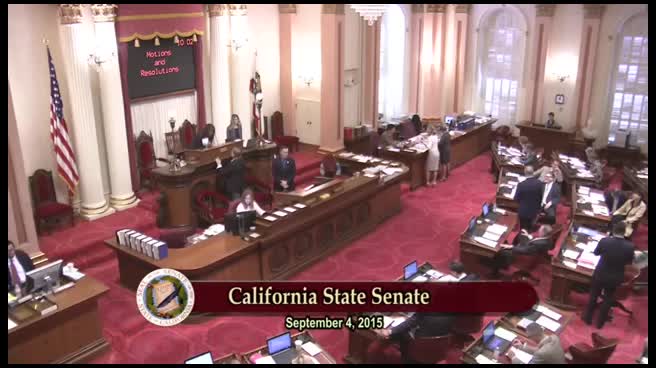 28MIN
Senate Floor
 18MIN
Senate Floor
 1H
Senate Standing Committee on Environmental Quality
 2MIN
Assembly Floor
 2MIN
Assembly Standing Committee on Appropriations
 18MIN
Assembly Standing Committee on Natural Resources
Bill Author

Bill Co-Author(s):