AB 926: Parole: Safe Communities Grant Program.
- Session Year: 2015-2016
- House: Assembly
- Latest Version Date: 2015-04-06
Existing law governs the length and conditions of parole and establishes the Board of Parole Hearings to carry out various duties relating to parole, including conducting parole consideration hearings, parole rescission hearings, and parole progress hearings for adults and juveniles under the jurisdiction of the Department of Corrections and Rehabilitation, reviewing inmates requests for reconsideration of the denial of good-time credit and setting of parole length or conditions, and making every order granting and revoking parole and issuing final discharges to any person under the jurisdiction of the department.
This bill would require the department to establish rules and regulations for implementing an earned compliance credit program that would reduce the period of parole supervision of eligible persons, as specified, upon compliance with their parole conditions. The bill would provide that for each full calendar month of compliance with the conditions of parole supervision, earned compliance credits equal to the number of days in that month shall be deducted from the eligible parolees parole discharge date. The bill would also specify the circumstances under which credits would not accrue, including when a parolee has been arrested for a new offense, except as specified.
The bill would also require the department to provide annually to the Director of Finance and the Legislative Analysts Office specified data regarding the program, including the number and percentage of parolees who qualified for the earned compliance credit program and the total amount of credits earned by parolees within the year.
The bill would establish the Safe Communities Grant Program to be administered by the Department of Corrections and Rehabilitation in consultation with specified state entities, to allocate moneys to counties, by January 1 of each fiscal year beginning in 2018, to provide support for employment and housing for parolees, as specified.
The bill would also establish the continuously appropriated Safe Communities Grant Program Fund within the State Treasury for purposes of the program. The bill would require, on or before July 31, 2017, and on or before July 31 of each fiscal year thereafter, the Director of Finance to calculate the savings accrued to the state from the implementation of the earned compliance credit program and to certify the results of the calculation to the Controller no later than August 1 of each fiscal year. The bill would require the Controller, before August 31, 2017, and before August 31 of each fiscal year thereafter, to transfer that amount from the General Fund to the Safe Communities Grant Program Fund. The bill would also require, every 2 years, beginning in 2019, the Controller to conduct an audit of the Safe Communities Grant Program Fund to ensure the funds are disbursed and expended solely according to the requirements of the bill and to report his or her findings to the Legislature and make them available to the public. The bill would also require that any costs incurred by the Director of Finance and the Controller in connection with the administration of the Safe Communities Grant Program Fund, including the costs of the required calculation and the audit, be deducted from the Safe Communities Grant Program Fund before the funds are disbursed, as specified.
By establishing the continuously appropriated Safe Communities Grant Program Fund, and by directing the Controller to transfer funds from the General Fund to that fund, the bill would make an appropriation.
(a)For the purposes of this section, the following terms shall have the following meanings:
(1)Department refers to the Department of Corrections and Rehabilitation.
(2)Parole authority refers to the Board of Parole Hearings.
(b)The department shall establish rules and regulations for implementing an earned compliance credit program that provides eligible parolees the opportunity to reduce their period of parole supervision upon compliance with their parole conditions.
(c)The department shall have the authority to award earned compliance credits to eligible parolees who are in compliance with the terms and conditions of parole supervision and who are not subject to mandatory lifetime parole pursuant to Section 3000.1.
(1)For each full calendar month of compliance with the conditions of parole supervision, earned compliance credits equal to the number of days in that month shall be deducted from the eligible parolees parole discharge date.
(2)Earned compliance credits shall accrue for eligible parolees after the first full calendar month of compliance of supervision conditions.
(3)Earned compliance credits shall be applied to the parole discharge date within thirty (30) 30 days of the end of the month in which the credits were earned. The department or supervising parole agent shall notify eligible parolees of their respective current parole discharge dates at least every six (6) months.
(4)The department or supervising parole agent shall notify the parole authority of the impending discharge within sixty (60) 60 days prior to the date of final discharge. If the time served on parole combined with the earned compliance credits satisfies the terms of parole, the parole authority shall order the final discharge of the parolee.
(5)For the purposes of this section, a parolee is deemed to be in compliance with the conditions of parole supervision if there was no a citation was not issued to the parolee and the parolee was not arrested as a result of the violation of the conditions of parole supervision.
(d)The following persons shall be eligible to participate in the earned compliance credit program:
(1)A person sentenced pursuant to Section 1170 and subsequently paroled pursuant to Section 3000 or 3000.08.
(2)A person serving a California sentence for an eligible offense in any jurisdiction pursuant to the Interstate Compact for Adult Offender Supervision.
(e)Earned compliance credits shall not accrue in any calendar month in which any of the following circumstances apply:
(1)The parolee has absconded from parole supervision.
(2)A parole violation report has been submitted by the supervising parole agent. Credits shall not accrue for months between the submission of the report and the final action by the parole authority. If the parole violation is not sustained, the parolee shall be deemed compliant and shall have the lost credits restored, beginning on the first day of the month in which the report was submitted.
(3)
(2)The parolee has been arrested for a new offense. Credits shall not accrue for months between the arrest and the final outcome of the arrest. If the charges are dropped, dismissed, or the parolee is otherwise absolved, the parolee shall be deemed compliant and shall have the lost credits restored, beginning on the first day of the month in which the arrest occurred.
(4)
(3)The parolee is serving a term of incarceration for a parole violation or new conviction.
(f)The department shall provide annually to the Director of Finance and the Legislative Analysts Office the following data:
(1)The number and percentage of parolees who qualified for the earned compliance credit program.
(2)The total amount of credits earned by parolees within the year.
(3)The average amount of credits earned by parolees within the year.
SEC. 2.Section 3000.02 is added to the Penal Code, to read:3000.02.(a)The Safe Communities Grant Program Fund is hereby created within the State Treasury and, notwithstanding Section 13340 of the Government Code, is continuously appropriated without regard to fiscal year for carrying out the purposes of this section.
(b)On or before July 31, 2017, and on or before July 31 of each fiscal year thereafter, the Director of Finance shall calculate the savings accrued to the state from the implementation of the earned compliance credit program created by Section 3000.01. In making the calculation required by this section, the Director of Finance shall use actual data or best available estimates where actual data is not available. The Director of Finance shall certify the results of the calculation to the Controller no later than August 1 of each fiscal year.
(c)Before August 31, 2017, and before August 31 of each fiscal year thereafter, the Controller shall transfer from the General Fund to the Safe Communities Grant Program Fund the total amount calculated pursuant to subdivision (b).
(d)There is hereby established the Safe Communities Grant Program which shall be administered by the Department of Corrections and Rehabilitation in consultation with the California Workforce Investment Board, the Employment Development Department, and the Department of Housing and Community Development. In developing the Safe Communities Grant Program, the Department of Corrections and Rehabilitation shall hold a minimum of two public hearings whereby public and private stakeholders, community-based organizations that provide reentry services to state parolees, and other interested parties can provide public comment or submit written public comment on the development and administration of the Safe Communities Grant Program.
(e)By January 1 of each fiscal year beginning in 2018, the Department of Corrections and Rehabilitation shall allocate moneys deposited in the Safe Communities Grant Program to counties to support the following purposes:
(1)Employment support, including, but not limited to, on-the-job training programs, transitional jobs, and apprenticeships, for persons sentenced pursuant to Section 1170 and subsequently paroled pursuant to Section 3000 or 3000.08.
(2)Housing support, including, but not limited to, transitional and supportive housing, for persons sentenced pursuant to Section 1170 and subsequently paroled pursuant to Section 3000 or 3008.08.
(f)(1)Every (1)Every two years, beginning in 2019, the Controller shall conduct an audit of the Safe Communities Grant Program Fund to ensure the funds are disbursed and expended solely according to this section and shall report his or her findings to the Legislature and make them available to the public.
(2)A report required to be submitted pursuant to paragraph (1) shall be submitted in compliance with Section 9795 of the Government Code.
(g)Any costs incurred by the Director of Finance and the Controller in connection with the administration of the Safe Communities Grant Program Fund, including the costs of the calculation required by subdivision (b) and the audit required by subdivision (f), shall be deducted from the fund before moneys are disbursed pursuant to subdivision (d).
(a)For the purposes of this section, the following terms shall have the following meanings:
(1)Department refers to the Department of Corrections and Rehabilitation.
(2)Parole authority refers to the Board of Parole Hearings.
(b)The department shall establish rules and regulations for implementing an earned compliance credit program that provides eligible parolees the opportunity to reduce their period of parole supervision upon compliance with their parole conditions.
(c)The department shall have the authority to award earned compliance credits to eligible parolees who are in compliance with the terms and conditions of parole supervision and who are not subject to mandatory lifetime parole pursuant to Section 3000.1.
(1)For each full calendar month of compliance with the conditions of parole supervision, earned compliance credits equal to the number of days in that month shall be deducted from the eligible parolees parole discharge date.
(2)Earned compliance credits shall accrue for eligible parolees after the first full calendar month of compliance of supervision conditions.
(3)Earned compliance credits shall be applied to the parole discharge date within thirty (30) days of the end of the month in which the credits were earned. The department or supervising parole agent shall notify eligible parolees of their respective current parole discharge dates at least every six (6) months.
(4)The department or supervising parole agent shall notify the parole authority of the impending discharge within sixty (60) days prior to the date of final discharge. If the time served on parole combined with the earned compliance credits satisfies the terms of parole, the parole authority shall order the final discharge of the parolee.
(5)For the purposes of this section, a parolee is deemed to be in compliance with the conditions of parole supervision if there was no violation of the conditions of parole supervision.
(d)The following persons shall be eligible to participate in the earned compliance credit program:
(1)A person sentenced pursuant to Section 1170 and subsequently paroled pursuant to Section 3000 or 3000.08.
(2)A person serving a California sentence for an eligible offense in any jurisdiction pursuant to the Interstate Compact for Adult Offender Supervision.
(e)Earned compliance credits shall not accrue in any calendar month in which any of the following circumstances apply:
(1)The parolee has absconded from parole supervision.
(2)A parole violation report has been submitted by the supervising parole agent. Credits shall not accrue for months between the submission of the report and the final action by the parole authority. If the parole violation is not sustained, the parolee shall be deemed compliant and shall have the lost credits restored, beginning on the first day of the month in which the report was submitted.
(3)The parolee has been arrested for a new offense. Credits shall not accrue for months between the arrest and the final outcome of the arrest. If the charges are dropped, dismissed, or the parolee is otherwise absolved, the parolee shall be deemed compliant and shall have the lost credits restored, beginning on the first day of the month in which the arrest occurred.
(4)The parolee is serving a term of incarceration for a parole violation or new conviction.
(f)The department shall provide annually to the Director of Finance and the Legislative Analysts Office the following data:
(1)The number and percentage of parolees who qualified for the earned compliance credit program.
(2)The total amount of credits earned by parolees within the year.
(3)The average amount of credits earned by parolees within the year.
SEC. 2.Section 3000.02 is added to the Penal Code, to read:3000.02.(a)The Safe Communities Grant Program Fund is hereby created within the State Treasury and, notwithstanding Section 13340 of the Government Code, is continuously appropriated without regard to fiscal year for carrying out the purposes of this section.
(b)On or before July 31, 2017, and on or before July 31 of each fiscal year thereafter, the Director of Finance shall calculate the savings accrued to the state from the implementation of the earned compliance credit program created by Section 3000.01. In making the calculation required by this section, the Director of Finance shall use actual data or best available estimates where actual data is not available. The Director of Finance shall certify the results of the calculation to the Controller no later than August 1 of each fiscal year.
(c)Before August 31, 2017, and before August 31 of each fiscal year thereafter, the Controller shall transfer from the General Fund to the Safe Communities Grant Program Fund the total amount calculated pursuant to subdivision (b).
(d)There is hereby established the Safe Communities Grant Program which shall be administered by the Department of Corrections and Rehabilitation in consultation with the California Workforce Investment Board, the Employment Development Department, and the Department of Housing and Community Development. In developing the Safe Communities Grant Program, the Department of Corrections and Rehabilitation shall hold a minimum of two public hearings whereby public and private stakeholders, community-based organizations that provide reentry services to state parolees, and other interested parties can provide public comment or submit written public comment on the development and administration of the Safe Communities Grant Program.
(e)By January 1 of each fiscal year beginning in 2018, the Department of Corrections and Rehabilitation shall allocate moneys deposited in the Safe Communities Grant Program to counties to support the following purposes:
(1)Employment support, including, but not limited to, on-the-job training programs, transitional jobs, and apprenticeships, for persons sentenced pursuant to Section 1170 and subsequently paroled pursuant to Section 3000 or 3000.08.
(2)Housing support, including, but not limited to, transitional and supportive housing, for persons sentenced pursuant to Section 1170 and subsequently paroled pursuant to Section 3000 or 3008.08.
(f)(1)Every two years, beginning in 2019, the Controller shall conduct an audit of the Safe Communities Grant Program Fund to ensure the funds are disbursed and expended solely according to this section and shall report his or her findings to the Legislature and make them available to the public.
(2)A report required to be submitted pursuant to paragraph (1) shall be submitted in compliance with Section 9795 of the Government Code.
(g)Any costs incurred by the Director of Finance and the Controller in connection with the administration of the Safe Communities Grant Program Fund, including the costs of the calculation required by subdivision (b) and the audit required by subdivision (f), shall be deducted from the fund before moneys are disbursed pursuant to subdivision (d).
|
Date
|
Status
|
|---|---|
| Feb 26, 2015 | Read first time. To print. |
| Feb 27, 2015 | From printer. May be heard in committee March 29. |
| Mar 16, 2015 | Referred to Com. on PUB. S. |
| Apr 6, 2015 | From committee chair, with author's amendments: Amend, and re-refer to Com. on PUB. S. Read second time and amended. |
| Apr 7, 2015 | Re-referred to Com. on PUB. S. |
| Apr 8, 2015 | From committee: Do pass and re-refer to Com. on APPR. (Ayes 5. Noes 2.) (April 7). Re-referred to Com. on APPR. |
| Apr 22, 2015 | In committee: Set, first hearing. Referred to APPR. suspense file. |
| May 28, 2015 | In committee: Held under submission. |
| Jan 31, 2016 | Died pursuant to Article IV, Sec. 10(c) of the Constitution. |
| Feb 1, 2016 | From committee: Filed with the Chief Clerk pursuant to Joint Rule 56. |
|
Date
|
Description
|
Location
|
Votes
|
|
|---|---|---|---|---|
| Apr 7, 2015 | Do pass and be re-referred to the Committee on [Appropriations] | Assembly Standing Committee on Public Safety |
Passed |
This list shows positions taken on this bill by organizations on the date displayed, which is linked to the original source.
Positions by individuals are not included.
|
Organization
|
Position
|
Date
|
|---|---|---|
| ACLU of California | * Support | Apr 7, 2015 |
| California Attorneys For Criminal Justice | * Support | Apr 7, 2015 |
| California District Attorneys Association | * Against | Apr 7, 2015 |
| California Public Defenders Association | * Support | Apr 7, 2015 |
| Ella Baker Center For Human Rights | * Support | Apr 7, 2015 |
| Legal Services for Prisoners with Children | * Support | Apr 7, 2015 |
| National Association of Social Workers | * Support | Apr 7, 2015 |
| PICO California | * Support | Apr 7, 2015 |
AB 926
Page 3
Date of Hearing: April 22, 2015
ASSEMBLY COMMITTEE ON APPROPRIATIONS
Jimmy Gomez, Chair
AB 926
(Jones-Sawyer) – As Amended April 6, 2015
Policy Committee: |
Public Safety |
Vote: |
5 - 2 |
|
|
|
|
|
|
|
|
Urgency: No State Mandated Local Program: No Reimbursable: No
SUMMARY:
This bill implements an earned-compliance-credit program which provides eligible parolees with the opportunity to reduce the length of parole and direct the savings to job training and housing support for parolees. Specifically, this bill:
Requires the California Department of Corrections and Rehabilitation (CDCR) to establish rules and regulations for implementing an earned compliance credit program, as specified, that provides eligible parolees with the opportunity to reduce their period of parole supervision upon compliance with their parole conditions.
Requires CDCR to annually provide specific information to the Director of the Department of Finance (DOF) and the Legislative Analyst's Office to allow DOF to calculate the annual savings accrued to the state from implementation of the program.
Establishes and continuously appropriates the Save Communities Grant Program Fund (Fund). The State Controller (SCO) is required to transfer annually from the GF to the Fund an amount equal to the state savings
Requires CDCR to establish the Safe Communities Grant Program (Program) in consultation with several state agencies and after at least two public hearings. CDCR is to allocate, by January 1, 2018, monies deposited in the Fund to counties to provide employment and housing support for parolees.
FISCAL EFFECT:
CDCR one-time costs in excess of $1 million (GF) to modify the existing parolee tracking system to provide the appropriate earned credits on a monthly basis.
CDCR annual costs in excess of $500,000 (GF) for staff to administer the grant program. AB 926 states CDCR shall allocated moneys deposited in the Program to counties.
CDCR one-time costs of $200,000 (GF), $100,000 to establish the required programs and $100,000 to adopt regulations to provide for the required credit.
Redirection of GF savings in the hundreds of thousands of dollars to the Fund (special fund), and cost to CDCR by the same amount in the form of grants to counties for employment and housing support, and specific administrative costs to DOF and SCO. (AB 926 species that costs to DOF and SCO shall be deducted from the Fund.)
COMMENTS:
Purpose. According to the author, "There is a growing momentum among states seeking to safely reduce corrections costs and reduce recidivism. California has the opportunity to take this policy one step further by reinvesting resources to ensure greater reductions in recidivism and improve outcomes for individuals, families and communities.
This bill creates an earned compliance credit program that provides eligible parolees with the opportunity to reduce their period of parole supervision upon compliance with their parole conditions. Savings from the reduced parole supervision shall be reinvested into job training and housing support for state parolees to reduce recidivism."Background. Under current law, most parolees can be discharged from parole early if they successfully complete a certain period of parole and there is not good cause to retain them. When a parolee serves a period of time on continuous parole (i.e. without violations, revocations, or absconding), the parole board must conduct a discharge review. Depending on the underlying commitment offense and the statutorily-imposed length of parole, different time periods apply in determining the presumptive discharge date. For example, if a parolee has a three-year parole term, he or she is eligible for discharge after one year, assuming the parolee has had successful continuing parole. Likewise, a parolee with a five-year parole term can be discharged after three years if the parolee has been on parole continuously. Unless the board acts to retain the parolee after the presumptive discharge date, the parolee is discharged from parole. The earned compliance credits proposed by this bill will presumably advance the possible discharge dates.
Argument in Support: The Ella Baker Center for Human Rights, the sponsor of this bill, writes, "There is a growing momentum among states to safely reduce correction costs and reduce recidivism. Gone are the days of increasing penalties and building supermax prisons – states are now engaging in reforms that downsize the prison apparatus and incentivize and reward positive behavior and participation. According to a report by the Association of State Correctional Administrators, 6 out of 7 state respondents who implemented an earned compliance credit program stated that public opinion on the reduction of community supervision has not been a problem in managing the program. Further, 6 out of 7 states that have an earned compliance credit program for parolees or probationers have seen reductions in costs for supervision. Similar to these efforts, AB 926 will help save the state be reducing the costs associated with parole supervision and the costs associated with returns to prison."
However, staff points out there will be no savings to the state since the bill requires all GF savings be deposited in the new Fund for allocation to counties for specific support services.
Argument in Opposition: The California District Attorneys Association states, "Requiring the California Department of Corrections and Rehabilitation and Board of Parole Hearings to establish a credit program may sound better than proposing to cut supervision periods in half, but, in reality, that's exactly what AB 926 does.
Related Legislation: AB 512 (Stone), pending in this committee, increases the number of weeks of additional program credit reductions that may be awarded to a prisoner.
Analysis Prepared by: Pedro R. Reyes / APPR. / (916) 319-2081
AB 926
Page 7
Date of Hearing: April 7, 2015
Counsel: Sandra Uribe
ASSEMBLY COMMITTEE ON PUBLIC SAFETY
Bill Quirk, Chair
AB 926
(Jones-Sawyer) – As Amended April 6, 2015
SUMMARY:
Implements an earned-compliance-credit program which provides
eligible parolees with the opportunity to reduce the length of parole
and direct the savings to job training and housing support for
parolees. Specifically, this bill:
Requires the California Department of Corrections and Rehabilitation (CDCR) to establish rules and regulations for implementing an earned compliance credit program that provides eligible parolees with the opportunity to reduce their period of parole supervision upon compliance with their parole conditions.
Authorizes CDCR to award earned compliance credits to eligible parolees who are in compliance with the terms and conditions of parole, but who are not subject to lifetime parole.
Provides that for each full calendar month of compliance with parole conditions, earned compliance credits equal to the number of days in that month shall be deducted from the parolee's parole discharge date.
Provides that earned compliance credits begin to accrue after the first full calendar month of compliance with parole-supervision conditions.
Requires earned compliance credits to be applied to the parole discharge date within 30 days of the end of the month in which the credits were earned.
Requires CDCR or the supervising parole agent to notify the parole authority in the impending discharge with 60 days before the date of final discharge.
Specifies that if the time served on parole combined with the earned compliance credits satisfies the terms of parole, the parole authority shall order the final discharge of the parolee.
States that a parolee is deemed to be in compliance with the conditions of parole supervision if a citation was not issued to the parolee and the parolee was not arrested as a result of a violation of the conditions of parole supervision.
Deems the following persons eligible to participate in the earned compliance credit program:
A person paroled under Penal Code sections 3000 or 3000.08; or
A person serving a California sentence for an eligible offense in any jurisdiction under the Interstate Compact for adult Offender Supervision.
Disallows the accrual of earned compliance credits in any month during which any of the following circumstances apply:
The parolee has absconded from supervision;
The parolee has been arrested for a new offense. Credits shall not accrue for months between the arrest and the final outcome of the arrest. If the charges are dropped, dismissed, or the parolee is otherwise absolved, the parolee shall be deemed compliant and shall have the lost credits restored, beginning on the first day of the month in which the arrest occurred.
The parolee is serving a term of incarceration for a parole violation or a new conviction.
Requires CDCR to annually provide the following information to the Director of the Department of Finance and the Legislative Analyst's Office:
The number and percentage of qualifying parolees;
The total amount of credits earned by parolees within the year; and
The average amount of credits earned by parolees within the year.
Creates the Safe Communities Grant Program Fund within the state treasury and specifies that it is continuously appropriated without regard to fiscal year to carry out its purpose.
Requires the Director of Finance to calculate the savings accrued to the state from the implementation of the earned compliance credit program beginning on or before July 31, 2017, and annually thereafter.
Requires the Controller to transfer the total amount of savings accrued from the General Fund to the Safe Communities Grant Program Fund before August 31, 2017, and annually thereafter.
Establishes the Safe Communities Grant Program to be administered by CDCR in consultation with specified agencies.
Requires CDCR to hold a minimum of two public meetings in the process of developing the program in order allow for public comment and input.
Requires CDCR to allocate monies deposited in the Fund to the counties to provide employment and housing support for parolees.
Defines the following terms:
"Department" means the California "Department of Corrections and Rehabilitation."
"Parole authority" means the "Board of Parole."
EXISTING LAW:
Provides, generally, for a period of post-prison supervision immediately following a period of incarceration in state prison. (Pen. Code, § 3000 et seq.)
Provides for varying lengths of parole, depending on the commitment offense and the date of commitment. (Pen. Code, § 3000, subd. (b).)
Requires all persons paroled before October 1, 2011 to remain under the supervision of the California Department of Corrections and Rehabilitation (CDCR) until jurisdiction is terminated by operation of law or until parole is discharged. (Pen. Code, § 3000.09.)
Requires the following persons released from prison on or after July 1, 2013, be subject to parole under the supervision of CDCR:
A person who committed a serious felony listed in Penal Code section 1192.7, subdivision (c);
A person who committed a violent felony listed in Penal Code section 667.5, subdivision (c);
A person serving a Three-Strikes sentence;
A high risk sex offender;
A mentally disordered offender (Pen. Code, §3000.08, subd. (a));
A person required to register as a sex offender and subject to a parole term exceeding three years at the time of the commission of the offense for which he or she is being released; and,
A person subject to lifetime parole at the time of the commission of the offense for which he or she is being released. (Pen. Code, § 3000.08, subds. (a) and (c).)
Authorizes parole officials to "impose additional and appropriate conditions of supervision," upon a finding of good cause that the parolee has committed a violation of law or violated his or her conditions of parole; those may include "rehabilitation and treatment services and appropriate incentives for compliance, and impose immediate, structured, and intermediate sanctions for parole violations, including flash [short term] incarceration in a county jail." (Pen. Code, § 3000.08, subd. (d).)
Provides that the parole agent or peace officer may bring a parolee before the court for a violation of the conditions of parole. If the court finds that the parolee has violated a condition of parole, the court may impose any of the following sanctions for parole violations, as specified:
Return the person to parole supervision with modifications of conditions, if appropriate, including a period of incarceration in county jail;
Revoke parole and order the person to confinement in the county jail;
Refer the person to a reentry court pursuant to Section 3015 or other evidence-based program in the court’s discretion; and (Pen. Code, § 3000.08, subd. (f).)
States that confinement for parole violation shall not exceed a period of 180 days in the county jail. (Pen.Code, § 3000.08, subd. (f).)
Authorizes the early discharge of a parolee from parole upon successful completion of a certain amount of parole time, known as continuous parole. The eligible discharge date is based on the commitment offense and the statutorily-required length of parole. (Pen. Code, § 3001.)
Authorizes CDCR to recommend to the parole board that a parole be retained on parole for good cause. (Pen. Code, § 3001.)
FISCAL EFFECT:
Unknown
COMMENTS:
Author's Statement: According to the author, "There is a growing momentum among states seeking to safely reduce corrections costs and reduce recidivism. California has the opportunity to take this policy one step further by reinvesting resources to ensure greater reductions in recidivism and improve outcomes for individuals, families and communities.
This bill creates an earned compliance credit program that provides eligible parolees with the opportunity to reduce their period of parole supervision upon compliance with their parole conditions. Savings from the reduced parole supervision shall be reinvested into job training and housing support for state parolees to reduce recidivism."
Changes to Parole As a Result of Criminal Justice Realignment: Prior to realignment, individuals released from prison were placed on parole and supervised in the community by parole agents of CDCR. If it was alleged that a parolee had violated a condition of parole, he or she would have a revocation proceeding before the Board of Parole Hearings (BPH). If parole was revoked, the offender would be returned to state prison for violating parole.
Realignment shifted the supervision of some released prison inmates from CDCR parole agents to local probation departments. Parole under the jurisdiction of CDCR for inmates released from prison on or after October 1, 2011 is limited to those defendants whose term was for a serious or violent felony; were serving a Three-Strikes sentence; are classified as high-risk sex offenders; who are required to undergo treatment as mentally disordered offenders; or who, while on certain paroles, commit new offenses. (Pen. Code, §§ 3000.08, subds. (a) & (c), and 3451, subd. (b).) All other inmates released from prison are subject to up to three years of Post Release Community Supervision under local supervision. (Pen. Code, §§ 3000.08, subd. (b), and 3451, subd. (a).)
Realignment also changed where an offender is incarcerated for violating parole. Most individuals can no longer be returned to state prison for violating a term of supervision; offenders serve the revocation term in county jail. (Pen. Code, §§ 3056, subd. (a), and 3458.) There is a 180-day limit to incarceration. (Pen. Code, §§ 3056, subd. (a), and 3455, subd. (c).) The only offenders who are eligible for return to prison for violating parole are life-term inmates paroled pursuant to Penal Code section 3000.1 (e.g., murderers, specific life term sex offenses).
Additionally, realignment changed the process for revocation hearings. As of July 1, 2013, the trial courts assumed responsibility for holding all revocation hearings for those individuals who remain under the jurisdiction of CDCR. Moreover, intermediate sanctions, including flash incarceration, also became available for state parolees on July 1, 2013. (Pen. Code, § 3000.08, subd. (d).) Despite the new authority to impose terms of flash incarceration upon state-supervised parolees, the Division of Adult Parole Operations (DAPO) has made a policy decision not to utilize flash incarceration. (See Valdivia v. Brown, Response to May 6 Order, filed 05/28/13, p. 17.) CDCR has informed this committee that at this time DAPO is still not utilizing flash incarceration.
Discharge after certain periods of continuous parole: "The granting of parole is an essential part of our criminal justice system and is intended to assist those convicted of crime to integrate into society as constructive individuals as soon as possible and alleviate the cost of maintaining them in custodial facilities." (In Re Vasquez (2009) 170 Cal.App.4th 370, 379–380, citations omitted.)
Under current law, most parolees can be discharged from parole early if they successfully complete a certain period of parole and there is not good cause to retain them. When a parolee serves a period of time on continuous parole (i.e. without violations, revocations, or absconding), the parole board must conduct a discharge review. Depending on the underlying commitment offense and the statutorily-imposed length of parole, different time periods apply in determining the presumptive discharge date. For example, if a parolee has a three-year parole term, he or she is eligible for discharge after one year, assuming the parolee has had successful continuing parole. Likewise, a parolee with a five-year parole term can be discharged after three years if the parolee has been on parole continuously. Unless the board acts to retain the parolee after the presumptive discharge date, the parolee is discharged from parole.
The earned compliance credits proposed by this bill will presumably advance the possible discharge dates.
Argument in Support: The Ella Baker Center for Human Rights, the sponsor of this bill, writes, "There is a growing momentum among states to safely reduce correction costs and reduce recidivism. Gone are the days of increasing penalties and building supermax prisons – states are now engaging in reforms that downsize the prison apparatus and incentivize and reward positive behavior and participation. According to a report by the Association of State Correctional Administrators, 6 out of 7 state respondents who implemented an earned compliance credit program stated that public opinion on the reduction of community supervision has not been a problem in managing the program. Further, 6 out of 7 states that have an earned compliance credit program for parolees or probationers have seen reductions in costs for supervision. Similar to these efforts, AB 926 will help save the state be reducing the costs associated with parole supervision and the costs associated with returns to prison.
"In the last decade, more than a dozen states have implemented earned credit mechanisms for people on parole or probation. The impact of these policies has yielded substantial savings without harming public safety. California has the opportunity to take this policy one step further by reinvesting resources to ensure greater reductions in recidivism and improve outcomes for individuals, families, and communities."
Argument in Opposition: The California District Attorneys Association states, "Requiring the California Department of Corrections and Rehabilitation and Board of Parole Hearings to establish a credit program may sound better than proposing to cut supervision periods in half, but, in reality, that's exactly what AB 926 does.
"Although this bill seeks to allow parolees to 'earn' credits by complying with the conditions of their release, the practical effect is a 50 percent reduction in the length of every grant of supervision. This bill does not require parolees to do anything other than what they're already supposed to be doing. In order for someone not to earn credits, he or she would have to abscond from supervision, violate the conditions of his or her release, or commit a new offense. At that point, supervision would be revoked anyway.
"At a time when California is putting more offenders back into the community soon, the last thing we need is less supervision. This jeopardizes public safety, and runs counter to the goals of using community-based supervision and treatment in lieu of incarceration to rehabilitate offenders. To do so in the name of 'Safe Communities' is a particularly tragic irony.
"While we certainly recognize the connection between employment, stable housing, and a decreased likelihood of recidivating, we disagree with the wisdom of funding those programs by reducing community supervision of parolees. Additionally, much of the savings generated by this proposal would likely be consumed by the additional costs of administering the new credits scheme, further depriving our communities of any potential benefit."
Related Legislation: AB 512 (Stone), would increase the number of weeks of additional program credit reductions that may be awarded to a prisoner. AB 512 is pending hearing in this committee today.
REGISTERED SUPPORT / OPPOSITION:
Support
Ella Baker Center for Human Rights (Co-Sponsor)
Friends
Committee on Legislation of California (Co-Sponsor)
California
Attorneys for Criminal Justice
California Catholic
Conference
California Public Defenders Association
Californians
United for a Responsible Budget
Center of Juvenile and Criminal
Justice
Drug Policy Alliance
Fair Chance Project
Forward
Together
Legal Services for Prisoners with Children
National
Association of Social Workers – California Chapter
Prison
Activist Resource Center
Prison Law Office
Western Regional
Advocacy Project
Opposition
California District Attorneys Association
Analysis Prepared by:
Sandy Uribe / PUB. S. / (916) 319-3744
Discussed in Hearing
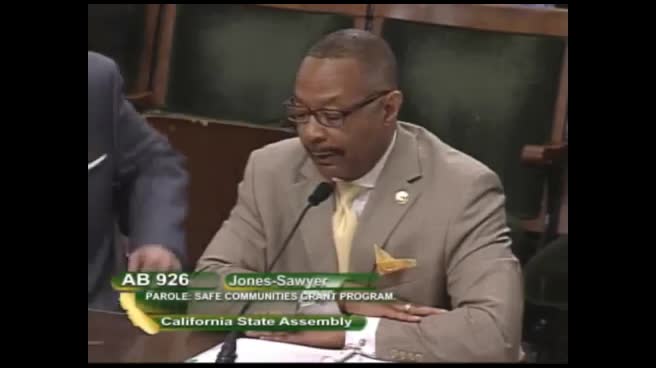 16MIN
Assembly Standing Committee on Public Safety
Bill Author

Bill Co-Author(s):