AB 936: Groundwater monitoring.
- Session Year: 2015-2016
- House: Assembly
- Latest Version Date: 2015-04-15
Existing law establishes a groundwater monitoring program pursuant to which specified entities may propose to be designated by the Department of Water Resources as groundwater monitoring entities, as defined, for the purposes of monitoring and reporting with regard to groundwater elevations in all or part of a groundwater basin or subbasin. Existing law requires the department to identify the extent of monitoring of groundwater elevations that is being undertaken in groundwater basins and subbasins, and if the department determines that all or part of a basin or subbasin is not being monitored, to determine whether there is sufficient interest in establishing a groundwater management plan, an integrated regional water management plan, or a groundwater monitoring association. Under certain circumstances, if there is insufficient interest in establishing a plan or association, and the county decides not to perform groundwater monitoring and reporting functions, the department is required to perform the groundwater monitoring functions. In that event, specified entities with authority to assume groundwater monitoring functions with regard to a basin or subbasin for which the department has assumed those functions are not eligible for a water grant or loan awarded or administered by the state.
This bill would create an exception authorize the department to exempt an entity from this eligibility restriction if the entity submits to the department for approval documentation demonstrating that there are special circumstances justifying the entitys noncompliance, including, but not limited to, that a significant portion of the entitys service area qualifies as a disadvantaged community and that the water grant or loan project includes those actions needed to comply with groundwater monitoring functions.
Existing law establishes a groundwater monitoring program pursuant to which specified entities may propose to be designated by the Department of Water Resources as groundwater monitoring entities, as defined, for the purposes of monitoring and reporting with regard to groundwater elevations in all or part of a groundwater basin or subbasin. Existing law requires the department to identify the extent of monitoring of groundwater elevations that is being undertaken in groundwater basins and subbasins, and if the department determines that all or part of a basin or subbasin is not being monitored, to determine whether there is sufficient interest in establishing a groundwater management plan, an integrated regional water management plan, or a groundwater monitoring association. Under certain circumstances, if there is insufficient interest in establishing a plan or association, and the county decides not to perform groundwater monitoring and reporting functions, the department is required to perform the groundwater monitoring functions. In that event, specified entities with authority to assume groundwater monitoring functions with regard to a basin or subbasin for which the department has assumed those functions are not eligible for a water grant or loan awarded or administered by the state.
This bill would create an exception from this eligibility restriction if the entity submits to the department for approval documentation demonstrating the water grant or loan project includes those actions needed to comply with groundwater monitoring functions.
(a)If the department is required to perform groundwater monitoring functions pursuant to Section 10933.5, the county and the entities described in subdivisions (a) to (d), inclusive, of Section 10927 shall not be eligible for a water grant or loan awarded or administered by the state.
(b)Notwithstanding subdivision (a), the department shall determine that an entity described in subdivision (a) is eligible for a water grant or loan under the circumstances described in subdivision (a) if the entity has submitted to the department for approval documentation that demonstrates either of the following: demonstrating that the entitys entire service area qualifies as a disadvantaged community.
(1)The entitys entire service area qualifies as a disadvantaged community.
(2)The water grant or loan project includes those actions needed to comply with the monitoring functions pursuant to this chapter.
(c)Notwithstanding subdivision (a), the department may determine that an entity described in subdivision (a) is eligible for a water grant or loan under the circumstances described in subdivision (a) if the entity has submitted to the department for approval documentation demonstrating that there are special circumstances justifying the entitys noncompliance, including, but not limited to, that a significant portion of the entitys service area qualifies as a disadvantaged community and that the water grant or loan project includes those actions needed to comply with the monitoring functions pursuant to this chapter.
(a)If the department is required to perform groundwater monitoring functions pursuant to Section 10933.5, the county and the entities described in subdivisions (a) to (d), inclusive, of Section 10927 shall not be eligible for a water grant or loan awarded or administered by the state.
(b)Notwithstanding subdivision (a), the department shall determine that an entity described in subdivision (a) is eligible for a water grant or loan under the circumstances described in subdivision (a) if the entity has submitted to the department for approval documentation demonstrating that its entire that demonstrates either of the following:
(1)The entitys entire service area qualifies as a disadvantaged community.
(2)The water grant or loan project includes those actions needed to comply with the monitoring functions pursuant to this chapter.
|
Date
|
Status
|
|---|---|
| Feb 26, 2015 | Read first time. To print. |
| Feb 27, 2015 | From printer. May be heard in committee March 29. |
| Mar 16, 2015 | Referred to Com. on W., P., & W. |
| Apr 14, 2015 | From committee: Amend, and do pass as amended and re-refer to Com. on APPR. (Ayes 14. Noes 0.) (April 14). |
| Apr 15, 2015 | Read second time and amended. |
| Apr 16, 2015 | Re-referred to Com. on APPR. |
| Apr 22, 2015 | In committee: Set, first hearing. Referred to APPR. suspense file. |
| May 28, 2015 | In committee: Held under submission. |
| Jan 31, 2016 | Died pursuant to Article IV, Sec. 10(c) of the Constitution. |
| Feb 1, 2016 | From committee: Filed with the Chief Clerk pursuant to Joint Rule 56. |
|
Date
|
Description
|
Location
|
Votes
|
|
|---|---|---|---|---|
| Apr 14, 2015 | Do pass as amended and be re-referred to the Committee on [Appropriations] | Assembly Standing Committee on Water, Parks, and Wildlife |
Passed |
This list shows positions taken on this bill by organizations on the date displayed, which is linked to the original source.
Positions by individuals are not included.
|
Organization
|
Position
|
Date
|
|---|---|---|
| Association Of California Water Agencies | * Support | Apr 14, 2015 |
| Regional Council Of Rural Counties (Rcrc) And Its Joint Powers Authorities | * Support | Apr 14, 2015 |
| Rural County Representatives of California | * Support | Apr 14, 2015 |
| Valley Ag Water Coalition | ** Support | Apr 14, 2015 |
AB 936
Page 2
Date of Hearing: April 22, 2015
ASSEMBLY COMMITTEE ON APPROPRIATIONS
Jimmy Gomez, Chair
AB 936
(Salas) – As Amended April 15, 2015
Policy Committee: |
Water, Parks and Wildlife |
Vote: |
14 - 0 |
|
|
|
|
|
|
|
|
Urgency: No State Mandated Local Program: No Reimbursable:
SUMMARY:
This bill authorizes the Department of Water Resources (DWR) to allow projects and programs in disadvantaged communities currently ineligible for funding due to noncompliance with groundwater monitoring requirements to receive state funding if the project includes actions necessary to meet groundwater monitoring requirements.
FISCAL EFFECT:
Potential increased shifts in the awarding of grants from eligible entities to entities currently ineligible.
Minor to moderate increased staff costs, likely in the $100,000 to $150,000 range to evaluate applications to determine if the grant request would result in compliance with monitoring functions.
DWR administers a number of grant programs to which this bill may apply including Integrated Regional Water Management Program, Local Groundwater Assistance Grants, Agricultural Water Conservation grants, and Urban Water Conservation grants. Each program may potentially have the additional duty of reviewing requests to determine if the applicant is in a disadvantaged community and the grant brings the entity into compliance.
COMMENTS:
Rationale. The California Statewide Groundwater Elevation Monitoring Program (CASGEM) requires reporting of groundwater basin elevation information to DWR, and requires DWR to assume monitoring functions if the local agency is unable or unwilling to perform the reporting and monitoring duties. Basins for which DWR assumes the duties, or are out of compliance with CASEGEM requirements, are prohibited from receiving state grants and loans.
According to the author, the policy of denying CASGEM noncompliant basins state funding is having the negative consequence of preventing local agencies from receiving much needed water grants and loans in order to set up groundwater monitoring programs This bill would allow basins to receive funding under specified circumstance.
Background. On January 17, 2014, Governor Brown proclaimed a drought State of Emergency. That was followed on April 25, 2014 by a continued State of Emergency and on April 3, 2015 by a seven-page Executive Order, B-29-15, with 31 directives to address the drought crisis.
Directive 15 states that local agencies in all high and medium priority groundwater basins are to immediately implement all CASGEM requirements or be referred to the State Water Resources Control Board for possible enforcement action.
There are currently 127 high and medium priority basins in California. Those groundwater basins account for 96% of all groundwater use. Of the high and medium priority basins, DWR has determined that 9 are fully unmonitored and 16 are partially unmonitored. In other words, 102 are currently CASGEM compliant and 25 are noncompliant.
In the 25 non-compliant basins, local agencies can still be eligible for a water grant or loan if their whole area is a disadvantaged community. That is because it is assumed that the bar to compliance is that the entity's customers are financially incapable of supporting a monitoring program. This bill will further clarify eligibility.
Analysis Prepared by: Jennifer Galehouse / APPR. / (916) 319-2081
Discussed in Hearing
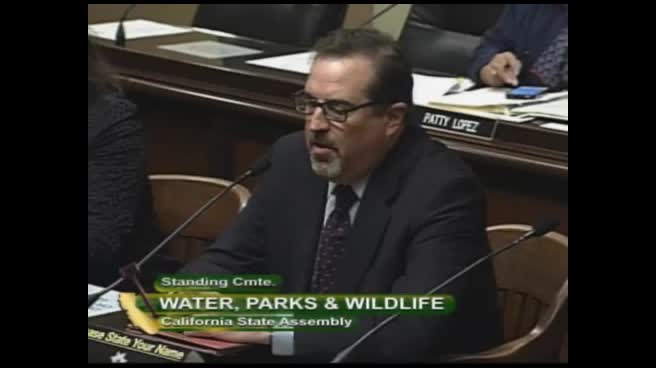 4MIN
Assembly Standing Committee on Water, Parks, and Wildlife
Bill Author

Bill Co-Author(s):
