AB 951: Santa Clarita Valley Sanitation District.
- Session Year: 2015-2016
- House: Assembly
- Latest Version Date: 2015-09-28
The County Sanitation District Act provides for the formation of county sanitation districts. Existing law, the Ralph M. Brown Act, requires the regular and special meetings of a legislative body to be held within the boundaries of the territory over which the local agency exercises jurisdiction, except that the local agency may meet in the closest meeting facility if it has no meeting facility within the boundaries of the territory over which the local agency exercises jurisdiction, or at its principal office if that office is located outside the territory over which the local agency exercises jurisdiction. Under the Federal Water Pollution Control Act, each state is required to identify those waters for which prescribed effluent limitations are not stringent enough to implement applicable water quality standards and to establish, with regard to those waters, total maximum daily loads (TMDLs), subject to the approval of the United States Environmental Protection Agency, for certain pollutants at a level necessary to implement those water quality standards.
This bill would prohibit the meeting exception described above from applying to the Santa Clarita Valley Sanitation District when decisions are being made upon policy items relating to a total maximum daily load (TMDL) of any pollutant. By imposing new duties on the Santa Clarita Valley Sanitation District, this bill would impose a state-mandated local program.
This bill would make legislative findings and declarations as to the necessity of a special statute.
The California Constitution requires local agencies, for the purpose of ensuring public access to the meetings of public bodies and the writings of public officials and agencies, to comply with a statutory enactment that amends or enacts laws relating to public records or open meetings and contains findings demonstrating that the enactment furthers the constitutional requirements relating to this purpose.
This bill would make legislative findings to that effect.
The California Constitution requires the state to reimburse local agencies and school districts for certain costs mandated by the state. Statutory provisions establish procedures for making that reimbursement.
This bill would provide that no reimbursement is required by this act for a specified reason.
The County Sanitation District Act provides for the formation of county sanitation districts. Existing law, the Ralph M. Brown Act, requires the regular and special meetings of a legislative body to be held within the boundaries of the territory over which the local agency exercises jurisdiction, except that the local agency may meet in the closest meeting facility if it has no meeting facility within the boundaries of the territory over which the local agency exercises jurisdiction, or at its principal office if that office is located outside the territory over which the local agency exercises jurisdiction. Under the Federal Water Pollution Control Act, each state is required to identify those waters for which prescribed effluent limitations are not stringent enough to implement applicable water quality standards and to establish, with regard to those waters, total maximum daily loads (TMDLs), subject to the approval of the United States Environmental Protection Agency, for certain pollutants at a level necessary to implement those water quality standards.
This bill would prohibit the meeting exception described above from applying to the Santa Clarita Valley Sanitation District. District when decisions are being made upon policy items relating to a total maximum daily load (TMDL) of any pollutant. By imposing new duties on the Santa Clarita Valley Sanitation District, this bill would impose a state-mandated local program.
This bill would make legislative findings and declarations as to the necessity of a special statute.
The California Constitution requires local agencies, for the purpose of ensuring public access to the meetings of public bodies and the writings of public officials and agencies, to comply with a statutory enactment that amends or enacts laws relating to public records or open meetings and contains findings demonstrating that the enactment furthers the constitutional requirements relating to this purpose.
This bill would make legislative findings to that effect.
The California Constitution requires the state to reimburse local agencies and school districts for certain costs mandated by the state. Statutory provisions establish procedures for making that reimbursement.
This bill would provide that no reimbursement is required by this act for a specified reason.
The County Sanitation District Act provides for the formation of county sanitation districts. Existing law, the Ralph M. Brown Act, requires the regular and special meetings of a legislative body to be held within the boundaries of the territory over which the local agency exercises jurisdiction, except that the local agency may meet in the closest meeting facility if it has no meeting facility within the boundaries of the territory over which the local agency exercises jurisdiction, or at its principal office if that office is located outside the territory over which the local agency exercises jurisdiction.
This bill would, notwithstanding the would prohibit the exception described above, require above from applying to the Santa Clarita Valley Sanitation District to meet in Santa Clarita. District. By imposing new duties on the Santa Clarita Valley Sanitation District, this bill would impose a state-mandated local program.
This bill would make legislative findings and declarations as to the necessity of a special statute.
The California Constitution requires local agencies, for the purpose of ensuring public access to the meetings of public bodies and the writings of public officials and agencies, to comply with a statutory enactment that amends or enacts laws relating to public records or open meetings and contains findings demonstrating that the enactment furthers the constitutional requirements relating to this purpose.
This bill would make legislative findings to that effect.
The California Constitution requires the state to reimburse local agencies and school districts for certain costs mandated by the state. Statutory provisions establish procedures for making that reimbursement.
This bill would provide that no reimbursement is required by this act for a specified reason.
Existing law, the Ralph M. Brown Act, requires the legislative body of a local agency to provide the time and place for holding regular meetings of the legislative body. regular and special meetings of a legislative body to be held within the boundaries of the territory over which the local agency exercises jurisdiction, except that the local agency may meet at its principal office if that office is located outside the territory over which the agency exercises jurisdiction.
This bill would make technical, nonsubstantive changes to this law.
This bill would, notwithstanding the exception described above, require the Santa Clarita Valley Sanitation District to meet in Santa Clarita. By imposing new duties on the Santa Clarita Valley Sanitation District, this bill would impose a state-mandated local program.
This bill would make legislative findings and declarations as to the necessity of a special statute.
The California Constitution requires local agencies, for the purpose of ensuring public access to the meetings of public bodies and the writings of public officials and agencies, to comply with a statutory enactment that amends or enacts laws relating to public records or open meetings and contains findings demonstrating that the enactment furthers the constitutional requirements relating to this purpose.
This bill would make legislative findings to that effect.
The California Constitution requires the state to reimburse local agencies and school districts for certain costs mandated by the state. Statutory provisions establish procedures for making that reimbursement.
This bill would provide that no reimbursement is required by this act for a specified reason.
Existing law, the Ralph M. Brown Act, requires the legislative body of a local agency to provide the time and place for holding regular meetings of the legislative body.
This bill would make technical, nonsubstantive changes to this law.
(a)Paragraph (4) of subdivision (b) of Section 54954 of the Government Code does not apply to the regular and special meetings of the Santa Clarita Valley Sanitation District where decisions are being made upon policy items relating to a total maximum daily load (TMDL) of any pollutant.
(b)For purposes of this section, meetings has the same definition as that term is defined in Section 54952.2 of the Government Code.
SEC. 2.The Legislature finds and declares that a special law is necessary and that a general law cannot be made applicable within the meaning of Section 16 of Article IV of the California Constitution because of the need to hold certain meetings of the Santa Clarita Valley Sanitation District in a location within the boundaries of the territory over which the district exercises jurisdiction instead of at the principal office of the district, which is over fifty miles away.
SEC. 3.The Legislature finds and declares that Section 1 of this act, which amends Section 54954 of the Government Code, furthers, within the meaning of paragraph (7) of subdivision (b) of Section 3 of Article I of the California Constitution, the purposes of that constitutional section as it relates to the right of public access to the meetings of local public bodies or the writings of local public officials and local agencies. Pursuant to paragraph (7) of subdivision (b) of Section 3 of Article I of the California Constitution, the Legislature makes the following findings:
Because of the need to hold certain meetings of the Santa Clarita Valley Sanitation District in a location within the boundaries of the territory over which the district exercises jurisdiction instead of at the principal office of the district, which is over 50 miles away, this act would further the purpose of Section 3 of Article I of the California Constitution.
SEC. 4.No reimbursement is required by this act pursuant to Section 6 of Article XIII B of the California Constitution because the only costs that may be incurred by a local agency or school district under this act would result from a legislative mandate that is within the scope of paragraph (7) of subdivision (b) of Section 3 of Article I of the California Constitution.
(a)Paragraph (4) of subdivision (b) of Section 54954 of the Government Code does not apply to the regular and special meetings of the Santa Clarita Valley Sanitation District. District where decisions are being made upon policy items relating to a total maximum daily load (TMDL) of any pollutant.
(b)For purposes of this section, meetings has the same definition as that term is defined in Section 54952.2 of the Government Code.
SEC. 2.The Legislature finds and declares that a special law is necessary and that a general law cannot be made applicable within the meaning of Section 16 of Article IV of the California Constitution because of the need to hold certain meetings of the Santa Clarita Valley Sanitation District in a location within the bounderies boundaries of the territory over which the district exercises jurisdiction instead of at the principal office of the district, which is over fifty miles away.
SEC. 3.The Legislature finds and declares that Section 1 of this act, which amends Section 54954 of the Government Code, furthers, within the meaning of paragraph (7) of subdivision (b) of Section 3 of Article I of the California Constitution, the purposes of that constitutional section as it relates to the right of public access to the meetings of local public bodies or the writings of local public officials and local agencies. Pursuant to paragraph (7) of subdivision (b) of Section 3 of Article I of the California Constitution, the Legislature makes the following findings:
Because of the need to hold certain meetings of the Santa Clarita Valley Sanitation District in a location within the bounderies boundaries of the territory over which the district exercises jurisdiction instead of at the principal office of the district, which is over fifty 50 miles away, this act would further the purpose of Section 3 of Article I of the California Constitution.
SEC. 4.No reimbursement is required by this act pursuant to Section 6 of Article XIII B of the California Constitution because the only costs that may be incurred by a local agency or school district under this act would result from a legislative mandate that is within the scope of paragraph (7) of subdivision (b) of Section 3 of Article I of the California Constitution.
(a)Paragraph (4) of subdivision (b) of Section 54954 of the Government Code does not apply to the regular and special meetings of the Santa Clarita Valley Sanitation District.
(b)For purposes of this section, meetings has the same definition as that term is defined in Section 54952.2 of the Government Code.
SECTION 1.Section 54954 of the Government Code is amended to read:54954.(a)Each legislative body of a local agency, except for advisory committees or standing committees, shall provide, by ordinance, resolution, bylaws, or by whatever other rule is required for the conduct of business by that body, the time and place for holding regular meetings. Meetings of advisory committees or standing committees, for which an agenda is posted at least 72 hours in advance of the meeting pursuant to subdivision (a) of Section 54954.2, shall be considered for purposes of this chapter as regular meetings of the legislative body.
(b)Regular and special meetings of the legislative body shall be held within the boundaries of the territory over which the local agency exercises jurisdiction, except to do any of the following:
(1)Comply with state or federal law or court order, or attend a judicial or administrative proceeding to which the local agency is a party.
(2)Inspect real or personal property that cannot be conveniently brought within the boundaries of the territory over which the local agency exercises jurisdiction provided that the topic of the meeting is limited to items directly related to the real or personal property.
(3)Participate in meetings or discussions of multiagency significance that are outside the boundaries of a local agencys jurisdiction. However, a meeting or discussion held pursuant to this subdivision shall take place within the jurisdiction of one of the participating local agencies and be noticed by all participating agencies as provided for in this chapter.
(4)Meet in the closest meeting facility if the local agency has no meeting facility within the boundaries of the territory over which the local agency exercises jurisdiction, or at the principal office of the local agency if that office is located outside the territory over which the agency exercises jurisdiction.
(5)Meet outside their immediate jurisdiction with elected or appointed officials of the United States or the State of California when a local meeting would be impractical, solely to discuss a legislative or regulatory issue affecting the local agency and over which the federal or state officials have jurisdiction.
(6)Meet outside their immediate jurisdiction if the meeting takes place in or nearby a facility owned by the agency, provided that the topic of the meeting is limited to items directly related to the facility.
(7)Visit the office of the local agencys legal counsel for a closed session on pending litigation held pursuant to Section 54956.9, when to do so would reduce legal fees or costs.
(c)Meetings of the governing board of a school district shall be held within the district, except under the circumstances enumerated in subdivision (b), or to do any of the following:
(1)Attend a conference on nonadversarial collective bargaining techniques.
(2)Interview members of the public residing in another district with reference to the trustees potential employment of an applicant for the position of the superintendent of the district.
(3)Interview a potential employee from another district.
(d)Meetings of a joint powers authority shall occur within the territory of at least one of its member agencies, or as provided in subdivision (b). However, a joint powers authority that has members throughout the state may meet at any facility in the state that complies with the requirements of Section 54961.
(e)If, by reason of fire, flood, earthquake, or other emergency, it shall be unsafe to meet in the place designated, the meetings shall be held for the duration of the emergency at the place designated by the presiding officer of the legislative body, or his or her designee, in a notice to the local media that have requested notice pursuant to Section 54956, by the most rapid means of communication available at the time.
(f)Notwithstanding paragraph (4) of subdivision (b), all regular and special meetings of the Santa Clarita Valley Sanitation District shall be held in Santa Clarita.
SEC. 2.The Legislature finds and declares that a special law is necessary and that a general law cannot be made applicable within the meaning of Section 16 of Article IV of the California Constitution because of the need to hold meetings of the Santa Clarita Valley Sanitation District in a location in Santa Clarita within the bounderies of the territory over which the district exercises jurisdiction instead of at the principal office of the district, which is over fifty miles away.
SEC. 3.The Legislature finds and declares that Section 1 of this act, which amends Section 54954 of the Government Code, furthers, within the meaning of paragraph (7) of subdivision (b) of Section 3 of Article I of the California Constitution, the purposes of that constitutional section as it relates to the right of public access to the meetings of local public bodies or the writings of local public officials and local agencies. Pursuant to paragraph (7) of subdivision (b) of Section 3 of Article I of the California Constitution, the Legislature makes the following findings:
Because of the need to hold meetings of the Santa Clarita Valley Sanitation District in a location in Santa Clarita within the bounderies of the territory over which the district exercises jurisdiction instead of at the principal office of the district, which is over fifty miles away, this act would further the purpose of Section 3 of Article I of the California Constitution.
SEC. 4.No reimbursement is required by this act pursuant to Section 6 of Article XIII B of the California Constitution because the only costs that may be incurred by a local agency or school district under this act would result from a legislative mandate that is within the scope of paragraph (7) of subdivision (b) of Section 3 of Article I of the California Constitution.
(a)Each legislative body of a local agency, except for advisory committees or standing committees, shall provide, by ordinance, resolution, bylaws, or by whatever other rule is required for the conduct of business by that body, the time and place for holding regular meetings. Meetings of advisory committees or standing committees, for which an agenda is posted at least 72 hours in advance of the meeting pursuant to subdivision (a) of Section 54954.2, shall be considered for purposes of this chapter as regular meetings of the legislative body.
(b)Regular and special meetings of the legislative body shall be held within the boundaries of the territory over which the local agency exercises jurisdiction, except to do any of the following:
(1)Comply with state or federal law or court order, or attend a judicial or administrative proceeding to which the local agency is a party.
(2)Inspect real or personal property that cannot be conveniently brought within the boundaries of the territory over which the local agency exercises jurisdiction provided that the topic of the meeting is limited to items directly related to the real or personal property.
(3)Participate in meetings or discussions of multiagency significance that are outside the boundaries of a local agencys jurisdiction. However, a meeting or discussion held pursuant to this subdivision shall take place within the jurisdiction of one of the participating local agencies and be noticed by all participating agencies as provided for in this chapter.
(4)Meet in the closest meeting facility if the local agency has no meeting facility within the boundaries of the territory over which the local agency exercises jurisdiction, or at the principal office of the local agency if that office is located outside the territory over which the agency exercises jurisdiction.
(5)Meet outside their immediate jurisdiction with elected or appointed officials of the United States or the State of California when a local meeting would be impractical, solely to discuss a legislative or regulatory issue affecting the local agency and over which the federal or state officials have jurisdiction.
(6)Meet outside their immediate jurisdiction if the meeting takes place in or nearby a facility owned by the agency, provided that the topic of the meeting is limited to items directly related to the facility.
(7)Visit the office of the local agencys legal counsel for a closed session on pending litigation held pursuant to Section 54956.9, when to do so would reduce legal fees or costs.
(c)Meetings of the governing board of a school district shall be held within the district, except under the circumstances enumerated in subdivision (b), or to do any of the following:
(1)Attend a conference on nonadversarial collective bargaining techniques.
(2)Interview members of the public residing in another district with reference to the trustees potential employment of an applicant for the position of the superintendent of the district.
(3)Interview a potential employee from another district.
(d)Meetings of a joint powers authority shall occur within the territory of at least one of its member agencies, or as provided in subdivision (b). However, a joint powers authority that has members throughout the state may meet at any facility in the state that complies with the requirements of Section 54961.
(e)If, by reason of fire, flood, earthquake, or other emergency, it shall be unsafe to meet in the place designated, the meetings shall be held for the duration of the emergency at the place designated by the presiding officer of the legislative body, or his or her designee, in a notice to the local media that have requested notice pursuant to Section 54956, by the most rapid means of communication available at the time.
(f)Notwithstanding paragraph (4) of subdivision (b), all regular and special meetings of the Santa Clarita Valley Sanitation District shall be held in Santa Clarita.
SEC. 2.The Legislature finds and declares that a special law is necessary and that a general law cannot be made applicable within the meaning of Section 16 of Article IV of the California Constitution because of the need to hold meetings of the Santa Clarita Valley Sanitation District in a location in Santa Clarita instead of at the principal office of the district, which is over fifty miles away.
SEC. 3.The Legislature finds and declares that Section 1 of this act, which amends Section 54954 of the Government Code, furthers, within the meaning of paragraph (7) of subdivision (b) of Section 3 of Article I of the California Constitution, the purposes of that constitutional section as it relates to the right of public access to the meetings of local public bodies or the writings of local public officials and local agencies. Pursuant to paragraph (7) of subdivision (b) of Section 3 of Article I of the California Constitution, the Legislature makes the following findings:
Because of the need to hold meetings of the Santa Clarita Valley Sanitation District in a location in Santa Clarita instead of at the principal office of the district, which is over fifty miles away, this act would further the purpose of Section 3 of Article I of the California Constitution.
SEC. 4.No reimbursement is required by this act pursuant to Section 6 of Article XIII B of the California Constitution because the only costs that may be incurred by a local agency or school district under this act would result from a legislative mandate that is within the scope of paragraph (7) of subdivision (b) of Section 3 of Article I of the California Constitution.
(a)Each legislative body of a local agency, except for advisory committees or standing committees, shall provide, by ordinance, resolution, bylaws, or by whatever other rule is required for the conduct of business by that body, the time and place for holding regular meetings. Meetings of advisory committees or standing committees, for which an agenda is posted at least 72 hours in advance of the meeting pursuant to subdivision (a) of Section 54954.2, shall be considered for purposes of this chapter as regular meetings of the legislative body.
(b)Regular and special meetings of the legislative body shall be held within the boundaries of the territory over which the local agency exercises jurisdiction, except to do any of the following:
(1)Comply with state or federal law or court order, or attend a judicial or administrative proceeding to which the local agency is a party.
(2)Inspect real or personal property which that cannot be conveniently brought within the boundaries of the territory over which the local agency exercises jurisdiction provided that the topic of the meeting is limited to items directly related to the real or personal property.
(3)Participate in meetings or discussions of multiagency significance that are outside the boundaries of a local agencys jurisdiction. However, any a meeting or discussion held pursuant to this subdivision shall take place within the jurisdiction of one of the participating local agencies and be noticed by all participating agencies as provided for in this chapter.
(4)Meet in the closest meeting facility if the local agency has no meeting facility within the boundaries of the territory over which the local agency exercises jurisdiction, or at the principal office of the local agency if that office is located outside the territory over which the agency exercises jurisdiction.
(5)Meet outside their immediate jurisdiction with elected or appointed officials of the United States or the State of California when a local meeting would be impractical, solely to discuss a legislative or regulatory issue affecting the local agency and over which the federal or state officials have jurisdiction.
(6)Meet outside their immediate jurisdiction if the meeting takes place in or nearby a facility owned by the agency, provided that the topic of the meeting is limited to items directly related to the facility.
(7)Visit the office of the local agencys legal counsel for a closed session on pending litigation held pursuant to Section 54956.9, when to do so would reduce legal fees or costs.
(c)Meetings of the governing board of a school district shall be held within the district, except under the circumstances enumerated in subdivision (b), or to do any of the following:
(1)Attend a conference on nonadversarial collective bargaining techniques.
(2)Interview members of the public residing in another district with reference to the trustees potential employment of an applicant for the position of the superintendent of the district.
(3)Interview a potential employee from another district.
(d)Meetings of a joint powers authority shall occur within the territory of at least one of its member agencies, or as provided in subdivision (b). However, a joint powers authority which that has members throughout the state may meet at any facility in the state which that complies with the requirements of Section 54961.
(e)If, by reason of fire, flood, earthquake, or other emergency, it shall be unsafe to meet in the place designated, the meetings shall be held for the duration of the emergency at the place designated by the presiding officer of the legislative body body, or his or her designee designee, in a notice to the local media that have requested notice pursuant to Section 54956, by the most rapid means of communication available at the time.
|
Date
|
Status
|
|---|---|
| Jun 10, 2015 | From committee chair, with author's amendments: Amend, and re-refer to committee. Read second time, amended, and re-referred to Com. on GOV. & F. |
| Sep 28, 2015 | Chaptered by Secretary of State - Chapter 342, Statutes of 2015. |
| Sep 28, 2015 | Approved by the Governor. |
| Sep 10, 2015 | Enrolled and presented to the Governor at 4 p.m. |
| Sep 1, 2015 | Senate amendments concurred in. To Engrossing and Enrolling. (Ayes 79. Noes 0.). |
| Sep 1, 2015 | Senate amendments concurred in. To Engrossing and Enrolling. (Ayes 79. Noes 0. Page 2740.). |
| Sep 1, 2015 | Assembly Rule 77 suspended. (Page 2729.) |
| Sep 1, 2015 | Assembly Rule 77 suspended. |
| Aug 31, 2015 | Read third time. Passed. Ordered to the Assembly. (Ayes 40. Noes 0. Page 2293.). |
| Aug 31, 2015 | Read third time. Passed. Ordered to the Assembly. |
| Aug 31, 2015 | In Assembly. Concurrence in Senate amendments pending. May be considered on or after September 2 pursuant to Assembly Rule 77. |
| Aug 18, 2015 | Read second time. Ordered to third reading. |
| Aug 17, 2015 | From committee: Be placed on second reading file pursuant to Senate Rule 28.8. |
| Jul 8, 2015 | From committee: Do pass and re-refer to Com. on APPR. (Ayes 7. Noes 0.) (July 8). Re-referred to Com. on APPR. |
| Jun 17, 2015 | In committee: Hearing postponed by committee. |
| Feb 26, 2015 | Read first time. To print. |
| Jun 3, 2015 | In committee: Set, first hearing. Hearing canceled at the request of author. |
| May 21, 2015 | Referred to Com. on GOV. & F. |
| May 7, 2015 | Read third time. Passed. Ordered to the Senate. (Ayes 77. Noes 0. Page 1349.) |
| May 7, 2015 | Read third time. Passed. Ordered to the Senate. |
| May 7, 2015 | In Senate. Read first time. To Com. on RLS. for assignment. |
| Apr 30, 2015 | Read second time. Ordered to Consent Calendar. |
| Apr 29, 2015 | From committee: Do pass. To Consent Calendar. (Ayes 17. Noes 0.) (April 29). |
| Apr 21, 2015 | Re-referred to Com. on APPR. |
| Apr 20, 2015 | Read second time and amended. |
| Apr 16, 2015 | From committee: Amend, and do pass as amended and re-refer to Com. on APPR. (Ayes 9. Noes 0.) (April 15). |
| Apr 6, 2015 | Re-referred to Com. on L. GOV. |
| Mar 26, 2015 | Referred to Com. on L. GOV. |
| Mar 26, 2015 | From committee chair, with author's amendments: Amend, and re-refer to Com. on L. GOV. Read second time and amended. |
| Feb 27, 2015 | From printer. May be heard in committee March 29. |
|
Date
|
Description
|
Location
|
Votes
|
|
|---|---|---|---|---|
| Sep 1, 2015 | AB 951 WILK Concurrence in Senate Amendments | Assembly Floor |
Passed |
|
| Aug 31, 2015 | Assembly 3rd Reading AB951 Wilk By Runner | Senate Floor |
Passed |
|
| Jul 8, 2015 | Do pass, but first be re-referred to the Committee on [Appropriations] | Senate Standing Committee on Governance and Finance |
Passed |
|
| May 7, 2015 | AB 951 WILK Consent Calendar Second Day Regular Session | Assembly Floor |
Passed |
|
| Apr 29, 2015 | Do pass. To Consent Calendar. | Assembly Standing Committee on Appropriations |
Passed |
|
| Apr 15, 2015 | Do pass as amended and be re-referred to the Committee on [Appropriations] | Assembly Standing Committee on Local Government |
Passed |
This list shows positions taken on this bill by organizations on the date displayed, which is linked to the original source.
Positions by individuals are not included.
AB 951
Page 5
CONCURRENCE IN SENATE AMENDMENTS
AB 951
(Wilk)
As Amended June 10, 2015
Majority vote
ASSEMBLY: |
77-0 |
(May 7, 2015) |
SENATE: |
40-0 |
(August 31, 2015) |
Original Committee Reference: L. GOV.
SUMMARY: Requires all regular and special meetings of the Santa Clarita Valley Sanitation District (SCVSD), where decisions are being made upon policy items relating to a total maximum daily load (TMDL) of any pollutant, to be held within the boundaries of the SCVSD.
The Senate amendments narrow this bill's requirement to apply only to meetings where decisions are being made upon policy items relating to a TMDL of any pollutant, and make conforming and technical changes.
EXISTING LAW:
Requires, pursuant to the Ralph M. Brown Act (Brown Act), that regular and special meetings of a legislative body must be held within the boundaries of the territory over which the local agency exercises jurisdiction, except that the local agency may meet at its principal office if that office is located outside the territory over which the agency exercises jurisdiction.
Provides, pursuant to the County Sanitation District Act (CSD Act), for the formation, consolidation, officers, and powers of county sanitation districts (CSDs), which must comply with the Brown Act.
Requires, pursuant to Proposition 42 as passed by voters on June 3, 2014, that all local governments comply with the California Public Records Act (CPRA) and the Brown Act and with any subsequent changes to those Acts. Proposition 42 also eliminated reimbursement to local agencies for costs of complying with these acts.
Requires, pursuant to the Federal Water Pollution Control Act, each state to identify those waters for which prescribed effluent limitations are not stringent enough to implement applicable water quality standards and to establish, with regard to those waters, TMDLs, subject to the approval of the United States Environmental Protection Agency (EPA), for certain pollutants at a level necessary to implement those water quality standards.
FISCAL EFFECT: According to the Senate Appropriations Committee, pursuant to Senate Rule 28.8, negligible state costs.
COMMENTS:
Bill Summary. This bill requires all regular and special meetings of the SCVSD, where decisions are being made upon policy items relating to a TMDL of any pollutant, to be held within the boundaries of the SCVSD. By placing this requirement in the Brown Act (rather than the County Sanitation District Act), this bill falls under the requirements of Proposition 42 that eliminated reimbursement to local agencies for the costs of complying with the Brown Act. This bill is sponsored by the author.
Author's Statement. According to the author, "Santa Clarita Valley (SCV) has been locked in a 15-year battle with the Los Angeles Regional Water Quality Control Board (LARWQCB) to reduce the level of chloride that can be discharged into the Santa Clara River. The LARWQCB arbitrarily set a limit of 100 PPM of chloride, claiming any amount higher than that level harms the crops of Ventura County farmers – a finding yet to be supported by science.
"In any event, the Santa Clarita Valley Sanitation District Board (SCVSD) charged with the responsibility to come up with a plan to comply with the proposed limit, chose and sited a plan to reduce the chloride level by drilling and storing brine underground below the communities of Westridge and Stevenson Ranch. It was then discovered that neither the community nor its leaders had much information about the proposed location and that those decisions made by SCVSD in regard to this issue had been made, more than likely, 50 miles from SCV in Whittier where the SCVSD Board regularly meets. While an occasional local meeting was scheduled and announced, on the chloride issue, meetings took place outside the view of SCV residents and ratepayers. Naturally, the distance discourages public comment from the effected residents and their ability to be informed of all the facts and in this case specifically, the Westridge and Stevenson Ranch portions of SCV were left in the dark about a decision that would have a major impact not only on their water rates, but as to the deep well brine injection, their property values, earthquake insurance, and quiet enjoyment of their properties.
"Assembly Bill 951 would require the SCVSD, when any issue is to be discussed or decided upon that effects its residents and ratepayers, to hold their Board meetings within the boundaries of that district. To do otherwise and continue to hold any of those meetings in Whittier makes public testimony and access to information a burden for residents living in the SCV. Had this measure already been law, residents and ratepayers would have had constructive knowledge of the proposal and the ability to comment on its efficacy, saving both the residents and the SCVSD valuable time and money."
Background. The SCVSD is one of 24 independent special districts that make up the Sanitation Districts of Los Angeles County (Sanitation Districts), a public agency created under state law to manage wastewater and solid waste on a regional scale. Its member agencies combined serve about 5.5 million people in Los Angeles County. The service area covers approximately 824 square miles and encompasses 78 cities and unincorporated territory within the county. The Sanitation Districts treat about half the wastewater in Los Angeles County.
To maximize efficiency and reduce costs, the 24 Sanitation Districts work cooperatively under a Joint Administration Agreement with one administrative staff headquartered near the City of Whittier. Each individual Sanitation District has a Board of Directors consisting of the mayor of each city and the Chair of the Board of Supervisors for unincorporated territory. Each Sanitation District pays its proportionate share of joint administrative costs.
SCVSD. The SCVSD is a local agency that collects wastewater from Santa Clarita Valley's homes and businesses. The wastewater travels through sewer pipes to two sewage treatment plants, the Saugus and Valencia Water Reclamation Plants (WRPs), where it is cleaned and disinfected to produce high quality recycled water. The recycled water is returned to the environment through the Santa Clara River or provided to local water agencies for irrigating landscape. Property owners pay for their sewer services, including operating the sewage treatment plants, through a sewer service charge.
The SCVSD is regulated by the EPA through a delegated authority to the State Water Resources Control Board, assisted by the Los Angeles Regional Water Quality Control Board (Regional Water Board). The Federal Water Pollution Control Act requires California to identify waters for which prescribed effluent limitations are not stringent enough to implement applicable water quality standards and to establish TMDLs for those waters, subject to the approval of the EPA, for certain pollutants at a level necessary to implement those water quality standards.
Both the Saugus and Valencia WRPs discharge their recycled water to the Santa Clara River, which is designated as a water of the United States. Accordingly, each plant must have a National Pollution Discharge Elimination System permit issued by the Regional Water Board. This permit designates a number of requirements that must be met before the recycled water can be discharged. Failure to comply with the terms of the permit can result in significant state and federal fines.
State-Mandated Chloride (Salt) Limit. The state is requiring the Santa Clarita Valley to reduce the chloride levels in the treated wastewater discharged to the Santa Clara River and has set strict deadlines that the Santa Clarita Valley must meet. Salt levels in the Santa Clarita Valley's treated sewage are above the state-mandated chloride limit. For more than 10 years, the SCVSD challenged the state's chloride limit and deadlines. However, the state rejected all of SCVSD's challenges and subsequently fined SCVSD $225,000 for failing to comply with the state-mandated chloride limit. This fine was paid by ratepayers.
SCVSD began to prepare a Chloride Compliance Facilities Plan and Environmental Impact Report (EIR) to evaluate possible alternatives for complying with the state’s chloride mandate. According to the SCVSD, this process "included extensive public outreach involving homeowner organizations, neighborhood councils, the business community, and other stakeholder groups who offered invaluable input on different alternatives and financial impacts. Based on this input and following a lengthy public hearing, a project involving ultraviolet (UV) disinfection, microfiltration/reverse osmosis (MF/RO), and brine disposal by deep well injection was selected as the least expensive alternative that would comply with the state's strict chloride mandate."
The portion of the compliance project that involves brine (salty water) disposal by deep well injection into very salty, unusable water 1-2 miles below the ground is not considered fracking. Brine is a normal by-product of the MF/RO treatment.
According to the SCVSD, "On April 24, 2013, the (SCVSD) released the proposed plans for public review and comment, and provided many opportunities for public input. The extended 90-day public comment period closed on July 24, 2013. A revised plan, including responses to all public input and recommendations, was released on October 10, 2013." The SCVSD Board of Directors unanimously agreed to certify the Final EIR and approve the Final Chloride Compliance Facilities Plan on October 28, 2013.
Also according to the SCVSD, "The SCVSD conducted a local planning process that encouraged community input. Four information meetings were held to provide an opportunity to learn more about the process and discuss the process with (SCVSD) staff. Over 25 presentations were given to local groups and organizations to discuss the alternatives and gather input. Four public hearings were held to receive official public comment, (and SCVSD) staff also responded to numerous phone calls, e-mails and requests for information. These and other public outreach efforts led to the submission of 492 different comments from 114 separate individuals, community organizations, and government agencies."
Despite these efforts, the proposed deep well injection site at the Tournament Players Club in Stevenson Ranch and Westridge engendered fierce opposition from those communities. SCVSD's Board subsequently voted to reject that site and seek an alternative location.
Meeting Locations of the SCVSD Board. Traditionally, the Sanitation Districts' boards meet in Whittier at the Joint Administration Office. The meetings are grouped on different days of the month, so some, though not all, of the boards usually meet together. The joint board meetings are an efficient and cost effective way to conduct business because many of the directors serve on multiple boards. This is because most of the district boundaries were set up to reflect drainage boundaries rather than political boundaries. (Again, there are a few exceptions where an entire city is in the boundary of one district and the whole city council serves as that district's board.)
The board of SCVSD is composed of the mayor, a city council member, and the Chair of the Board of Supervisors. One reason that the board meets in Whittier for routine matters is that the Chair of the Board of Supervisors also sits on five other CSD boards that meet on the same day, so it is very efficient for him to attend all six board meetings. If there is a need for a board meeting to be held in a different, more distant location (e.g. Santa Clarita), it can be challenging for the supervisor to attend.
That said, it has been the SCVSD Board's practice to hold board meetings in Whittier on the 2nd Wednesday of each month, and to hold special board meetings and public hearings in Santa Clarita on matters of community interest, such as the Chloride TMDL, the Chloride Compliance Project, and rate-setting. The Board meetings held in Whittier typically include routine matters such as materials and equipment purchasing, routine actions for construction related to operations, and annexations.
Proposition 42. Proposition 42 was passed by voters on June 3, 2014, and requires all local governments to comply with the CPRA and the Brown Act and with any subsequent changes to those Acts. Proposition 42 also eliminated reimbursement to local agencies for costs of complying with the CPRA and the Brown Act.
This bill contains language stating that the Legislature finds and declares that Section 1 of the bill furthers the purposes of the California Constitution as it relates to the right of public access to the meetings of local public bodies or the writings of local public officials and local agencies. This bill also includes a finding that states, "Because of the need to hold certain meetings of the SCVSD in a location within the boundaries of the territory over which the district exercises jurisdiction instead of at the principal office of the district, which is over 50 miles away, this act would further the purpose of Section 3 of Article I of the California Constitution."
This bill also specifies that no reimbursement for local agencies to implement the bill's provisions is necessary because "the only costs that may be incurred by a local agency or school district… would result from a legislative mandate that is within the scope of paragraph (7) of subdivision (b) of Section 3 of Article I of the California Constitution."
Policy Considerations. The Legislature might wish to consider the following:
Brown Act Precedent. The Brown Act currently requires regular and special meetings of a legislative body to be held within the boundaries of the territory over which the local agency exercises jurisdiction, except that the local agency may meet at its principal office if that office is located outside the territory over which the agency exercises jurisdiction. This bill amends the Brown Act to require a single agency, the SCVSD, to hold its regular and special meetings within the SCVSD's territory when those meetings include decisions regarding policy items relating to a TMDL of any pollutant. This provision is a precedent for the Brown Act, which does not otherwise specify meeting locations for a particular entity. The Legislature may wish to consider whether the circumstances that prompted this bill warrant a precedent of this kind.
Is Legislation Necessary? It appears from information published online and provided by the SCVSD that the public input process was effective in the instance of the proposed deep well injection site. Affected parties communicated their concerns and the SCVSD eventually stopped the plan and is now considering and vetting an alternative site. The Legislature may wish to consider whether this bill is necessary.
Appropriate Statutory Location. The provisions of this bill have been placed in the Brown Act. The Legislature may wish to consider whether they would more appropriately be placed in the County Sanitation District Act.
Previous Legislation. SB 475 (Runner), Chapter 393, Statutes of 2006, established a process by which the SCVSD may require the removal of all residential water softening or conditioning appliances that discharge to the public sewer system, in an effort to reduce the volume of chloride discharged to the Santa Clara River.
Arguments in Support. None on file.
Arguments in Opposition. None on file.
Analysis Prepared by: Angela Mapp / L. GOV. / (916) 319-3958 FN: 0001361
AB 951
Page 5
|
Office of Senate Floor Analyses (916) 651-1520 Fax: (916) 327-4478 |
THIRD READING
Bill No: AB 951
Amended: 6/10/15 in Senate
SENATE GOVERNANCE & FIN. COMMITTEE: 7-0, 7/8/15
AYES: Hertzberg, Nguyen, Beall, Hernandez, Lara, Moorlach, Pavley
SENATE APPROPRIATIONS COMMITTEE: Senate Rule 28.8
ASSEMBLY FLOOR: 77-0, 5/7/15 (Consent) - See last page for vote
SUBJECT: Santa Clarita Valley Sanitation District
DIGEST: This bill requires regular and special meetings of the Santa Clarita Valley Sanitation District (SCVSD) related to a policy decision on total maximum daily load (TMDL) of any pollutant to be held within the boundaries of the territory over which the district exercises jurisdiction.
Existing law:
Requires the meetings of local governments’ legislative bodies to be “open and public,” thereby ensuring people’s access to information so that they may retain control over the public agencies that serve them.
Requires, under the Ralph M. Brown Act, the meetings of local governments’ legislative bodies to be “open and public,” thereby ensuring people’s access to information so that they may retain control over the public agencies that serve them.
Requires local agencies to hold all regular and special meetings within the boundaries of the territory over which they have jurisdiction. An exception under the Brown Act allows an agency to meet outside of its area of jurisdiction if the agency’s principal office is located outside of its territory.
This bill:
Requires SCVSD to hold regular and special meetings within the boundaries of the territory over which the agency exercises jurisdiction, where such meetings involve policy decisions related to a TMDL of any pollutant.
Directs that the statute allowing a local agency’s legislative body to meet at the principal office of the local agency even if the office is located outside of the agency’s territory does not apply to SCVSD.
Makes findings and declarations that this bill furthers the purpose of Section 3 of Article I of the California Constitution, since it requires SCVSD to meet in Santa Clarita instead of at the principal office of the district, which is over 50 miles away.
Background
SCVSD collects and treats wastewater from Santa Clarita homes and businesses and discharges the resulting treated water into the Santa Clara River. SCVSD is one of 24 independent special districts that make up the Los Angeles County Sanitation Districts (LACSD), a regional public agency organized under the County Sanitation District Act. To maximize efficiency and cost effectiveness, the 24 districts work together under a Joint Administration Agreement with one administrative staff headquartered near the City of Whittier, which is approximately 50 miles away from Santa Clarita.
After regional water control authorities fined SCVSD $225,000 for chloride levels above the state-mandated minimum in the agency’s treated wastewater, SCVSD prepared a proposed cleanup strategy for public comment in April of 2013. Among other things, the cleanup plan involved brine disposal by deepwell injection. The extended 90-day public comment period on SCVSD’s cleanup plan closed in July of 2013 and SCVSD published a revised plan including responses to public input and recommendations in October of that same year. At a meeting later that month in Santa Clarita, SCVSD’s Board of Directors approved the final cleanup plan, including brine disposal by deepwell injection.
At subsequent public meetings in Santa Clarita on the subject, the proposed brine disposal element of the project generated significant pushback from local residents, who expressed concerns that a deepwell injection site could adversely affect their quality of life, cause earthquakes, and harm the community’s image.
Concerned residents believe SCVSD should be required to make policy decisions related to TMDL of pollutants in Santa Clarita, rather than at LACSD’s headquarters near Whittier, 50 miles away. They want the Legislature to eliminate the exception to the Brown Act that allows SCVSD to meet outside of the area over which it has jurisdiction.
Comments
Purpose of the bill. Continuing to allow SCVSD to meet in Whittier when making policy decisions, relating to pollutant levels makes public testimony and access to information a burden for residents living 50 miles away in the Santa Clarita area. By removing the Brown Act exception that allows SCVSD to hold meetings on these matters in Whittier instead of the Santa Clarita area, AB 951 makes the agency’s meetings more accessible to residents and ratepayers, thereby forcing SCVSD to be more transparent and accountable to the public.
Water under the bridge? AB 951 requires SCVSD to meet within the agency’s area of jurisdiction to encourage transparency and public participation. However, information published online and provided by SCVSD suggests that the public input process, was effective in the case of the proposed deepwell injection site. Constituents communicated their concerns to SCVSD, which then abandoned the proposed brine well in response to strong public opposition. The substantial public input provided to SCVSD and its response makes it unclear whether it is necessary to require SCVSD to relocate its meetings.
Brown Act precedent. The Brown Act currently requires regular and special meetings of a legislative body to be held, within the boundaries of the territory over which the local agency exercises jurisdiction, except that the local agency may meet at its principal office, if that office is located outside the territory over which the agency exercises jurisdiction. This bill effectively amends the Brown Act to require a single agency, the SCVSD, to hold its regular and special meetings in a single, specified location. The Brown Act does not otherwise specify meeting locations for a particular entity. Creating a district-specific exemption may set a precedent that invites further amendments to the Brown Act.
Special legislation. The California Constitution prohibits special legislation when a general law can apply (Article IV, §16). AB 951 contains findings and declarations explaining the need for legislation that applies only to the SCVSD.
Mandate. Because AB 951 sets forth where SCVSD can hold its meetings, the Legislative Counsel’s Office says that AB 951 creates a new state-mandated local program. But this bill disclaims the state’s responsibility for reimbursing the SCVSD for this new requirement, since California voters amended the State Constitution in 2012 (Proposition 42) to eliminate the state’s responsibility to pay local governments for compliance with the Brown Act and its amendments.
FISCAL EFFECT: Appropriation: No Fiscal Com.: Yes Local: Yes
None received
OPPOSITION: (Verified 8/18/15)
None received
AYES: Achadjian, Alejo, Travis Allen, Baker, Bigelow, Bloom, Bonilla, Bonta, Brough, Brown, Burke, Calderon, Chang, Chau, Chávez, Chiu, Chu, Cooley, Cooper, Dababneh, Dahle, Daly, Dodd, Eggman, Frazier, Beth Gaines, Gallagher, Cristina Garcia, Eduardo Garcia, Gatto, Gipson, Gomez, Gonzalez, Gordon, Gray, Grove, Hadley, Harper, Holden, Irwin, Jones, Jones-Sawyer, Kim, Lackey, Levine, Linder, Lopez, Low, Maienschein, Mathis, Mayes, McCarty, Medina, Melendez, Mullin, Nazarian, Obernolte, O'Donnell, Olsen, Patterson, Perea, Quirk, Rendon, Ridley-Thomas, Rodriguez, Salas, Santiago, Mark Stone, Thurmond, Ting, Wagner, Waldron, Weber, Wilk, Williams, Wood, Atkins
NO VOTE RECORDED: Campos, Roger Hernández, Steinorth
Prepared by: Toren Lewis / GOV. & F. / (916) 651-4119
8/19/15 20:42:55
AB 951 (Wilk) 6/10/15 Page 3 of 3
SENATE COMMITTEE ON GOVERNANCE AND FINANCE
Senator Robert M. Hertzberg, Chair
2015 - 2016 Regular
Bill No: |
AB 951 |
Hearing Date: |
7/8/15 |
Author: |
Wilk |
Tax Levy: |
No |
Version: |
6/10/15 |
Fiscal: |
Yes |
Consultant: |
Lewis |
||
Santa Clarita Valley Sanitation District
Requires regular and special meetings of the Santa Clarita Valley Sanitation District related to a policy decision on total maximum daily load (TMDL) of any pollutant to be held within the boundaries of the territory over which the district exercises jurisdiction.
Background and Existing Law
The Ralph M. Brown Act (Brown Act) requires the meetings of local governments’ legislative bodies to be “open and public,” thereby ensuring people’s access to information so that they may retain control over the public agencies that serve them. In addition, the Brown Act requires local agencies to hold all regular and special meetings within the boundaries of the territory over which they have jurisdiction. An exception under the Brown Act allows an agency to meet outside of its area of jurisdiction if the agency’s principal office is located outside of its territory.
The Santa Clarita Valley Sanitation District (SCVSD) collects and treats wastewater from Santa Clarita homes and businesses and discharges the resulting treated water into the Santa Clara River. SCVSD is one of 24 independent special districts that make up the Los Angeles County Sanitation Districts (LACSD), a regional public agency organized under the County Sanitation District Act. To maximize efficiency and cost effectiveness, the 24 districts work together under a Joint Administration Agreement with one administrative staff headquartered near the City of Whittier, which is approximately 50 miles away from Santa Clarita.
After regional water control authorities fined SCVSD $225,000 for chloride levels above the state-mandated minimum in the agency’s treated wastewater, SCVSD prepared a proposed cleanup strategy for public comment in April of 2013. Among other things, the cleanup plan involved brine disposal by deep well injection. The extended 90-day public comment period on SCVSD’s cleanup plan closed in July of 2013, and SCVSD published a revised plan—including responses to public input and recommendations—in October of that same year. At a meeting later that month in Santa Clarita, SCVSD’s Board of Directors approved the final cleanup plan, including brine disposal by deepwell injection.
At subsequent public meetings in Santa Clarita on the subject, the proposed brine disposal element of the project generated significant pushback from local residents, who expressed concerns that a deep well injection site could adversely affect their quality of life, cause earthquakes, and harm the community’s image.
Concerned residents believe SCVSD should be required to make policy decisions related to total maximum daily loads (TMDL) of pollutants in Santa Clarita, rather than at LACSD’s headquarters near Whittier, 50 miles away. They want the Legislature to eliminate the exception to the Brown Act that allows SCVSD to meet outside of the area over which it has jurisdiction.
Proposed Law
Assembly Bill 951 requires the Santa Clarita Valley Sanitation District (SCVSD) to hold regular and special meetings within the boundaries of the territory over which the agency exercises jurisdiction, where such meetings involve policy decisions related to a total maximum daily load (TMDL) of any pollutant.
Specifically, the bill directs that the statute allowing a local agency’s legislative body to meet at the principal office of the local agency even if the office is located outside of the agency’s territory does not apply to SCVSD.
AB 951 makes findings and declarations that the bill would further the purpose of Section 3 of Article I of the California Constitution, since it requires SCVSD to meet in Santa Clarita instead of at the principal office of the district, which is over fifty miles away.
State Revenue Impact
No estimate.
Comments
1. Purpose of the bill. Continuing to allow the Santa Clarita Valley Sanitation District to meet in Whittier when making policy decisions relating to pollutant levels makes public testimony and access to information a burden for residents living 50 miles away in the Santa Clarita area. By removing the Brown Act exception that allows SCVSD to hold meetings on these matters in Whittier instead of the Santa Clarita area, AB 951 makes the agency’s meetings more accessible to residents and ratepayers, thereby forcing SCVSD to be more transparent and accountable to the public.
2. Water under the bridge? AB 951 requires SCVSD to meet within the agency’s area of jurisdiction to encourage transparency and public participation. However, information published online and provided by SCVSD suggests that the public input process was effective in the case of the proposed deep well injection site. Constituents communicated their concerns to SCVSD, which then abandoned the proposed brine well in response to strong public opposition. The substantial public input provided to SCVSD and its response makes it unclear whether it is necessary to require SCVSD to relocate its meetings.
3. Brown Act precedent. The Brown Act currently requires regular and special meetings of a legislative body to be held within the boundaries of the territory over which the local agency exercises jurisdiction, except that the local agency may meet at its principal office if that office is located outside the territory over which the agency exercises jurisdiction. This bill effectively amends the Brown Act to require a single agency, the SCVSD, to hold its regular and special meetings in a single, specified location. The Brown Act does not otherwise specify meeting locations for a particular entity. Creating a district-specific exemption may set a precedent that invites further amendments to the Brown Act.
4.Special legislation. The California Constitution prohibits special legislation when a general law can apply (Article IV, §16). AB 951 contains findings and declarations explaining the need for legislation that applies only to the Santa Clarita Valley Sanitation District.
5. Mandate. Because AB 951 sets forth where SCVSD can hold its meetings, the Legislative Counsel’s Office says that AB 951 creates a new state-mandated local program. But this bill disclaims the state's responsibility for reimbursing the Santa Clarita Valley Sanitation District for this new requirement, since California voters amended the State Constitution in 2012 (Proposition 42) to eliminate the state’s responsibility to pay local governments for compliance with the Brown Act and its amendments.
Assembly Actions
Assembly Local Government 9-0
Assembly Appropriations 17-0
Assembly Floor 77-0
Support and Opposition
(7/2/15)
Support: Unknown.
Opposition: Unknown.
-- END --
AB 951 (Wilk) 6/10/15 Page 3 of 3
SENATE COMMITTEE ON GOVERNANCE AND FINANCE
Senator Robert M. Hertzberg, Chair
2015 - 2016 Regular
Bill No: |
AB 951 |
Hearing Date: |
6/17/15 |
Author: |
Wilk |
Tax Levy: |
No |
Version: |
6/10/15 |
Fiscal: |
Yes |
Consultant: |
Lewis |
||
Santa Clarita Valley Sanitation District
Requires all regular and special meetings of the Santa Clarita Valley Sanitation District to be held within the boundaries of the territory over which the district exercises jurisdiction.
Background and Existing Law
The Ralph M. Brown Act (Brown Act) requires the meetings of local governments’ legislative bodies to be “open and public,” thereby ensuring people’s access to information so that they may retain control over the public agencies that serve them. In addition, the Brown Act requires local agencies to hold all regular and special meetings within the boundaries of the territory over which they have jurisdiction. An exception under the Brown Act allows an agency to meet outside of its area of jurisdiction if the agency’s principal office is located outside of its territory.
The Santa Clarita Valley Sanitation District (SCVSD) collects and treats wastewater from Santa Clarita homes and businesses and discharges the resulting treated water into the Santa Clara River. SCVSD is one of 24 independent special districts that make up the Los Angeles County Sanitation Districts (LACSD), a regional public agency organized under the County Sanitation District Act. To maximize efficiency and cost effectiveness, the 24 districts work together under a Joint Administration Agreement with one administrative staff headquartered near the City of Whittier, which is approximately 50 miles away from Santa Clarita.
After regional water control authorities fined SCVSD $225,000 for chloride levels above the state-mandated minimum in the agency’s treated wastewater, SCVSD prepared a proposed cleanup strategy for public comment in April of 2013. Among other things, the cleanup plan involved brine disposal by deep well injection. The extended 90-day public comment period on SCVSD’s cleanup plan closed in July of 2013, and SCVSD published a revised plan—including responses to public input and recommendations—in October of that same year. At a meeting at LACSD’s headquarters near Whittier later that month, SCVSD’s Board of Directors unanimously agreed to certify and approve the final cleanup plan, including the deep injection well.
The proposed brine disposal element of the project generated significant pushback from local residents, who expressed concerns that a deep well injection site could adversely affect their quality of life, cause earthquakes, and harm the community’s image. Opponents criticized SCVSD for holding its final meeting on the matter in Whittier, rather than in Santa Clarita, a decision that critics say discouraged public comment from the affected residents and ratepayers.
Concerned residents and some local officials believe SCVSD should be required to make decisions related to pollutant levels in Santa Clarita, rather than 50 miles away. They want the Legislature to eliminate the exception to the Brown Act that allows SCVSD to meet outside of the area over which it has jurisdiction.
Proposed Law
Assembly Bill 951 requires the Santa Clarita Valley Sanitation District (SCVSD) to hold all regular and special meetings related to a total maximum daily load (TMDL) of any pollutant within the boundaries of the territory over which the agency exercises jurisdiction.
Specifically, the bill directs that the statute allowing a local agency’s legislative body to meet at the principal office of the local agency even if the office is located outside of the agency’s territory does not apply to SCVSD.
AB 951 makes findings and declarations that the bill would further the purpose of Section 3 of Article I of the California Constitution, since it requires SCVSD to meet in Santa Clarita instead of at the principal office of the district, which is over fifty miles away.
State Revenue Impact
No estimate.
Comments
1. Purpose of the bill. Continuing to allow the Santa Clarita Valley Sanitation District meet in Whittier when making policy decisions relating to pollutant levels makes public testimony and access to information a burden for residents living 50 miles away in the Santa Clarita area. By removing the Brown Act exception that allows SCVSD to hold meetings on these matters in Whittier instead of the Santa Clarita area, AB 951 makes the agency’s meetings more accessible to residents and ratepayers, thereby forcing SCVSD to be more transparent and accountable to the public.
2. Water under the bridge? AB 951 requires SCVSD to meet within the agency’s area of jurisdiction to encourage transparency and public participation. However, information published online and provided by SCVSD suggests that the public input process was effective in the case of the proposed deep well injection site. Constituents communicated their concerns to SCVSD, which then abandoned the proposed brine well in response to strong public opposition. The substantial public input provided to SCVSD and its response makes it unclear whether it is necessary to require SCVSD to relocate its meetings.
3. Brown Act precedent. The Brown Act currently requires regular and special meetings of a legislative body to be held within the boundaries of the territory over which the local agency exercises jurisdiction, except that the local agency may meet at its principal office if that office is located outside the territory over which the agency exercises jurisdiction. This bill amends the Brown Act to require a single agency, the SCVSD, to hold its regular and special meetings in a single, specified location. The Brown Act does not otherwise specify meeting locations for a particular entity. Creating a district-specific exemption may set a precedent that invites further amendments to the Brown Act.
4.Special legislation. The California Constitution prohibits special legislation when a general law can apply (Article IV, §16). AB 951 contains findings and declarations explaining the need for legislation that applies only to the Santa Clarita Valley Sanitation District.
5. Mandate. Because AB 951 sets forth where SCVSD can hold its meetings, the Legislative Counsel’s Office says that SB 951 creates a new state-mandated local program. But this bill disclaims the state's responsibility for reimbursing the city of Santa Clarita for this new requirement, since California voters amended the State Constitution in 2012 (Proposition 42) to eliminate the state’s responsibility to pay local governments for compliance with the Brown Act and its amendments.
Assembly Actions
Assembly Local Government 9-0
Assembly Appropriations 17-0
Assembly Floor 77-0
Support and Opposition
(6/10/15)
Support: Unknown.
Opposition: Unknown.
-- END --
AB 951
Page 2
Date of Hearing: April 29, 2015
ASSEMBLY COMMITTEE ON APPROPRIATIONS
Jimmy Gomez, Chair
AB 951
(Wilk) – As Amended April 20, 2015
Policy Committee: |
Local Government |
Vote: |
9 - 0 |
|
|
|
|
|
|
|
|
Urgency: No State Mandated Local Program: Yes Reimbursable: No
SUMMARY:
This bill exempts the Santa Clarita Valley Sanitation District (SCVSD) from an exception to the Ralph M. Brown Act regarding meeting locations. This has the effect of requiring the meetings of the SCVSD to occur within the boundaries of the district.
FISCAL EFFECT:
Negligible state costs. Local mandate costs are not reimbursable because they would fall under Proposition 42.
COMMENTS:
Purpose. According to the author, "Santa Clarita Valley (SCV) has been locked in a 15-year battle with the Los Angeles Regional Water Quality Control Board (LARWQCB) to reduce the level of chloride that can be discharged into the Santa Clara River. The Santa Clarita Valley Sanitation District Board (SCVSD) charged with the responsibility to come up with a plan to comply with the proposed limit, chose and sited a plan to reduce the chloride level by drilling and storing brine underground below the communities of Westridge and Stevenson Ranch. It was then discovered that neither the community nor its leaders had much information about the proposed location and that those decisions made by SCVSD in regard to this issue had been made, more than likely, 50 miles from SCV in Whittier where the SCVSD Board regularly meets. Naturally, the distance discourages public comment from the effected residents and their ability to be informed of all the facts.” This bill would prohibit a Brown Act exception, thus requiring the meetings of the SCVSD to occur within the boundaries of the district, instead of at the principal office in Whittier.
Ralph M. Brown Act. The Brown Act requires, among other things, that the regular and special meetings of a legislative agency be held within the boundaries of the territory over which the local agency has jurisdiction. The Brown Act also contains several exceptions to this rule including allowing a local agency to meet in the closest meeting facility if it has no meeting facility with the boundaries of the territory, or at its principal office if that office is located outside the jurisdictional territory of the local agency. This bill prohibits this exception from applying to the SCVSD.
Santa Clarita Valley Sanitation District. The SCVSD is a local agency that collects wastewater from Santa Clarita Valley’s homes and businesses. It is one of 24 independent special districts that make up the Sanitation Districts of Los Angeles County (Sanitation Districts), a public agency created under state law to manage wastewater and solid waste on a regional scale.
The 24 sanitation districts work cooperatively under a Joint Administration Agreement with one administrative staff headquartered near the City of Whittier. Each individual sanitation district has a Board of Directors consisting of the mayor of each city and the Chair of the Board of Supervisors for unincorporated territory. Each Sanitation District pays its proportionate share of joint administrative costs.
The Sanitation Districts' boards typically meet in Whittier at the Joint Administration Office. The meetings are grouped on different days of the month, so some, though not all, of the boards usually meet together. This approach is viewed as efficient and cost effective because many of the directors serve on multiple boards and the Chair of the Board of Supervisors, a member of the SCVSD, sits on multiple local government boards that meet the same day.
It has been the SCVSD Board’s practice to hold board meetings in Whittier on the 2nd Wednesday of each month, and to hold special board meetings and public hearings in Santa Clarita on matters of community interest.
Proposition 42. Proposition 42 was passed by voters on June 3, 2014, amended the state Constitution to require all local governments to comply with the California Public Records Act and the Ralph M. Brown Act and with any subsequent changes to those Acts. Proposition 42 also eliminated reimbursement to local agencies for costs of complying with the California Public Records Act and the Ralph M. Brown Act.
Analysis Prepared by: Jennifer Swenson / APPR. / (916) 319-2081
AB 951
Page 6
Date of Hearing: April 15, 2015
ASSEMBLY COMMITTEE ON LOCAL GOVERNMENT
Brian Maienschein, Chair
AB 951
(Wilk) – As Amended March 26, 2015
SUBJECT: Local agencies.
SUMMARY: Requires all regular and special meetings of the Santa Clarita Valley Sanitation District to be held in Santa Clarita. Specifically, this bill:
Requires all regular and special meetings of the Santa Clarita Valley Sanitation District (SCVSD) to be held in Santa Clarita.
Finds and declares that a special law is necessary and that a general law cannot be made applicable within the meaning of Section 16 of Article IV of the California Constitution because of the need to hold meetings of the SCVSD in a location in Santa Clarita instead
of at the principal office of the district, which is over fifty miles away.
Finds and declares that Section 1 of this bill furthers, within the meaning of paragraph (7)
of subdivision (b) of Section 3 of Article I of the California Constitution, the purposes of that constitutional section as it relates to the right of public access to the meetings of local public bodies or the writings of local public officials and local agencies, and declares, pursuant to paragraph (7) of subdivision (b) of Section 3 of Article I of the California Constitution, that the Legislature makes the following findings:
Because of the need to hold meetings of the SCVSD in a location in Santa Clarita instead of at the principal office of the district, which is over fifty miles away, this bill would further the purpose of Section 3 of Article I of the California Constitution.
Provides that no reimbursement is required by this bill because the only costs that may be incurred by a local agency or school district under this bill would result from a legislative mandate that is within the scope of paragraph (7) of subdivision (b) of Section 3 of Article I of the California Constitution.
EXISTING LAW:
Requires, pursuant to the Ralph M. Brown Act (Brown Act), that regular and special meetings of a legislative body must be held within the boundaries of the territory over which the local agency exercises jurisdiction, except that the local agency may meet at its principal office if that office is located outside the territory over which the agency exercises jurisdiction.
Provides, pursuant to the County Sanitation District Act (CSD Act), for the formation, consolidation, officers, and powers of county sanitation districts (CSDs), which must comply with the Brown Act.
Requires, pursuant to Proposition 42 as passed by voters on June 3, 2014, that all local governments comply with the California Public Records Act and the Brown Act and with any subsequent changes to those Acts. Proposition 42 also eliminated reimbursement to local agencies for costs of complying with these acts.
FISCAL EFFECT: This bill is keyed fiscal.
COMMENTS:
Bill Summary. This bill requires all regular and special meetings of the SCVSD to be held in Santa Clarita. By placing this requirement in the Brown Act (rather than the County Sanitation District Act), this bill falls under the requirements of Proposition 42 that eliminated reimbursement to local agencies for the costs of complying with the Brown Act. This bill is sponsored by the author.
Author's Statement. According to the author, "Santa Clarita Valley (SCV) has been locked in a 15-year battle with the Los Angeles Regional Water Quality Control Board (LARWQCB) to reduce the level of chloride that can be discharged into the Santa Clara River. The LARWQCB arbitrarily set a limit of 100 PPM of chloride, claiming any amount higher than that level harms the crops of Ventura County farmers – a finding yet to be supported by science.
"In any event, the Santa Clarita Valley Sanitation District Board (SCVSD) charged with the responsibility to come up with a plan to comply with the proposed limit, chose and sited a plan to reduce the chloride level by drilling and storing brine underground below the communities of Westridge and Stevenson Ranch. It was then discovered that neither the community nor its leaders had much information about the proposed location and that those decisions made by SCVSD in regard to this issue had been made, more than likely, 50 miles from SCV in Whittier where the SCVSD Board regularly meets. While an occasional local meeting was scheduled and announced, on the chloride issue, meetings took place outside the view of SCV residents and ratepayers. Naturally, the distance discourages public comment from the effected residents and their ability to be informed of all the facts and in this case specifically, the Westridge and Stevenson Ranch portions of SCV were left in the dark about a decision that would have a major impact not only on their water rates, but as to the deep well brine injection, their property values, earthquake insurance, and quiet enjoyment of their properties.
"Assembly Bill 951 would require the SCVSD, when any issue is to be discussed or decided upon that effects its residents and ratepayers, to hold their Board meetings within the boundaries of that district. To do otherwise and continue to hold any of those meetings in Whittier makes public testimony and access to information a burden for residents living in the SCV. Had this measure already been law, residents and ratepayers would have had constructive knowledge of the proposal and the ability to comment on its efficacy, saving both the residents and the SCVSD valuable time and money."
Background. The SCVSD is one of 24 independent special districts that make up the Sanitation Districts of Los Angeles County (Sanitation Districts), a public agency created under state law to manage wastewater and solid waste on a regional scale. Its member agencies combined serve about 5.5 million people in Los Angeles County. The service area covers approximately 824 square miles and encompasses 78 cities and unincorporated territory within the county.
The Sanitation Districts treat about half the wastewater in Los
Angeles County with
11 wastewater treatment plants, 48 active
pumping plants, and approximately 1,400 miles
of sewers.
Created in 1923, the Sanitation Districts' purpose was to construct, operate, and maintain facilities that collect, treat, recycle, and dispose of domestic and industrial wastewater. Individual districts operate and maintain collection systems that are owned by the Sanitation Districts. Cities and unincorporated areas within the Sanitation Districts' service area are responsible for their smaller local collection systems.
To maximize efficiency and reduce costs, the 24 Sanitation Districts work cooperatively under a Joint Administration Agreement with one administrative staff headquartered near the City of Whittier. Each individual Sanitation District has a Board of Directors consisting of the mayor of each city and the Chair of the Board of Supervisors for unincorporated territory. Each Sanitation District pays its proportionate share of joint administrative costs.
Santa Clarita Valley Sanitation District. The SCVSD is a local agency that collects wastewater from Santa Clarita Valley’s homes and businesses. The wastewater travels through sewer pipes to two sewage treatment plants, the Saugus and Valencia Water Reclamation Plants (WRPs), where it is cleaned and disinfected to produce high quality recycled water. The recycled water is returned to the environment through the Santa Clara River or provided to local water agencies for irrigating landscape. Property owners pay for their sewer services, including operating the sewage treatment plants, through a sewer service charge.
The SCVSD was originally formed as Sanitation District Nos. 26 and 32. Sanitation District No. 26 was formed on January 2, 1961, to serve the unincorporated areas of Saugus, Canyon Country, and Sand Canyon. Sanitation District No. 32 was formed on March 23, 1965, to serve the Valencia, Newhall and Castaic areas west of Saugus. In November of 2003, Sanitation Districts Nos. 26 and 32 began a process to consolidate into a single district. LA County LAFCO approved the consolidation in March 2004, and it took effect July 1, 2005. At this time the district was renamed SCVSD.
The SCVSD is regulated by the United States Environmental Protection Agency through a delegated authority to the State Water Resources Control Board, assisted by the Los Angeles Regional Water Quality Control Board (Regional Water Board).
Both the Saugus and Valencia WRPs discharge their recycled water to the Santa Clara River, which is designated as a water of the United States. Accordingly, each plant must have a National Pollution Discharge Elimination System permit issued by the Regional Water Board. This permit designates a number of requirements that must be met before the recycled water can be discharged. Failure to comply with the terms of the permit can result in significant state and federal fines.
State-Mandated Chloride (Salt) Limit. The state is requiring the Valley to reduce the chloride levels in the treated wastewater discharged to the Santa Clara River and has set strict deadlines that the Valley must meet. Salt levels in the Valley's treated sewage are above the state-mandated chloride limit. For more than 10 years, the SCVSD challenged the state’s chloride limit and deadlines. However, the state rejected all of SCVSD's challenges and subsequently fined the Santa Clarita Valley $225,000 for failing to comply with the state-mandated chloride limit. This fine was paid by ratepayers.
SCVSD began to prepare a Chloride Compliance Facilities Plan and Environmental Impact Report (EIR) to evaluate possible alternatives for complying with the state’s mandate. According to the SCVSD, this process "included extensive public outreach involving homeowner organizations, neighborhood councils, the business community, and other stakeholder groups who offered invaluable input on different alternatives and financial impacts. Based on this input and following a lengthy public hearing, a project involving ultraviolet (UV) disinfection, microfiltration/reverse osmosis (MF/RO), and brine disposal by deep well injection was selected as the least expensive alternative that would comply with the State’s strict chloride mandate."
The portion of the compliance project that involves brine (salty water) disposal by deep well injection into very salty, unusable water 1-2 miles below the ground is not considered fracking. Brine is a normal by-product of the MF/RO treatment.
According to the SCVSD, "On April 24, 2013, the (SCVSD) released the proposed plans for public review and comment, and provided many opportunities for public input. The extended 90-day public comment period closed on July 24, 2013. A revised plan, including responses to all public input and recommendations, was released on October 10, 2013." The SCVSD Board of Directors unanimously agreed to certify the Final EIR and approve the Final Chloride Compliance Facilities Plan on October 28, 2013.
Also according to the SCVSD, "The SCVSD conducted a local planning process that encouraged community input. Four information meetings were held to provide an opportunity to learn more about the process and discuss the process with (SCVSD) staff. Over 25 presentations were given to local groups and organizations to discuss the alternatives and gather input. Four public hearings were held to receive official public comment, (and SCVSD) staff also responded to numerous phone calls, e-mails and requests for information. These and other public outreach efforts led to the submission of 492 different comments from 114 separate individuals, community organizations, and government agencies."
Despite these efforts, the proposed deep well injection site at the Tournament Players Club in Stevenson Ranch and Westridge engendered fierce opposition from those communities. SCVSD's Board subsequently voted to reject that site and seek an alternative location.
Meeting Locations of the SCVSD Board. Traditionally, the Sanitation Districts' boards meet in Whittier at the Joint Administration Office. The meetings are grouped on different days of the month, so some, though not all, of the boards usually meet together. The joint board meetings are an efficient and cost effective way to conduct business because many of the directors serve on multiple boards. This is because most of the district boundaries were set up to reflect drainage boundaries rather than political boundaries. (Again, there are a few exceptions where an entire city is in the boundary of one district and the whole city council serves as that district’s board.)
The Board of SCVSD is composed of the Mayor, a City Council Member, and the Chair of the Board of Supervisors. One reason that the Board meets in Whittier for routine matters is that the Chair of the Board of Supervisors also sits on five other CSD boards that meet on the same day, so it is very efficient for him to attend all six board meetings. If there is a need for a board meeting to be held in a different, more distant location (e.g. Santa Clarita), it can be challenging for the Supervisor to attend.
That said, it has been the SCVSD Board’s practice to hold board meetings in Whittier on the 2nd Wednesday of each month, and to hold special board meetings and public hearings in Santa Clarita on matters of community interest, such as the Chloride Total Maximum Daily Load (TMDL), the Chloride Compliance Project and rate-setting. The Board meetings held in Whittier typically include routine matters such as materials and equipment purchasing, routine actions for construction related to operations, and annexations.
Proposition 42. Proposition 42 was passed by voters on June 3, 2014, and requires all local governments to comply with the California Public Records Act and the Brown Act and with any subsequent changes to those Acts. Proposition 42 also eliminated reimbursement to local agencies for costs of complying with the California Public Records Act and the Brown Act.
This bill contains language that says that the Legislature finds and declares that Section 1 of the bill furthers the purposes of the California Constitution as it relates to the right of public access to the meetings of local public bodies or the writings of local public officials and local agencies. The bill also includes a finding that states, "Because of the need to hold meetings of the SCVSD in a location in Santa Clarita instead of at the principal office of the district, which is over fifty miles away, this bill would further the purpose of Section 3 of Article I of the California Constitution.
This bill also specifies that no reimbursement for local agencies to implement the bill's provisions is necessary because "the only costs that may be incurred by a local agency or school district…would result from a legislative mandate that is within the scope of paragraph (7) of subdivision (b) of Section 3 of Article I of the California Constitution."
Policy Considerations. The Committee might wish to consider the following:
Brown Act Precedent. The Brown Act currently requires regular and special meetings of a legislative body to be held within the boundaries of the territory over which the local agency exercises jurisdiction, except that the local agency may meet at its principal office if that office is located outside the territory over which the agency exercises jurisdiction. This bill amends the Brown Act to require a single agency, the SCVSD, to hold its regular and special meetings in a single, specified location. This provision is a precedent for the Brown Act, which does not otherwise specify meeting locations for a particular entity. The Committee may wish to consider whether the circumstances that prompted this bill warrant a precedent of this kind.
Is Legislation Necessary? It appears from information published online and provided by the SCVSD that the public input process was effective in the instance of the proposed deep well injection site. Affected parties communicated their concerns and the SCVSD eventually stopped the plan and is now considering and vetting an alternative site. The Committee may wish to consider whether this bill is necessary.
Appropriate Statutory Location. The provisions of this bill have been placed in the Brown Act. The Committee may wish to consider whether they would more appropriately be placed in the County Sanitation District Act.
Previous Legislation. SB 475 (Runner), Chapter 393, Statutes of 2006, established a process by which the SCVSD, upon voter approval of an ordinance adopted by the district board to do so, may require the removal of all residential water softening or conditioning appliances that discharge to the public sewer system, in an effort to reduce the volume of chloride discharged to the Santa Clara River.
Arguments in Support. None on file.
Arguments in Opposition. None on file.
REGISTERED SUPPORT / OPPOSITION:
Support
None on file
Opposition
None on file
Analysis Prepared by: Angela Mapp / L. GOV. / (916) 319-3958
Discussed in Hearing
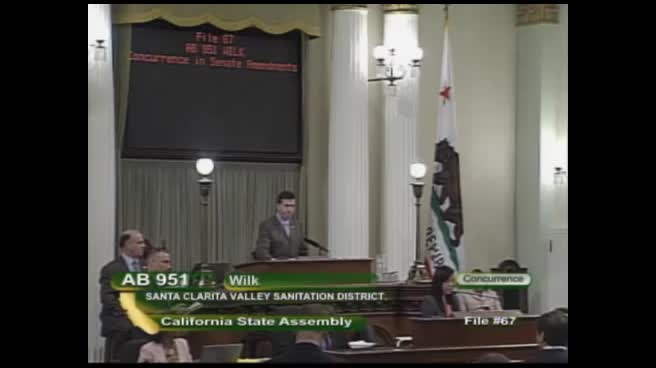 53SEC
Assembly Floor
 3MIN
Senate Floor
 2MIN
Senate Standing Committee on Governance and Finance
 2MIN
Assembly Standing Committee on Local Government
Bill Author

Bill Co-Author(s):