AB 96: Animal parts and products: importation or sale of ivory and rhinoceros horn.
- Session Year: 2015-2016
- House: Assembly
- Latest Version Date: 2015-10-04
Existing law makes it a crime to import into the state for commercial purposes, to possess with intent to sell, or to sell within the state, the dead body, or any part or product thereof, of an elephant. Existing law exempts the possession with intent to sell, or sale of the dead body, or any part or product thereof, of any elephant before June 1, 1977, or the possession with intent to sell or the sale of any such item on or after June 1, 1977, if the item was imported before January 1, 1977.
This bill would delete this exemption. By changing the definition of a crime, this bill would impose a state-mandated local program.
This bill would make it unlawful to purchase, sell, offer for sale, possess with intent to sell, or import with intent to sell ivory or rhinoceros horn, except as specified, and would make this prohibition enforceable by the Department of Fish and Wildlife. The bill would make a violation of this provision or any rule, regulation, or order adopted pursuant to this provision a misdemeanor subject to specified criminal penalties. By creating a new crime, the bill would impose a state-mandated local program. In addition to the specified criminal penalties, the bill would authorize the department to impose an administrative penalty of up to $10,000 for a violation of this provision or any rule, regulation, or order adopted pursuant to this provision.
This bill would provide that the provisions of this bill are severable.
This bill would make these provisions operative on July 1, 2016.
The California Constitution requires the state to reimburse local agencies and school districts for certain costs mandated by the state. Statutory provisions establish procedures for making that reimbursement.
This bill would provide that no reimbursement is required by this act for a specified reason.
Existing law makes it a crime to import into the state for commercial purposes, to possess with intent to sell, or to sell within the state, the dead body, or any part or product thereof, of an elephant. Existing law exempts the possession with intent to sell, or sale of the dead body, or any part or product thereof, of any elephant before June 1, 1977, or the possession with intent to sell or the sale of any such item on or after June 1, 1977, if the item was imported before January 1, 1977.
This bill would delete this exemption. By changing the definition of a crime, this bill would impose a state-mandated local program.
This bill would prohibit a person from purchasing, selling, offering for sale, possessing with intent to sell, or importing make it unlawful to purchase, sell, offer for sale, possess with intent to sell, or import with intent to sell ivory or rhinoceros horn, except as specified, and would make this prohibition enforceable by the Department of Fish and Wildlife. The bill would make a violation of this provision or any rule, regulation, or order adopted pursuant to this provision a misdemeanor subject to specified criminal penalties. By creating a new crime, the bill would impose a state-mandated local program. In addition to the specified criminal penalties, the bill would authorize the department to impose a civil an administrative penalty of up to $10,000 for a violation of this provision or any rule, regulation, or order adopted pursuant to this provision. The bill would authorize the department to permit the purchase, sale, offer for sale, possession with intent to sell, or importation with intent to sell ivory or rhinoceros horn for educational or scientific purposes by a bona fide educational or scientific institution if certain criteria are satisfied.
This bill would provide that the provisions of this bill are severable.
This bill would make these provisions operative on July 1, 2016.
The California Constitution requires the state to reimburse local agencies and school districts for certain costs mandated by the state. Statutory provisions establish procedures for making that reimbursement.
This bill would provide that no reimbursement is required by this act for a specified reason.
Existing law makes it a crime to import into the state for commercial purposes, to possess with intent to sell, or to sell within the state, the dead body, or any part or product thereof, of an elephant. Existing law exempts the possession with intent to sell, or sale of the dead body, or any part or product thereof, of any elephant before June 1, 1977, or the possession with intent to sell or the sale of any such item on or after June 1, 1977, if the item was imported before January 1, 1977.
This bill would delete this exemption. By changing the definition of a crime, this bill would impose a state-mandated local program.
This bill would prohibit a person from purchasing, selling, offering for sale, possessing with intent to sell, or importing with intent to sell ivory or rhinoceros horn, except as specified, and would make this prohibition enforceable by the Department of Fish and Wildlife. The bill would make a violation of this provision or any rule, regulation, or order adopted pursuant to this provision a misdemeanor subject to specified criminal penalties. By creating a new crime, the bill would impose a state-mandated local program. In addition to the specified criminal penalties, the bill would authorize the department to impose a civil penalty of up to $10,000 for a violation of this provision or any rule, regulation, or order adopted pursuant to this provision. The bill would authorize the department to permit the purchase, sale, offer for sale, possession with intent to sell, or importation with intent to sell ivory or rhinoceros horn for educational or scientific purposes by a bona fide educational or scientific institution if certain criteria are satisfied.
This bill would provide that the provisions of this bill are severable.
This bill would make these provisions operative on July 1, 2016.
The California Constitution requires the state to reimburse local agencies and school districts for certain costs mandated by the state. Statutory provisions establish procedures for making that reimbursement.
This bill would provide that no reimbursement is required by this act for a specified reason.
The Legislature finds and declares all of the following:
(a)There is worldwide concern regarding the plight of elephants and rhinoceroses, who are being poached at alarming rates an average of 96 elephants per day are killed in Africa.
(b)Illegal poaching and wildlife trafficking is the fourth largest transnational crime and ivory helps fund the military operations of notorious terrorist groups. Smuggling gangs move tons of tusks to markets thousands of miles away.
(c)International, federal, and state laws are all being strengthened to protect these iconic species from cruelty and extinction. The states of New York and New Jersey recently enacted strong prohibitions on intrastate ivory and rhinoceros horn commerce and the federal government has proposed strengthened ivory trade and import regulations.
(d)California has prohibited the ivory trade since 1977, but a loophole has rendered the law unenforceable allowing illegal sales to flourish. San Francisco and Los Angeles have consistently ranked among the top trading markets for illegal ivory in the United States.
SEC. 2.Section 2022 is added to the Fish and Game Code, to read:2022.(a)For the purposes of this section, the following terms have the following meanings:
(1)Bona fide educational or scientific institution means an institution that establishes through documentation either of the following:
(A)Educational or scientific tax exemption, from the federal Internal Revenue Service or the institutions national, state, or local tax authority.
(B)Accreditation as an educational or scientific institution, from a qualified national, regional, state, or local authority for the institutions location.
(2)Ivory means a tooth or tusk from a species of elephant, hippopotamus, mammoth, mastodon, walrus, warthog, whale, or narwhal, or a piece thereof, whether raw ivory or worked ivory, and includes a product containing, or advertised as containing, ivory.
(3)Rhinoceros horn means the horn, or a piece thereof, or a derivative such as powder, of a species of rhinoceros, and includes a product containing, or advertised as containing, a rhinoceros horn.
(4)Sale or sell means selling, trading, bartering for monetary or nonmonetary consideration, giving away in conjunction with a commercial transaction, or giving away at a location where a commercial transaction occurred at least once during the same or the previous calendar year.
(5)Total value means either the fair market value or the actual price paid for ivory or rhinoceros horn, whichever is greater.
(b)Except as provided in subdivision (c), it is unlawful to purchase, sell, offer for sale, possess with intent to sell, or import with intent to sell ivory or rhinoceros horn.
(c)The prohibitions set forth in subdivision (b) shall not apply to any of the following:
(1)An employee or agent of the federal or state government undertaking a law enforcement activity pursuant to federal or state law, or a mandatory duty required by federal law.
(2)An activity that is authorized by an exemption or permit under federal law or that is otherwise expressly authorized under federal law.
(3)Ivory or rhinoceros horn that is part of a musical instrument, including, but not limited to, a string or wind instrument or piano, and that is less than 20 percent by volume of the instrument, if the owner or seller provides historical documentation demonstrating provenance and showing the item was manufactured no later than 1975.
(4)Ivory or rhinoceros horn that is part of a bona fide antique and that is less than five percent by volume of the antique, if the antique status is established by the owner or seller of the antique with historical documentation demonstrating provenance and showing the antique to be not less than 100 years old.
(5)The purchase, sale, offer for sale, possession with intent to sell, or importation with intent to sell ivory or rhinoceros horn for educational or scientific purposes by a bona fide educational or scientific institution if both of the following criteria are satisfied:
(A)The purchase, sale, offer for sale, possession with intent to sell, or import with intent to sell the ivory or rhinoceros horn is not prohibited by federal law.
(B)The ivory or rhinoceros horn was legally acquired before January 1, 1991, and was not subsequently transferred from one person to another for financial gain or profit after July 1, 2016.
(d)Possession of ivory or rhinoceros horn in a retail or wholesale outlet commonly used for the buying or selling of similar items is prima facie evidence of possession with intent to sell. This evidence shall not preclude a finding of intent to sell based on any other evidence that may serve to establish that intent independently or in conjunction with this evidence.
(e)For a violation of any provision of this section, or any rule, regulation, or order adopted pursuant to this section, the following criminal penalties shall be imposed:
(1)For a first conviction, where the total value of the ivory or rhinoceros horn is two hundred fifty dollars ($250) or less, the offense shall be a misdemeanor punishable by a fine of not less than one thousand dollars ($1,000), or more than ten thousand dollars ($10,000), imprisonment in the county jail for not more than 30 days, or by both the fine and imprisonment.
(2)For a first conviction, where the total value of the ivory or rhinoceros horn is more than two hundred fifty dollars ($250), the offense shall be a misdemeanor punishable by a fine of not less than five thousand dollars ($5,000), or more than forty thousand dollars ($40,000), imprisonment in the county jail for not more than one year, or by both the fine and imprisonment.
(3)For a second or subsequent conviction, where the total value of the ivory or rhinoceros horn is two hundred fifty dollars ($250) or less, the offense shall be a misdemeanor punishable by a fine of not less than five thousand dollars ($5,000), or more than forty thousand dollars ($40,000), imprisonment in county jail for not more than one year, or by both the fine and imprisonment.
(4)For a second or subsequent conviction, where the total value of the ivory or rhinoceros horn is more than two hundred fifty dollars ($250), the offense shall be a misdemeanor punishable by a fine of not less than ten thousand dollars ($10,000), or more than fifty thousand dollars ($50,000) or the amount equal to two times the total value of the ivory or rhinoceros horn involved in the violation, whichever is greater, imprisonment in county jail for not more than one year, or by both the fine and imprisonment.
(f)In addition to, and separate from, any criminal penalty provided for under subdivision (e), an administrative penalty of up to ten thousand dollars ($10,000) may be imposed for a violation of any provision of this section, or any rule, regulation, or order adopted pursuant to this section. Penalties authorized pursuant to this subdivision may be imposed by the department consistent with all of the following:
(1)The chief of enforcement issues a complaint to any person or entity on which an administrative civil penalty may be imposed pursuant to this section. The complaint shall allege the act or failure to act that constitutes a violation, relevant facts, the provision of law authorizing the administrative penalty to be imposed, and the proposed penalty amount.
(2)The complaint and order is served by personal notice or certified mail and informs the party served that the party may request a hearing no later than 20 days from the date of service. If a hearing is requested, it shall be scheduled before the director or his or her designee, which designee shall not be the chief of enforcement issuing the complaint and order. A request for hearing shall contain a brief statement of the material facts the party claims support his or her contention that no administrative penalty should be imposed or that an administrative penalty of a lesser amount is warranted. A party served with a complaint pursuant to this subdivision waives the right to a hearing if no hearing is requested within 20 days of service of the complaint, in which case the order imposing the administrative penalty shall become final.
(3)The director, or his or her designee, shall control the nature and order of the hearing proceedings. Hearings shall be informal in nature, and need not be conducted according to the technical rules relating to evidence. The director, or his or her designee, shall issue a final order within 45 days of the close of the hearing. A final copy of the order shall be served by certified mail upon the party served with the complaint.
(4)A party may obtain review of the final order by filing a petition for a writ of mandate with the superior court within 30 days of the date of service of the final order. The administrative penalty shall be due and payable to the department within 60 days after the time to seek judicial review has expired or, where the party has not requested a hearing of the order, within 20 days after the order imposing an administrative penalty becomes final.
(g)For any conviction or other entry of judgment imposed by a court for a violation of this section resulting in a fine, the court may pay one-half of the fine, but not to exceed five hundred dollars ($500), to any person giving information that led to the conviction or other entry of judgment. This reward shall not apply if the informant is a regular salaried law enforcement officer, or officer or agent of the department.
(h)Upon conviction or other entry of judgment for a violation of this section, any seized ivory or rhinoceros horn shall be forfeited and, upon forfeiture, either maintained by the department for educational or training purposes, donated by the department to a bona fide educational or scientific institution, or destroyed.
(i)Administrative penalties collected pursuant to this section shall be deposited in the Fish and Game Preservation Fund and used for law enforcement purposes upon appropriation by the Legislature.
(j)This section does not preclude enforcement under Section 653o of the Penal Code.
SEC. 3.Section 5 of Chapter 692 of the Statutes of 1976 is repealed.SEC. 4.The provisions of this act are severable. If any provision of this act or its application is held invalid, that invalidity shall not affect other provisions or applications that can be given effect without the invalid provision or application.
SEC. 5.No reimbursement is required by this act pursuant to Section 6 of Article XIIIB of the California Constitution because the only costs that may be incurred by a local agency or school district will be incurred because this act creates a new crime or infraction, eliminates a crime or infraction, or changes the penalty for a crime or infraction, within the meaning of Section 17556 of the Government Code, or changes the definition of a crime within the meaning of Section 6 of Article XIIIB of the California Constitution.
SEC. 6.This act shall become operative on July 1, 2016.
The Legislature finds and declares all of the following:
(a)There is worldwide concern regarding the plight of elephants and rhinoceroses, who are being poached at alarming rates an average of 96 elephants per day are killed in Africa.
(b)Illegal poaching and wildlife trafficking is the fourth largest transnational crime and ivory helps fund the military operations of notorious terrorist groups. Smuggling gangs move tons of tusks to markets thousands of miles away.
(c)International, federal, and state laws are all being strengthened to protect these iconic species from cruelty and extinction. The states of New York and New Jersey recently enacted strong prohibitions on intrastate ivory and rhinoceros horn commerce and the federal government has proposed strengthened ivory trade and import regulations.
(d)California has prohibited the ivory trade since 1977, but a loophole has rendered the law unenforceable allowing illegal sales to flourish. San Francisco and Los Angeles have consistently ranked among the top trading markets for illegal ivory in the United States.
SEC. 2.Section 2022 is added to the Fish and Game Code, to read:2022.(a)For the purposes of this section, the following terms have the following meanings:
(1)Bona fide educational or scientific institution means an institution that establishes through documentation either of the following:
(A)Educational or scientific tax exemption, from the federal Internal Revenue Service or the institutions national, state, or local tax authority.
(B)Accreditation as an educational or scientific institution, from a qualified national, regional, state, or local authority for the institutions location.
(2)Ivory means a tooth or tusk from a species of elephant, hippopotamus, mammoth, mastodon, walrus, warthog, whale, or narwhal, or a piece thereof, whether raw ivory or worked ivory, and includes a product containing, or advertised as containing, ivory.
(3)Rhinoceros horn means the horn, or a piece thereof, or a derivative such as powder, of a species of rhinoceros, and includes a product containing, or advertised as containing, a rhinoceros horn.
(4)Sale or sell means selling, trading, bartering for monetary or nonmonetary consideration, giving away in conjunction with a commercial transaction, or giving away at a location where a commercial transaction occurred at least once during the same or the previous calendar year.
(5)Total value means either the fair market value or the actual price paid for ivory or rhinoceros horn, whichever is greater.
(b)Except as provided in subdivisions (c) and (d), a person shall not subdivision (c), it is unlawful to purchase, sell, offer for sale, possess with intent to sell, or import with intent to sell ivory or rhinoceros horn.
(c)The prohibitions set forth in subdivision (b) shall not apply to any of the following:
(1)An employee or agent of the federal or state government undertaking a law enforcement activity pursuant to federal or state law, or a mandatory duty required by federal law.
(2)An activity that is authorized by an exemption or permit under federal law or that is otherwise expressly authorized under federal law.
(3)Ivory or rhinoceros horn that is part of a musical instrument, including, but not limited to, a string or wind instrument or piano, and that is less than 20 percent by volume of the instrument, if the owner or seller provides historical documentation demonstrating provenance and showing the item was manufactured no later than 1975.
(4)Ivory or rhinoceros horn that is part of a bona fide antique and that is less than five percent by volume of the antique, if the antique status is established by the owner or seller of the antique with historical documentation demonstrating provenance and showing the antique to be not less than 100 years old.
(d)
(5)The department may permit the purchase, sale, offer for sale, possession with intent to sell, or importation with intent to sell ivory or rhinoceros horn for educational or scientific purposes by a bona fide educational or scientific institution if both of the following criteria are satisfied:
(1)
(A)The purchase, sale, offer for sale, possession with intent to sell, or import with intent to sell the ivory or rhinoceros horn is not prohibited by federal law.
(2)
(B)The ivory or rhinoceros horn was legally acquired before January 1, 1991, and was not subsequently transferred from one person to another for financial gain or profit after July 1, 2016.
(e)It shall be presumptive evidence of possession with intent to sell ivory or rhinoceros horn if the ivory or rhinoceros horn is possessed in a retail or wholesale outlet commonly used for the buying or selling of similar items. This presumption
(d)Possession of ivory or rhinoceros horn in a retail or wholesale outlet commonly used for the buying or selling of similar items is prima facie evidence of possession with intent to sell. This evidence shall not preclude a finding of intent to sell based on any other evidence that may serve to independently establish that intent. intent independently or in conjunction with this evidence.
(f)
(e)For a violation of any provision of this section, or any rule, regulation, or order adopted pursuant to this section, the following criminal penalties shall be imposed:
(1)For a first conviction, where the total value of the ivory or rhinoceros horn is two hundred fifty dollars ($250) or less, the offense shall be a misdemeanor punishable by a fine of not less than one thousand dollars ($1,000), or more than ten thousand dollars ($10,000), imprisonment in the county jail for not more than 30 days, or by both the fine and imprisonment.
(2)For a first conviction, where the total value of the ivory or rhinoceros horn is more than two hundred fifty dollars ($250), the offense shall be a misdemeanor punishable by a fine of not less than five thousand dollars ($5,000), or more than forty thousand dollars ($40,000), imprisonment in the county jail for not more than one year, or by both the fine and imprisonment.
(3)For a second or subsequent conviction, where the total value of the ivory or rhinoceros horn is two hundred fifty dollars ($250) or less, the offense shall be a misdemeanor punishable by a fine of not less than five thousand dollars ($5,000), or more than forty thousand dollars ($40,000), imprisonment in county jail for not more than one year, or by both the fine and imprisonment.
(4)For a second or subsequent conviction, where the total value of the ivory or rhinoceros horn is more than two hundred fifty dollars ($250), the offense shall be a misdemeanor punishable by a fine of not less than ten thousand dollars ($10,000), or more than fifty thousand dollars ($50,000) or the amount equal to two times the total value of the ivory or rhinoceros horn involved in the violation, whichever is greater, imprisonment in county jail for not more than one year, or by both the fine and imprisonment.
(g)
(f)In addition to, and separate from, any criminal penalty provided for under subdivision (f), a civil or (e), an administrative fine penalty of up to ten thousand dollars ($10,000) may be imposed for a violation of any provision of this section, or any rule, regulation, or order adopted pursuant to this section. Civil penalties Penalties authorized pursuant to this subdivision may be imposed administratively by the department consistent with all of the following:
(1)The chief of enforcement issues a complaint to any person or entity on which an administrative civil penalty may be imposed pursuant to this section. The complaint shall allege the act or failure to act that constitutes a violation, relevant facts, the provision of law authorizing the civil administrative penalty to be imposed, and the proposed penalty amount.
(2)The complaint and order is served by personal notice or certified mail and informs the party served that the party may request a hearing no later than 20 days from the date of service. If a hearing is requested, it shall be scheduled before the director or his or her designee, which designee shall not be the chief of enforcement issuing the complaint and order. A request for hearing shall contain a brief statement of the material facts the party claims support his or her contention that no administrative penalty should be imposed or that an administrative penalty of a lesser amount is warranted. A party served with a complaint pursuant to this subdivision waives the right to a hearing if no hearing is requested within 20 days of service of the complaint, in which case the order imposing the administrative penalty shall become final.
(3)The director, or his or her designee, shall control the nature and order of the hearing proceedings. Hearings shall be informal in nature, and need not be conducted according to the technical rules relating to evidence. The director director, or his or her designee designee, shall issue a final order within 45 days of the close of the hearing. A final copy of the order shall be served by certified mail upon the party served with the complaint.
(4)A party may obtain review of the final order by filing a petition for a writ of mandate with the superior court within 30 days of the date of service of the final order. The administrative penalty shall be due and payable to the department within 60 days after the time to seek judicial review has expired or, where the party has not requested a hearing of the order, within 20 days after the order imposing an administrative penalty becomes final.
(h)
(g)For any conviction or other entry of judgment imposed by a court for a violation of this section resulting in a fine, the department may, upon appropriation by the Legislature, court may pay one-half of the fine, but not to exceed five hundred dollars ($500), to any person giving information that led to the conviction or other entry of judgment. This reward shall not apply if the informant is a regular salaried law enforcement officer, or officer or agent of the department.
(i)
(h)Upon conviction or other entry of judgment for a violation of this section, any seized ivory or rhinoceros horn shall be forfeited and, upon forfeiture, either maintained by the department for educational or training purposes, donated by the department to a bona fide educational or scientific institution, or destroyed.
(i)Administrative penalties collected pursuant to this section shall be deposited in the Fish and Game Preservation Fund and used for law enforcement purposes upon appropriation by the Legislature.
(j)This section does not preclude enforcement under Section 653o of the Penal Code.
SEC. 3.Section 5 of Chapter 692 of the Statutes of 1976 is repealed.SEC. 4.The provisions of this act are severable. If any provision of this act or its application is held invalid, that invalidity shall not affect other provisions or applications that can be given effect without the invalid provision or application.
SEC. 5.No reimbursement is required by this act pursuant to Section 6 of Article XIIIB of the California Constitution because the only costs that may be incurred by a local agency or school district will be incurred because this act creates a new crime or infraction, eliminates a crime or infraction, or changes the penalty for a crime or infraction, within the meaning of Section 17556 of the Government Code, or changes the definition of a crime within the meaning of Section 6 of Article XIIIB of the California Constitution.
SEC. 6.This act shall become operative on July 1, 2016.
The Legislature finds and declares all of the following:
(a)There is worldwide concern regarding the plight of elephants and rhinoceroses, who are being poached at alarming rates an average of 96 elephants per day are killed in Africa.
(b)Illegal poaching and wildlife trafficking is the fourth largest transnational crime and ivory helps fund the military operations of notorious terrorist groups. Smuggling gangs move tons of tusks to markets thousands of miles away.
(c)International, federal, and state laws are all being strengthened to protect these iconic species from cruelty and extinction. The states of New York and New Jersey recently enacted strong prohibitions on intra-state ivory and rhinoceros horn commerce and the federal government has proposed strengthened ivory trade and import regulations.
(d)California has prohibited the ivory trade since 1977, but a loophole has rendered the law unenforceable allowing illegal sales to flourish. San Francisco and Los Angeles have consistently ranked among the top trading markets for illegal ivory in the United States.
SEC. 2.Section 2022 is added to the Fish and Game Code, to read:2022.(a)For the purposes of this section, the following terms have the following meanings:
(1)Bona fide educational or scientific institution means an institution that establishes through documentation either of the following:
(A)Educational or scientific tax exemption, from the federal Internal Revenue Service or the institutions national, state, or local tax authority.
(B)Accreditation as an educational or scientific institution, from a qualified national, regional, state, or local authority for the institutions location.
(2)Ivory means a tooth or tusk from a species of elephant, hippopotamus, mammoth, walrus, whale, or narwhal, or a piece thereof, whether raw ivory or worked ivory, and includes a product containing, or advertised as containing, ivory.
(3)Rhinoceros horn means the horn, or a piece thereof, or a derivative such as powder, of a species of rhinoceros, and includes a product containing, or advertised as containing, a rhinoceros horn.
(4)Sale or sell means selling, trading, bartering for monetary or nonmonetary consideration, giving away in conjunction with a commercial transaction, or giving away at a location where a commercial transaction occurred at least once during the same or the previous calendar year.
(5)Total value means either the fair market value or the actual price paid for ivory or rhinoceros horn, whichever is greater.
(b)Except as provided in subdivisions (c) and (d), a person shall not purchase, sell, offer for sale, possess with intent to sell, or import with intent to sell ivory or rhinoceros horn.
(c)The prohibitions set forth in subdivision (b) shall not apply to any of the following:
(1)An employee or agent of the federal or state government undertaking a law enforcement activity pursuant to federal or state law, or a mandatory duty required by federal law.
(2)An activity that is authorized by an exemption or permit under federal law or that is otherwise expressly authorized under federal law.
(3)Ivory or rhinoceros horn that is part of a musical instrument, including, but not limited to, a string or wind instrument or piano, and that is less than 20 percent by volume of the instrument, if the owner or seller provides historical documentation demonstrating provenance and showing the item was manufactured no later than 1975.
(4)Ivory or rhinoceros horn that is part of a bona fide antique and that is less than five percent by volume of the antique, if the antique status is established by the owner or seller of the antique with historical documentation demonstrating provenance and showing the antique to be not less than 100 years old.
(d)The department may permit the purchase, sale, offer for sale, possession with intent to sell, or importation with intent to sell ivory or rhinoceros horn for educational or scientific purposes by a bona fide educational or scientific institution if both of the following criteria are satisfied:
(1)The purchase, sale, offer for sale, possession with intent to sell, or import with intent to sell the ivory or rhinoceros horn is not prohibited by federal law.
(2)The ivory or rhinoceros horn was legally acquired before January 1, 1991, and was not subsequently transferred from one person to another for financial gain or profit after July 1, 2016.
(e)It shall be presumptive evidence of possession with intent to sell ivory or rhinoceros horn if the ivory or rhinoceros horn is possessed in a retail or wholesale outlet commonly used for the buying or selling of similar items. This presumption shall not preclude a finding of intent to sell based on any other evidence that may serve to independently establish that intent.
(f)For a violation of any provision of this section, or any rule, regulation, or order adopted pursuant to this section, the following criminal penalties shall be imposed:
(1)For a first conviction, where the total value of the ivory or rhinoceros horn is two hundred fifty dollars ($250) or less, the offense shall be a misdemeanor punishable by a fine of not less than one thousand dollars ($1,000), or more than ten thousand dollars ($10,000), imprisonment in the county jail for not more than 30 days, or by both the fine and imprisonment.
(2)For a first conviction, where the total value of the ivory or rhinoceros horn is more than two hundred fifty dollars ($250), the offense shall be a misdemeanor punishable by a fine of not less than five thousand dollars ($5,000), or more than forty thousand dollars ($40,000), imprisonment in the county jail for not more than one year, or by both the fine and imprisonment.
(3)For a second or subsequent conviction, where the total value of the ivory or rhinoceros horn is two hundred fifty dollars ($250) or less, the offense shall be a misdemeanor punishable by a fine of not less than five thousand dollars ($5,000), or more than forty thousand dollars ($40,000), imprisonment in county jail for not more than one year, or by both the fine and imprisonment.
(4)For a second or subsequent conviction, where the total value of the ivory or rhinoceros horn is more than two hundred fifty dollars ($250), the offense shall be a misdemeanor punishable by a fine of not less than ten thousand dollars ($10,000), or more than fifty thousand dollars ($50,000) or the amount equal to two times the total value of the ivory or rhinoceros horn involved in the violation, whichever is greater, imprisonment in county jail for not more than one year, or by both the fine and imprisonment.
(g)In addition to, and separate from, any criminal penalty provided for under subdivision (f), a civil or administrative fine of up to ten thousand dollars ($10,000) may be imposed for a violation of any provision of this section, or any rule, regulation, or order adopted pursuant to this section. Civil penalties authorized pursuant to this subdivision may be imposed administratively by the department consistent with all of the following:
(1)The chief of enforcement issues a complaint to any person or entity on which an administrative civil penalty may be imposed pursuant to this section. The complaint shall allege the act or failure to act that constitutes a violation, relevant facts, the provision of law authorizing the civil penalty to be imposed, and the proposed penalty amount.
(2)The complaint and order is served by personal notice or certified mail and informs the party served that the party may request a hearing no later than 20 days from the date of service. If a hearing is requested, it shall be scheduled before the director or his or her designee, which designee shall not be the chief of enforcement issuing the complaint and order. A request for hearing shall contain a brief statement of the material facts the party claims support his or her contention that no administrative penalty should be imposed or that an administrative penalty of a lesser amount is warranted. A party served with a complaint pursuant to this subdivision waives the right to a hearing if no hearing is requested within 20 days of service of the complaint, in which case the order imposing the administrative penalty shall become final.
(3)The director, or his or her designee, shall control the nature and order of the hearing proceedings. Hearings shall be informal in nature, and need not be conducted according to the technical rules relating to evidence. The director or his or her designee shall issue a final order within 45 days of the close of the hearing. A final copy of the order shall be served by certified mail upon the party served with the complaint.
(4)A party may obtain review of the final order by filing a petition for a writ of mandate with the superior court within 30 days of the date of service of the final order. The administrative penalty shall be due and payable to the department within 60 days after the time to seek judicial review has expired or, where the party has not requested a hearing of the order, within 20 days after the order imposing an administrative penalty becomes final.
(h)For any conviction or other entry of judgment for a violation of this section resulting in a fine, the department may, upon appropriation by the Legislature, pay one-half of the fine, but not to exceed five hundred dollars ($500), to any person giving information that led to the conviction or other entry of judgment. This reward shall not apply if the informant is a regular salaried law enforcement officer, or officer or agent of the department.
(i)Upon conviction or other entry of judgment for a violation of this section, any seized ivory or rhinoceros horn shall be forfeited and, upon forfeiture, either maintained by the department for educational or training purposes, donated by the department to a bona fide educational or scientific institution, or destroyed.
(j)This section does not preclude enforcement under Section 653o of the Penal Code.
SEC. 3.Section 5 of Chapter 692 of the Statutes of 1976 is repealed.SEC. 5.Section 1 of this act shall become operative June 1, 1977. No provision of law shall prohibit the possession with intent to sell, or sale of the dead body, or any part of product thereof, of any elephant prior to June 1, 1977, or the possession with intent to sell or the sale of any such item on or after such date which was imported prior to the effective date of this act.
The burden of proof to demonstrate that such item or items were imported prior to the effective date of this act shall be placed upon the defendant.
SEC. 4.The provisions of this act are severable. If any provision of this act or its application is held invalid, that invalidity shall not affect other provisions or applications that can be given effect without the invalid provision or application.
SEC. 5.No reimbursement is required by this act pursuant to Section 6 of Article XIIIB of the California Constitution because the only costs that may be incurred by a local agency or school district will be incurred because this act creates a new crime or infraction, eliminates a crime or infraction, or changes the penalty for a crime or infraction, within the meaning of Section 17556 of the Government Code, or changes the definition of a crime within the meaning of Section 6 of Article XIIIB of the California Constitution.
SEC. 6.This act shall become operative on July 1, 2016.
|
Date
|
Status
|
|---|---|
| Jun 24, 2015 | From committee: Do pass and re-refer to Com. on APPR. (Ayes 7. Noes 2.) (June 23). Re-referred to Com. on APPR. |
| Oct 4, 2015 | Chaptered by Secretary of State - Chapter 475, Statutes of 2015. |
| Oct 4, 2015 | Approved by the Governor. |
| Sep 16, 2015 | Enrolled and presented to the Governor at 4 p.m. |
| Sep 4, 2015 | Senate amendments concurred in. To Engrossing and Enrolling. (Ayes 54. Noes 21.). |
| Sep 4, 2015 | Senate amendments concurred in. To Engrossing and Enrolling. (Ayes 54. Noes 21. Page 2907.). |
| Sep 4, 2015 | Senate amendments concurred in. To Engrossing and Enrolling. |
| Sep 2, 2015 | Read third time. Passed. Ordered to the Assembly. (Ayes 26. Noes 13. Page 2394.). |
| Sep 2, 2015 | Read third time. Passed. Ordered to the Assembly. |
| Sep 2, 2015 | In Assembly. Concurrence in Senate amendments pending. May be considered on or after September 4 pursuant to Assembly Rule 77. |
| Aug 31, 2015 | Read second time. Ordered to third reading. |
| Aug 27, 2015 | From committee: Do pass. (Ayes 5. Noes 2.) (August 27). |
| Jul 6, 2015 | In committee: Referred to APPR. suspense file. |
| Jan 7, 2015 | Read first time. To print. |
| Jun 17, 2015 | From committee chair, with author's amendments: Amend, and re-refer to committee. Read second time, amended, and re-referred to Com. on N.R. & W. |
| Jun 11, 2015 | Referred to Com. on N.R. & W. |
| Jun 2, 2015 | Read third time. Passed. Ordered to the Senate. (Ayes 62. Noes 14. Page 1776.) |
| Jun 2, 2015 | Read third time. Passed. Ordered to the Senate. |
| Jun 2, 2015 | In Senate. Read first time. To Com. on RLS. for assignment. |
| Jun 1, 2015 | Read second time. Ordered to third reading. |
| May 28, 2015 | From committee: Do pass. (Ayes 12. Noes 4.) (May 28). |
| Mar 25, 2015 | In committee: Set, first hearing. Referred to suspense file. |
| Mar 10, 2015 | From committee: Do pass and re-refer to Com. on APPR. (Ayes 10. Noes 2.) (March 10). Re-referred to Com. on APPR. |
| Jan 26, 2015 | Referred to Com. on W., P., & W. |
| Jan 8, 2015 | From printer. May be heard in committee February 7. |
|
Date
|
Description
|
Location
|
Votes
|
|
|---|---|---|---|---|
| Sep 4, 2015 | AB 96 ATKINS Concurrence in Senate Amendments | Assembly Floor |
Passed |
|
| Sep 2, 2015 | Assembly 3rd Reading AB96 Atkins By Lara | Senate Floor |
Passed |
|
| Aug 27, 2015 | Do pass | Senate Standing Committee on Appropriations |
Passed |
|
| Jul 6, 2015 | Placed on suspense file | Senate Standing Committee on Appropriations |
Passed |
|
| Jun 23, 2015 | Do pass, but first be re-referred to the Committee on [Appropriations] | Senate Standing Committee on Natural Resources and Water |
Passed |
|
| Jun 2, 2015 | AB 96 ATKINS Assembly Third Reading | Assembly Floor |
Passed |
|
| May 28, 2015 | Do pass. | Assembly Standing Committee on Appropriations |
Passed |
|
| Mar 10, 2015 | Do pass and be re-referred to the Committee on [Appropriations] | Assembly Standing Committee on Water, Parks, and Wildlife |
Passed |
This list shows positions taken on this bill by organizations on the date displayed, which is linked to the original source.
Positions by individuals are not included.
|
Organization
|
Position
|
Date
|
|---|---|---|
| 26th District of the Humane Society | * Support | Jun 23, 2015 |
| 58th Congressional District | * Support | Jun 23, 2015 |
| 96 Elephants Campaign | * Support | Jun 23, 2015 |
| American Federation of State, County and Municipal Employees | ** Support | Sep 2, 2015 |
| American Society For The Prevention Of Cruelty To Animals | ** Support | Sep 2, 2015 |
| Animal Legal Defense Fund | ** Support | Sep 2, 2015 |
| Animal Place Farm Sanctuary | * Support | Jun 23, 2015 |
| Animal Place Sanctuary, Grass Valley | * Support | Jun 23, 2015 |
| Animals Asia | ** Support | Sep 2, 2015 |
| AquaMeridian | * Indeterminate | Mar 10, 2015 |
| Aquarium of the Bay | ** Support | Sep 2, 2015 |
| Asian Pacific Alliance for Wildlife & Sustainability | ** Support | Sep 2, 2015 |
| Asian Pacific Alliance for Wildlife Sustainability | ** Support | Mar 10, 2015 |
| Benicia, California | * Support | Jun 23, 2015 |
| BGA Media | * Indeterminate | Mar 10, 2015 |
| Big Life Foundation | ** Support | Sep 2, 2015 |
| Born Free USA | * Indeterminate | Mar 10, 2015 |
| Bornean Sun Bear Conservation Centre | ** Support | Sep 2, 2015 |
| Budongo Conservation Field Station | ** Support | Sep 2, 2015 |
| Budongo Conservation Field Station, Uganda | ** Support | Mar 10, 2015 |
| CA for Elephants | * Support | Jun 23, 2015 |
| Cabrillo Marine Aquarium | ** Support | Mar 10, 2015 |
| California Academy Of Sciences | ** Support | Sep 2, 2015 |
| California Arts Advocates | * Indeterminate | Mar 10, 2015 |
| California Association Of Zoos And Aquariums | ** Support | Sep 2, 2015 |
| California Bowmen Hunters/ State Archery Association | * Against | Mar 10, 2015 |
| California Commission on Asian and Pacific Islander American Affairs | ** Support | Sep 2, 2015 |
| California District Attorneys Association | ** Support | Sep 2, 2015 |
| California League Of Conservation Voters | * Support | Jun 23, 2015 |
| California League of Conservation Voters California Travel Association | ** Support | Sep 2, 2015 |
| California League of Conservation Voters California Wolf Center | * Support | Jun 23, 2015 |
| California Rifle And Pistol Association, Inc. | * Against | Jul 6, 2015 |
| California Wolf Center | ** Support | Sep 2, 2015 |
| Charles Paddock Zoo | ** Support | Mar 10, 2015 |
| Chelsea Clinton, the Clinton Foundation | ** Support | Sep 2, 2015 |
| City of Los Angeles, Mayor, Eric Garcetti | ** Support | Sep 2, 2015 |
| City Of Oakland | ** Support | Sep 2, 2015 |
| Conservation Department | * Support | Jun 23, 2015 |
| Conserving Africa for Elephants | * Support | Mar 10, 2015 |
| Crossroads of the West Gun Shows | ** Against | Jun 23, 2015 |
| Cruelty Free International | * Indeterminate | Mar 10, 2015 |
| CuriOdyssey | ** Support | Mar 10, 2015 |
| Davis | * Support | Jun 23, 2015 |
| Defenders Of Wildlife | ** Support | Sep 2, 2015 |
| Defense of Animals | * Support | Jun 23, 2015 |
| DogE911 | * Support | Jun 23, 2015 |
| DogE911 Junior Vet | * Support | Jun 23, 2015 |
| Downey, California | * Support | Jun 23, 2015 |
| Duo Duo Animal Welfare Project | * Indeterminate | Mar 10, 2015 |
| Durand and Oakland | * Support | Jun 23, 2015 |
| Earth Island Institute | ** Support | Jun 23, 2015 |
| East Bay Zoological Society | ** Support | Sep 2, 2015 |
| Elephants DC | * Indeterminate | Mar 10, 2015 |
| Elk Grove, California | * Support | Jun 23, 2015 |
| Enough Project | ** Support | Sep 2, 2015 |
| Ewaso Lions | ** Support | Sep 2, 2015 |
| Fair Oaks, California | * Support | Jun 23, 2015 |
| Folsom, California | * Support | Jun 23, 2015 |
| Gaines & Associates | * Indeterminate | Jun 23, 2015 |
| Galt California | * Support | Jun 23, 2015 |
| Global March for Elephants and Rhinos | * Indeterminate | Mar 10, 2015 |
| Happy Hollow Park & Zoo | ** Support | Mar 10, 2015 |
| Human Society | * Support | Jun 23, 2015 |
| Human Society of the United States | * Support | Jun 23, 2015 |
| Human Society Veterinarian Medical Association | * Support | Jun 23, 2015 |
| Humane Society Of The United States, The | ** Support | Sep 2, 2015 |
| Humane Society Veterinarian Medical Association | * Indeterminate | Mar 10, 2015 |
| Humane Society Veterinary Medical Association | ** Support | Sep 2, 2015 |
| International Fund for Animal Welfare | ** Support | Sep 2, 2015 |
| Ivory Educational Institute | ** Against | Jun 23, 2015 |
| Laguna Niguel | * Support | Jun 23, 2015 |
| Living Desert | ** Support | Mar 10, 2015 |
| Long Beach, California | * Support | Jun 23, 2015 |
| Los Angeles | * Support | Jun 23, 2015 |
| Los Angeles Zoo | ** Support | Mar 10, 2015 |
| Los Angeles, City Of | ** Support | Sep 2, 2015 |
| Lubee Bat Conservancy | ** Support | Sep 2, 2015 |
| March for Elephants | ** Support | Sep 2, 2015 |
| March for Elephants San Francisco | * Support | Jun 23, 2015 |
| Maroon Humane Society | * Support | Jun 23, 2015 |
| Mid-Peninsula Animal Rights Group | * Support | Jun 23, 2015 |
| Monterey Bay Aquarium | ** Support | Sep 2, 2015 |
| National Rifle Association Institute For Legislative Action | * Against | Jul 6, 2015 |
| National Shooting Sports Foundation, Inc. | * Against | Jul 6, 2015 |
| Natural Resources Defense Council | ** Support | Sep 2, 2015 |
| Network of Spiritual Progressives | * Support | Mar 10, 2015 |
| Nevada County | * Support | Mar 10, 2015 |
| New Nature Foundation | ** Support | Sep 2, 2015 |
| NRDC | * Support | Jun 23, 2015 |
| Oakland | * Support | Jun 23, 2015 |
| Oakland Zoo | ** Support | Sep 2, 2015 |
| Palo Alto | * Support | Jun 23, 2015 |
| Palomar Medical Center | * Support | Jun 23, 2015 |
| Performing Animal Welfare Society | ** Support | Sep 2, 2015 |
| Petaluma | * Support | Jun 23, 2015 |
| Registered Veterinary Technician | * Support | Jun 23, 2015 |
| Relief Interational | ** Support | Sep 2, 2015 |
| Relief International | ** Support | Jun 23, 2015 |
| Resident, Benicia | * Support | Jun 23, 2015 |
| Resident, Elk Grove | * Support | Jun 23, 2015 |
| Resident, Fair Oaks | * Support | Jun 23, 2015 |
| Resident, Galt | * Support | Jun 23, 2015 |
| Resident, Glen Ellen | * Support | Jun 23, 2015 |
| Resident, Huntington Beach | * Support | Jun 23, 2015 |
| Resident, Lakeside | * Support | Jun 23, 2015 |
| Resident, Mill Valley | * Support | Jun 23, 2015 |
| Resident, Novato | * Support | Jun 23, 2015 |
| Resident, Oakland | * Support | Jun 23, 2015 |
| Resident, Richmond | * Support | Jun 23, 2015 |
| Resident, Sacramento | * Support | Jun 23, 2015 |
| Resident, Santa Cruz | * Support | Jun 23, 2015 |
| Resolve LRA Crisis Initiative | ** Support | Sep 2, 2015 |
| Richmond | * Support | Jun 23, 2015 |
| Sacramento | * Support | Jun 23, 2015 |
| Sacramento Zoo | * Support | Jun 23, 2015 |
| Sacramento, County Of | * Support | Mar 10, 2015 |
| Safari Club International-California Chapters | * Against | Jul 6, 2015 |
| San Andreas, California | * Support | Jun 23, 2015 |
| San Diego Zoo | * Support | Jun 23, 2015 |
| San Diego Zoo Global | * Support | Jun 23, 2015 |
| San Diego, California | * Support | Jun 23, 2015 |
| San Francisco | * Support | Jun 23, 2015 |
| San Francisco Board of Supervisors | ** Support | Sep 2, 2015 |
| San Francisco Commission of Animal Control and Welfare | ** Support | Sep 2, 2015 |
| San Francisco March for Elephants | * Support | Jun 23, 2015 |
| San Francisco SCPA | ** Support | Jun 23, 2015 |
| San Francisco Spca | ** Support | Sep 2, 2015 |
| San Francisco Zoo | ** Support | Mar 10, 2015 |
| San Mateo County | * Support | Jun 23, 2015 |
| Santa Barbara Zoo | ** Support | Mar 10, 2015 |
| Santa Cruz March for Elephants | * Indeterminate | Mar 10, 2015 |
| Santa Monica | * Support | Jun 23, 2015 |
| SeaWorld San Diego | ** Support | Sep 2, 2015 |
| Senator Dianne Feinstein | ** Support | Mar 10, 2015 |
| Sequoia Park Zoo | ** Support | Mar 10, 2015 |
| Sierra Club California | ** Support | Sep 2, 2015 |
| Sonoma County Bar Association | * Indeterminate | Mar 10, 2015 |
| South Lake Tahoe | * Support | Jun 23, 2015 |
| State Humane Association of California | ** Support | Sep 2, 2015 |
| Tembo Preserve | ** Support | Mar 10, 2015 |
| The Nature Conservancy | ** Support | Sep 2, 2015 |
| U.S. Senate, Senator, Dianne Feinstein | ** Support | Sep 2, 2015 |
| UCSB | * Support | Jun 23, 2015 |
| Uganda Carnivore Program | ** Support | Sep 2, 2015 |
| United States Senator Diane Feinstein | ** Support | Jun 23, 2015 |
| University Professional & Technical Employees, UPTE-CWA 9119 | * Indeterminate | Mar 10, 2015 |
| Utopia Scientific | ** Support | Sep 2, 2015 |
| W.,P. & W. | ** Against | Mar 10, 2015 |
| Western Environmental Action Committee | * Indeterminate | Mar 10, 2015 |
| Western University | * Support | Jun 23, 2015 |
| WildAid | ** Support | Sep 2, 2015 |
| Wildlife Alive | ** Support | Sep 2, 2015 |
| Wildlife Conservation Society | ** Support | Sep 2, 2015 |
| Yuba City | * Support | Jun 23, 2015 |
AB 96
Page 3
CONCURRENCE IN SENATE AMENDMENTS
AB 96
(Atkins)
As Amended June 17, 2015
Majority vote
ASSEMBLY: |
62-14 |
(June 2, 2015) |
SENATE: |
26-13 |
(September 2, 2015) |
Original Committee Reference: W., P., & W.
SUMMARY: Makes it unlawful to purchase, sell, offer for sale, possess with intent to sell, or import with intent to sell, ivory or rhinoceros horn in California, with specified exceptions. Makes a violation of these prohibitions a misdemeanor, subject to both criminal and administrative penalties.
The Senate amendments:
Provide that possession of ivory or rhinoceros horn in a retail or wholesale outlet commonly used for the buying or selling of similar items is prima facie evidence of possession with intent to sell, but that this evidence shall not preclude a finding of intent to sell based on other evidence of intent.
Clarifies the Department of Fish and Wildlife's (DFW's) authority to impose administrative penalties for violations, and provides that administrative penalties shall be deposited in the Fish and Game Preservation Fund and used for law enforcement purposes upon appropriation of the Legislature.
Authorizes half of a fine, but not to exceed $500, imposed by a court for a violation of this bill to be paid to a person giving information leading to a conviction or judgment.
EXISTING LAW:
Makes it unlawful to import into this state for commercial purposes with intent to sell, or to sell within the state, the dead body, or any part or product thereof, of any elephant. Violations are punishable as a misdemeanor, subject to a fine of not less than $1,000 and not more than $5,000, or imprisonment in county jail for not more than six months, or both the fine and imprisonment, for each violation.
Provides in uncodified language, that no provision of law shall prohibit the possession with intent to sell, or sale of the dead body, or any part or product thereof, of any elephant prior to 1977, or the possession with intent to sell or the sale of any such item on or after such date which was imported prior to the effective date of the act in 1977. Further provides that the burden of proof to demonstrate that such items were imported prior to the effective date of the act shall be placed upon the defendant.
FISCAL EFFECT:
According to the Senate Appropriations Committee:
Minor and absorbable costs to the Fish and Game Preservation Fund (special/General Fund) for the Department of Fish and Wildlife (DFW) to update regulations.
Unknown cost pressures, potentially up to $1.2 million annually ongoing and $1 million in one-time costs, to the Fish and Game Preservation Fund (special/General Fund) to DFW for enforcement. These costs may be at least partially offset by criminal and civil penalties.
COMMENTS:
The author has introduced this bill to protect elephants and rhinoceros from poaching, by eliminating the market value of poached ivory and rhinoceros horn in California. Background information provided by the author's office notes that the existing law, by grandfathering in ivory possessed and acquired prior to June 1, 1977, makes it virtually impossible to enforce the ban on ivory, since it is very difficult to determine the age of the ivory. Although the existing law places the burden of proof on the defendant, that provision was never codified and therefore is rarely applied in court. In addition, the current law in California makes no reference to rhinoceros which are poached for their horns and are also imperiled. This bill addresses the loopholes in existing law that make enforcing the ban on importation and sale of ivory difficult by: a) repealing the exemption for ivory possessed or imported prior to 1977 (limited exceptions for musical instruments and antiques are retained); b) codifying the provision placing the burden of proof on the defendant to prove that the ivory meets the limited exceptions for musical instruments and antiques; c) adding express protection for rhinoceros; and d) increasing penalties for violations.
The Senate amendments make mostly minor changes relating to penalties and enforcement.
Worldwide most elephant and rhinoceros populations are in serious decline, and are classified as threatened, endangered or critically endangered. The United States (U.S.) is the second largest market for ivory in the world, after China. California provides the second largest market in the U.S. after New York. Both New York and New Jersey enacted new laws in 2014 banning the ivory trade.
According to the U.S. Fish and Wildlife Service (USFWS), a substantial amount of elephant ivory is illegally imported and enters the domestic market in the United States. The USFWS acknowledges it is extremely difficult to differentiate legally acquired ivory from ivory derived from elephant poaching. According to the USFWS, criminal investigations and anti-smuggling efforts have clearly shown that legal ivory trade can serve as a cover for illegal trade. As one example, USFWS and state officers seized more than two million dollars of illegal elephant ivory from two New York City retail stores in 2012. The USFWS advises that by significantly restricting ivory trade in the United States, it will be more difficult to launder illegal ivory into the market and thus reduce the threat of poaching to imperiled elephant populations. Involvement of transnational organized crime operations in the illicit ivory trade has also been documented by international authorities. In addition, numerous news outlets have reported on suspicions that ivory poaching is becoming a growing source of funding for several terrorist organizations, including the Janjaweed militia in Sudan and the Lord's Resistance Army in Uganda, and possibly including terrorist groups in Somalia.
Supporters emphasize this bill will clarify California's law prohibiting ivory importation and sale, protect endangered species, and aid in combating international terrorism. Supporters stress that elephant poaching may soon drive the species to the brink of extinction. In addition, trade from the ivory black market is now a crucial source for funding terrorist groups. Transnational organized crime has also increasingly taken part in the illegal trade because of the lucrative profits from ivory sales. If current poaching rates continue, elephants and rhinoceros could be extinct in a decade or less. Supporters further emphasize one of the most effective ways to protect elephants and rhinoceros is to eliminate the market by prohibiting the purchase and sale of ivory and rhinoceros horn.
The National Rifle Association (NRA) and California Rifle and Pistol Association continue to oppose this bill because they believe it would harm collectors and sportsmen who own firearms made with ivory, and would amount to a taking of property by prohibiting the sale of these items. The NRA argues that the exceptions in this bill for antiques do not adequately address these concerns because owners may not have the documentation to prove that the antique gun is more than 100 years old. In addition, the exception for bona fide antiques applies only to antiques with less than 5% ivory content, which would exclude some weapons that were lawfully purchased prior to the ban.
Analysis Prepared by: Diane Colborn / W., P., & W. / (916) 319-2096 FN: 0001758
AB 96
Page 9
|
Office of Senate Floor Analyses (916) 651-1520 Fax: (916) 327-4478 |
THIRD READING
Bill No: AB 96
Amended: 6/17/15 in Senate
SENATE NATURAL RES. & WATER COMMITTEE: 7-2, 6/23/15
AYES: Pavley, Allen, Hertzberg, Hueso, Jackson, Monning, Wolk
NOES: Stone, Vidak
SENATE APPROPRIATIONS COMMITTEE: 5-2, 8/27/15
AYES: Lara, Beall, Hill, Leyva, Mendoza
NOES: Bates, Nielsen
ASSEMBLY FLOOR: 62-14, 6/2/15 - See last page for vote
SUBJECT: Animal parts and products: importation or sale of ivory and rhinoceros horn
SOURCE: East Bay Zoological Society
Humane Society of the United States
Natural Resources Defense Council
DIGEST: This bill modifies and expands the prohibition of the importation, sale, and purchasing of ivory and rhinoceros horn.
Existing law:
Establishes at the federal level, laws governing wildlife importation including the Lacey Act, the Endangered Species Act (ESA) and the African Elephant Conservation Act. The Lacey Act makes it a federal offense to violate U.S. state, tribal or foreign wildlife trade statutes, treaties and regulations, and prohibits the import or sale of wildlife taken in violation of any federal, state, tribal of foreign wildlife law, among other provisions. The ESA seeks to conserve endangered and threatened species, and prohibits a person from importing or obtaining any species that is listed as threatened or endangered. The ESA implements the import and export regulations for wildlife noted in the text of the Convention on International Trade in Endangered Species of Wild Fauna and Flora (CITES). The African Elephant Conservation Act restricts the trade in African elephants and was motivated, in part, to help reduce poaching of African elephant populations.
Makes it illegal to import into California for commercial purposes with intent to sell, or to sell within the state, the dead body of any elephant or any part of it. Violations are punishable as a misdemeanor and are subject to a fine of between $1,000 and $5,000, or imprisonment in county jail for not more than six months, or both the fine and imprisonment, for each violation.
Provides in uncodified language that no provision of law shall prohibit the possession with intent to sell, or sale of the dead body of any elephant on or after June 1, 1977, or any part of or product made from it, or the possession with intent to sell or sale of any such item on or after such date which was imported prior to January 1, 1977.
Provides that the burden of proof is placed upon the defendant to demonstrate that the items described in (3) were imported prior to January 1, 1977.
This bill modifies and expands the prohibition on the importation or sale of ivory or rhinoceros horn in California. Specifically, this bill:
Prohibits a person from purchasing, selling, offering for sale, possessing with intent to sell, or importing with intent to sell, ivory or rhinoceros horn, with specified exceptions. Ivory means a tooth or tusk from a species of elephant, hippopotamus, mammoth, mastodon, walrus, warthog, whale, or narwhal, whether raw or worked, as specified.
Exempts from the prohibition all of the following:
State or federal employees undertaking a law enforcement activity.
Activities authorized by federal law, as specified.
Ivory or rhinoceros horn that is part of a musical instrument and is less than 20% by volume of the instrument, if the owner or seller provides historical documentation that the item was manufactured no later than 1975.
Ivory or rhinoceros horn that is part of a bona fide antique and is less than 5% by volume of the antique, if the owner or seller provides historical documentation that the antique is not less than 100 years old.
The purchase, sale, offer for sale, possession with intent to sell or import with intent to sell ivory or rhinoceros horn for educational or scientific purposes, as specified, including that the item was legally acquired before January 1, 1991, and was not transferred for financial gain or profit after July 1, 2016.
Creates a presumption that ivory or rhinoceros horn possessed in a retail or wholesale outlet commonly used for buying or selling of similar items is evidence of possession with intent to sell, as specified.
Authorizes criminal penalties for a violation of this bill as follows:
For a first conviction involving ivory or rhinoceros horn valued at $250 or less, the offense shall be a misdemeanor punishable by a fine of between $1,000 and $10,000, imprisonment in county jail for not more than 30 days, or both the fine and imprisonment;
For a first conviction involving ivory or rhinoceros horn valued at more than $250, the offense shall be a misdemeanor punishable by a fine of between $5,000 and $40,000, imprisonment in county jail for not more than one year, or both the fine and imprisonment;
For a second or subsequent conviction involving ivory or rhinoceros horn valued at $250 or less, the offense shall be a misdemeanor punishable by a fine of between $5,000 and $40,000, imprisonment in county jail for not more than one year, or both the fine and imprisonment; and
For a second or subsequent conviction involving ivory or rhinoceros horn valued at more than $250, the offense shall be a misdemeanor punishable by a fine of between $10,000 and $50,000 or an amount equal to two times the total value of the ivory or rhinoceros horn, whichever is greater, imprisonment in county jail for not more than one year, or both the fine and imprisonment.
Authorizes, in addition to any criminal penalties, an administrative penalty of up to $10,000. The penalty may be imposed by the Department of Fish and Wildlife (Department), subject to specified procedures and requirements.
Authorizes the payment by the court of a reward of up to $500 to any person providing information leading to a conviction or entry of judgment, as specified.
Provides that upon conviction or other entry of judgment, any seized ivory or rhinoceros horn shall be forfeited and maintained by the Department for educational or training purposes, donated for education or research, or destroyed, as specified.
Repeals existing provisions of law allowing possession of elephant parts possessed or imported prior to June 1, 1977.
Makes relevant legislative findings and declarations, defines various terms, and provides that provisions of this bill are severable.
Delays the operative date of the bill until July 1, 2016.
Background
Throughout the world, most elephant populations are in serious decline and are classified as threatened, endangered or critically endangered. Illegal poaching for ivory is a significant contributor to the decline. The Rhinocerotidae family includes five species of rhinoceros. Four of the five species are listed as endangered and some subspecies are already extinct. Reports suggest up to 1,000 rhinos are killed per year for their horns which are used for traditional medicines in some cultures.
The U.S. is the second largest market for ivory, such as from elephant tusks, in the world after China. California is the second largest state market after New York. (Both New York and New Jersey enacted new laws in 2014 banning the ivory trade.) According to the U.S. Fish and Wildlife Service (USFWS), a substantial amount of elephant ivory is illegally imported into the U.S. domestic market. The USFWS acknowledges it is extremely difficult to differentiate legally acquired ivory from ivory derived from elephant poaching. According to the USFWS, criminal investigations and anti-smuggling efforts have clearly shown that legal ivory trade can serve as a cover for illegal trade. The USFWS advises that by significantly restricting ivory trade in the U.S., it will be more difficult to launder illegal ivory into the market and thus reduce the threat of poaching to threatened elephant populations.
Previous surveys identified Los Angeles and San Francisco as the U.S. cities with the highest proportions of potentially illegal ivory sales, and the largest ivory markets overall, behind New York City. A 2014 study of the two cities by the Natural Resources Defense Council found over 1,250 ivory items offered for sale in over 100 businesses in Los Angeles and San Francisco between 77% and 90% of the ivory observed was determined in all likelihood to be illegal in Los Angeles under California law and there were similar findings in San Francisco. The study also found that the incidence of recently manufactured ivory had roughly doubled to 50% from 2006 to 2014.
Comments
Closing loopholes in existing law. This bill addresses loopholes in existing law that make enforcing the ban on the import and sale of ivory difficult.
NOTE: For additional information, please see the Senate Natural Resources and Water Committee analysis.
FISCAL EFFECT: Appropriation: No Fiscal Com.: Yes Local: Yes
According to the Senate Appropriations Committee:
Minor and absorbable costs to the Fish and Game Preservation Fund (special/General Fund) for the Department to update regulations.
Unknown cost pressures, potentially up to $1.2 million annually ongoing and $1 million in one-time costs, to the Fish and Game Preservation Fund (special/General Fund) to the Department for enforcement. These costs may be at least partially offset by criminal and civil penalties.
East Bay Zoological Society (co-source)
Humane Society of the United States (co-source)
Natural Resources Defense Council (co-source)
American Federation of State, County and Municipal Employees
American Society for the Prevention of Cruelty to Animals
Animal Legal Defense Fund
Animals Asia
Aquarium of the Bay
Asian Pacific Alliance for Wildlife & Sustainability
Big Life Foundation
Bornean Sun Bear Conservation Centre
Budongo Conservation Field Station
California Academy of Sciences
California Association of Zoos and Aquariums
California Commission on Asian and Pacific Islander American Affairs
California District Attorneys Association
California League of Conservation Voters
California Travel Association
California Wolf Center
Chelsea Clinton, the Clinton Foundation
City of Los Angeles
City of Los Angeles, Mayor, Eric Garcetti
City of Oakland
Defenders of Wildlife
Enough Project
Ewaso Lions
Humane Society Veterinary Medical Association
International Fund for Animal Welfare
Lubee Bat Conservancy
March for Elephants
Monterey Bay Aquarium
New Nature Foundation
Oakland Zoo
Performing Animal Welfare Society
Relief Interational
Resolve LRA Crisis Initiative
San Francisco Board of Supervisors
San Francisco Commission of Animal Control and Welfare
San Francisco SPCA
SeaWorld San Diego
Sierra Club California
State Humane Association of California
The Nature Conservancy
U.S. House of Representatives, Member of Congress, Alan Lowenthal
U.S. House of Representatives, Member of Congress, Jared Huffman
U.S. House of Representatives, Member of Congress, John Garamendi
U.S. House of Representatives, Member of Congress, Mark DeSaulnier
U.S. House of Representatives, Member of Congress, Michael Honda
U.S. House of Representatives, Member of Congress, Susan A. Davis
U.S. House of Representatives, Member of Congress, Ted Lieu
U.S. Senate, Senator, Dianne Feinstein
Uganda Carnivore Program
Utopia Scientific
WildAid
Wildlife Alive
Wildlife Conservation Society
Numerous individuals
OPPOSITION: (Verified 8/28/15)
California Rifle and Pistol Association
California Sportsman's Lobby Inc.
Crossroads of the West Gun Shows
Ivory Education Institute
National Rifle Association
National Shooting Sports Foundation, Inc.
Outdoor Sportsmen's Coalition of California
Robert Cullen, Mayor, King City
Safari Club International
Scrimshaw Gallery
The Pearl Guys
Numerous individuals
ARGUMENTS IN SUPPORT: According to the author, “[o]ne of the most effective ways to protect elephants and rhinos from extinction is to eliminate the illegal market for poached ivory and rhino horn by prohibiting their purchase and sale.”
“On average, 96 elephants per day are brutally killed for their ivory. […] This type of species loss is unsustainable and African elephants are now being slaughtered faster than they are being born – which will eventually result in their extinction.”
“Protecting and preserving the elephant and rhinoceros populations is a key national and international imperative. Elephants are known as a ‘keystone’ species because their presence is critical to habitat management and environmental balance.”
“The sale of elephant ivory is also a known source of financing for terrorist groups such as Boko Haram, which was responsible for the kidnapping of 300 Nigerian school girls, among other heinous acts.”
“California and the federal government have existing laws banning the commercial sale of ivory and these laws have been on the books since 1977 and 1989.”
“However, both the federal and state laws have grandfathering provisions that allow for the sale of ‘antique ivory’ acquired prior to the enactment of the ban. These grandfathering provisions make current law nearly impossible to enforce as determining the age of ivory based on observation alone is very difficult.”
ARGUMENTS IN OPPOSITION: The National Rifle Association (NRA) writing in opposition supports efforts to “stop poaching and the illegal trade” but argue that “AB 96 would not contribute to that goal.” The NRA argues that collectors “have legally purchased firearms that incorporate ivory features for decades. These include some of American’s most historically significant and collectible guns.” The NRA continues that exceptions in AB 96 for antiques do not adequately address their concerns as it would be difficult to meet the exception’s requirements. The NRA argues that this constitutes a taking of property.
Numerous individual scrimshaw artists, collectors, and dealers wrote in opposition to AB 96. (Scrimshaw is the name given to scrollwork, engravings, and carvings done in bone or ivory. Traditionally it refers to the handiwork created by whalers made from harvested whales.) Reasons cited to oppose vary, and include loss of livelihood, a taking of property, mammoths and mastodons are already extinct, existing federal and state restrictions on the ivory trade are sufficient, existing alternative domestic ivory stockpiles are sufficient and do not present a threat to any species, scrimshaw is an uniquely American art form, fossil ivory and new ivory are easily distinguishable, and other countries are more responsible for the illegal ivory trade, among others.
ASSEMBLY FLOOR: 62-14, 6/2/15
AYES: Achadjian, Alejo, Travis Allen, Baker, Bloom, Bonilla, Bonta, Brough, Brown, Burke, Calderon, Campos, Chau, Chiu, Chu, Cooley, Cooper, Dababneh, Dahle, Daly, Dodd, Eggman, Cristina Garcia, Eduardo Garcia, Gatto, Gipson, Gomez, Gonzalez, Gordon, Gray, Hadley, Roger Hernández, Holden, Irwin, Jones-Sawyer, Levine, Lopez, Low, Maienschein, McCarty, Medina, Melendez, Mullin, Nazarian, O'Donnell, Perea, Quirk, Rendon, Ridley-Thomas, Rodriguez, Salas, Santiago, Steinorth, Mark Stone, Thurmond, Ting, Waldron, Weber, Wilk, Williams, Wood, Atkins
NOES: Bigelow, Frazier, Beth Gaines, Gallagher, Grove, Harper, Jones, Kim, Lackey, Mathis, Obernolte, Olsen, Patterson, Wagner
NO VOTE RECORDED: Chang, Chávez, Linder, Mayes
Prepared by: Katharine Moore / N.R. & W. / (916) 651-4116
8/30/15 19:49:02
**** END ****
AB 96 (Atkins) Page 3 of 3
SENATE COMMITTEE ON APPROPRIATIONS
Senator Ricardo Lara, Chair
2015 - 2016 Regular Session
AB 96 (Atkins) - Animal parts and products: importation or sale of ivory and rhinoceros horn.
|
|
Version: June 17, 2015 |
Policy Vote: N.R. & W. 7 - 2 |
Urgency: No |
Mandate: Yes (see staff comment) |
Hearing Date: July 6, 2015 |
Consultant: Marie Liu |
This bill meets the criteria for referral to the Suspense File.
Bill Summary:
AB 96 would modify and expand the prohibition of the importation, sale, and purchasing of ivory and rhinoceros horn.
Fiscal Impact:
Minor and absorbable costs to the Fish and Game Preservation Fund (special/General Fund) for the Department of Fish and Wildlife (DFW) to update regulations.
Unknown cost pressures, potentially up to $1.2 million annually ongoing and $1 million in one-time costs, to the Fish and Game Preservation Fund (special/General Fund) to DFW for enforcement. These costs may be at least partially offset by criminal and civil penalties.
Background:
Under existing law, a person is prohibited from importing into California for commercial purposes with intent to sell, or to sell within the state, the dead body, or any part of, any elephant (Penal Code §653o). However, Section 5 of Chapter 692 of the Statutes of 1976 excluded from this prohibition any elephant bodies or parts that was imported prior to January 1, 1977. This section also placed the burden of proof to demonstrate the items were imported prior to January 1, 1977 are placed upon the defendant.
Proposed Law:
This bill would delete the exemption on the importation or sale of elephant bodies or parts that were imported prior to January 1, 1977.
This bill would also create a new ban the sale, purchase, and importation of ivory and rhinoceros horn within the Fish and Game Code. Ivory would be defined as the tooth or tusk from a species of elephant, hippopotamus, mammoth, walrus, whale, or narwhal.
The following would be exempted from the ban:
Law enforcement activity being undertaken by a state or federal employee;
Activities authorized by federal law;
Ivory or rhinoceros horn that is part of a musical instrument and is less than 20% of by volume of the instrument if the instrument was manufactured no later than 1975;
Ivory or rhinoceros horn that is part of an antique and is less than 5% by volume of the antique, if there is documentation that the antique is at least 100 years old; or
The purchase or sale of the ivory or rhinoceros horn is for educational or scientific purposes and the item was legally acquired before 1991 and it is transferred or sold before July 1, 2016.
This bill would establish specific criminal penalties for violations of this prohibition.
This bill would also establish the procedure by which civil and administrative penalties may be imposed.
Staff Comments:
This bill would not require specific levels of enforcement, however the bill create cost pressures to enforce the new provisions. Enforcement costs would depend on the number of enforcement actions and the nature of those actions. For example, DFW cites that the investigative costs for violations can vary between $150 and $150,000 per incident. Higher cost investigations are for those cases that may require specially-trained wildlife officers, undercover operations, and covert surveillance.
Because of this wide variability in investigative costs, DFW assumes that this bill would require them to develop infrastructure (staff and equipment) to provide for the greatest level of enforcement. This would require, according to DFW, four wardens, one Lieutenant, a wildlife forensic specialist, legal counsel, and one governmental program analyst to provide clerical and administrative support for an annual costs of $1.2 million. DFW also estimates needing approximately $1 million in one-time costs for sampling and analysis equipment.
Staff notes that DFW’s estimate does not take into account the fact that at least some of these enforcement cost pressures, if not most, are preexisting because of the current Penal Code prohibitions on elephant bodies and parts. Existing enforcement cost pressures are significant because DFW does not currently spend significant resources on enforcement of those provisions. Instead, DFW has relied on enforcement by the US Fish and Wildlife Service. DFW believes that the expansion of the ivory and rhinoceros horn prohibition would make it more likely that they would have to undertake the enforcement action rather than the federal government.
Staff notes that this bill could arguably reduce enforcement cost pressures by deleting the exemption on imports made before 1977. It is very difficult, if not impossible, to verify when a particular animal part was imported. Thus the existing exemption has made enforcement very difficult and expensive. The age or import time of the ivory or horn under this bill is no longer relevant under this bill (the date requirements for the musical instrument and antique exemptions are based on the age of the instrument and antique piece as a whole, not the ivory part), thereby potentially easing enforcement actions.
The department notes that it may incur additional costs in the $10,000 to $30,000 range to implement the exemption for educational or scientific purposes. However, given that this exemption essentially expires after July 1, 2016, this would be a relatively minor one-time cost.
This bill constitutes a state mandate as it creates a new crime. However, under the California Constitution, costs associated with this mandate are not reimbursable.
-- END --
AB 96 (Atkins) Page 8 of 8
SENATE COMMITTEE ON NATURAL RESOURCES AND WATER
Senator Fran Pavley, Chair
2015 - 2016 Regular
Bill No: AB 96 Hearing Date: June 23, 2015
Author: |
Atkins |
|
|
Version: |
June 17, 2015 Amended |
||
Urgency: |
No |
Fiscal: |
Yes |
Consultant: |
Katharine Moore |
||
Subject: Animal parts and products: importation or sale of ivory and rhinoceros horn.
BACKGROUND AND EXISTING LAW
Existing federal laws governing the wildlife importation include the Lacey Act, the Endangered Species Act (ESA) and the African Elephant Conservation Act. The Lacey Act makes it a federal offense to violate US state, tribal or foreign wildlife trade statutes, treaties and regulations, and prohibits the import or sale of wildlife taken in violation of any federal, state, tribal of foreign wildlife law, among other provisions. The ESA seeks to conserve endangered and threatened species, and prohibits a person from importing or obtaining any species that is listed as threatened or endangered. The ESA implements the import and export regulations for wildlife noted in the text of the Convention on International Trade in Endangered Species of Wild Fauna and Flora (CITES, described below). The African Elephant Conservation Act restricts the trade in African elephants and was motivated, in part, to help reduce poaching of African elephant populations.
Existing law makes it illegal to import into California for commercial purposes with intent to sell, or to sell within the state, the dead body of any elephant or any part of it. Violations are punishable as a misdemeanor and are subject to a fine of between $1,000 and $5,000, or imprisonment in county jail for not more than six months, or both the fine and imprisonment, for each violation.
Existing law provides in uncodified language that no provision of law shall prohibit the possession with intent to sell, or sale of the dead body of any elephant on or after June 1, 1977, or any part of or product made from it, or the possession with intent to sell or sale of any such item on or after such date which was imported prior to January 1, 1977.
Existing law further provides that the burden of proof to demonstrate that the items described above were imported prior to January 1, 1977 shall be placed upon the defendant.
The US is the second largest market for ivory, such as from elephant tusks, in the world after China. California is the second largest state market after New York. (Both New York and New Jersey enacted new laws in 2014 banning the ivory trade.) According to the US Fish and Wildlife Service (USFWS), a substantial amount of elephant ivory is illegally imported into the US domestic market. The USFWS acknowledges it is extremely difficult to differentiate legally acquired ivory from ivory derived from elephant poaching. According to the USFWS, criminal investigations and anti-smuggling efforts have clearly shown that legal ivory trade can serve as a cover for illegal trade. As one example, USFWS and state officers seized more than two million dollars of illegal elephant ivory from two New York City retail stores in 2012. The USFWS advises that by significantly restricting ivory trade in the United States, it will be more difficult to launder illegal ivory into the market and thus reduce the threat of poaching to threatened elephant populations.
Previous surveys identified Los Angeles and San Francisco as the US cities with the highest proportions of potentially illegal ivory sales, and the largest ivory markets overall, behind New York City. A 2014 study of the two cities by the Natural Resources Defense Council found over 1,250 ivory items offered for sale by 107 vendors, including 77 vendors in Los Angeles and 30 vendors in San Francisco. Between 77% and 90% of the ivory observed was determined in all likelihood to be illegal in Los Angeles under California law and a corresponding 47% to 60% was likely to also be illegal under federal law. In San Francisco, the results were similar. The study also found that the incidence of recently manufactured ivory had roughly doubled to 50% from 2006 to 2014.
Throughout the world, most elephant populations are in serious decline and are classified as threatened, endangered or critically endangered. Illegal poaching for ivory is a significant contributor to the decline. Two species of elephants – the African and Asian elephants – are generally recognized, and male African elephants are the largest terrestrial animal alive today (reaching a height of 13 feet and a weight of over 15,000 pounds). The current population of elephants in Africa is uncertain. The USFWS estimates the population at about 600,000 which is a decline of about 50% since the 1970s. The population of Asian elephants is thought to be less than 40,000 which also represents a significant decline over the last 100 years.
According to a study published in the August issue of the Proceedings of the National Academy of Sciences – a highly-regarded, peer-reviewed scientific journal – an estimated 100,000 African elephants were illegally slaughtered from 2010 – 2012. Given these levels of poaching, some scientists believe the population estimate today is lower than the 600,000 noted above.
Elephants live in matriarchal family groups, can live up to 70 years in the wild and are known to be intelligent animals – similar to primates and whales. They use multiple modes of communication, appear to have self-awareness and exhibit emotional responses to sick, dying and dead elephants.
The Rhinocerotidae family includes five species of rhinoceros. Two species – the White and Black Rhinoceros – are native to Africa and three species – the Indian, Javan and Sumatran – are native to South Asia. One of the two subspecies of White Rhinoceros is endangered and Black Rhinoceros populations are thought to be about 10% of historic levels. The three Asian species are all endangered. Some Asian subspecies have already gone extinct and one subspecies of the Javan Rhinoceros is now only a small population of 35 – 40 animals in West Java. Reports suggest up to 1000 rhinos are killed per year for their horns which are used for traditional medicines in some cultures.
PROPOSED LAW
This bill would prohibit the importation or sale of ivory or rhinoceros horn in California. Specifically, this bill would:
Prohibit a person from purchasing, selling, offering for sale, possessing with intent to sell, or importing with intent to sell, ivory or rhinoceros horn, with specified exceptions. Ivory means a tooth or tusk from a species of elephant, hippopotamus, mammoth, mastodon, walrus, warthog, whale, or narwhal, whether raw or worked, as specified.
Exempt from the above prohibition are all of the following:
State or federal employees undertaking a law enforcement activity.
Activities authorized by federal law, as specified.
Ivory or rhinoceros horn that is part of a musical instrument and is less than 20 percent by volume of the instrument, if the owner or seller provides historical documentation that the item was manufactured no later than 1975.
Ivory or rhinoceros horn that is part of a bona fide antique and is less than 5 percent by volume of the antique, if the owner or seller provides historical documentation that the antique is not less than 100 years old.
The purchase, sale, offer for sale, possession with intent to sell or import with intent to sell ivory or rhinoceros horn for educational or scientific purposes, as specified, including that the item was legally acquired before January 1, 1991 and was not transferred for financial gain or profit after July 1, 2016.
Create a presumption that ivory or rhinoceros horn possessed in a retail or wholesale outlet commonly used for buying or selling of similar items is evidence of possession with intent to sell, as specified.
Authorize criminal penalties for a violation of this bill as follows:
For a first conviction involving ivory or rhinoceros horn valued at $250 or less, the offense shall be a misdemeanor punishable by a fine of between $1,000 and $10,000, imprisonment in county jail for not more than 30 days, or both the fine and imprisonment;
For a first conviction involving ivory or rhinoceros horn valued at more than $250, the offense shall be a misdemeanor punishable by a fine of between $5,000 and $40,000, imprisonment in county jail for not more than one year, or both the fine and imprisonment;
For a second or subsequent conviction involving ivory or rhinoceros horn valued at $250 or less, the offense shall be a misdemeanor punishable by a fine of between $5,000 and $40,000, imprisonment in county jail for not more than one year, or both the fine and imprisonment; and
For a second or subsequent conviction involving ivory or rhinoceros horn valued at more than $250, the offense shall be a misdemeanor punishable by a fine of between $10,000 and $50,000 or an amount equal to two times the total value of the ivory or rhinoceros horn, whichever is greater, imprisonment in county jail for not more than one year, or both the fine and imprisonment.
Authorize, in addition to any criminal penalties, an administrative penalty of up to $10,000. The penalty may be imposed by the Department of Fish and Wildlife (department), subject to specified procedures, including the right to request a hearing, and to petition for court review of a final administrative order. Administrative penalties shall be used for law enforcement purposes by the department.
Authorize the payment by the court of a reward of up to $500 to any person providing information leading to a conviction or entry of judgment, as specified.
Provide that upon conviction or other entry of judgment, any seized ivory or rhinoceros horn shall be forfeited and maintained by the department for educational or training purposes, donated for education or research, or destroyed, as specified.
Repeal existing provisions of law allowing possession of elephant parts possessed or imported prior to June 1, 1977.
Provide that provisions of this bill are severable.
Make legislative findings and declarations regarding the threats to elephants and rhinoceros of illegal poaching and wildlife trafficking, and actions being taken at the international, federal and state levels to protect these species from extinction.
Define various terms for purposes of this bill.
Delay the operative date of the bill until July 1, 2016.
ARGUMENTS IN SUPPORT
According to the author, “[o]ne of the most effective ways to protect elephants and rhinos from extinction is to eliminate the illegal market for poached ivory and rhino horn by prohibiting their purchase and sale.”
“Growing demand for elephant ivory and rhinoceros horn is causing prices to soar for these illegal commodities and the black market for poachers trading in these illegal goods to thrive.”
“On average, 96 elephants per day are brutally killed for their ivory. […] This type of species loss is unsustainable and African elephants are now being slaughtered faster than they are being born – which will eventually result in their extinction.”
“Protecting and preserving the elephant and rhinoceros populations is a key national and international imperative. Elephants are known as a “keystone” species because their presence is critical to habitat management and environmental balance.”
“The sale of elephant ivory is also a known source of financing for terrorist groups such as Boko Haram, which was responsible for the kidnapping of 300 Nigerian school girls, among other heinous acts.”
“California and the federal government have existing laws banning the commercial sale of ivory and these laws have been on the books since 1977 and 1989.”
“However, both the federal and state laws have grandfathering provisions that allow for the sale of “antique ivory” acquired prior to the enactment of the ban. These grandfathering provisions make current law nearly impossible to enforce as determining the age of ivory based on observation alone is very difficult.”
ARGUMENTS IN OPPOSITION
The National Rifle Association (NRA) writing in opposition supports efforts to “stop poaching and the illegal trade” but argue that “AB 96 would not contribute to that goal.” The NRA argues that collectors “have legally purchased firearms that incorporate ivory features for decades. These include some of American’s most historically significant and collectible guns.” The NRA continues that exceptions in AB 96 for antiques do not adequately address their concerns because owners may not have the documentation to prove that an antique gun is more than 100 years old. In addition, the exception for bona fide antiques applies only to antiques with less than a 5% ivory content which would exclude some weapons that were lawfully purchased prior to the ban. The NRA argues that this constitutes a taking of property.
Numerous individual scrimshaw artists, collectors, and dealers wrote in opposition to AB 96. (Scrimshaw is the name given to scrollwork, engravings, and carvings done in bone or ivory. Traditionally it refers to the handiwork created by whalers made from harvested whales, although other sources of ivory or bone may also be used.) Reasons cited to oppose vary, and include loss of livelihood, a taking of property, mammoths and mastodons are already extinct, existing federal and state restrictions on the ivory trade are sufficient, existing alternative domestic ivory stockpiles are sufficient and do not present a threat to any species, scrimshaw is an uniquely American art form, fossil ivory and new ivory are easily distinguishable, and other countries are more responsible for the illegal ivory trade, among others.
COMMENTS
Closing loopholes in existing law. This bill addresses loopholes in existing law that make enforcing the ban on the import and sale of ivory difficult. It does this by repealing the exemption for ivory possessed or imported prior to 1977, although limited exceptions for musical instruments and antiques, as specified, are retained. As noted above, the currently legal trade in ivory has been shown to be a cover for the illegal trade. This bill also codifies the provision placing the burden of proof on the defendant to prove the limited exception for musical instruments and antiques applies. Additionally, the bill adds explicit protection for rhinoceros and increases penalties for violations.
Fossil ivory is not readily-distinguishable from new ivory. Fossil ivory is visually indistinguishable in many instances from elephant ivory and therefore creates an avenue for black market ivory into California. According to the author, articles made from elephant ivory can be altered to resemble mammoth ivory. The articles are then labeled as “mammoth ivory” or similar to escape detection. While a trained person may be able to distinguish between mammoth ivory and elephant ivory, most enforcement agents do not have the appropriate skills to do so. The USFWS’ online ivory identification guide cautions that “an examination of the carved ivory object by a trained scientist is still necessary to obtain and provide identification of the species source.”
Other states’ actions. Both New York and New Jersey enacted new laws in 2014 banning the ivory trade. Other states currently considering adoption of new stronger laws prohibiting commercial trade in ivory include Hawaii, Florida, Connecticut and Massachusetts.
The illegal ivory trade may be a source of funding for terrorist activities. Involvement of transnational organized crime operations in the illicit ivory trade has been documented by international authorities. In addition, numerous news outlets have reported on suspicions that ivory poaching is becoming a growing source of funding for several terrorist organizations, including the Janjaweed militia in Sudan, the Lord's Resistance Army in Uganda, and, possibly, terrorist groups in Somalia.
This bill does not appear to constitute a taking. The US Supreme Court has disagreed that a law similar to this bill amounts to a taking. The only US Supreme Court case directly addressing a takings challenge to wildlife protections laws is Andrus v. Allard, 444 U.S. 51 (1979) which held that a law prohibiting the commercial sale of legally acquired bird parts did not amount to a taking because, while the ban foreclosed the most profitable use of the bird parts (sales), it still allowed other economically beneficial uses, such as possession, transport, donation and exhibition, as does this bill. Additionally, AB 96 includes a delayed effective date which would allow, for example, guns with ivory that do not meet the exceptions to be sold until June 2016. The recent shark fin ban bill (AB 376, Fong, c. 524, Statutes of 2011) contained a similar provision to allow restaurants to sell their shark fin stocks. That said, there will be economic disruption to those who previously benefited from the ivory and rhinoceros horn trade in California.
Status of Federal efforts. In addition to animal listings under the federal ESA, including action as recent as the 2014 threatened listing of the southern population of the White Rhinoceros, President Obama issued an Executive Order committing the U.S. to step up efforts to combat wildlife trafficking, including illegal commercial trade in elephant ivory in July 2013. The USFWS is promulgating new regulations to implement a more complete ban on commercial trade in elephant ivory. The regulations, which are a work in progress, generally ban all commercial imports of African elephant ivory, with certain specified exceptions; permit Asian elephant ivory to be imported under limited circumstances with proper documentation; prohibit the export of elephant ivory from the U.S. with certain specified exceptions; and make it illegal to engage in interstate or intrastate sales of ivory unless certain specified exceptions apply.
International Efforts: The Convention on International Trade in Endangered Species of Wild Fauna and Flora, known as CITES, is an international voluntary agreement between governments, the aim of which is to ensure that international trade in specimens of wild animals and plants does not threaten their survival. The United States is a signatory to the agreement, which today has 180 participating parties. Importation of ivory for commercial purposes has been banned under CITES since 1990. Wildlife species of concern are listed under CITES in either Appendix I, II, or III. Species listed in Appendix I are those species that are the most endangered and threatened with extinction. Commercial trade in these species is generally prohibited, with certain exceptions. Appendix II lists species that may become threatened with extinction unless trade is closely controlled. Trade in Appendix II species may be authorized pursuant to an export permit. Asian elephants have been listed in Appendix I since 1975; African elephants were listed under Appendix II in 1977, moved to Appendix I in 1990, and today are listed under either Appendix I or Appendix II, depending on the country and subpopulation. Rhinoceros are generally listed under Appendix I, although some Southern White Rhinoceros subpopulations are listed under Appendix II.
According to a recent report of CITES, over 20,000 elephants were poached in Africa alone in 2013. Poaching remains alarmingly high and continues to far exceed the natural elephant population growth rates. The number of elephants poached exceeded 20,000 for each year from 2011 to 2013. A 2013 CITES report on rhinoceros similarly found that illegal trade in rhinoceros horn continues to be one of the most structured criminal activities that CITES must address currently. CITES also reports that there was a clear increase in large seizures of ivory in Africa, indicative of transnational organized crime involvement in the illicit ivory trade, and clear indications that organized criminal groups are also involved in the poaching and illegal trade of rhinoceros horn. Since 2010, losses of rhinoceros in South Africa from poaching have been increasing. While overall population numbers there had not declined as of 2013, the report warned some populations could go into decline if the illegal killing escalates. The report concludes that rhinoceros are facing a crisis that threatens to reverse the conservation achievements of the last two decades if not addressed.
SUPPORT
Humane Society of the United States (sponsor)
Natural Resources Defense Council (sponsor)
East Bay Zoological Society (sponsor)
American Federation of State, County and Municipal Employees
American Society for the Prevention of Cruelty to Animals
Animal Legal Defense Fund
Aquarium of the Bay
Asian Pacific Alliance for Wildlife & Sustainability
Animals Asia
Big Life Foundation
Bornean Sun Bear Conservation Centre
Budongo Conservation Field Station
California Academy of Sciences
California Association of Zoos and Aquariums
California Commission on Asian Pacific Islander American Affairs
California District Attorneys Association
California League of Conservation Voters
California Wolf Center
City of Los Angeles
City of Oakland
United States Representatives Davis, Honda, Garamendi, Huffman, Lowenthal, Lieu, DeSaulnier
Defenders of Wildlife
Enough Project
Earth Island Institute
Humane Society Veterinary Medical Association
International Fund for Animal Welfare
Los Angeles Mayor Eric Garcetti
Lubee Bat Conservancy
March for Elephants
Monterey Bay Aquarium
The Nature Conservancy
New Nature Foundation
Performing Animal Welfare Society
San Francisco Board of Supervisors
San Francisco Commission of Animal Control and Welfare
San Francisco SCPA
Sea World San Diego
Sierra Club California
WildAid
Wildlife Alive
Wildlife Conservation Society
United States Senator Diane Feinstein
Relief International
Resolve LRA Crisis Initiative
Uganda Carnivore Program
Utopia Scientific
Ewaso Lions
Two Individuals
OPPOSITION
California Rifle and Pistol Association
California Sportsman's Lobby Inc.
Crossroads of the West Gun Shows
Ivory Educational Institute
National Rifle Association
National Shooting Sports Foundation, Inc.
Outdoor Sportsmen's Coalition of California
Robert Cullen, Mayor, King City
Safari Club International
Scrimshaw Gallery
Ten Individuals
-- END --
AB 96
Page 5
ASSEMBLY THIRD READING
AB 96
(Atkins)
As Introduced January 7, 2015
Majority vote
Committee |
Votes |
Ayes |
Noes |
Water |
10-2 |
Levine, Cristina Garcia, Dodd, Gomez, Gray, Lopez, Medina, Rendon, Ridley-Thomas, Williams |
Beth Gaines, Harper |
Appropriations |
12-4 |
Gomez, Bonta, Calderon, Daly, Eggman, Eduardo Garcia, Gordon, Holden, Quirk, Rendon, Weber, Wood |
Bigelow, Gallagher, Jones, Wagner |
SUMMARY:
Prohibits the importation or sale of elephant ivory or rhinoceros horn in California. Specifically, this bill:
States legislative findings and declarations regarding the threats to elephants and rhinoceros of illegal poaching and wildlife trafficking, and actions being taken at the international, federal and state levels to protect these species from extinction.
Prohibits a person from purchasing, selling, offering for sale, possessing with intent to sell, or importing with intent to sell, ivory or rhinoceros horn, with specified exceptions.
Exempts from the above prohibition all of the following:
State or federal employees undertaking a law enforcement activity.
Activities authorized by federal law, as specified.
Ivory or rhinoceros horn that is part of a musical instrument and is less than 20% by volume of the instrument, if the owner or seller provides historical documentation that the item was manufactured no later than 1975.
Ivory or rhinoceros horn that is part of a bona fide antique and is less than 5 percent by volume of the antique, if the owner or seller provides historical documentation that the antique is not less than 100 years old.
Authorizes the Department of Fish and Wildlife (DFW) to permit the purchase, sale, possession or importation of ivory or rhinoceros horn for educational or scientific purposes by a bona fide educational or scientific institution, provided the activity is not prohibited by federal law, and the item was legally acquired before January 1, 1991, and was not transferred for financial gain or profit after July 1, 2016.
Creates a presumption that ivory or rhinoceros horn possessed in a retail or wholesale outlet constitutes possession with intent to sell.
Authorizes criminal penalties for a violation of this bill as follows:
For a first conviction involving ivory or rhinoceros horn valued at $250 or less, the offense shall be a misdemeanor punishable by a fine of not less than $1,000 or more than $10,000, imprisonment in county jail for not more than 30 days, or both the fine and imprisonment;
For a first conviction involving ivory or rhinoceros horn valued at more than $250, the offense shall be a misdemeanor punishable by a fine of not less than $5,000 or more than $40,000, imprisonment in county jail for not more than one year, or both the fine and imprisonment;
For a second or subsequent conviction involving ivory or rhinoceros horn valued at $250 or less, the offense shall be a misdemeanor punishable by a fine of not less than $5,000 or more than $40,000, imprisonment in county jail for not more than one year, or both the fine and imprisonment; and
For a second or subsequent conviction involving ivory or rhinoceros horn valued at more than $250, the offense shall be a misdemeanor punishable by a fine of not less than $10,000 or more than $50,000 or an amount equal to two times the total value of the ivory or rhinoceros horn, whichever is greater, imprisonment in county jail for not more than one year, or both the fine and imprisonment.
Authorizes, in addition to any criminal penalties, a civil or administrative fine of up to $10,000. Authorizes civil penalties to be imposed by the DFW, subject to specified procedures, including the right to request a hearing, and to petition for court review of a final administrative order.
Authorizes the payment of a reward of up to $500 to any person providing information leading to a conviction or entry of judgment.
Provides that upon conviction or other entry of judgment, any seized ivory or rhinoceros horn shall be forfeited.
Repeals existing provisions of law allowing possession of elephant parts possessed or imported prior to June 1, 1977.
Defines various terms for purposes of this bill.
Contains a delayed operative date of July 1, 2016.
EXISTING LAW:
Makes it unlawful to import into this state for commercial purposes with intent to sell, or to sell within the state, the dead body, or any part or product thereof, of any elephant. Violations are punishable as a misdemeanor, subject to a fine of not less than $1,000 and not more than $5,000, or imprisonment in county jail for not more than six months, or both the fine and imprisonment.
Provides in uncodified language, that no provision of law shall prohibit the possession with intent to sell, or sale of the dead body, or any part or product thereof, of any elephant prior to 1977, or the possession with intent to sell or the sale of any such item on or after such date which was imported prior to the effective date of the act in 1977. Further provides that the burden of proof to demonstrate that such items were imported prior to the effective date of the act shall be placed upon the defendant.
FISCAL EFFECT:
According to the Assembly Appropriations Committee:
Increased one-time General Fund (GF) costs to DFW for staffing start-up and equipment purchases of up to $1.7 million.
Increased on-going GF costs to DFW of over $1 million annually.
Unknown, potential increased revenue resulting from increased penalties and enforcement.
Implementation of this bill will require DFW to lead enforcement efforts, develop the forensic capacity to analyze evidence of violations, and develop and implement administrative hearings and civil penalties. It is unknown how many violations exist, and to what extent the new law will result in further compliance or force underground sales.
COMMENTS:
The author has introduced this bill to protect elephants and rhinoceros from poaching by eliminating the market value of poached ivory and rhinoceros horn in California. Background information provided by the author's office notes that the existing law, by grandfathering in ivory possessed and acquired prior to June 1, 1977, makes it virtually impossible to enforce the ban on ivory, since it is very difficult to determine the age of the ivory. Although the existing law places the burden of proof on the defendant, that provision was never codified and therefore is rarely applied in court. The author further notes that: "Growing demand for elephant ivory and rhinoceros horn is causing prices to soar for these illegal commodities and the black market for poachers trading in these illegal goods to thrive. The United States is one of the largest consumers of illegal ivory in the world, and California is the second largest U.S. retail market for illegal ivory behind the state of New York, which recently passed a law banning such sales….On average, 96 elephants per day are brutally killed for their ivory, translating into an average of over 35,000 elephants per year. This type of species loss is unsustainable and African elephants are now being slaughtered faster than they are being born -- which will eventually result in their extinction. Protecting and preserving the elephant and rhinoceros populations is a key national and international imperative." In addition, the current law in California makes no reference to rhinoceros which are poached for their horns and also imperiled.
This bill addresses the loopholes in existing law that make enforcing the ban on importation and sale of ivory difficult by:
Repealing the exemption for ivory possessed or imported prior to 1977 (limited exceptions for musical instruments and antiques are retained);
Codifying the provision placing the burden of proof on the defendant to prove that the ivory meets the limited exceptions for musical instruments and antiques;
Adding express protection for rhinoceros;
Increasing penalties for violations.
Worldwide most elephant and rhinoceros populations are in serious decline, and are classified as threatened, endangered or critically endangered. The United States Fish and Wildlife Service (USFWS) estimates the current African elephant population is about 600,000, which is a decrease of about 50% over the past 40 years. Asian elephants numbered around 80,000 near the beginning of the 20th Century, but today's population is less than half that, with about 20,000 living in India and the remainder scattered throughout other Asian countries. According to a study published in an August issue of the Proceedings of the National Academy of Sciences, an estimated 100,000 elephants were illegally slaughtered from 2010 to 2012. More than 30,000 elephants were estimated poached in 2012 alone, and another 20,000 in 2013. With poaching at these levels, some scientists believe the population may be significantly lower today than the estimated 600,000 population referenced above.
Rhinoceros include five species belonging to the family Rhinocerotidae. Two species, the White and Black Rhinoceros, are native to Africa, and three species, the Indian, Javan and Sumatran Rhinoceros, are native to Southern Asia. The White Rhinoceros consists of two subspecies, the northern subspecies, which is endangered, and the southern subspecies, which resides primarily in South Africa and is currently the most abundant of the species. Black Rhinoceros numbers were significantly reduced in the latter half of the 20th Century, have increased some since then, but are still about 90% below historic population levels. The three Asian species are all endangered. A subspecies of the Javan Rhinoceros is already extinct, with the last known individual poached in Vietnam in 2012. The other nominate subspecies of the Javan Rhinoceros is now found only in one small population of 35-40 individuals in West Java, Indonesia.
The Asian elephant was listed as endangered under the federal Endangered Species Act (ESA) in 1976, and the African elephant was listed as threatened under the ESA in 1978. In addition to the ESA protections, the African Elephant Conservation Act, enacted in 1989, prohibits the importation of raw African elephant ivory from any country other than an ivory producing country that belongs to the Convention on International Trade in Endangered Species of Wild Fauna and Flora (CITES). The three Asian rhinoceros species, the Black Rhinoceros in Africa, and the northern population of the White Rhinoceros are all listed as endangered under the ESA. The southern population of White Rhinoceros was listed as threatened under the ESA in 2014 due to similarity of appearance with other endangered populations.
Surveys have identified Los Angeles and San Francisco as the United States cities with the highest proportions of potentially illegal ivory sales, and the largest ivory markets overall, after New York City. A 2014 study by the Natural Resources Defense Council found over 1,250 ivory items offered for sale by 107 vendors, including 77 vendors in Los Angeles and 30 vendors in San Francisco. In Los Angeles, between 77% and 90% of the ivory seen was determined to be likely illegal under California law and between 47% and 60% likely illegal under federal law. In San Francisco, approximately 80% of the ivory was determined to be likely illegal under California law, and 52% likely illegal under federal law. The study also found there was a much higher incidence of recently manufactured ivory, roughly doubling from approximately 25% in 2006 to 50% in 2014.
According to the USFWS, a substantial amount of elephant ivory is illegally imported and enters the domestic market in the United States. The USFWS acknowledges it is extremely difficult to differentiate legally acquired ivory from ivory derived from elephant poaching. According to the USFWS, criminal investigations and anti-smuggling efforts have shown that the legal ivory trade can serve as a cover for illegal trade. As one example, USFWS and state officers seized more than two million dollars of illegal elephant ivory from two New York City retail stores in 2012. The USFWS advises that by significantly restricting ivory trade in the United States, it will be more difficult to launder illegal ivory into the market and thus reduce the threat of poaching to imperiled elephant populations. Involvement of transnational organized crime operations in the illicit ivory trade has also been documented by international authorities, and news outlets have reported that ivory poaching is becoming a growing source of funding for several terrorist organizations.
In July 2013 President Obama issued an Executive Order committing the United States to step up efforts to combat wildlife trafficking, including illegal commercial trade in elephant ivory. The USFWS is promulgating new regulations to implement a more complete ban on commercial trade in elephant ivory. The regulations generally ban commercial imports of African elephant ivory, with certain exceptions; permit Asian elephant ivory to be imported under limited circumstances with proper documentation; prohibit the export of elephant ivory from the United States. with certain specified exceptions; and make it illegal to engage in interstate or intrastate sales of ivory, again with exceptions.
Supporters emphasize this bill will clarify California’s law prohibiting ivory importation and sale, protect endangered species, and aid in combating international terrorism. Supporters stress that elephant poaching may soon drive the species to the brink of extinction. In addition, trade from the ivory black market is now a crucial source for funding terrorist groups such as the Janjaweed militia in Sudan and the Lord’s Resistance Army in Uganda. Transnational organized crime has also increasingly taken part in the illegal trade because of the lucrative profits from ivory sales. If current poaching rates continue, elephants and rhinoceros could be extinct in a decade or less. Supporters further emphasize one of the most effective ways to protect elephants and rhinoceros is to eliminate the market by prohibiting the purchase and sale of ivory and rhinoceros horn.
Opponents assert this bill will harm collectors and sportsmen who own firearms made with ivory, and would amount to a taking of property by prohibiting the sale of these items. The National Rifle Association argues that the exceptions in this bill for antiques do not adequately address these concerns because owners may not have the documentation to prove that an antique gun is more than 100 years old. In addition, the exception for bona fide antiques applies only to antiques with less than 5% ivory content, which would exclude some weapons that were lawfully purchased prior to the ban.
Analysis Prepared by: Diane Colborn / W., P., & W. / (916) 319-2096 FN: 0000803
AB 96
Page 3
Date of Hearing: March 25, 2015
ASSEMBLY COMMITTEE ON APPROPRIATIONS
Jimmy Gomez, Chair
AB 96
(Atkins) – As Introduced January 7, 2015
Policy Committee: |
Water, Parks and Wildlife |
Vote: |
10 - 2 |
|
|
|
|
|
|
|
|
Urgency: No State Mandated Local Program: Yes Reimbursable: No
SUMMARY:
This bill, as of July 1, 2016, prohibits the importation or sale of elephant or rhinoceros horn in California. Specifically, this bill:
Prohibits a person from purchasing, selling, offering for sale, possessing with intent to sell, or importing with intent to sell, ivory or rhinoceros horn, with specified exceptions. Presumes ivory or rhinoceros horns possessed in retail or wholesale outlets constitute possession with intent to sell.
Exempts from the above prohibition all of the following:
State or federal employees undertaking a law enforcement activity and specified activities authorized by federal law.
Documented Musical Instruments manufactured before 1975 containing less than
20% ivory or rhinoceros horn or bonafide 100 year or older antiques containing less than 5% ivory or rhinoceros horn.
Authorizes the Department of Fish and Wildlife (DFW) to permit the purchase, sale, possession or importation of ivory or rhinoceros horn for educational or scientific purposes as specified.
Authorizes increased criminal penalties for first violations ranging from $1,000 to $40, 000, or imprisonment in county jail for 30 days to one year, or both, depending on the value of the prohibited product.
Authorizes increased criminal penalties for subsequent violations from $5,000 to $50,000 or an amount equal to two times the total value of the product (whichever is greater), or imprisonment in county jail for one year, or both depending on the value of the prohibited product.
Authorizes DFW to impose prescribed civil penalties or administrative fines up to $10,000 in addition to any criminal penalties.
Authorizes the payment of a reward of up to $500 to any person providing information leading to a conviction or entry of judgment.
FISCAL EFFECT:
Increased one-time GF costs to DFW for staffing start-up and equipment purchases of up to $1.7 million.
Increased on-going GF costs to DFW of over $1 million annually.
Unknown, potential increased revenue resulting from increased penalties and enforcement activities.
Implementation of this bill will require DFW to lead enforcement efforts, develop the forensic capacity to analyze evidence of violations, and develop and implement administrative hearings and civil penalties. It is unknown how many violations exist, and to what extend the new law will result in further compliance or force underground sales.
COMMENTS:
Rationale. Current law, (Chapter 692, Statutes of 1976) prohibits the importation of any elephant body, body part or product for commercial purposes. Violation of this prohibition is punishable as a misdemeanor subject to either a fine of $1,000 to $5,000, or imprisonment in county jail for up to six months, or both.
This law also contained uncodified provisions including an exemption to allow the sale of elephant bodies, body parts or products that were imported prior to 1977. Uncodified law also places the burden of proof on the defendant to demonstrate items were legally imported prior to 1977.
According to the author, allowing ivory possessed and acquired prior to June 1, 1977, to be sold makes it virtually impossible to enforce the ban since it is difficult to determine the age of ivory. Additionally, although the burden of proof is placed on the defendant, it is uncodified law and rarely applied in court. Further, current law does not expressly apply to rhinoceroses which are also poached for their horns and are imperiled.
This bill addresses the limitations of existing law by: a) repealing the exemption for ivory possessed or imported prior to 1977; b) codifying the burden of proof provision; c) expressly including rhinoceroses in the prohibition; and d) increasing penalties.
Background. The United States is the second largest market for ivory in the world after China. California provides the second largest market in the U.S. after NewYork.
Previous surveys identify Los Angeles and San Francisco as cities with the highest proportions of potentially illegal ivory sales. A 2014 Study by the Natural Resources Defense Council (NRDC) identified significant increases in illegal sales and higher incidences, almost double, of recently manufactured ivory from 2006 to 2014.
Species of both Elephants and Rhino are protected under federal law and considered endangered and imperiled.
Federal Actions and Legislation. In July 2013, President Obama issued an Executive Order committing the U.S. to increase efforts to combat wildlife trafficking, including illegal commercial trade in elephant ivory. The United States Federal Wildlife Service is currently promulgating new regulations to provide a comprehensive ban.
Senators Dianne Feinstein (D-Calif) and Lindsey Graham (R-S.C.) have introduced S. 27, the Wildlife Trafficking Enforcement Act, to help law enforcement crack down on poachers and transnational criminal organizations by strengthening penalties for wildlife trafficking.
H.R. 697 by Representative Young (R-Alaska) weakens existing provisions of the African Elephant Conservation Act of 1988 to allow the importation and sale of ivory under various scenarios.
Other States. Both New York and New Jersey banned ivory trade in 2014. Other states currently considering adoption of new stronger laws prohibiting commercial trade in ivory include Hawaii, Florida, Connecticut and Massachusetts.
Analysis Prepared by: Jennifer Galehouse / APPR. / (916) 319-2081
Discussed in Hearing
 57SEC
Assembly Floor
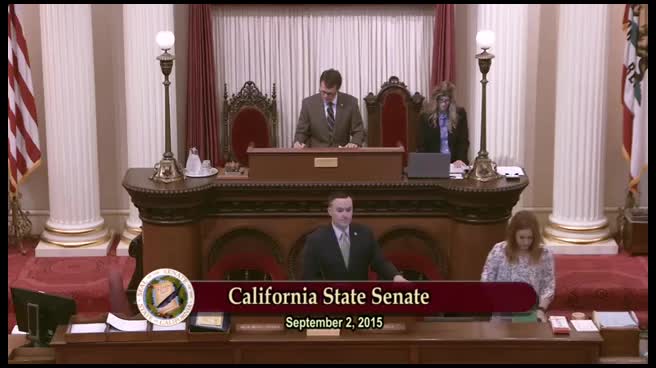 22MIN
Senate Floor
 16MIN
Senate Standing Committee on Appropriations
 1H
Senate Standing Committee on Natural Resources and Water
 1MIN
Assembly Floor
 1H