SB 1006: Firearm Violence Research Center.
- Session Year: 2015-2016
- House: Senate
- Latest Version Date: 2016-04-11
Existing law establishes and funds various research centers and programs in conjunction with the University of California.
This bill would enact the California Firearm Violence Research Act. The bill would declare the intent of the Legislature that the Regents of the University of California establish the California Firearm Violence Research Center to research firearm-related violence. The bill would declare legislative intent regarding the principles by which the university would administer the center and award research funds, as prescribed. The bill would require the university to report, on or before December 31, 2017, and every 5 years thereafter, specified information regarding the activities of the center and information pertaining to research grants. The bill would require the center and the grant recipients to provide copies of its their research publications to the Legislature. Legislature and specified agencies. The bill would specify that its provisions would apply to the university only to the extent that the Regents, regents, by resolution, make any of the provisions of the bill applicable to the university.
Existing law establishes and funds various research centers and programs in conjunction with the University of California.
This bill would enact the California Firearm Violence Research Act. The bill would declare the intent of the Legislature that the Regents of the University of California establish the California Firearm Violence Research Center to research firearm-related violence. The bill would declare legislative intent regarding the principles by which the university would administer the center and award research funds, as prescribed. The bill would require the university to report, on or before December 31, 2017, and every 5 years thereafter, specified information regarding the activities of the center and information pertaining to research grants. The bill would require the center to provide copies of its research publications to the Legislature. The bill would specify that its provisions would apply to the university only to the extent that the Regents, by resolution, make any of the provisions of the bill applicable to the university.
The Legislature finds and declares the following:
(a)Firearm violence is a significant public health and public safety problem in California and nationwide. Nationally, rates of fatal firearm violence have remained essentially unchanged for more than a decade, as declines in homicide have been offset by increases in suicide.
(b)California has been the site of some of the nations most infamous mass shootings, such as those at a McDonalds in San Ysidro, at Cleveland Elementary School in Stockton, near UC Santa Barbara in Isla Vista, and most recently at the Inland Regional Center in San Bernardino. Yet public mass shootings account for less than 1 percent of firearm violence. In 2014, there were 2,939 firearm-related deaths in California, including 1,582 suicides, 1,230 homicides, 89 deaths by legal intervention, and 38 unintentional or undetermined deaths. In communities where firearm violence is a frequent occurrence, the very structure of daily life is affected.
(c)Nationwide, the annual societal cost of firearm violence was estimated at two hundred twenty-nine billion dollars ($229,000,000,000) in 2012. A significant share of this burden falls on California. In 2013, the Office of Statewide Health Planning and Development noted that government-sponsored insurance programs covered nearly two-thirds of the costs of hospitalizations for firearm assaults in California, and about half one-half of the costs of hospitalizations for unintentional injuries or those resulting from deliberate self-harm.
(d)California has been a leader in responding to this continuing crisis. However, although rates of fatal firearm violence in California are well below average for the 50 states, they are not low enough.
(e)Too little is known about firearm violence and its prevention. This is in substantial part because too little research has been done. The need for more research and more sophisticated research has repeatedly been emphasized. Because there has been so little support for research, only a small number of trained investigators are available.
(f)When confronted by other major health and social problems, California and the nation have mounted effective responses, coupling an expanded research effort with policy reform in the publics interest. Motor vehicle accidents, cancer, heart disease, and tobacco use are all examples of the benefits of this approach.
(g)Federal funding for firearm violence research through the Centers for Disease Control and Prevention has been virtually eliminated by Congress since 1996, leaving a major gap that must be filled by other sources.
14231.(a)It is the intent of the Legislature to establish a center for research into firearm-related violence. It is the intent of the Legislature that the center be administered by the University of California pursuant to the following principles:
(1)Interdisciplinary work of the center shall address the following:
(A)The nature of firearm violence, including individual and societal determinants of risk for involvement in firearm violence, whether as a victim or a perpetrator.
(B)The individual, community, and societal consequences of firearm violence.
(C)Prevention and treatment of firearm violence at the individual, community, and societal levels.
(2)The center shall conduct basic, translational, and transformative research with a mission to provide the scientific evidence on which sound firearm violence prevention policies and programs can be based. Its research shall extend to firearm violence as a form of terrorism. include, but not be limited to, the effectiveness of existing laws and policies intended to reduce firearm violence, including the criminal misuse of firearms, and efforts to promote the responsible ownership and use of firearms.
(3)The center shall work on a continuing basis with policymakers in the Legislature and state agencies to identify, implement, and evaluate innovative firearm violence prevention policies and programs.
(4)To help ensure a long-term and successful effort to understand and prevent firearm violence, the center shall recruit and provide specialized training opportunities for new researchers, including experienced investigators in related fields who are beginning work on firearm violence, young investigators who have completed their education, postdoctoral scholars, doctoral students, and undergraduates.
(5)It is the intent of the Legislature to support the centers activities by funding the center with an appropriation to a Firearm Violence Research Center Account. The center may also seek additional federal, state, and private funds.
(6)As a supplement to its own research, the center shall administer a small grants program for research on firearm violence, funded through a research account in the Firearm Violence Research Center Account. All research funds shall be awarded on the basis of scientific merit as determined by an open, competitive peer review process that assures objectivity, consistency, and high quality. All qualified investigators, regardless of institutional affiliation, shall have equal access and opportunity to compete for the funds in the research account.
(7)The peer review process for the selection of grants awarded under this program shall be modeled on the process used by the National Institutes of Health in its grantmaking process.
(b)It is further the intent of the Legislature that on or before December 31, 2017, and every five years thereafter, the University of California transmit programmatic, as well as financial, reports to the state, including a report on the grants made, pending grants, program accomplishments, and the future direction of the program. The report shall be submitted in compliance with Section 9795 of the Government Code.
(c)Subject to the conditions and requirements established elsewhere in statute, state agencies, including including, but not limited to to, the Department of Justice, the State Department of Public Health, the State Department of Health Care Services, the Office of Statewide Health Planning and Development, and the Department of Motor Vehicles, shall provide to the center, upon proper request, the data necessary for the center to conduct its research.
(d)The center and all recipients of grants supported by the research account shall provide copies of their research publications to the Legislature and to agencies supplying data used in the conduct of that research as soon as is practicable following publication. These submissions shall be submitted in compliance with Section 9795 of the Government Code.
(e)Toward these ends, the Legislature requests that the Regents of the University of California establish a Firearm Violence Research Center and administer the center and grant program pursuant to to, and consistent with with, the principles and goals stated herein.
14232.This article shall apply to the University of California only to the extent that the Regents of the University of California, by resolution, make any of these provisions applicable to the university.
The Legislature finds and declares the following:
(a)Firearm violence is a significant public health and public safety problem in California and nationwide. Nationally, rates of fatal firearm violence have remained essentially unchanged for more than a decade, as declines in homicide have been offset by increases in suicide.
(b)California has been the site of some of the nations most infamous mass shootings, such as those at a McDonalds in San Ysidro, at Cleveland Elementary School in Stockton, near UC Santa Barbara in Isla Vista, and most recently at the Inland Regional Center in San Bernardino. Yet public mass shootings account for less than 1 percent of firearm violence. In 2014, there were 2,939 firearm-related deaths in California, including 1,582 suicides, 1,230 homicides, 89 deaths by legal intervention, and 38 unintentional or undetermined deaths. In communities where firearm violence is a frequent occurrence, the very structure of daily life is affected.
(c)Nationwide, the annual societal cost of firearm violence was estimated at two hundred twenty-nine billion dollars ($229,000,000,000) in 2012. A significant share of this burden falls on California. In 2013, the Office of Statewide Health Planning and Development noted that government-sponsored insurance programs covered nearly two-thirds of the costs of hospitalizations for firearm assaults in California, and about half the costs of hospitalizations for unintentional injuries or those resulting from deliberate self-harm.
(d)California has been a leader in responding to this continuing crisis. However, although rates of fatal firearm violence in California are well below average for the 50 states, they are not low enough.
(e)Too little is known about firearm violence and its prevention. This is in substantial part because too little research has been done. The need for more research and more sophisticated research has repeatedly been emphasized. Because there has been so little support for research, only a small number of trained investigators are available.
(f)When confronted by other major health and social problems, California and the nation have mounted effective responses, coupling an expanded research effort with policy reform in the publics interest. Motor vehicle accidents, cancer, heart disease, and tobacco use are all examples of the benefits of this approach.
(g)Federal funding for firearm violence research through the Centers for Disease Control has been virtually eliminated by Congress since 1996, leaving a major gap that must be filled by other sources.
14231.(a)It is the intent of the Legislature to establish a center for research into firearm-related violence. It is the intent of the Legislature that the center be administered by the University of California pursuant to the following principles:
(1)Interdisciplinary work of the center shall address the following:
(A)The nature of firearm violence, including individual and societal determinants of risk for involvement in firearm violence, whether as a victim or a perpetrator.
(B)The individual, community, and societal consequences of firearm violence.
(C)Prevention and treatment of firearm violence at the individual, community, and societal levels.
(2)The center shall conduct basic, translational, and transformative research with a mission to provide the scientific evidence on which sound firearm violence prevention policies and programs can be based. Its research shall extend to firearm violence as a form of terrorism.
(3)The center shall work on a continuing basis with policymakers in the Legislature and state agencies to identify, implement, and evaluate innovative firearm violence prevention policies and programs.
(4)To help ensure a long-term and successful effort to understand and prevent firearm violence, the center shall recruit and provide specialized training opportunities for new researchers, including experienced investigators in related fields who are beginning work on firearm violence, young investigators who have completed their education, postdoctoral scholars, doctoral students, and undergraduates.
(5)It is the intent of the Legislature to support the centers activities by funding the center with an appropriation to a Firearm Violence Research Center Account. The center may also seek additional federal, state, and private funds.
(6)As a supplement to its own research, the center shall administer a small grants program for research on firearm violence, funded through a research account in the Firearm Violence Research Center Account. All research funds shall be awarded on the basis of scientific merit as determined by an open, competitive peer review process that assures objectivity, consistency, and high quality. All qualified investigators, regardless of institutional affiliation, shall have equal access and opportunity to compete for the funds in the research account.
(7)The peer review process for the selection of grants awarded under this program shall be modeled on the process used by the National Institutes of Health in its grantmaking process.
(8)Awardees shall be reimbursed for the full cost, both direct and indirect, of conducting the sponsored research consistent with federal guidelines governing all federal research grants and contracts.
(b)It is further the intent of the Legislature that on or before December 31, 2017, and every five years thereafter, the University of California transmit programmatic, as well as financial, reports to the state, including a report on the grants made, pending grants, program accomplishments, and the future direction of the program. The report shall be submitted in compliance with Section 9795 of the Government Code.
(c)Subject to the conditions and requirements established elsewhere in statute, state agencies, including but not limited to the Department of Justice, the State Department of Public Health, the State Department of Health Care Services, the Office of Statewide Health Planning and Development, and the Department of Motor Vehicles, shall provide to the center, upon proper request, the data necessary for the center to conduct its research.
(d)The center and all recipients of grants supported by the research account shall provide copies of their research publications to the Legislature and to agencies supplying data used in the conduct of that research as soon as is practicable following publication. These submissions shall be submitted in compliance with Section 9795 of the Government Code.
(e)Toward these ends, the Legislature requests that the Regents of the University of California establish a Firearm Violence Research Center and administer the center and grant program pursuant to and consistent with the principles and goals stated herein.
14232.This article shall apply to the University of California only to the extent that the Regents of the University of California, by resolution, make any of these provisions applicable to the university.
HeadingLine 2.The Legislature finds and declares the following:
(a)Firearm violence is a significant public health and public safety problem in California and nationwide. Nationally, rates of fatal firearm violence have remained essentially unchanged for more than a decade, as declines in homicide have been offset by increases in suicide.
(b)California has been the site of some of the nations most infamous mass shootings, such as those at a McDonalds in San Ysidro, at Cleveland Elementary School in Stockton, near UC Santa Barbara in Isla Vista, and most recently at the Inland Regional Center in San Bernardino. Yet public mass shootings account for less than 1 percent of firearm violence. In 2014, there were 2,939 firearm-related deaths in California, including 1,582 suicides, 1,230 homicides, 89 deaths by legal intervention, and 38 unintentional or undetermined deaths. In communities where firearm violence is a frequent occurrence, the very structure of daily life is affected.
(c)Nationwide, the annual societal cost of firearm violence was estimated at 229 billion dollars ($229,000,000,000) in 2012. A significant share of this burden falls on California. In 2013, the Office of Statewide Health Planning and Development noted that government-sponsored insurance programs covered nearly two-thirds of the costs of hospitalizations for firearm assaults in California, and about half the costs of hospitalizations for unintentional injuries or those resulting from deliberate self-harm.
(d)California has been a leader in responding to this continuing crisis. However, although rates of fatal firearm violence in California are well below average for the 50 states, they are not low enough.
(e)Too little is known about firearm violence and its prevention. This is in substantial part because too little research has been done. The need for more research and more sophisticated research has repeatedly been emphasized. Because there has been so little support for research, only a small number of trained investigators are available.
(f)When confronted by other major health and social problems, California and the nation have mounted effective responses, coupling an expanded research effort with policy reform in the publics interest. Motor vehicle accidents, cancer, heart disease, and tobacco use are all examples of the benefits of this approach.
(g)Federal funding for firearm violence research through the Centers for Disease Control has been virtually eliminated by Congress since 1996, leaving a major gap that must be filled by other sources.
14231.(a)It is the intent of the Legislature to establish a center for research into firearm-related violence. It is the intent of the Legislature that the center be administered by the University of California pursuant to the following principles:
(1)Interdisciplinary work of the center shall address the following:
(A)The nature of firearm violence, including individual and societal determinants of risk for involvement in firearm violence, whether as a victim or a perpetrator.
(B)The individual, community, and societal consequences of firearm violence.
(C)Prevention and treatment of firearm violence at the individual, community, and societal levels.
(2)The center shall conduct basic, translational, and transformative research with a mission to provide the scientific evidence on which sound firearm violence prevention policies and programs can be based. Its research shall extend to firearm violence as a form of terrorism.
(3)The center shall work on a continuing basis with policymakers in the Legislature and state agencies to identify, implement, and evaluate innovative firearm violence prevention policies and programs.
(4)To help ensure a long-term and successful effort to understand and prevent firearm violence, the center shall recruit and provide specialized training opportunities for new researchers, including experienced investigators in related fields who are beginning work on firearm violence, young investigators who have completed their education, postdoctoral scholars, doctoral students, and undergraduates.
(5)It is the intent of the Legislature to support the centers activities by funding the center with an appropriation to a Firearm Violence Research Center Account. The center may also seek additional federal, state, and private funds.
(6)As a supplement to its own research, the center shall administer a grants program for research on firearm violence, funded through a research account in the Firearm Violence Research Center Account. All research funds shall be awarded on the basis of scientific merit as determined by an open, competitive peer review process that assures objectivity, consistency, and high quality. All qualified investigators, regardless of institutional affiliation, shall have equal access and opportunity to compete for the funds in the research account.
(7)The peer review process for the selection of grants awarded under this program shall be modeled on the process used by the National Institutes of Health in its grantmaking process.
(8)Awardees shall be reimbursed for the full cost, both direct and indirect, of conducting the sponsored research consistent with federal guidelines governing all federal research grants and contracts.
(b)It is further the intent of the Legislature that on or before December 31, 2017, and every five years thereafter, the University of California transmit programmatic, as well as financial, reports to the state, including a report on the grants made, pending grants, program accomplishments, and the future direction of the program. The report shall be submitted in compliance with Section 9795 of the Government Code.
(c)Subject to the conditions and requirements established elsewhere in statute, state agencies, including but not limited to the Department of Justice, the State Department of Public Health, the State Department of Health Care Services, the Office of Statewide Health Planning and Development, and the Department of Motor Vehicles, shall provide to the center, upon proper request, the data necessary for the center to conduct its research.
(d)The center and all recipients of grants supported by the research account shall provide copies of their research publications to the Legislature and to agencies supplying data used in the conduct of that research as soon as is practicable following publication. These submissions shall be submitted in compliance with Section 9795 of the Government Code.
(e)Toward these ends, the Legislature requests that the Regents of the University of California establish a Firearm Violence Research Center and administer the center and grant program pursuant to and consistent with the principles and goals stated herein.
14232.This article shall apply to the University of California only to the extent that the Regents of the University of California, by resolution, make any of these provisions applicable to the university.
|
Date
|
Status
|
|---|---|
| Apr 20, 2016 | From committee: Do pass and re-refer to Com. on APPR. (Ayes 5. Noes 2.) (April 19). Re-referred to Com. on APPR. |
| Jun 14, 2016 | June 14 set for first hearing canceled at the request of author. |
| Jun 1, 2016 | Referred to Coms. on HIGHER ED. and PUB. S. |
| May 19, 2016 | Read third time. Passed. (Ayes 24. Noes 14.) Ordered to the Assembly. |
| May 19, 2016 | Read third time. Passed. (Ayes 24. Noes 14. Page 3902.) Ordered to the Assembly. |
| May 19, 2016 | In Assembly. Read first time. Held at Desk. |
| May 17, 2016 | Read second time. Ordered to third reading. |
| May 16, 2016 | Motion to place on APPR. suspense file failed. |
| May 16, 2016 | From committee: Do pass. (Ayes 5. Noes 2.) (May 16). |
| May 16, 2016 | From committee: Do pass. (Ayes 5. Noes 2. Page 3888.) (May 16). |
| May 16, 2016 | (Ayes 2. Noes 4.) (May 16) |
| May 16, 2016 | (Ayes 2. Noes 4. Page 3888.) (May 16) |
| May 11, 2016 | Set for hearing May 16. |
| Apr 28, 2016 | May 2 hearing postponed by committee. |
| Apr 22, 2016 | Set for hearing May 2. |
| Feb 10, 2016 | Introduced. Read first time. To Com. on RLS. for assignment. To print. |
| Apr 20, 2016 | From committee: Do pass and re-refer to Com. on APPR. (Ayes 5. Noes 2. Page 3612.) (April 19). Re-referred to Com. on APPR. |
| Apr 11, 2016 | From committee with author's amendments. Read second time and amended. Re-referred to Com. on PUB. S. |
| Apr 1, 2016 | Set for hearing April 19. |
| Mar 31, 2016 | April 12 hearing postponed by committee. |
| Mar 29, 2016 | Set for hearing April 12. |
| Mar 28, 2016 | April 5 set for first hearing canceled at the request of author. |
| Mar 24, 2016 | Set for hearing April 5. |
| Mar 17, 2016 | Read second time and amended. Re-referred to Com. on PUB. S. |
| Mar 17, 2016 | (Corrected March 23). |
| Mar 16, 2016 | From committee: Do pass as amended and re-refer to Com. on PUB. S. (Ayes 7. Noes 2. Page 3240.) (March 16). |
| Feb 25, 2016 | Set for hearing March 16. |
| Feb 18, 2016 | Referred to Coms. on ED. and PUB. S. |
| Feb 11, 2016 | From printer. May be acted upon on or after March 12. |
|
Date
|
Description
|
Location
|
Votes
|
|
|---|---|---|---|---|
| May 19, 2016 | Senate 3rd Reading SB1006 Wolk | Senate Floor |
Passed |
|
| May 16, 2016 | Do pass | Senate Standing Committee on Appropriations |
Passed |
|
| May 16, 2016 | Placed on suspense file | Senate Standing Committee on Appropriations |
Failed |
|
| Apr 19, 2016 | Do pass, but first be re-referred to the Committee on [Appropriations] | Senate Standing Committee on Public Safety |
Passed |
|
| Mar 16, 2016 | Do pass as amended, but first amend, and re-refer to the Committee on [Public Safety] | Senate Standing Committee on Education |
Passed |
This list shows positions taken on this bill by organizations on the date displayed, which is linked to the original source.
Positions by individuals are not included.
|
Organization
|
Position
|
Date
|
|---|---|---|
| According to the Senate Appropriations Committee: | ** Support | May 19, 2016 |
| All Saints Church, Pasadena | ** Support | May 19, 2016 |
| American Academy Of Pediatrics, California | ** Support | May 19, 2016 |
| American Association of Pediatricians | * Support | Mar 16, 2016 |
| American Civil Liberties Union Foundation Of Southern California | * Support | May 16, 2016 |
| Americans for Responsible Solutions | ** Support | May 19, 2016 |
| California Academy Of Family Physicians | ** Support | May 19, 2016 |
| California Chapter of the American College of Emergency Physicians | ** Support | May 19, 2016 |
| California Chapters of The Brady Campaign to Prevent Gun Violence | ** Support | May 19, 2016 |
| California College and University Policy Chiefs Association | ** Support | May 19, 2016 |
| California Manufacturers And Technology Association | * Against | May 16, 2016 |
| California Medical Association, Inc. | ** Support | May 19, 2016 |
| California Police Chiefs Association | ** Support | May 19, 2016 |
| California Psychiatric Association | ** Support | May 19, 2016 |
| California Public Defenders Association | ** Support | May 19, 2016 |
| California Restaurant Association | * Against | May 16, 2016 |
| California Rifle And Pistol Association, Inc. | * Against | Apr 19, 2016 |
| California School Nurses Association | ** Support | May 19, 2016 |
| California Sportsman's Lobby, Inc. | ** Against | May 19, 2016 |
| California State Association Of Counties | * Against | May 16, 2016 |
| Dave Jones, Insurance Commissioner | ** Support | May 19, 2016 |
| Doctors for America | ** Support | May 19, 2016 |
| Doctors for Responsible Gun Ownership | ** Against | May 19, 2016 |
| Firearms Policy Coalition | ** Against | May 19, 2016 |
| Friends Committee On Legislation Of California | ** Support | May 19, 2016 |
| Gavin Newsom, Lieutenant Governor | ** Support | May 19, 2016 |
| Gun Owners of America | ** Against | May 19, 2016 |
| Gun Owners of California | ** Against | May 19, 2016 |
| International Health & Epidemiology Research Center | ** Support | May 19, 2016 |
| Los Angeles City Attorney | ** Support | May 19, 2016 |
| National Association of Social Workers | ** Support | May 19, 2016 |
| Outdoors Sportsmen's Coalition of California | ** Against | May 19, 2016 |
| Outdoors Sportsmen's Coalitional of California | ** Against | Mar 16, 2016 |
| PRIOR LEGISLATION | ** Support | May 19, 2016 |
| Related | ** Support | May 19, 2016 |
| Safari Club International | ** Against | May 19, 2016 |
| Southern Medical Center | * Support | Apr 19, 2016 |
| UC Davis Medical Center | * Support | Mar 16, 2016 |
| United States Senator, Dianne Feinstein | ** Support | May 19, 2016 |
| Violence Prevention Coalition of Orange County | ** Support | May 19, 2016 |
| Youth ALIVE! | ** Support | May 19, 2016 |
Office of Senate Floor Analyses (916) 651-1520 Fax: (916) 327-4478 | SB 1006 |
THIRD READING
Bill No: SB 1006
Amended: 4/11/16
SENATE EDUCATION COMMITTEE: 7-2, 3/16/16
AYES: Liu, Block, Hancock, Leyva, Mendoza, Monning, Pan
NOES: Huff, Vidak
SENATE PUBLIC SAFETY COMMITTEE: 5-2, 4/19/16
AYES: Hancock, Glazer, Leno, Liu, Monning
NOES: Anderson, Stone
SENATE APPROPRIATIONS COMMITTEE: 5-2, 5/16/16
AYES: Lara, Beall, Hill, McGuire, Mendoza
NOES: Bates, Nielsen
SUBJECT: Firearm Violence Research Center
SOURCE: American College of Emergency Physicians
American Academy of Pediatrics, California
DIGEST: This bill requests the Regents of the University of California (UC) establish a Firearm Violence Research Center (Center) and administer the Center and a grant program pursuant to, and consistent with, specified principles and goals.
Existing law:
- Regulates the use, possession and sale of deadly weapons in California. (Penal Code § 16000, et. seq.)
- Establishes, in the California Constitution, the UC, a public trust to be administered by the Regents of the UC and grants the Regents full powers of organization and government, subject only to such legislative control as may be necessary to insure security of its funds, compliance with the terms of its endowments, statutory requirements around competitive bidding and contracts, sales of property and the purchase of materials, goods and services. (Article IX, Section (9)(a) of the California Constitution.)
- Provides that the statutes related to UC (and most other aspects of the governance and operation of UC) are applicable only to the extent that the Regents of the UC make such provisions applicable. (Education Code § 67400.)
This bill:
- Requests that the UC Regents establish the Center for purposes of conducting research related to firearm violence and its prevention.
- States the legislative intent that the administration of the Center be consistent with the following principles:
- Works to address the nature, consequences, and prevention of firearm violence, as described.
- Conducts basic, translational, and transformative research with a mission to provide the scientific evidence on which sound firearm violence prevention policies and programs can be based. Its research shall include, but not be limited to, the effectiveness of existing laws and policies intended to reduce firearm violence, including the criminal misuse of firearms, and efforts to promote the responsible ownership and use of firearms.
- Identifies, implements, and evaluates innovative prevention policies and programs with policymakers and state agencies.
- Recruits and provides specialized training opportunities for new researchers, as specified.
- States the Legislature’s intent to appropriate funds to a Firearm Research Center Account for purposes specified in the bill and further:
- Authorizes the Center to seek additional federal, state or private funds.
- Requires that the Center administer a small grant program that provides for:
- An open, competitive peer review process modeled after the National Institute of Health’s granting making process.
- A process by which all qualified investigators have equal access to compete for funds.
- States legislative intent that the UC report, on or before December 31, 2017, and every 5 years thereafter, specified information regarding the activities of the Center and information pertaining to research grants.
- Requires state agencies to comply with data requests initiated by the Center only to the extent permitted by current law.
- Requires that the Center provide copies of its research publications to the Legislature and certain state agencies.
- Makes a number of findings and declarations relative to the effects of firearm violence on public health and safety and the need for expanded research efforts and more funding.
- Provides that these provisions are applicable to the UC only if the Board of Regents, by resolution, makes it applicable.
Comments
- Need for the bill. According to the author:
Research into gun-related injury, violence or death was once the responsibility of the Centers for Disease Control and Prevention (CDC) and was funded by the federal government, along with research on all other public health issues, including diseases, accidental injuries and deaths, and food safety. However, in 1996, at the request of the National Rifle Association, Congress passed the “Dickey Amendment” by Representative Jay Dickey, a Republican from Arkansas that put an end to this research at the CDC. As a result, there are many important questions asked which remain unanswered. We as policymakers are often left with insufficient data and evidence to determine the most effective policies to reduce the number of deaths and injuries resulting from firearm violence.
Fortunately, California is well situated to fill this research gap. The University of California has the capacity to do what Congress has failed to do – get the facts, apply sound scientific methods, and find answers that lead to solutions.
Support for more firearm violence research is strong, and includes the author of the Dickey Amendment, Jay Dickey himself, the Republican and NRA member from Arkansas who has since changed his mind. Congressman Dickey has come out strongly in favor of more research, including SB 1006. Let me quote from Congressman Dickey who co-wrote the following with Mark Rosenberg, the former Director of the CDC’s National Center for Injury Prevention and Control:
“Our nation does not have to choose between reducing gun-violence injuries and safeguarding gun ownership… States can serve as democracy’s laboratories for firearm violence prevention research, as they do for other major health and social problems… This research could have been continued on gun violence without infringing on the rights of gun owners, in the same fashion that the highway industry continued its research (on deaths and injuries from head-on collisions) without eliminating the automobile.”
- Effect of this bill. Various research centers and programs focus on public safety research, including firearms violence prevention, such as the John Hopkins Center for Gun Policy and Research, the Harvard Injury Control Research Center, and the National Consortium for Violence Research supported by grant funding from the National Science Foundation. In California, the Violence Prevention Research Program (VPRP) at the UC Davis Health System describes itself as follows:
The VPRP is a multi-disciplinary program of research and policy development focused on the causes, consequences, and prevention of violence. We place a particular focus on firearm violence, and on the connections between violence, substance abuse, and mental illness.
We helped develop the public health approach to violence in the 1980s, and we apply that approach to everything we do. Our mission is to develop and disseminate the research evidence on which informed policy and practice are based. Our approach to research and prevention is hemispheric, focusing on areas that face the highest burden from violence.
Our program of research on firearm violence is internationally recognized as among the best of its kind. We are now expanding in size and scope, adding new areas of emphasis in alcohol and drug abuse, mental illness, and the social factors that determine risk for violence, substance abuse, and mental illness.
Related/Prior Legislation
AB 2600 (Lackey, 2015) requests the UC Regents to establish the California Institute for Aerospace, and specifies implementation only to the extent that the Regents determine that adequate funding for its purposes has been provided from federal, local, or private sector sources in the annual Budget Act or in another statute. The bill is pending hearing in the Assembly Appropriations Committee.
SB 466 (DeSaulnier, 2014) would have established the California Institute for Criminal Justice Policy (CICJP) at the request of the Legislature to the UC to house the CICJP to facilitate independent and nonpartisan research on issues related to criminal justice and public safety by experts in the UC system and beyond. The bill was held on the Suspense File of the Assembly Appropriations Committee.
FISCAL EFFECT: Appropriation: No Fiscal Com.: Yes Local: No
According to the Senate Appropriations Committee:
- UC Research Center: To the extent the Regents of the UC resolve to make the provisions of this bill applicable, potential one-time and ongoing funding of $1 million to $2 million (General Fund) annually would be required to establish and support the Center, including staffing, administrative costs, and the grant program.
- State agencies: Potentially significant costs (General Fund / Special Funds*) to specified state agencies to provide the data necessary for the Center to conduct its research as required upon proper request by the Center. It is unclear what would constitute a “proper request” as it is undefined in this bill. To the extent state agencies do not currently collect, track, or have access to the data requested, costs could potentially be very significant. The DPH and DMV have indicated no significant fiscal impact to meet any potential data requests.
American College of Emergency Physicians (co-source)
American Academy of Pediatrics, California (co-source)
Dave Jones, Insurance Commissioner
Gavin Newsom, Lieutenant Governor
All Saints Church, Pasadena
Americans for Responsible Solutions
California Chapter of the American College of Emergency Physicians
California Academy of Family Physicians
California Chapters of the Brady Campaign to Prevent Gun Violence
California College and University Policy Chiefs Association
California Medical Association
California Police Chiefs Association
California Psychiatric Association
California Public Defenders Association
California School Nurses Association
Doctors for America
International Health & Epidemiology Research Center
Friends Committee on Legislation of California
Los Angeles City Attorney
National Association of Social Workers
Physicians for Social Responsibility, San Francisco Bay Area Chapter
Violence Prevention Coalition of Orange County
United States Senator, Dianne Feinstein
Youth Alive!
Several individuals
OPPOSITION: (Verified 5/18/16)
California Sportsman’s Lobby
Doctors for Responsible Gun Ownership
Firearms Policy Coalition
Gun Owners of America
Gun Owners of California
Outdoors Sportsmen’s Coalition of California
Safari Club International
Several individuals
ARGUMENTS IN SUPPORT: According to the California Chapters of the Brady Campaign to Prevent Gun Violence:
Senate Bill 1006 seeks to establish the California Firearm Violence Research Center at the University of California to conduct basic research on firearm-related violence. Specifically the Center is charged with studying: 1) the nature of firearm violence, including individual and societal determinants of risk for involvement in firearm violence, 2) the individual, community, and societal consequences of firearm violence; and 3) strategies for prevention and treatment of firearm violence at the individual, community, and societal levels. The Center would be funded by the legislature and be required to report annually on its activities.
Basic research is an essential element in formulating and carrying out good public policy. California has been at the forefront of passing strong firearm laws. However, there is a need to conduct more research on the efficacy of these laws and to suggest areas where future legislative actions may be beneficial.
The limited research that has been conducted to date is promising, however the large sample sizes needed to draw robust conclusions has been inhibited by lack of funding and lack of access to federal data. Since 1996, the Centers for Disease Control and Prevention has been banned from using federal funds to “advocate or promote gun control”, which has been construed as a ban on any firearm violence research whatsoever. In 2011, this limitation on collecting scientific data was extended to the National Institutes of Health. Accordingly, for the past twenty years it has been nearly impossible to conduct research into this important public safety issue.
As the most populous state, California has both the ability and the duty to take the lead in this area. Over the years, California has been a beacon on many policy issues to other states and the nation and so too should it be on formulating policies to reduce gun violence.
ARGUMENTS IN OPPOSITION: According to the Firearms Policy Coalition:
Our concerns with the measure are many fold but share the common root; that the program is one-sided and the “research” is to be used to guide the legislature on gun control, euphemistically called “firearms violence prevention.”
SB 1006 presumes that violence that uses firearms is a “health issue,” it presumes that studying things like “…risk for involvement in firearm violence, whether as a victim or a perpetrator.” rather than being includes and studying things like the effect of an armed citizenry on crime and violence prevention, show how the measure is transparently biased before the first dollar is doled out.
SB 1006 is so sure of its pre-determined outcomes it requires a grant applicant to agree that firearms violence can be treated like a disease, going so far as to say “Prevention and treatment of firearm violence at the individual, community, and societal levels.” Yes, that’s right “treatment.” Given that this is really to fund one narrow worldview, it isn’t surprising, but when it comes to appropriating taxpayer monies, it is controversial.
This type of academic limitation discourages actual social scientists from applying for the grant for fear their research will not match up with the pre-determinations of SB 1006, which seem to revolve around the opinions of one man who is a medical doctor affiliated with the UC Davis violence prevention research program.
Sadly, the positive use of firearms and their inoculating presence in the community is not part of the narrow grant requirements. Violent crime thwarted by firearms is not either, nor the deterrent effect of having millions of armed households and over a million firearms sold annually with no rise in “gun violence.”
It would appear that the outcome has already been decided and it only needs to pre-fund an existing worldview and program at UC Davis--the obvious and transparent sole-source recipient of this gift of public monies, to report back with new ways to harass and burden law abiding citizens who contribute positively to the public good by being responsible gun owners, and concealed carry licensees.
Violence, in general, regardless of the form it takes deserves our careful study. No academic grant, funding or appropriation should be do narrow in its requirements as to discourage honest evaluation and competition by those who view violence and its deterrence more holistically and have relevant backgrounds in the social sciences than are allowed for in SB 1006.
Prepared by: Jonas Austin / SFA / (916) 651-1520
5/18/16 18:37:28
**** END ****
SENATE COMMITTEE ON
Senator Ricardo Lara, Chair
2015 - 2016 Regular Session
SB 1006 (Wolk) - Firearm Violence Research Center
Version: | Policy Vote: |
Urgency: | Mandate: |
Hearing Date: | Consultant: |
This bill meets the criteria for referral to the Suspense File.
Bill Summary:
SB 1006 would request the Regents of the University of California (UC) establish a Firearm Violence Research Center (Center) and administer the Center and a grant program pursuant to, and consistent with, specified principles and goals.
Fiscal Impact:
- UC Research Center: To the extent the Regents of the UC resolve to make the provisions of the bill applicable, potential one-time and ongoing funding of $1 million to $2 million (General Fund) annually would be required to establish and support the Center, including staffing, administrative costs, and the grant program.
- State agencies: Potentially significant costs (General Fund / Special Funds*) to specified state agencies to provide the data necessary for the Center to conduct its research as required upon proper request by the center. It is unclear what would constitute a “proper request” as it is undefined in the bill. To the extent state agencies do not currently collect, track, or have access to the data requested, costs could potentially be very significant. The DPH and DMV have indicated no significant fiscal impact to meet any potential data requests.
Background:
Various research centers and programs focus on public safety research, including firearms violence prevention, such as the John Hopkins Center for Gun Policy and Research, the Harvard Injury Control Research Center, and the National Consortium for Violence Research supported by grant funding from the National Science Foundation. In California, the Violence Prevention Research Program (VPRP) at the UC Davis Health System describes itself as follows:
The VPRP is a multi-disciplinary program of research and policy development focused on the causes, consequences, and prevention of violence. We place a particular focus on firearm violence, and on the connections between violence, substance abuse, and mental illness.
We helped develop the public health approach to violence in the 1980s, and we apply that approach to everything we do. Our mission is to develop and disseminate the research evidence on which informed policy and practice are based. Our approach to research and prevention is hemispheric, focusing on areas that face the highest burden from violence.
Our program of research on firearm violence is internationally recognized as among the best of its kind. We are now expanding in size and scope, adding new areas of emphasis in alcohol and drug abuse, mental illness, and the social factors that determine risk for violence, substance abuse, and mental illness.
This bill seeks to provide support for gun violence research that has been subject to limited funding at the federal level subsequent to 1996. According to the Smithsonian article, Why So Few Scientists Are Studying the Causes of Gun Violence (July 2015):
For nearly 20 years, the Center for Disease Control and Prevention (CDC) has been subject to what some call a ban on funding to study gun violence. Originally included in the 1996 appropriations bill as a rider proposed by Arkansas Representative Jay Dickey, the amendment doesn’t explicitly ban gun research. Instead it says that "none of the funds made available for injury prevention and control at the Centers for Disease Control and Prevention may be used to advocate or promote gun control," reports Christine Jamieson for the American Psychological Association’s Psychological Science Agenda. She adds: However, Congress also took $2.6 million from the CDC’s budget — the amount the CDC had invested in firearm injury research the previous year — and earmarked the funds for prevention of traumatic brain injury. The vagueness of the Dickey amendment wording has kept the CDC from funding researchers that might study gun violence for fear that they would be financially punished.
Proposed Law:
This bill would request that the UC Regents establish a Firearm Violence Research Center (the Center), and administer the Center and a grant program, as follows:
- Requires interdisciplinary work of the Center to address the following:
- The nature of firearm violence, including individual and societal determinants of risk for involvement in firearm violence, whether as a victim or a perpetrator.
- The individual, community, and societal consequences of firearm violence.
- Prevention and treatment of firearm violence at the individual, community, and societal levels.
- Requires the Center to conduct basic, translational, and transformative research with a mission to provide the scientific evidence on which sound firearm violence prevention policies and programs can be based. Its research shall include, but not be limited to, the effectiveness of existing laws and policies intended to reduce firearm violence, including the criminal misuse of firearms, and efforts to promote the responsible ownership and use of firearms.
- Requires the Center to work on a continuing basis with policymakers in the Legislature and state agencies to identify, implement, and evaluate innovative firearm violence prevention policies and programs.
- Requires the Center to recruit and provide specialized training opportunities for new researchers, including experienced investigators in related fields who are beginning work on firearm violence, young investigators who have completed their education, postdoctoral scholars, doctoral students, and undergraduates.
- Provides that it is the intent of the Legislature to support the Center’s activities by funding the Center with an appropriation to a Firearm Violence Research Center Account. Authorizes the Center to also seek additional federal, state, and private funds.
- As a supplement to its own research, requires the Center to administer a small grants program for research on firearm violence, funded through a research account in the Firearm Violence Research Center Account. All research funds are to be awarded on the basis of scientific merit as determined by an open, competitive peer review process that assures objectivity, consistency, and high quality. All qualified investigators, regardless of institutional affiliation, are to have equal access and opportunity to compete for the funds in the research account.
- Provides that it is the intent of the Legislature that on or before December 31, 2017, and every five years thereafter, the UC transmit programmatic, as well as financial, reports to the state, including a report on the grants made, pending grants, program accomplishments, and the future direction of the program.
- Requires state agencies, including, but not limited to, the DOJ, DPH, DHCS, OSHPD, and the DMV, to provide to the Center, upon proper request, the data necessary for the Center to conduct its research.
- Requires the Center and all recipients of grants supported by the research account to provide copies of their research publications to the Legislature and to agencies supplying data used in the conduct of that research as soon as is practicable following publication, as specified.
- This article shall apply to the University of California only to the extent that the Regents of the University of California, by resolution, make any of these provisions applicable to the UC.
Related Legislation:
AB 2600 (Lackey) 2015 requests the UC Regents to establish the California Institute for Aerospace, and specifies implementation only to the extent that the Regents determine that adequate funding for its purposes has been provided from federal, local, or private sector sources in the annual Budget Act or in another statute. This bill is pending hearing in the Assembly Appropriations Committee.
Prior Legislation: SB 466 (DeSaulnier) 2014 would have established the California Institute for Criminal Justice Policy (CICJP) at the request of the Legislature to the UC to house the CICJP to facilitate independent and nonpartisan research on issues related to criminal justice and public safety by experts in the UC system and beyond. This bill was held on the Suspense File of the Assembly Appropriations Committee.
Staff Comments:
The UC does not anticipate costs associated with this measure, as the bill states the intent of the Legislature to support the Center through a state appropriation. Additionally, due to the provision that provides the Regents with the option of establishing the Center, to the extent sufficient state funding is not made available, the Regents would likely not establish the Center. To the extent the UC has the appropriate expertise and an appropriate level of funding specific to the Center is made available, annual state funding in the range of $1 million to $2 million (General Fund) per year would likely be required to operate the Center. While the bill authorizes the Center to seek additional federal, state, and private funds, there is no mandate to do so.
This bill requires specified state agencies (DOJ, DPH, DHCS, OSHPD, and DMV) to provide to the UC “upon proper request” the data necessary for the Center to conduct its research. Staff notes it is unclear what would constitute a proper request from the Center, as it is undefined in the bill. To the extent the state agencies do not collect, track, or have access to the data being requested, the costs to provide the data could be significant, resulting in overtime, staffing, and potentially automation system upgrades to meet the data provision mandate in the bill.
The Department of Public Health (DPH) has indicated no significant fiscal impact to provide data to the Center, as this activity is consistent with the DPH’s epidemiological and surveillance activities and could be absorbed within its current workload. Likewise, the DMV has indicated minor costs to accommodate any requests for data.
-- END --
SENATE COMMITTEE ON PUBLIC SAFETY
Senator Loni Hancock, Chair
2015 - 2016 Regular
Bill No: SB 1006 Hearing Date: April 19, 2016
Author: | Wolk | ||
Version: | April 11, 2016 | ||
Urgency: | No | Fiscal: | Yes |
Consultant: | JRD | ||
Subject: Firearm Violence Research Center
HISTORY
Source: American College of Emergency Physicians; American Academy of Pediatrics, California
Prior Legislation: None known
Support: All Saints Church, Pasadena; Americans for Responsible Solutions; California Chapter of the American College of Emergency Physicians; California Academy of Family Physicans; California Chapters of the Brady Campaign to Prevent Gun Violence; California College and University Policy Chiefs Association; California Police Chiefs Association; California Psychiatric Association; California Public Defenders Association; California School Nurses Association; Dave Jones, Insurance Commissioner; Doctors for America; International Health & Epidemiology Research Center; Friends Committee on Legislation of California; Los Angeles City Attorney; National Association of Social Workers; Physicians for Social Responsibility, San Francisco Bay Area Chapter; Violence Prevention Coalition of Orange County; United States Senator, Dianne Feinstein; Youth Alive!; several individuals
Opposition: California Sportsman’s Lobby; Doctors for Responsible Gun Ownership; Firearms Policy Coalition; Gun Owners of America; Gun Owners of California; Outdoors Sportsmen’s Coalition of California; Safari Club International; several individuals
PURPOSE
This purpose of this bill is to request that the UC Regents establish the Center for purposes of conducting research related to firearm violence and its prevention, as specified.
Existing law generally regulates the use, possession and sale of deadly weapons in California. (Penal Code § 16000, et. seq.)
Under existing law the California Constitution establishes the UC, a public trust to be administered by the Regents of the UC and grants the Regents full powers of organization and government, subject only to such legislative control as may be necessary to insure security of its funds, compliance with the terms of its endowments, statutory requirements around competitive bidding and contracts, sales of property and the purchase of materials, goods and services. (Article IX, Section (9)(a) of the California Constitution.)
Current law provides that the statutes related to UC (and most other aspects of the governance and operation of UC) are applicable only to the extent that the Regents of UC make such provisions applicable. (Education Code § 67400.)
This bill requests that the UC Regents establish the Center for purposes of conducting research related to firearm violence and its prevention.
This bill states the legislative intent that the administration of the Center be consistent with the following principles:
- Works to address the nature, consequences, and prevention of firearm violence, as described.
- Conducts basic, translational, and transformative research with a mission to provide the scientific evidence on which sound firearm violence prevention policies and programs can be based. Its research shall include, but not be limited to, the effectiveness of existing laws and policies intended to reduce firearm violence, including the criminal misuse of firearms, and efforts to promote the responsible ownership and use of firearms.
- Identifies, implements, and evaluates innovative prevention policies and programs with policymakers and state agencies.
- Recruits and provides specialized training opportunities for new researchers, as specified.
This bill states the legislature’s intent to appropriate funds to a Firearm Research Center Account for purposes specified in the bill and further:
- Authorizes the Center to seek additional federal, state or private funds.
- Requires that the Center administer a small grant program that provides for:
- An open, competitive peer review process modeled after the National Institute of Health’s granting making process.
- A process by which all qualified investigators have equal access to compete for funds.
This bill states legislative intent that the University of California (UC) report, on or before December 31, 2017, and every 5 years thereafter, specified information regarding the activities of the Center and information pertaining to research grants.
This bill requires state agencies to comply with data requests initiated by the Center only to the extent permitted by current law.
This bill requires that the Center provide copies of its research publications to the Legislature and certain state agencies.
This bill makes a number of findings and declarations relative to the effects of firearm violence on public health and safety and the need for expanded research efforts and more funding.
This bill provides that these provisions are applicable to UC only if the Board of Regents, by resolution, makes it applicable.
RECEIVERSHIP/OVERCROWDING CRISIS AGGRAVATION
For the past several years this Committee has scrutinized legislation referred to its jurisdiction for any potential impact on prison overcrowding. Mindful of the United States Supreme Court ruling and federal court orders relating to the state’s ability to provide a constitutional level of health care to its inmate population and the related issue of prison overcrowding, this Committee has applied its “ROCA” policy as a content-neutral, provisional measure necessary to ensure that the Legislature does not erode progress in reducing prison overcrowding.
On February 10, 2014, the federal court ordered California to reduce its in-state adult institution population to 137.5% of design capacity by February 28, 2016, as follows:
- 143% of design bed capacity by June 30, 2014;
- 141.5% of design bed capacity by February 28, 2015; and,
- 137.5% of design bed capacity by February 28, 2016.
In December of 2015 the administration reported that as “of December 9, 2015, 112,510 inmates were housed in the State’s 34 adult institutions, which amounts to 136.0% of design bed capacity, and 5,264 inmates were housed in out-of-state facilities. The current population is 1,212 inmates below the final court-ordered population benchmark of 137.5% of design bed capacity, and has been under that benchmark since February 2015.” (Defendants’ December 2015 Status Report in Response to February 10, 2014 Order, 2:90-cv-00520 KJM DAD PC, 3-Judge Court, Coleman v. Brown, Plata v. Brown (fn. omitted).) One year ago, 115,826 inmates were housed in the State’s 34 adult institutions, which amounted to 140.0% of design bed capacity, and 8,864 inmates were housed in out-of-state facilities. (Defendants’ December 2014 Status Report in Response to February 10, 2014 Order, 2:90-cv-00520 KJM DAD PC, 3-Judge Court, Coleman v. Brown, Plata v. Brown (fn. omitted).)
While significant gains have been made in reducing the prison population, the state must stabilize these advances and demonstrate to the federal court that California has in place the “durable solution” to prison overcrowding “consistently demanded” by the court. (Opinion Re: Order Granting in Part and Denying in Part Defendants’ Request For Extension of December 31, 2013 Deadline, NO. 2:90-cv-0520 LKK DAD (PC), 3-Judge Court, Coleman v. Brown, Plata v. Brown (2-10-14). The Committee’s consideration of bills that may impact the prison population therefore will be informed by the following questions:
- Whether a proposal erodes a measure which has contributed to reducing the prison population;
- Whether a proposal addresses a major area of public safety or criminal activity for which there is no other reasonable, appropriate remedy;
- Whether a proposal addresses a crime which is directly dangerous to the physical safety of others for which there is no other reasonably appropriate sanction;
- Whether a proposal corrects a constitutional problem or legislative drafting error; and
- Whether a proposal proposes penalties which are proportionate, and cannot be achieved through any other reasonably appropriate remedy.
COMMENTS
- Need for This Bill
According to the author:
Research into gun-related injury, violence or death was once the responsibility of the Centers for Disease Control and Prevention (CDC) and was funded by the federal government, along with research on all other public health issues, including diseases, accidental injuries and deaths, and food safety. However, in 1996, at the request of the National Rifle Association, Congress passed the “Dickey Amendment” by Representative Jay Dickey, a Republican from Arkansas that put an end to this research at the CDC. As a result, there are many important questions asked which remain unanswered. We as policymakers are often left with insufficient data and evidence to determine the most effective policies to reduce the number of deaths and injuries resulting from firearm violence.
Fortunately, California is well situated to fill this research gap. The University of California has the capacity to do what Congress has failed to do – get the facts, apply sound scientific methods, and find answers that lead to solutions.
Support for more firearm violence research is strong, and includes the author of the Dickey Amendment, Jay Dickey himself, the Republican and NRA member from Arkansas who has since changed his mind. Congressman Dickey has come out strongly in favor of more research, including SB 1006. Let me quote from Congressman Dickey who co-wrote the following with Mark Rosenberg, the former Director of the CDC’s National Center for Injury Prevention and Control:
“Our nation does not have to choose between reducing gun-violence injuries and safeguarding gun ownership… States can serve as democracy’s laboratories for firearm violence prevention research, as they do for other major health and social problems… This research could have been continued on gun violence without infringing on the rights of gun owners, in the same fashion that the highway industry continued its research (on deaths and injuries from head-on collisions) without eliminating the automobile.”
- Effect of This Bill
It appears there are various independent and university based institutes that concentrate on firearm violence research throughout the state, including the Violence Prevention Research Program at the University of California, Davis (UCD).
The UC Davis Violence Prevention Research Program (VPRP) is a multi-disciplinary program of research and policy development focused on the causes, consequences, and prevention of violence. We place a particular focus on firearm violence, and on the connections between violence, substance abuse and mental illness. . .
Our program of research on firearm violence is internationally recognized as among the best of its kind. We are now expanding in size and scope, adding new areas of emphasis in alcohol and drug abuse, mental illness, and the social factors that determine risk for violence, substance abuse, and mental illness. . .
Our program of research focuses on three main areas:
- understanding current and emerging forms of violence and their links to substance abuse and mental illness;
- identifying the individual and social determinants of risk for violence and associated health problems (e.g., substance abuse and mental illness); and
- evaluating policies and programs that seek to reduce violence.
Violence is complex and cannot be understood from a single point of view. Our research colleagues include representatives from medicine, epidemiology, criminology, public health, economics, statistics and the law. They work at leading universities from across the nation, including Stanford, Harvard, Johns Hopkins, Rutgers, Northeastern, Duke and the University of Chicago.
VPRP works to translate scientific evidence into improved prevention policy through technical assistance to federal, state, and local policy makers and agencies. We work actively to disseminate new knowledge regarding violence and its prevention through assistance to the media, directed policy briefs, and our website.
(http://www.ucdmc.ucdavis.edu/vprp/.)
This bill requests that the UC Regents establish a center for research into firearm-related violence for purposes of conducting research related to firearm violence and its prevention. This bill, additionally, states the legislature’s intent to appropriate funding to support the center.
GIVEN THAT FIREARMS RESEARCH IS ALREADY BEING DONE IN THE UC SYSTEM, IS THIS LEGISLATION NECESSARY?
- Argument in Support
According to the California Chapters of the Brady Campaign to Prevent Gun Violence:
Senate Bill 1006 seeks to establish the California Firearm Violence Research Center at the University of California to conduct basic research on firearm-related violence. Specifically the Center is charged with studying: 1) the nature of firearm violence, including individual and societal determinants of risk for involvement in firearm violence, 2) the individual, community, and societal consequences of firearm violence; and 3) strategies for prevention and treatment of firearm violence at the individual, community, and societal levels. The Center would be funded by the legislature and be required to report annually on its activities.
Basic research is an essential element in formulating and carrying out good public policy. California has been at the forefront of passing strong firearm laws. However, there is a need to conduct more research on the efficacy of these laws and to suggest areas where future legislative actions may be beneficial.
The limited research that has been conducted to date is promising, however the large sample sizes needed to draw robust conclusions has been inhibited by lack of funding and lack of access to federal data. Since 1996, the Centers for Disease Control and Prevention has been banned from using federal funds to “advocate or promote gun control”, which has been construed as a ban on any firearm violence research whatsoever. In 2011, this limitation on collecting scientific data was extended to the National Institutes of Health. Accordingly, for the past twenty years it has been nearly impossible to conduct research into this important public safety issue.
As the most populous state, California has both the ability and the duty to take the lead in this area. Over the years, California has been a beacon on many policy issues to other states and the nation and so too should it be on formulating policies to reduce gun violence.
- Argument in Opposition
According to the Firearms Policy Coalition:
Our concerns with the measure are many fold but share the common root; that the program is one-sided and the “research” is to be used to guide the legislature on gun control, euphemistically called “firearms violence prevention.”
SB 1006 presumes that violence that uses firearms is a “health issue,” it presumes that studying things like “…risk for involvement in firearm violence, whether as a victim or a perpetrator.” rather than being includes and studying things like the effect of an armed citizenry on crime and violence prevention, show how the measure is transparently biased before the first dollar is doled out.
SB 1006 is so sure of its pre-determined outcomes it requires a grant applicant to agree that firearms violence can be treated like a disease, going so far as to say “Prevention and treatment of firearm violence at the individual, community, and societal levels.” Yes, that’s right “treatment.” Given that this is really to fund one narrow worldview, it isn’t surprising, but when it comes to appropriating taxpayer monies, it is controversial.
This type of academic limitation discourages actual social scientists from applying for the grant for fear their research will not match up with the pre-determinations of SB 1006, which seem to revolve around the opinions of one man who is a medical doctor affiliated with the UC Davis violence prevention research program.
Sadly, the positive use of firearms and their inoculating presence in the community is not part of the narrow grant requirements. Violent crime thwarted by firearms is not either, nor the deterrent effect of having millions of armed households and over a million firearms sold annually with no rise in “gun violence.”
It would appear that the outcome has already been decided and it only needs to pre-fund an existing worldview and program at UC Davis--the obvious and transparent sole-source recipient of this gift of public monies, to report back with new ways to harass and burden law abiding citizens who contribute positively to the public good by being responsible gun owners, and concealed carry licensees.
Violence, in general, regardless of the form it takes deserves our careful study. No academic grant, funding or appropriation should be do narrow in its requirements as to discourage honest evaluation and competition by those who view violence and its deterrence more holistically and have relevant backgrounds in the social sciences than are allowed for in SB 1006.
-- END –
SENATE COMMITTEE ON EDUCATION
Senator Carol Liu, Chair
2015 - 2016 Regular
Bill No: SB 1006
Author: | |||
Version: | February 10, 2016 Hearing Date: March 16, 2016 | ||
Urgency: | No | Fiscal: | Yes |
Consultant: | Olgalilia Ramirez | ||
Subject: Firearm Violence Research Center
NOTE: This bill has been referred to the Committees on Education and Public Safety. A “do pass” motion should include referral to the Committee on Public Safety.
SUMMARY
This bill requests that the Regents of the University of California (UC) establish the California Firearm Violence Research Center (Center) for purposes of conducting research related to firearm violence and its prevention.
BACKGROUND
The California Constitution establishes the UC, a public trust to be administered by the Regents of the UC and grants the Regents full powers of organization and government, subject only to such legislative control as may be necessary to insure security of its funds, compliance with the terms of its endowments, statutory requirements around competitive bidding and contracts, sales of property and the purchase of materials, goods and services. (Article IX, Section (9)(a) of the California Constitution)
Current law further provides that the statutes related to UC (and most other aspects of the governance and operation of UC) are applicable only to the extent that the Regents of UC make such provisions applicable. (Education Code § 67400)
ANALYSIS
This bill:
- Requests that the UC Regents establish the Center for purposes of conducting research related to firearm violence and its prevention.
- States the legislative intent that the administration of the Center be consistent with all of the following principles:
- Works to address the nature, consequences, and prevention of firearm violence, as described.
- Conducts research that provides scientific evidence for which violence prevention policies and programs can be based.
- Identifies, implements, and evaluates innovative prevention policies and programs with policymakers and state agencies.
- Recruits and provides specialized training opportunities for new researchers, as specified.
- States the legislature’s intent to appropriate funds to a Firearm Research Center Account for purposes specified in the bill and further:
- Authorizes the Center to seek additional federal, state or private funds.
- Requires that the Center administer a grant program that provides for:
- An open, competitive peer review process modeled after the National Institute of Health’s granting making process.
- A process by which all qualified investigators have equal access to compete for funds.
- Reimbursement of awardees for full cost of conducting the sponsored research consistent with federal guidelines governing all federal research grants and contracts.
- States legislative intent that the University of California (UC) report, on or before December 31, 2017, and every 5 years thereafter, specified information regarding the activities of the Center and information pertaining to research grants.
- Requires state agencies to comply with data requests initiated by the Center only to the extent permitted by current law.
- Requires that the Center provide copies of its research publications to the Legislature and certain state agencies.
- Makes a number of findings and declarations relative to the effects of firearm violence on public health and safety and the need for expanded research efforts and more funding.
- Provides that these provisions are applicable to UC only if the Board of Regents, by resolution, makes it applicable.
STAFF COMMENTS
- Need for the bill. According to the author, congress has blocked funding for firearm violence research thereby creating a gap in information related to this field of study. Provisions within federal appropriations prohibit the Centers for Disease Control and Prevention (CDC) from using funds to advocate or promote gun control. This bill seeks to fill a void in research by requesting that the UC establish a Firearm Violence Research Center to be funded by an appropriation from the state.
- Related activities at University of California (UC). It appears there are various independent and university based institutes that concentrate on firearm violence research throughout the state including the Violence Prevention Research Program at the University of California, Davis (UCD). Specifically, the UCD program focuses on research and policy development with particular emphasis on the causes, consequences, and prevention of violence. There may be others within the UC who engage in this field of study but nothing as structured or comparable to the program at UCD. Provided that the UC agrees to implement the provisions in this bill, it is plausible for UCD or any other UC campus to be a candidate for hosting the Center.
- Is a bill necessary? Aside from the multiple benefits, an initiative like a Firearm Violence Research Center may offer in the areas of violence prevention and information based on scientific evidence, it would seem that legislation is unnecessary to request that the UC establish a center given the UC’s constitutional autonomy as noted in the background of this analysis. According to the author, the state legislature is positioned to benefit from this type of program and should funding be appropriated to the UC for the stated purpose, it is incumbent upon the Legislature to establish intent and goals for those funds through legislation.
- Grant program. This bill requires the Center to administer a grant program and further provides for reimbursement to awardees to cover the full cost of conducting sponsored research that is consistent with federal guidelines governing all federal research grants and contracts. Consistent with the author’s request, staff recommends that the bill be amended as follows:
- Delete Penal Code section 14231(8) related to reimbursement described above.
- Clarify that the Center administer a small grant program to supplement its work.
- Related legislation. AB 2600 (Lackey, 2015) requests the UC Regents to establish the California Institute for Aerospace and appropriates a specified amount of dollars from the General Fund to the Regents for the implementation of the bill. AB 2600 is pending referral in the Assembly.
SUPPORT
California Chapter of the American College of Emergency Physicians
California College and University Policy Chiefs Association
California Psychiatric Association
Dave Jones, Insurance Commissioner
Violence Prevention Coalition of Orange County
United States Senator, Dianne Feinstein
Several Individuals
OPPOSITION
California Sportsman’s Lobby
Firearms Policy Coalition
Outdoors Sportsmen’s Coalitional of California
Safari Club International
-- END --
Discussed in Hearing
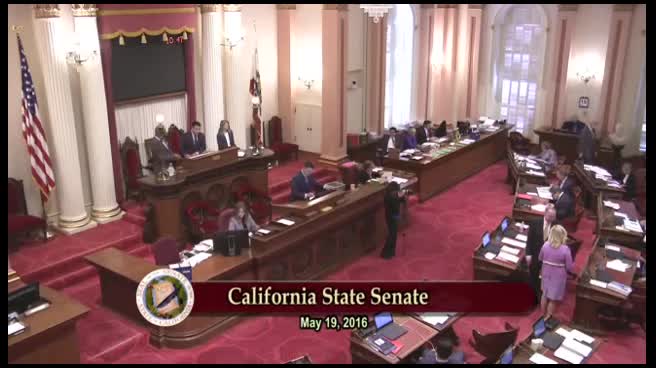 4MIN
Senate Floor
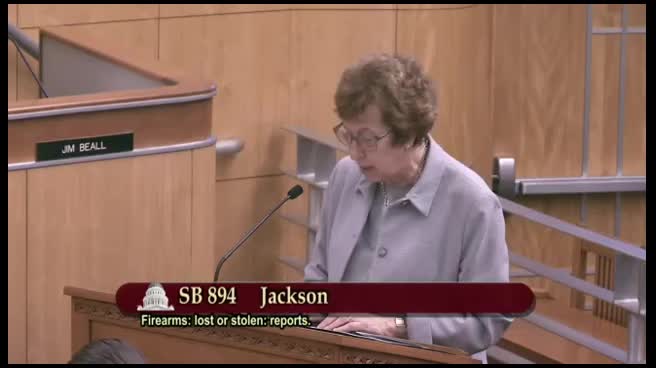 8MIN
Senate Standing Committee on Appropriations
 22MIN
Senate Standing Committee on Public Safety
 40MIN
Senate Standing Committee on Education
Bill Author