SB 1034: Health care coverage: autism.
- Session Year: 2015-2016
- House: Senate
- Latest Version Date: 2016-08-01
Existing law provides for the licensure and regulation of health care service plans by the Department of Managed Health Care. A violation of those provisions is a crime. Existing law provides for the licensure and regulation of health insurers by the Department of Insurance.
Existing law requires every health care service plan contract and health insurance policy to provide coverage for behavioral health treatment for pervasive developmental disorder or autism until January 1, 2017, and defines behavioral health treatment to mean specified services provided by, among others, a qualified autism service professional supervised and employed by a qualified autism service provider. Existing law defines a qualified autism service professional to mean a person who, among other requirements, is a behavior service provider approved as a vendor by a California regional center to provide services as an associate behavior analyst, behavior analyst, behavior management assistant, behavior management consultant, or behavior management program pursuant to specified regulations adopted under the Lanterman Developmental Disabilities Services Act. Existing law requires a treatment plan to be reviewed no less than once every 6 months. Under existing law, the above provisions do not apply to certain types of health care coverage, including health care service plans and health insurance policies in the Medi-Cal program.
This bill would, among other things, modify requirements to be a qualified autism service professional to include providing behavioral health treatment, such as clinical management and case supervision. which may include clinical management and case supervision under the direction and supervision of a qualified autism service provider. The bill would require that a treatment plan be reviewed that, unless a treatment plan is modified by a qualified autism service provider, utilization review be conducted no more than once every 6 months, unless a shorter period is recommended by the qualified autism service provider. months. The bill would also provide that coverage for behavioral health treatment for pervasive developmental disorder or autism would be dependent on medical necessity, subject to utilization review, and required to be in compliance with federal mental health parity requirements. The bill would extend the operation of these provisions to January 1, 2022. The bill would require behavioral health treatment for purposes of the Medi-Cal program to expressly comply with the approved Medicaid state plan. The bill also would make clarifying and conforming changes.
By extending the operation of these provisions, the violation of which by a health care service plan would be a crime, the bill would impose a state-mandated local program.
The California Constitution requires the state to reimburse local agencies and school districts for certain costs mandated by the state. Statutory provisions establish procedures for making that reimbursement.
This bill would provide that no reimbursement is required by this act for a specified reason.
Existing law provides for the licensure and regulation of health care service plans by the Department of Managed Health Care. A violation of those provisions is a crime. Existing law provides for the licensure and regulation of health insurers by the Department of Insurance.
Existing law requires every health care service plan contract and health insurance policy to provide coverage for behavioral health treatment for pervasive developmental disorder or autism until January 1, 2017, and defines behavioral health treatment to mean specified services provided by, among others, a qualified autism service professional supervised and employed by a qualified autism service provider. Existing law defines a qualified autism service professional to mean a person who, among other requirements, is a behavior service provider approved as a vendor by a California regional center to provide services as an associate behavior analyst, behavior analyst, behavior management assistant, behavior management consultant, or behavior management program pursuant to specified regulations adopted under the Lanterman Developmental Disabilities Services Act. Existing law requires a treatment plan to be reviewed no less than once every 6 months. Under existing law, the above provisions do not apply to certain types of health care coverage, including health care service plans and health insurance policies in the Medi-Cal program.
This bill would, among other things, modify requirements to be a qualified autism service professional to include providing behavioral health treatment, such as clinical management and case supervision. The bill would require that a treatment plan be reviewed no more than once every 6 months, unless a shorter period is recommended by the qualified autism service provider. The bill would extend the operation of these provisions indefinitely. to January 1, 2022. The bill would require behavioral health treatment for purposes of the Medi-Cal program to expressly comply with the approved Medicaid state plan. The bill also would make clarifying and conforming changes.
By extending the operation of these provisions, the violation of which by a health care service plan would be a crime, the bill would impose a state-mandated local program.
The California Constitution requires the state to reimburse local agencies and school districts for certain costs mandated by the state. Statutory provisions establish procedures for making that reimbursement.
This bill would provide that no reimbursement is required by this act for a specified reason.
Existing law provides for the licensure and regulation of health care service plans by the Department of Managed Health Care. A violation of those provisions is a crime. Existing law provides for the licensure and regulation of health insurers by the Department of Insurance.
Existing law requires every health care service plan contract and health insurance policy to provide coverage for behavioral health treatment for pervasive developmental disorder or autism until January 1, 2017, and defines behavioral health treatment to mean specified services provided by, among others, a qualified autism service professional supervised and employed by a qualified autism service provider. Existing law defines a qualified autism service professional to mean a person who, among other requirements, is a behavior service provider approved as a vendor by a California regional center to provide services as an associate behavior analyst, behavior analyst, behavior management assistant, behavior management consultant, or behavior management program pursuant to specified regulations adopted under the Lanterman Developmental Disabilities Services Act. Existing law requires a treatment plan to be reviewed no less than once every 6 months.
This bill would, among other things, modify requirements to be a qualified autism service professional to include providing behavioral health treatment, such as clinical management and case supervision. The bill would require that a treatment plan be reviewed no more than once every 6 months, unless a shorter period is recommended by the qualified autism service provider. The bill would extend the operation of these provisions indefinitely. The bill would make conforming changes.
By extending the operation of these provisions, the violation of which by a health care service plan would be a crime, the bill would impose a state-mandated local program.
The California Constitution requires the state to reimburse local agencies and school districts for certain costs mandated by the state. Statutory provisions establish procedures for making that reimbursement.
This bill would provide that no reimbursement is required by this act for a specified reason.
Existing law provides for the licensure and regulation of health care service plans by the Department of Managed Health Care. A violation of those provisions is a crime. Existing law provides for the licensure and regulation of health insurers by the Department of Insurance.
Existing law requires every health care service plan contract and health insurance policy to provide coverage for behavioral health treatment for pervasive developmental disorder or autism until January 1, 2017, and defines behavioral health treatment to mean specified services provided by, among others, a qualified autism service professional supervised and employed by a qualified autism service provider. Existing law defines a qualified autism service professional to mean a person who, among other requirements, is a behavior service provider approved as a vendor by a California regional center to provide services as an associate behavior analyst, behavior analyst, behavior management assistant, behavior management consultant, or behavior management program pursuant to specified regulations adopted under the Lanterman Developmental Disabilities Services Act. Existing law requires a treatment plan to be reviewed no less than once every 6 months.
This bill would, among other things, modify requirements to be a qualified autism service professional to include providing behavioral health treatment, such as clinical management and case supervision. The bill would require that a treatment plan be reviewed no more than once every 6 months, unless a shorter period is recommended by the qualified autism service provider. The bill would extend the operation of these provisions indefinitely. The bill would make conforming changes.
By extending the operation of these provisions, the violation of which by a health care service plan would be a crime, the bill would impose a state-mandated local program.
The California Constitution requires the state to reimburse local agencies and school districts for certain costs mandated by the state. Statutory provisions establish procedures for making that reimbursement.
This bill would provide that no reimbursement is required by this act for a specified reason.
Existing law provides for the licensure and regulation of health care service plans by the Department of Managed Health Care. A violation of those provisions is a crime. Existing law provides for the licensure and regulation of health insurers by the Department of Insurance.
Existing law requires every health care service plan contract and health insurance policy to provide coverage for behavioral health treatment for pervasive developmental disorder or autism until January 1, 2017, and defines behavioral health treatment to mean specified services provided by, among others, a qualified autism service professional supervised and employed by a qualified autism service provider. Existing law defines a qualified autism service professional to mean a person who, among other requirements, is a behavior service provider approved as a vendor by a California regional center to provide services as an associate behavior analyst, behavior analyst, behavior management assistant, behavior management consultant, or behavior management program pursuant to specified regulations adopted under the Lanterman Developmental Disabilities Services Act. Existing law requires a treatment plan to be reviewed no less than once every 6 months.
This bill would, among other things, modify requirements to be a qualified autism service professional to include providing behavioral health treatment, such as clinical management and case supervision. The bill would require that a treatment plan be reviewed no more than once every 6 months, unless a shorter period is recommended by the qualified autism service provider. The bill would extend the operation of these provisions indefinitely. The bill would make conforming changes.
By extending the operation of these provisions, the violation of which by a health care service plan would be a crime, the bill would impose a state-mandated local program.
The California Constitution requires the state to reimburse local agencies and school districts for certain costs mandated by the state. Statutory provisions establish procedures for making that reimbursement.
This bill would provide that no reimbursement is required by this act for a specified reason.
(a)(1)Every health care service plan contract that provides hospital, medical, or surgical coverage shall also provide coverage for behavioral health treatment for pervasive developmental disorder or autism no later than July 1, 2012. The coverage shall be provided in the same manner and shall be subject to the same requirements as provided in Section 1374.72.
(2)Notwithstanding paragraph (1), as of the date that proposed final rulemaking for essential health benefits is issued, (1), this section does not require any benefits to be provided that exceed the essential health benefits that all health plans will be required by federal regulations to provide under Section 1302(b) of the federal Patient Protection and Affordable Care Act (Public Law 111-148), as amended by the federal Health Care and Education Reconciliation Act of 2010 (Public Law 111-152).
(3)This section shall not affect services for which an individual is eligible pursuant to Division 4.5 (commencing with Section 4500) of the Welfare and Institutions Code or Title 14 (commencing with Section 95000) of the Government Code.
(4)This section shall not affect or reduce any obligation to provide services under an individualized education program, as defined in Section 56032 of the Education Code, or an individual service plan, as described in Section 5600.4 of the Welfare and Institutions Code, or under the federal Individuals with Disabilities Education Act (20 U.S.C. Sec. 1400 et seq.) and its implementing regulations.
(5)This section shall not be construed to require a health care service plan to provide reimbursement for services delivered by school personnel pursuant to an enrollees individualized educational program unless otherwise required by law.
(b)Every health care service plan subject to this section shall maintain an adequate network that includes qualified autism service providers who supervise qualified autism service professionals or paraprofessionals who provide and administer behavioral health treatment. Nothing herein shall prevent a health care service plan from selectively contracting with providers within these requirements.
(c)For the purposes of this section, the following definitions shall apply:
(1)Behavioral health treatment means professional services and treatment programs, including applied behavior analysis and other evidence-based behavior intervention programs, that develop, keep, or restore, to the maximum extent practicable, the functioning of an individual with pervasive developmental disorder or autism and that meet all of the following criteria:
(A)The treatment is prescribed by a physician and surgeon licensed pursuant to Chapter 5 (commencing with Section 2000) of, or is developed by a psychologist licensed pursuant to Chapter 6.6 (commencing with Section 2900) of, Division 2 of the Business and Professions Code.
(B)The treatment is provided under a treatment plan prescribed by a qualified autism service provider and is administered by one of the following:
(i)A qualified autism service provider.
(ii)A qualified autism service professional supervised by the qualified autism service provider.
(iii)A qualified autism service paraprofessional supervised by a qualified autism service provider.
(C)The treatment plan has measurable goals over a specific timeline that is developed and approved by the qualified autism service provider for the specific patient being treated. The treatment plan shall be reviewed no more less than once every six months by the qualified autism service provider, unless a shorter period is recommended by the qualified autism service provider, and modified whenever appropriate, and shall be consistent with Section 4686.2 of the Welfare and Institutions Code pursuant to which the qualified autism service provider does all of the following:
(i)Describes the patients behavioral health impairments or developmental challenges that are to be treated.
(ii)Designs an intervention plan that includes Includes the service type, number of hours, and parent or caregiver participation recommended by the qualified autism service provider to achieve the plans goal and objectives, and the frequency at which the patients progress is evaluated and reported. Lack of parent or caregiver participation shall not be used to deny or reduce medically necessary behavioral health treatment. objectives.
(iii)Provides intervention plans that utilize Utilizes evidence-based practices, with demonstrated clinical efficacy in treating pervasive developmental disorder or autism.
(iv)Discontinues intensive behavioral intervention services when the treatment goals and objectives are achieved or no longer appropriate, and continued therapy is not necessary to maintain function or prevent deterioration.
(v)Makes the treatment plan available to the health care service plan upon request.
(D)(i)The treatment plan is not used for purposes of providing or for the reimbursement of respite, day care, or academic services and is not used to reimburse a parent for participating in the treatment program.
(ii)The setting, location, or time of treatment shall not be used as a reason to deny medically necessary behavioral health treatment.
(iii)The treatment plan shall be made available to the health care service plan upon request.
(2)Pervasive developmental disorder or autism shall have the same meaning and interpretation as used in Section 1374.72.
(3)Qualified autism service provider means either of the following:
(A)A person, entity, or group that is certified by a national entity, such as the Behavior Analyst Certification Board, that is accredited by the National Commission for Certifying Agencies, and who designs, supervises, or provides treatment for pervasive developmental disorder or autism, provided the services are within the experience and competence of the person, entity, or group that is nationally certified.
(B)A person licensed as a physician and surgeon, physical therapist, occupational therapist, psychologist, marriage and family therapist, educational psychologist, clinical social worker, professional clinical counselor, speech-language pathologist, or audiologist pursuant to Division 2 (commencing with Section 500) of the Business and Professions Code, who designs, supervises, or provides treatment for pervasive developmental disorder or autism, provided the services are within the experience and competence of the licensee.
(4)Qualified autism service professional means an individual who meets all of the following criteria:
(A)Provides behavioral health treatment, including clinical management and case supervision. treatment, which may include clinical management and case supervision under the direction and supervision of a qualified autism service provider.
(B)Is supervised by a person, entity, or group that is a qualified autism service provider.
(C)Provides treatment pursuant to a treatment plan developed and approved by the qualified autism service provider.
(D)Is a behavioral service provider who meets the education and experience qualifications defined in Section 54342 of Title 17 of the California Code of Regulations for an Associate Behavior Analyst, Behavior Analyst, Behavior Management Assistant, Behavior Management Consultant, or Behavior Management Program.
(E)Has training and experience in providing services for pervasive developmental disorder or autism pursuant to Division 4.5 (commencing with Section 4500) of the Welfare and Institutions Code or Title 14 (commencing with Section 95000) of the Government Code.
(5)Qualified autism service paraprofessional means an unlicensed and uncertified individual who meets all of the following criteria:
(A)Is supervised by a qualified autism service provider. person, entity, or group that is a qualified autism service provider or qualified autism service professional.
(B)Provides treatment and implements services pursuant to a treatment plan developed and approved by the qualified autism service provider or qualified autism service professional.
(C)Meets the education and training qualifications defined in the regulations adopted pursuant to Section 4686.3 of the Welfare and Institutions Code. Section 54342 of Article 3 of Subchapter 2 of Chapter 3 of Division 2 of Title 17 of the California Code of Regulations.
(D)Has adequate education, training, and experience, as certified by a qualified autism service provider.
(d)This section shall not apply to the following:
(1)A specialized health care service plan that does not deliver mental health or behavioral health services to enrollees.
(2)A health care service plan contract in the Medi-Cal program (Chapter 7 (commencing with Section 14000) of Part 3 of Division 9 of the Welfare and Institutions Code). The provision of behavioral health treatment in the Medi-Cal program, including any associated obligation of a health care service plan in the Medi-Cal program, is governed by Section 14132.56 of the Welfare and Institutions Code, the approved Medi-Cal state plan and waivers, and applicable federal Medicaid law.
(e)This section does not limit the obligation to provide services pursuant to Section 1374.72.
(f)As provided in Section 1374.72 and in paragraph (1) of subdivision (a), in the provision of benefits required by this section, a health care service plan may utilize case management, network providers, utilization review techniques, prior authorization, copayments, or other cost sharing.
(1)Unless a treatment plan is modified by a qualified autism service provider, utilization review shall be conducted no more often than every six months and shall be conducted in accordance with good professional practice and consistent with the requirements of Section 1363.5.
(2)The setting, location, or time of treatment recommended by the qualified autism service provider shall not be used as a reason to deny or reduce coverage for medically necessary services.
(3)Lack of parent or caregiver participation shall not be used as the sole basis for denying or reducing coverage of medically necessary services.
(4)Notwithstanding paragraphs (2) and (3), all services shall remain covered only to the extent that the services are medically necessary and subject to utilization review as described in this subdivision.
(5)Provision of services under this section, including any limits on the scope or duration of these services, shall be in compliance with the Paul Wellstone and Pete Domenici Mental Health Parity and Addiction Equity Act of 2008 (Public Law 110-343), and all rules, regulations, or guidance issued pursuant to Section 2726 of the federal Public Health Service Act (42 U.S.C. Sec. 300gg-26).
(g)This section shall not be construed to require coverage for services that are included in a patients an enrollees individualized education program.
(h)This section shall remain in effect only until January 1, 2022, and as of that date is repealed, unless a later enacted statute, that is enacted before January 1, 2022, deletes or extends that date.
SEC. 2.Section 10144.51 of the Insurance Code is amended to read:10144.51.(a)(1)Every health insurance policy shall also provide coverage for behavioral health treatment for pervasive developmental disorder or autism no later than July 1, 2012. The coverage shall be provided in the same manner and shall be subject to the same requirements as provided in Section 10144.5.
(2)Notwithstanding paragraph (1), as of the date that proposed final rulemaking for essential health benefits is issued, (1), this section does not require any benefits to be provided that exceed the essential health benefits that all health insurers will be required by federal regulations to provide under Section 1302(b) of the federal Patient Protection and Affordable Care Act (Public Law 111-148), as amended by the federal Health Care and Education Reconciliation Act of 2010 (Public Law 111-152).
(3)This section shall not affect services for which an individual is eligible pursuant to Division 4.5 (commencing with Section 4500) of the Welfare and Institutions Code or Title 14 (commencing with Section 95000) of the Government Code.
(4)This section shall not affect or reduce any obligation to provide services under an individualized education program, as defined in Section 56032 of the Education Code, or an individual service plan, as described in Section 5600.4 of the Welfare and Institutions Code, or under the federal Individuals with Disabilities Education Act (20 U.S.C. Sec. 1400 et seq.) and its implementing regulations.
(5)This section shall not be construed to require a health insurer to provide reimbursement for services delivered by school personnel pursuant to an insureds individualized educational program unless otherwise required by law.
(b)Pursuant to Article 6 (commencing with Section 2240) of Title 10 of the California Code of Regulations, every health insurer subject to this section shall maintain an adequate network that includes qualified autism service providers who supervise qualified autism service professionals or paraprofessionals who provide and administer behavioral health treatment. Nothing herein shall prevent a health insurer from selectively contracting with providers within these requirements.
(c)For the purposes of this section, the following definitions shall apply:
(1)Behavioral health treatment means professional services and treatment programs, including applied behavior analysis and other evidence-based behavior intervention programs, that develop, keep, or restore, to the maximum extent practicable, the functioning of an individual with pervasive developmental disorder or autism, and that meet all of the following criteria:
(A)The treatment is prescribed by a physician and surgeon licensed pursuant to Chapter 5 (commencing with Section 2000) of, or is developed by a psychologist licensed pursuant to Chapter 6.6 (commencing with Section 2900) of, Division 2 of the Business and Professions Code.
(B)The treatment is provided under a treatment plan prescribed by a qualified autism service provider and is administered by one of the following:
(i)A qualified autism service provider.
(ii)A qualified autism service professional supervised by the qualified autism service provider.
(iii)A qualified autism service paraprofessional supervised by a qualified autism service provider.
(C)The treatment plan has measurable goals over a specific timeline that is developed and approved by the qualified autism service provider for the specific patient being treated. The treatment plan shall be reviewed no more less than once every six months by the qualified autism service provider, unless a shorter period is recommended by the qualified autism service provider, and modified whenever appropriate, and shall be consistent with Section 4686.2 of the Welfare and Institutions Code pursuant to which the qualified autism service provider does all of the following:
(i)Describes the patients behavioral health impairments or developmental challenges that are to be treated.
(ii)Designs an intervention plan that includes Includes the service type, number of hours, and parent or caregiver participation recommended by a qualified autism service provider to achieve the plans goal and objectives, and the frequency at which the patients progress is evaluated and reported. Lack of parent or caregiver participation shall not be used to deny or reduce medically necessary behavioral health treatment. objectives.
(iii)Provides intervention plans that utilize Utilizes evidence-based practices, with demonstrated clinical efficacy in treating pervasive developmental disorder or autism.
(iv)Discontinues intensive behavioral intervention services when the treatment goals and objectives are achieved or no longer appropriate, and continued therapy is not necessary to maintain function or prevent deterioration.
(v)Makes the treatment plan available to the health insurer upon request.
(D)(i)The treatment plan is not used for purposes of providing or for the reimbursement of respite, day care, or academic services and is not used to reimburse a parent for participating in the treatment program.
(ii)The setting, location, or time of treatment shall not be used as a reason to deny medically necessary behavioral health treatment.
(iii)The treatment plan shall be made available to the insurer upon request.
(2)Pervasive developmental disorder or autism shall have the same meaning and interpretation as used in Section 10144.5.
(3)Qualified autism service provider means either of the following:
(A)A person, entity, or group that is certified by a national entity, such as the Behavior Analyst Certification Board, that is accredited by the National Commission for Certifying Agencies, and who designs, supervises, or provides treatment for pervasive developmental disorder or autism, provided the services are within the experience and competence of the person, entity, or group that is nationally certified.
(B)A person licensed as a physician and surgeon, physical therapist, occupational therapist, psychologist, marriage and family therapist, educational psychologist, clinical social worker, professional clinical counselor, speech-language pathologist, or audiologist pursuant to Division 2 (commencing with Section 500) of the Business and Professions Code, who designs, supervises, or provides treatment for pervasive developmental disorder or autism, provided the services are within the experience and competence of the licensee.
(4)Qualified autism service professional means an individual who meets all of the following criteria:
(A)Provides behavioral health treatment, including clinical management and case supervision. treatment, which may include clinical management and case supervision under the direction and supervision of a qualified autism service provider.
(B)Is employed and supervised by a person, entity, or group that is a qualified autism service provider.
(C)Provides treatment pursuant to a treatment plan developed and approved by the qualified autism service provider.
(D)Is a behavioral service provider who meets the education and experience qualifications defined in Section 54342 of Title 17 of the California Code of Regulations for an Associate Behavior Analyst, Behavior Analyst, Behavior Management Assistant, Behavior Management Consultant, or Behavior Management Program.
(E)Has training and experience in providing services for pervasive developmental disorder or autism pursuant to Division 4.5 (commencing with Section 4500) of the Welfare and Institutions Code or Title 14 (commencing with Section 95000) of the Government Code.
(5)Qualified autism service paraprofessional means an unlicensed and uncertified individual who meets all of the following criteria:
(A)Is supervised by a qualified autism service provider. person, entity, or group that is a qualified autism service provider or qualified autism service professional.
(B)Provides treatment and implements services pursuant to a treatment plan developed and approved by the qualified autism service provider or qualified autism service professional.
(C)Meets the education and training qualifications defined in the regulations adopted pursuant to Section 4686.3 of the Welfare and Institutions Code. Section 54342 of Article 3 of Subchapter 2 of Chapter 3 of Division 2 of Title 17 of the California Code of Regulations.
(D)Has adequate education, training, and experience, as certified by a qualified autism service provider.
(d)This section shall not apply to the following:
(1)A specialized health insurance policy that does not cover mental health or behavioral health services or an accident only, specified disease, hospital indemnity, or Medicare supplement policy.
(2)A health insurance policy in the Medi-Cal program (Chapter 7 (commencing with Section 14000) of Part 3 of Division 9 of the Welfare and Institutions Code). The provision of behavioral health treatment in the Medi-Cal program, including any associated obligation of a health insurance policy in the Medi-Cal program, is governed by Section 14132.56 of the Welfare and Institutions Code, the approved Medi-Cal state plan and waivers, and applicable federal Medicaid law.
(e)As provided in Section 10144.5 and in paragraph (1) of subdivision (a), in the provision of benefits required by this section, a health insurer may utilize case management, network providers, utilization review techniques, prior authorization, copayments, or other cost sharing.
(1)Unless a treatment plan is modified by a qualified autism service provider, utilization review shall be conducted no more often than every six months and shall be conducted in accordance with good professional practice and consistent with the requirements of subdivision (f) of Section 10123.135.
(2)The setting, location, or time of treatment recommended by the qualified autism service provider shall not be used as a reason to deny or reduce coverage for medically necessary services.
(3)Lack of parent or caregiver participation shall not be used as the sole basis for denying or reducing coverage of medically necessary services.
(4)Notwithstanding paragraphs (2) and (3), all services shall remain covered only to the extent that the services are medically necessary and subject to utilization review as described in this subdivision.
(5)Provision of services under this section, including any limits on the scope or duration of these services, shall be in compliance with the federal Paul Wellstone and Pete Domenici Mental Health Parity and Addiction Equity Act of 2008 (Public Law 110-343), and all rules, regulations, or guidance issued pursuant to Section 2726 of the federal Public Health Service Act (42 U.S.C. Sec. 300gg-26).
(f)This section shall not be construed to require coverage for services that are included in a patients an insureds individualized education program.
(g)This section shall remain in effect only until January 1, 2022, and as of that date is repealed, unless a later enacted statute, that is enacted before January 1, 2022, deletes or extends that date.
SEC. 3.Section 10144.52 of the Insurance Code is amended to read:10144.52.(a)For purposes of this part, the terms provider, professional provider, network provider, mental health provider, and mental health professional shall include the term qualified autism service provider, as defined in subdivision (c) of Section 10144.51.
(b)This section shall remain in effect only until January 1, 2022, and as of that date is repealed, unless a later enacted statute, that is enacted before January 1, 2022, deletes or extends that date.
SEC. 4.Section 14132.56 of the Welfare and Institutions Code is amended to read:14132.56.(a)(1)Only to the extent required by the federal government and effective no sooner than required by the federal government, behavioral health treatment (BHT) shall be a covered Medi-Cal service for individuals under 21 years of age.
(2)It is the intent of the Legislature that, to the extent the federal government requires BHT to be a covered Medi-Cal service, the department shall seek statutory authority to implement this new benefit in Medi-Cal.
(3)For purposes of this section, behavioral health treatment or BHT means professional services and treatment programs, including applied behavior analysis and evidence-based behavior intervention programs that develop or restore, to the maximum extent practicable, the functioning of an individual with pervasive developmental disorder or autism, and are administered as described in the approved state plan.
(b)The department shall implement, or continue to implement, this section only after all of the following occurs or has occurred:
(1)The department receives all necessary federal approvals to obtain federal funds for the service.
(2)The department seeks an appropriation that would provide the necessary state funding estimated to be required for the applicable fiscal year.
(3)The department consults with stakeholders.
(c)The department shall develop and define eligibility criteria, provider participation criteria, utilization controls, and delivery system structure for services under this section, subject to limitations allowable under federal law, in consultation with stakeholders.
(d)Notwithstanding Chapter 3.5 (commencing with Section 11340) of Part 1 of Division 3 of Title 2 of the Government Code, the department, without taking any further regulatory action, shall implement, interpret, or make specific this section by means of all-county letters, plan letters, plan or provider bulletins, or similar instructions until regulations are adopted. The department shall adopt regulations by July 1, 2017, in accordance with the requirements of Chapter 3.5 (commencing with Section 11340) of Part 1 of Division 3 of Title 2 of the Government Code. Notwithstanding Section 10231.5 of the Government Code, beginning six months after the effective date of this section, the department shall provide semiannual status reports to the Legislature, in compliance with Section 9795 of the Government Code, until regulations have been adopted.
(e)For the purposes of implementing this section, the department may enter into exclusive or nonexclusive contracts on a bid or negotiated basis, including contracts for the purpose of obtaining subject matter expertise or other technical assistance. Contracts may be statewide or on a more limited geographic basis. Contracts entered into or amended under this subdivision shall be exempt from Part 2 (commencing with Section 10100) of Division 2 of the Public Contract Code and Chapter 6 (commencing with Section 14825) of Part 5.5 of Division 3 of the Government Code, and shall be exempt from the review or approval of any division of the Department of General Services.
(f)The department may seek approval of any necessary state plan amendments or waivers to implement this section. The department shall make any state plan amendments or waiver requests public at least 30 days prior to submitting to the federal Centers for Medicare and Medicaid Services, and the department shall work with stakeholders to address the public comments in the state plan amendment or waiver request.
(g)This section shall be implemented only to the extent that federal financial participation is available and any necessary federal approvals have been obtained.
SEC. 4.Section 14132.56 of the Welfare and Institutions Code is amended to read:14132.56.(a)(1)Only to the extent required by the federal government and effective no sooner than required by the federal government, behavioral health treatment (BHT), as defined by Section 1374.73 of the Health and Safety Code, (BHT) shall be a covered Medi-Cal service for individuals under 21 years of age.
(2)It is the intent of the Legislature that, to the extent the federal government requires BHT to be a covered Medi-Cal service, the department shall seek statutory authority to implement this new benefit in Medi-Cal.
(3)For purposes of this section, behavioral health treatment or BHT means professional services and treatment programs, including applied behavior analysis and evidence-based behavior intervention programs that develop or restore, to the maximum extent practicable, the functioning of an individual with pervasive developmental disorder or autism, and are administered as described in the approved state plan.
(b)The department shall implement, or continue to implement, this section only after all of the following occurs or has occurred:
(1)The department receives all necessary federal approvals to obtain federal funds for the service.
(2)The department seeks an appropriation that would provide the necessary state funding estimated to be required for the applicable fiscal year.
(3)The department consults with stakeholders.
(c)The department shall develop and define eligibility criteria, provider participation criteria, utilization controls, and delivery system structure for services under this section, subject to limitations allowable under federal law, in consultation with stakeholders.
(d)(1)The department, commencing on the effective date of the act that added this subdivision until March 31, 2017, inclusive, may make available to individuals described in paragraph (2) contracted services to assist those individuals with health insurance enrollment, without regard to whether federal funds are available for the contracted services.
(2)The contracted services described in paragraph (1) may be provided only to an individual under 21 years of age whom the department identifies as no longer eligible for Medi-Cal solely due to the transition of BHT coverage from the waiver program under Section 1915(c) of the federal Social Security Act to the Medi-Cal state plan in accordance with this section and who meets all of the following criteria:
(A)He or she was enrolled in the home and community-based services waiver for persons with developmental disabilities under Section 1915(c) of the Social Security Act as of January 31, 2016.
(B)He or she was deemed to be institutionalized in order to establish eligibility under the terms of the waiver.
(C)He or she has not been found eligible under any other federally funded Medi-Cal criteria without a share of cost.
(D)He or she had received a BHT service from a regional center for persons with developmental disabilities as provided in Chapter 5 (commencing with Section 4620) of Division 4.5.
(e)Notwithstanding Chapter 3.5 (commencing with Section 11340) of Part 1 of Division 3 of Title 2 of the Government Code, the department, without taking any further regulatory action, shall implement, interpret, or make specific this section by means of all-county letters, plan letters, plan or provider bulletins, or similar instructions until regulations are adopted. The department shall adopt regulations by July 1, 2017, in accordance with the requirements of Chapter 3.5 (commencing with Section 11340) of Part 1 of Division 3 of Title 2 of the Government Code. Notwithstanding Section 10231.5 of the Government Code, beginning six months after the effective date of this section, the department shall provide semiannual status reports to the Legislature, in compliance with Section 9795 of the Government Code, until regulations have been adopted.
(f)For the purposes of implementing this section, the department may enter into exclusive or nonexclusive contracts on a bid or negotiated basis, including contracts for the purpose of obtaining subject matter expertise or other technical assistance. Contracts may be statewide or on a more limited geographic basis. Contracts entered into or amended under this subdivision shall be exempt from Part 2 (commencing with Section 10100) of Division 2 of the Public Contract Code, Section 19130 of the Government Code, and Chapter 6 (commencing with Section 14825) of Part 5.5 of Division 3 of the Government Code, and shall be exempt from the review or approval of any division of the Department of General Services.
(g)The department may seek approval of any necessary state plan amendments or waivers to implement this section. The department shall make any state plan amendments or waiver requests public at least 30 days prior to submitting to the federal Centers for Medicare and Medicaid Services, and the department shall work with stakeholders to address the public comments in the state plan amendment or waiver request.
(h)This section shall be implemented only to the extent that federal financial participation is available and any necessary federal approvals have been obtained.
SEC. 5.No reimbursement is required by this act pursuant to Section 6 of Article XIIIB of the California Constitution because the only costs that may be incurred by a local agency or school district will be incurred because this act creates a new crime or infraction, eliminates a crime or infraction, or changes the penalty for a crime or infraction, within the meaning of Section 17556 of the Government Code, or changes the definition of a crime within the meaning of Section 6 of Article XIIIB of the California Constitution.
(a)(1)Every health care service plan contract that provides hospital, medical, or surgical coverage shall also provide coverage for behavioral health treatment for pervasive developmental disorder or autism no later than July 1, 2012. The coverage shall be provided in the same manner and shall be subject to the same requirements as provided in Section 1374.72.
(2)Notwithstanding paragraph (1), as of the date that proposed final rulemaking for essential health benefits is issued, this section does not require any benefits to be provided that exceed the essential health benefits that all health plans will be required by federal regulations to provide under Section 1302(b) of the federal Patient Protection and Affordable Care Act (Public Law 111-148), as amended by the federal Health Care and Education Reconciliation Act of 2010 (Public Law 111-152).
(3)This section shall not affect services for which an individual is eligible pursuant to Division 4.5 (commencing with Section 4500) of the Welfare and Institutions Code or Title 14 (commencing with Section 95000) of the Government Code.
(4)This section shall not affect or reduce any obligation to provide services under an individualized education program, as defined in Section 56032 of the Education Code, or an individual service plan, as described in Section 5600.4 of the Welfare and Institutions Code, or under the federal Individuals with Disabilities Education Act (20 U.S.C. Sec. 1400 et seq.) and its implementing regulations.
(b)Every health care service plan subject to this section shall maintain an adequate network that includes qualified autism service providers who supervise qualified autism service professionals or paraprofessionals who provide and administer behavioral health treatment. Nothing shall prevent a health care service plan from selectively contracting with providers within these requirements.
(c)For the purposes of this section, the following definitions shall apply:
(1)Behavioral health treatment means professional services and treatment programs, including applied behavior analysis and other evidence-based behavior intervention programs, that develop, keep, or restore, to the maximum extent practicable, the functioning of an individual with pervasive developmental disorder or autism and that meet all of the following criteria:
(A)The treatment is prescribed by a physician and surgeon licensed pursuant to Chapter 5 (commencing with Section 2000) of, or is developed by a psychologist licensed pursuant to Chapter 6.6 (commencing with Section 2900) of, Division 2 of the Business and Professions Code.
(B)The treatment is provided under a treatment plan prescribed by a qualified autism service provider and is administered by one of the following:
(i)A qualified autism service provider.
(ii)A qualified autism service professional supervised by the qualified autism service provider.
(iii)A qualified autism service paraprofessional supervised by a qualified autism service provider.
(C)The treatment plan has measurable goals over a specific timeline that is developed and approved by the qualified autism service provider for the specific patient being treated. The treatment plan shall be reviewed no more than once every six months by the qualified autism service provider, unless a shorter period is recommended by the qualified autism service provider, and modified whenever appropriate, and shall be consistent with Section 4686.2 of the Welfare and Institutions Code pursuant to which the qualified autism service provider does all of the following:
(i)Describes the patients behavioral health impairments or developmental challenges that are to be treated.
(ii)Designs an intervention plan that includes the service type, number of hours, and parent or caregiver participation recommended by the qualified autism service provider to achieve the plans goal and objectives, and the frequency at which the patients progress is evaluated and reported. Lack of parent or caregiver participation shall not be used to deny or reduce medically necessary behavioral health treatment.
(iii)Provides intervention plans that utilize evidence-based practices, with demonstrated clinical efficacy in treating pervasive developmental disorder or autism.
(iv)Discontinues intensive behavioral intervention services when the treatment goals and objectives are achieved or no longer appropriate, and continued therapy is not necessary to maintain function or prevent deterioration.
(D)(i)The treatment plan is not used for purposes of providing or for the reimbursement of respite, day care, or academic services and is not used to reimburse a parent for participating in the treatment program.
(ii)The setting, location, or time of treatment shall not be used as a reason to deny medically necessary behavioral health treatment.
(iii)The treatment plan shall be made available to the health care service plan upon request.
(2)Pervasive developmental disorder or autism shall have the same meaning and interpretation as used in Section 1374.72.
(3)Qualified autism service provider means either of the following:
(A)A person, entity, or group that is certified by a national entity, such as the Behavior Analyst Certification Board, that is accredited by the National Commission for Certifying Agencies, and who designs, supervises, or provides treatment for pervasive developmental disorder or autism, provided the services are within the experience and competence of the person, entity, or group that is nationally certified.
(B)A person licensed as a physician and surgeon, physical therapist, occupational therapist, psychologist, marriage and family therapist, educational psychologist, clinical social worker, professional clinical counselor, speech-language pathologist, or audiologist pursuant to Division 2 (commencing with Section 500) of the Business and Professions Code, who designs, supervises, or provides treatment for pervasive developmental disorder or autism, provided the services are within the experience and competence of the licensee.
(4)Qualified autism service professional means an individual who meets all of the following criteria:
(A)Provides behavioral health treatment, including clinical management and case supervision.
(B)Is supervised by a qualified autism service provider.
(C)Provides treatment pursuant to a treatment plan developed and approved by the qualified autism service provider.
(D)Is a behavioral service provider who meets the education and experience qualifications defined in Section 54342 of Title 17 of the California Code of Regulations for an Associate Behavior Analyst, Behavior Analyst, Behavior Management Assistant, Behavior Management Consultant, or Behavior Management Program.
(E)Has training and experience in providing services for pervasive developmental disorder or autism pursuant to Division 4.5 (commencing with Section 4500) of the Welfare and Institutions Code or Title 14 (commencing with Section 95000) of the Government Code.
(5)Qualified autism service paraprofessional means an unlicensed and uncertified individual who meets all of the following criteria:
(A)Is supervised by a qualified autism service provider.
(B)Provides treatment and implements services pursuant to a treatment plan developed and approved by the qualified autism service provider or qualified autism service professional.
(C)Meets the education and training qualifications defined in the regulations adopted pursuant to Section 4686.3 of the Welfare and Institutions Code.
(D)Has adequate education, training, and experience, as certified by a qualified autism service provider.
(d)This section shall not apply to the following:
(1)A specialized health care service plan that does not deliver mental health or behavioral health services to enrollees.
(2)A health care service plan contract in the Medi-Cal program (Chapter 7 (commencing with Section 14000) of Part 3 of Division 9 of the Welfare and Institutions Code). The provision of behavioral health treatment in the Medi-Cal program, including any associated obligation of a health care service plan in the Medi-Cal program, is governed by Section 14132.56 of the Welfare and Institutions Code, the approved Medi-Cal state plan and waivers, and applicable federal Medicaid law.
(e)This section does not limit the obligation to provide services pursuant to Section 1374.72.
(f)As provided in Section 1374.72 and in paragraph (1) of subdivision (a), in the provision of benefits required by this section, a health care service plan may utilize case management, network providers, utilization review techniques, prior authorization, copayments, or other cost sharing.
(g)This section shall not be construed to require coverage for services that are included in a patients individualized education program.
(h)This section shall remain in effect only until January 1, 2022, and as of that date is repealed, unless a later enacted statute, that is enacted before January 1, 2022, deletes or extends that date.
SEC. 2.Section 10144.51 of the Insurance Code is amended to read:10144.51.(a)(1)Every health insurance policy shall also provide coverage for behavioral health treatment for pervasive developmental disorder or autism no later than July 1, 2012. The coverage shall be provided in the same manner and shall be subject to the same requirements as provided in Section 10144.5.
(2)Notwithstanding paragraph (1), as of the date that proposed final rulemaking for essential health benefits is issued, this section does not require any benefits to be provided that exceed the essential health benefits that all health insurers will be required by federal regulations to provide under Section 1302(b) of the federal Patient Protection and Affordable Care Act (Public Law 111-148), as amended by the federal Health Care and Education Reconciliation Act of 2010 (Public Law 111-152).
(3)This section shall not affect services for which an individual is eligible pursuant to Division 4.5 (commencing with Section 4500) of the Welfare and Institutions Code or Title 14 (commencing with Section 95000) of the Government Code.
(4)This section shall not affect or reduce any obligation to provide services under an individualized education program, as defined in Section 56032 of the Education Code, or an individual service plan, as described in Section 5600.4 of the Welfare and Institutions Code, or under the federal Individuals with Disabilities Education Act (20 U.S.C. Sec. 1400 et seq.) and its implementing regulations.
(b)Pursuant to Article 6 (commencing with Section 2240) of Title 10 of the California Code of Regulations, every health insurer subject to this section shall maintain an adequate network that includes qualified autism service providers who supervise qualified autism service professionals or paraprofessionals who provide and administer behavioral health treatment. Nothing shall prevent a health insurer from selectively contracting with providers within these requirements.
(c)For the purposes of this section, the following definitions shall apply:
(1)Behavioral health treatment means professional services and treatment programs, including applied behavior analysis and other evidence-based behavior intervention programs, that develop, keep, or restore, to the maximum extent practicable, the functioning of an individual with pervasive developmental disorder or autism, and that meet all of the following criteria:
(A)The treatment is prescribed by a physician and surgeon licensed pursuant to Chapter 5 (commencing with Section 2000) of, or is developed by a psychologist licensed pursuant to Chapter 6.6 (commencing with Section 2900) of, Division 2 of the Business and Professions Code.
(B)The treatment is provided under a treatment plan prescribed by a qualified autism service provider and is administered by one of the following:
(i)A qualified autism service provider.
(ii)A qualified autism service professional supervised by the qualified autism service provider.
(iii)A qualified autism service paraprofessional supervised by a qualified autism service provider.
(C)The treatment plan has measurable goals over a specific timeline that is developed and approved by the qualified autism service provider for the specific patient being treated. The treatment plan shall be reviewed no more than once every six months by the qualified autism service provider, unless a shorter period is recommended by the qualified autism service provider, and modified whenever appropriate, and shall be consistent with Section 4686.2 of the Welfare and Institutions Code pursuant to which the qualified autism service provider does all of the following:
(i)Describes the patients behavioral health impairments or developmental challenges that are to be treated.
(ii)Designs an intervention plan that includes the service type, number of hours, and parent or caregiver participation recommended by a qualified autism service provider to achieve the plans goal and objectives, and the frequency at which the patients progress is evaluated and reported. Lack of parent or caregiver participation shall not be used to deny or reduce medically necessary behavioral health treatment.
(iii)Provides intervention plans that utilize evidence-based practices, with demonstrated clinical efficacy in treating pervasive developmental disorder or autism.
(iv)Discontinues intensive behavioral intervention services when the treatment goals and objectives are achieved or no longer appropriate, and continued therapy is not necessary to maintain function or prevent deterioration.
(D)(i)The treatment plan is not used for purposes of providing or for the reimbursement of respite, day care, or academic services and is not used to reimburse a parent for participating in the treatment program.
(ii)The setting, location, or time of treatment shall not be used as a reason to deny medically necessary behavioral health treatment.
(iii)The treatment plan shall be made available to the insurer upon request.
(2)Pervasive developmental disorder or autism shall have the same meaning and interpretation as used in Section 10144.5.
(3)Qualified autism service provider means either of the following:
(A)A person, entity, or group that is certified by a national entity, such as the Behavior Analyst Certification Board, that is accredited by the National Commission for Certifying Agencies, and who designs, supervises, or provides treatment for pervasive developmental disorder or autism, provided the services are within the experience and competence of the person, entity, or group that is nationally certified.
(B)A person licensed as a physician and surgeon, physical therapist, occupational therapist, psychologist, marriage and family therapist, educational psychologist, clinical social worker, professional clinical counselor, speech-language pathologist, or audiologist pursuant to Division 2 (commencing with Section 500) of the Business and Professions Code, who designs, supervises, or provides treatment for pervasive developmental disorder or autism, provided the services are within the experience and competence of the licensee.
(4)Qualified autism service professional means an individual who meets all of the following criteria:
(A)Provides behavioral health treatment, including clinical management and case supervision.
(B)Is employed and supervised by a qualified autism service provider.
(C)Provides treatment pursuant to a treatment plan developed and approved by the qualified autism service provider.
(D)Is a behavioral service provider who meets the education and experience qualifications defined in Section 54342 of Title 17 of the California Code of Regulations for an Associate Behavior Analyst, Behavior Analyst, Behavior Management Assistant, Behavior Management Consultant, or Behavior Management Program.
(E)Has training and experience in providing services for pervasive developmental disorder or autism pursuant to Division 4.5 (commencing with Section 4500) of the Welfare and Institutions Code or Title 14 (commencing with Section 95000) of the Government Code.
(5)Qualified autism service paraprofessional means an unlicensed and uncertified individual who meets all of the following criteria:
(A)Is supervised by a qualified autism service provider.
(B)Provides treatment and implements services pursuant to a treatment plan developed and approved by the qualified autism service provider or qualified autism service professional.
(C)Meets the education and training qualifications defined in the regulations adopted pursuant to Section 4686.3 of the Welfare and Institutions Code.
(D)Has adequate education, training, and experience, as certified by a qualified autism service provider.
(d)This section shall not apply to the following:
(1)A specialized health insurance policy that does not cover mental health or behavioral health services or an accident only, specified disease, hospital indemnity, or Medicare supplement policy.
(2)A health insurance policy in the Medi-Cal program (Chapter 7 (commencing with Section 14000) of Part 3 of Division 9 of the Welfare and Institutions Code). The provision of behavioral health treatment in the Medi-Cal program, including any associated obligation of a health insurance policy in the Medi-Cal program, is governed by Section 14132.56 of the Welfare and Institutions Code, the approved Medi-Cal state plan and waivers, and applicable federal Medicaid law.
(e)As provided in Section 10144.5 and in paragraph (1) of subdivision (a), in the provision of benefits required by this section, a health insurer may utilize case management, network providers, utilization review techniques, prior authorization, copayments, or other cost sharing.
(f)This section shall not be construed to require coverage for services that are included in a patients individualized education program.
(g)This section shall remain in effect only until January 1, 2022, and as of that date is repealed, unless a later enacted statute, that is enacted before January 1, 2022, deletes or extends that date.
SEC. 3.Section 10144.52 of the Insurance Code is amended to read:10144.52.For (a)For purposes of this part, the terms provider, professional provider, network provider, mental health provider, and mental health professional shall include the term qualified autism service provider, as defined in subdivision (c) of Section 10144.51.
(b)This section shall remain in effect only until January 1, 2022, and as of that date is repealed, unless a later enacted statute, that is enacted before January 1, 2022, deletes or extends that date.
SEC. 4.Section 14132.56 of the Welfare and Institutions Code is amended to read:14132.56.(a)(1)Only to the extent required by the federal government and effective no sooner than required by the federal government, behavioral health treatment (BHT), as defined by Section 1374.73 of the Health and Safety Code, (BHT) shall be a covered Medi-Cal service for individuals under 21 years of age.
(2)It is the intent of the Legislature that, to the extent the federal government requires BHT to be a covered Medi-Cal service, the department shall seek statutory authority to implement this new benefit in Medi-Cal.
(3)For purposes of this section, behavioral health treatment or BHT means professional services and treatment programs, including applied behavior analysis and evidence-based behavior intervention programs that develop or restore, to the maximum extent practicable, the functioning of an individual with pervasive developmental disorder or autism, and are administered as described in the approved state plan.
(b)The department shall implement, or continue to implement, this section only after all of the following occurs or has occurred:
(1)The department receives all necessary federal approvals to obtain federal funds for the service.
(2)The department seeks an appropriation that would provide the necessary state funding estimated to be required for the applicable fiscal year.
(3)The department consults with stakeholders.
(c)The department shall develop and define eligibility criteria, provider participation criteria, utilization controls, and delivery system structure for services under this section, subject to limitations allowable under federal law, in consultation with stakeholders.
(d)Notwithstanding Chapter 3.5 (commencing with Section 11340) of Part 1 of Division 3 of Title 2 of the Government Code, the department, without taking any further regulatory action, shall implement, interpret, or make specific this section by means of all-county letters, plan letters, plan or provider bulletins, or similar instructions until regulations are adopted. The department shall adopt regulations by July 1, 2017, in accordance with the requirements of Chapter 3.5 (commencing with Section 11340) of Part 1 of Division 3 of Title 2 of the Government Code. Notwithstanding Section 10231.5 of the Government Code, beginning six months after the effective date of this section, the department shall provide semiannual status reports to the Legislature, in compliance with Section 9795 of the Government Code, until regulations have been adopted.
(e)For the purposes of implementing this section, the department may enter into exclusive or nonexclusive contracts on a bid or negotiated basis, including contracts for the purpose of obtaining subject matter expertise or other technical assistance. Contracts may be statewide or on a more limited geographic basis. Contracts entered into or amended under this subdivision shall be exempt from Part 2 (commencing with Section 10100) of Division 2 of the Public Contract Code and Chapter 6 (commencing with Section 14825) of Part 5.5 of Division 3 of the Government Code, and shall be exempt from the review or approval of any division of the Department of General Services.
(f)The department may seek approval of any necessary state plan amendments or waivers to implement this section. The department shall make any state plan amendments or waiver requests public at least 30 days prior to submitting to the federal Centers for Medicare and Medicaid Services, and the department shall work with stakeholders to address the public comments in the state plan amendment or waiver request.
(g)This section shall be implemented only to the extent that federal financial participation is available and any necessary federal approvals have been obtained.
SEC. 4.SEC. 5.No reimbursement is required by this act pursuant to Section 6 of Article XIIIB of the California Constitution because the only costs that may be incurred by a local agency or school district will be incurred because this act creates a new crime or infraction, eliminates a crime or infraction, or changes the penalty for a crime or infraction, within the meaning of Section 17556 of the Government Code, or changes the definition of a crime within the meaning of Section 6 of Article XIIIB of the California Constitution.
(a)(1)Every health care service plan contract that provides hospital, medical, or surgical coverage shall also provide coverage for behavioral health treatment for pervasive developmental disorder or autism no later than July 1, 2012. The coverage shall be provided in the same manner and shall be subject to the same requirements as provided in Section 1374.72.
(2)Notwithstanding paragraph (1), as of the date that proposed final rulemaking for essential health benefits is issued, this section does not require any benefits to be provided that exceed the essential health benefits that all health plans will be required by federal regulations to provide under Section 1302(b) of the federal Patient Protection and Affordable Care Act (Public Law 111-148), as amended by the federal Health Care and Education Reconciliation Act of 2010 (Public Law 111-152).
(3)This section shall not affect services for which an individual is eligible pursuant to Division 4.5 (commencing with Section 4500) of the Welfare and Institutions Code or Title 14 (commencing with Section 95000) of the Government Code.
(4)This section shall not affect or reduce any obligation to provide services under an individualized education program, as defined in Section 56032 of the Education Code, or an individual service plan, as described in Section 5600.4 of the Welfare and Institutions Code, or under the federal Individuals with Disabilities Education Act (20 U.S.C. Sec. 1400 et seq.) and its implementing regulations.
(b)Every health care service plan subject to this section shall maintain an adequate network that includes qualified autism service providers who supervise qualified autism service professionals or paraprofessionals who provide and administer behavioral health treatment. Nothing shall prevent a health care service plan from selectively contracting with providers within these requirements.
(c)For the purposes of this section, the following definitions shall apply:
(1)Behavioral health treatment means professional services and treatment programs, including applied behavior analysis and other evidence-based behavior intervention programs, that develop, keep, or restore, to the maximum extent practicable, the functioning of an individual with pervasive developmental disorder or autism and that meet all of the following criteria:
(A)The treatment is prescribed by a physician and surgeon licensed pursuant to Chapter 5 (commencing with Section 2000) of, or is developed by a psychologist licensed pursuant to Chapter 6.6 (commencing with Section 2900) of, Division 2 of the Business and Professions Code.
(B)The treatment is provided under a treatment plan prescribed by a qualified autism service provider and is administered by one of the following:
(i)A qualified autism service provider.
(ii)A qualified autism service professional supervised by the qualified autism service provider.
(iii)A qualified autism service paraprofessional supervised by a qualified autism service provider.
(C)The treatment plan has measurable goals over a specific timeline that is developed and approved by the qualified autism service provider for the specific patient being treated. The treatment plan shall be reviewed no more than once every six months by the qualified autism service provider, unless a shorter period is recommended by the qualified autism service provider, and modified whenever appropriate, and shall be consistent with Section 4686.2 of the Welfare and Institutions Code pursuant to which the qualified autism service provider does all of the following:
(i)Describes the patients behavioral health impairments or developmental challenges that are to be treated.
(ii)Designs an intervention plan that includes the service type, number of hours, and parent or caregiver participation recommended by the qualified autism service provider to achieve the plans goal and objectives, and the frequency at which the patients progress is evaluated and reported. Lack of parent or caregiver participation shall not be used to deny or reduce medically necessary behavioral health treatment.
(iii)Provides intervention plans that utilize evidence-based practices, with demonstrated clinical efficacy in treating pervasive developmental disorder or autism.
(iv)Discontinues intensive behavioral intervention services when the treatment goals and objectives are achieved or no longer appropriate, and continued therapy is not necessary to maintain function or prevent deterioration.
(D)(i)The treatment plan is not used for purposes of providing or for the reimbursement of respite, day care, or academic services and is not used to reimburse a parent for participating in the treatment program.
(ii)The setting, location, or time of treatment shall not be used as a reason to deny medically necessary behavioral health treatment.
(iii)The treatment plan shall be made available to the health care service plan upon request.
(2)Pervasive developmental disorder or autism shall have the same meaning and interpretation as used in Section 1374.72.
(3)Qualified autism service provider means either of the following:
(A)A person, entity, or group that is certified by a national entity, such as the Behavior Analyst Certification Board, that is accredited by the National Commission for Certifying Agencies, and who designs, supervises, or provides treatment for pervasive developmental disorder or autism, provided the services are within the experience and competence of the person, entity, or group that is nationally certified.
(B)A person licensed as a physician and surgeon, physical therapist, occupational therapist, psychologist, marriage and family therapist, educational psychologist, clinical social worker, professional clinical counselor, speech-language pathologist, or audiologist pursuant to Division 2 (commencing with Section 500) of the Business and Professions Code, who designs, supervises, or provides treatment for pervasive developmental disorder or autism, provided the services are within the experience and competence of the licensee.
(4)Qualified autism service professional means an individual who meets all of the following criteria:
(A)Provides behavioral health treatment, including clinical management and case supervision.
(B)Is supervised by a qualified autism service provider.
(C)Provides treatment pursuant to a treatment plan developed and approved by the qualified autism service provider.
(D)Is a behavioral service provider who meets the education and experience qualifications defined in Section 54342 of Title 17 of the California Code of Regulations for an Associate Behavior Analyst, Behavior Analyst, Behavior Management Assistant, Behavior Management Consultant, or Behavior Management Program.
(E)Has training and experience in providing services for pervasive developmental disorder or autism pursuant to Division 4.5 (commencing with Section 4500) of the Welfare and Institutions Code or Title 14 (commencing with Section 95000) of the Government Code.
(5)Qualified autism service paraprofessional means an unlicensed and uncertified individual who meets all of the following criteria:
(A)Is supervised by a qualified autism service provider.
(B)Provides treatment and implements services pursuant to a treatment plan developed and approved by the qualified autism service provider or qualified autism service professional.
(C)Meets the education and training qualifications defined in the regulations adopted pursuant to Section 4686.3 of the Welfare and Institutions Code.
(D)Has adequate education, training, and experience, as certified by a qualified autism service provider.
(d)This section shall not apply to the following:
(1)A specialized health care service plan that does not deliver mental health or behavioral health services to enrollees.
(2)A health care service plan contract in the Medi-Cal program (Chapter 7 (commencing with Section 14000) of Part 3 of Division 9 of the Welfare and Institutions Code).
(e)This section does not limit the obligation to provide services pursuant to Section 1374.72.
(f)As provided in Section 1374.72 and in paragraph (1) of subdivision (a), in the provision of benefits required by this section, a health care service plan may utilize case management, network providers, utilization review techniques, prior authorization, copayments, or other cost sharing.
(g)This section shall not be construed to require coverage for services that are included in a patients individualized education program.
SEC. 2.Section 10144.51 of the Insurance Code is amended to read:10144.51.(a)(1)Every health insurance policy shall also provide coverage for behavioral health treatment for pervasive developmental disorder or autism no later than July 1, 2012. The coverage shall be provided in the same manner and shall be subject to the same requirements as provided in Section 10144.5.
(2)Notwithstanding paragraph (1), as of the date that proposed final rulemaking for essential health benefits is issued, this section does not require any benefits to be provided that exceed the essential health benefits that all health insurers will be required by federal regulations to provide under Section 1302(b) of the federal Patient Protection and Affordable Care Act (Public Law 111-148), as amended by the federal Health Care and Education Reconciliation Act of 2010 (Public Law 111-152).
(3)This section shall not affect services for which an individual is eligible pursuant to Division 4.5 (commencing with Section 4500) of the Welfare and Institutions Code or Title 14 (commencing with Section 95000) of the Government Code.
(4)This section shall not affect or reduce any obligation to provide services under an individualized education program, as defined in Section 56032 of the Education Code, or an individual service plan, as described in Section 5600.4 of the Welfare and Institutions Code, or under the federal Individuals with Disabilities Education Act (20 U.S.C. Sec. 1400 et seq.) and its implementing regulations.
(b)Pursuant to Article 6 (commencing with Section 2240) of Title 10 of the California Code of Regulations, every health insurer subject to this section shall maintain an adequate network that includes qualified autism service providers who supervise qualified autism service professionals or paraprofessionals who provide and administer behavioral health treatment. Nothing shall prevent a health insurer from selectively contracting with providers within these requirements.
(c)For the purposes of this section, the following definitions shall apply:
(1)Behavioral health treatment means professional services and treatment programs, including applied behavior analysis and other evidence-based behavior intervention programs, that develop, keep, or restore, to the maximum extent practicable, the functioning of an individual with pervasive developmental disorder or autism, and that meet all of the following criteria:
(A)The treatment is prescribed by a physician and surgeon licensed pursuant to Chapter 5 (commencing with Section 2000) of, or is developed by a psychologist licensed pursuant to Chapter 6.6 (commencing with Section 2900) of, Division 2 of the Business and Professions Code.
(B)The treatment is provided under a treatment plan prescribed by a qualified autism service provider and is administered by one of the following:
(i)A qualified autism service provider.
(ii)A qualified autism service professional supervised by the qualified autism service provider.
(iii)A qualified autism service paraprofessional supervised by a qualified autism service provider.
(C)The treatment plan has measurable goals over a specific timeline that is developed and approved by the qualified autism service provider for the specific patient being treated. The treatment plan shall be reviewed no more than once every six months by the qualified autism service provider, unless a shorter period is recommended by the qualified autism service provider, and modified whenever appropriate, and shall be consistent with Section 4686.2 of the Welfare and Institutions Code pursuant to which the qualified autism service provider does all of the following:
(i)Describes the patients behavioral health impairments or developmental challenges that are to be treated.
(ii)Designs an intervention plan that includes the service type, number of hours, and parent or caregiver participation recommended by a qualified autism service provider to achieve the plans goal and objectives, and the frequency at which the patients progress is evaluated and reported. Lack of parent or caregiver participation shall not be used to deny or reduce medically necessary behavioral health treatment.
(iii)Provides intervention plans that utilize evidence-based practices, with demonstrated clinical efficacy in treating pervasive developmental disorder or autism.
(iv)Discontinues intensive behavioral intervention services when the treatment goals and objectives are achieved or no longer appropriate, and continued therapy is not necessary to maintain function or prevent deterioration.
(D)(i)The treatment plan is not used for purposes of providing or for the reimbursement of respite, day care, or academic services and is not used to reimburse a parent for participating in the treatment program.
(ii)The setting, location, or time of treatment shall not be used as a reason to deny medically necessary behavioral health treatment.
(iii)The treatment plan shall be made available to the insurer upon request.
(2)Pervasive developmental disorder or autism shall have the same meaning and interpretation as used in Section 10144.5.
(3)Qualified autism service provider means either of the following:
(A)A person, entity, or group that is certified by a national entity, such as the Behavior Analyst Certification Board, that is accredited by the National Commission for Certifying Agencies, and who designs, supervises, or provides treatment for pervasive developmental disorder or autism, provided the services are within the experience and competence of the person, entity, or group that is nationally certified.
(B)A person licensed as a physician and surgeon, physical therapist, occupational therapist, psychologist, marriage and family therapist, educational psychologist, clinical social worker, professional clinical counselor, speech-language pathologist, or audiologist pursuant to Division 2 (commencing with Section 500) of the Business and Professions Code, who designs, supervises, or provides treatment for pervasive developmental disorder or autism, provided the services are within the experience and competence of the licensee.
(4)Qualified autism service professional means an individual who meets all of the following criteria:
(A)Provides behavioral health treatment, including clinical management and case supervision.
(B)Is employed and supervised by a qualified autism service provider.
(C)Provides treatment pursuant to a treatment plan developed and approved by the qualified autism service provider.
(D)Is a behavioral service provider who meets the education and experience qualifications defined in Section 54342 of Title 17 of the California Code of Regulations for an Associate Behavior Analyst, Behavior Analyst, Behavior Management Assistant, Behavior Management Consultant, or Behavior Management Program.
(E)Has training and experience in providing services for pervasive developmental disorder or autism pursuant to Division 4.5 (commencing with Section 4500) of the Welfare and Institutions Code or Title 14 (commencing with Section 95000) of the Government Code.
(5)Qualified autism service paraprofessional means an unlicensed and uncertified individual who meets all of the following criteria:
(A)Is supervised by a qualified autism service provider.
(B)Provides treatment and implements services pursuant to a treatment plan developed and approved by the qualified autism service provider or qualified autism service professional.
(C)Meets the education and training qualifications defined in the regulations adopted pursuant to Section 4686.3 of the Welfare and Institutions Code.
(D)Has adequate education, training, and experience, as certified by a qualified autism service provider.
(d)This section shall not apply to the following:
(1)A specialized health insurance policy that does not cover mental health or behavioral health services or an accident only, specified disease, hospital indemnity, or Medicare supplement policy.
(2)A health insurance policy in the Medi-Cal program (Chapter 7 (commencing with Section 14000) of Part 3 of Division 9 of the Welfare and Institutions Code).
(e)As provided in Section 10144.5 and in paragraph (1) of subdivision (a), in the provision of benefits required by this section, a health insurer may utilize case management, network providers, utilization review techniques, prior authorization, copayments, or other cost sharing.
(f)This section shall not be construed to require coverage for services that are included in a patients individualized education program.
SEC. 3.Section 10144.52 of the Insurance Code is amended to read:10144.52.For purposes of this part, the terms provider, professional provider, network provider, mental health provider, and mental health professional shall include the term qualified autism service provider, as defined in subdivision (c) of Section 10144.51.
SEC. 4.No reimbursement is required by this act pursuant to Section 6 of Article XIIIB of the California Constitution because the only costs that may be incurred by a local agency or school district will be incurred because this act creates a new crime or infraction, eliminates a crime or infraction, or changes the penalty for a crime or infraction, within the meaning of Section 17556 of the Government Code, or changes the definition of a crime within the meaning of Section 6 of Article XIIIB of the California Constitution.
(a)(1)Every health care service plan contract that provides hospital, medical, or surgical coverage shall also provide coverage for behavioral health treatment for pervasive developmental disorder or autism no later than July 1, 2012. The coverage shall be provided in the same manner and shall be subject to the same requirements as provided in Section 1374.72.
(2)Notwithstanding paragraph (1), as of the date that proposed final rulemaking for essential health benefits is issued, this section does not require any benefits to be provided that exceed the essential health benefits that all health plans will be required by federal regulations to provide under Section 1302(b) of the federal Patient Protection and Affordable Care Act (Public Law 111-148), as amended by the federal Health Care and Education Reconciliation Act of 2010 (Public Law 111-152).
(3)This section shall not affect services for which an individual is eligible pursuant to Division 4.5 (commencing with Section 4500) of the Welfare and Institutions Code or Title 14 (commencing with Section 95000) of the Government Code.
(4)This section shall not affect or reduce any obligation to provide services under an individualized education program, as defined in Section 56032 of the Education Code, or an individual service plan, as described in Section 5600.4 of the Welfare and Institutions Code, or under the federal Individuals with Disabilities Education Act (20 U.S.C. Sec. 1400 et seq.) and its implementing regulations.
(b)Every health care service plan subject to this section shall maintain an adequate network that includes qualified autism service providers who supervise qualified autism service professionals or paraprofessionals who provide and administer behavioral health treatment. Nothing shall prevent a health care service plan from selectively contracting with providers within these requirements.
(c)For the purposes of this section, the following definitions shall apply:
(1)Behavioral health treatment means professional services and treatment programs, including applied behavior analysis and other evidence-based behavior intervention programs, that develop, maintain, keep, or restore, to the maximum extent practicable, the functioning of an individual with pervasive developmental disorder or autism and that meet all of the following criteria:
(A)The treatment is prescribed by a physician and surgeon licensed pursuant to Chapter 5 (commencing with Section 2000) of, or is developed by a psychologist licensed pursuant to Chapter 6.6 (commencing with Section 2900) of, Division 2 of the Business and Professions Code.
(B)The treatment is provided under a treatment plan prescribed by a qualified autism service provider and is administered by one of the following:
(i)A qualified autism service provider.
(ii)A qualified autism service professional supervised by the qualified autism service provider.
(iii)A qualified autism service paraprofessional supervised by a qualified autism service provider.
(C)The treatment plan has measurable goals over a specific timeline that is developed and approved by the qualified autism service provider for the specific patient being treated. The treatment plan shall be reviewed no more than once every six months by the qualified autism service provider, unless a shorter period is recommended by the qualified autism service provider, and modified whenever appropriate, and shall be consistent with Section 4686.2 of the Welfare and Institutions Code pursuant to which the qualified autism service provider does all of the following:
(i)Describes the patients behavioral health impairments or developmental challenges that are to be treated.
(ii)Designs an intervention plan that includes the service type, number of hours, and parent or caregiver participation recommended by the qualified autism service provider, needed provider to achieve the plans goal and objectives, and the frequency at which the patients progress is evaluated and reported. Lack of parent or caregiver participation shall not be used to deny or reduce medically necessary behavioral health treatment.
(iii)Provides intervention plans that utilize evidence-based practices, with demonstrated clinical efficacy in treating pervasive developmental disorder or autism.
(iv)Discontinues intensive behavioral intervention services when the treatment goals and objectives are achieved or no longer appropriate, and continued therapy is not necessary to maintain function or prevent deterioration.
(D)(i)The treatment plan is not used for purposes of providing or for the reimbursement of respite, day care, or educational academic services and is not used to reimburse a parent for participating in the treatment program.
(ii)Notwithstanding the clause (i), all medically necessary behavioral health treatment shall be covered in all settings regardless of time or location of delivery.
(ii)The setting, location, or time of treatment shall not be used as a reason to deny medically necessary behavioral health treatment.
(iii)The treatment plan shall be made available to the health care service plan upon request.
(2)Pervasive developmental disorder or autism shall have the same meaning and interpretation as used in Section 1374.72.
(3)Qualified autism service provider means either of the following:
(A)A person, entity, or group that is certified by a national entity, such as the Behavior Analyst Certification Board, that is accredited by the National Commission for Certifying Agencies, and who designs, supervises, or provides treatment for pervasive developmental disorder or autism, provided the services are within the experience and competence of the person, entity, or group that is nationally certified.
(B)A person licensed as a physician and surgeon, physical therapist, occupational therapist, psychologist, marriage and family therapist, educational psychologist, clinical social worker, professional clinical counselor, speech-language pathologist, or audiologist pursuant to Division 2 (commencing with Section 500) of the Business and Professions Code, who designs, supervises, or provides treatment for pervasive developmental disorder or autism, provided the services are within the experience and competence of the licensee.
(4)Qualified autism service professional means an individual who meets all of the following criteria:
(A)Provides behavioral health treatment, including clinical management and case supervision.
(B)Is supervised by a qualified autism service provider.
(C)Provides treatment pursuant to a treatment plan developed and approved by the qualified autism service provider.
(D)Is a behavioral service provider who meets the education and experience qualifications defined in Section 5432 54342 of Title 17 of the California Code of Regulations for an Associate Behavior Analyst, Behavior Analyst, Behavior Management Assistant, Behavior Management Consultant, or Behavior Management Program.
(E)Has training and experience in providing services for pervasive developmental disorder or autism pursuant to Division 4.5 (commencing with Section 4500) of the Welfare and Institutions Code or Title 14 (commencing with Section 95000) of the Government Code.
(5)Qualified autism service paraprofessional means an unlicensed and uncertified individual who meets all of the following criteria:
(A)Is supervised by a qualified autism service provider.
(B)Provides treatment and implements services pursuant to a treatment plan developed and approved by the qualified autism service provider or qualified autism service professional.
(C)Meets the education and experience training qualifications defined in the regulations adopted pursuant to Section 4686.3 of the Welfare and Institutions Code.
(D)Has adequate education, training, and experience, as certified by a qualified autism service provider.
(d)This section shall not apply to the following:
(1)A specialized health care service plan that does not deliver mental health or behavioral health services to enrollees.
(2)A health care service plan contract in the MDI-Cal Medi-Cal program (Chapter 7 (commencing with Section 14000) of Part 3 of Division 9 of the Welfare and Institutions Code).
(e)This section does not limit the obligation to provide services pursuant to Section 1374.72.
(f)As provided in Section 1374.72 and in paragraph (1) of subdivision (a), in the provision of benefits required by this section, a health care service plan may utilize case management, network providers, utilization review techniques, prior authorization, copayments, or other cost sharing.
SEC. 2.Section 10144.51 of the Insurance Code is amended to read:10144.51.(a)(1)Every health insurance policy shall also provide coverage for behavioral health treatment for pervasive developmental disorder or autism no later than July 1, 2012. The coverage shall be provided in the same manner and shall be subject to the same requirements as provided in Section 10144.5.
(2)Notwithstanding paragraph (1), as of the date that proposed final rulemaking for essential health benefits is issued, this section does not require any benefits to be provided that exceed the essential health benefits that all health insurers will be required by federal regulations to provide under Section 1302(b) of the federal Patient Protection and Affordable Care Act (Public Law 111-148), as amended by the federal Health Care and Education Reconciliation Act of 2010 (Public Law 111-152).
(3)This section shall not affect services for which an individual is eligible pursuant to Division 4.5 (commencing with Section 4500) of the Welfare and Institutions Code or Title 14 (commencing with Section 95000) of the Government Code.
(4)This section shall not affect or reduce any obligation to provide services under an individualized education program, as defined in Section 56032 of the Education Code, or an individual service plan, as described in Section 5600.4 of the Welfare and Institutions Code, or under the federal Individuals with Disabilities Education Act (20 U.S.C. Sec. 1400 et seq.) and its implementing regulations.
(b)Pursuant to Article 6 (commencing with Section 2240) of Title 10 of the California Code of Regulations, every health insurer subject to this section shall maintain an adequate network that includes qualified autism service providers who supervise qualified autism service professionals or paraprofessionals who provide and administer behavioral health treatment. Nothing shall prevent a health insurer from selectively contracting with providers within these requirements.
(c)For the purposes of this section, the following definitions shall apply:
(1)Behavioral health treatment means professional services and treatment programs, including applied behavior analysis and other evidence-based behavior intervention programs, that develop, maintain, keep, or restore, to the maximum extent practicable, the functioning of an individual with pervasive developmental disorder or autism, and that meet all of the following criteria:
(A)The treatment is prescribed by a physician and surgeon licensed pursuant to Chapter 5 (commencing with Section 2000) of, or is developed by a psychologist licensed pursuant to Chapter 6.6 (commencing with Section 2900) of, Division 2 of the Business and Professions Code.
(B)The treatment is provided under a treatment plan prescribed by a qualified autism service provider and is administered by one of the following:
(i)A qualified autism service provider.
(ii)A qualified autism service professional supervised by the qualified autism service provider.
(iii)A qualified autism service paraprofessional supervised by a qualified autism service provider.
(C)The treatment plan has measurable goals over a specific timeline that is developed and approved by the qualified autism service provider for the specific patient being treated. The treatment plan shall be reviewed no more than once every six months by the qualified autism service provider, unless a shorter period is recommended by the qualified autism service provider, and modified whenever appropriate, and shall be consistent with Section 4686.2 of the Welfare and Institutions Code pursuant to which the qualified autism service provider does all of the following:
(i)Describes the patients behavioral health impairments or developmental challenges that are to be treated.
(ii)Designs an intervention plan that includes the service type, number of hours, and parent or caregiver participation recommended by a qualified autism service provider needed to achieve the plans goal and objectives, and the frequency at which the patients progress is evaluated and reported. Lack of parent or caregiver participation shall not be used to deny or reduce medically necessary behavioral health treatment.
(iii)Provides intervention plans that utilize evidence-based practices, with demonstrated clinical efficacy in treating pervasive developmental disorder or autism.
(iv)Discontinues intensive behavioral intervention services when the treatment goals and objectives are achieved or no longer appropriate, and continued therapy is not necessary to maintain function or prevent deterioration.
(D)(i)The treatment plan is not used for purposes of providing or for the reimbursement of respite, day care, or educational academic services and is not used to reimburse a parent for participating in the treatment program.
(ii)Notwithstanding the above, all medically necessary behavioral health treatment shall be covered in all settings regardless of time or location of delivery.
(ii)The setting, location, or time of treatment shall not be used as a reason to deny medically necessary behavioral health treatment.
(iii)The treatment plan shall be made available to the insurer upon request.
(2)Pervasive developmental disorder or autism shall have the same meaning and interpretation as used in Section 10144.5.
(3)Qualified autism service provider means either of the following:
(A)A person, entity, or group that is certified by a national entity, such as the Behavior Analyst Certification Board, that is accredited by the National Commission for Certifying Agencies, and who designs, supervises, or provides treatment for pervasive developmental disorder or autism, provided the services are within the experience and competence of the person, entity, or group that is nationally certified.
(B)A person licensed as a physician and surgeon, physical therapist, occupational therapist, psychologist, marriage and family therapist, educational psychologist, clinical social worker, professional clinical counselor, speech-language pathologist, or audiologist pursuant to Division 2 (commencing with Section 500) of the Business and Professions Code, who designs, supervises, or provides treatment for pervasive developmental disorder or autism, provided the services are within the experience and competence of the licensee.
(4)Qualified autism service professional means an individual who meets all of the following criteria:
(A)Provides behavioral health treatment, including clinical management and case supervision.
(B)Is employed and supervised by a qualified autism service provider.
(C)Provides treatment pursuant to a treatment plan developed and approved by the qualified autism service provider.
(D)Is a behavioral service provider who meets the education and experience qualifications defined in Section 5432 54342 of Title 17 of the California Code of Regulations for an Associate Behavior Analyst, Behavior Analyst, Behavior Management Assistant, Behavior Management Consultant, or Behavior Management Program.
(E)Has training and experience in providing services for pervasive developmental disorder or autism pursuant to Division 4.5 (commencing with Section 4500) of the Welfare and Institutions Code or Title 14 (commencing with Section 95000) of the Government Code.
(5)Qualified autism service paraprofessional means an unlicensed and uncertified individual who meets all of the following criteria:
(A)Is supervised by a qualified autism service provider.
(B)Provides treatment and implements services pursuant to a treatment plan developed and approved by the qualified autism service provider or qualified autism service professional.
(C)Meets the education and experience training qualifications defined in the regulations adopted pursuant to Section 4686.3 of the Welfare and Institutions Code.
(D)Has adequate education, training, and experience, as certified by a qualified autism service provider.
(d)This section shall not apply to the following:
(1)A specialized health insurance policy that does not cover mental health or behavioral health services or an accident only, specified disease, hospital indemnity, or Medicare supplement policy.
(2)A health insurance policy in the MDI-Cal Medi-Cal program (Chapter 7 (commencing with Section 14000) of Part 3 of Division 9 of the Welfare and Institutions Code).
(e)As provided in Section 10144.5 and in paragraph (1) of subdivision (a), in the provision of benefits required by this section, a health insurer may utilize case management, network providers, utilization review techniques, prior authorization, copayments, or other cost sharing.
SEC. 3.Section 10144.52 of the Insurance Code is amended to read:10144.52.For purposes of this part, the terms provider, professional provider, network provider, mental health provider, and mental health professional shall include the term qualified autism service provider, as defined in subdivision (c) of Section 10144.51.
SEC. 4.No reimbursement is required by this act pursuant to Section 6 of Article XIIIB of the California Constitution because the only costs that may be incurred by a local agency or school district will be incurred because this act creates a new crime or infraction, eliminates a crime or infraction, or changes the penalty for a crime or infraction, within the meaning of Section 17556 of the Government Code, or changes the definition of a crime within the meaning of Section 6 of Article XIIIB of the California Constitution.
(a)(1)Every health care service plan contract that provides hospital, medical, or surgical coverage shall also provide coverage for behavioral health treatment for pervasive developmental disorder or autism no later than July 1, 2012. The coverage shall be provided in the same manner and shall be subject to the same requirements as provided in Section 1374.72.
(2)Notwithstanding paragraph (1), as of the date that proposed final rulemaking for essential health benefits is issued, this section does not require any benefits to be provided that exceed the essential health benefits that all health plans will be required by federal regulations to provide under Section 1302(b) of the federal Patient Protection and Affordable Care Act (Public Law 111-148), as amended by the federal Health Care and Education Reconciliation Act of 2010 (Public Law 111-152).
(3)This section shall not affect services for which an individual is eligible pursuant to Division 4.5 (commencing with Section 4500) of the Welfare and Institutions Code or Title 14 (commencing with Section 95000) of the Government Code.
(4)This section shall not affect or reduce any obligation to provide services under an individualized education program, as defined in Section 56032 of the Education Code, or an individual service plan, as described in Section 5600.4 of the Welfare and Institutions Code, or under the federal Individuals with Disabilities Education Act (20 U.S.C. Sec. 1400 et seq.) and its implementing regulations.
(b)Every health care service plan subject to this section shall maintain an adequate network that includes qualified autism service providers who supervise and employ qualified autism service professionals or paraprofessionals who provide and administer behavioral health treatment. Nothing shall prevent a health care service plan from selectively contracting with providers within these requirements.
(c)For the purposes of this section, the following definitions shall apply:
(1)Behavioral health treatment means professional services and treatment programs, including applied behavior analysis and other evidence-based behavior intervention programs, that develop develop, maintain, or restore, to the maximum extent practicable, the functioning of an individual with pervasive developmental disorder or autism and that meet all of the following criteria:
(A)The treatment is prescribed by a physician and surgeon licensed pursuant to Chapter 5 (commencing with Section 2000) of, or is developed by a psychologist licensed pursuant to Chapter 6.6 (commencing with Section 2900) of, Division 2 of the Business and Professions Code.
(B)The treatment is provided under a treatment plan prescribed by a qualified autism service provider and is administered by one of the following:
(i)A qualified autism service provider.
(ii)A qualified autism service professional supervised and employed by the qualified autism service provider.
(iii)A qualified autism service paraprofessional supervised and employed by a qualified autism service provider.
(C)The treatment plan has measurable goals over a specific timeline that is developed and approved by the qualified autism service provider for the specific patient being treated. The treatment plan shall be reviewed no less more than once every six months by the qualified autism service provider provider, unless a shorter period is recommended by the qualified autism service provider, and modified whenever appropriate, and shall be consistent with Section 4686.2 of the Welfare and Institutions Code pursuant to which the qualified autism service provider does all of the following:
(i)Describes the patients behavioral health impairments or developmental challenges that are to be treated.
(ii)Designs an intervention plan that includes the service type, number of hours, and parent or caregiver participation recommended by the qualified autism service provider, needed to achieve the plans goal and objectives, and the frequency at which the patients progress is evaluated and reported. Lack of parent or caregiver participation shall not be used to deny or reduce medically necessary behavioral health treatment.
(iii)Provides intervention plans that utilize evidence-based practices, with demonstrated clinical efficacy in treating pervasive developmental disorder or autism.
(iv)Discontinues intensive behavioral intervention services when the treatment goals and objectives are achieved or no longer appropriate. appropriate, and continued therapy is not necessary to maintain function or prevent deterioration.
(D)(i)The treatment plan is not used for purposes of providing or for the reimbursement of respite, day care, or educational services and is not used to reimburse a parent for participating in the treatment program. The
(ii)Notwithstanding the clause (i), all medically necessary behavioral health treatment shall be covered in all settings regardless of time or location of delivery.
(iii)The treatment plan shall be made available to the health care service plan upon request.
(2)Pervasive developmental disorder or autism shall have the same meaning and interpretation as used in Section 1374.72.
(3)Qualified autism service provider means either of the following:
(A)A person, entity, or group that is certified by a national entity, such as the Behavior Analyst Certification Board, that is accredited by the National Commission for Certifying Agencies, and who designs, supervises, or provides treatment for pervasive developmental disorder or autism, provided the services are within the experience and competence of the person, entity, or group that is nationally certified.
(B)A person licensed as a physician and surgeon, physical therapist, occupational therapist, psychologist, marriage and family therapist, educational psychologist, clinical social worker, professional clinical counselor, speech-language pathologist, or audiologist pursuant to Division 2 (commencing with Section 500) of the Business and Professions Code, who designs, supervises, or provides treatment for pervasive developmental disorder or autism, provided the services are within the experience and competence of the licensee.
(4)Qualified autism service professional means an individual who meets all of the following criteria:
(A)Provides behavioral health treatment. treatment, including clinical management and case supervision.
(B)Is employed and supervised by a qualified autism service provider.
(C)Provides treatment pursuant to a treatment plan developed and approved by the qualified autism service provider.
(D)Is a behavioral service provider approved as a vendor by a California regional center to provide services as who meets the education and experience qualifications defined in Section 5432 of Title 17 of the California Code of Regulations for an Associate Behavior Analyst, Behavior Analyst, Behavior Management Assistant, Behavior Management Consultant, or Behavior Management Program as defined in Section 54342 of Title 17 of the California Code of Regulations. Program.
(E)Has training and experience in providing services for pervasive developmental disorder or autism pursuant to Division 4.5 (commencing with Section 4500) of the Welfare and Institutions Code or Title 14 (commencing with Section 95000) of the Government Code.
(5)Qualified autism service paraprofessional means an unlicensed and uncertified individual who meets all of the following criteria:
(A)Is employed and supervised by a qualified autism service provider.
(B)Provides treatment and implements services pursuant to a treatment plan developed and approved by the qualified autism service provider. provider or qualified autism service professional.
(C)Meets the criteria set forth education and experience qualifications defined in the regulations adopted pursuant to Section 4686.3 of the Welfare and Institutions Code.
(D)Has adequate education, training, and experience, as certified by a qualified autism service provider.
(d)This section shall not apply to the following:
(1)A specialized health care service plan that does not deliver mental health or behavioral health services to enrollees.
(2)A health care service plan contract in the Medi MDI-Cal program (Chapter 7 (commencing with Section 14000) of Part 3 of Division 9 of the Welfare and Institutions Code).
(3)A health care service plan contract in the Healthy Families Program (Part 6.2 (commencing with Section 12693) of Division 2 of the Insurance Code).
(4)A health care benefit plan or contract entered into with the Board of Administration of the Public Employees Retirement System pursuant to the Public Employees Medical and Hospital Care Act (Part 5 (commencing with Section 22750) of Division 5 of Title 2 of the Government Code).
(e)Nothing in this section shall be construed to This section does not limit the obligation to provide services under pursuant to Section 1374.72.
(f)As provided in Section 1374.72 and in paragraph (1) of subdivision (a), in the provision of benefits required by this section, a health care service plan may utilize case management, network providers, utilization review techniques, prior authorization, copayments, or other cost sharing.
(g)This section shall remain in effect only until January 1, 2017, and as of that date is repealed, unless a later enacted statute, that is enacted before January 1, 2017, deletes or extends that date.
SEC. 2.Section 10144.51 of the Insurance Code is amended to read:10144.51.(a)(1)Every health insurance policy shall also provide coverage for behavioral health treatment for pervasive developmental disorder or autism no later than July 1, 2012. The coverage shall be provided in the same manner and shall be subject to the same requirements as provided in Section 10144.5.
(2)Notwithstanding paragraph (1), as of the date that proposed final rulemaking for essential health benefits is issued, this section does not require any benefits to be provided that exceed the essential health benefits that all health insurers will be required by federal regulations to provide under Section 1302(b) of the federal Patient Protection and Affordable Care Act (Public Law 111-148), as amended by the federal Health Care and Education Reconciliation Act of 2010 (Public Law 111-152).
(3)This section shall not affect services for which an individual is eligible pursuant to Division 4.5 (commencing with Section 4500) of the Welfare and Institutions Code or Title 14 (commencing with Section 95000) of the Government Code.
(4)This section shall not affect or reduce any obligation to provide services under an individualized education program, as defined in Section 56032 of the Education Code, or an individual service plan, as described in Section 5600.4 of the Welfare and Institutions Code, or under the federal Individuals with Disabilities Education Act (20 U.S.C. Sec. 1400 et seq.) and its implementing regulations.
(b)Pursuant to Article 6 (commencing with Section 2240) of Title 10 of the California Code of Regulations, every health insurer subject to this section shall maintain an adequate network that includes qualified autism service providers who supervise and employ qualified autism service professionals or paraprofessionals who provide and administer behavioral health treatment. Nothing shall prevent a health insurer from selectively contracting with providers within these requirements.
(c)For the purposes of this section, the following definitions shall apply:
(1)Behavioral health treatment means professional services and treatment programs, including applied behavior analysis and other evidence-based behavior intervention programs, that develop develop, maintain, or restore, to the maximum extent practicable, the functioning of an individual with pervasive developmental disorder or autism, and that meet all of the following criteria:
(A)The treatment is prescribed by a physician and surgeon licensed pursuant to Chapter 5 (commencing with Section 2000) of, or is developed by a psychologist licensed pursuant to Chapter 6.6 (commencing with Section 2900) of, Division 2 of the Business and Professions Code.
(B)The treatment is provided under a treatment plan prescribed by a qualified autism service provider and is administered by one of the following:
(i)A qualified autism service provider.
(ii)A qualified autism service professional supervised and employed by the qualified autism service provider.
(iii)A qualified autism service paraprofessional supervised and employed by a qualified autism service provider.
(C)The treatment plan has measurable goals over a specific timeline that is developed and approved by the qualified autism service provider for the specific patient being treated. The treatment plan shall be reviewed no less more than once every six months by the qualified autism service provider provider, unless a shorter period is recommended by the qualified autism service provider, and modified whenever appropriate, and shall be consistent with Section 4686.2 of the Welfare and Institutions Code pursuant to which the qualified autism service provider does all of the following:
(i)Describes the patients behavioral health impairments or developmental challenges that are to be treated.
(ii)Designs an intervention plan that includes the service type, number of hours, and parent or caregiver participation recommended by a qualified autism service provider needed to achieve the plans goal and objectives, and the frequency at which the patients progress is evaluated and reported. Lack of parent or caregiver participation shall not be used to deny or reduce medically necessary behavioral health treatment.
(iii)Provides intervention plans that utilize evidence-based practices, with demonstrated clinical efficacy in treating pervasive developmental disorder or autism.
(iv)Discontinues intensive behavioral intervention services when the treatment goals and objectives are achieved or no longer appropriate. appropriate, and continued therapy is not necessary to maintain function or prevent deterioration.
(D)(i)The treatment plan is not used for purposes of providing or for the reimbursement of respite, day care, or educational services and is not used to reimburse a parent for participating in the treatment program. The
(ii)Notwithstanding the above, all medically necessary behavioral health treatment shall be covered in all settings regardless of time or location of delivery.
(iii)The treatment plan shall be made available to the insurer upon request.
(2)Pervasive developmental disorder or autism shall have the same meaning and interpretation as used in Section 10144.5.
(3)Qualified autism service provider means either of the following:
(A)A person, entity, or group that is certified by a national entity, such as the Behavior Analyst Certification Board, that is accredited by the National Commission for Certifying Agencies, and who designs, supervises, or provides treatment for pervasive developmental disorder or autism, provided the services are within the experience and competence of the person, entity, or group that is nationally certified.
(B)A person licensed as a physician and surgeon, physical therapist, occupational therapist, psychologist, marriage and family therapist, educational psychologist, clinical social worker, professional clinical counselor, speech-language pathologist, or audiologist pursuant to Division 2 (commencing with Section 500) of the Business and Professions Code, who designs, supervises, or provides treatment for pervasive developmental disorder or autism, provided the services are within the experience and competence of the licensee.
(4)Qualified autism service professional means an individual who meets all of the following criteria:
(A)Provides behavioral health treatment. treatment, including clinical management and case supervision.
(B)Is employed and supervised by a qualified autism service provider.
(C)Provides treatment pursuant to a treatment plan developed and approved by the qualified autism service provider.
(D)Is a behavioral service provider approved as a vendor by a California regional center to provide services as who meets the education and experience qualifications defined in Section 5432 of Title 17 of the California Code of Regulations for an Associate Behavior Analyst, Behavior Analyst, Behavior Management Assistant, Behavior Management Consultant, or Behavior Management Program as defined in Section 54342 of Title 17 of the California Code of Regulations. Program.
(E)Has training and experience in providing services for pervasive developmental disorder or autism pursuant to Division 4.5 (commencing with Section 4500) of the Welfare and Institutions Code or Title 14 (commencing with Section 95000) of the Government Code.
(5)Qualified autism service paraprofessional means an unlicensed and uncertified individual who meets all of the following criteria:
(A)Is employed and supervised by a qualified autism service provider.
(B)Provides treatment and implements services pursuant to a treatment plan developed and approved by the qualified autism service provider. provider or qualified autism service professional.
(C)Meets the criteria set forth education and experience qualifications defined in the regulations adopted pursuant to Section 4686.3 of the Welfare and Institutions Code.
(D)Has adequate education, training, and experience, as certified by a qualified autism service provider.
(d)This section shall not apply to the following:
(1)A specialized health insurance policy that does not cover mental health or behavioral health services or an accident only, specified disease, hospital indemnity, or Medicare supplement policy.
(2)A health insurance policy in the Medi MDI-Cal program (Chapter 7 (commencing with Section 14000) of Part 3 of Division 9 of the Welfare and Institutions Code).
(3)A health insurance policy in the Healthy Families Program (Part 6.2 (commencing with Section 12693)).
(4)A health care benefit plan or policy entered into with the Board of Administration of the Public Employees Retirement System pursuant to the Public Employees Medical and Hospital Care Act (Part 5 (commencing with Section 22750) of Division 5 of Title 2 of the Government Code).
(e)Nothing in this section shall be construed to limit the obligation to provide services under Section 10144.5.
(f)
(e)As provided in Section 10144.5 and in paragraph (1) of subdivision (a), in the provision of benefits required by this section, a health insurer may utilize case management, network providers, utilization review techniques, prior authorization, copayments, or other cost sharing.
(g)This section shall remain in effect only until January 1, 2017, and as of that date is repealed, unless a later enacted statute, that is enacted before January 1, 2017, deletes or extends that date.
SEC. 3.Section 10144.52 of the Insurance Code is amended to read:10144.52.(a)For purposes of this part, the terms provider, professional provider, network provider, mental health provider, and mental health professional shall include the term qualified autism service provider, as defined in subdivision (c) of Section 10144.51.
(b)This section shall remain in effect only until January 1, 2017, and as of that date is repealed, unless a later enacted statute, that is enacted before January 1, 2017, deletes or extends that date.
SEC. 4.No reimbursement is required by this act pursuant to Section 6 of Article XIIIB of the California Constitution because the only costs that may be incurred by a local agency or school district will be incurred because this act creates a new crime or infraction, eliminates a crime or infraction, or changes the penalty for a crime or infraction, within the meaning of Section 17556 of the Government Code, or changes the definition of a crime within the meaning of Section 6 of Article XIIIB of the California Constitution.
|
Date
|
Status
|
|---|---|
| May 27, 2016 | From committee: Do pass as amended. (Ayes 5. Noes 2.) (May 27). |
| Aug 11, 2016 | August 11 hearing. Held in committee and under submission. |
| Aug 3, 2016 | August 3 set for first hearing. Placed on APPR. suspense file. |
| Aug 1, 2016 | From committee with author's amendments. Read second time and amended. Re-referred to Com. on APPR. |
| Jun 30, 2016 | Read second time and amended. Re-referred to Com. on APPR. |
| Jun 29, 2016 | From committee: Do pass as amended and re-refer to Com. on APPR. (Ayes 13. Noes 1.) (June 28). |
| Jun 9, 2016 | Referred to Com. on HEALTH. |
| Jun 2, 2016 | In Assembly. Read first time. Held at Desk. |
| Jun 1, 2016 | Read third time. Passed. (Ayes 25. Noes 12.) Ordered to the Assembly. |
| Jun 1, 2016 | Read third time. Passed. (Ayes 25. Noes 12. Page 4102.) Ordered to the Assembly. |
| May 31, 2016 | Read second time and amended. Ordered to third reading. |
| Feb 12, 2016 | Introduced. Read first time. To Com. on RLS. for assignment. To print. |
| May 27, 2016 | From committee: Do pass as amended. (Ayes 5. Noes 2. Page 4002.) (May 27). |
| May 20, 2016 | Set for hearing May 27. |
| May 9, 2016 | May 9 hearing: Placed on APPR. suspense file. |
| Apr 29, 2016 | Set for hearing May 9. |
| Apr 26, 2016 | Read second time and amended. Re-referred to Com. on APPR. |
| Apr 25, 2016 | From committee: Do pass as amended and re-refer to Com. on APPR. (Ayes 6. Noes 0.) (April 20). |
| Apr 25, 2016 | From committee: Do pass as amended and re-refer to Com. on APPR. (Ayes 6. Noes 0. Page 3645.) (April 20). |
| Apr 7, 2016 | Set for hearing April 20. |
| Feb 25, 2016 | Referred to Com. on HEALTH. |
| Feb 16, 2016 | From printer. May be acted upon on or after March 17. |
|
Date
|
Description
|
Location
|
Votes
|
|
|---|---|---|---|---|
| Jun 28, 2016 | Do pass as amended and be re-referred to the Committee on [Appropriations] | Assembly Standing Committee on Health |
Passed |
|
| Jun 1, 2016 | Senate 3rd Reading SB1034 Mitchell | Senate Floor |
Passed |
|
| May 27, 2016 | Do pass as amended | Senate Standing Committee on Appropriations |
Passed |
|
| May 9, 2016 | Placed on suspense file | Senate Standing Committee on Appropriations |
Passed |
|
| Apr 20, 2016 | Do pass as amended, but first amend, and re-refer to the Committee on [Appropriations] | Senate Standing Committee on Health |
Passed |
This list shows positions taken on this bill by organizations on the date displayed, which is linked to the original source.
Positions by individuals are not included.
|
Organization
|
Position
|
Date
|
|---|---|---|
| A Change in Trajectory, ACT | ** Support | Jun 1, 2016 |
| Alliance of California Autism Organizations | ** Support | Jun 28, 2016 |
| American Health Insurance Plans | * Against | Jun 28, 2016 |
| Arco Association Regional Center Agencies | * Indeterminate | Jun 28, 2016 |
| Association Of California Life & Health Insurance Companies | * Against | Jun 28, 2016 |
| Autism Behavior Services | * Support | Jun 28, 2016 |
| Autism Business Association | * Support | Jun 28, 2016 |
| Autism Deserves Equal Coverage | * Support | Jun 28, 2016 |
| Autism Deserves Equal Coverage Foundation | ** Support | Jun 28, 2016 |
| Autism Insurance Project | * Support | Jun 28, 2016 |
| Autism Learning Partners | ** Support | Jun 28, 2016 |
| Autism Society California | ** Support | Jun 28, 2016 |
| Autism Society Inland Empire 5013 | ** Support | Jun 28, 2016 |
| Autism Society Santa Barbara 5013 | ** Support | Jun 28, 2016 |
| Autism Speaks | * Support | Jun 28, 2016 |
| Autism Spectrum Intervention Parent Network | ** Support | Jun 28, 2016 |
| Autism Spectrum Interventions | ** Support | Jun 1, 2016 |
| Behavior Education Services and Training | * Support | Jun 28, 2016 |
| Behavioral Intervention Association | * Support | Jun 28, 2016 |
| Bloom Behavioral Health | ** Support | Jun 1, 2016 |
| California Association For Behavior Analysis | * Support | Jun 28, 2016 |
| California Association for Parent-Child Advocacy | ** Support | Jun 28, 2016 |
| California Association Health Plans | * Against | Jun 28, 2016 |
| California Association Of Health Plans | ** Against | Jun 28, 2016 |
| California Chamber Of Commerce | * Against | Jun 28, 2016 |
| California Coverage and Health Initiatives | ** Support | Jun 28, 2016 |
| California Disability Rights | * Support | Jun 28, 2016 |
| California Psychcare | ** Support | Jun 1, 2016 |
| California Psychological Association | ** Support | Jun 28, 2016 |
| California School Employees Association, AFL-CIO | ** Support | Jun 28, 2016 |
| Center For Autism And Related Disorders (Card); The | * Support | Jun 28, 2016 |
| Children Now | * Support | Jun 28, 2016 |
| Children'S Defense Fund | ** Support | Jun 28, 2016 |
| David Pine, Supervisor, First District, San Mateo County | ** Support | Jun 28, 2016 |
| Disability Rights California | * Support | Jun 28, 2016 |
| Families for Early Autism Treatment Sacramento | ** Support | Jun 28, 2016 |
| Families for Effective Autism Treatment Fresno Madera County | ** Support | Jun 28, 2016 |
| Hope Autism Therapies | ** Support | Jun 28, 2016 |
| Inizio Interventions Inc. | ** Support | Jun 1, 2016 |
| National Association of Social Workers | * Support | Jun 28, 2016 |
| National Association Of Social Workers, California Chapter | ** Support | Jun 28, 2016 |
| National Health Law Program | ** Support | Jun 28, 2016 |
| Orange County United Way | ** Support | Jun 28, 2016 |
| Sacramento Asperger Syndrome Information and Support | ** Support | Jun 28, 2016 |
| Star of CA Behavioral and Psychological Services | ** Support | Jun 28, 2016 |
| The Children's Partnership | * Support | Jun 28, 2016 |
| United Way California Capital Region | * Support | Jun 28, 2016 |
| United Ways Of California | ** Support | Jun 28, 2016 |
Date of Hearing: August 3, 2016
ASSEMBLY COMMITTEE ON APPROPRIATIONS
Lorena Gonzalez, Chair
SBPCA Bill Id:SB 1034
Author:(Mitchell) – As Amended Ver:August 1, 2016
Policy Committee: | Health | Vote: | 13 - 1 |
|
| ||
|
|
Urgency: No State Mandated Local Program: Yes Reimbursable: No
SUMMARY:
This bill extends and broadens an existing mandate that requires health plans and insurers to cover medically necessary behavioral health treatment services, including applied behavioral analysis (ABA) for pervasive developmental disorder or autism (autism). Specifically, this bill:
- Revises the definition of BHT to require coverage of other evidence-based behavior intervention programs and programs that maintain the functioning of an individual with autism, as specified.
- Deletes requirements that qualified autism service (QAS) professionals and paraprofessionals be employed by QAS providers.
- Prohibits lack of parent or caregiver participation from being used to deny or reduce medically necessary BHT.
- Prohibits health plans or health insurers from denying medically necessary BHT on the basis of setting, location, or time of treatment.
- Provides that notwithstanding (3) and (4), all services shall remain covered only to the extent that the services are medical necessary and are subject to utilization review, as described.
- Deletes exemptions from the law for health plans that participate in the Healthy Families Program (which no longer exists) and CalPERS.
- Extends the sunset on the mandate to January 1, 2022.
- Prohibits construing this bill from requiring coverage for services that are included in a patient’s individualized education program (IEP; a plan that describes a child's special education needs and services) or delivered by school personnel.
- Continues the exemption of Medi-Cal from the mandate requirements.
FISCAL EFFECT:
- According to the California Health Benefits Review Program (CHBRP):
- Annual premium costs to CalPERS of about $290,000 per year (GF/ special/ federal/ local). Cost savings are split approximately 50-50 between state and local government.
- Annual employer-funded premium costs in the private insurance market of approximately $4 million.
- Increased premium expenditures by employees and individuals purchasing insurance of $3.4 million, and increased total out-of-pocket expenses of $0.5 million.
- CHBRP notes several other provisions may increase utilization of services and commensurate costs, including the prohibition against denials of parent/caregiver involvement, the elimination of restrictions on settings (as public schools could now be covered settings), and utilization of maintenance behavioral health treatment among older individuals who are not currently receiving BHT services. However, CHBRP was unable to quantify these increases.
Given CHBRP identified only 6,000 individuals who are receiving BHT services, out of a total of 36,000 diagnosed with autism with coverage that is affected by this mandate, utilization of coverage for maintenance therapy among individuals who may have had some prior treatment but are currently not using services could be quite significant (i.e., a portion of those 30,000 people may begin to use coverage). In addition, if schools are now covered settings whereas school-based services were previously being denied due to setting or timing of services during the school day, it stands to reason a larger number of hours may be paid for by plans, because there are simply a limited number of hours available outside of school. Rejection of treatment during the school day or in a school setting may constrain utilization, and this would no longer be the case.
Any significant increased costs associated with these "unquantifiable" provisions would affect CalPERS premiums and the state as a payer, as well commercial plans.
- No increased costs for the Medi-Cal program are anticipated due to this bill. Current law exempts Medi-Cal managed care plans from the existing benefit mandate, and this bill continues to exempt Medi-Cal. (However, federal guidance requires coverage for BHT for Medi-Cal enrollees with autism or related disorders. The state has just begun providing this benefit in Medi-Cal and is in the process of transitioning Medi-Cal enrollee previously served by regional centers to having coverage provided by Medi-Cal.)
- Minor costs, under $50,000, to the California Department of Insurance (Insurance Fund) and minor and absorbable costs to the Department of Managed Health Care (Managed Care Fund) to verify plans and insurers comply with this requirement.
- Since the bill does not require plans to pay for services that are included in an IEP, it is unclear whether this bill will lead to plan-covered services displacing services that would otherwise be funded by the public school system. To the extent this occurs, however, there could be reduced Proposition 98/GF cost pressure for special education services.
COMMENTS:
- Purpose. According to the author, this bill would ensure that children diagnosed with autism continue to have access to medically necessary treatments to increase their quality of life and functional independence by extending the sunset on the BHT mandate and increasing access by changing provisions that describe the terms of coverage.
- Background. The state's BHT mandate (SB 946 (Steinberg), Chapter 650, Statutes of 2011), imposes a set of rules regarding BHT that health plans and health insurers in California must cover for individuals with autism. SB 946 also identifies the required qualifications of individuals who provide BHT, and permits individuals who are not licensed by the state to provide BHT, as long as the detailed criteria set forth in the bill are met. Before and since the time SB 946 was signed, BHT has also found to be required under different provisions of law, namely under regulatory interpretation of federal mental health parity laws for commercial plans, and under federal Centers for Medicare and Medicaid Services (CMS) guidance for Medi-Cal.
- IEPs. Pursuant to the federal Individuals with Disabilities Education Act (IDEA), children with disabilities are guaranteed the right to a free, appropriate public education (FAPE), including necessary services for a child to benefit from his or her education. An IEP is a legally binding document that determines what special education services a child will receive and why. IEPs include a child's classification, placement, specialized services, academic and behavioral goals, a behavior plan if needed, percentage of time in regular education, and progress reports from teachers and therapists. A child may require any related services in order to benefit from special education, including, but not limited to: speech-language pathology and audiology services, early identification and assessment of disabilities in children, medical services, physical and occupational therapy, and behavioral health services.
Pursuant to federal regulation (34 CFR §300.154), schools are allowed to seek insurance coverage for services required for a child to benefit from a FAPE, as long as they have parent consent. Schools must still provide special education services regardless of parental consent to use their private insurance. Schools can also use special education funds to pay copayments for health insurance.
- Support. Advocates for children and autistic children, autism providers, the National Health Law Program, and the California School Employees Association, AFL-CIO support this bill, stating it will ensure children are not denied medically necessary services.
- Opposition. Health plans and insurers are opposed raise a number of concerns, including the following:
- Cost-shifting to the plans for services that may have otherwise have been provided by schools. They see the prohibition on denying services based on time, location, or setting as requiring plans to pay for significantly more school-based services, likely as a result of increased utilization as well as cost-shifting.
- A lack of geographical boundaries with respect to provisions prohibiting denial based on the setting or location of treatment. Plans see this as an open-ended requirement to cover treatment at any time or location.
- Concern that the combination of mandating coverage for therapy that seeks to maintain functioning and the prohibition on denial of services due to lack of parent participation will mean therapists paid for by plans will displace support provided by parents, who are critical partners in ensuring effective treatment according to medical literature.
- The exemption of Medi-Cal creates dual standards and may not stand up to legal or public scrutiny.
- According to federal student privacy law, plans are not legally allowed to access IEPs, so they have no way to verify whether services should be covered or may be denied based upon their inclusion in an IEP or provision by the school district.
- Provisions requiring coverage for maintenance services and prohibiting denial based on lack of parental participation runs afoul of accepted best practices and is unsupported by medical literature or peer review.
- Prior Legislation. SB 126 (Steinberg), Chapter 680, Statutes of 2013, extends, until January 1, 2017, the sunset date of the BHT mandate.
- Related Legislation. AB 796 (Nazarian) requires the Department of Developmental Services to develop a methodology for determining what constitutes an evidence-based practice in the field of BHT for autism and pervasive developmental disorder and to update regulations to set forth the minimum standards of education, training, and professional experience for QAS professionals and paraprofessionals, as specified. AB 796 is pending in the Senate Appropriations Committee.
- Staff Comments. By exempting Medi-Cal, the bill sets up conflicting standards for the provision and denial of care between Medi-Cal and the commercial market, which raises the question of why the bill's protections, which according to proponents are important to ensure those children in commercial plans receive adequate treatment, are not granted to children on Medi-Cal.
A technical issue that appears unresolved is that the bill exempts plans from covering services that are in an IEP – but how will a plan know whether services are in an IEP for purposes of this bill?
More broadly, in the case of autism, a brain disorder that impedes social development, there is often no clean line between social and developmental services that may be necessary to benefit from a FAPE, and "medically necessary" behavioral health treatment services. According to health plans, the denial of coverage for health services provided at a school setting during the school day may have maintained a line between school-based special education services and health care services, which this bill seeks to blur or eliminate for purposes of autism treatment. Without comment on the desirability of removing this distinction, it does appear to merit additional discussion of who should be the primary payer for needed services for which there is a dual coverage mandate.
Analysis Prepared by: Lisa Murawski / APPR. / (916) 319-2081
Date of Hearing: June 28, 2016
ASSEMBLY COMMITTEE ON HEALTH
Jim Wood, Chair
SBPCA Bill Id:SB 1034
Author:(Mitchell) – As Amended Ver:May 31, 2016
SENATE VOTE: 25-12
SUBJECT: Health care coverage: autism.
SUMMARY: Eliminates the sunset date on the health insurance mandate to cover behavioral health treatment (BHT) for pervasive developmental disorder (PDD) or autism, and prohibits health care service plans (health plan) or health insurers from excluding medically necessary BHT on the basis of setting, location, time of treatment, or lack of parent or caregiver participation. Specifically, this bill:
- Revises the BHT definition to include other evidence-based behavior intervention programs that maintain the functioning of an individual with PDD, as specified.
- Deletes requirements that qualified autism service (QAS) professionals and paraprofessionals be employed by QAS providers.
- Requires treatment plans to be reviewed no more than once every six months by a QAS provider, unless a shorter period is recommended by the QAS provider. Revises previous requirements that the treatment plan be reviewed no less than once every six months.
- Specifies that an intervention plan include parent or caregiver participation as recommended by a QAS provider and prohibits lack of parent or caregiver participation from being used to deny or reduce medically necessary BHT.
- Allows intensive behavioral intervention services to be discontinued when continued therapy is not necessary to maintain function or prevent deterioration.
- Revises the prohibition that the treatment plan not be used for the purposes of providing or for the reimbursement of academic services. Prohibits health plans or health insurers from excluding medically necessary BHT on the basis of setting, location, or time of treatment.
- Revises the definition of a QAS professional to include an individual providing BHT, including clinical management and case supervision; deletes the requirement that the individual be employed by a QAS provider; and, deletes the requirement that the individual be a behavioral service provider approved as a vendor by a California regional center and instead requires the behavioral service provider meet the education and experience qualified in existing regulations, as defined.
- Revises the definition of QAS paraprofessional to delete the requirement that the individual be employed by a QAS provider and to include language indicating that the treatment plan be developed and approved by a QAS professional.
- Deletes exemptions from the law for health plans that participate in the Healthy Families Program (which no longer exists) and California Public Employees' Retirement System (CalPERS).
- Deletes the sunset in existing law.
- Prohibits construing this bill from requiring coverage for services that are included in a patient’s individualized education program (IEP).
- Makes other conforming and technical changes.
EXISTING LAW:
- Establishes the Department of Managed Health Care (DMHC) to regulate health plans; the California Department of Insurance (CDI) to regulate health insurers; and, the California Health Benefit Exchange (the Exchange or Covered California) to compare and make available through selective contracting health insurance for individual and small business purchasers as authorized under the federal Patient Protection and Affordable Care Act (ACA).
- Requires health plans and insurers providing health coverage in the individual and small group markets to cover, at a minimum, essential health benefits (EHBs), including the 10 EHB benefit categories in the ACA, and consistent with California’s EHB benchmark plan, the Kaiser Foundation Health Plan Small Group HMO 30 plan (Kaiser benchmark), as specified in state law.
- Requires issuers of individual and small group coverage to, at a minimum, cover EHBs in the following 10 categories: ambulatory patient services, emergency services, hospitalization, maternity and newborn care, mental health and substance use disorder services, including BHT, prescription drugs, rehabilitative and habilitative services and devices, laboratory services, preventive and wellness services and chronic disease management, and pediatric services, including oral and vision care.
- Requires every health plan contract that provides hospital, medical, or surgical coverage and health insurance policy to also provide coverage for BHT for PDD or autism no later than July 1, 2012. Requires the coverage to be provided in the same manner and to be subject to the same requirements as provided in California’s mental health parity law.
- Defines BHT to mean specified services provided by, among others, a QAS professional supervised and employed by a qualified autism service provider. Defines a QAS professional to mean a person who, among other requirements, is a behavior service provider approved as a vendor by a California regional center to provide services as an associate behavior analyst, behavior analyst, behavior management assistant, behavior management consultant, or behavior management program pursuant to specified regulations adopted under the Lanterman Developmental Disabilities Services Act.
- Requires DMHC, in consultation with CDI, to convene a task force by February 1, 2012, to develop recommendations regarding BHT that are medically necessary for the treatment of individuals with PDD or autism, as specified. Requires DMHC to submit a report of the task force to the Governor, President pro Tem of the Senate, the Speaker of the Assembly, and the Senate and Assembly Committees on Health by December 31, 2012, on which date the task force ceases to exist.
- Exempts from 4) above a specialized health plan or health insurance policy that does not deliver mental health or behavioral health services to enrollees, or an accident only, specified disease, hospital indemnity, or Medicare supplement policy, a health plan contract or health insurance policy under Medi-Cal or Healthy Families Program, and a health care benefit plan or contract with CalPERS.
- Sunsets the provisions described in 4) through 7) above on January 1, 2017.
- Establishes the independent medical review (IMR) process as part of the DMHC or CDI appeal process. Makes IMR available to the enrollee or insured after participation in a health plan or health insurer’s grievance process.
FISCAL EFFECT: According to the Senate Appropriations Committee:
- One-time costs of about $50,000 and ongoing costs of $15,000 per year to review health plan filings for compliance with the requirements of this bill and to undertake any necessary enforcement actions by the DMHC (Managed Care Fund).
- Likely costs of less than $100,000 per year for review of health insurance plan filings and enforcement actions by the CDI (Insurance Fund).
- No state costs are anticipated due to the elimination of the existing sunset on the benefit mandate or the extension of the existing benefit mandate to CalPERS coverage. While existing law specifically mandates coverage for BHT, separate federal and state mental health parity requirements and requirements for the provision of EHBs implicitly require coverage for BHT for autism and related disorders. Therefore, elimination of the statutory sunset and extension of the mandate to CalPERS health coverage will not increase state costs, because CalPERS plans would have to provide coverage for these services even without a specific benefit mandate. Nor will eliminating the sunset require the state to pay for the costs to subsidize coverage for BHT coverage for subsidized Covered California plans.
- Ongoing costs of about $300,000 per year due to a minor increase in health care premiums to CalPERS due to the expansion of the existing benefit mandate to require coverage to “keep” the functioning of eligible individuals (General Fund, special funds, and local funds). About half of the above costs would accrue to the state and half to local governments. See below.
- Uncertain impact on CalPERS health care costs from other changes to the existing benefit mandate in the bill (General Fund, special funds, and local funds). According to the California Health Benefits Review Program (CHBRP), there are several changes to the existing benefit mandate that could increase utilization of services, but that CHBRP was unable to quantify. To the extent that those factors do increase utilization, premium costs to CalPERS would increase.
- No increased costs for the Medi-Cal program are anticipated due to this bill. Current law exempts Medi-Cal managed care plans from the existing benefit mandate. (However, federal guidance requires coverage for BHT for Medi-Cal enrollees with autism or related disorders. The state has just begun providing this benefit in Medi-Cal and is in the process of transitioning Medi-Cal enrollee previously served by regional centers to having coverage provided by Medi-Cal.) This bill does not eliminate the existing Medi-Cal exemption.
COMMENTS:
- PURPOSE OF THIS BILL. According to the author, this bill would ensure that children diagnosed with autism continue to have access to medically necessary treatments to increase their quality of life and functional independence by removing the 2017 sunset on the requirement for health plans and health insurers to provide BHT to children with autism.
According to one of this bill’s cosponsors, Autism Speaks, since the passage of SB 946 (Steinberg), Chapter 650, Statutes of 2011, countless children have received treatment through their health plans. Prior to the passage of SB 946, families (with health insurance) often paid upwards of $50,000 per year. In the process, many risked their homes and the educations of their unaffected children – essentially mortgaging their entire futures. Alternately, services were provided by regional and developmental centers at a high cost to the state. Removing the sunset will allow children with autism to continue to receive medically necessary BHT from QAS providers.
According to the Centers for Disease Control and Prevention, autism spectrum disorder (ASD) is a developmental disability that can cause significant social, communication, and behavioral challenges. A diagnosis of ASD now includes several conditions that used to be diagnosed separately: autistic disorder, PDD not otherwise specified, and Asperger syndrome. These conditions are now all called ASD. About one in 68 or 1.5% of children were identified with ASD based on tracking in 11 communities across the United States in 2012.
- BACKGROUND.
- CHBRP analysis. AB 1996 (Thomson), Chapter 795, Statutes of 2002, requests the University of California to assess legislation proposing a mandated benefit or service and prepare a written analysis with relevant data on the medical, economic, and public health impacts of proposed health plan and health insurance benefit mandate legislation. CHBRP was created in response to AB 1996. SB 125 (Hernandez), Chapter 9, Statutes of 2015, added an impact assessment on EHBs, and legislation that impacts health insurance benefit designs, cost sharing, premiums, and other health insurance topics. CHBRP states in its analysis of this bill, as introduced on February 12, 2016, the following:
- Enrollees covered. In 2017, 18.3 million of 25.2 million Californians would have state-regulated health insurance that would be subject to this bill. Of the varied requirements, this bill would place on DMHC-regulated plans and CDI-regulated insurers, CHBRP can only quantify the impacts of coverage for BHT for ASD for maintenance. Currently 6% of enrollees with health insurance that would be subject to this bill have such coverage; postmandate 100% would. This bill’s other coverage requirements might have an impact on enrollees’ health insurance, but CHBRP is unable to quantify such effects.
- Impact on expenditures. Total premiums and cost sharing would increase by $8.3 million (0.006%). Post mandate, as a result of the coverage change for BHT for ASD for maintenance, assuming that maintenance BHT would occur for persons with ASD who use a moderate amount of BHT (defined as $10,000–$30,000 per year), CHBRP would expect an initial year increase in utilization from approximately 44 to 47 annual hours per 1,000 enrollees with health insurance subject to this bill.
- EHBs. For two reasons, this bill would not trigger financial costs to the state for exceeding EHBs. First, this bill alters the terms and conditions of an existing benefit mandate, but does not require an additional benefit to be covered. Second, the current law that this bill would alter expressly indicates that it ceases to function if it exceeds EHBs and this bill does not eliminate this clause of the current law (so neither the current law nor the version this bill would create function if they are deemed to exceed EHBs).
- Medical effectiveness. CHBRP found insufficient evidence to determine whether BHT aimed at maintaining function derived from intensive BHT is effective. Studies have not separately examined its effects on improvement of functioning from its effects on maintenance of improvements in functioning. In light of the large body of evidence from studies with moderately strong research designs that BHT improves functioning across multiple domains, it stands to reason that it could also be useful for maintaining functioning. A preponderance of evidence from studies with moderately strong research designs suggests that parent/caregiver involvement in BHT improves outcomes. However, evidence also suggests that BHT is more effective than usual care regardless of the degree of parent/caregiver involvement. There is a preponderance of evidence from studies with moderately strong research designs that BHT can be delivered effectively in multiple settings. There is insufficient evidence to assess the impact of prohibiting health plans from reviewing treatment plans more frequently than every six months. There is a preponderance of evidence from studies with moderately strong research designs that BHT provided by persons who are trained or supervised by experienced BHT providers improves outcomes.
- Benefit coverage. Of the varied requirements this bill would place on DMHC-regulated plans and CDI-regulated insurers, CHBRP can only quantify the impacts of coverage for BHT for ASD for maintenance. Currently 6% of enrollees with health insurance that would be subject to this bill have such coverage; postmandate 100% would. This bill’s other coverage requirements might have an impact on enrollees’ health insurance, but CHBRP is unable to quantify such effects.
- Utilization. Post mandate, as a result of the coverage change for BHT for ASD for maintenance, assuming that maintenance BHT would occur for persons with ASD who use a moderate amount of BHT (defined as $10,000–$30,000 per year), CHBRP would expect an initial year increase in utilization from approximately 44 to 47 annual hours per 1,000 enrollees with health insurance subject to this bill.
- Public Health. CHBRP found wide variance in individual outcomes from BHT for ASD and insufficient literature from longitudinal studies to indicate that ongoing maintenance therapy is effective or necessary to preserve gains conferred by early intensive BHT. Therefore, CHBRP concludes that the overall public health impact of this bill is unknown. However, to the extent that maintenance therapy is comprised of less intensive applications of medically-effective BHT, such as applied behavioral analysis, it would be reasonable to assume that, for some children and adolescents with a history of BHT for ASD, maintenance therapy would reinforce and possibly enhance gains in intelligence quotient, adaptive social behaviors, and language skills.
- Long-term impacts. Although CHBRP can make only directional statements, a number of aspects of this bill could lead to greater increases in utilization of BHT in the first year and in years following. This bill’s prohibition against denials based on parent/caregiver involvement may increase some enrollees’ use of BHT as a covered benefit. In addition, the elimination of restrictions on settings may increase use, particularly as public schools could now be covered settings. It is also possible that utilization of maintenance BHT among the older population with ASD may increase. Although older people may not currently use BHT for skill acquisition purposes, providers may develop an applicable treatment plan for maintenance of gains made through prior courses of BHT among their older patients. Although not quantifiable at this time, expenditure increases would correspond to utilization increases. Although not quantifiable at this time, increases in utilization could also be expected to result in some increase in some desirable health outcomes among some persons with ASD.
- SB 946. SB 946 was signed into law on October 9, 2011. SB 946 imposes a temporary set of rules regarding BHT that health plans and health insurers in California must cover for individuals with autism and PDD. SB 946 also identifies the required qualifications of individuals who provide BHT, and permits individuals who are not licensed by the state to provide BHT, as long as the detailed criteria set forth in the bill are met. SB 946 also required the DMHC to convene an Autism Advisory Task Force (Task Force) by February 1, 2012, to develop recommendations regarding medically necessary BHT for individuals with autism or PDD, as well as the appropriate qualifications, training and supervision for providers of such treatment. SB 946 also required the Task Force to develop recommendations regarding the education, training, and experience requirements that unlicensed individuals providing BHT must meet in order to obtain licensure from the state.
- Task Force. The Chair of the Task Force was the DMHC Director, who was a non-voting member, and 17 other members were appointed by the DMHC. Members of the Task Force include parents of children with autism and individuals with legal, health plan, behavioral health, and medical expertise. The charge of the Task Force was to make recommendations to inform state policymaking and guide future recommendations addressing six subjects and develop recommendations regarding the education, training, and experience requirements that unlicensed individuals providing autism services shall meet in order to secure a license from the state. The six subjects are:
- Interventions that have been scientifically validated and have demonstrated clinical efficacy;
- Interventions that have measurable treatment outcomes;
- Patient selection, monitoring, and duration of therapy;
- Qualifications, training, and supervision of providers;
- Adequate networks of providers; and,
- The education, training, and experience requirements that unlicensed individuals providing autism services shall meet in order to secure a license from the state.
- CHBRP analysis. AB 1996 (Thomson), Chapter 795, Statutes of 2002, requests the University of California to assess legislation proposing a mandated benefit or service and prepare a written analysis with relevant data on the medical, economic, and public health impacts of proposed health plan and health insurance benefit mandate legislation. CHBRP was created in response to AB 1996. SB 125 (Hernandez), Chapter 9, Statutes of 2015, added an impact assessment on EHBs, and legislation that impacts health insurance benefit designs, cost sharing, premiums, and other health insurance topics. CHBRP states in its analysis of this bill, as introduced on February 12, 2016, the following:
A guiding principle of the Task Force was that every individual with autism or PDD is unique. Individuals have different combinations of characteristics, different needs for assistance, and respond differently to treatment. Therefore, behavioral health interventions need to be highly individualized. Since treatment selection should be made by a team of individuals who can consider the unique needs and history of the individual with autism or PDD, the Task Force determined that it would not be informative to state policymakers to merely develop a list of BHTs that are determined to be effective, based solely on current scientific literature. Since scientific research and findings naturally advance, the Task Force determined that the choice of BHTs should be grounded in scientific evidence, clinical practice guidelines, and/or evidence based practice. With regard to PDD or autism, the Task Force considers the following diagnoses to fall under the definition: PDD-not otherwise specified, Autistic Disorder, Asperger Syndrome, Rett's Syndrome, and Childhood Disintegrative Disorder.
The Task Force reached consensus on 54 of 55 recommendations and approved one recommendation by a vote of the majority. The Task Force concluded that all "top level" (undefined) providers should be licensed by the state, and set forth a process for establishing a new professional license for "Licensed Behavioral Health Practitioner." The Task Force recommended that the license requirement not take effect until three years after the license is established, and an interim commission be formed to implement the new license until a board is able to do so. The Task Force also recommended all providers of autism services be registered with the state's TrustLine Registry or comparable system as a condition of employment by service organizations and contracting with health plans and health insurers. TrustLine uses the criminal history background check system to check the fingerprints of applicants, and checks for evidence of additional criminal records.
- IEPs. Pursuant to the federal Individuals with Disabilities Education Act, children with disabilities are guaranteed the right to a free, appropriate public education, including necessary services for a child to benefit from his or her education. Between 1976 and 1984, to meet this federal mandate, California schools provided mental health services to special education students who needed the services pursuant to an IEP. An IEP is a legally binding document that determines what special education services a child will receive and why. IEPs include a child's classification, placement, specialized services, academic and behavioral goals, a behavior plan if needed, percentage of time in regular education, and progress reports from teachers and therapists. A child may require any related services in order to benefit from special education, including, but not limited to: speech-language pathology and audiology services; early identification and assessment of disabilities in children; medical services; physical and occupational therapy; orientation and mobility services; and, psychological services. According to the California Department of Education, over 700,000 (approximately 11%) California students received special education services in the 2013-14 academic year.
- IEPs. Pursuant to the federal Individuals with Disabilities Education Act, children with disabilities are guaranteed the right to a free, appropriate public education, including necessary services for a child to benefit from his or her education. Between 1976 and 1984, to meet this federal mandate, California schools provided mental health services to special education students who needed the services pursuant to an IEP. An IEP is a legally binding document that determines what special education services a child will receive and why. IEPs include a child's classification, placement, specialized services, academic and behavioral goals, a behavior plan if needed, percentage of time in regular education, and progress reports from teachers and therapists. A child may require any related services in order to benefit from special education, including, but not limited to: speech-language pathology and audiology services; early identification and assessment of disabilities in children; medical services; physical and occupational therapy; orientation and mobility services; and, psychological services. According to the California Department of Education, over 700,000 (approximately 11%) California students received special education services in the 2013-14 academic year.
- SUPPORT. Autism Speaks, cosponsors of this bill, states that SB 946 included a sunset to provide an opportunity for the Legislature to revisit issues related to mandated benefits, the ACA and the state’s fiscal responsibility and now that some of these issues have been resolved, this bill will allow children with autism to continue to receive medically necessary BHT from QAS professionals. The Center for Autism and Related Disorders, cosponsors of this bill, states that this bill makes changes to existing statute that will ensure timely access and limit delays to treatment. Autism Deserves Equal Coverage Foundation states that this bill cleans up the language to address outstanding confusion and misinterpretation of the statute by health plans and health insurers. The California School Employees Association, AFL-CIO, states this bill is a compassionate bill that recognizes the challenges autistic children face and the need for services that help them and those who care for them.
Special Needs Network (SNN), cosponsors of this bill, states that this bill clarifies that services cannot be denied solely because they occur on the school-site or because they occur between the hours of nine and three when an individual "should" be in school. Medical necessity needs to determine location and time of day of treatment, not arbitrary limits. This bill also clarifies that services cannot be denied solely due to lack of the ability for parents to participate in the care. SNN contends that some health plans have set 100% participation requirements, which are not appropriate and violate federal mental health parity law. Additionally, SNN states that such requirements have a disproportionate impact limiting access to care for low income families and families of color, who may not be able to take off work to be present for 100% of their child’s treatment. According to SNN, this bill clarifies the QAS professional (middle tier) is allowed to supervise and provide case management for health plans, under the supervision of a licensed or certified QAS provider, in the same way they are allowed to do so for regional centers, which was always the intent. Without the clarification, health plans are interpreting the law differently. This clarification could significantly alleviate with capacity issues for plans not using the QAS professional in this capacity.
- OPPOSITION. The California Chamber of Commerce contends that this bill will limit the ability of health care issuers to promote and manage the use of applied behavioral analysis for children with autism, and will add to the problem of rising health care costs, making it harder for Californians to access other important care. America’s Health Insurance Plans contends that this bill will drive up costs for consumers and stifle the use of innovative, evidence-based medicine. The Association of California Life and Health Insurance Companies (ACLHIC) contends that this bill radically alters the standard of care by requiring coverage “at any location or time” as current law requires health insurers to cover care provided in traditional and widely accepted locations. ACLHIC contends that this bill’s expansion could lead to inadequate care being provided in an unsuitable location with little benefit to the patient. ACLHIC also contends that federal law requires schools to facilitate participation in the educational environments and should health insurers be required to cover the cost of treatment in schools, federal funding could be curtailed or eliminated and cause an increase in premiums and decrease in educational assistance by school districts. Finally, ACLHIC states that this bill’s provision regarding parental participation runs afoul of accepted best practices and is completely unsupported by medical literature or peer review. The California Association of Health Plans contends that coverage for maintenance services is not supported by medical literature and limitations on parent participation go against clinical best practices.
- RELATED LEGISLATION.
- AB 796 (Nazarian) requires the Department of Developmental Services, no later than July 1, 2018, with input from stakeholders, as specified, to develop a methodology for determining what constitutes an evidence-based practice in the field of BHT for autism and pervasive developmental disorder and to update regulations to set forth the minimum standards of education, training, and professional experience for QAS professionals and paraprofessionals, as specified. AB 796 is pending in the Senate Human Services Committee.
- SB 479 (Bates) would establish the Behavior Analyst Act which requires a person to apply for and obtain a license from the Board of Psychology prior to engaging in the practice of behavior analysis, as defined, either as a behavior analyst or an assistant behavior analyst, and meet certain educational and training requirements. SB 479 is pending in the Assembly Appropriations Committee.
- PREVIOUS LEGISLATION.
- AB 2041 (Jones) of 2014, would have required that a regional center classify a vendor as a behavior management consultant or behavior management assistant if the vendor designs or implements evidence-based BHT, has a specified amount of experience in designing or implementing that treatment, and meets other licensure and education requirements. AB 2041 would have required the Department of Developmental Services to amend its regulations as necessary to implement the provisions of the bill. AB 2041 died in the Senate Appropriations Committee.
- SB 126 (Steinberg), Chapter 680, Statutes of 2013, extends, until January 1, 2017, the sunset date of an existing state health benefit mandate that requires health plans and health insurance policies to cover BHT for PDD or autism and requires plans and insurers to maintain adequate networks of these service providers.
- SB 946 requires health plans and health insurance policies to cover BHT for PDD or autism, requires health plans and insurers to maintain adequate networks of autism service providers, establishes a task force in DMHC, sunsets the autism mandate provisions on July 1, 2014, and makes other technical changes to existing law regarding HIV reporting and mental health services payments.
- AB 1453 (Monning), Chapter 854, Statutes of 2012, and SB 951 (Ed Hernandez), Chapter 866, Statutes of 2012, establish California's EHBs.
- SB 770 (Steinberg) of 2010 would have required health plans and insurance policies to provide coverage for BHT. SB 770 was held in the Assembly Appropriations Committee.
- SB 166 (Steinberg) of 2011 would have required health care service plans licensed by DMHC and health insurers licensed by CDI to provide coverage for BHT for autism. SB 166 was held in the Senate Health Committee.
- AB 1205 (Bill Berryhill) of 2011 would have required the Board of Behavioral Sciences to license behavioral analysts and assistant behavioral analysts, on and after January 1, 2015, and included standards for licensure such as specified higher education and training, fieldwork, passage of relevant examinations, and national board accreditation. AB 1205 was held in the Assembly Appropriations Committee on the suspense file.
- AMENDMENTS. To address concerns raised by the Committee, the author has agreed to amend this bill as follows:
- To continue evaluating the BHT mandate, extend the sunset to January 1, 2022; and,
- Clarify language with respect to the provision of BHT services in the Medi-Cal program.
REGISTERED SUPPORT / OPPOSITION:
Support
Autism Deserves Equal Coverage Foundation (cosponsor)
Autism Speaks (cosponsor)
Center for Autism and Related Disorders (cosponsor)
Special Needs Network (cosponsor)
David Pine, Supervisor, First District, San Mateo County
Alliance of California Autism Organizations
Autism Behavior Services, Inc.
Autism Business Association
Autism Learning Partners
Autism Society California
Autism Society Inland Empire 501©3
Autism Society Santa Barbara 501©3
Autism Spectrum Intervention Parent Network
California Association for Parent-Child Advocacy
California Coverage and Health Initiatives
California Psychological Association
California School Employees Association, AFL-CIO
Center for Autism and Related Disorders
Children Now
Children's Defense Fund
Children's Partnership
Disability Rights California
Families for Early Autism Treatment Sacramento
Families for Effective Autism Treatment Fresno Madera County
Hope Autism Therapies
Inizio Interventions
National Association of Social Workers, California Chapter
National Health Law Program
Orange County United Way
Sacramento Asperger Syndrome Information and Support
Star of CA Behavioral and Psychological Services
United Ways of California
Opposition
America's Health Insurance Plans
Association of California Life and Health Insurance Companies
California Association of Health Plans
California Chamber of Commerce
Analysis Prepared by: Kristene Mapile / HEALTH / (916) 319-2097
Office of Senate Floor Analyses (916) 651-1520 Fax: (916) 327-4478 | SB |
THIRD READING
Bill No: SB 1034
:
SENATE HEALTH COMMITTEE: 6-0, 4/20/16
AYES: Hernandez, Hall, Mitchell, Monning, Pan, Roth
NO VOTE RECORDED: Nguyen, Nielsen, Wolk
SENATE APPROPRIATIONS COMMITTEE: 5-2, 5/27/16
AYES: Lara, Beall, Hill, McGuire, Mendoza
NOES: Bates, Nielsen
SOURCE: Autism Deserves Equal Coverage Foundation
Autism Speaks
Center for Autism and Related Disorders
Special Needs Network
DIGEST: This bill eliminates the sunset date on the health insurance mandate to cover behavioral health treatment for pervasive developmental disorder or autism, and makes other revisions to the law such as prohibiting denials for medically necessary behavioral health treatment based on the setting, location or time of the treatment.
Existing law:
- Establishes the Department of Managed Health Care (DMHC) to regulate health plans under the Knox-Keene Health Care Services Plan Act of 1975 in the Health and Safety Code; the California Department of Insurance (CDI) to regulate health insurers under the Insurance Code; and, the California Health Benefit Exchange (Exchange) to compare and make available through selective contracting health insurance for individual and small business purchasers as authorized under the federal Patient Protection and Affordable Care Act (ACA).
- Establishes as California's essential health benefits (EHBs) benchmark the Kaiser Small Group Health Maintenance Organization plan, existing California mandates, and the 10 ACA mandated benefits.
- Requires every health plan contract that provides hospital, medical, or surgical coverage and health insurance policy to also provide coverage for behavioral health treatment for pervasive developmental disorder or autism. Requires the coverage to be provided in the same manner and to be subject to the same requirements as provided in California’s mental health parity law.
- Sunsets the provisions described in 3) on January 1, 2017.
This bill:
- Revises the definition of “behavioral health treatment” to include other evidence-based behavior intervention programs that keep the functioning of an individual with pervasive developmental disorder, as specified.
- Deletes requirements in law that qualified autism service professionals and paraprofessionals are employed by qualified autism service providers.
- Requires treatment plans to be reviewed no more (rather than no less) than once every six months by the autism service provider, unless a shorter period is recommended by the qualified autism provider.
- Specifies that parent or caregiver participation in the treatment plan is recommended by the qualified autism service provider, and prohibits lack of parent or caregiver participation from being used to deny or reduce medically necessary behavioral health treatment.
- Permits intensive behavioral intervention services to be discontinued when the treatment goals and objectives are achieved, or when treatment is no longer appropriate and continued therapy is not necessary to keep function or prevent deterioration.
- Prohibits the setting, location or time of the treatment from being used as a reason to deny medically necessary behavioral health treatment. Prohibits this provision from being construed to require coverage for services that are included in a patient’s individualized education program.
- Revises the definition of “qualified autism service professional” to include someone who provides clinical management and care supervision, deletes a requirement that he or she is approved as a vendor by a California regional center, and instead, requires him or her to meet the education and experience qualifications defined in regulations, as specified.
- Revises the definition of “qualified autism service paraprofessional” to indicate that the paraprofessional provides treatment and implements services pursuant to a plan developed and approved by a qualified autism service professional.
- Deletes exemptions from the law for plans that participate in Healthy Families (which no longer exists) and the CalPERS.
- Deletes the sunset date in existing law.
Comments
- Author’s statement. According to the author, this bill ensures that children diagnosed with autism continue to have access to medically necessary treatments to increase their quality of life and functional independence by removing the 2017 sunset on the requirement for health plans and insurers to provide behavioral health treatments to children with autism.
- CHBRP analysis. AB 1996 (Thomson, Chapter 795, Statutes of 2002), requests the University of California to assess legislation proposing a mandated benefit or service and prepare a written analysis with relevant data on the medical, economic, and public health impacts of proposed health plan and health insurance benefit mandate legislation. CHBRP was created in response to AB 1996, and reviewed this bill. Key findings include:
- Coverage impacts and enrollees covered. In 2017, 18.3 million of 25.2 million Californians have state-regulated health insurance that is be subject to SB 1034. Approximately, 94% of enrollees with health insurance subject to SB 1034 gain benefit coverage;
- Essential health benefits. For two reasons, SB 1034 does not trigger financial costs to the state for exceeding EHBs. First, SB 1034 alters the terms and conditions of an existing benefit mandate, but does not require an additional benefit to be covered. Second, the current law that SB 1034 alters expressly indicates that it ceases to function if it exceeds EHBs and SB 1034 does not eliminate this clause of the current law (so neither the current law nor the version SB 1034 creates function if they are deemed to exceed EHBs);
- Medical effectiveness. CHBRP found insufficient evidence to determine whether behavioral health treatment aimed at maintaining function derived from intensive behavioral health treatments is effective. Studies have not separately examined its effects on improvement of functioning from its effects on maintenance of improvements in functioning. In light of the large body of evidence from studies with moderately strong research designs that behavioral health treatment improves functioning across multiple domains, it stands to reason that it could also be useful for maintaining functioning. A preponderance of evidence from studies with moderately strong research designs suggests that parent/caregiver involvement in behavioral health treatment improves outcomes. However, evidence also suggests that behavioral health treatments are more effective than usual care regardless of the degree of parent/caregiver involvement. There is a preponderance of evidence from studies with moderately strong research designs that behavioral health treatment can be delivered effectively in multiple settings. There is insufficient evidence to assess the impact of prohibiting health plans from reviewing treatment plans more frequently than every six months. There is a preponderance of evidence from studies with moderately strong research designs that behavioral health treatment provided by persons who are trained or supervised by experienced behavioral health treatment providers improves outcomes;
- Utilization. Utilization would increase to 47 annual hours per 1,000 enrollees (up by 3 hours). Although unquantifiable, the other aspects of SB 1034 might also increase utilization of behavioral health treatment, particularly in the long term;
- Impact on expenditures. Total premiums and cost sharing increases by $8.3 million (0.006%); and,
- Public health. Although the evidence is unclear, it seems reasonable to assume that there would be some improvement of some health outcomes for some enrollees with increased utilization.
- Concern. The Association of Regional Center Agencies (ARCA) indicates that this bill does not specify how many staff members can be supervised under one professional certification, which could unintentionally diminish the quality of clinical supervision. ARCA also raises concerns that by expanding the treatment settings and limiting parent participation, skills developed through treatment would not be transferable to the home or community environment and would limit effectiveness of treatment.
Fiscal Impact:
Appropriation: Fiscal Com.: Local:
According to the Senate Appropriations Committee:
- One-time costs of about $50,000 and ongoing costs of $15,000 per year to review health plan filings for compliance with the requirements of the bill and to undertake any necessary enforcement actions by DMHC (Managed Care Fund).
- Likely costs of less than $100,000 per year for review of health insurance plan filings and enforcement actions by CDI (Insurance Fund).
- No state costs are anticipated due to the elimination of the existing sunset on the benefit mandate or the extension of the existing benefit mandate to CalPERS coverage. While existing law specifically mandates coverage for behavioral health treatment, separate federal and state mental health parity requirements and requirements for the provision of EHBs implicitly require coverage for behavioral health treatment for autism and related disorders. Therefore, elimination of the statutory sunset and extension of the mandate to CalPERS health coverage will not increase state costs, because CalPERS plans would have to provide coverage for these services even without a specific benefit mandate. Nor will eliminating the sunset require the state to pay for the costs to subsidize coverage for behavioral health treatment coverage for subsidized Covered California plans.
- Ongoing costs of about $300,000 per year due to a minor increase in health care premiums to CalPERS due to the expansion of the existing benefit mandate to require coverage to “keep” the functioning of eligible individuals (General Fund, special funds, and local funds). About half of the above costs would accrue to the state and half to local governments.
- Uncertain impact on CalPERS health care costs from other changes to the existing benefit mandate in the bill (General Fund, special funds, and local funds). According to CHBRP, there are several changes to the existing benefit mandate that could increase utilization of services, but that CHBRP was unable to quantify. To the extent that those factors do increase utilization, premium costs to CalPERS would increase.
- No increased costs for the Medi-Cal program are anticipated due to the bill. Current law exempts Medi-Cal managed care plans from the existing benefit mandate. (However, federal guidance requires coverage for behavioral health treatment for Medi-Cal enrollees with autism or related disorders. The state has just begun providing this benefit in Medi-Cal and is in the process of transitioning Medi-Cal enrollee previously served by regional centers to having coverage provided by Medi-Cal.) This bill does not eliminate the existing Medi-Cal exemption.
Autism Deserves Equal Coverage Foundation (co-source)
Autism Speaks (co-source)
Center for Autism and Related Disorders (co-source)
Special Needs Network (co-source)
A Change in Trajectory, ACT
Autism Behavior Services Inc.
Autism Business Association
Autism Learning Partners
Autism Spectrum Interventions
Bloom Behavioral Health
California Psychcare
California School Employees Association, AFL-CIO
Disability Rights California
Hope Autism Therapies
Inizio Interventions Inc.
National Association of Social Workers- California Chapter
Star of California Behavioral and Psychological Services
OPPOSITION: (Verified 5/27/16)
California Association of Health Plans
California Chamber of Commerce
ARGUMENTS IN SUPPORT: At the passage of SB 946 (Steinberg, Chapter 650, Statutes of 2011), which established the coverage mandate for behavioral health treatment for pervasive developmental disorder and autism, according to Autism Speaks, there were a number of outstanding questions with regards to mandated benefits, the ACA, and the State’s fiscal responsibility. The sunset provides an opportunity to revisit the issue. The federal government has since provided guidance on EHB selection and implementation of the ACA, and behavioral health treatments for children with autism are covered as an EHB. DMHC has determined that behavioral health treatments for autism are covered under California and federal mental health parity, which extends to CalPERS. Since the passage of SB 946, countless children have received treatment through their health plans and insurers. Proponents indicate that frequent reviews delay treatment and can harm the progress of the child. Some health plans and insurers will not approve treatment that is provided at a school, church or other community settings which can be critical for the development of the child. This issue has gone to the Independent Medical Review on multiple occasions where it has been determined to be medically necessary services; additionally parent participation requirements have become a hurdle to accessing treatment. The Center for Autism and Related Disorders writes that this bill makes changes to the existing statute that will ensure timely access and limit delays to treatment.
ARGUMENTS IN OPPOSITION: The California Chamber of Commerce (Chamber) writes that this bill while well intentioned, undermines the ability of health care issuers to promote and manage the use of applied behavioral analysis for children with autism, and will add to the problem of rising health care costs, making it harder for Californians to access other important care. The Chamber is not aware of any peer reviewed studies that suggest a professional treatment team must remain permanently involved in a child’s life to ensure these skills are maintained. This could lead to a shortage of available therapists and create access issues for newly diagnosed children. The Chamber believes issuers should have the ability to begin tapering treatment, and to monitor the impact of that reduction of services more frequently than every six months. It is appropriate for issuers to make coverage contingent upon caregiver participation since research on the effectiveness of applied behavioral analysis shows unequivocally that it is critical to the success of the treatment. Of greatest concern, is if issuers are forced to cover all behavioral health treatments in all settings, schools could deny educational services or make these services harder to obtain, and thereby shift these costs to public and private purchasers. The California Association of Health Plans believes the next step in continuing these services is to license the providers of autism care rather than expand the nature of the existing requirement.
5/31/16 20:45:29
**** END ****
SENATE COMMITTEE ON APPROPRIATIONS
Senator Ricardo Lara, Chair
2015 - 2016 Regular Session
SB 1034 (Mitchell) - Health care coverage: autism
Version: April 26, 2016 | Policy Vote: HEALTH 6 - 0 |
Urgency: No | Mandate: Yes |
Hearing Date: May 27, 2016 | Consultant: Brendan McCarthy |
Bill Summary:
SB 1034 would delete the existing statutory sunset on the mandate to provide health care coverage for behavioral health treatment for autism and related disorders. The bill would also revise the existing benefit mandate and apply the benefit mandate to health care coverage provided by CalPERS.
*********** ANALYSIS ADDENDUM – SUSPENSE FILE ***********
The following information is revised to reflect amendments
adopted by the committee on May 27, 2016
Fiscal Impact:
- One-time costs of about $50,000 and ongoing costs of $15,000 per year to review health plan filings for compliance with the requirements of the bill and to undertake any necessary enforcement actions by the Department of Managed Health Care (Managed Care Fund).
- Likely costs of less than $100,000 per year for review of health insurance plan filings and enforcement actions by the Department of Insurance (Insurance Fund).
- No state costs are anticipated due to the elimination of the existing sunset on the benefit mandate or the extension of the existing benefit mandate to CalPERS coverage. While existing law specifically mandates coverage for behavioral health treatment, separate federal and state mental health parity requirements and requirements for the provision of essential health benefits implicitly require coverage for behavioral health treatment for autism and related disorders. Therefore, elimination of the statutory sunset and extension of the mandate to CalPERS health coverage will not increase state costs, because CalPERS plans would have to provide coverage for these services even without a specific benefit mandate. Nor will eliminating the sunset require the state to pay for the costs to subsidize coverage for behavioral health treatment coverage for subsidized Covered California plans.
- Ongoing costs of about $300,000 per year due to a minor increase in health care premiums to CalPERS due to the expansion of the existing benefit mandate to require coverage to “keep” the functioning of eligible individuals (General Fund, special funds, and local funds). About half of the above costs would accrue to the state and half to local governments. See below.
- Uncertain impact on CalPERS health care costs from other changes to the existing benefit mandate in the bill (General Fund, special funds, and local funds). According to the California Health Benefits Review Program, there are several changes to the existing benefit mandate that could increase utilization of services, but that the Program was unable to quantify. To the extent that those factors do increase utilization, premium costs to CalPERS would increase.
- No increased costs for the Medi-Cal program are anticipated due to the bill. Current law exempts Medi-Cal managed care plans from the existing benefit mandate. (However, federal guidance requires coverage for behavioral health treatment for Medi-Cal enrollees with autism or related disorders. The state has just begun providing this benefit in Medi-Cal and is in the process of transitioning Medi-Cal enrollee previously served by regional centers to having coverage provided by Medi-Cal.) This bill does not eliminate the existing Medi-Cal exemption.
Committee Amendments:
specify that the bill would not require coverage for services required under a student’s Individualized Educational Program.
-- END --
SENATE COMMITTEE ON APPROPRIATIONS
Senator Ricardo Lara, Chair
2015 - 2016 Regular Session
SB 1034 (Mitchell) - Health care coverage: autism
Version: April 26, 2016 | Policy Vote: HEALTH 6 - 0 |
Urgency: No | Mandate: Yes |
Hearing Date: May 9, 2016 | Consultant: Brendan McCarthy |
This bill meets the criteria for referral to the Suspense File.
Bill Summary:
SB 1034 would delete the existing statutory sunset on the mandate to provide health care coverage for behavioral health treatment for autism and related disorders. The bill would also revise the existing benefit mandate and apply the benefit mandate to health care coverage provided by CalPERS.
Fiscal Impact:
- One-time costs of about $50,000 and ongoing costs of $15,000 per year to review health plan filings for compliance with the requirements of the bill and to undertake any necessary enforcement actions by the Department of Managed Health Care (Managed Care Fund).
- Likely costs of less than $100,000 per year for review of health insurance plan filings and enforcement actions by the Department of Insurance (Insurance Fund).
- No state costs are anticipated due to the elimination of the existing sunset on the benefit mandate or the extension of the existing benefit mandate to CalPERS coverage. While existing law specifically mandates coverage for behavioral health treatment, separate federal and state mental health parity requirements and requirements for the provision of essential health benefits implicitly require coverage for behavioral health treatment for autism and related disorders. Therefore, elimination of the statutory sunset and extension of the mandate to CalPERS health coverage will not increase state costs, because CalPERS plans would have to provide coverage for these services even without a specific benefit mandate. Nor will eliminating the sunset require the state to pay for the costs to subsidize coverage for behavioral health treatment coverage for subsidized Covered California plans.
- Ongoing costs of about $300,000 per year due to a minor increase in health care premiums to CalPERS due to the expansion of the existing benefit mandate to require coverage to “keep” the functioning of eligible individuals (General Fund, special funds, and local funds). About half of the above costs would accrue to the state and half to local governments. See below.
- Uncertain impact on CalPERS health care costs from other changes to the existing benefit mandate in the bill (General Fund, special funds, and local funds). According to the California Health Benefits Review Program, there are several changes to the existing benefit mandate that could increase utilization of services, but that the Program was unable to quantify. To the extent that those factors do increase utilization, premium costs to CalPERS would increase. See below.
- No increased costs for the Medi-Cal program are anticipated due to the bill. Current law exempts Medi-Cal managed care plans from the existing benefit mandate. (However, federal guidance requires coverage for behavioral health treatment for Medi-Cal enrollees with autism or related disorders. The state has just begun providing this benefit in Medi-Cal and is in the process of transitioning Medi-Cal enrollee previously served by regional centers to having coverage provided by Medi-Cal.) This bill does not eliminate the existing Medi-Cal exemption.
Background:
Current state law (SB 88, Thompson, Statutes of 1999) requires health plans and health insurers who provide hospital, medical, or surgical coverage to provide coverage for the diagnosis and treatment of severe mental illness (as specified in statute). In addition, health plans and health insurers are required to provide additional coverage for serious emotional disturbances of a child. In both cases, coverage is required to be provided under the same terms and conditions applied to other medical conditions. Under current federal law, health plans and health insurers that offer coverage for mental health or substance abuse disorders are required to provide that coverage under the same terms and conditions as other covered benefits. Collectively, these requirements are referred to as “mental health parity” requirements.
In addition, current state law (SB 946, Steinberg, Statutes of 2011) specifically requires health plans and health insurers to cover behavioral health therapy for pervasive development disorder or autism. The statutory sunset in SB 946 was extended to January 1, 2017 in SB 126 (Steinberg, 2013). Current law defines behavioral health treatment to include programs that “develop or restore, to the maximum extent practicable, the functioning of an individual…”.
Under the federal Patient Protection and Affordable Care Act, health coverage provided in the small group or individual market (including through health exchanges) must provide essential health benefits. Under federal law, individuals purchasing coverage through health benefit exchanges will be eligible for subsidies, based on income, paid by the federal government. However, if a state imposes a benefit mandate after January 1, 2012 that exceeds the benefits provided by the essential health benefits benchmark plan, the state is responsible for providing the subsidies for coverage of that mandated benefit.
Proposed Law:
SB 1034 would delete the existing statutory sunset on the mandate to provide health care coverage for behavioral health treatment for autism and related disorders. The bill would also revise the existing benefit mandate and apply the benefit mandate to health care coverage provided by CalPERS.
Specific provisions of the bill would:
- Revise the definition of behavioral health treatment to include other evidence-based behavioral intervention programs and also include programs designed to keep the functioning of the individual;
- Delete the requirement that autism service professionals and paraprofessionals be employed by qualified autism service providers (they would still require supervision by providers);
- Require treatment plans to be reviewed no more than once every six months, unless a shorter period is recommended by the provider;
- Prohibit a lack of parent or caregiver participation from being used to deny coverage;
- Permit services to be discontinued when no longer necessary;
- Prohibit the setting, location, or time of treatment from being used as a reason to deny coverage;
- Revise the definitions and requirements for qualified autism service professionals and paraprofessionals;
- Delete the exemption in current law for CalPERS coverage from the benefit mandate;
- Delete the existing statutory sunset.
Related Legislation:
AB 796 (Nazarian) would require the Board of Psychology to convene a committee to study evidenced-based treatments for autism and related disorders. The bill would also extend the existing benefit mandate sunset to January 1, 2022. That bill is pending in the Senate Health Committee.
Staff Comments:
The California Health Benefits Review Program found that there is insufficient evidence to determine whether behavioral health treatment aimed at maintaining function (amended to “keep” in the latest amendments) derived from intensive behavioral health treatments is effective. However, given that there is a large body of evidence that behavioral health treatment improves functioning, the Program found that it stands to reason that it could also be useful for maintaining function.
The Program was able to make projections about the increased utilization of services relating to maintaining function (recently amended to “keep”). For the other changes to the mandate in the bill (such as the prohibition of denials of coverage based on parental participation or the elimination of restrictions on the time or setting of services), the Program could not quantify the impacts of the changes. The Program indicates that those changes are likely to increase utilization
For example, under current state and federal law, school districts are required to provide certain services to students to allow the students to fulfil their educational needs. The boundary between services covered by health plans and health insurers under the existing benefit mandate and those provided by schools is not completely clear. There are indications that health plans and health insurers have denied coverage for mandated services simply because those services were to be provided in a school setting (but by a contracted provider, not the school or its providers). By prohibiting denial of coverage based on time or setting, the bill may result in coverage for some services shifting from school districts to health plans and health insurers.
The only costs that may be incurred by a local agency relate to crimes and infractions. Under the California Constitution, such costs are not reimbursable by the state.
-- END --
SENATE COMMITTEE ON HEALTH
Senator Ed Hernandez, O.D., Chair
BILL NO: SB 1034
AUTHOR: | Mitchell | ||
VERSION: | February 12, 2016 | ||
HEARING DATE: | April 20, 2016 | ||
CONSULTANT: | Teri Boughton | ||
SUBJECT: Health care coverage: autism
SUMMARY:
Eliminates the sunset date on the health insurance mandate to cover behavioral health treatment for pervasive developmental disorder or autism, and makes other revisions to the law such as requiring all medically necessary behavioral health treatment to be covered in all settings regardless of time or location of delivery.
Existing law:
- Establishes the Department of Managed Health Care (DMHC) to regulate health plans under the Knox-Keene Health Care Services Plan Act of 1975 in the Health and Safety Code; the California Department of Insurance (CDI) to regulate health insurers under the Insurance Code; and, the California Health Benefit Exchange (Exchange) to compare and make available through selective contracting health insurance for individual and small business purchasers as authorized under the federal Patient Protection and Affordable Care Act (ACA).
- Establishes as California's essential health benefits (EHBs) benchmark the Kaiser Small Group Health Maintenance Organization plan, existing California mandates, and the following 10 ACA mandated benefits:
- Ambulatory patient services;
- Emergency services;
- Hospitalization;
- Maternity and newborn care;
- Mental health and substance use disorder services, including behavioral health treatment;
- Prescription drugs;
- Rehabilitative and habilitative services and devices;
- Laboratory services;
- Preventive and wellness services and chronic disease management; and,
- Pediatric services, including oral and vision care.
- Requires every health plan contract that provides hospital, medical, or surgical coverage and health insurance policy to also provide coverage for behavioral health treatment for pervasive developmental disorder or autism no later than July 1, 2012. Requires the coverage to be provided in the same manner and to be subject to the same requirements as provided in California’s mental health parity law.
- Requires DMHC, in consultation with CDI, to convene a task force by February 1, 2012, to develop recommendations regarding behavioral health treatment that are medically necessary for the treatment of individuals with pervasive developmental disorder or autism, as specified. Requires DMHC to submit a report of the task force to the Governor, President pro Tem of the Senate, the Speaker of the Assembly, and the Senate and Assembly Committees on Health by December 31, 2012, on which date the task force ceases to exist.
- Exempts from 3) above a specialized health plan or health insurance policy that does not deliver mental health or behavioral health services to enrollees, or an accident only, specified disease, hospital indemnity, or Medicare supplement policy, a health plan contract or health insurance policy under Medi-Cal or Healthy Families program, and a health care benefit plan or contract pursuant to the Public Employees’ Retirement System (PERS).
- Sunsets the provisions described in 3) through 5) above on January 1, 2017.
This bill:
- Revises the definition of “behavioral health treatment” to include other evidence-based behavior intervention programs that maintain the functioning of an individual with pervasive developmental disorder, as specified.
- Deletes requirements in law that qualified autism service professionals and paraprofessionals are employed by qualified autism service providers.
- Requires treatment plans to be reviewed no more (rather than no less) than once every six months by the autism service provider, unless a shorter period is recommended by the qualified autism provider.
- Specifies that parent or caregiver participation in the treatment plan is recommended by the qualified autism service provider, and prohibits lack of parent or caregiver participation from being used to deny or reduce medically necessary behavioral health treatment.
- Permits intensive behavioral intervention services to be discontinued when the treatment goals and objectives are achieved or no longer appropriate, and continued therapy is not necessary to maintain function or prevent deterioration.
- Requires all medically necessary behavioral health treatment to be covered in all settings regardless of time or location of delivery.
- Revises the definition of “qualified autism service professional” to include someone who provides clinical management and care supervision, deletes a requirement that he or she is approved as a vendor by a California regional center, and instead, requires him or her to meet the education and experience qualifications defined in regulations, as specified.
- Revises the definition of “qualified autism service paraprofessional” to indicate that the paraprofessional provides treatment and implements services pursuant to a plan developed and approved by a qualified autism service professional.
- Deletes exemptions from the law for plans that participate in Healthy Families (which no longer exists) and the CalPERS.
- Deletes the sunset date in existing law.
FISCAL EFFECT:
This bill has not been analyzed by a fiscal committee.
COMMENTS:
- Author’s statement. According to the author, this bill would ensure that children diagnosed with autism continue to have access to medically necessary treatments to increase their quality of life and functional independence by removing the 2017 sunset on the requirement for health plans and insurers to provide behavioral health treatments to children with autism.
CHBRP analysis. AB 1996 (Thomson, Chapter 795, Statutes of 2002), requests the University of California to assess legislation proposing a mandated benefit or service and prepare a written analysis with relevant data on the medical, economic, and public health impacts of proposed health plan and health insurance benefit mandate legislation. CHBRP was created in response to AB 1996, and reviewed this bill. Key findings include:
- Coverage impacts and enrollees covered. In 2017, 18.3 million of 25.2 million Californians have state-regulated health insurance that would be subject to SB 1034. Approximately, 94% of enrollees with health insurance subject to SB 1034 would gain benefit coverage;
- Essential health benefits. For two reasons, SB 1034 would not trigger financial costs to the state for exceeding EHBs. First, SB 1034 alters the terms and conditions of an existing benefit mandate, but does not require an additional benefit to be covered. Second, the current law that SB 1034 would alter expressly indicates that it ceases to function if it exceeds EHBs and SB 1034 does not eliminate this clause of the current law (so neither the current law nor the version SB 1034 would create function if they are deemed to exceed EHBs);
- Medical effectiveness. CHBRP found insufficient evidence to determine whether behavioral health treatment aimed at maintaining function derived from intensive behavioral health treatments is effective. Studies have not separately examined its effects on improvement of functioning from its effects on maintenance of improvements in functioning. In light of the large body of evidence from studies with moderately strong research designs that behavioral health treatment improves functioning across multiple domains, it stands to reason that it could also be useful for maintaining functioning. A preponderance of evidence from studies with moderately strong research designs suggests that parent/caregiver involvement in behavioral health treatment improves outcomes. However, evidence also suggests that behavioral health treatments are more effective than usual care regardless of the degree of parent/caregiver involvement. There is a preponderance of evidence from studies with moderately strong research designs that behavioral health treatment can be delivered effectively in multiple settings. There is insufficient evidence to assess the impact of prohibiting health plans from reviewing treatment plans more frequently than every six months. There is a preponderance of evidence from studies with moderately strong research designs that behavioral health treatment provided by persons who are trained or supervised by experienced behavioral health treatment providers improves outcomes;
- Utilization. Utilization would increase to 47 annual hours per 1,000 enrollees (up by 3 hours). Although unquantifiable, the other aspects of SB 1034 might also increase utilization of behavioral health treatment, particularly in the long term;
- Impact on expenditures. Total premiums and cost sharing would increase by $8.3 million (0.006%); and,
- Public health. Although the evidence is unclear, it seems reasonable to assume that there would be some improvement of some health outcomes for some enrollees with increased utilization.
- Task Force. The Autism Advisory Task Force was established pursuant to SB 946. The Chair of the task force was the DMHC Director, who was a non-voting member, and another 17 members were appointed by the DMHC. Members of the task force include parents of children with autism and individuals with legal, health plan, behavioral health, and medical expertise. The charge of the task force was to make recommendations to inform state policymaking and guide future recommendations addressing six subjects and develop recommendations regarding the education, training, and experience requirements that unlicensed individuals providing autism services shall meet in order to secure a license from the state. The six subjects are:
- Interventions that have been scientifically validated and have demonstrated clinical efficacy;
- Interventions that have measurable treatment outcomes;
- Patient selection, monitoring, and duration of therapy;
- Qualifications, training, and supervision of providers;
- Adequate networks of providers; and,
- The education, training, and experience requirements that unlicensed individuals providing autism services shall meet in order to secure a license from the state.
A guiding principle of the task force was that every individual with per is unique and the task force concluded that behavioral health treatment needs to be highly individualized. With regard to pervasive development disorder or autism, the task force considers the following diagnoses to fall under the definition: pervasive developmental disorder-not otherwise specified, Autistic Disorder, Asperger Syndrome, Rett's Syndrome, and Childhood Disintegrative Disorder. In all 55 recommendations were adopted, all but one, on a consensus basis. The task force concludes that all "top level" (undefined) providers should be licensed by the state, and set forth a process for establishing a new professional license for "Licensed Behavioral Health Practitioner." The task force recommended that the license requirement not take effect until three years after the license is established, and an interim commission be formed to implement the new license until a board is able to do so. The task force also recommended all providers of autism services be registered with the state's TrustLine Registry or comparable system as a condition of employment by service organizations and contracting with health plans and health insurers. TrustLine uses the criminal history background check system to check the fingerprints of applicants, and checks for evidence of additional criminal records.
- Related legislation. AB 796 (Nazarian) would require the Board of Psychology (BOP) to convene a committee to create a list of evidence-based treatment modalities for purposes of developing mandated behavioral health treatment modalities for pervasive development disorder or autism. Extends the sunset provisions requiring health care service plans to provide health coverage for behavioral health treatment for pervasive development disorder or autism to January 1, 2022. AB 796 is pending in the Senate Health Committee.
- SB 479 (Bates) would establish the Behavior Analyst Act which requires a person to apply for and obtain a license from the Board of Psychology prior to engaging in the practice of behavior analysis, as defined, either as a behavior analyst or an assistant behavior analyst, and meet certain educational and training requirements. SB 479 is pending in the Senate Rules Committee.
- Prior legislation. AB 2041 (Jones of 2014), would have required that a regional center classify a vendor as a behavior management consultant or behavior management assistant if the vendor designs or implements evidence-based behavioral health treatment, has a specified amount of experience in designing or implementing that treatment, and meets other licensure and education requirements. AB 2041 would have required the Department of Developmental Services to amend its regulations as necessary to implement the provisions of the bill. AB 2041 died in the Senate Appropriations Committee.
SB 126 (Steinberg, Chapter 680, Statutes of 2013), extends, until January 1, 2017, the sunset date of an existing state health benefit mandate that requires health plans and health insurance policies to cover behavioral health treatment for pervasive developmental disorder or autism and requires plans and insurers to maintain adequate networks of these service providers.
SB 946 (Steinberg, Chapter 650, Statutes of 2011), requires health plans and health insurance policies to cover behavioral health treatment for pervasive developmental disorder or autism, requires health plans and insurers to maintain adequate networks of autism service providers, establishes a task force in DMHC, sunsets the autism mandate provisions on July 1, 2014, and makes other technical changes to existing law regarding HIV reporting and mental health services payments.
AB 1453 (Monning, Chapter 854, Statutes of 2012), and SB 951 (Ed Hernandez, Chapter 866, Statutes of 2012), established California's essential health benefits.
SB 770 (Steinberg of 2010) would have required health plans and insurance policies to provide coverage for BHT. SB 770 was held in the Assembly Appropriations Committee.
SB 166 (Steinberg of 2011) would have required health care service plans licensed by DMHC and health insurers licensed by CDI to provide coverage for behavioral health treatment for autism. SB 166 was held in the Senate Health Committee.
AB 1205 (Bill Berryhill of 2011) would have required the Board of Behavioral Sciences to license behavioral analysts and assistant behavioral analysts, on and after January 1, 2015, and included standards for licensure such as specified higher education and training, fieldwork, passage of relevant examinations, and national board accreditation. AB 1205 was held in the Assembly Appropriations Committee on the suspense file.
- Support. According to Autism Speaks, at the time SB 946 passed there were a number of outstanding questions with regards to mandated benefits, the Affordable Care Act, and the State’s fiscal responsibility. The sunset provides an opportunity to revisit the issue. The federal government has since provided guidance on essential health benchmark selection and implementation of the ACA, and behavioral health treatments for children with autism are covered as an essential health benefit. DMHC has determined that behavioral health treatments for autism are covered under California and federal mental health parity, which extends to CalPERS. Since the passage of SB 946, countless children have received treatment through their plans. Proponents indicate that frequent reviews delay treatment and can harm the progress of the child. Some health plans will not approve treatment that is provided at a school, church or other community setting which can be critical for the development of the child. This issue has gone to the Independent Medical Review on multiple occasions where it has been determined medically necessary services; additionally parent participation requirements have become a hurdle to accessing treatment. The Center for Autism and Related Disorders writes that this bill makes changes to the existing statute that will ensure timely access and limit delays to treatment.
- Concern. The Association of Regional Center Agencies (ARCA) expresses concern that allowing more flexibility in the supervision of in-home staff without specifying how many staff members can be supervised under one professional certification could unintentionally diminish the quality of clinical supervision. Additionally, ARCA writes that the goal of behavioral services is to help individuals to become more functional in natural settings. Expanding the settings and limiting parent participation requirements would allow individuals to develop skills that are not transferable to the home or community environments and limit the effectiveness of treatment.
- Opposition. The California Chamber of Commerce (Chamber) writes that this bill while well intentioned, undermines the ability of health care issuers to promote and manage the use of applied behavioral analysis for children with autism, and will add to the problem of rising health care costs, making it harder for Californians to access other important care. The Chamber is not aware of any peer reviewed studies that suggest a professional treatment team must remain permanently involved in a child’s life to ensure these skills are maintained. This could lead to a shortage of available therapists and create access issues for newly diagnosed children. The Chamber believes issuers should have the ability to begin tapering treatment, and to monitor the impact of that reduction of services more frequently than every six months. It is appropriate for issuers to make coverage contingent upon caregiver participation since research on the effectiveness of applied behavioral analysis shows unequivocally that it is critical to the success of the treatment. Of greatest concern, is if issuers are forced to cover all behavioral health treatments in all settings, schools could deny educational services or make these services harder to obtain, and thereby shift these costs to public and private purchasers.
- Amendments.
- Page 6, line 9, and page 10, line 21, “MDI-Cal” should be changed to “Medi-Cal”
- Page 3, line 20, and page 7, line 30, “maintain” should be changed to “keep”
SUPPORT AND OPPOSITION:
Support: Autism Speaks (cosponsor)
Center for Autism and Related Disorders (cosponsor)
Special Needs Network (cosponsor)
Autism Deserves Equal Coverage Foundation (cosponsor)
California School Employees Association, AFL-CIO
National Association of Social Workers – California Chapter
Oppose: California Association of Health Plans
California Chamber of Commerce
-- END --
Discussed in Hearing
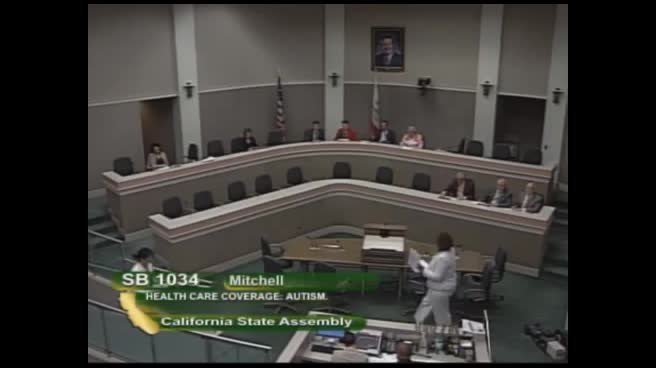 24MIN
Assembly Standing Committee on Health
 3MIN
Senate Floor
 32MIN
Senate Standing Committee on Health
Bill Author

Bill Co-Author(s):