SB 1042: Child care: state preschool programs: age of eligibility.
- Session Year: 2015-2016
- House: Senate
- Latest Version Date: 2016-02-12
Existing law requires the Superintendent of Public Instruction to administer all California state preschool programs, including, but not limited to, part-day age and developmentally appropriate programs for 3- and 4-year-old children. Existing law defines 3-year-old children for these purposes as children who will have their 3rd birthday on or before September 1 of the fiscal year in which they are enrolled in a California state preschool program.
This bill would instead define 3-year-old children as children who will have their 3rd birthday on or before December 1 of the fiscal year in which they are enrolled in a California state preschool program.
As used in this chapter:
(a)Alternative payments includes payments that are made by one child care agency to another agency or child care provider for the provision of child care and development services, and payments that are made by an agency to a parent for the parents purchase of child care and development services.
(b)Alternative payment program means a local government agency or nonprofit organization that has contracted with the department pursuant to Section 8220.1 to provide alternative payments and to provide support services to parents and providers.
(c)Applicant or contracting agency means a school district, community college district, college or university, county superintendent of schools, county, city, public agency, private nontax-exempt agency, private tax-exempt agency, or other entity that is authorized to establish, maintain, or operate services pursuant to this chapter. Private agencies and parent cooperatives, duly licensed by law, shall receive the same consideration as any other authorized entity with no loss of parental decisionmaking prerogatives as consistent with the provisions of this chapter.
(d)Assigned reimbursement rate is that rate established by the contract with the agency and is derived by dividing the total dollar amount of the contract by the minimum child day of average daily enrollment level of service required.
(e)Attendance means the number of children present at a child care and development facility. Attendance, for purposes of reimbursement, includes excused absences by children because of illness, quarantine, illness or quarantine of their parent, family emergency, or to spend time with a parent or other relative as required by a court of law or that is clearly in the best interest of the child.
(f)Capital outlay means the amount paid for the renovation and repair of child care and development facilities to comply with state and local health and safety standards, and the amount paid for the state purchase of relocatable child care and development facilities for lease to qualifying contracting agencies.
(g)Caregiver means a person who provides direct care, supervision, and guidance to children in a child care and development facility.
(h)Child care and development facility means a residence or building or part thereof in which child care and development services are provided.
(i)Child care and development programs means those programs that offer a full range of services for children from infancy to 13 years of age, for any part of a day, by a public or private agency, in centers and family child care homes. These programs include, but are not limited to, all of the following:
(1)General child care and development.
(2)Migrant child care and development.
(3)Child care provided by the California School Age Families Education Program (Article 7.1 (commencing with Section 54740) of Chapter 9 of Part 29 of Division 4 of Title 2).
(4)California state preschool program.
(5)Resource and referral.
(6)Child care and development services for children with exceptional needs.
(7)Family child care home education network.
(8)Alternative payment.
(9)Schoolage community child care.
(j)Child care and development services means those services designed to meet a wide variety of needs of children and their families, while their parents or guardians are working, in training, seeking employment, incapacitated, or in need of respite. These services may include direct care and supervision, instructional activities, resource and referral programs, and alternative payment arrangements.
(k)Children at risk of abuse, neglect, or exploitation means children who are so identified in a written referral from a legal, medical, or social service agency, or emergency shelter.
(l)Children with exceptional needs means either of the following:
(1)Infants and toddlers under three years of age who have been determined to be eligible for early intervention services pursuant to the California Early Intervention Services Act (Title 14 (commencing with Section 95000) of the Government Code) and its implementing regulations. These children include an infant or toddler with a developmental delay or established risk condition, or who is at high risk of having a substantial developmental disability, as defined in subdivision (a) of Section 95014 of the Government Code. These children shall have active individualized family service plans, shall be receiving early intervention services, and shall be children who require the special attention of adults in a child care setting.
(2)Children 3 to 21 years of age, inclusive, who have been determined to be eligible for special education and related services by an individualized education program team according to the special education requirements contained in Part 30 (commencing with Section 56000) of Division 4 of Title 2, and who meet eligibility criteria described in Section 56026 and, Article 2.5 (commencing with Section 56333) of Chapter 4 of Part 30 of Division 4 of Title 2, and Sections 3030 and 3031 of Title 5 of the California Code of Regulations. These children shall have an active individualized education program, shall be receiving early intervention services or appropriate special education and related services, and shall be children who require the special attention of adults in a child care setting. These children include children with intellectual disabilities, hearing impairments (including deafness), speech or language impairments, visual impairments (including blindness), serious emotional disturbance (also referred to as emotional disturbance), orthopedic impairments, autism, traumatic brain injury, other health impairments, or specific learning disabilities, who need special education and related services consistent with Section 1401(3)(A) of Title 20 of the United States Code.
(m)Closedown costs means reimbursements for all approved activities associated with the closing of operations at the end of each growing season for migrant child development programs only.
(n)Cost includes, but is not limited to, expenditures that are related to the operation of child care and development programs. Cost may include a reasonable amount for state and local contributions to employee benefits, including approved retirement programs, agency administration, and any other reasonable program operational costs. Cost may also include amounts for licensable facilities in the community served by the program, including lease payments or depreciation, downpayments, and payments of principal and interest on loans incurred to acquire, rehabilitate, or construct licensable facilities, but these costs shall not exceed fair market rents existing in the community in which the facility is located. Reasonable and necessary costs are costs that, in nature and amount, do not exceed what an ordinary prudent person would incur in the conduct of a competitive business.
(o)Elementary school, as contained in former Section 425 of Title 20 of the United States Code (the National Defense Education Act of 1958, Public Law 85-864, as amended), includes early childhood education programs and all child development programs, for the purpose of the cancellation provisions of loans to students in institutions of higher learning.
(p)Family child care home education network means an entity organized under law that contracts with the department pursuant to Section 8245 to make payments to licensed family child care home providers and to provide educational and support services to those providers and to children and families eligible for state-subsidized child care and development services. A family child care home education network may also be referred to as a family child care home system.
(q)Health services include, but are not limited to, all of the following:
(1)Referral, whenever possible, to appropriate health care providers able to provide continuity of medical care.
(2)Health screening and health treatment, including a full range of immunization recorded on the appropriate state immunization form to the extent provided by the Medi-Cal Act (Chapter 7 (commencing with Section 14000) of Part 3 of Division 9 of the Welfare and Institutions Code) and the Child Health and Disability Prevention Program (Article 6 (commencing with Section 124025) of Chapter 3 of Part 2 of Division 106 of the Health and Safety Code), but only to the extent that ongoing care cannot be obtained utilizing community resources.
(3)Health education and training for children, parents, staff, and providers.
(4)Followup treatment through referral to appropriate health care agencies or individual health care professionals.
(r)Higher educational institutions means the Regents of the University of California, the Trustees of the California State University, the Board of Governors of the California Community Colleges, and the governing bodies of any accredited private nonprofit institution of postsecondary education.
(s)Intergenerational staff means persons of various generations.
(t)Limited-English-speaking-proficient and non-English-speaking-proficient children means children who are unable to benefit fully from an English-only child care and development program as a result of either of the following:
(1)Having used a language other than English when they first began to speak.
(2)Having a language other than English predominantly or exclusively spoken at home.
(u)Parent means a biological parent, stepparent, adoptive parent, foster parent, caretaker relative, or any other adult living with a child who has responsibility for the care and welfare of the child.
(v)Program director means a person who, pursuant to Sections 8244 and 8360.1, is qualified to serve as a program director.
(w)Proprietary child care agency means an organization or facility providing child care, which is operated for profit.
(x)Resource and referral programs means programs that provide information to parents, including referrals and coordination of community resources for parents and public or private providers of care. Services frequently include, but are not limited to: technical assistance for providers, toy-lending libraries, equipment-lending libraries, toy- and equipment-lending libraries, staff development programs, health and nutrition education, and referrals to social services.
(y)Severely disabled children are children with exceptional needs from birth to 21 years of age, inclusive, who require intensive instruction and training in programs serving pupils with the following profound disabilities: autism, blindness, deafness, severe orthopedic impairments, serious emotional disturbances, or severe intellectual disabilities. Severely disabled children also include those individuals who would have been eligible for enrollment in a developmental center for handicapped pupils under Chapter 6 (commencing with Section 56800) of Part 30 of Division 4 of Title 2 as it read on January 1, 1980.
(z)Short-term respite child care means child care service to assist families whose children have been identified through written referral from a legal, medical, or social service agency, or emergency shelter as being neglected, abused, exploited, or homeless, or at risk of being neglected, abused, exploited, or homeless. Child care is provided for less than 24 hours per day in child care centers, treatment centers for abusive parents, family child care homes, or in the childs own home.
(aa)(1)Site supervisor means a person who, regardless of his or her title, has operational program responsibility for a child care and development program at a single site. A site supervisor shall hold a permit issued by the Commission on Teacher Credentialing that authorizes supervision of a child care and development program operating in a single site. The Superintendent may waive the requirements of this subdivision if the Superintendent determines that the existence of compelling need is appropriately documented.
(2)For California state preschool programs, a site supervisor may qualify under any of the provisions in this subdivision, or may qualify by holding an administrative credential or an administrative services credential. A person who meets the qualifications of a program director under both Sections 8244 and 8360.1 is also qualified under this subdivision.
(ab)Standard reimbursement rate means that rate established by the Superintendent pursuant to Section 8265.
(ac)Startup costs means those expenses an agency incurs in the process of opening a new or additional facility before the full enrollment of children.
(ad)California state preschool program means part-day and full-day educational programs for low-income or otherwise disadvantaged three- and four-year-old children.
(ae)Support services means those services that, when combined with child care and development services, help promote the healthy physical, mental, social, and emotional growth of children. Support services include, but are not limited to: protective services, parent training, provider and staff training, transportation, parent and child counseling, child development resource and referral services, and child placement counseling.
(af)Teacher means a person with the appropriate permit issued by the Commission on Teacher Credentialing who provides program supervision and instruction that includes supervision of a number of aides, volunteers, and groups of children.
(ag)Underserved area means a county or subcounty area, including, but not limited to, school districts, census tracts, or ZIP Code areas, where the ratio of publicly subsidized child care and development program services to the need for these services is low, as determined by the Superintendent.
(ah)Workday means the time that the parent requires temporary care for a child for any of the following reasons:
(1)To undertake training in preparation for a job.
(2)To undertake or retain a job.
(3)To undertake other activities that are essential to maintaining or improving the social and economic function of the family, are beneficial to the community, or are required because of health problems in the family.
(ai)Three-year-old children means children who will have their third birthday on or before the date specified December 1 of the fiscal year in which they are enrolled in a California state preschool program, as follows: program.
(1)November 1 of the 201213 fiscal year.
(2)October 1 of the 201314 fiscal year.
(3)September 1 of the 201415 fiscal year and each fiscal year thereafter.
(aj)Four-year-old children means children who will have their fourth birthday on or before the date specified September 1 of the fiscal year in which they are enrolled in a California state preschool program, as follows: program.
(1)November 1 of the 201213 fiscal year.
(2)October 1 of the 201314 fiscal year.
(3)September 1 of the 201415 fiscal year and each fiscal year thereafter.
(ak)Local educational agency means a school district, a county office of education, a community college district, or a school district on behalf of one or more schools within the school district.
|
Date
|
Status
|
|---|---|
| Feb 12, 2016 | Introduced. Read first time. To Com. on RLS. for assignment. To print. |
| Feb 16, 2016 | From printer. May be acted upon on or after March 17. |
| Feb 25, 2016 | Referred to Com. on ED. |
| Mar 11, 2016 | Set for hearing March 30. |
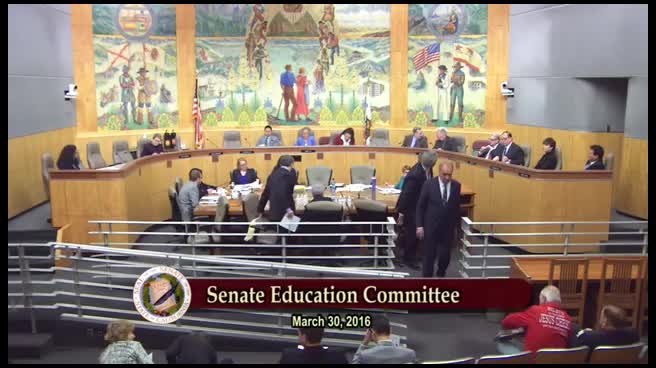
| Mar 30, 2016 | From committee: Do pass and re-refer to Com. on APPR. (Ayes 8. Noes 1. Page 3332.) (March 30). Re-referred to Com. on APPR. |
| Mar 30, 2016 | From committee: Do pass and re-refer to Com. on APPR. (Ayes 8. Noes 1.) (March 30). Re-referred to Com. on APPR. |
| Apr 1, 2016 | Set for hearing April 11. |
| Apr 11, 2016 | April 11 hearing: Placed on APPR. suspense file. |
| May 20, 2016 | Set for hearing May 27. |
| May 27, 2016 | May 27 hearing: Held in committee and under submission. |
|
Date
|
Description
|
Location
|
Votes
|
|
|---|---|---|---|---|
| Apr 11, 2016 | Placed on suspense file | Senate Standing Committee on Appropriations |
Passed |
|
| Mar 30, 2016 | Do pass, but first be re-referred to the Committee on [Appropriations] | Senate Standing Committee on Education |
Passed |
This list shows positions taken on this bill by organizations on the date displayed, which is linked to the original source.
Positions by individuals are not included.
|
Organization
|
Position
|
Date
|
|---|---|---|
| Alameda County Early Care and Education Planning Council | ** Support | Mar 30, 2016 |
| Alameda County Early Care and Education Program | * Support | Mar 30, 2016 |
| Bay Area Hispano Institute for Advancement | ** Support | Mar 30, 2016 |
| Berkeley Unified School District | ** Support | Mar 30, 2016 |
| California Community College Early Childhood Educators | ** Support | Mar 30, 2016 |
| California Department of Education | * Support | Mar 30, 2016 |
| California Head Start Association | ** Support | Mar 30, 2016 |
| Kidango, Inc. | ** Support | Mar 30, 2016 |
| Rio Hondo College Child Development Center | ** Support | Mar 30, 2016 |
| Salvation Army | ** Support | Mar 30, 2016 |
| Superintendent of Public Instruction, Tom Torlakson | ** Support | Mar 30, 2016 |
| u None received. | ** Against | Mar 30, 2016 |
SENATE COMMITTEE ON APPROPRIATIONS
Senator Ricardo Lara, Chair
2015 - 2016 Regular Session
SB 1042 (Hancock) - Child care: state preschool programs: age of eligibility
Version: February 12, 2016 | Policy Vote: ED. 8 - 1 |
Urgency: No | Mandate: No |
Hearing Date: April 11, 2016 | Consultant: Jillian Kissee |
This bill meets the criteria for referral to the Suspense File.
Bill Summary:
This bill expands eligibility for the California State Preschool Program (CSPP) by adjusting the date of eligibility by three months to include younger three-year-olds.
Fiscal Impact:
Potential significant loss of savings to the state to the extent certain providers are able to expand services to younger three-year-olds. This bill could also add to the existing number of eligible children not being served if not all providers can accommodate the expanded eligibility, thereby adding to the existing pressure for the state to fund all its eligible children. However, at-risk children and eligible four-year-olds would continue to have priority in the program. (Proposition 98) (See Staff Comments)
Background:
The CSPP is one of four major preschool programs in California. Existing law establishes CSPP for purposes of providing part-day and full-day developmentally appropriate programs designed to facilitate the transition to kindergarten for three- and four-year-old children in educational development, and to provide health, social, and nutritional services, as well as parent education and participation, evaluation, and staff development. Existing law specifies that children are eligible for a CSPP if the family is currently a CalWORKs cash aid recipient, meets specified income eligibility requirements, is homeless or if the child is the recipient of protective services, or has been, or is at risk of being, identified as neglected, abused, or exploited. (Education Code § 8263)
Existing law requires that first priority go to three- or four-year-old neglected or abused children who are recipients of child protective services, or who are at risk of being neglected, abused, or exploited. After this priority is satisfied, then the next priority is given to eligible four-year-old children who are not enrolled in a state-funded transitional kindergarten program before enrolling eligible three-year-old children. (Education Code § 8235 and 8236)
Existing law requires that a child enrolled in a CSPP be three- or four-years-old on or before September 1 in the fiscal year in which they enroll. (Education Code § 8208)
Existing law defines Transitional Kindergarten as the first year of a two year kindergarten program that uses a modified kindergarten curriculum that is age and developmentally appropriate, and requires schools, as a condition of receiving apportionments for Transitional Kindergarten, to admit a child who will have his or her fifth birthday between September 2 and December 2. (EC § 48000 (c))
The Governor’s Budget proposes to create an Early Education Block Grant by consolidating Proposition 98 funding for CSPP, Transitional Kindergarten, and the Preschool Quality Rating and Improvement System. This proposal consolidates a total of $1.7 billion. The proposal intends to extend the goals of the Local Control Funding Formula to promote local flexibility to develop programs that address the needs of the community, to allocate funding based on factors such as population and need, and to prioritize services for low-income and at-risk children. The Administration has engaged stakeholders on the development of the block grant to inform additional details of the program which is anticipated to be included in the May Revision.
Proposed Law:
This bill changes the definition of eligible three-year-old children to those who will have their third birthday on or before December 1 of the fiscal year in which they are enrolled in a CSPP, thereby expanding eligibility by three months.
Related Legislation:
SB 858 (Chapter 32, Statutes of 2014), the education omnibus trailer bill, included Legislative intent to provide quality preschool opportunities for all low-income children whose families wish to enroll them, and that the state provide all low-income four-year-old children from working families with full-day, full-year early education and care.
Staff Comments:
According to the author, with more families enrolling four-year old children in Transitional Kindergarten, some state preschool providers struggle to fill their programs with eligible four-year-olds. This bill intends to give providers the ability to fill existing slots that would otherwise remain vacant with younger three-year olds. If providers are unable to fill existing slots and spend the funding that they are allocated, it returns to the state as savings, available for reallocation for other Proposition 98 purposes. For example, the Budget Act of 2015 reappropriates $34.1 million originally allocated in the Budget Act of 2013 for the CSPP. If this bill, as intended, results in the ability for providers to spend more of their allocation and send less back to the state, the state would lose potentially significant savings. For context, if 10 percent of the savings in the 2013-14 fiscal year were instead spent by some providers on services to younger three-year-old children, the state could incur a loss in savings of about $3.4 million. This could translate to roughly 700 additional part-day preschool slots for three-year-olds.
Because the number of available slots for CSPP is determined by the annual budget, priority is given to certain children as CSPP is unable to serve all eligible children. According to estimates from the American Institutes for Research, over 33,000 income-eligible four-year-olds were not participating and/or do not have access to slots in any publicly supported school readiness program including the CSPP, other state Title 5 programs, TK, and federal Head Start in 2014 (and about 137,000 eligible three-year-olds). This bill does not add additional slots for CSPP. As noted above, it expands eligibility by allowing providers that are able, to serve younger three-year-olds than currently permitted. In other areas this could add to the list of eligible children not being served if those providers are unable to accommodate the expanded eligibility. However, at-risk children and eligible four-year-olds would continue to have priority in the program.
-- END --
SENATE COMMITTEE ON EDUCATION
Senator Carol Liu, Chair
2015 - 2016 Regular
Bill No: SB 1042
Author: | |||
Version: | February 12, 2016 Hearing Date: March 30, 2016 | ||
Urgency: | No | Fiscal: | Yes |
Consultant: | Olgalilia Ramirez | ||
Subject: Child care: state preschool programs: age of eligibility
SUMMARY
This bill expands eligibility for the California State Preschool Program (CSPP) by adjusting the date of eligibility by three months to include younger three-year-olds.
BACKGROUND
Existing law:
- Establishes the CSPP for purposes of providing part-day and full-day educational development programs to three- and four-year-old children.
(Education Code § 8235)
- Specifies that children are eligible for a CSPP if the family currently receives aid, meets specified income eligibility requirements, is homeless, or if the child is the recipient of protective services, or has been identified as neglected, abused or exploited (or at risk of such). (EC § 8263)
- Requires that a child enrolled in a CSPP be three- or four-years-old on or before September 1st, of that fiscal year. (EC § 8208)
- Further, requires a CSPP to prioritize service in the following order:
- Three- and four-year-olds who are neglected or abused.
- Eligible four-year-old children who are not enrolled in a Transitional Kindergarten program.
- Eligible three-year-olds. (EC § 8236)
ANALYSIS
- This bill expands eligibility for the California State Preschool Program (CSPP) by adjusting the date of eligibility by three months to include younger three-year-olds Specifically it:
- Revises the definition in statute for “Three-year-old children,” to mean children who will have their third birthday on or before December 1st, of the fiscal year in which they are enrolled in a CSPP, rather than on or before September 1st.
- Deletes obsolete provisions that phase-in enrollment-age requirements for California state preschool program (CSPP).
- Makes non-substantive technical amendments.
STAFF COMMENTS
- Need for the bill. Prior to the implementation of Transitional Kindergarten (TK), three-year-old children were eligible to enroll in CSPP if their third birthday fell on or before December 2nd of that fiscal year. To align with the TK enrollment dates, the CSPP cutoff dates shifted to September 1st. According to the author, with more families enrolling four-year old children in TK, some state preschool providers struggle to fill their programs with eligible four-year-olds. This bill aims to provide eligible children who turn three on or before December 1st the opportunity to attend a CSPP while giving providers the ability to fill slots that otherwise would remain vacant.
- Slots and priority. This bill does not increase the number of slots for CSPP but rather seeks to give providers the ability to fill existing slots with younger three-year olds. Children considered to be at-risk and eligible four-year-olds would continue to have priority in the program. Recent data shows that four-year-old children represent the majority of children in state preschool programs at 56% full-day, and 64% part-day, followed by three-year olds at 29% full-day and 19% part-day, with the remaining population being five-year olds at 15% full-day and 17% part-day.
In the absence of this bill, this funding would be forfeited and returned to the state for possible reallocation to other general fund purposes. While preserving these funds for child care purposes is reasonable, the committee may wish to consider whether policy should focus on expansion of eligibility to include younger children, or reallocation of slots (i.e. redistribution of funds) to providers who are unable to serve all eligible four-year olds.
- Related budget activity. The Governor’s Budget proposes to create an Early Education Block Grant by consolidating Prop 98 funding for State Preschool, Transitional Kindergarten, and the Preschool Quality Rating and Improvement System. The Block Grant concept is very similar to the Local Control Funding Formula in that distribution of funds would be based on population and need. However, the Block Grant proposal is still a work in progress and the administration plans to unveil the remaining details of the program in the coming months. Separate from the Governor’s proposal, this bill would adjust eligibility requirements for CSPP while maintaining the existing priority requirements.
SUPPORT
Alameda County Early Care and Education Planning Council
Bay Area Hispano Institute for Advancement
Berkeley Unified School District
California Community College Early Childhood Educators
California Head Start Association
Coalition of California Welfare Rights Organization
Kidango, Inc.
Rio Hondo College Child Development Center
Superintendent of Public Instruction, Tom Torlakson
The Salvation Army
OPPOSITION
None received.
-- END --
Bill Author

Bill Co-Author(s):