SB 1078: Civil procedure: arbitration.
- Session Year: 2015-2016
- House: Senate
- Latest Version Date: 2016-09-02
Existing law governs arbitration in civil proceedings. Under existing law, a neutral arbitrator is defined as one who is selected jointly by the parties or by the parties arbitrators, or is appointed by the court if the parties or their arbitrators cannot jointly select an arbitrator. Existing law requires a person selected to serve as a neutral arbitrator to disclose all matters that could cause a person aware of the facts to reasonably entertain a doubt as to the proposed neutral arbitrators impartiality. Existing law requires the disclosure to include, among other things, whether or not the proposed neutral arbitrator has a current arrangement concerning prospective employment or other compensated service as a dispute resolution neutral with a party to the proceeding, or is participating in, or has participated within the last 2 years in, discussions regarding such prospective employment or service.
This bill, in a consumer arbitration case, would also require the disclosure of any solicitation made within the last 2 years by, or at the direction of, a private arbitration company to a party or lawyer for a party. The bill would only require disclosure of solicitations made after January 1, 2017. The bill would specify what is, and what is not, a solicitation for purposes of this disclosure. The bill would prohibit the solicitation of a party or lawyer for a party during the pendency of the arbitration. The bill would also prohibit an arbitrator, from the time of appointment until the conclusion of the arbitration, from entertaining or accepting any offers of employment or offers of new professional relationships, and, in a consumer arbitration case, would prohibit the arbitrator from entertaining or accepting any offers of employment as a dispute resolution neutral in another case from a party or lawyer for a party in the pending arbitration, except as provided.
This bill would exempt specified self-regulatory organizations from the application of the bill. The bill would provide that its provisions are severable.
Existing law governs arbitration in civil proceedings. Under existing law, a neutral arbitrator is defined as one who is selected jointly by the parties or by the parties arbitrators, or is appointed by the court if the parties or their arbitrators cannot jointly select an arbitrator. Existing law requires a person selected to serve as a neutral arbitrator to disclose all matters that could cause a person aware of the facts to reasonably entertain a doubt as to the proposed neutral arbitrators impartiality. Existing law requires the disclosure to include, among other things, whether or not the proposed neutral arbitrator has a current arrangement concerning prospective employment or other compensated service as a dispute resolution neutral with a party to the proceeding, or is participating in, or has participated within the last 2 years in, discussions regarding such prospective employment or service.
This bill, in a consumer arbitration case, would also require the disclosure of any solicitation made within the last 2 years by, or at the direction of, a private arbitration company to a party or lawyer for a party. The bill would only require disclosure of solicitations made after January 1, 2017. The bill would specify what is, and what is not, a solicitation for purposes of this disclosure. The bill would prohibit the solicitation of a party or lawyer for a party during the pendency of the arbitration. The bill would also prohibit an arbitrator, from the time of appointment until the conclusion of the arbitration, from entertaining or accepting any offers of employment or offers of new professional relationships, and, in a consumer arbitration case, would prohibit the arbitrator from entertaining or accepting any offers of employment as a dispute resolution neutral in another case from a party or lawyer for a party in the pending arbitration. arbitration, except as provided.
Existing law requires a court to vacate an arbitration award if it determines that certain circumstances exist.
This bill, in a consumer arbitration case, would authorize a party to recover arbitration proceeding costs from a private arbitration company or arbitrator if the arbitration award is vacated by the court based on a determination that there was corruption in any of the arbitrators, the rights of the party were substantially prejudiced by misconduct of a neutral arbitrator, or the arbitrator making the award either failed to timely disclose a ground for disqualification, as specified, or the arbitrator was subject to disqualification, as specified, but failed to disqualify himself or herself after receiving a timely demand to disqualify because of a violation of specified ethics standards or disclosure requirements. The bill would only allow the recovery of costs after the private arbitration company or arbitrator is provided notice and an opportunity to be heard only on the issue of whether there was a violation of the ethics standards or disclosure requirements. The bill would prohibit the recovery of costs if the arbitration award is vacated solely on the basis of a harmless error.
This bill would exempt specified self-regulatory organizations from the application of the bill. The bill would provide that its provisions are severable.
Existing law governs arbitration in civil proceedings. Under existing law, a neutral arbitrator is defined as one who is selected jointly by the parties or by the parties arbitrators, or is appointed by the court if the parties or their arbitrators cannot jointly select an arbitrator. Existing law requires a person selected to serve as a neutral arbitrator to disclose all matters that could cause a person aware of the facts to reasonably entertain a doubt as to the proposed neutral arbitrators impartiality. Existing law requires the disclosure to include, among other things, whether or not the proposed neutral arbitrator has a current arrangement concerning prospective employment or other compensated service as a dispute resolution neutral with a party to the proceeding, or is participating in, or has participated within the last 2 years in, discussions regarding such prospective employment or service.
This bill, in a consumer arbitration case, would also require the disclosure of any solicitation made within the last 2 years by, or at the direction of, a private arbitration company to a party or lawyer for a party. The bill would only require disclosure of solicitations made after January 1, 2017. The bill would prohibit the solicitation of a party or lawyer for a party during the pendency of the arbitration. The bill would also prohibit an arbitrator, from the time of appointment until the conclusion of the arbitration, from entertaining or accepting any offers of employment, employment or offers of new professional relationships, or and, in a consumer arbitration case, would prohibit the arbitrator from entertaining or accepting any offers of employment as a dispute resolution neutral in another case from a party or lawyer for a party in the pending arbitration.
Existing law requires a court to vacate an arbitration award if it determines that certain circumstances exist.
This bill bill, in a consumer arbitration case, would authorize a party to recover arbitration proceeding costs from a private arbitration company or arbitrator if the arbitration award is vacated by the court based on a determination that there was corruption in any of the arbitrators, the rights of the party were substantially prejudiced by misconduct of a neutral arbitrator, or the arbitrator making the award either failed to timely disclose a ground for disqualification, as specified, or the arbitrator was subject to disqualification, as specified, but failed to disqualify himself or herself after receiving a timely demand to disqualify. disqualify because of a violation of specified ethics standards or disclosure requirements. The bill would only allow the recovery of costs after the private arbitration company or arbitrator is provided notice and an opportunity to be heard only on the issue of whether there was a violation of the ethics standards or disclosure requirements. The bill would prohibit the recovery of costs if the arbitration award is vacated solely on the basis of a harmless error.
This bill would exempt specified self-regulatory organizations from the application of the bill.
Existing law governs arbitration in civil proceedings. Under existing law, a neutral arbitrator is defined as one who is selected jointly by the parties or by the parties arbitrators, or is appointed by the court if the parties or their arbitrators cannot jointly select an arbitrator. Existing law requires a person selected to serve as a neutral arbitrator to disclose all matters that could cause a person aware of the facts to reasonably entertain a doubt as to the proposed neutral arbitrators impartiality. Existing law requires the disclosure to include, among other things, whether or not the proposed neutral arbitrator has a current arrangement concerning prospective employment or other compensated service as a dispute resolution neutral with a party to the proceeding, or is participating in, or has participated within the last 2 years in, discussions regarding such prospective employment or service.
This bill, in a consumer arbitration case, would also require the disclosure of any solicitation made within the last 2 years by, or at the direction of, a private arbitration company to a party or lawyer for a party. The bill would prohibit the solicitation of a party or lawyer for a party during the pendency of the arbitration. The bill would also prohibit an arbitrator, from the time of appointment until the conclusion of the arbitration, from entertaining or accepting any offers of employment, offers of new professional relationships, or offers of employment as a dispute resolution neutral in another case from a party or lawyer for a party in the pending arbitration.
Existing law requires a court to vacate an arbitration award if it determines certain that a specified circumstance exists. that certain circumstances exist.
This bill would authorize a party to recover arbitration proceeding costs from a private arbitration company or arbitrator if the arbitration award is vacated by the court based on a determination of the existence of one of these circumstances. The bill would also authorize a party to petition the court to recover arbitration proceeding costs from a private arbitration company if the arbitrator is dismissed during the pendency of the arbitration because of a violation of the Judicial Council ethical standards or a violation of the disclosure requirements described above. that there was corruption in any of the arbitrators, the rights of the party were substantially prejudiced by misconduct of a neutral arbitrator, or the arbitrator making the award either failed to timely disclose a ground for disqualification, as specified, or the arbitrator was subject to disqualification, as specified, but failed to disqualify himself or herself after receiving a timely demand to disqualify.
Existing law governs arbitration in civil proceedings. Under existing law, a neutral arbitrator is defined as one who is selected jointly by the parties or by the parties arbitrators, or is appointed by the court if the parties or their arbitrators cannot jointly select an arbitrator. Existing law requires a person selected to serve as a neutral arbitrator to disclose all matters that could cause a person aware of the facts to reasonably entertain a doubt that as to the proposed neutral arbitrator would be able to be impartial. neutral arbitrators impartiality. Existing law requires the disclosure to include, among other things, whether or not the proposed neutral arbitrator has a current arrangement concerning prospective employment or other compensated service as a dispute resolution neutral with a party to the proceeding, or is participating in, or has participated within the last 2 years in, discussions regarding such prospective employment or service.
This bill, in a consumer arbitration case, would also require the disclosure of any solicitation made within the last 2 years by, or at the direction of, a private arbitration company to a party or lawyer for a party. The bill would prohibit the solicitation of a party or lawyer for a party during the pendency of the arbitration. The bill would also prohibit an arbitrator, from the time of appointment until the conclusion of the arbitration, from entertaining or accepting any offers of employment, offers of new professional relationships, or offers of employment as a dispute resolution neutral in another case from a party or lawyer for a party in the pending arbitration.
Existing law requires a person serving as a neutral arbitrator pursuant to an arbitration agreement to comply with the ethics standards for arbitrators adopted by the Judicial Council, as specified. a court to vacate an arbitration award if it determines certain that a specified circumstance exists.
This bill would authorize a party to recover arbitration proceeding costs from a private arbitration company if the arbitration award is vacated because of a violation of the Judicial Council ethical standards or a violation of the disclosure requirements described above. by the court based on a determination of the existence of one of these circumstances. The bill would also authorize a party to petition the court to recover arbitration proceeding costs from a private arbitration company if the arbitrator is dismissed during the pendency of the arbitration because of a violation of the Judicial Council ethical standards or a violation of the disclosure requirements described above.
Existing law governs arbitration in civil proceedings. Under existing law, a neutral arbitrator is defined as one who is selected jointly by the parties or by the parties arbitrators, or is appointed by the court if the parties or their arbitrators cannot jointly select an arbitrator. Existing law provides that a party to an arbitration includes the party seeking to arbitrate the agreement, a party against whom arbitration is sought, or a party who is made a party by any of the parties to an agreement, including the arbitrator. Existing law also provides that a written arbitration agreement includes a written agreement that is extended or renewed by an implied or oral agreement. Existing law requires a person selected to serve as a neutral arbitrator to disclose all matters that could cause a person aware of the facts to reasonably entertain a doubt that the proposed neutral arbitrator would be able to be impartial. Existing law requires the disclosure to include, among other things, whether or not the proposed neutral arbitrator has a current arrangement concerning prospective employment or other compensated service as a dispute resolution neutral with a party to the proceeding, or is participating in, or has participated within the last 2 years in, discussions regarding such prospective employment or service.
This bill would make a technical, nonsubstantive change to these provisions.
This bill, in a consumer arbitration case, would also require the disclosure of any solicitation made within the last 2 years by, or at the direction of, a private arbitration company to a party or lawyer for a party. The bill would prohibit the solicitation of a party or lawyer for a party during the pendency of the arbitration. The bill would also prohibit an arbitrator, from the time of appointment until the conclusion of the arbitration, from entertaining or accepting any offers of employment, offers of new professional relationships, or offers of employment as a dispute resolution neutral in another case from a party or lawyer for a party in the pending arbitration.
Existing law requires a person serving as a neutral arbitrator pursuant to an arbitration agreement to comply with the ethics standards for arbitrators adopted by the Judicial Council, as specified.
This bill would authorize a party to recover arbitration proceeding costs from a private arbitration company if the arbitration award is vacated because of a violation of the Judicial Council ethical standards or a violation of the disclosure requirements described above. The bill would also authorize a party to petition the court to recover arbitration proceeding costs from a private arbitration company if the arbitrator is dismissed during the pendency of the arbitration because of a violation of the Judicial Council ethical standards or a violation of the disclosure requirements described above.
Existing law governs arbitration in civil proceedings. Under existing law, a neutral arbitrator is defined as one who is selected jointly by the parties or by the parties arbitrators, or is appointed by the court if the parties or their arbitrators cannot jointly select an arbitrator. Existing law provides that a party to an arbitration includes the party seeking to arbitrate the agreement, a party against whom arbitration is sought, or a party who is made a party by any of the parties to an agreement, including the arbitrator. Existing law also provides that a written arbitration agreement includes a written agreement that is extended or renewed by an implied or oral agreement.
This bill would make a technical, nonsubstantive change to these provisions.
(a)From the time of appointment until the conclusion of the arbitration, an arbitrator shall not entertain or accept either of the following:
(1)Any offers of employment or new professional relationships as a lawyer, expert witness, or consultant from a party or lawyer for a party in the pending arbitration.
(2)In a consumer arbitration case, any offers of employment as a dispute resolution neutral in another case involving a party or lawyer for a party in the pending arbitration unless all parties to the pending arbitration, including the lawyers in the arbitration, have conferred and agreed in writing, before any solicitation of the arbitrator, to allow offers of future employment as a dispute resolution neutral to be made to the arbitrator.
(b)This section does not apply to an arbitration conducted or administered by a self-regulatory organization, as defined by the federal Securities Exchange Act of 1934 (15 U.S.C. Sec. 78a) or regulations adopted under that act. This section also does not apply to an arbitration conducted pursuant to the terms of a public or private sector collective bargaining agreement.
(c)For purposes of this section, lawyer for a party has the same definition as that term is defined in Section 1281.9.
SEC. 2.Section 1281.9 of the Code of Civil Procedure is amended to read:1281.9.(a)In any arbitration pursuant to an arbitration agreement, when a person is to serve as a neutral arbitrator, the proposed neutral arbitrator shall disclose all matters that could cause a person aware of the facts to reasonably entertain a doubt that the proposed neutral arbitrator would be able to be impartial, including all of the following:
(1)The existence of any ground specified in Section 170.1 for disqualification of a judge. For purposes of paragraph (8) of subdivision (a) of Section 170.1, the proposed neutral arbitrator shall disclose whether or not he or she has a current arrangement concerning prospective employment or other compensated service as a dispute resolution neutral or is participating in, or, within the last two years, has participated in, discussions regarding such prospective employment or service with a party to the proceeding.
(2)Any matters required to be disclosed by the ethics standards for neutral arbitrators adopted by the Judicial Council pursuant to this chapter.
(3)The names of the parties to all prior or pending noncollective bargaining cases in which the proposed neutral arbitrator served or is serving as a party arbitrator for a party to the arbitration proceeding or for a lawyer for a party and the results of each case arbitrated to conclusion, including the date of the arbitration award, identification of the prevailing party, the names of the parties attorneys, and the amount of monetary damages awarded, if any. In order to preserve confidentiality, it shall be sufficient to give the name of any party who is not a party to the pending arbitration as claimant or respondent if the party is an individual and not a business or corporate entity.
(4)The names of the parties to all prior or pending noncollective bargaining cases involving a party to the arbitration or lawyer for a party for which the proposed neutral arbitrator served or is serving as neutral arbitrator, and the results of each case arbitrated to conclusion, including the date of the arbitration award, identification of the prevailing party, the names of the parties attorneys and the amount of monetary damages awarded, if any. In order to preserve confidentiality, it shall be sufficient to give the name of any party not a party to the pending arbitration as claimant or respondent if the party is an individual and not a business or corporate entity.
(5)Any attorney-client relationship the proposed neutral arbitrator has or had with a party or lawyer for a party to the arbitration proceeding.
(6)Any professional or significant personal relationship the proposed neutral arbitrator or his or her spouse or minor child living in the household has or has had with a party to the arbitration proceeding or lawyer for a party.
(7)(A)For a consumer arbitration case, any solicitation made within the last two years by, or at the direction of, the private arbitration company to a party or lawyer for a party to the consumer arbitration. During the pendency of the consumer arbitration, no solicitation shall be made of a party to the arbitration or of a lawyer for a party to the arbitration. Any solicitation made before January 1, 2017, is not required to be disclosed pursuant to this paragraph.
(B)This paragraph does not apply to an arbitration conducted or administered by a self-regulatory organization, as defined by the federal Securities Exchange Act of 1934 (15 U.S.C. Sec. 78a) or regulations adopted under that act.
(C)(i)For purposes of this paragraph, solicitation includes either of the following:
(I)Private presentations made to a party or lawyer for a party by the private arbitration company or the arbitrator.
(II)Oral or written discussions, meetings, or negotiations to designate the private arbitration company or the arbitrator as the arbitration provider or arbitrator for a party in specific contracts.
(ii)For purposes of this paragraph, solicitation does not include any of the following:
(I)Advertising directed to the general public.
(II)Communications indicating a general willingness to serve as an arbitrator or private arbitration company. For purposes of this subclause, communications include, but are not limited to, standard educational materials about alternative dispute resolution or the provider organization.
(III)Presentations made by the private arbitration company or the arbitrator at a program or seminar held open to the public.
(IV)Responding to inquiries regarding the arbitration providers costs, rules, procedures, or standards.
(b)Subject only to the disclosure requirements of law, the proposed neutral arbitrator shall disclose all matters required to be disclosed pursuant to this section to all parties in writing within 10 calendar days of service of notice of the proposed nomination or appointment.
(c)For purposes of this section, lawyer for a party includes any lawyer or law firm currently associated in the practice of law with the lawyer hired to represent a party.
(d)For purposes of this section, prior cases means noncollective bargaining cases in which an arbitration award was rendered within five years before the date of the proposed nomination or appointment.
(e)For purposes of this section, any arbitration does not include an arbitration conducted pursuant to the terms of a public or private sector collective bargaining agreement.
SEC. 3.The provisions of this bill are severable. If any provision of this bill or its application is held invalid, that invalidity shall not affect other provisions or applications that can be given effect without the invalid provision or application.
(a)From the time of appointment until the conclusion of the arbitration, an arbitrator shall not entertain or accept either of the following:
(1)Any offers of employment or new professional relationships as a lawyer, expert witness, or consultant from a party or lawyer for a party in the pending arbitration.
(2)In a consumer arbitration case, any offers of employment as a dispute resolution neutral in another case involving a party or lawyer for a party in the pending arbitration unless all parties to the pending arbitration, including the lawyers in the arbitration, have conferred and agreed in writing, before any solicitation of the arbitrator, to allow offers of future employment as a dispute resolution neutral to be made to the arbitrator.
(b)This section does not apply to an arbitration conducted or administered by a self-regulatory organization, as defined by the federal Securities Exchange Act of 1934 (15 U.S.C. Sec. 78a) or regulations adopted under that act. This section also does not apply to an arbitration conducted pursuant to the terms of a public or private sector collective bargaining agreement.
(c)For purposes of this section, lawyer for a party has the same definition as that term is defined in Section 1281.9.
SEC. 2.Section 1281.85 of the Code of Civil Procedure is amended to read:1281.85.(a)Beginning July 1, 2002, a person serving as a neutral arbitrator pursuant to an arbitration agreement shall comply with the ethics standards for arbitrators adopted by the Judicial Council pursuant to this section. The Judicial Council shall adopt ethics standards for all neutral arbitrators effective July 1, 2002. These standards shall be consistent with the standards established for arbitrators in the judicial arbitration program and may expand, but shall not limit, the disclosure and disqualification requirements established by this chapter. The ethics standards shall address the disclosure of interests, relationships, or affiliations that may constitute conflicts of interest, including prior service as an arbitrator or other dispute resolution neutral entity, disqualifications, acceptance of gifts, and establishment of future professional relationships.
(b)Subdivision (a) does not apply to an arbitration conducted pursuant to the terms of a public or private sector collective bargaining agreement.
(c)The ethics requirements and standards of this chapter are nonnegotiable and shall not be waived.
(d)(1)In a consumer arbitration case, if an arbitration award is vacated pursuant to paragraph (2), (3), or (6) of subdivision (a) of Section 1286.2 because of a violation of the ethics standards adopted by the Judicial Council pursuant to this section or a violation of the disclosure requirements established by this chapter, a party may recover any costs incurred in the arbitration proceeding from the private arbitration company or from the arbitrator to whom the costs were paid. A recovery of costs from the private arbitration company or from the arbitrator is only allowed after the private arbitration company or the arbitrator is provided notice and an opportunity to be heard only on the issue of whether there was a violation of the ethics standards or disclosure requirements. A recovery of costs under this paragraph is prohibited if the arbitration award is vacated solely on the basis of a harmless error. For purposes of this paragraph, costs include filing fees, administrative costs, arbitrator fees, or any other fees paid to the private arbitration company or arbitrator.
(2)This subdivision does not apply to an arbitration conducted or administered by a self-regulatory organization, as defined by the federal Securities Exchange Act of 1934 (15 U.S.C. Sec. 78a) or regulations adopted under that act.
SEC. 3.SEC. 2.Section 1281.9 of the Code of Civil Procedure is amended to read:1281.9.(a)In any arbitration pursuant to an arbitration agreement, when a person is to serve as a neutral arbitrator, the proposed neutral arbitrator shall disclose all matters that could cause a person aware of the facts to reasonably entertain a doubt that the proposed neutral arbitrator would be able to be impartial, including all of the following:
(1)The existence of any ground specified in Section 170.1 for disqualification of a judge. For purposes of paragraph (8) of subdivision (a) of Section 170.1, the proposed neutral arbitrator shall disclose whether or not he or she has a current arrangement concerning prospective employment or other compensated service as a dispute resolution neutral or is participating in, or, within the last two years, has participated in, discussions regarding such prospective employment or service with a party to the proceeding.
(2)Any matters required to be disclosed by the ethics standards for neutral arbitrators adopted by the Judicial Council pursuant to this chapter.
(3)The names of the parties to all prior or pending noncollective bargaining cases in which the proposed neutral arbitrator served or is serving as a party arbitrator for a party to the arbitration proceeding or for a lawyer for a party and the results of each case arbitrated to conclusion, including the date of the arbitration award, identification of the prevailing party, the names of the parties attorneys, and the amount of monetary damages awarded, if any. In order to preserve confidentiality, it shall be sufficient to give the name of any party who is not a party to the pending arbitration as claimant or respondent if the party is an individual and not a business or corporate entity.
(4)The names of the parties to all prior or pending noncollective bargaining cases involving a party to the arbitration or lawyer for a party for which the proposed neutral arbitrator served or is serving as neutral arbitrator, and the results of each case arbitrated to conclusion, including the date of the arbitration award, identification of the prevailing party, the names of the parties attorneys and the amount of monetary damages awarded, if any. In order to preserve confidentiality, it shall be sufficient to give the name of any party not a party to the pending arbitration as claimant or respondent if the party is an individual and not a business or corporate entity.
(5)Any attorney-client relationship the proposed neutral arbitrator has or had with a party or lawyer for a party to the arbitration proceeding.
(6)Any professional or significant personal relationship the proposed neutral arbitrator or his or her spouse or minor child living in the household has or has had with a party to the arbitration proceeding or lawyer for a party.
(7)(A)For a consumer arbitration case, any solicitation made within the last two years by, or at the direction of, the private arbitration company to a party or lawyer for a party to the consumer arbitration. During the pendency of the consumer arbitration, no solicitation shall be made of a party to the arbitration or of a lawyer for a party to the arbitration. Any solicitation made before January 1, 2017, is not required to be disclosed pursuant to this paragraph.
(B)This paragraph does not apply to an arbitration conducted or administered by a self-regulatory organization, as defined by the federal Securities Exchange Act of 1934 (15 U.S.C. Sec. 78a) or regulations adopted under that act.
(C)(i)For purposes of this paragraph, solicitation includes all either of the following:
(I)Private presentations made to a party or lawyer for a party by the private arbitration company or the arbitrator.
(II)An oral or written request for arbitration business.
(III)
(II)Oral or written discussions, meetings, or negotiations to designate the private arbitration company or the arbitrator as the arbitration provider or arbitrator for a party. party in specific contracts.
(ii)For purposes of this paragraph, solicitation does not include any of the following:
(I)Advertising directed to the general public.
(II)Communications indicating a general willingness to serve as an arbitrator or private arbitration company. For purposes of this subclause, communications include, but are not limited to, standard educational materials about alternative dispute resolution or the provider organization.
(III)Presentations made by the private arbitration company or the arbitrator at a program or seminar held open to the public.
(IV)Responding to inquiries regarding the arbitration providers costs, rules, procedures, or standards.
(b)Subject only to the disclosure requirements of law, the proposed neutral arbitrator shall disclose all matters required to be disclosed pursuant to this section to all parties in writing within 10 calendar days of service of notice of the proposed nomination or appointment.
(c)For purposes of this section, lawyer for a party includes any lawyer or law firm currently associated in the practice of law with the lawyer hired to represent a party.
(d)For purposes of this section, prior cases means noncollective bargaining cases in which an arbitration award was rendered within five years before the date of the proposed nomination or appointment.
(e)For purposes of this section, any arbitration does not include an arbitration conducted pursuant to the terms of a public or private sector collective bargaining agreement.
SEC. 3.The provisions of this bill are severable. If any provision of this bill or its application is held invalid, that invalidity shall not affect other provisions or applications that can be given effect without the invalid provision or application.
(a)From the time of appointment until the conclusion of the arbitration, an arbitrator shall not entertain or accept either of the following:
(a)Any
(1)Any offers of employment or new professional relationships as a lawyer, expert witness, or consultant from a party or lawyer for a party in the pending arbitration.
(b)Any
(2)In a consumer arbitration case, any offers of employment as a dispute resolution neutral in another case involving a party or lawyer for a party in the pending arbitration unless all parties to the pending arbitration, including the lawyers in the arbitration, have conferred and agreed in writing, before any solicitation of the arbitrator, to allow offers of future employment as a dispute resolution neutral to be made to the arbitrator.
(b)This section does not apply to an arbitration conducted or administered by a self-regulatory organization, as defined by the federal Securities Exchange Act of 1934 (15 U.S.C. Sec. 78a) or regulations adopted under that act.
(c)For purposes of this section, lawyer for a party has the same definition as that term is defined in Section 1281.9.
SEC. 2.Section 1281.85 of the Code of Civil Procedure is amended to read:1281.85.(a)Beginning July 1, 2002, a person serving as a neutral arbitrator pursuant to an arbitration agreement shall comply with the ethics standards for arbitrators adopted by the Judicial Council pursuant to this section. The Judicial Council shall adopt ethical ethics standards for all neutral arbitrators effective July 1, 2002. These standards shall be consistent with the standards established for arbitrators in the judicial arbitration program and may expand expand, but shall not limit limit, the disclosure and disqualification requirements established by this chapter. The ethics standards shall address the disclosure of interests, relationships, or affiliations that may constitute conflicts of interest, including prior service as an arbitrator or other dispute resolution neutral entity, disqualifications, acceptance of gifts, and establishment of future professional relationships.
(b)Subdivision (a) does not apply to an arbitration conducted pursuant to the terms of a public or private sector collective bargaining agreement.
(c)The ethics requirements and standards of this chapter are nonnegotiable and shall not be waived.
(d)If (1)In a consumer arbitration case, if an arbitration award is vacated pursuant to paragraph (2), (3), or (6) of subdivision (a) of Section 1286.2 because of a violation of the ethical ethics standards adopted by the Judicial Council pursuant to this section or a violation of the disclosure requirements established by this chapter, a party may recover any costs incurred in the arbitration proceeding from the private arbitration company or from the arbitrator to whom the costs were paid. A recovery of costs from the private arbitration company or from the arbitrator is only allowed after the private arbitration company or the arbitrator is provided notice and an opportunity to be heard only on the issue of whether there was a violation of the ethics standards or disclosure requirements. A recovery of costs under this paragraph is prohibited if the arbitration award is vacated solely on the basis of a harmless error. For purposes of this paragraph, costs include filing fees, administrative costs, arbitrator fees, or any other fees paid to the private arbitration company or arbitrator.
(2)This subdivision does not apply to an arbitration conducted or administered by a self-regulatory organization, as defined by the federal Securities Exchange Act of 1934 (15 U.S.C. Sec. 78a) or regulations adopted under that act.
SEC. 3.Section 1281.9 of the Code of Civil Procedure is amended to read:1281.9.(a)In any arbitration pursuant to an arbitration agreement, when a person is to serve as a neutral arbitrator, the proposed neutral arbitrator shall disclose all matters that could cause a person aware of the facts to reasonably entertain a doubt that the proposed neutral arbitrator would be able to be impartial, including all of the following:
(1)The existence of any ground specified in Section 170.1 for disqualification of a judge. For purposes of paragraph (8) of subdivision (a) of Section 170.1, the proposed neutral arbitrator shall disclose whether or not he or she has a current arrangement concerning prospective employment or other compensated service as a dispute resolution neutral or is participating in, or, within the last two years, has participated in, discussions regarding such prospective employment or service with a party to the proceeding.
(2)Any matters required to be disclosed by the ethics standards for neutral arbitrators adopted by the Judicial Council pursuant to this chapter.
(3)The names of the parties to all prior or pending noncollective bargaining cases in which the proposed neutral arbitrator served or is serving as a party arbitrator for a party to the arbitration proceeding or for a lawyer for a party and the results of each case arbitrated to conclusion, including the date of the arbitration award, identification of the prevailing party, the names of the parties attorneys, and the amount of monetary damages awarded, if any. In order to preserve confidentiality, it shall be sufficient to give the name of any party who is not a party to the pending arbitration as claimant or respondent if the party is an individual and not a business or corporate entity.
(4)The names of the parties to all prior or pending noncollective bargaining cases involving a party to the arbitration or lawyer for a party for which the proposed neutral arbitrator served or is serving as neutral arbitrator, and the results of each case arbitrated to conclusion, including the date of the arbitration award, identification of the prevailing party, the names of the parties attorneys and the amount of monetary damages awarded, if any. In order to preserve confidentiality, it shall be sufficient to give the name of any party not a party to the pending arbitration as claimant or respondent if the party is an individual and not a business or corporate entity.
(5)Any attorney-client relationship the proposed neutral arbitrator has or had with a party or lawyer for a party to the arbitration proceeding.
(6)Any professional or significant personal relationship the proposed neutral arbitrator or his or her spouse or minor child living in the household has or has had with a party to the arbitration proceeding or lawyer for a party.
(7)(A)For a consumer arbitration case, any solicitation made within the last two years by, or at the direction of, the private arbitration company to a party or lawyer for a party to the consumer arbitration. During the pendency of the consumer arbitration, no solicitation shall be made of a party to the arbitration or of a lawyer for a party to the arbitration. For Any solicitation made before January 1, 2017, is not required to be disclosed pursuant to this paragraph.
(B)This paragraph does not apply to an arbitration conducted or administered by a self-regulatory organization, as defined by the federal Securities Exchange Act of 1934 (15 U.S.C. Sec. 78a) or regulations adopted under that act.
(C)(i)For purposes of this paragraph, solicitation includes an oral or written request for arbitration business, but does not include advertising directed to the general public or communications indicating a general willingness to serve as an arbitrator or private arbitration company. all of the following:
(I)Private presentations made to a party or lawyer for a party by the private arbitration company or the arbitrator.
(II)An oral or written request for arbitration business.
(III)Oral or written discussions, meetings, or negotiations to designate the private arbitration company or the arbitrator as the arbitration provider or arbitrator for a party.
(ii)For purposes of this paragraph, solicitation does not include any of the following:
(I)Advertising directed to the general public.
(II)Communications indicating a general willingness to serve as an arbitrator or private arbitration company.
(III)Presentations made by the private arbitration company or the arbitrator at a program or seminar held open to the public.
(b)Subject only to the disclosure requirements of law, the proposed neutral arbitrator shall disclose all matters required to be disclosed pursuant to this section to all parties in writing within 10 calendar days of service of notice of the proposed nomination or appointment.
(c)For purposes of this section, lawyer for a party includes any lawyer or law firm currently associated in the practice of law with the lawyer hired to represent a party.
(d)For purposes of this section, prior cases means noncollective bargaining cases in which an arbitration award was rendered within five years before the date of the proposed nomination or appointment.
(e)For purposes of this section, any arbitration does not include an arbitration conducted pursuant to the terms of a public or private sector collective bargaining agreement.
From the time of appointment until the conclusion of the arbitration, an arbitrator shall not entertain or accept either of the following:
(a)Any offers of employment or new professional relationships as a lawyer, expert witness, or consultant from a party or lawyer for a party in the pending arbitration.
(b)Any offers of employment as a dispute resolution neutral in another case involving a party or lawyer for a party in the pending arbitration unless all parties to the pending arbitration, including the lawyers in the arbitration, have conferred and agreed in writing, before any solicitation of the arbitrator, to allow offers of future employment as a dispute resolution neutral to be made to the arbitrator.
SEC. 2.Section 1281.85 of the Code of Civil Procedure is amended to read:1281.85.(a)Beginning July 1, 2002, a person serving as a neutral arbitrator pursuant to an arbitration agreement shall comply with the ethics standards for arbitrators adopted by the Judicial Council pursuant to this section. The Judicial Council shall adopt ethical standards for all neutral arbitrators effective July 1, 2002. These standards shall be consistent with the standards established for arbitrators in the judicial arbitration program and may expand but shall not limit the disclosure and disqualification requirements established by this chapter. The standards shall address the disclosure of interests, relationships, or affiliations that may constitute conflicts of interest, including prior service as an arbitrator or other dispute resolution neutral entity, disqualifications, acceptance of gifts, and establishment of future professional relationships.
(b)Subdivision (a) does not apply to an arbitration conducted pursuant to the terms of a public or private sector collective bargaining agreement.
(c)The ethics requirements and standards of this chapter are nonnegotiable and shall not be waived.
(d)A party may recover costs incurred in an arbitration proceeding from a private arbitration company if the arbitration award is vacated pursuant to Section 1286.2. A party may also petition the court to recover costs incurred in an arbitration proceeding from a private arbitration company if the arbitrator is dismissed during the pendency of the arbitration because of a violation of the ethical standards adopted by the Judicial Council pursuant to this section or a violation of the disclosure requirements established by this chapter.
(d)If an arbitration award is vacated pursuant to paragraph (2), (3), or (6) of subdivision (a) of Section 1286.2 because of a violation of the ethical standards adopted by the Judicial Council pursuant to this section or a violation of the disclosure requirements established by this chapter, a party may recover any costs incurred in the arbitration proceeding from the private arbitration company or from the arbitrator to whom the costs were paid. For purposes of this paragraph, costs include filing fees, administrative costs, arbitrator fees, or any other fees paid to the private arbitration company or arbitrator.
SEC. 3.Section 1281.9 of the Code of Civil Procedure is amended to read:1281.9.(a)In any arbitration pursuant to an arbitration agreement, when a person is to serve as a neutral arbitrator, the proposed neutral arbitrator shall disclose all matters that could cause a person aware of the facts to reasonably entertain a doubt that the proposed neutral arbitrator would be able to be impartial, including all of the following:
(1)The existence of any ground specified in Section 170.1 for disqualification of a judge. For purposes of paragraph (8) of subdivision (a) of Section 170.1, the proposed neutral arbitrator shall disclose whether or not he or she has a current arrangement concerning prospective employment or other compensated service as a dispute resolution neutral or is participating in, or, within the last two years, has participated in, discussions regarding such prospective employment or service with a party to the proceeding.
(2)Any matters required to be disclosed by the ethics standards for neutral arbitrators adopted by the Judicial Council pursuant to this chapter.
(3)The names of the parties to all prior or pending noncollective bargaining cases in which the proposed neutral arbitrator served or is serving as a party arbitrator for any a party to the arbitration proceeding or for a lawyer for a party and the results of each case arbitrated to conclusion, including the date of the arbitration award, identification of the prevailing party, the names of the parties attorneys, and the amount of monetary damages awarded, if any. In order to preserve confidentiality, it shall be sufficient to give the name of any party who is not a party to the pending arbitration as claimant or respondent if the party is an individual and not a business or corporate entity.
(4)The names of the parties to all prior or pending noncollective bargaining cases involving any a party to the arbitration or lawyer for a party for which the proposed neutral arbitrator served or is serving as neutral arbitrator, and the results of each case arbitrated to conclusion, including the date of the arbitration award, identification of the prevailing party, the names of the parties attorneys and the amount of monetary damages awarded, if any. In order to preserve confidentiality, it shall be sufficient to give the name of any party not a party to the pending arbitration as claimant or respondent if the party is an individual and not a business or corporate entity.
(5)Any attorney-client relationship the proposed neutral arbitrator has or had with any a party or lawyer for a party to the arbitration proceeding.
(6)Any professional or significant personal relationship the proposed neutral arbitrator or his or her spouse or minor child living in the household has or has had with any a party to the arbitration proceeding or lawyer for a party.
(7)For a consumer arbitration case, any solicitation made within the last two years by, or at the direction of, the private arbitration company to a party or lawyer for a party to the consumer arbitration. During the pendency of the consumer arbitration, no solicitation shall made of a party to the arbitration or of a lawyer for a party to the arbitration. For purposes of this paragraph, solicitation includes an oral or written request for arbitration business, but does not include advertising directed to the general public or communications indicating a general willingness to serve as an arbitrator or private arbitration company.
(b)Subject only to the disclosure requirements of law, the proposed neutral arbitrator shall disclose all matters required to be disclosed pursuant to this section to all parties in writing within 10 calendar days of service of notice of the proposed nomination or appointment.
(c)For purposes of this section, lawyer for a party includes any lawyer or law firm currently associated in the practice of law with the lawyer hired to represent a party.
(d)For purposes of this section, prior cases means noncollective bargaining cases in which an arbitration award was rendered within five years prior to before the date of the proposed nomination or appointment.
(e)For purposes of this section, any arbitration does not include an arbitration conducted pursuant to the terms of a public or private sector collective bargaining agreement.
From the time of appointment until the conclusion of the arbitration, an arbitrator shall not entertain or accept either of the following:
(a)Any offers of employment or new professional relationships as a lawyer, expert witness, or consultant from a party or lawyer for a party in the pending arbitration.
(b)Any offers of employment as a dispute resolution neutral in another case involving a party or lawyer for a party in the pending arbitration unless all parties to the pending arbitration, including the lawyers in the arbitration, have conferred and agreed in writing, before any solicitation of the arbitrator, to allow offers of future employment as a dispute resolution neutral to be made to the arbitrator.
SEC. 2.Section 1281.85 of the Code of Civil Procedure is amended to read:1281.85.(a)Beginning July 1, 2002, a person serving as a neutral arbitrator pursuant to an arbitration agreement shall comply with the ethics standards for arbitrators adopted by the Judicial Council pursuant to this section. The Judicial Council shall adopt ethical standards for all neutral arbitrators effective July 1, 2002. These standards shall be consistent with the standards established for arbitrators in the judicial arbitration program and may expand but shall not limit the disclosure and disqualification requirements established by this chapter. The standards shall address the disclosure of interests, relationships, or affiliations that may constitute conflicts of interest, including prior service as an arbitrator or other dispute resolution neutral entity, disqualifications, acceptance of gifts, and establishment of future professional relationships.
(b)Subdivision (a) does not apply to an arbitration conducted pursuant to the terms of a public or private sector collective bargaining agreement.
(c)The ethics requirements and standards of this chapter are nonnegotiable and shall not be waived.
(d)A party may recover costs incurred in an arbitration proceeding from a private arbitration company if the arbitration award is vacated because of a violation of the ethical standards adopted by the Judicial Council pursuant to this section or a violation of the disclosure requirements established by this chapter. pursuant to Section 1286.2. A party may also petition the court to recover costs incurred in an arbitration proceeding from a private arbitration company if the arbitrator is dismissed during the pendency of the arbitration because of a violation of the ethical standards adopted by the Judicial Council pursuant to this section or a violation of the disclosure requirements established by this chapter.
SEC. 3.Section 1281.9 of the Code of Civil Procedure is amended to read:1281.9.(a)In any arbitration pursuant to an arbitration agreement, when a person is to serve as a neutral arbitrator, the proposed neutral arbitrator shall disclose all matters that could cause a person aware of the facts to reasonably entertain a doubt that the proposed neutral arbitrator would be able to be impartial, including all of the following:
(1)The existence of any ground specified in Section 170.1 for disqualification of a judge. For purposes of paragraph (8) of subdivision (a) of Section 170.1, the proposed neutral arbitrator shall disclose whether or not he or she has a current arrangement concerning prospective employment or other compensated service as a dispute resolution neutral or is participating in, or, within the last two years, has participated in, discussions regarding such prospective employment or service with a party to the proceeding.
(2)Any matters required to be disclosed by the ethics standards for neutral arbitrators adopted by the Judicial Council pursuant to this chapter.
(3)The names of the parties to all prior or pending noncollective bargaining cases in which the proposed neutral arbitrator served or is serving as a party arbitrator for any party to the arbitration proceeding or for a lawyer for a party and the results of each case arbitrated to conclusion, including the date of the arbitration award, identification of the prevailing party, the names of the parties attorneys, and the amount of monetary damages awarded, if any. In order to preserve confidentiality, it shall be sufficient to give the name of any party who is not a party to the pending arbitration as claimant or respondent if the party is an individual and not a business or corporate entity.
(4)The names of the parties to all prior or pending noncollective bargaining cases involving any party to the arbitration or lawyer for a party for which the proposed neutral arbitrator served or is serving as neutral arbitrator, and the results of each case arbitrated to conclusion, including the date of the arbitration award, identification of the prevailing party, the names of the parties attorneys and the amount of monetary damages awarded, if any. In order to preserve confidentiality, it shall be sufficient to give the name of any party not a party to the pending arbitration as claimant or respondent if the party is an individual and not a business or corporate entity.
(5)Any attorney-client relationship the proposed neutral arbitrator has or had with any party or lawyer for a party to the arbitration proceeding.
(6)Any professional or significant personal relationship the proposed neutral arbitrator or his or her spouse or minor child living in the household has or has had with any party to the arbitration proceeding or lawyer for a party.
(7)For a consumer arbitration case, any solicitation made within the last two years by, or at the direction of, the private arbitration company to a party or lawyer for a party to the consumer arbitration. During the pendency of the consumer arbitration, no solicitation shall made of a party to the arbitration or of a lawyer for a party to the arbitration. For purposes of this paragraph, solicitation includes an oral or written request for arbitration business, but does not include advertising directed to the general public or communications indicating a general willingness to serve as an arbitrator or private arbitration company.
(b)Subject only to the disclosure requirements of law, the proposed neutral arbitrator shall disclose all matters required to be disclosed pursuant to this section to all parties in writing within 10 calendar days of service of notice of the proposed nomination or appointment.
(c)For purposes of this section, lawyer for a party includes any lawyer or law firm currently associated in the practice of law with the lawyer hired to represent a party.
(d)For purposes of this section, prior cases means noncollective bargaining cases in which an arbitration award was rendered within five years prior to the date of the proposed nomination or appointment.
(e)For purposes of this section, any arbitration does not include an arbitration conducted pursuant to the terms of a public or private sector collective bargaining agreement.
From the time of appointment until the conclusion of the arbitration, an arbitrator shall not entertain or accept either of the following:
(a)Any offers of employment or new professional relationships as a lawyer, expert witness, or consultant from a party or lawyer for a party in the pending arbitration.
(b)Any offers of employment as a dispute resolution neutral in another case involving a party or lawyer for a party in the pending arbitration unless all parties to the pending arbitration, including the lawyers in the arbitration, have conferred and agreed in writing, before any solicitation of the arbitrator, to allow offers of future employment as a dispute resolution neutral to be made to the arbitrator.
SEC. 2.Section 1281.85 of the Code of Civil Procedure is amended to read:1281.85.(a)Beginning July 1, 2002, a person serving as a neutral arbitrator pursuant to an arbitration agreement shall comply with the ethics standards for arbitrators adopted by the Judicial Council pursuant to this section. The Judicial Council shall adopt ethical standards for all neutral arbitrators effective July 1, 2002. These standards shall be consistent with the standards established for arbitrators in the judicial arbitration program and may expand but may shall not limit the disclosure and disqualification requirements established by this chapter. The standards shall address the disclosure of interests, relationships, or affiliations that may constitute conflicts of interest, including prior service as an arbitrator or other dispute resolution neutral entity, disqualifications, acceptance of gifts, and establishment of future professional relationships.
(b)Subdivision (a) does not apply to an arbitration conducted pursuant to the terms of a public or private sector collective bargaining agreement.
(c)The ethics requirements and standards of this chapter are nonnegotiable and shall not be waived.
(d)A party may recover costs incurred in an arbitration proceeding from a private arbitration company if the arbitration award is vacated because of a violation of the ethical standards adopted by the Judicial Council pursuant to this section or a violation of the disclosure requirements established by this chapter. A party may also petition the court to recover costs incurred in an arbitration proceeding from a private arbitration company if the arbitrator is dismissed during the pendency of the arbitration because of a violation of the ethical standards adopted by the Judicial Council pursuant to this section or a violation of the disclosure requirements established by this chapter.
SEC. 3.Section 1281.9 of the Code of Civil Procedure is amended to read:1281.9.(a)In any arbitration pursuant to an arbitration agreement, when a person is to serve as a neutral arbitrator, the proposed neutral arbitrator shall disclose all matters that could cause a person aware of the facts to reasonably entertain a doubt that the proposed neutral arbitrator would be able to be impartial, including all of the following:
(1)The existence of any ground specified in Section 170.1 for disqualification of a judge. For purposes of paragraph (8) of subdivision (a) of Section 170.1, the proposed neutral arbitrator shall disclose whether or not he or she has a current arrangement concerning prospective employment or other compensated service as a dispute resolution neutral or is participating in, or, within the last two years, has participated in, discussions regarding such prospective employment or service with a party to the proceeding.
(2)Any matters required to be disclosed by the ethics standards for neutral arbitrators adopted by the Judicial Council pursuant to this chapter.
(3)The names of the parties to all prior or pending noncollective bargaining cases in which the proposed neutral arbitrator served or is serving as a party arbitrator for any party to the arbitration proceeding or for a lawyer for a party and the results of each case arbitrated to conclusion, including the date of the arbitration award, identification of the prevailing party, the names of the parties attorneys attorneys, and the amount of monetary damages awarded, if any. In order to preserve confidentiality, it shall be sufficient to give the name of any party who is not a party to the pending arbitration as claimant or respondent if the party is an individual and not a business or corporate entity.
(4)The names of the parties to all prior or pending noncollective bargaining cases involving any party to the arbitration or lawyer for a party for which the proposed neutral arbitrator served or is serving as neutral arbitrator, and the results of each case arbitrated to conclusion, including the date of the arbitration award, identification of the prevailing party, the names of the parties attorneys and the amount of monetary damages awarded, if any. In order to preserve confidentiality, it shall be sufficient to give the name of any party not a party to the pending arbitration as claimant or respondent if the party is an individual and not a business or corporate entity.
(5)Any attorney-client relationship the proposed neutral arbitrator has or had with any party or lawyer for a party to the arbitration proceeding.
(6)Any professional or significant personal relationship the proposed neutral arbitrator or his or her spouse or minor child living in the household has or has had with any party to the arbitration proceeding or lawyer for a party.
(7)For a consumer arbitration case, any solicitation made within the last two years by, or at the direction of, the private arbitration company to a party or lawyer for a party to the consumer arbitration. During the pendency of the consumer arbitration, no solicitation shall made of a party to the arbitration or of a lawyer for a party to the arbitration. For purposes of this paragraph, solicitation includes an oral or written request for arbitration business, but does not include advertising directed to the general public or communications indicating a general willingness to serve as an arbitrator or private arbitration company.
(b)Subject only to the disclosure requirements of law, the proposed neutral arbitrator shall disclose all matters required to be disclosed pursuant to this section to all parties in writing within 10 calendar days of service of notice of the proposed nomination or appointment.
(c)For purposes of this section, lawyer for a party includes any lawyer or law firm currently associated in the practice of law with the lawyer hired to represent a party.
(d)For purposes of this section, prior cases means noncollective bargaining cases in which an arbitration award was rendered within five years prior to the date of the proposed nomination or appointment.
(e)For purposes of this section, any arbitration does not include an arbitration conducted pursuant to the terms of a public or private sector collective bargaining agreement.
SECTION 1.Section 1280 of the Code of Civil Procedure is amended to read:1280.As used in this title:
(a)Agreement includes but is not limited to agreements providing for valuations, appraisals and similar proceedings and agreements between employers and employees or between their respective representatives.
(b)Award includes but is not limited to an award made pursuant to an agreement not in writing.
(c)Controversy means any question arising between parties to an agreement whether such question is one of law or of fact or both.
(d)Neutral arbitrator means an arbitrator who is either (1)selected jointly by the parties or by the arbitrators selected by the parties or (2)appointed by the court when the parties or the arbitrators selected by the parties fail to select an arbitrator who was to be selected jointly by them.
(e)Party to the arbitration means a party to the arbitration agreement:
(1)Who seeks to arbitrate a controversy pursuant to the agreement;
(2)Against whom such arbitration is sought pursuant to the agreement; or
(3)Who is made a party to such arbitration by order of the neutral arbitrator upon such partys application, upon the application of any other party to the arbitration or upon the neutral arbitrators own determination.
(f)Written agreement shall be deemed to include a written agreement which has been extended or renewed by an oral or implied agreement.
As used in this title:
(a)Agreement includes but is not limited to agreements providing for valuations, appraisals and similar proceedings and agreements between employers and employees or between their respective representatives.
(b)Award includes but is not limited to an award made pursuant to an agreement not in writing.
(c)Controversy means any question arising between parties to an agreement whether such question is one of law or of fact or both.
(d)Neutral arbitrator means an arbitrator who is either (1)selected jointly by the parties or by the arbitrators selected by the parties or (2)appointed by the court when the parties or the arbitrators selected by the parties fail to select an arbitrator who was to be selected jointly by them.
(e)Party to the arbitration means a party to the arbitration agreement:
(1)Who seeks to arbitrate a controversy pursuant to the agreement;
(2)Against whom such arbitration is sought pursuant to the agreement; or
(3)Who is made a party to such arbitration by order of the neutral arbitrator upon such partys application, upon the application of any other party to the arbitration or upon the neutral arbitrators own determination.
(f)Written agreement shall be deemed to include a written agreement which has been extended or renewed by an oral or implied agreement.
|
Date
|
Status
|
|---|---|
| May 12, 2016 | Read third time. Passed. (Ayes 24. Noes 12.) Ordered to the Assembly. |
| Sep 8, 2016 | Enrolled and presented to the Governor at 5 p.m. |
| Aug 30, 2016 | In Senate. Concurrence in Assembly amendments pending. |
| Aug 30, 2016 | Assembly amendments concurred in. (Ayes 24. Noes 13.) Ordered to engrossing and enrolling. |
| Aug 30, 2016 | Assembly amendments concurred in. (Ayes 24. Noes 13. Page 5534.) Ordered to engrossing and enrolling. |
| Aug 29, 2016 | Read third time. Passed. (Ayes 48. Noes 26. Page 6363.) Ordered to the Senate. |
| Aug 29, 2016 | Read third time. Passed. Ordered to the Senate. |
| Aug 19, 2016 | Read third time and amended. (Ayes 73. Noes 0. Page 5947.) |
| Aug 19, 2016 | Read third time and amended. |
| Aug 19, 2016 | Ordered to third reading. |
| Jun 22, 2016 | Read second time. Ordered to third reading. |
| Jun 21, 2016 | From committee: Do pass. (Ayes 8. Noes 2.) (June 21). |
| Jun 14, 2016 | From committee with author's amendments. Read second time and amended. Re-referred to Com. on JUD. |
| May 19, 2016 | Referred to Com. on JUD. |
| Feb 17, 2016 | Introduced. Read first time. To Com. on RLS. for assignment. To print. |
| May 12, 2016 | Read third time. Passed. (Ayes 24. Noes 12. Page 3848.) Ordered to the Assembly. |
| May 12, 2016 | In Assembly. Read first time. Held at Desk. |
| May 11, 2016 | Read second time. Ordered to third reading. |
| May 10, 2016 | Read third time and amended. |
| May 10, 2016 | Ordered to second reading. |
| Apr 28, 2016 | Read second time. Ordered to third reading. |
| Apr 27, 2016 | From committee: Do pass. (Ayes 6. Noes 1.) (April 26). |
| Apr 27, 2016 | From committee: Do pass. (Ayes 6. Noes 1. Page 3700.) (April 26). |
| Apr 14, 2016 | From committee with author's amendments. Read second time and amended. Re-referred to Com. on JUD. |
| Apr 7, 2016 | Re-referred to Com. on JUD. |
| Apr 4, 2016 | From committee with author's amendments. Read second time and amended. Re-referred to Com. on RLS. |
| Feb 25, 2016 | Referred to Com. on RLS. |
| Feb 18, 2016 | From printer. May be acted upon on or after March 19. |
|
Date
|
Description
|
Location
|
Votes
|
|
|---|---|---|---|---|
| Aug 30, 2016 | Unfinished Business (Supplemental File 1) SB1078 Jackson Concurrence | Senate Floor |
Passed |
|
| Aug 29, 2016 | SB 1078 Jackson Senate Third Reading By CHAU | Assembly Floor |
Passed |
|
| Aug 19, 2016 | SB 1078 Jackson Senate Third Reading Amendment Set #1 | Assembly Floor |
Passed |
|
| Jun 21, 2016 | Do pass. | Assembly Standing Committee on Judiciary |
Passed |
|
| May 12, 2016 | Senate 3rd Reading SB1078 Jackson | Senate Floor |
Passed |
|
| Apr 26, 2016 | Do pass | Senate Standing Committee on Judiciary |
Passed |
This list shows positions taken on this bill by organizations on the date displayed, which is linked to the original source.
Positions by individuals are not included.
|
Organization
|
Position
|
Date
|
|---|---|---|
| American Arbitration Association | ** Against | Aug 30, 2016 |
| California Advocates for Nursing Home Reform | ** Support | Aug 30, 2016 |
| California Dispute Resolution Council | ** Against | Aug 30, 2016 |
| California Employment Lawyers Association | ** Support | Aug 30, 2016 |
| CDRC | * Against | Jun 21, 2016 |
| Civil Justice Association Of California | * Against | Jun 21, 2016 |
| Consumer Attorneys Of California | ** Support | Aug 30, 2016 |
| Consumer Federation Of California | ** Support | Aug 30, 2016 |
Office of Senate Floor Analyses (916) 651-1520 Fax: (916) 327-4478 | SB |
VETO
Bill No: SB 1078
:
SENATE JUDICIARY COMMITTEE: 6-1, 4/26/16
AYES: Jackson, Moorlach, Hertzberg, Leno, Monning, Wieckowski
NOES: Anderson
SENATE FLOOR: 24-12, 5/12/16
AYES: Allen, Beall, Block, De León, Glazer, Hall, Hancock, Hernandez, Hertzberg, Hill, Hueso, Jackson, Lara, Leno, Leyva, McGuire, Mendoza, Mitchell, Monning, Moorlach, Pavley, Roth, Wieckowski, Wolk
NOES: Anderson, Bates, Berryhill, Cannella, Fuller, Gaines, Huff, Morrell, Nguyen, Nielsen, Stone, Vidak
NO VOTE RECORDED: Galgiani, Liu, Pan, Runner
SENATE FLOOR: 24-13, 8/30/16
AYES: Allen, Beall, Block, De León, Glazer, Hall, Hancock, Hernandez, Hertzberg, Hill, Hueso, Jackson, Lara, Leno, Leyva, Liu, McGuire, Mendoza, Mitchell, Monning, Pavley, Roth, Wieckowski, Wolk
NOES: Anderson, Bates, Berryhill, Cannella, Fuller, Gaines, Huff, Moorlach, Morrell, Nguyen, Nielsen, Stone, Vidak
NO VOTE RECORDED: Galgiani, Pan
ASSEMBLY FLOOR: 48-26, 8/29/16 - See last page for vote
DIGEST: This bill generally prohibits an arbitrator, in consumer arbitrations, from entertaining or accepting, from the time of appointment until the conclusion of the arbitration any offers of employment as a dispute resolution neutral in another case involving a party or lawyer for a party in the pending arbitration without the prior written consent of the parties, as specified. This bill also adds specified prohibitions and disclosure requirements relating to certain solicitations made by, or at the direction of, a private arbitration company to a party or a lawyer for a party in a pending arbitration.
Existing law:
- Governs arbitrations in California, under the California Arbitration Act (CAA), including the enforcement of arbitration agreements, rules for neutral arbitrators, the conduct of arbitration proceedings, and the enforcement of arbitration awards. The CAA generally requires a person serving as a neutral arbitrator pursuant to an arbitration agreement to comply with the ethics standards for arbitrators adopted by the Judicial Council.
- Requires, under the CAA, that a proposed neutral arbitrator make specified disclosures and allows a party to disqualify the arbitrator. Requires that the proposed neutral arbitrator disclose all matters required to be disclosed pursuant to this section to all parties in writing within 10 calendar days of service of notice of the proposed nomination or appointment.
- Requires, under the Judicial Council’s “Ethics Standards for Neutral Arbitrators in Contractual Arbitration,” that covered arbitrators make basic disclosures regarding potential conflicts of interest and requires compliance with certain standards of conduct. Standards 7 and 8 of the Ethics Standards provide for various disclosures that the arbitrator must make on behalf of him or herself, and on behalf of the arbitration company, respectively.
- Provides, under Standard 12(a) of the Ethics Standards, that from the time of appointment until the conclusion of the arbitration, an arbitrator must not entertain or accept any offers of employment or new professional relationships as a lawyer, an expert witness, or a consultant from a party or a lawyer for a party in the pending arbitration.
- Provides, under Standard 12(b) of the Ethics Standards, with respect to offers for employment or professional relationships other than as a lawyer, expert witness, or consultant, that:
- In addition to disclosures under Standards 7 and 8, above, a proposed arbitrator must disclose a written disclosure to all parties, within 10 calendar days of service of notice of the proposed nomination or appointment, if, while that arbitration is pending, he or she will entertain offers of employment or new professional relationships in any capacity other than as a lawyer, expert witness, or consultant from a party or a lawyer for a party, including offers to serve as a dispute resolution neutral in another case;
- If the arbitrator discloses that he or she will entertain such offers of employment or new professional relationships while the arbitration is pending, the disclosure must also state that the arbitrator will inform the parties as required, below, if he or she subsequently receives an offer while that arbitration is pending; and
- A party may disqualify the arbitrator based on this disclosure by serving a notice of disqualification in the manner and within the time specified in Section 1281.91(b) of the Code of Civil Procedure (within 10 calendar days of service of notice of the proposed nomination or appointment).
- Provides, under Standard 12(d) of the Ethics Standards, that if, in the disclosure made pursuant to Standard 12(b), above, the arbitrator stated that he or she will entertain offers of employment or new professional relationships other than as a lawyer, expert witness, or consultant, the arbitrator must then, from the time of appointment until the conclusion of the arbitration, inform all parties to the current arbitration of any such offer and whether it was accepted, as specified. If the arbitrator fails to inform the parties of an offer or an acceptance, such failure constitutes a failure to comply with the arbitrator’s obligation to make a disclosure required under these ethics standards. However, if an arbitrator has informed the parties in a pending arbitration about an offer as required, receiving or accepting that offer does not, by itself, constitute corruption in, or misconduct by, the arbitrator. If the arbitrator has informed the parties in a pending arbitration about an offer as required, then the arbitrator is not subject to disqualification on the basis of that offer or the acceptance of that offer.
- Requires, under Standard 17(a) of the Ethics Standards, an arbitrator to be truthful and accurate in marketing his or her services. An arbitrator may advertise a general willingness to serve as an arbitrator and convey biographical information and commercial terms of employment, but must not make any representation that directly or indirectly implies favoritism or a specific outcome. An arbitrator must ensure that his or her personal marketing activities and any activities carried out on his or her behalf, including those of a provider organization that he or she affiliates with, comply with this requirement.
- Provides, under Standard 17 of the Ethics Standards, that an arbitrator must not solicit business from a participant in the arbitration while the arbitration is pending, and an arbitrator must not solicit appointment as an arbitrator in a specific case or specific cases.
This bill:
- Codifies the ethical rule, under item #5 above, that, from the time of appointment until the conclusion of the arbitration, an arbitrator shall not entertain or accept any offers of employment or new professional relationships as a lawyer, expert witness, or consultant from a party or lawyer for a party in the pending arbitration. Also prohibits, during that same time period, an arbitrator from entertaining or accepting, in a consumer arbitration case, any offers of employment as a dispute resolution neutral in another case involving a party or lawyer for a party in the pending arbitration unless all parties to the pending arbitration, including the lawyers in the arbitration, have conferred and agreed in writing, before any solicitation of the arbitrator, to allow offers of future employment as a dispute resolution neutral to be made to the arbitrator.
- Adds to the current statutory list of disclosures that an arbitrator must make pursuant to existing law, with respect to consumer arbitration cases, any solicitation made within the last two years by, or at the direction of, the private arbitration company to a party or lawyer for a party to the consumer arbitration. Provides that, during the pendency of the arbitration, no solicitation shall be made of a party to the arbitration or of a lawyer for a party to the arbitration. Solicitation made before January 1, 2017, is not required to be disclosed.
- Specifies that “solicitation” includes: private presentations made to a party or lawyer for a party by the private arbitration company or the arbitrator, as well as oral or written discussions, meetings, or negotiations to designate the private arbitration company or the arbitrator as the arbitration provider or arbitrator for a party in specific contracts. Solicitation does not include, among other things:
- Advertising directed to the general public.
- Responding to inquiries regarding the arbitration provider’s costs, rules, procedures, or standards.
Background
As a general matter, arbitrations provide an alternative method of dispute resolution, outside of the courts, wherein a neutral third party, known as the arbitrator, renders a decision after a hearing to which both parties have had an opportunity to be heard. Under California law, there are two distinguishable types of arbitration: judicial arbitration (also known as court-annexed arbitration, governed under Code Civ. Proc. Secs. 1141.10 -1141.31) and private arbitrations (also commonly known as “contractual,” “voluntary,” or “nonjudicial” arbitrations; governed under the CAA, Code Civ. Proc. Sec. 1280 et seq.).
On March 1, 2016, the Senate Judiciary Committee held an informational hearing on the topic of private or contractual arbitration agreements, entitled The Federal Arbitration Act, the U.S. Supreme Court, and the Impact of Mandatory Arbitration on California Consumers and Employees. In that hearing, many issues facing consumers and employees who are subject to arbitration clauses contained in standardized, take-it-or-leave-it, or “adhesive” contracts were brought to light. The hearing also brought to light the various difficulties facing the state in addressing some of the underlying, fundamental harms faced by consumers and employees as a result of federal preemption and U.S. Supreme Court precedent interpreting the Federal Arbitration Act. A package of bills, of which this bill is one, arose out of the hearing, seeking to address various fairness issues surrounding the rules that govern the conduct and operation of arbitrators and arbitrations in this state.
Of particular relevance to this bill are issues surrounding arbitrator ethics, as discussed during the March hearing. In 2001, as a result of a concern mutually shared by Governor Davis, Chief Justice George, and the Chair of the Senate Judiciary Committee that the Legislature take a serious look at the growing use of private judges and how that growing use raises questions of fairness and the creation of a dual justice system that favors the wealthy litigant over the poor litigant, SB 475 (Escutia, Chapter 362, Statutes of 2001) was enacted to require the Judicial Council to adopt ethical rules for arbitrators. The resulting Judicial Council ethical standards are “intended to guide the conduct of arbitrators, to inform and protect participants in arbitration, and to promote public confidence in the arbitration process,” and require covered arbitrators to make basic disclosures regarding potential conflicts of interest and to comply with certain standards of conduct. In addition, the CAA requires a proposed neutral arbitrator to make specified disclosures and allows a party to disqualify the arbitrator within certain timelines based on those disclosures or improper non-disclosures. These ethical standards and requirements for neutral arbitrators are not subject to negotiation and may not be waived. (See AB 1090, Monning, Chapter 133, Statutes of 2009.)
This bill now seeks to build upon the current ethical rules and disclosure requirements under California law by: (1) generally prohibiting an arbitrator from being offered future cases involving either party during the pendency of the arbitration, without the prior written consent of both parties, including the attorneys in the arbitration; and (2) requiring arbitrators to disclose certain targeted solicitation activities made by, or at the direction of, the private arbitration company to a party or a lawyer for a party to a consumer arbitration, and prohibits such activities during the pendency of an arbitration.
Comments
As stated by the author, “SB 1078 addresses issues of unfairness and bias in consumer arbitrations [by strengthening] current rules relating to targeted marketing activities of private arbitration companies as well as rules relating to the ability of arbitrators to enter into future arrangements with one party to a pending arbitration.”
FISCAL EFFECT: Appropriation: Fiscal Com.: Local:
California Advocates for Nursing Home Reform
California Employment Lawyers Association
Consumer Attorneys of California
Consumer Federation of California
OPPOSITION: (Verified 10/7/16)
American Arbitration Association
California Dispute Resolution Council
California Farm Bureau Federation
California Hospital Association
California Professional Association of Specialty Contractors
California Restaurant Association
California Retailers Association
Civil Justice Association of California
ARGUMENTS IN SUPPORT: The California Employment Lawyers Association writes in support:
[T]he current rules are deficient in numerous respects. [ . . . Today,] in a ‘consumer or employment’ arbitration as defined by the rules, the arbitrator now must disclose the new cases they have taken from one party but there is still no opportunity to reject the arbitrator or oppose the solicitation or acceptance of that new case based merely on the disclosure. In commercial cases the old rule remains the same which means that one party can offer and the arbitrator can accept an unlimited number of new matters and keep those professional and financial relationships secret. This is obviously an unacceptable practice.
The impact of arbitrators’ repeat dealings with the same party is very troubling. A recent study by Cornell University’s ILR Review journal examined results of 11 years of employment arbitration cases administered by the American Arbitration Association (AAA). Their findings show a significant repeat “employer/arbitrator pairing” effect: employers that use the same arbitrator on multiple occasions win more often and have lower damages awarded against them than do employers appearing before an arbitrator for the first time.
One of our member’s recent arbitration experience illustrates how the “repeat player” phenomenon loads the deck against employees in mandatory arbitration. In 2013, our member’s client sued his employer to recover unpaid sales commissions that were owed to him [. . .]. During the pendency of the arbitration, the arbitrator disclosed that he had accepted forty four additional matters from the same defense firm representing the defendant in that case. A motion to disqualify the arbitrator in that matter was recently denied by JAMS.
Also in support, the Consumer Federation of California writes that, “[t]he use of mandatory arbitration clauses in consumer contracts has skyrocketed over the last few years. These clauses are often in adhesion contracts, conditional to receiving a good, service, or a job, and deny consumers their day in court. Consumers are required to waive their right to sue, to participate in a class action lawsuit, or to appeal. SB 1078 will help to ensure that consumers receive fairer treatment during the arbitration process and work to safeguard the objectivity of arbitrators.”
ARGUMENTS IN OPPOSITION: A coalition including the Civil Justice Association of California, among others, writes in opposition that this bill “will prohibit arbitration companies from soliciting business from a party to a consumer arbitration for as long as the arbitration lasts. Because some arbitration companies offer dozens or hundreds of neutrals, any one of whom could be providing service as a neutral at any time for a party that frequently uses arbitration, SB 1078 will operate as a ban on solicitation by arbitration companies of their most frequent users. [ . . . ] If a party to an ongoing arbitration is a frequent user of arbitration, this ban constitutes a practical barrier to the arbitrator scheduling subsequent work, and will complicate the logistical challenge faced by arbitration companies as they try to keep track of which neutrals are available.” The coalition believes that existing law sufficiently addresses issues of corruption or misconduct.
The American Arbitration Association (AAA) writes in opposition to this bill that “[b]ecause of SB 1078’s broad and imprecise definition of ‘solicitations,’ the majority of those individual communications – regardless of where in the world they may take place – would need to be captured and documented so that they could be disclosed in the event that one of the parties, lawyers or law firms involved in the communication is involved in a consumer arbitration in California within the next two years. Establishing and maintaining a recordkeeping process with the scope necessary to comply with the disclosure process contained in SB 1078 would be unduly burdensome and effectively unworkable.” AAA further asserts that the disclosure requirements “are so extremely burdensome and difficult for an organization like the AAA to comply with that we would decline to administer consumer and employment arbitrations in California.”
GOVERNOR'S VETO MESSAGE:
I am returning Senate Bill 1078 without my signature.
This bill prohibits an arbitrator from accepting an offer of employment in a future case involving a party or lawyer in a pending arbitration, without prior written consent. The bill also adds prohibitions and disclosure requirements relating to certain solicitations made by private arbitration companies.
Arbitrators in California are already subject to stringent disclosure requirements under existing state law and Judicial Council standards. I am reluctant to add additional disclosure rules and further prohibitions without evidence of a problem. Further, the existing Judicial Council procedure for amending arbitrator ethics standards is a deliberative and public process that can more appropriately consider additional requirements.
ASSEMBLY FLOOR: 48-26, 8/29/16
AYES: Alejo, Travis Allen, Arambula, Atkins, Bloom, Bonilla, Bonta, Brown, Burke, Calderon, Chau, Chiu, Chu, Cooley, Dababneh, Daly, Dodd, Eggman, Cristina Garcia, Eduardo Garcia, Gatto, Gomez, Gonzalez, Hadley, Roger Hernández, Holden, Irwin, Jones-Sawyer, Linder, Lopez, Low, McCarty, Medina, Mullin, Nazarian, O'Donnell, Quirk, Ridley-Thomas, Salas, Santiago, Mark Stone, Thurmond, Ting, Wagner, Weber, Williams, Wood, Rendon
NOES: Achadjian, Baker, Bigelow, Brough, Chang, Chávez, Dahle, Beth Gaines, Gallagher, Gray, Grove, Harper, Jones, Kim, Lackey, Levine, Maienschein, Mathis, Mayes, Melendez, Obernolte, Olsen, Patterson, Steinorth, Waldron, Wilk
NO VOTE RECORDED: Campos, Cooper, Frazier, Gipson, Gordon, Rodriguez
10/17/16 14:52:47
Office of Senate Floor Analyses (916) 651-1520 Fax: (916) 327-4478 | SB |
UNFINISHED BUSINESS
Bill No: SB 1078
:
SENATE JUDICIARY COMMITTEE: 6-1, 4/26/16
AYES: Jackson, Moorlach, Hertzberg, Leno, Monning, Wieckowski
NOES: Anderson
SENATE FLOOR: 24-12, 5/12/16
AYES: Allen, Beall, Block, De León, Glazer, Hall, Hancock, Hernandez, Hertzberg, Hill, Hueso, Jackson, Lara, Leno, Leyva, McGuire, Mendoza, Mitchell, Monning, Moorlach, Pavley, Roth, Wieckowski, Wolk
NOES: Anderson, Bates, Berryhill, Cannella, Fuller, Gaines, Huff, Morrell, Nguyen, Nielsen, Stone, Vidak
NO VOTE RECORDED: Galgiani, Liu, Pan, Runner
ASSEMBLY FLOOR: 48-26, 8/29/16 - See last page for vote
DIGEST: This bill generally prohibits an arbitrator, in consumer arbitrations, from entertaining or accepting, from the time of appointment until the conclusion of the arbitration any offers of employment as a dispute resolution neutral in another case involving a party or lawyer for a party in the pending arbitration without the prior written consent of the parties, as specified. This bill also adds specified prohibitions and disclosure requirements relating to certain solicitations made by, or at the direction of, a private arbitration company to a party or a lawyer for a party in a pending arbitration.
Assembly Amendments add a severability clause and otherwise narrow the bill by: (1) clarifying that the bill applies only to consumer (including employment) arbitrations; (2) adding specified exemptions for arbitrations conducted or administered specified Securities and Exchange Commission-regulated arbitrations, as well as arbitrations conducted pursuant to a collective bargaining agreement; (3) deleting a provision that would have allowed parties to recover costs if their award was vacated for ethical violations; and (4) clarifying what is and is not considered a “solicitation.”
Existing law:
- Governs arbitrations in California, under the California Arbitration Act (CAA), including the enforcement of arbitration agreements, rules for neutral arbitrators, the conduct of arbitration proceedings, and the enforcement of arbitration awards. The CAA generally requires a person serving as a neutral arbitrator pursuant to an arbitration agreement to comply with the ethics standards for arbitrators adopted by the Judicial Council.
- Requires, under the CAA, that a proposed neutral arbitrator make specified disclosures and allows a party to disqualify the arbitrator. Existing law provides that, subject only to the disclosure requirements of law, the proposed neutral arbitrator shall disclose all matters required to be disclosed pursuant to this section to all parties in writing within 10 calendar days of service of notice of the proposed nomination or appointment.
- Requires, under the Judicial Council’s “Ethics Standards for Neutral Arbitrators in Contractual Arbitration,” that covered arbitrators make basic disclosures regarding potential conflicts of interest and requires compliance with certain standards of conduct. Standards 7 and 8 of the Ethics Standards provide for various disclosures that the arbitrator must make on behalf of him or herself, and on behalf of the arbitration company, respectively.
- Provides that, under Standard 12(a) of the Ethics Standards, from the time of appointment until the conclusion of the arbitration, an arbitrator must not entertain or accept any offers of employment or new professional relationships as a lawyer, an expert witness, or a consultant from a party or a lawyer for a party in the pending arbitration.
- Provides, under Standard 12(b) of the Ethics Standards, with respect to offers for employment or professional relationships other than as a lawyer, expert witness, or consultant, that:
- In addition to disclosures under Standards 7 and 8, above, a proposed arbitrator must disclose a written disclosure to all parties, within 10 calendar days of service of notice of the proposed nomination or appointment, if, while that arbitration is pending, he or she will entertain offers of employment or new professional relationships in any capacity other than as a lawyer, expert witness, or consultant from a party or a lawyer for a party, including offers to serve as a dispute resolution neutral in another case;
- If the arbitrator discloses that he or she will entertain such offers of employment or new professional relationships while the arbitration is pending, the disclosure must also state that the arbitrator will inform the parties as required, below, if he or she subsequently receives an offer while that arbitration is pending; and
- A party may disqualify the arbitrator based on this disclosure by serving a notice of disqualification in the manner and within the time specified in Section 1281.91(b) of the Code of Civil Procedure (within 10 calendar days of service of notice of the proposed nomination or appointment).
- Provides, under Standard 12(d) of the Ethics Standards, that if, in the disclosure made pursuant to Standard 12(b), above, the arbitrator stated that he or she will entertain offers of employment or new professional relationships other than as a lawyer, expert witness, or consultant, the arbitrator must then, from the time of appointment until the conclusion of the arbitration, inform all parties to the current arbitration of any such offer and whether it was accepted, as specified. If the arbitrator fails to inform the parties of an offer or an acceptance, such failure constitutes a failure to comply with the arbitrator’s obligation to make a disclosure required under these ethics standards. However, if an arbitrator has informed the parties in a pending arbitration about an offer as required, receiving or accepting that offer does not, by itself, constitute corruption in, or misconduct by, the arbitrator. If the arbitrator has informed the parties in a pending arbitration about an offer as required, then the arbitrator is not subject to disqualification on the basis of that offer or the acceptance of that offer.
- Requires, under Standard 17(a) of the Ethics Standards, an arbitrator to be truthful and accurate in marketing his or her services. An arbitrator may advertise a general willingness to serve as an arbitrator and convey biographical information and commercial terms of employment, but must not make any representation that directly or indirectly implies favoritism or a specific outcome. An arbitrator must ensure that his or her personal marketing activities and any activities carried out on his or her behalf, including those of a provider organization that he or she affiliates with, comply with this requirement.
- Provides, under Standard 17 of the Ethics Standards, that an arbitrator must not solicit business from a participant in the arbitration while the arbitration is pending, and an arbitrator must not solicit appointment as an arbitrator in a specific case or specific cases. “Solicit” generally means to communicate in person, by phone, or through real-time electronic contact to any prospective participant in the arbitration concerning the availability for professional employment of the arbitrator in which a significant motive is pecuniary gain.
This bill:
- Codifies the ethical rule, under item #5 above, that, from the time of appointment until the conclusion of the arbitration, an arbitrator shall not entertain or accept any offers of employment or new professional relationships as a lawyer, expert witness, or consultant from a party or lawyer for a party in the pending arbitration. Also prohibits, during that same time period, an arbitrator from entertaining or accepting, in a consumer arbitration case, any offers of employment as a dispute resolution neutral in another case involving a party or lawyer for a party in the pending arbitration unless all parties to the pending arbitration, including the lawyers in the arbitration, have conferred and agreed in writing, before any solicitation of the arbitrator, to allow offers of future employment as a dispute resolution neutral to be made to the arbitrator.
- Adds to the current statutory list of disclosures that an arbitrator must make pursuant to existing law, that for a consumer arbitration case, an arbitrator must also disclose any solicitation made within the last two years by, or at the direction of, the private arbitration company to a party or lawyer for a party to the consumer arbitration. Provides that, during the pendency of the arbitration, no solicitation shall be made of a party to the arbitration or of a lawyer for a party to the arbitration. Solicitation made before January 1, 2017, is not required to be disclosed.
- Specifies that “solicitation” includes: private presentations made to a party or lawyer for a party by the private arbitration company or the arbitrator, as well as oral or written discussions, meetings, or negotiations to designate the private arbitration company or the arbitrator as the arbitration provider or arbitrator for a party in specific contracts. Solicitation does not include:
- Advertising directed to the general public.
- Communications indicating a general willingness to serve as an arbitrator or private arbitration company, as specified.
- Presentations made by the private arbitration company or the arbitrator at a program or seminar held open to the public.
- Responding to inquiries regarding the arbitration provider’s costs, rules, procedures, or standards.
Background
As a general matter, arbitrations provide an alternative method of dispute resolution, outside of the courts, wherein a neutral third party, known as the arbitrator, renders a decision after a hearing to which both parties have had an opportunity to be heard. Under California law, there are two distinguishable types of arbitration: judicial arbitration (also known as court-annexed arbitration, governed under Code Civ. Proc. Secs. 1141.10 -1141.31) and private arbitrations (also commonly known as “contractual,” “voluntary,” or “nonjudicial” arbitrations; governed under the CAA, Code Civ. Proc. Sec. 1280 et seq.).
On March 1, 2016, the Senate Judiciary Committee held an informational hearing on the topic of private or contractual arbitration agreements, entitled The Federal Arbitration Act, the U.S. Supreme Court, and the Impact of Mandatory Arbitration on California Consumers and Employees. In that hearing, many issues facing consumers and employees who are subject to arbitration clauses contained in standardized, take-it-or-leave-it, or “adhesive” contracts were brought to light. The hearing also brought to light the various difficulties facing the state in addressing some of the underlying, fundamental harms faced by consumers and employees as a result of federal preemption and U.S. Supreme Court precedent interpreting the Federal Arbitration Act. A package of bills, of which this bill is one, arose out of the hearing, seeking to address various fairness issues surrounding the rules that govern the conduct and operation of arbitrators and arbitrations in this state.
Of particular relevance to this bill are issues surrounding arbitrator ethics, as discussed during the March hearing. In 2001, as a result of a concern mutually shared by Governor Davis, Chief Justice George, and the Chair of the Senate Judiciary Committee that the Legislature take a serious look at the growing use of private judges and how that growing use raises questions of fairness and the creation of a dual justice system that favors the wealthy litigant over the poor litigant, SB 475 (Escutia, Chapter 362, Statutes of 2001) was enacted to require the Judicial Council to adopt ethical rules for arbitrators. (See Senate Judiciary Committee analysis of SB 475 (2001-2002 Reg. Session) Apr. 17, 2001, p. 4.)
The resulting Judicial Council ethical standards are “intended to guide the conduct of arbitrators, to inform and protect participants in arbitration, and to promote public confidence in the arbitration process,” and require covered arbitrators to make basic disclosures regarding potential conflicts of interest and to comply with certain standards of conduct. In addition, the CAA (Code Civ. Proc. Sec. 1280 et seq.) requires a proposed neutral arbitrator to make specified disclosures and allows a party to disqualify the arbitrator within certain timelines based on those disclosures or improper non-disclosures. These ethical standards and requirements for neutral arbitrators are not subject to negotiation and may not be waived. (See AB 1090, Monning, Chapter 133, Statutes of 2009.)
This bill now seeks to build upon the current ethical rules and disclosure requirements under California law by: (1) generally prohibiting an arbitrator from being offered future cases involving either party during the pendency of the arbitration, without the prior written consent of both parties, including the attorneys in the arbitration; and (2) requiring arbitrators to disclose certain targeted solicitation activities made by, or at the direction of, the private arbitration company to a party or a lawyer for a party to a consumer arbitration, and prohibits such activities during the pendency of an arbitration.
Comments
As stated by the author, “SB 1078 addresses issues of unfairness and bias in consumer arbitrations [by strengthening] current rules relating to targeted marketing activities of private arbitration companies as well as rules relating to the ability of arbitrators to enter into future arrangements with one party to a pending arbitration.”
FISCAL EFFECT: Appropriation: Fiscal Com.: Local:
California Advocates for Nursing Home Reform
California Employment Lawyers Association
Consumer Attorneys of California
Consumer Federation of California
OPPOSITION: (Verified 8/29/16)
American Arbitration Association
California Dispute Resolution Council
California Farm Bureau Federation
California Hospital Association
California Professional Association of Specialty Contractors
California Restaurant Association
California Retailers Association
Civil Justice Association of California
ARGUMENTS IN SUPPORT: The California Employment Lawyers Association writes in support:
[T]he current rules are deficient in numerous respects. [ . . . Today,] in a ‘consumer or employment’ arbitration as defined by the rules, the arbitrator now must disclose the new cases they have taken from one party but there is still no opportunity to reject the arbitrator or oppose the solicitation or acceptance of that new case based merely on the disclosure. In commercial cases the old rule remains the same which means that one party can offer and the arbitrator can accept an unlimited number of new matters and keep those professional and financial relationships secret. This is obviously an unacceptable practice.
The impact of arbitrators’ repeat dealings with the same party is very troubling. A recent study by Cornell University’s ILR Review journal examined results of 11 years of employment arbitration cases administered by the American Arbitration Association (AAA). Their findings show a significant repeat “employer/arbitrator pairing” effect: employers that use the same arbitrator on multiple occasions win more often and have lower damages awarded against them than do employers appearing before an arbitrator for the first time.
One of our member’s recent arbitration experience illustrates how the “repeat player” phenomenon loads the deck against employees in mandatory arbitration. In 2013, our member’s client sued his employer to recover unpaid sales commissions that were owed to him [. . .]. During the pendency of the arbitration, the arbitrator disclosed that he had accepted forty four additional matters from the same defense firm representing the defendant in that case. A motion to disqualify the arbitrator in that matter was recently denied by JAMS.
Also in support, the Consumer Federation of California writes that, “[t]he use of mandatory arbitration clauses in consumer contracts has skyrocketed over the last few years. These clauses are often in adhesion contracts, conditional to receiving a good, service, or a job, and deny consumers their day in court. Consumers are required to waive their right to sue, to participate in a class action lawsuit, or to appeal. SB 1078 will help to ensure that consumers receive fairer treatment during the arbitration process and work to safeguard the objectivity of arbitrators.”
ARGUMENTS IN OPPOSITION: A coalition including the Civil Justice Association of California, among others, writes in opposition that this bill “will prohibit arbitration companies from soliciting business from a party to a consumer arbitration for as long as the arbitration lasts. Because some arbitration companies offer dozens or hundreds of neutrals, any one of whom could be providing service as a neutral at any time for a party that frequently uses arbitration, SB 1078 will operate as a ban on solicitation by arbitration companies of their most frequent users. SB 1078 will also prohibit an arbitrator, during an arbitration, from entertaining any offers of employment as a dispute resolution neutral from a party to the arbitration. If a party to an ongoing arbitration is a frequent user of arbitration, this ban constitutes a practical barrier to the arbitrator scheduling subsequent work, and will complicate the logistical challenge faced by arbitration companies as they try to keep track of which neutrals are available.” The coalition believes that existing law is already sufficient to address issues of corruption or misconduct of a neutral arbitrator.
The American Arbitration Association (AAA) writes in opposition to this bill that “[b]ecause of SB 1078’s broad and imprecise definition of ‘solicitations,’ the majority of those individual communications – regardless of where in the world they may take place – would need to be captured and documented so that they could be disclosed in the event that one of the parties, lawyers or law firms involved in the communication is involved in a consumer arbitration in California within the next two years. Establishing and maintaining a recordkeeping process with the scope necessary to comply with the disclosure process contained in SB 1078 would be unduly burdensome and effectively unworkable.” AAA further asserts that the disclosure requirements “are so extremely burdensome and difficult for an organization like the AAA to comply with that we would decline to administer consumer and employment arbitrations in California.”
ASSEMBLY FLOOR: 48-26, 8/29/16
AYES: Alejo, Travis Allen, Arambula, Atkins, Bloom, Bonilla, Bonta, Brown, Burke, Calderon, Chau, Chiu, Chu, Cooley, Dababneh, Daly, Dodd, Eggman, Cristina Garcia, Eduardo Garcia, Gatto, Gomez, Gonzalez, Hadley, Roger Hernández, Holden, Irwin, Jones-Sawyer, Linder, Lopez, Low, McCarty, Medina, Mullin, Nazarian, O'Donnell, Quirk, Ridley-Thomas, Salas, Santiago, Mark Stone, Thurmond, Ting, Wagner, Weber, Williams, Wood, Rendon
NOES: Achadjian, Baker, Bigelow, Brough, Chang, Chávez, Dahle, Beth Gaines, Gallagher, Gray, Grove, Harper, Jones, Kim, Lackey, Levine, Maienschein, Mathis, Mayes, Melendez, Obernolte, Olsen, Patterson, Steinorth, Waldron, Wilk
NO VOTE RECORDED: Campos, Cooper, Frazier, Gipson, Gordon, Rodriguez
8/30/16 14:08:24
SENATE THIRD READING
STR Bill Id:SB 1078
Author:(Jackson)
As Amended Ver:August 19, 2016
Majority vote
SENATE VOTE: 24-12
Committee | Votes | Ayes | Noes |
Judiciary | 8-2 | Mark Stone, Wagner, Alejo, Chau, Chiu, Cristina Garcia, Holden, Ting | Gallagher, Maienschein |
SUMMARY: Prohibits arbitrators in consumer arbitration cases from accepting certain work assignments or offers of employment during the course of an arbitration and requires them to make additional disclosures about solicitations for work received during the course of an ongoing arbitration. Specifically, this bill:
- Prohibits, from the time of appointment until the conclusion of the arbitration, an arbitrator – except when conducting an arbitration regulated by the Securities and Exchange Commission (SEC)-- from entertaining or accepting either of the following:
- Any offer of employment or new professional relationship as a lawyer, expert witness, or consultant from a party or lawyer for a party in the pending arbitration.
- In a consumer arbitration case, any offer of employment as a dispute resolution neutral (arbitrator) in another case involving a party or lawyer for a party in the pending arbitration unless all parties to the pending arbitration, including the lawyers in the arbitration, have conferred and agreed in writing, before any solicitation of the arbitrator, to allow offers of future employment to be made to the arbitrator.
- Defines, for purposes of 1) above, a "lawyer for a party" to include any lawyer or law firm currently associated in the practice of law with the lawyer hired to represent a party.
- Provides that the provisions of 1) above, do not apply to an arbitration conducted pursuant to the terms of a public or private sector collective bargaining agreement.
- Requires, in any arbitration pursuant to an arbitration agreement, the proposed neutral arbitrator to disclose the following, in addition to other disclosures required by existing law, in a consumer arbitration case: any "solicitation" made within the last two years by, or at the direction of, the private arbitration company to a party or lawyer for a party to the consumer arbitration and provides that any solicitation made before January 1, 2017, is not required to be disclosed.
- Prohibits, during the pendency of the consumer arbitration, any "solicitation" to be made of a party to the arbitration or of a lawyer for a party to the arbitration.
- Defines "solicitation" to include private presentations and oral and written discussions to designate the private arbitration company or the arbitrator as the arbitration provider for a party in specific contracts, but exclude interactions such as advertising directed to the general public, communicating standard educational material about alternative dispute resolution, or responding to inquiries regarding the arbitration provider's costs, rules, procedures, or standards.
- Provides that the provisions of the bill are severable if any provision of the bill or its application is held to be invalid.
FISCAL EFFECT: None.
COMMENTS: Arbitration is a sometimes controversial form of alternative dispute resolution held outside of courts where a third-party (rather than a judge) makes a binding (and rarely appealable) award. In an effort to protect consumers and workers, this Legislature has worked on legislation aimed at leveling the playing field, a turf that has been used by corporate interests to evade public scrutiny, and even, avoid the law. This is because arbitrators do not need to be trained in the law, or even apply the law, or render a decision consistent with the evidence presented to them. What evidence is presented may, in fact, be incomplete because parties in arbitration have no legal right to obtain evidence in support of their claims or defenses, or the claims or defenses of the other party, contrary to the longstanding discovery practice in public courts.
Restriction on solicitation of business during arbitration. This bill would codify the ethical rule that, from the time of appointment until the conclusion of the arbitration, an arbitrator shall not entertain or accept any offers of employment or new professional relationships as a lawyer, expert witness, or consultant from a party or lawyer for a party in the pending arbitration. This bill would also prohibit an arbitrator, in a consumer arbitration case, from entertaining or accepting any offers of employment as a dispute resolution neutral in another case involving a party or lawyer for a party in the pending arbitration, something which is not prohibited by existing Judicial Council regulations. Therefore, arbitrators in consumer arbitration cases would be prohibited from entertaining and accepting a wider range of employment for a party involved in the pending arbitration. There is an exception if all parties to the pending arbitration, including the lawyers in the arbitration, confer and agree in writing, before any solicitation of the arbitrator, to allow offers of future employment as a dispute resolution neutral to be made to the arbitrator. These provisions that limit an arbitrator from entertaining or accepting certain offers of employment do not apply to an arbitration conducted pursuant to the terms of a public or private sector collective bargaining agreement.
Disclosure rules under current law and as proposed to be enhanced by this bill. In an effort to protect against conflicts of interest in consumer arbitrations, this bill requires arbitrators to disclose certain targeted solicitation activities, beginning January 1, 2017, made by, or at the direction of, the private arbitration company to a party or lawyer for a party to a consumer arbitration, and prohibits arbitrators from undertaking such activities during the pendency of an arbitration. Specifically, the bill requires the proposed neutral arbitrator to disclose any solicitation made within the last two years (but not including any such solicitation prior to January 1, 2017) by, or at the direction of, the private arbitration company to a party or lawyer for a party to the consumer arbitration. The bill exempts from these requirements "an arbitration conducted or administered by a self-regulatory organization, as defined by the federal Securities Exchange Act of 1934 (15 United States Code Section 78a) or regulations adopted under that act"– or in other words, an arbitration proceeding that is regulated by the SEC.
This bill also includes a severability clause.
Analysis Prepared by: Eric Dang and Alison Merrilees / JUD. / (916) 319-2334 FN: 0004658
SENATE THIRD READING
STR Bill Id:SB 1078
Author:(Jackson)
As Amended Ver:June 14, 2016
Majority vote
SENATE VOTE: 24-12
Committee | Votes | Ayes | Noes |
Judiciary | 8-2 | Mark Stone, Wagner, Alejo, Chau, Chiu, Cristina Garcia, Holden, Ting | Gallagher, Maienschein |
SUMMARY: Prohibits arbitrators in consumer arbitration cases from accepting certain work assignments or offers of employment during the course of an arbitration and requires them to make additional disclosures about solicitations for work received during the course of an ongoing arbitration. Specifically, this bill:
- Prohibits, from the time of appointment until the conclusion of the arbitration, an arbitrator – except when conducting an arbitration regulated by the Securities and Exchange Commission (SEC)-- from entertaining or accepting either of the following:
- Any offer of employment or new professional relationship as a lawyer, expert witness, or consultant from a party or lawyer for a party in the pending arbitration.
- In a consumer arbitration case, any offer of employment as a dispute resolution neutral [arbitrator] in another case involving a party or lawyer for a party in the pending arbitration unless all parties to the pending arbitration, including the lawyers in the arbitration, have conferred and agreed in writing, before any solicitation of the arbitrator, to allow offers of future employment to be made to the arbitrator.
- Defines, for purposes of 1) above, a "lawyer for a party" to include any lawyer or law firm currently associated in the practice of law with the lawyer hired to represent a party.
- Requires, in a consumer arbitration case other than in a case subject to regulation by the SEC, if an arbitration award is vacated because of a violation of the ethics standards adopted by the Judicial Council or specified improper conduct of the arbitrator, the consumer to be reimbursed for any costs incurred in the arbitration proceeding from the private arbitration company or from the arbitrator to whom the costs were paid.
- Clarifies that a recovery of costs from the private arbitration company or from the arbitrator authorized in 3) above, is only allowed after the private arbitration company or the arbitrator is provided notice and an opportunity to be heard only on the issue of whether there was a violation of the ethics standards or disclosure requirements and is prohibited if the arbitration award is vacated solely on the basis of a harmless error.
- Requires, in any arbitration pursuant to an arbitration agreement, the proposed neutral arbitrator to disclose the following, in addition to other disclosures required by existing law, in a consumer arbitration case: any "solicitation" made within the last two years by, or at the direction of, the private arbitration company to a party or lawyer for a party to the consumer arbitration and provides that any solicitation made before January 1, 2017, is not required to be disclosed.
- Prohibits, during the pendency of the consumer arbitration, any "solicitation" to be made of a party to the arbitration or of a lawyer for a party to the arbitration.
- Defines "solicitation" to include private presentations and oral and written requests for arbitration business, but exclude interactions such as advertising directed to the general public.
FISCAL EFFECT: None.
COMMENTS: Arbitration is a sometimes controversial form of alternative dispute resolution held outside of courts where a third-party (rather than a judge) makes a binding (and rarely appealable) award. In an effort to protect consumers and workers, this Legislature has worked on legislation aimed at leveling the playing field, a turf that has been used by corporate interests to evade public scrutiny, and even, avoid the law. This is because arbitrators do not need to be trained in the law, or even apply the law, or render a decision consistent with the evidence presented to them. What evidence is presented may, in fact, be incomplete because parties in arbitration have no legal right to obtain evidence in support of their claims or defenses, or the claims or defenses of the other party, contrary to the longstanding discovery practice in public courts.
Restriction on solicitation of business during arbitration. This bill would codify the ethical rule that, from the time of appointment until the conclusion of the arbitration, an arbitrator shall not entertain or accept any offers of employment or new professional relationships as a lawyer, expert witness, or consultant from a party or lawyer for a party in the pending arbitration. This bill would also prohibit an arbitrator, in a consumer arbitration case, from entertaining or accepting any offers of employment as a dispute resolution neutral in another case involving a party or lawyer for a party in the pending arbitration, something which is not prohibited by existing Judicial Council regulations. Therefore, arbitrators in consumer arbitration cases would be prohibited from entertaining and accepting a wider range of employment for a party involved in the pending arbitration. There is an exception if all parties to the pending arbitration, including the lawyers in the arbitration, confer and agree in writing, before any solicitation of the arbitrator, to allow offers of future employment as a dispute resolution neutral to be made to the arbitrator.
Disclosure rules under current law and as proposed to be enhanced by this bill. In an effort to protect against conflicts of interest in consumer arbitrations, this bill requires arbitrators to disclose certain targeted solicitation activities, beginning January 1, 2017, made by, or at the direction of, the private arbitration company to a party or lawyer for a party to a consumer arbitration, and prohibits arbitrators from undertaking such activities during the pendency of an arbitration. Specifically, the bill requires the proposed neutral arbitrator to disclose any solicitation made within the last two years (but not including any such solicitation prior to January 1, 2017) by, or at the direction of, the private arbitration company to a party or lawyer for a party to the consumer arbitration. The bill exempts from these requirements "an arbitration conducted or administered by a self-regulatory organization, as defined by the federal Securities Exchange Act of 1934 (15 United States Code Section 78a) or regulations adopted under that act"– or in other words, an arbitration proceeding that is regulated by the SEC.
Recovery of costs. Code of Civil Procedure (CCP) Section 1285 provides that "any party to an arbitration in which an award has been made may petition the court to confirm, correct or vacate the award." A court is required to vacate the award if the court determines any of a number of facts or circumstances that would reasonably compromise the fairness of the proceeding, including the fact that the award was procured by corruption, fraud or other undue means. (CCP Section 1286.2 (a)(1).) One reason for vacating an award is that the arbitrator who made the award either: 1) failed to disclose within the time required for disclosure a ground for disqualification of which the arbitrator was then aware; or 2) was subject to disqualification upon specified grounds but failed upon receipt of timely demand to disqualify himself or herself as required by that provision. (CCP Section 1286.2 (a)(6).)
Opponents and concerned third parties focus on this provision in the bill, saying – in the words of JAMS -- that it is "unworkable, patently unfair to Providers and arbitrators and disrupts long-standing principles ensuring the Provider and arbitrator remain neutral." Regarding the solicitation provision, JAMS states that it would "significantly restrain a provider's ability to conduct business."
However, the bill appears to deliberately exclude cases where an award is vacated for a reason other than misconduct by the arbitrator. For example, the bill reasonably does not include CCP Section 1286.2 (a)(2), the award was procured by corruption, fraud or other undue means, which otherwise seems to be a perfectly appropriate (and necessary) reason to vacate an award, apparently because that language does not specify that the arbitrator must be responsible for the corruption, fraud or other undue means. The bill does not even include CCP Section 1286.2(a)(4), the arbitrators exceeded their powers and the award cannot be corrected, presumably out of an abundance of deference to arbitrators who may sometimes act in excess of their authority. Finally, the bill specifies that "recovery of costs under this paragraph is prohibited if the arbitration award is vacated solely on the basis of a harmless error." As a result, the only grounds for vacating an award in CCP Section 1286.2 that are included in the bill are those which are based upon clear and significant misconduct by the arbitrator which seems to be a perfectly reasonable basis for awarding costs to the consumer as a result.
Analysis Prepared by: Eric Dang and Alison Merrilees / JUD. / (916) 319-2334 FN: 0003505
Date of Hearing: June 21, 2016
ASSEMBLY COMMITTEE ON JUDICIARY
Mark Stone, Chair
SBPCA Bill Id:SB 1078
Author:(Jackson) – As Amended Ver:June 14, 2016
SENATE VOTE: 24-12
SUBJECT: ARBITRATION: ETHICS
KEY ISSUE: IN ORDER TO ADDRESS ISSUES OF UNFAIRNESS AND BIAS IN CONSUMER ARBITRATION, SHOULD A NUMBER OF REFORMS BE IMPLEMENTED TO AVOID CONFLICTS OF INTEREST, INCREASE TRANSPARENCY, AND COMPENSATE CONSUMERS WHOSE ARBITRATION AWARDS ARE VACATED?
SYNOPSIS
Arbitration is a sometimes controversial form of alternative dispute resolution held outside of courts where a third-party (rather than a judge) makes a binding (and rarely appealable) award. In an effort to protect consumers and workers, this Legislature has worked on legislation aimed at leveling the playing field, a turf that has been used by corporate interests to evade public scrutiny, and even, avoid the law. This is because arbitrators do not need to be trained in the law, or even apply the law, or render a decision consistent with the evidence presented to them. What evidence is presented may, in fact, be incomplete because parties in arbitration have no legal right to obtain evidence in support of their claims or defenses, or the claims or defenses of the other party, contrary to the longstanding discovery practice in public courts. Some argue that anything that interferes with arbitration is preempted by the FAA, but federal law does not preempt states from enacting basic protections around the principles of contract law. While federal preemption is broad, states are permitted to set rules that are consistent with certain contract law principles. Additionally, states may establish specific arbitration rules in their states, such as the rules set forth in this bill.
This well-intentioned bill addresses issues of unfairness and bias in consumer arbitrations. The bill strengthens current rules relating to targeted marketing activities of private arbitration companies as well as rules relating to the ability of arbitrators to enter into future arrangements with one party to a pending arbitration. This bill also prevents unjust enrichment to an arbitration company where an award has been vacated based on violations of ethical rules or disclosure requirements. Specifically, the bill does the following: (1) Prohibits an arbitrator, during the pendency of the arbitration, from being offered and taking future cases involving either party without the prior written consent of both parties, including the attorneys in the arbitration; (2) Requires arbitrators to disclose certain targeted marketing activities made by, or at the direction of, the private arbitration company to a party or lawyer for a party to a consumer arbitration, and prohibits such activities during the pendency of an arbitration; and, (3) Ensures that a party can recover specified costs incurred in an arbitration proceeding from a private arbitration company or the arbitrator if the arbitration award is vacated pursuant to existing grounds for vacatur such as violation of ethical standards or disclosure requirements. The bill exempts SEC-regulated arbitration matters from all three of these provisions.
This analysis addresses a number of issues relevant to arbitration in general and the provisions of this bill in particular. For example, it examines the First Amendment issues associated with disclosures and whether they are unlawful compelled speech and determines that they are reasonable restrictions on commercial speech that serve an important purpose. The analysis also points out some ambiguities in the current wording of the bill. For example, the term “entertain” in relation to a ban on entertaining or accepting offers of employment during the pendency of arbitration may not be specific in terms of which acts it prohibits. Also, the bill’s exemption for SEC matters seems to be unclear in terms of how it applies to two of the bill’s provisions. This bill, which passed the Senate by a vote of 24-12, is supported by the California Advocates for Nursing Home Reform; California Employment Lawyers Association; and Consumer Attorneys of California. It is opposed by the American Arbitration Association; the California Dispute Resolution Council; and the Civil Justice Association of California.
SUMMARY: Prohibits arbitrators in consumer arbitration cases from accepting certain work assignments or offers of employment during the course of an arbitration and requires them to make additional disclosures about solicitations for work received during the course of an ongoing arbitration. Specifically, this bill:
- Prohibits, from the time of appointment until the conclusion of the arbitration, an arbitrator – except when conducting an arbitration regulated by the Securities and Exchange Commission (SEC)-- from entertaining or accepting either of the following:
- Any offer of employment or new professional relationship as a lawyer, expert witness, or consultant from a party or lawyer for a party in the pending arbitration.
- In a consumer arbitration case, any offer of employment as a dispute resolution neutral [arbitrator] in another case involving a party or lawyer for a party in the pending arbitration unless all parties to the pending arbitration, including the lawyers in the arbitration, have conferred and agreed in writing, before any solicitation of the arbitrator, to allow offers of future employment to be made to the arbitrator.
- Defines, for purposes of 1), above, a “lawyer for a party” to include any lawyer or law firm currently associated in the practice of law with the lawyer hired to represent a party.
- Requires, in a consumer arbitration case other than in a case subject to regulation by the SEC, if an arbitration award is vacated because of a violation of the ethics standards adopted by the Judicial Council or specified improper conduct of the arbitrator, the consumer to be reimbursed for any costs incurred in the arbitration proceeding from the private arbitration company or from the arbitrator to whom the costs were paid.
- Clarifies that a recovery of costs from the private arbitration company or from the arbitrator authorized in 3), above, is only allowed after the private arbitration company or the arbitrator is provided notice and an opportunity to be heard only on the issue of whether there was a violation of the ethics standards or disclosure requirements and is prohibited if the arbitration award is vacated solely on the basis of a harmless error.
- Requires, in any arbitration pursuant to an arbitration agreement, the proposed neutral arbitrator to disclose the following, in addition to other disclosures required by existing law, in a consumer arbitration case: any “solicitation” made within the last two years by, or at the direction of, the private arbitration company to a party or lawyer for a party to the consumer arbitration and provides that any solicitation made before January 1, 2017, is not required to be disclosed.
- Prohibits, during the pendency of the consumer arbitration, any “solicitation” to be made of a party to the arbitration or of a lawyer for a party to the arbitration.
- Defines “solicitation” to include private presentations and oral and written requests for arbitration business, but exclude interactions such as advertising directed to the general public.
EXISTING LAW:
- Requires a person serving as a neutral arbitrator pursuant to an arbitration agreement to comply with the ethics standards for arbitrators adopted by the Judicial Council pursuant to this section. (Code of Civil Procedure (CCP) Section 1281.85 (a). All further statutory references are to this code, unless otherwise indicated.)
- Requires the ethics standards adopted by the Judicial Council to address the disclosure of interests, relationships, or affiliations that may constitute conflicts of interest, including prior service as an arbitrator or other dispute resolution neutral entity, disqualifications, acceptance of gifts, and establishment of future professional relationships. (Ibid.)
- Provides that the ethics requirements and standards in the CCP are nonnegotiable and cannot be waived. (Section 1281.85 (c).)
- Requires, in any arbitration pursuant to an arbitration agreement, when a person is to serve as a neutral arbitrator, the proposed neutral arbitrator shall disclose all matters that could cause a person aware of the facts to reasonably entertain a doubt that the proposed neutral arbitrator would be able to be impartial, including all of the following:
- The existence of any ground for disqualification of a judge, including whether or not he or she has a current arrangement concerning prospective employment or other compensated service as a dispute resolution neutral or is participating in, or, within the last two years, has participated in, discussions regarding such prospective employment or service with a party to the proceeding. (Section 1281.9.)
- Any matters required to be disclosed by the ethics standards for neutral arbitrators adopted by the Judicial Council. (Ibid.)
- The names of the parties to all prior or pending noncollective bargaining cases in which the proposed neutral arbitrator served or is serving as a party arbitrator for any a party to the arbitration proceeding or for a lawyer for a party and the results of each case arbitrated to conclusion, including the date of the arbitration award, identification of the prevailing party, the names of the parties’ attorneys, and the amount of monetary damages awarded, if any, but not the name of the claimant or respondent if the party is an individual and not a business or corporate entity. (Ibid.)
- The names of the parties to all prior or pending noncollective bargaining cases involving any a party to the arbitration or lawyer for a party for which the proposed neutral arbitrator served or is serving as neutral arbitrator, and the results of each case arbitrated to conclusion, including the date of the arbitration award, identification of the prevailing party, the names of the parties’ attorneys and the amount of monetary damages awarded, if any. In order to preserve confidentiality, it shall be sufficient to give the name of any party not a party to the pending arbitration as “claimant” or “respondent” if the party is an individual and not a business or corporate entity. (Ibid.)
- Any attorney-client relationship the proposed neutral arbitrator has or had with any a party or lawyer for a party to the arbitration proceeding. (Ibid.)
- Any professional or significant personal relationship the proposed neutral arbitrator or his or her spouse or minor child living in the household has or has had with any party to the arbitration proceeding or lawyer for a party. (Ibid.)
- Requires the proposed neutral arbitrator to disclose all matters required to be disclosed pursuant to existing law, as well as the new disclosures required by the bill, to all parties in writing within 10 calendar days of service of notice of the proposed nomination or appointment. (Section 1281.9 (b).)
- Requires a court to vacate an arbitration award if it determines any of the following:
- The award was procured by corruption, fraud, or other undue means.
- There was corruption in any of the arbitrators.
- The rights of a party were substantially prejudiced by misconduct of a neutral arbitrator.
- The arbitrators exceeded their powers and the award cannot be corrected without affecting the merits of the decision.
- The rights of a party were substantially prejudiced by the refusal of the arbitrators to postpone the hearing upon sufficient cause being shown for postponement, or by the refusal of the arbitrators to hear evidence material to the controversy, or by other misconduct of the arbitrators.
- An arbitrator making the award failed to disclose a ground for disqualification or was subject to disqualification but failed to disqualify himself or herself. (Section 1286.2.)
- Provides that a petition to vacate an arbitration award must be served and filed no later than 100 days after the date of the service of a signed copy of the award on the petitioner. (Section 1288.)
FISCAL EFFECT: As currently in print this bill is keyed non-fiscal.
COMMENTS: Justice Brennan once said that, “courts are the central dispute-setting institutions of our society. They are bound to do equal justice under the law, to rich and poor alike.” It comes as no surprise then that the phrase, “Equal Justice Under Law,” is engraved above the entrance to our nation’s highest court. And so it seems, we put a great deal of faith in our courts – but would we expect any less? We anticipate our courts to apply the law in a fair, neutral, and open manner. We hold judges to high standards, and ask that they avoid even the appearance of impropriety. We count on our judiciary to advance the law, issue orders, and render written opinions. And yet, we acknowledge that our system isn’t perfect and that despite their best efforts, courts sometimes get it wrong. Acknowledging the imperfection of our justice system is undoubtedly one reason why it has safeguards. We remember that decisions of courts are reviewed by appellate courts and indeed, reviewed by our elected branches. In order to facilitate the right to appeal, we provide a record of the proceedings, in criminal matters at least. And so, when our families, friends, and neighbors are injured, wronged, or have a dispute, we rely upon that faith that our courts—the institution we trust upon to promote fairness—will deliver equal justice under the law.
As this Committee is well-aware, arbitration is a form of alternative dispute resolution held outside of courts where a third-party (rather than a judge) makes a binding (and rarely appealable) award. Because most arbitration is created by entering into a contract (usually a contract that is adhesive or take-it-or-leave-it), the arbitration agreement will lay-out the procedures that will be followed during the arbitration hearing. For example, the terms of the arbitration agreement may stipulate that the award need not be written or justified (unlike in court), and that the entire process be kept in secret (rather than in public view). Arbitrators do not need to be lawyers, nor do they need to be trained in the law. Arbitrators who issue favorable awards to a particular company can be repeatedly-hired by that same company to serve as the arbitration-neutral without ever notifying the public about that award-history. It’s easy to predict the calls if you can hire the umpire.
Last year, the New York Times issued a three-part series titled, “Beware the Fine Print” – a special report examining how arbitration clauses buried in contracts deprives Americans of their fundamental constitutional rights:
Over the last 10 years, thousands of businesses across the country – from big corporations to storefront shops – have used arbitration to create an alternate system of justice. There, rules tend to favor businesses, and judges and juries have been replaced by arbitrators who commonly consider the companies their clients. The change has been swift and virtually unnoticed, even though it has meant that tens of millions of Americans have lost a fundamental right: their day in court. (Silver-Greenberg & Corkery, In Arbitration, a Privatization of the Justice System, N.Y. Times (Nov. 1, 2015).)
In fact, some legal scholars have stated that, arbitration “amounts to the whole-scale privatization of the justice system.” (Ibid.) In an effort to protect consumers and workers, this Legislature has worked on legislation aimed at leveling the playing field, a turf that has been used by corporate interests to evade public scrutiny, and even, avoid the law. This is because arbitrators do not need to be trained in the law, or even apply the law, or render a decision consistent with the evidence presented to them. What evidence is presented may, in fact, be incomplete because parties in arbitration have no legal right to obtain evidence in support of their claims or defenses, or the claims or defenses of the other party, contrary to the longstanding discovery practice in public courts. Advocates continue to debate about the benefits and harms of mandatory-arbitration. Proponents of arbitration say that arbitration produces quicker results and reduces litigation costs. Opponents argue that arbitration harms consumers and workers because arbitration proceedings render unfair awards.
A brief review of recent court decisions on arbitration. Given the preemptive issues surrounding the Federal Arbitration Act (FAA) and the U.S. Supreme Court’s interpretation of the FAA, the ability to legislate around the issue of arbitration is difficult. In 2005, the California Supreme Court held that in certain adhesive take-it-or-leave-it consumer contracts, a contractual provision requiring the consumer to waive class-action is unconscionable and void. This is known as the Discovery Bank rule (herein the Rule). (36 Cal. 4th 148, 159.) In the well-known Concepcion decision, the U.S. Supreme Court struck down the Rule. (AT&T Mobility LLC v. Concepcion (2011) 563 U.S. 333, 344-47.) In that case, Vincent and Liza Concepcion entered into a cellphone contract that required claims to be brought in an “individual capacity, and not as a plaintiff or class member in any purported class or representative proceeding.” (Id. at 336.) Relying on Discovery Bank, the Concepcions challenged the class-action waiver as an unconscionable contract provision. (Id. at 338.) In abrogating the Rule, the Court held that the Rule stood “as an obstacle to the accomplishment and execution of the full purposes and objectives of Congress” because it “interferes with fundamental attributes of arbitration.” (Id. at 344-47.) Although the Supreme Court has not defined a “fundamental attribute of arbitration,” the Court did say that there were potential advantages of arbitration: lower costs, greater efficiency and speed, and the ability to choose expert adjudicators to resolve specialized disputes. (Id. at 348.) Indeed, the Court analogized to several examples on the kinds of rules or laws that would amount to “interference” with the “fundamental attribute of arbitration.” For example, a rule to require arbitration agreements and proceedings to provide judicially-monitored discovery, or to follow the Federal Rules of Evidence would clearly violate the FAA. (Id. at 342.) In those instances, those additional protections and procedures—admirable as they are—would increase costs, reduce efficiency and speed, and prevent an arbitrator from applying the rules he or she wants to apply; accordingly, states and courts are limited in crafting certain rules.
Despite what some may say, California may regulate issues that affect arbitration. Relying on these principles in Concepcion, some argue that anything that interferes with arbitration is preempted by the FAA, as interpreted under Concepcion; however, this argument is mistaken. Federal law does not preempt states from enacting basic protections around the principles of contract law. While federal preemption is broad, states are permitted to set rules that are consistent with certain contract law principles. Additionally, states may establish specific arbitration rules in their states. As the Supreme Court has stated, “parties are generally free to structure their arbitration agreements as they see fit…[Where] parties have agreed to abide by state rules of arbitration, enforcing those rules according to the terms of the agreement is fully consistent with the goals of the FAA.” (Volt Information Sciences, Inc. v. Board of Trustees of Leland Stanford Junior Univ. (1989) 489 U.S. 468, 479.) Accordingly, states can create procedural protections for arbitration agreements without offending the FAA.
Restriction on solicitation of business during arbitration. Existing ethical rules for arbitrators provide that, from the time of appointment until the conclusion of the arbitration, an arbitrator must not entertain or accept any offers of employment or new professional relationships as a lawyer, an expert witness, or a consultant from a party or a lawyer for a party in the pending arbitration. (Standard 12 (a).) In addition, ethical rules require an arbitrator to do the following: (1) Disclose a written disclosure to all parties, within 10 calendar days of service of notice of the proposed nomination or appointment, if he or she will entertain offers of employment or new professional relationships in any capacity other than as a lawyer, expert witness, or consultant from a party or a lawyer for a party, including offers to serve as a dispute resolution neutral in another case, while that arbitration is pending; and (2) Inform the parties if he or she subsequently receives an offer while that arbitration is pending. (Standard 12 (b).)
This bill would codify the ethical rule that, from the time of appointment until the conclusion of the arbitration, an arbitrator shall not entertain or accept any offers of employment or new professional relationships as a lawyer, expert witness, or consultant from a party or lawyer for a party in the pending arbitration. This bill would also prohibit an arbitrator, in a consumer arbitration case, from entertaining or accepting any offers of employment as a dispute resolution neutral in another case involving a party or lawyer for a party in the pending arbitration, something which is not prohibited by existing Judicial Council regulations. Therefore, arbitrators in consumer arbitration cases would be prohibited from entertaining and accepting a wider range of employment for a party involved in the pending arbitration. There is an exception if all parties to the pending arbitration, including the lawyers in the arbitration, confer and agree in writing, before any solicitation of the arbitrator, to allow offers of future employment as a dispute resolution neutral to be made to the arbitrator.
“Entertain offers.” While the prohibition on an arbitrator entertaining an offer of employment is well-intentioned and consistent with good policy, it may not be as clear as it could be in terms of what it does—and does not—prohibit arbitrators from doing. As currently drafted, the bill provides that an arbitrator shall not “entertain” or accept certain offers of employment. Although this language is intended to mirror the language that is used in the Judicial Council’s regulations, the use of “entertain” in this context seems overly broad. Indeed, according to Black’s Dictionary, entertain means “to bear in mind or consider.” (See Black’s Law Dict. (8th ed. 2004) p. 572, col.2.) While it may be prudent to require an arbitrator to not even think about offers of employment from a party who is subject to an arbitration proceeding, such a prohibition seems both impossible to heed and impractical to enforce. And while it is certainly reasonable to prohibit the serious consideration of a job offer by an arbitrator, it is unclear whether the current language is limited enough to only apply to such cases. If an unsolicited job offer is made to the arbitrator and the arbitrator thinks about it and then immediately rejects it, has it been entertained? Does it matter how long the arbitrator considers the offer before ultimately rejecting it? Should an affirmative act – such as initiating oral or written contact about a job, inquiring about the terms and conditions of employment, responding to a solicitation in any way other than immediately rejecting it, or negotiating terms and conditions of employment—be required as evidence that the arbitrator entertained an offer? If the intent of the language is to prohibit an arbitrator from seriously considering an offer of employment without immediately rejecting it, then the author may wish to consider making the language of the bill more specific.
Exemption for SEC-regulated arbitration. The bill exempts from these requirements “an arbitration conducted or administered by a self-regulatory organization, as defined by the federal Securities Exchange Act of 1934 (15 U.S.C. Sec. 78a) or regulations adopted under that act”– or in other words, an arbitration proceeding that is regulated by the SEC. While it seems appropriate to exempt arbitrations under the SEC, as currently drafted, the language is unclear in terms of how and when the exemption would apply. For example, if an arbitrator was the neutral in an SEC arbitration between Acme, Inc. and XYZ, Corp., could the arbitrator accept an offer of employment from Acme, Inc. in a consumer arbitration case? It would seem so. Conversely, if an arbitrator was the neutral for a consumer case between Acme, Inc. and Consumer Jane, could the arbitrator accept an offer of employment from Acme, Inc. for an SEC matter? It would also seem so. Or is the intent of the SEC exemption that both the original arbitration matter and offer of new employment must be SEC matters? The author may wish to clarify how the SEC exemption is intended to operate as the bill moves forward.
Disclosure rules under current law and as proposed to be enhanced by this bill. CCP Section 1281.9 requires proposed neutral arbitrators to disclose all matters that could cause a person aware of the facts to reasonably entertain a doubt that the proposed neutral arbitrator would be able to be impartial. These include any matters required to be disclosed by the ethics standards developed by Judicial Council, among other things. If a proposed neutral arbitrator fails to comply with this requirement and any party entitled to receive the disclosure serves a notice of disqualification within 15 calendar days after the proposed nominee or appointee fails to comply, then the proposed neutral arbitrator is disqualified. (CCP Section 1281.91 (a).) Additionally, if the proposed neutral arbitrator complies with this requirement, then any party entitled to receive the disclosure may disqualify the arbitrator on the basis of the disclosure statement if the party serves a notice of disqualification within 15 calendar days after service of the disclosure statement. (CCP Section 1281.91 (b).)
In an effort to protect against conflicts of interest in consumer arbitrations, this bill requires arbitrators to disclose certain targeted solicitation activities, beginning January 1, 2017, made by, or at the direction of, the private arbitration company to a party or lawyer for a party to a consumer arbitration, and prohibits arbitrators from undertaking such activities during the pendency of an arbitration. Specifically, the bill requires the proposed neutral arbitrator to disclose any solicitation made within the last two years (but not including any such solicitation prior to January 1, 2017) by, or at the direction of, the private arbitration company to a party or lawyer for a party to the consumer arbitration. The bill exempts from these requirements “an arbitration conducted or administered by a self-regulatory organization, as defined by the federal Securities Exchange Act of 1934 (15 U.S.C. Sec. 78a) or regulations adopted under that act”– or in other words, an arbitration proceeding that is regulated by the SEC.
The First Amendment issues and mandatory disclosures – unconstitutional compelled speech? It is well-established that the First Amendment generally prohibits the government from compelling speech. “[T]he right of freedom of thought protected by the First Amendment … includes both the right to speak freely and the right to refrain from speaking at all.” (Wooley v. Maynard, 430 U.S. 705, 714; see R.J. Reynolds Tobacco Co. v. Shewry (9th Cir. 2005) 423 F.3d 906, 915.) However, the First Amendment’s protections—including the right to not be compelled to speak—are not absolute. (See Schenck v. United States (1919) 249 U.S. 47, 52, “The most stringent protection of free speech would not protect a man [from] falsely shouting fire in a theatre and causing panic.”)
In a compelled speech analysis, a court will uphold a law that compels speech if the law is tailored and the government’s reasoning behind the law survives the applicable level of scrutiny. A court applies different levels of scrutiny depending on how the speech is classified. The higher the scrutiny, the more tailored the law must be, and the more compelling the government’s interest must be. (See Riley v. National Federation of the Blind of North Carolina (1988) 487 U.S. 781, 796, “Our lodestars in deciding what level of scrutiny to apply to a compelled statement must be the nature of the speech taken as a whole and the effect of the compelled statement thereon.”)
A. Content-Based or Content-Neutral. The first classification of any regulation of speech is whether the regulation is “content-based” or “content-neutral.” However, the Supreme Court has stated that “[m]andating speech that a speaker would not otherwise make necessarily alters the content of the speech.” (Riley v. National Federation of the Blind of North Carolina, Inc. (1988) 487 U.S. 781, 795.) Accordingly, any compelled speech is viewed as a content-based regulation (i.e. a law proscribing certain content). (Ibid.)
B. Commercial Speech. The second level of analysis for a speech regulation is whether the speech being regulated is commercial or noncommercial speech. If the regulation is content-based and the speech is noncommercial, a court will likely apply the strict scrutiny. Conversely, a similar regulation that is content-based but where the speech is commercial, a court will apply a more lenient standard. (See Dex Media West, Inc. v. City of Seattle (9th Cir. 2012) 696 F.3d 952, 956-957.) Indeed, regulations targeting misleading commercial speech need only survive rational basis scrutiny. (See Zauderer v. Office of Disciplinary Counsel of the Supreme Ct. (1985) 471 U.S. 626.)
It is well-settled law that the government is “free to prevent the dissemination to commercial speech that is false, deceptive, or misleading” without violating the First Amendment. (Zauderer v. Office of Disciplinary Counsel of the Supreme Ct. (1985) 471 U.S. 638.) Specifically, “disclosure requirements trench much more narrowly on an advertiser’s interests [because] warnings or disclaimers might be appropriately required in order to dissipate the possibility of consumer confusion or deception.” (Id. at 651 [internal quotations omitted]). Accordingly, misleading commercial speech only needs to survive rational basis scrutiny. (Ibid.)
Indeed, “laws requiring a commercial speaker to make purely factual disclosures relating to its business affairs, whether to prevent deception or simply to promote informational transparency, have a purpose consistent with the reasons for according constitutional protection to commercial speech.” (Beeman v. Anthem Prescription Management, LLC (2013) 58 Cal.4th 329, 356 [citations omitted].) Similarly, “[m]andated disclosure of accurate, factual, commercial information does not offend the core First Amendment values of promoting efficient exchange of information or protecting individual liberty interests. Such disclosure furthers, rather than hinders, the First Amendment goal of the discovery of truth and contributes to the efficiency of the ‘marketplace of ideas.’” (National Electric Manufacturers Assn. v. Sorrell (2d Cir. 2001) 272 F.3d 104, 113-114.)
Here, the bill does not propose to dictate what the proposed neutral arbitrator is required to tell prospective clients. Instead, the requirement is to information about the neutral arbitrator his or her business dealings in addition to similar disclosures required under existing law. Specifically, the bill requires the proposed neutral arbitrator to disclose any solicitation made within the last two years (but not including any such solicitation prior to January 1, 2017) by, or at the direction of, the private arbitration company to a party or lawyer for a party to the consumer arbitration. Therefore, the disclosure requirement would likely be considered viewpoint-neutral commercial speech that would be subject to intermediate scrutiny.
C. Intermediate Scrutiny. To survive intermediate scrutiny, the law must directly advance a substantial governmental interest. (See Association of National Advertisers, Inc. v. Lungren (9th Cir. 1994) 44 F.3d 726, 729.) Here, the interest is to ensure that consumers are adequately informed of any potential conflict of interest that the proposed neutral arbitrator may have because of a solicitation. Given that the fact of a solicitation by or at the direction of the private arbitration company could naturally affect the neutrality of the proposed neutral arbitrator, the disclosure of this information is likely to advance a substantial government interest: to ensure that a proposed neutral arbitrator is, in fact, neutral and that a consumer is able to understand any potential real or perceived bias on the part of the arbitrator. Furthermore, if there is an entrenched belief among the public that arbitration is not a fair forum for dispute resolution as provided in the Senate’s analysis, the government would necessarily have an interest in improving the public’s faith and perception of the arbitration system.
Exemption for SEC-regulated arbitration. The bill exempts from these disclosure requirements an arbitration proceeding that is regulated by the SEC. As currently drafted, however, the language is unclear in terms of how and when the exemption would apply. While it seems clear that the author intends to exempt arbitrators from the bill’s disclosure requirements while involved in arbitrating an SEC matter, the exemption could be interpreted to apply more broadly. For example, if an arbitrator were the neutral for a consumer case between Acme, Inc. and Consumer Jane, would the arbitrator be required to disclose the fact that Acme, Inc. engaged her services in an SEC matter less than two years earlier, or would that arbitration be exempt from disclosure because it was an SEC matter? The author may wish to clarify how the SEC exemption is intended to apply to the bill’s new disclosure requirement as the bill moves forward.
Recovery of costs. Section 1285 provides that “any party to an arbitration in which an award has been made may petition the court to confirm, correct or vacate the award.” A court is required to vacate the award if the court determines any of a number of facts or circumstances that would reasonably compromise the fairness of the proceeding, including the fact that the award was procured by corruption, fraud or other undue means. (Section 1286.2 (a)(1).) One reason for vacating an award is that the arbitrator who made the award either: (1) failed to disclose within the time required for disclosure a ground for disqualification of which the arbitrator was then aware; or (2) was subject to disqualification upon specified grounds but failed upon receipt of timely demand to disqualify himself or herself as required by that provision. (Section 1286.2 (a)(6).)
Opponents and concerned third parties focus on this provision in the bill, saying – in the words of JAMS -- that it is “unworkable, patently unfair to Providers and arbitrators and disrupts long-standing principles ensuring the Provider and arbitrator remain neutral.” Regarding the solicitation provision, JAMS states that it would “significantly restrain a provider’s ability to conduct business.”
However, the bill appears to deliberately exclude cases where an award is vacated for a reason other than misconduct by the arbitrator. For example, the bill reasonably does not include Section 1286.2 (a)(2), the award was procured by corruption, fraud or other undue means, which otherwise seems to be a perfectly appropriate (and necessary) reason to vacate an award, apparently because that language does not specify that the arbitrator must be responsible for the corruption, fraud or other undue means. The bill does not even include Section 1286.2(a)(4), the arbitrators exceeded their powers and the award cannot be corrected, presumably out of an abundance of deference to arbitrators who may sometimes act in excess of their authority. Finally, the bill specifies that “recovery of costs under this paragraph is prohibited if the arbitration award is vacated solely on the basis of a harmless error.” As a result, the only grounds for vacating an award in Section 1286.2 that are included in the bill are those which are based upon clear and significant misconduct by the arbitrator which seems to be a perfectly reasonable basis for awarding costs to the consumer as a result.
According to the author:
Despite the fact that arbitrators are prohibited from directly soliciting cases for themselves, arbitration provider organizations can engage in undisclosed arrangements and activities (e.g., holding seminars on how to do better in arbitration, or consulting on which cases to submit to an arbitration). Such activities understandably cause the consumer or employee to question the objectivity of the company and its arbitrators.
. . . [T]here are few consequences to an arbitrator or private arbitration company that fails to comply with the ethical rules and disclosure requirements, because there is no entity with general oversight or enforcement authority over arbitrators. In fact, when an arbitrator’s award is vacated or the arbitrator is removed for failure to comply with the ethical rules or make necessary disclosures, the arbitrator and/or private arbitrator company is permitted to retain the fees collected, even though the parties may have to restart the proceedings, thus resulting in an unjust enrichment to the arbitrator and the private arbitration company.
ARGUMENTS IN OPPOSITION: The Civil Justice Association writes that, “The bill would seriously hamper the ability of the providers of arbitration services to function, diminishing or eliminating arbitration as a practical option for resolving disputes, especially for parties who frequently seek the advantages of speed and cost efficiency offered by arbitration compared to civil court litigation.”
The American Arbitration Association argues that it would be unfair to award costs to a consumer whose arbitration award is vacated because the arbitrator or provider may not be responsible for the grounds justifying vacatur. The association also argues that the definition of “solicitation” could encompass both commercial and non-commercial speech and therefore trigger First Amendment issues.
ARGUMENTS IN SUPPORT: In support of the bill, the California Advocates for Nursing Home Reform (CANHR) states that it supports the bill’s efforts to better ensure that parties to an arbitration are aware of possible conflicts of interest with an arbitrator. CANHR writes that “[t]hese days, a vast majority of long-term care facilities require residents to sign pre-dispute mandatory arbitration agreements so more and more disputes are being settled by arbitrators who have financial and other reasons to rule against the residents. Therefore it is increasingly important that arbitrators be as impartial as possible. Prohibiting employment offers to arbitrators while a matter is pending and requiring disclosure of solicitations to parties or lawyers involved in the arbitration are eminently reasonable measures to safeguard the integrity of arbitrations.”
Also in support, the Consumer Attorneys of California writes that “SB 1078 addresses issues of unfairness and bias in forced consumer arbitrations. Private arbitration firms that administer the arbitrations (firms like JAMS and AAA) often operate with defendant companies on a regular basis without disclosing a conflict of interest to the consumer plaintiff.”
REGISTERED SUPPORT / OPPOSITION:
Support
California Advocates for Nursing Home Reform
California Employment Lawyers Association
Consumer Attorneys of California
Opposition
American Arbitration Association
California Dispute Resolution Council
Civil Justice Association of California
Concerns
Financial Industry Regulatory Authority
JAMS
Analysis Prepared by: Alison Merrilees and Eric Dang / JUD. / (916) 319-2334
Office of Senate Floor Analyses (916) 651-1520 Fax: (916) 327-4478 | SB 1078 |
THIRD READING
Bill No: SB 1078
Amended: 5/10/16
SENATE JUDICIARY COMMITTEE: 6-1, 4/26/16
AYES: Jackson, Moorlach, Hertzberg, Leno, Monning, Wieckowski
NOES: Anderson
SUBJECT: Civil procedure: arbitration
DIGEST: This bill prohibits an arbitrator from entertaining or accepting, from the time of appointment until the conclusion of the arbitration any offers of employment as a dispute resolution neutral in another case involving a party or lawyer for a party in the pending arbitration without the prior written consent of the parties, as specified. This bill also authorizes a party to recover specified costs incurred in an arbitration proceeding from a private arbitration company or arbitrator to whom the costs were paid if the arbitration award is vacated because of a violation of the specified ethical standards or disclosure requirements. Lastly, this bill adds specified prohibitions and disclosure requirements relating to solicitations made by, or at the direction of, a private arbitration company to a party or a lawyer for a party in a pending arbitration.
Senate Floor Amendments of 5/10/16 clarify provisions under Section 2 of the bill, relating to costs that must be refunded upon vacatur of the arbitration award for ethical or disclosure violations.
Existing law:
- Governs arbitrations in California, under the California Arbitration Act (CAA), including the enforcement of arbitration agreements, rules for neutral arbitrators, the conduct of arbitration proceedings, and the enforcement of arbitration awards. The CAA generally requires a person serving as a neutral arbitrator pursuant to an arbitration agreement to comply with the ethics standards for arbitrators adopted by the Judicial Council.
- Requires, under the CAA, that a proposed neutral arbitrator make specified disclosures and allows a party to disqualify the arbitrator. Existing law provides that, subject only to the disclosure requirements of law, the proposed neutral arbitrator shall disclose all matters required to be disclosed pursuant to this section to all parties in writing within 10 calendar days of service of notice of the proposed nomination or appointment.
- Provides, generally, that, subject to specified procedural requirements, the court shall vacate the award if the court determines any of the following:
- The award was procured by corruption, fraud or other undue means;
- There was corruption in any of the arbitrators (“paragraph 2”);
- The rights of the party were substantially prejudiced by misconduct of a neutral arbitrator (“paragraph 3”);
- The arbitrators exceeded their powers and the award cannot be corrected without affecting the merits of the decision upon the controversy submitted;
- The rights of the party were substantially prejudiced by the refusal of the arbitrators to postpone the hearing upon sufficient cause being shown therefor, by the refusal of the arbitrators to hear evidence material to the controversy or by other conduct of the arbitrators contrary to the provisions of the CAA; or
- An arbitrator making the award either: (a) failed to disclose within the time required for disclosure a ground for disqualification of which the arbitrator was then aware; or (b) was subject to disqualification upon specified grounds but failed upon receipt of timely demand to disqualify himself or herself as required by that provision (“paragraph 6”).
- Requires, under the Judicial Council’s “Ethics Standards for Neutral Arbitrators in Contractual Arbitration,” that covered arbitrators make basic disclosures regarding potential conflicts of interest and requires compliance with certain standards of conduct. Standards 7 and 8 of the Ethics Standards provide for various disclosures that the arbitrator must make on behalf of him or herself, and on behalf of the arbitration company, respectively.
- Provides that, under Standard 12(a) of the Ethics Standards, from the time of appointment until the conclusion of the arbitration, an arbitrator must not entertain or accept any offers of employment or new professional relationships as a lawyer, an expert witness, or a consultant from a party or a lawyer for a party in the pending arbitration.
- Provides, under Standard 12(b) of the Ethics Standards, with respect to offers for employment or professional relationships other than as a lawyer, expert witness, or consultant, that:
- In addition to disclosures under Standards 7 and 8, above, a proposed arbitrator must disclose a written disclosure to all parties, within 10 calendar days of service of notice of the proposed nomination or appointment, if, while that arbitration is pending, he or she will entertain offers of employment or new professional relationships in any capacity other than as a lawyer, expert witness, or consultant from a party or a lawyer for a party, including offers to serve as a dispute resolution neutral in another case;
- If the arbitrator discloses that he or she will entertain such offers of employment or new professional relationships while the arbitration is pending, the disclosure must also state that the arbitrator will inform the parties as required, below, if he or she subsequently receives an offer while that arbitration is pending; and
- A party may disqualify the arbitrator based on this disclosure by serving a notice of disqualification in the manner and within the time specified in Section 1281.91(b) of the Code of Civil Procedure (within 10 calendar days of service of notice of the proposed nomination or appointment).
- Provides that if, under Standard 12(d) of the Ethics Standards, in the disclosure made pursuant to Standard 12(b), above, the arbitrator stated that he or she will entertain offers of employment or new professional relationships other than as a lawyer, expert witness, or consultant, the arbitrator must then, from the time of appointment until the conclusion of the arbitration, inform all parties to the current arbitration of any such offer and whether it was accepted, as specified. If the arbitrator fails to inform the parties of an offer or an acceptance, such failure constitutes a failure to comply with the arbitrator’s obligation to make a disclosure required under these ethics standards. However, if an arbitrator has informed the parties in a pending arbitration about an offer as required, receiving or accepting that offer does not, by itself, constitute corruption in, or misconduct by, the arbitrator. If the arbitrator has informed the parties in a pending arbitration about an offer as required, then the arbitrator is not subject to disqualification on the basis of that offer or the acceptance of that offer.
- Requires, under Standard 17(a) of the Ethics Standards, an arbitrator to be truthful and accurate in marketing his or her services. An arbitrator may advertise a general willingness to serve as an arbitrator and convey biographical information and commercial terms of employment, but must not make any representation that directly or indirectly implies favoritism or a specific outcome. An arbitrator must ensure that his or her personal marketing activities and any activities carried out on his or her behalf, including those of a provider organization that he or she affiliates with, comply with this requirement.
- Provides that, under Standard 17 of the Ethics Standards, an arbitrator must not solicit business from a participant in the arbitration while the arbitration is pending, and an arbitrator must not solicit appointment as an arbitrator in a specific case or specific cases. For this standard, “solicit” generally means to communicate in person, by phone, or through real-time electronic contact to any prospective participant in the arbitration concerning the availability for professional employment of the arbitrator in which a significant motive is pecuniary gain.
This bill:
- Codifies the ethical rule, above, that, from the time of appointment until the conclusion of the arbitration, an arbitrator shall not entertain or accept any offers of employment or new professional relationships as a lawyer, expert witness, or consultant from a party or lawyer for a party in the pending arbitration. This bill also prohibits, during that same time period, an arbitrator from entertaining or accepting any offers of employment as a dispute resolution neutral in another case involving a party or lawyer for a party in the pending arbitration unless all parties to the pending arbitration, including the lawyers in the arbitration, have conferred and agreed in writing, before any solicitation of the arbitrator, to allow offers of future employment as a dispute resolution neutral to be made to the arbitrator.
- Adds to the statutory list of disclosures that an arbitrator must make pursuant to Section 1281.9, above, that for a consumer arbitration case, an arbitrator must disclose any solicitation made within the last two years by, or at the direction of, the private arbitration company to a party or lawyer for a party to the consumer arbitration. This bill also provides that, during the pendency of the arbitration, no solicitation shall be made of a party to the arbitration or of a lawyer for a party to the arbitration. “Solicitation” includes an oral or written request for arbitration business, but does not include advertising directed to the general public or communications indicating a general willingness to serve as an arbitrator or private arbitration company.
- Provides that if an arbitration award is vacated pursuant to specified provisions (paragraphs 2, 3, or 6) of the existing vacatur statute, above, because of a violation of the ethical standards adopted by the Judicial Council or a violation of the disclosure requirements established by the CAA, a party may recover any costs incurred in the arbitration proceeding from the private arbitration company or the arbitrator to whom the costs were paid. “Costs” for these purposes includes filing fees, administrative costs, arbitrator fees, or any other fees paid to the private arbitration company or arbitrator.
Background
As a general matter, arbitrations provide an alternative method of dispute resolution, outside of the courts, wherein a neutral third party, known as the arbitrator, renders a decision after a hearing to which both parties have had an opportunity to be heard. Under California law, there are two distinguishable types of arbitration: judicial arbitration (also known as court-annexed arbitration, governed under Code of Civil Procedure Sections 1141.10 -1141.31) and private arbitrations (also commonly known as “contractual,” “voluntary,” or “nonjudicial” arbitrations; governed under the CAA, Code of Civil Procedure Section 1280 et seq.).
On March 1, 2016, the Senate Judiciary Committee held an informational hearing on the topic of private or contractual arbitration agreements, entitled The Federal Arbitration Act, the U.S. Supreme Court, and the Impact of Mandatory Arbitration on California Consumers and Employees. In that hearing, many issues facing consumers and employees who are subject to arbitration clauses contained in standardized, take-it-or-leave-it, or “adhesive” contracts were brought to light. That hearing also brought to light the various difficulties facing the state in addressing some of the underlying, fundamental harms faced by consumers and employees as a result of federal preemption and U.S. Supreme Court precedent interpreting the Federal Arbitration Act. A package of arbitration bills, of which this bill is one, arose out of the hearing, seeking to address various fairness issues surrounding the rules that govern the conduct and operation of arbitrators and arbitrations in this state.
Of particular relevance to this bill are issues surrounding arbitrator ethics, as discussed during the March hearing. In 2001, as a result of a concern mutually shared by Governor Davis, Chief Justice George, and the Chair of the Senate Judiciary Committee that the Legislature must take a serious look at the growing use of private judges and how that growing use raises questions of fairness and the creation of a dual justice system that favors the wealthy litigant over the poor litigant, SB 475 (Escutia, Chapter 362, Statutes of 2001) was enacted to require the Judicial Council to adopt ethical rules for arbitrators. (See Sen. Judiciary Com., analysis of SB 475 (2001-2002 Reg. Session) Apr. 17, 2001, p. 4.)
The resulting Judicial Council ethical standards are “intended to guide the conduct of arbitrators, to inform and protect participants in arbitration, and to promote public confidence in the arbitration process,” and require covered arbitrators to make basic disclosures regarding potential conflicts of interest and to comply with certain standards of conduct. In addition, the CAA (Code Civ. Proc. Sec. 1280 et seq.) requires a proposed neutral arbitrator to make specified disclosures and allows a party to disqualify the arbitrator within certain timelines based on those disclosures or improper non-disclosures. These ethical standards and requirements for neutral arbitrators are not subject to negotiation and may not be waived. (See AB 1090, Monning, Chapter 133, Statutes of 2009.)
This bill now seeks to build upon the current ethical rules and disclosure requirements under California law to: (1) prohibit an arbitrator from being offered future cases involving either party during the pendency of the arbitration, without the prior written consent of both parties, including the attorneys in the arbitration; (2) require arbitrators to disclose certain targeted marketing activities made by, or at the direction of, the private arbitration company to a party or a lawyer for a party to a consumer arbitration, and prohibits such activities during the pendency of an arbitration; and, (3) ensure that a party can recover specified costs incurred in an arbitration proceeding from a private arbitration company or arbitrator if the arbitration award is vacated because of a violation of specified ethical standards or disclosure requirements.
Comments
As stated by the author:
SB 1078 addresses issues of unfairness and bias in consumer arbitrations. The bill strengthens current rules relating to targeted marketing activities of private arbitration companies as well as rules relating to the ability of arbitrators to enter into future arrangements with one party to a pending arbitration. This bill also prevents unjust enrichment to an arbitration company where an award has been vacated or where the arbitrator has been removed during an arbitration for violations of ethical rules or disclosure requirements.
FISCAL EFFECT: Appropriation: No Fiscal Com.: No Local: No
California Advocates for Nursing Home Reform
California Employment Lawyers Association
Consumer Attorneys of California
OPPOSITION: (Verified 5/11/16)
American Arbitration Association
California Dispute Resolution Council
Civil Justice Association of California
ARGUMENTS IN SUPPORT: In support of the bill, the California Advocates for Nursing Home Reform (CANHR) states that it supports this bill’s efforts to better ensure that parties to an arbitration are aware of possible conflicts of interest with an arbitrator. CANHR writes that “[t]hese days, a vast majority of long-term care facilities require residents to sign pre-dispute mandatory arbitration agreements so more and more disputes are being settled by arbitrators who have financial and other reasons to rule against the residents. Therefore it is increasingly important that arbitrators be as impartial as possible. Prohibiting employment offers to arbitrators while a matter is pending and requiring disclosure of solicitations to parties or lawyers involved in the arbitration are eminently reasonable measures to safeguard the integrity of arbitrations.”
The California Employment Lawyers Association writes in support:
[T]he current rules are deficient in numerous respects. [ . . . Today,] in a ‘consumer or employment’ arbitration as defined by the rules, the arbitrator now must disclose the new cases they have taken from one party but there is still no opportunity to reject the arbitrator or oppose the solicitation or acceptance of that new case based merely on the disclosure. In commercial cases the old rule remains the same which means that one party can offer and the arbitrator can accept an unlimited number of new matters and keep those professional and financial relationships secret. This is obviously an unacceptable practice.
The impact of arbitrators’ repeat dealings with the same party is very troubling. A recent study by Cornell University’s ILR Review journal examined results of 11 years of employment arbitration cases administered by the American Arbitration Association (AAA). Their findings show a significant repeat “employer/arbitrator pairing” effect: employers that use the same arbitrator on multiple occasions win more often and have lower damages awarded against them than do employers appearing before an arbitrator for the first time.
One of our member’s recent arbitration experience illustrates how the “repeat player” phenomenon loads the deck against employees in mandatory arbitration. In 2013, our member’s client sued his employer to recover unpaid sales commissions that were owed to him [. . .]. During the pendency of the arbitration, the arbitrator disclosed that he had accepted forty four additional matters from the same defense firm representing the defendant in that case. A motion to disqualify the arbitrator in that matter was recently denied by JAMS.
ARGUMENTS IN OPPOSITION: California Dispute Resolution Council (CDRC) writes in opposition to this bill in large degree because it believes the current ethical rules are working properly. CDRC believes that Rule 12 of the Judicial Council Ethics Standards works very well, as is, because a party who is concerned by an arbitrator’s disclosure that he or she will accept solicitations as a dispute resolution neutral while the arbitration is pending can disqualify the arbitrator. If they don’t, “then the party obviously is aware that the arbitrator may accept offers from its adversaries (or itself) for future work as a dispute resolution neutral and is not concerned about that possibility.” CDRC also expresses concern that the bill allows a party to an arbitration to recover undefined costs incurred in an arbitration proceeding from the private arbitration company (the provider) if the award is vacated. This bill would “therefore make the provider vicariously liable for any act of an arbitrator that led to the vacat[ur] of an award. [. . .]”
The Civil Justice Association of California (CJAC) also writes in opposition that this bill “will prohibit arbitration companies from soliciting business from a party to a consumer arbitration for as long as the arbitration lasts. Because some arbitration companies offer dozens or hundreds of neutrals, any one of whom could be providing service as a neutral at any time for a party that frequently uses arbitration, SB 1078 will operate as a ban on solicitation by arbitration companies of their most frequent users. SB 1078 will also prohibit an arbitrator, during an arbitration, from entertaining any offers of employment as a dispute resolution neutral from a party to the arbitration. If a party to an ongoing arbitration is a frequent user of arbitration, this ban constitutes a practical barrier to the arbitrator scheduling subsequent work, and will complicate the logistical challenge faced by arbitration companies as they try to keep track of which neutrals are available.” CJAC believes that existing law is already sufficient to address issues of corruption or misconduct of a neutral arbitrator.
Prepared by: Ronak Daylami / JUD. / (916) 651-4113
5/11/16 16:06:36
Office of Senate Floor Analyses (916) 651-1520 Fax: (916) 327-4478 | SB |
THIRD READING
Bill No: SB 1078
:
SENATE JUDICIARY COMMITTEE: 6-1, 4/26/16
AYES: Jackson, Moorlach, Hertzberg, Leno, Monning, Wieckowski
NOES: Anderson
DIGEST: This bill prohibits an arbitrator from entertaining or accepting, from the time of appointment until the conclusion of the arbitration any offers of employment as a dispute resolution neutral in another case involving a party or lawyer for a party in the pending arbitration without the prior written consent of the parties, as specified. This bill also authorizes a party to recover costs incurred in an arbitration proceeding from a private arbitration company if the arbitration award is vacated or the arbitrator is dismissed during the pendency of the arbitration because of a violation of the specified ethical standards or disclosure requirements. Lastly, this bill adds specified prohibitions and disclosure requirements relating to solicitations made by, or at the direction of, a private arbitration company to a party or a lawyer for a party in a pending arbitration.
Existing law:
- Governs arbitrations in California, under the California Arbitration Act (CAA), including the enforcement of arbitration agreements, rules for neutral arbitrators, the conduct of arbitration proceedings, and the enforcement of arbitration awards. The CAA generally requires a person serving as a neutral arbitrator pursuant to an arbitration agreement to comply with the ethics standards for arbitrators adopted by the Judicial Council.
- Requires, under the CAA, that a proposed neutral arbitrator make specified disclosures and allows a party to disqualify the arbitrator. Existing law provides that, subject only to the disclosure requirements of law, the proposed neutral arbitrator shall disclose all matters required to be disclosed pursuant to this section to all parties in writing within 10 calendar days of service of notice of the proposed nomination or appointment.
- Provides, generally, that, subject to specified procedural requirements, the court shall vacate the award if the court determines any of the following:
- The award was procured by corruption, fraud or other undue means;
- There was corruption in any of the arbitrators;
- The rights of the party were substantially prejudiced by misconduct of a neutral arbitrator;
- The arbitrators exceeded their powers and the award cannot be corrected without affecting the merits of the decision upon the controversy submitted;
- The rights of the party were substantially prejudiced by the refusal of the arbitrators to postpone the hearing upon sufficient cause being shown therefor, by the refusal of the arbitrators to hear evidence material to the controversy or by other conduct of the arbitrators contrary to the provisions of the CAA; or
- An arbitrator making the award either: (a) failed to disclose within the time required for disclosure a ground for disqualification of which the arbitrator was then aware; or (b) was subject to disqualification upon specified grounds but failed upon receipt of timely demand to disqualify himself or herself as required by that provision.
- Requires, under the Judicial Council’s “Ethics Standards for Neutral Arbitrators in Contractual Arbitration,” that covered arbitrators make basic disclosures regarding potential conflicts of interest and requires compliance with certain standards of conduct. Standards 7 and 8 of the Ethics Standards provide for various disclosures that the arbitrator must make on behalf of him or herself, and on behalf of the arbitration company, respectively.
- Provides that, under Standard 12(a) of the Ethics Standards, from the time of appointment until the conclusion of the arbitration, an arbitrator must not entertain or accept any offers of employment or new professional relationships as a lawyer, an expert witness, or a consultant from a party or a lawyer for a party in the pending arbitration.
- Provides, under Standard 12(b) of the Ethics Standards, with respect to offers for employment or professional relationships other than as a lawyer, expert witness, or consultant, that:
- In addition to disclosures under Standards 7 and 8, above, a proposed arbitrator must disclose a written disclosure to all parties, within 10 calendar days of service of notice of the proposed nomination or appointment, if, while that arbitration is pending, he or she will entertain offers of employment or new professional relationships in any capacity other than as a lawyer, expert witness, or consultant from a party or a lawyer for a party, including offers to serve as a dispute resolution neutral in another case;
- If the arbitrator discloses that he or she will entertain such offers of employment or new professional relationships while the arbitration is pending, the disclosure must also state that the arbitrator will inform the parties as required, below, if he or she subsequently receives an offer while that arbitration is pending; and
- A party may disqualify the arbitrator based on this disclosure by serving a notice of disqualification in the manner and within the time specified in Section 1281.91(b) of the Code of Civil Procedure (within 10 calendar days of service of notice of the proposed nomination or appointment).
- Provides that if, under Standard 12(d) of the Ethics Standards, in the disclosure made pursuant to Standard 12(b), above, the arbitrator stated that he or she will entertain offers of employment or new professional relationships other than as a lawyer, expert witness, or consultant, the arbitrator must then, from the time of appointment until the conclusion of the arbitration, inform all parties to the current arbitration of any such offer and whether it was accepted, as specified. If the arbitrator fails to inform the parties of an offer or an acceptance, such failure constitutes a failure to comply with the arbitrator’s obligation to make a disclosure required under these ethics standards. However, if an arbitrator has informed the parties in a pending arbitration about an offer as required, receiving or accepting that offer does not, by itself, constitute corruption in, or misconduct by, the arbitrator. If the arbitrator has informed the parties in a pending arbitration about an offer as required, then the arbitrator is not subject to disqualification on the basis of that offer or the acceptance of that offer.
- Requires, under Standard 17(a) of the Ethics Standards, an arbitrator to be truthful and accurate in marketing his or her services. An arbitrator may advertise a general willingness to serve as an arbitrator and convey biographical information and commercial terms of employment, but must not make any representation that directly or indirectly implies favoritism or a specific outcome. An arbitrator must ensure that his or her personal marketing activities and any activities carried out on his or her behalf, including those of a provider organization that he or she affiliates with, comply with this requirement.
- Provides that, under Standard 17 of the Ethics Standards, an arbitrator must not solicit business from a participant in the arbitration while the arbitration is pending, and an arbitrator must not solicit appointment as an arbitrator in a specific case or specific cases. For this standard, “solicit” generally means to communicate in person, by phone, or through real-time electronic contact to any prospective participant in the arbitration concerning the availability for professional employment of the arbitrator in which a significant motive is pecuniary gain.
This bill:
- Codifies the ethical rule, above, that, from the time of appointment until the conclusion of the arbitration, an arbitrator shall not entertain or accept any offers of employment or new professional relationships as a lawyer, expert witness, or consultant from a party or lawyer for a party in the pending arbitration. This bill also prohibits, during that same time period, an arbitrator from entertaining or accepting any offers of employment as a dispute resolution neutral in another case involving a party or lawyer for a party in the pending arbitration unless all parties to the pending arbitration, including the lawyers in the arbitration, have conferred and agreed in writing, before any solicitation of the arbitrator, to allow offers of future employment as a dispute resolution neutral to be made to the arbitrator.
- Adds to the statutory list of disclosures that an arbitrator must make pursuant to Section 1281.9, above, that for a consumer arbitration case, an arbitrator must disclose any solicitation made within the last two years by, or at the direction of, the private arbitration company to a party or lawyer for a party to the consumer arbitration. This bill also provides that, during the pendency of the arbitration, no solicitation shall be made of a party to the arbitration or of a lawyer for a party to the arbitration. “Solicitation” includes an oral or written request for arbitration business, but does not include advertising directed to the general public or communications indicating a general willingness to serve as an arbitrator or private arbitration company.
- Permits a party to recover costs incurred in an arbitration proceeding from a private arbitration company if the arbitration award is vacated pursuant to the existing law vacatur statute. This bill further permits a party to also petition the court to recover costs incurred in an arbitration proceeding from a private arbitration company if the arbitrator is dismissed during the pendency of the arbitration because of a violation of the ethical standards or a violation of the CAA’s disclosure requirements.
Background
As a general matter, arbitrations provide an alternative method of dispute resolution, outside of the courts, wherein a neutral third party, known as the arbitrator, renders a decision after a hearing to which both parties have had an opportunity to be heard. Under California law, there are two distinguishable types of arbitration: judicial arbitration (also known as court-annexed arbitration, governed under Code of Civil Procedure Sections 1141.10 -1141.31) and private arbitrations (also commonly known as “contractual,” “voluntary,” or “nonjudicial” arbitrations; governed under the CAA, Code of Civil Procedure Section 1280 et seq.).
On March 1, 2016, the Senate Judiciary Committee held an informational hearing on the topic of private or contractual arbitration agreements, entitled The Federal Arbitration Act, the U.S. Supreme Court, and the Impact of Mandatory Arbitration on California Consumers and Employees. In that hearing, many issues facing consumers and employees who are subject to arbitration clauses contained in standardized, take-it-or-leave-it, or “adhesive” contracts were brought to light. That hearing also brought to light the various difficulties facing the state in addressing some of the underlying, fundamental harms faced by consumers and employees as a result of federal preemption and U.S. Supreme Court precedent interpreting the Federal Arbitration Act. A package of arbitration bills, of which this bill is one, arose out of the hearing, seeking to address various fairness issues surrounding the rules that govern the conduct and operation of arbitrators and arbitrations in this state.
Of particular relevance to this bill are issues surrounding arbitrator ethics, as discussed during the March hearing. In 2001, as a result of a concern mutually shared by Governor Davis, Chief Justice George, and the Chair of the Senate Judiciary Committee that the Legislature must take a serious look at the growing use of private judges and how that growing use raises questions of fairness and the creation of a dual justice system that favors the wealthy litigant over the poor litigant, SB 475 (Escutia, Chapter 362, Statutes of 2001) was enacted to require the Judicial Council to adopt ethical rules for arbitrators. (See Sen. Judiciary Com., analysis of SB 475 (2001-2002 Reg. Session) Apr. 17, 2001, p. 4.)
The resulting Judicial Council ethical standards are “intended to guide the conduct of arbitrators, to inform and protect participants in arbitration, and to promote public confidence in the arbitration process,” and require covered arbitrators to make basic disclosures regarding potential conflicts of interest and to comply with certain standards of conduct. In addition, the CAA (Code Civ. Proc. Sec. 1280 et seq.) requires a proposed neutral arbitrator to make specified disclosures and allows a party to disqualify the arbitrator within certain timelines based on those disclosures or improper non-disclosures. These ethical standards and requirements for neutral arbitrators are not subject to negotiation and may not be waived. (See AB 1090, Monning, Chapter 133, Statutes of 2009.)
This bill now seeks to build upon the current ethical rules and disclosure requirements under California law to: (1) prohibit an arbitrator from being offered future cases involving either party during the pendency of the arbitration, without the prior written consent of both parties, including the attorneys in the arbitration; (2) require arbitrators to disclose certain targeted marketing activities made by, or at the direction of, the private arbitration company to a party or a lawyer for a party to a consumer arbitration, and prohibits such activities during the pendency of an arbitration; and, (3) ensure that a party can recover costs incurred in an arbitration proceeding from a private arbitration company if the arbitration award is vacated or the arbitrator is dismissed during the pendency of the arbitration because of a violation of specified ethical standards or disclosure requirements.
Comments
As stated by the author:
SB 1078 addresses issues of unfairness and bias in consumer arbitrations. The bill strengthens current rules relating to targeted marketing activities of private arbitration companies as well as rules relating to the ability of arbitrators to enter into future arrangements with one party to a pending arbitration. This bill also prevents unjust enrichment to an arbitration company where an award has been vacated or where the arbitrator has been removed during an arbitration for violations of ethical rules or disclosure requirements.
FISCAL EFFECT: Appropriation: Fiscal Com.: Local:
California Advocates for Nursing Home Reform
California Employment Lawyers Association
Consumer Attorneys of California
OPPOSITION: (Verified 4/28/16)
American Arbitration Association
California Dispute Resolution Council
Civil Justice Association of California
ARGUMENTS IN SUPPORT: In support of the bill, the California Advocates for Nursing Home Reform (CANHR) states that it supports this bill’s efforts to better ensure that parties to an arbitration are aware of possible conflicts of interest with an arbitrator. CANHR writes that “[t]hese days, a vast majority of long-term care facilities require residents to sign pre-dispute mandatory arbitration agreements so more and more disputes are being settled by arbitrators who have financial and other reasons to rule against the residents. Therefore it is increasingly important that arbitrators be as impartial as possible. Prohibiting employment offers to arbitrators while a matter is pending and requiring disclosure of solicitations to parties or lawyers involved in the arbitration are eminently reasonable measures to safeguard the integrity of arbitrations.”
The California Employment Lawyers Association writes in support:
[T]he current rules are deficient in numerous respects. [ . . . Today,] in a ‘consumer or employment’ arbitration as defined by the rules, the arbitrator now must disclose the new cases they have taken from one party but there is still no opportunity to reject the arbitrator or oppose the solicitation or acceptance of that new case based merely on the disclosure. In commercial cases the old rule remains the same which means that one party can offer and the arbitrator can accept an unlimited number of new matters and keep those professional and financial relationships secret. This is obviously an unacceptable practice.
The impact of arbitrators’ repeat dealings with the same party is very troubling. A recent study by Cornell University’s ILR Review journal examined results of 11 years of employment arbitration cases administered by the American Arbitration Association (AAA). Their findings show a significant repeat “employer/arbitrator pairing” effect: employers that use the same arbitrator on multiple occasions win more often and have lower damages awarded against them than do employers appearing before an arbitrator for the first time.
One of our member’s recent arbitration experience illustrates how the “repeat player” phenomenon loads the deck against employees in mandatory arbitration. In 2013, our member’s client sued his employer to recover unpaid sales commissions that were owed to him [. . .]. During the pendency of the arbitration, the arbitrator disclosed that he had accepted forty four additional matters from the same defense firm representing the defendant in that case. A motion to disqualify the arbitrator in that matter was recently denied by JAMS.
ARGUMENTS IN OPPOSITION: California Dispute Resolution Council (CDRC) writes in opposition to this bill in large degree because it believes the current ethical rules are working properly. CDRC believes that Rule 12 of the Judicial Council Ethics Standards works very well, as is, because a party who is concerned by an arbitrator’s disclosure that he or she will accept solicitations as a dispute resolution neutral while the arbitration is pending can disqualify the arbitrator. If they don’t, “then the party obviously is aware that the arbitrator may accept offers from its adversaries (or itself) for future work as a dispute resolution neutral and is not concerned about that possibility.” CDRC also expresses concern that the bill allows a party to an arbitration to recover undefined costs incurred in an arbitration proceeding from the private arbitration company (the provider) if the award is vacated. This bill would “therefore make the provider vicariously liable for any act of an arbitrator that led to the vacat[ur] of an award. [. . .]”
The Civil Justice Association of California (CJAC) also writes in opposition that this bill “will prohibit arbitration companies from soliciting business from a party to a consumer arbitration for as long as the arbitration lasts. Because some arbitration companies offer dozens or hundreds of neutrals, any one of whom could be providing service as a neutral at any time for a party that frequently uses arbitration, SB 1078 will operate as a ban on solicitation by arbitration companies of their most frequent users. SB 1078 will also prohibit an arbitrator, during an arbitration, from entertaining any offers of employment as a dispute resolution neutral from a party to the arbitration. If a party to an ongoing arbitration is a frequent user of arbitration, this ban constitutes a practical barrier to the arbitrator scheduling subsequent work, and will complicate the logistical challenge faced by arbitration companies as they try to keep track of which neutrals are available.” CJAC believes that existing law is already sufficient to address issues of corruption or misconduct of a neutral arbitrator.
5/4/16 16:22:58
Senator Hannah-Beth Jackson, Chair
2015-2016 Regular Session
Bill No: SB 1078 (Author:Jackson)
Version: April 14, 2016
Hearing Date: April 26, 2016
Fiscal: No
Urgency: No
Consultant: RD
SUBJECT
Civil procedure: arbitration
DESCRIPTION
This bill would prohibit an arbitrator from entertaining or accepting, from the time of appointment until the conclusion of the arbitration, either of the following: (1) any offers of employment or new professional relationships as a lawyer, expert witness, or consultant from a party or lawyer for a party in the pending arbitration; or (2) any offers of employment as a dispute resolution neutral in another case involving a party or lawyer for a party in the pending arbitration without the prior written consent of the parties, as specified.
This bill also would authorize a party to recover costs incurred in an arbitration proceeding from a private arbitration company if the arbitration award is vacated or the arbitrator is dismissed during the pendency of the arbitration because of a violation of the specified ethical standards or disclosure requirements. Lastly, this bill would add specified prohibitions and disclosure requirements relating to solicitations made by, or at the direction of, a private arbitration company to a party or a lawyer for a party in a pending arbitration.
BACKGROUND
As a general matter, arbitrations provide an alternative method of dispute resolution, outside of the courts, wherein a neutral third party, known as the arbitrator, renders a decision after a hearing to which both parties have had an opportunity to be heard. Under California law, there are two distinguishable types of arbitration: judicial arbitration (also known as court-annexed arbitration, governed under Code of Civil Procedure Sections 1141.10 -1141.31) and private arbitrations (also commonly known as “contractual,” “voluntary,” or “nonjudicial” arbitrations; governed under the California Arbitration Act, Code of Civil Procedure Section 1280 et seq.).
On March 1, 2016, the Senate Judiciary Committee held an informational hearing on the topic of private or contractual arbitration agreements, entitled The Federal Arbitration Act, the U.S. Supreme Court, and the Impact of Mandatory Arbitration on California Consumers and Employees. In that hearing, many issues facing consumers and employees who are subject to arbitration clauses contained in standardized, take-it-or-leave-it, or “adhesive” contracts were brought to light. That hearing also brought to light the various difficulties facing the State in addressing some of the underlying, fundamental harms faced by consumers and employees as a result of federal preemption and U.S. Supreme Court precedent interpreting the Federal Arbitration Act. A package of arbitration bills, of which this bill is one, arose out of the hearing, seeking to address various fairness issues surrounding the rules that govern the conduct and operation of arbitrators and arbitrations in this state.
Of particular relevance to this bill are issues surrounding arbitrator ethics, as discussed during the March hearing. (See Comment 2.) In 2001, as a result of a concern mutually shared by Governor Davis, Chief Justice George, and the Chair of this Committee that the Legislature must take a serious look at the growing use of private judges and how that growing use raises questions of fairness and the creation of a dual justice system that favors the wealthy litigant over the poor litigant, SB 475 (Escutia, Ch. 362, Stats. 2001) was enacted to require the Judicial Council to adopt ethical rules for arbitrators. (See Sen. Judiciary Com., analysis of SB 475 (2001-2002 Reg. Session) Apr. 17, 2001, p. 4.)
The resulting Judicial Council ethical standards are “intended to guide the conduct of arbitrators, to inform and protect participants in arbitration, and to promote public confidence in the arbitration process,” and require covered arbitrators to make basic disclosures regarding potential conflicts of interest and to comply with certain standards of conduct. In addition, the California Arbitration Act (Code Civ. Proc. Sec. 1280 et seq.) requires a proposed neutral arbitrator to make specified disclosures and allows a party to disqualify the arbitrator within certain timelines based on those disclosures or improper non-disclosures. These ethical standards and requirements for neutral arbitrators are not subject to negotiation and may not be waived. (See AB 1090 (Monning, Ch. 133, Stats. 2009).)
This bill now seeks to build upon the current ethical rules and disclosure requirements under California law to: (1) prohibit an arbitrator from being offered future cases involving either party during the pendency of the arbitration, without the prior written consent of both parties, including the attorneys in the arbitration; (2) require arbitrators to disclose certain targeted marketing activities made by, or at the direction of, the private arbitration company to a party or a lawyer for a party to a consumer arbitration, and prohibits such activities during the pendency of an arbitration; and, (3) ensure that a party can recover costs incurred in an arbitration proceeding from a private arbitration company if the arbitration award is vacated or the arbitrator is dismissed during the pendency of the arbitration because of a violation of specified ethical standards or disclosure requirements.
CHANGES TO EXISTING LAW
Existing law, the California Arbitration Act (CAA), governs arbitrations in California, including the enforcement of arbitration agreements, rules for neutral arbitrators, the conduct of arbitration proceedings, and the enforcement of arbitration awards. (Code Civ. Proc. Sec. 1280 et. seq.) The CAA generally requires a person serving as a neutral arbitrator pursuant to an arbitration agreement to comply with the ethics standards for arbitrators adopted by the Judicial Council. (Code Civ. Proc. Sec. 1281.85.)
Existing law, the CAA, requires a proposed neutral arbitrator to make specified disclosures and allows a party to disqualify the arbitrator. (Code Civ. Proc. Sec. 1281.9(a).) Existing law provides that, subject only to the disclosure requirements of law, the proposed neutral arbitrator shall disclose all matters required to be disclosed pursuant to this section to all parties in writing within 10 calendar days of service of notice of the proposed nomination or appointment. (Code Civ. Proc. Sec. 1281.9(b).)
Existing law generally provides that, subject to specified procedural requirements, the court shall vacate the award if the court determines any of the following:
- the award was procured by corruption, fraud or other undue means;
- there was corruption in any of the arbitrators;
- the rights of the party were substantially prejudiced by misconduct of a neutral arbitrator;
- the arbitrators exceeded their powers and the award cannot be corrected without affecting the merits of the decision upon the controversy submitted;
- the rights of the party were substantially prejudiced by the refusal of the arbitrators to postpone the hearing upon sufficient cause being shown therefor, by the refusal of the arbitrators to hear evidence material to the controversy or by other conduct of the arbitrators contrary to the provisions of the CAA; or
- an arbitrator making the award either: (1) failed to disclose within the time required for disclosure a ground for disqualification of which the arbitrator was then aware; or (2) was subject to disqualification upon specified grounds but failed upon receipt of timely demand to disqualify himself or herself as required by that provision. (Code Civ. Proc. Sec. 1286.2(a).)
Existing law, under the Judicial Council’s “Ethics Standards for Neutral Arbitrators in Contractual Arbitration,” requires covered arbitrators to make basic disclosures regarding potential conflicts of interest and requires compliance with certain standards of conduct. Existing ethical rules, Standards 7 and 8, provide for various disclosures that the arbitrator must make on behalf of him or herself, and on behalf of the arbitration company, respectively.
Existing ethical rule, Standard 12(a), provides that, from the time of appointment until the conclusion of the arbitration, an arbitrator must not entertain or accept any offers of employment or new professional relationships as a lawyer, an expert witness, or a consultant from a party or a lawyer for a party in the pending arbitration.
Existing ethical rule, Standard 12(b), provides with respect to offers for employment or professional relationships other than as a lawyer, expert witness, or consultant, that:
- in addition to disclosures under Standards 7 and 8, above, a proposed arbitrator must disclose a written disclosure to all parties, within 10 calendar days of service of notice of the proposed nomination or appointment, if, while that arbitration is pending, he or she will entertain offers of employment or new professional relationships in any capacity other than as a lawyer, expert witness, or consultant from a party or a lawyer for a party, including offers to serve as a dispute resolution neutral in another case;
- if the arbitrator discloses that he or she will entertain such offers of employment or new professional relationships while the arbitration is pending, the disclosure must also state that the arbitrator will inform the parties as required, below, if he or she subsequently receives an offer while that arbitration is pending; and
- a party may disqualify the arbitrator based on this disclosure by serving a notice of disqualification in the manner and within the time specified in Section 1281.91(b) of the Code of Civil Procedure (within 10 calendar days of service of notice of the proposed nomination or appointment).
Existing ethical rule, Standard 12(d) provides that if, in the disclosure made pursuant to Standard 12(b), above, the arbitrator stated that he or she will entertain offers of employment or new professional relationships other than as a lawyer, expert witness, or consultant, the arbitrator must then, from the time of appointment until the conclusion of the arbitration, inform all parties to the current arbitration of any such offer and whether it was accepted, as specified. If the arbitrator fails to inform the parties of an offer or an acceptance, such failure constitutes a failure to comply with the arbitrator’s obligation to make a disclosure required under these ethics standards. However, if an arbitrator has informed the parties in a pending arbitration about an offer as required, receiving or accepting that offer does not, by itself, constitute corruption in, or misconduct by, the arbitrator. Additionally, if the arbitrator has informed the parties in a pending arbitration about an offer as required, then the arbitrator is not subject to disqualification on the basis of that offer or the arbitrator’s acceptance of that offer.
Existing ethical rule, Standard 17(a), requires an arbitrator to be truthful and accurate in marketing his or her services. An arbitrator may advertise a general willingness to serve as an arbitrator and convey biographical information and commercial terms of employment, but must not make any representation that directly or indirectly implies favoritism or a specific outcome. An arbitrator must ensure that his or her personal marketing activities and any activities carried out on his or her behalf, including those of a provider organization that he or she affiliates with, comply with this requirement.
Existing ethical rule, Standard 17, further provides that an arbitrator must not solicit business from a participant in the arbitration while the arbitration is pending, and an arbitrator must not solicit appointment as an arbitrator in a specific case or specific cases. For this standard, “solicit” generally means to communicate in person, by phone, or through real-time electronic contact to any prospective participant in the arbitration concerning the availability for professional employment of the arbitrator in which a significant motive is pecuniary gain.
This bill would codify the ethical rule, above, that, from the time of appointment until the conclusion of the arbitration, an arbitrator shall not entertain or accept any offers of employment or new professional relationships as a lawyer, expert witness, or consultant from a party or lawyer for a party in the pending arbitration. This bill would also prohibit, during that same time period, an arbitrator from entertaining or accepting any offers of employment as a dispute resolution neutral in another case involving a party or lawyer for a party in the pending arbitration unless all parties to the pending arbitration, including the lawyers in the arbitration, have conferred and agreed in writing, before any solicitation of the arbitrator, to allow offers of future employment as a dispute resolution neutral to be made to the arbitrator.
This bill would add to the statutory list of disclosures that an arbitrator must make pursuant to Section 1281.9, above, that for a consumer arbitration case, an arbitrator must disclose any solicitation made within the last two years by, or at the direction of, the private arbitration company to a party or lawyer for a party to the consumer arbitration. This bill would also provide that, during the pendency of the arbitration, no solicitation shall be made of a party to the arbitration or of a lawyer for a party to the arbitration. “Solicitation” includes an oral or written request for arbitration business, but does not include advertising directed to the general public or communications indicating a general willingness to serve as an arbitrator or private arbitration company.
This bill would permit a party to recover costs incurred in an arbitration proceeding from a private arbitration company if the arbitration award is vacated pursuant to the existing law vacatur statute. This bill would further permit a party to also petition the court to recover costs incurred in an arbitration proceeding from a private arbitration company if the arbitrator is dismissed during the pendency of the arbitration because of a violation of the ethical standards or a violation of the CAA’s disclosure requirements.
COMMENT
1. Stated need for the bill
According to the author:
SB 1078 addresses issues of unfairness and bias in consumer arbitrations. The bill strengthens current rules relating to targeted marketing activities of private arbitration companies as well as rules relating to the ability of arbitrators to enter into future arrangements with one party to a pending arbitration. This bill also prevents unjust enrichment to an arbitration company where an award has been vacated or where the arbitrator has been removed during an arbitration for violations of ethical rules or disclosure requirements.
In support of the bill, the California Advocates for Nursing Home Reform (CANHR) states that it supports the bill’s efforts to better ensure that parties to an arbitration are aware of possible conflicts of interest with an arbitrator. CANHR writes that “[t]hese days, a vast majority of long-term care facilities require residents to sign pre-dispute mandatory arbitration agreements so more and more disputes are being settled by arbitrators who have financial and other reasons to rule against the residents. Therefore it is increasingly important that arbitrators be as impartial as possible. Prohibiting employment offers to arbitrators while a matter is pending and requiring disclosure of solicitations to parties or lawyers involved in the arbitration are eminently reasonable measures to safeguard the integrity of arbitrations.”
Also in support, the Consumer Attorneys of California writes that “SB 1078 addresses issues of unfairness and bias in forced consumer arbitrations. Private arbitration firms that administer the arbitrations (firms like JAMS and AAA) often operate with defendant companies on a regular basis without disclosing a conflict of interest to the consumer plaintiff.”
2. Informational hearing reviewed issues surrounding mandatory arbitration and efficacy of current ethical standards for arbitrators
Arbitration is a method of alternative dispute resolution where the disputing parties present their disagreement(s) to one or more third-party arbitrators whose decisions are generally final and binding, instead of litigating the issues in courts. Mandatory arbitration clauses, however, have been a topic of significant controversy over the years as a form of alternative disputes resolution. Generally, supporters of arbitration assert that private arbitration provides a cheaper, faster, more efficient form of dispute resolution than the overburdened courts, because they are able to limit discovery, set their own rules for presenting evidence, schedule proceedings at their own convenience, and select the third party who will decide their cases. However, critics of private arbitration contend that it is an unregulated industry, which is often costly and unreceptive to consumers. Consumer advocates view mandatory arbitration as putting consumers and businesses employees on an uneven playing field that creates an inclination by arbitrators to decide cases in favor of businesses. They further view arbitration as an expensive process which also puts consumers at a disadvantage by imposing procedural limitations on their ability to pursue their legal claims. This is especially true in cases where the business has pre-selected the company in the contract who will arbitrate the claim. Critics contend that arbitrators have far less incentive to be fair to both sides when they owe their engagement to the business that will repeatedly appear before them, unlike the consumer party who did not choose the arbitration company and is not likely to be the source of future work for the arbitrator.
These concerns are compounded by the fact that there are little, if any, regulations or legal standards imposed on arbitrators or their decisions. Regardless of the level or type of mistake, or even misconduct, by the arbitrator, the grounds on which a court will allow judicial review of an arbitration are extremely narrow. (See Moncharsh v. Heiley & Blase (1992) 3 Cal.4th 1 (holding that a court is not permitted to vacate an arbitration award based on errors of law by the arbitrator, except for certain narrow exceptions).) Courts have recently begun to make some exceptions to Moncharsh, and allowed for more expanded judicial review of arbitral awards in certain circumstances. (See Pearson Dental Supplies Inc. v. Superior Court (2010) 48 Cal.4th 665 (holding that error of law was sufficient grounds to vacate the arbitral award because an arbitrator whose legal error barred an employee subject to a mandatory arbitration agreement from obtaining a hearing on the merits of a discrimination claim under the Fair Employment and Housing Act (or other claims based on unwaivable statutory rights) exceeded his or her legal powers).) Although the Pearson decision does provide some recourse for individuals who were compelled to arbitrate claims of unwaivable statutory rights, and effectively denied a hearing on the merits for their claim, the general rule providing for limited judicial review of arbitral awards is still controlling.
In this Committee’s informational hearing on mandatory arbitration, several issues relating to bias or the appearance of unfairness in arbitrations were brought to light, suggesting that California’s ethical rules for arbitrators must be enhanced to better ensure a fair process for all parties to an arbitration. Some of those issues, which this bill seeks to address, include: (1) the ability of an arbitrator to take on numerous cases involving one party to a pending arbitration; (2) the ability of a provider organization to engage in various (undisclosed) marketing activities intended to solicit business from businesses and firms, including those that may be involved in an ongoing arbitration using one of the provider’s arbitrators; and (3) the unfairness of allowing arbitrator and arbitrator providers to keep the money paid for their services when the award has been vacated due to ethical violations or other misconduct.
3. Bill seeks to address gaps and otherwise strengthen current ethical rules
As discussed in Comment 2 above, the increased use of mandatory arbitration clauses in consumer contracts has been highly controversial for a variety of reasons, including alleged issues surrounding concerns of “repeat players,” whereby a repeat defendant, such as a corporate defendant, may, conspicuously or not, receive preferential treatment or rulings from arbitrators who rely on being selected by the corporate defendant to earn a living as an arbitrator. Prior bills have attempted to address the repeat player problem by requiring private arbitration companies (also known as provider organizations) to disclose certain information about the parties and outcomes of consumer arbitrations that they have conducted. (See AB 2656 (Corbett, Ch. 1158, Stats. 2002); AB 802 (Wieckowski, Ch. 870, Stats. 2012.) In support of the bill, the California Employment Lawyers Association (CELA) writes:
[T]he current rules are deficient in numerous respects. The original rules actually provided that if in the multi-page disclosure statement the arbitrator checks a box that says they will accept additional cases from the parties, the arbitrator may then [ . . .] accept an unlimited number of new cases from one side of the dispute without ever telling the other side. [Thus,] while a case was pending the other side could offer and enter into any number of additional, very lucrative financial arrangements with the arbitrator and keep those relationships and contacts secret.
[Today,] in a ‘consumer or employment’ arbitration as defined by the rules, the arbitrator now must disclose the new cases they have taken from one party but there is still no opportunity to reject the arbitrator or oppose the solicitation or acceptance of that new case based merely on the disclosure. In commercial cases the old rule remains the same which means that one party can offer and the arbitrator can accept an unlimited number of new matters and keep those professional and financial relationships secret. This is obviously an unacceptable practice.
The impact of arbitrators’ repeat dealings with the same party is very troubling. A recent study by Cornell University’s ILR Review journal examined results of 11 years of employment arbitration cases administered by the American Arbitration Association (AAA). Their findings show a significant repeat “employer/arbitrator pairing” effect: employers that use the same arbitrator on multiple occasions win more often and have lower damages awarded against them than do employers appearing before an arbitrator for the first time.
One of our member’s recent arbitration experience illustrates how the “repeat player” phenomenon loads the deck against employees in mandatory arbitration. In 2013, our member’s client sued his employer to recover unpaid sales commissions that were owed to him [. . .]. During the pendency of the arbitration, the arbitrator disclosed that he had accepted forty four additional matters from the same defense firm representing the defendant in that case. A motion to disqualify the arbitrator in that matter was recently denied by JAMS.
Staff notes that while advocates on the various sides of arbitration may dispute as to whether there is an actual “repeat player” problem in arbitrations, it is undeniable that there is an entrenched belief amongst a large sector of the public that a problem exists, which ultimately undermines the integrity of arbitration as a fair forum for dispute resolutions. This problem, or the perception of the problem, is aggravated when a party that has been “forced” to resolve their disputes pursuant to an arbitration clause, learns that the opposing party has used or is under contract to use that arbitrator or arbitration company in dozens of other cases. In the March hearing, it was relayed that, as a matter of form, some well-known arbitration providers will require their arbitrators to “disclose” the possibility of them taking future cases with one party to the arbitration. Thus, while the current rules allow a party to object to the use of the arbitrator based upon that disclosure, they will only find that all other arbitrators in that organization have the same disclosures in their disclosure forms as well, leaving the objecting party with no viable alternatives. Moreover, under the existing rules, when the proposed arbitrator makes a disclosure that he or she might take future cases with either party, if the party does not object to the proposed arbitrator within 10 days of that initial disclosure, the party cannot later seek to remove the arbitrator in the middle of the arbitration if the arbitrator actually takes additional cases with the opposing party.
Accordingly, this bill seeks to address that problem by requiring that, during the pendency of an arbitration, both parties provide prior written consent before either party can approach the arbitrator to take future cases. This bill would not otherwise affect the ability of the parties or their lawyers to approach the arbitrator for future cases before the arbitration has commenced or after it has ended. Thus, arguably, the bill would not unduly restrict any such offers of future employment but would help combat the perception of a repeat player problem during an arbitration.
4. Bill addresses marketing activities and adds accountability for ethical violations
In addition to strengthening existing rules regarding the ability of an arbitrator to take future cases involving either party during the pendency of an arbitration between those parties, this bill seeks to address issues relating to marketing activities of provider organizations and the lack of enforcement mechanisms when ethical or disclosure rules are violated.
First, as noted by CELA in support of this bill, a provider “stands to make thousands, if not millions of dollars, if they are named as the arbitration service provider in a company’s standard employment or consumer agreements. [T]hese providers are putting on seminars on ‘how to win in arbitration’ and holding private meetings with companies to try to lure their business. In one situation, we were informed that a proposed specialized panel of arbitrators was shown to prospective arbitration users in advance in an effort to get their business. Those kinds of practices, whether done by the arbitrators or by their agents, should not be permitted. Providers should be required to disclose targeted marketing and solicitation of cases done on behalf of the arbitrators on their panels.” Such activities, the author argues “understandably cause the consumer or employee to question the objectivity of the company and its arbitrators.”
The author also seeks to address an issue arising out of the hearing relating to the ability of parties to recover costs against an arbitrator who acts unethically or engages in other misconduct. The author writes that “currently, there are few consequences to an arbitrator or private arbitration company that fails to comply with the ethical rules and disclosure requirements, because there is no entity with general oversight or enforcement authority over arbitrators. In fact, when an arbitrator’s award is vacated or the arbitrator is removed for failure to comply with the ethical rules or make necessary disclosures, the arbitrator and/or private arbitrator company is permitted to retain the fees collected, even though the parties may have to restart the proceedings, resulting in an unjust enrichment to the arbitrator and the private arbitration company.”
Thus, this bill also seeks to require arbitrators to disclose certain targeted marketing activities (as opposed to general solicitations to the public) made by, or at the direction of, the private arbitration company, to a party or lawyer for a party to an ongoing consumer arbitration in the prior two years. The bill also prohibits such targeted solicitation activities during the pendency of an arbitration with respect to either party or the party’s lawyer in the arbitration. For these purposes, “solicitation” specifically is defined to include an oral or written request for arbitration business, but exclude advertising directed to the general public or communications indicating a general willingness to serve as an arbitrator or private arbitration company. Lastly, to encourage strict adherence to the ethical and disclosure rules and dissuade any corruption or bias on the part of an arbitrator, and to prevent unjust enrichment to a provider organization whose arbitrators violate these rules, the bill would ensure that a party can recover costs incurred in an arbitration proceeding from a private arbitration company if the arbitration award is vacated or the arbitrator is dismissed during the arbitration due to ethical or disclosure rule violations, or other misconduct.
5. Opposition arguments
California Dispute Resolution Council (CDRC) writes in opposition to this bill in large degree because it believes the current ethical rules are working properly. More specifically, CDRC believes that Rule 12 of the Ethics Standards adopted by Judicial Council works very well, as is, because a party who is concerned by an arbitrator’s disclosure that he or she will accept solicitations as a dispute resolution neutral while the arbitration is pending can disqualify the arbitrator within 15 days after receiving the disclosure. If not, “then the party obviously is aware that the arbitrator may accept offers from its adversaries (or itself) for future work as a dispute resolution neutral and is not concerned about that possibility.” CDRC argues that the approach taken by this bill to require prior written consent of both parties before an arbitrator can accept cases with either lawyer for a party in the pending arbitration is “more cumbersome.”
CDRC also expresses concern that the bill allows a party to an arbitration to recover undefined costs incurred in an arbitration proceeding from the private arbitration company (the provider) if the award is vacated under the existing law grounds for vacatur. The bill would “therefore make the provider vicariously liable for any act of an arbitrator that led to the vacat[ur] of an award. The proposed legislation seems to imply that arbitration awards are vacated solely because of fraud or other chicanery committed by the arbitrator and that the provider had something to do with it. But there is absolutely no evidence that this is the case. Arbitrators, like judges, are human and they can make mistakes that might lead to vacatur.”
The Civil Justice Association of California (CJAC) also writes in opposition because the bill “will prohibit arbitration companies from soliciting business from a party to a consumer arbitration for as long as the arbitration lasts. Because some arbitration companies offer dozens or hundreds of neutrals, any one of whom could be providing service as a neutral at any time for a party that frequently uses arbitration, SB 1078 will operate as a ban on solicitation by arbitration companies of their most frequent users. SB 1078 will also prohibit an arbitrator, during an arbitration, from entertaining any offers of employment as a dispute resolution neutral from a party to the arbitration. If a party to an ongoing arbitration is a frequent user of arbitration, this ban constitutes a practical barrier to the arbitrator scheduling subsequent work, and will complicate the logistical challenge faced by arbitration companies as they try to keep track of which neutrals are available.” CJAC believes that existing law is already sufficient to address issues of corruption or misconduct of a neutral arbitrator.
In response, the author asserts that while the opponents may believe that the status quo is adequately protective against conflicts of interest and bias in the private arbitration system, there are multiple other indicators that a significant sector of the public believes that they cannot obtain a fair chance in mandatory arbitrations. The author writes:
There remains a strong perception amongst consumers and employees, and their representatives, that arbitrations are unfair and biased against them from the outset. Though the opposition can disagree as to whether issues of actual bias or unfairness exist in arbitrations, the reality is that the appearance of bias and unfairness continues to persist amongst the public, undermining their confidence in their ability to obtain a fair shake in the resolution of their disputes in this private forum. Such a perception is compounded by the fact that consumers and employees are often forced into arbitration as a result of a non-negotiable clause in a take-it-or-leave-it contract, and the fact that arbitrators rely on the repeat business of the companies paying for the arbitration.
Moreover, most of the current ethical rules focus on the activities of the arbitrator- not the arbitration company. So while an arbitrator cannot directly solicit a law firm for business in specific cases, nothing stops the provider organization from approaching the firm and holding seminars on how to do better in arbitration, on which cases to submit to arbitration and to which arbitrators. Worse, they do not even have to disclose those activities to the parties. So, if, in midst of an arbitration, or after the award was made against them, a consumer or employee finds out about such targeted marketing activities of the arbitration company that was supposed to provide them with a “neutral arbitrator,” that information could cause the consumer or employee to question the neutrality of the arbitrator that was provided to them. So long as private arbitrations are part of our justice system, the public needs to have some measure of confidence in the system. This bill seeks to enhance and build upon the existing ethical and disclosure rules, until more can be done by the federal government on issues relating to the Supreme Court’s interpretations of the Federal Arbitration Act.
Lastly, with regard to the cost provisions in this bill, the author states that the intent is to prevent the unjust enrichment of a provider organization if their arbitrators engage in ethical violations or misconduct that results in vacatur or removal of the arbitrator in midst of the proceedings. CELA adds that “[w]hen an arbitrator goes through the arbitration process and violates the ethical rules with some misconduct, causing the award to be vacated after the parties have paid thousands of dollars, it is unjust for the Provider to be able to keep the money. In all other industries, if a company provides a product or service that is defective, the company has to pay the money back. Similarly, the Arbitration Service Provider should have to pay the money back if the service they provide results in vacatur because of ethical violations.”
Support: California Advocates for Nursing Home Reform; California Employment Lawyers Association; Consumer Attorneys of California
Opposition: California Disputes Resolution Council; Civil Justice Association of California
HISTORY
Source: Author
Related Pending Legislation:
SB 1241 (Wieckowski, 2016) would provide that any contract provisions that require a consumer or employee to litigate or arbitrate in a different state or that require a different state’s law to govern a dispute that arose in California, as specified, are voidable by the consumer or employee.
SB 1065 (Monning, 2016) would eliminate the existing law right of appeal when a motion to compel arbitration has been denied, if the case involves a claim under the Elder Abuse and Dependent Adult Civil Protection Act and the senior has received a trial preference under existing law due to age and health.
SB 1007 (Wieckowski, 2016) would establish the right of a party to an arbitration to have a certified shorthand reporter transcribe any deposition, proceeding, or hearing, at the expense of the party requesting the transcript, except as specified, and would provide that the transcript shall be the official record of the deposition, proceeding, or hearing. The refusal of this right would be a ground for vacatur of the arbitration award.
Prior Legislation: None Known
**************
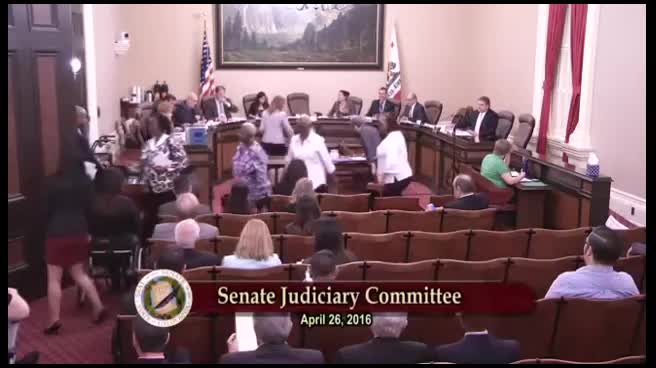
Bill Author

Bill Co-Author(s):