SB 1223: Driver’s licenses: provisional licenses.
- Session Year: 2015-2016
- House: Senate
- Latest Version Date: 2016-04-21
Existing law, the Brady-Jared Teen Driver Safety Act of 1997, establishes a provisional licensing program and generally requires that a drivers license issued to a person at least 16 years of age but under 18 years of age be issued pursuant to that provisional licensing program. During the first 12 months after issuance of a provisional license, existing law prohibits the licensee from driving between the hours of 11 p.m. and 5 a.m. and transporting passengers who are under 20 years of age, unless he or she is accompanied and supervised by a licensed driver, as specified, or a licensed or certified driving instructor. Existing law provides limited exceptions to these restrictions under which a licensee is authorized to drive under specified circumstances, including a schooling school or school-authorized activity or an employment necessity, and requires the licensee to keep certain supporting documentation in his or her possession. A violation of these provisions is punishable as an infraction.
This bill would expand the scope of the provisional licensing program by extending the applicable age range for the program from 16 to under 18 years of age to 16 to under 21 years of age. By expanding the scope of the provisional licensing program, the violation of which constitutes an infraction, the bill would impose a state-mandated local program. The bill would authorize a licensee who is 18, 19, or 20 years of age to keep in his or her possession a copy of his or her class schedule or work schedule as documentation to satisfy the exceptions for schooling a school or school-authorized activity and employment necessity, respectively, and would provide that a signed statement by a parent or legal guardian is not required if reasonable transportation facilities are inadequate and the operation of a vehicle by a licensee who is 18, 19, or 20 years of age is necessary to transport the licensee or the licensees immediate family member. The bill would make other technical and conforming changes.
The California Constitution requires the state to reimburse local agencies and school districts for certain costs mandated by the state. Statutory provisions establish procedures for making that reimbursement.
This bill would provide that no reimbursement is required by this act for a specified reason.
Existing law, the Brady-Jared Teen Driver Safety Act of 1997, establishes a provisional licensing program and generally requires that a drivers license issued to a person at least 16 years of age but under 18 years of age be issued pursuant to that provisional licensing program. During the first 12 months after issuance of a provisional license, existing law prohibits the licensee from driving between the hours of 11 p.m. and 5 a.m. and transporting passengers who are under 20 years of age, unless he or she is accompanied and supervised by a licensed driver, as specified, or a licensed or certified driving instructor. Existing law provides limited exceptions to these restrictions under which a licensee is authorized to drive under specified circumstances, including a schooling or school-authorized activity or an employment necessity, and requires the licensee to keep certain supporting documentation in his or her possession. A violation of these provisions is punishable as an infraction.
This bill would expand the scope of the provisional licensing program by extending the applicable age range for the program from 16 to under 18 years of age to 16 to under 21 years of age. By expanding the scope of the provisional licensing program, the violation of which constitutes an infraction, the bill would impose a state-mandated local program. The bill would authorize a licensee who is 18, 19, or 20 years of age to keep in his or her possession a copy of his or her class schedule or work schedule as documentation to satisfy the exceptions for schooling or school-authorized activity and employment necessity, respectively, and would provide that a signed statement by a parent or legal guardian is not required if reasonable transportation facilities are inadequate and the operation of a vehicle by a licensee who is 18, 19, or 20 years of age is necessary to transport the licensee or the licensees immediate family member. The bill would make other conforming changes.
The California Constitution requires the state to reimburse local agencies and school districts for certain costs mandated by the state. Statutory provisions establish procedures for making that reimbursement.
This bill would provide that no reimbursement is required by this act for a specified reason.
Existing law, the Brady-Jared Teen Driver Safety Act of 1997, permits a person who is at least 16 years of age, but under 18 years of age, to apply for and be issued a provisional drivers license. The act requires licensees to comply with certain requirements, including completing specified driver education and training, and imposes certain driving restrictions on licensees, including, among other restrictions, prohibiting licensees, during the first 12 months after issuance of the provisional license, from driving during the hours between 11 p.m. and 5 a.m., or transporting passengers who are under 20 years of age, except as specified. A violation of these driving restrictions is a crime.
Existing law makes it an infraction punishable by a base fine of $20 for a first offense and $50 for each subsequent offense for a person under 18 years of age to drive a motor vehicle while using a wireless telephone or an electronic wireless communication device, as specified.
This bill would require that the provisional drivers license and the accompanying restrictions imposed upon that license remain in effect until the driver reaches 18 years of age, if a minor who holds the provisional license is convicted of driving a motor vehicle while using a wireless telephone or an electronic wireless communication device, as specified. By expanding the scope of a crime, the bill would impose a state-mandated local program.
The California Constitution requires the state to reimburse local agencies and school districts for certain costs mandated by the state. Statutory provisions establish procedures for making that reimbursement.
This bill would provide that no reimbursement is required by this act for a specified reason.
(a)Except as provided in Section 12814.7, a drivers license issued to a person at least 16 years of age but under 21 years of age shall be issued pursuant to the provisional licensing program contained in this section. The program shall consist of all of the following components:
(1)Upon application for an original license, the applicant shall be issued an instruction permit pursuant to Section 12509. A person who has in his or her immediate possession a valid permit issued pursuant to Section 12509 may operate a motor vehicle, other than a motorcycle or motorized bicycle, only when the person is either taking the driver training instruction referred to in paragraph (3) or practicing that instruction, provided the person is accompanied by, and is under the immediate supervision of, a California licensed driver 25 years of age or older whose driving privilege is not on probation. The age requirement of this paragraph does not apply if the licensed driver is the parent, spouse, or guardian of the permitholder or is a licensed or certified driving instructor.
(2)The person shall hold an instruction permit for not less than six months prior to applying for a provisional drivers license.
(3)The person shall have complied with one of the following:
(A)Satisfactory completion of approved courses in automobile driver education and driver training maintained pursuant to provisions of the Education Code in any secondary school of California, or equivalent instruction in a secondary school of another state.
(B)Satisfactory completion of an integrated driver education and training program that is approved by the department and conducted by a driving instructor licensed under Chapter 1 (commencing with Section 11100) of Division 5. The program shall utilize segmented modules, whereby a portion of the educational instruction is provided by, and then reinforced through, specific behind-the-wheel training before moving to the next phase of driver education and training. The program shall contain a minimum of 30 hours of classroom instruction and six hours of behind-the-wheel training.
(C)Satisfactory completion of six hours or more of behind-the-wheel instruction by a driving school or an independent driving instructor licensed under Chapter 1 (commencing with Section 11100) of Division 5 and either an accredited course in automobile driver education in any secondary school of California pursuant to provisions of the Education Code or satisfactory completion of equivalent professional instruction acceptable to the department. To be acceptable to the department, the professional instruction shall meet minimum standards to be prescribed by the department, and the standards shall be at least equal to the requirements for driver education and driver training contained in the rules and regulations adopted by the State Board of Education pursuant to the Education Code. A person who has complied with this subparagraph shall not be required by the governing board of a school district to comply with subparagraph (A) in order to graduate from high school.
(D)Except as provided under subparagraph (B), a student shall not take driver training instruction, unless he or she has successfully completed driver education.
(4)The person shall complete 50 hours of supervised driving practice prior to the issuance of a provisional license, which is in addition to any other driver training instruction required by law. Not less than 10 of the required practice hours shall include driving during darkness, as defined in Section 280. Upon application for a provisional license, the person shall submit to the department the certification of a parent, spouse, guardian, or licensed or certified driving instructor that the applicant has completed the required amount of driving practice and is prepared to take the departments driving test. A person without a parent, spouse, guardian, or who is an emancipated minor, may have a licensed driver 25 years of age or older or a licensed or certified driving instructor complete the certification. This requirement does not apply to motorcycle practice.
(5)The person shall successfully complete an examination required by the department. Before retaking a test, the person shall wait for not less than one week after failure of the written test and for not less than two weeks after failure of the driving test.
(b)Except as provided in Section 12814.7, the provisional drivers license shall be subject to all of the following restrictions:
(1)Except as specified in paragraph (2), during the first 12 months after issuance of a provisional license the licensee shall not do any of the following unless accompanied and supervised by a licensed driver who is the licensees parent or guardian, a licensed driver who is 25 years of age or older, or a licensed or certified driving instructor:
(A)Drive between the hours of 11 p.m. and 5 a.m.
(B)Transport passengers who are under 20 years of age.
(2)A licensee may drive between the hours of 11 p.m. and 5 a.m. or transport an immediate family member without being accompanied and supervised by a licensed driver who is the licensees parent or guardian, a licensed driver who is 25 years of age or older, or a licensed or certified driving instructor, in the following circumstances:
(A)Medical necessity of the licensee when reasonable transportation facilities are inadequate and operation of a vehicle by a licensee is necessary. The licensee shall keep in his or her possession a signed statement from a physician familiar with the condition, containing a diagnosis and probable date when sufficient recovery will have been made to terminate the necessity.
(B)Schooling School or school-authorized activities of the licensee when reasonable transportation facilities are inadequate and operation of a vehicle by a licensee is necessary.
(i)The licensee shall keep in his or her possession a signed statement from the school principal, dean, or school staff member designated by the principal or dean, containing a probable date that the schooling school or school-authorized activity will have been completed.
(ii)A licensee who is 18, 19, or 20 years of age may keep in his or her possession a copy of his or her class schedule as documentation to satisfy clause (i).
(C)Employment necessity of the licensee when reasonable transportation facilities are inadequate and operation of a vehicle by a licensee is necessary.
(i)The licensee shall keep in his or her possession a signed statement from the employer, verifying employment and containing a probable date that the employment will have been completed.
(ii)A licensee who is 18, 19, or 20 years of age may keep in his or her possession a copy of his or her work schedule as documentation to satisfy clause (i).
(D)Necessity of the licensee or the licensees immediate family member when reasonable transportation facilities are inadequate and operation of a vehicle by a licensee is necessary to transport the licensee or the licensees immediate family member. The licensee shall keep in his or her possession a signed statement from a parent or legal guardian verifying the reason and containing a probable date that the necessity will have ceased. If reasonable transportation facilities are inadequate and operation of a vehicle by a licensee who is 18, 19, or 20 years of age is necessary to transport the licensee or the licensees immediate family member, a signed statement by a parent or legal guardian is not required.
(E)The licensee is an emancipated minor.
(c)A law enforcement officer shall not stop a vehicle for the sole purpose of determining whether the driver is in violation of the restrictions imposed under subdivision (b).
(d)A law enforcement officer shall not stop a vehicle for the sole purpose of determining whether a driver who is subject to the license restrictions in subdivision (b) is in violation of Article 2.5 (commencing with Section 118947) of Chapter 4 of Part 15 of Division 104 of the Health and Safety Code.
(e)(1)Upon a finding that any licensee has violated paragraph (1) of subdivision (b), the court shall impose one of the following:
(A)Not less than eight hours nor more than 16 hours of community service for a first offense and not less than 16 hours nor more than 24 hours of community service for a second or subsequent offense.
(B)A fine of not more than thirty-five dollars ($35) for a first offense and a fine of not more than fifty dollars ($50) for a second or subsequent offense.
(2)If the court orders community service, the court shall retain jurisdiction until the hours of community service have been completed.
(3)If the hours of community service have not been completed within 90 days, the court shall impose a fine of not more than thirty-five dollars ($35) for a first offense and not more than fifty dollars ($50) for a second or subsequent offense.
(f)A conviction of paragraph (1) of subdivision (b), when reported to the department, shall not be disclosed as otherwise specified in Section 1808 or constitute a violation point count value pursuant to Section 12810.
(g)Any term of restriction or suspension of the driving privilege imposed on a person pursuant to this subdivision shall remain in effect until the end of the term even though the person becomes 21 years of age before the term ends.
(1)The driving privilege shall be suspended when the record of the person shows one or more notifications issued pursuant to Section 40509 or 40509.5. The suspension shall continue until any notification issued pursuant to Section 40509 or 40509.5 has been cleared.
(2)A 30-day restriction shall be imposed when a drivers record shows a violation point count of two or more points in 12 months, as determined in accordance with Section 12810. The restriction shall require the licensee to be accompanied by a licensed parent, spouse, guardian, or other licensed driver 25 years of age or older, except when operating a class M vehicle, or so licensed, with no passengers aboard.
(3)A six-month suspension of the driving privilege and a one-year term of probation shall be imposed whenever a licensees record shows a violation point count of three or more points in 12 months, as determined in accordance with Section 12810. The terms and conditions of probation shall include, but not be limited to, both of the following:
(A)The person shall not violate any law that, if resulting in conviction, is reportable to the department under Section 1803.
(B)The person shall remain free from accident responsibility.
(h)Whenever action by the department under subdivision (g) arises as a result of a motor vehicle accident, the person may, in writing and within 10 days, demand a hearing to present evidence that he or she was not responsible for the accident upon which the action is based. Whenever action by the department is based upon a conviction reportable to the department under Section 1803, the person has no right to a hearing pursuant to Article 3 (commencing with Section 14100) of Chapter 3.
(i)The department shall require a person whose driving privilege is suspended or revoked pursuant to subdivision (g) to submit proof of financial responsibility as defined in Section 16430. The proof of financial responsibility shall be filed on or before the date of reinstatement following the suspension or revocation. The proof of financial responsibility shall be maintained with the department for three years following the date of reinstatement.
(j)(1)Notwithstanding any other provision of this code, the department may issue a distinctive drivers license, that displays a distinctive color or a distinctively colored stripe or other distinguishing characteristic, to persons at least 16 years of age and older but under 18 years of age, and to persons 18 years of age and older but under 21 years of age, so that the distinctive license feature is immediately recognizable. The features shall clearly differentiate between drivers licenses issued to persons at least 16 years of age or older but under 18 years of age and to persons 18 years of age or older but under 21 years of age.
(2)If changes in the format or appearance of drivers licenses are adopted pursuant to this subdivision, those changes may be implemented under any new contract for the production of drivers licenses entered into after the adoption of those changes.
(k)The department shall include, on the face of the provisional drivers license, the original issuance date of the provisional drivers license in addition to any other issuance date.
(l)This section shall be known and may be cited as the Brady-Jared Teen Driver Safety Act of 1997.
SEC. 2.No reimbursement is required by this act pursuant to Section 6 of Article XIIIB of the California Constitution because the only costs that may be incurred by a local agency or school district will be incurred because this act creates a new crime or infraction, eliminates a crime or infraction, or changes the penalty for a crime or infraction, within the meaning of Section 17556 of the Government Code, or changes the definition of a crime within the meaning of Section 6 of Article XIIIB of the California Constitution.
(a)Except as provided in Section 12814.7, a drivers license issued to a person at least 16 years of age but under 18 21 years of age shall be issued pursuant to the provisional licensing program contained in this section. The program shall consist of all of the following components:
(1)Upon application for an original license, the applicant shall be issued an instruction permit pursuant to Section 12509. A person who has in his or her immediate possession a valid permit issued pursuant to Section 12509 may operate a motor vehicle, other than a motorcycle or motorized bicycle, only when the person is either taking the driver training instruction referred to in paragraph (3) or practicing that instruction, provided the person is accompanied by, and is under the immediate supervision of, a California licensed driver 25 years of age or older whose driving privilege is not on probation. The age requirement of this paragraph does not apply if the licensed driver is the parent, spouse, or guardian of the permitholder or is a licensed or certified driving instructor.
(2)The person shall hold an instruction permit for not less than six months prior to applying for a provisional drivers license.
(3)The person shall have complied with one of the following:
(A)Satisfactory completion of approved courses in automobile driver education and driver training maintained pursuant to provisions of the Education Code in any secondary school of California, or equivalent instruction in a secondary school of another state.
(B)Satisfactory completion of an integrated driver education and training program that is approved by the department and conducted by a driving instructor licensed under Chapter 1 (commencing with Section 11100) of Division 5. The program shall utilize segmented modules, whereby a portion of the educational instruction is provided by, and then reinforced through, specific behind-the-wheel training before moving to the next phase of driver education and training. The program shall contain a minimum of 30 hours of classroom instruction and six hours of behind-the-wheel training.
(C)Satisfactory completion of six hours or more of behind-the-wheel instruction by a driving school or an independent driving instructor licensed under Chapter 1 (commencing with Section 11100) of Division 5 and either an accredited course in automobile driver education in any secondary school of California pursuant to provisions of the Education Code or satisfactory completion of equivalent professional instruction acceptable to the department. To be acceptable to the department, the professional instruction shall meet minimum standards to be prescribed by the department, and the standards shall be at least equal to the requirements for driver education and driver training contained in the rules and regulations adopted by the State Board of Education pursuant to the Education Code. A person who has complied with this subdivision subparagraph shall not be required by the governing board of a school district to comply with subparagraph (A) in order to graduate from high school.
(D)Except as provided under subparagraph (B), a student may shall not take driver training instruction, unless he or she has successfully completed driver education.
(4)The person shall complete 50 hours of supervised driving practice prior to the issuance of a provisional license, which is in addition to any other driver training instruction required by law. Not less than 10 of the required practice hours shall include driving during darkness, as defined in Section 280. Upon application for a provisional license, the person shall submit to the department the certification of a parent, spouse, guardian, or licensed or certified driving instructor that the applicant has completed the required amount of driving practice and is prepared to take the departments driving test. A person without a parent, spouse, guardian, or who is an emancipated minor, may have a licensed driver 25 years of age or older or a licensed or certified driving instructor complete the certification. This requirement does not apply to motorcycle practice.
(5)The person shall successfully complete an examination required by the department. Before retaking a test, the person shall wait for not less than one week after failure of the written test and for not less than two weeks after failure of the driving test.
(b)Except as provided in Section 12814.7, the provisional drivers license shall be subject to all of the following restrictions:
(1)Except as specified in paragraph (2), during the first 12 months after issuance of a provisional license the licensee may shall not do any of the following unless accompanied and supervised by a licensed driver who is the licensees parent or guardian, a licensed driver who is 25 years of age or older, or a licensed or certified driving instructor:
(A)Drive between the hours of 11 p.m. and 5 a.m.
(B)Transport passengers who are under 20 years of age.
(2)A licensee may drive between the hours of 11 p.m. and 5 a.m. or transport an immediate family member without being accompanied and supervised by a licensed driver who is the licensees parent or guardian, a licensed driver who is 25 years of age or older, or a licensed or certified driving instructor, in the following circumstances:
(A)Medical necessity of the licensee when reasonable transportation facilities are inadequate and operation of a vehicle by a minor licensee is necessary. The licensee shall keep in his or her possession a signed statement from a physician familiar with the condition, containing a diagnosis and probable date when sufficient recovery will have been made to terminate the necessity.
(B)Schooling or school-authorized activities of the licensee when reasonable transportation facilities are inadequate and operation of a vehicle by a licensee is necessary.
(B) Schooling or school-authorized activities of the licensee when reasonable transportation facilities are inadequate and operation of a vehicle by a minor is necessary. The
(i)The licensee shall keep in his or her possession a signed statement from the school principal, dean, or school staff member designated by the principal or dean, containing a probable date that the schooling or school-authorized activity will have been completed.
(ii)A licensee who is 18, 19, or 20 years of age may keep in his or her possession a copy of his or her class schedule as documentation to satisfy clause (i).
(C)Employment necessity of the licensee when reasonable transportation facilities are inadequate and operation of a vehicle by a licensee is necessary.
(C) Employment necessity of the licensee when reasonable transportation facilities are inadequate and operation of a vehicle by a minor is necessary. The
(i)The licensee shall keep in his or her possession a signed statement from the employer, verifying employment and containing a probable date that the employment will have been completed.
(ii)A licensee who is 18, 19, or 20 years of age may keep in his or her possession a copy of his or her work schedule as documentation to satisfy clause (i).
(D)Necessity of the licensee or the licensees immediate family member when reasonable transportation facilities are inadequate and operation of a vehicle by a minor licensee is necessary to transport the licensee or the licensees immediate family member. The licensee shall keep in his or her possession a signed statement from a parent or legal guardian verifying the reason and containing a probable date that the necessity will have ceased. If reasonable transportation facilities are inadequate and operation of a vehicle by a licensee who is 18, 19, or 20 years of age is necessary to transport the licensee or the licensees immediate family member, a signed statement by a parent or legal guardian is not required.
(E)The licensee is an emancipated minor.
(c)A law enforcement officer shall not stop a vehicle for the sole purpose of determining whether the driver is in violation of the restrictions imposed under subdivision (b).
(d)A law enforcement officer shall not stop a vehicle for the sole purpose of determining whether a driver who is subject to the license restrictions in subdivision (b) is in violation of Article 2.5 (commencing with Section 118947) of Chapter 4 of Part 15 of Division 104 of the Health and Safety Code.
(e)(1)Upon a finding that any licensee has violated paragraph (1) of subdivision (b), the court shall impose one of the following:
(A)Not less than eight hours nor more than 16 hours of community service for a first offense and not less than 16 hours nor more than 24 hours of community service for a second or subsequent offense.
(B)A fine of not more than thirty-five dollars ($35) for a first offense and a fine of not more than fifty dollars ($50) for a second or subsequent offense.
(2)If the court orders community service, the court shall retain jurisdiction until the hours of community service have been completed.
(3)If the hours of community service have not been completed within 90 days, the court shall impose a fine of not more than thirty-five dollars ($35) for a first offense and not more than fifty dollars ($50) for a second or subsequent offense.
(f)A conviction of paragraph (1) of subdivision (b), when reported to the department, may shall not be disclosed as otherwise specified in Section 1808 or constitute a violation point count value pursuant to Section 12810.
(g)Any term of restriction or suspension of the driving privilege imposed on a person pursuant to this subdivision shall remain in effect until the end of the term even though the person becomes 18 21 years of age before the term ends.
(1)The driving privilege shall be suspended when the record of the person shows one or more notifications issued pursuant to Section 40509 or 40509.5. The suspension shall continue until any notification issued pursuant to Section 40509 or 40509.5 has been cleared.
(2)A 30-day restriction shall be imposed when a drivers record shows a violation point count of two or more points in 12 months, as determined in accordance with Section 12810. The restriction shall require the licensee to be accompanied by a licensed parent, spouse, guardian, or other licensed driver 25 years of age or older, except when operating a class M vehicle, or so licensed, with no passengers aboard.
(3)A six-month suspension of the driving privilege and a one-year term of probation shall be imposed whenever a licensees record shows a violation point count of three or more points in 12 months, as determined in accordance with Section 12810. The terms and conditions of probation shall include, but not be limited to, both of the following:
(A)The person shall not violate no any law which, that, if resulting in conviction, is reportable to the department under Section 1803.
(B)The person shall remain free from accident responsibility.
(h)Whenever action by the department under subdivision (g) arises as a result of a motor vehicle accident, the person may, in writing and within 10 days, demand a hearing to present evidence that he or she was not responsible for the accident upon which the action is based. Whenever action by the department is based upon a conviction reportable to the department under Section 1803, the person has no right to a hearing pursuant to Article 3 (commencing with Section 14100) of Chapter 3.
(i)The department shall require a person whose driving privilege is suspended or revoked pursuant to subdivision (g) to submit proof of financial responsibility as defined in Section 16430. The proof of financial responsibility shall be filed on or before the date of reinstatement following the suspension or revocation. The proof of financial responsibility shall be maintained with the department for three years following the date of reinstatement.
(j)(1)Notwithstanding any other provision of this code, the department may issue a distinctive drivers license, that displays a distinctive color or a distinctively colored stripe or other distinguishing characteristic, to persons at least 16 years of age and older but under 18 years of age, and to persons 18 years of age and older but under 21 years of age, so that the distinctive license feature is immediately recognizable. The features shall clearly differentiate between drivers licenses issued to persons at least 16 years of age or older but under 18 years of age and to persons 18 years of age or older but under 21 years of age.
(2)If changes in the format or appearance of drivers licenses are adopted pursuant to this subdivision, those changes may be implemented under any new contract for the production of drivers licenses entered into after the adoption of those changes.
(k)The department shall include, on the face of the provisional drivers license, the original issuance date of the provisional drivers license in addition to any other issuance date.
(l)This section shall be known and may be cited as the Brady-Jared Teen Driver Safety Act of 1997.
SEC. 2.No reimbursement is required by this act pursuant to Section 6 of Article XIIIB of the California Constitution because the only costs that may be incurred by a local agency or school district will be incurred because this act creates a new crime or infraction, eliminates a crime or infraction, or changes the penalty for a crime or infraction, within the meaning of Section 17556 of the Government Code, or changes the definition of a crime within the meaning of Section 6 of Article XIIIB of the California Constitution.
SECTION 1.Section 12814.6 of the Vehicle Code is amended to read:12814.6.(a)Except as provided in Section 12814.7, a drivers license issued to a person at least 16 years of age, but under 18 years of age, shall be issued pursuant to the provisional licensing program contained in this section. The program shall consist of all of the following components:
(1)Upon application for an original license, the applicant shall be issued an instruction permit pursuant to Section 12509. A person who has in his or her immediate possession a valid permit issued pursuant to Section 12509 may operate a motor vehicle, other than a motorcycle or motorized bicycle, only when the person is either taking the driver training instruction referred to in paragraph (3) or practicing that instruction, provided the person is accompanied by, and is under the immediate supervision of, a California licensed driver 25 years of age or older whose driving privilege is not on probation. The age requirement of this paragraph does not apply if the licensed driver is the parent, spouse, or guardian of the permitholder or is a licensed or certified driving instructor.
(2)The person shall hold an instruction permit for not less than six months prior to applying for a provisional drivers license.
(3)The person shall have complied with one of the following:
(A)Satisfactory completion of approved courses in automobile driver education and driver training maintained pursuant to provisions of the Education Code in any secondary school of California, or equivalent instruction in a secondary school of another state.
(B)Satisfactory completion of an integrated driver education and training program that is approved by the department and conducted by a driving instructor licensed under Chapter 1 (commencing with Section 11100) of Division 5. The program shall utilize segmented modules, whereby a portion of the educational instruction is provided by, and then reinforced through, specific behind-the-wheel training before moving to the next phase of driver education and training. The program shall contain a minimum of 30 hours of classroom instruction and six hours of behind-the-wheel training.
(C)Satisfactory completion of six hours or more of behind-the-wheel instruction by a driving school or an independent driving instructor licensed under Chapter 1 (commencing with Section 11100) of Division 5 and either an accredited course in automobile driver education in any secondary school of California pursuant to provisions of the Education Code or satisfactory completion of equivalent professional instruction acceptable to the department. To be acceptable to the department, the professional instruction shall meet minimum standards to be prescribed by the department, and the standards shall be at least equal to the requirements for driver education and driver training contained in the rules and regulations adopted by the State Board of Education pursuant to the Education Code. A person who has complied with this subdivision shall not be required by the governing board of a school district to comply with subparagraph (A) in order to graduate from high school.
(D)Except as provided under subparagraph (B), a student may not take driver training instruction, unless he or she has successfully completed driver education.
(4)The person shall complete 50 hours of supervised driving practice prior to the issuance of a provisional license, which is in addition to any other driver training instruction required by law. Not less than 10 of the required practice hours shall include driving during darkness, as defined in Section 280. Upon application for a provisional license, the person shall submit to the department the certification of a parent, spouse, guardian, or licensed or certified driving instructor that the applicant has completed the required amount of driving practice and is prepared to take the departments driving test. A person without a parent, spouse, guardian, or who is an emancipated minor, may have a licensed driver 25 years of age or older or a licensed or certified driving instructor complete the certification. This requirement does not apply to motorcycle practice.
(5)The person shall successfully complete an examination required by the department. Before retaking a test, the person shall wait for not less than one week after failure of the written test and for not less than two weeks after failure of the driving test.
(b)Except as provided in Section 12814.7, the provisional drivers license shall be subject to all of the following restrictions:
(1)Except as specified in paragraph (2), during the first 12 months after issuance of a provisional license the licensee may not do any of the following unless accompanied and supervised by a licensed driver who is the licensees parent or guardian, a licensed driver who is 25 years of age or older, or a licensed or certified driving instructor:
(A)Drive between the hours of 11 p.m. and 5 a.m.
(B)Transport passengers who are under 20 years of age.
(2)A licensee may drive between the hours of 11 p.m. and 5 a.m. or transport an immediate family member without being accompanied and supervised by a licensed driver who is the licensees parent or guardian, a licensed driver who is 25 years of age or older, or a licensed or certified driving instructor, in the following circumstances:
(A)Medical necessity of the licensee when reasonable transportation facilities are inadequate and operation of a vehicle by a minor is necessary. The licensee shall keep in his or her possession a signed statement from a physician familiar with the condition, containing a diagnosis and probable date when sufficient recovery will have been made to terminate the necessity.
(B)Schooling or school-authorized activities of the licensee when reasonable transportation facilities are inadequate and operation of a vehicle by a minor is necessary. The licensee shall keep in his or her possession a signed statement from the school principal, dean, or school staff member designated by the principal or dean, containing a probable date that the schooling or school-authorized activity will have been completed.
(C)Employment necessity of the licensee when reasonable transportation facilities are inadequate and operation of a vehicle by a minor is necessary. The licensee shall keep in his or her possession a signed statement from the employer, verifying employment and containing a probable date that the employment will have been completed.
(D)Necessity of the licensee or the licensees immediate family member when reasonable transportation facilities are inadequate and operation of a vehicle by a minor is necessary to transport the licensee or the licensees immediate family member. The licensee shall keep in his or her possession a signed statement from a parent or legal guardian verifying the reason and containing a probable date that the necessity will have ceased.
(E)The licensee is an emancipated minor.
(3)If the person holds a provisional drivers license issued pursuant to this section, and he or she is convicted of violating Section 23124, the provisional license and its accompanying restrictions as described in this subdivision shall remain in effect until the person reaches 18 years of age, regardless of when the driver first received the provisional license. This paragraph does not affect, and shall not be interpreted to rescind or limit, the restriction or suspension of that license pursuant to any other law, including subdivision (g).
(c)A law enforcement officer shall not stop a vehicle for the sole purpose of determining whether the driver is in violation of the restrictions imposed under subdivision (b).
(d)A law enforcement officer shall not stop a vehicle for the sole purpose of determining whether a driver who is subject to the license restrictions in subdivision (b) is in violation of Article 2.5 (commencing with Section 118947) of Chapter 4 of Part 15 of Division 104 of the Health and Safety Code.
(e)(1)Upon a finding that any licensee has violated paragraph (1) of subdivision (b), the court shall impose one of the following:
(A)Not less than eight hours nor more than 16 hours of community service for a first offense and not less than 16 hours nor more than 24 hours of community service for a second or subsequent offense.
(B)A fine of not more than thirty-five dollars ($35) for a first offense and a fine of not more than fifty dollars ($50) for a second or subsequent offense.
(2)If the court orders community service, the court shall retain jurisdiction until the hours of community service have been completed.
(3)If the hours of community service have not been completed within 90 days, the court shall impose a fine of not more than thirty-five dollars ($35) for a first offense and not more than fifty dollars ($50) for a second or subsequent offense.
(f)A conviction of paragraph (1) of subdivision (b), when reported to the department, may not be disclosed as otherwise specified in Section 1808 or constitute a violation point count value pursuant to Section 12810.
(g)Any term of restriction or suspension of the driving privilege imposed on a person pursuant to this subdivision shall remain in effect until the end of the term even though the person becomes 18 years of age before the term ends.
(1)The driving privilege shall be suspended when the record of the person shows one or more notifications issued pursuant to Section 40509 or 40509.5. The suspension shall continue until any notification issued pursuant to Section 40509 or 40509.5 has been cleared.
(2)A 30-day restriction shall be imposed when a drivers record shows a violation point count of two or more points in 12 months, as determined in accordance with Section 12810. The restriction shall require the licensee to be accompanied by a licensed parent, spouse, guardian, or other licensed driver 25 years of age or older, except when operating a class M vehicle, or so licensed, with no passengers aboard.
(3)A six-month suspension of the driving privilege and a one-year term of probation shall be imposed whenever a licensees record shows a violation point count of three or more points in 12 months, as determined in accordance with Section 12810. The terms and conditions of probation shall include, but not be limited to, both of the following:
(A)The person shall not violate any law that, if resulting in conviction, is reportable to the department under Section 1803.
(B)The person shall remain free from accident responsibility.
(h)Whenever action by the department under subdivision (g) arises as a result of a motor vehicle accident, the person may, in writing and within 10 days, demand a hearing to present evidence that he or she was not responsible for the accident upon which the action is based. Whenever action by the department is based upon a conviction reportable to the department under Section 1803, the person has no right to a hearing pursuant to Article 3 (commencing with Section 14100) of Chapter 3.
(i)The department shall require a person whose driving privilege is suspended or revoked pursuant to subdivision (g) to submit proof of financial responsibility as defined in Section 16430. The proof of financial responsibility shall be filed on or before the date of reinstatement following the suspension or revocation. The proof of financial responsibility shall be maintained with the department for three years following the date of reinstatement.
(j)(1)Notwithstanding any other provision of this code, the department may issue a distinctive drivers license, that displays a distinctive color or a distinctively colored stripe or other distinguishing characteristic, to persons at least 16 years of age and older but under 18 years of age, and to persons 18 years of age and older but under 21 years of age, so that the distinctive license feature is immediately recognizable. The features shall clearly differentiate between drivers licenses issued to persons at least 16 years of age or older but under 18 years of age and to persons 18 years of age or older but under 21 years of age.
(2)If changes in the format or appearance of drivers licenses are adopted pursuant to this subdivision, those changes may be implemented under any new contract for the production of drivers licenses entered into after the adoption of those changes.
(k)The department shall include, on the face of the provisional drivers license, the original issuance date of the provisional drivers license in addition to any other issuance date.
(l)This section shall be known and may be cited as the Brady-Jared Teen Driver Safety Act of 1997.
SEC. 2.Section 23124 of the Vehicle Code is amended to read:23124.(a)This section applies to a person under 18 years of age.
(b)Notwithstanding Sections 23123 and 23123.5, a person described in subdivision (a) shall not drive a motor vehicle while using a wireless telephone or an electronic wireless communications device, even if equipped with a hands-free device.
(c)(1)A violation of this section is an infraction punishable by a base fine of twenty dollars ($20) for a first offense and fifty dollars ($50) for each subsequent offense.
(2)If the person holds a provisional drivers license issued pursuant to Section 12814.6, and he or she is convicted of violating this section, the provisional license and its accompanying restrictions shall remain in effect until the person reaches 18 years of age, regardless of when the driver first received the provisional license. This paragraph does not affect, and shall not be interpreted to rescind or limit, the restriction or suspension of that license pursuant to any other law, including subdivision (g) of Section 12814.6.
(d)A law enforcement officer shall not stop a vehicle for the sole purpose of determining whether the driver is violating subdivision (b).
(e)Subdivision (d) does not prohibit a law enforcement officer from stopping a vehicle for a violation of Section 23123 or 23123.5.
(f)This section does not apply to a person using a wireless telephone or a mobile service device for emergency purposes, including, but not limited to, an emergency call to a law enforcement agency, health care provider, fire department, or other emergency services agency or entity.
(g)For the purposes of this section, electronic wireless communications device includes, but is not limited to, a broadband personal communication device, specialized mobile radio device, handheld device or laptop computer with mobile data access, pager, and two-way messaging device.
SEC. 3.No reimbursement is required by this act pursuant to Section 6 of Article XIIIB of the California Constitution because the only costs that may be incurred by a local agency or school district will be incurred because this act creates a new crime or infraction, eliminates a crime or infraction, or changes the penalty for a crime or infraction, within the meaning of Section 17556 of the Government Code, or changes the definition of a crime within the meaning of Section 6 of Article XIIIB of the California Constitution.
(a)Except as provided in Section 12814.7, a drivers license issued to a person at least 16 years of age age, but under 18 years of age age, shall be issued pursuant to the provisional licensing program contained in this section. The program shall consist of all of the following components:
(1)Upon application for an original license, the applicant shall be issued an instruction permit pursuant to Section 12509. A person who has in his or her immediate possession a valid permit issued pursuant to Section 12509 may operate a motor vehicle, other than a motorcycle or motorized bicycle, only when the person is either taking the driver training instruction referred to in paragraph (3) or practicing that instruction, provided the person is accompanied by, and is under the immediate supervision of, a California licensed driver 25 years of age or older whose driving privilege is not on probation. The age requirement of this paragraph does not apply if the licensed driver is the parent, spouse, or guardian of the permitholder or is a licensed or certified driving instructor.
(2)The person shall hold an instruction permit for not less than six months prior to applying for a provisional drivers license.
(3)The person shall have complied with one of the following:
(A)Satisfactory completion of approved courses in automobile driver education and driver training maintained pursuant to provisions of the Education Code in any secondary school of California, or equivalent instruction in a secondary school of another state.
(B)Satisfactory completion of an integrated driver education and training program that is approved by the department and conducted by a driving instructor licensed under Chapter 1 (commencing with Section 11100) of Division 5. The program shall utilize segmented modules, whereby a portion of the educational instruction is provided by, and then reinforced through, specific behind-the-wheel training before moving to the next phase of driver education and training. The program shall contain a minimum of 30 hours of classroom instruction and six hours of behind-the-wheel training.
(C)Satisfactory completion of six hours or more of behind-the-wheel instruction by a driving school or an independent driving instructor licensed under Chapter 1 (commencing with Section 11100) of Division 5 and either an accredited course in automobile driver education in any secondary school of California pursuant to provisions of the Education Code or satisfactory completion of equivalent professional instruction acceptable to the department. To be acceptable to the department, the professional instruction shall meet minimum standards to be prescribed by the department, and the standards shall be at least equal to the requirements for driver education and driver training contained in the rules and regulations adopted by the State Board of Education pursuant to the Education Code. A person who has complied with this subdivision shall not be required by the governing board of a school district to comply with subparagraph (A) in order to graduate from high school.
(D)Except as provided under subparagraph (B), a student may not take driver training instruction, unless he or she has successfully completed driver education.
(4)The person shall complete 50 hours of supervised driving practice prior to the issuance of a provisional license, which is in addition to any other driver training instruction required by law. Not less than 10 of the required practice hours shall include driving during darkness, as defined in Section 280. Upon application for a provisional license, the person shall submit to the department the certification of a parent, spouse, guardian, or licensed or certified driving instructor that the applicant has completed the required amount of driving practice and is prepared to take the departments driving test. A person without a parent, spouse, guardian, or who is an emancipated minor, may have a licensed driver 25 years of age or older or a licensed or certified driving instructor complete the certification. This requirement does not apply to motorcycle practice.
(5)The person shall successfully complete an examination required by the department. Before retaking a test, the person shall wait for not less than one week after failure of the written test and for not less than two weeks after failure of the driving test.
(b)Except as provided in Section 12814.7, the provisional drivers license shall be subject to all of the following restrictions:
(1)Except as specified in paragraph (2), during the first 12 months after issuance of a provisional license the licensee may not do any of the following unless accompanied and supervised by a licensed driver who is the licensees parent or guardian, a licensed driver who is 25 years of age or older, or a licensed or certified driving instructor:
(A)Drive between the hours of 11 p.m. and 5 a.m.
(B)Transport passengers who are under 20 years of age.
(2)A licensee may drive between the hours of 11 p.m. and 5 a.m. or transport an immediate family member without being accompanied and supervised by a licensed driver who is the licensees parent or guardian, a licensed driver who is 25 years of age or older, or a licensed or certified driving instructor, in the following circumstances:
(A)Medical necessity of the licensee when reasonable transportation facilities are inadequate and operation of a vehicle by a minor is necessary. The licensee shall keep in his or her possession a signed statement from a physician familiar with the condition, containing a diagnosis and probable date when sufficient recovery will have been made to terminate the necessity.
(B)Schooling or school-authorized activities of the licensee when reasonable transportation facilities are inadequate and operation of a vehicle by a minor is necessary. The licensee shall keep in his or her possession a signed statement from the school principal, dean, or school staff member designated by the principal or dean, containing a probable date that the schooling or school-authorized activity will have been completed.
(C)Employment necessity of the licensee when reasonable transportation facilities are inadequate and operation of a vehicle by a minor is necessary. The licensee shall keep in his or her possession a signed statement from the employer, verifying employment and containing a probable date that the employment will have been completed.
(D)Necessity of the licensee or the licensees immediate family member when reasonable transportation facilities are inadequate and operation of a vehicle by a minor is necessary to transport the licensee or the licensees immediate family member. The licensee shall keep in his or her possession a signed statement from a parent or legal guardian verifying the reason and containing a probable date that the necessity will have ceased.
(E)The licensee is an emancipated minor.
(3)If the person holds a provisional drivers license issued pursuant to this section, and he or she is convicted of violating Section 23124, the provisional license and its accompanying restrictions as described in this subdivision shall remain in effect until the person reaches 18 years of age, regardless of when the driver first received the provisional license. This paragraph does not affect, and shall not be interpreted to rescind or limit, the restriction or suspension of that license pursuant to any other law, including subdivision (g).
(c)A law enforcement officer shall not stop a vehicle for the sole purpose of determining whether the driver is in violation of the restrictions imposed under subdivision (b).
(d)A law enforcement officer shall not stop a vehicle for the sole purpose of determining whether a driver who is subject to the license restrictions in subdivision (b) is in violation of Article 2.5 (commencing with Section 118947) of Chapter 4 of Part 15 of Division 104 of the Health and Safety Code.
(e)(1)Upon a finding that any licensee has violated paragraph (1) of subdivision (b), the court shall impose one of the following:
(A)Not less than eight hours nor more than 16 hours of community service for a first offense and not less than 16 hours nor more than 24 hours of community service for a second or subsequent offense.
(B)A fine of not more than thirty-five dollars ($35) for a first offense and a fine of not more than fifty dollars ($50) for a second or subsequent offense.
(2)If the court orders community service, the court shall retain jurisdiction until the hours of community service have been completed.
(3)If the hours of community service have not been completed within 90 days, the court shall impose a fine of not more than thirty-five dollars ($35) for a first offense and not more than fifty dollars ($50) for a second or subsequent offense.
(f)A conviction of paragraph (1) of subdivision (b), when reported to the department, may not be disclosed as otherwise specified in Section 1808 or constitute a violation point count value pursuant to Section 12810.
(g)Any term of restriction or suspension of the driving privilege imposed on a person pursuant to this subdivision shall remain in effect until the end of the term even though the person becomes 18 years of age before the term ends.
(1)The driving privilege shall be suspended when the record of the person shows one or more notifications issued pursuant to Section 40509 or 40509.5. The suspension shall continue until any notification issued pursuant to Section 40509 or 40509.5 has been cleared.
(2)A 30-day restriction shall be imposed when a drivers record shows a violation point count of two or more points in 12 months, as determined in accordance with Section 12810. The restriction shall require the licensee to be accompanied by a licensed parent, spouse, guardian, or other licensed driver 25 years of age or older, except when operating a class M vehicle, or so licensed, with no passengers aboard.
(3)A six-month suspension of the driving privilege and a one-year term of probation shall be imposed whenever a licensees record shows a violation point count of three or more points in 12 months, as determined in accordance with Section 12810. The terms and conditions of probation shall include, but not be limited to, both of the following:
(A)The person shall not violate no law which, any law that, if resulting in conviction, is reportable to the department under Section 1803.
(B)The person shall remain free from accident responsibility.
(h)Whenever action by the department under subdivision (g) arises as a result of a motor vehicle accident, the person may, in writing and within 10 days, demand a hearing to present evidence that he or she was not responsible for the accident upon which the action is based. Whenever action by the department is based upon a conviction reportable to the department under Section 1803, the person has no right to a hearing pursuant to Article 3 (commencing with Section 14100) of Chapter 3.
(i)The department shall require a person whose driving privilege is suspended or revoked pursuant to subdivision (g) to submit proof of financial responsibility as defined in Section 16430. The proof of financial responsibility shall be filed on or before the date of reinstatement following the suspension or revocation. The proof of financial responsibility shall be maintained with the department for three years following the date of reinstatement.
(j)(1)Notwithstanding any other provision of this code, the department may issue a distinctive drivers license, that displays a distinctive color or a distinctively colored stripe or other distinguishing characteristic, to persons at least 16 years of age and older but under 18 years of age, and to persons 18 years of age and older but under 21 years of age, so that the distinctive license feature is immediately recognizable. The features shall clearly differentiate between drivers licenses issued to persons at least 16 years of age or older but under 18 years of age and to persons 18 years of age or older but under 21 years of age.
(2)If changes in the format or appearance of drivers licenses are adopted pursuant to this subdivision, those changes may be implemented under any new contract for the production of drivers licenses entered into after the adoption of those changes.
(k)The department shall include, on the face of the provisional drivers license, the original issuance date of the provisional drivers license in addition to any other issuance date.
(l)This section shall be known and may be cited as the Brady-Jared Teen Driver Safety Act of 1997.
SEC. 2.Section 23124 of the Vehicle Code is amended to read:23124.(a)This section applies to a person under the age of 18 years. 18 years of age.
(b)Notwithstanding Sections 23123 and 23123.5, a person described in subdivision (a) shall not drive a motor vehicle while using a wireless telephone or an electronic wireless communications device, even if equipped with a hands-free device.
(c)(1)A violation of this section is an infraction punishable by a base fine of twenty dollars ($20) for a first offense and fifty dollars ($50) for each subsequent offense.
(2)If the person holds a provisional drivers license issued pursuant to Section 12814.6, and he or she is convicted of violating this section, the provisional license and its accompanying restrictions shall remain in effect until the person reaches 18 years of age, regardless of when the driver first received the provisional license. This paragraph does not affect, and shall not be interpreted to rescind or limit, the restriction or suspension of that license pursuant to any other law, including subdivision (g) of Section 12814.6.
(d)A law enforcement officer shall not stop a vehicle for the sole purpose of determining whether the driver is violating subdivision (b).
(e)Subdivision (d) does not prohibit a law enforcement officer from stopping a vehicle for a violation of Section 23123 or 23123.5.
(f)This section does not apply to a person using a wireless telephone or a mobile service device for emergency purposes, including, but not limited to, an emergency call to a law enforcement agency, health care provider, fire department, or other emergency services agency or entity.
(g)For the purposes of this section, electronic wireless communications device includes, but is not limited to, a broadband personal communication device, specialized mobile radio device, handheld device or laptop computer with mobile data access, pager, and two-way messaging device.
SEC. 3.No reimbursement is required by this act pursuant to Section 6 of Article XIIIB of the California Constitution because the only costs that may be incurred by a local agency or school district will be incurred because this act creates a new crime or infraction, eliminates a crime or infraction, or changes the penalty for a crime or infraction, within the meaning of Section 17556 of the Government Code, or changes the definition of a crime within the meaning of Section 6 of Article XIIIB of the California Constitution.
|
Date
|
Status
|
|---|---|
| Feb 18, 2016 | Introduced. Read first time. To Com. on RLS. for assignment. To print. |
| Feb 19, 2016 | From printer. May be acted upon on or after March 20. |
| Mar 3, 2016 | Referred to Com. on T. & H. |
| Mar 24, 2016 | Set for hearing April 19. |
| Mar 28, 2016 | From committee with author's amendments. Read second time and amended. Re-referred to Com. on T. & H. |
| Apr 20, 2016 | From committee: Do pass and re-refer to Com. on APPR. (Ayes 10. Noes 0. Page 3616.) (April 19). Re-referred to Com. on APPR. |
| Apr 20, 2016 | From committee: Do pass and re-refer to Com. on APPR. (Ayes 10. Noes 0.) (April 19). Re-referred to Com. on APPR. |
| Apr 21, 2016 | From committee with author's amendments. Read second time and amended. Re-referred to Com. on APPR. |
| Apr 22, 2016 | Set for hearing May 2. |
| Apr 26, 2016 | May 2 set for first hearing canceled at the request of author. |
| May 6, 2016 | Set for hearing May 16. |
| May 16, 2016 | May 16 hearing: Placed on APPR. suspense file. (Ayes 7. Noes 0.) |
| May 20, 2016 | Set for hearing May 27. |
| May 27, 2016 | May 27 hearing: Held in committee and under submission. |
|
Date
|
Description
|
Location
|
Votes
|
|
|---|---|---|---|---|
| May 16, 2016 | Placed on suspense file | Senate Standing Committee on Appropriations |
Passed |
|
| Apr 19, 2016 | Do pass, but first be re-referred to the Committee on [Appropriations] | Senate Standing Committee on Transportation and Housing |
Passed |
This list shows positions taken on this bill by organizations on the date displayed, which is linked to the original source.
Positions by individuals are not included.
|
Organization
|
Position
|
Date
|
|---|---|---|
| California Association Of Highway Patrolmen | * Support | Apr 19, 2016 |
| California Casualty | ** Support | Apr 19, 2016 |
| California Unintentional Injury Strategic Plan Projecy | * Support | Apr 19, 2016 |
| Impact Teen Drivers | * Support | Apr 19, 2016 |
| Impact Ten Drivers | * Support | Apr 19, 2016 |
| National Safety Council | ** Support | Apr 19, 2016 |
SENATE COMMITTEE ON APPROPRIATIONS
Senator Ricardo Lara, Chair
2015 - 2016 Regular Session
SB 1223 (Huff) - Driver’s licenses: provisional licenses
Version: April 21, 2016 | Policy Vote: T. & H. 10 - 0 |
Urgency: No | Mandate: Yes |
Hearing Date: May 16, 2016 | Consultant: Mark McKenzie |
This bill meets the criteria for referral to the Suspense File.
Bill Summary:
SB 1223 would expand the applicability of the provisional driver’s license program to new drivers under the age of 21, as specified.
Fiscal Impact:
- One-time Department of Motor Vehicles (DMV) implementation costs in 2016-17, likely exceeding $350,000. (Motor Vehicle Account)
Background:
Existing law provides for a graduated driver’s licensing structure and provisional driver’s license program that restricts the driving privileges of young drivers under the age of 18 in light of their operating inexperience. Prior to applying for a provisional license, a person at least 15-1/2 years of age may apply for an instructional permit. A young driver must hold the instructional permit for at least six months, complete specified driver training instruction, document 50 hours of supervised driving practice, including at least 10 hours of driving during darkness, and successfully complete DMV’s examination requirements prior to applying for a provisional license.
During the first 12 months following issuance of a provisional license to a person between the ages of 16 and 18, the licensee is prohibited from driving between 11 p.m. and 5 a.m. and transporting passengers under the age of 20, unless accompanied by a parent, driving instructor, or a licensed driver who is at least 25 years old. Existing law provides exceptions to these restrictions and requirements in cases of medical necessity, school activities, employment necessity, and transporting immediate family members, as specified. A provisional licensee must be in possession of certain signed documentation when driving under one of those exceptions.
Existing law authorizes a person who is 18 years of age or older to apply for an original driver’s license by passing a traffic laws and signs test, among other requirements. There are no graduated driving requirements or provisional restrictions on a person who initially applies for a driver’s license at age 18 or older.
Proposed Law:
SB 1223 would extend the requirements of the provisional driver’s license program to drivers under the age of 21, rather than to drivers under the age of 18. The bill also authorizes a provisional licensee who is 18-20 years old to drive an immediate family member without a signed statement from a parent or legal guardian, and to use the following alternative documentation to drive under restricted circumstances:
- A copy of a class schedule as documentation to authorize driving for school or school-authorized activities
- A copy of a work schedule as documentation to authorize driving for employment necessity.
Related Legislation:
AB 235 (Frazier), which was held on this Committee’s Suspense File last year, would have required provisional driver’s license restrictions to remain in effect until the end of the provisional period at age 18, instead of 12 months after issuance of the provisional license. AB 1801 (Frazier), an identical bill to AB 235, was held on the Assembly Appropriations Committee’s Suspense File in 2014.
AB 724 (Cooley), which was held on the Assembly Appropriations Committee’s Suspense File in 2013, would have extended provisional driver’s license requirements to those under the age of 20.
Staff Comments:
This bill is intended to reduce the incidence of traffic fatalities and accidents caused by young and inexperienced drivers by applying a graduated driver’s licensing structure and 12-month restricted driving period to all new drivers under the age of 21. An increasing number of teens wait until they are 18 or older to obtain a driver’s license, which means they are not subject to the mandatory driver’s training or restricted driving requirements of the provisional driver’s license program. Existing data indicates that young drivers without provisional driver’s license training have a much higher crash rate than those who undergo a graduated driver’s licensing structure.
Implementation of the bill would require DMV to make programming changes to revise the applicability of provisional restrictions, and make necessary updates to informational brochures, handbooks, and DMV’s website. One-time costs to perform these tasks are expected to exceed $350,000.
Staff notes that DMV has a significant programming backlog of federal and state mandates. These include federally-mandated changes to the Commercial Driver License System, compliance with which is tied to federal transportation funding, and state mandates such as the recent implementation of AB 60 (Chapter 524/2014), which allows for the issuance of driver’s licenses for those without documentation proving legal presence, and AB 1461 (Chapter 729/2015), which provides for automatic voter registration through the DMV, in addition to other recently-enacted legislation. Given the current backlog, it is unlikely that DMV would be able to complete the programming necessary to implement this bill by the January 1, 2017 operative date without impacting currently scheduled programming priorities.
-- END --
SENATE COMMITTEE ON TRANSPORTATION AND HOUSING
Senator Jim Beall, Chair
2015 - 2016 Regular
Bill No: SB 1223 Hearing Date: 4/19/2016
Author: | Huff | ||
Version: | 3/28/2016 | ||
Urgency: | No | Fiscal: | Yes |
Consultant: | Erin Riches | ||
SUBJECT: Driver’s licenses: provisional licenses
DIGEST: This bill expands the provisional driver’s license period from 18 to 21 years of age.
ANALYSIS:
Existing law:
- Establishes a provisional driver’s license program for individuals between 16 and 18 years of age.
- Provides that prior to issuing a provisional license, the Department of Motor Vehicles (DMV) shall issue an instruction permit, commonly known as a learner’s permit. An individual must be at least 15 years and six months old to apply for a learner’s permit, and must have taken, or be enrolled in, driver education and training classes. The learner’s permit authorizes the holder to operate a motor vehicle only when he or she is either taking a driver training class or is practicing under the immediate supervision of a California licensed driver 25 years or older.
- Prohibits a learner’s permit holder from applying for a provisional driver’s license until he or she has held the permit for at least six months. Requires a permit holder, prior to applying for a provisional license, to successfully complete driver education and training classes; at least six hours of behind-the-wheel training; 50 hours of supervised driving practice, including at least 10 hours of nighttime driving; and an exam required by DMV.
- Prohibits, during the first 12 months, a provisional licensee from driving between the hours of 11 p.m. and 5 a.m. or from transporting passengers who are under 20 years old, unless accompanied by the provisional license holder’s parent or guardian, a licensed driver who is 25 years or older, or a licensed and certified driving instructor. Provides exceptions for medical necessity, school activities, job necessity, need to transport an immediate family member, or if the licensee is an emancipated minor.
- Requires a provisional licensee who needs to drive under one of the exceptions listed above to keep in his or her possession the appropriate document, as follows:
- Medical necessity exception: a signed statement from a physician.
- School activity exception: a signed statement from the school principal, dean, or school staff member designated by the principal or dean.
- Employment exception: a signed statement from the employer.
- Family member exception: a signed statement from a parent or legal guardian.
- Allows an individual 18 years or older to apply for an original driver’s license by passing a traffic laws and signs test, among other requirements. Provides that an individual 18 years or older who holds a learner’s permit must be accompanied by another individual 18 years or older when practicing driving. Provides that this individual may schedule a driving test at DMV at any time once he or she has obtained the learner’s permit.
This bill:
- Expands the provisional driver’s license program from 18 years of age to 21 years of age.
- Authorizes a provisional licensee who is 18-20 years old to use a copy of his or her class schedule to document the school activity exception.
- Authorizes a provisional licensee who is 18-20 years old to use a copy of his or her work schedule to document the employment exception.
- Waives the requirement for a provisional licensee who is 18-20 years of age to document the family member exception.
COMMENTS:
- Purpose. The author states that because the provisional driver’s license program only applies to 16 -to18-year-olds, teenagers are simply opting to wait until their 18th birthday to obtain their driver’s license. The author cites a study based on DMV data showing that crash rates are significantly higher for individuals licensed at 18 years of age, i.e., avoiding the provisional driver’s license program, than for individuals licensed at 16 or 17. The author also points to the California Unintentional Injury Prevention Strategic Plan, which cites vehicle crashes — particularly teen driver-caused crashes — as a leading cause of childhood death and hospitalization. In addition, data from the U.S. Centers for Disease Control and Prevention and the Insurance Institute for Highway Safety show that teen drivers without provisional driver’s license training have a 20% to 40% higher crash rate than teens who do complete the program. The author states that moving the age to 21 is a practical and proven method of addressing this part of the overall California child and youth unintentional injury prevention effort.
- Background: California’s GDL system. Prior to 1998, California law allowed teenagers aged 16 to 18 years to obtain a learner’s permit or provisional driver’s license with only minimal restrictions, such as requiring an individual to hold a permit for at least 30 days before applying for a provisional license. SB 1329 (Leslie, Chapter 760, Statutes of 1997) enacted the state’s initial graduated driver’s licensing (GDL) system, including the six-month learner’s permit period, nighttime driving ban, and supervised driving provisions. AB 1747 (Maze, Chapter 337, Statutes of 2005) extended the ban on nighttime driving and on transporting passengers under 20 years of age to 12 months. It also expanded the nighttime ban by one hour. All states have had some form of GDL restrictions since the mid-1990s.
- Making it more difficult for older teens to work or go to school? By increasing the GDL requirements to 21, this bill could make it more difficult for 18 to20-year-olds to work and/or attend school. To address this concern, this bill provides less stringent requirements on documentation for 18 to 20-year-olds relating to school and work activities, as well as waiving the requirement to document the need to transport an immediate family member.
- Teen drivers a shrinking demographic. Recent data published by the Federal Highway Administration indicates that the number of young drivers in the U.S. has hit an all-time low. In 2014, roughly 8.5 million people aged 19 and younger had a driver’s license, and of those, only about a million were 16 and younger — the lowest number since the 1960s. This drop may be attributable to a variety of reasons, including the recession (e.g., less disposable income), the Internet (e.g., communicating via social media and shopping online), and shifting attitudes. In addition, most high schools no longer offer driver education and driver training as part of the curriculum, and teens must instead pay to take these courses, which may be difficult to fit into busy schedules.
- Will teens simply put off their license until 21? According to the Insurance Institute for Highway Safety, the fatal crash rate per mile driven for 16 to 17-year-olds is nearly twice as high as it is for 18 to19-year-olds. This could mean that these young drivers are less safe than older drivers, or that GDL programs are working: crash rates are higher for novice drivers than for “trained” drivers. By the same token, however, extending the provisional driver’s license period to 21 could encourage teens to wait even longer to obtain a driver’s license —resulting in even more “untrained” drivers on California’s roads. The sponsor of this bill, Impact Teen Drivers, notes that research indicates that risk-taking decreases significantly, and decision-making improves significantly, when individuals reach their 20s; they note that the Center for Disease Control and Prevention crash data indicates lower crash rates for novice drivers in their 20s than for novice drivers in their teens. In addition, the author notes that extending the provisional license program to 21 makes it difficult for a teen to simply put off obtaining a license, as the need to be able to drive oneself increases after an individual graduates from high school and heads to college, obtains a full-time job, etc.
Related Legislation:
SCR 69 (Galgiani) —requests the DMV to conduct a study regarding the possible effects of reducing the minimum age for a learner’s permit to 15 years of age. This bill is also being heard in the Senate Transportation and Housing committee today.
AB 2322 (Chu) — requires DMV to provide the recipient of a learner’s permit with a removable and transferrable decal that reads “student driver” and authorizes the permit holder to display the decal on the side or rear window of the vehicle when driving. This bill is pending in the Assembly Transportation Committee.
AB 235 (Frazier, 2015) —would have expanded restrictions on driving for provisional licensees from the first 12 months to the entire period of the provisional license. This bill was passed by the Senate Transportation and Housing committee on a 10-1 vote but was subsequently held on the Senate Appropriations Committee suspense file.
AB 1801 (Frazier, 2014) —would have expanded restrictions on driving for provisional licensees until age 18. This bill was held on the Assembly Appropriations Committee suspense file.
AB 1113 (Frazier, 2013) — would have expanded restrictions on driving for provisional licensees, including a three-month increase in the minimum time an individual must hold a learner’s permit before applying for a driver’s license, increasing the age of passengers a provisional licensee could transport, expanding nighttime driving restrictions, and prohibiting DMV from issuing a provisional license or full license to a driver who does not have a six-month period of conviction-free driving. This bill was passed by the Senate Transportation and Housing committee on an 11-0 vote but was subsequently vetoed by Governor Brown.
AB 724 (Cooley, 2013) — would have extended the provisional driver’s license requirements to those under age 20 instead of those under age 18. This bill was held on the Assembly Appropriations Committee suspense file.
FISCAL EFFECT: Appropriation: Fiscal Com.: Local:
POSITIONS: (Communicated to the committee before noon on Wednesday,
April 13, 2016.)
SUPPORT:
California Association of Highway Patrolmen (co-sponsor)
Impact Teen Drivers (co-sponsor)
California Casualty
National Safety Council
OPPOSITION:
None received
-- END --
Discussed in Hearing
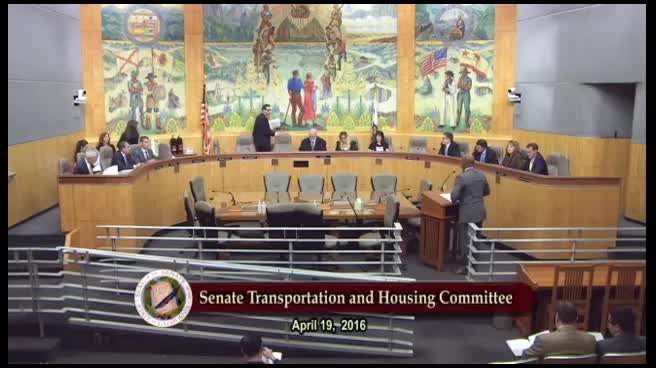 17MIN
Senate Standing Committee on Transportation and Housing
Bill Author